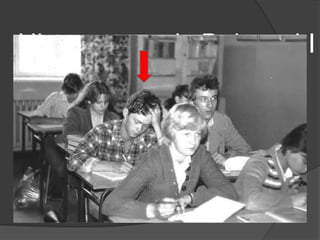
4. Modernist Paradigm Originated in 20th Century when life in Western civilization was characterized by capitalism, rationalism, individualism and a move towards secular culture. (English, p.36) Social progress was tied closely to the dynamics of capitalistic production and economic growth.(Giroux, 1997) Science and technology were intrinsically good and “served as the drivers of society’s engines.” (Starratt, 2003)
5. Scientific Management a.k.aTaylorism Taylor believed that…. There is only one best way to accomplish a job. Administration “can be reduced to replication of behaviors that are proven to be effective and efficient” (English, p.34) “Principles of Scientific Management “ Frederic W. Taylor 1911.
6. Scientific Management a.k.aTaylorism Manager ‘s role is to discover the best way to accomplish the job with the least number of body motions. Results of worker’s labor can always be predicted and quantified. Administrator’s role is to: Clearly delineate the necessary steps Provide training Monitor process of implementation Use hard data to evaluate efficiency and effectiveness
7. Scientific Management a.k.aTaylorism Taylorism provided extremely mechanized way to standardize the workplace (Foster, 1986) Valued organizational goals more than it valued the interests and needs of the people. Bureaucracy was firmly established through a clear delineation of managers’ and workers’ responsibilities (English p.35)
8. According to the Scientific Management the role of the worker is to…
12. Scientific Management Supervisor most likely believed that… Those in position of power had intellectual superiority. Subordinates had no internal motivation and were only motivated by money. Workers didn’t have intellectual ability to do their job without very close supervision and monitoring.
13. Scientific Managementapplied to schools Focused on measuring efficiency in the production of schools’ products a.k.a. children Assumed that human endeavors are always linear, rational, predictable and consistent. Followed three principles: Preference for sanitized language avoidance of expressing anything that is perceived to be uncomfortable or offensive Logical Rigor consistency and predictability Value Neutrality refusal to acknowledge bias
14. Causes of opposition to Modernist Paradigm and Scientific Management It was seen as imperialistic It resonated with notions of class, gender and race domination. It was a catalyst of alienation of individuals Resulted in domination of the individual by bureaucracy
15. Progression to Moral Leadership in Education Since “schools serve as spaces for social reproduction”(English p.39) two questions can be asked Should they solidify the Status Quo? Should they bring about change?
16. The Choice is Clear “The only constant is change, continuing change, inevitable change, that is the dominant factor in society today. No sensible decision can be made any longer without taking into account not only the world as it is, but the world as it will be.” (Isaac Asimov)
18. Meaning, Purpose and Ethical Leadership Thoughts and Ideas Having meaning in our lives ties our behavior to a purpose. What is the reason for our existence? Educational Leadership is not the mechanism to perpetuate commerce. What is the product of our work? Schools are no longer places for merely academic pursuit. What do we need to pursue? Schools are places where human imagination and creativity can be used to re-create our world. What would that world be like? Schools are places of struggle between the status quo and fabrication of a different existence. What existence would that be?
19. Essential Questions for Ethical Leaders How are society and culture reproduced through schooling? Why underclass children often become underclass parents? Why can’t schools break the cycle of class reproduction? How is a culture of sexism and violence perpetuated?
20. Moral Leaders are… Purpose Driven Cognizant of the prevailing cultural issues inside and outside the school Provide a critical voice addressing the meaning behind: racial profiling, violence and drug trafficking Go beyond academics Are at the forefront of societal accountability and responsibility.
21. Moral Leaders Self-Reflect Carefully examine values, attitudes, assumptions and predispositions covering a whole host of issues. Unearth areas of dissonance that may exist between their demonstrated behaviors and internal assumptions. Wrestle with how schools and their administration potentially perpetuate racial and class divides. Examine and question the relevance of operating norms.
22. Questions for Discussion As more and more of us agree that our schools must go through radical changes, in order to prepare our students, teachers and administrators for the 21st Century, to what degree, the “legacy” of scientific management will be slowing us down? “When I visit your school, I want to see all students learning the same content and I want to see all teachers teach the same way.” “My students will not learn unless I spell out exactly what I want them to do, say or think step by step” What essential questions will moral leaders be asking themselves in the 21st century that they did not have to ask before?