
EXPLORE THE MAGIC OF USING
VIRTUAL WORLDS AS AN INNOVATIVE
TEACHING/LEARNING STRATEGY FOR
HEALTHCARE PROFESSIONALS
  Jone Tiffany DNP, MA, RNC-OB
  Jane McKinley RN, ADN
  Wade Schuette BA, MBA, MPH
  Evelyn McElhinney MSc, RN,
  Stephanie Stewart, PhD MSN,RN
  Tom Berthold BSN, RN
  Dawn Pope APNP, RN


                  IMSH 2013 | Orlando, Florida
Disclosure(s)
       We Have Nothing to Disclose
1
Learning Objectives
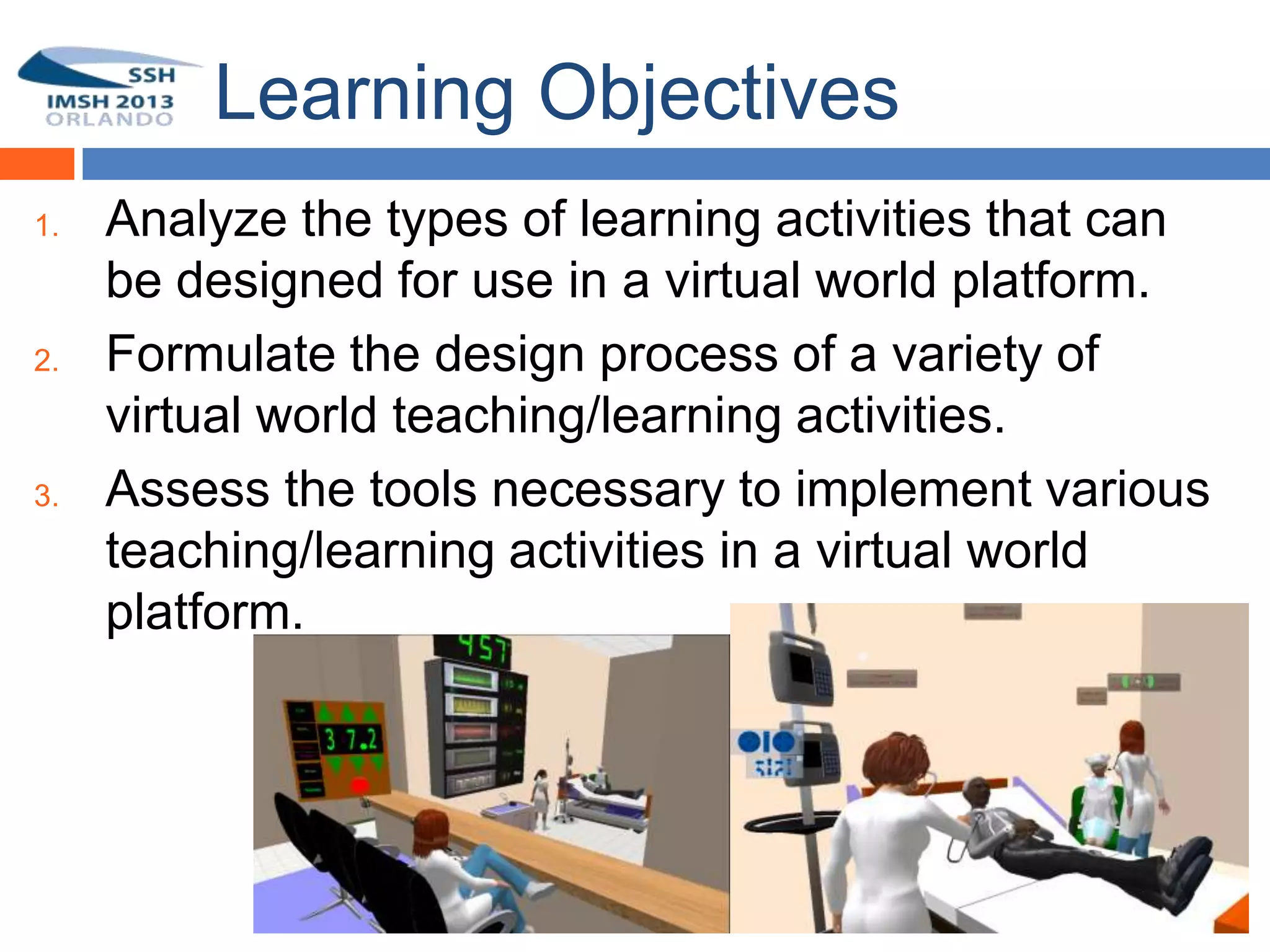
1.   Analyze the types of learning activities that can
 3
     be designed for use in a virtual world platform.
2.   Formulate the design process of a variety of
     virtual world teaching/learning activities.
3.   Assess the tools necessary to implement various
     teaching/learning activities in a virtual world
     platform.
Video Introduction
Virtual Reality Technology

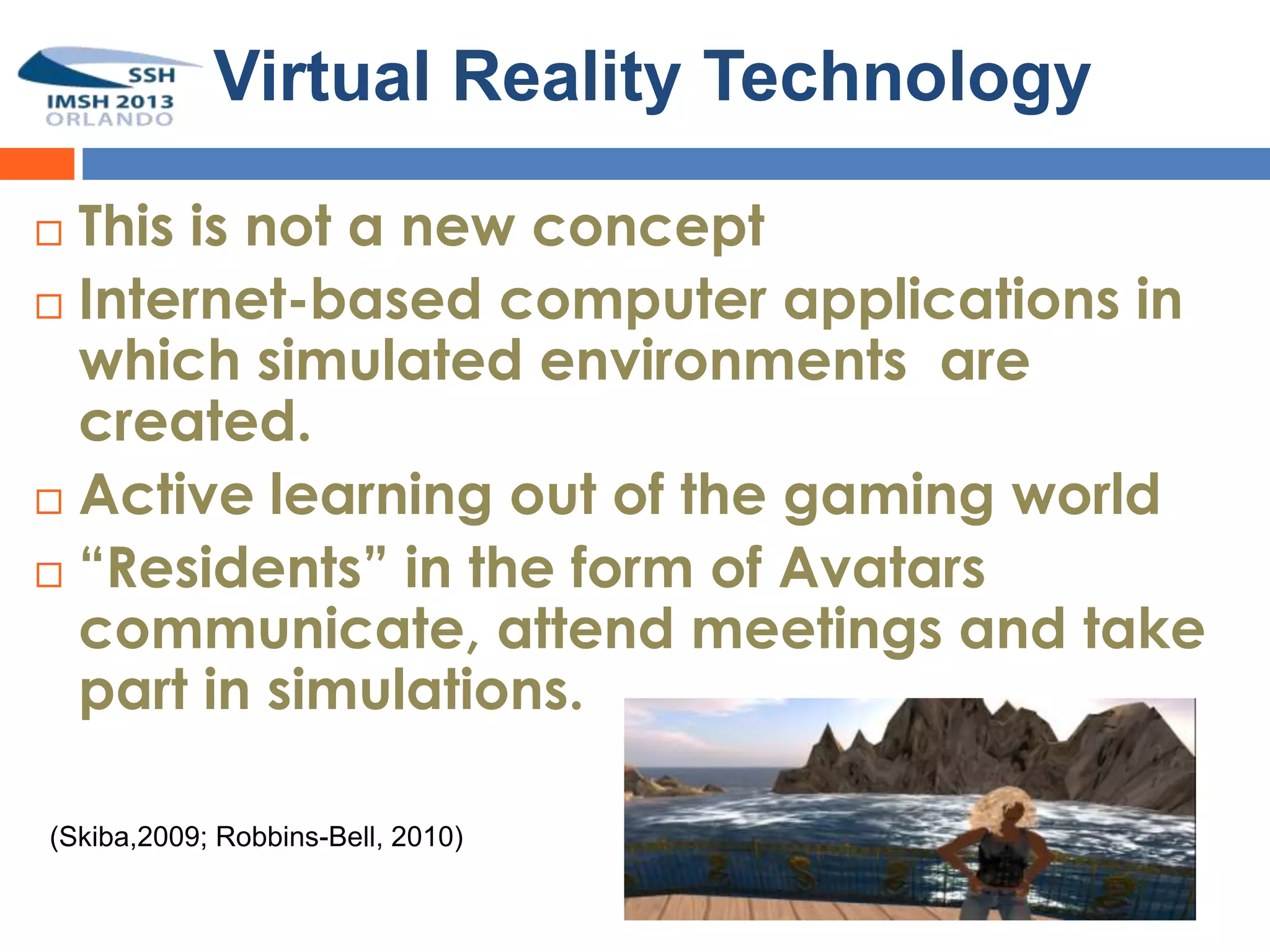
 This is not a new concept
 Internet-based computer applications in
  which simulated environments are
  created.
 Active learning out of the gaming world

 “Residents” in the form of Avatars
  communicate, attend meetings and take
  part in simulations.

(Skiba,2009; Robbins-Bell, 2010)
What are virtual worlds?
  Internet-based 3D simulated
  environments
 Users can interact via typed chat or
  real-time voice.
 Residents in the form of avatars
  attend meetings, communicate and
  perform simulations
 Over 150 Higher-Ed Institutions
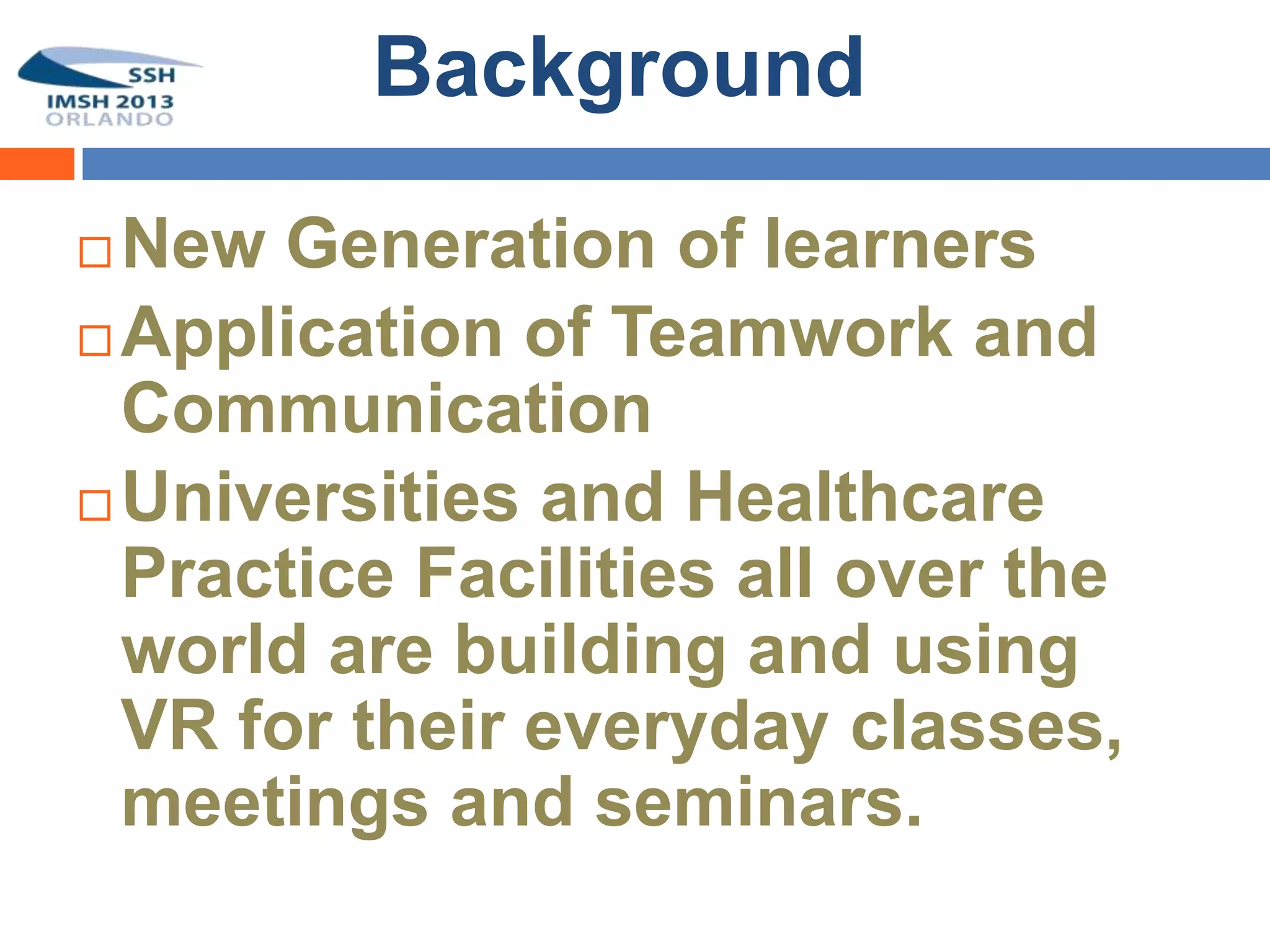
Background

 New Generation of learners
 Application of Teamwork and
  Communication
 Universities and Healthcare
  Practice Facilities all over the
  world are building and using
  VR for their everyday classes,
  meetings and seminars.
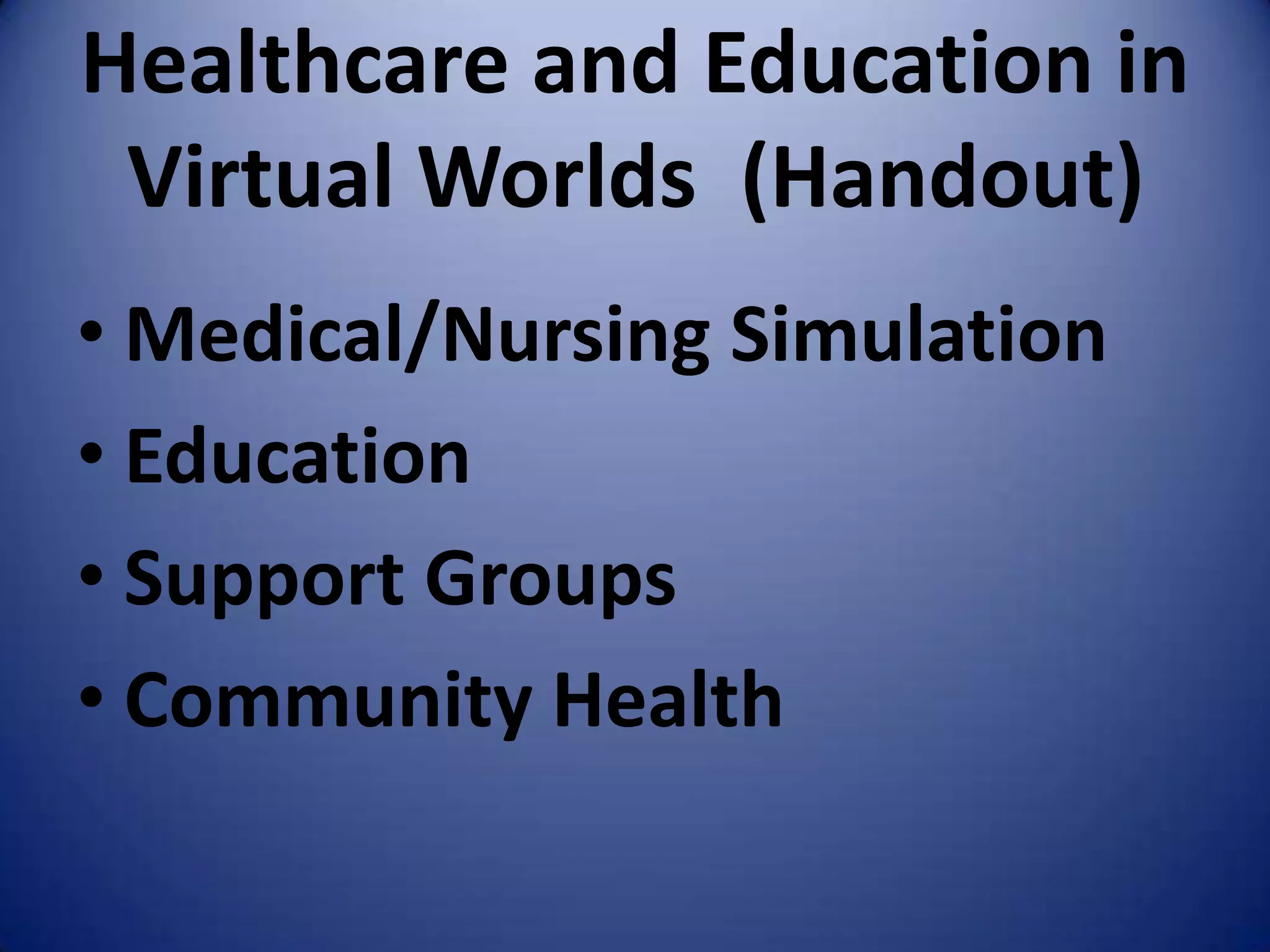
Healthcare and Education in
 Virtual Worlds (Handout)
• Medical/Nursing Simulation
• Education
• Support Groups
• Community Health
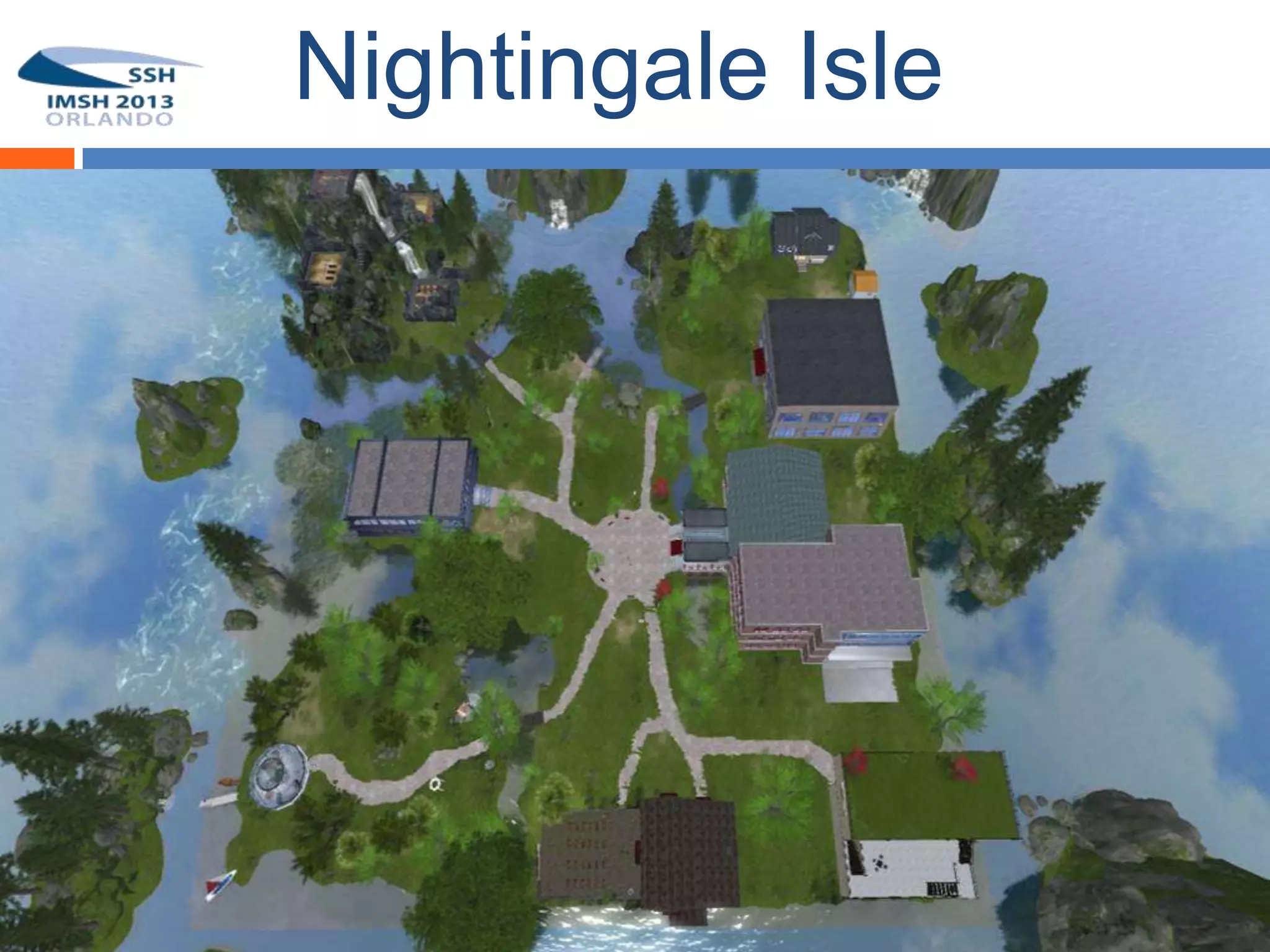
Nightingale Isle
American Nurses Credentialing Center
    (ANCC) Virtual Poster Presentation


• http://www.anccmagnetconference.org/index.cfm
Education

• Virtual World Educator Roundtable
  –Meets every Thursday (usually at
    11:30am SL time) @BGSU
    community area Second Life Wiki
    www.vwer.org
• Nightingale Isle Group in SL
Medical Expert Presentations
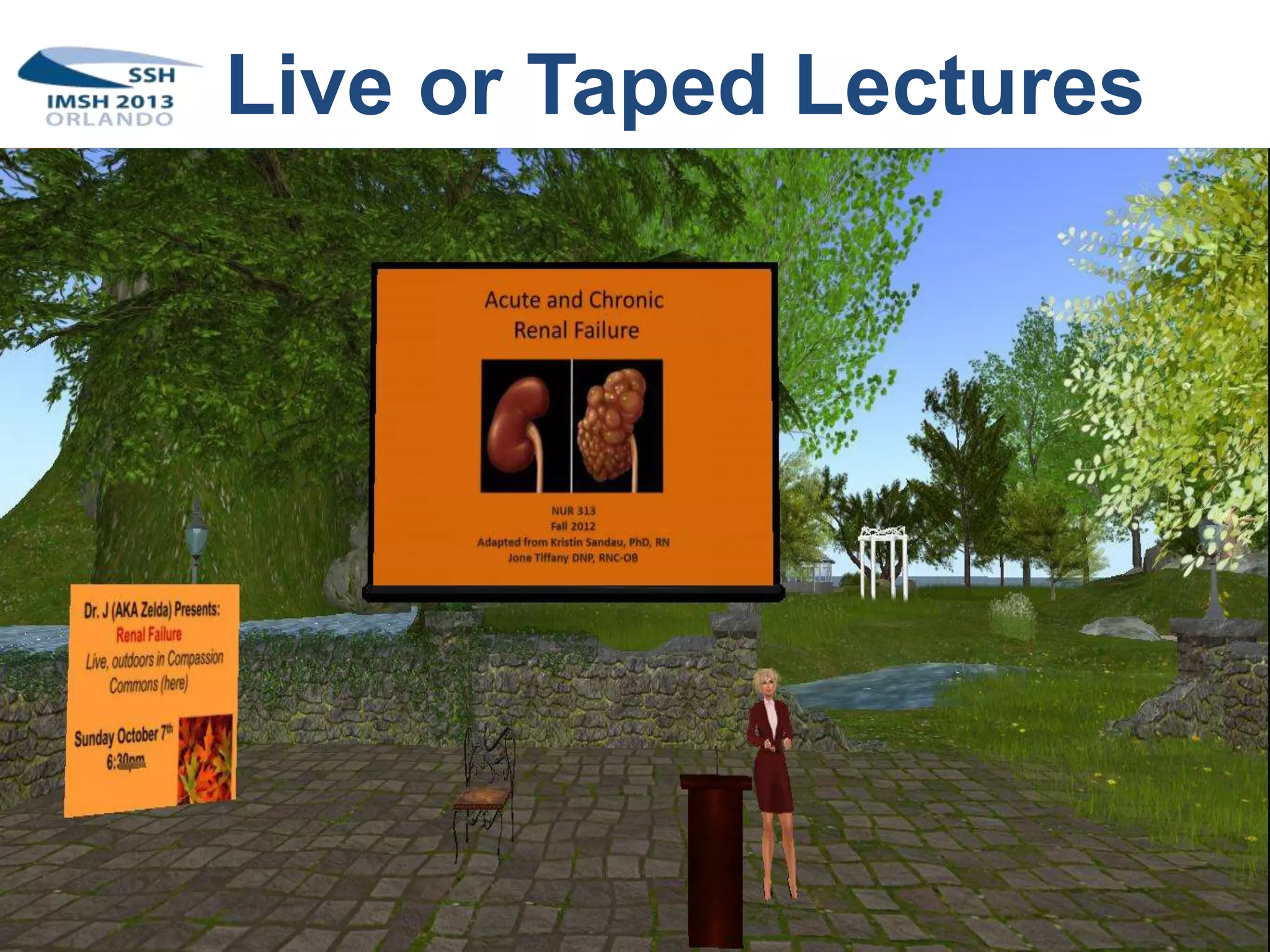
Live or Taped Lectures
Learning Activities
Inclusivity Assignment
Examples of Diverse Avatars
Nightingale Isle South Street Clinic
Glasgow Caledonian University

24
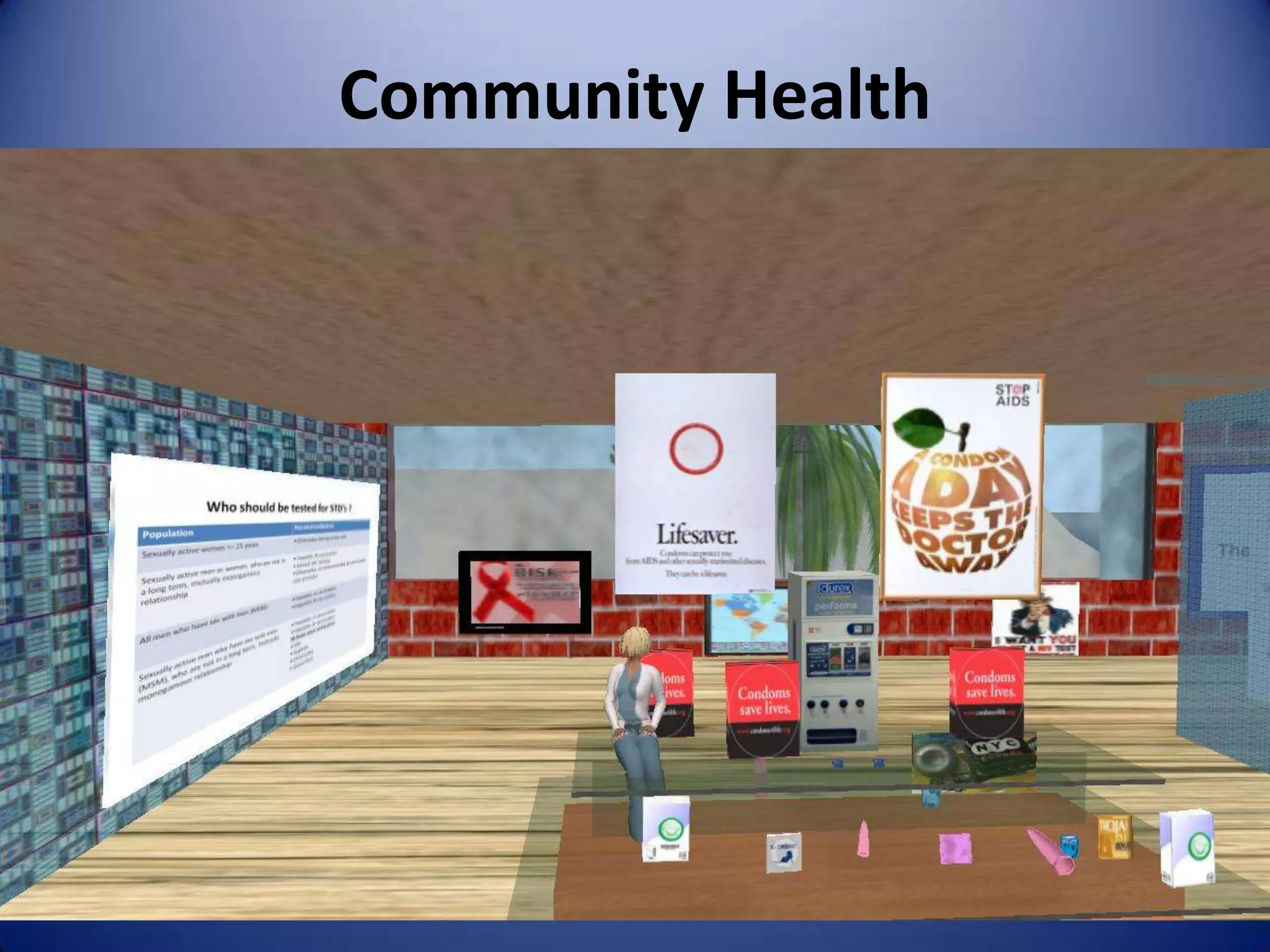
Community Health
Center for Disease Control
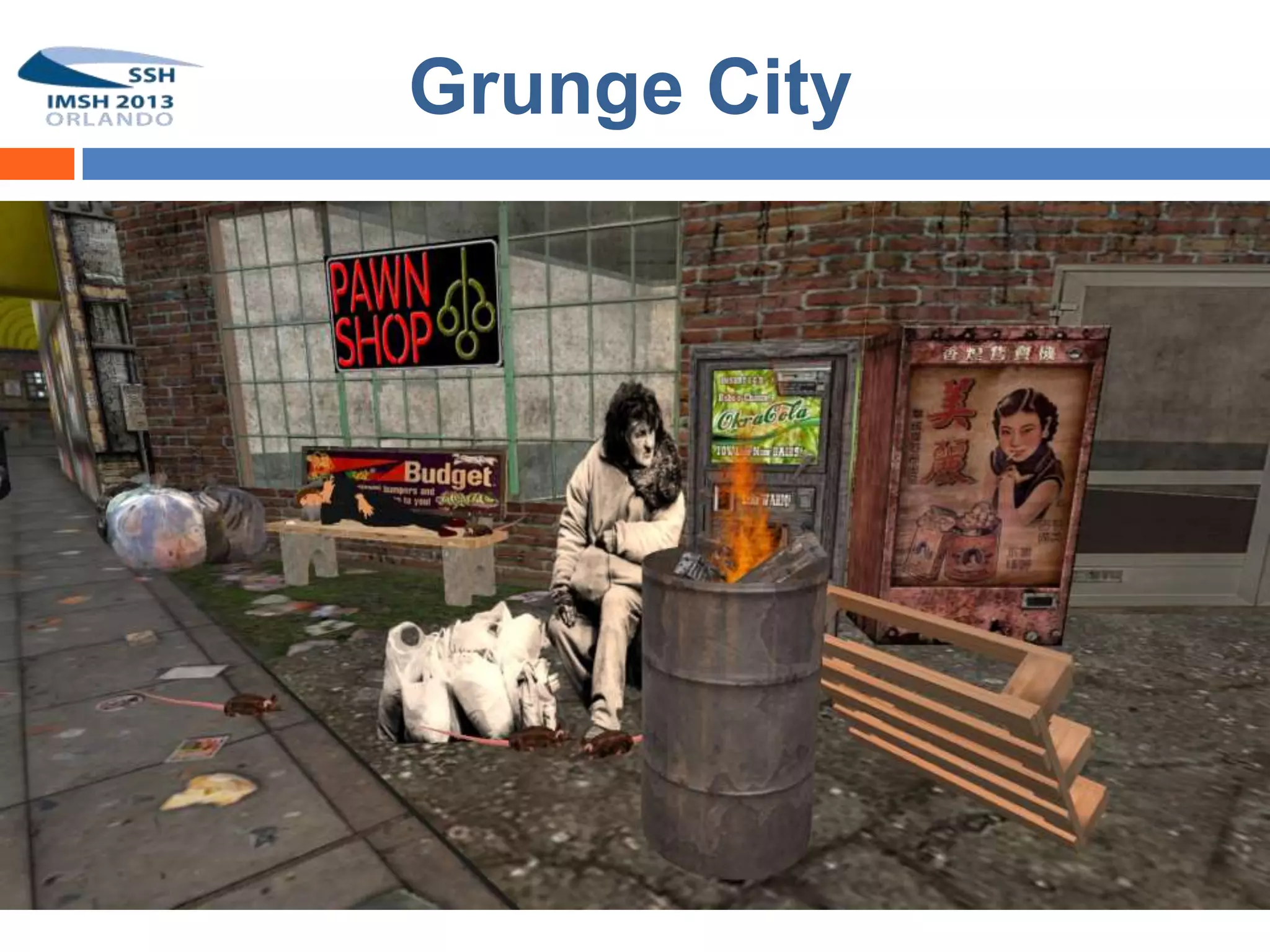
Two Communities created for Public
   Health Windshield Surveys
Grunge City
BSN Students and Plane Crash Triage Exercise
       http://www.youtube.com/watch?v=Id7RMc-Jli0
Sample Assignment
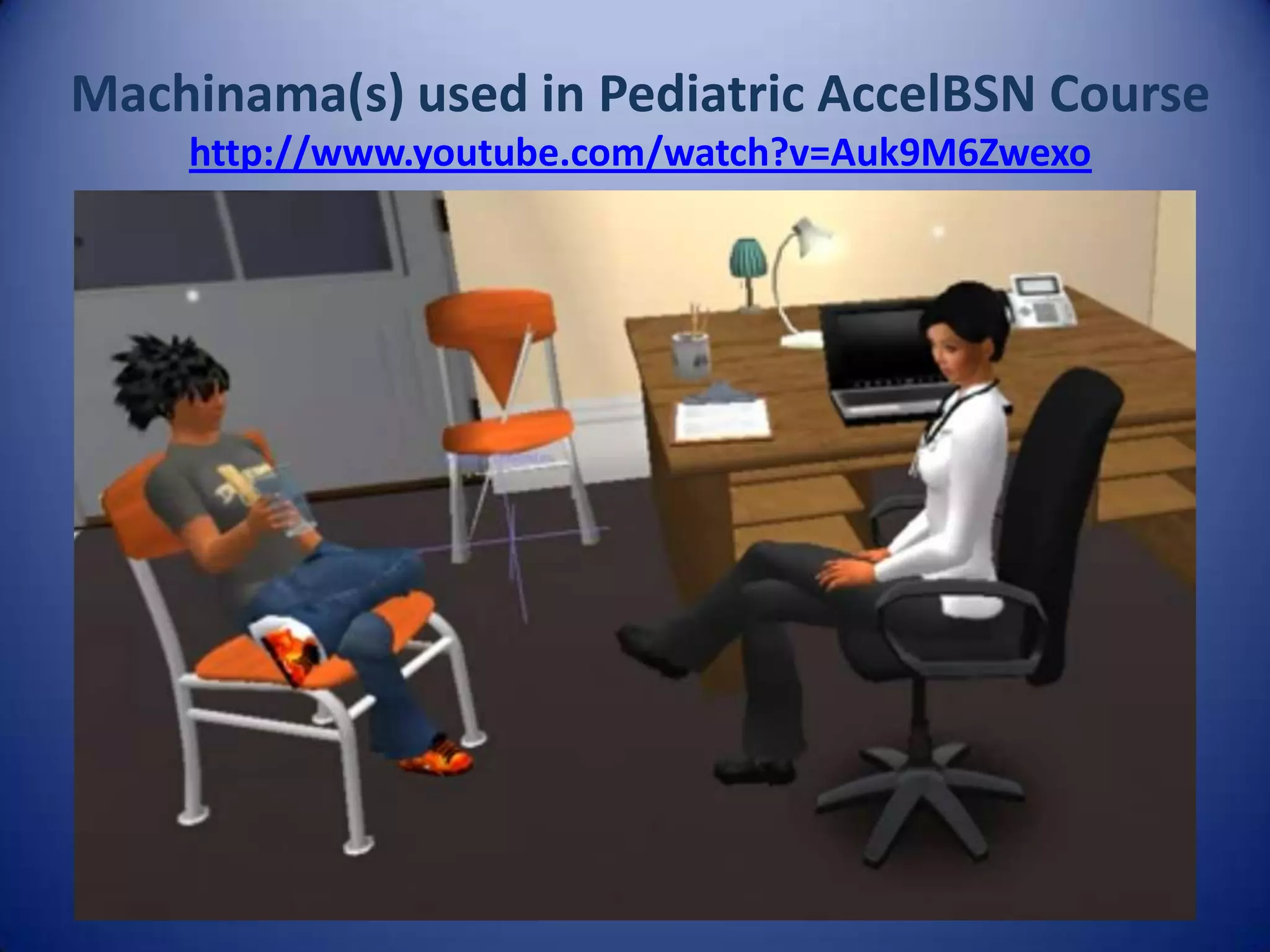
Machinama(s) used in Pediatric AccelBSN Course
    http://www.youtube.com/watch?v=Auk9M6Zwexo
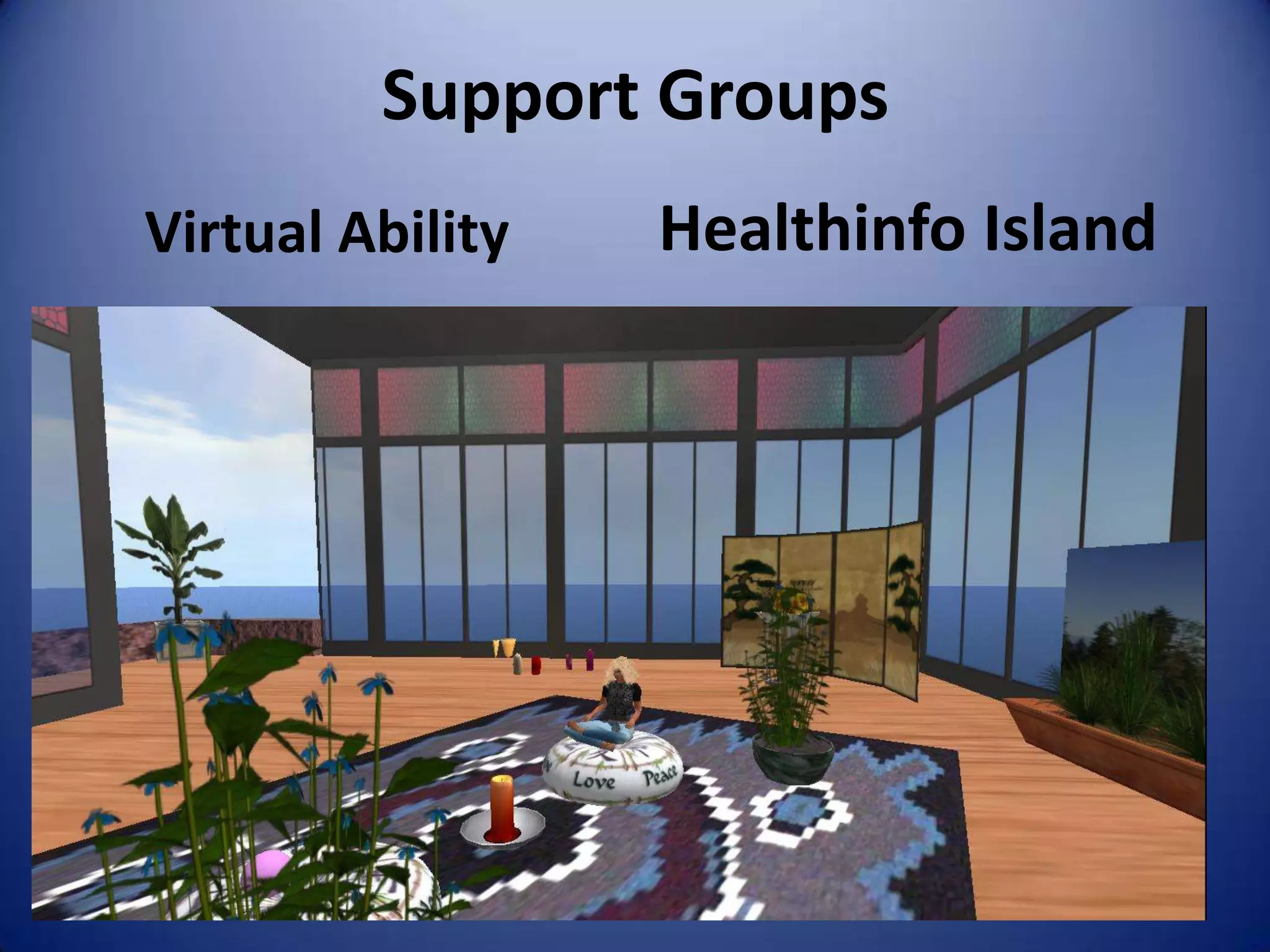
Support Groups
Virtual Ability   Healthinfo Island
Use Of Virtual World Platforms for
   Medical Simulation/Education?
• Rapidly growing among   • Suspension of
  serious educators         disbelief?
• Cost effective          • Those who dislike
• Distance Education        Technology
• Mature technology not   • Power and bandwidth
  a fad                   • Personal connection
• Many( VR )resources       with avatar?
  are already available   • Use of voice or text
• References in packet      chat?
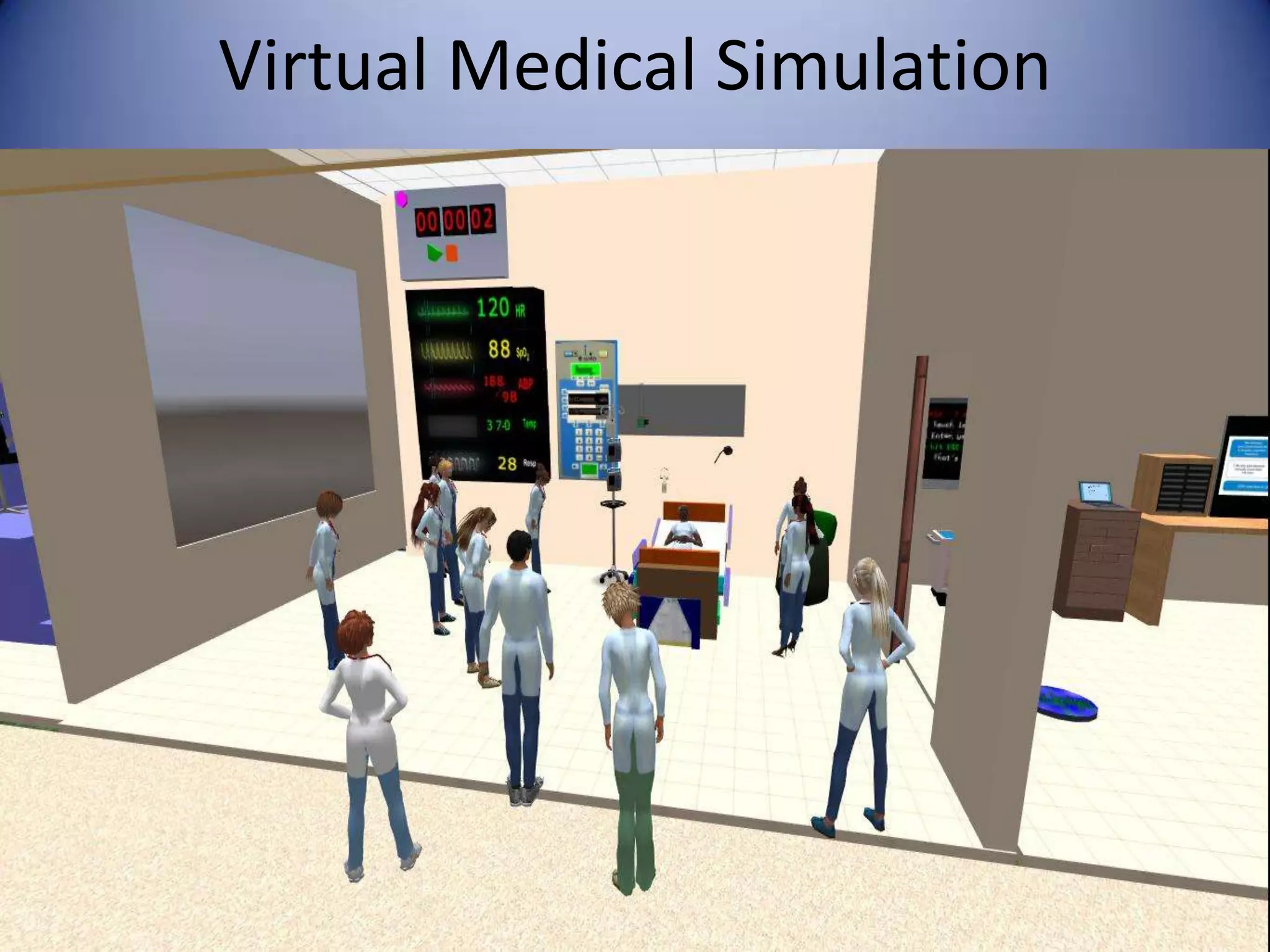
Virtual Medical Simulation
Avatars
Pre-Designed    Make Your Own
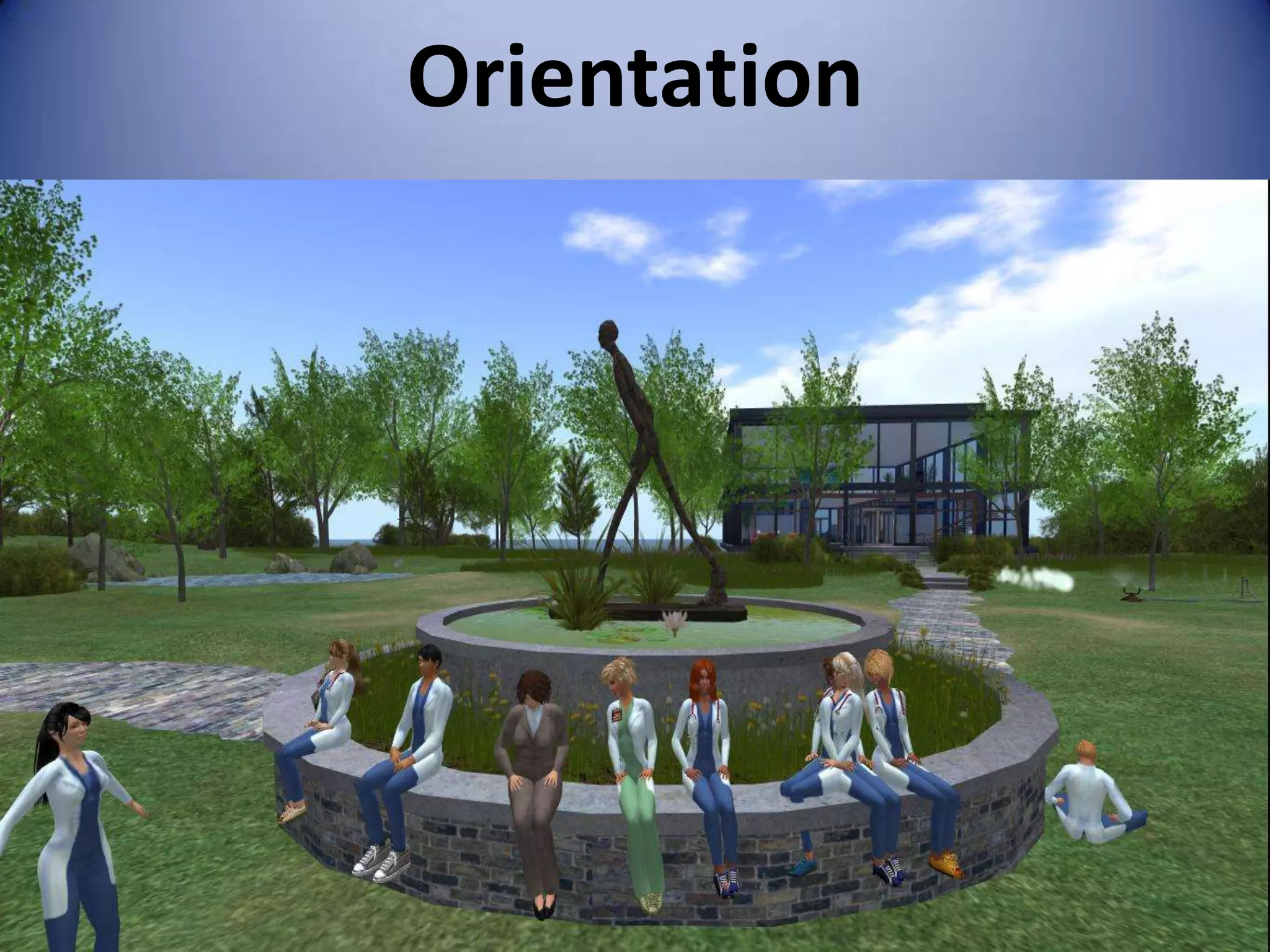
Orientation
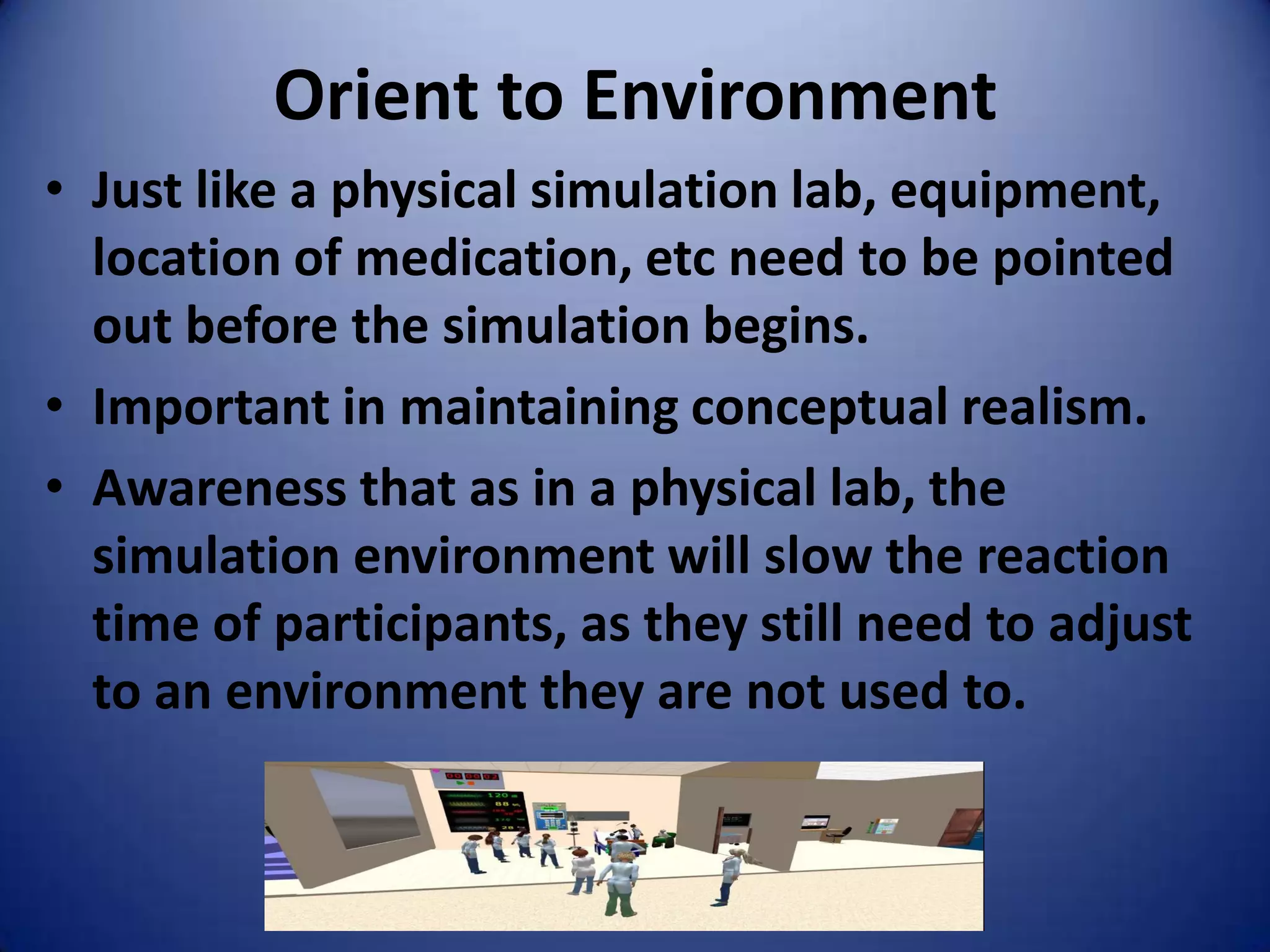
Orient to Environment
• Just like a physical simulation lab, equipment,
  location of medication, etc need to be pointed
  out before the simulation begins.
• Important in maintaining conceptual realism.
• Awareness that as in a physical lab, the
  simulation environment will slow the reaction
  time of participants, as they still need to adjust
  to an environment they are not used to.
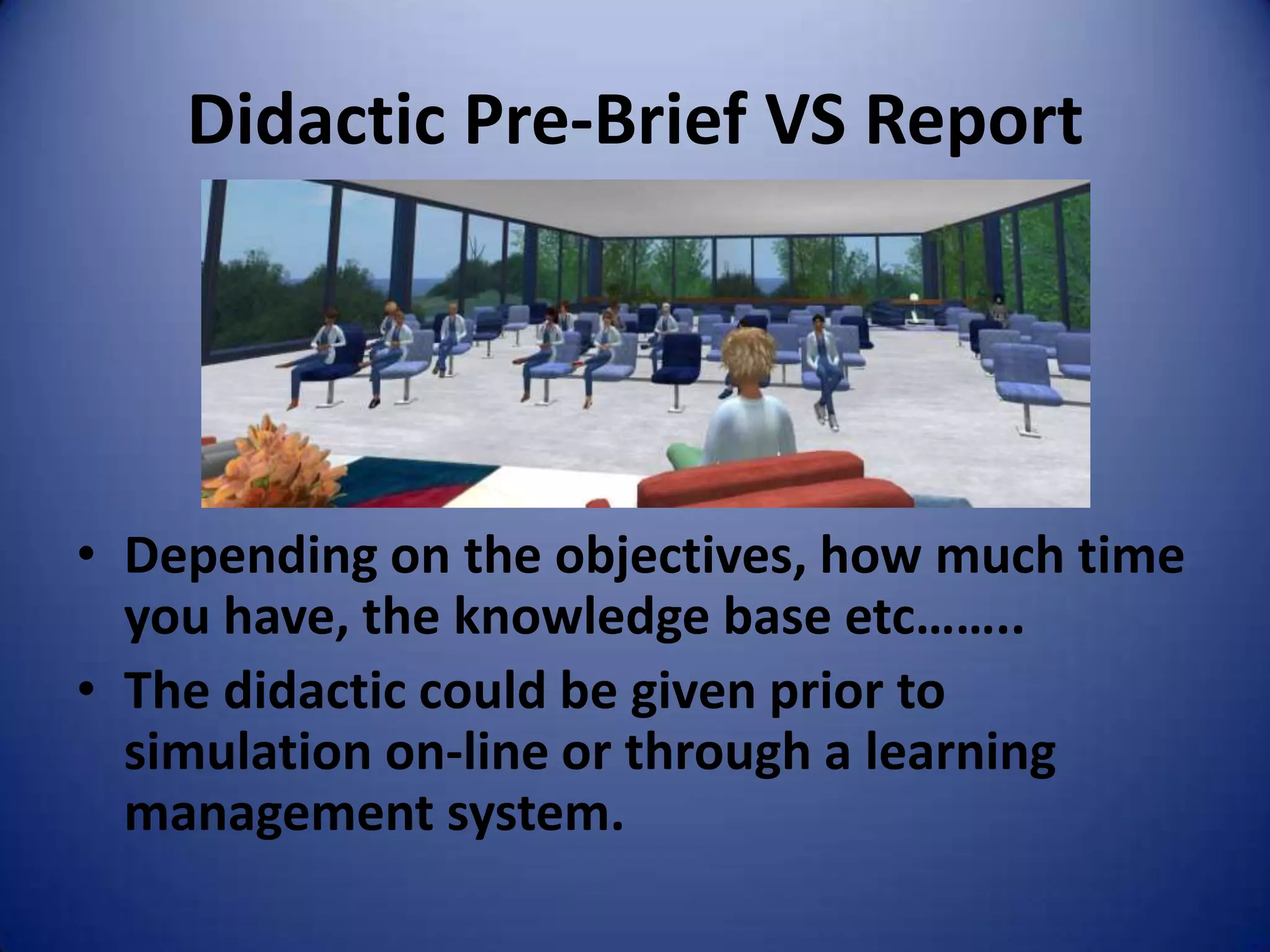
Didactic Pre-Brief VS Report


• Depending on the objectives, how much time
  you have, the knowledge base etc……..
• The didactic could be given prior to
  simulation on-line or through a learning
  management system.
Virtual Medical Simulations
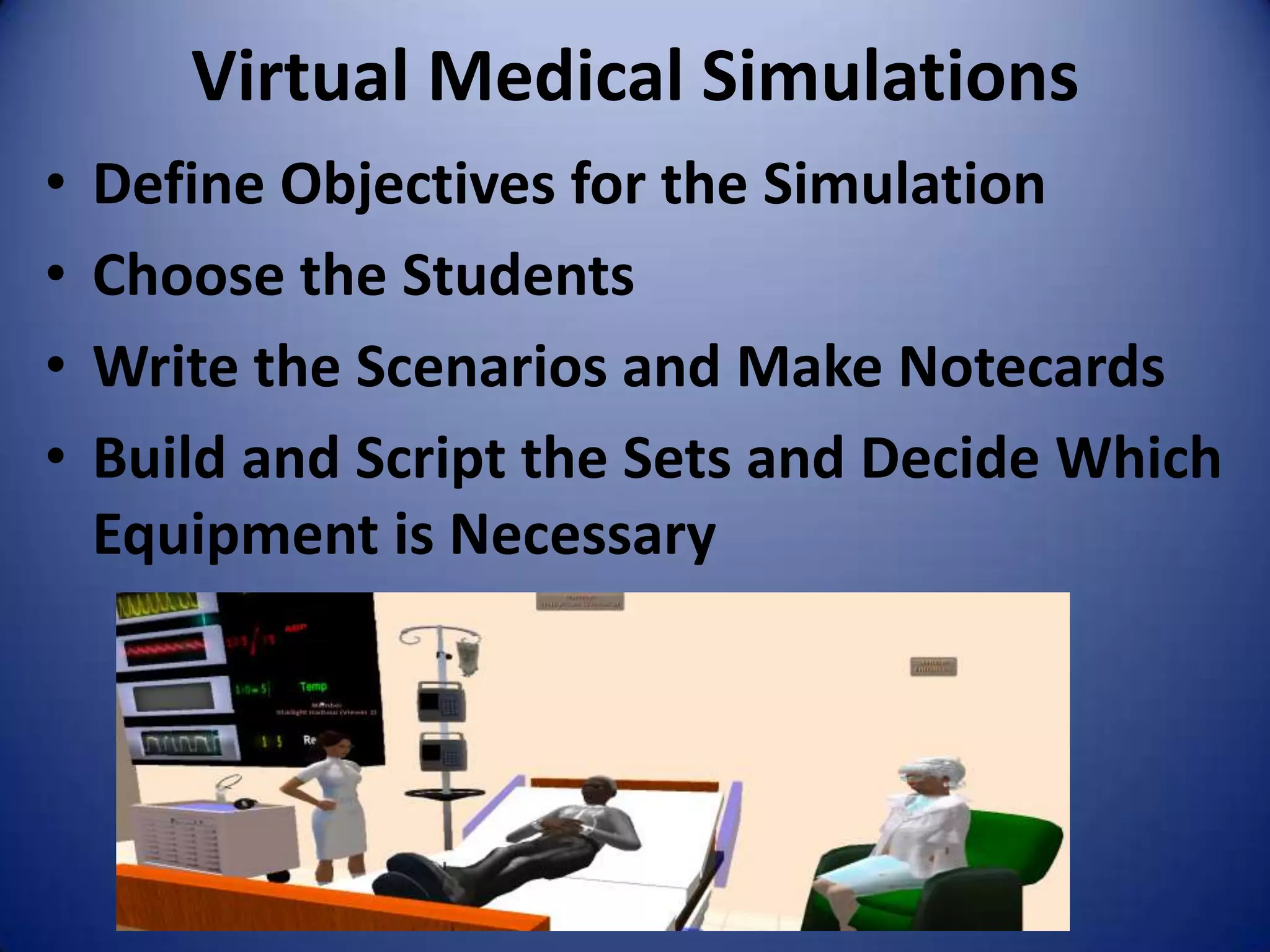
•   Define Objectives for the Simulation
•   Choose the Students
•   Write the Scenarios and Make Notecards
•   Build and Script the Sets and Decide Which
    Equipment is Necessary
Virtual Medical Simulations
• Run the Simulation
• Debrief with the Participants (Where the
  learning takes place)
National League for Nurses Health
Information Technology Scholar HITS
              Project
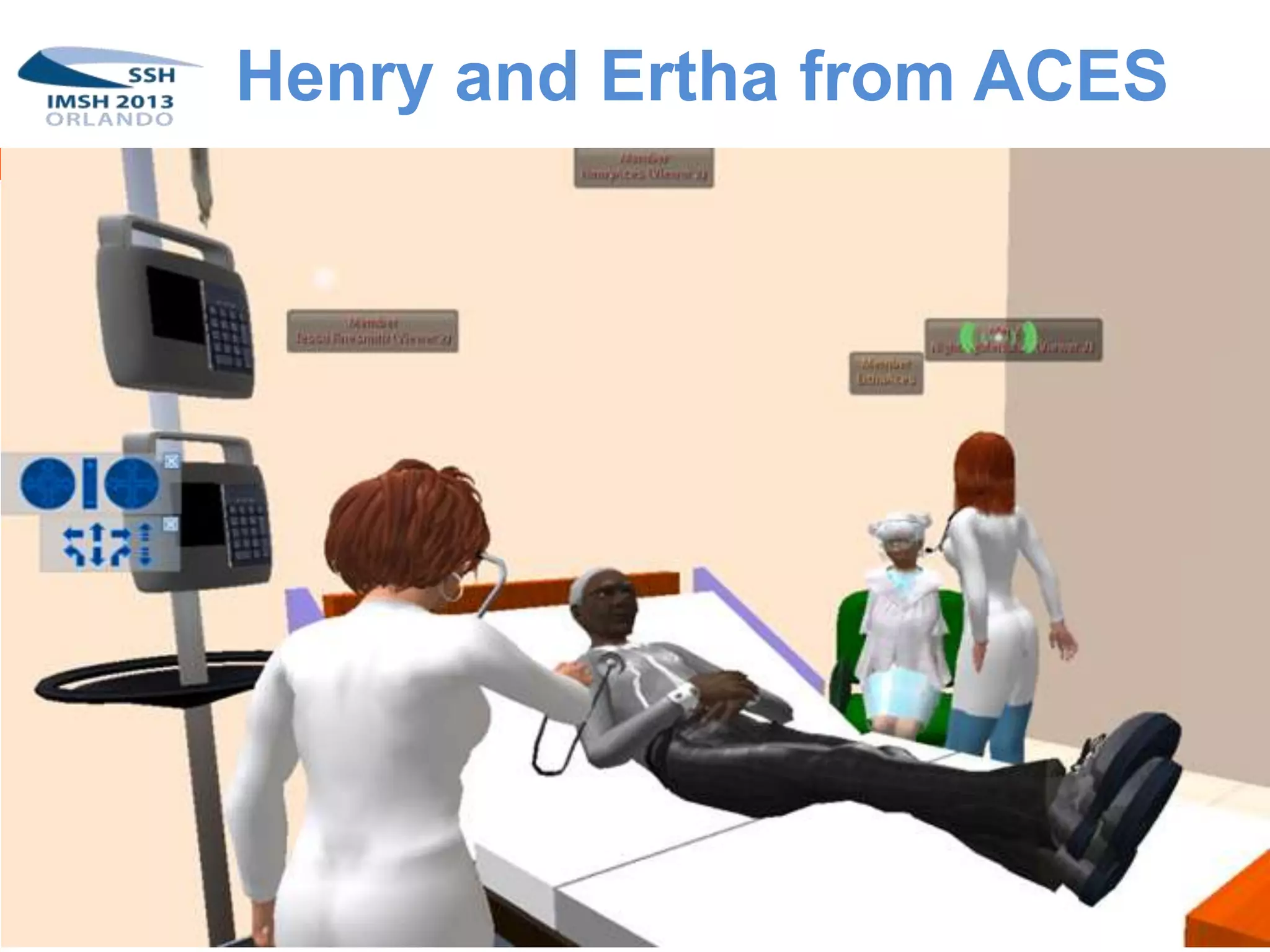
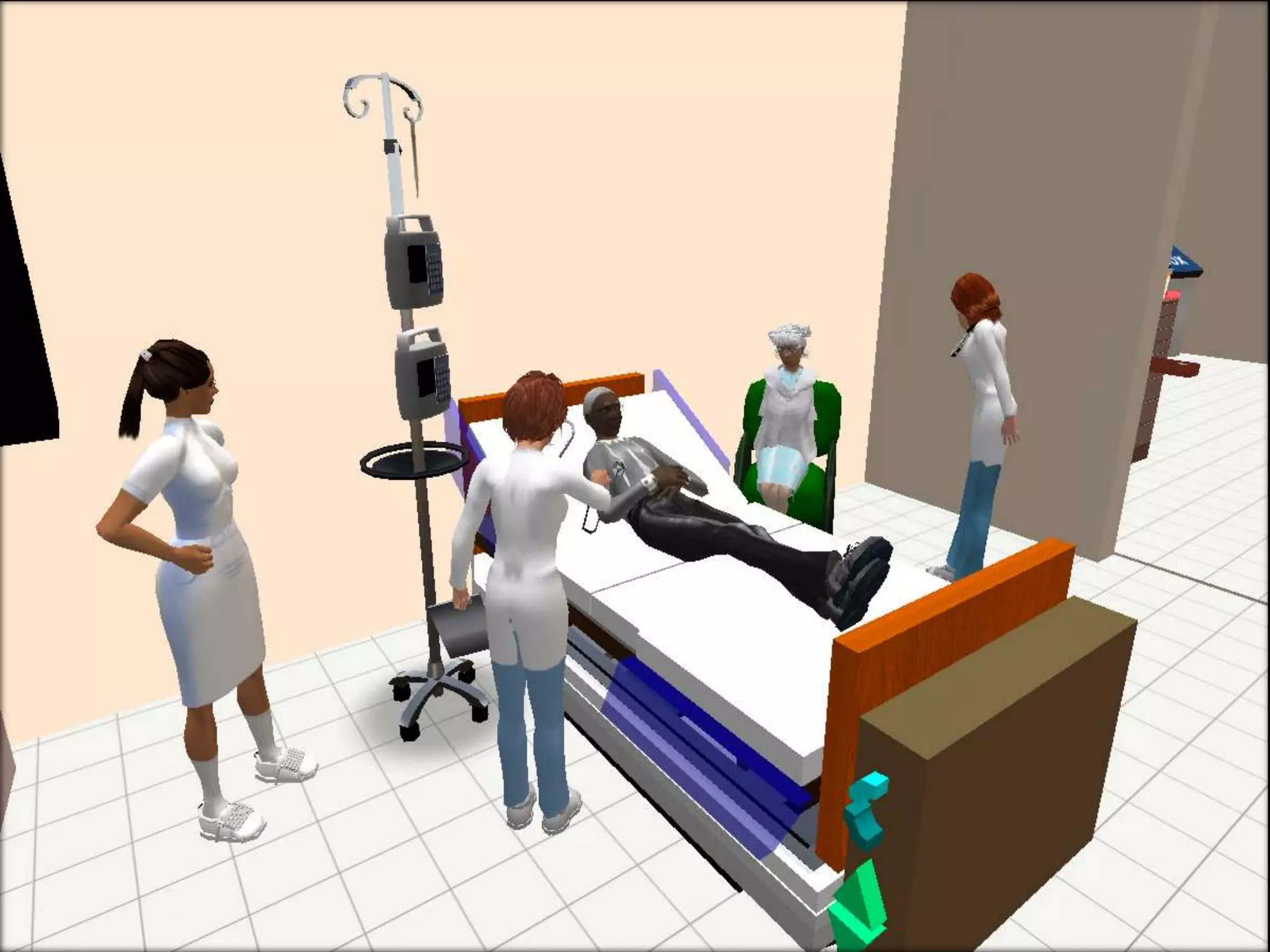
          Henry and Ertha
Henry and Ertha from ACES
Available Resources
•   Packet of Information
•   Places to visit
•   Free or low cost medical supplies
•   VWER group meetings
•   Nightingale Isle practice area
Early Cardiac Event Simulation Developed
          through Tecne Grant


49


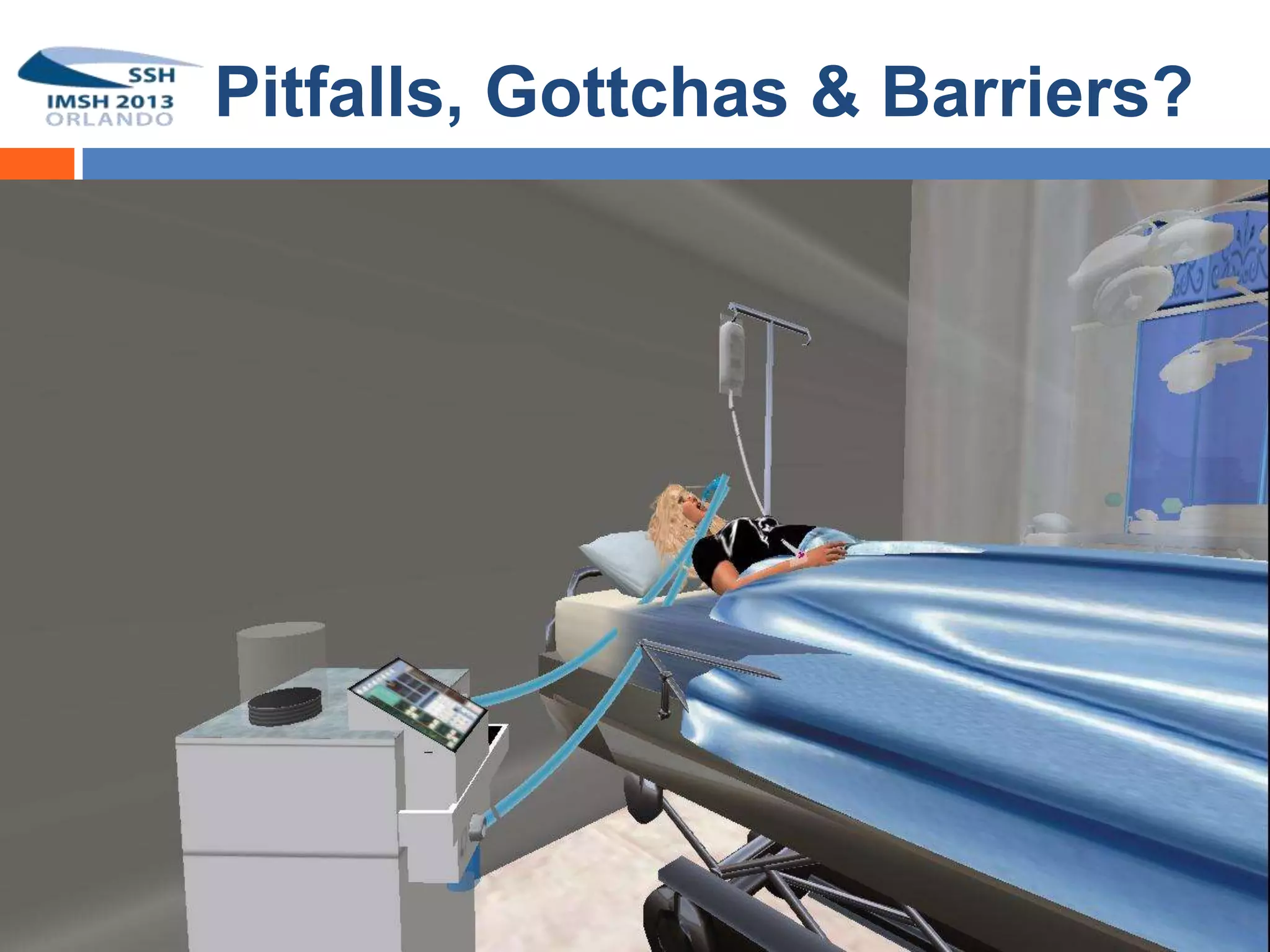
     The Good and the Not so easy……….
Pitfalls, Gottchas & Barriers?
Live Demo and Questions
Small Group Rotations
• Group 1: Nightingale Isle Simulation
          » Jane (in person) & Wade (virtual)

• Group 2: Nightingale Isle Clinic/Presentation
          » Jone (in person)

• Group 3: Oshkosh/Tecne – Community
           Safety House and Disaster Triage
          » Stephanie, Dawn & Tom (in person)

• Group 4: Glasgow
          » Evelyn (virtual)
Contact Information

   Jone Tiffany: jone-tiffany@bethel.edu
   Jane Mckinley: Jane.McKinley@riverland.edu
   Stephanie Stewart: stewart@uwosh.edu
   Tom Berthold: ons@uwosh.edu
   Evelyn McElhinney:
    Evelyn.McElhinney@gcu.ac.uk
   Wade Schuette: wade.schuette@gmail.com
   Dawn Pope: pope@uwosh.edu
References
Aebersold, M., Tschannen, D., Anderson, P., & Lei, X. (2011). Second Life: A new
          strategy in educating nursing students. Clinical Simulation in Nursing.
54        doi:10.1016/j.ecns.2011.05.002.
Anderson, A., Hristov, E., & Karimi, H. (2008). Second Life – New opportunity for
          higher educational institutions. Journal of Virtual Worlds Research,
          2(1), 18-25.
Baker, S. C., Wentz, R. K., & Woods, M. M. (2009). Using Virtual Worlds in
          Education: Second Life® as an Educational Tool. Teaching of Psychology,
          36(1), 59-64. doi:10.1080/00986280802529079.
Carr, D., Oliver, M., & Burn, A., (2010). Learning, Teaching and Ambiguity in
          Virtual Worlds. In: Peachey, A., Gillen, J., Livingstone, D. and Smith-
          Robbins, S., eds, Researching Learning in Virtual Worlds. London: Open
          University Press, pp. 17-30.
Ellaway, H., & Topps, D., (2010). Preparing for Practice - Issues in Virtual Medical
          Education. In: C. Wankel and S. Malleck, eds, Emerging Ethical Issues of
          Life in Virtual Worlds. USA: Information Age Publishing, pp. 101-117.
References
Heiphetz, A., & Woodill, G.,( 2010). Training and Collaboration with Virtual Worlds
          How to Create Cost-Saving, Efficient, and Engaging Programs. 1st edn.
55
          USA: The McGraw-Hill Companies.
Hermanns, M. & Kilmon, C. (2011). Second Life as a clinical conference
          environment: Experience of students and faculty. Clinical Simulation in
          Nursing. Doi: 10.1016/j.ecns.2011.04.002.
Honey, M., Connor, K., Veltman, M., Bodily, D., & Diener, S. (2011). Teaching with
          Second Life: hemorrhage management as an example of a process for
          developing simulations for multiuser virtual environments. Clinical
          Simulation in Nursing.
McCallum, J., Ness, V., & Price, T., (2010). Exploring nursing students’ decision-
          making skills whilst in a Second Life clinical simulation laboratory, Nurse
          Education Today. doi: 10/1016/j.nedt.2010.03.010.
Skiba, D. (2007). Nursing education 2.0: Second life. Nursing Education
          Perspectives, 28(3), 157-157.

Explore the magic final

  • 1.
    EXPLORE THE MAGICOF USING VIRTUAL WORLDS AS AN INNOVATIVE TEACHING/LEARNING STRATEGY FOR HEALTHCARE PROFESSIONALS Jone Tiffany DNP, MA, RNC-OB Jane McKinley RN, ADN Wade Schuette BA, MBA, MPH Evelyn McElhinney MSc, RN, Stephanie Stewart, PhD MSN,RN Tom Berthold BSN, RN Dawn Pope APNP, RN IMSH 2013 | Orlando, Florida
  • 2.
    Disclosure(s)  We Have Nothing to Disclose 1
  • 3.
    Learning Objectives 1. Analyze the types of learning activities that can 3 be designed for use in a virtual world platform. 2. Formulate the design process of a variety of virtual world teaching/learning activities. 3. Assess the tools necessary to implement various teaching/learning activities in a virtual world platform.
  • 4.
  • 5.
    Virtual Reality Technology This is not a new concept  Internet-based computer applications in which simulated environments are created.  Active learning out of the gaming world  “Residents” in the form of Avatars communicate, attend meetings and take part in simulations. (Skiba,2009; Robbins-Bell, 2010)
  • 6.
    What are virtualworlds?  Internet-based 3D simulated environments  Users can interact via typed chat or real-time voice.  Residents in the form of avatars attend meetings, communicate and perform simulations  Over 150 Higher-Ed Institutions
  • 7.
    Background  New Generationof learners  Application of Teamwork and Communication  Universities and Healthcare Practice Facilities all over the world are building and using VR for their everyday classes, meetings and seminars.
  • 8.
    Healthcare and Educationin Virtual Worlds (Handout) • Medical/Nursing Simulation • Education • Support Groups • Community Health
  • 10.
  • 14.
    American Nurses CredentialingCenter (ANCC) Virtual Poster Presentation • http://www.anccmagnetconference.org/index.cfm
  • 15.
    Education • Virtual WorldEducator Roundtable –Meets every Thursday (usually at 11:30am SL time) @BGSU community area Second Life Wiki www.vwer.org • Nightingale Isle Group in SL
  • 16.
  • 17.
    Live or TapedLectures
  • 19.
  • 20.
  • 21.
  • 22.
  • 24.
  • 26.
  • 27.
  • 28.
    Two Communities createdfor Public Health Windshield Surveys
  • 29.
  • 30.
    BSN Students andPlane Crash Triage Exercise http://www.youtube.com/watch?v=Id7RMc-Jli0
  • 31.
  • 32.
    Machinama(s) used inPediatric AccelBSN Course http://www.youtube.com/watch?v=Auk9M6Zwexo
  • 33.
  • 34.
    Use Of VirtualWorld Platforms for Medical Simulation/Education? • Rapidly growing among • Suspension of serious educators disbelief? • Cost effective • Those who dislike • Distance Education Technology • Mature technology not • Power and bandwidth a fad • Personal connection • Many( VR )resources with avatar? are already available • Use of voice or text • References in packet chat?
  • 35.
  • 36.
    Avatars Pre-Designed Make Your Own
  • 37.
  • 38.
    Orient to Environment •Just like a physical simulation lab, equipment, location of medication, etc need to be pointed out before the simulation begins. • Important in maintaining conceptual realism. • Awareness that as in a physical lab, the simulation environment will slow the reaction time of participants, as they still need to adjust to an environment they are not used to.
  • 40.
    Didactic Pre-Brief VSReport • Depending on the objectives, how much time you have, the knowledge base etc…….. • The didactic could be given prior to simulation on-line or through a learning management system.
  • 41.
    Virtual Medical Simulations • Define Objectives for the Simulation • Choose the Students • Write the Scenarios and Make Notecards • Build and Script the Sets and Decide Which Equipment is Necessary
  • 42.
    Virtual Medical Simulations •Run the Simulation • Debrief with the Participants (Where the learning takes place)
  • 43.
    National League forNurses Health Information Technology Scholar HITS Project Henry and Ertha
  • 44.
    Henry and Erthafrom ACES
  • 48.
    Available Resources • Packet of Information • Places to visit • Free or low cost medical supplies • VWER group meetings • Nightingale Isle practice area
  • 49.
    Early Cardiac EventSimulation Developed through Tecne Grant 49 The Good and the Not so easy……….
  • 50.
  • 51.
    Live Demo andQuestions
  • 52.
    Small Group Rotations •Group 1: Nightingale Isle Simulation » Jane (in person) & Wade (virtual) • Group 2: Nightingale Isle Clinic/Presentation » Jone (in person) • Group 3: Oshkosh/Tecne – Community Safety House and Disaster Triage » Stephanie, Dawn & Tom (in person) • Group 4: Glasgow » Evelyn (virtual)
  • 53.
    Contact Information  Jone Tiffany: jone-tiffany@bethel.edu  Jane Mckinley: Jane.McKinley@riverland.edu  Stephanie Stewart: stewart@uwosh.edu  Tom Berthold: ons@uwosh.edu  Evelyn McElhinney: Evelyn.McElhinney@gcu.ac.uk  Wade Schuette: wade.schuette@gmail.com  Dawn Pope: pope@uwosh.edu
  • 54.
    References Aebersold, M., Tschannen,D., Anderson, P., & Lei, X. (2011). Second Life: A new strategy in educating nursing students. Clinical Simulation in Nursing. 54 doi:10.1016/j.ecns.2011.05.002. Anderson, A., Hristov, E., & Karimi, H. (2008). Second Life – New opportunity for higher educational institutions. Journal of Virtual Worlds Research, 2(1), 18-25. Baker, S. C., Wentz, R. K., & Woods, M. M. (2009). Using Virtual Worlds in Education: Second Life® as an Educational Tool. Teaching of Psychology, 36(1), 59-64. doi:10.1080/00986280802529079. Carr, D., Oliver, M., & Burn, A., (2010). Learning, Teaching and Ambiguity in Virtual Worlds. In: Peachey, A., Gillen, J., Livingstone, D. and Smith- Robbins, S., eds, Researching Learning in Virtual Worlds. London: Open University Press, pp. 17-30. Ellaway, H., & Topps, D., (2010). Preparing for Practice - Issues in Virtual Medical Education. In: C. Wankel and S. Malleck, eds, Emerging Ethical Issues of Life in Virtual Worlds. USA: Information Age Publishing, pp. 101-117.
  • 55.
    References Heiphetz, A., &Woodill, G.,( 2010). Training and Collaboration with Virtual Worlds How to Create Cost-Saving, Efficient, and Engaging Programs. 1st edn. 55 USA: The McGraw-Hill Companies. Hermanns, M. & Kilmon, C. (2011). Second Life as a clinical conference environment: Experience of students and faculty. Clinical Simulation in Nursing. Doi: 10.1016/j.ecns.2011.04.002. Honey, M., Connor, K., Veltman, M., Bodily, D., & Diener, S. (2011). Teaching with Second Life: hemorrhage management as an example of a process for developing simulations for multiuser virtual environments. Clinical Simulation in Nursing. McCallum, J., Ness, V., & Price, T., (2010). Exploring nursing students’ decision- making skills whilst in a Second Life clinical simulation laboratory, Nurse Education Today. doi: 10/1016/j.nedt.2010.03.010. Skiba, D. (2007). Nursing education 2.0: Second life. Nursing Education Perspectives, 28(3), 157-157.

Editor's Notes

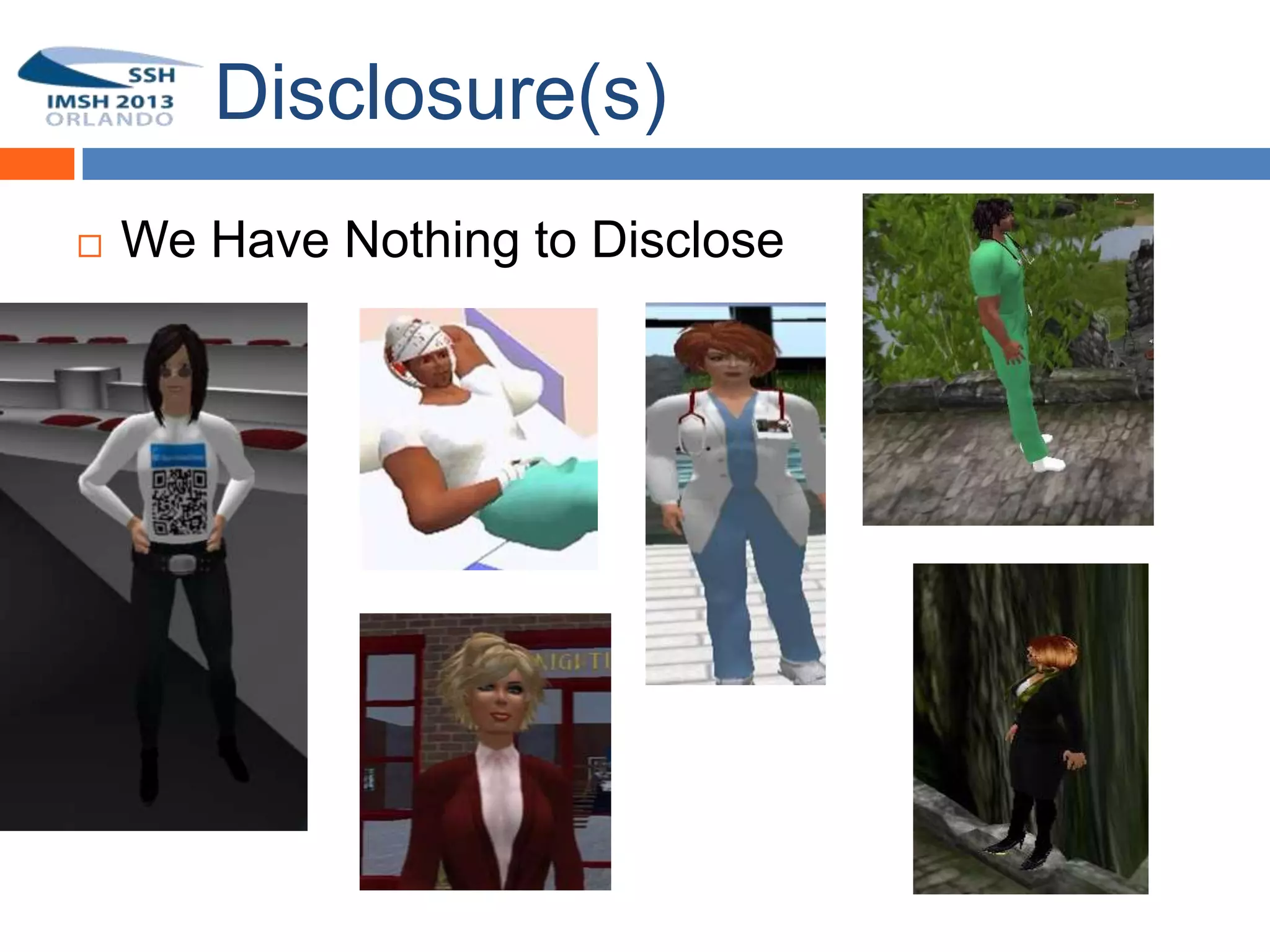
  • #3 Add your avatar picture here
  • #5 Video we made for last year. See what you think???
  • #7 Download software and sign in. Some of the uses are for support groups – ESL practice – medical and nursing simulations – disaster planning – quizzes Now I will show a short video clip that introduces Second Life and some of the Public Health/community building uses.
  • #9 Jone - Refer to the landmarks in the handout so that they can see how much already exists out there.
  • #10 Jone talk about this
  • #11 An example of a place with many educational options.
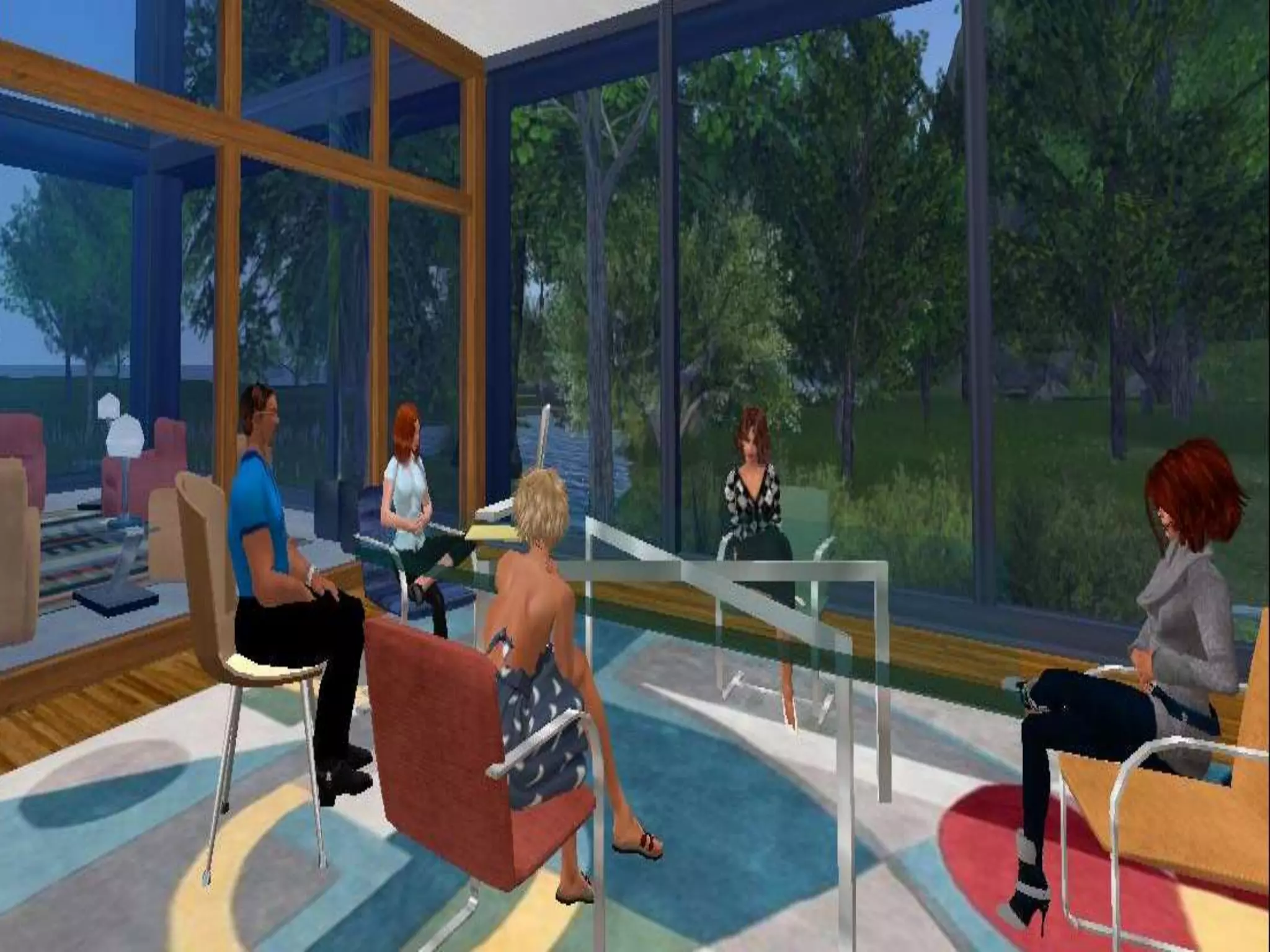
  • #12 Collaborative meeting
  • #13 Another meeting place
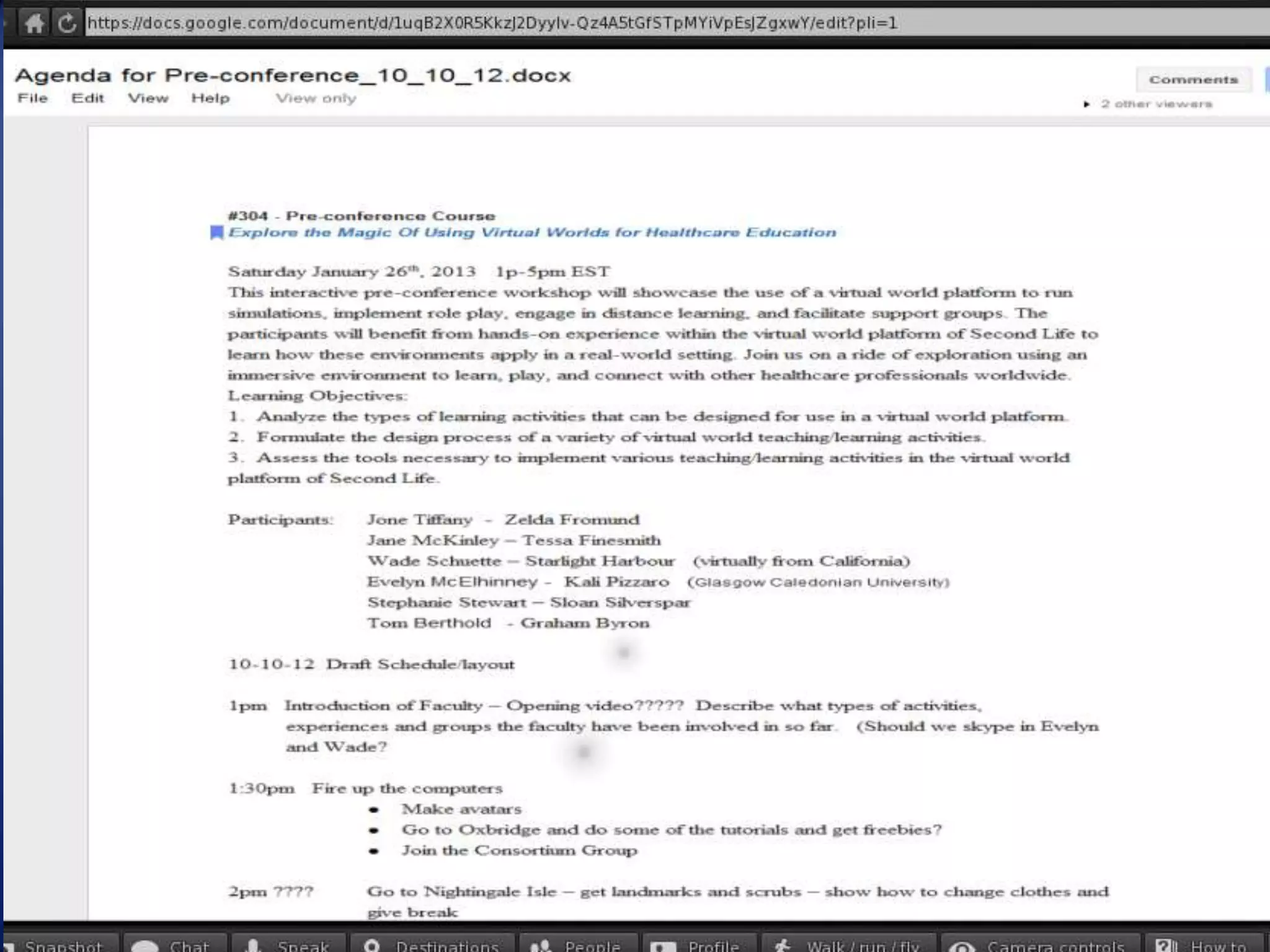
  • #14 Use of Google Docs for meetings
  • #15 Example of a virtual poster session
  • #16 Jone
  • #17 H1N1 talk – physician from Denmark and from Delaware speaking about the movement of H1N1
  • #19 Example of a classroom
  • #20 Heart murmur sim/ Evergreen/ Virtual Hallucinations etc………………
  • #21 An example of another kind of learning activity
  • #22 Here are some examples of avatars you can purchase ready made. There are culturally diverse avatars, different ages, equipment for people with disabilities.
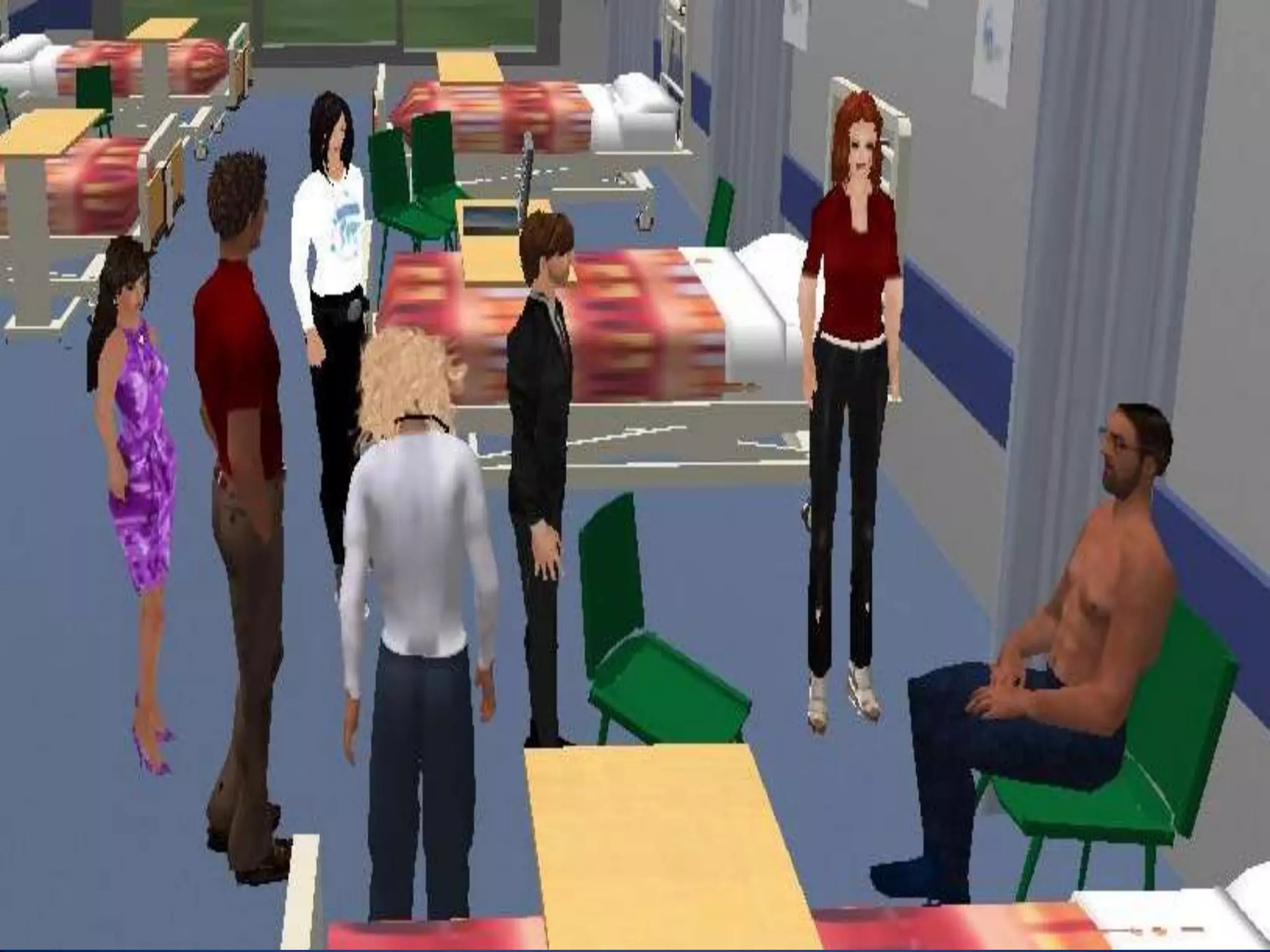
  • #23 Clinic with notecard giver to build assignment
  • #24 Computers directly interface with web
  • #25 Kali can talk about this or we can just briefly talk about it and then tell them they are going there?
  • #26 Kali speak to your set up here.
  • #27 CDC UW Oshgosh etc……….
  • #29 Stephanie speak about this???
  • #30 Stephanie to speak on this direct opposite of Summerville
  • #31 Tom can speak of it and could show excerpt of 3 min machinama
  • #32 Tom – see example provided (handouts – I will bring)
  • #33 Dawn speak about
  • #34 Jone
  • #35 Jone - Types of simulation: Medical Simulation , Role Play, Teamwork and Communication ,Psych/Mental Health,Practice with interviewing
  • #36 Overview of medical sims
  • #37 talk about how the literature shows that the connection to ones avatar is important to increase the feeling of presence and connection. And how the Bethel students(and all students) wanted to change their avatars.
  • #38 Jane – discuss the orientation packet A chance to be oriented away and separate from the sim a must. Talk about the comments from the students about wanting more time to practice and get comfortable. Also talk about supplies and scrubs - Any time participants are running sims or practicing they should wear scrubs.Make sure all supplies are readily available and the participants have access to what they need. Refer to the fact that the first time out they will be teleported to Welcome Island. I don’t remember if the other places to practice were in the handout that I found…. Can refer to them.
  • #39 Jane -
  • #40 Can be like herding cats 
  • #41 Jone – talk about giving PPT’s etc. in Second Life – free viewers available save as JPEG and pop them in.
  • #42 Review how a sim is run in SL.
  • #43 Jane
  • #44 Examples – first, Jone talk about HITS project
  • #47 Funny video Wade made set to music.
  • #48 Jane talk about Ann Myers Medical Center experience
  • #49 Jane
  • #50 Steph, Dawn, Tom mention how it needed to be more user friendly, and more orientation needed for students, lack of time to teach use and SL Navigation for Accelerated students
  • #51 Jane - Work with a good builder and scripter from the beginning!!!!! The seedy side of SL. Need to warn them what is out there and some suggestions on how to deal with it? Explain that as in RL, same exists in SL, just avoid it! Technology available or comfortable with. Some schools do block this site because of the sex stuff. Cost if want to build own island. Ahemmm older participants struggle with this more than younger ones. Simulation in a physical lab is more work, but evidence is overwhelming that it is so incredibly beneficial; so it can be in a VW.
  • #52 ALL
  • #53 25 minutes for each rotation and 5 minutes to teleport etc………..
  • #54 Put in Dawn Pope’s contact information