Repository Deposit Service Description - Presentation Transcript
Repository Deposit Service Description OR 2007 : the 2nd International Conference on Open Repositories San Antonio, Texas, USA, 23-26 Jan 2007 Presenter: Julie Allinson, UKOLN, University of Bath Co-authors: Rachel Heery (UKOLN), Martin Morrey (Intrallect), Christopher Gutteridge (Southampton), and Jim Downing (Cambridge) www.bath.ac.uk a centre of expertise in digital information management www.ukoln.ac.uk UKOLN is supported by:
Overview
Background and context
Requirements for depositing content in repositories
Defining a lightweight deposit service
Developing the service
Proof-of-concept implementation - update
Context
Higher (and Further) Education in the United Kingdom
JISC – the Joint Information Systems Committee
JISC – considerable investment in UK repositories R&D over the last 5 years, and continuing
FAIR Programme (2002-2005)
Exchange for Learning (X4L) Programme (2002-2005)
Digital Repositories Programme (2005-2007)
JISC Capital Programme Repositories and Preservation strand (2006-2009)
Deposit API
Deposit API activity was brought together
to find lightweight solution to assist populating repositories within timescales of JISC programmes
It comprised a group of repository software developers from Eprints.org, DSpace, Fedora, Intrallect and others
facilitated by the JISC Repositories Research Team
to address the need for a common Deposit standard
Background motivation
In general, developers are not creating repository systems and software from scratch
repositories must interface with each other, with users and with other applications within institutions and the wider information landscape
VLEs, authoring tools, packaging tools, name authority services, classification services and research systems
There is no common deposit API or protocol
Pain points
no standardised way of transferring existing collections of digital objects and/or metadata from a filesystem or legacy database into a repository
no standard interface for tagging, packaging or authoring tools to upload catalogued objects into a repository
no standard interface for transferring digital objects between repositories
no way of initiating a contribution workflow from outside a repository system
no way of including deposit into a repository a part of service orientated architecture
for harvesting there is OAI-PMH – this has had a major impact
There is no equivalent mechanism for deposit
Why is deposit so important?
Without it, there is nothing in our repositories
Ensuring the emerging network of repositories is well populated with content is a PRIORITY
Encouraging deposit is one of the most difficult cultural issues for repositories
Technology needs to support culture change and advocacy, through
ease of use
multiple deposit
auto-deposit
NOT closed or proprietary mechanisms
Repository
Stores, manages and makes available content and metadata
Deposit interface
Delete interface
Search interface
Harvest interface
Obtain interface
From Andy Powell, A 'service oriented' view of the JISC Information Environment: http://www.ukoln.ac.uk/distributed-systems/jisc-ie/arch/soa/jisc-ie-soa.pdf
Similarly, the ORE initiative identifies put (deposit), obtain and harvest services
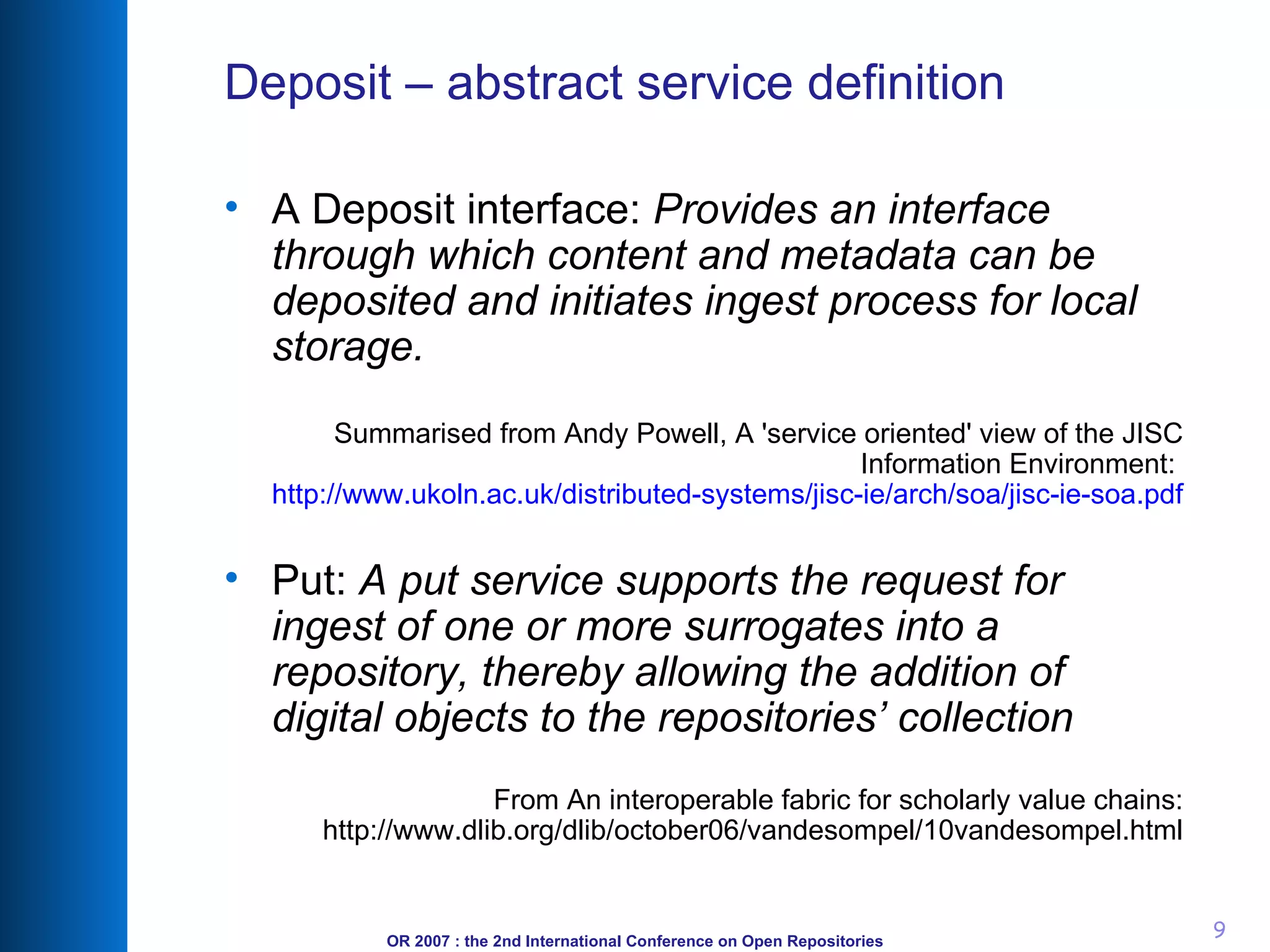
Deposit – abstract service definition
A Deposit interface: Provides an interface through which content and metadata can be deposited and initiates ingest process for local storage.
Summarised from Andy Powell, A 'service oriented' view of the JISC Information Environment: http://www.ukoln.ac.uk/distributed-systems/jisc-ie/arch/soa/jisc-ie-soa.pdf
Put: A put service supports the request for ingest of one or more surrogates into a repository, thereby allowing the addition of digital objects to the repositories’ collection
From An interoperable fabric for scholarly value chains: http://www.dlib.org/dlib/october06/vandesompel/10vandesompel.html
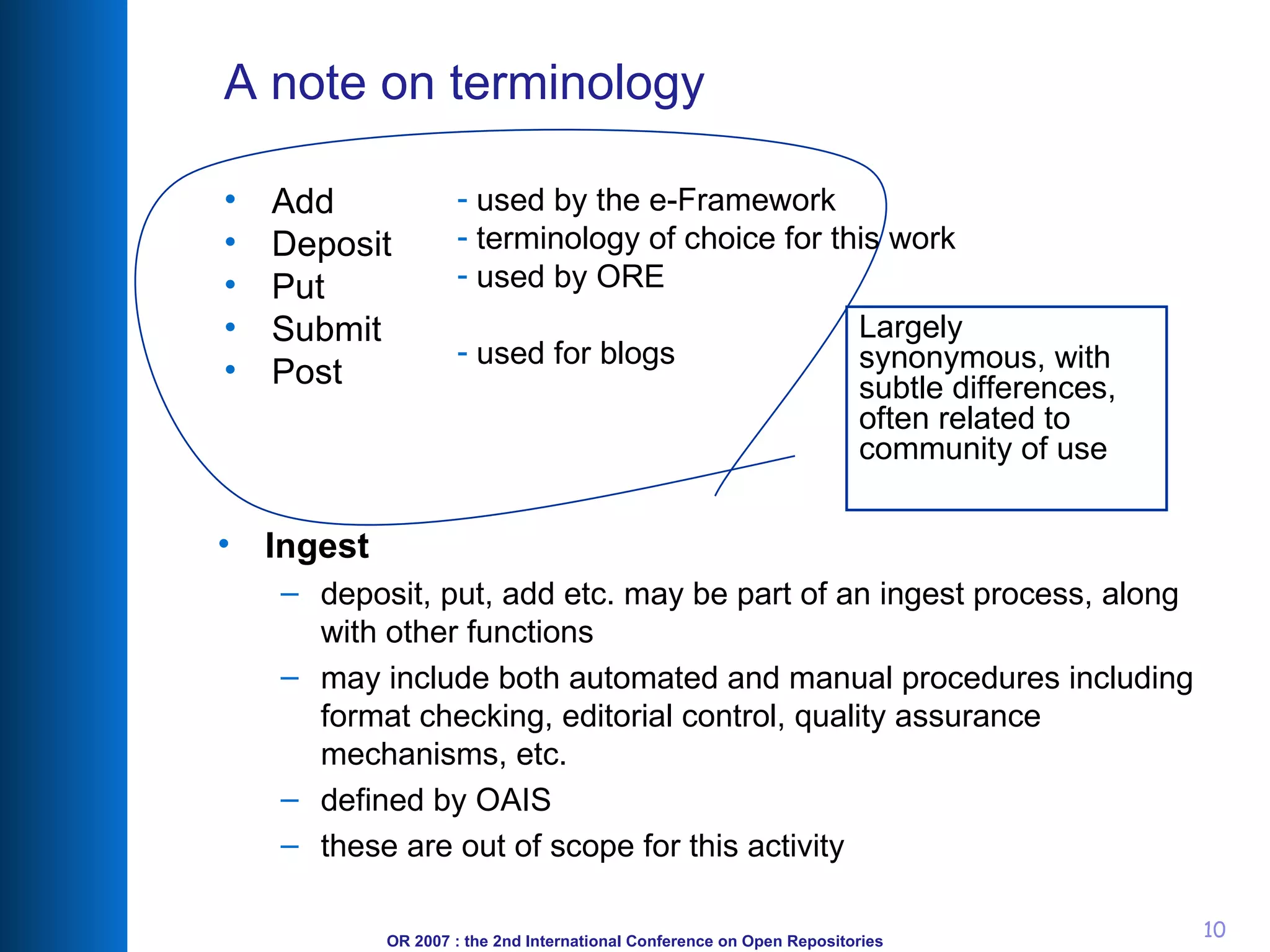
A note on terminology
Add
Deposit
Put
Submit
Post
Ingest
deposit, put, add etc. may be part of an ingest process, along with other functions
may include both automated and manual procedures including format checking, editorial control, quality assurance mechanisms, etc.
defined by OAIS
these are out of scope for this activity
used by the e-Framework
terminology of choice for this work
used by ORE
used for blogs
Largely synonymous, with subtle differences, often related to community of use
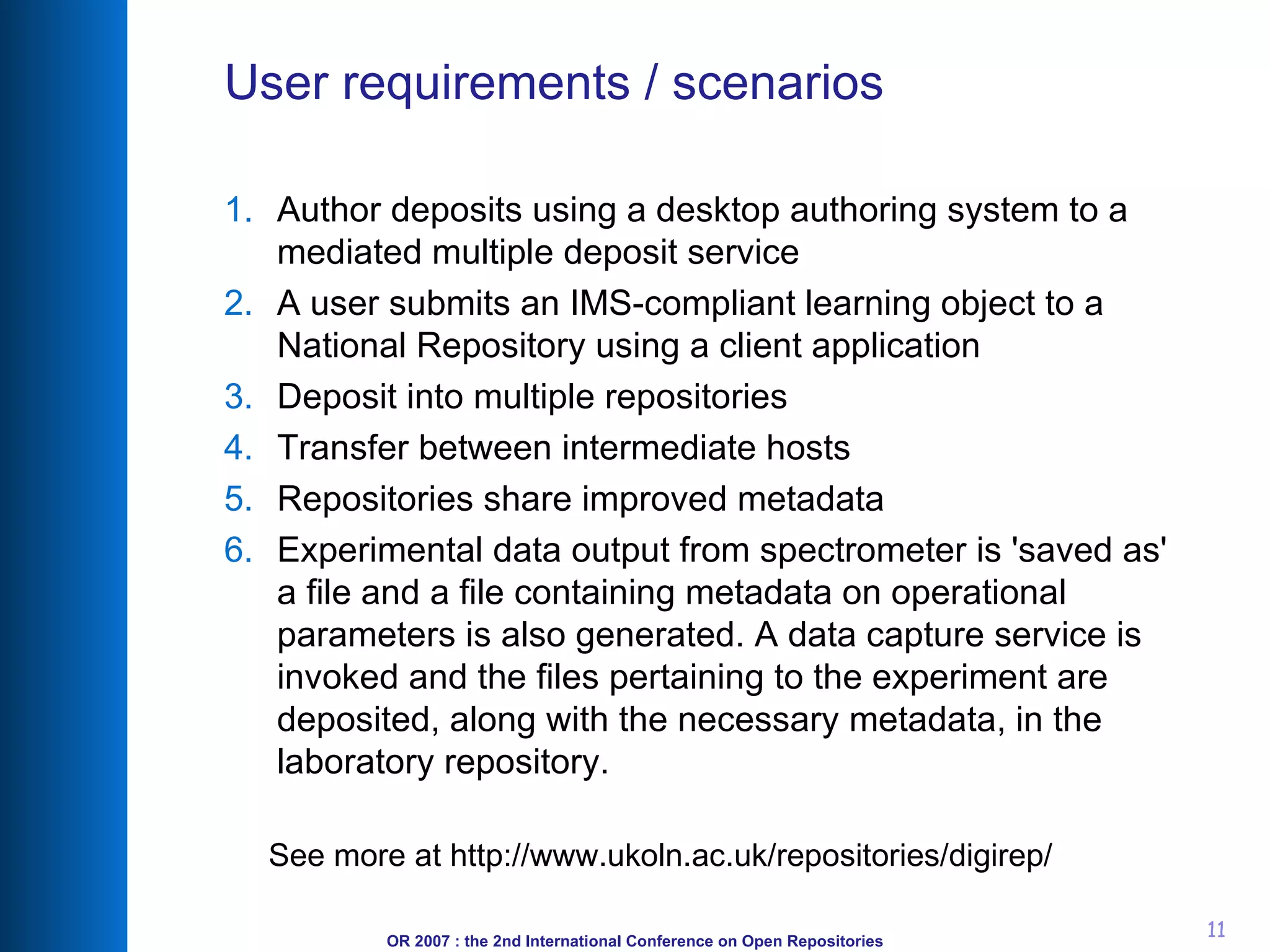
User requirements / scenarios
Author deposits using a desktop authoring system to a mediated multiple deposit service
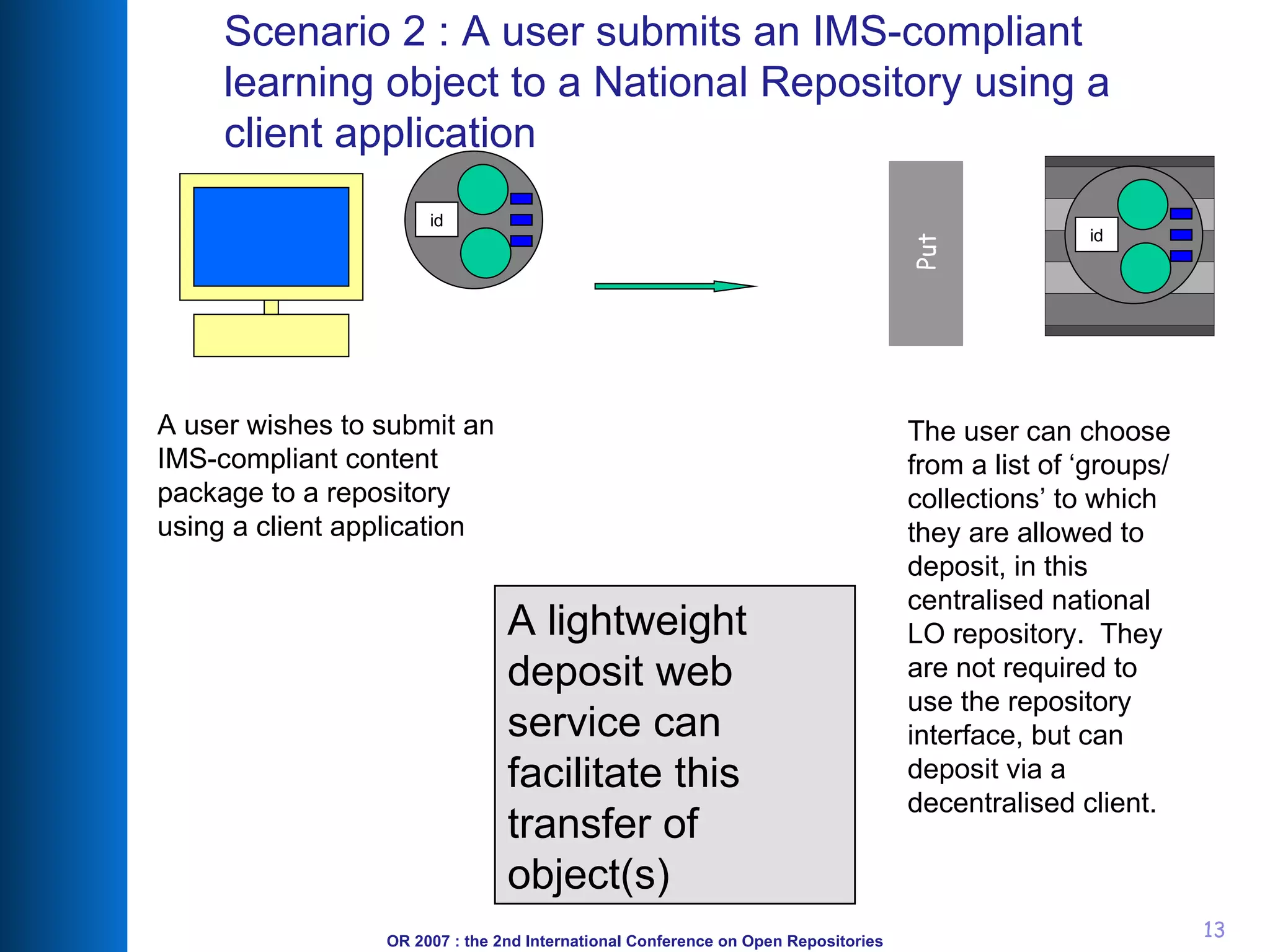
A user submits an IMS-compliant learning object to a National Repository using a client application
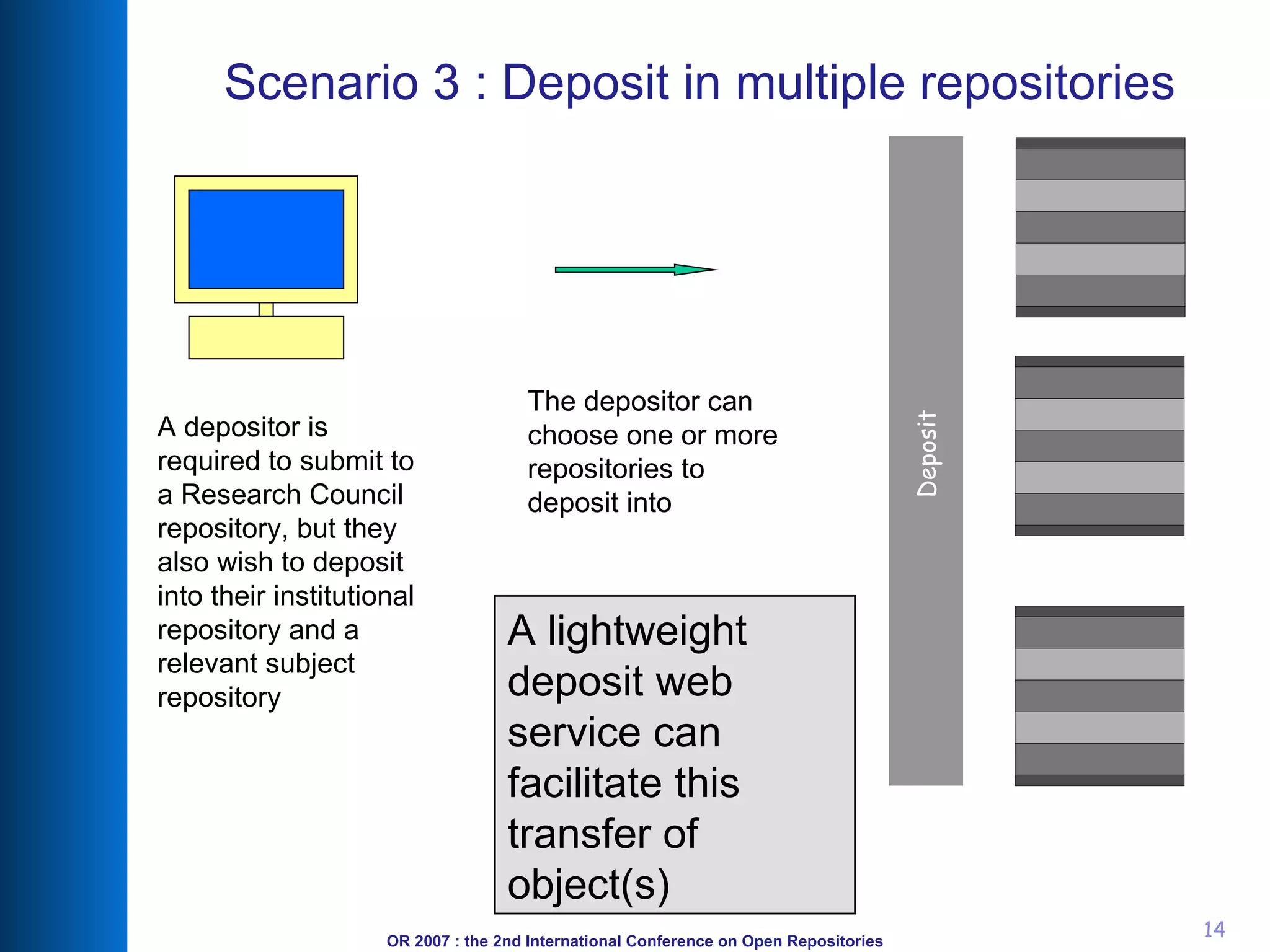
Deposit into multiple repositories
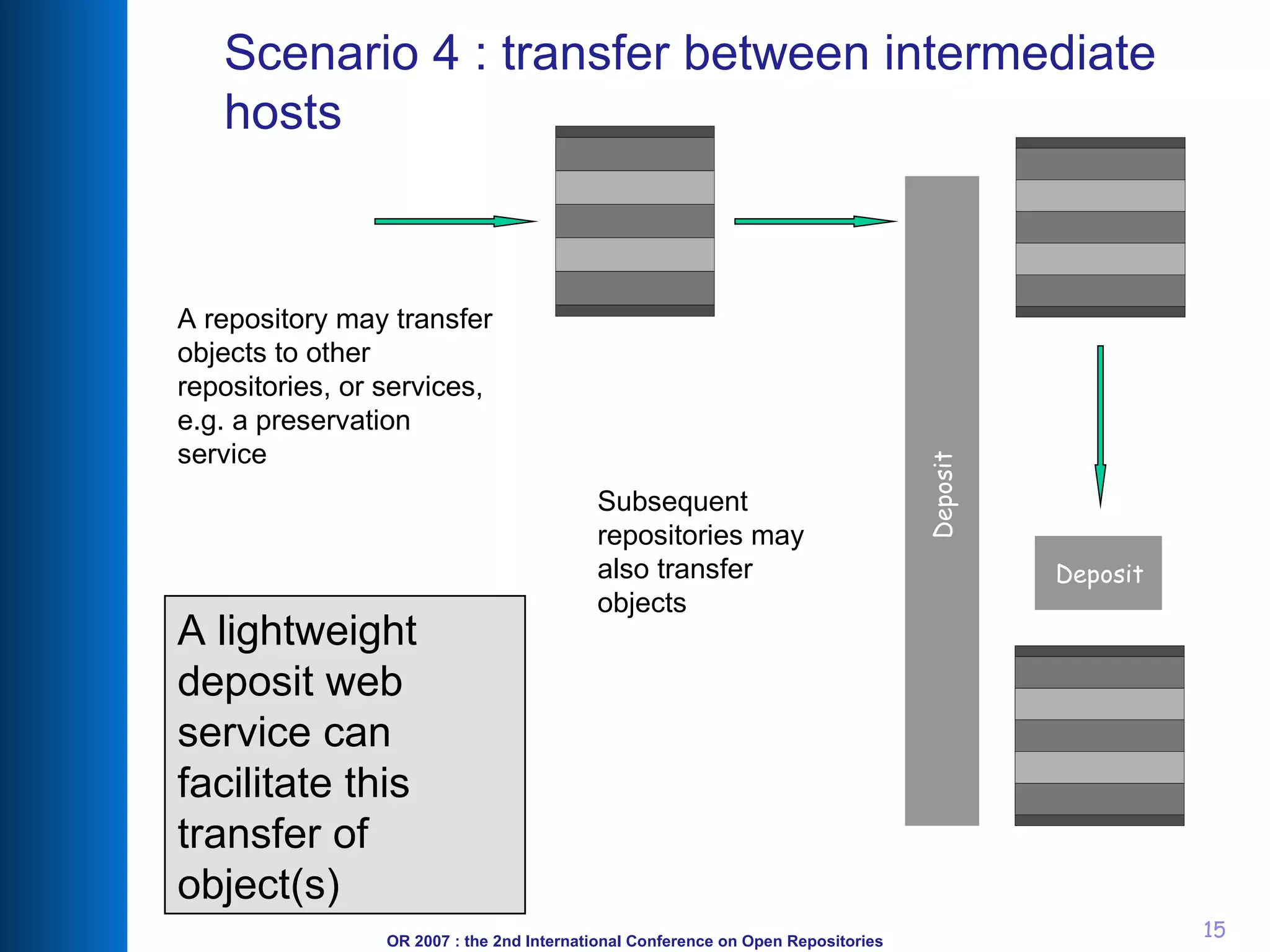
Transfer between intermediate hosts
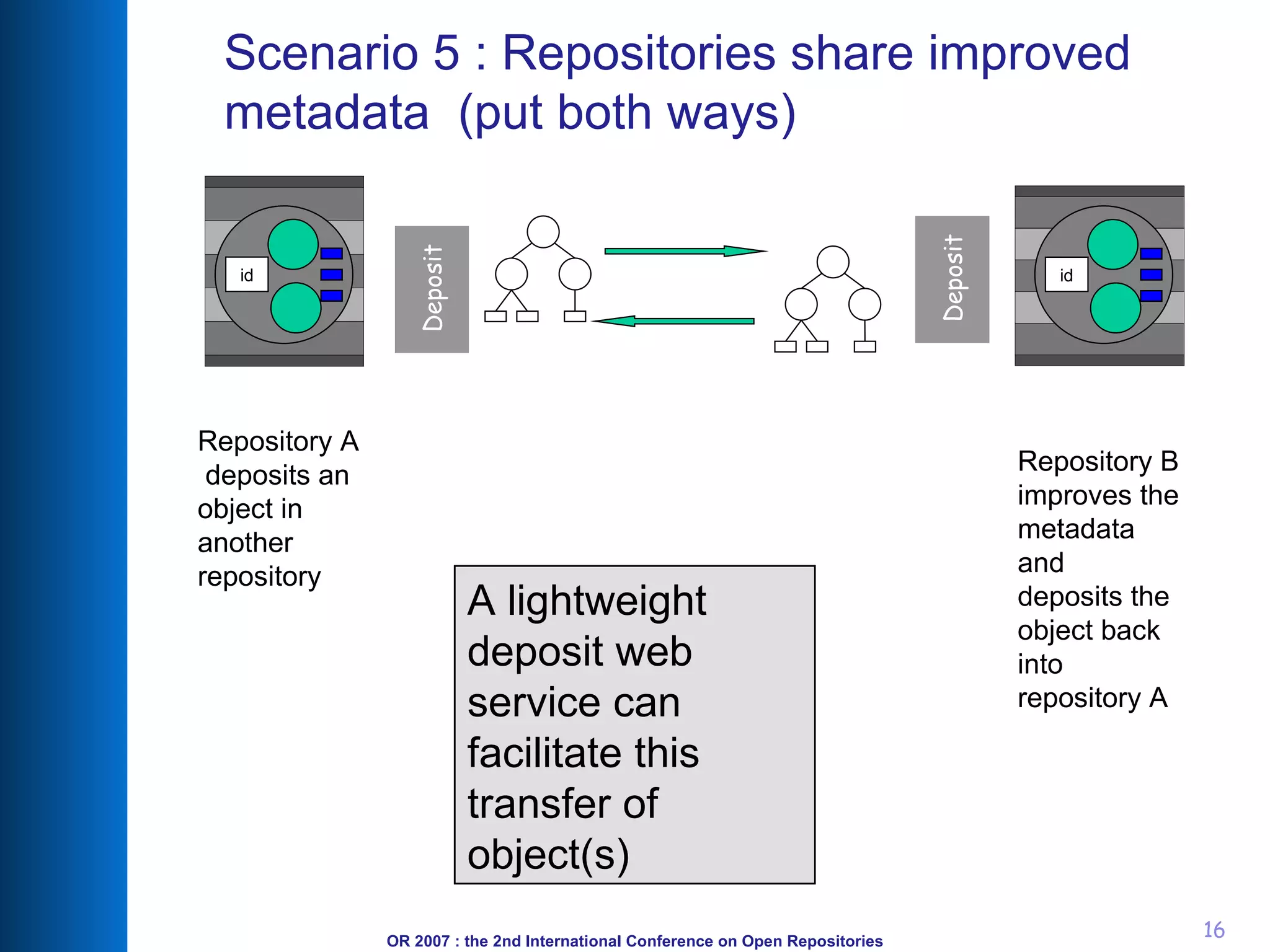
Repositories share improved metadata
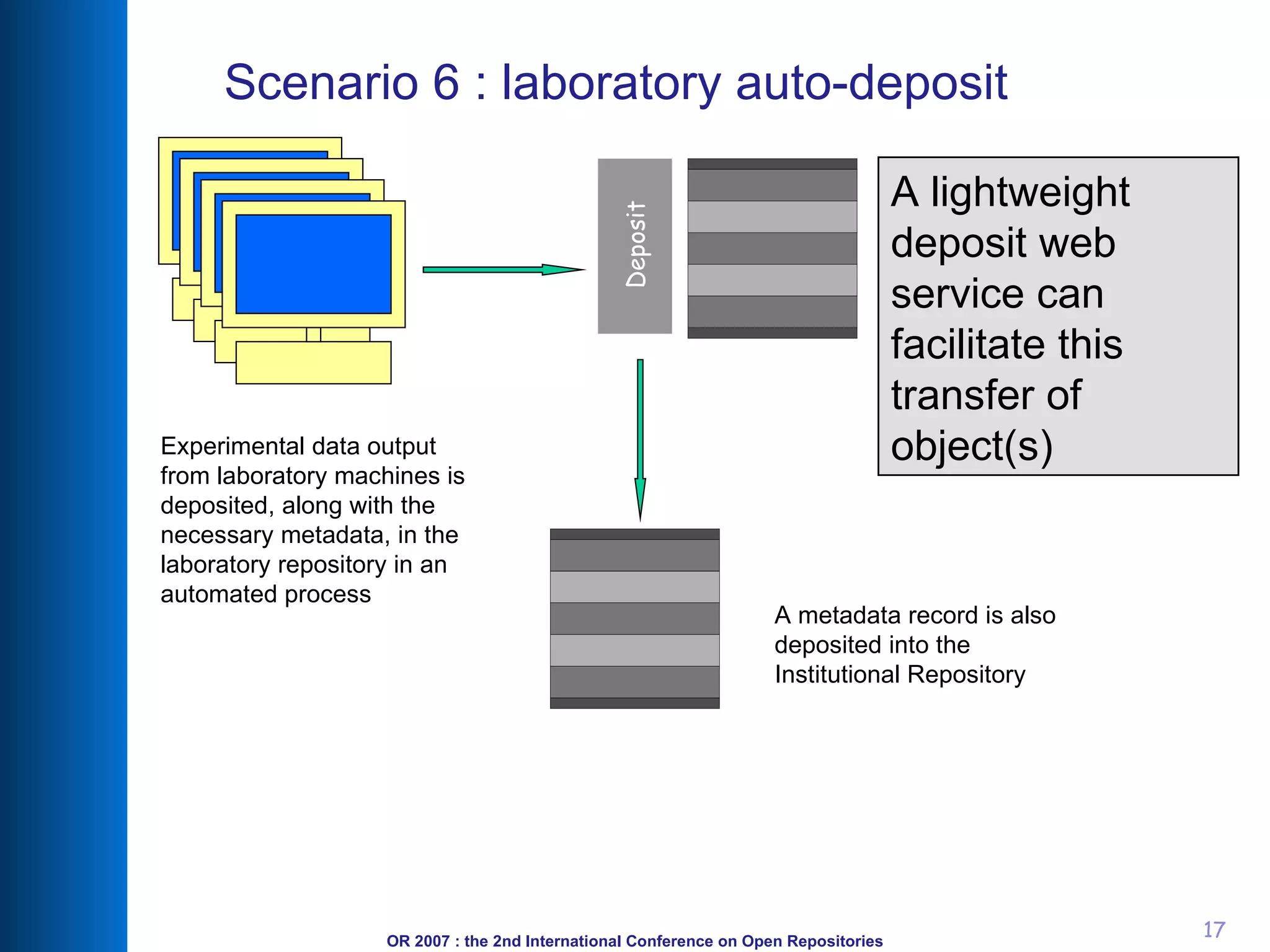
Experimental data output from spectrometer is 'saved as' a file and a file containing metadata on operational parameters is also generated. A data capture service is invoked and the files pertaining to the experiment are deposited, along with the necessary metadata, in the laboratory repository.
See more at http://www.ukoln.ac.uk/repositories/digirep/
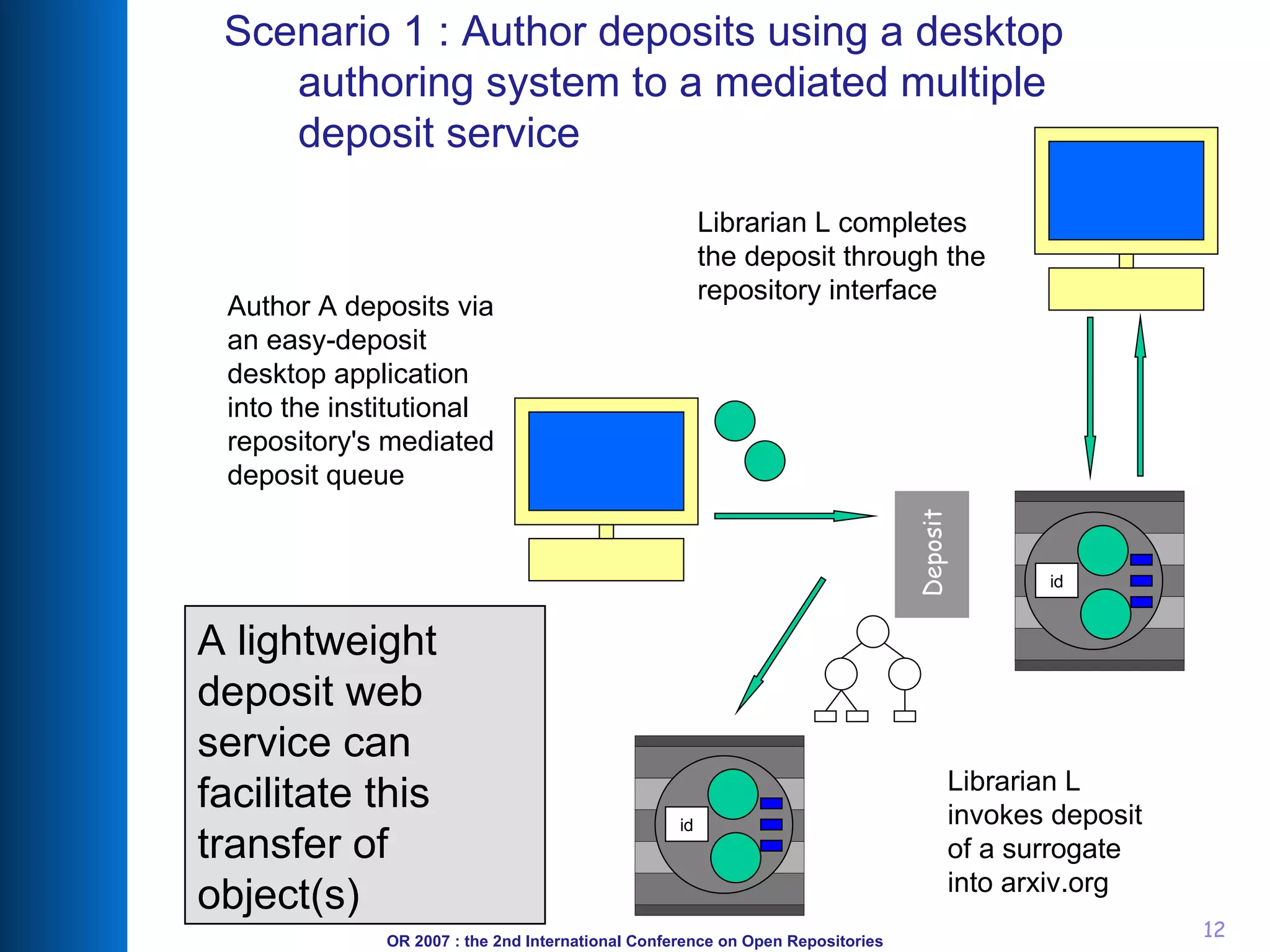
Scenario 1 : Author deposits using a desktop authoring system to a mediated multiple deposit service A lightweight deposit web service can facilitate this transfer of object(s) Librarian L completes the deposit through the repository interface id Librarian L invokes deposit of a surrogate into arxiv.org Deposit id Author A deposits via an easy-deposit desktop application into the institutional repository's mediated deposit queue
Scenario 2 : A user submits an IMS-compliant learning object to a National Repository using a client application A lightweight deposit web service can facilitate this transfer of object(s) A user wishes to submit an IMS-compliant content package to a repository using a client application id Put The user can choose from a list of ‘groups/collections’ to which they are allowed to deposit, in this centralised national LO repository. They are not required to use the repository interface, but can deposit via a decentralised client. id
Scenario 3 : Deposit in multiple repositories A lightweight deposit web service can facilitate this transfer of object(s) Deposit The depositor can choose one or more repositories to deposit into A depositor is required to submit to a Research Council repository, but they also wish to deposit into their institutional repository and a relevant subject repository
Scenario 4 : transfer between intermediate hosts A lightweight deposit web service can facilitate this transfer of object(s) Deposit Subsequent repositories may also transfer objects Deposit A repository may transfer objects to other repositories, or services, e.g. a preservation service
Scenario 5 : Repositories share improved metadata (put both ways) A lightweight deposit web service can facilitate this transfer of object(s) Deposit id Repository A deposits an object in another repository Deposit Repository B improves the metadata and deposits the object back into repository A id
Scenario 6 : laboratory auto-deposit A lightweight deposit web service can facilitate this transfer of object(s) Deposit Experimental data output from laboratory machines is deposited, along with the necessary metadata, in the laboratory repository in an automated process A metadata record is also deposited into the Institutional Repository
Some functional requirements
A Deposit service should:
be generic enough to support wide range of heterogeneous repositories
scholarly publications, data, learning objects, images, etc.
accept submission of different digital object types in consistent way:
data and/or metadata in the form of complex objects or content packages
support different workflows for deposit, e.g.
user to multiple repositories via intermediate client
user to repository, repository to additional repositories
user-triggered and machine-triggered deposit
accept large-scale (scientific datasets)
support statuses, e.g. deposit to different states of a workflow
support collections and changes in policy and permissions
support differences in repository policy
support non-instantaneous processes, e.g. deposit pending mediation
support validation report and integrity checks
support anonymous deposit
support more complex, authenticated deposit
support acceptance and handling of incomplete records
support rejection of records (reasons for rejection are out of scope)
support human-selected targets for deposit
support different deposit requests
Defining a lightweight deposit service
Define abstract service scope
information models and APIs must be developed in manner neutral to implementation binding
Examine existing protocols and specifications
could they be used implement the defined abstract service?
Evaluate and decide whether a new protocol or API is required
Abstract service: a discrete piece of technical functionality required to fulfil a specific requirement or set of requirements
Synonymous with a ‘service genre’ in the
JISC DEST e-Framework
Deposit – abstract service definition
A Deposit interface: Provides an interface through which content and metadata can be deposited and initiates ingest process for local storage.
Summarised from Andy Powell, A 'service oriented' view of the JISC Information Environment: http://www.ukoln.ac.uk/distributed-systems/jisc-ie/arch/soa/jisc-ie-soa.pdf
Put: A put service supports the request for ingest of one or more surrogates into a repository, thereby allowing the addition of digital objects to the repositories’ collection
From An interoperable fabric for scholarly value chains: http://www.dlib.org/dlib/october06/vandesompel/10vandesompel.html
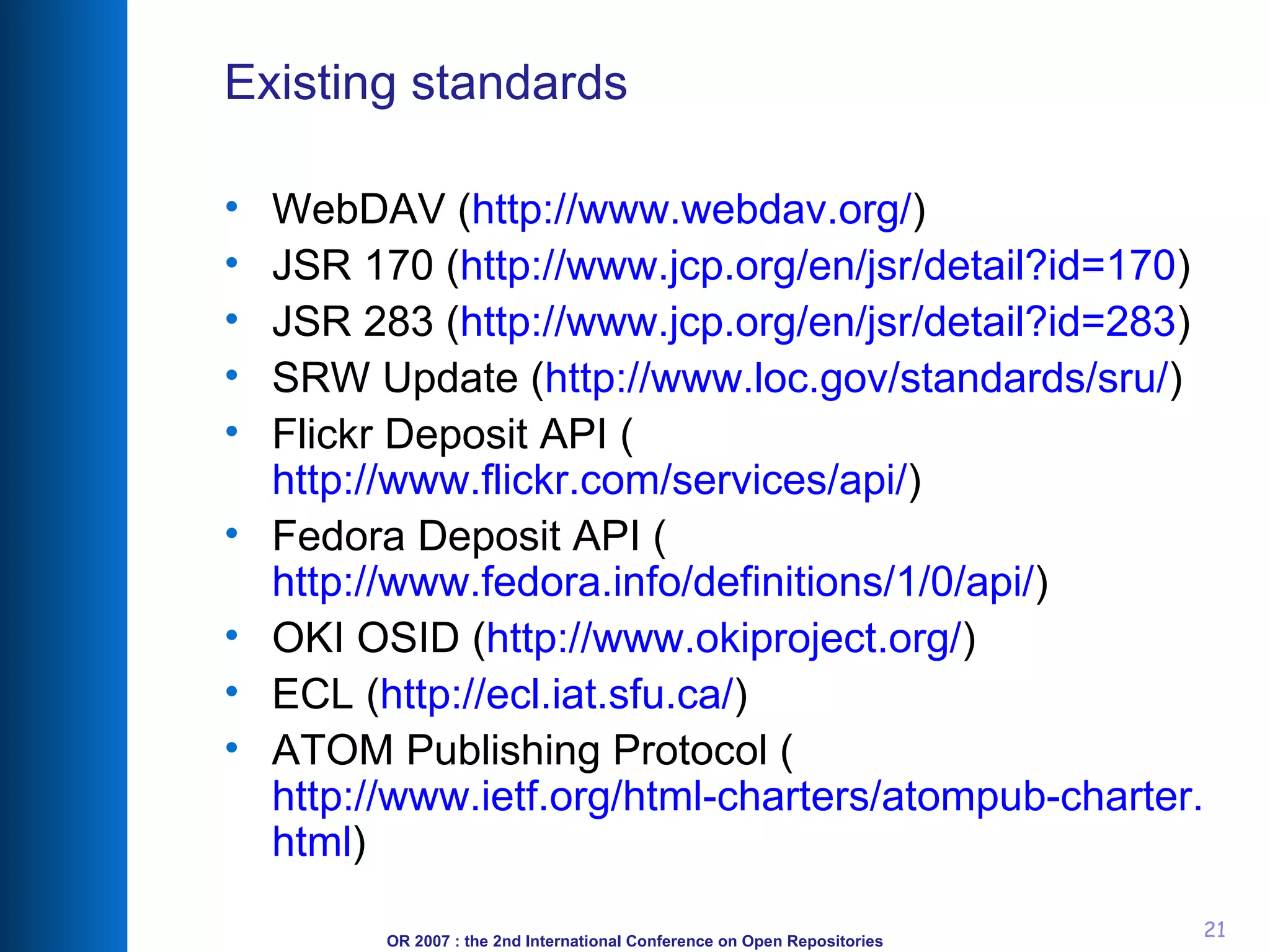
Flickr Deposit API ( http://www.flickr.com/services/api/ )
Fedora Deposit API ( http://www.fedora.info/definitions/1/0/api/ )
OKI OSID ( http://www.okiproject.org/ )
ECL ( http://ecl.iat.sfu.ca/ )
ATOM Publishing Protocol ( http://www.ietf.org/html-charters/atompub-charter. html )
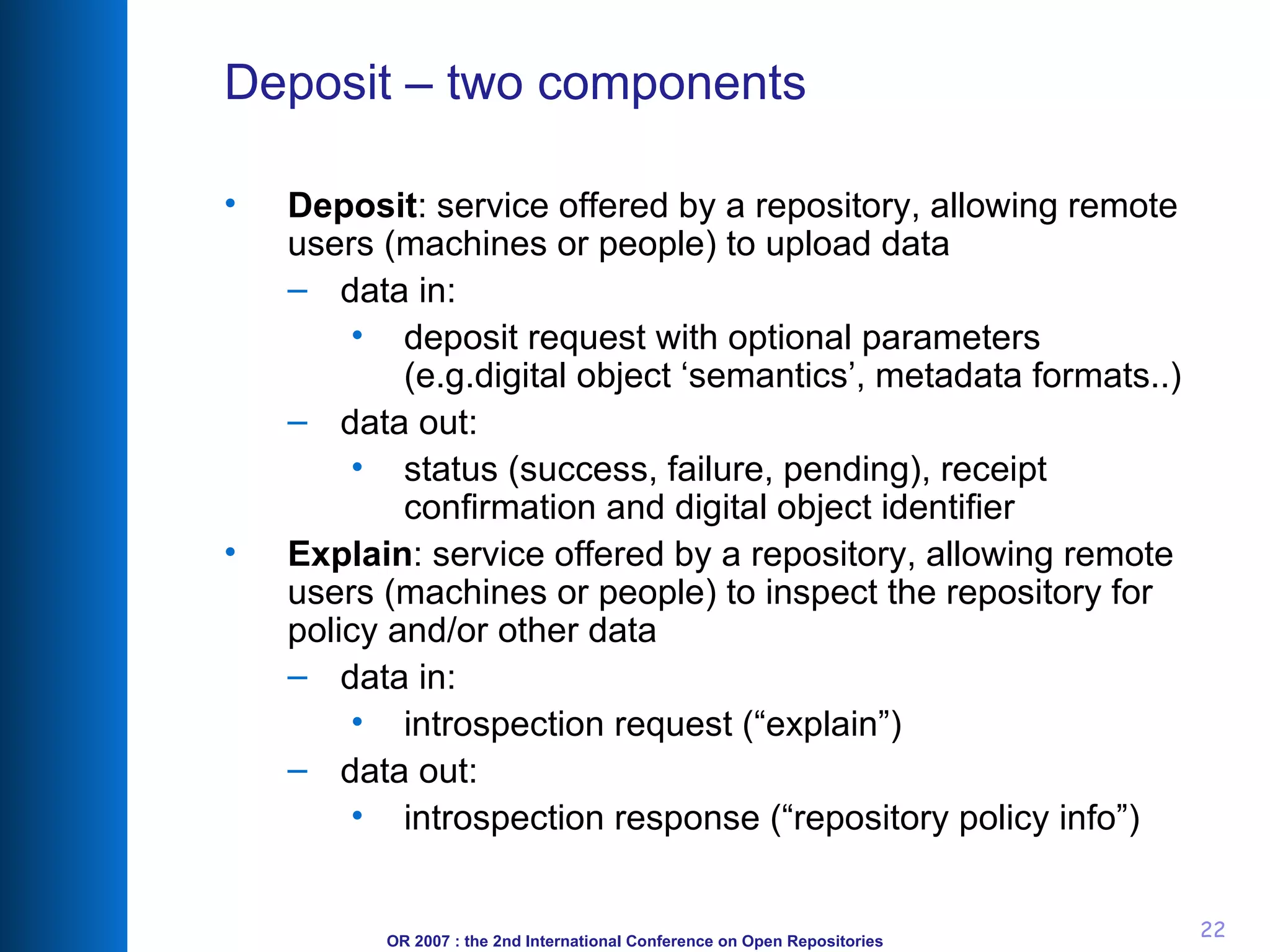
Deposit – two components
Deposit : service offered by a repository, allowing remote users (machines or people) to upload data
data in:
deposit request with optional parameters (e.g.digital object ‘semantics’, metadata formats..)
data out:
status (success, failure, pending), receipt confirmation and digital object identifier
Explain : service offered by a repository, allowing remote users (machines or people) to inspect the repository for policy and/or other data
data in:
introspection request (“explain”)
data out:
introspection response (“repository policy info”)
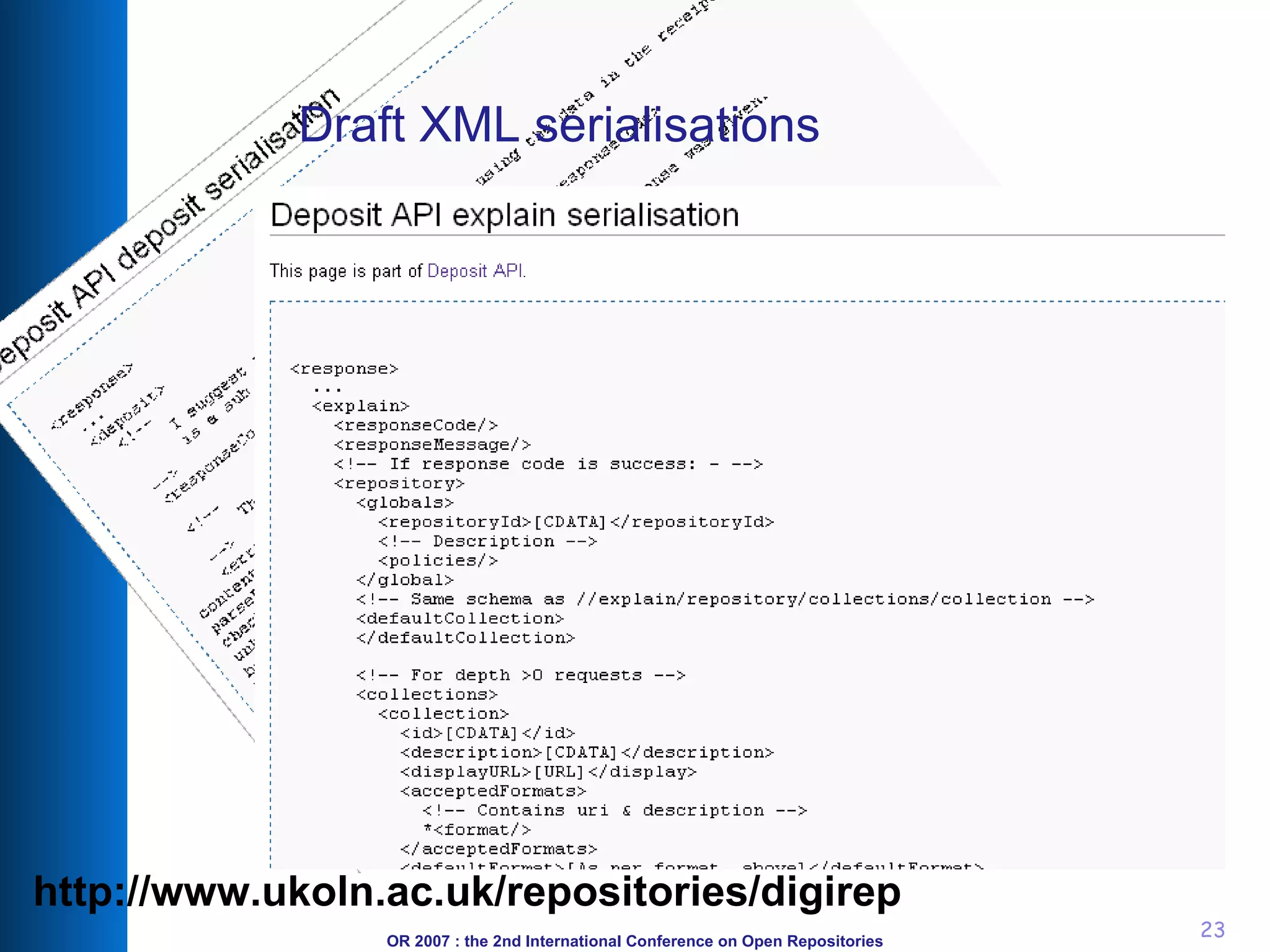
Draft XML serialisations http://www.ukoln.ac.uk/repositories/digirep
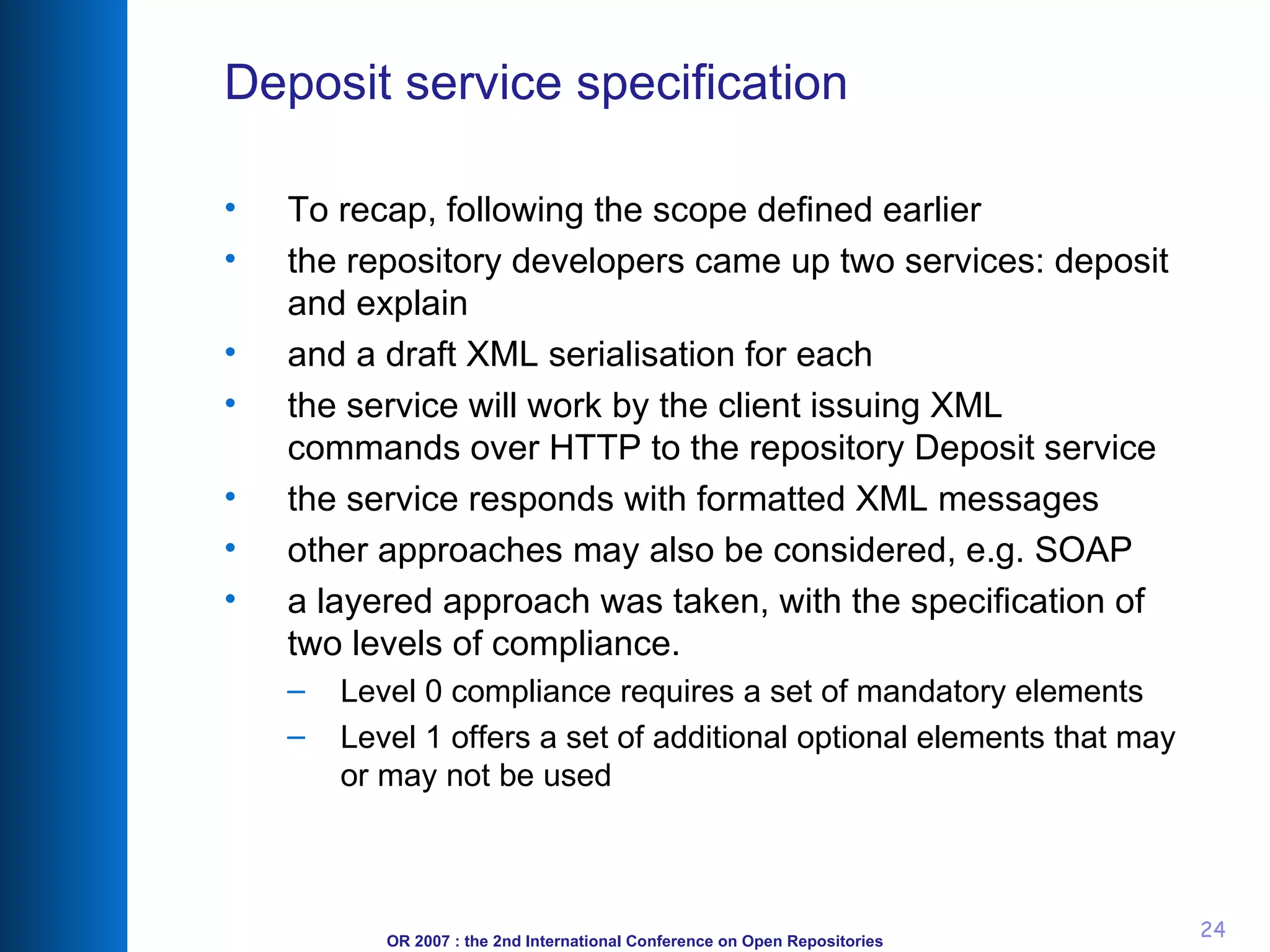
Deposit service specification
To recap, following the scope defined earlier
the repository developers came up two services: deposit and explain
and a draft XML serialisation for each
the service will work by the client issuing XML commands over HTTP to the repository Deposit service
the service responds with formatted XML messages
other approaches may also be considered, e.g. SOAP
a layered approach was taken, with the specification of two levels of compliance.
Level 0 compliance requires a set of mandatory elements
Level 1 offers a set of additional optional elements that may or may not be used
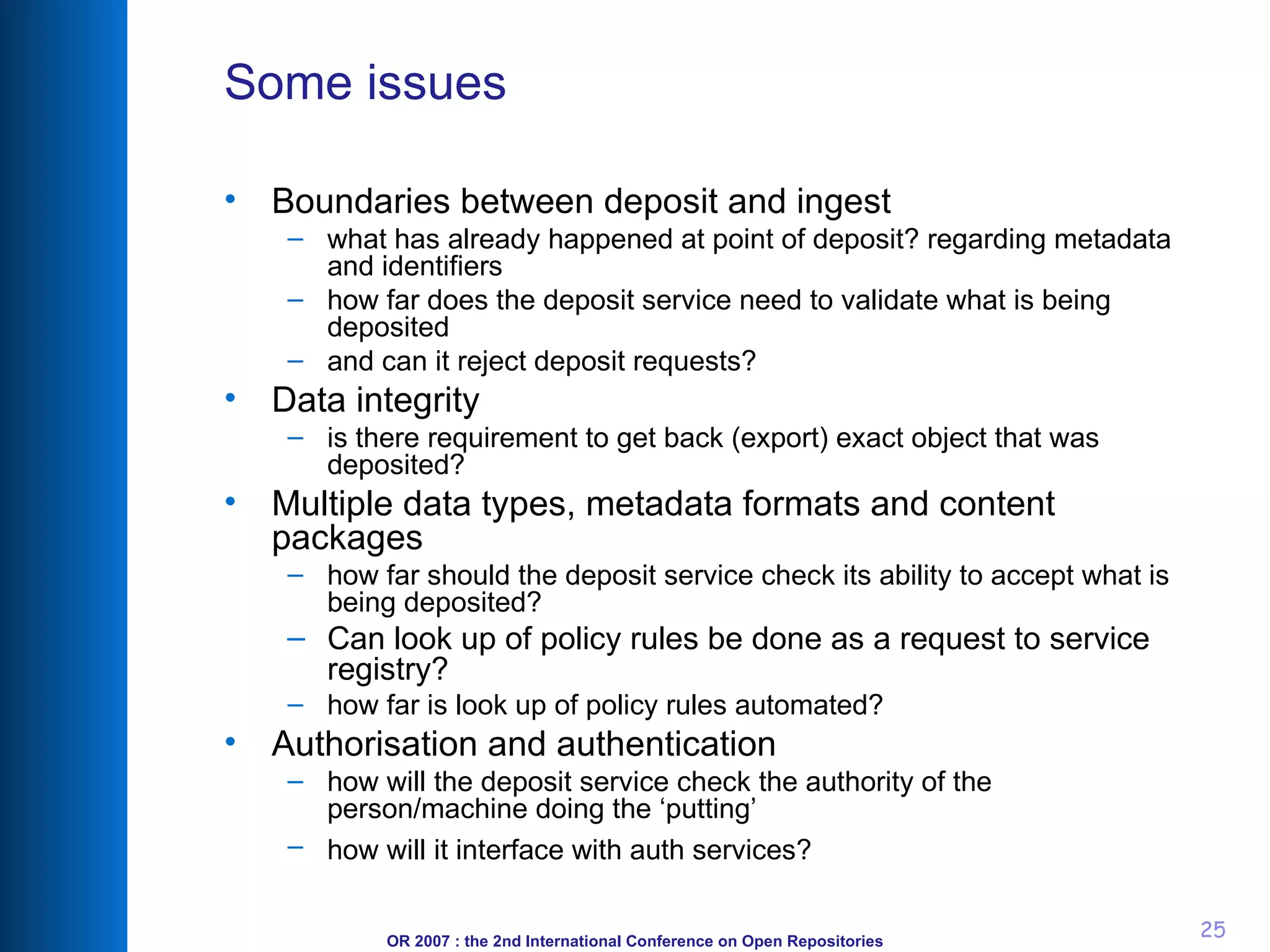
Some issues
Boundaries between deposit and ingest
what has already happened at point of deposit? regarding metadata and identifiers
how far does the deposit service need to validate what is being deposited
and can it reject deposit requests?
Data integrity
is there requirement to get back (export) exact object that was deposited?
Multiple data types, metadata formats and content packages
how far should the deposit service check its ability to accept what is being deposited?
Can look up of policy rules be done as a request to service registry?
how far is look up of policy rules automated?
Authorisation and authentication
how will the deposit service check the authority of the person/machine doing the ‘putting’
how will it interface with auth services?
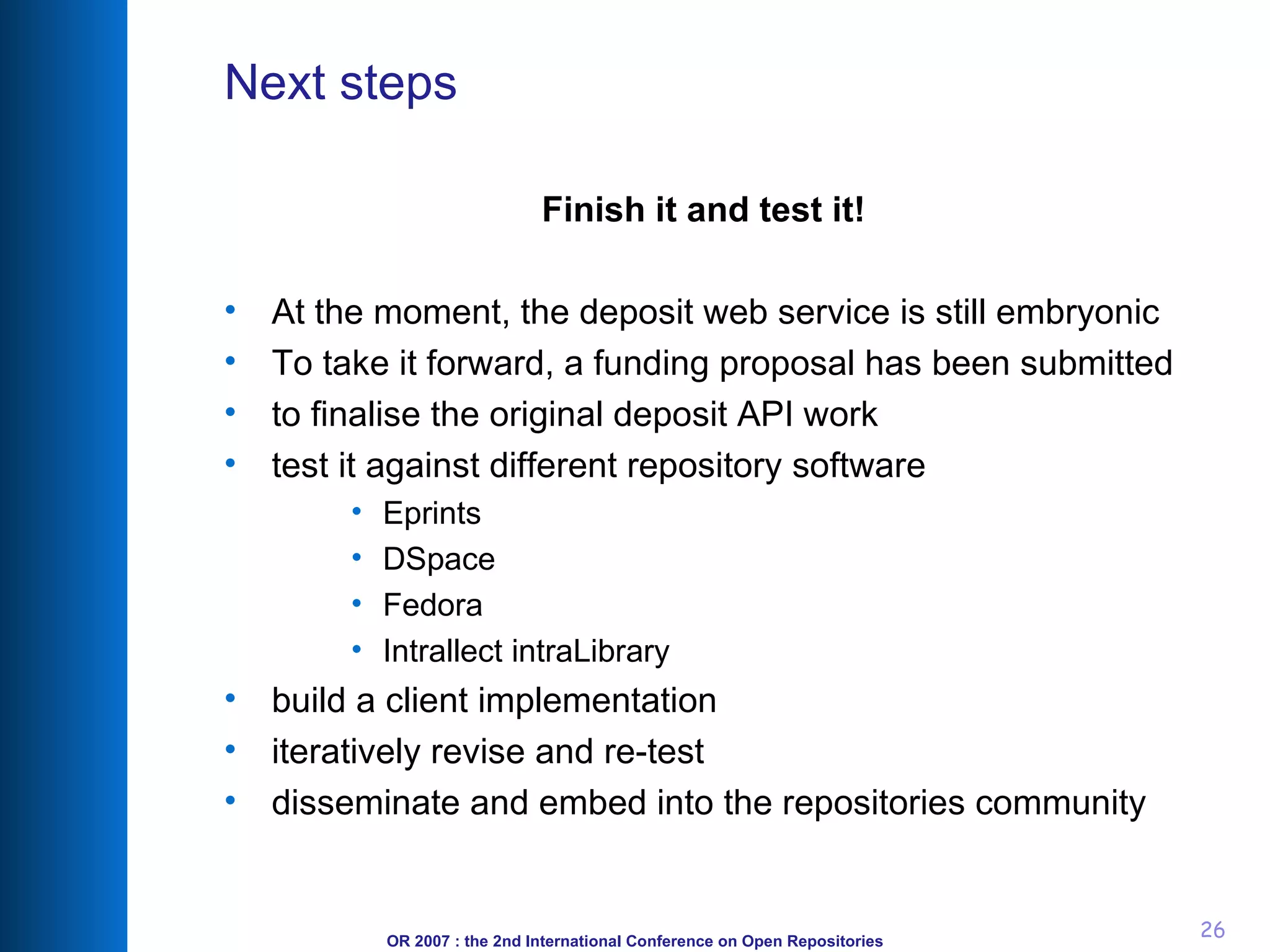
Next steps
Finish it and test it!
At the moment, the deposit web service is still embryonic
To take it forward, a funding proposal has been submitted
to finalise the original deposit API work
test it against different repository software
Eprints
DSpace
Fedora
Intrallect intraLibrary
build a client implementation
iteratively revise and re-test
disseminate and embed into the repositories community
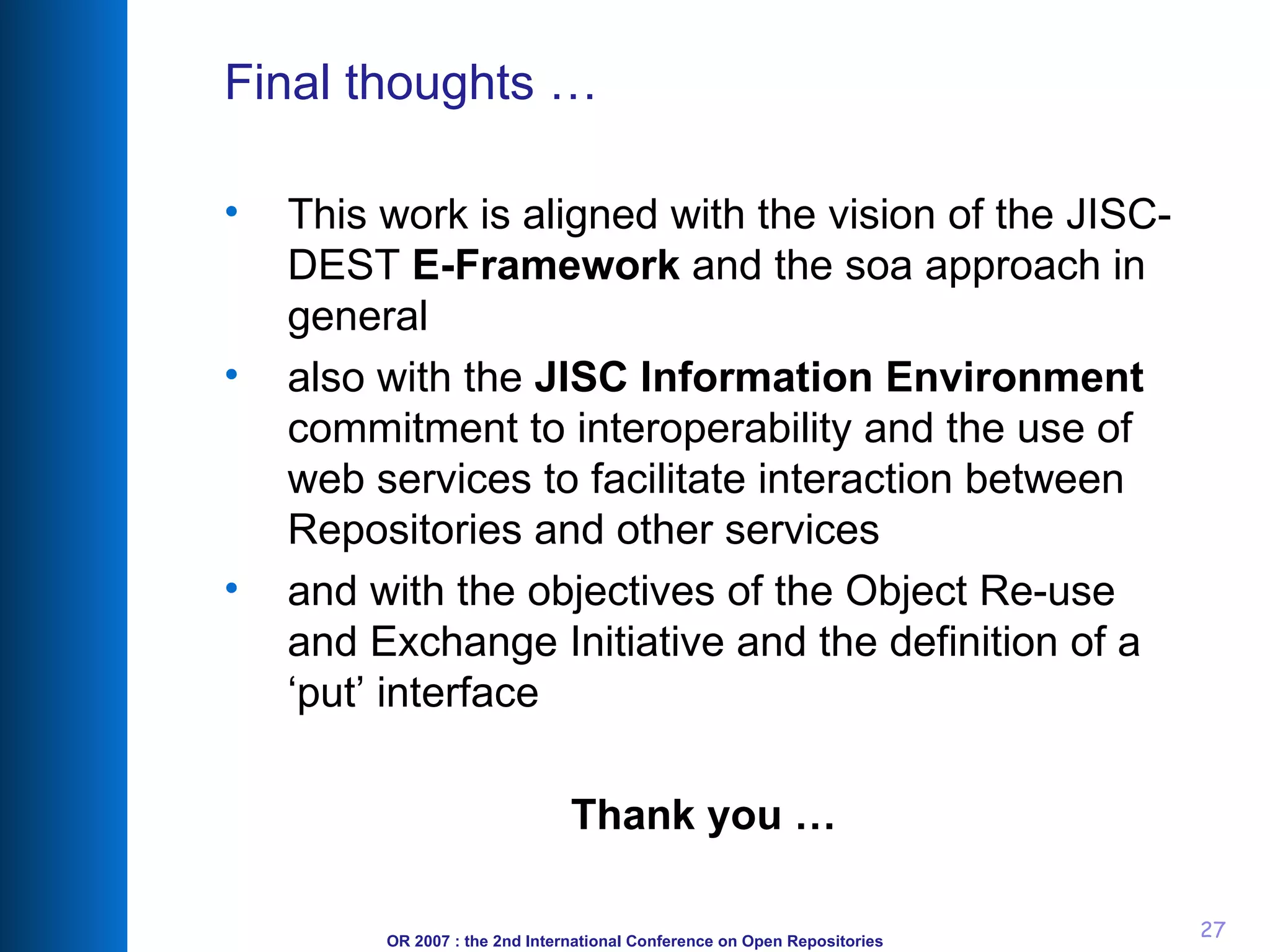
Final thoughts …
This work is aligned with the vision of the JISC-DEST E-Framework and the soa approach in general
also with the JISC Information Environment commitment to interoperability and the use of web services to facilitate interaction between Repositories and other services
and with the objectives of the Object Re-use and Exchange Initiative and the definition of a ‘put’ interface
Rachel Heery, Julie Allinson, Jim Downing, Christop more
Rachel Heery, Julie Allinson, Jim Downing, Christopher Gutteridge and Martin Morrey, UKOLN, University of Bath, will update attendees on a three-year UK program that is developing repository infrastructure aimed at increasing open access to scholarly material, while improving management of assets in higher education institutions. This effort is designed to ensure that the emerging network of JISC (Joint Information Services Committee) Digital Repositories is well populated with content. They will present their work towards defining a lightweight Common Repository Deposit Service Description. less
0 comments
Post a comment