Ilias Trochidis
Ortelio Ltd
http://ortelio.co.uk
MARIO
Managing active and healthy aging with use of
caring service robots
Horizon 2020 "Health, demographic change and wellbeing" Programme
European Robotics Forum 2015
Vienna, Austria, March 11-13, 2015
 Partners
 Motivation
 Objectives
 Target groups
 Major milestones
 Impact
 Unique selling points
MARIO Project Presentation
2
 National University of Ireland, Galway
 ROBOSOFT
 RU Robot
 Ortelio Ltd
 City of Stockport
 Consiglio Nazionale delle Ricerche
 R2M Solution
 Casa Sollievo della Sofferenza Hospital
 Caretta-Net
 University of Passau
Partners
3
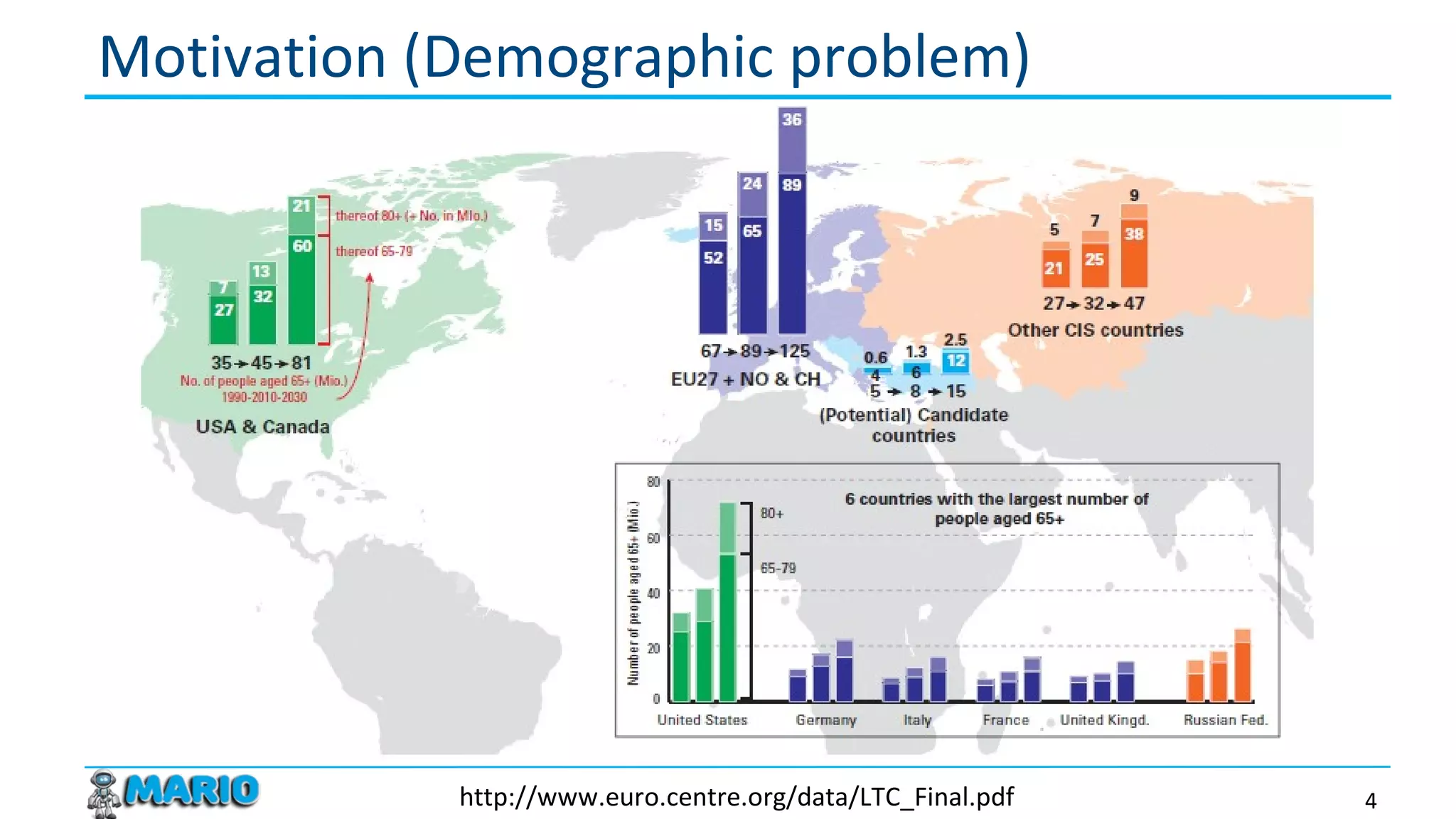
Motivation (Demographic problem)
4
Evolution of the population in the older age groups (65 and older, 65-79, 80 and older), 1990, 2010 and 2030
http://www.euro.centre.org/data/LTC_Final.pdf
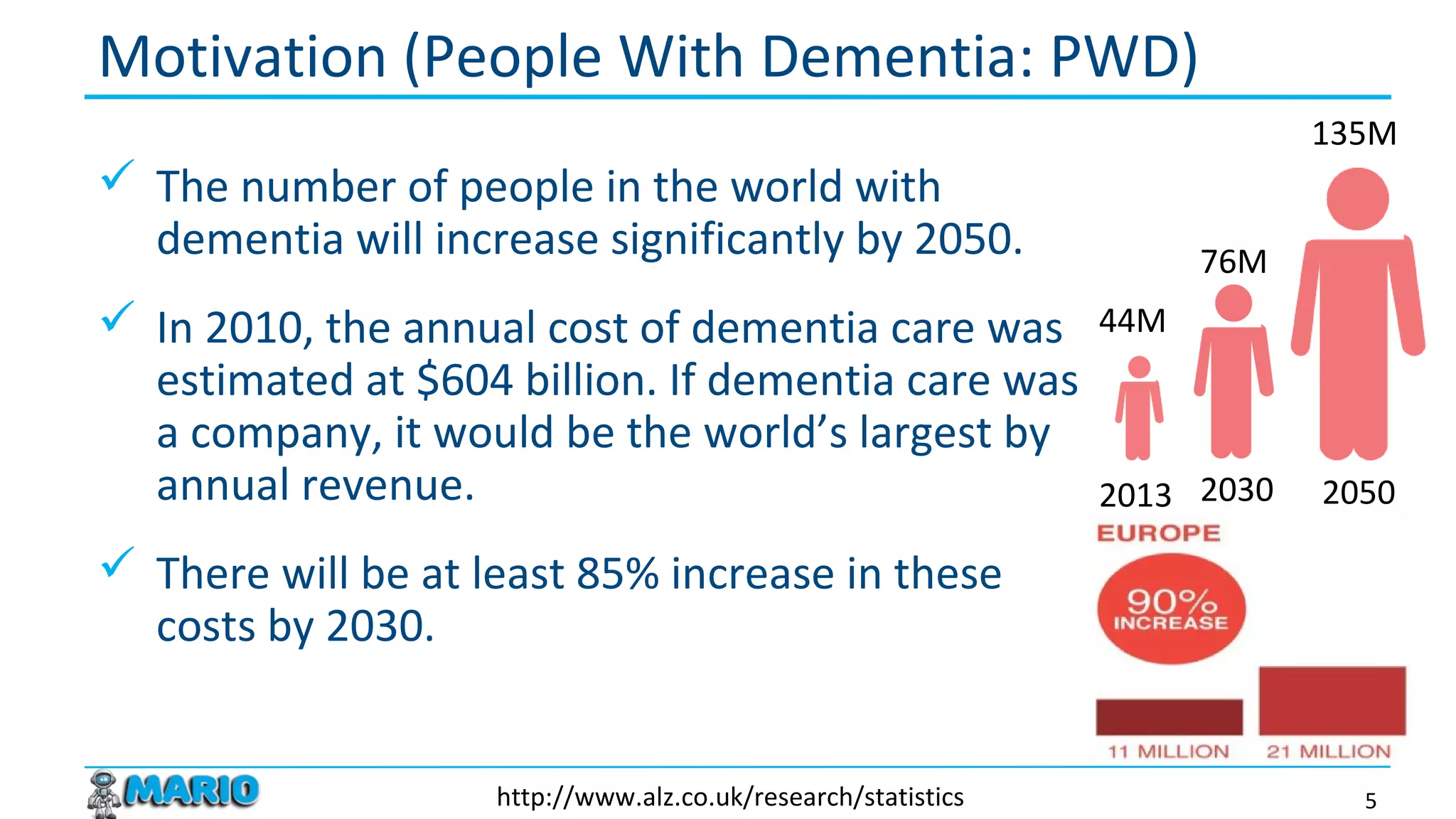
 The number of people in the world with
dementia will increase significantly by 2050.
 In 2010, the annual cost of dementia care was
estimated at $604 billion. If dementia care was
a company, it would be the world’s largest by
annual revenue.
 There will be at least 85% increase in these
costs by 2030.
Motivation (People With Dementia: PWD)
5
44M
2013
76M
2030
135M
2050
http://www.alz.co.uk/research/statistics
 To address and make progress on the challenging problems of
loneliness, isolation and dementia in older persons through multi-
faceted interventions delivered by service robots.
 To conduct near project length interaction with end users and
assisted living environments.
 To assist caregivers and physicians in the comprehensive geriatric
assessment (CGA) through the use of service robots.
 The use of near state of the art robotic platforms that are flexible,
modular friendly, low cost and close to market ready.
MARIO objectives 1/2
6
 To make MARIO capable to support and receive “robot
applications” similar to the developer and app community for
smartphones.
 Through novel advances in machine learning techniques and
semantic analysis methods to make MARIO more personable,
useful, and accepted by end users (e.g. gain perception of non-
loneliness).
 To bring MARIO service robot concepts out of the lab and into
industry.
MARIO objectives 1/2
7
We connect older persons to 4+ main target groups:
Their community and social support programs
The medical community and caregivers
Their social network (family & friends)
Their interests (stimulation for cognitive aspects)
+The developer community that can make available new robot
applications
MARIO target groups
8
 Nurse practitioners / Dementia specialists
 Geriatricians
 Psychologists
 PWD and their carers
 Technologists
People that will benefit
9
M12
Implementation of the platform hardware, sensor and communication modifications. 12
Service Robots ready to be used for validation.
M24
Execution of the health aspects of the proposal related to loneliness, isolation, resilience
and dementia.
Execution of the CGA and MPI assessments with service robots.
Implementation of the personalised semantic interaction.
Implementation of the MARIO’s behavioural and social skills.
M34
Technical Integration Complete & Replication Plan Ready
M36
Validation completed in homes, communities and hospitals.
Major milestones
10
 Less demand on social workers, caregivers, and medical
experts:
• MARIO robots are able to perform CGA and MPI assessments
• MARIO robots tackle the problems of loneliness, isolation and
depression giving simple access to a range of support functionality
both within and outside the home / institution.
 Highly personalised applications to robots, while reducing
the development costs and the response time to address
existing and new needs.
Impact
11
MARIO will:
perform CGA
be a benchmark for robotics in dementia
be a tool for assisting elderly to stay connected
be acceptable by end-users
be a market leader and a commercially viable product
provide an ethical framework for assisted living
provide a framework for measuring life improvements
save money
MARIO main unique selling points
12
 Aknowledgements
The research leading to these results has received funding from the
European Union Horizon 2020 – the Framework Programme for Research
and Innovation (2014-2020) under grant agreement 643808 Project
MARIO “Managing active and healthy aging with use of caring service
robots”
 Contact
http://www.mario-project.eu/ (coming soon)
it@ortelio.co.uk
@itroch
Thank you
13

MARIO Project Presentation - 10 March 2015

  • 1.
    Ilias Trochidis Ortelio Ltd http://ortelio.co.uk MARIO Managingactive and healthy aging with use of caring service robots Horizon 2020 "Health, demographic change and wellbeing" Programme European Robotics Forum 2015 Vienna, Austria, March 11-13, 2015
  • 2.
     Partners  Motivation Objectives  Target groups  Major milestones  Impact  Unique selling points MARIO Project Presentation 2
  • 3.
     National Universityof Ireland, Galway  ROBOSOFT  RU Robot  Ortelio Ltd  City of Stockport  Consiglio Nazionale delle Ricerche  R2M Solution  Casa Sollievo della Sofferenza Hospital  Caretta-Net  University of Passau Partners 3
  • 4.
    Motivation (Demographic problem) 4 Evolutionof the population in the older age groups (65 and older, 65-79, 80 and older), 1990, 2010 and 2030 http://www.euro.centre.org/data/LTC_Final.pdf
  • 5.
     The numberof people in the world with dementia will increase significantly by 2050.  In 2010, the annual cost of dementia care was estimated at $604 billion. If dementia care was a company, it would be the world’s largest by annual revenue.  There will be at least 85% increase in these costs by 2030. Motivation (People With Dementia: PWD) 5 44M 2013 76M 2030 135M 2050 http://www.alz.co.uk/research/statistics
  • 6.
     To addressand make progress on the challenging problems of loneliness, isolation and dementia in older persons through multi- faceted interventions delivered by service robots.  To conduct near project length interaction with end users and assisted living environments.  To assist caregivers and physicians in the comprehensive geriatric assessment (CGA) through the use of service robots.  The use of near state of the art robotic platforms that are flexible, modular friendly, low cost and close to market ready. MARIO objectives 1/2 6
  • 7.
     To makeMARIO capable to support and receive “robot applications” similar to the developer and app community for smartphones.  Through novel advances in machine learning techniques and semantic analysis methods to make MARIO more personable, useful, and accepted by end users (e.g. gain perception of non- loneliness).  To bring MARIO service robot concepts out of the lab and into industry. MARIO objectives 1/2 7
  • 8.
    We connect olderpersons to 4+ main target groups: Their community and social support programs The medical community and caregivers Their social network (family & friends) Their interests (stimulation for cognitive aspects) +The developer community that can make available new robot applications MARIO target groups 8
  • 9.
     Nurse practitioners/ Dementia specialists  Geriatricians  Psychologists  PWD and their carers  Technologists People that will benefit 9
  • 10.
    M12 Implementation of theplatform hardware, sensor and communication modifications. 12 Service Robots ready to be used for validation. M24 Execution of the health aspects of the proposal related to loneliness, isolation, resilience and dementia. Execution of the CGA and MPI assessments with service robots. Implementation of the personalised semantic interaction. Implementation of the MARIO’s behavioural and social skills. M34 Technical Integration Complete & Replication Plan Ready M36 Validation completed in homes, communities and hospitals. Major milestones 10
  • 11.
     Less demandon social workers, caregivers, and medical experts: • MARIO robots are able to perform CGA and MPI assessments • MARIO robots tackle the problems of loneliness, isolation and depression giving simple access to a range of support functionality both within and outside the home / institution.  Highly personalised applications to robots, while reducing the development costs and the response time to address existing and new needs. Impact 11
  • 12.
    MARIO will: perform CGA bea benchmark for robotics in dementia be a tool for assisting elderly to stay connected be acceptable by end-users be a market leader and a commercially viable product provide an ethical framework for assisted living provide a framework for measuring life improvements save money MARIO main unique selling points 12
  • 13.
     Aknowledgements The researchleading to these results has received funding from the European Union Horizon 2020 – the Framework Programme for Research and Innovation (2014-2020) under grant agreement 643808 Project MARIO “Managing active and healthy aging with use of caring service robots”  Contact http://www.mario-project.eu/ (coming soon) it@ortelio.co.uk @itroch Thank you 13

Editor's Notes

  • #7 innovative resilient based intervention targeting PWD, carers and community, will improve the outcomes of PWD so that they can continue to participate in a meaningful way and live well within their community for as long as possible the first instance globally that a robot module will be developed that is capable of performing autonomously a CGA directly on elderly patients without assistance and can subsequently determine the health status (MPIR)