
RoboBrain: A Software Architecture Mapping the
Human Brain
Ilias Trochidis
Ortelio Ltd, UK
Adamantios Koumpis
University of Passau, Germany
Laurentiu Vasiliu
Peracton Ltd, Ireland
Christoph Bussler
Tropo Inc, USA
When do we first hear about
robots and robot brain?
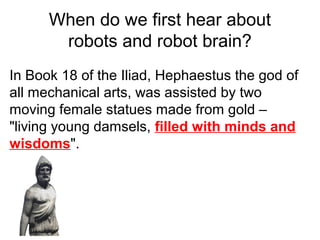
In Book 18 of the Iliad, Hephaestus the god of
all mechanical arts, was assisted by two
moving female statues made from gold –
"living young damsels, filled with minds and
wisdoms".
What happened until now?
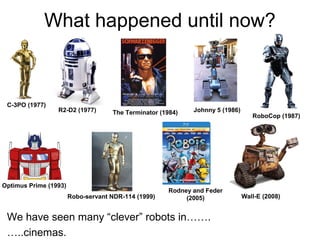
Optimus Prime (1993)
Johnny 5 (1986)
Wall-E (2008)
The Terminator (1984)R2-D2 (1977)
C-3PO (1977)
RoboCop (1987)
Robo-servant NDR-114 (1999)
Rodney and Feder
(2005)
We have seen many “clever” robots in…….
…..cinemas.
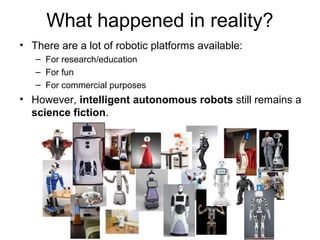
What happened in reality?
• There are a lot of robotic platforms available:
– For research/education
– For fun
– For commercial purposes
• However, intelligent autonomous robots still remains a
science fiction.
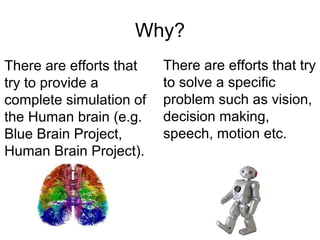
Why?
There are efforts that try
to solve a specific
problem such as vision,
decision making,
speech, motion etc.
There are efforts that
try to provide a
complete simulation of
the Human brain (e.g.
Blue Brain Project,
Human Brain Project).
@ the RoboBrain lab
We develop the RoboBrain Architecture
@ the RoboBrain lab
It is a component based software architecture
that:
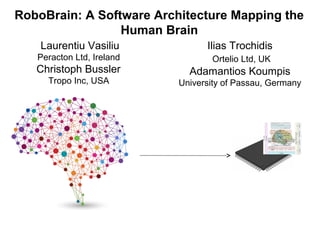
•Maps the main functions of the human brain.
•Allows components to be plugged in.
•Can be installed on any Humanoid robot.
RoboBrain is a software developer’s view of how a
robot brain should work.
We build the first robotic software brain architecture that emulates
human brain functionality!
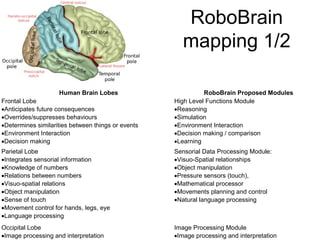
Human Brain Lobes RoboBrain Proposed Modules
Frontal Lobe
•Anticipates future consequences
•Overrides/suppresses behaviours
•Determines similarities between things or events
•Environment Interaction
•Decision making
High Level Functions Module
•Reasoning
•Simulation
•Environment Interaction
•Decision making / comparison
•Learning
Parietal Lobe
•Integrates sensorial information
•Knowledge of numbers
•Relations between numbers
•Visuo-spatial relations
•Object manipulation
•Sense of touch
•Movement control for hands, legs, eye
•Language processing
Sensorial Data Processing Module:
•Visuo-Spatial relationships
•Object manipulation
•Pressure sensors (touch),
•Mathematical processor
•Movements planning and control
•Natural language processing
Occipital Lobe
•Image processing and interpretation
Image Processing Module
•Image processing and interpretation
RoboBrain
mapping 1/2
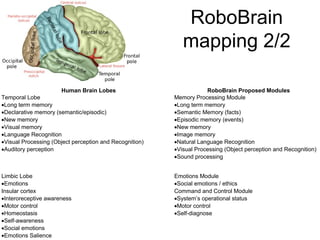
Human Brain Lobes RoboBrain Proposed Modules
Temporal Lobe
•Long term memory
•Declarative memory (semantic/episodic)
•New memory
•Visual memory
•Language Recognition
•Visual Processing (Object perception and Recognition)
•Auditory perception
Memory Processing Module
•Long term memory
•Semantic Memory (facts)
•Episodic memory (events)
•New memory
•Image memory
•Natural Language Recognition
•Visual Processing (Object perception and Recognition)
•Sound processing
Limbic Lobe
•Emotions
Emotions Module
•Social emotions / ethics
Insular cortex
•Interoreceptive awareness
•Motor control
•Homeostasis
•Self-awareness
•Social emotions
•Emotions Salience
Command and Control Module
•System’s operational status
•Motor control
•Self-diagnose
RoboBrain
mapping 2/2
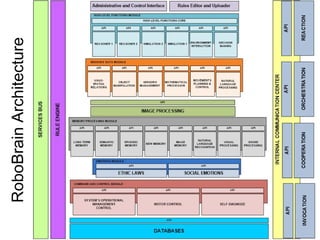
RoboBrainArchitecture
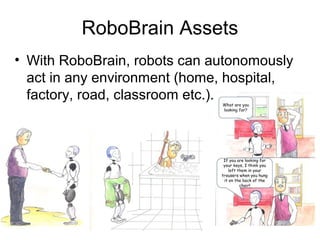
RoboBrain Assets
• With RoboBrain, robots can autonomously
act in any environment (home, hospital,
factory, road, classroom etc.).
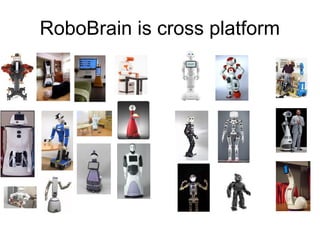
RoboBrain is cross platform
RoboBrain is open source
• By mid 2015 we intend to create our open
source community that will release the first
instantiation of the RoboBrain architecture.
• You are welcome to contribute!
RoboBrain is requesting
funding
• ICT-24-2015 Horizon 2020: Robotics
• Healthcare, Consumer, Transport.
• We are looking for partners actively
involved in Robotics.
• Are you interested? Let us know!
Thank you
Ortelio Ltd
it@ortelio.co.uk

RoboBrain: A software architecture for mapping the human brain

  • 1.
    RoboBrain: A SoftwareArchitecture Mapping the Human Brain Ilias Trochidis Ortelio Ltd, UK Adamantios Koumpis University of Passau, Germany Laurentiu Vasiliu Peracton Ltd, Ireland Christoph Bussler Tropo Inc, USA
  • 2.
    When do wefirst hear about robots and robot brain? In Book 18 of the Iliad, Hephaestus the god of all mechanical arts, was assisted by two moving female statues made from gold – "living young damsels, filled with minds and wisdoms".
  • 3.
    What happened untilnow? Optimus Prime (1993) Johnny 5 (1986) Wall-E (2008) The Terminator (1984)R2-D2 (1977) C-3PO (1977) RoboCop (1987) Robo-servant NDR-114 (1999) Rodney and Feder (2005) We have seen many “clever” robots in……. …..cinemas.
  • 4.
    What happened inreality? • There are a lot of robotic platforms available: – For research/education – For fun – For commercial purposes • However, intelligent autonomous robots still remains a science fiction.
  • 5.
    Why? There are effortsthat try to solve a specific problem such as vision, decision making, speech, motion etc. There are efforts that try to provide a complete simulation of the Human brain (e.g. Blue Brain Project, Human Brain Project).
  • 6.
    @ the RoboBrainlab We develop the RoboBrain Architecture
  • 7.
    @ the RoboBrainlab It is a component based software architecture that: •Maps the main functions of the human brain. •Allows components to be plugged in. •Can be installed on any Humanoid robot. RoboBrain is a software developer’s view of how a robot brain should work. We build the first robotic software brain architecture that emulates human brain functionality!
  • 8.
    Human Brain LobesRoboBrain Proposed Modules Frontal Lobe •Anticipates future consequences •Overrides/suppresses behaviours •Determines similarities between things or events •Environment Interaction •Decision making High Level Functions Module •Reasoning •Simulation •Environment Interaction •Decision making / comparison •Learning Parietal Lobe •Integrates sensorial information •Knowledge of numbers •Relations between numbers •Visuo-spatial relations •Object manipulation •Sense of touch •Movement control for hands, legs, eye •Language processing Sensorial Data Processing Module: •Visuo-Spatial relationships •Object manipulation •Pressure sensors (touch), •Mathematical processor •Movements planning and control •Natural language processing Occipital Lobe •Image processing and interpretation Image Processing Module •Image processing and interpretation RoboBrain mapping 1/2
  • 9.
    Human Brain LobesRoboBrain Proposed Modules Temporal Lobe •Long term memory •Declarative memory (semantic/episodic) •New memory •Visual memory •Language Recognition •Visual Processing (Object perception and Recognition) •Auditory perception Memory Processing Module •Long term memory •Semantic Memory (facts) •Episodic memory (events) •New memory •Image memory •Natural Language Recognition •Visual Processing (Object perception and Recognition) •Sound processing Limbic Lobe •Emotions Emotions Module •Social emotions / ethics Insular cortex •Interoreceptive awareness •Motor control •Homeostasis •Self-awareness •Social emotions •Emotions Salience Command and Control Module •System’s operational status •Motor control •Self-diagnose RoboBrain mapping 2/2
  • 10.
  • 11.
    RoboBrain Assets • WithRoboBrain, robots can autonomously act in any environment (home, hospital, factory, road, classroom etc.).
  • 12.
  • 13.
    RoboBrain is opensource • By mid 2015 we intend to create our open source community that will release the first instantiation of the RoboBrain architecture. • You are welcome to contribute!
  • 14.
    RoboBrain is requesting funding •ICT-24-2015 Horizon 2020: Robotics • Healthcare, Consumer, Transport. • We are looking for partners actively involved in Robotics. • Are you interested? Let us know!
  • 15.

Editor's Notes

  • #3 The Ancient Greeks were clearly obsessed with the notion of creating mechanical living beings. We do know that they had very advanced engineering skills and most certainly managed to make partially animated Statues which would be used in Ceremonies. They were probable worked by levers and human powered, although there are descriptions of using steam and water as a source of power. The Greeks certainly had the technology and ingenuity to have used steam powered devises. Descriptions of wonderful mechanical people and objects not only came out of mythology but also other cultures from around the world. There seems to have been a common ambition to emulate living things through out the whole of the ancient world. The following is a description of some of the more intriguing ones.
  • #8 The architecture supports the dynamic addition, removal and change of components in order to support the evolving needs of the overall system.