INTRO
TO
SAP EWM
SUPPLYCHAINMANAGEMENT (SCM)ISTHE
OVERSIGHT OFMATERIALS, INFORMATION, AND
FINANCES ASTHEYMOVEINAPROCESS FROM
SUPPLIER TOMANUFACTURER TOWHOLESALER TO
RETAILER TOCONSUMER.
SUPPLYCHAINMANAGEMENT INVOLVES
COORDINATING ANDINTEGRATING THESEFLOWS
BOTHWITHINANDAMONGCOMPANIES.
Supply Chain Management
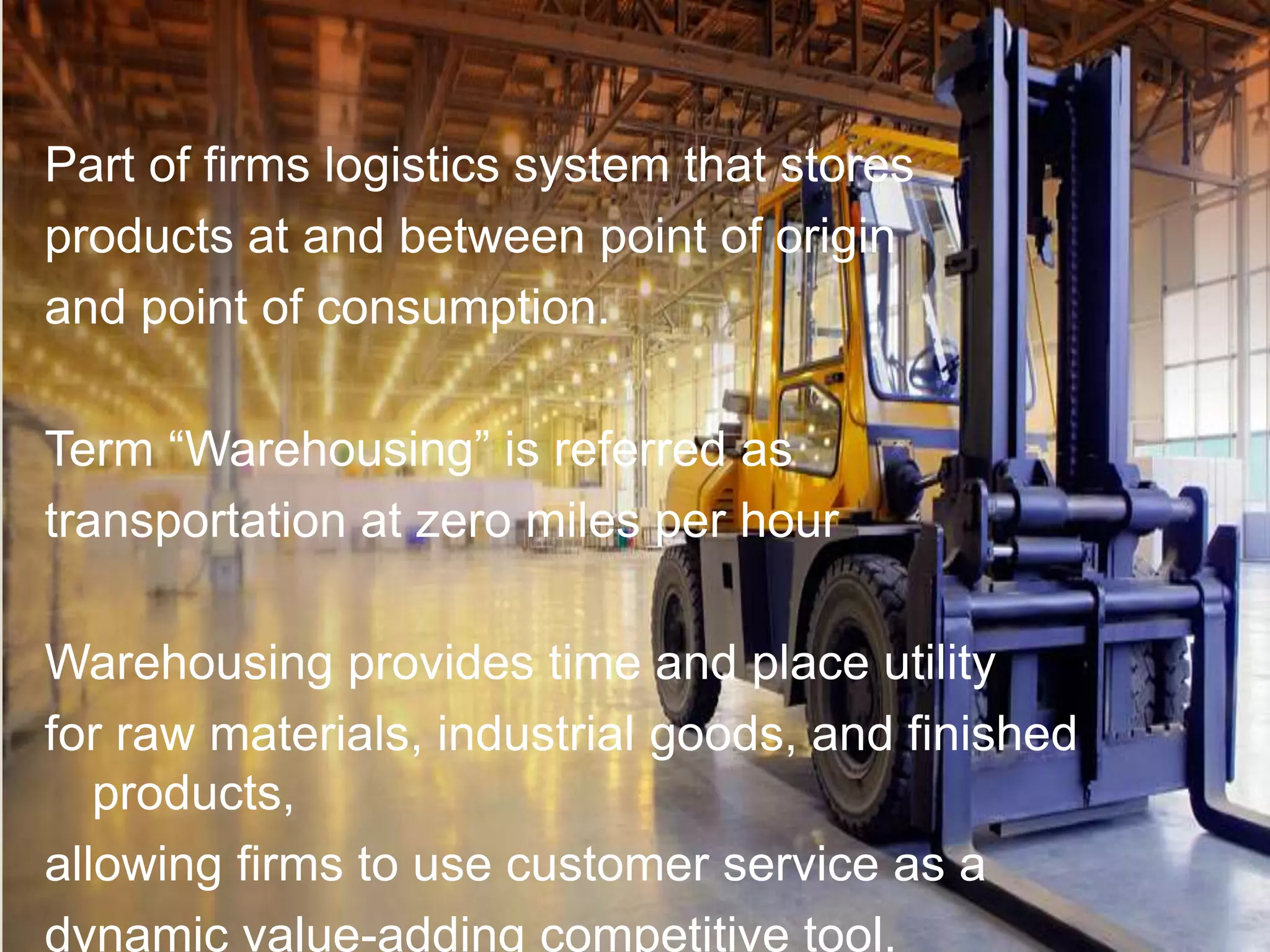
Part of firms logistics system that stores
products at and between point of origin
and point of consumption.
Term “Warehousing” is referred as
transportation at zero miles per hour
Warehousing provides time and place utility
for raw materials, industrial goods, and finished
products,
allowing firms to use customer service as a
dynamic value-adding competitive tool.
• Benefits of Warehouse
Management
– Provide a place to store &
protect inventory
– Reduce transportation costs
– Improve customer service
levels
• Complexity of warehouse
operation depends on the
number of SKUs handled & the
THE ROLE OF THE WAREHOUSE IN THE
LOGISTICS SYSTEM
The warehouse is where the supply chain holds or
stores goods.
Functions of warehousing include:-
Transportation consolidation
Product mixing
Docking
Service
Protection against contingencies
TYPE OF WAREHOUSING
• Public Warehousing
• Private Warehousing
• Contract Warehousing
• Multi-client Warehousing
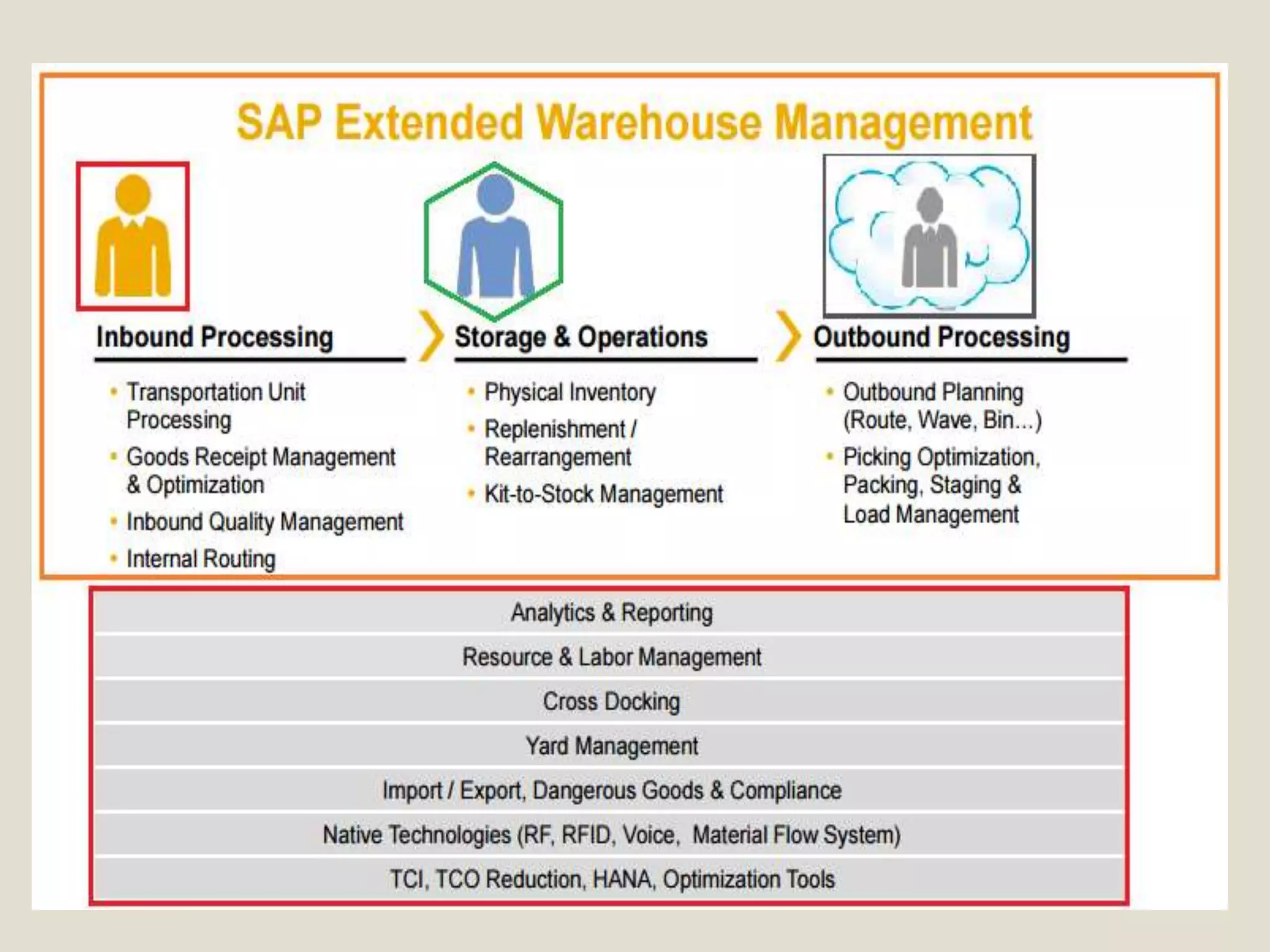
What is EWM?
• It is a best-in-class warehouse
management solution designed
to manage & track logistics
execution processes
• It offers flexible, automated
support for processing various
goods movements and for
managing stocks in a whse.
• In 1 solution provides labor
management, slotting,
advanced optimization
techniques, connection to
automation
• How do companies benefit from
EWM?
• High warehouse productivity /
efficiency
• High inventory accuracy
• Reduced labor costs
• Better customer service
• What are key capabilities of EWM?
• Multi customer warehouse
• Flexible modeling of warehouse
processes
• Stock and process transparency
• Optimization in storage planning
and process execution
• Seamless integration of
Automation (RF, RFID, Pick-by-
Voice, …)
• Integration in the overall SAP
Logistics Solution
WAREHOUSE ACTIVITIES
• Receive goods
• Identify the goods
• Dispatch goods to
storage
• Hold goods
• Pick goods
• Marshal shipment
• Dispatch shipment
PRINCIPLES OF WAREHOUSE LAYOUT DESIGN
Use one-story facilities
Move goods in a straight
line
Use efficient materials-
handling equipment
Use an effective storage
plan
Minimize aisle space
Use maximum height of the
SAP EWM is different from SAP Warehouse Management
How SAP SCM EWM Evolved ?
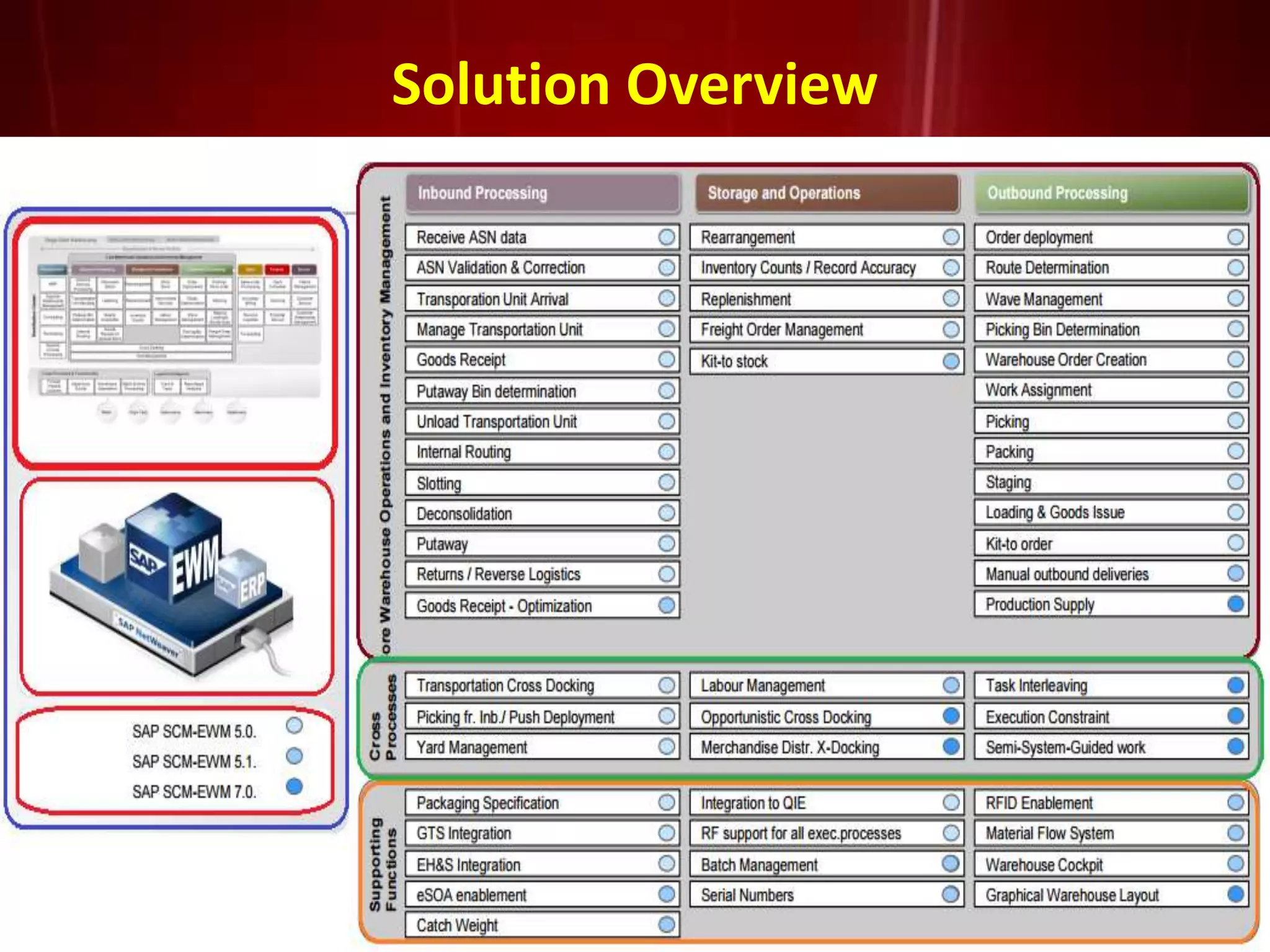
Solution Overview
WAREHOUSE PROCESS
Put-away
•Identify Product
•Identify Product Location
•Move Products
•Update Records
Storage
•Equipment
•Stock Location
– Popularity
– Unit Size
– Cube
Shipping Preparation
•Packing
•Labeling
•Stacking
Order Picking
•Information
•Walk & Pick
•Batch Picking
Shipping
•Schedule Carrier
•Load Vehicle
•Bill of Loading
•Record Update
RECEIVING
•Schedule Carrier
•Unload Vehicle
•Inspect for damage
INP
UT
OUTPU
T
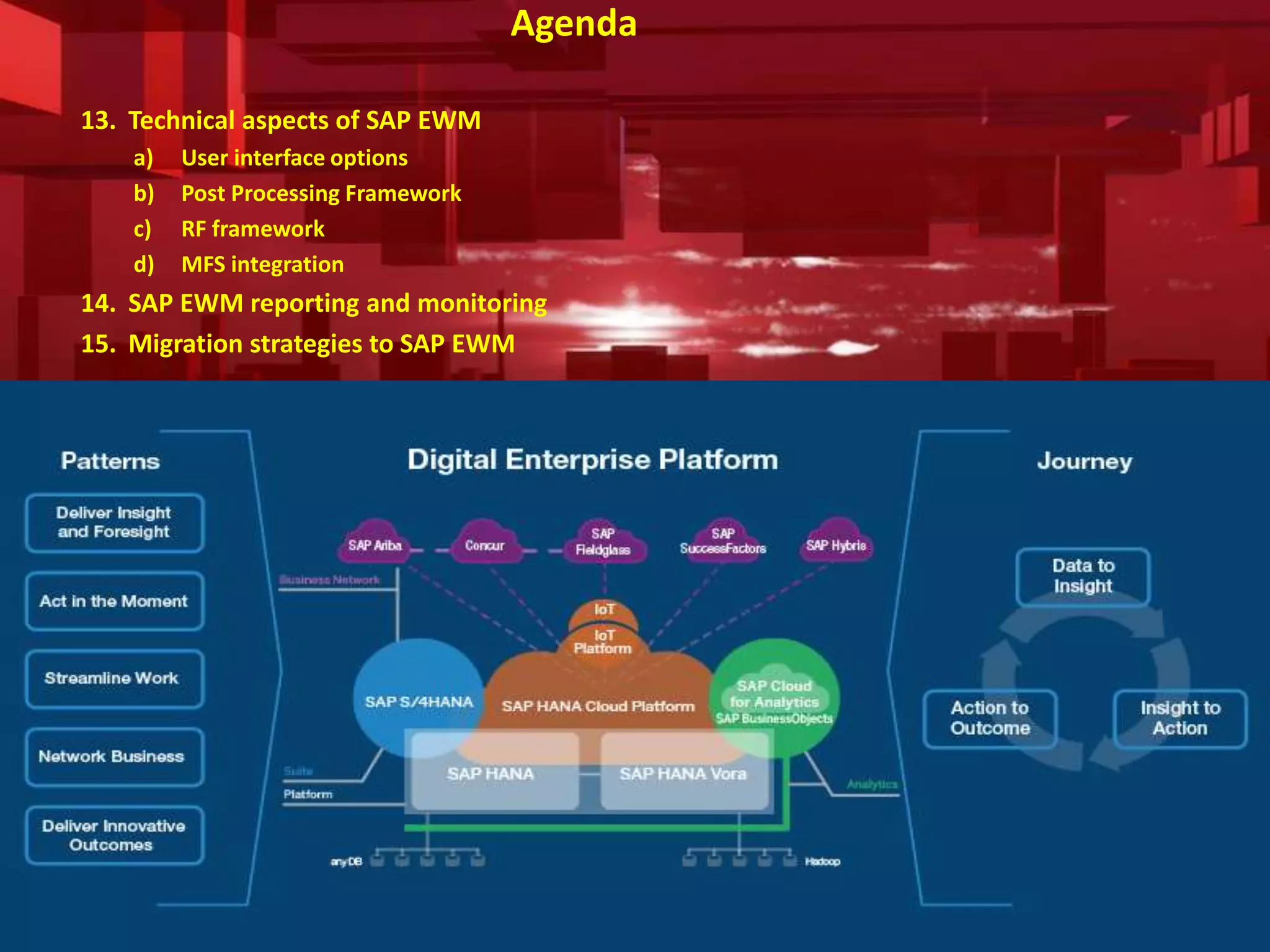
Agenda
1. Introduction to SCM
2. Introduction to EWM
3. ERP – EWM integration
a) CIF
b) qRFC
4. Organizational structures in SAP EWM
5. Master data in SAP EWM
a) Products
b) Bins
c) Packaging Specifications
d) Resources
e) Work Centers
6. SAP EWM general features overview
a) EWM Document Types
b) WOCR
c) POSC
d) LOSC
e) Serial Numbers in SAP EWM
f) Batch Management in SAP EWM
g) Quality Management in SAP EWM
h) Kiting
i) VAS
7. Inbound processes in SAP EWM
a) Expected Goods Receipt
8. Internal warehouse processes
a) Replenishment
b) Physical inventory
c) Internal movements
9. Production Integration with SAP EWM
10. Outbound processes in SAP EWM
a. Direct Outbound proces
b. Simple Outbound proces
c. Pick Denial
11. Advanced Return Management
12. Build-in-Optimization tools (only Information)
a) Slotting and Rearrangement
b) Cartonizatiion
c) Wave Management
d) Labor Management
e) DAS
f) Cross-Docking
g) Yard Management
h) Tasks interleaving and resources constrains
Agenda
13. Technical aspects of SAP EWM
a) User interface options
b) Post Processing Framework
c) RF framework
d) MFS integration
14. SAP EWM reporting and monitoring
15. Migration strategies to SAP EWM
Sap EWM Introduction

Sap EWM Introduction

  • 1.
  • 3.
    SUPPLYCHAINMANAGEMENT (SCM)ISTHE OVERSIGHT OFMATERIALS,INFORMATION, AND FINANCES ASTHEYMOVEINAPROCESS FROM SUPPLIER TOMANUFACTURER TOWHOLESALER TO RETAILER TOCONSUMER. SUPPLYCHAINMANAGEMENT INVOLVES COORDINATING ANDINTEGRATING THESEFLOWS BOTHWITHINANDAMONGCOMPANIES. Supply Chain Management
  • 5.
    Part of firmslogistics system that stores products at and between point of origin and point of consumption. Term “Warehousing” is referred as transportation at zero miles per hour Warehousing provides time and place utility for raw materials, industrial goods, and finished products, allowing firms to use customer service as a dynamic value-adding competitive tool.
  • 6.
    • Benefits ofWarehouse Management – Provide a place to store & protect inventory – Reduce transportation costs – Improve customer service levels • Complexity of warehouse operation depends on the number of SKUs handled & the
  • 7.
    THE ROLE OFTHE WAREHOUSE IN THE LOGISTICS SYSTEM The warehouse is where the supply chain holds or stores goods. Functions of warehousing include:- Transportation consolidation Product mixing Docking Service Protection against contingencies TYPE OF WAREHOUSING • Public Warehousing • Private Warehousing • Contract Warehousing • Multi-client Warehousing
  • 8.
    What is EWM? •It is a best-in-class warehouse management solution designed to manage & track logistics execution processes • It offers flexible, automated support for processing various goods movements and for managing stocks in a whse. • In 1 solution provides labor management, slotting, advanced optimization techniques, connection to automation
  • 9.
    • How docompanies benefit from EWM? • High warehouse productivity / efficiency • High inventory accuracy • Reduced labor costs • Better customer service • What are key capabilities of EWM? • Multi customer warehouse • Flexible modeling of warehouse processes • Stock and process transparency • Optimization in storage planning and process execution • Seamless integration of Automation (RF, RFID, Pick-by- Voice, …) • Integration in the overall SAP Logistics Solution
  • 10.
    WAREHOUSE ACTIVITIES • Receivegoods • Identify the goods • Dispatch goods to storage • Hold goods • Pick goods • Marshal shipment • Dispatch shipment
  • 11.
    PRINCIPLES OF WAREHOUSELAYOUT DESIGN Use one-story facilities Move goods in a straight line Use efficient materials- handling equipment Use an effective storage plan Minimize aisle space Use maximum height of the
  • 12.
    SAP EWM isdifferent from SAP Warehouse Management
  • 13.
    How SAP SCMEWM Evolved ?
  • 14.
  • 17.
    WAREHOUSE PROCESS Put-away •Identify Product •IdentifyProduct Location •Move Products •Update Records Storage •Equipment •Stock Location – Popularity – Unit Size – Cube Shipping Preparation •Packing •Labeling •Stacking Order Picking •Information •Walk & Pick •Batch Picking Shipping •Schedule Carrier •Load Vehicle •Bill of Loading •Record Update RECEIVING •Schedule Carrier •Unload Vehicle •Inspect for damage INP UT OUTPU T
  • 21.
    Agenda 1. Introduction toSCM 2. Introduction to EWM 3. ERP – EWM integration a) CIF b) qRFC 4. Organizational structures in SAP EWM 5. Master data in SAP EWM a) Products b) Bins c) Packaging Specifications d) Resources e) Work Centers 6. SAP EWM general features overview a) EWM Document Types b) WOCR c) POSC d) LOSC e) Serial Numbers in SAP EWM f) Batch Management in SAP EWM g) Quality Management in SAP EWM h) Kiting i) VAS 7. Inbound processes in SAP EWM a) Expected Goods Receipt 8. Internal warehouse processes a) Replenishment b) Physical inventory c) Internal movements 9. Production Integration with SAP EWM 10. Outbound processes in SAP EWM a. Direct Outbound proces b. Simple Outbound proces c. Pick Denial 11. Advanced Return Management 12. Build-in-Optimization tools (only Information) a) Slotting and Rearrangement b) Cartonizatiion c) Wave Management d) Labor Management e) DAS f) Cross-Docking g) Yard Management h) Tasks interleaving and resources constrains
  • 22.
    Agenda 13. Technical aspectsof SAP EWM a) User interface options b) Post Processing Framework c) RF framework d) MFS integration 14. SAP EWM reporting and monitoring 15. Migration strategies to SAP EWM