A Multi-tenant Architecture for Business Process ExecutionsMilindaPathirage, Srinath Perera, Indika Kumara, SanjivaWeerawaranaWSO2 Inc.
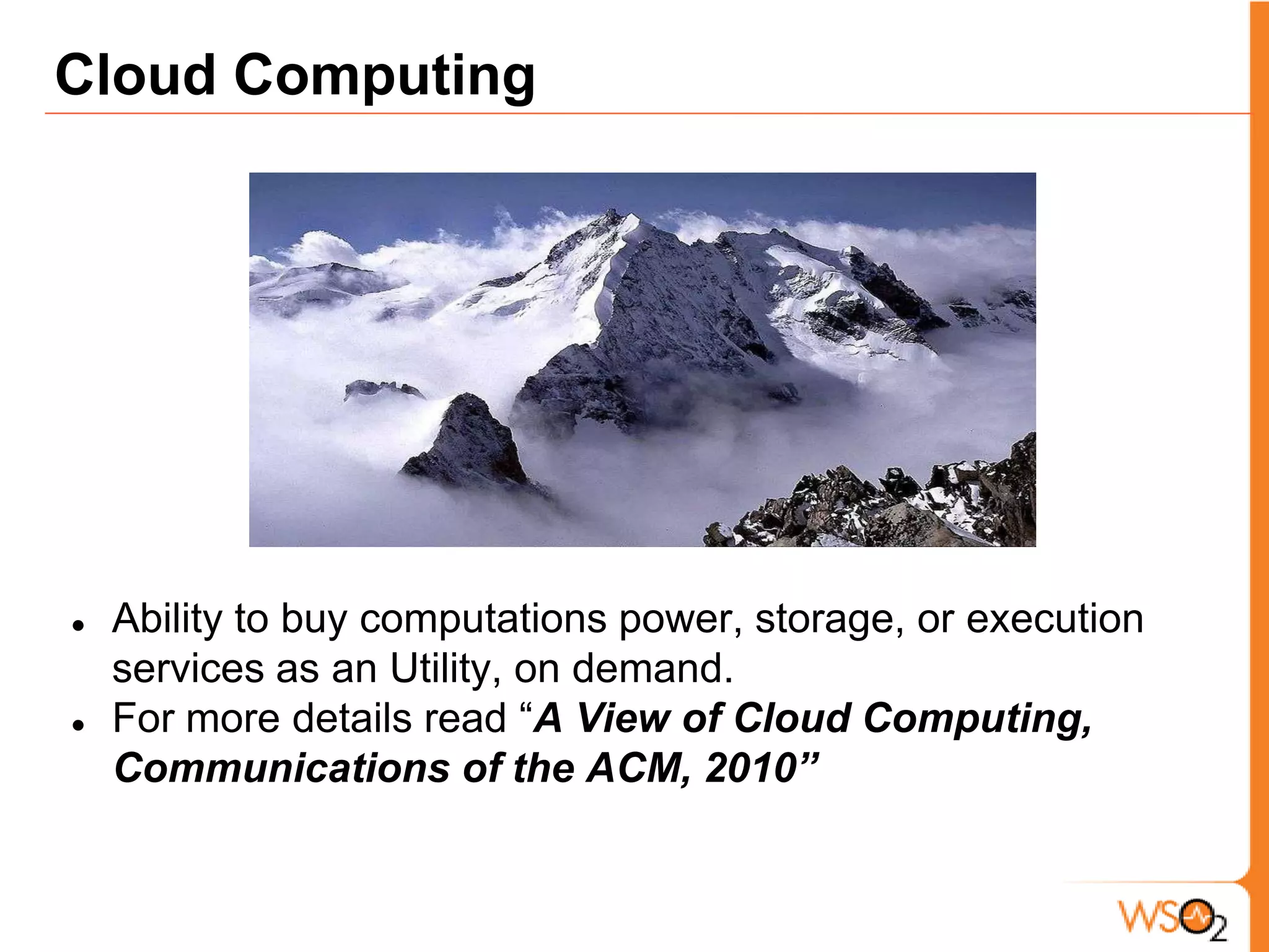
Cloud ComputingAbility to buy computations power, storage, or execution services as an Utility, on demand.
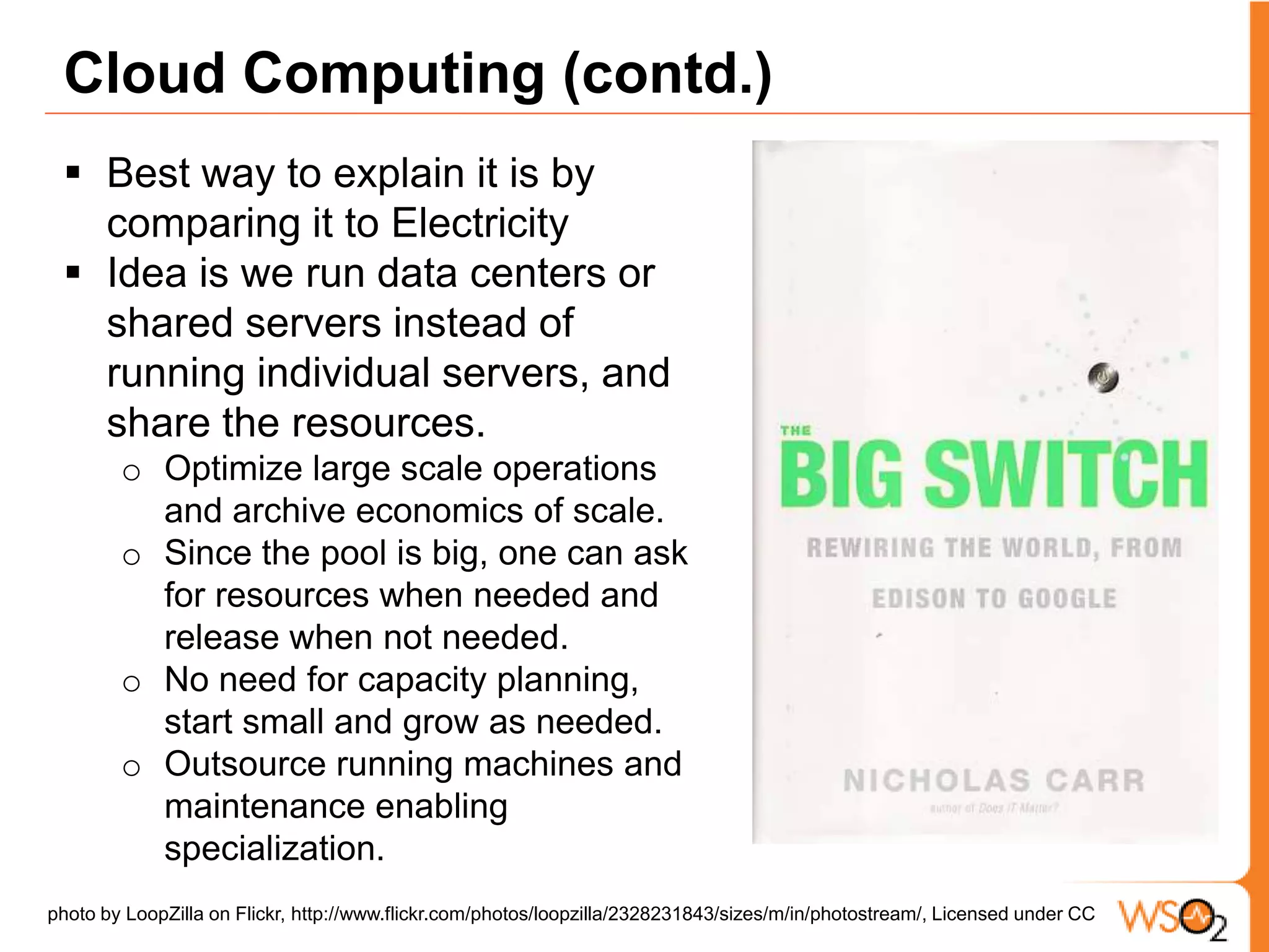
For more details read “A View of Cloud Computing, Communications of the ACM, 2010”Cloud Computing (contd.)Best way to explain it is by comparing it to Electricity Idea is we run data centers or shared servers instead of running individual servers, and share the resources. Optimize large scale operations and archive economics of scale.Since the pool is big, one can ask for resources when needed and release when not needed. No need for capacity planning, start small and grow as needed. Outsource running machines and maintenance enabling specialization.  photo by LoopZilla on Flickr, http://www.flickr.com/photos/loopzilla/2328231843/sizes/m/in/photostream/, Licensed under CC
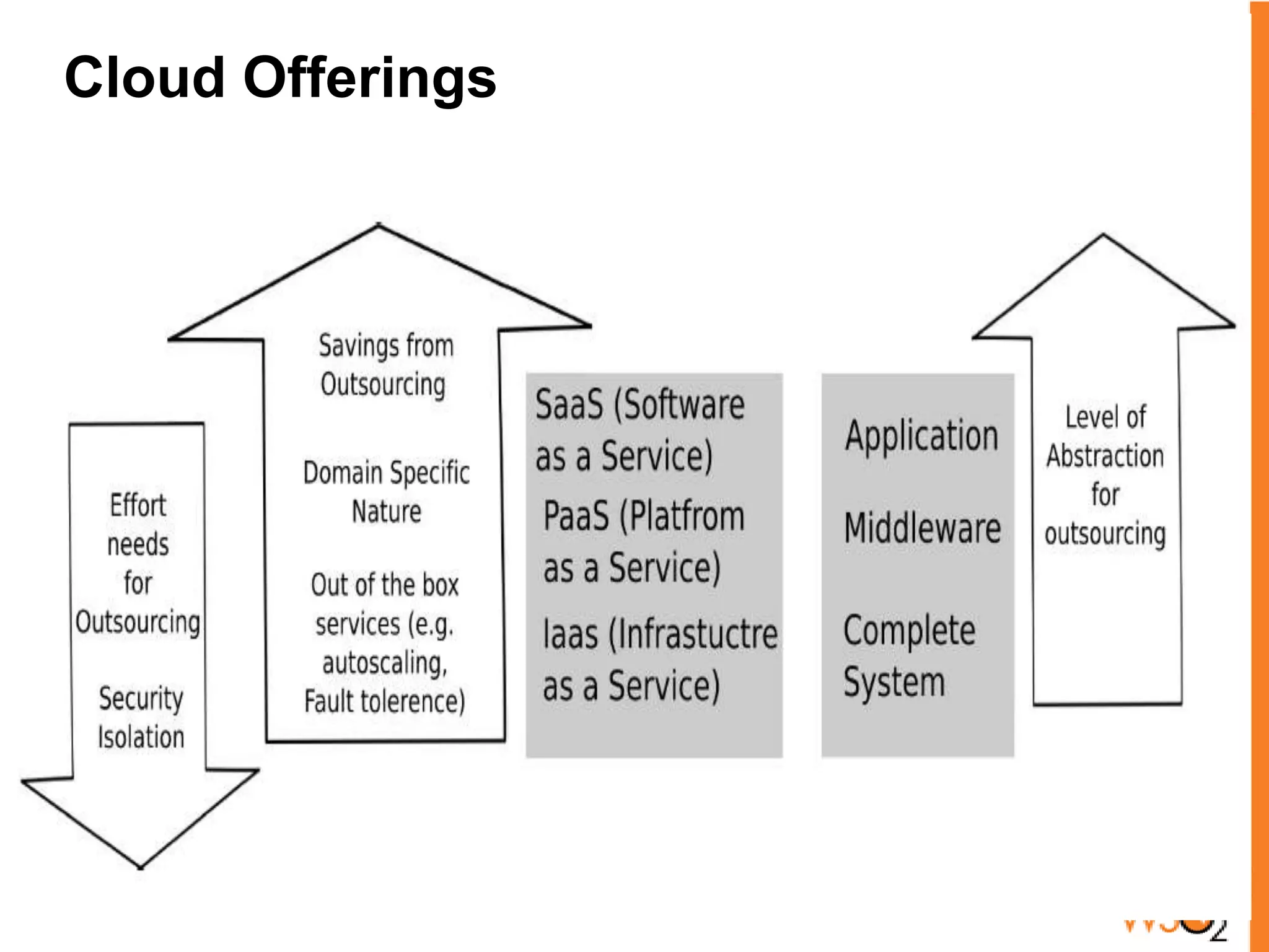
Cloud Offerings
Why PaaS?IaaS only provides limited saving to someone who needs to outsource their IT functionsSaaS is great when they can be used They are usually very specific (e.g. email, CRM ..)If they match, then great, but if they are not, not much choice for the user. PaaS stays in the middle ground Framework to host your appsHopefully you can move your apps as it is (well not the case with Azure or App Engine, but it is possible).
Supporting SOA in PaaSSOA is a primary technology in the EnterpriseMany users already have SOA artifacts Moving them to the Cloud without need for changing will be a great advantage We want to see Cloud as yet another deployment modelWrite and test applications locallyEven deploy it locally if neededWhen you need it, you can deploy the same artifacts in the cloud.Multi-tenancy plays a major role. Which brings us to our Topic.photo by MikkoTarvainenon Flickr, http://www.flickr.com/photos/mtarvainen/5131983246/, Licensed under CC
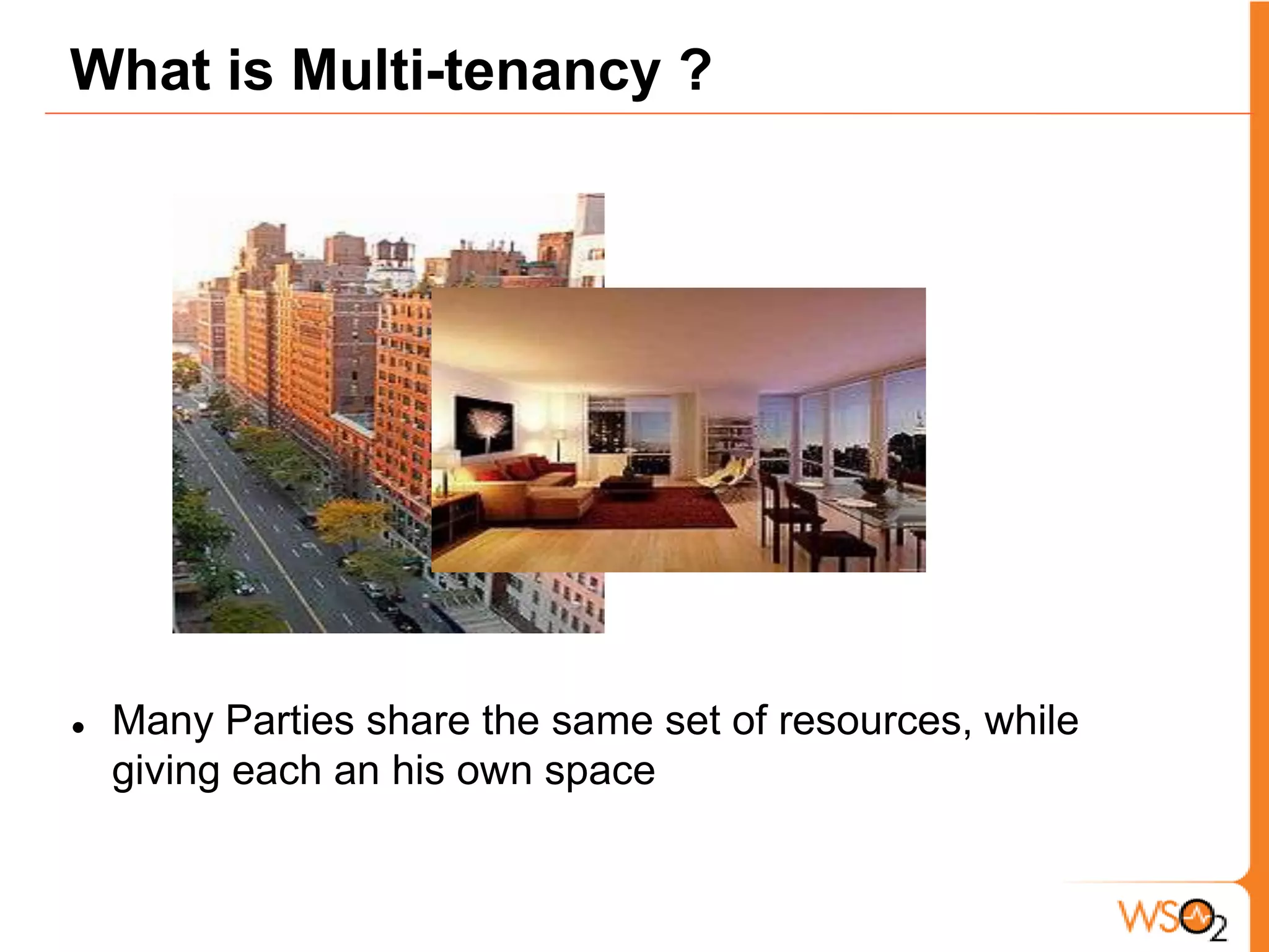
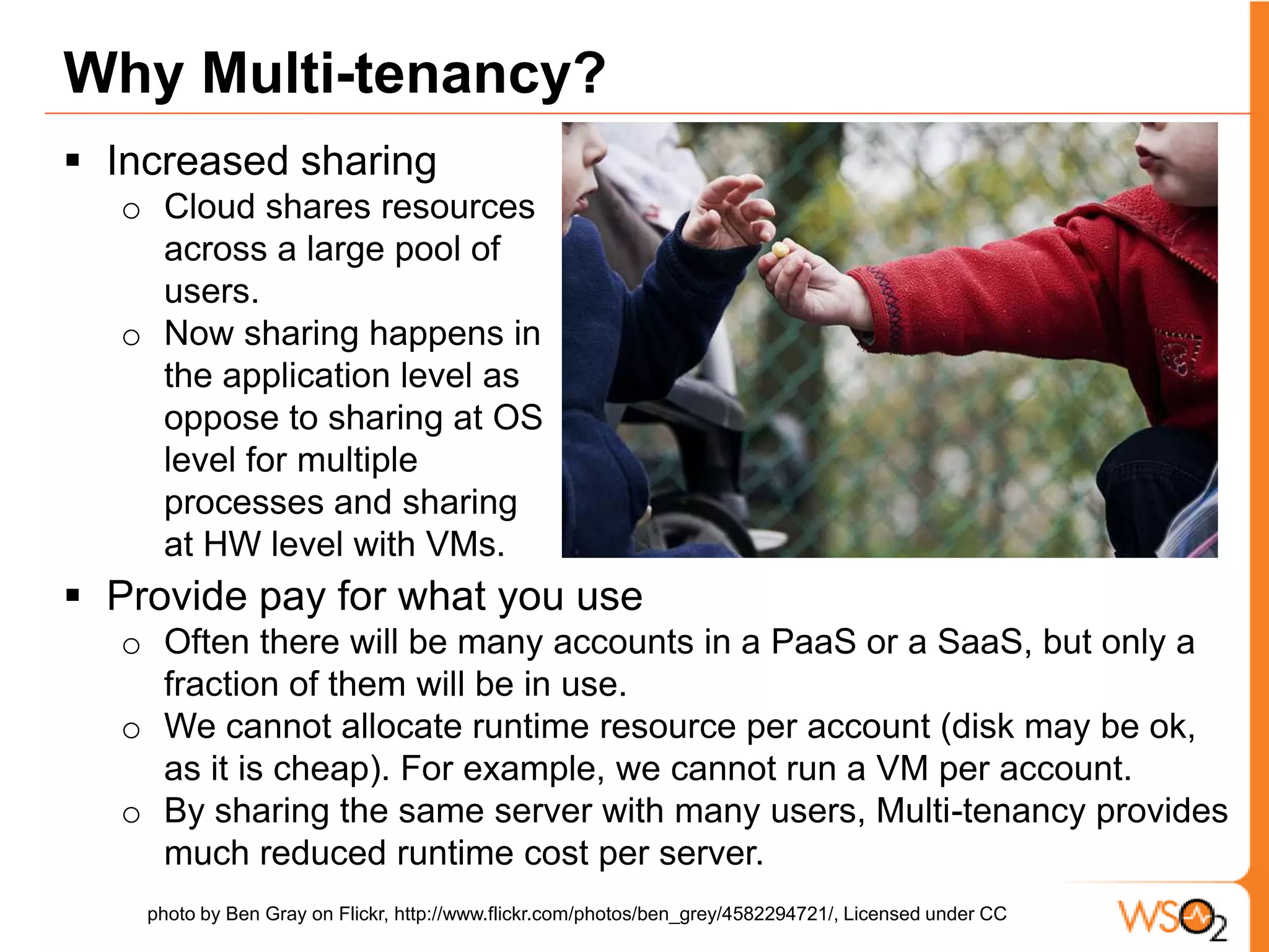
 What is Multi-tenancy ?Many Parties share the same set of resources, while giving each an his own spaceWhy Multi-tenancy? Increased sharingCloud shares resources across a large pool of users. Now sharing happens in the application level as oppose to sharing at OS level for multiple processes and sharing at HW level with VMs. Provide pay for what you use Often there will be many accounts in a PaaS or a SaaS, but only a fraction of them will be in use. We cannot allocate runtime resource per account (disk may be ok, as it is cheap). For example, we cannot run a VM per account. By sharing the same server with many users, Multi-tenancy provides much reduced runtime cost per server. photo by Ben Gray on Flickr, http://www.flickr.com/photos/ben_grey/4582294721/, Licensed under CC
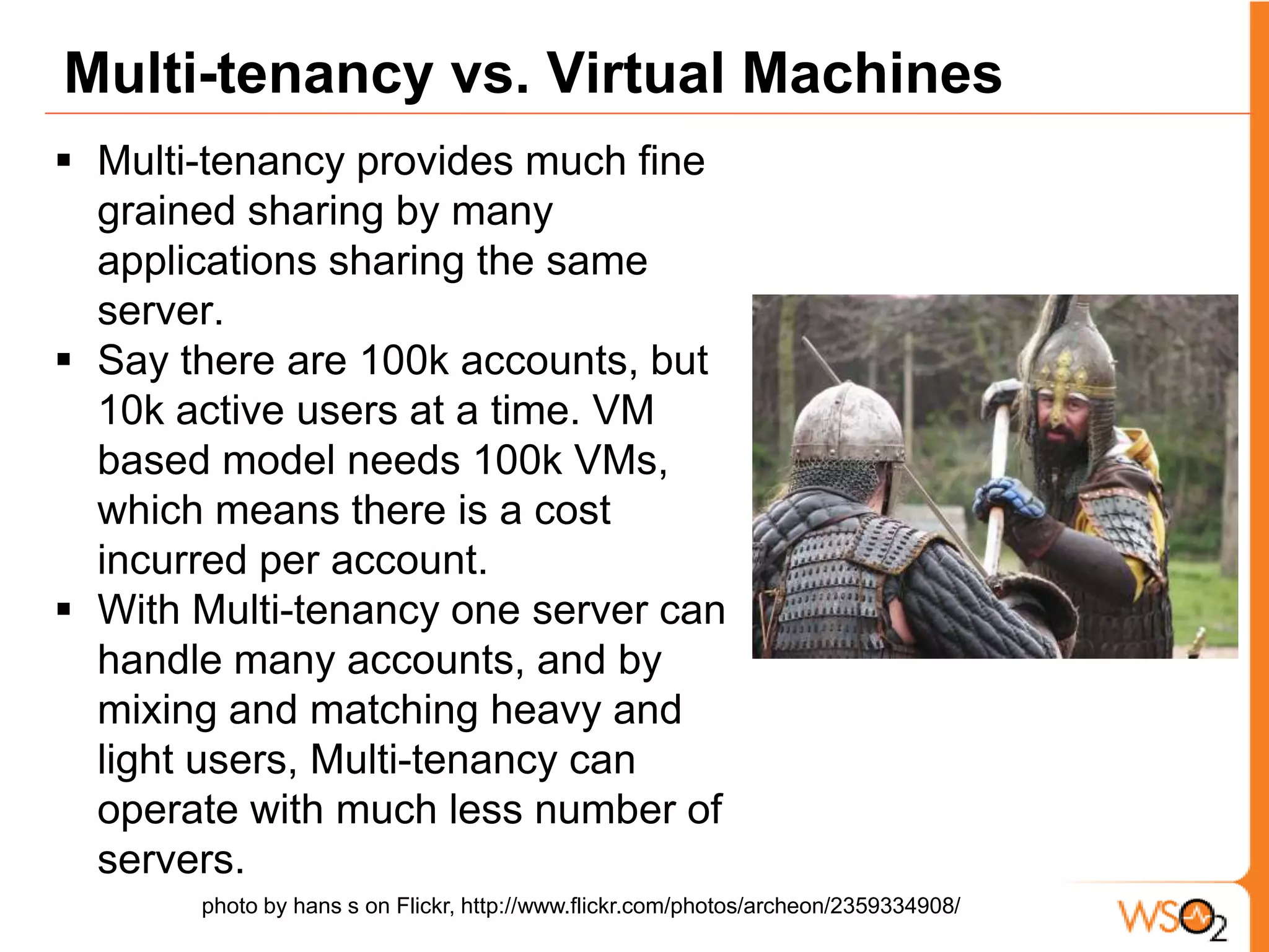
Multi-tenancy vs. Virtual MachinesMulti-tenancy provides much fine grained sharing by many applications sharing the same server. Say there are 100k accounts, but 10k active users at a time. VM based model needs 100k VMs, which means there is a cost incurred per account. With Multi-tenancy one server can handle many accounts, and by mixing and matching heavy and light users, Multi-tenancy can operate with much less number of servers. photo by hans s on Flickr, http://www.flickr.com/photos/archeon/2359334908/
Our Earlier Works on Multi-tenancy We provide a SOA PaaS offering called Stratos. Some of the featuresWeb Service Hosting as a Service Web Application Hosting as a ServiceMessage Mediation Execution as a Service (ESB)Governance as a Service Earlier publications on the topic A. Azeez and S. Perera et al., WSO2 Stratos: An Industrial Stack to Support Cloud Computing, IT: Methods and Applications of Informatics and Information Technology Journal, the special Issue on Cloud Computing, 2011.AfkhamAzeez, Srinath Perera, DimuthuGamage, Ruwan Linton, PrabathSiriwardana, DimuthuLeelaratne, SanjivaWeerawarana, Paul Fremantle, "Multi-Tenant SOA Middleware for Cloud Computing" 3rd International Conference on Cloud Computing, Florida, 2010
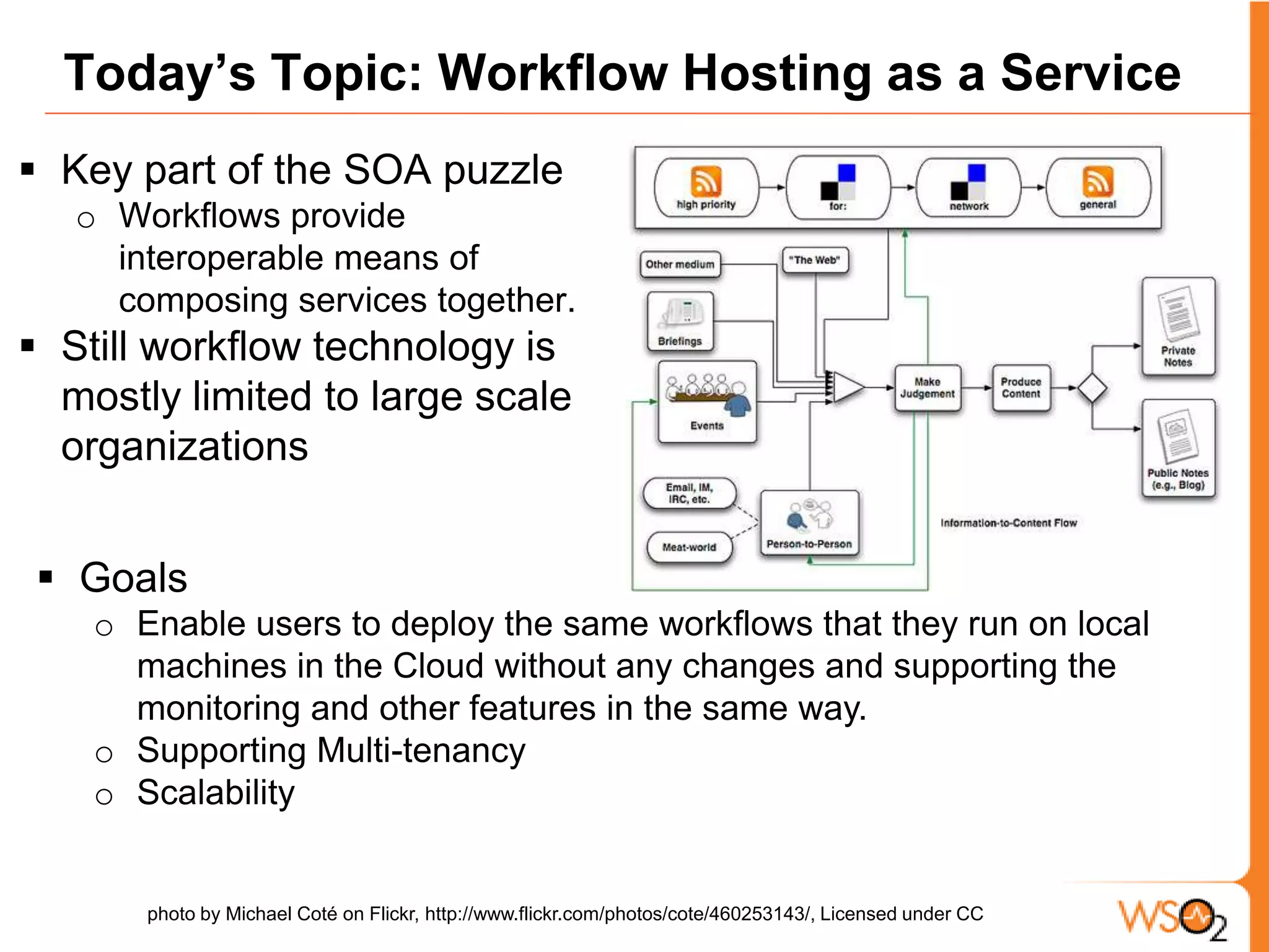
Today’s Topic: Workflow Hosting as a ServiceKey part of the SOA puzzle Workflows provide interoperable means of composing services together. Still workflow technology is mostly limited to large scale organizationsGoalsEnable users to deploy the same workflows that they run on local machines in the Cloud without any changes and supporting the monitoring and other features in the same way. Supporting Multi-tenancy Scalability photo by Michael Coté on Flickr, http://www.flickr.com/photos/cote/460253143/, Licensed under CC
Motivating Usecases
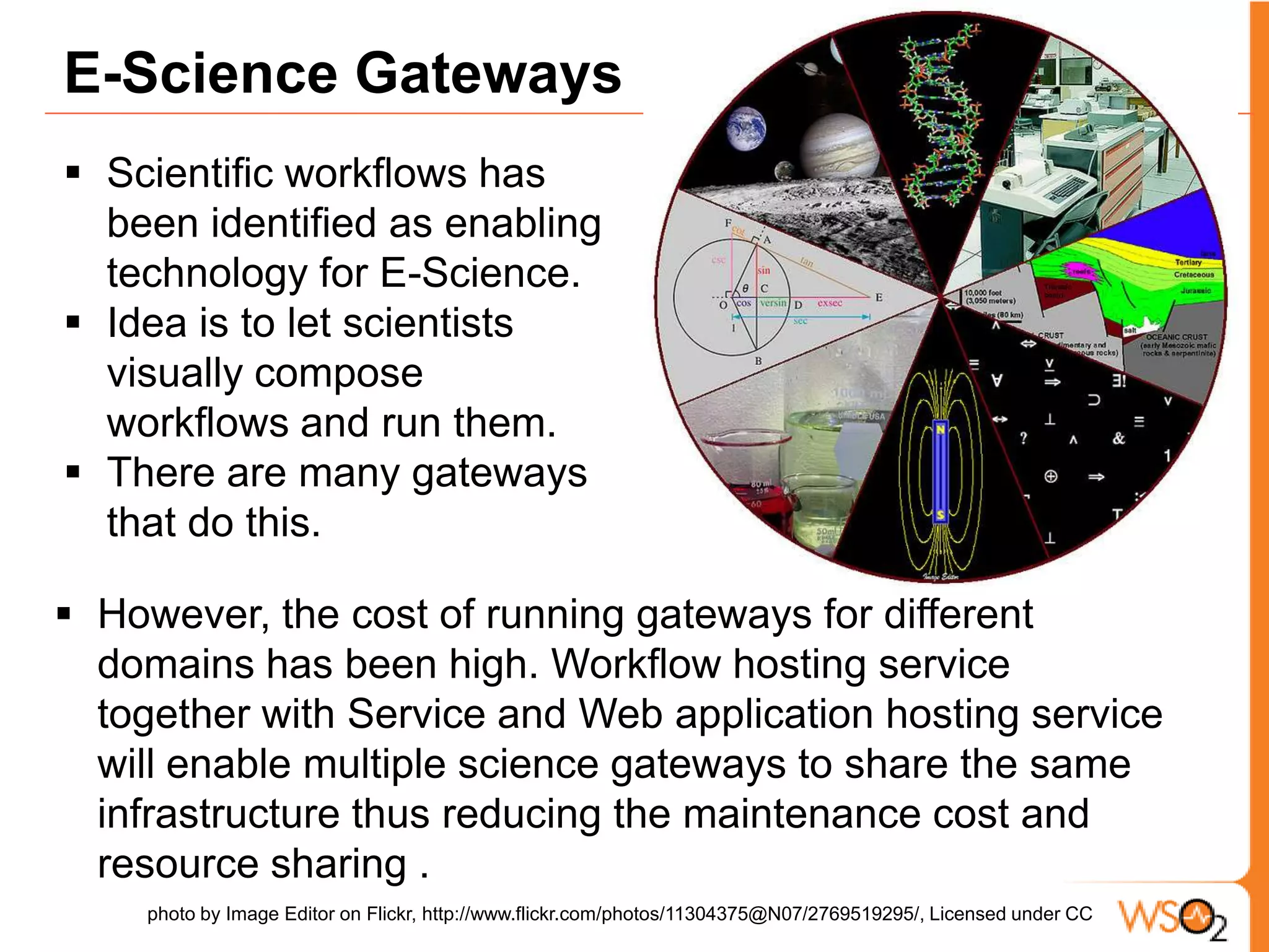
E-Science GatewaysScientific workflows has been identified as enabling technology for E-Science. Idea is to let scientists visually compose workflows and run them. There are many gateways that do this. However, the cost of running gateways for different domains has been high. Workflow hosting service together with Service and Web application hosting service will enable multiple science gateways to share the same infrastructure thus reducing the maintenance cost and resource sharing . photo by Image Editor on Flickr, http://www.flickr.com/photos/11304375@N07/2769519295/, Licensed under CC
SMBs (Small and Medium size Business) Most SMBs can not afforded to run their own workflow technologies. This stops them from goes to the next level. Workflow, Service and Web hosting services can enable multiple SMBs to share the same infrastructure. This will lower the bar of workflow use, and enable SMBs to move to the next level. photo by Olaf on Flickr http://www.flickr.com/photos/okreitz/3073783437/, Licensed under CC
Goals of Multi-tenancy Sharing – maximize the resource sharing across multiple tenants. Isolation – hide the fact other other are also in the same server. Execution – enforce security. Make sure one tenant can’t call other  tenants executable logic. Data – make sure one tenant can’t see other data Performance  - make sure performance is not affected by existence of other tenants. ScaleServer is distributed and it can handle larger load by adding more nodes. photo by John TrainoronFlickr http://www.flickr.com/photos/trainor/2902023575/, Licensed under CC
Related works Mitezner [5] and Shi et al.[6] introduced application templates where the system lets users customize a template workflow.Mitezneret al. introduced a tenant context to hold execution data and isolate  executions. We also use a similar concept. Cai, Wang, and Zhou [8] have used tenant context to support multi-tenancy in Web Applications. Anstett et al. [9] discuss challenges of bring BPEL processes to cloud. Need changes to BPEL engineConfiguration data isolationAvoid giving access to DBsSecuring the Data in the communication
BPS Multi-tenancy Architecture
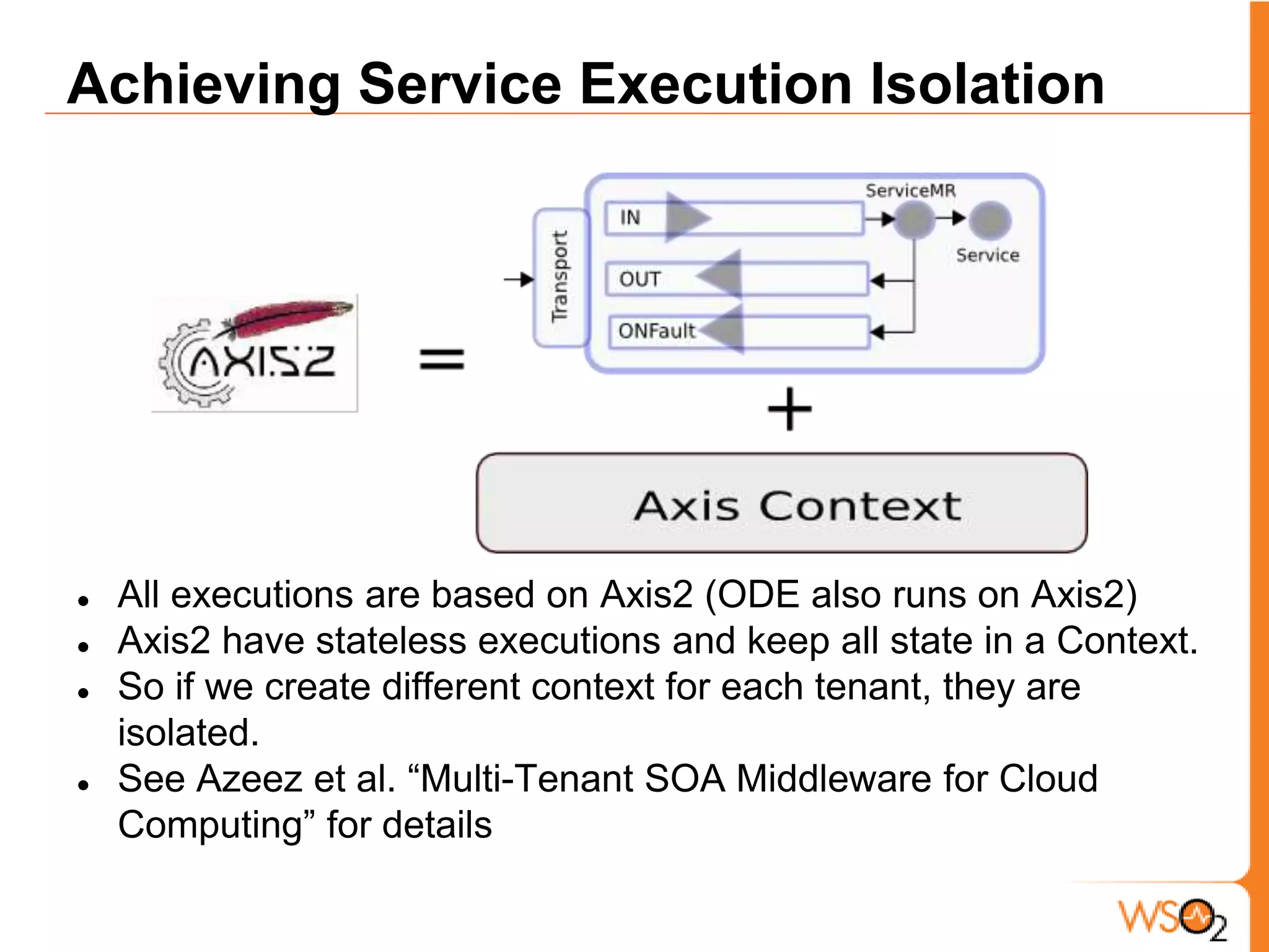
Achieving Service Execution IsolationAll executions are based on Axis2 (ODE also runs on Axis2)
Axis2 have stateless executions and keep all state in a Context.
So if we create different context for each tenant, they are isolated.
See Azeez et al. “Multi-Tenant SOA Middleware for Cloud Computing” for details    BPS Multi-tenancy Architecture
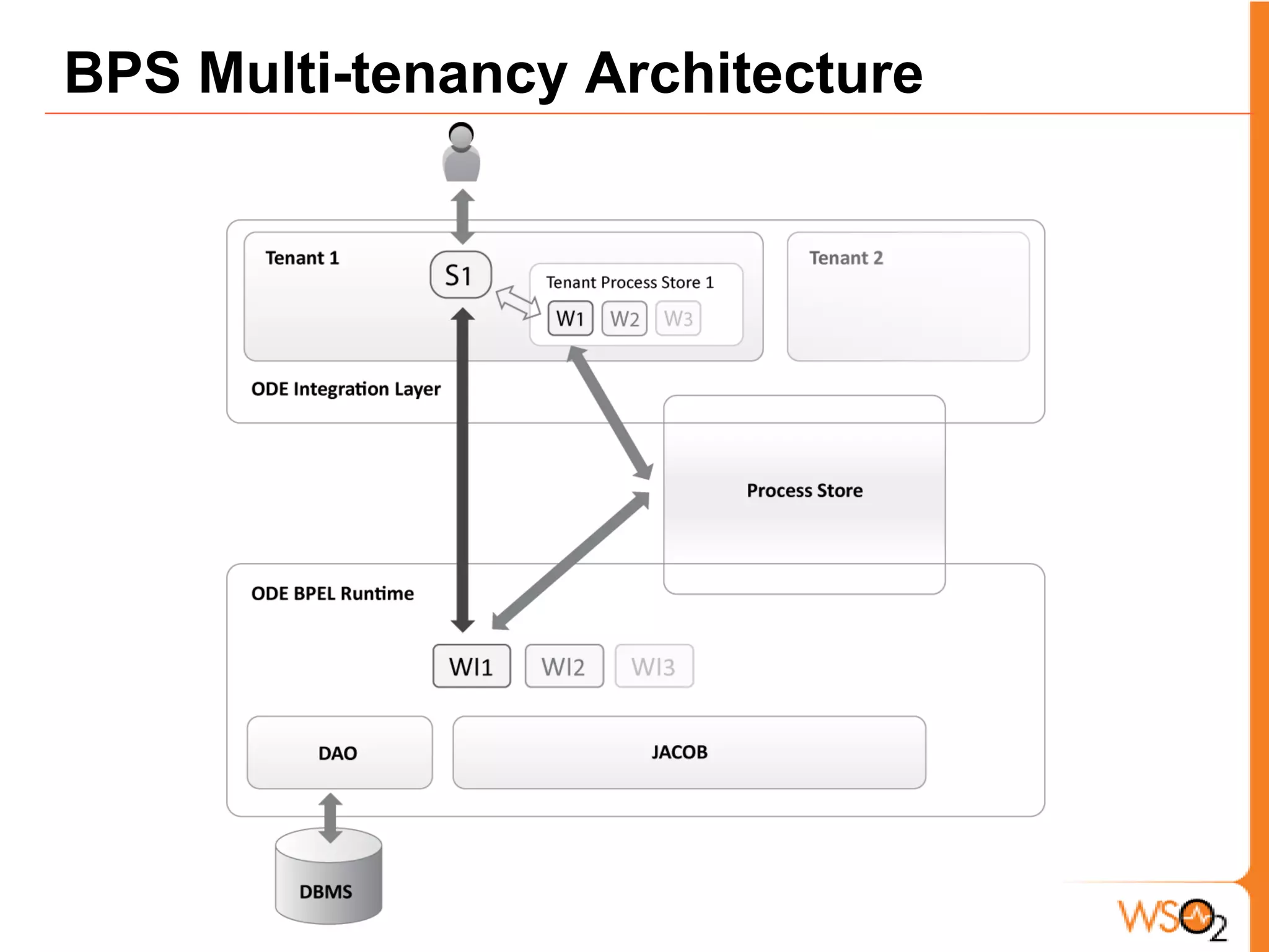
BPS Multi-tenancy Architecture (Contd.)Extends Apache ODEHas a single tenant Apache ODE Engine as the core and added Multi-tenancy by adding a Multi-tenant process store and adding isolation at the message reception. Parts of the architecture A Process store per tenant, which only allows calls from that tenantParent process store that provides a single process store view across all tenant stores (to Apache ODE).
BPS Multi-tenancy Architecture (Contd.)When a workflow is deployed by T1, it is stored in T1’s process store. Also, a service is created for the workflow and deployed within T1’s space. When a workflow received a message, the service that receives the message perform access control and then injects it to ODE with tenant ID as a correlation property. A implicit correlation rule together with other correlation rules routes the messages to a workflow instance. When workflow instance access the process store, it is routed to the T1’s  tenant process store.
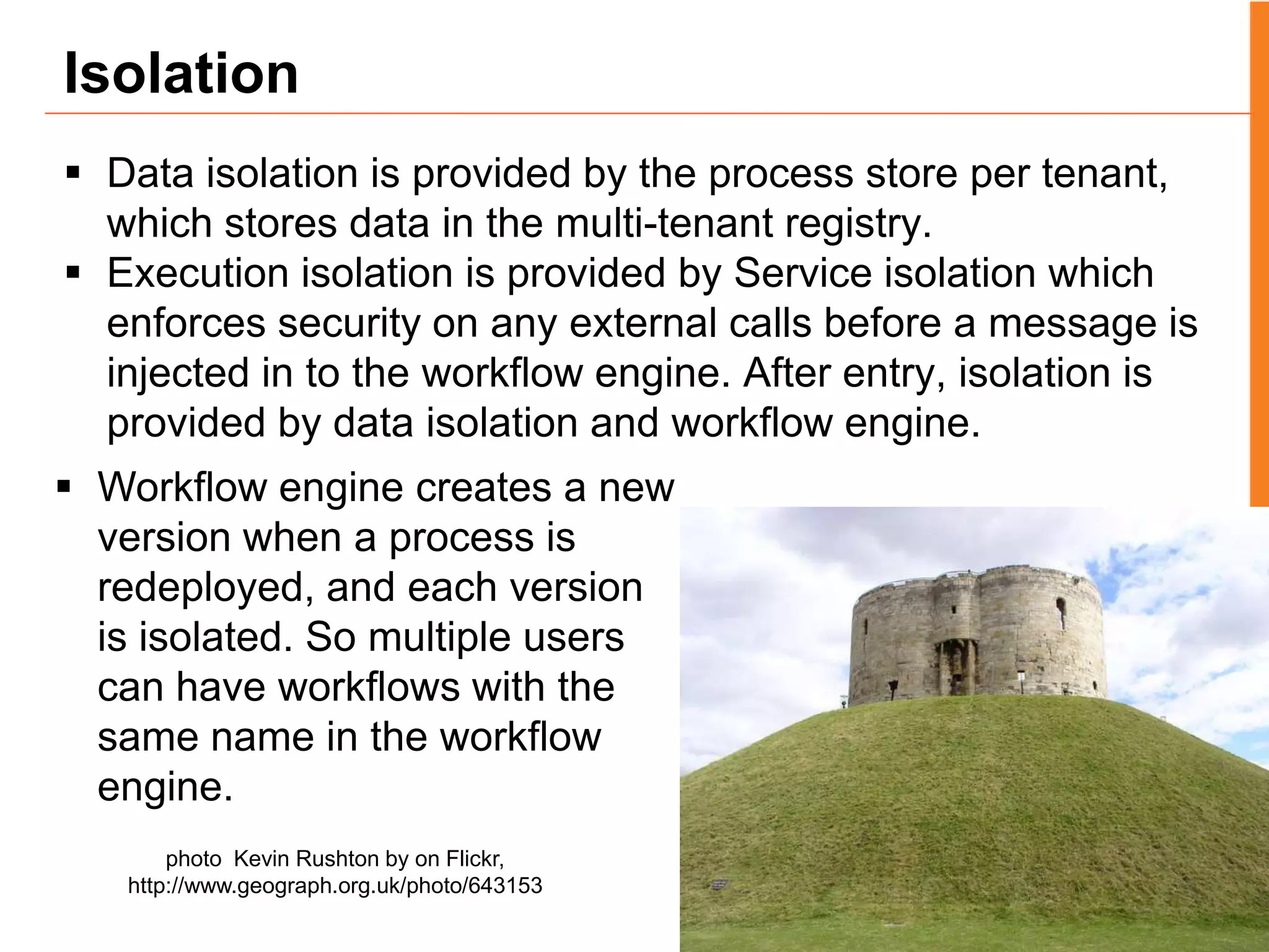
IsolationData isolation is provided by the process store per tenant, which stores data in the multi-tenant registry. Execution isolation is provided by Service isolation which enforces security on any external calls before a message is injected in to the workflow engine. After entry, isolation is provided by data isolation and workflow engine. Workflow engine creates a new version when a process is redeployed, and each version is isolated. So multiple users can have workflows with the same name in the workflow engine. photo  Kevin Rushton by on Flickr, http://www.geograph.org.uk/photo/643153
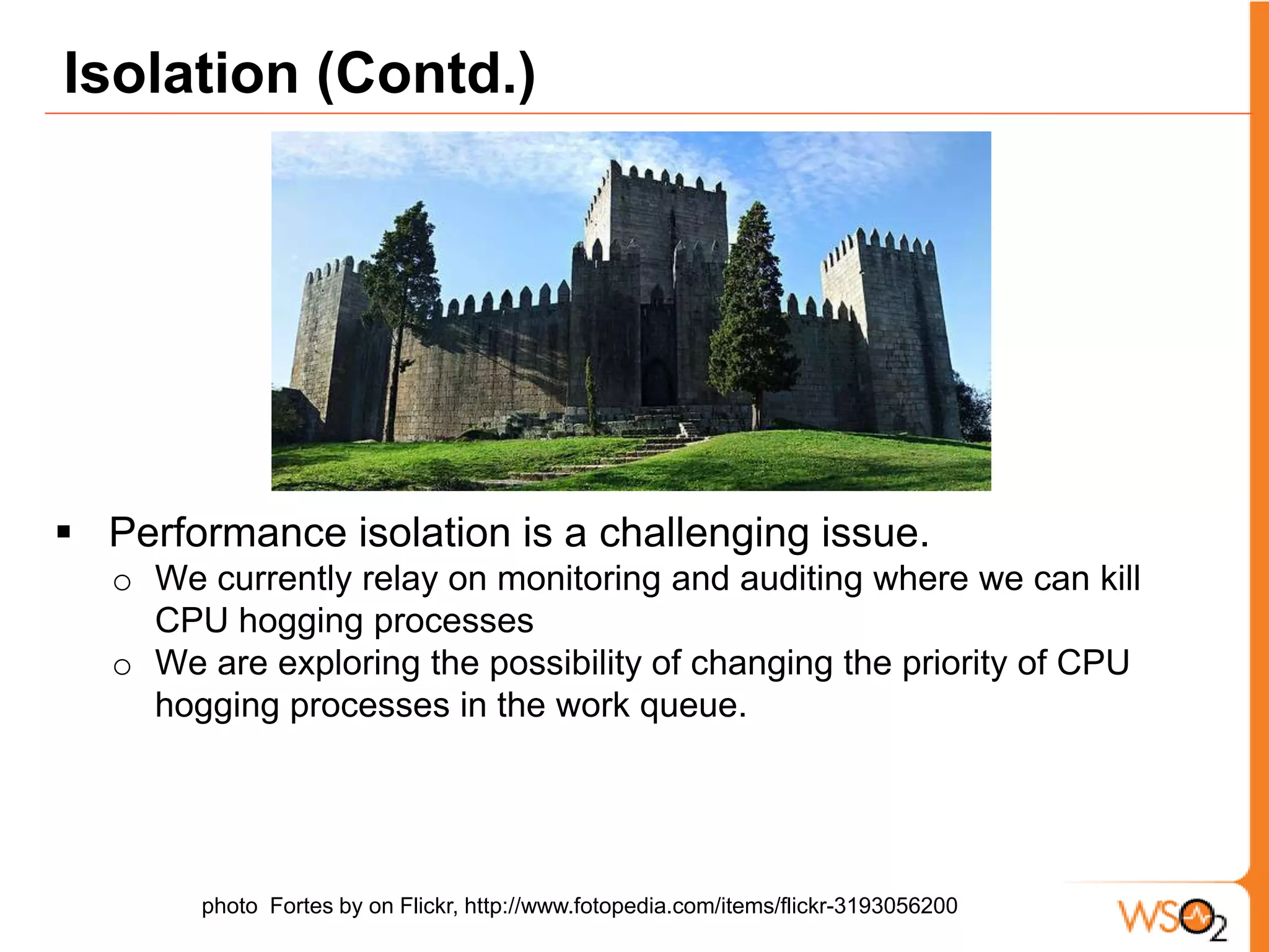
Isolation (Contd.) Performance isolation is a challenging issue. We currently relay on monitoring and auditing where we can kill CPU hogging processesWe are exploring the possibility of changing the priority of CPU hogging processes in the work queue.  photo  Fortes by on Flickr, http://www.fotopedia.com/items/flickr-3193056200
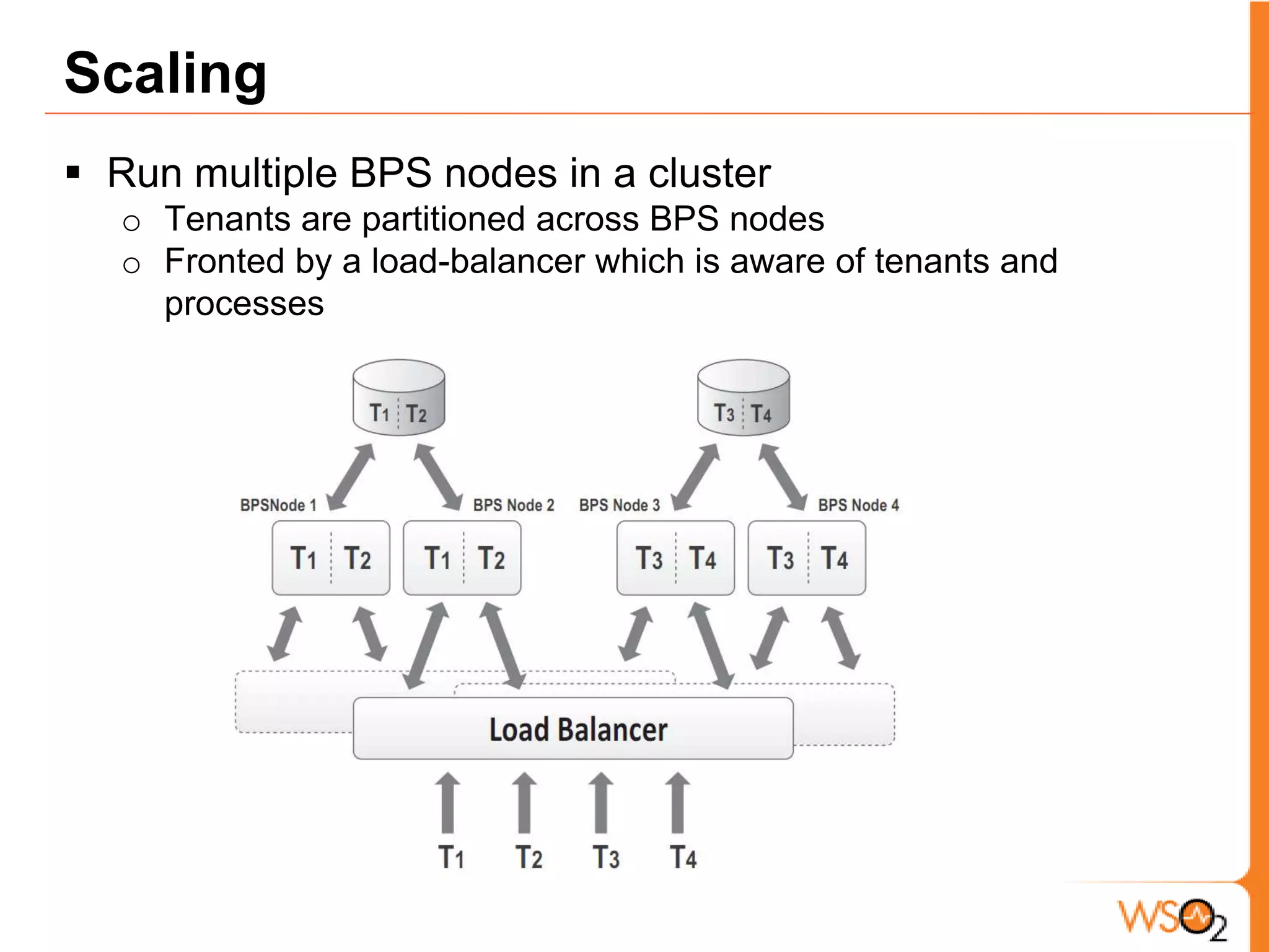
Scaling Run multiple BPS nodes in a clusterTenants are partitioned across BPS nodesFronted by a load-balancer which is aware of tenants and processes
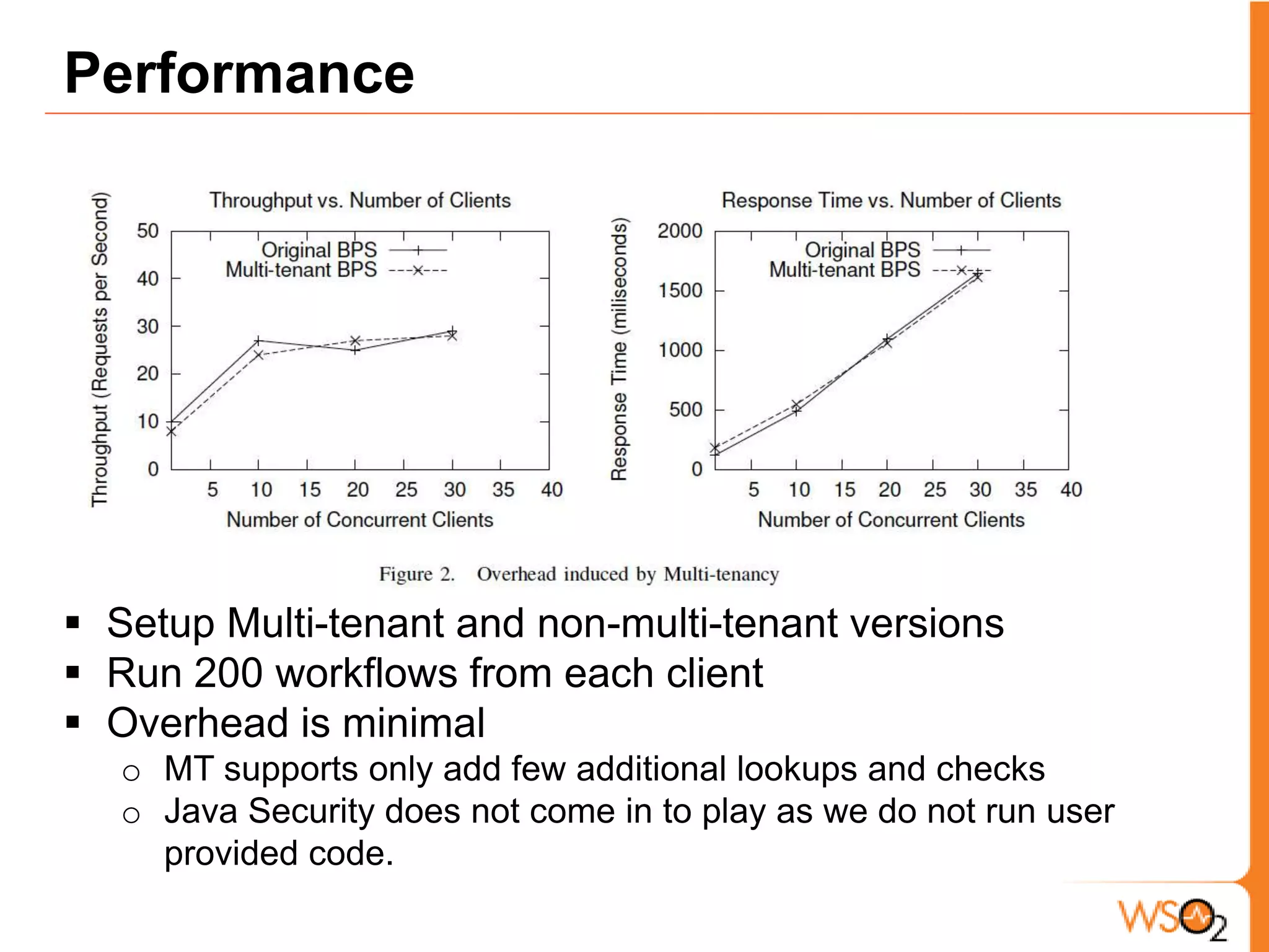
Performance Setup Multi-tenant and non-multi-tenant versions Run 200 workflows from each clientOverhead is minimalMT supports only add few additional lookups and checksJava Security does not come in to play as we do not run user provided code.
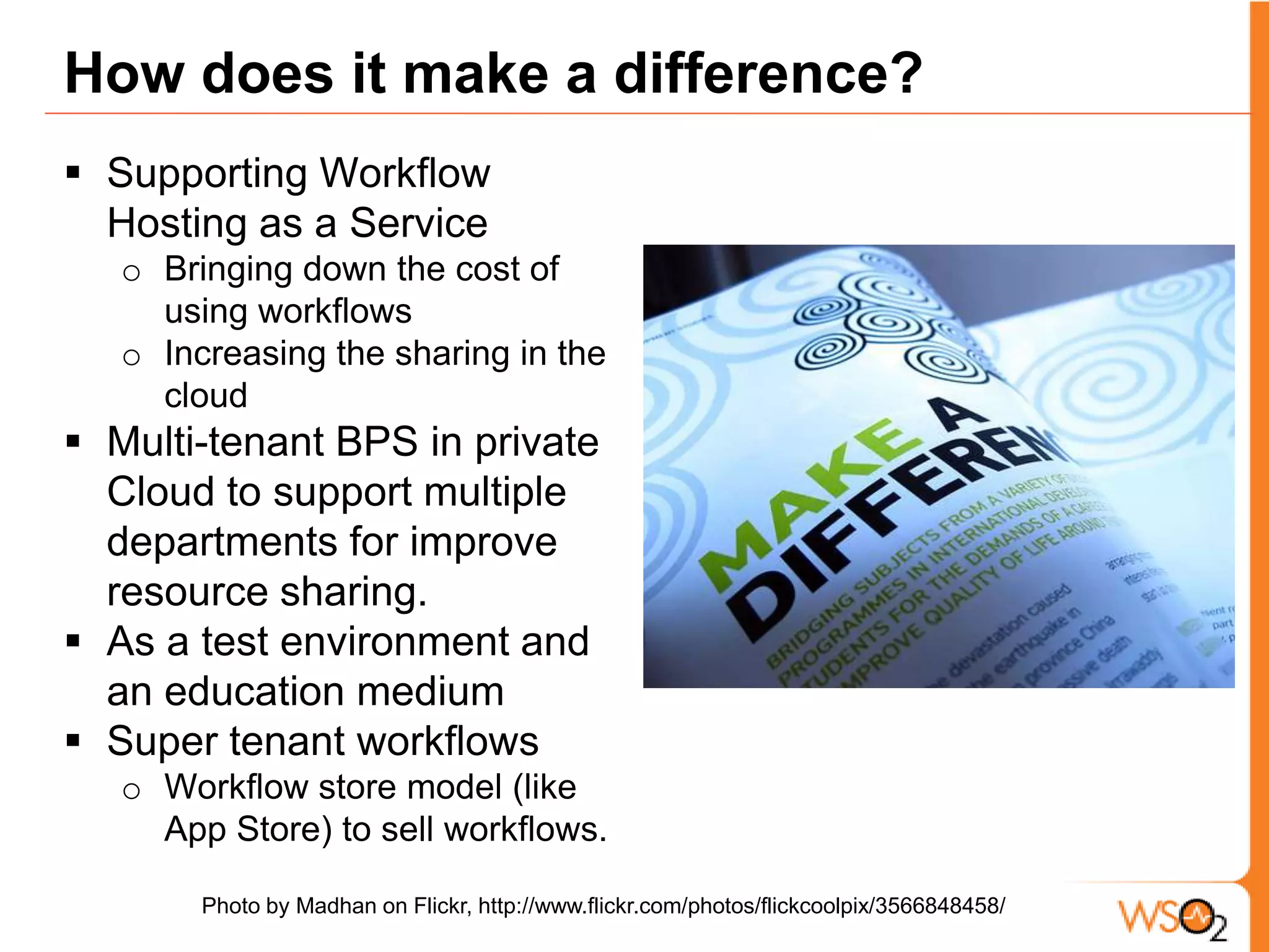
How does it make a difference?Supporting Workflow Hosting as a ServiceBringing down the cost of using workflowsIncreasing the sharing in the cloud  Multi-tenant BPS in private Cloud to support multiple departments for improve resource sharing. As a test environment and an education medium Super tenant workflows Workflow store model (like App Store) to sell workflows. Photo by Madhan on Flickr, http://www.flickr.com/photos/flickcoolpix/3566848458/
ConclusionWe proposed an architecture for supporting Multi-tenant  Business Process Engine We layered this on top of our earlier works on Service Multi-tenancy and Data Multi-tenancy. We discussed data and execution isolation. We have realized the architecture on top of WSO2 BPS, which is an extension of Apache ODEMulti-tenant business process engine enables end-users to deploy their current BPEL workflows running on their machine without any changes. It only introduced a minimal overhead It is currently available for free from cloud.wso2.com

A Multi-tenant Architecture for Business Process Executions

  • 1.
    A Multi-tenant Architecturefor Business Process ExecutionsMilindaPathirage, Srinath Perera, Indika Kumara, SanjivaWeerawaranaWSO2 Inc.
  • 2.
    Cloud ComputingAbility tobuy computations power, storage, or execution services as an Utility, on demand.
  • 3.
    For more detailsread “A View of Cloud Computing, Communications of the ACM, 2010”Cloud Computing (contd.)Best way to explain it is by comparing it to Electricity Idea is we run data centers or shared servers instead of running individual servers, and share the resources. Optimize large scale operations and archive economics of scale.Since the pool is big, one can ask for resources when needed and release when not needed. No need for capacity planning, start small and grow as needed. Outsource running machines and maintenance enabling specialization. photo by LoopZilla on Flickr, http://www.flickr.com/photos/loopzilla/2328231843/sizes/m/in/photostream/, Licensed under CC
  • 4.
  • 5.
    Why PaaS?IaaS onlyprovides limited saving to someone who needs to outsource their IT functionsSaaS is great when they can be used They are usually very specific (e.g. email, CRM ..)If they match, then great, but if they are not, not much choice for the user. PaaS stays in the middle ground Framework to host your appsHopefully you can move your apps as it is (well not the case with Azure or App Engine, but it is possible).
  • 6.
    Supporting SOA inPaaSSOA is a primary technology in the EnterpriseMany users already have SOA artifacts Moving them to the Cloud without need for changing will be a great advantage We want to see Cloud as yet another deployment modelWrite and test applications locallyEven deploy it locally if neededWhen you need it, you can deploy the same artifacts in the cloud.Multi-tenancy plays a major role. Which brings us to our Topic.photo by MikkoTarvainenon Flickr, http://www.flickr.com/photos/mtarvainen/5131983246/, Licensed under CC
  • 7.
    What isMulti-tenancy ?Many Parties share the same set of resources, while giving each an his own spaceWhy Multi-tenancy? Increased sharingCloud shares resources across a large pool of users. Now sharing happens in the application level as oppose to sharing at OS level for multiple processes and sharing at HW level with VMs. Provide pay for what you use Often there will be many accounts in a PaaS or a SaaS, but only a fraction of them will be in use. We cannot allocate runtime resource per account (disk may be ok, as it is cheap). For example, we cannot run a VM per account. By sharing the same server with many users, Multi-tenancy provides much reduced runtime cost per server. photo by Ben Gray on Flickr, http://www.flickr.com/photos/ben_grey/4582294721/, Licensed under CC
  • 8.
    Multi-tenancy vs. VirtualMachinesMulti-tenancy provides much fine grained sharing by many applications sharing the same server. Say there are 100k accounts, but 10k active users at a time. VM based model needs 100k VMs, which means there is a cost incurred per account. With Multi-tenancy one server can handle many accounts, and by mixing and matching heavy and light users, Multi-tenancy can operate with much less number of servers. photo by hans s on Flickr, http://www.flickr.com/photos/archeon/2359334908/
  • 9.
    Our Earlier Workson Multi-tenancy We provide a SOA PaaS offering called Stratos. Some of the featuresWeb Service Hosting as a Service Web Application Hosting as a ServiceMessage Mediation Execution as a Service (ESB)Governance as a Service Earlier publications on the topic A. Azeez and S. Perera et al., WSO2 Stratos: An Industrial Stack to Support Cloud Computing, IT: Methods and Applications of Informatics and Information Technology Journal, the special Issue on Cloud Computing, 2011.AfkhamAzeez, Srinath Perera, DimuthuGamage, Ruwan Linton, PrabathSiriwardana, DimuthuLeelaratne, SanjivaWeerawarana, Paul Fremantle, "Multi-Tenant SOA Middleware for Cloud Computing" 3rd International Conference on Cloud Computing, Florida, 2010
  • 10.
    Today’s Topic: WorkflowHosting as a ServiceKey part of the SOA puzzle Workflows provide interoperable means of composing services together. Still workflow technology is mostly limited to large scale organizationsGoalsEnable users to deploy the same workflows that they run on local machines in the Cloud without any changes and supporting the monitoring and other features in the same way. Supporting Multi-tenancy Scalability photo by Michael Coté on Flickr, http://www.flickr.com/photos/cote/460253143/, Licensed under CC
  • 11.
  • 12.
    E-Science GatewaysScientific workflowshas been identified as enabling technology for E-Science. Idea is to let scientists visually compose workflows and run them. There are many gateways that do this. However, the cost of running gateways for different domains has been high. Workflow hosting service together with Service and Web application hosting service will enable multiple science gateways to share the same infrastructure thus reducing the maintenance cost and resource sharing . photo by Image Editor on Flickr, http://www.flickr.com/photos/11304375@N07/2769519295/, Licensed under CC
  • 13.
    SMBs (Small andMedium size Business) Most SMBs can not afforded to run their own workflow technologies. This stops them from goes to the next level. Workflow, Service and Web hosting services can enable multiple SMBs to share the same infrastructure. This will lower the bar of workflow use, and enable SMBs to move to the next level. photo by Olaf on Flickr http://www.flickr.com/photos/okreitz/3073783437/, Licensed under CC
  • 14.
    Goals of Multi-tenancySharing – maximize the resource sharing across multiple tenants. Isolation – hide the fact other other are also in the same server. Execution – enforce security. Make sure one tenant can’t call other tenants executable logic. Data – make sure one tenant can’t see other data Performance - make sure performance is not affected by existence of other tenants. ScaleServer is distributed and it can handle larger load by adding more nodes. photo by John TrainoronFlickr http://www.flickr.com/photos/trainor/2902023575/, Licensed under CC
  • 15.
    Related works Mitezner[5] and Shi et al.[6] introduced application templates where the system lets users customize a template workflow.Mitezneret al. introduced a tenant context to hold execution data and isolate executions. We also use a similar concept. Cai, Wang, and Zhou [8] have used tenant context to support multi-tenancy in Web Applications. Anstett et al. [9] discuss challenges of bring BPEL processes to cloud. Need changes to BPEL engineConfiguration data isolationAvoid giving access to DBsSecuring the Data in the communication
  • 16.
  • 17.
    Achieving Service ExecutionIsolationAll executions are based on Axis2 (ODE also runs on Axis2)
  • 18.
    Axis2 have statelessexecutions and keep all state in a Context.
  • 19.
    So if wecreate different context for each tenant, they are isolated.
  • 20.
    See Azeez etal. “Multi-Tenant SOA Middleware for Cloud Computing” for details BPS Multi-tenancy Architecture
  • 21.
    BPS Multi-tenancy Architecture(Contd.)Extends Apache ODEHas a single tenant Apache ODE Engine as the core and added Multi-tenancy by adding a Multi-tenant process store and adding isolation at the message reception. Parts of the architecture A Process store per tenant, which only allows calls from that tenantParent process store that provides a single process store view across all tenant stores (to Apache ODE).
  • 22.
    BPS Multi-tenancy Architecture(Contd.)When a workflow is deployed by T1, it is stored in T1’s process store. Also, a service is created for the workflow and deployed within T1’s space. When a workflow received a message, the service that receives the message perform access control and then injects it to ODE with tenant ID as a correlation property. A implicit correlation rule together with other correlation rules routes the messages to a workflow instance. When workflow instance access the process store, it is routed to the T1’s tenant process store.
  • 23.
    IsolationData isolation isprovided by the process store per tenant, which stores data in the multi-tenant registry. Execution isolation is provided by Service isolation which enforces security on any external calls before a message is injected in to the workflow engine. After entry, isolation is provided by data isolation and workflow engine. Workflow engine creates a new version when a process is redeployed, and each version is isolated. So multiple users can have workflows with the same name in the workflow engine. photo Kevin Rushton by on Flickr, http://www.geograph.org.uk/photo/643153
  • 24.
    Isolation (Contd.) Performanceisolation is a challenging issue. We currently relay on monitoring and auditing where we can kill CPU hogging processesWe are exploring the possibility of changing the priority of CPU hogging processes in the work queue. photo Fortes by on Flickr, http://www.fotopedia.com/items/flickr-3193056200
  • 25.
    Scaling Run multipleBPS nodes in a clusterTenants are partitioned across BPS nodesFronted by a load-balancer which is aware of tenants and processes
  • 26.
    Performance Setup Multi-tenantand non-multi-tenant versions Run 200 workflows from each clientOverhead is minimalMT supports only add few additional lookups and checksJava Security does not come in to play as we do not run user provided code.
  • 27.
    How does itmake a difference?Supporting Workflow Hosting as a ServiceBringing down the cost of using workflowsIncreasing the sharing in the cloud Multi-tenant BPS in private Cloud to support multiple departments for improve resource sharing. As a test environment and an education medium Super tenant workflows Workflow store model (like App Store) to sell workflows. Photo by Madhan on Flickr, http://www.flickr.com/photos/flickcoolpix/3566848458/
  • 28.
    ConclusionWe proposed anarchitecture for supporting Multi-tenant Business Process Engine We layered this on top of our earlier works on Service Multi-tenancy and Data Multi-tenancy. We discussed data and execution isolation. We have realized the architecture on top of WSO2 BPS, which is an extension of Apache ODEMulti-tenant business process engine enables end-users to deploy their current BPEL workflows running on their machine without any changes. It only introduced a minimal overhead It is currently available for free from cloud.wso2.com
  • 29.