© 2014 Health Catalyst
www.healthcatalyst.com
Proprietary. Feel free to share but we would appreciate a Health Catalyst citation.
© 2014 Health Catalyst
www.healthcatalyst.comProprietary. Feel free to share but we would appreciate a Health Catalyst citation.
By Bobbi Brown and Leslie Falk
6 Steps for Implementing Successful Performance
Improvement Initiatives in Healthcare
© 2014 Health Catalyst
www.healthcatalyst.com
Proprietary. Feel free to share but we would appreciate a Health Catalyst citation.
Performance Improvement Initiatives
Healthcare organizations
routinely pursue performance
improvement initiatives to
improve clinical outcomes
and patient experiences and
reduce organizational costs.
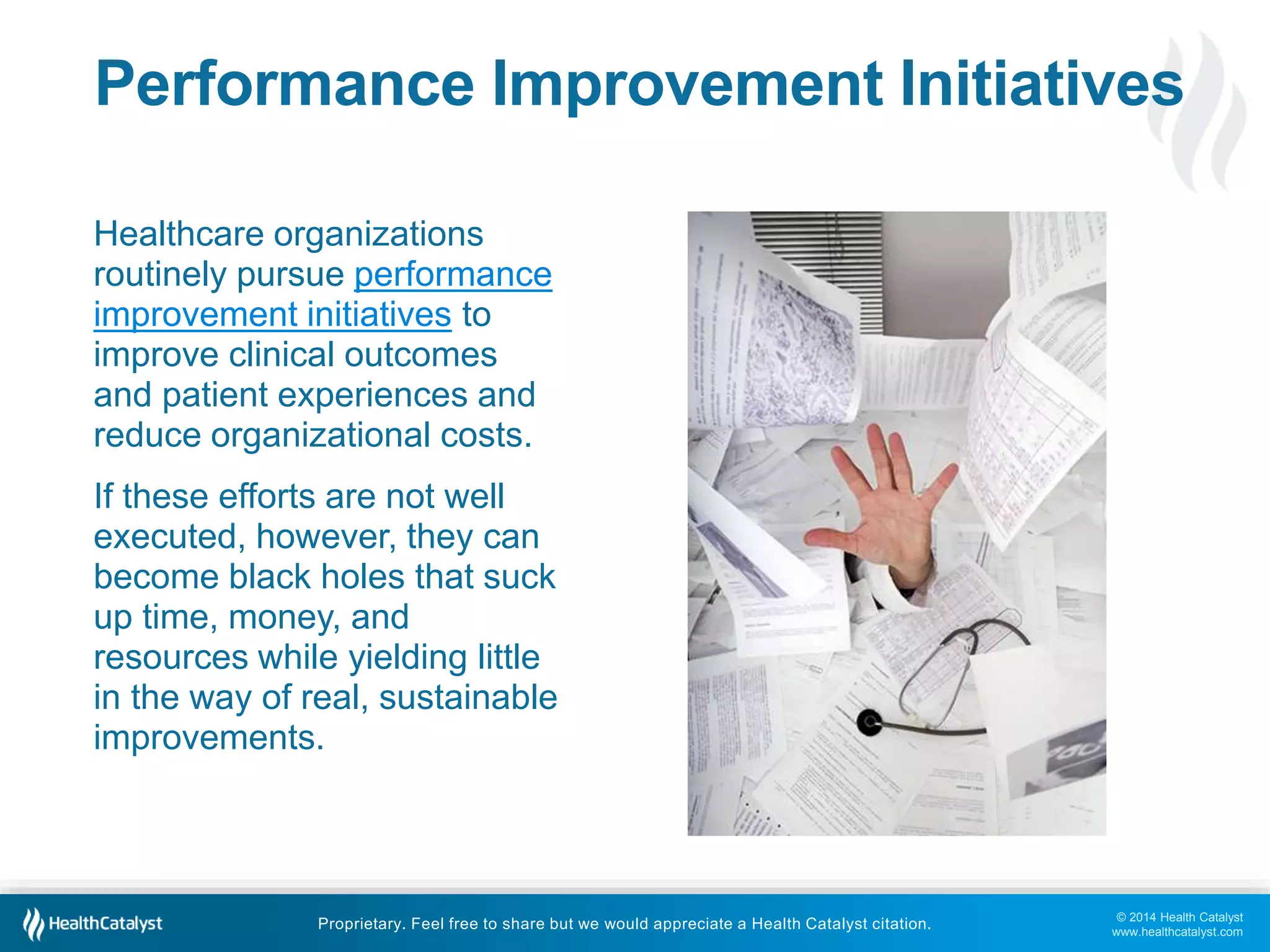
If these efforts are not well
executed, however, they can
become black holes that suck
up time, money, and
resources while yielding little
in the way of real, sustainable
improvements.
© 2014 Health Catalyst
www.healthcatalyst.com
Proprietary. Feel free to share but we would appreciate a Health Catalyst citation.
Performance Improvement Initiatives
To be effective and sustainable,
an organization’s performance
improvement initiatives should all
be conceived and performed in
the context of an ongoing
performance program.
The initial goals for such a
program should be to prioritize
performance improvement efforts
so that the organization can
achieve early successes and build
momentum for future performance
improvement efforts.
Content
System
Deployment
System
Analytics
System
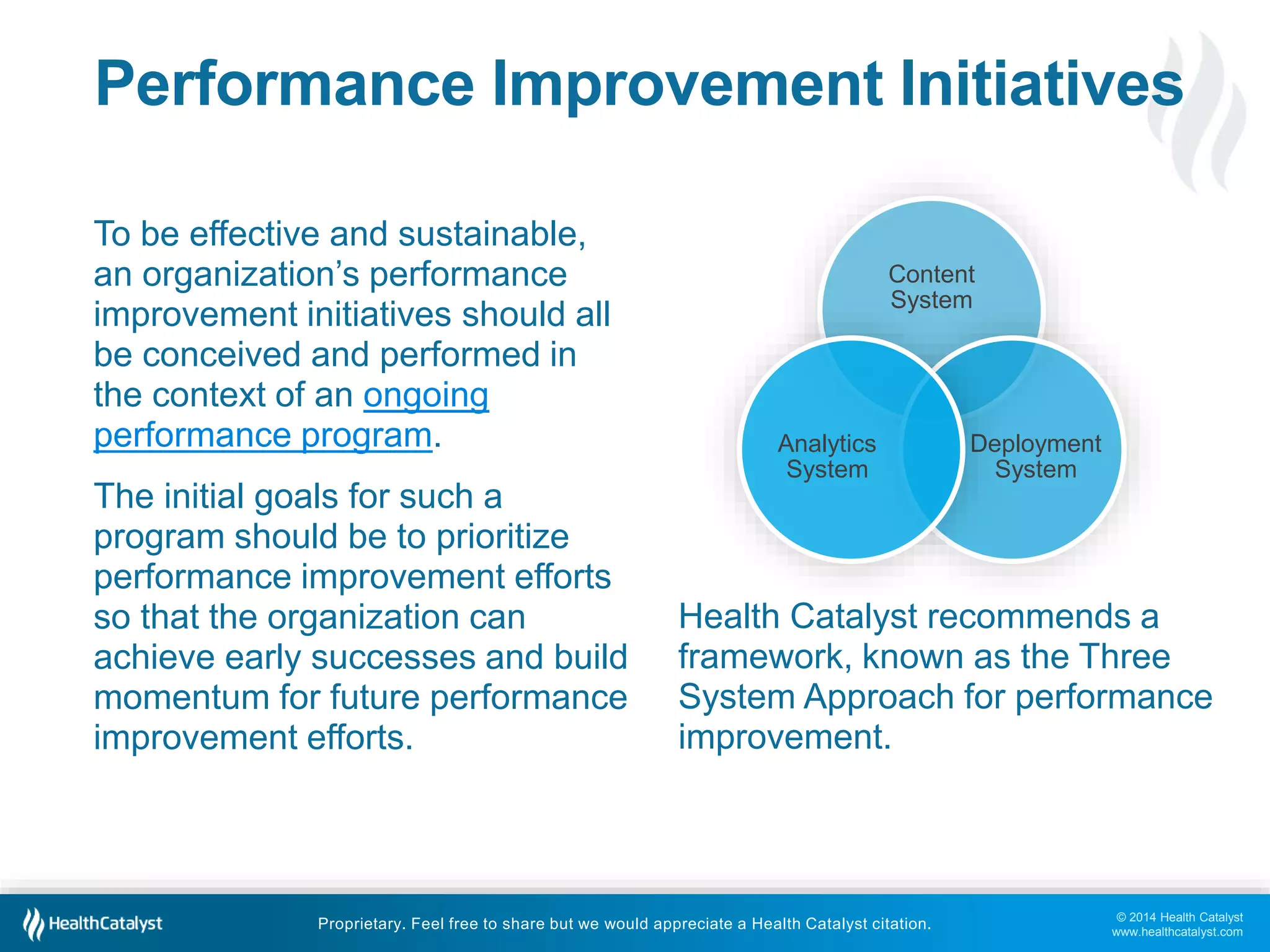
Health Catalyst recommends a
framework, known as the Three
System Approach for performance
improvement.
© 2014 Health Catalyst
www.healthcatalyst.com
Proprietary. Feel free to share but we would appreciate a Health Catalyst citation.
Six Steps to Implementing a
Performance Improvement Program
Integrate Performance Improvement into
Your Strategic Objectives
SIX STEPS
PERFORMANCE
IMPROVEMENT
1
Healthcare is a complex, adaptive system where interactions and relationships of
different components simultaneously affect and are shaped by the system. As
such, it is important for performance improvement to be integrated within the
healthcare organization’s strategic objectives.
Strategic objectives such as becoming an accountable care organization (ACO),
focusing on population health management, or developing a cardiovascular center
of excellence, all require performance improvement in order to be successful.
© 2014 Health Catalyst
www.healthcatalyst.com
Proprietary. Feel free to share but we would appreciate a Health Catalyst citation.
Six Steps to Implementing a
Performance Improvement Program
Use Analytics to Unlock Data and
Identify Areas of Opportunity
SIX STEPS
PERFORMANCE
IMPROVEMENT
2
Performance improvement requires an analytics system that integrates data
sources (clinical, claims, financial, operational, etc.), and facilitates quick and easy
data sharing. Only with appropriate analytics can an organization identify specific
areas of opportunity among strategic areas of focus.
Health Catalyst offers a unique solution with our Late-Binding™ Enterprise Data
Warehouse – an agile, interactive process producing balanced metrics.
© 2014 Health Catalyst
www.healthcatalyst.com
Proprietary. Feel free to share but we would appreciate a Health Catalyst citation.
Six Steps to Implementing a
Performance Improvement Program
Use Analytics to Unlock Data and
Identify Areas of Opportunity
SIX STEPS
PERFORMANCE
IMPROVEMENT
2
Performance improvement requires an analytics system that integrates data sources
(clinical, claims, financial, operational, etc.), and facilitates quick and easy data sharing.
Only with appropriate analytics can an organization identify specific areas of opportunity
among strategic areas of focus.
Health Catalyst offers a unique solution with our Late-Binding™ Enterprise Data
Warehouse – an agile, interactive process producing balanced metrics.
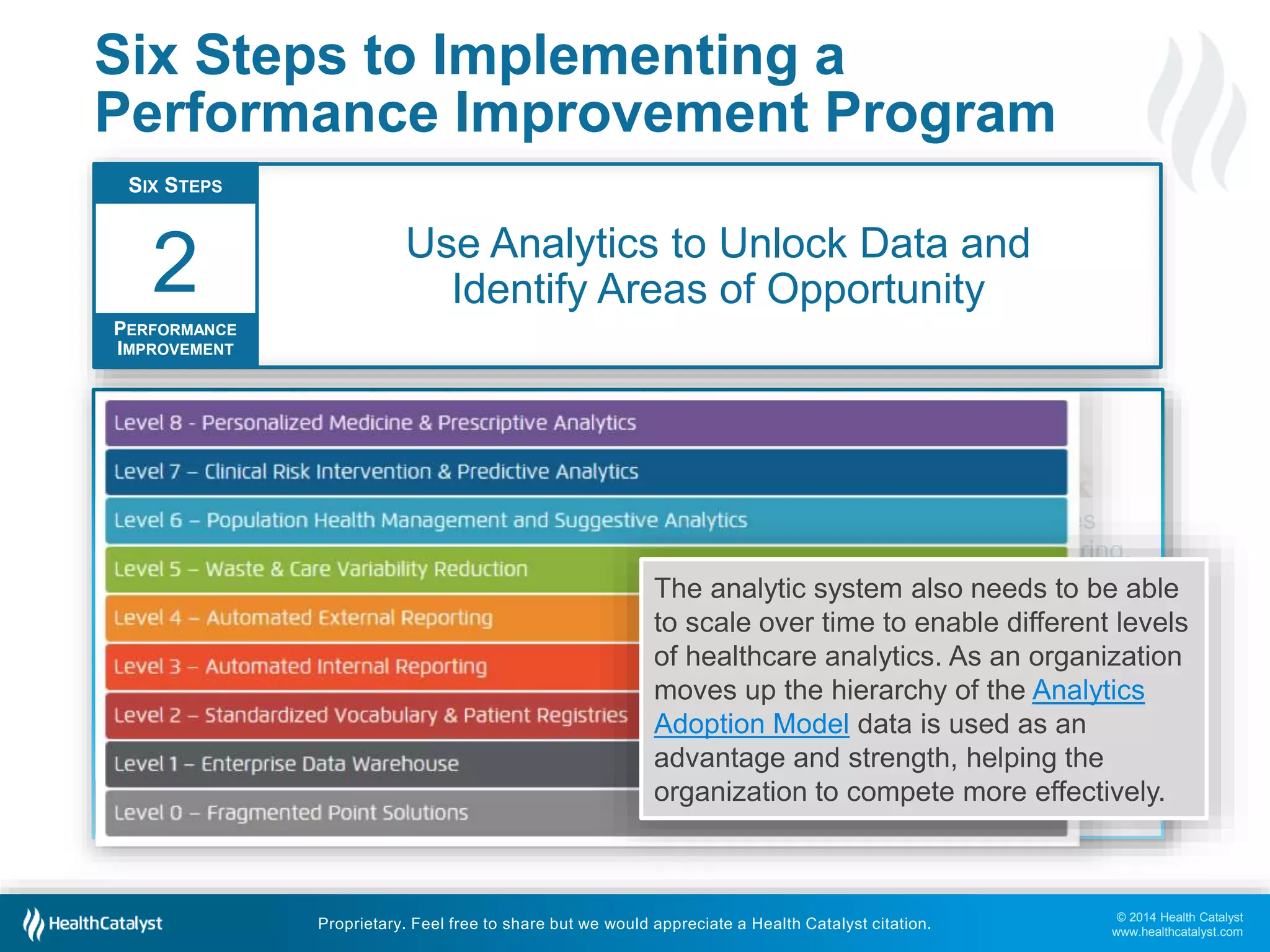
The analytic system also needs to be able
to scale over time to enable different levels
of healthcare analytics. As an organization
moves up the hierarchy of the Analytics
Adoption Model data is used as an
advantage and strength, helping the
organization to compete more effectively.
© 2014 Health Catalyst
www.healthcatalyst.com
Proprietary. Feel free to share but we would appreciate a Health Catalyst citation.
Six Steps to Implementing a
Performance Improvement Program
Use Analytics to Unlock Data and
Identify Areas of Opportunity
SIX STEPS
PERFORMANCE
IMPROVEMENT
2
Performance improvement requires an analytics system that integrates data sources
(clinical, claims, financial, operational, etc.), and facilitates quick and easy data sharing.
Only with appropriate analytics can an organization identify specific areas of opportunity
among strategic areas of focus.
Health Catalyst offers a unique solution with our Late-Binding™ Enterprise Data
Warehouse – an agile, interactive process producing balanced metrics.
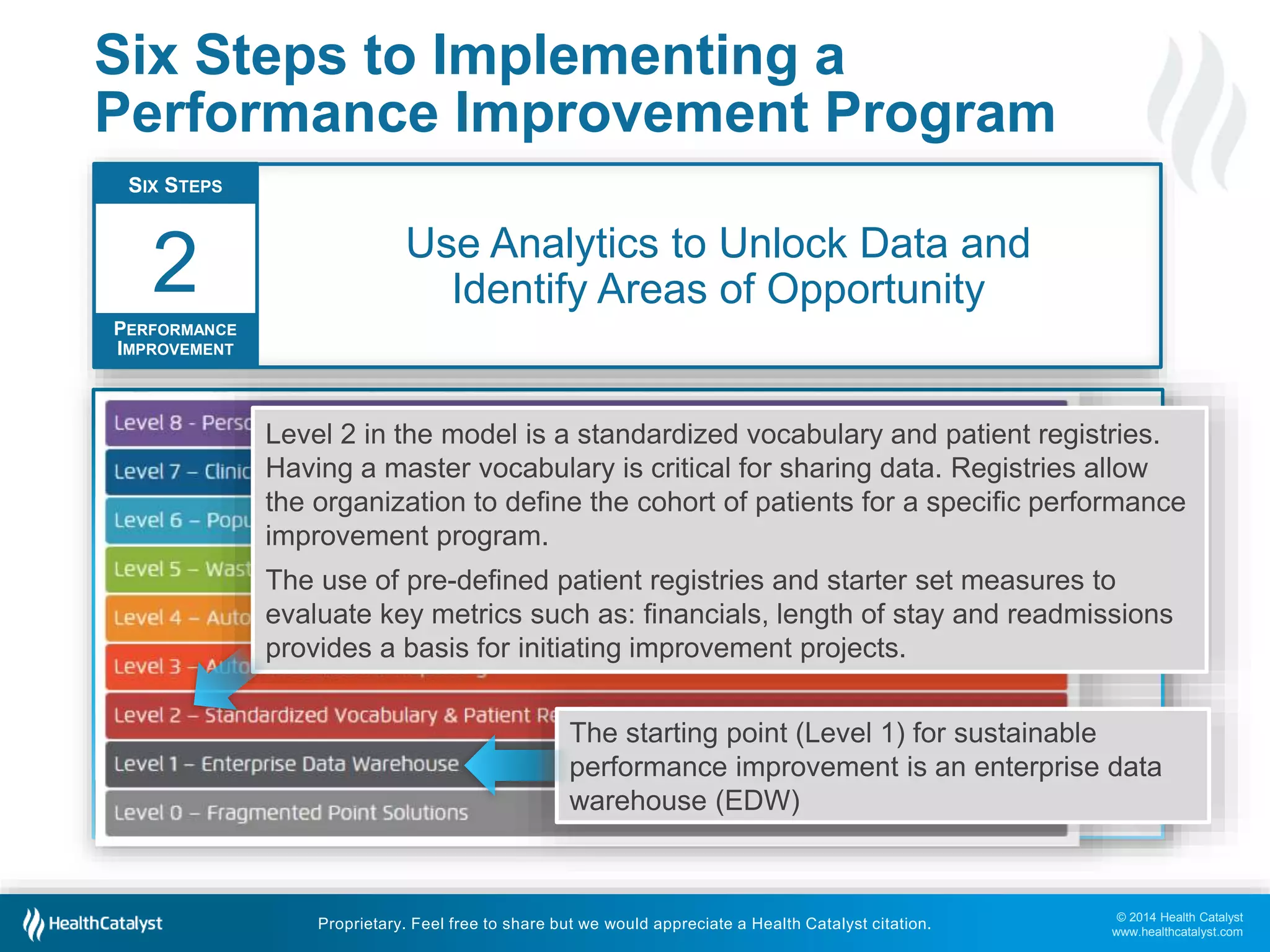
Level 2 in the model is a standardized vocabulary and patient registries.
Having a master vocabulary is critical for sharing data. Registries allow
the organization to define the cohort of patients for a specific performance
improvement program.
The use of pre-defined patient registries and starter set measures to
evaluate key metrics such as: financials, length of stay and readmissions
provides a basis for initiating improvement projects.
The starting point (Level 1) for sustainable
performance improvement is an enterprise data
warehouse (EDW)
© 2014 Health Catalyst
www.healthcatalyst.com
Proprietary. Feel free to share but we would appreciate a Health Catalyst citation.
Six Steps to Implementing a
Performance Improvement Program
Use Analytics to Unlock Data and
Identify Areas of Opportunity
SIX STEPS
PERFORMANCE
IMPROVEMENT
2
Performance improvement requires an analytics system that integrates data sources
(clinical, claims, financial, operational, etc.), and facilitates quick and easy data sharing.
Only with appropriate analytics can an organization identify specific areas of opportunity
among strategic areas of focus.
Health Catalyst offers a unique solution with our Late-Binding™ Enterprise Data
Warehouse – an agile, interactive process producing balanced metrics.
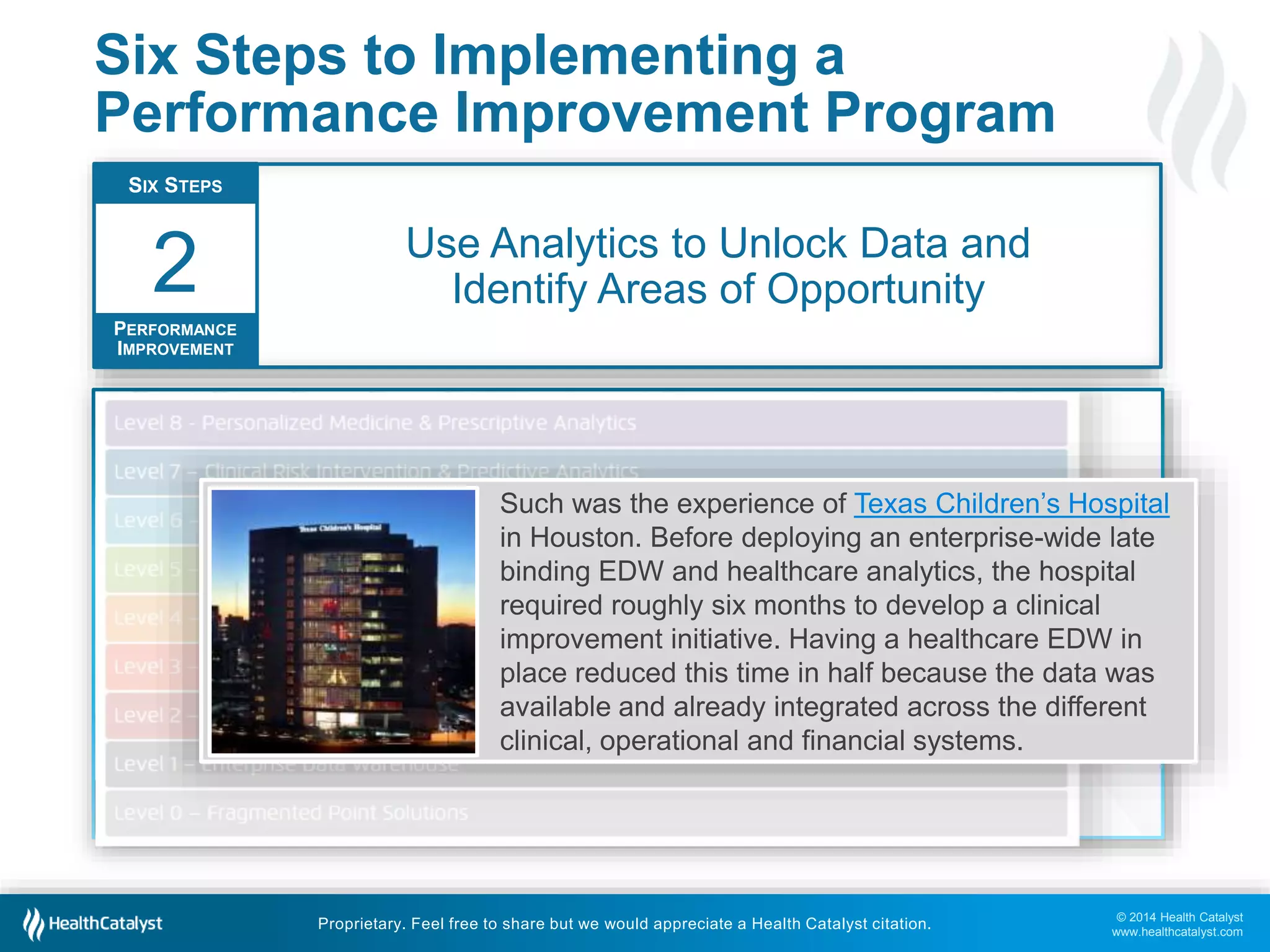
Such was the experience of Texas Children’s Hospital
in Houston. Before deploying an enterprise-wide late
binding EDW and healthcare analytics, the hospital
required roughly six months to develop a clinical
improvement initiative. Having a healthcare EDW in
place reduced this time in half because the data was
available and already integrated across the different
clinical, operational and financial systems.
© 2014 Health Catalyst
www.healthcatalyst.com
Proprietary. Feel free to share but we would appreciate a Health Catalyst citation.
Six Steps to Implementing a
Performance Improvement Program
Use Analytics to Unlock Data and
Identify Areas of Opportunity
SIX STEPS
PERFORMANCE
IMPROVEMENT
2
Performance improvement requires an analytics system that integrates data sources
(clinical, claims, financial, operational, etc.), and facilitates quick and easy data sharing.
Only with appropriate analytics can an organization identify specific areas of opportunity
among strategic areas of focus.
Health Catalyst offers a unique solution with our Late-Binding™ Enterprise Data
Warehouse – an agile, interactive process producing balanced metrics.
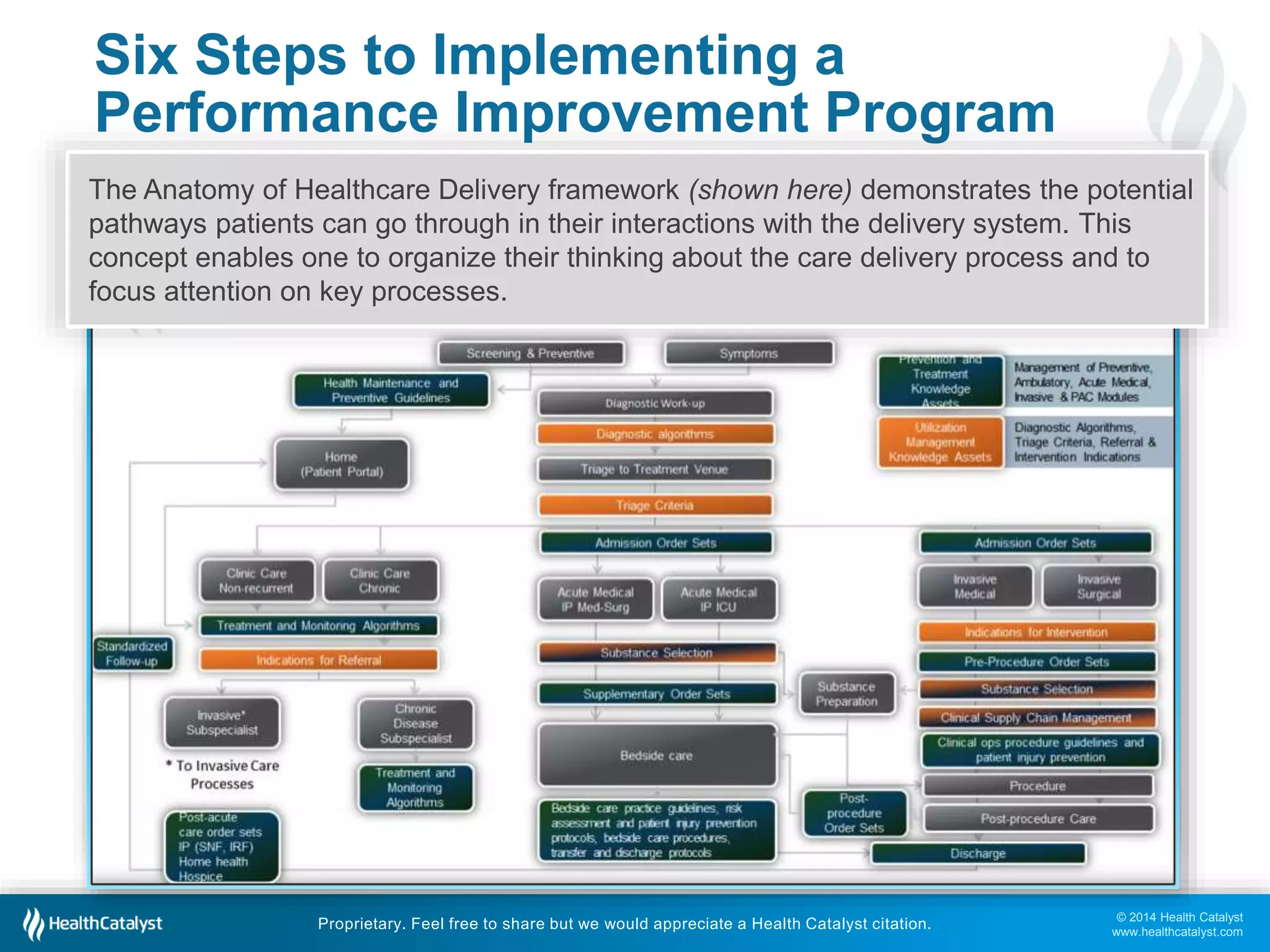
The Anatomy of Healthcare Delivery framework (shown here) demonstrates the potential
pathways patients can go through in their interactions with the delivery system. This
concept enables one to organize their thinking about the care delivery process and to
focus attention on key processes.
© 2014 Health Catalyst
www.healthcatalyst.com
Proprietary. Feel free to share but we would appreciate a Health Catalyst citation.
Six Steps to Implementing a
Performance Improvement Program
Use Analytics to Unlock Data and
Identify Areas of Opportunity
SIX STEPS
PERFORMANCE
IMPROVEMENT
2
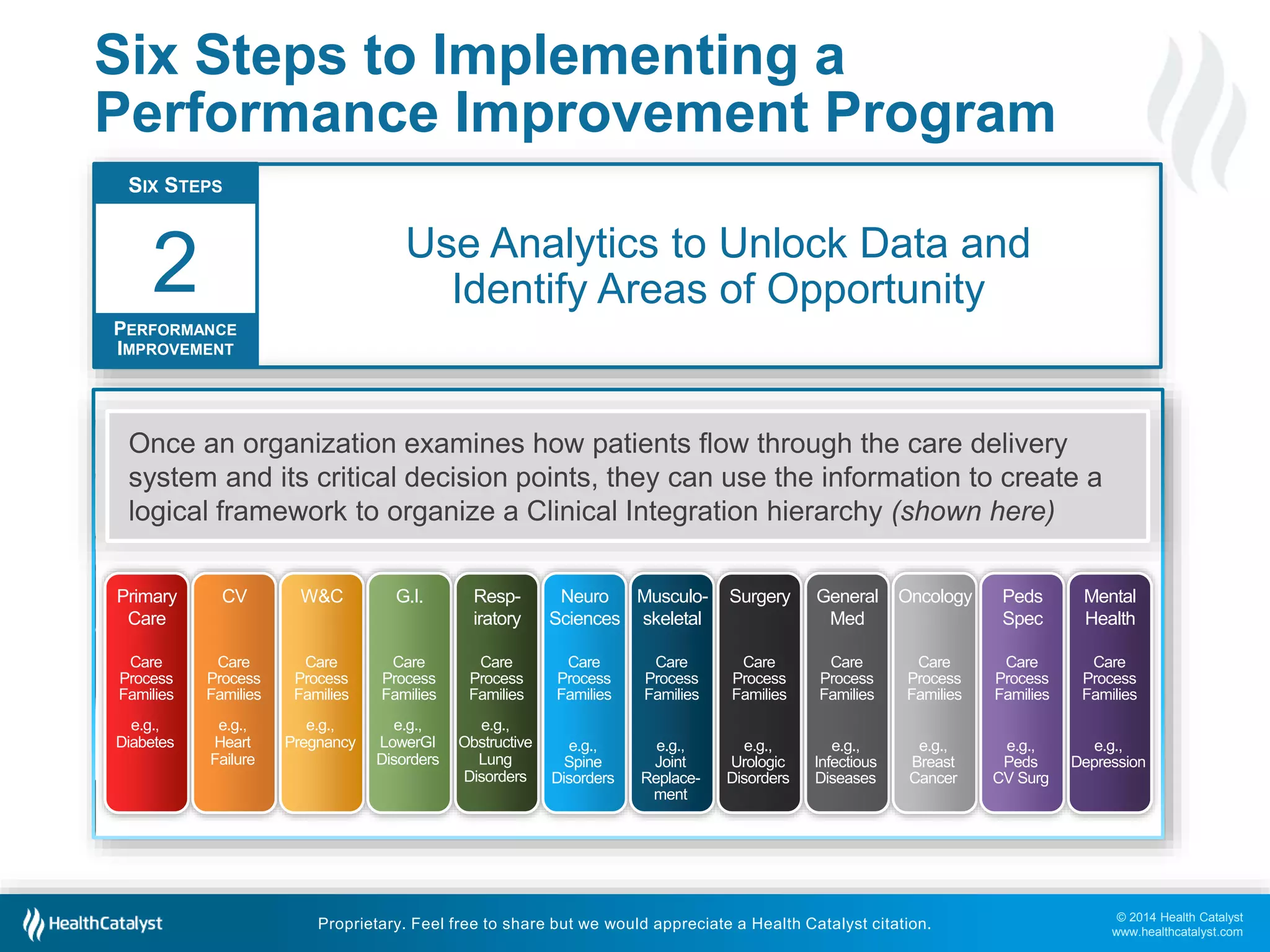
Once an organization examines how patients flow through the care delivery
system and its critical decision points, they can use the information to create a
logical framework to organize a Clinical Integration hierarchy (shown here)
Primary
Care
Care
Process
Families
e.g.,
Diabetes
CV
Care
Process
Families
e.g.,
Heart
Failure
W&C
Care
Process
Families
e.g.,
Pregnancy
G.I.
Care
Process
Families
e.g.,
LowerGI
Disorders
Resp-
iratory
Care
Process
Families
e.g.,
Obstructive
Lung
Disorders
Neuro
Sciences
Care
Process
Families
e.g.,
Spine
Disorders
Musculo-
skeletal
Care
Process
Families
e.g.,
Joint
Replace-
ment
Surgery
Care
Process
Families
e.g.,
Urologic
Disorders
General
Med
Care
Process
Families
e.g.,
Infectious
Diseases
Oncology
Care
Process
Families
e.g.,
Breast
Cancer
Peds
Spec
Care
Process
Families
e.g.,
Peds
CV Surg
Mental
Health
Care
Process
Families
e.g.,
Depression
© 2014 Health Catalyst
www.healthcatalyst.com
Proprietary. Feel free to share but we would appreciate a Health Catalyst citation.
Six Steps to Implementing a
Performance Improvement Program
Use Analytics to Unlock Data and
Identify Areas of Opportunity
SIX STEPS
PERFORMANCE
IMPROVEMENT
2
Performance improvement requires an analytics system that integrates data sources
(clinical, claims, financial, operational, etc.), and facilitates quick and easy data sharing.
Only with appropriate analytics can an organization identify specific areas of opportunity
among strategic areas of focus.
Health Catalyst offers a unique solution with our Late-Binding™ Enterprise Data
Warehouse – an agile, interactive process producing balanced metrics.
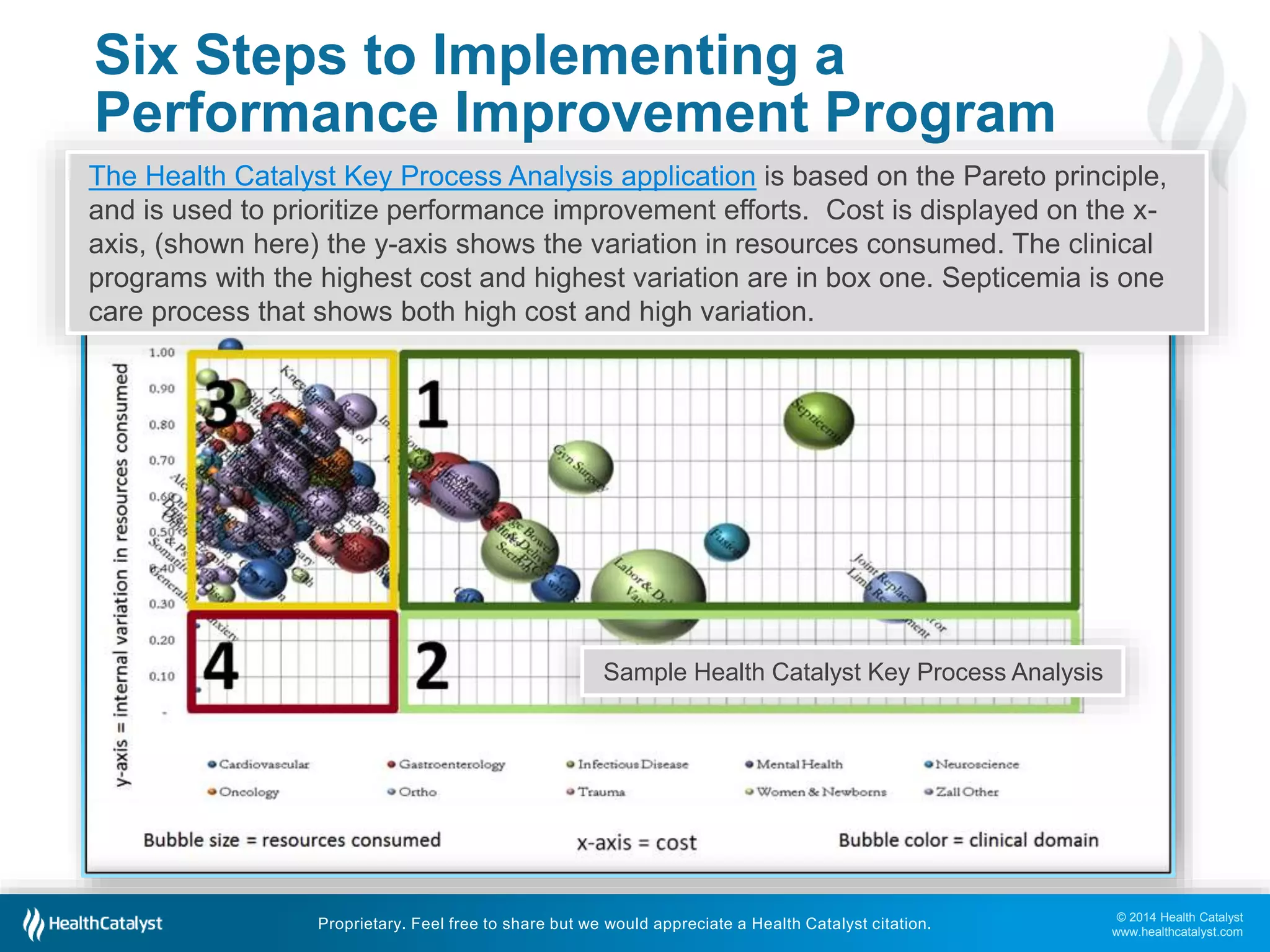
The Health Catalyst Key Process Analysis application is based on the Pareto principle,
and is used to prioritize performance improvement efforts. Cost is displayed on the x-
axis, (shown here) the y-axis shows the variation in resources consumed. The clinical
programs with the highest cost and highest variation are in box one. Septicemia is one
care process that shows both high cost and high variation.
Sample Health Catalyst Key Process Analysis
© 2014 Health Catalyst
www.healthcatalyst.com
Proprietary. Feel free to share but we would appreciate a Health Catalyst citation.
Six Steps to Implementing a
Performance Improvement Program
Use Analytics to Unlock Data and
Identify Areas of Opportunity
SIX STEPS
PERFORMANCE
IMPROVEMENT
2
Performance improvement requires an analytics system that integrates data sources
(clinical, claims, financial, operational, etc.), and facilitates quick and easy data sharing.
Only with appropriate analytics can an organization identify specific areas of opportunity
among strategic areas of focus.
Health Catalyst offers a unique solution with our Late-Binding™ Enterprise Data
Warehouse – an agile, interactive process producing balanced metrics.
Data governance is also a key component of the analytic
strategy. A data governance committee should be responsible
for understanding and implementing local data standards
(facility codes, department codes, etc.); as well as regional
and industry standards (CPT, ICD, SNOMED, LOINC, etc.).
In addition to coded data standards, the committee is also
involved in the standard use of algorithms to bind data into
analytic algorithms that should be consistently used
throughout the organization, such as calculating length of
stay, defining readmission criteria, defining patient cohorts,
and attributing patients to providers in accountable care
arrangements.
© 2014 Health Catalyst
www.healthcatalyst.com
Proprietary. Feel free to share but we would appreciate a Health Catalyst citation.
Six Steps to Implementing a
Performance Improvement Program
Prioritize programs using a combination
of analytics and a deployment system
SIX STEPS
PERFORMANCE
IMPROVEMENT
3
Successfully improving clinical outcomes and streamlining operations requires a
strong organizational commitment and changes in culture, organizational structure,
staff education, and workflow processes, what Health Catalyst calls a deployment
system.
Consequently, any organization that embarks on this performance improvement
journey should first assess its readiness for change.
© 2014 Health Catalyst
www.healthcatalyst.com
Proprietary. Feel free to share but we would appreciate a Health Catalyst citation.
Six Steps to Implementing a
Performance Improvement Program
Define the Performance Improvement
Program’s Permanent Teams
SIX STEPS
PERFORMANCE
IMPROVEMENT
4
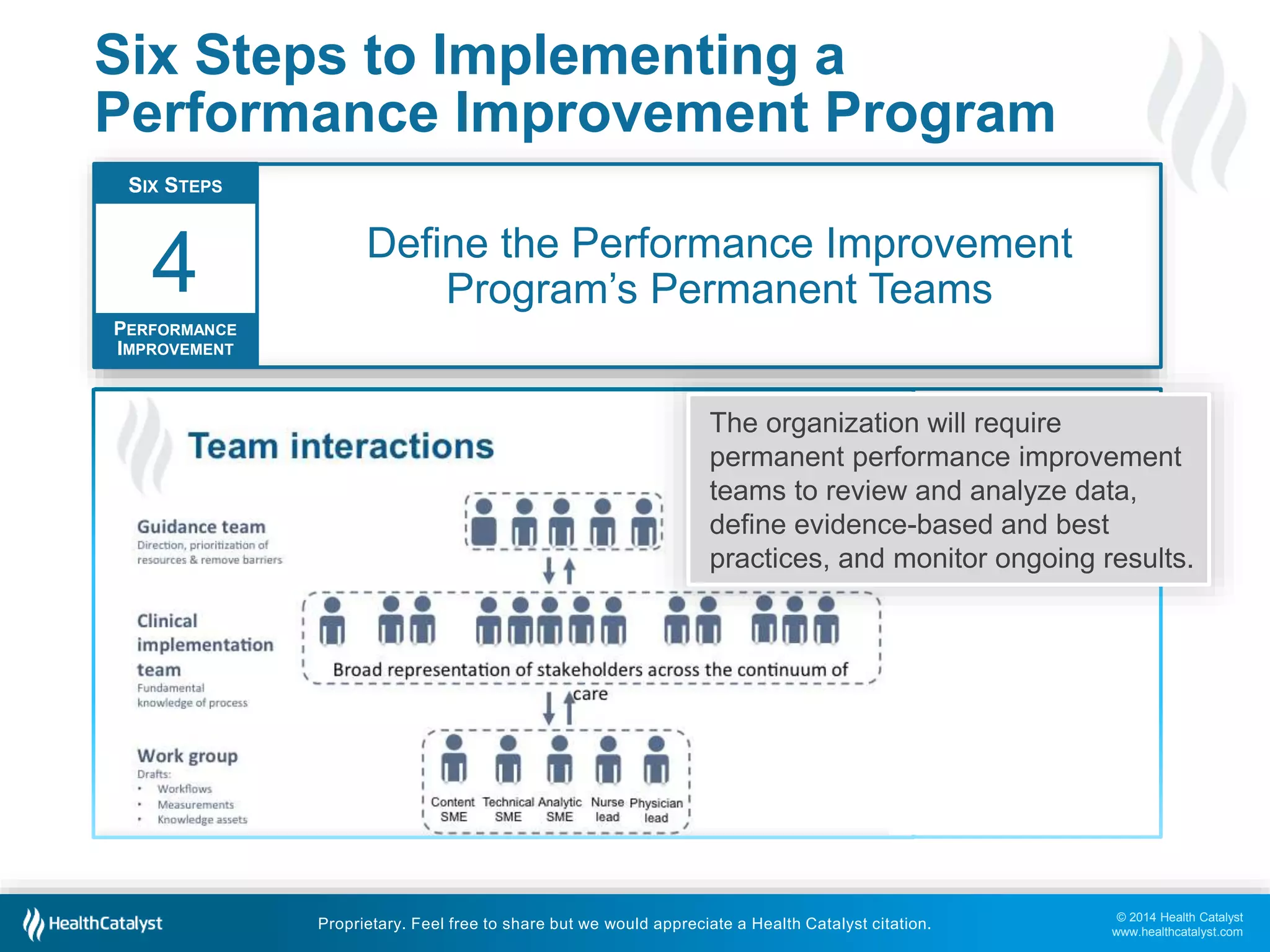
The organization will require
permanent performance improvement
teams to review and analyze data,
define evidence-based and best
practices, and monitor ongoing results.
© 2014 Health Catalyst
www.healthcatalyst.com
Proprietary. Feel free to share but we would appreciate a Health Catalyst citation.
Six Steps to Implementing a
Performance Improvement Program
Use a content system to define program
outcomes and define interventions
SIX STEPS
PERFORMANCE
IMPROVEMENT
5
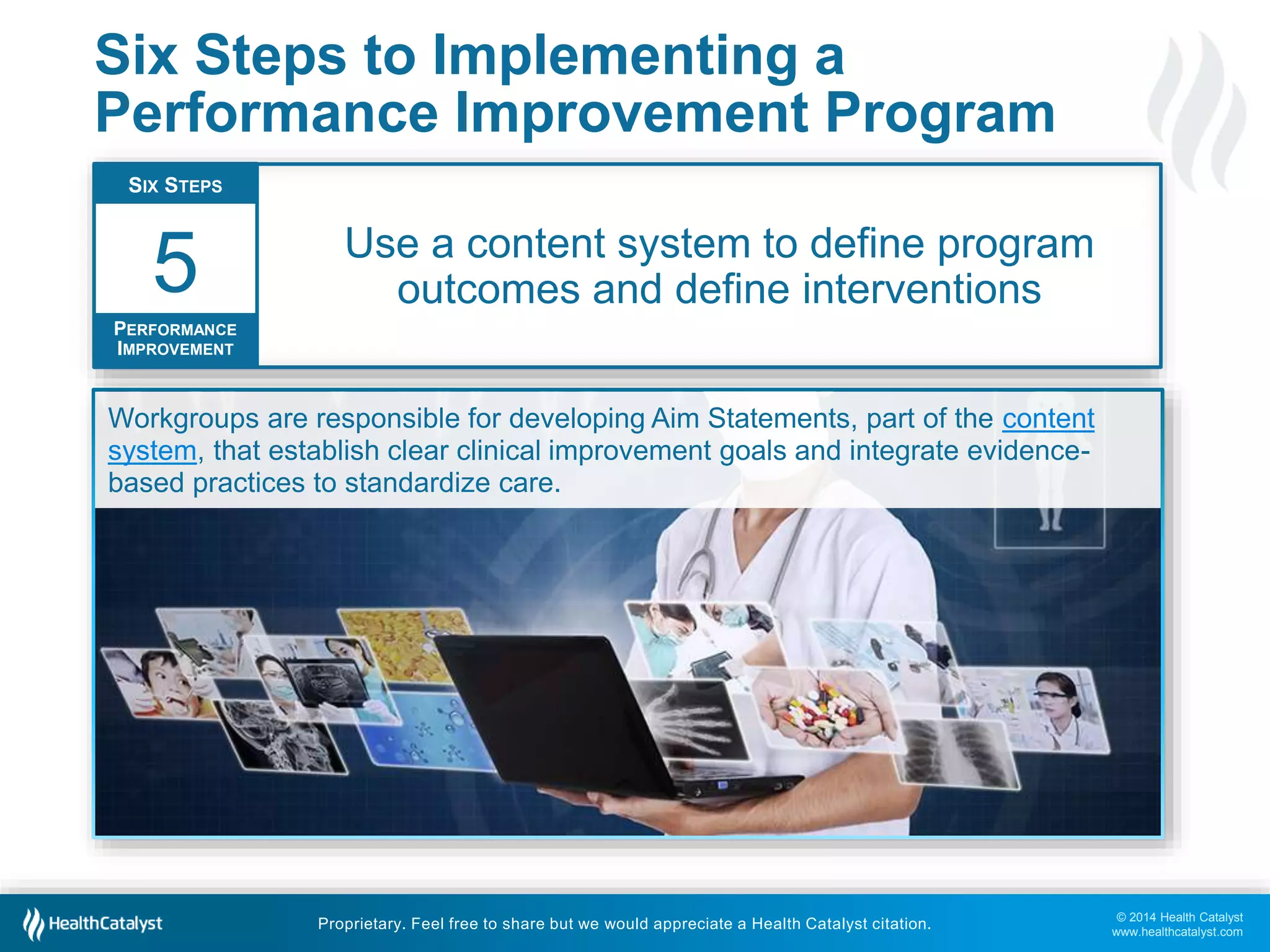
Workgroups are responsible for developing Aim Statements, part of the content
system, that establish clear clinical improvement goals and integrate evidence-
based practices to standardize care.
© 2014 Health Catalyst
www.healthcatalyst.com
Proprietary. Feel free to share but we would appreciate a Health Catalyst citation.
Six Steps to Implementing a
Performance Improvement Program
Use a content system to define program
outcomes and define interventions
SIX STEPS
PERFORMANCE
IMPROVEMENT
5
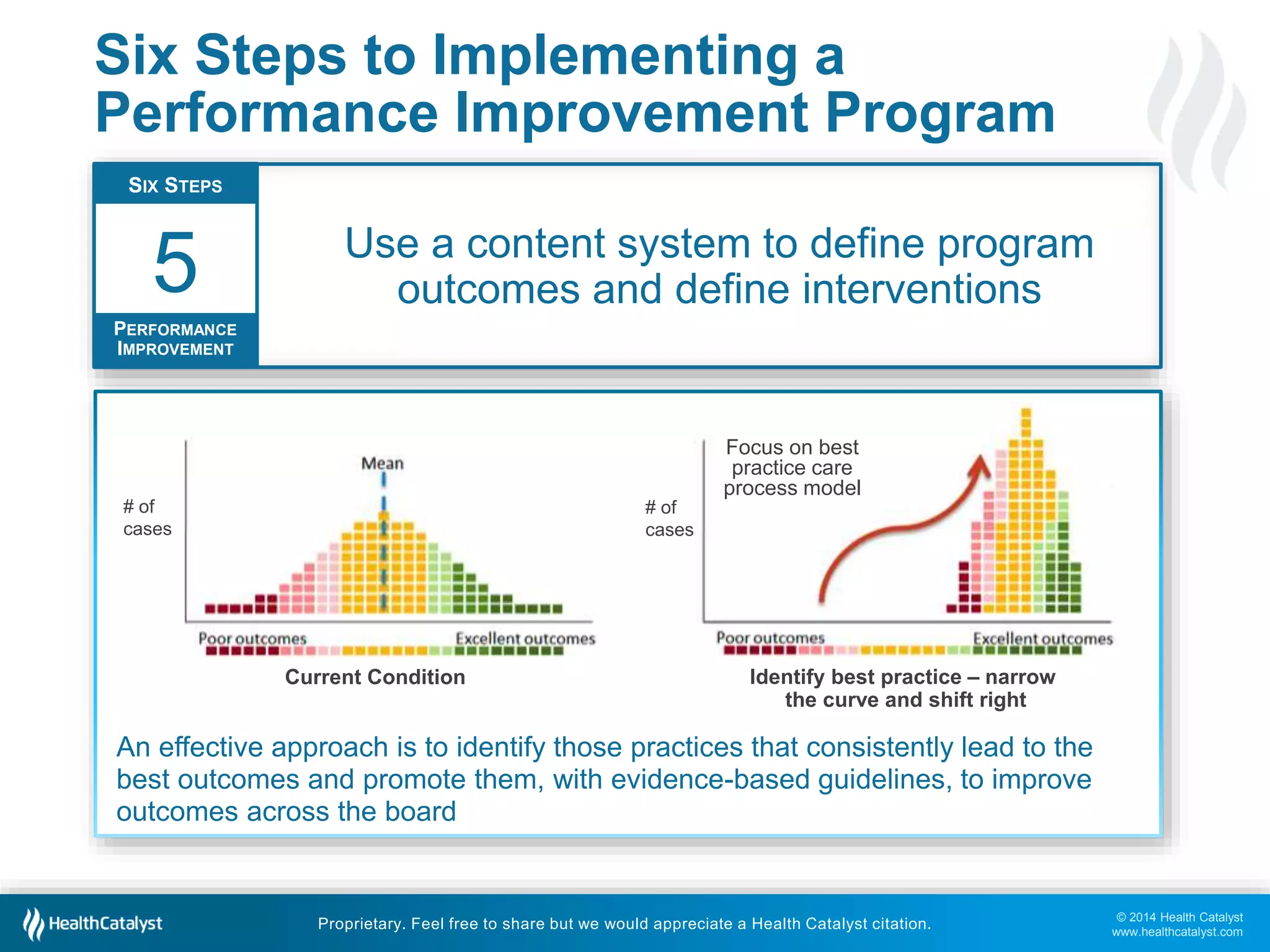
An effective approach is to identify those practices that consistently lead to the
best outcomes and promote them, with evidence-based guidelines, to improve
outcomes across the board
Focus on best
practice care
process model
# of
cases
# of
cases
Current Condition Identify best practice – narrow
the curve and shift right
© 2014 Health Catalyst
www.healthcatalyst.com
Proprietary. Feel free to share but we would appreciate a Health Catalyst citation.
Six Steps to Implementing a
Performance Improvement Program
Use a content system to define program
outcomes and define interventions
SIX STEPS
PERFORMANCE
IMPROVEMENT
5
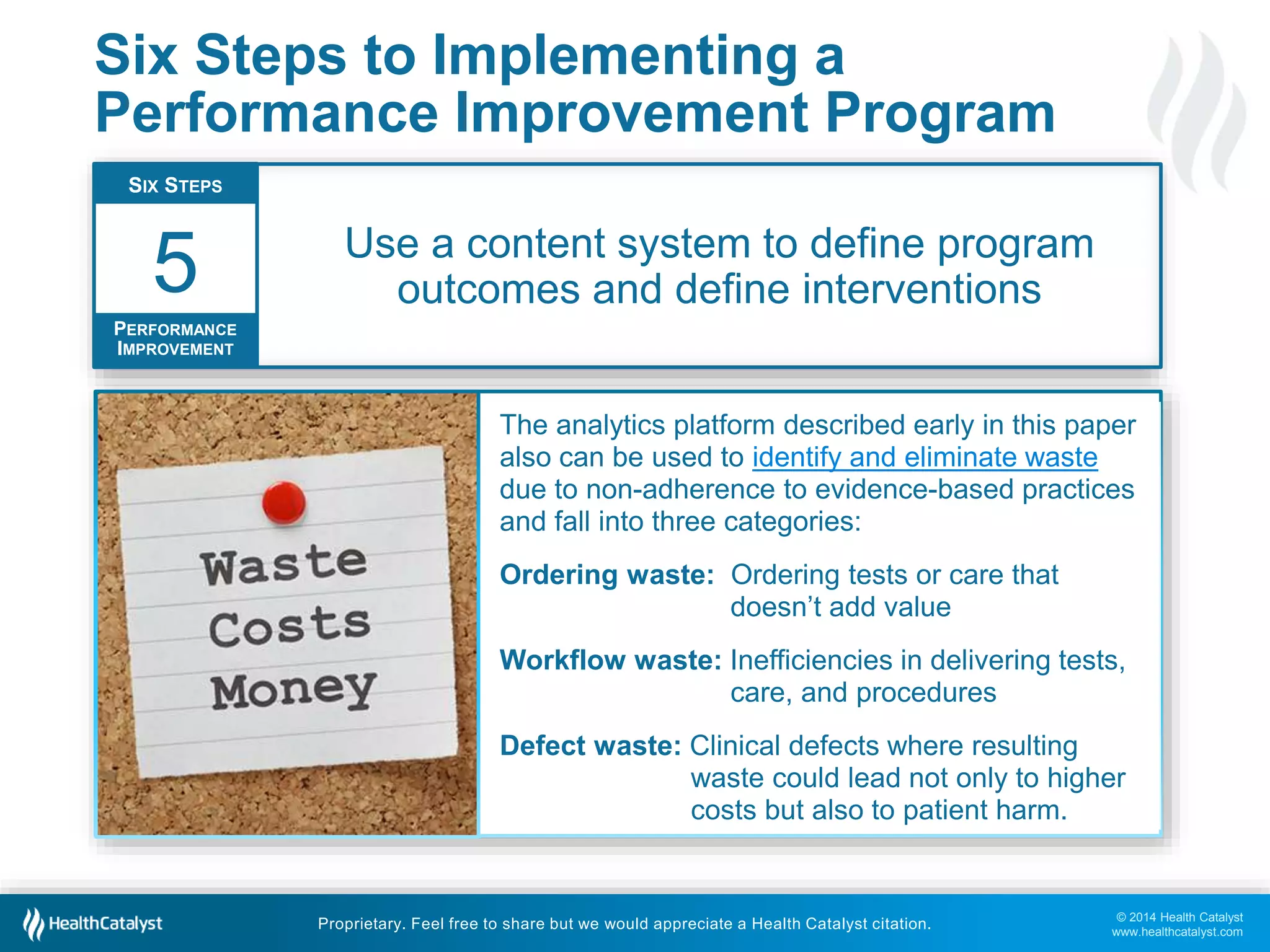
The analytics platform described early in this paper
also can be used to identify and eliminate waste
due to non-adherence to evidence-based practices
and fall into three categories:
Ordering waste: Ordering tests or care that
doesn’t add value
Workflow waste: Inefficiencies in delivering tests,
care, and procedures
Defect waste: Clinical defects where resulting
waste could lead not only to higher
costs but also to patient harm.
© 2014 Health Catalyst
www.healthcatalyst.com
Proprietary. Feel free to share but we would appreciate a Health Catalyst citation.
Six Steps to Implementing a
Performance Improvement Program
Estimate the ROI
SIX STEPS
PERFORMANCE
IMPROVEMENT
6
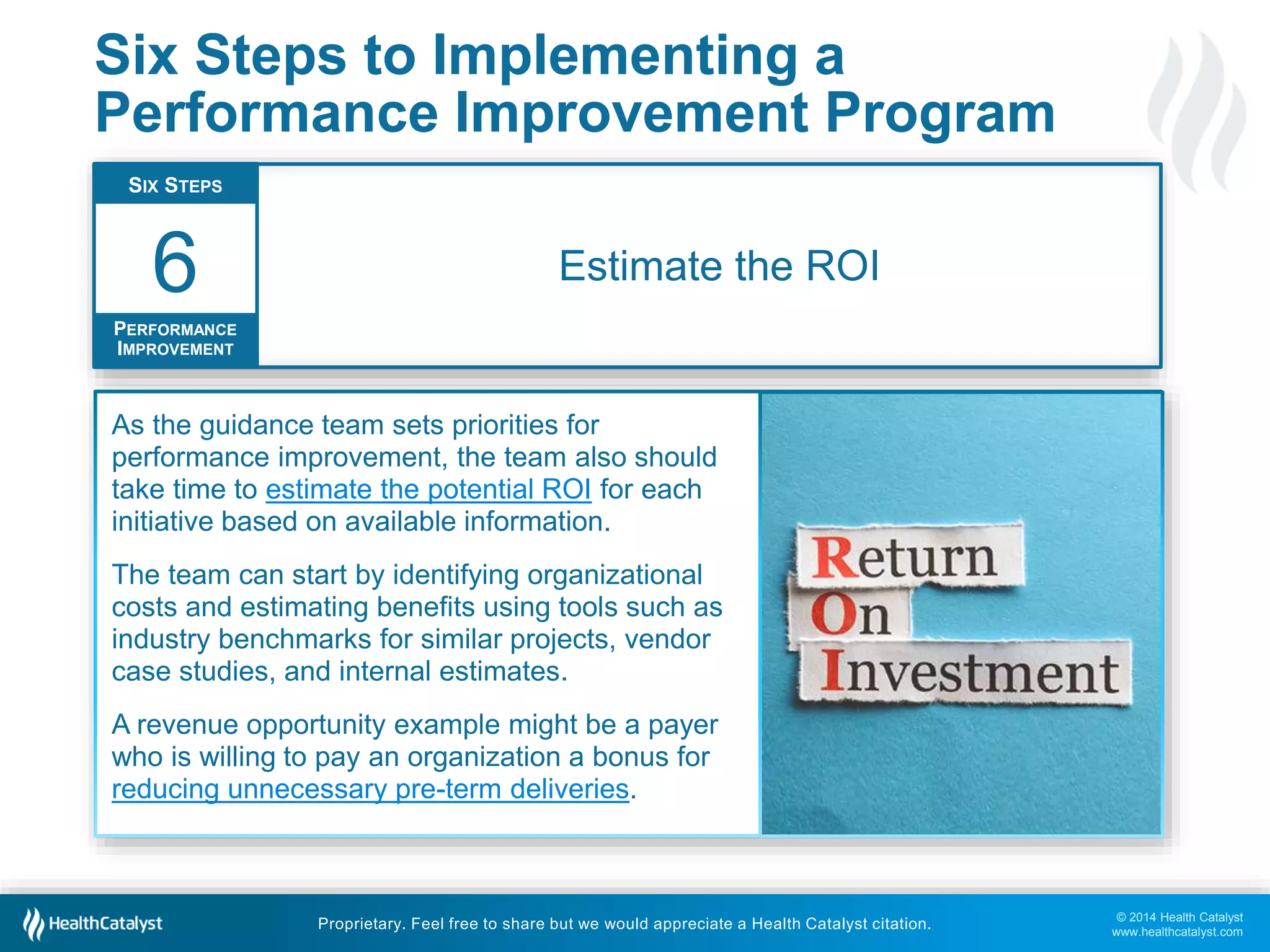
As the guidance team sets priorities for
performance improvement, the team also should
take time to estimate the potential ROI for each
initiative based on available information.
The team can start by identifying organizational
costs and estimating benefits using tools such as
industry benchmarks for similar projects, vendor
case studies, and internal estimates.
A revenue opportunity example might be a payer
who is willing to pay an organization a bonus for
reducing unnecessary pre-term deliveries.
© 2014 Health Catalyst
www.healthcatalyst.com
Proprietary. Feel free to share but we would appreciate a Health Catalyst citation.
Six Steps to Implementing a
Performance Improvement Program
Building the framework
Creating a foundation for
sustainable improvement and
prioritizing initiatives does not
have to be overwhelming.
By following these steps and
establishing a framework for
performance improvement
based on analytics, the right
teams, and evidence-based
practices, an organization can
obtain the right tools to achieve
and sustain performance
improvement gains into the
future.
What failures and
successes have you had
in your performance
improvement initiatives?
© 2014 Health Catalyst
www.healthcatalyst.com
Proprietary. Feel free to share but we would appreciate a Health Catalyst citation.
More about this topic
FIve Deming Principles That Help Healthcare Process Improvement
Dr. John Haughom, Senior Advisor
Quality Improvement in Healthcare: Where is the Best Place to Start?
Eric Just, Vice President Technology
Using Statistical Process Control Charts in Clinical Quality Improvement Initiatives
Cherbon VanEtten, Director Education
Overcoming Clinical Data Problems in Quality Improvement Projects
Kathleen Merkley, Ph.D., Vice President Engagement Executive
Keys to Successful Performance Improvement – A Health System Example
View on demand webinar, download slides, or read transcript
© 2014 Health Catalyst
www.healthcatalyst.com
Proprietary. Feel free to share but we would appreciate a Health Catalyst citation.
Other Clinical Quality Improvement Resources
Click to read additional information at www.healthcatalyst.com
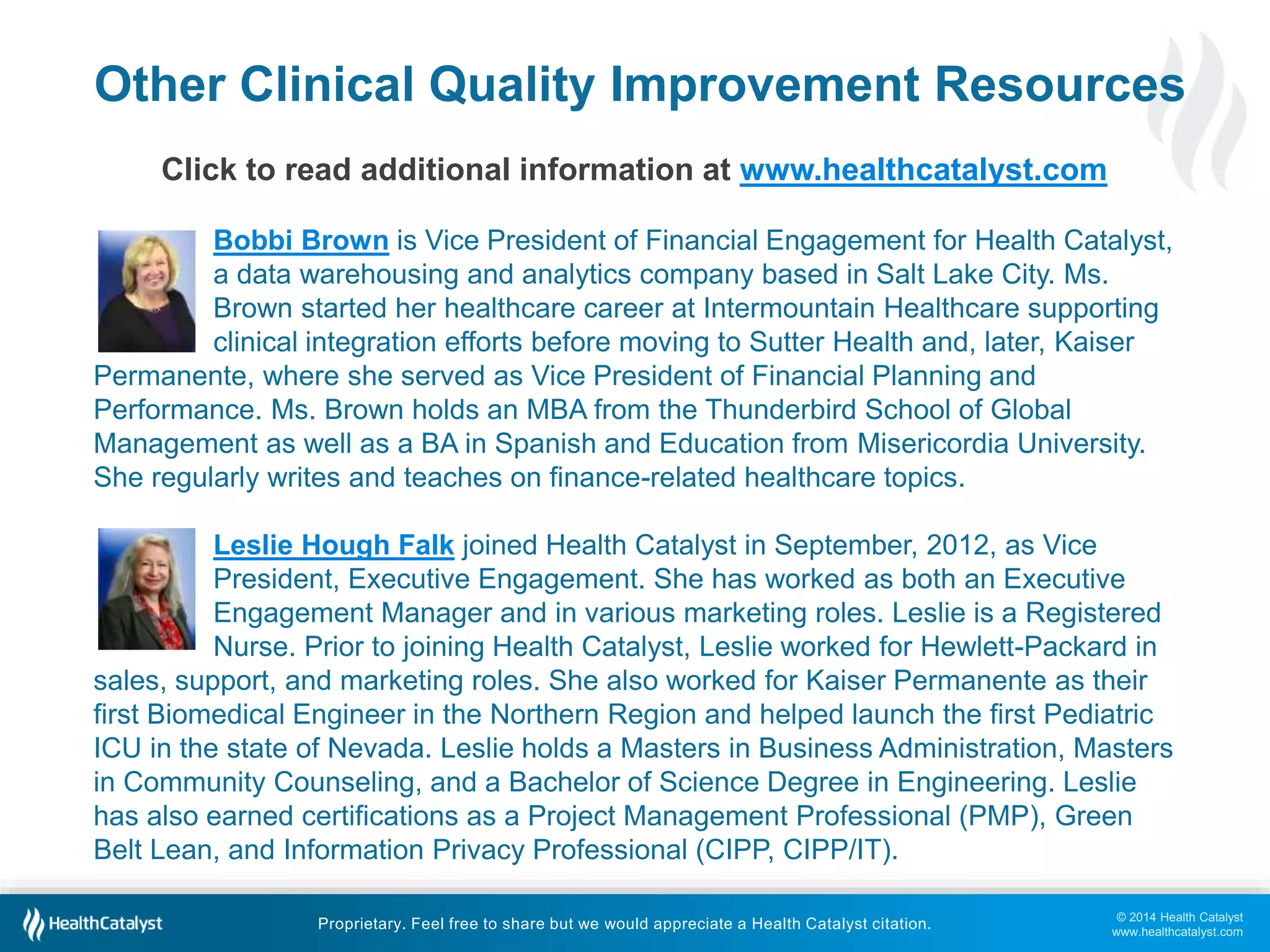
Bobbi Brown is Vice President of Financial Engagement for Health Catalyst,
a data warehousing and analytics company based in Salt Lake City. Ms.
Brown started her healthcare career at Intermountain Healthcare supporting
clinical integration efforts before moving to Sutter Health and, later, Kaiser
Permanente, where she served as Vice President of Financial Planning and
Performance. Ms. Brown holds an MBA from the Thunderbird School of Global
Management as well as a BA in Spanish and Education from Misericordia University.
She regularly writes and teaches on finance-related healthcare topics.
Leslie Hough Falk joined Health Catalyst in September, 2012, as Vice
President, Executive Engagement. She has worked as both an Executive
Engagement Manager and in various marketing roles. Leslie is a Registered
Nurse. Prior to joining Health Catalyst, Leslie worked for Hewlett-Packard in
sales, support, and marketing roles. She also worked for Kaiser Permanente as their
first Biomedical Engineer in the Northern Region and helped launch the first Pediatric
ICU in the state of Nevada. Leslie holds a Masters in Business Administration, Masters
in Community Counseling, and a Bachelor of Science Degree in Engineering. Leslie
has also earned certifications as a Project Management Professional (PMP), Green
Belt Lean, and Information Privacy Professional (CIPP, CIPP/IT).

6 Steps for Implementing Successful Performance Improvement Initiatives in Healthcare

  • 1.
    © 2014 HealthCatalyst www.healthcatalyst.com Proprietary. Feel free to share but we would appreciate a Health Catalyst citation. © 2014 Health Catalyst www.healthcatalyst.comProprietary. Feel free to share but we would appreciate a Health Catalyst citation. By Bobbi Brown and Leslie Falk 6 Steps for Implementing Successful Performance Improvement Initiatives in Healthcare
  • 2.
    © 2014 HealthCatalyst www.healthcatalyst.com Proprietary. Feel free to share but we would appreciate a Health Catalyst citation. Performance Improvement Initiatives Healthcare organizations routinely pursue performance improvement initiatives to improve clinical outcomes and patient experiences and reduce organizational costs. If these efforts are not well executed, however, they can become black holes that suck up time, money, and resources while yielding little in the way of real, sustainable improvements.
  • 3.
    © 2014 HealthCatalyst www.healthcatalyst.com Proprietary. Feel free to share but we would appreciate a Health Catalyst citation. Performance Improvement Initiatives To be effective and sustainable, an organization’s performance improvement initiatives should all be conceived and performed in the context of an ongoing performance program. The initial goals for such a program should be to prioritize performance improvement efforts so that the organization can achieve early successes and build momentum for future performance improvement efforts. Content System Deployment System Analytics System Health Catalyst recommends a framework, known as the Three System Approach for performance improvement.
  • 4.
    © 2014 HealthCatalyst www.healthcatalyst.com Proprietary. Feel free to share but we would appreciate a Health Catalyst citation. Six Steps to Implementing a Performance Improvement Program Integrate Performance Improvement into Your Strategic Objectives SIX STEPS PERFORMANCE IMPROVEMENT 1 Healthcare is a complex, adaptive system where interactions and relationships of different components simultaneously affect and are shaped by the system. As such, it is important for performance improvement to be integrated within the healthcare organization’s strategic objectives. Strategic objectives such as becoming an accountable care organization (ACO), focusing on population health management, or developing a cardiovascular center of excellence, all require performance improvement in order to be successful.
  • 5.
    © 2014 HealthCatalyst www.healthcatalyst.com Proprietary. Feel free to share but we would appreciate a Health Catalyst citation. Six Steps to Implementing a Performance Improvement Program Use Analytics to Unlock Data and Identify Areas of Opportunity SIX STEPS PERFORMANCE IMPROVEMENT 2 Performance improvement requires an analytics system that integrates data sources (clinical, claims, financial, operational, etc.), and facilitates quick and easy data sharing. Only with appropriate analytics can an organization identify specific areas of opportunity among strategic areas of focus. Health Catalyst offers a unique solution with our Late-Binding™ Enterprise Data Warehouse – an agile, interactive process producing balanced metrics.
  • 6.
    © 2014 HealthCatalyst www.healthcatalyst.com Proprietary. Feel free to share but we would appreciate a Health Catalyst citation. Six Steps to Implementing a Performance Improvement Program Use Analytics to Unlock Data and Identify Areas of Opportunity SIX STEPS PERFORMANCE IMPROVEMENT 2 Performance improvement requires an analytics system that integrates data sources (clinical, claims, financial, operational, etc.), and facilitates quick and easy data sharing. Only with appropriate analytics can an organization identify specific areas of opportunity among strategic areas of focus. Health Catalyst offers a unique solution with our Late-Binding™ Enterprise Data Warehouse – an agile, interactive process producing balanced metrics. The analytic system also needs to be able to scale over time to enable different levels of healthcare analytics. As an organization moves up the hierarchy of the Analytics Adoption Model data is used as an advantage and strength, helping the organization to compete more effectively.
  • 7.
    © 2014 HealthCatalyst www.healthcatalyst.com Proprietary. Feel free to share but we would appreciate a Health Catalyst citation. Six Steps to Implementing a Performance Improvement Program Use Analytics to Unlock Data and Identify Areas of Opportunity SIX STEPS PERFORMANCE IMPROVEMENT 2 Performance improvement requires an analytics system that integrates data sources (clinical, claims, financial, operational, etc.), and facilitates quick and easy data sharing. Only with appropriate analytics can an organization identify specific areas of opportunity among strategic areas of focus. Health Catalyst offers a unique solution with our Late-Binding™ Enterprise Data Warehouse – an agile, interactive process producing balanced metrics. Level 2 in the model is a standardized vocabulary and patient registries. Having a master vocabulary is critical for sharing data. Registries allow the organization to define the cohort of patients for a specific performance improvement program. The use of pre-defined patient registries and starter set measures to evaluate key metrics such as: financials, length of stay and readmissions provides a basis for initiating improvement projects. The starting point (Level 1) for sustainable performance improvement is an enterprise data warehouse (EDW)
  • 8.
    © 2014 HealthCatalyst www.healthcatalyst.com Proprietary. Feel free to share but we would appreciate a Health Catalyst citation. Six Steps to Implementing a Performance Improvement Program Use Analytics to Unlock Data and Identify Areas of Opportunity SIX STEPS PERFORMANCE IMPROVEMENT 2 Performance improvement requires an analytics system that integrates data sources (clinical, claims, financial, operational, etc.), and facilitates quick and easy data sharing. Only with appropriate analytics can an organization identify specific areas of opportunity among strategic areas of focus. Health Catalyst offers a unique solution with our Late-Binding™ Enterprise Data Warehouse – an agile, interactive process producing balanced metrics. Such was the experience of Texas Children’s Hospital in Houston. Before deploying an enterprise-wide late binding EDW and healthcare analytics, the hospital required roughly six months to develop a clinical improvement initiative. Having a healthcare EDW in place reduced this time in half because the data was available and already integrated across the different clinical, operational and financial systems.
  • 9.
    © 2014 HealthCatalyst www.healthcatalyst.com Proprietary. Feel free to share but we would appreciate a Health Catalyst citation. Six Steps to Implementing a Performance Improvement Program Use Analytics to Unlock Data and Identify Areas of Opportunity SIX STEPS PERFORMANCE IMPROVEMENT 2 Performance improvement requires an analytics system that integrates data sources (clinical, claims, financial, operational, etc.), and facilitates quick and easy data sharing. Only with appropriate analytics can an organization identify specific areas of opportunity among strategic areas of focus. Health Catalyst offers a unique solution with our Late-Binding™ Enterprise Data Warehouse – an agile, interactive process producing balanced metrics. The Anatomy of Healthcare Delivery framework (shown here) demonstrates the potential pathways patients can go through in their interactions with the delivery system. This concept enables one to organize their thinking about the care delivery process and to focus attention on key processes.
  • 10.
    © 2014 HealthCatalyst www.healthcatalyst.com Proprietary. Feel free to share but we would appreciate a Health Catalyst citation. Six Steps to Implementing a Performance Improvement Program Use Analytics to Unlock Data and Identify Areas of Opportunity SIX STEPS PERFORMANCE IMPROVEMENT 2 Once an organization examines how patients flow through the care delivery system and its critical decision points, they can use the information to create a logical framework to organize a Clinical Integration hierarchy (shown here) Primary Care Care Process Families e.g., Diabetes CV Care Process Families e.g., Heart Failure W&C Care Process Families e.g., Pregnancy G.I. Care Process Families e.g., LowerGI Disorders Resp- iratory Care Process Families e.g., Obstructive Lung Disorders Neuro Sciences Care Process Families e.g., Spine Disorders Musculo- skeletal Care Process Families e.g., Joint Replace- ment Surgery Care Process Families e.g., Urologic Disorders General Med Care Process Families e.g., Infectious Diseases Oncology Care Process Families e.g., Breast Cancer Peds Spec Care Process Families e.g., Peds CV Surg Mental Health Care Process Families e.g., Depression
  • 11.
    © 2014 HealthCatalyst www.healthcatalyst.com Proprietary. Feel free to share but we would appreciate a Health Catalyst citation. Six Steps to Implementing a Performance Improvement Program Use Analytics to Unlock Data and Identify Areas of Opportunity SIX STEPS PERFORMANCE IMPROVEMENT 2 Performance improvement requires an analytics system that integrates data sources (clinical, claims, financial, operational, etc.), and facilitates quick and easy data sharing. Only with appropriate analytics can an organization identify specific areas of opportunity among strategic areas of focus. Health Catalyst offers a unique solution with our Late-Binding™ Enterprise Data Warehouse – an agile, interactive process producing balanced metrics. The Health Catalyst Key Process Analysis application is based on the Pareto principle, and is used to prioritize performance improvement efforts. Cost is displayed on the x- axis, (shown here) the y-axis shows the variation in resources consumed. The clinical programs with the highest cost and highest variation are in box one. Septicemia is one care process that shows both high cost and high variation. Sample Health Catalyst Key Process Analysis
  • 12.
    © 2014 HealthCatalyst www.healthcatalyst.com Proprietary. Feel free to share but we would appreciate a Health Catalyst citation. Six Steps to Implementing a Performance Improvement Program Use Analytics to Unlock Data and Identify Areas of Opportunity SIX STEPS PERFORMANCE IMPROVEMENT 2 Performance improvement requires an analytics system that integrates data sources (clinical, claims, financial, operational, etc.), and facilitates quick and easy data sharing. Only with appropriate analytics can an organization identify specific areas of opportunity among strategic areas of focus. Health Catalyst offers a unique solution with our Late-Binding™ Enterprise Data Warehouse – an agile, interactive process producing balanced metrics. Data governance is also a key component of the analytic strategy. A data governance committee should be responsible for understanding and implementing local data standards (facility codes, department codes, etc.); as well as regional and industry standards (CPT, ICD, SNOMED, LOINC, etc.). In addition to coded data standards, the committee is also involved in the standard use of algorithms to bind data into analytic algorithms that should be consistently used throughout the organization, such as calculating length of stay, defining readmission criteria, defining patient cohorts, and attributing patients to providers in accountable care arrangements.
  • 13.
    © 2014 HealthCatalyst www.healthcatalyst.com Proprietary. Feel free to share but we would appreciate a Health Catalyst citation. Six Steps to Implementing a Performance Improvement Program Prioritize programs using a combination of analytics and a deployment system SIX STEPS PERFORMANCE IMPROVEMENT 3 Successfully improving clinical outcomes and streamlining operations requires a strong organizational commitment and changes in culture, organizational structure, staff education, and workflow processes, what Health Catalyst calls a deployment system. Consequently, any organization that embarks on this performance improvement journey should first assess its readiness for change.
  • 14.
    © 2014 HealthCatalyst www.healthcatalyst.com Proprietary. Feel free to share but we would appreciate a Health Catalyst citation. Six Steps to Implementing a Performance Improvement Program Define the Performance Improvement Program’s Permanent Teams SIX STEPS PERFORMANCE IMPROVEMENT 4 The organization will require permanent performance improvement teams to review and analyze data, define evidence-based and best practices, and monitor ongoing results.
  • 15.
    © 2014 HealthCatalyst www.healthcatalyst.com Proprietary. Feel free to share but we would appreciate a Health Catalyst citation. Six Steps to Implementing a Performance Improvement Program Use a content system to define program outcomes and define interventions SIX STEPS PERFORMANCE IMPROVEMENT 5 Workgroups are responsible for developing Aim Statements, part of the content system, that establish clear clinical improvement goals and integrate evidence- based practices to standardize care.
  • 16.
    © 2014 HealthCatalyst www.healthcatalyst.com Proprietary. Feel free to share but we would appreciate a Health Catalyst citation. Six Steps to Implementing a Performance Improvement Program Use a content system to define program outcomes and define interventions SIX STEPS PERFORMANCE IMPROVEMENT 5 An effective approach is to identify those practices that consistently lead to the best outcomes and promote them, with evidence-based guidelines, to improve outcomes across the board Focus on best practice care process model # of cases # of cases Current Condition Identify best practice – narrow the curve and shift right
  • 17.
    © 2014 HealthCatalyst www.healthcatalyst.com Proprietary. Feel free to share but we would appreciate a Health Catalyst citation. Six Steps to Implementing a Performance Improvement Program Use a content system to define program outcomes and define interventions SIX STEPS PERFORMANCE IMPROVEMENT 5 The analytics platform described early in this paper also can be used to identify and eliminate waste due to non-adherence to evidence-based practices and fall into three categories: Ordering waste: Ordering tests or care that doesn’t add value Workflow waste: Inefficiencies in delivering tests, care, and procedures Defect waste: Clinical defects where resulting waste could lead not only to higher costs but also to patient harm.
  • 18.
    © 2014 HealthCatalyst www.healthcatalyst.com Proprietary. Feel free to share but we would appreciate a Health Catalyst citation. Six Steps to Implementing a Performance Improvement Program Estimate the ROI SIX STEPS PERFORMANCE IMPROVEMENT 6 As the guidance team sets priorities for performance improvement, the team also should take time to estimate the potential ROI for each initiative based on available information. The team can start by identifying organizational costs and estimating benefits using tools such as industry benchmarks for similar projects, vendor case studies, and internal estimates. A revenue opportunity example might be a payer who is willing to pay an organization a bonus for reducing unnecessary pre-term deliveries.
  • 19.
    © 2014 HealthCatalyst www.healthcatalyst.com Proprietary. Feel free to share but we would appreciate a Health Catalyst citation. Six Steps to Implementing a Performance Improvement Program Building the framework Creating a foundation for sustainable improvement and prioritizing initiatives does not have to be overwhelming. By following these steps and establishing a framework for performance improvement based on analytics, the right teams, and evidence-based practices, an organization can obtain the right tools to achieve and sustain performance improvement gains into the future. What failures and successes have you had in your performance improvement initiatives?
  • 20.
    © 2014 HealthCatalyst www.healthcatalyst.com Proprietary. Feel free to share but we would appreciate a Health Catalyst citation. More about this topic FIve Deming Principles That Help Healthcare Process Improvement Dr. John Haughom, Senior Advisor Quality Improvement in Healthcare: Where is the Best Place to Start? Eric Just, Vice President Technology Using Statistical Process Control Charts in Clinical Quality Improvement Initiatives Cherbon VanEtten, Director Education Overcoming Clinical Data Problems in Quality Improvement Projects Kathleen Merkley, Ph.D., Vice President Engagement Executive Keys to Successful Performance Improvement – A Health System Example View on demand webinar, download slides, or read transcript
  • 21.
    © 2014 HealthCatalyst www.healthcatalyst.com Proprietary. Feel free to share but we would appreciate a Health Catalyst citation. Other Clinical Quality Improvement Resources Click to read additional information at www.healthcatalyst.com Bobbi Brown is Vice President of Financial Engagement for Health Catalyst, a data warehousing and analytics company based in Salt Lake City. Ms. Brown started her healthcare career at Intermountain Healthcare supporting clinical integration efforts before moving to Sutter Health and, later, Kaiser Permanente, where she served as Vice President of Financial Planning and Performance. Ms. Brown holds an MBA from the Thunderbird School of Global Management as well as a BA in Spanish and Education from Misericordia University. She regularly writes and teaches on finance-related healthcare topics. Leslie Hough Falk joined Health Catalyst in September, 2012, as Vice President, Executive Engagement. She has worked as both an Executive Engagement Manager and in various marketing roles. Leslie is a Registered Nurse. Prior to joining Health Catalyst, Leslie worked for Hewlett-Packard in sales, support, and marketing roles. She also worked for Kaiser Permanente as their first Biomedical Engineer in the Northern Region and helped launch the first Pediatric ICU in the state of Nevada. Leslie holds a Masters in Business Administration, Masters in Community Counseling, and a Bachelor of Science Degree in Engineering. Leslie has also earned certifications as a Project Management Professional (PMP), Green Belt Lean, and Information Privacy Professional (CIPP, CIPP/IT).