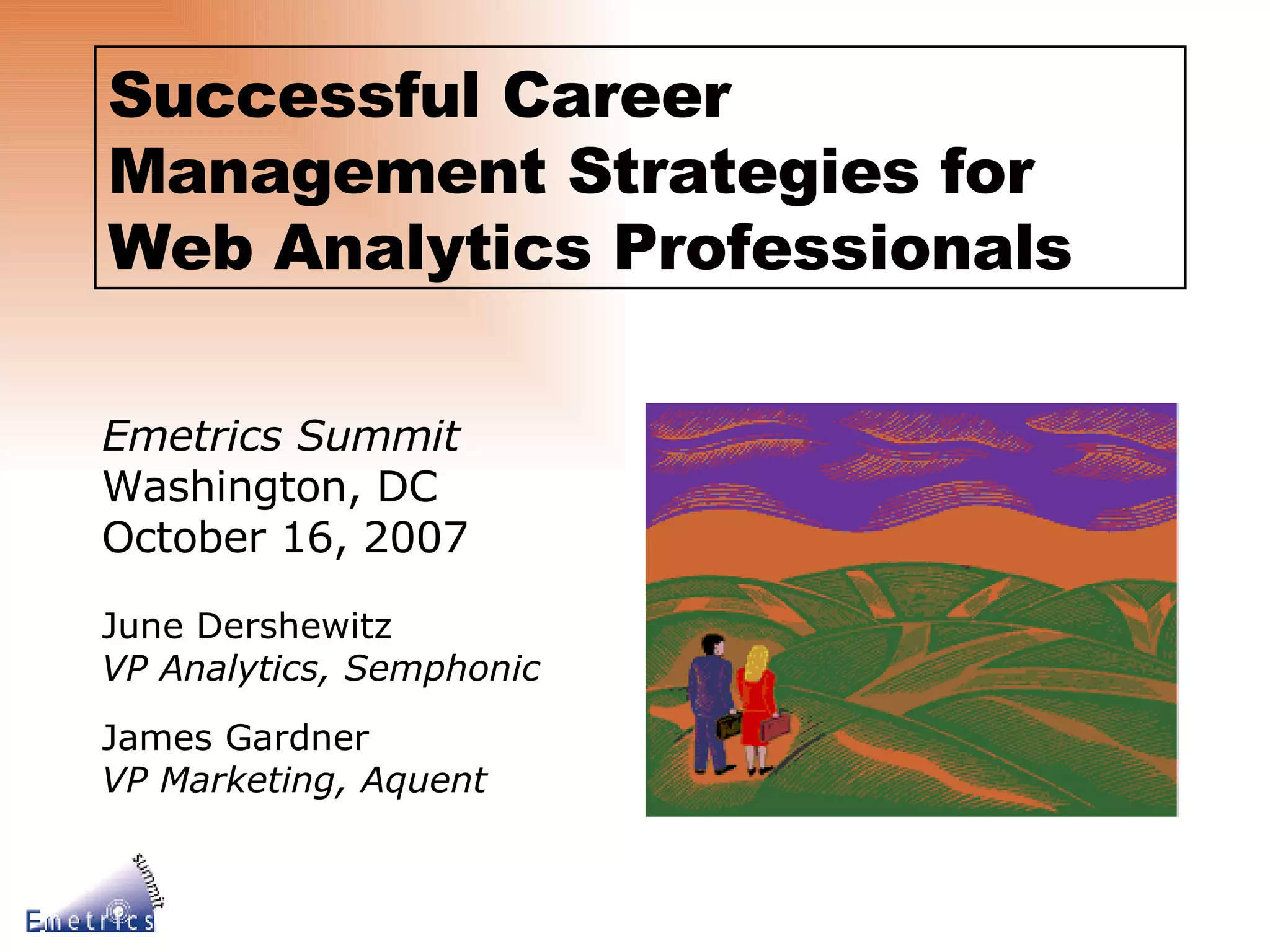
Emetrics Summit Washington, DC October 16, 2007 June Dershewitz VP Analytics, Semphonic James Gardner VP Marketing, Aquent Successful Career Management Strategies for Web Analytics Professionals
Labor markets correct themselves
Steady paycheck vs. personal fulfillment
Options, planning = confidence, motivation
Our professional skills are HOT … … but that doesn’t make career choices easier.
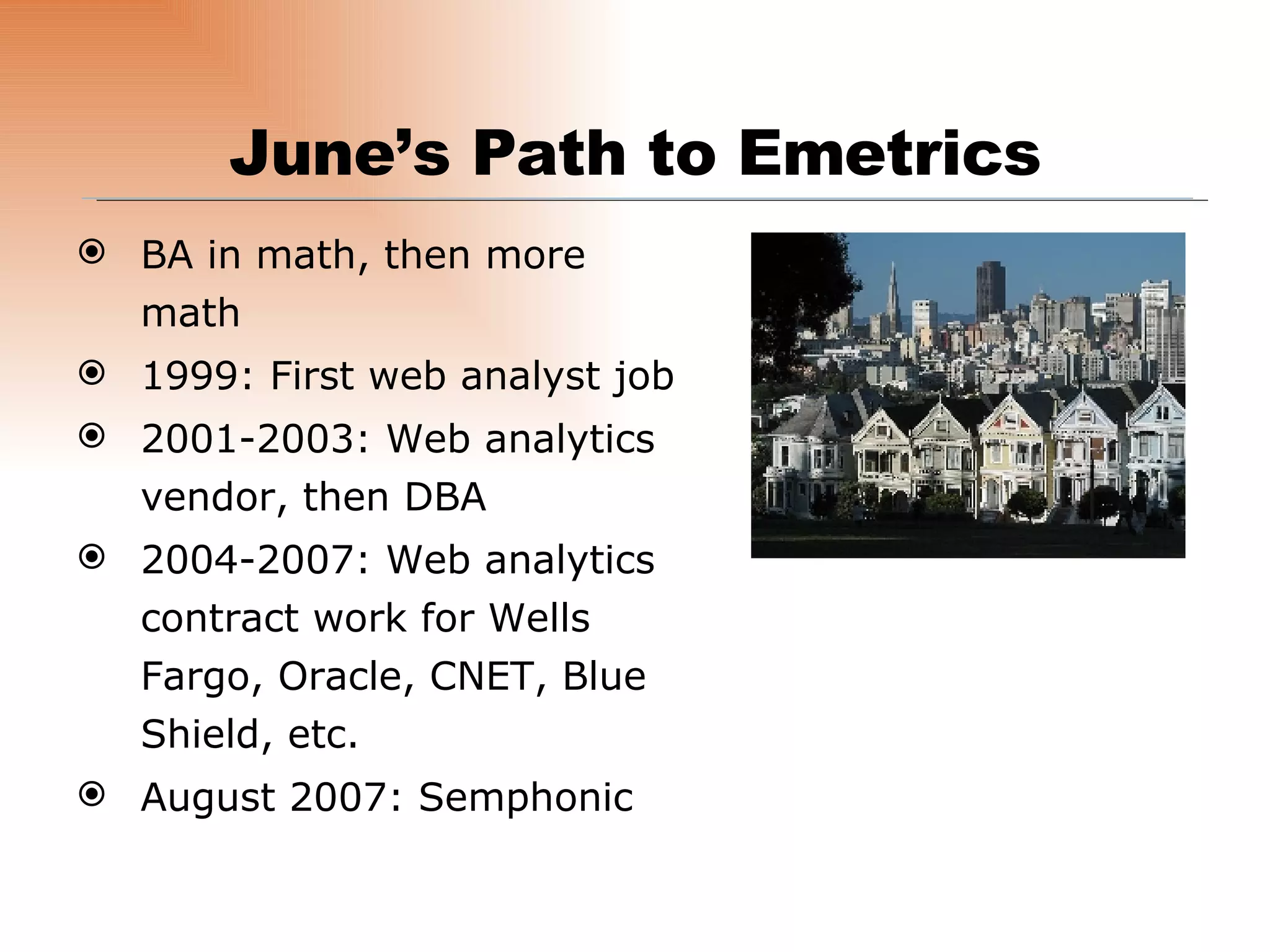
June’s path to Emetrics
Shattering some myths
Job-hopping, Freelance consulting, Swiss Army knife
Managing your career
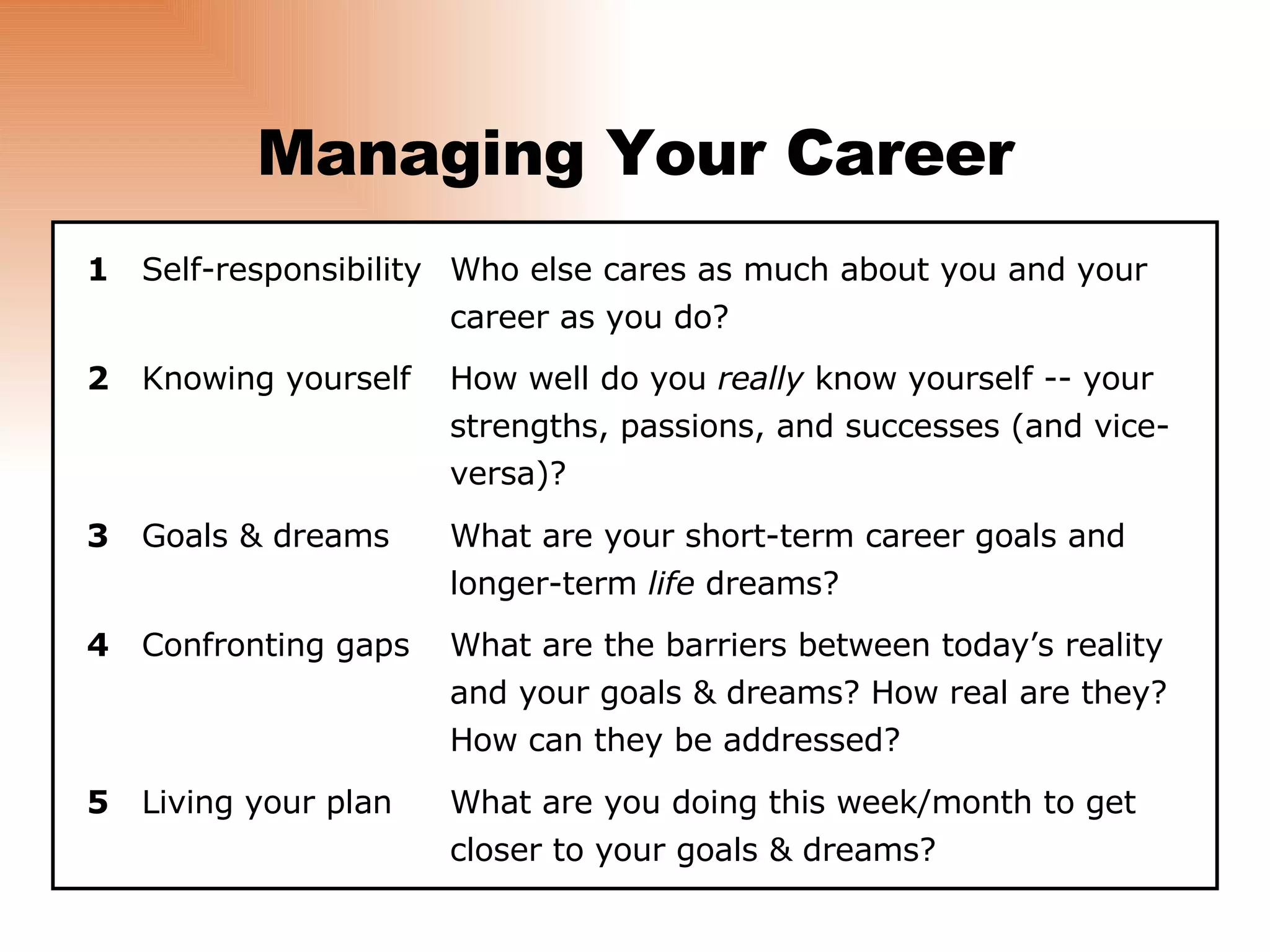
Self-responsibility, Knowing yourself, Goals & dreams, Confronting gaps, Living your plan
Discussion Points
BA in math, then more math
1999: First web analyst job
2001-2003: Web analytics vendor, then DBA
2004-2007: Web analytics contract work for Wells Fargo, Oracle, CNET, Blue Shield, etc.
August 2007: Semphonic
June’s Path to Emetrics
Only a stigma if you let it become one
Find and maintain career focus
Prepare to explain your reasons for moving …you will be explaining for years
Whatever you do, don’t burn bridges .
Shattered Myth #1: Job-Hopping
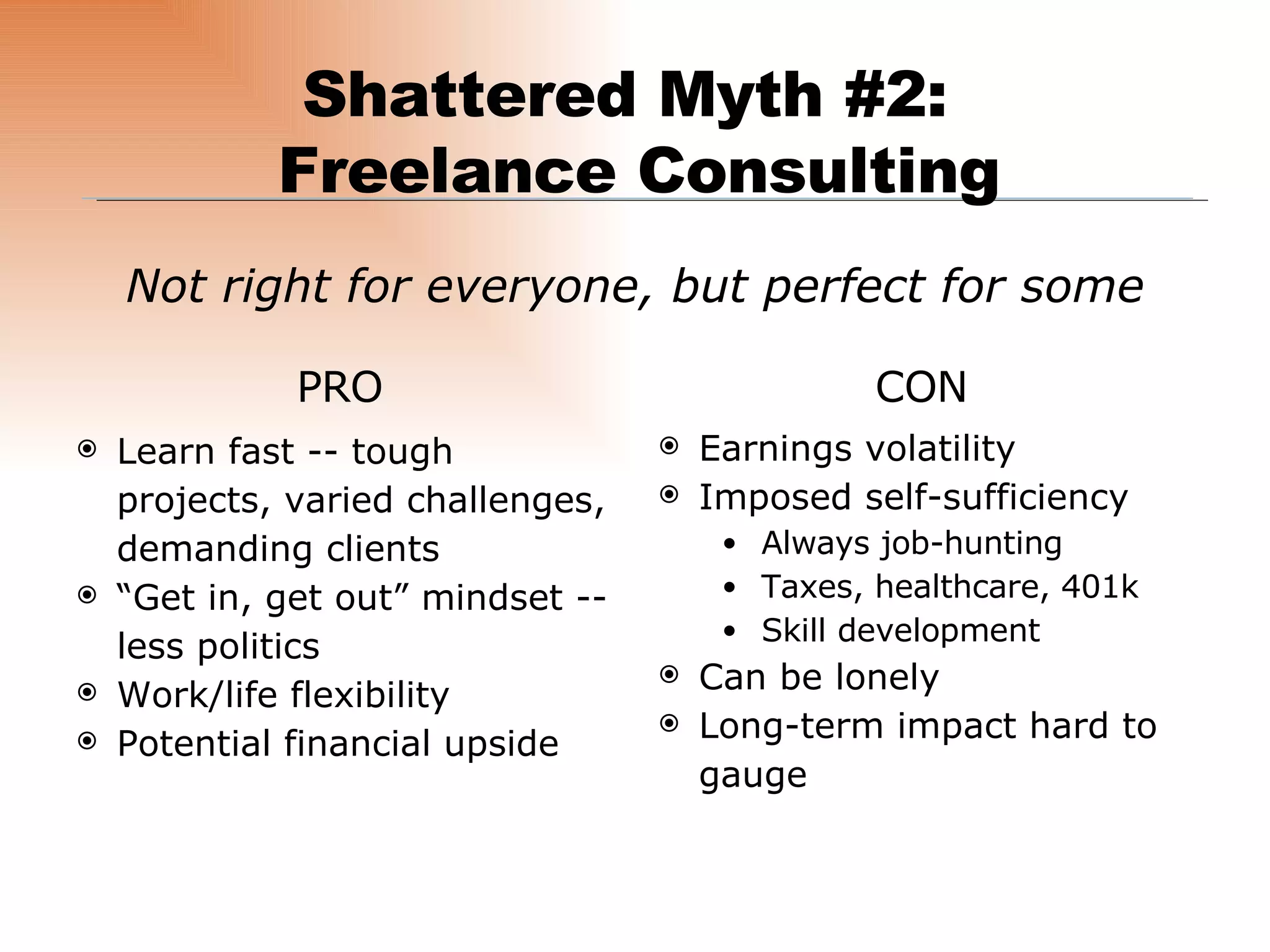
Not right for everyone, but perfect for some Shattered Myth #2: Freelance Consulting PRO CON
Learn fast -- tough projects, varied challenges, demanding clients
“ Get in, get out” mindset -- less politics
Work/life flexibility
Potential financial upside
Earnings volatility
Imposed self-sufficiency
Always job-hunting
Taxes, healthcare, 401k
Skill development
Can be lonely
Long-term impact hard to gauge
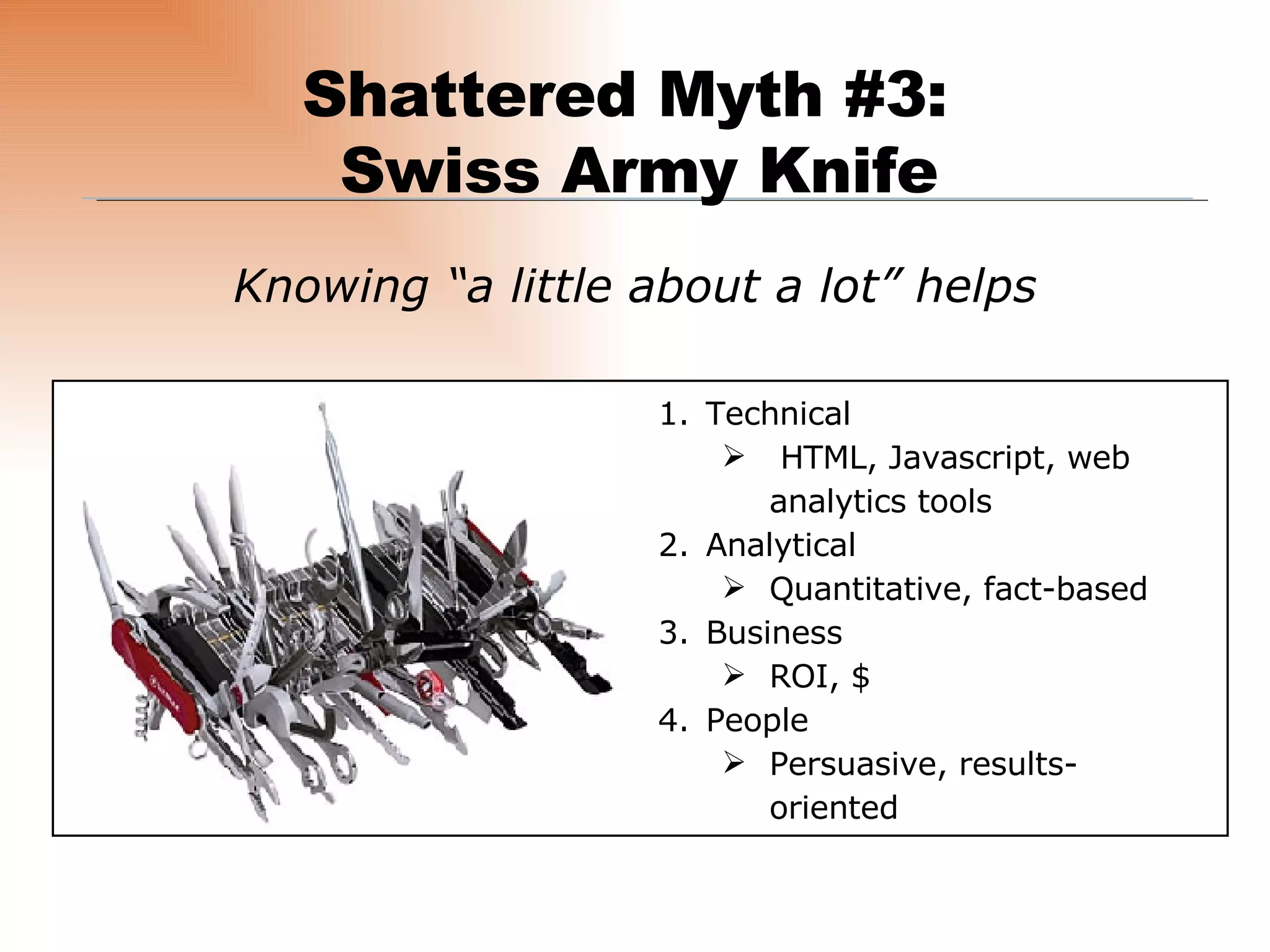
Knowing “a little about a lot” helps Shattered Myth #3: Swiss Army Knife
Technical
HTML, Javascript, web analytics tools
Analytical
Quantitative, fact-based
Business
ROI, $
People
Persuasive, results-oriented
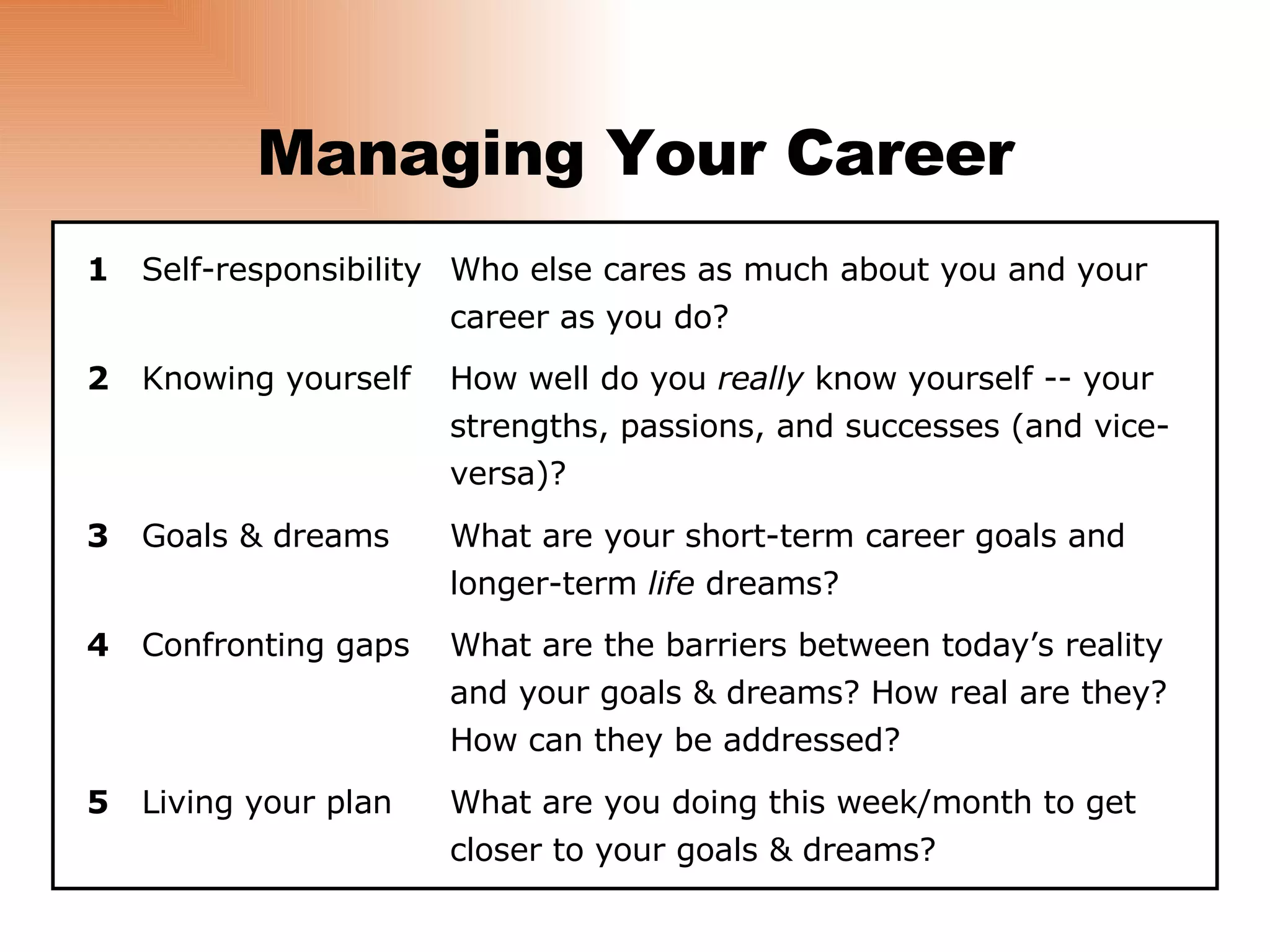
Managing Your Career 2 How well do you really know yourself -- your strengths, passions, and successes (and vice-versa)? Knowing yourself 3 What are your short-term career goals and longer-term life dreams? Goals & dreams 5 What are you doing this week/month to get closer to your goals & dreams? Living your plan 1 Who else cares as much about you and your career as you do? Self-responsibility 4 What are the barriers between today’s reality and your goals & dreams? How real are they? How can they be addressed? Confronting gaps
“ The cold, hard, truth is that you’ve got to look after yourself.”
- David Maister
#1 Maister on Self-Responsibility: (Thanks: http://about.davidmaister.com/bio/)
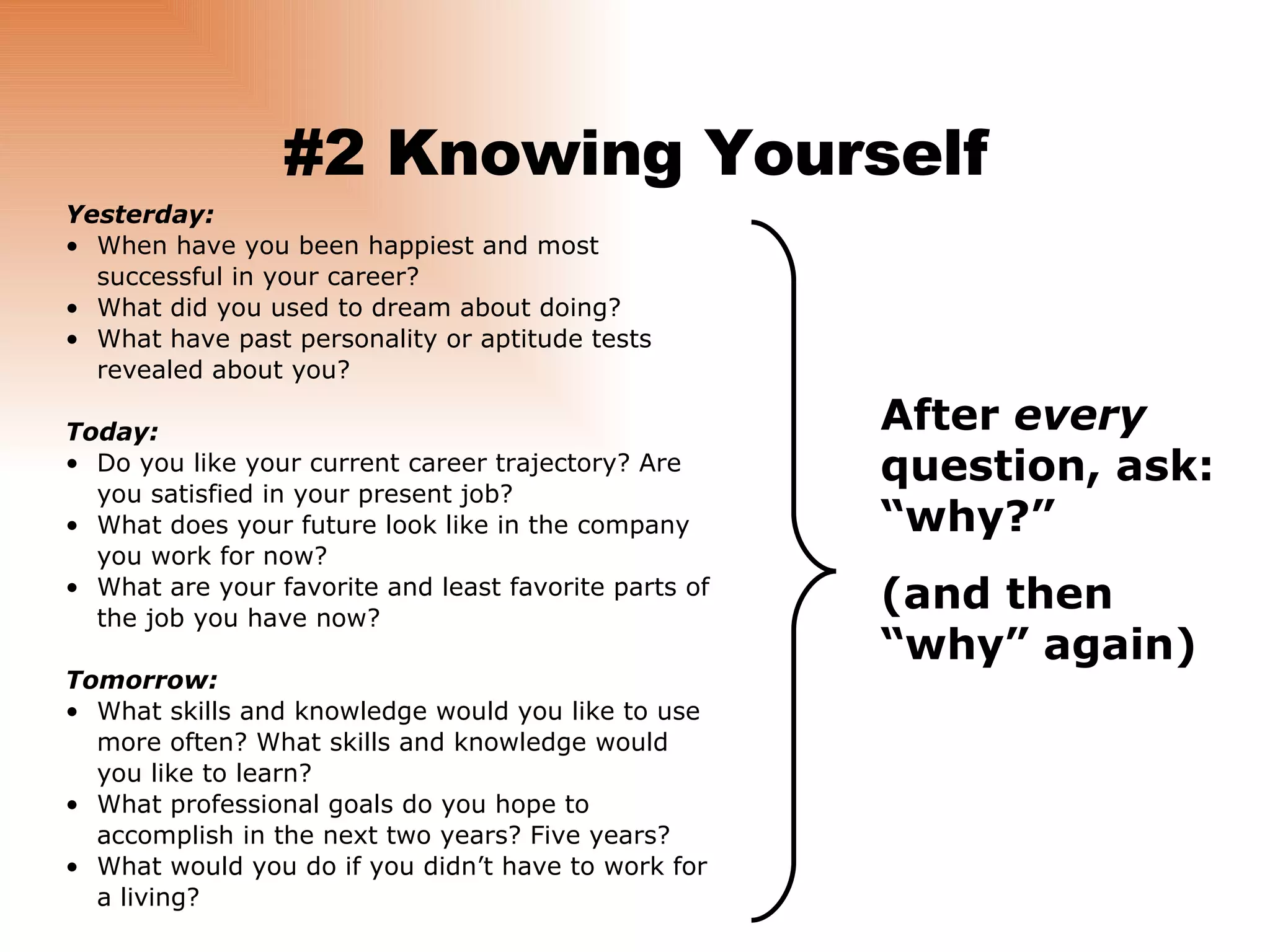
#2 Knowing Yourself
Yesterday:
When have you been happiest and most successful in your career?
What did you used to dream about doing?
What have past personality or aptitude tests revealed about you?
Today:
Do you like your current career trajectory? Are you satisfied in your present job?
What does your future look like in the company you work for now?
What are your favorite and least favorite parts of the job you have now?
Tomorrow:
What skills and knowledge would you like to use more often? What skills and knowledge would you like to learn?
What professional goals do you hope to accomplish in the next two years? Five years?
What would you do if you didn’t have to work for a living?
After every question, ask: “why?” (and then “why” again)
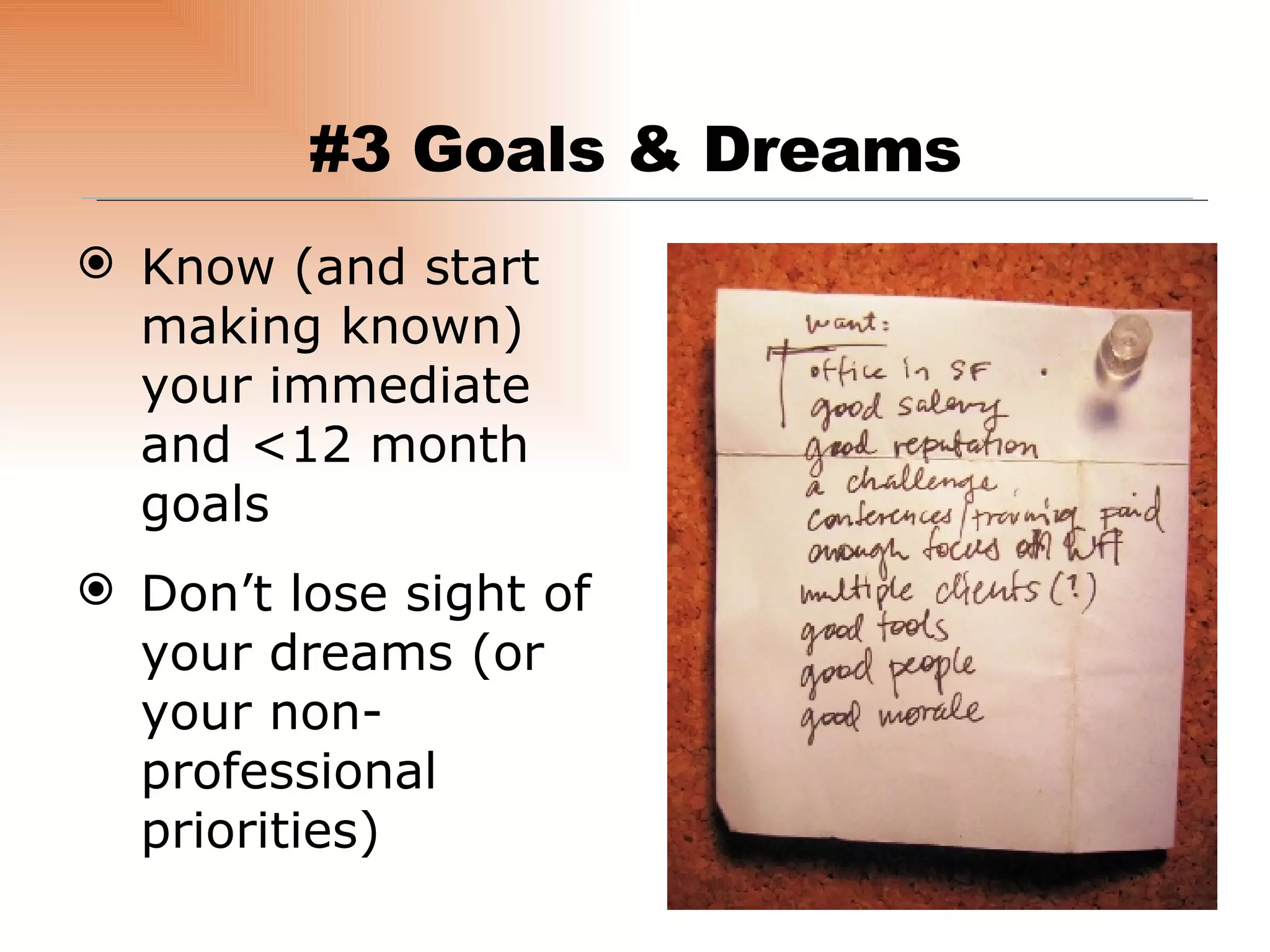
Know (and start making known) your immediate and <12 month goals
Don’t lose sight of your dreams (or your non-professional priorities)
#3 Goals & Dreams
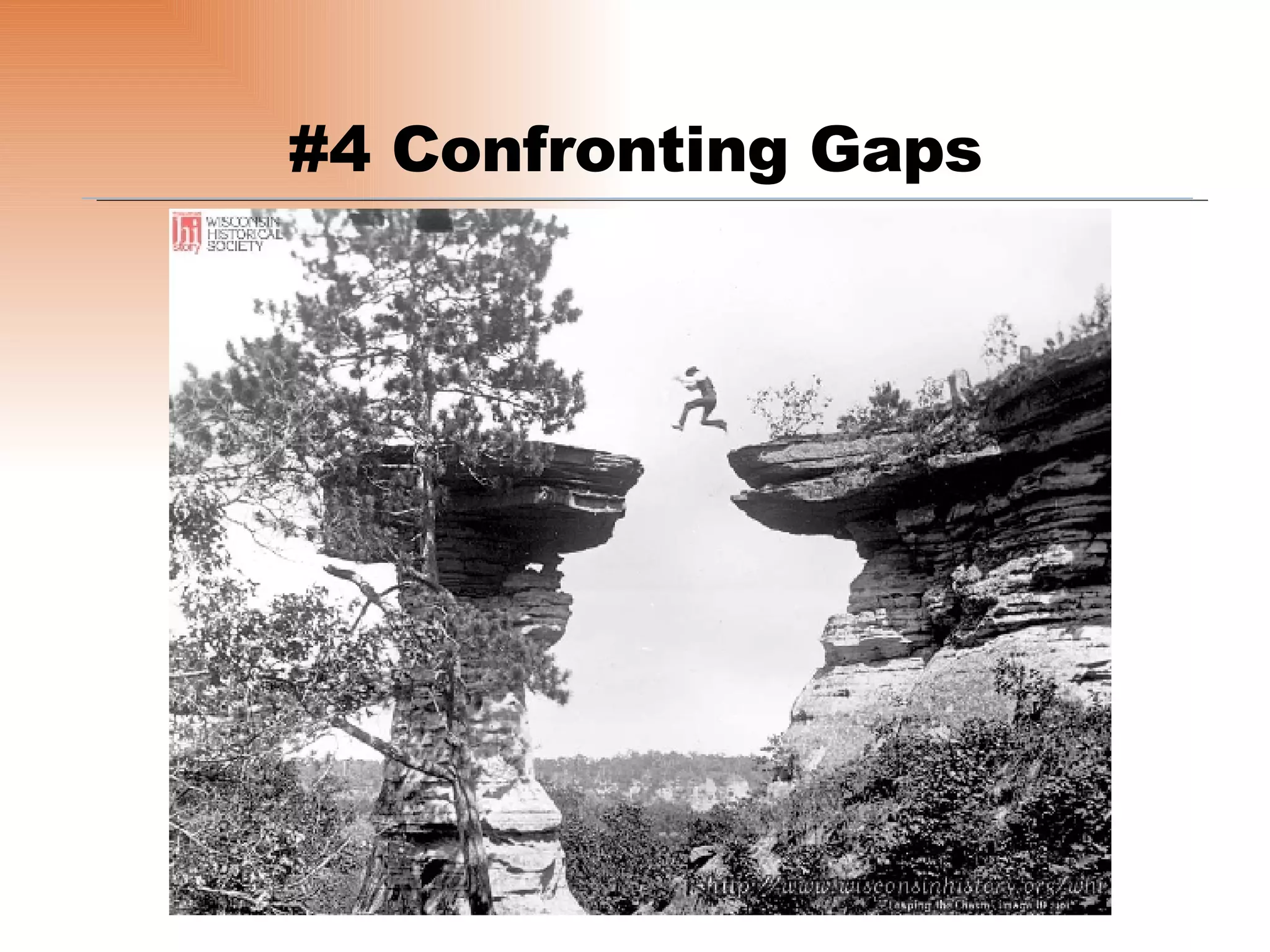
#4 Confronting Gaps
Confronting Gaps
What’s really between you and your future?
Develop your own list -- specific, actionable
Consult your manager (but trust seasoned friends, mentors, colleagues)
Separate the real from your self-created life baggage (hint: this is quite hard!)
Create your to-do plan for the quarter, year
Should you revisit your goals and dreams? Be honest!
Every 3 months, audit yourself:
Am I making progress at increasing my value in the market?
Am I bringing the right value to my employer?
Am I being fairly compensated for my contributions?
Am I mind/body/soul happy?
If not -- seek enrichment , education , and/or community (and, after much thought, seek change )
(Thanks: Stephane Hamel, blog.immeria.net) #5 Living Your Plan
Managing Your Career 2 How well do you really know yourself -- your strengths, passions, and successes (and vice-versa)? Knowing yourself 3 What are your short-term career goals and longer-term life dreams? Goals & dreams 5 What are you doing this week/month to get closer to your goals & dreams? Living your plan 1 Who else cares as much about you and your career as you do? Self-responsibility 4 What are the barriers between today’s reality and your goals & dreams? How real are they? How can they be addressed? Confronting gaps
Unplanned, unmanaged careers rarely lead to professional happiness
You can’t delegate: nobody cares about your career as much as you do
Getting started is the hardest part of the journey (and it’s not that hard!)
Get Started!
June Dershewitz
[email_address]
blog: june.typepad.com
www.semphonic.com
James Gardner [email_address] linkedin.com/in/gardner www.aquent.com Thank You! Email June for more career perspectives and James for Aquent career management resources (including copies of these slides)
Emetrics Summit Washington, DC October 16, 2007 June Dershewitz VP Analytics, Semphonic James Gardner VP Marketing, Aquent Successful Career Management Strategies for Web Analytics Professionals
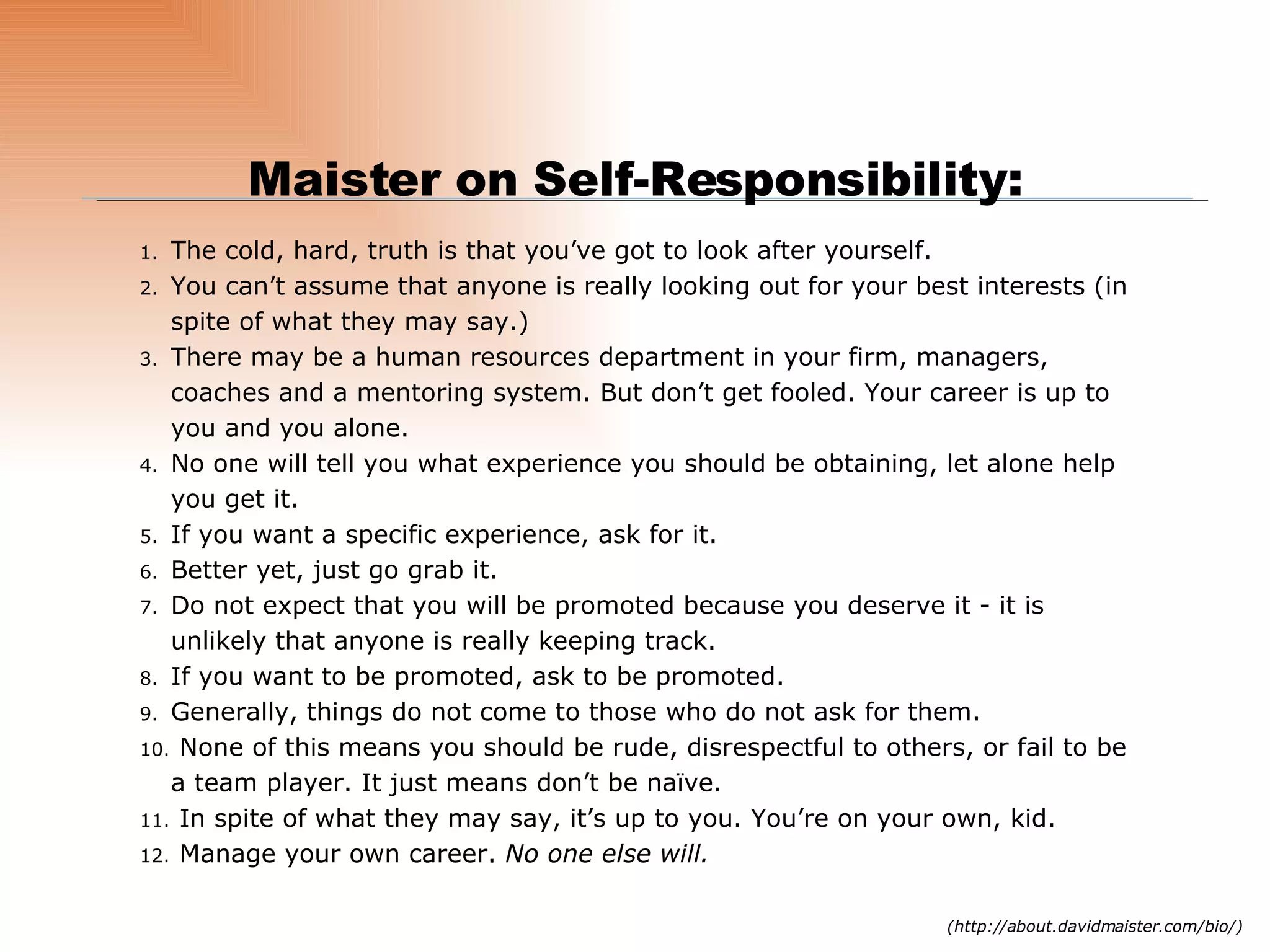
The cold, hard, truth is that you’ve got to look after yourself.
You can’t assume that anyone is really looking out for your best interests (in spite of what they may say.)
There may be a human resources department in your firm, managers, coaches and a mentoring system. But don’t get fooled. Your career is up to you and you alone.
No one will tell you what experience you should be obtaining, let alone help you get it.
If you want a specific experience, ask for it.
Better yet, just go grab it.
Do not expect that you will be promoted because you deserve it - it is unlikely that anyone is really keeping track.
If you want to be promoted, ask to be promoted.
Generally, things do not come to those who do not ask for them.
None of this means you should be rude, disrespectful to others, or fail to be a team player. It just means don’t be naïve.
In spite of what they may say, it’s up to you. You’re on your own, kid.
Manage your own career. No one else will.
Maister on Self-Responsibility: (http://about.davidmaister.com/bio/)
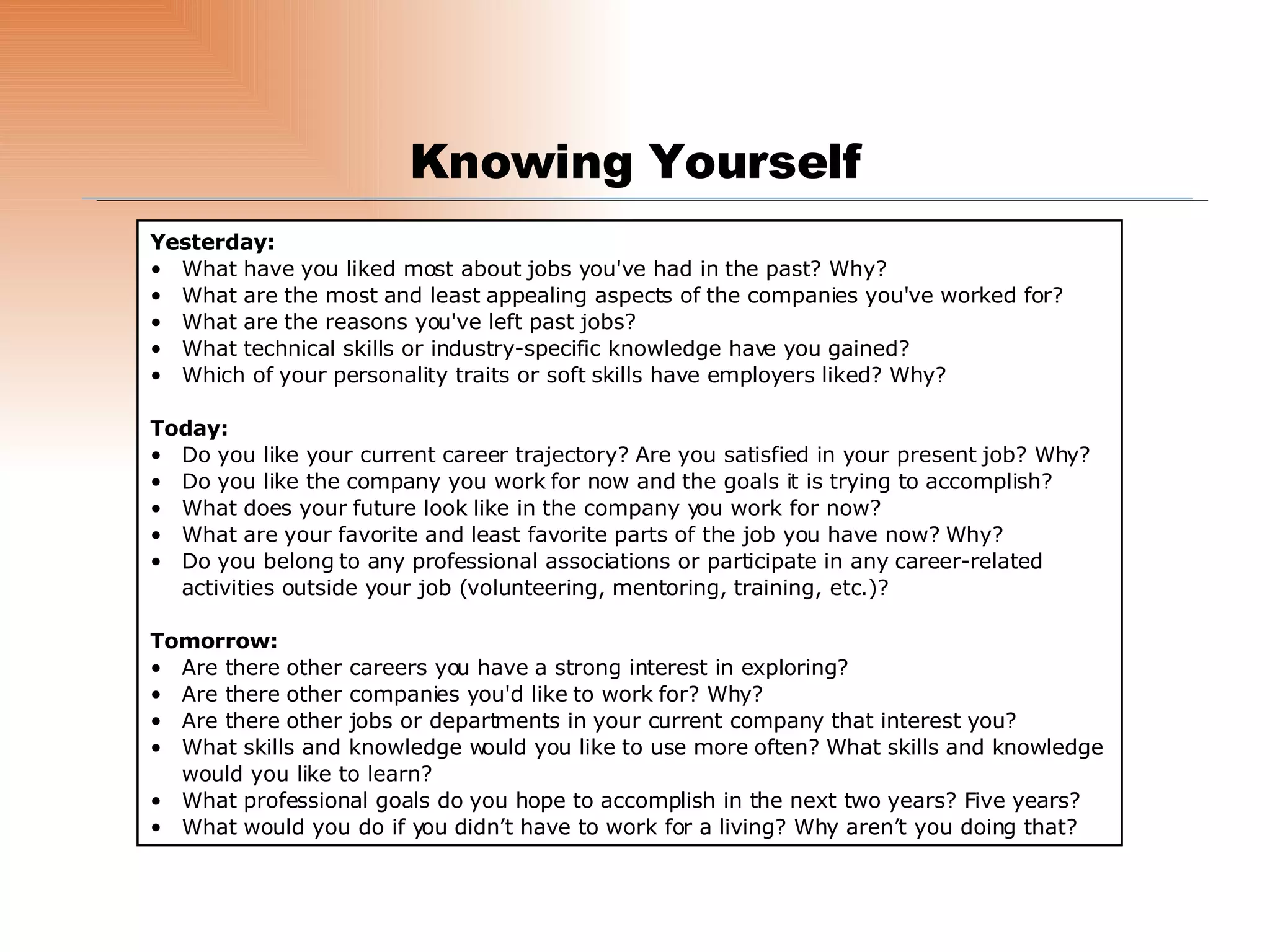
Knowing Yourself
Yesterday:
What have you liked most about jobs you've had in the past? Why?
What are the most and least appealing aspects of the companies you've worked for?
What are the reasons you've left past jobs?
What technical skills or industry-specific knowledge have you gained?
Which of your personality traits or soft skills have employers liked? Why?
Today:
Do you like your current career trajectory? Are you satisfied in your present job? Why?
Do you like the company you work for now and the goals it is trying to accomplish?
What does your future look like in the company you work for now?
What are your favorite and least favorite parts of the job you have now? Why?
Do you belong to any professional associations or participate in any career-related activities outside your job (volunteering, mentoring, training, etc.)?
Tomorrow:
Are there other careers you have a strong interest in exploring?
Are there other companies you'd like to work for? Why?
Are there other jobs or departments in your current company that interest you?
What skills and knowledge would you like to use more often? What skills and knowledge would you like to learn?
What professional goals do you hope to accomplish in the next two years? Five years?
What would you do if you didn’t have to work for a living? Why aren’t you doing that?
0 comments
Post a comment