Comparison with Requirement-
    based Approaches
 IEEE            Use
                                 scenario
  830            case


            Chen Jing Fung @iii
                 2011/7/5

   Ref: Agile solutions as How to write, gather ideas, estimate
   the approach, planning an iteration
The common requirement-based approaches

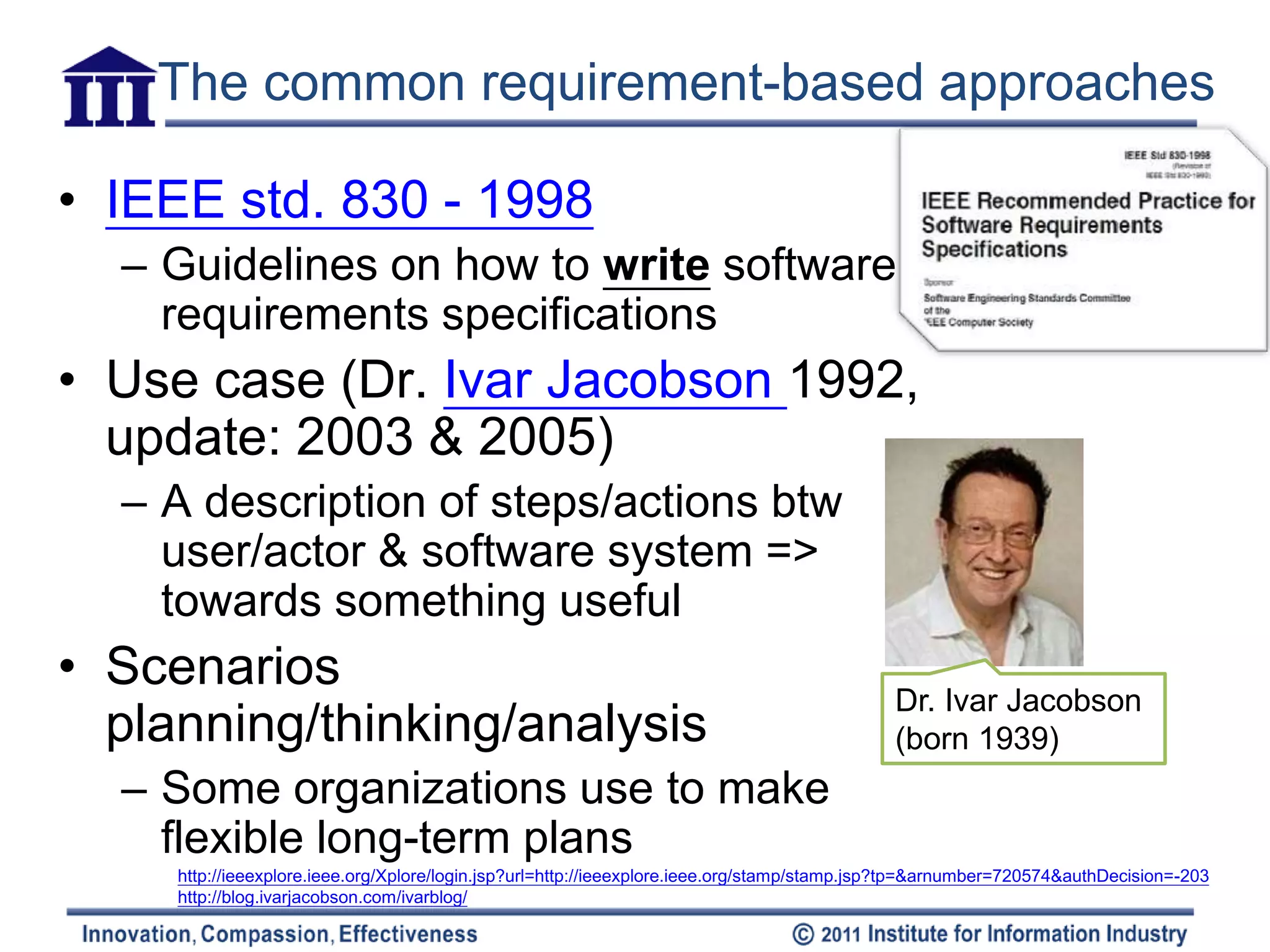
• IEEE std. 830 - 1998
  – Guidelines on how to write software
    requirements specifications
• Use case (Dr. Ivar Jacobson 1992,
  update: 2003 & 2005)
  – A description of steps/actions btw
    user/actor & software system =>
    towards something useful
• Scenarios
                                                                                              Dr. Ivar Jacobson
  planning/thinking/analysis                                                                  (born 1939)
  – Some organizations use to make
    flexible long-term plans
     http://ieeexplore.ieee.org/Xplore/login.jsp?url=http://ieeexplore.ieee.org/stamp/stamp.jsp?tp=&arnumber=720574&authDecision=-203
     http://blog.ivarjacobson.com/ivarblog/
Comparison lists
   customers
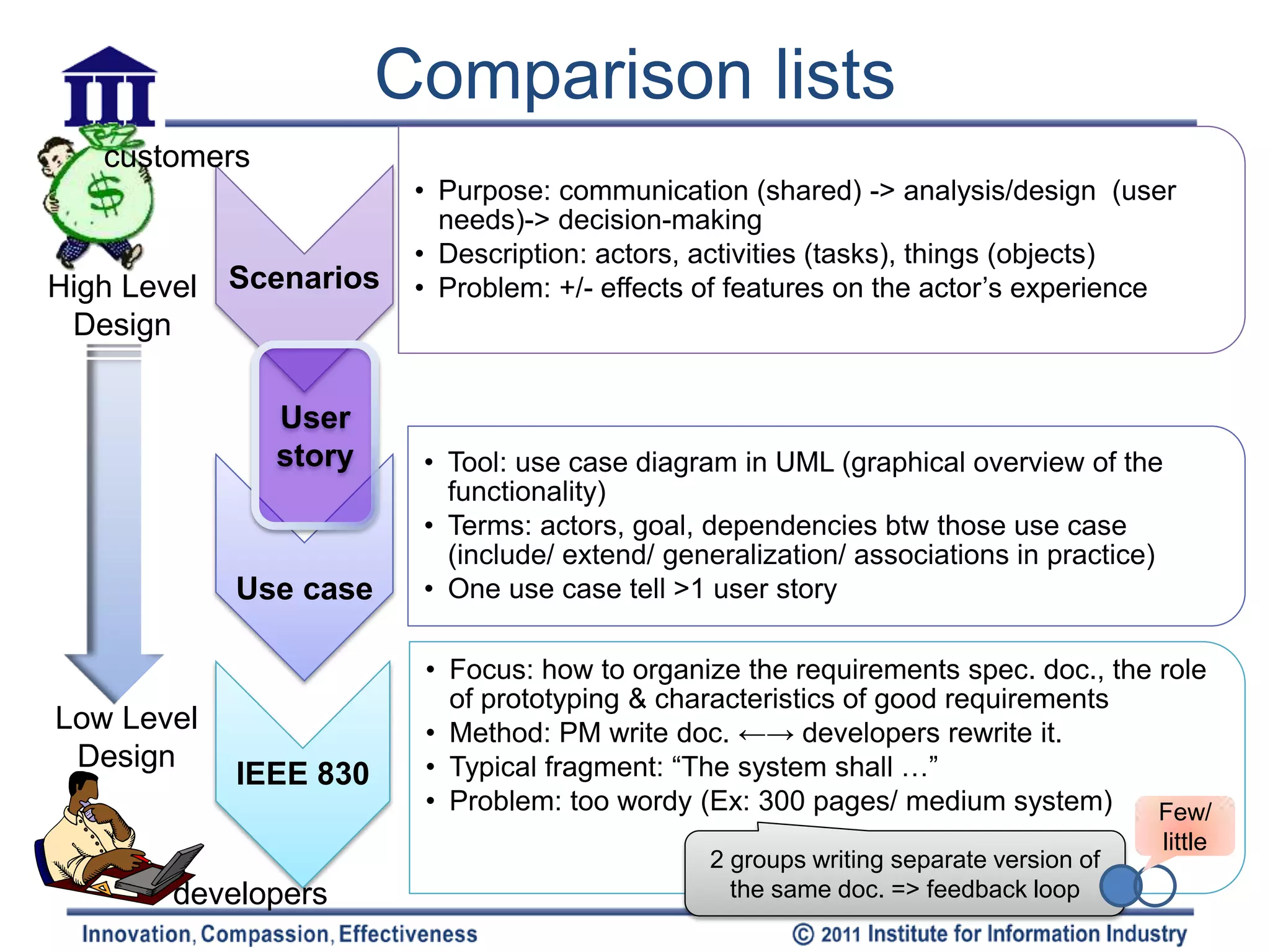
                        • Purpose: communication (shared) -> analysis/design (user
                          needs)-> decision-making
                        • Description: actors, activities (tasks), things (objects)
High Level Scenarios    • Problem: +/- effects of features on the actor’s experience
 Design

               User
               story    • Tool: use case diagram in UML (graphical overview of the
                          functionality)
                        • Terms: actors, goal, dependencies btw those use case
                          (include/ extend/ generalization/ associations in practice)
            Use case    • One use case tell >1 user story

                        • Focus: how to organize the requirements spec. doc., the role
                          of prototyping & characteristics of good requirements
Low Level               • Method: PM write doc. ←→ developers rewrite it.
 Design                 • Typical fragment: “The system shall …”
            IEEE 830
                        • Problem: too wordy (Ex: 300 pages/ medium system)       Few/
                                                                                      little
                                               2 groups writing separate version of
       developers                                the same doc. => feedback loop
IEEE 830 – 1998 vs. User stories
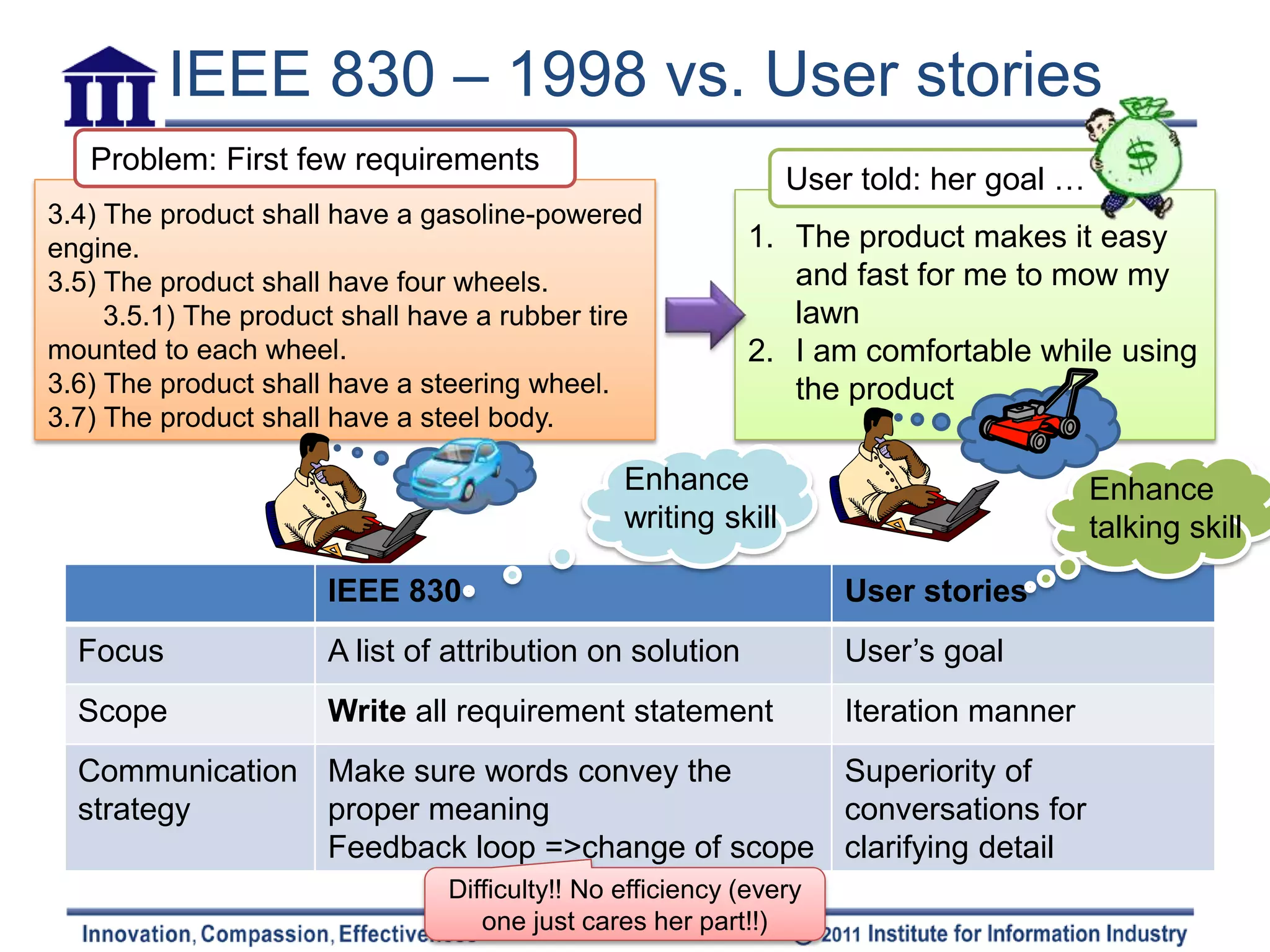
   Problem: First few requirements
                                                                User told: her goal …
3.4) The product shall have a gasoline-powered
engine.                                                    1. The product makes it easy
3.5) The product shall have four wheels.                      and fast for me to mow my
     3.5.1) The product shall have a rubber tire              lawn
mounted to each wheel.                                     2. I am comfortable while using
3.6) The product shall have a steering wheel.                 the product
3.7) The product shall have a steel body.

                                                Enhance                                 Enhance
                                                writing skill                           talking skill

                      IEEE 830                                      User stories
  Focus               A list of attribution on solution             User’s goal
  Scope               Write all requirement statement               Iteration manner
  Communication Make sure words convey the      Superiority of
  strategy      proper meaning                  conversations for
                Feedback loop =>change of scope clarifying detail
                                Difficulty!! No efficiency (every
                                   one just cares her part!!)
Use Case
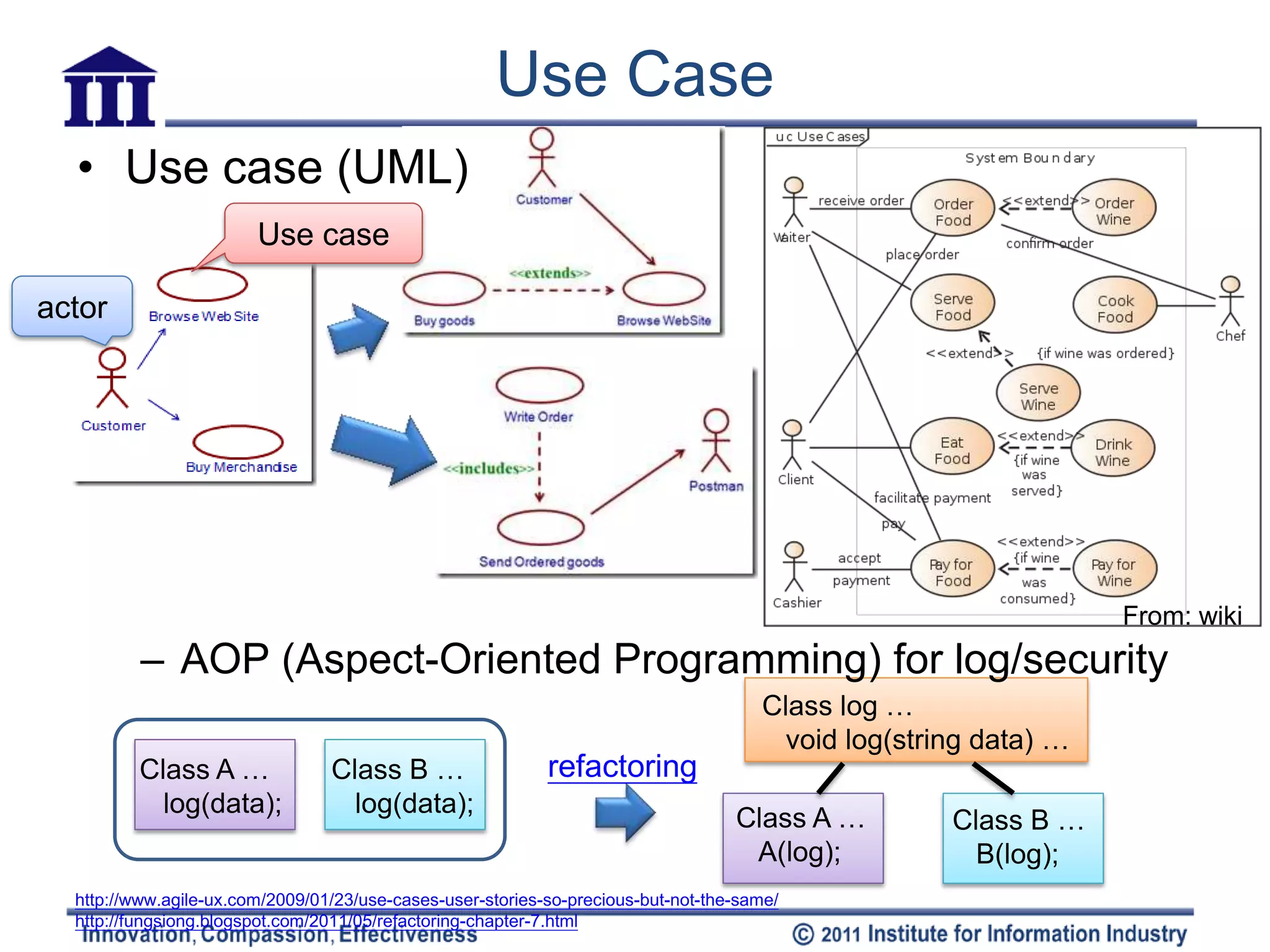
  • Use case (UML)
                        Use case

actor


                                                                                                                  From: wiki
          – AOP (Aspect-Oriented Programming) for log/security
                                                                                      Class log …
                                                                                        void log(string data) …
         Class A …               Class B …                  refactoring
           log(data);              log(data);
                                                                                   Class A …         Class B …
                                                                                    A(log);            B(log);
  http://www.agile-ux.com/2009/01/23/use-cases-user-stories-so-precious-but-not-the-same/
  http://fungsiong.blogspot.com/2011/05/refactoring-chapter-7.html
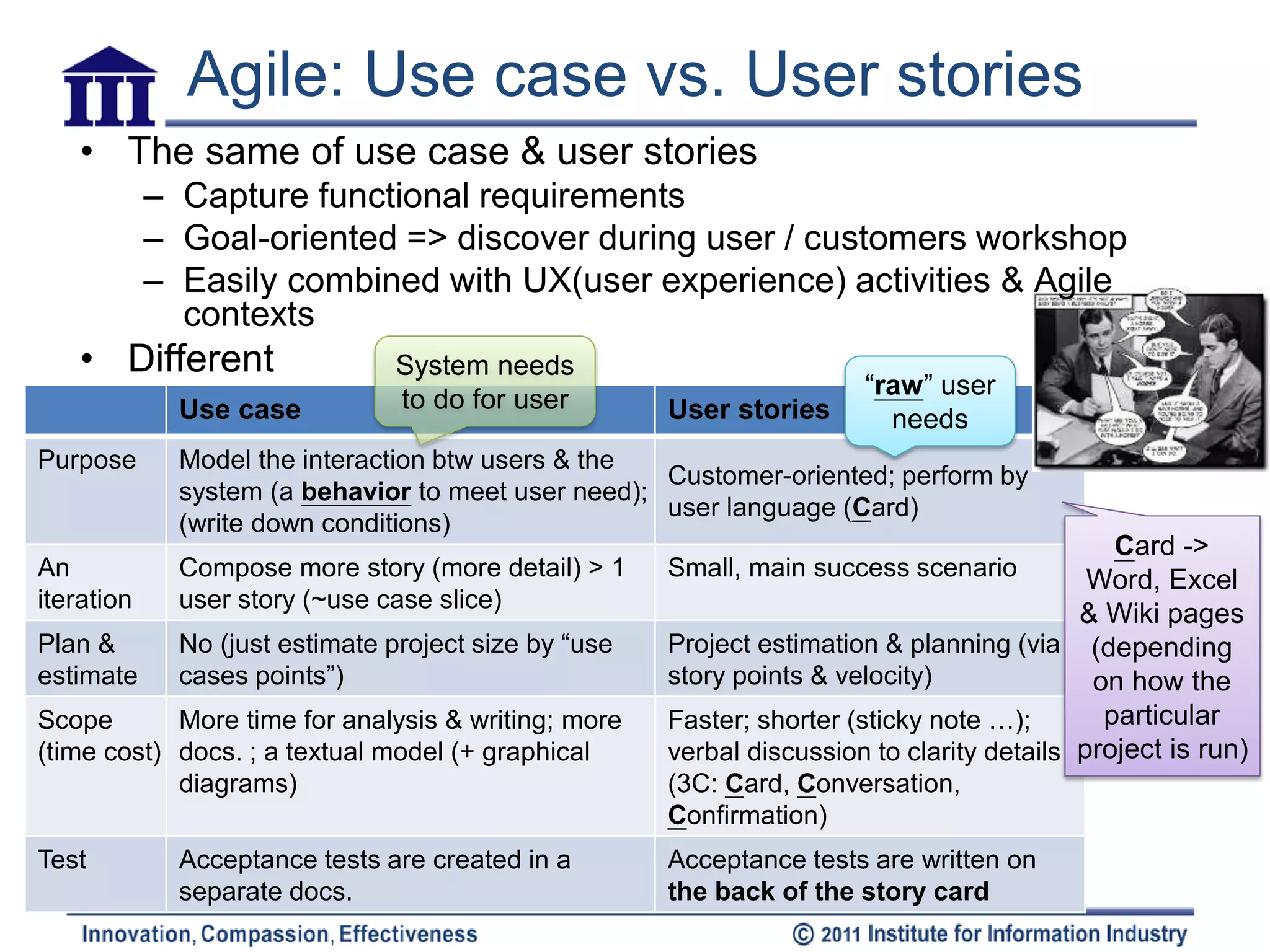
Agile: Use case vs. User stories
    • The same of use case & user stories
            – Capture functional requirements
            – Goal-oriented => discover during user / customers workshop
            – Easily combined with UX(user experience) activities & Agile
              contexts
    • Different                 System needs
                                                                        “raw” user
              Use case          to do for user         User stories       needs
Purpose       Model the interaction btw users & the
                                                     Customer-oriented; perform by
              system (a behavior to meet user need);
                                                     user language (Card)
              (write down conditions)
                                                                                               Card ->
An            Compose more story (more detail) > 1     Small, main success scenario          Word, Excel
iteration     user story (~use case slice)
                                                                                            & Wiki pages
Plan &        No (just estimate project size by “use   Project estimation & planning (via (depending
estimate      cases points”)                           story points & velocity)              on how the
Scope       More time for analysis & writing; more     Faster; shorter (sticky note …);       particular
(time cost) docs. ; a textual model (+ graphical       verbal discussion to clarity details project is run)
            diagrams)                                  (3C: Card, Conversation,
                                                       Confirmation)
Test          Acceptance tests are created in a        Acceptance tests are written on
              separate docs.                           the back of the story card
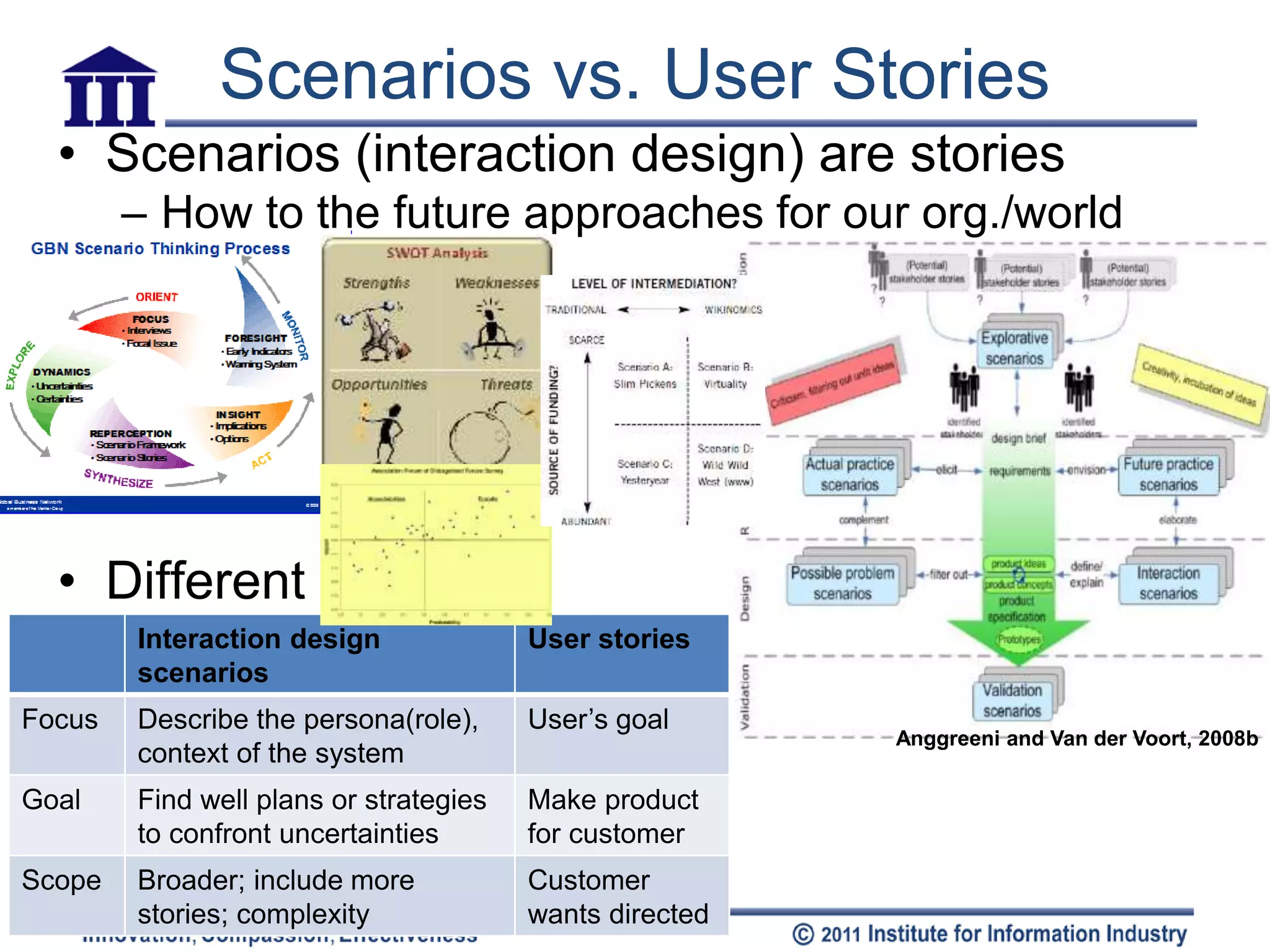
Scenarios vs. User Stories
  • Scenarios (interaction design) are stories
        – How to the future approaches for our org./world


  • Different
        Interaction design              User stories
        scenarios
Focus   Describe the persona(role),     User’s goal
                                                         Anggreeni and Van der Voort, 2008b
        context of the system
Goal    Find well plans or strategies   Make product
        to confront uncertainties       for customer
Scope   Broader; include more           Customer
        stories; complexity             wants directed
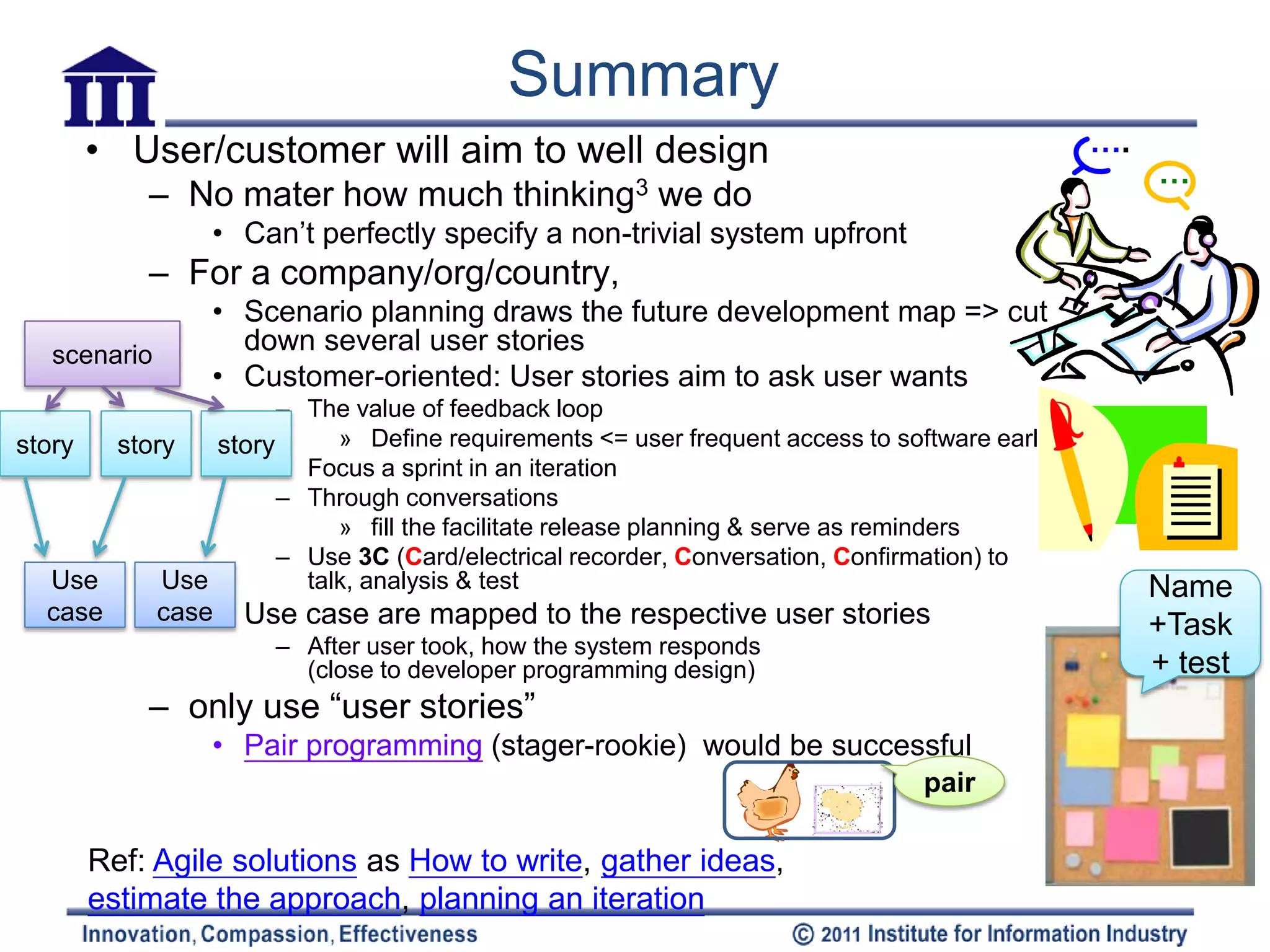
Summary
     • User/customer will aim to well design                                                ….
                                                                                                 …
           – No mater how much thinking3 we do
                  • Can’t perfectly specify a non-trivial system upfront
           – For a company/org/country,
                  • Scenario planning draws the future development map => cut
   scenario
                    down several user stories
                  • Customer-oriented: User stories aim to ask user wants
                     – The value of feedback loop
story  story   story      » Define requirements <= user frequent access to software early
                     – Focus a sprint in an iteration
                     – Through conversations
                          » fill the facilitate release planning & serve as reminders
                     – Use 3C (Card/electrical recorder, Conversation, Confirmation) to
   Use     Use         talk, analysis & test                                                     Name
  case        case• Use case are mapped to the respective user stories
                                                                                                 +Task
                      – After user took, how the system responds
                        (close to developer programming design)                                  + test
           – only use “user stories”
                  • Pair programming (stager-rookie) would be successful
                                                                              pair

      Ref: Agile solutions as How to write, gather ideas,
      estimate the approach, planning an iteration
Reference
• Mike Cohn (2004). User Stories Applied: For Agile
  Software Development. Addison-Wesley Professional.
      • http://www.mountaingoatsoftware.com/books/2-user-stories-
        applied-for-agile-software-development
• Ivar Jacobson (2011). Use cases – What is New?.
      • http://blog.ivarjacobson.com/use-cases-what-is-new/
• Gipi blog (2010). Use case diagram.
      • http://www.dotblogs.com.tw/jimmyyu/archive/2010/01/18/use-
        case-diagram.aspx
• Andrew Stellman (2009). Requirements 101: User
  Stories vs. Use Cases.
      • http://www.stellman-greene.com/2009/05/03/requirements-101-
        user-stories-vs-use-cases/
    Andrew Stellman review ->                                 2005

Agile comparison with requriement approaches

  • 1.
    Comparison with Requirement- based Approaches IEEE Use scenario 830 case Chen Jing Fung @iii 2011/7/5 Ref: Agile solutions as How to write, gather ideas, estimate the approach, planning an iteration
  • 2.
    The common requirement-basedapproaches • IEEE std. 830 - 1998 – Guidelines on how to write software requirements specifications • Use case (Dr. Ivar Jacobson 1992, update: 2003 & 2005) – A description of steps/actions btw user/actor & software system => towards something useful • Scenarios Dr. Ivar Jacobson planning/thinking/analysis (born 1939) – Some organizations use to make flexible long-term plans http://ieeexplore.ieee.org/Xplore/login.jsp?url=http://ieeexplore.ieee.org/stamp/stamp.jsp?tp=&arnumber=720574&authDecision=-203 http://blog.ivarjacobson.com/ivarblog/
  • 3.
    Comparison lists customers • Purpose: communication (shared) -> analysis/design (user needs)-> decision-making • Description: actors, activities (tasks), things (objects) High Level Scenarios • Problem: +/- effects of features on the actor’s experience Design User story • Tool: use case diagram in UML (graphical overview of the functionality) • Terms: actors, goal, dependencies btw those use case (include/ extend/ generalization/ associations in practice) Use case • One use case tell >1 user story • Focus: how to organize the requirements spec. doc., the role of prototyping & characteristics of good requirements Low Level • Method: PM write doc. ←→ developers rewrite it. Design • Typical fragment: “The system shall …” IEEE 830 • Problem: too wordy (Ex: 300 pages/ medium system) Few/ little 2 groups writing separate version of developers the same doc. => feedback loop
  • 4.
    IEEE 830 –1998 vs. User stories Problem: First few requirements User told: her goal … 3.4) The product shall have a gasoline-powered engine. 1. The product makes it easy 3.5) The product shall have four wheels. and fast for me to mow my 3.5.1) The product shall have a rubber tire lawn mounted to each wheel. 2. I am comfortable while using 3.6) The product shall have a steering wheel. the product 3.7) The product shall have a steel body. Enhance Enhance writing skill talking skill IEEE 830 User stories Focus A list of attribution on solution User’s goal Scope Write all requirement statement Iteration manner Communication Make sure words convey the Superiority of strategy proper meaning conversations for Feedback loop =>change of scope clarifying detail Difficulty!! No efficiency (every one just cares her part!!)
  • 5.
    Use Case • Use case (UML) Use case actor From: wiki – AOP (Aspect-Oriented Programming) for log/security Class log … void log(string data) … Class A … Class B … refactoring log(data); log(data); Class A … Class B … A(log); B(log); http://www.agile-ux.com/2009/01/23/use-cases-user-stories-so-precious-but-not-the-same/ http://fungsiong.blogspot.com/2011/05/refactoring-chapter-7.html
  • 6.
    Agile: Use casevs. User stories • The same of use case & user stories – Capture functional requirements – Goal-oriented => discover during user / customers workshop – Easily combined with UX(user experience) activities & Agile contexts • Different System needs “raw” user Use case to do for user User stories needs Purpose Model the interaction btw users & the Customer-oriented; perform by system (a behavior to meet user need); user language (Card) (write down conditions) Card -> An Compose more story (more detail) > 1 Small, main success scenario Word, Excel iteration user story (~use case slice) & Wiki pages Plan & No (just estimate project size by “use Project estimation & planning (via (depending estimate cases points”) story points & velocity) on how the Scope More time for analysis & writing; more Faster; shorter (sticky note …); particular (time cost) docs. ; a textual model (+ graphical verbal discussion to clarity details project is run) diagrams) (3C: Card, Conversation, Confirmation) Test Acceptance tests are created in a Acceptance tests are written on separate docs. the back of the story card
  • 7.
    Scenarios vs. UserStories • Scenarios (interaction design) are stories – How to the future approaches for our org./world • Different Interaction design User stories scenarios Focus Describe the persona(role), User’s goal Anggreeni and Van der Voort, 2008b context of the system Goal Find well plans or strategies Make product to confront uncertainties for customer Scope Broader; include more Customer stories; complexity wants directed
  • 8.
    Summary • User/customer will aim to well design …. … – No mater how much thinking3 we do • Can’t perfectly specify a non-trivial system upfront – For a company/org/country, • Scenario planning draws the future development map => cut scenario down several user stories • Customer-oriented: User stories aim to ask user wants – The value of feedback loop story story story » Define requirements <= user frequent access to software early – Focus a sprint in an iteration – Through conversations » fill the facilitate release planning & serve as reminders – Use 3C (Card/electrical recorder, Conversation, Confirmation) to Use Use talk, analysis & test Name case case• Use case are mapped to the respective user stories +Task – After user took, how the system responds (close to developer programming design) + test – only use “user stories” • Pair programming (stager-rookie) would be successful pair Ref: Agile solutions as How to write, gather ideas, estimate the approach, planning an iteration
  • 9.
    Reference • Mike Cohn(2004). User Stories Applied: For Agile Software Development. Addison-Wesley Professional. • http://www.mountaingoatsoftware.com/books/2-user-stories- applied-for-agile-software-development • Ivar Jacobson (2011). Use cases – What is New?. • http://blog.ivarjacobson.com/use-cases-what-is-new/ • Gipi blog (2010). Use case diagram. • http://www.dotblogs.com.tw/jimmyyu/archive/2010/01/18/use- case-diagram.aspx • Andrew Stellman (2009). Requirements 101: User Stories vs. Use Cases. • http://www.stellman-greene.com/2009/05/03/requirements-101- user-stories-vs-use-cases/ Andrew Stellman review -> 2005