FRACP Teaching 2014 
Sleep For Exams
AAbbnnoorrmmaall sslleeeepp ddiissoorrddeerrss 
 DDIIMMSS ((ddiissoorrddeerr ooff iinniittiiaattiioonn aanndd mmaaiinntteennaannccee ooff sslleeeepp)) 
 DDOOEESS ((ddiissoorrddeerrss ooff eexxcceessssiivvee sslleeeeppiinneessss)) 
-- nnoott eennoouugghh sslleeeepp 
-- OOSSAA 
-- NNaarrccoolleeppssyy 
-- PPLLMMSS//RRLLSS 
 PPaarraassoommnniiaass ((AAbbnnoorrmmaall bbeehhaavviioorr dduurriinngg sslleeeepp)) 
-- NNRREEMM ((sslleeeepp wwaallkkiinngg// nniigghhtt tteerrrroorrss)) 
-- RREEMM ((nniigghhttmmaarreess,, RREEMM sslleeeepp bbeehhaavviioorr ddiissoorrddeerrss))
SSlleeeepp WWaakkee CCyyccllee 
 NNRREEMM RReellaattiivveellyy iinnaaccttiivvee yyeett 
aaccttiivveellyy rreegguullaattiinngg bbrraaiinn iinn aa 
mmoovvaabbllee bbooddyy 
SSttaaggee 11((ddrroowwssiinneessss)) 55%% 
SSlloowwiinngg ooff aallpphhaa ttoo tthheettaa 
SSllooww rroolllliinngg eeyyee mmoovveemmeennttss 
SSttaaggee 22 ((lliigghhtt sslleeeepp)) 5500%% 
SSlleeeepp SSppiinnddlleess aanndd KK CCoommpplleexxeess 
SSttaaggee 33 aanndd 44 ((ddeeeepp sslleeeepp)) 2200%% 
DDeellttaa wwaavveess
SSlleeeepp-- WWaakkee CCyyccllee 
WWhhaatt iiss nnoorrmmaall ?? 
 Sleep enters through NREM (slow wave sleep) 
 Alternates with REM about every 90 minutes 
 SWS in first 1/3 rd of night and REM in last 1/3rd 
 REM peaks in early hours of morning which coincides 
with trough of body temperature
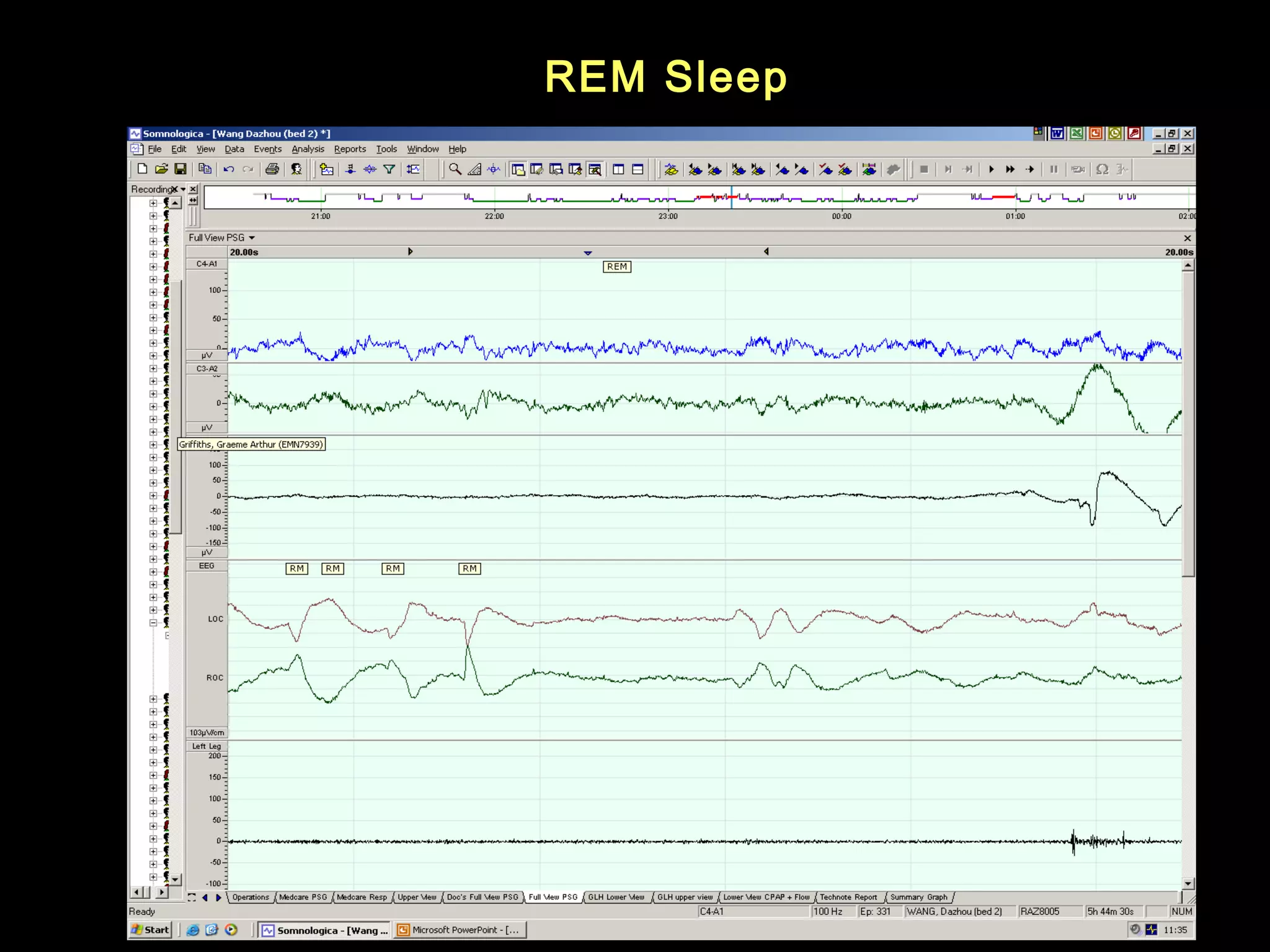
RREEMM SSlleeeepp 
 RREEMM sslleeeepp :: HHiigghhllyy aaccttiivvaatteedd bbrraaiinn iinn aa ppaarraallyyzzeedd bbooddyy 
 SSaaww ttooootthh EEEEGG 
 DDrreeaammiinngg 
 AAttoonniiaa 
 PPhhaassiicc eevveennttss ((iirrrreegguullaarriittiieess iinn HHRR aanndd rreessppiirraattiioonn)) 
Hallmark: 
Hypo-tonic, Hypo-ventilation, Hypo-tension
REM Sleep
Important nneeuurroo--ttrraannssmmiitttteerrss 
NNEE AAcchh 
WWaakkiinngg 
NNRREEMM 
TToonniicc RREEMM 
PPhhaassiicc RREEMM
RReessppiirraattoorryy CChhaannggeess iinn RREEMM sslleeeepp 
WWiitthhddrraawwaall ooff nnoorraaddrreenneerrggiicc eexxcciittaattiioonn oonn uuppppeerr aaiirrwwaayyss 
 SSuupppprreessssiioonn ooff aaccttiivviittyy ooff hhyyppoogglloossssaall mmoottoorr nneeuurroonnss 
 RReedduucceedd aaccttiivviittyy ooff ggeenniioohhyyooiidd aanndd ggeennoogglloossssuuss 
-- IInnccrreeaasseedd uuppppeerr aaiirrwwaayy rreessiissttaannccee 
 AAttoonniiaa ooff iinntteerrccoossttaall mmuusscclleess 
-- ppaarraaddooxxiiccaall cchheesstt ccoollllaappssee dduurriinngg iinnssppiirraattiioonn 
 DDeeccrreeaasseedd ddiiaapphhrraaggmmaattiicc aaccttiivviittyy
CChhaannggeess iinn sslleeeepp wwiitthh AAGGEE 
 SSWWSS ddeeccrreeaasseess wwiitthh aaggee aafftteerr aaggee 2200------ bbiioommaarrkkeerr aaggeeiinngg CCNNSS 
 RREEMM ccoonnssttaanntt aafftteerr iinnffaannccyy 
 WWAASSOO iinnccrreeaasseess wwiitthh aaggee 
 RREEMM llaatteennccyy rreedduucceess wwiitthh aaggee ((eeaarrllyy oonnsseett RREEMM))
FFaaccttoorrss mmooddiiffyyiinngg sslleeeepp ssttaaggeess cctt.... 
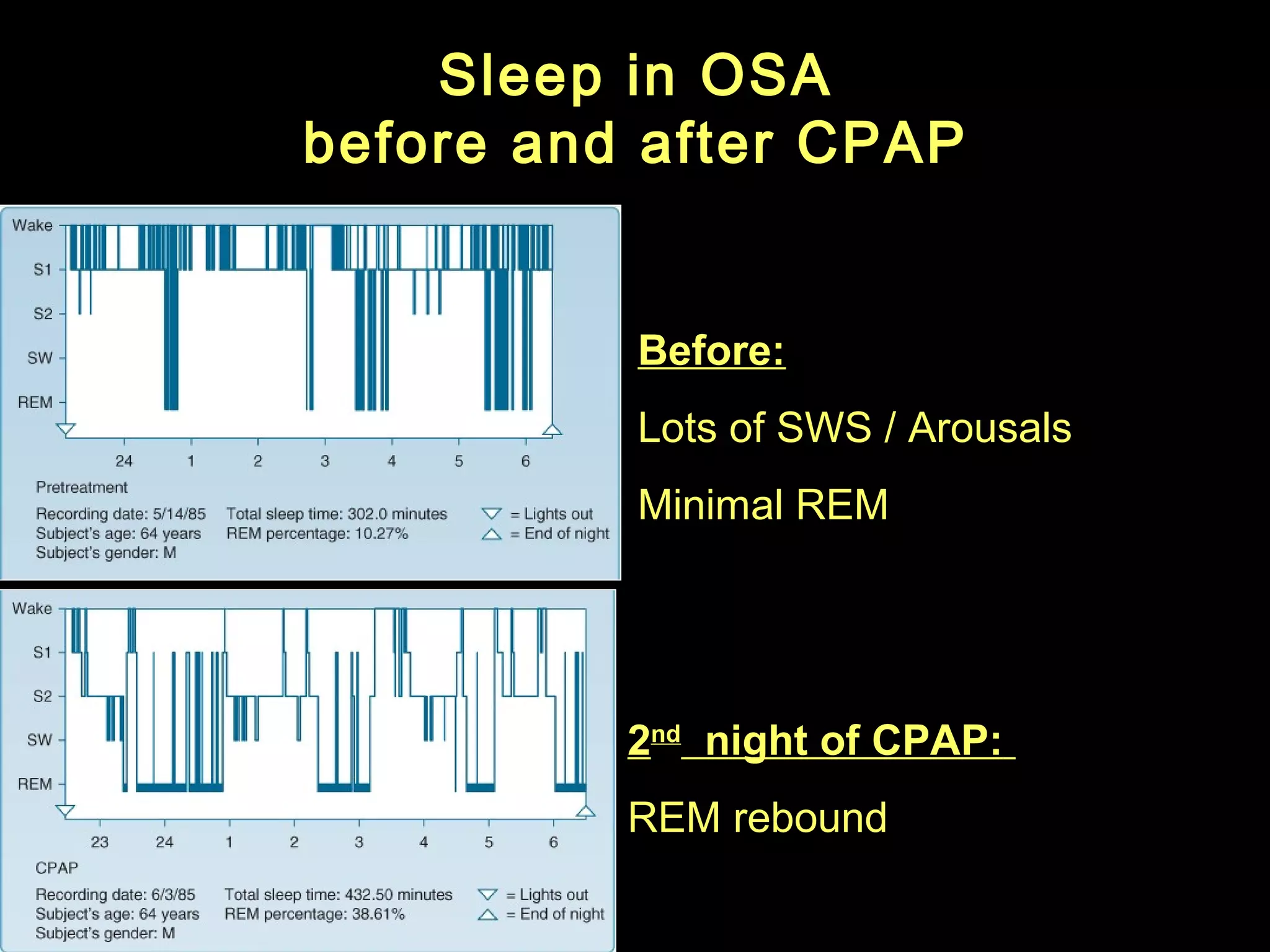
RReeccoovveerryy ffrroomm sslleeeepp lloossss (( ee..gg.. OOSSAA ssttaarrtteedd oonn CCPPAAPP)) 
 11sstt nniigghhtt SSWWSS rreeccoovveerrss 
 22nndd nniigghhtt RREEMM rreeccoovveerrss wwiitthh RREEMM rreebboouunndd 
 SSOORREEMMSS iiff cchhrroonniicc sslleeeepp rreessttrriiccttiioonn ((mmiimmiicc nnaarrccoolleeppssyy)) 
DDrruuggss aanndd ddrruugg wwiitthhddrraawwaallss 
 BBeennzzoo’’ss ssuupppprreessss SSWWSS 
 TTCCAA//MMAAOOII’’ss ssuupppprreessss RREEMM ((wwiitthhddrraawwaall ccaauusseess 
SSOORREEMMSS)) 
 AAllccoohhooll RREEMM ssuupppprreessssiioonn ffoolllloowweedd bbyy RREEMM rreebboouunndd 
 CChhrroonniicc TTHHCC –– lloonngg tteerrmm ssuupppprreessssiioonn ooff SSWWSS ((““aaggeeiinngg””))
SSlleeeepp iinn OOSSAA 
bbeeffoorree aanndd aafftteerr CCPPAAPP 
Before: 
Lots of SWS / Arousals 
Minimal REM 
2nd night of CPAP: 
REM rebound
PPaatthhoo--pphhyyssiioollooggyy ooff OOSSAA
WWhhaatt hhaappppeennss iinn OOSSAA 
 NNaarrrroowwiinngg ooff aaiirrwwaayyss ++ AAiirrwwaayy CCoollllaappssee ((BBeerroonniillll’’ee pprriinncciippllee)) 
 IInnccrreeaasseedd eeffffoorrtt 
 SSyymmppaatthheettiicc oouuttppoouurriinngg ((‘‘ccaauussee ffoorr mmoosstt hhaarrmm’’)) 
 DDee--ssaattuurraattiioonnss 
 AArroouussaall 
 PPoooorr sslleeeepp ((eeffffoorrtt ooff bbrreeaatthhiinngg aanndd aarroouussaallss ddiissttuurrbbss sslleeeepp 
nnoott tthhee hhyyppooxxiiaa ))
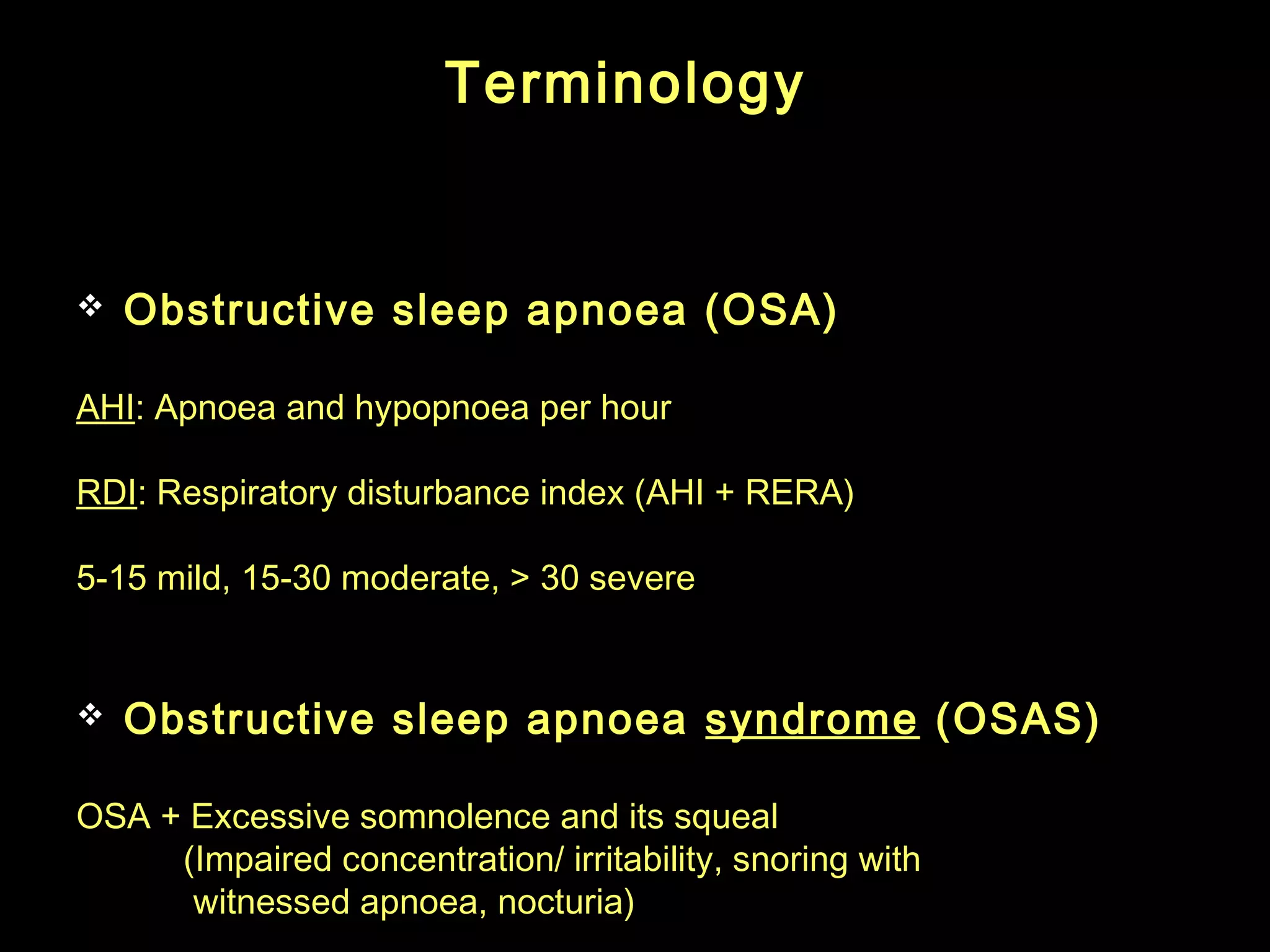
TTeerrmmiinnoollooggyy 
 Obstructive sleep apnoea (OSA) 
AHI: Apnoea and hypopnoea per hour 
RDI: Respiratory disturbance index (AHI + RERA) 
5-15 mild, 15-30 moderate, > 30 severe 
 Obstructive sleep apnoea syndrome (OSAS) 
OSA + Excessive somnolence and its squeal 
(Impaired concentration/ irritability, snoring with 
witnessed apnoea, nocturia)
Repetitive 
partial /complete 
closure of 
pharynx during 
sleep 
Recurrent 
Arousals 
Day time 
drowsiness….. 
Recurrent 
nocturnal 
hypoxemia 
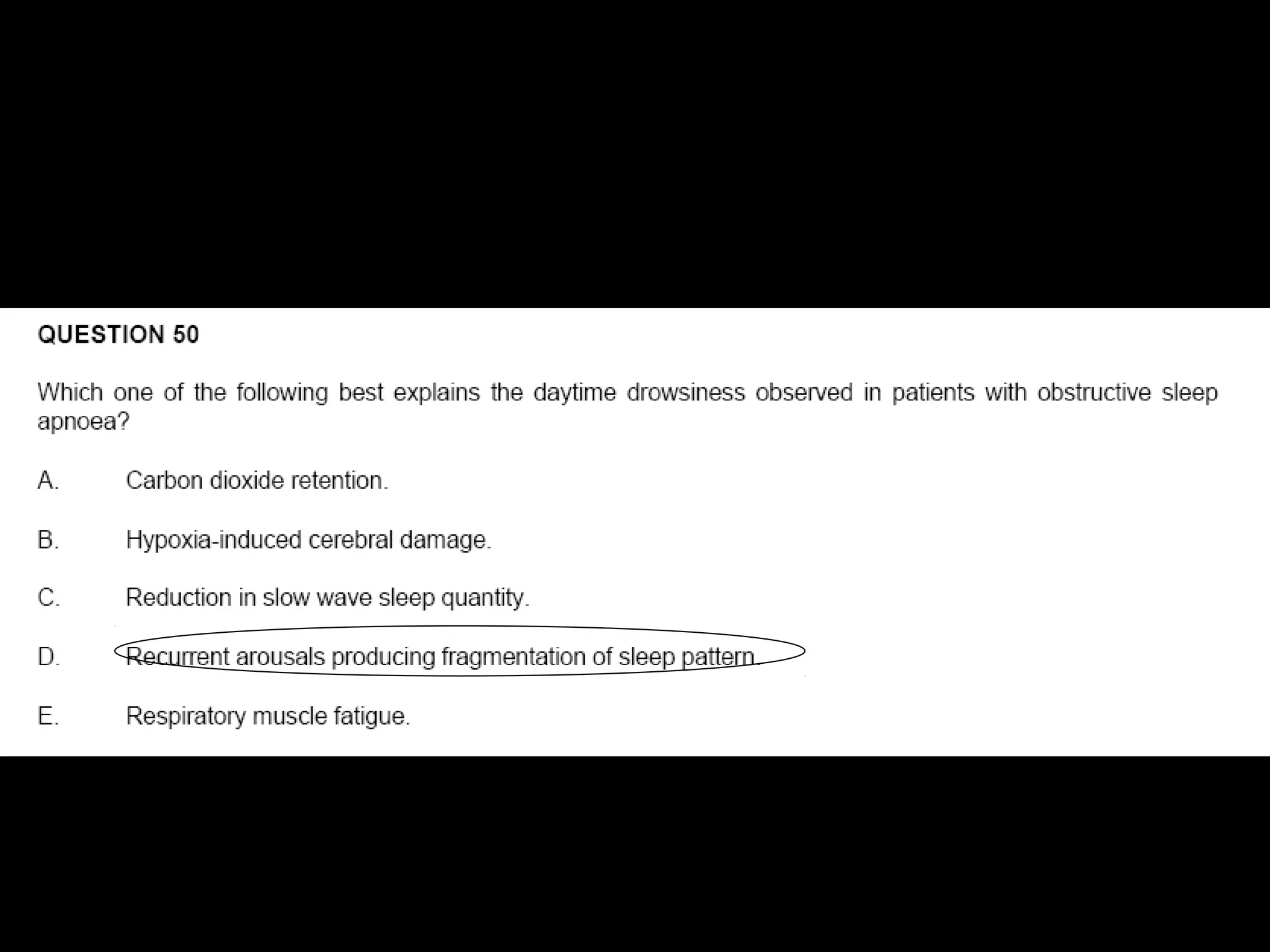
Fragmented sleep 
“Floppy airway” 
Reduced neural 
output 
Nocturnal 
sympathetic 
surges
Who gets OSAS 
 Middle aged men (2-4% men and 1% women) 
 Overweight 
 Snorers 
 Collar size > 43 cm 
 Craniofacial abnormalities, retrognathia. 
 Large tonsils (large adenoids in chidhood) 
 Hypothyroidism 
 Alcohol….. 
 Neuromuscular disease 
 Rare: Acromegaly, Cushing's syndrome, Down's 
syndrome.
Consequences of OSA 
 Excessive sleepiness - QOL, cognition, accidents 
 Loud snoring, witnessed apnoea and chocking 
 Feeling un-refreshed waking 
 Poor concentration/ irritability/ depression 
 Nocturia 
 Reduced libido 
 Hypertension 
 ? Cardiovascular disease 
 ? Metabolic syndrome
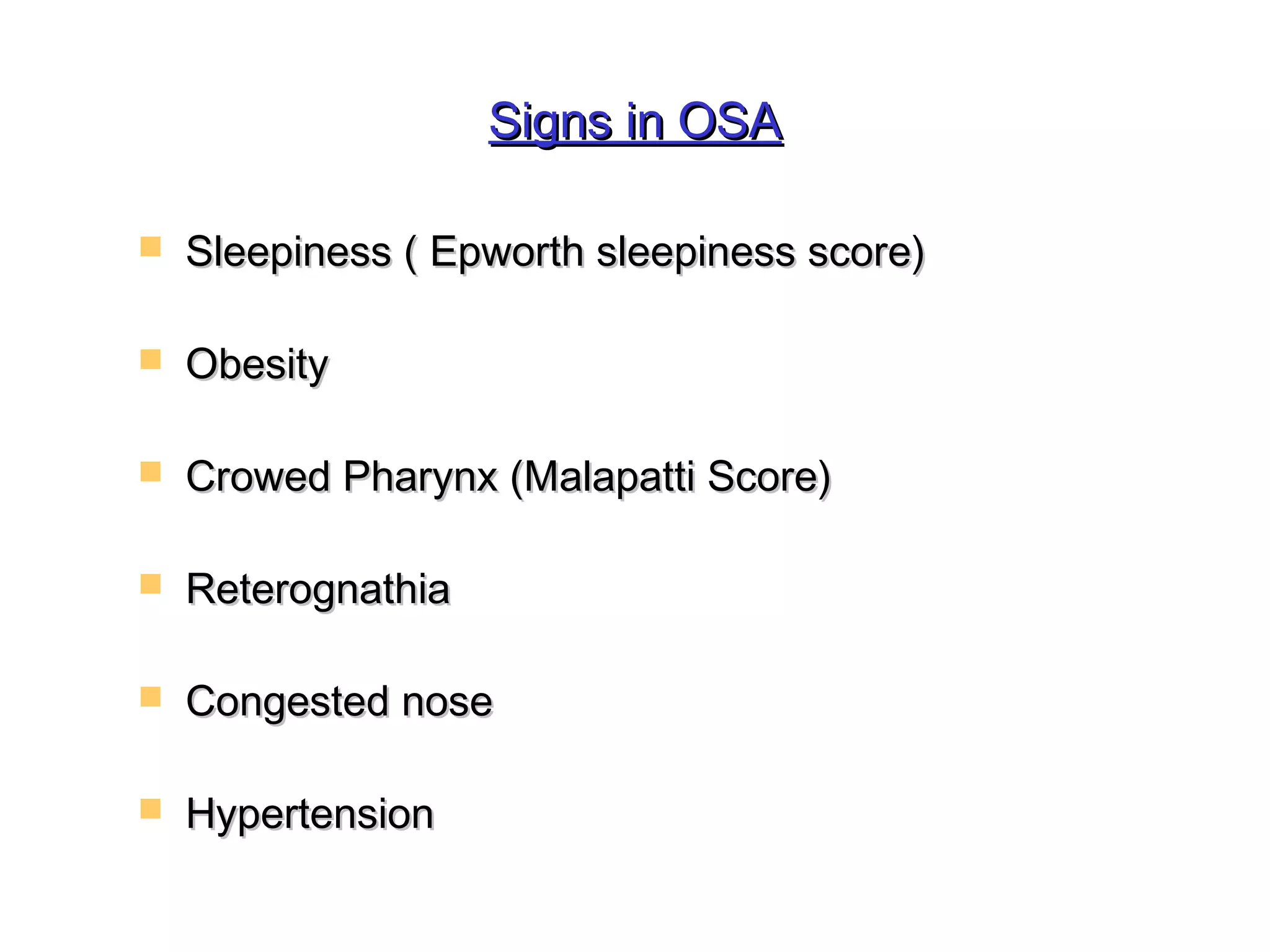
SSiiggnnss iinn OOSSAA 
 SSlleeeeppiinneessss (( EEppwwoorrtthh sslleeeeppiinneessss ssccoorree)) 
 OObbeessiittyy 
 CCrroowweedd PPhhaarryynnxx ((MMaallaappaattttii SSccoorree)) 
 RReetteerrooggnnaatthhiiaa 
 CCoonnggeesstteedd nnoossee 
 HHyyppeerrtteennssiioonn
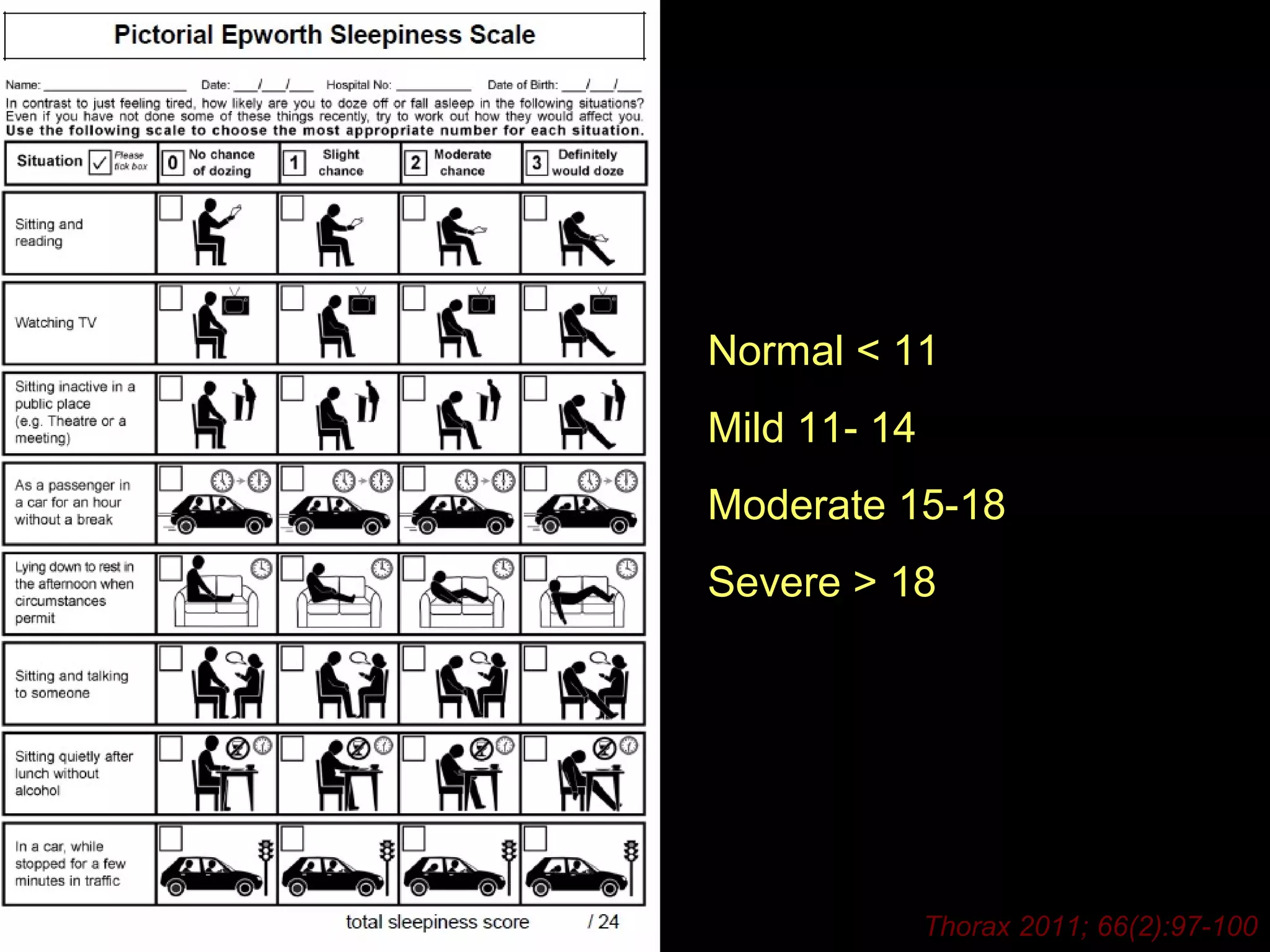
Epworth sleepiness Score 
 Best available tool to guide clinicians to patient 
perception of sleepiness 
 Predicts level of compliance with CPAP 
 Guides to urgency of assessment
Normal < 11 
Mild 11- 14 
Moderate 15-18 
Severe > 18 
Thorax 2011; 66(2):97-100
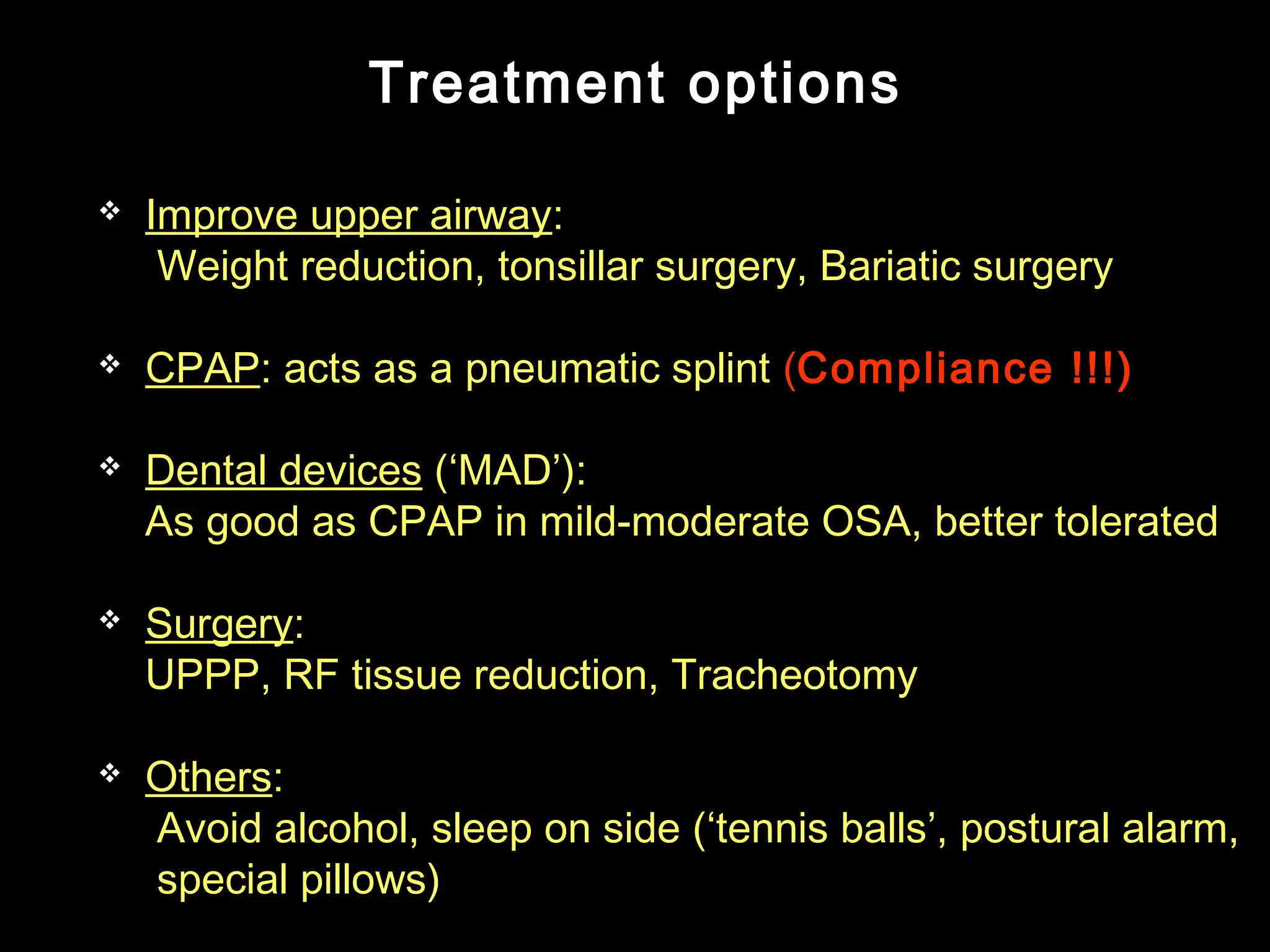
Treatment options 
 Improve upper airway: 
Weight reduction, tonsillar surgery, Bariatic surgery 
 CPAP: acts as a pneumatic splint (Compliance !!!) 
 Dental devices (‘MAD’): 
As good as CPAP in mild-moderate OSA, better tolerated 
 Surgery: 
UPPP, RF tissue reduction, Tracheotomy 
 Others: 
Avoid alcohol, sleep on side (‘tennis balls’, postural alarm, 
special pillows)
Adherence to CPAP 
Non-compliance: use < 4 hours a night (30% - 80%) 
 Adherences during the first week… 
 Severity of OSA (a weak relationship) 
 Degree of day time sleepiness (strong relationship) 
 Level of education…. 
 Psychological traits: optimism, motivation to engage in 
healthy behaviour ( ‘healthy user effect’)
What about OSA, CPAP and 
The heart ?
Association of OSA with 
Hypertension 
JAMA:2012;307:2169 
 37% developed HT at 12 years 
 Dose response effect
Is CPAP useful in 
Hypertension ?.....Yes 
BUT….. 
 Reduction in mean BP is only small 
(- 2.5mm vs. + 0.8mm) at 4 weeks 
 Greater decrease among severe OSA (- 3.3mm) 
 Reduction in BP less than with anti-hypertensive 
(Lorstatan vs. CPAP: -9mm vs. -2.1mm) 
 Reduction in BP is less in non-sleepy than in sleepy patients 
Lancet 2002:359;204 
AJRCCM 2010:182:954
Effects of CPAP in HT with non-sleepy OSA 
SBP reduced by -1.8 mm at 1 year DBP reduced by – 2.1mm
CPAP more useful in reducing BP in 
sleepy than in non- sleepy OSA 
 In most studies patients who did not have excessive day 
time drowsiness had NO reduction in the BP with CPAP 
 In sleepy patients benefits with CPAP seen even within 4 
weeks of treatment, whereas non-sleepy patients need 
CPAP for longer to achieve a smaller reduction in BP
OSA and Coronary heart disease: 
The Sleep Heart Health study: 
10 years follow up 
1927 males 2495 females 
OSA was predictor of incident CHD only in men, BUT after 
adjustment for diabetes, lipids, hypertension and anti-hypertensive 
medication use, the association was not 
Circulation 2010:122:352-360 
statistically significant in any group.
OSA and CHD 
 Association of OSA with incident CHD 
(Myocardial infarction, re-vascularisation and 
coronary heart disease death) 
is equivocal
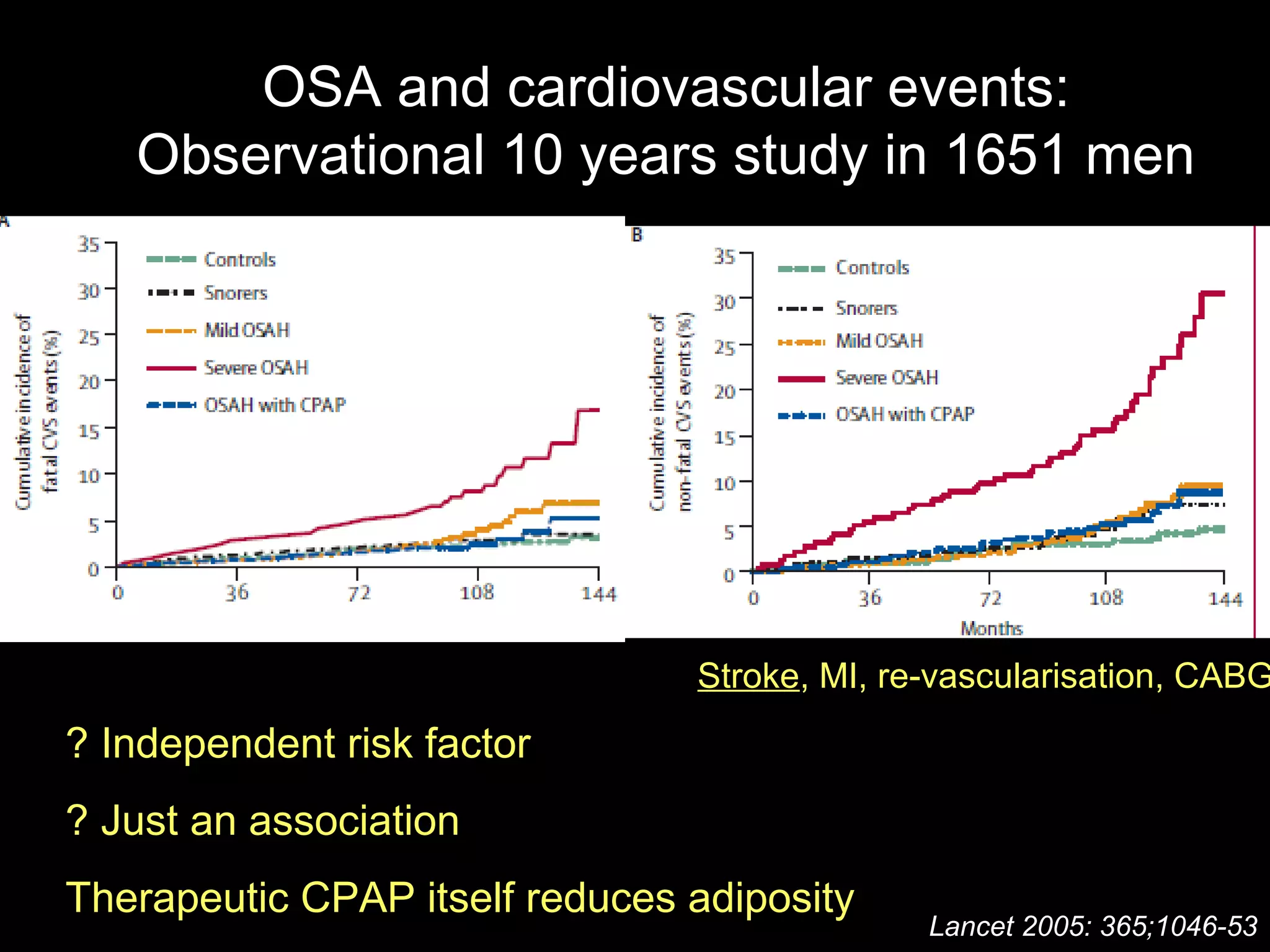
OSA and cardiovascular events: 
Observational 10 years study in 1651 men 
Stroke, MI, re-vascularisation, CABG 
Lancet 2005: 365;1046-53 
? Independent risk factor 
? Just an association 
Therapeutic CPAP itself reduces adiposity
OSA and Cardiovascular disease 
 CPAP in severe OSA may reduce cardiovascular events 
BUT… 
 No RCT that prove that CPAP improves mortality 
 No clinical trials to support routine use of CPAP in OSA 
for sole purpose of reducing cardiovascular events 
 ‘Healthy User effect’ could effect outcomes in studies 
Chest 2010; Study of the healthy user effect in OSA
OSA and Heart failure: 
The Sleep Heart Health study: 
10 years follow up 
1927 males 2495 females 
OSA predicted incident heart failure in men but not in women 
Circulation 2010:122:352-360
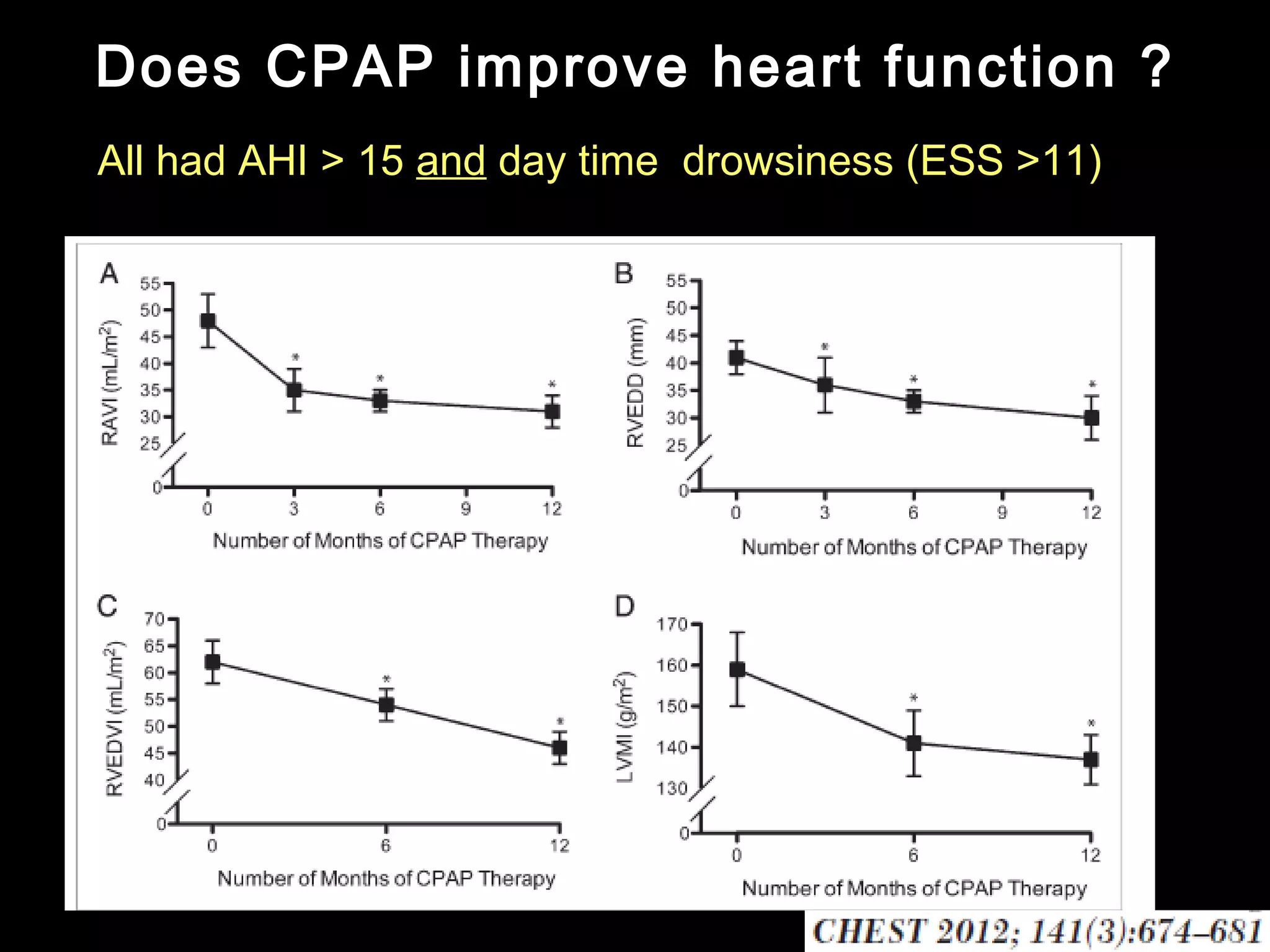
Does CPAP improve heart function ? 
All had AHI > 15 and day time drowsiness (ESS >11)
Does CPAP improve heart function ? 
 All had excessive day time drowsiness (ESS > 11) 
 No control group---- diet, exercise, changes in 
medications and medication adherence could be 
effected by close monitoring in the study 
 Natural history of CMRI in OSA is not known 
 CPAP adherence was 100% ( 52/52) 
( “Healthy user effect”)
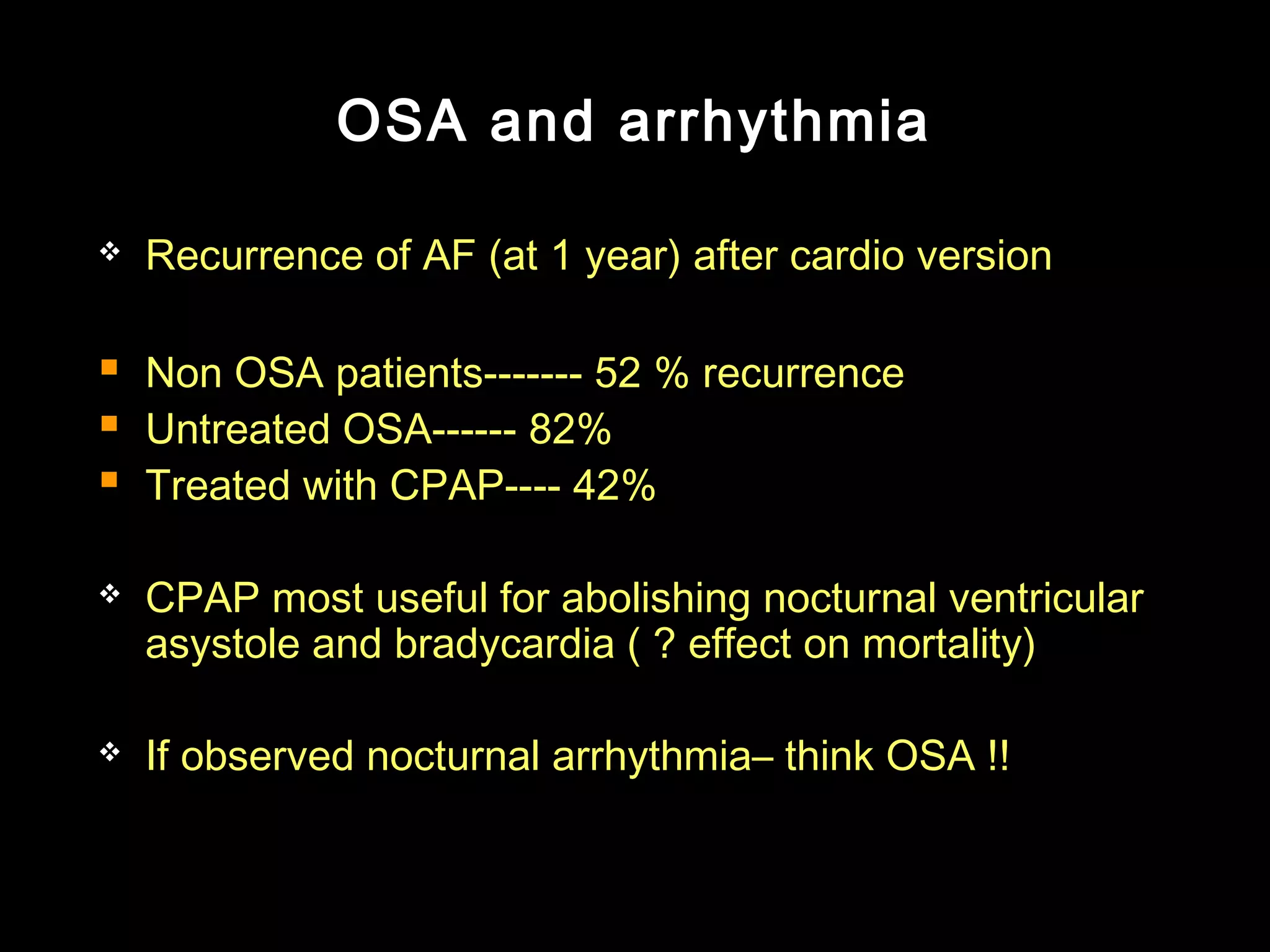
OSA and arrhythmia 
 Recurrence of AF (at 1 year) after cardio version 
 Non OSA patients------- 52 % recurrence 
 Untreated OSA------ 82% 
 Treated with CPAP---- 42% 
 CPAP most useful for abolishing nocturnal ventricular 
asystole and bradycardia ( ? effect on mortality) 
 If observed nocturnal arrhythmia– think OSA !!
OSA and Pulmonary HT 
 Risk only if co-existent day time hypoxemia (i.e. associated 
chronic lung disease) 
 Treatment with CPAP causes only very modest reduction in 
PASP (from 29 mm to 24mm) 
Eur Heart J 2006:27:1106 
 Evidence of improved mortality is lacking 
 Pulmonary HT alone is NOT an indication for diagnostic 
evaluation of OSA
Benefits of CPAP in OSA 
The evidence !! 
 Decreased day time sleepiness 
 Improved quality of life 
 Improves cognitive function 
 Improves resistant hypertension 
 Improves heart function in heart failure 
 Reduces cardiovascular events 
 Improves metabolic abnormalities 
 Reduces mortality 
?????
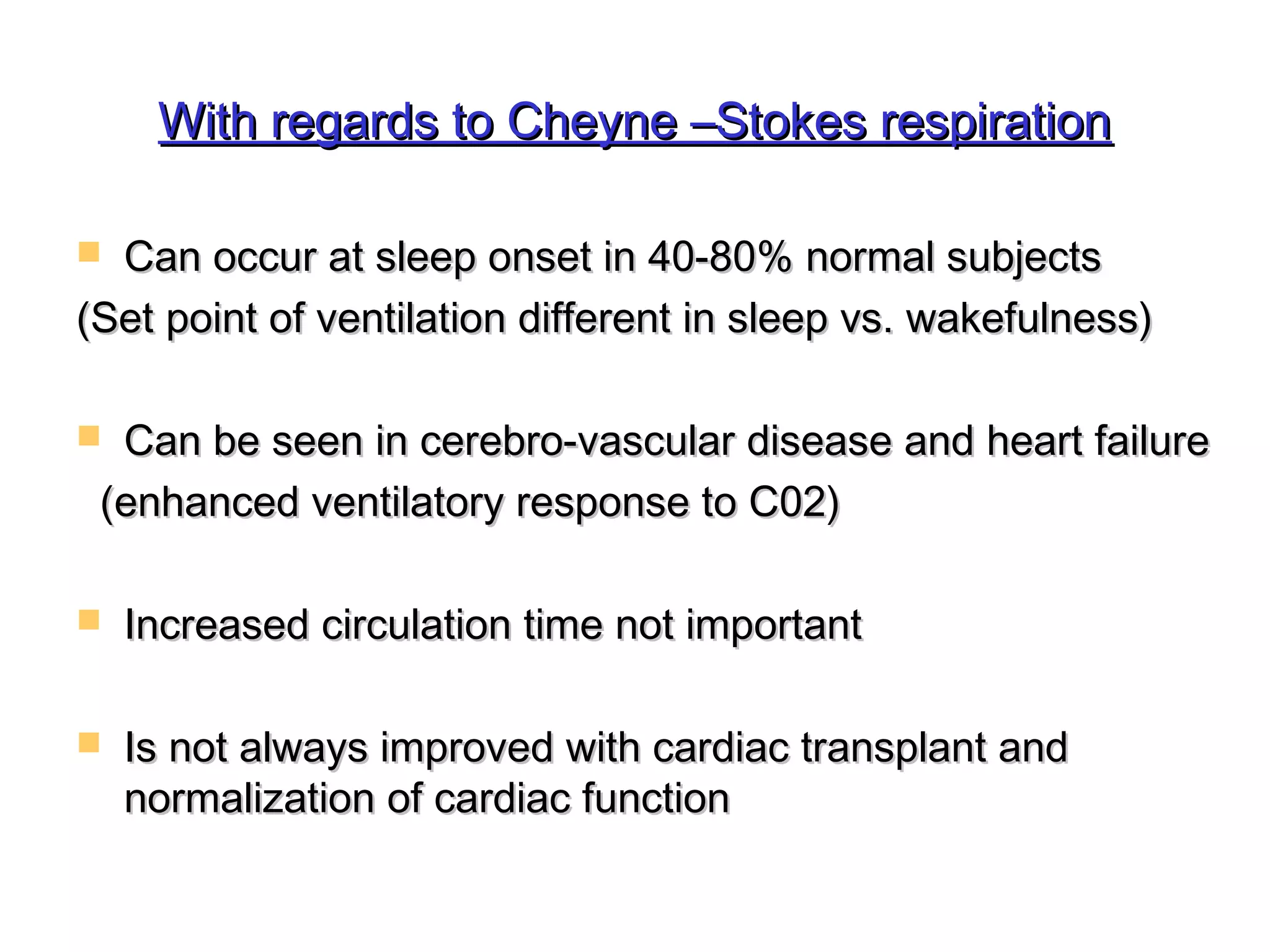
WWiitthh rreeggaarrddss ttoo CChheeyynnee ––SSttookkeess rreessppiirraattiioonn 
 CCaann ooccccuurr aatt sslleeeepp oonnsseett iinn 4400--8800%% nnoorrmmaall ssuubbjjeeccttss 
((SSeett ppooiinntt ooff vveennttiillaattiioonn ddiiffffeerreenntt iinn sslleeeepp vvss.. wwaakkeeffuullnneessss)) 
 CCaann bbee sseeeenn iinn cceerreebbrroo--vvaassccuullaarr ddiisseeaassee aanndd hheeaarrtt ffaaiilluurree 
((eennhhaanncceedd vveennttiillaattoorryy rreessppoonnssee ttoo CC0022)) 
 IInnccrreeaasseedd cciirrccuullaattiioonn ttiimmee nnoott iimmppoorrttaanntt 
 IIss nnoott aallwwaayyss iimmpprroovveedd wwiitthh ccaarrddiiaacc ttrraannssppllaanntt aanndd 
nnoorrmmaalliizzaattiioonn ooff ccaarrddiiaacc ffuunnccttiioonn
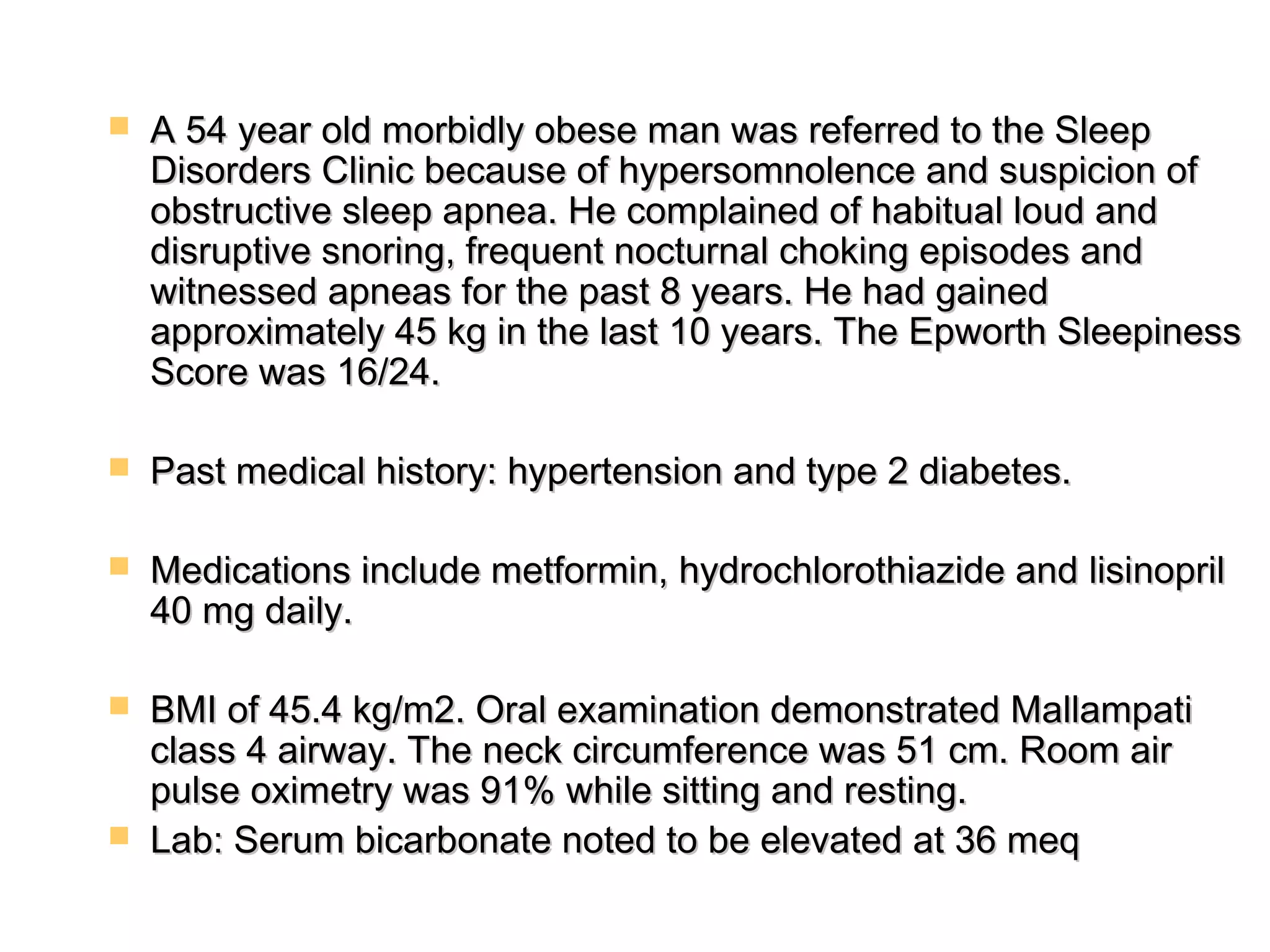
 A 54 year old morbidly obese man wwaass rreeffeerrrreedd ttoo tthhee SSlleeeepp 
DDiissoorrddeerrss CClliinniicc bbeeccaauussee ooff hhyyppeerrssoommnnoolleennccee aanndd ssuussppiicciioonn ooff 
oobbssttrruuccttiivvee sslleeeepp aappnneeaa.. HHee ccoommppllaaiinneedd ooff hhaabbiittuuaall lloouudd aanndd 
ddiissrruuppttiivvee ssnnoorriinngg,, ffrreeqquueenntt nnooccttuurrnnaall cchhookkiinngg eeppiissooddeess aanndd 
wwiittnneesssseedd aappnneeaass ffoorr tthhee ppaasstt 88 yyeeaarrss.. HHee hhaadd ggaaiinneedd 
aapppprrooxxiimmaatteellyy 4455 kkgg iinn tthhee llaasstt 1100 yyeeaarrss.. TThhee EEppwwoorrtthh SSlleeeeppiinneessss 
SSccoorree wwaass 116//2244.. 
 PPaasstt mmeeddiiccaall hhiissttoorryy:: hhyyppeerrtteennssiioonn aanndd ttyyppee 22 ddiiaabbeetteess.. 
 MMeeddiiccaattiioonnss iinncclluuddee mmeettffoorrmmiinn,, hhyyddrroocchhlloorrootthhiiaazziiddee aanndd lliissiinnoopprriill 
4400 mmgg ddaaiillyy.. 
 BBMMII ooff 4455..44 kkgg//mm22.. OOrraall eexxaammiinnaattiioonn ddeemmoonnssttrraatteedd MMaallllaammppaattii 
ccllaassss 44 aaiirrwwaayy.. TThhee nneecckk cciirrccuummffeerreennccee wwaass 5511 ccmm.. RRoooomm aaiirr 
ppuullssee ooxxiimmeettrryy wwaass 9911%% wwhhiillee ssiittttiinngg aanndd rreessttiinngg.. 
 LLaabb:: SSeerruumm bbiiccaarrbboonnaattee nnootteedd ttoo bbee eelleevvaatteedd aatt 336 mmeeqq
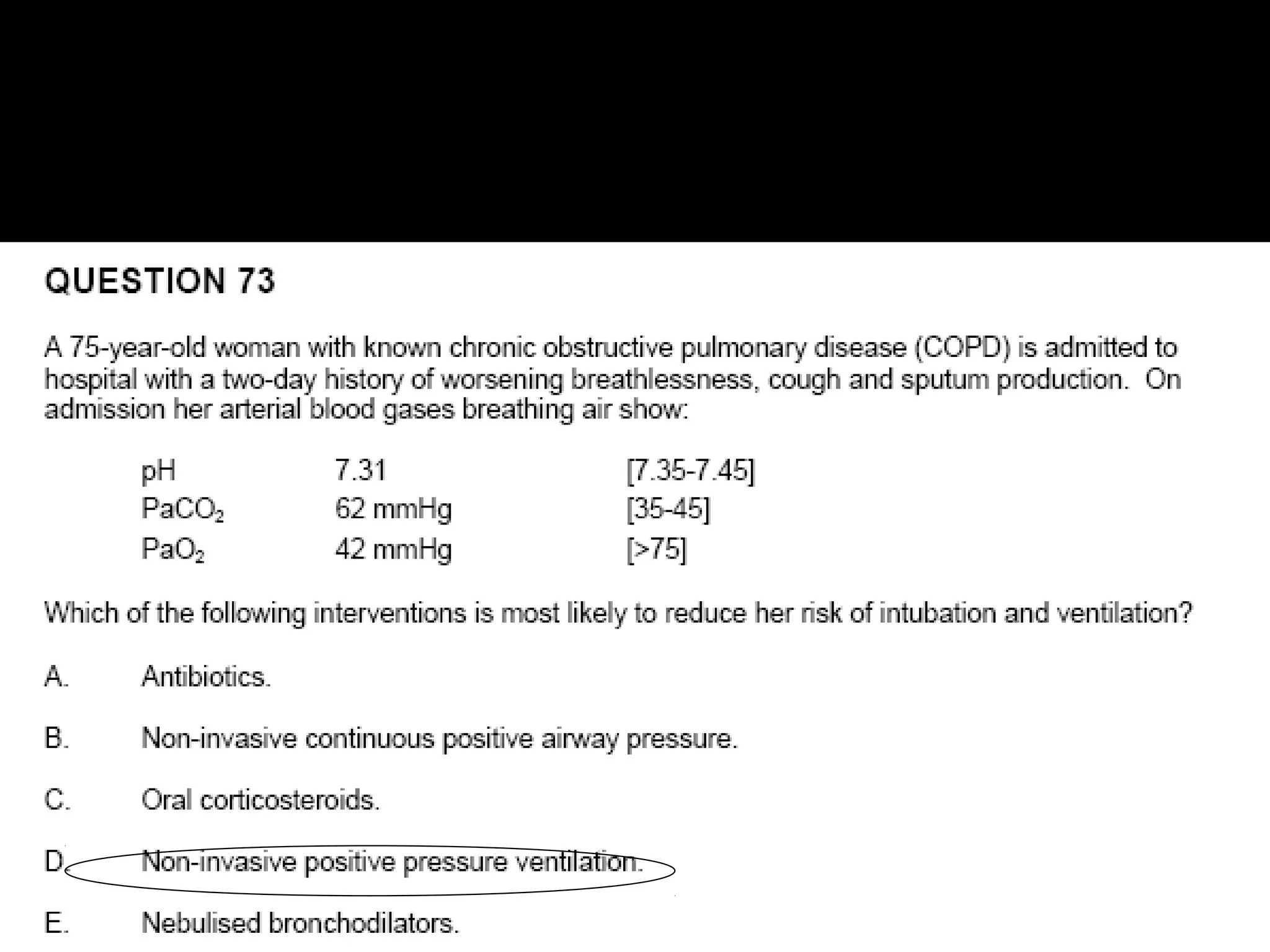
Which of the following ffeeaattuurreess hhaass bbeeeenn sshhoowwnn ttoo bbee 
pprreeddiiccttiivvee ooff oobbeessiittyy hhyyppoovveennttiillaattiioonn ssyynnddrroommee ((OOHHSS))?? 
 AA..BBMMII>>3355 kkgg//mm 
 BB.. PPeerriipphheerraall eeddeemmaa 
 CC.. NNeecckk cciirrccuummffeerreennccee ooff 5511 ccmm 
 DD.. MMaallllaammppaattii ccllaassss IIVV aaiirrwwaayy 
 EE.. SSeerruumm bbiiccaarrbboonnaattee aabboovvee tthhee uuppppeerr lliimmiittss ooff 
nnoorrmmaall 
Hypercapnic OSA = OHS
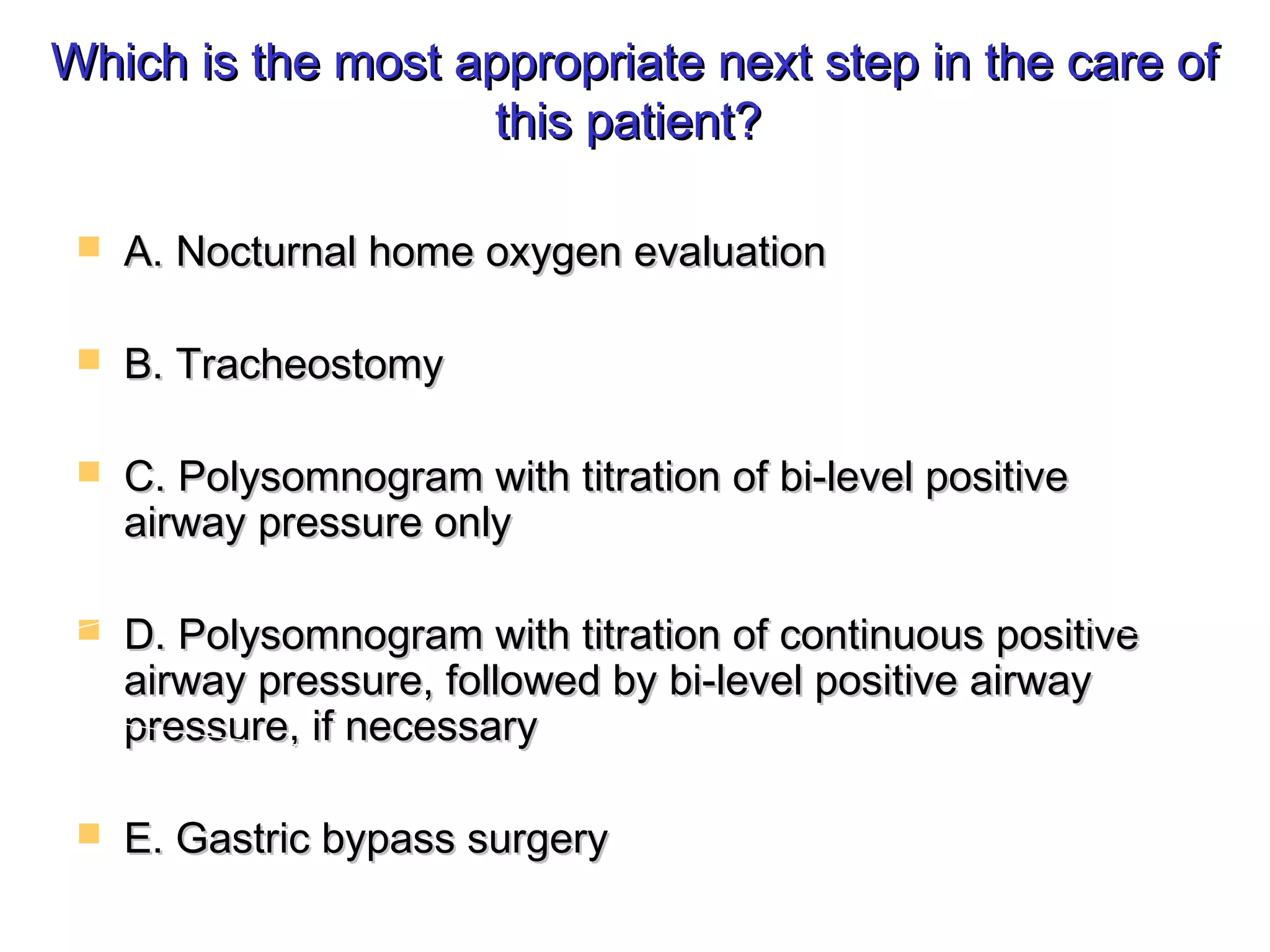
Which is the most aapppprroopprriiaattee nneexxtt sstteepp iinn tthhee ccaarree ooff 
tthhiiss ppaattiieenntt?? 
 AA.. NNooccttuurrnnaall hhoommee ooxxyyggeenn eevvaalluuaattiioonn 
 BB.. TTrraacchheeoossttoommyy 
 CC.. PPoollyyssoommnnooggrraamm wwiitthh ttiittrraattiioonn ooff bbii--lleevveell ppoossiittiivvee 
aaiirrwwaayy pprreessssuurree oonnllyy 
 DD.. PPoollyyssoommnnooggrraamm wwiitthh ttiittrraattiioonn ooff ccoonnttiinnuuoouuss ppoossiittiivvee 
aaiirrwwaayy pprreessssuurree,, ffoolllloowweedd bbyy bbii--lleevveell ppoossiittiivvee aaiirrwwaayy 
pprreessssuurree,, iiff nneecceessssaarryy 
 EE.. Gaassttrriicc bbyyppaassss ssuurrggeerryy
All of the following wwoouulldd aallssoo bbee ppaarrtt ooff aann aapppprroopprriiaattee 
wwoorrkkuupp iinn tthhiiss ppaattiieenntt eexxcceepptt:: 
 AA.. PPuullmmoonnaarryy ffuunnccttiioonn tteessttss 
 BB.. CCoommpplleettee bblloooodd ccoouunntt 
 CC.. CChheesstt iimmaaggiinngg 
 DD.. MMuullttiippllee sslleeeepp llaatteennccyy tteesstt 
 EE.. TThhyyrrooiidd ssttiimmuullaattiinngg hhoorrmmoonnee
CPAP treatment is initiated ffoorr aa ppaattiieenntt.. SShhee rreettuurrnnss 11 
mmoonntthh aafftteerr ssttaarrttiinngg ttrreeaattmmeenntt bbuutt ccoommppllaaiinnss ooff 
ccoonnttiinnuueedd ddaayyttiimmee sslleeeeppiinneessss.. WWhhiicchh ooff tthhee ffoolllloowwiinngg 
iinniittiiaall ddaattaa wwoouulldd bbee mmoosstt hheellppffuull ffoorr ddeetteerrmmiinniinngg tthhee 
nneexxtt sstteepp iinn hheerr mmaannaaggeemmeenntt?? 
 AA.. RReeppeeaatt MMSSLLTT aafftteerr aa PPSSG oonn CCPPAAPP 
 BB.. MMaaiinntteennaannccee ooff wwaakkeeffuullnneessss tteesstt 
 CC ..SSlleeeepp lloogg 
 DD.. CCoommpplliiaannccee rreeppoorrtt 
 EE.. RReeppeeaatt CCPPAAPP ttiittrraattiioonn
Which of the following symptoms, iiff pprreesseenntt,, wwoouulldd bbee 
mmoosstt iinnddiiccaattiivvee ooff nnaarrccoolleeppssyy?? 
 AA.. HHyyppnnaaggooggiicc hhaalllluucciinnaattiioonnss 
 BB.. CCaattaapplleexxyy 
 CC.. SSlleeeepp ppaarraallyyssiiss 
 DD.. AAuuttoommaattiicc bbeehhaavviioorrss 
 EE.. HHyyppnnooppoommppiicc hhaalllluucciinnaattiioonnss
NNaarrccoolleeppssyy 
 RREEMM iinnttrruussiioonnss dduurriinngg wwaakkeeffuullnneessss 
 2200--4400 ttiimmeess ggrreeaatteerr rriisskk ooff ffaammiillyy hhiissttoorryy 
 1100--2200%% ccoonnccoorrddaanncceess iinn iiddeennttiiccaall ttwwiinnss 
 110000%% hhaavvee HHLLAADDQQBB11..00660022 ((bbuutt ssoo ddoo 1100--2200%% ooff nnoorrmmaall 
ppooppuullaattiioonn)) 
 AAggee ooff oonnsseett 6600%% 1111--2200 yyeeaarrss,, 2255%% 2200--4400 yyeeaarrss
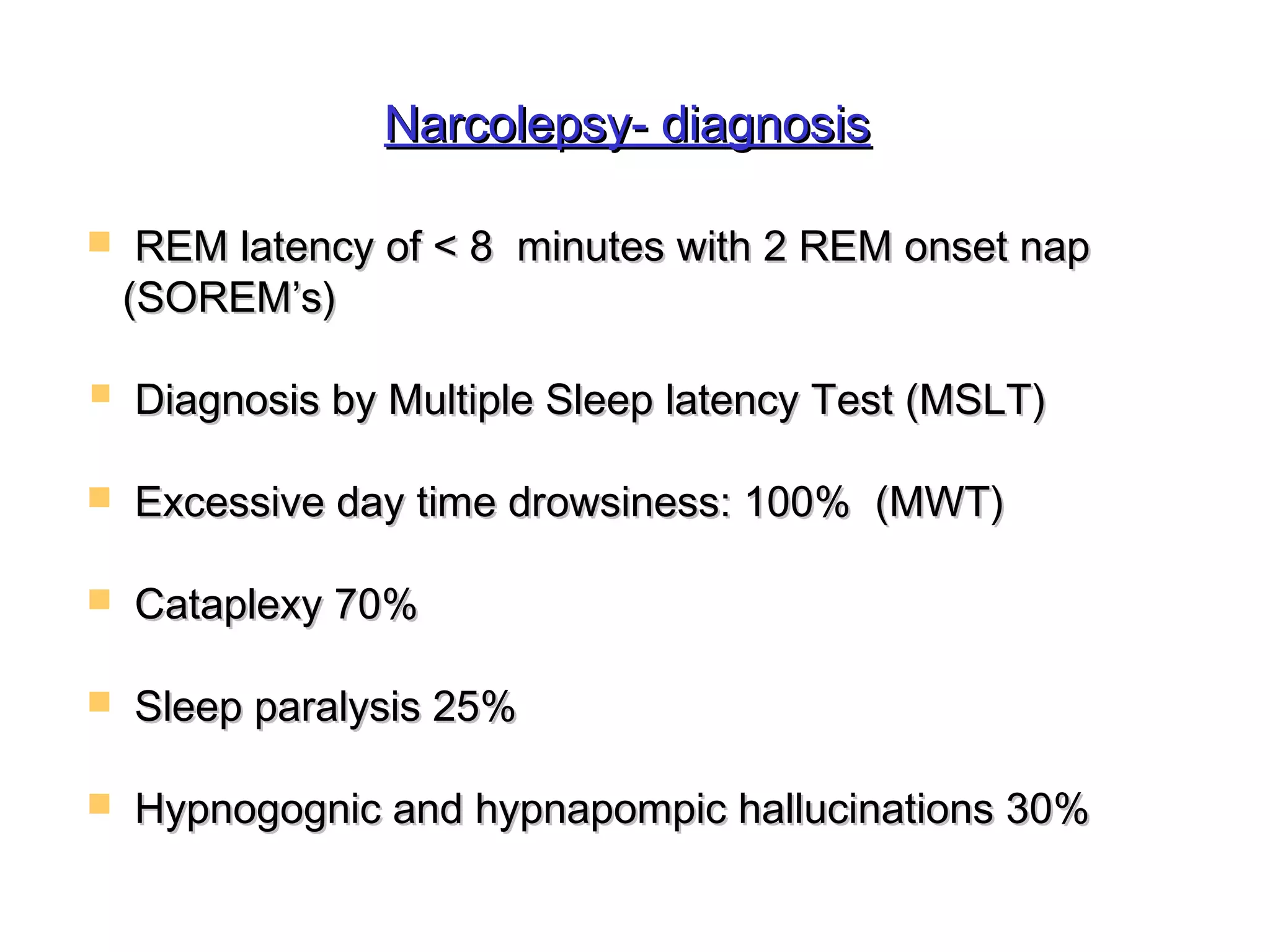
NNaarrccoolleeppssyy-- ddiiaaggnnoossiiss 
 RREEMM llaatteennccyy ooff << 88 mmiinnuutteess wwiitthh 22 RREEMM oonnsseett nnaapp 
((SSOORREEMM’’ss)) 
 DDiiaaggnnoossiiss bbyy MMuullttiippllee SSlleeeepp llaatteennccyy TTeesstt ((MMSSLLTT)) 
 EExxcceessssiivvee ddaayy ttiimmee ddrroowwssiinneessss:: 110000%% ((MMWWTT)) 
 CCaattaapplleexxyy 7700%% 
 SSlleeeepp ppaarraallyyssiiss 2255%% 
 HHyyppnnooggooggnniicc aanndd hhyyppnnaappoommppiicc hhaalllluucciinnaattiioonnss 3300%%
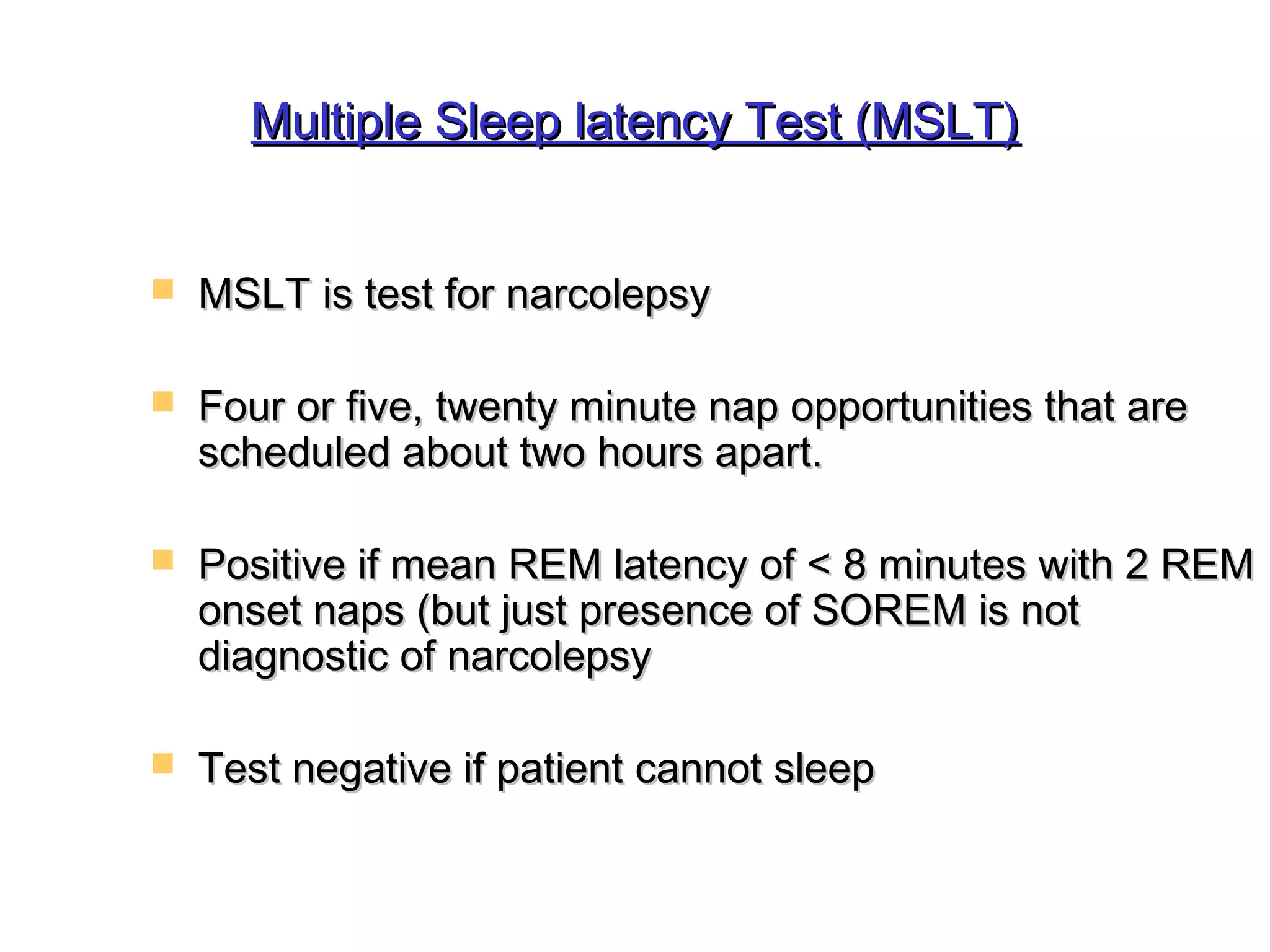
Multiple SSlleeeepp llaatteennccyy TTeesstt ((MMSSLLTT)) 
 MMSSLLTT iiss tteesstt ffoorr nnaarrccoolleeppssyy 
 FFoouurr oorr ffiivvee,, ttwweennttyy mmiinnuuttee nnaapp ooppppoorrttuunniittiieess tthhaatt aarree 
sscchheedduulleedd aabboouutt ttwwoo hhoouurrss aappaarrtt.. 
 PPoossiittiivvee iiff mmeeaann RREEMM llaatteennccyy ooff << 88 mmiinnuutteess wwiitthh 22 RREEMM 
oonnsseett nnaappss ((bbuutt jjuusstt pprreesseennccee ooff SSOORREEMM iiss nnoott 
ddiiaaggnnoossttiicc ooff nnaarrccoolleeppssyy 
 TTeesstt nneeggaattiivvee iiff ppaattiieenntt ccaannnnoott sslleeeepp
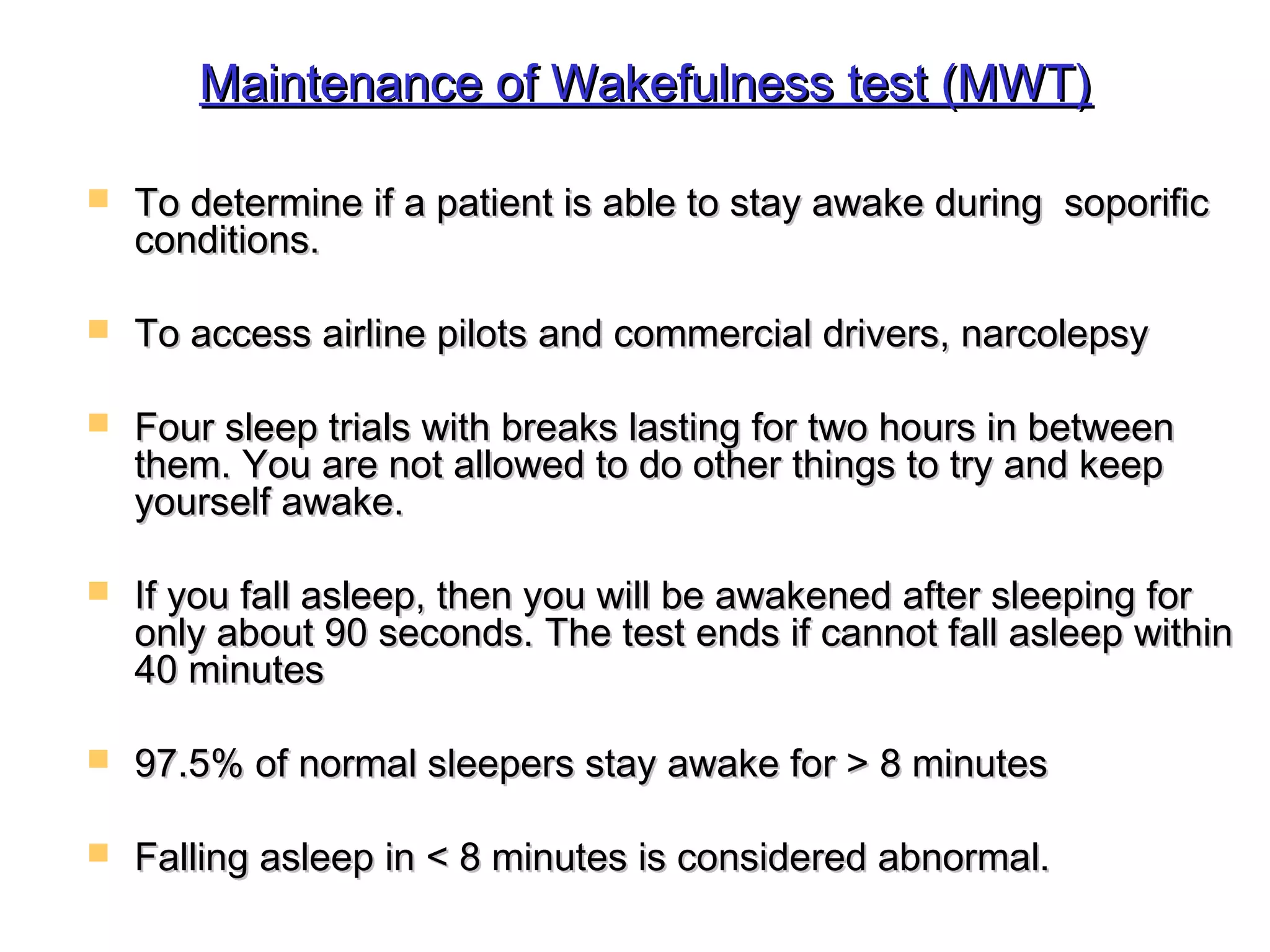
Maintenance ooff WWaakkeeffuullnneessss tteesstt ((MMWWTT)) 
 TToo ddeetteerrmmiinnee iiff aa ppaattiieenntt iiss aabbllee ttoo ssttaayy aawwaakkee dduurriinngg ssooppoorriiffiicc 
ccoonnddiittiioonnss.. 
 TToo aacccceessss aaiirrlliinnee ppiilloottss aanndd ccoommmmeerrcciiaall ddrriivveerrss,, nnaarrccoolleeppssyy 
 FFoouurr sslleeeepp ttrriiaallss wwiitthh bbrreeaakkss llaassttiinngg ffoorr ttwwoo hhoouurrss iinn bbeettwweeeenn 
tthheemm.. YYoouu aarree nnoott aalllloowweedd ttoo ddoo ootthheerr tthhiinnggss ttoo ttrryy aanndd kkeeeepp 
yyoouurrsseellff aawwaakkee.. 
 IIff yyoouu ffaallll aasslleeeepp,, tthheenn yyoouu wwiillll bbee aawwaakkeenneedd aafftteerr sslleeeeppiinngg ffoorr 
oonnllyy aabboouutt 9900 sseeccoonnddss.. TThhee tteesstt eennddss iiff ccaannnnoott ffaallll aasslleeeepp wwiitthhiinn 
4400 mmiinnuutteess 
 9977..55%% ooff nnoorrmmaall sslleeeeppeerrss ssttaayy aawwaakkee ffoorr >> 88 mmiinnuutteess 
 FFaalllliinngg aasslleeeepp iinn << 88 mmiinnuutteess iiss ccoonnssiiddeerreedd aabbnnoorrmmaall..
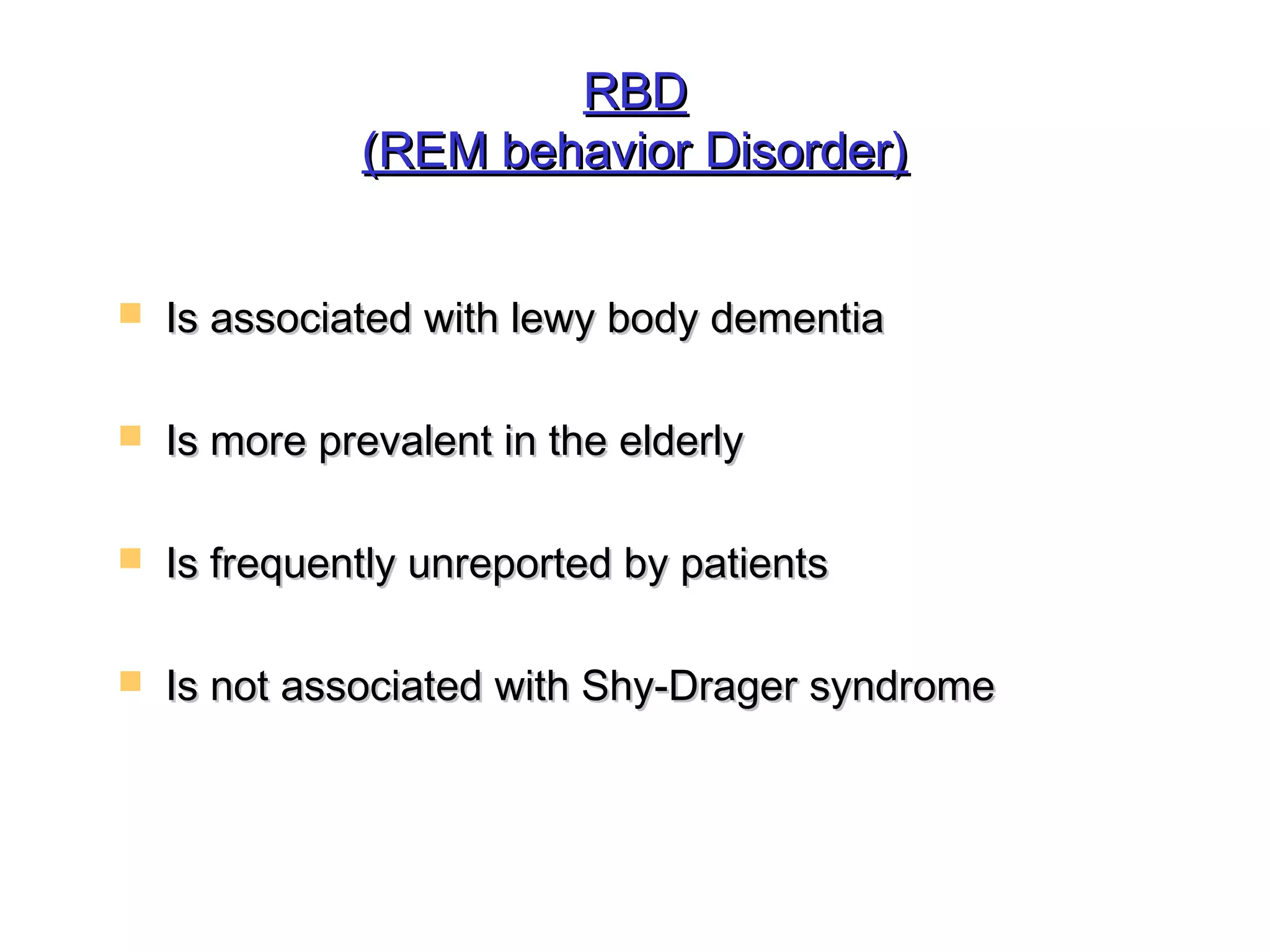
RRBBDD 
((RREEMM bbeehhaavviioorr DDiissoorrddeerr)) 
 IIss aassssoocciiaatteedd wwiitthh lleewwyy bbooddyy ddeemmeennttiiaa 
 IIss mmoorree pprreevvaalleenntt iinn tthhee eellddeerrllyy 
 IIss ffrreeqquueennttllyy uunnrreeppoorrtteedd bbyy ppaattiieennttss 
 IIss nnoott aassssoocciiaatteedd wwiitthh SShhyy--DDrraaggeerr ssyynnddrroommee
RReessttlleessss LLeegg SSyynnddrroommee ((RRLLSS)) 
 DDeessiirree ttoo mmoovvee lleeggss wwhheenn sslleeeeppyy ((‘‘ppaarraasstthheessiiaa’’)) 
 WWoorrsstt aatt rreesstt bbeetttteerr wwiitthh aaccttiivviittyy 
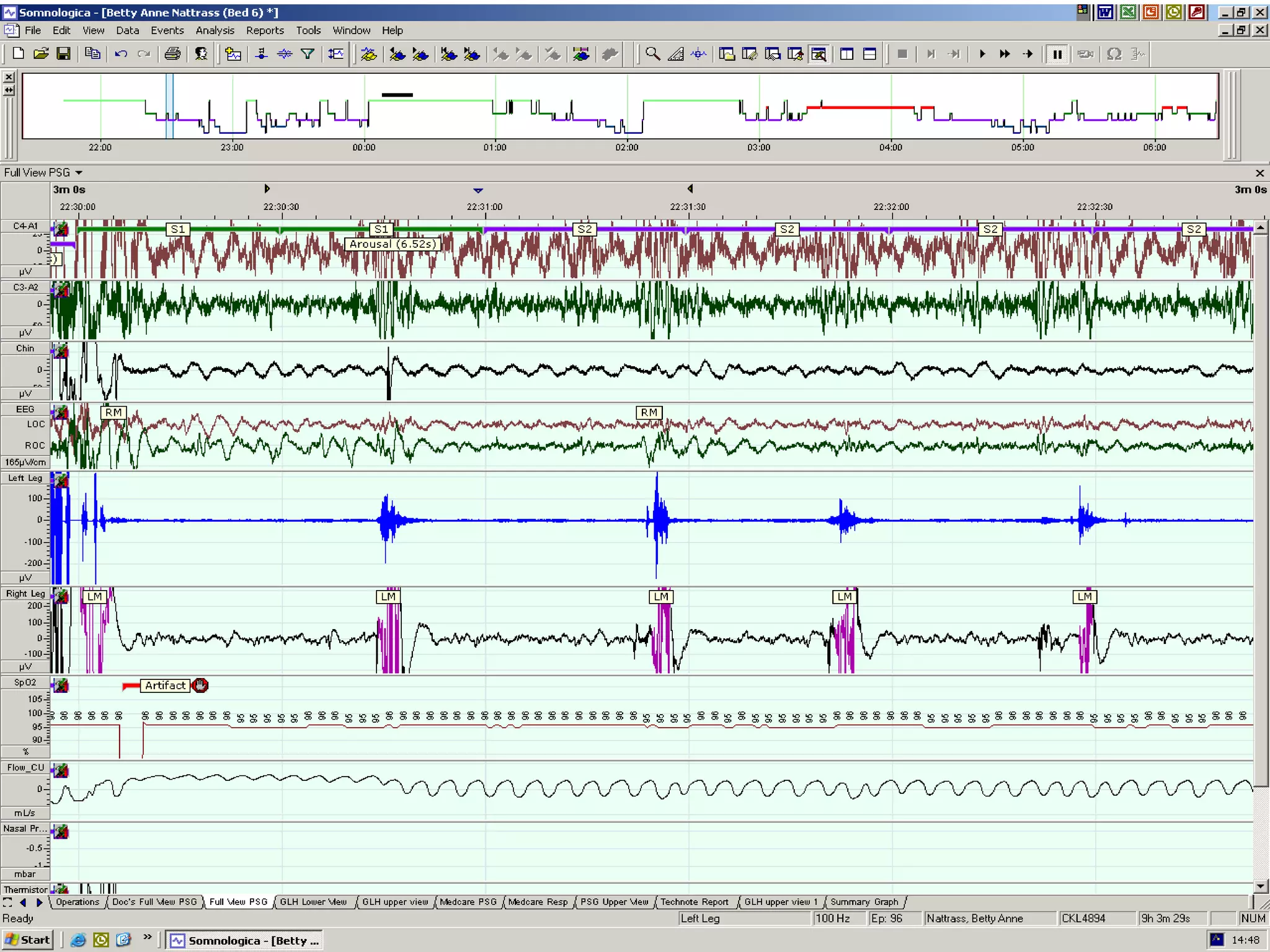
 PPLLMMSS iinn rreeppeettiittiivvee fflleexxiioonn ooff lleeggss 00..55 ttoo 55 sseeccoonnddss iinn 
dduurraattiioonn eevveerryy 2200--4400 sseeccoonnddss 
 PPLLMMSS iiss tthhee PPSSGG ffiinnddiinngg iinn RRLLSS 
 8800%% ooff RRLLSS hhaavvee PPLLMMSS,, 5500%% ooff ppaattiieennttss wwiitthh PPLLMMSS 
hhaavvee RRLLSS
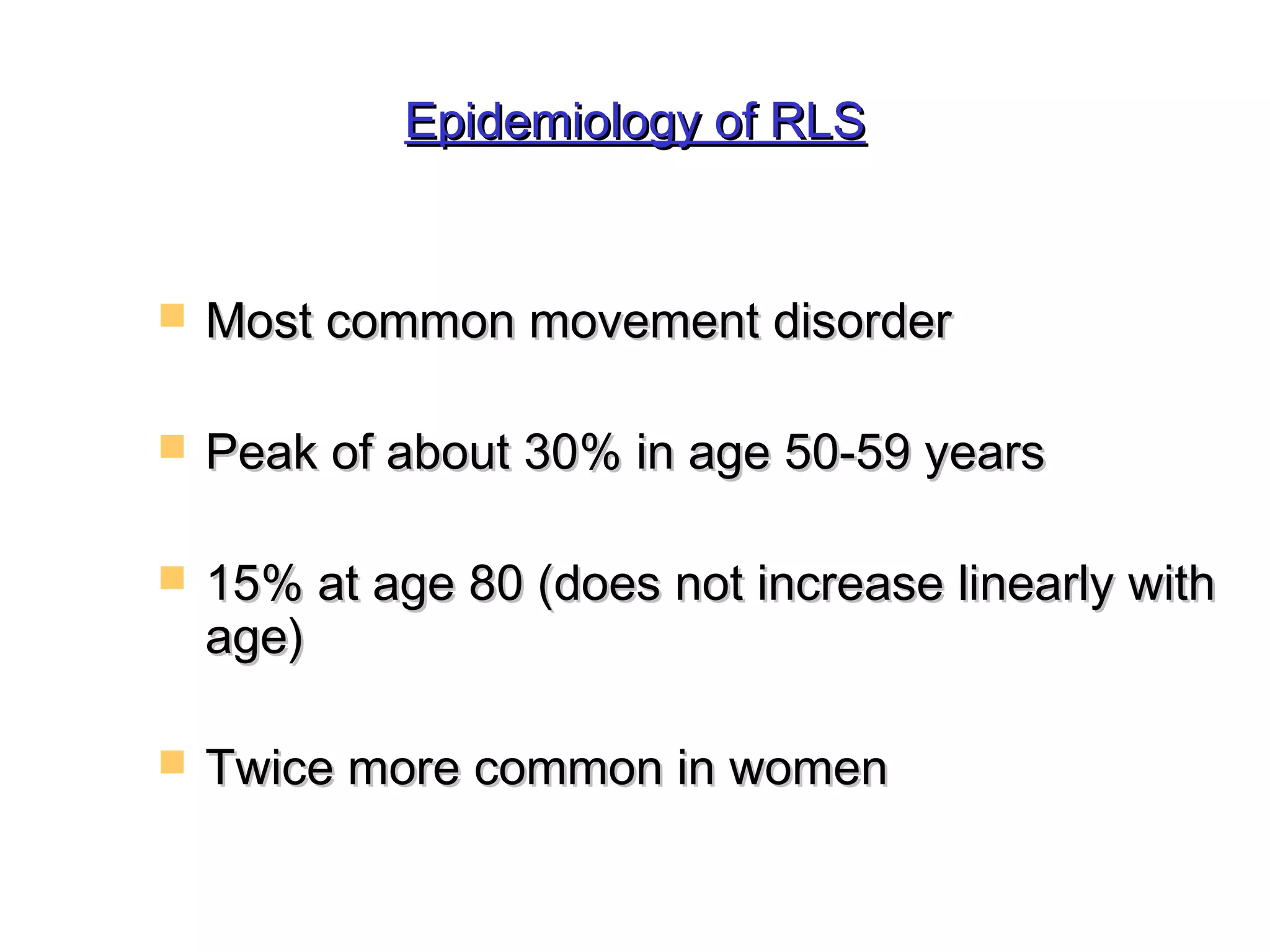
EEppiiddeemmiioollooggyy ooff RRLLSS 
 MMoosstt ccoommmmoonn mmoovveemmeenntt ddiissoorrddeerr 
 PPeeaakk ooff aabboouutt 3300%% iinn aaggee 5500--5599 yyeeaarrss 
 1155%% aatt aaggee 8800 ((ddooeess nnoott iinnccrreeaassee lliinneeaarrllyy wwiitthh 
aaggee)) 
 TTwwiiccee mmoorree ccoommmmoonn iinn wwoommeenn
AAssssoocciiaattiioonnss 
IIrroonn ddeeffiicciieennccyy 
 FFrroomm aannyy ccaauussee 
 MMoorree ccoommmmoonn iinn rreeppeeaatt bblloooodd ddoonnoorrss 
EESSRRFF 1155 ttoo 4400%% 
 ?? DDuuee ttoo aanneemmiiaa ((EEPPOO hheellppss)) 
 ?? DDuuee ttoo ppeerriipphheerraall nneeuurrooppaatthhyy 
((iimmpprroovveess wwiitthh ddiiaallyyssiiss)) 
OOtthheerrss 
 FFiibbrroommyyaallggiiaa,, DDiiaabbeetteess,, ddrruuggss ((SSSSRRII’’ss,, TTCCAA))
TTrreeaattmmeenntt ooff RRLLSS 
LL -- ddooppaa 
 EEffffiiccaaccyy ggoooodd BBUUTT 
 22 mmaajjoorr ssiiddee eeffffeeccttss 
 MMoorrnniinngg rreebboouunndd 
 AAuuggmmeennttaattiioonn ((iinn 8811%% )) 
- sshhiiffttiinngg ooff ssyymmppttoommss eeaarrlliieerr dduurriinngg tthhee ddaayy 
- SSyymmppttoommss aaffffeeccttiinngg pprreevviioouussllyy uunnaaffffeecctteedd ppaarrttss
Dopaminergic agonists ((eerrggoott ddeerriivvaattiivveess)) 
AAllll hhaavvee SSEE ooff nnaauusseeaa aanndd ppoossttuurraall hhyyppootteennssiioonn 
BBrroommooccrryyppttiinnee ((DD22 rreecceeppttoorr aaggoonniisstt)) 
 HHaallff lliiffee 33 ttoo 88 hhoouurrss 
PPeerrggoolliiddee (( DD22 rreecceeppttoorr aaggoonniisstt)) 
 HHaallff lliiffee 77--1166 hhoouurrss 
CCaarrbbeeggoolliinnee:: 
 HHaallff lliiffee 6655 hhoouurrss
Dopaminergic agonists (NNoonn EErrggoott ddeerriivvaattiivveess)) 
LLeessss SSiiddee eeffffeeccttss ooff nnaauusseeaa,, ppoossttuurraall hhyyppootteennssiioonn 
PPrraammiippeexxoollee(( DD33 rreecceeppttoorr aaggoonniisstt)) 
 LLoonngg tteerrmm eeffffiiccaaccyy NNOOTT ddeeccrreeaasseedd eevveenn aafftteerr 77..88 
mmoonntthhss 
 SSuussttaaiinneedd eeffffiiccaaccyy ooff >> 9900%% wwiitthh aauuggmmeennttaattiioonn iinn 
oonnllyy 3300%%.. 
RRooppiinniirroollee

Sleep Study Interpretation

  • 1.
    FRACP Teaching 2014 Sleep For Exams
  • 2.
    AAbbnnoorrmmaall sslleeeepp ddiissoorrddeerrss  DDIIMMSS ((ddiissoorrddeerr ooff iinniittiiaattiioonn aanndd mmaaiinntteennaannccee ooff sslleeeepp))  DDOOEESS ((ddiissoorrddeerrss ooff eexxcceessssiivvee sslleeeeppiinneessss)) -- nnoott eennoouugghh sslleeeepp -- OOSSAA -- NNaarrccoolleeppssyy -- PPLLMMSS//RRLLSS  PPaarraassoommnniiaass ((AAbbnnoorrmmaall bbeehhaavviioorr dduurriinngg sslleeeepp)) -- NNRREEMM ((sslleeeepp wwaallkkiinngg// nniigghhtt tteerrrroorrss)) -- RREEMM ((nniigghhttmmaarreess,, RREEMM sslleeeepp bbeehhaavviioorr ddiissoorrddeerrss))
  • 3.
    SSlleeeepp WWaakkee CCyyccllee  NNRREEMM RReellaattiivveellyy iinnaaccttiivvee yyeett aaccttiivveellyy rreegguullaattiinngg bbrraaiinn iinn aa mmoovvaabbllee bbooddyy SSttaaggee 11((ddrroowwssiinneessss)) 55%% SSlloowwiinngg ooff aallpphhaa ttoo tthheettaa SSllooww rroolllliinngg eeyyee mmoovveemmeennttss SSttaaggee 22 ((lliigghhtt sslleeeepp)) 5500%% SSlleeeepp SSppiinnddlleess aanndd KK CCoommpplleexxeess SSttaaggee 33 aanndd 44 ((ddeeeepp sslleeeepp)) 2200%% DDeellttaa wwaavveess
  • 5.
    SSlleeeepp-- WWaakkee CCyyccllee WWhhaatt iiss nnoorrmmaall ??  Sleep enters through NREM (slow wave sleep)  Alternates with REM about every 90 minutes  SWS in first 1/3 rd of night and REM in last 1/3rd  REM peaks in early hours of morning which coincides with trough of body temperature
  • 6.
    RREEMM SSlleeeepp RREEMM sslleeeepp :: HHiigghhllyy aaccttiivvaatteedd bbrraaiinn iinn aa ppaarraallyyzzeedd bbooddyy  SSaaww ttooootthh EEEEGG  DDrreeaammiinngg  AAttoonniiaa  PPhhaassiicc eevveennttss ((iirrrreegguullaarriittiieess iinn HHRR aanndd rreessppiirraattiioonn)) Hallmark: Hypo-tonic, Hypo-ventilation, Hypo-tension
  • 7.
  • 8.
    Important nneeuurroo--ttrraannssmmiitttteerrss NNEEAAcchh WWaakkiinngg NNRREEMM TToonniicc RREEMM PPhhaassiicc RREEMM
  • 9.
    RReessppiirraattoorryy CChhaannggeess iinnRREEMM sslleeeepp WWiitthhddrraawwaall ooff nnoorraaddrreenneerrggiicc eexxcciittaattiioonn oonn uuppppeerr aaiirrwwaayyss  SSuupppprreessssiioonn ooff aaccttiivviittyy ooff hhyyppoogglloossssaall mmoottoorr nneeuurroonnss  RReedduucceedd aaccttiivviittyy ooff ggeenniioohhyyooiidd aanndd ggeennoogglloossssuuss -- IInnccrreeaasseedd uuppppeerr aaiirrwwaayy rreessiissttaannccee  AAttoonniiaa ooff iinntteerrccoossttaall mmuusscclleess -- ppaarraaddooxxiiccaall cchheesstt ccoollllaappssee dduurriinngg iinnssppiirraattiioonn  DDeeccrreeaasseedd ddiiaapphhrraaggmmaattiicc aaccttiivviittyy
  • 10.
    CChhaannggeess iinn sslleeeeppwwiitthh AAGGEE  SSWWSS ddeeccrreeaasseess wwiitthh aaggee aafftteerr aaggee 2200------ bbiioommaarrkkeerr aaggeeiinngg CCNNSS  RREEMM ccoonnssttaanntt aafftteerr iinnffaannccyy  WWAASSOO iinnccrreeaasseess wwiitthh aaggee  RREEMM llaatteennccyy rreedduucceess wwiitthh aaggee ((eeaarrllyy oonnsseett RREEMM))
  • 11.
    FFaaccttoorrss mmooddiiffyyiinngg sslleeeeppssttaaggeess cctt.... RReeccoovveerryy ffrroomm sslleeeepp lloossss (( ee..gg.. OOSSAA ssttaarrtteedd oonn CCPPAAPP))  11sstt nniigghhtt SSWWSS rreeccoovveerrss  22nndd nniigghhtt RREEMM rreeccoovveerrss wwiitthh RREEMM rreebboouunndd  SSOORREEMMSS iiff cchhrroonniicc sslleeeepp rreessttrriiccttiioonn ((mmiimmiicc nnaarrccoolleeppssyy)) DDrruuggss aanndd ddrruugg wwiitthhddrraawwaallss  BBeennzzoo’’ss ssuupppprreessss SSWWSS  TTCCAA//MMAAOOII’’ss ssuupppprreessss RREEMM ((wwiitthhddrraawwaall ccaauusseess SSOORREEMMSS))  AAllccoohhooll RREEMM ssuupppprreessssiioonn ffoolllloowweedd bbyy RREEMM rreebboouunndd  CChhrroonniicc TTHHCC –– lloonngg tteerrmm ssuupppprreessssiioonn ooff SSWWSS ((““aaggeeiinngg””))
  • 12.
    SSlleeeepp iinn OOSSAA bbeeffoorree aanndd aafftteerr CCPPAAPP Before: Lots of SWS / Arousals Minimal REM 2nd night of CPAP: REM rebound
  • 14.
  • 15.
    WWhhaatt hhaappppeennss iinnOOSSAA  NNaarrrroowwiinngg ooff aaiirrwwaayyss ++ AAiirrwwaayy CCoollllaappssee ((BBeerroonniillll’’ee pprriinncciippllee))  IInnccrreeaasseedd eeffffoorrtt  SSyymmppaatthheettiicc oouuttppoouurriinngg ((‘‘ccaauussee ffoorr mmoosstt hhaarrmm’’))  DDee--ssaattuurraattiioonnss  AArroouussaall  PPoooorr sslleeeepp ((eeffffoorrtt ooff bbrreeaatthhiinngg aanndd aarroouussaallss ddiissttuurrbbss sslleeeepp nnoott tthhee hhyyppooxxiiaa ))
  • 16.
    TTeerrmmiinnoollooggyy  Obstructivesleep apnoea (OSA) AHI: Apnoea and hypopnoea per hour RDI: Respiratory disturbance index (AHI + RERA) 5-15 mild, 15-30 moderate, > 30 severe  Obstructive sleep apnoea syndrome (OSAS) OSA + Excessive somnolence and its squeal (Impaired concentration/ irritability, snoring with witnessed apnoea, nocturia)
  • 18.
    Repetitive partial /complete closure of pharynx during sleep Recurrent Arousals Day time drowsiness….. Recurrent nocturnal hypoxemia Fragmented sleep “Floppy airway” Reduced neural output Nocturnal sympathetic surges
  • 20.
    Who gets OSAS  Middle aged men (2-4% men and 1% women)  Overweight  Snorers  Collar size > 43 cm  Craniofacial abnormalities, retrognathia.  Large tonsils (large adenoids in chidhood)  Hypothyroidism  Alcohol…..  Neuromuscular disease  Rare: Acromegaly, Cushing's syndrome, Down's syndrome.
  • 21.
    Consequences of OSA  Excessive sleepiness - QOL, cognition, accidents  Loud snoring, witnessed apnoea and chocking  Feeling un-refreshed waking  Poor concentration/ irritability/ depression  Nocturia  Reduced libido  Hypertension  ? Cardiovascular disease  ? Metabolic syndrome
  • 22.
    SSiiggnnss iinn OOSSAA  SSlleeeeppiinneessss (( EEppwwoorrtthh sslleeeeppiinneessss ssccoorree))  OObbeessiittyy  CCrroowweedd PPhhaarryynnxx ((MMaallaappaattttii SSccoorree))  RReetteerrooggnnaatthhiiaa  CCoonnggeesstteedd nnoossee  HHyyppeerrtteennssiioonn
  • 23.
    Epworth sleepiness Score  Best available tool to guide clinicians to patient perception of sleepiness  Predicts level of compliance with CPAP  Guides to urgency of assessment
  • 24.
    Normal < 11 Mild 11- 14 Moderate 15-18 Severe > 18 Thorax 2011; 66(2):97-100
  • 25.
    Treatment options Improve upper airway: Weight reduction, tonsillar surgery, Bariatic surgery  CPAP: acts as a pneumatic splint (Compliance !!!)  Dental devices (‘MAD’): As good as CPAP in mild-moderate OSA, better tolerated  Surgery: UPPP, RF tissue reduction, Tracheotomy  Others: Avoid alcohol, sleep on side (‘tennis balls’, postural alarm, special pillows)
  • 26.
    Adherence to CPAP Non-compliance: use < 4 hours a night (30% - 80%)  Adherences during the first week…  Severity of OSA (a weak relationship)  Degree of day time sleepiness (strong relationship)  Level of education….  Psychological traits: optimism, motivation to engage in healthy behaviour ( ‘healthy user effect’)
  • 27.
    What about OSA,CPAP and The heart ?
  • 28.
    Association of OSAwith Hypertension JAMA:2012;307:2169  37% developed HT at 12 years  Dose response effect
  • 29.
    Is CPAP usefulin Hypertension ?.....Yes BUT…..  Reduction in mean BP is only small (- 2.5mm vs. + 0.8mm) at 4 weeks  Greater decrease among severe OSA (- 3.3mm)  Reduction in BP less than with anti-hypertensive (Lorstatan vs. CPAP: -9mm vs. -2.1mm)  Reduction in BP is less in non-sleepy than in sleepy patients Lancet 2002:359;204 AJRCCM 2010:182:954
  • 30.
    Effects of CPAPin HT with non-sleepy OSA SBP reduced by -1.8 mm at 1 year DBP reduced by – 2.1mm
  • 31.
    CPAP more usefulin reducing BP in sleepy than in non- sleepy OSA  In most studies patients who did not have excessive day time drowsiness had NO reduction in the BP with CPAP  In sleepy patients benefits with CPAP seen even within 4 weeks of treatment, whereas non-sleepy patients need CPAP for longer to achieve a smaller reduction in BP
  • 32.
    OSA and Coronaryheart disease: The Sleep Heart Health study: 10 years follow up 1927 males 2495 females OSA was predictor of incident CHD only in men, BUT after adjustment for diabetes, lipids, hypertension and anti-hypertensive medication use, the association was not Circulation 2010:122:352-360 statistically significant in any group.
  • 33.
    OSA and CHD  Association of OSA with incident CHD (Myocardial infarction, re-vascularisation and coronary heart disease death) is equivocal
  • 34.
    OSA and cardiovascularevents: Observational 10 years study in 1651 men Stroke, MI, re-vascularisation, CABG Lancet 2005: 365;1046-53 ? Independent risk factor ? Just an association Therapeutic CPAP itself reduces adiposity
  • 35.
    OSA and Cardiovasculardisease  CPAP in severe OSA may reduce cardiovascular events BUT…  No RCT that prove that CPAP improves mortality  No clinical trials to support routine use of CPAP in OSA for sole purpose of reducing cardiovascular events  ‘Healthy User effect’ could effect outcomes in studies Chest 2010; Study of the healthy user effect in OSA
  • 36.
    OSA and Heartfailure: The Sleep Heart Health study: 10 years follow up 1927 males 2495 females OSA predicted incident heart failure in men but not in women Circulation 2010:122:352-360
  • 37.
    Does CPAP improveheart function ? All had AHI > 15 and day time drowsiness (ESS >11)
  • 38.
    Does CPAP improveheart function ?  All had excessive day time drowsiness (ESS > 11)  No control group---- diet, exercise, changes in medications and medication adherence could be effected by close monitoring in the study  Natural history of CMRI in OSA is not known  CPAP adherence was 100% ( 52/52) ( “Healthy user effect”)
  • 39.
    OSA and arrhythmia  Recurrence of AF (at 1 year) after cardio version  Non OSA patients------- 52 % recurrence  Untreated OSA------ 82%  Treated with CPAP---- 42%  CPAP most useful for abolishing nocturnal ventricular asystole and bradycardia ( ? effect on mortality)  If observed nocturnal arrhythmia– think OSA !!
  • 40.
    OSA and PulmonaryHT  Risk only if co-existent day time hypoxemia (i.e. associated chronic lung disease)  Treatment with CPAP causes only very modest reduction in PASP (from 29 mm to 24mm) Eur Heart J 2006:27:1106  Evidence of improved mortality is lacking  Pulmonary HT alone is NOT an indication for diagnostic evaluation of OSA
  • 41.
    Benefits of CPAPin OSA The evidence !!  Decreased day time sleepiness  Improved quality of life  Improves cognitive function  Improves resistant hypertension  Improves heart function in heart failure  Reduces cardiovascular events  Improves metabolic abnormalities  Reduces mortality ?????
  • 48.
    WWiitthh rreeggaarrddss ttooCChheeyynnee ––SSttookkeess rreessppiirraattiioonn  CCaann ooccccuurr aatt sslleeeepp oonnsseett iinn 4400--8800%% nnoorrmmaall ssuubbjjeeccttss ((SSeett ppooiinntt ooff vveennttiillaattiioonn ddiiffffeerreenntt iinn sslleeeepp vvss.. wwaakkeeffuullnneessss))  CCaann bbee sseeeenn iinn cceerreebbrroo--vvaassccuullaarr ddiisseeaassee aanndd hheeaarrtt ffaaiilluurree ((eennhhaanncceedd vveennttiillaattoorryy rreessppoonnssee ttoo CC0022))  IInnccrreeaasseedd cciirrccuullaattiioonn ttiimmee nnoott iimmppoorrttaanntt  IIss nnoott aallwwaayyss iimmpprroovveedd wwiitthh ccaarrddiiaacc ttrraannssppllaanntt aanndd nnoorrmmaalliizzaattiioonn ooff ccaarrddiiaacc ffuunnccttiioonn
  • 53.
     A 54year old morbidly obese man wwaass rreeffeerrrreedd ttoo tthhee SSlleeeepp DDiissoorrddeerrss CClliinniicc bbeeccaauussee ooff hhyyppeerrssoommnnoolleennccee aanndd ssuussppiicciioonn ooff oobbssttrruuccttiivvee sslleeeepp aappnneeaa.. HHee ccoommppllaaiinneedd ooff hhaabbiittuuaall lloouudd aanndd ddiissrruuppttiivvee ssnnoorriinngg,, ffrreeqquueenntt nnooccttuurrnnaall cchhookkiinngg eeppiissooddeess aanndd wwiittnneesssseedd aappnneeaass ffoorr tthhee ppaasstt 88 yyeeaarrss.. HHee hhaadd ggaaiinneedd aapppprrooxxiimmaatteellyy 4455 kkgg iinn tthhee llaasstt 1100 yyeeaarrss.. TThhee EEppwwoorrtthh SSlleeeeppiinneessss SSccoorree wwaass 116//2244..  PPaasstt mmeeddiiccaall hhiissttoorryy:: hhyyppeerrtteennssiioonn aanndd ttyyppee 22 ddiiaabbeetteess..  MMeeddiiccaattiioonnss iinncclluuddee mmeettffoorrmmiinn,, hhyyddrroocchhlloorrootthhiiaazziiddee aanndd lliissiinnoopprriill 4400 mmgg ddaaiillyy..  BBMMII ooff 4455..44 kkgg//mm22.. OOrraall eexxaammiinnaattiioonn ddeemmoonnssttrraatteedd MMaallllaammppaattii ccllaassss 44 aaiirrwwaayy.. TThhee nneecckk cciirrccuummffeerreennccee wwaass 5511 ccmm.. RRoooomm aaiirr ppuullssee ooxxiimmeettrryy wwaass 9911%% wwhhiillee ssiittttiinngg aanndd rreessttiinngg..  LLaabb:: SSeerruumm bbiiccaarrbboonnaattee nnootteedd ttoo bbee eelleevvaatteedd aatt 336 mmeeqq
  • 54.
    Which of thefollowing ffeeaattuurreess hhaass bbeeeenn sshhoowwnn ttoo bbee pprreeddiiccttiivvee ooff oobbeessiittyy hhyyppoovveennttiillaattiioonn ssyynnddrroommee ((OOHHSS))??  AA..BBMMII>>3355 kkgg//mm  BB.. PPeerriipphheerraall eeddeemmaa  CC.. NNeecckk cciirrccuummffeerreennccee ooff 5511 ccmm  DD.. MMaallllaammppaattii ccllaassss IIVV aaiirrwwaayy  EE.. SSeerruumm bbiiccaarrbboonnaattee aabboovvee tthhee uuppppeerr lliimmiittss ooff nnoorrmmaall Hypercapnic OSA = OHS
  • 55.
    Which is themost aapppprroopprriiaattee nneexxtt sstteepp iinn tthhee ccaarree ooff tthhiiss ppaattiieenntt??  AA.. NNooccttuurrnnaall hhoommee ooxxyyggeenn eevvaalluuaattiioonn  BB.. TTrraacchheeoossttoommyy  CC.. PPoollyyssoommnnooggrraamm wwiitthh ttiittrraattiioonn ooff bbii--lleevveell ppoossiittiivvee aaiirrwwaayy pprreessssuurree oonnllyy  DD.. PPoollyyssoommnnooggrraamm wwiitthh ttiittrraattiioonn ooff ccoonnttiinnuuoouuss ppoossiittiivvee aaiirrwwaayy pprreessssuurree,, ffoolllloowweedd bbyy bbii--lleevveell ppoossiittiivvee aaiirrwwaayy pprreessssuurree,, iiff nneecceessssaarryy  EE.. Gaassttrriicc bbyyppaassss ssuurrggeerryy
  • 56.
    All of thefollowing wwoouulldd aallssoo bbee ppaarrtt ooff aann aapppprroopprriiaattee wwoorrkkuupp iinn tthhiiss ppaattiieenntt eexxcceepptt::  AA.. PPuullmmoonnaarryy ffuunnccttiioonn tteessttss  BB.. CCoommpplleettee bblloooodd ccoouunntt  CC.. CChheesstt iimmaaggiinngg  DD.. MMuullttiippllee sslleeeepp llaatteennccyy tteesstt  EE.. TThhyyrrooiidd ssttiimmuullaattiinngg hhoorrmmoonnee
  • 57.
    CPAP treatment isinitiated ffoorr aa ppaattiieenntt.. SShhee rreettuurrnnss 11 mmoonntthh aafftteerr ssttaarrttiinngg ttrreeaattmmeenntt bbuutt ccoommppllaaiinnss ooff ccoonnttiinnuueedd ddaayyttiimmee sslleeeeppiinneessss.. WWhhiicchh ooff tthhee ffoolllloowwiinngg iinniittiiaall ddaattaa wwoouulldd bbee mmoosstt hheellppffuull ffoorr ddeetteerrmmiinniinngg tthhee nneexxtt sstteepp iinn hheerr mmaannaaggeemmeenntt??  AA.. RReeppeeaatt MMSSLLTT aafftteerr aa PPSSG oonn CCPPAAPP  BB.. MMaaiinntteennaannccee ooff wwaakkeeffuullnneessss tteesstt  CC ..SSlleeeepp lloogg  DD.. CCoommpplliiaannccee rreeppoorrtt  EE.. RReeppeeaatt CCPPAAPP ttiittrraattiioonn
  • 58.
    Which of thefollowing symptoms, iiff pprreesseenntt,, wwoouulldd bbee mmoosstt iinnddiiccaattiivvee ooff nnaarrccoolleeppssyy??  AA.. HHyyppnnaaggooggiicc hhaalllluucciinnaattiioonnss  BB.. CCaattaapplleexxyy  CC.. SSlleeeepp ppaarraallyyssiiss  DD.. AAuuttoommaattiicc bbeehhaavviioorrss  EE.. HHyyppnnooppoommppiicc hhaalllluucciinnaattiioonnss
  • 59.
    NNaarrccoolleeppssyy  RREEMMiinnttrruussiioonnss dduurriinngg wwaakkeeffuullnneessss  2200--4400 ttiimmeess ggrreeaatteerr rriisskk ooff ffaammiillyy hhiissttoorryy  1100--2200%% ccoonnccoorrddaanncceess iinn iiddeennttiiccaall ttwwiinnss  110000%% hhaavvee HHLLAADDQQBB11..00660022 ((bbuutt ssoo ddoo 1100--2200%% ooff nnoorrmmaall ppooppuullaattiioonn))  AAggee ooff oonnsseett 6600%% 1111--2200 yyeeaarrss,, 2255%% 2200--4400 yyeeaarrss
  • 60.
    NNaarrccoolleeppssyy-- ddiiaaggnnoossiiss RREEMM llaatteennccyy ooff << 88 mmiinnuutteess wwiitthh 22 RREEMM oonnsseett nnaapp ((SSOORREEMM’’ss))  DDiiaaggnnoossiiss bbyy MMuullttiippllee SSlleeeepp llaatteennccyy TTeesstt ((MMSSLLTT))  EExxcceessssiivvee ddaayy ttiimmee ddrroowwssiinneessss:: 110000%% ((MMWWTT))  CCaattaapplleexxyy 7700%%  SSlleeeepp ppaarraallyyssiiss 2255%%  HHyyppnnooggooggnniicc aanndd hhyyppnnaappoommppiicc hhaalllluucciinnaattiioonnss 3300%%
  • 61.
    Multiple SSlleeeepp llaatteennccyyTTeesstt ((MMSSLLTT))  MMSSLLTT iiss tteesstt ffoorr nnaarrccoolleeppssyy  FFoouurr oorr ffiivvee,, ttwweennttyy mmiinnuuttee nnaapp ooppppoorrttuunniittiieess tthhaatt aarree sscchheedduulleedd aabboouutt ttwwoo hhoouurrss aappaarrtt..  PPoossiittiivvee iiff mmeeaann RREEMM llaatteennccyy ooff << 88 mmiinnuutteess wwiitthh 22 RREEMM oonnsseett nnaappss ((bbuutt jjuusstt pprreesseennccee ooff SSOORREEMM iiss nnoott ddiiaaggnnoossttiicc ooff nnaarrccoolleeppssyy  TTeesstt nneeggaattiivvee iiff ppaattiieenntt ccaannnnoott sslleeeepp
  • 62.
    Maintenance ooff WWaakkeeffuullnneesssstteesstt ((MMWWTT))  TToo ddeetteerrmmiinnee iiff aa ppaattiieenntt iiss aabbllee ttoo ssttaayy aawwaakkee dduurriinngg ssooppoorriiffiicc ccoonnddiittiioonnss..  TToo aacccceessss aaiirrlliinnee ppiilloottss aanndd ccoommmmeerrcciiaall ddrriivveerrss,, nnaarrccoolleeppssyy  FFoouurr sslleeeepp ttrriiaallss wwiitthh bbrreeaakkss llaassttiinngg ffoorr ttwwoo hhoouurrss iinn bbeettwweeeenn tthheemm.. YYoouu aarree nnoott aalllloowweedd ttoo ddoo ootthheerr tthhiinnggss ttoo ttrryy aanndd kkeeeepp yyoouurrsseellff aawwaakkee..  IIff yyoouu ffaallll aasslleeeepp,, tthheenn yyoouu wwiillll bbee aawwaakkeenneedd aafftteerr sslleeeeppiinngg ffoorr oonnllyy aabboouutt 9900 sseeccoonnddss.. TThhee tteesstt eennddss iiff ccaannnnoott ffaallll aasslleeeepp wwiitthhiinn 4400 mmiinnuutteess  9977..55%% ooff nnoorrmmaall sslleeeeppeerrss ssttaayy aawwaakkee ffoorr >> 88 mmiinnuutteess  FFaalllliinngg aasslleeeepp iinn << 88 mmiinnuutteess iiss ccoonnssiiddeerreedd aabbnnoorrmmaall..
  • 63.
    RRBBDD ((RREEMM bbeehhaavviioorrDDiissoorrddeerr))  IIss aassssoocciiaatteedd wwiitthh lleewwyy bbooddyy ddeemmeennttiiaa  IIss mmoorree pprreevvaalleenntt iinn tthhee eellddeerrllyy  IIss ffrreeqquueennttllyy uunnrreeppoorrtteedd bbyy ppaattiieennttss  IIss nnoott aassssoocciiaatteedd wwiitthh SShhyy--DDrraaggeerr ssyynnddrroommee
  • 66.
    RReessttlleessss LLeegg SSyynnddrroommee((RRLLSS))  DDeessiirree ttoo mmoovvee lleeggss wwhheenn sslleeeeppyy ((‘‘ppaarraasstthheessiiaa’’))  WWoorrsstt aatt rreesstt bbeetttteerr wwiitthh aaccttiivviittyy  PPLLMMSS iinn rreeppeettiittiivvee fflleexxiioonn ooff lleeggss 00..55 ttoo 55 sseeccoonnddss iinn dduurraattiioonn eevveerryy 2200--4400 sseeccoonnddss  PPLLMMSS iiss tthhee PPSSGG ffiinnddiinngg iinn RRLLSS  8800%% ooff RRLLSS hhaavvee PPLLMMSS,, 5500%% ooff ppaattiieennttss wwiitthh PPLLMMSS hhaavvee RRLLSS
  • 69.
    EEppiiddeemmiioollooggyy ooff RRLLSS  MMoosstt ccoommmmoonn mmoovveemmeenntt ddiissoorrddeerr  PPeeaakk ooff aabboouutt 3300%% iinn aaggee 5500--5599 yyeeaarrss  1155%% aatt aaggee 8800 ((ddooeess nnoott iinnccrreeaassee lliinneeaarrllyy wwiitthh aaggee))  TTwwiiccee mmoorree ccoommmmoonn iinn wwoommeenn
  • 70.
    AAssssoocciiaattiioonnss IIrroonn ddeeffiicciieennccyy  FFrroomm aannyy ccaauussee  MMoorree ccoommmmoonn iinn rreeppeeaatt bblloooodd ddoonnoorrss EESSRRFF 1155 ttoo 4400%%  ?? DDuuee ttoo aanneemmiiaa ((EEPPOO hheellppss))  ?? DDuuee ttoo ppeerriipphheerraall nneeuurrooppaatthhyy ((iimmpprroovveess wwiitthh ddiiaallyyssiiss)) OOtthheerrss  FFiibbrroommyyaallggiiaa,, DDiiaabbeetteess,, ddrruuggss ((SSSSRRII’’ss,, TTCCAA))
  • 71.
    TTrreeaattmmeenntt ooff RRLLSS LL -- ddooppaa  EEffffiiccaaccyy ggoooodd BBUUTT  22 mmaajjoorr ssiiddee eeffffeeccttss  MMoorrnniinngg rreebboouunndd  AAuuggmmeennttaattiioonn ((iinn 8811%% )) - sshhiiffttiinngg ooff ssyymmppttoommss eeaarrlliieerr dduurriinngg tthhee ddaayy - SSyymmppttoommss aaffffeeccttiinngg pprreevviioouussllyy uunnaaffffeecctteedd ppaarrttss
  • 72.
    Dopaminergic agonists ((eerrggoottddeerriivvaattiivveess)) AAllll hhaavvee SSEE ooff nnaauusseeaa aanndd ppoossttuurraall hhyyppootteennssiioonn BBrroommooccrryyppttiinnee ((DD22 rreecceeppttoorr aaggoonniisstt))  HHaallff lliiffee 33 ttoo 88 hhoouurrss PPeerrggoolliiddee (( DD22 rreecceeppttoorr aaggoonniisstt))  HHaallff lliiffee 77--1166 hhoouurrss CCaarrbbeeggoolliinnee::  HHaallff lliiffee 6655 hhoouurrss
  • 73.
    Dopaminergic agonists (NNoonnEErrggoott ddeerriivvaattiivveess)) LLeessss SSiiddee eeffffeeccttss ooff nnaauusseeaa,, ppoossttuurraall hhyyppootteennssiioonn PPrraammiippeexxoollee(( DD33 rreecceeppttoorr aaggoonniisstt))  LLoonngg tteerrmm eeffffiiccaaccyy NNOOTT ddeeccrreeaasseedd eevveenn aafftteerr 77..88 mmoonntthhss  SSuussttaaiinneedd eeffffiiccaaccyy ooff >> 9900%% wwiitthh aauuggmmeennttaattiioonn iinn oonnllyy 3300%%.. RRooppiinniirroollee

Editor's Notes

  • #4 Theta: low voltage- frequency 3-7 Hz Sleep spindles- burst of sinuusodial waves called sleep spindles delta-; high voltage slow frequency 0.5-2Hz
  • #6 In a young normal adult living in a conventional sleep wake cycle with no sleep complaints REM sleep predominates in last 1/3rd of night and is linked to circadian rhythm of body temperature. It coincides with the trough of body temperature
  • #7 Low amplitute mixed frequency Phasic events: REM, Irregularties with HR, respiration
  • #9 Sleep related cardiac events cause 20% of MI’s and 15% sudden cardiac deaths NREM- reduced sympathetic tone and heightened Vagal tone- bradycardia, reduced CO, reduced BP so some autonomic instability– normally BP FALLS in NREM sleep Aurosal from sleep also causes acute rise in NE causing raised BP REM- autonomic instability, central release of Cholinergic surges and increased autonomic tone is responsible for SIDS, arrhythmias , reduced coronary blood flow due to HR rise, BP surges In OSA once treated with CPAP- SWS rebound during first night- can precipitate hypotension if patient on anti hypertensive
  • #10 Withdrawal of serotonergic and noradrenergic excitation on upper airways and increased cholinergic transmission Suppression of activity of hypoglossal motor neurons so loss of tone of tounge Reduced activity of geniohyoid and sternohyoid
  • #11 SWS extremely early biomarker of ageing of CNS. The decline of SWS begins around age 20. Human life expectancy was 20-30 years. Decline in SWS could be a evolutionary remnant of initiation of ageing Healthy elderly people may not have any SWS WASO( wake time after sleep onset)- increases with age- fragmented sleep Older subjects shorter REM latency due to age dependent change in circadian timing systems. The core body temperature is phase advanced relative to sleep onset so early onset REM occurs
  • #12 If sleep loss for 1 or more nights Ist night SWS recovers, 2nd night REM recovers REM rebound during recovery ( eg OSA treated with CPAP- REM rebound- nightmares- increase REM related phenomenon&amp;apos;s of either apnea during REM or REM hypoventilation) if chronic sleep restriction- with recovery they get SOREM’s- can be associated with hallucinations/ sleep paralysis etc ( can mimic narcolepsy ) so sleep history important TCA/MAO withdrawl- cause SOREMS Alcohol- few pints THC- cause ageing for there CNS, politicians do not believe
  • #13 Ist night SWS recovers– risk of hypotension 2nd night REM rebound– arrythemias, hypotension, hypoventilation ( C02 retention)
  • #14 4 imporatant muscles genoglossus, genihyoid, sternohyoid- stabilises tongue/ hyoid Tensor veli palati0 stabilises palate Retroghathia they push mandible backward so narrow velopharynx
  • #15 Changes in the upper airways muscles during sleep
  • #16 The effort of breath which disturbs sleep and not the hypoxia ( seen in UARS– no hypoxia but arousal with flow limitation) Lot of harms of OSA caused by sympathetic outflow
  • #17 Apnoea: No flow for 10 seconds Hypopnea: A ≥30% drop from baseline in the nasal pressure transducer flow signal lasting at least 10 seconds and associated with a ≥4% desaturation AHI; Number of A and H per hour RERA: respiratory event related aurosals RDI: AHI + RERA; RDI; 5-15 mild, 15-30 moderate, &amp;gt; 30 severe– cut off arbitary Nocturia due to either:Raised atrial natriuretic peptide levels from increased central blood volume, resulting from low intrathoracic pressures during obstructed breathing The sleep fragmentation and disruption of the normal decrease in nocturnal urine production when asleep.
  • #19 Sleep fragmentation is due to repeated aurosaual and not due to low oxygen; Excessive somnolence, Impaired alertness, Poor cognition. Drop in O2 and inappropiate intrathoracic pressure swings causies incrteased ventilatory drive cauisng arousal and sudden opening of the airways (gasp of air) and rise in oxygen saturation Low oxygen causing pulmonary HT, arrythemias, polycenthemia etc
  • #21 More common in men due to different distribution of fat ( upper body obesity so incresaed neck circumfreence in men) compated to hip fat in women. Large adenoid in childhood could also cause retardation of growth of mandible and predispose to OSA Alcohol excaberates OSA, depresses CNS, worstens sllepiness, promotes weitht gain Neuromuscular disoredres: stroke, myotonic or Duchenne dystrophy, and motor neurone disease. Only OSA- rate is 24% in men and 9% women
  • #22 (measured with ESS) Nocturia---- Raised ANP from increased central blood volume due to low intra-thoracic pressure during obstructed breathing Sleep fragmentation causes disruption of normal decrease in urine production when asleep
  • #24 Other tools like Berlin questionnaire etc More sleepy– high risk of accidents etc
  • #25 Good for patients with English as second language. Has been validated 33% participais made erreors while completing traditional ESS 75% preferred pictorial va traditional ESS 65%
  • #26 CPAP- problems of claustrophobia, nasal congestion, pain and ulceration of bridge of nose UPPP- consists of removing part of the soft palate and tonsils and tightening up the side walls of the pharynx, are sometimes used in an attempt to improve snoring, although the benefit is unpredictable and limited- works ONLY IN MINORITY. However, a recent Cochrane review confirmed that it is not effective at treating obstructive sleep apnoea. [9]. It is also painful and can make subsequent use of nasal continuous positive airways pressure therapy more difficult. only partly successful in adults. PROBLEMS; Pian, nasal reflux, pharyngeal stenosis, dysphonia, infeection, bleeding. Tonsillectomy and adenoidectomy can be curative in children MAD– Protrude the mandible forward or hold tongue more anterior (Tounge retaining devices better tolerated in OSA and works by holding the lower jaw forward, patient MUST have his own teeth and is fitted by dentist Problems with MAD: jaw discomfort. Dry mouth, slaivation. They are contraindicated in patients with loose fitting teeth, poorly controlled epilepsy, or temporomandibular joint problems.
  • #27 Many CPAP machines contain meters that record the duration that the machine is turned on. This approach is limited by its inability to differentiate the duration that the patient is receiving CPAP therapy from the duration that the machine is simply turned on and potentially not being used. CPAP manufacturers provide several ways to obtain adherence data from the devices. As an example, a smart card can be inserted into the CPAP machine, removed by the patient, and taken or mailed to the provider&amp;apos;s office to be read by a card-reader. Alternatively, the information can be transmitted by modem or wireless transmission. Provider-specific reports can then be generated, including graphic displays. The reports may include total device use, mean device use, and specific patterns of use. No diffrence between auto-titration devices vs fixed pressure devices
  • #29 Spainish study with 1889 patients with OSA followed for 12 years– 37% developed HT Incidence of HT was diagnosed with physician diagnosed HT and started on medications or BP of &amp;gt; 140/90 recorded on 2 or more follow up visit separated by at least 1 week There is a dose response effect: Patients with mild OSA had twice the risk of controls and those with AHI &amp;gt; 15 had three times risk that of controls
  • #30 BUT only 2mm reduction in BP is enough to reduce cardiovascular risks Lancet randomly assigned 118 patients to use CPAP or sub-therapeutic CPAP for 1 month Randomized cross over study: 23 patients with untreated HT and untreated OSA– measured mean 24 hours BP reading Three out of 4 RCT that evaluated patients with OSA who did not have Excessive daytime sleepiness found NO reduction in the BP Additional effect in patients already on anti-hypertensive
  • #31 725 patients with HT but ESS of &amp;lt;11– 358 received CPAP and 367 no active treatment (SBP reduced by -1.8mm and DBP by -2.1 mm after 1 year of CPAP)
  • #32 Also benefits of CPAP seen earlier ( even at 4 weeks) in sleepy OSA
  • #33 Results—A total of 1927 men and 2495 women 40 years of age and free of coronary heart disease and heart failure at the time of baseline polysomnography were followed up for a median of 8.7 years in this prospective longitudinal epidemiological study. After adjustment for multiple risk factors, obstructive sleep apnea was a significant predictor of incident coronary heart disease (myocardial infarction, revascularization procedure, or coronary heart disease death) only in men less than 70 years of age– NOMINAL STATISTICAL SIFNIFICANCE (adjusted hazard ratio 1.10 [95% confidence interval 1.00 to 1.21] per 10-unit increase in apnea-hypopnea index [AHI]) but not in older men or in women of any age. Among men 40 to 70 years old, those with AHI 30 were 68% more likely to develop coronary heart disease than those with AHI 5. COMMUNITY BASED SAMPLE Conclusions—Its association with incident coronary heart disease in this sample is equivocal. ( Association of OSA with CHD (MI, revascularisation, coronary heart disease death) was not statistically significant in either men or women after adjustment for covariates Event rates increased with severity of OSA in men but NOT in women. After adjustment for age, race, BMI and smoking there was significant association of AHI with incident CHD in men but not in women BUT after adjustment for BM, lipids, BP and use of anti-0HT medications the association in men was NOT statistically significant
  • #35 1651 men followed for 10 years following PSG– OBSERVATIONAL STUDY Patients with untreated severe OSA (mean AHI &amp;gt; 42) had higher incidence of fatal and non-fatal CV events than untreated patients with mild-moderate OSA, patients treated with CPAP, simple snorers and healthy participants even after adjusting for confounding variables This DOES NOT indicate causal relationship as severe OSA is associated with multiple vascular risk factors causing reduced HDL, increased CRP, increased homocuysteien, glucose etc As viceral obesity itself is a risk factor for metabolic syndrome . Patients on CPAP also reduce there adiposity which could influence outcomes. It is still not clear if OSA is a further INDEPENDENT risk factor or merely an association One problem is pooling of cerebro-vascular and cardiovascular disease. The studies suggest that OSA is greater risk of stroke rather than cardiovascular disease
  • #36 Severe OSA may also be associated with other multiple vascular morbidity– decreased HDL, increased CRP, rasied glucose, raised homocystiene all of which may not be corrected by use of CPAP Non adhrenence to CPAP associated with non adherence to statins Patients who adhere with CPAP are more likely to be healthier and have better compliance with drugs, diet etc than those who does not adhere with CPAP Patients consistently refilling lipid lowering medications were more adherent to using CPAP
  • #37 Results—A total of 1927 men and 2495 women 40 years of age and free of coronary heart disease and heart failure at the time of baseline polysomnography were followed up for a median of 8.7 years in this prospective longitudinal epidemiological study. Obstructive sleep apnea predicted incident heart failure in men but not in women (adjusted hazard ratio 1.13 [95% confidence interval 1.02 to 1.26] per 10-unit increase in AHI). Men with AHI 30 were 58% more likely to develop heart failure than those with AHI 5. Conclusions—Obstructive sleep apnea is associated with an increased risk of incident heart failure in communitydwelling middle-aged and older men ( both less and more than 70 years age) REASONS less in women Less prevalence of OSA in women Later age onset of OSA in women- usually post menopausal so LESS cumulative exposure to OSA Men have greater ventilatory response to C02 and hypoxemia Men have larger increase in LV mass for a given increase in BMI
  • #38 All had AHI of &amp;gt; 15 + day time drowsiness with ESS &amp;gt; 10 Right atrial volume index, RV end diastolic volume index, RVEDD, LV mass as determined with CRM No effects on pro BNP, CRP or TnT LV mass predicts future events Problems; Uncontrolled study of 52 patients with no control group; The adherence to medications, diet, exercise could be effected by close monitoring Natural history of CMR measurement in OSA is not known CPAP adherence was HIGH in the group – ALL 52 were compliant for 1 year ( mean use of 4.5 H per night) All had day time sleepiness- ESS &amp;gt; 14, AHI &amp;gt; 15
  • #39 Some changes could be unrelated to use of CPAP
  • #40 If observed nocturnal cardiac arrhythmia ( with or without day time arrhythmia) should be eveluated for possible OSA
  • #41 Isolated nocturnal hypoxemia NOT associated with cor pulmonmale In study of 23 patinets with OSA randomly assigned to theurapatic CPAP vs subtheurapatic CPA for 12 weeks. The improvement in PASP was higest among patinets with OSA plus pulmonary HT
  • #42 Improves metabolic abnormalities– TC, LDL, TG, HbiAC, abdominal fat content, BMI -- NEJM 2011– CPAP for the metabolic syndrome in OSA– 3 months therapeutic CPAP then 3 months sham CPAP and other group vice versa. Problem was that CPAP group lost more weight as CPAP itself reduces adiposity ( less day tome drowsiness) so could effect outcomes
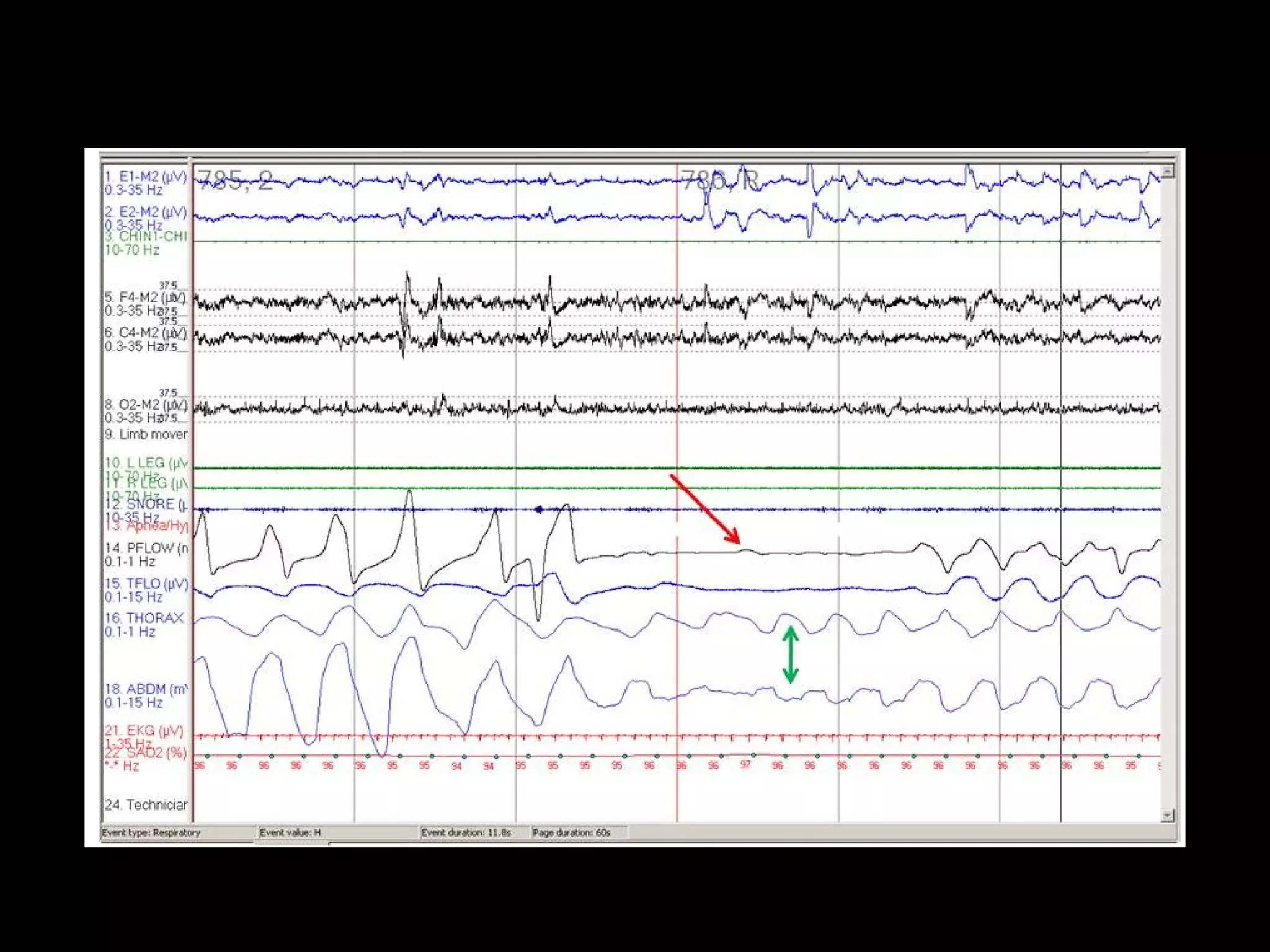
  • #43 Obstructive sleep apnea. Note the absence of flow (red arrow) despite paradoxical respiratory effort (green arrow).
  • #44 Comparison of a central apnea (box) and obstructive apnea (circle).
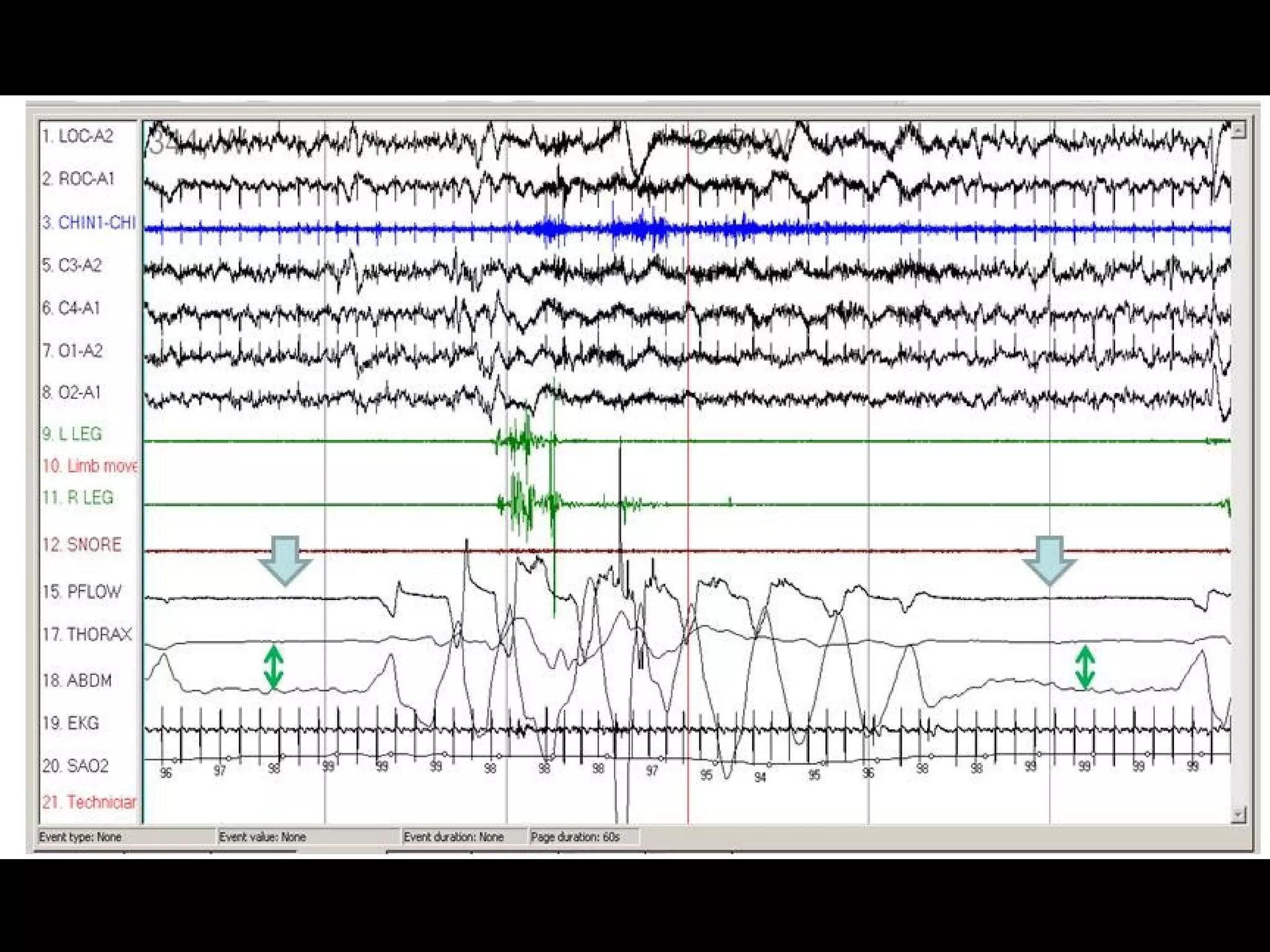
  • #45 Central sleep apnea (thick areas). Note the absence of both flow and respiratory effort (green double arrows). Central apnea is the cessation of airflow for at least 10 seconds with no respiratory effort
  • #46 Mixed sleep apnea. Note that the apnea (orange arrow) begins as a central apnea (effort absent; red double arrow) and ends as an obstructive apnea (effort present; green double arrow). Note the arousal (blue arrow) that terminates the apnea and the desaturation (purple arrow) that follows
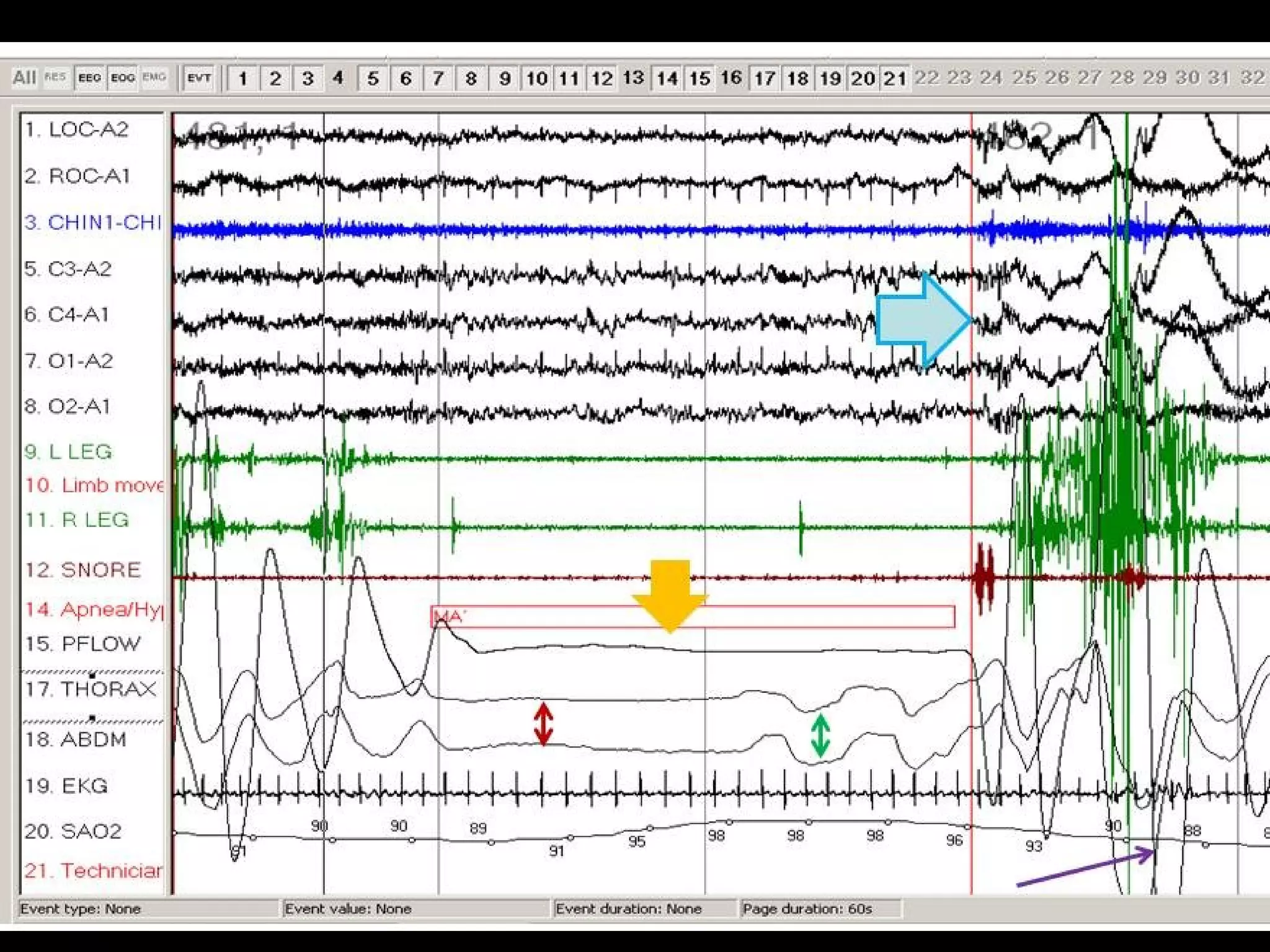
  • #48 Peroidic breathing at sleep wake transition.- Alternating hyperventilation and hypoventilation with apnea at nadir
  • #49 Incidence of peroidic breathing at sleep onset 40-80% of normal subjects. This increases with age Reason- set point of regulation on ventilation is different during wakefullness and sleep. During sleep reduced ventilation and pc02 rises adjusted to the sleep set point- on aurosal the increased pc02 above the wakefullness setpoint constitutes an error signal that causes hyperventilation ( increased ventilatory response to C02) until the c02 falls below wakefullness set point In HF- enhanced ventilatory response to c02- acute increase in ventilation during aurosal, c02 falls below threshold- apnea- increased circulation time not impoprant and CSR not improved with cardiac transplant and normalization of cardiac function CSR sustained by-enhanced ventilatory drive, pulmonary congestion, aurosals, apnea induced hypoxia
  • #52 REM- autonomic instability, central release of Cholinergic surges responsible for SIDS, arrhythmias , reduced coronary blood flow due to HR rise, BP surges NREM- reduced sympathetic tone and heightened vagal tone so bradycardia In OSA once treated with CPAP- SWS rebound during first night- can precipitate hypotension if patient on anti hypertensives
  • #55 However, patients with OHS have an elevated serum bicarbonate level due to the metabolic compensation for the chronic respiratory acidosis. It was recently shown that serum bicarbonate combined with the severity of obstructive sleep apnea (OSA) can be used as clinical predictors of OHS in patients with severe obesity and OSA OHS= Hyper-capnic OSA OHS is defined as a combination of obesity (BMI &amp;gt;= 30kg/m2) and awake chronic hypercapnia (PaCO2 &amp;gt;= 45 mm Hg) accompanied by sleep-disordered breathing.
  • #56 In approximately 90% of patients with OHS the sleep-disordered breathing consists of obstructive sleep apnea (OSA). OHS is labelled as sleep hypoventilation and is defined as an increase in PaCO2 during sleep by 10 mm Hg above wakefulness or significant oxygen desaturation that is not explained by obstructive apneas or hypopneas.3
  • #57 MSLT is for narcolepsy: would only be clinically indicated if daytime hypersomnolence persists after successful treatment with PVV The test consists of four or five, twenty minute nap opportunities that are scheduled about two hours apart. Positive if mean REM latency of &amp;lt; 8 minutes with 2 REM onset naps( but just presnece of SOREM is not diagnostic of narcolepsy Test negative if patient cannot sleep as excessive daytime sleepiness occurs in 100% of narcolepsy
  • #59 All of the symptoms listed are consistent with the diagnosis of narcolepsy, but only cataplexy is pathognomonic  for narcolepsy. Cataplexy occurs when skeletal muscle atonia is triggered by strong emotion such as laughter, anger, surprise, or excitement.  The atonia results in muscle weakness in the  in limbs, face, and neck. Episodes are generally brief (&amp;lt; 2 minutes) and consciousness is generally preserved.
  • #61 MSLT is for narcolepsy The test consists of four or five, twenty minute nap opportunities that are scheduled about two hours apart. Positive if mean REM latency of &amp;lt; 8 minutes with 2 REM onset naps( but just presnece of SOREM is not diagnostic of narcolepsy Test negative if patient cannot sleep as excessive daytime sleepiness occurs in 100% of narcolepsy The MWT is generally used to determine if a patient is able to stay awake during soporific conditions The MWT consists of four sleep trials with breaks lasting for two hours in between them. You are not allowed to do other things to try and keep yourself awake. This includes actions such as singing or slapping your face. If you fall asleep, then you will be awakened after sleeping for only about 90 seconds. The test will end if you do not fall asleep within 40 minutes A total of 97.5% of normal sleepers stay awake for an average of eight minutes or more during the MWT. Falling asleep in an average of less than eight minutes during the test would be considered abnormal. Results show that from 40% to 59% of people with normal sleep stay awake for the entire 40 minutes of all four trials
  • #62 excessive daytime sleepiness occurs in 100% of narcolepsy
  • #63 No singing, no slapping etc
  • #68 PLMS
  • #69 Repetitive flexion of legs periodic every 20-30 seconds May be associated with aurosal