造粒 Granulation To produce free flowing particles for further processing; often after powder synthesis and before forming of products, may need to add binder/ wetting agent to keep small particles together, (but not to form hard agglomerate), semi-dry granule.  Principal methods: spray drying, extruding, simple pressing, mixing + perforated plate, etc;  Characteristics: critical range of liquid content for granulation (for each particle system); it affects granulate size, distribution, porosity; fine particles need more liquid. Che5700  陶瓷粉末處理
Direct Granulation Che5700  陶瓷粉末處理 Sometimes referred as “pelletizing” process; e.g. pressing, extrusion, spray granulation etc. used to produce alumina, ferrite, clays, tile bodies, porcelain bodies, conventional refractory compositions, catalyst support, and feed materials for glass or metal refining;  Granules may not be spherical, could be cylindrical;  Spray granulation: spray (may contain binder) and stir to make pellets
Formation of Granule Che5700  陶瓷粉末處理 Can be viewed as nucleation & growth process;    At first, binder solution droplet touch particle    nucleus; capillary force and binder flocculation provide strength  Growth by layering through contact and adhesion; or by nuclei agglomeration; Rubbing between granules    make granules surface smooth
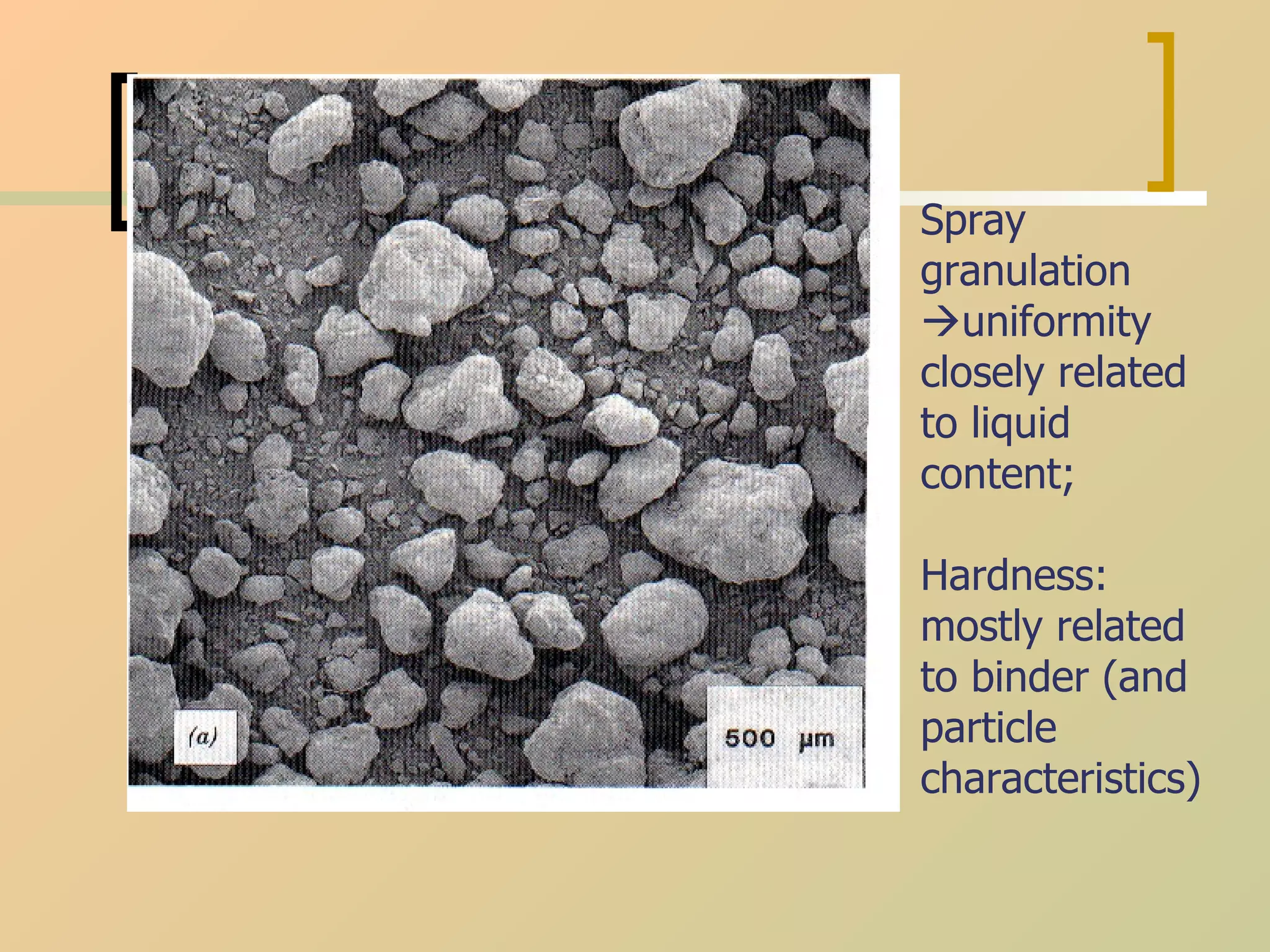
Spray granulation   uniformity closely related to liquid content;  Hardness: mostly related to binder (and particle characteristics)
Spray Granulation Power demand = resistance to flow Liquid requirement is higher when specific surface area is high;  Common liquid requirement: 20-36%
Spray Granulation 2 There is a critical liquid content for each process;  Granule may need to be dried before use;
Spray Drying Main method of granulation: produce spherical particles (~20  m), high productivity (e.g. ~ 10-100 kg/h); suitable for subsequent pressing process. Use hot air (co-current or counter-current flow) to dry flowing solids Droplet size ~ product size Slurry viscosity: important operation variable, should be  shear thinning , shear rate at nozzle ~10 4 /sec Che5700  陶瓷粉末處理
Spray Drying (2) Atomization: large pressure drop at nozzle, significant wear; possibility of blockage; other variables: surface tension, feed rate Drying rate: gas temperature, contact time (usually less than 30 sec); avoid sticking to walls;  Due to high temperature: should be aware of possible loss of material along with evaporation; polymer additives: possible cracking or decomposition;
Taken from TA Ring, 1996 Droplet/particle: mean residence time ~ 30 sec Three basic steps: (a)atomization, (b)droplet drying, (c) gas-droplet mixing
Spray dried samples: donut particle, temperature rise too fast, surface dried (sealed), vaporization of internal liquid    pores (viscous binder fluid may flow toward inside)
Spraying Drying (3) Foam index: bubbles in slurry    low quality of granules, use foam index to represent bubbles in slurry: foam index (%) = [  T  –   E ] 100/  T ;   T ,   E  = theoretical and experimental density of slurry (the latter contain bubbles) If necessary, add anti-foam agent;  wall deposit problem two-fluid nozzle: to lower pressure drop and to get smaller particles Mass and heat transfer during drying, relative rate    may get dry surface with some internal liquid Che5700  陶瓷粉末處理
Atomization Some common techniques: high pressure nozzle, two-fluid nozzle, and high speed centrifugal disc; often need to remove large particles from slurry Energy efficiency often low, also about 1% for new surface formation (breakup of steams into droplets), others for heating up the system;  Jet breakup mechanism: Rayleigh instability, one dimensionless parameter, Weber number; = aerodynamic force to surface tension force; Che5700  陶瓷粉末處理 u 1 : interfacial velocity between gas and liquid; D d max  = at critical Weber number, largest stable size
Droplet Size Depending on jet breakup mechanism    different equations to estimate droplet size Rayleigh breakup mechanism    D d  = 1.89 D j ; for high viscous liquid, then Dd = 1.89 Dj (1 + 3  1 /(  1  D j  g)  1/2 )  1/6 ; (Dj = jet diameter;) Gas / liquid interfacial velocity (u 1 ) increase, breakup mechanism more complex; critical Weber number    decide droplet size N v  = dimension-less viscosity;
 
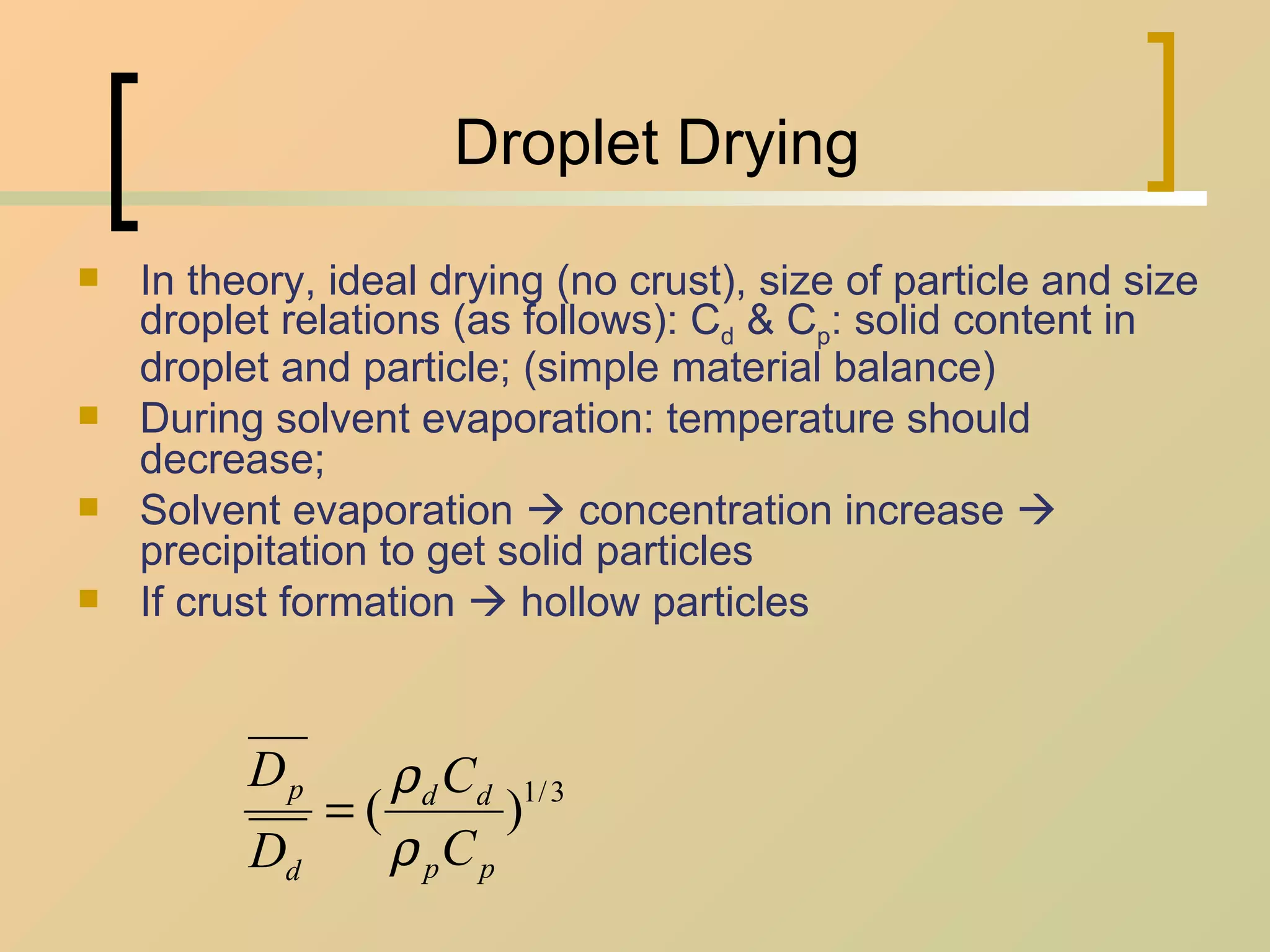
Droplet Drying In theory, ideal drying (no crust), size of particle and size droplet relations (as follows): C d  & C p : solid content in droplet and particle; (simple material balance) During solvent evaporation: temperature should decrease;  Solvent evaporation    concentration increase    precipitation to get solid particles If crust formation    hollow particles
Gas-droplet mixing: maybe co-current or counter-current or even cross-current flow; decide contact time and heat and mass transfer effects. ----------------
Characteristics of dried particles: moisture adsorption; flow time; fill density; tap density/fill density ratio etc.  Che5700  陶瓷粉末處理
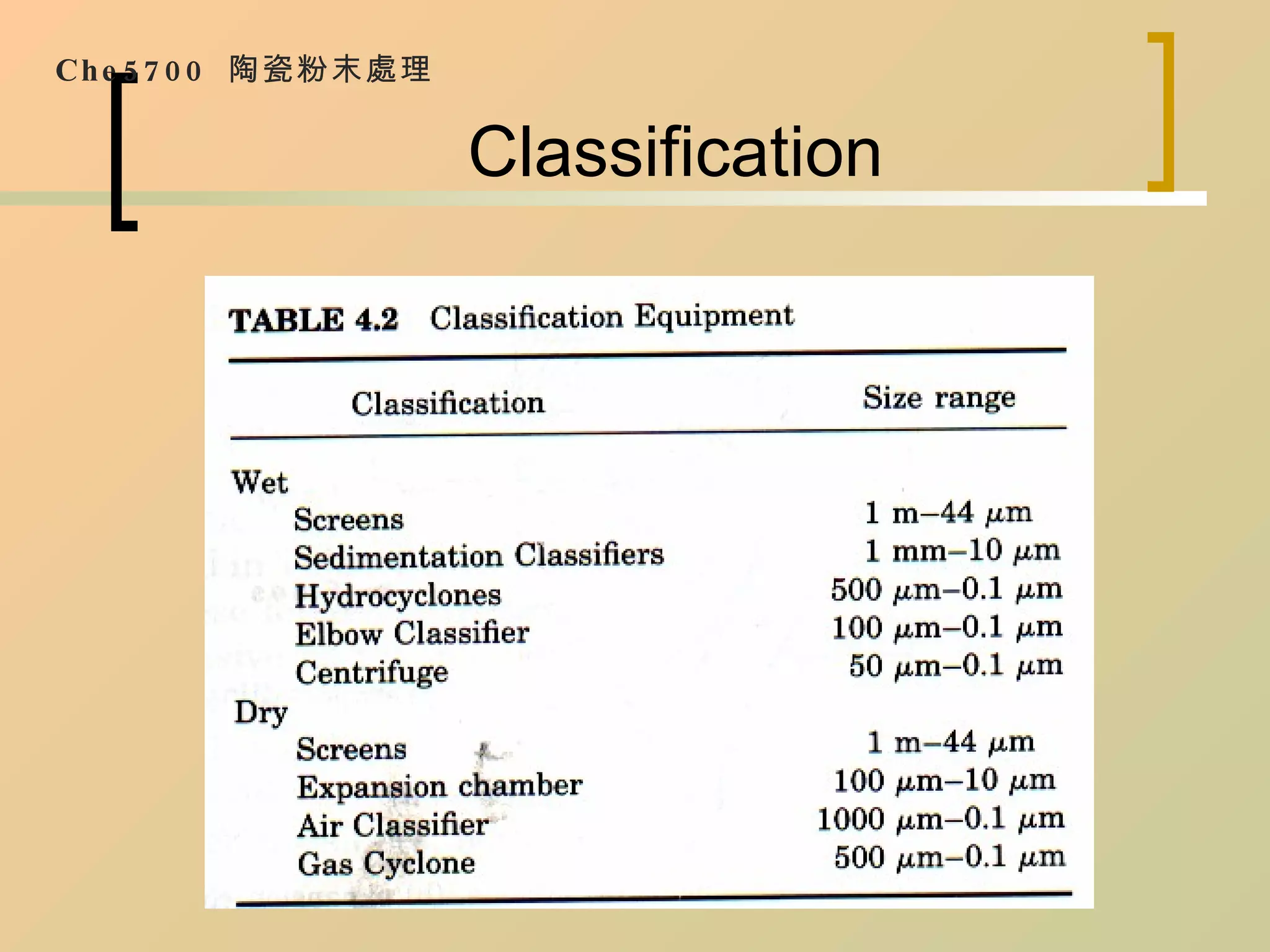
Classification Che5700  陶瓷粉末處理
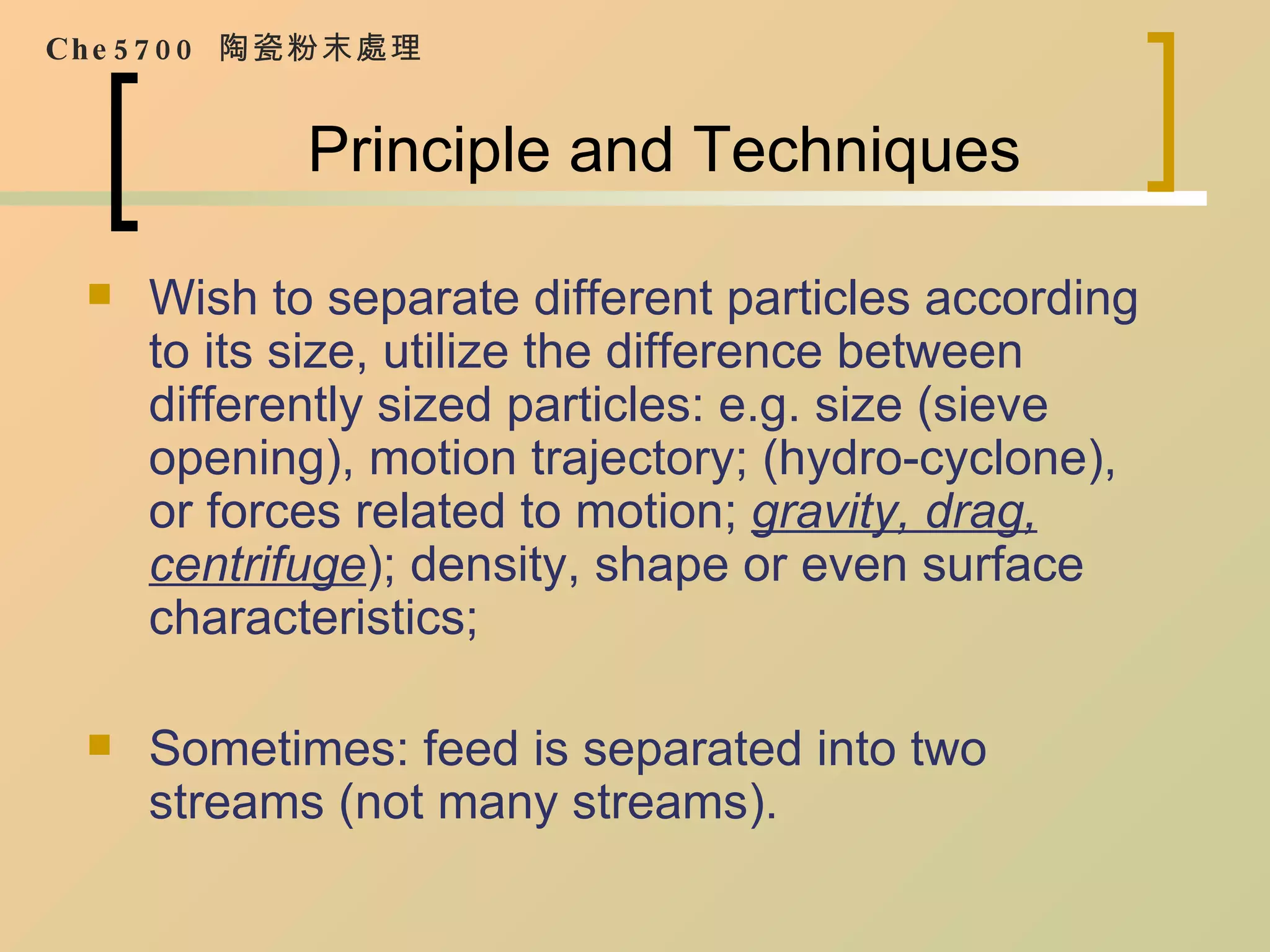
Principle and Techniques Wish to separate different particles according to its size, utilize the difference between differently sized particles: e.g. size (sieve opening), motion trajectory; (hydro-cyclone), or forces related to motion;  gravity, drag, centrifuge ); density, shape or even surface characteristics; Sometimes: feed is separated into two streams (not many streams). Che5700  陶瓷粉末處理
Taken from TA Ring, 1996; can add some baffles, to separate large particles
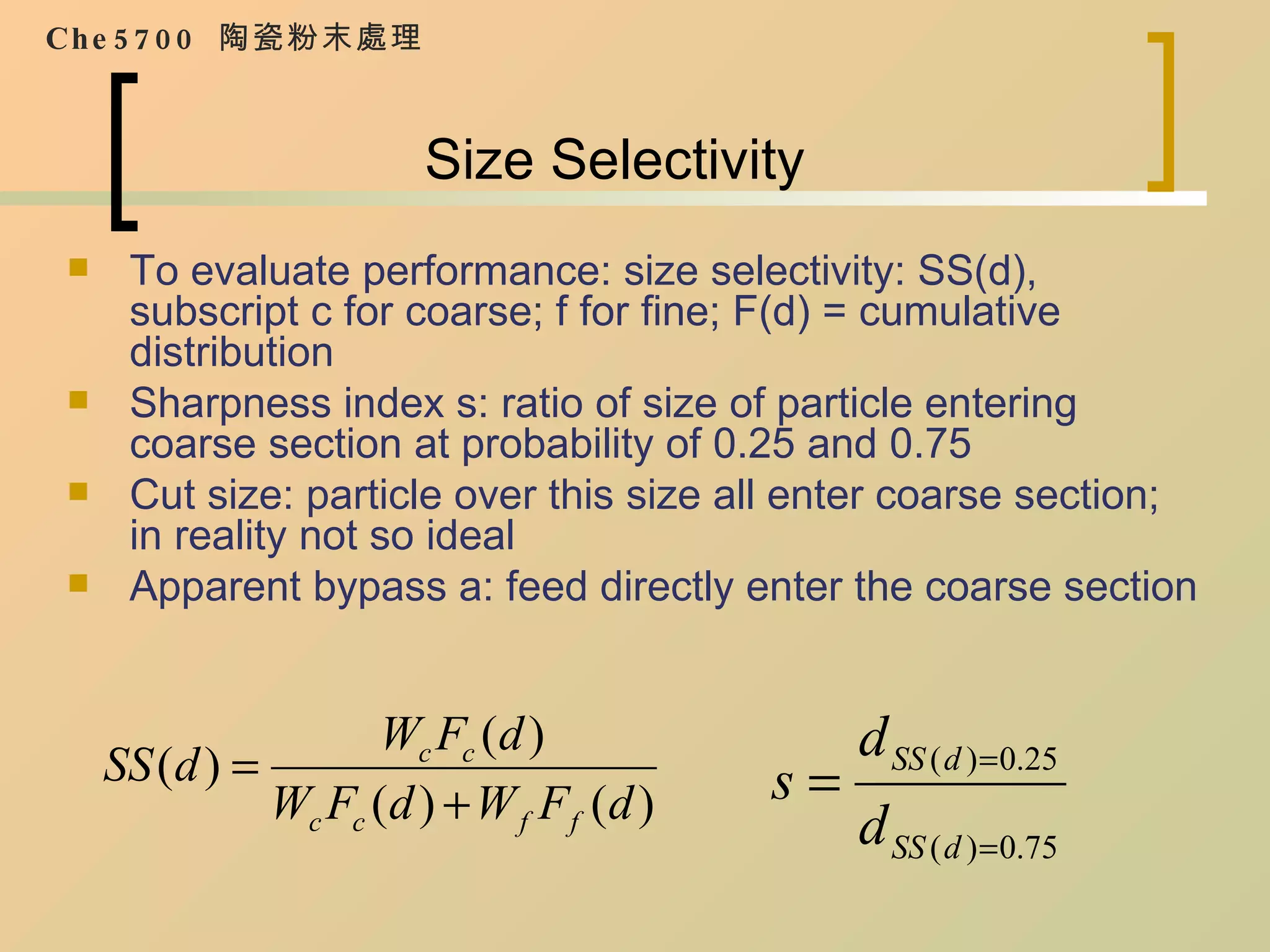
Size Selectivity To evaluate performance: size selectivity: SS(d), subscript c for coarse; f for fine; F(d) = cumulative distribution Sharpness index s: ratio of size of particle entering coarse section at probability of 0.25 and 0.75 Cut size: particle over this size all enter coarse section; in reality not so ideal Apparent bypass a: feed directly enter the coarse section Che5700  陶瓷粉末處理
取自 TA Ring 1996;  Cut size; bypass;  Sharpness index b-b’ curve: normal case
Recovery & Yield Che5700  陶瓷粉末處理 Classifier performance: recovery R & yield Y If fines are the product: following equation (if coarse is the product, one can write a corresponding equation) Classifier efficiency: E(d) = Rf(d) – Rc(d); difference between fine and coarse streams
Che5700  陶瓷粉末處理
phase transformation during calcination Gibbsite, Bayerite Al(OH) 3 ; Boehmite AlOOH Diaspore α-AlOOH

Granulation

  • 1.
    造粒 Granulation Toproduce free flowing particles for further processing; often after powder synthesis and before forming of products, may need to add binder/ wetting agent to keep small particles together, (but not to form hard agglomerate), semi-dry granule. Principal methods: spray drying, extruding, simple pressing, mixing + perforated plate, etc; Characteristics: critical range of liquid content for granulation (for each particle system); it affects granulate size, distribution, porosity; fine particles need more liquid. Che5700 陶瓷粉末處理
  • 2.
    Direct Granulation Che5700 陶瓷粉末處理 Sometimes referred as “pelletizing” process; e.g. pressing, extrusion, spray granulation etc. used to produce alumina, ferrite, clays, tile bodies, porcelain bodies, conventional refractory compositions, catalyst support, and feed materials for glass or metal refining; Granules may not be spherical, could be cylindrical; Spray granulation: spray (may contain binder) and stir to make pellets
  • 3.
    Formation of GranuleChe5700 陶瓷粉末處理 Can be viewed as nucleation & growth process;  At first, binder solution droplet touch particle  nucleus; capillary force and binder flocculation provide strength Growth by layering through contact and adhesion; or by nuclei agglomeration; Rubbing between granules  make granules surface smooth
  • 4.
    Spray granulation  uniformity closely related to liquid content; Hardness: mostly related to binder (and particle characteristics)
  • 5.
    Spray Granulation Powerdemand = resistance to flow Liquid requirement is higher when specific surface area is high; Common liquid requirement: 20-36%
  • 6.
    Spray Granulation 2There is a critical liquid content for each process; Granule may need to be dried before use;
  • 7.
    Spray Drying Mainmethod of granulation: produce spherical particles (~20  m), high productivity (e.g. ~ 10-100 kg/h); suitable for subsequent pressing process. Use hot air (co-current or counter-current flow) to dry flowing solids Droplet size ~ product size Slurry viscosity: important operation variable, should be shear thinning , shear rate at nozzle ~10 4 /sec Che5700 陶瓷粉末處理
  • 8.
    Spray Drying (2)Atomization: large pressure drop at nozzle, significant wear; possibility of blockage; other variables: surface tension, feed rate Drying rate: gas temperature, contact time (usually less than 30 sec); avoid sticking to walls; Due to high temperature: should be aware of possible loss of material along with evaporation; polymer additives: possible cracking or decomposition;
  • 9.
    Taken from TARing, 1996 Droplet/particle: mean residence time ~ 30 sec Three basic steps: (a)atomization, (b)droplet drying, (c) gas-droplet mixing
  • 10.
    Spray dried samples:donut particle, temperature rise too fast, surface dried (sealed), vaporization of internal liquid  pores (viscous binder fluid may flow toward inside)
  • 11.
    Spraying Drying (3)Foam index: bubbles in slurry  low quality of granules, use foam index to represent bubbles in slurry: foam index (%) = [  T –  E ] 100/  T ;  T ,  E = theoretical and experimental density of slurry (the latter contain bubbles) If necessary, add anti-foam agent; wall deposit problem two-fluid nozzle: to lower pressure drop and to get smaller particles Mass and heat transfer during drying, relative rate  may get dry surface with some internal liquid Che5700 陶瓷粉末處理
  • 12.
    Atomization Some commontechniques: high pressure nozzle, two-fluid nozzle, and high speed centrifugal disc; often need to remove large particles from slurry Energy efficiency often low, also about 1% for new surface formation (breakup of steams into droplets), others for heating up the system; Jet breakup mechanism: Rayleigh instability, one dimensionless parameter, Weber number; = aerodynamic force to surface tension force; Che5700 陶瓷粉末處理 u 1 : interfacial velocity between gas and liquid; D d max = at critical Weber number, largest stable size
  • 13.
    Droplet Size Dependingon jet breakup mechanism  different equations to estimate droplet size Rayleigh breakup mechanism  D d = 1.89 D j ; for high viscous liquid, then Dd = 1.89 Dj (1 + 3  1 /(  1 D j g) 1/2 ) 1/6 ; (Dj = jet diameter;) Gas / liquid interfacial velocity (u 1 ) increase, breakup mechanism more complex; critical Weber number  decide droplet size N v = dimension-less viscosity;
  • 14.
  • 15.
    Droplet Drying Intheory, ideal drying (no crust), size of particle and size droplet relations (as follows): C d & C p : solid content in droplet and particle; (simple material balance) During solvent evaporation: temperature should decrease; Solvent evaporation  concentration increase  precipitation to get solid particles If crust formation  hollow particles
  • 16.
    Gas-droplet mixing: maybeco-current or counter-current or even cross-current flow; decide contact time and heat and mass transfer effects. ----------------
  • 17.
    Characteristics of driedparticles: moisture adsorption; flow time; fill density; tap density/fill density ratio etc. Che5700 陶瓷粉末處理
  • 18.
    Classification Che5700 陶瓷粉末處理
  • 19.
    Principle and TechniquesWish to separate different particles according to its size, utilize the difference between differently sized particles: e.g. size (sieve opening), motion trajectory; (hydro-cyclone), or forces related to motion; gravity, drag, centrifuge ); density, shape or even surface characteristics; Sometimes: feed is separated into two streams (not many streams). Che5700 陶瓷粉末處理
  • 20.
    Taken from TARing, 1996; can add some baffles, to separate large particles
  • 21.
    Size Selectivity Toevaluate performance: size selectivity: SS(d), subscript c for coarse; f for fine; F(d) = cumulative distribution Sharpness index s: ratio of size of particle entering coarse section at probability of 0.25 and 0.75 Cut size: particle over this size all enter coarse section; in reality not so ideal Apparent bypass a: feed directly enter the coarse section Che5700 陶瓷粉末處理
  • 22.
    取自 TA Ring1996; Cut size; bypass; Sharpness index b-b’ curve: normal case
  • 23.
    Recovery & YieldChe5700 陶瓷粉末處理 Classifier performance: recovery R & yield Y If fines are the product: following equation (if coarse is the product, one can write a corresponding equation) Classifier efficiency: E(d) = Rf(d) – Rc(d); difference between fine and coarse streams
  • 24.
  • 25.
    phase transformation duringcalcination Gibbsite, Bayerite Al(OH) 3 ; Boehmite AlOOH Diaspore α-AlOOH