Slideshare.net (beta)

 
Post to TwitterPost to Twitter
Post: 
Myspace Hi5 Friendster Xanga LiveJournal Facebook Blogger Tagged Typepad Freewebs BlackPlanet gigya icons

All comments

Add a comment on Slide 1

If you have a SlideShare account, login to comment; else you can comment as a guest


Showing 1-50 of 12 (more)

Reader’s Response Journal

From eduhawk, 2 years ago

Presentation in introducing reader's response journal to implement more

10929 views  |  0 comments  |  12 favorites  |  650 downloads  |  11 embeds (Stats)
 

Categories

Add Category


Tags

reading writing journals response journal reader's reader leitura literacia readers

more


Groups / Events


Embed
options

More Info

This slideshow is Public
Total Views: 10929
on Slideshare: 10777
from embeds: 152

Slideshow transcript

Slide 1: B y: E duhawk

Slide 2: Wh a t is a R e a de r’s R e s pons e J ourna l? •Reader’s Response journal is a notebook in which a student writes about a book he or she is reading independently to a teacher, friend or parents in a specified format. •In the journal the reader writes a summarization along with reactions and questions they may have about the book.

Slide 3: Wh y Do It?  E ncourages independent reading.  Connects reading and writing to expand meaning.  S upports the teaching of letter writing throughout the year.

Slide 4: R e a de r’s R e s pons e S tyle Le tte r F orma t Introduce parts of a friendly letter. Date S alutation B ody Closing

Slide 5: E xa mple of A F rie ndly Le tte r Date October 2, 2006 Salutation Dear Class, Last night I read the story, Tomas and the Library Lady by Pat Mora. This book is about a boy named Tomas who lives in Texas in the Body winter months and then has to travel to Iowa in the summer months. You see, Tomas’s parents are farm workers and have to go where work is available. Tomas always gets stories told by his grandfather. One day Tomas decides to go into the library. The lady helps him discover how much he likes reading. He even reads stories to his family and becomes a storyteller like his grandfather. My family is similar to Tomas’ because we also travel in the summer to another state. My husband Gary leads a crew of workers to pick tomatoes for farmers over in South Carolina and Virginia. My father lives with us and he loves to tell us stories of when he was a young boy growing up. I am a lot like Tomas because I enjoy reading and in the summer I get to read all types of books. I even go to the public libraries whenever I am in another state, especially when my husband is working. I love spending time at the local bookstore to buy books to read for my children. My children all read over the summer, I like them to read at least one chapter book. Reading takes you to many places that you may never get to visit. Sincerely, Closing Mrs. Nunez

Slide 6: C olor C oding Why I use it?  It gives the writing organization and guides the student what to write about next in their letter.  I love color and as a visual learner, I like using colors to distinguish parts and sections.  Its fun using different colors to write. What I Use:  B lack: Includes Date, S alutation and Closing of Letter along with author signature.  Red: 1 st Paragraph - introduction  Green: 2 nd paragraph - S ummarization or Target  B lue: 3 rd paragraph - Connections

Slide 7: S te p 1: Da te a nd S a luta tion Code d in B la c k October 6, 2006 Dear Class, Salutations can vary.

Slide 8: E xa mple of S a luta tions These are most often used for classroom purposes.  Dear M om and Dad,  Dear M r. or/and M rs.,  Dear ________(name of friend),  To Whom It M ay Concern:

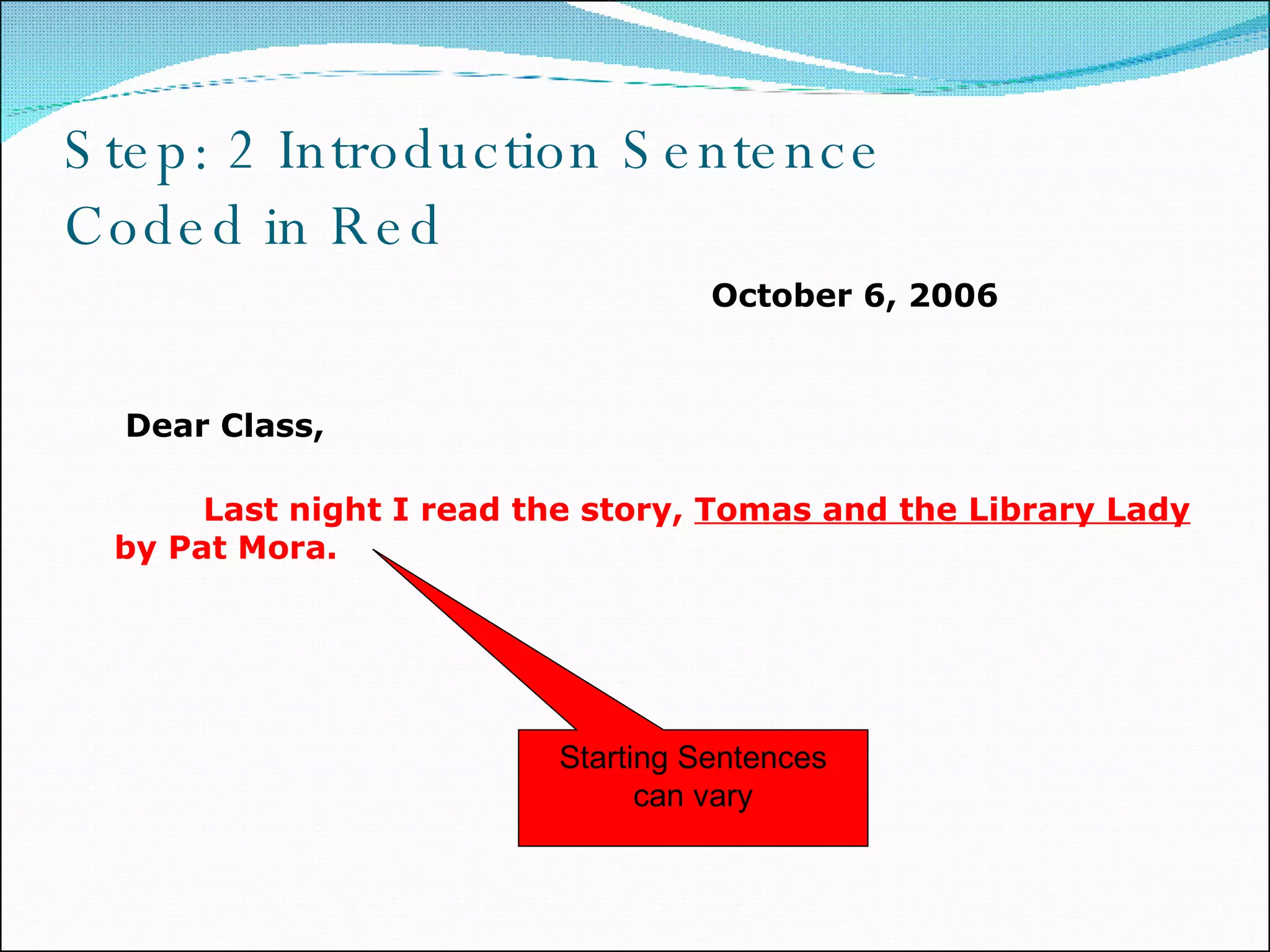
Slide 9: S te p: 2 Introduc tion S e nte nc e Code d in R e d October 6, 2006 Dear Class, Last night I read the story, Tomas and the Library Lady by Pat Mora. Starting Sentences can vary

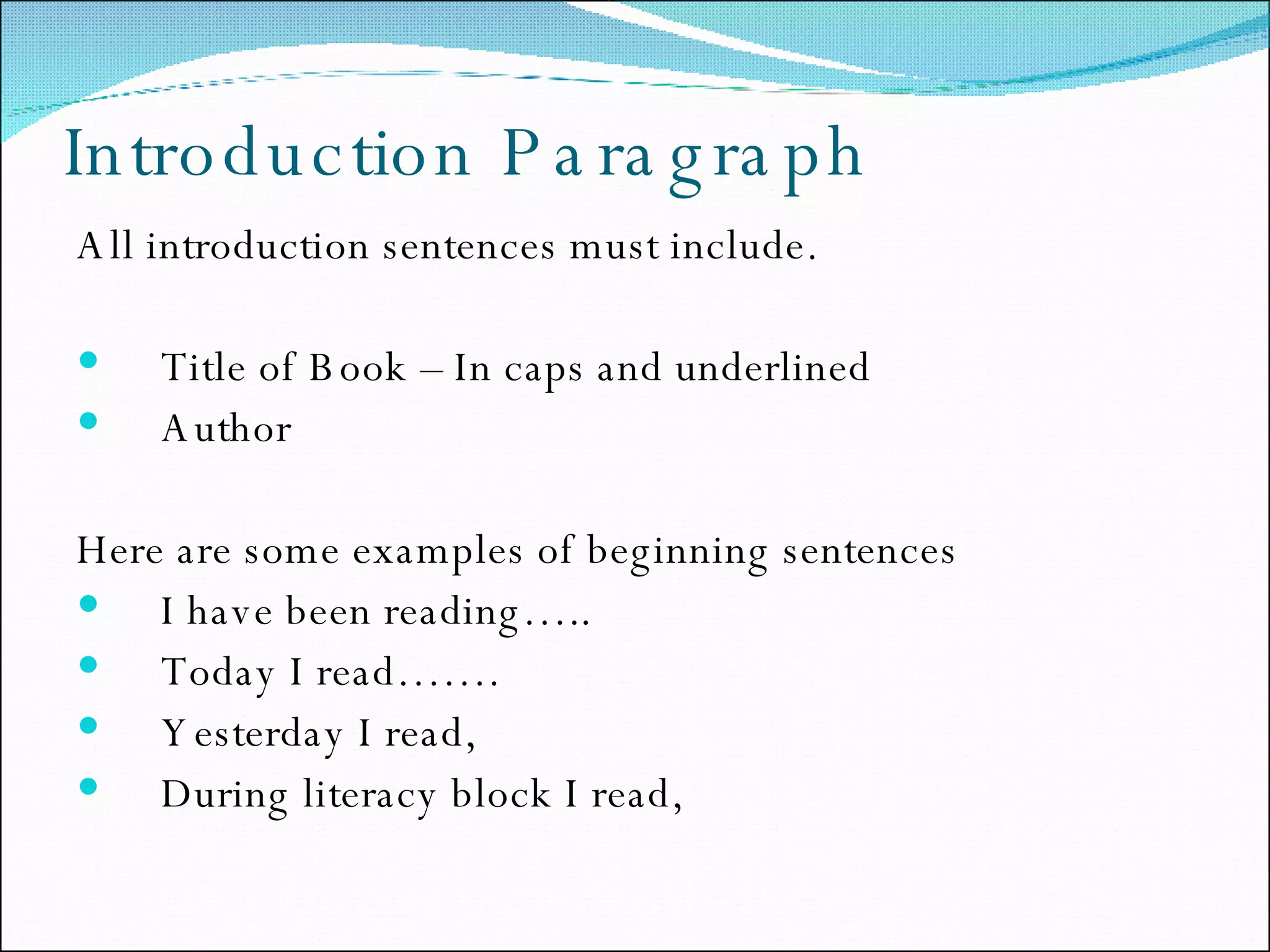
Slide 10: Introduc tion P a ra g ra ph A ll introduction sentences must include.  Title of B ook – In caps and underlined  A uthor Here are some examples of beginning sentences  I have been reading…..  Today I read…….  Y esterday I read,  During literacy block I read,

Slide 11: S te p 3: S um m a riz a tion/ rg e t S u g g e s tion Ta C ode d in G re e n October 2, 2006 Dear Class, Last night I read the story, Tomas and the Library Lady by Pat Mora. This book is about a boy named Tomas who lives in Texas in the winter months and then has to travel to Iowa in the summer months. You see, Tomas’ parents are farm workers and have to go where work is available. Tomas always gets stories told by his grandfather. One day Tomas decides to go into the library. The lady helps him discover how much he likes reading. He even reads stories to his family and becomes a storyteller like his grandfather. Target: summarization

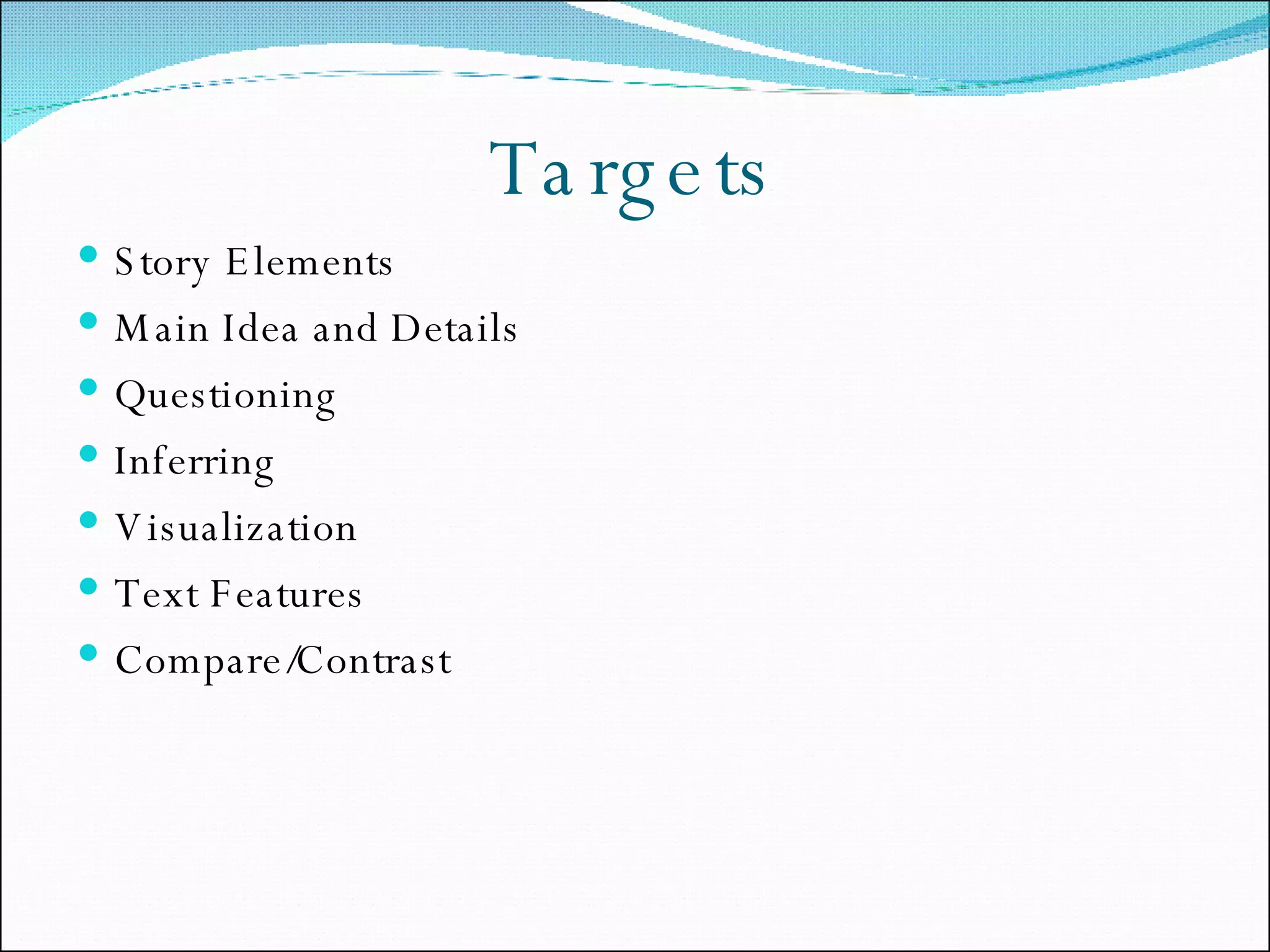
Slide 12: Ta rg e ts  S tory E lements  M ain Idea and Details  Questioning  Inferring  V isualization  Text F eatures  Compare/Contrast

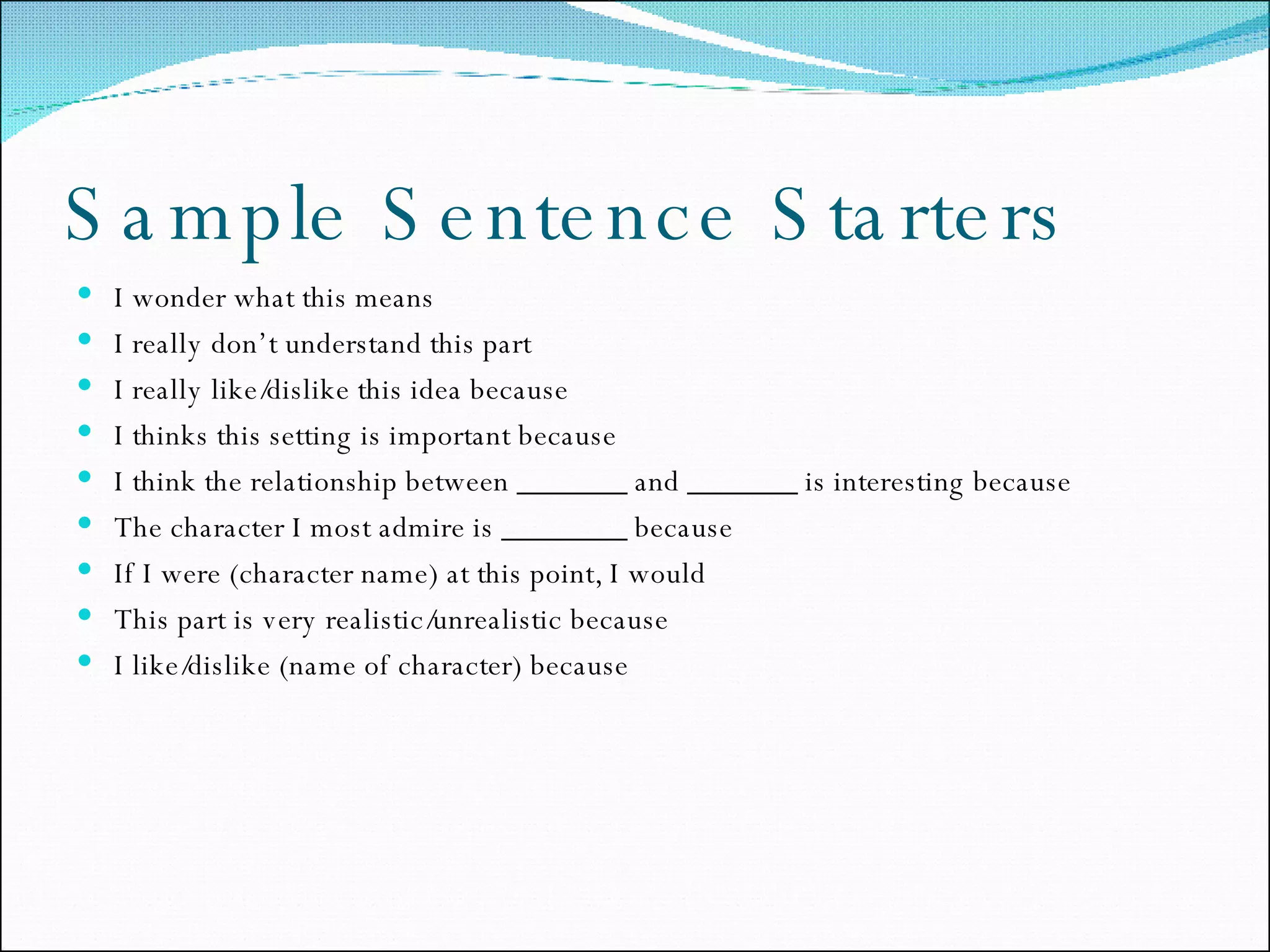
Slide 13: S a mple S e nte nc e S ta rte rs  I wonder what this means  I really don’t understand this part  I really like/dislike this idea because  I thinks this setting is important because  I think the relationship between _______ and _______ is interesting because  The character I most admire is ________ because  If I were (character name) at this point, I would  This part is very realistic/unrealistic because  I like/dislike (name of character) because

Slide 14: S te p 4: C onne c tions – 3 rd pa ra g ra ph C ode d in B lue October 2, 2006 Dear Class, Last night I read the story, Tomas and the Library Lady by Pat Mora. This book is about a boy named Tomas who lives in Texas in the winter months and then has to travel to Iowa in the summer months. You see, Tomas’s parents are farm workers and have to go where work is available. Tomas always gets stories told by his grandfather. One day Tomas decides to go into the library. The lady helps him discover how much he likes reading. He even reads stories to his family and becomes a storyteller like his grandfather. T-S My family is similar to Tomas’ because we also travel in the summer to another state. My husband Gary leads a crew of workers to pick tomatoes for farmers over in South Carolina and Virginia. My father lives with us and he loves to tell us stories of when he was a young boy growing up. I am a lot like Tomas because I enjoy reading and in the summer I get to read all types of books. I even go to the public libraries whenever I am in another state, especially when my husband is working. I love spending time at the local bookstore to buy books to read for my children. My children all read over the summer, I like them to read at least one chapter book. Reading takes you to many places that you may never get to visit. Connection ? Text to Self

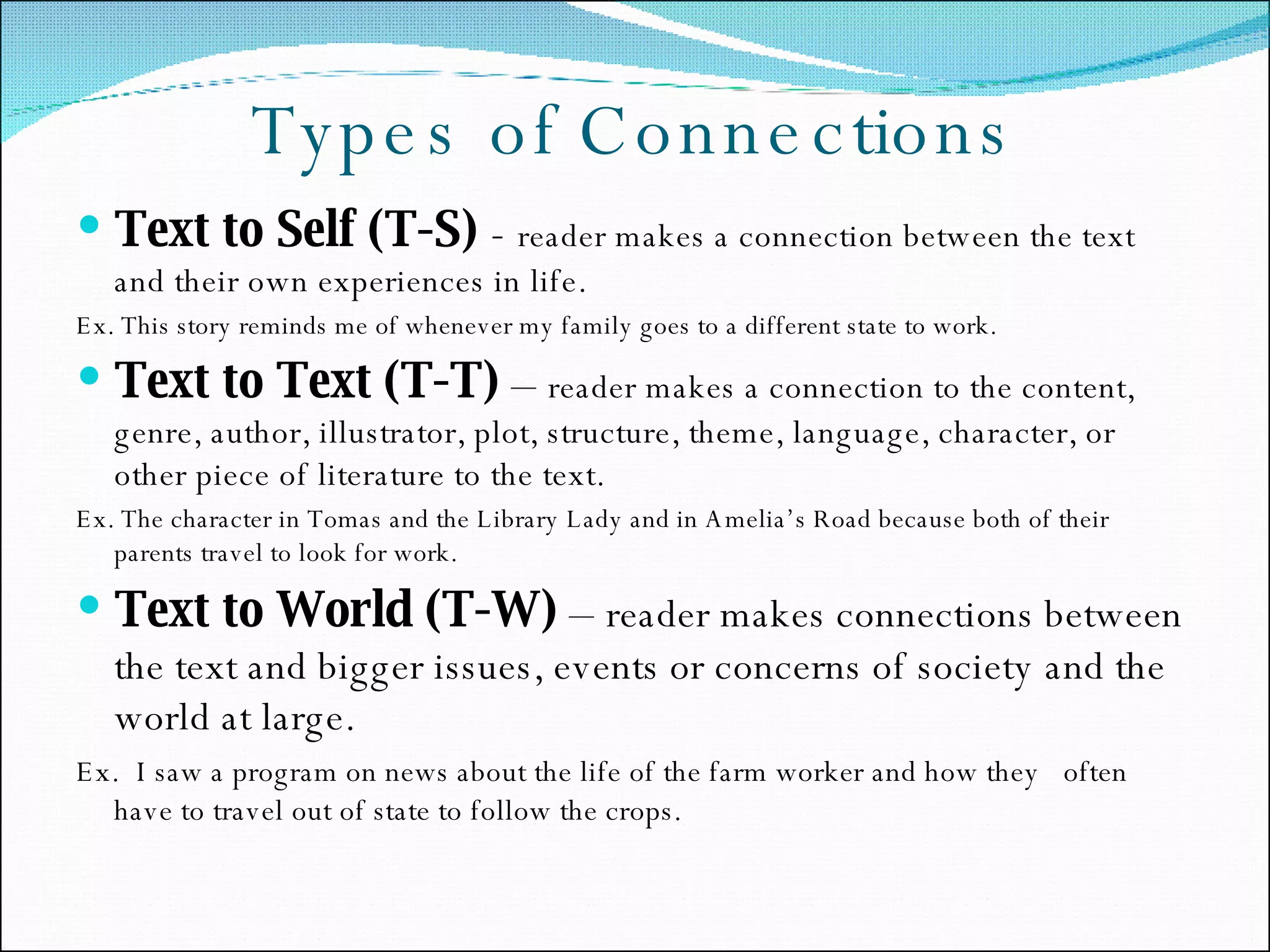
Slide 15: Type s of C onne c tions  Text to Self (T-S) - reader makes a connection between the text and their own experiences in life. Ex. This story reminds me of whenever my family goes to a different state to work.  Text to Text (T-T) – reader makes a connection to the content, genre, author, illustrator, plot, structure, theme, language, character, or other piece of literature to the text. Ex. The character in Tomas and the L ibrary L ady and in A melia’s Road because both of their parents travel to look for work.  Text to World (T-W) – reader makes connections between the text and bigger issues, events or concerns of society and the world at large. Ex. I saw a program on news about the life of the farm worker and how they often have to travel out of state to follow the crops.

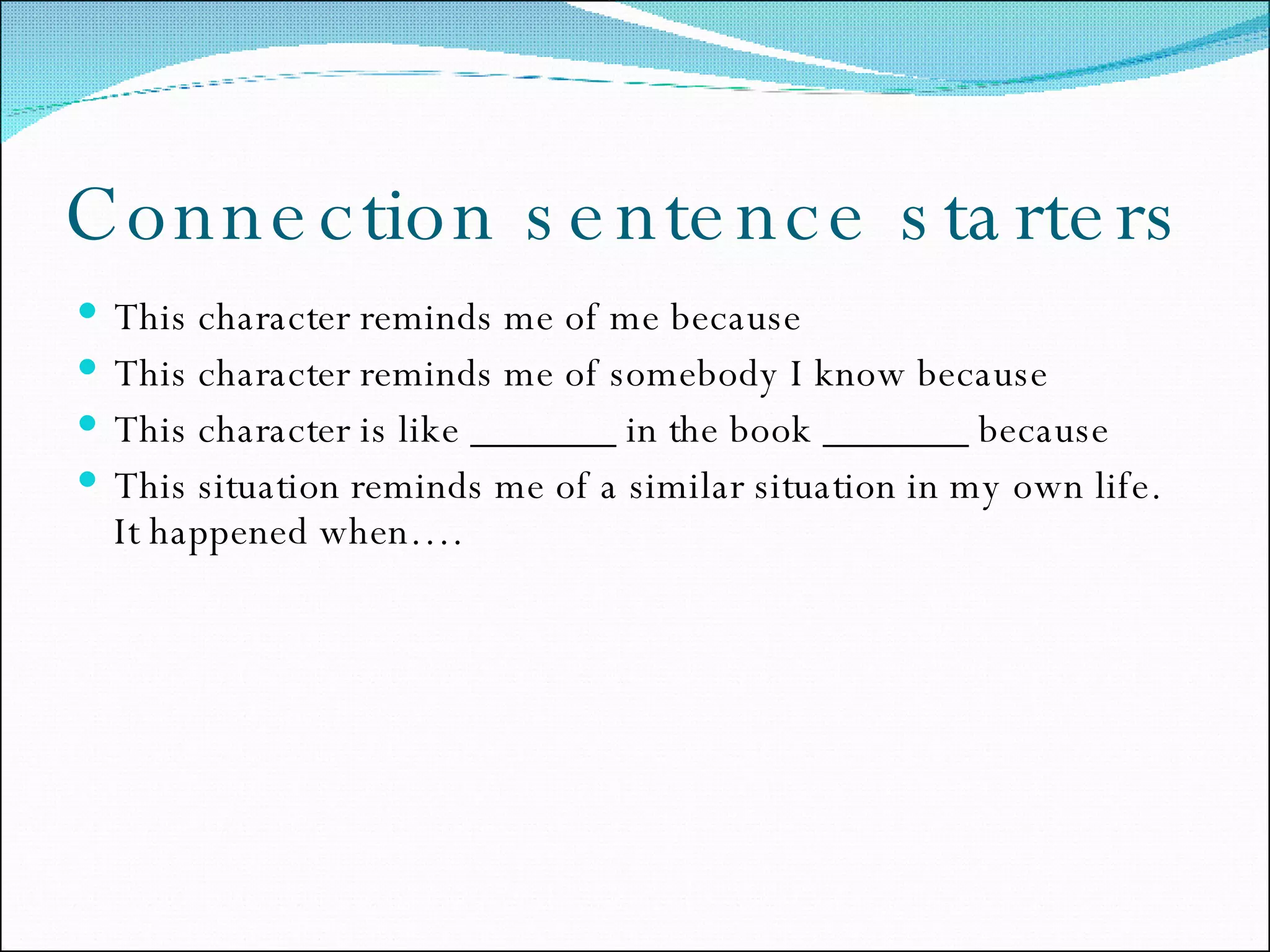
Slide 16: Conne c tion s e nte nc e s ta rte rs  This character reminds me of me because  This character reminds me of somebody I know because  This character is like _______ in the book _______ because  This situation reminds me of a similar situation in my own life. It happened when….

Slide 17: S te p 4: Clos ing a nd a uth or Color Code d: B la c k October 2, 2006 Dear Class, Last night I read the story, Tomas and the Library Lady by Pat Mora. This book is about a boy named Tomas who lives in Texas in the winter months and then has to travel to Iowa in the summer months. You see, Tomas’s parents are farm workers and have to go where work is available. Tomas always gets stories told by his grandfather. One day Tomas decides to go into the library. The lady helps him discover how much he likes reading. He even reads stories to his family and becomes a storyteller like his grandfather. My family is similar to Tomas’ because we also travel in the summer to another state. My husband Gary leads a crew of workers to pick tomatoes for farmers over in South Carolina and Virginia. My father lives with us and he loves to tell us stories of when he was a young boy growing up. I am a lot like Tomas because I enjoy reading and in the summer I get to read all types of books. I even go to the public libraries whenever I am in another state, especially when my husband is working. I love spending time at the local bookstore to buy books to read for my children. My children all read over the summer, I like them to read at least one chapter book. Reading takes you to many places that you may never get to visit. Sincerely, Closing can vary Mrs. Nunez

Slide 18: Clos ing s E xa mple s  L ove,  B est Wishes,  Truly yours,  Y our student,  Y our friend,

Slide 19: S c oring R e a de r’s R e s pons e s Criteria 4 3 2 1 0 Letter Writing Format Written in letter format Written in letter format Written in letter format Written in letter format Did not write in letter with date, and missing and missing two with body and format and has salutation, body either date, parts: either missing three no parts of the and closing salutation or date, salutation parts of letter: letter closing or closing date, closing and salutation Color Coded Correctly used all colors Correctly used three Correctly used two Correctly used one color Used no colors in the Letter parts in the letter colors in letter colors in the in the letter letter response. For organization. response. response. letter response. response. Red Section: Introduction Students wrote an Student wrote an Student wrote an Student wrote an No introduction written. introduction introduction introduction introduction sentence sentence sentence sentence without including the including title, including title title and author Title in all caps but missing with no author. of book. and underlined either all capitals With proper and the author of or underlining of conventions. book with title and included correct author with convention marks. proper conventions. Letter Green Section: Student wrote four to Student wrote three (3) Student wrote two to Student wrote one to Student wrote one Body book response five (4–5) sentences and three (2-3) two sentences sentence and sentences and stayed on topic sentences and and topic is not topic is not stayed on topic of choice topic loses some focused. focused or wrote of choice. focus. nothing. Letter Blue Section: Student wrote four to Student wrote three (3) Student wrote two – Student wrote one to No connection to book is Connection five (4-5) sentences and three (2-3) two (1-2) evident and has Conclusion sentences and connection to sentences but sentences but many convention connection to book is evident connection to connection to errors. book is evident and focused. book is evident book is not clear and focused. Minimal but lacks focus. or focused. Many Minimal convention Some convention convention convention errors. errors. errors. errors.

Slide 20: F e e dba c k  In a reader’s response journal feedback is a very important element to include along with your rubric scoring.  Feedback in a journal could be in form of comments or a written letter back to the student after every entry or several entries.  With immediate feedback, students will understand how to improve in the quality of their writing in organization, content and conventions.  It helps the teacher know what the student is reading independently or loves to read and can offer suggestions to explore other genres or books of similar genres.  Fosters communication between the teacher and student through writing.

Slide 21: Additiona l R e s ourc e s on How To Imple me nt R e a de r’s R e s pons e s  B ook: Guiding Readers and Writers: Teaching Comprehension, Genre, and Content L iteracy (Grades 3-6) by Irene C. Fountas and Gay S u Pinnell *This includes the First 20 Days of Independent Reading in an easy to follow format.  Reader Response *This website offers ideas on how to implement it and offers self-evaluation sheets for students with student samples.  Reader’s Workshop *This website provides you with the background of what is reader’s workshop along with instructional strategies for all sections of a reader’s workshop. Most importantly on the types of connections.  A lternative Rubric – A fter student mastery of initial Reader’s Response Rubric  Post-Reading: Reader’s Response Journal – Recommendation for students who have a hard time starting to write and offers suggestions on how to put their thoughts together.

Slide 22: R e fe re nc e s Ekstrom, C., Reader’s Workshop, retrieved June 3, 2007 from http:/ independence.fhsd.k12.mo.us/ / cekstorm/reader’s_workshop.htm Fountas, I. and Pinnell, S ., (2001) Guiding Readers and Writers (Grades 3 – 6), Teaching Comprehension, Genre and Content Literacy, Portsmouth, NH: Heinimann Heape, D., Reader Response, retrieved June 3, 2007 from www.columbus.k12.oh.us/ d_heape/ pas/ reader_response.htm S mith, Deb, Reading Response Journal L it L ogs, retrieved June 3, 2007 from www.debfourblocks.com