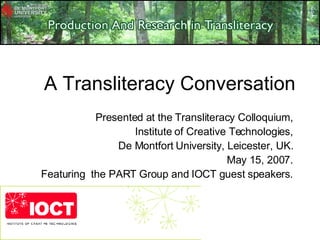
A Transliteracy Conversation

Loading...

Flash Player 9 (or above) is needed to view presentations.
We have detected that you do not have it on your computer. To install it, go here.

0 comments

Post a comment

    Post a comment
    Embed Video
    Edit your comment Cancel

    3 Favorites

    A Transliteracy Conversation - Presentation Transcript

    1. A Transliteracy Conversation Presented at the Transliteracy Colloquium, Institute of Creative Technologies, De Montfort University, Leicester, UK. May 15, 2007. Featuring the PART Group and IOCT guest speakers.
      • Programme
      • 11.00 Welcome and Introduction
      • 11.30 Presentations
      • 12.30 Summing up
      • 12.45 Lunch (served here)
      • 13.30 Responses from the floor
      • 14.00 Small groups
      • 15.00 Break
      • 15.15 Plenary Discussion
      • 16.00 End
    2. Introducing the Book
      • Working Definition
      • Transliteracy is the ability to read, write and interact across a range of platforms, tools and media from signing and orality through handwriting, print, TV, radio and film, to digital social networks.
      • The Qualities of Transliteracy might be:
      • Awareness of historical and cultural context
      • Ability to understand and use a range of tools
      • Multimodal sensibility
      • Participation in collective behaviour
      • Sense of physicality / spatiality / lifeworld
    3. Howard Rheingold
      • Visiting Professor, IOCT
      • &
      • Production and Research in Transliteracy group
    4. Transliteracy as a Cognitive Tool Simon Perril Image from Alan Halsey ‘This Problem of Script: Essays in Textual Analysis’, Marginalien . Five Seasons Press , 2005
    5. Kate Pullinger - Producing transliteracy
      • Production in transliteracy:
      • How are particular transliteral forms created?
      • Analysis of
      • - tools and methods
      • structures and forms of outputs
      • types of productive communication, collaboration; 'creativity'?
      • and/or
      • Why are particular transliteral forms created?
      • - Social, economic, political and cultural analyses of production
      Chris Joseph
    6. Transliteracy as Multimodality
      • The slide on transliteracy as multimodality used several reveals to demonstrate multimodality in action. Problems with embedding mean that we have had to split the original single slide into several different ones.
      Jess Laccetti Jess Laccetti
    7. Transliteracy as Multimodality
      • With the digital environment in mind (as an obvious example but not limited to it):
      • We need to know how to read
          • Text
          • Sound
          • Images
          • Video
          • Haptics (interaction)
          • SIMULTANEOUSLY
      Jess Laccetti
    8. Transliteracy as Multimodality Jess Laccetti
    9. Transliteracy as Multimodality As this screen slowly appears, first the text then the image, the sound of buzzing flies emanates. Jess Laccetti
    10. Transliteracy as Multimodality Clicking on “FLIES” changes the view through the window to show a flurry of flies. Jess Laccetti
    11. Transliteracy as Multimodality
      • Ways to Navigate :
      • Click on the “up” and “down” arrows to move through this section of the story
      • Click on links in the side-bar
      • Click on links within the story
      • Click on the sequence of images
      • Click on chronological lexia
      • Listen to a reading (the whole text or sections)
      Jess Laccetti
    12. Transliteracy as Multimodality
    13. Bruce Mason I do not think it means what you think it means.
    14. Sue Thomas
    15. Simon Mills
    16. Musical Transliteracies ‘ Literate’ musicians read 5-line lattice notation, whereas ‘illiterate’ musicians (the majority) do not Digital musicians work directly with sounds (rather than notes) whereas traditional musicians work with instruments (including the voice) Some musicians start from pitch (e.g. classical, folk) Some musicians start from rhythm (e.g. rock, pop) Some musicians start from timbre (e.g. electronic, technological) In digital music, though, it doesn’t matter where you start! Transliteracies of style, practice, culture, techniques… Andrew Hugill
    17. Transliteracy
      • Cross-discipline research needs common vocabulary with clear grounding
      • Especially true for human-centred activity
        • Humanities & Natural Science
      • Examples
        • Design, Creativity, Innovation, Invention
        • Interactivity
        • Context
      • Applications
        • Digital Human & Artificial Life
      Mohammad Ibrahim
    18. Michael Wesch The Machine Is Us/ing Us

    + Bruce MasonBruce Mason, 3 years ago

    custom

    1557 views, 3 favs, 2 embeds more stats

    This is a collaborative slideshow produced for the more

    More info about this document

    © All Rights Reserved

    Go to text version

    • Total Views 1557
      • 1550 on SlideShare
      • 7 from embeds
    • Comments 0
    • Favorites 3
    • Downloads 32
    Most viewed embeds
    • 5 views on http://oberonweb20.wikispaces.com
    • 2 views on http://www.hum.dmu.ac.uk

    more

    All embeds
    • 5 views on http://oberonweb20.wikispaces.com
    • 2 views on http://www.hum.dmu.ac.uk

    less

    Flagged as inappropriate Flag as inappropriate
    Flag as inappropriate

    Select your reason for flagging this presentation as inappropriate. If needed, use the feedback form to let us know more details.

    Cancel
    File a copyright complaint
    Having problems? Go to our helpdesk?

    Categories