FIDO Taipei Workshop: Securing the Edge with FDO
1
© FIDO Alliance 2024
An introduction to FDO:
How it works & example
FDO applications
Richard Kerslake
FIDO Alliance
FIDO Taipei Workshop: Securing the Edge with FDO
2
What problem does FDO solve?
When a new enterprise, edge or IOT solution is being
installed in a facility (factory, hospital, car, store etc.),
the device must be “onboarded” to its management
platform (on-premise or cloud)
FDO provides secure “plug and play” onboarding for
almost any device/network.
FIDO Taipei Workshop: Securing the Edge with FDO
3
Manual Vs FDO onboarding
Manual
Slow – often 20 mins/device
Poor security
Need skilled technician
Expensive
FDO
Fast – about 1 min/device
High security
No skills needed for installation
Lower installation costs
Open standard
FIDO Taipei Workshop: Securing the Edge with FDO
4
FDO: Fast, Scalable Device Provisioning, Onboarding & Activation
Zero touch onboarding – integrates with existing zero touch solutions
Fast & more secure – ~1 minute
Hardware flexibility – any hardware - ARM MCU to Intel
®
Xeon
®
Any cloud – internet, intranet & closed network, multi-tenant
Late binding – reduces number of product SKUs needed
Multiple implementations – 5 implementations in various programming languages
Certification program – Available from FIDO Alliance
4
1. Drop ship device to
installation location
2. Power-up & connect
to Network 3. Auto-provisions, Onboards
to Device Management
Service
4
1. No product or component can be absolutely secure
FIDO Taipei Workshop: Securing the Edge with FDO
5
How FDO works
Device Manufacturer
3
Load Ownership
Voucher (OV) to
Cloud
Device in box shipped
to installation location
1
Ownership
Voucher (OV)
FDO
Manufacturing
tool
FDO Client, Credentials
path to RV server
a. FDO agent & FDO credentials
places in device.
b. Ownership Voucher (OV)
created
8
7
a. Mutual authentication
takes place
b. Secure channel is
established
c. Onboarding takes place
using FSIM’s
Device given network
connectivity and powers up
Target Cloud

Application
Data
/
Control
→
Cloud Managed,
Device data flows
FDO owner
5
Device contacts RV
and is re-directed to
Cloud
6
Rendezvous
server (RV)
4
Register OV
with
Rendezvous
Server
FDO Client &
credentials
2
Onboarding
Data
→
FIDO Taipei Workshop: Securing the Edge with FDO
6
How FDO works (with spec terms)
Device Manufacturer
Ownership
Voucher (OV)
FDO
Manufacturing
tool
FDO Client &
Credentials
Device Initialization (DI)
• Places FDO device credentials in Device
• Creates FDO Ownership Voucher
Target Cloud
FDO owner
Rendezvous
server (RV)
FDO Client &
credentials
T00/T01 protocols
• The interaction between Device and
Rendezvous Server
• Device identifies itself to the
Rendezvous Server. Obtains mapping to
connect to the Owner’s IP address.
T02 protocol
• The interaction between
Device and Owner.
• Device contacts Owner.
Establishes trust and then
performs onboarding

Application
Data
/
Control
→
Onboarding
Data
→
Final State
Cloud Managed,
Device data flows
FIDO Taipei Workshop: Securing the Edge with FDO
7
FIDO Device Onboard: Late Binding in Supply Chain
Customer 1
Build-to-order
Manufacturing
Infrastructure
• Zero Touch without FDO
Device software and security
customization happens at manufacture
• ➔ Complicated manufacturing
infrastructure, many SKUs, higher cost
Customer 1
Customer 2
Customer 3
Build-to-plan
Manufacturing
Infrastructure
• Zero Touch with FDO
Device software and security
customization happens at installation
• ➔ Simplified supply chain, lower costs
FDO reduces costs & complexity in supply chain – a single device SKU for all customers
Customer 1
Customer 1
Customer 2
Customer 3
FDO late
binding
FIDO Taipei Workshop: Securing the Edge with FDO
8
Authors of the FDO specification
The FDO spec was written by
technology leaders:
• Intel
• Amazon
• Google
• Microsoft
• Qualcomm
• ARM Link to FDO 1.1 specification
FIDO Taipei Workshop: Securing the Edge with FDO
9
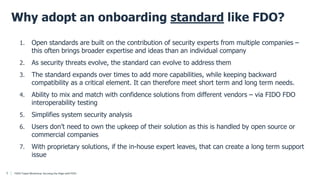
Why adopt an onboarding standard like FDO?
Open standards are built on the contribution of security experts from multiple companies –
this often brings broader expertise and ideas than an individual company
As security threats evolve, the standard can evolve to address them
The standard expands over times to add more capabilities, while keeping backward
compatibility as a critical element. It can therefore meet short term and long term needs.
Ability to mix and match with confidence solutions from different vendors – via FIDO FDO
interoperability testing
Simplifies system security analysis
Users don’t need to own the upkeep of their solution as this is handled by open source or
commercial companies
With proprietary solutions, if the in-house expert leaves, that can create a long term support
issue
FIDO Taipei Workshop: Securing the Edge with FDO
10
Example FDO applications
FIDO Taipei Workshop: Securing the Edge with FDO
11
Potential application of FDO to
Manufacturing Applications
Manufacturing Cloud
Local Server (ACP)
PLC/DCN
FIDO Taipei Workshop: Securing the Edge with FDO
12
Potential application of FDO to
Retail Applications
Retail Cloud
Local Server
POS
Security
Camera
Cloud
FIDO Taipei Workshop: Securing the Edge with FDO
13
Potential application of FDO to
Medical Applications
Cloud
Local Server
FIDO Taipei Workshop: Securing the Edge with FDO
14
Potential application of FDO to
Automotive Applications
Software update
FIDO Taipei Workshop: Securing the Edge with FDO
15
Potential application of FDO to
In-vehicle Automotive Applications
Vehicle
computer
Zone
controller
FIDO Taipei Workshop: Securing the Edge with FDO
16
Example FDO architectures
FIDO Taipei Workshop: Securing the Edge with FDO
17
FDO is highly flexible and therefore can users can choose the architecture that
best meets there needs
As a users needs evolved, FDO can be extended without breaking backwards
compatibility
single cloud ➔ multi-cloud ➔ closed network ➔ ‘bring your own devices’
Choosing the right FDO deployment model for
your application
FIDO Taipei Workshop: Securing the Edge with FDO
18
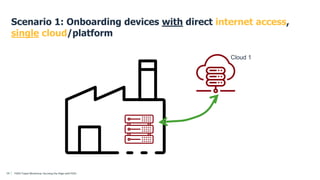
Scenario 1: Onboarding devices with direct internet access,
single cloud/platform
Cloud 1
FIDO Taipei Workshop: Securing the Edge with FDO
19
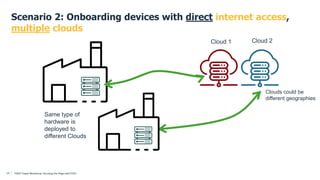
Scenario 2: Onboarding devices with direct internet access,
multiple clouds
Cloud 1 Cloud 2
Clouds could be
different geographies
Same type of
hardware is
deployed to
different Clouds
FIDO Taipei Workshop: Securing the Edge with FDO
20
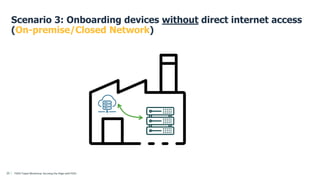
Scenario 3: Onboarding devices without direct internet access
(On-premise/Closed Network)
FIDO Taipei Workshop: Securing the Edge with FDO
21
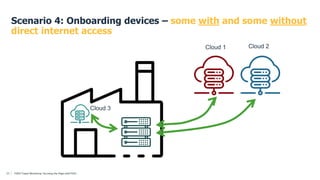
Scenario 4: Onboarding devices – some with and some without
direct internet access
Cloud 1 Cloud 2
Cloud 3
FIDO Taipei Workshop: Securing the Edge with FDO
22
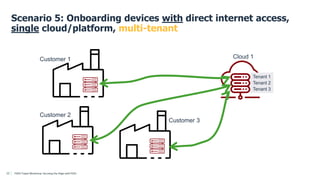
Scenario 5: Onboarding devices with direct internet access,
single cloud/platform, multi-tenant
Cloud 1
Tenant 1
Tenant 2
Tenant 3
Customer 1
Customer 2
Customer 3
FIDO Taipei Workshop: Securing the Edge with FDO
23
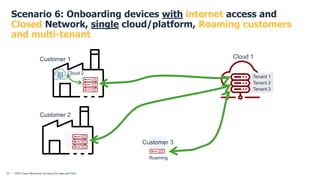
Scenario 6: Onboarding devices with internet access and
Closed Network, single cloud/platform, Roaming customers
and multi-tenant
Cloud 1
Tenant 1
Tenant 2
Tenant 3
Customer 1
Customer 2
Cloud 2
Roaming
Customer 3
FIDO Taipei Workshop: Securing the Edge with FDO
24
FDO – A Flexible and extensible
solution
FIDO Taipei Workshop: Securing the Edge with FDO
25
FDO Deployment Flexibility
Architectural Sophistication
Single Internet
Cloud
Internet Cloud
& On-
prem/Closed
Single Cloud
with Multi-
tenant
Multi-Cloud,
Internet and
closed network
with Multi-
tenant
FIDO Taipei Workshop: Securing the Edge with FDO
26
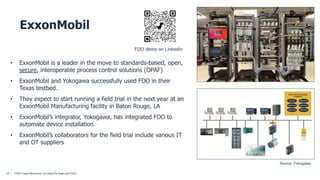
ExxonMobil
ExxonMobil is a leader in the move to standards-based, open,
secure, interoperable process control solutions (OPAF)
ExxonMobil and Yokogawa successfully used FDO in their
Texas testbed.
They expect to start running a field trial in the next year at an
ExxonMobil Manufacturing facility in Baton Rouge, LA
ExxonMobil’s integrator, Yokogawa, has integrated FDO to
automate device installation.
ExxonMobil’s collaborators for the field trial include various IT
and OT suppliers
Source: Yokogawa
FDO demo on LinkedIn
FIDO Taipei Workshop: Securing the Edge with FDO
27
FDO Business FAQ
1. Do I need to join the FIDO Alliance to use the FDO specification?
➢ No. FDO is an open standard. The spec can be downloaded from the FIDO Alliance web site.
➢ Joining the FIDO Alliance will allow you to impact the evolution of FDO and learn from other users and ecosystem
partners
2. What is the license agreement for the FDO technical specification
➢ The FIDO Alliance IPR terms can be found here:
https://media.fidoalliance.org/wp-content/uploads/2019/12/FIDO-IPR-flowchart-v4-W3C.pdf
3. Do I need to pay for certification?
➢ The FIDO Alliance does offer a paid FDO Certification program.
➢ There is no obligation for members to certify their products, however if companies want to use a FIDO FDO certification
logo then certification of the product is required.
➢ Members do receive a discount on Certification costs.
3. Is there software available that implements FDO? Do I need to pay for them?
➢ Yes, multiple versions. Some are open source, some are commercial version.
FIDO Taipei Workshop: Securing the Edge with FDO
28
Extending FDO applications with FSIMs
Hardware ships
with FDO only
Software deployed
at facility via FDO
Remote SW deployment
Firmware update
deployed at facility
via FDO
Remote firmware updated
Hardware ships with
FDO and SW load
FSIM protocols
• Embedded
protocols within
FDO that perform
onboarding
actions
• Examples: File
transfers, key
generation, shell
commands
FIDO Taipei Workshop: Securing the Edge with FDO
29
Conclusion
FDO is highly flexible and extensible
A wide range of deployment architectures are supported
Customers can evolve their architecture over time while retaining compatibility
FDO has been developed to offer a high degree of security
Customers can further extend the security as needed in their application
Users can mix-and-match their credential storage approach as needed
FDO can be used with a wide range of processors and Operating systems
In conclusion, FDO meets your onboarding needs for today and the future