An example of Multiple Choice Fill In The Blanks for Assessment Of Learning

Loading...

Flash Player 9 (or above) is needed to view presentations.
We have detected that you do not have it on your computer. To install it, go here.

0 comments

Post a comment

    Post a comment
    Embed Video
    Edit your comment Cancel

    Favorites, Groups & Events

    An example of Multiple Choice Fill In The Blanks for Assessment Of Learning - Presentation Transcript

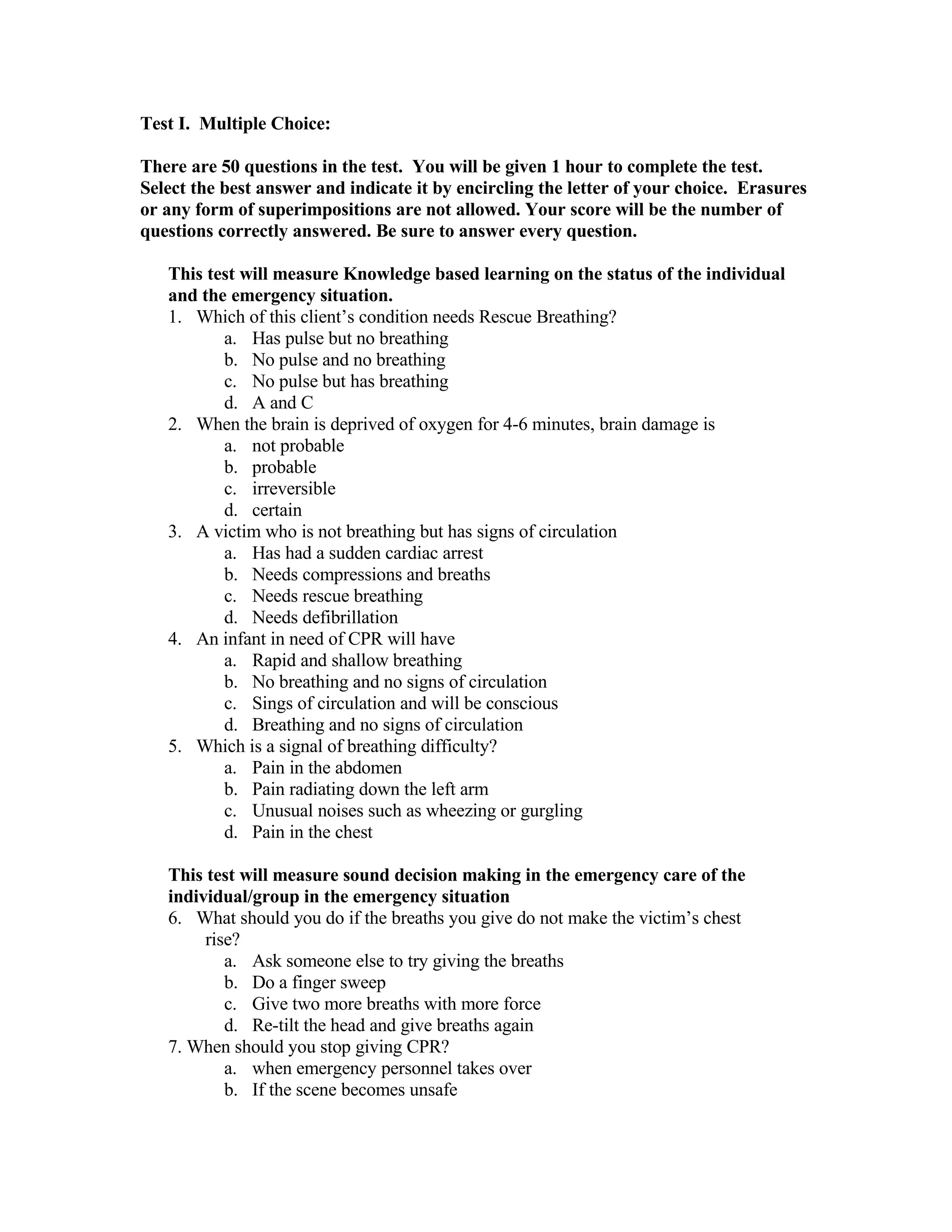
    1. Test I. Multiple Choice: There are 50 questions in the test. You will be given 1 hour to complete the test. Select the best answer and indicate it by encircling the letter of your choice. Erasures or any form of superimpositions are not allowed. Your score will be the number of questions correctly answered. Be sure to answer every question. This test will measure Knowledge based learning on the status of the individual and the emergency situation. 1. Which of this client’s condition needs Rescue Breathing? a. Has pulse but no breathing b. No pulse and no breathing c. No pulse but has breathing d. A and C 2. When the brain is deprived of oxygen for 4-6 minutes, brain damage is a. not probable b. probable c. irreversible d. certain 3. A victim who is not breathing but has signs of circulation a. Has had a sudden cardiac arrest b. Needs compressions and breaths c. Needs rescue breathing d. Needs defibrillation 4. An infant in need of CPR will have a. Rapid and shallow breathing b. No breathing and no signs of circulation c. Sings of circulation and will be conscious d. Breathing and no signs of circulation 5. Which is a signal of breathing difficulty? a. Pain in the abdomen b. Pain radiating down the left arm c. Unusual noises such as wheezing or gurgling d. Pain in the chest This test will measure sound decision making in the emergency care of the individual/group in the emergency situation 6. What should you do if the breaths you give do not make the victim’s chest rise? a. Ask someone else to try giving the breaths b. Do a finger sweep c. Give two more breaths with more force d. Re-tilt the head and give breaths again 7. When should you stop giving CPR? a. when emergency personnel takes over b. If the scene becomes unsafe
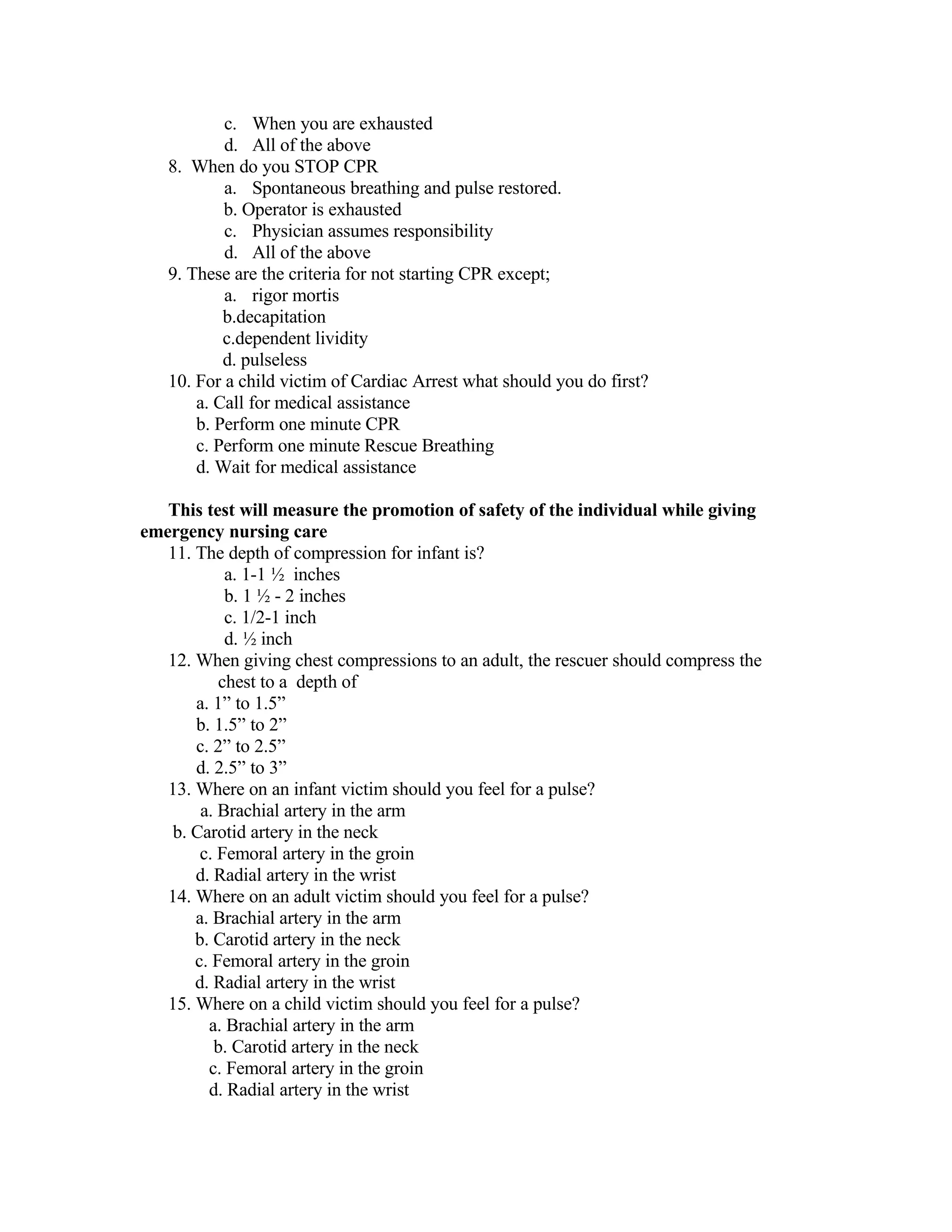
    2. c. When you are exhausted d. All of the above 8. When do you STOP CPR a. Spontaneous breathing and pulse restored. b. Operator is exhausted c. Physician assumes responsibility d. All of the above 9. These are the criteria for not starting CPR except; a. rigor mortis b.decapitation c.dependent lividity d. pulseless 10. For a child victim of Cardiac Arrest what should you do first? a. Call for medical assistance b. Perform one minute CPR c. Perform one minute Rescue Breathing d. Wait for medical assistance This test will measure the promotion of safety of the individual while giving emergency nursing care 11. The depth of compression for infant is? a. 1-1 ½ inches b. 1 ½ - 2 inches c. 1/2-1 inch d. ½ inch 12. When giving chest compressions to an adult, the rescuer should compress the chest to a depth of a. 1” to 1.5” b. 1.5” to 2” c. 2” to 2.5” d. 2.5” to 3” 13. Where on an infant victim should you feel for a pulse? a. Brachial artery in the arm b. Carotid artery in the neck c. Femoral artery in the groin d. Radial artery in the wrist 14. Where on an adult victim should you feel for a pulse? a. Brachial artery in the arm b. Carotid artery in the neck c. Femoral artery in the groin d. Radial artery in the wrist 15. Where on a child victim should you feel for a pulse? a. Brachial artery in the arm b. Carotid artery in the neck c. Femoral artery in the groin d. Radial artery in the wrist
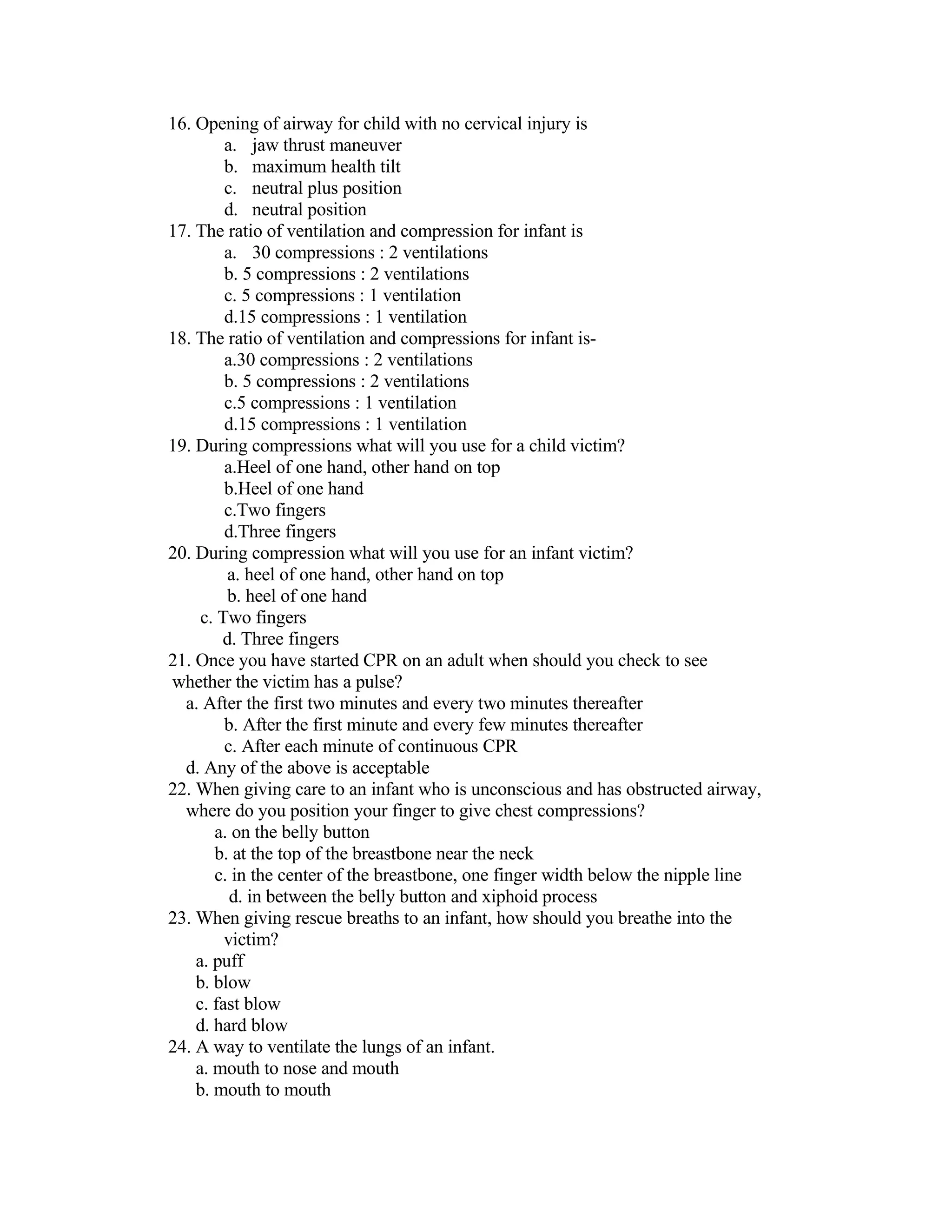
    3. 16. Opening of airway for child with no cervical injury is a. jaw thrust maneuver b. maximum health tilt c. neutral plus position d. neutral position 17. The ratio of ventilation and compression for infant is a. 30 compressions : 2 ventilations b. 5 compressions : 2 ventilations c. 5 compressions : 1 ventilation d.15 compressions : 1 ventilation 18. The ratio of ventilation and compressions for infant is- a.30 compressions : 2 ventilations b. 5 compressions : 2 ventilations c.5 compressions : 1 ventilation d.15 compressions : 1 ventilation 19. During compressions what will you use for a child victim? a.Heel of one hand, other hand on top b.Heel of one hand c.Two fingers d.Three fingers 20. During compression what will you use for an infant victim? a. heel of one hand, other hand on top b. heel of one hand c. Two fingers d. Three fingers 21. Once you have started CPR on an adult when should you check to see whether the victim has a pulse? a. After the first two minutes and every two minutes thereafter b. After the first minute and every few minutes thereafter c. After each minute of continuous CPR d. Any of the above is acceptable 22. When giving care to an infant who is unconscious and has obstructed airway, where do you position your finger to give chest compressions? a. on the belly button b. at the top of the breastbone near the neck c. in the center of the breastbone, one finger width below the nipple line d. in between the belly button and xiphoid process 23. When giving rescue breaths to an infant, how should you breathe into the victim? a. puff b. blow c. fast blow d. hard blow 24. A way to ventilate the lungs of an infant. a. mouth to nose and mouth b. mouth to mouth
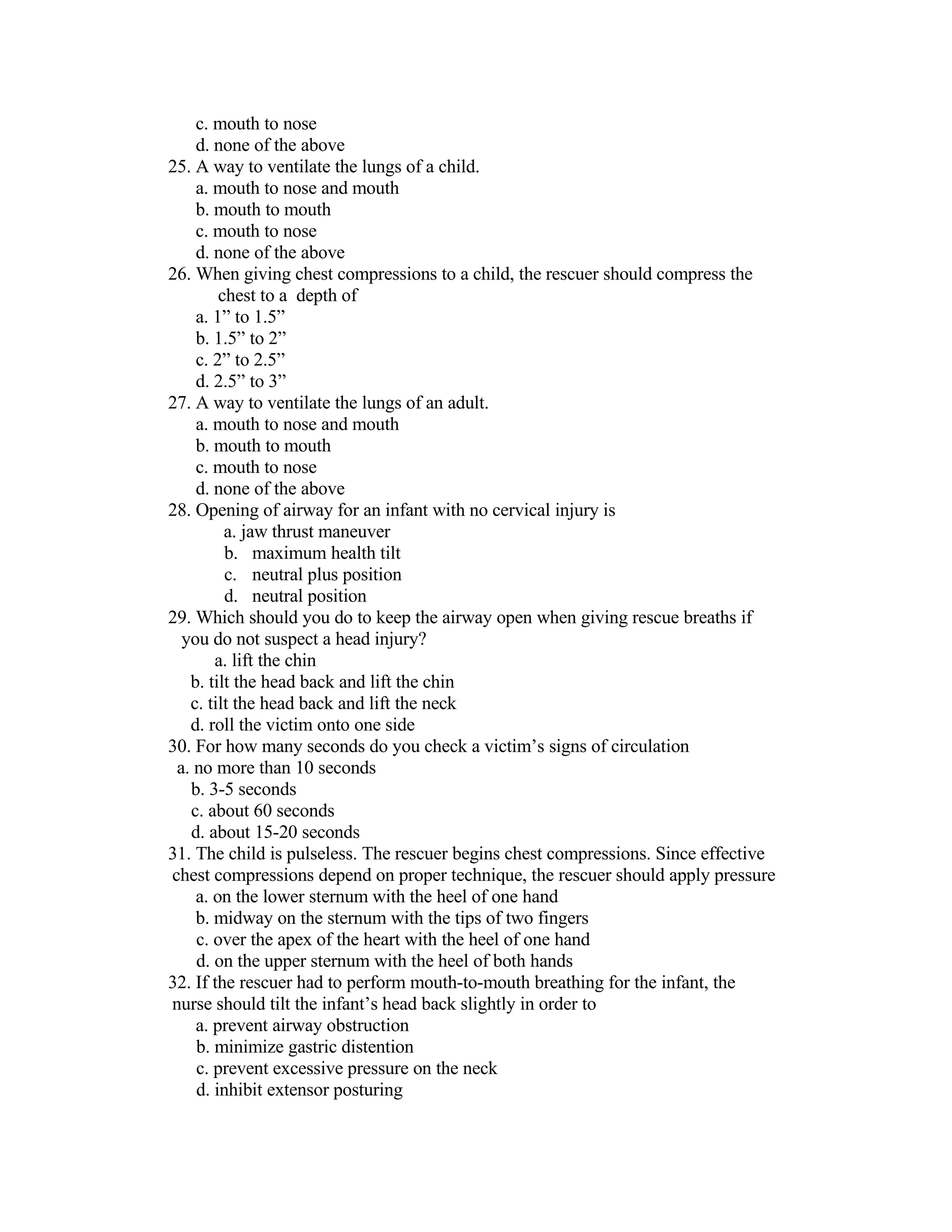
    4. c. mouth to nose d. none of the above 25. A way to ventilate the lungs of a child. a. mouth to nose and mouth b. mouth to mouth c. mouth to nose d. none of the above 26. When giving chest compressions to a child, the rescuer should compress the chest to a depth of a. 1” to 1.5” b. 1.5” to 2” c. 2” to 2.5” d. 2.5” to 3” 27. A way to ventilate the lungs of an adult. a. mouth to nose and mouth b. mouth to mouth c. mouth to nose d. none of the above 28. Opening of airway for an infant with no cervical injury is a. jaw thrust maneuver b. maximum health tilt c. neutral plus position d. neutral position 29. Which should you do to keep the airway open when giving rescue breaths if you do not suspect a head injury? a. lift the chin b. tilt the head back and lift the chin c. tilt the head back and lift the neck d. roll the victim onto one side 30. For how many seconds do you check a victim’s signs of circulation a. no more than 10 seconds b. 3-5 seconds c. about 60 seconds d. about 15-20 seconds 31. The child is pulseless. The rescuer begins chest compressions. Since effective chest compressions depend on proper technique, the rescuer should apply pressure a. on the lower sternum with the heel of one hand b. midway on the sternum with the tips of two fingers c. over the apex of the heart with the heel of one hand d. on the upper sternum with the heel of both hands 32. If the rescuer had to perform mouth-to-mouth breathing for the infant, the nurse should tilt the infant’s head back slightly in order to a. prevent airway obstruction b. minimize gastric distention c. prevent excessive pressure on the neck d. inhibit extensor posturing
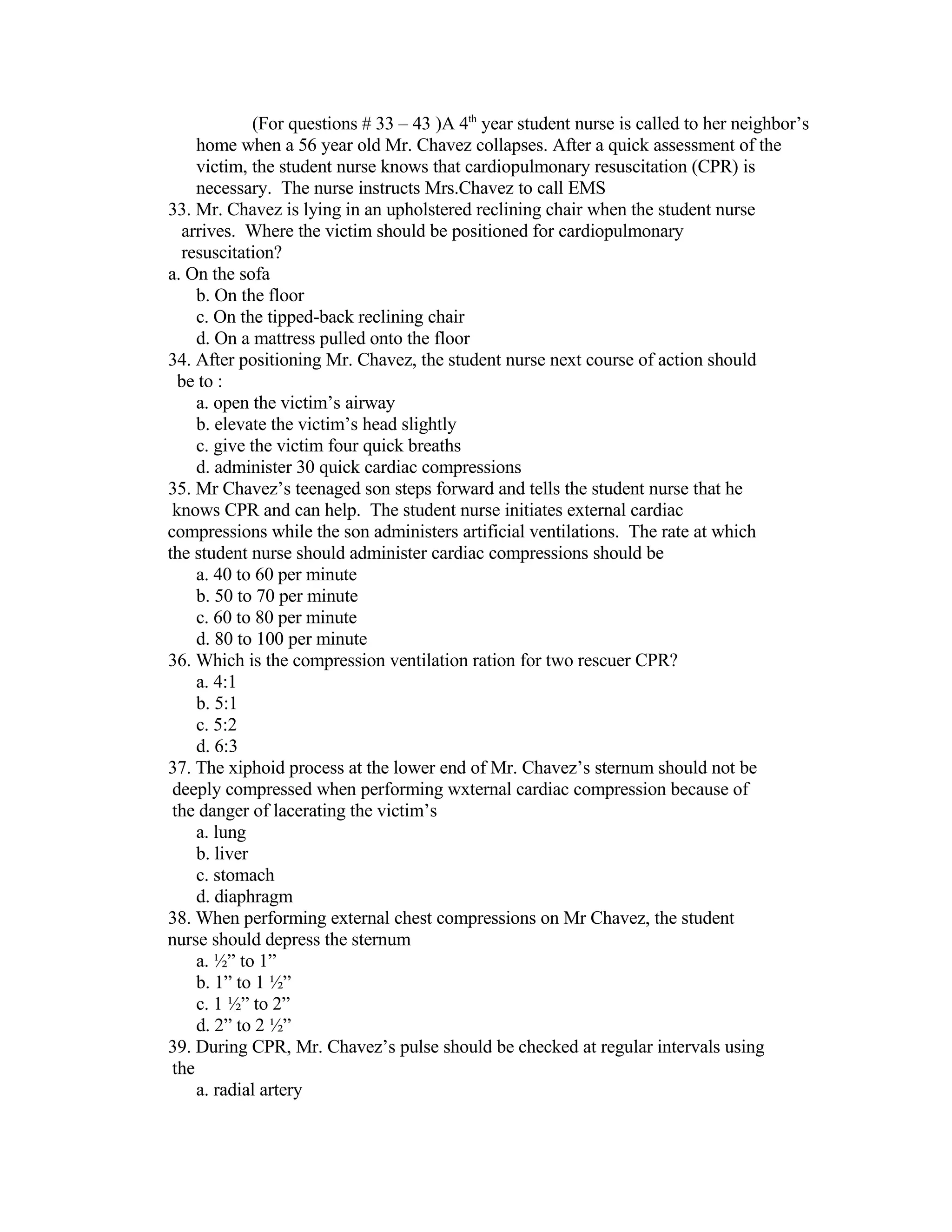
    5. (For questions # 33 – 43 )A 4th year student nurse is called to her neighbor’s home when a 56 year old Mr. Chavez collapses. After a quick assessment of the victim, the student nurse knows that cardiopulmonary resuscitation (CPR) is necessary. The nurse instructs Mrs.Chavez to call EMS 33. Mr. Chavez is lying in an upholstered reclining chair when the student nurse arrives. Where the victim should be positioned for cardiopulmonary resuscitation? a. On the sofa b. On the floor c. On the tipped-back reclining chair d. On a mattress pulled onto the floor 34. After positioning Mr. Chavez, the student nurse next course of action should be to : a. open the victim’s airway b. elevate the victim’s head slightly c. give the victim four quick breaths d. administer 30 quick cardiac compressions 35. Mr Chavez’s teenaged son steps forward and tells the student nurse that he knows CPR and can help. The student nurse initiates external cardiac compressions while the son administers artificial ventilations. The rate at which the student nurse should administer cardiac compressions should be a. 40 to 60 per minute b. 50 to 70 per minute c. 60 to 80 per minute d. 80 to 100 per minute 36. Which is the compression ventilation ration for two rescuer CPR? a. 4:1 b. 5:1 c. 5:2 d. 6:3 37. The xiphoid process at the lower end of Mr. Chavez’s sternum should not be deeply compressed when performing wxternal cardiac compression because of the danger of lacerating the victim’s a. lung b. liver c. stomach d. diaphragm 38. When performing external chest compressions on Mr Chavez, the student nurse should depress the sternum a. ½” to 1” b. 1” to 1 ½” c. 1 ½” to 2” d. 2” to 2 ½” 39. During CPR, Mr. Chavez’s pulse should be checked at regular intervals using the a. radial artery
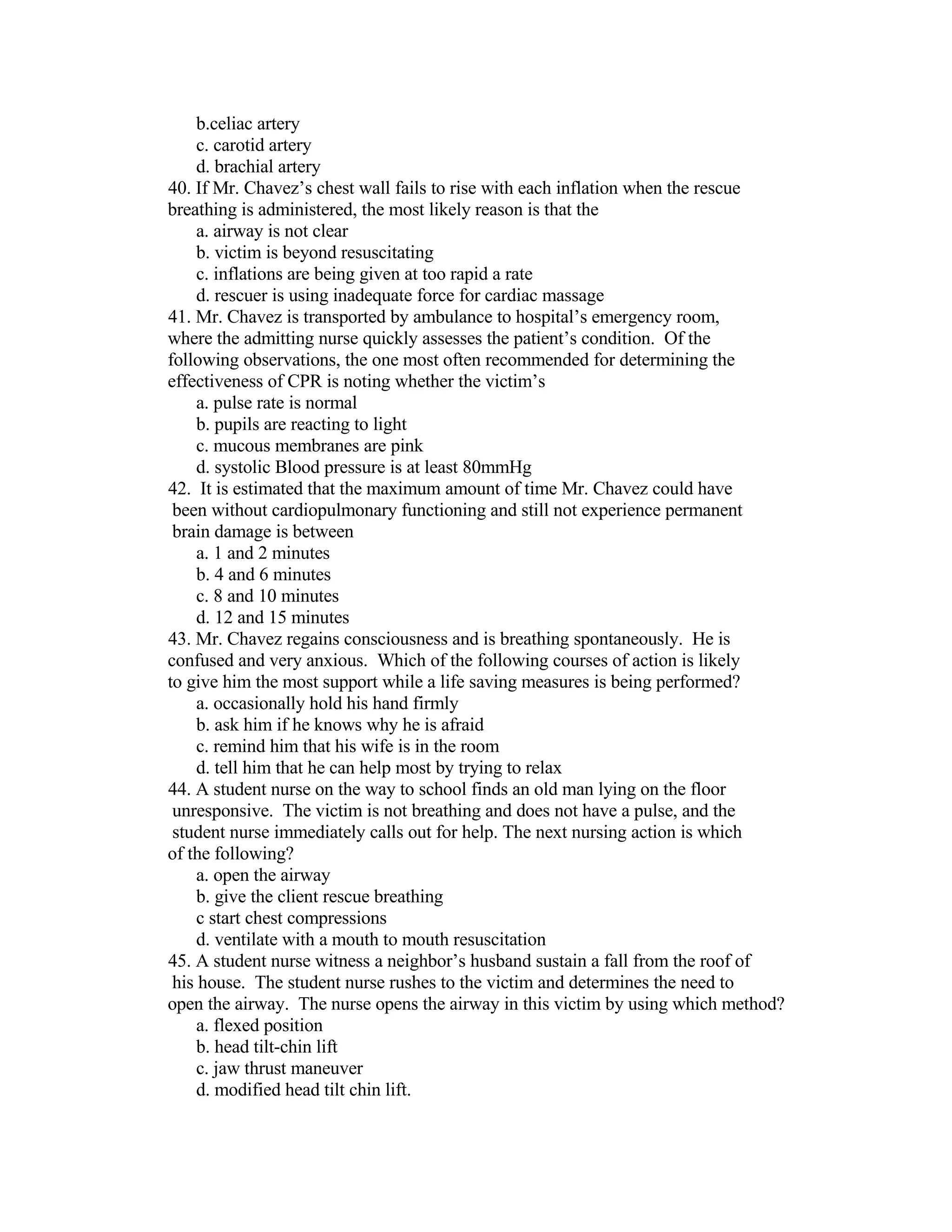
    6. b.celiac artery c. carotid artery d. brachial artery 40. If Mr. Chavez’s chest wall fails to rise with each inflation when the rescue breathing is administered, the most likely reason is that the a. airway is not clear b. victim is beyond resuscitating c. inflations are being given at too rapid a rate d. rescuer is using inadequate force for cardiac massage 41. Mr. Chavez is transported by ambulance to hospital’s emergency room, where the admitting nurse quickly assesses the patient’s condition. Of the following observations, the one most often recommended for determining the effectiveness of CPR is noting whether the victim’s a. pulse rate is normal b. pupils are reacting to light c. mucous membranes are pink d. systolic Blood pressure is at least 80mmHg 42. It is estimated that the maximum amount of time Mr. Chavez could have been without cardiopulmonary functioning and still not experience permanent brain damage is between a. 1 and 2 minutes b. 4 and 6 minutes c. 8 and 10 minutes d. 12 and 15 minutes 43. Mr. Chavez regains consciousness and is breathing spontaneously. He is confused and very anxious. Which of the following courses of action is likely to give him the most support while a life saving measures is being performed? a. occasionally hold his hand firmly b. ask him if he knows why he is afraid c. remind him that his wife is in the room d. tell him that he can help most by trying to relax 44. A student nurse on the way to school finds an old man lying on the floor unresponsive. The victim is not breathing and does not have a pulse, and the student nurse immediately calls out for help. The next nursing action is which of the following? a. open the airway b. give the client rescue breathing c start chest compressions d. ventilate with a mouth to mouth resuscitation 45. A student nurse witness a neighbor’s husband sustain a fall from the roof of his house. The student nurse rushes to the victim and determines the need to open the airway. The nurse opens the airway in this victim by using which method? a. flexed position b. head tilt-chin lift c. jaw thrust maneuver d. modified head tilt chin lift.
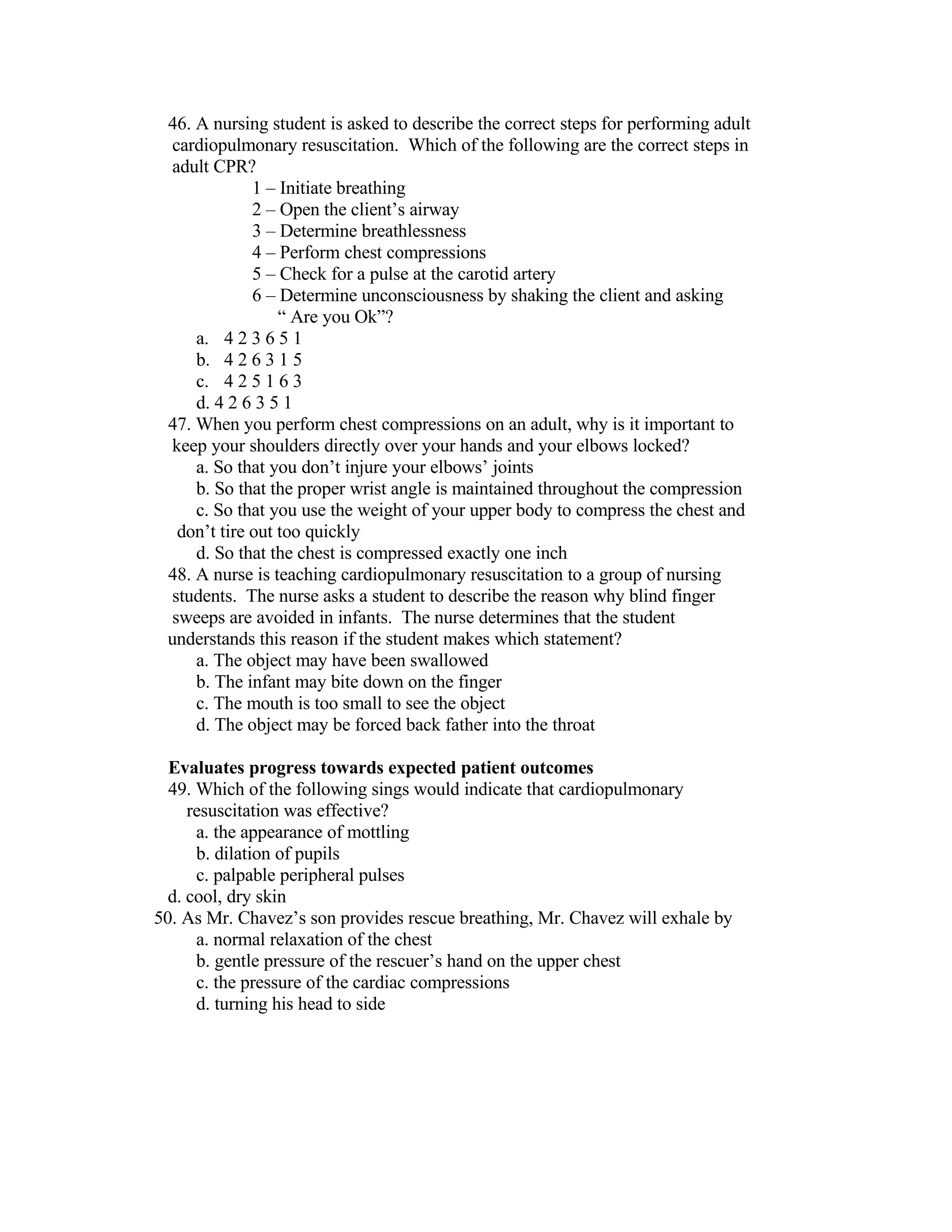
    7. 46. A nursing student is asked to describe the correct steps for performing adult cardiopulmonary resuscitation. Which of the following are the correct steps in adult CPR? 1 – Initiate breathing 2 – Open the client’s airway 3 – Determine breathlessness 4 – Perform chest compressions 5 – Check for a pulse at the carotid artery 6 – Determine unconsciousness by shaking the client and asking “ Are you Ok”? a. 4 2 3 6 5 1 b. 4 2 6 3 1 5 c. 4 2 5 1 6 3 d. 4 2 6 3 5 1 47. When you perform chest compressions on an adult, why is it important to keep your shoulders directly over your hands and your elbows locked? a. So that you don’t injure your elbows’ joints b. So that the proper wrist angle is maintained throughout the compression c. So that you use the weight of your upper body to compress the chest and don’t tire out too quickly d. So that the chest is compressed exactly one inch 48. A nurse is teaching cardiopulmonary resuscitation to a group of nursing students. The nurse asks a student to describe the reason why blind finger sweeps are avoided in infants. The nurse determines that the student understands this reason if the student makes which statement? a. The object may have been swallowed b. The infant may bite down on the finger c. The mouth is too small to see the object d. The object may be forced back father into the throat Evaluates progress towards expected patient outcomes 49. Which of the following sings would indicate that cardiopulmonary resuscitation was effective? a. the appearance of mottling b. dilation of pupils c. palpable peripheral pulses d. cool, dry skin 50. As Mr. Chavez’s son provides rescue breathing, Mr. Chavez will exhale by a. normal relaxation of the chest b. gentle pressure of the rescuer’s hand on the upper chest c. the pressure of the cardiac compressions d. turning his head to side
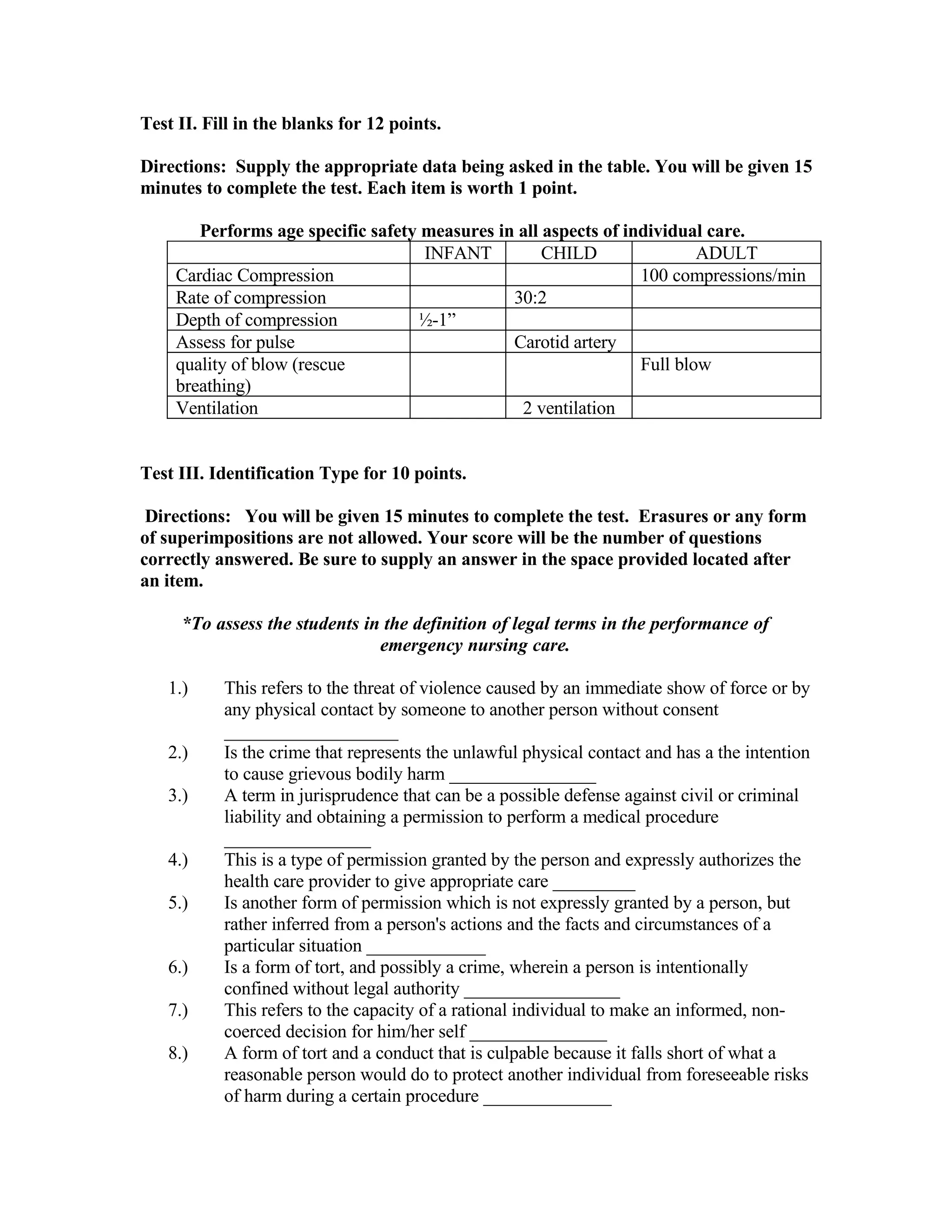
    8. Test II. Fill in the blanks for 12 points. Directions: Supply the appropriate data being asked in the table. You will be given 15 minutes to complete the test. Each item is worth 1 point. Performs age specific safety measures in all aspects of individual care. INFANT CHILD ADULT Cardiac Compression 100 compressions/min Rate of compression 30:2 Depth of compression ½-1” Assess for pulse Carotid artery quality of blow (rescue Full blow breathing) Ventilation 2 ventilation Test III. Identification Type for 10 points. Directions: You will be given 15 minutes to complete the test. Erasures or any form of superimpositions are not allowed. Your score will be the number of questions correctly answered. Be sure to supply an answer in the space provided located after an item. *To assess the students in the definition of legal terms in the performance of emergency nursing care. 1.) This refers to the threat of violence caused by an immediate show of force or by any physical contact by someone to another person without consent ___________________ 2.) Is the crime that represents the unlawful physical contact and has a the intention to cause grievous bodily harm ________________ 3.) A term in jurisprudence that can be a possible defense against civil or criminal liability and obtaining a permission to perform a medical procedure ________________ 4.) This is a type of permission granted by the person and expressly authorizes the health care provider to give appropriate care _________ 5.) Is another form of permission which is not expressly granted by a person, but rather inferred from a person's actions and the facts and circumstances of a particular situation _____________ 6.) Is a form of tort, and possibly a crime, wherein a person is intentionally confined without legal authority _________________ 7.) This refers to the capacity of a rational individual to make an informed, non- coerced decision for him/her self _______________ 8.) A form of tort and a conduct that is culpable because it falls short of what a reasonable person would do to protect another individual from foreseeable risks of harm during a certain procedure ______________
    9. 9.) Occurs when a health care professional has already begun emergency treatment of a patient and then suddenly walks away while the patient is still in need, without securing the services of an adequate substitute or giving the patient adequate opportunity to find one _____________ 10.) International accepted laws or acts protecting from liability those who choose to aid others who are injured or ill and also utilizes the principle of 'duty to rescue' ___________________
    SlideShare Zeitgeist 2009

    + Dave Jay  ManriquezDave Jay Manriquez Nominate

    custom

    1221 views, 0 favs, 0 embeds more stats

    Table Of Specification Assessment Of Learnings, usi more

    More info about this document

    © All Rights Reserved

    Go to text version

    • Total Views 1221
      • 1221 on SlideShare
      • 0 from embeds
    • Comments 0
    • Favorites 0
    • Downloads 3
    Most viewed embeds

    more

    All embeds

    less

    Flagged as inappropriate Flag as inappropriate
    Flag as inappropriate

    Select your reason for flagging this presentation as inappropriate. If needed, use the feedback form to let us know more details.

    Cancel
    File a copyright complaint
    Having problems? Go to our helpdesk?

    Categories