Cross-Cultural Collaboration Through a Virtual Community of Practice Using Video and Social Networking ED-MEDIA   2011 Lisbon, Portugal Bert Kimura, University of Hawaii, USA Mary Kimura, Kansai University, Japan Kenichi Kubota, Kansai University, Japan Curtis P. Ho, University of Hawaii, USA
Panel Session Overview Project Background Cross-Cultural Collaboration & Social Media Video Production at a Distance Learning Implications for VCoP & Cross-Cultural Settings Q & A
Goals & Objectives Student performance objectives Plan using social media Collaborate to produce a short video Instructor expectations How community emerges & evolves Cross-cultural context Social media
Background Student Populations Language level Technology experience Graduate student status Class Descriptions Schedule of Classes Friends
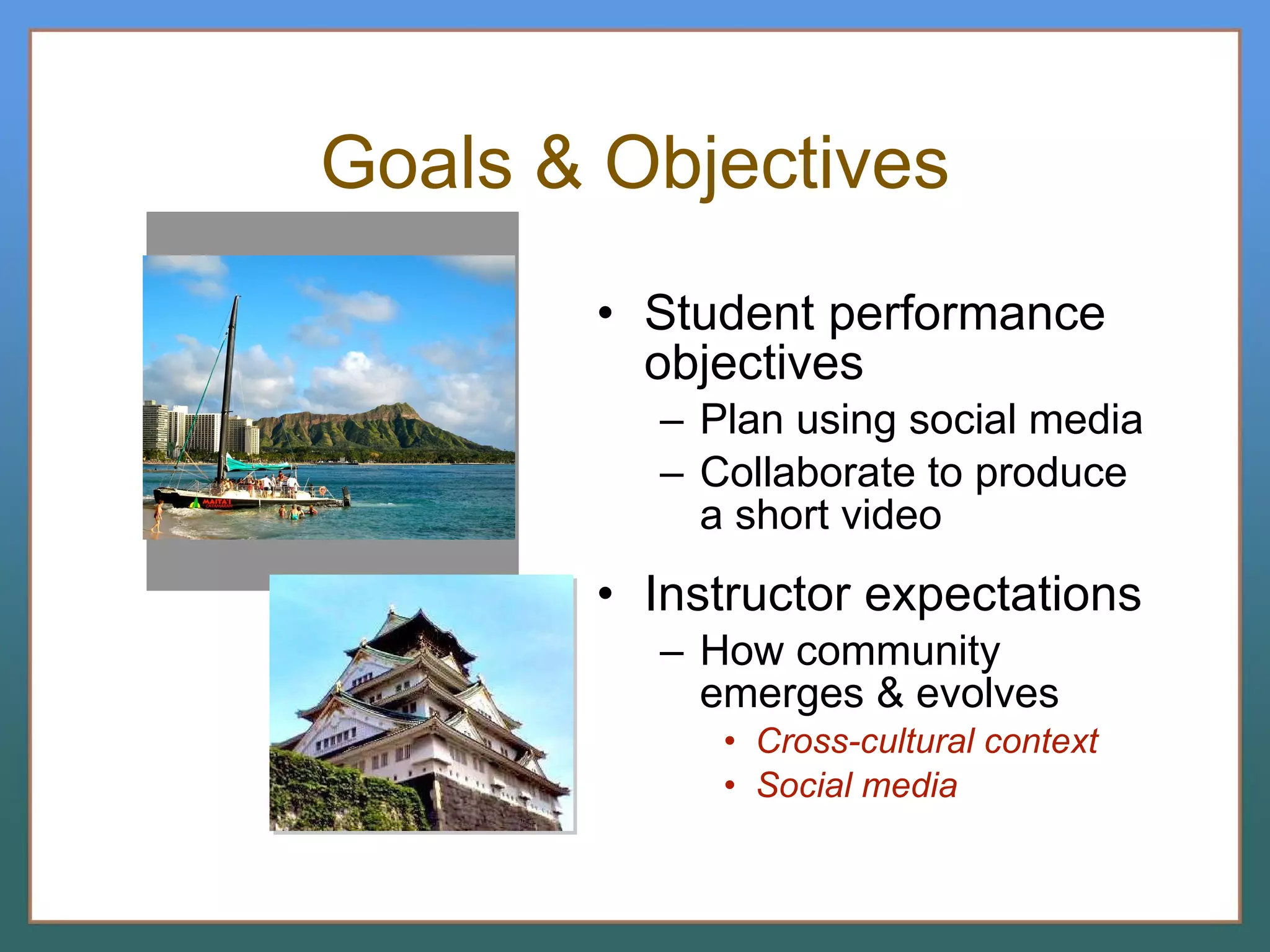
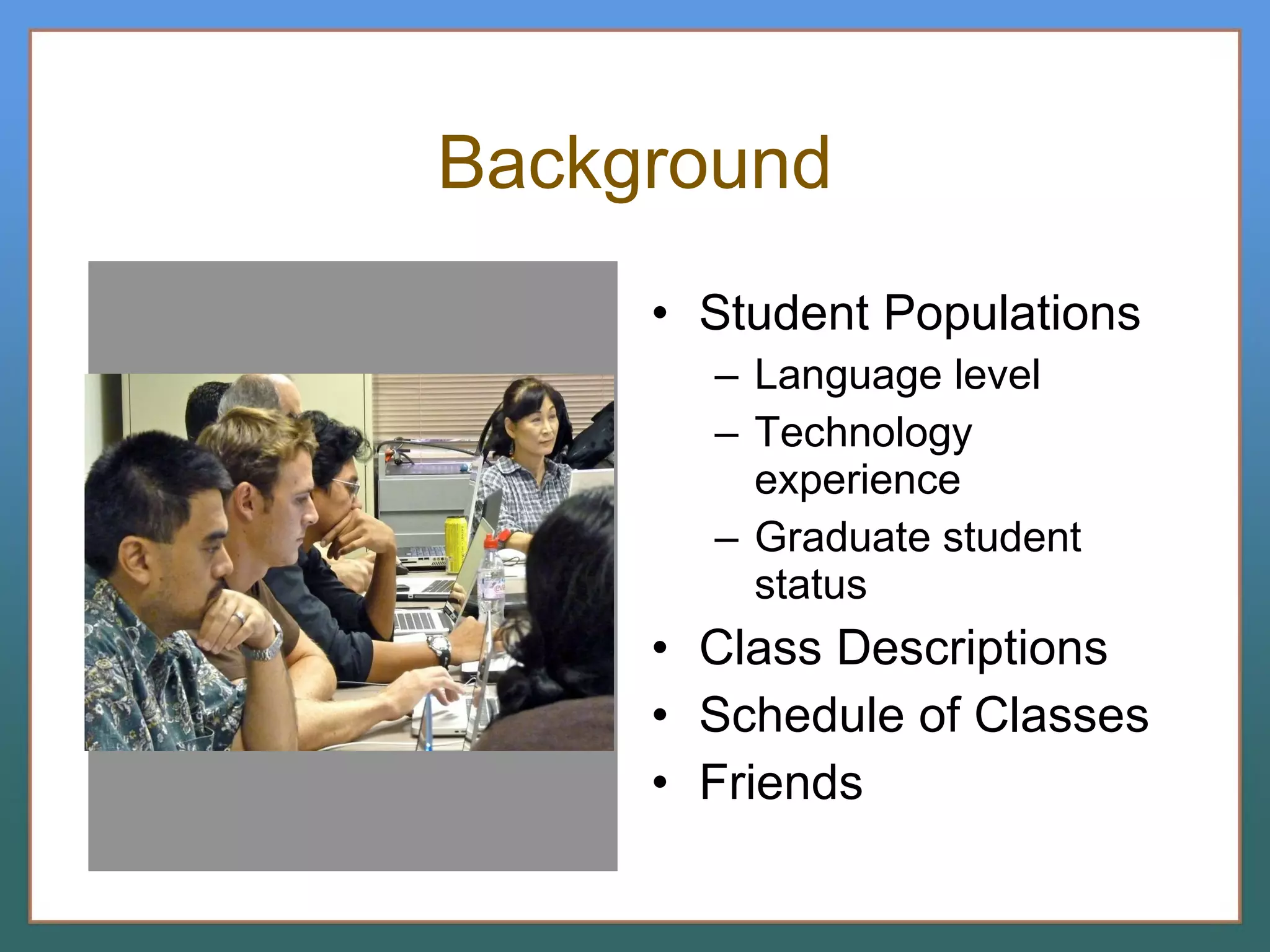
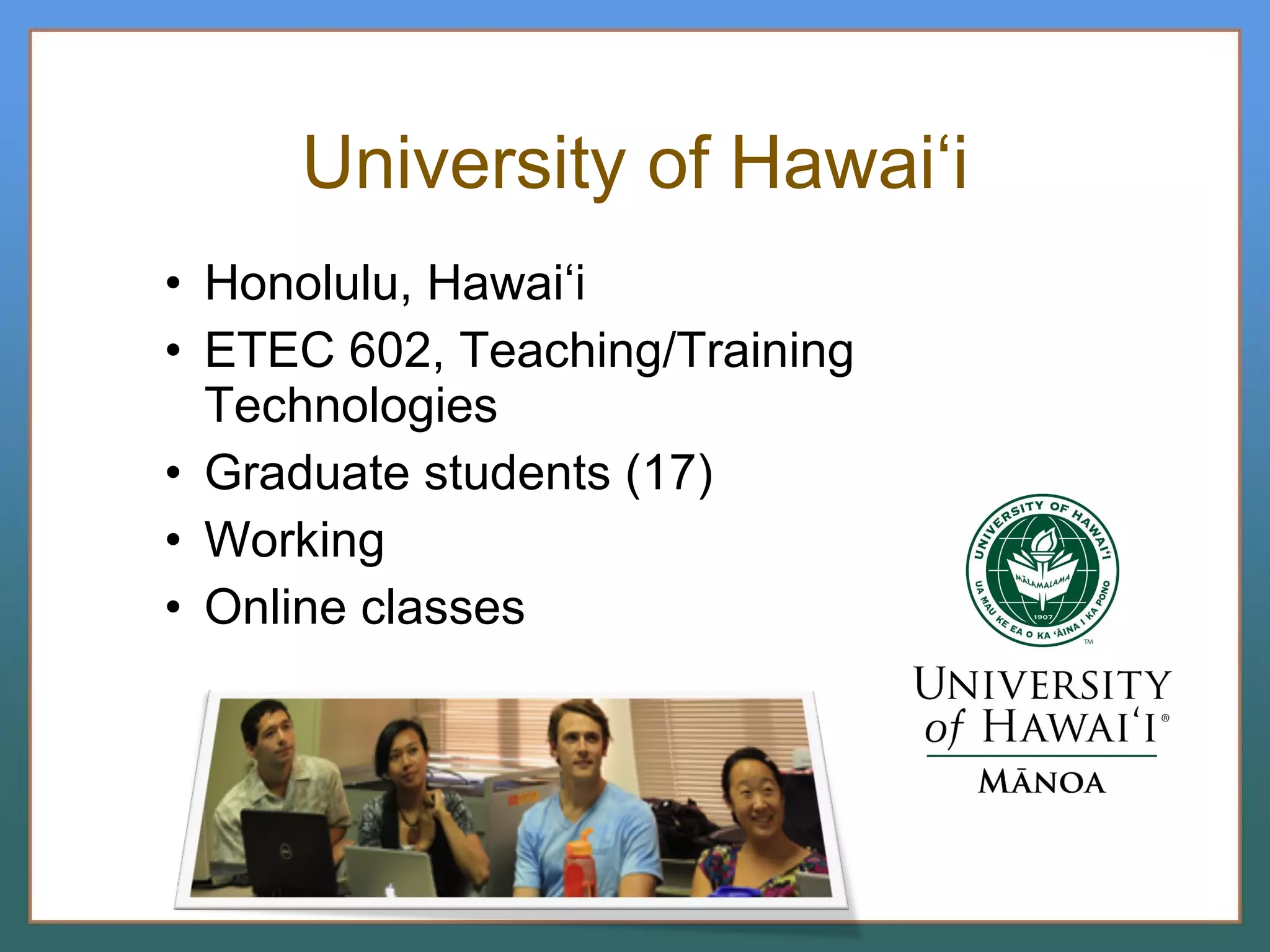
University of Hawai‘i Honolulu, Hawai‘i ETEC 602, Teaching/Training Technologies  Graduate students (17) Working Online classes
Osaka, Japan ICT for Learning On campus (14) Younger in age Use of second language Limited online experience Kansai University
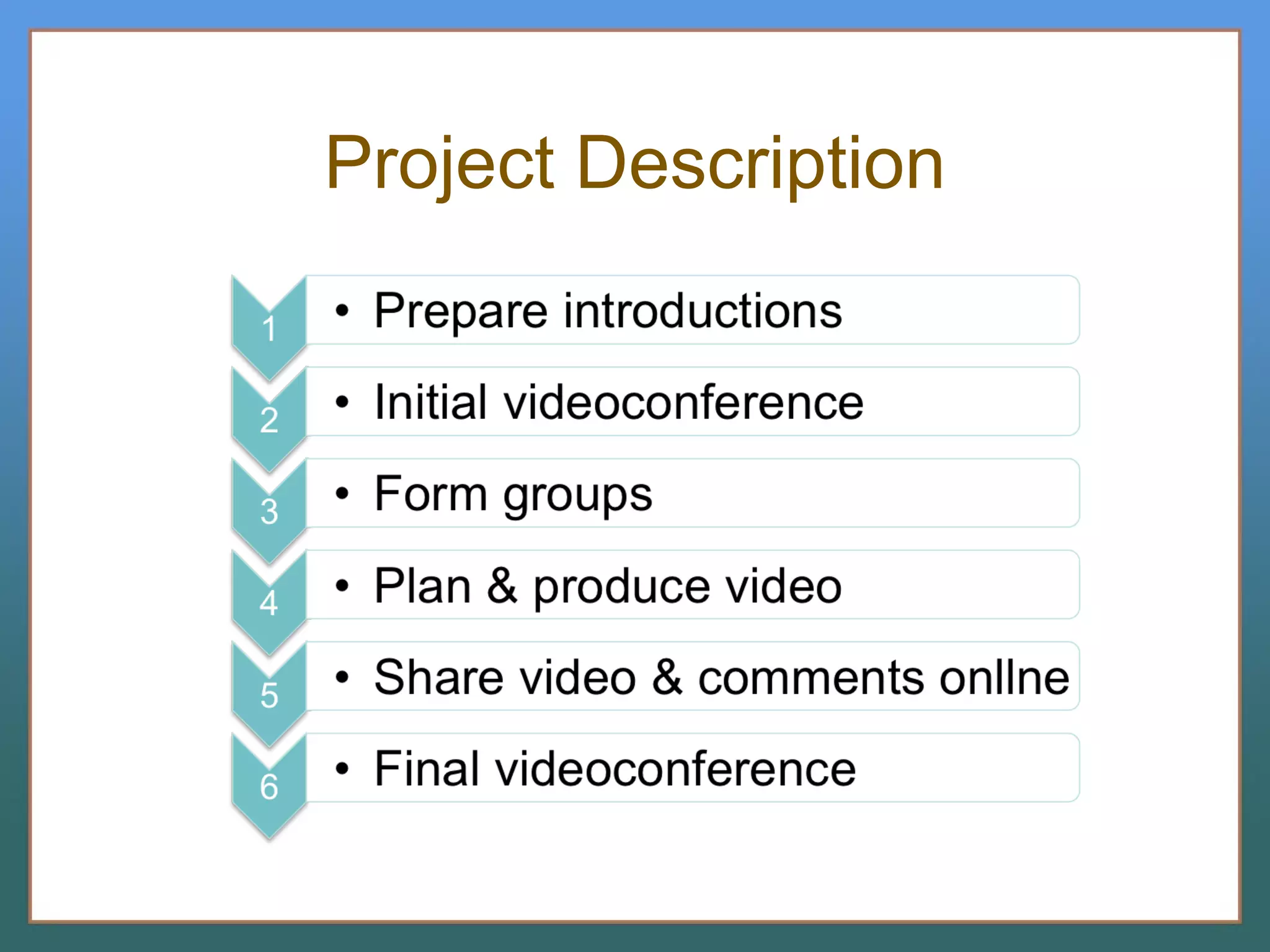
Project Description
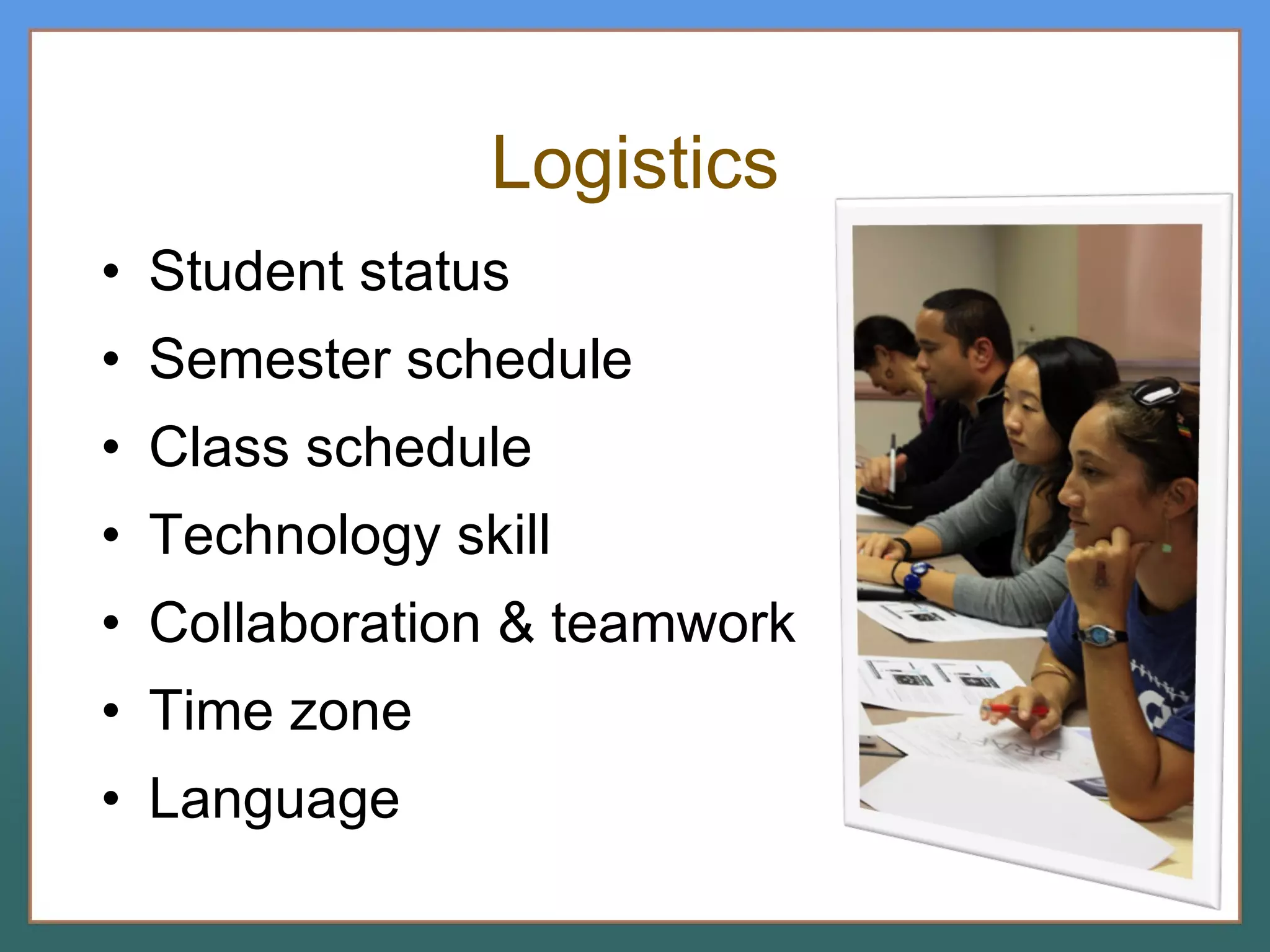
Logistics Student status Semester schedule Class schedule Technology skill Collaboration & teamwork Time zone Language
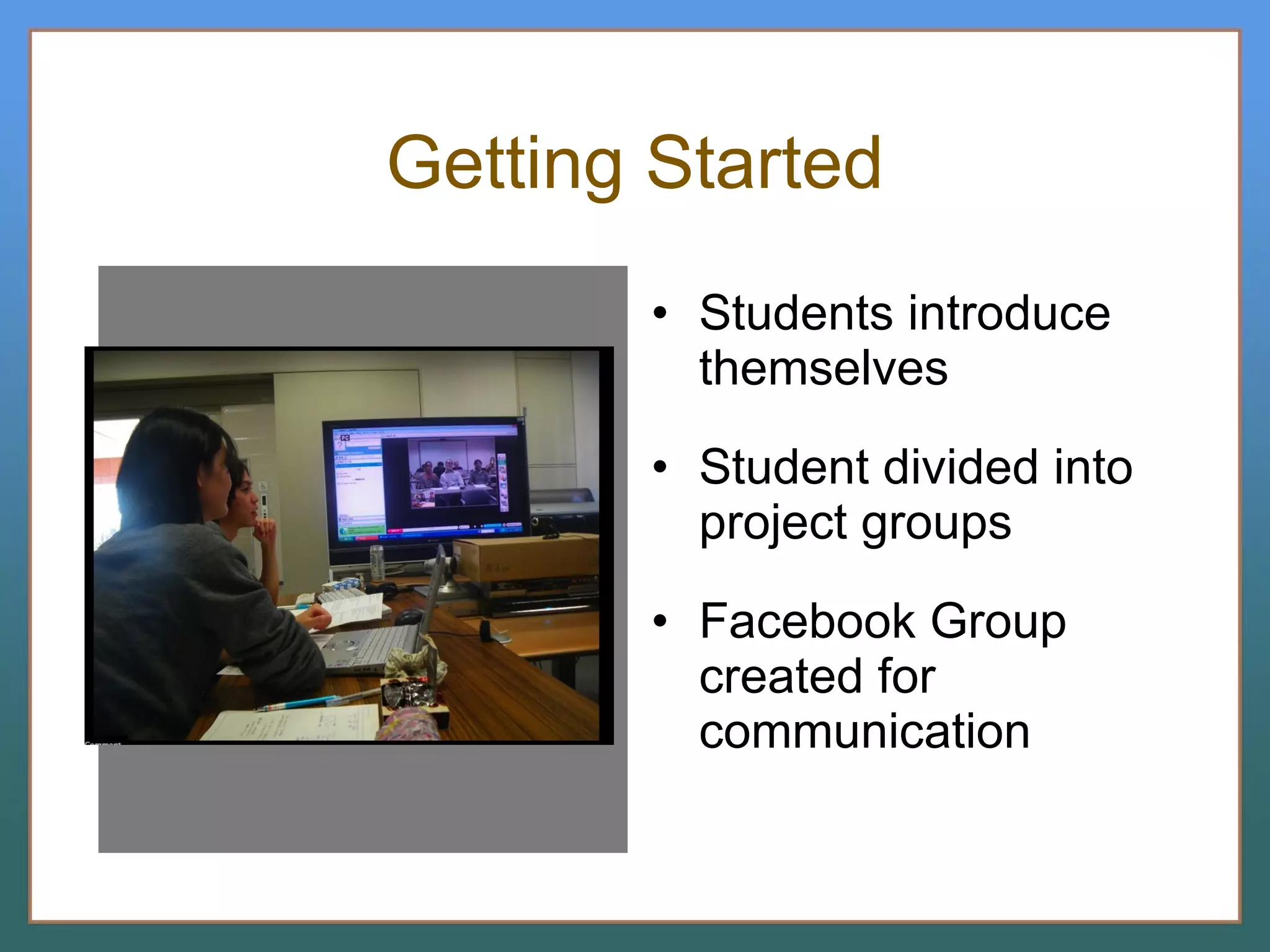
Getting Started Students introduce themselves Student divided into project groups Facebook Group created for communication
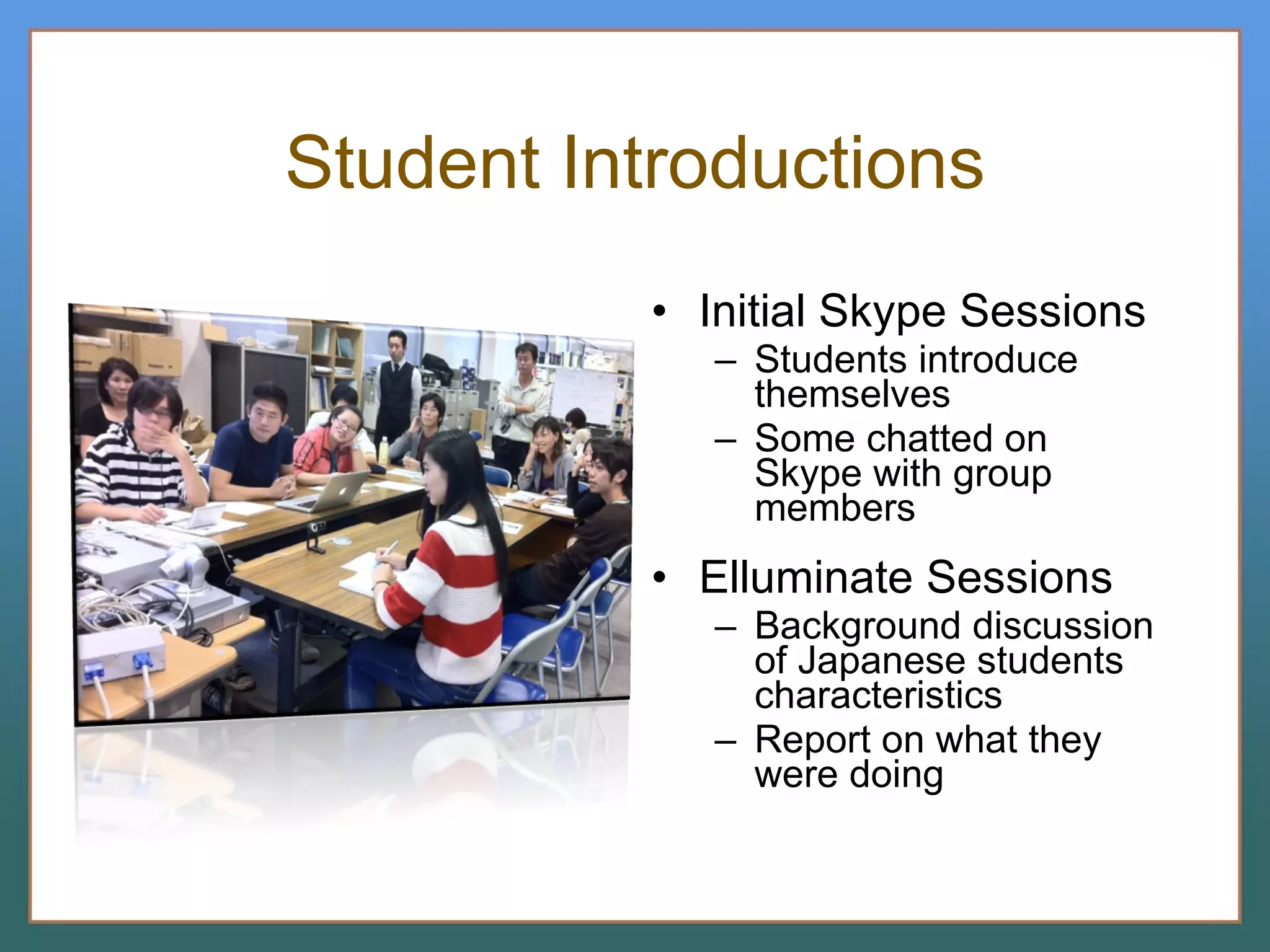
Student Introductions Initial Skype Sessions Students introduce themselves Some chatted on Skype with group members Elluminate Sessions Background discussion of Japanese students characteristics Report on what they were doing
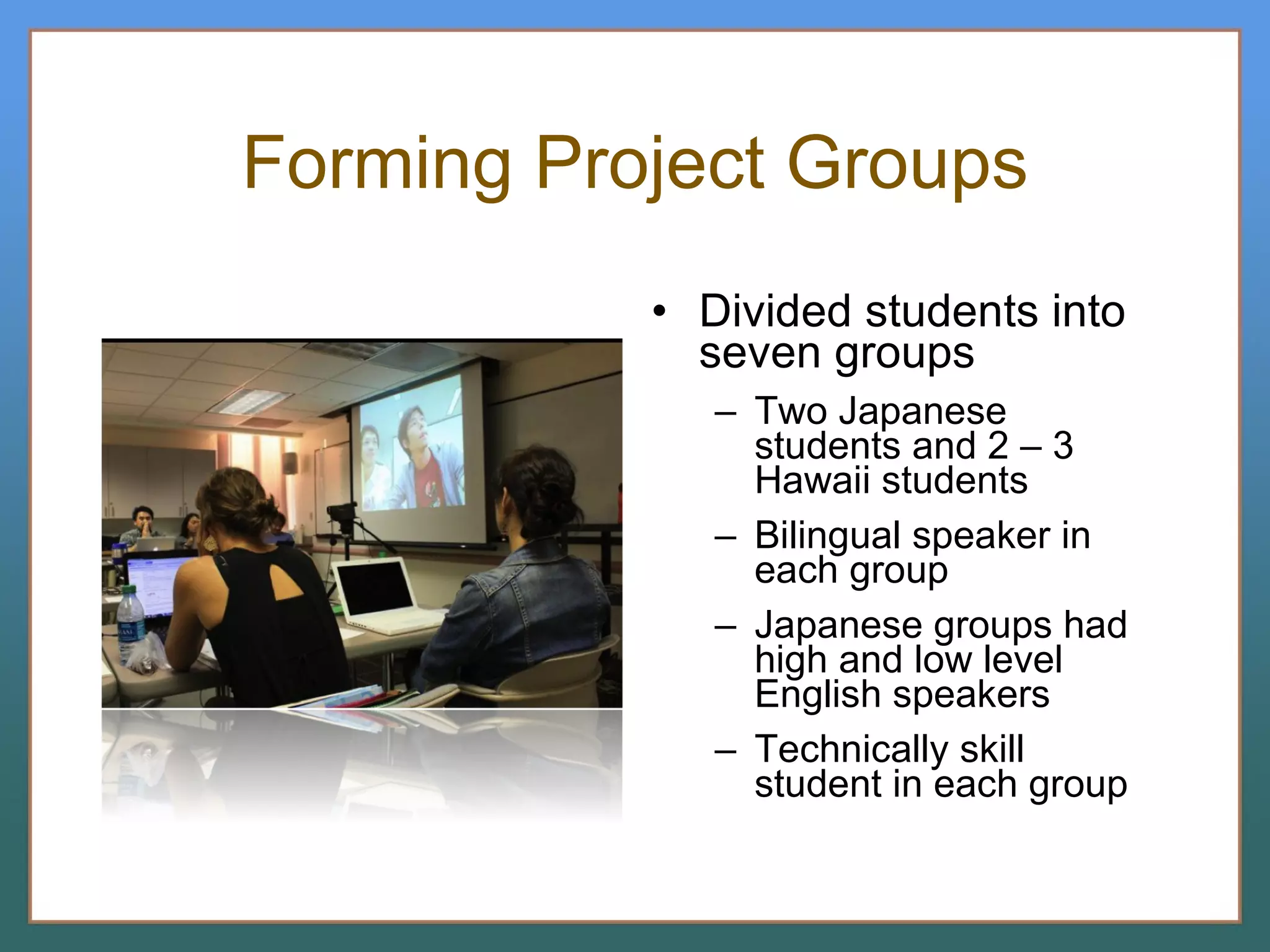
Forming Project Groups Divided students into seven groups Two Japanese students and 2 – 3 Hawaii students Bilingual speaker in each group Japanese groups had high and low level English speakers Technically skill student in each group
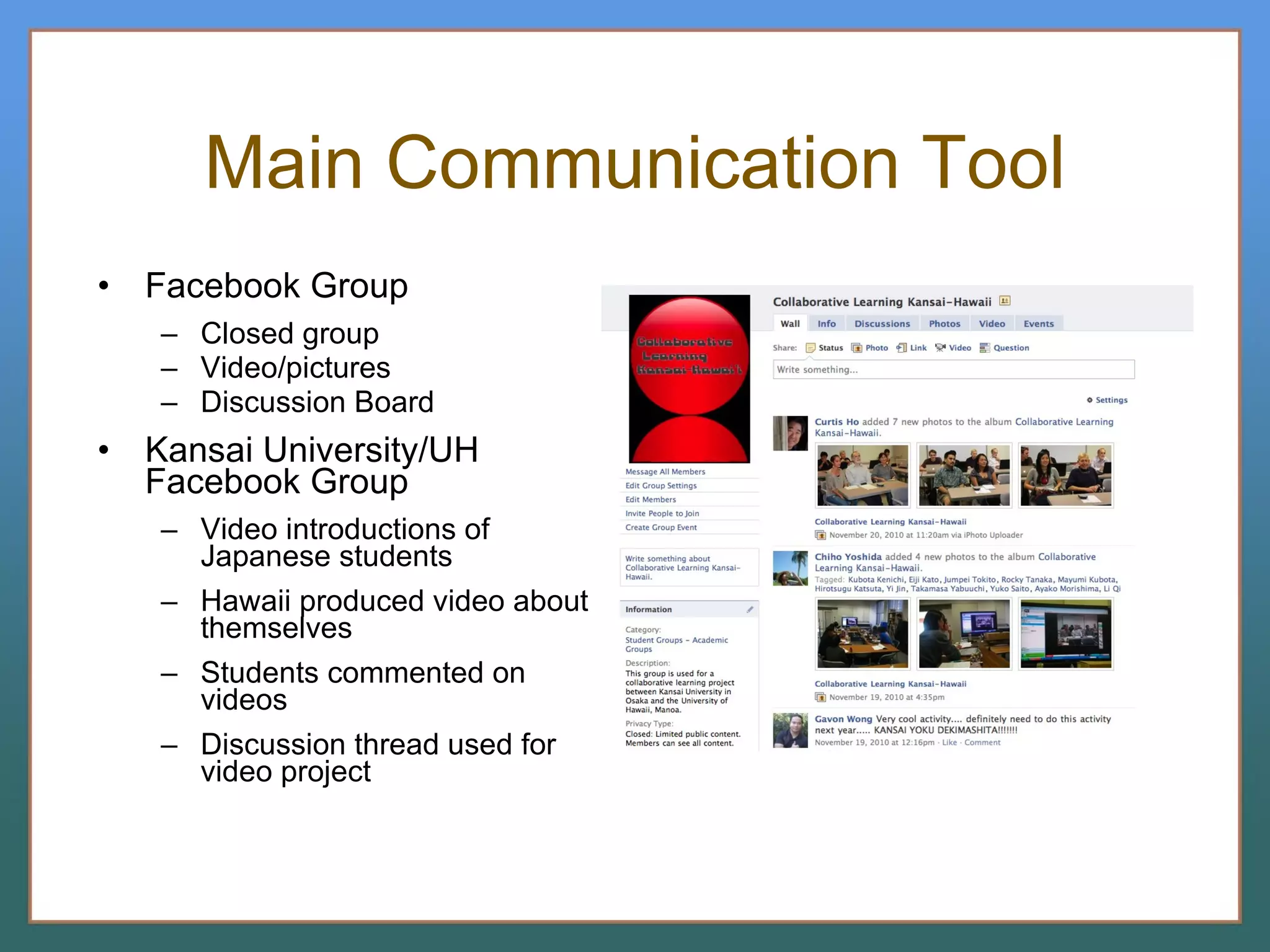
Main Communication Tool Facebook Group Closed group Video/pictures Discussion Board Kansai University/UH Facebook Group Video introductions of Japanese students Hawaii produced video about themselves Students commented on videos Discussion thread used for video project
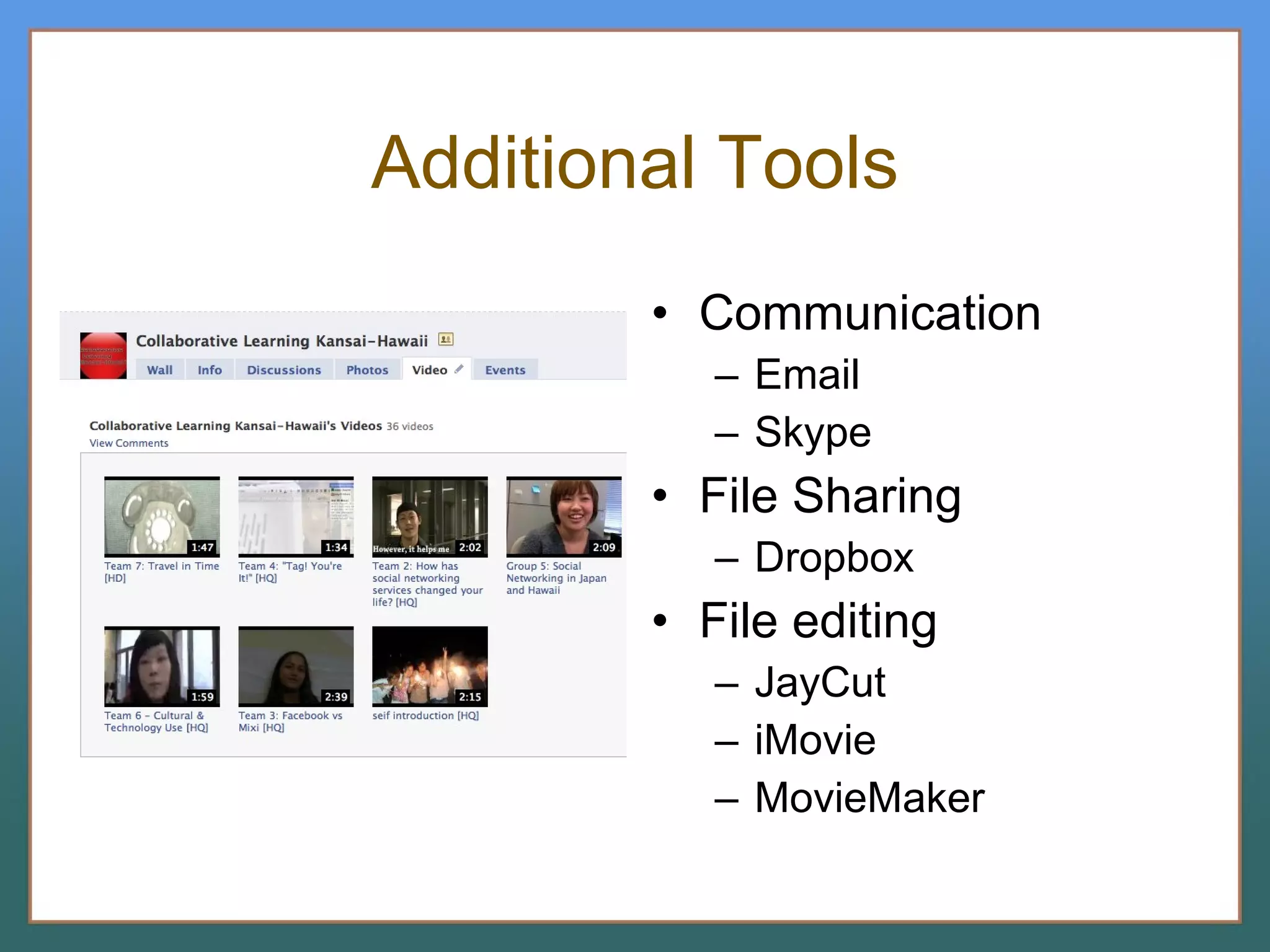
Additional Tools Communication Email Skype File Sharing Dropbox File editing JayCut iMovie MovieMaker
Survey of Communication Tools Survey given in Japanese and English Some students were interviewed by a bilingual UH student Review of online discussions
Survey Results Facebook used as the primary means of discussion Students could check discussion at any time Easier for Japanese students to read and write English Five of 7 teams used another tool with Facebook Skype Could talk with group members about plans and progress Scheduling difficulties Sometime difficult for Japanese students to follow Email Some Japanese students didn’t like face-to-face communication Easier for those unfamiliar with Facebook Text Chat Students could communicate in real time Difficult for Japanese students to type ideas quickly
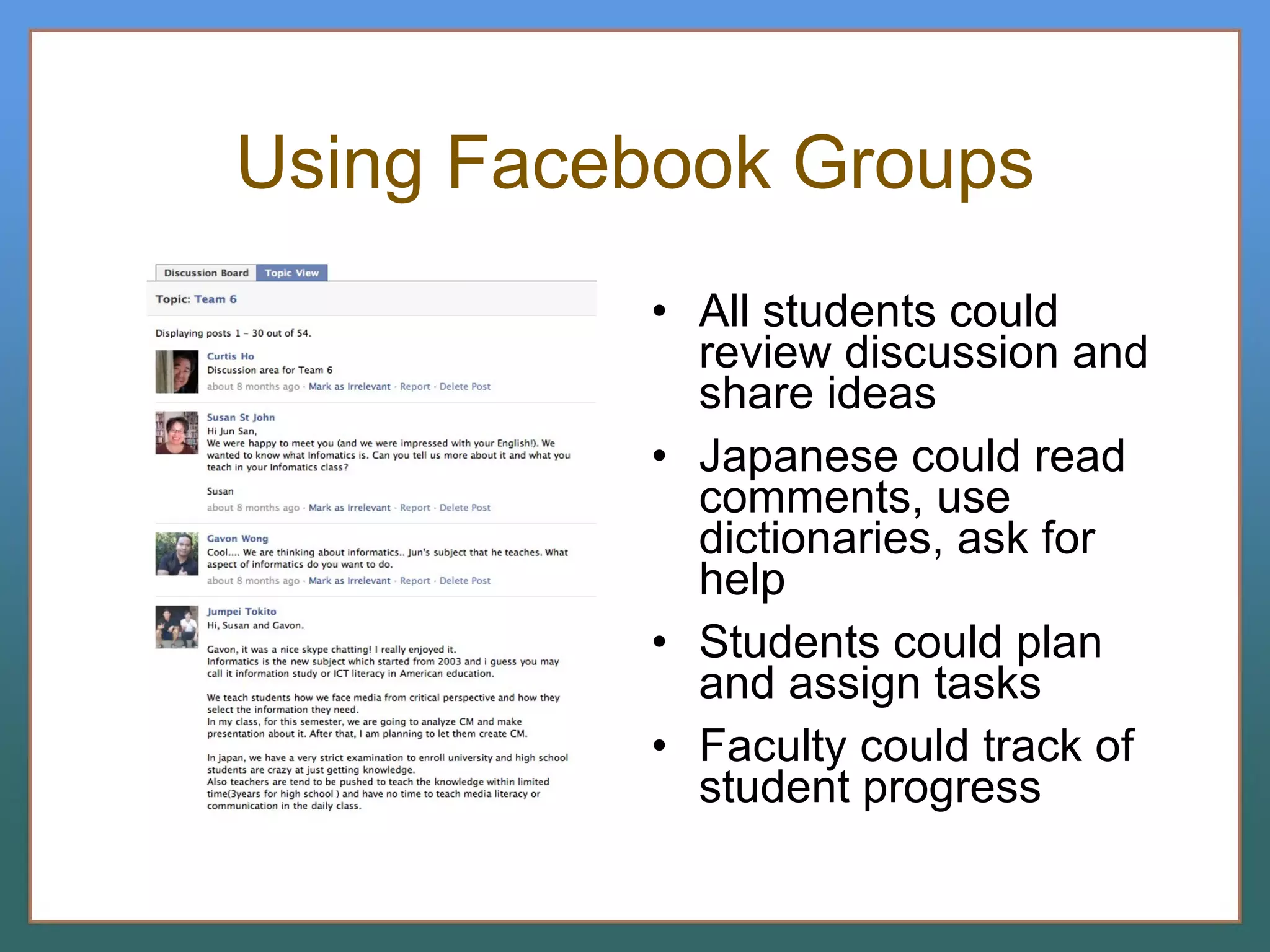
Using Facebook Groups All students could review discussion and share ideas Japanese could read comments, use dictionaries, ask for help Students could plan and assign tasks Faculty could track of student progress
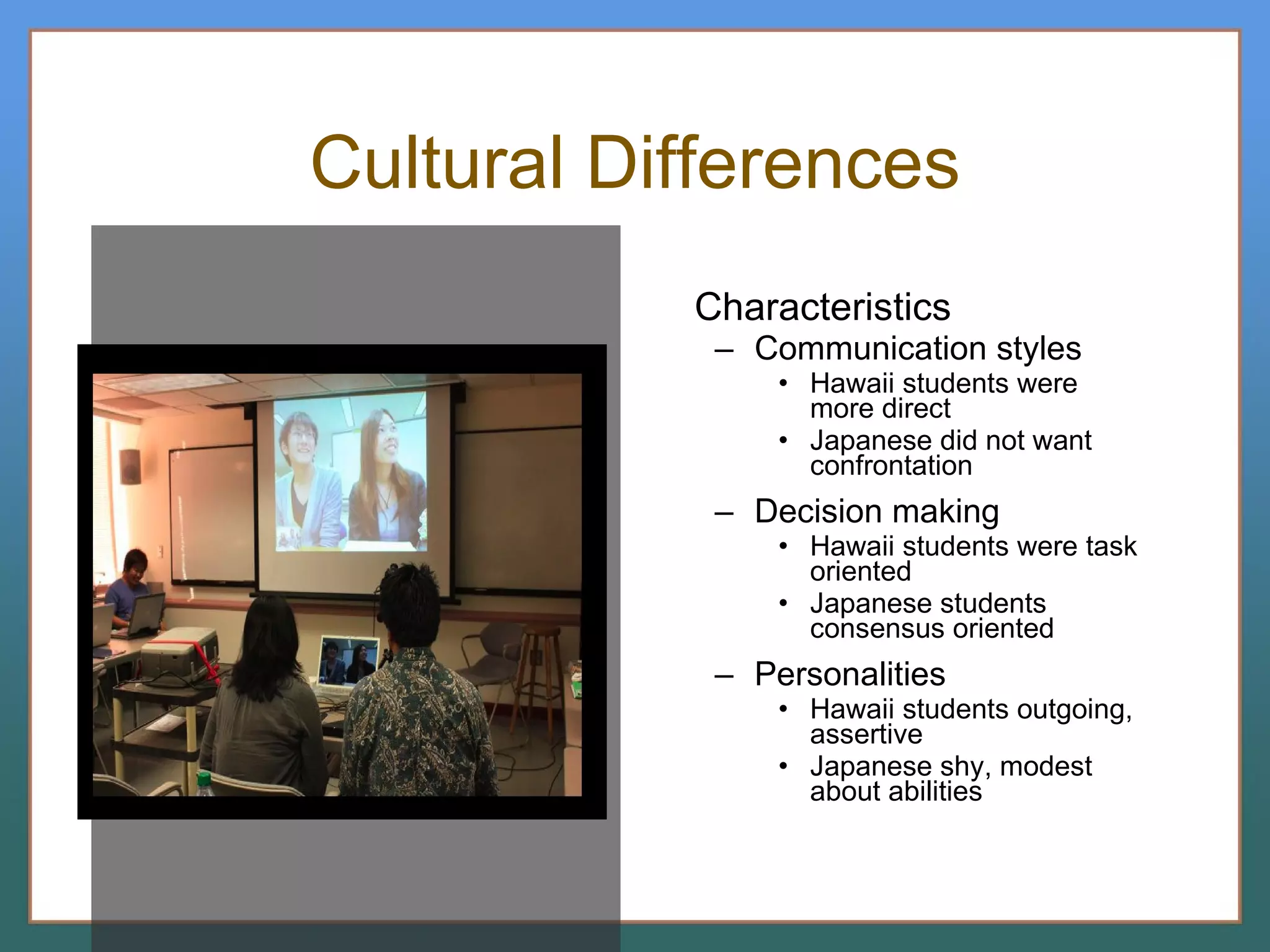
Cultural Differences Characteristics Communication styles Hawaii students were  more direct Japanese did not want confrontation Decision making Hawaii students were task oriented Japanese students consensus oriented Personalities Hawaii students outgoing, assertive Japanese shy, modest about abilities
Cultural Styles Communication missed cultural signals Japanese students used indirect communication Suggested what they wanted to do Would not object if their ideas weren’t considered Hawaii students were more direct Stated what they thought would be a good direction Would explain why and how to use their ideas Group Dynamics Hawaii students wanted ice-breakers Japanese students wanted some way to encourage “nominication”
Language Difficulties Hawaii students tried to speak slowly and used simple English Lower level Japanese students had difficulty following Skype conversations Japanese students who were stronger English speakers took a greater role in communication and decision making Some Japanese students reluctant to use English and needed encouragement to participate
Summary Online tools allowed for a variety of ways of collaborating A Facebook Group discussions provided written documentation of progress Using other online tools with Facebook facilitated collaboration Time differences made face-to-face interaction challenging Possible future direction is to find a way to have online “nominication”
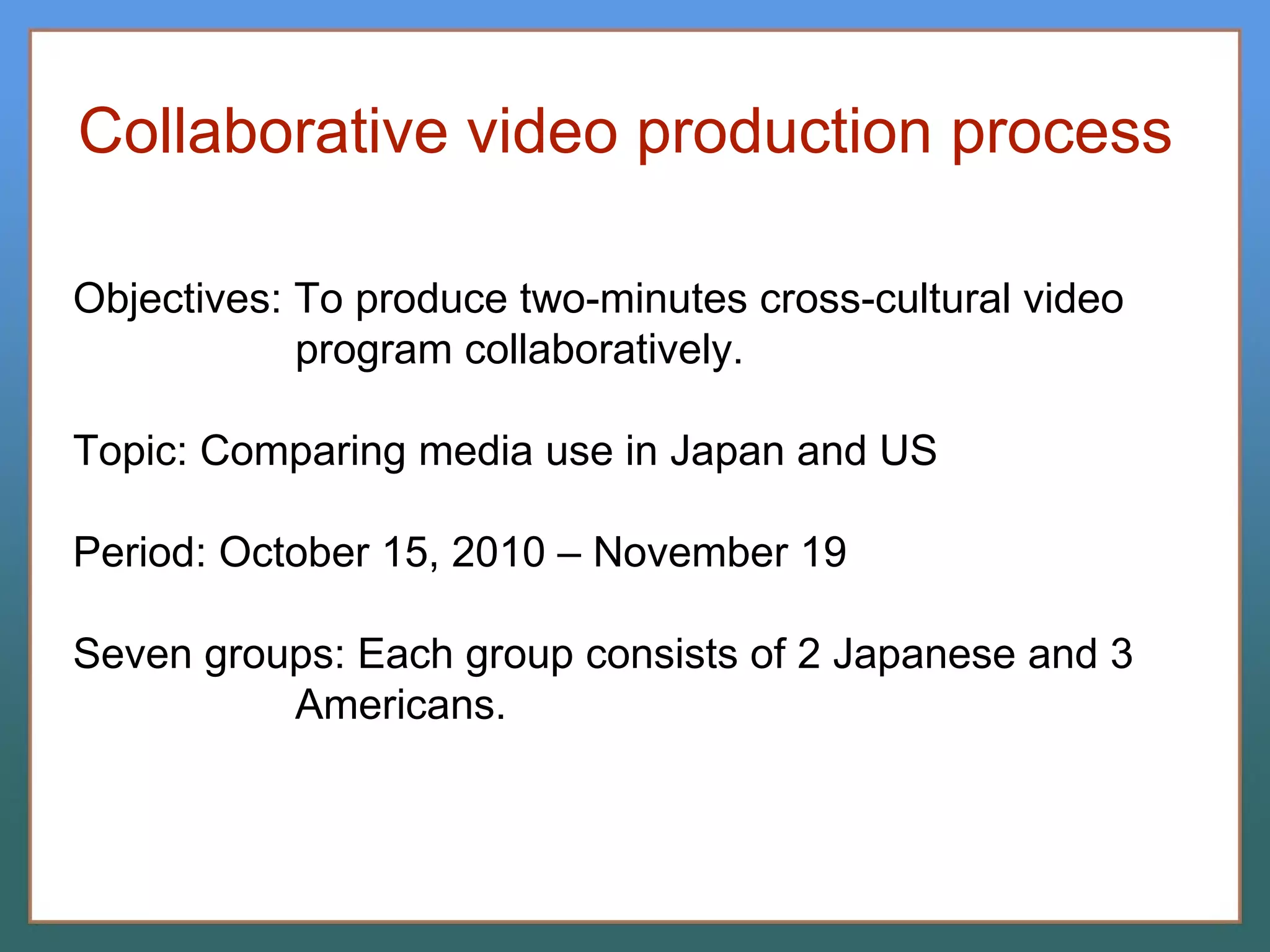
Collaborative video production process Objectives: To produce two-minutes cross-cultural video program collaboratively. Topic: Comparing media use in Japan and US Period: October 15, 2010 – November 19 Seven groups: Each group consists of 2 Japanese and 3 Americans.
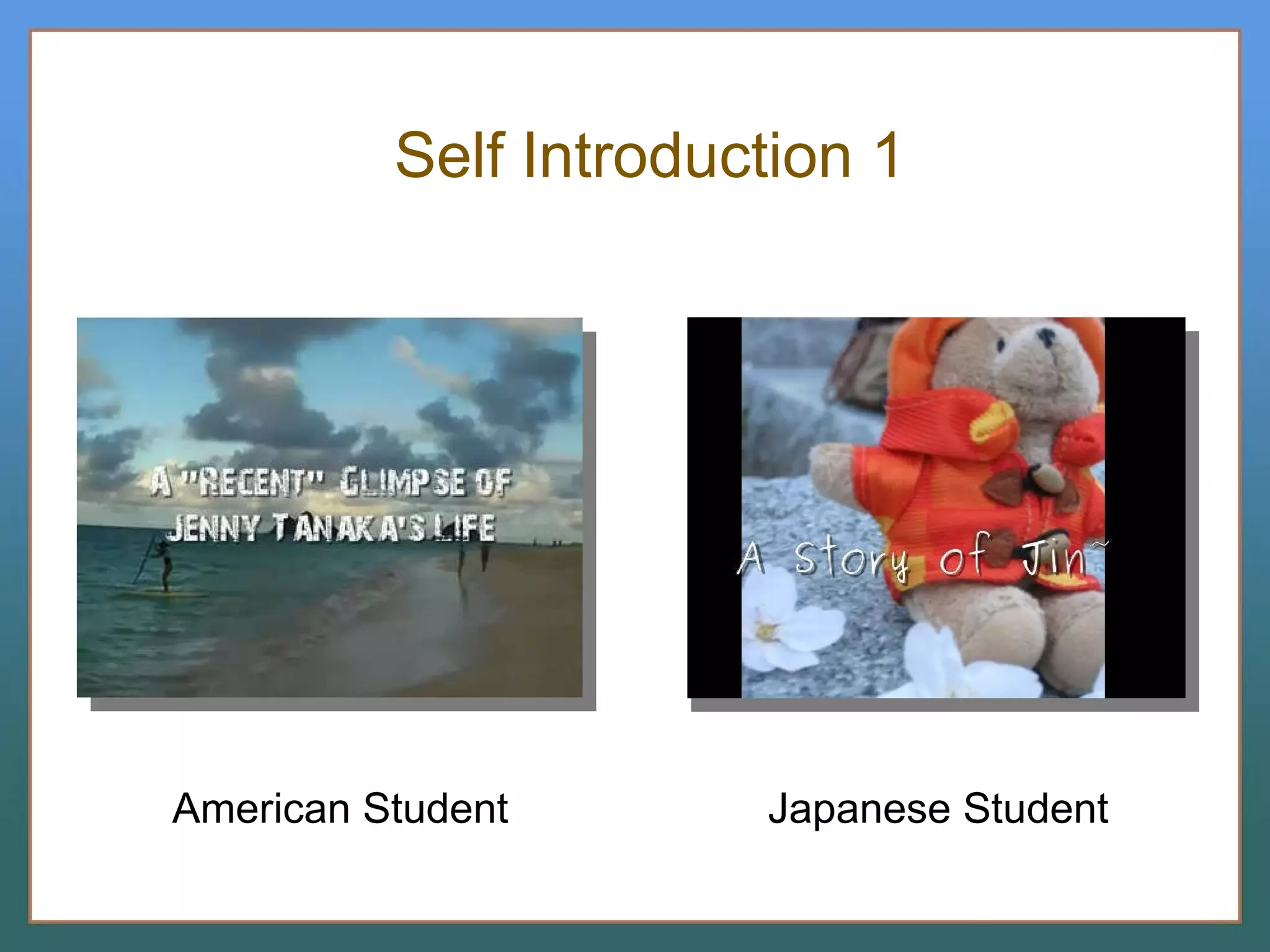
Self Introduction 1   American Student Japanese Student
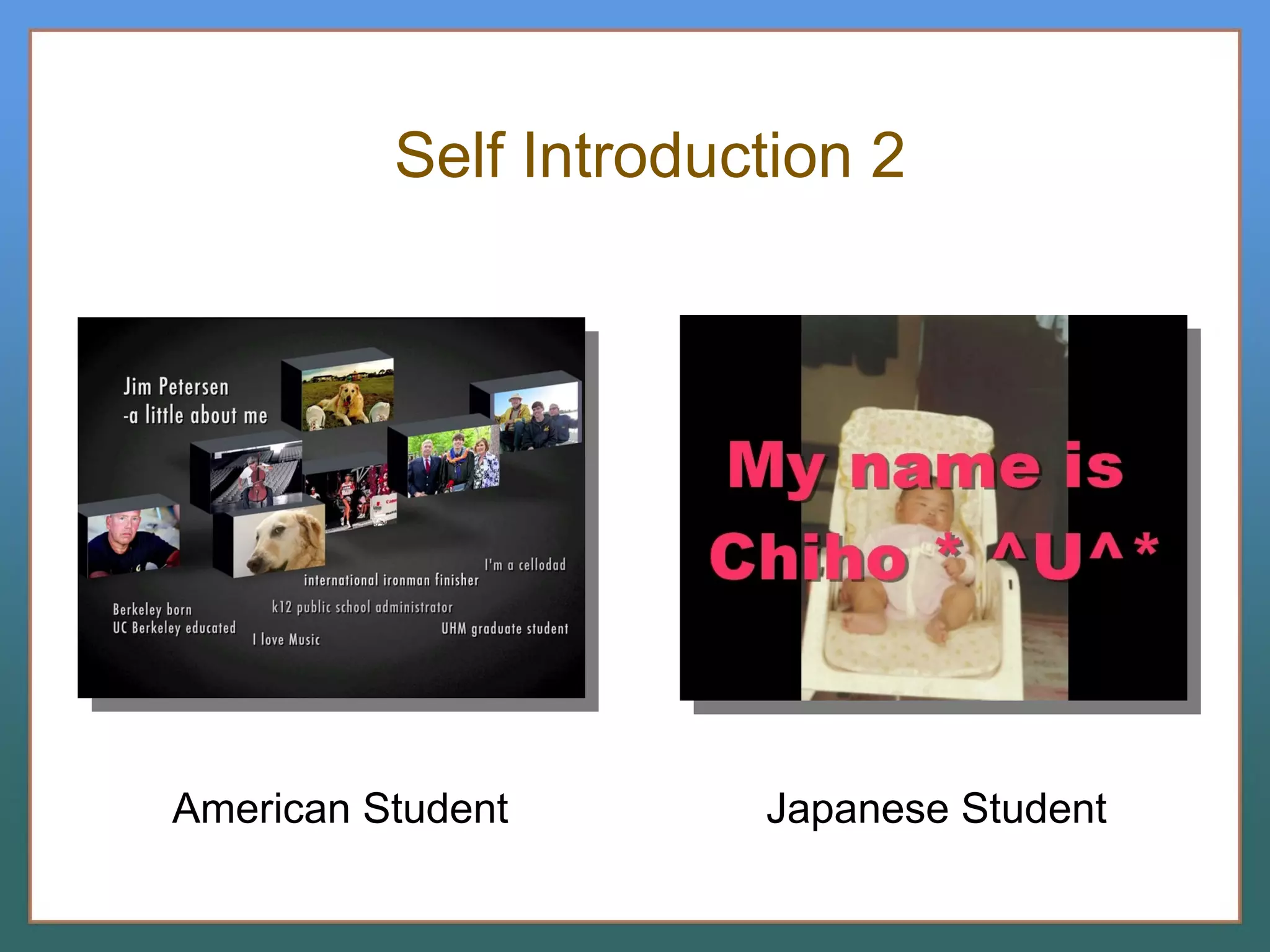
Self Introduction 2   American Student Japanese Student
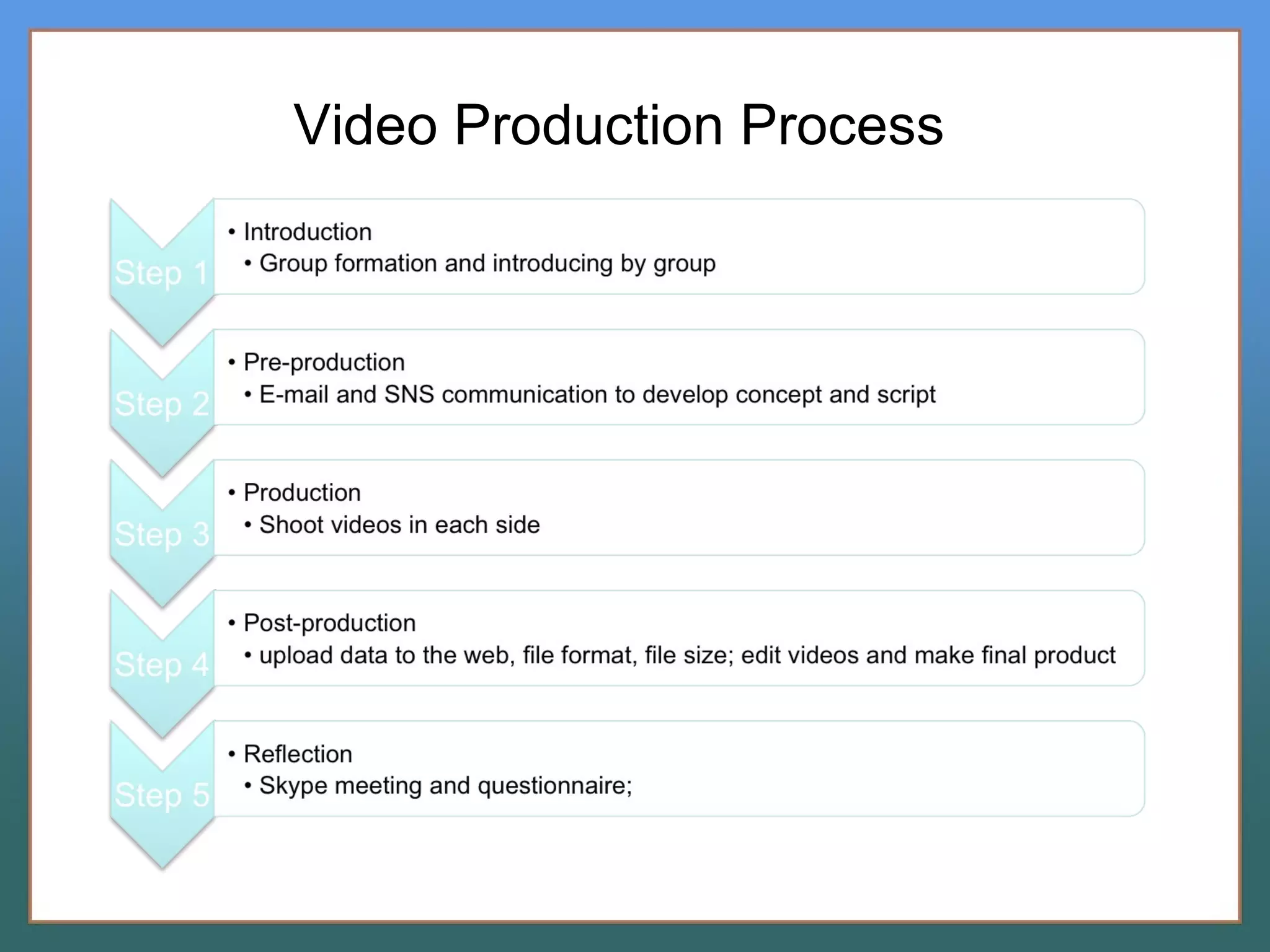
Video Production Process
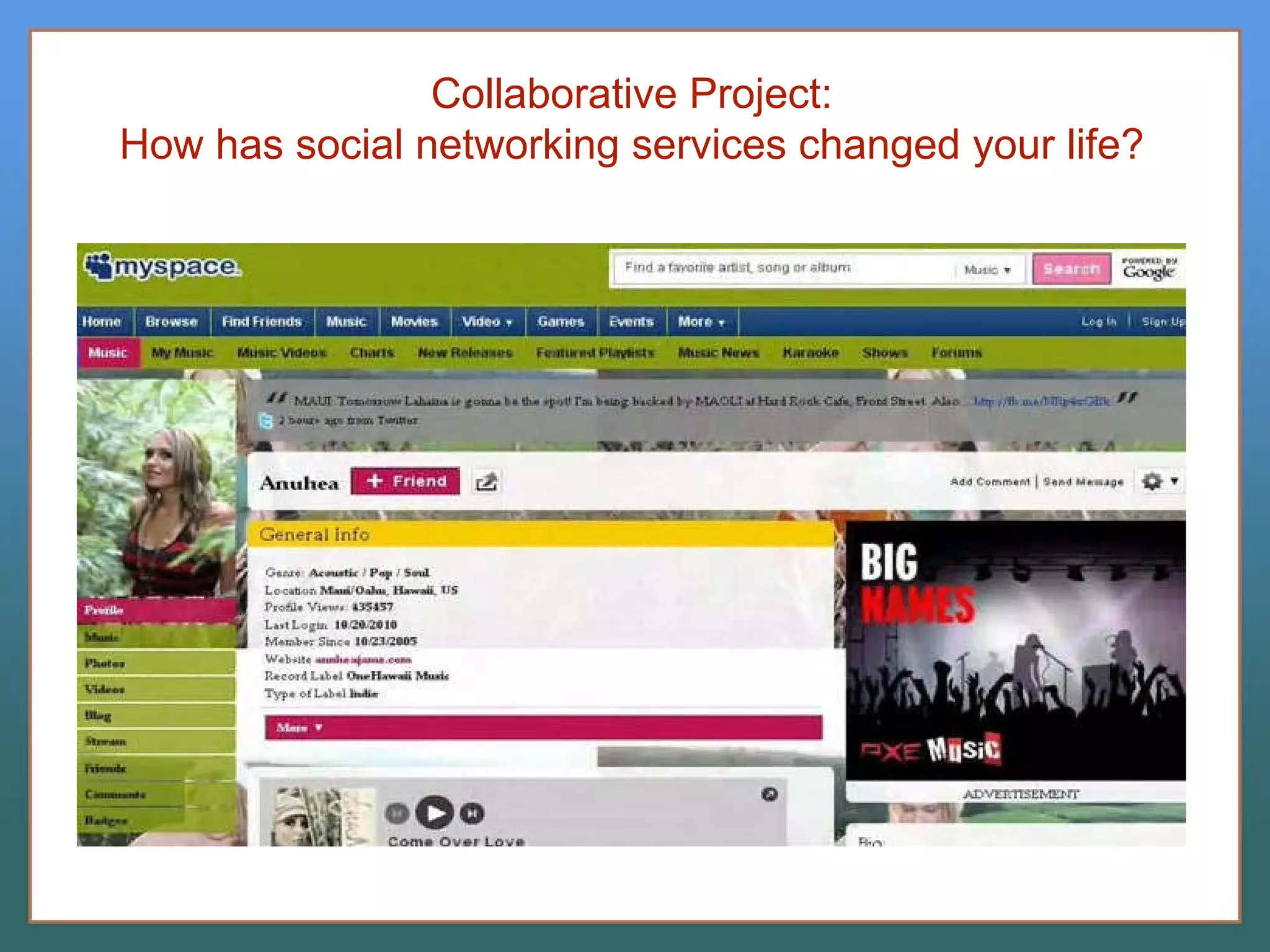
Collaborative Project: How has social networking services changed your life?
Collaborative Project: Facebook vs Mixi
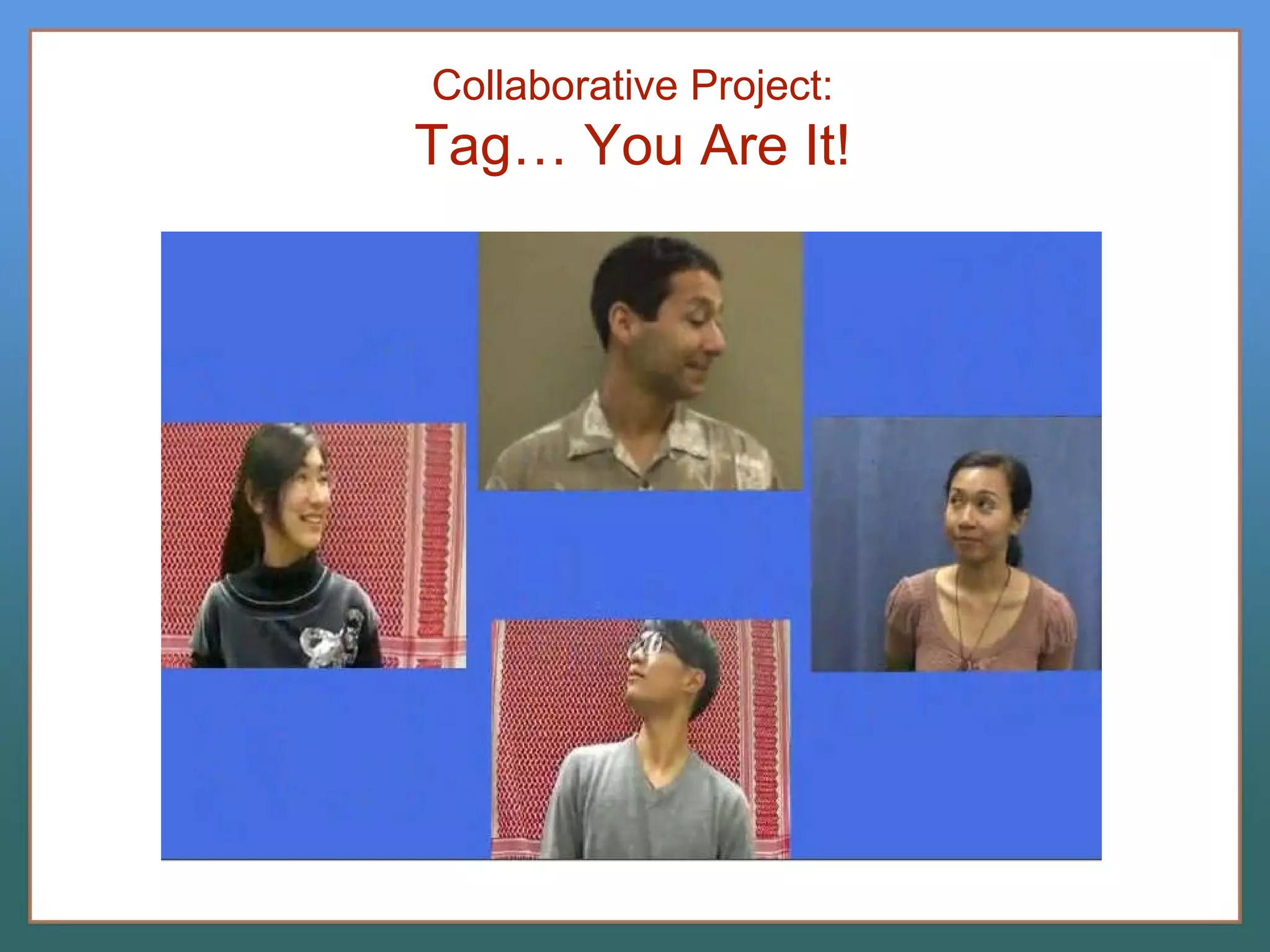
Collaborative Project: Tag… You Are It!
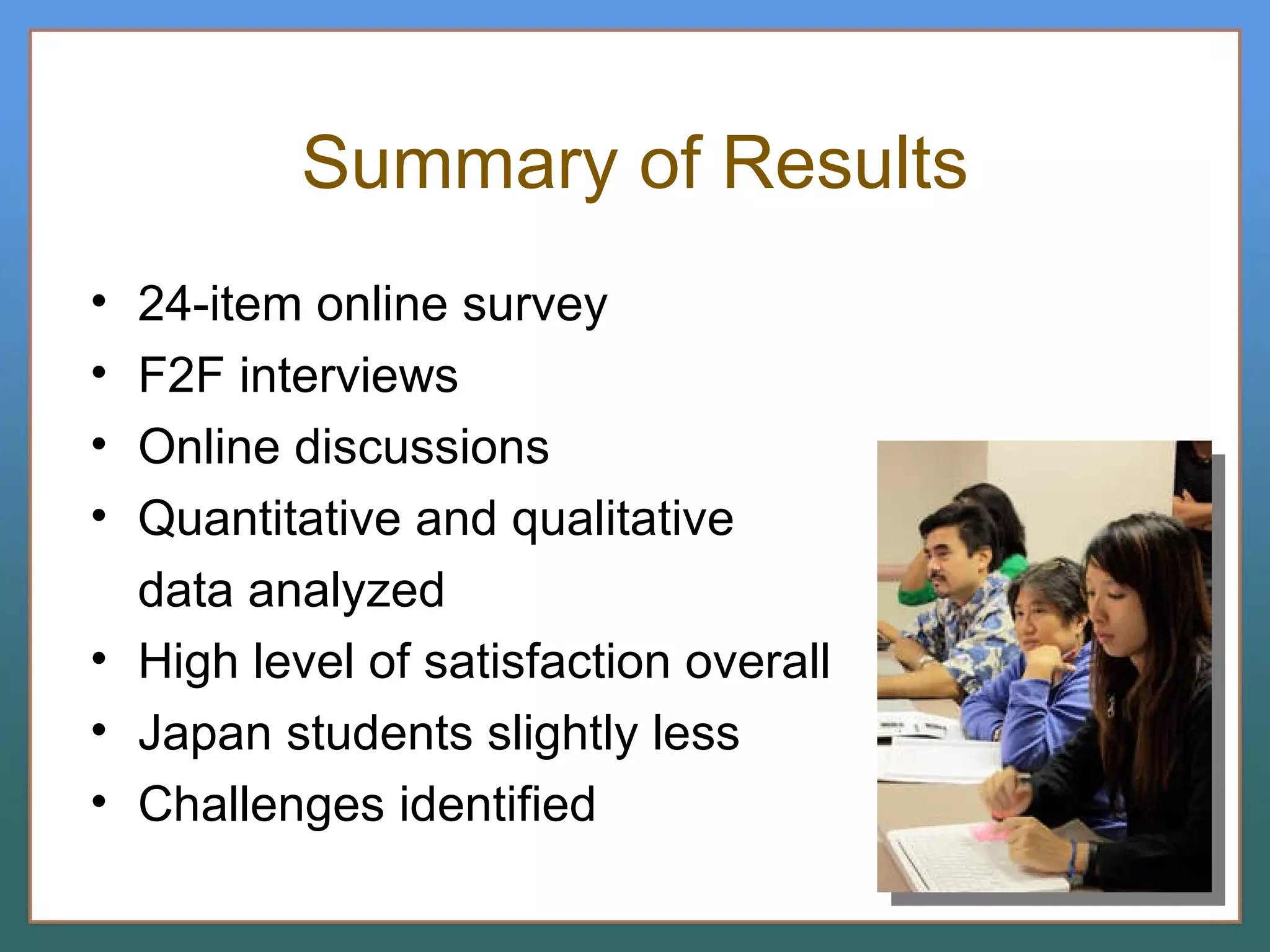
Summary of Results 24-item online survey F2F interviews Online discussions Quantitative and qualitative  data analyzed High level of satisfaction overall Japan students slightly less  Challenges identified
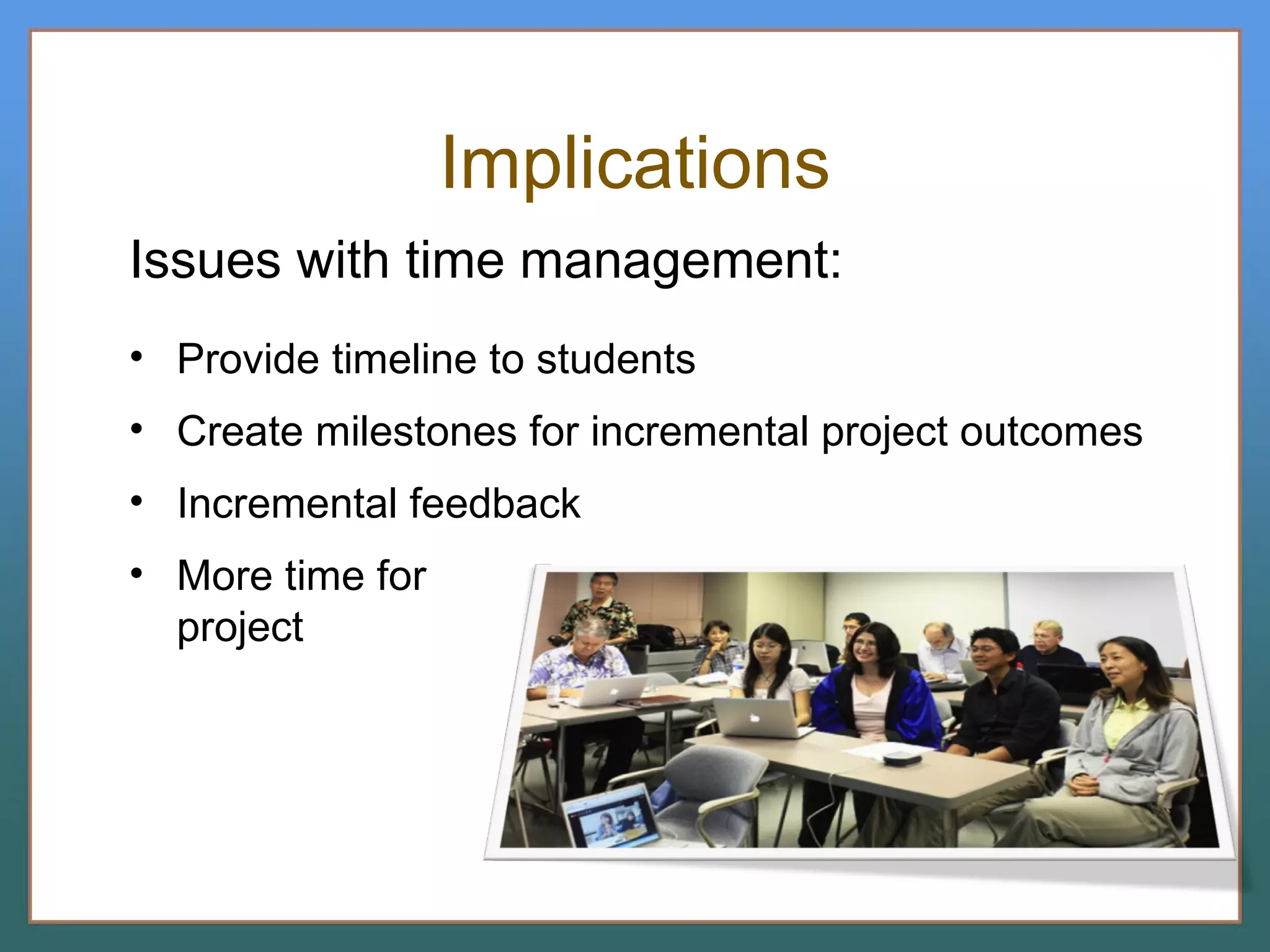
Implications Issues with time management: Provide timeline to students Create milestones for incremental project outcomes Incremental feedback More time for  project
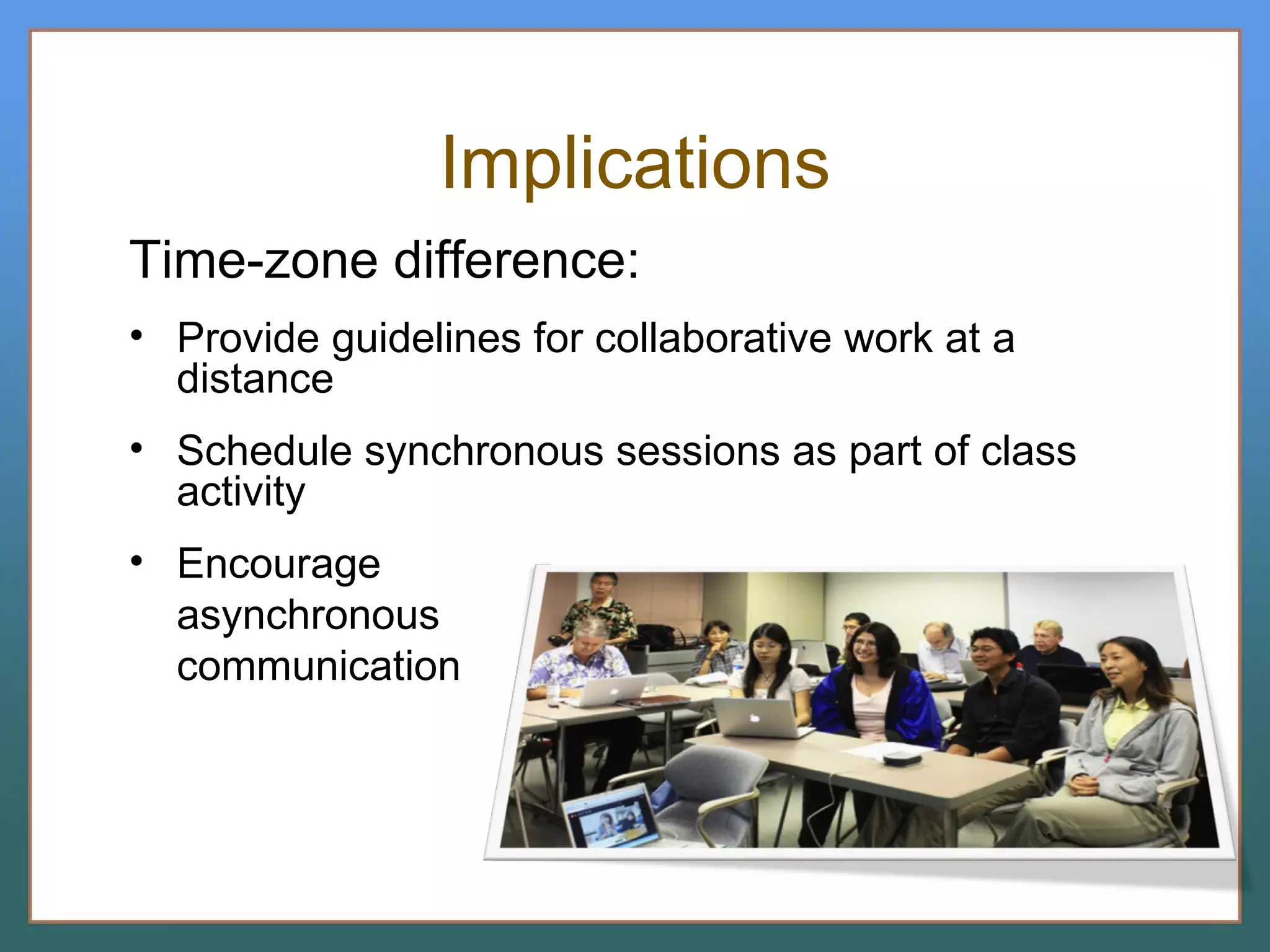
Implications Time-zone difference: Provide guidelines for collaborative work at a distance Schedule synchronous sessions as part of class activity Encourage  asynchronous communication
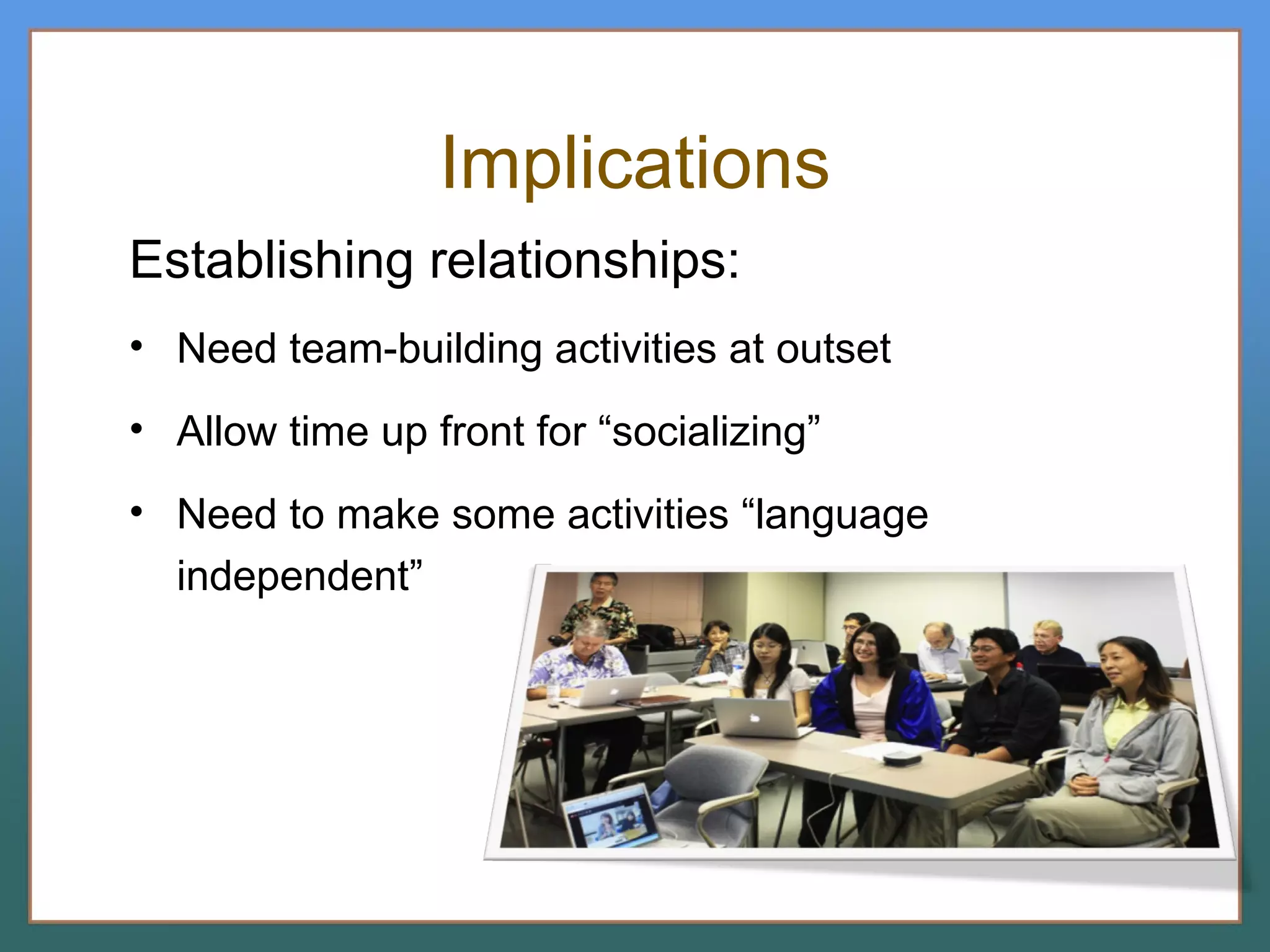
Implications Establishing relationships: Need team-building activities at outset Allow time up front for “socializing” Need to make some activities “language independent”
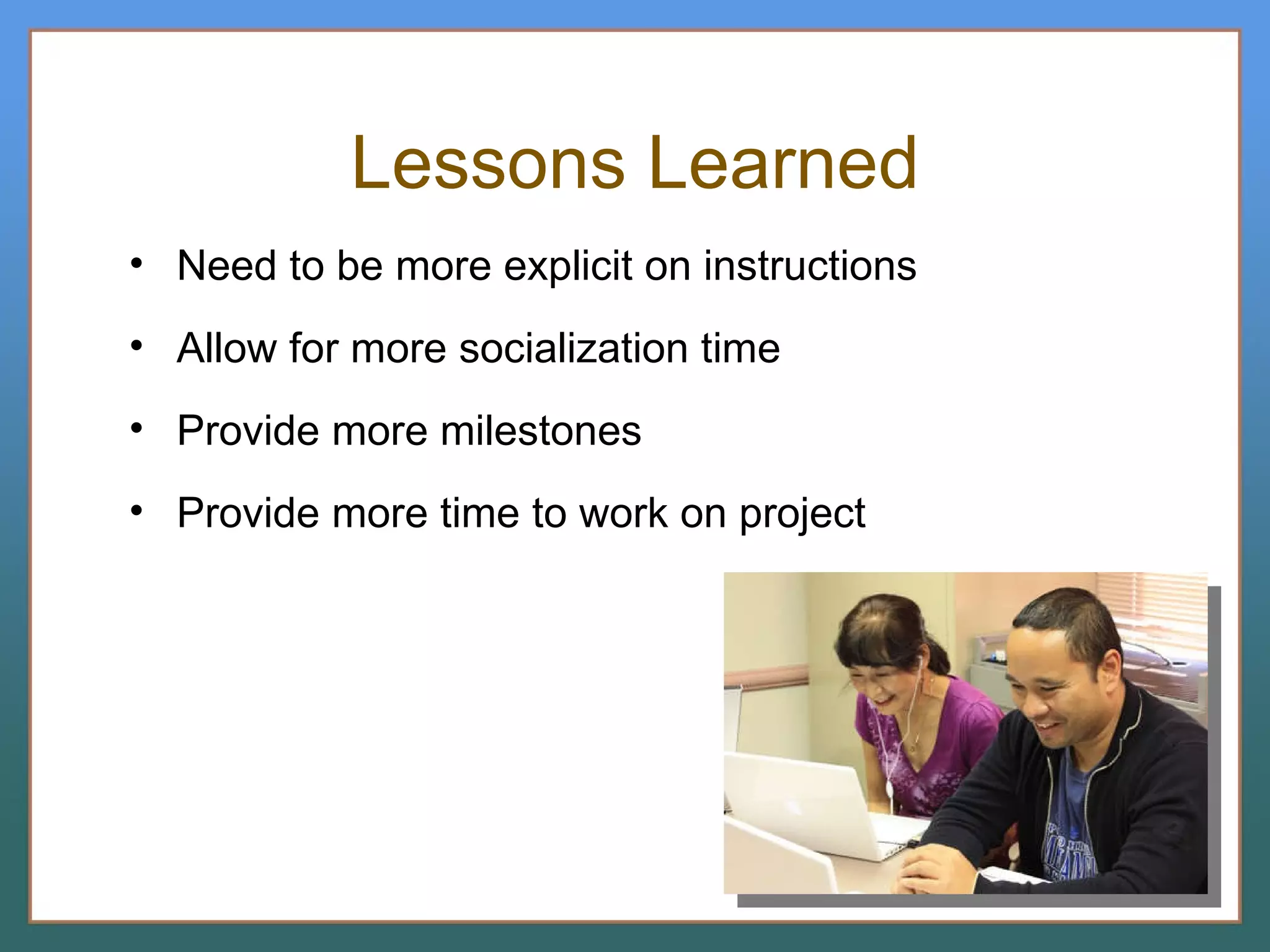
Lessons Learned Need to be more explicit on instructions Allow for more socialization time Provide more milestones Provide more time to work on project
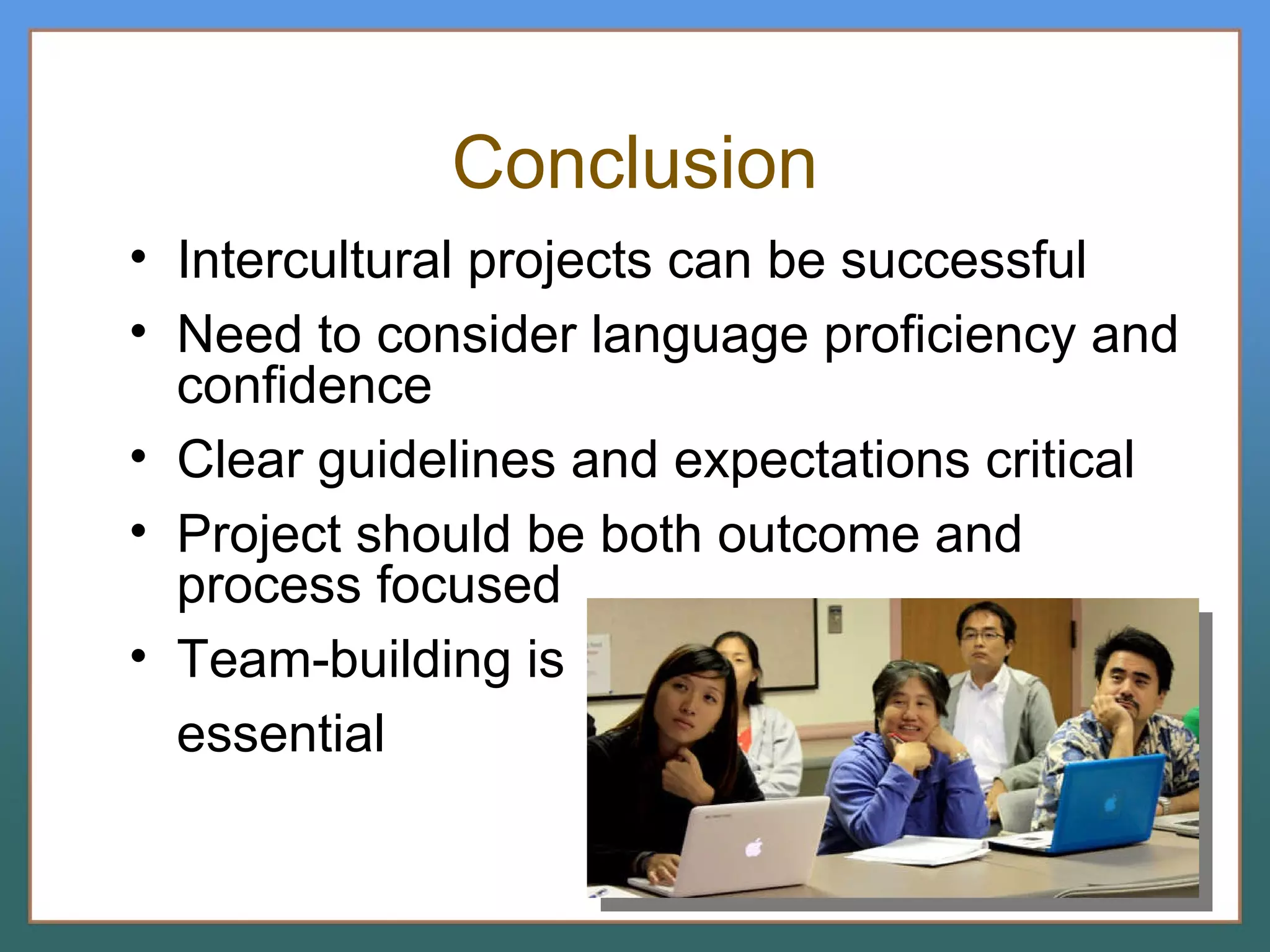
Conclusion Intercultural projects can be successful Need to consider language proficiency and confidence Clear guidelines and expectations critical Project should be both outcome and process focused  Team-building is essential
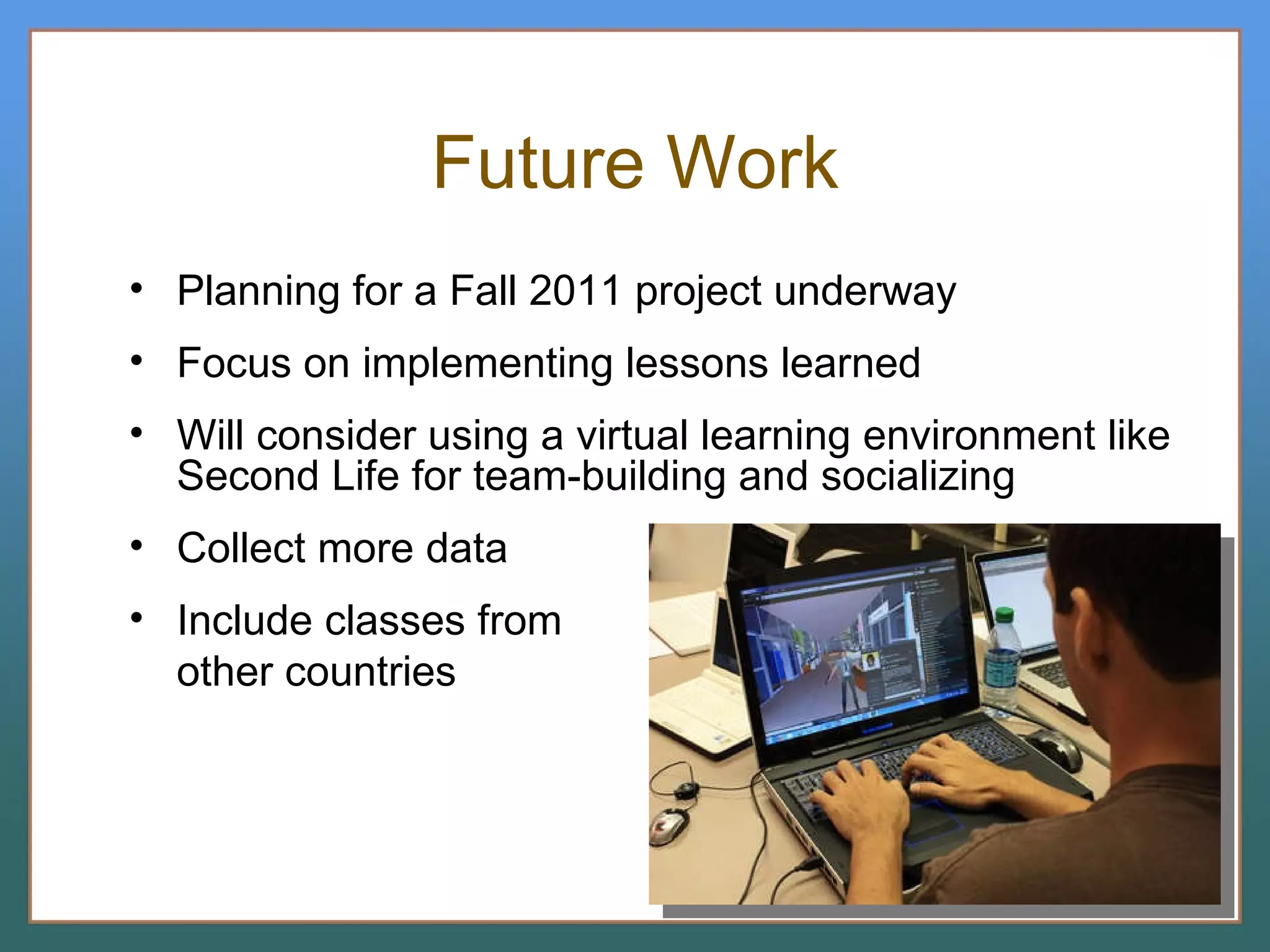
Future Work Planning for a Fall 2011 project underway Focus on implementing lessons learned Will consider using a virtual learning environment like Second Life for team-building and socializing  Collect more data Include classes from other countries
Discussion What is your experience with cross-cultural collaboration? How do you deal with language differences? How do you deal with time differences? How do you deal with cultural differences? What are your strategies for team or community building?
Mahalo! Bert Kimura, University of Hawaii, USA [email_address] Mary Kimura, Kansai University, Japan [email_address] Kenichi Kubota, Kansai University, Japan kubota@res.kutc.kansai-u.ac.jp  Curtis P. Ho, University of Hawaii, USA [email_address]

cross-cultural collaboration using video and social networking

  • 1.
    Cross-Cultural Collaboration Througha Virtual Community of Practice Using Video and Social Networking ED-MEDIA 2011 Lisbon, Portugal Bert Kimura, University of Hawaii, USA Mary Kimura, Kansai University, Japan Kenichi Kubota, Kansai University, Japan Curtis P. Ho, University of Hawaii, USA
  • 2.
    Panel Session OverviewProject Background Cross-Cultural Collaboration & Social Media Video Production at a Distance Learning Implications for VCoP & Cross-Cultural Settings Q & A
  • 3.
    Goals & ObjectivesStudent performance objectives Plan using social media Collaborate to produce a short video Instructor expectations How community emerges & evolves Cross-cultural context Social media
  • 4.
    Background Student PopulationsLanguage level Technology experience Graduate student status Class Descriptions Schedule of Classes Friends
  • 5.
    University of Hawai‘iHonolulu, Hawai‘i ETEC 602, Teaching/Training Technologies Graduate students (17) Working Online classes
  • 6.
    Osaka, Japan ICTfor Learning On campus (14) Younger in age Use of second language Limited online experience Kansai University
  • 7.
  • 8.
    Logistics Student statusSemester schedule Class schedule Technology skill Collaboration & teamwork Time zone Language
  • 9.
    Getting Started Studentsintroduce themselves Student divided into project groups Facebook Group created for communication
  • 10.
    Student Introductions InitialSkype Sessions Students introduce themselves Some chatted on Skype with group members Elluminate Sessions Background discussion of Japanese students characteristics Report on what they were doing
  • 11.
    Forming Project GroupsDivided students into seven groups Two Japanese students and 2 – 3 Hawaii students Bilingual speaker in each group Japanese groups had high and low level English speakers Technically skill student in each group
  • 12.
    Main Communication ToolFacebook Group Closed group Video/pictures Discussion Board Kansai University/UH Facebook Group Video introductions of Japanese students Hawaii produced video about themselves Students commented on videos Discussion thread used for video project
  • 13.
    Additional Tools CommunicationEmail Skype File Sharing Dropbox File editing JayCut iMovie MovieMaker
  • 14.
    Survey of CommunicationTools Survey given in Japanese and English Some students were interviewed by a bilingual UH student Review of online discussions
  • 15.
    Survey Results Facebookused as the primary means of discussion Students could check discussion at any time Easier for Japanese students to read and write English Five of 7 teams used another tool with Facebook Skype Could talk with group members about plans and progress Scheduling difficulties Sometime difficult for Japanese students to follow Email Some Japanese students didn’t like face-to-face communication Easier for those unfamiliar with Facebook Text Chat Students could communicate in real time Difficult for Japanese students to type ideas quickly
  • 16.
    Using Facebook GroupsAll students could review discussion and share ideas Japanese could read comments, use dictionaries, ask for help Students could plan and assign tasks Faculty could track of student progress
  • 17.
    Cultural Differences CharacteristicsCommunication styles Hawaii students were more direct Japanese did not want confrontation Decision making Hawaii students were task oriented Japanese students consensus oriented Personalities Hawaii students outgoing, assertive Japanese shy, modest about abilities
  • 18.
    Cultural Styles Communicationmissed cultural signals Japanese students used indirect communication Suggested what they wanted to do Would not object if their ideas weren’t considered Hawaii students were more direct Stated what they thought would be a good direction Would explain why and how to use their ideas Group Dynamics Hawaii students wanted ice-breakers Japanese students wanted some way to encourage “nominication”
  • 19.
    Language Difficulties Hawaiistudents tried to speak slowly and used simple English Lower level Japanese students had difficulty following Skype conversations Japanese students who were stronger English speakers took a greater role in communication and decision making Some Japanese students reluctant to use English and needed encouragement to participate
  • 20.
    Summary Online toolsallowed for a variety of ways of collaborating A Facebook Group discussions provided written documentation of progress Using other online tools with Facebook facilitated collaboration Time differences made face-to-face interaction challenging Possible future direction is to find a way to have online “nominication”
  • 21.
    Collaborative video productionprocess Objectives: To produce two-minutes cross-cultural video program collaboratively. Topic: Comparing media use in Japan and US Period: October 15, 2010 – November 19 Seven groups: Each group consists of 2 Japanese and 3 Americans.
  • 22.
    Self Introduction 1 American Student Japanese Student
  • 23.
    Self Introduction 2 American Student Japanese Student
  • 24.
  • 25.
    Collaborative Project: Howhas social networking services changed your life?
  • 26.
  • 27.
  • 28.
    Summary of Results24-item online survey F2F interviews Online discussions Quantitative and qualitative data analyzed High level of satisfaction overall Japan students slightly less Challenges identified
  • 29.
    Implications Issues withtime management: Provide timeline to students Create milestones for incremental project outcomes Incremental feedback More time for project
  • 30.
    Implications Time-zone difference:Provide guidelines for collaborative work at a distance Schedule synchronous sessions as part of class activity Encourage asynchronous communication
  • 31.
    Implications Establishing relationships:Need team-building activities at outset Allow time up front for “socializing” Need to make some activities “language independent”
  • 32.
    Lessons Learned Needto be more explicit on instructions Allow for more socialization time Provide more milestones Provide more time to work on project
  • 33.
    Conclusion Intercultural projectscan be successful Need to consider language proficiency and confidence Clear guidelines and expectations critical Project should be both outcome and process focused Team-building is essential
  • 34.
    Future Work Planningfor a Fall 2011 project underway Focus on implementing lessons learned Will consider using a virtual learning environment like Second Life for team-building and socializing Collect more data Include classes from other countries
  • 35.
    Discussion What isyour experience with cross-cultural collaboration? How do you deal with language differences? How do you deal with time differences? How do you deal with cultural differences? What are your strategies for team or community building?
  • 36.
    Mahalo! Bert Kimura,University of Hawaii, USA [email_address] Mary Kimura, Kansai University, Japan [email_address] Kenichi Kubota, Kansai University, Japan kubota@res.kutc.kansai-u.ac.jp Curtis P. Ho, University of Hawaii, USA [email_address]

Editor's Notes

  • #4 Community = emerge and evolve
  • #5 One University of Hawaii graduate class and one Kansai University graduate class. UH class typically met once per week for 2.5 hours; Kansai class met once per week for 90 minutes. Fall semester 2010. Fact that we are all friends as well as colleagues enable us to implement this project.
  • #6 Need photo of students. ETEC 602, as of Spring 2011, Innovations in Educational Technology
  • #7 Students include Master’s, 8, PhD 2, Seniors 4
  • #8 5-weeks, using Elluminate Live and Skype; sharing includes commenting on video.