Facebook Profile ProjectMichael Sappwww.shoesatthedoor.com 
IntroProject IntroductionEven though this application can and should serve multiple purposes, it was built from ESP concepts developed for needs assessment. In order to help teachers and students develop learning goals and plans, the following questions can be asked to gain a better understanding of a student’s language needs:
Project IntroductionWhat functions and tasks does the student want to do?What language competencies are required to perform those tasks and functions well?How does the student currently do those tasks and functions?(Friedenberg, et al. 2003)The goal of this application is to help answer some of these questions while also beginning the steps of creating a plan to reach students’ goals.
Facebook Profile ProjectThis application is designed in two parts:Student NotesTeacher Notes
Part 1Teacher NotesIntroThe ClassRationaleObjectivesSchedule TipsProceduresEvaluationMaterials
IntroWhat is Facebook?“Facebookis a social networking service and website launched in February 2004, operated and privately owned by Facebook, Inc. As of January 2011, Facebook has more than 600 million active users. Users may create a personal profile, add other users as friends, and exchange messages, including automatic notifications when they update their profile. Additionally, users may join common interest user groups, organized by workplace, school or college, or other characteristics” (Wikipedia).
IntroWhat is a Facebook Profile?A Facebook profile is a users’ main page that lists information about that person including name, birthdate, relationship status, political views, religious views, hobbies, interests, etc.
IntroWhat is a Pseudo-Profile?A pseudo-profile is a profile created by a user with creative or fictional details.
The ClassThe ClassThis application was designed for a reading and writing class of an Intensive English Program of students with intermediate language abilities and higher.“In an ESL context, learners should be encouraged to writeabout a topic that interests them personally, to be read (and enjoyed) by peers or members of an interest group. This may reduce apprehension in creating an output in English” (Tan, Ng, & Saw, 2010).
RationaleBy creating a pseudo-profile based on their goals and hopes for how life might be if they obtained their language goals, students can clarify and come to understand more about why they want to learn English, and what they hope to gain from learning English. Students and teachers can create and engage in more meaningful learning environments if language goals are defined, clear, and measurable“Simply putting learners in front of some content and expecting them to learn isn’t enough” (Carroll, 2008).
RationaleIdentifying student motivations and aligning them to goals can help students and teachers make better decisions when designing and participating in classA social networking profile is a great medium for building, discovering, sharing, and developing personal and professional goals“I encourage students to try the untried. From literature around us I bring to class possibilities for experimentation” (Romano, 2008, pg. 35).
ObjectivesObjectivesStudents will learn to navigate a social networking site in English and create an accountStudents will create a pseudo-profile based on themselves under the hypothetical context that they are fluent in EnglishStudents will interact with other students using social networking tools in English (chat, comments, links, wall-posts, etc.)Students will gain an understanding of what they hope to accomplish with EnglishStudents will gain a better understanding of what they need to do in order to accomplish their goals
ScheduleScheduleDay 1- Discuss Facebook and Facebook ProfilesIn-class/homework: Fill-out Goal Worksheet and Profile WorksheetDay 2 – Students create a Pseudo-ProfileIn-class/homework:Create a Facebook account and profile
ScheduleDay 3 – Students use profiles to interactIn-class/homework: Students complete the Plan Worksheet
TipsTips“The world of writing is larger, more rewarding, and more challenging than the five-paragraph you know-what. In fact, that reductive form so ubiquitous in 7–12 classrooms is of little use to students who attend college, where writing is expected to be exploratory, substantive, well-reasoned, and as long or as short as it needs to be” (Romano, 2008, pg. 35).Help students differentiate Facebook content from advertisementsTalk about privacy issues and concerns with posting too much personal informationEncourage students to be creative and thoughtfulThe plan worksheet can also act as a debriefing prompt for class discussion
TipsUsing the complete Lexical Tutor to study the vocabulary of Facebook profile creation pages, I have found some interesting statistics that suggest Facebook can be a useful reading/writing tool for ESL students:The profile edit pages contain on average 70% K1 and K2 words, 7% academic words, and 23% off-list wordsMost college students will know or have some understanding of almost all of the K1 and many of the K2 words, and the academic words are so few that learning a small amount will not be difficult or time consuming if they are not already knownThe 23% off-list words consist of Facebook specific lexis such as the word Facebook, profile, settings, chat, etc.
TipsDue to the way Facebook is organized by content words, students will have a good chance of understanding profiles if the Facebook specific lexis of words are learned. Students will then have enough background knowledge of the site to have high comprehension when creating and reading Facebook profiles. The difficulty of using Facebook lies in the unforeseeable vocabulary and content created by other users. Simply using Facebook and interacting with others in English is a good goal, but I want students to take it a step further and learn something more about themselves from the profile creation process. I aim for this application to be a creative and motivating activity.
TipsOne possible method to help with unknown vocabulary is to create quizzes and puzzles using the software Hot Potatoes
ProceduresDay 1 – Introduction to Facebook ProfilesIntroduce Facebook to students with relevant videos and websitesIntroduce relevant and Facebook specific vocabularyStudents observe as the teacher goes through the process of generating ideas needed to fill-out the Goals Worksheet using a think-aloud processAfter these are complete the teacher will present the process of setting up an accountBased on the information from the Profile Worksheet, the teacher will create a Pseudo-Profile
ProceduresDay 2 Students Create their own Pseudo-ProfileDiscuss the language of FacebookWhat is appropriate and WhenHow is language used with Facebook?Continue reviewing useful vocabularyStudents complete the Goals Worksheet and the Profile WorksheetStudents then create a Facebook account and profileStudents dress-up their profiles by adding media such asVideosPhotosLinks
ProceduresDay 3 Students Interact with Profiles Allow time for students to interact with classmates on Facebook under the guise of their pseudo-profilesHave students complete a Plan Worksheet“The use of social networking also had a secondary impact in that it moved learning from beyond the classroom and its formal setting. Students were sending each other links, commenting them and posting blogs about those links at all times of day and night, at the times that suited them and their family and work commitments. This ability to mix both formal and informal learning is an  advantage” (Curcher,  2011).
EvaluationEvaluationEvaluation is based on one Rubric:Evaluation Rubric
MaterialsMaterialsGoals Worksheet to help students create and develop goals and language objectivesProfile Worksheet used to help in the creation of a Facebook profilePlan Worksheet to help students organize their goals become aware of the steps needed to complete their goals.Computer projection and computer accessPowerPoint slides with Student NotesEvaluation Rubric
Part 2IntroObjectivesAssignmentMaterialsResourcesStudent Notes
IntroWhat is Facebook?“Facebookis a social networking service and website launched in February 2004, operated and privately owned by Facebook, Inc. As of January 2011, Facebook has more than 600 million active users. Users may create a personal profile, add other users as friends, and exchange messages, including automatic notifications when they update their profile. Additionally, users may join common interest user groups, organized by workplace, school or college, or other characteristics” (Wikipedia).
IntroWhat is a Facebook Profile?A Facebook profile is a users main page that lists information about that person including name, birthdate, relationship status, political views, religious views, hobbies, interests, etc.
IntroWhat is a Pseudo-Profile?A pseudo-profile is a profile created by a user with creative or untrue details.
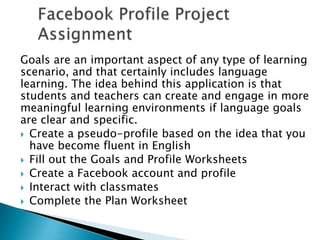
Facebook Profile Project AssignmentGoals are an important aspect of any type of learning scenario, and that certainly includes language learning. The idea behind this application is that students and teachers can create and engage in more meaningful learning environments if language goals are clear and specific.Create a pseudo-profile based on the idea that you have become fluent in EnglishFill out the Goals and Profile WorksheetsCreate a Facebook account and profileInteract with classmatesComplete the Plan Worksheet
ObjectivesObjectivesStudents will learn to navigate a social networking site in English and create an accountStudents will create a pseudo-profile based on themselves under the hypothetical context that they are fluent in EnglishStudents will interact with other students using social networking tools in English (chat, comments, links, wall-posts, etc.)Students will gain an understanding of what they hope to accomplish with EnglishStudents will gain a better understanding of what they need to do in order to accomplish their goals
AssignmentCompleting the Goals WorksheetImagine that you are able to speak English with a high degree of fluency, then answer the questions in the worksheet with as much detail as possibleThe details can be practical, fantasy, or any combination of the two
AssignmentCompleting the Profile WorksheetBased on your answers in the Goals Worksheet, imagine more details about this fictional person or future-you by filling in the details of the profile worksheetFeel free to search the web for inspiration on details such as TV shows or books that you are unfamiliar with, but your pseudo-profile might enjoy
AssignmentCreating a ProfileAfter creating an account, fill in the details of the profile creation pages using your profile worksheetFeel free to add images, links, or other media that you feel would represent your pseudo-profile
AssignmentCompleting the Plan WorksheetThink about how you and your pseudo-profile are similar and differentResearch and find out what kinds of language your pseudo-profile likely uses the most (your teacher can help you with this)Work with your teacher and figure out how you can begin to learn these language abilities
MaterialsMaterialsGoals Worksheet to help students create and develop goals and language objectivesProfile Worksheet used to help in the creation of a Facebook profilePlan Worksheet to help students organize their goals become aware of the steps needed to complete their goals.Computer projection and computer accessPowerPoint slides with Student NotesEvaluation Rubric
Resources & ReferencesCarroll, Ken. (2008). Discussion of Social 	Networks 	for Language Learning. Retrieved from: http://ken-	carroll.com/2008/01/14/skype-             	social-networks-and-language-	learning/Curcher, M. (2011). A case study examining the 	implementation of social networking 		technologies to enhance student learning in a 	second language. Education, Business and 	Society: Contemporary Middle Eastern Issues, 4(1), 80-90. doi: 	10.1108/17537981111111283.Friedenberg, J., Kenned, D., Lomperis, A., 	Martin, W., Weserfield, K.  (2003). 	Effective 	Practices in Workplace 	Language Training. 	Alexandria, VA: 	TESOL.
Romano, T. (2009). Defining Fun and 	Seeking Flow in English Language 	Arts. English Journal, 98(6), 8. 	National Council of Teachers of 	English. Tan, K. E., Ng, M. L. Y., & Saw, K. G. 	(2010). Online activities and writing 	practices of urban Malaysian 	adolescents. System, 38(4), 548-	559. Elsevier Ltd. doi: 	10.1016/j.system.2010.09.014.

Facebook Profile Project

  • 1.
    Facebook Profile ProjectMichaelSappwww.shoesatthedoor.com 
  • 2.
    IntroProject IntroductionEven thoughthis application can and should serve multiple purposes, it was built from ESP concepts developed for needs assessment. In order to help teachers and students develop learning goals and plans, the following questions can be asked to gain a better understanding of a student’s language needs:
  • 3.
    Project IntroductionWhat functionsand tasks does the student want to do?What language competencies are required to perform those tasks and functions well?How does the student currently do those tasks and functions?(Friedenberg, et al. 2003)The goal of this application is to help answer some of these questions while also beginning the steps of creating a plan to reach students’ goals.
  • 4.
    Facebook Profile ProjectThisapplication is designed in two parts:Student NotesTeacher Notes
  • 5.
    Part 1Teacher NotesIntroTheClassRationaleObjectivesSchedule TipsProceduresEvaluationMaterials
  • 6.
    IntroWhat is Facebook?“Facebookisa social networking service and website launched in February 2004, operated and privately owned by Facebook, Inc. As of January 2011, Facebook has more than 600 million active users. Users may create a personal profile, add other users as friends, and exchange messages, including automatic notifications when they update their profile. Additionally, users may join common interest user groups, organized by workplace, school or college, or other characteristics” (Wikipedia).
  • 7.
    IntroWhat is aFacebook Profile?A Facebook profile is a users’ main page that lists information about that person including name, birthdate, relationship status, political views, religious views, hobbies, interests, etc.
  • 8.
    IntroWhat is aPseudo-Profile?A pseudo-profile is a profile created by a user with creative or fictional details.
  • 9.
    The ClassThe ClassThisapplication was designed for a reading and writing class of an Intensive English Program of students with intermediate language abilities and higher.“In an ESL context, learners should be encouraged to writeabout a topic that interests them personally, to be read (and enjoyed) by peers or members of an interest group. This may reduce apprehension in creating an output in English” (Tan, Ng, & Saw, 2010).
  • 10.
    RationaleBy creating apseudo-profile based on their goals and hopes for how life might be if they obtained their language goals, students can clarify and come to understand more about why they want to learn English, and what they hope to gain from learning English. Students and teachers can create and engage in more meaningful learning environments if language goals are defined, clear, and measurable“Simply putting learners in front of some content and expecting them to learn isn’t enough” (Carroll, 2008).
  • 11.
    RationaleIdentifying student motivationsand aligning them to goals can help students and teachers make better decisions when designing and participating in classA social networking profile is a great medium for building, discovering, sharing, and developing personal and professional goals“I encourage students to try the untried. From literature around us I bring to class possibilities for experimentation” (Romano, 2008, pg. 35).
  • 12.
    ObjectivesObjectivesStudents will learnto navigate a social networking site in English and create an accountStudents will create a pseudo-profile based on themselves under the hypothetical context that they are fluent in EnglishStudents will interact with other students using social networking tools in English (chat, comments, links, wall-posts, etc.)Students will gain an understanding of what they hope to accomplish with EnglishStudents will gain a better understanding of what they need to do in order to accomplish their goals
  • 13.
    ScheduleScheduleDay 1- DiscussFacebook and Facebook ProfilesIn-class/homework: Fill-out Goal Worksheet and Profile WorksheetDay 2 – Students create a Pseudo-ProfileIn-class/homework:Create a Facebook account and profile
  • 14.
    ScheduleDay 3 –Students use profiles to interactIn-class/homework: Students complete the Plan Worksheet
  • 15.
    TipsTips“The world ofwriting is larger, more rewarding, and more challenging than the five-paragraph you know-what. In fact, that reductive form so ubiquitous in 7–12 classrooms is of little use to students who attend college, where writing is expected to be exploratory, substantive, well-reasoned, and as long or as short as it needs to be” (Romano, 2008, pg. 35).Help students differentiate Facebook content from advertisementsTalk about privacy issues and concerns with posting too much personal informationEncourage students to be creative and thoughtfulThe plan worksheet can also act as a debriefing prompt for class discussion
  • 16.
    TipsUsing the completeLexical Tutor to study the vocabulary of Facebook profile creation pages, I have found some interesting statistics that suggest Facebook can be a useful reading/writing tool for ESL students:The profile edit pages contain on average 70% K1 and K2 words, 7% academic words, and 23% off-list wordsMost college students will know or have some understanding of almost all of the K1 and many of the K2 words, and the academic words are so few that learning a small amount will not be difficult or time consuming if they are not already knownThe 23% off-list words consist of Facebook specific lexis such as the word Facebook, profile, settings, chat, etc.
  • 17.
    TipsDue to theway Facebook is organized by content words, students will have a good chance of understanding profiles if the Facebook specific lexis of words are learned. Students will then have enough background knowledge of the site to have high comprehension when creating and reading Facebook profiles. The difficulty of using Facebook lies in the unforeseeable vocabulary and content created by other users. Simply using Facebook and interacting with others in English is a good goal, but I want students to take it a step further and learn something more about themselves from the profile creation process. I aim for this application to be a creative and motivating activity.
  • 18.
    TipsOne possible methodto help with unknown vocabulary is to create quizzes and puzzles using the software Hot Potatoes
  • 19.
    ProceduresDay 1 –Introduction to Facebook ProfilesIntroduce Facebook to students with relevant videos and websitesIntroduce relevant and Facebook specific vocabularyStudents observe as the teacher goes through the process of generating ideas needed to fill-out the Goals Worksheet using a think-aloud processAfter these are complete the teacher will present the process of setting up an accountBased on the information from the Profile Worksheet, the teacher will create a Pseudo-Profile
  • 20.
    ProceduresDay 2 StudentsCreate their own Pseudo-ProfileDiscuss the language of FacebookWhat is appropriate and WhenHow is language used with Facebook?Continue reviewing useful vocabularyStudents complete the Goals Worksheet and the Profile WorksheetStudents then create a Facebook account and profileStudents dress-up their profiles by adding media such asVideosPhotosLinks
  • 21.
    ProceduresDay 3 StudentsInteract with Profiles Allow time for students to interact with classmates on Facebook under the guise of their pseudo-profilesHave students complete a Plan Worksheet“The use of social networking also had a secondary impact in that it moved learning from beyond the classroom and its formal setting. Students were sending each other links, commenting them and posting blogs about those links at all times of day and night, at the times that suited them and their family and work commitments. This ability to mix both formal and informal learning is an advantage” (Curcher, 2011).
  • 22.
    EvaluationEvaluationEvaluation is basedon one Rubric:Evaluation Rubric
  • 23.
    MaterialsMaterialsGoals Worksheet tohelp students create and develop goals and language objectivesProfile Worksheet used to help in the creation of a Facebook profilePlan Worksheet to help students organize their goals become aware of the steps needed to complete their goals.Computer projection and computer accessPowerPoint slides with Student NotesEvaluation Rubric
  • 24.
  • 25.
    IntroWhat is Facebook?“Facebookisa social networking service and website launched in February 2004, operated and privately owned by Facebook, Inc. As of January 2011, Facebook has more than 600 million active users. Users may create a personal profile, add other users as friends, and exchange messages, including automatic notifications when they update their profile. Additionally, users may join common interest user groups, organized by workplace, school or college, or other characteristics” (Wikipedia).
  • 26.
    IntroWhat is aFacebook Profile?A Facebook profile is a users main page that lists information about that person including name, birthdate, relationship status, political views, religious views, hobbies, interests, etc.
  • 27.
    IntroWhat is aPseudo-Profile?A pseudo-profile is a profile created by a user with creative or untrue details.
  • 28.
    Facebook Profile ProjectAssignmentGoals are an important aspect of any type of learning scenario, and that certainly includes language learning. The idea behind this application is that students and teachers can create and engage in more meaningful learning environments if language goals are clear and specific.Create a pseudo-profile based on the idea that you have become fluent in EnglishFill out the Goals and Profile WorksheetsCreate a Facebook account and profileInteract with classmatesComplete the Plan Worksheet
  • 29.
    ObjectivesObjectivesStudents will learnto navigate a social networking site in English and create an accountStudents will create a pseudo-profile based on themselves under the hypothetical context that they are fluent in EnglishStudents will interact with other students using social networking tools in English (chat, comments, links, wall-posts, etc.)Students will gain an understanding of what they hope to accomplish with EnglishStudents will gain a better understanding of what they need to do in order to accomplish their goals
  • 30.
    AssignmentCompleting the GoalsWorksheetImagine that you are able to speak English with a high degree of fluency, then answer the questions in the worksheet with as much detail as possibleThe details can be practical, fantasy, or any combination of the two
  • 31.
    AssignmentCompleting the ProfileWorksheetBased on your answers in the Goals Worksheet, imagine more details about this fictional person or future-you by filling in the details of the profile worksheetFeel free to search the web for inspiration on details such as TV shows or books that you are unfamiliar with, but your pseudo-profile might enjoy
  • 32.
    AssignmentCreating a ProfileAftercreating an account, fill in the details of the profile creation pages using your profile worksheetFeel free to add images, links, or other media that you feel would represent your pseudo-profile
  • 33.
    AssignmentCompleting the PlanWorksheetThink about how you and your pseudo-profile are similar and differentResearch and find out what kinds of language your pseudo-profile likely uses the most (your teacher can help you with this)Work with your teacher and figure out how you can begin to learn these language abilities
  • 34.
    MaterialsMaterialsGoals Worksheet tohelp students create and develop goals and language objectivesProfile Worksheet used to help in the creation of a Facebook profilePlan Worksheet to help students organize their goals become aware of the steps needed to complete their goals.Computer projection and computer accessPowerPoint slides with Student NotesEvaluation Rubric
  • 35.
    Resources & ReferencesCarroll,Ken. (2008). Discussion of Social Networks for Language Learning. Retrieved from: http://ken- carroll.com/2008/01/14/skype- social-networks-and-language- learning/Curcher, M. (2011). A case study examining the implementation of social networking technologies to enhance student learning in a second language. Education, Business and Society: Contemporary Middle Eastern Issues, 4(1), 80-90. doi: 10.1108/17537981111111283.Friedenberg, J., Kenned, D., Lomperis, A., Martin, W., Weserfield, K. (2003). Effective Practices in Workplace Language Training. Alexandria, VA: TESOL.
  • 36.
    Romano, T. (2009).Defining Fun and Seeking Flow in English Language Arts. English Journal, 98(6), 8. National Council of Teachers of English. Tan, K. E., Ng, M. L. Y., & Saw, K. G. (2010). Online activities and writing practices of urban Malaysian adolescents. System, 38(4), 548- 559. Elsevier Ltd. doi: 10.1016/j.system.2010.09.014.