How to Prepare Our Students For College:  A Review of Literature and Research that supports the use of Web 2.0 and Cloud Technology as it relates to disruptive innovation in education .  A Presentation to the Teachers of Spring Branch Elementary by Mary Katherine Cox
Literature Review Concerning Technological Trends and Disruptive Innovation in the Field Of Educating Small ChildrenResources used in the presentation:Johnson, L., Levine, A., Smith, R., & Stone, S. (2006-2010). The 2010 Horizon Report. Austin, Texas: The New Media Consortium.Smith S., Caruso, J.  (2010)  The ECAR study of undergraduate students and information technology.  Boulder, CO.  EducauseCenter for Applied ResearchThe Morgan Stanley Mobile Internet Report (2010).  Citation on Next PageCITATIONS ARE ALSO ON THE NOTES ON THE BOTTOM OF SOME SLIDES.
Morgan Stanley Mobile Internet Report Citation InformationMorgan Stanley Research – ContributorsNote: All e-mail: @morganstanley.comUS Internet US TelecomMary Meeker mary.meeker@ (212) 761-8042 Simon Flannery simon.flannery@ (212) 761-6432Scott Devittscott.devitt@ -3365 Sean Ittelsean.ittel@ -7220Liang Wu liang.wu@ -6320Colter Van Domelen colter.van.domelen@ -7678 EU TelecomNick Delfasnick.delfas@ +44 20 7425-6611US Hardware Sean Gardiner sean.gardiner@ +971 4 709-7120Katy Hubertykathryn.huberty@ (212) 761-6249Mathew Schneider mathew.schneider@ -3483 Japan TelecomHironori Tanaka hiro.tanaka@ +81 3 5424-5336US Communications EquipmentEhud Gelblumehud.gelblum@ (212) 761-8564 APAC TelecomAvi Silver avi.silver@ -4226 NavinKillanavin.killa@ +852 2848-5422VinayJaisingvinay.jaising@ +91 22 2209-7780Japan Internet Yvonne Chow yvonne.chow@ +852 2848-8262NaoshiNemanaoshi.nema@ +81 3 5424-5320China InternetEU Communications Equipment Richard Jirichard.ji@ +852 2848-6926James Dawson james.dawson@ +44 20 7425-9646Patrick Standaertpatrick.standaert@ -9290 US Cable / MediaBenjamin Swinburne benjamin.swinburne@ (212) 761-7527US SemiconductorsMark Lipacismark.lipacis@ (415) 576-2190 US SoftwareSanjay Devgansanjay.devgan@ -2382 Adam Holt adam.holt@ (415) 576-2320APAC TechnologyJasmine Lu jasmine.lu@ +852 2239-1348Bill Lu bill.lu@ +852 2848-5214Keon Han keon.han@ +82 2 399-4933We acknowledge the contributions of Ravi Lath to this report
Our Most Important Job as Educators:  College/Career-ReadinessOur most important job as educators of small children is preparing our students to thrive in an increasingly technological world.  “The technologies we use [in life, work, and play] are increasingly cloud-based”(p.3).“The work of students is increasingly seen as collaborative by nature, and there is more cross-campus collaboration between departments” (p.3).
What does Cloud-Based Technology Mean?“Cloud-based or Web 2.0 technologies, a term that refers to the vast array of socially oriented, free or nearly free, web-based tools, has represented a transition from institutionally-provided to freely available technology tools” (Diaz, Abstract)
Examples of Cloud-Based Technology
Email on the Go“Email communication now plays a central role in most of our busy lives. That’s fine if you don’t go out much but if you travel a lot, this may cause problems. Unless you carry a mobile WiFi-enabled laptop with you everywhere you go or use push email on your cellphone, having an email client sitting on your computer at home means that while out and about you risk spending time outside of the communication loop. This is one area where the cloud finds its most frequent and useful application”.
Think FreeFree Online Office with Powerful functionsSame functions and user environments of MS Office but provided for free.
On occasion you may find yourself in need of the opinion of your peers. Downloading files onto flash memory, emailing documents to friends or family or colleagues or sending submissions by snail mail is so last century. Last year Google launched a service that allowed groups of people to work on the same document, idea or proposal in real time or whenever convenient to each participant.
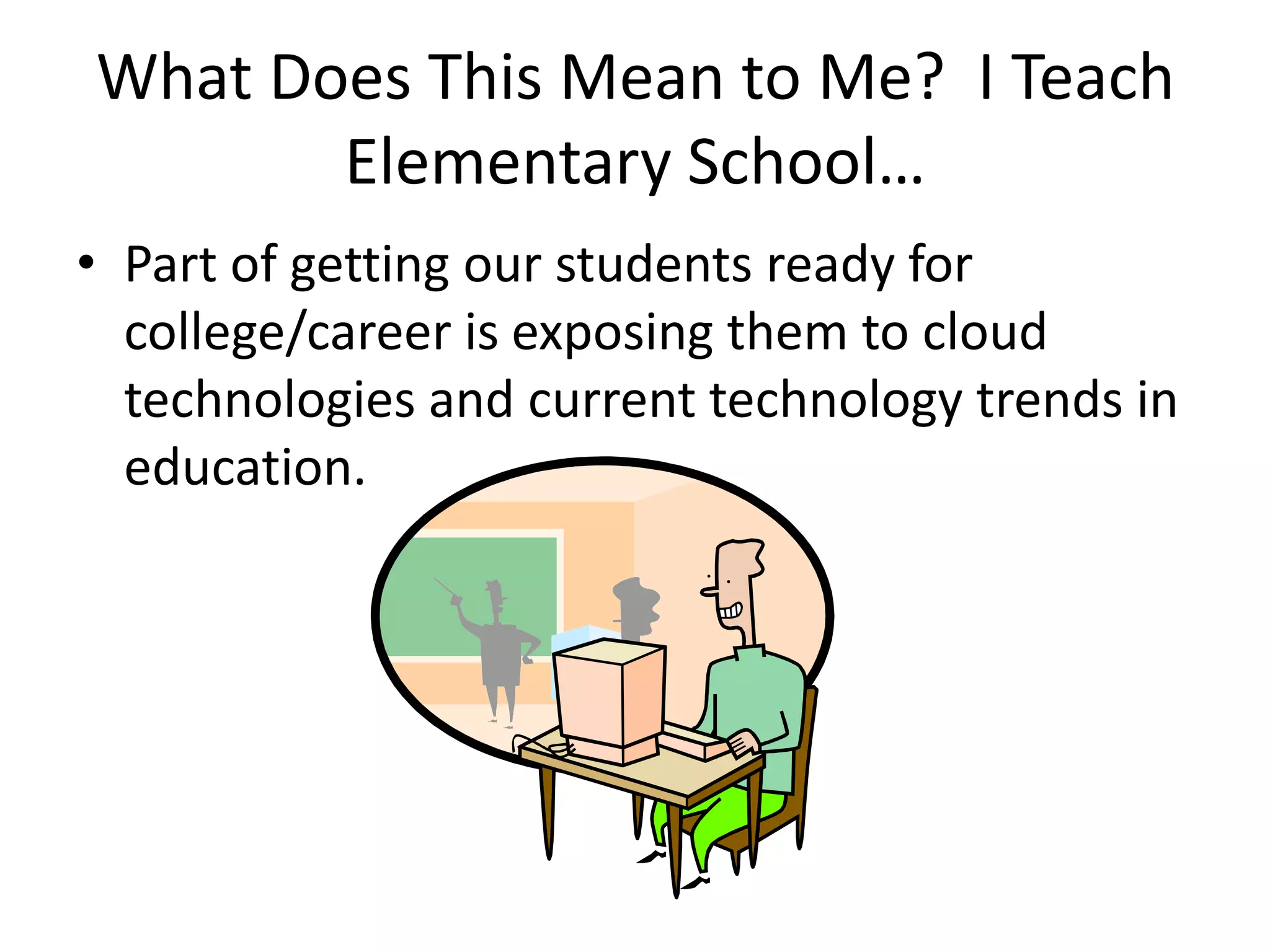
What Does This Mean to Me?  I Teach Elementary School…Part of getting our students ready for college/career is exposing them to cloud technologies and current technology trends in education.
Research says:  Do this in the classroom!According to the ECAR Study of Undergraduate Students and Information technology (2010), Information is everywhere and increasingly abundant online.  “In such a world, sense-making and the ability to assess the credibility of information is paramount” (p.2).  Translation to the classroom:  teach kids that not everything on the internet is factual, and teach them to discern between blogs, opinion, fact, and credible sources.
Research Says:  Do this in the classroom!People need and want to compute and use technology anywhere.Translation to the classroom:  teach kids how to use cloud-based technology, netbooks, ipads, laptops, apple and pc, and to use handheld devices such as the itouch, .  Teach kids about apps and how to download them. This is vital!
Research Says:  Do this in the classroom!The world is moving to cloud-based technology.Translation to the classroom:  teach kids about web 2.0:  delicious, facebook, googleapps, googledocs, spicebirdbeta, thinkfree.  Use these tools EVERYDAY!  Make the kids type, login, search, save, tag, make them do everything!  Their future depends on it!
Research Says:  Do this in the classroom!Collaborative work is key!Translation in the classroom:  group projects, googledocs, WIKI’s, blogs, cross-curriculum projects with other classrooms or grade levels, or flat classroom.  Start a collaborative project with a classroom in Hong Kong. Do something collaborative and train those kids on how to think as a team.
http://horizon.nmc.org/wdata/xdocs/Horizon-Metatrends.pdfAs we click on this link we can see that:Mashups, collective intelligence (collaboration),social networking, virtual collaboration, and mobile computing and apps are the most used technologies over the past 5 years.  Again we see that cloud-based technology is taking over.  MEGATRENDS:  5 years of researchSo……..
What Do These Megatrends Mean in Your Classroom?Use cloud-based technologyTeach and use appsTeach collaborative skillsDemand these skills from your studentsCreate projects;  publish and present in your classroom, to your school, and across the internet.
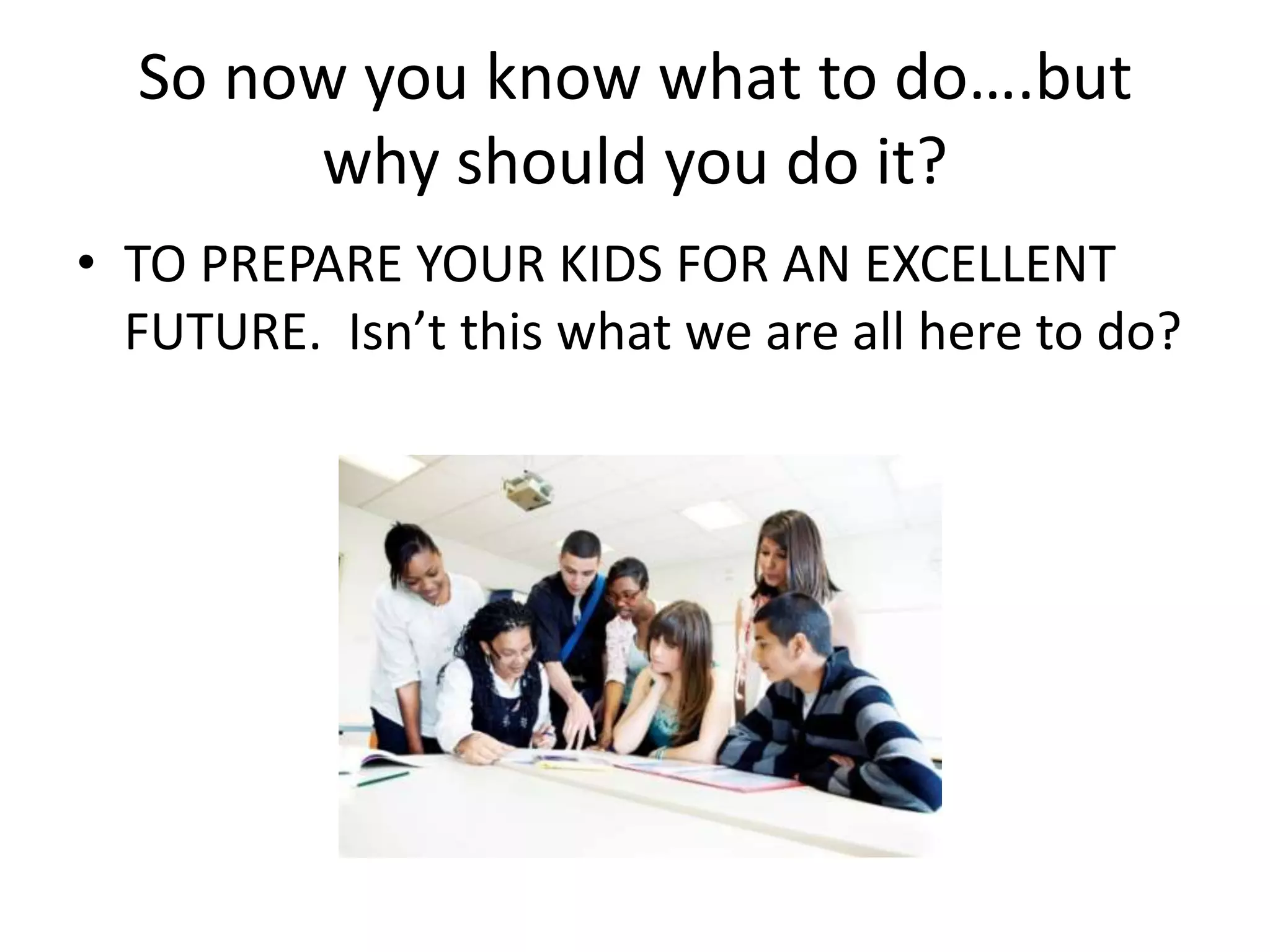
So now you know what to do….but why should you do it?TO PREPARE YOUR KIDS FOR AN EXCELLENT FUTURE.  Isn’t this what we are all here to do?
Take a 5 minute break and reflect at your tables..I am about to disrupt your mind!
Welcome Back!  Here are some new ideas..Innovation means to change or renew;  to create change. As educators we are constantly trying to do better,  innovate,  and change what we do in the classroom to get our kids ready for college and career.  There are two types of innovation that typically exist:  sustaining and disruptive.
Disruptive Innovation:  Talk at your tables about what this means….A disruptive technology or disruptive innovation is an innovation that helps create a new market and value network, and eventually goes on to disrupt an existing market and value network (over a few years or decades), displacing an earlier technology there. The term is used in business and technology literature to describe innovations that improve a product or service in ways that the market does not expect, typically first by designing for a different set of consumers in the new market and later by lowering prices in the existing market.
Sustaining Innovation: Talk at your tables about how this differs from disruptive innovation"sustaining" innovation does not create new markets or value networks but rather only evolves existing ones with better value, allowing the firms within to compete against each other's sustaining improvements.”
Get it yet?  Great!  Let’s move on.I am kidding.  Obviously it is not that easy or we wouldn’t have to discuss this at length.
Sustaining InnovationSimply put, sustaining innovation is “continued changing and improvement of products and services is called sustaining innovation.  “Airplanes that fly farther, computers that process faster, cellular phone batteries that last longer, and televisions with clearer images are all sustaining innovations” (p.46).    Sustaining innovation is different from disruptive innovation in that disruptive innovations are usually of lower quality, appear in an unexpected fashion, and traditionally surprise companies whose focus is improving their already-successful products.”
In the Educator’s World….Sustaining innovation is making things better.  Translation to education:  hiring expensive consultants to fix our problems with TAKS scores, new adoption of textbooks each year that contain the same material, buying the same PC’s that we purchased 2 years ago because we have more students, building newer, more beautiful, more expensive schools.
In the Educator’s World…Disruptive innovation sneaks up and surprises us all.Translation to education:  Disruptive innovation occurs when there is a need that is not being fulfilled in the traditional way of teaching.  It doesn’t necessarily mean that this new way of doing things is better or an improvement, it can even be a worse way of doing things.  But it appeals to certain students and makes things simpler for these kids.
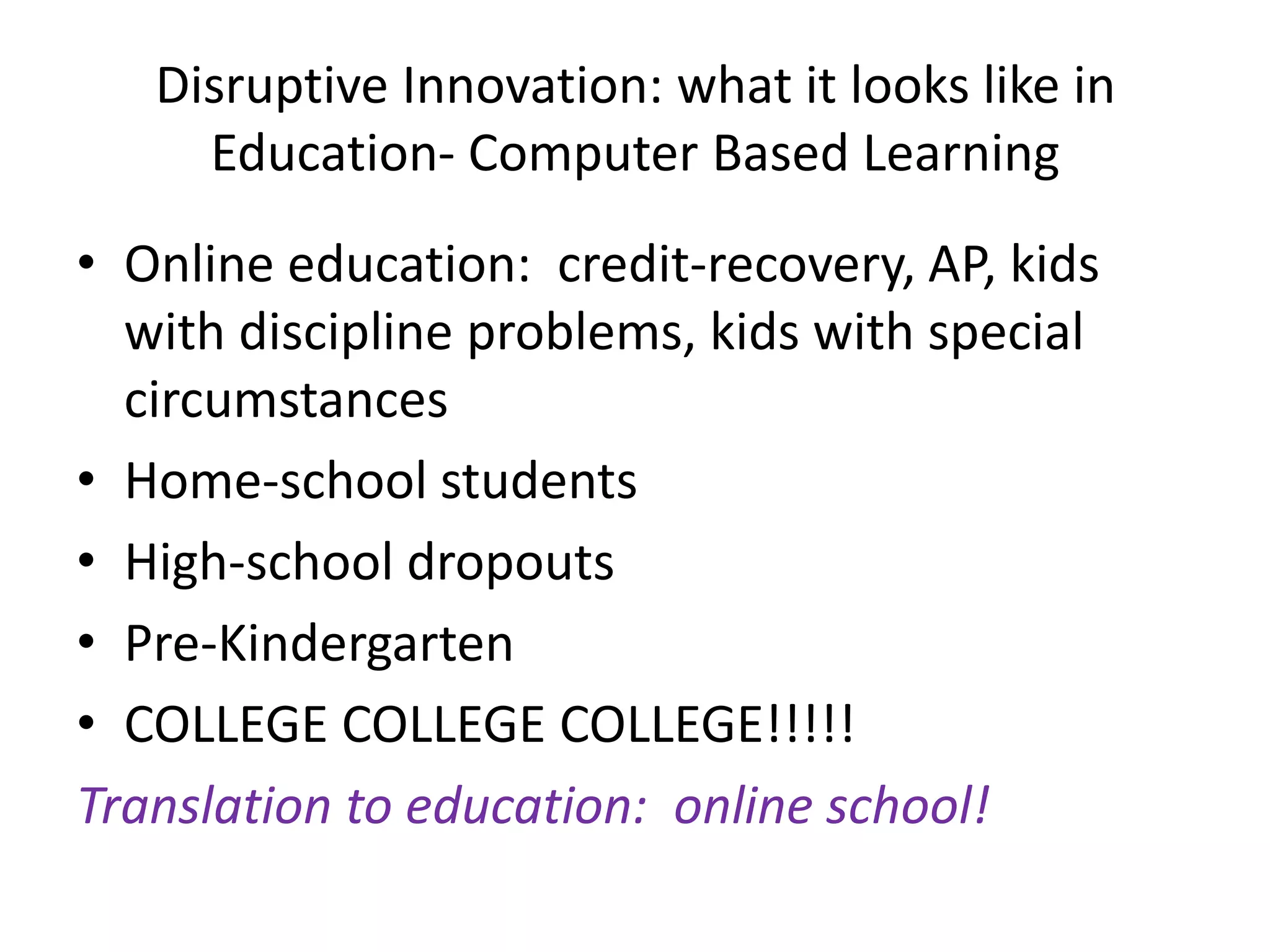
Disruptive Innovation: what it looks like in Education- Computer Based LearningOnline education:  credit-recovery, AP, kids with discipline problems, kids with special circumstancesHome-school studentsHigh-school dropoutsPre-KindergartenCOLLEGE COLLEGECOLLEGE!!!!!Translation to education:  online school!
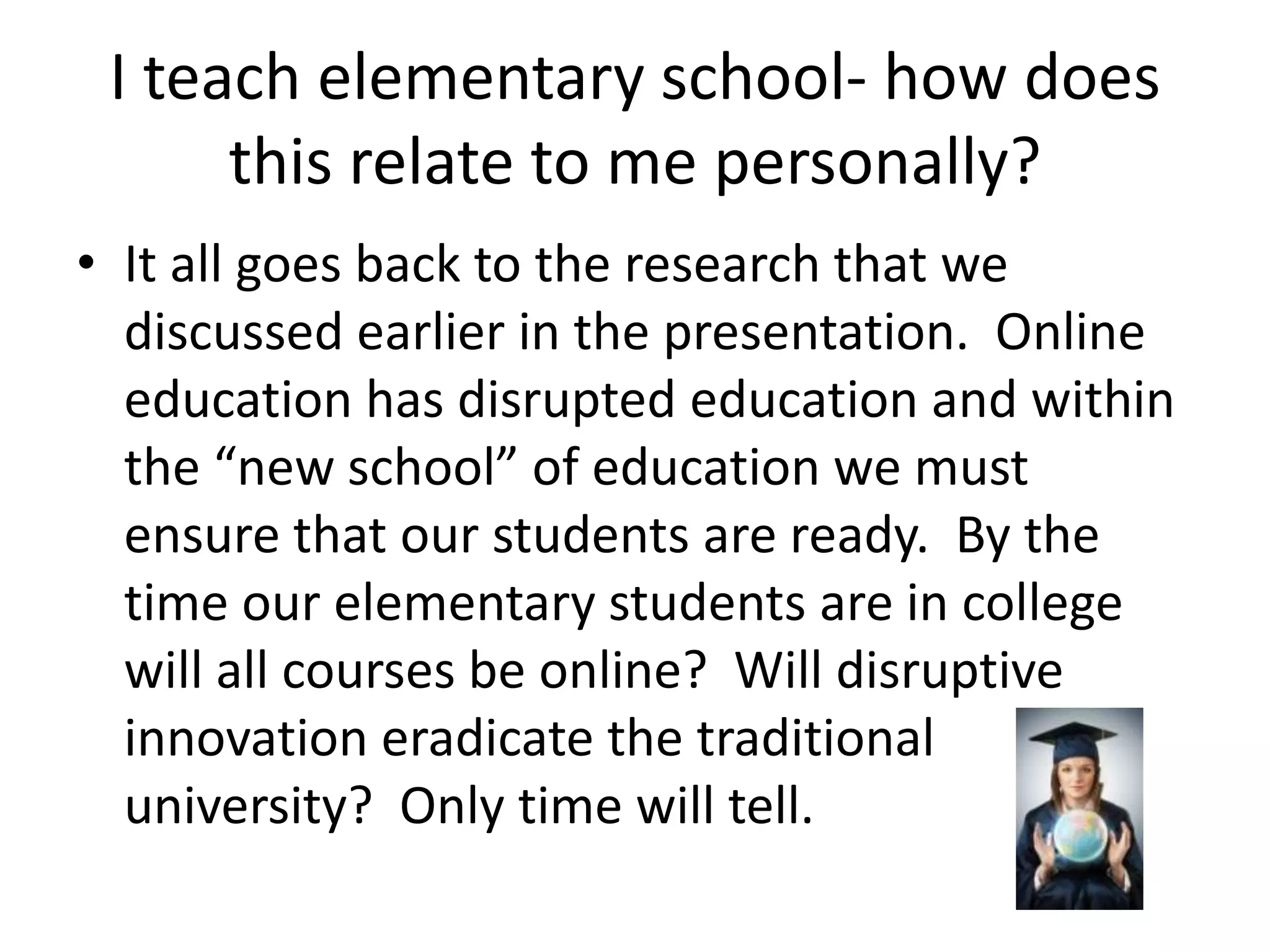
I teach elementary school- how does this relate to me personally?It all goes back to the research that we discussed earlier in the presentation.  Online education has disrupted education and within the “new school” of education we must ensure that our students are ready.  By the time our elementary students are in college will all courses be online?  Will disruptive innovation eradicate the traditional university?  Only time will tell.
All of the research we have examined points to the same conclusion:Looking at the ECAR study again, when college students were polled, they stated, “[They] are creating and sharing content, as revealed in responses to our questions about Web 2.0 user-driven sites.  Close to the same number of respondents said they contributed video to video websites (42%), and update wikis(40%), while slightly more than a third or respondents said they contribute to blogs (36%) (p.4).  Translation to classroom:  all research says the same thing.  Web 2.0 and Cloud technology is where we are and where we will continue to go.
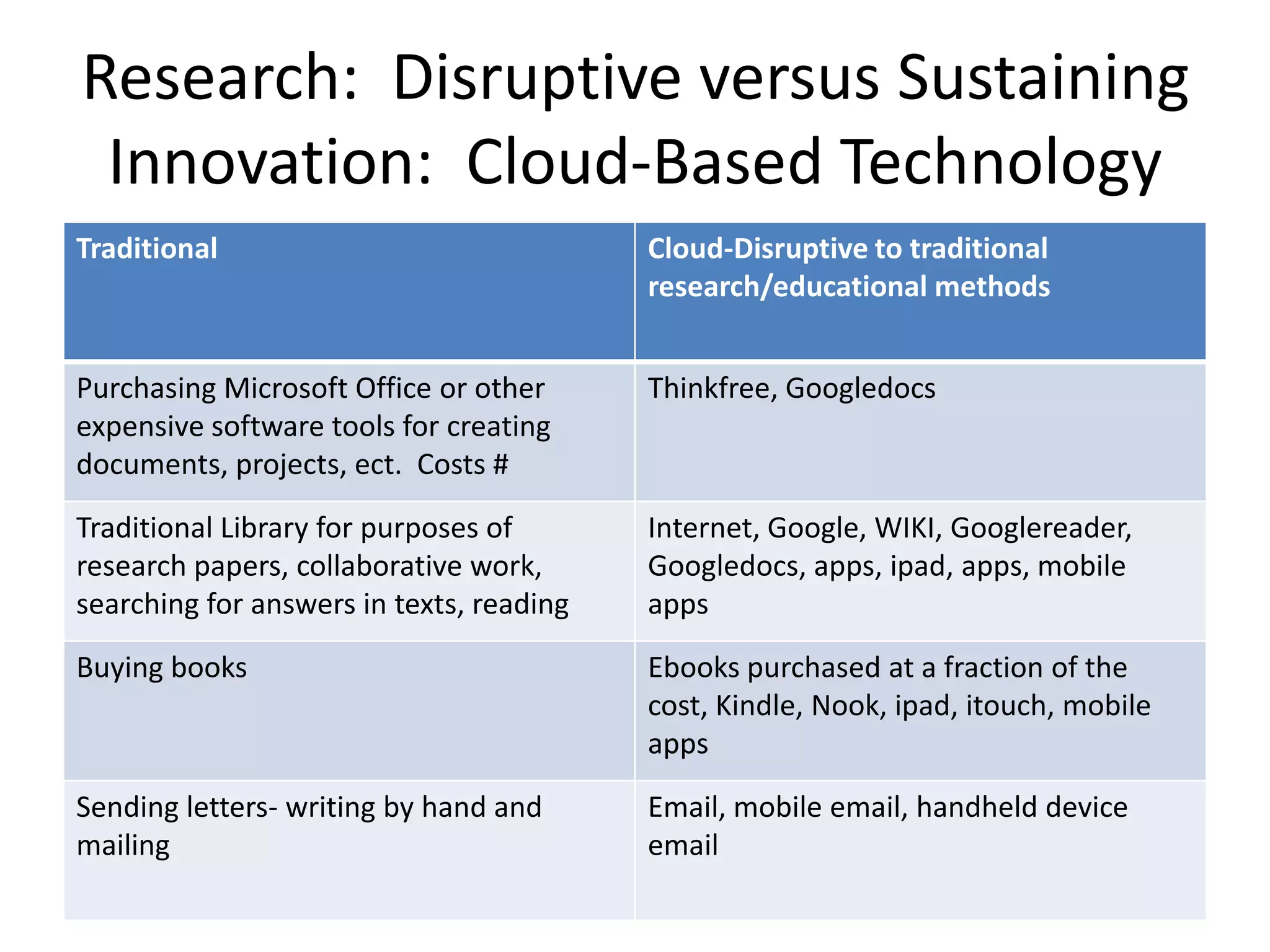
Research:  Disruptive versus Sustaining Innovation:  Cloud-Based Technology
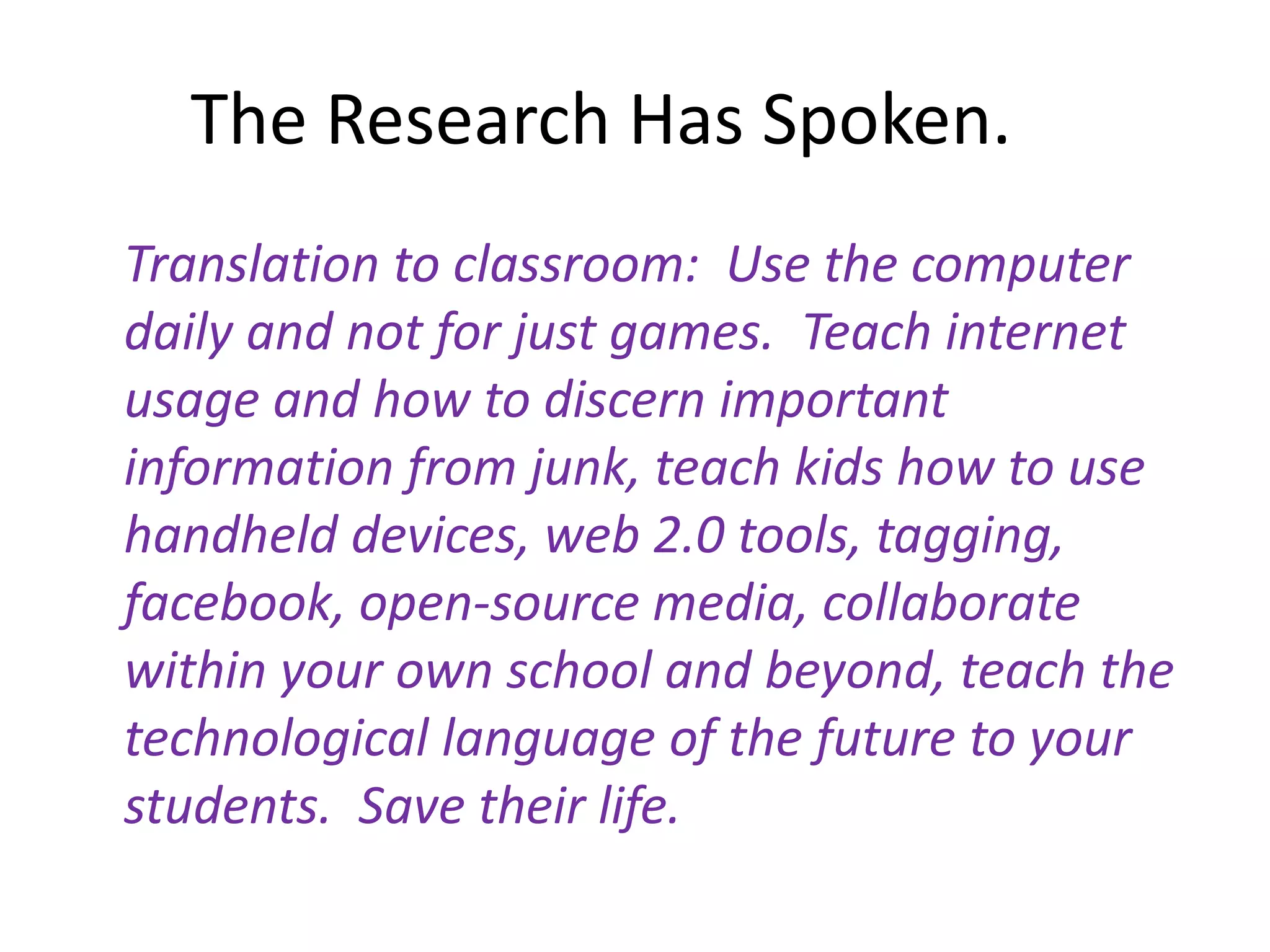
The Research Has Spoken.	Translation to classroom:  Use the computer daily and not for just games.  Teach internet usage and how to discern important information from junk, teach kids how to use handheld devices, web 2.0 tools, tagging, facebook, open-source media, collaborate within your own school and beyond, teach the technological language of the future to your students.  Save their life.
And….	Make sure that your students understand the reason that you are teaching all of this to them.  Discuss their future, discuss college, discuss how the bachelor’s degree is the new high school diploma.  Discuss competition, discuss WHY WHEN AND HOW.  Make your kids technologically savvy, and make yourself a better teacher by learning about the vastness of the web, web 2.0 and Cloud technology.
Can this be true?According to the 2010 Morgan Stanley Mobile Internet Report, “Regarding pace of change, we believe more users willlikely connect to the Internet via mobile devices thandesktop PCs within 5 years” (p.22).
Think about this…“History has shown that educational institutions at all levels are too quick to jump on the band wagon and simply accept a sustaining innovation that does little to improve learning” (Young, 2011).
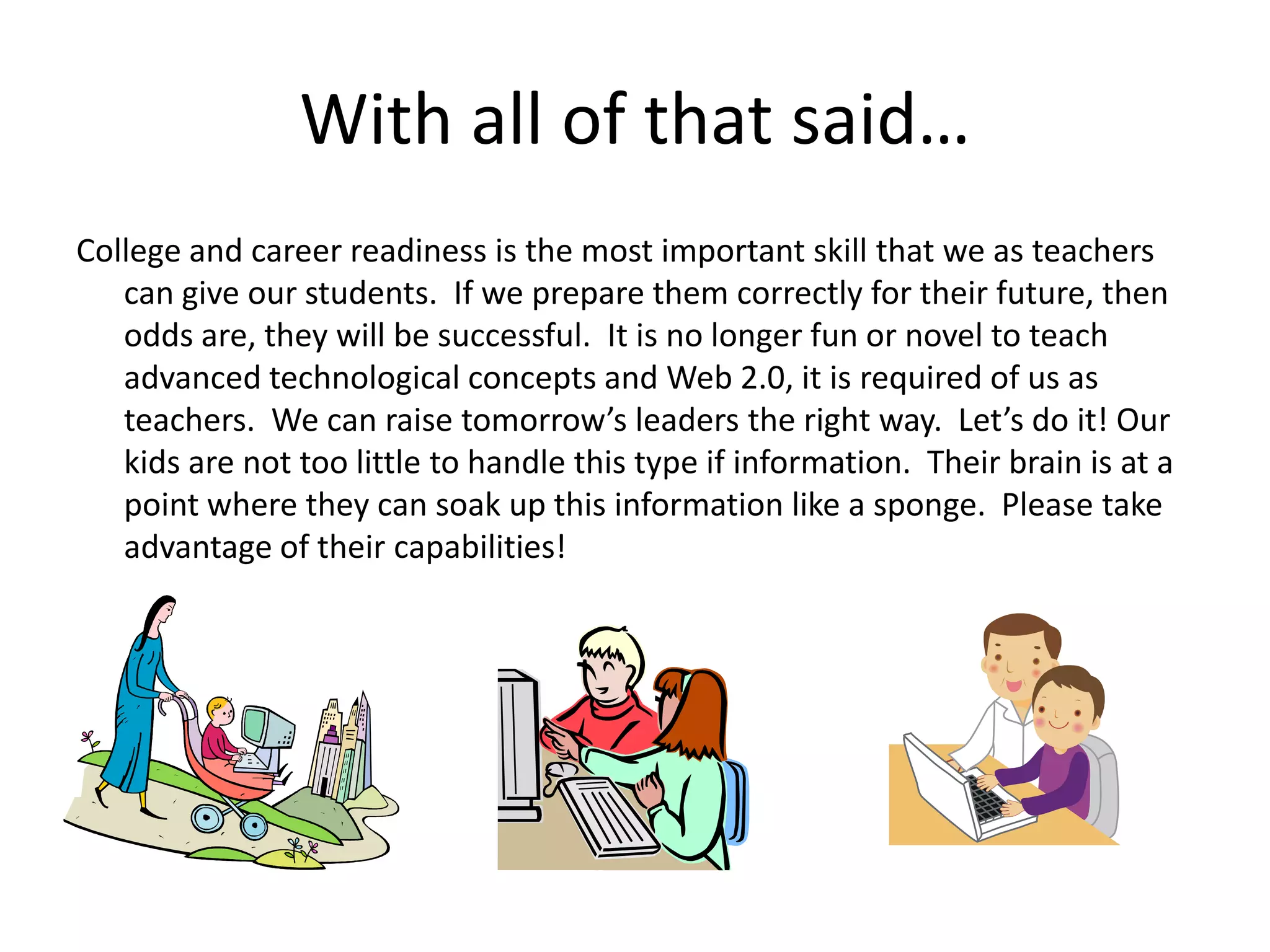
With all of that said…College and career readiness is the most important skill that we as teachers can give our students.  If we prepare them correctly for their future, then odds are, they will be successful.  It is no longer fun or novel to teach advanced technological concepts and Web 2.0, it is required of us as teachers.  We can raise tomorrow’s leaders the right way.  Let’s do it! Our kids are not too little to handle this type if information.  Their brain is at a point where they can soak up this information like a sponge.  Please take advantage of their capabilities!
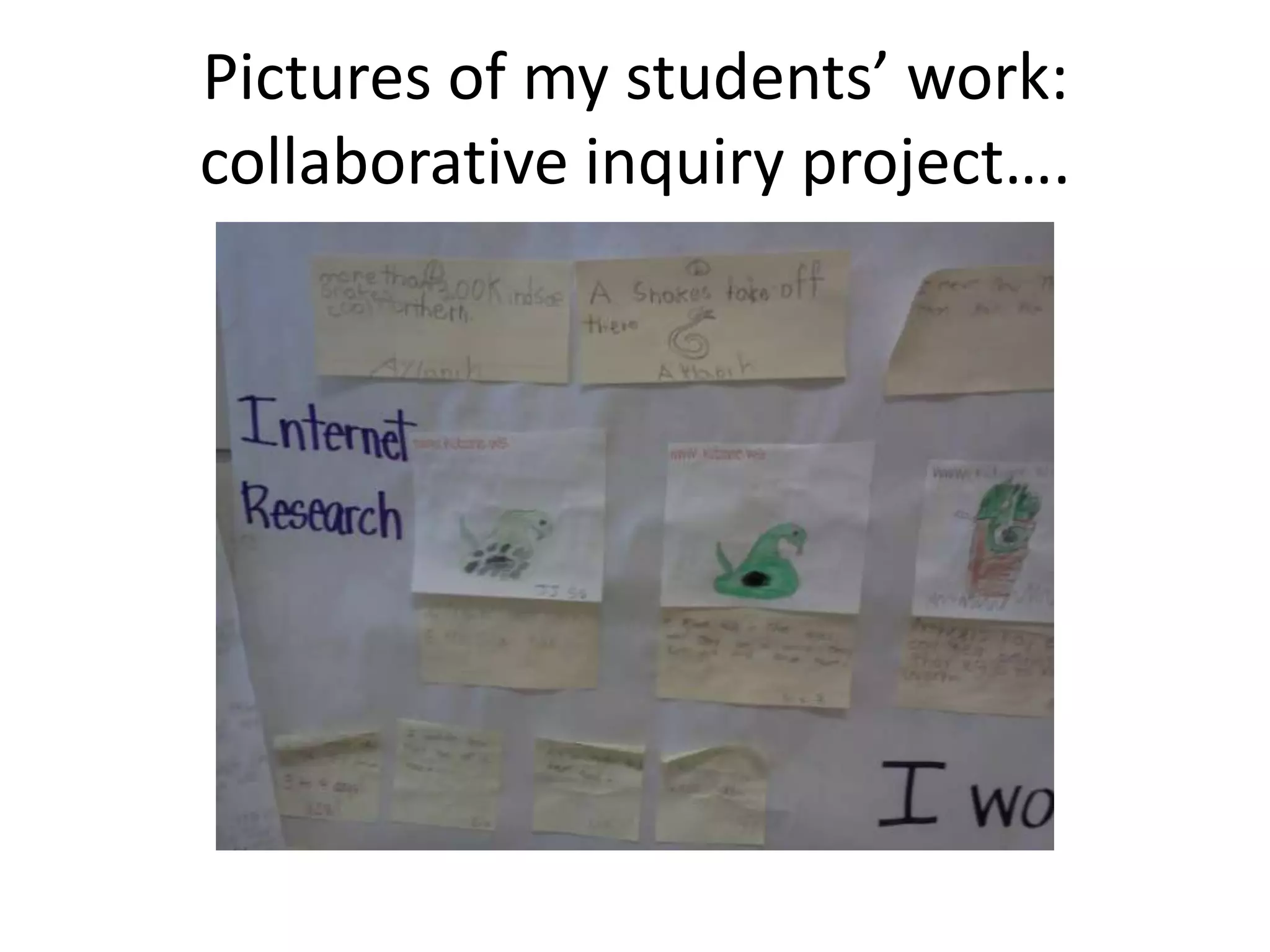
Pictures of my students’ work:  collaborative inquiry project….
More work…
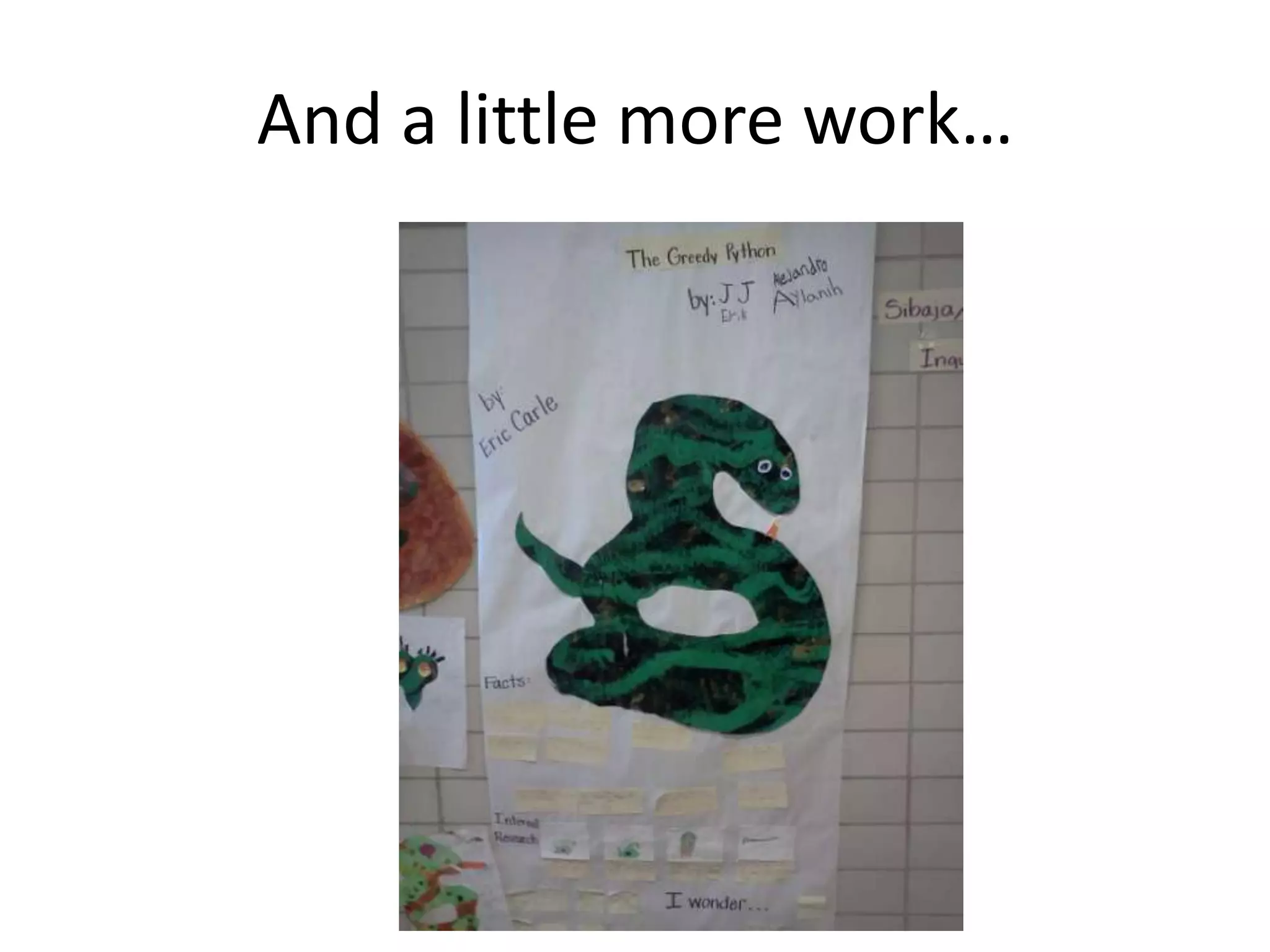
And a little more work…
About the work…	All of this work was done by 6 year olds and they contrasted fact and fiction by reading the books of Eric Carle together, then researching the animals online.  It was wonderful, collaborative, web-based, creative, astonishing, and absolutely do-able.YOU CAN DO THIS TOO!!
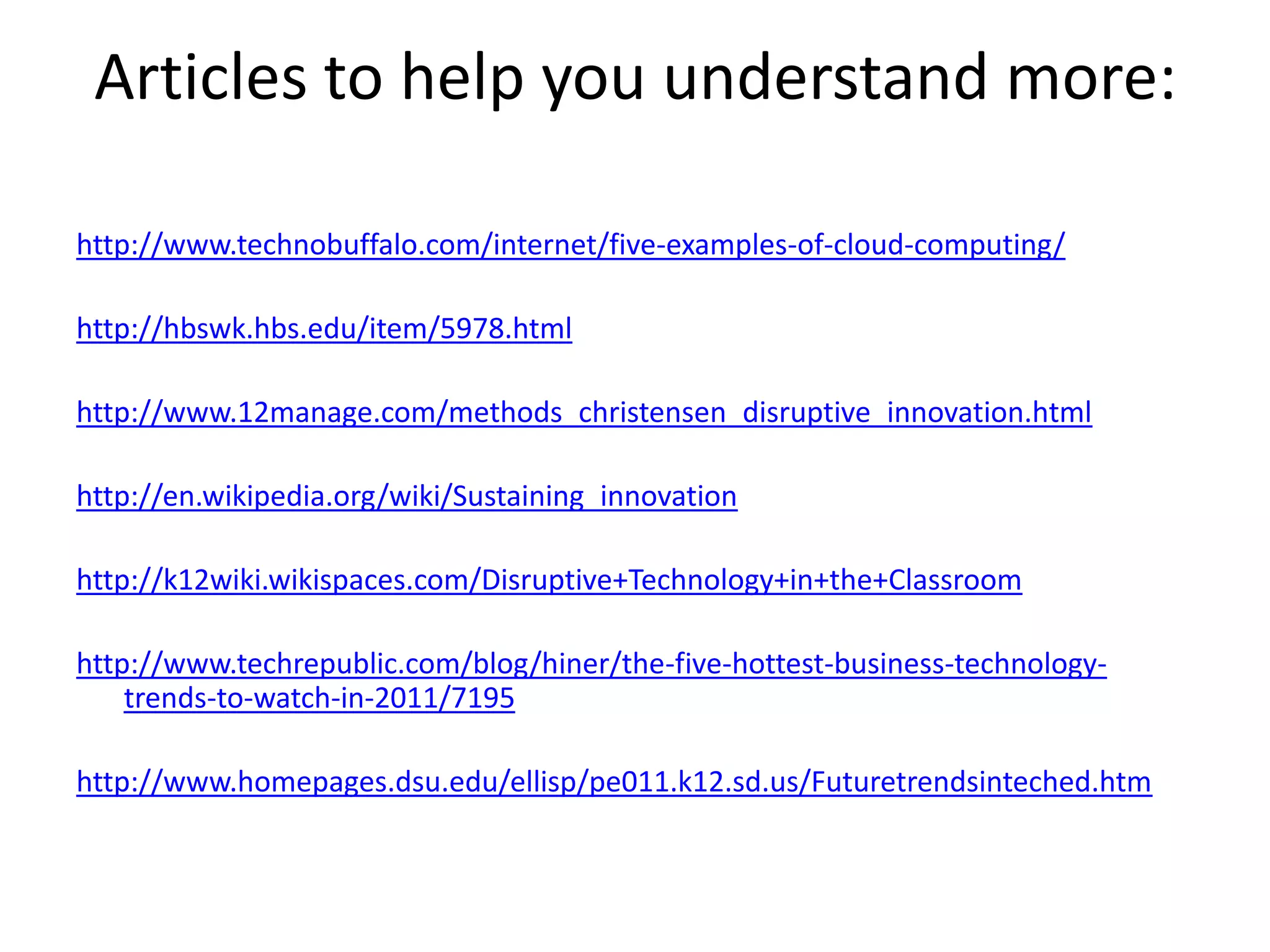
Articles to help you understand more:http://www.technobuffalo.com/internet/five-examples-of-cloud-computing/http://hbswk.hbs.edu/item/5978.htmlhttp://www.12manage.com/methods_christensen_disruptive_innovation.htmlhttp://en.wikipedia.org/wiki/Sustaining_innovationhttp://k12wiki.wikispaces.com/Disruptive+Technology+in+the+Classroomhttp://www.techrepublic.com/blog/hiner/the-five-hottest-business-technology-trends-to-watch-in-2011/7195http://www.homepages.dsu.edu/ellisp/pe011.k12.sd.us/Futuretrendsinteched.htm
I use these site in my classroom…www.brainpop.comwww.brainpopjr.comwww.unitedstreaming.comwww.snapfish.comwww.facebook.comwww.delicious.comwww.youtube.comwww.teachertube.comwww.tumblebooks.comwww.animoto.comhttp://www.wordle.net/more?  Email me at mary.cox@springbranchisd.com
The EndThank you so much for your time and I hope that you will be encouraged to try some of these new things.  The research proves that we must teach this way or our kids will not be ready for the future.Mary Katherine Cox

M2 a7coxm

  • 1.
    How to PrepareOur Students For College: A Review of Literature and Research that supports the use of Web 2.0 and Cloud Technology as it relates to disruptive innovation in education . A Presentation to the Teachers of Spring Branch Elementary by Mary Katherine Cox
  • 2.
    Literature Review ConcerningTechnological Trends and Disruptive Innovation in the Field Of Educating Small ChildrenResources used in the presentation:Johnson, L., Levine, A., Smith, R., & Stone, S. (2006-2010). The 2010 Horizon Report. Austin, Texas: The New Media Consortium.Smith S., Caruso, J. (2010) The ECAR study of undergraduate students and information technology. Boulder, CO. EducauseCenter for Applied ResearchThe Morgan Stanley Mobile Internet Report (2010). Citation on Next PageCITATIONS ARE ALSO ON THE NOTES ON THE BOTTOM OF SOME SLIDES.
  • 3.
    Morgan Stanley MobileInternet Report Citation InformationMorgan Stanley Research – ContributorsNote: All e-mail: @morganstanley.comUS Internet US TelecomMary Meeker mary.meeker@ (212) 761-8042 Simon Flannery simon.flannery@ (212) 761-6432Scott Devittscott.devitt@ -3365 Sean Ittelsean.ittel@ -7220Liang Wu liang.wu@ -6320Colter Van Domelen colter.van.domelen@ -7678 EU TelecomNick Delfasnick.delfas@ +44 20 7425-6611US Hardware Sean Gardiner sean.gardiner@ +971 4 709-7120Katy Hubertykathryn.huberty@ (212) 761-6249Mathew Schneider mathew.schneider@ -3483 Japan TelecomHironori Tanaka hiro.tanaka@ +81 3 5424-5336US Communications EquipmentEhud Gelblumehud.gelblum@ (212) 761-8564 APAC TelecomAvi Silver avi.silver@ -4226 NavinKillanavin.killa@ +852 2848-5422VinayJaisingvinay.jaising@ +91 22 2209-7780Japan Internet Yvonne Chow yvonne.chow@ +852 2848-8262NaoshiNemanaoshi.nema@ +81 3 5424-5320China InternetEU Communications Equipment Richard Jirichard.ji@ +852 2848-6926James Dawson james.dawson@ +44 20 7425-9646Patrick Standaertpatrick.standaert@ -9290 US Cable / MediaBenjamin Swinburne benjamin.swinburne@ (212) 761-7527US SemiconductorsMark Lipacismark.lipacis@ (415) 576-2190 US SoftwareSanjay Devgansanjay.devgan@ -2382 Adam Holt adam.holt@ (415) 576-2320APAC TechnologyJasmine Lu jasmine.lu@ +852 2239-1348Bill Lu bill.lu@ +852 2848-5214Keon Han keon.han@ +82 2 399-4933We acknowledge the contributions of Ravi Lath to this report
  • 4.
    Our Most ImportantJob as Educators: College/Career-ReadinessOur most important job as educators of small children is preparing our students to thrive in an increasingly technological world. “The technologies we use [in life, work, and play] are increasingly cloud-based”(p.3).“The work of students is increasingly seen as collaborative by nature, and there is more cross-campus collaboration between departments” (p.3).
  • 5.
    What does Cloud-BasedTechnology Mean?“Cloud-based or Web 2.0 technologies, a term that refers to the vast array of socially oriented, free or nearly free, web-based tools, has represented a transition from institutionally-provided to freely available technology tools” (Diaz, Abstract)
  • 6.
  • 7.
    Email on theGo“Email communication now plays a central role in most of our busy lives. That’s fine if you don’t go out much but if you travel a lot, this may cause problems. Unless you carry a mobile WiFi-enabled laptop with you everywhere you go or use push email on your cellphone, having an email client sitting on your computer at home means that while out and about you risk spending time outside of the communication loop. This is one area where the cloud finds its most frequent and useful application”.
  • 8.
    Think FreeFree OnlineOffice with Powerful functionsSame functions and user environments of MS Office but provided for free.
  • 9.
    On occasion youmay find yourself in need of the opinion of your peers. Downloading files onto flash memory, emailing documents to friends or family or colleagues or sending submissions by snail mail is so last century. Last year Google launched a service that allowed groups of people to work on the same document, idea or proposal in real time or whenever convenient to each participant.
  • 10.
    What Does ThisMean to Me? I Teach Elementary School…Part of getting our students ready for college/career is exposing them to cloud technologies and current technology trends in education.
  • 11.
    Research says: Do this in the classroom!According to the ECAR Study of Undergraduate Students and Information technology (2010), Information is everywhere and increasingly abundant online. “In such a world, sense-making and the ability to assess the credibility of information is paramount” (p.2). Translation to the classroom: teach kids that not everything on the internet is factual, and teach them to discern between blogs, opinion, fact, and credible sources.
  • 12.
    Research Says: Do this in the classroom!People need and want to compute and use technology anywhere.Translation to the classroom: teach kids how to use cloud-based technology, netbooks, ipads, laptops, apple and pc, and to use handheld devices such as the itouch, . Teach kids about apps and how to download them. This is vital!
  • 13.
    Research Says: Do this in the classroom!The world is moving to cloud-based technology.Translation to the classroom: teach kids about web 2.0: delicious, facebook, googleapps, googledocs, spicebirdbeta, thinkfree. Use these tools EVERYDAY! Make the kids type, login, search, save, tag, make them do everything! Their future depends on it!
  • 14.
    Research Says: Do this in the classroom!Collaborative work is key!Translation in the classroom: group projects, googledocs, WIKI’s, blogs, cross-curriculum projects with other classrooms or grade levels, or flat classroom. Start a collaborative project with a classroom in Hong Kong. Do something collaborative and train those kids on how to think as a team.
  • 15.
    http://horizon.nmc.org/wdata/xdocs/Horizon-Metatrends.pdfAs we clickon this link we can see that:Mashups, collective intelligence (collaboration),social networking, virtual collaboration, and mobile computing and apps are the most used technologies over the past 5 years. Again we see that cloud-based technology is taking over. MEGATRENDS: 5 years of researchSo……..
  • 16.
    What Do TheseMegatrends Mean in Your Classroom?Use cloud-based technologyTeach and use appsTeach collaborative skillsDemand these skills from your studentsCreate projects; publish and present in your classroom, to your school, and across the internet.
  • 17.
    So now youknow what to do….but why should you do it?TO PREPARE YOUR KIDS FOR AN EXCELLENT FUTURE. Isn’t this what we are all here to do?
  • 18.
    Take a 5minute break and reflect at your tables..I am about to disrupt your mind!
  • 19.
    Welcome Back! Here are some new ideas..Innovation means to change or renew; to create change. As educators we are constantly trying to do better, innovate, and change what we do in the classroom to get our kids ready for college and career. There are two types of innovation that typically exist: sustaining and disruptive.
  • 20.
    Disruptive Innovation: Talk at your tables about what this means….A disruptive technology or disruptive innovation is an innovation that helps create a new market and value network, and eventually goes on to disrupt an existing market and value network (over a few years or decades), displacing an earlier technology there. The term is used in business and technology literature to describe innovations that improve a product or service in ways that the market does not expect, typically first by designing for a different set of consumers in the new market and later by lowering prices in the existing market.
  • 21.
    Sustaining Innovation: Talkat your tables about how this differs from disruptive innovation"sustaining" innovation does not create new markets or value networks but rather only evolves existing ones with better value, allowing the firms within to compete against each other's sustaining improvements.”
  • 22.
    Get it yet? Great! Let’s move on.I am kidding. Obviously it is not that easy or we wouldn’t have to discuss this at length.
  • 23.
    Sustaining InnovationSimply put,sustaining innovation is “continued changing and improvement of products and services is called sustaining innovation. “Airplanes that fly farther, computers that process faster, cellular phone batteries that last longer, and televisions with clearer images are all sustaining innovations” (p.46). Sustaining innovation is different from disruptive innovation in that disruptive innovations are usually of lower quality, appear in an unexpected fashion, and traditionally surprise companies whose focus is improving their already-successful products.”
  • 24.
    In the Educator’sWorld….Sustaining innovation is making things better. Translation to education: hiring expensive consultants to fix our problems with TAKS scores, new adoption of textbooks each year that contain the same material, buying the same PC’s that we purchased 2 years ago because we have more students, building newer, more beautiful, more expensive schools.
  • 25.
    In the Educator’sWorld…Disruptive innovation sneaks up and surprises us all.Translation to education: Disruptive innovation occurs when there is a need that is not being fulfilled in the traditional way of teaching. It doesn’t necessarily mean that this new way of doing things is better or an improvement, it can even be a worse way of doing things. But it appeals to certain students and makes things simpler for these kids.
  • 26.
    Disruptive Innovation: whatit looks like in Education- Computer Based LearningOnline education: credit-recovery, AP, kids with discipline problems, kids with special circumstancesHome-school studentsHigh-school dropoutsPre-KindergartenCOLLEGE COLLEGECOLLEGE!!!!!Translation to education: online school!
  • 27.
    I teach elementaryschool- how does this relate to me personally?It all goes back to the research that we discussed earlier in the presentation. Online education has disrupted education and within the “new school” of education we must ensure that our students are ready. By the time our elementary students are in college will all courses be online? Will disruptive innovation eradicate the traditional university? Only time will tell.
  • 28.
    All of theresearch we have examined points to the same conclusion:Looking at the ECAR study again, when college students were polled, they stated, “[They] are creating and sharing content, as revealed in responses to our questions about Web 2.0 user-driven sites. Close to the same number of respondents said they contributed video to video websites (42%), and update wikis(40%), while slightly more than a third or respondents said they contribute to blogs (36%) (p.4). Translation to classroom: all research says the same thing. Web 2.0 and Cloud technology is where we are and where we will continue to go.
  • 29.
    Research: Disruptiveversus Sustaining Innovation: Cloud-Based Technology
  • 30.
    The Research HasSpoken. Translation to classroom: Use the computer daily and not for just games. Teach internet usage and how to discern important information from junk, teach kids how to use handheld devices, web 2.0 tools, tagging, facebook, open-source media, collaborate within your own school and beyond, teach the technological language of the future to your students. Save their life.
  • 31.
    And…. Make sure thatyour students understand the reason that you are teaching all of this to them. Discuss their future, discuss college, discuss how the bachelor’s degree is the new high school diploma. Discuss competition, discuss WHY WHEN AND HOW. Make your kids technologically savvy, and make yourself a better teacher by learning about the vastness of the web, web 2.0 and Cloud technology.
  • 32.
    Can this betrue?According to the 2010 Morgan Stanley Mobile Internet Report, “Regarding pace of change, we believe more users willlikely connect to the Internet via mobile devices thandesktop PCs within 5 years” (p.22).
  • 33.
    Think about this…“Historyhas shown that educational institutions at all levels are too quick to jump on the band wagon and simply accept a sustaining innovation that does little to improve learning” (Young, 2011).
  • 34.
    With all ofthat said…College and career readiness is the most important skill that we as teachers can give our students. If we prepare them correctly for their future, then odds are, they will be successful. It is no longer fun or novel to teach advanced technological concepts and Web 2.0, it is required of us as teachers. We can raise tomorrow’s leaders the right way. Let’s do it! Our kids are not too little to handle this type if information. Their brain is at a point where they can soak up this information like a sponge. Please take advantage of their capabilities!
  • 35.
    Pictures of mystudents’ work: collaborative inquiry project….
  • 36.
  • 37.
    And a littlemore work…
  • 38.
    About the work… Allof this work was done by 6 year olds and they contrasted fact and fiction by reading the books of Eric Carle together, then researching the animals online. It was wonderful, collaborative, web-based, creative, astonishing, and absolutely do-able.YOU CAN DO THIS TOO!!
  • 39.
    Articles to helpyou understand more:http://www.technobuffalo.com/internet/five-examples-of-cloud-computing/http://hbswk.hbs.edu/item/5978.htmlhttp://www.12manage.com/methods_christensen_disruptive_innovation.htmlhttp://en.wikipedia.org/wiki/Sustaining_innovationhttp://k12wiki.wikispaces.com/Disruptive+Technology+in+the+Classroomhttp://www.techrepublic.com/blog/hiner/the-five-hottest-business-technology-trends-to-watch-in-2011/7195http://www.homepages.dsu.edu/ellisp/pe011.k12.sd.us/Futuretrendsinteched.htm
  • 40.
    I use thesesite in my classroom…www.brainpop.comwww.brainpopjr.comwww.unitedstreaming.comwww.snapfish.comwww.facebook.comwww.delicious.comwww.youtube.comwww.teachertube.comwww.tumblebooks.comwww.animoto.comhttp://www.wordle.net/more? Email me at mary.cox@springbranchisd.com
  • 41.
    The EndThank youso much for your time and I hope that you will be encouraged to try some of these new things. The research proves that we must teach this way or our kids will not be ready for the future.Mary Katherine Cox

Editor's Notes

  • #5 Johnson, L., Levine, A., Smith, R., & Stone, S. (2010). The 2010 Horizon Report.Austin, Texas: The New Media Consortium.
  • #6 Diaz, V. (2011). Cloud-Based Technologies: Faculty, Development, Support, and Implementation. Retrieved from http://sloanconsortium.org/jaln/v15n1/cloud-based-technologies-faculty-development-support-and-implementation
  • #7 http://www.technobuffalo.com/internet/five-examples-of-cloud-computing/
  • #8 http://www.technobuffalo.com/internet/five-examples-of-cloud-computing/
  • #9 http://member.thinkfree.com/member/goAboutService.actionhttp://www.technobuffalo.com/internet/five-examples-of-cloud-computing/
  • #10 http://www.technobuffalo.com/internet/five-examples-of-cloud-computing/
  • #12 Johnson, L., Levine, A., Smith, R., & Stone, S. (2010). The 2010 Horizon Report. Austin, Texas: The New Media Consortium.
  • #13 Johnson, L., Levine, A., Smith, R., & Stone, S. (2010). The 2010 Horizon Report. Austin, Texas: The New Media Consortium.
  • #14 Johnson, L., Levine, A., Smith, R., & Stone, S. (2010). The 2010 Horizon Report. Austin, Texas: The New Media Consortium.
  • #15 Johnson, L., Levine, A., Smith, R., & Stone, S. (2010). The 2010 Horizon Report. Austin, Texas: The New Media Consortium.
  • #16 http://horizon.nmc.org/wdata/xdocs/Horizon-Metatrends.pdf
  • #17 Johnson, L., Levine, A., Smith, R., & Stone, S. (2008). The 2008 Horizon Report. Austin, Texas: The New Media Consortium.
  • #21 http://en.wikipedia.org/wiki/Sustaining_innovation
  • #22 http://en.wikipedia.org/wiki/Sustaining_innovation
  • #24 Taken from assignment 3 in EDUC 652, by Mary Katherine Cox. 2011.Christensen, C.M., Horn M.B., & Johnson, C.W. (2011). Disrupting class: how disruptive innovation will change the way the world learns. New York: McGraw Hill.
  • #27 Christensen, C.M., Horn M.B., & Johnson, C.W. (2011). Disrupting class: how disruptive innovation will change the way the world learns. New York: McGraw Hill.
  • #29 Smith S., Caruso, J. (2010) The ECAR study of undergraduate students and information technology. Boulder, CO. Educause Center for Applied Research
  • #33 http://www.morganstanley.com/institutional/techresearch/pdfs/2SETUP_12142009_RI.pdf
  • #34 Young, J. (2011, July 13). Blackboard and Major Publishers Collaboration [Blog message]. Retrieved from Harapnuik Blog: http.www.harapnuik.org