New Literacies For An Online Flattened World, Primed To Promote Global Understanding  Donald J. Leu New Literacies Research Lab University of Connecticut [email_address] Peace Corps Coverdale World Wise Schools October 15, 2009 (This Powerpoint is at: Slideshare)
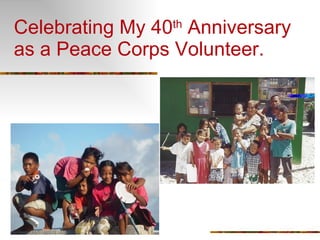
Celebrating My 40 th  Anniversary as a Peace Corps Volunteer.
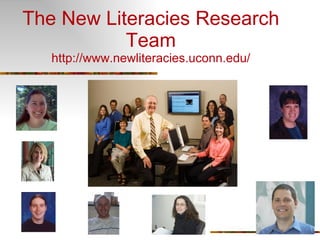
The New Literacies Research Team http://www.newliteracies.uconn.edu/
Important Funding and Support From: Ray and Carole Neag The Carnegie Corporation of New York IES, U.S. Department of Education The National Science Foundation North Central Educational Research Lab PBS The Annenberg Foundation William and Flora Hewlett Foundation Bill and Melinda Gates Foundation Australian Council of Educational Research OECD Schools and teachers around the world.
Major Points The Internet is this generation’s defining technology for reading and learning. New Literacies: The Internet requires additional online reading comprehension and learning skills. How might we teach the new literacies of online reading comprehension in classrooms around the world?  What can we do together to prepare a new generation of global citizens?
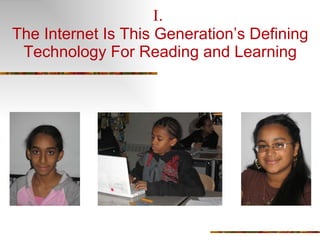
I .  The Internet Is This Generation’s Defining Technology For Reading and Learning
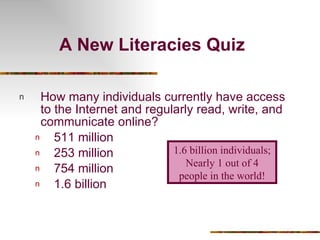
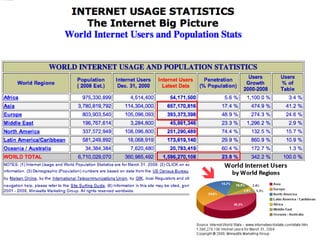
A New Literacies Quiz How many individuals currently have access to the Internet and regularly read, write, and communicate online?   511 million 253 million 754 million 1.6 billion 1.6 billion individuals; Nearly 1 out of 4 people in the world!

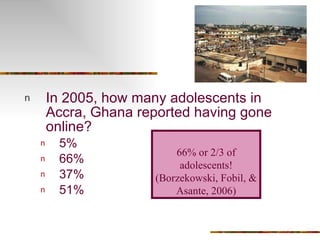
In 2005, how many adolescents in Accra, Ghana reported having gone online? 5% 66% 37% 51% 66% or 2/3 of adolescents! ( Borzekowski, Fobil, & Asante, 2006)
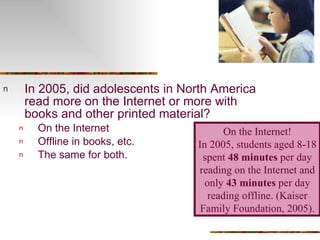
In 2005, did adolescents in North America read more on the Internet or more with books and other printed material? On the Internet  Offline in books, etc. The same for both. On the Internet! In 2005, students aged 8-18 spent  48   minutes  per day reading on the Internet and only  43   minutes  per day reading offline. (Kaiser Family Foundation, 2005).
Which nation manufactures the most software in the world? The U.S. Indonesia India Ireland Ireland!  ( Organization for Economic Development and Cooperation, 2004)
Which nation provides all teachers with 5 weeks of paid, release-time, professional development at integrating the Internet into the K-12 curriculum? The U.S. Indonesia China Finland Finland!
Which nation, in North America, is implementing a plan to ensure Internet access to every home and every school to prepare its citizens for the 21st century? Canada Mexico The U.S. Mexico! Mexico is implementing its eMexico plan right now. See http://www.e-mexico.gob.mx/
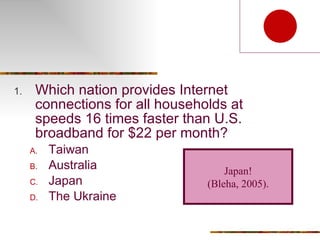
Which nation provides Internet connections for all households at speeds 16 times faster than U.S. broadband for $22 per month? Taiwan Australia Japan The Ukraine Japan! ( Bleha, 2005).
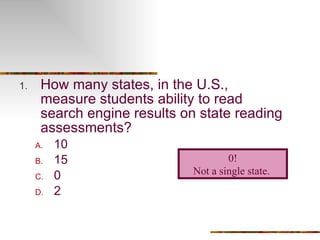
How many states, in the U.S., measure students ability to read search engine results on state reading assessments? 10 15 0 2 0! Not a single state.
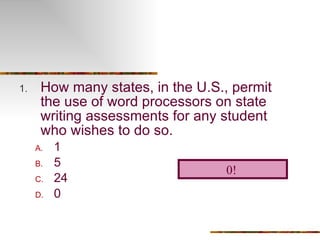
How many states, in the U.S., permit the use of word processors on state writing assessments for any student who wishes to do so. 1 5 24 0 0!
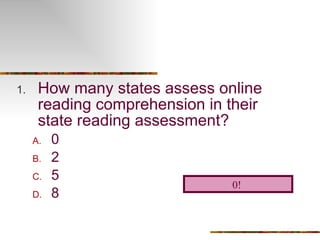
How many states assess online reading comprehension in their state reading assessment? 0 2 5 8 0!
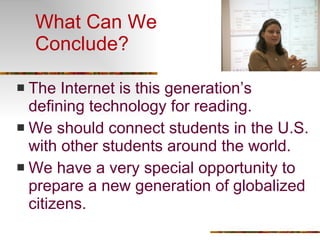
What Can We Conclude? The Internet is this generation’s defining technology for reading. We should connect students in the U.S. with other students around the world. We have a very special opportunity to prepare a new generation of globalized citizens.
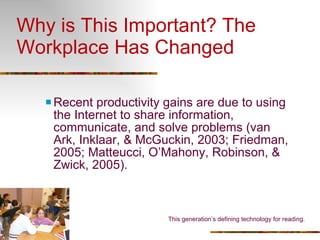
Why is This Important? The Workplace Has Changed Recent productivity gains are due to using the Internet to share information, communicate, and solve problems (van Ark, Inklaar, & McGuckin, 2003; Friedman, 2005; Matteucci, O’Mahony, Robinson, & Zwick, 2005). This generation’s defining technology for reading.
OECD Assessment Initiatives 2009  PISA   International Assessment of Reading – Digital Literacies Programme for the International Assessment of Adult Competencies (PIAAC) – Problem Solving in Technologically Rich Evironments This generation’s defining technology for reading.
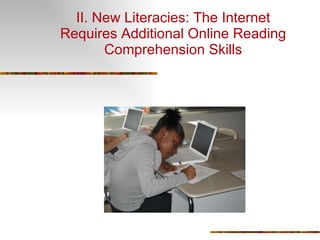
II. New Literacies: The Internet Requires Additional Online Reading Comprehension Skills
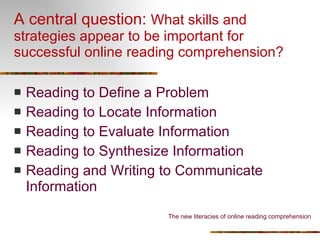
A central question:  What skills and strategies appear to be important for successful online reading comprehension?  Reading to Define a Problem Reading to Locate Information Reading to Evaluate Information Reading to Synthesize Information Reading and Writing to Communicate Information The new literacies of online reading comprehension
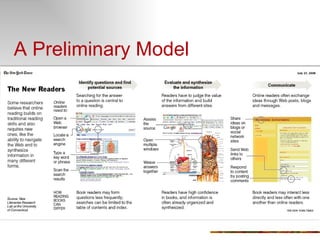
A Preliminary Model
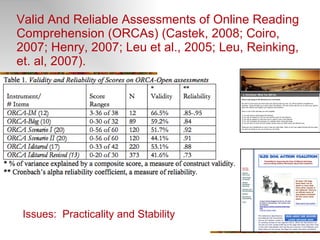
Valid And Reliable Assessments of Online Reading Comprehension (ORCAs) (Castek, 2008; Coiro, 2007; Henry, 2007; Leu et al., 2005; Leu, Reinking, et. al, 2007). Issues:  Practicality and Stability
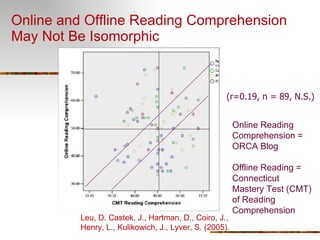
Online and Offline Reading Comprehension May Not Be Isomorphic (r=0.19, n = 89, N.S.) Leu, D. Castek, J., Hartman, D., Coiro, J.,  Henry, L., Kulikowich, J., Lyver, S. (2005). Online Reading Comprehension =  ORCA Blog Offline Reading =  Connecticut  Mastery Test (CMT) of Reading  Comprehension
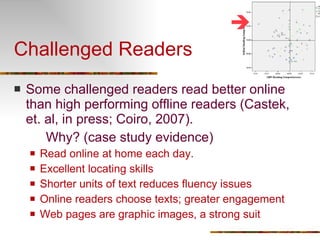
Challenged Readers Some challenged readers read better online than high performing offline readers (Castek, et. al, in press; Coiro, 2007). Why? (case study evidence)  Read online at home each day. Excellent locating skills Shorter units of text reduces fluency issues Online readers choose texts; greater engagement Web pages are graphic images, a strong suit 
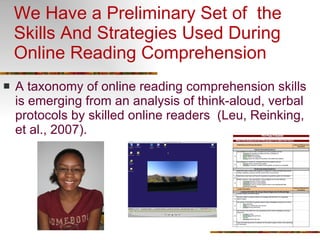
We Have a Preliminary Set of  the Skills And Strategies Used During Online Reading Comprehension A taxonomy of online reading comprehension skills is emerging from an analysis of think-aloud, verbal protocols by skilled online readers  (Leu, Reinking, et al., 2007).
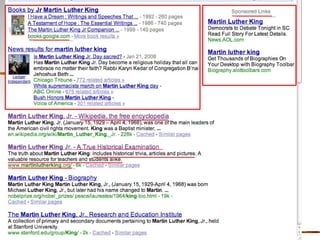
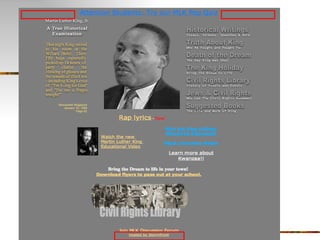
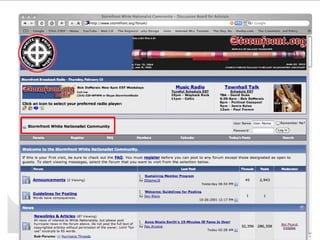
An Example of Online Reading Comprehension Reading About Martin Luther King The new literacies of online reading comprehension


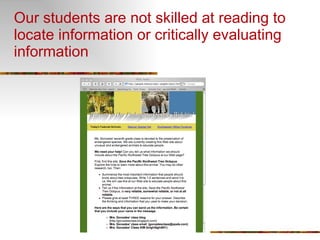
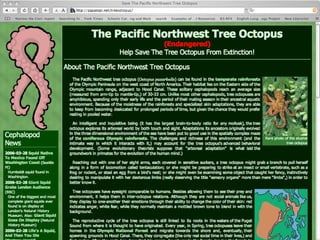
Our students are not skilled at reading to locate information or critically evaluating information
Locating information, Part I:  “the .com strategy” [13:38 … highlights address bar, types in  www.savethepacificnorthwesttreeoctopus.com   …, presses enter and waits]… [15:22 …types in  www.savethenorthwesttreeoctopus.com  (deletes pacific), presses enter and waits] [16:01 …  http://www.savethenorthwestoctopus.com  (deletes tree) and waits] S: I wonder why it’s not coming up.  [long pause] [indecipherable] [long pause] [17:10 …  types in savethepacificnorthwestoctopus (adds pacific) … The new literacies of online reading comprehension
Locating Information, Part II: the “click and look” strategy In our entire population, of those who obtained a page of search engine results, approximately 50% did not read them. “ Click and Look” strategies used The new literacies of online reading comprehension
 
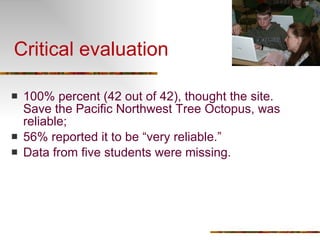
Critical evaluation 100% percent (42 out of 42), thought the site. Save the Pacific Northwest Tree Octopus, was reliable;  56% reported it to be “very reliable.”  Data from five students were missing.
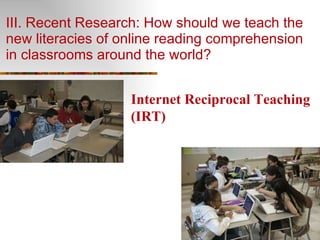
III. Recent Research: How should we teach the new literacies of online reading comprehension in classrooms around the world?  Internet Reciprocal Teaching (IRT)
IRT: Phase I Teacher-led Basic Skills Teacher-led demonstrations of basic Internet use skills and cooperative learning strategies Explicit modeling by teacher Largely whole class instruction Mini-lessons as transition to Phase II
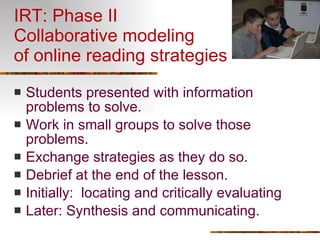
IRT: Phase II Collaborative modeling  of online reading strategies Students presented with information problems to solve. Work in small groups to solve those problems. Exchange strategies as they do so. Debrief at the end of the lesson. Initially:  locating and critically evaluating Later: Synthesis and communicating.
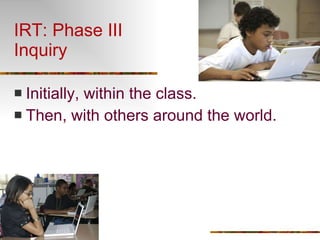
IRT: Phase III Inquiry Initially, within the class. Then, with others around the world.
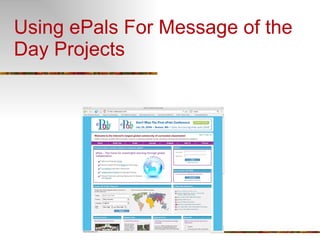
Using ePals For Message of the Day Projects
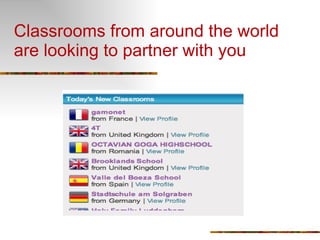
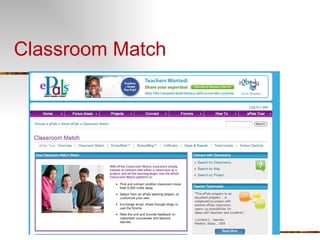
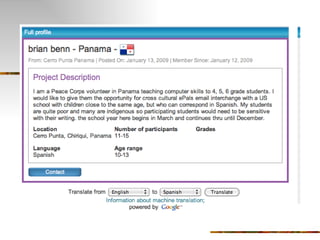
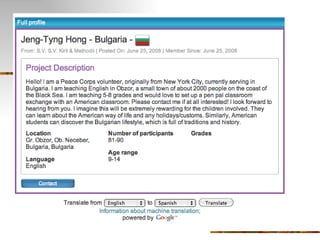
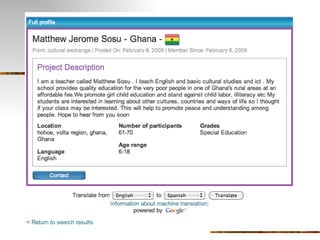
Classrooms from around the world are looking to partner with you
Classroom Match


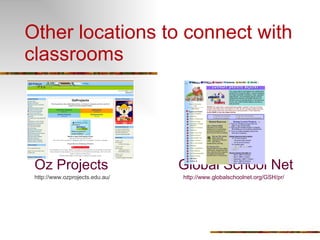
Other locations to connect with classrooms Oz Projects   Global School Net http://www.ozprojects.edu.au/   http://www.globalschoolnet.org/GSH/pr/
A Current Research Study: Best Practices in Global Collaborative Projects Between Classrooms Contact: Heidi Everett-Cacopardo e-mail:  [email_address]
IV. What can we do together to prepare a new generation of global citizens?  The Peace Corps:  Prepare for a far larger role in supporting online global connections among volunteers and schools. Develop a new cohort of teachers for the connected world of the 21 st  century. Support initiatives in host nations.
What can we do together to prepare a new generation of global citizens?  Teachers Use child-safe email solutions such as ePals or Gaggle. Begin simply, with a Morning Message of the Day project. Move to collaborative projects with other classrooms, making our world a better place through your work.
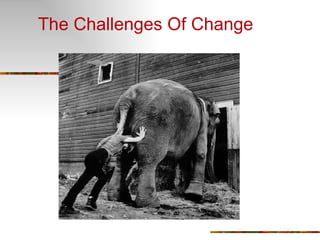
The Challenges Of Change
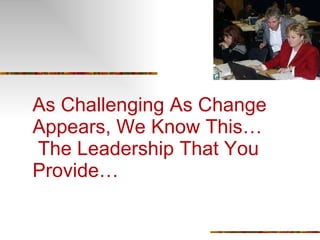
As Challenging As Change Appears, We Know This…  The Leadership That You Provide…
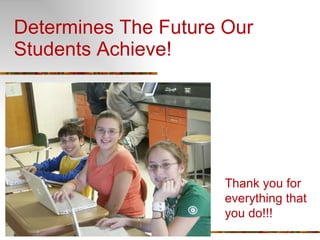
Determines The Future Our Students Achieve! Thank you for  everything that you do!!!
New Literacies For An Online Flattened World, Primed To Promote Global Understanding  Donald J. Leu New Literacies Research Lab University of Connecticut [email_address] Peace Corps Coverdale World Wise Schools October 15, 2009

Leu Keynote Peace Corps

  • 1.
    New Literacies ForAn Online Flattened World, Primed To Promote Global Understanding Donald J. Leu New Literacies Research Lab University of Connecticut [email_address] Peace Corps Coverdale World Wise Schools October 15, 2009 (This Powerpoint is at: Slideshare)
  • 2.
    Celebrating My 40th Anniversary as a Peace Corps Volunteer.
  • 3.
    The New LiteraciesResearch Team http://www.newliteracies.uconn.edu/
  • 4.
    Important Funding andSupport From: Ray and Carole Neag The Carnegie Corporation of New York IES, U.S. Department of Education The National Science Foundation North Central Educational Research Lab PBS The Annenberg Foundation William and Flora Hewlett Foundation Bill and Melinda Gates Foundation Australian Council of Educational Research OECD Schools and teachers around the world.
  • 5.
    Major Points TheInternet is this generation’s defining technology for reading and learning. New Literacies: The Internet requires additional online reading comprehension and learning skills. How might we teach the new literacies of online reading comprehension in classrooms around the world? What can we do together to prepare a new generation of global citizens?
  • 6.
    I . The Internet Is This Generation’s Defining Technology For Reading and Learning
  • 7.
    A New LiteraciesQuiz How many individuals currently have access to the Internet and regularly read, write, and communicate online? 511 million 253 million 754 million 1.6 billion 1.6 billion individuals; Nearly 1 out of 4 people in the world!
  • 8.
  • 9.
    In 2005, howmany adolescents in Accra, Ghana reported having gone online? 5% 66% 37% 51% 66% or 2/3 of adolescents! ( Borzekowski, Fobil, & Asante, 2006)
  • 10.
    In 2005, didadolescents in North America read more on the Internet or more with books and other printed material? On the Internet Offline in books, etc. The same for both. On the Internet! In 2005, students aged 8-18 spent 48 minutes per day reading on the Internet and only 43 minutes per day reading offline. (Kaiser Family Foundation, 2005).
  • 11.
    Which nation manufacturesthe most software in the world? The U.S. Indonesia India Ireland Ireland! ( Organization for Economic Development and Cooperation, 2004)
  • 12.
    Which nation providesall teachers with 5 weeks of paid, release-time, professional development at integrating the Internet into the K-12 curriculum? The U.S. Indonesia China Finland Finland!
  • 13.
    Which nation, inNorth America, is implementing a plan to ensure Internet access to every home and every school to prepare its citizens for the 21st century? Canada Mexico The U.S. Mexico! Mexico is implementing its eMexico plan right now. See http://www.e-mexico.gob.mx/
  • 14.
    Which nation providesInternet connections for all households at speeds 16 times faster than U.S. broadband for $22 per month? Taiwan Australia Japan The Ukraine Japan! ( Bleha, 2005).
  • 15.
    How many states,in the U.S., measure students ability to read search engine results on state reading assessments? 10 15 0 2 0! Not a single state.
  • 16.
    How many states,in the U.S., permit the use of word processors on state writing assessments for any student who wishes to do so. 1 5 24 0 0!
  • 17.
    How many statesassess online reading comprehension in their state reading assessment? 0 2 5 8 0!
  • 18.
    What Can WeConclude? The Internet is this generation’s defining technology for reading. We should connect students in the U.S. with other students around the world. We have a very special opportunity to prepare a new generation of globalized citizens.
  • 19.
    Why is ThisImportant? The Workplace Has Changed Recent productivity gains are due to using the Internet to share information, communicate, and solve problems (van Ark, Inklaar, & McGuckin, 2003; Friedman, 2005; Matteucci, O’Mahony, Robinson, & Zwick, 2005). This generation’s defining technology for reading.
  • 20.
    OECD Assessment Initiatives2009 PISA International Assessment of Reading – Digital Literacies Programme for the International Assessment of Adult Competencies (PIAAC) – Problem Solving in Technologically Rich Evironments This generation’s defining technology for reading.
  • 21.
    II. New Literacies:The Internet Requires Additional Online Reading Comprehension Skills
  • 22.
    A central question: What skills and strategies appear to be important for successful online reading comprehension? Reading to Define a Problem Reading to Locate Information Reading to Evaluate Information Reading to Synthesize Information Reading and Writing to Communicate Information The new literacies of online reading comprehension
  • 23.
  • 24.
    Valid And ReliableAssessments of Online Reading Comprehension (ORCAs) (Castek, 2008; Coiro, 2007; Henry, 2007; Leu et al., 2005; Leu, Reinking, et. al, 2007). Issues: Practicality and Stability
  • 25.
    Online and OfflineReading Comprehension May Not Be Isomorphic (r=0.19, n = 89, N.S.) Leu, D. Castek, J., Hartman, D., Coiro, J., Henry, L., Kulikowich, J., Lyver, S. (2005). Online Reading Comprehension = ORCA Blog Offline Reading = Connecticut Mastery Test (CMT) of Reading Comprehension
  • 26.
    Challenged Readers Somechallenged readers read better online than high performing offline readers (Castek, et. al, in press; Coiro, 2007). Why? (case study evidence) Read online at home each day. Excellent locating skills Shorter units of text reduces fluency issues Online readers choose texts; greater engagement Web pages are graphic images, a strong suit 
  • 27.
    We Have aPreliminary Set of the Skills And Strategies Used During Online Reading Comprehension A taxonomy of online reading comprehension skills is emerging from an analysis of think-aloud, verbal protocols by skilled online readers (Leu, Reinking, et al., 2007).
  • 28.
    An Example ofOnline Reading Comprehension Reading About Martin Luther King The new literacies of online reading comprehension
  • 29.
  • 30.
  • 31.
  • 32.
    Our students arenot skilled at reading to locate information or critically evaluating information
  • 33.
    Locating information, PartI: “the .com strategy” [13:38 … highlights address bar, types in www.savethepacificnorthwesttreeoctopus.com …, presses enter and waits]… [15:22 …types in www.savethenorthwesttreeoctopus.com (deletes pacific), presses enter and waits] [16:01 … http://www.savethenorthwestoctopus.com (deletes tree) and waits] S: I wonder why it’s not coming up. [long pause] [indecipherable] [long pause] [17:10 … types in savethepacificnorthwestoctopus (adds pacific) … The new literacies of online reading comprehension
  • 34.
    Locating Information, PartII: the “click and look” strategy In our entire population, of those who obtained a page of search engine results, approximately 50% did not read them. “ Click and Look” strategies used The new literacies of online reading comprehension
  • 35.
  • 36.
    Critical evaluation 100%percent (42 out of 42), thought the site. Save the Pacific Northwest Tree Octopus, was reliable; 56% reported it to be “very reliable.” Data from five students were missing.
  • 37.
    III. Recent Research:How should we teach the new literacies of online reading comprehension in classrooms around the world? Internet Reciprocal Teaching (IRT)
  • 38.
    IRT: Phase ITeacher-led Basic Skills Teacher-led demonstrations of basic Internet use skills and cooperative learning strategies Explicit modeling by teacher Largely whole class instruction Mini-lessons as transition to Phase II
  • 39.
    IRT: Phase IICollaborative modeling of online reading strategies Students presented with information problems to solve. Work in small groups to solve those problems. Exchange strategies as they do so. Debrief at the end of the lesson. Initially: locating and critically evaluating Later: Synthesis and communicating.
  • 40.
    IRT: Phase IIIInquiry Initially, within the class. Then, with others around the world.
  • 41.
    Using ePals ForMessage of the Day Projects
  • 42.
    Classrooms from aroundthe world are looking to partner with you
  • 43.
  • 44.
  • 45.
  • 46.
  • 47.
    Other locations toconnect with classrooms Oz Projects Global School Net http://www.ozprojects.edu.au/ http://www.globalschoolnet.org/GSH/pr/
  • 48.
    A Current ResearchStudy: Best Practices in Global Collaborative Projects Between Classrooms Contact: Heidi Everett-Cacopardo e-mail: [email_address]
  • 49.
    IV. What canwe do together to prepare a new generation of global citizens? The Peace Corps: Prepare for a far larger role in supporting online global connections among volunteers and schools. Develop a new cohort of teachers for the connected world of the 21 st century. Support initiatives in host nations.
  • 50.
    What can wedo together to prepare a new generation of global citizens? Teachers Use child-safe email solutions such as ePals or Gaggle. Begin simply, with a Morning Message of the Day project. Move to collaborative projects with other classrooms, making our world a better place through your work.
  • 51.
  • 52.
    As Challenging AsChange Appears, We Know This… The Leadership That You Provide…
  • 53.
    Determines The FutureOur Students Achieve! Thank you for everything that you do!!!
  • 54.
    New Literacies ForAn Online Flattened World, Primed To Promote Global Understanding Donald J. Leu New Literacies Research Lab University of Connecticut [email_address] Peace Corps Coverdale World Wise Schools October 15, 2009

Editor's Notes