Memory and Models of
     Memory
      Introductory Psychology
What is Memory?
• Mental ability to retain and recall past
  experience

• Based on mental processes of
  – Learning
  – Retention
  – Recall and Retrieval
The Basic Memory Process


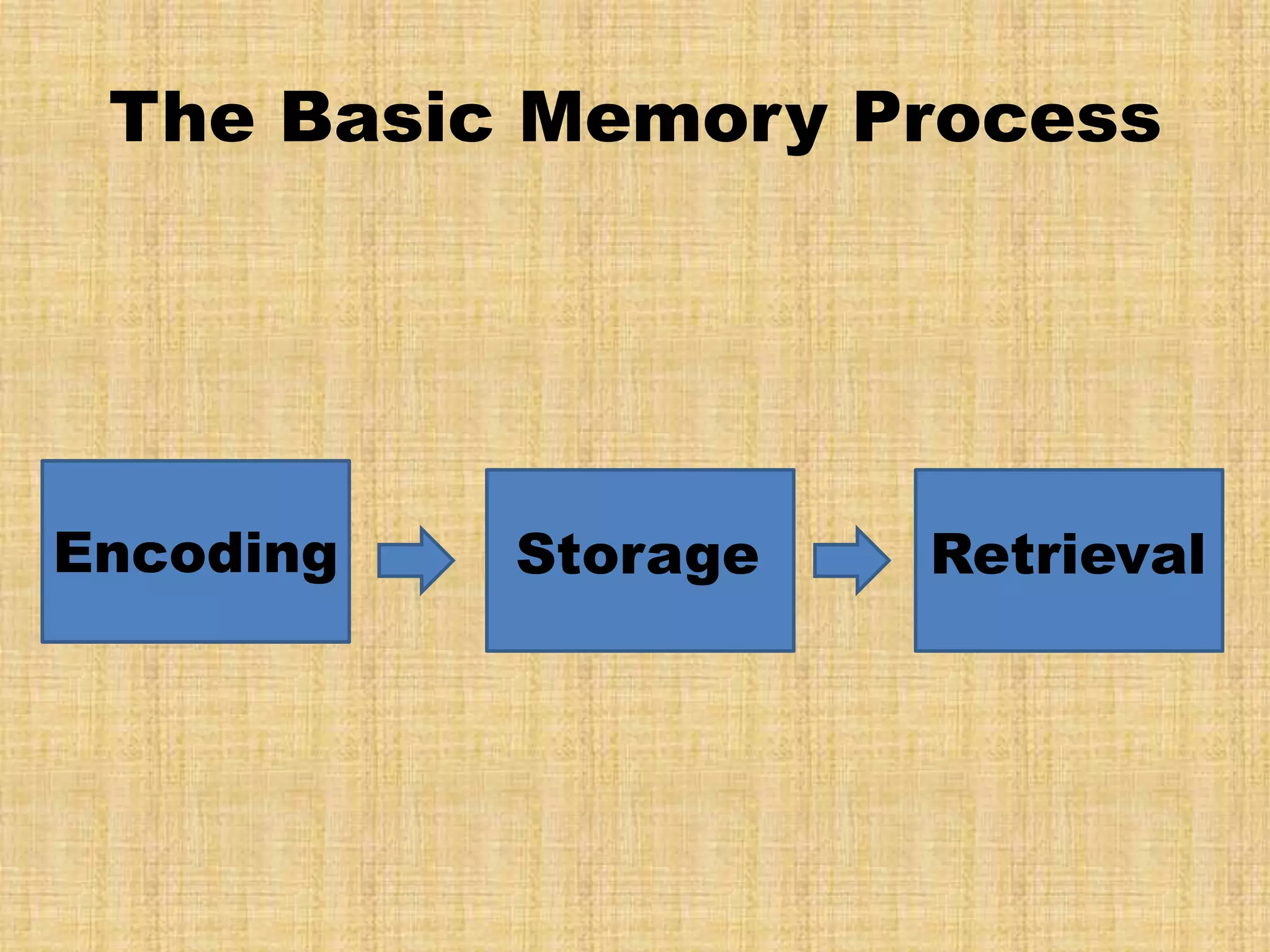
Encoding   Storage   Retrieval
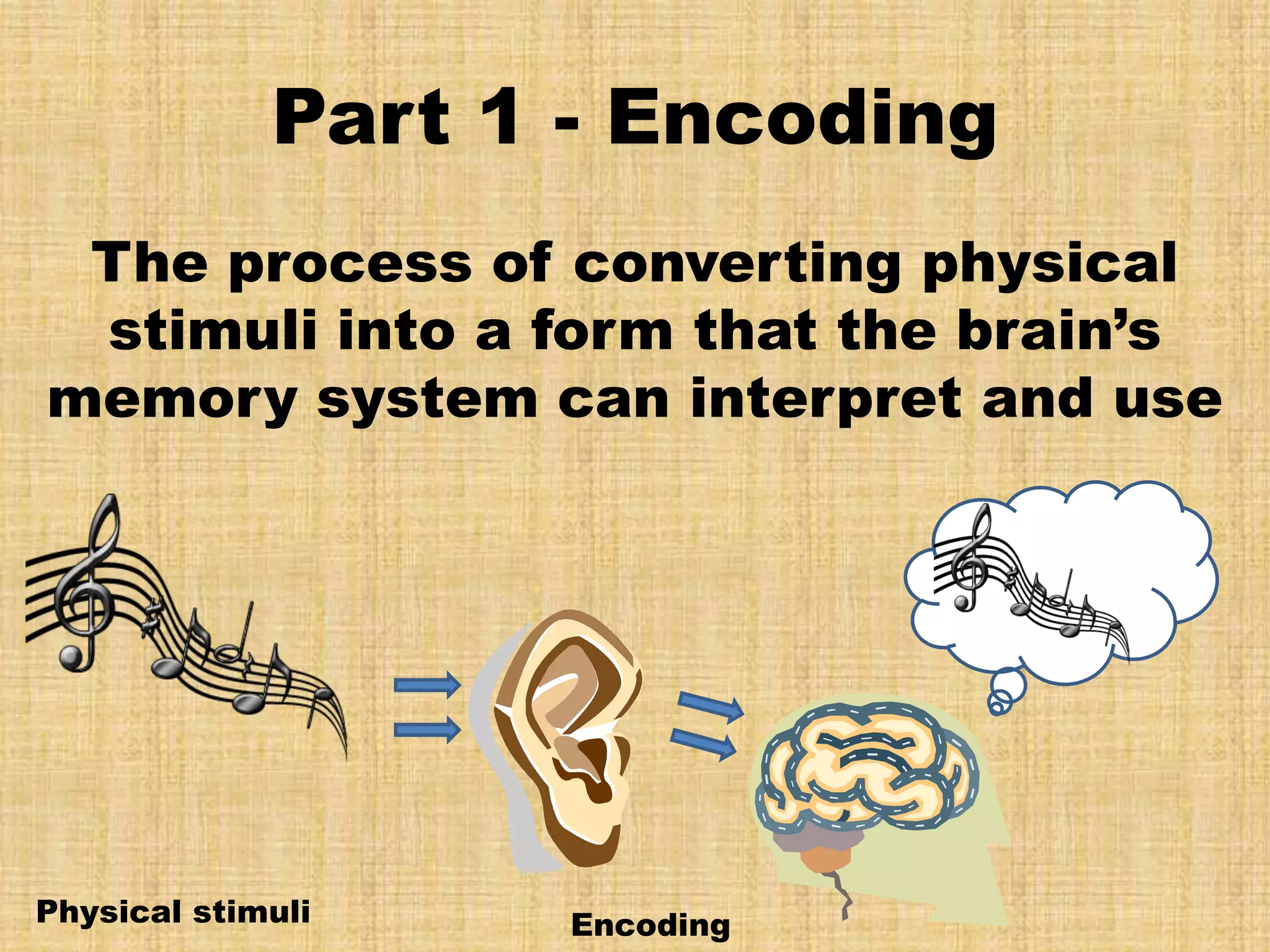
Part 1 - Encoding
 The process of converting physical
 stimuli into a form that the brain’s
memory system can interpret and use


Physical stimuli   Encoding
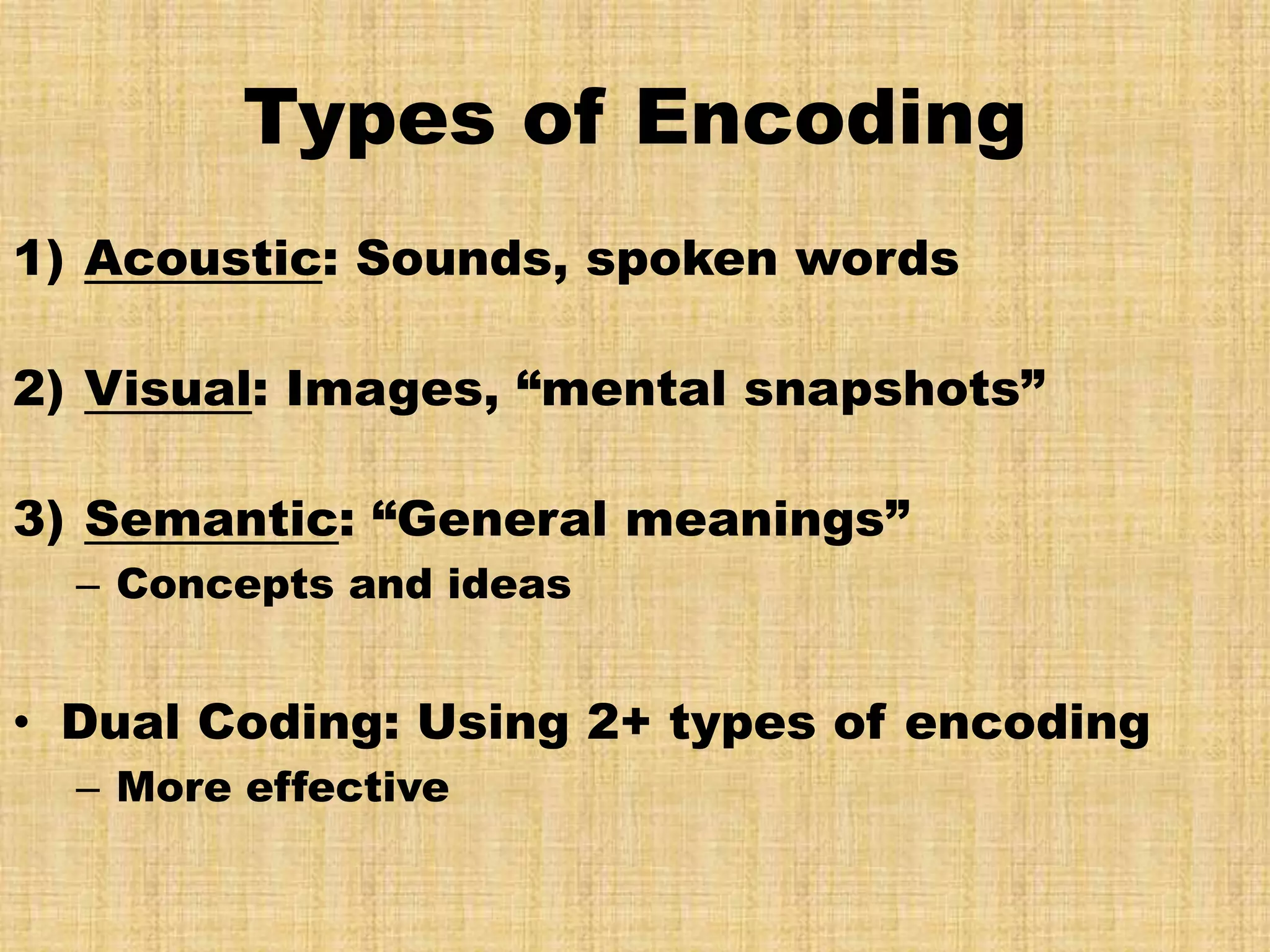
Types of Encoding
1) Acoustic: Sounds, spoken words

2) Visual: Images, “mental snapshots”

3) Semantic: “General meanings”
  – Concepts and ideas


• Dual Coding: Using 2+ types of encoding
  – More effective
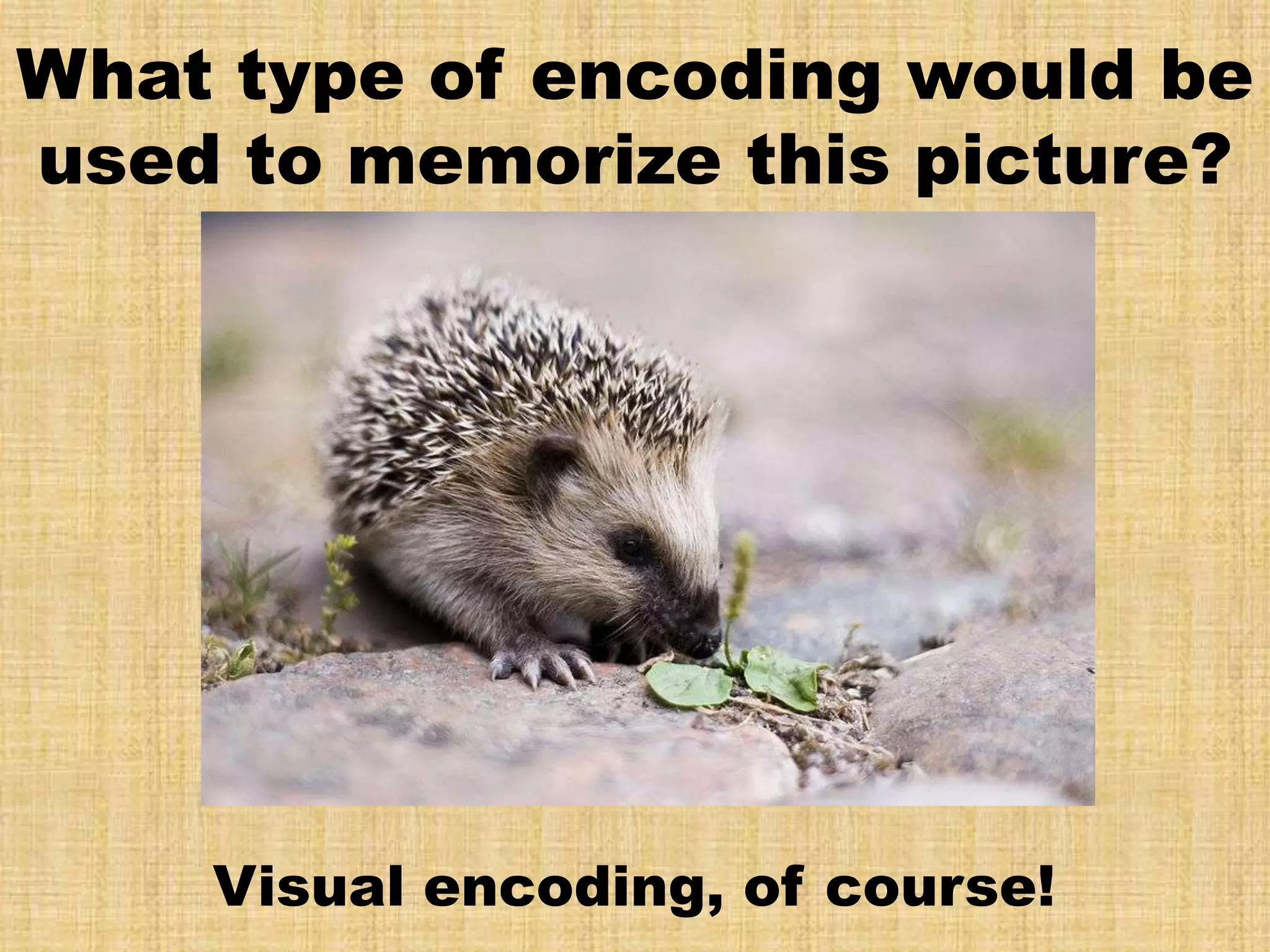
What type of encoding would be
used to memorize this picture?


    Visual encoding, of course!
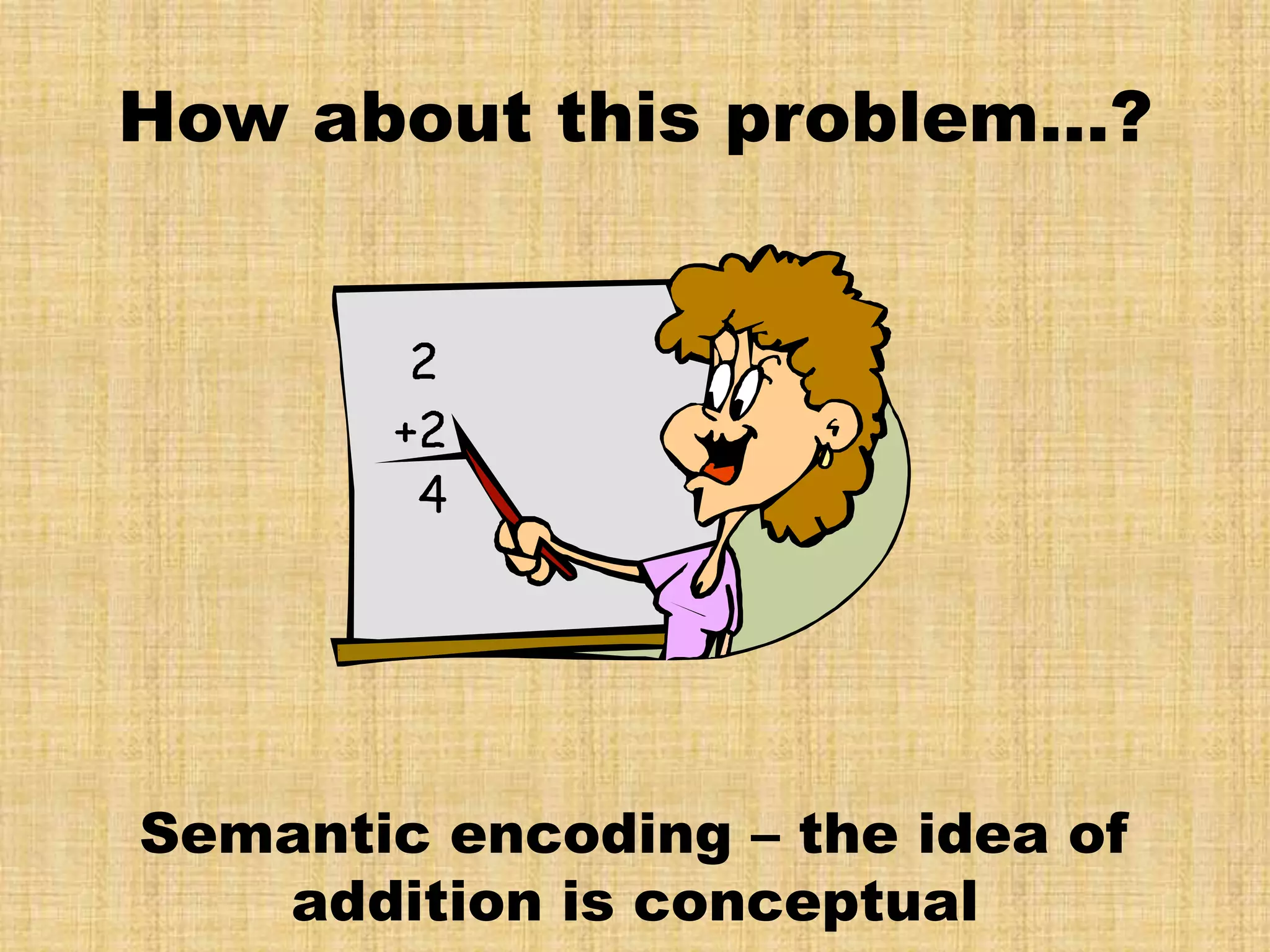
How about this problem…?


Semantic encoding – the idea of
   addition is conceptual
What about this last one…?


 http://www.youtube.com/watch?v=zMzlm9OVpvU&feature=plcp&context=C3f0f838UDO
 EgsToPDskKvmmlg5165l9EZxd1uYEaK


Trick question! It’s visual AND acoustic
             (dual coding)
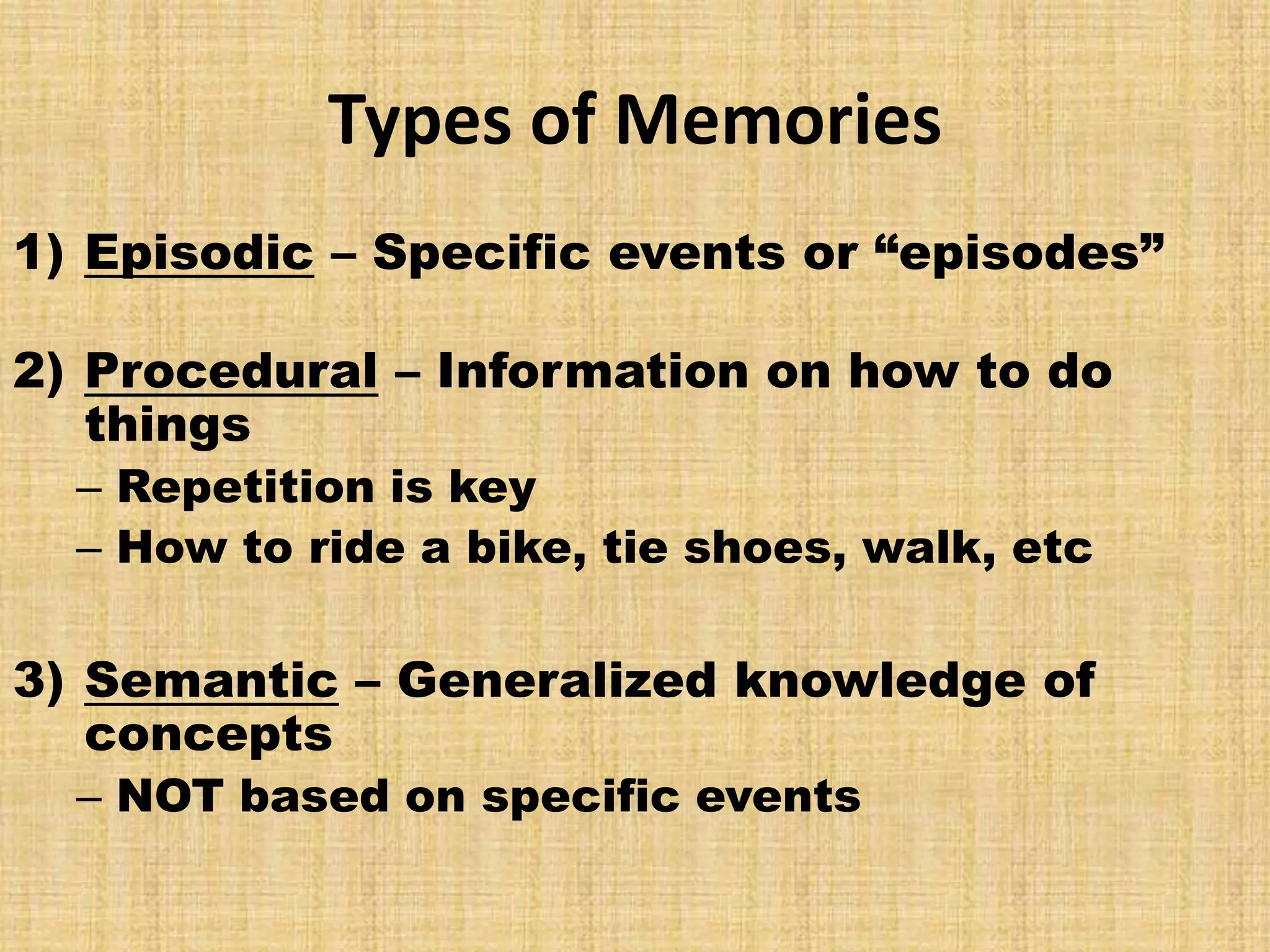
Part 2 - Storage
 The process of keeping memories
intact in the brain’s memory system
              over time
Types of Memories
1) Episodic – Specific events or “episodes”

2) Procedural – Information on how to do
   things
  – Repetition is key
  – How to ride a bike, tie shoes, walk, etc

3) Semantic – Generalized knowledge of
   concepts
  – NOT based on specific events
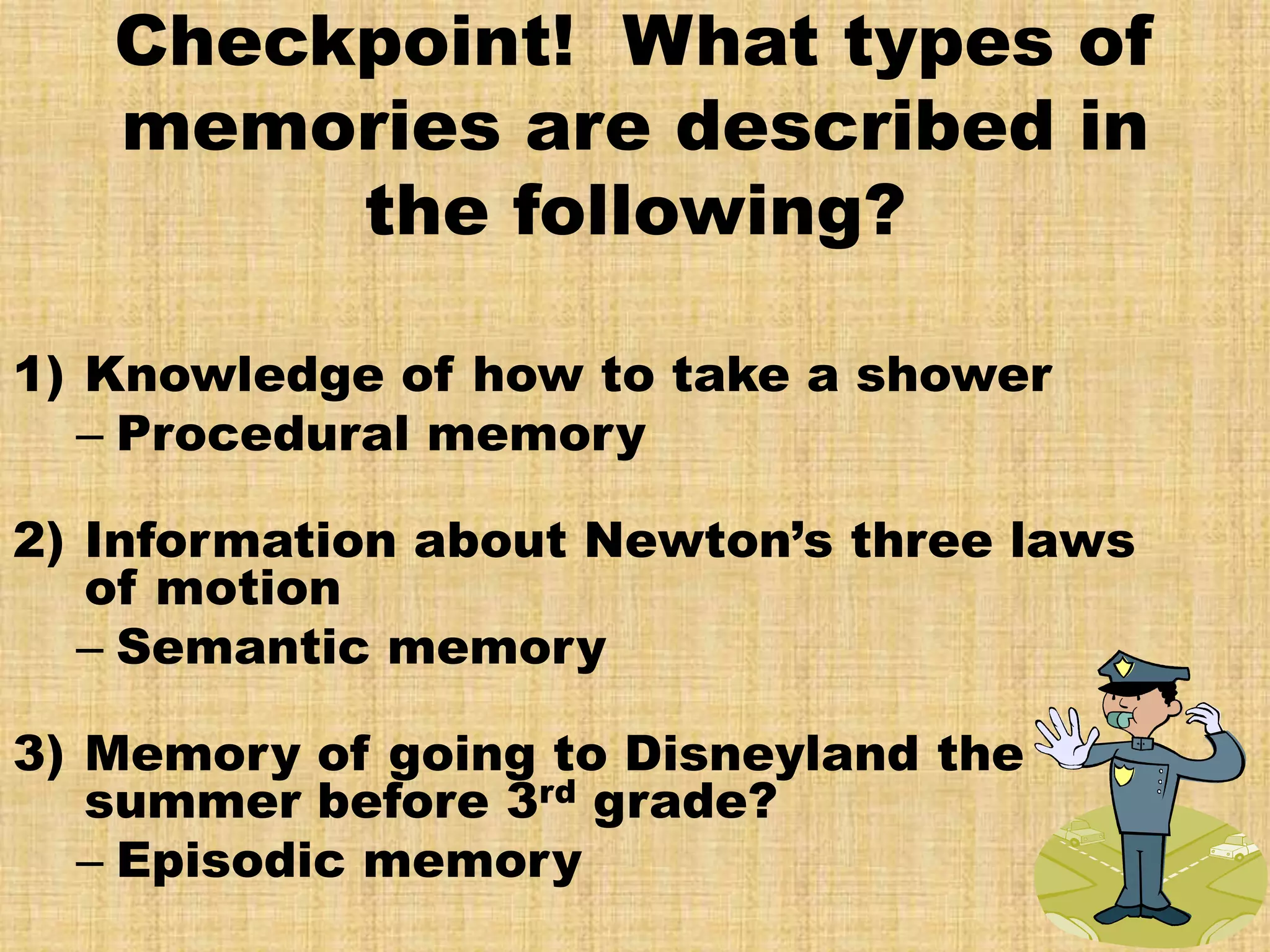
Checkpoint! What types of
   memories are described in
        the following?

1) Knowledge of how to take a shower
   – Procedural memory

2) Information about Newton’s three laws
   of motion
   – Semantic memory

3) Memory of going to Disneyland the
   summer before 3rd grade?
   – Episodic memory
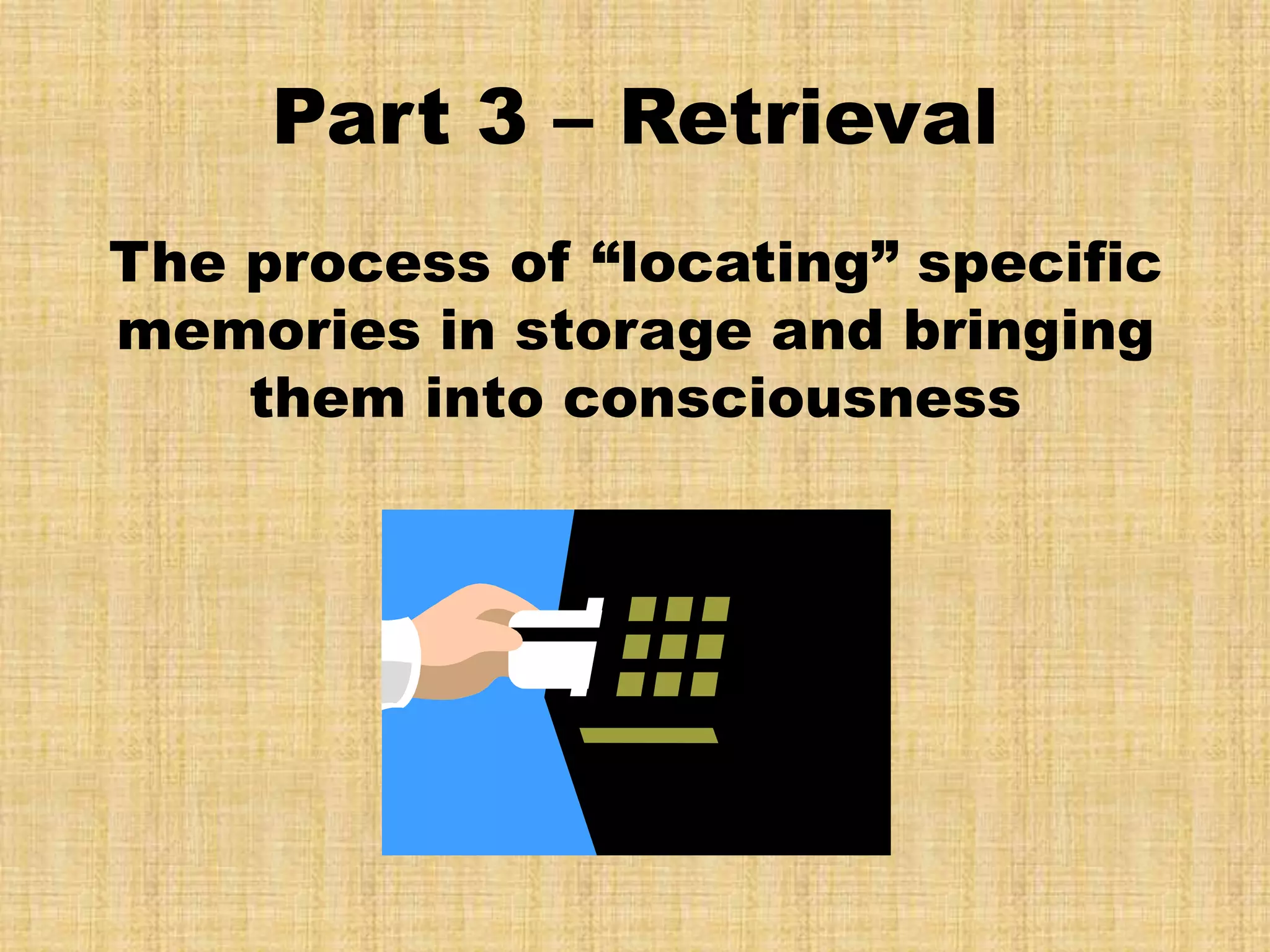
Part 3 – Retrieval
The process of “locating” specific
memories in storage and bringing
    them into consciousness
Types of Retrieval

1) Recall – Unaided retrieval of
   memories
  – Free response questions, oral exams

2) Recognition – Retrieval with help
   of hints
  – Easier than recall
  – Multiple choice tests
Categories of Memories Retrieved

 • Explicit – Deliberately remembered

 • Implicit – Unintentional recollection
   – Influence of prior experiences
   – Unconscious, you have no control over
     this
   – “Good guys” and “bad guys”
Models of Memory
1. Levels of Processing (LoP)
States that the quality of memory is based
on the degree that information is processed
    • More examples
    • Last night’s TV show


Quality means that memories are…
  – Properly stored
  – Easily recalled
  – Not quickly forgotten
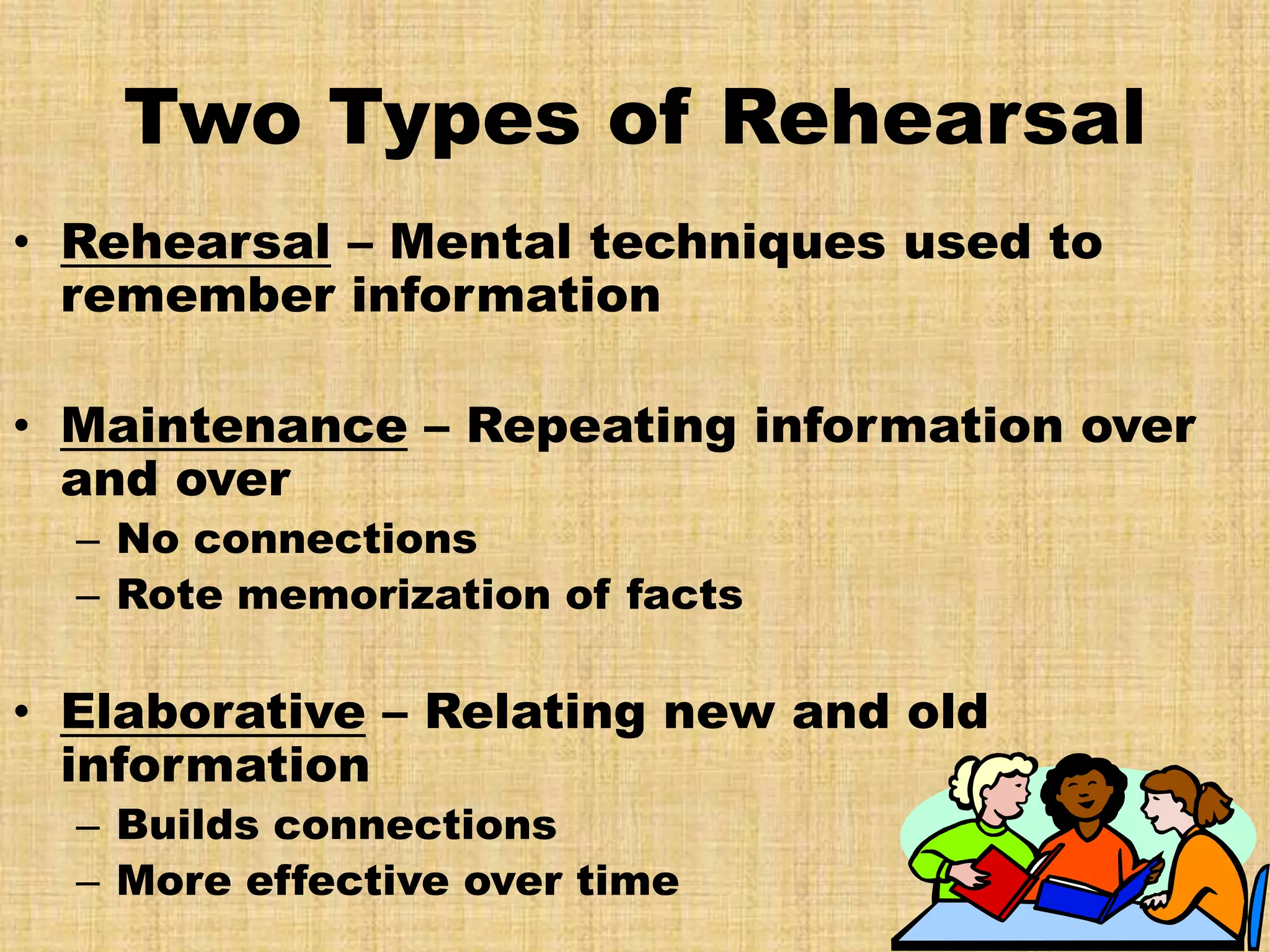
Two Types of Rehearsal
• Rehearsal – Mental techniques used to
  remember information

• Maintenance – Repeating information over
  and over
  – No connections
  – Rote memorization of facts

• Elaborative – Relating new and old
  information
  – Builds connections
  – More effective over time
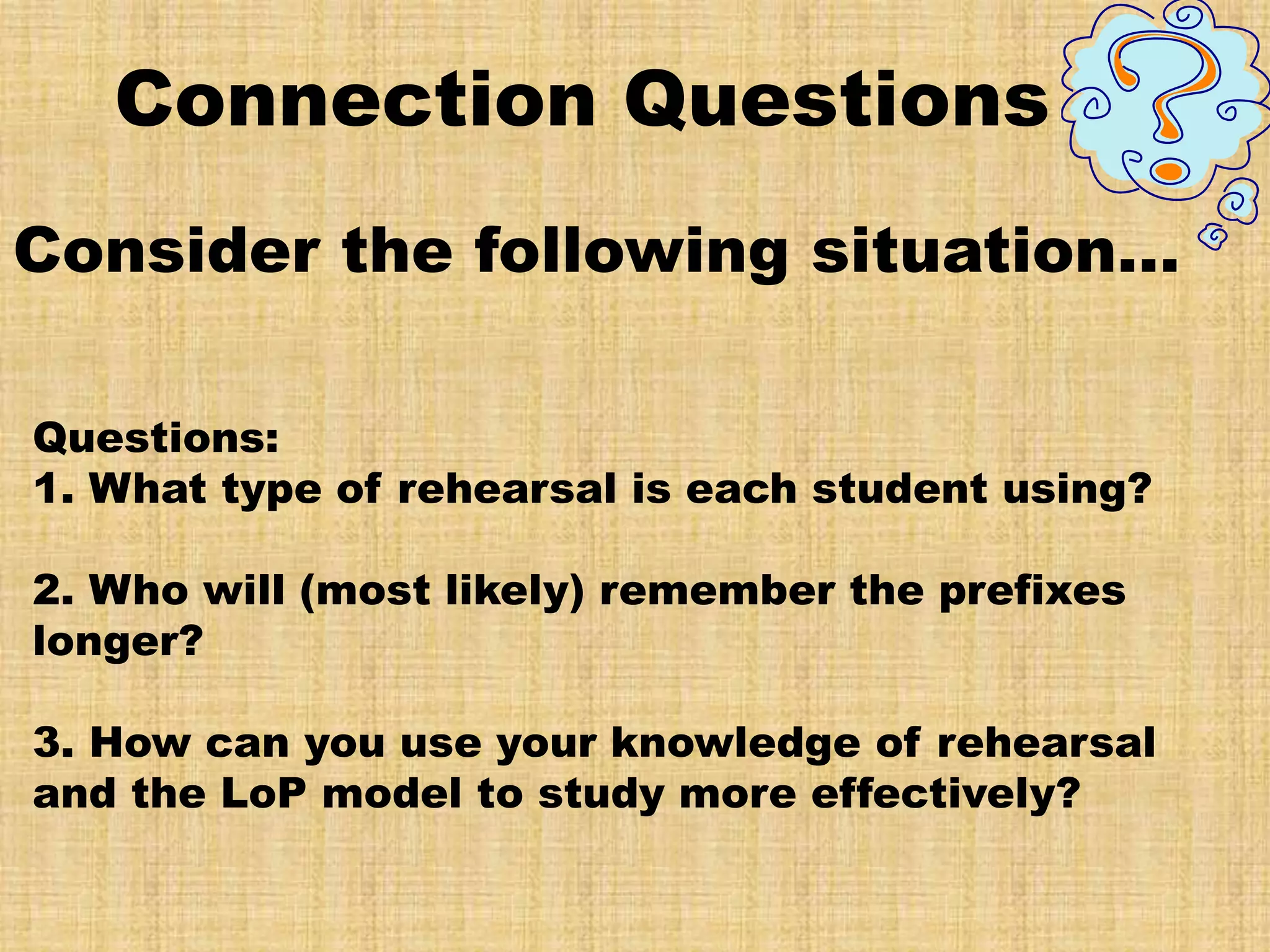
Connection Questions
Consider the following situation…

Questions:
1. What type of rehearsal is each student using?

2. Who will (most likely) remember the prefixes
longer?

3. How can you use your knowledge of rehearsal
and the LoP model to study more effectively?
2. Transfer Appropriate Processing
               (TaP)

  States that memory quality increases if
retrieval process matches original encoding
                  process
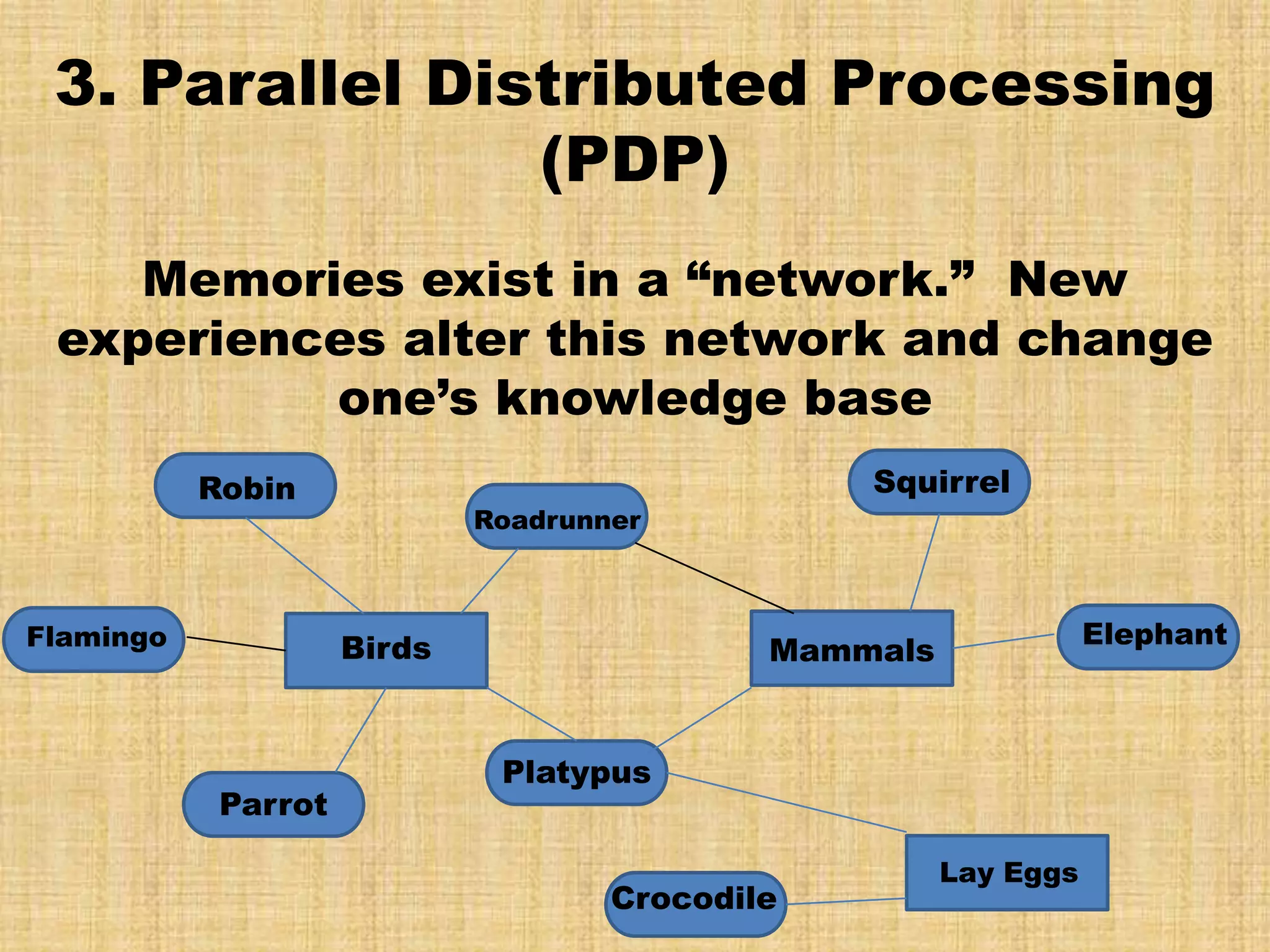
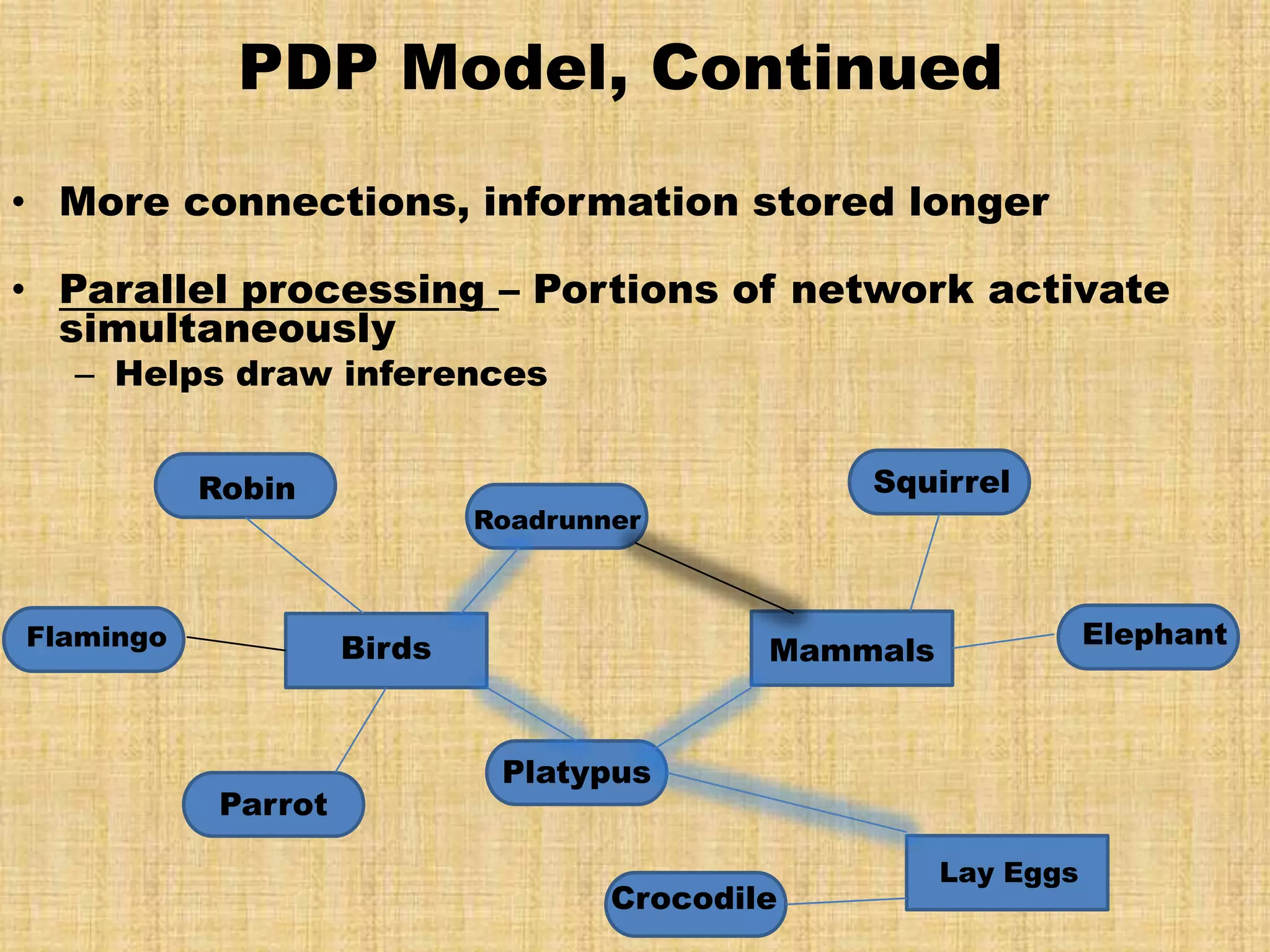
3. Parallel Distributed Processing
                (PDP)
    Memories exist in a “network.” New
 experiences alter this network and change
          one’s knowledge base
           Robin                                 Squirrel
                             Roadrunner


Flamingo             Birds                                        Elephant
                                             Mammals


                              Platypus
            Parrot

                                                       Lay Eggs
                                     Crocodile
PDP Model, Continued
• More connections, information stored longer

• Parallel processing – Portions of network activate
  simultaneously
  – Helps draw inferences


           Robin                                 Squirrel
                             Roadrunner


Flamingo             Birds                                        Elephant
                                             Mammals


                              Platypus
            Parrot

                                                       Lay Eggs
                                     Crocodile
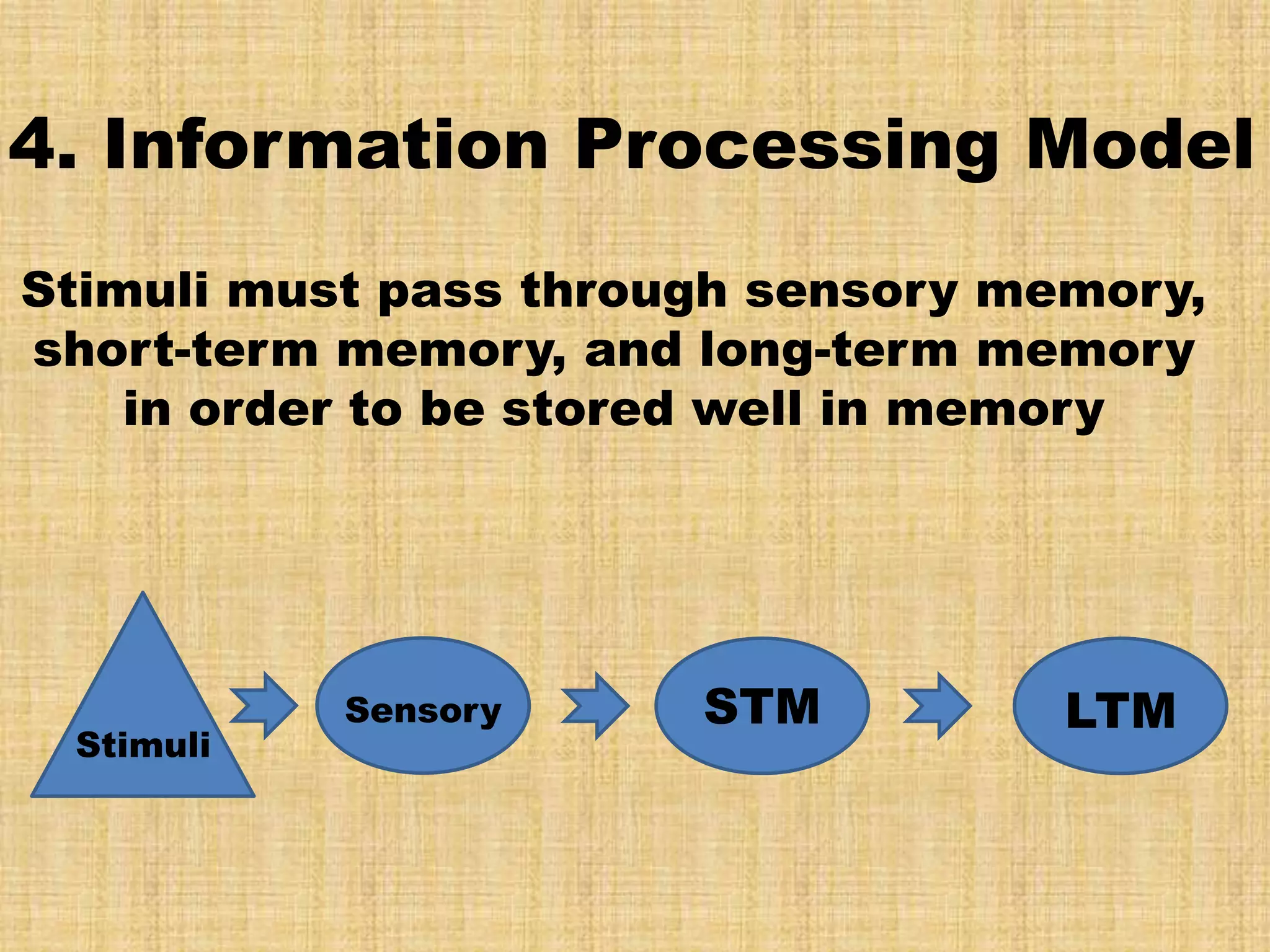
4. Information Processing Model
Stimuli must pass through sensory memory,
short-term memory, and long-term memory
    in order to be stored well in memory


           Sensory     STM          LTM
 Stimuli
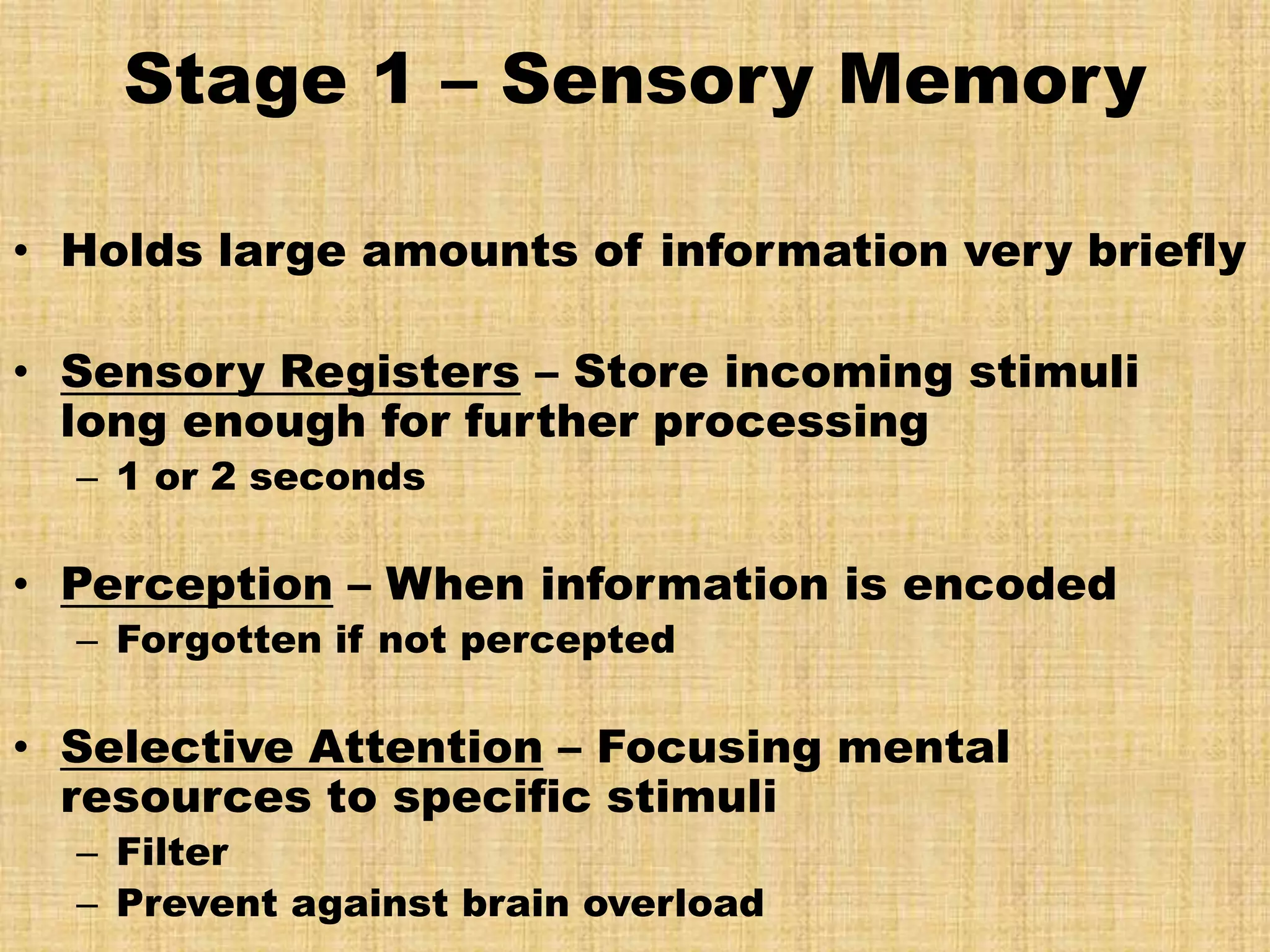
Stage 1 – Sensory Memory

• Holds large amounts of information very briefly

• Sensory Registers – Store incoming stimuli
  long enough for further processing
  – 1 or 2 seconds

• Perception – When information is encoded
  – Forgotten if not percepted

• Selective Attention – Focusing mental
  resources to specific stimuli
  – Filter
  – Prevent against brain overload
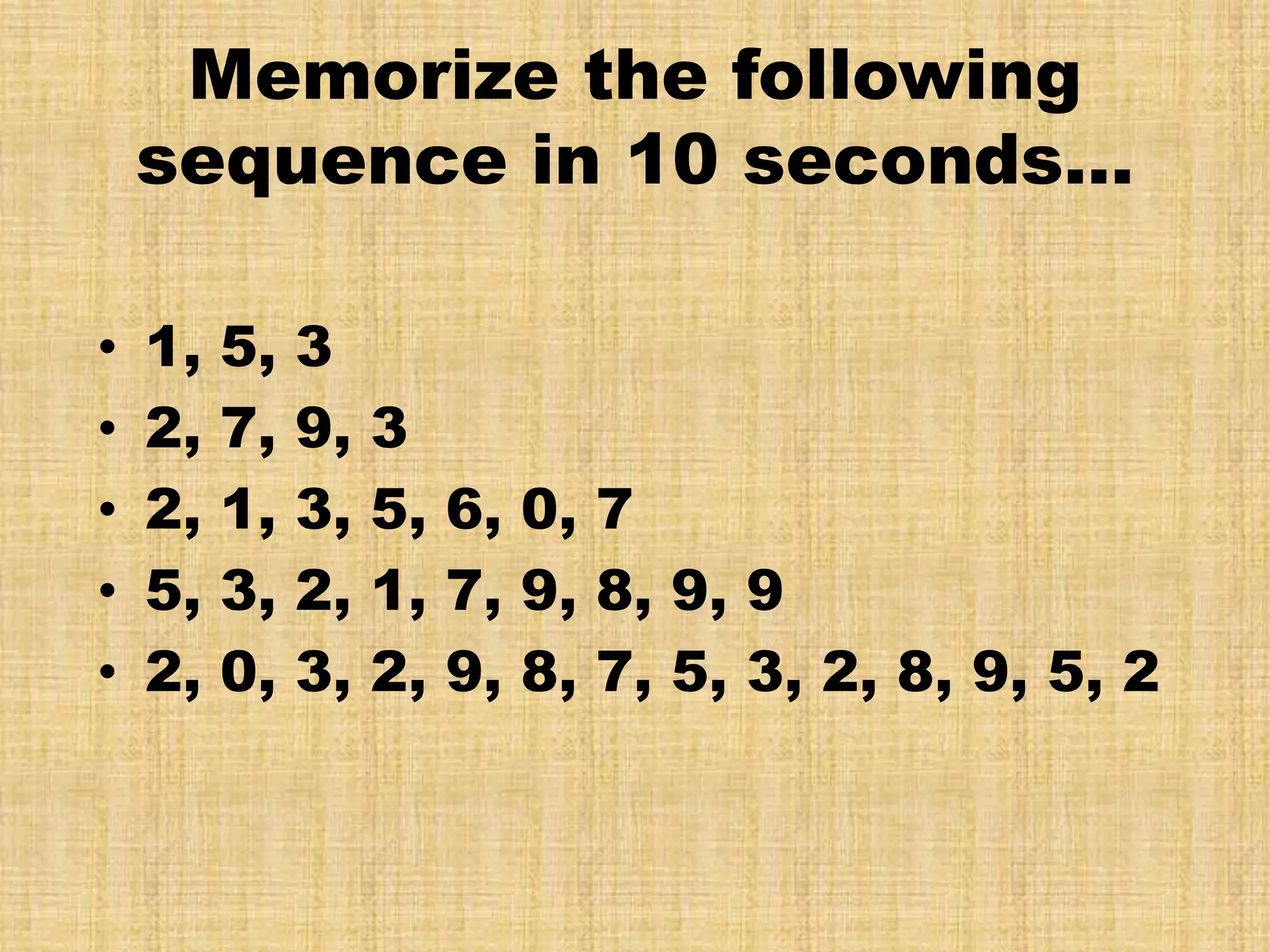
Memorize the following
    sequence in 10 seconds…

•   1,   5,   3
•   2,   7,   9,   3
•   2,   1,   3,   5, 6, 0, 7
•   5,   3,   2,   1, 7, 9, 8, 9, 9
•   2,   0,   3,   2, 9, 8, 7, 5, 3, 2, 8, 9, 5, 2
Stage 2 – Short Term Memory
              (STM)
• 7 +/- 2 item memory span

• Chunking – Grouping items meaningfully
  – Thinking of two 9’s as one item
  – Increases STM capacity

• 18 second duration

• Uses mainly acoustic and partially visual
  encoding
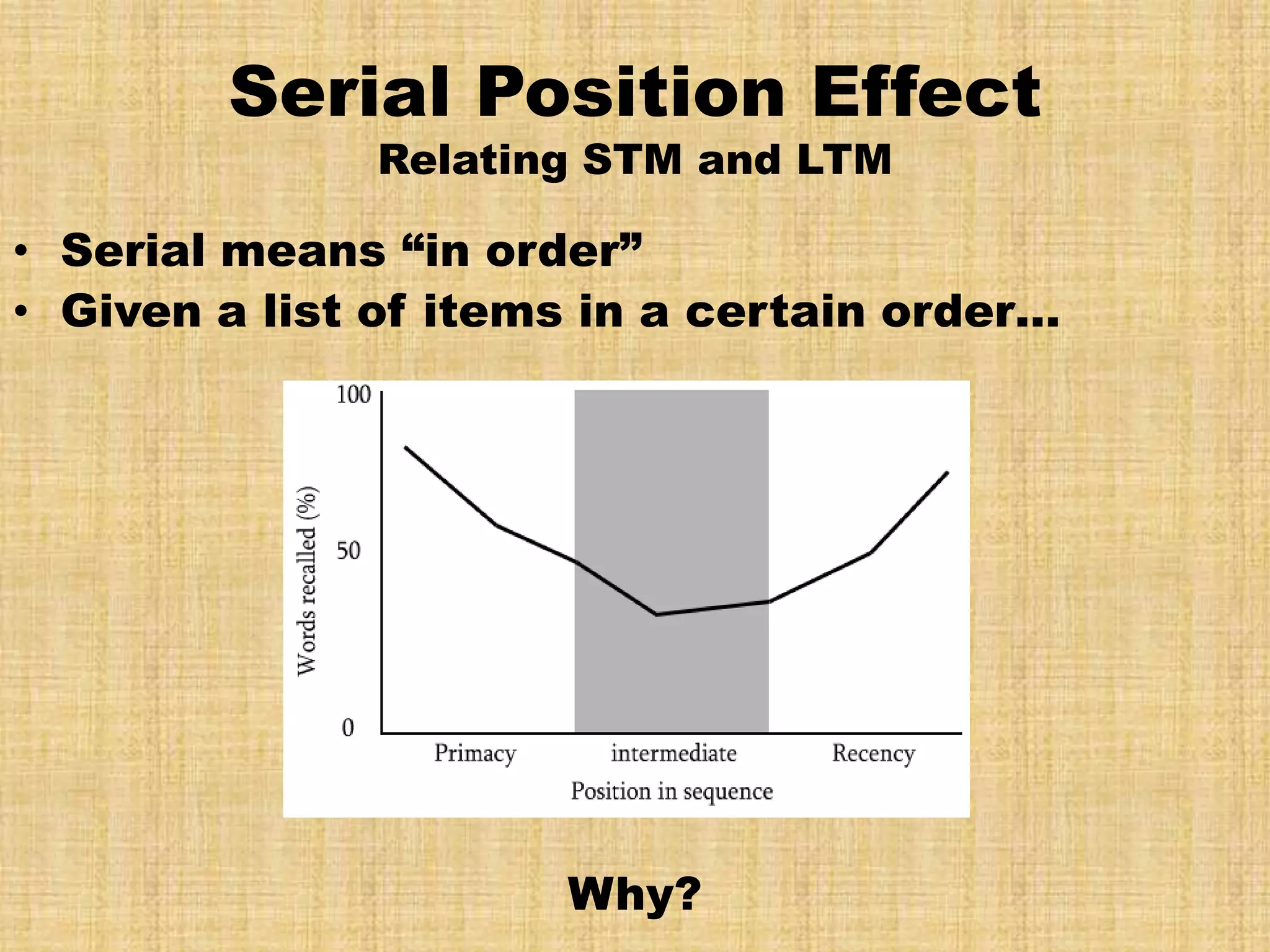
Stage 3 – Long Term Memory
            (LTM)

• Unlimited capacity (hypothetically)

• Duration: 18+ seconds to forever

• Mainly semantic, partially visual
  encoding
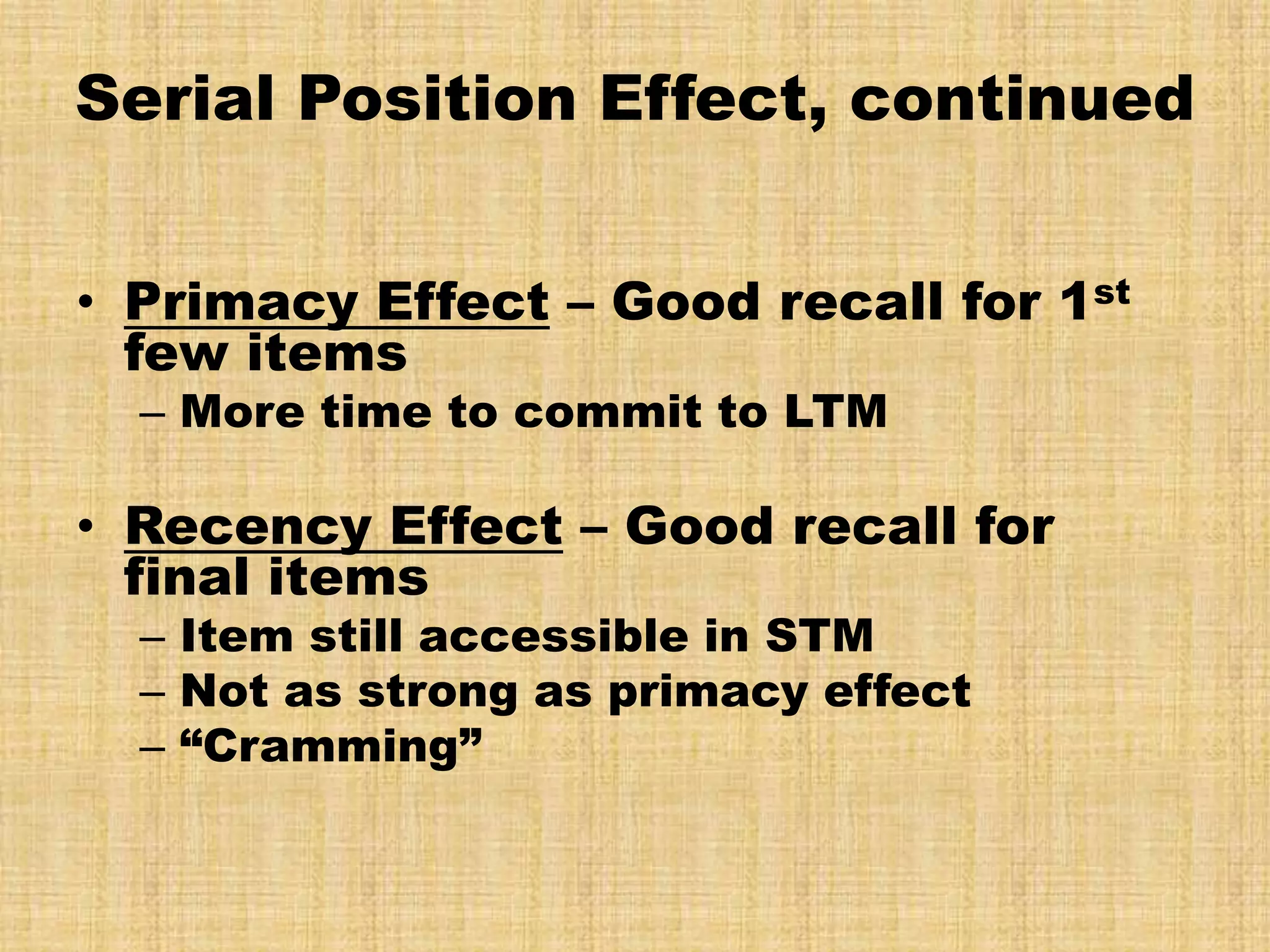
Serial Position Effect
              Relating STM and LTM

• Serial means “in order”
• Given a list of items in a certain order…


                      Why?
Serial Position Effect, continued


• Primacy Effect – Good recall for 1st
  few items
  – More time to commit to LTM

• Recency Effect – Good recall for
  final items
  – Item still accessible in STM
  – Not as strong as primacy effect
  – “Cramming”
So which model is correct…?


 • What do you think?

 • Most likely, each theory has some
   truth
Tune in next class for “Remembering and Forgetting”
Sources
Image, slide 1: http://3.bp.blogspot.com/-
stpf5Ne2Qds/TmofNF_Cz8I/AAAAAAAADec/gR26IbT6oQ0/s1600/Pump+memory.jpg

Image, slide 6:
http://upload.wikimedia.org/wikipedia/commons/8/87/Keqs_young_european_hedgehog1.jpg

Video (created by me), slide 8:
http://www.youtube.com/watch?v=zMzlm9OVpvU&feature=plcp&context=C3f0f838UDOEgsT
oPDskKvmmlg5165l9EZxd1uYEaK

Image, slide 9: http://www.learningsuccess.com/memory_bank1.jpg

Image, slide 14: http://2.bp.blogspot.com/-
PVAImJGSvbE/TrXfdH9Cj3I/AAAAAAAAAH0/ah4rnlfwVEQ/s1600/badguy_snidelywhiplash.jpg

Image, slide 15:
http://2.bp.blogspot.com/_b3zeGvTktAU/TUvgDANyjJI/AAAAAAAABec/lquwRVNzLog/s1600/C
ogs+memory.jpg

Graph, slide 27: http://upload.wikimedia.org/wikipedia/en/9/94/Serial_position.png

Note: Pictures on slides 4, 7, 11, 12, 17, and 18 are Microsoft Office clip art pieces

Memory and Models of Memory

  • 1.
    Memory and Modelsof Memory Introductory Psychology
  • 2.
    What is Memory? •Mental ability to retain and recall past experience • Based on mental processes of – Learning – Retention – Recall and Retrieval
  • 3.
    The Basic MemoryProcess Encoding Storage Retrieval
  • 4.
    Part 1 -Encoding The process of converting physical stimuli into a form that the brain’s memory system can interpret and use Physical stimuli Encoding
  • 5.
    Types of Encoding 1)Acoustic: Sounds, spoken words 2) Visual: Images, “mental snapshots” 3) Semantic: “General meanings” – Concepts and ideas • Dual Coding: Using 2+ types of encoding – More effective
  • 6.
    What type ofencoding would be used to memorize this picture? Visual encoding, of course!
  • 7.
    How about thisproblem…? Semantic encoding – the idea of addition is conceptual
  • 8.
    What about thislast one…? http://www.youtube.com/watch?v=zMzlm9OVpvU&feature=plcp&context=C3f0f838UDO EgsToPDskKvmmlg5165l9EZxd1uYEaK Trick question! It’s visual AND acoustic (dual coding)
  • 9.
    Part 2 -Storage The process of keeping memories intact in the brain’s memory system over time
  • 10.
    Types of Memories 1)Episodic – Specific events or “episodes” 2) Procedural – Information on how to do things – Repetition is key – How to ride a bike, tie shoes, walk, etc 3) Semantic – Generalized knowledge of concepts – NOT based on specific events
  • 11.
    Checkpoint! What typesof memories are described in the following? 1) Knowledge of how to take a shower – Procedural memory 2) Information about Newton’s three laws of motion – Semantic memory 3) Memory of going to Disneyland the summer before 3rd grade? – Episodic memory
  • 12.
    Part 3 –Retrieval The process of “locating” specific memories in storage and bringing them into consciousness
  • 13.
    Types of Retrieval 1)Recall – Unaided retrieval of memories – Free response questions, oral exams 2) Recognition – Retrieval with help of hints – Easier than recall – Multiple choice tests
  • 14.
    Categories of MemoriesRetrieved • Explicit – Deliberately remembered • Implicit – Unintentional recollection – Influence of prior experiences – Unconscious, you have no control over this – “Good guys” and “bad guys”
  • 15.
  • 16.
    1. Levels ofProcessing (LoP) States that the quality of memory is based on the degree that information is processed • More examples • Last night’s TV show Quality means that memories are… – Properly stored – Easily recalled – Not quickly forgotten
  • 17.
    Two Types ofRehearsal • Rehearsal – Mental techniques used to remember information • Maintenance – Repeating information over and over – No connections – Rote memorization of facts • Elaborative – Relating new and old information – Builds connections – More effective over time
  • 18.
    Connection Questions Consider thefollowing situation… Questions: 1. What type of rehearsal is each student using? 2. Who will (most likely) remember the prefixes longer? 3. How can you use your knowledge of rehearsal and the LoP model to study more effectively?
  • 19.
    2. Transfer AppropriateProcessing (TaP) States that memory quality increases if retrieval process matches original encoding process
  • 20.
    3. Parallel DistributedProcessing (PDP) Memories exist in a “network.” New experiences alter this network and change one’s knowledge base Robin Squirrel Roadrunner Flamingo Birds Elephant Mammals Platypus Parrot Lay Eggs Crocodile
  • 21.
    PDP Model, Continued •More connections, information stored longer • Parallel processing – Portions of network activate simultaneously – Helps draw inferences Robin Squirrel Roadrunner Flamingo Birds Elephant Mammals Platypus Parrot Lay Eggs Crocodile
  • 22.
    4. Information ProcessingModel Stimuli must pass through sensory memory, short-term memory, and long-term memory in order to be stored well in memory Sensory STM LTM Stimuli
  • 23.
    Stage 1 –Sensory Memory • Holds large amounts of information very briefly • Sensory Registers – Store incoming stimuli long enough for further processing – 1 or 2 seconds • Perception – When information is encoded – Forgotten if not percepted • Selective Attention – Focusing mental resources to specific stimuli – Filter – Prevent against brain overload
  • 24.
    Memorize the following sequence in 10 seconds… • 1, 5, 3 • 2, 7, 9, 3 • 2, 1, 3, 5, 6, 0, 7 • 5, 3, 2, 1, 7, 9, 8, 9, 9 • 2, 0, 3, 2, 9, 8, 7, 5, 3, 2, 8, 9, 5, 2
  • 25.
    Stage 2 –Short Term Memory (STM) • 7 +/- 2 item memory span • Chunking – Grouping items meaningfully – Thinking of two 9’s as one item – Increases STM capacity • 18 second duration • Uses mainly acoustic and partially visual encoding
  • 26.
    Stage 3 –Long Term Memory (LTM) • Unlimited capacity (hypothetically) • Duration: 18+ seconds to forever • Mainly semantic, partially visual encoding
  • 27.
    Serial Position Effect Relating STM and LTM • Serial means “in order” • Given a list of items in a certain order… Why?
  • 28.
    Serial Position Effect,continued • Primacy Effect – Good recall for 1st few items – More time to commit to LTM • Recency Effect – Good recall for final items – Item still accessible in STM – Not as strong as primacy effect – “Cramming”
  • 29.
    So which modelis correct…? • What do you think? • Most likely, each theory has some truth
  • 30.
    Tune in nextclass for “Remembering and Forgetting”
  • 31.
    Sources Image, slide 1:http://3.bp.blogspot.com/- stpf5Ne2Qds/TmofNF_Cz8I/AAAAAAAADec/gR26IbT6oQ0/s1600/Pump+memory.jpg Image, slide 6: http://upload.wikimedia.org/wikipedia/commons/8/87/Keqs_young_european_hedgehog1.jpg Video (created by me), slide 8: http://www.youtube.com/watch?v=zMzlm9OVpvU&feature=plcp&context=C3f0f838UDOEgsT oPDskKvmmlg5165l9EZxd1uYEaK Image, slide 9: http://www.learningsuccess.com/memory_bank1.jpg Image, slide 14: http://2.bp.blogspot.com/- PVAImJGSvbE/TrXfdH9Cj3I/AAAAAAAAAH0/ah4rnlfwVEQ/s1600/badguy_snidelywhiplash.jpg Image, slide 15: http://2.bp.blogspot.com/_b3zeGvTktAU/TUvgDANyjJI/AAAAAAAABec/lquwRVNzLog/s1600/C ogs+memory.jpg Graph, slide 27: http://upload.wikimedia.org/wikipedia/en/9/94/Serial_position.png Note: Pictures on slides 4, 7, 11, 12, 17, and 18 are Microsoft Office clip art pieces

Editor's Notes

  • #19 Joe is studying for his linguistics tests. He writes all of the prefixes he needs to know on notecards and memorizes them. Betsty, on the other hand, writes examples containing each prefix on her flash cards