Livestock Insurance in Kenya: A Market-Based
Innovation for Climate Risk Management
Apurba Shee, ILRI
IWMI-CCAFS Workshop on Institutions and Policies for Scaling Out Climate Smart
Agriculture, Colombo, Sri Lanka – Dec 2 2013
Outline









Introduction and motivations
Potential of index insurance – insurance for the poor
IBLI coverage
Designing the index
IBLI contract pricing and features
Implementation
Opportunities and challenges
Conclusions

2
Livestock- the pastoralist livelihood
• Livestock are a significant global asset; account for 20%-40%
of agricultural GDP (Steinfeld et al., 2006; Herrero et al., 2013)
• Arid and semi-arid lands (2/3 of Africa) – 20 million
pastoralists’ main livelihood is livestock grazing
• Livestock is the key productive asset
• Low and erratic rainfall and poor soils prohibit crop production
• Pastoralist systems adapted to variable climate, but very
vulnerable to severe drought events. In the past 100 years,
northern Kenya recorded 28 major droughts, 4 occurred in
last 10 years
• Droughts  forage shortage  livestock mortality  poverty
trap and dependence on food aid
• Uninsured climate risk is main driver of persistent poverty
3
Impact of drought risks on livelihoods
Component Shares of Income

• Sale of livestock and livestock
products constitute 40% of household
income
• External support (food and cash)
make up nearly 25% of household
income

Cause of Livestock Mortality

• Drought is by far the leading cause
of livestock mortality
• Disease and Predation likely to be
directly related to drought

Data source: Project baseline 2009 (924 Marsabit Households)

4
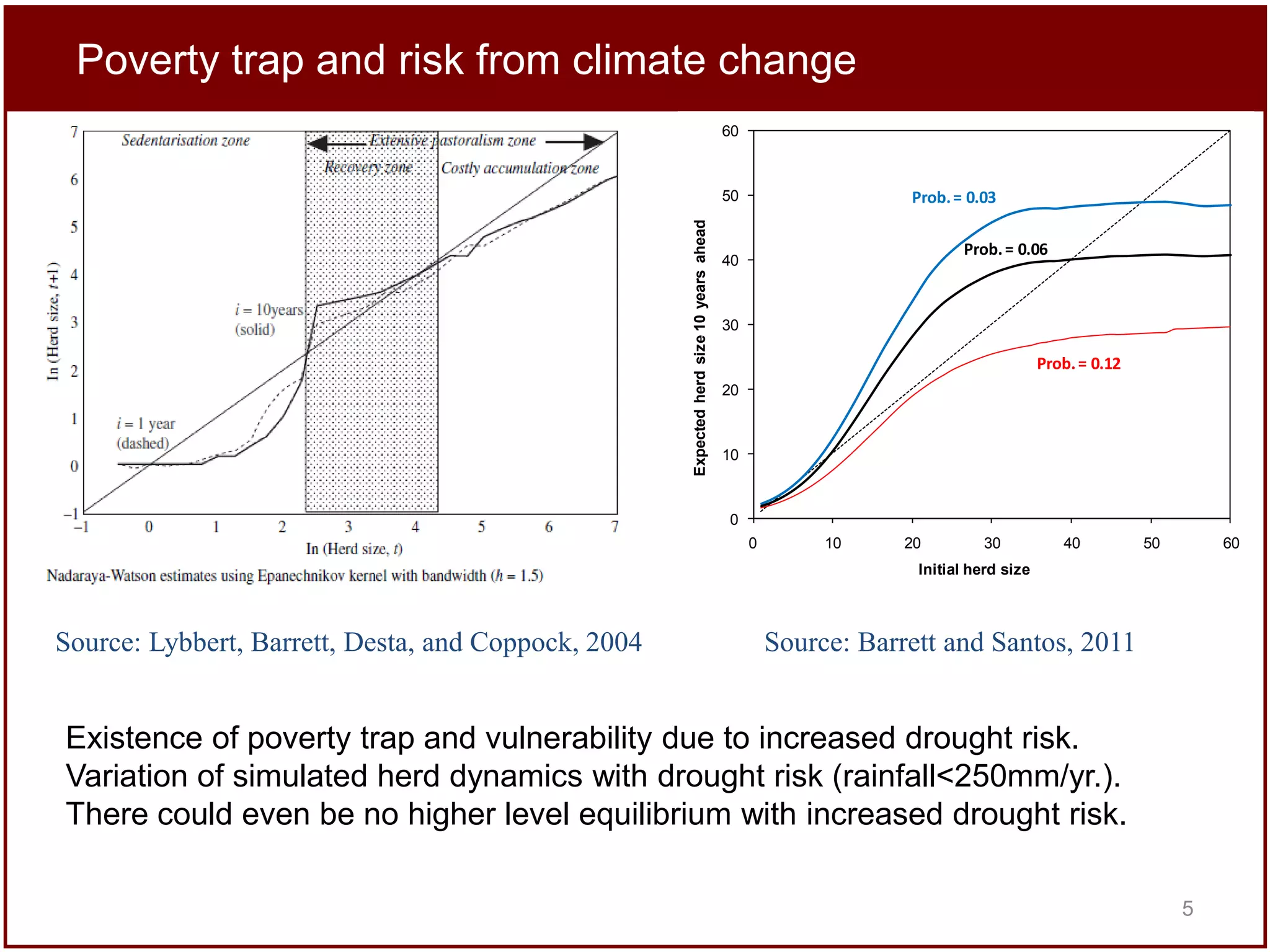
Poverty trap and risk from climate change
60

Prob. = 0.03

Expected herd size 10 years ahead

50

Prob. = 0.06

40

30

Prob. = 0.12
20

10

0
0

10

20

30

40

50

60

Initial herd size

Source: Lybbert, Barrett, Desta, and Coppock, 2004

Source: Barrett and Santos, 2011

Existence of poverty trap and vulnerability due to increased drought risk.
Variation of simulated herd dynamics with drought risk (rainfall<250mm/yr.).
There could even be no higher level equilibrium with increased drought risk.
5
Costs of uninsured risk

•

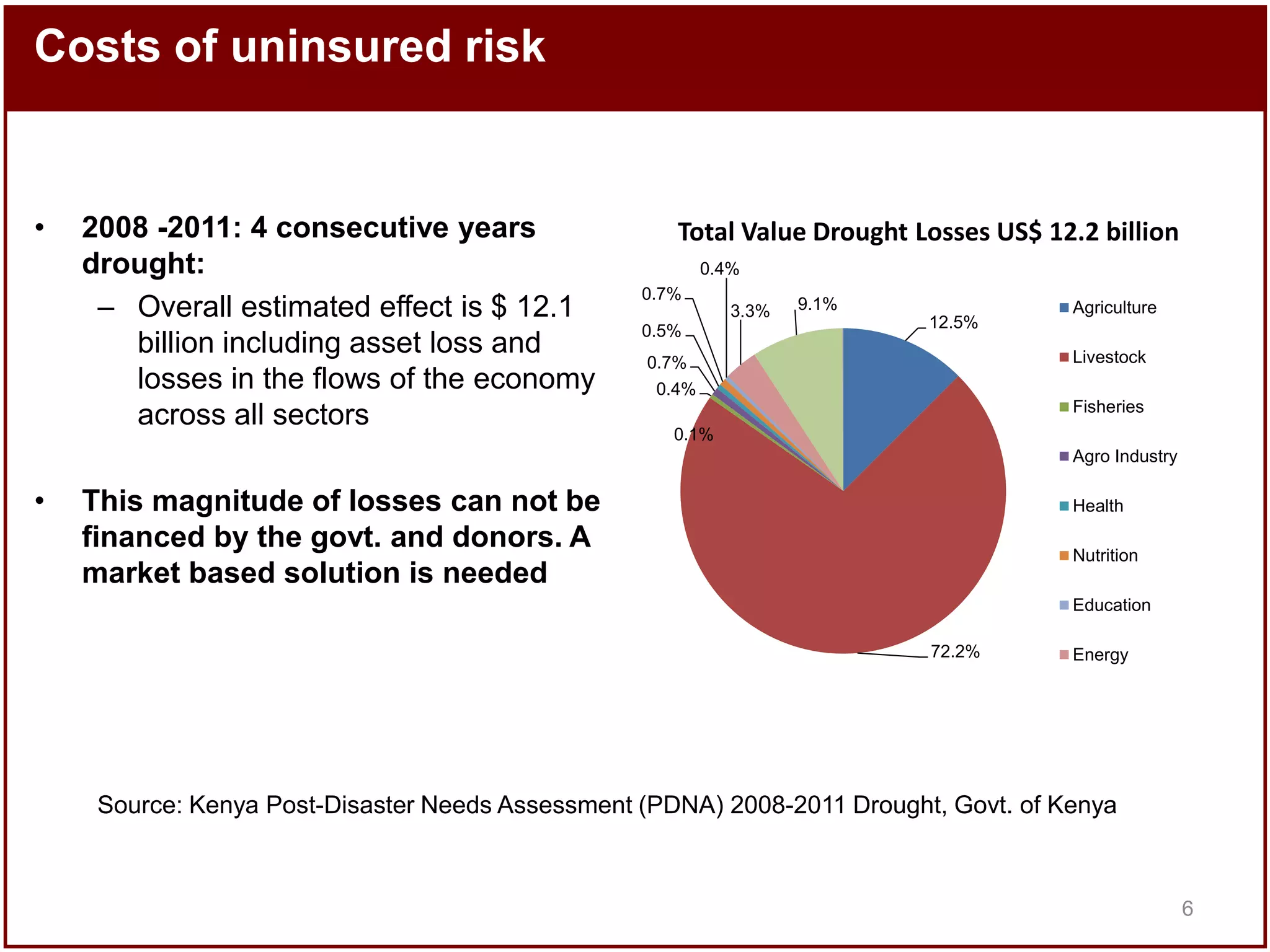
2008 -2011: 4 consecutive years
drought:
– Overall estimated effect is $ 12.1
billion including asset loss and
losses in the flows of the economy
across all sectors

Total Value Drought Losses US$ 12.2 billion
0.4%
0.7%
3.3%
0.5%

9.1%
12.5%

Agriculture

Livestock

0.7%
0.4%

Fisheries

0.1%
Agro Industry

•

This magnitude of losses can not be
financed by the govt. and donors. A
market based solution is needed

Health
Nutrition
Education
72.2%

Energy

Source: Kenya Post-Disaster Needs Assessment (PDNA) 2008-2011 Drought, Govt. of Kenya

6
Index insurance for the poor?: opportunities and challenges
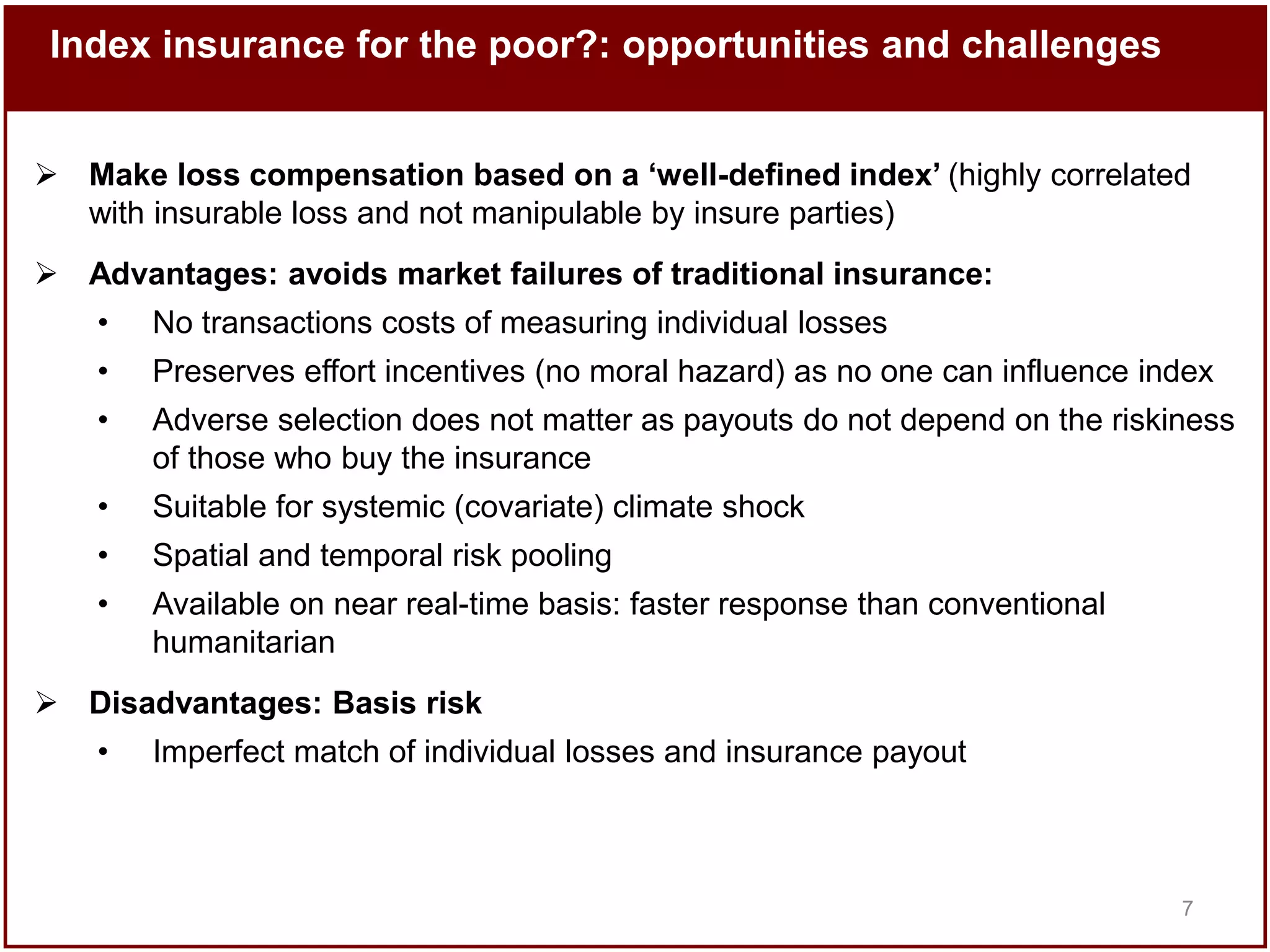
 Make loss compensation based on a ‘well-defined index’ (highly correlated
with insurable loss and not manipulable by insure parties)
 Advantages: avoids market failures of traditional insurance:
•

No transactions costs of measuring individual losses

•

Preserves effort incentives (no moral hazard) as no one can influence index

•

Adverse selection does not matter as payouts do not depend on the riskiness
of those who buy the insurance

•

Suitable for systemic (covariate) climate shock

•

Spatial and temporal risk pooling

•

Available on near real-time basis: faster response than conventional
humanitarian

 Disadvantages: Basis risk
•

Imperfect match of individual losses and insurance payout

7
IBLI Coverage
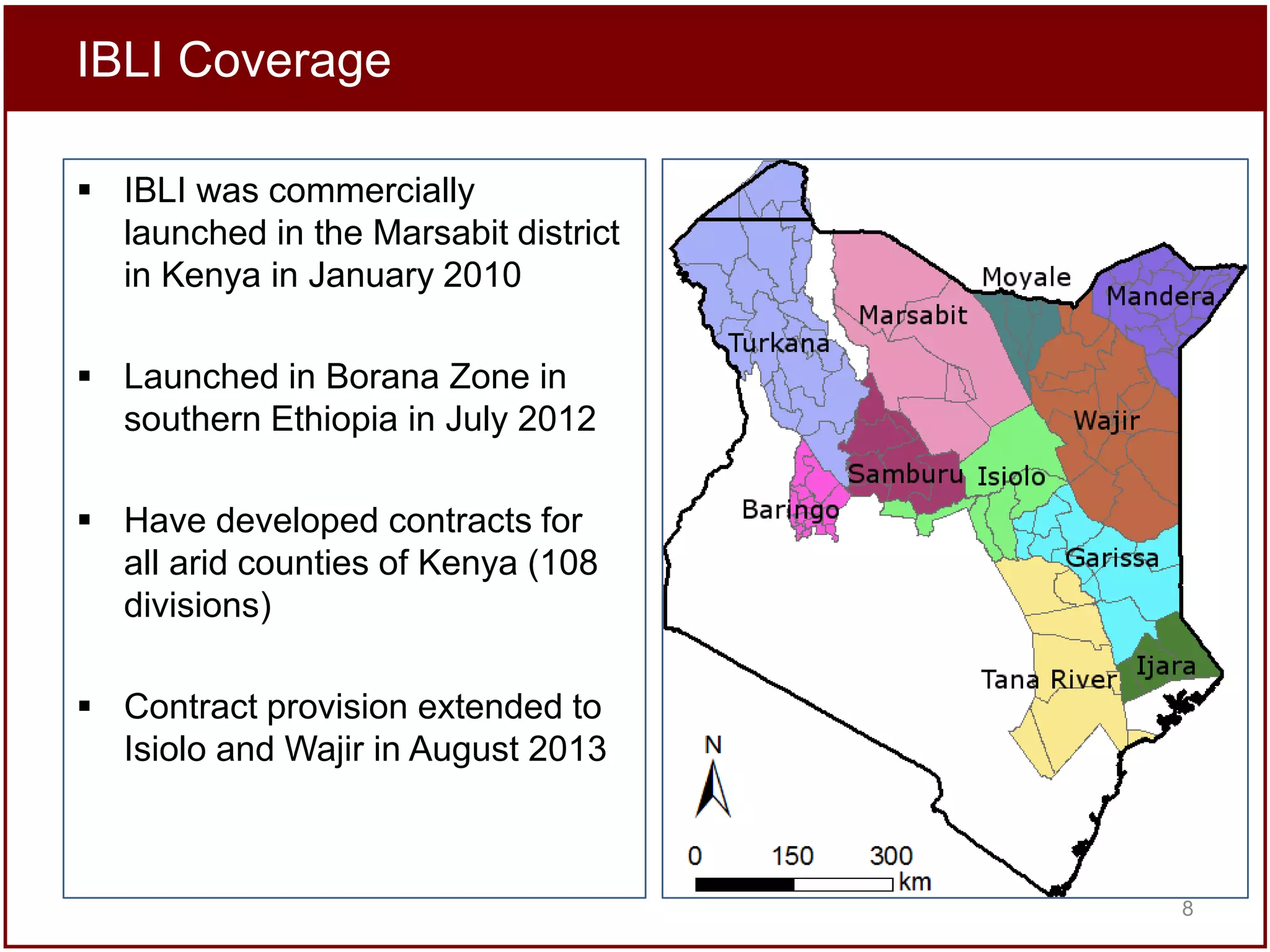
 IBLI was commercially
launched in the Marsabit district
in Kenya in January 2010
 Launched in Borana Zone in
southern Ethiopia in July 2012
 Have developed contracts for
all arid counties of Kenya (108
divisions)
 Contract provision extended to
Isiolo and Wajir in August 2013

8
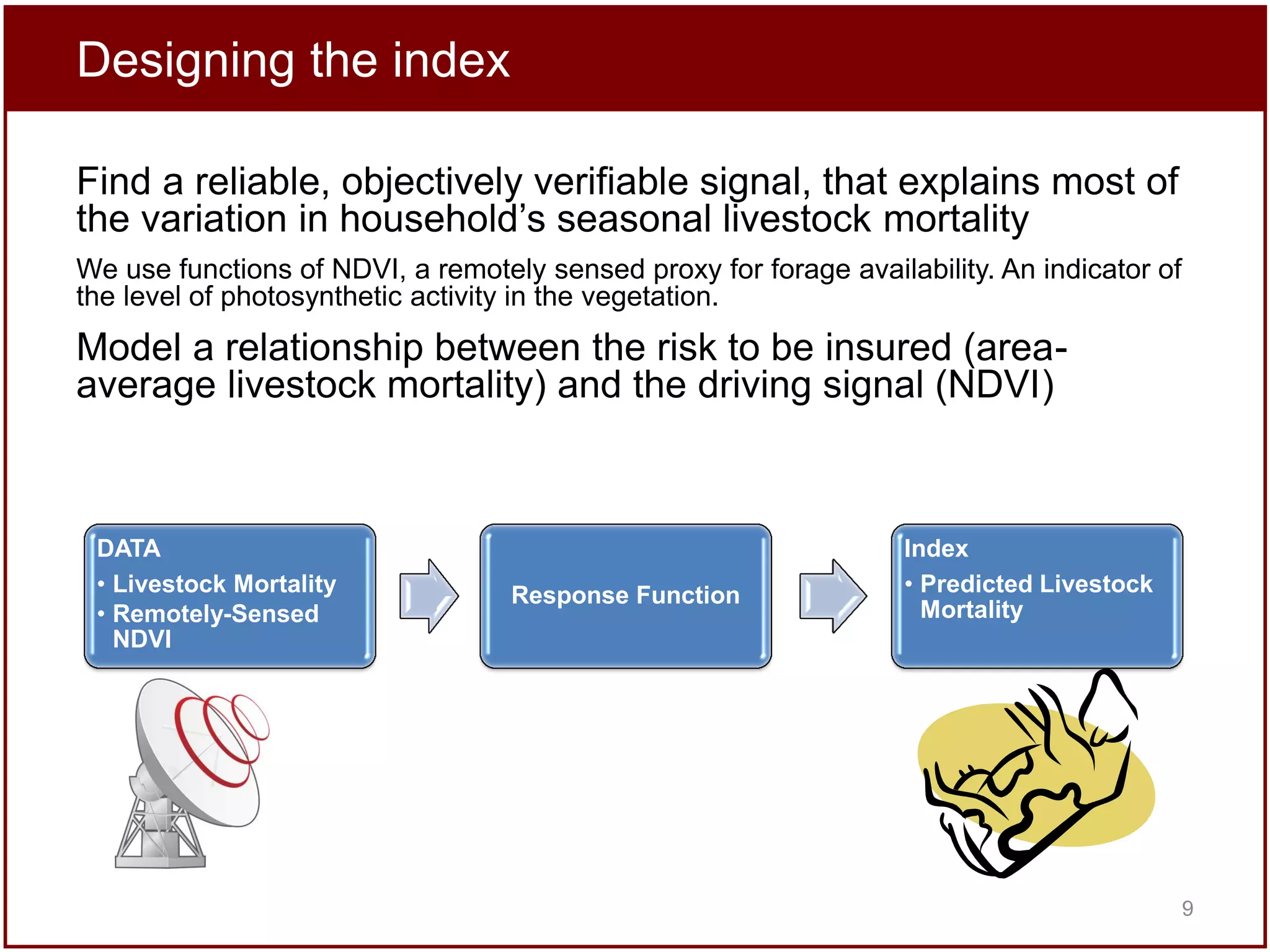
Designing the index
Find a reliable, objectively verifiable signal, that explains most of
the variation in household’s seasonal livestock mortality
We use functions of NDVI, a remotely sensed proxy for forage availability. An indicator of
the level of photosynthetic activity in the vegetation.

Model a relationship between the risk to be insured (areaaverage livestock mortality) and the driving signal (NDVI)

DATA
• Livestock Mortality
• Remotely-Sensed
NDVI

Response Function

Index
• Predicted Livestock
Mortality

9
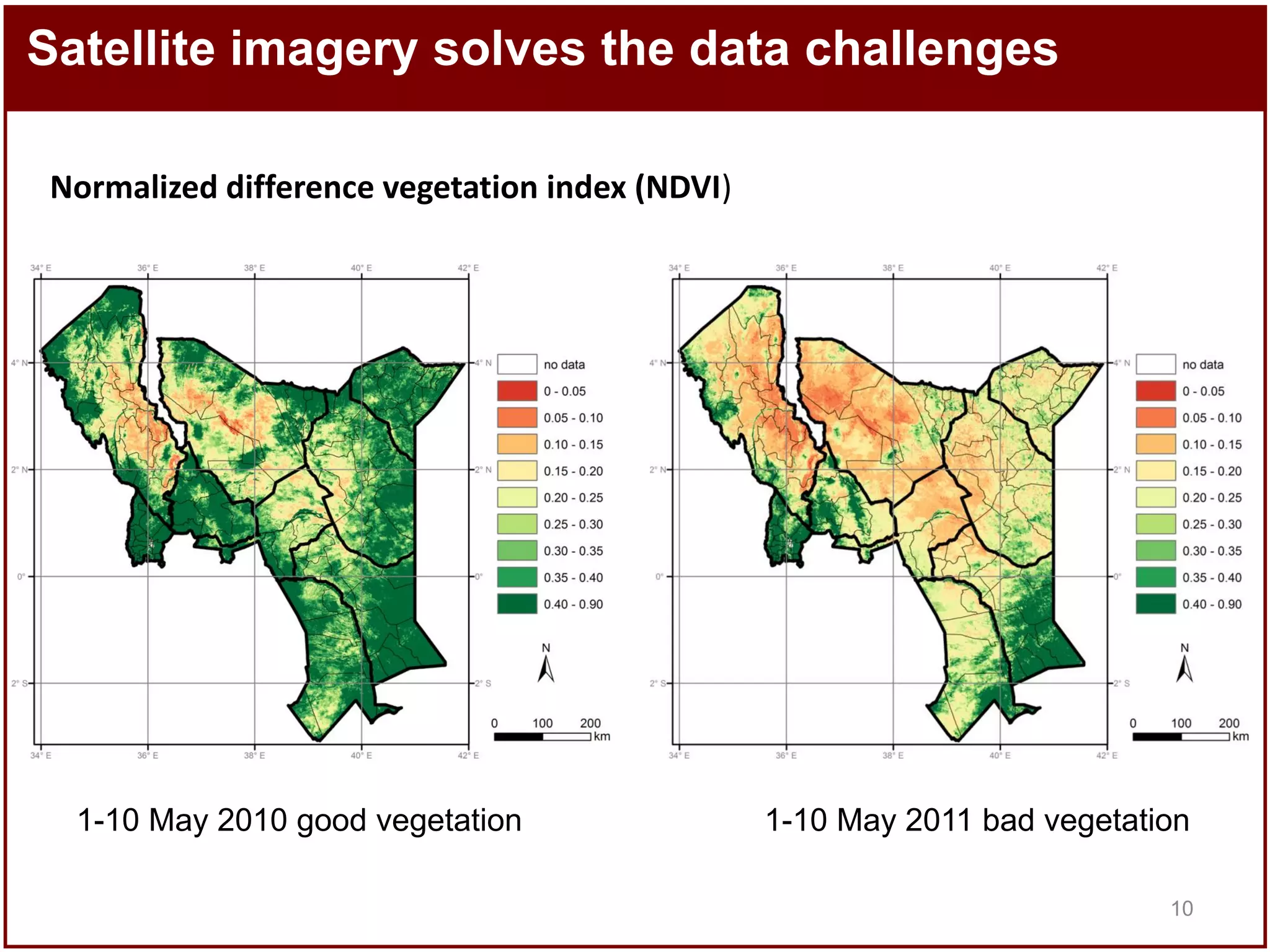
Satellite imagery solves the data challenges
Normalized difference vegetation index (NDVI)

1-10 May 2010 good vegetation

1-10 May 2011 bad vegetation
10
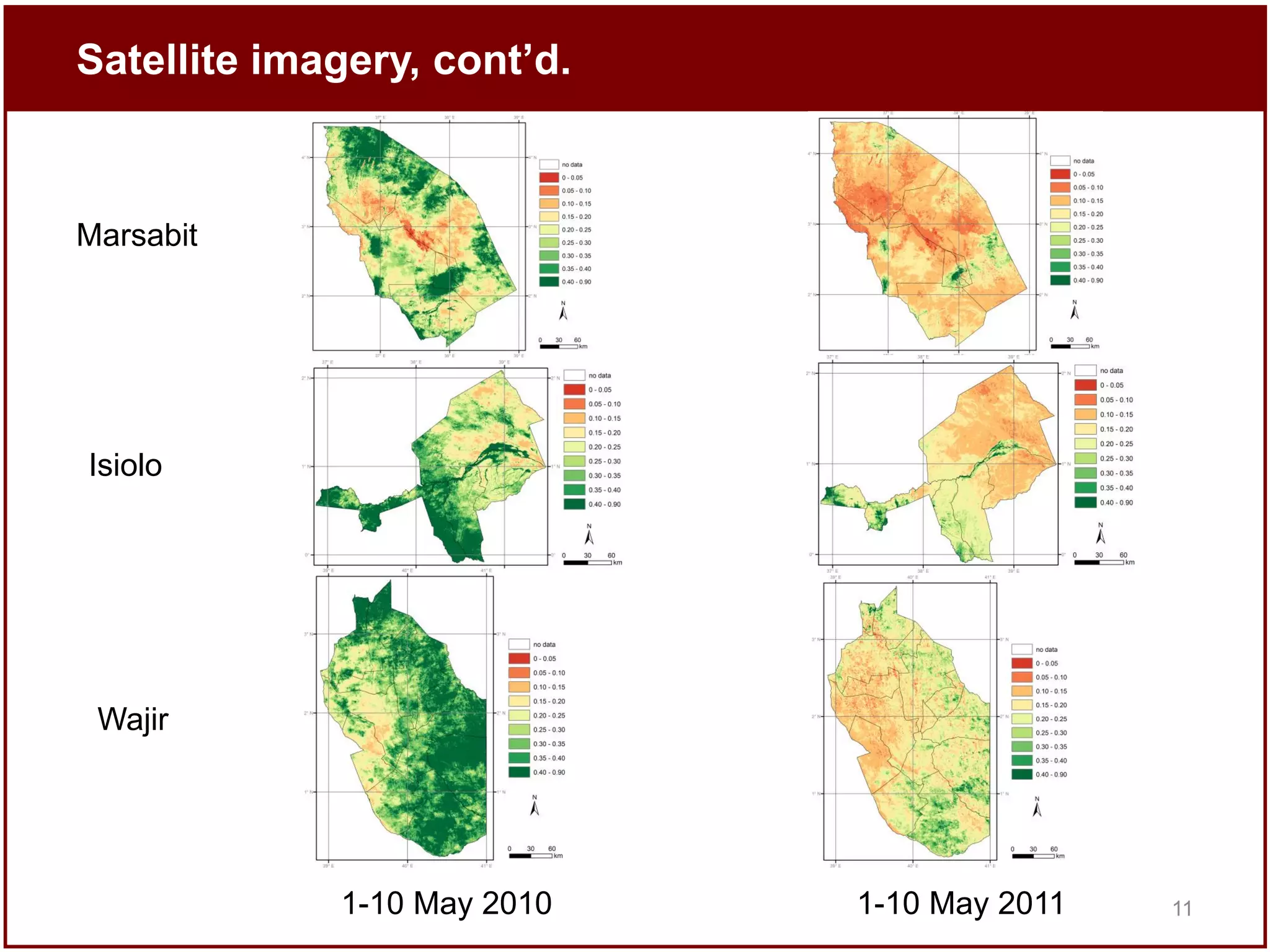
Satellite imagery, cont’d.

Marsabit

Isiolo

Wajir

1-10 May 2010

1-10 May 2011

11
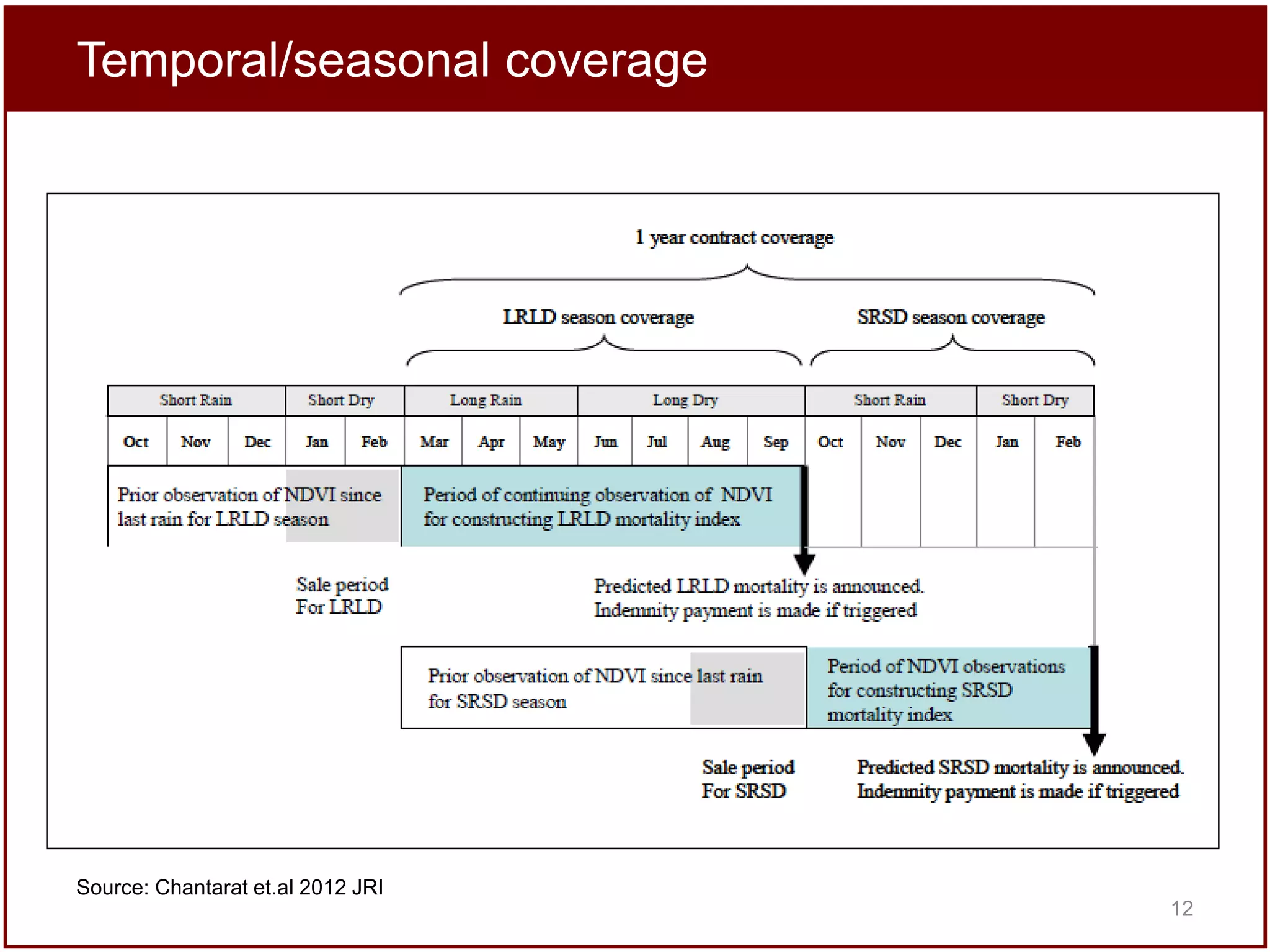
Temporal/seasonal coverage

Source: Chantarat et.al 2012 JRI
12
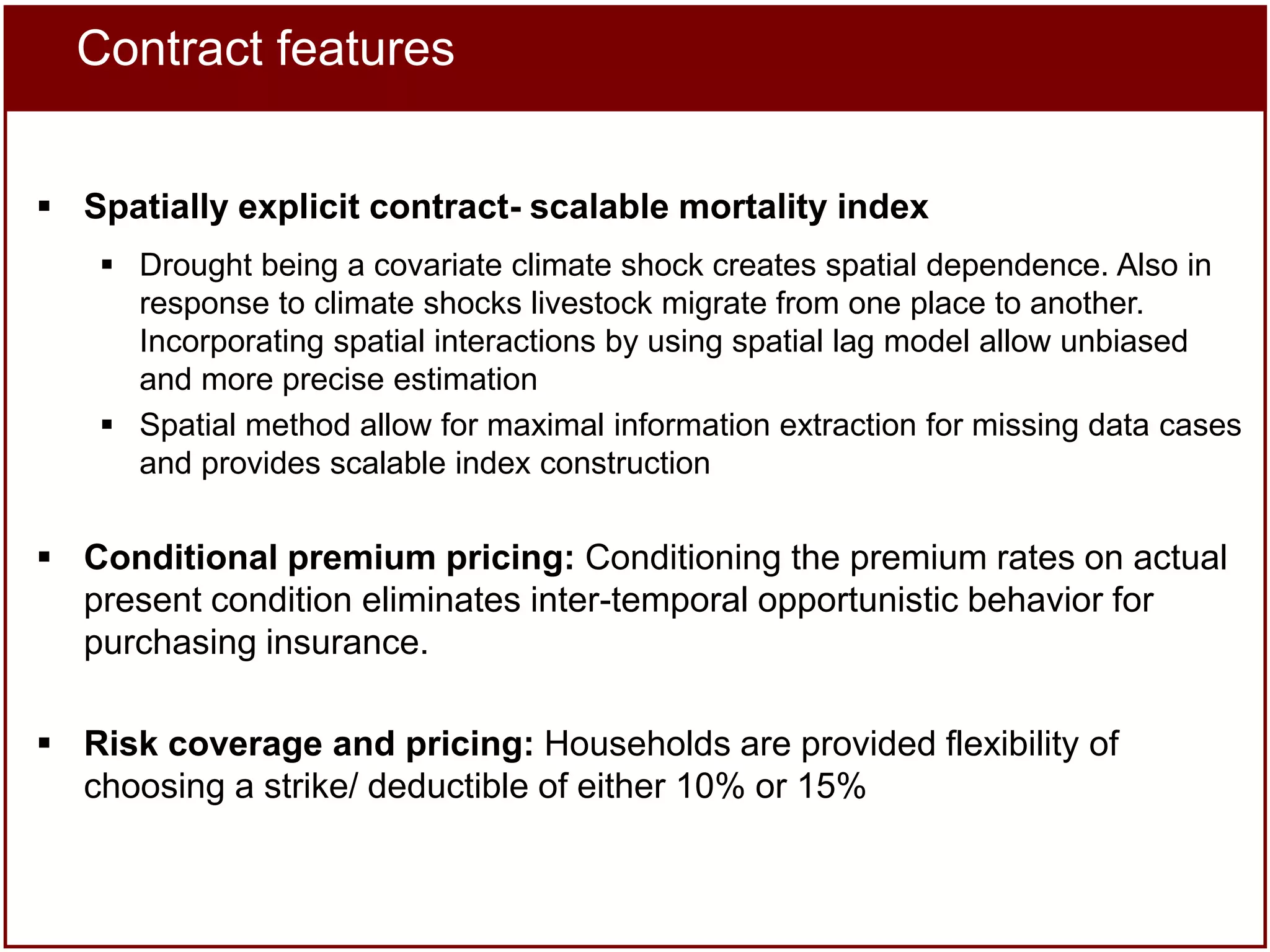
Contract features
 Spatially explicit contract- scalable mortality index
 Drought being a covariate climate shock creates spatial dependence. Also in
response to climate shocks livestock migrate from one place to another.
Incorporating spatial interactions by using spatial lag model allow unbiased
and more precise estimation
 Spatial method allow for maximal information extraction for missing data cases
and provides scalable index construction

 Conditional premium pricing: Conditioning the premium rates on actual
present condition eliminates inter-temporal opportunistic behavior for
purchasing insurance.
 Risk coverage and pricing: Households are provided flexibility of
choosing a strike/ deductible of either 10% or 15%
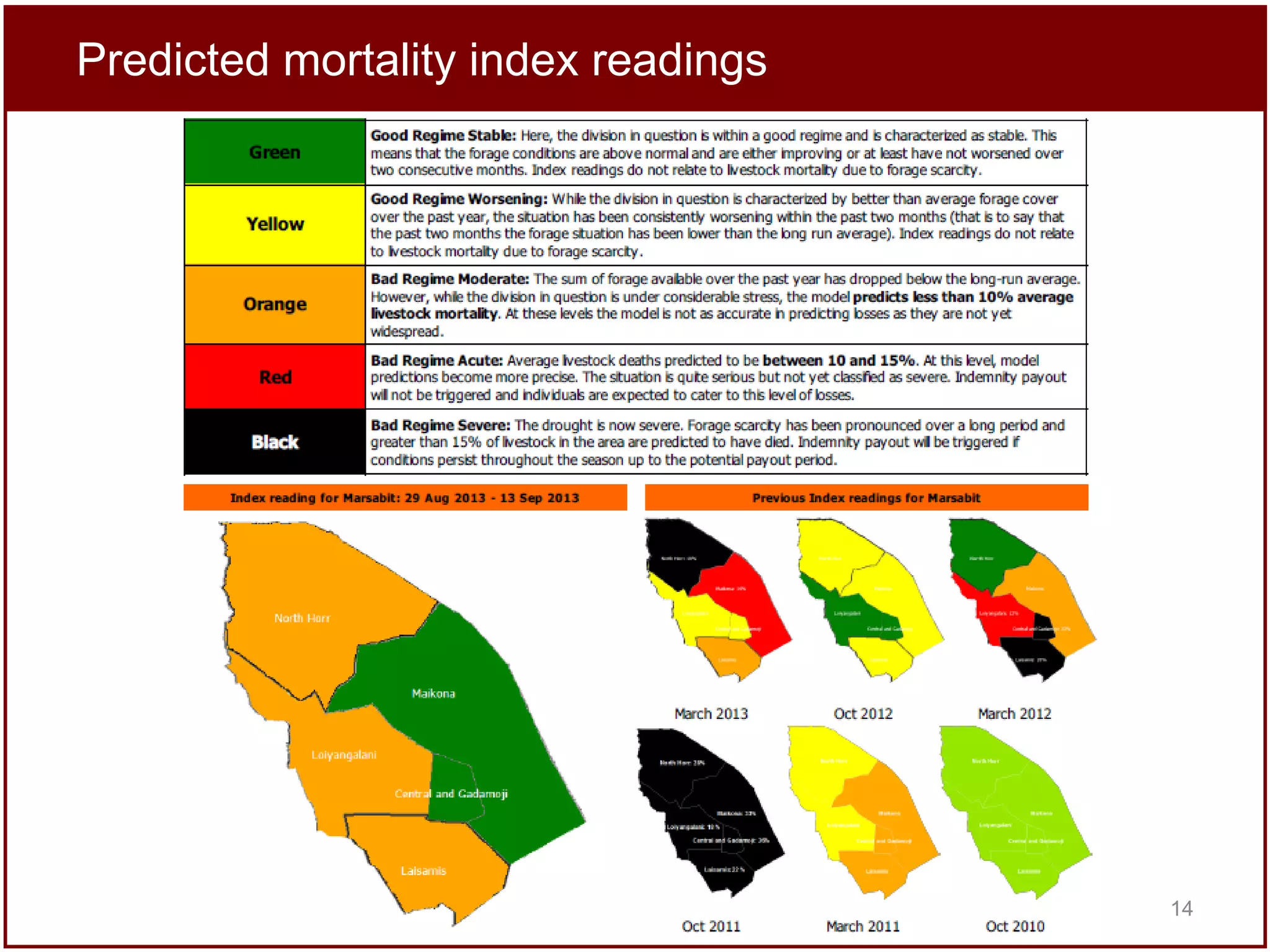
Predicted mortality index readings

14
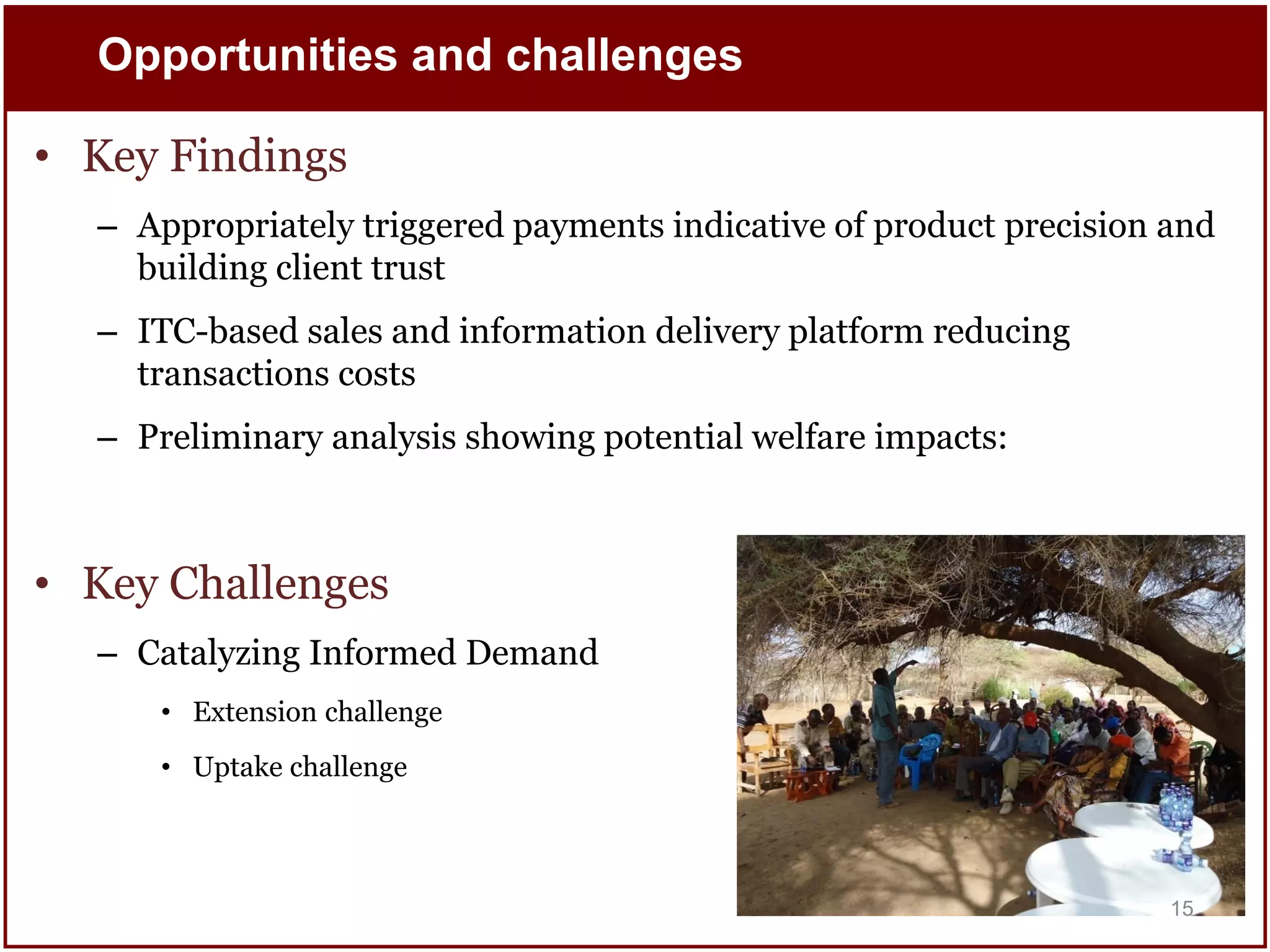
Opportunities and challenges

• Key Findings
– Appropriately triggered payments indicative of product precision and
building client trust

– ITC-based sales and information delivery platform reducing
transactions costs
– Preliminary analysis showing potential welfare impacts:

• Key Challenges
– Catalyzing Informed Demand
• Extension challenge
• Uptake challenge

15
Conclusions
•

Uninsured climate (drought) risk is a major cause of food insecurity and
poverty traps

•

IBLI appears effective financial innovation for protecting pastoralists
against drought related livestock mortality and could help households
avoid poverty traps

•

Considering the challenges it is important to encourage public private
partnership and policy to make index insurance a sustainable
development tool

•

Index insurance can be embedded with structural credit product to
reduce farmers default probability to weather risk and hence it not only
can protect downside risk for the farmers but it also provides credit
access for agricultural development.

•

Meso level (county governments) – allows for timely provision of
resources for drought emergency response

a promising option for addressing poverty traps that arise from catastrophic
16
drought risk
Thank you for your attention and comments

17

Livestock Insurance in Kenya

  • 1.
    Livestock Insurance inKenya: A Market-Based Innovation for Climate Risk Management Apurba Shee, ILRI IWMI-CCAFS Workshop on Institutions and Policies for Scaling Out Climate Smart Agriculture, Colombo, Sri Lanka – Dec 2 2013
  • 2.
    Outline         Introduction and motivations Potentialof index insurance – insurance for the poor IBLI coverage Designing the index IBLI contract pricing and features Implementation Opportunities and challenges Conclusions 2
  • 3.
    Livestock- the pastoralistlivelihood • Livestock are a significant global asset; account for 20%-40% of agricultural GDP (Steinfeld et al., 2006; Herrero et al., 2013) • Arid and semi-arid lands (2/3 of Africa) – 20 million pastoralists’ main livelihood is livestock grazing • Livestock is the key productive asset • Low and erratic rainfall and poor soils prohibit crop production • Pastoralist systems adapted to variable climate, but very vulnerable to severe drought events. In the past 100 years, northern Kenya recorded 28 major droughts, 4 occurred in last 10 years • Droughts  forage shortage  livestock mortality  poverty trap and dependence on food aid • Uninsured climate risk is main driver of persistent poverty 3
  • 4.
    Impact of droughtrisks on livelihoods Component Shares of Income • Sale of livestock and livestock products constitute 40% of household income • External support (food and cash) make up nearly 25% of household income Cause of Livestock Mortality • Drought is by far the leading cause of livestock mortality • Disease and Predation likely to be directly related to drought Data source: Project baseline 2009 (924 Marsabit Households) 4
  • 5.
    Poverty trap andrisk from climate change 60 Prob. = 0.03 Expected herd size 10 years ahead 50 Prob. = 0.06 40 30 Prob. = 0.12 20 10 0 0 10 20 30 40 50 60 Initial herd size Source: Lybbert, Barrett, Desta, and Coppock, 2004 Source: Barrett and Santos, 2011 Existence of poverty trap and vulnerability due to increased drought risk. Variation of simulated herd dynamics with drought risk (rainfall<250mm/yr.). There could even be no higher level equilibrium with increased drought risk. 5
  • 6.
    Costs of uninsuredrisk • 2008 -2011: 4 consecutive years drought: – Overall estimated effect is $ 12.1 billion including asset loss and losses in the flows of the economy across all sectors Total Value Drought Losses US$ 12.2 billion 0.4% 0.7% 3.3% 0.5% 9.1% 12.5% Agriculture Livestock 0.7% 0.4% Fisheries 0.1% Agro Industry • This magnitude of losses can not be financed by the govt. and donors. A market based solution is needed Health Nutrition Education 72.2% Energy Source: Kenya Post-Disaster Needs Assessment (PDNA) 2008-2011 Drought, Govt. of Kenya 6
  • 7.
    Index insurance forthe poor?: opportunities and challenges  Make loss compensation based on a ‘well-defined index’ (highly correlated with insurable loss and not manipulable by insure parties)  Advantages: avoids market failures of traditional insurance: • No transactions costs of measuring individual losses • Preserves effort incentives (no moral hazard) as no one can influence index • Adverse selection does not matter as payouts do not depend on the riskiness of those who buy the insurance • Suitable for systemic (covariate) climate shock • Spatial and temporal risk pooling • Available on near real-time basis: faster response than conventional humanitarian  Disadvantages: Basis risk • Imperfect match of individual losses and insurance payout 7
  • 8.
    IBLI Coverage  IBLIwas commercially launched in the Marsabit district in Kenya in January 2010  Launched in Borana Zone in southern Ethiopia in July 2012  Have developed contracts for all arid counties of Kenya (108 divisions)  Contract provision extended to Isiolo and Wajir in August 2013 8
  • 9.
    Designing the index Finda reliable, objectively verifiable signal, that explains most of the variation in household’s seasonal livestock mortality We use functions of NDVI, a remotely sensed proxy for forage availability. An indicator of the level of photosynthetic activity in the vegetation. Model a relationship between the risk to be insured (areaaverage livestock mortality) and the driving signal (NDVI) DATA • Livestock Mortality • Remotely-Sensed NDVI Response Function Index • Predicted Livestock Mortality 9
  • 10.
    Satellite imagery solvesthe data challenges Normalized difference vegetation index (NDVI) 1-10 May 2010 good vegetation 1-10 May 2011 bad vegetation 10
  • 11.
  • 12.
  • 13.
    Contract features  Spatiallyexplicit contract- scalable mortality index  Drought being a covariate climate shock creates spatial dependence. Also in response to climate shocks livestock migrate from one place to another. Incorporating spatial interactions by using spatial lag model allow unbiased and more precise estimation  Spatial method allow for maximal information extraction for missing data cases and provides scalable index construction  Conditional premium pricing: Conditioning the premium rates on actual present condition eliminates inter-temporal opportunistic behavior for purchasing insurance.  Risk coverage and pricing: Households are provided flexibility of choosing a strike/ deductible of either 10% or 15%
  • 14.
  • 15.
    Opportunities and challenges •Key Findings – Appropriately triggered payments indicative of product precision and building client trust – ITC-based sales and information delivery platform reducing transactions costs – Preliminary analysis showing potential welfare impacts: • Key Challenges – Catalyzing Informed Demand • Extension challenge • Uptake challenge 15
  • 16.
    Conclusions • Uninsured climate (drought)risk is a major cause of food insecurity and poverty traps • IBLI appears effective financial innovation for protecting pastoralists against drought related livestock mortality and could help households avoid poverty traps • Considering the challenges it is important to encourage public private partnership and policy to make index insurance a sustainable development tool • Index insurance can be embedded with structural credit product to reduce farmers default probability to weather risk and hence it not only can protect downside risk for the farmers but it also provides credit access for agricultural development. • Meso level (county governments) – allows for timely provision of resources for drought emergency response a promising option for addressing poverty traps that arise from catastrophic 16 drought risk
  • 17.
    Thank you foryour attention and comments 17