ROLE OF AGRICULTURE
AND GOVERNMENT IN
RURAL DEVELOPMENT
PSSP’s Third Annual Conference
April 14, 2015
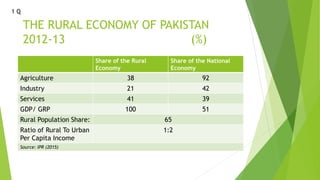
THE RURAL ECONOMY OF PAKISTAN
2012-13 (%)
Share of the Rural
Economy
Share of the National
Economy
Agriculture 38 92
Industry 21 42
Services 41 39
GDP/ GRP 100 51
Rural Population Share: 65
Ratio of Rural To Urban
Per Capita Income
1:2
Source: IPR (2015)
1 Q
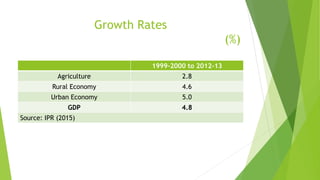
Growth Rates
(%)
1999-2000 to 2012-13
Agriculture 2.8
Rural Economy 4.6
Urban Economy 5.0
GDP 4.8
Source: IPR (2015)
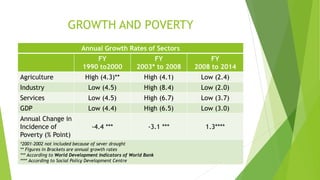
GROWTH AND POVERTY
Annual Growth Rates of Sectors
FY
1990 to2000
FY
2003* to 2008
FY
2008 to 2014
Agriculture High (4.3)** High (4.1) Low (2.4)
Industry Low (4.5) High (8.4) Low (2.0)
Services Low (4.5) High (6.7) Low (3.7)
GDP Low (4.4) High (6.5) Low (3.0)
Annual Change in
Incidence of
Poverty (% Point)
-4.4 *** -3.1 *** 1.3****
*2001-2002 not included because of sever drought
** Figures in Brackets are annual growth rates
*** According to World Development Indicators of World Bank
**** According to Social Policy Development Centre
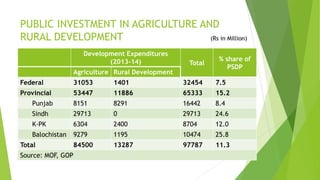
PUBLIC INVESTMENT IN AGRICULTURE AND
RURAL DEVELOPMENT
Development Expenditures
(2013-14) Total
% share of
PSDP
Agriculture Rural Development
Federal 31053 1401 32454 7.5
Provincial 53447 11886 65333 15.2
Punjab 8151 8291 16442 8.4
Sindh 29713 0 29713 24.6
K-PK 6304 2400 8704 12.0
Balochistan 9279 1195 10474 25.8
Total 84500 13287 97787 11.3
Source: MOF, GOP
(Rs in Million)
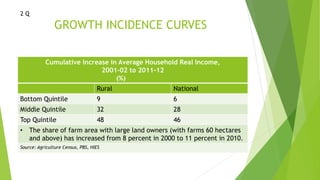
GROWTH INCIDENCE CURVES
Cumulative Increase in Average Household Real Income,
2001-02 to 2011-12
(%)
Rural National
Bottom Quintile 9 6
Middle Quintile 32 28
Top Quintile 48 46
• The share of farm area with large land owners (with farms 60 hectares
and above) has increased from 8 percent in 2000 to 11 percent in 2010.
Source: Agriculture Census, PBS, HIES
2 Q
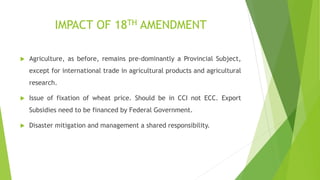
IMPACT OF 18TH AMENDMENT
 Agriculture, as before, remains pre-dominantly a Provincial Subject,
except for international trade in agricultural products and agricultural
research.
 Issue of fixation of wheat price. Should be in CCI not ECC. Export
Subsidies need to be financed by Federal Government.
 Disaster mitigation and management a shared responsibility.
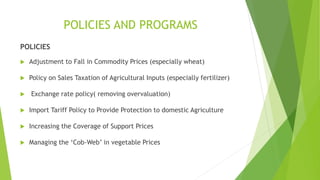
POLICIES AND PROGRAMS
POLICIES
 Adjustment to Fall in Commodity Prices (especially wheat)
 Policy on Sales Taxation of Agricultural Inputs (especially fertilizer)
 Exchange rate policy( removing overvaluation)
 Import Tariff Policy to Provide Protection to domestic Agriculture
 Increasing the Coverage of Support Prices
 Managing the ‘Cob-Web’ in vegetable Prices
POLICIES AND PROGRAMS
PROGRAMS
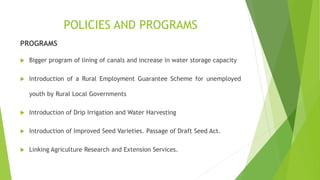
 Bigger program of lining of canals and increase in water storage capacity
 Introduction of a Rural Employment Guarantee Scheme for unemployed
youth by Rural Local Governments
 Introduction of Drip Irrigation and Water Harvesting
 Introduction of Improved Seed Varieties. Passage of Draft Seed Act.
 Linking Agriculture Research and Extension Services.
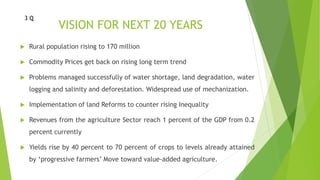
VISION FOR NEXT 20 YEARS
 Rural population rising to 170 million
 Commodity Prices get back on rising long term trend
 Problems managed successfully of water shortage, land degradation, water
logging and salinity and deforestation. Widespread use of mechanization.
 Implementation of land Reforms to counter rising Inequality
 Revenues from the agriculture Sector reach 1 percent of the GDP from 0.2
percent currently
 Yields rise by 40 percent to 70 percent of crops to levels already attained
by ‘progressive farmers’ Move toward value-added agriculture.
3 Q
VISION FOR NEXT 20 YEARS
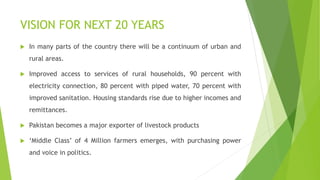
 In many parts of the country there will be a continuum of urban and
rural areas.
 Improved access to services of rural households, 90 percent with
electricity connection, 80 percent with piped water, 70 percent with
improved sanitation. Housing standards rise due to higher incomes and
remittances.
 Pakistan becomes a major exporter of livestock products
 ‘Middle Class’ of 4 Million farmers emerges, with purchasing power
and voice in politics.
Thank You

Hafiz Pasha - Role of Agriculture and Government in Rural Development

  • 1.
    ROLE OF AGRICULTURE ANDGOVERNMENT IN RURAL DEVELOPMENT PSSP’s Third Annual Conference April 14, 2015
  • 2.
    THE RURAL ECONOMYOF PAKISTAN 2012-13 (%) Share of the Rural Economy Share of the National Economy Agriculture 38 92 Industry 21 42 Services 41 39 GDP/ GRP 100 51 Rural Population Share: 65 Ratio of Rural To Urban Per Capita Income 1:2 Source: IPR (2015) 1 Q
  • 3.
    Growth Rates (%) 1999-2000 to2012-13 Agriculture 2.8 Rural Economy 4.6 Urban Economy 5.0 GDP 4.8 Source: IPR (2015)
  • 4.
    GROWTH AND POVERTY AnnualGrowth Rates of Sectors FY 1990 to2000 FY 2003* to 2008 FY 2008 to 2014 Agriculture High (4.3)** High (4.1) Low (2.4) Industry Low (4.5) High (8.4) Low (2.0) Services Low (4.5) High (6.7) Low (3.7) GDP Low (4.4) High (6.5) Low (3.0) Annual Change in Incidence of Poverty (% Point) -4.4 *** -3.1 *** 1.3**** *2001-2002 not included because of sever drought ** Figures in Brackets are annual growth rates *** According to World Development Indicators of World Bank **** According to Social Policy Development Centre
  • 5.
    PUBLIC INVESTMENT INAGRICULTURE AND RURAL DEVELOPMENT Development Expenditures (2013-14) Total % share of PSDP Agriculture Rural Development Federal 31053 1401 32454 7.5 Provincial 53447 11886 65333 15.2 Punjab 8151 8291 16442 8.4 Sindh 29713 0 29713 24.6 K-PK 6304 2400 8704 12.0 Balochistan 9279 1195 10474 25.8 Total 84500 13287 97787 11.3 Source: MOF, GOP (Rs in Million)
  • 6.
    GROWTH INCIDENCE CURVES CumulativeIncrease in Average Household Real Income, 2001-02 to 2011-12 (%) Rural National Bottom Quintile 9 6 Middle Quintile 32 28 Top Quintile 48 46 • The share of farm area with large land owners (with farms 60 hectares and above) has increased from 8 percent in 2000 to 11 percent in 2010. Source: Agriculture Census, PBS, HIES 2 Q
  • 7.
    IMPACT OF 18THAMENDMENT  Agriculture, as before, remains pre-dominantly a Provincial Subject, except for international trade in agricultural products and agricultural research.  Issue of fixation of wheat price. Should be in CCI not ECC. Export Subsidies need to be financed by Federal Government.  Disaster mitigation and management a shared responsibility.
  • 8.
    POLICIES AND PROGRAMS POLICIES Adjustment to Fall in Commodity Prices (especially wheat)  Policy on Sales Taxation of Agricultural Inputs (especially fertilizer)  Exchange rate policy( removing overvaluation)  Import Tariff Policy to Provide Protection to domestic Agriculture  Increasing the Coverage of Support Prices  Managing the ‘Cob-Web’ in vegetable Prices
  • 9.
    POLICIES AND PROGRAMS PROGRAMS Bigger program of lining of canals and increase in water storage capacity  Introduction of a Rural Employment Guarantee Scheme for unemployed youth by Rural Local Governments  Introduction of Drip Irrigation and Water Harvesting  Introduction of Improved Seed Varieties. Passage of Draft Seed Act.  Linking Agriculture Research and Extension Services.
  • 10.
    VISION FOR NEXT20 YEARS  Rural population rising to 170 million  Commodity Prices get back on rising long term trend  Problems managed successfully of water shortage, land degradation, water logging and salinity and deforestation. Widespread use of mechanization.  Implementation of land Reforms to counter rising Inequality  Revenues from the agriculture Sector reach 1 percent of the GDP from 0.2 percent currently  Yields rise by 40 percent to 70 percent of crops to levels already attained by ‘progressive farmers’ Move toward value-added agriculture. 3 Q
  • 11.
    VISION FOR NEXT20 YEARS  In many parts of the country there will be a continuum of urban and rural areas.  Improved access to services of rural households, 90 percent with electricity connection, 80 percent with piped water, 70 percent with improved sanitation. Housing standards rise due to higher incomes and remittances.  Pakistan becomes a major exporter of livestock products  ‘Middle Class’ of 4 Million farmers emerges, with purchasing power and voice in politics.
  • 12.