Java Persistence API: Best Practices Carol McDonald Java Architect
Agenda Entity Manager Persistence Context Entities Schema & Queries Transaction
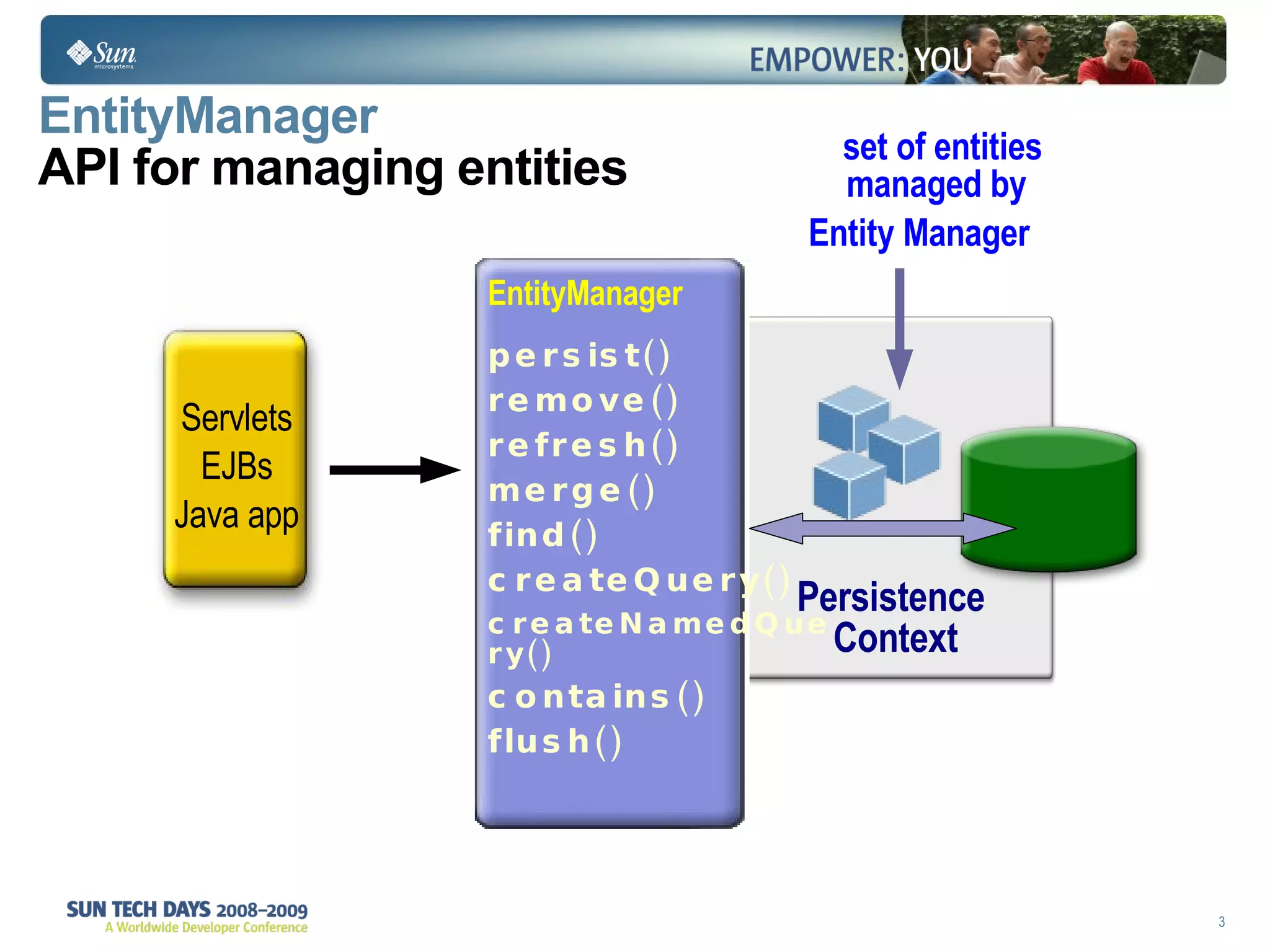
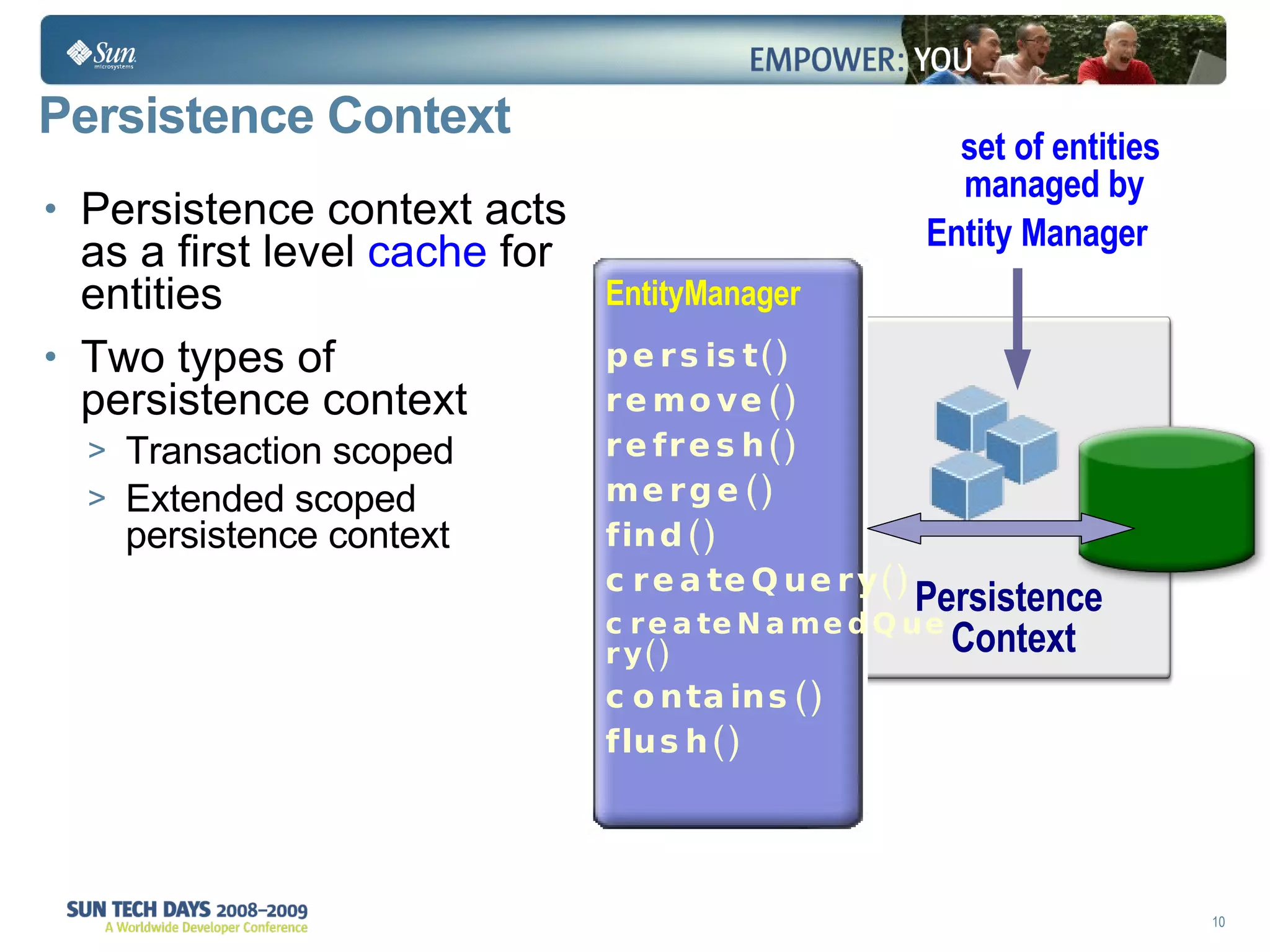
Persistence  Context EntityManager persist() remove() refresh() merge() find() createQuery() createNamedQuery() contains() flush() EntityManager  API for managing entities set of entities managed by  Entity Manager Servlets EJBs Java app
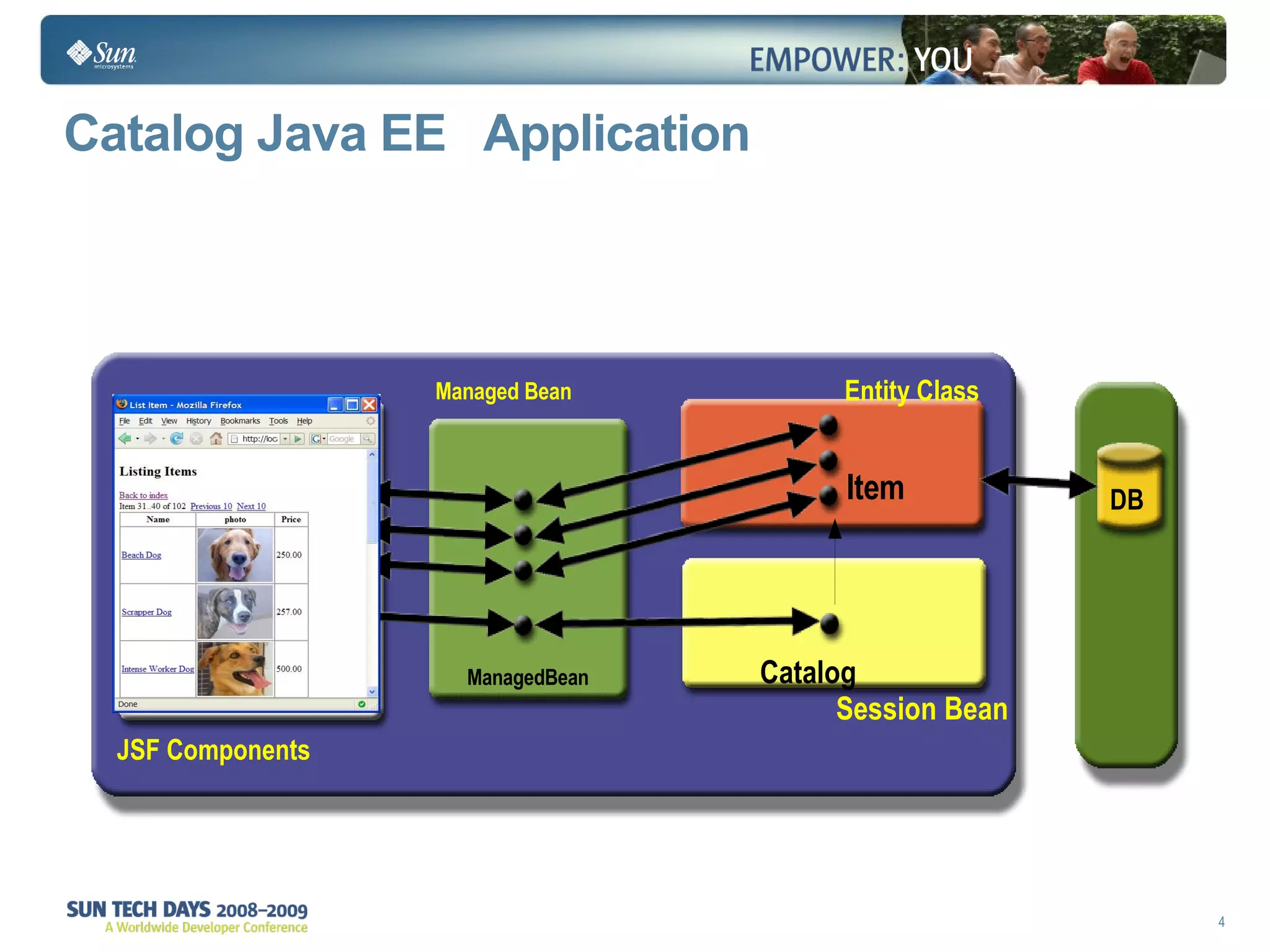
Catalog Java EE  Application DB Registration Application Managed Bean JSF Components Session Bean Entity Class Catalog Item ManagedBean
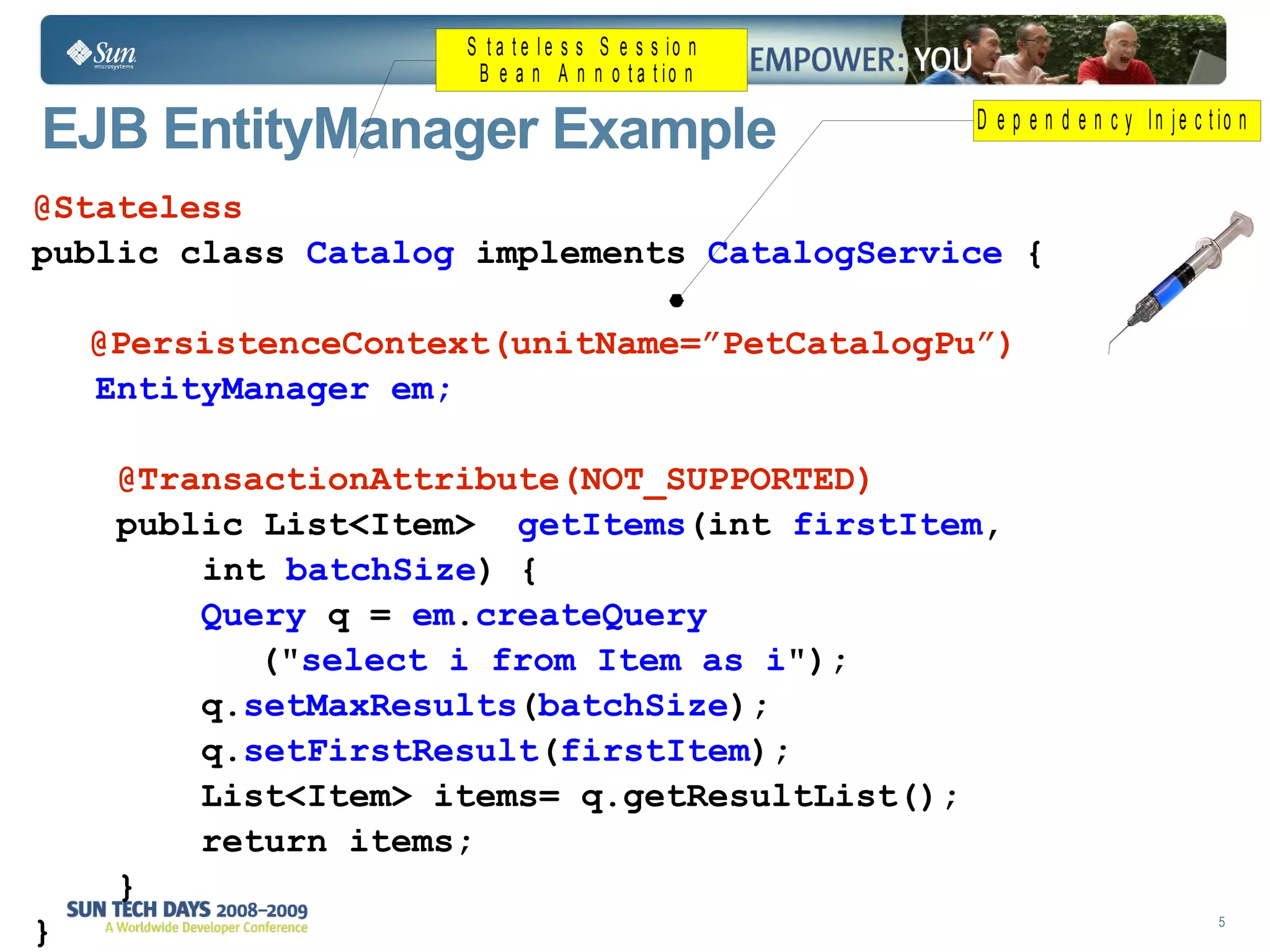
EJB EntityManager Example  @Stateless public class  Catalog  implements  CatalogService  { @PersistenceContext(unitName=”PetCatalogPu”)   EntityManager em; @TransactionAttribute(NOT_SUPPORTED) public List<Item>  getItems (int  firstItem , int  batchSize ) {  Query  q =  em . createQuery (&quot; select i from Item as i &quot;);  q. setMaxResults ( batchSize ); q. setFirstResult ( firstItem ); List<Item> items= q.getResultList(); return items;  } }
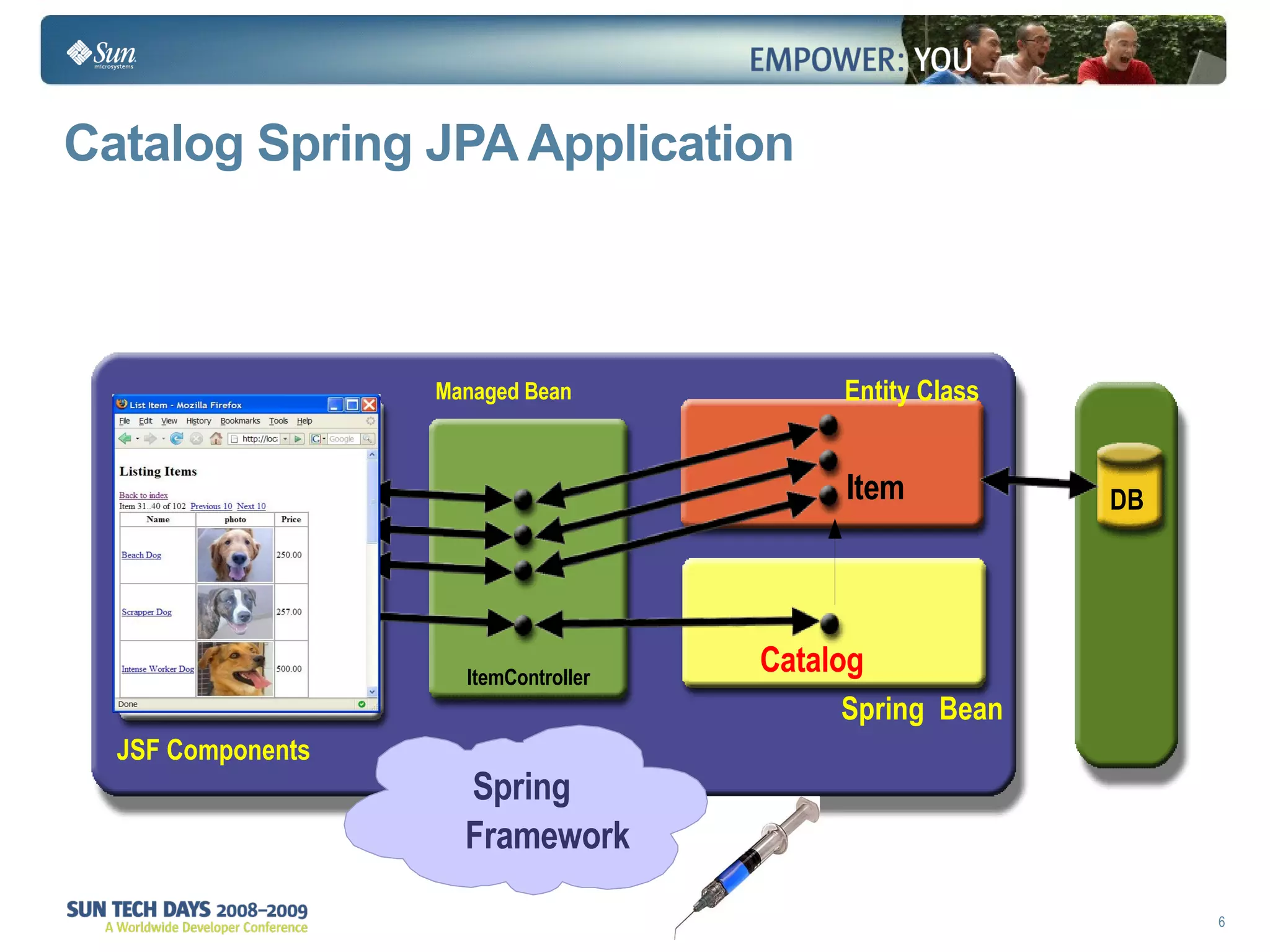
Catalog Spring JPA Application DB Registration Application Managed Bean JSF Components Spring  Bean Entity Class Catalog Item ItemController Spring Framework
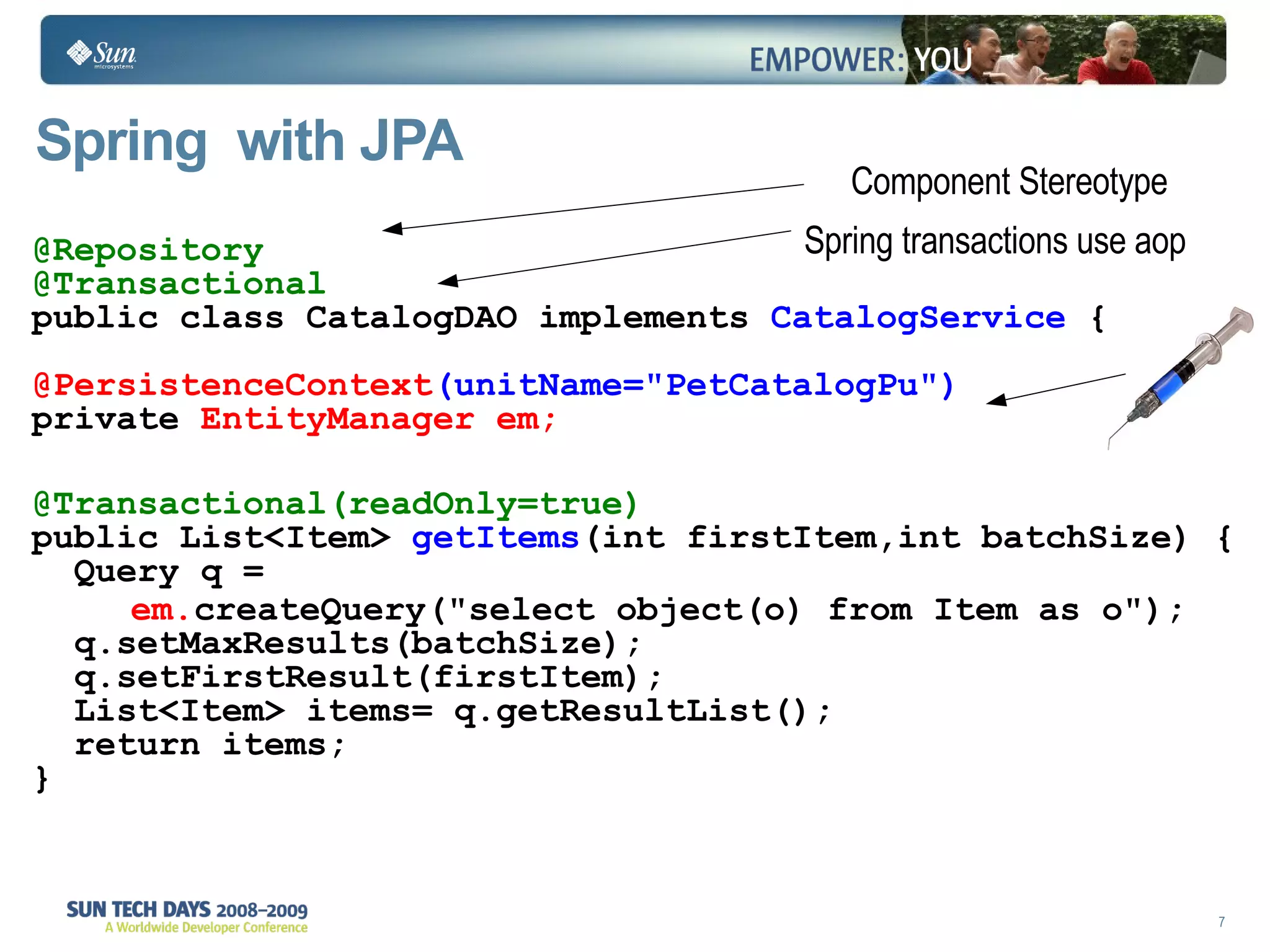
Spring  with JPA @Repository @Transactional public class CatalogDAO implements  CatalogService  { @PersistenceContext (unitName=&quot;PetCatalogPu&quot;) private  EntityManager em; @Transactional(readOnly=true) public List<Item>  getItems (int firstItem,int batchSize) {    Query q =    em. createQuery(&quot;select object(o) from Item as o&quot;);   q.setMaxResults(batchSize);   q.setFirstResult(firstItem);   List<Item> items= q.getResultList();   return items;  } Component Stereotype Spring transactions use aop
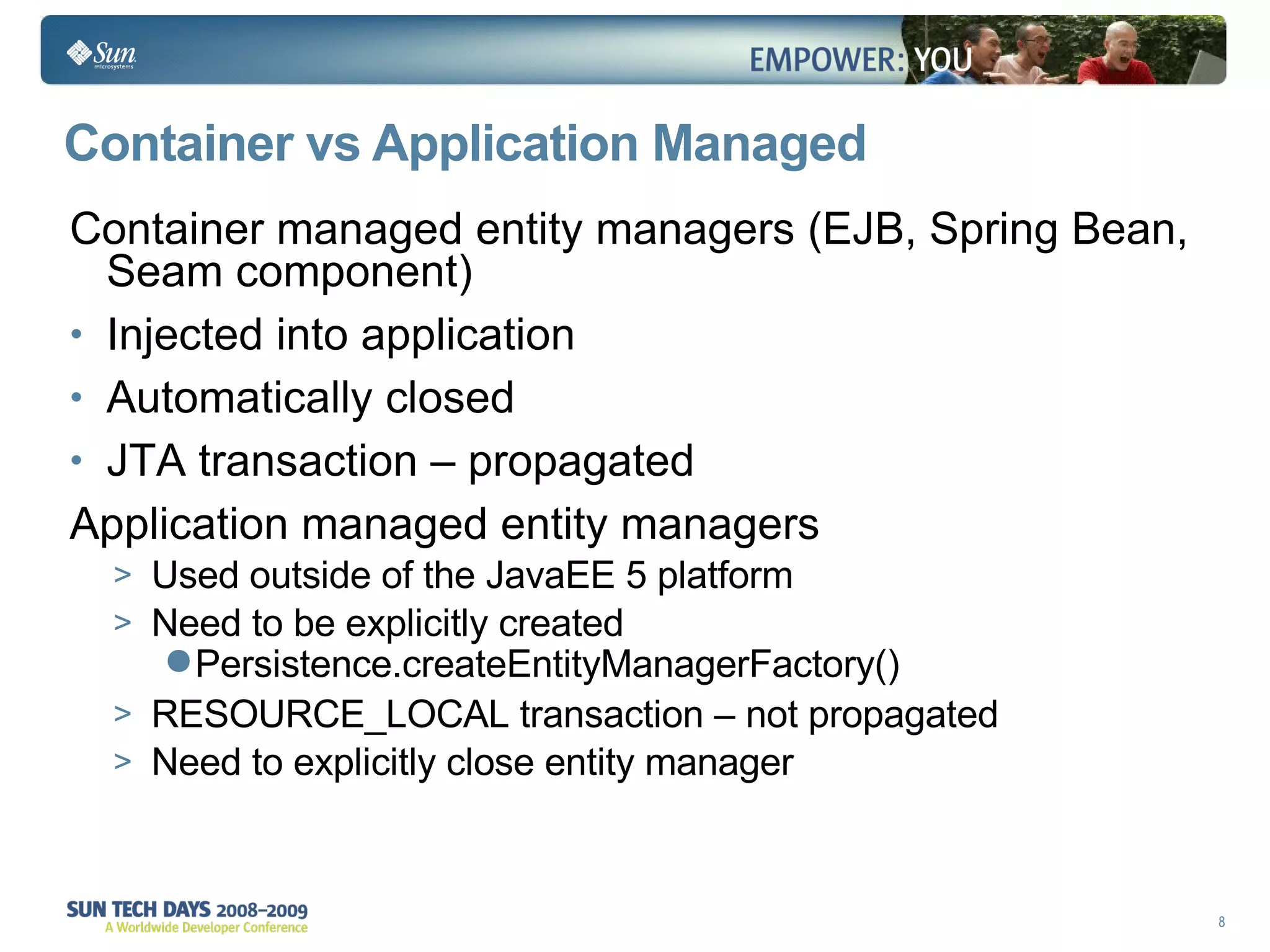
Container vs Application Managed  Container managed entity managers (EJB, Spring Bean, Seam component) Injected into application  Automatically closed  JTA transaction – propagated Application managed entity managers Used outside of the JavaEE 5 platform Need to be explicitly created Persistence.createEntityManagerFactory() RESOURCE_LOCAL transaction – not propagated Need to explicitly close entity manager
Agenda Entity Manager Persistence Context Entities Queries Transaction
Persistence  Context EntityManager persist() remove() refresh() merge() find() createQuery() createNamedQuery() contains() flush() Persistence Context  set of entities managed by  Entity Manager Persistence context acts as a first level  cache  for entities Two types of persistence context Transaction scoped Extended scoped persistence context
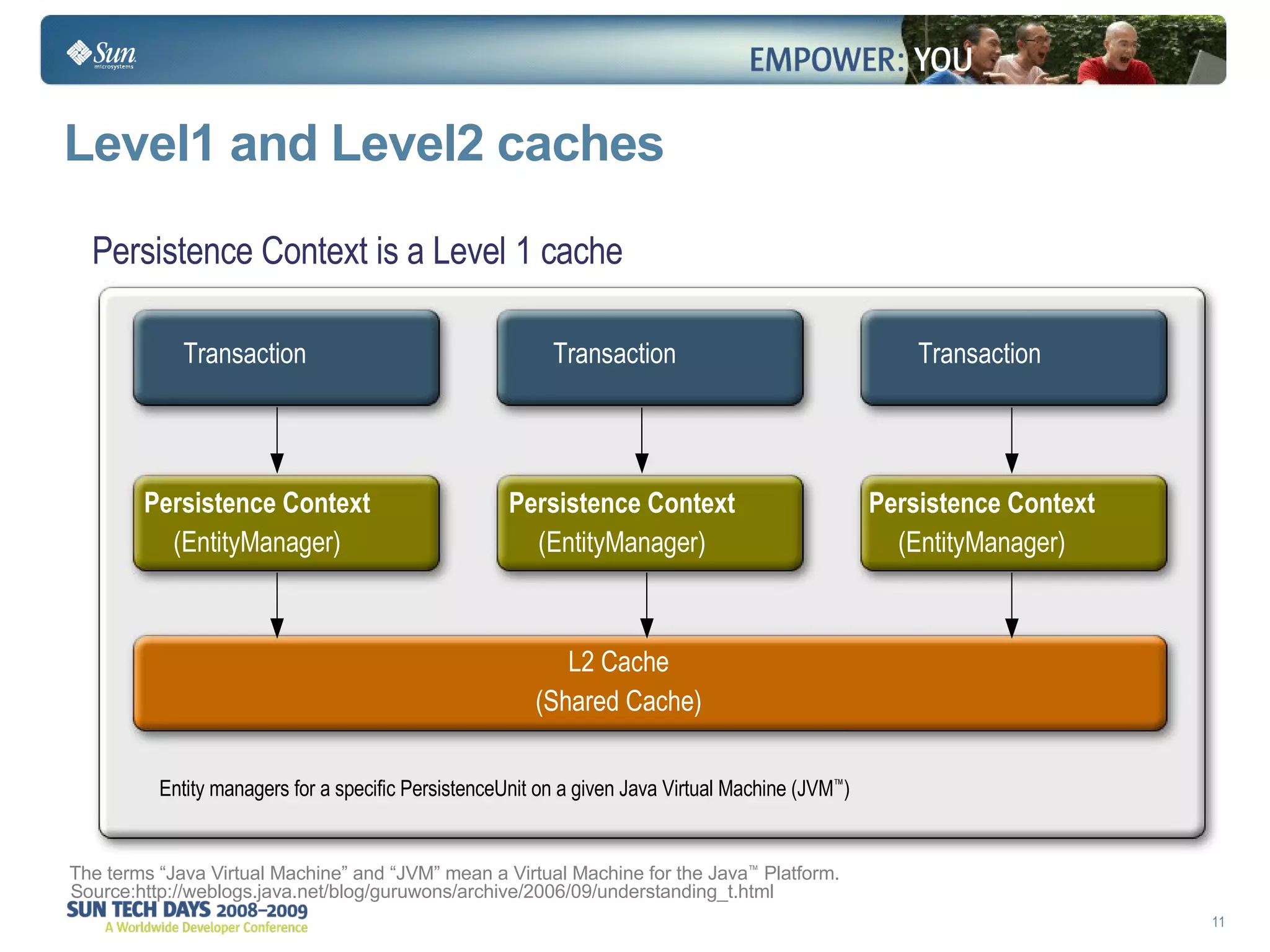
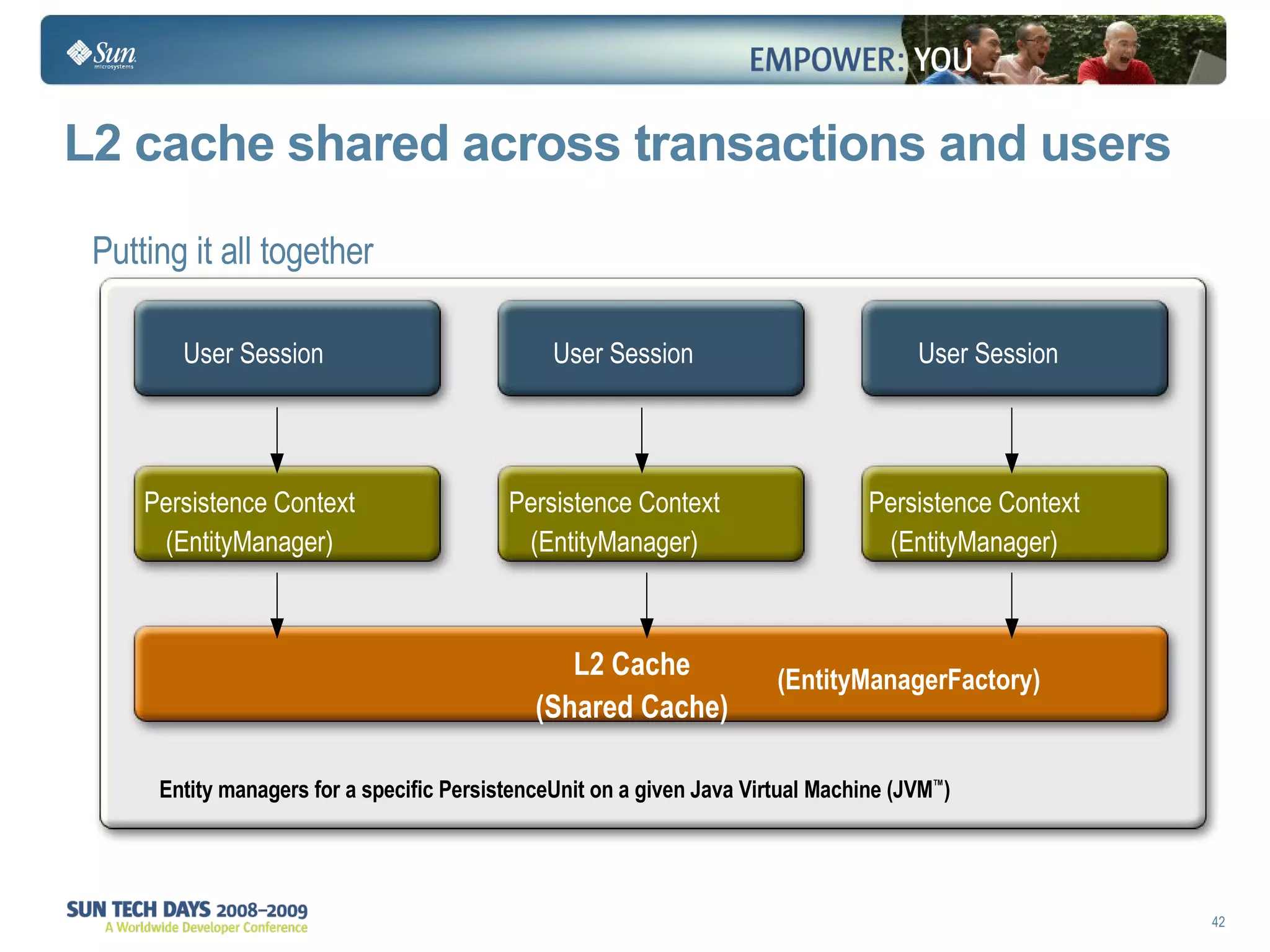
Level1 and Level2 caches The terms “Java Virtual Machine” and “JVM” mean a Virtual Machine for the Java ™  Platform. Source:http://weblogs.java.net/blog/guruwons/archive/2006/09/understanding_t.html Persistence Context is a Level 1 cache Transaction  Transaction  Transaction  Persistence Context (EntityManager) Persistence Context (EntityManager) Persistence Context (EntityManager) L2 Cache (Shared Cache) Entity managers for a specific PersistenceUnit on a given Java Virtual Machine (JVM ™ )
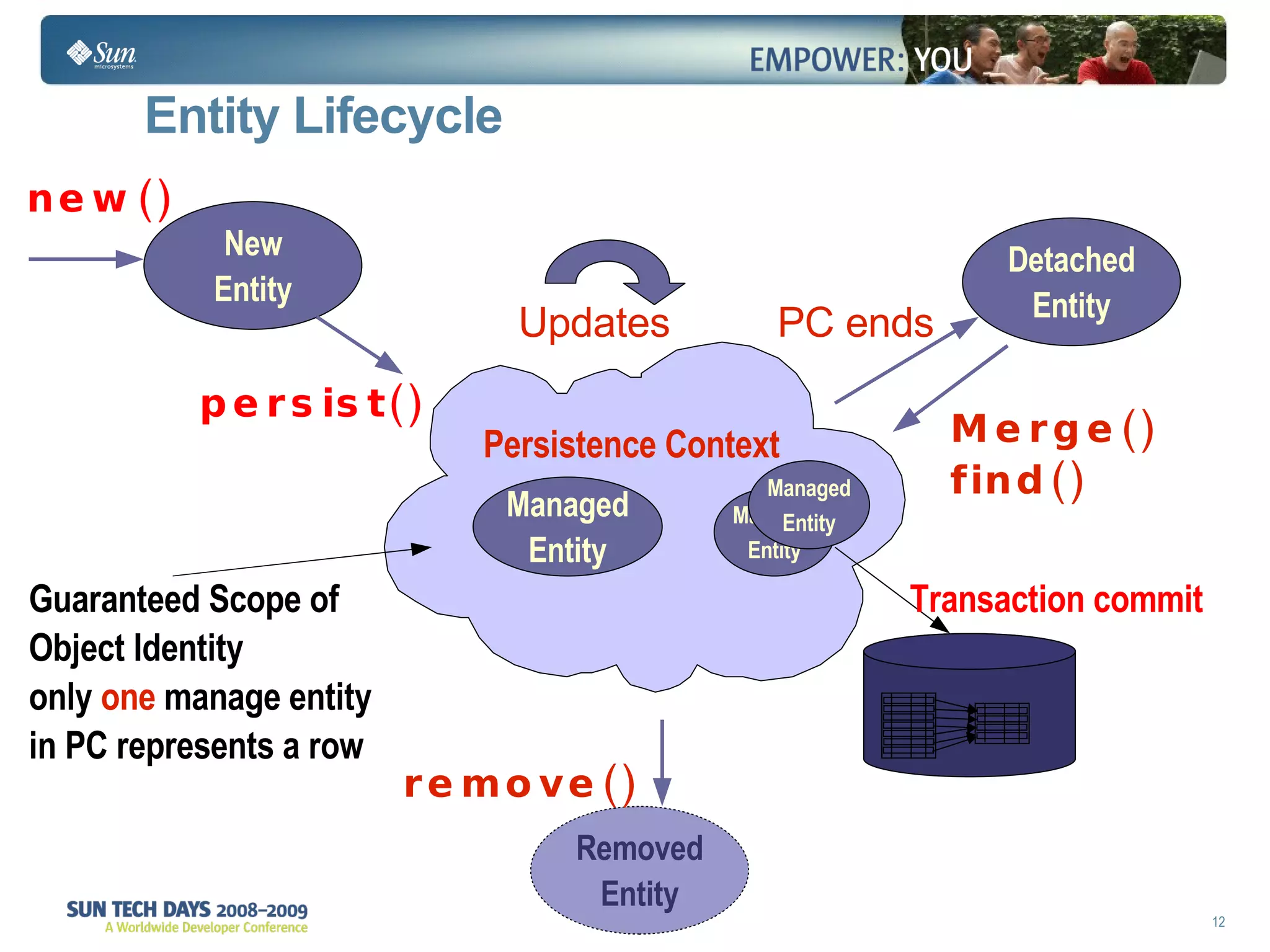
Persistence Context Transaction commit new() persist() Updates remove() Merge() find() PC ends Entity Lifecycle  Guaranteed Scope of  Object Identity  only  one  manage entity  in PC represents a row
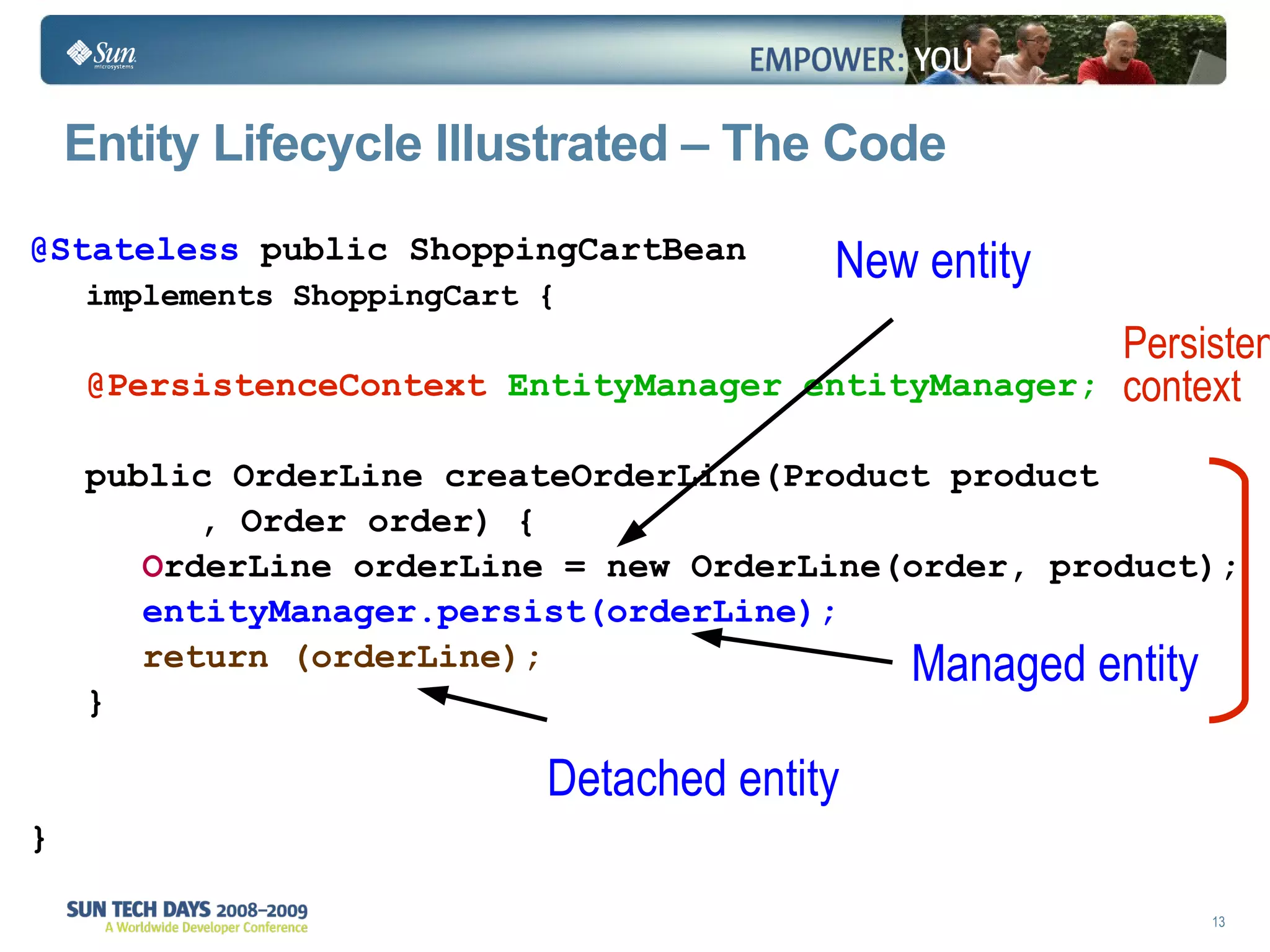
Entity Lifecycle Illustrated – The Code @Stateless  public ShoppingCartBean implements ShoppingCart { @PersistenceContext   EntityManager entityManager; public OrderLine createOrderLine(Product product , Order order) { O rderLine orderLine = new OrderLine(order, product); entityManager.persist(orderLine); return (orderLine); } } New entity Managed entity Detached entity Persistence context
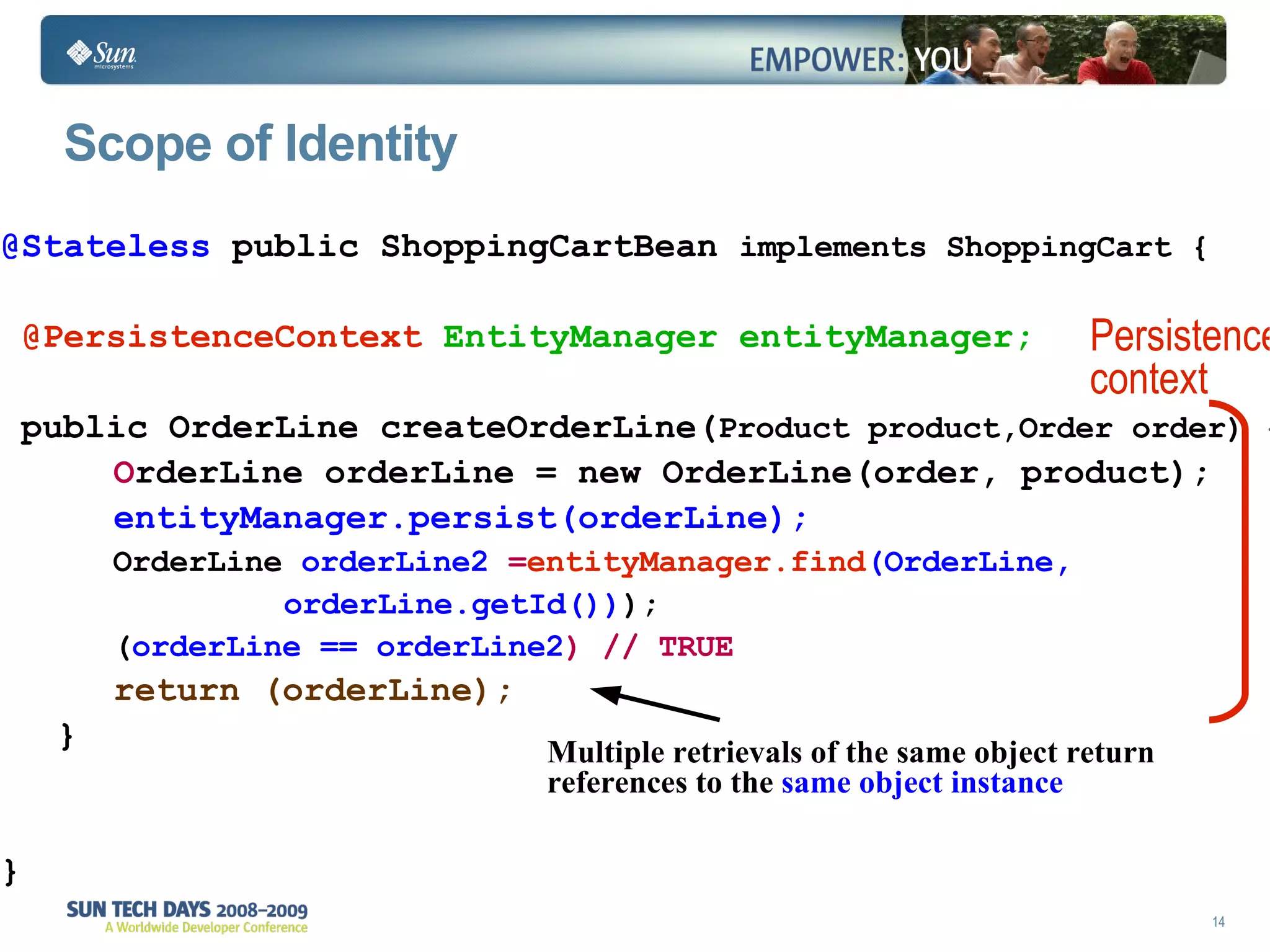
Scope of Identity @Stateless  public ShoppingCartBean  implements ShoppingCart { @PersistenceContext   EntityManager entityManager; public OrderLine createOrderLine( Product product,Order order) { O rderLine orderLine = new OrderLine(order, product); entityManager.persist(orderLine); OrderLine  orderLine2  = entityManager.find (OrderLine, orderLine.getId()) ); ( orderLine == orderLine2 ) // TRUE return (orderLine); } } Persistence context Multiple retrievals of the same object return references to the  same object instance
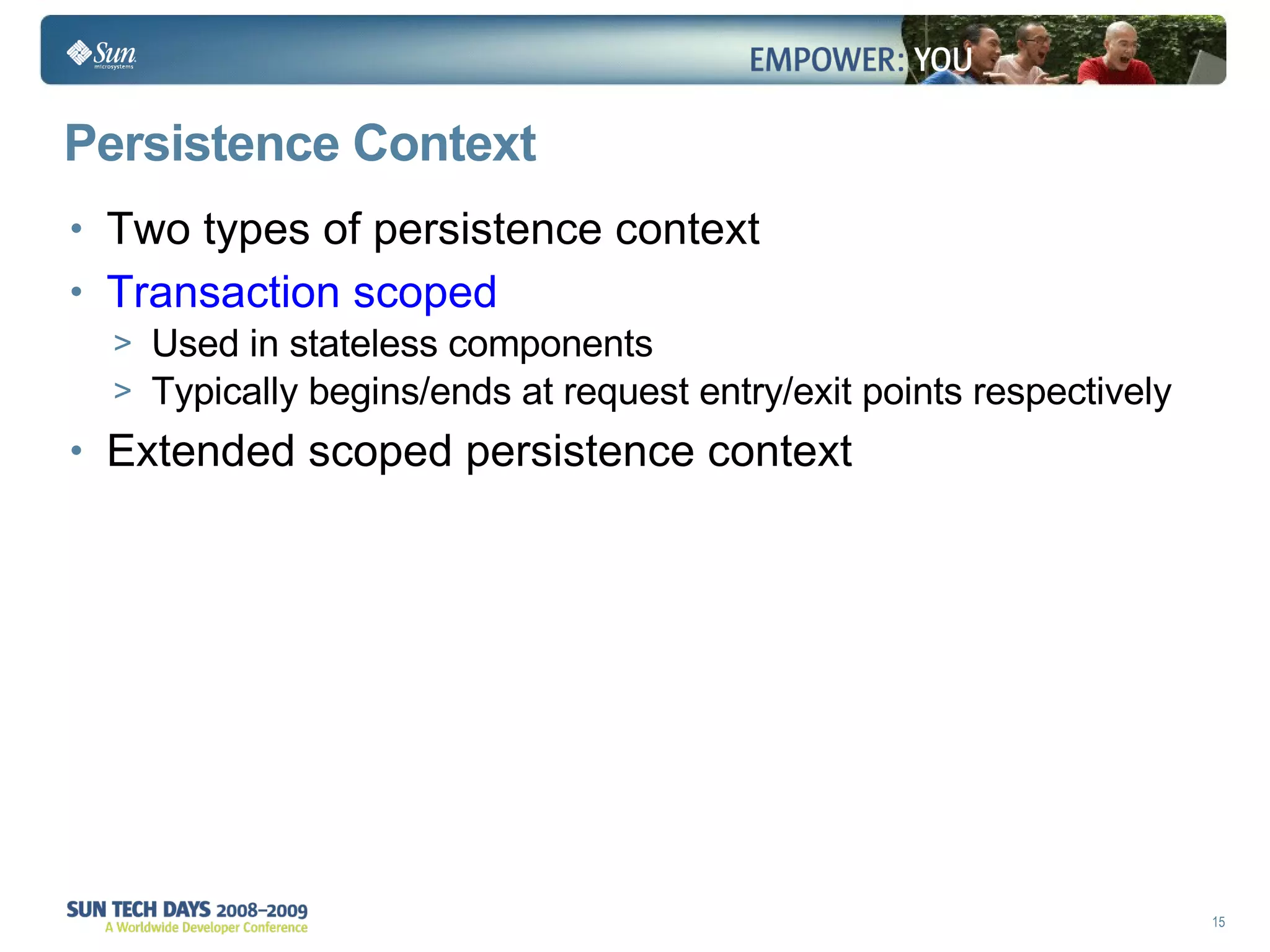
Persistence Context Two types of persistence context Transaction scoped Used in stateless components Typically begins/ends at request entry/exit points respectively Extended scoped persistence context
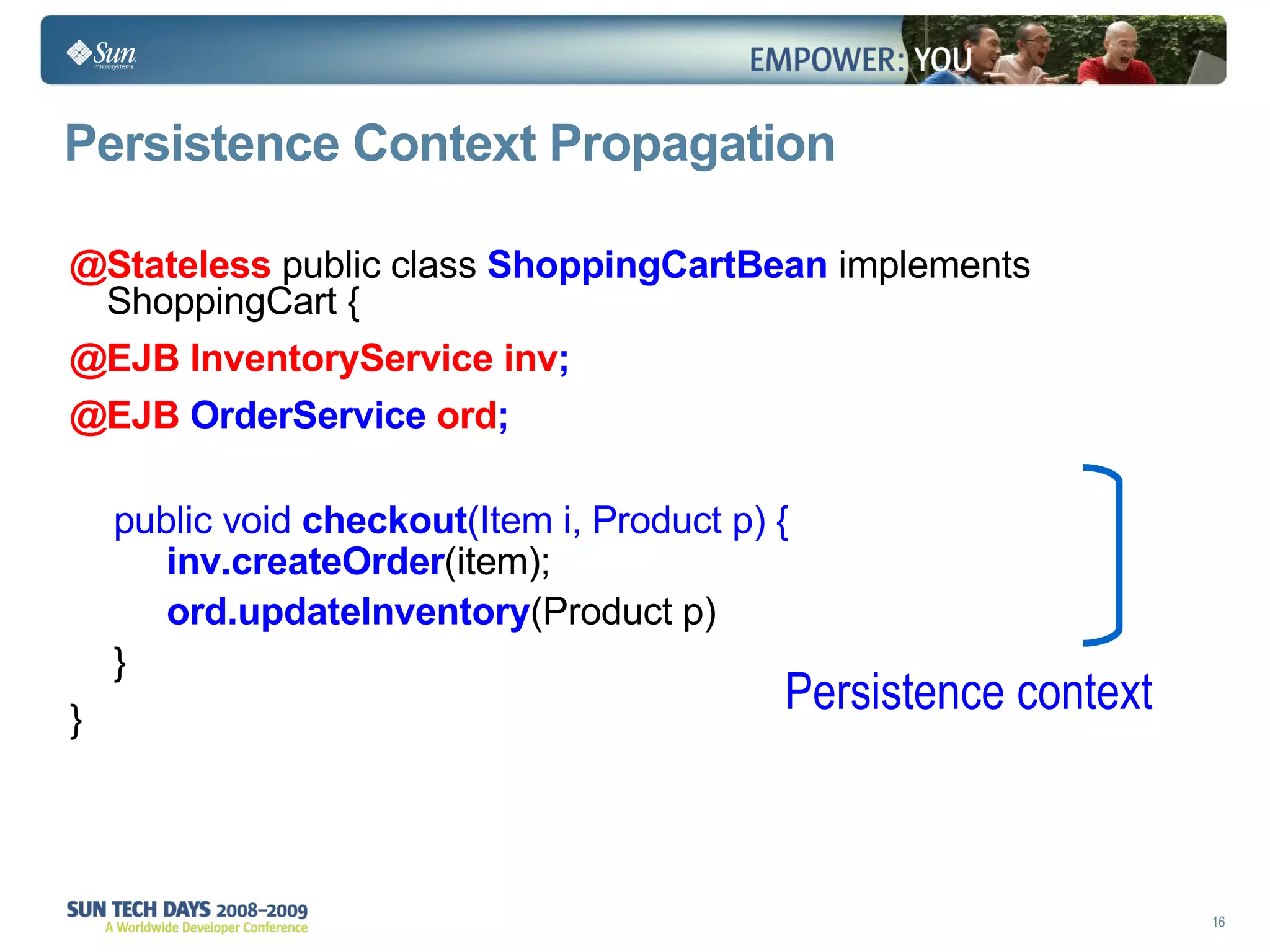
Persistence Context Propagation @Stateless   public class  ShoppingCartBean  implements ShoppingCart { @EJB InventoryService inv ; @EJB  OrderService  ord ; public void  checkout (Item i, Product p) { inv.createOrder (item);  ord.updateInventory (Product p) } } Persistence context
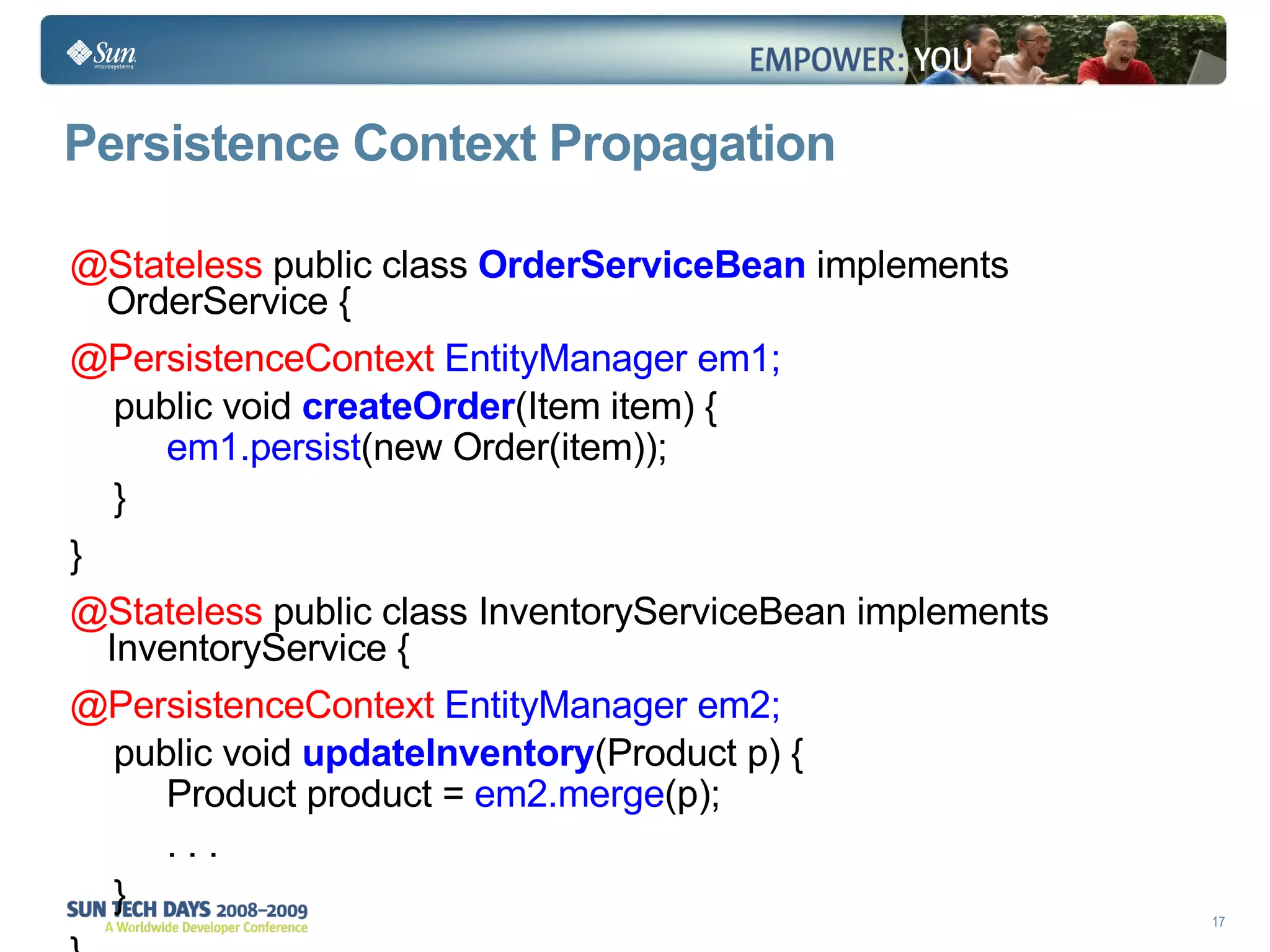
Persistence Context Propagation @Stateless  public class  OrderServiceBean  implements OrderService { @PersistenceContext   EntityManager em1; public void  createOrder (Item item) { em1.persist (new Order(item)); } } @Stateless  public class InventoryServiceBean implements InventoryService { @PersistenceContext   EntityManager em2; public void  updateInventory (Product p) { Product product =  em2.merge (p); . . . } }
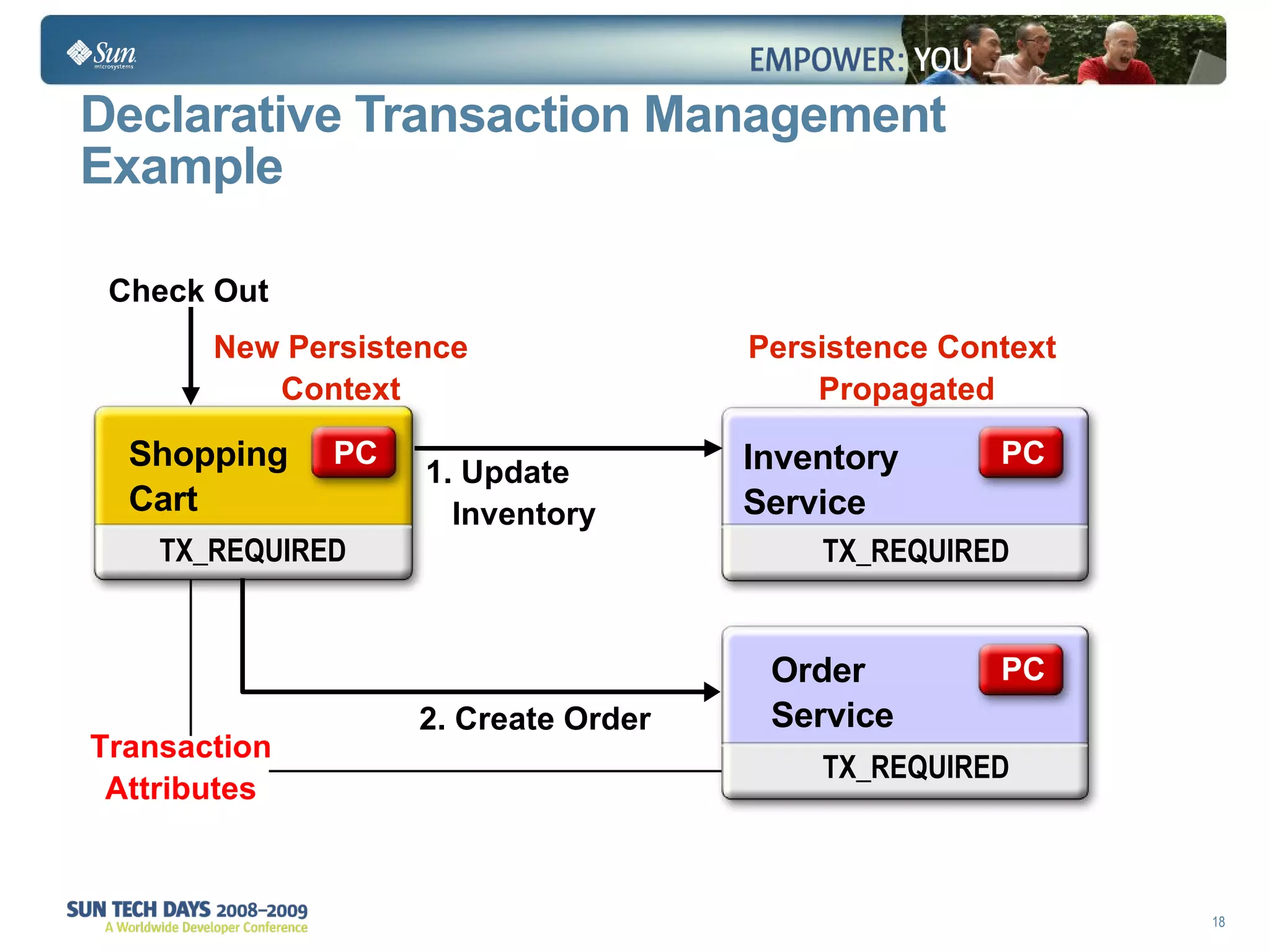
Declarative Transaction Management Example TX_REQUIRED TX_REQUIRED TX_REQUIRED PC PC PC Shopping Cart Inventory Service Order Service Check Out 1. Update Inventory New Persistence Context Persistence Context  Propagated Transaction Attributes 2. Create Order
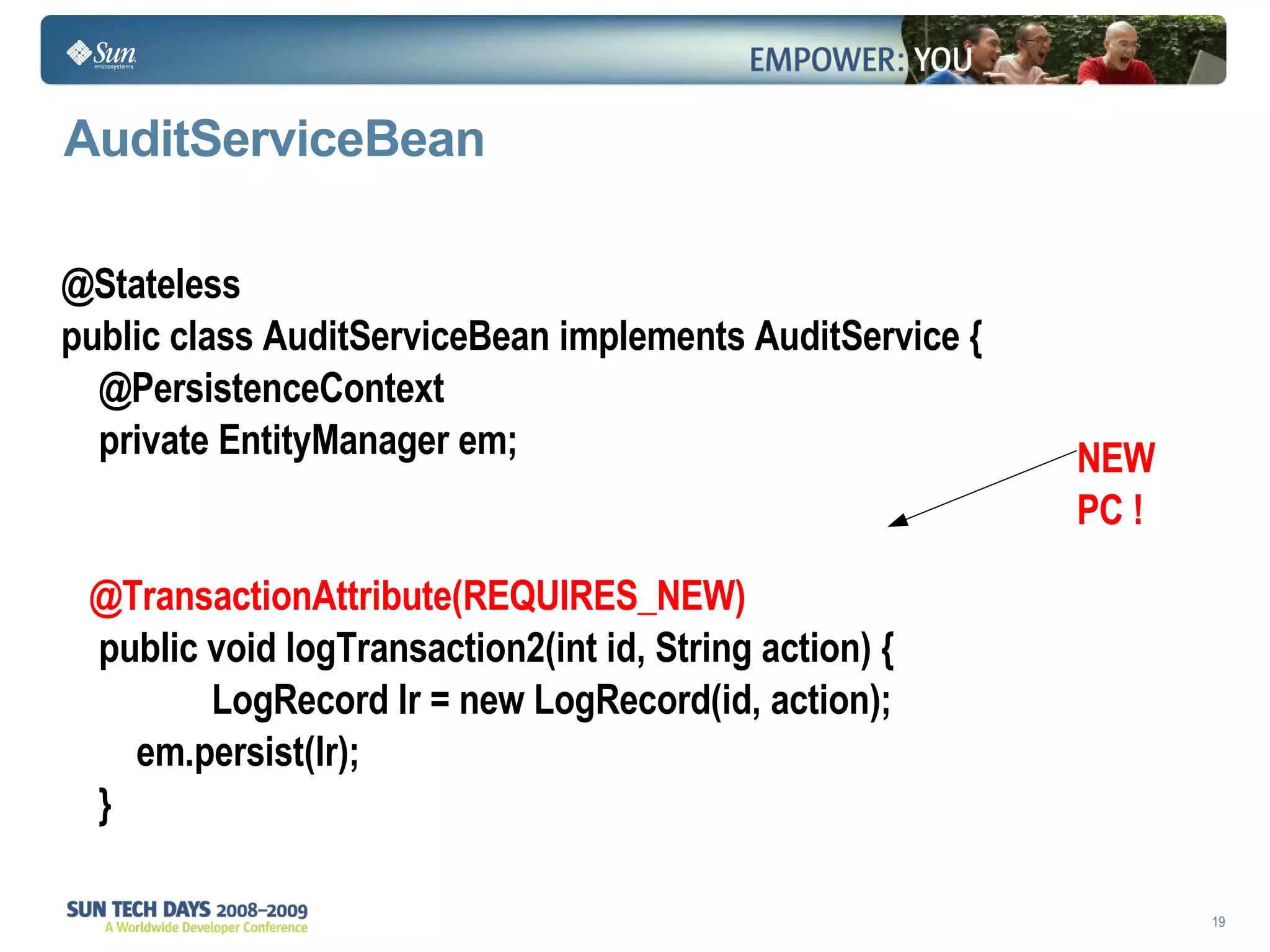
AuditServiceBean  @Stateless public class AuditServiceBean implements AuditService { @PersistenceContext private EntityManager em; @TransactionAttribute(REQUIRES_NEW) public void logTransaction2(int id, String action) { LogRecord lr = new LogRecord(id, action); em.persist(lr); } NEW PC !
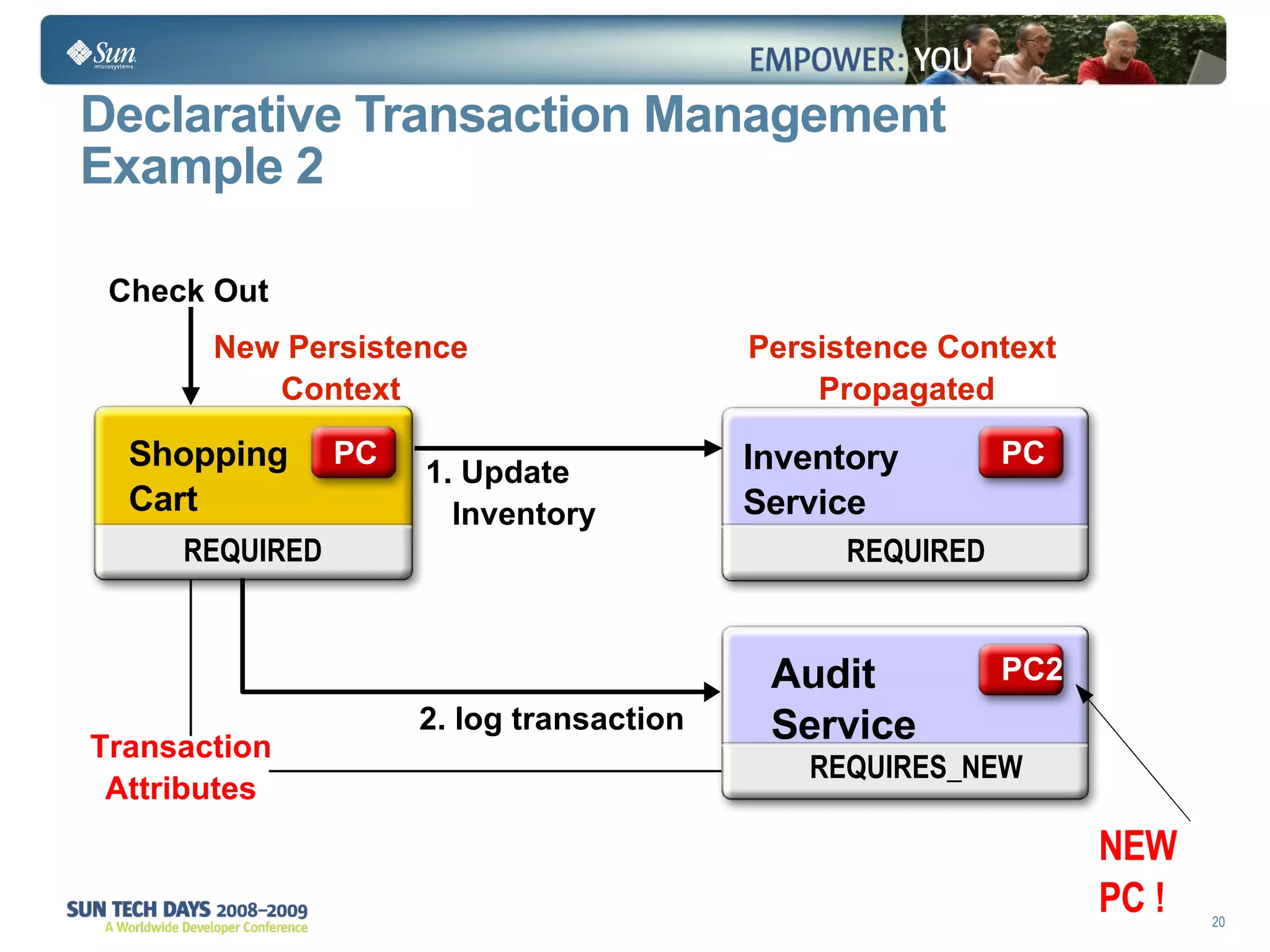
Declarative Transaction Management Example 2 REQUIRED REQUIRED REQUIRES_NEW PC PC PC2 Shopping Cart Inventory Service Audit Service Check Out 1. Update Inventory New Persistence Context Persistence Context  Propagated Transaction Attributes 2. log transaction  NEW PC !
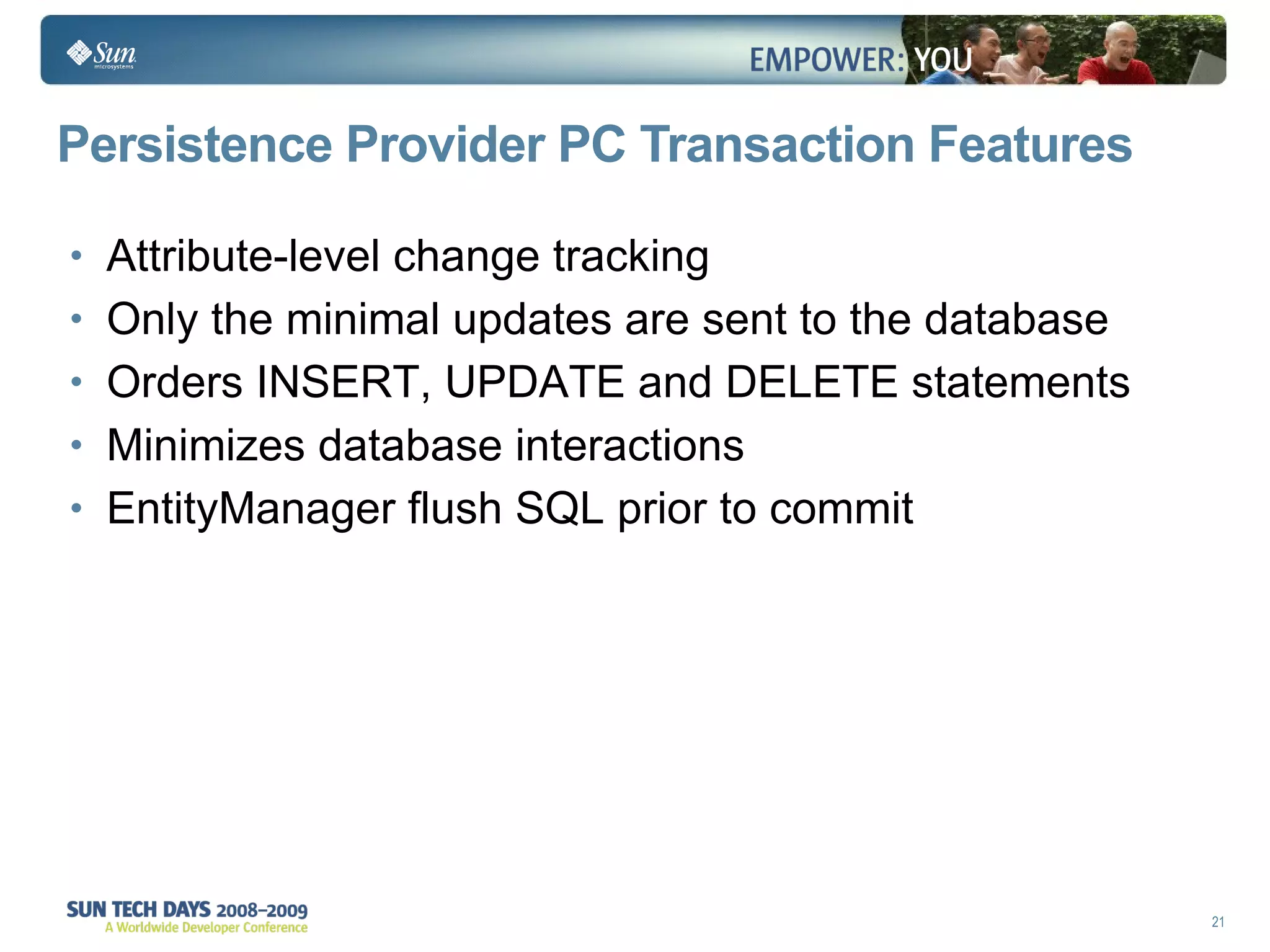
Persistence Provider PC Transaction Features Attribute-level change tracking Only the minimal updates are sent to the database Orders INSERT, UPDATE and DELETE statements Minimizes database interactions EntityManager flush SQL prior to commit
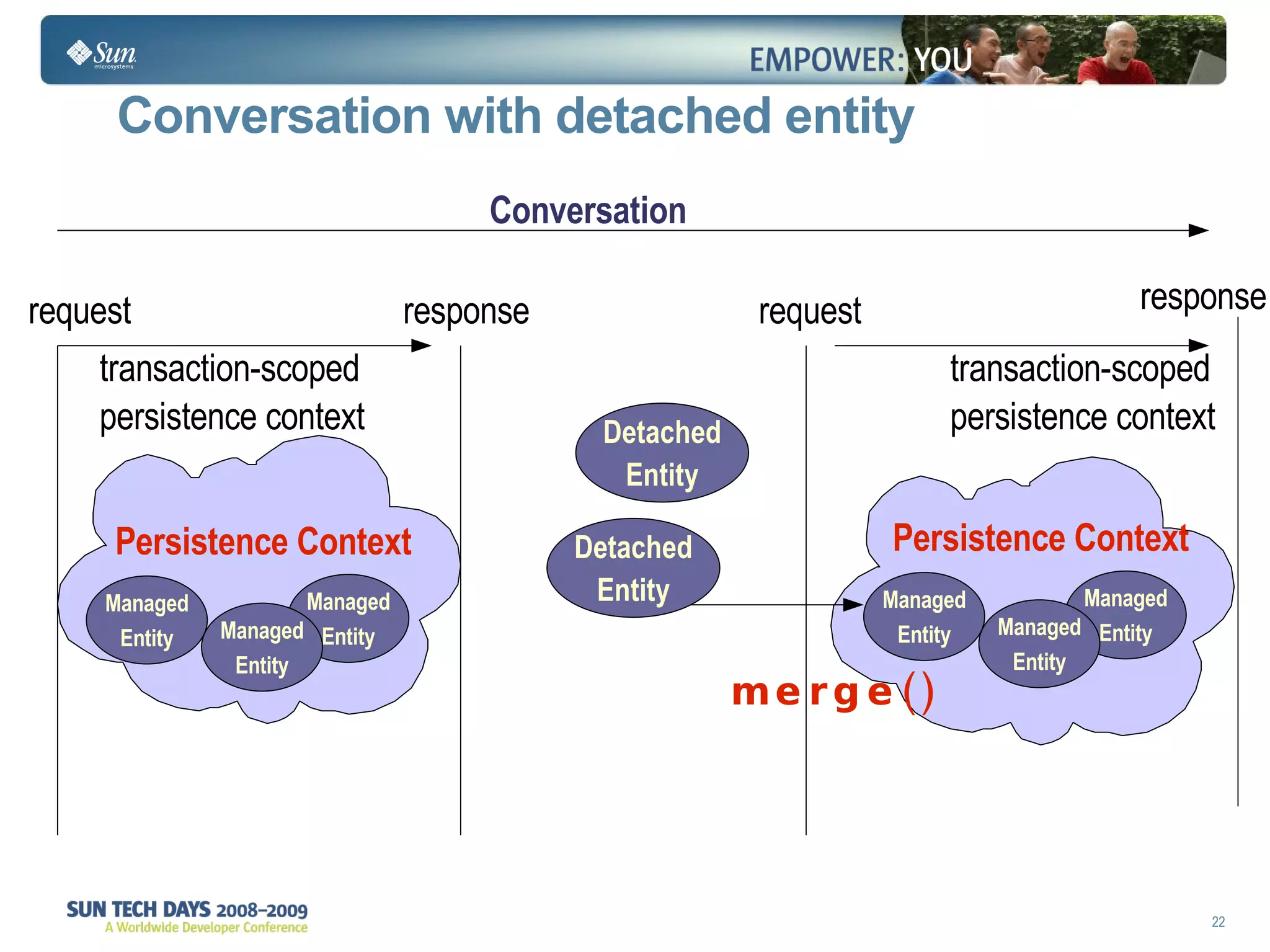
Persistence Context Conversation with detached entity  Persistence Context merge() transaction-scoped  persistence context request response request response Conversation transaction-scoped  persistence context
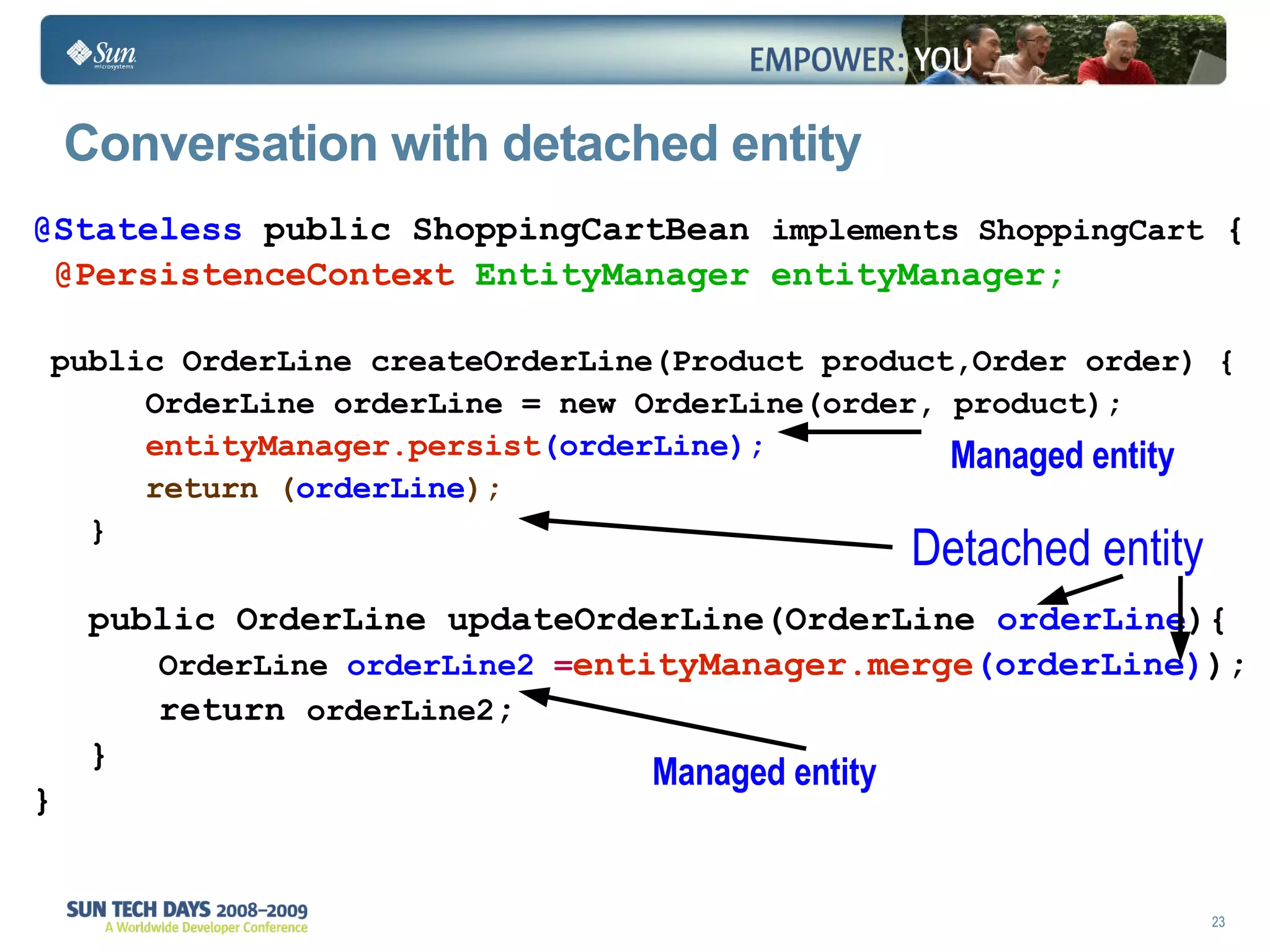
Conversation with detached entity @Stateless  public ShoppingCartBean  implements ShoppingCart  { @PersistenceContext   EntityManager entityManager; public OrderLine createOrderLine(Product product,Order order) { OrderLine orderLine = new OrderLine(order, product); entityManager.persist (orderLine); return ( orderLine ); } public OrderLine updateOrderLine(OrderLine  orderLine ){ OrderLine  orderLine2  = entityManager.merge (orderLine) ); return  orderLine2 ; } } Managed entity Detached entity Managed entity
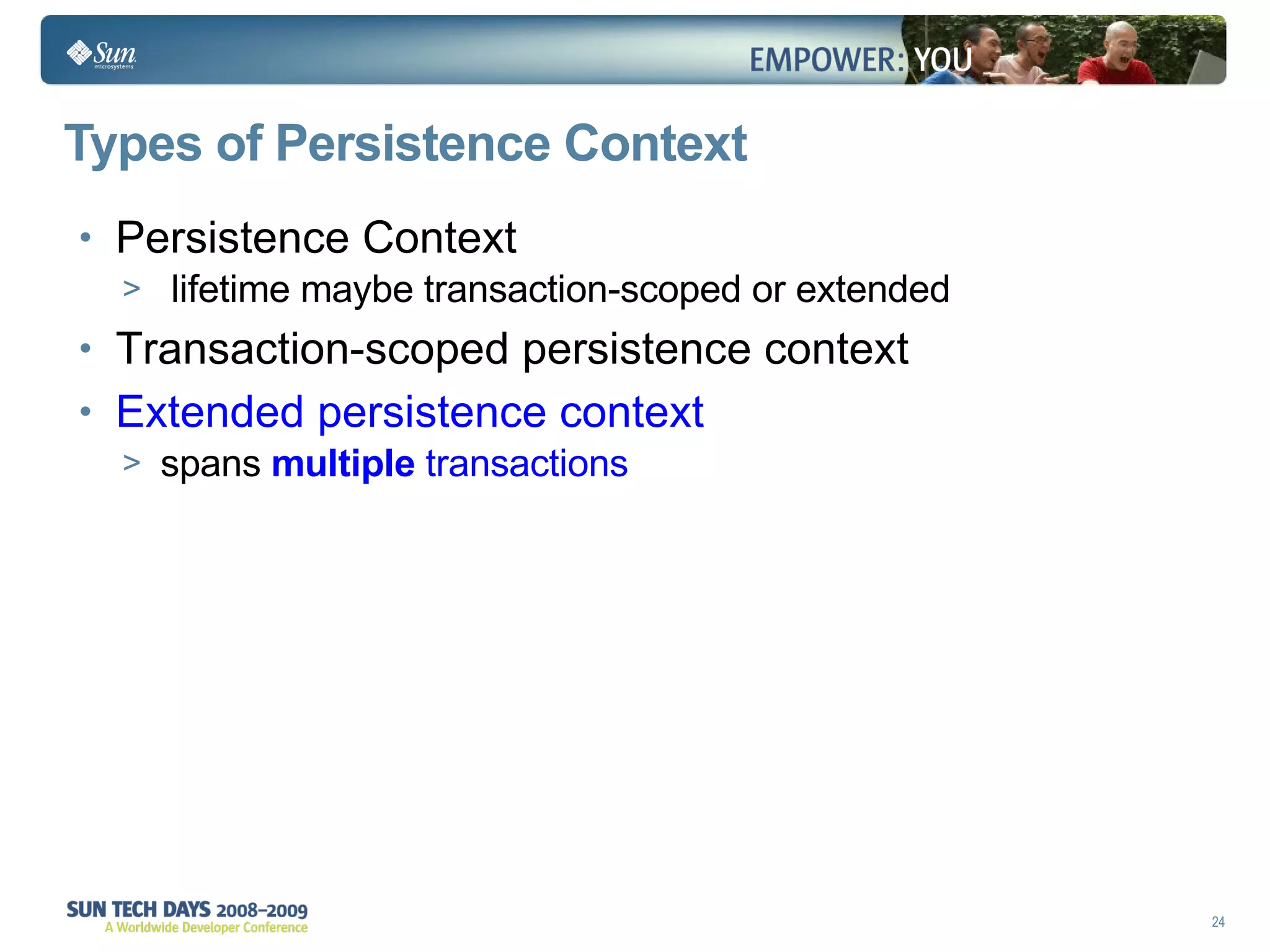
Types of Persistence Context Persistence Context lifetime maybe transaction-scoped or extended Transaction-scoped persistence context Extended persistence context spans   multiple  transactions
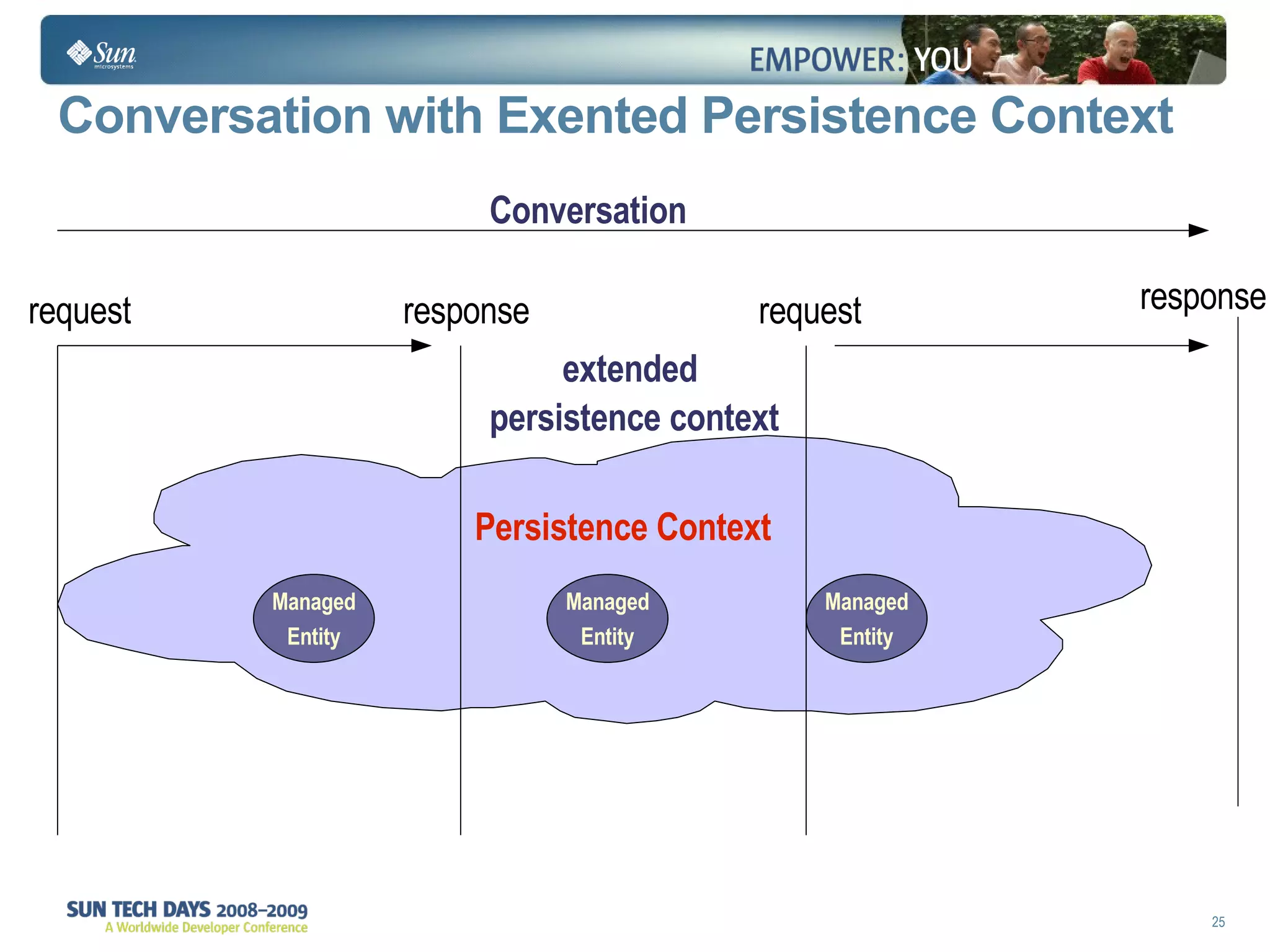
Persistence Context Conversation with Exented Persistence Context request response request response Conversation extended  persistence context
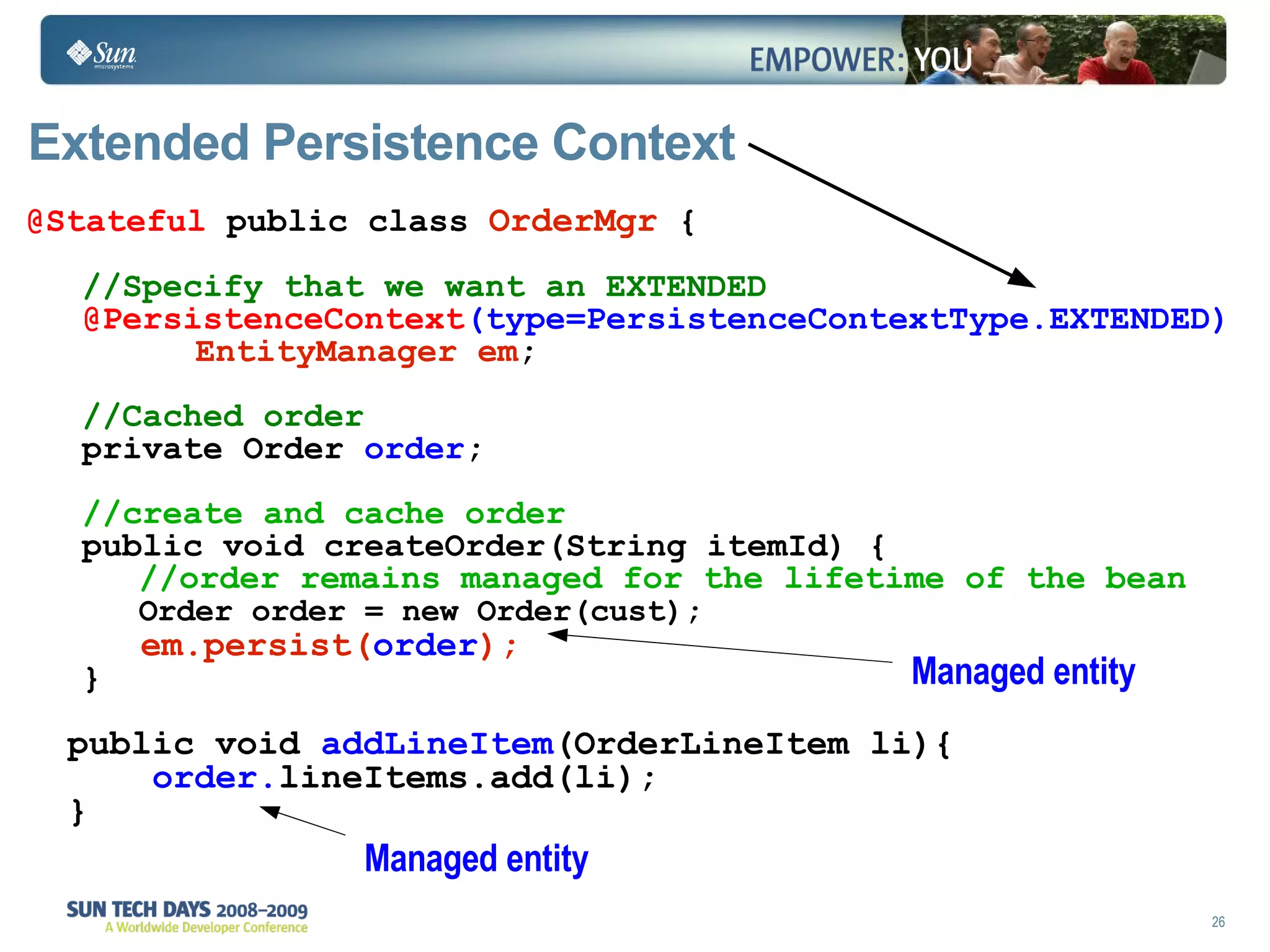
Extended Persistence Context @Stateful  public class  OrderMgr  { //Specify that we want an EXTENDED   @PersistenceContext (type=PersistenceContextType.EXTENDED) EntityManager em ; //Cached order private Order  order ; //create and cache order public void createOrder(String itemId) { //order remains managed for the lifetime of the bean Order order = new Order(cust); em.persist( order ); } public void  addLineItem (OrderLineItem li){ order. lineItems.add(li); } Managed entity Managed entity
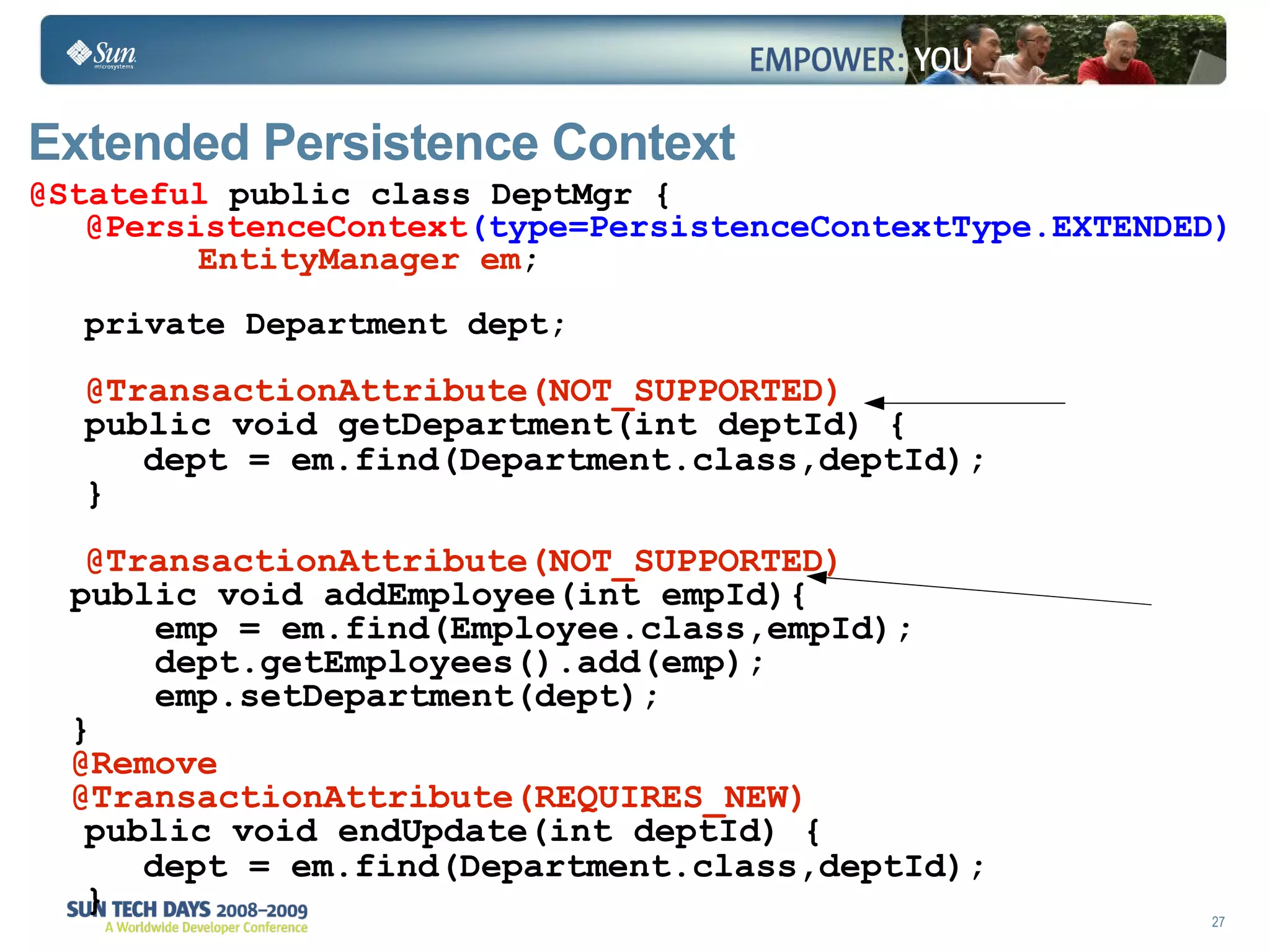
Extended Persistence Context @Stateful  public class DeptMgr { @PersistenceContext (type=PersistenceContextType.EXTENDED) EntityManager em ; private Department dept; @TransactionAttribute(NOT_SUPPORTED) public void getDepartment(int deptId) { dept  = em.find(Department.class,deptId); } @TransactionAttribute(NOT_SUPPORTED) public void  addEmployee (int empId){ emp  = em.find(Employee.class,empId); dept.getEmployees().add(emp); emp.setDepartment(dept); } @Remove @TransactionAttribute(REQUIRES_NEW) public void endUpdate(int deptId) { dept  = em.find(Department.class,deptId); }
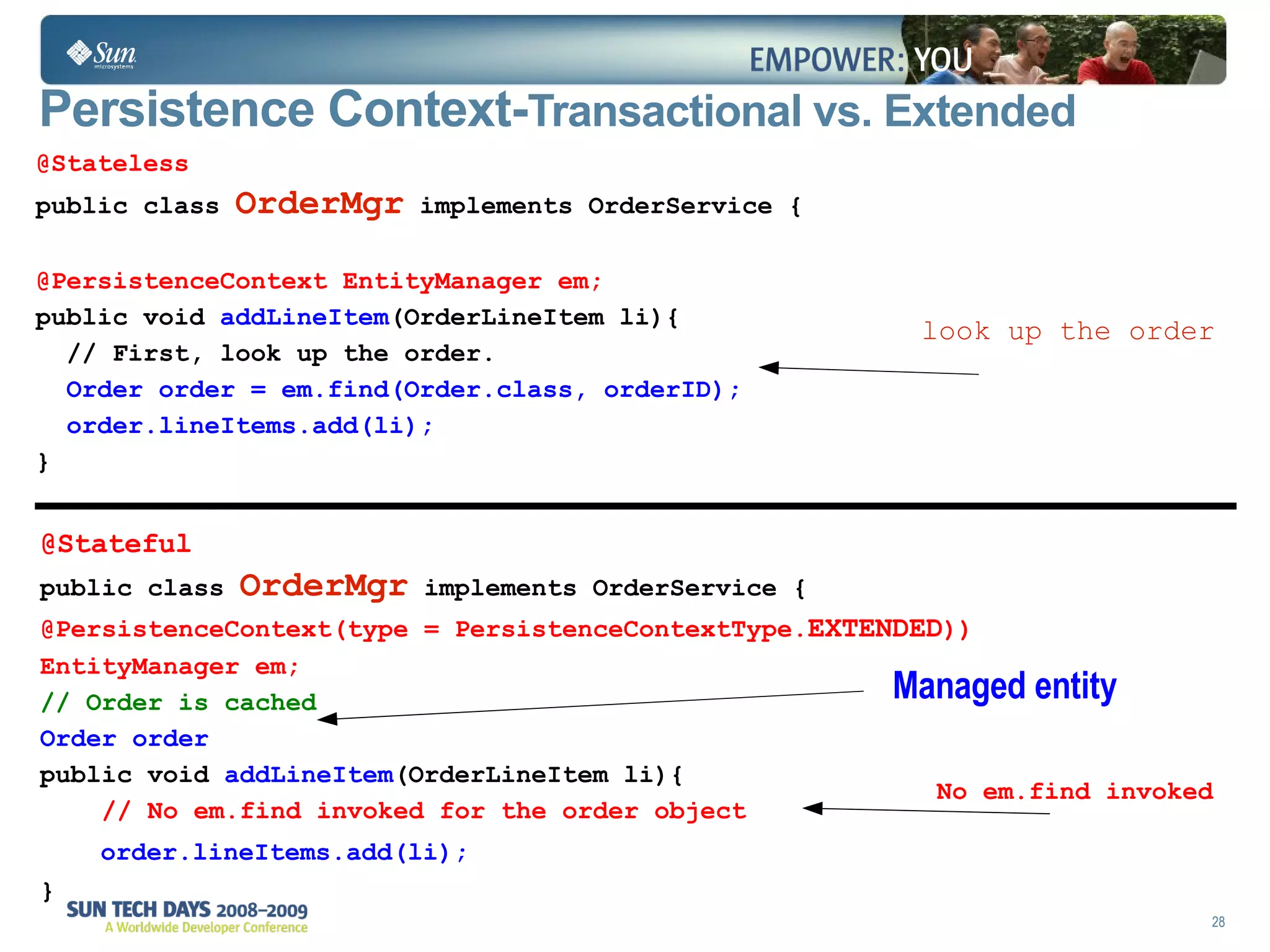
Persistence Context- Transactional vs. Extended @Stateless public class  OrderMgr  implements OrderService { @PersistenceContext EntityManager em;  public void  addLineItem (OrderLineItem li){  // First, look up the order. Order order = em.find(Order.class, orderID); order.lineItems.add(li); } @Stateful public class  OrderMgr  implements OrderService { @PersistenceContext(type = PersistenceContextType. EXTENDED )) EntityManager em;   // Order is cached Order order public void  addLineItem (OrderLineItem li){ // No em.find invoked for the order object  order.lineItems.add(li); } look up the order No em.find invoked  Managed entity
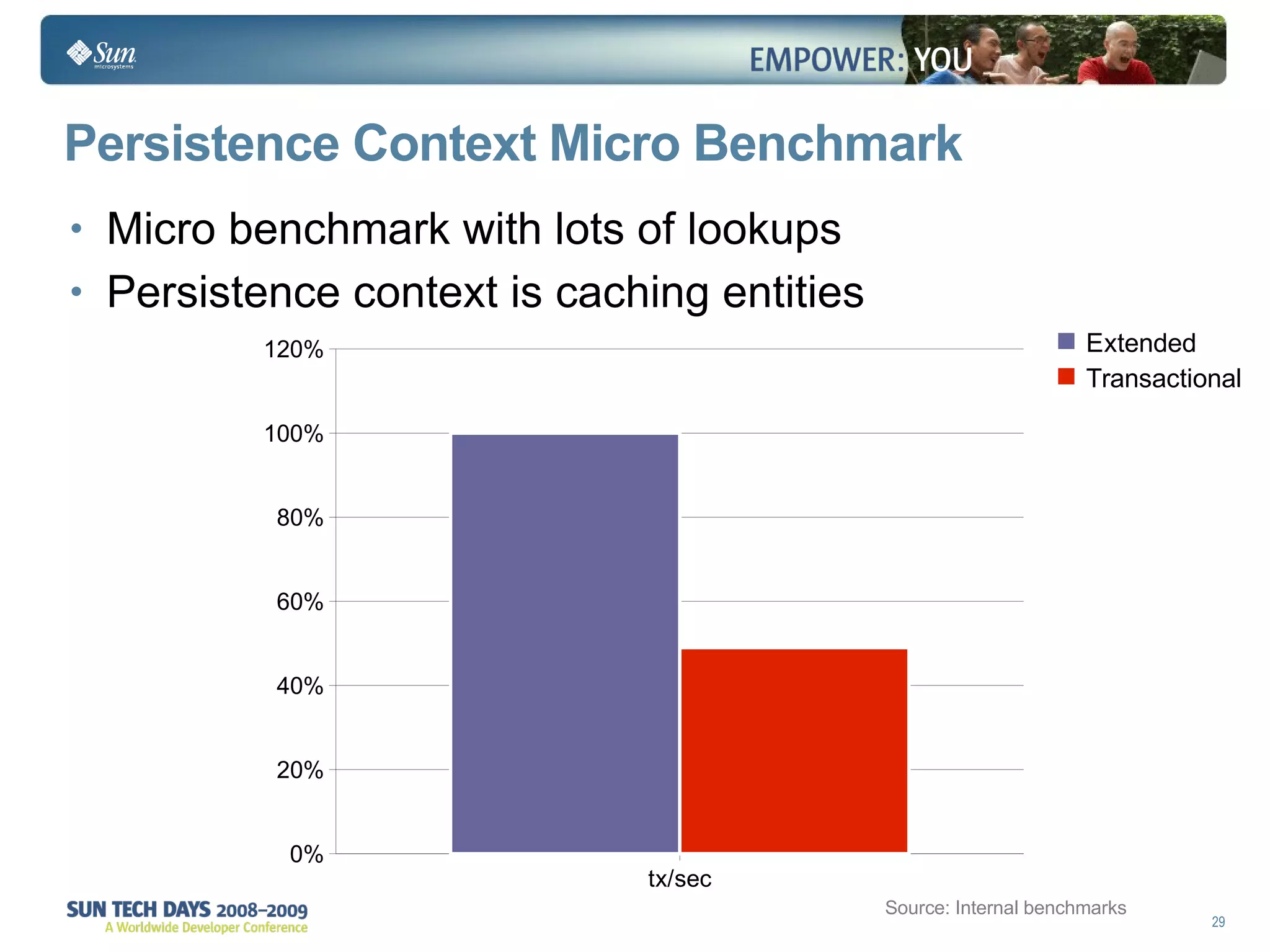
Persistence Context Micro Benchmark Micro benchmark with lots of lookups Persistence context is caching entities Source: Internal benchmarks
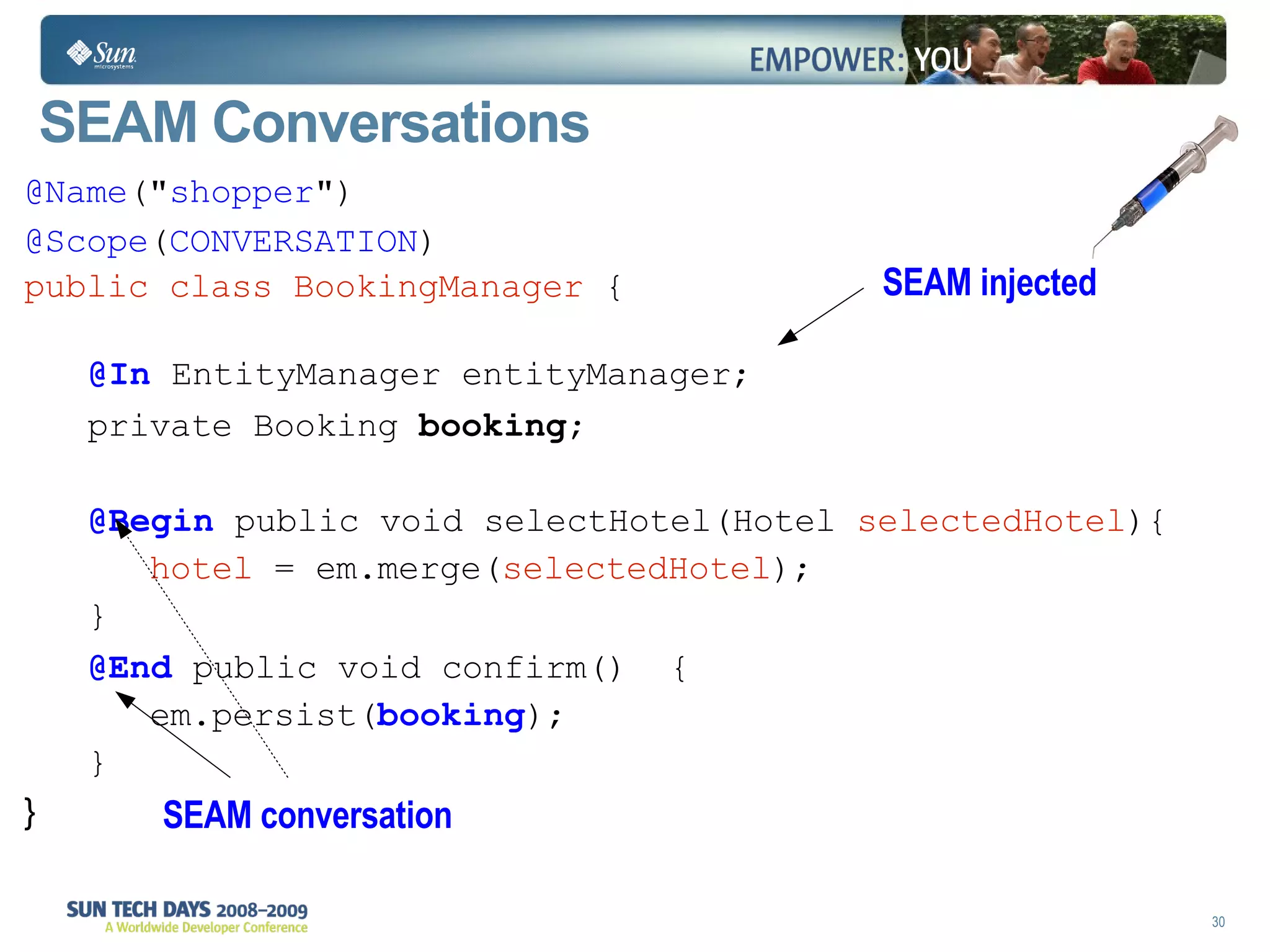
SEAM Conversations  @Name (&quot; shopper &quot;)‏ @Scope ( CONVERSATION )‏ public class BookingManager  { @In  EntityManager  entityManager ; private Booking  booking ; @Begin   public void  selectHotel(Hotel  selectedHotel ){ hotel  = em.merge( selectedHotel ); } @End   public void  confirm()  { em.persist( booking );  } } SEAM injected  SEAM conversation
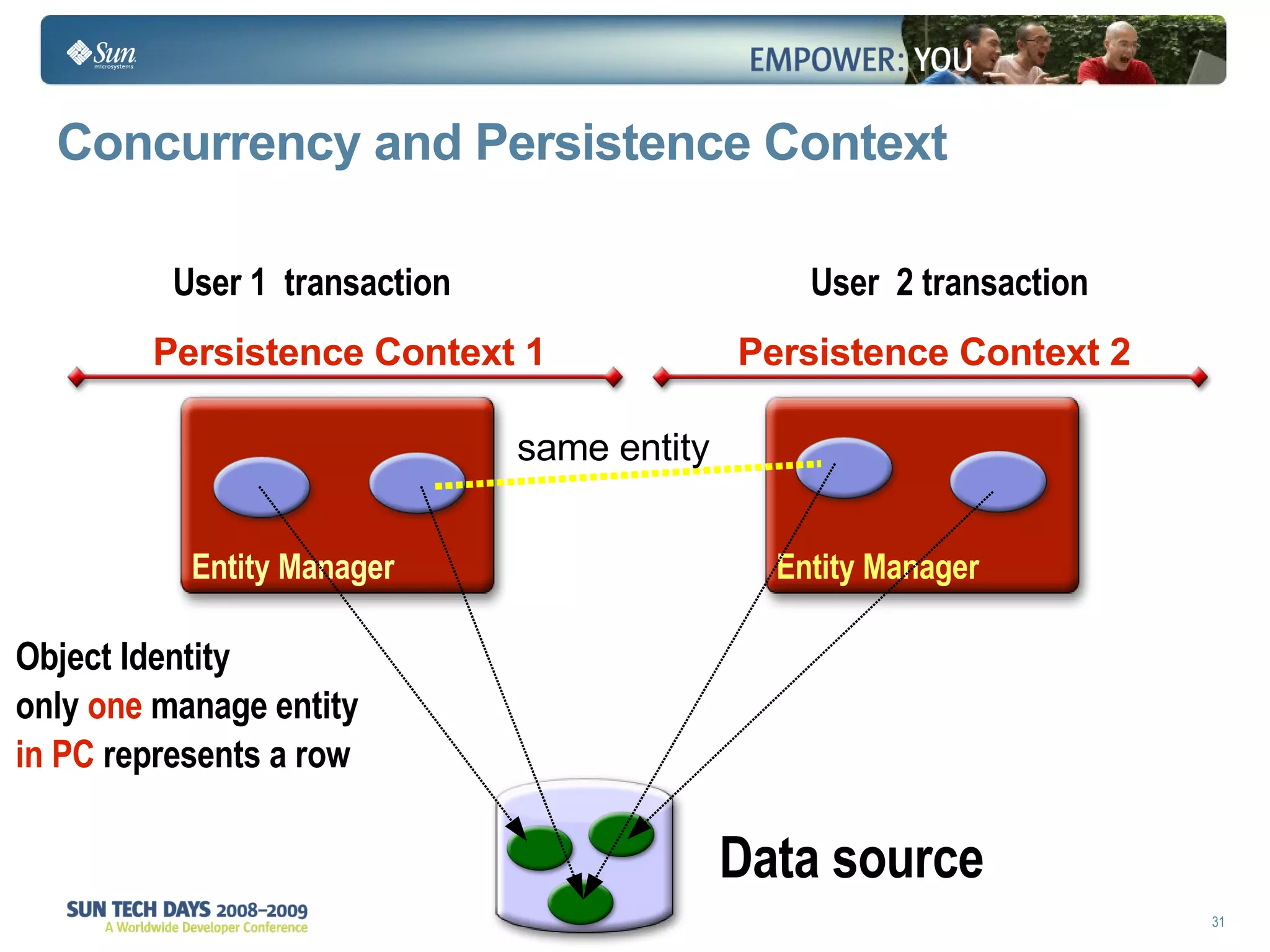
Concurrency and Persistence Context  Object Identity  only  one  manage entity  in PC  represents a row  User  2 transaction User 1  transaction Persistence Context 1 Entity Manager Persistence Context 2 Entity Manager Data source same entity
Optimistic versus Pessimistic Concurrency Optimistic Concurrency Pros—No database locks held Cons—Requires a  version attribute  in schema user or app must refresh and retry failed updates Suitable when application has   few  parallel updates Pessimistic Concurrency Lock the row when data is read in database locks the row upon a select  (SELECT . . . FOR UPDATE [NOWAIT])   Pros—Simpler application code Cons—Database locks limits concurrent access to the data =   scalability   May cause  deadlocks Not in JPA 1.0 (vendor specific),  supported  in  JPA 2.0 Suitable when application has  many  parallel updates
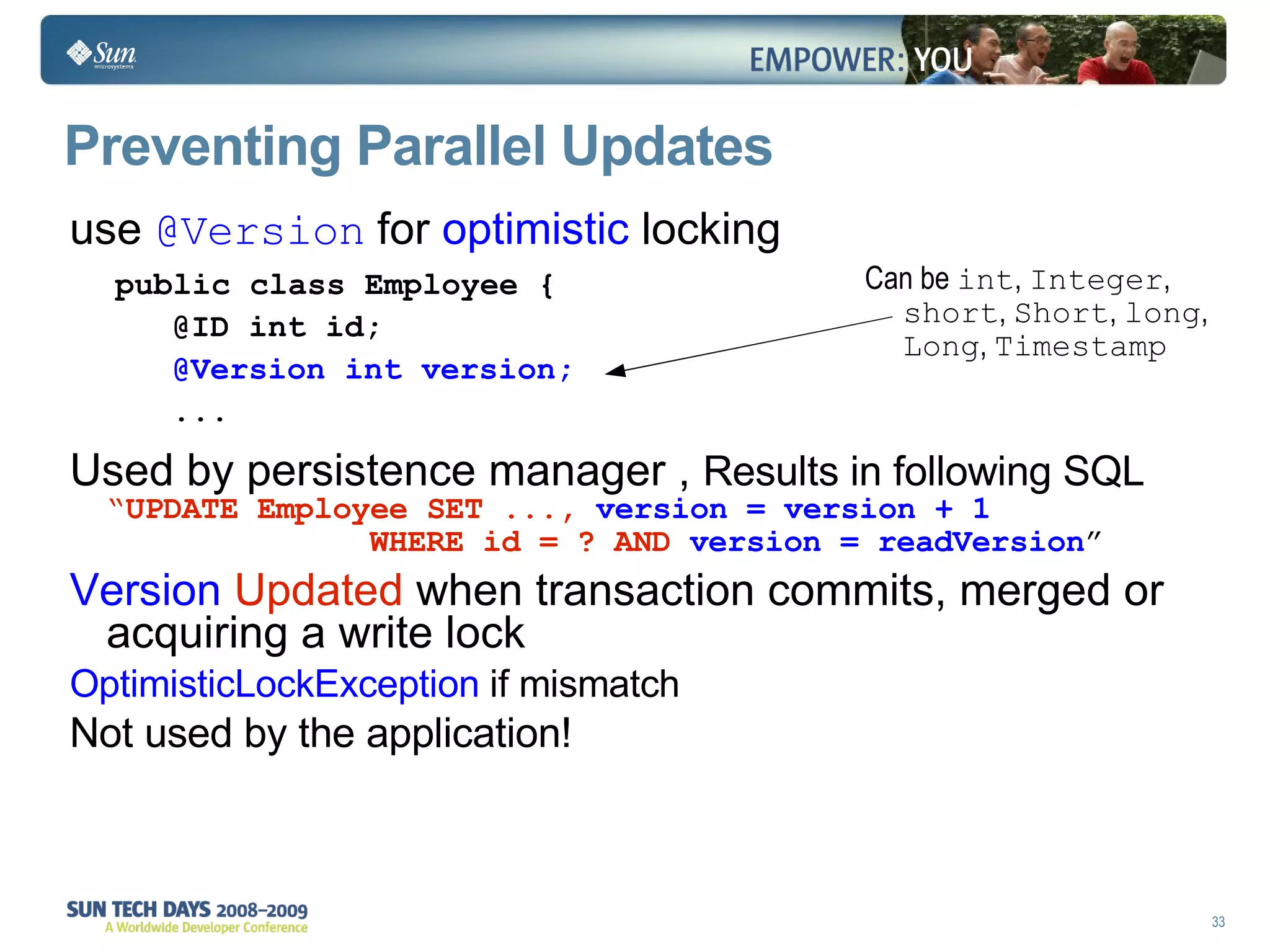
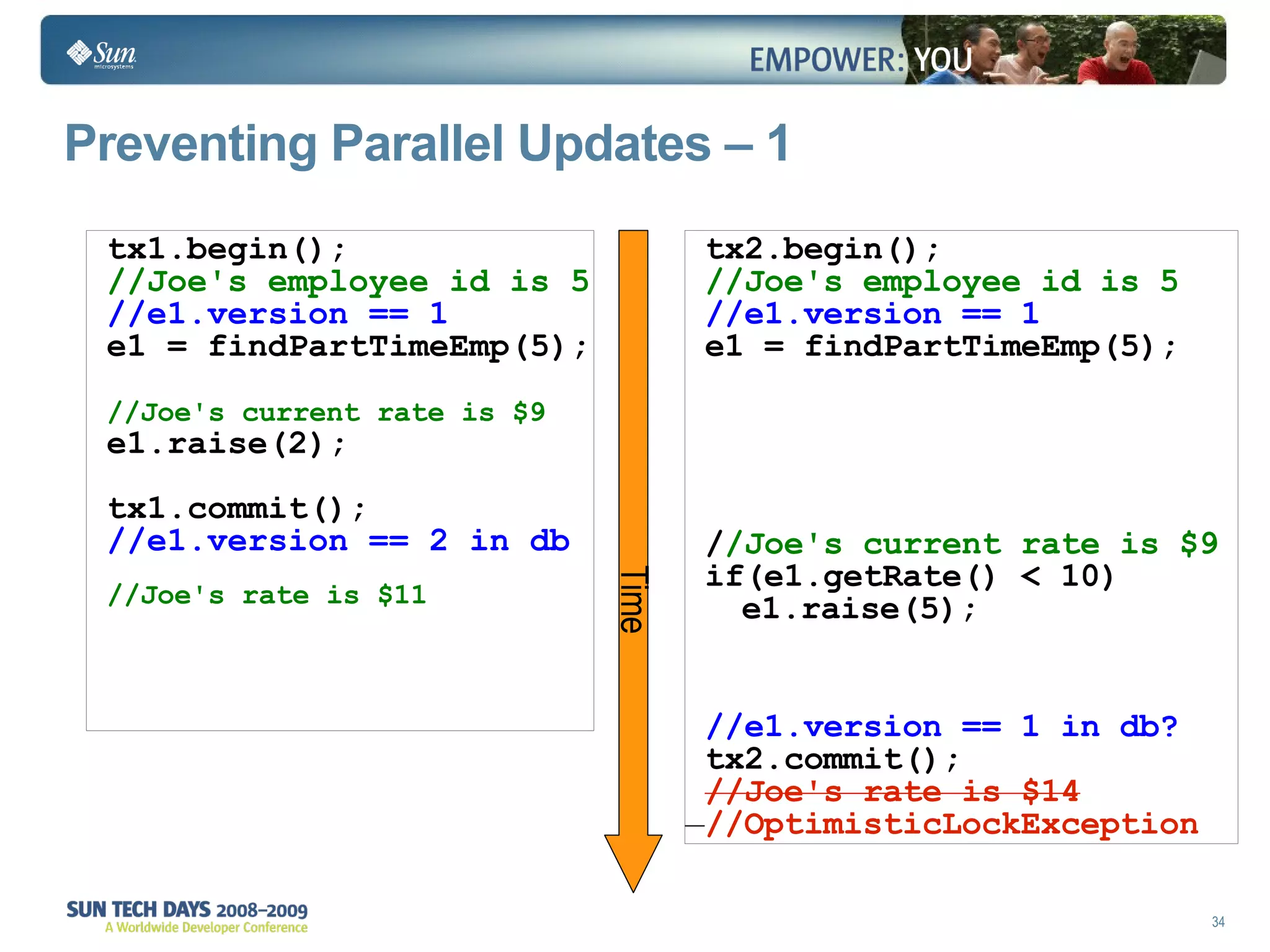
Preventing Parallel Updates use  @Version  for  optimistic  locking Used by persistence manager ,  Results in following SQL  “ UPDATE Employee SET ...,   version = version + 1    WHERE id = ? AND   version = readVersion ” Version  Updated  when transaction commits, merged or acquiring a write lock OptimisticLockException  if mismatch Not used by the application! public class Employee { @ID int id; @Version int version; ... Can be  int ,  Integer ,  short ,  Short ,  long ,  Long ,  Timestamp
Preventing Parallel Updates – 1 tx1.begin();   //Joe's employee id is 5   //e1.version == 1  e1 = findPartTimeEmp(5);   //Joe's current rate is $9    e1.raise(2);  tx1.commit();   //e1.version == 2 in db //Joe's rate is $11 tx2.begin();   //Joe's employee id is 5   //e1.version == 1  e1 = findPartTimeEmp(5); / /Joe's current rate is $9  if(e1.getRate() < 10) e1.raise(5);   //e1.version == 1 in db?  tx2.commit();   //Joe's rate is $14   //OptimisticLockException  Time
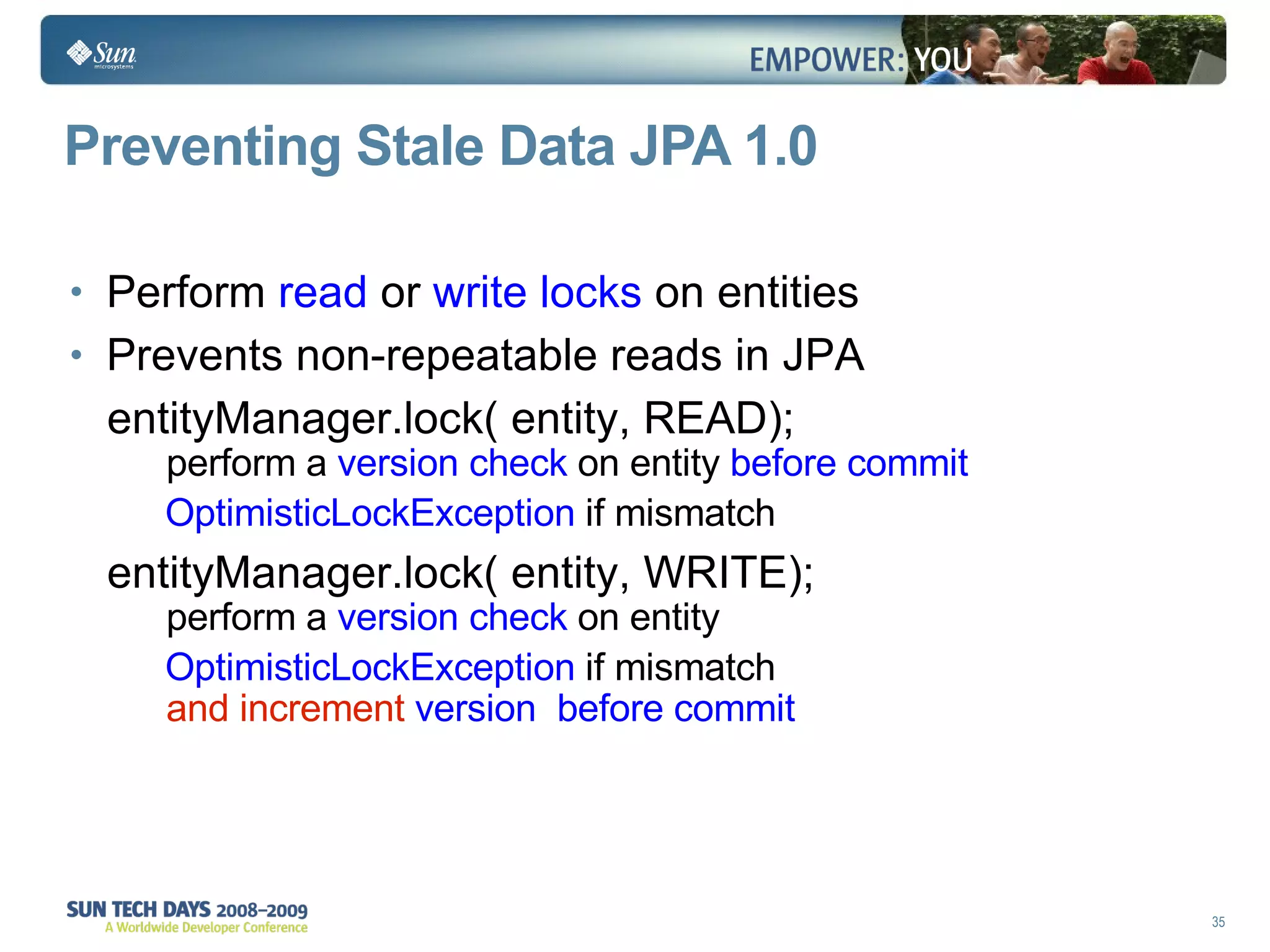
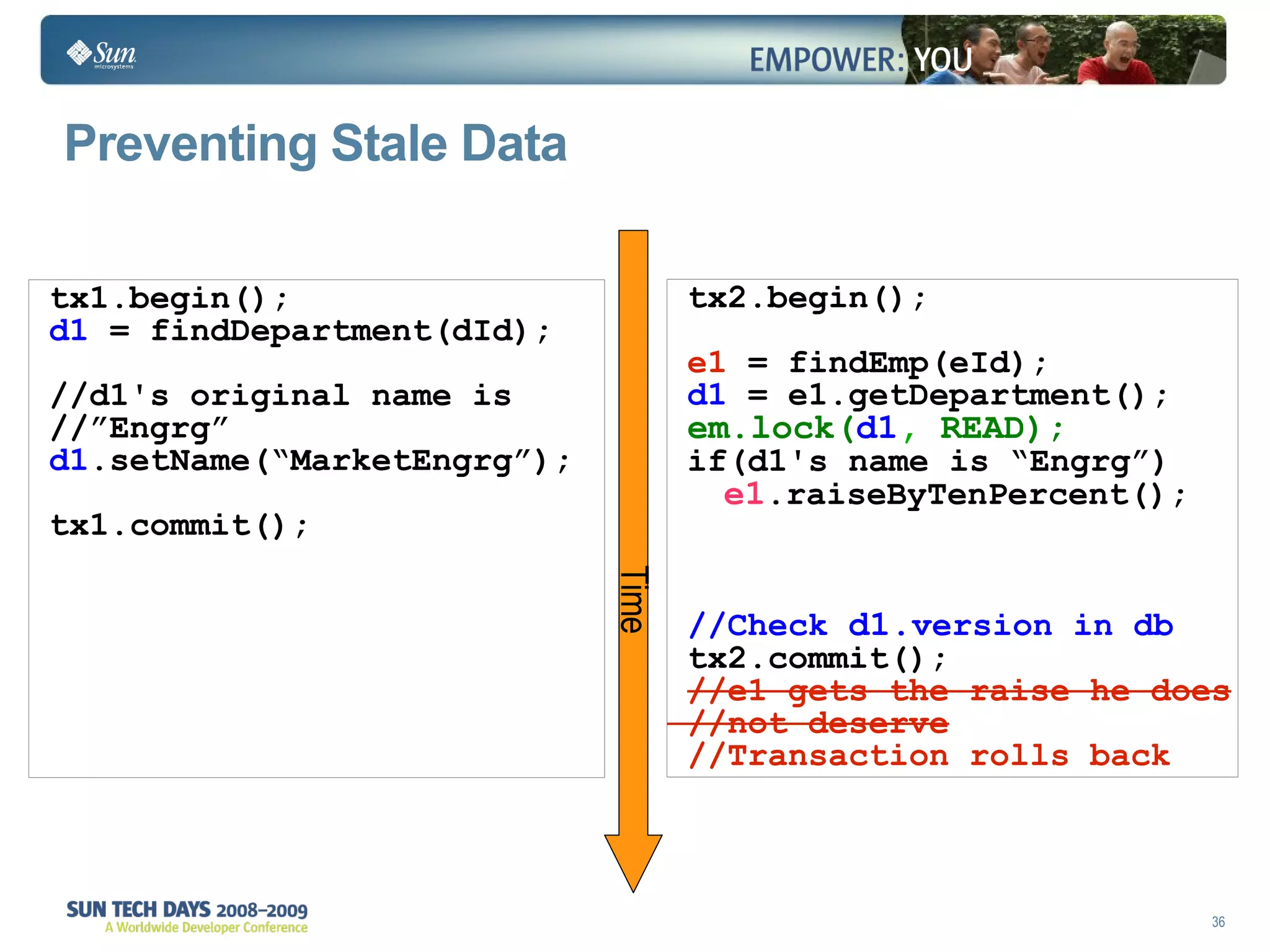
Preventing Stale Data JPA 1.0 Perform  read  or  write locks  on entities Prevents non-repeatable reads in JPA entityManager.lock( entity, READ);  perform a  version check  on entity  before commit OptimisticLockException  if mismatch entityManager.lock( entity, WRITE);  perform a  version check  on entity OptimisticLockException  if mismatch and increment  version   before commit
Preventing Stale Data tx1.begin();  d1  = findDepartment(dId);  //d1's original name is  //”Engrg”   d1 .setName(“MarketEngrg”);  tx1.commit();  tx2.begin();   e1  = findEmp(eId);   d1  = e1.getDepartment();   em.lock( d1 ,  READ);  if(d1's name is “Engrg”)  e1 .raiseByTenPercent();    //Check  d1. version in db  tx2.commit();   //e1 gets the raise he does  //not deserve  //Transaction rolls back Time
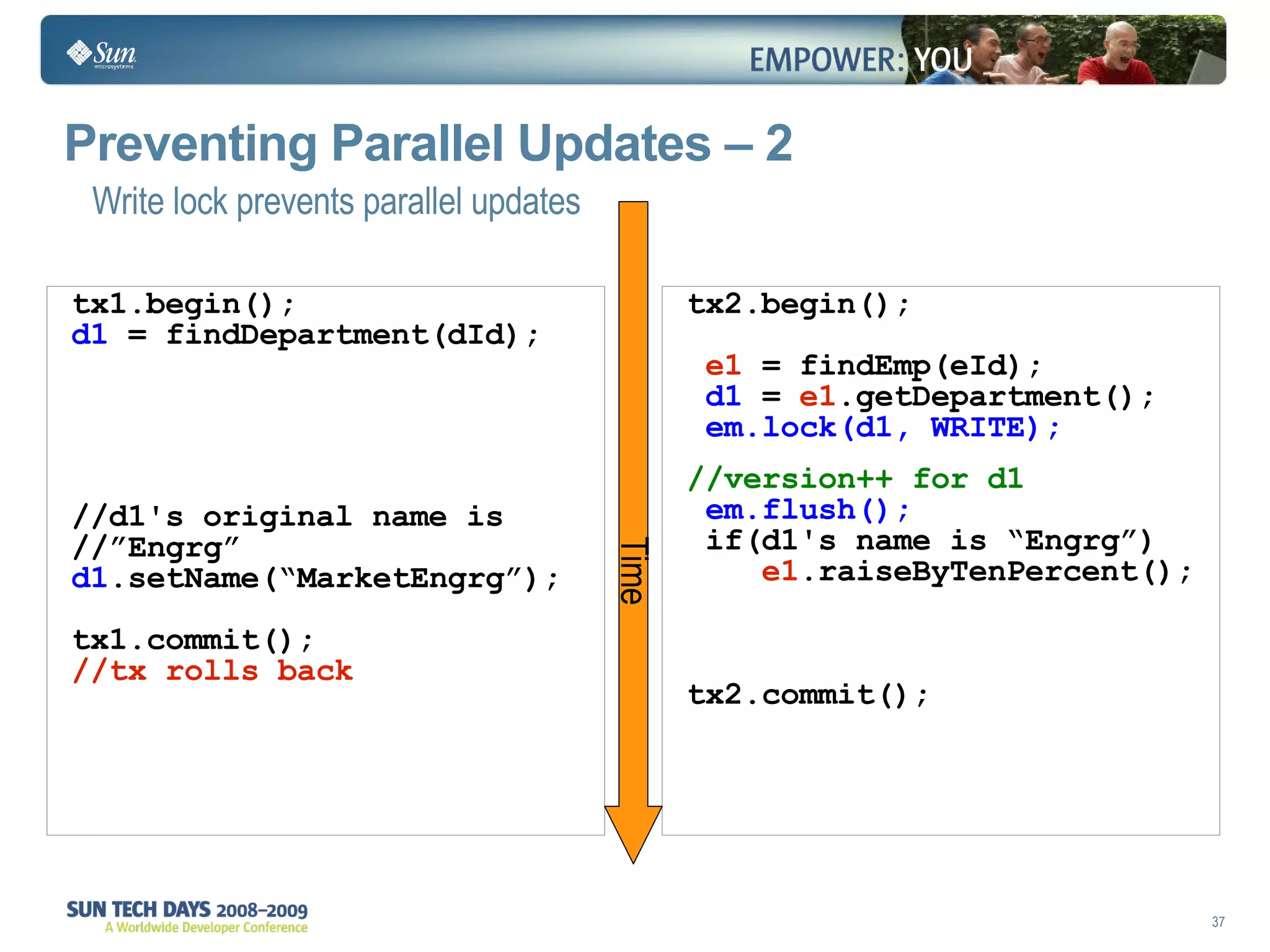
Write lock prevents parallel updates tx1.begin(); d1  = findDepartment(dId); //d1's original name is //”Engrg” d1 .setName(“MarketEngrg”); tx1.commit();  //tx rolls back tx2.begin();   e1  = findEmp(eId);   d1  =  e1 .getDepartment();   em.lock(d1, WRITE); //version++ for d1   em.flush();   if(d1's name is “Engrg”)    e1 .raiseByTenPercent(); tx2.commit(); Preventing Parallel Updates – 2  Time
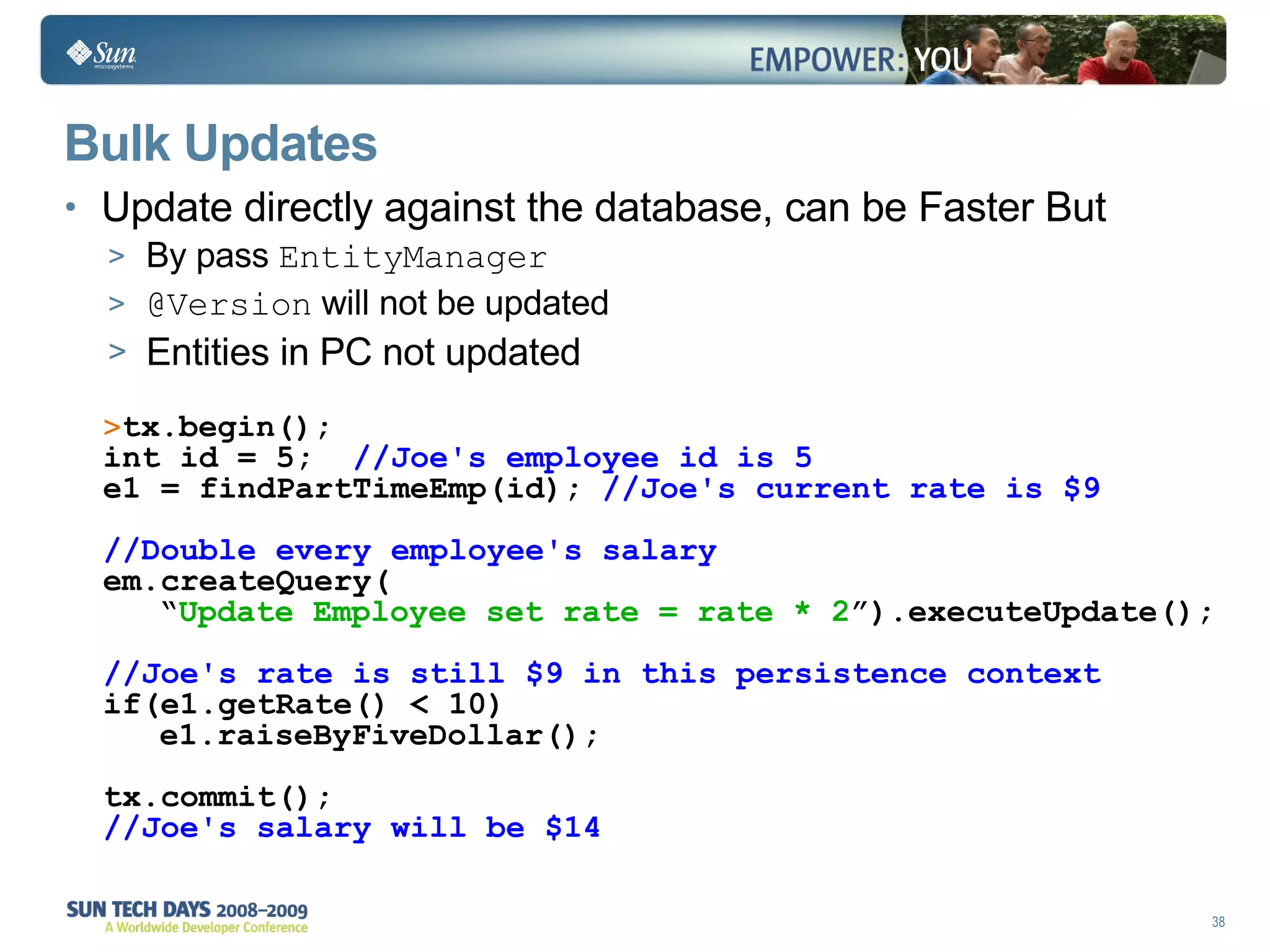
Bulk Updates Update directly against the database, can be Faster But By pass  EntityManager @Version  will not be updated Entities in PC not updated tx.begin(); int id = 5;  //Joe's employee id is 5 e1 = findPartTimeEmp(id);  //Joe's current rate is $9   //Double every employee's salary em.createQuery( “ Update Employee set rate = rate * 2 ”).executeUpdate(); //Joe's rate is still $9 in this persistence context if(e1.getRate() < 10) e1.raiseByFiveDollar();   tx.commit(); //Joe's salary will be $14
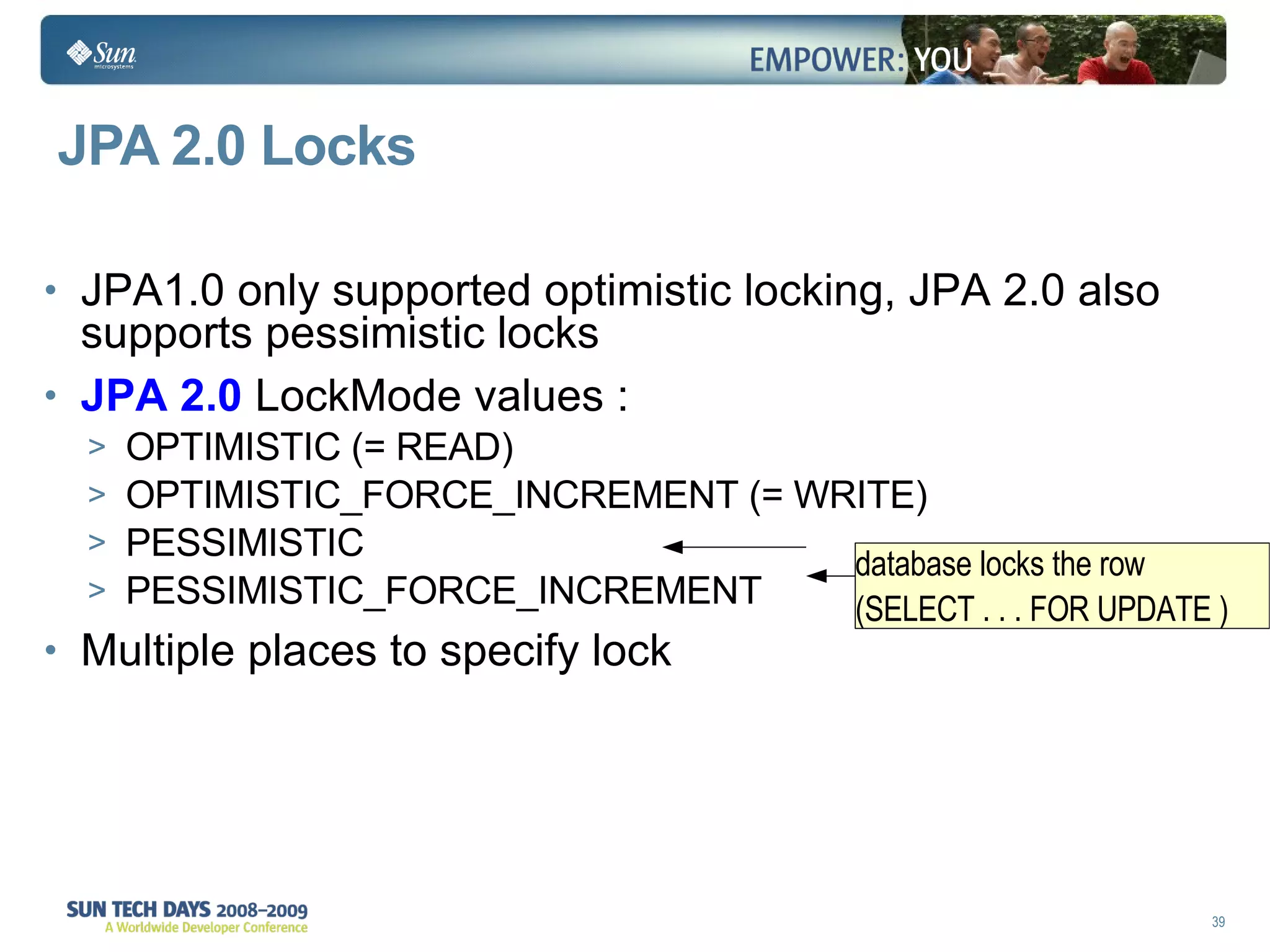
JPA 2.0 Locks JPA1.0 only supported optimistic locking, JPA 2.0 also supports pessimistic locks JPA 2.0  LockMode values : OPTIMISTIC (= READ) OPTIMISTIC_FORCE_INCREMENT (= WRITE) PESSIMISTIC PESSIMISTIC_FORCE_INCREMENT Multiple places to specify lock  database locks the row  (SELECT . . . FOR UPDATE )
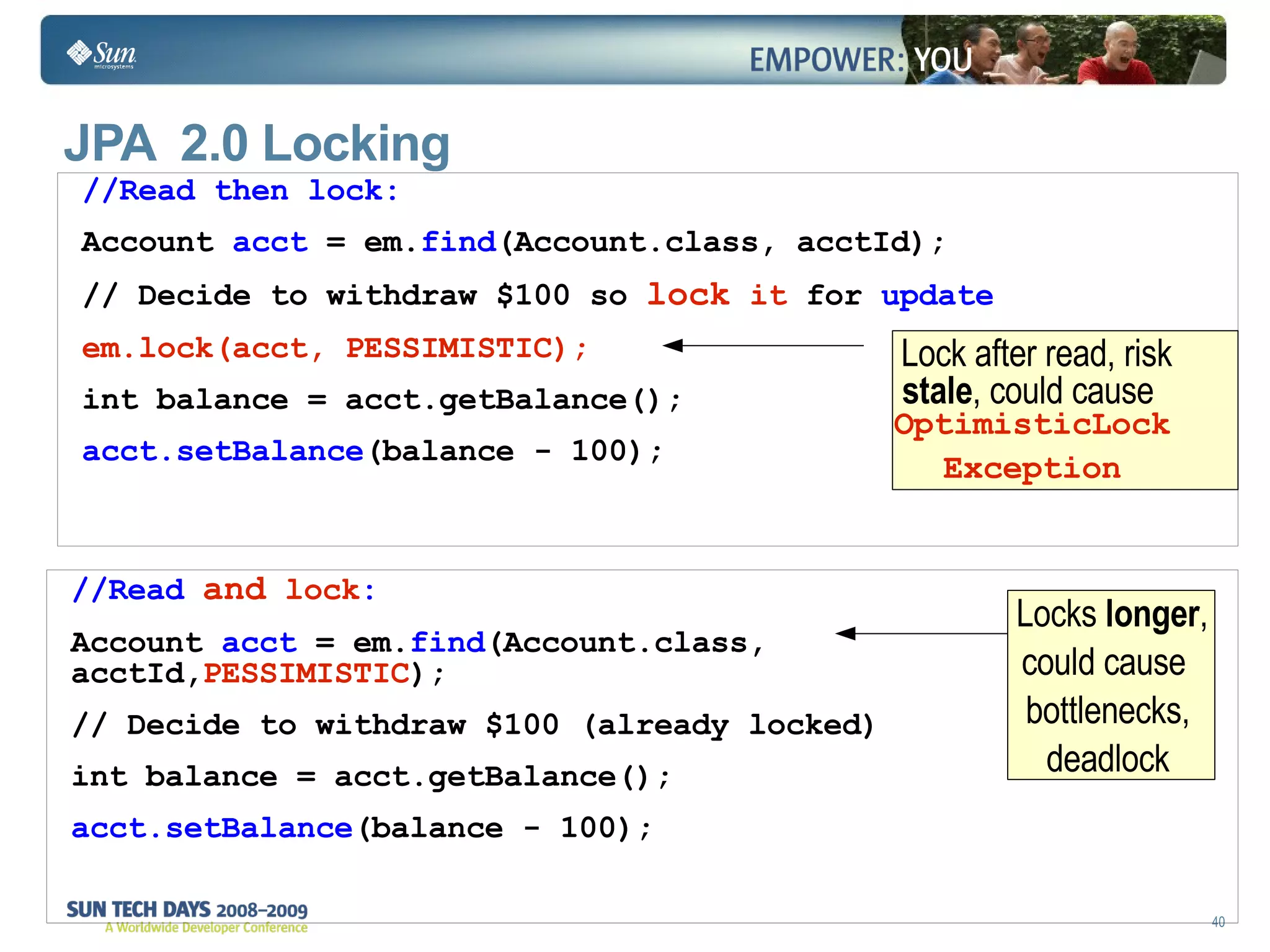
//Read then lock: Account  acct  = em. find (Account.class, acctId); // Decide to withdraw $100 so  lock  it  for  update em.lock(acct, PESSIMISTIC); int balance = acct.getBalance(); acct.setBalance (balance - 100); //Read  and   lock : Account  acct  = em. find (Account.class,  acctId, PESSIMISTIC ); // Decide to withdraw $100 (already locked) int balance = acct.getBalance(); acct.setBalance (balance - 100); JPA  2.0 Locking  Locks  longer , could cause  bottlenecks, deadlock Lock after read, risk  stale , could cause  OptimisticLock Exception
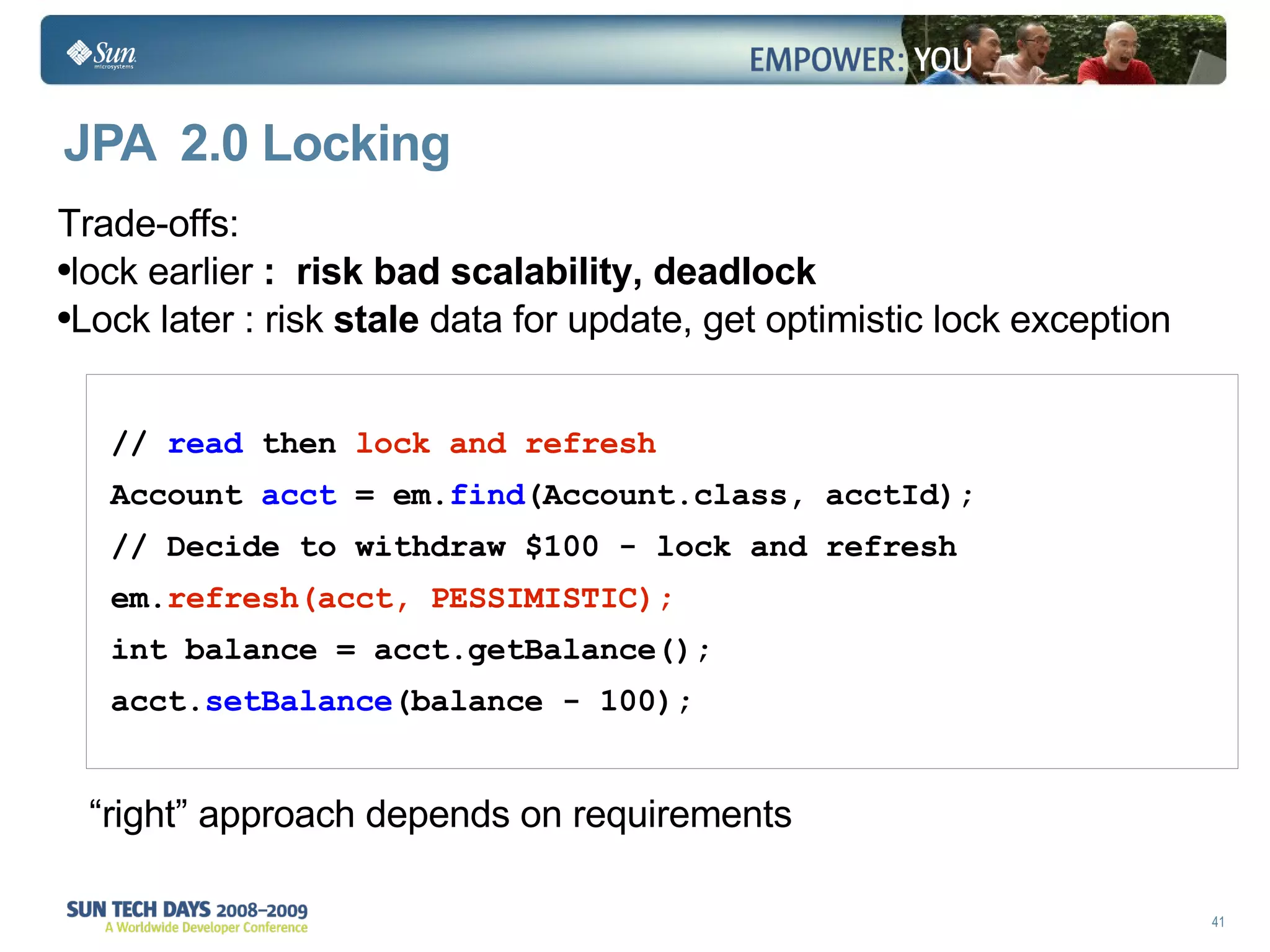
//  read  then  lock and refresh Account  acct  = em. find (Account.class, acctId); // Decide to withdraw $100 - lock and refresh em. refresh(acct, PESSIMISTIC); int balance = acct.getBalance(); acct. setBalance (balance - 100); JPA  2.0 Locking  “ right” approach depends on requirements Trade-offs:  lock earlier  :  risk bad scalability, deadlock Lock later : risk  stale  data for update, get optimistic lock  exception
L2 cache shared across transactions and users Putting it all together User Session  User Session  User Session Persistence Context (EntityManager) Persistence Context (EntityManager) Persistence Context (EntityManager) L2 Cache (Shared Cache) Entity managers for a specific PersistenceUnit on a given Java Virtual Machine (JVM ™ ) (EntityManagerFactory)
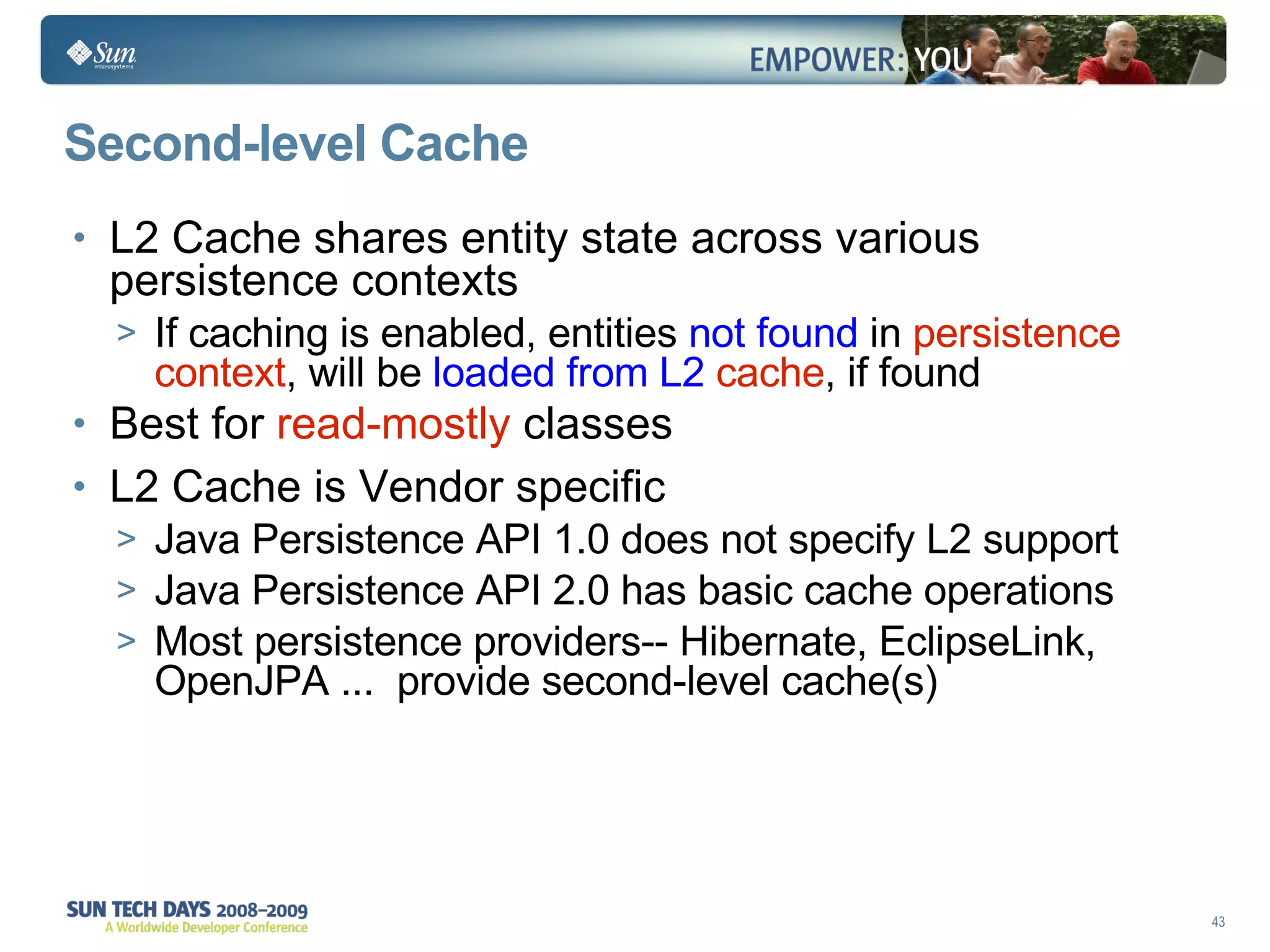
Second-level Cache L2 Cache shares entity state across various persistence contexts If caching is enabled, entities  not found  in  persistence context , will be  loaded from L2   cache , if found Best for  read-mostly  classes L2 Cache is Vendor specific Java Persistence API 1.0 does not specify L2 support Java Persistence API 2.0 has basic cache operations Most persistence providers-- Hibernate, EclipseLink, OpenJPA ...  provide second-level cache(s)
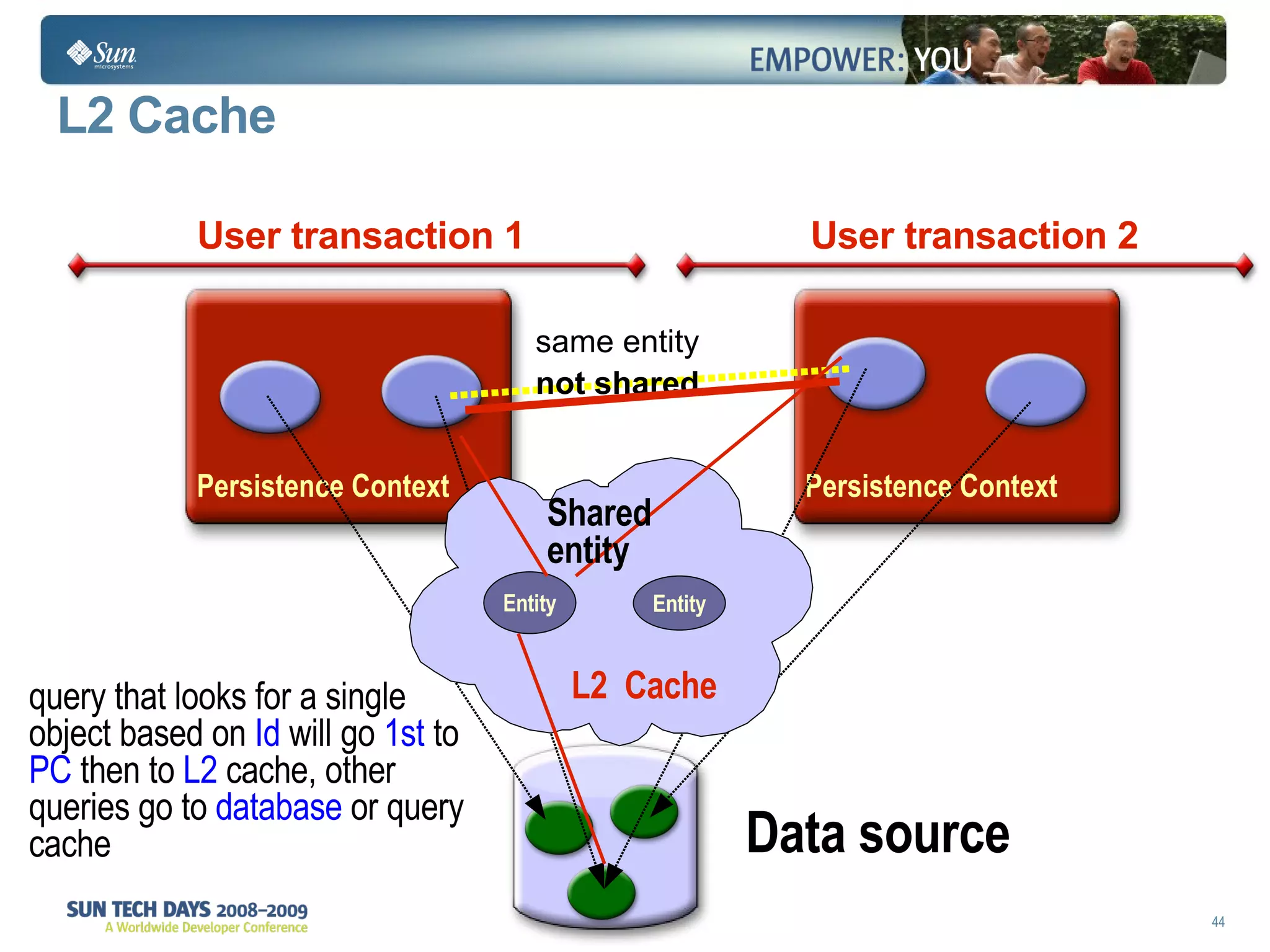
L2 Cache L2  Cache query that looks for a single object based on  Id  will go  1st  to  PC  then to  L2  cache, other queries go to  database  or query cache Shared entity User transaction 1 Persistence Context User transaction 2 Persistence Context Data source same entity not shared
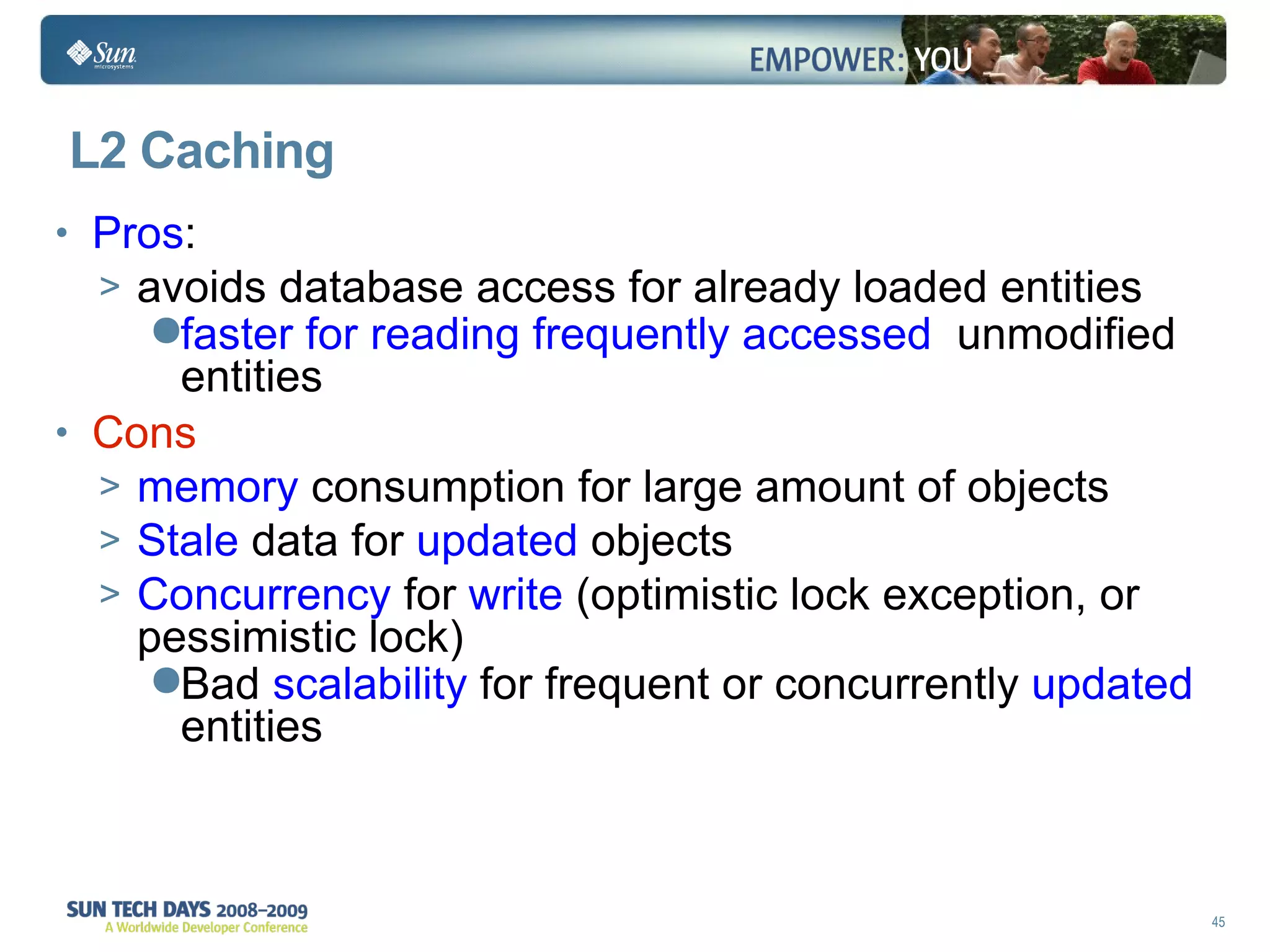
L2 Caching Pros :  avoids database access for already loaded entities faster for reading frequently accessed   unmodified entities Cons memory  consumption for large amount of objects Stale  data for  updated  objects Concurrency  for  write  (optimistic lock exception, or pessimistic lock) Bad  scalability  for frequent or concurrently  updated  entities
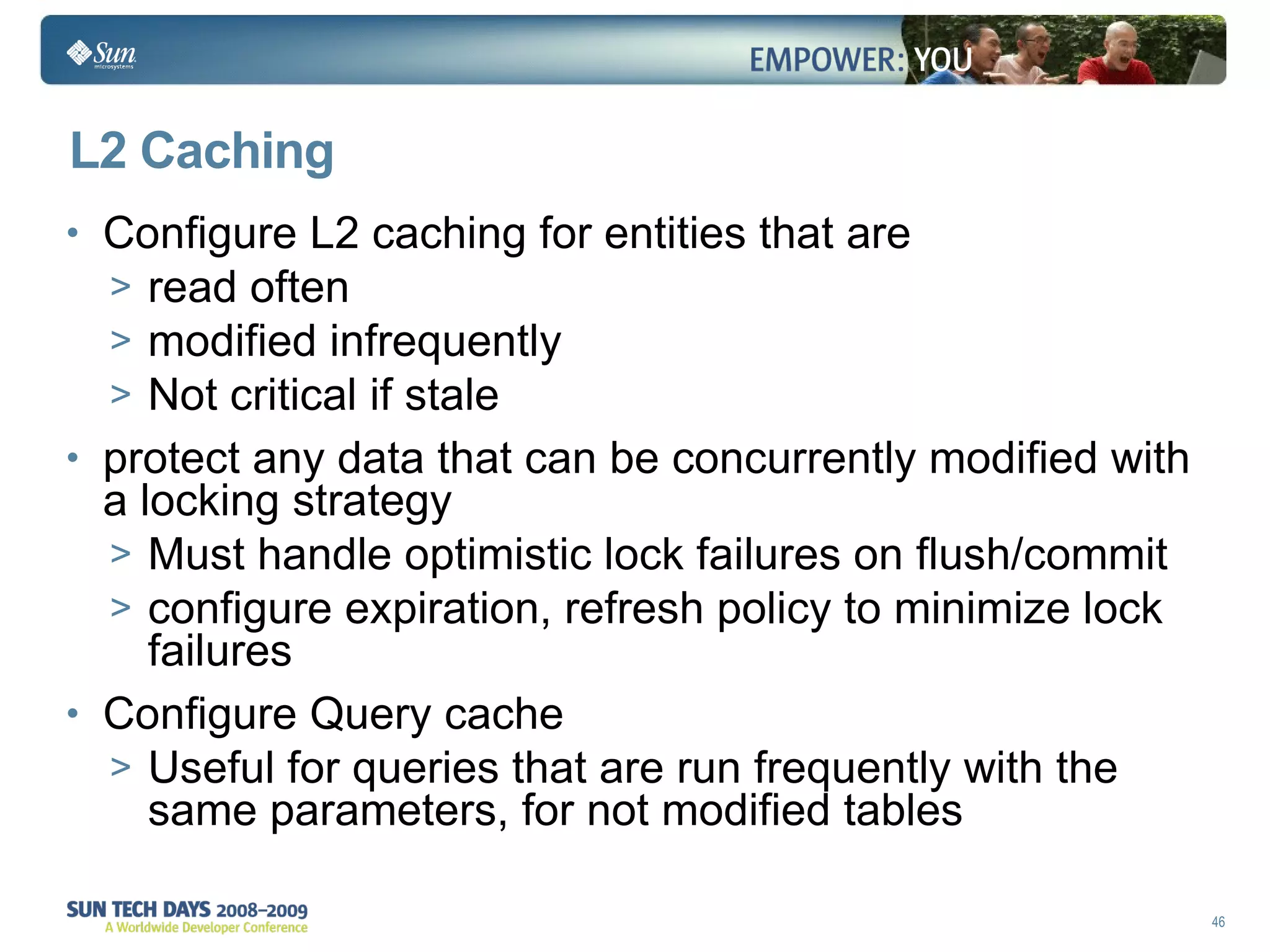
L2 Caching Configure L2 caching for entities that are  read often modified infrequently Not critical if stale  protect any data that can be concurrently modified with a locking strategy  Must handle optimistic lock failures on flush/commit configure expiration, refresh policy to minimize lock failures Configure Query cache Useful for queries that are run frequently with the same parameters, for not modified tables
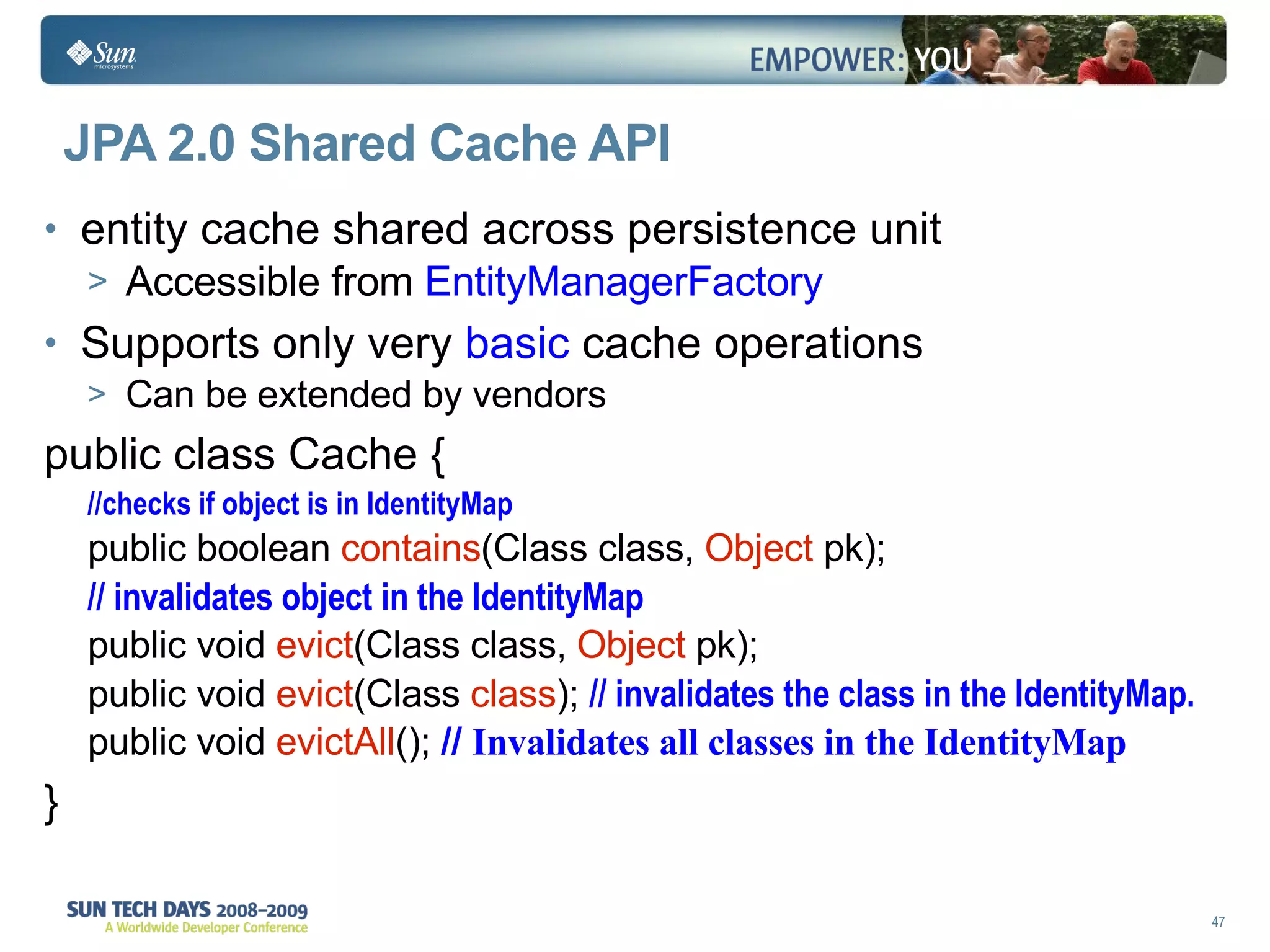
JPA 2.0 Shared Cache API entity cache shared across persistence unit Accessible from  EntityManagerFactory Supports only very  basic  cache operations Can be extended by vendors public class Cache { //checks if object is in IdentityMap public boolean  contains (Class class,  Object  pk); // invalidates object in the IdentityMap public void  evict (Class class,  Object  pk);  public void  evict (Class  class );  // invalidates the class in the IdentityMap. public void  evictAll ();  //  Invalidates all classes in the IdentityMap }
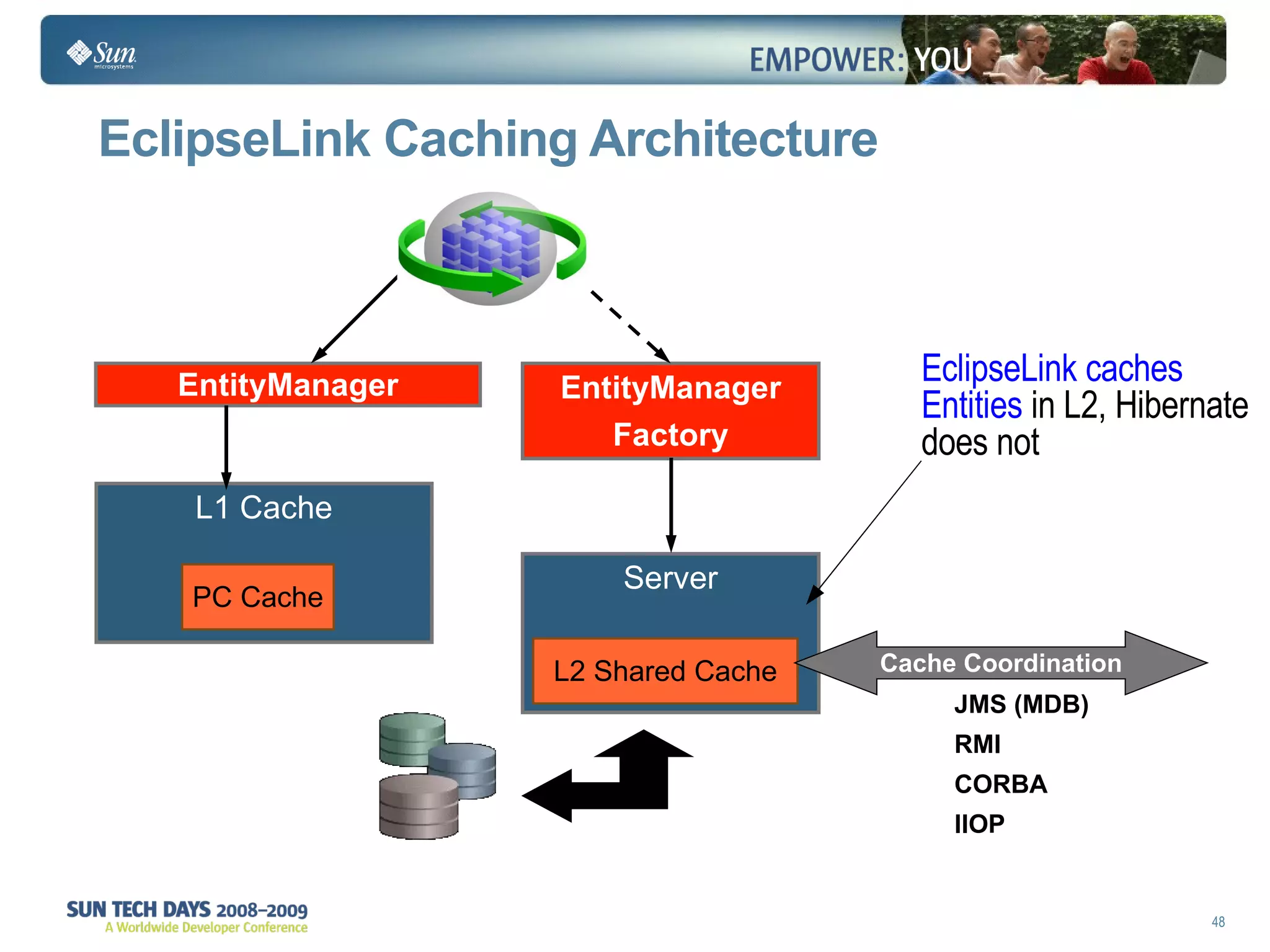
EclipseLink Caching Architecture EclipseLink caches Entities  in L2, Hibernate does not  EntityManager EntityManager Factory Server L1 Cache PC Cache L2 Shared Cache Cache Coordination JMS (MDB) RMI  CORBA IIOP
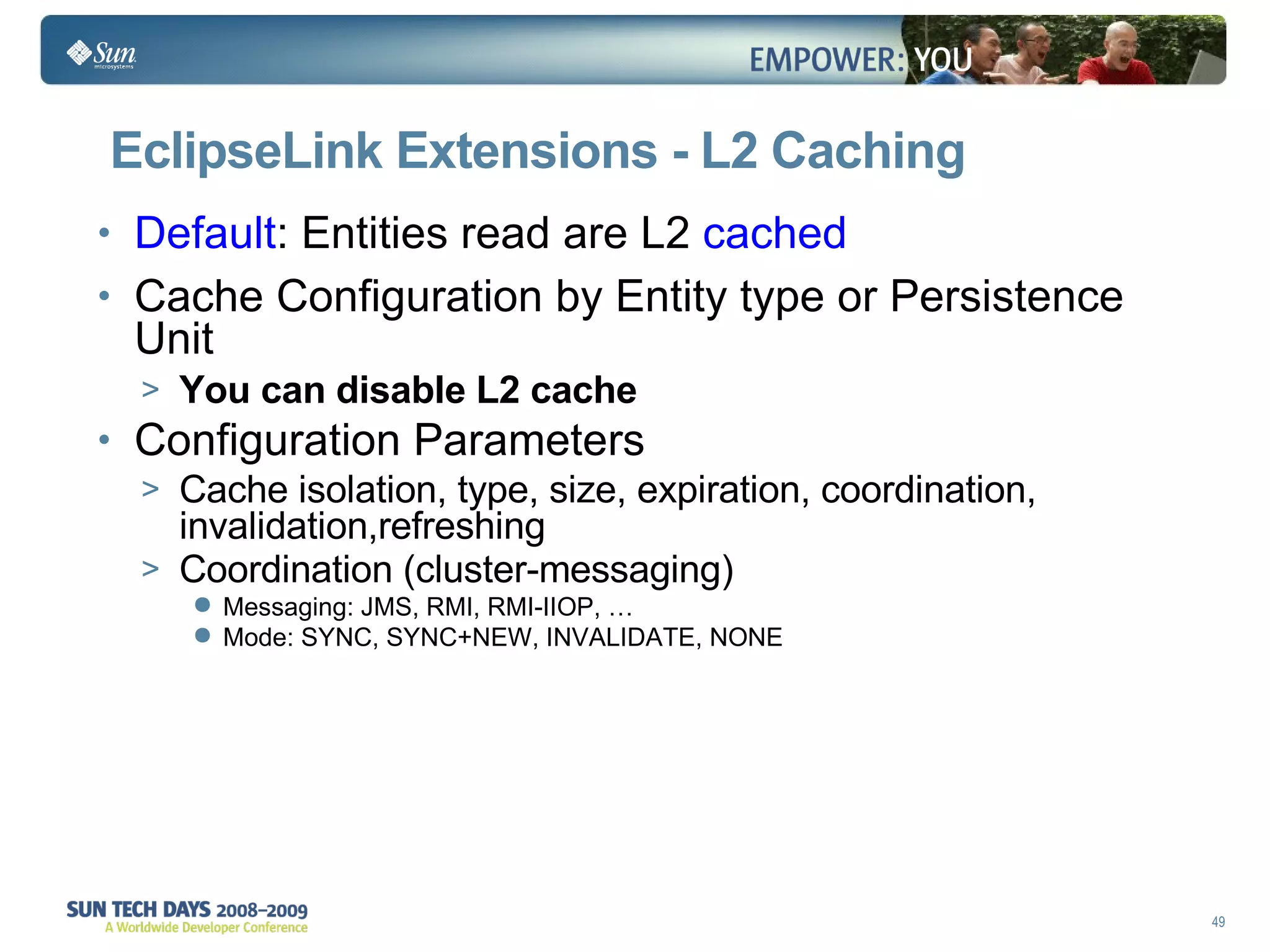
EclipseLink Extensions - L2 Caching Default : Entities read are L2  cached Cache Configuration by Entity type or Persistence Unit You can disable L2 cache   Configuration Parameters Cache isolation, type, size, expiration, coordination, invalidation,refreshing Coordination (cluster-messaging) Messaging: JMS, RMI, RMI-IIOP, … Mode: SYNC, SYNC+NEW, INVALIDATE, NONE
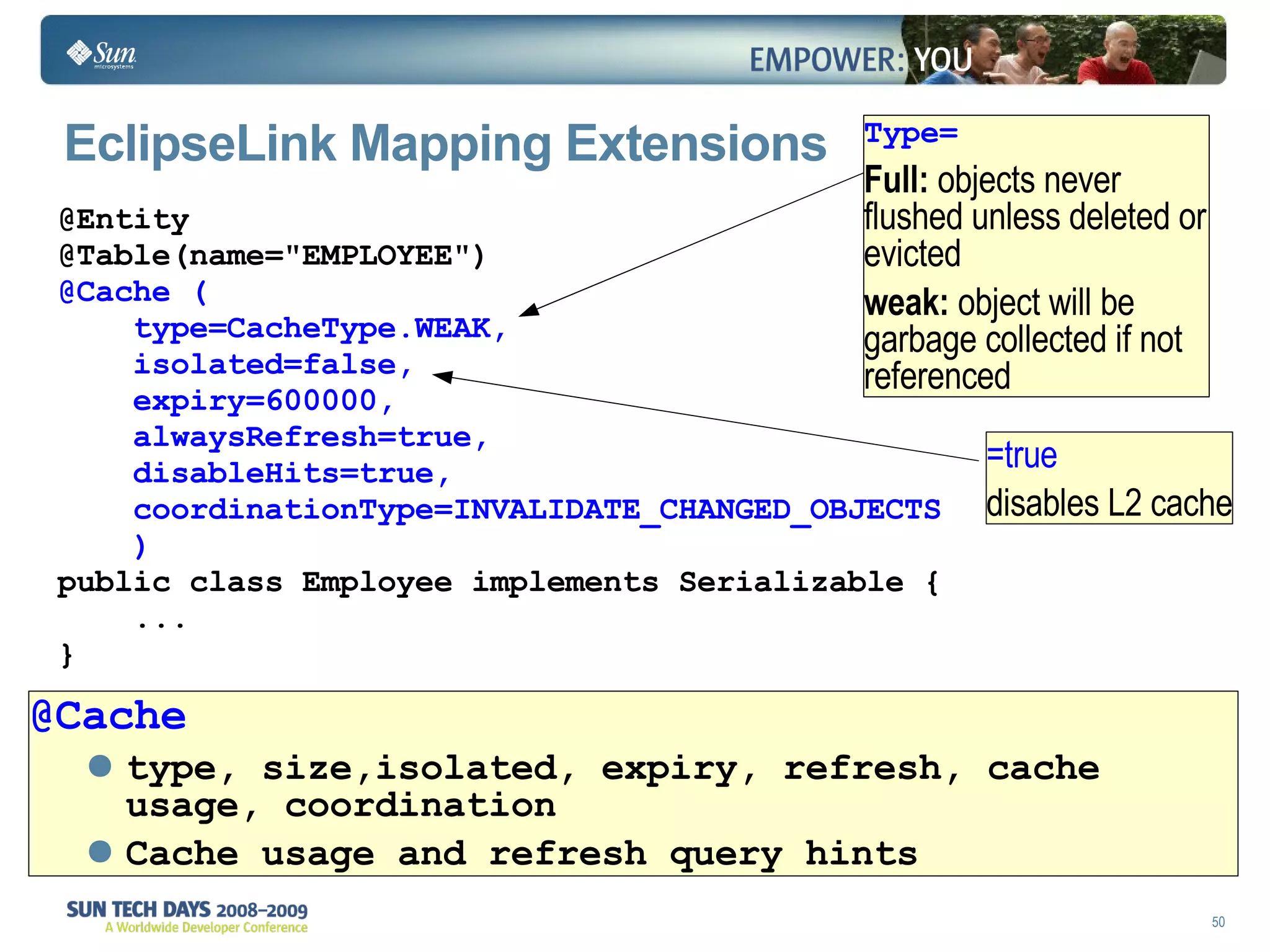
@Entity @Table(name=&quot;EMPLOYEE&quot;) @Cache ( type=CacheType.WEAK, isolated=false, expiry=600000, alwaysRefresh=true, disableHits=true, coordinationType=INVALIDATE_CHANGED_OBJECTS ) public class Employee implements Serializable { ... } EclipseLink Mapping Extensions   Type= Full:  objects never flushed unless deleted or evicted weak:  object will be garbage collected if not referenced @Cache type, size,isolated, expiry, refresh, cache usage, coordination Cache usage and refresh query hints =true disables L2 cache
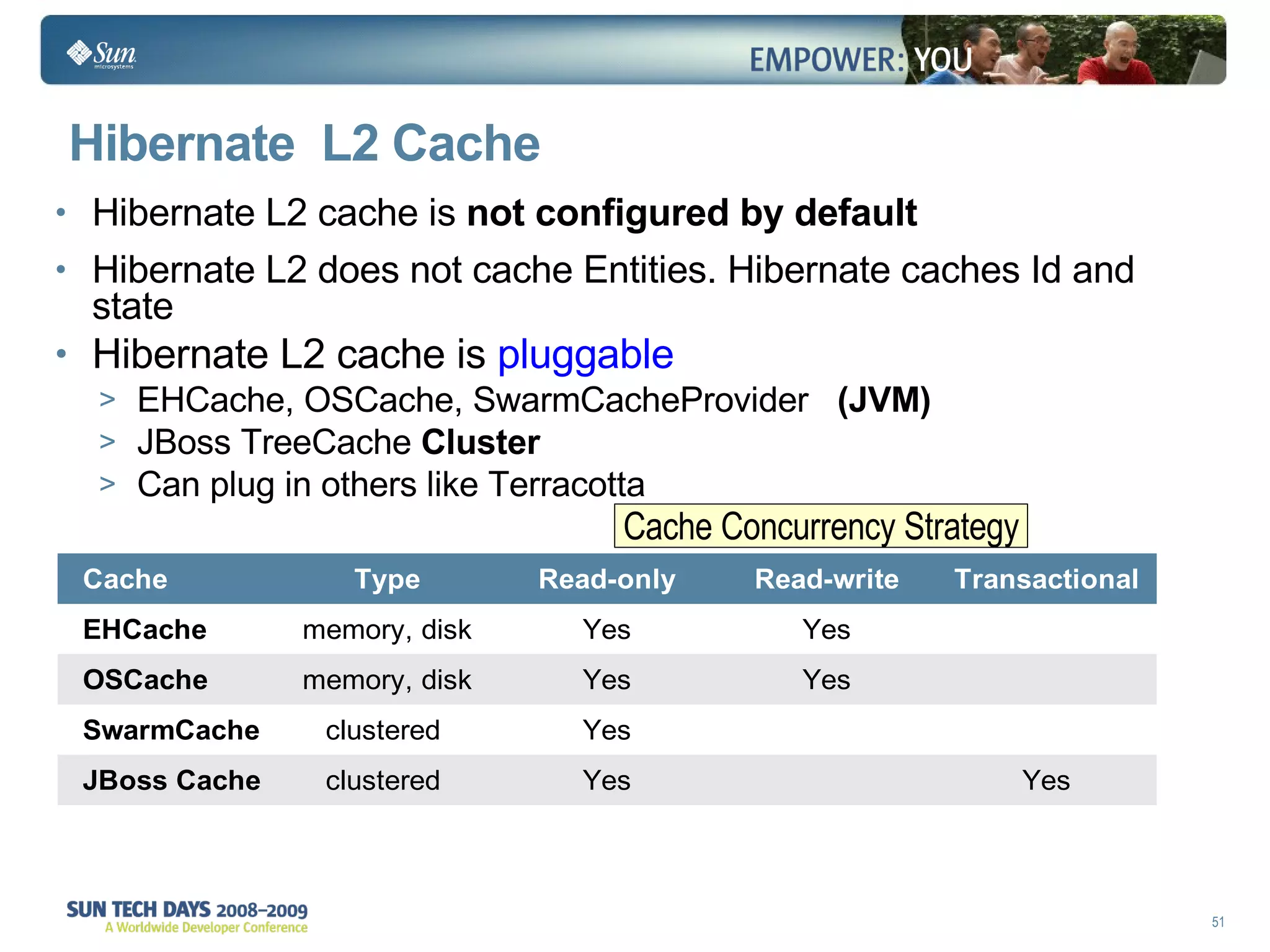
Hibernate  L2 Cache Hibernate L2 cache is  not configured by default   Hibernate L2 does not cache Entities. Hibernate caches Id and state   Hibernate L2 cache is  pluggable EHCache, OSCache, SwarmCacheProvider  (JVM)  JBoss TreeCache  Cluster   Can plug in others like Terracotta Cache Concurrency Strategy
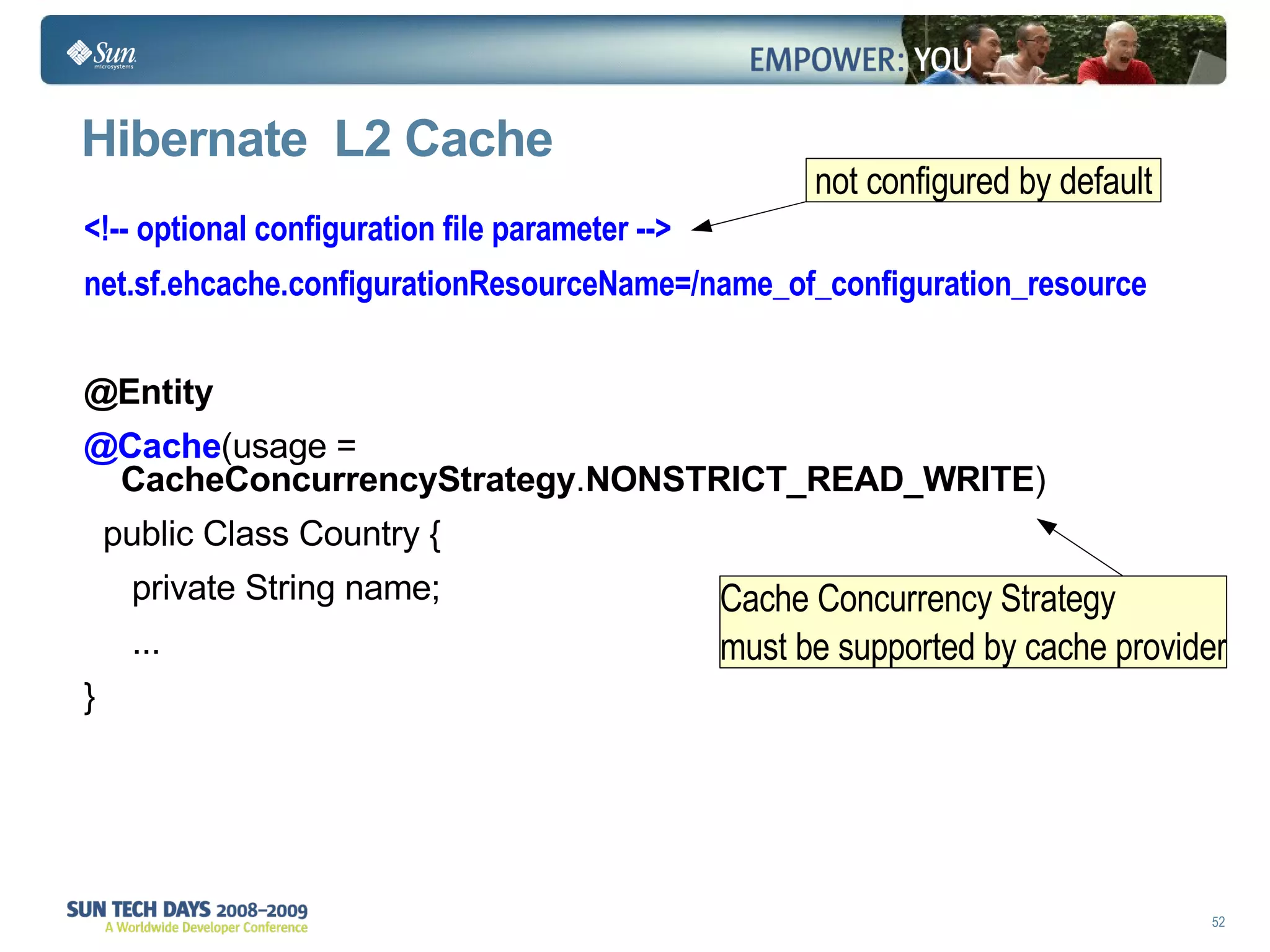
Hibernate  L2 Cache <!-- optional configuration file parameter --> net.sf.ehcache.configurationResourceName=/name_of_configuration_resource @Entity @Cache (usage =  CacheConcurrencyStrategy . NONSTRICT_READ_WRITE ) public Class Country { private String name; ... } not configured by default  Cache Concurrency Strategy must be supported by cache provider
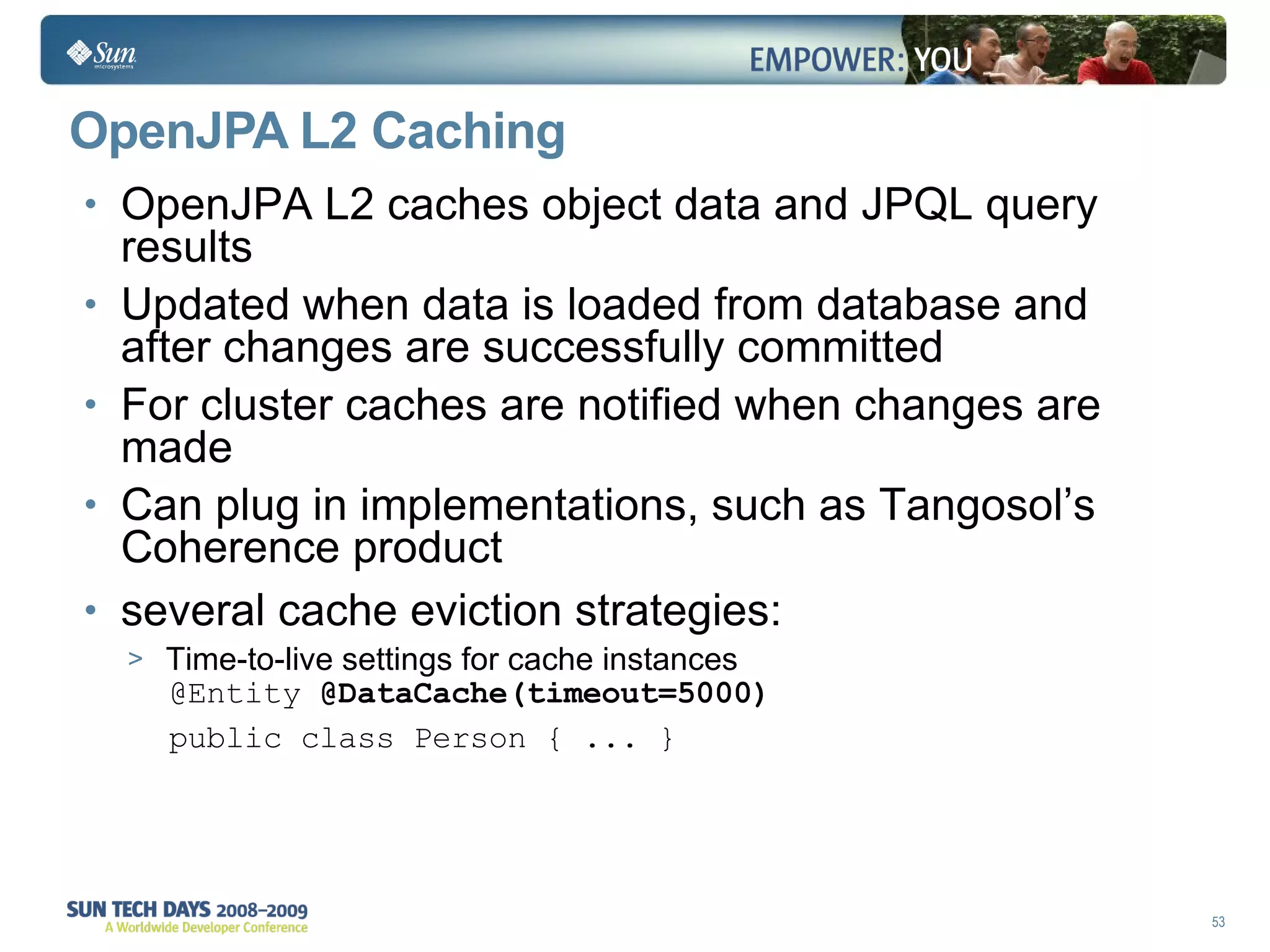
OpenJPA L2  Caching OpenJPA L2 caches object data and JPQL query results Updated when data is loaded from database and after changes are successfully committed For cluster caches are notified when changes are made Can plug in implementations, such as Tangosol’s Coherence product several cache eviction strategies: Time-to-live settings for cache instances @Entity  @DataCache(timeout=5000) public class Person { ... }
Agenda Entity Manager Persistence Context Entities Schema and Queries Transaction
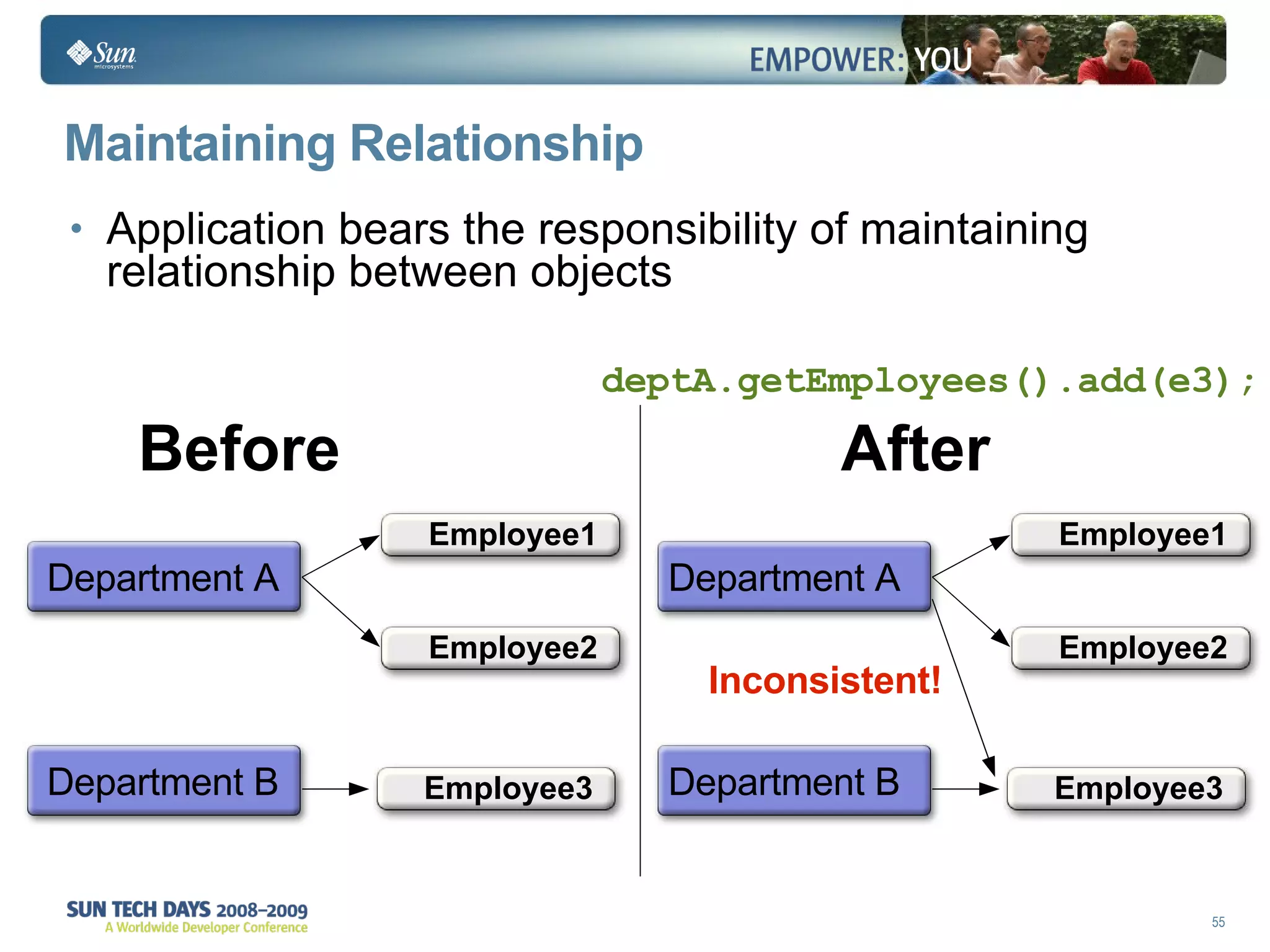
Maintaining Relationship Application bears the responsibility of maintaining relationship between objects deptA.getEmployees().add(e3); Department A Employee1 Employee2 Employee3 Employee1 Employee2 Employee3 Before After Inconsistent! Department B Department A Department B
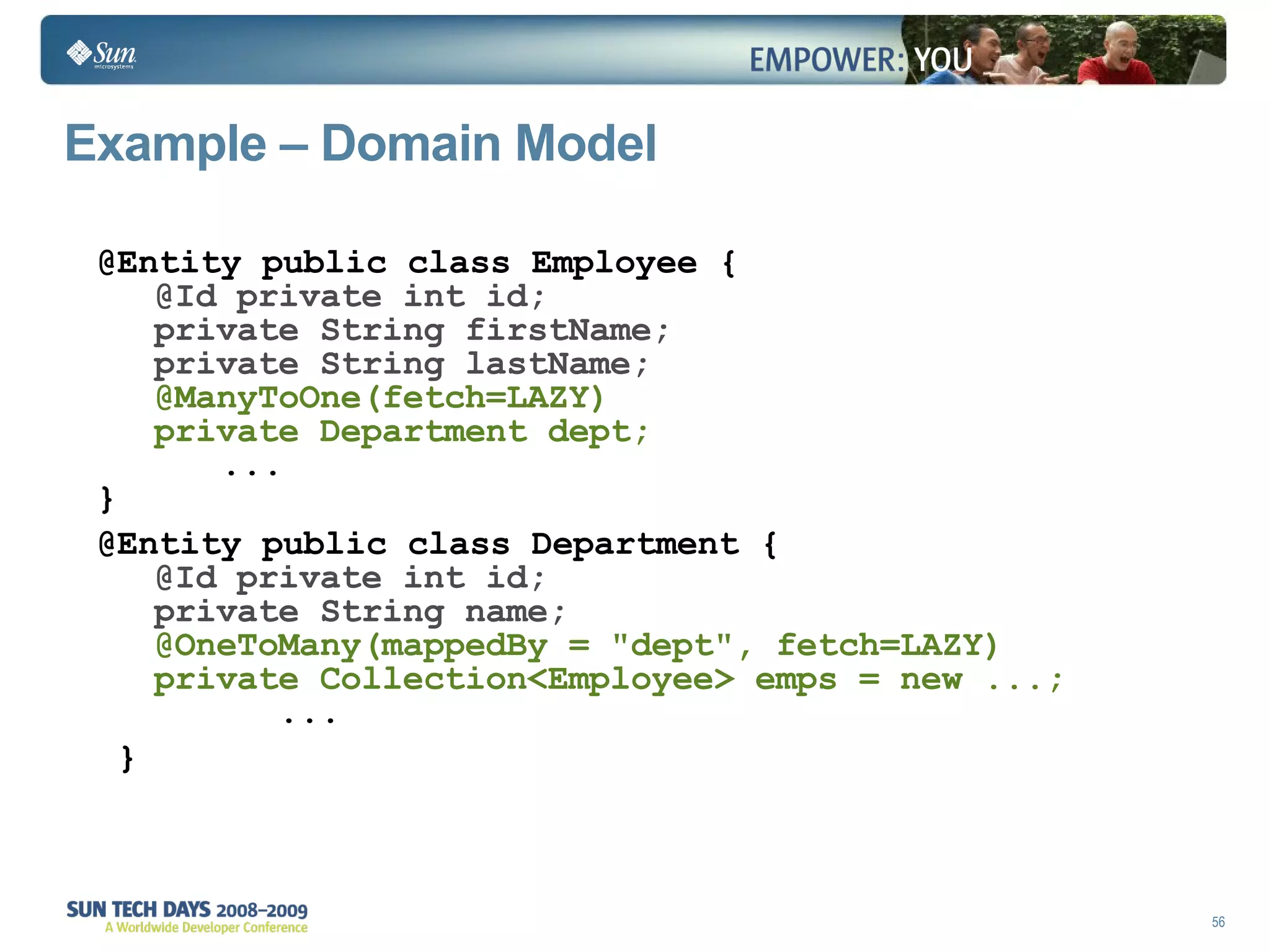
Example – Domain Model @Entity public class Employee { @Id private int id; private String firstName; private String lastName; @ManyToOne(fetch=LAZY) private Department dept;   ... } @Entity public class Department { @Id private int id; private String name; @OneToMany(mappedBy = &quot;dept&quot;, fetch=LAZY) private Collection<Employee> emps = new ...;   ... }
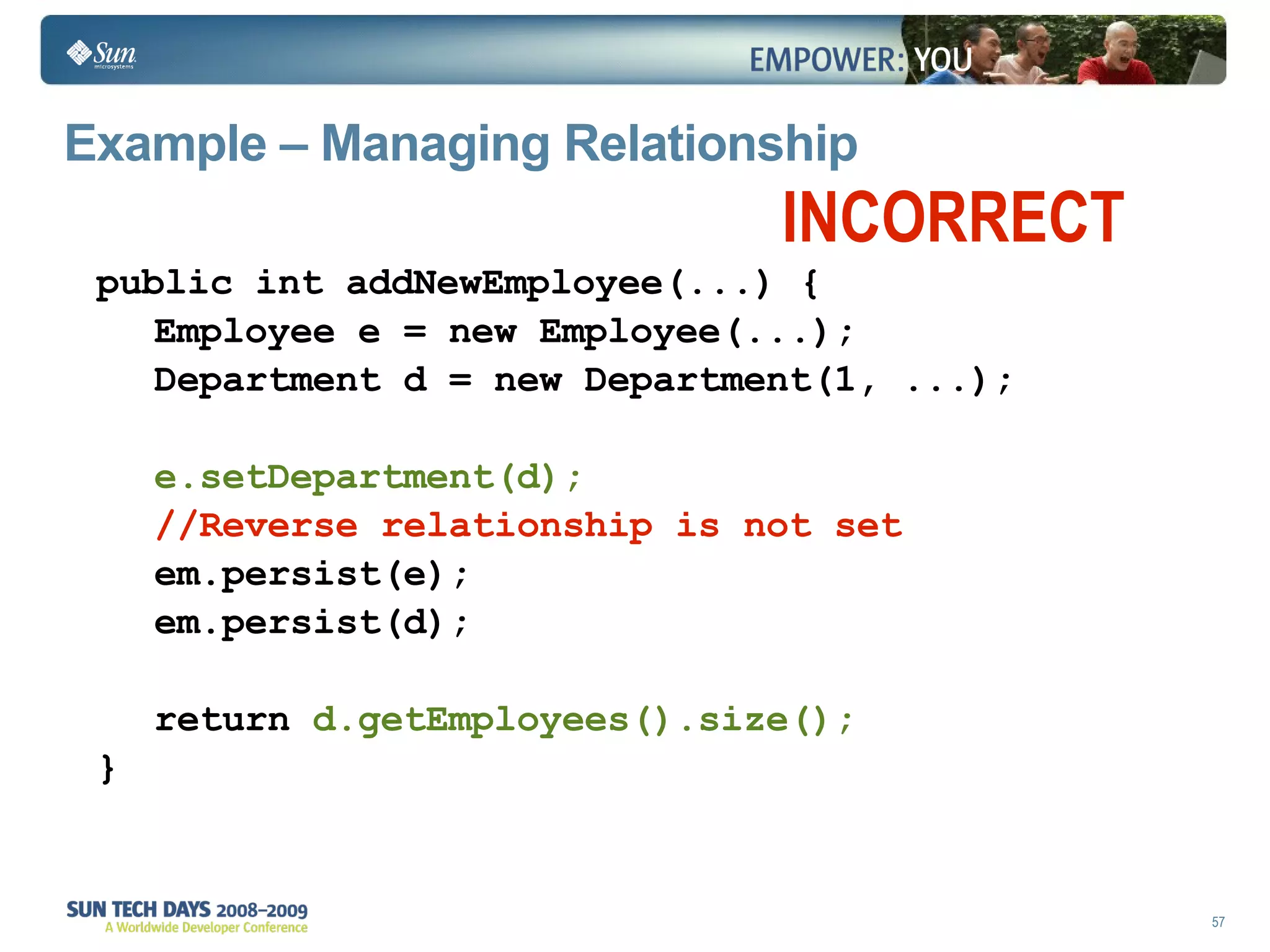
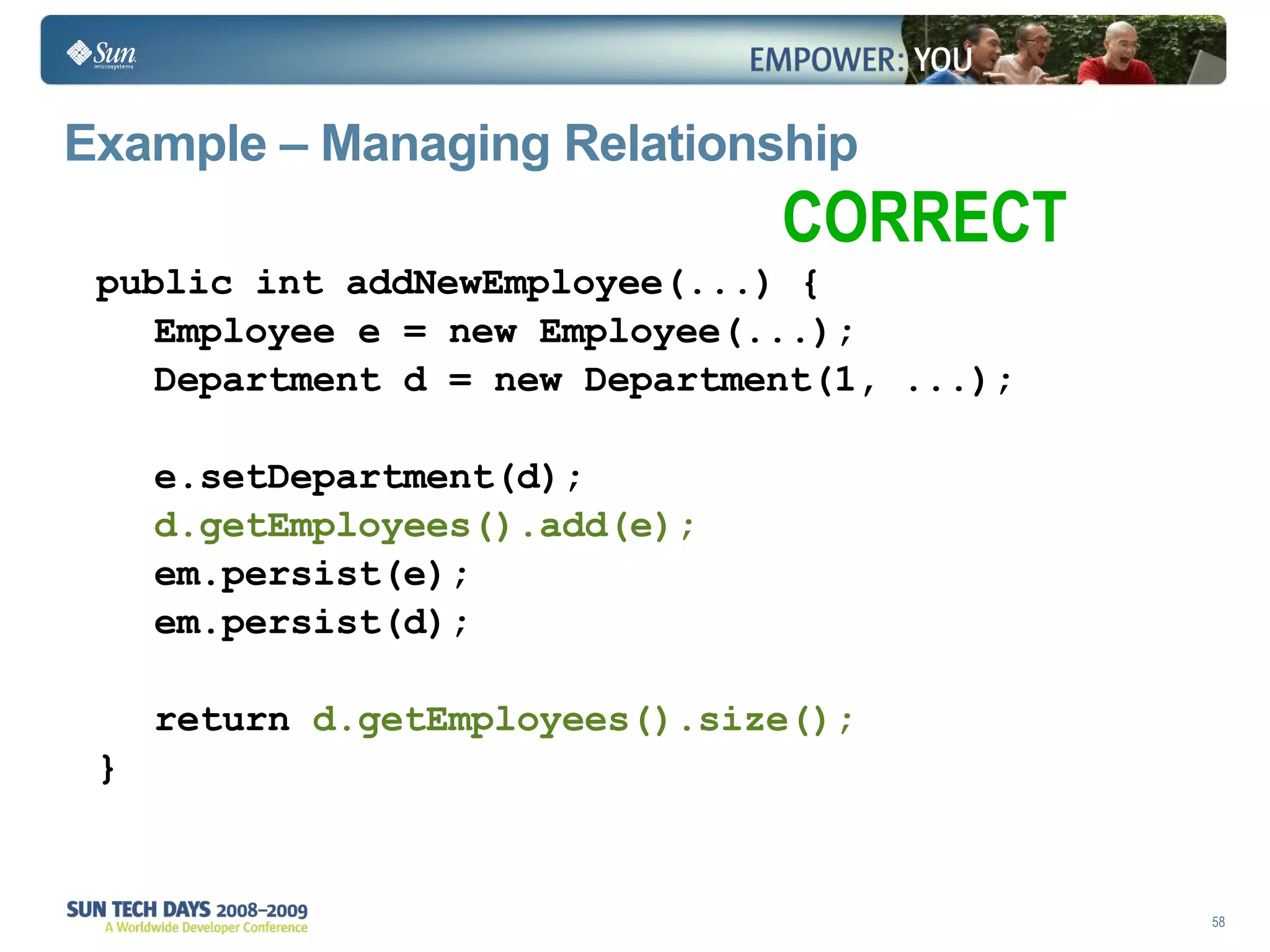
Example – Managing Relationship public int addNewEmployee(...) { Employee e = new Employee(...); Department d = new Department(1, ...); e.setDepartment(d); //Reverse relationship is not set em.persist(e); em.persist(d); return  d.getEmployees().size(); } INCORRECT
Example – Managing Relationship public int addNewEmployee(...) { Employee e = new Employee(...); Department d = new Department(1, ...); e.setDepartment(d); d.getEmployees().add(e); em.persist(e); em.persist(d); return  d.getEmployees().size(); } CORRECT
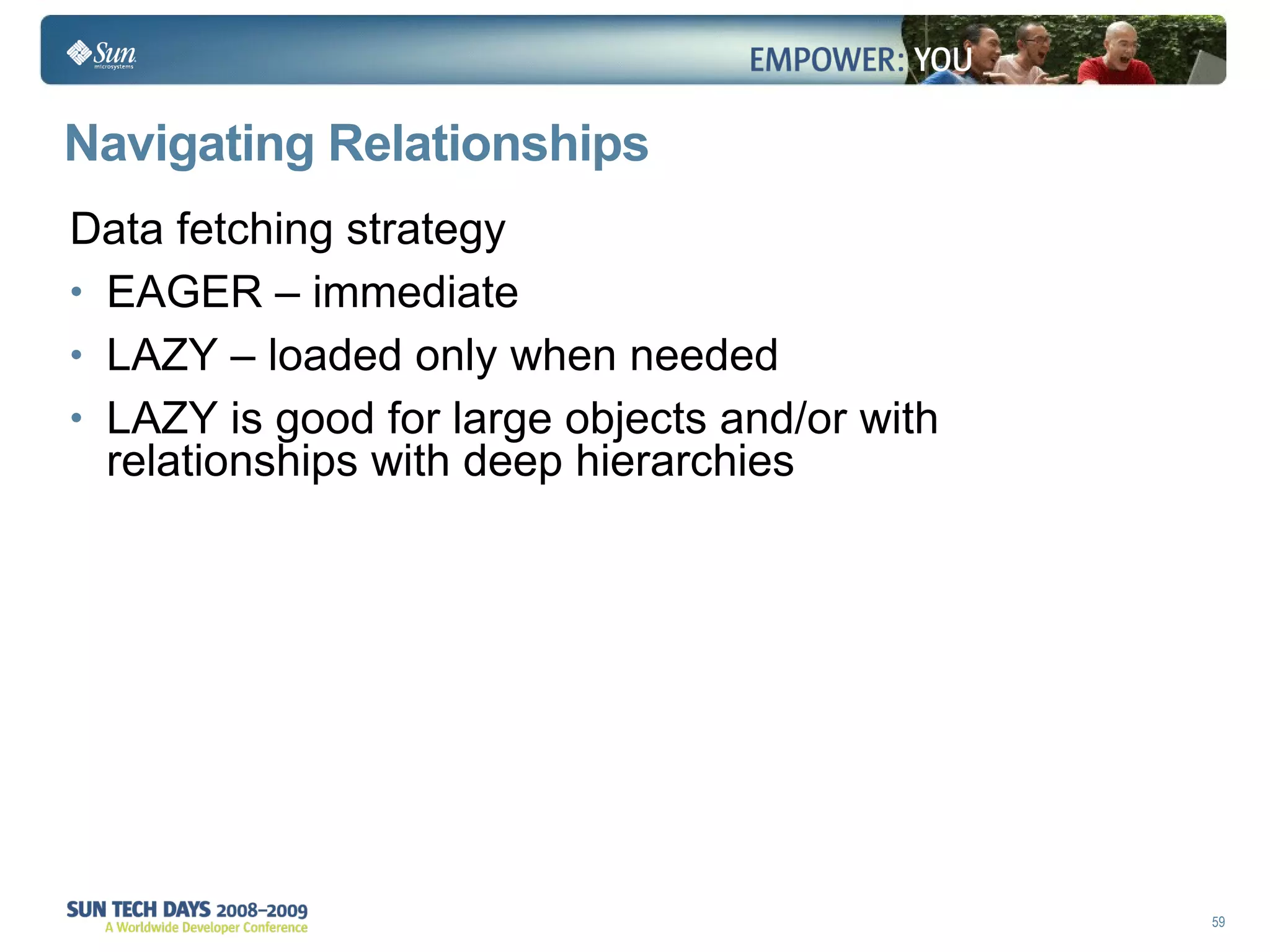
Navigating Relationships Data fetching strategy EAGER – immediate LAZY – loaded only when needed LAZY is good for large objects and/or with relationships with deep hierarchies
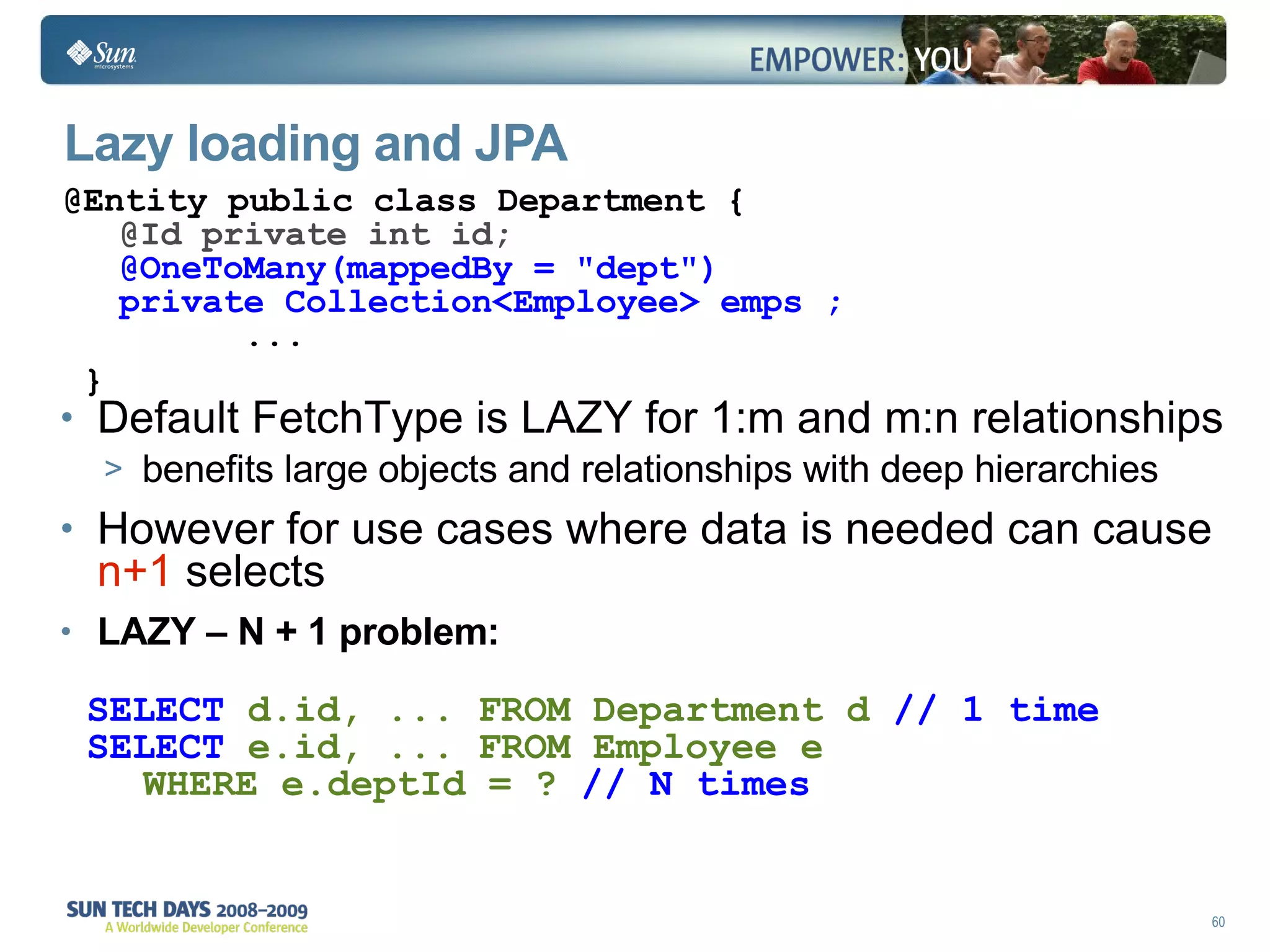
Lazy loading and JPA Default FetchType is LAZY for 1:m and m:n relationships benefits large objects and relationships with deep hierarchies However for use cases where data is needed can cause  n+1  selects LAZY – N + 1 problem: @Entity public class Department { @Id private int id; @OneToMany(mappedBy = &quot;dept&quot;) private Collection<Employee> emps ;   ... } SELECT  d.id, ... FROM Department d  // 1 time SELECT  e.id, ... FROM Employee e  WHERE e.deptId = ?  // N times
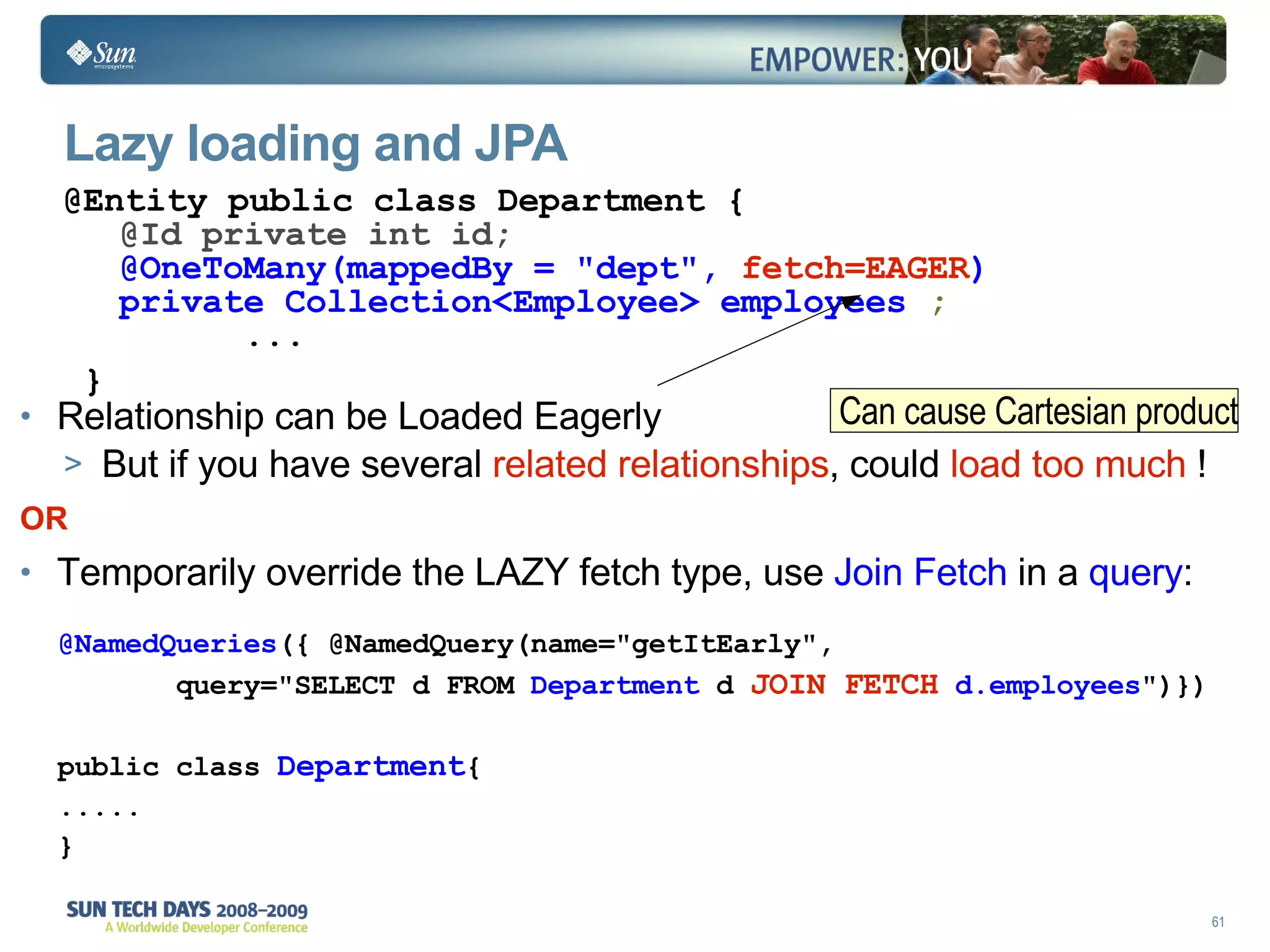
Lazy loading and JPA Relationship can be Loaded Eagerly But if you have several  related relationships , could  load too much  !  OR Temporarily override the LAZY fetch type, use  Join Fetch  in a  query : @Entity public class Department { @Id private int id; @OneToMany(mappedBy = &quot;dept&quot;,  fetch=EAGER ) private Collection<Employee> employees  ;   ... } @NamedQueries ({ @NamedQuery(name=&quot;getItEarly&quot;,  query=&quot;SELECT d FROM  Department  d  JOIN FETCH   d.employees &quot;)}) public class  Department { ..... } Can cause Cartesian product
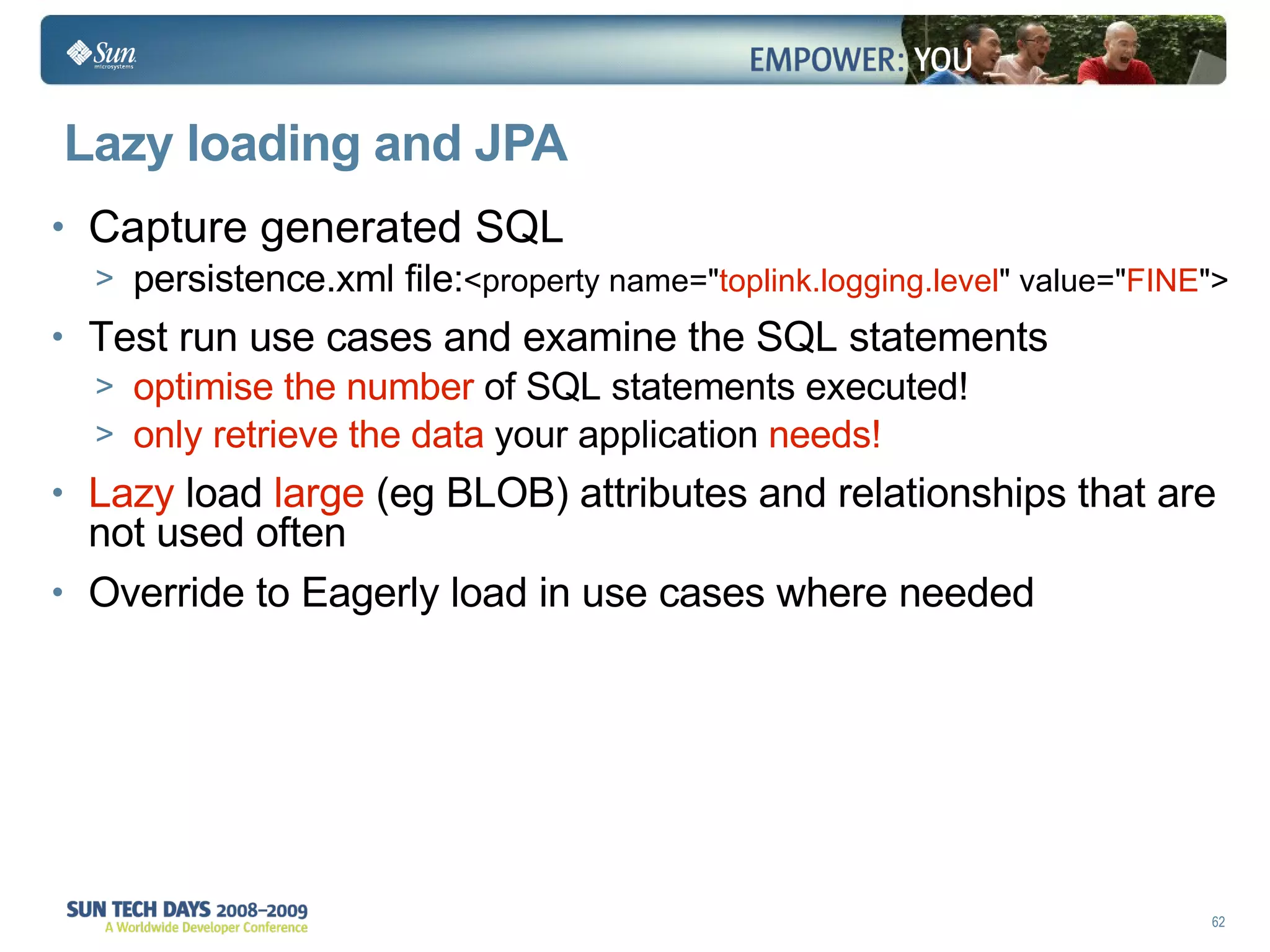
Lazy loading and JPA Capture generated SQL persistence.xml file: <property name=&quot; toplink.logging.level &quot; value=&quot; FINE &quot;> Test run use cases and examine the SQL statements  optimise  the number  of SQL statements executed! only retrieve the data  your application  needs!  Lazy  load  large  (eg BLOB) attributes and relationships that are not used often Override to Eagerly load in use cases where needed
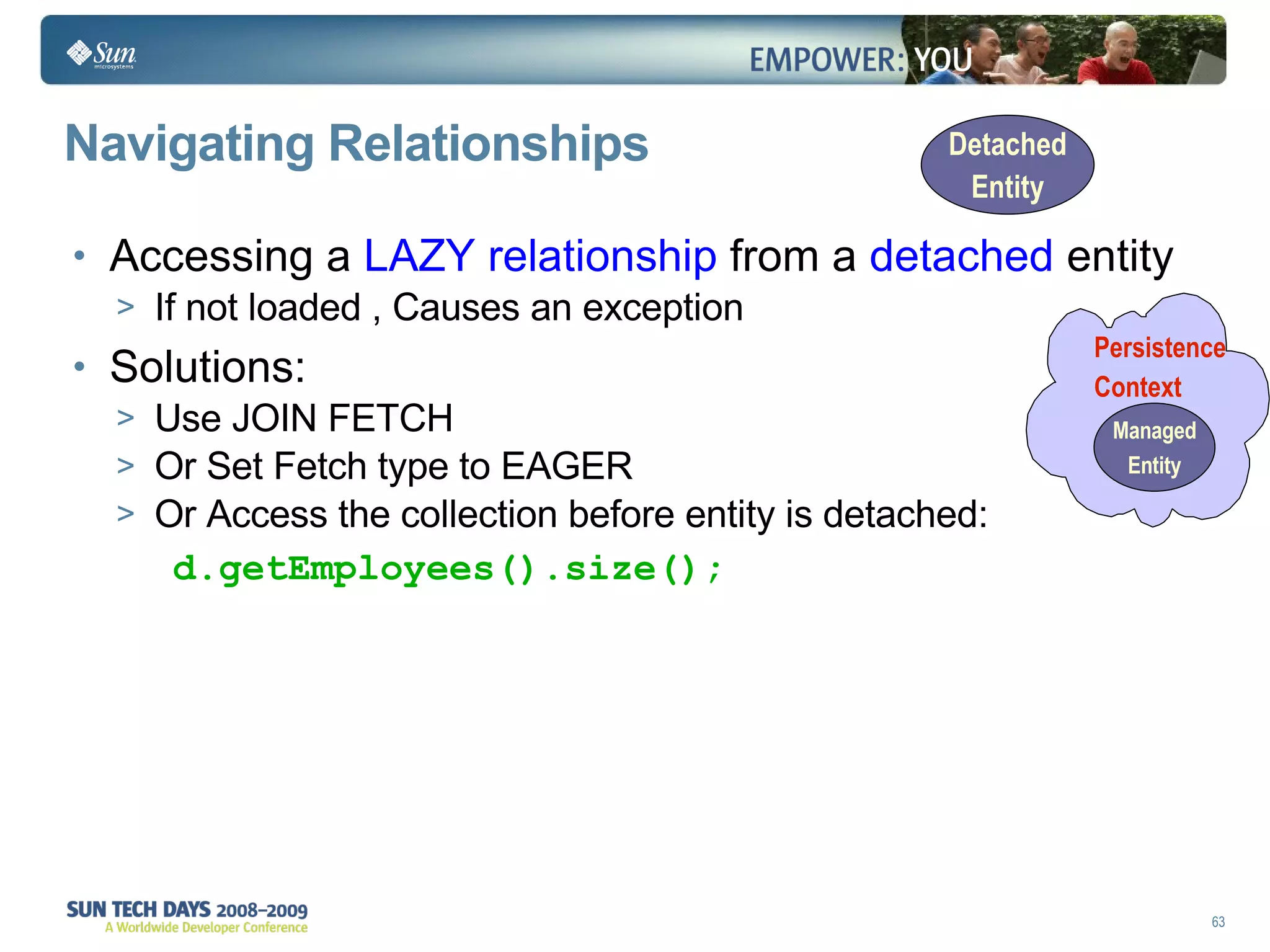
Navigating Relationships Accessing a  LAZY relationship  from a  detached  entity If not loaded , Causes an exception Solutions: Use JOIN FETCH Or Set Fetch type to EAGER Or Access the collection before entity is detached: d.getEmployees().size(); Persistence  Context
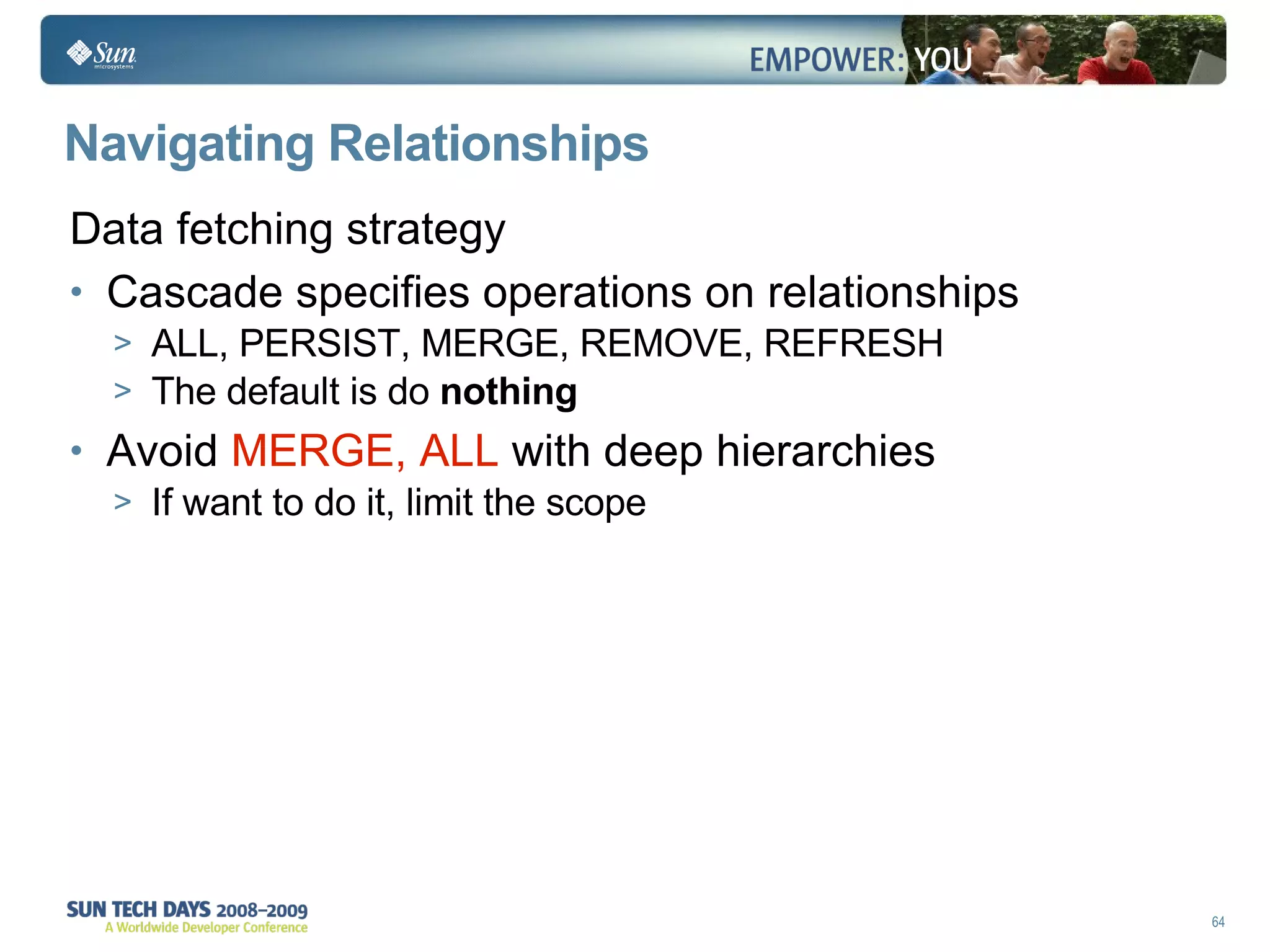
Navigating Relationships Data fetching strategy Cascade specifies operations on relationships ALL, PERSIST, MERGE, REMOVE, REFRESH The default is do  nothing Avoid  MERGE, ALL  with deep hierarchies If want to do it, limit the scope
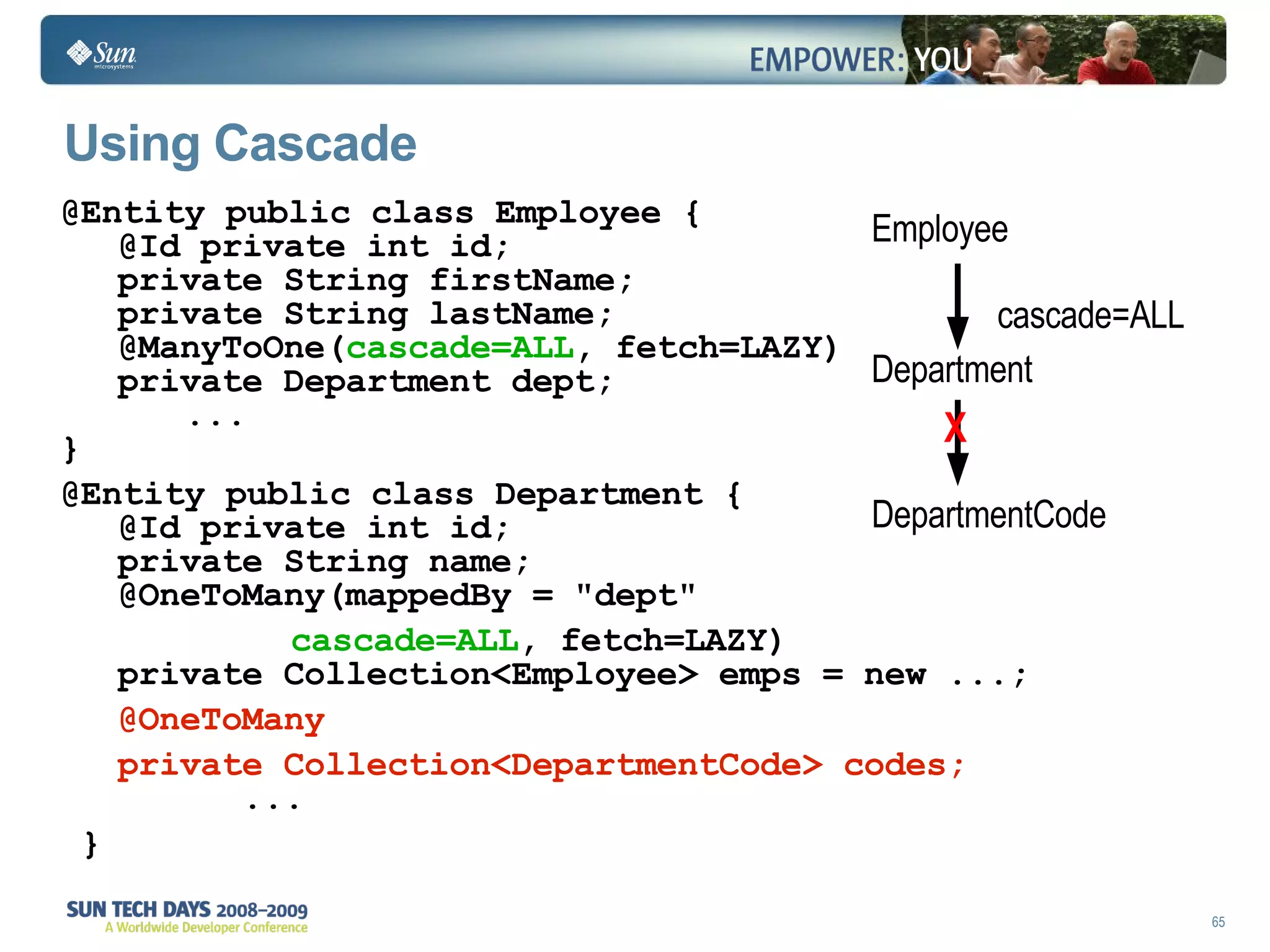
Using Cascade @Entity public class Employee { @Id private int id; private String firstName; private String lastName; @ManyToOne( cascade=ALL , fetch=LAZY) private Department dept;   ... } @Entity public class Department { @Id private int id; private String name; @OneToMany(mappedBy = &quot;dept&quot; cascade=ALL , fetch=LAZY) private Collection<Employee> emps = new ...; @OneToMany private Collection<DepartmentCode> codes;   ... } Employee Department DepartmentCode cascade=ALL X
Agenda Entity Manager Persistence Context Entities Schema and Queries Transaction
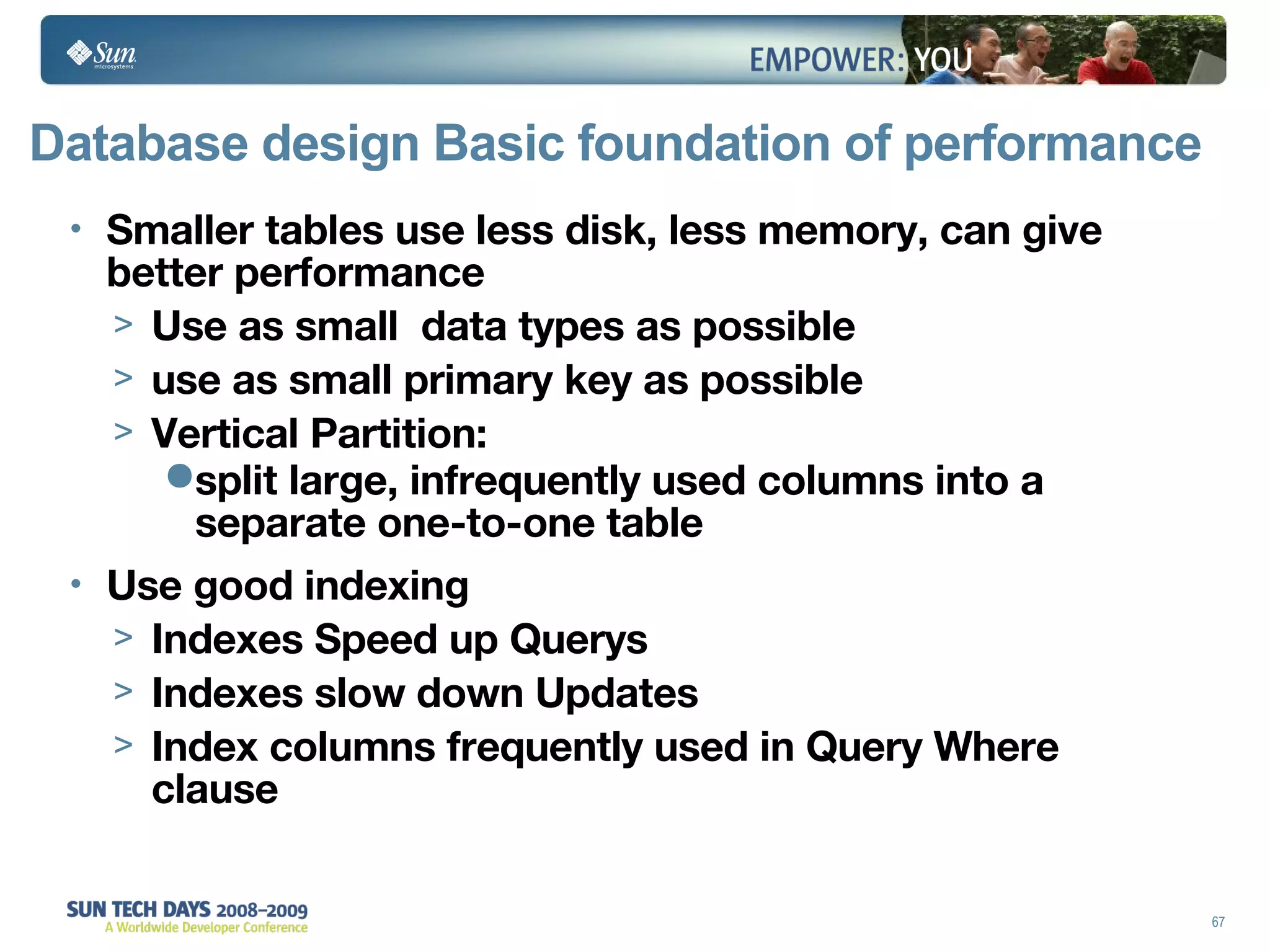
Database design Basic foundation of performance Smaller tables use less disk, less memory, can give better performance Use as small  data types as possible use as small primary key as possible Vertical Partition: split large, infrequently used columns into a separate one-to-one table Use good indexing Indexes Speed up Querys Indexes slow down Updates Index columns frequently used in Query Where clause
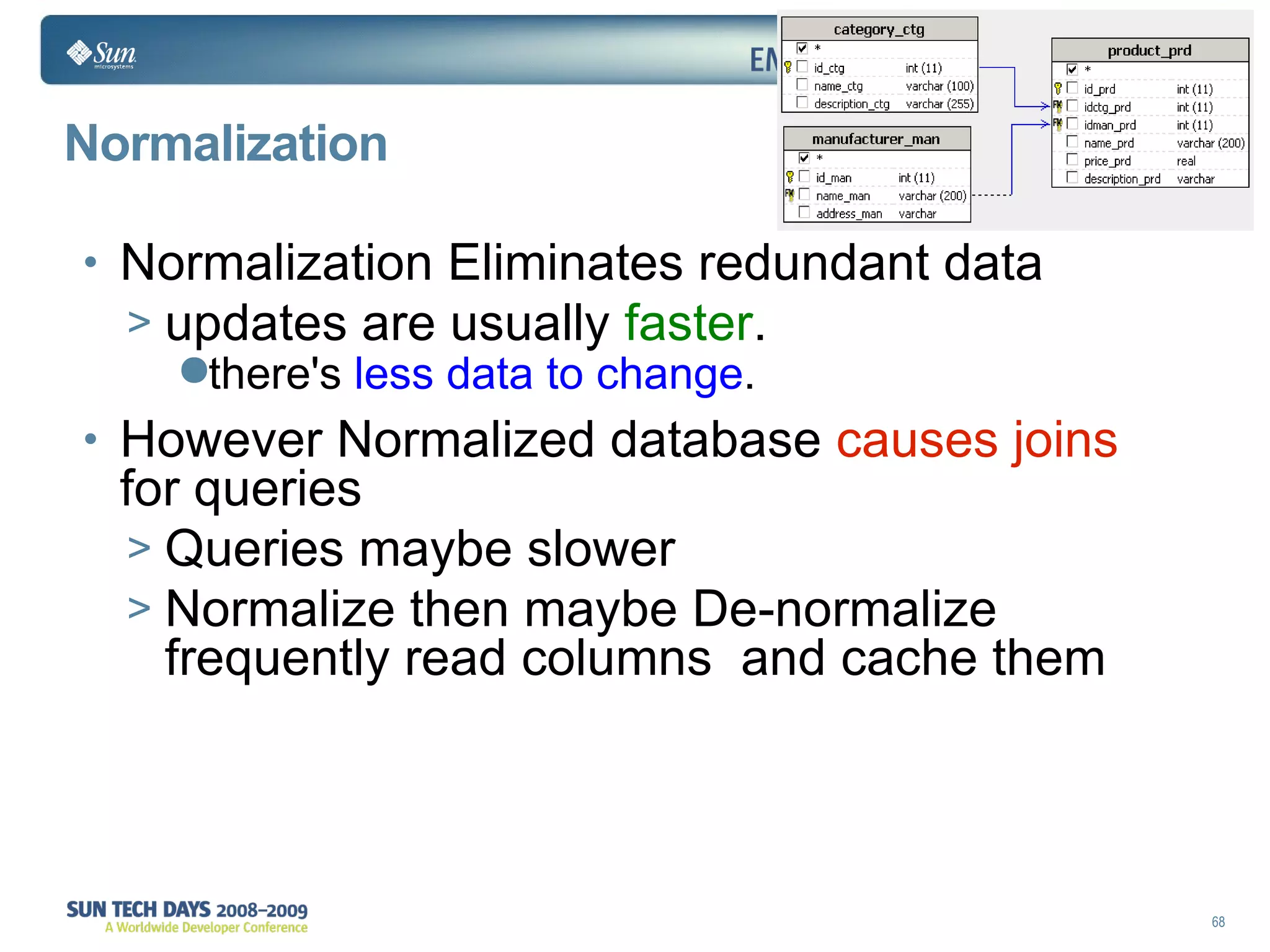
Normalization Normalization Eliminates redundant data updates are usually   faster . there's  less data to change . However Normalized database  causes joins  for queries Queries maybe slower Normalize then maybe De-normalize frequently read columns  and cache them
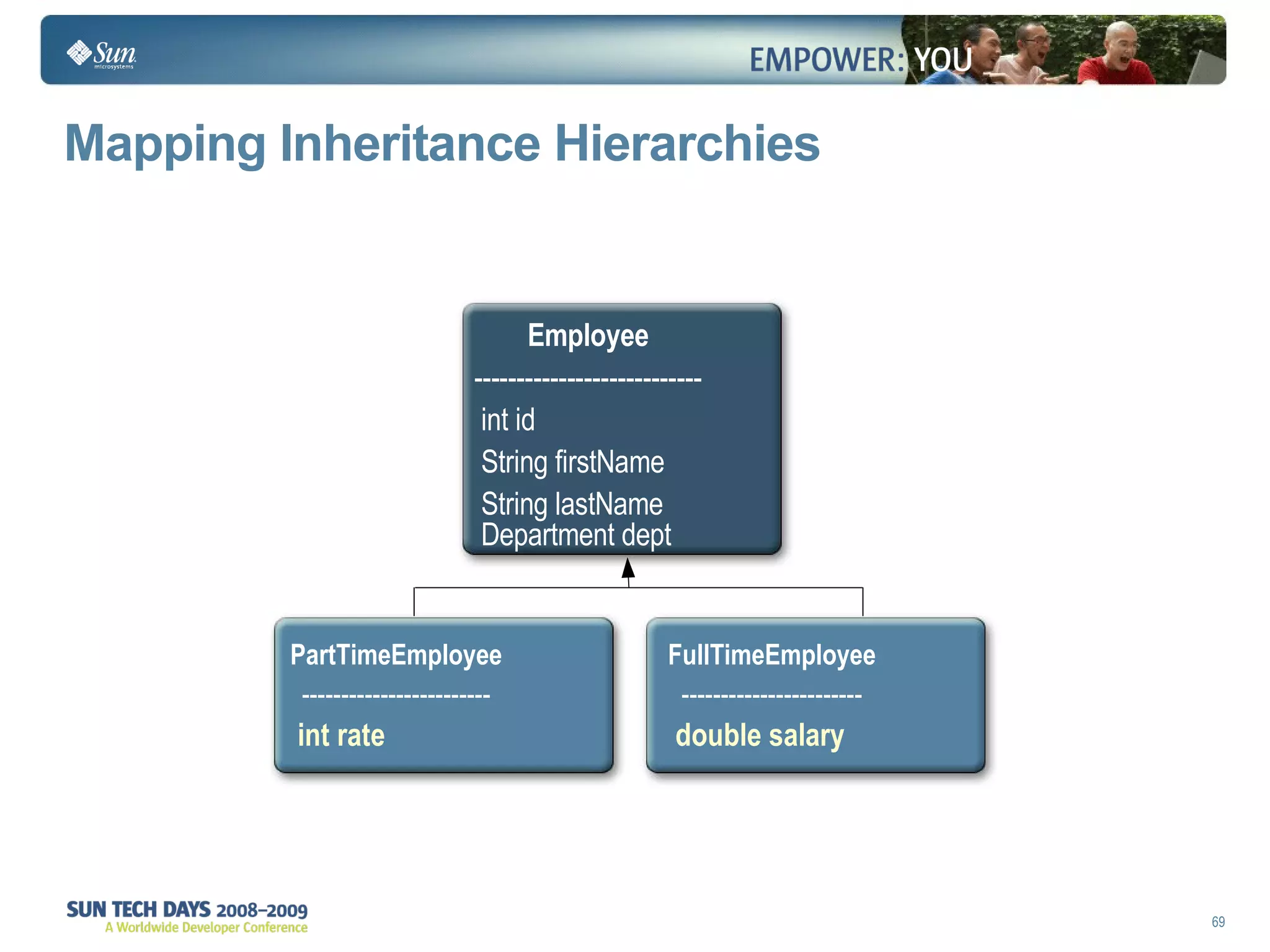
Mapping Inheritance Hierarchies Employee --------------------------- int id  String firstName String lastName  Department dept PartTimeEmployee ------------------------ int rate FullTimeEmployee ----------------------- double salary
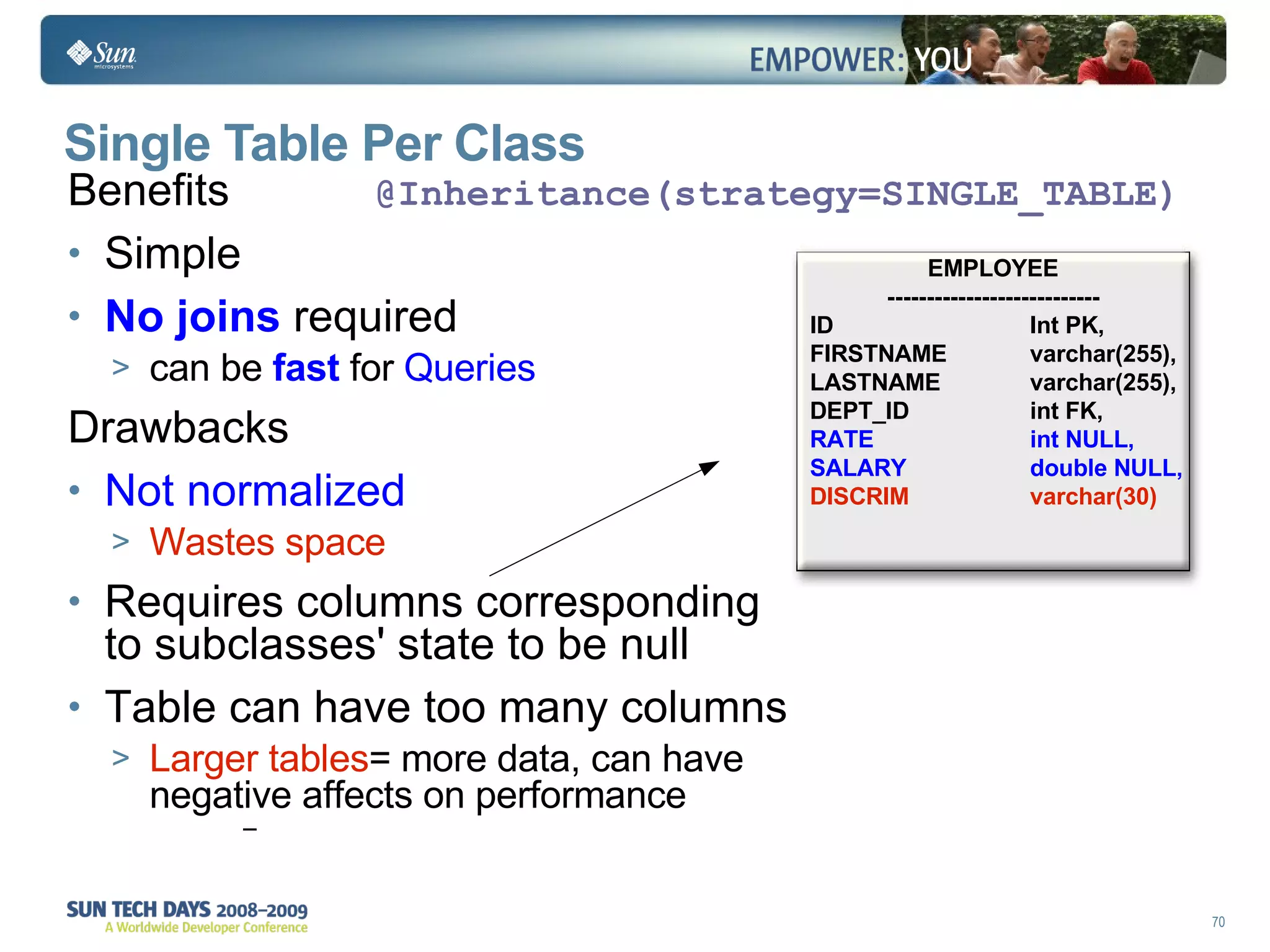
Single Table Per Class Benefits Simple No joins   required can be  fast   for  Queries   Drawbacks Not normalized Wastes space Requires columns corresponding to subclasses' state to be null Table can have too many columns Larger tables = more data, can have negative affects on performance @Inheritance(strategy=SINGLE_TABLE) EMPLOYEE --------------------------- ID Int PK, FIRSTNAME varchar(255), LASTNAME varchar(255),  DEPT_ID int FK, RATE int NULL, SALARY double NULL, DISCRIM varchar(30)
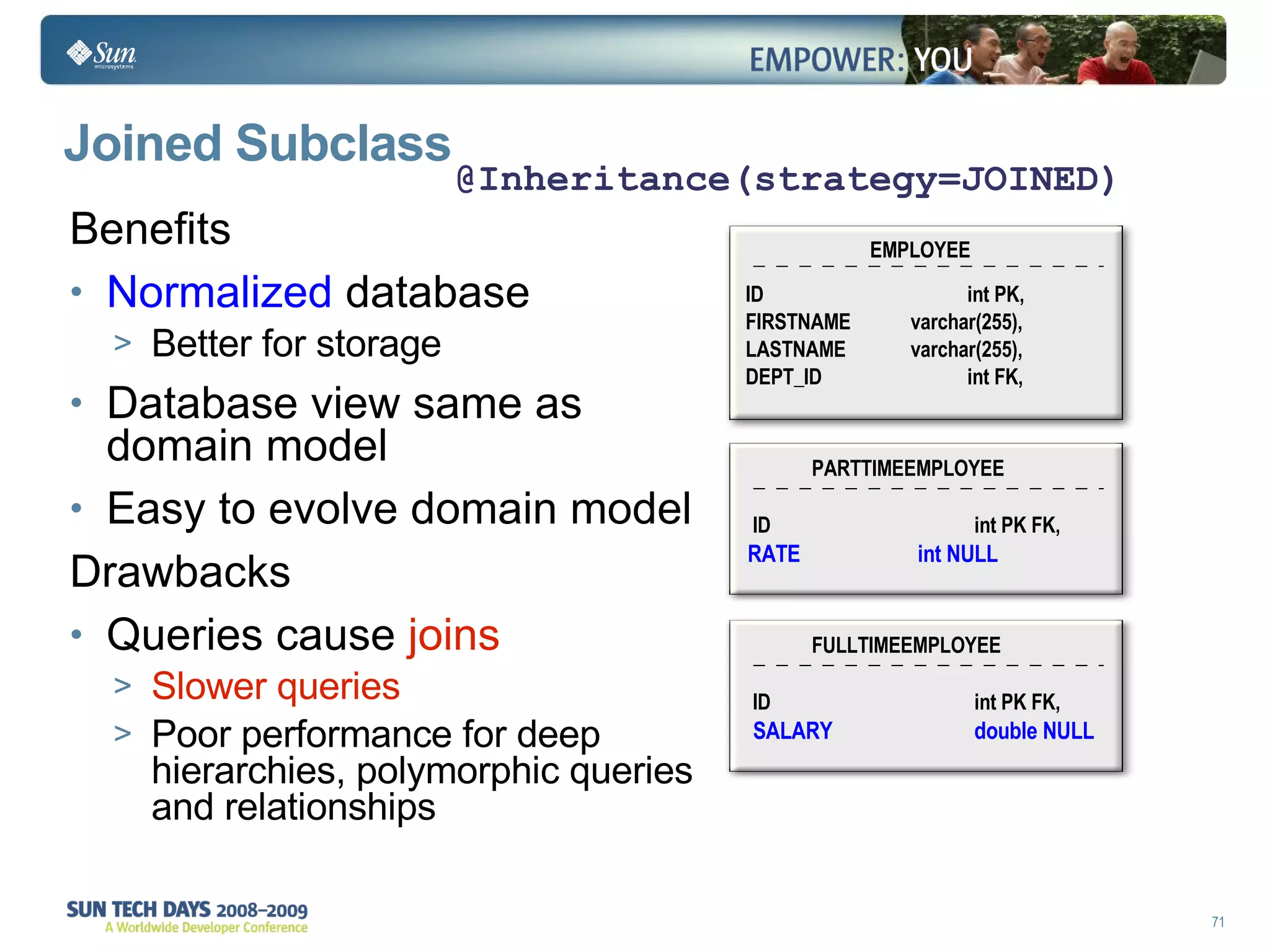
Joined Subclass Benefits Normalized  database Better for storage Database view same as domain model Easy to evolve domain model Drawbacks Queries cause  joins Slower queries Poor performance for deep hierarchies, polymorphic queries and relationships @Inheritance(strategy=JOINED) ID int PK, FIRSTNAME varchar(255), LASTNAME varchar(255),  DEPT_ID int FK, ID int PK FK, RATE int NULL ID int PK FK, SALARY double NULL EMPLOYEE PARTTIMEEMPLOYEE FULLTIMEEMPLOYEE
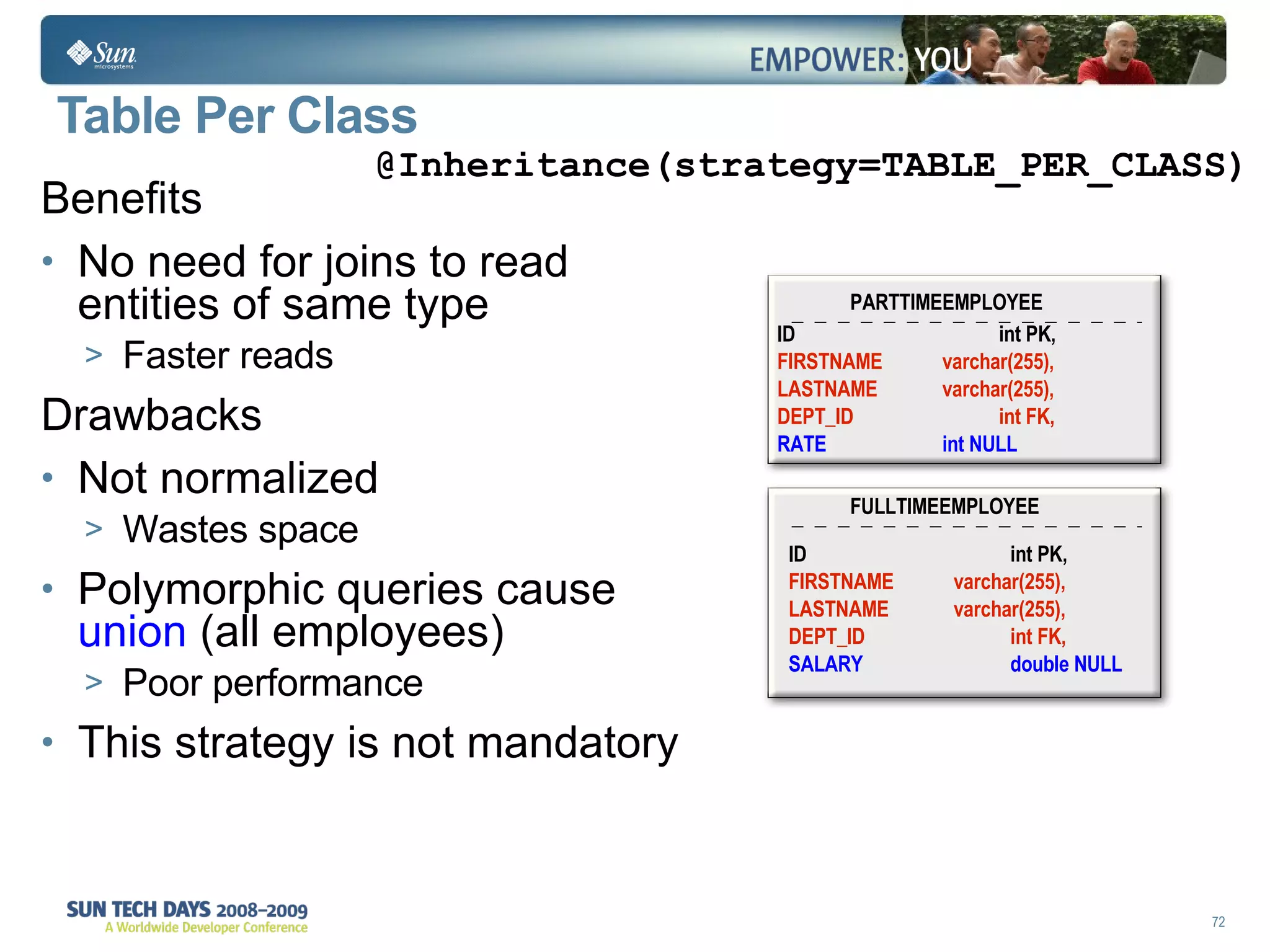
Table Per Class Benefits No need for joins to read  entities of same type Faster reads Drawbacks Not normalized Wastes space Polymorphic queries cause  union  (all employees) Poor performance  This strategy is not mandatory @Inheritance(strategy=TABLE_PER_CLASS) ID int PK, FIRSTNAME varchar(255), LASTNAME varchar(255), DEPT_ID int FK, SALARY double NULL ID int PK, FIRSTNAME varchar(255), LASTNAME varchar(255), DEPT_ID int FK, RATE int NULL PARTTIMEEMPLOYEE FULLTIMEEMPLOYEE
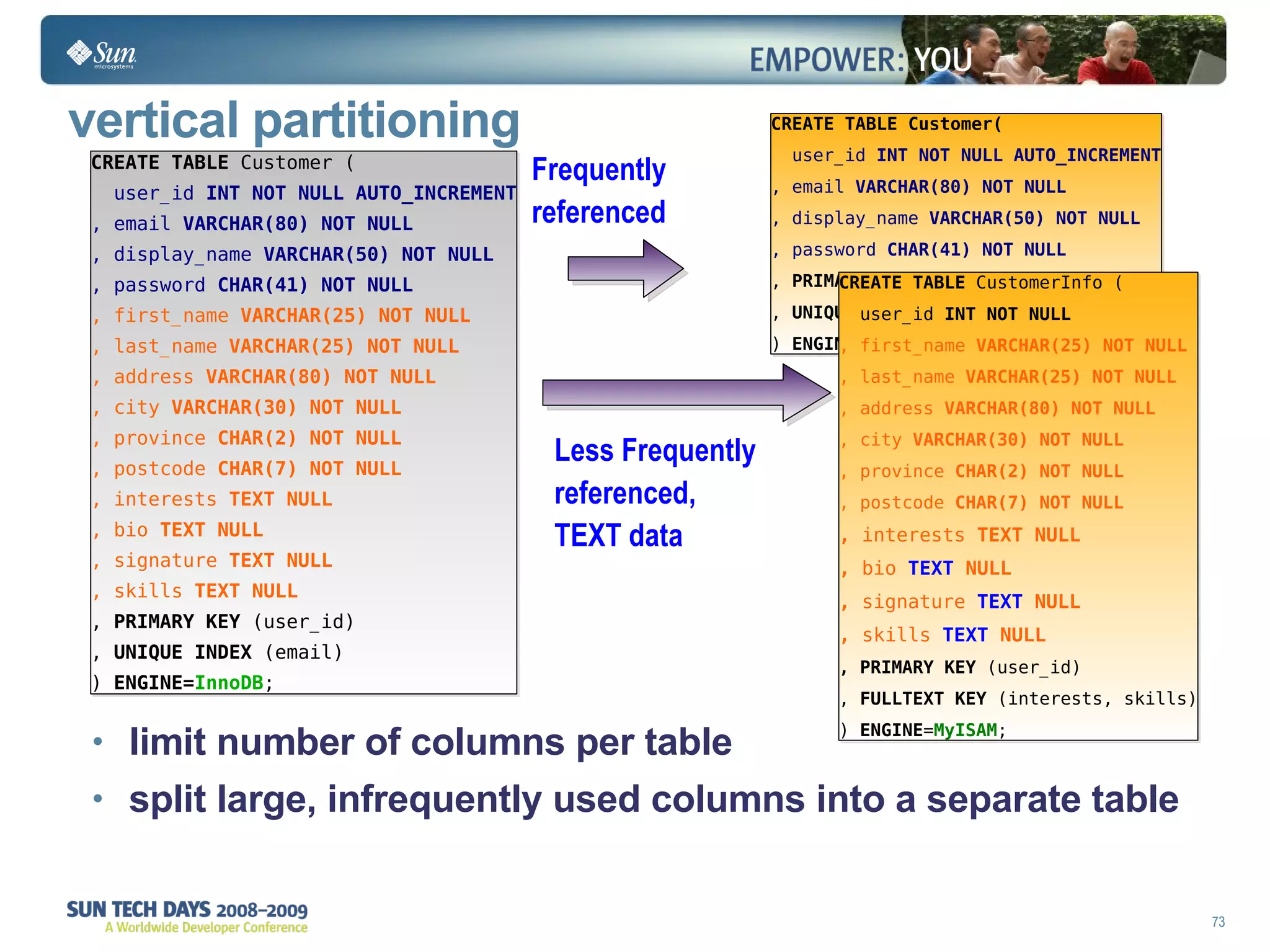
vertical partitioning limit number of columns per table split large, infrequently used columns into a separate  table CREATE TABLE  Customer ( user_id  INT NOT NULL AUTO_INCREMENT , email  VARCHAR(80) NOT NULL , display_name  VARCHAR(50) NOT NULL , password  CHAR(41) NOT NULL , first_name  VARCHAR(25) NOT NULL , last_name  VARCHAR(25) NOT NULL , address  VARCHAR(80) NOT NULL , city  VARCHAR(30) NOT NULL , province  CHAR(2) NOT NULL , postcode  CHAR(7) NOT NULL , interests  TEXT NULL , bio  TEXT NULL , signature  TEXT NULL , skills  TEXT NULL ,  PRIMARY KEY  (user_id) ,  UNIQUE INDEX  (email) )  ENGINE= InnoDB ; Less Frequently referenced, TEXT data Frequently referenced CREATE TABLE Customer( user_id  INT NOT NULL AUTO_INCREMENT , email  VARCHAR(80) NOT NULL , display_name  VARCHAR(50) NOT NULL , password  CHAR(41) NOT NULL ,  PRIMARY KEY  (user_id) ,  UNIQUE INDEX  (email) )  ENGINE = InnoDB ; CREATE TABLE  CustomerInfo ( user_id  INT NOT NULL , first_name  VARCHAR(25) NOT NULL , last_name  VARCHAR(25) NOT NULL , address  VARCHAR(80) NOT NULL , city  VARCHAR(30) NOT NULL , province  CHAR(2) NOT NULL , postcode  CHAR(7) NOT NULL ,  interests  TEXT NULL ,  bio  TEXT  NULL ,  signature   TEXT  NULL ,  skills   TEXT  NULL , PRIMARY KEY  (user_id) ,  FULLTEXT KEY  (interests, skills) )  ENGINE = MyISAM ;
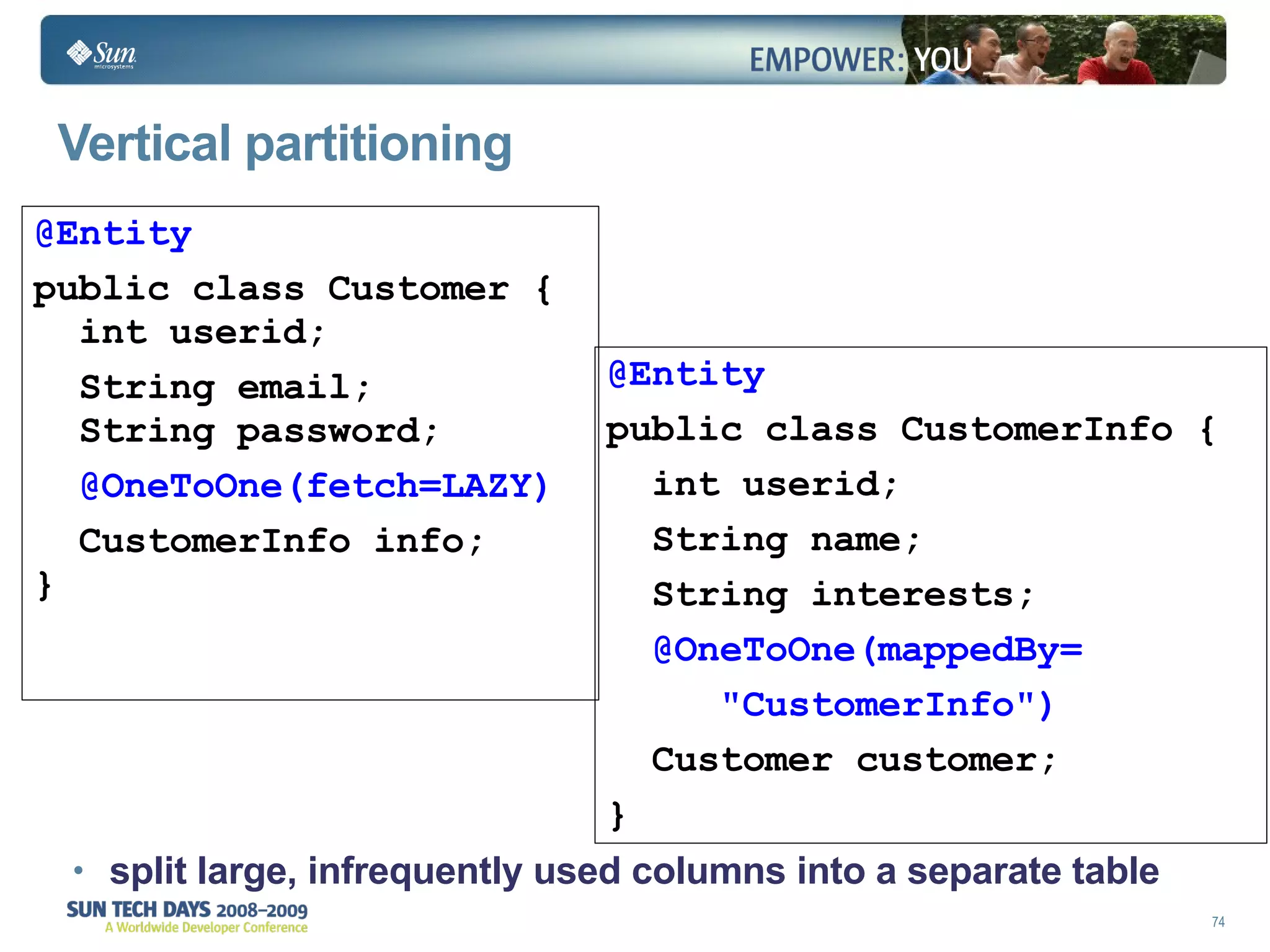
Vertical partitioning split large, infrequently used columns into a separate  table @Entity public class Customer {    int userid; String email;   String password; @OneToOne(fetch=LAZY) CustomerInfo info; } @Entity public class CustomerInfo {  int userid; String name; String interests; @OneToOne(mappedBy= &quot;CustomerInfo&quot;) Customer customer; }
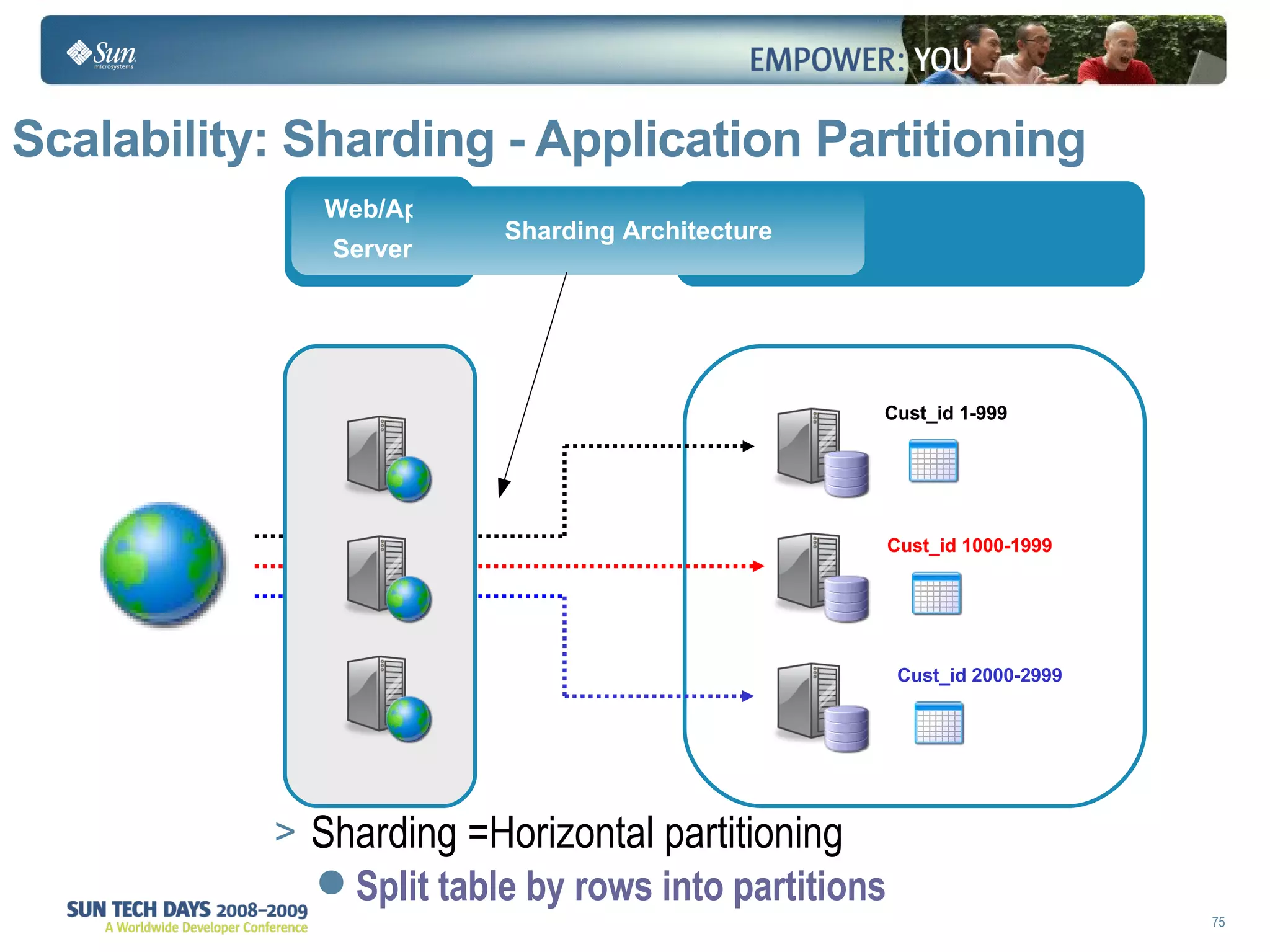
Scalability: Sharding - Application Partitioning Sharding =Horizontal partitioning Split table by rows into partitions Cust_id 1-999 Cust_id 1000-1999 Cust_id 2000-2999 Sharding Architecture Web/App Servers
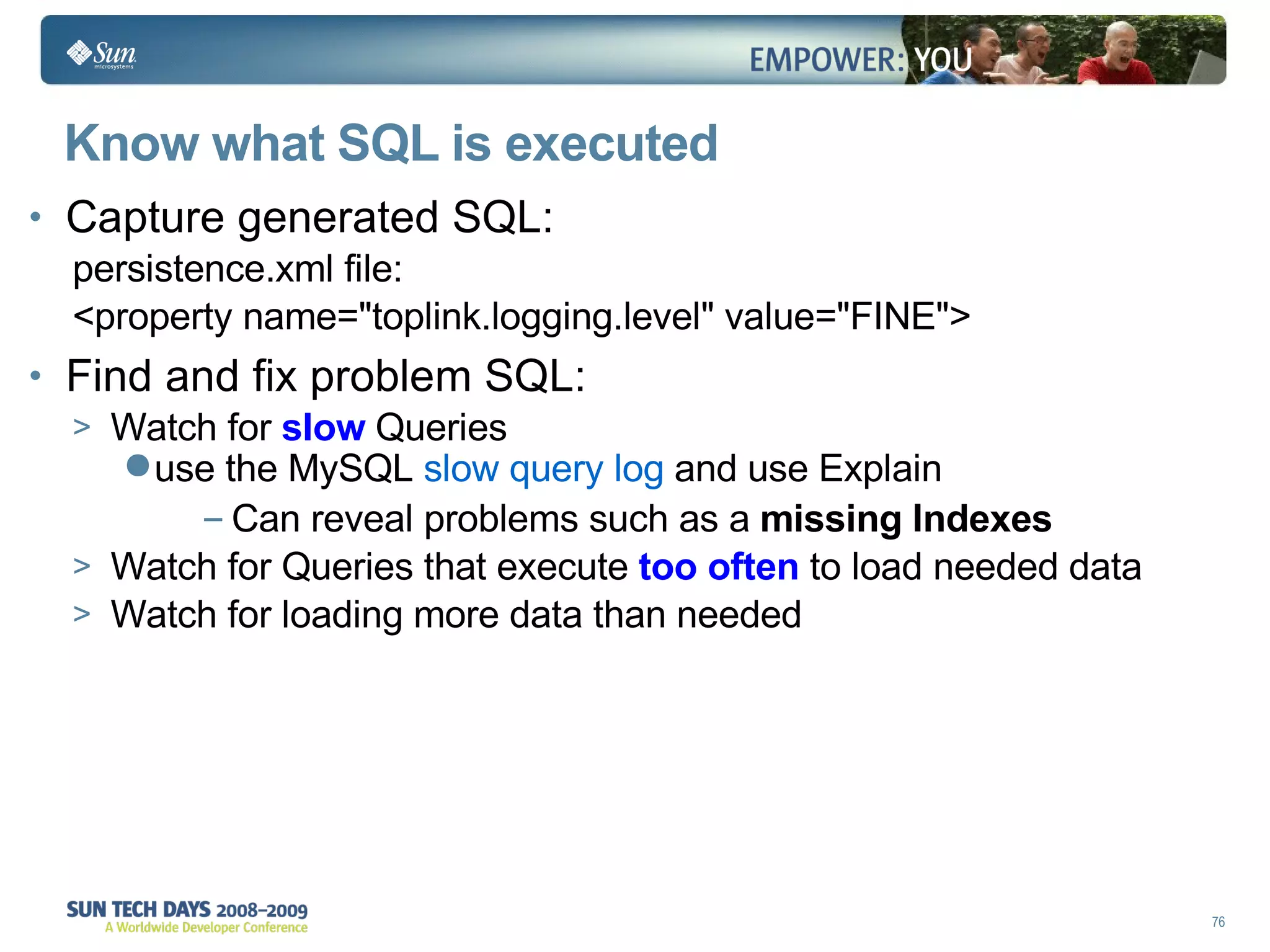
Know what SQL is executed  Capture generated SQL: persistence.xml file: <property name=&quot;toplink.logging.level&quot; value=&quot;FINE&quot;> Find and fix problem SQL: Watch for  slow  Queries use the MySQL  slow query log  and use Explain Can reveal problems such as a  missing Indexes Watch for Queries that execute  too often  to load needed data  Watch for loading more data than needed
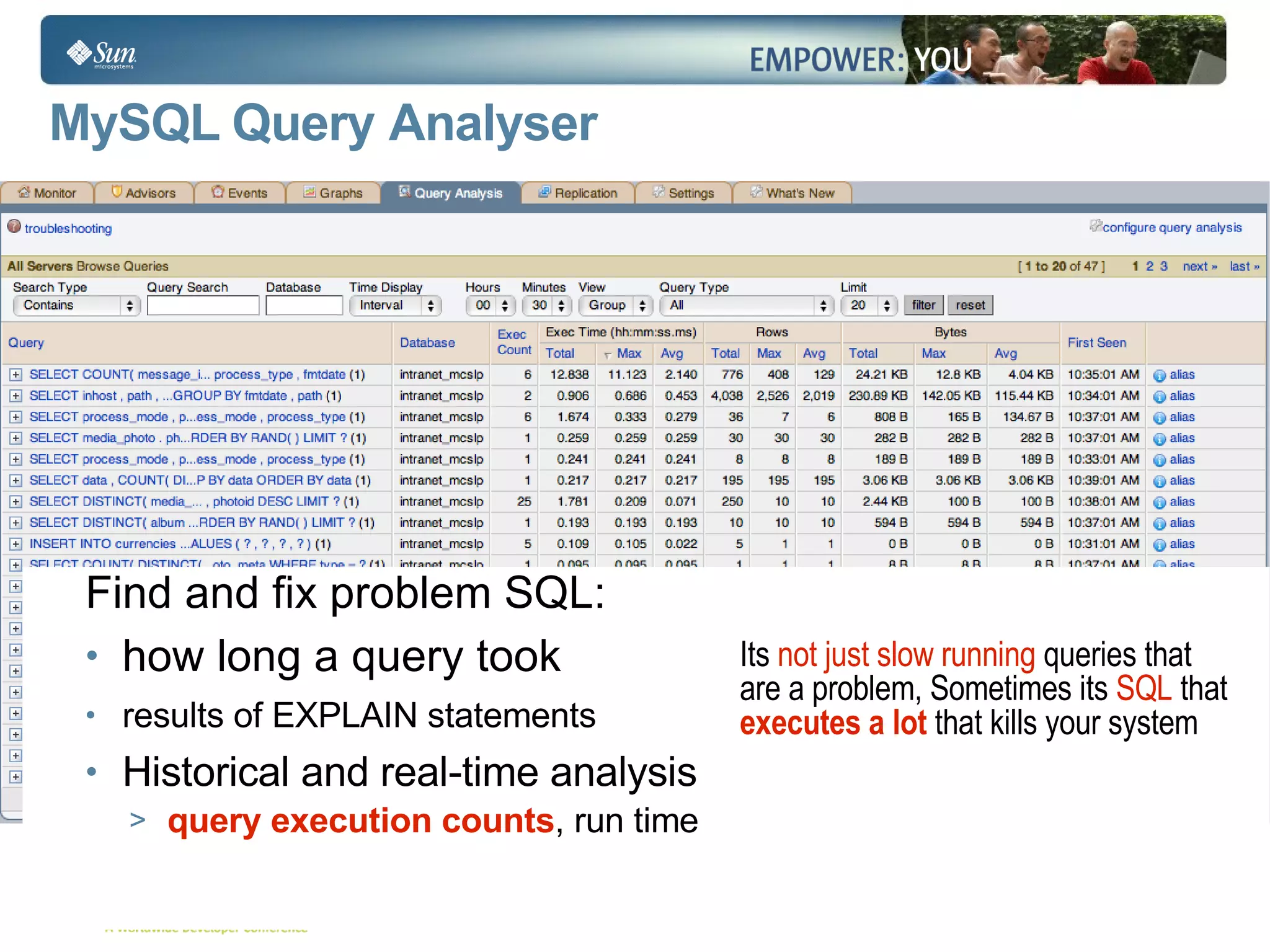
MySQL Query  Analyser Find and fix problem SQL: how long a query took results of EXPLAIN statements Historical and real-time analysis  query execution counts , run time Its  not just slow running  queries that are a problem, Sometimes its  SQL  that  executes a lot   that kills your system
Agenda Entities Entity Manager Persistence Context Queries Transaction
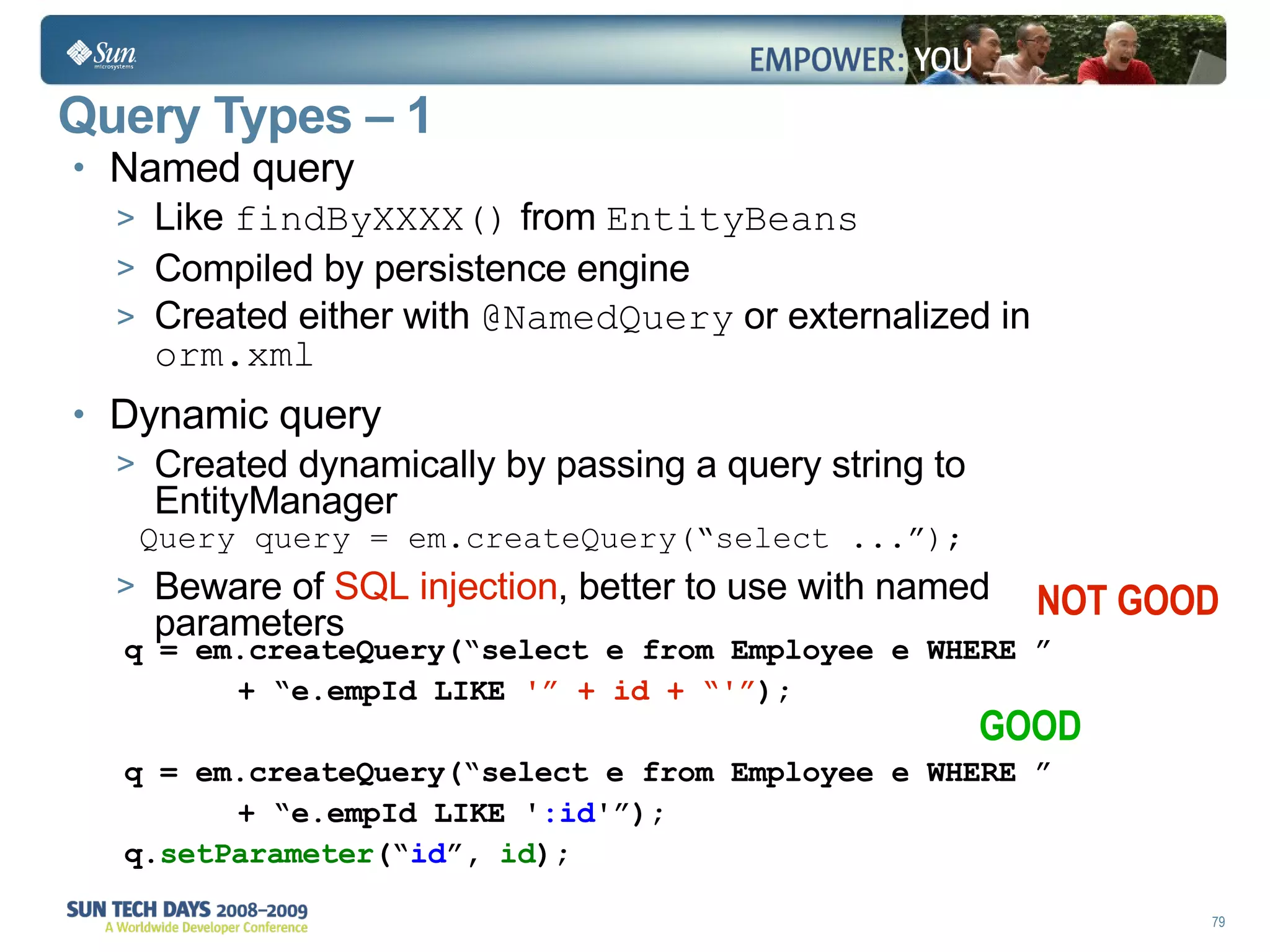
Query Types – 1  Named query Like  findByXXXX()  from  EntityBeans Compiled by persistence engine Created either with  @NamedQuery  or externalized in  orm.xml Dynamic query Created dynamically by passing a query string to EntityManager Query query = em.createQuery(“select ...”); Beware of  SQL injection , better to use with named parameters q = em.createQuery(“select e from Employee e WHERE ” + “e.empId LIKE  '” + id + “'” ); q = em.createQuery(“select e from Employee e WHERE ” + “e.empId LIKE ' :id '”); q. setParameter (“ id ”,  id ); NOT GOOD GOOD
Query Types – 2  Native query Leverage the native database querying facilities Not portable – ties queries to database
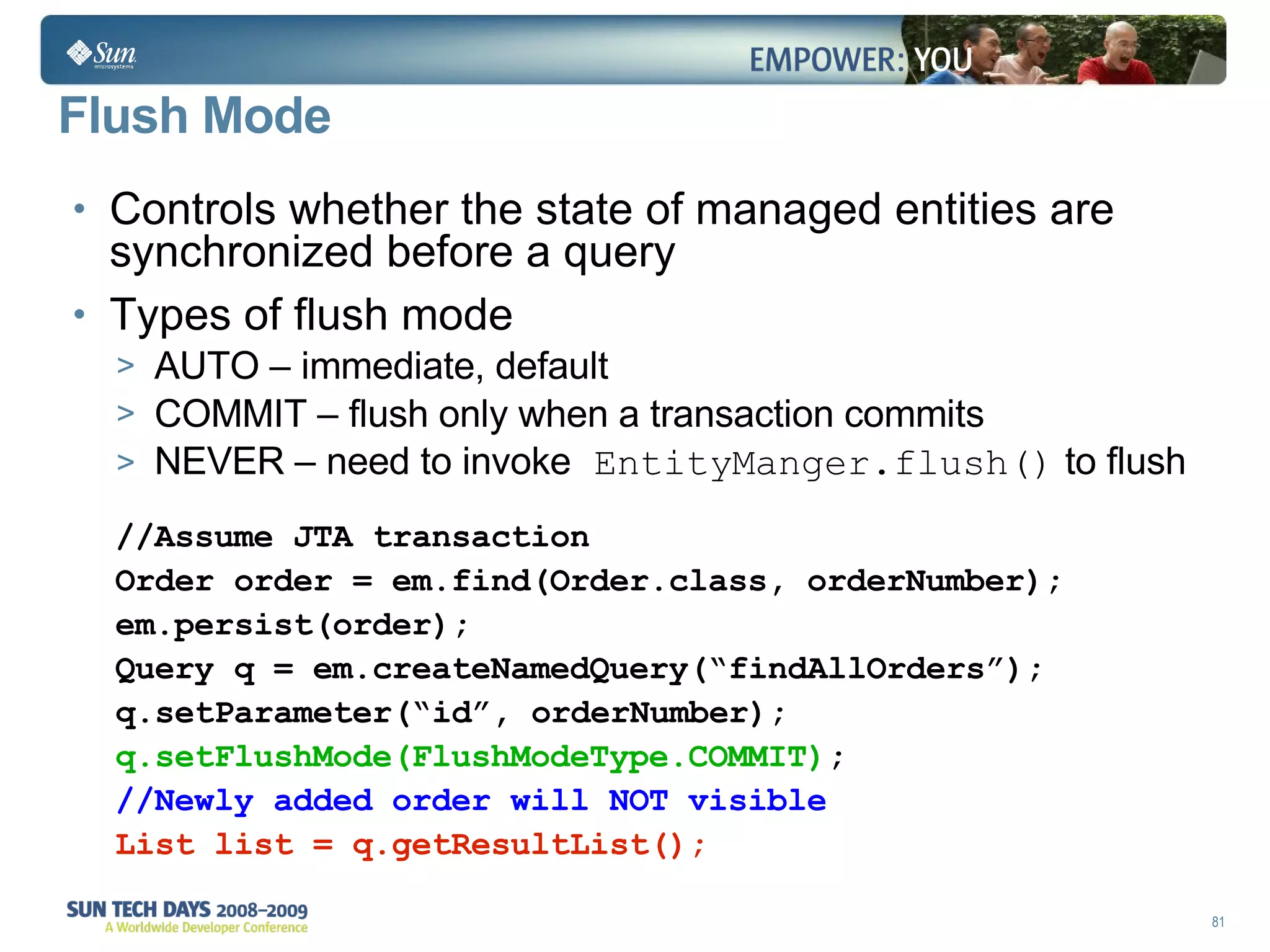
Flush Mode  Controls whether the state of managed entities are synchronized before a query Types of flush mode AUTO – immediate, default COMMIT – flush only when a transaction commits NEVER – need to invoke  EntityManger.flush()  to flush //Assume JTA transaction Order order = em.find(Order.class, orderNumber); em.persist(order); Query q = em.createNamedQuery(“findAllOrders”); q.setParameter(“id”, orderNumber); q.setFlushMode(FlushModeType.COMMIT) ; //Newly added order will NOT visible List list = q.getResultList();
Agenda Entities Entity Manager Persistence Context Queries Transaction
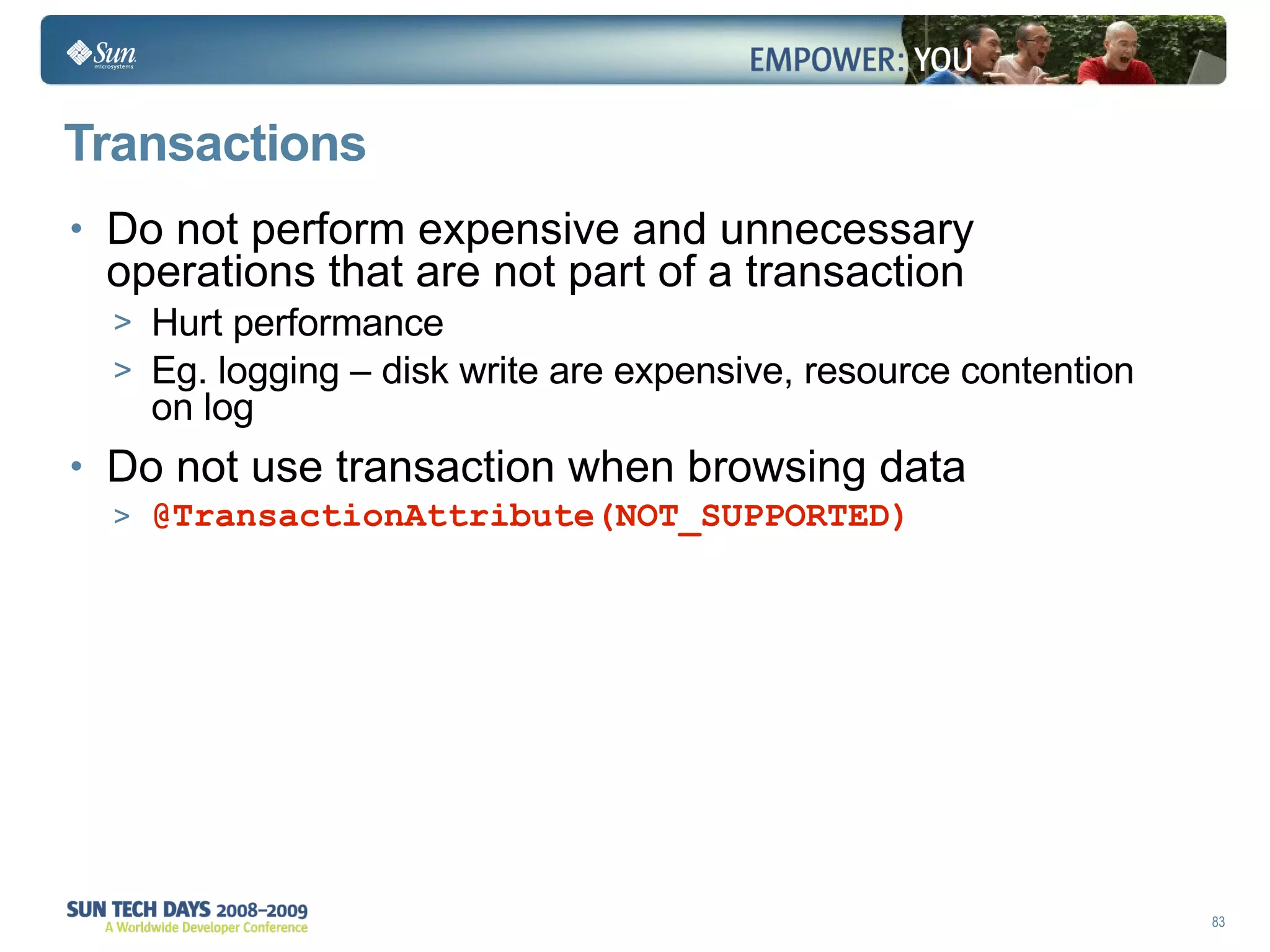
Transactions Do not perform expensive and unnecessary operations that are not part of a transaction Hurt performance Eg. logging – disk write are expensive, resource contention on log Do not use transaction when browsing data @TransactionAttribute(NOT_SUPPORTED)
Carol McDonald Java Architect

JPA Best Practices

  • 1.
    Java Persistence API:Best Practices Carol McDonald Java Architect
  • 2.
    Agenda Entity ManagerPersistence Context Entities Schema & Queries Transaction
  • 3.
    Persistence ContextEntityManager persist() remove() refresh() merge() find() createQuery() createNamedQuery() contains() flush() EntityManager API for managing entities set of entities managed by Entity Manager Servlets EJBs Java app
  • 4.
    Catalog Java EE Application DB Registration Application Managed Bean JSF Components Session Bean Entity Class Catalog Item ManagedBean
  • 5.
    EJB EntityManager Example @Stateless public class Catalog implements CatalogService { @PersistenceContext(unitName=”PetCatalogPu”) EntityManager em; @TransactionAttribute(NOT_SUPPORTED) public List<Item> getItems (int firstItem , int batchSize ) { Query q = em . createQuery (&quot; select i from Item as i &quot;); q. setMaxResults ( batchSize ); q. setFirstResult ( firstItem ); List<Item> items= q.getResultList(); return items; } }
  • 6.
    Catalog Spring JPAApplication DB Registration Application Managed Bean JSF Components Spring Bean Entity Class Catalog Item ItemController Spring Framework
  • 7.
    Spring withJPA @Repository @Transactional public class CatalogDAO implements CatalogService { @PersistenceContext (unitName=&quot;PetCatalogPu&quot;) private EntityManager em; @Transactional(readOnly=true) public List<Item> getItems (int firstItem,int batchSize) { Query q = em. createQuery(&quot;select object(o) from Item as o&quot;); q.setMaxResults(batchSize); q.setFirstResult(firstItem); List<Item> items= q.getResultList(); return items; } Component Stereotype Spring transactions use aop
  • 8.
    Container vs ApplicationManaged Container managed entity managers (EJB, Spring Bean, Seam component) Injected into application Automatically closed JTA transaction – propagated Application managed entity managers Used outside of the JavaEE 5 platform Need to be explicitly created Persistence.createEntityManagerFactory() RESOURCE_LOCAL transaction – not propagated Need to explicitly close entity manager
  • 9.
    Agenda Entity ManagerPersistence Context Entities Queries Transaction
  • 10.
    Persistence ContextEntityManager persist() remove() refresh() merge() find() createQuery() createNamedQuery() contains() flush() Persistence Context set of entities managed by Entity Manager Persistence context acts as a first level cache for entities Two types of persistence context Transaction scoped Extended scoped persistence context
  • 11.
    Level1 and Level2caches The terms “Java Virtual Machine” and “JVM” mean a Virtual Machine for the Java ™ Platform. Source:http://weblogs.java.net/blog/guruwons/archive/2006/09/understanding_t.html Persistence Context is a Level 1 cache Transaction Transaction Transaction Persistence Context (EntityManager) Persistence Context (EntityManager) Persistence Context (EntityManager) L2 Cache (Shared Cache) Entity managers for a specific PersistenceUnit on a given Java Virtual Machine (JVM ™ )
  • 12.
    Persistence Context Transactioncommit new() persist() Updates remove() Merge() find() PC ends Entity Lifecycle Guaranteed Scope of Object Identity only one manage entity in PC represents a row
  • 13.
    Entity Lifecycle Illustrated– The Code @Stateless public ShoppingCartBean implements ShoppingCart { @PersistenceContext EntityManager entityManager; public OrderLine createOrderLine(Product product , Order order) { O rderLine orderLine = new OrderLine(order, product); entityManager.persist(orderLine); return (orderLine); } } New entity Managed entity Detached entity Persistence context
  • 14.
    Scope of Identity@Stateless public ShoppingCartBean implements ShoppingCart { @PersistenceContext EntityManager entityManager; public OrderLine createOrderLine( Product product,Order order) { O rderLine orderLine = new OrderLine(order, product); entityManager.persist(orderLine); OrderLine orderLine2 = entityManager.find (OrderLine, orderLine.getId()) ); ( orderLine == orderLine2 ) // TRUE return (orderLine); } } Persistence context Multiple retrievals of the same object return references to the same object instance
  • 15.
    Persistence Context Twotypes of persistence context Transaction scoped Used in stateless components Typically begins/ends at request entry/exit points respectively Extended scoped persistence context
  • 16.
    Persistence Context Propagation@Stateless public class ShoppingCartBean implements ShoppingCart { @EJB InventoryService inv ; @EJB OrderService ord ; public void checkout (Item i, Product p) { inv.createOrder (item); ord.updateInventory (Product p) } } Persistence context
  • 17.
    Persistence Context Propagation@Stateless public class OrderServiceBean implements OrderService { @PersistenceContext EntityManager em1; public void createOrder (Item item) { em1.persist (new Order(item)); } } @Stateless public class InventoryServiceBean implements InventoryService { @PersistenceContext EntityManager em2; public void updateInventory (Product p) { Product product = em2.merge (p); . . . } }
  • 18.
    Declarative Transaction ManagementExample TX_REQUIRED TX_REQUIRED TX_REQUIRED PC PC PC Shopping Cart Inventory Service Order Service Check Out 1. Update Inventory New Persistence Context Persistence Context Propagated Transaction Attributes 2. Create Order
  • 19.
    AuditServiceBean @Statelesspublic class AuditServiceBean implements AuditService { @PersistenceContext private EntityManager em; @TransactionAttribute(REQUIRES_NEW) public void logTransaction2(int id, String action) { LogRecord lr = new LogRecord(id, action); em.persist(lr); } NEW PC !
  • 20.
    Declarative Transaction ManagementExample 2 REQUIRED REQUIRED REQUIRES_NEW PC PC PC2 Shopping Cart Inventory Service Audit Service Check Out 1. Update Inventory New Persistence Context Persistence Context Propagated Transaction Attributes 2. log transaction NEW PC !
  • 21.
    Persistence Provider PCTransaction Features Attribute-level change tracking Only the minimal updates are sent to the database Orders INSERT, UPDATE and DELETE statements Minimizes database interactions EntityManager flush SQL prior to commit
  • 22.
    Persistence Context Conversationwith detached entity Persistence Context merge() transaction-scoped persistence context request response request response Conversation transaction-scoped persistence context
  • 23.
    Conversation with detachedentity @Stateless public ShoppingCartBean implements ShoppingCart { @PersistenceContext EntityManager entityManager; public OrderLine createOrderLine(Product product,Order order) { OrderLine orderLine = new OrderLine(order, product); entityManager.persist (orderLine); return ( orderLine ); } public OrderLine updateOrderLine(OrderLine orderLine ){ OrderLine orderLine2 = entityManager.merge (orderLine) ); return orderLine2 ; } } Managed entity Detached entity Managed entity
  • 24.
    Types of PersistenceContext Persistence Context lifetime maybe transaction-scoped or extended Transaction-scoped persistence context Extended persistence context spans multiple transactions
  • 25.
    Persistence Context Conversationwith Exented Persistence Context request response request response Conversation extended persistence context
  • 26.
    Extended Persistence Context@Stateful public class OrderMgr { //Specify that we want an EXTENDED @PersistenceContext (type=PersistenceContextType.EXTENDED) EntityManager em ; //Cached order private Order order ; //create and cache order public void createOrder(String itemId) { //order remains managed for the lifetime of the bean Order order = new Order(cust); em.persist( order ); } public void addLineItem (OrderLineItem li){ order. lineItems.add(li); } Managed entity Managed entity
  • 27.
    Extended Persistence Context@Stateful public class DeptMgr { @PersistenceContext (type=PersistenceContextType.EXTENDED) EntityManager em ; private Department dept; @TransactionAttribute(NOT_SUPPORTED) public void getDepartment(int deptId) { dept = em.find(Department.class,deptId); } @TransactionAttribute(NOT_SUPPORTED) public void addEmployee (int empId){ emp = em.find(Employee.class,empId); dept.getEmployees().add(emp); emp.setDepartment(dept); } @Remove @TransactionAttribute(REQUIRES_NEW) public void endUpdate(int deptId) { dept = em.find(Department.class,deptId); }
  • 28.
    Persistence Context- Transactionalvs. Extended @Stateless public class OrderMgr implements OrderService { @PersistenceContext EntityManager em; public void addLineItem (OrderLineItem li){ // First, look up the order. Order order = em.find(Order.class, orderID); order.lineItems.add(li); } @Stateful public class OrderMgr implements OrderService { @PersistenceContext(type = PersistenceContextType. EXTENDED )) EntityManager em; // Order is cached Order order public void addLineItem (OrderLineItem li){ // No em.find invoked for the order object order.lineItems.add(li); } look up the order No em.find invoked Managed entity
  • 29.
    Persistence Context MicroBenchmark Micro benchmark with lots of lookups Persistence context is caching entities Source: Internal benchmarks
  • 30.
    SEAM Conversations @Name (&quot; shopper &quot;)‏ @Scope ( CONVERSATION )‏ public class BookingManager { @In EntityManager entityManager ; private Booking booking ; @Begin public void selectHotel(Hotel selectedHotel ){ hotel = em.merge( selectedHotel ); } @End public void confirm() { em.persist( booking ); } } SEAM injected SEAM conversation
  • 31.
    Concurrency and PersistenceContext Object Identity only one manage entity in PC represents a row User 2 transaction User 1 transaction Persistence Context 1 Entity Manager Persistence Context 2 Entity Manager Data source same entity
  • 32.
    Optimistic versus PessimisticConcurrency Optimistic Concurrency Pros—No database locks held Cons—Requires a version attribute in schema user or app must refresh and retry failed updates Suitable when application has few parallel updates Pessimistic Concurrency Lock the row when data is read in database locks the row upon a select (SELECT . . . FOR UPDATE [NOWAIT]) Pros—Simpler application code Cons—Database locks limits concurrent access to the data = scalability May cause deadlocks Not in JPA 1.0 (vendor specific), supported in JPA 2.0 Suitable when application has many parallel updates
  • 33.
    Preventing Parallel Updatesuse @Version for optimistic locking Used by persistence manager , Results in following SQL “ UPDATE Employee SET ..., version = version + 1 WHERE id = ? AND version = readVersion ” Version Updated when transaction commits, merged or acquiring a write lock OptimisticLockException if mismatch Not used by the application! public class Employee { @ID int id; @Version int version; ... Can be int , Integer , short , Short , long , Long , Timestamp
  • 34.
    Preventing Parallel Updates– 1 tx1.begin(); //Joe's employee id is 5 //e1.version == 1 e1 = findPartTimeEmp(5); //Joe's current rate is $9 e1.raise(2); tx1.commit(); //e1.version == 2 in db //Joe's rate is $11 tx2.begin(); //Joe's employee id is 5 //e1.version == 1 e1 = findPartTimeEmp(5); / /Joe's current rate is $9 if(e1.getRate() < 10) e1.raise(5); //e1.version == 1 in db? tx2.commit(); //Joe's rate is $14 //OptimisticLockException Time
  • 35.
    Preventing Stale DataJPA 1.0 Perform read or write locks on entities Prevents non-repeatable reads in JPA entityManager.lock( entity, READ); perform a version check on entity before commit OptimisticLockException if mismatch entityManager.lock( entity, WRITE); perform a version check on entity OptimisticLockException if mismatch and increment version before commit
  • 36.
    Preventing Stale Datatx1.begin(); d1 = findDepartment(dId); //d1's original name is //”Engrg” d1 .setName(“MarketEngrg”); tx1.commit(); tx2.begin(); e1 = findEmp(eId); d1 = e1.getDepartment(); em.lock( d1 , READ); if(d1's name is “Engrg”) e1 .raiseByTenPercent(); //Check d1. version in db tx2.commit(); //e1 gets the raise he does //not deserve //Transaction rolls back Time
  • 37.
    Write lock preventsparallel updates tx1.begin(); d1 = findDepartment(dId); //d1's original name is //”Engrg” d1 .setName(“MarketEngrg”); tx1.commit(); //tx rolls back tx2.begin(); e1 = findEmp(eId); d1 = e1 .getDepartment(); em.lock(d1, WRITE); //version++ for d1 em.flush(); if(d1's name is “Engrg”) e1 .raiseByTenPercent(); tx2.commit(); Preventing Parallel Updates – 2 Time
  • 38.
    Bulk Updates Updatedirectly against the database, can be Faster But By pass EntityManager @Version will not be updated Entities in PC not updated tx.begin(); int id = 5; //Joe's employee id is 5 e1 = findPartTimeEmp(id); //Joe's current rate is $9 //Double every employee's salary em.createQuery( “ Update Employee set rate = rate * 2 ”).executeUpdate(); //Joe's rate is still $9 in this persistence context if(e1.getRate() < 10) e1.raiseByFiveDollar(); tx.commit(); //Joe's salary will be $14
  • 39.
    JPA 2.0 LocksJPA1.0 only supported optimistic locking, JPA 2.0 also supports pessimistic locks JPA 2.0 LockMode values : OPTIMISTIC (= READ) OPTIMISTIC_FORCE_INCREMENT (= WRITE) PESSIMISTIC PESSIMISTIC_FORCE_INCREMENT Multiple places to specify lock database locks the row (SELECT . . . FOR UPDATE )
  • 40.
    //Read then lock:Account acct = em. find (Account.class, acctId); // Decide to withdraw $100 so lock it for update em.lock(acct, PESSIMISTIC); int balance = acct.getBalance(); acct.setBalance (balance - 100); //Read and lock : Account acct = em. find (Account.class, acctId, PESSIMISTIC ); // Decide to withdraw $100 (already locked) int balance = acct.getBalance(); acct.setBalance (balance - 100); JPA 2.0 Locking Locks longer , could cause bottlenecks, deadlock Lock after read, risk stale , could cause OptimisticLock Exception
  • 41.
    // read then lock and refresh Account acct = em. find (Account.class, acctId); // Decide to withdraw $100 - lock and refresh em. refresh(acct, PESSIMISTIC); int balance = acct.getBalance(); acct. setBalance (balance - 100); JPA 2.0 Locking “ right” approach depends on requirements Trade-offs: lock earlier : risk bad scalability, deadlock Lock later : risk stale data for update, get optimistic lock exception
  • 42.
    L2 cache sharedacross transactions and users Putting it all together User Session User Session User Session Persistence Context (EntityManager) Persistence Context (EntityManager) Persistence Context (EntityManager) L2 Cache (Shared Cache) Entity managers for a specific PersistenceUnit on a given Java Virtual Machine (JVM ™ ) (EntityManagerFactory)
  • 43.
    Second-level Cache L2Cache shares entity state across various persistence contexts If caching is enabled, entities not found in persistence context , will be loaded from L2 cache , if found Best for read-mostly classes L2 Cache is Vendor specific Java Persistence API 1.0 does not specify L2 support Java Persistence API 2.0 has basic cache operations Most persistence providers-- Hibernate, EclipseLink, OpenJPA ... provide second-level cache(s)
  • 44.
    L2 Cache L2 Cache query that looks for a single object based on Id will go 1st to PC then to L2 cache, other queries go to database or query cache Shared entity User transaction 1 Persistence Context User transaction 2 Persistence Context Data source same entity not shared
  • 45.
    L2 Caching Pros: avoids database access for already loaded entities faster for reading frequently accessed unmodified entities Cons memory consumption for large amount of objects Stale data for updated objects Concurrency for write (optimistic lock exception, or pessimistic lock) Bad scalability for frequent or concurrently updated entities
  • 46.
    L2 Caching ConfigureL2 caching for entities that are read often modified infrequently Not critical if stale protect any data that can be concurrently modified with a locking strategy Must handle optimistic lock failures on flush/commit configure expiration, refresh policy to minimize lock failures Configure Query cache Useful for queries that are run frequently with the same parameters, for not modified tables
  • 47.
    JPA 2.0 SharedCache API entity cache shared across persistence unit Accessible from EntityManagerFactory Supports only very basic cache operations Can be extended by vendors public class Cache { //checks if object is in IdentityMap public boolean contains (Class class, Object pk); // invalidates object in the IdentityMap public void evict (Class class, Object pk); public void evict (Class class ); // invalidates the class in the IdentityMap. public void evictAll (); // Invalidates all classes in the IdentityMap }
  • 48.
    EclipseLink Caching ArchitectureEclipseLink caches Entities in L2, Hibernate does not EntityManager EntityManager Factory Server L1 Cache PC Cache L2 Shared Cache Cache Coordination JMS (MDB) RMI CORBA IIOP
  • 49.
    EclipseLink Extensions -L2 Caching Default : Entities read are L2 cached Cache Configuration by Entity type or Persistence Unit You can disable L2 cache Configuration Parameters Cache isolation, type, size, expiration, coordination, invalidation,refreshing Coordination (cluster-messaging) Messaging: JMS, RMI, RMI-IIOP, … Mode: SYNC, SYNC+NEW, INVALIDATE, NONE
  • 50.
    @Entity @Table(name=&quot;EMPLOYEE&quot;) @Cache( type=CacheType.WEAK, isolated=false, expiry=600000, alwaysRefresh=true, disableHits=true, coordinationType=INVALIDATE_CHANGED_OBJECTS ) public class Employee implements Serializable { ... } EclipseLink Mapping Extensions Type= Full: objects never flushed unless deleted or evicted weak: object will be garbage collected if not referenced @Cache type, size,isolated, expiry, refresh, cache usage, coordination Cache usage and refresh query hints =true disables L2 cache
  • 51.
    Hibernate L2Cache Hibernate L2 cache is not configured by default Hibernate L2 does not cache Entities. Hibernate caches Id and state Hibernate L2 cache is pluggable EHCache, OSCache, SwarmCacheProvider (JVM) JBoss TreeCache Cluster Can plug in others like Terracotta Cache Concurrency Strategy
  • 52.
    Hibernate L2Cache <!-- optional configuration file parameter --> net.sf.ehcache.configurationResourceName=/name_of_configuration_resource @Entity @Cache (usage = CacheConcurrencyStrategy . NONSTRICT_READ_WRITE ) public Class Country { private String name; ... } not configured by default Cache Concurrency Strategy must be supported by cache provider
  • 53.
    OpenJPA L2 Caching OpenJPA L2 caches object data and JPQL query results Updated when data is loaded from database and after changes are successfully committed For cluster caches are notified when changes are made Can plug in implementations, such as Tangosol’s Coherence product several cache eviction strategies: Time-to-live settings for cache instances @Entity @DataCache(timeout=5000) public class Person { ... }
  • 54.
    Agenda Entity ManagerPersistence Context Entities Schema and Queries Transaction
  • 55.
    Maintaining Relationship Applicationbears the responsibility of maintaining relationship between objects deptA.getEmployees().add(e3); Department A Employee1 Employee2 Employee3 Employee1 Employee2 Employee3 Before After Inconsistent! Department B Department A Department B
  • 56.
    Example – DomainModel @Entity public class Employee { @Id private int id; private String firstName; private String lastName; @ManyToOne(fetch=LAZY) private Department dept; ... } @Entity public class Department { @Id private int id; private String name; @OneToMany(mappedBy = &quot;dept&quot;, fetch=LAZY) private Collection<Employee> emps = new ...; ... }
  • 57.
    Example – ManagingRelationship public int addNewEmployee(...) { Employee e = new Employee(...); Department d = new Department(1, ...); e.setDepartment(d); //Reverse relationship is not set em.persist(e); em.persist(d); return d.getEmployees().size(); } INCORRECT
  • 58.
    Example – ManagingRelationship public int addNewEmployee(...) { Employee e = new Employee(...); Department d = new Department(1, ...); e.setDepartment(d); d.getEmployees().add(e); em.persist(e); em.persist(d); return d.getEmployees().size(); } CORRECT
  • 59.
    Navigating Relationships Datafetching strategy EAGER – immediate LAZY – loaded only when needed LAZY is good for large objects and/or with relationships with deep hierarchies
  • 60.
    Lazy loading andJPA Default FetchType is LAZY for 1:m and m:n relationships benefits large objects and relationships with deep hierarchies However for use cases where data is needed can cause n+1 selects LAZY – N + 1 problem: @Entity public class Department { @Id private int id; @OneToMany(mappedBy = &quot;dept&quot;) private Collection<Employee> emps ; ... } SELECT d.id, ... FROM Department d // 1 time SELECT e.id, ... FROM Employee e WHERE e.deptId = ? // N times
  • 61.
    Lazy loading andJPA Relationship can be Loaded Eagerly But if you have several related relationships , could load too much ! OR Temporarily override the LAZY fetch type, use Join Fetch in a query : @Entity public class Department { @Id private int id; @OneToMany(mappedBy = &quot;dept&quot;, fetch=EAGER ) private Collection<Employee> employees ; ... } @NamedQueries ({ @NamedQuery(name=&quot;getItEarly&quot;, query=&quot;SELECT d FROM Department d JOIN FETCH d.employees &quot;)}) public class Department { ..... } Can cause Cartesian product
  • 62.
    Lazy loading andJPA Capture generated SQL persistence.xml file: <property name=&quot; toplink.logging.level &quot; value=&quot; FINE &quot;> Test run use cases and examine the SQL statements optimise the number of SQL statements executed! only retrieve the data your application needs! Lazy load large (eg BLOB) attributes and relationships that are not used often Override to Eagerly load in use cases where needed
  • 63.
    Navigating Relationships Accessinga LAZY relationship from a detached entity If not loaded , Causes an exception Solutions: Use JOIN FETCH Or Set Fetch type to EAGER Or Access the collection before entity is detached: d.getEmployees().size(); Persistence Context
  • 64.
    Navigating Relationships Datafetching strategy Cascade specifies operations on relationships ALL, PERSIST, MERGE, REMOVE, REFRESH The default is do nothing Avoid MERGE, ALL with deep hierarchies If want to do it, limit the scope
  • 65.
    Using Cascade @Entitypublic class Employee { @Id private int id; private String firstName; private String lastName; @ManyToOne( cascade=ALL , fetch=LAZY) private Department dept; ... } @Entity public class Department { @Id private int id; private String name; @OneToMany(mappedBy = &quot;dept&quot; cascade=ALL , fetch=LAZY) private Collection<Employee> emps = new ...; @OneToMany private Collection<DepartmentCode> codes; ... } Employee Department DepartmentCode cascade=ALL X
  • 66.
    Agenda Entity ManagerPersistence Context Entities Schema and Queries Transaction
  • 67.
    Database design Basicfoundation of performance Smaller tables use less disk, less memory, can give better performance Use as small data types as possible use as small primary key as possible Vertical Partition: split large, infrequently used columns into a separate one-to-one table Use good indexing Indexes Speed up Querys Indexes slow down Updates Index columns frequently used in Query Where clause
  • 68.
    Normalization Normalization Eliminatesredundant data updates are usually faster . there's less data to change . However Normalized database causes joins for queries Queries maybe slower Normalize then maybe De-normalize frequently read columns and cache them
  • 69.
    Mapping Inheritance HierarchiesEmployee --------------------------- int id String firstName String lastName Department dept PartTimeEmployee ------------------------ int rate FullTimeEmployee ----------------------- double salary
  • 70.
    Single Table PerClass Benefits Simple No joins required can be fast for Queries Drawbacks Not normalized Wastes space Requires columns corresponding to subclasses' state to be null Table can have too many columns Larger tables = more data, can have negative affects on performance @Inheritance(strategy=SINGLE_TABLE) EMPLOYEE --------------------------- ID Int PK, FIRSTNAME varchar(255), LASTNAME varchar(255), DEPT_ID int FK, RATE int NULL, SALARY double NULL, DISCRIM varchar(30)
  • 71.
    Joined Subclass BenefitsNormalized database Better for storage Database view same as domain model Easy to evolve domain model Drawbacks Queries cause joins Slower queries Poor performance for deep hierarchies, polymorphic queries and relationships @Inheritance(strategy=JOINED) ID int PK, FIRSTNAME varchar(255), LASTNAME varchar(255), DEPT_ID int FK, ID int PK FK, RATE int NULL ID int PK FK, SALARY double NULL EMPLOYEE PARTTIMEEMPLOYEE FULLTIMEEMPLOYEE
  • 72.
    Table Per ClassBenefits No need for joins to read entities of same type Faster reads Drawbacks Not normalized Wastes space Polymorphic queries cause union (all employees) Poor performance This strategy is not mandatory @Inheritance(strategy=TABLE_PER_CLASS) ID int PK, FIRSTNAME varchar(255), LASTNAME varchar(255), DEPT_ID int FK, SALARY double NULL ID int PK, FIRSTNAME varchar(255), LASTNAME varchar(255), DEPT_ID int FK, RATE int NULL PARTTIMEEMPLOYEE FULLTIMEEMPLOYEE
  • 73.
    vertical partitioning limitnumber of columns per table split large, infrequently used columns into a separate table CREATE TABLE Customer ( user_id INT NOT NULL AUTO_INCREMENT , email VARCHAR(80) NOT NULL , display_name VARCHAR(50) NOT NULL , password CHAR(41) NOT NULL , first_name VARCHAR(25) NOT NULL , last_name VARCHAR(25) NOT NULL , address VARCHAR(80) NOT NULL , city VARCHAR(30) NOT NULL , province CHAR(2) NOT NULL , postcode CHAR(7) NOT NULL , interests TEXT NULL , bio TEXT NULL , signature TEXT NULL , skills TEXT NULL , PRIMARY KEY (user_id) , UNIQUE INDEX (email) ) ENGINE= InnoDB ; Less Frequently referenced, TEXT data Frequently referenced CREATE TABLE Customer( user_id INT NOT NULL AUTO_INCREMENT , email VARCHAR(80) NOT NULL , display_name VARCHAR(50) NOT NULL , password CHAR(41) NOT NULL , PRIMARY KEY (user_id) , UNIQUE INDEX (email) ) ENGINE = InnoDB ; CREATE TABLE CustomerInfo ( user_id INT NOT NULL , first_name VARCHAR(25) NOT NULL , last_name VARCHAR(25) NOT NULL , address VARCHAR(80) NOT NULL , city VARCHAR(30) NOT NULL , province CHAR(2) NOT NULL , postcode CHAR(7) NOT NULL , interests TEXT NULL , bio TEXT NULL , signature TEXT NULL , skills TEXT NULL , PRIMARY KEY (user_id) , FULLTEXT KEY (interests, skills) ) ENGINE = MyISAM ;
  • 74.
    Vertical partitioning splitlarge, infrequently used columns into a separate table @Entity public class Customer { int userid; String email; String password; @OneToOne(fetch=LAZY) CustomerInfo info; } @Entity public class CustomerInfo { int userid; String name; String interests; @OneToOne(mappedBy= &quot;CustomerInfo&quot;) Customer customer; }
  • 75.
    Scalability: Sharding -Application Partitioning Sharding =Horizontal partitioning Split table by rows into partitions Cust_id 1-999 Cust_id 1000-1999 Cust_id 2000-2999 Sharding Architecture Web/App Servers
  • 76.
    Know what SQLis executed Capture generated SQL: persistence.xml file: <property name=&quot;toplink.logging.level&quot; value=&quot;FINE&quot;> Find and fix problem SQL: Watch for slow Queries use the MySQL slow query log and use Explain Can reveal problems such as a missing Indexes Watch for Queries that execute too often to load needed data Watch for loading more data than needed
  • 77.
    MySQL Query Analyser Find and fix problem SQL: how long a query took results of EXPLAIN statements Historical and real-time analysis query execution counts , run time Its not just slow running queries that are a problem, Sometimes its SQL that executes a lot that kills your system
  • 78.
    Agenda Entities EntityManager Persistence Context Queries Transaction
  • 79.
    Query Types –1 Named query Like findByXXXX() from EntityBeans Compiled by persistence engine Created either with @NamedQuery or externalized in orm.xml Dynamic query Created dynamically by passing a query string to EntityManager Query query = em.createQuery(“select ...”); Beware of SQL injection , better to use with named parameters q = em.createQuery(“select e from Employee e WHERE ” + “e.empId LIKE '” + id + “'” ); q = em.createQuery(“select e from Employee e WHERE ” + “e.empId LIKE ' :id '”); q. setParameter (“ id ”, id ); NOT GOOD GOOD
  • 80.
    Query Types –2 Native query Leverage the native database querying facilities Not portable – ties queries to database
  • 81.
    Flush Mode Controls whether the state of managed entities are synchronized before a query Types of flush mode AUTO – immediate, default COMMIT – flush only when a transaction commits NEVER – need to invoke EntityManger.flush() to flush //Assume JTA transaction Order order = em.find(Order.class, orderNumber); em.persist(order); Query q = em.createNamedQuery(“findAllOrders”); q.setParameter(“id”, orderNumber); q.setFlushMode(FlushModeType.COMMIT) ; //Newly added order will NOT visible List list = q.getResultList();
  • 82.
    Agenda Entities EntityManager Persistence Context Queries Transaction
  • 83.
    Transactions Do notperform expensive and unnecessary operations that are not part of a transaction Hurt performance Eg. logging – disk write are expensive, resource contention on log Do not use transaction when browsing data @TransactionAttribute(NOT_SUPPORTED)
  • 84.