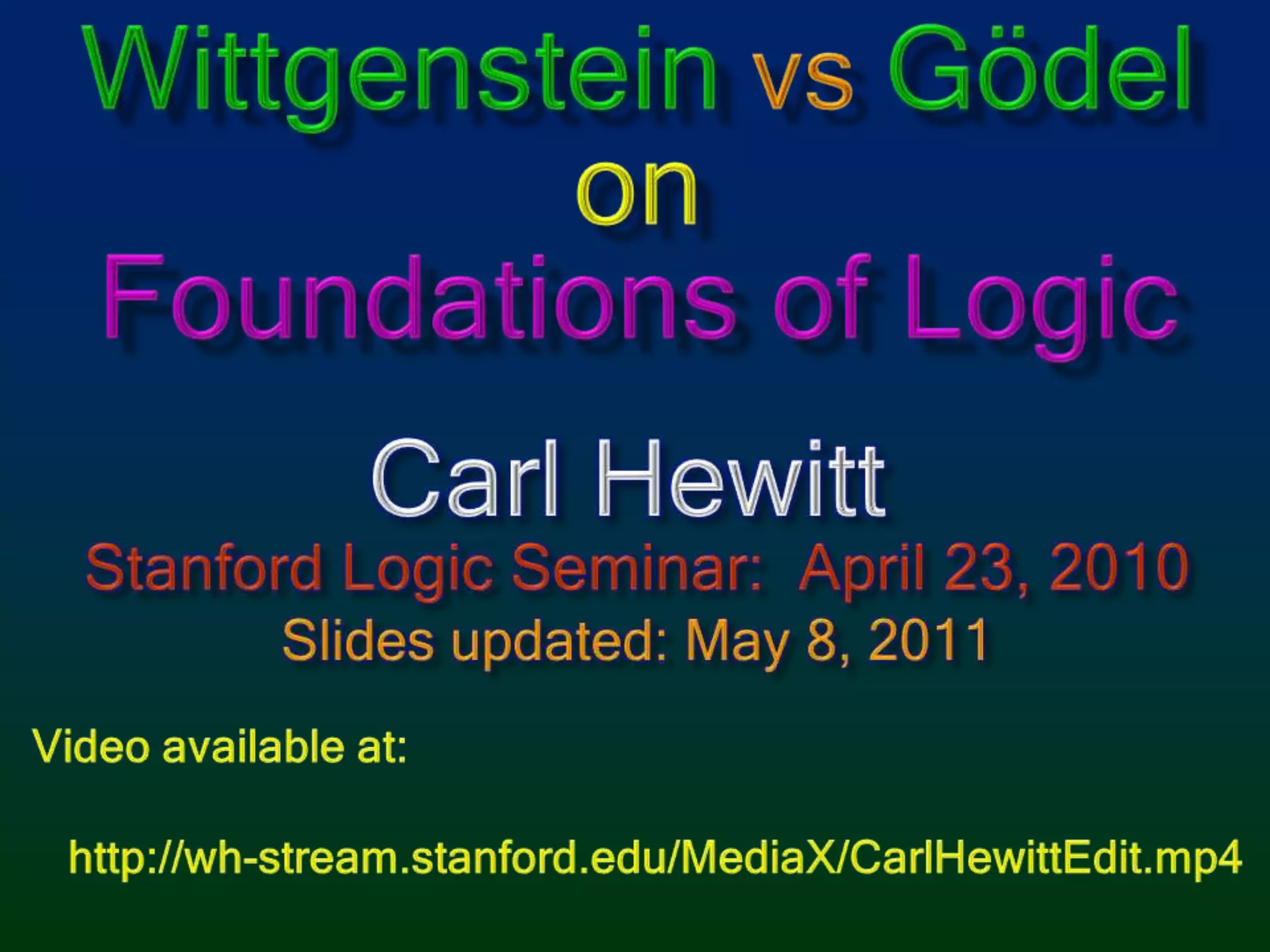
WittgensteinvsGödelonFoundations of LogicCarl HewittStanford Logic Seminar: April 23, 2010Slides updated: May 8, 2011Video available at:   http://wh-stream.stanford.edu/MediaX/CarlHewittEdit.mp4
AbstractThis talk (in four parts) explains how some of the writings of Ludwig Wittgenstein can be interpreted as precursors of important developments in the foundations of mathematical logic for information systems applications. These Wittgenstein writings stand in almost exact opposition to the views of Kurt Gödel. First part: the current state of foundations of mathematical logic for information systems applications is overviewed with regard to issues of expressiblity, incompleteness, and inconsistency tolerance. Second part: The above developments have precursors in the following writings of Wittgenstein: *There can’t in any fundamental sense be such a thing as meta-mathematics. . . . Thus, it isn’t enough to say that p is provable, what we must say is: provable according to a particular system.True in Russell’s system” means, as we have said, proved in Russell's system; and “false in Russell's system” means that the opposite has been proved in Russell's system.Have said-with pride in a mathematical discovery [e.g., inconsistency of Russell’s system because incompleteness is self-proved]: “Look, this is how we produce a contradiction.”Indeed, even at this stage, I predict a time when there will be mathematical investigations of calculi containing contradictions, and people will actually be proud of having emancipated themselves from consistency. Third part:the above views are contrasted with the almost opposite ones of Gödel.The situation between Gödel and Wittgenstein can be summarized as follows: GödelMathematics is based on objective truth.Roundtripping proves incompleteness but (hopefully) not inconsistency.Theories should be proved consistent. WittgensteinMathematics is based on communities of practice.Self-proof of incompleteness leads to inconsistency.Theories should use inconsistency tolerant reasoning. Fourth part:How do the above provide framework and guidance for the further development of logic for information systems applications? *The (posthumously edited) writings of Wittgenstein are idiosyncratic and fragmentary. Interpretations in this talk are directed to putting them in their best possible light as precursors.
Further readingCommon sense for concurrency and inconsistency tolerance using Direct Logic™ ArXiv:0812.4852
OverviewState of the artCherry-picking WittgensteinGödel on WittgensteinInventing the future
Pervasive Inconsistency“find bugs faster than developers can fix them and each fix leads to another bug”--Cusumano & Selby 1995
Wittgenstein 1930Indeed, even at this stage, I predict a time when there will be mathematical investigations of calculi containing contradictions, and people will actually be proud of having emancipated themselves from consistency.
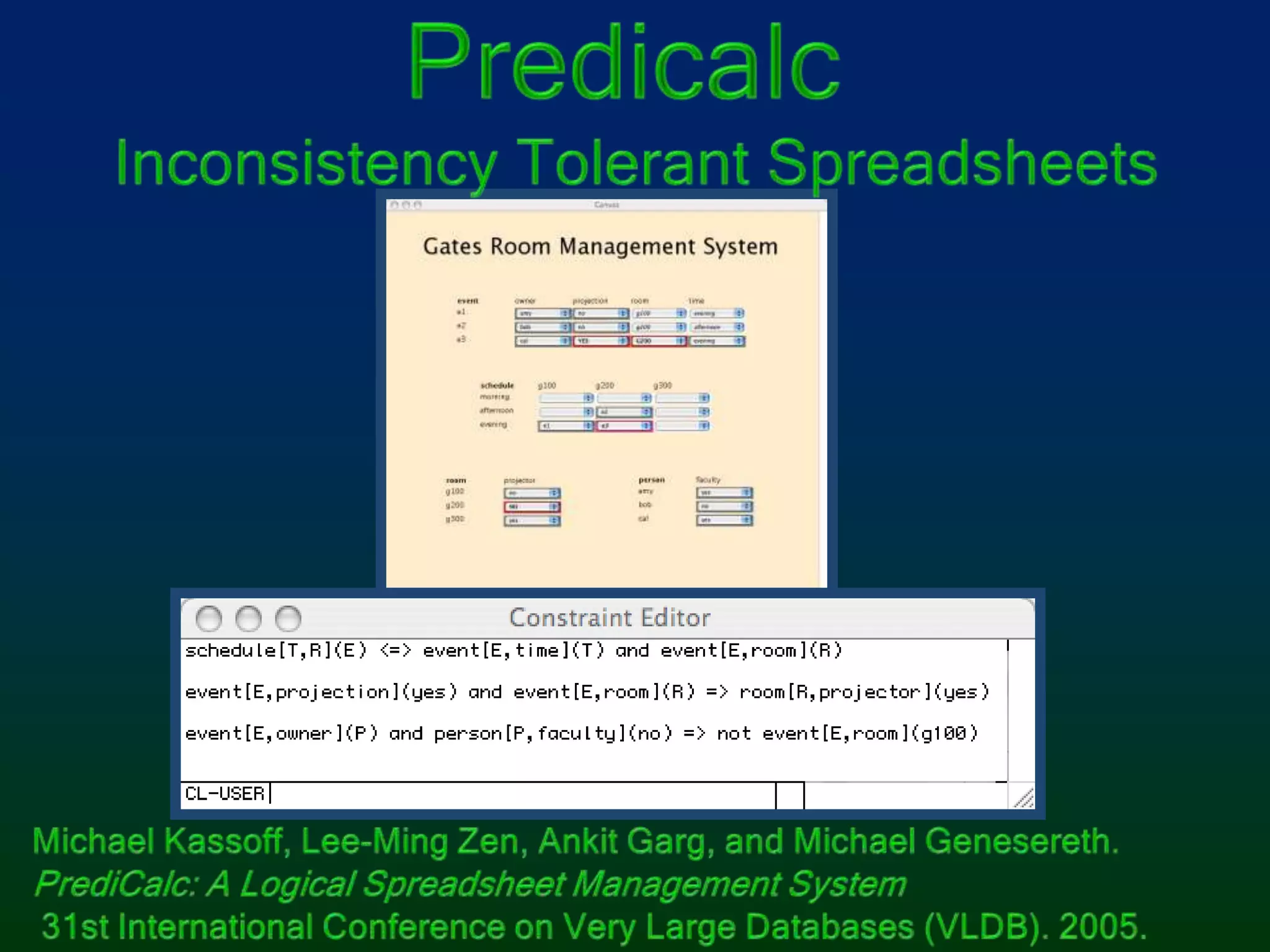
PredicalcInconsistency Tolerant SpreadsheetsMichael Kassoff, Lee-Ming Zen, Ankit Garg, and Michael Genesereth. PrediCalc: A Logical Spreadsheet Management System 31st International Conference on Very Large Databases (VLDB). 2005.
Direct LogicA minimal fixtoClassical Logic
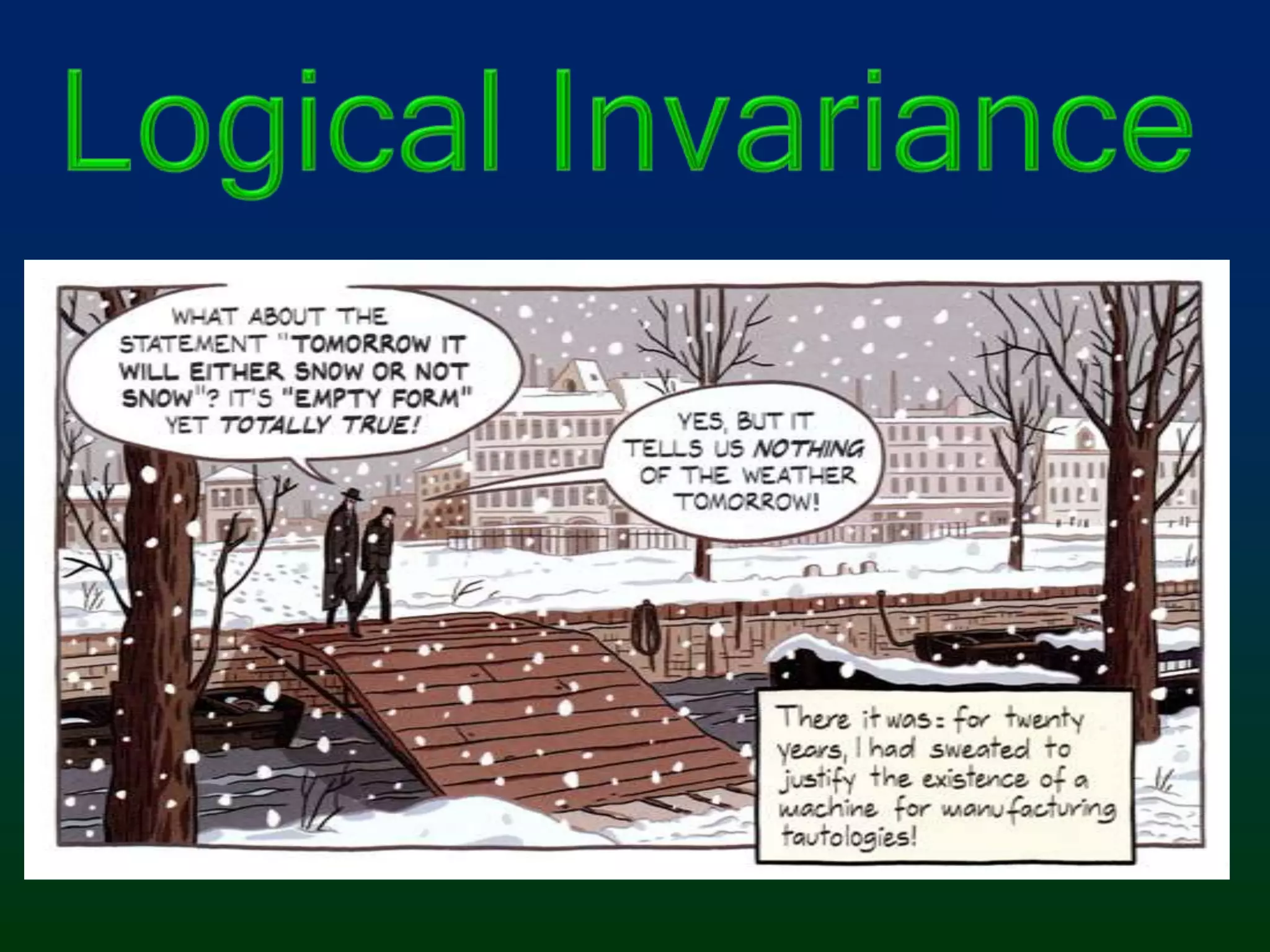
Logical Invariance
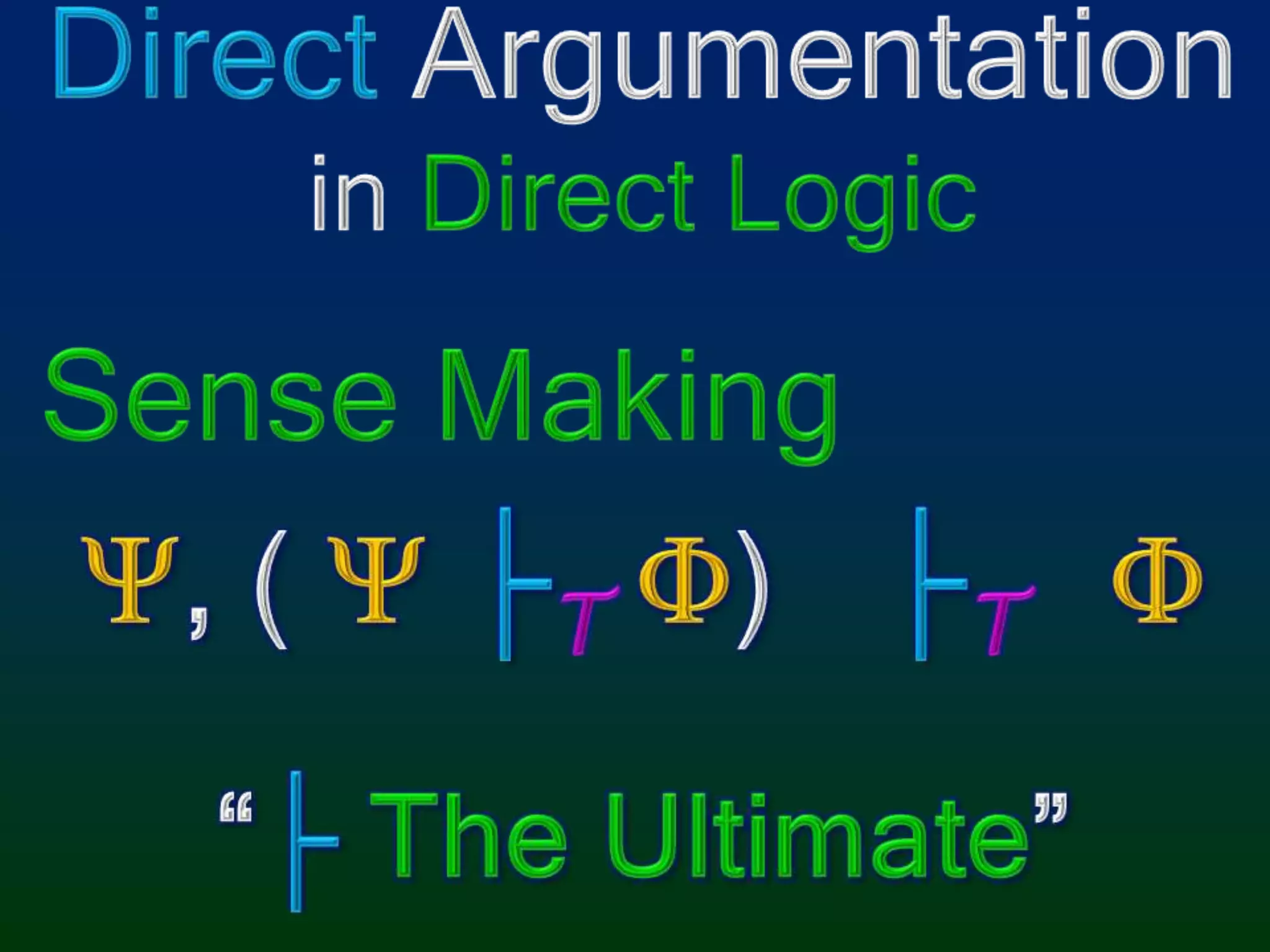
DirectArgumentationin Direct LogicSense Making,(  ├T)   ├T“├ The Ultimate”
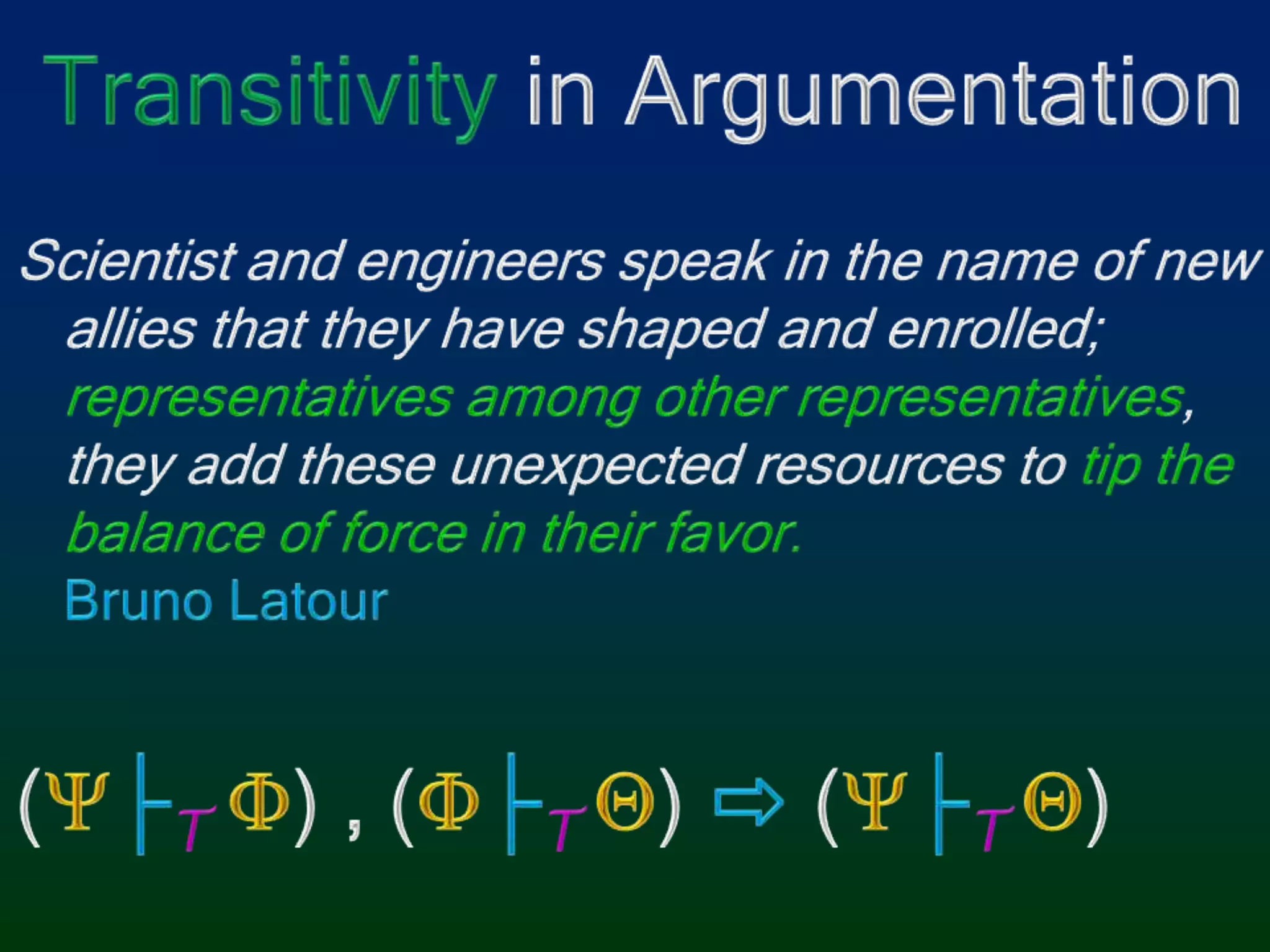
Transitivity in ArgumentationScientist and engineers speak in the name of new allies that they have shaped and enrolled; representatives among other representatives, they add these unexpected resources to tip the balance of force in their favor.Bruno Latour(├T) , (├T)⇨ (├T)
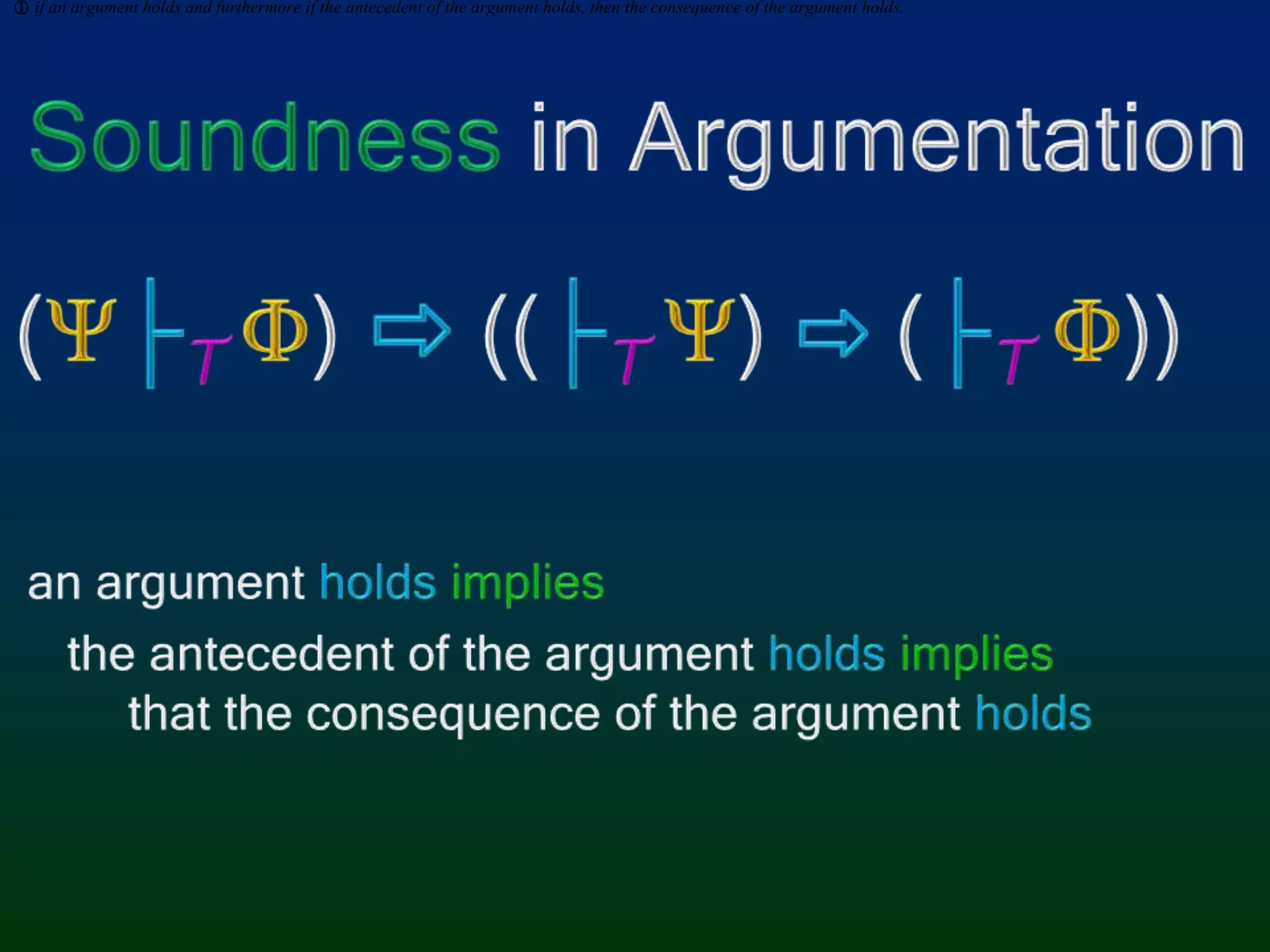
 if an argument holds and furthermore if the antecedent of the argument holds, then the consequence of the argument holds.Soundness in Argumentation(├T)⇨((├T)⇨(├T))an argument holdsimplies    the antecedent of theargument holds implies     thatthe consequence of the argument holds
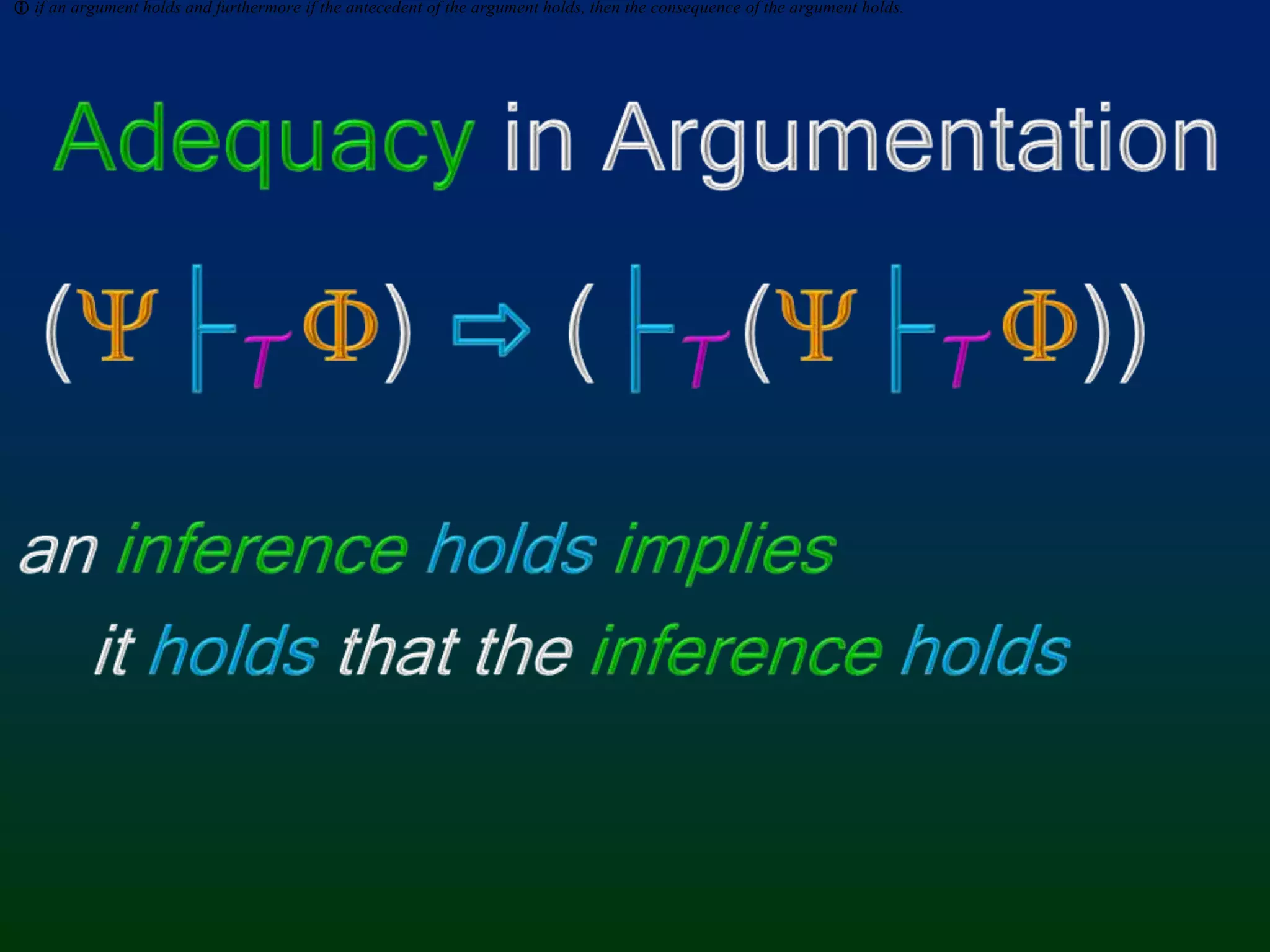
 if an argument holds and furthermore if the antecedent of the argument holds, then the consequence of the argument holds.Adequacyin Argumentation(├T)⇨ (├T(├T))an inference holdsimplies    it holds that the inference holds
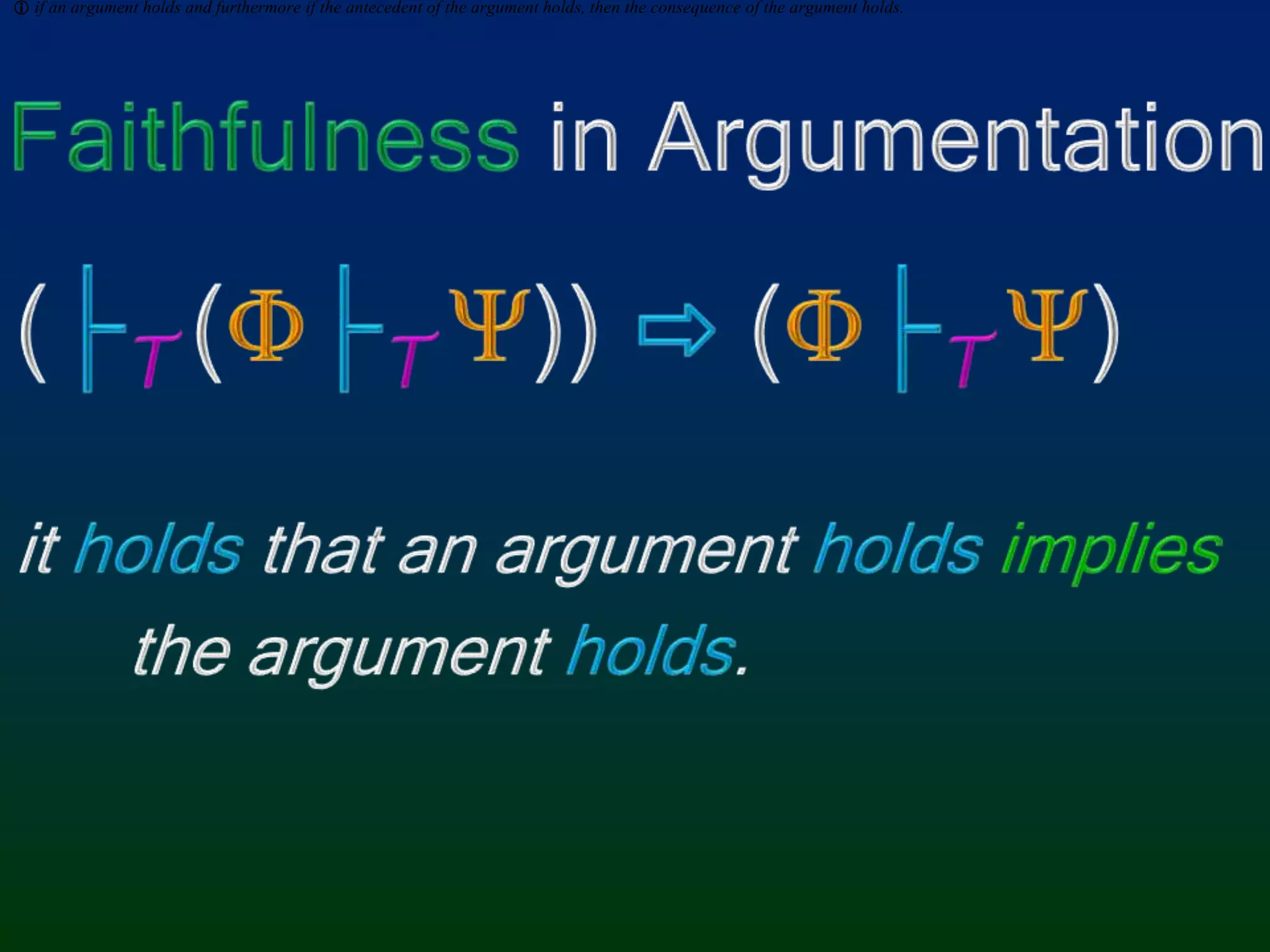
 if an argument holds and furthermore if the antecedent of the argument holds, then the consequence of the argument holds.Faithfulness in Argumentation(├T(├T))⇨ (├T)it holds that an argument holdsimplies      the argument holds.
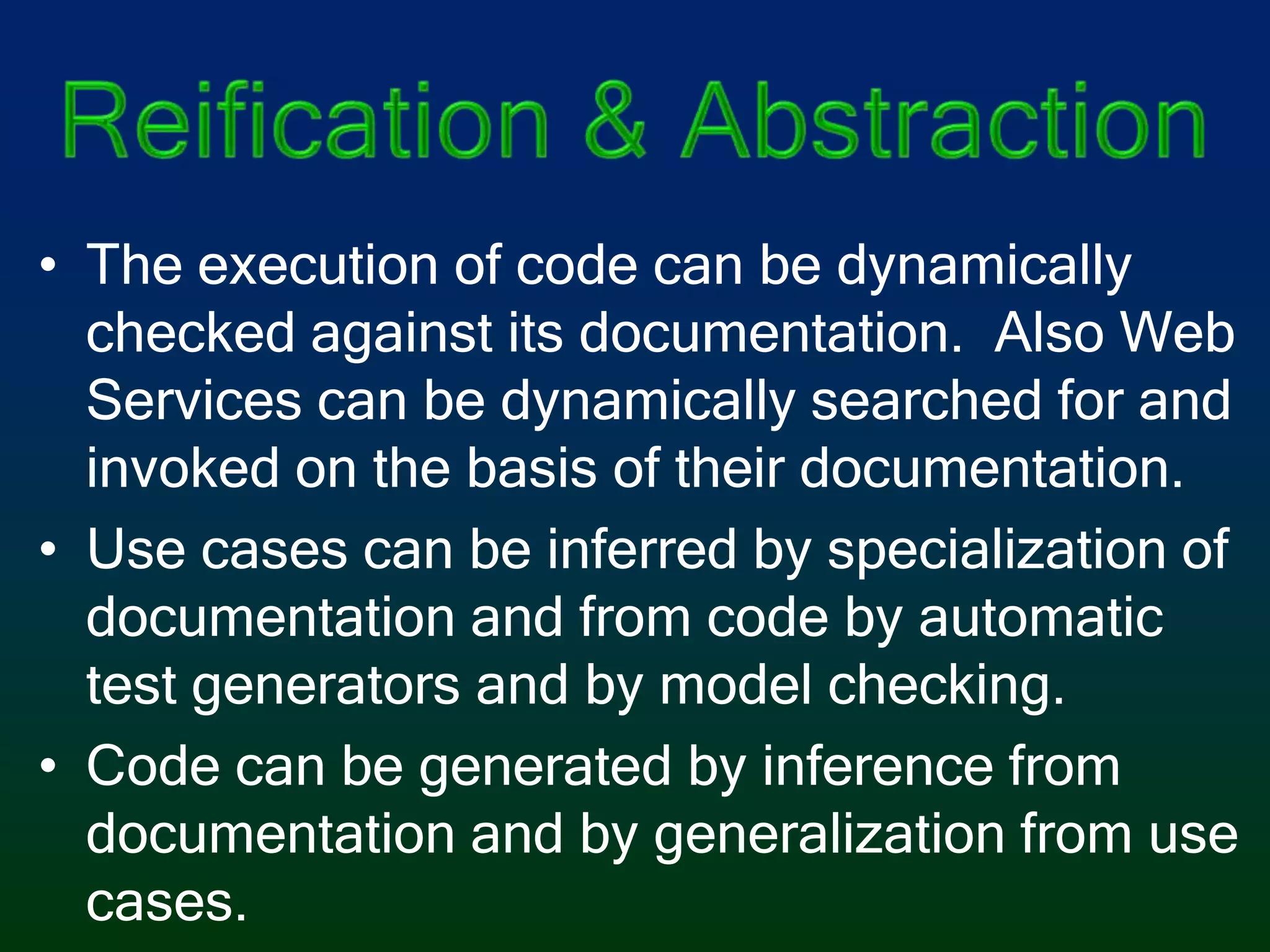
Reification & AbstractionThe execution of code can be dynamically checked against its documentation.  Also Web Services can be dynamically searched for and invoked on the basis of their documentation.Use cases can be inferred by specialization of documentation and from code by automatic test generators and by model checking.Code can be generated by inference from documentation and by generalization from use cases.
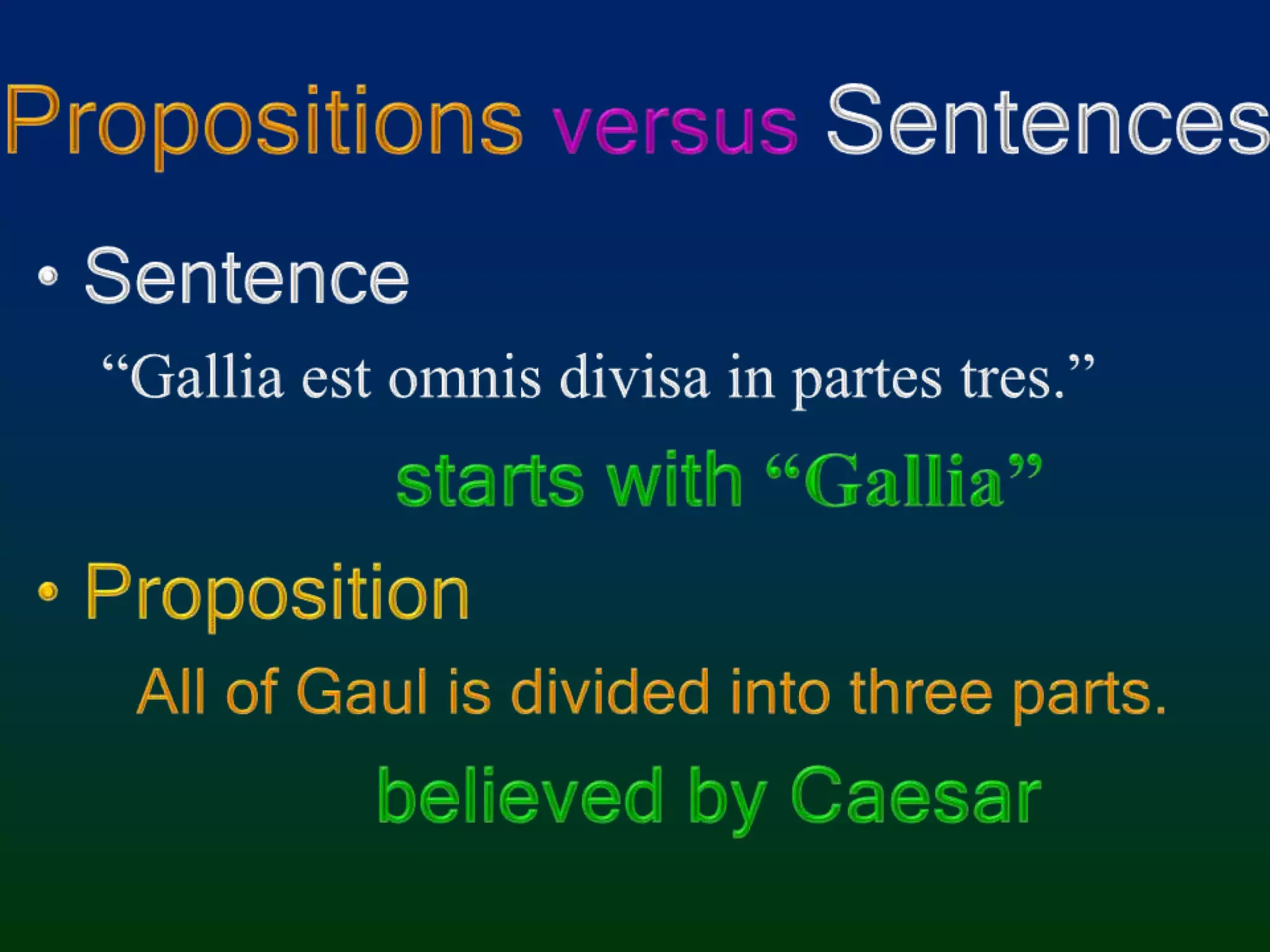
Propositionsversus SentencesSentence “Gallia estomnisdivisa in partestres.”starts with “Gallia”Proposition      All of Gaul is divided into three parts.believed by Caesar
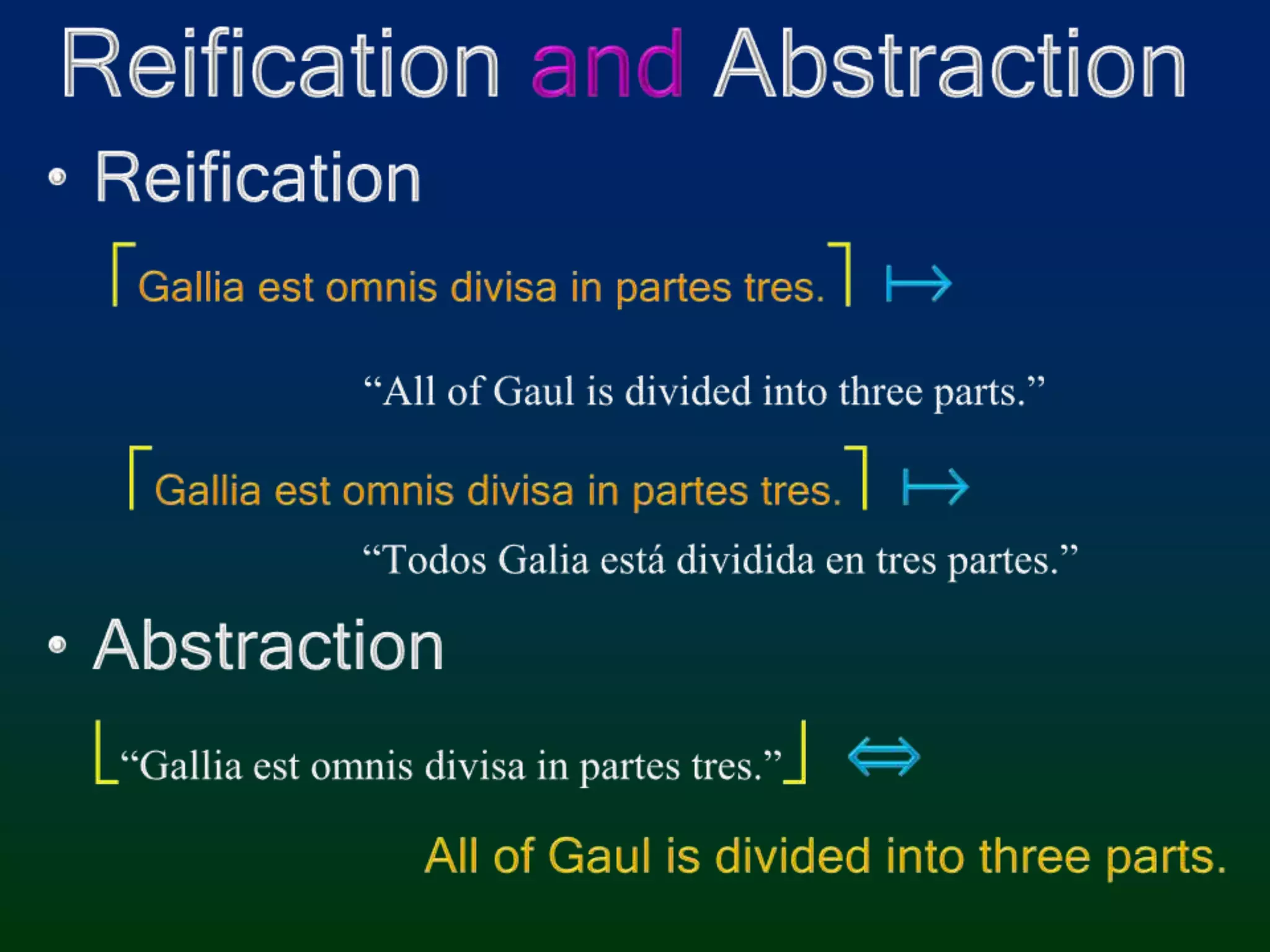
Reification and AbstractionReification    Gallia estomnisdivisa in partestres.  “All of Gaul is divided into three parts.”Gallia estomnisdivisa in partestres.                                “Todos Galia está dividida en tres partes.”  Abstraction   “Gallia estomnisdivisa in partestres.”⇔All of Gaul is divided into three parts.
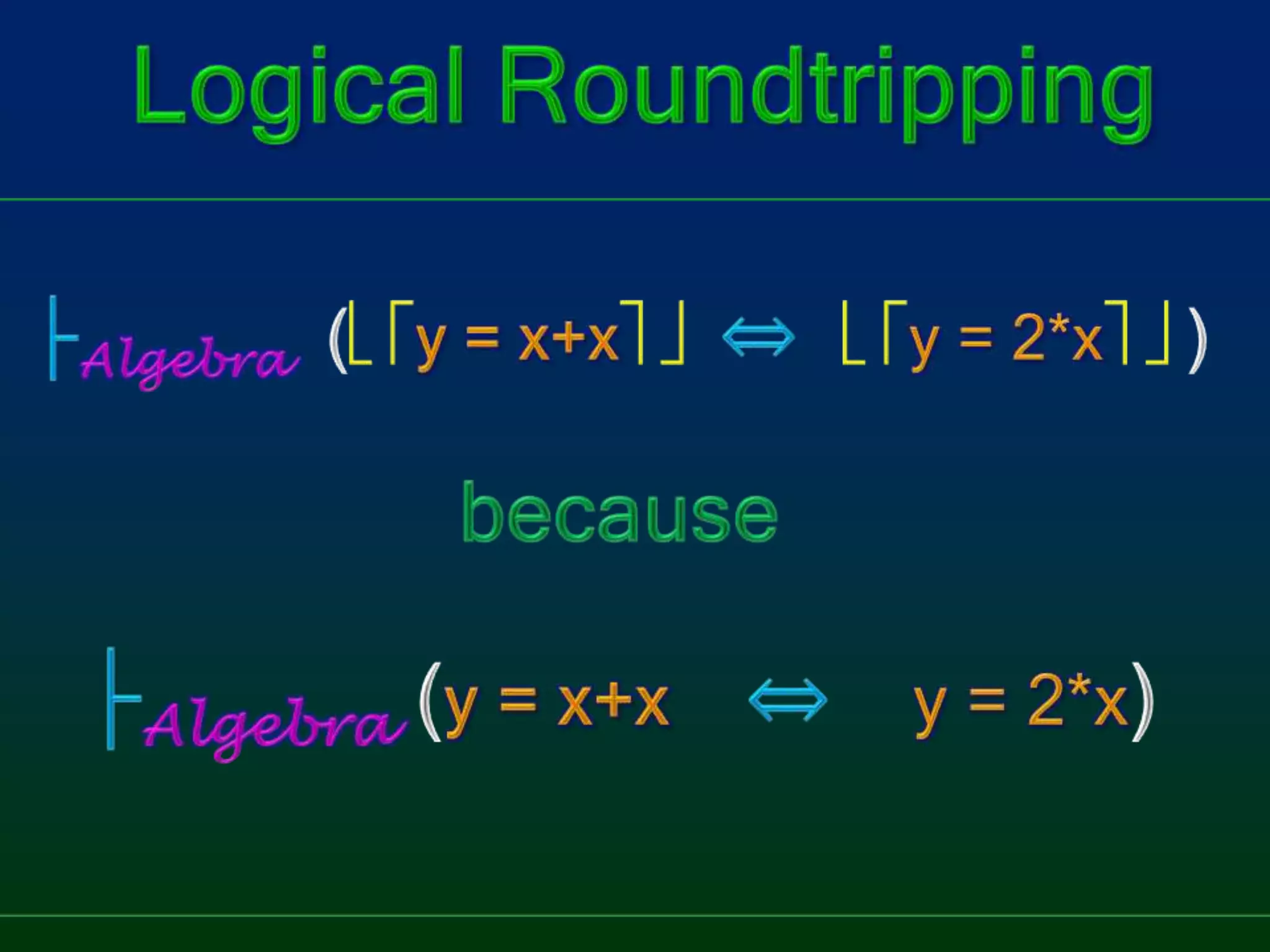
Logical Roundtripping├Algebra  (y = x+x⇔y = 2*x )because├Algebra(y = x+x⇔y = 2*x)
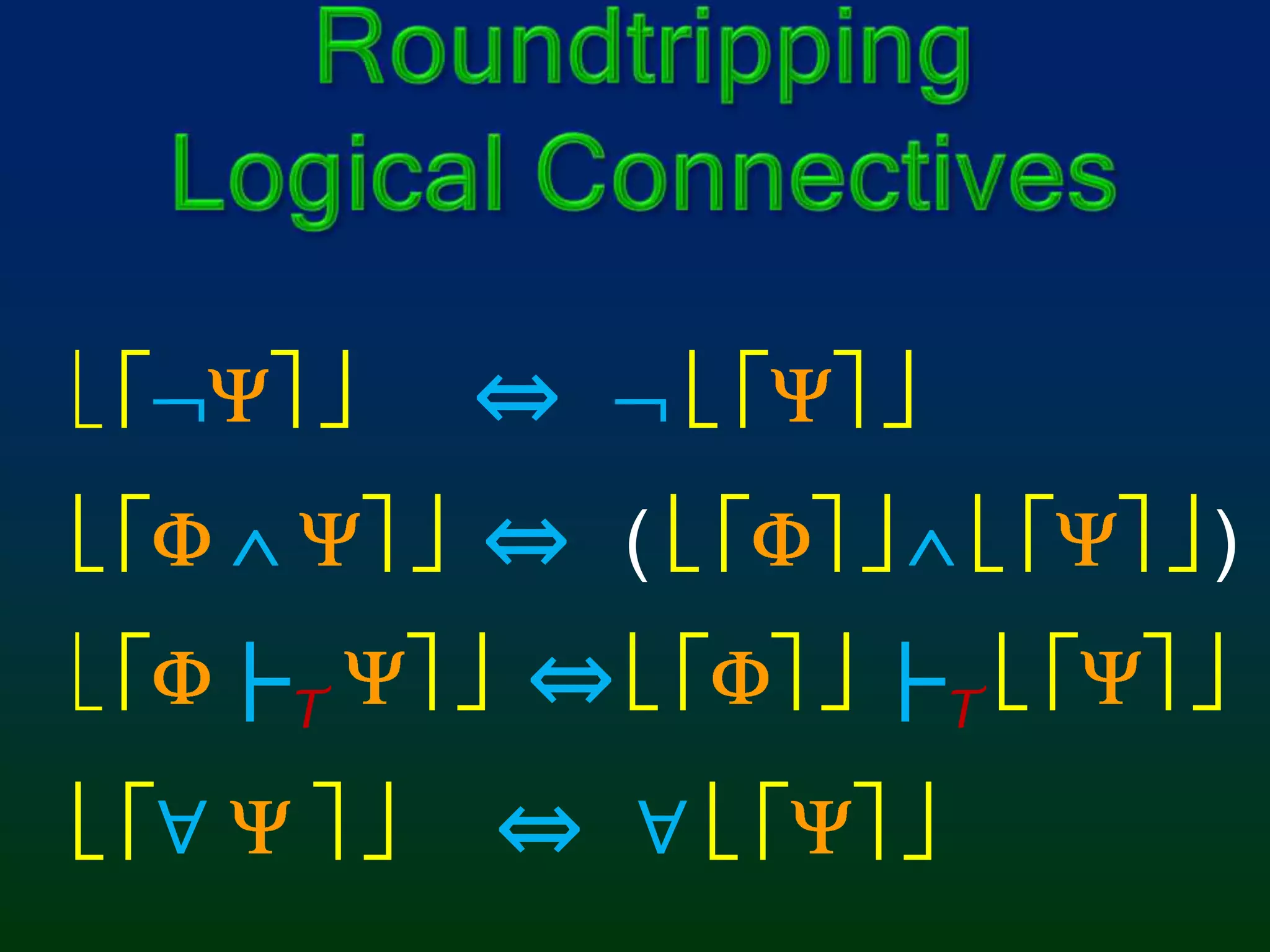
RoundtrippingLogical Connectives ⇔  ⇔ () ├T⇔ ├T∀ ⇔∀
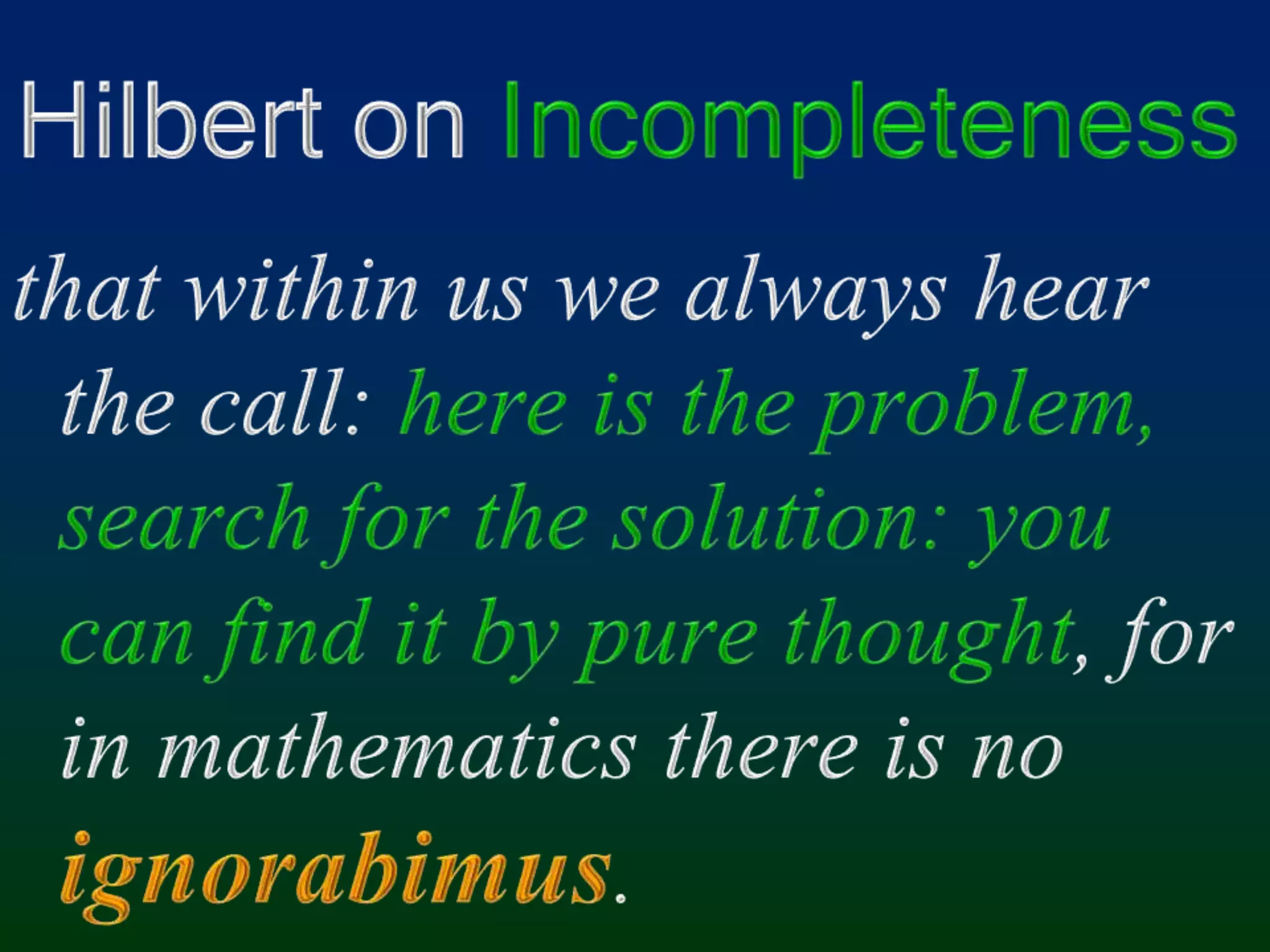
Hilbert on Incompletenessthat within us we always hear the call: here is the problem, search for the solution: you can find it by pure thought, for in mathematics there is no ignorabimus.
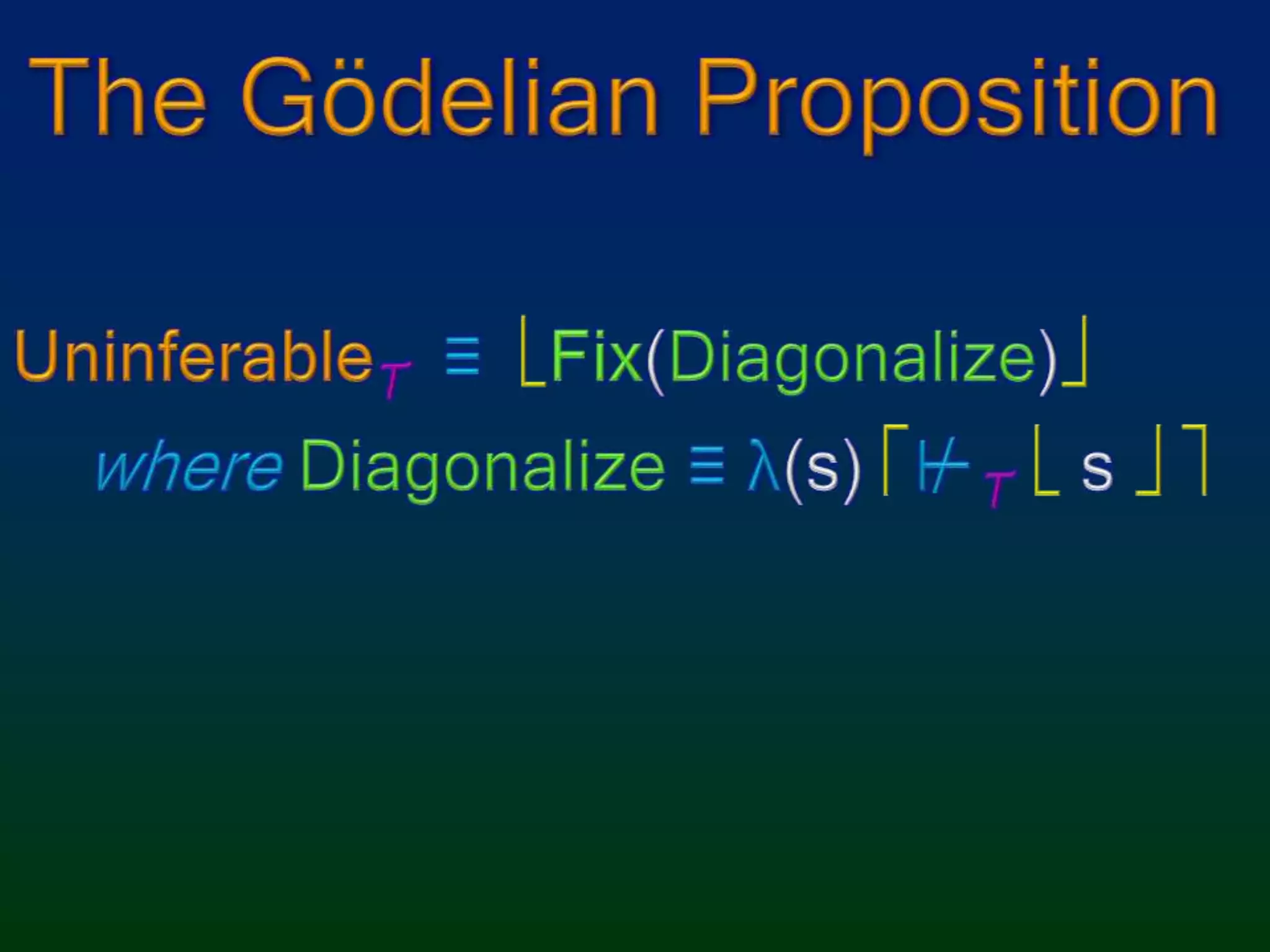
The Gödelian PropositionUninferableT≡ Fix(Diagonalize)where Diagonalize ≡λ(s) ⊬T s
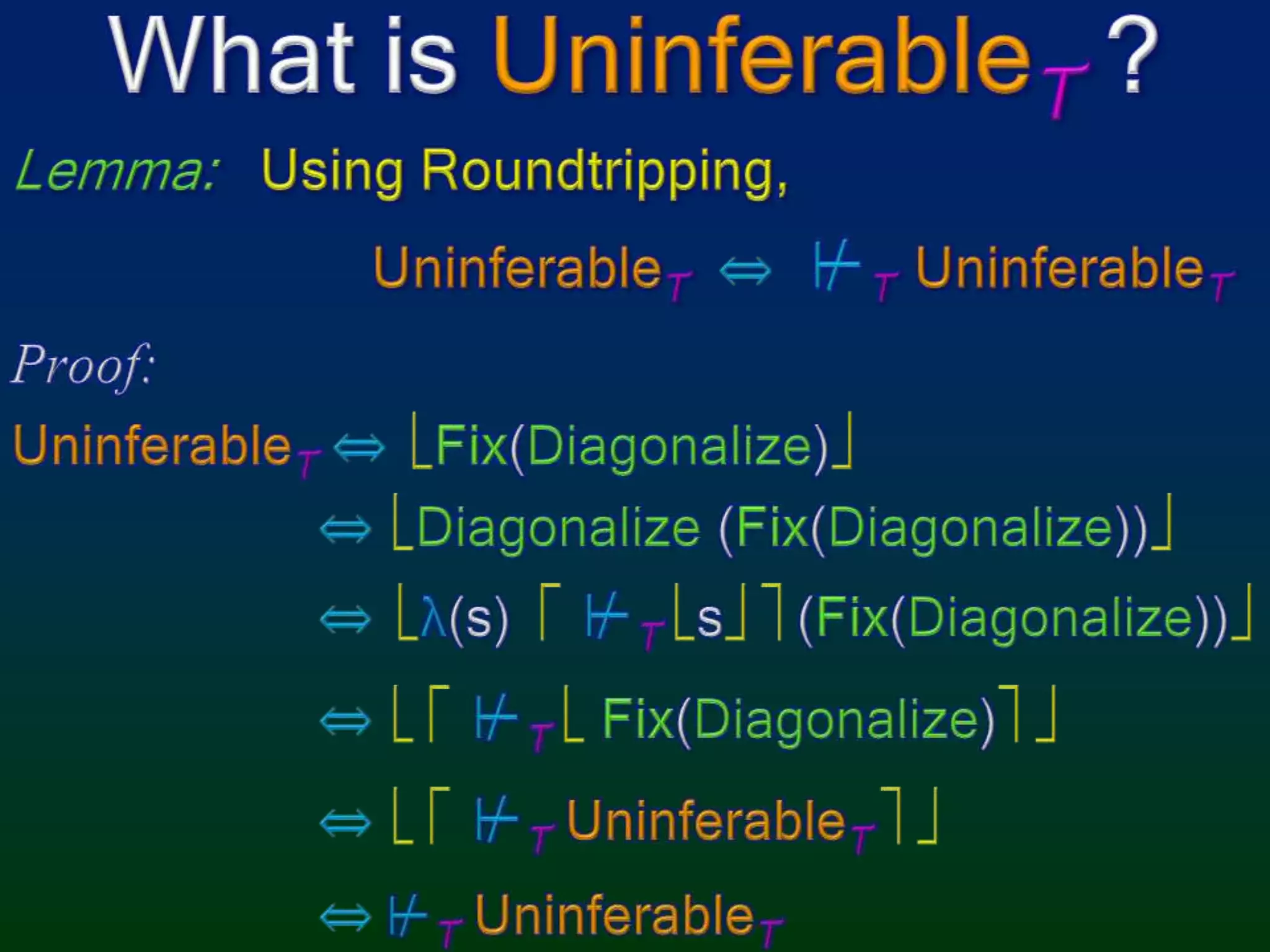
What is UninferableT?Lemma:Using Roundtripping,UninferableT⇔⊬TUninferableTProof:UninferableT⇔Fix(Diagonalize)⇔Diagonalize(Fix(Diagonalize))⇔λ(s)⊬Ts (Fix(Diagonalize))⇔⊬TFix(Diagonalize)⇔ ⊬TUninferableT ⇔⊬TUninferableT
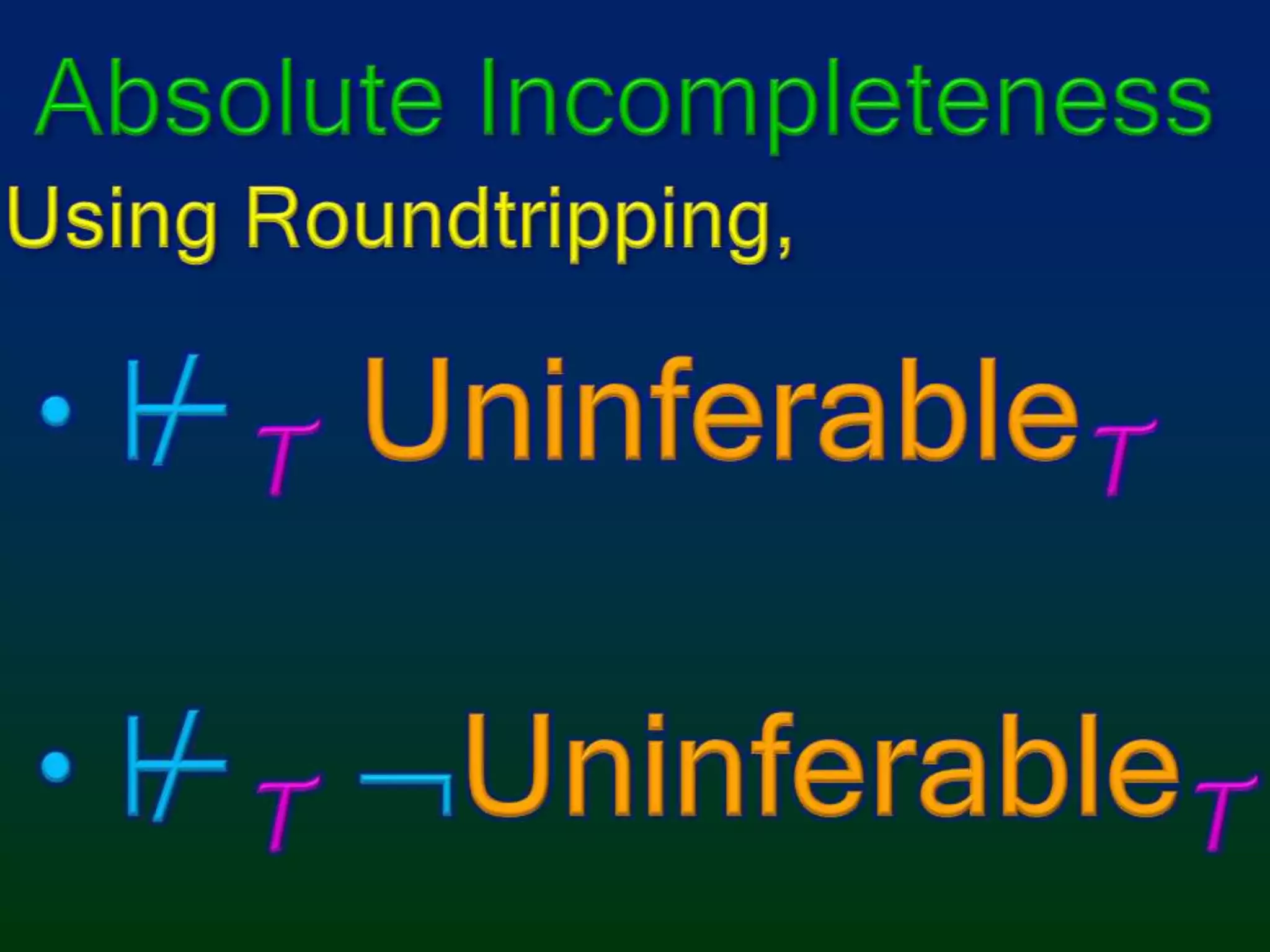
Absolute IncompletenessUsing Roundtripping,⊬TUninferableT⊬TUninferableT
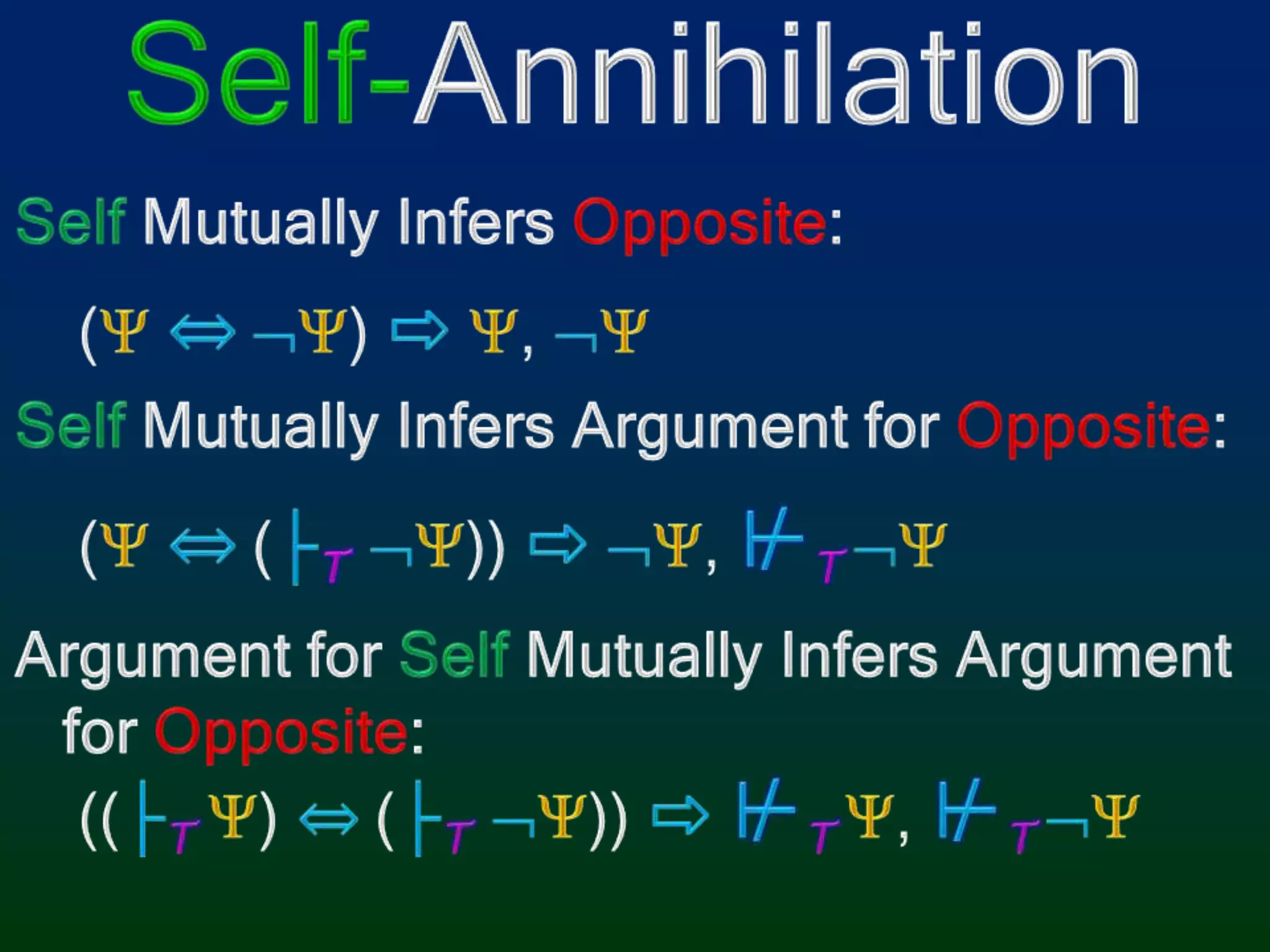
Self-AnnihilationSelf MutuallyInfers Opposite:(⇔)⇨,Self MutuallyInfers Argument for Opposite:(⇔(├T)) ⇨, ⊬TArgument for Self MutuallyInfers Argument for Opposite:((├T)⇔ (├T)) ⇨⊬T,⊬T
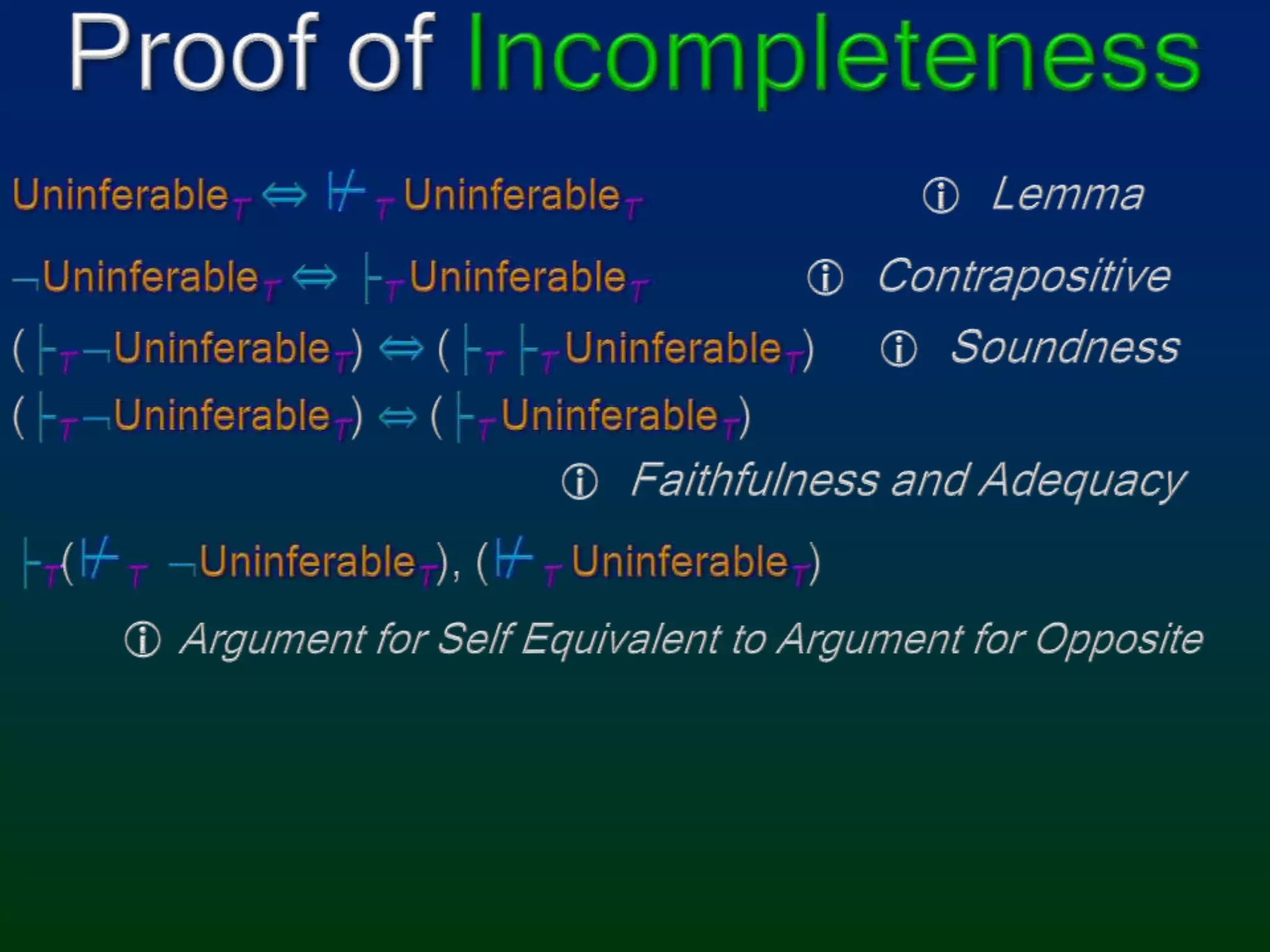
Proof of IncompletenessUninferableT⇔⊬TUninferableT  LemmaUninferableT⇔├TUninferableT  Contrapositive(├TUninferableT) ⇔(├T├TUninferableT)     Soundness(├TUninferableT) ⇔ (├TUninferableT)  Faithfulness and Adequacy├T(⊬TUninferableT), (⊬TUninferableT)Argument for Self Equivalent to Argument for Opposite
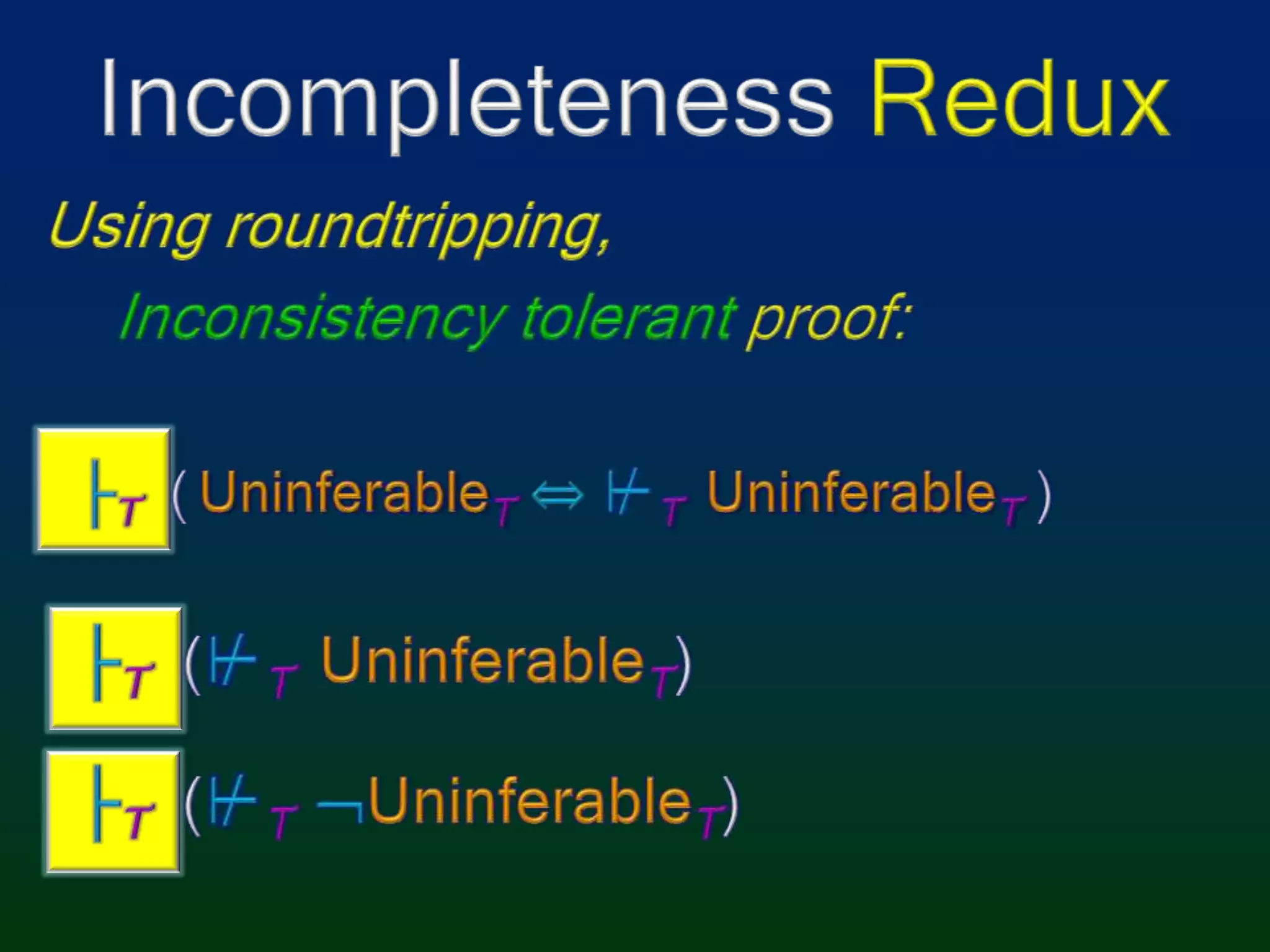
Incompleteness Redux Using roundtripping,Inconsistency tolerant proof:├T(UninferableT⇔⊬T UninferableT)├T(⊬TUninferableT)├T(⊬TUninferableT)
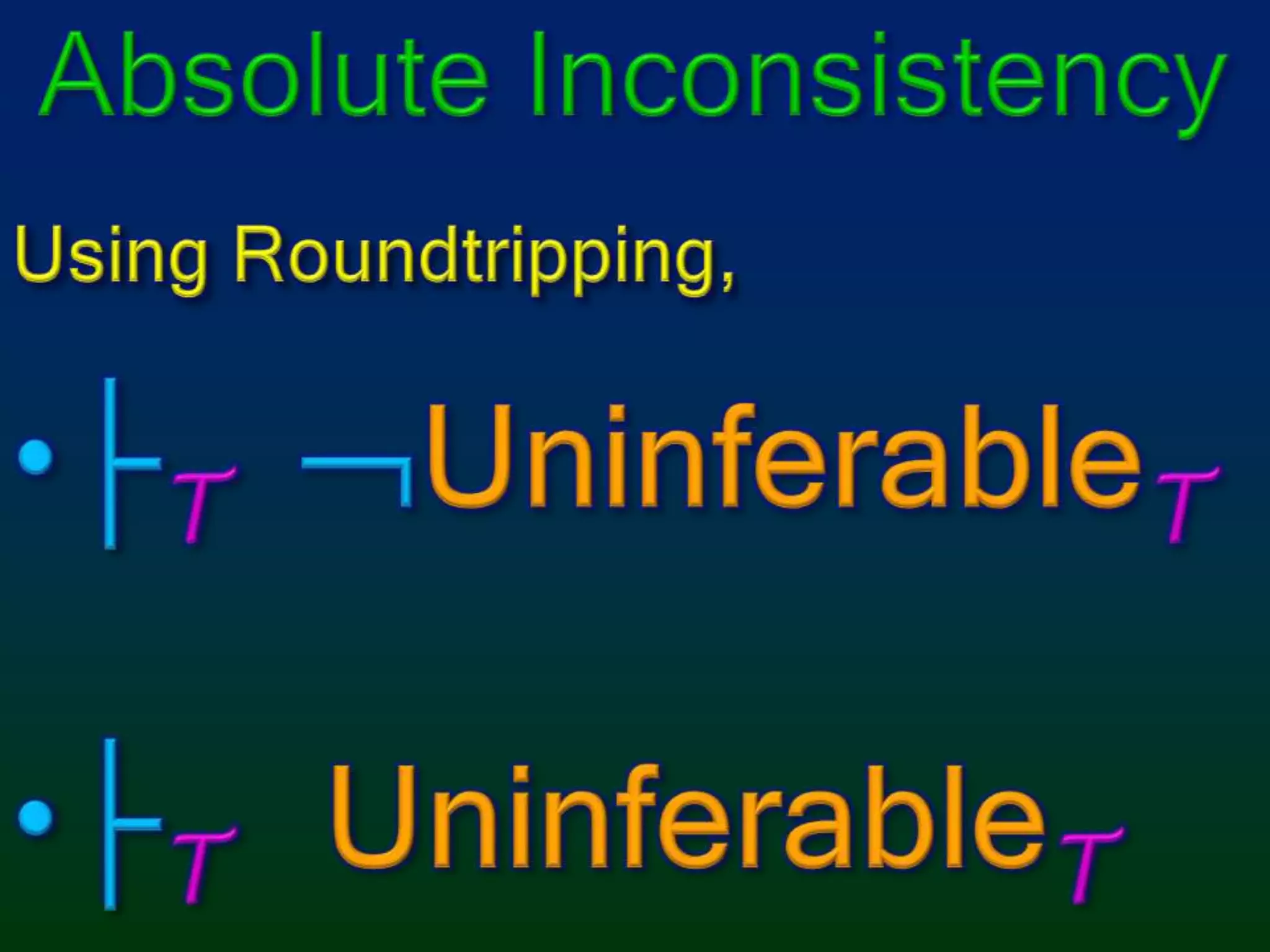
Absolute InconsistencyUsing Roundtripping,├TUninferableT├TUninferableT
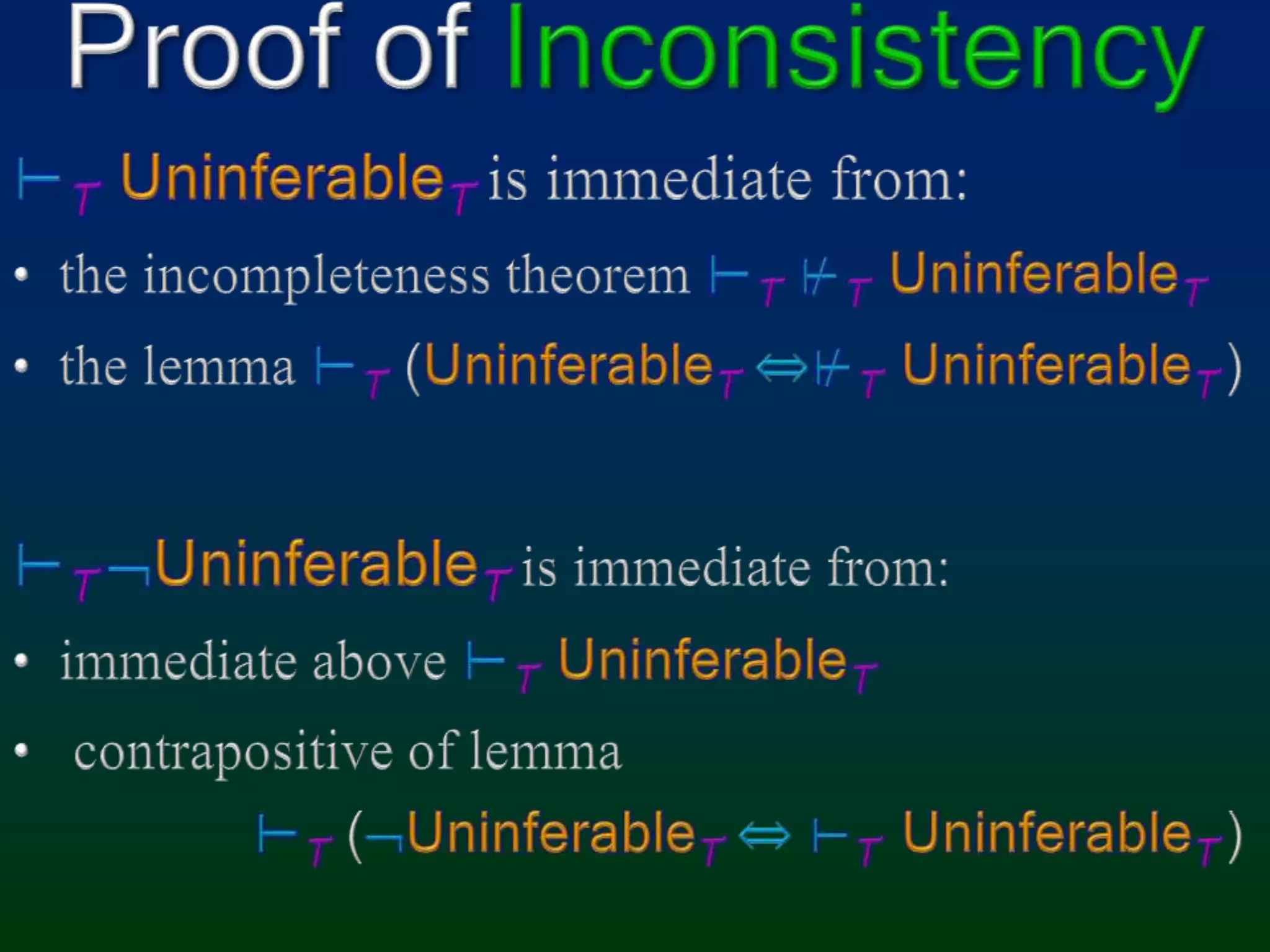
Proof of Inconsistency⊢TUninferableTis immediate from:the incompleteness theorem ⊢T ⊬TUninferableTthe lemma ⊢T(UninferableT⇔⊬TUninferableT)⊢TUninferableTis immediate from:immediate above ⊢TUninferableT contrapositive of lemma            ⊢T(UninferableT⇔⊢T UninferableT)
OverviewState of the artCherry-picking WittgensteinGödel on WittgensteinInventing the future
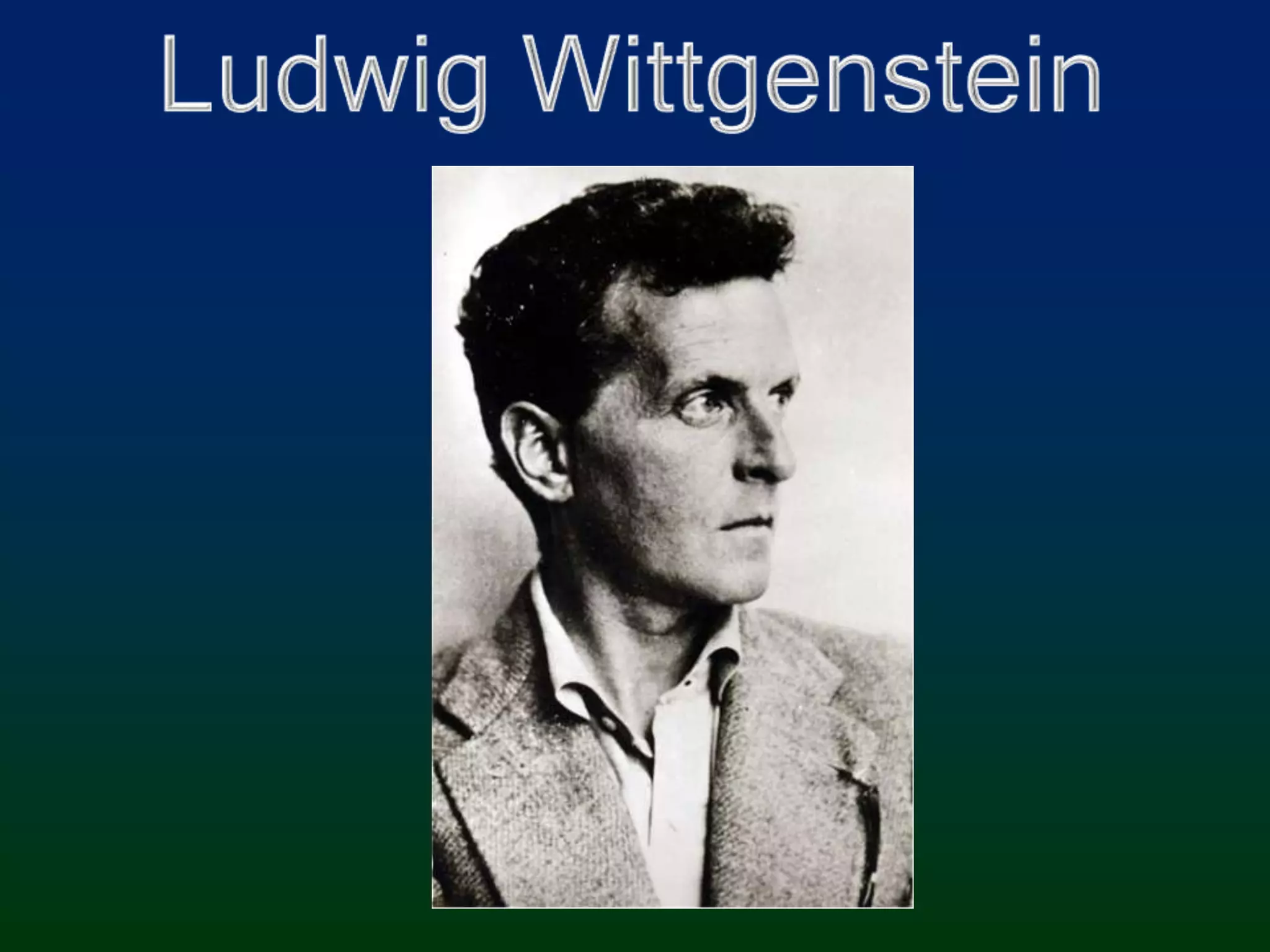
Ludwig Wittgenstein
Wittgenstein on “meta-theory”There can’t in any fundamental sense be such a thing as meta-mathematics. . . . Thus, it isn’t enough to say that p is provable, what we must say is: provable according to a particular system.
Wittgenstein onTruth in Russell“True in Russell’s system” [Russell] means, as we have said, proved in Russell's system; and “false in Russell's system” means that the opposite has been proved in Russell's system.
Wittgenstein onIncompleteness and InconsistencyLet us suppose I prove the unprovability (in Russell’s system[Russell )] ) of P [⊢Russell⊬RussellPwhereP⇔⊬RussellP,i.e. P⇔⊢Russell P];then by this proof I have proved P[⊢RussellP].Now if this proof were one in Russell’s system[⊢Russell⊢RussellP]—I should in this case have proved at once that it belonged [⊢RussellP] and did not belong [⊢RussellP]to Russell’s system.—That is what comes of making up such sentences.But there is a contradiction here!—Well, then there is a contradiction here[in Russell]. Does it do any harm here?
Wittgenstein onInconsistency ToleranceCan we say: ‘Contradiction is harmless if it can be sealed off’? But what prevents us from sealing it off?Let us imagine having been taught Frege’s calculus, contradiction and all. But the contradiction is not presented as a disease. It is, rather, an accepted part of the calculus, and we calculate with it.Have said-with pride in a mathematical discovery: “Look, this is how we produce a contradiction.”
OverviewState of the artCherry-picking WittgensteinGödel on WittgensteinInventing the future
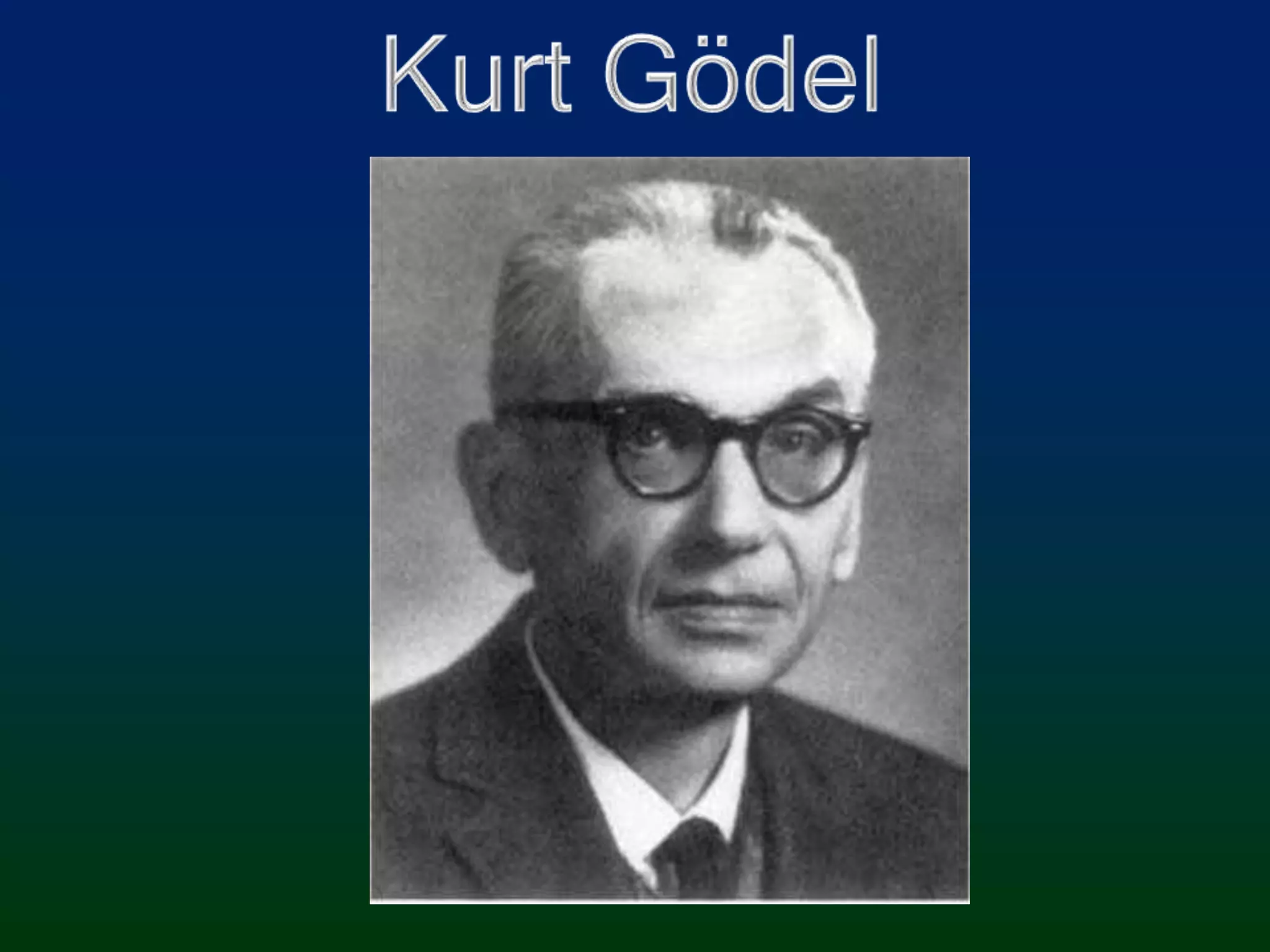
Kurt Gödel
Gödel onWittgensteinIt is clear from the passages you cite that Wittgenstein did ''not'' understand it [1st incompleteness theorem] (or pretended not to understand it). He interpreted it as a kind of logical paradox*, while in fact is just the opposite, namely a mathematical theorem within an absolutely uncontroversial part of mathematics (finitary number theory or combinatorics).*in Principia Mathematica
More Gödel onWittgensteinHe [Wittgenstein] has to take a position when he has no business to do so. For example, “you can’t derive everything from a contradiction.” He should try to develop a system of logic in which that is true.It’s amazing that Turing could get anything out of discussions with somebody like Wittgenstein.
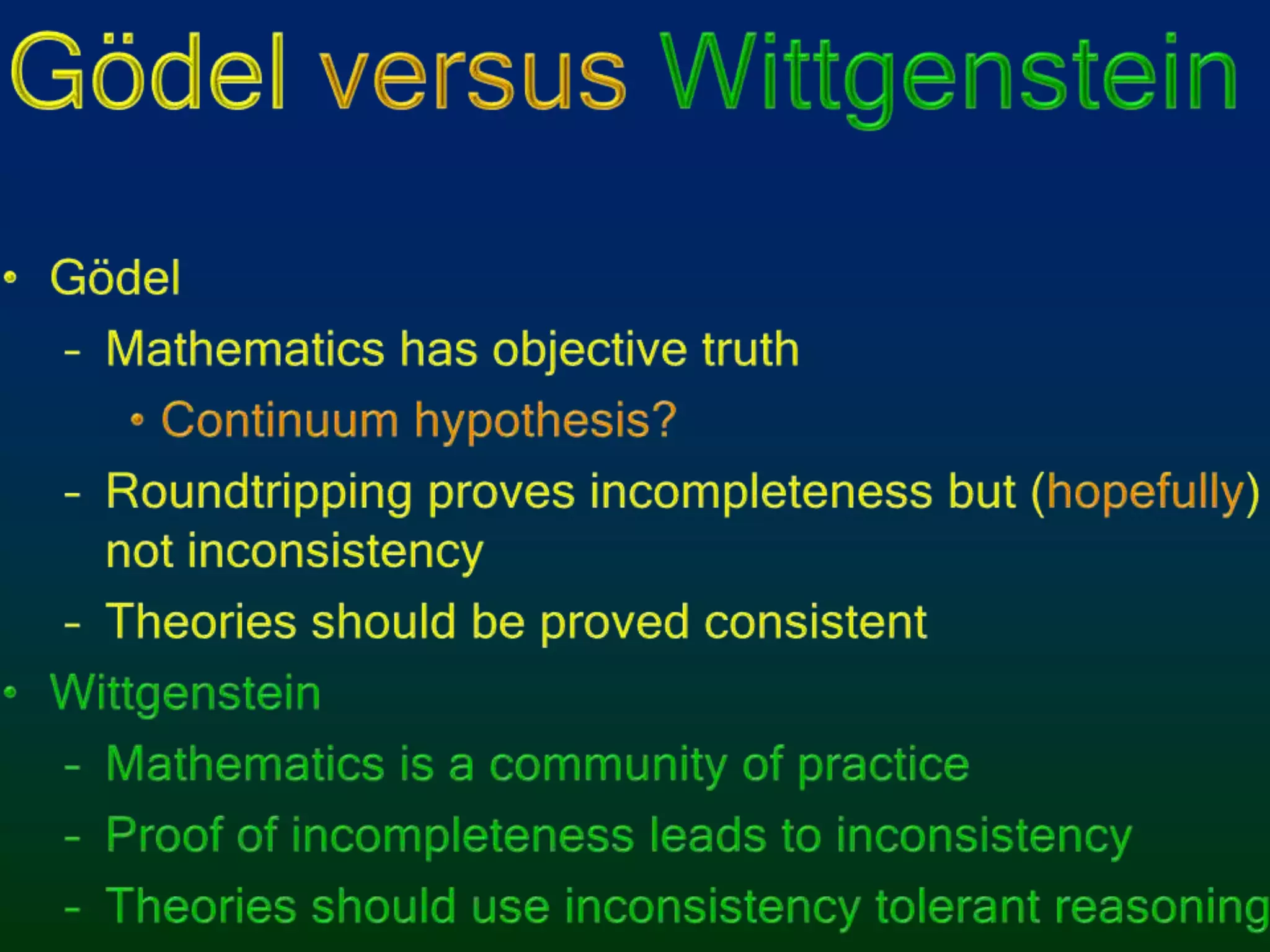
Gödel versusWittgensteinGödelMathematics has objective truthContinuum hypothesis?Roundtripping proves incompleteness but (hopefully) not inconsistencyTheories should be proved consistentWittgensteinMathematics is a community of practiceProof of incompleteness leads to inconsistencyTheories should use inconsistency tolerant reasoning
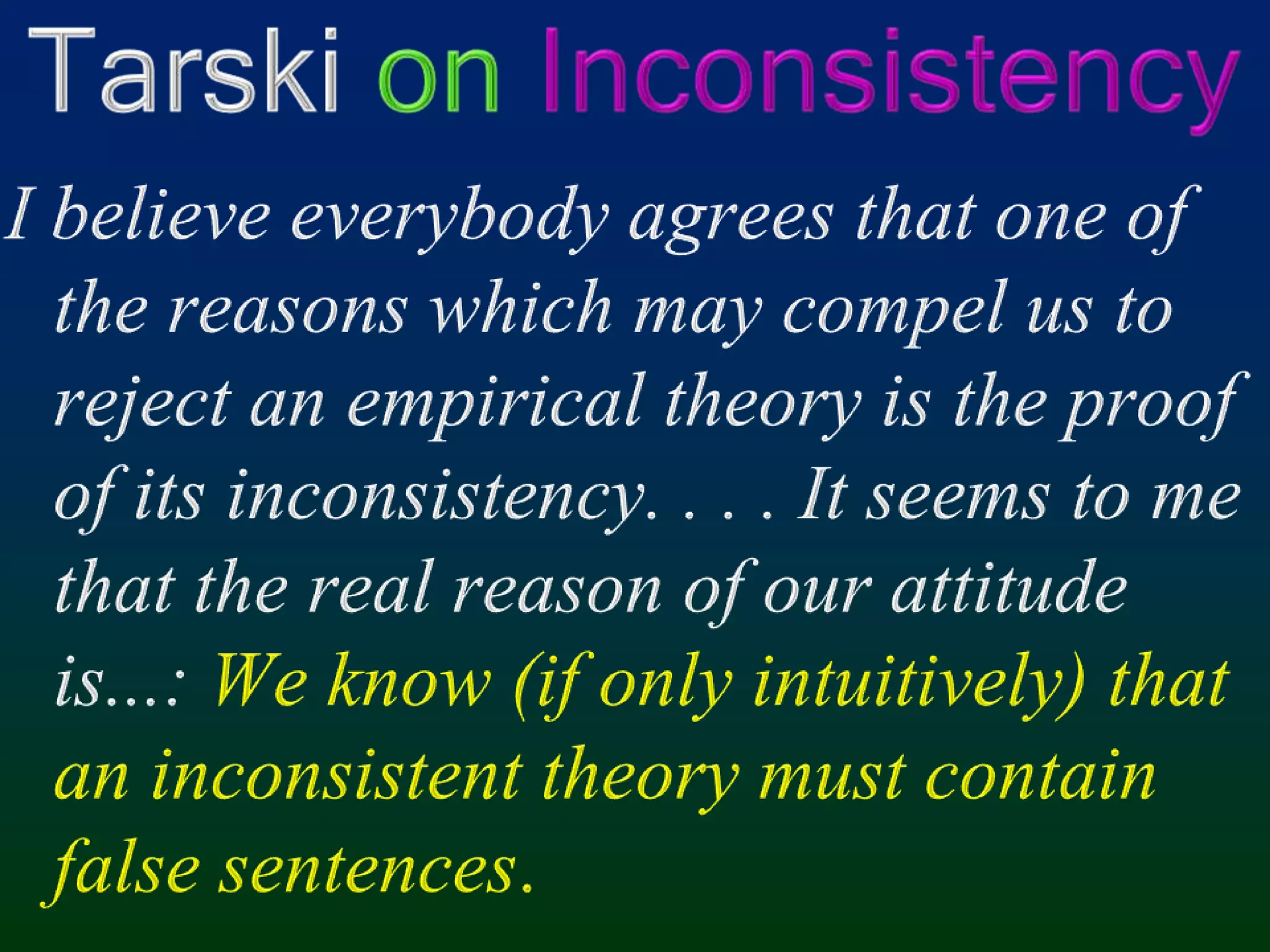
Tarski onInconsistencyI believe everybody agrees that one of the reasons which may compel us to reject an empirical theory is the proof of its inconsistency. . . . It seems to me that the real reason of our attitude is...: We know (if only intuitively) that an inconsistent theory must contain false sentences.
Frege onTruthwhen we say that it is true that seawater is salty, we don’t add anything to what we say when we say simply that seawater is salty, so the notion of truth, in spite of being the central notion of  [classical]logic, is a singularly ineffectual notion.  It is surprising that we would have occasion to use such an impotent notion, nevermind that we would regard it as valuable and important.
OverviewState of the artCherry-picking WittgensteinGödel on WittgensteinInventing the future
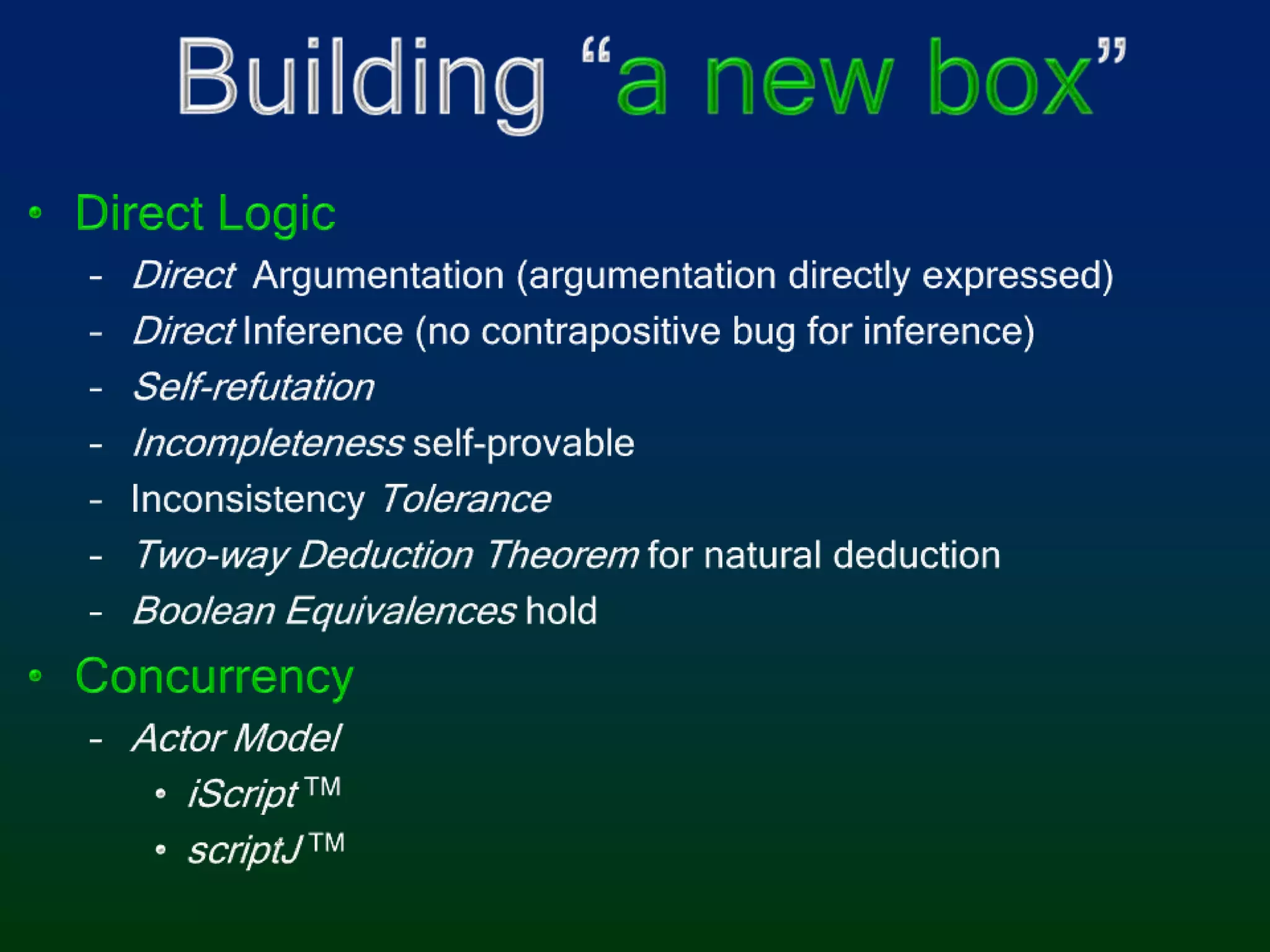
Building “a new box”Direct LogicDirectArgumentation (argumentation directly expressed)Direct Inference (no contrapositive bug for inference)Self-refutationIncompleteness self-provableInconsistency ToleranceTwo-way Deduction Theorem for natural deductionBoolean Equivalences holdConcurrencyActor ModeliScript TMscriptJ TM
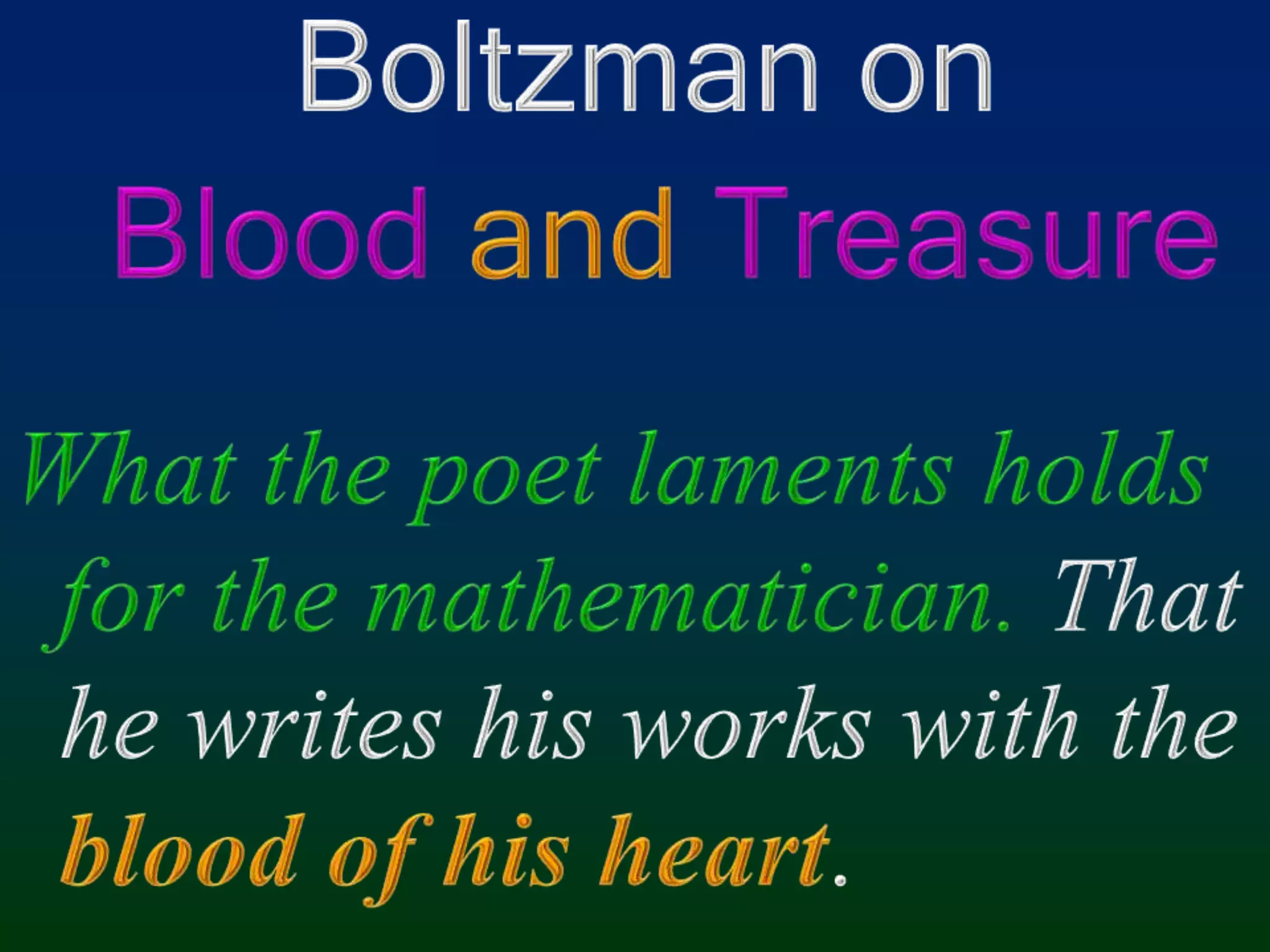
Boltzman onBloodandTreasureWhat the poet laments holds for the mathematician. That he writes his works with the blood of his heart.

Incompleteness Theorems: Logical Necessity of Inconsistency

  • 1.
    WittgensteinvsGödelonFoundations of LogicCarlHewittStanford Logic Seminar: April 23, 2010Slides updated: May 8, 2011Video available at: http://wh-stream.stanford.edu/MediaX/CarlHewittEdit.mp4
  • 2.
    AbstractThis talk (infour parts) explains how some of the writings of Ludwig Wittgenstein can be interpreted as precursors of important developments in the foundations of mathematical logic for information systems applications. These Wittgenstein writings stand in almost exact opposition to the views of Kurt Gödel. First part: the current state of foundations of mathematical logic for information systems applications is overviewed with regard to issues of expressiblity, incompleteness, and inconsistency tolerance. Second part: The above developments have precursors in the following writings of Wittgenstein: *There can’t in any fundamental sense be such a thing as meta-mathematics. . . . Thus, it isn’t enough to say that p is provable, what we must say is: provable according to a particular system.True in Russell’s system” means, as we have said, proved in Russell's system; and “false in Russell's system” means that the opposite has been proved in Russell's system.Have said-with pride in a mathematical discovery [e.g., inconsistency of Russell’s system because incompleteness is self-proved]: “Look, this is how we produce a contradiction.”Indeed, even at this stage, I predict a time when there will be mathematical investigations of calculi containing contradictions, and people will actually be proud of having emancipated themselves from consistency. Third part:the above views are contrasted with the almost opposite ones of Gödel.The situation between Gödel and Wittgenstein can be summarized as follows: GödelMathematics is based on objective truth.Roundtripping proves incompleteness but (hopefully) not inconsistency.Theories should be proved consistent. WittgensteinMathematics is based on communities of practice.Self-proof of incompleteness leads to inconsistency.Theories should use inconsistency tolerant reasoning. Fourth part:How do the above provide framework and guidance for the further development of logic for information systems applications? *The (posthumously edited) writings of Wittgenstein are idiosyncratic and fragmentary. Interpretations in this talk are directed to putting them in their best possible light as precursors.
  • 3.
    Further readingCommon sensefor concurrency and inconsistency tolerance using Direct Logic™ ArXiv:0812.4852
  • 4.
    OverviewState of theartCherry-picking WittgensteinGödel on WittgensteinInventing the future
  • 5.
    Pervasive Inconsistency“find bugsfaster than developers can fix them and each fix leads to another bug”--Cusumano & Selby 1995
  • 6.
    Wittgenstein 1930Indeed, evenat this stage, I predict a time when there will be mathematical investigations of calculi containing contradictions, and people will actually be proud of having emancipated themselves from consistency.
  • 7.
    PredicalcInconsistency Tolerant SpreadsheetsMichaelKassoff, Lee-Ming Zen, Ankit Garg, and Michael Genesereth. PrediCalc: A Logical Spreadsheet Management System 31st International Conference on Very Large Databases (VLDB). 2005.
  • 8.
    Direct LogicA minimalfixtoClassical Logic
  • 9.
  • 10.
    DirectArgumentationin Direct LogicSenseMaking,(  ├T) ├T“├ The Ultimate”
  • 11.
    Transitivity in ArgumentationScientistand engineers speak in the name of new allies that they have shaped and enrolled; representatives among other representatives, they add these unexpected resources to tip the balance of force in their favor.Bruno Latour(├T) , (├T)⇨ (├T)
  • 12.
     if anargument holds and furthermore if the antecedent of the argument holds, then the consequence of the argument holds.Soundness in Argumentation(├T)⇨((├T)⇨(├T))an argument holdsimplies the antecedent of theargument holds implies thatthe consequence of the argument holds
  • 13.
     if anargument holds and furthermore if the antecedent of the argument holds, then the consequence of the argument holds.Adequacyin Argumentation(├T)⇨ (├T(├T))an inference holdsimplies it holds that the inference holds
  • 14.
     if anargument holds and furthermore if the antecedent of the argument holds, then the consequence of the argument holds.Faithfulness in Argumentation(├T(├T))⇨ (├T)it holds that an argument holdsimplies the argument holds.
  • 15.
    Reification & AbstractionTheexecution of code can be dynamically checked against its documentation. Also Web Services can be dynamically searched for and invoked on the basis of their documentation.Use cases can be inferred by specialization of documentation and from code by automatic test generators and by model checking.Code can be generated by inference from documentation and by generalization from use cases.
  • 16.
    Propositionsversus SentencesSentence “Galliaestomnisdivisa in partestres.”starts with “Gallia”Proposition All of Gaul is divided into three parts.believed by Caesar
  • 17.
    Reification and AbstractionReification Gallia estomnisdivisa in partestres. “All of Gaul is divided into three parts.”Gallia estomnisdivisa in partestres.  “Todos Galia está dividida en tres partes.”  Abstraction “Gallia estomnisdivisa in partestres.”⇔All of Gaul is divided into three parts.
  • 18.
    Logical Roundtripping├Algebra (y = x+x⇔y = 2*x )because├Algebra(y = x+x⇔y = 2*x)
  • 19.
    RoundtrippingLogical Connectives ⇔ ⇔ () ├T⇔ ├T∀ ⇔∀
  • 20.
    Hilbert on Incompletenessthatwithin us we always hear the call: here is the problem, search for the solution: you can find it by pure thought, for in mathematics there is no ignorabimus.
  • 21.
    The Gödelian PropositionUninferableT≡Fix(Diagonalize)where Diagonalize ≡λ(s) ⊬T s
  • 22.
    What is UninferableT?Lemma:UsingRoundtripping,UninferableT⇔⊬TUninferableTProof:UninferableT⇔Fix(Diagonalize)⇔Diagonalize(Fix(Diagonalize))⇔λ(s)⊬Ts (Fix(Diagonalize))⇔⊬TFix(Diagonalize)⇔ ⊬TUninferableT ⇔⊬TUninferableT
  • 23.
  • 24.
    Self-AnnihilationSelf MutuallyInfers Opposite:(⇔)⇨,SelfMutuallyInfers Argument for Opposite:(⇔(├T)) ⇨, ⊬TArgument for Self MutuallyInfers Argument for Opposite:((├T)⇔ (├T)) ⇨⊬T,⊬T
  • 25.
    Proof of IncompletenessUninferableT⇔⊬TUninferableT LemmaUninferableT⇔├TUninferableT Contrapositive(├TUninferableT) ⇔(├T├TUninferableT) Soundness(├TUninferableT) ⇔ (├TUninferableT) Faithfulness and Adequacy├T(⊬TUninferableT), (⊬TUninferableT)Argument for Self Equivalent to Argument for Opposite
  • 26.
    Incompleteness Redux Using roundtripping,Inconsistencytolerant proof:├T(UninferableT⇔⊬T UninferableT)├T(⊬TUninferableT)├T(⊬TUninferableT)
  • 27.
  • 28.
    Proof of Inconsistency⊢TUninferableTisimmediate from:the incompleteness theorem ⊢T ⊬TUninferableTthe lemma ⊢T(UninferableT⇔⊬TUninferableT)⊢TUninferableTis immediate from:immediate above ⊢TUninferableT contrapositive of lemma ⊢T(UninferableT⇔⊢T UninferableT)
  • 29.
    OverviewState of theartCherry-picking WittgensteinGödel on WittgensteinInventing the future
  • 30.
  • 31.
    Wittgenstein on “meta-theory”Therecan’t in any fundamental sense be such a thing as meta-mathematics. . . . Thus, it isn’t enough to say that p is provable, what we must say is: provable according to a particular system.
  • 32.
    Wittgenstein onTruth inRussell“True in Russell’s system” [Russell] means, as we have said, proved in Russell's system; and “false in Russell's system” means that the opposite has been proved in Russell's system.
  • 33.
    Wittgenstein onIncompleteness andInconsistencyLet us suppose I prove the unprovability (in Russell’s system[Russell )] ) of P [⊢Russell⊬RussellPwhereP⇔⊬RussellP,i.e. P⇔⊢Russell P];then by this proof I have proved P[⊢RussellP].Now if this proof were one in Russell’s system[⊢Russell⊢RussellP]—I should in this case have proved at once that it belonged [⊢RussellP] and did not belong [⊢RussellP]to Russell’s system.—That is what comes of making up such sentences.But there is a contradiction here!—Well, then there is a contradiction here[in Russell]. Does it do any harm here?
  • 34.
    Wittgenstein onInconsistency ToleranceCanwe say: ‘Contradiction is harmless if it can be sealed off’? But what prevents us from sealing it off?Let us imagine having been taught Frege’s calculus, contradiction and all. But the contradiction is not presented as a disease. It is, rather, an accepted part of the calculus, and we calculate with it.Have said-with pride in a mathematical discovery: “Look, this is how we produce a contradiction.”
  • 35.
    OverviewState of theartCherry-picking WittgensteinGödel on WittgensteinInventing the future
  • 36.
  • 37.
    Gödel onWittgensteinIt isclear from the passages you cite that Wittgenstein did ''not'' understand it [1st incompleteness theorem] (or pretended not to understand it). He interpreted it as a kind of logical paradox*, while in fact is just the opposite, namely a mathematical theorem within an absolutely uncontroversial part of mathematics (finitary number theory or combinatorics).*in Principia Mathematica
  • 38.
    More Gödel onWittgensteinHe[Wittgenstein] has to take a position when he has no business to do so. For example, “you can’t derive everything from a contradiction.” He should try to develop a system of logic in which that is true.It’s amazing that Turing could get anything out of discussions with somebody like Wittgenstein.
  • 39.
    Gödel versusWittgensteinGödelMathematics hasobjective truthContinuum hypothesis?Roundtripping proves incompleteness but (hopefully) not inconsistencyTheories should be proved consistentWittgensteinMathematics is a community of practiceProof of incompleteness leads to inconsistencyTheories should use inconsistency tolerant reasoning
  • 40.
    Tarski onInconsistencyI believeeverybody agrees that one of the reasons which may compel us to reject an empirical theory is the proof of its inconsistency. . . . It seems to me that the real reason of our attitude is...: We know (if only intuitively) that an inconsistent theory must contain false sentences.
  • 41.
    Frege onTruthwhen wesay that it is true that seawater is salty, we don’t add anything to what we say when we say simply that seawater is salty, so the notion of truth, in spite of being the central notion of [classical]logic, is a singularly ineffectual notion. It is surprising that we would have occasion to use such an impotent notion, nevermind that we would regard it as valuable and important.
  • 42.
    OverviewState of theartCherry-picking WittgensteinGödel on WittgensteinInventing the future
  • 43.
    Building “a newbox”Direct LogicDirectArgumentation (argumentation directly expressed)Direct Inference (no contrapositive bug for inference)Self-refutationIncompleteness self-provableInconsistency ToleranceTwo-way Deduction Theorem for natural deductionBoolean Equivalences holdConcurrencyActor ModeliScript TMscriptJ TM
  • 44.
    Boltzman onBloodandTreasureWhat thepoet laments holds for the mathematician. That he writes his works with the blood of his heart.