INTEGRATIVE TEACHING 
STRATEGIES (ITS) 
By: Romeo T. Daligdig, ed.D.
INTEGRATIVE TEACHING STRATEGIES 
(ITS) 
PREPARED BY: 
CHARRY MAE L. ABECHUELA 
BSE-MATHEMATICS IV
INTRODUCTION: 
Success in the teaching-learning process is 
always attributed to the creativity of the teachers. 
Being the pilot of the classroom educative flight, the 
teacher has to choose and design what strategy suits 
the kind of learners present therein. To be creative, 
teacher has to consider individual differences (old) or 
diversity of learners in every learning episode to 
make it more meaningful.
TEACHER A says, 
“My students are BORED” 
TEACHER B says, 
“It seems like my students are not 
interested.”
TEACHER C says, 
“My students can hardly understand 
the lesson.” 
TEACHER D says, 
“My students think there’s just too 
much to learn”
TEACHERS A,B,C and D ask: 
“Is there any way to improve 
learning?” 
“Well, why don’t we improve learning, 
first?”
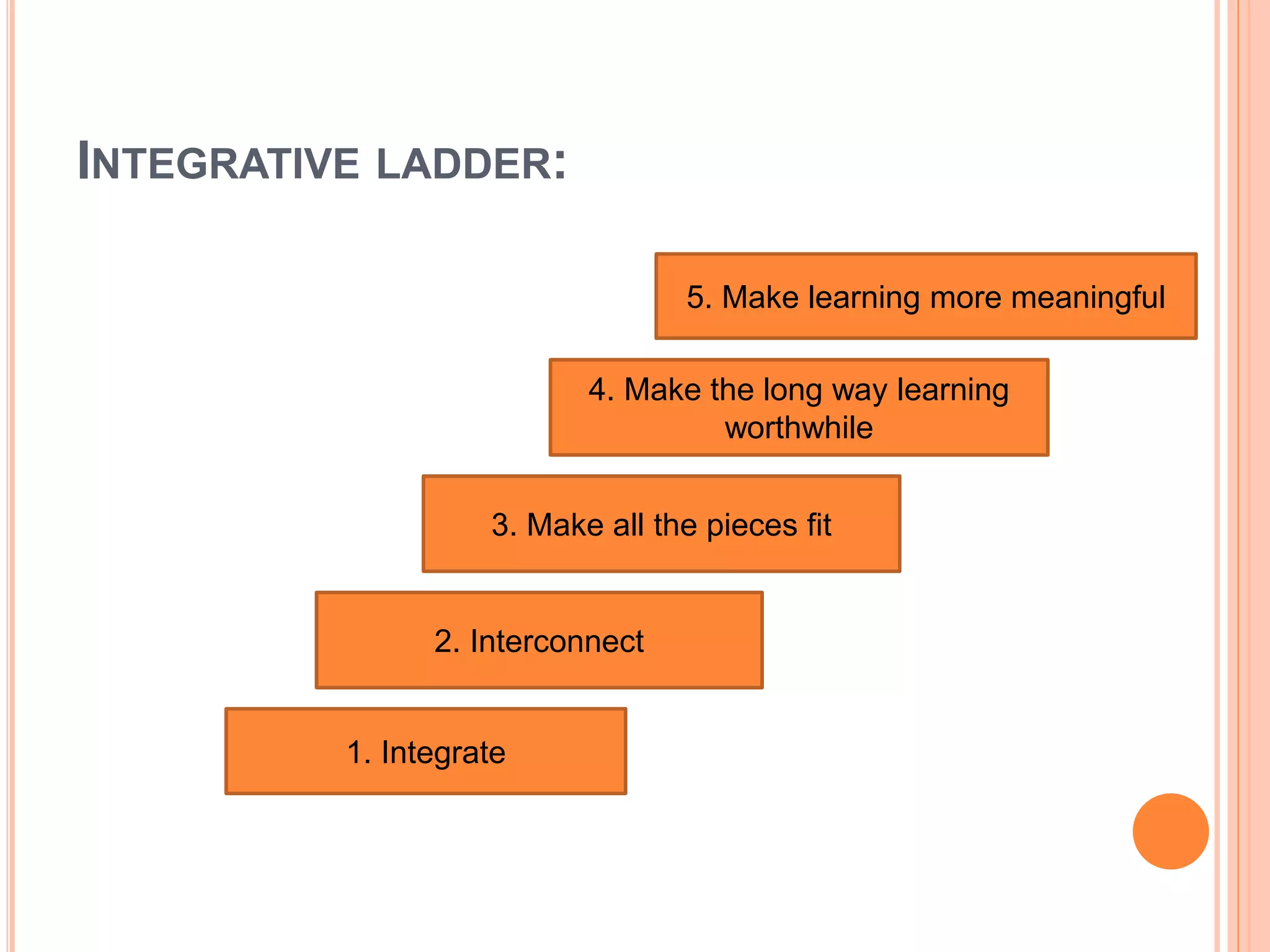
INTEGRATIVE LADDER: 
1. Integrate 
5. Make learning more meaningful 
4. Make the long way learning 
worthwhile 
3. Make all the pieces fit 
2. Interconnect
Several ways to sustain learner’s interest: 
1. use diverse learning activities or experiences; 
2. relate clearly to individual learning modes; and 
3. recognize group’s success through appreciative 
remarks and rewards.
DISCUSSION: 
 INTEGRATIVE TEACHING STRATEGY 
 is a well-organized strategy anchored on real life 
situation that include learners’ interests and needs 
creating a variety of meaningful activities and 
learning experiences.
1. THE THREE MODES OF TEACHING 
STRATEGIES 
1. THEMATIC TEACHING 
 It provides a broad framework for linking content 
and process from a variety of disciplines. The 
theme provides coherence; it gives a “focus” to the 
activities that accompany by the unit. The theme 
also helps learners see the meaningful connection 
across disciplines or skills areas. It conveys a 
clear, compelling purpose to learners, teachers 
and parents, linking ideas to actions and learning 
to life. (Zulueta, 2006)
Steps for the Integrated Unit Design (Thematic Teaching): 
1. Decide on a unit theme that will allow all group members to enter to the 
integration process. 
2. Identify a major concept to serve as a suitable “integrating lens” for the 
study. 
3. Web the topics for study, by subject or learning area, around the concept 
and theme. 
4. Brainstorm some of the “essential understanding” (generalization) that 
would expect learners to derive from the study. 
5. Brainstorm “essential questions” to facilitate study toward the essential 
understanding. 
6. List processed (complex performance) and bullet key skills to be 
emphasized in a unit instruction and activities. 
7. For each week and discipline in the unit, write instructional activities to 
engage learners with essential questions and process. 
8. Write the culminating performance to show the depth of learning. 
9. Design the scoring guide (rubric-criteria and standard) to assess the 
performance task. Additional types of assessment may be used to 
measure progress throughout the unit.
1. CONTENT-BASED INSTRUCTION 
Content-Based Instruction (CBI) is the 
integration of content learning with language 
teaching aims. It refers to the concurrent study 
of language and subject matter, with the form 
and sequence of language presentation 
dictated by content material. The language 
curriculum is centered on the academic needs 
and interests of the learner, and crosses the 
barrier between language and subject matter 
courses.
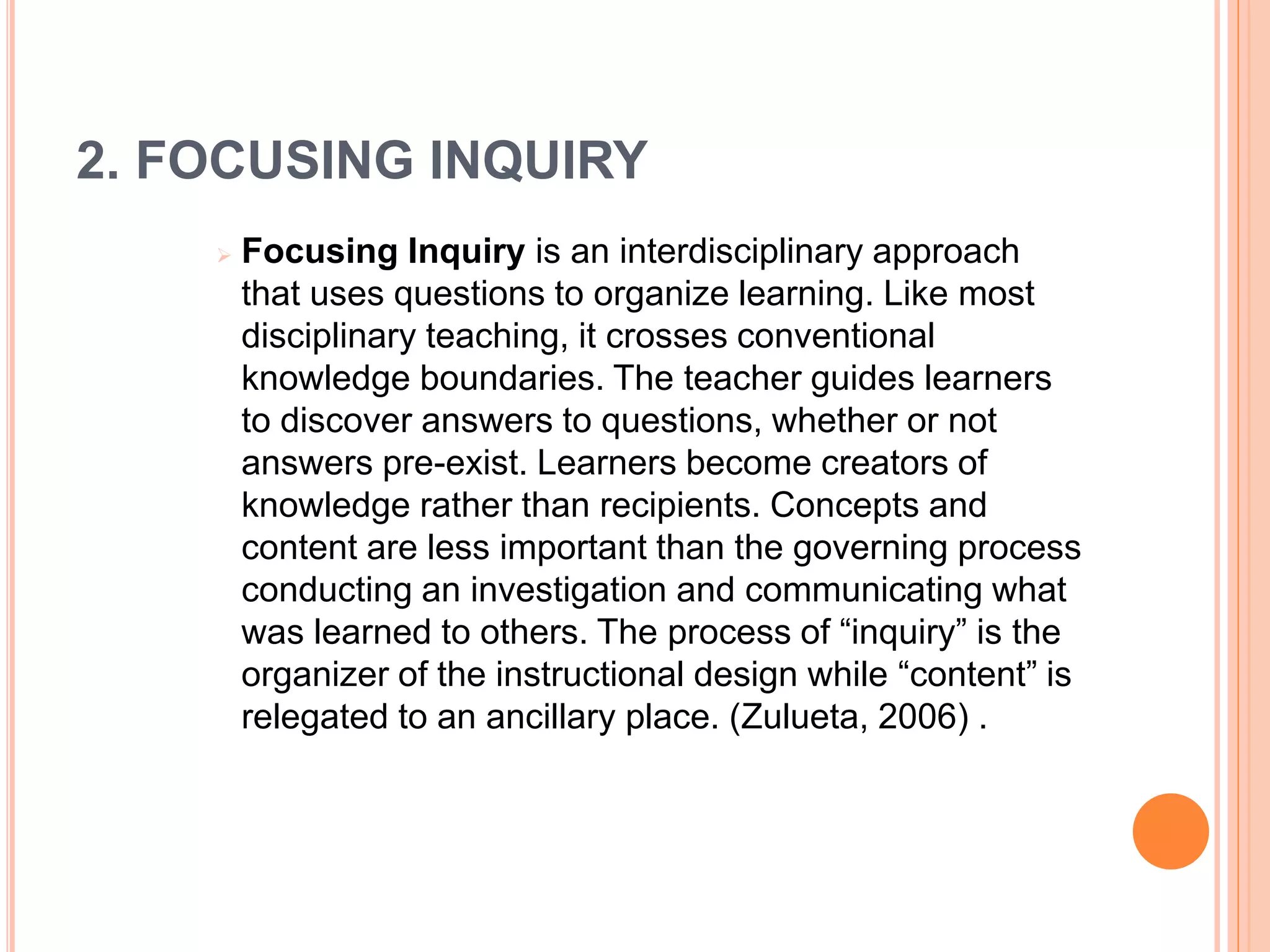
2. FOCUSING INQUIRY 
 Focusing Inquiry is an interdisciplinary approach 
that uses questions to organize learning. Like most 
disciplinary teaching, it crosses conventional 
knowledge boundaries. The teacher guides learners 
to discover answers to questions, whether or not 
answers pre-exist. Learners become creators of 
knowledge rather than recipients. Concepts and 
content are less important than the governing process 
conducting an investigation and communicating what 
was learned to others. The process of “inquiry” is the 
organizer of the instructional design while “content” is 
relegated to an ancillary place. (Zulueta, 2006) .
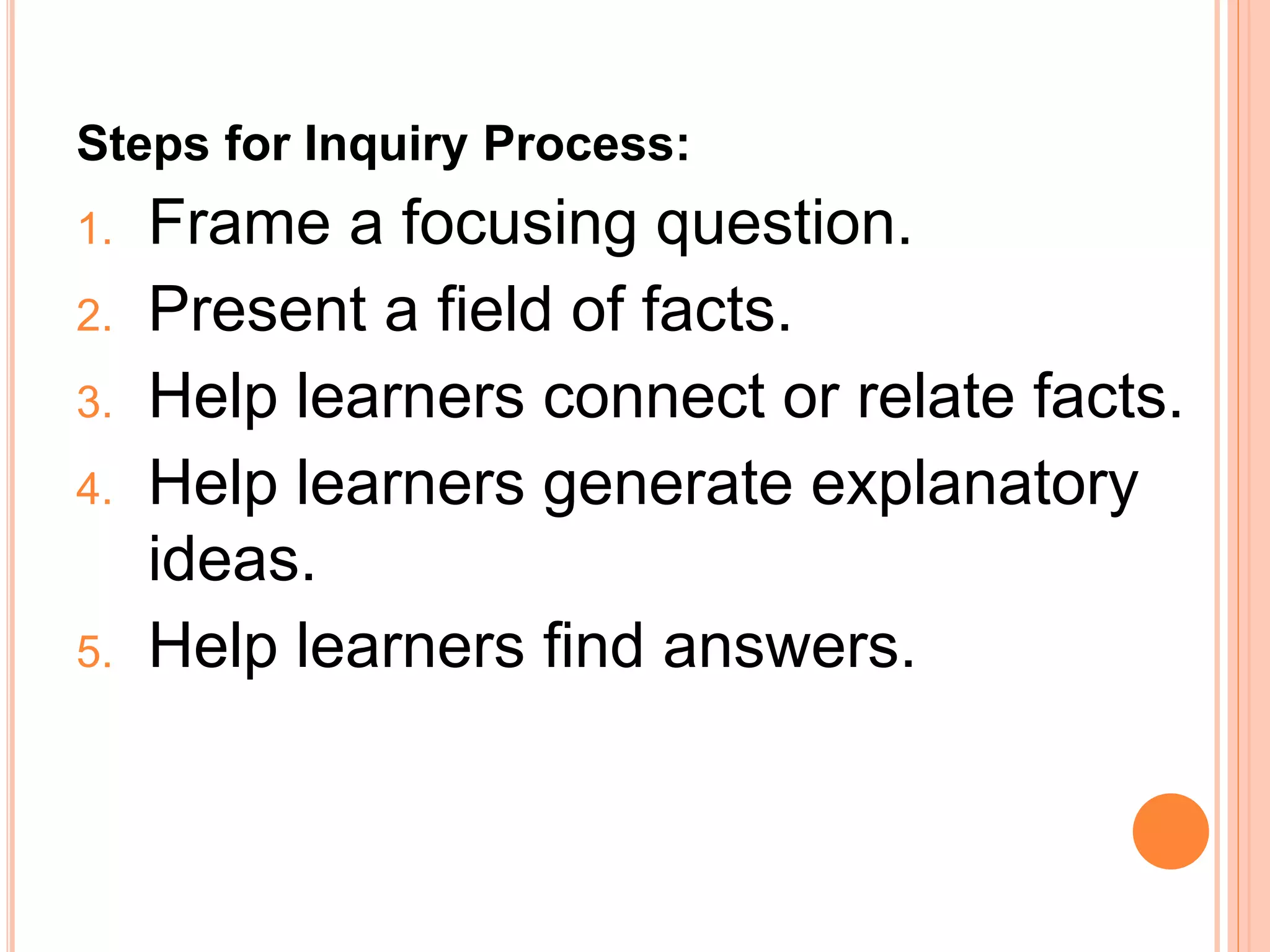
Steps for Inquiry Process: 
1. Frame a focusing question. 
2. Present a field of facts. 
3. Help learners connect or relate facts. 
4. Help learners generate explanatory 
ideas. 
5. Help learners find answers.
Teaching Strategies for Cognitive, Thinking, or 
Inquiry Process 
o These strategies may be used in any subject and 
are designed to be used at all levels of instruction. 
The order of questioning generally follows but varies 
in terms of student’s backgrounds, prior knowledge 
instruction or emphasis on inductive and deductive 
approach. Both cognitive and affective dimensions 
are involved in any given strategy. (Aquino, 1999)
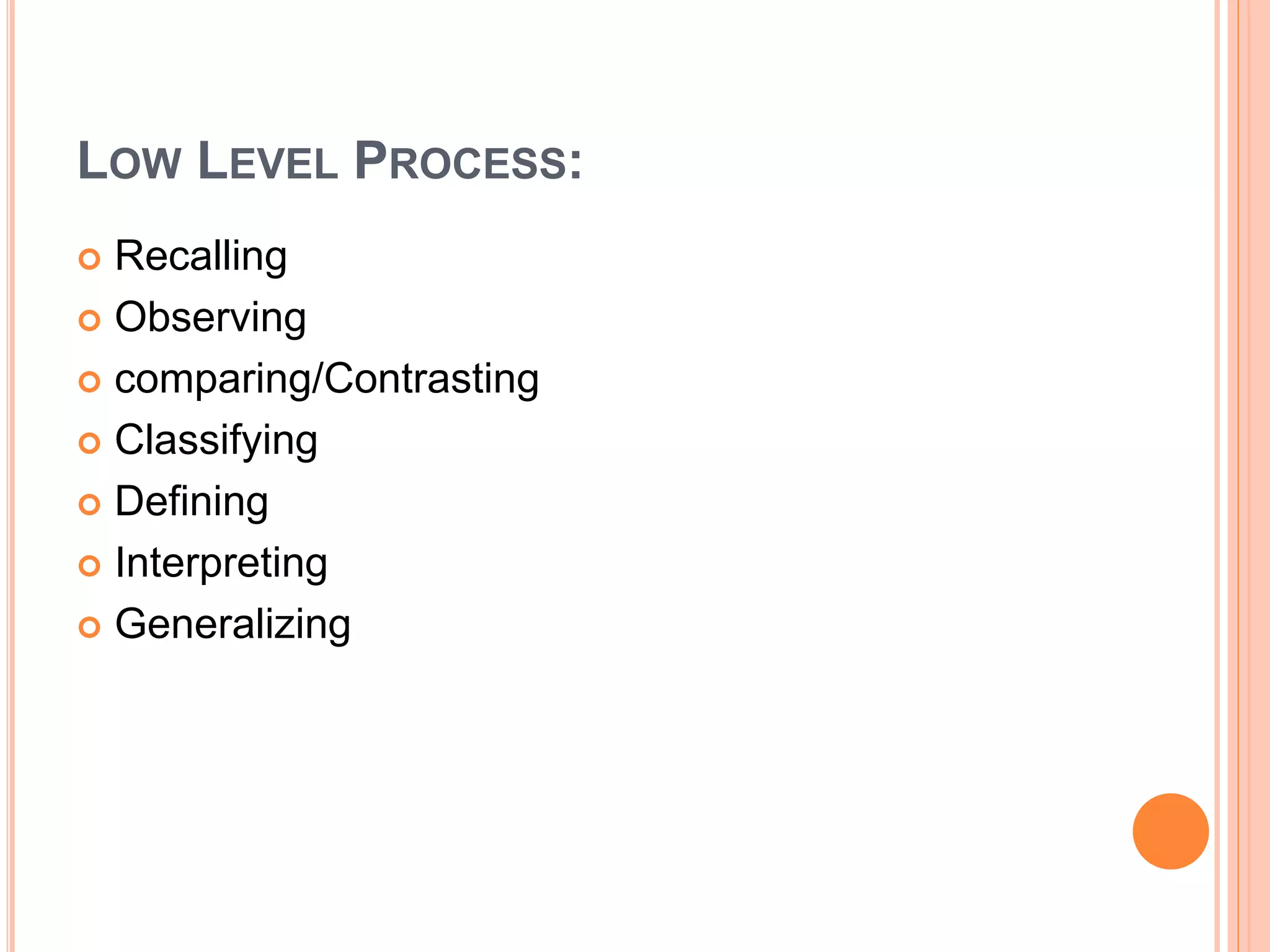
LOW LEVEL PROCESS: 
 Recalling 
 Observing 
 comparing/Contrasting 
 Classifying 
 Defining 
 Interpreting 
 Generalizing
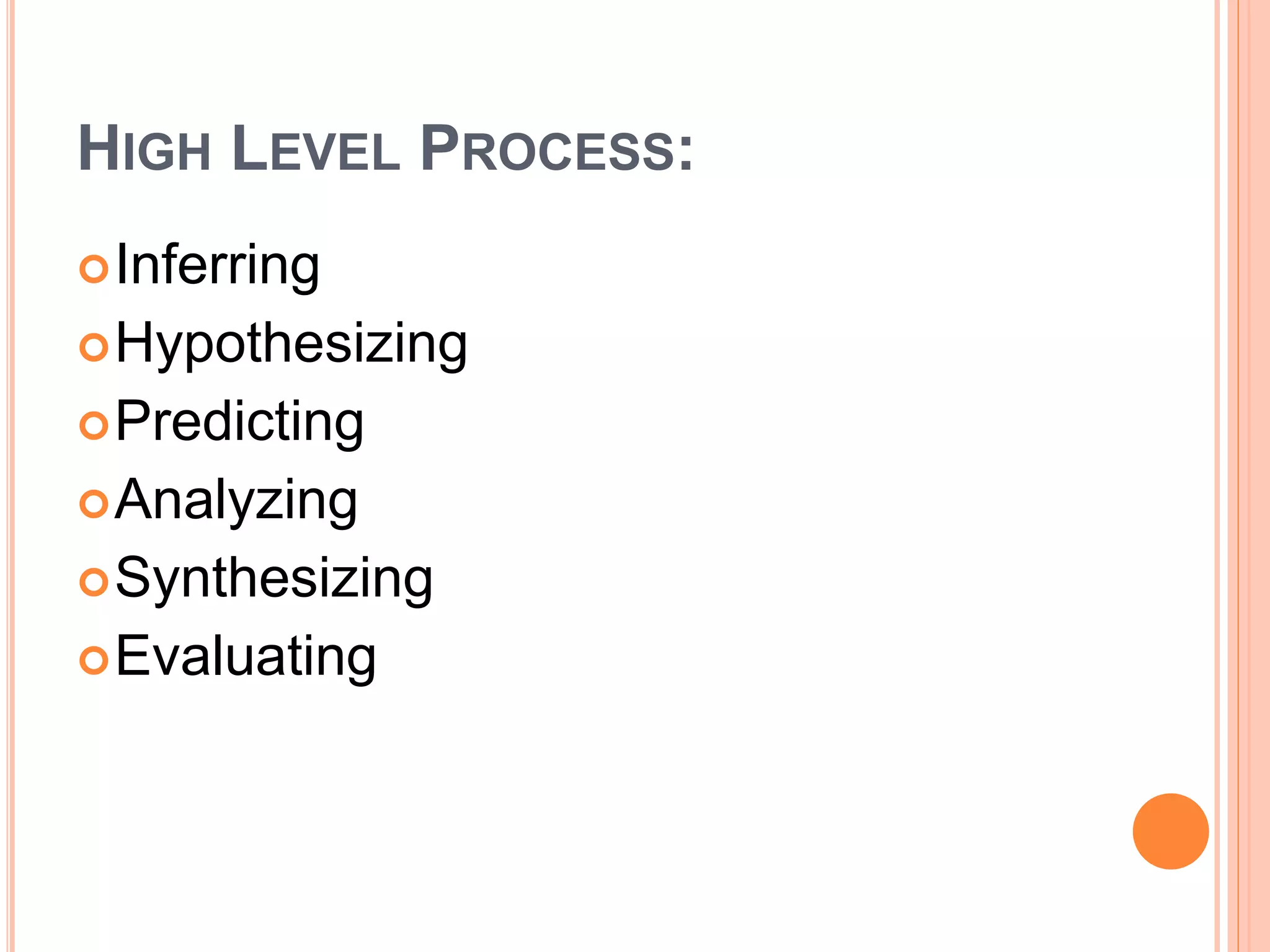
HIGH LEVEL PROCESS: 
Inferring 
Hypothesizing 
Predicting 
Analyzing 
Synthesizing 
Evaluating
OBJECTIVES OF INTEGRATIVE 
TEACHING STRATEGIES 
1. To foster security and satisfaction. 
2. To promote cooperative learning. 
3. To help develop sense of values. 
4. To help develop self-direction. 
5. To foster creativity. 
6. To provide opportunities for social action. 
7. To help evaluate learning.
III. Principles underlying the planning for integrative 
teaching strategies 
1. The development of the whole personality of the learner is 
more important than the subject matter. 
2. Long rage plans and large units should be prepared to daily 
and isolated tasks. 
3. Learning activities should be recognized around real-life 
problems of the pupils, their needs and interests. 
4. Learning should be characterized by group planning, group 
work, and group assessment. 
5. Teaching- learning activities should follow democratic 
procedures. 
6. Individual Differences should be provided for by a wide 
variety of learning activities and experiences. 
7. The atmosphere of the classroom should be permissive and 
happy.
IV. BENEFITS 
1. Help alleviate fragmentation of 
learning and isolated skill instruction. 
2. Train students to think and reason at 
a higher level (critical thinking). 
3. Provide instruction in a more relevant 
and interesting to the students.
V. IMPEDIMENTS 
1. Take more time in planning and 
collaborating with other disciplines. 
2. Does not sound accepted as valid or 
useful by some teachers. 
3. Result to competition among teachers 
with regards to time, priorities and learning 
environment.
VI. KINDS OF WORK UNITS OR 
INTEGRATIVE ACTIVITIES IN THE 
CLASSROOM 
The Three Kinds of Units of Work: 
1. Subject Matter Units 
2. Center of Interest Units 
3. Integrative Experience Units
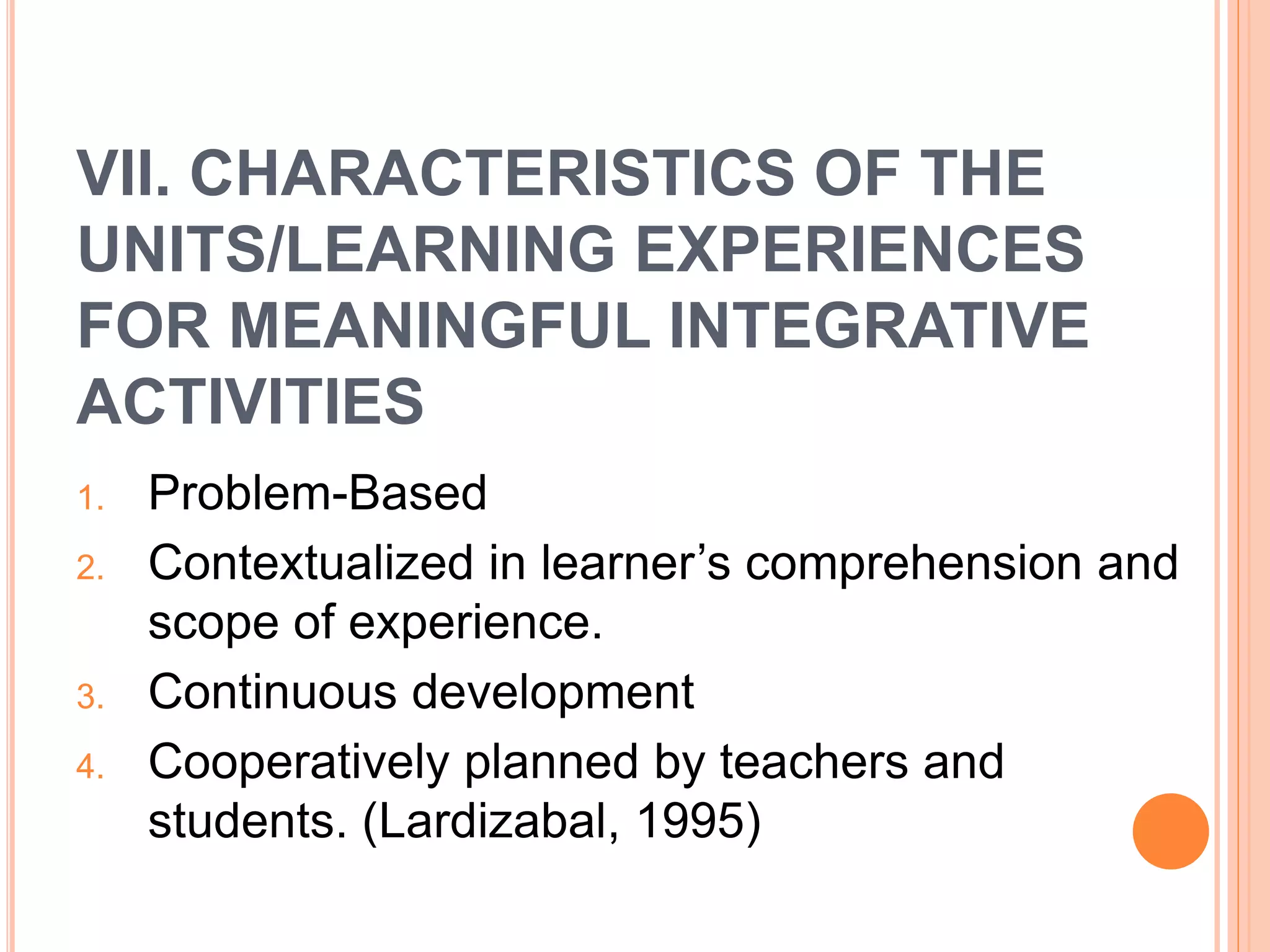
VII. CHARACTERISTICS OF THE 
UNITS/LEARNING EXPERIENCES 
FOR MEANINGFUL INTEGRATIVE 
ACTIVITIES 
1. Problem-Based 
2. Contextualized in learner’s comprehension and 
scope of experience. 
3. Continuous development 
4. Cooperatively planned by teachers and 
students. (Lardizabal, 1995)
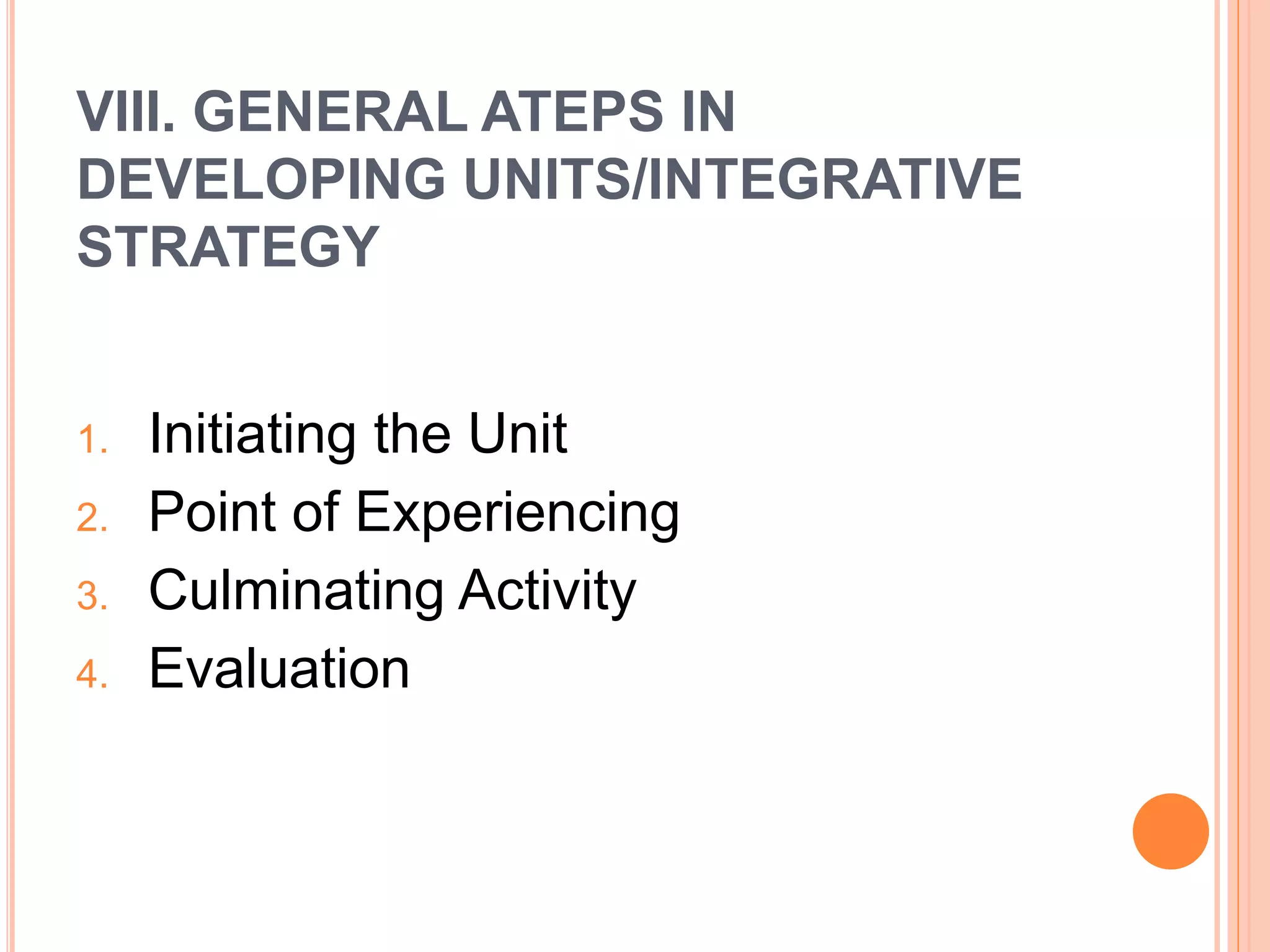
VIII. GENERAL ATEPS IN 
DEVELOPING UNITS/INTEGRATIVE 
STRATEGY 
1. Initiating the Unit 
2. Point of Experiencing 
3. Culminating Activity 
4. Evaluation
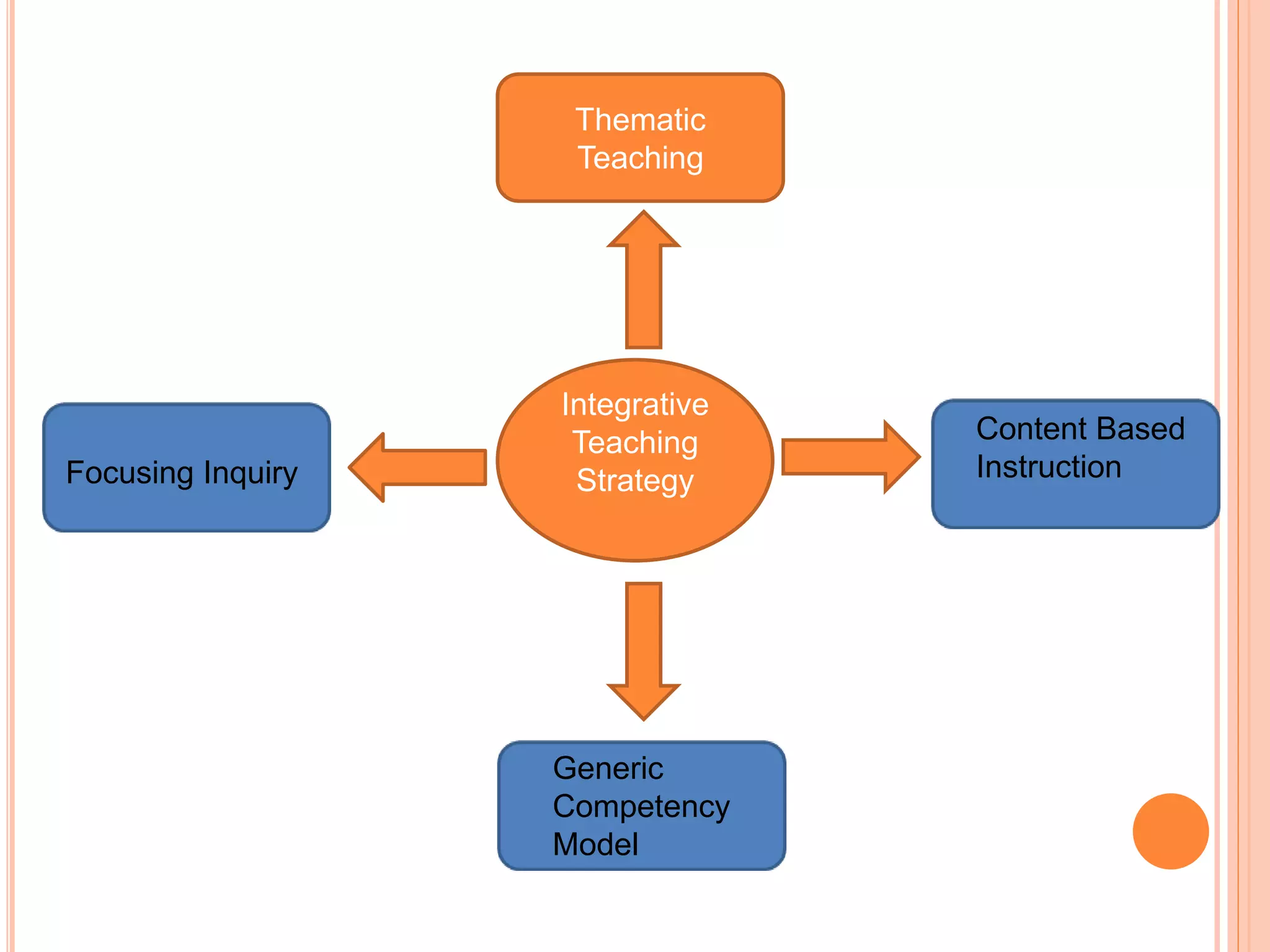
Thematic 
Teaching 
Integrative 
Teaching 
Strategy 
Focusing Inquiry 
Generic 
Competency 
Model 
Content Based 
Instruction
Integrative Teaching Strategies (ITS)

Integrative Teaching Strategies (ITS)

  • 1.
    INTEGRATIVE TEACHING STRATEGIES(ITS) By: Romeo T. Daligdig, ed.D.
  • 2.
    INTEGRATIVE TEACHING STRATEGIES (ITS) PREPARED BY: CHARRY MAE L. ABECHUELA BSE-MATHEMATICS IV
  • 3.
    INTRODUCTION: Success inthe teaching-learning process is always attributed to the creativity of the teachers. Being the pilot of the classroom educative flight, the teacher has to choose and design what strategy suits the kind of learners present therein. To be creative, teacher has to consider individual differences (old) or diversity of learners in every learning episode to make it more meaningful.
  • 4.
    TEACHER A says, “My students are BORED” TEACHER B says, “It seems like my students are not interested.”
  • 5.
    TEACHER C says, “My students can hardly understand the lesson.” TEACHER D says, “My students think there’s just too much to learn”
  • 6.
    TEACHERS A,B,C andD ask: “Is there any way to improve learning?” “Well, why don’t we improve learning, first?”
  • 7.
    INTEGRATIVE LADDER: 1.Integrate 5. Make learning more meaningful 4. Make the long way learning worthwhile 3. Make all the pieces fit 2. Interconnect
  • 8.
    Several ways tosustain learner’s interest: 1. use diverse learning activities or experiences; 2. relate clearly to individual learning modes; and 3. recognize group’s success through appreciative remarks and rewards.
  • 9.
    DISCUSSION:  INTEGRATIVETEACHING STRATEGY  is a well-organized strategy anchored on real life situation that include learners’ interests and needs creating a variety of meaningful activities and learning experiences.
  • 10.
    1. THE THREEMODES OF TEACHING STRATEGIES 1. THEMATIC TEACHING  It provides a broad framework for linking content and process from a variety of disciplines. The theme provides coherence; it gives a “focus” to the activities that accompany by the unit. The theme also helps learners see the meaningful connection across disciplines or skills areas. It conveys a clear, compelling purpose to learners, teachers and parents, linking ideas to actions and learning to life. (Zulueta, 2006)
  • 11.
    Steps for theIntegrated Unit Design (Thematic Teaching): 1. Decide on a unit theme that will allow all group members to enter to the integration process. 2. Identify a major concept to serve as a suitable “integrating lens” for the study. 3. Web the topics for study, by subject or learning area, around the concept and theme. 4. Brainstorm some of the “essential understanding” (generalization) that would expect learners to derive from the study. 5. Brainstorm “essential questions” to facilitate study toward the essential understanding. 6. List processed (complex performance) and bullet key skills to be emphasized in a unit instruction and activities. 7. For each week and discipline in the unit, write instructional activities to engage learners with essential questions and process. 8. Write the culminating performance to show the depth of learning. 9. Design the scoring guide (rubric-criteria and standard) to assess the performance task. Additional types of assessment may be used to measure progress throughout the unit.
  • 12.
    1. CONTENT-BASED INSTRUCTION Content-Based Instruction (CBI) is the integration of content learning with language teaching aims. It refers to the concurrent study of language and subject matter, with the form and sequence of language presentation dictated by content material. The language curriculum is centered on the academic needs and interests of the learner, and crosses the barrier between language and subject matter courses.
  • 13.
    2. FOCUSING INQUIRY  Focusing Inquiry is an interdisciplinary approach that uses questions to organize learning. Like most disciplinary teaching, it crosses conventional knowledge boundaries. The teacher guides learners to discover answers to questions, whether or not answers pre-exist. Learners become creators of knowledge rather than recipients. Concepts and content are less important than the governing process conducting an investigation and communicating what was learned to others. The process of “inquiry” is the organizer of the instructional design while “content” is relegated to an ancillary place. (Zulueta, 2006) .
  • 14.
    Steps for InquiryProcess: 1. Frame a focusing question. 2. Present a field of facts. 3. Help learners connect or relate facts. 4. Help learners generate explanatory ideas. 5. Help learners find answers.
  • 15.
    Teaching Strategies forCognitive, Thinking, or Inquiry Process o These strategies may be used in any subject and are designed to be used at all levels of instruction. The order of questioning generally follows but varies in terms of student’s backgrounds, prior knowledge instruction or emphasis on inductive and deductive approach. Both cognitive and affective dimensions are involved in any given strategy. (Aquino, 1999)
  • 16.
    LOW LEVEL PROCESS:  Recalling  Observing  comparing/Contrasting  Classifying  Defining  Interpreting  Generalizing
  • 17.
    HIGH LEVEL PROCESS: Inferring Hypothesizing Predicting Analyzing Synthesizing Evaluating
  • 18.
    OBJECTIVES OF INTEGRATIVE TEACHING STRATEGIES 1. To foster security and satisfaction. 2. To promote cooperative learning. 3. To help develop sense of values. 4. To help develop self-direction. 5. To foster creativity. 6. To provide opportunities for social action. 7. To help evaluate learning.
  • 19.
    III. Principles underlyingthe planning for integrative teaching strategies 1. The development of the whole personality of the learner is more important than the subject matter. 2. Long rage plans and large units should be prepared to daily and isolated tasks. 3. Learning activities should be recognized around real-life problems of the pupils, their needs and interests. 4. Learning should be characterized by group planning, group work, and group assessment. 5. Teaching- learning activities should follow democratic procedures. 6. Individual Differences should be provided for by a wide variety of learning activities and experiences. 7. The atmosphere of the classroom should be permissive and happy.
  • 20.
    IV. BENEFITS 1.Help alleviate fragmentation of learning and isolated skill instruction. 2. Train students to think and reason at a higher level (critical thinking). 3. Provide instruction in a more relevant and interesting to the students.
  • 21.
    V. IMPEDIMENTS 1.Take more time in planning and collaborating with other disciplines. 2. Does not sound accepted as valid or useful by some teachers. 3. Result to competition among teachers with regards to time, priorities and learning environment.
  • 22.
    VI. KINDS OFWORK UNITS OR INTEGRATIVE ACTIVITIES IN THE CLASSROOM The Three Kinds of Units of Work: 1. Subject Matter Units 2. Center of Interest Units 3. Integrative Experience Units
  • 23.
    VII. CHARACTERISTICS OFTHE UNITS/LEARNING EXPERIENCES FOR MEANINGFUL INTEGRATIVE ACTIVITIES 1. Problem-Based 2. Contextualized in learner’s comprehension and scope of experience. 3. Continuous development 4. Cooperatively planned by teachers and students. (Lardizabal, 1995)
  • 24.
    VIII. GENERAL ATEPSIN DEVELOPING UNITS/INTEGRATIVE STRATEGY 1. Initiating the Unit 2. Point of Experiencing 3. Culminating Activity 4. Evaluation
  • 25.
    Thematic Teaching Integrative Teaching Strategy Focusing Inquiry Generic Competency Model Content Based Instruction