


Understanding Nonverbal Learning DisabilityBinyamin Goldman, PsyD
DefinitionA nonverbal learning disability (NLD) is a developmental brain based disorder that impairs a child's capacity to perceive, express, and understand nonverbal (nonlinguistic) signs. The disorder is generally expressed as a pattern of impaired functioning in the nonverbal domains, with higher functioning in the verbal domain.
DefinitionThe neuropsychological deficits associated with this disorder constrain children's capacity to function in the academic, social, emotional, or vocational domain and lead to a heterogeneous set of neurobehavioral symptoms. The brain dysfunctions affect children's behaviors, their social interactions, their feelings about themselves and others, and their emerging personality patterns--all of which may manifest as symptomatic behaviors.
DiscoveryJohnson & Myklebust (1967)Coined the term nonverbal learning disabilityReferred to a residual group of children who did not have verbal language problems but did have a range of symptoms that interfered with their school functioningInitially used the term “disorders of social imperception,” referring to: “a child’s … lack of ability to understand his social environment, especially in terms of his own behavior.”Concluded that these children have a hard time understanding the meanings of other people’s social cues
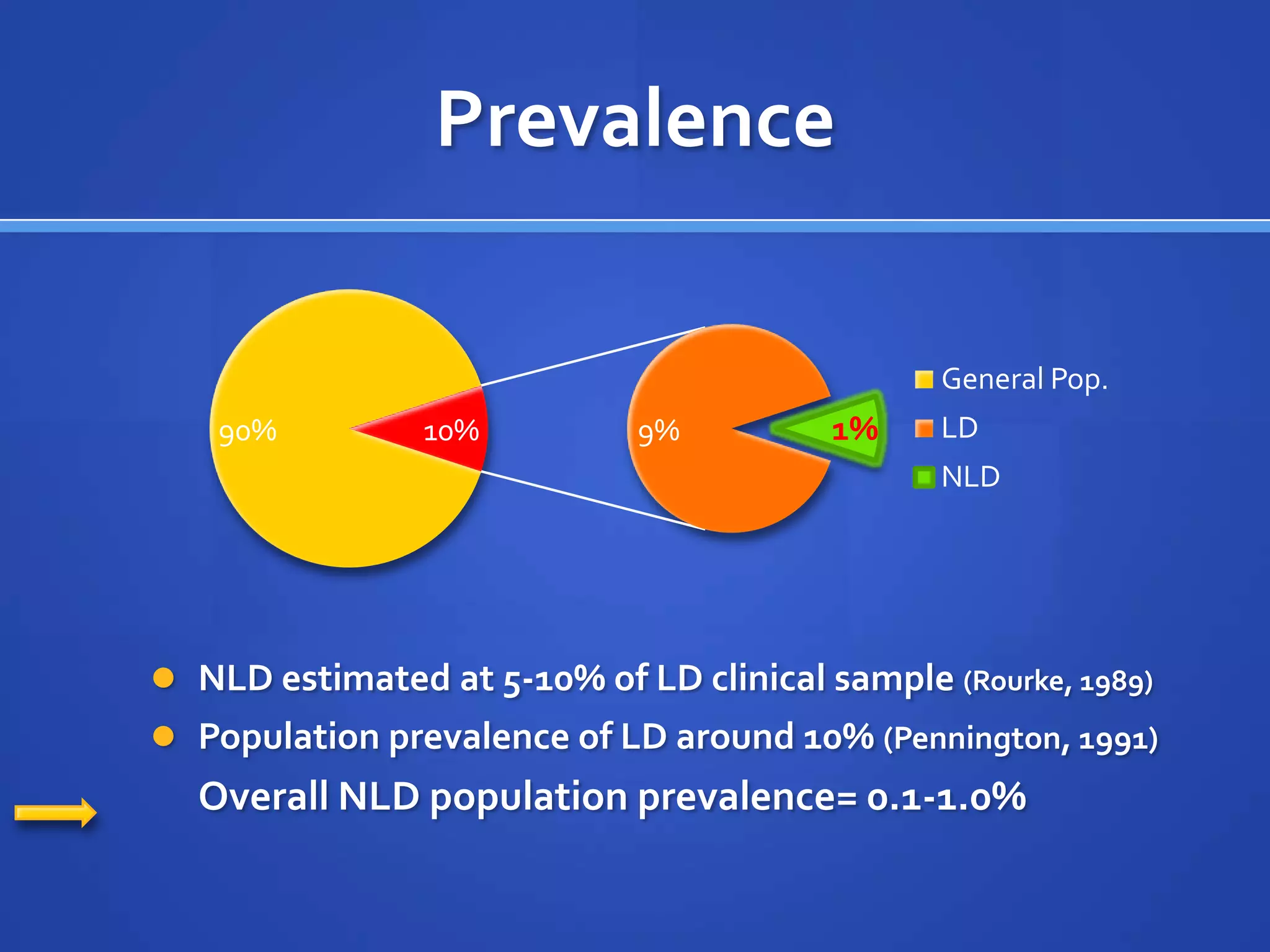
PrevalenceNLD estimated at 5-10% of LD clinical sample (Rourke, 1989)Population prevalence of LD around 10% (Pennington, 1991)	Overall NLD population prevalence= 0.1-1.0%
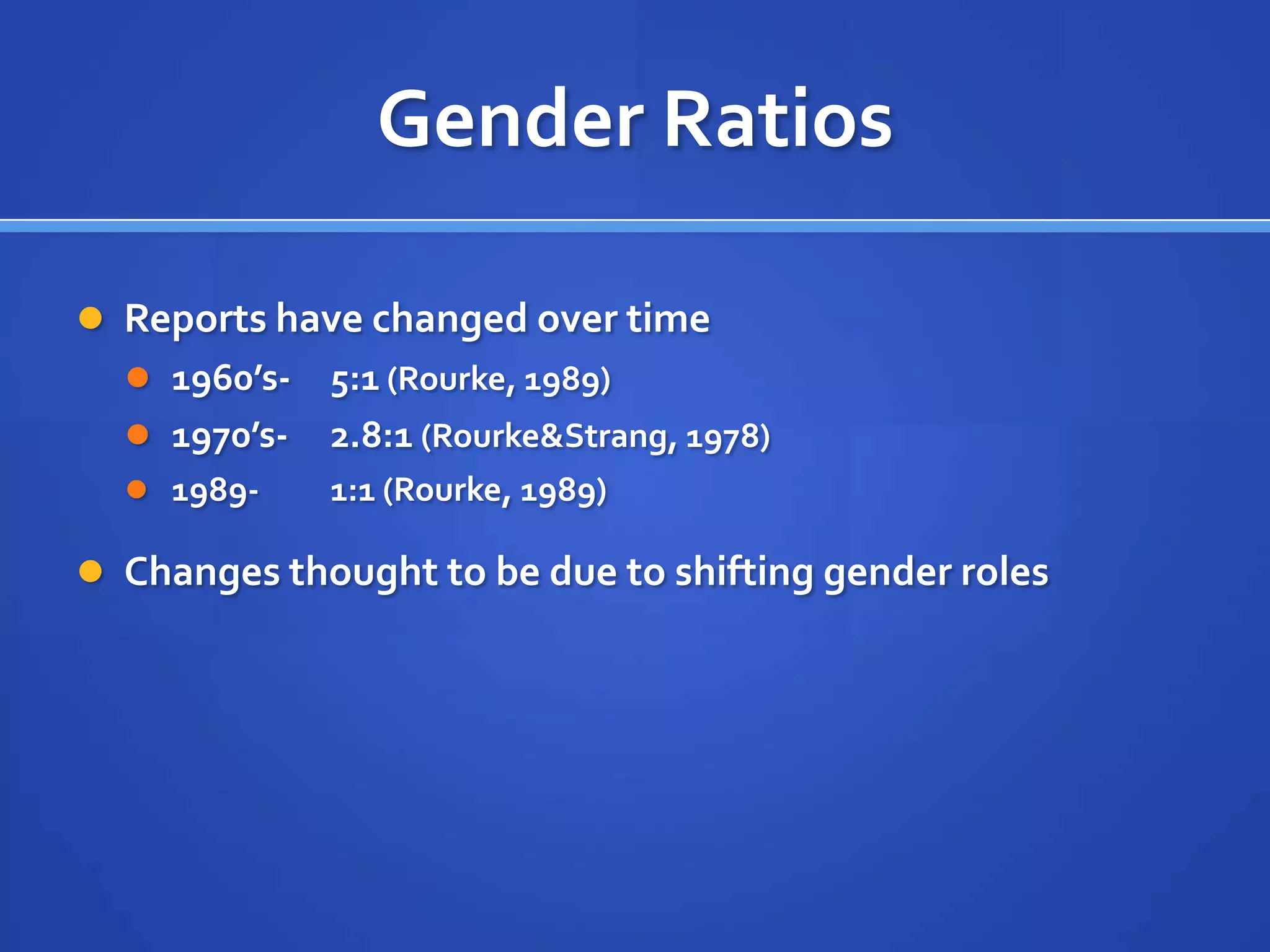
Gender RatiosReports have changed over time1960’s-	5:1 (Rourke, 1989)1970’s-	2.8:1 (Rourke & Strang, 1978)1989- 	1:1 (Rourke, 1989)Changes thought to be due to shifting gender roles
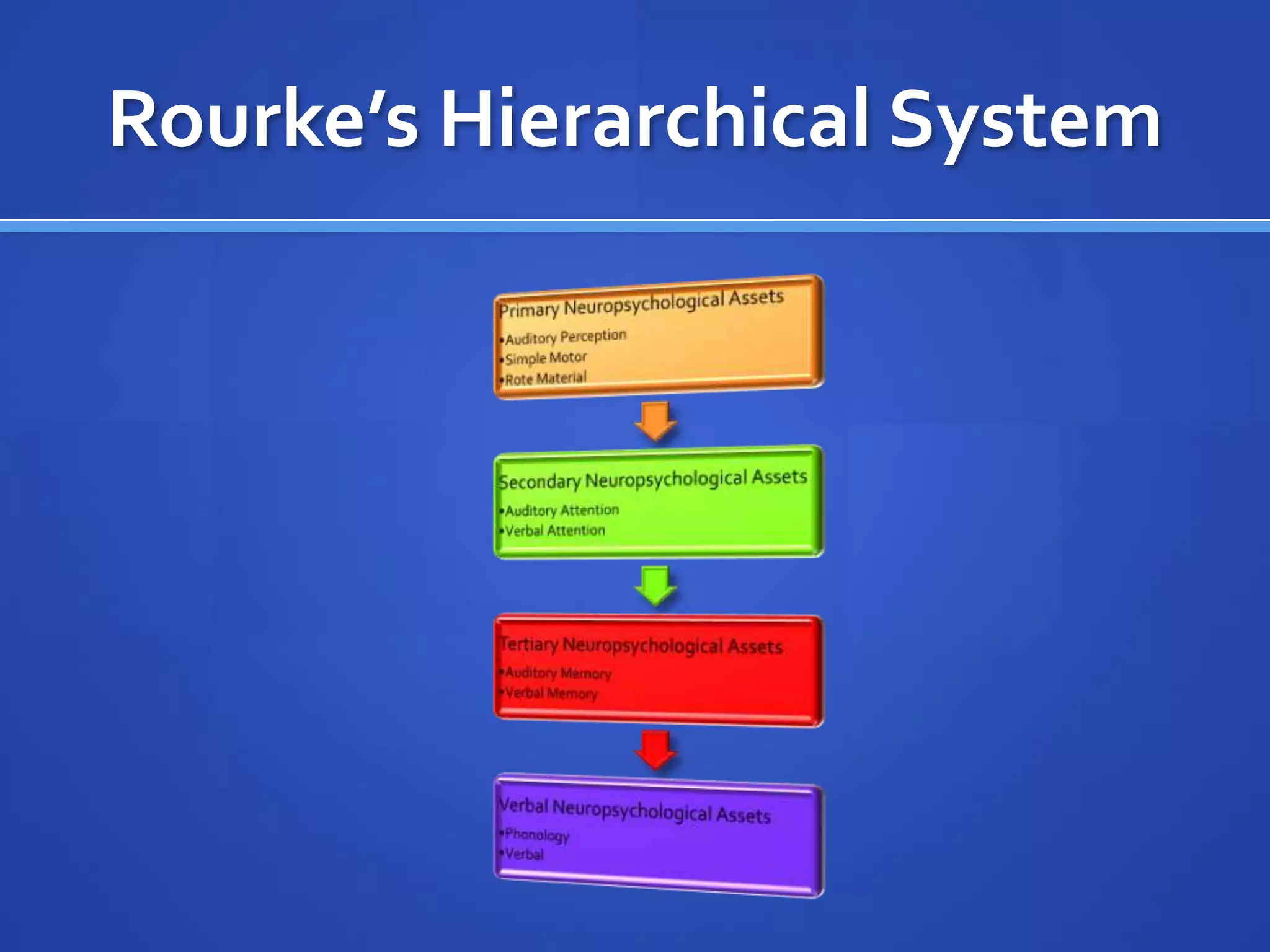
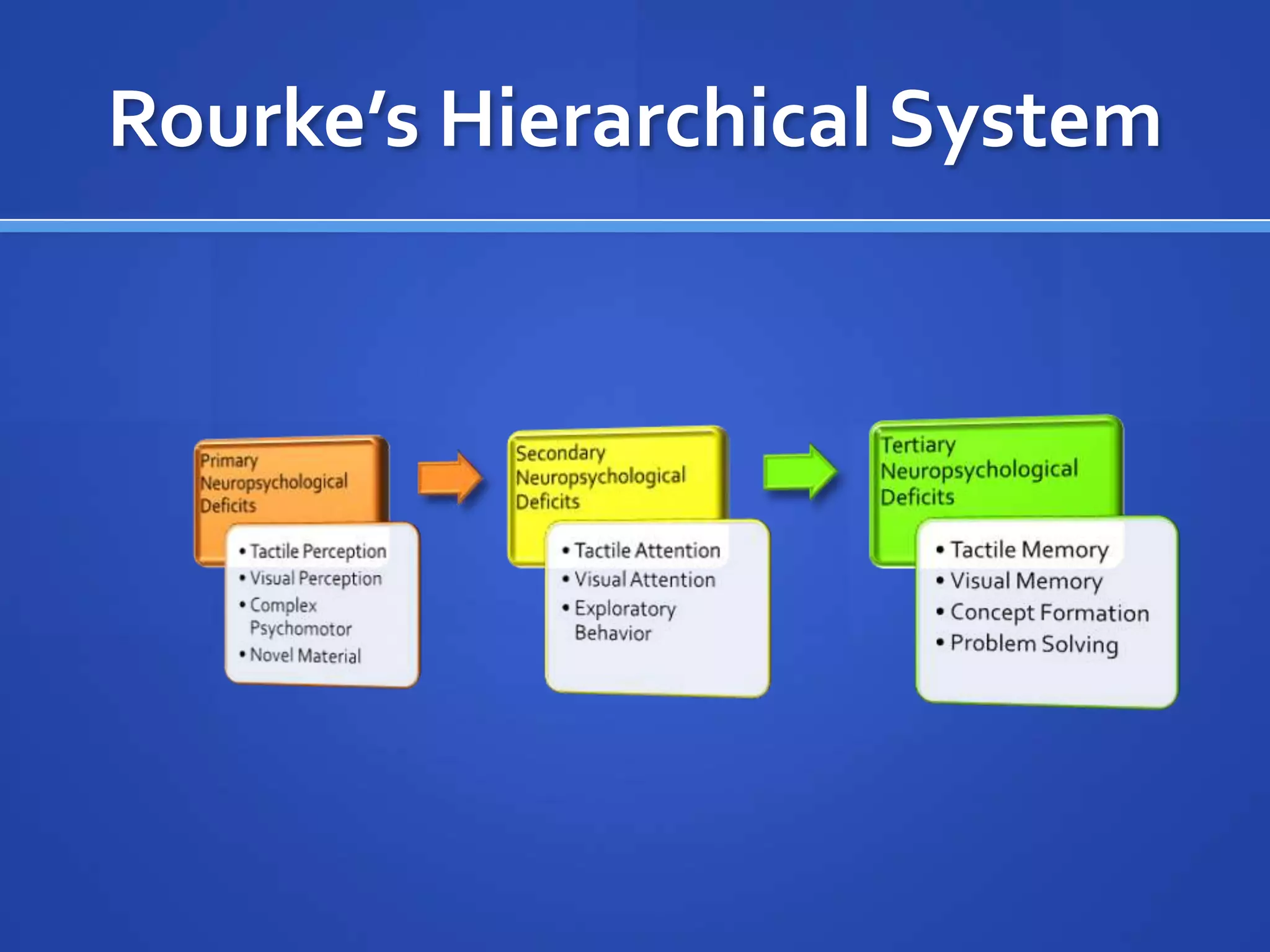
Rourke’s Hierarchical System
Primary AssetsSimple motor skillsSimple, repetitive motoric skills are generally intact, especially at older age levels (middle childhood and beyond).Auditory perceptionAfter a very early developmental period when such skills appear to be lagging, auditory-perceptual capacities become very well developed.Rote materialRepetition and/or constancy of stimulus input - especially through the auditory modality, but not confined to it - is well appreciated. Repetitious motoric acts, including some aspects of speech and well-practiced skills such as handwriting, eventually develop to average or above-average levels(Rourke, 2008)(Rourke, 2008)
Secondary AssetsAttentional skills Deployment of selective and sustained attention for simple, repetitive verbal material (especially that delivered through the auditory modality) becomes very well developed.(Rourke, 2008)
Tertiary AssetsMemoryRote verbal memory and memory for material that is readily coded in a rote verbal fashion becomes extremely well developed.Verbal Assets: Speech and Language Following an early developmental period when linguistic skills appear to be lagging, a number of such skills emerge and develop in a rapid fashion. These include excellent phonemic hearing, segmentation, blending, and repetition. Very well-developed receptive language skills and rote verbal capacities are evident, as are a large store of rote verbal material and verbal associations, and a very high volume of speech output. All of these characteristics tend to become more prominent with advancing years.(Rourke, 2008)
Academic AssetsFollowing initial problems with the visual-motor aspects of writing and much practice with a writing instrument, graphomotor skills (for words) reach good to excellent levels. Following initial problems with the development of the visual-spatial feature analysis skills necessary for reading, good to excellent single-word reading skills also develop to above-average levels. Misspellings are almost exclusively of the “phonetically accurate” variety: that is, the type seen most often in normal spellers. Verbatim memory for oral and written verbal material can be outstanding in the middle to late elementary school years and thereafter.(Rourke, 2008)
Primary DeficitsTactile perception- Bilateral tactile-perceptual deficits are evident, often more marked on the left side of the body. Deficits in simple tactile imperception and suppression may become less prominent with advancing years, but problems in dealing with complex tactile input tend to persist.Visual perception- There is impaired discrimination and recognition of visual detail and visual relationships, and there are outstanding deficiencies in visual-spatial-organizational skills. Simple visual discrimination, especially for material that is verbalisable, usually approaches normal levels with advancing years. Complex visual-spatial-organizational skills, especially when required within a novel framework, tend to worsen relative to age-based norms.(Rourke, 2008)
Primary DeficitsComplex psychomotor skills- Bilateral psychomotor coordination deficiencies are prominent; these are often more marked on the left side of the body. These deficits, except for well-practiced skills such as handwriting, tend to increase in severity with age, especially when they are required within a novel framework.Novel material- As long as stimulus configurations remain novel, they are dealt with very poorly and inappropriately. Difficulties in age-appropriate accommodation to, and a marked tendency toward over-assimilation of, novel events increase with advancing years. There is an over-reliance on prosaic, rote (and in consequence, inappropriate) behaviors in such situations. The capacity to deal with novel experiences often remains poor and may even worsen with age.(Rourke, 2008)
Secondary DeficitsAttention- Attention to tactile and visual input is poor. Relative deficiencies in visual attention tend to increase over the course of development, except for material that is programmatic and over-learned (e.g., printed text). Deployment of selective and sustained attention is much better for simple, repetitive verbal material (especially that delivered though the auditory modality) than for complex, novel nonverbal material (especially that delivered through the visual or tactile modalities). The disparity between attentional deployment capacities for these two sets of materials tends to increase with age.(Rourke, 2008)
Secondary DeficitsExploratory behavior. During early phases of development, there is little physical exploration of any kind. This is the case even for objects that are immediately within reach and could be explored through visual or tactile means. A tendency toward sedentary and physically limited modes of functioning tends to increase with age.(Rourke, 2008)
Tertiary DeficitsMemory- Memory for tactile and visual input is poor. Relative deficiencies in these areas tend to increase over the course of development, except for material that is programmatic and overlearned (e.g., spoken natural language). Memory for nonverbal material, whether presented through the auditory, visual, or tactile modalities, is poor if such material is not readily coded in a verbal fashion. Relatively poor memory for complex, meaningful, and/or novel verbal and nonverbal material is typical. Differences between good to excellent memory for rote material and impaired memory for complex material and/or that which is not readily coded in a verbal fashion tend to increase with age.(Rourke, 2008)
Tertiary DeficitsConcept-formation, problem-solving, strategy-generation, and hypothesis-testing/appreciation of informational feedback. Marked deficits in all of these areas are apparent, especially when the concept to be formed, the problem to be solved, and/or the problem-solving milieu(x) is/are novel or complex. Also evident are significant difficulties in dealing with cause-and-effect relationships and marked deficiencies in the appreciation of incongruities (e.g., age-appropriate sensitivity to humor). Most noticeable when formal operational thought becomes a developmental demand (i.e., in late childhood and early adolescence), relative deficits in these areas tend to increase markedly with advancing years, as is evident in the often widening gap between performance on rote (overlearned) and novel tasks.(Rourke, 2008)
Linguistic DeficitsSpeech and language. Mildly deficient oral-motor praxis, little or no speech prosody, and much verbosity of a repetitive, straightforward, rote nature are characteristic. Content disorders of language, characterized by very poor psycholinguistic content and pragmatics (e.g., “cocktail party” speech) and reliance upon language as a principal means for social relating, information gathering, and relief from anxiety. "Memory" for complex verbal material is usually very poor, probably as a result of poor initial comprehension of such material. All of these characteristics, except oral-motor praxis difficulties, tend to become more prominent with advancing years.(Rourke, 2008)
Academic DeficitsGraphomotor In the early school years, there is much difficulty with printing and cursive script; with considerable practice, handwriting often becomes quite good. However, some avoid practice and remain deficient in such skills.Reading comprehension Reading comprehension is much poorer than single-word reading (decoding). Relative deficits in reading comprehension, especially for novel material, tend to increase with advancing years.(Rourke, 2008)
Academic DeficitsMechanical arithmetic and mathematics There are outstanding relative deficiencies in mechanical arithmetic as compared to proficiencies in reading (word-recognition) and spelling. With advancing years, the gap between good to excellent single-word reading and spelling and deficient mechanical arithmetic performance widens. Absolute level of mechanical arithmetic performance only rarely exceeds the Grade 5 level; mathematical reasoning, as opposed to programmatic arithmetic calculation, remains poorly developed. (Rourke, 2008)
Academic DeficitsSciencePersistent difficulties in academic subjects involving problem-solving and complex concept-formation (e.g., physics) are prominent. Problems in dealing with scientific concepts and theories become apparent by early adolescence. The gap between deficiencies in this type of complex academic endeavor and other, more rote, programmatic academic pursuits widens with age.(Rourke, 2008)
Psychosocial/Adaptational DeficitsAdaptation in novel situations There is extreme difficulty in adapting to (i.e., countenancing, organizing, analyzing, and synthesizing) novel and otherwise complex situations. An over-reliance on prosaic, rote (and, in consequence, inappropriate) behaviors in such situations is common. These characteristics tend to become more prominent and problematic with advancing years.Social competence. Significant deficits are apparent in social perception, social judgment, and social interaction skills; these deficits become more prominent and problematic as age increases. There is a marked tendency toward social withdrawal and even social isolation with advancing years.(Rourke, 2008)
Psychosocial/Adaptational DeficitsPsychosocial disturbance Often characterized during early childhood as afflicted with some type of acting-out or other "externalized" disorder, such children are very much at risk for the development of internalized forms of psychopathology. Indications of excessive anxiety, depression, and associated internalized forms of psychosocial disturbance tend to increase with advancing years.Activity level Children who exhibit the syndrome are frequently perceived as hyperactive during early childhood. With advancing years, they tend to be characterized as normoactive and eventually hypoactive.(Rourke, 2008)
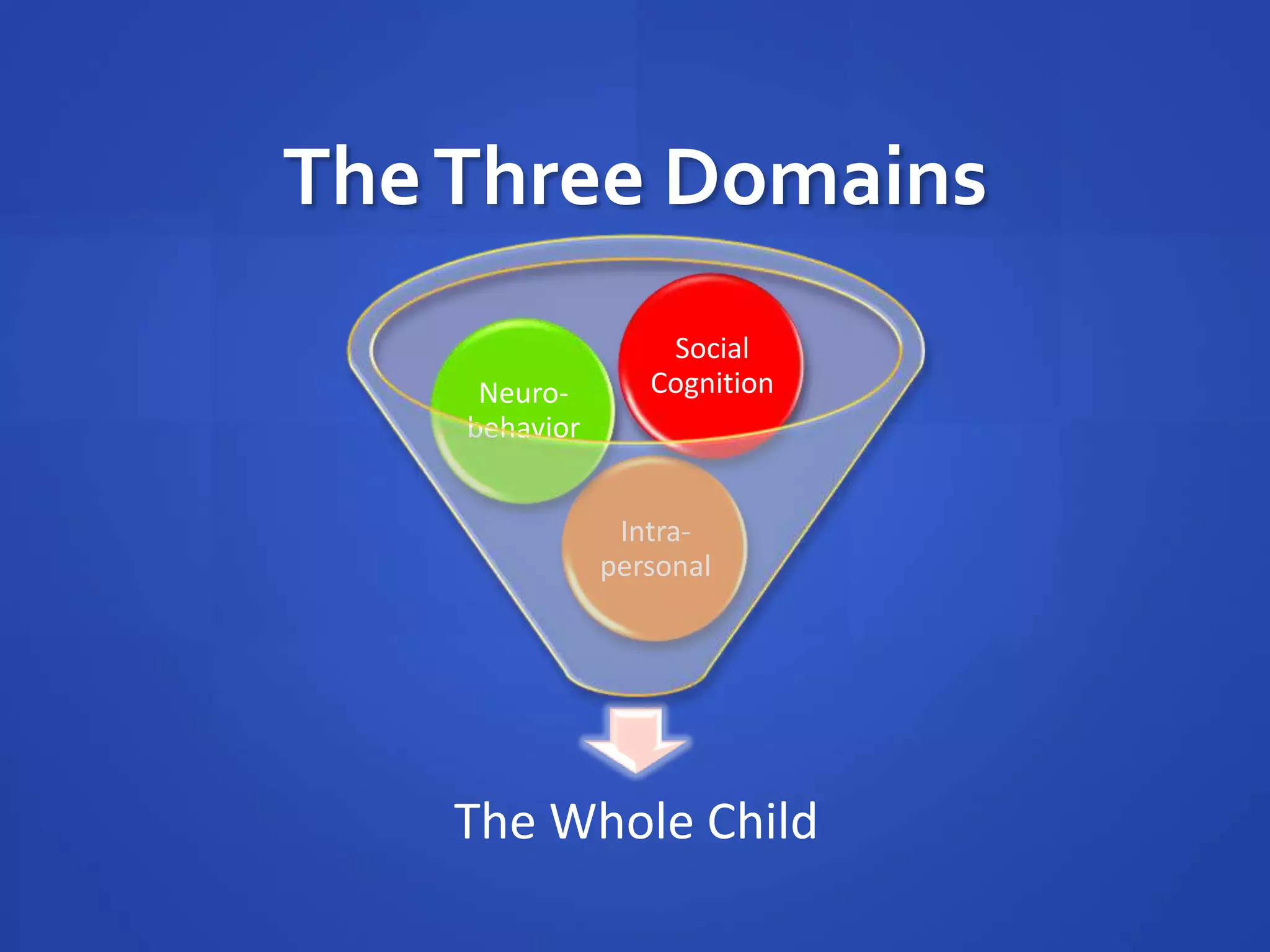
The Three Domains
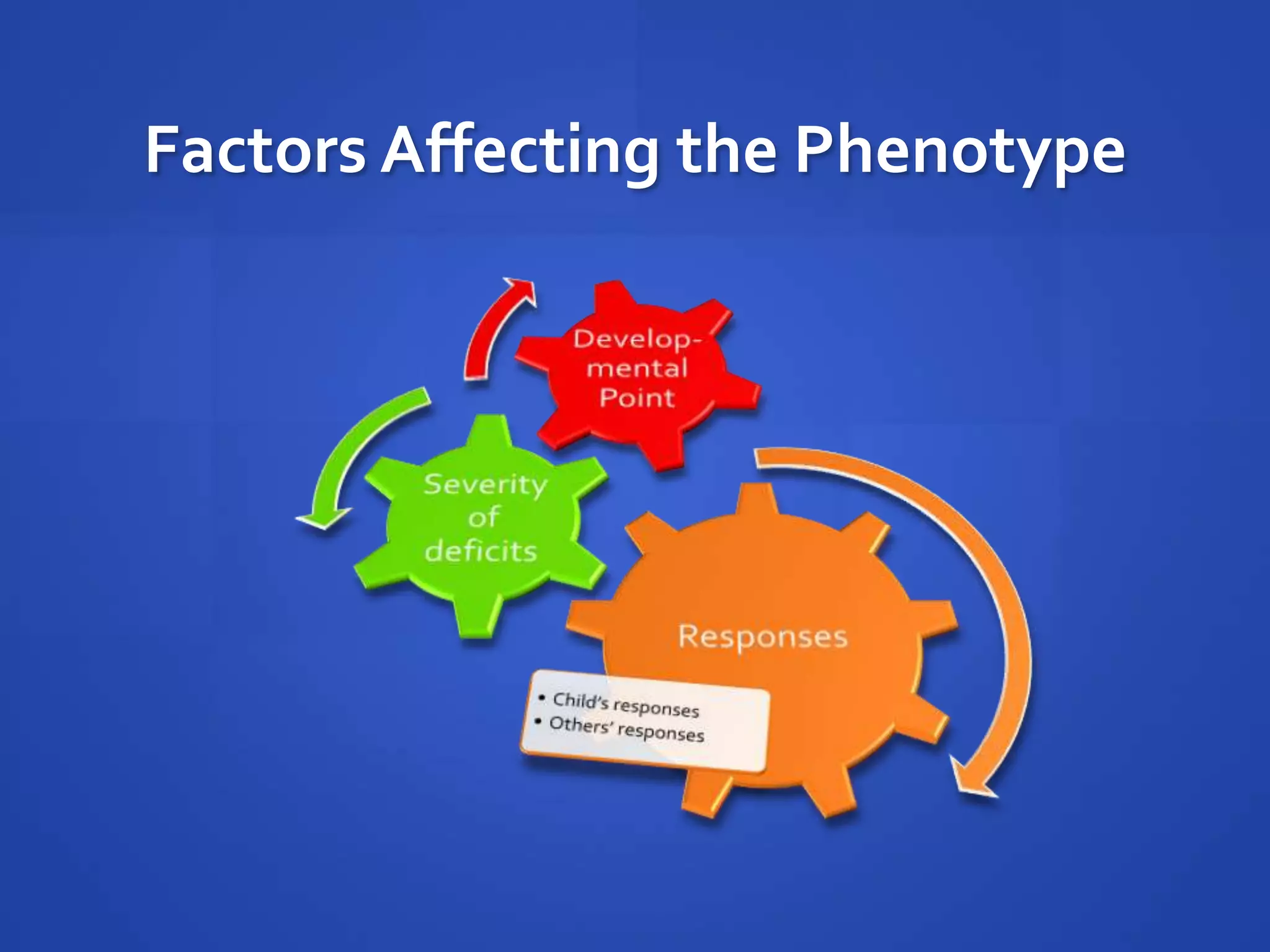
Factors Affecting the Phenotype
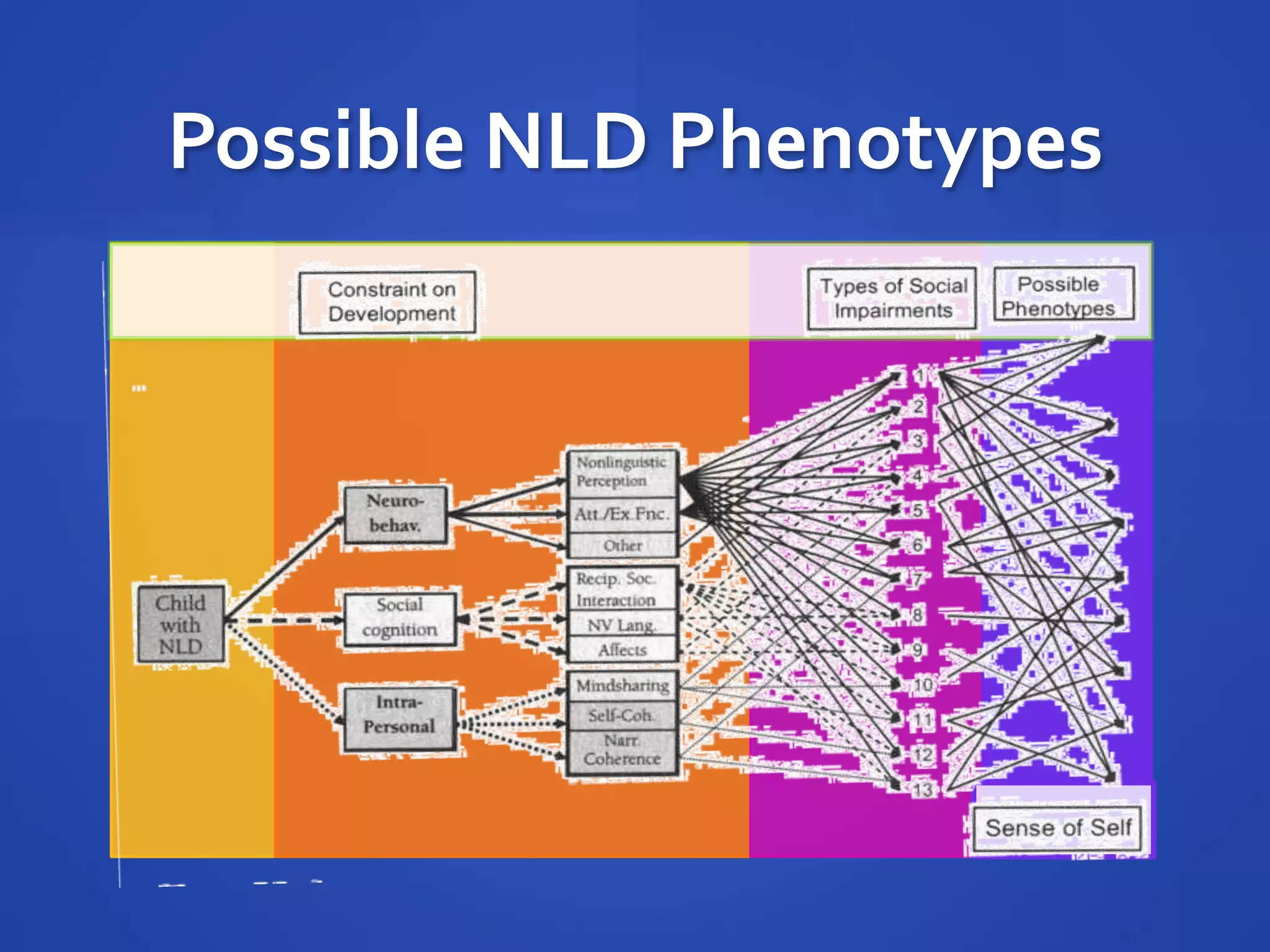
Possible NLD Phenotypes
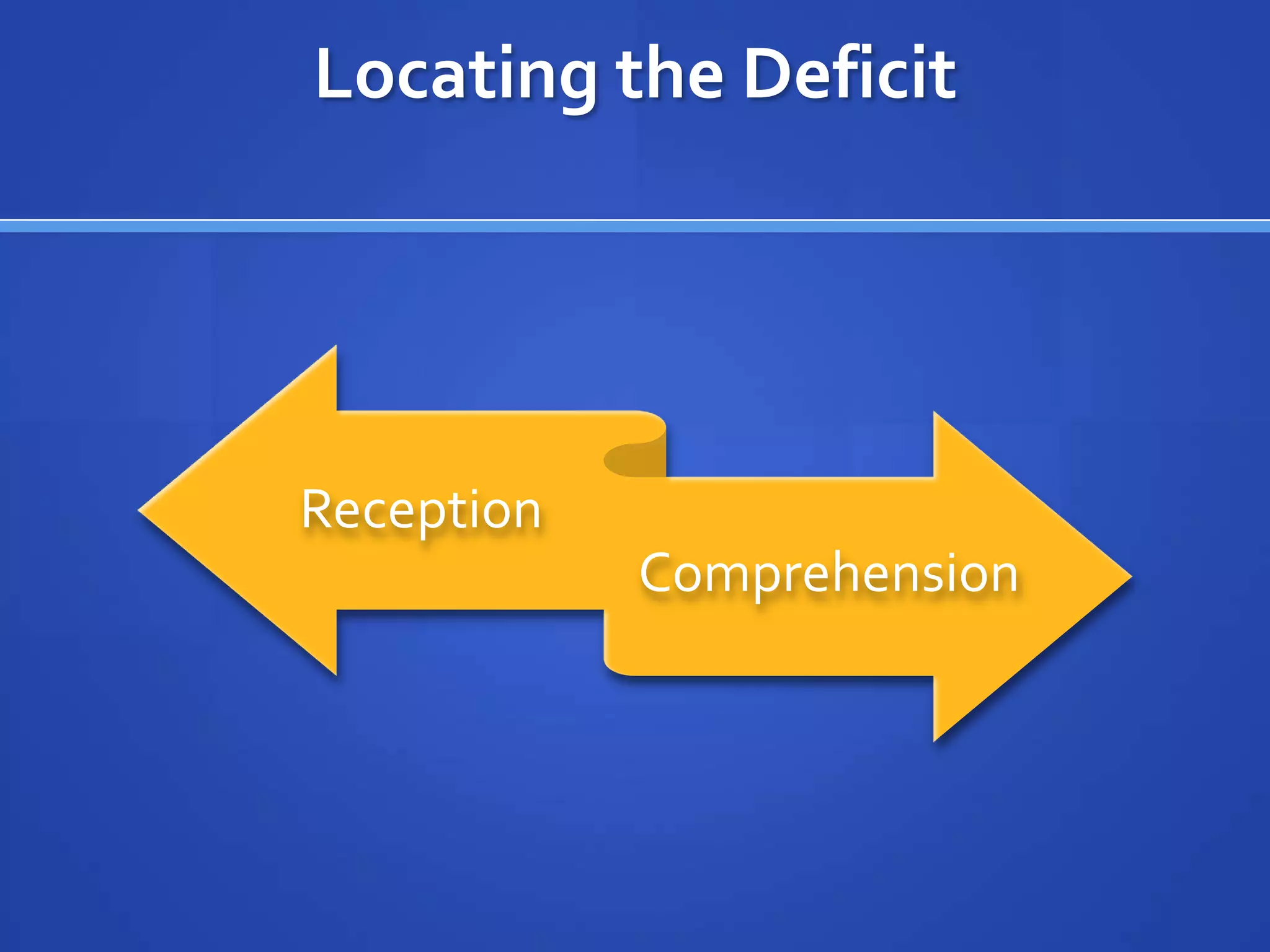
Locating the Deficit
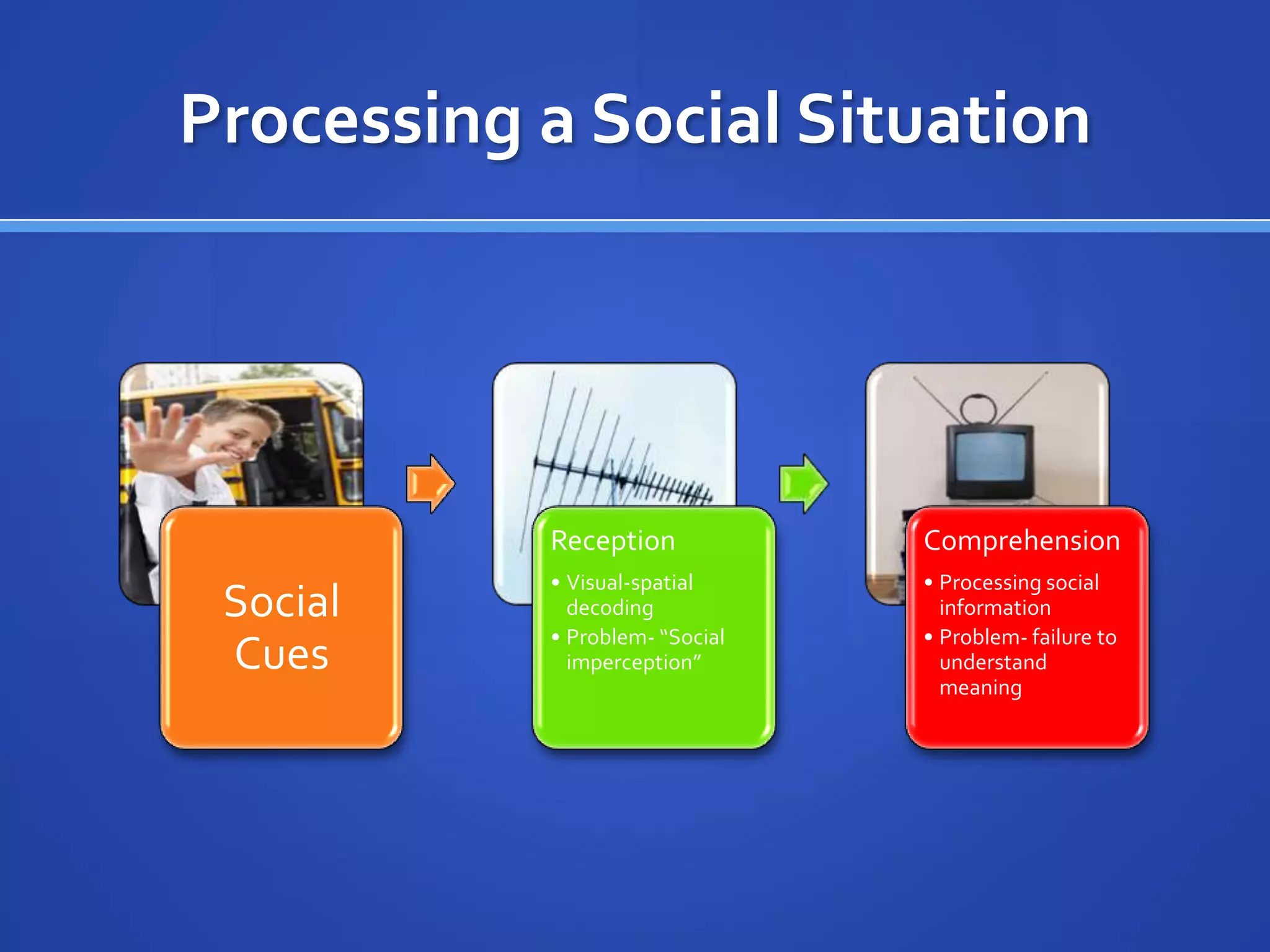
Processing a Social Situation
The Neurological PerspectiveHistory and Models
Early StudiesGenerally pursued a hypothesis of right hemisphere dysfunctionFocused on brain-damaged individuals who displayed symptoms similar to NLDMajor validity questions:No uniformity among samplesNo precise way to identify type or location of brain lesion(Palombo, 2006)
Early StudiesApplied various labels to their cohorts:Disorders of social imperception(Johnson & Mykelbust, 1967)Left hemisyndrome(Denckla, 1978)Nonverbal learning disability (Rourke, 1989; Johnson, 1987)Social-emotional learning disability (Denckla, 1983; Voeller, 1986)Right parietal lobe syndrome/developmental learning disability of the right hemisphere(Weintraub & Mesulam, 1982)Right hemisphere deficit syndrome (Voeller, 1986)Right hemisphere deficit syndrome (Semrud-Clikeman & Hynd, 1990)(Palombo, 2006)
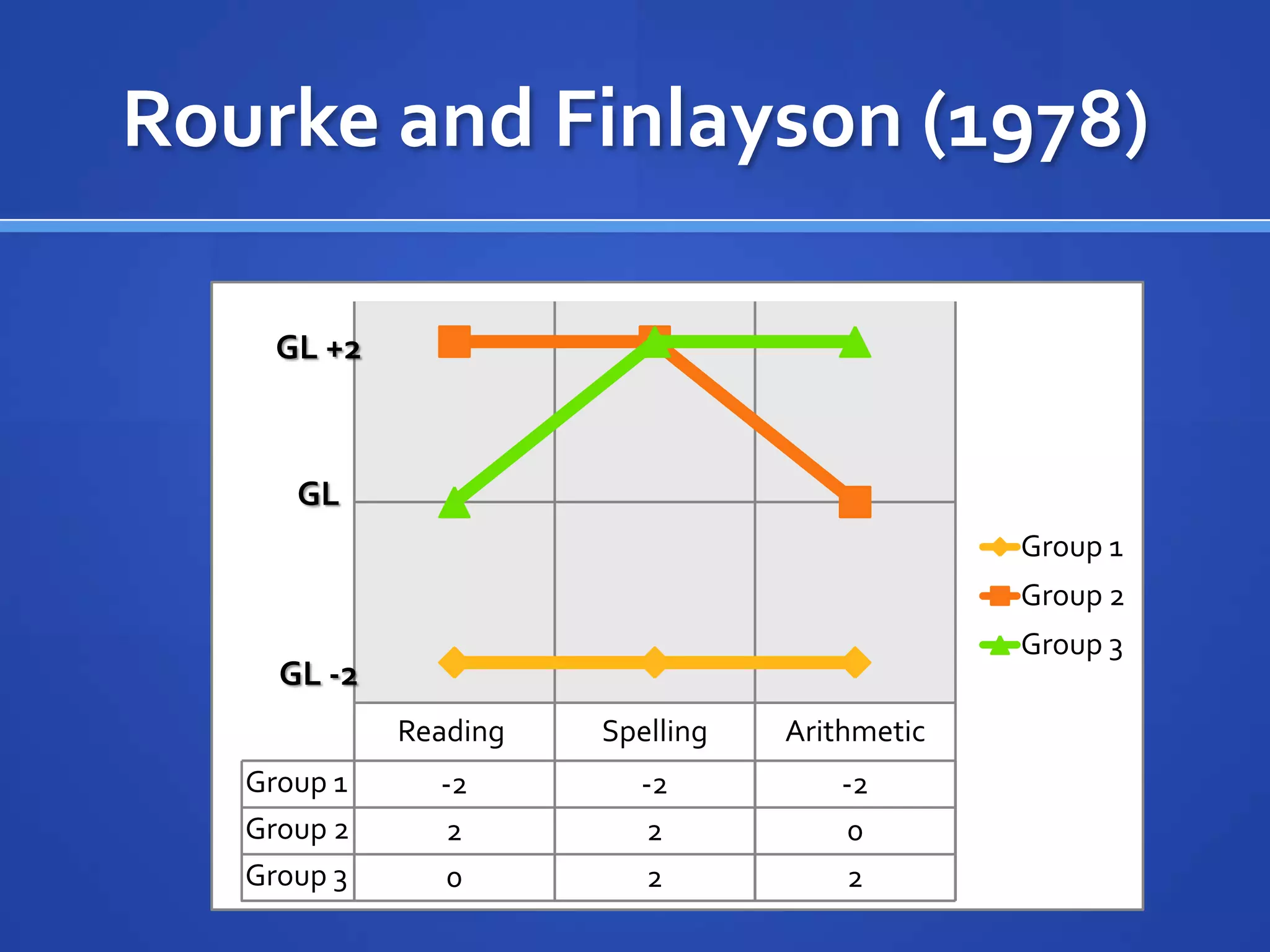
Rourke and Finlayson (1978)GL +2GLGL -2
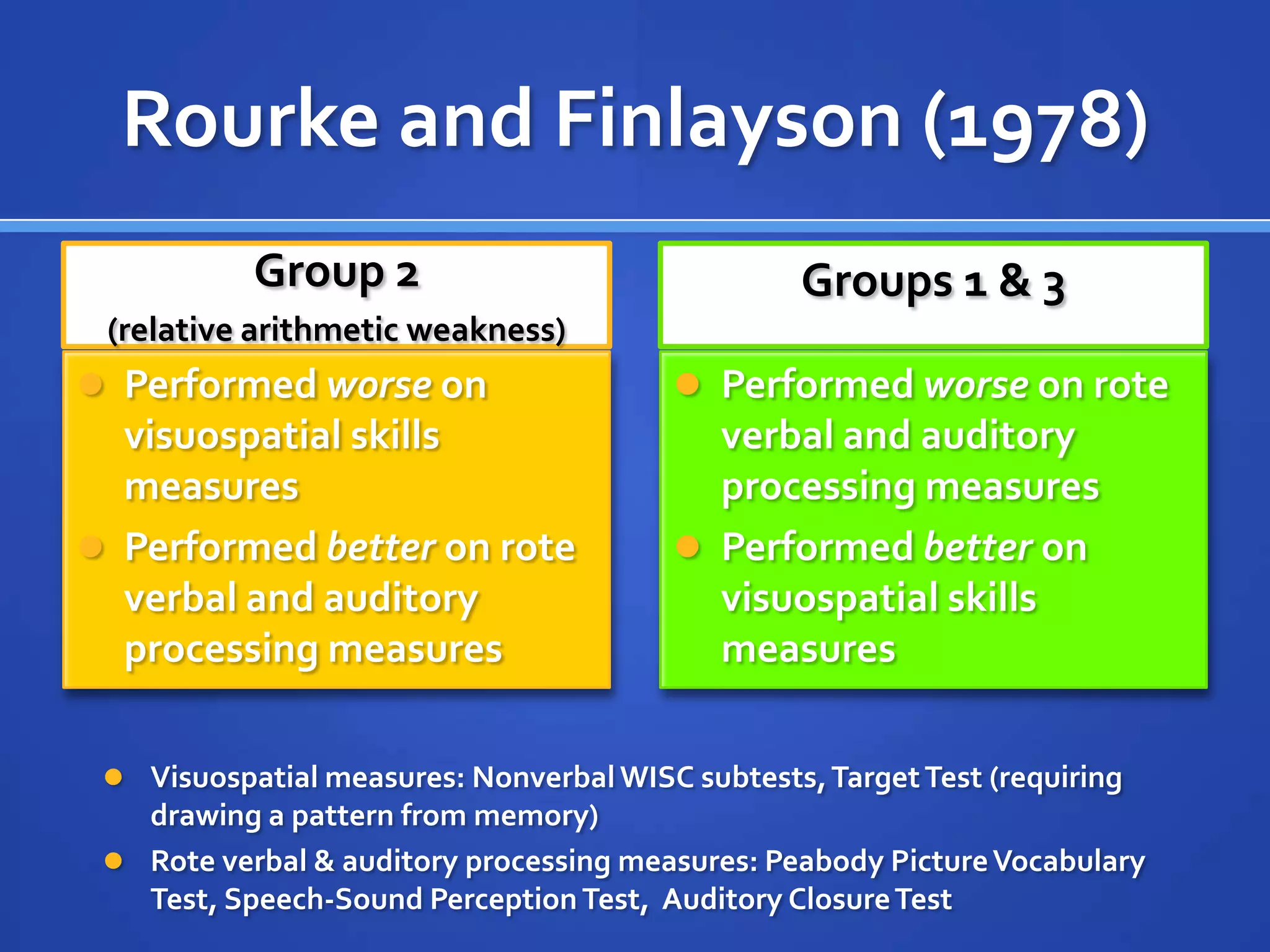
Rourke and Finlayson (1978)Group 2 (relative arithmetic weakness)Groups 1 & 3Performed worse on visuospatial skills measures Performed better on rote verbal and auditory processing measuresPerformed worse on rote verbal and auditory processing measuresPerformed better on visuospatial skills measures Visuospatial measures: Nonverbal WISC subtests, Target Test (requiring  drawing a pattern from memory)
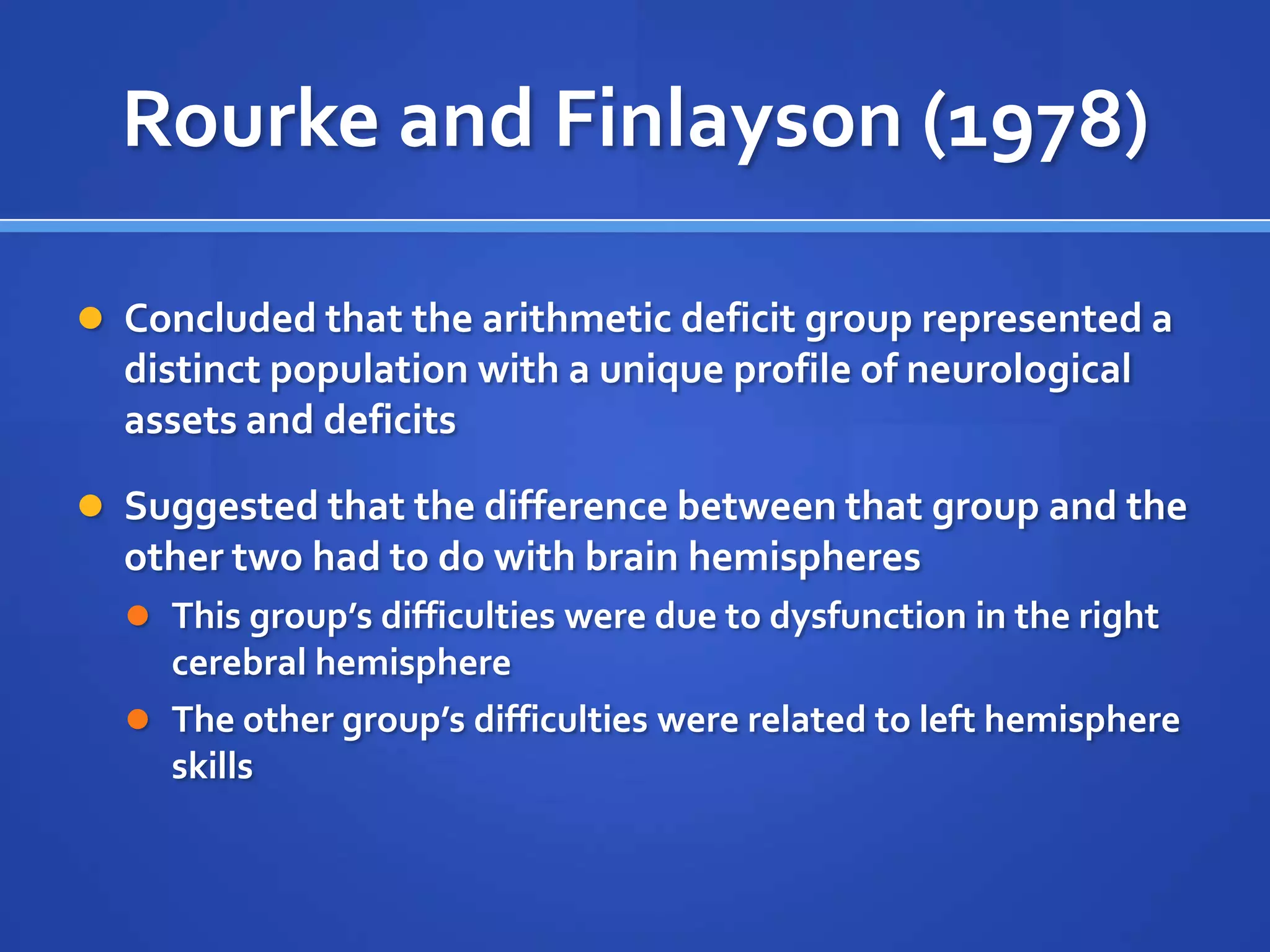
Rote verbal & auditory processing measures: Peabody Picture Vocabulary Test, Speech-Sound Perception Test,  Auditory Closure TestRourke and Finlayson (1978)Concluded that the arithmetic deficit group represented a distinct population with a unique profile of neurological assets and deficitsSuggested that the difference between that group and the other two had to do with brain hemispheresThis group’s difficulties were due to dysfunction in the right cerebral hemisphereThe other group’s difficulties were related to left hemisphere skills
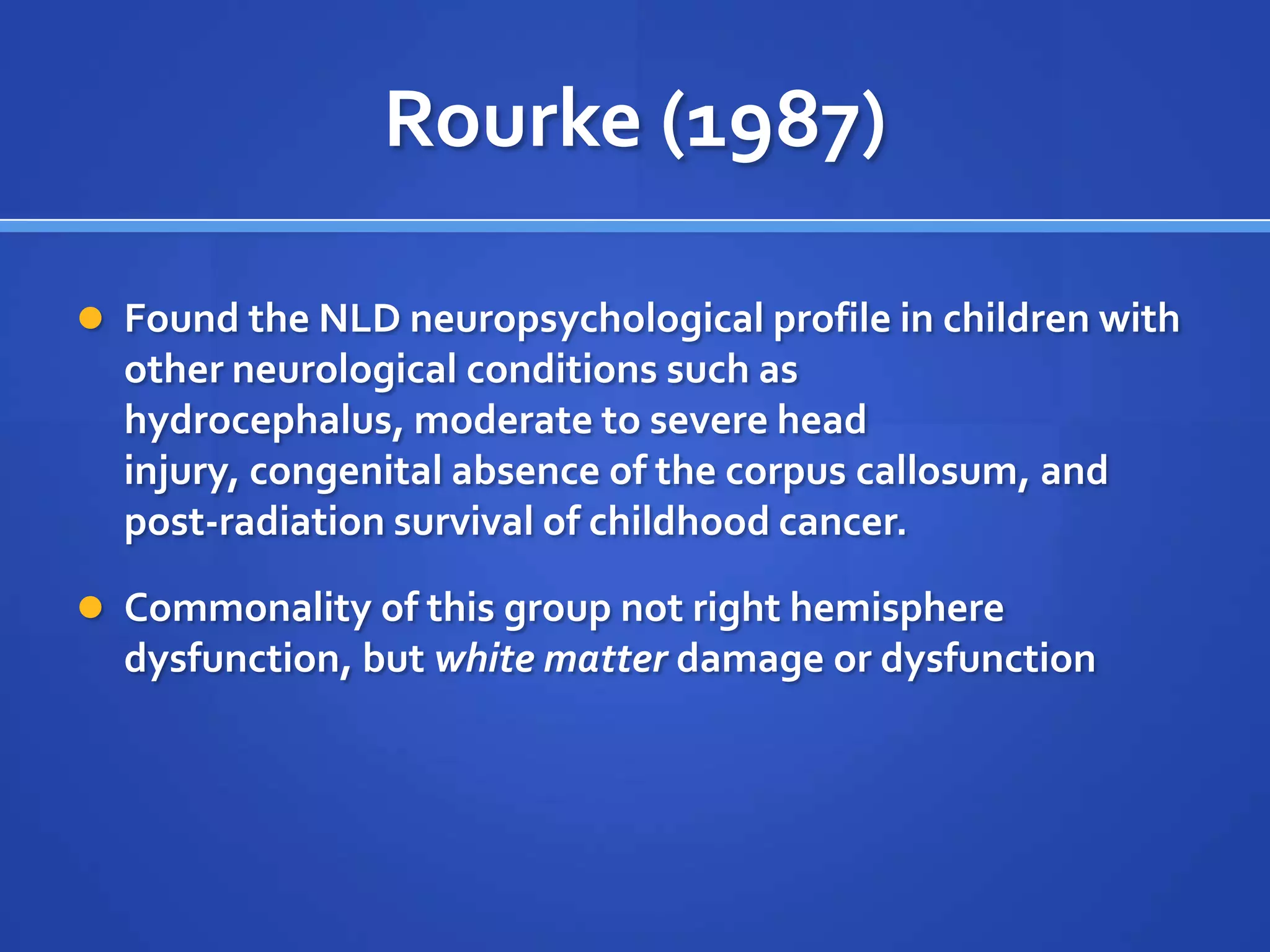
Rourke (1987)Found the NLD neuropsychological profile in children with other neurological conditions such as hydrocephalus, moderate to severe head injury, congenital absence of the corpus callosum, and post-radiation survival of childhood cancer.Commonality of this group not right hemisphere dysfunction, but white matter damage or dysfunction
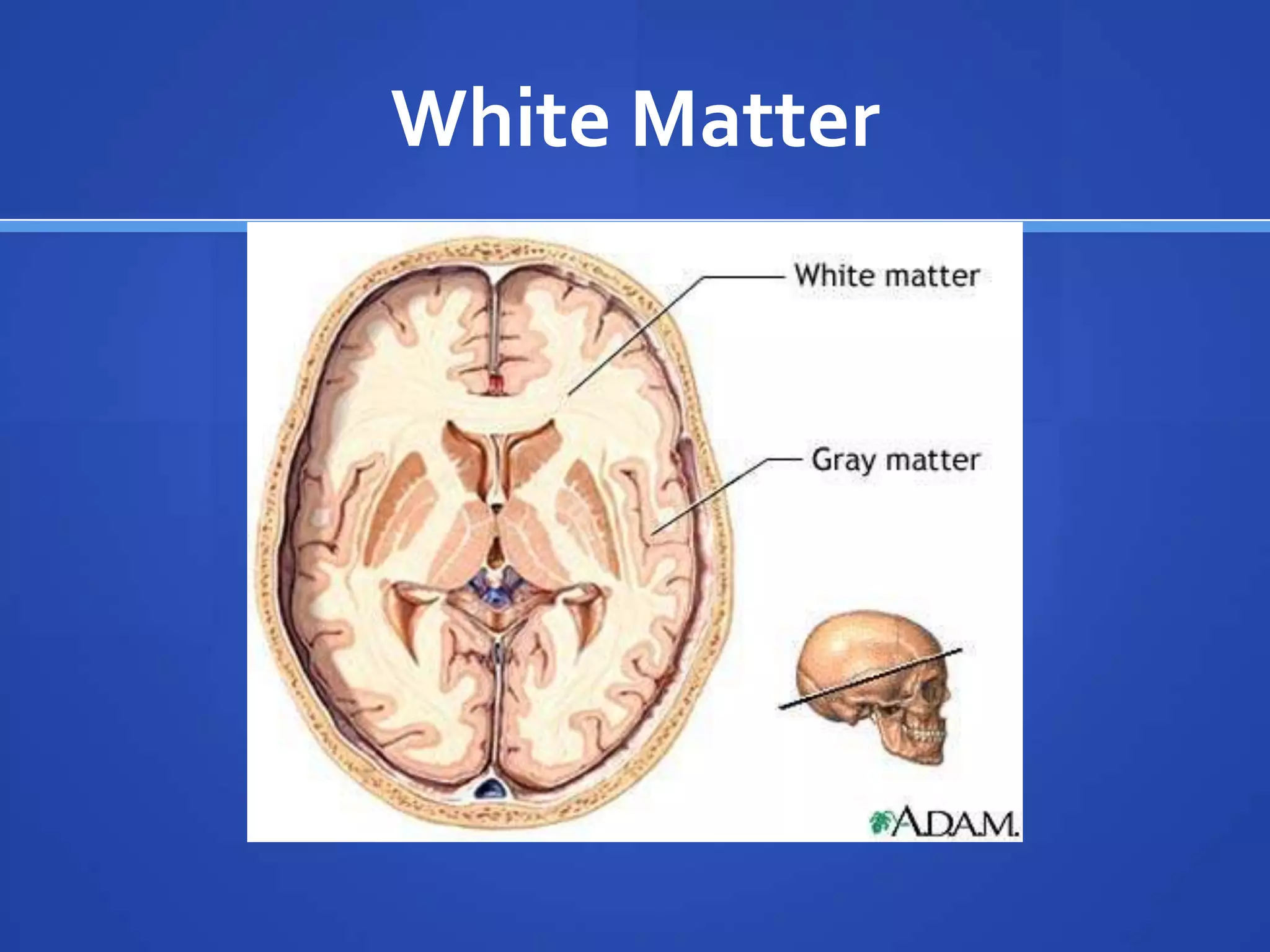
White Matter
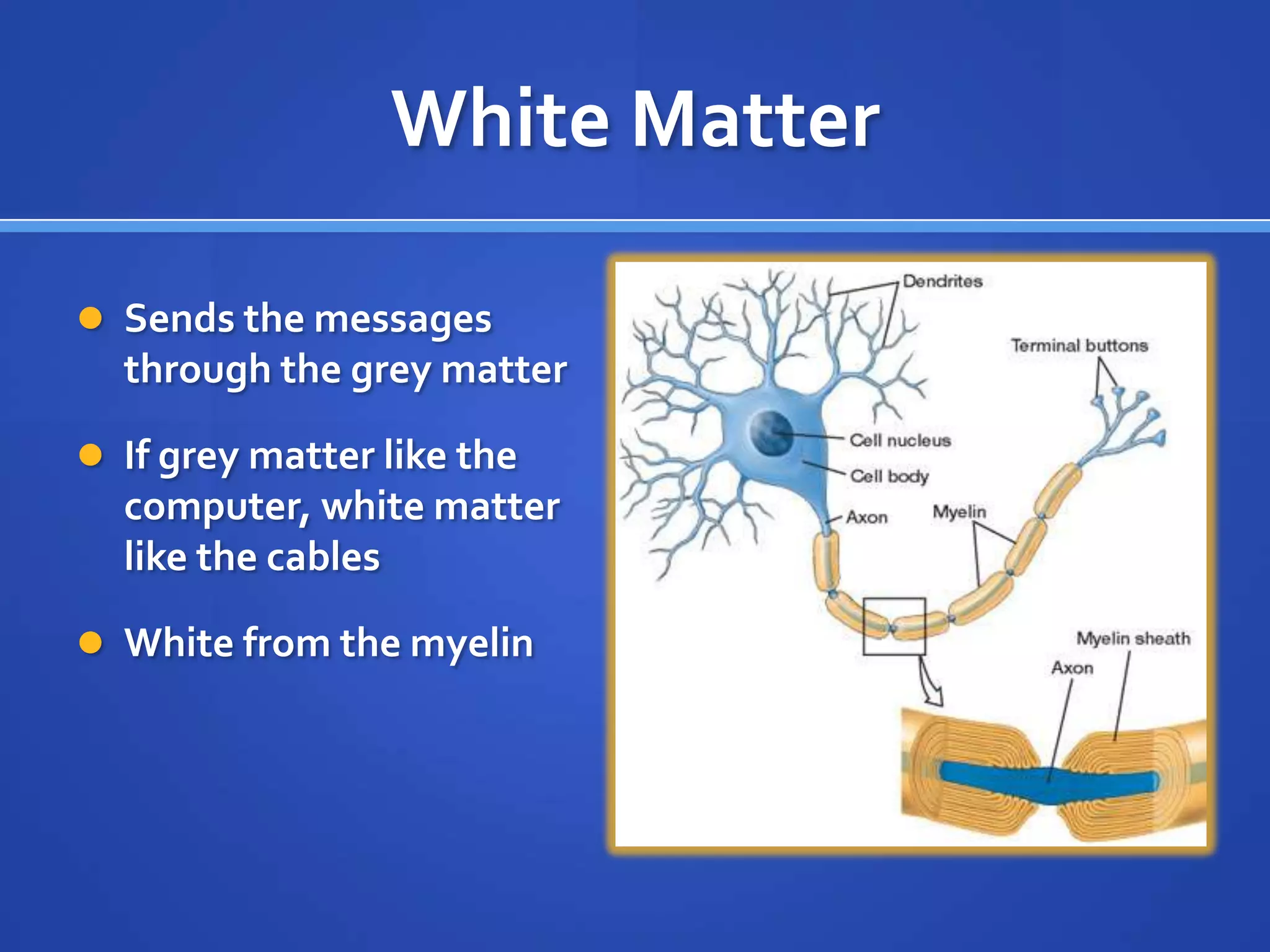
White MatterSends the messages through the grey matterIf grey matter like the computer, white matter like the cablesWhite from the myelin
Rourke’s White Matter ModelNLD occurs when there is a problem with: the white matter in the right hemisphereAdverse conditions in early childhood are more likely to affect right hemisphere processing abilities because:The right hemisphere contains a greater proportion of white matter to grey matter than does the left hemisphereThe right hemisphere is dominant in infancy(Rourke, 1987; Rourke et al., 2002)
Hemispheric Specialization“Localization”-Broca (in 1861) and Wernicke (in 1876) Hypothesized specific areas of the cerebrum that are responsible for specific functionsShaped the historical understanding of brain functioning(Palombo, 2006)
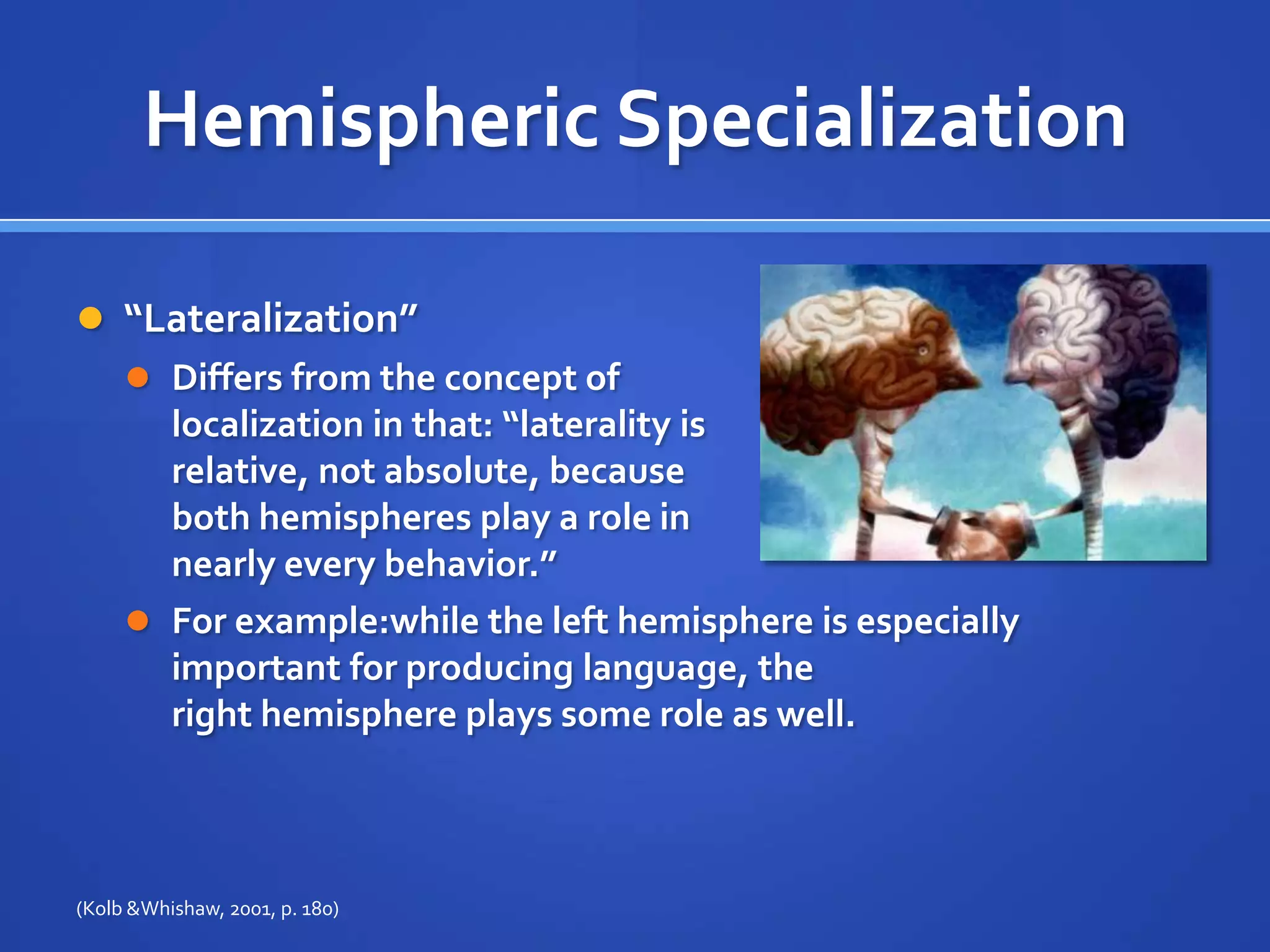
Hemispheric Specialization“Lateralization”Differs from the concept of localization in that: “laterality is relative, not absolute, because both hemispheres play a role in nearly every behavior.”For example:while the left hemisphere is especially important for producing language, the right hemisphere plays some role as well.(Kolb & Whishaw, 2001, p. 180)
Hemispheric Specialization“Lateralization”This means that just because many NLD symptoms appear to be the products of right hemisphere dysfunctions, that does not necessarily mean that the left hemisphere and subcortical regions do not also contribute to those problems(Palombo, 2006)
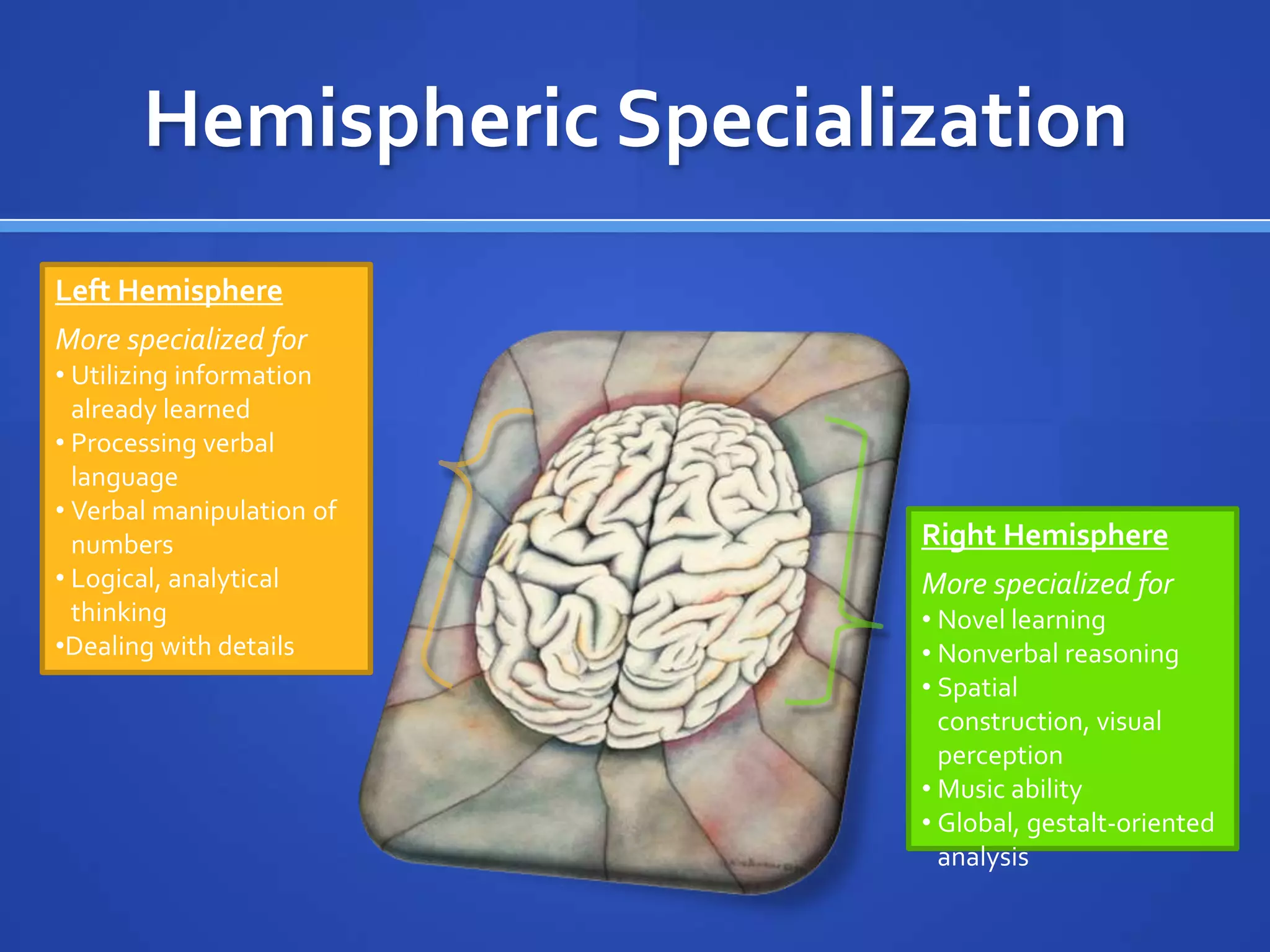
Hemispheric SpecializationLeft HemisphereMore specialized forUtilizing information already learned
Processing verbal language
Verbal manipulation of numbers
Logical, analytical thinking
Dealing with detailsRight HemisphereMore specialized forNovel learning
Nonverbal reasoning
Spatial construction, visual perception
Music ability
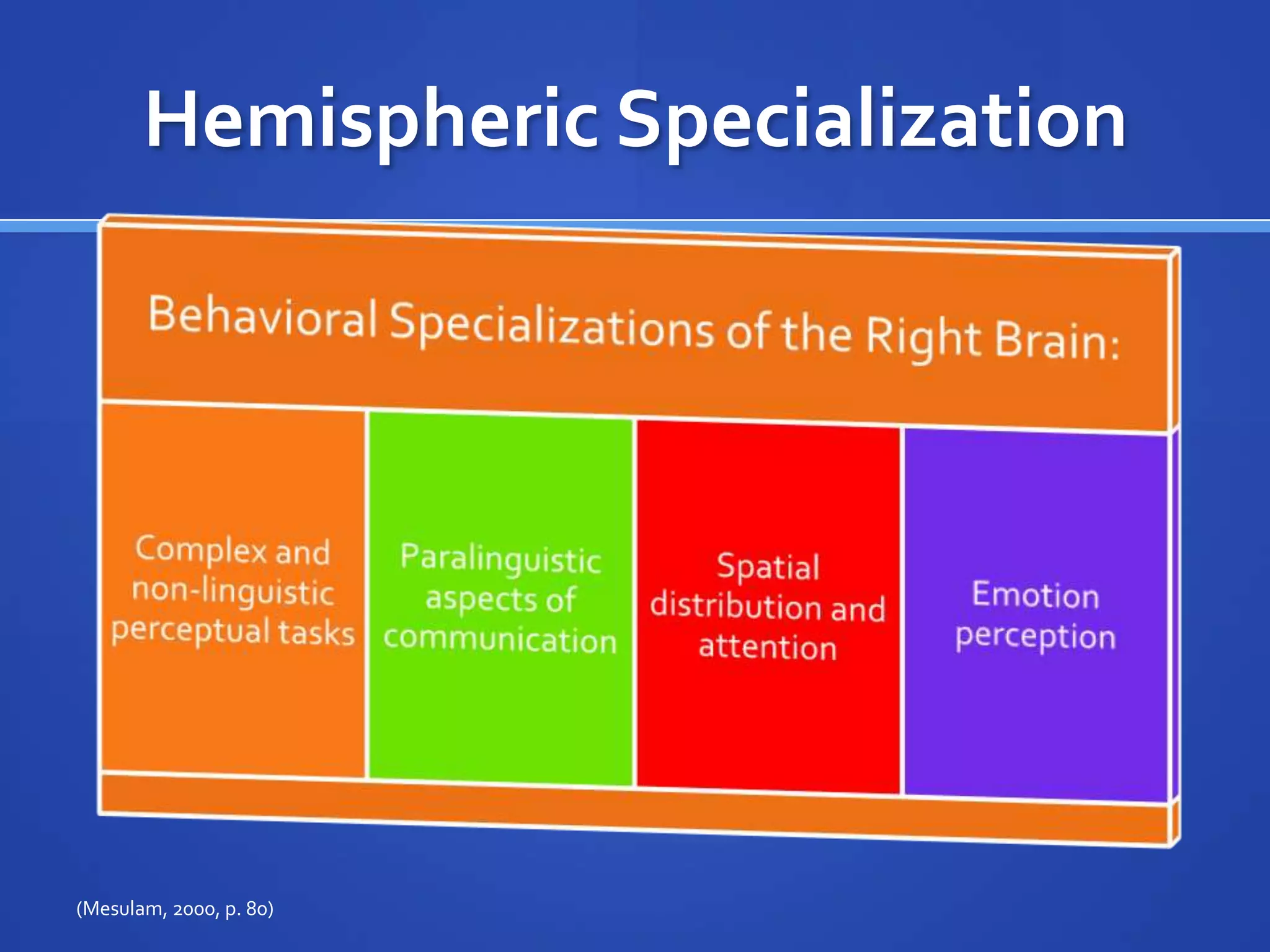
Global, gestalt-oriented analysisHemispheric Specialization(Mesulam, 2000, p. 80)
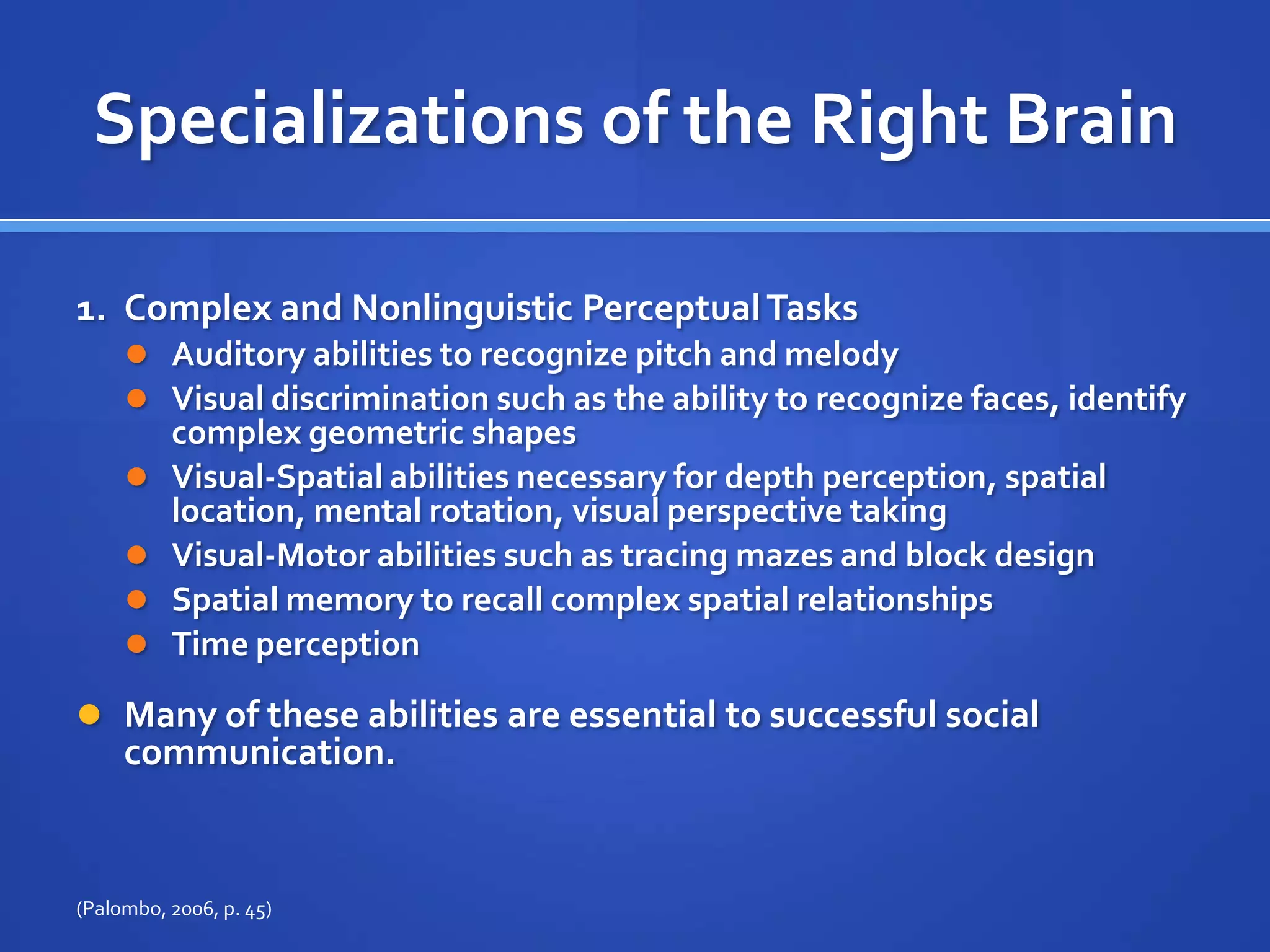
Specializations of the Right Brain1.	Complex and Nonlinguistic Perceptual TasksAuditory abilities to recognize pitch and melodyVisual discrimination such as the ability to recognize faces, identify complex geometric shapesVisual-Spatial abilities necessary for depth perception, spatial location, mental rotation, visual perspective takingVisual-Motor abilities such as tracing mazes and block designSpatial memory to recall complex spatial relationshipsTime perceptionMany of these abilities are essential to successful social communication.(Palombo, 2006, p. 45)
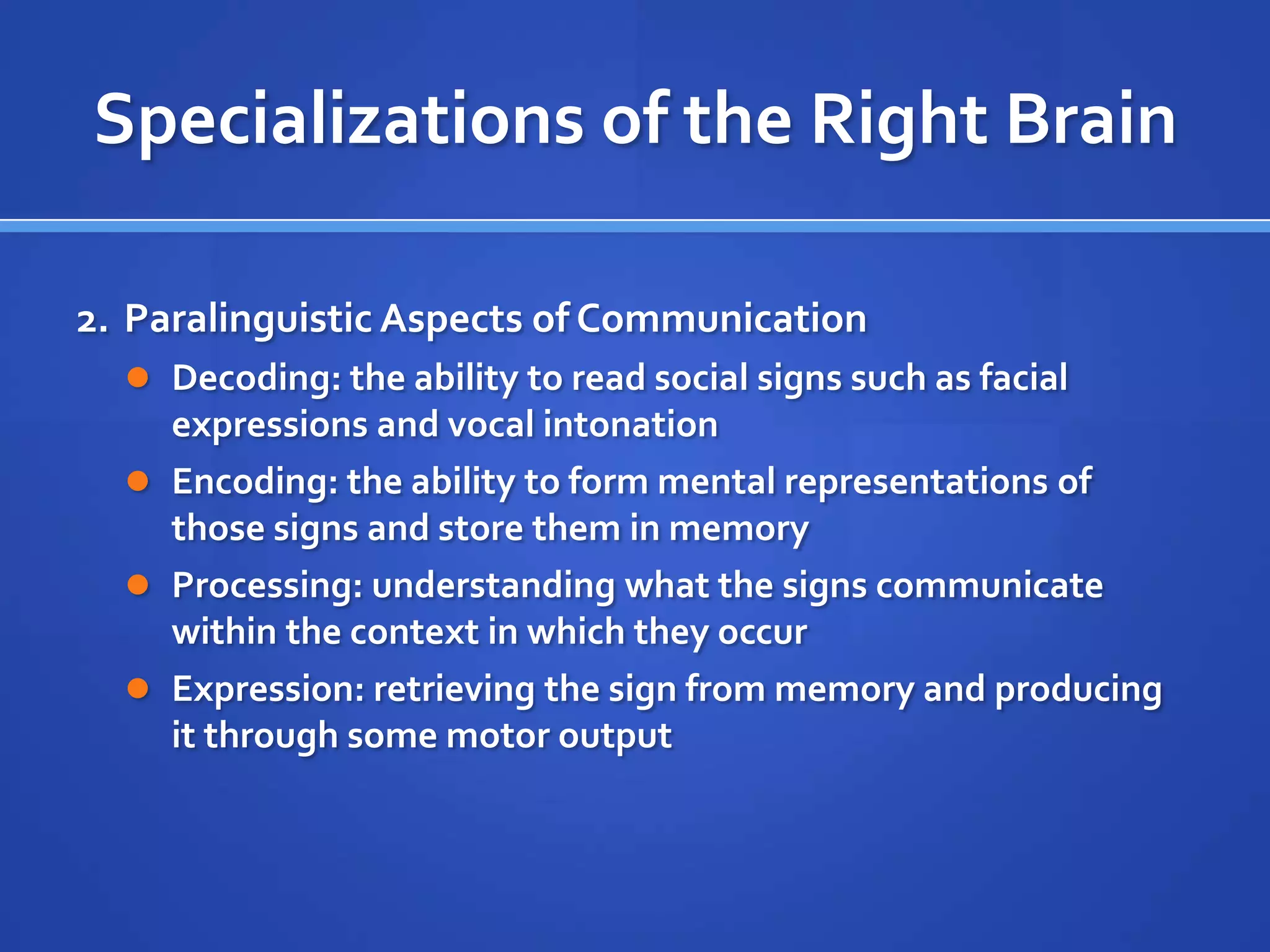
Specializations of the Right Brain2.	Paralinguistic Aspects of CommunicationDecoding: the ability to read social signs such as facial expressions and vocal intonationEncoding: the ability to form mental representations of those signs and store them in memoryProcessing: understanding what the signs communicate within the context in which they occurExpression: retrieving the sign from memory and producing it through some motor output
Specializations of the Right Brain3.	Spatial Distribution of AttentionVery little research exists with regard to how this function relates to the problems displayed by children with NLD.
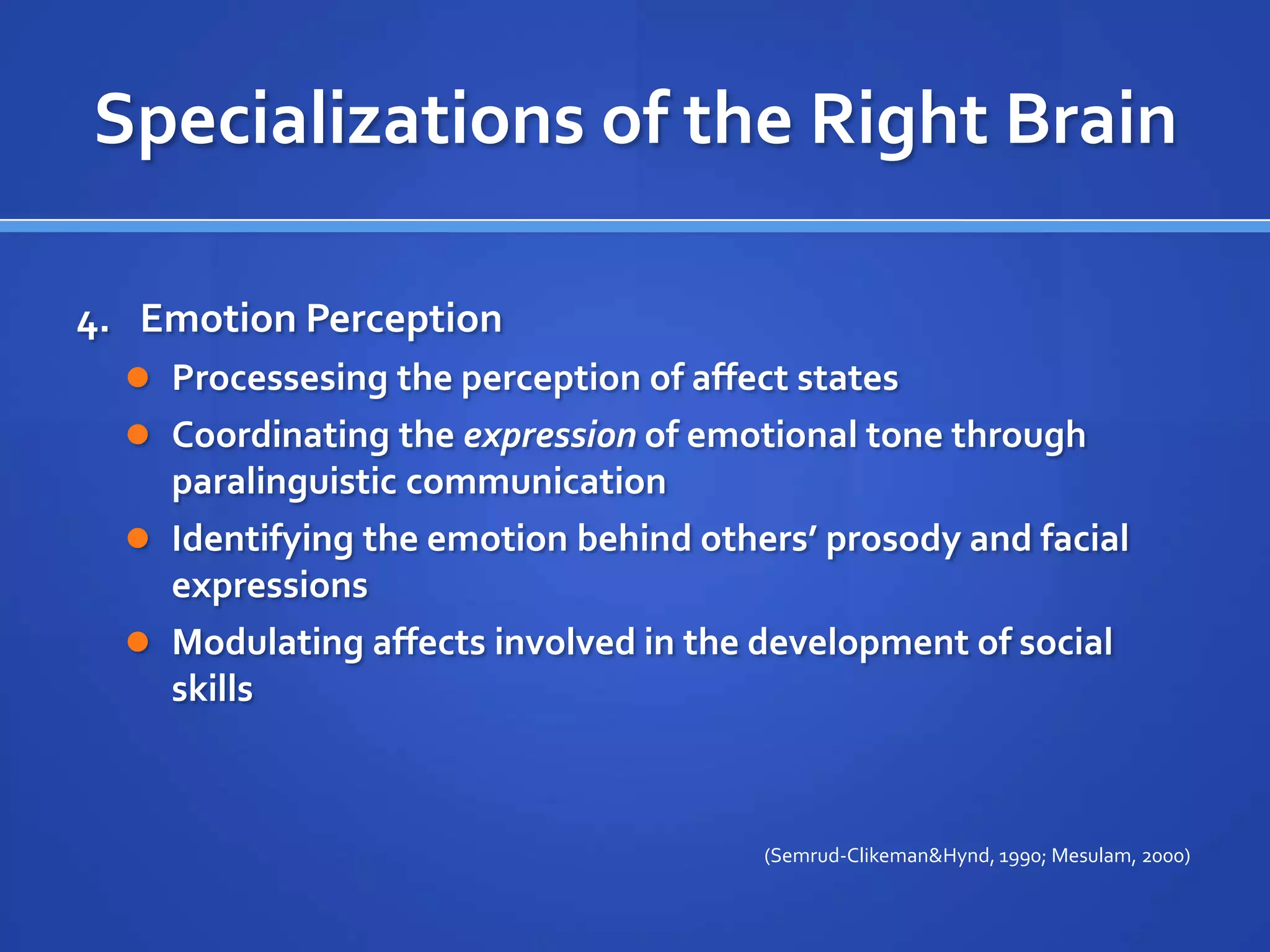
Specializations of the Right Brain4.	Emotion PerceptionProcessesing the perception of affect statesCoordinating the expression of emotional tone through paralinguistic communicationIdentifying the emotion behind others’ prosody and facial expressionsModulating affects involved in the development of social skills(Semrud-Clikeman & Hynd, 1990; Mesulam, 2000)
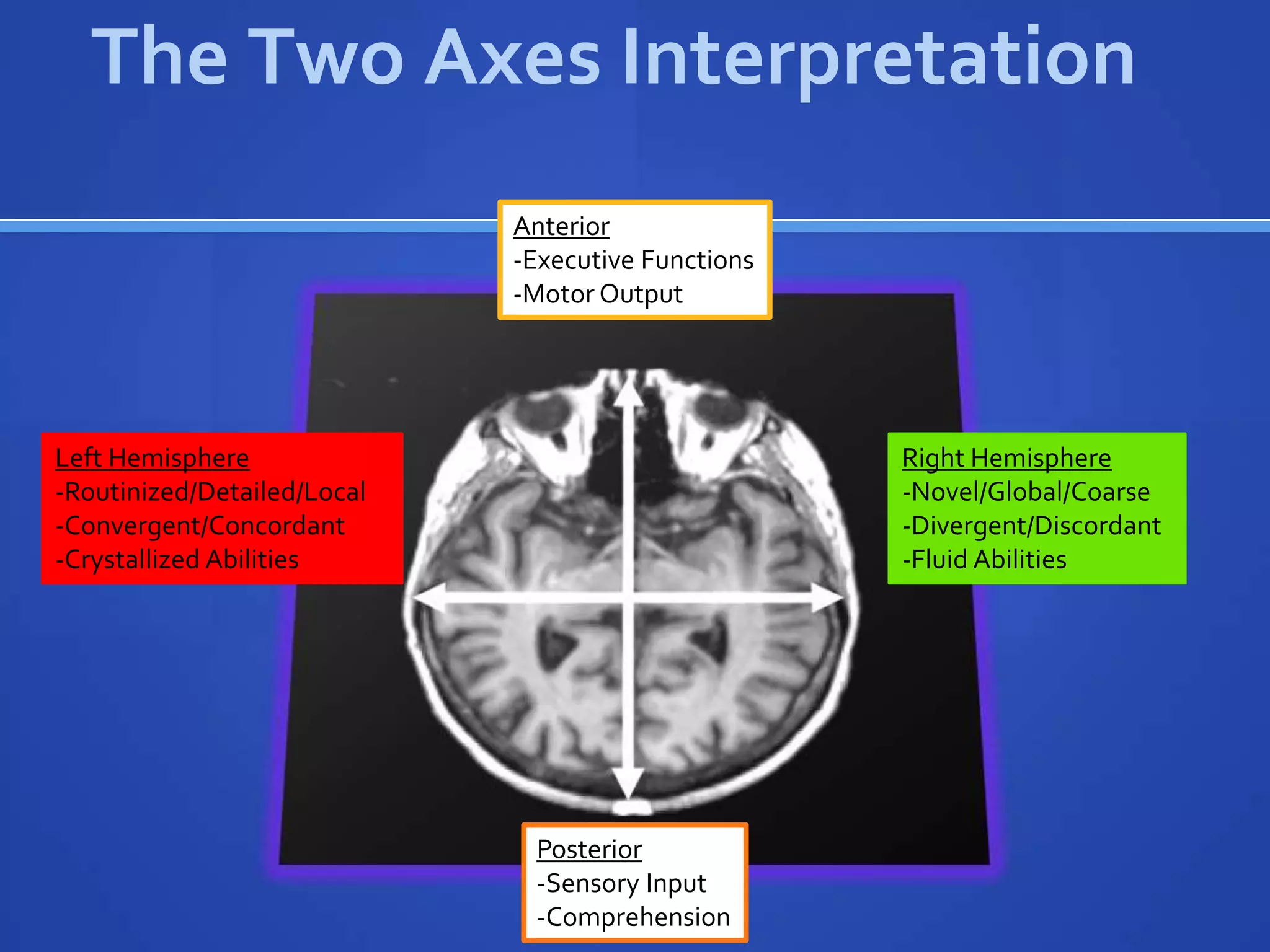
The Two Axes InterpretationAnterior-Executive Functions-Motor OutputRight Hemisphere-Novel/Global/Coarse-Divergent/Discordant-Fluid AbilitiesLeft Hemisphere-Routinized/Detailed/Local-Convergent/Concordant-Crystallized AbilitiesPosterior-Sensory Input-Comprehension
Developmental ProfileNLD Through the Lifespan(from Thompson, 1997)
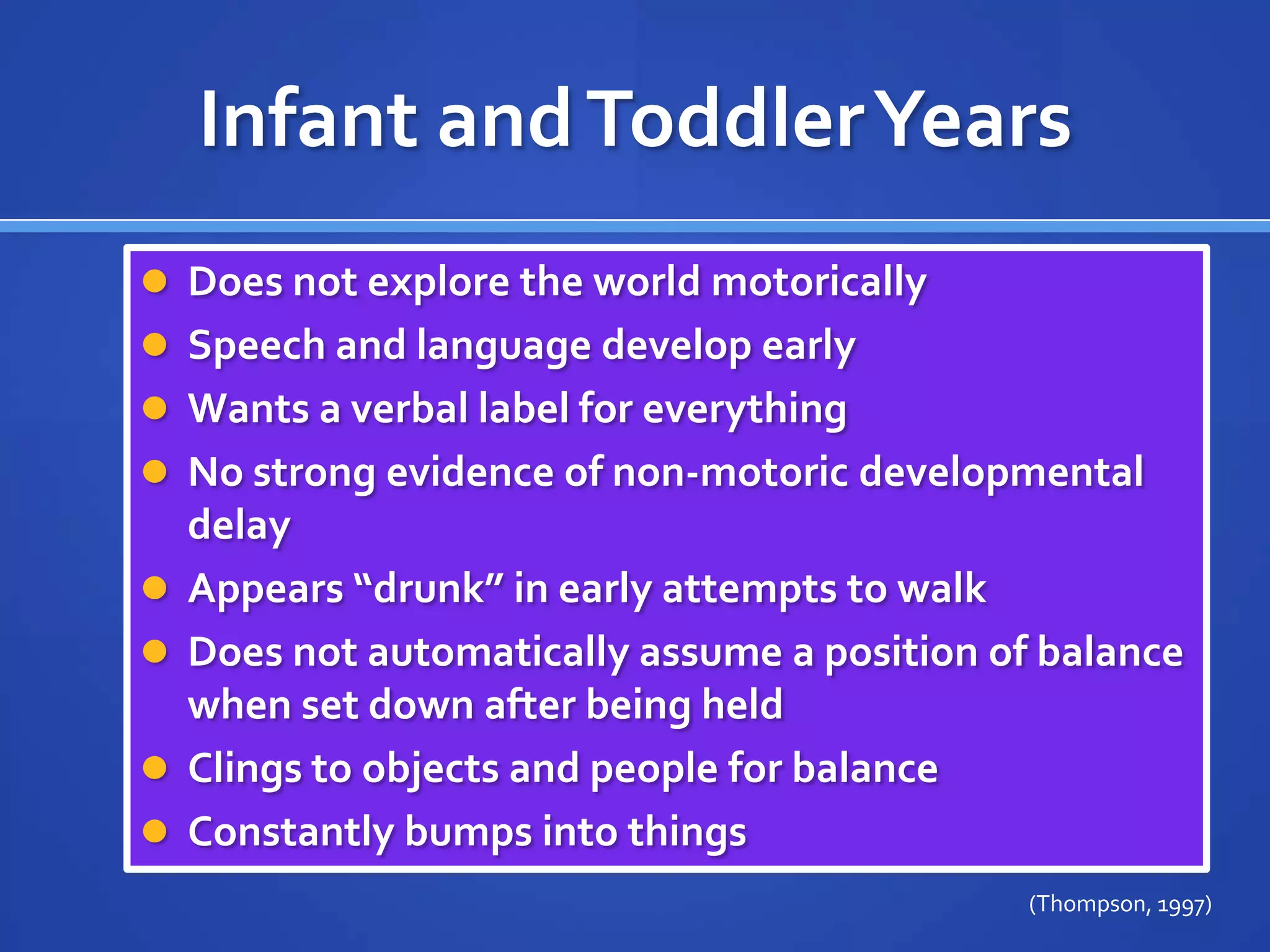
Infant and Toddler YearsDoes not explore the world motoricallySpeech and language develop earlyWants a verbal label for everythingNo strong evidence of non-motoric developmental delayAppears “drunk” in early attempts to walkDoes not automatically assume a position of balance when set down after being heldClings to objects and people for balanceConstantly bumps into things(Thompson, 1997)
Preschool YearsExceptional rote verbatim memory skillsExtremely verbose, perhaps talking “like an adult”Early reading skills, strong letter and number recognition and spelling skillsUnderstands statements and readings very literally, views things as black and whitePoor gross motor development and motor planning skills(Thompson, 1997)
Middle School Years (11-14) is often excluded, teased, and persecuted at school is misunderstood by both teachers and peers has difficulty meeting age-appropriate behavioral expectations; these difficulties may be misattributed to "emotional" issues has problems with work and study habits; these problems may be misattributed to "motivational" issueshas visual-spatial-organizational difficulties, difficulty using a locker, can't find his way around campus, is often lost or tardy
High School Years (15-18) by high school, peer tolerance usually increases; one or two close friendships may develop (or continue)If an Individualized Education Program has been put into place to accommodate the student, academic achievement, which typically drops in middle school, makes an encouraging comeback; if no IEP, this student is at risk for dropping out of school still thinks in concrete and literal terms is slow to date and interact with the opposite sex
High School Yearsearly job experience performance problems are commonhas difficulty learning to drive, can't coordinate the use of a manual shift is socially immature; may be seen as a "nerd" or "weird" by classmates has low self-esteem; is prone to depression, withdrawal, anxiety, and suicide
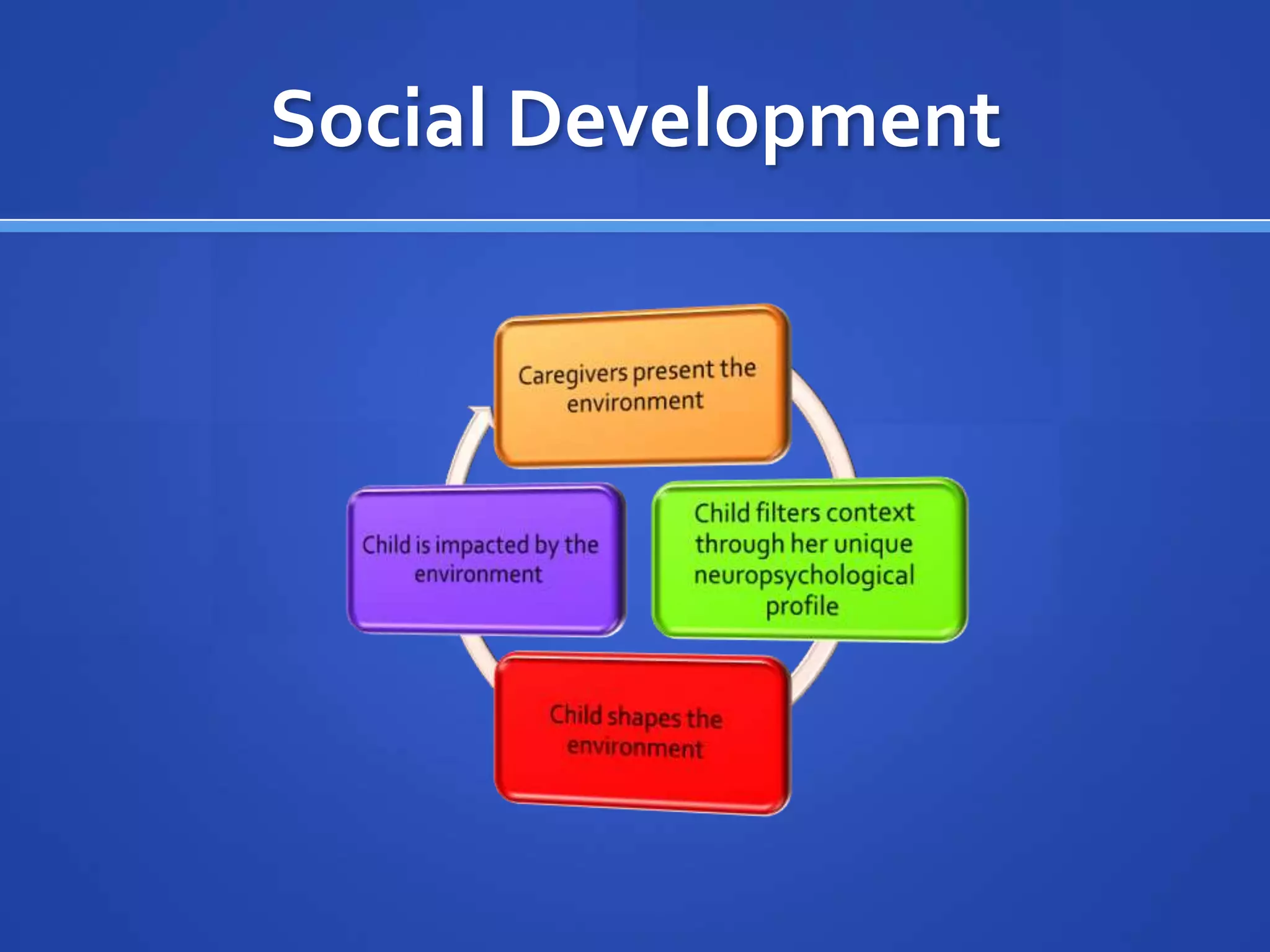
Social Development
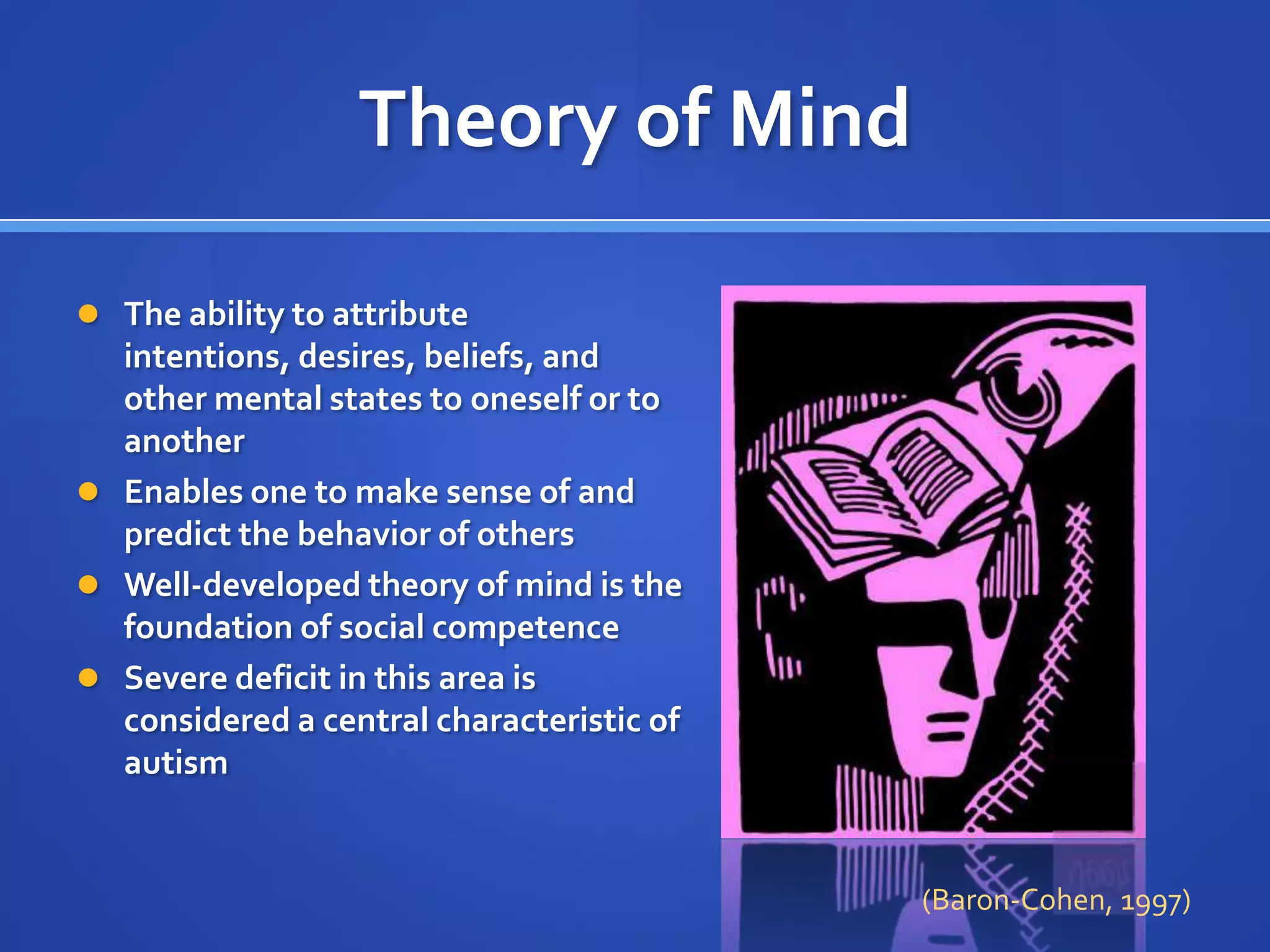
Theory of MindThe ability to attribute intentions, desires, beliefs, and other mental states to oneself or to another Enables one to make sense of and predict the behavior of othersWell-developed theory of mind is the foundation of social competenceSevere deficit in this area is considered a central characteristic of autism(Baron-Cohen, 1997)
Theory of MindWhat about children with NLD?
Theory of MindFalse-Belief TestChild No studies of False-Belief Test performance for kids with NLD
Theory of MindChildren with NLD:Have difficulty with reciprocal exchangesAre socially immatureAre argumentative & socially disruptiveHave difficulty maintaining friendshipsAre often rejected by their peers
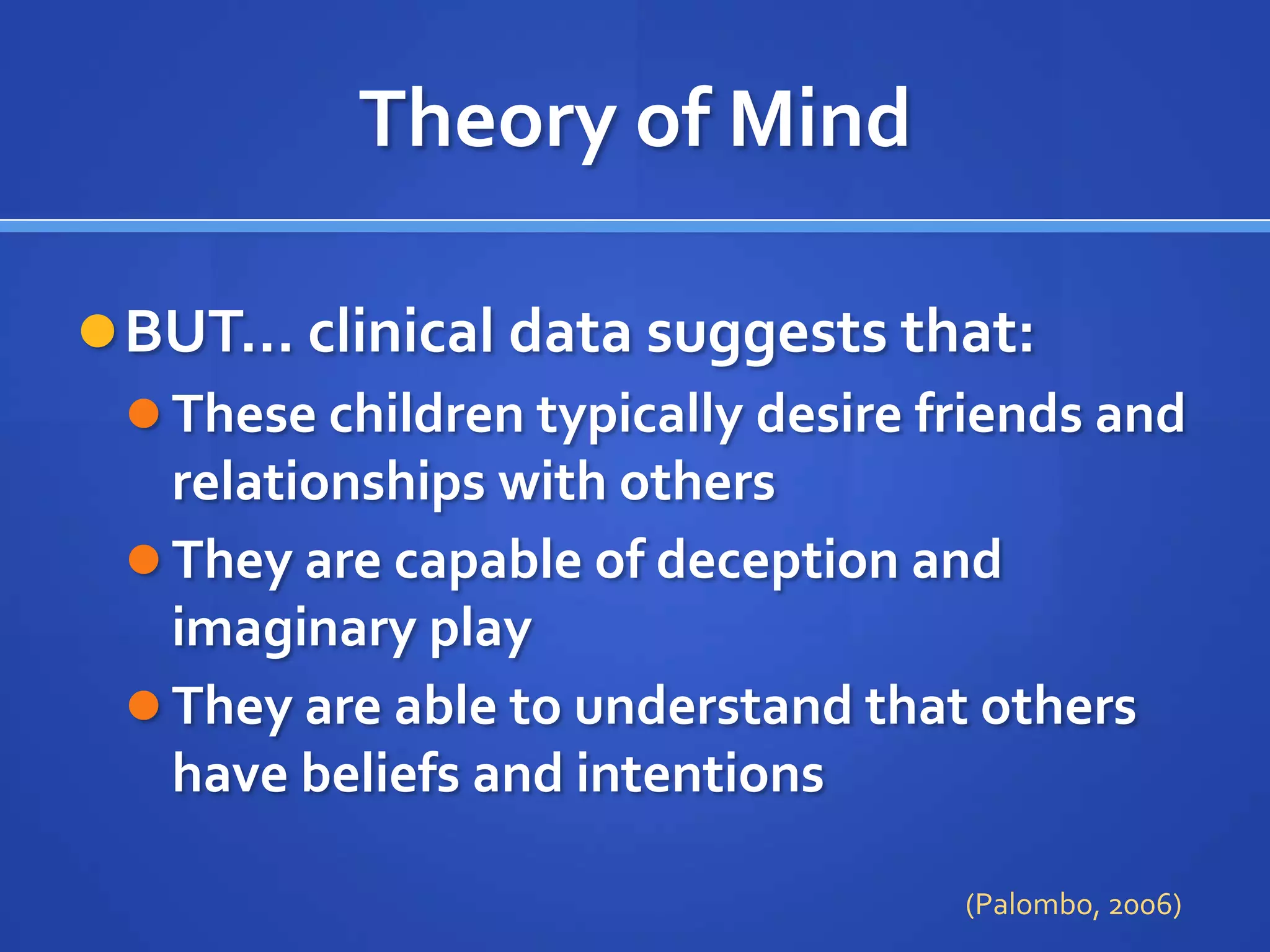
Theory of MindBUT… clinical data suggests that:These children typically desire friends and relationships with othersThey are capable of deception and imaginary playThey are able to understand that others have beliefs and intentions(Palombo, 2006)
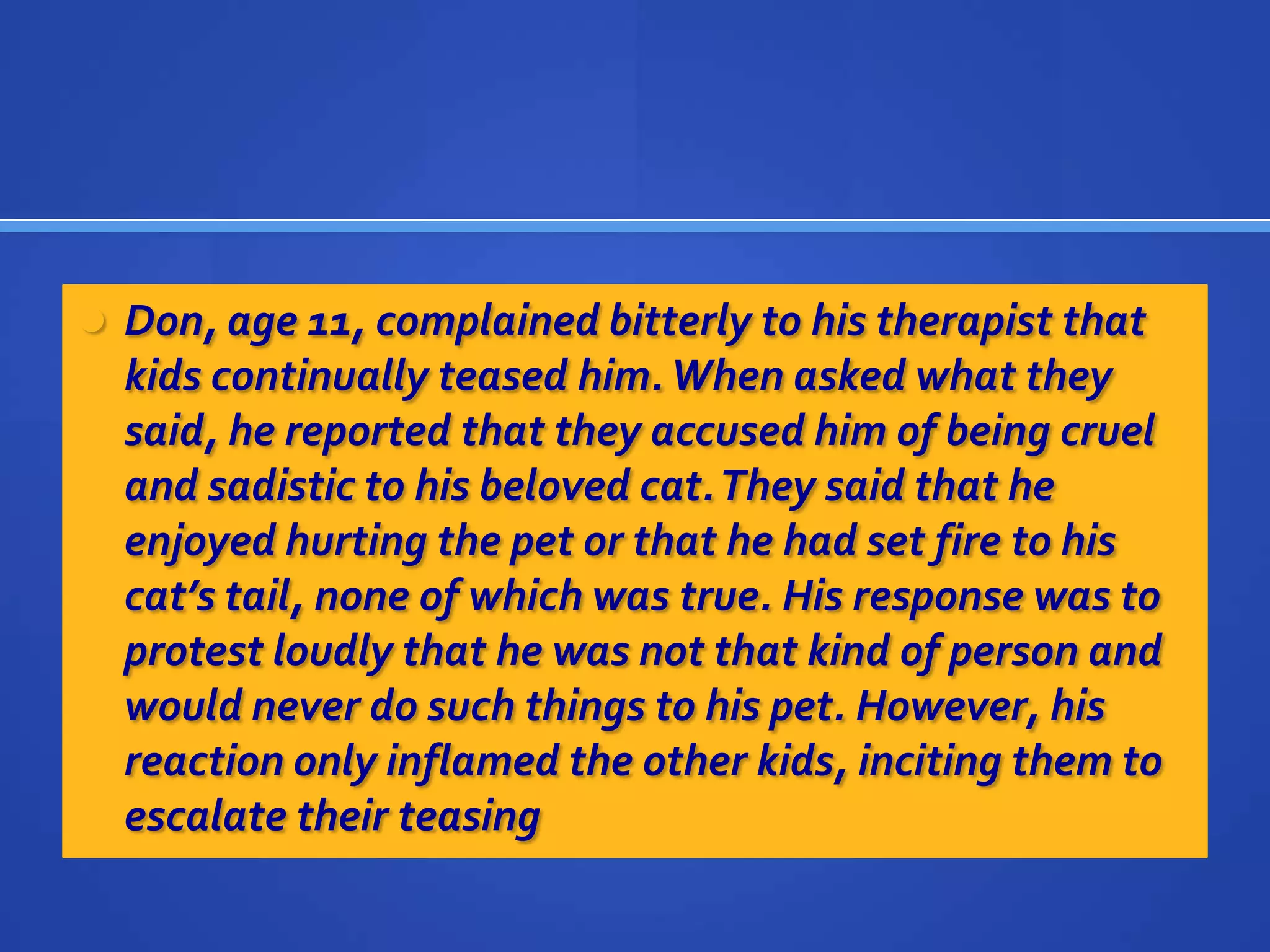
Don, age 11, complained bitterly to his therapist that kids continually teased him. When asked what they said, he reported that they accused him of being cruel and sadistic to his beloved cat. They said that he enjoyed hurting the pet or that he had set fire to his cat’s tail, none of which was true. His response was to protest loudly that he was not that kind of person and would never do such things to his pet. However, his reaction only inflamed the other kids, inciting them to escalate their teasing
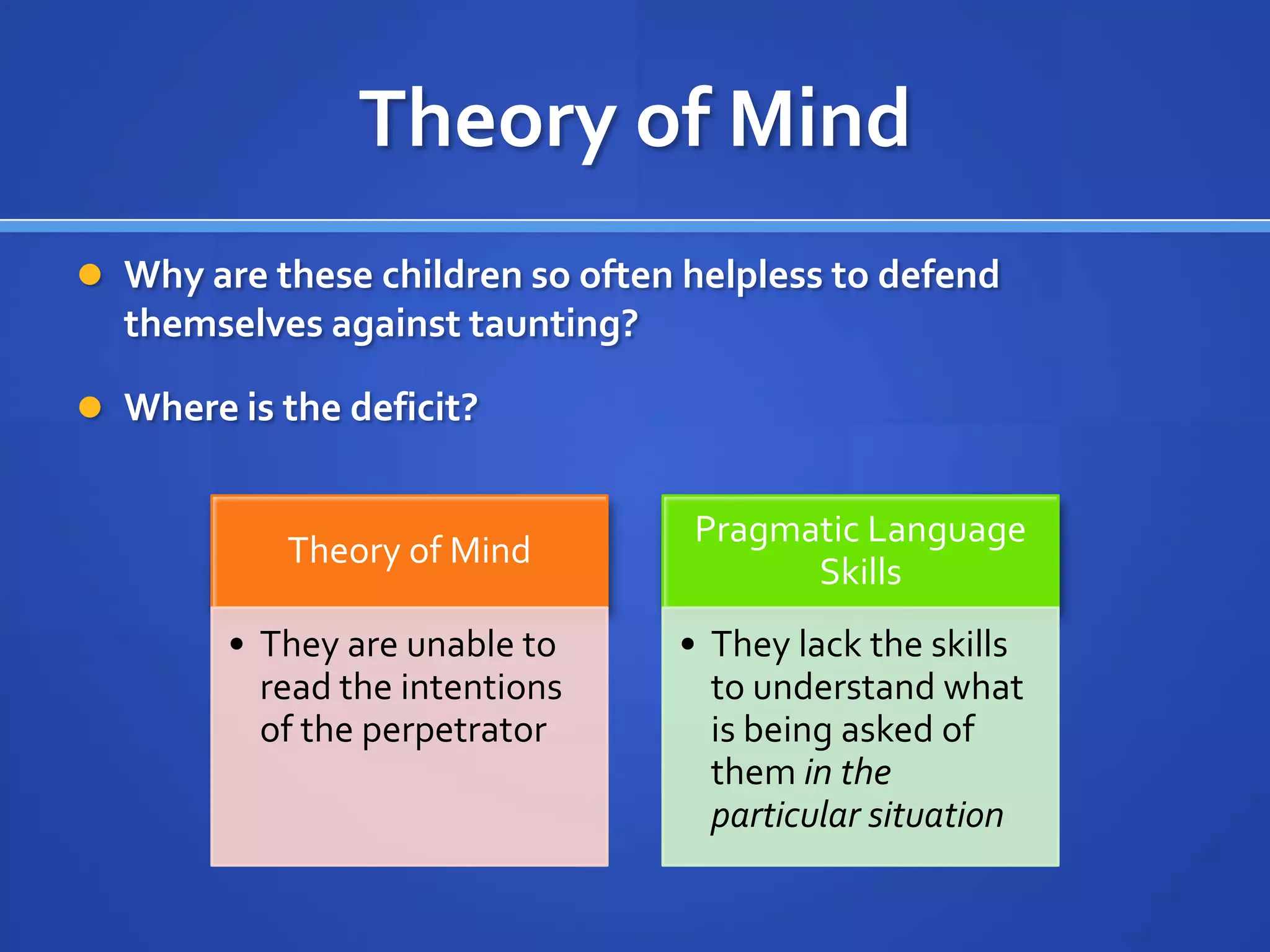
Theory of MindWhy are these children so often helpless to defend themselves against taunting? Where is the deficit?
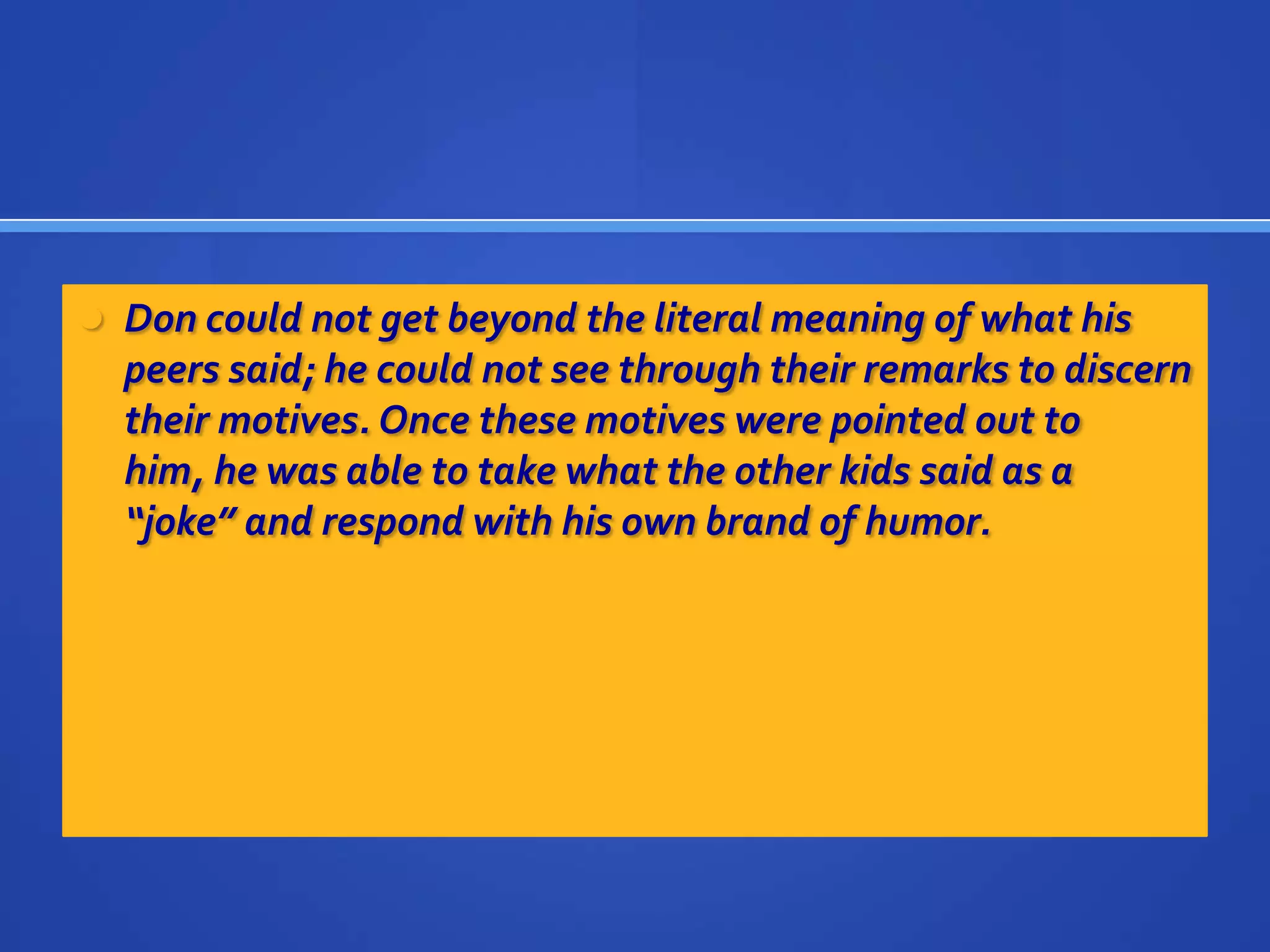
Don could not get beyond the literal meaning of what his peers said; he could not see through their remarks to discern their motives. Once these motives were pointed out to him, he was able to take what the other kids said as a “joke” and respond with his own brand of humor.
Differential DiagnosisIs NLD Really Different from Asperger’s?
NLD vs. ASNLD and AS are very similar in behaviors, NP profiles, and comorbid conditions“The process of differentiating the characteristics of AS, and NLD, and a pragmatic language disorder arguably may be the most challenging diagnostic task in developmental –behavioral pediatrics.” (Stein, 2008)Lack of agreement on core definitions of both disorders. (Palombo, 2006)
Rourke suggests that the two should not be dissociated (Rourke, et al., 2002)The two are not mutually exclusive (they belong to  different classification systems) and often co-uccur .(Klin, 2008)Children with AS have NLD, but many children with NLD don’t have AS (Palombo, 2006)AS has more stereotypic behaviors and restricted interests, greater impairment of sense of self, theory of mind
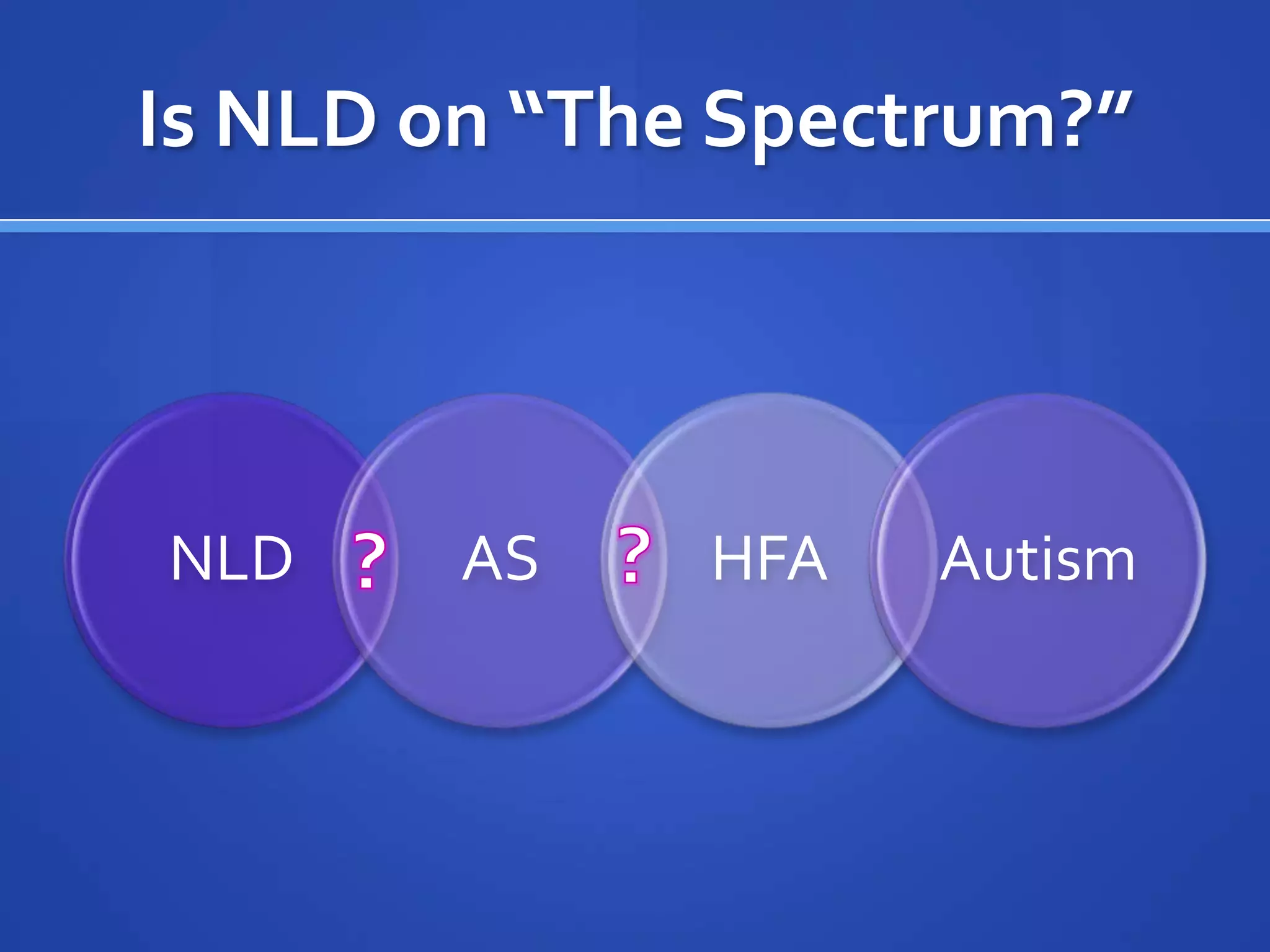
Is NLD on “The Spectrum?”??
Interventions
3 Levels of Intervention
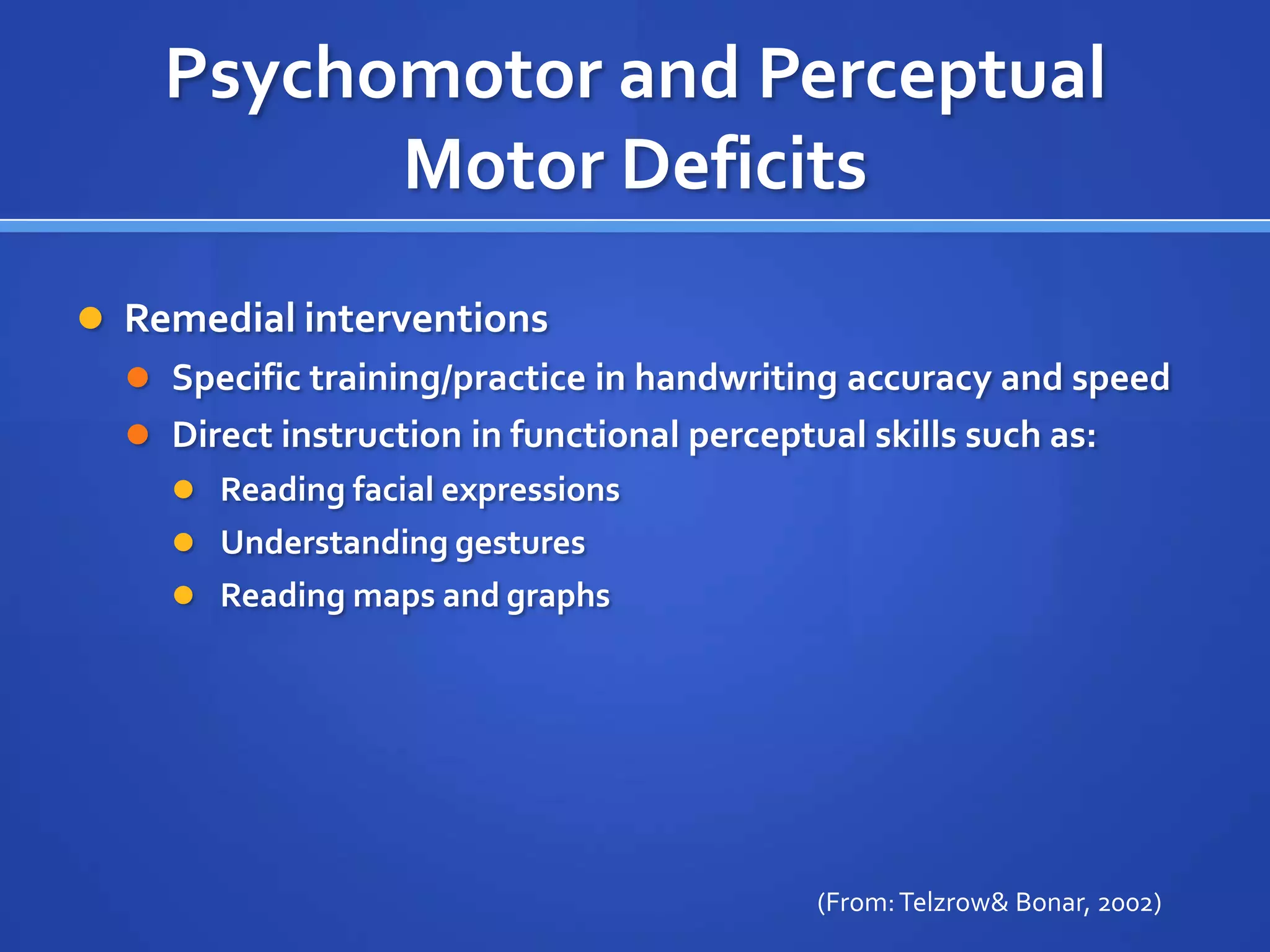
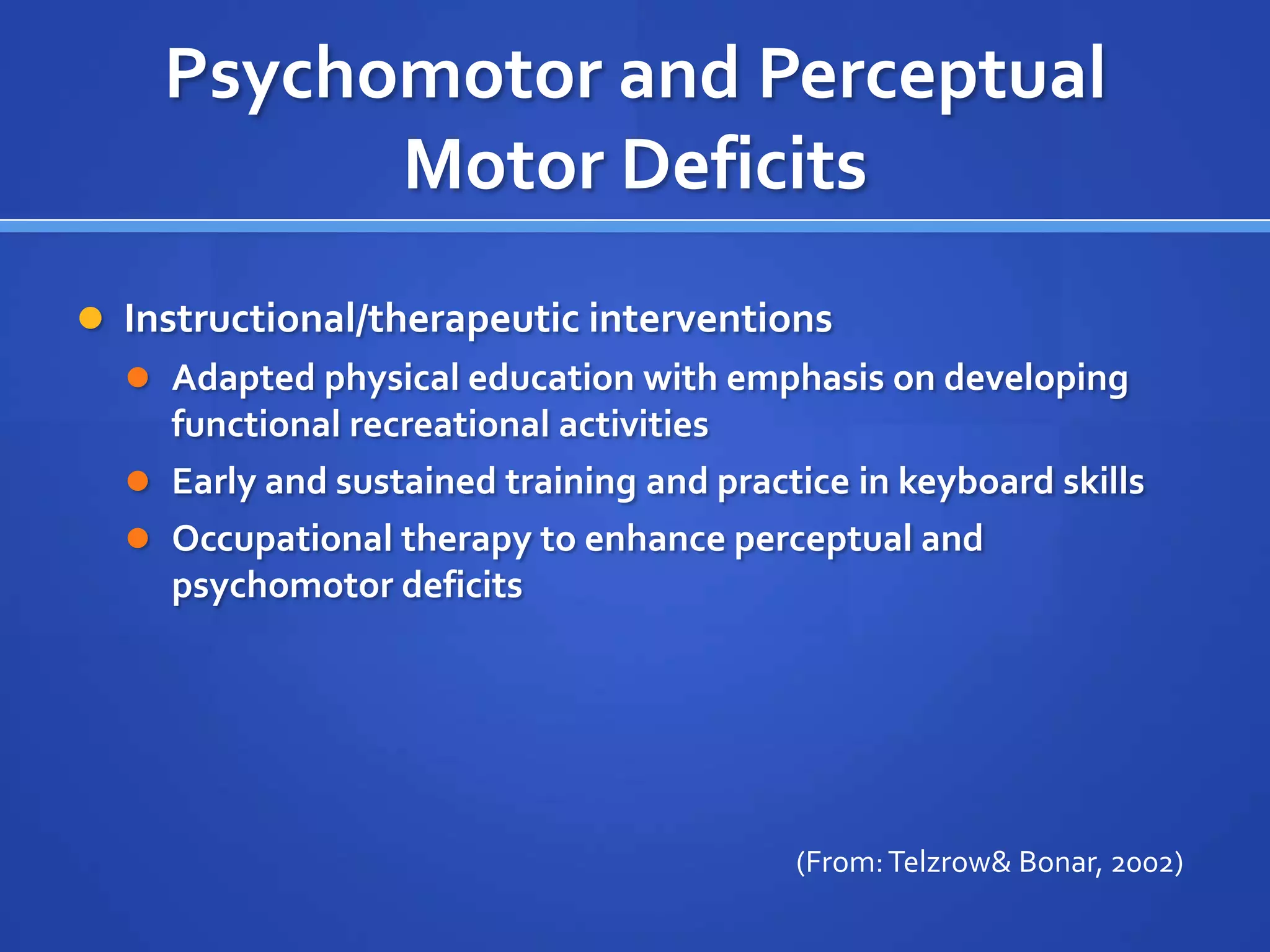
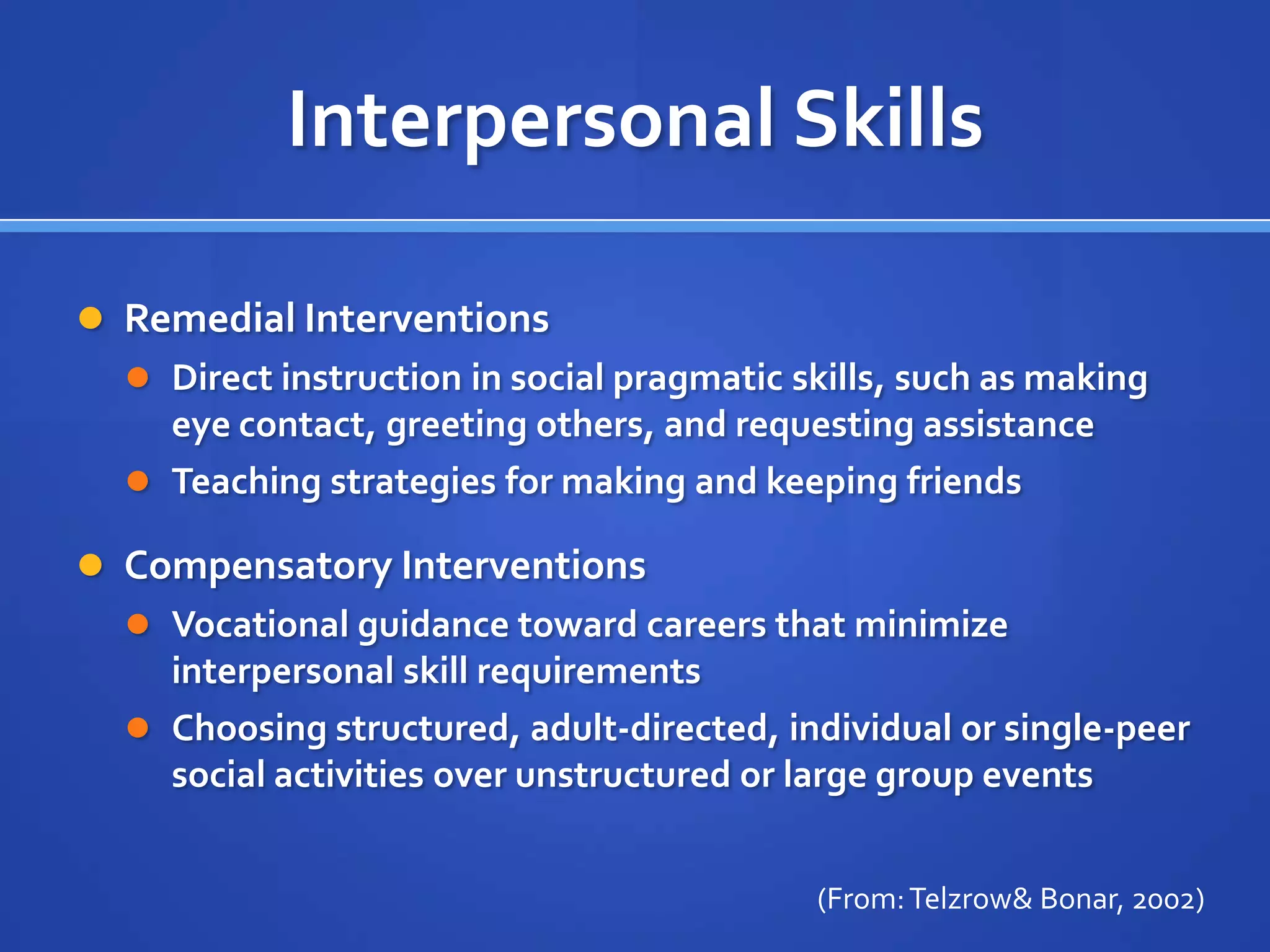
Psychomotor and Perceptual Motor DeficitsRemedial interventionsSpecific training/practice in handwriting accuracy and speedDirect instruction in functional perceptual skills such as:Reading facial expressionsUnderstanding gesturesReading maps and graphs(From: Telzrow & Bonar, 2002)
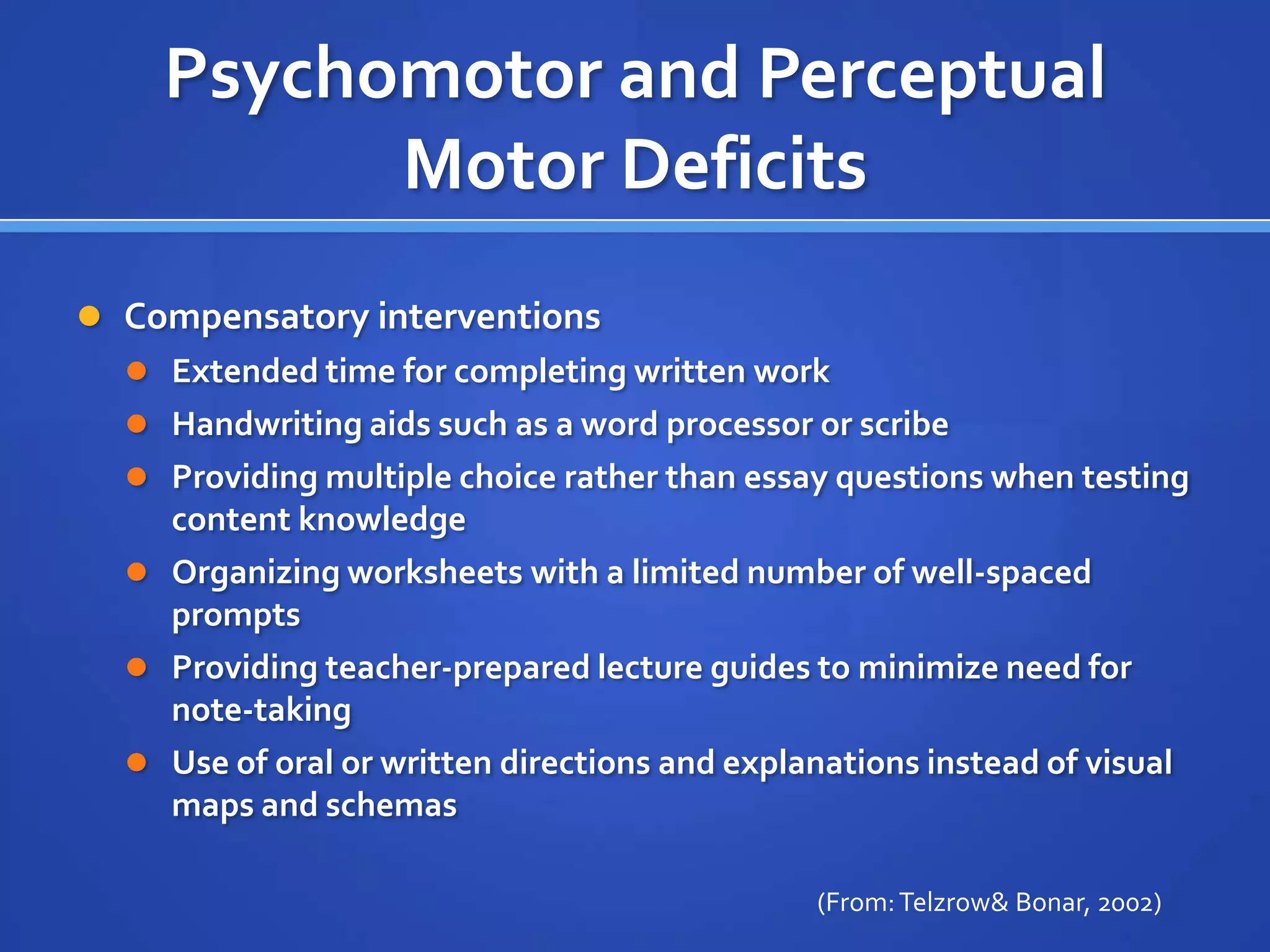
Psychomotor and Perceptual Motor DeficitsCompensatory interventionsExtended time for completing written workHandwriting aids such as a word processor or scribeProviding multiple choice rather than essay questions when testing content knowledgeOrganizing worksheets with a limited number of well-spaced promptsProviding teacher-prepared lecture guides to minimize need for note-takingUse of oral or written directions and explanations instead of visual maps and schemas(From: Telzrow & Bonar, 2002)
Psychomotor and Perceptual Motor DeficitsInstructional/therapeutic interventionsAdapted physical education with emphasis on developing functional recreational activitiesEarly and sustained training and practice in keyboard skillsOccupational therapy to enhance perceptual and psychomotor deficits(From: Telzrow & Bonar, 2002)
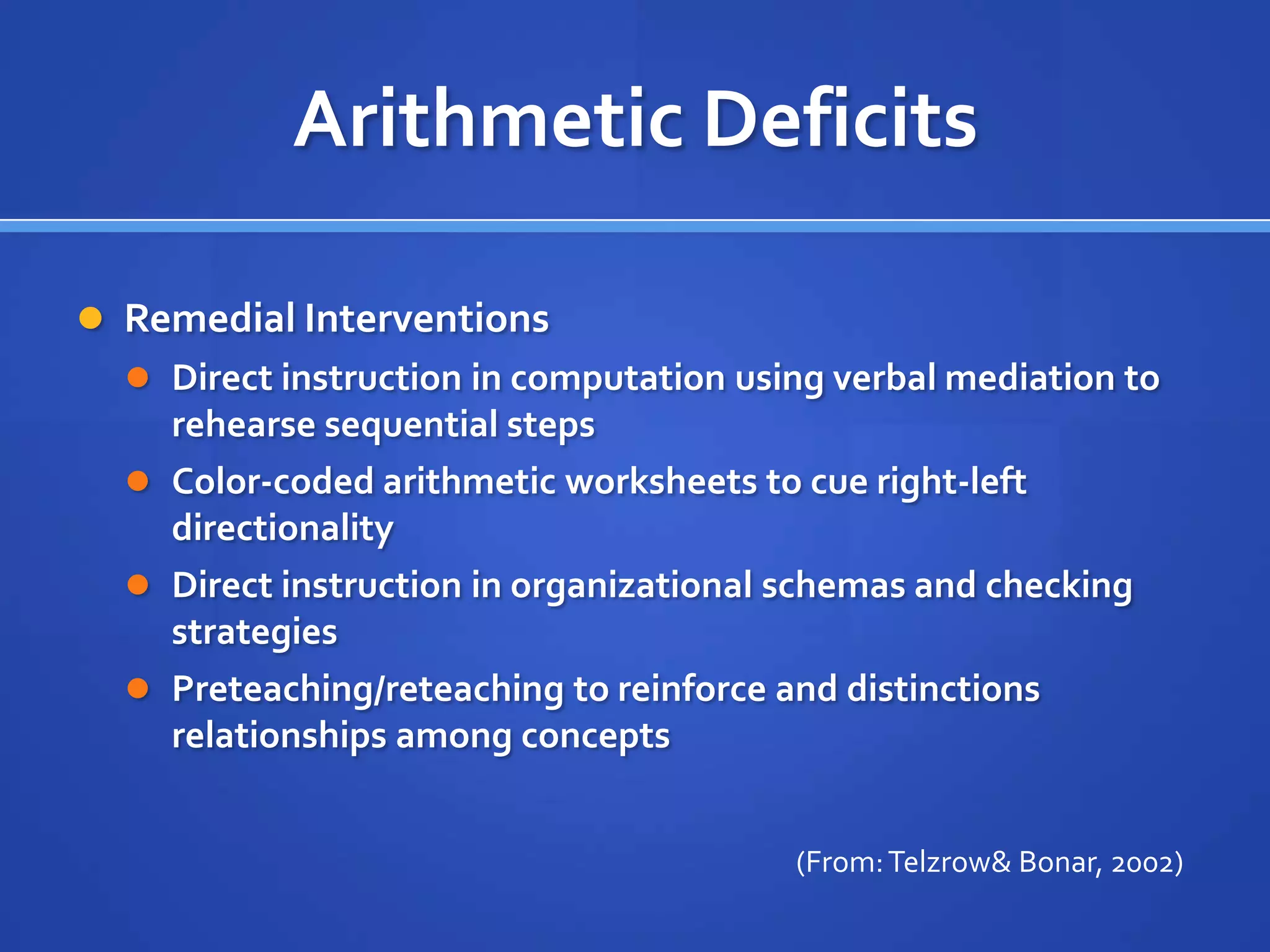
Arithmetic DeficitsRemedial InterventionsDirect instruction in computation using verbal mediation to rehearse sequential stepsColor-coded arithmetic worksheets to cue right-left directionalityDirect instruction in organizational schemas and checking strategiesPreteaching/reteaching to reinforce and distinctions relationships among concepts(From: Telzrow & Bonar, 2002)
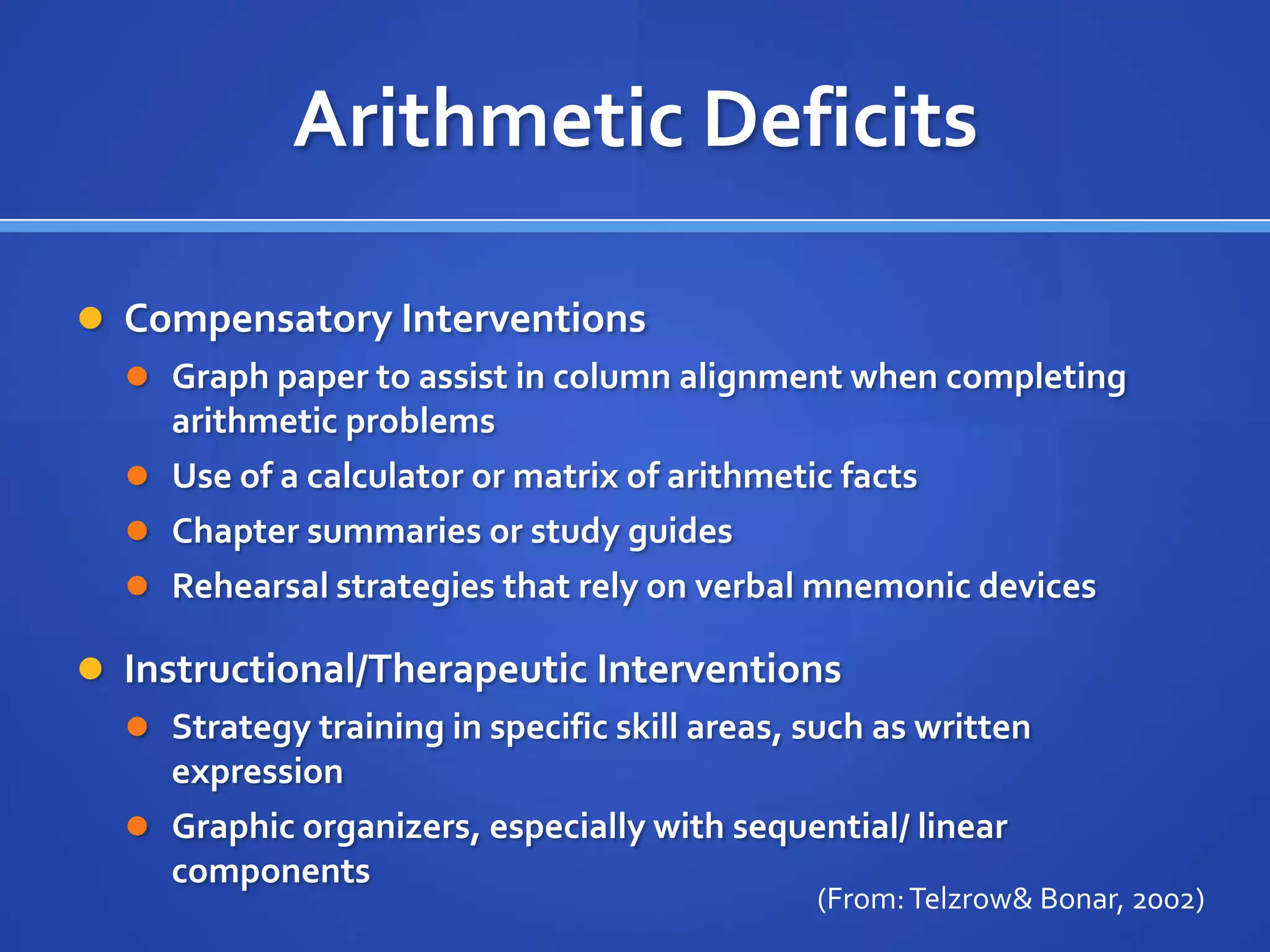
Arithmetic DeficitsCompensatory InterventionsGraph paper to assist in column alignment when completing arithmetic problemsUse of a calculator or matrix of arithmetic factsChapter summaries or study guidesRehearsal strategies that rely on verbal mnemonic devicesInstructional/Therapeutic InterventionsStrategy training in specific skill areas, such as written expressionGraphic organizers, especially with sequential/ linear components(From: Telzrow & Bonar, 2002)
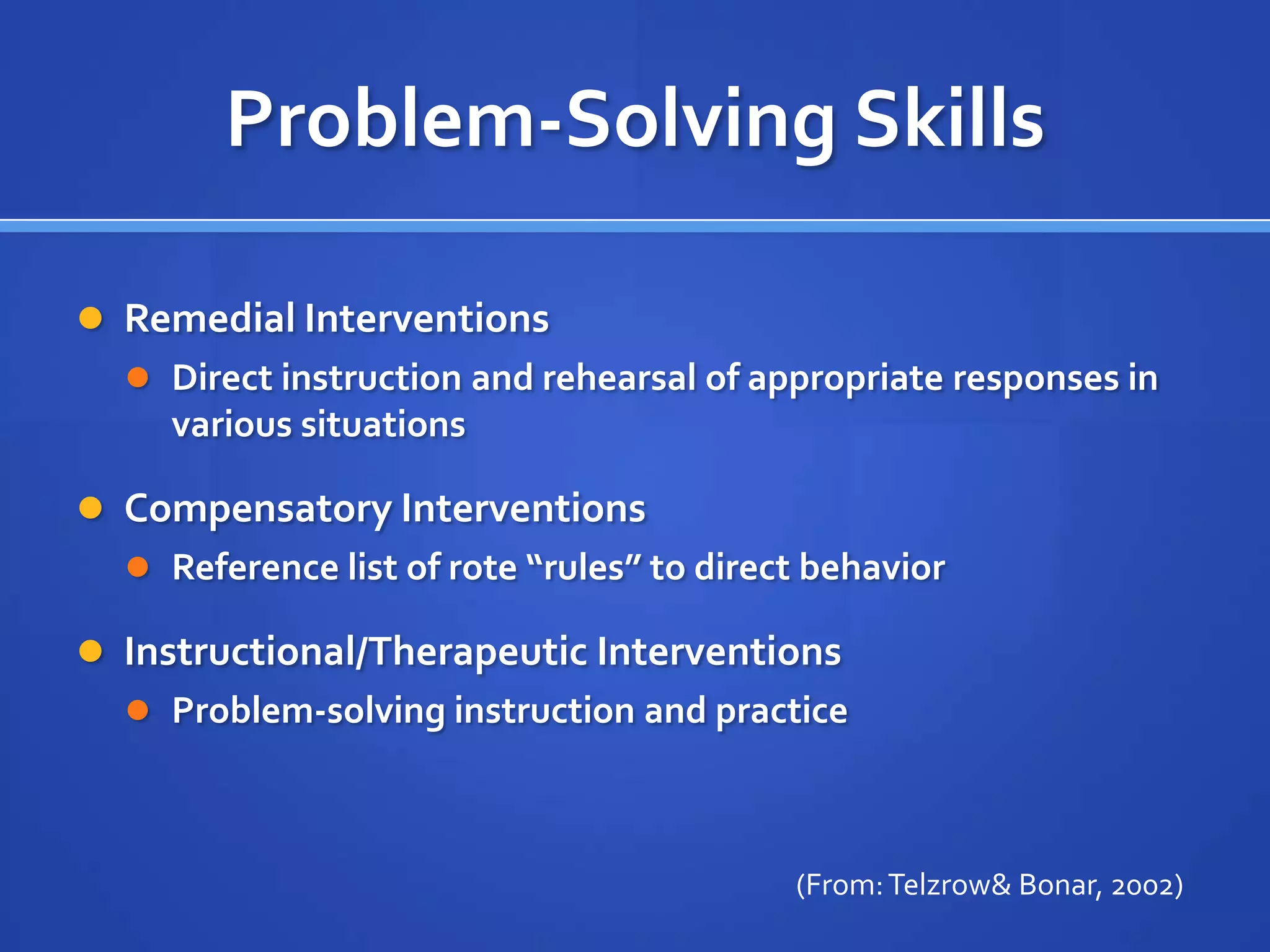
Problem-Solving SkillsRemedial InterventionsDirect instruction and rehearsal of appropriate responses in various situationsCompensatory InterventionsReference list of rote “rules” to direct behaviorInstructional/Therapeutic InterventionsProblem-solving instruction and practice(From: Telzrow & Bonar, 2002)

Understanding Nonverbal Learning Disabilities

  • 1.
    Understanding Nonverbal LearningDisabilityBinyamin Goldman, PsyD
  • 2.
    DefinitionA nonverbal learningdisability (NLD) is a developmental brain based disorder that impairs a child's capacity to perceive, express, and understand nonverbal (nonlinguistic) signs. The disorder is generally expressed as a pattern of impaired functioning in the nonverbal domains, with higher functioning in the verbal domain.
  • 3.
    DefinitionThe neuropsychological deficitsassociated with this disorder constrain children's capacity to function in the academic, social, emotional, or vocational domain and lead to a heterogeneous set of neurobehavioral symptoms. The brain dysfunctions affect children's behaviors, their social interactions, their feelings about themselves and others, and their emerging personality patterns--all of which may manifest as symptomatic behaviors.
  • 4.
    DiscoveryJohnson & Myklebust(1967)Coined the term nonverbal learning disabilityReferred to a residual group of children who did not have verbal language problems but did have a range of symptoms that interfered with their school functioningInitially used the term “disorders of social imperception,” referring to: “a child’s … lack of ability to understand his social environment, especially in terms of his own behavior.”Concluded that these children have a hard time understanding the meanings of other people’s social cues
  • 5.
    PrevalenceNLD estimated at5-10% of LD clinical sample (Rourke, 1989)Population prevalence of LD around 10% (Pennington, 1991) Overall NLD population prevalence= 0.1-1.0%
  • 6.
    Gender RatiosReports havechanged over time1960’s- 5:1 (Rourke, 1989)1970’s- 2.8:1 (Rourke & Strang, 1978)1989- 1:1 (Rourke, 1989)Changes thought to be due to shifting gender roles
  • 7.
  • 8.
  • 9.
    Primary AssetsSimple motorskillsSimple, repetitive motoric skills are generally intact, especially at older age levels (middle childhood and beyond).Auditory perceptionAfter a very early developmental period when such skills appear to be lagging, auditory-perceptual capacities become very well developed.Rote materialRepetition and/or constancy of stimulus input - especially through the auditory modality, but not confined to it - is well appreciated. Repetitious motoric acts, including some aspects of speech and well-practiced skills such as handwriting, eventually develop to average or above-average levels(Rourke, 2008)(Rourke, 2008)
  • 10.
    Secondary AssetsAttentional skillsDeployment of selective and sustained attention for simple, repetitive verbal material (especially that delivered through the auditory modality) becomes very well developed.(Rourke, 2008)
  • 11.
    Tertiary AssetsMemoryRote verbalmemory and memory for material that is readily coded in a rote verbal fashion becomes extremely well developed.Verbal Assets: Speech and Language Following an early developmental period when linguistic skills appear to be lagging, a number of such skills emerge and develop in a rapid fashion. These include excellent phonemic hearing, segmentation, blending, and repetition. Very well-developed receptive language skills and rote verbal capacities are evident, as are a large store of rote verbal material and verbal associations, and a very high volume of speech output. All of these characteristics tend to become more prominent with advancing years.(Rourke, 2008)
  • 12.
    Academic AssetsFollowing initialproblems with the visual-motor aspects of writing and much practice with a writing instrument, graphomotor skills (for words) reach good to excellent levels. Following initial problems with the development of the visual-spatial feature analysis skills necessary for reading, good to excellent single-word reading skills also develop to above-average levels. Misspellings are almost exclusively of the “phonetically accurate” variety: that is, the type seen most often in normal spellers. Verbatim memory for oral and written verbal material can be outstanding in the middle to late elementary school years and thereafter.(Rourke, 2008)
  • 13.
    Primary DeficitsTactile perception-Bilateral tactile-perceptual deficits are evident, often more marked on the left side of the body. Deficits in simple tactile imperception and suppression may become less prominent with advancing years, but problems in dealing with complex tactile input tend to persist.Visual perception- There is impaired discrimination and recognition of visual detail and visual relationships, and there are outstanding deficiencies in visual-spatial-organizational skills. Simple visual discrimination, especially for material that is verbalisable, usually approaches normal levels with advancing years. Complex visual-spatial-organizational skills, especially when required within a novel framework, tend to worsen relative to age-based norms.(Rourke, 2008)
  • 14.
    Primary DeficitsComplex psychomotorskills- Bilateral psychomotor coordination deficiencies are prominent; these are often more marked on the left side of the body. These deficits, except for well-practiced skills such as handwriting, tend to increase in severity with age, especially when they are required within a novel framework.Novel material- As long as stimulus configurations remain novel, they are dealt with very poorly and inappropriately. Difficulties in age-appropriate accommodation to, and a marked tendency toward over-assimilation of, novel events increase with advancing years. There is an over-reliance on prosaic, rote (and in consequence, inappropriate) behaviors in such situations. The capacity to deal with novel experiences often remains poor and may even worsen with age.(Rourke, 2008)
  • 15.
    Secondary DeficitsAttention- Attentionto tactile and visual input is poor. Relative deficiencies in visual attention tend to increase over the course of development, except for material that is programmatic and over-learned (e.g., printed text). Deployment of selective and sustained attention is much better for simple, repetitive verbal material (especially that delivered though the auditory modality) than for complex, novel nonverbal material (especially that delivered through the visual or tactile modalities). The disparity between attentional deployment capacities for these two sets of materials tends to increase with age.(Rourke, 2008)
  • 16.
    Secondary DeficitsExploratory behavior.During early phases of development, there is little physical exploration of any kind. This is the case even for objects that are immediately within reach and could be explored through visual or tactile means. A tendency toward sedentary and physically limited modes of functioning tends to increase with age.(Rourke, 2008)
  • 17.
    Tertiary DeficitsMemory- Memoryfor tactile and visual input is poor. Relative deficiencies in these areas tend to increase over the course of development, except for material that is programmatic and overlearned (e.g., spoken natural language). Memory for nonverbal material, whether presented through the auditory, visual, or tactile modalities, is poor if such material is not readily coded in a verbal fashion. Relatively poor memory for complex, meaningful, and/or novel verbal and nonverbal material is typical. Differences between good to excellent memory for rote material and impaired memory for complex material and/or that which is not readily coded in a verbal fashion tend to increase with age.(Rourke, 2008)
  • 18.
    Tertiary DeficitsConcept-formation, problem-solving,strategy-generation, and hypothesis-testing/appreciation of informational feedback. Marked deficits in all of these areas are apparent, especially when the concept to be formed, the problem to be solved, and/or the problem-solving milieu(x) is/are novel or complex. Also evident are significant difficulties in dealing with cause-and-effect relationships and marked deficiencies in the appreciation of incongruities (e.g., age-appropriate sensitivity to humor). Most noticeable when formal operational thought becomes a developmental demand (i.e., in late childhood and early adolescence), relative deficits in these areas tend to increase markedly with advancing years, as is evident in the often widening gap between performance on rote (overlearned) and novel tasks.(Rourke, 2008)
  • 19.
    Linguistic DeficitsSpeech andlanguage. Mildly deficient oral-motor praxis, little or no speech prosody, and much verbosity of a repetitive, straightforward, rote nature are characteristic. Content disorders of language, characterized by very poor psycholinguistic content and pragmatics (e.g., “cocktail party” speech) and reliance upon language as a principal means for social relating, information gathering, and relief from anxiety. "Memory" for complex verbal material is usually very poor, probably as a result of poor initial comprehension of such material. All of these characteristics, except oral-motor praxis difficulties, tend to become more prominent with advancing years.(Rourke, 2008)
  • 20.
    Academic DeficitsGraphomotor Inthe early school years, there is much difficulty with printing and cursive script; with considerable practice, handwriting often becomes quite good. However, some avoid practice and remain deficient in such skills.Reading comprehension Reading comprehension is much poorer than single-word reading (decoding). Relative deficits in reading comprehension, especially for novel material, tend to increase with advancing years.(Rourke, 2008)
  • 21.
    Academic DeficitsMechanical arithmeticand mathematics There are outstanding relative deficiencies in mechanical arithmetic as compared to proficiencies in reading (word-recognition) and spelling. With advancing years, the gap between good to excellent single-word reading and spelling and deficient mechanical arithmetic performance widens. Absolute level of mechanical arithmetic performance only rarely exceeds the Grade 5 level; mathematical reasoning, as opposed to programmatic arithmetic calculation, remains poorly developed. (Rourke, 2008)
  • 22.
    Academic DeficitsSciencePersistent difficultiesin academic subjects involving problem-solving and complex concept-formation (e.g., physics) are prominent. Problems in dealing with scientific concepts and theories become apparent by early adolescence. The gap between deficiencies in this type of complex academic endeavor and other, more rote, programmatic academic pursuits widens with age.(Rourke, 2008)
  • 23.
    Psychosocial/Adaptational DeficitsAdaptation innovel situations There is extreme difficulty in adapting to (i.e., countenancing, organizing, analyzing, and synthesizing) novel and otherwise complex situations. An over-reliance on prosaic, rote (and, in consequence, inappropriate) behaviors in such situations is common. These characteristics tend to become more prominent and problematic with advancing years.Social competence. Significant deficits are apparent in social perception, social judgment, and social interaction skills; these deficits become more prominent and problematic as age increases. There is a marked tendency toward social withdrawal and even social isolation with advancing years.(Rourke, 2008)
  • 24.
    Psychosocial/Adaptational DeficitsPsychosocial disturbanceOften characterized during early childhood as afflicted with some type of acting-out or other "externalized" disorder, such children are very much at risk for the development of internalized forms of psychopathology. Indications of excessive anxiety, depression, and associated internalized forms of psychosocial disturbance tend to increase with advancing years.Activity level Children who exhibit the syndrome are frequently perceived as hyperactive during early childhood. With advancing years, they tend to be characterized as normoactive and eventually hypoactive.(Rourke, 2008)
  • 25.
  • 26.
  • 27.
  • 28.
  • 29.
  • 31.
  • 32.
    Early StudiesGenerally pursueda hypothesis of right hemisphere dysfunctionFocused on brain-damaged individuals who displayed symptoms similar to NLDMajor validity questions:No uniformity among samplesNo precise way to identify type or location of brain lesion(Palombo, 2006)
  • 33.
    Early StudiesApplied variouslabels to their cohorts:Disorders of social imperception(Johnson & Mykelbust, 1967)Left hemisyndrome(Denckla, 1978)Nonverbal learning disability (Rourke, 1989; Johnson, 1987)Social-emotional learning disability (Denckla, 1983; Voeller, 1986)Right parietal lobe syndrome/developmental learning disability of the right hemisphere(Weintraub & Mesulam, 1982)Right hemisphere deficit syndrome (Voeller, 1986)Right hemisphere deficit syndrome (Semrud-Clikeman & Hynd, 1990)(Palombo, 2006)
  • 34.
    Rourke and Finlayson(1978)GL +2GLGL -2
  • 35.
    Rourke and Finlayson(1978)Group 2 (relative arithmetic weakness)Groups 1 & 3Performed worse on visuospatial skills measures Performed better on rote verbal and auditory processing measuresPerformed worse on rote verbal and auditory processing measuresPerformed better on visuospatial skills measures Visuospatial measures: Nonverbal WISC subtests, Target Test (requiring drawing a pattern from memory)
  • 36.
    Rote verbal &auditory processing measures: Peabody Picture Vocabulary Test, Speech-Sound Perception Test, Auditory Closure TestRourke and Finlayson (1978)Concluded that the arithmetic deficit group represented a distinct population with a unique profile of neurological assets and deficitsSuggested that the difference between that group and the other two had to do with brain hemispheresThis group’s difficulties were due to dysfunction in the right cerebral hemisphereThe other group’s difficulties were related to left hemisphere skills
  • 37.
    Rourke (1987)Found theNLD neuropsychological profile in children with other neurological conditions such as hydrocephalus, moderate to severe head injury, congenital absence of the corpus callosum, and post-radiation survival of childhood cancer.Commonality of this group not right hemisphere dysfunction, but white matter damage or dysfunction
  • 38.
  • 39.
    White MatterSends themessages through the grey matterIf grey matter like the computer, white matter like the cablesWhite from the myelin
  • 40.
    Rourke’s White MatterModelNLD occurs when there is a problem with: the white matter in the right hemisphereAdverse conditions in early childhood are more likely to affect right hemisphere processing abilities because:The right hemisphere contains a greater proportion of white matter to grey matter than does the left hemisphereThe right hemisphere is dominant in infancy(Rourke, 1987; Rourke et al., 2002)
  • 42.
    Hemispheric Specialization“Localization”-Broca (in1861) and Wernicke (in 1876) Hypothesized specific areas of the cerebrum that are responsible for specific functionsShaped the historical understanding of brain functioning(Palombo, 2006)
  • 43.
    Hemispheric Specialization“Lateralization”Differs fromthe concept of localization in that: “laterality is relative, not absolute, because both hemispheres play a role in nearly every behavior.”For example:while the left hemisphere is especially important for producing language, the right hemisphere plays some role as well.(Kolb & Whishaw, 2001, p. 180)
  • 44.
    Hemispheric Specialization“Lateralization”This meansthat just because many NLD symptoms appear to be the products of right hemisphere dysfunctions, that does not necessarily mean that the left hemisphere and subcortical regions do not also contribute to those problems(Palombo, 2006)
  • 45.
    Hemispheric SpecializationLeft HemisphereMorespecialized forUtilizing information already learned
  • 46.
  • 47.
  • 48.
  • 49.
    Dealing with detailsRightHemisphereMore specialized forNovel learning
  • 50.
  • 51.
  • 52.
  • 53.
    Global, gestalt-oriented analysisHemisphericSpecialization(Mesulam, 2000, p. 80)
  • 54.
    Specializations of theRight Brain1. Complex and Nonlinguistic Perceptual TasksAuditory abilities to recognize pitch and melodyVisual discrimination such as the ability to recognize faces, identify complex geometric shapesVisual-Spatial abilities necessary for depth perception, spatial location, mental rotation, visual perspective takingVisual-Motor abilities such as tracing mazes and block designSpatial memory to recall complex spatial relationshipsTime perceptionMany of these abilities are essential to successful social communication.(Palombo, 2006, p. 45)
  • 55.
    Specializations of theRight Brain2. Paralinguistic Aspects of CommunicationDecoding: the ability to read social signs such as facial expressions and vocal intonationEncoding: the ability to form mental representations of those signs and store them in memoryProcessing: understanding what the signs communicate within the context in which they occurExpression: retrieving the sign from memory and producing it through some motor output
  • 56.
    Specializations of theRight Brain3. Spatial Distribution of AttentionVery little research exists with regard to how this function relates to the problems displayed by children with NLD.
  • 57.
    Specializations of theRight Brain4. Emotion PerceptionProcessesing the perception of affect statesCoordinating the expression of emotional tone through paralinguistic communicationIdentifying the emotion behind others’ prosody and facial expressionsModulating affects involved in the development of social skills(Semrud-Clikeman & Hynd, 1990; Mesulam, 2000)
  • 58.
    The Two AxesInterpretationAnterior-Executive Functions-Motor OutputRight Hemisphere-Novel/Global/Coarse-Divergent/Discordant-Fluid AbilitiesLeft Hemisphere-Routinized/Detailed/Local-Convergent/Concordant-Crystallized AbilitiesPosterior-Sensory Input-Comprehension
  • 59.
    Developmental ProfileNLD Throughthe Lifespan(from Thompson, 1997)
  • 60.
    Infant and ToddlerYearsDoes not explore the world motoricallySpeech and language develop earlyWants a verbal label for everythingNo strong evidence of non-motoric developmental delayAppears “drunk” in early attempts to walkDoes not automatically assume a position of balance when set down after being heldClings to objects and people for balanceConstantly bumps into things(Thompson, 1997)
  • 61.
    Preschool YearsExceptional roteverbatim memory skillsExtremely verbose, perhaps talking “like an adult”Early reading skills, strong letter and number recognition and spelling skillsUnderstands statements and readings very literally, views things as black and whitePoor gross motor development and motor planning skills(Thompson, 1997)
  • 62.
    Middle School Years(11-14) is often excluded, teased, and persecuted at school is misunderstood by both teachers and peers has difficulty meeting age-appropriate behavioral expectations; these difficulties may be misattributed to "emotional" issues has problems with work and study habits; these problems may be misattributed to "motivational" issueshas visual-spatial-organizational difficulties, difficulty using a locker, can't find his way around campus, is often lost or tardy
  • 63.
    High School Years(15-18) by high school, peer tolerance usually increases; one or two close friendships may develop (or continue)If an Individualized Education Program has been put into place to accommodate the student, academic achievement, which typically drops in middle school, makes an encouraging comeback; if no IEP, this student is at risk for dropping out of school still thinks in concrete and literal terms is slow to date and interact with the opposite sex
  • 64.
    High School Yearsearlyjob experience performance problems are commonhas difficulty learning to drive, can't coordinate the use of a manual shift is socially immature; may be seen as a "nerd" or "weird" by classmates has low self-esteem; is prone to depression, withdrawal, anxiety, and suicide
  • 65.
  • 66.
    Theory of MindTheability to attribute intentions, desires, beliefs, and other mental states to oneself or to another Enables one to make sense of and predict the behavior of othersWell-developed theory of mind is the foundation of social competenceSevere deficit in this area is considered a central characteristic of autism(Baron-Cohen, 1997)
  • 67.
    Theory of MindWhatabout children with NLD?
  • 68.
    Theory of MindFalse-BeliefTestChild No studies of False-Belief Test performance for kids with NLD
  • 69.
    Theory of MindChildrenwith NLD:Have difficulty with reciprocal exchangesAre socially immatureAre argumentative & socially disruptiveHave difficulty maintaining friendshipsAre often rejected by their peers
  • 70.
    Theory of MindBUT…clinical data suggests that:These children typically desire friends and relationships with othersThey are capable of deception and imaginary playThey are able to understand that others have beliefs and intentions(Palombo, 2006)
  • 71.
    Don, age 11,complained bitterly to his therapist that kids continually teased him. When asked what they said, he reported that they accused him of being cruel and sadistic to his beloved cat. They said that he enjoyed hurting the pet or that he had set fire to his cat’s tail, none of which was true. His response was to protest loudly that he was not that kind of person and would never do such things to his pet. However, his reaction only inflamed the other kids, inciting them to escalate their teasing
  • 72.
    Theory of MindWhyare these children so often helpless to defend themselves against taunting? Where is the deficit?
  • 73.
    Don could notget beyond the literal meaning of what his peers said; he could not see through their remarks to discern their motives. Once these motives were pointed out to him, he was able to take what the other kids said as a “joke” and respond with his own brand of humor.
  • 74.
    Differential DiagnosisIs NLDReally Different from Asperger’s?
  • 75.
    NLD vs. ASNLDand AS are very similar in behaviors, NP profiles, and comorbid conditions“The process of differentiating the characteristics of AS, and NLD, and a pragmatic language disorder arguably may be the most challenging diagnostic task in developmental –behavioral pediatrics.” (Stein, 2008)Lack of agreement on core definitions of both disorders. (Palombo, 2006)
  • 76.
    Rourke suggests thatthe two should not be dissociated (Rourke, et al., 2002)The two are not mutually exclusive (they belong to different classification systems) and often co-uccur .(Klin, 2008)Children with AS have NLD, but many children with NLD don’t have AS (Palombo, 2006)AS has more stereotypic behaviors and restricted interests, greater impairment of sense of self, theory of mind
  • 77.
    Is NLD on“The Spectrum?”??
  • 79.
  • 80.
    3 Levels ofIntervention
  • 81.
    Psychomotor and PerceptualMotor DeficitsRemedial interventionsSpecific training/practice in handwriting accuracy and speedDirect instruction in functional perceptual skills such as:Reading facial expressionsUnderstanding gesturesReading maps and graphs(From: Telzrow & Bonar, 2002)
  • 82.
    Psychomotor and PerceptualMotor DeficitsCompensatory interventionsExtended time for completing written workHandwriting aids such as a word processor or scribeProviding multiple choice rather than essay questions when testing content knowledgeOrganizing worksheets with a limited number of well-spaced promptsProviding teacher-prepared lecture guides to minimize need for note-takingUse of oral or written directions and explanations instead of visual maps and schemas(From: Telzrow & Bonar, 2002)
  • 83.
    Psychomotor and PerceptualMotor DeficitsInstructional/therapeutic interventionsAdapted physical education with emphasis on developing functional recreational activitiesEarly and sustained training and practice in keyboard skillsOccupational therapy to enhance perceptual and psychomotor deficits(From: Telzrow & Bonar, 2002)
  • 84.
    Arithmetic DeficitsRemedial InterventionsDirectinstruction in computation using verbal mediation to rehearse sequential stepsColor-coded arithmetic worksheets to cue right-left directionalityDirect instruction in organizational schemas and checking strategiesPreteaching/reteaching to reinforce and distinctions relationships among concepts(From: Telzrow & Bonar, 2002)
  • 85.
    Arithmetic DeficitsCompensatory InterventionsGraphpaper to assist in column alignment when completing arithmetic problemsUse of a calculator or matrix of arithmetic factsChapter summaries or study guidesRehearsal strategies that rely on verbal mnemonic devicesInstructional/Therapeutic InterventionsStrategy training in specific skill areas, such as written expressionGraphic organizers, especially with sequential/ linear components(From: Telzrow & Bonar, 2002)
  • 86.
    Problem-Solving SkillsRemedial InterventionsDirectinstruction and rehearsal of appropriate responses in various situationsCompensatory InterventionsReference list of rote “rules” to direct behaviorInstructional/Therapeutic InterventionsProblem-solving instruction and practice(From: Telzrow & Bonar, 2002)
  • 87.
    Interpersonal SkillsRemedial InterventionsDirectinstruction in social pragmatic skills, such as making eye contact, greeting others, and requesting assistanceTeaching strategies for making and keeping friendsCompensatory InterventionsVocational guidance toward careers that minimize interpersonal skill requirementsChoosing structured, adult-directed, individual or single-peer social activities over unstructured or large group events(From: Telzrow & Bonar, 2002)
  • 88.
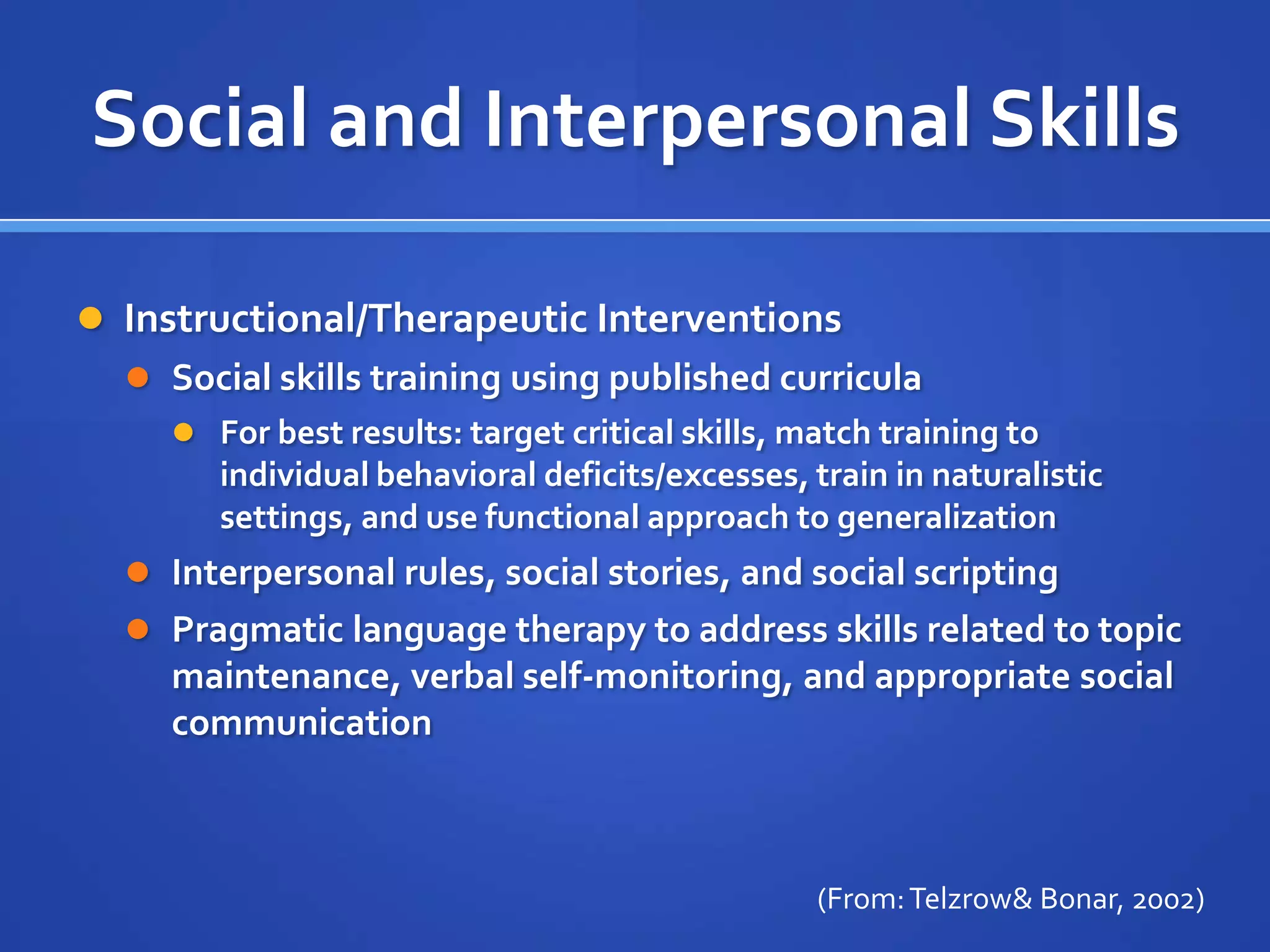
    Social and InterpersonalSkillsInstructional/Therapeutic InterventionsSocial skills training using published curricula For best results: target critical skills, match training to individual behavioral deficits/excesses, train in naturalistic settings, and use functional approach to generalizationInterpersonal rules, social stories, and social scriptingPragmatic language therapy to address skills related to topic maintenance, verbal self-monitoring, and appropriate social communication(From: Telzrow & Bonar, 2002)
  • 89.
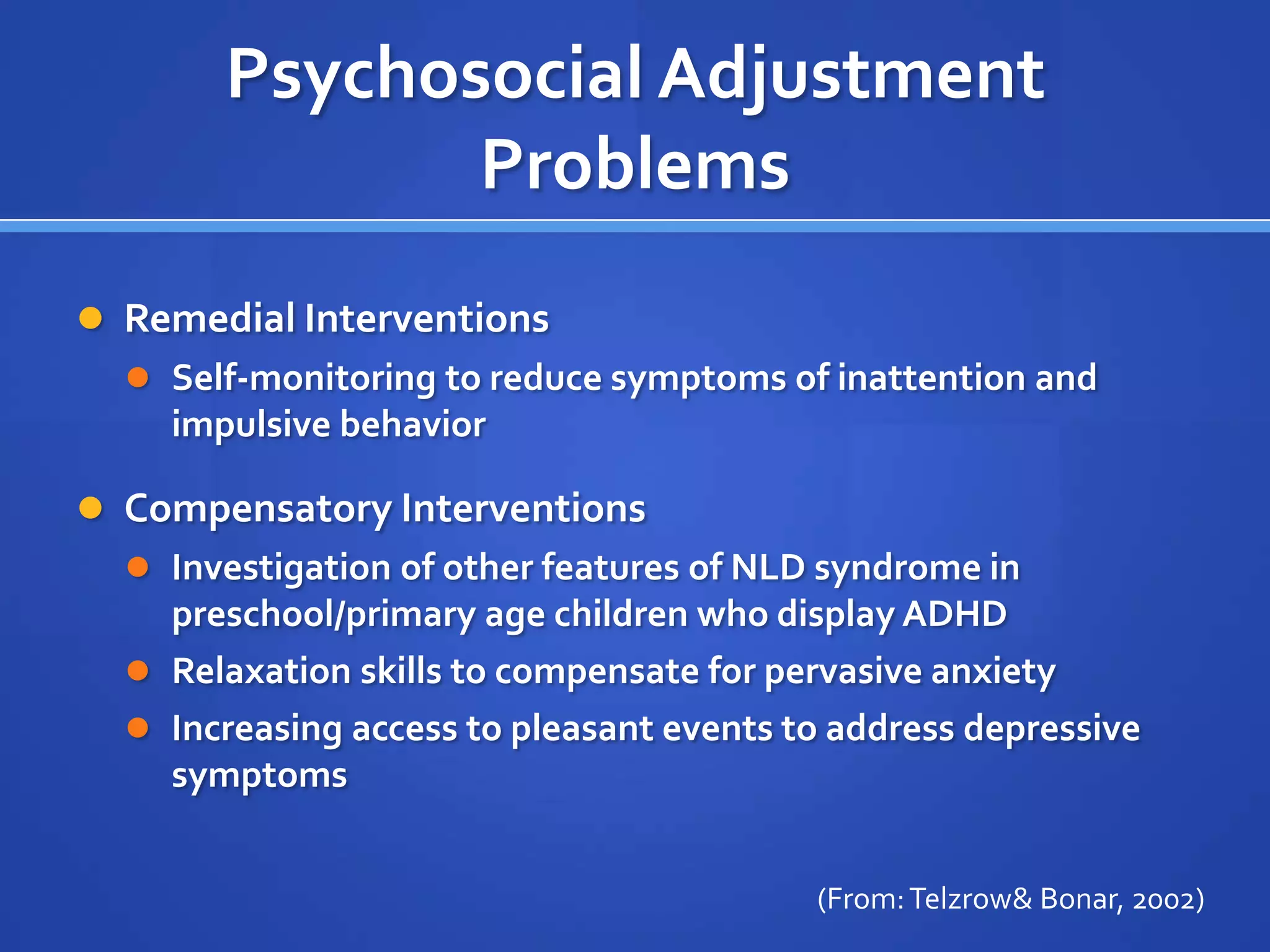
    Psychosocial Adjustment ProblemsRemedialInterventionsSelf-monitoring to reduce symptoms of inattention and impulsive behaviorCompensatory InterventionsInvestigation of other features of NLD syndrome in preschool/primary age children who display ADHDRelaxation skills to compensate for pervasive anxietyIncreasing access to pleasant events to address depressive symptoms(From: Telzrow & Bonar, 2002)
  • 90.
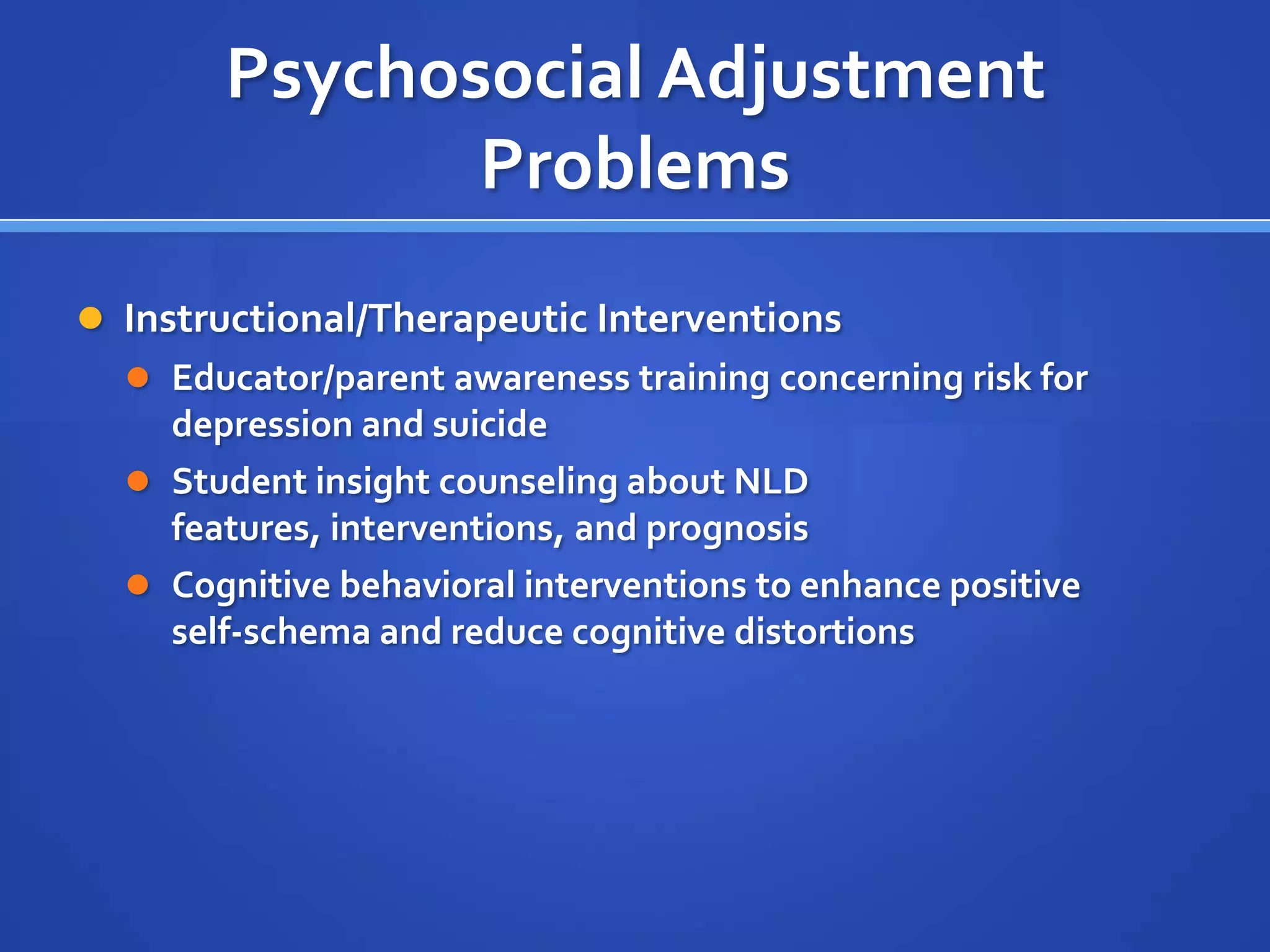
    Psychosocial Adjustment ProblemsInstructional/TherapeuticInterventions Educator/parent awareness training concerning risk for depression and suicideStudent insight counseling about NLD features, interventions, and prognosisCognitive behavioral interventions to enhance positive self-schema and reduce cognitive distortions
  • 91.
    ClassificationDepends on thestate and district Almost no state has NLD as a SLDMost NLD children receive services, if at all, based on other conditions or seek an AS diagnosis.
  • 92.
    References (partial)Palombo, J.(2006). Nonverbal learning disabilities: A clinical perspective. New York: W. W. Norton & CompanyRourke, B. (1989). Nonverbal learning disabilities: The syndrome and the model. New York: Guilford Press.Telzrow, C. & Bonar, A. (2002). Responding to students with nonverbal learning disabilities. Teaching Exceptional Children, 34 (6) pp 8-13Thomoson, S. (1997). The source for nonverbal learning disorders. East Moline, IL: LinguiSystems.

Editor's Notes

  • #8 We and other practitioners arrived at these formulations on the basis of clinical observations. Confirmation of these dimensions as primary arises from the results of some studies in our laboratory (e.g., Casey, Rourke, & Picard, 1991; Harnadek & Rourke, 1994). It should be emphasized that, in the Rourke (1988a,1989, 1995a) models, the patterns of academic and psychosocial deficits experienced by individuals who exhibit NLD are viewed as the direct result of the interaction of the primary, secondary, tertiary, and linguistic neuropsychological assets and deficits that are outlined schematically in Figure 1
  • #35 First evidence for Right Hemisphere expl.