ELT- 702 Academic Writing


 Data commentary

 by, Betül GÜLERYÜZ
     Osman AYDOĞAR
                   16.03.2012
 While data commentaries may be "stand-alone"
  pieces of writing, they generally occur in the
  Results or Discussion sections of a report or
  thesis.
 The main purposes of a data commentary are to
  present the results of research, interpret these
  results, and to discuss the significance and
  implications of the results.
 Data can often be best expressed by a chart,
   graph, table, or other illustration.
 The type of writing that accompanies a visual
  display is called data commentary.
 The data should be presented and analysed in logical manner;
  in other words you are expected to analyse and evaluate the
  data, not just describe it.
Why use a data commentary?

 Highlight results
 Assess standard theories, common beliefs, or
generals practices in light of the results
 Compare and evaluate different data sets
 Assess the reliability of data in terms of the methods
  that produced it
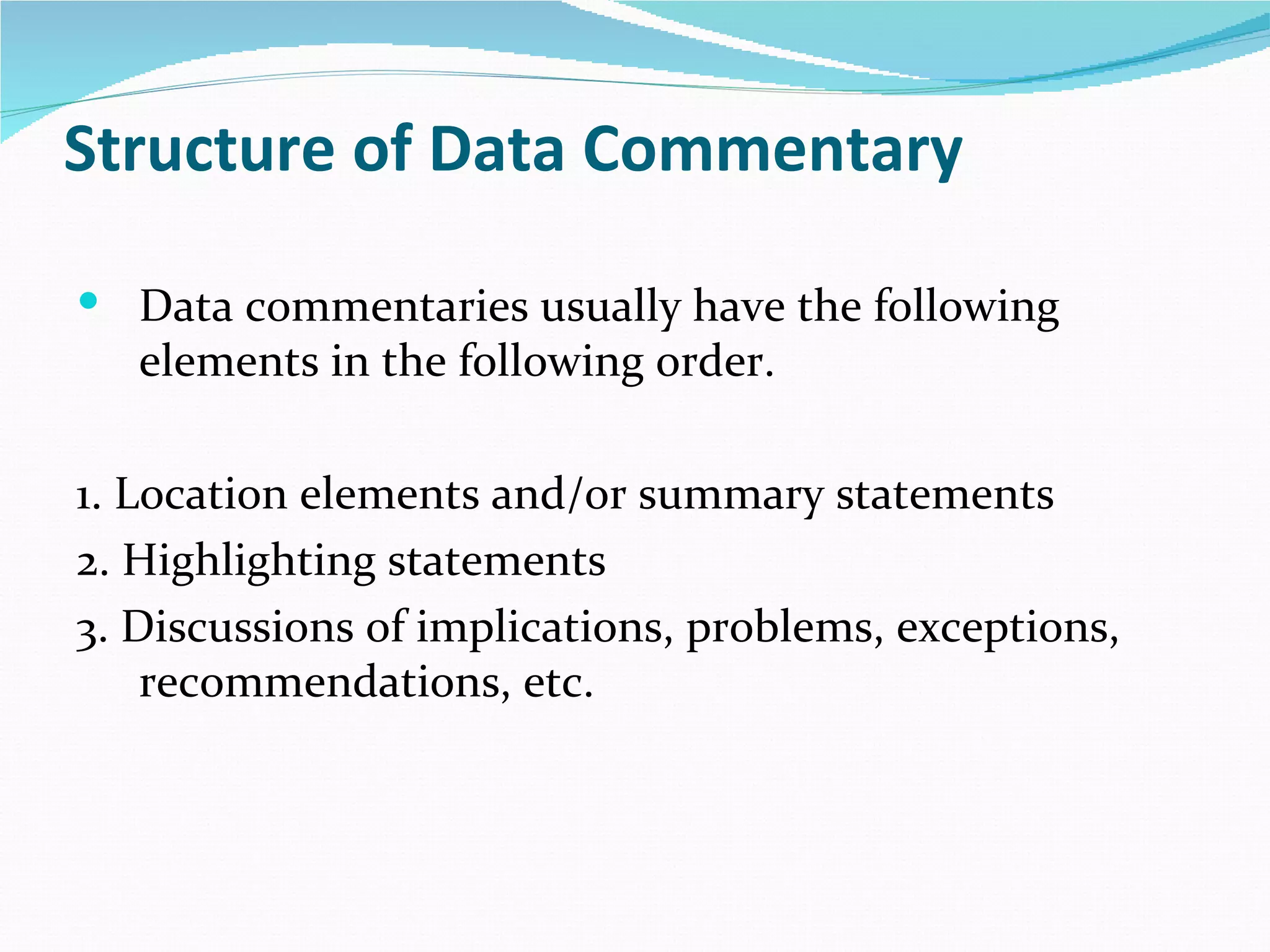
 Discuss implications of the data
 Calls attention to something not directly apparent
 from the table, chart, or graph.
 Analyzes data for a reason: to support a claim which
 in turn helps achieve the main goal of the paper.
Structure of Data Commentary

 Data commentaries usually have the following
   elements in the following order.

1. Location elements and/or summary statements
2. Highlighting statements
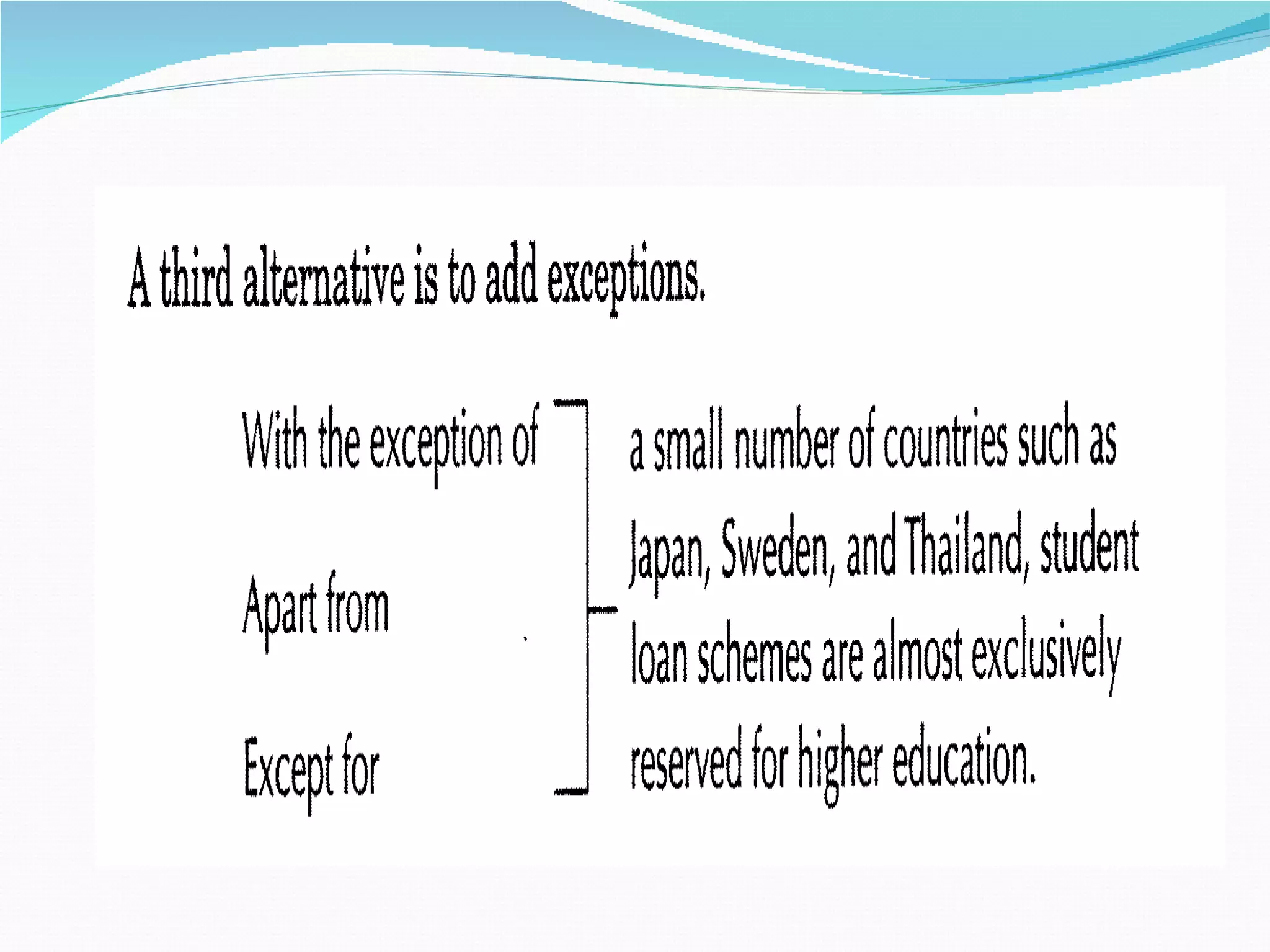
3. Discussions of implications, problems, exceptions,
    recommendations, etc.
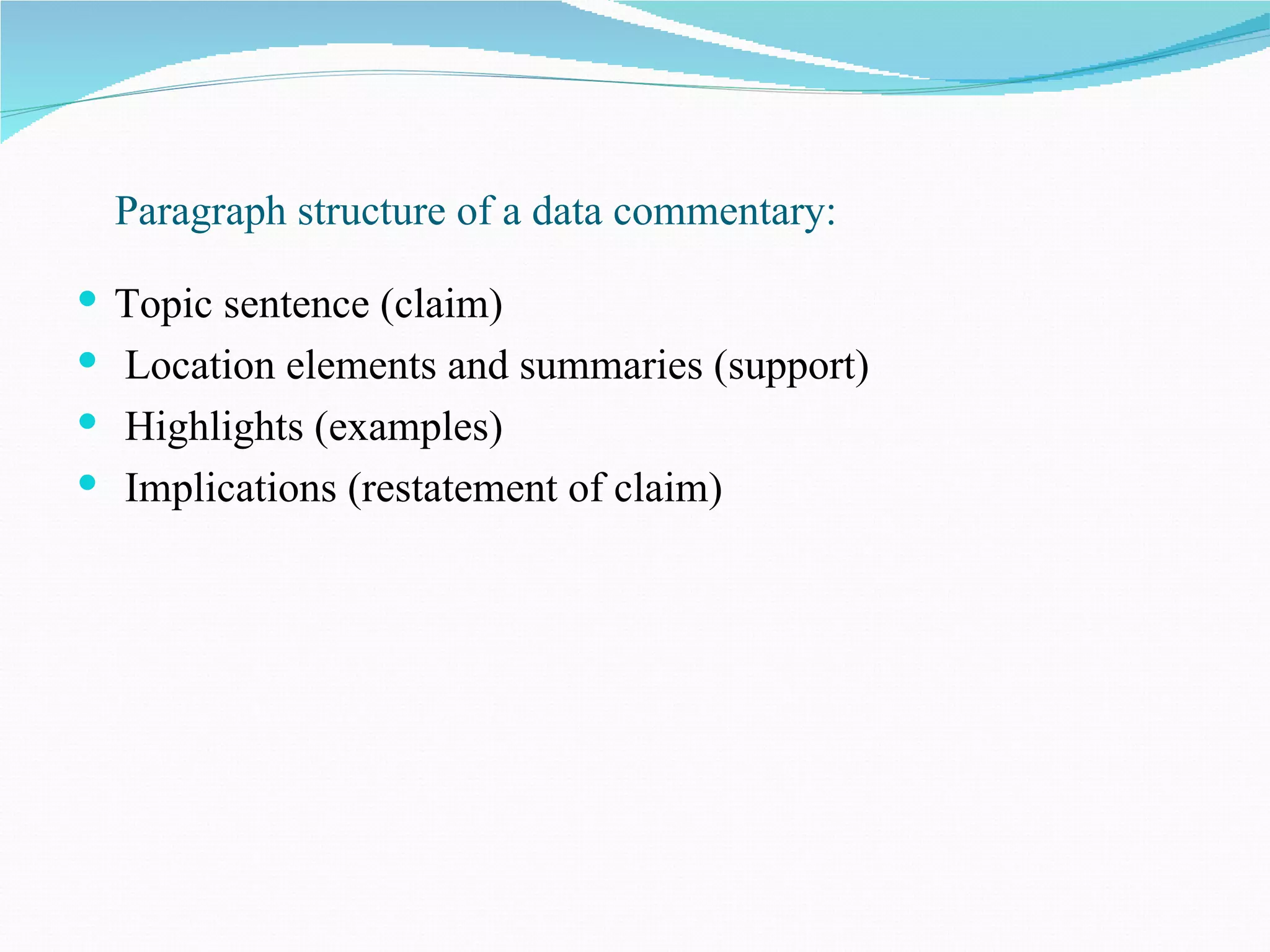
Paragraph structure of a data commentary:

 Topic sentence (claim)
 Location elements and summaries (support)
 Highlights (examples)
 Implications (restatement of claim)
Highlighting Statements
 The central sections of data commentaries consist of
  highlighting statements.
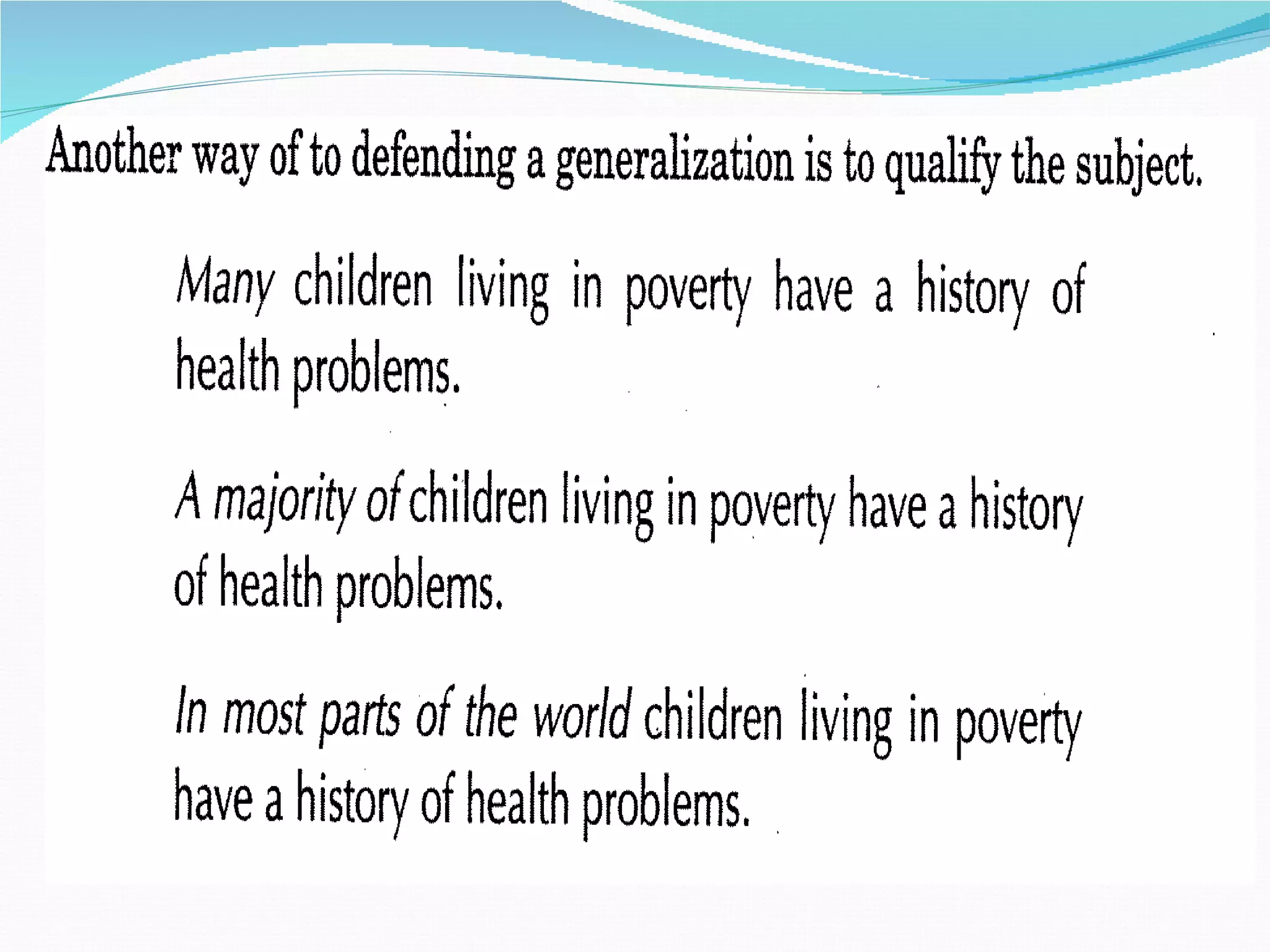
 Highlighting statements are generalizations that you
  can draw from the details of the data display.
 Highlighting statements need good judgment.
 They are an opportunity to show your intelligence..
 In particular, they are an opportunity for you to
 demonstrate
   that you can spot trends or regularities in the data,
   that you can separate more important findings from
    less important ones, and
   that you can make claims of appropriate strength
So, do not

 simply repeat all the details in words,
 attempt to cover all the information, or
 claim more than is reasonable or defensible.
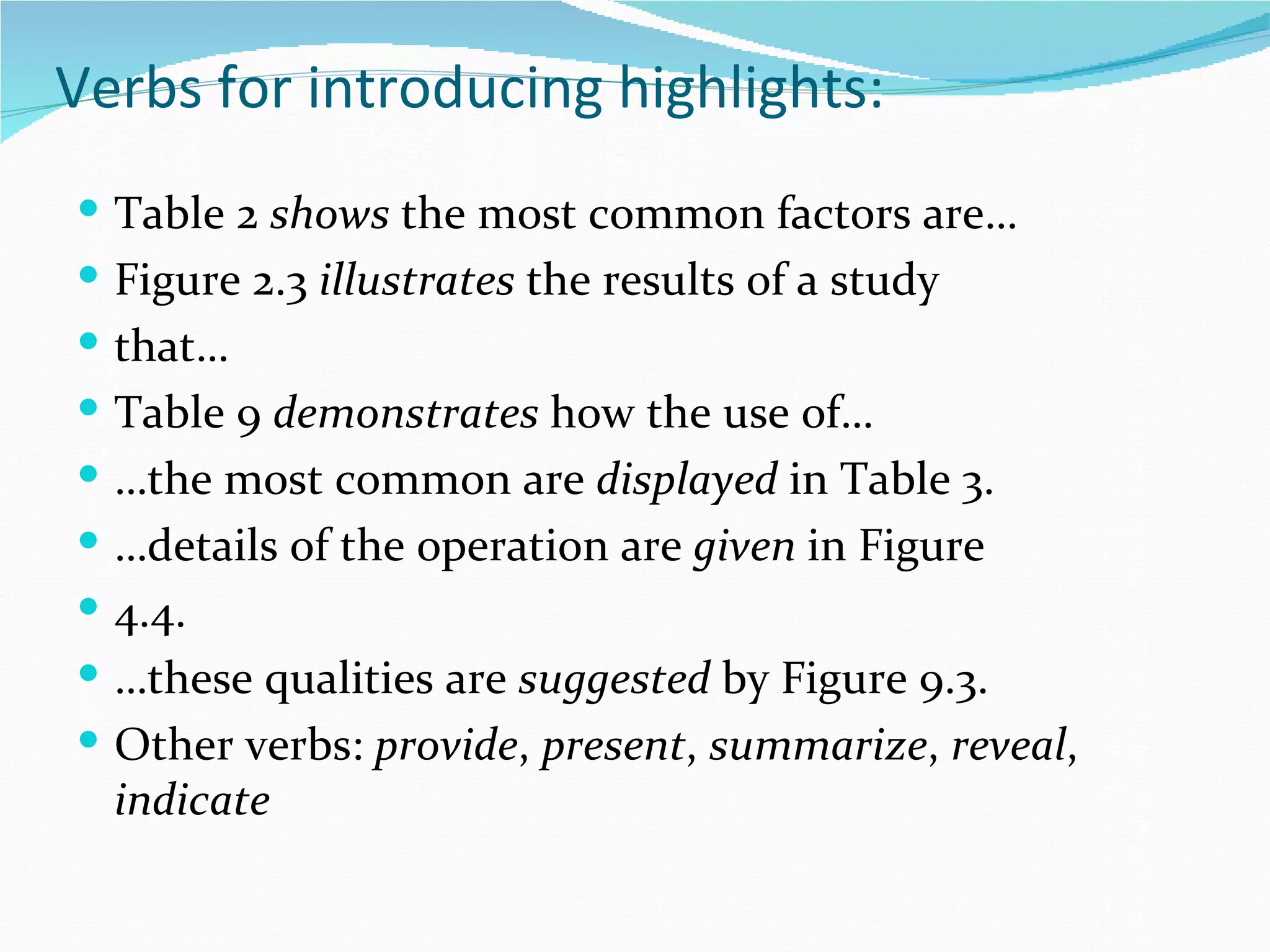
Verbs for introducing highlights:
 Table 2 shows the most common factors are…
 Figure 2.3 illustrates the results of a study
 that…
 Table 9 demonstrates how the use of…
 …the most common are displayed in Table 3.
 …details of the operation are given in Figure
 4.4.
 …these qualities are suggested by Figure 9.3.
 Other verbs: provide, present, summarize, reveal,
  indicate
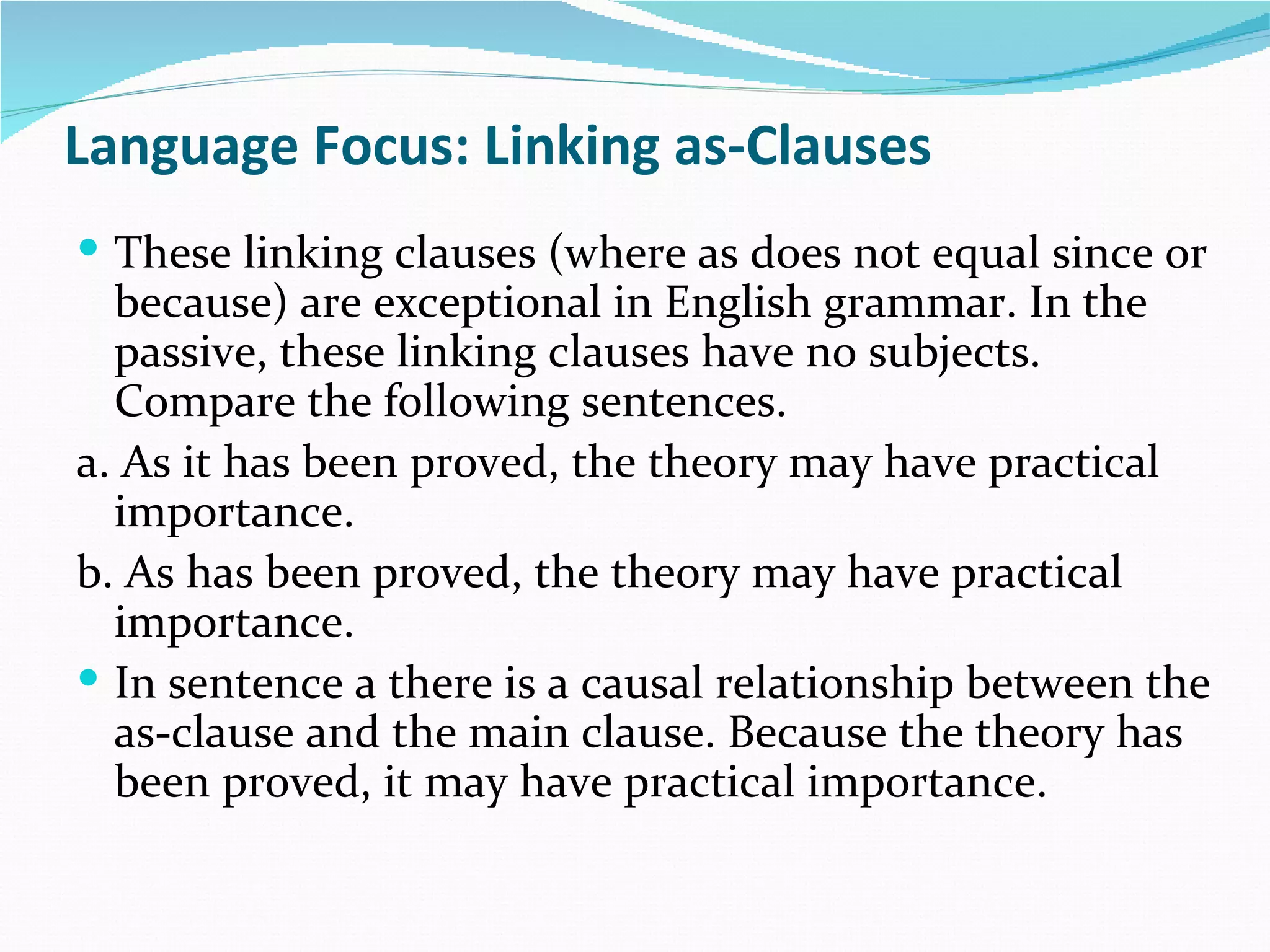
Language Focus: Linking as-Clauses
 These linking clauses (where as does not equal since or
  because) are exceptional in English grammar. In the
  passive, these linking clauses have no subjects.
  Compare the following sentences.
a. As it has been proved, the theory may have practical
  importance.
b. As has been proved, the theory may have practical
  importance.
 In sentence a there is a causal relationship between the
  as-clause and the main clause. Because the theory has
  been proved, it may have practical importance.
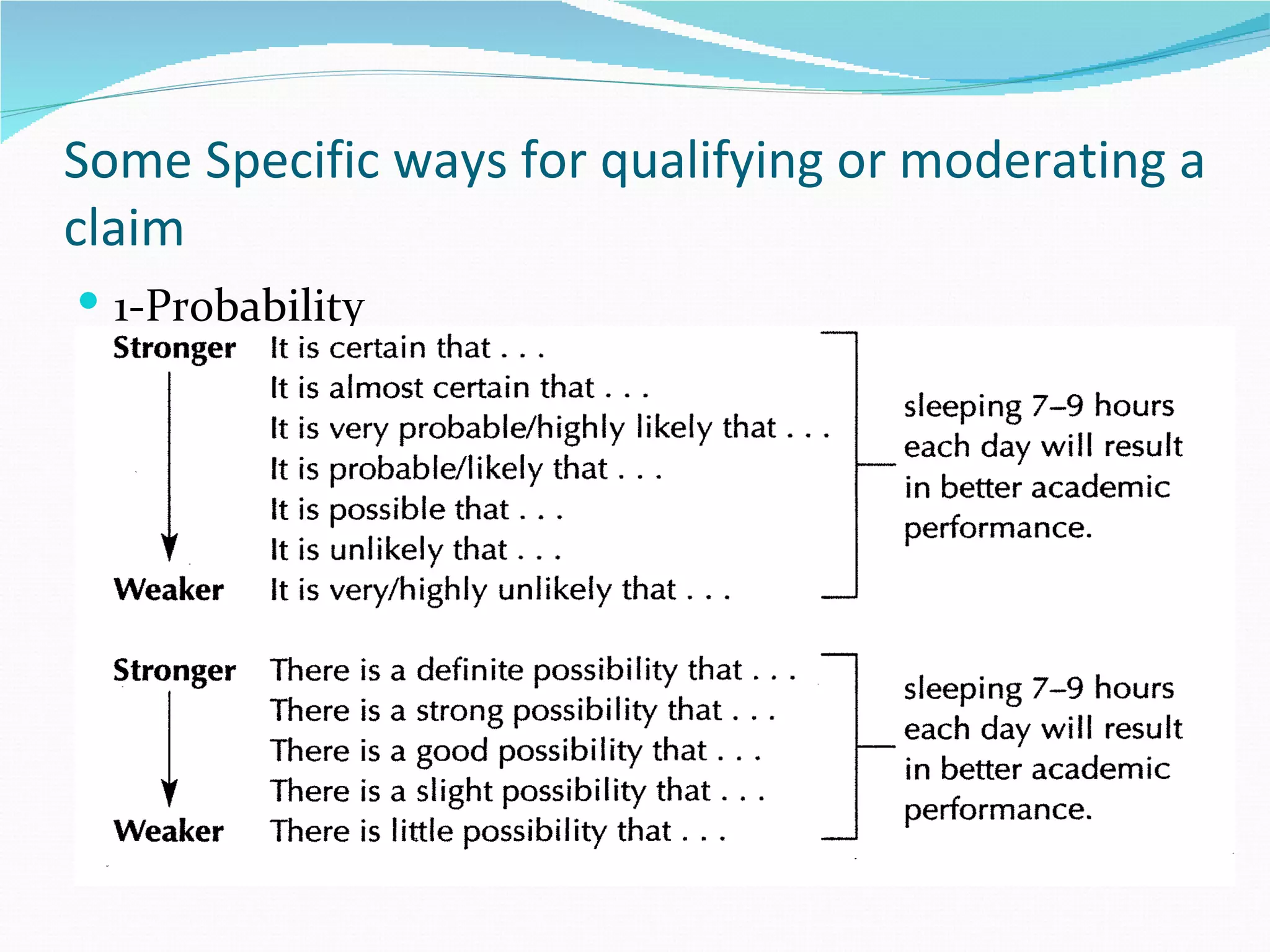
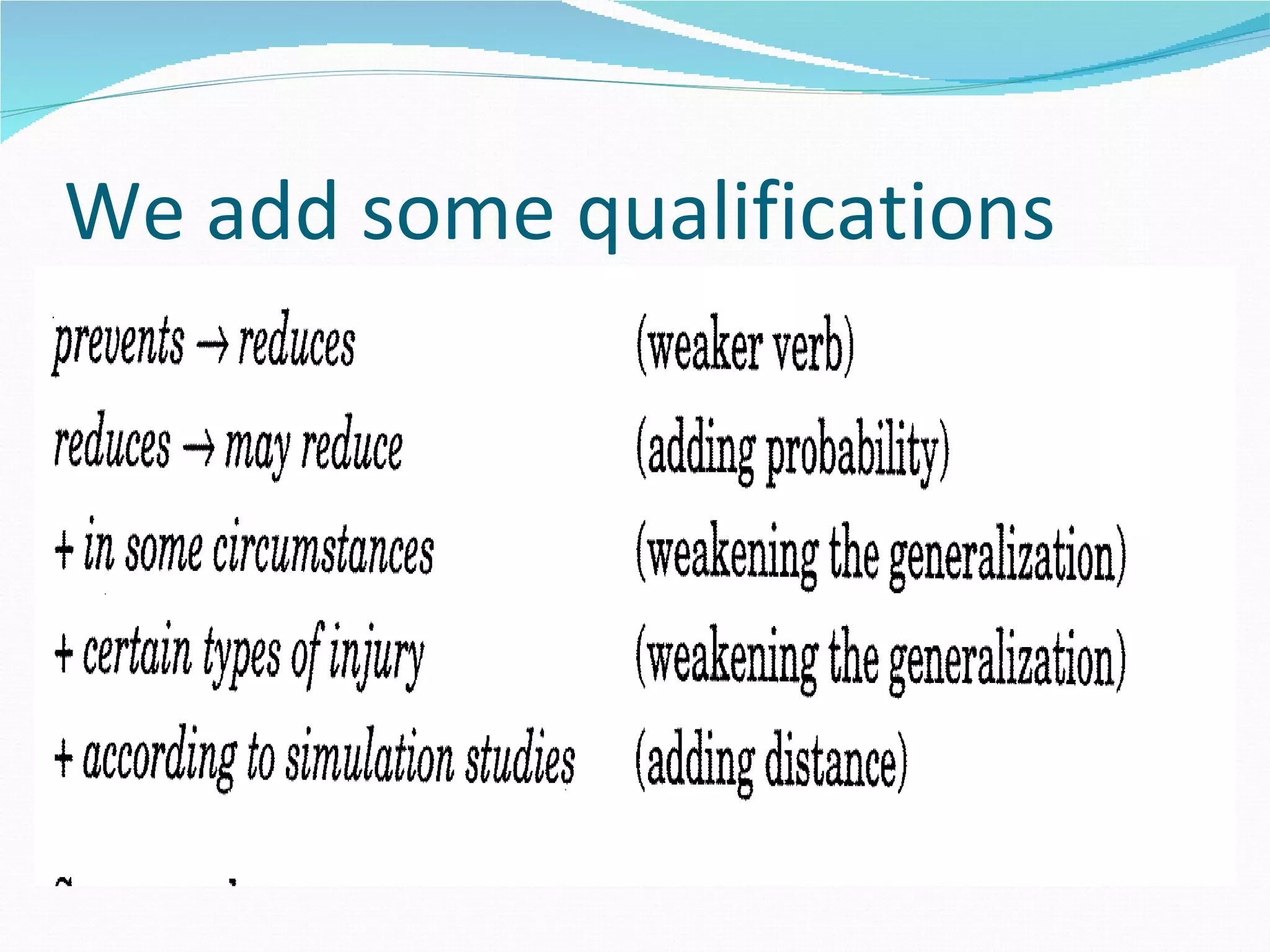
Some Specific ways for qualifying or moderating a
claim
 1-Probability
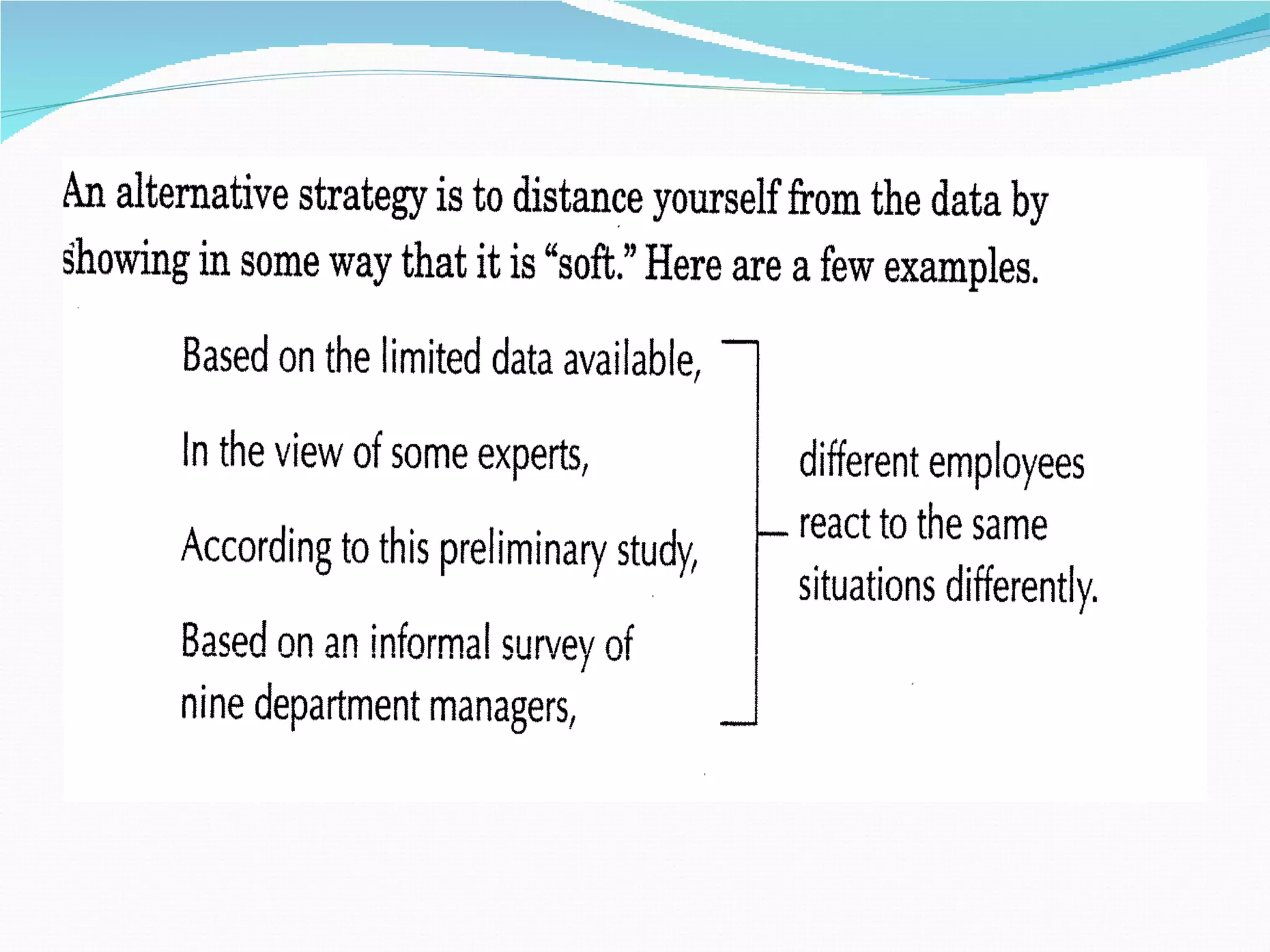
2-Distance
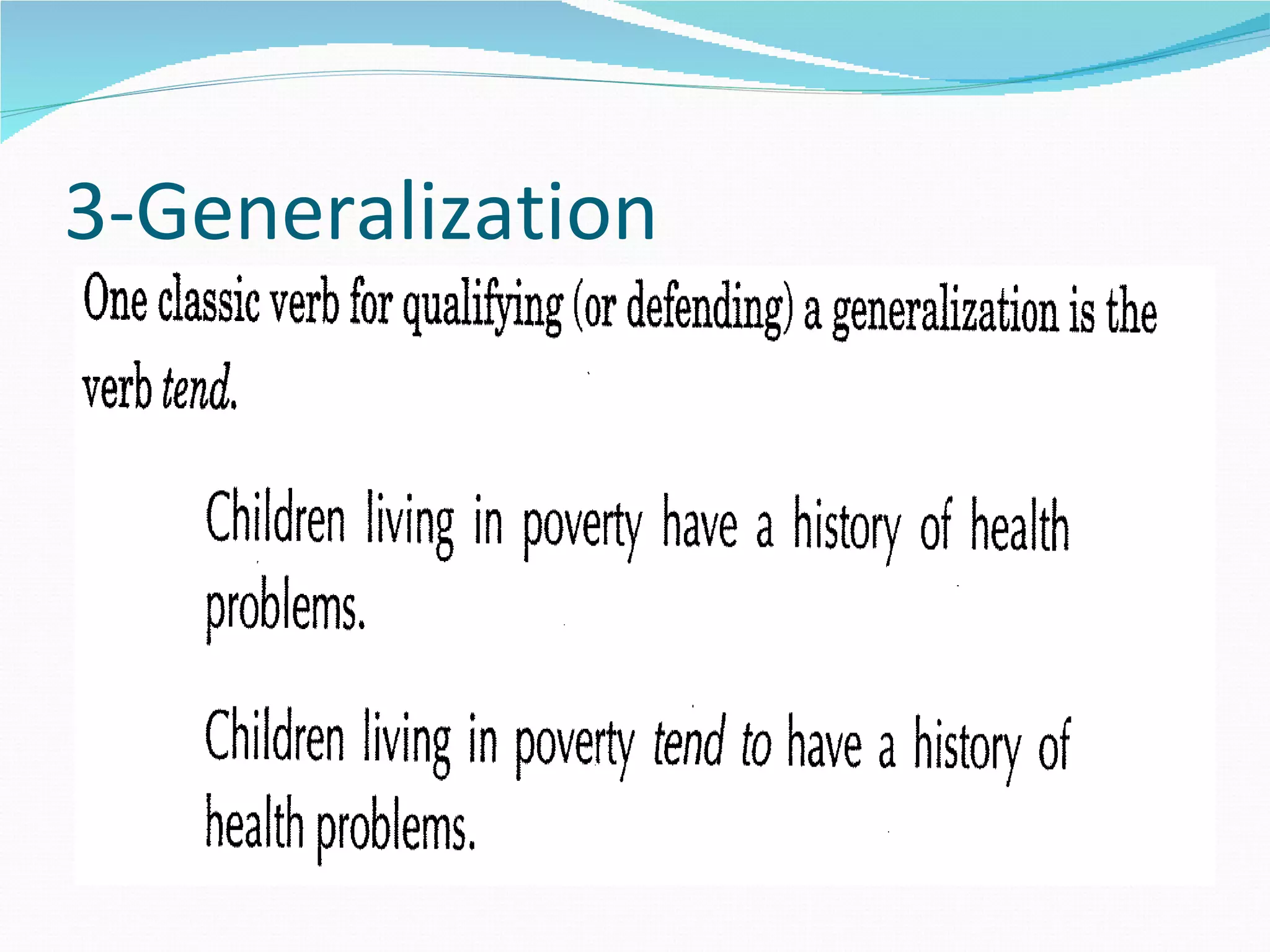
3-Generalization
4-Weaker verbs
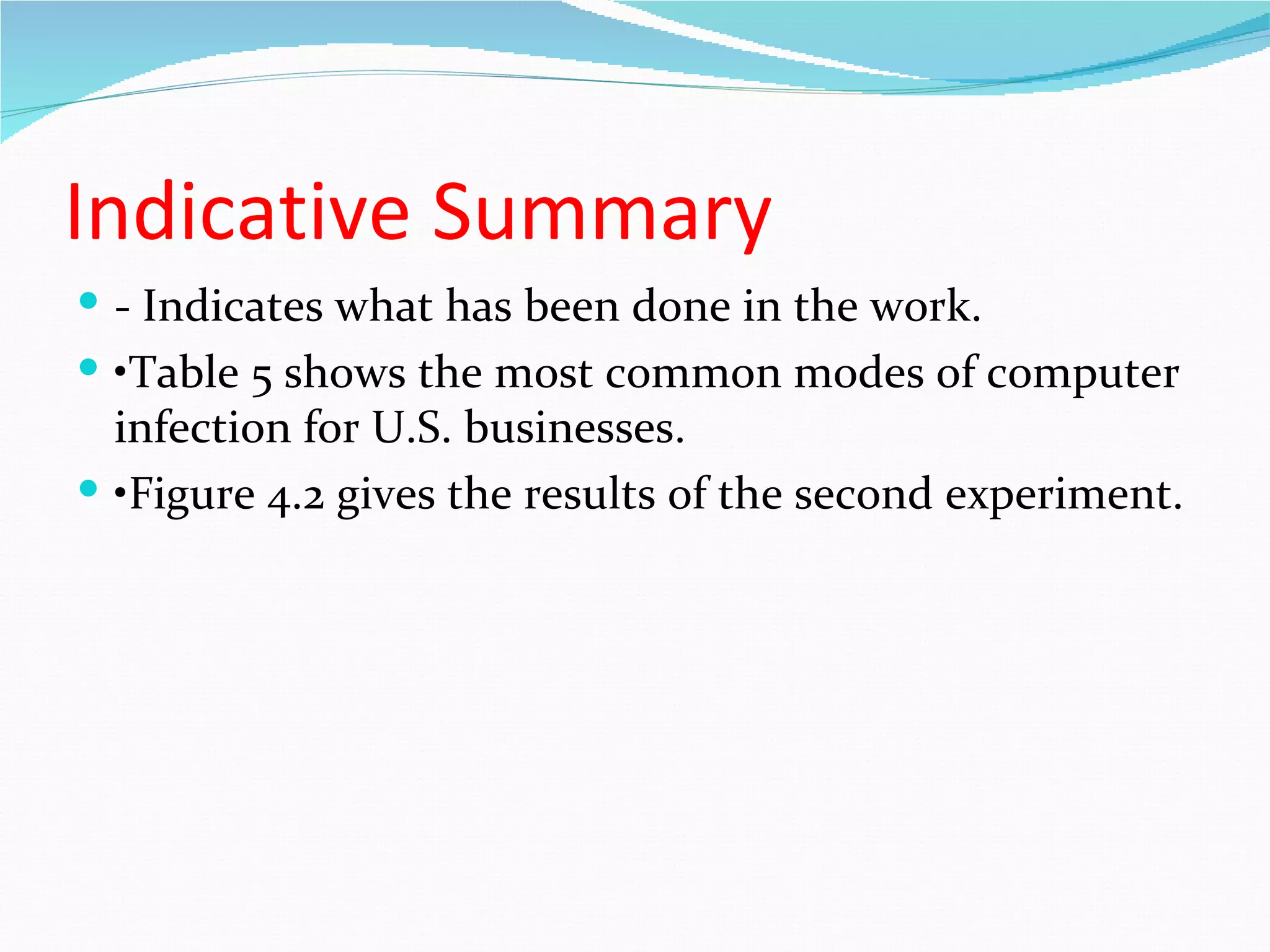
Indicative Summary
 - Indicates what has been done in the work.
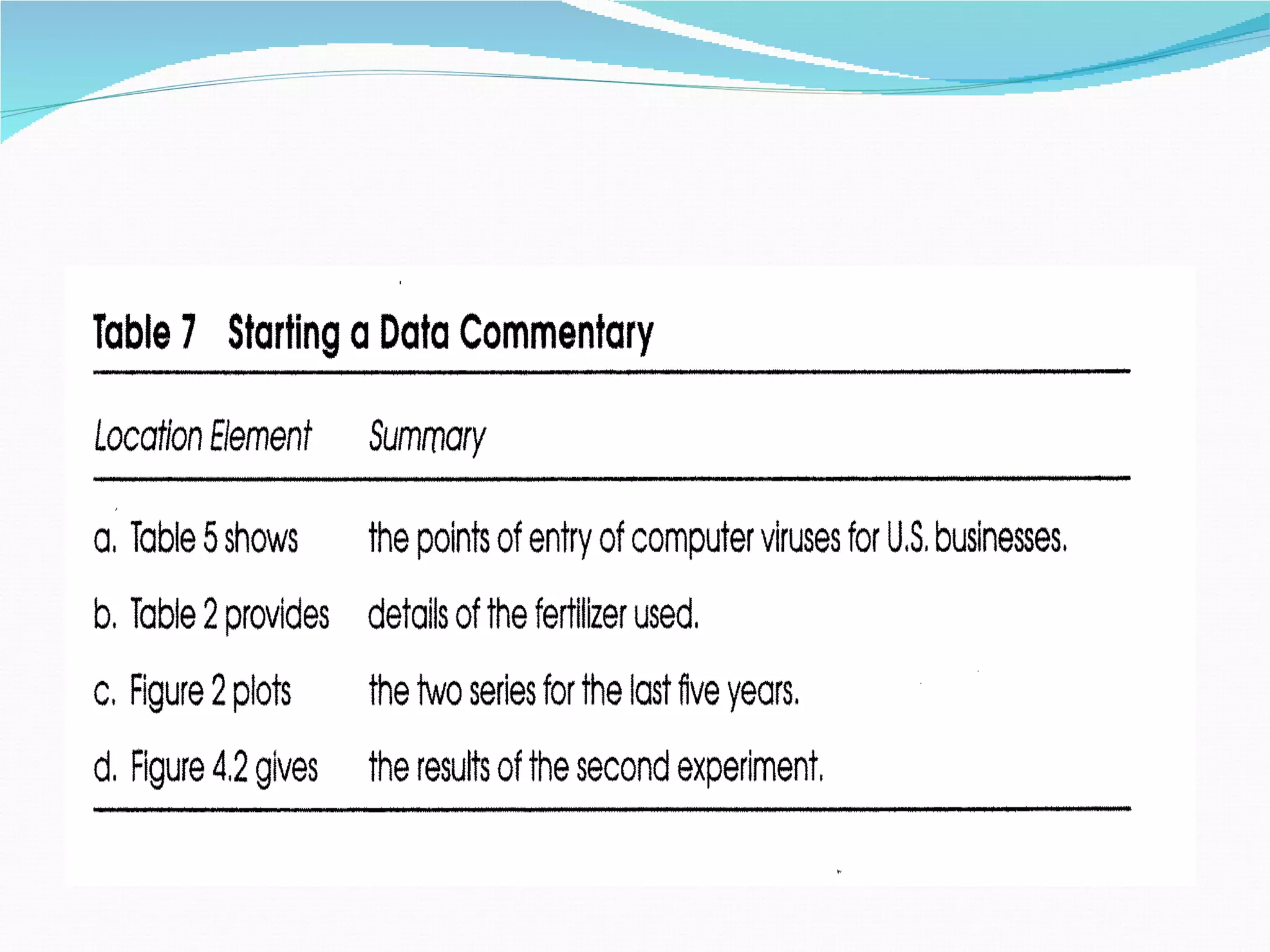
 •Table 5 shows the most common modes of computer
  infection for U.S. businesses.
 •Figure 4.2 gives the results of the second experiment.
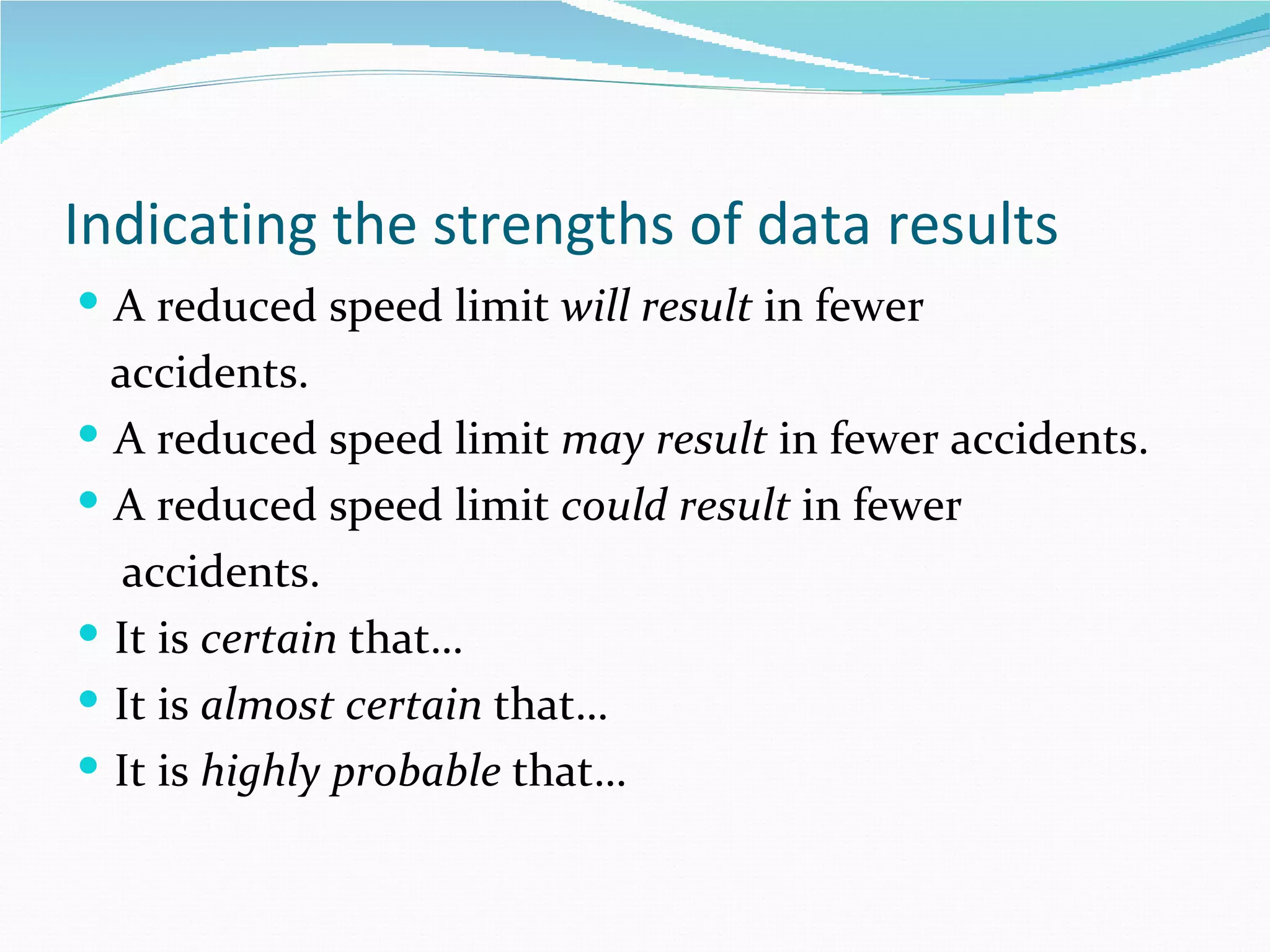
Indicating the strengths of data results
 A reduced speed limit will result in fewer
  accidents.
 A reduced speed limit may result in fewer accidents.
 A reduced speed limit could result in fewer
   accidents.
 It is certain that…
 It is almost certain that…
 It is highly probable that…
 It is possible that…
 It is unlikely that…
 There is a strong possibility that…
 There is a slight possibility that…
 There is a remote possibility that…
Informative Summary
 - Provides a summary of the data.
 •Table 5 shows that home disks are the major source
  of computer viruses.
 •Table 4.2 suggests that the experimental results
  confirm the hypothesis.
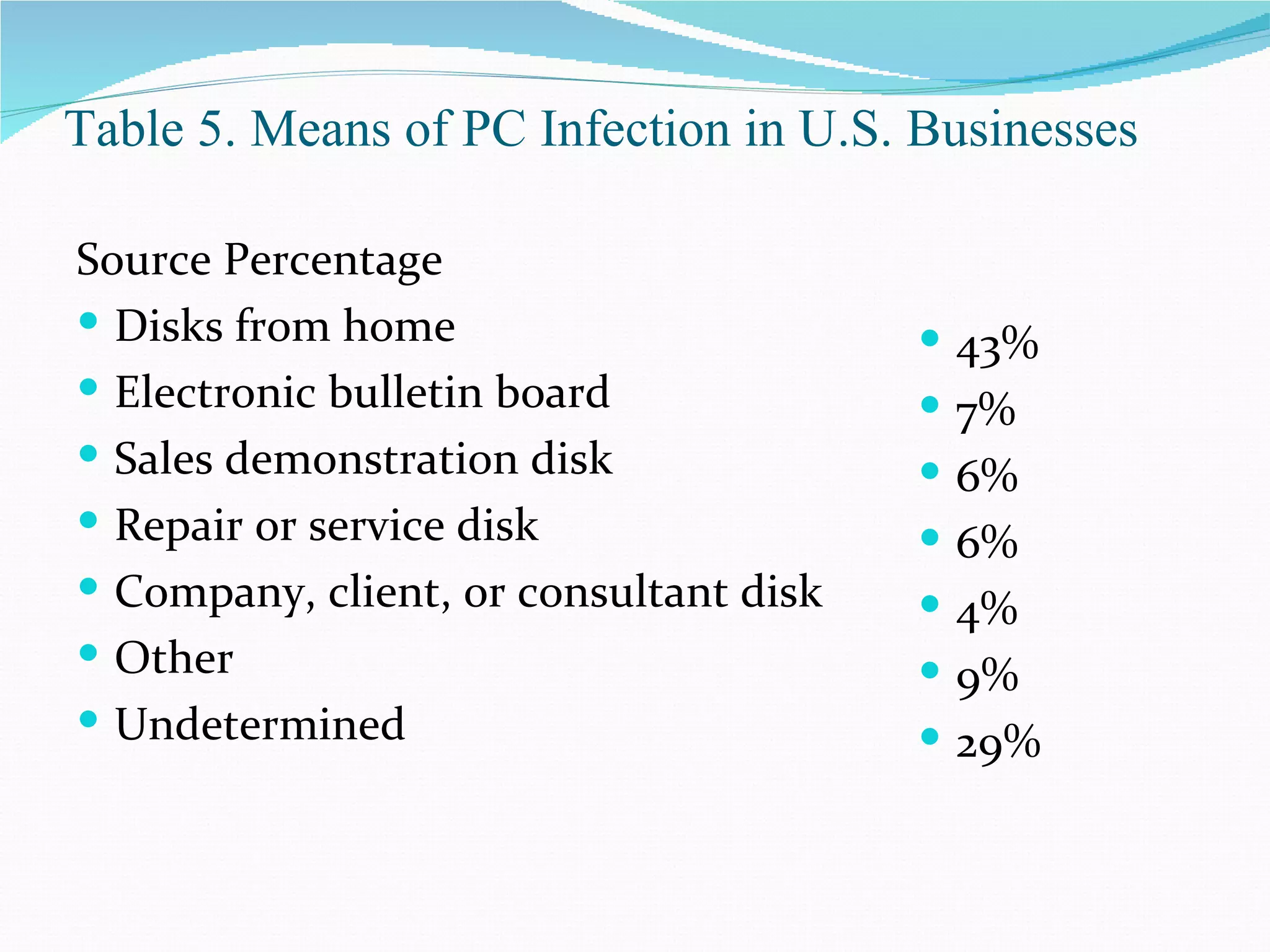
Table 5. Means of PC Infection in U.S. Businesses

Source Percentage
 Disks from home                        43%
 Electronic bulletin board              7%
 Sales demonstration disk               6%
 Repair or service disk                 6%
 Company, client, or consultant disk    4%
 Other                                  9%
 Undetermined                           29%
 1) A computer virus is a program that is specifically and
  maliciously designed to attack a computer system, destroying
  data. 2) As businesses have become increasingly dependent
  on computer systems, concern over the potential
  destructiveness of such viruses has also grown. 3) Table 5
  shows the most common modes of infection for U.S.
  businesses.-location and indicative summary

 4) As can be seen, in the majority of cases, the source of the
  virus infection can be detected, with disks being brought to
  the workplace from home being by far the most significant
  (43%). 5) However, it is alarming to note that the source of
  nearly 30% of viruses cannot be determined.-highlightment
 6) While it may be possible to eliminate home-to-
  workplace infection by requiring computer users to run
  antiviral software on diskettes brought from home,
  businesses are still vulnerable to major data loss,
  especially from unidentifiable sources of infection.
    -implications
Combined qualifications
 A strong claim
We add some qualifications
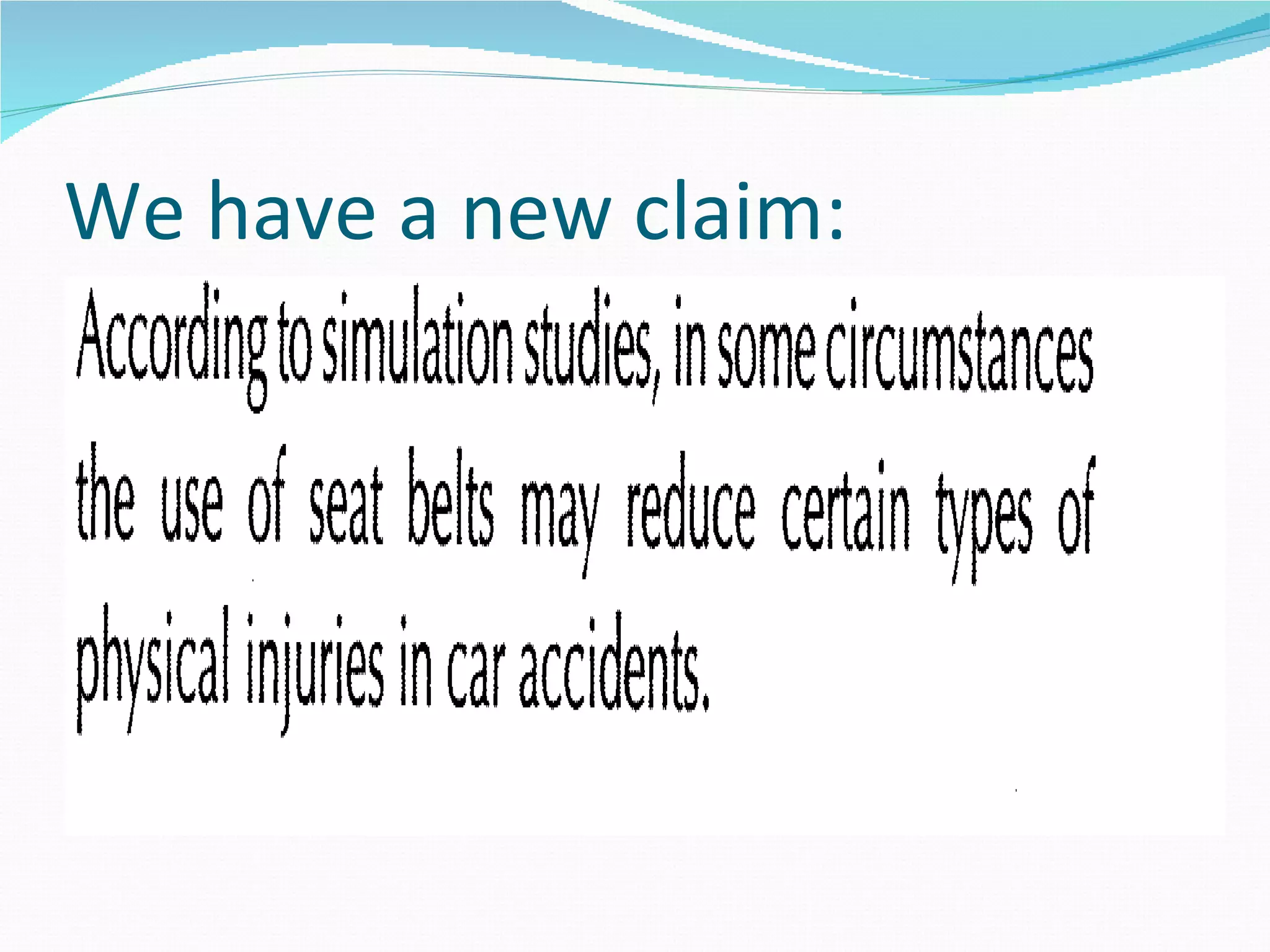
We have a new claim:
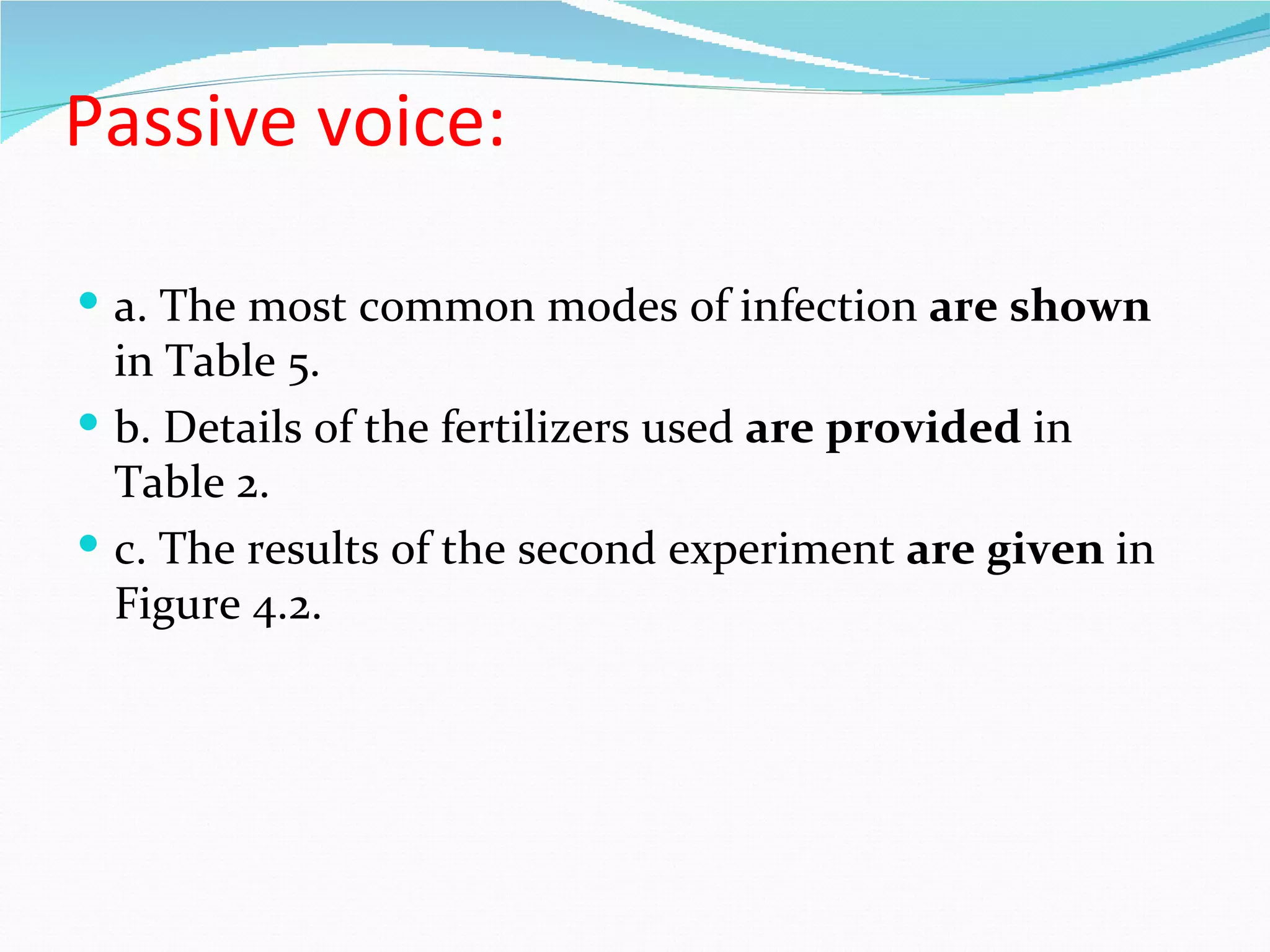
Passive voice:

 a. The most common modes of infection are shown
  in Table 5.
 b. Details of the fertilizers used are provided in
  Table 2.
 c. The results of the second experiment are given in
  Figure 4.2.
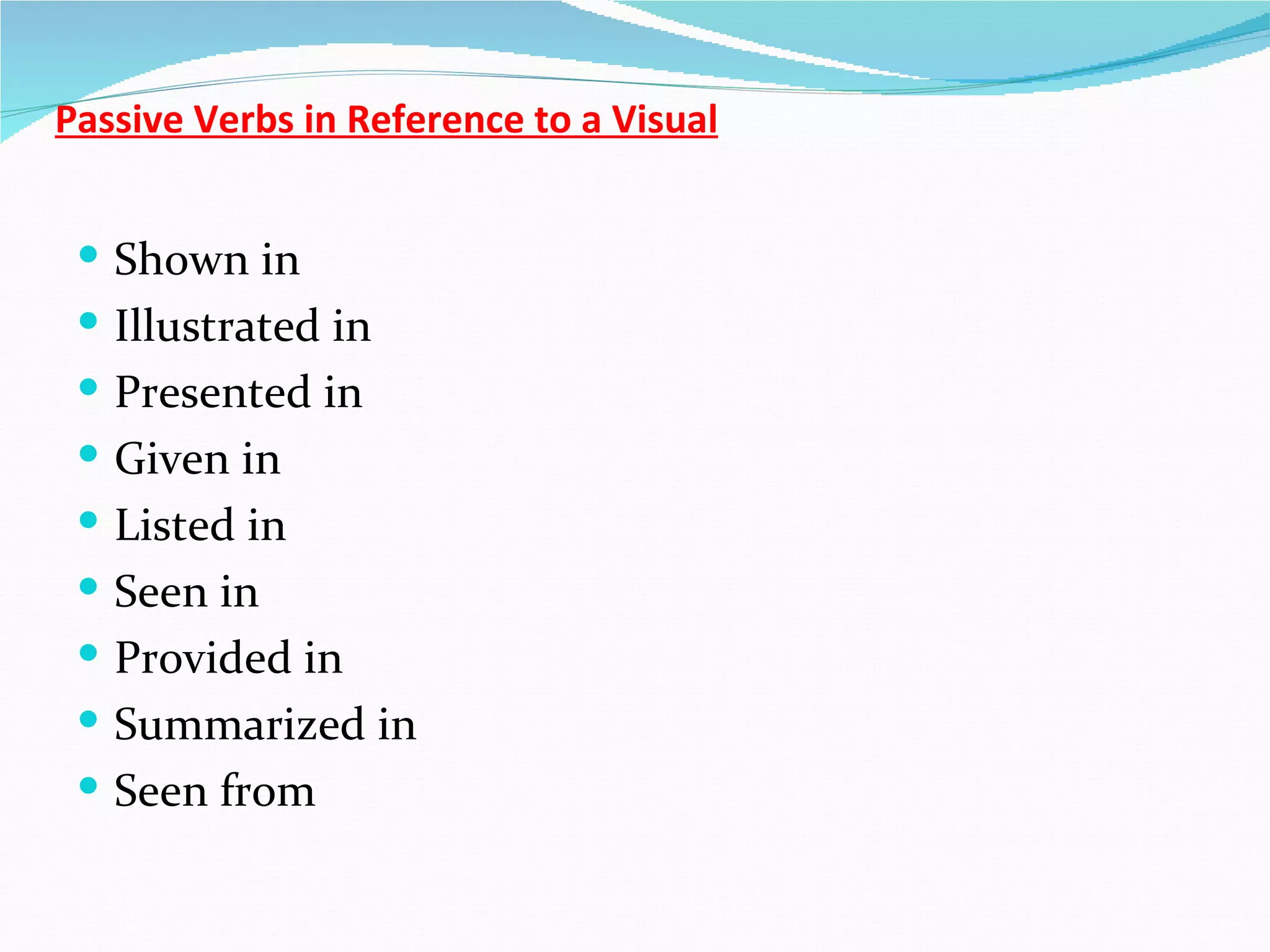
Passive Verbs in Reference to a Visual


  Shown in
  Illustrated in
  Presented in
  Given in
  Listed in
  Seen in
  Provided in
  Summarized in
  Seen from
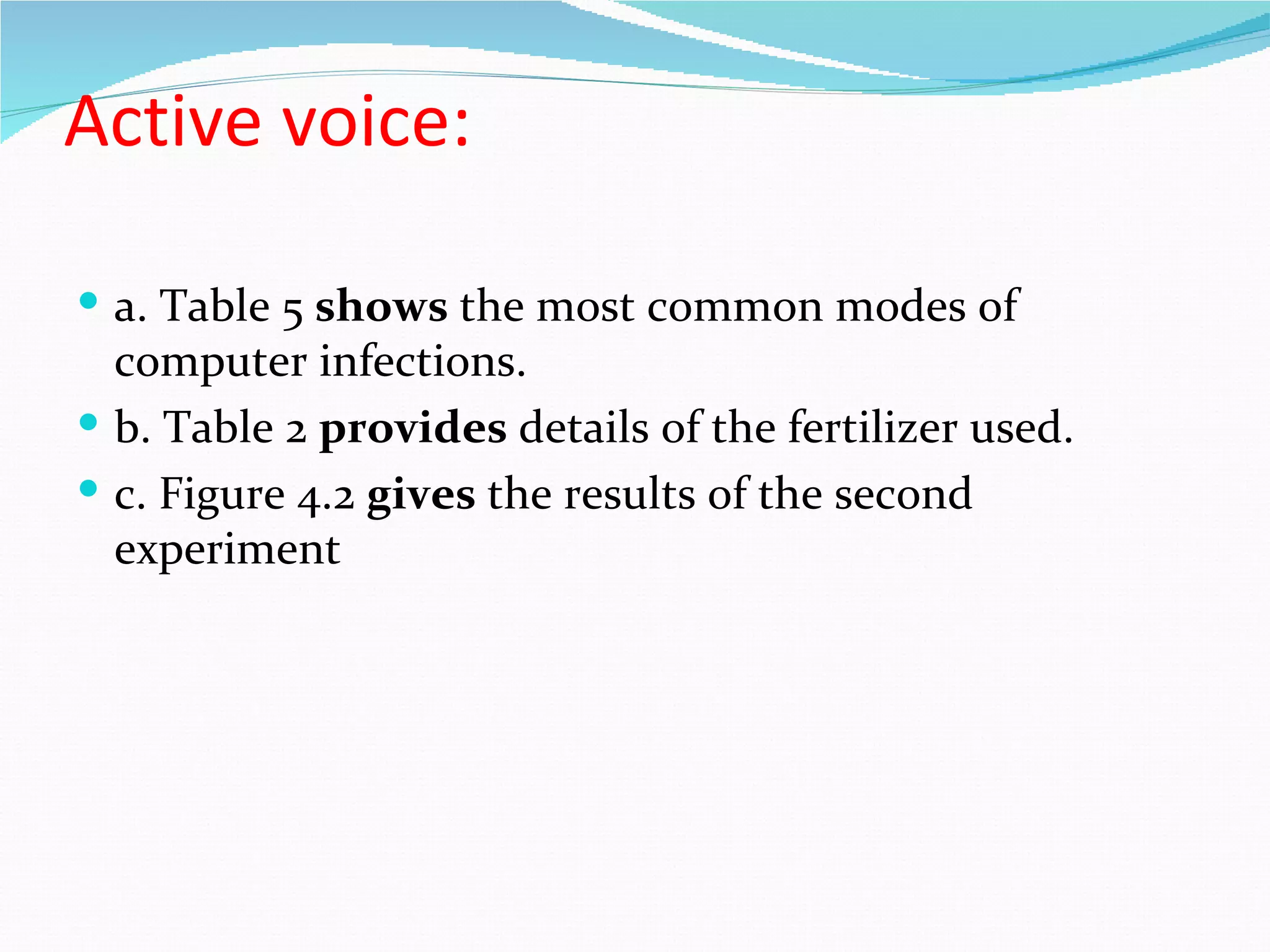
Active voice:

 a. Table 5 shows the most common modes of
  computer infections.
 b. Table 2 provides details of the fertilizer used.
 c. Figure 4.2 gives the results of the second
  experiment
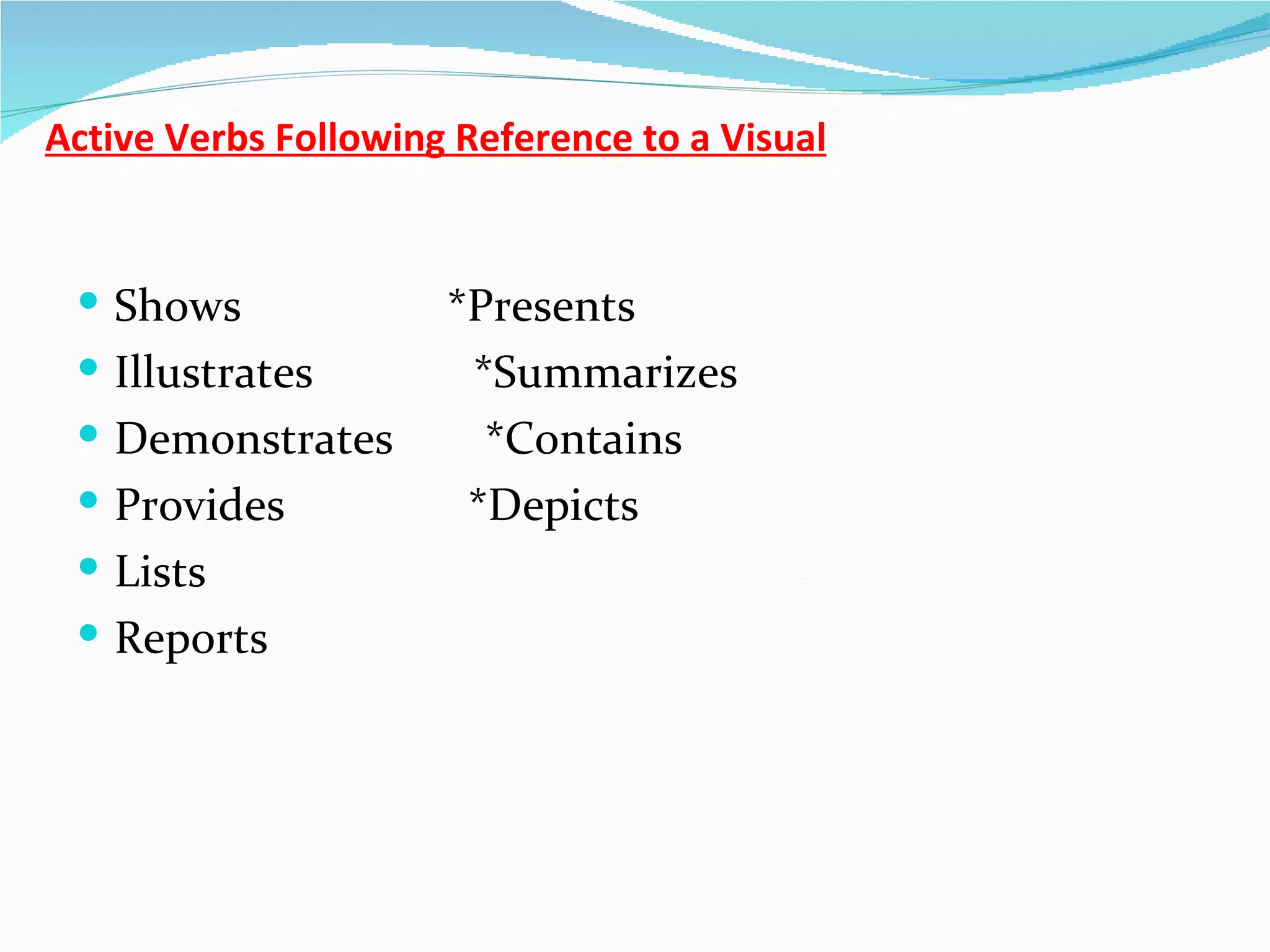
Active Verbs Following Reference to a Visual


  Shows              *Presents
  Illustrates         *Summarizes
  Demonstrates         *Contains
  Provides            *Depicts
  Lists
  Reports
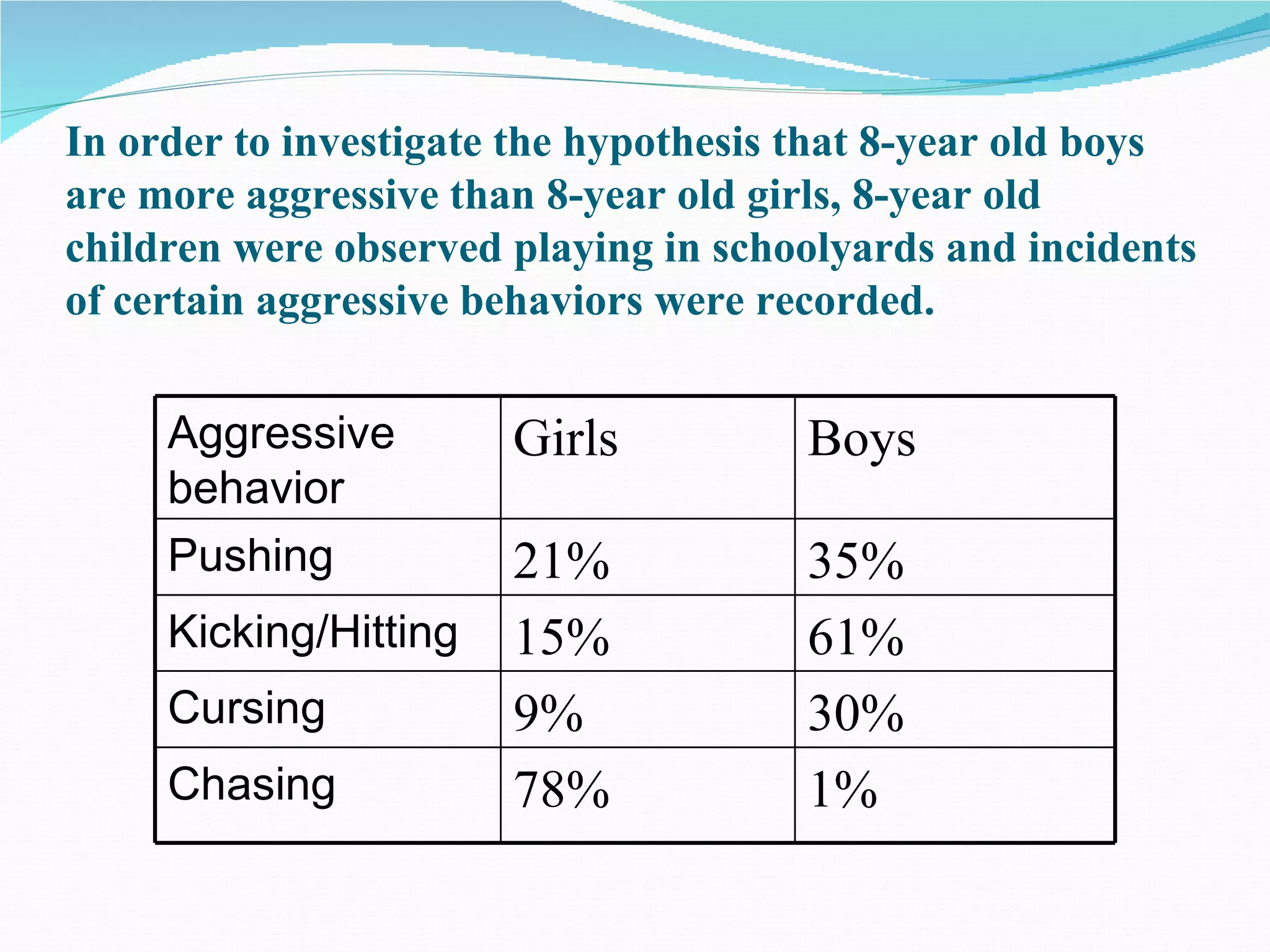
In order to investigate the hypothesis that 8-year old boys
are more aggressive than 8-year old girls, 8-year old
children were observed playing in schoolyards and incidents
of certain aggressive behaviors were recorded.


     Aggressive        Girls          Boys
     behavior
     Pushing           21%            35%
     Kicking/Hitting   15%            61%
     Cursing           9%             30%
     Chasing           78%            1%
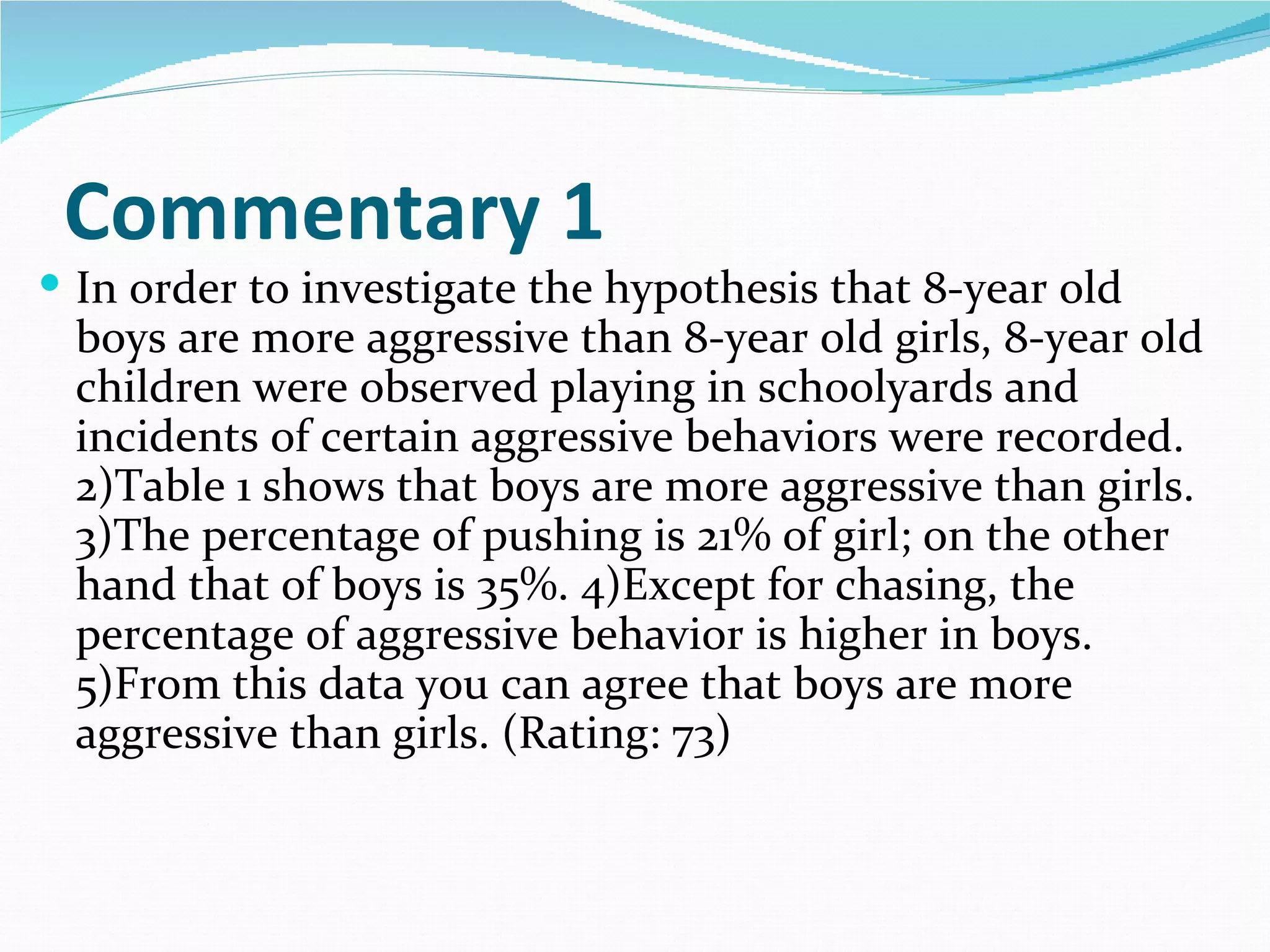
Commentary 1
 In order to investigate the hypothesis that 8-year old
 boys are more aggressive than 8-year old girls, 8-year old
 children were observed playing in schoolyards and
 incidents of certain aggressive behaviors were recorded.
 2)Table 1 shows that boys are more aggressive than girls.
 3)The percentage of pushing is 21% of girl; on the other
 hand that of boys is 35%. 4)Except for chasing, the
 percentage of aggressive behavior is higher in boys.
 5)From this data you can agree that boys are more
 aggressive than girls. (Rating: 73)
Commentary 2
 In order to investigate the hypothesis that 8-year old
 boys are more aggressive than 8-year old girls, 8-year old
 children were observed playing in schoolyards and
 incidents of certain aggressive behaviors were recorded.
 2)As you can see in Table 1, we only considered four
 human aggressive behaviors in our study. 3)The most
 common children aggressive conduct are pushing,
 kicking/hitting, cursing, and chasing. 4)After several
 weeks of observation in different schools playground we
 found the percentage that appeared on table 1. 5) (See
 attachment 1) 6) Sixty percent (61%) of the boys like to
 kick and hit compared to fifteen percent (15%) of the
 girls. 7)This is more aggressive than chasing. 8)The
 chasing behavior was the only one girls were more
 aggressive than boys. (Rating: 77)
Commentary 3
 In order to investigate the hypothesis that 8-year old
 boys are more aggressive than 8-year old girls, 8-year old
 children were observed playing in schoolyards and
 incidents of certain aggressive behaviors were recorded.
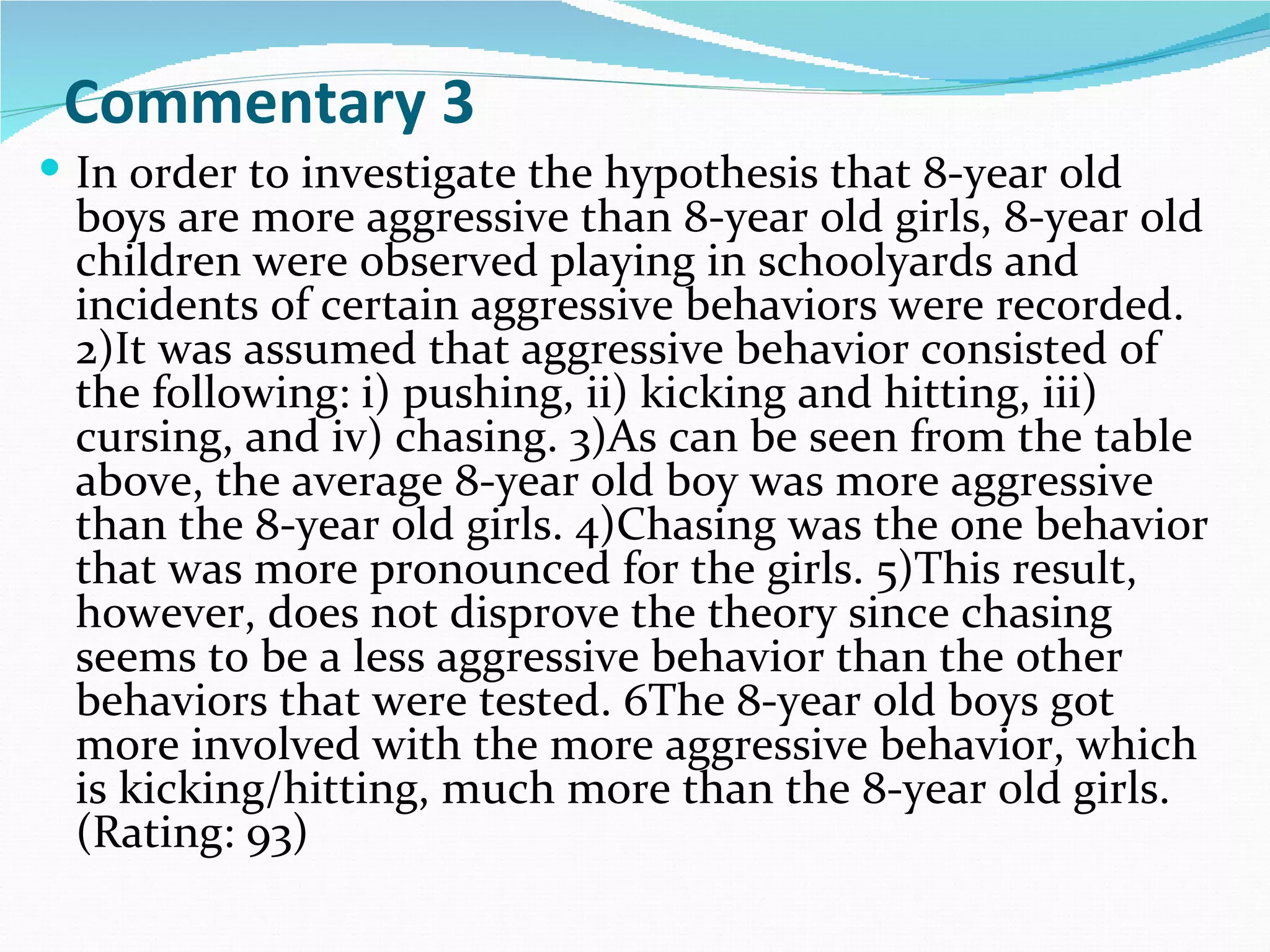
 2)It was assumed that aggressive behavior consisted of
 the following: i) pushing, ii) kicking and hitting, iii)
 cursing, and iv) chasing. 3)As can be seen from the table
 above, the average 8-year old boy was more aggressive
 than the 8-year old girls. 4)Chasing was the one behavior
 that was more pronounced for the girls. 5)This result,
 however, does not disprove the theory since chasing
 seems to be a less aggressive behavior than the other
 behaviors that were tested. 6The 8-year old boys got
 more involved with the more aggressive behavior, which
 is kicking/hitting, much more than the 8-year old girls.
 (Rating: 93)
Commentary 4
 In order to investigate the hypothesis that 8-year old boys are more
  aggressive than 8-year old girls, 8-year old children were observed
  playing in schoolyards and incidents of certain aggressive behaviors
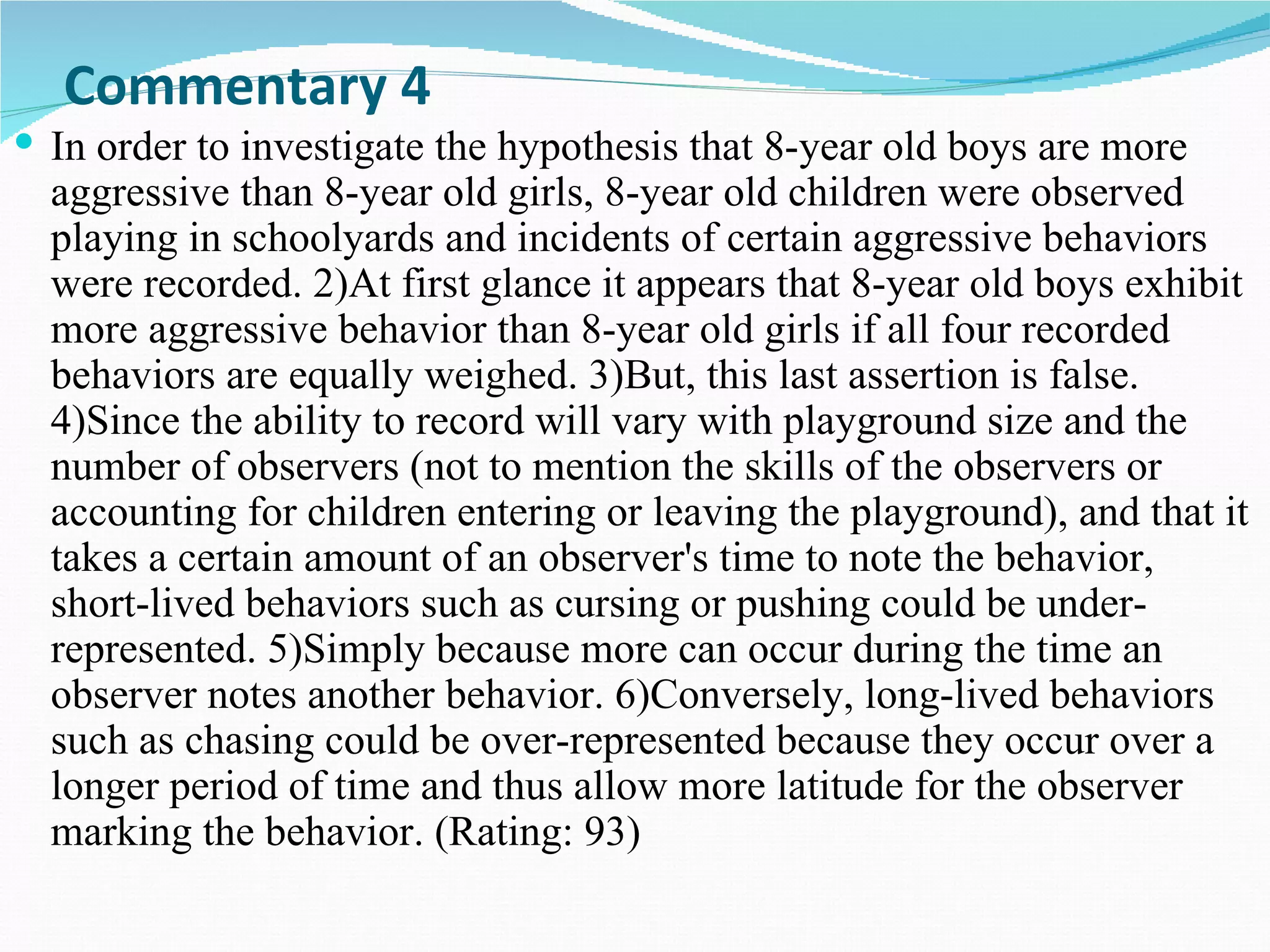
  were recorded. 2)At first glance it appears that 8-year old boys exhibit
  more aggressive behavior than 8-year old girls if all four recorded
  behaviors are equally weighed. 3)But, this last assertion is false.
  4)Since the ability to record will vary with playground size and the
  number of observers (not to mention the skills of the observers or
  accounting for children entering or leaving the playground), and that it
  takes a certain amount of an observer's time to note the behavior,
  short-lived behaviors such as cursing or pushing could be under-
  represented. 5)Simply because more can occur during the time an
  observer notes another behavior. 6)Conversely, long-lived behaviors
  such as chasing could be over-represented because they occur over a
  longer period of time and thus allow more latitude for the observer
  marking the behavior. (Rating: 93)

data commentary

  • 1.
    ELT- 702 AcademicWriting  Data commentary by, Betül GÜLERYÜZ Osman AYDOĞAR 16.03.2012
  • 2.
     While datacommentaries may be "stand-alone" pieces of writing, they generally occur in the Results or Discussion sections of a report or thesis.  The main purposes of a data commentary are to present the results of research, interpret these results, and to discuss the significance and implications of the results.
  • 3.
     Data canoften be best expressed by a chart, graph, table, or other illustration.  The type of writing that accompanies a visual display is called data commentary.
  • 4.
     The datashould be presented and analysed in logical manner; in other words you are expected to analyse and evaluate the data, not just describe it.
  • 5.
    Why use adata commentary?  Highlight results  Assess standard theories, common beliefs, or generals practices in light of the results  Compare and evaluate different data sets  Assess the reliability of data in terms of the methods that produced it
  • 6.
     Discuss implicationsof the data  Calls attention to something not directly apparent  from the table, chart, or graph.  Analyzes data for a reason: to support a claim which  in turn helps achieve the main goal of the paper.
  • 7.
    Structure of DataCommentary  Data commentaries usually have the following elements in the following order. 1. Location elements and/or summary statements 2. Highlighting statements 3. Discussions of implications, problems, exceptions, recommendations, etc.
  • 8.
    Paragraph structure ofa data commentary:  Topic sentence (claim)  Location elements and summaries (support)  Highlights (examples)  Implications (restatement of claim)
  • 10.
    Highlighting Statements  Thecentral sections of data commentaries consist of highlighting statements.  Highlighting statements are generalizations that you can draw from the details of the data display.  Highlighting statements need good judgment.  They are an opportunity to show your intelligence..
  • 11.
     In particular,they are an opportunity for you to demonstrate  that you can spot trends or regularities in the data,  that you can separate more important findings from less important ones, and  that you can make claims of appropriate strength
  • 12.
    So, do not simply repeat all the details in words,  attempt to cover all the information, or  claim more than is reasonable or defensible.
  • 13.
    Verbs for introducinghighlights:  Table 2 shows the most common factors are…  Figure 2.3 illustrates the results of a study  that…  Table 9 demonstrates how the use of…  …the most common are displayed in Table 3.  …details of the operation are given in Figure  4.4.  …these qualities are suggested by Figure 9.3.  Other verbs: provide, present, summarize, reveal, indicate
  • 14.
    Language Focus: Linkingas-Clauses  These linking clauses (where as does not equal since or because) are exceptional in English grammar. In the passive, these linking clauses have no subjects. Compare the following sentences. a. As it has been proved, the theory may have practical importance. b. As has been proved, the theory may have practical importance.  In sentence a there is a causal relationship between the as-clause and the main clause. Because the theory has been proved, it may have practical importance.
  • 16.
    Some Specific waysfor qualifying or moderating a claim  1-Probability
  • 17.
  • 19.
  • 22.
  • 23.
    Indicative Summary  -Indicates what has been done in the work.  •Table 5 shows the most common modes of computer infection for U.S. businesses.  •Figure 4.2 gives the results of the second experiment.
  • 24.
    Indicating the strengthsof data results  A reduced speed limit will result in fewer accidents.  A reduced speed limit may result in fewer accidents.  A reduced speed limit could result in fewer accidents.  It is certain that…  It is almost certain that…  It is highly probable that…
  • 25.
     It ispossible that…  It is unlikely that…  There is a strong possibility that…  There is a slight possibility that…  There is a remote possibility that…
  • 26.
    Informative Summary  -Provides a summary of the data.  •Table 5 shows that home disks are the major source of computer viruses.  •Table 4.2 suggests that the experimental results confirm the hypothesis.
  • 27.
    Table 5. Meansof PC Infection in U.S. Businesses Source Percentage  Disks from home  43%  Electronic bulletin board  7%  Sales demonstration disk  6%  Repair or service disk  6%  Company, client, or consultant disk  4%  Other  9%  Undetermined  29%
  • 28.
     1) Acomputer virus is a program that is specifically and maliciously designed to attack a computer system, destroying data. 2) As businesses have become increasingly dependent on computer systems, concern over the potential destructiveness of such viruses has also grown. 3) Table 5 shows the most common modes of infection for U.S. businesses.-location and indicative summary  4) As can be seen, in the majority of cases, the source of the virus infection can be detected, with disks being brought to the workplace from home being by far the most significant (43%). 5) However, it is alarming to note that the source of nearly 30% of viruses cannot be determined.-highlightment
  • 29.
     6) Whileit may be possible to eliminate home-to- workplace infection by requiring computer users to run antiviral software on diskettes brought from home, businesses are still vulnerable to major data loss, especially from unidentifiable sources of infection. -implications
  • 30.
  • 31.
    We add somequalifications
  • 32.
    We have anew claim:
  • 33.
    Passive voice:  a.The most common modes of infection are shown in Table 5.  b. Details of the fertilizers used are provided in Table 2.  c. The results of the second experiment are given in Figure 4.2.
  • 34.
    Passive Verbs inReference to a Visual  Shown in  Illustrated in  Presented in  Given in  Listed in  Seen in  Provided in  Summarized in  Seen from
  • 35.
    Active voice:  a.Table 5 shows the most common modes of computer infections.  b. Table 2 provides details of the fertilizer used.  c. Figure 4.2 gives the results of the second experiment
  • 36.
    Active Verbs FollowingReference to a Visual  Shows *Presents  Illustrates *Summarizes  Demonstrates *Contains  Provides *Depicts  Lists  Reports
  • 37.
    In order toinvestigate the hypothesis that 8-year old boys are more aggressive than 8-year old girls, 8-year old children were observed playing in schoolyards and incidents of certain aggressive behaviors were recorded. Aggressive Girls Boys behavior Pushing 21% 35% Kicking/Hitting 15% 61% Cursing 9% 30% Chasing 78% 1%
  • 38.
    Commentary 1  Inorder to investigate the hypothesis that 8-year old boys are more aggressive than 8-year old girls, 8-year old children were observed playing in schoolyards and incidents of certain aggressive behaviors were recorded. 2)Table 1 shows that boys are more aggressive than girls. 3)The percentage of pushing is 21% of girl; on the other hand that of boys is 35%. 4)Except for chasing, the percentage of aggressive behavior is higher in boys. 5)From this data you can agree that boys are more aggressive than girls. (Rating: 73)
  • 39.
    Commentary 2  Inorder to investigate the hypothesis that 8-year old boys are more aggressive than 8-year old girls, 8-year old children were observed playing in schoolyards and incidents of certain aggressive behaviors were recorded. 2)As you can see in Table 1, we only considered four human aggressive behaviors in our study. 3)The most common children aggressive conduct are pushing, kicking/hitting, cursing, and chasing. 4)After several weeks of observation in different schools playground we found the percentage that appeared on table 1. 5) (See attachment 1) 6) Sixty percent (61%) of the boys like to kick and hit compared to fifteen percent (15%) of the girls. 7)This is more aggressive than chasing. 8)The chasing behavior was the only one girls were more aggressive than boys. (Rating: 77)
  • 40.
    Commentary 3  Inorder to investigate the hypothesis that 8-year old boys are more aggressive than 8-year old girls, 8-year old children were observed playing in schoolyards and incidents of certain aggressive behaviors were recorded. 2)It was assumed that aggressive behavior consisted of the following: i) pushing, ii) kicking and hitting, iii) cursing, and iv) chasing. 3)As can be seen from the table above, the average 8-year old boy was more aggressive than the 8-year old girls. 4)Chasing was the one behavior that was more pronounced for the girls. 5)This result, however, does not disprove the theory since chasing seems to be a less aggressive behavior than the other behaviors that were tested. 6The 8-year old boys got more involved with the more aggressive behavior, which is kicking/hitting, much more than the 8-year old girls. (Rating: 93)
  • 41.
    Commentary 4  Inorder to investigate the hypothesis that 8-year old boys are more aggressive than 8-year old girls, 8-year old children were observed playing in schoolyards and incidents of certain aggressive behaviors were recorded. 2)At first glance it appears that 8-year old boys exhibit more aggressive behavior than 8-year old girls if all four recorded behaviors are equally weighed. 3)But, this last assertion is false. 4)Since the ability to record will vary with playground size and the number of observers (not to mention the skills of the observers or accounting for children entering or leaving the playground), and that it takes a certain amount of an observer's time to note the behavior, short-lived behaviors such as cursing or pushing could be under- represented. 5)Simply because more can occur during the time an observer notes another behavior. 6)Conversely, long-lived behaviors such as chasing could be over-represented because they occur over a longer period of time and thus allow more latitude for the observer marking the behavior. (Rating: 93)