Aggression can take many forms from physical violence to verbal insults. While some argue aggression is innate, driven by evolution and hormones, others believe it is learned through experiences like punishment and imitation of models. Gender, culture, media exposure, and substances like alcohol can influence aggressive behaviors. Effectively addressing the root causes of frustration and negative affect while promoting non-violent conflict resolution may help reduce aggression.
In this document
Powered by AI
Overview of aggression and its definitions, with examples including murder, assault, and cultural variations.
Definitions of key terms: violence, anger, hostility, instrumental and emotional aggression.
Aggression levels in various cultures with data on murder rates and youth involvement in crime.
Discussion on how men are generally more aggressive than women, with notes on types of aggression.
Exploration of whether aggression is biological or learned, referencing Freud and Lorenz's theories.
Aggression's role in survival and reproductive strategies, highlighting differences in male and female behaviors.
Relationship between testosterone and aggression, and the mitigating role of serotonin.
How children learn aggressive behaviors, referencing Bandura's BOBO experiment showing imitation.
How boys and girls are socialized differently regarding aggression, reinforcing traditional gender roles.
Recognition of multiple factors influencing aggression, emphasizing environmental and biological aspects.
Frustration as a cause of aggression, introducing the concept of catharsis and its ineffectiveness.
Various stimuli that can increase aggression, with a focus on temperature and emotional responses.
The impact of arousal intensity on aggression, particularly in response to negative emotions.
How thoughts and perceptions influence aggressive behavior, especially in high-stress situations.
Discussion of sanctioned vs. unsanctioned violence in sports, with an example from NHL incidents.
The correlation between exposure to violence in media and real-world aggression, plus desensitization effects.
Exploration of the relationship between violent pornography and aggressive behavior, particularly in predisposed individuals.
Discussion on date rape, alcohol's role in aggression among university students, and gender dynamics.
Several causes of partner aggression, gender dynamics, and research findings regarding abuse statistics.
Overview of child abuse rates in Canada, dynamics between mothers and fathers, and the cycle of family violence.
Proposed solutions for reducing aggression, including stress management and educational workshops.
WHAT IS AGGRESSION?Textbookdefines it as ‘behaviour that is intended to harm another individual’HOWEVER, there are numerous examples of behaviours that exhibit aggression: murdering for money, verbally and physically assaulting someone, accidentally injuring someone, working persistently to sell a product, and many, many moreAlmost every definition that psychologists have tried to come up with for ‘aggression’ can contradict a perfect example of something that is aggressive
3.
Warning: This isvery intense..http://www.youtube.com/watch?v=YersIyzsOpc
4.
Important words toknow...Violence – extreme acts of aggressionAnger – strong feelings of displeasure in response to a perceived injuryHostility – a negative, antagonistic attitude toward another person or groupInstrumental Aggression – inflicting harm, in order to obtain something of value (i.e. hiring a hit man)Emotional Aggression – inflicting harm for its own sake (i.e. a fight at a hockey game)
5.
Is There CulturalVariation in Aggression?Aggression varies greatly across cultures A study done in 2002 show that the countries with the most murders were the Russian Federation, Puerto Rico, Mexico, and Ukraine. The United States were very high on the list, while Canada was quite lowSubcultures exist within countries, and these subcultures are often aggressive towards each other based on attributes like age, race, gender, religion, social status, wealth etc.Teenagers aged 14-24 were found to be involved in the most crime, and Aboriginal peoples had the highest percent of race involved in crime
6.
Does Gender PlayA Role in Aggression?Universally, men are more violent than womenFemales feel the same amount of anger as males, however they are much less likely to act upon that angerImportant to note that most of these gender-related studies have been done only on PHYSICAL aggressionBoys are OVERTLY aggressive, while girls are indirectly, or relationally aggressive“Boys may use their fists to fight, but at least it’s over with quickly; girls use their tongues, and it goes on forever” (Britt Galen and Marion Underwood, 1997)
7.
Aggression: Innate orLearned?ARE WE BORN AGGRESSIVE OR IS AGGRESSIVENESSLEARNED THROUGH EXPERIENCE? Innate aggression: an inevitable, biological inclination to violenceLearned aggression: aggression taught through experience and imitation
8.
Aggression is Innate...Freudand Lorenz argued that aggression is an innate, natural, and biological characteristic Freud described his theory of the ‘death instinct’ as a being a method of escaping life by playing dead whereas the ‘life instinct’ is meant to preserve life and reproduce. Lorenz stated that the will to live and aggression are compatible in the fact that both are directed at securing the advantages necessary to survival and reproductionHowever, these theories of innate aggression are cyclical in the fact that they are shut off from testable alternatives and linear reasoning (Humans are aggressive because its instinctual and we know its instinctual because humans behave aggressively) (Brehm et al. 2008)
9.
The Role ofEvolutionAggression is seen as a way of ensuring survival. The male competes for resources and a healthy female in order to produce healthy offspring. Violence amongst males is a result of threatened status (social and economic) and is also linked with sexual jealousy (securing knowledge of paternity)Women are explained as being aggressive to protect their offspring usually in a less confrontational method. This is explained as behavior meant to preserve the mothers life (and thus the offspring’s lives) These views are challenged when historical, environmental and cultural differences are examined as well. Aggression can be a product of culture, through religion, sports and political and economic states (De Souza 2007)
10.
Hormones and Aggression:Are They Related?Testosterone correlates with high levels of aggression, but this does not imply causation. Stress and aggressive or violent acts can increase testosterone levels as well.The neurotransmitter serotonin seems to act as a damper on aggressive behavior, those with higher levels of serotonin tend to be less aggressive compared to those with smaller amounts Though these chemicals are internal, they are affected by external influences, which shows that aggression is not simply internally motivated (De Souza 2007)
11.
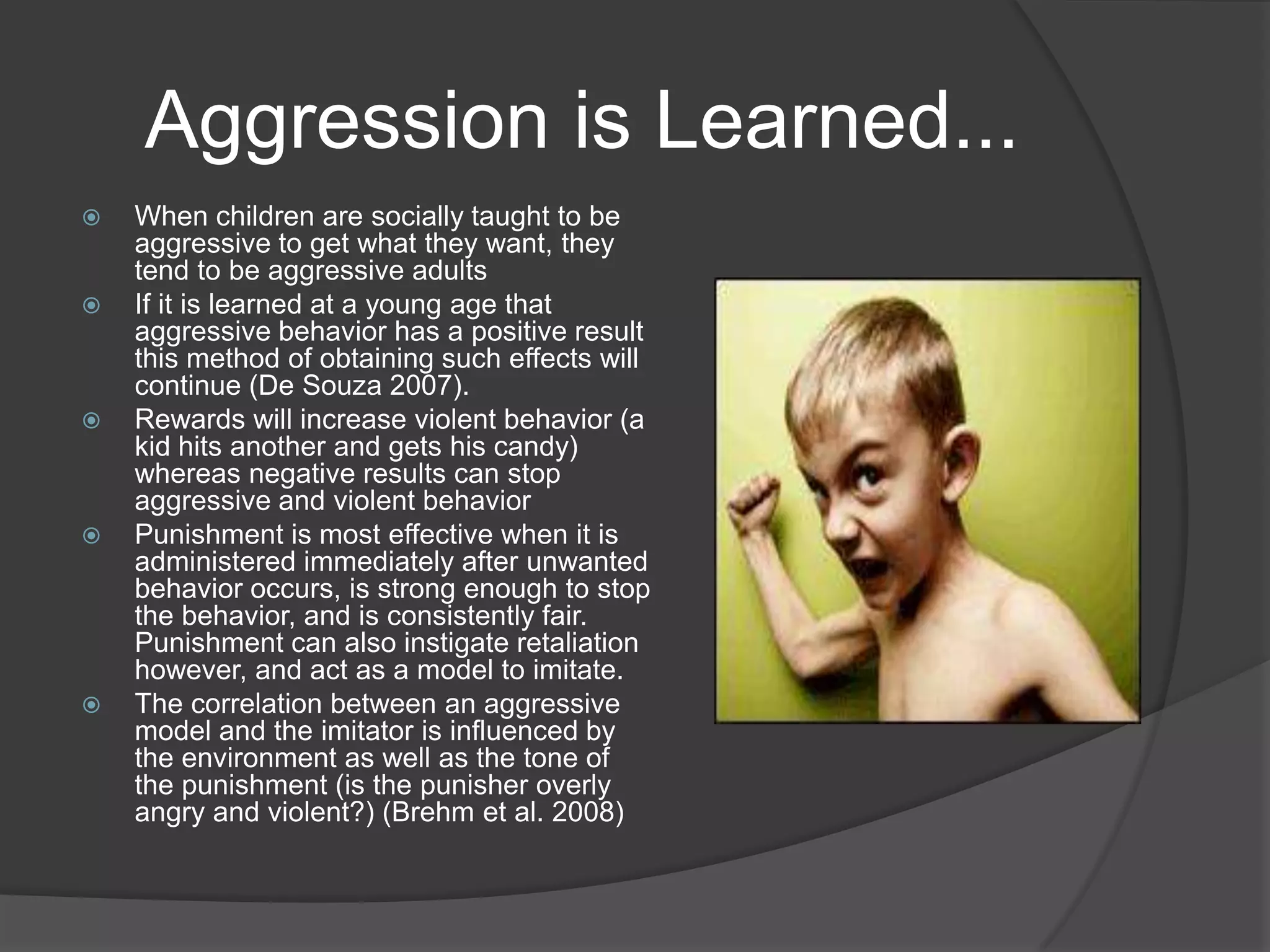
Aggression is Learned...Whenchildren are socially taught to be aggressive to get what they want, they tend to be aggressive adultsIf it is learned at a young age that aggressive behavior has a positive result this method of obtaining such effects will continue (De Souza 2007). Rewards will increase violent behavior (a kid hits another and gets his candy) whereas negative results can stop aggressive and violent behaviorPunishment is most effective when it is administered immediately after unwanted behavior occurs, is strong enough to stop the behavior, and is consistently fair. Punishment can also instigate retaliation however, and act as a model to imitate. The correlation between an aggressive model and the imitator is influenced by the environment as well as the tone of the punishment (is the punisher overly angry and violent?) (Brehm et al. 2008)
12.
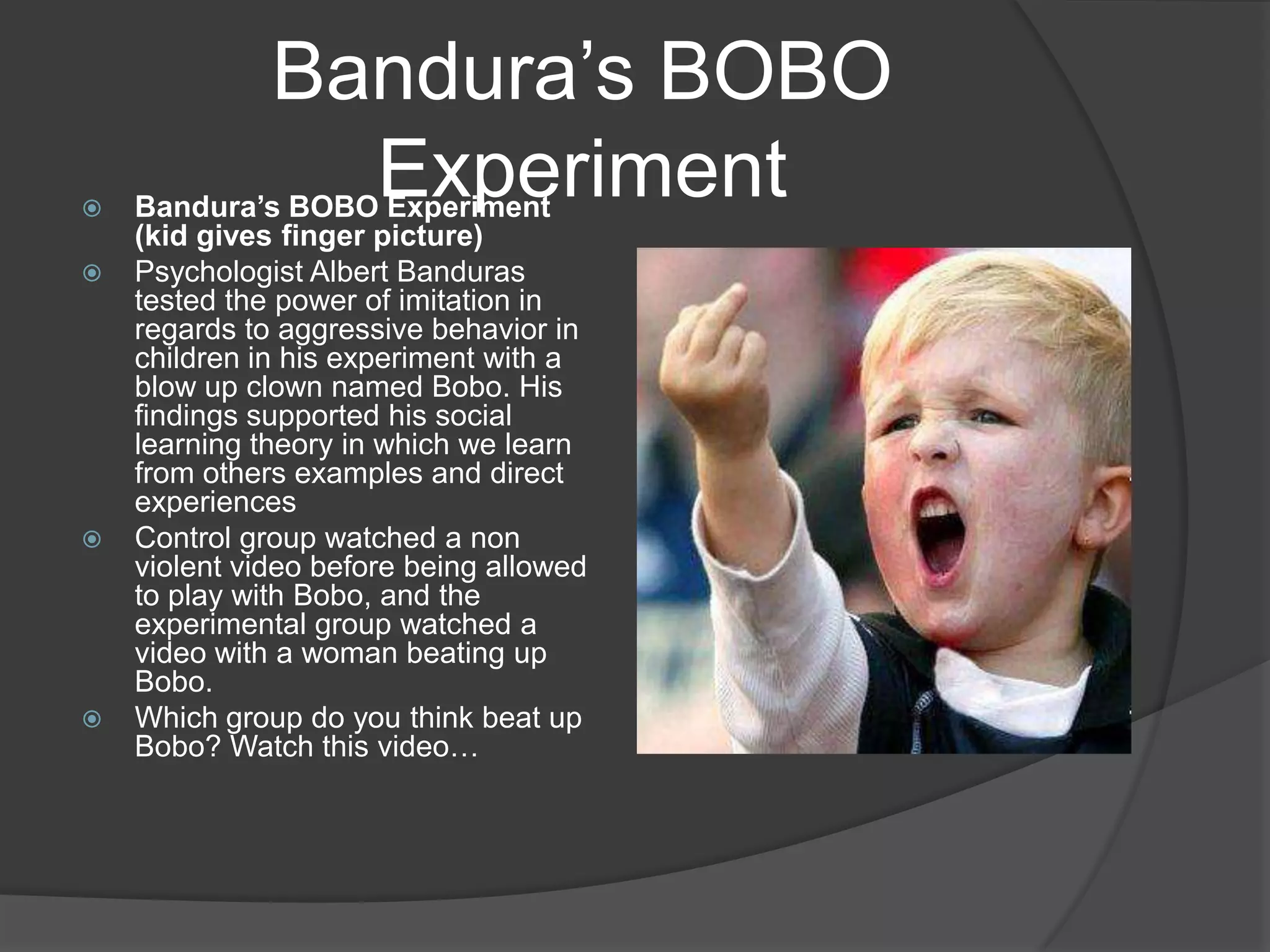
Bandura’s BOBO ExperimentBandura’sBOBO Experiment (kid gives finger picture)Psychologist Albert Banduras tested the power of imitation in regards to aggressive behavior in children in his experiment with a blow up clown named Bobo. His findings supported his social learning theory in which we learn from others examples and direct experiencesControl group watched a non violent video before being allowed to play with Bobo, and the experimental group watched a video with a woman beating up Bobo.Which group do you think beat up Bobo? Watch this video…
Boys vs. GirlsFroma young age boys and girl are rewarded and punished differently for aggressive behavior. Boys are rewarded for playing aggressively, and it is perceived as a healthy competitive spirit, or good rough and tumble play, whereas girls are encouraged to be cautious and considerate. Boys are encouraged to play cops and robbers, and girls are encouraged to play house.These gender roles are taught at a very young age, and they are maintained through the lessons and gender schemas passed on from generation to generation (Brehm et al. 2008)
15.
Nature vs. Nurturehttp://www.youtube.com/watch?v=7d4gmdl3zNQTheroot cause of aggression is not singular, many different factors come into play when determining the cause of aggressive behaviorEnvironmental and biological factors must be considered Here’s an interesting Australian PSA…
16.
Frustration: Aggression asa DriveFrustration produces motive to aggress and that aggression is caused by frustrationThe frustration-aggression hypothesis holds that engaging in any aggressive action reduces the motive to engage in further aggression, a process called catharsisAggression now is likely to increase aggression laterFrustration is only one of a number of unpleasant experiences that produce negative affect and increase aggressionMost research does not support the idea of catharsis as an effective means to reduce aggression
17.
Negative AffectA widevariety of noxious stimuli can create negative feelings and increase aggressionHot temperatures are associated with increased aggression and violencePositive emotional responses are incompatible with negative affect and reduce retaliatory aggression
18.
Arousal: “Wired” forActionHighly arousing stimuli, neutral as well as negative, increase retaliatory aggressionThe arousal-affect model proposes that both the type of emotion and the intensity of arousal influence aggression, which is greatest in response to experiences that combine negative affect and high arousal
19.
Thought: Automatic andDeliberateUnpleasant experiences create negative affect, which in turn stimulates automatic associations connected with anger and fearBehavioral and emotional outcomes then depends, at least in part, on higher-order cognitive processingSituational cues associated with aggression, such as the presence of a gun, can automatically activate aggression-related thoughts and increase aggressive behaviorIndividual differences, such as in chronic aggressiveness, influence how individuals interpret the aggression-related motives of othersHigh arousal impairs the cognitive control of aggression, as does alcohol
20.
Bertuzzi-Moore NHL IceHockey Incident: Crossing the Line Between Sanctioned and Unsanctioned Violence in Sporthttp://www.sciencedirect.com/science?_ob=ArticleURL&_udi=B6VH7-4HVF13G-1&_user=10&_coverDate=08%2F31%2F2006&_alid=1286005848&_rdoc=1&_fmt=high&_orig=search&_cdi=6059&_sort=r&_st=4&_docanchor=&_ct=1291&_acct=C000050221&_version=1&_urlVersion=0&_userid=10&md5=622843b9224665ff6593a22f5b5ae561
21.
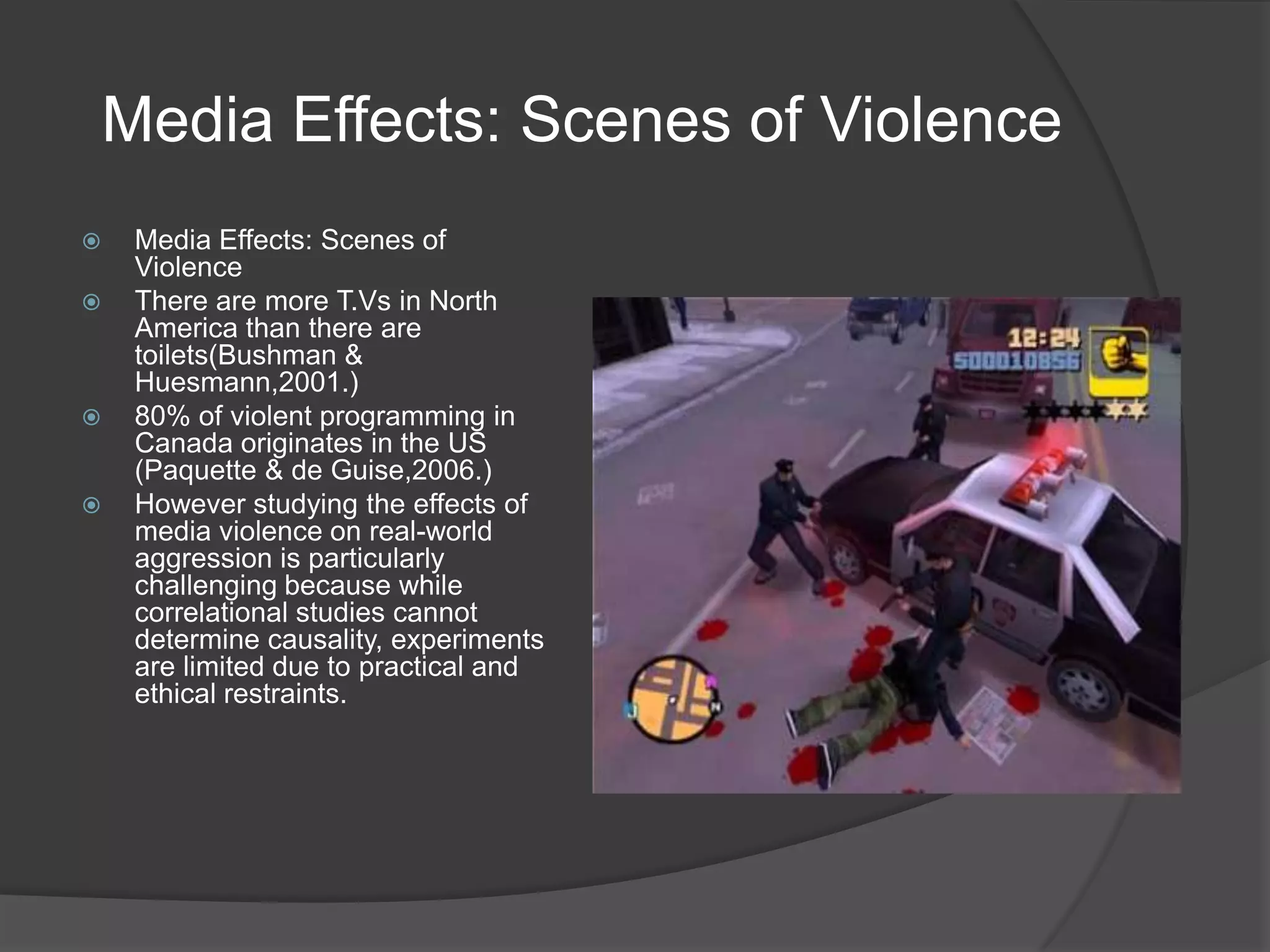
Media Effects: Scenesof ViolenceMedia Effects: Scenes of ViolenceThere are more T.Vs in North America than there are toilets(Bushman & Huesmann,2001.)80% of violent programming in Canada originates in the US (Paquette & de Guise,2006.)However studying the effects of media violence on real-world aggression is particularly challenging because while correlational studies cannot determine causality, experiments are limited due to practical and ethical restraints.
22.
Immediate and LongTerm Effectshttp://www.youtube.com/watch?v=CggjBd7o-PM&feature=relatedExposure to violent video games is significantly linked to increase in aggressive behaviour, aggressive cognitions, aggressive affect and physiological arousal, and to decreases in helping behaviour (Anderson,2004b.)Attitudes can be effected by the process of habituationFamiliarity with violence reduces physiological arousal. Desensitized to violence, we may become accepting of it.
23.
Pornography and AggressionIngeneral the link between viewing nonviolent pornography and aggressive behaviour is weak, but the effect is stronger among individuals who are already predisposed to sexual aggressionTogether, the interest in violent pornography and negative attitudes toward women is a strong predictor of self-reported sexual aggression in the past and sexually aggressive intentions for the future.
24.
Violence Among UniversityStudents‘Acquaintance rape’ (also called ‘date rape’) – unwanted sexual intercourse because they were overwhelmed by their male partners, more than 20 percent of women on Canadian university campuses have experienced thisTwo more important factors relating to aggression amongst university students = GENDER and ALCOHOLMen and women both report that men are more likely to engage in aggressive behaviour, psychological and physical, to obtain sexAlcohol consumption is involved in a majority of sexually aggressive incidents between university students. The actual consumption of alcohol as well as the BELIEF that one has consumed alcohol makes them more aggressive, as well as heightens their sexual arousal and interest
25.
Physical Aggression BetweenPartnersSeveral factors lead to aggression between partners, including: jealously of others, uncertainty of faithfulness, age, attitudes towards violence, drug and alcohol abuse, socioeconomic status, stress over income and education, social isolation, and growing up in a violent familyRecent research has discovered that the amount of wife-to-husband abuse is actually higher than that of husband-to-wife, however, the women usually experience greater injuries, and in several cases, death, due to the higher amount of force used by men
26.
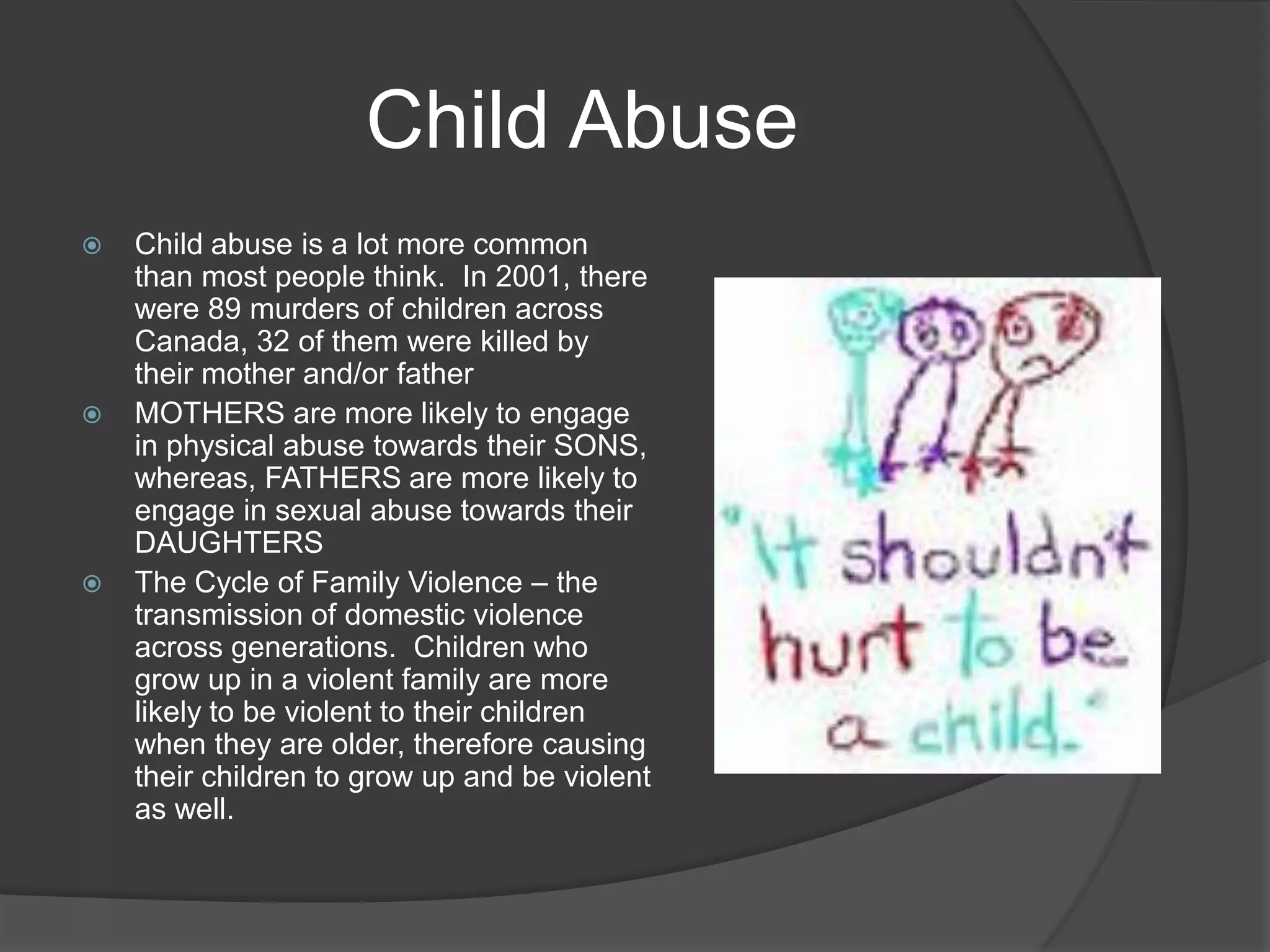
Child AbuseChild abuseis a lot more common than most people think. In 2001, there were 89 murders of children across Canada, 32 of them were killed by their mother and/or fatherMOTHERS are more likely to engage in physical abuse towards their SONS, whereas, FATHERS are more likely to engage in sexual abuse towards their DAUGHTERSThe Cycle of Family Violence – the transmission of domestic violence across generations. Children who grow up in a violent family are more likely to be violent to their children when they are older, therefore causing their children to grow up and be violent as well.
28.
Is there acure?There really is no definite cure for aggression butthere are several ideas put forth that would help:Reducing stressors such as frustration, discomfort, and provocationProviding healthy living conditions, an improved economy, and social support Government censorship of violent movies, television, and games, especially those which demean and degrade womenEducational workshops






![Social process[1]](https://cdn.slidesharecdn.com/ss_thumbnails/socialprocess1-200513101442-thumbnail.jpg?width=640&height=640&fit=bounds)


