How the learning perspective explains aggression
Aggression: the action or series of actions where the aim is to cause harm to another person or object.“Aggression is always a consequence of frustration and contrary wise… the existence of frustration always leads to some form of aggression.” – Dollard, 1939.Aggression is an innate drive response to frustrating external stimuli from the environment.
The frustrating stimuli can be any social conditions that thwart our satisfactions. i.e. poor housing, unemployment..The aggressive response can take many forms such as overt aggressive behaviour against the cause of frustration or indirect release through displacement of aggression.Displacement of aggression is when aggression is released on an innocent scapegoat that has no actual relevance to the cause of frustration.
Psychologists have found that the greater the degree of the frustration the greater the likelihood of aggression. Frustration increases if you’re:Interrupted closer to achieving a goalHave higher expectations and failIf the reasons for rejection are inadequate
Supporting evidenceBarker, 1941.  He found that children frustrated by being kept waiting for a long time before they were allowed to play in a room full of toys were aggressive and destructive i.e. they threw the toys against the wall and stamped on them. A control group who weren’t frustrated played normally.
Hovland & Sears, 1940. They found a significant correlation between economic frustration [measured in terms of the price of cotton] and displaced aggression on scapegoats [which was measured in terms of the hanging of blacks] in the Southern States of America between 1882 and 1930.
Instrumental aggressionAggressive behaviour that is maintained due to positive reinforcement.People give in to aggressive behaviour therefore reinforcing it.It’s also negatively reinforced according to the frustration aggression hypothesis because aggression reduces frustration.
Social learning theoryWe don’t need to be rewarded for aggression if we see others rewarded for it.Characters being rewarded for aggressive behaviour on television can lead to observational learning of aggressive behaviours in observers.
Eron 1995Eron believed that aggression could be learned through watching televised violence, including cartoons, making violence seem normal for children.His study included 8 year olds from New York in 1960 who he then caught up with after 10, 20 and 40 years.
He found that those who were exposed to violence at a young age were significantly more aggressive then those who were not exposed to violence at a young age. The participants exposed to violence had more criminal convictions, such as spousal abuse and drink-driving than those who weren’t. The children of those who were more aggressive were also more aggressive than the children of those who weren’t.
Anderson and Dill 2003Anderson and Dill studied the correlation between aggression and video games.Randomly chose 210 undergraduate students½ played a 1st person shooting game½ played a puzzles game
The groups were then given the same game where there were opportunities to punish the characters with a loud blast of noise.The group who had played the shooter game tended to use louder and longer blasts than those who played the maze game.Video games are dangerous because they provide rehearsal of aggressive behaviour and reward it directly in the game.
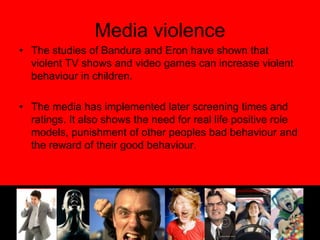
Media violenceThe studies of Bandura and Eron have shown that violent TV shows and video games can increase violent behaviour in children.The media has implemented later screening times and ratings. It also shows the need for real life positive role models, punishment of other peoples bad behaviour and the reward of their good behaviour.
The BoBo doll study is also an important part of the way the learning theory explains aggression through the social learning theory and observation, but another group is already doing it in depth so we didn’t!!!

Psych aggression

  • 1.
    How the learningperspective explains aggression
  • 2.
    Aggression: the actionor series of actions where the aim is to cause harm to another person or object.“Aggression is always a consequence of frustration and contrary wise… the existence of frustration always leads to some form of aggression.” – Dollard, 1939.Aggression is an innate drive response to frustrating external stimuli from the environment.
  • 3.
    The frustrating stimulican be any social conditions that thwart our satisfactions. i.e. poor housing, unemployment..The aggressive response can take many forms such as overt aggressive behaviour against the cause of frustration or indirect release through displacement of aggression.Displacement of aggression is when aggression is released on an innocent scapegoat that has no actual relevance to the cause of frustration.
  • 4.
    Psychologists have foundthat the greater the degree of the frustration the greater the likelihood of aggression. Frustration increases if you’re:Interrupted closer to achieving a goalHave higher expectations and failIf the reasons for rejection are inadequate
  • 5.
    Supporting evidenceBarker, 1941. He found that children frustrated by being kept waiting for a long time before they were allowed to play in a room full of toys were aggressive and destructive i.e. they threw the toys against the wall and stamped on them. A control group who weren’t frustrated played normally.
  • 6.
    Hovland & Sears,1940. They found a significant correlation between economic frustration [measured in terms of the price of cotton] and displaced aggression on scapegoats [which was measured in terms of the hanging of blacks] in the Southern States of America between 1882 and 1930.
  • 7.
    Instrumental aggressionAggressive behaviourthat is maintained due to positive reinforcement.People give in to aggressive behaviour therefore reinforcing it.It’s also negatively reinforced according to the frustration aggression hypothesis because aggression reduces frustration.
  • 8.
    Social learning theoryWedon’t need to be rewarded for aggression if we see others rewarded for it.Characters being rewarded for aggressive behaviour on television can lead to observational learning of aggressive behaviours in observers.
  • 9.
    Eron 1995Eron believedthat aggression could be learned through watching televised violence, including cartoons, making violence seem normal for children.His study included 8 year olds from New York in 1960 who he then caught up with after 10, 20 and 40 years.
  • 10.
    He found thatthose who were exposed to violence at a young age were significantly more aggressive then those who were not exposed to violence at a young age. The participants exposed to violence had more criminal convictions, such as spousal abuse and drink-driving than those who weren’t. The children of those who were more aggressive were also more aggressive than the children of those who weren’t.
  • 11.
    Anderson and Dill2003Anderson and Dill studied the correlation between aggression and video games.Randomly chose 210 undergraduate students½ played a 1st person shooting game½ played a puzzles game
  • 12.
    The groups werethen given the same game where there were opportunities to punish the characters with a loud blast of noise.The group who had played the shooter game tended to use louder and longer blasts than those who played the maze game.Video games are dangerous because they provide rehearsal of aggressive behaviour and reward it directly in the game.
  • 13.
    Media violenceThe studiesof Bandura and Eron have shown that violent TV shows and video games can increase violent behaviour in children.The media has implemented later screening times and ratings. It also shows the need for real life positive role models, punishment of other peoples bad behaviour and the reward of their good behaviour.
  • 14.
    The BoBo dollstudy is also an important part of the way the learning theory explains aggression through the social learning theory and observation, but another group is already doing it in depth so we didn’t!!!