Virginia Studies2008 StandardsCreated by Angela Turley2010Virginia Social Studies/ History SOL Review
What’s the Location VS2a Relative location may be described using terms that show connections between two places such as “next to,” “near,” “bordering.”
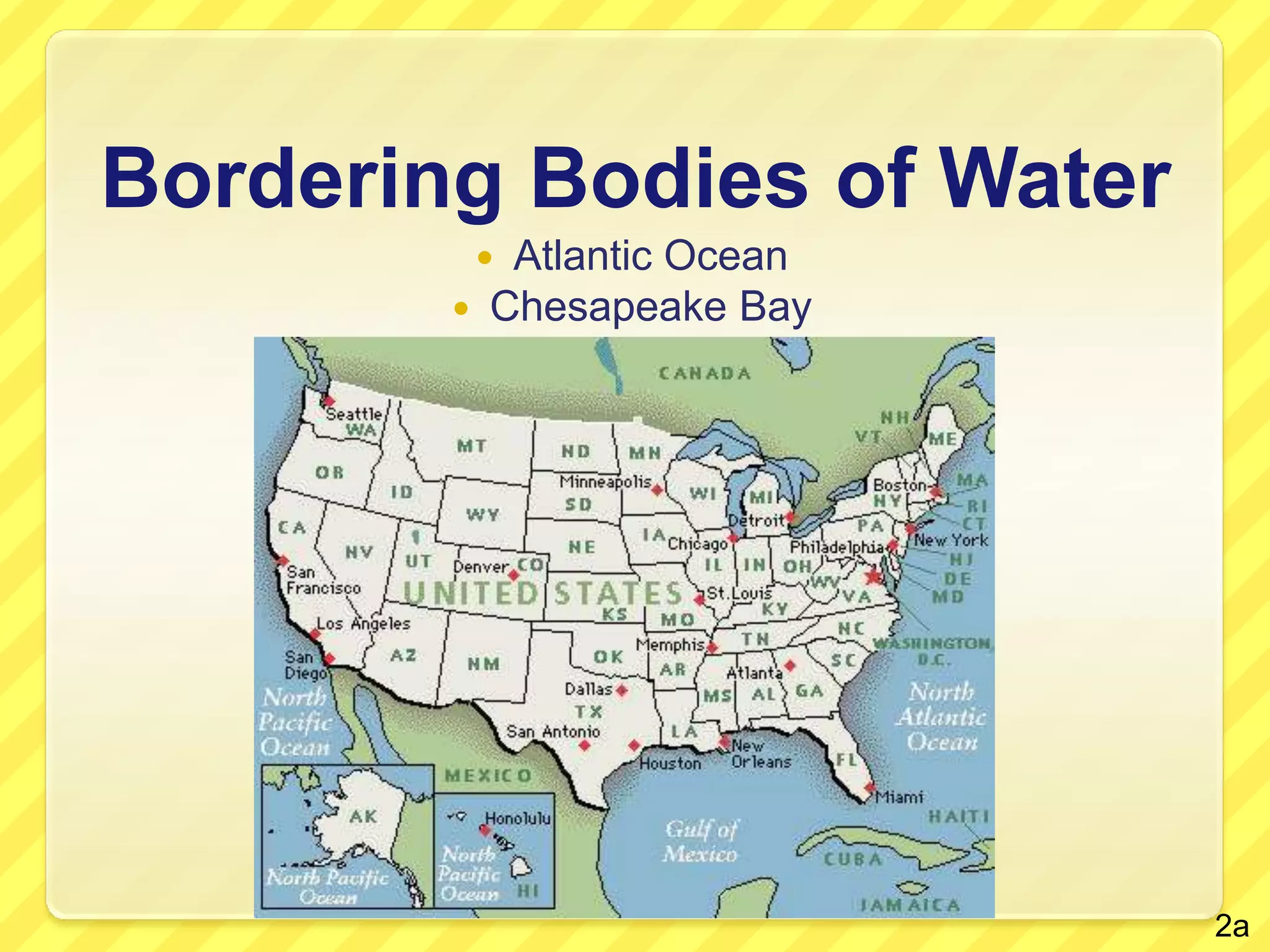
Bordering Bodies of WaterAtlantic Ocean  Chesapeake Bay 2a
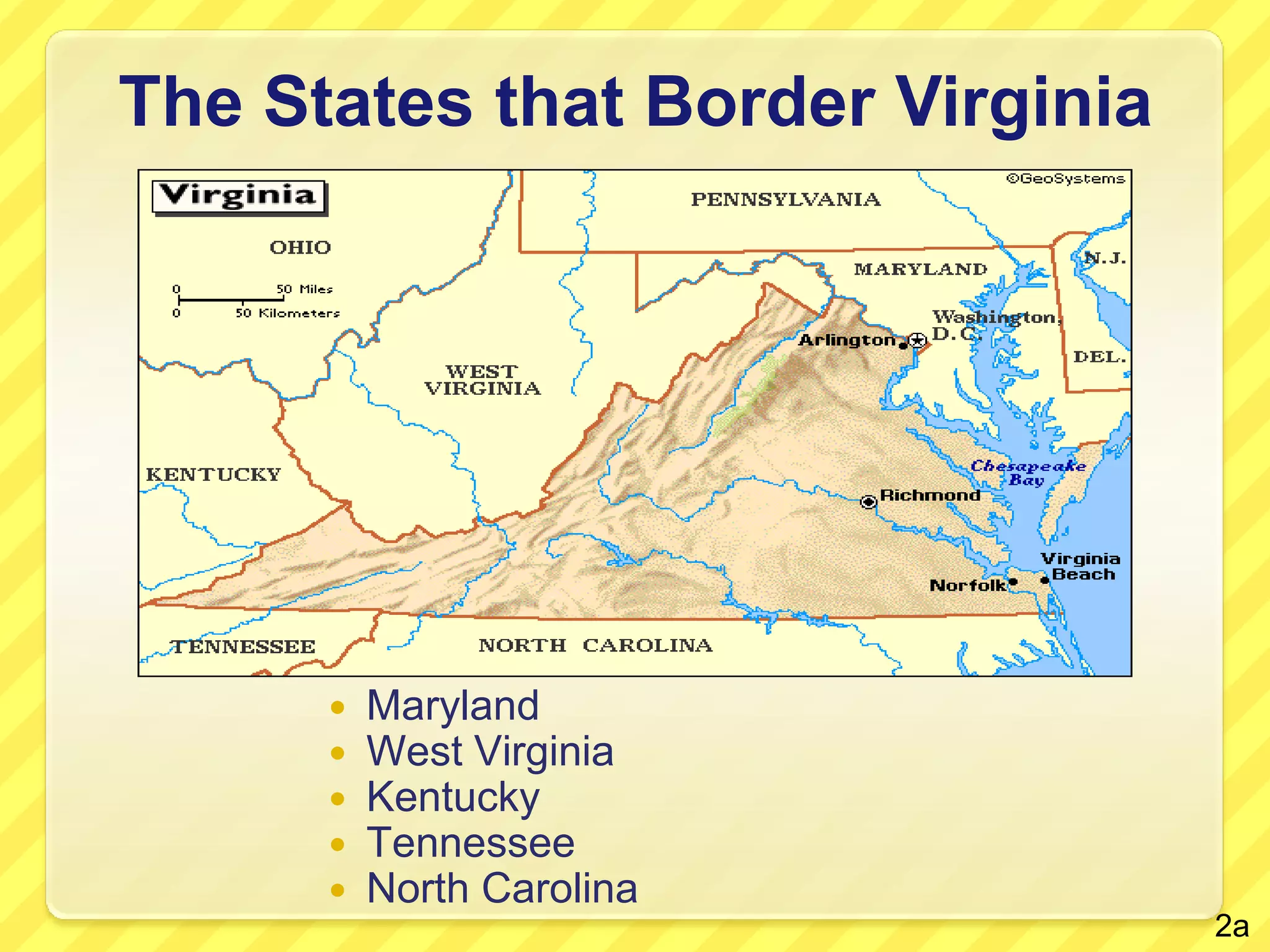
The States that Border VirginiaMarylandWest VirginiaKentuckyTennesseeNorth Carolina2a
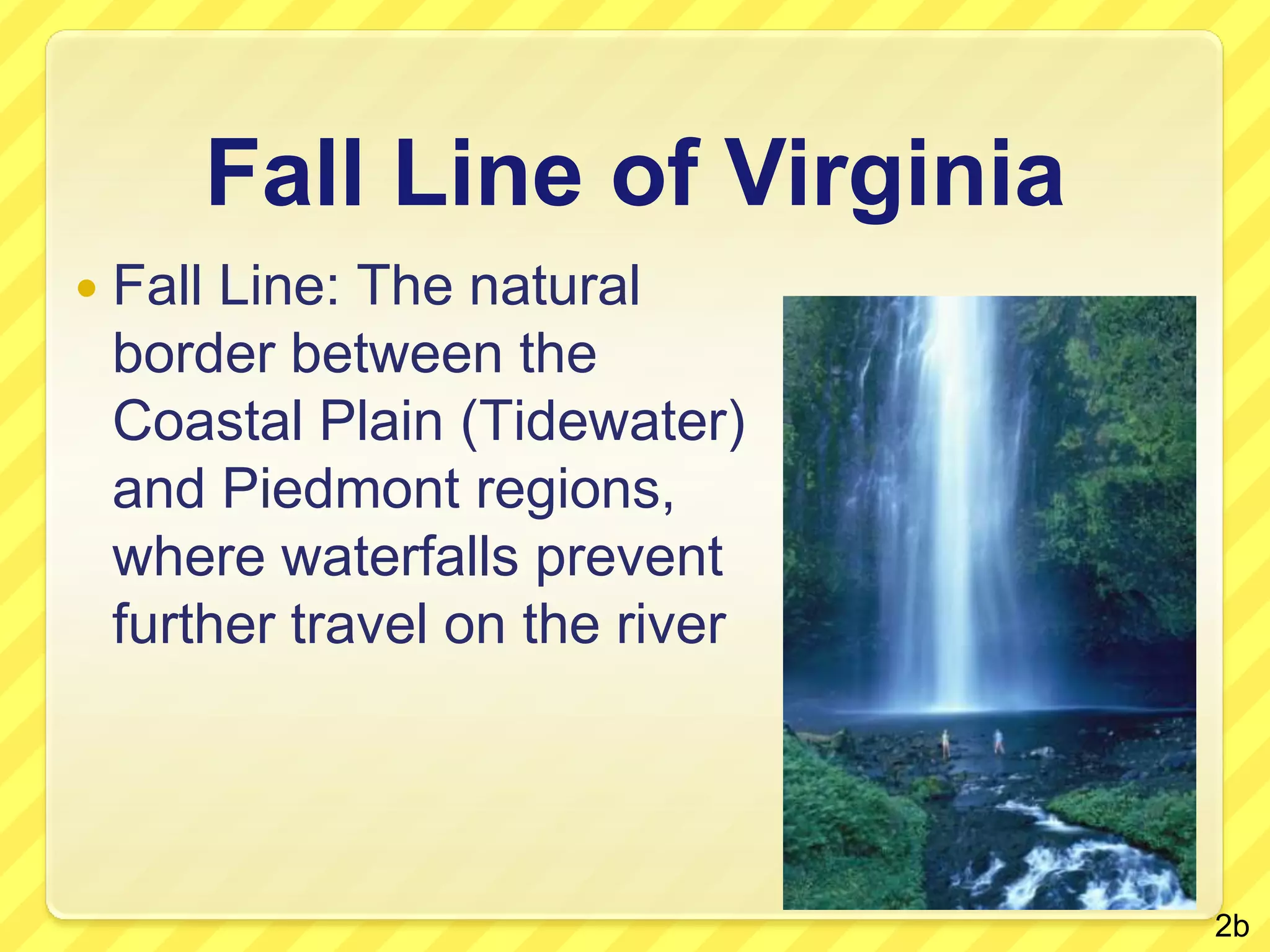
Fall Line of VirginiaFall Line: The natural border between the Coastal Plain (Tidewater) and Piedmont regions, where waterfalls prevent further travel on the river2b
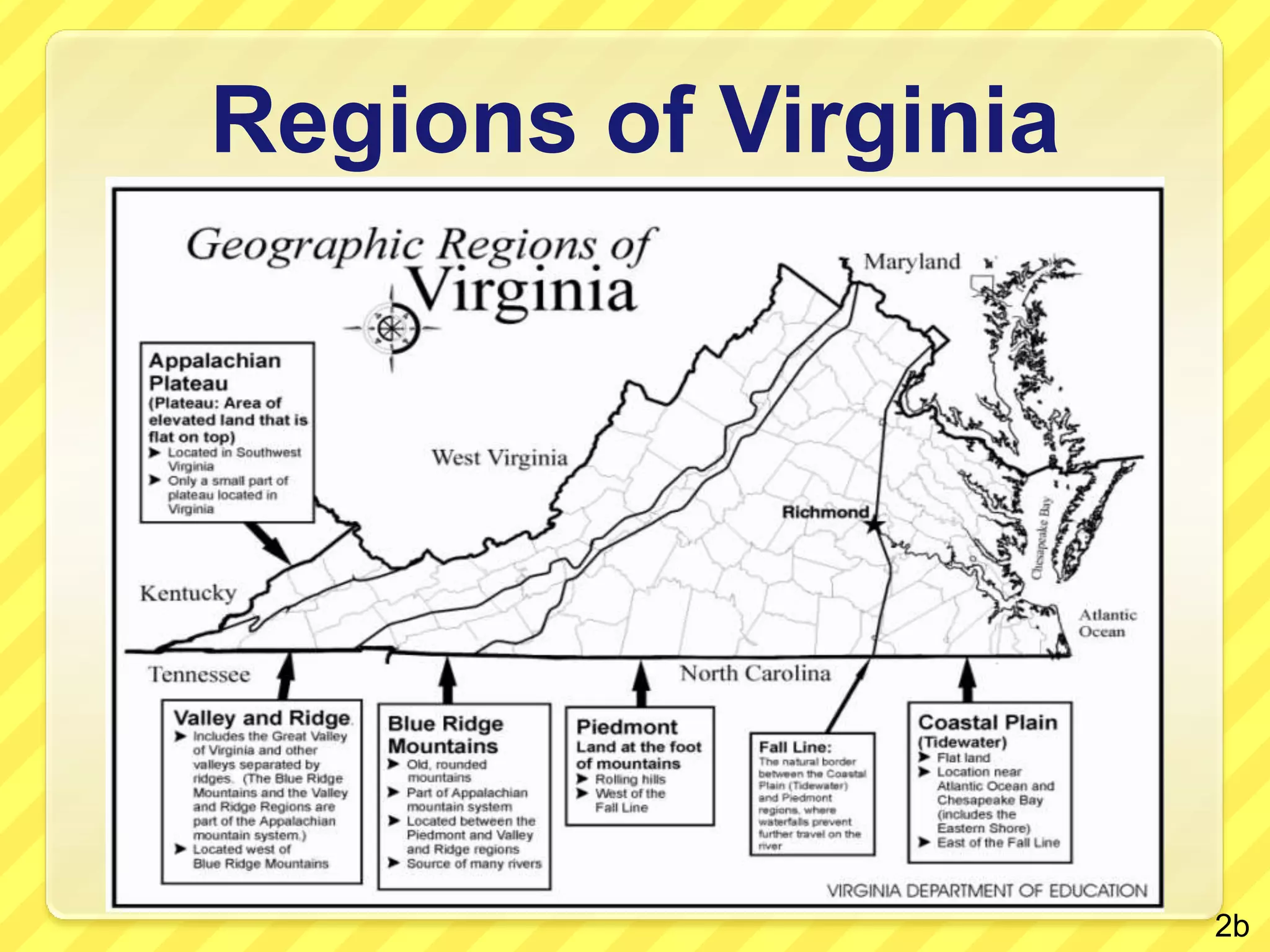
Regions of Virginia2b
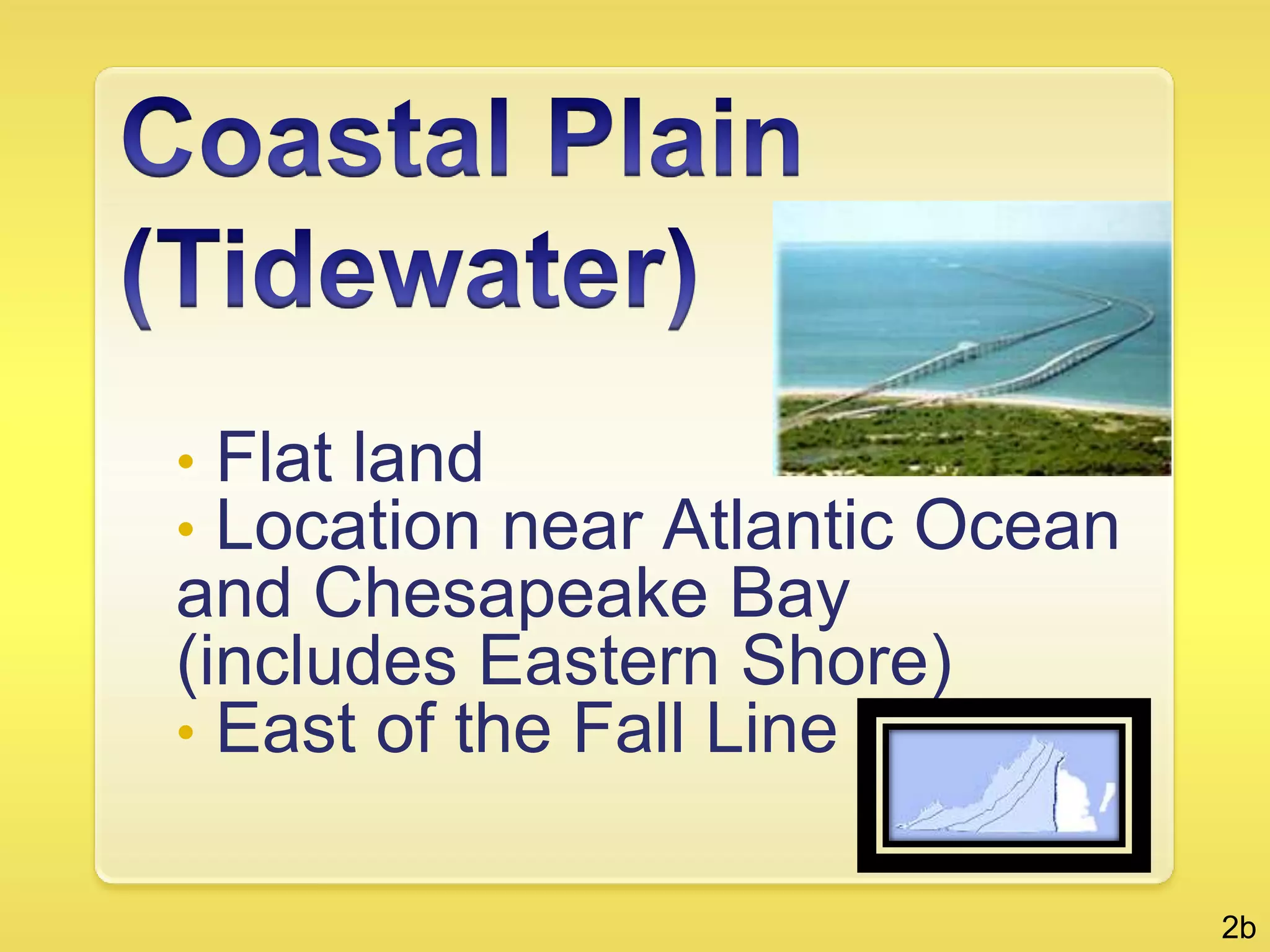
Coastal Plain(Tidewater)  Flat land
Location near Atlantic Ocean and Chesapeake Bay  (includes Eastern Shore)
East of the Fall Line 2b
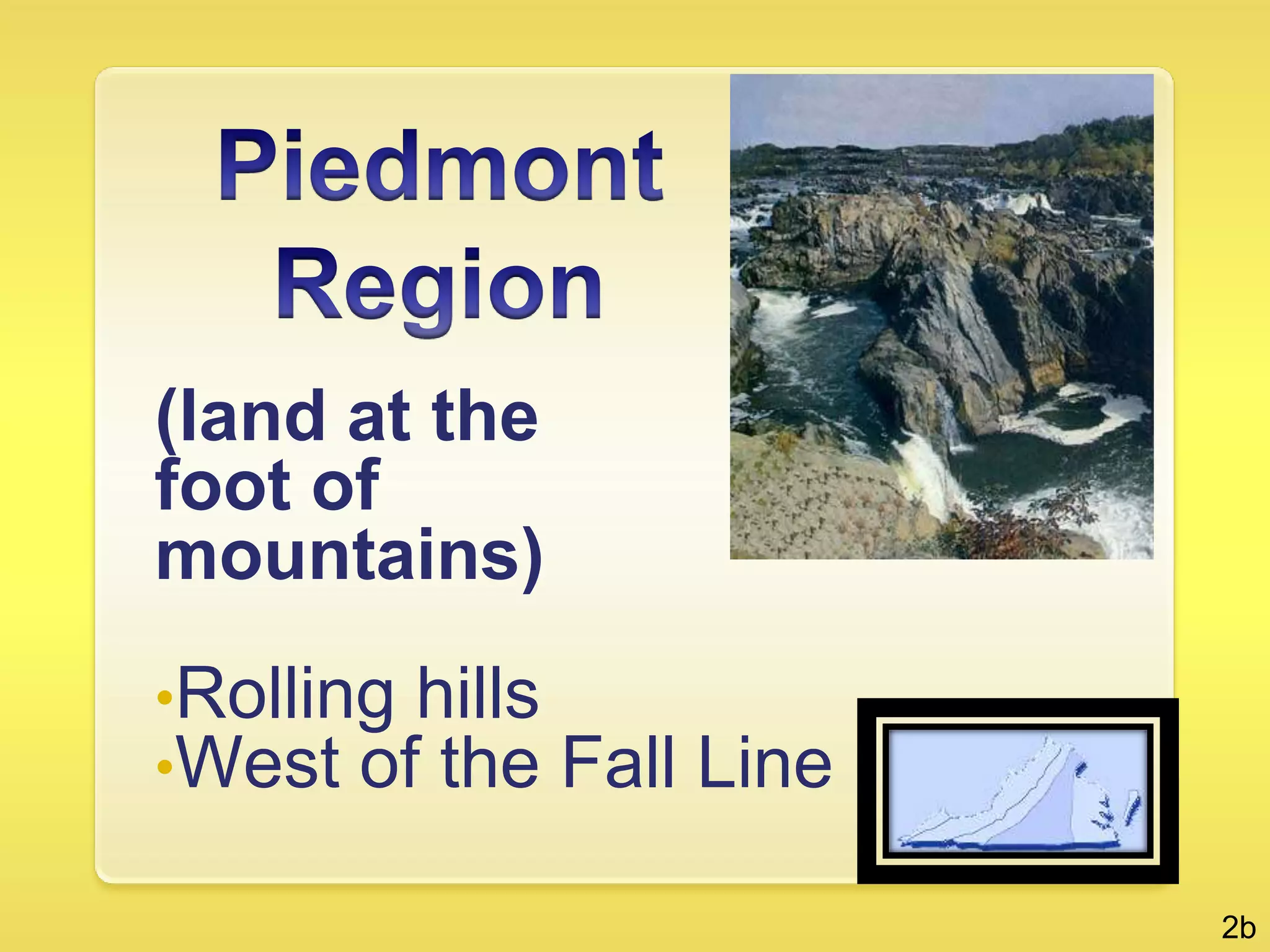
Piedmont Region (land at the foot of mountains)Rolling hills
West of the Fall Line  2b
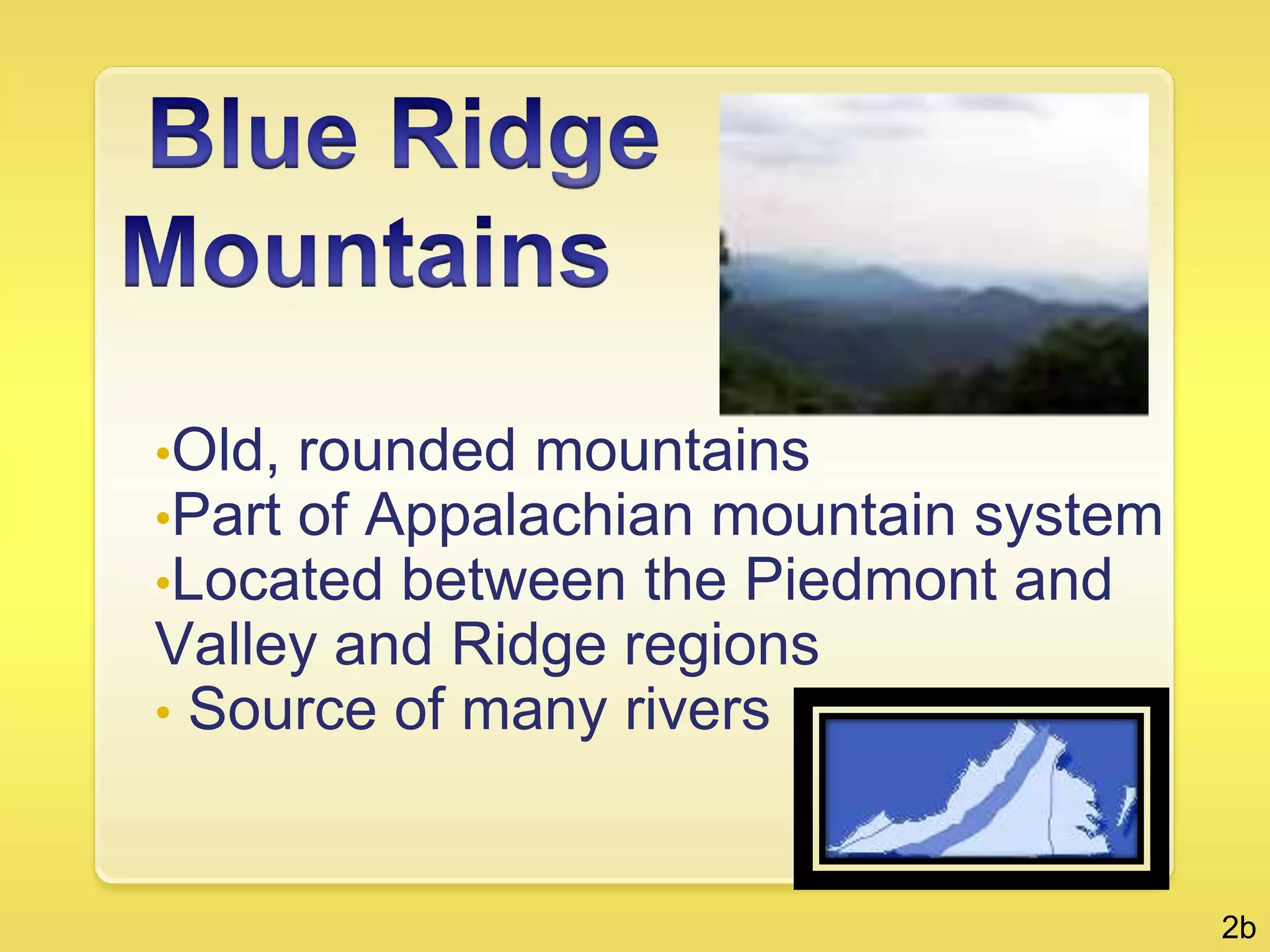
  Blue Ridge MountainsOld, rounded mountains
Part of Appalachian mountain system
Located between the Piedmont and Valley and Ridge regions
 Source of many rivers  2b
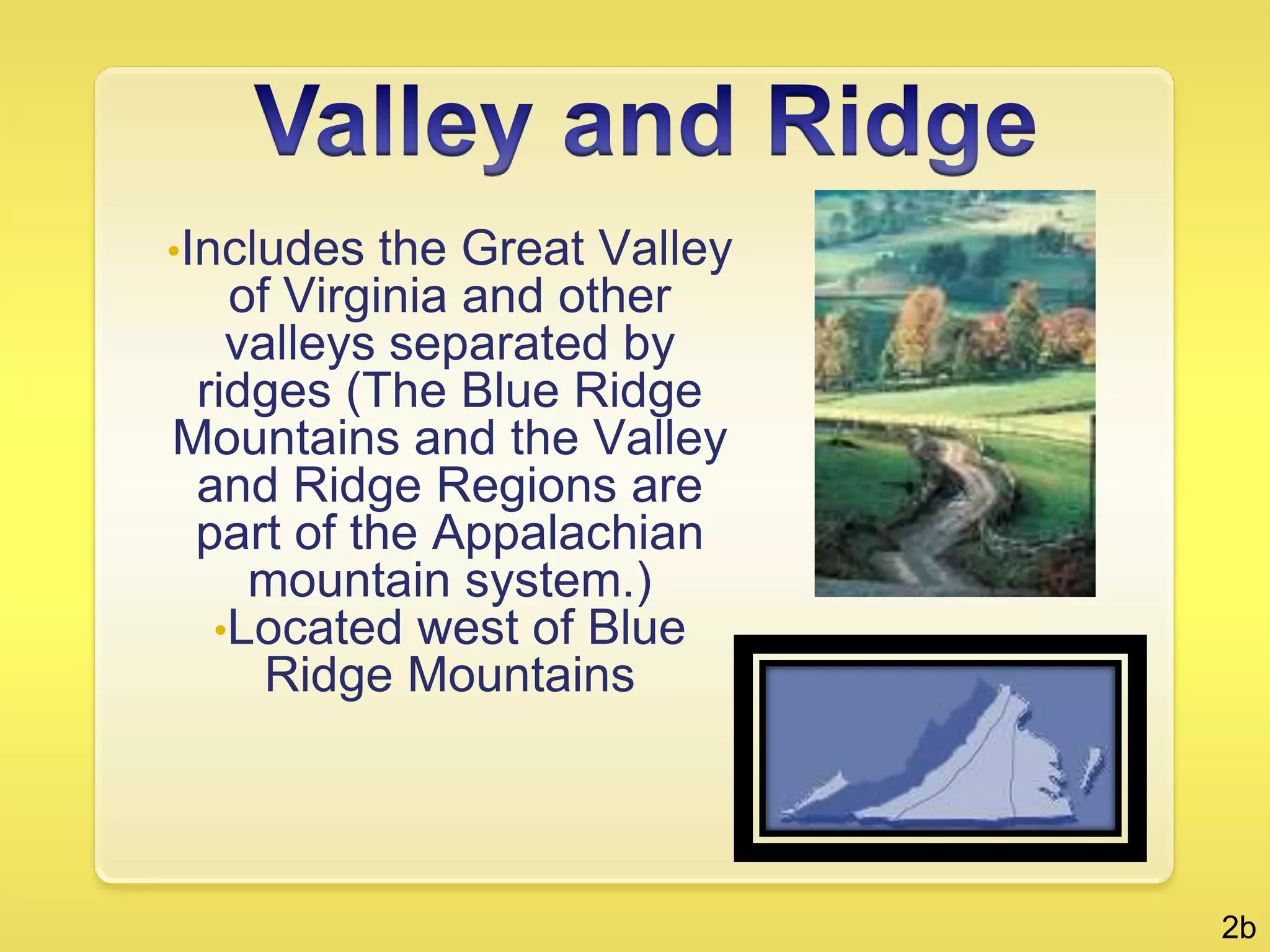
  Valley and Ridge Includes the Great Valley of Virginia and other valleys separated by ridges (The Blue Ridge Mountains and the Valley and Ridge Regions are part of the Appalachian mountain system.)
Located west of Blue Ridge Mountains  2b
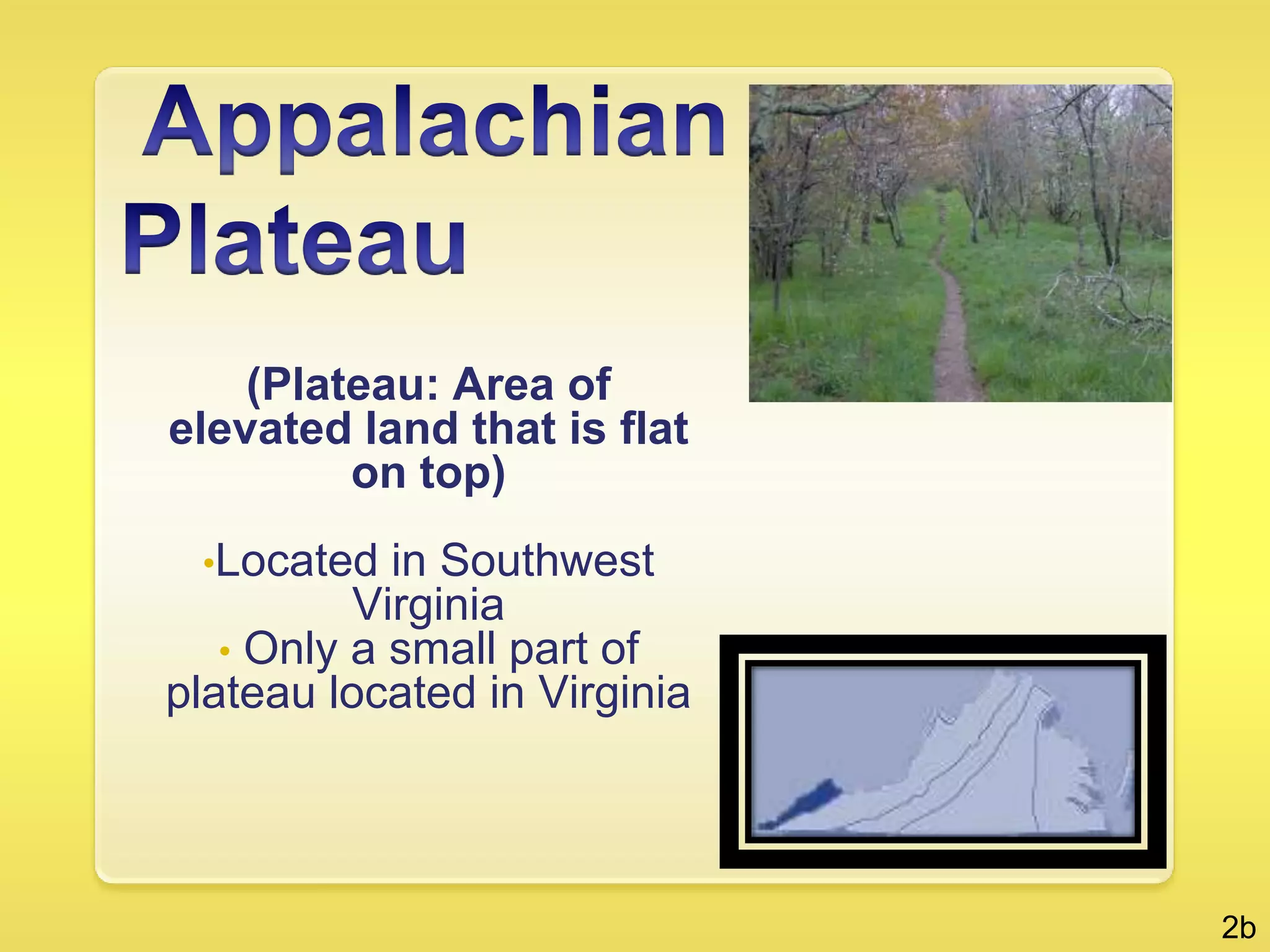
    Appalachian Plateau  (Plateau: Area of elevated land that is flat on top) Located in Southwest Virginia
 Only a small part of plateau located in Virginia   2b
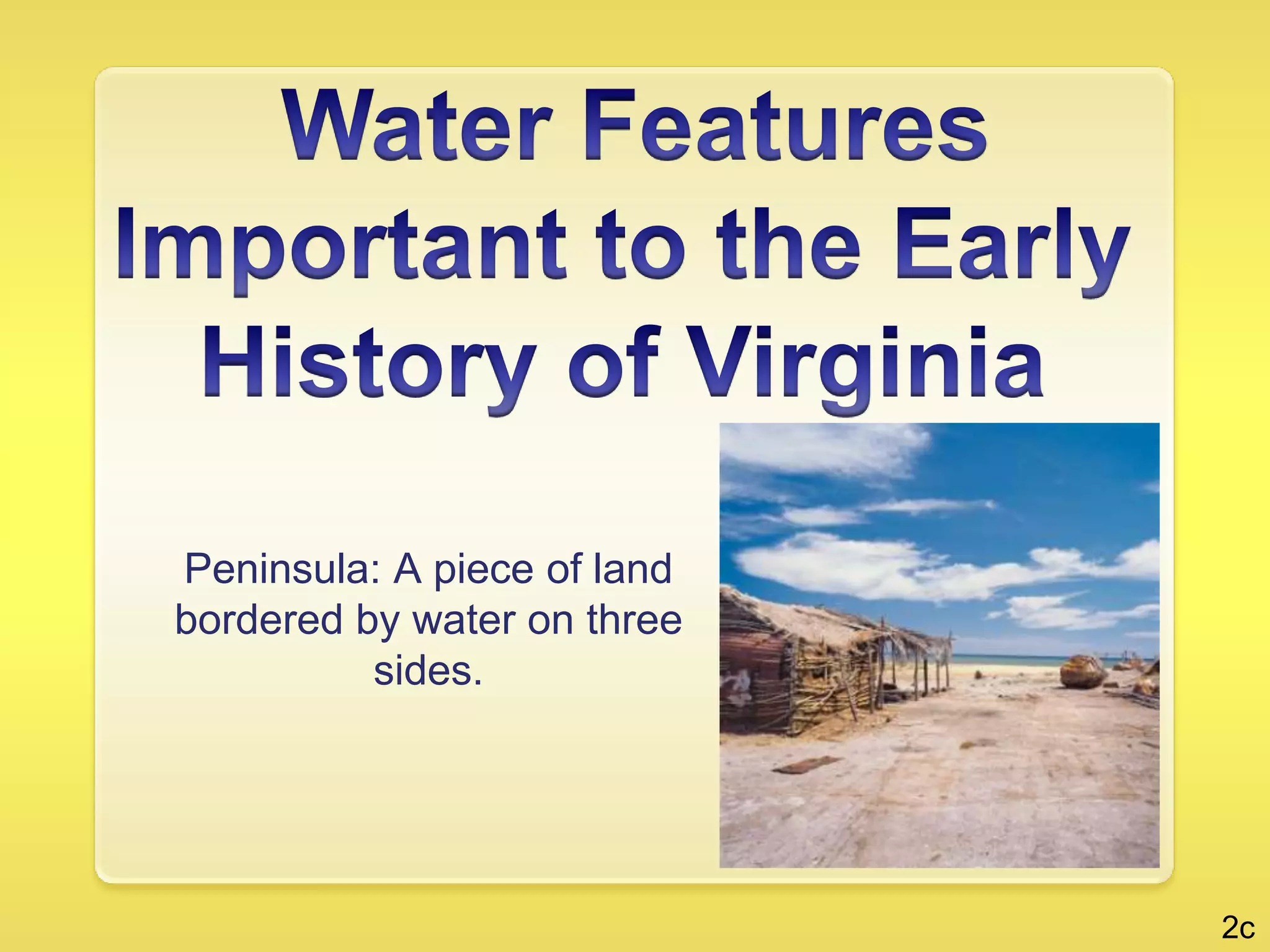
    Water Features Important to the Early History of Virginia   Peninsula: A piece of land bordered by water on three sides.   2c
Atlantic OceanProvided transportation links between Virginia and other places (e.g., Europe, Africa, Caribbean)       Water Features   2c
Chesapeake BayProvided a safe harbor
Was a source of food and transportation       Water Features   2c
James RiverFlows into the Chesapeake Bay
Richmond and Jamestown located along the James RiverYork RiverFlows into the Chesapeake Bay
Yorktown located along the York RiverPotomac RiverFlows into the Chesapeake Bay
Alexandria located along the Potomac RiverRappahannock RiverFlows into the Chesapeake Bay
Fredericksburg is located on the Rappahannock River        Water Features   2c
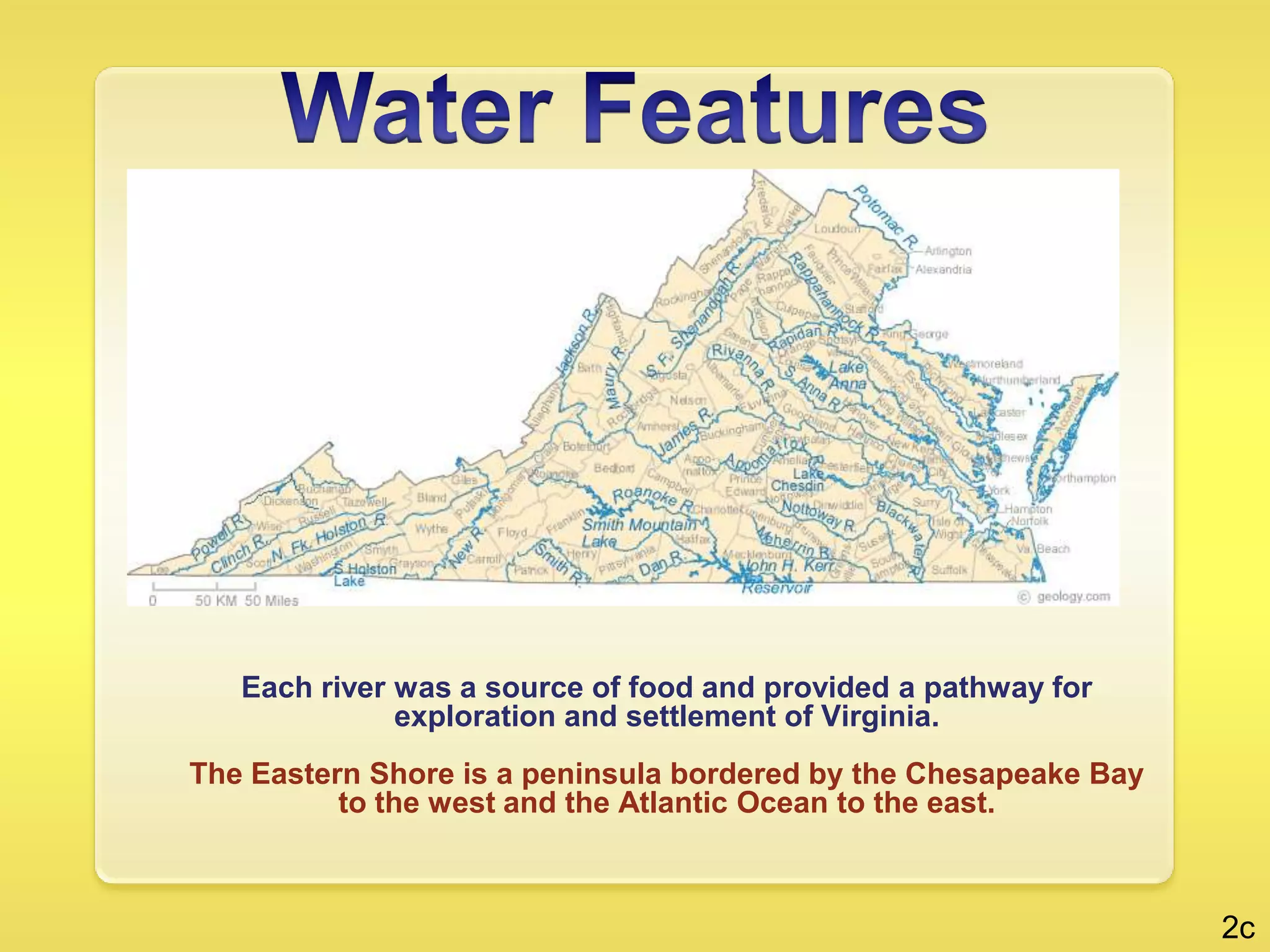
 Water Features   Each river was a source of food and provided a pathway for exploration and settlement of Virginia. The Eastern Shore is a peninsula bordered by the Chesapeake Bay to the west and the Atlantic Ocean to the east.   2c
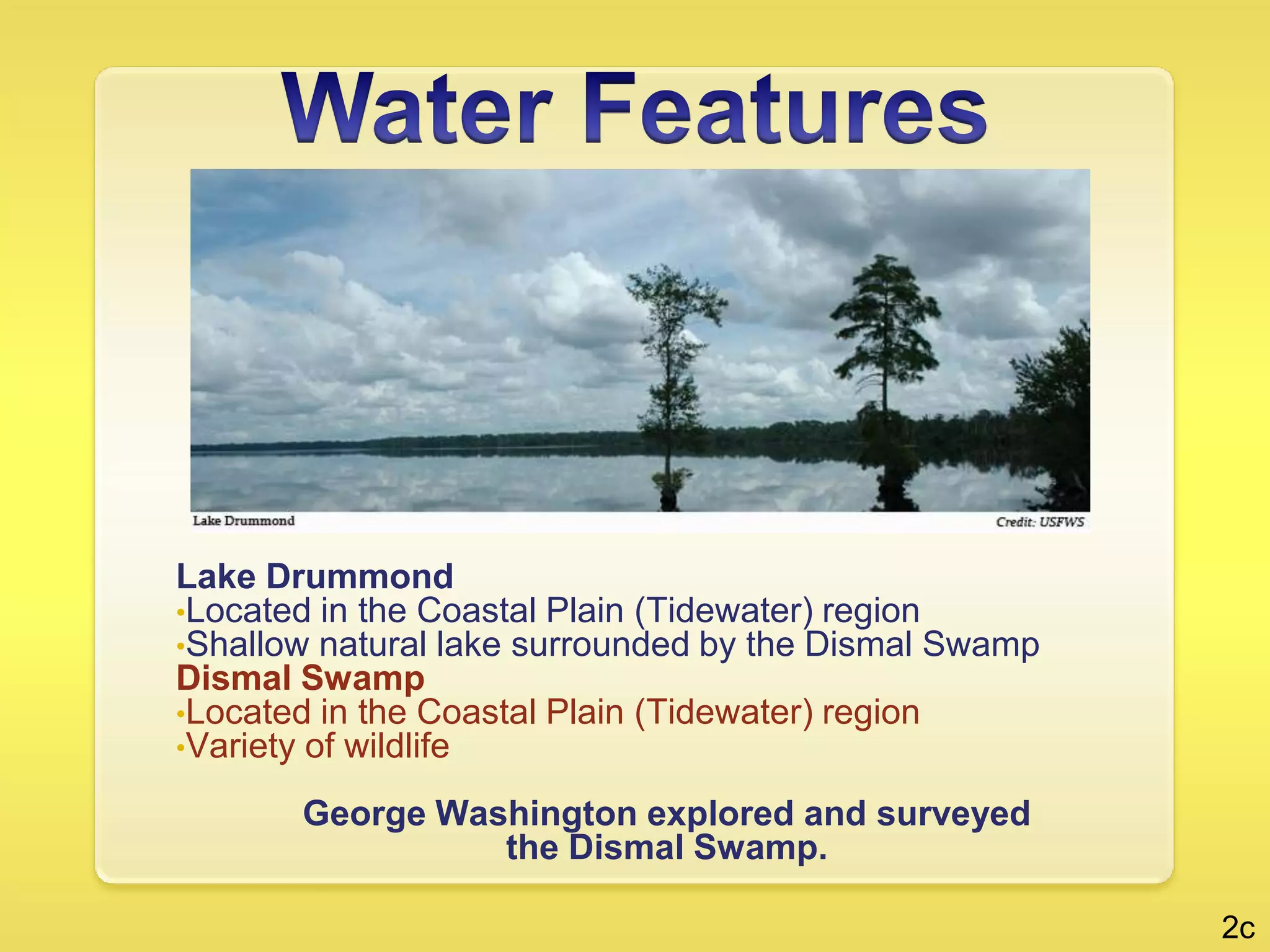
 Water Features   Lake DrummondLocated in the Coastal Plain (Tidewater) region
Shallow natural lake surrounded by the Dismal SwampDismal SwampLocated in the Coastal Plain (Tidewater) region
Variety of wildlifeGeorge Washington explored and surveyed                     the Dismal Swamp. 2c
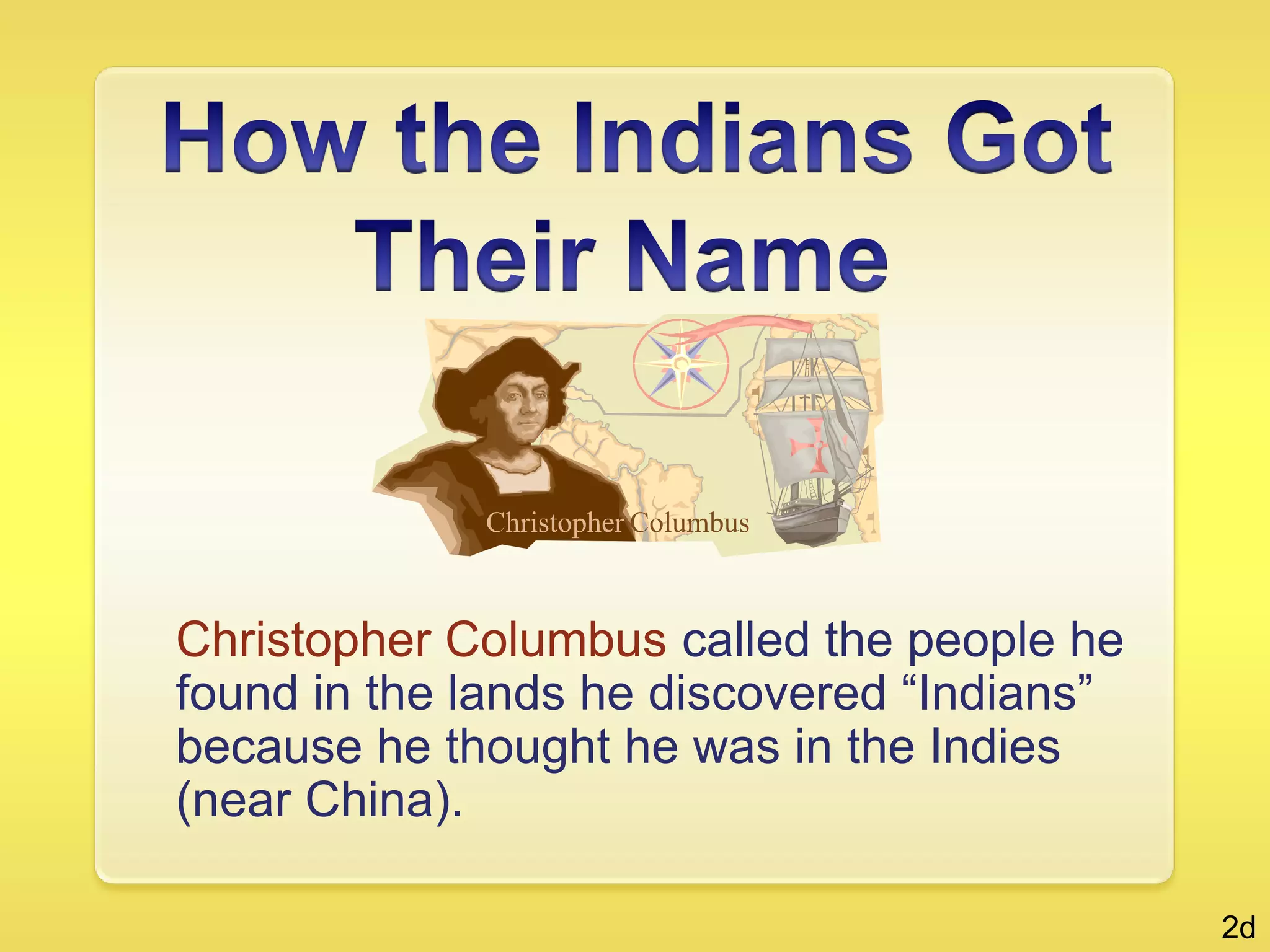
Christopher Columbus called the people he found in the lands he discovered “Indians” because he thought he was in the Indies (near China).   How the Indians Got Their Name  2d
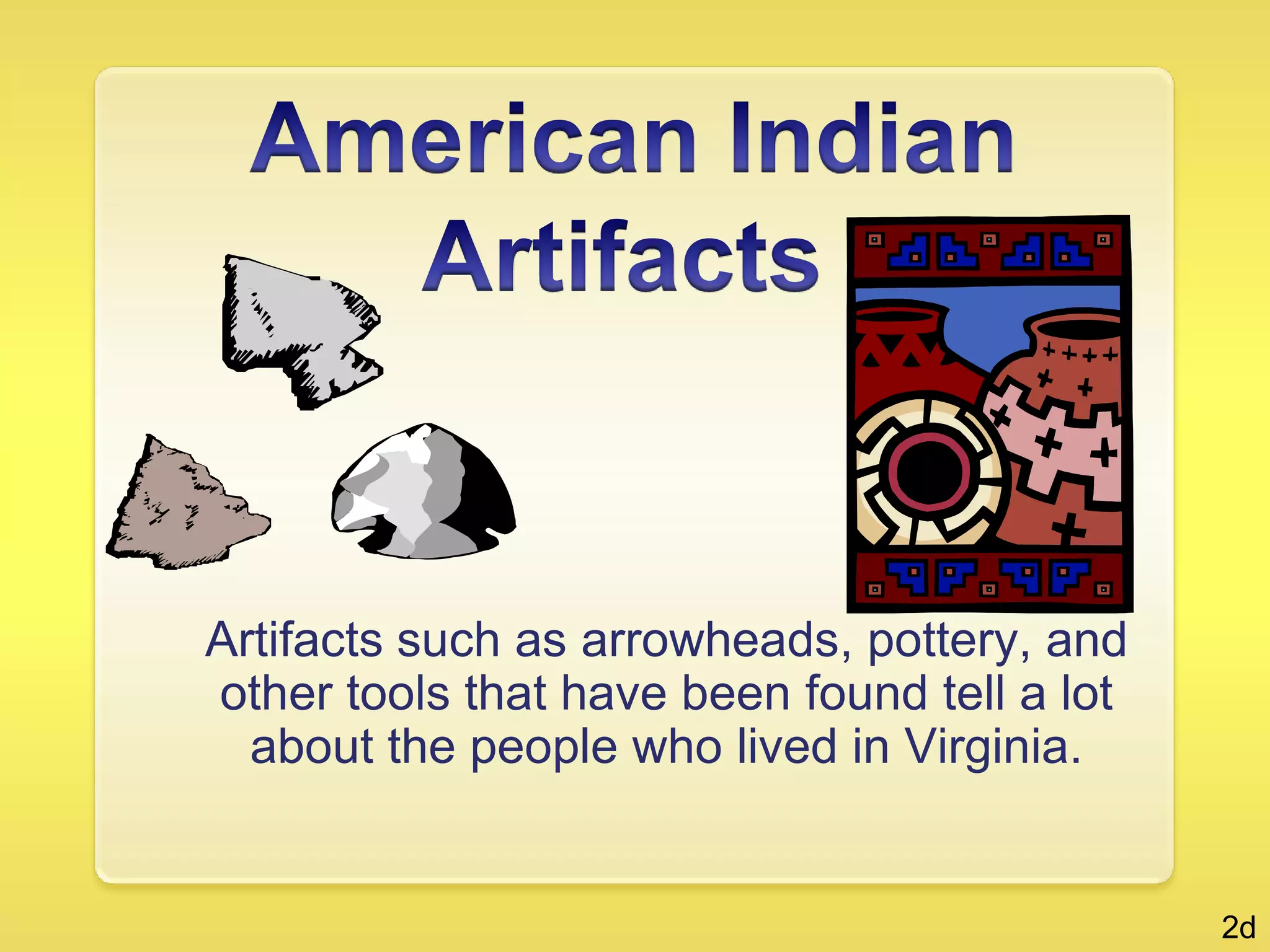
Artifacts such as arrowheads, pottery, and other tools that have been found tell a lot about the people who lived in Virginia.    American Indian Artifacts  2d
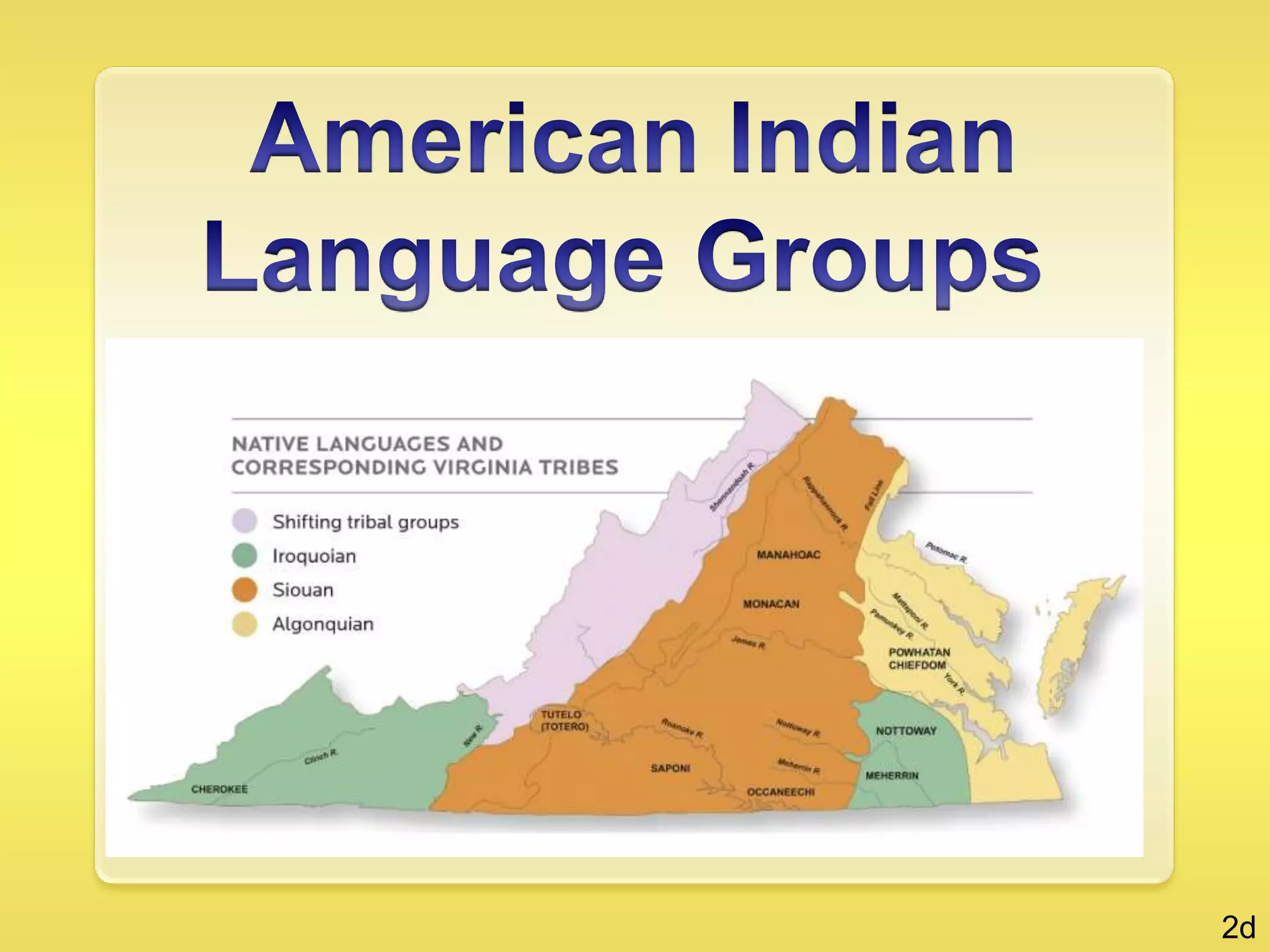
Algonquian was spoken primarily in Tidewater region.  The Powhatan were part of this group.
Siouan was spoken primarily in the Piedmont region. The Monacan were part of this group.
Iroquoian was spoken in Southwestern VA and in  Southern VA near what is today North Carolina. The Cherokee were a part of this group.  American Indian  Language Groups  2d
  American Indian  Language Groups  2d
 The climate in Virginia is relatively mild with distinct seasons– spring, summer, fall, and winter-resulting in a variety of vegetation.  Physical Geography and Native Peoples  2e
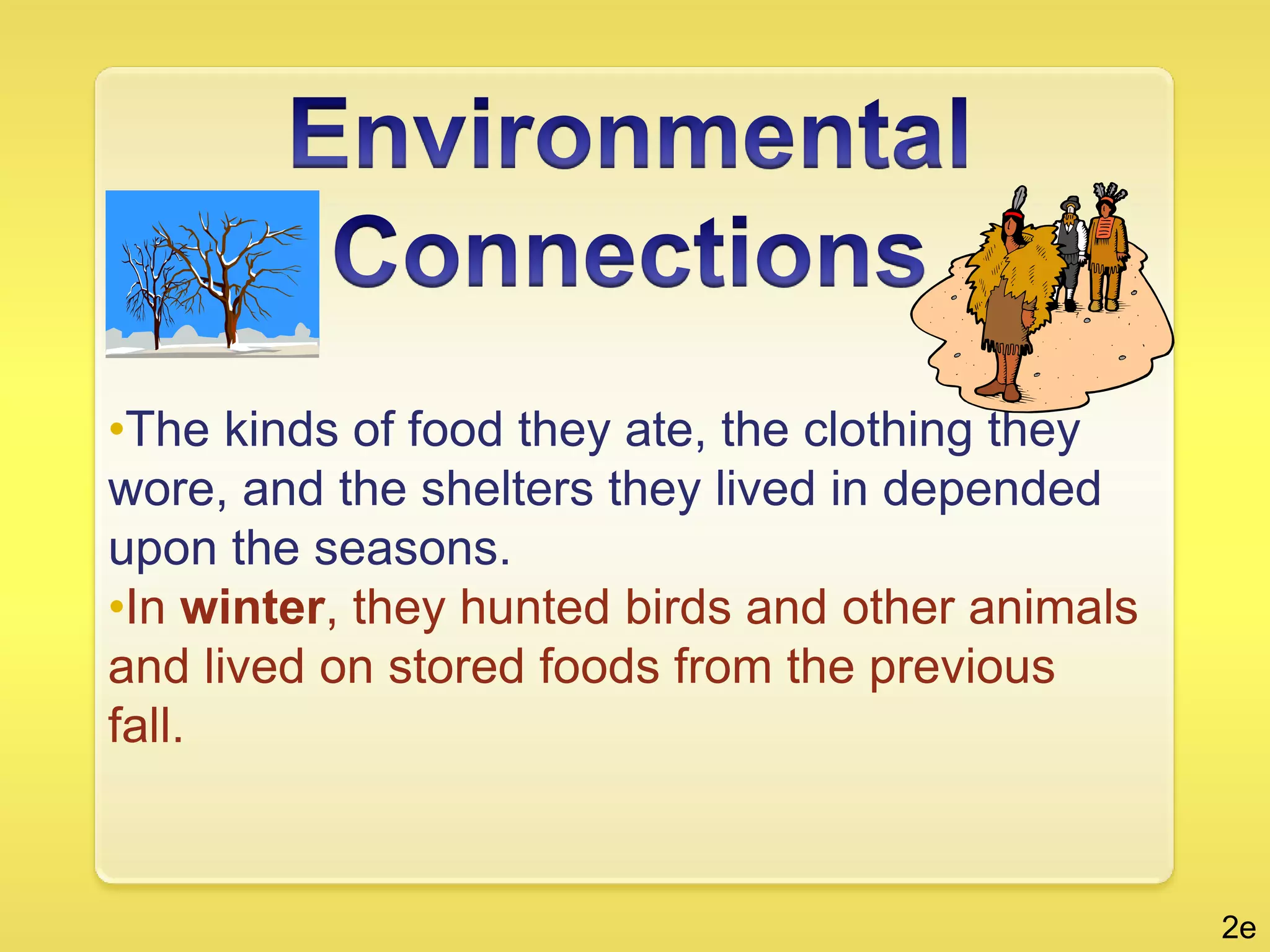
The kinds of food they ate, the clothing they wore, and the shelters they lived in depended upon the seasons.
In winter, they hunted birds and other animals and lived on stored foods from the previous fall.    Environmental Connections   2e
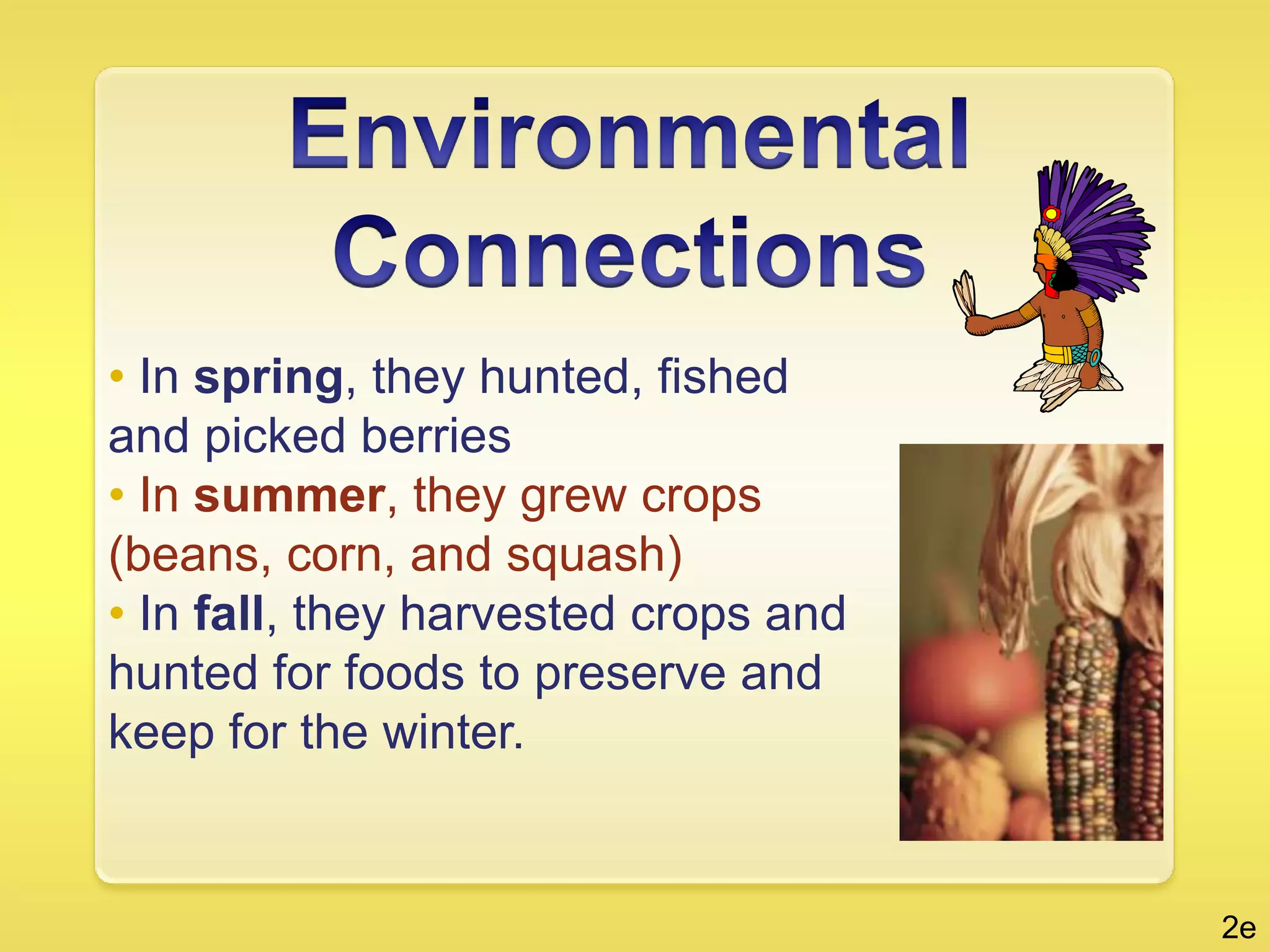
 In spring, they hunted, fished and picked berries
In summer, they grew crops (beans, corn, and squash)
In fall, they harvested crops and hunted for foods to preserve and keep for the winter.    Environmental Connections   2e
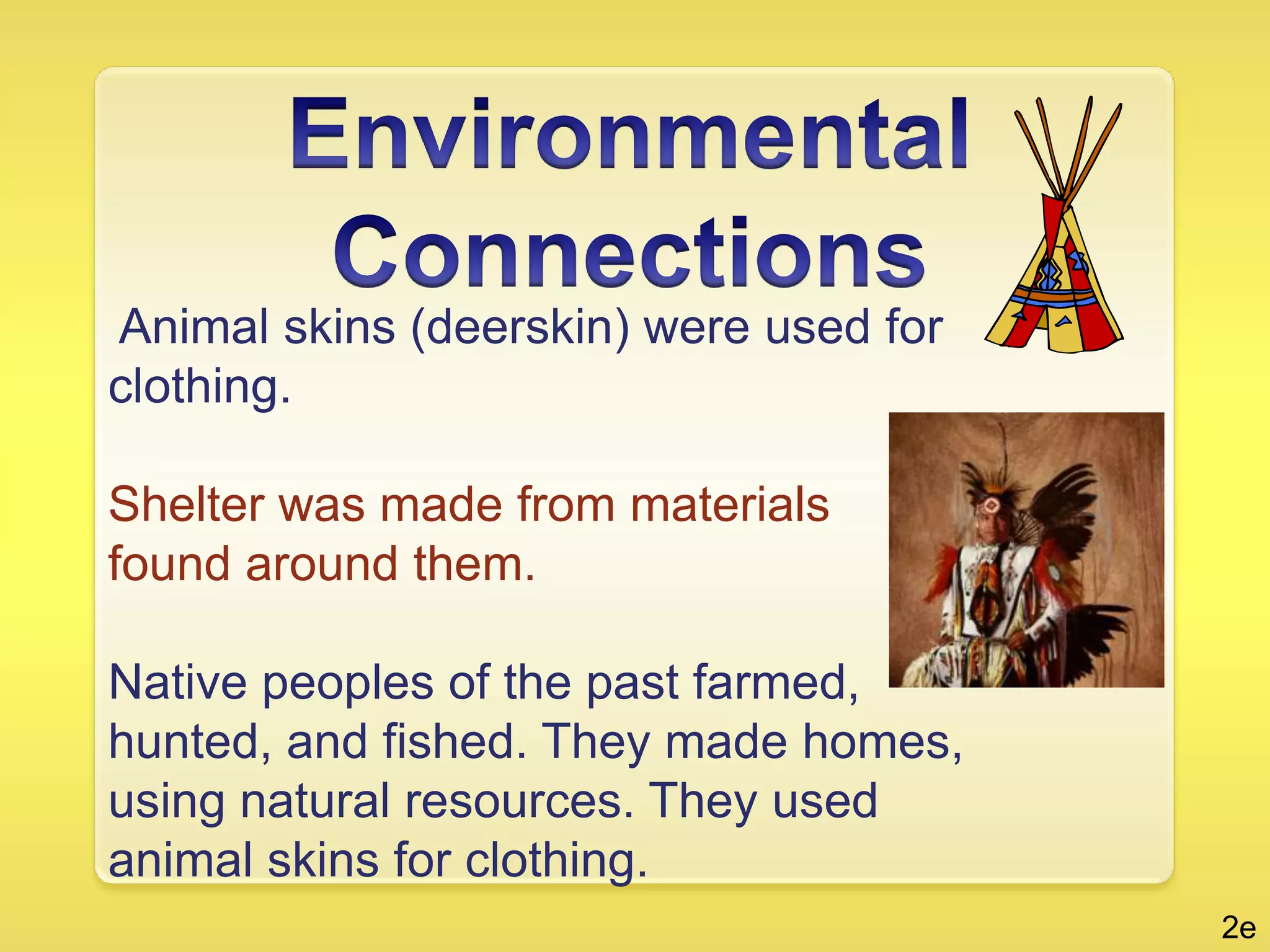
 Animal skins (deerskin) were used for clothing.Shelter was made from materials found around them. Native peoples of the past farmed, hunted, and fished. They made homes, using natural resources. They used animal skins for clothing.    Environmental Connections   2e
  Today, most native peoples live like other Americans. Their cultures have changed over time.     Environmental Connections   2e
  Archaeologists study all kinds of material evidence left by people from the past. Werowocomoco was a large Indian town used by Indian leaders for several hundred years before the English settlers came. It was the headquarters of the leader Powhatan in 1607.   New Evidencewas Discovered    2f
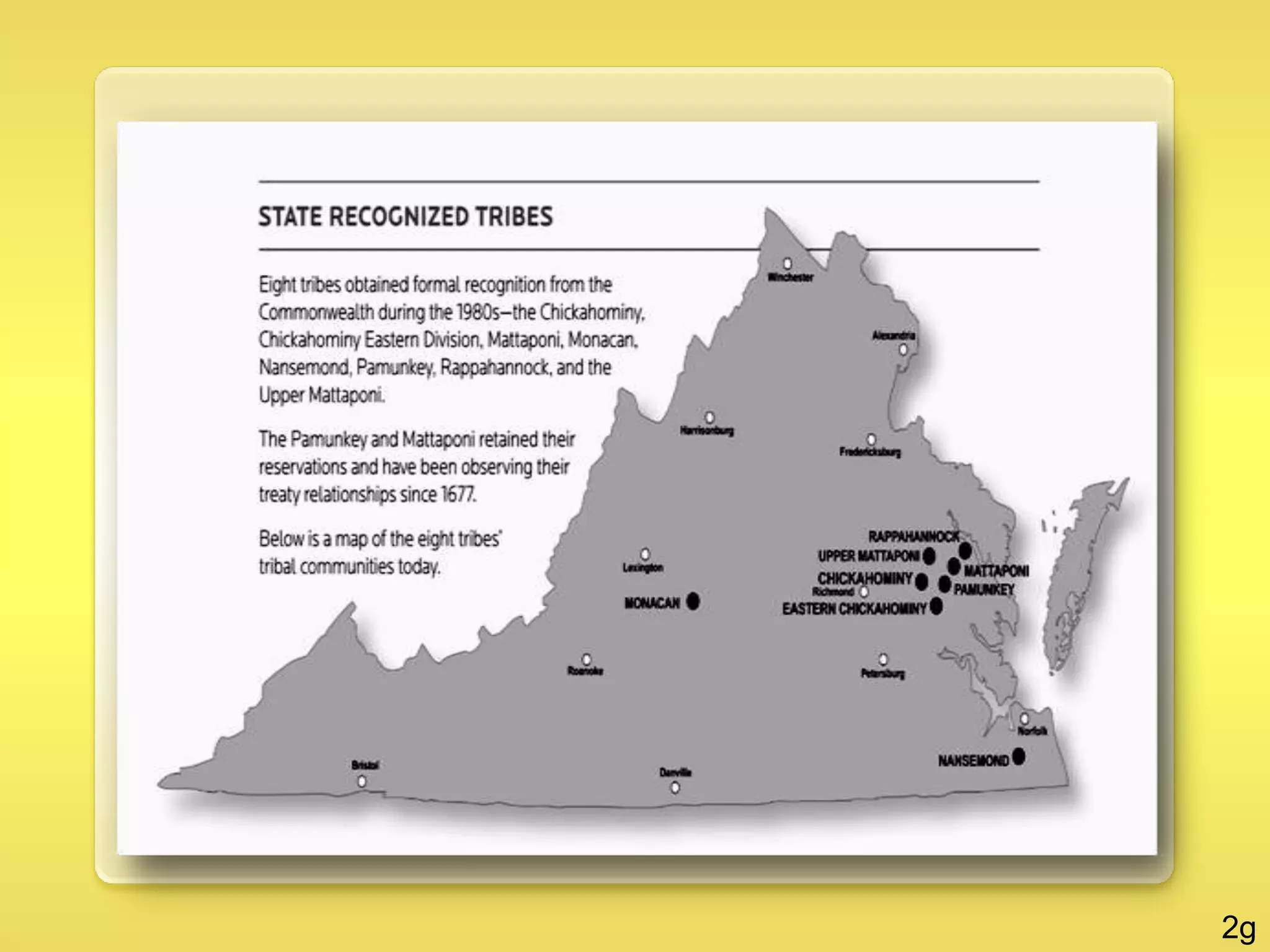
 New Evidencewas Discovered     American Indians, who trace their family histories back to well before 1607, continue to live in all parts of Virginia today.  2g
Coastal Plain (Tidewater) Region:Chickahominy TribeEastern Chickahominy TribeMattaponi TribeNansemond TribePamunkey TribeRappahannock TribeUpper Mattaponi TribePiedmont Region:Monacan Tribe Current State-Recognized  Tribes   2g
    2g
Reasons for English Colonization in AmericaEngland wanted to establish an American colony to increase its wealth and power.
England hoped to find silver and gold in America.
An American settlement would furnish raw materials that could not be grown or obtained in England, while opening new markets for trade. First English Settlement   3a
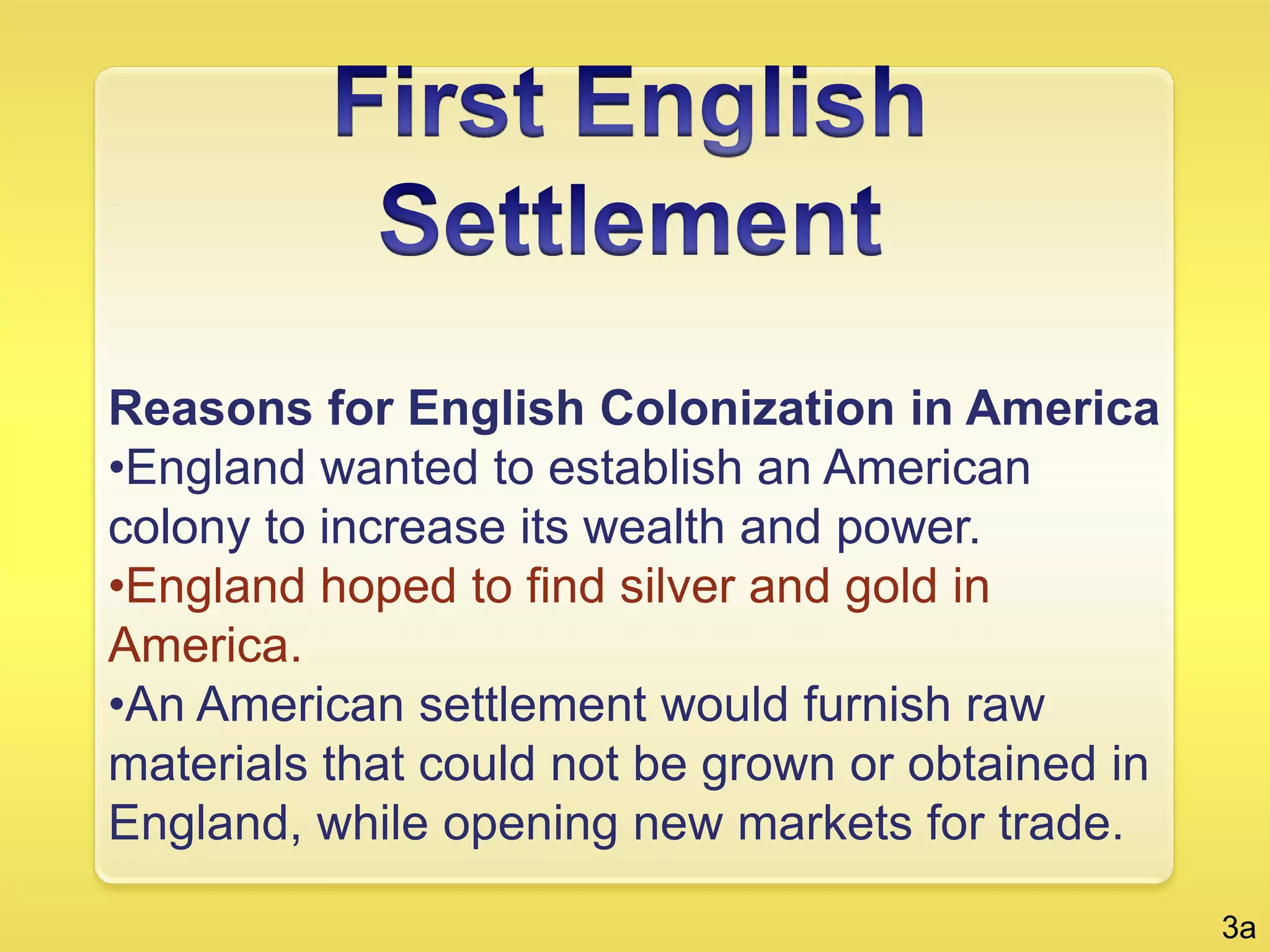
JamestownJamestown was primarily an economic venture.The stockholders of the Virginia Company of London financed the settlement of Jamestown.Jamestown, founded in 1607, became the first permanent English settlement in America. First English Settlement   3a
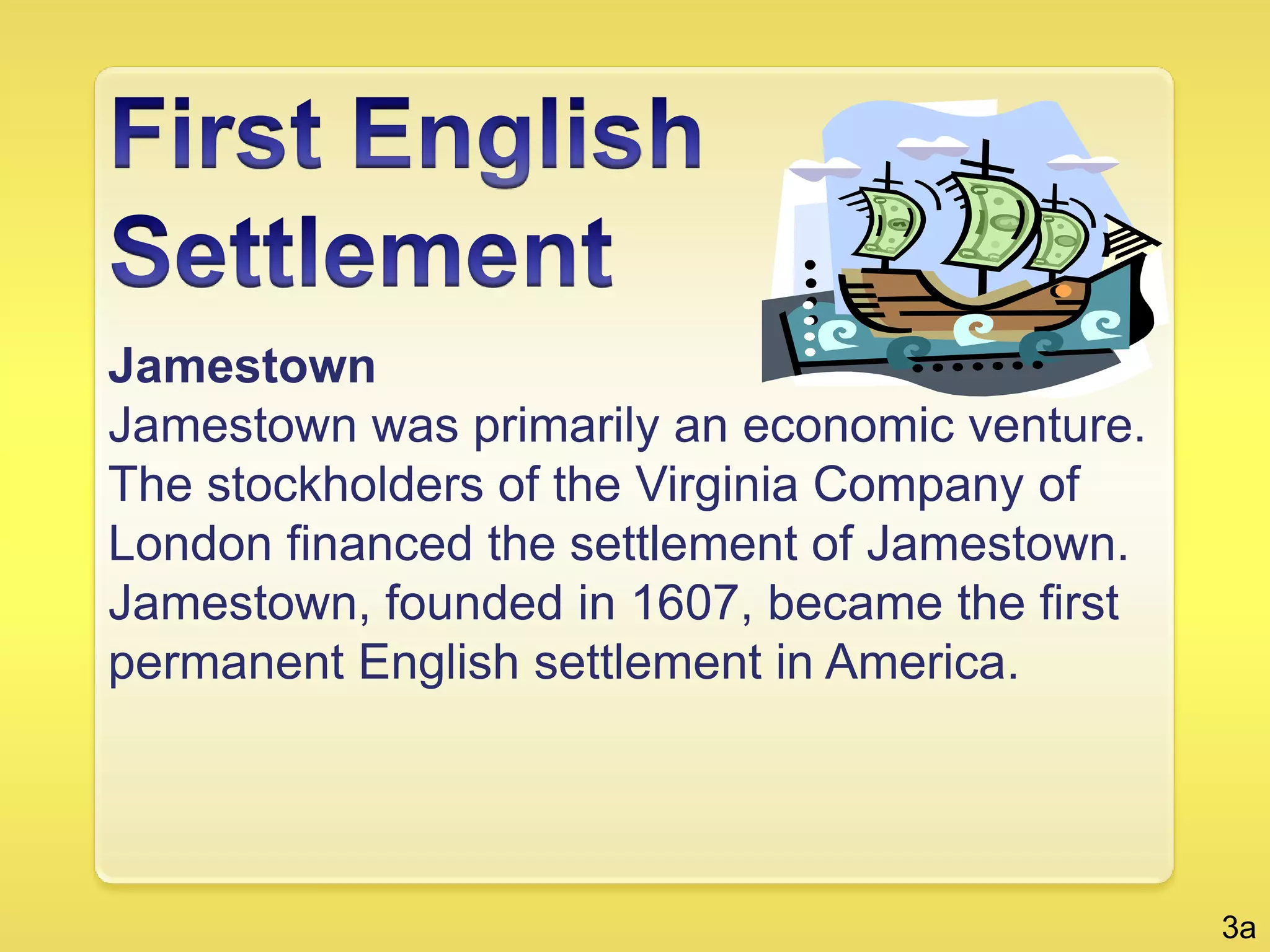
 Jamestown Settlement  When the settlers arrived in 1607, they founded Jamestown on a narrow peninsula bordered on three sides by the James River. Today, Jamestown is located on an island in the James River.  3b
Instructions told the settlers to go inland and find a suitable place for their colony.
The location could be easily defended from attack by sea (by the Spanish).
The water along the shore was deep enough for ships to dock.
They believed the site had a good supply of fresh water.  Reasons for Choosing Jamestown    3b
The King of England granted charters to the Virginia Company of London toestablish a settlement in North Americaextend English rights to the settlers.  Importance of Virginia Charters   3c
System of GovernmentIn 1619, the governor of Virginia called a meeting of the General Assembly. The General Assembly included two representatives, called burgesses, from each of the divisions of Virginia, along with the governor’s council and the governor. They met as one legislative body. (At that time, only certain free adult men had the right to take part.) General Assembly 1619   3d
 General Assembly 1619  The current Virginia General Assembly dates back to 1619 with the establishment of the General Assembly and its burgesses in Jamestown. It was the first elected legislative body in English America giving settlers the opportunity to control their own government 3d
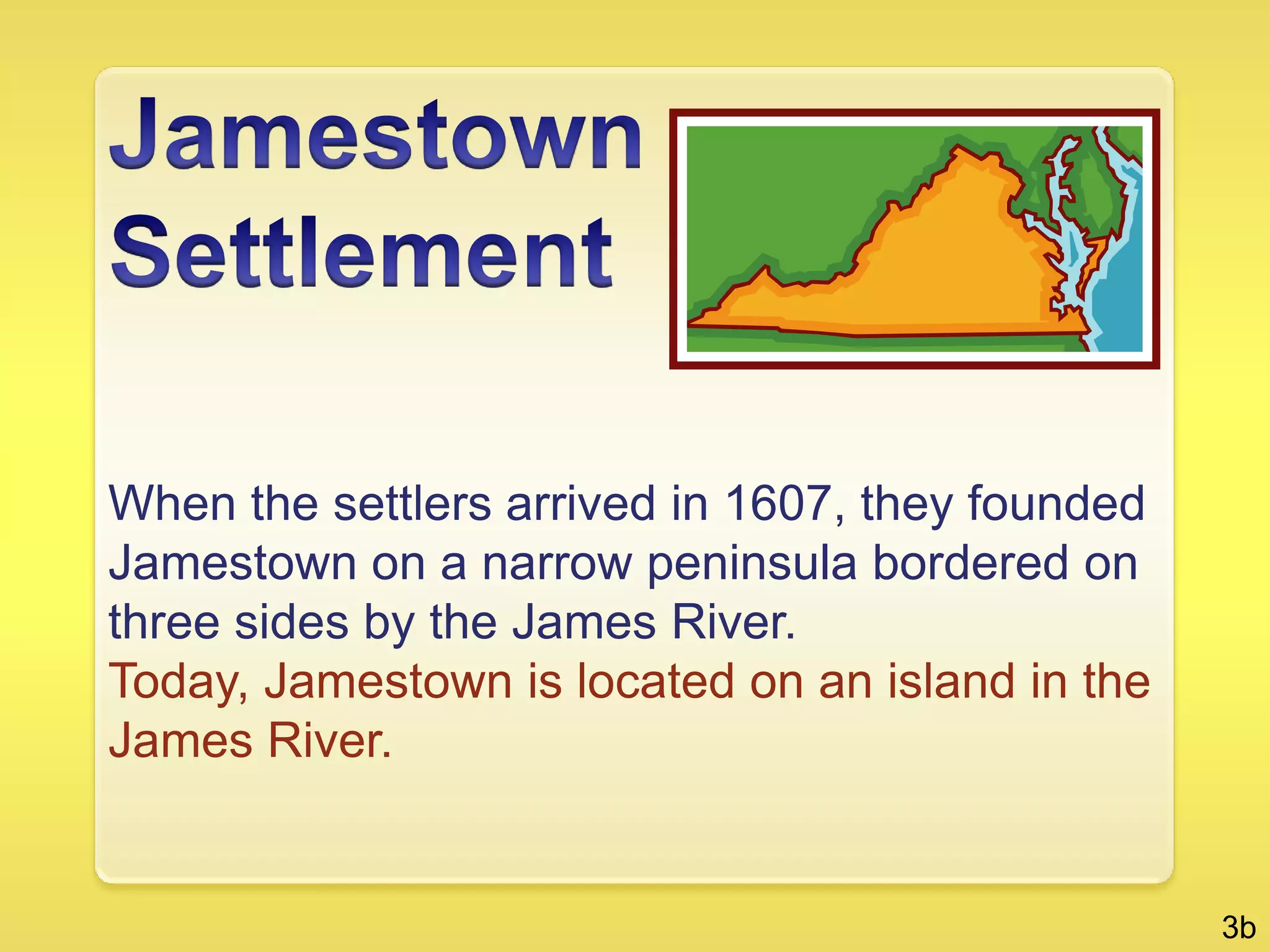
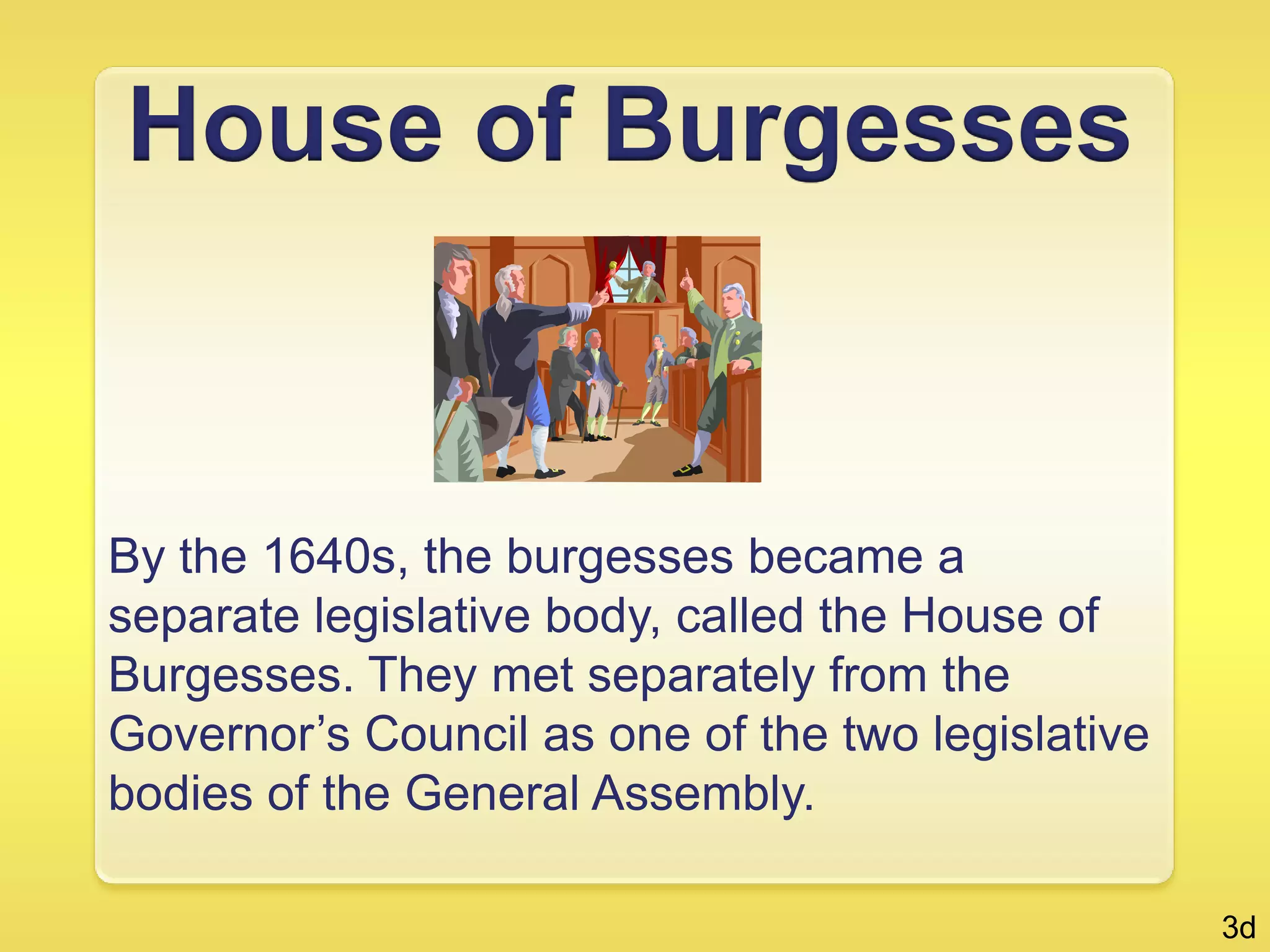
 House of Burgesses   By the 1640s, the burgesses became a separate legislative body, called the House of Burgesses. They met separately from the Governor’s Council as one of the two legislative bodies of the General Assembly.3d
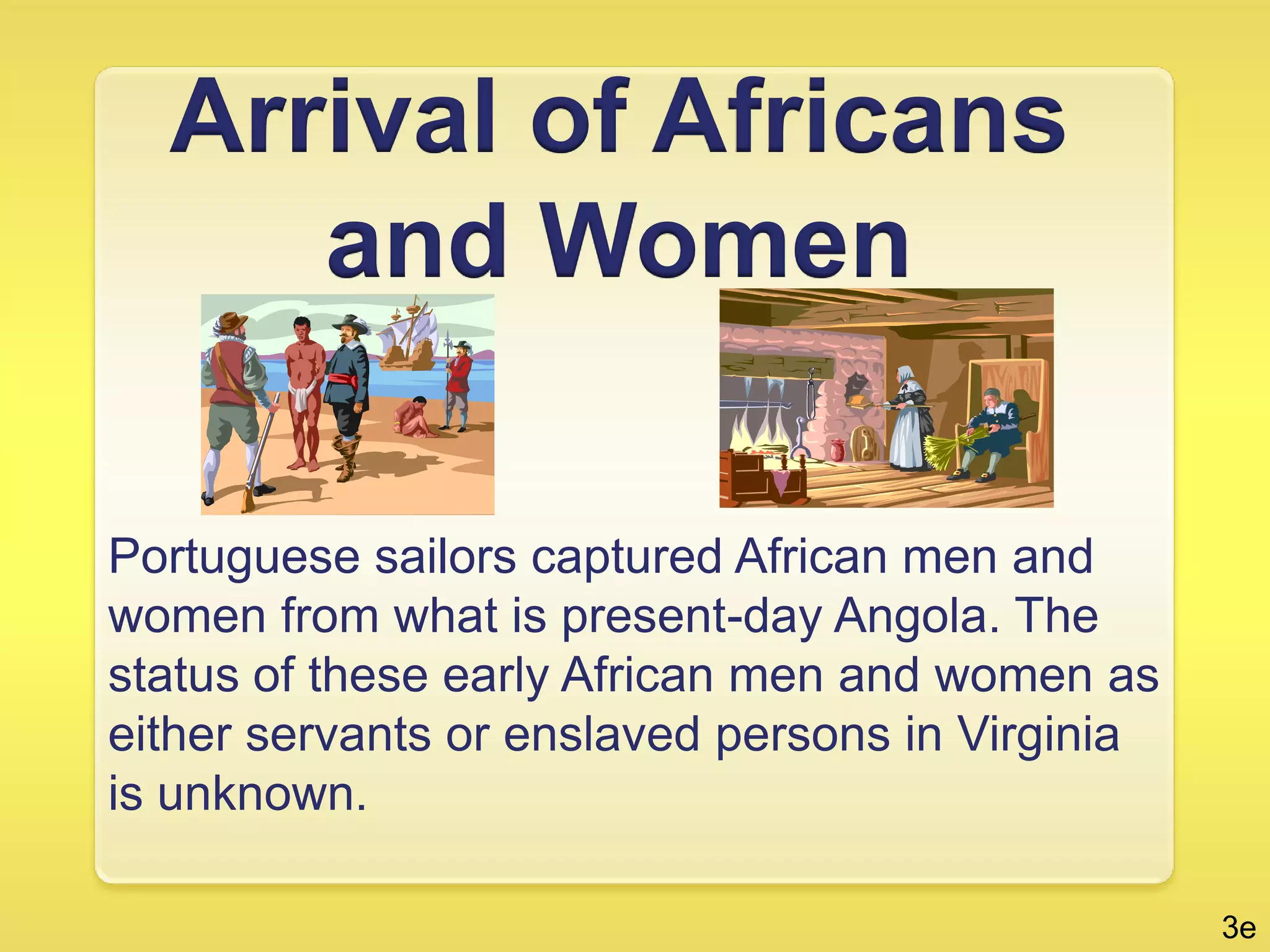
 Arrival of Africans and Women   Portuguese sailors captured African men and women from what is present-day Angola. The status of these early African men and women as either servants or enslaved persons in Virginia is unknown.3e
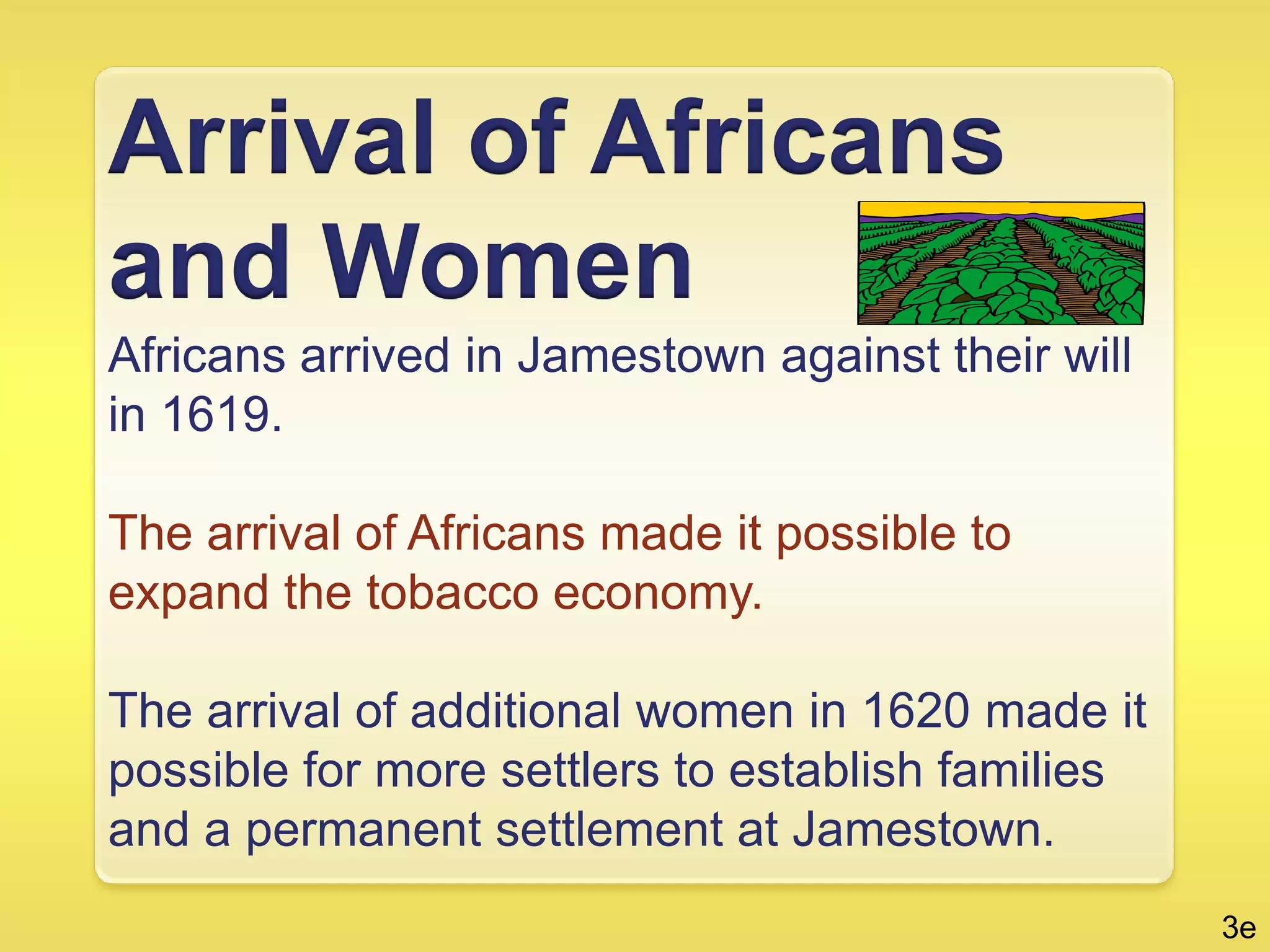
Africans arrived in Jamestown against their will in 1619. The arrival of Africans made it possible to expand the tobacco economy. The arrival of additional women in 1620 made it possible for more settlers to establish families and a permanent settlement at Jamestown. Arrival of Africans and Women   3e
The arrival of additional women in 1620 made it possible for more settlers to establish families and a permanent settlement at Jamestown.    Arrival of Women  3e
The site they chose to live on was marshy and lacked safe drinking water.
The settlers lacked some skills necessary to provide for themselves.
Many settlers died of starvation    Hardships Faced by the Jamestown Settlement   3f
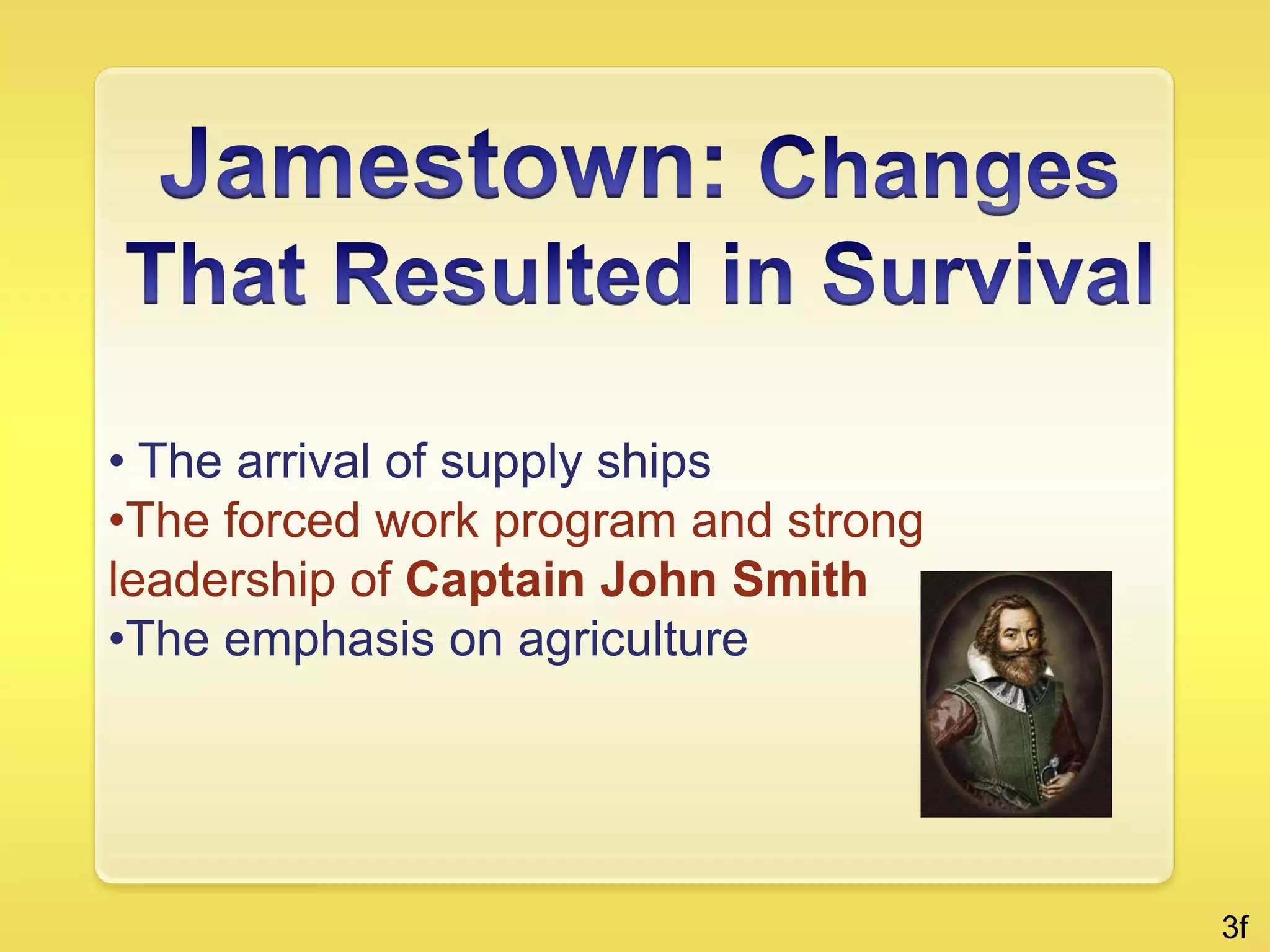
 The arrival of supply ships
The forced work program and strong leadership of Captain John Smith
The emphasis on agriculture         Jamestown: Changes That Resulted in Survival    3f
Captain John Smith initiated trading relationships with the native people.   The native peoples traded mainly food with the English in exchange for tools, pots, and copper for jewelry.  Interactions Between the English Settlers and the Indians     3f
The native peoples contributed to the survival of the Jamestown settlers in several ways.Powhatan, chief of many tribes, provided leadership to his people and taught the settlers survival skills. Interactions Between the English Settlers and the Indians     3g
Pocahontas, daughter of Powhatan, served as a contact between the native peoples and the English.
The native peoples showed the settlers how to plant corn and tobacco.  Interactions Between the English Settlers and the Indians     3g
The native peoples showed the settlers how to plant corn and tobacco.
Over time, the native peoples realized the English settlement would continue to grow. They came to see the settlers as invaders who would take over their land.   Interactions Between the English Settlers and the Indians     3g
cash crop: A crop that is grown to sell for money rather than for use by the growersThe economy of the Virginia colony depended on agriculture as the primary source of wealth.
Tobacco became the most profitable agricultural product.
Tobacco was sold in England as a cash crop.   The Importance of Agriculture       4a
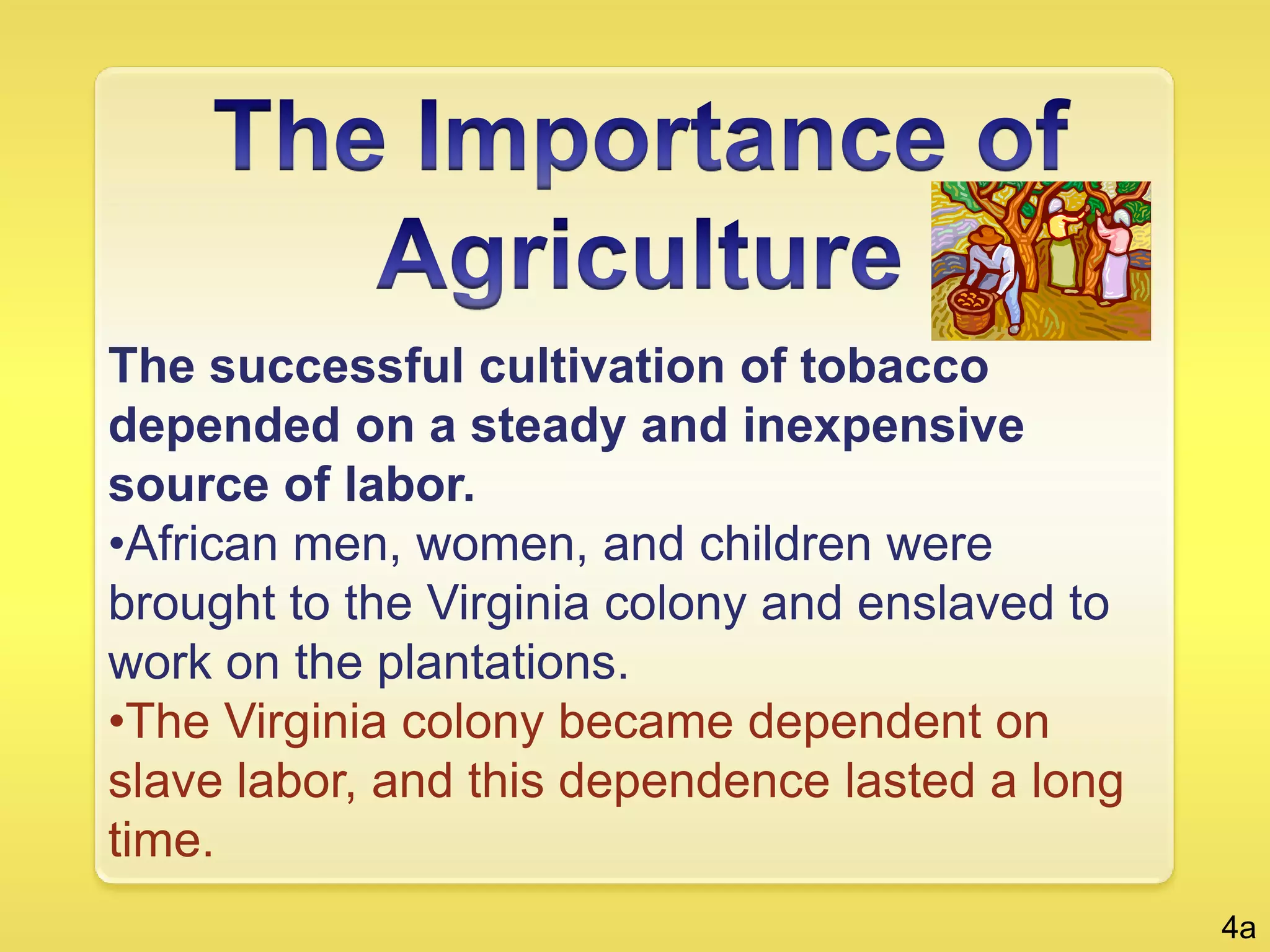
The successful cultivation of tobacco depended on a steady and inexpensive source of labor.African men, women, and children were brought to the Virginia colony and enslaved to work on the plantations.
The Virginia colony became dependent on slave labor, and this dependence lasted a long time.  The Importance of Agriculture       4a
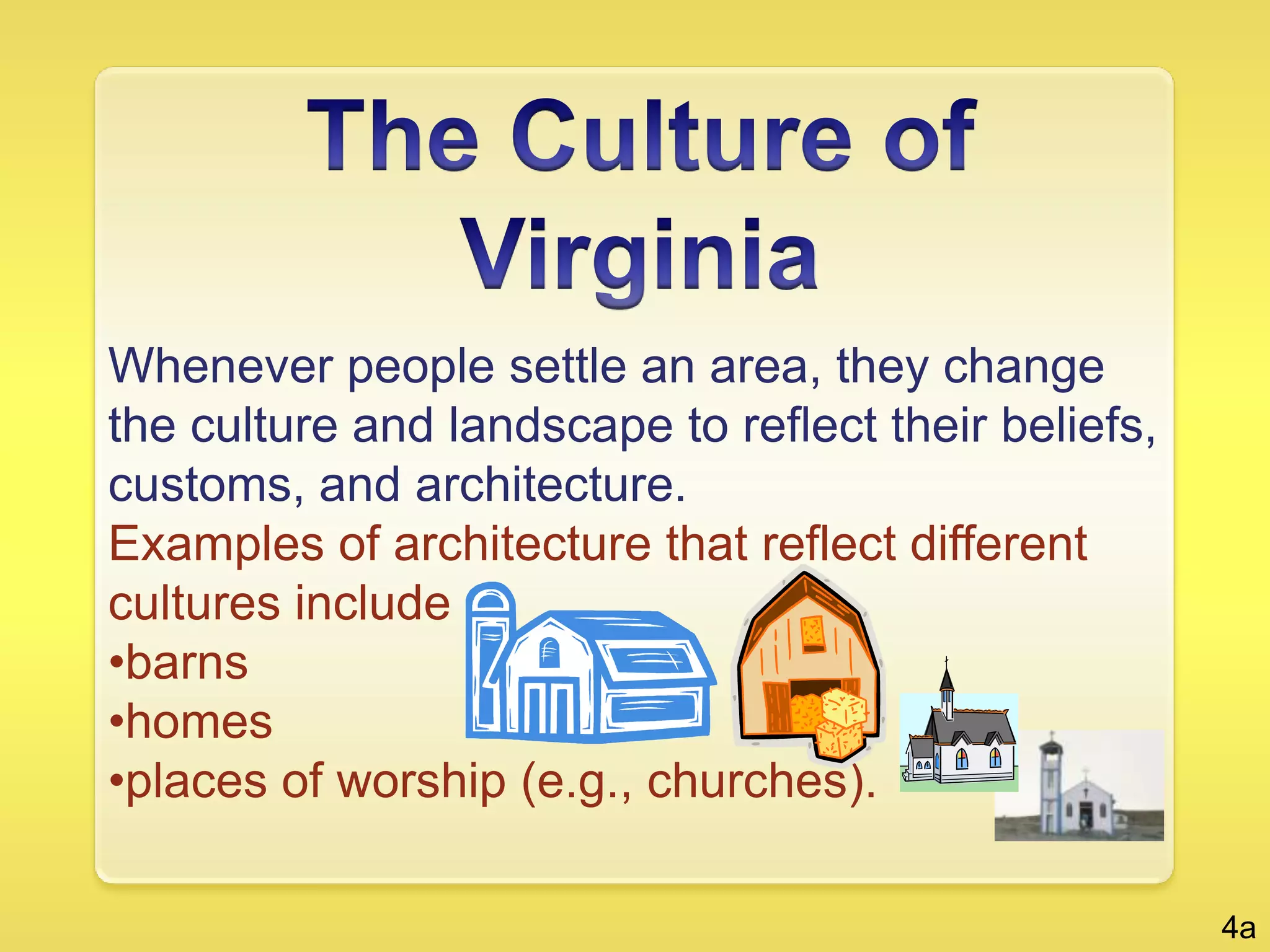
Whenever people settle an area, they change the culture and landscape to reflect their beliefs, customs, and architecture. Examples of architecture that reflect different cultures includebarns
homes
places of worship (e.g., churches).  The Culture of Virginia      4a
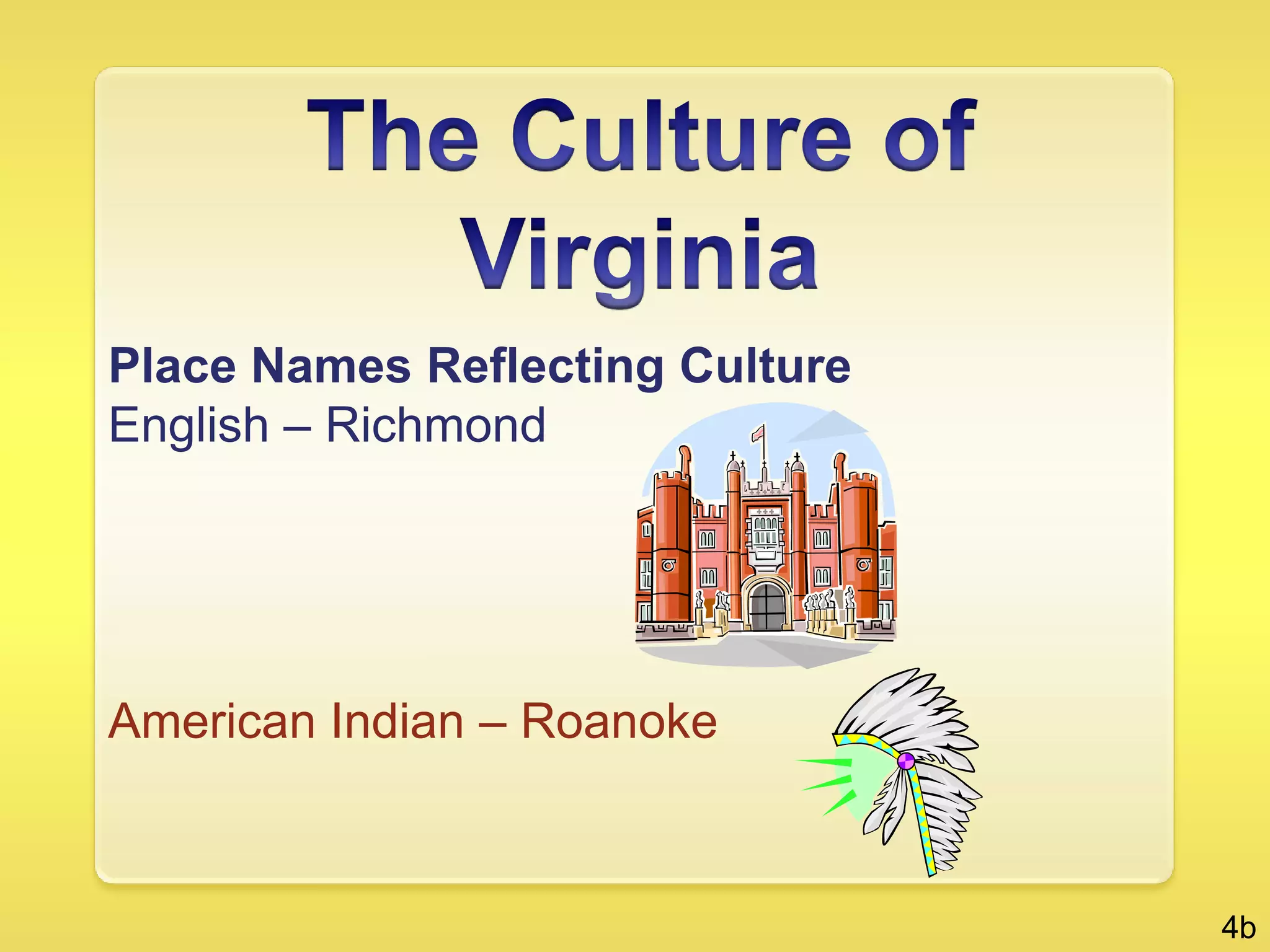
Place Names Reflecting CultureEnglish – RichmondAmerican Indian – Roanoke The Culture of Virginia      4b
 English and other Europeans settled primarily in the Coastal Plain (Tidewater) and the Piedmont regions.  Germans and Scots-Irish settled primarily in the Shenandoah Valley, which was along the migration route.  Settlement Areas of Virginia      4b
 Migration and living in new areas caused people to adapt old customs to their new environment.    Adapting Old Customs to a New Environment     4b
 Moved from Jamestown to WilliamsburgDrinking water was contaminated by seepage of salt water.
Unhealthy living conditions caused diseases.
Fire destroyed wooden and brick buildings at   Jamestown   Reasons for Moving the Capital     4c
 Moved from Williamsburg to RichmondThe population was moving westward.
Richmond was a more central location.
Moving to Richmond increased the distance from the sea and possible attack by the British.  Reasons for Moving the Capital     4c
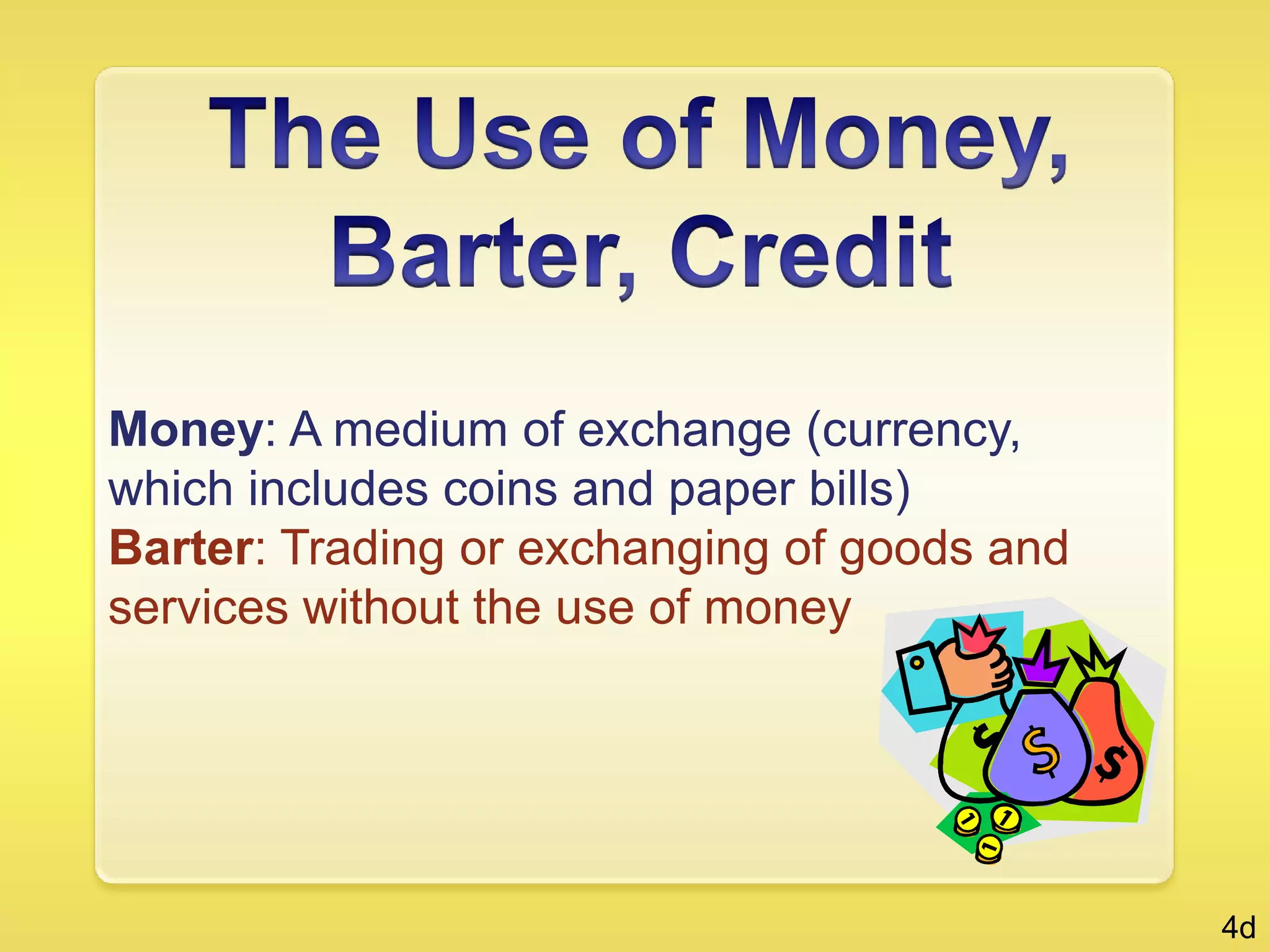
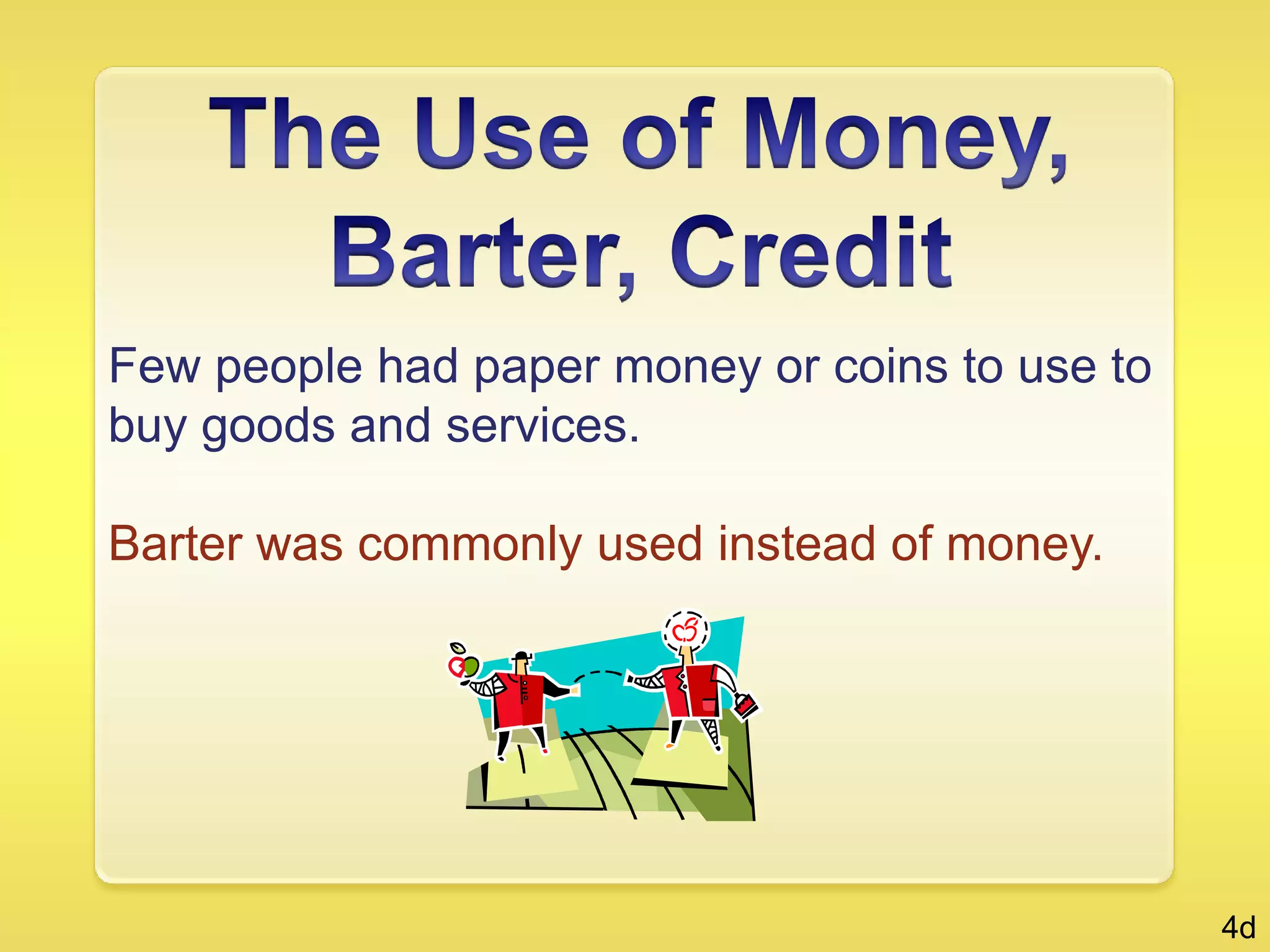
Money: A medium of exchange (currency, which includes coins and paper bills)Barter: Trading or exchanging of goods and services without the use of money  The Use of Money, Barter, Credit    4d
Credit: Buying a good or service now and paying for it laterDebt: A good or service owed to someonesavings: Money put away to save or to spend at a later timeSaving: Money put away to save or spend at a later time    The Use of Money, Barter, Credit    4d
Few people had paper money or coins to use to buy goods and services. Barter was commonly used instead of money.  The Use of Money, Barter, Credit    4d
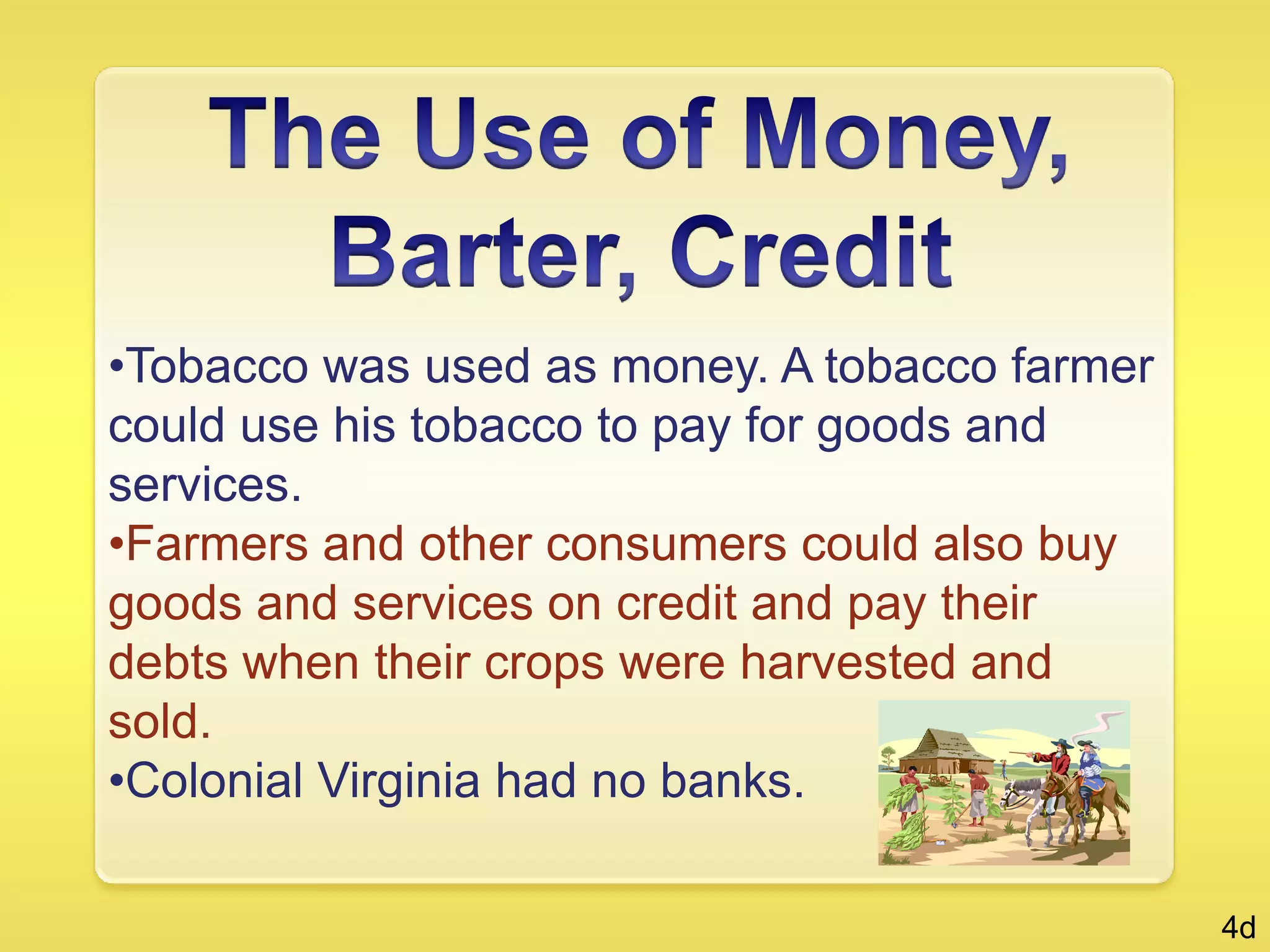
Tobacco was used as money. A tobacco farmer could use his tobacco to pay for goods and services.
Farmers and other consumers could also buy goods and services on credit and pay their debts when their crops were harvested and sold.
Colonial Virginia had no banks.  The Use of Money, Barter, Credit    4d
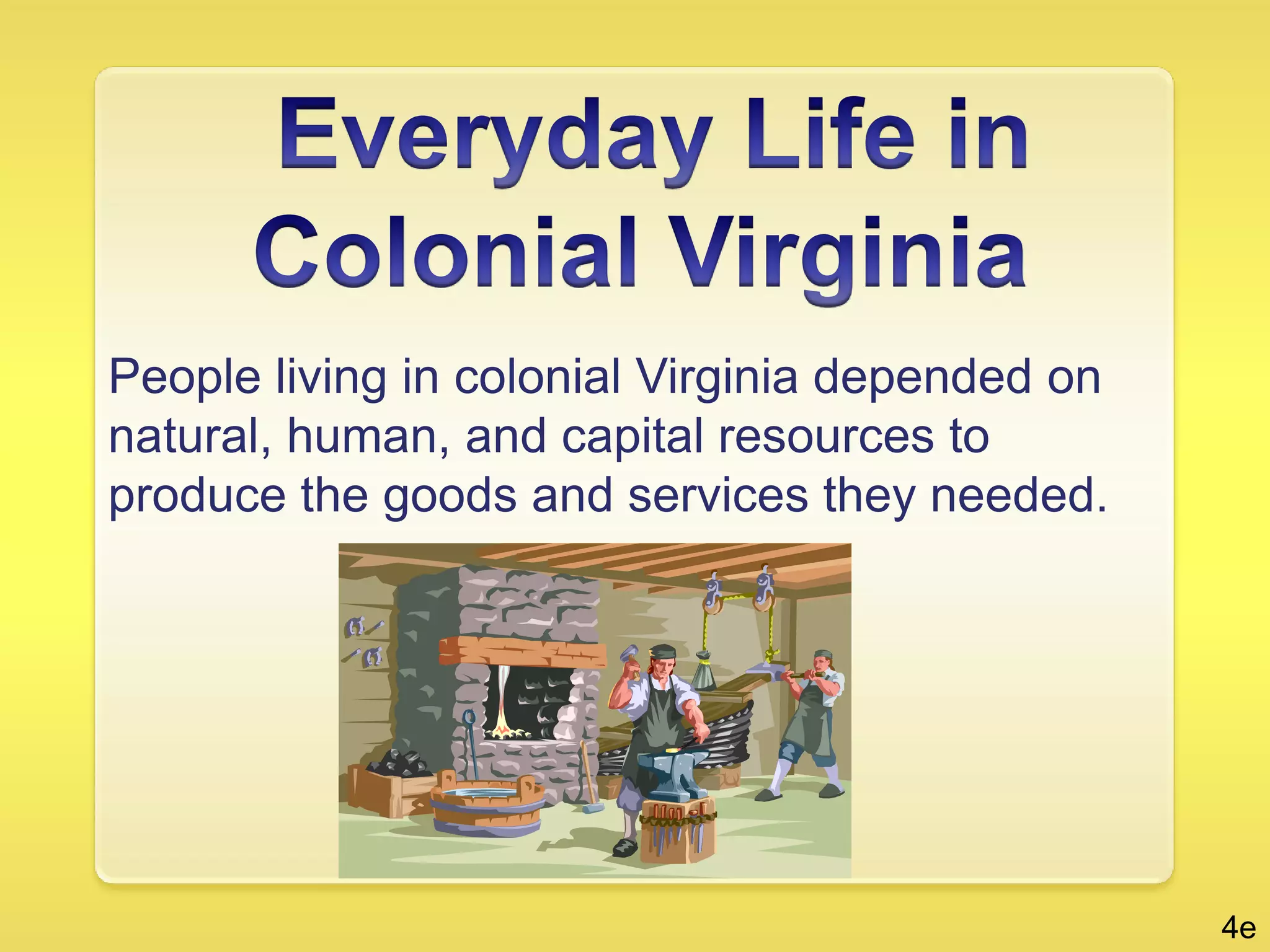
People living in colonial Virginia depended on natural, human, and capital resources to produce the goods and services they needed.    Everyday Life in Colonial Virginia     4e
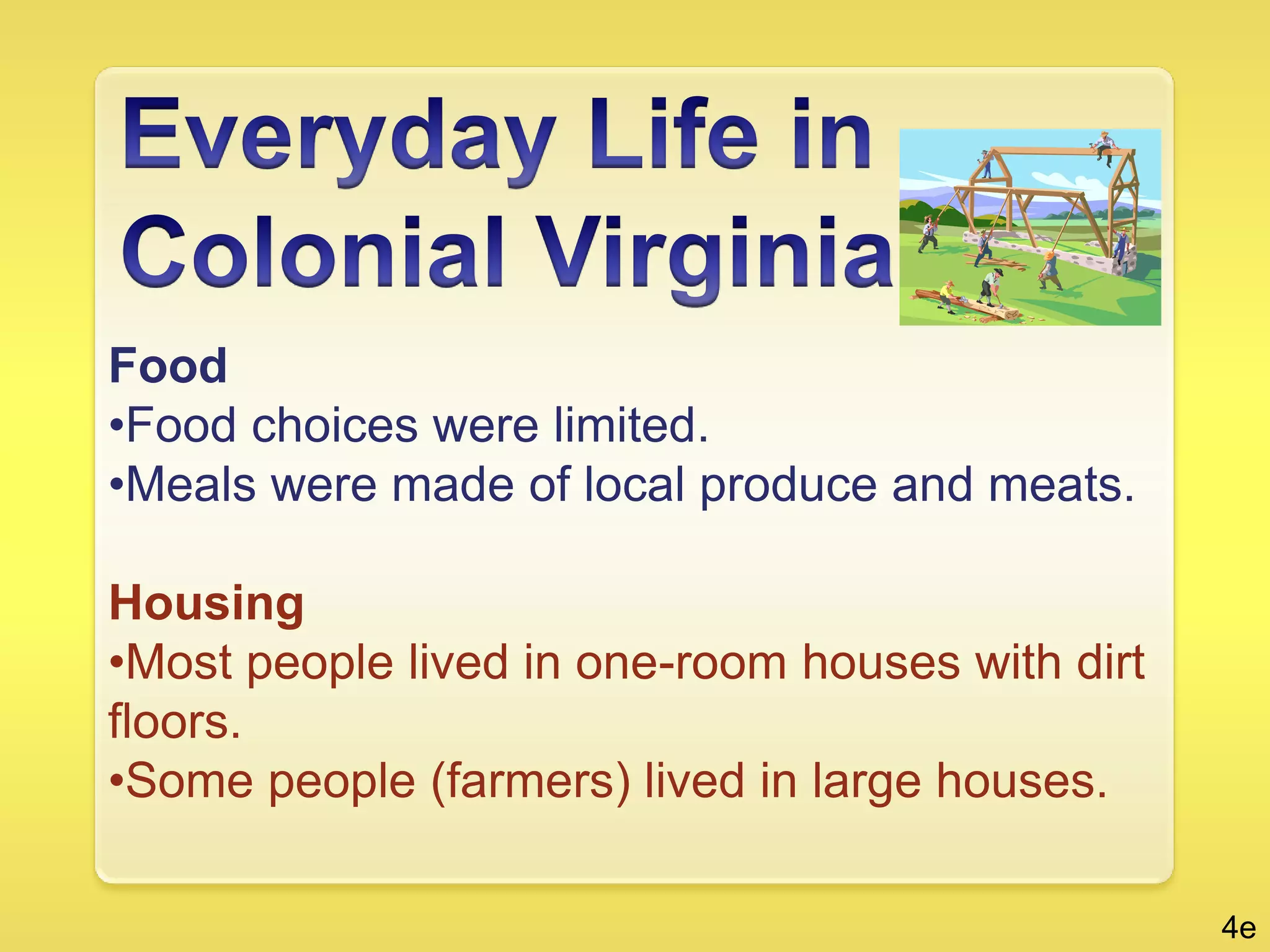
FoodFood choices were limited.
Meals were made of local produce and meats. HousingMost people lived in one-room houses with dirt floors.
Some people (farmers) lived in large houses.   Everyday Life in Colonial Virginia    4e
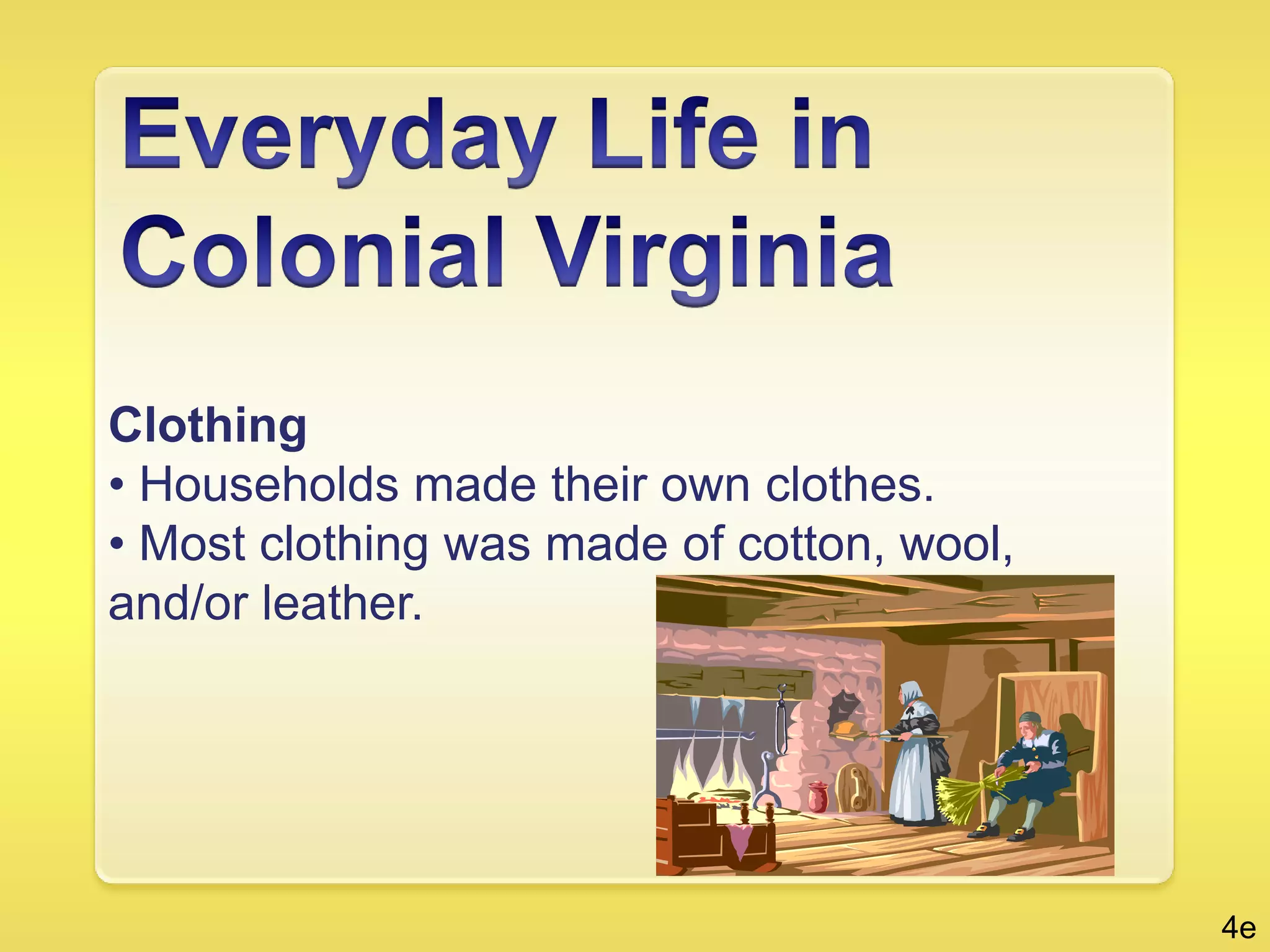
Clothing Households made their own clothes.
 Most clothing was made of cotton, wool, and/or leather.   Everyday Life in Colonial Virginia    4e
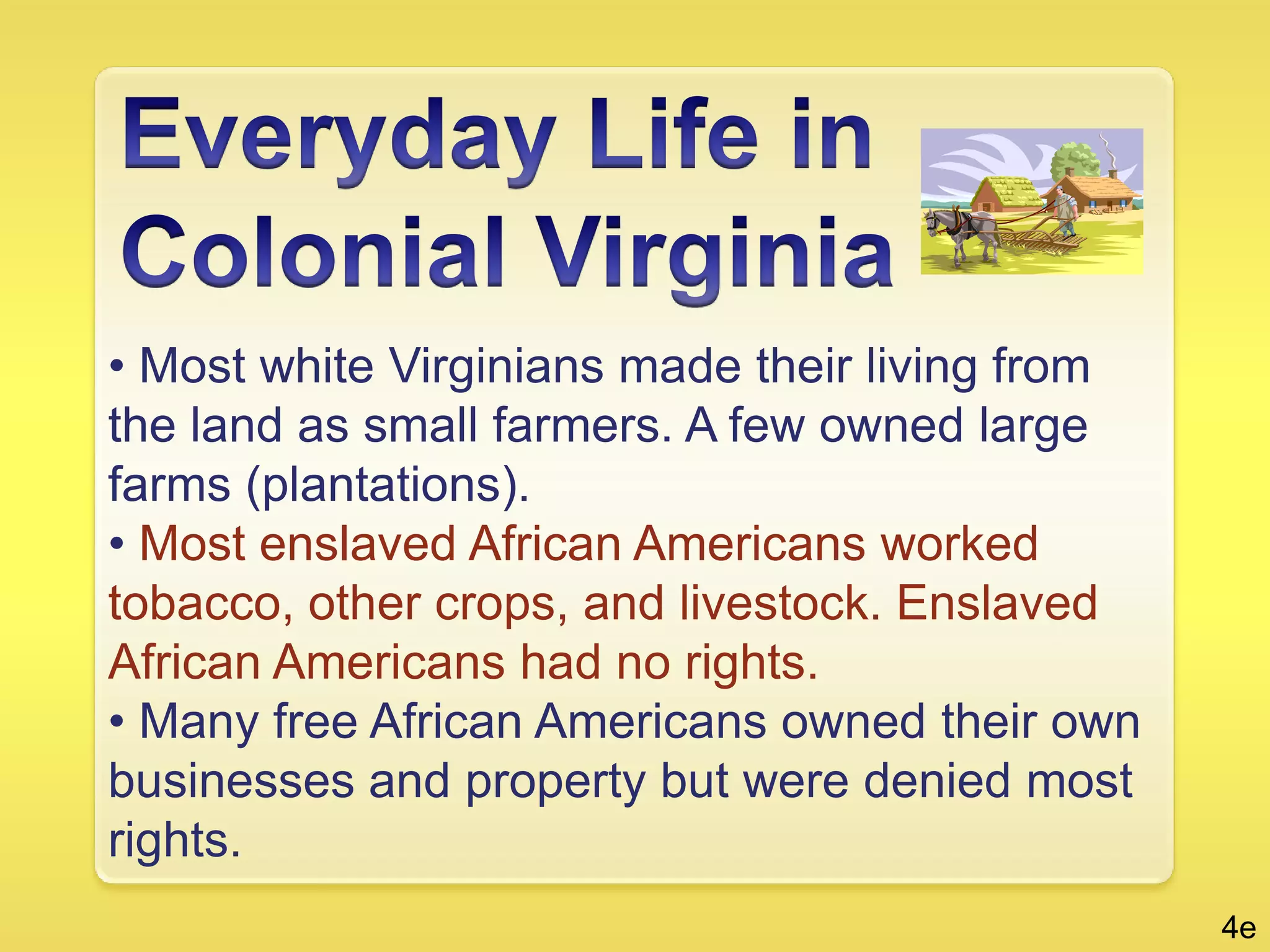
 Most white Virginians made their living from the land as small farmers. A few owned large farms (plantations).
Most enslaved African Americans worked tobacco, other crops, and livestock. Enslaved African Americans had no rights.
 Many free African Americans owned their own businesses and property but were denied most rights.    Everyday Life in Colonial Virginia    4e
 The colonists and the British Parliament disagreed over how the colonies should be governed.Parliament believed it had the legal authority in the  colonies, while the colonists believed their local assemblies had legal authority.
Parliament believed it had the right to tax the       colonies, while the colonists believed they should not be taxed because they had no representation in Parliament.    Reason Colonists Went to War    5a
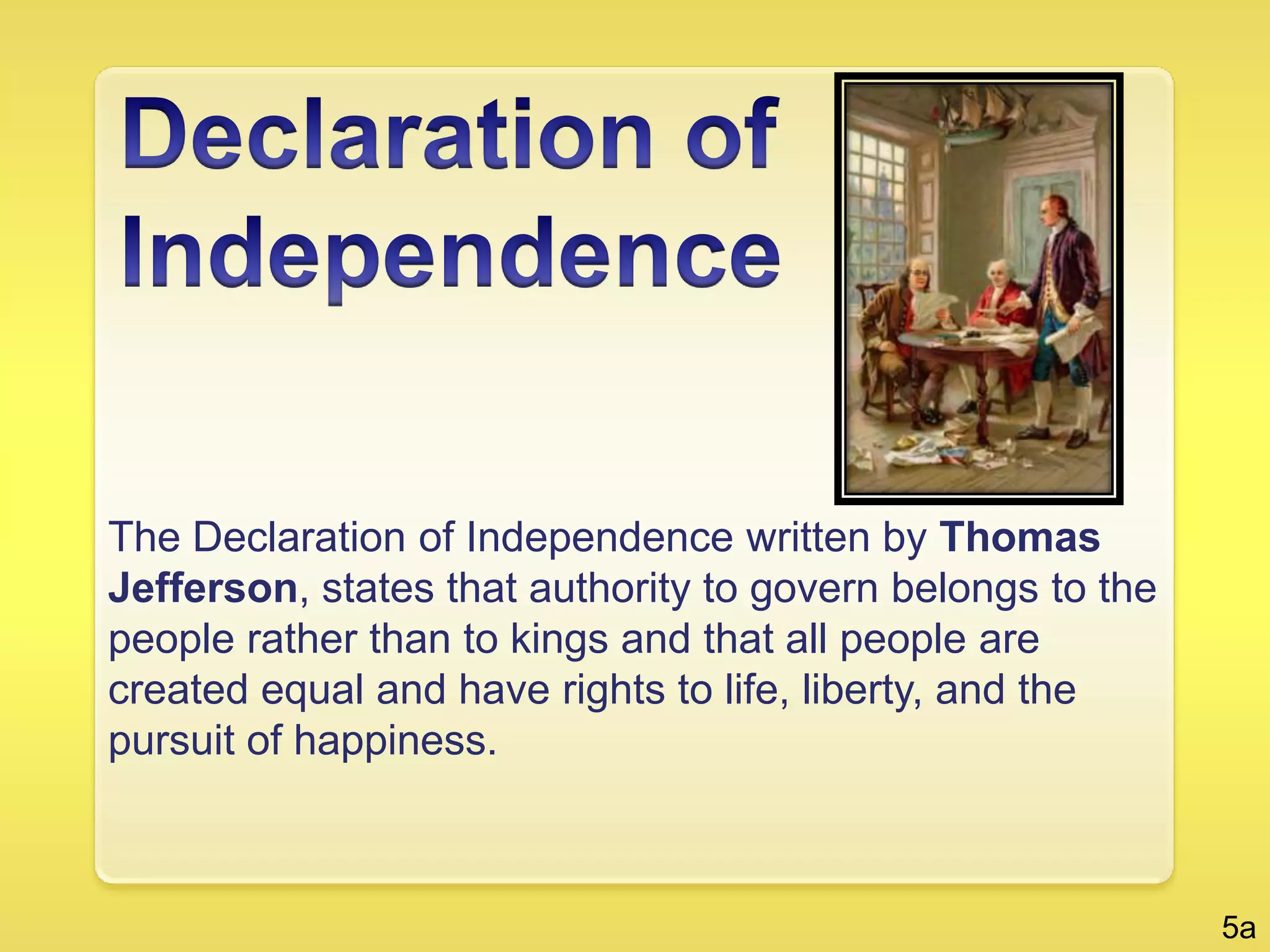
 The Declaration of Independence written by Thomas          Jefferson, states that authority to govern belongs to the people rather than to kings and that all people are      created equal and have rights to life, liberty, and the pursuit of happiness.    Declaration of Independence    5a
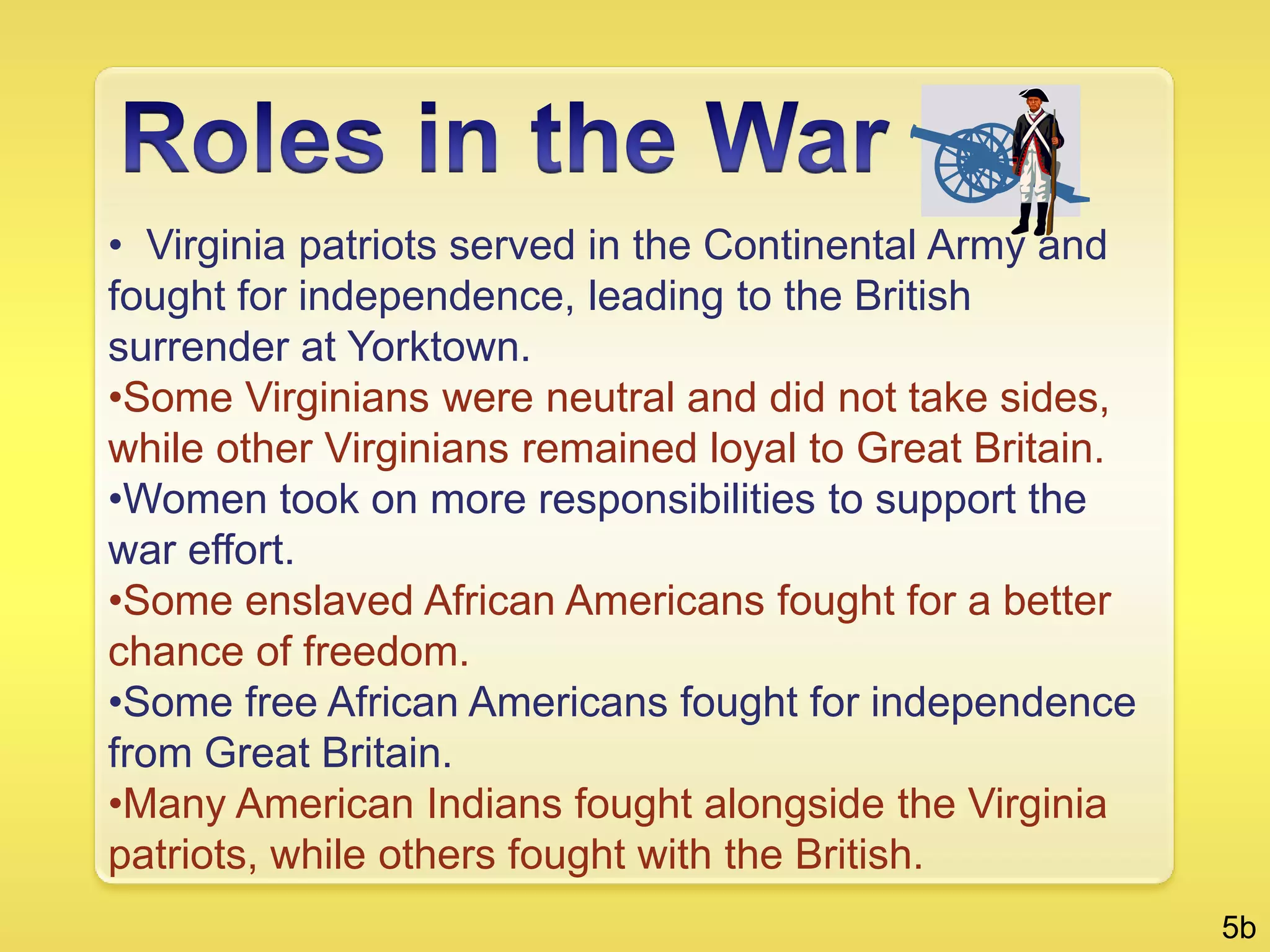
 Virginia patriots served in the Continental Army and fought for independence, leading to the British surrender at Yorktown.
Some Virginians were neutral and did not take sides, while other Virginians remained loyal to Great Britain.
Virginia studies review pp 2008 Standards

  • 1.
    Virginia Studies2008 StandardsCreatedby Angela Turley2010Virginia Social Studies/ History SOL Review
  • 2.
    What’s the LocationVS2a Relative location may be described using terms that show connections between two places such as “next to,” “near,” “bordering.”
  • 3.
    Bordering Bodies ofWaterAtlantic Ocean Chesapeake Bay 2a
  • 4.
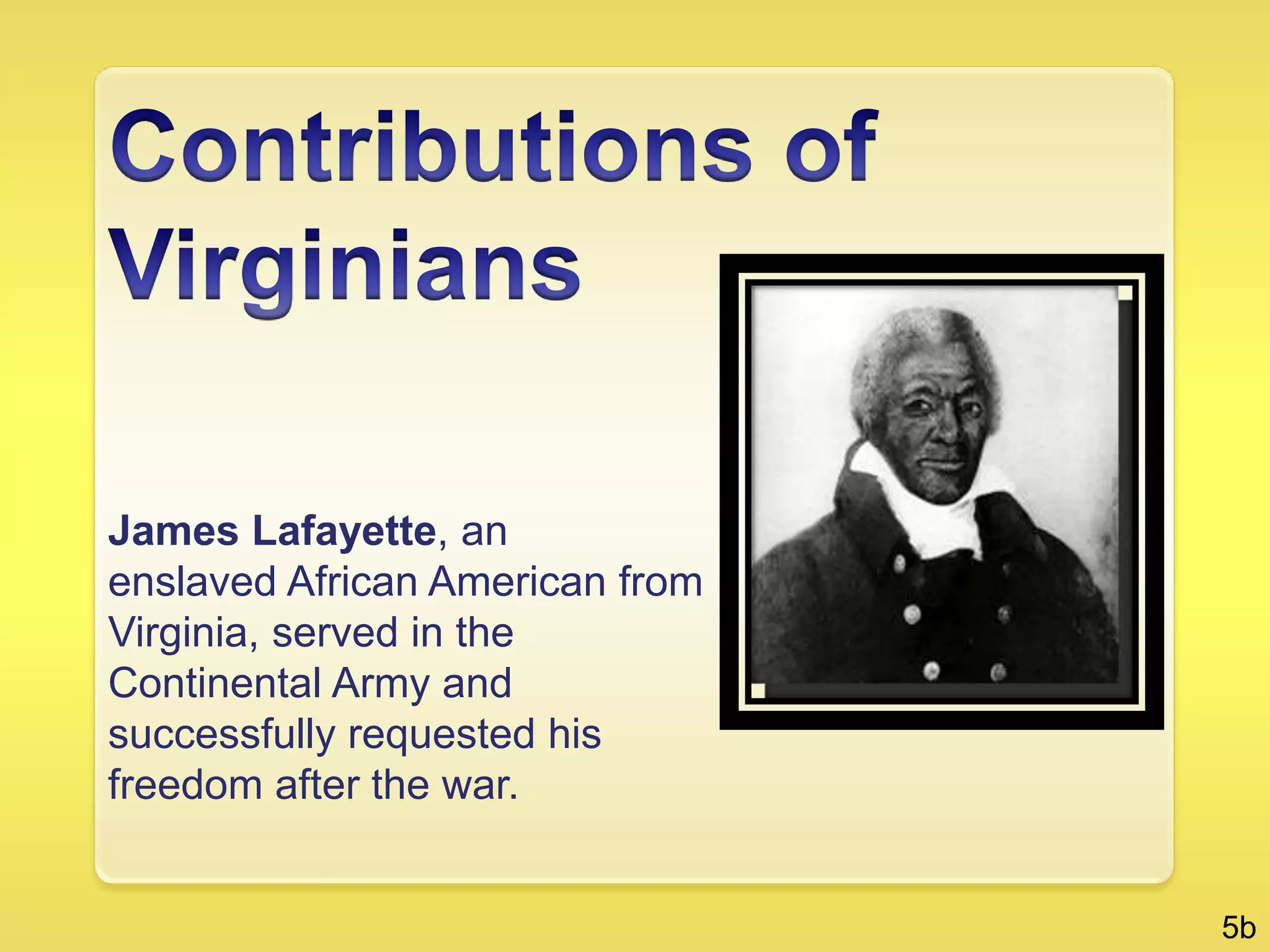
    The States thatBorder VirginiaMarylandWest VirginiaKentuckyTennesseeNorth Carolina2a
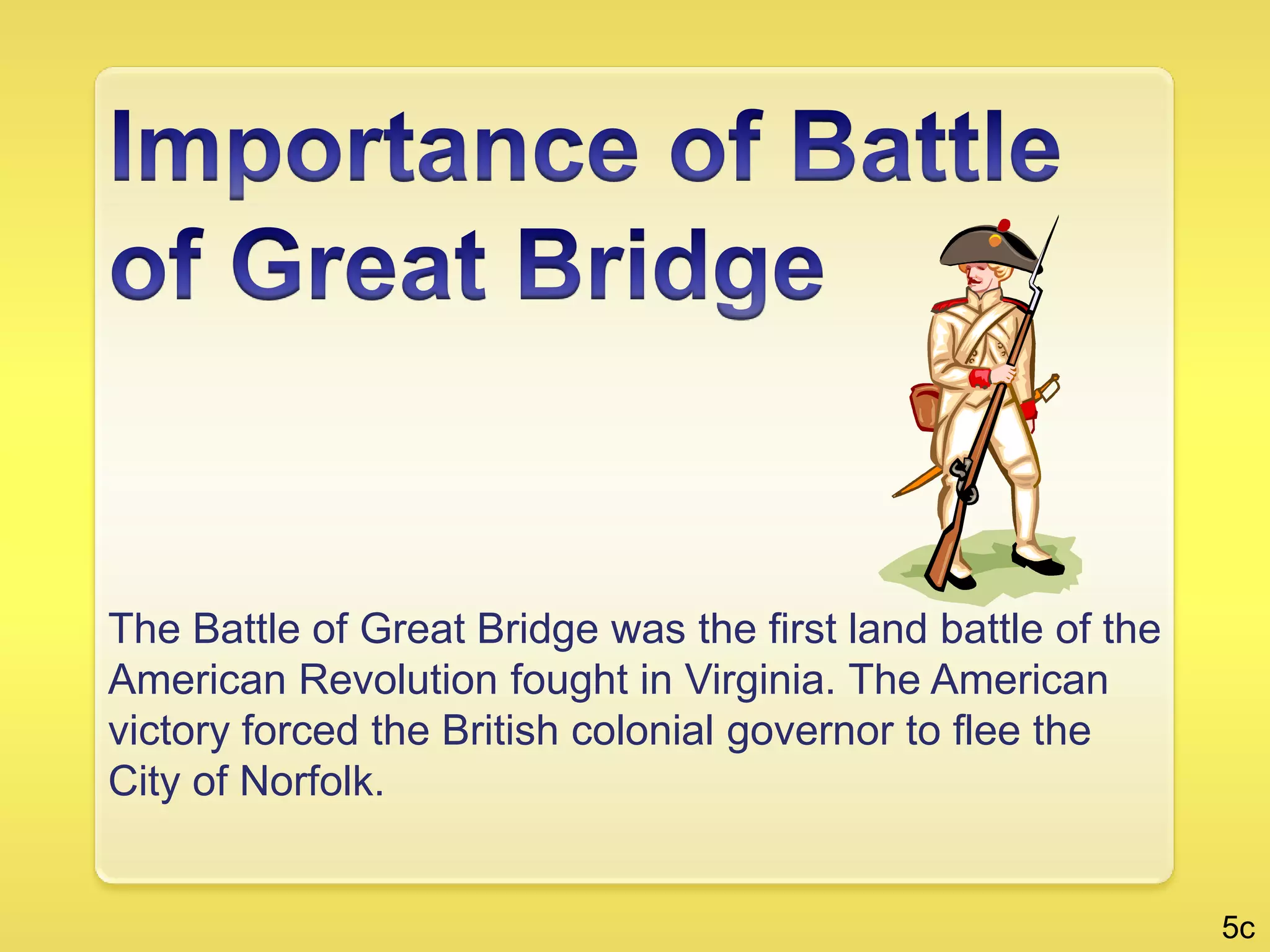
  • 5.
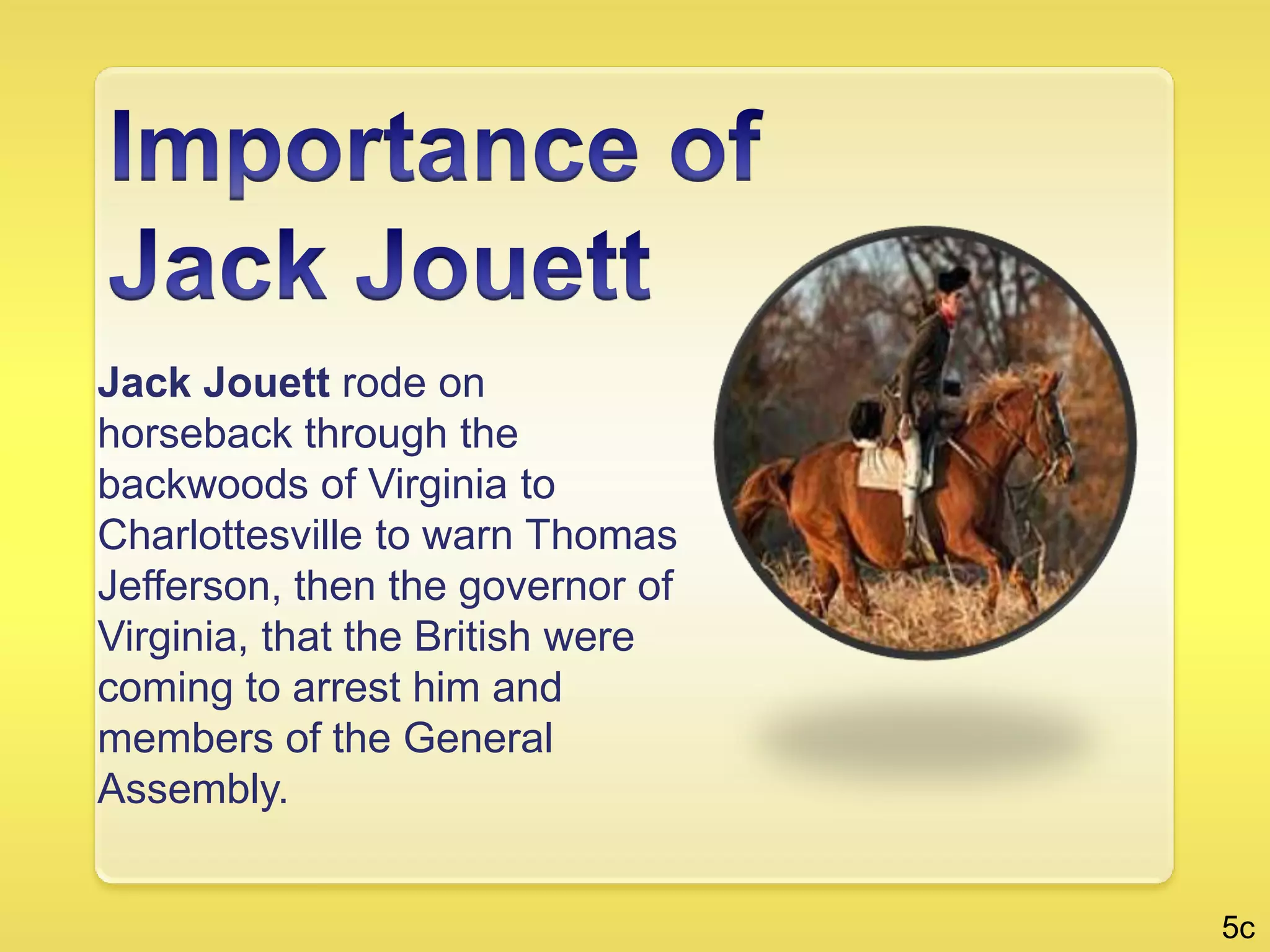
    Fall Line ofVirginiaFall Line: The natural border between the Coastal Plain (Tidewater) and Piedmont regions, where waterfalls prevent further travel on the river2b
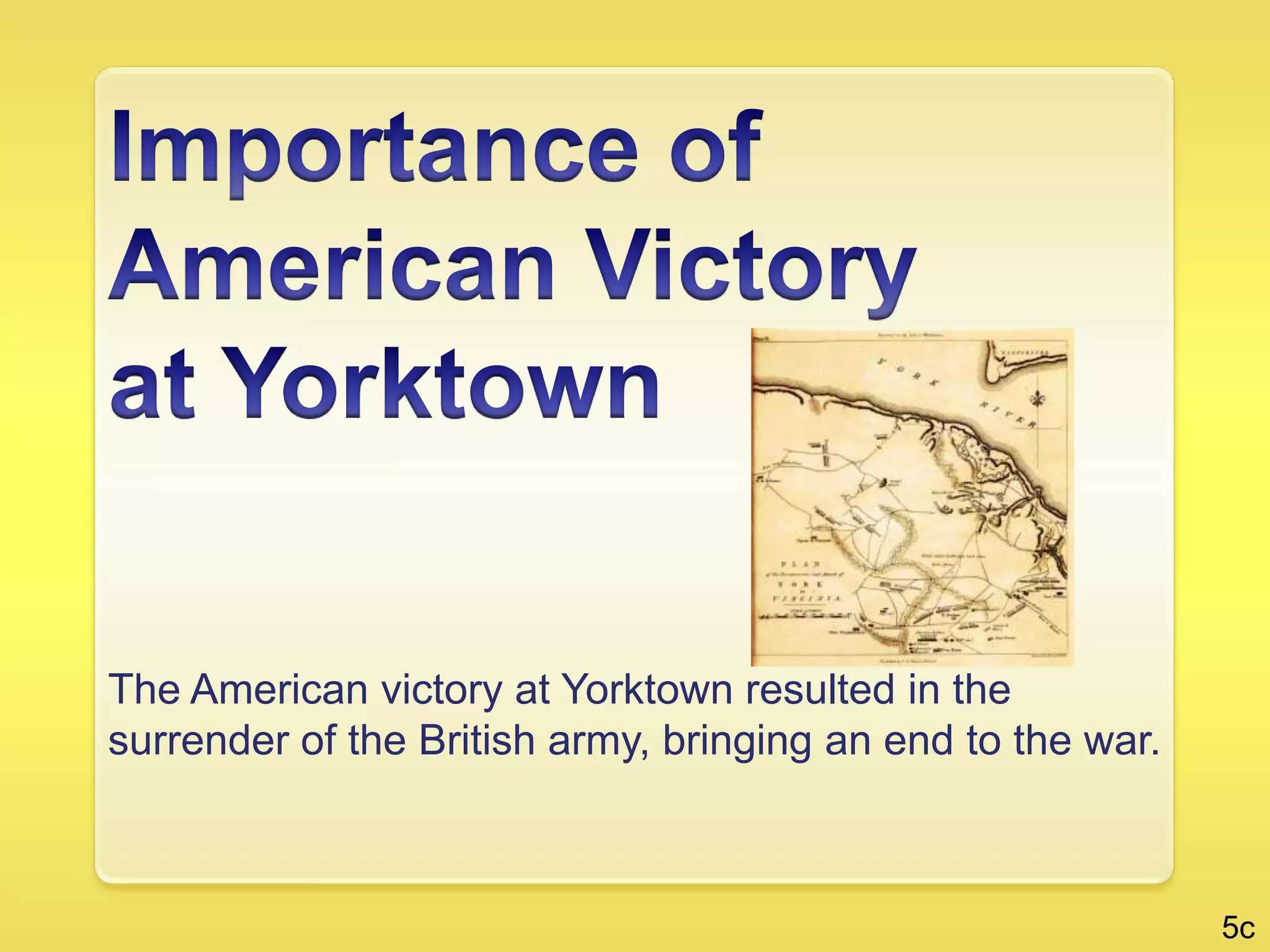
  • 6.
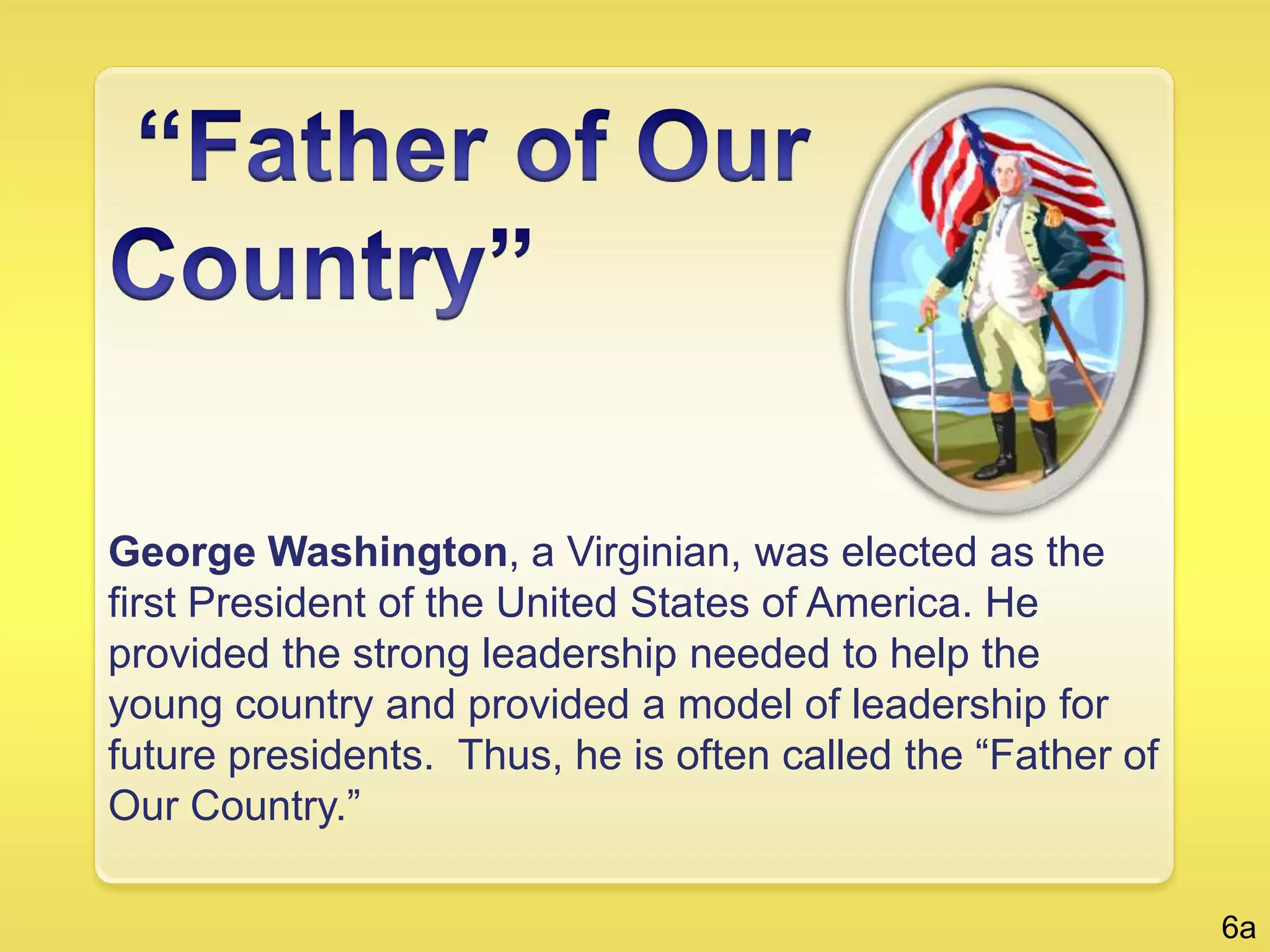
  • 7.
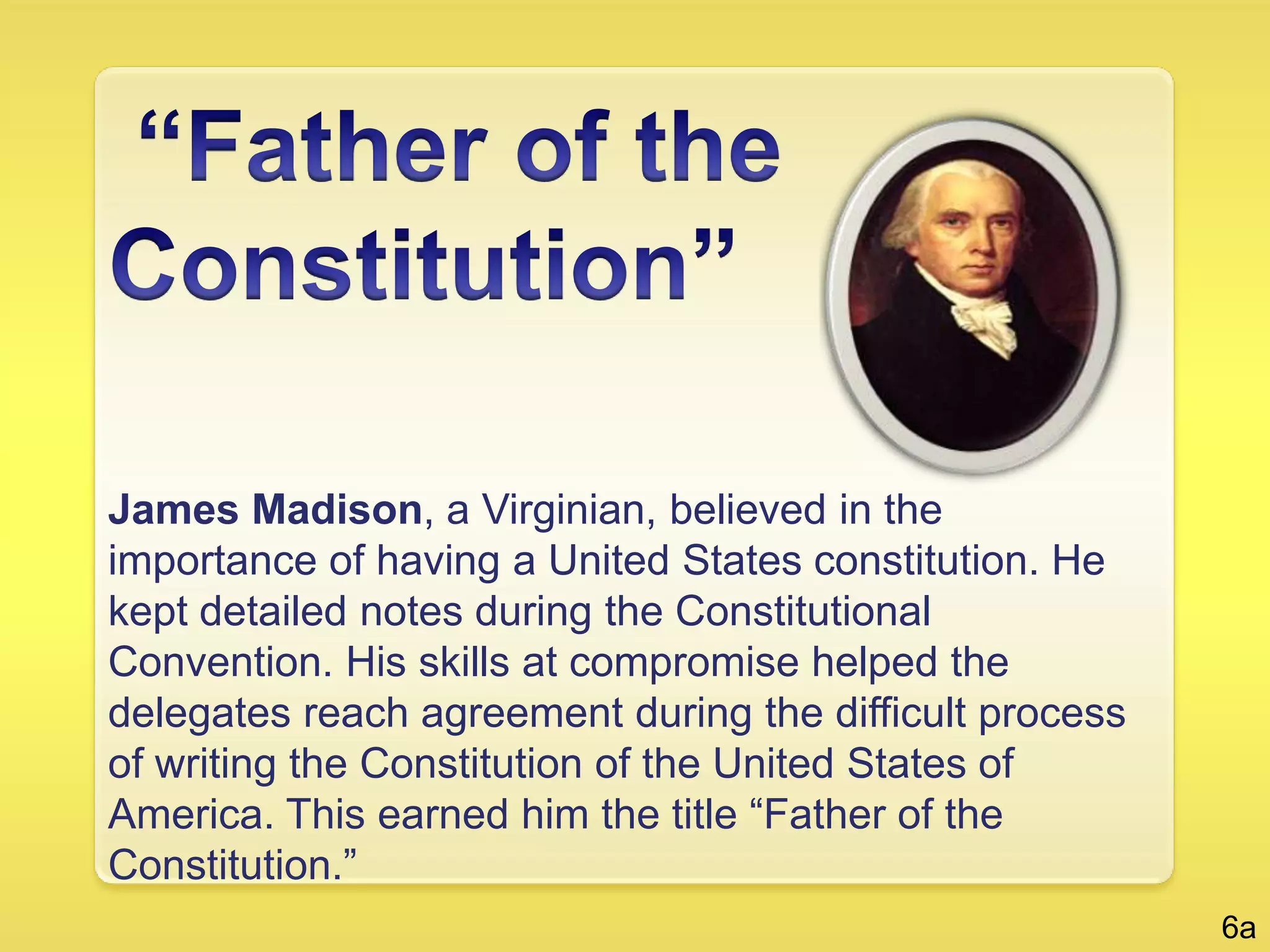
  • 8.
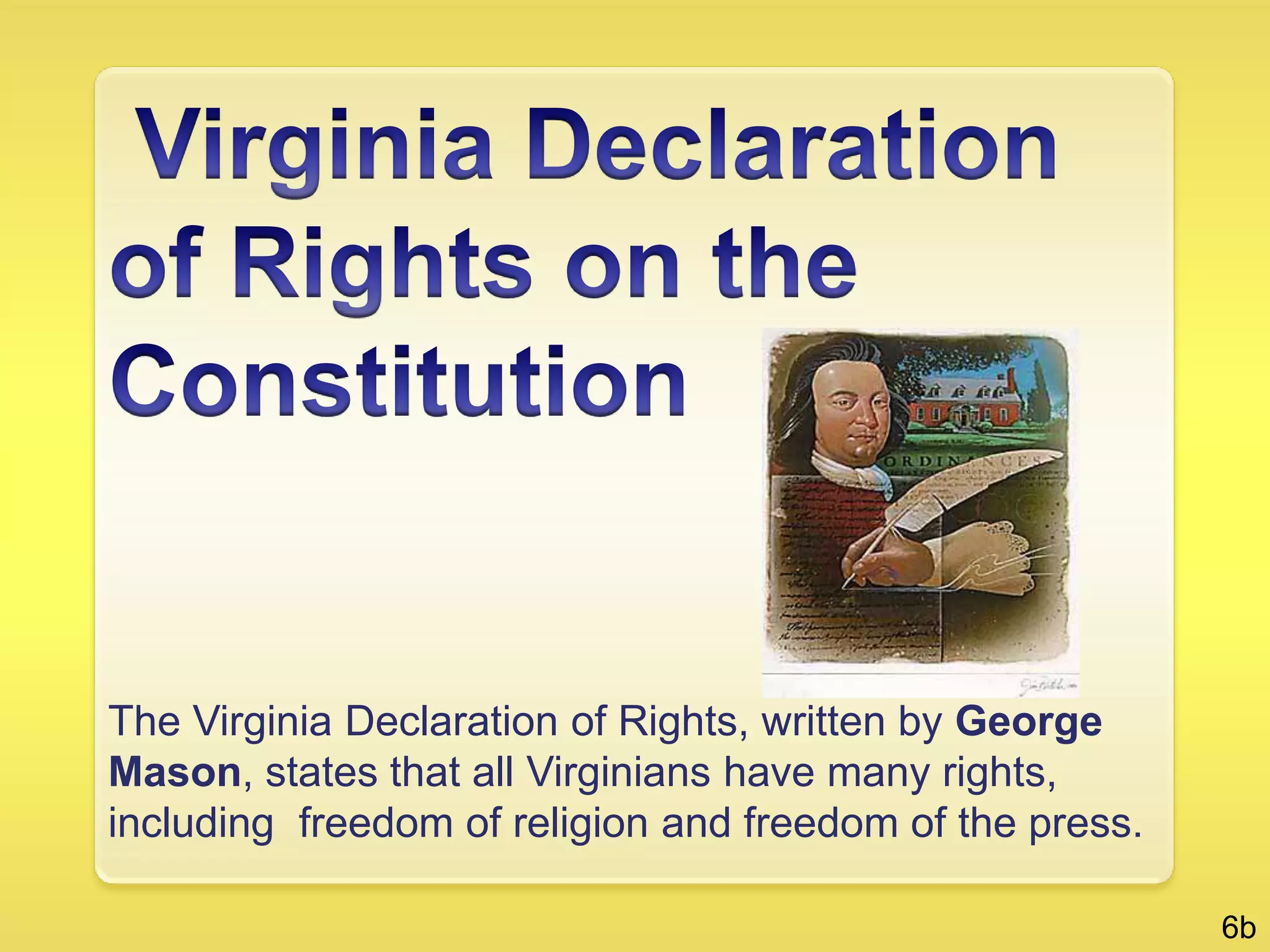
    Location near AtlanticOcean and Chesapeake Bay (includes Eastern Shore)
  • 9.
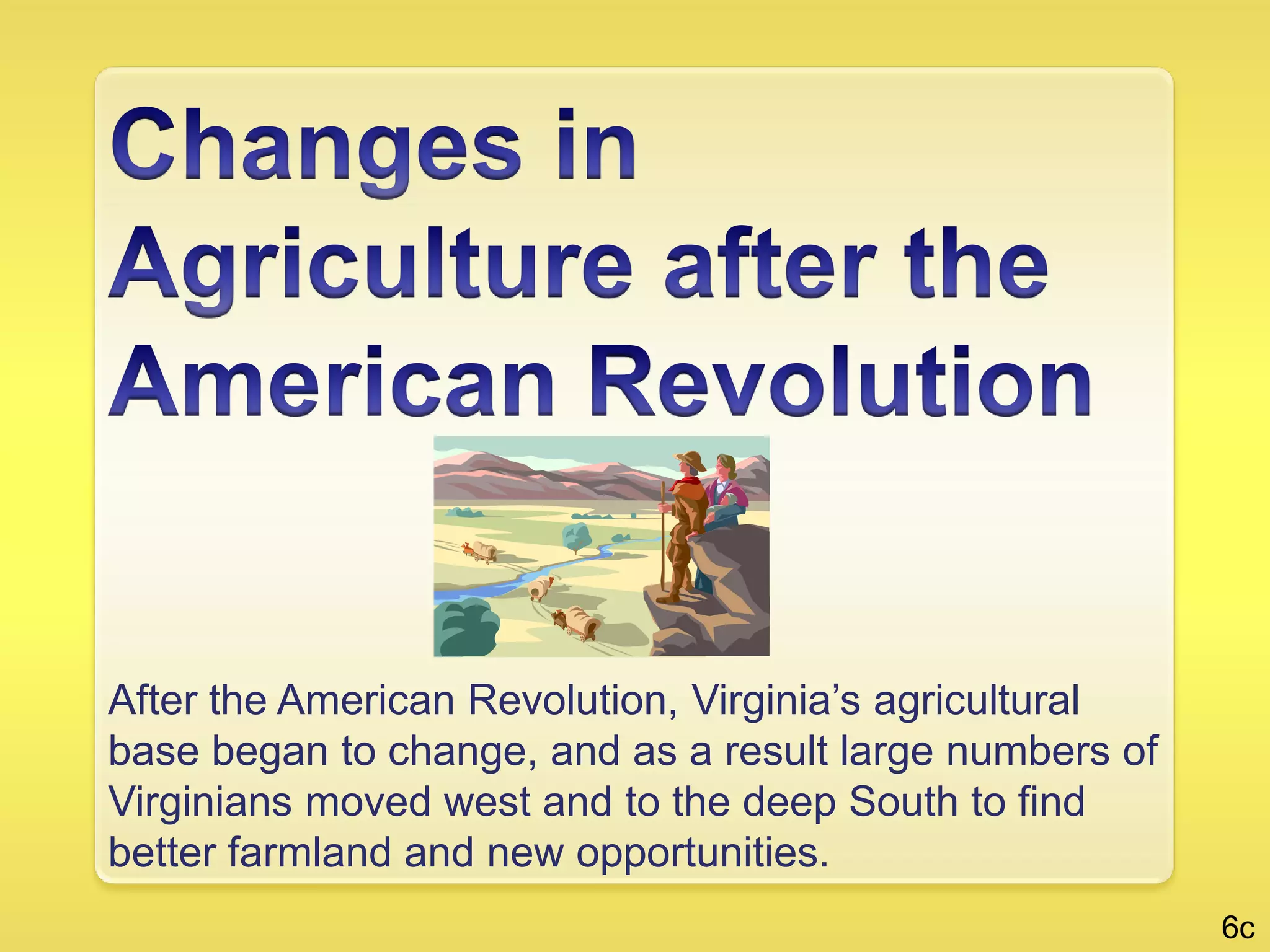
    East of theFall Line 2b
  • 10.
    Piedmont Region (land atthe foot of mountains)Rolling hills
  • 11.
    West of theFall Line  2b
  • 12.
  • 13.
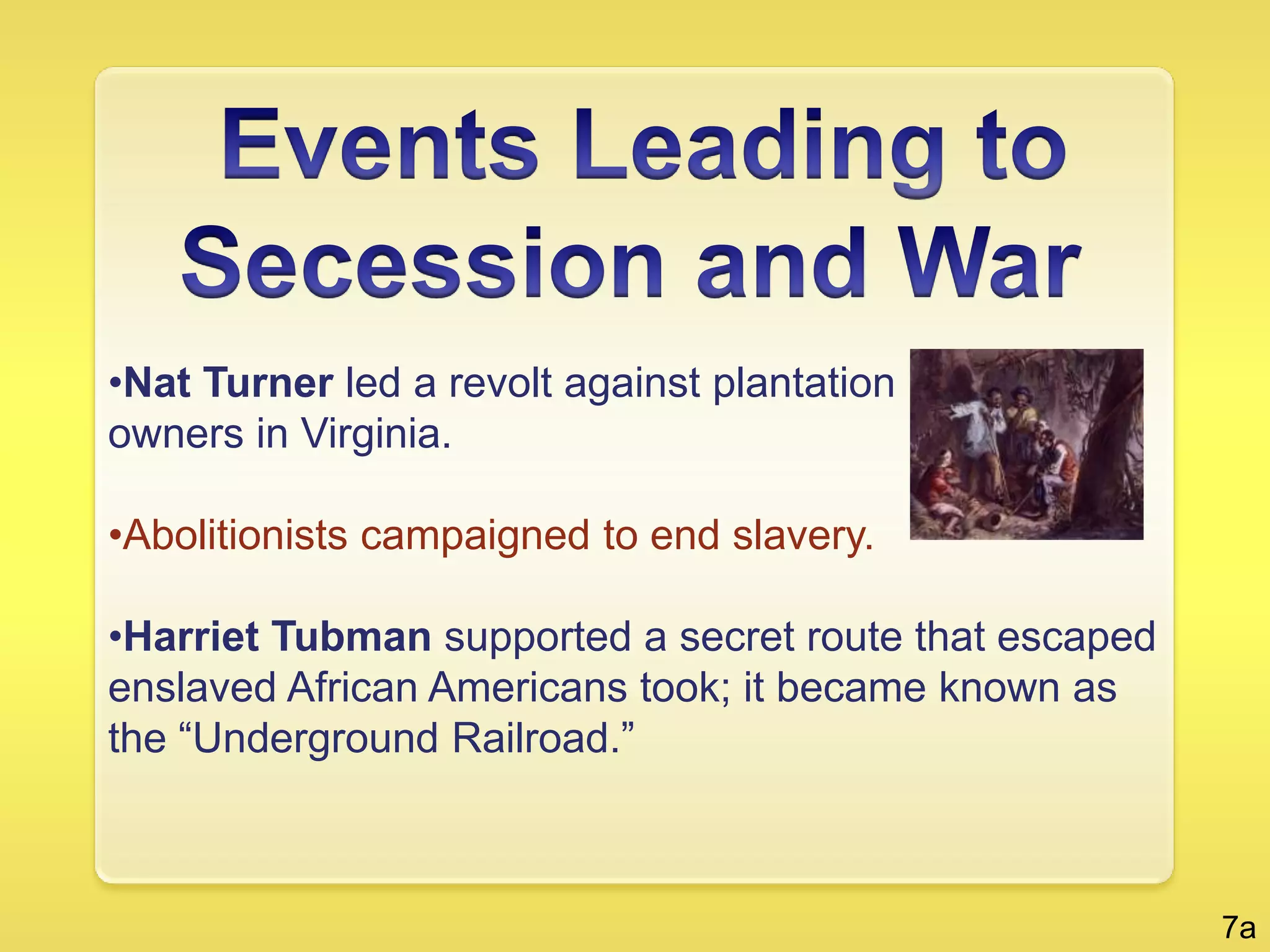
    Part of Appalachianmountain system
  • 14.
    Located between thePiedmont and Valley and Ridge regions
  • 15.
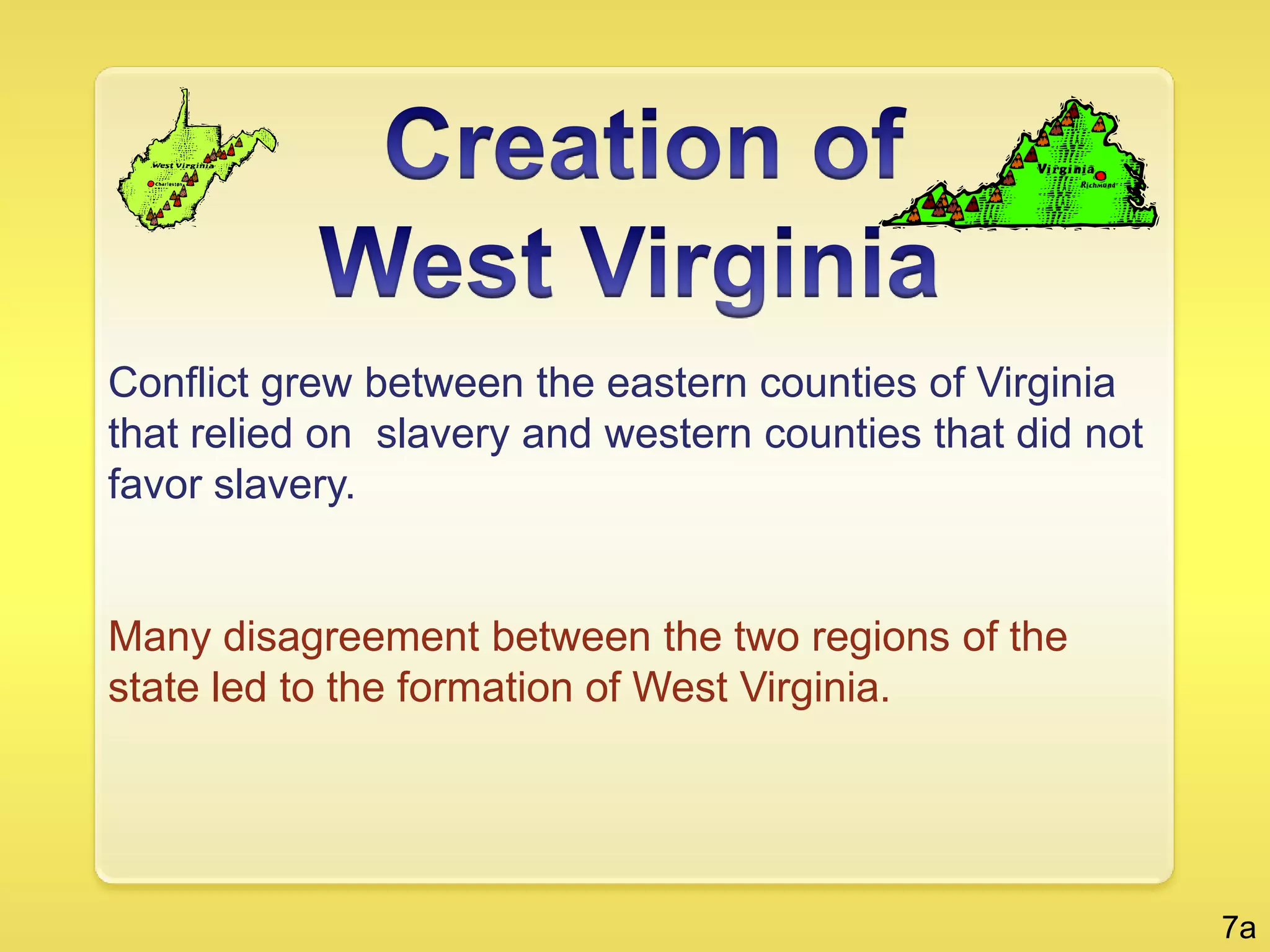
     Source of manyrivers  2b
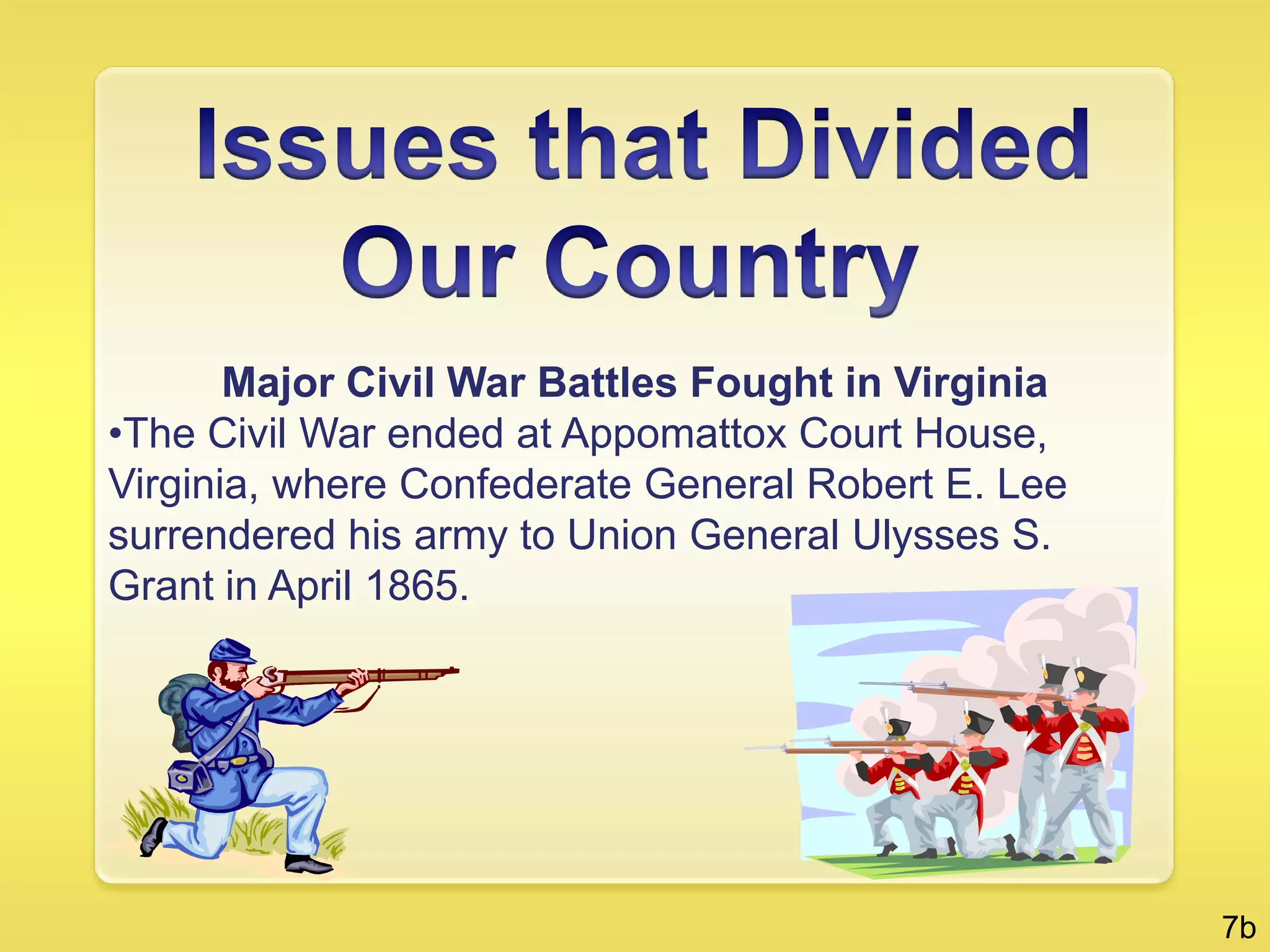
  • 16.
      Valley and Ridge Includesthe Great Valley of Virginia and other valleys separated by ridges (The Blue Ridge Mountains and the Valley and Ridge Regions are part of the Appalachian mountain system.)
  • 17.
    Located west ofBlue Ridge Mountains  2b
  • 18.
        Appalachian Plateau (Plateau: Area of elevated land that is flat on top) Located in Southwest Virginia
  • 19.
     Only a smallpart of plateau located in Virginia   2b
  • 20.
        Water FeaturesImportant to the Early History of Virginia   Peninsula: A piece of land bordered by water on three sides.   2c
  • 21.
    Atlantic OceanProvided transportationlinks between Virginia and other places (e.g., Europe, Africa, Caribbean)       Water Features   2c
  • 22.
  • 23.
    Was a sourceof food and transportation       Water Features   2c
  • 24.
    James RiverFlows intothe Chesapeake Bay
  • 25.
    Richmond and Jamestownlocated along the James RiverYork RiverFlows into the Chesapeake Bay
  • 26.
    Yorktown located alongthe York RiverPotomac RiverFlows into the Chesapeake Bay
  • 27.
    Alexandria located alongthe Potomac RiverRappahannock RiverFlows into the Chesapeake Bay
  • 28.
    Fredericksburg is locatedon the Rappahannock River        Water Features   2c
  • 29.
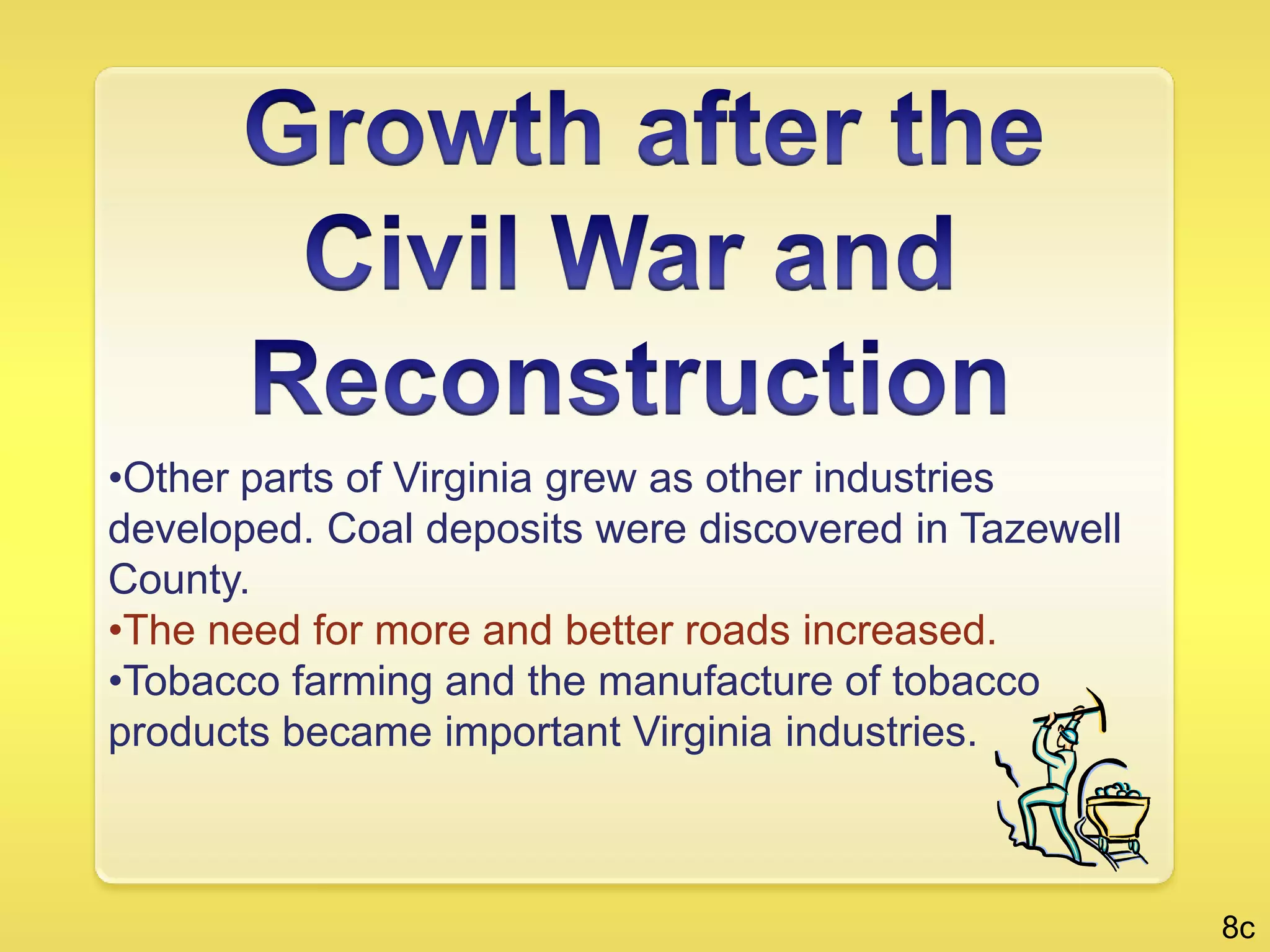
     Water Features   Eachriver was a source of food and provided a pathway for exploration and settlement of Virginia. The Eastern Shore is a peninsula bordered by the Chesapeake Bay to the west and the Atlantic Ocean to the east.   2c
  • 30.
     Water Features   LakeDrummondLocated in the Coastal Plain (Tidewater) region
  • 31.
    Shallow natural lakesurrounded by the Dismal SwampDismal SwampLocated in the Coastal Plain (Tidewater) region
  • 32.
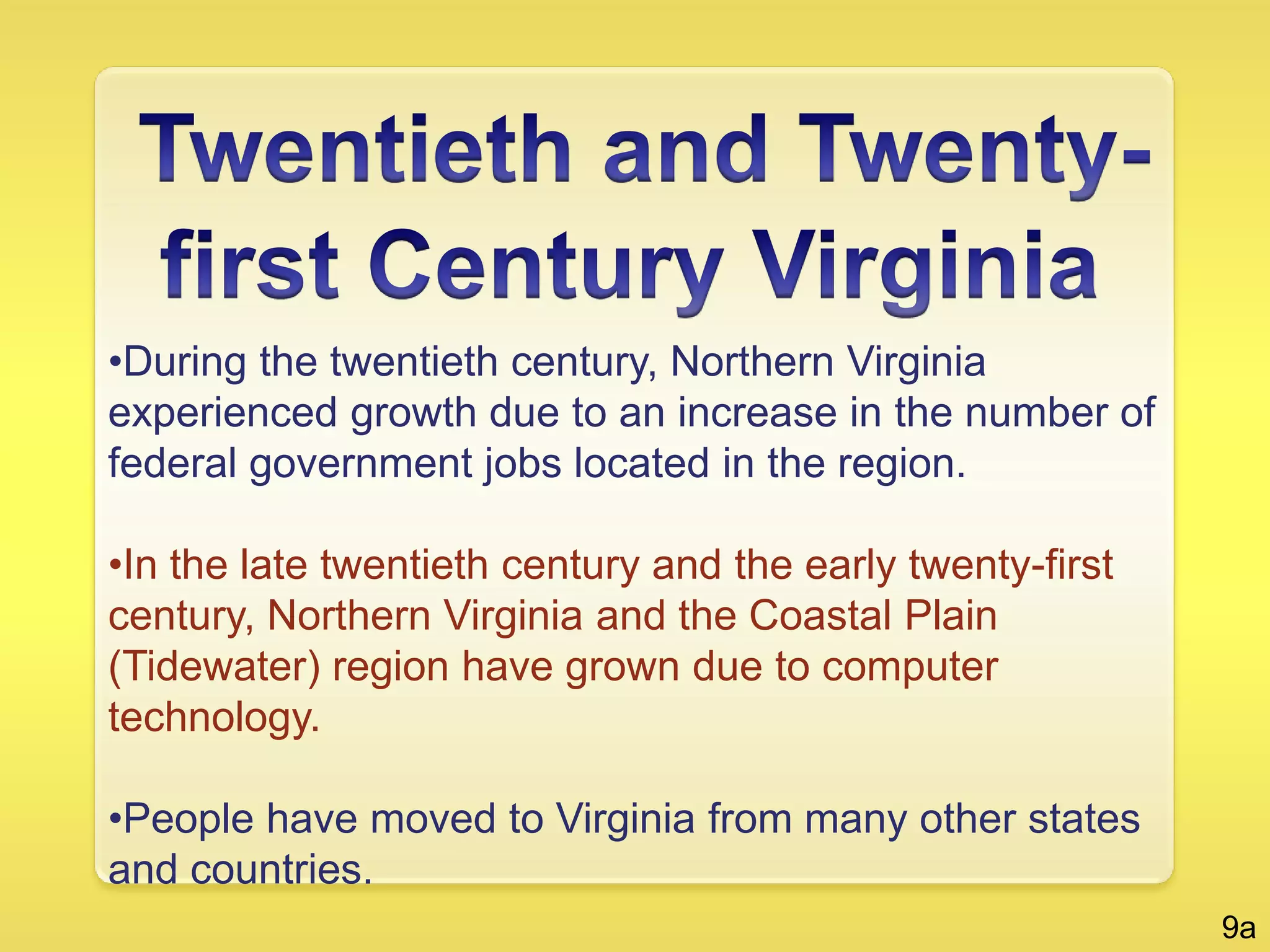
    Variety of wildlifeGeorgeWashington explored and surveyed the Dismal Swamp. 2c
  • 33.
    Christopher Columbus calledthe people he found in the lands he discovered “Indians” because he thought he was in the Indies (near China).   How the Indians Got Their Name  2d
  • 34.
    Artifacts such asarrowheads, pottery, and other tools that have been found tell a lot about the people who lived in Virginia.    American Indian Artifacts  2d
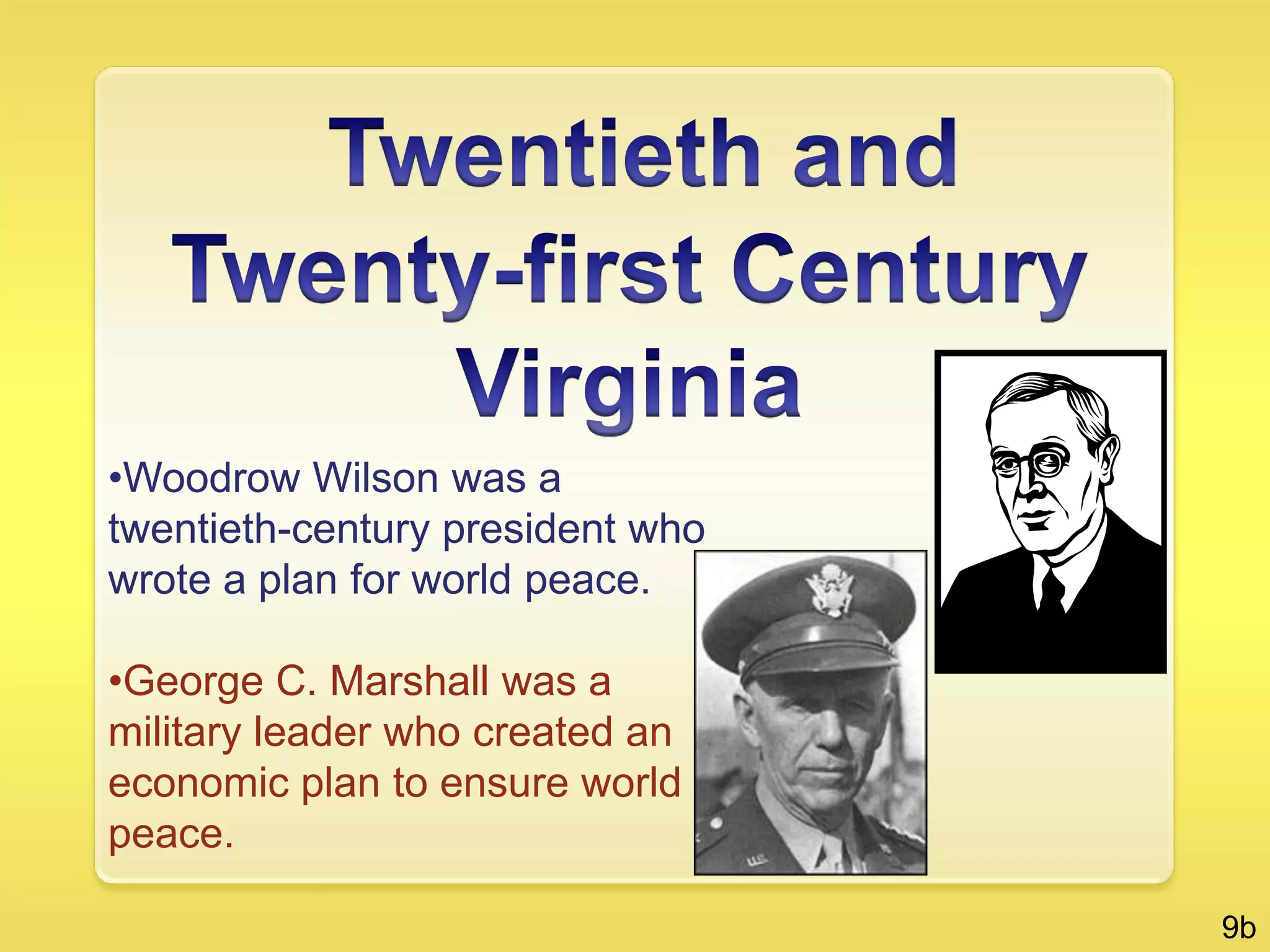
  • 35.
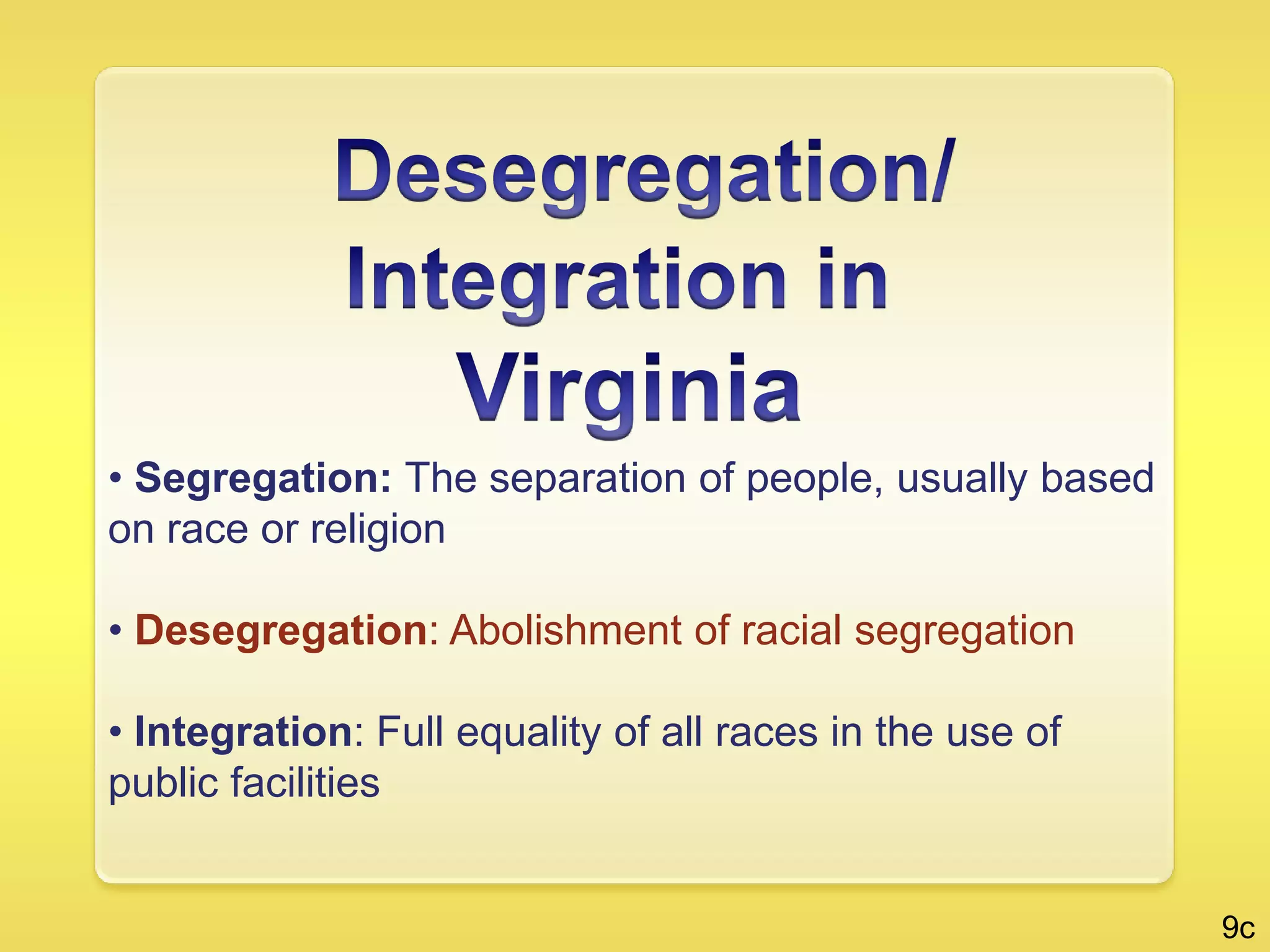
    Algonquian was spokenprimarily in Tidewater region. The Powhatan were part of this group.
  • 36.
    Siouan was spokenprimarily in the Piedmont region. The Monacan were part of this group.
  • 37.
    Iroquoian was spokenin Southwestern VA and in Southern VA near what is today North Carolina. The Cherokee were a part of this group.  American Indian Language Groups  2d
  • 38.
      American Indian Language Groups  2d
  • 39.
     The climate inVirginia is relatively mild with distinct seasons– spring, summer, fall, and winter-resulting in a variety of vegetation.  Physical Geography and Native Peoples  2e
  • 40.
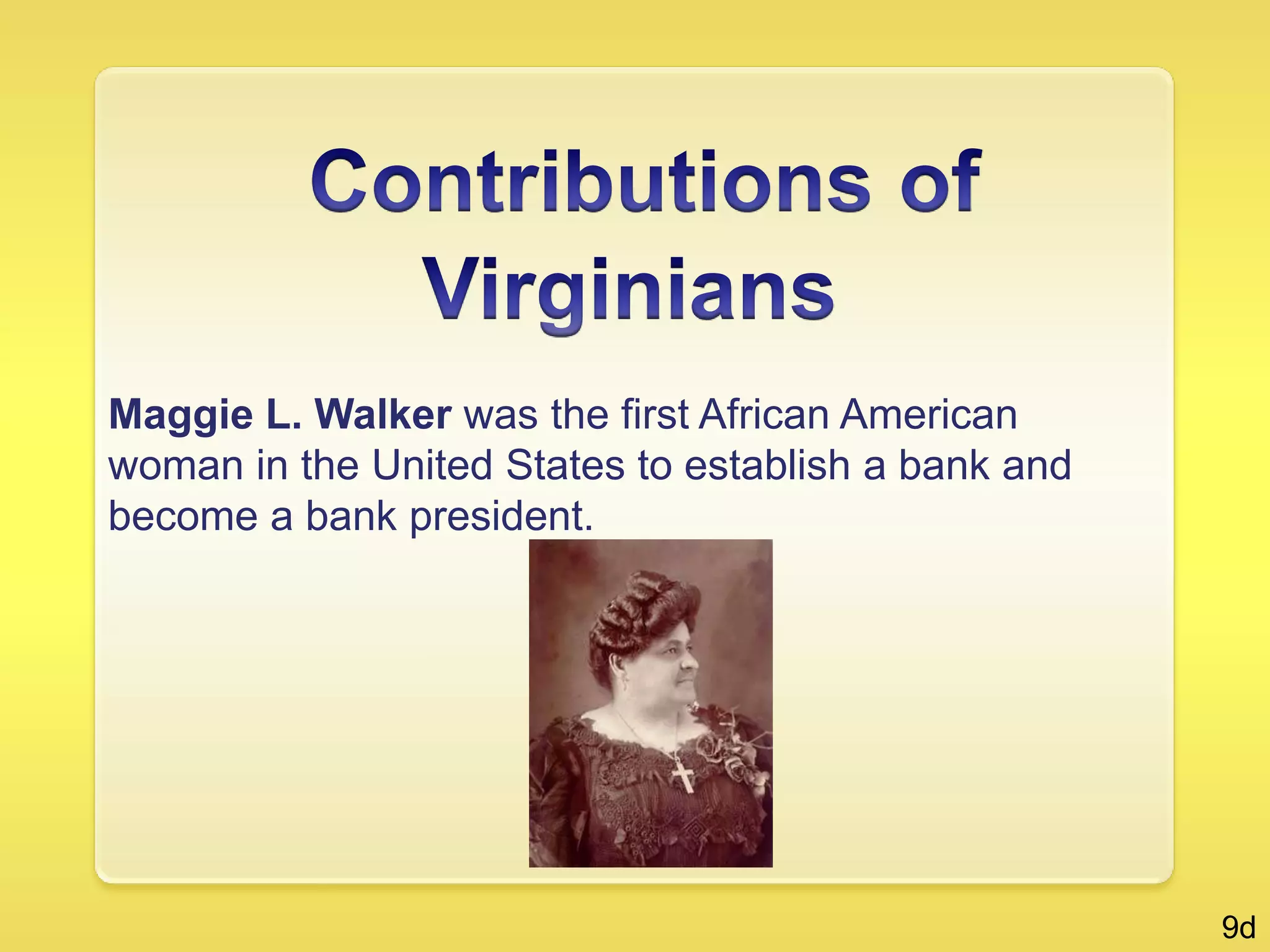
    The kinds offood they ate, the clothing they wore, and the shelters they lived in depended upon the seasons.
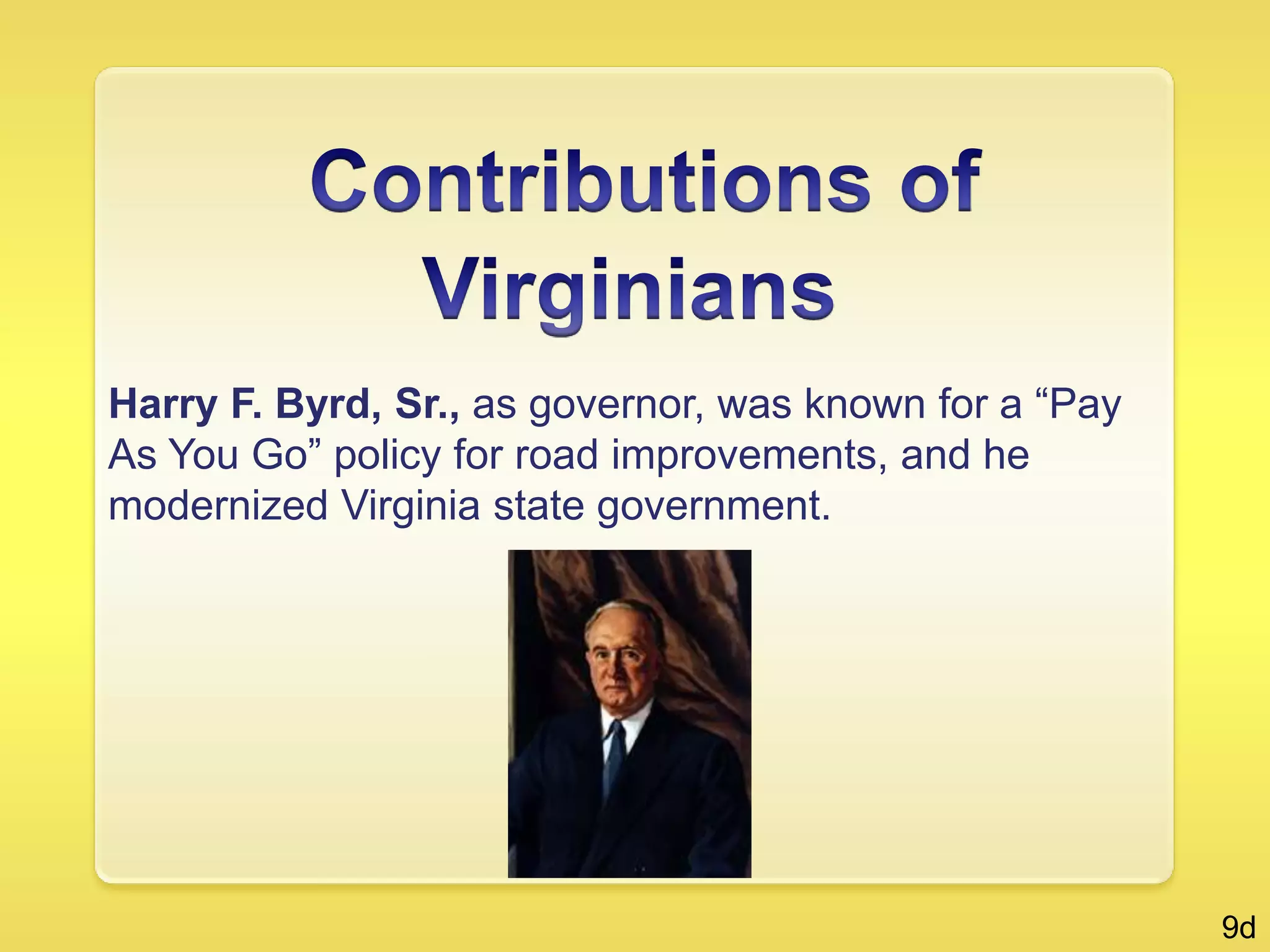
  • 41.
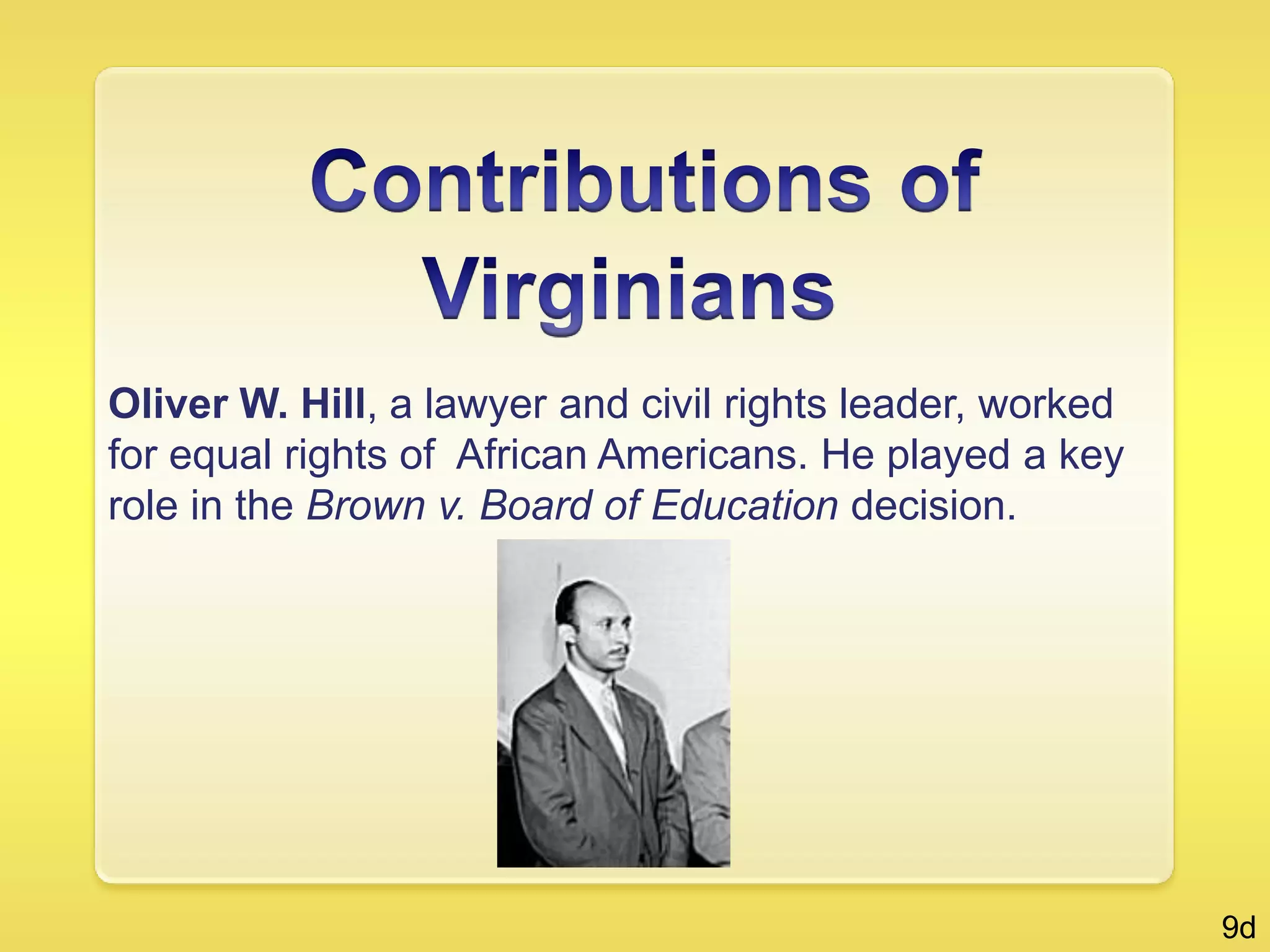
    In winter, theyhunted birds and other animals and lived on stored foods from the previous fall.    Environmental Connections   2e
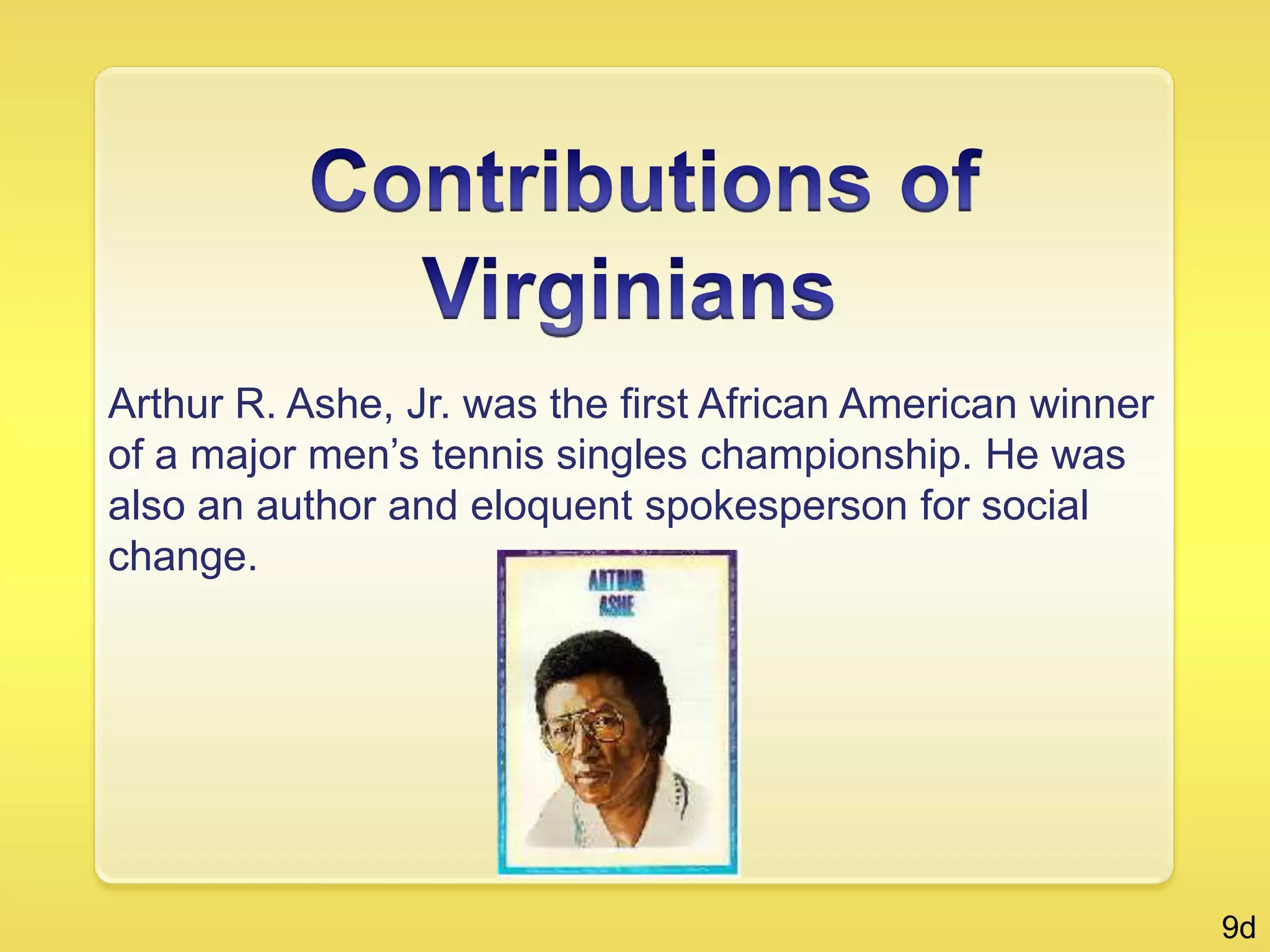
  • 42.
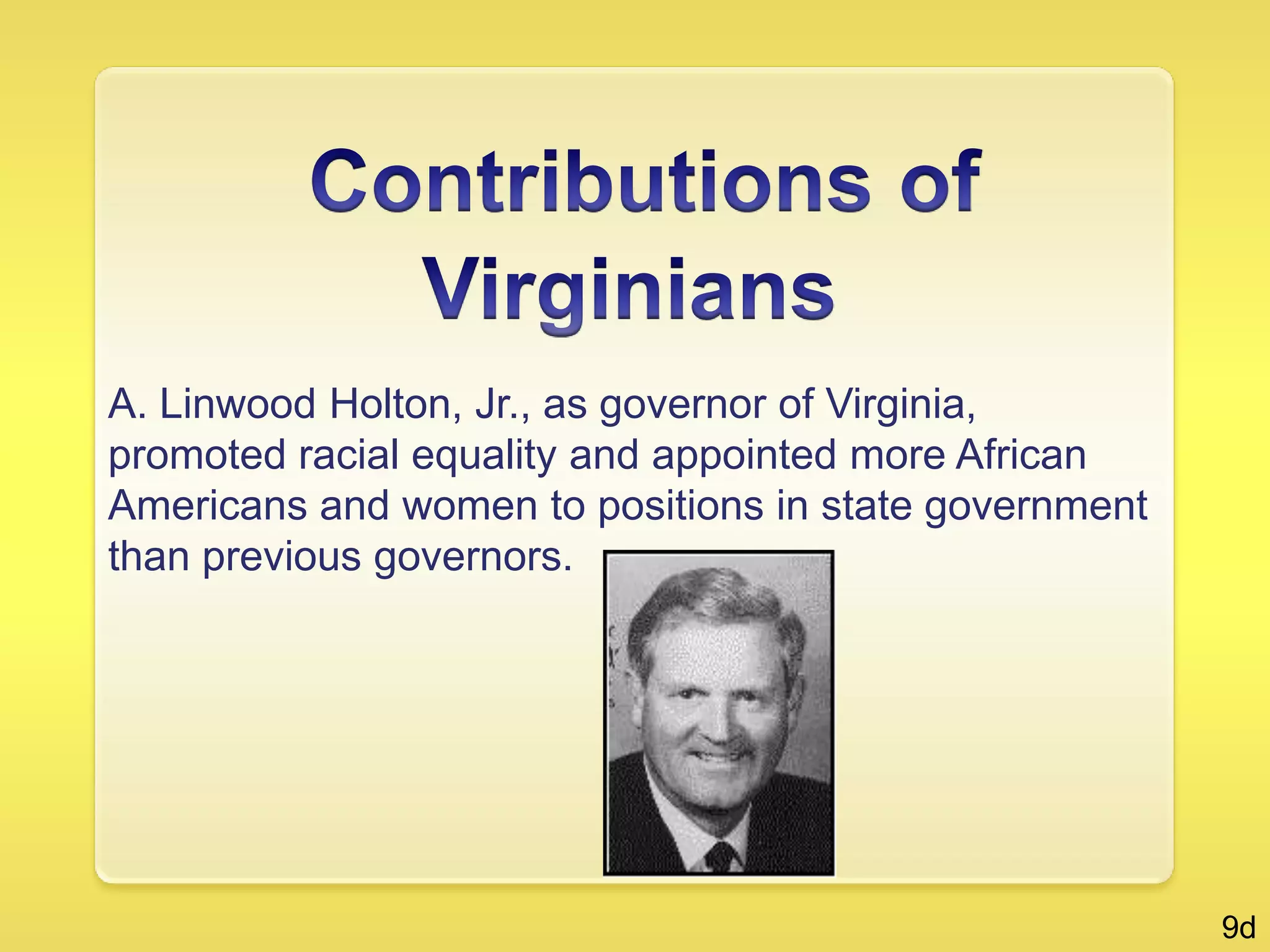
     In spring, theyhunted, fished and picked berries
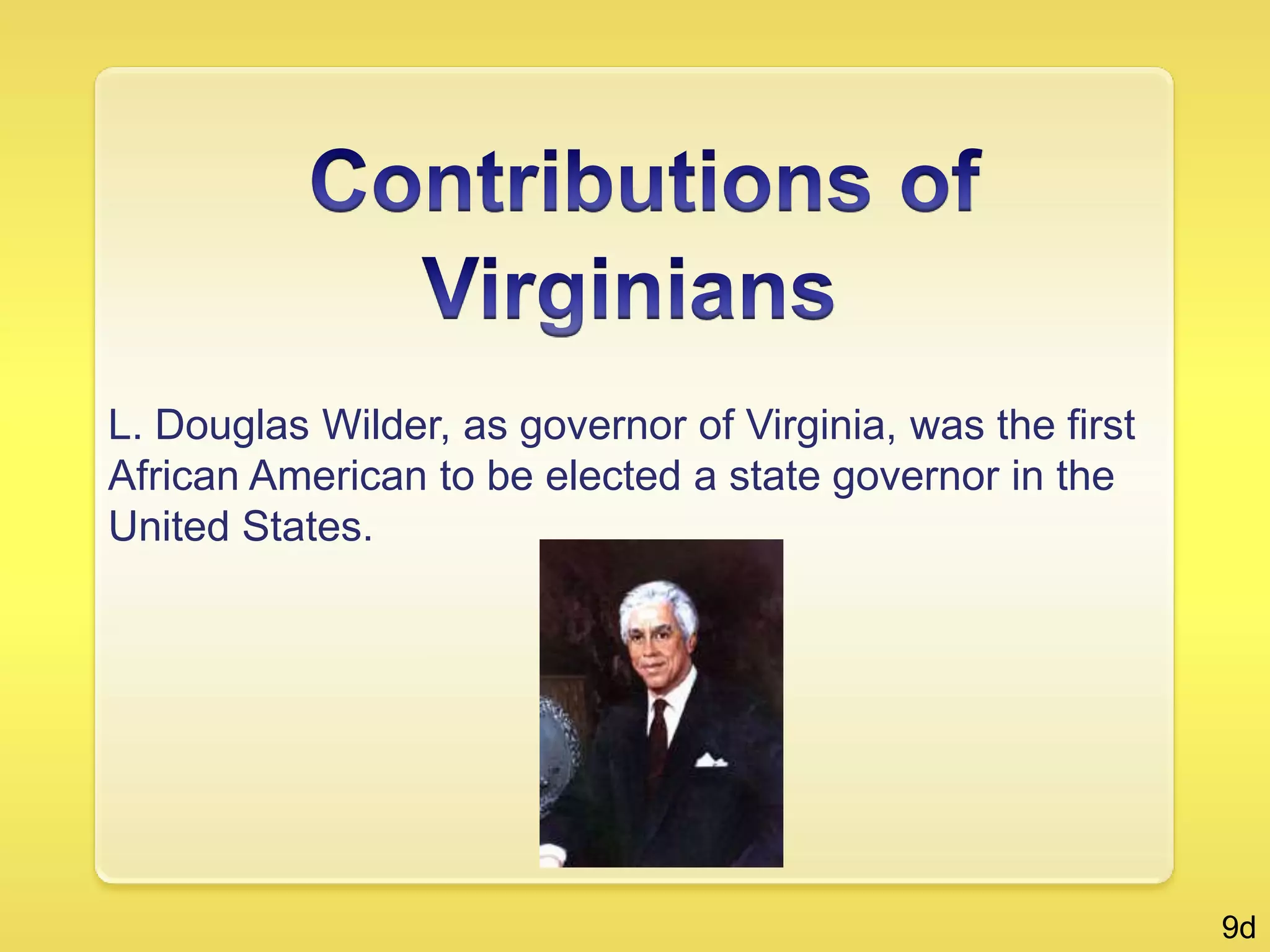
  • 43.
    In summer, theygrew crops (beans, corn, and squash)
  • 44.
    In fall, theyharvested crops and hunted for foods to preserve and keep for the winter.    Environmental Connections   2e
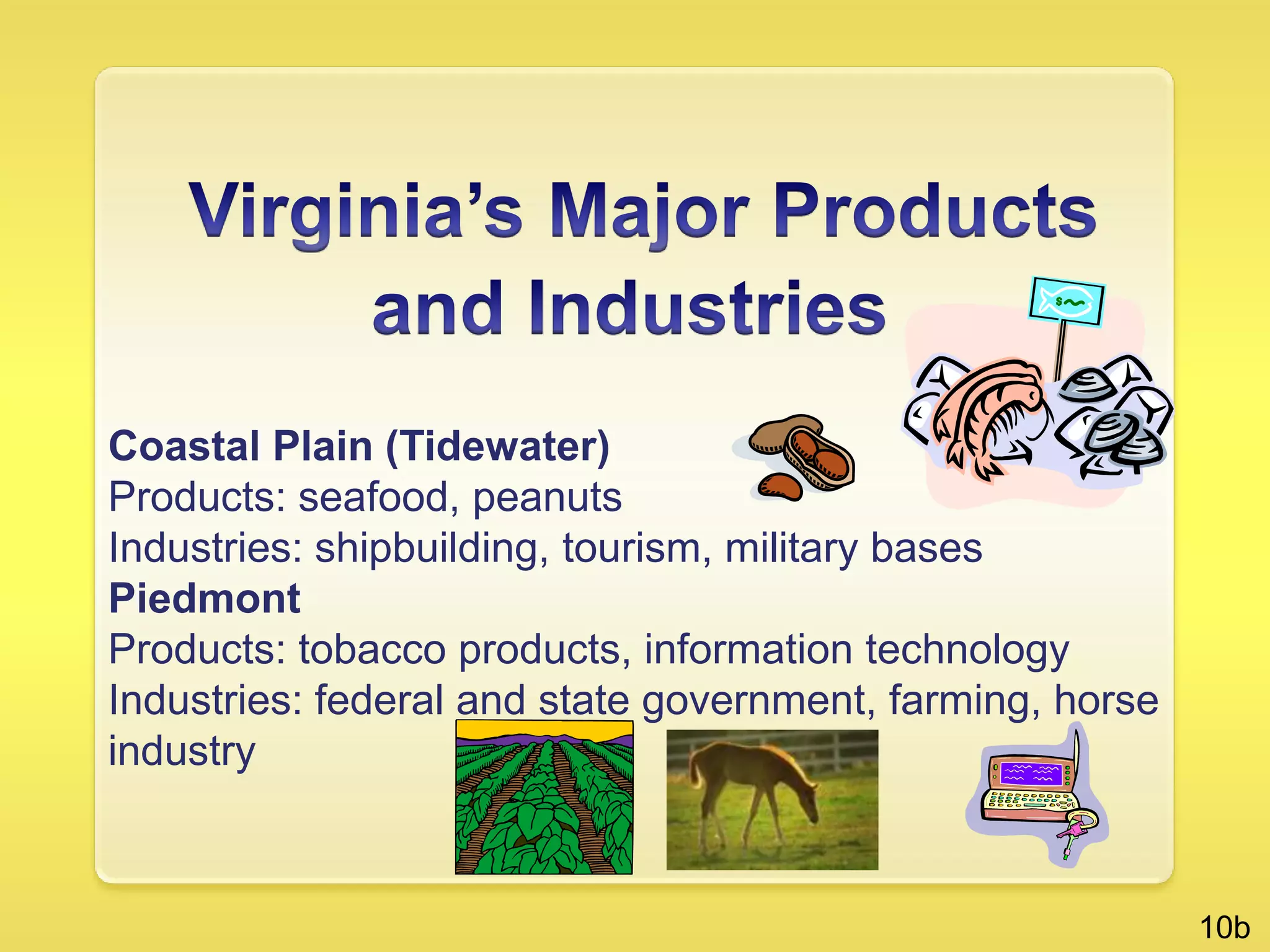
  • 45.
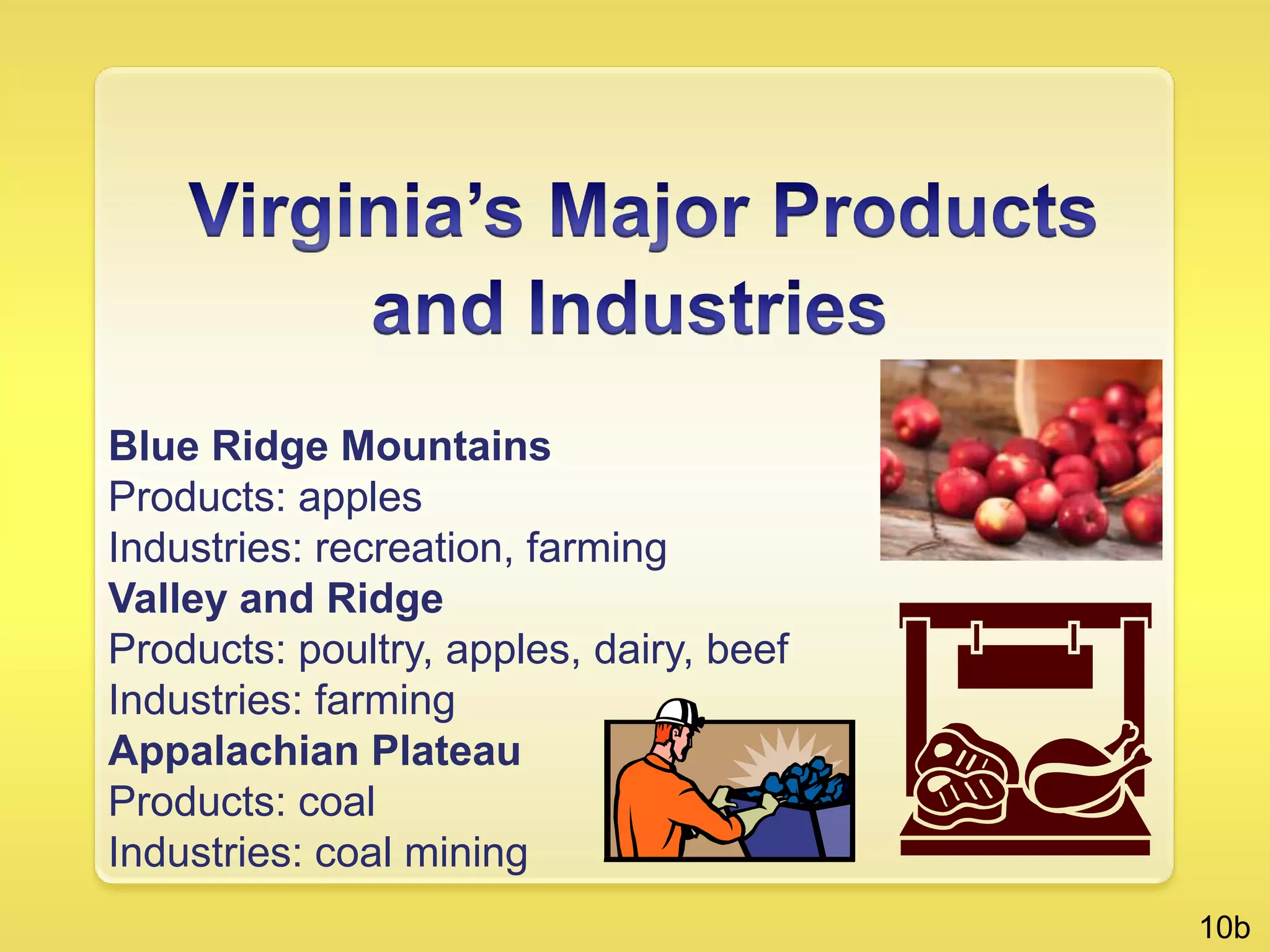
     Animal skins (deerskin)were used for clothing.Shelter was made from materials found around them. Native peoples of the past farmed, hunted, and fished. They made homes, using natural resources. They used animal skins for clothing.    Environmental Connections   2e
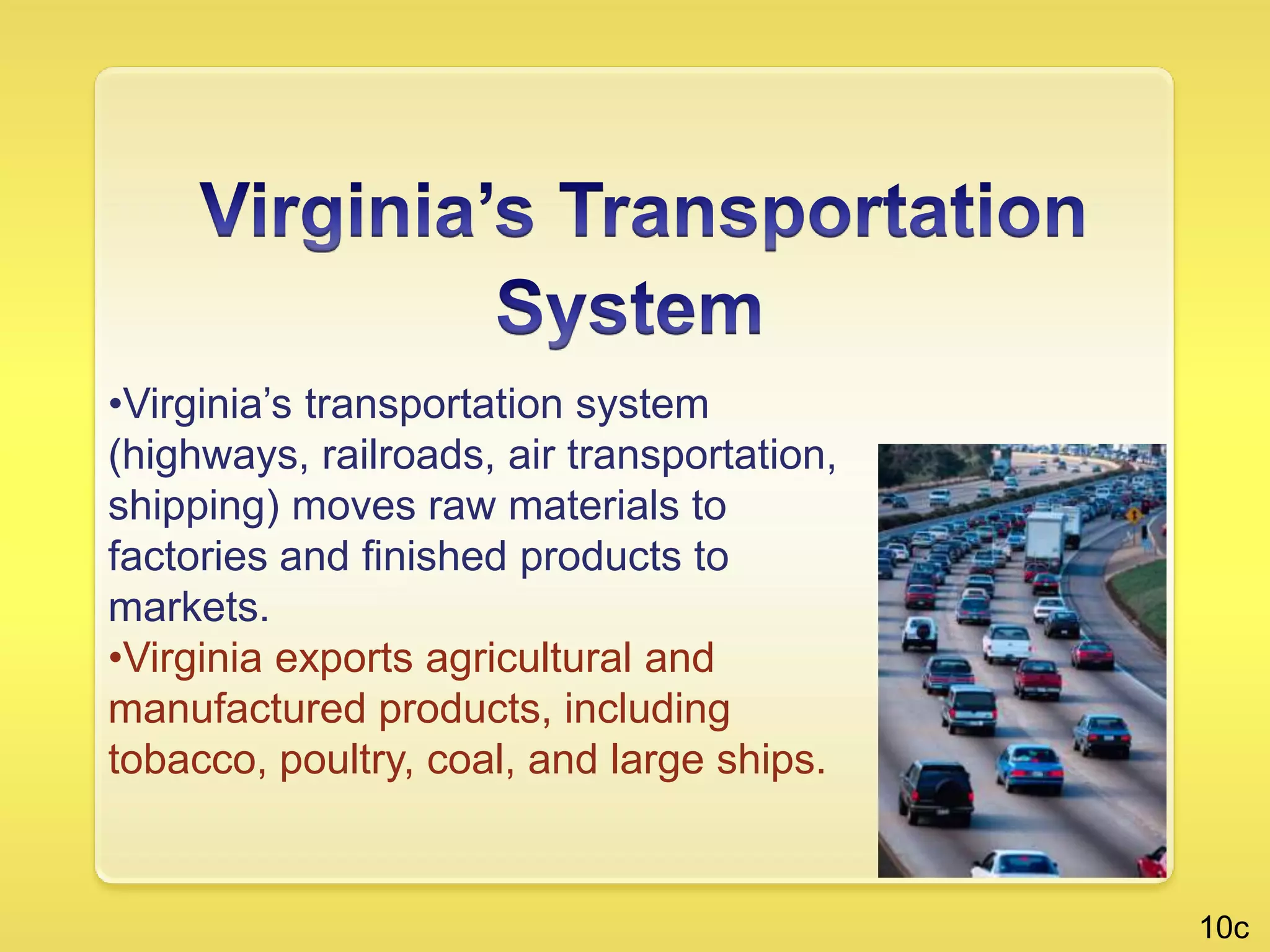
  • 46.
      Today, most nativepeoples live like other Americans. Their cultures have changed over time.     Environmental Connections   2e
  • 47.
      Archaeologists study allkinds of material evidence left by people from the past. Werowocomoco was a large Indian town used by Indian leaders for several hundred years before the English settlers came. It was the headquarters of the leader Powhatan in 1607.   New Evidencewas Discovered    2f
  • 48.
     New Evidencewas Discovered     AmericanIndians, who trace their family histories back to well before 1607, continue to live in all parts of Virginia today.  2g
  • 49.
    Coastal Plain (Tidewater)Region:Chickahominy TribeEastern Chickahominy TribeMattaponi TribeNansemond TribePamunkey TribeRappahannock TribeUpper Mattaponi TribePiedmont Region:Monacan Tribe Current State-Recognized  Tribes   2g
  • 50.
  • 51.
    Reasons for EnglishColonization in AmericaEngland wanted to establish an American colony to increase its wealth and power.
  • 52.
    England hoped tofind silver and gold in America.
  • 53.
    An American settlementwould furnish raw materials that could not be grown or obtained in England, while opening new markets for trade. First English Settlement   3a
  • 54.
    JamestownJamestown was primarilyan economic venture.The stockholders of the Virginia Company of London financed the settlement of Jamestown.Jamestown, founded in 1607, became the first permanent English settlement in America. First English Settlement   3a
  • 55.
     Jamestown Settlement  When thesettlers arrived in 1607, they founded Jamestown on a narrow peninsula bordered on three sides by the James River. Today, Jamestown is located on an island in the James River.  3b
  • 56.
    Instructions told thesettlers to go inland and find a suitable place for their colony.
  • 57.
    The location couldbe easily defended from attack by sea (by the Spanish).
  • 58.
    The water alongthe shore was deep enough for ships to dock.
  • 59.
    They believed thesite had a good supply of fresh water.  Reasons for Choosing Jamestown    3b
  • 60.
    The King ofEngland granted charters to the Virginia Company of London toestablish a settlement in North Americaextend English rights to the settlers.  Importance of Virginia Charters   3c
  • 61.
    System of GovernmentIn1619, the governor of Virginia called a meeting of the General Assembly. The General Assembly included two representatives, called burgesses, from each of the divisions of Virginia, along with the governor’s council and the governor. They met as one legislative body. (At that time, only certain free adult men had the right to take part.) General Assembly 1619   3d
  • 62.
     General Assembly 1619  Thecurrent Virginia General Assembly dates back to 1619 with the establishment of the General Assembly and its burgesses in Jamestown. It was the first elected legislative body in English America giving settlers the opportunity to control their own government 3d
  • 63.
     House of Burgesses   Bythe 1640s, the burgesses became a separate legislative body, called the House of Burgesses. They met separately from the Governor’s Council as one of the two legislative bodies of the General Assembly.3d
  • 64.
     Arrival of Africansand Women   Portuguese sailors captured African men and women from what is present-day Angola. The status of these early African men and women as either servants or enslaved persons in Virginia is unknown.3e
  • 65.
    Africans arrived inJamestown against their will in 1619. The arrival of Africans made it possible to expand the tobacco economy. The arrival of additional women in 1620 made it possible for more settlers to establish families and a permanent settlement at Jamestown. Arrival of Africans and Women   3e
  • 66.
    The arrival ofadditional women in 1620 made it possible for more settlers to establish families and a permanent settlement at Jamestown.    Arrival of Women  3e
  • 67.
    The site theychose to live on was marshy and lacked safe drinking water.
  • 68.
    The settlers lackedsome skills necessary to provide for themselves.
  • 69.
    Many settlers diedof starvation    Hardships Faced by the Jamestown Settlement   3f
  • 70.
     The arrival ofsupply ships
  • 71.
    The forced workprogram and strong leadership of Captain John Smith
  • 72.
    The emphasis onagriculture   Jamestown: Changes That Resulted in Survival    3f
  • 73.
    Captain John Smithinitiated trading relationships with the native people.  The native peoples traded mainly food with the English in exchange for tools, pots, and copper for jewelry.  Interactions Between the English Settlers and the Indians     3f
  • 74.
    The native peoplescontributed to the survival of the Jamestown settlers in several ways.Powhatan, chief of many tribes, provided leadership to his people and taught the settlers survival skills. Interactions Between the English Settlers and the Indians     3g
  • 75.
    Pocahontas, daughter ofPowhatan, served as a contact between the native peoples and the English.
  • 76.
    The native peoplesshowed the settlers how to plant corn and tobacco.  Interactions Between the English Settlers and the Indians     3g
  • 77.
    The native peoplesshowed the settlers how to plant corn and tobacco.
  • 78.
    Over time, thenative peoples realized the English settlement would continue to grow. They came to see the settlers as invaders who would take over their land.   Interactions Between the English Settlers and the Indians     3g
  • 79.
    cash crop: Acrop that is grown to sell for money rather than for use by the growersThe economy of the Virginia colony depended on agriculture as the primary source of wealth.
  • 80.
    Tobacco became themost profitable agricultural product.
  • 81.
    Tobacco was soldin England as a cash crop.   The Importance of Agriculture       4a
  • 82.
    The successful cultivationof tobacco depended on a steady and inexpensive source of labor.African men, women, and children were brought to the Virginia colony and enslaved to work on the plantations.
  • 83.
    The Virginia colonybecame dependent on slave labor, and this dependence lasted a long time.  The Importance of Agriculture       4a
  • 84.
    Whenever people settlean area, they change the culture and landscape to reflect their beliefs, customs, and architecture. Examples of architecture that reflect different cultures includebarns
  • 85.
  • 86.
    places of worship(e.g., churches).  The Culture of Virginia      4a
  • 87.
    Place Names ReflectingCultureEnglish – RichmondAmerican Indian – Roanoke The Culture of Virginia      4b
  • 88.
    English andother Europeans settled primarily in the Coastal Plain (Tidewater) and the Piedmont regions.  Germans and Scots-Irish settled primarily in the Shenandoah Valley, which was along the migration route.  Settlement Areas of Virginia      4b
  • 89.
     Migration and livingin new areas caused people to adapt old customs to their new environment.    Adapting Old Customs to a New Environment     4b
  • 90.
     Moved from Jamestownto WilliamsburgDrinking water was contaminated by seepage of salt water.
  • 91.
  • 92.
    Fire destroyed woodenand brick buildings at Jamestown   Reasons for Moving the Capital     4c
  • 93.
     Moved from Williamsburgto RichmondThe population was moving westward.
  • 94.
    Richmond was amore central location.
  • 95.
    Moving to Richmondincreased the distance from the sea and possible attack by the British.  Reasons for Moving the Capital     4c
  • 96.
    Money: A mediumof exchange (currency, which includes coins and paper bills)Barter: Trading or exchanging of goods and services without the use of money  The Use of Money, Barter, Credit    4d
  • 97.
    Credit: Buying agood or service now and paying for it laterDebt: A good or service owed to someonesavings: Money put away to save or to spend at a later timeSaving: Money put away to save or spend at a later time    The Use of Money, Barter, Credit    4d
  • 98.
    Few people hadpaper money or coins to use to buy goods and services. Barter was commonly used instead of money.  The Use of Money, Barter, Credit    4d
  • 99.
    Tobacco was usedas money. A tobacco farmer could use his tobacco to pay for goods and services.
  • 100.
    Farmers and otherconsumers could also buy goods and services on credit and pay their debts when their crops were harvested and sold.
  • 101.
    Colonial Virginia hadno banks.  The Use of Money, Barter, Credit    4d
  • 102.
    People living incolonial Virginia depended on natural, human, and capital resources to produce the goods and services they needed.    Everyday Life in Colonial Virginia     4e
  • 103.
  • 104.
    Meals were madeof local produce and meats. HousingMost people lived in one-room houses with dirt floors.
  • 105.
    Some people (farmers)lived in large houses.   Everyday Life in Colonial Virginia    4e
  • 106.
    Clothing Households madetheir own clothes.
  • 107.
    Most clothingwas made of cotton, wool, and/or leather.   Everyday Life in Colonial Virginia    4e
  • 108.
     Most white Virginiansmade their living from the land as small farmers. A few owned large farms (plantations).
  • 109.
    Most enslaved AfricanAmericans worked tobacco, other crops, and livestock. Enslaved African Americans had no rights.
  • 110.
     Many free AfricanAmericans owned their own businesses and property but were denied most rights.    Everyday Life in Colonial Virginia    4e
  • 111.
     The colonists andthe British Parliament disagreed over how the colonies should be governed.Parliament believed it had the legal authority in the colonies, while the colonists believed their local assemblies had legal authority.
  • 112.
    Parliament believed ithad the right to tax the colonies, while the colonists believed they should not be taxed because they had no representation in Parliament.    Reason Colonists Went to War    5a
  • 113.
     The Declaration ofIndependence written by Thomas Jefferson, states that authority to govern belongs to the people rather than to kings and that all people are created equal and have rights to life, liberty, and the pursuit of happiness.    Declaration of Independence    5a
  • 114.
     Virginia patriots servedin the Continental Army and fought for independence, leading to the British surrender at Yorktown.
  • 115.
    Some Virginians wereneutral and did not take sides, while other Virginians remained loyal to Great Britain.
  • 116.
    Women took onmore responsibilities to support the war effort.
  • 117.
    Some enslaved AfricanAmericans fought for a better chance of freedom.
  • 118.
    Some free AfricanAmericans fought for independence from Great Britain.
  • 119.
    Many American Indiansfought alongside the Virginia patriots, while others fought with the British.  Roles in the War     5b
  • 120.
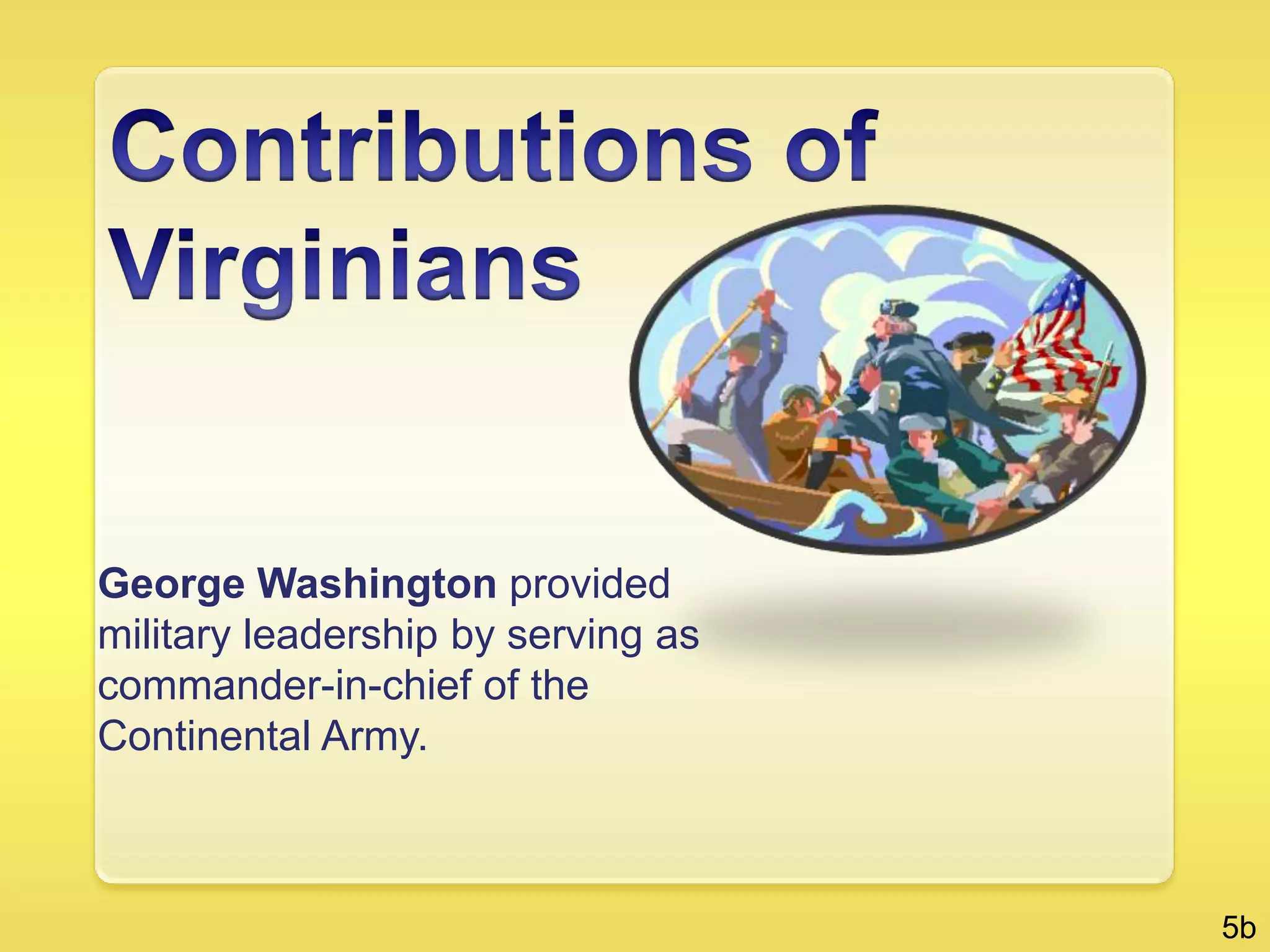
     Contributions of Virginians     GeorgeWashington provided military leadership by serving as commander-in-chief of the Continental Army.   5b
  • 121.
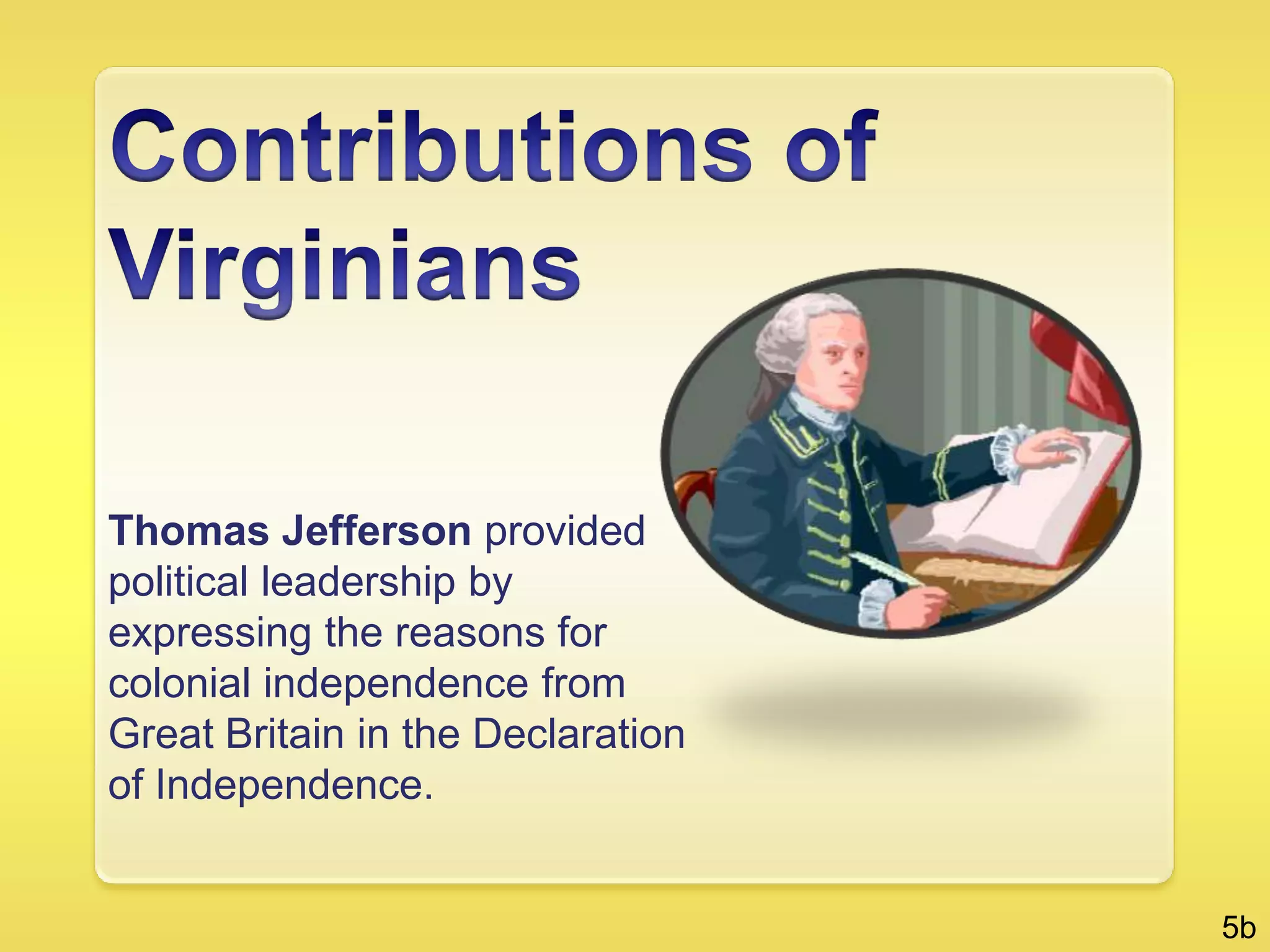
     Contributions of Virginians    ThomasJefferson provided political leadership by expressing the reasons for colonial independence from Great Britain in the Declaration of Independence.    5b
  • 122.
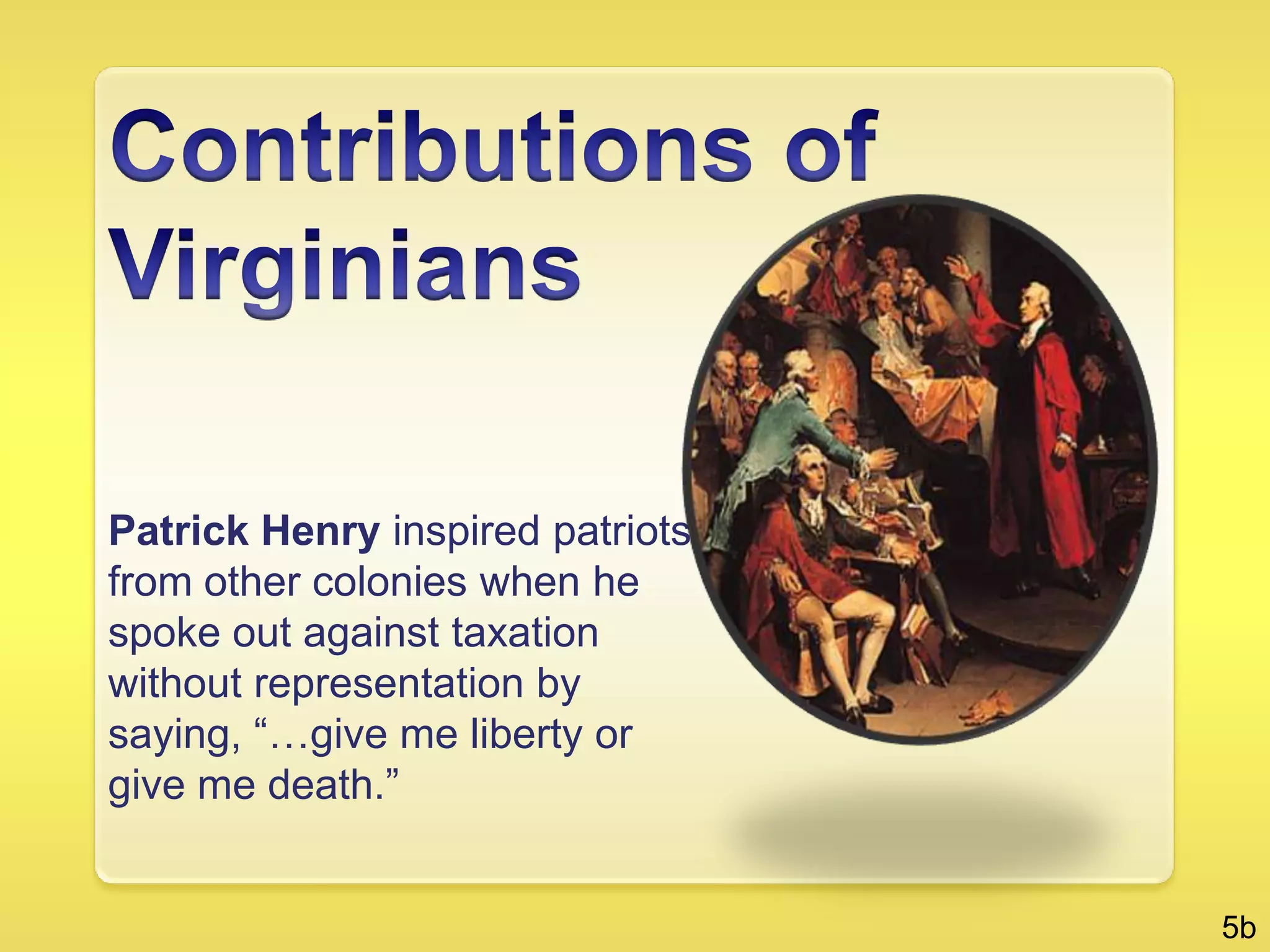
     Contributions of Virginians    PatrickHenry inspired patriots from other colonies when he spoke out against taxation without representation by saying, “…give me liberty or give me death.”     5b
  • 123.
     Contributions of Virginians    JamesLafayette, an enslaved African American from Virginia, served in the Continental Army and successfully requested his freedom after the war.       5b
  • 124.
     Importance of Battleof Great Bridge    The Battle of Great Bridge was the first land battle of the American Revolution fought in Virginia. The American victory forced the British colonial governor to flee the City of Norfolk.      5c
  • 125.
    Jack Jouettrode onhorseback through the backwoods of Virginia to Charlottesville to warn Thomas Jefferson, then the governor of Virginia, that the British were coming to arrest him and members of the General Assembly.       Importance of Jack Jouett     5c
  • 126.
     Importance of AmericanVictory at Yorktown    The American victory at Yorktown resulted in the surrender of the British army, bringing an end to the war.       5c
  • 127.
      “Father ofOur Country”     George Washington, a Virginian, was elected as the first President of the United States of America. He provided the strong leadership needed to help the young country and provided a model of leadership for future presidents. Thus, he is often called the “Father of Our Country.”       6a
  • 128.
      “Father ofthe Constitution”     James Madison, a Virginian, believed in the importance of having a United States constitution. He kept detailed notes during the Constitutional Convention. His skills at compromise helped the delegates reach agreement during the difficult process of writing the Constitution of the United States of America. This earned him the title “Father of the Constitution.”        6a
  • 129.
      Virginia Declarationof Rights on the Constitution    The Virginia Declaration of Rights, written by George Mason, states that all Virginians have many rights, including freedom of religion and freedom of the press.       6b
  • 130.
     The Virginia Statutefor Religious Freedom     The Virginia Statute for Religious Freedom, written by Thomas Jefferson, states that all people should be free to worship as they please.        6b
  • 131.
     Changes in Agricultureafter the American Revolution    After the American Revolution, Virginia’s agricultural base began to change, and as a result large numbers of Virginians moved west and to the deep South to find better farmland and new opportunities.       6c
  • 132.
    Tobacco farming washard on the soil, causing many farmers to look west and south for new land to farm.
  • 133.
    Virginians migrated intowestern territories looking for large areas of land and new opportunities.
  • 134.
    As Virginians moved,they took their traditions, ideas, and cultures with them.
  • 135.
    Settlers crossed theAppalachian Mountains through the Cumberland Gap as they migrated to new lands in the west.        Changes in Agriculture after the American Revolution    6c
  • 136.
    The economy inthe northern part of the United States was industrialized, while in the southern part it was agricultural and relied on slave labor.
  • 137.
    Northern states wantedthe new states created out of the western territory to be “free states,” while the southern states wanted the new states to be “slave states.”         Differences Between Northern and Southern States    7a
  • 138.
    Nat Turner leda revolt against plantation owners in Virginia.Abolitionists campaigned to end slavery.
  • 139.
    Harriet Tubman supporteda secret route that escaped enslaved African Americans took; it became known as the “Underground Railroad.”         Events Leading to Secession and War    7a
  • 140.
    John Brown leda raid on the United States Armory (Arsenal) at Harpers Ferry, Virginia. He was trying to start a slave rebellion. He was captured and hanged.
  • 141.
    After Abraham Lincolnwas elected president of the United States in 1860, some southern states seceded from the Union and formed the “Confederate States of America.” Later, Virginia seceded and joined them.        Events Leading to Secession and War    7a
  • 142.
    Conflict grew betweenthe eastern counties of Virginia that relied on slavery and western counties that did not favor slavery.  Many disagreement between the two regions of the state led to the formation of West Virginia.         Creation of West Virginia    7a
  • 143.
    Major Civil WarBattles Fought in VirginiaThe first Battle of Bull Run (or Manassas) was the first major clash of the Civil War. Confederate General Thomas “Stonewall” Jackson played a major role in this battle.
  • 144.
    General Robert E.Lee, Commander of the Army of Northern Virginia, defeated Union troops at Fredericksburg, Virginia.       Issues that Divided Our Country    7b
  • 145.
    Major Civil WarBattles Fought in VirginiaRichmond was the capital of the Confederacy. It fell to General Ulysses S. Grant and was burned near the end of the war.
  • 146.
    President Abraham Lincolnused the Union navy to blockade southern ports. An important sea battle between the Monitor (Union) and the Merrimack (Confederacy), two iron-clad ships, took place in Virginia waters near Norfolk and Hampton. The battle was fought to a draw.       Issues that Divided Our Country    7b
  • 147.
    Major Civil WarBattles Fought in VirginiaThe Civil War ended at Appomattox Court House, Virginia, where Confederate General Robert E. Lee surrendered his army to Union General Ulysses S. Grant in April 1865.      Issues that Divided Our Country    7b
  • 148.
    Most white Virginianssupported the Confederacy.
  • 149.
    The Confederacy reliedon enslaved African Americans to raise crops and provide labor for the army.
  • 150.
    Many enslaved AfricanAmericans fled to the Union army as it approached and some fought for the Union.     Varied Roles During the Civil War    7c
  • 151.
    Varied roles ofwhites, enslaved African Americans, free African Americans, and American Indians during the Civil WarSome free African Americans felt their limited rights could best be protected by supporting the Confederacy.
  • 152.
    Most American Indiansdid not take sides during the Civil War.      Varied Roles During the Civil War    7c
  • 153.
    Reconstruction: The periodfollowing the Civil War in which Congress passed laws designed to help rebuild the country and bring the southern states back into the Union   Effects of Reconstruction    8a
  • 154.
    Problems faced byVirginians during ReconstructionMillions of freed African Americans needed housing, education, clothing, food, and jobs.Virginia’s economy was in ruins:Money had no value.
  • 155.
  • 156.
    Railroads, bridges, plantations,and crops were destroyed.   Effects of Reconstruction    8a
  • 157.
    Measures Taken toResolve ProblemsThe Freedmen’s Bureau was a government agency that provided food, schools, and medical care for freed African Americans and others in Virginia.
  • 158.
    Sharecropping was asystem common in Virginia after the war in which freedmen and poor white farmers rented land from landowners by promising to pay the owners with a share of the crops.   Effects of Reconstruction    8a
  • 159.
    Segregation:The separation ofpeople, usually based on race or religionDiscrimination:An unfair difference in the treatment of people    Effects of Segregation    8b
  • 160.
    During Reconstruction, AfricanAmericans began to have power in Virginia’s government, and men of all races could vote.
  • 161.
    After Reconstruction, thesegains were lost when “Jim Crow” laws were passed by southern states. “Jim Crow” laws legally established segregation, or separation of the races, and reinforced prejudices held by whites.   Effects of Reconstruction    8b
  • 162.
    Unfair poll taxesand voting tests were established to keep African American men from voting.
  • 163.
    African Americans foundit very difficult to vote or hold public office.
  • 164.
    African Americans wereforced to use separate, poor-quality facilities and services, such as drinking fountains, restrooms, and restaurants.
  • 165.
    African-American and whitechildren attended separate schools.
  • 166.
    “Jim Crow” lawshad an effect on American Indians. Effect of “Jim Crow” Laws     8b
  • 167.
      Growth afterthe Civil War and Reconstruction     Virginia’s cities grew with people, businesses, and factories.
  • 168.
    Railroads were akey to the expansion of business, agriculture, and industry. They facilitated the growth of small towns into cities.8c
  • 169.
    Other parts ofVirginia grew as other industries developed. Coal deposits were discovered in Tazewell County.
  • 170.
    The need formore and better roads increased.
  • 171.
    Tobacco farming andthe manufacture of tobacco products became important Virginia industries.  Growth after the Civil War and Reconstruction     8c
  • 172.
    During the earlytwentieth century, agriculture began to change.Old systems of farming were no longer effective.
  • 173.
    Crop prices werelow. Twentieth and Twenty-first Century Virginia     9a
  • 174.
    Growth of Virginia’scitiesPeople moved from rural to urban areas for economic opportunities.
  • 175.
    Technological developments intransportation (roads, railroads, and streetcars) helped cities grow.
  • 176.
    Coal mining spurredthe growth of Virginia towns and cities as people moved from the countryside to find jobs. Twentieth and Twenty-first Century Virginia     9a
  • 177.
    During the twentiethcentury, Northern Virginia experienced growth due to an increase in the number of federal government jobs located in the region.
  • 178.
    In the latetwentieth century and the early twenty-first century, Northern Virginia and the Coastal Plain (Tidewater) region have grown due to computer technology.
  • 179.
    People have movedto Virginia from many other states and countries. Twentieth and Twenty-first Century Virginia     9a
  • 180.
    Woodrow Wilson wasa twentieth-century president who wrote a plan for world peace.
  • 181.
    George C. Marshallwas a military leader who created an economic plan to ensure world peace. Twentieth and Twenty-first Century Virginia     9b
  • 182.
     Segregation: The separationof people, usually based on race or religion
  • 183.
  • 184.
     Integration: Full equalityof all races in the use of public facilities Desegregation/Integration in Virginia    9c
  • 185.
    Desegregation and MassiveResistance in VirginiaThe U.S. Supreme Court ruled in 1954 (Brown v. Board of Education) that “separate but equal” public schools were unconstitutional.
  • 186.
    All public schools,including those in Virginia, were ordered to desegregate. Desegregation/Integration in Virginia    9c
  • 187.
     Desegregation and MassiveResistance     Virginia’s government established a policy of Massive Resistance, which fought to “resist” the integration of public schools.
  • 188.
    Some schools wereclosed to avoid integration.
  • 189.
    The policy ofMassive Resistance failed, and Virginia’s public schools were finally integrated.
  • 190.
    Harry F. Byrd,Sr., led the Massive Resistance Movement against the desegregation of public schools.  9c
  • 191.
    Maggie L. Walkerwas the first African American woman in the United States to establish a bank and become a bank president.   Contributions of Virginians      9d
  • 192.
    Harry F. Byrd,Sr., as governor, was known for a “Pay As You Go” policy for road improvements, and he modernized Virginia state government.   Contributions of Virginians      9d
  • 193.
    Oliver W. Hill,a lawyer and civil rights leader, worked for equal rights of African Americans. He played a key role in the Brown v. Board of Education decision.  Contributions of Virginians      9d
  • 194.
    Arthur R. Ashe,Jr. was the first African American winner of a major men’s tennis singles championship. He was also an author and eloquent spokesperson for social change. Contributions of Virginians      9d
  • 195.
    A. Linwood Holton,Jr., as governor of Virginia, promoted racial equality and appointed more African Americans and women to positions in state government than previous governors. Contributions of Virginians      9d
  • 196.
    L. Douglas Wilder,as governor of Virginia, was the first African American to be elected a state governor in the United States. Contributions of Virginians      9d
  • 197.
     Three Branches ofVirginia’s Government     The General Assembly is the legislative branch of the Virginia government that makes state laws. It is divided into two parts—the Senate and the House of Delegates.  10a
  • 198.
     Three Branches ofVirginia’s Government     The governor heads the executive branch of the state government. The executive branch makes sure that state laws are carried out.
  • 199.
    The judicial branchis the state’s court system. The judicial branch decides cases about people accused of breaking the law and whether or not a law agrees with Virginia’s constitution.10a
  • 200.
    Coastal Plain (Tidewater)Products:seafood, peanutsIndustries: shipbuilding, tourism, military basesPiedmontProducts: tobacco products, information technologyIndustries: federal and state government, farming, horse industry Virginia’s Major Products and Industries     10b
  • 201.
    Blue Ridge MountainsProducts:applesIndustries: recreation, farmingValley and RidgeProducts: poultry, apples, dairy, beefIndustries: farmingAppalachian PlateauProducts: coalIndustries: coal mining Virginia’s Major Products and Industries     10b
  • 202.
    Virginia’s transportation system(highways, railroads, air transportation, shipping) moves raw materials to factories and finished products to markets.
  • 203.
    Virginia exports agriculturaland manufactured products, including tobacco, poultry, coal, and large ships.  Virginia’s Transportation System     10c
  • 204.
    Virginia has alarge number of communications and other technology industries. Tourism is a major part of Virginia’s economy. Because many federal government workers live and/or work in Virginia, the federal government has a significant impact on Virginia’s economy. Virginia’s Prosperity and Role in the Global Economy     10c