2010 Fall141 History/Americas Since 1800 71227
By EricOsterberg
 California..a “terrestrial paradise”. A true caricature of our my
home state. First named in 1539 by the Spanish (Hernan
Cortes), they believed it to be an island, but later discovered it
to be a peninsula (Baja California)
 Old California, not Baja, wouldn’t be settled 230 years later
 The rugged beauty from sea to desert, best described in the
book as a landscape of “clear cut and confrontational
topographies”
 Most Californians can access the coastline, mountains,
deserts, valleys and canyons within a couple of hours of
driving time confirming its uniqueness as a state
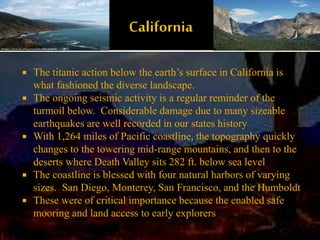
 The titanic action below the earth’s surface in California is
what fashioned the diverse landscape.
 The ongoing seismic activity is a regular reminder of the
turmoil below. Considerable damage due to many sizeable
earthquakes are well recorded in our states history
 With 1,264 miles of Pacific coastline, the topography quickly
changes to the towering mid-range mountains, and then to the
deserts where Death Valley sits 282 ft. below sea level
 The coastline is blessed with four natural harbors of varying
sizes. San Diego, Monterey, San Francisco, and the Humboldt
 These were of critical importance because the enabled safe
mooring and land access to early explorers
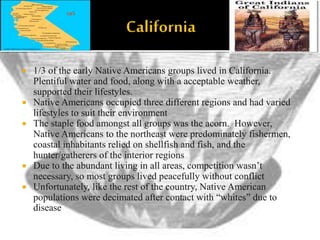
 1/3 of the early Native Americans groups lived in California.
Plentiful water and food, along with a acceptable weather,
supported their lifestyles.
 Native Americans occupied three different regions and had varied
lifestyles to suit their environment
 The staple food amongst all groups was the acorn. However,
Native Americans to the northeast were predominately fishermen,
coastal inhabitants relied on shellfish and fish, and the
hunter/gatherers of the interior regions
 Due to the abundant living in all areas, competition wasn’t
necessary, so most groups lived peacefully without conflict
 Unfortunately, like the rest of the country, Native American
populations were decimated after contact with “whites” due to
disease
 With statehood on Sept. 9th 1850, California experienced
steady growth. Men like William Hammond Hall realized that
water was the lifeblood to make the state fully “inhabitable
and productive”.
 Hall’s visionary efforts would pave the way for the California
of today
 Two water sources were identified: the Colorado and Owens
rivers. They would be tapped and water distribution to semi-
arid would allow habitation and development to occur
 The cities of San Francisco and Los Angeles would be the
burgeoning municipalities in the state early growth, both very
dependent upon imported water
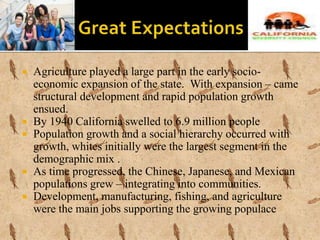
 Agriculture played a large part in the early socio-
economic expansion of the state. With expansion – came
structural development and rapid population growth
ensued.
 By 1940 California swelled to 6.9 million people
 Population growth and a social hierarchy occurred with
growth, whites initially were the largest segment in the
demographic mix .
 As time progressed, the Chinese, Japanese, and Mexican
populations grew – integrating into communities.
 Development, manufacturing, fishing, and agriculture
were the main jobs supporting the growing populace
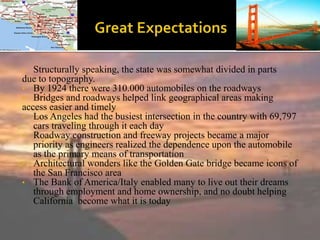
• Structurally speaking, the state was somewhat divided in parts
due to topography.
• By 1924 there were 310.000 automobiles on the roadways
• Bridges and roadways helped link geographical areas making
access easier and timely
• Los Angeles had the busiest intersection in the country with 69,797
cars traveling through it each day
• Roadway construction and freeway projects became a major
priority as engineers realized the dependence upon the automobile
as the primary means of transportation
• Architectural wonders like the Golden Gate bridge became icons of
the San Francisco area
• The Bank of America/Italy enabled many to live out their dreams
through employment and home ownership, and no doubt helping
California become what it is today
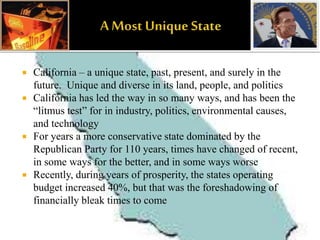
 California – a unique state, past, present, and surely in the
future. Unique and diverse in its land, people, and politics
 California has led the way in so many ways, and has been the
“litmus test” for in industry, politics, environmental causes,
and technology
 For years a more conservative state dominated by the
Republican Party for 110 years, times have changed of recent,
in some ways for the better, and in some ways worse
 Recently, during years of prosperity, the states operating
budget increased 40%, but that was the foreshadowing of
financially bleak times to come
 In 2003 things started to unravel financially with the state
experiencing a 38 million dollar shortfall in revenues
 Weather related incidents, fires, earthquakes, immigration, dot
com bust, and spendthrift politicians put the state in a
financial pit that it may not recover from without serious
budget cuts and a change in the way California conducts its
political and socio-economic business
 Voters elected Gov. Schwarzenegger to “terminate” business
as usual. Despite his initial success, thing haven’t gone to
well of recent
 California continues to struggle, dealing with a myriad of
challenging social, budgetary, political, and environmental
that won’t soon be resolved
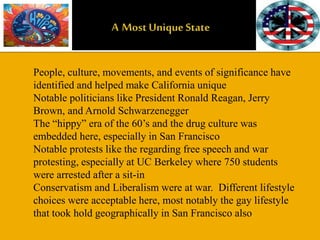
 People, culture, movements, and events of significance have
identified and helped make California unique
 Notable politicians like President Ronald Reagan, Jerry
Brown, and Arnold Schwarzenegger
 The “hippy” era of the 60’s and the drug culture was
embedded here, especially in San Francisco
 Notable protests like the regarding free speech and war
protesting, especially at UC Berkeley where 750 students
were arrested after a sit-in
 Conservatism and Liberalism were at war. Different lifestyle
choices were acceptable here, most notably the gay lifestyle
that took hold geographically in San Francisco also

California

  • 1.
    2010 Fall141 History/AmericasSince 1800 71227 By EricOsterberg
  • 2.
     California..a “terrestrialparadise”. A true caricature of our my home state. First named in 1539 by the Spanish (Hernan Cortes), they believed it to be an island, but later discovered it to be a peninsula (Baja California)  Old California, not Baja, wouldn’t be settled 230 years later  The rugged beauty from sea to desert, best described in the book as a landscape of “clear cut and confrontational topographies”  Most Californians can access the coastline, mountains, deserts, valleys and canyons within a couple of hours of driving time confirming its uniqueness as a state
  • 3.
     The titanicaction below the earth’s surface in California is what fashioned the diverse landscape.  The ongoing seismic activity is a regular reminder of the turmoil below. Considerable damage due to many sizeable earthquakes are well recorded in our states history  With 1,264 miles of Pacific coastline, the topography quickly changes to the towering mid-range mountains, and then to the deserts where Death Valley sits 282 ft. below sea level  The coastline is blessed with four natural harbors of varying sizes. San Diego, Monterey, San Francisco, and the Humboldt  These were of critical importance because the enabled safe mooring and land access to early explorers
  • 4.
     1/3 ofthe early Native Americans groups lived in California. Plentiful water and food, along with a acceptable weather, supported their lifestyles.  Native Americans occupied three different regions and had varied lifestyles to suit their environment  The staple food amongst all groups was the acorn. However, Native Americans to the northeast were predominately fishermen, coastal inhabitants relied on shellfish and fish, and the hunter/gatherers of the interior regions  Due to the abundant living in all areas, competition wasn’t necessary, so most groups lived peacefully without conflict  Unfortunately, like the rest of the country, Native American populations were decimated after contact with “whites” due to disease
  • 5.
     With statehoodon Sept. 9th 1850, California experienced steady growth. Men like William Hammond Hall realized that water was the lifeblood to make the state fully “inhabitable and productive”.  Hall’s visionary efforts would pave the way for the California of today  Two water sources were identified: the Colorado and Owens rivers. They would be tapped and water distribution to semi- arid would allow habitation and development to occur  The cities of San Francisco and Los Angeles would be the burgeoning municipalities in the state early growth, both very dependent upon imported water
  • 6.
     Agriculture playeda large part in the early socio- economic expansion of the state. With expansion – came structural development and rapid population growth ensued.  By 1940 California swelled to 6.9 million people  Population growth and a social hierarchy occurred with growth, whites initially were the largest segment in the demographic mix .  As time progressed, the Chinese, Japanese, and Mexican populations grew – integrating into communities.  Development, manufacturing, fishing, and agriculture were the main jobs supporting the growing populace
  • 7.
    • Structurally speaking,the state was somewhat divided in parts due to topography. • By 1924 there were 310.000 automobiles on the roadways • Bridges and roadways helped link geographical areas making access easier and timely • Los Angeles had the busiest intersection in the country with 69,797 cars traveling through it each day • Roadway construction and freeway projects became a major priority as engineers realized the dependence upon the automobile as the primary means of transportation • Architectural wonders like the Golden Gate bridge became icons of the San Francisco area • The Bank of America/Italy enabled many to live out their dreams through employment and home ownership, and no doubt helping California become what it is today
  • 8.
     California –a unique state, past, present, and surely in the future. Unique and diverse in its land, people, and politics  California has led the way in so many ways, and has been the “litmus test” for in industry, politics, environmental causes, and technology  For years a more conservative state dominated by the Republican Party for 110 years, times have changed of recent, in some ways for the better, and in some ways worse  Recently, during years of prosperity, the states operating budget increased 40%, but that was the foreshadowing of financially bleak times to come
  • 9.
     In 2003things started to unravel financially with the state experiencing a 38 million dollar shortfall in revenues  Weather related incidents, fires, earthquakes, immigration, dot com bust, and spendthrift politicians put the state in a financial pit that it may not recover from without serious budget cuts and a change in the way California conducts its political and socio-economic business  Voters elected Gov. Schwarzenegger to “terminate” business as usual. Despite his initial success, thing haven’t gone to well of recent  California continues to struggle, dealing with a myriad of challenging social, budgetary, political, and environmental that won’t soon be resolved
  • 10.
     People, culture,movements, and events of significance have identified and helped make California unique  Notable politicians like President Ronald Reagan, Jerry Brown, and Arnold Schwarzenegger  The “hippy” era of the 60’s and the drug culture was embedded here, especially in San Francisco  Notable protests like the regarding free speech and war protesting, especially at UC Berkeley where 750 students were arrested after a sit-in  Conservatism and Liberalism were at war. Different lifestyle choices were acceptable here, most notably the gay lifestyle that took hold geographically in San Francisco also