LogChaos: Challenges and Opportunities of Security Log StandardizationDr. Anton ChuvakinSecurity Warrior ConsultingOct 20095th Annual IT Security Automation ConferenceBaltimore, MDOctober 26-29, 2009
OutlineWorld of logs todayLog chaos? Why? Why order is sorely needed!Past attempts to bring order chaos!Why ALL failed?What does the future hold?You already know about CEE 
Log Data OverviewFrom Where?What Logs?Firewalls/intrusion prevention
Routers/switches
Intrusion detection
Servers, desktops, mainframes
Business applications
Databases
Anti-virus
VPNs
Audit logs
Transaction logs
Intrusion logs
Connection logs
System performance records
User activity logs
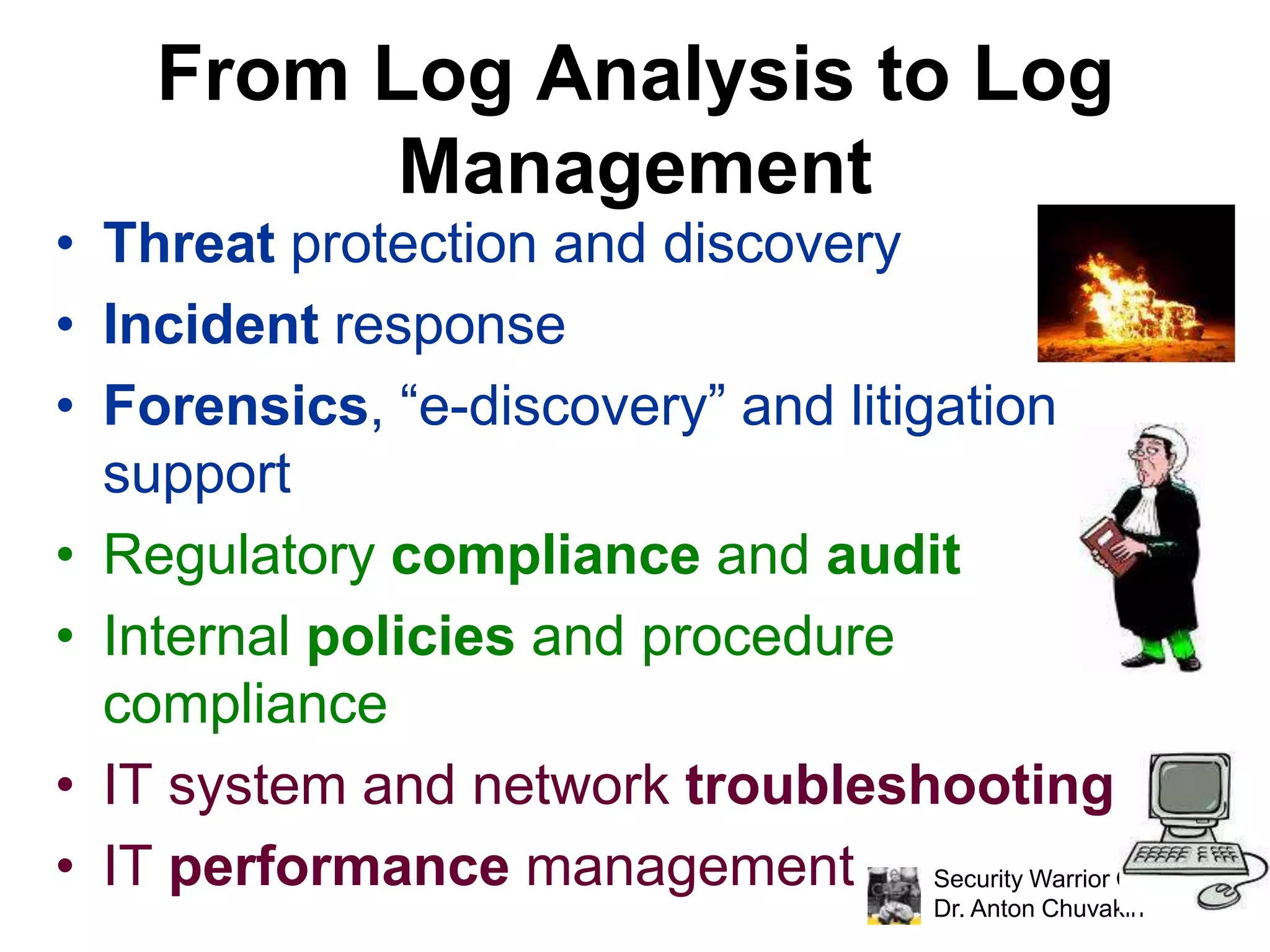
Various alerts and other messagesFrom Log Analysis to Log ManagementThreatprotection and discoveryIncident responseForensics, “e-discovery” and litigation supportRegulatory compliance and auditInternal policies and procedure complianceIT system and network troubleshootingIT performance management
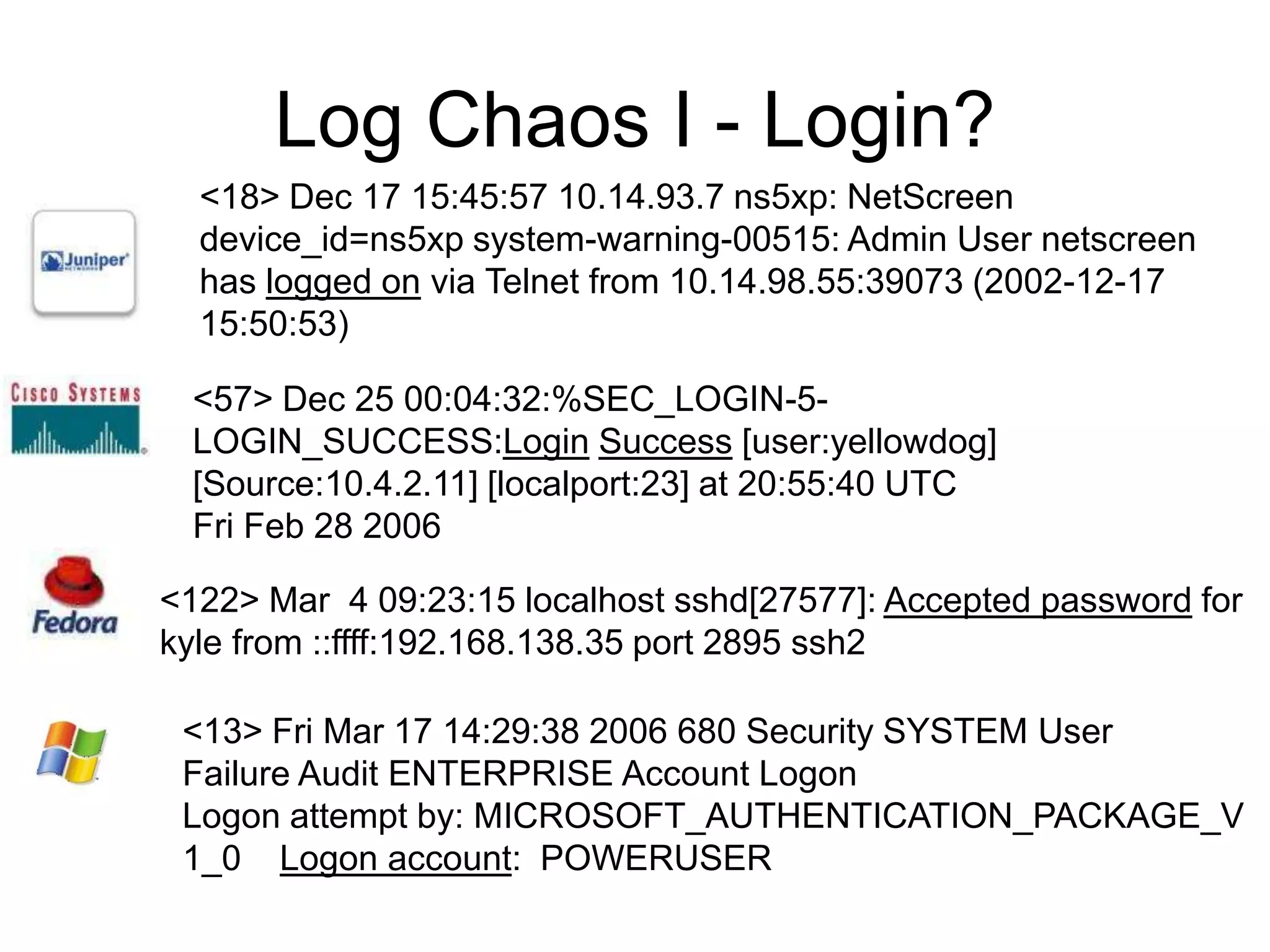
Log Chaos I - Login?<18> Dec 17 15:45:57 10.14.93.7 ns5xp: NetScreen device_id=ns5xp system-warning-00515: Admin User netscreen has logged on via Telnet from 10.14.98.55:39073 (2002-12-17 15:50:53) <57> Dec 25 00:04:32:%SEC_LOGIN-5-LOGIN_SUCCESS:LoginSuccess [user:yellowdog] [Source:10.4.2.11] [localport:23] at 20:55:40 UTC Fri Feb 28 2006<122> Mar  4 09:23:15 localhost sshd[27577]: Accepted password for kyle from ::ffff:192.168.138.35 port 2895 ssh2<13> Fri Mar 17 14:29:38 2006 680 Security SYSTEM User Failure Audit ENTERPRISE Account Logon Logon attempt by: MICROSOFT_AUTHENTICATION_PACKAGE_V1_0    Logon account:  POWERUSER   
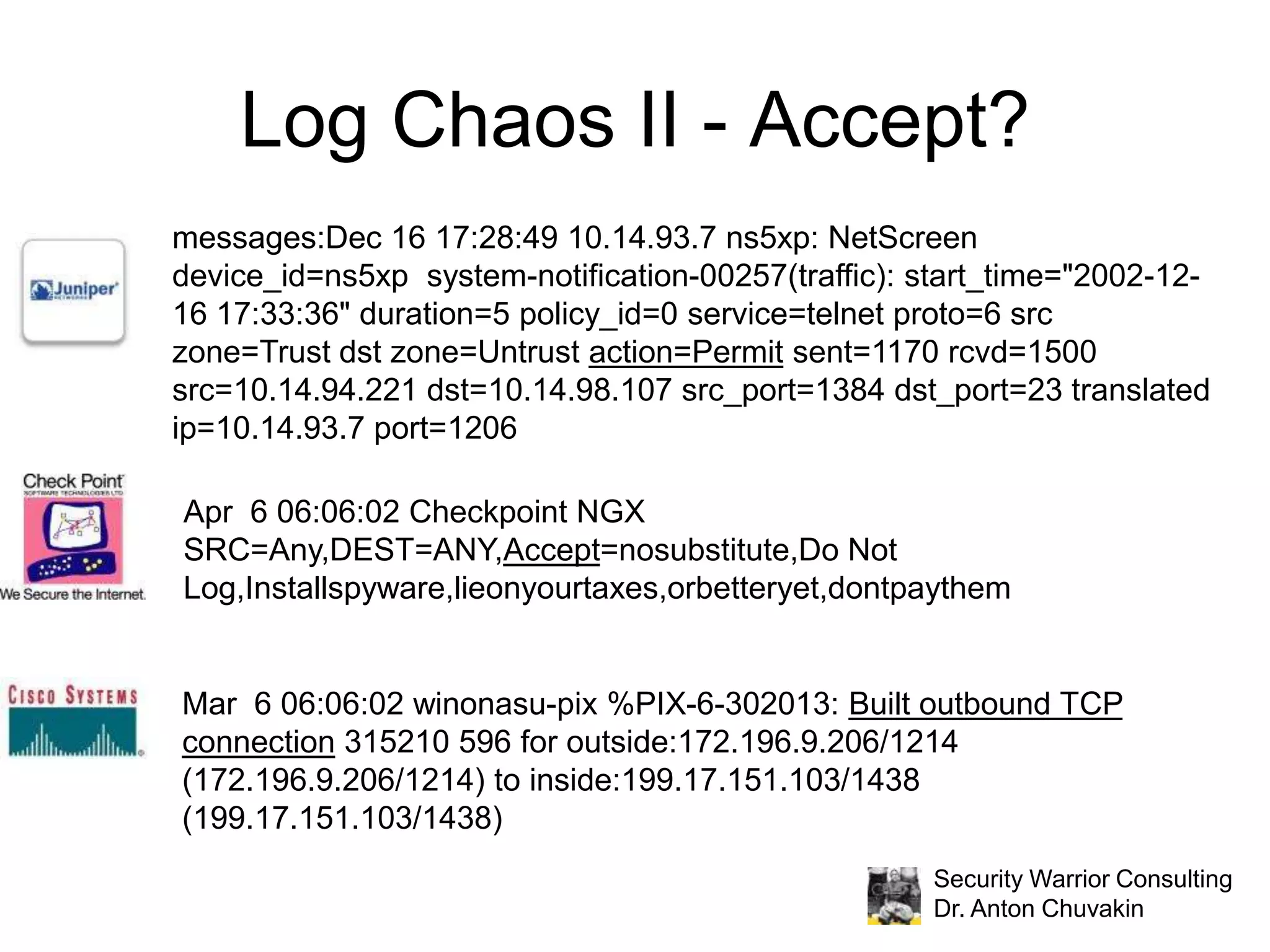
Log Chaos II - Accept?messages:Dec 16 17:28:49 10.14.93.7 ns5xp: NetScreen device_id=ns5xp  system-notification-00257(traffic): start_time="2002-12-16 17:33:36" duration=5 policy_id=0 service=telnet proto=6 src zone=Trust dst zone=Untrust action=Permit sent=1170 rcvd=1500 src=10.14.94.221 dst=10.14.98.107 src_port=1384 dst_port=23 translated ip=10.14.93.7 port=1206Apr  6 06:06:02 Checkpoint NGX SRC=Any,DEST=ANY,Accept=nosubstitute,Do Not Log,Installspyware,lieonyourtaxes,orbetteryet,dontpaythemMar  6 06:06:02 winonasu-pix %PIX-6-302013: Built outbound TCP connection 315210 596 for outside:172.196.9.206/1214 (172.196.9.206/1214) to inside:199.17.151.103/1438 (199.17.151.103/1438)
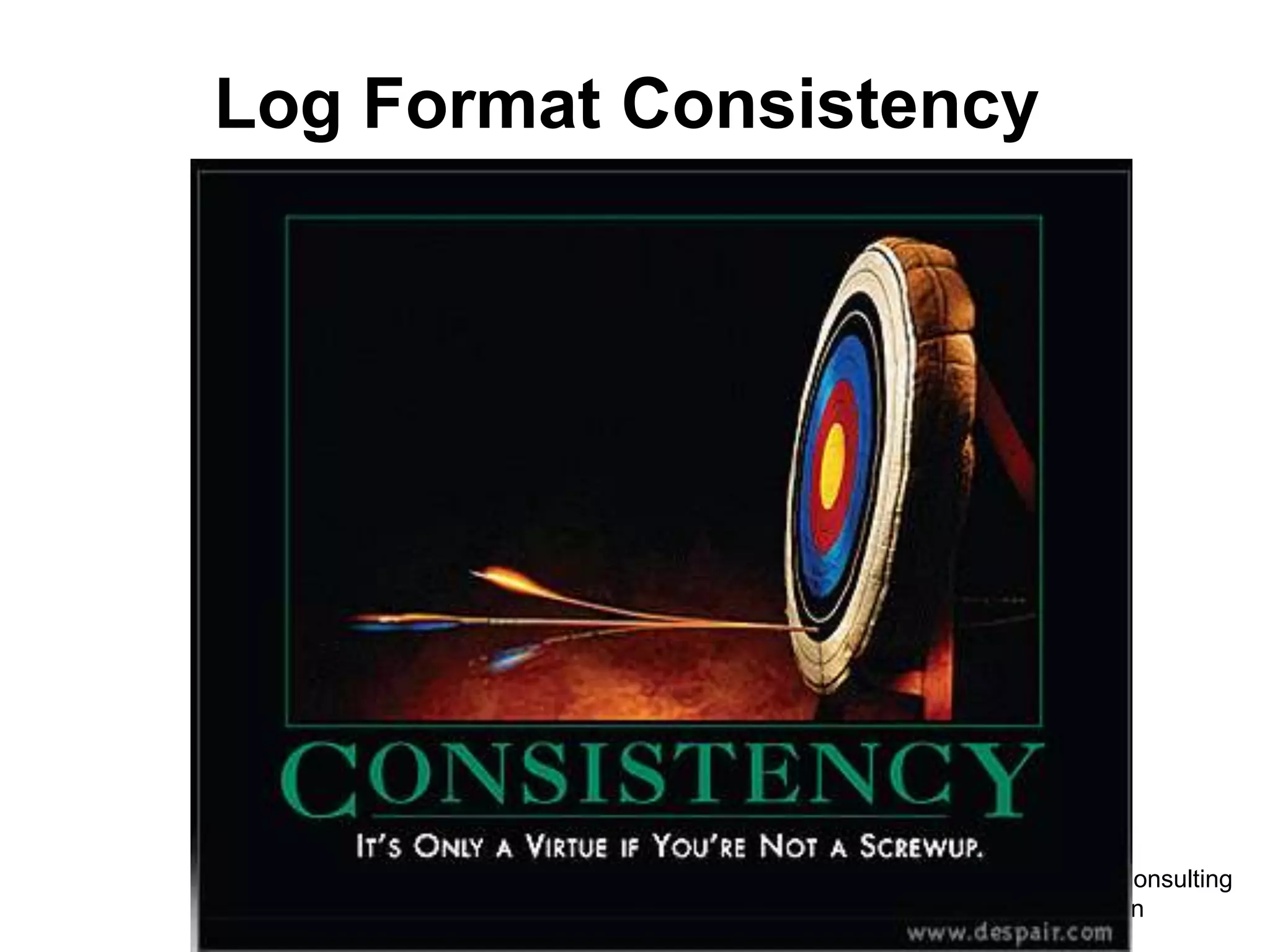
Log Format Consistency
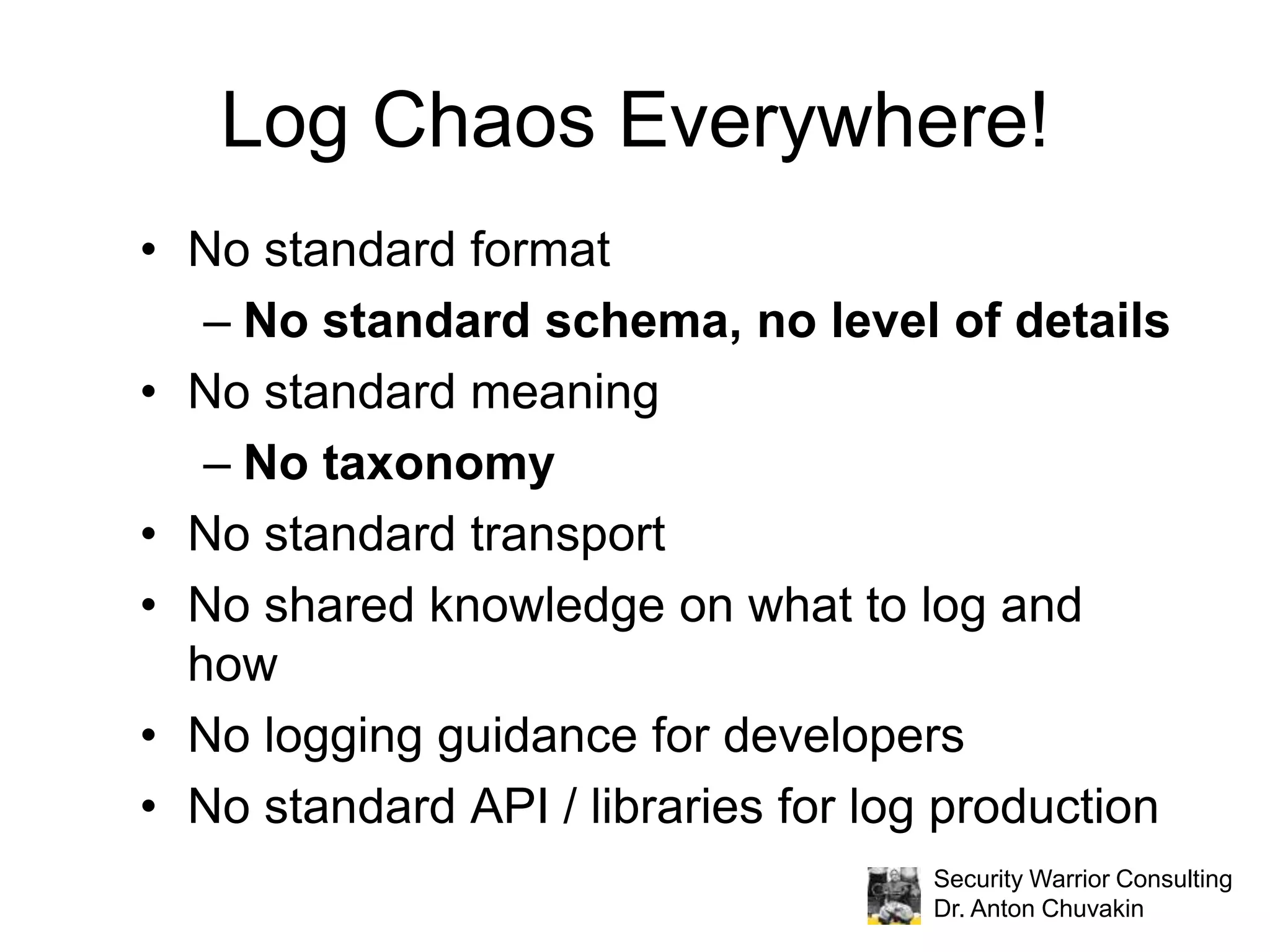
Log Chaos Everywhere!No standard formatNo standard schema, no level of detailsNo standard meaningNo taxonomyNo standard transportNo shared knowledge on what to log and howNo logging guidance for developersNo standard API / libraries for log production
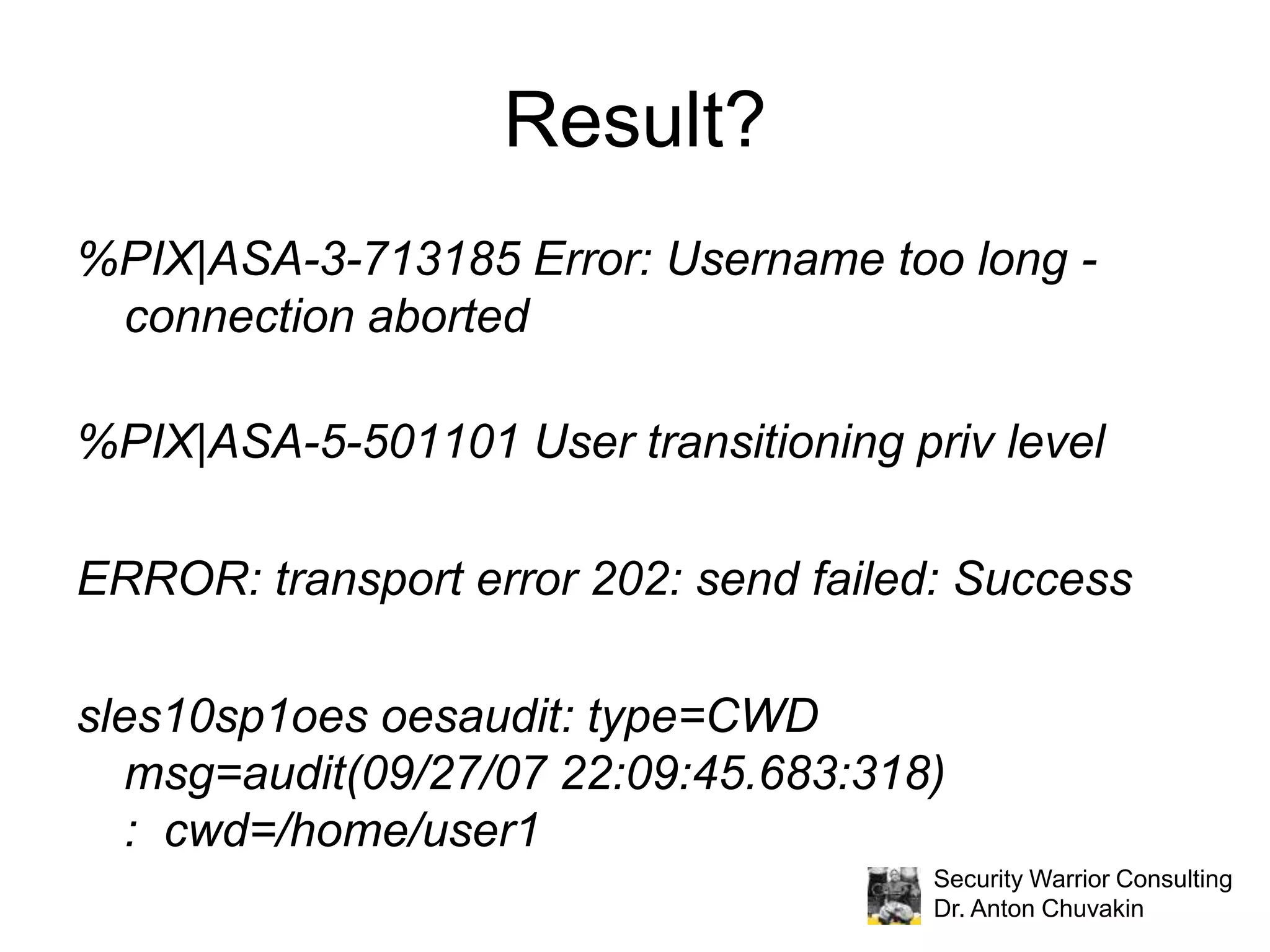
Result?%PIX|ASA-3-713185 Error: Username too long - connection aborted%PIX|ASA-5-501101 User transitioning priv levelERROR: transport error 202: send failed: Successsles10sp1oes oesaudit: type=CWD msg=audit(09/27/07 22:09:45.683:318) :  cwd=/home/user1
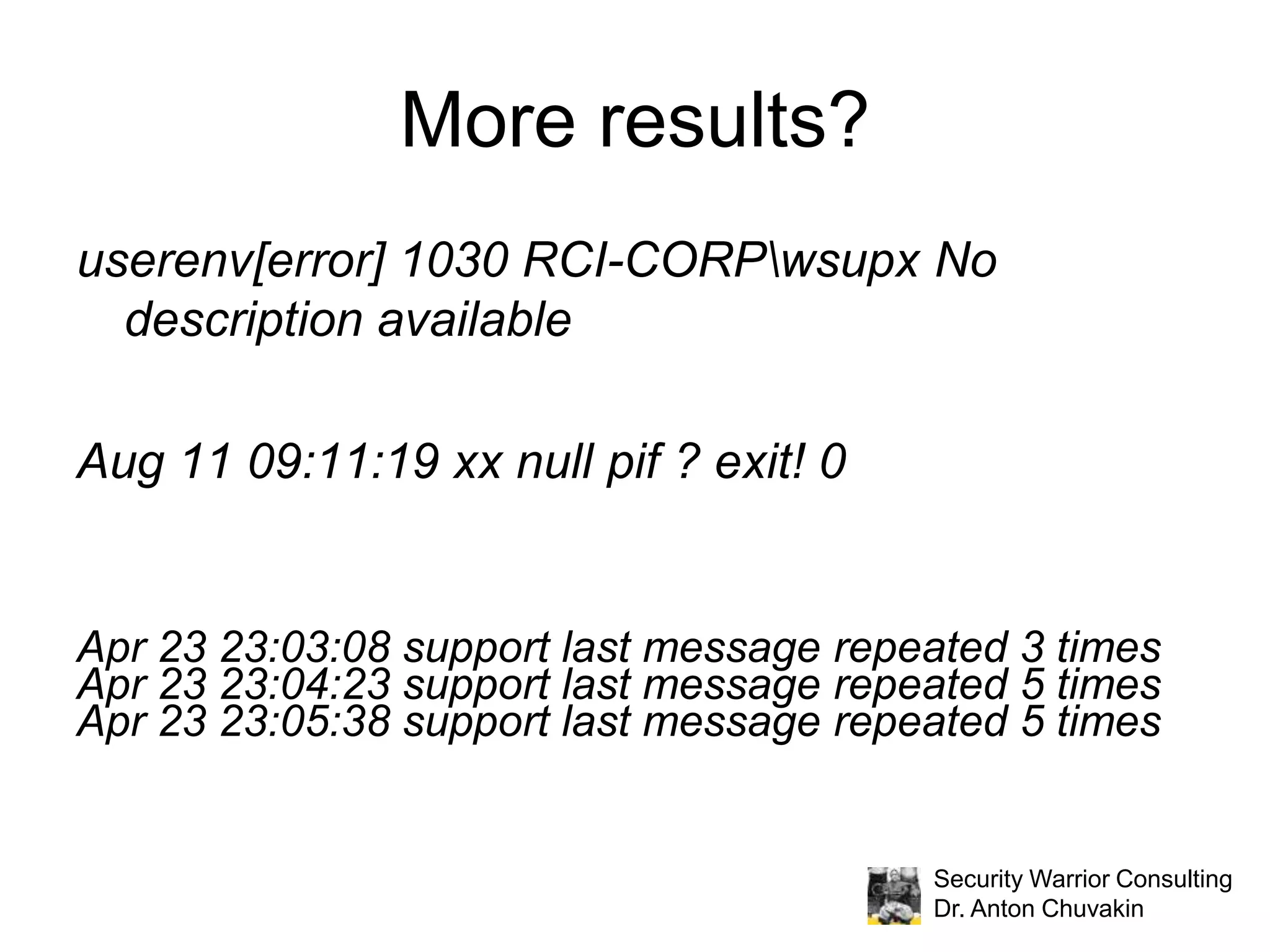
More results?userenv[error] 1030 RCI-CORP\wsupx No description availableAug 11 09:11:19 xx null pif ? exit! 0 Apr 23 23:03:08 support last message repeated 3 timesApr 23 23:04:23 support last message repeated 5 timesApr 23 23:05:38 support last message repeated 5 times
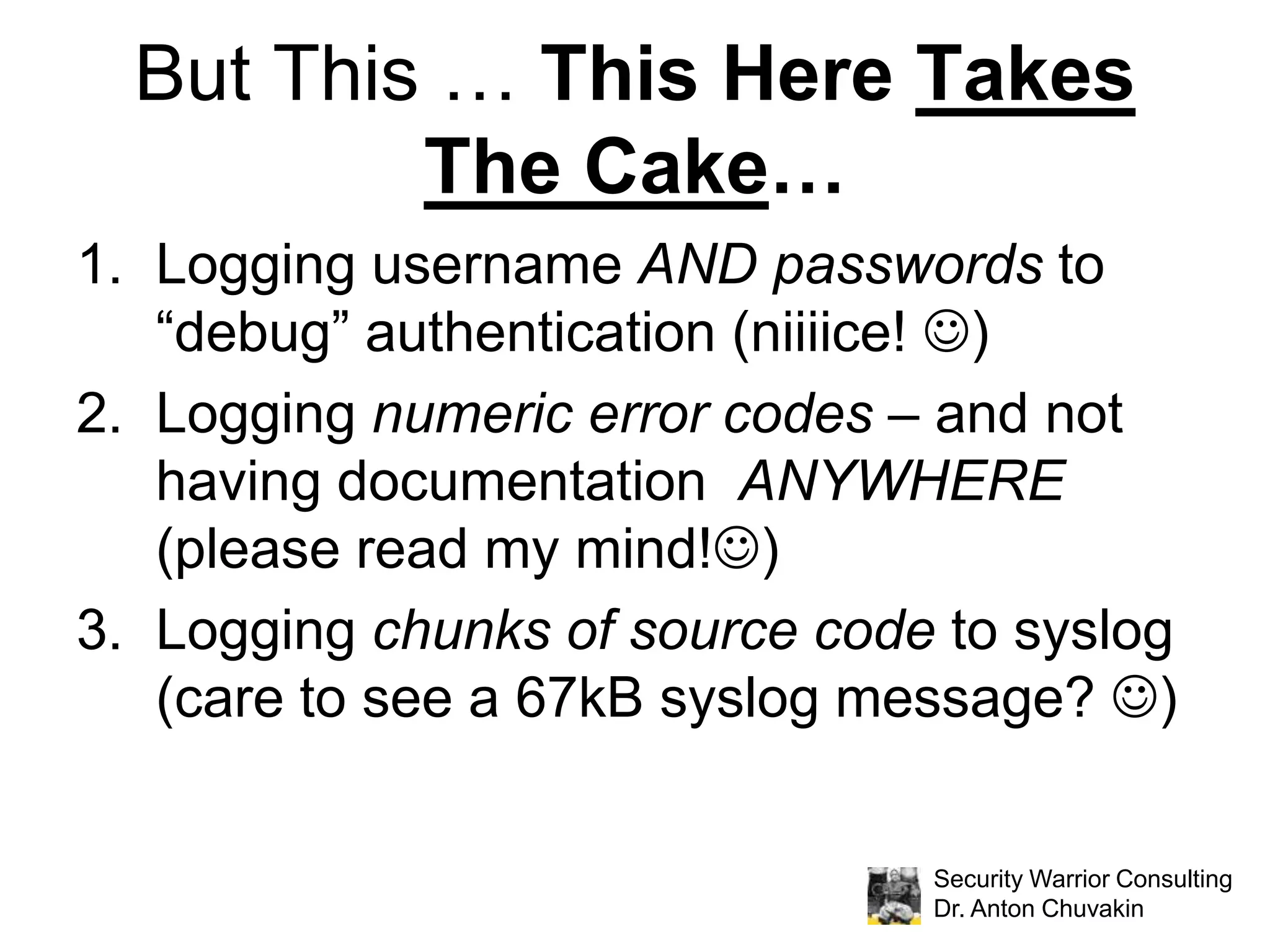
But This … This Here Takes The Cake…Logging username AND passwords to “debug” authentication (niiiice! )Logging numeric error codes – and not having documentation  ANYWHERE (please read my mind!)Logging chunks of source code to syslog (care to see a 67kB syslog message? )
Chaos2order: Why Logging Standards?Common languageEasier to report on logs and explain the reportsDeeper insight into future problems Easier system interoperabilityCommon logging practicesEasier to explain what is in the logs to management and non-IT people
What Becomes Possible?All those super-smart people at SIEM  vendors can stop parsing and start analyzingWhat the events mean? Consequences? Actions? Maybe even prediction?Different systems can mitigate consequences of each others’ failuresWe can finally tell the developers “what to log?” and have them “get it!”
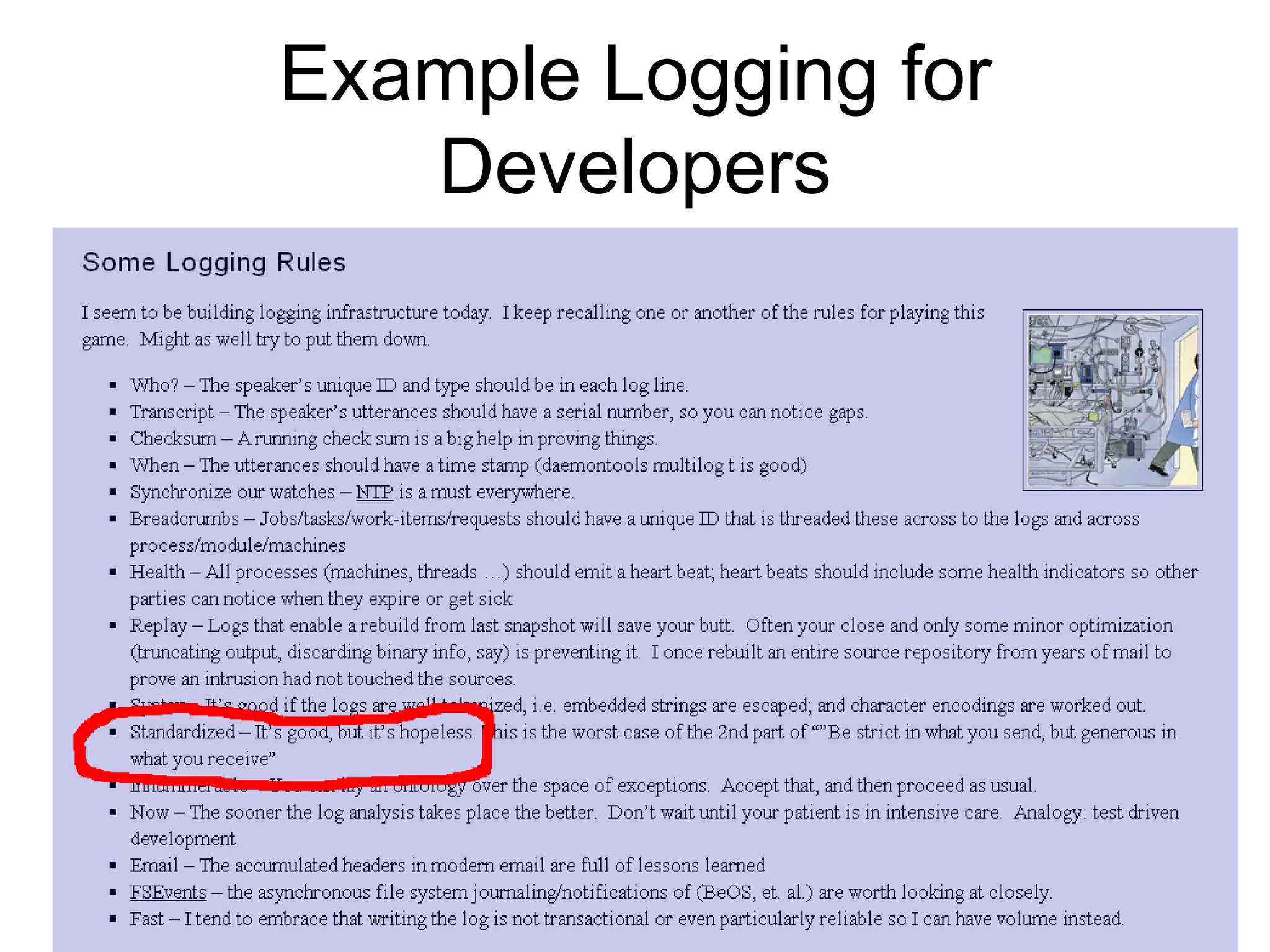
Example Logging for Developers
DefinitionsLog = message generated by an IT system to record whatever event happening Log format = layout of log messages in the form of fields, separators, delimiters, tags, etcLog syntax =  fields and values that are present in logsLog taxonomy = a taxonomy of log messages that categorizes log messages and codifies their meaningLog transport = a method of moving logs from one system to another; typically a network protocol
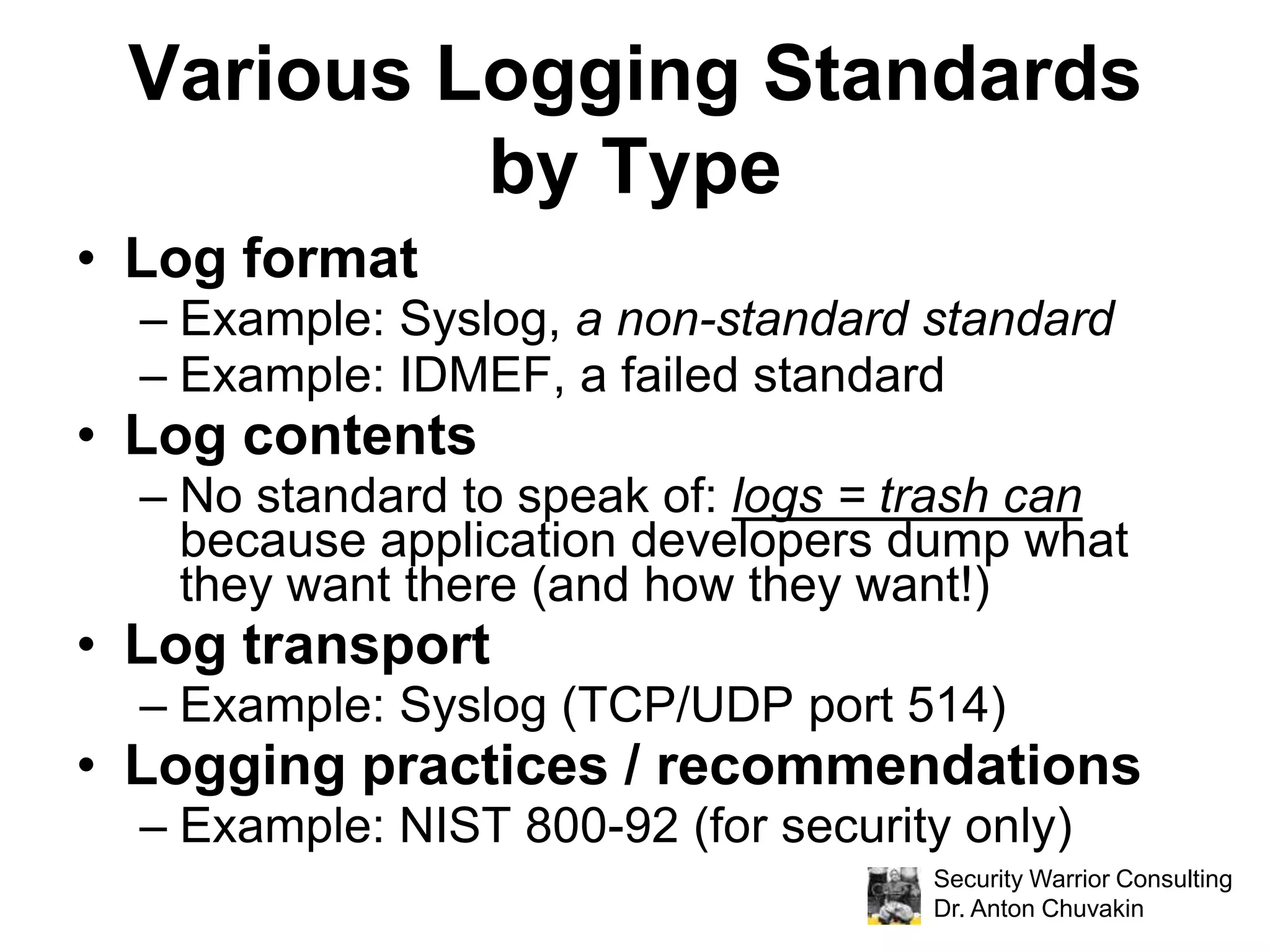
Various Logging Standards by TypeLog formatExample: Syslog, a non-standard standard Example: IDMEF, a failed standard Log contentsNo standard to speak of: logs = trash can because application developers dump what they want there (and how they want!)Log transportExample: Syslog (TCP/UDP port 514)Logging practices / recommendationsExample: NIST 800-92 (for security only)
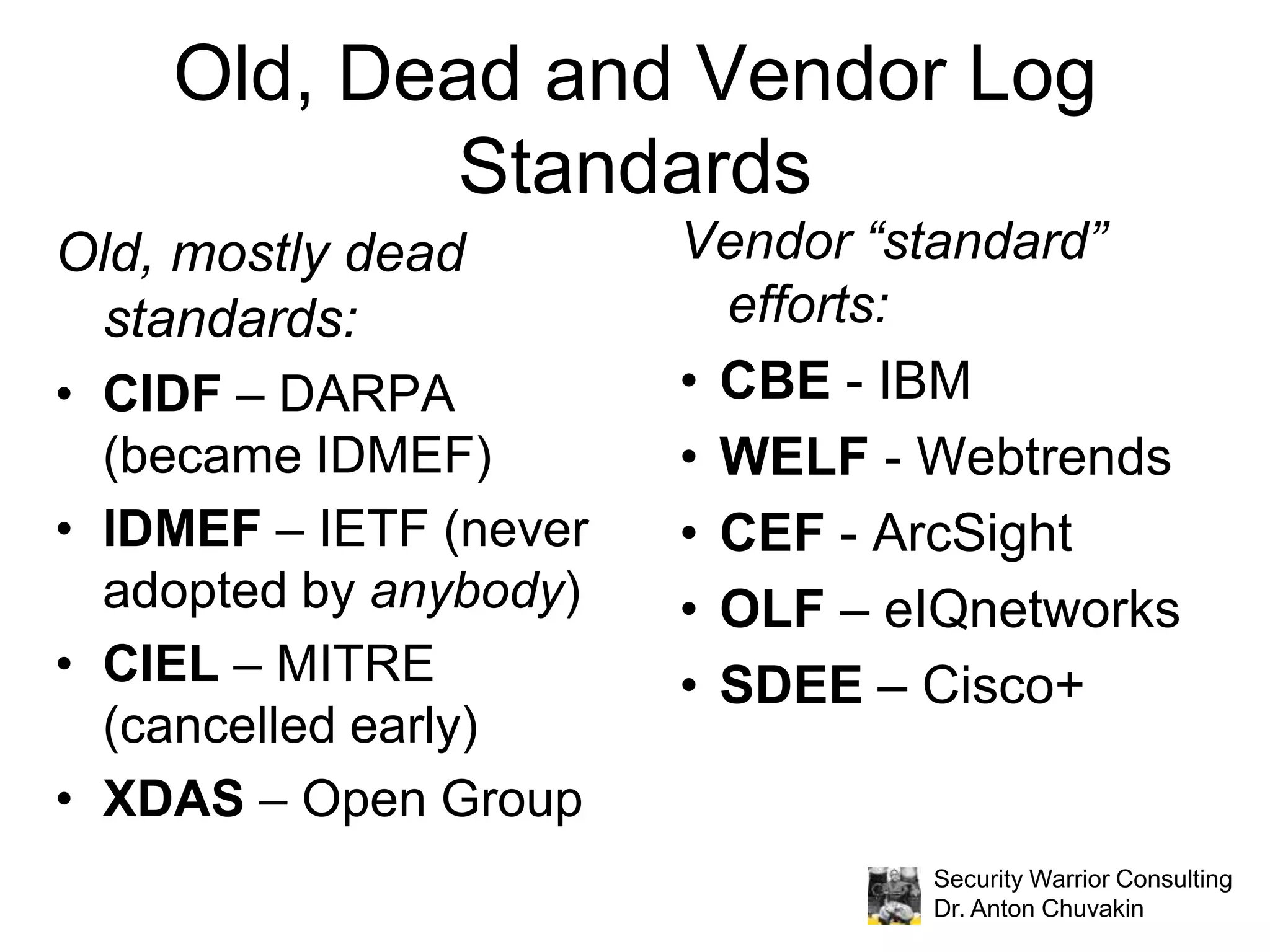
Old, Dead and Vendor Log StandardsVendor “standard” efforts:CBE - IBM
WELF - Webtrends

LogChaos: Challenges and Opportunities of Security Log Standardization

  • 1.
    LogChaos: Challenges andOpportunities of Security Log StandardizationDr. Anton ChuvakinSecurity Warrior ConsultingOct 20095th Annual IT Security Automation ConferenceBaltimore, MDOctober 26-29, 2009
  • 2.
    OutlineWorld of logstodayLog chaos? Why? Why order is sorely needed!Past attempts to bring order chaos!Why ALL failed?What does the future hold?You already know about CEE 
  • 4.
    Log Data OverviewFromWhere?What Logs?Firewalls/intrusion prevention
  • 5.
  • 6.
  • 7.
  • 8.
  • 9.
  • 10.
  • 11.
  • 12.
  • 13.
  • 14.
  • 15.
  • 16.
  • 17.
  • 18.
    Various alerts andother messagesFrom Log Analysis to Log ManagementThreatprotection and discoveryIncident responseForensics, “e-discovery” and litigation supportRegulatory compliance and auditInternal policies and procedure complianceIT system and network troubleshootingIT performance management
  • 19.
    Log Chaos I- Login?<18> Dec 17 15:45:57 10.14.93.7 ns5xp: NetScreen device_id=ns5xp system-warning-00515: Admin User netscreen has logged on via Telnet from 10.14.98.55:39073 (2002-12-17 15:50:53) <57> Dec 25 00:04:32:%SEC_LOGIN-5-LOGIN_SUCCESS:LoginSuccess [user:yellowdog] [Source:10.4.2.11] [localport:23] at 20:55:40 UTC Fri Feb 28 2006<122> Mar 4 09:23:15 localhost sshd[27577]: Accepted password for kyle from ::ffff:192.168.138.35 port 2895 ssh2<13> Fri Mar 17 14:29:38 2006 680 Security SYSTEM User Failure Audit ENTERPRISE Account Logon Logon attempt by: MICROSOFT_AUTHENTICATION_PACKAGE_V1_0    Logon account:  POWERUSER   
  • 20.
    Log Chaos II- Accept?messages:Dec 16 17:28:49 10.14.93.7 ns5xp: NetScreen device_id=ns5xp system-notification-00257(traffic): start_time="2002-12-16 17:33:36" duration=5 policy_id=0 service=telnet proto=6 src zone=Trust dst zone=Untrust action=Permit sent=1170 rcvd=1500 src=10.14.94.221 dst=10.14.98.107 src_port=1384 dst_port=23 translated ip=10.14.93.7 port=1206Apr 6 06:06:02 Checkpoint NGX SRC=Any,DEST=ANY,Accept=nosubstitute,Do Not Log,Installspyware,lieonyourtaxes,orbetteryet,dontpaythemMar 6 06:06:02 winonasu-pix %PIX-6-302013: Built outbound TCP connection 315210 596 for outside:172.196.9.206/1214 (172.196.9.206/1214) to inside:199.17.151.103/1438 (199.17.151.103/1438)
  • 21.
  • 22.
    Log Chaos Everywhere!Nostandard formatNo standard schema, no level of detailsNo standard meaningNo taxonomyNo standard transportNo shared knowledge on what to log and howNo logging guidance for developersNo standard API / libraries for log production
  • 23.
    Result?%PIX|ASA-3-713185 Error: Usernametoo long - connection aborted%PIX|ASA-5-501101 User transitioning priv levelERROR: transport error 202: send failed: Successsles10sp1oes oesaudit: type=CWD msg=audit(09/27/07 22:09:45.683:318) :  cwd=/home/user1
  • 24.
    More results?userenv[error] 1030RCI-CORP\wsupx No description availableAug 11 09:11:19 xx null pif ? exit! 0 Apr 23 23:03:08 support last message repeated 3 timesApr 23 23:04:23 support last message repeated 5 timesApr 23 23:05:38 support last message repeated 5 times
  • 25.
    But This …This Here Takes The Cake…Logging username AND passwords to “debug” authentication (niiiice! )Logging numeric error codes – and not having documentation ANYWHERE (please read my mind!)Logging chunks of source code to syslog (care to see a 67kB syslog message? )
  • 26.
    Chaos2order: Why LoggingStandards?Common languageEasier to report on logs and explain the reportsDeeper insight into future problems Easier system interoperabilityCommon logging practicesEasier to explain what is in the logs to management and non-IT people
  • 27.
    What Becomes Possible?Allthose super-smart people at SIEM vendors can stop parsing and start analyzingWhat the events mean? Consequences? Actions? Maybe even prediction?Different systems can mitigate consequences of each others’ failuresWe can finally tell the developers “what to log?” and have them “get it!”
  • 28.
  • 29.
    DefinitionsLog = messagegenerated by an IT system to record whatever event happening Log format = layout of log messages in the form of fields, separators, delimiters, tags, etcLog syntax = fields and values that are present in logsLog taxonomy = a taxonomy of log messages that categorizes log messages and codifies their meaningLog transport = a method of moving logs from one system to another; typically a network protocol
  • 30.
    Various Logging Standardsby TypeLog formatExample: Syslog, a non-standard standard Example: IDMEF, a failed standard Log contentsNo standard to speak of: logs = trash can because application developers dump what they want there (and how they want!)Log transportExample: Syslog (TCP/UDP port 514)Logging practices / recommendationsExample: NIST 800-92 (for security only)
  • 31.
    Old, Dead andVendor Log StandardsVendor “standard” efforts:CBE - IBM
  • 32.
  • 33.
  • 34.
  • 35.
    SDEE – Cisco+Old,mostly dead standards: CIDF – DARPA (became IDMEF)IDMEF – IETF (never adopted by anybody)CIEL – MITRE (cancelled early)XDAS – Open Group
  • 36.
    Example: IDMEF<?xml version="1.0"encoding="UTF-8"?><!DOCTYPE IDMEF-Message PUBLIC "-//IETF//DTD RFC XXXX IDMEF v1.0//EN“ "idmef-message.dtd"><IDMEF-Message version="1.0"><Alert ident="abc123456789"><Analyzer analyzerid="hq-dmz-analyzer62"><Node category="dns"><location>Headquarters Web Server</location><name>analyzer62.example.com</name></Node></Analyzer>….
  • 37.
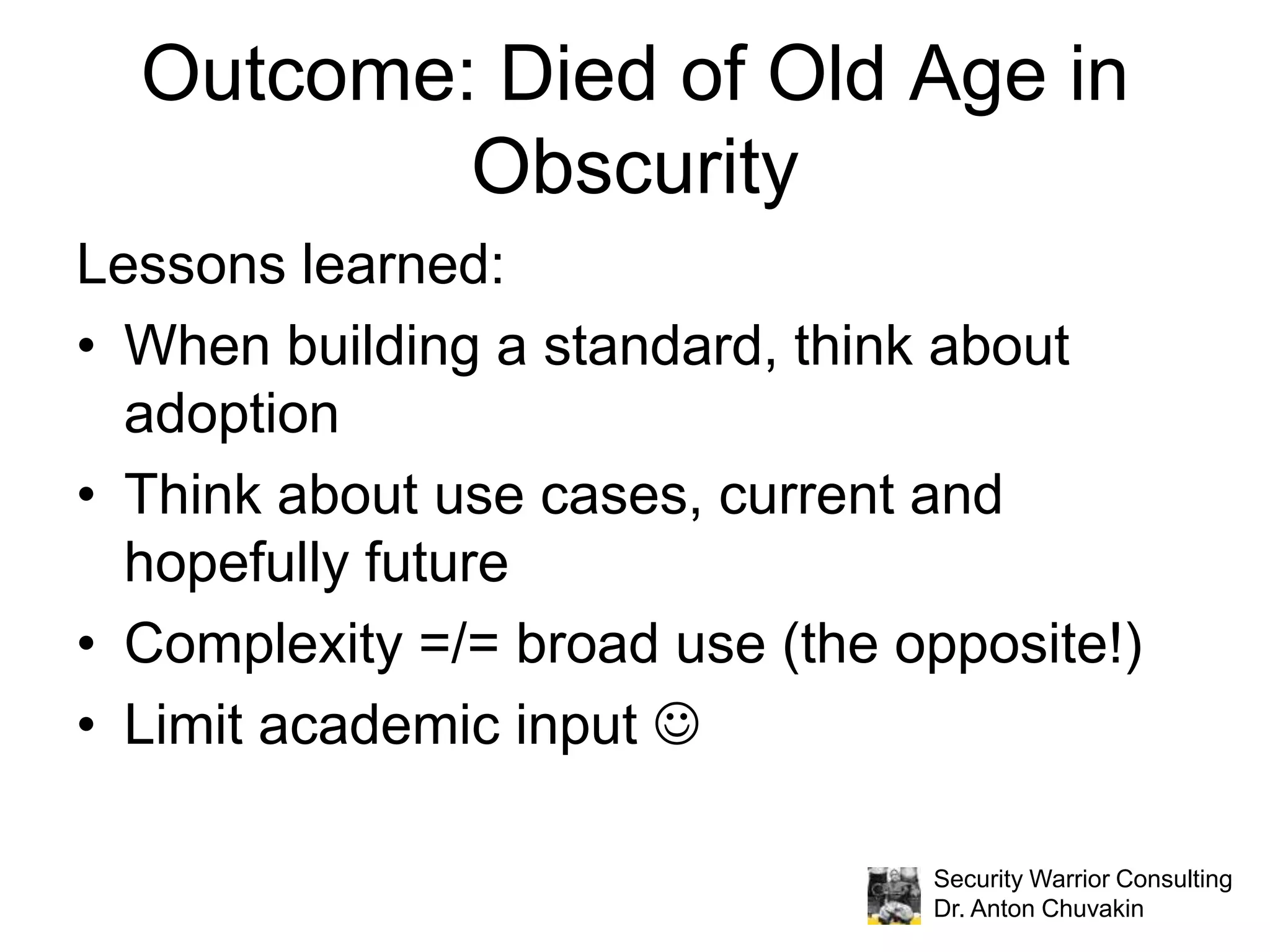
    Outcome: Died ofOld Age in ObscurityLessons learned:When building a standard, think about adoptionThink about use cases, current and hopefully futureComplexity =/= broad use (the opposite!)Limit academic input 
  • 38.
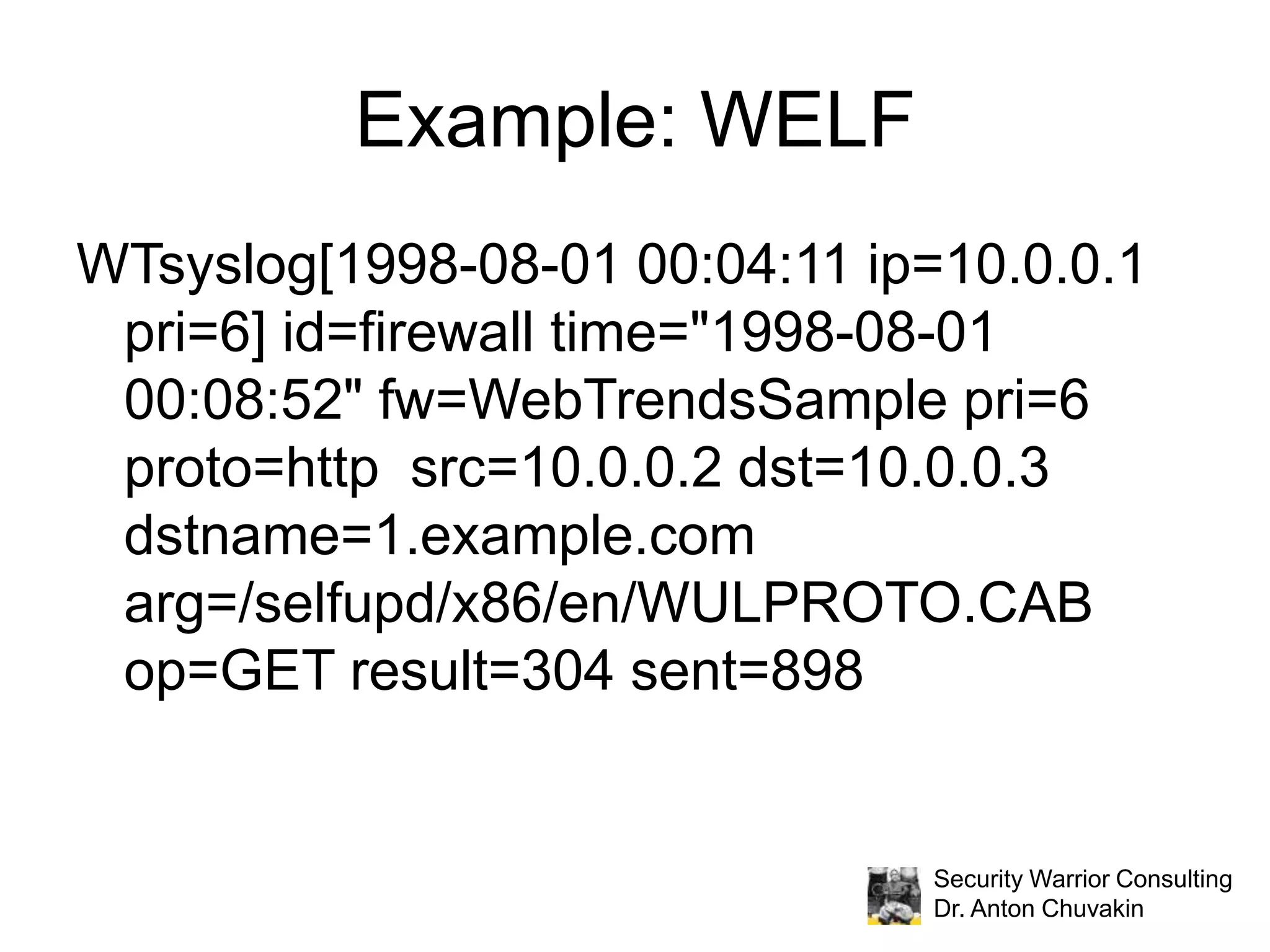
    Example: WELFWTsyslog[1998-08-01 00:04:11ip=10.0.0.1 pri=6] id=firewall time="1998-08-01 00:08:52" fw=WebTrendsSamplepri=6 proto=http src=10.0.0.2 dst=10.0.0.3 dstname=1.example.com arg=/selfupd/x86/en/WULPROTO.CAB op=GET result=304 sent=898
  • 39.
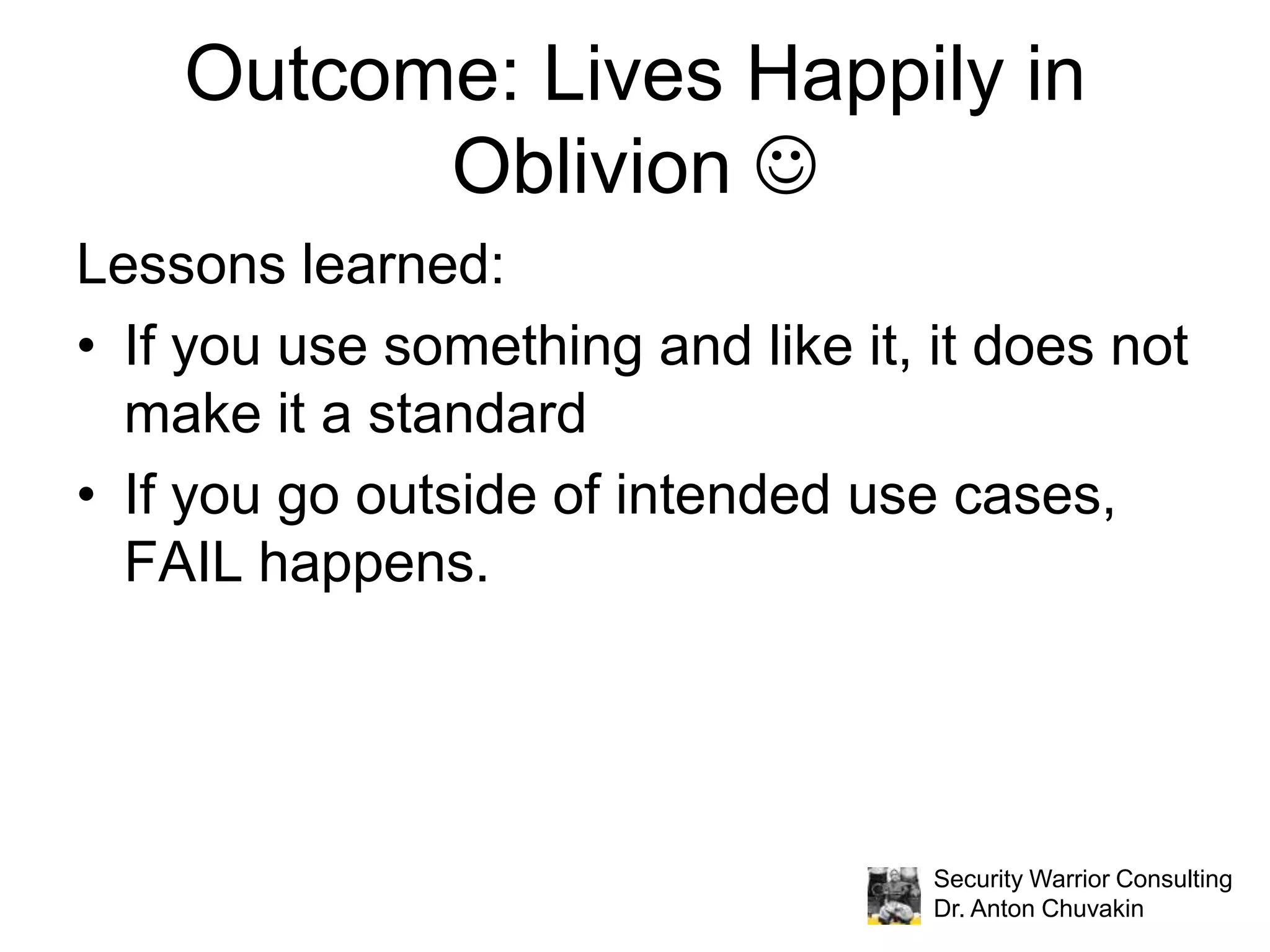
    Outcome: Lives Happilyin Oblivion Lessons learned:If you use something and like it, it does not make it a standardIf you go outside of intended use cases, FAIL happens.
  • 40.
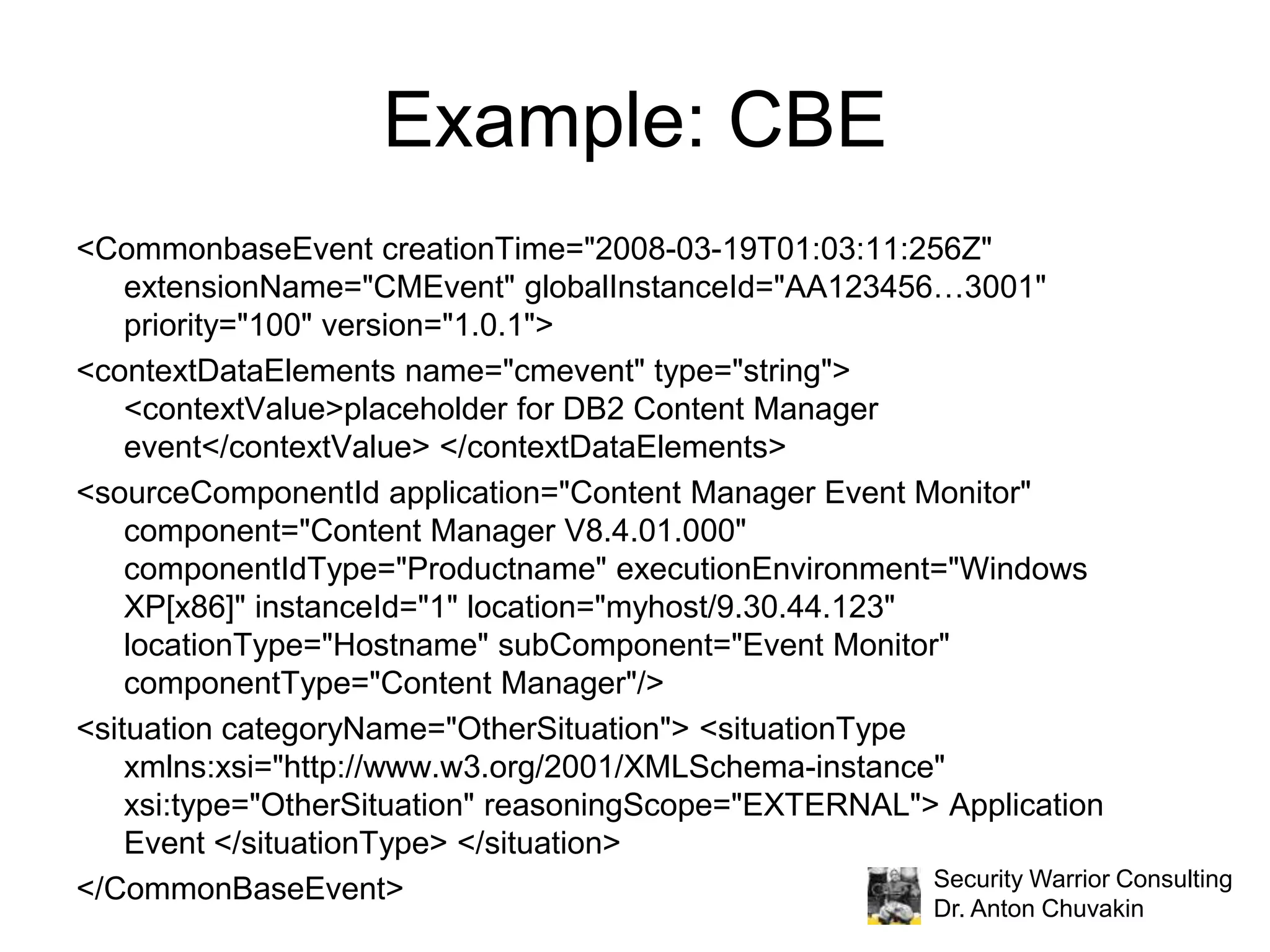
    Example: CBE<CommonbaseEventcreationTime="2008-03-19T01:03:11:256Z" extensionName="CMEvent"globalInstanceId="AA123456…3001" priority="100" version="1.0.1"> <contextDataElements name="cmevent" type="string"> <contextValue>placeholder for DB2 Content Manager event</contextValue> </contextDataElements> <sourceComponentId application="Content Manager Event Monitor" component="Content Manager V8.4.01.000" componentIdType="Productname" executionEnvironment="Windows XP[x86]" instanceId="1" location="myhost/9.30.44.123" locationType="Hostname" subComponent="Event Monitor" componentType="Content Manager"/> <situation categoryName="OtherSituation"> <situationTypexmlns:xsi="http://www.w3.org/2001/XMLSchema-instance" xsi:type="OtherSituation" reasoningScope="EXTERNAL"> Application Event </situationType> </situation></CommonBaseEvent>
  • 41.
    Outcome: MIALessons learned:Justbecause you are big doesn’t mean that anybody would care about your creationsIf you don’t use it yourself, others won’t either
  • 42.
    What Killed’em ALL?Lackof adoption – BIG one!“Solution in search of a problem”“Overthinking” designers Standard complexityEmphasis on XMLVendors and their tactical focus (or “marketing standards”)Narrow approach (e.g. just security)
  • 43.
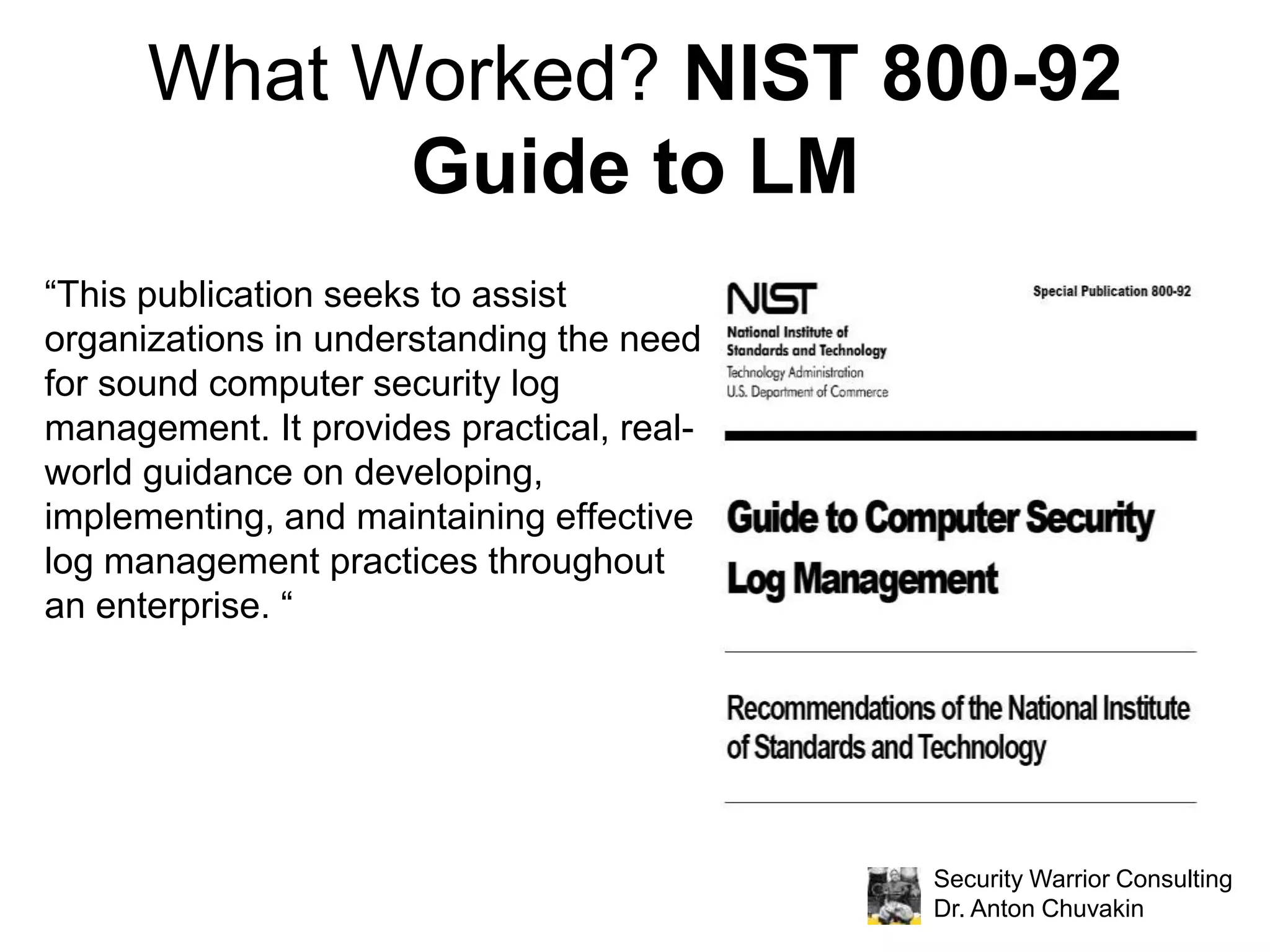
    What Worked? NIST800-92 Guide to LM“This publication seeks to assist organizations in understanding the need for sound computer security log management. It provides practical, real-world guidance on developing, implementing, and maintaining effective log management practices throughout an enterprise. “
  • 44.
    Pause …How wewant the world of logging to look like?
  • 45.
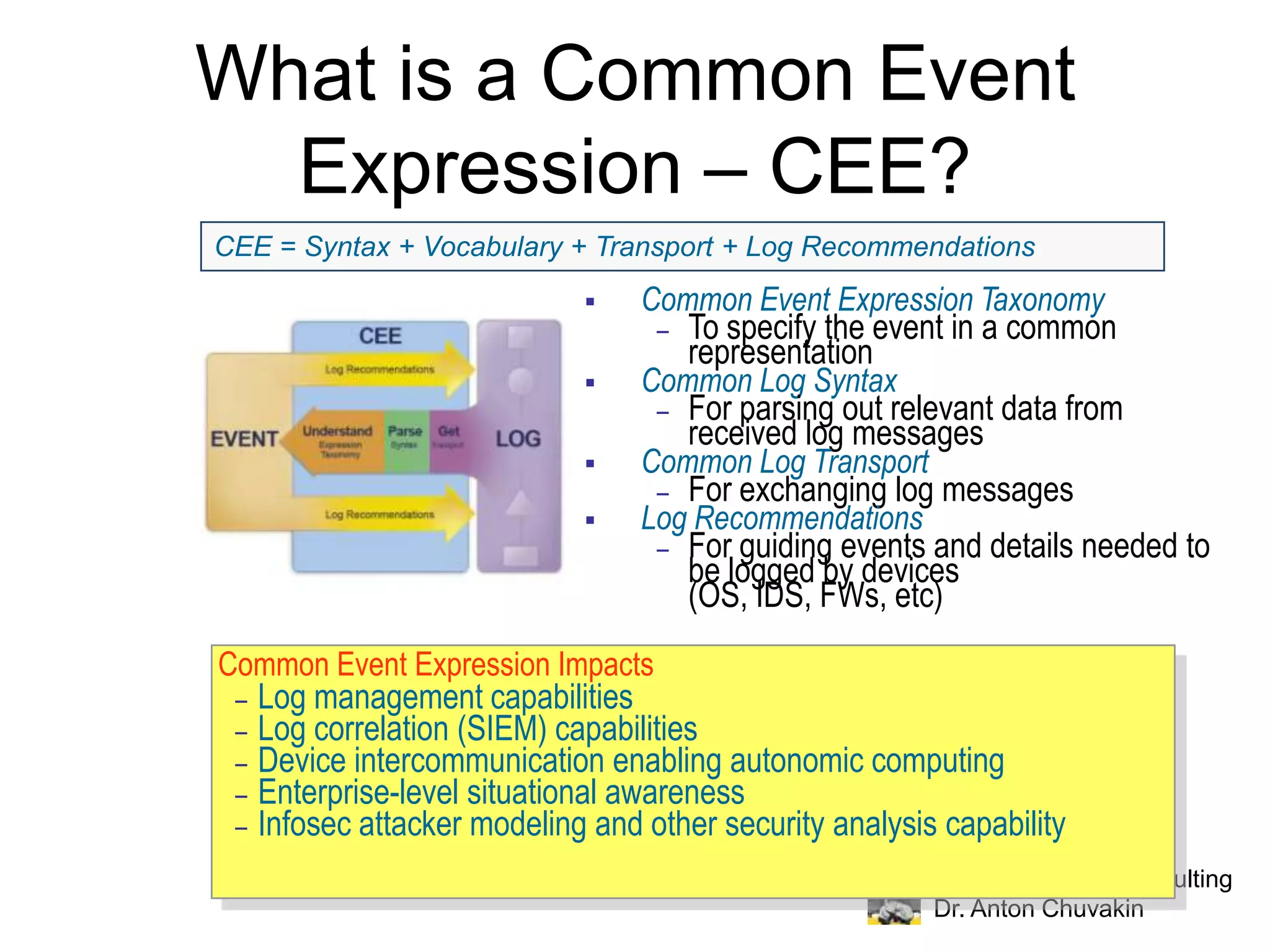
    What is aCommon Event Expression – CEE?CEE = Syntax + Vocabulary + Transport + Log Recommendations Common Event Expression Taxonomy
  • 46.
    To specify theevent in a common representation
  • 47.
  • 48.
    For parsing outrelevant data from received log messages
  • 49.
  • 50.
  • 51.
  • 52.
    For guiding eventsand details needed to be logged by devices (OS, IDS, FWs, etc)Common Event Expression ImpactsLog management capabilities
  • 53.
  • 54.
  • 55.
  • 56.
    Infosec attacker modelingand other security analysis capabilityKey Area of CEECommon Event Expression (CEE) by MITRE Key standard areas:“Create an event expression taxonomy for uniform and precise log definitions that lead to a common event representation.Create log syntaxes utilizing a single data dictionary to provide consistent event specific details.Standardize flexible event transport mechanisms to support multiple environments.Propose log recommendations for the events and attributes devices generate.”
  • 57.
    Conclusions: Future ofLog StandardsLog standard is sorely neededAbout 30 years of IT has passed by without itCEE standard will be created; CEE team has learned the lessons of othersCEE standard has a higher chance than any standard to be adoptedOK fine: “CEE standard will be adopted!” Let’s get to work!LogChaos must die! 
  • 58.
    Questions?Dr. Anton ChuvakinPrincipal @ Security Warrior ConsultingEmail:anton@chuvakin.orgSite:http://www.chuvakin.orgBlog:http://www.securitywarrior.orgLinkedIn:http://www.linkedin.com/in/chuvakinTwitter:@anton_chuvakin
  • 59.
    More on AntonBookauthor: “Security Warrior”, “PCI Compliance”, “Information Security Management Handbook”, “Know Your Enemy II”, “Hacker’s Challenge 3”, etcConference speaker: SANS, FIRST, GFIRST, ISSA, CSI, Interop, many, many others worldwideStandard developer: CEE, CVSS, OVAL, etcCommunity role: SANS, Honeynet Project, WASC, CSI, ISSA, OSSTMM, InfraGard, ISSA, othersPast roles: Researcher, Security Analyst, Strategist, Evangelist, Product Manager

Editor's Notes

  • #16 Some Logging RulesI seem to be building logging infrastructure today.  I keep recalling one or another of the rules for playing this game.  Might as well try to put them down.Who? – The speaker’s unique ID and type should be in each log line.Transcript – The speaker’s utterances should have a serial number, so you can notice gaps.Checksum – A running check sum is a big help in proving things.When – The utterances should have a time stamp (daemontoolsmultilog t is good)Synchronize our watches – NTP is a must everywhere.Breadcrumbs – Jobs/tasks/work-items/requests should have a unique ID that is threaded these across to the logs and across process/module/machinesHealth – All processes (machines, threads …) should emit a heart beat; heart beats should include some health indicators so other parties can notice when they expire or get sickReplay – Logs that enable a rebuild from last snapshot will save your butt.  Often your close and only some minor optimization (truncating output, discarding binary info, say) is preventing it.  I once rebuilt an entire source repository from years of mail to prove an intrusion had not touched the sources.Syntax – It’s good if the logs are well tokenized, i.e. embedded strings are escaped; and character encodings are worked out.Standardized – It’s good, but it’s hopeless. This is the worst case of the 2nd part of “”Be strict in what you send, but generous in what you receive”Innummerable – You can lay an ontology over the space of exceptions.  Accept that, and then proceed as usual.Now – The sooner the log analysis takes place the better.  Don’t wait until your patient is in intensive care.  Analogy: test driven development.Email – The accumulated headers in modern email are full of lessons learnedFSEvents – the asynchronous file system journaling/notifications of (BeOS, et. al.) are worth looking at closely.Fast – I tend to embrace that writing the log is not transactional or even particularly reliable so I can have volume instead.
  • #20 <?xml version="1.0" encoding="UTF-8"?><!DOCTYPE IDMEF-Message PUBLIC "-//IETF//DTD RFC XXXX IDMEFv1.0//EN“ "idmef-message.dtd"><IDMEF-Message version="1.0"><Alert ident="abc123456789"><Analyzer analyzerid="hq-dmz-analyzer62"><Node category="dns"><location>Headquarters Web Server</location><name>analyzer62.example.com</name></Node></Analyzer><CreateTimentpstamp="0xbc72b2b4.0x00000000"> 2000-03-09T15:31:00-08:00</CreateTime><Source ident="abc01"><Node ident="abc01-01"><Address ident="abc01-02" category="ipv4-addr"><address>192.0.2.200</address></Address></Node></Source><Target ident="def01"><Node ident="def01-01" category="dns"><name>www.example.com</name><Address ident="def01-02" category="ipv4-addr"><address>192.0.2.50</address></Address></Node><Service ident="def01-03"><portlist>5-25,37,42,43,53,69-119,123-514</portlist></Service></Target><Classification origin="vendor-specific"><name>portscan</name><url>http://www.vendor.com/portscan</url></Classification></Alert></IDMEF-Message>
  • #22 WTsyslog[1998-08-01 00:04:11 ip=10.0.0.1 pri=6] id=firewall time="1998-08-01 00:08:52" fw=WebTrendsSamplepri=6 proto=http src=10.0.0.2 dst=10.0.0.3 dstname=1.example.com arg=/selfupd/x86/en/WULPROTO.CAB op=GET result=304 sent=898 WTsyslog[1998-08-01 00:04:12 ip=10.0.0.1 pri=6] id=firewall time="1998-08-01 00:08:52" fw=WebTrendsSamplepri=6 proto=http src=10.0.0.2 dst=10.0.0.3 dstname=1.example.com arg=/selfupd/x86/en/CUNPROT2.CAB op=GET result=304 sent=853 WTsyslog[1998-08-01 00:04:23 ip=10.0.0.1 pri=6] id=firewall time="1998-08-01 00:09:03" fw=WebTrendsSamplepri=6 proto=http src=10.0.0.2 dst=10.0.0.3 dstname=1.example.com arg=/R510/v31content/90820/0x00000409.gng op=GET result=304 sent=2983 WTsyslog[1998-08-01 03:02:03 ip=10.0.0.1 pri=6] id=firewall time="1998-08-01 03:06:43" fw=WebTrendsSamplepri=6 proto=http src=10.0.0.2 dst=10.0.0.4 dstname=2.example.com arg=/ op=POST result=200 sent=2195 WTsyslog[1998-08-01 16:25:33 ip=10.0.0.1 pri=6] id=firewall time="1998-08-01 06:30:09" fw=WebTrendsSamplepri=6 proto=http src=10.0.0.5 dst=10.0.0.6 dstname=3.example.com arg=/portal/brand/images/logo_pimg.gif op=GET result=304 rcvd=1036
  • #24 Example of converting a DB2 Content Manager event to a CBE-formatted eventA DB2® Content Manager event is converted to a Common Base Event (CBE) formatted event. A CBE-formatted event contains additional information about the host name, product name, and the environment.The following example shows how a DB2 Content Manager event is converted to a CBE-formatted event. Information in the CBE-formatted event is entered by the event monitor:<CommonbaseEventcreationTime="2008-03-19T01:03:11:256Z" extensionName="CMEvent" globalInstanceId="AA1234567890123456789012345678901234567890123001" priority="100" version="1.0.1"> <contextDataElements name="cmevent" type="string"> <contextValue>placeholder for DB2 Content Manager event</contextValue> </contextDataElements> <sourceComponentId application="Content Manager Event Monitor" component="Content Manager V8.4.01.000" componentIdType="Productname" executionEnvironment="Windows XP[x86]" instanceId="1" location="myhost/9.30.44.123" locationType="Hostname" subComponent="Event Monitor" componentType="Content Manager"/> <situation categoryName="OtherSituation"> <situationTypexmlns:xsi="http://www.w3.org/2001/XMLSchema-instance" xsi:type="OtherSituation" reasoningScope="EXTERNAL"> Application Event </situationType> </situation> </CommonBaseEvent> Parent topic: CBE XML element format