New new media.
Chris Heathcote
Design of Understanding 2011
The specialist designer.


It’s thin ice to come to St Brides and talk about type, but I really respect the holistic view that
type designers had. They understood how their design would sit on the page, what it was
working with and near, how it would be printed, what kind of paper would be used, how ink
flows, and still came up with designs that incorporated all of this technical knowledge and
produced things with flair and beauty. I often wish that I could be a specialist and have an
intimate understanding of how one thing worked. Unfortunately the modern world doesn’t
often work that way...
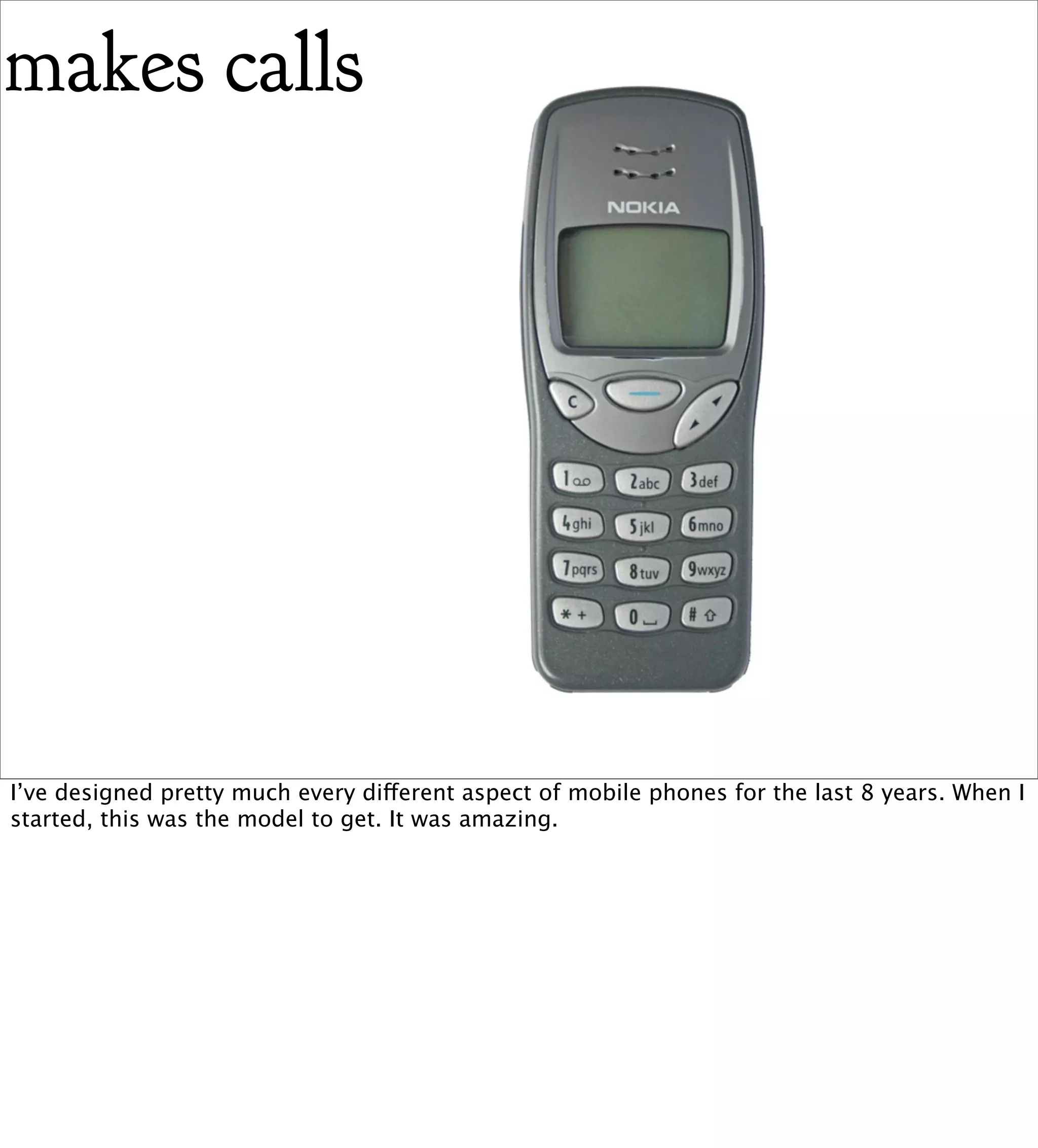
makes calls


I’ve designed pretty much every different aspect of mobile phones for the last 8 years. When I
started, this was the model to get. It was amazing.
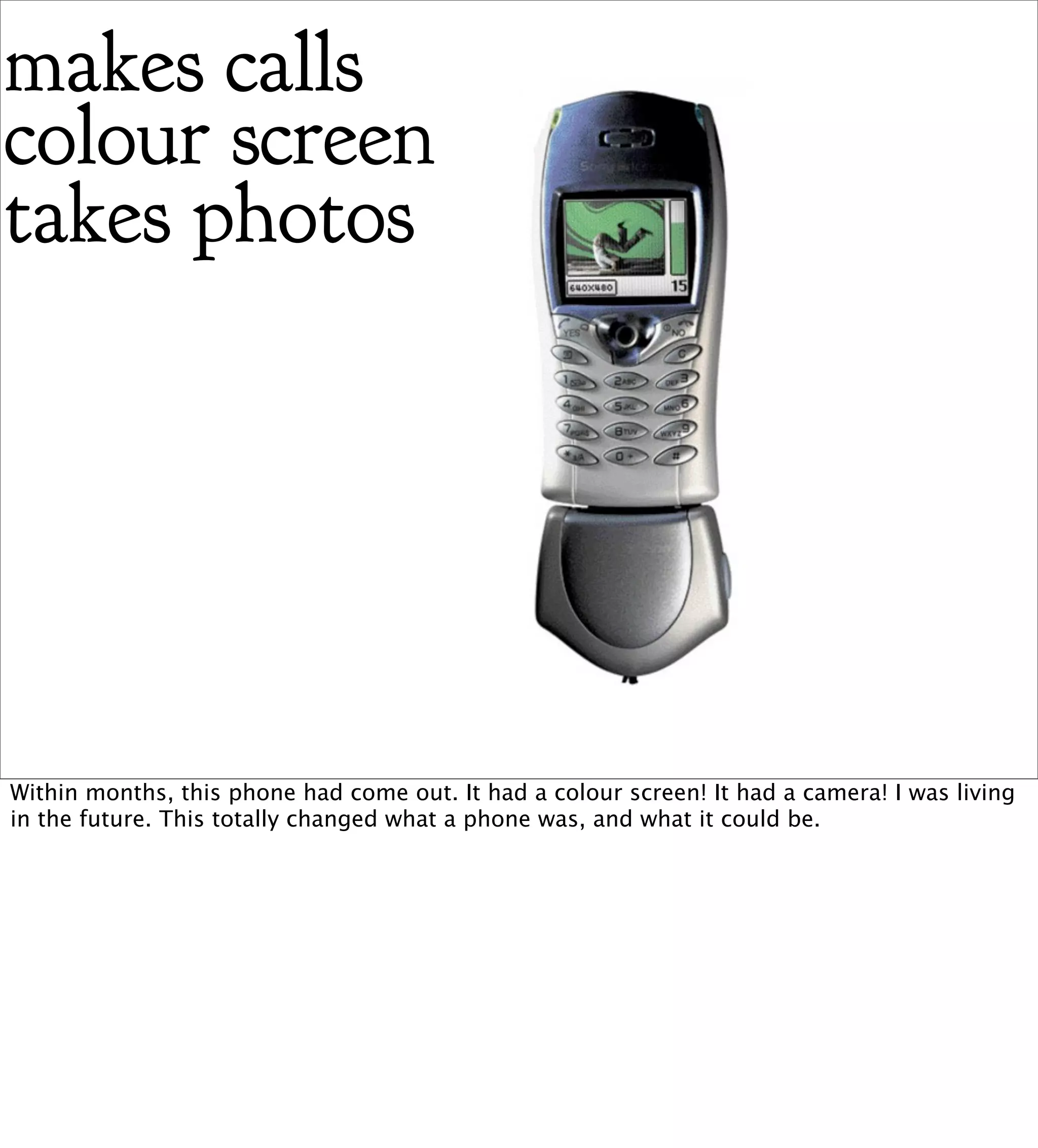
makes calls
colour screen
takes photos


Within months, this phone had come out. It had a colour screen! It had a camera! I was living
in the future. This totally changed what a phone was, and what it could be.
makes calls
colour screen
takes photos
browse web


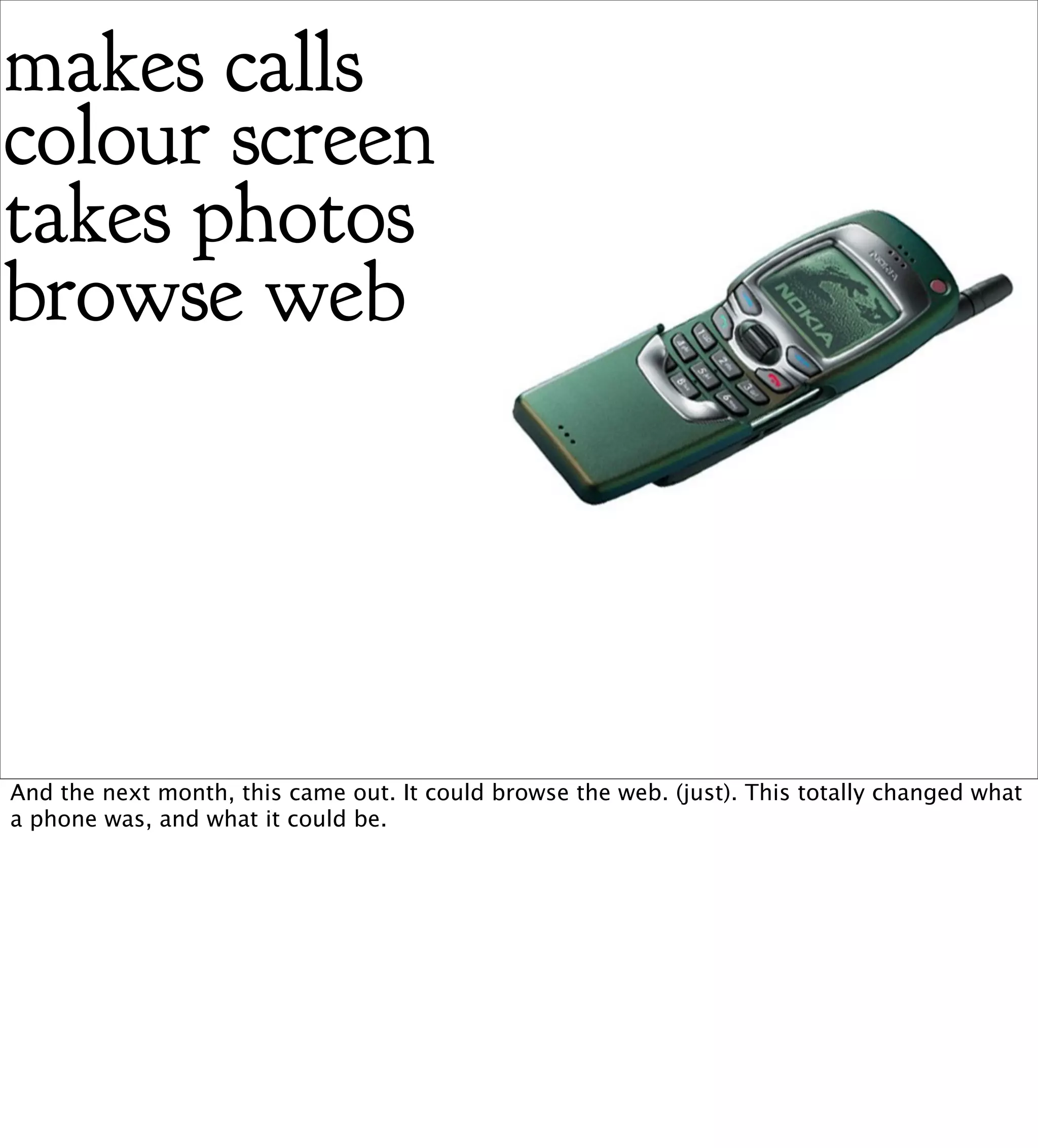
And the next month, this came out. It could browse the web. (just). This totally changed what
a phone was, and what it could be.
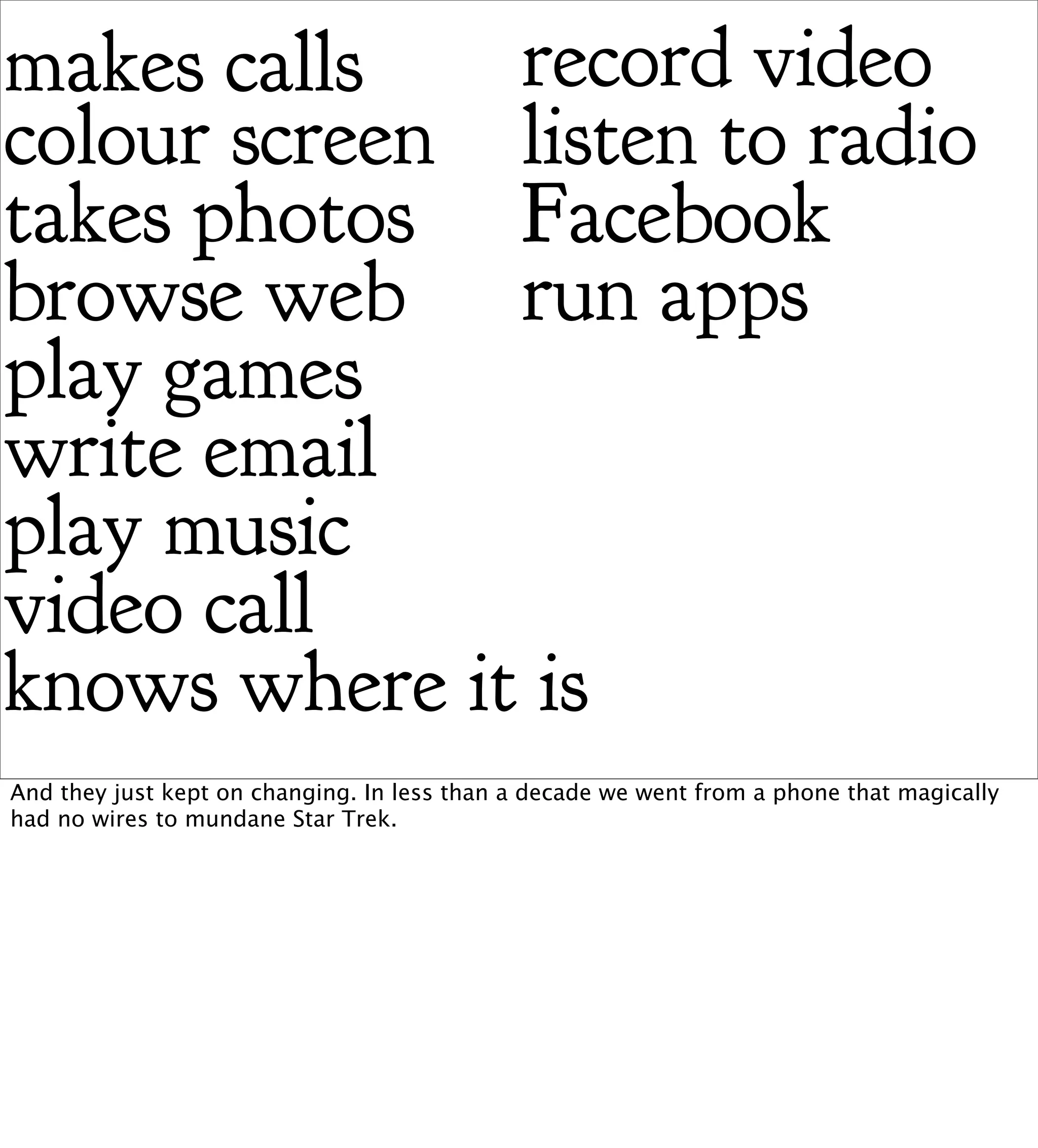
makes calls   record video
colour screen listen to radio
takes photos Facebook
browse web run apps
play games
write email
play music
video call
knows where it is
And they just kept on changing. In less than a decade we went from a phone that magically
had no wires to mundane Star Trek.
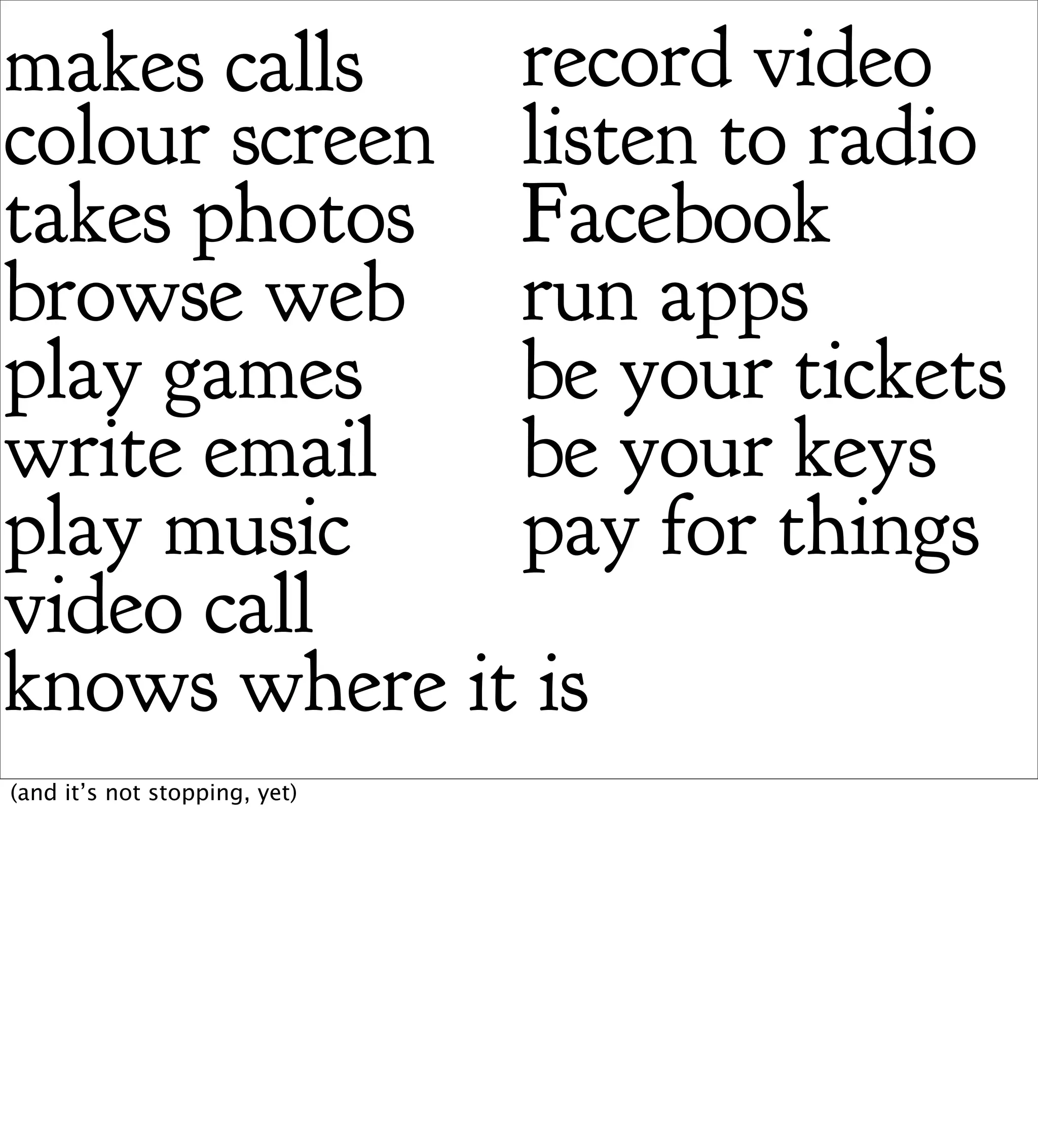
makes calls   record video
colour screen listen to radio
takes photos Facebook
browse web run apps
play games    be your tickets
write email   be your keys
play music    pay for things
video call
knows where it is
(and it’s not stopping, yet)
makes calls   record video
colour screen listen to radio
takes photos Facebook
browse web run apps
play games    be your ticket
write email   pay for things
play music
video call
knows where it is
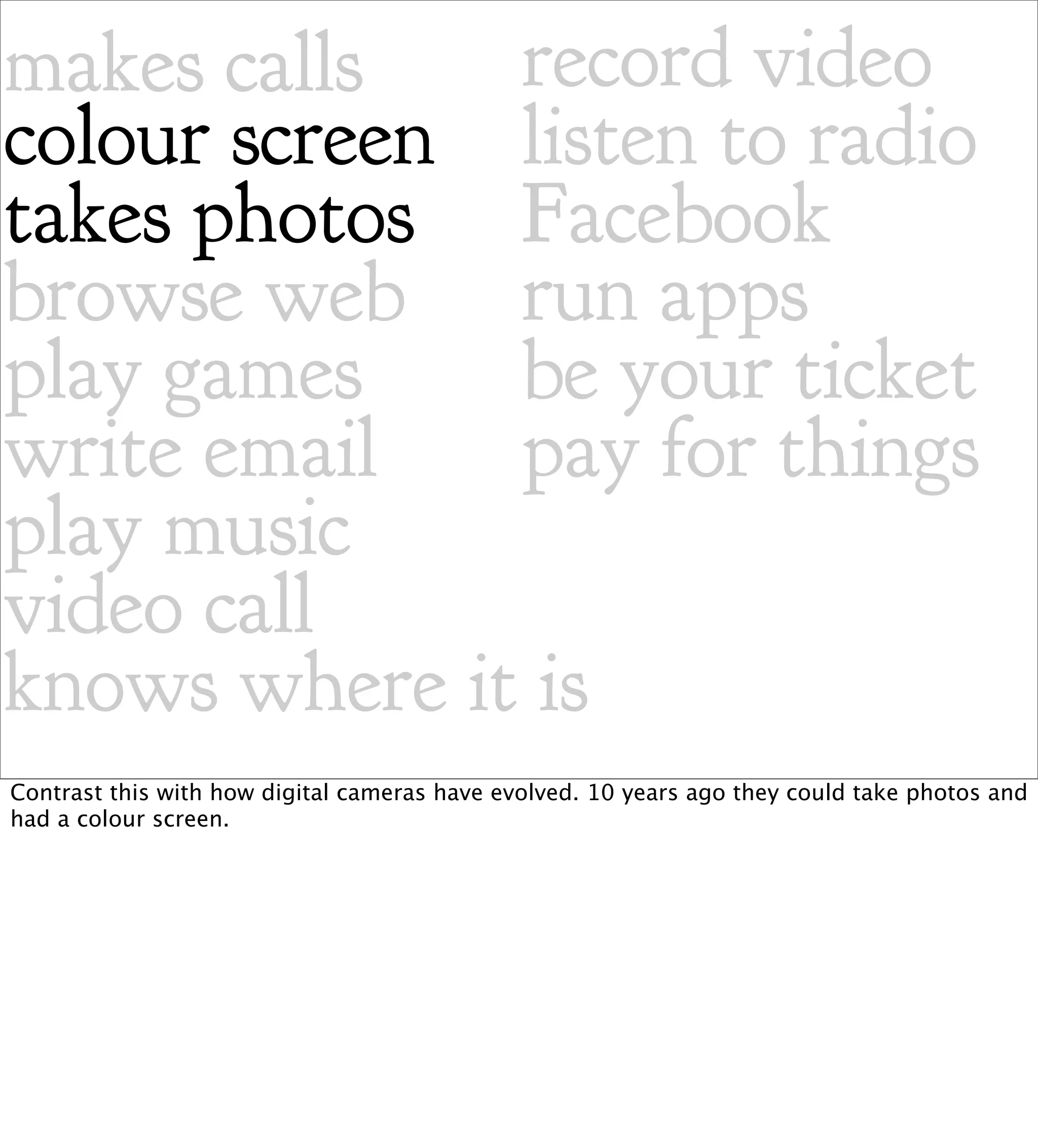
Contrast this with how digital cameras have evolved. 10 years ago they could take photos and
had a colour screen.
makes calls   record video
colour screen listen to radio
takes photos Facebook
browse web run apps
play games    be your ticket
write email   pay for things
play music
video call
knows where it is
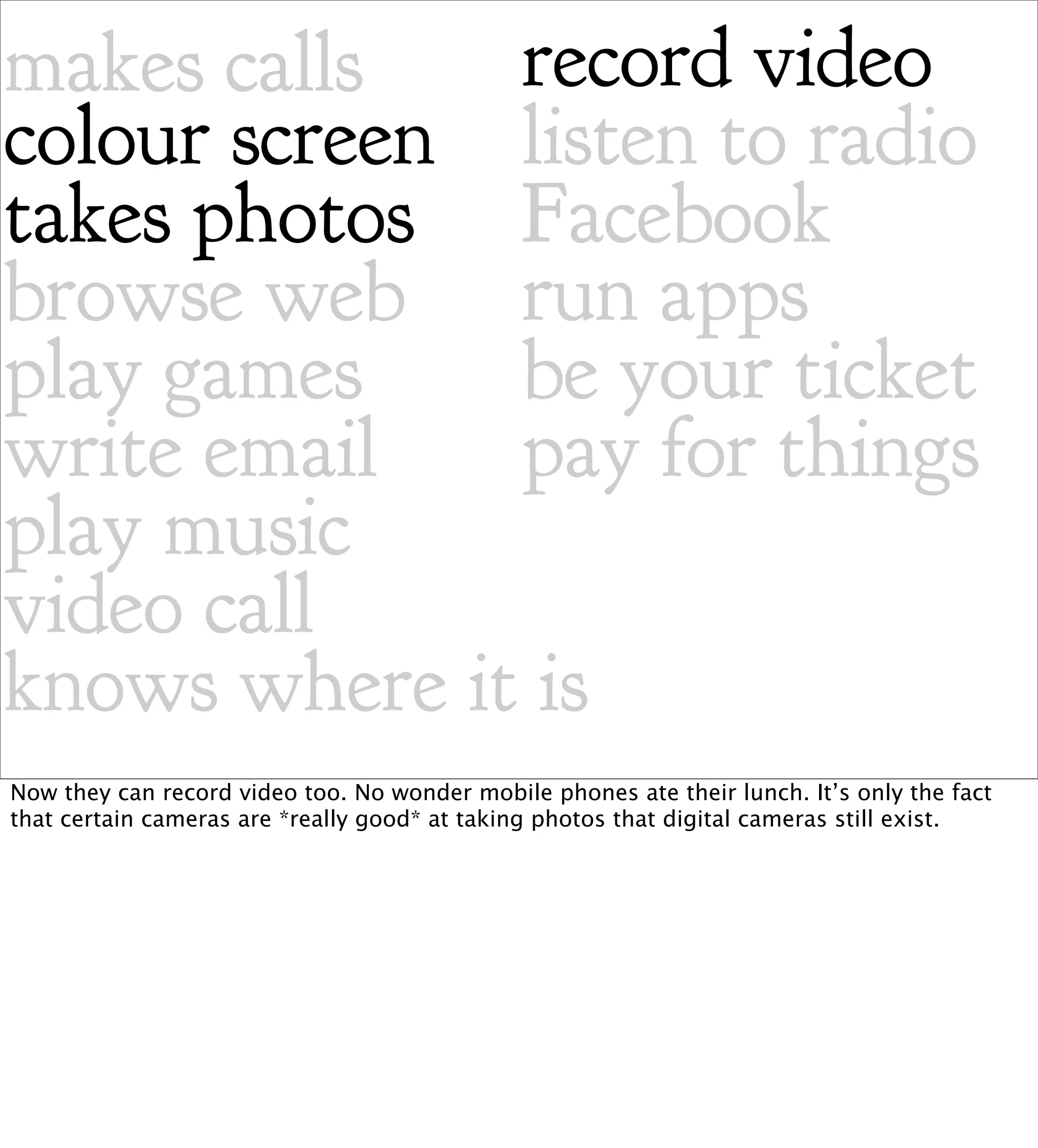
Now they can record video too. No wonder mobile phones ate their lunch. It’s only the fact
that certain cameras are *really good* at taking photos that digital cameras still exist.
Designer, engineer,
         anthropologist,
         sociologist.


Designers have to understand what stuff is available, they need to know some of how it
works, how people will use it, and how it will fit into their daily life. I counted 26 different
ways I can communicate with people with this iPhone. That’s illogical, but each fulfils a
slightly different role, and humans are great at understanding just the right way to
communicate with the right person in the right context. It’s impossible to design holistically
these days.
A thing.


But at least it’s still a thing. It’s an understandable object. This used to often be what most
designers cared about.
An action causes a
         reaction.


With the introduction of electricity right through to the Internet, this became the design
challenge - interaction and experiences.
Things happen...
        other things happen...
        something happens to you.


But we’re entering a weirder world now. We’re now able to collect large amounts of
information, piece together lots of different data and then act on it. Actions can be displaced
by time and space, and transmogrified into outcomes no-one would have predicted.
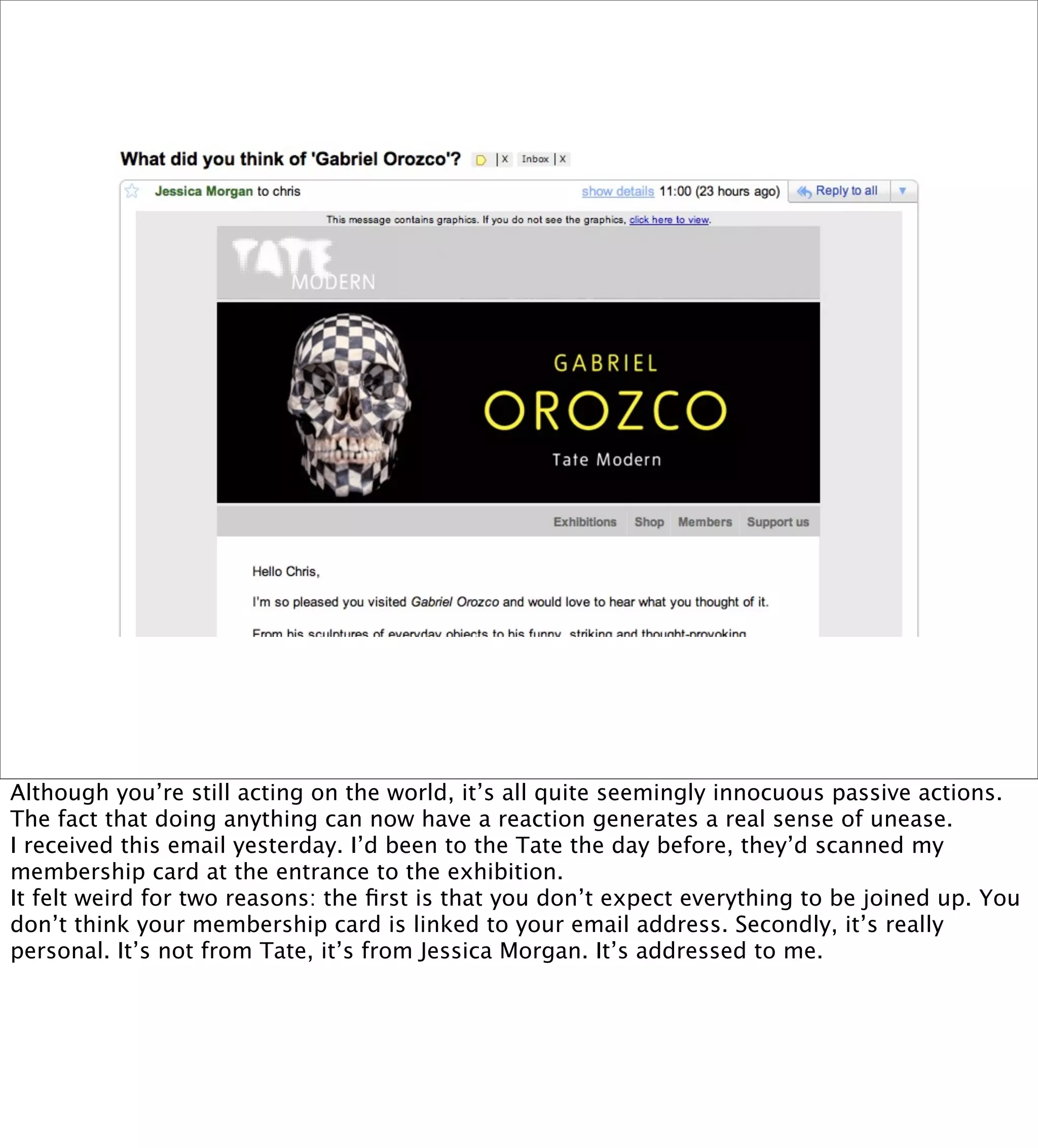
Although you’re still acting on the world, it’s all quite seemingly innocuous passive actions.
The fact that doing anything can now have a reaction generates a real sense of unease.
I received this email yesterday. I’d been to the Tate the day before, they’d scanned my
membership card at the entrance to the exhibition.
It felt weird for two reasons: the first is that you don’t expect everything to be joined up. You
don’t think your membership card is linked to your email address. Secondly, it’s really
personal. It’s not from Tate, it’s from Jessica Morgan. It’s addressed to me.
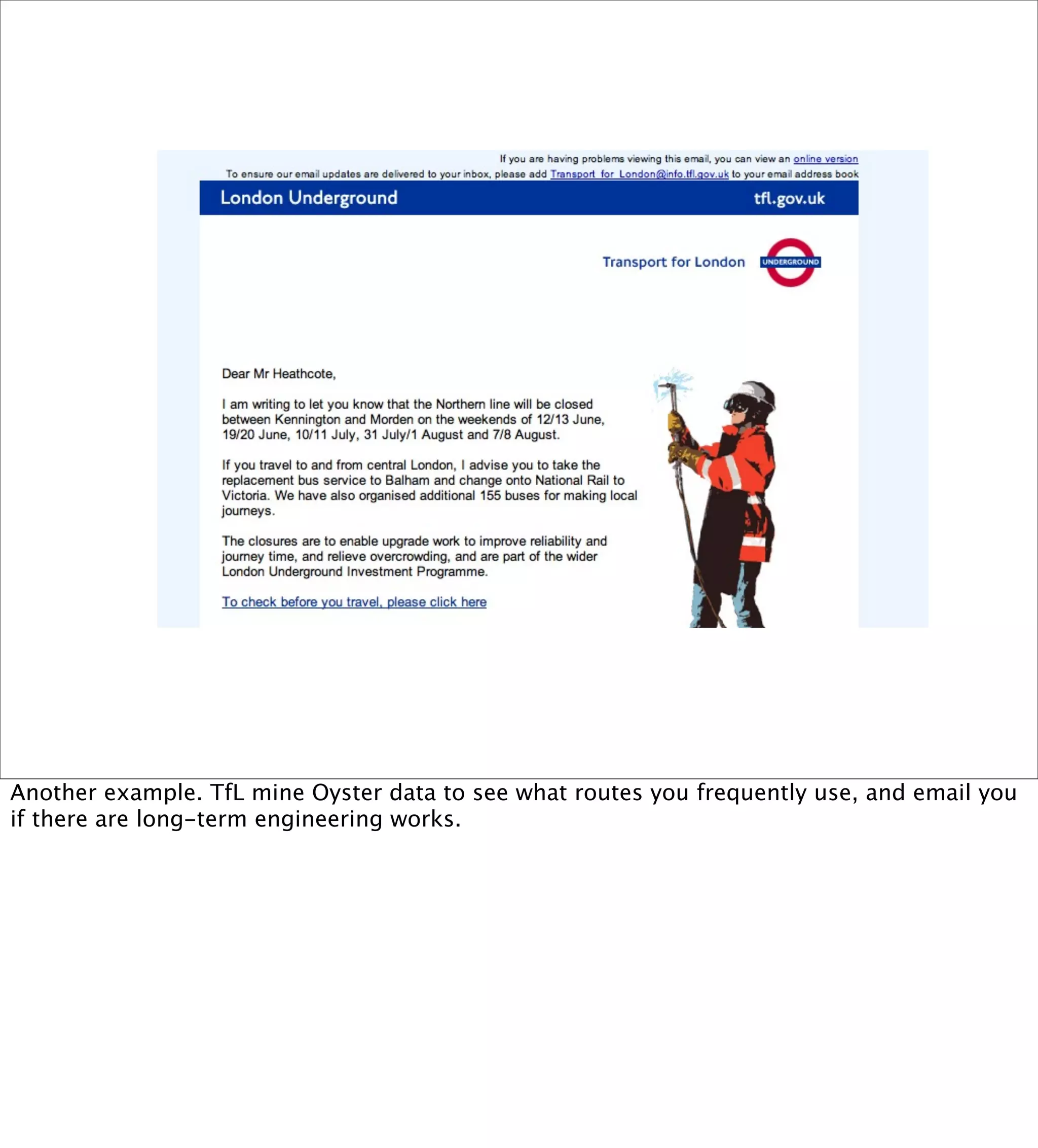
Another example. TfL mine Oyster data to see what routes you frequently use, and email you
if there are long-term engineering works.
A world of sensors and
        the sensed.


So we’re in a world of sensors, where all kinds of things can be sensed and reacted upon.
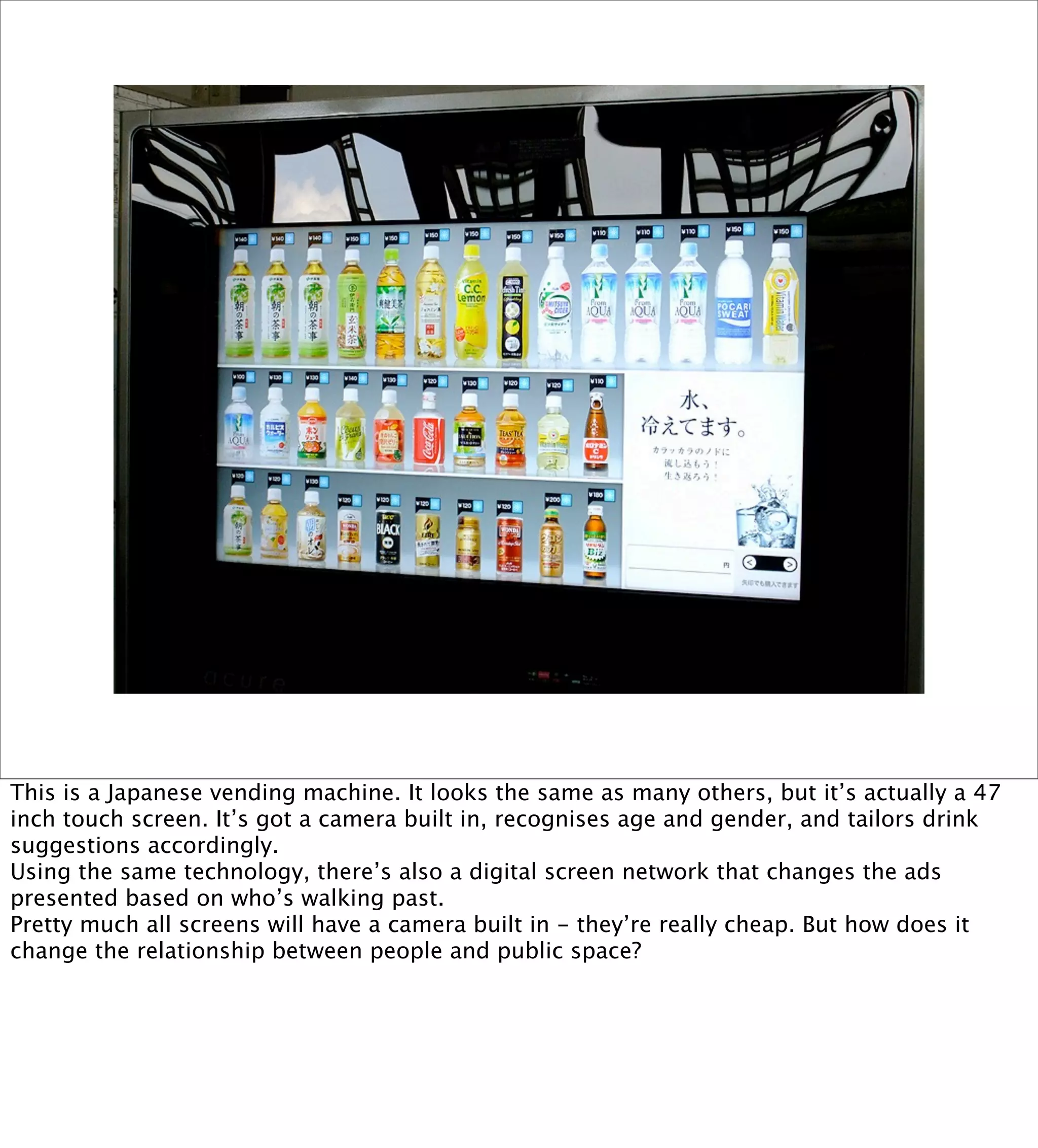
This is a Japanese vending machine. It looks the same as many others, but it’s actually a 47
inch touch screen. It’s got a camera built in, recognises age and gender, and tailors drink
suggestions accordingly.
Using the same technology, there’s also a digital screen network that changes the ads
presented based on who’s walking past.
Pretty much all screens will have a camera built in - they’re really cheap. But how does it
change the relationship between people and public space?
Adding a network
        connection changes any
        medium.


Even media we’ve had centuries to perfect and understand suddenly changes when you plug
the Internet into it.
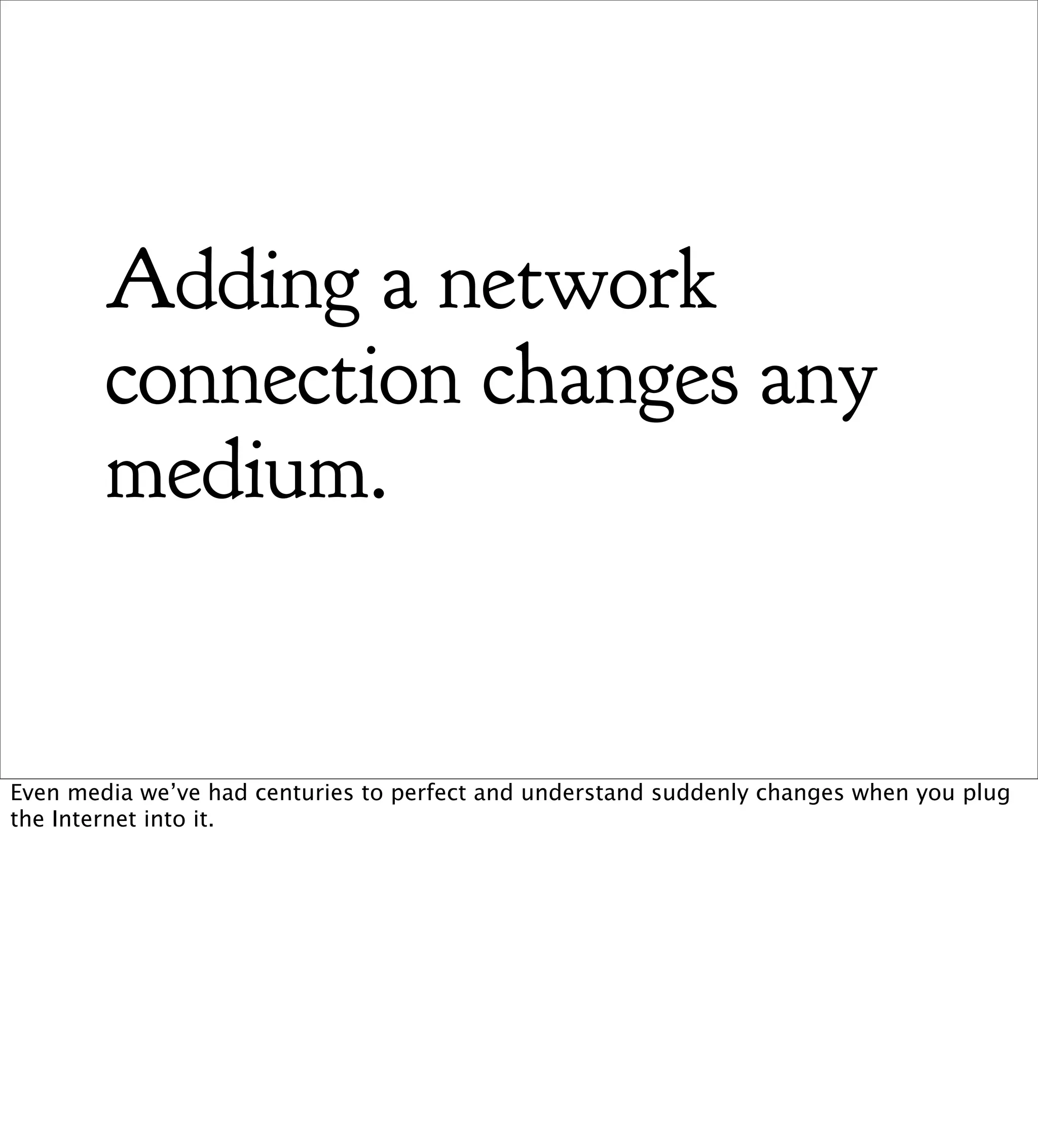
Even something like a receipt can change when you add a network connection. This is from a
project by Dentsu London and BERG exploring incidental media. Print can be fast. Live data,
the news, the weather could be included... the purpose of the receipt can be changed.
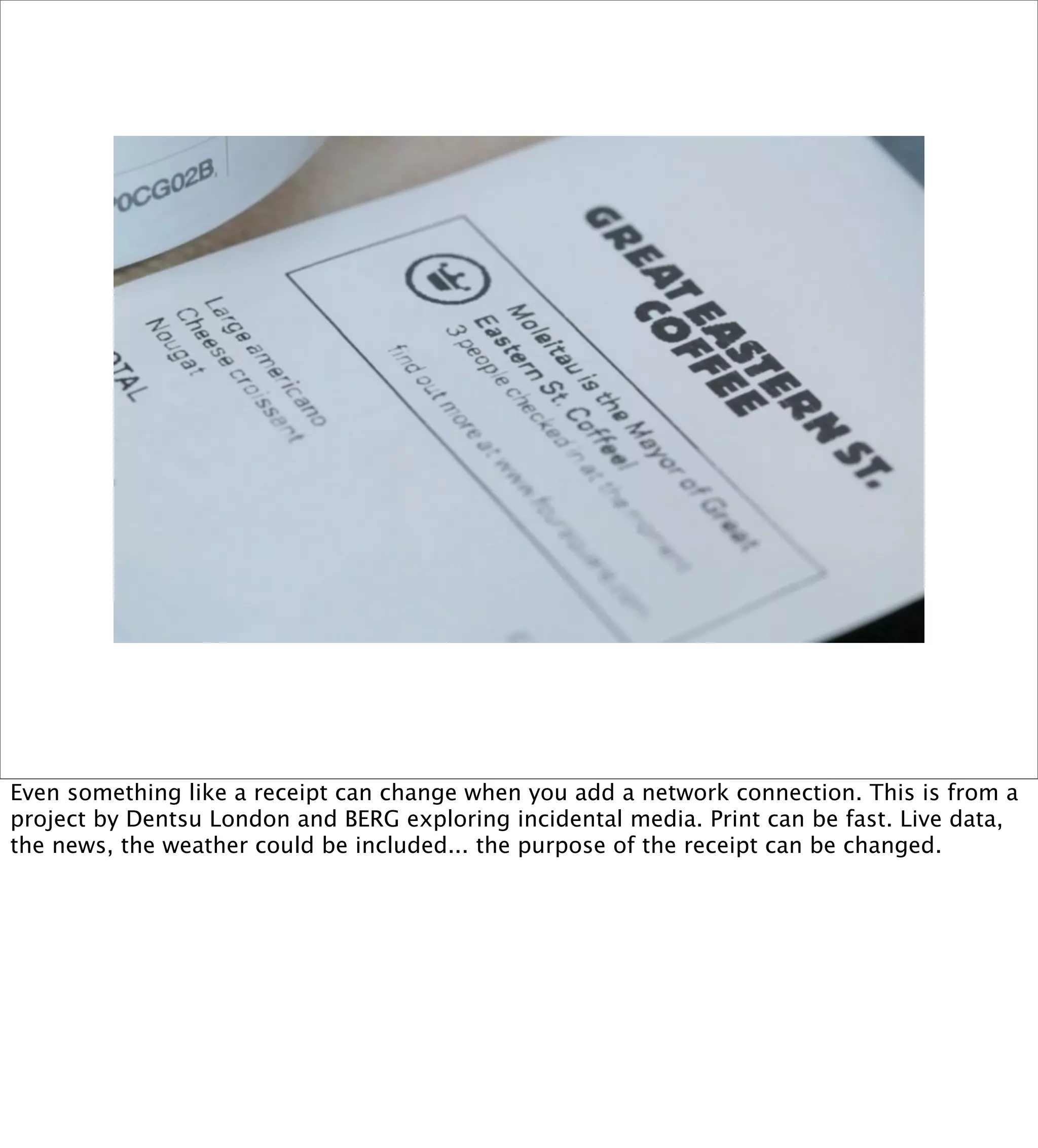
Similarly, what happens if a TV gets a network connection? Why isn’t the ticker made up of
information important to you?
Design is about wrangling
        invisible ows of data.


personal data, private data, friends data, public data, urban data. They’re unseen and
intangible, and it’s our job as designers to both instantiate them - make them real - and
make them understandable.
40p o a latte.


The cliche of ubiquitous computing is that as you walk past a starbucks, your phone will
vibrate with a coupon for 20p off a latte. It’s an unscalable, unsustainable example, but lets
unpick what could be going on.
First off - what ratted on you? Your Nike+ talking shoes, using a credit card nearby, your car
number plate being recognised, your phone reporting your location, or your Oyster card
informing the system that you’ve just come out of Oxford Circus tube?
Next, why you? Maybe your credit card or Foursquare checkins told them you prefer Cafe
Nero. Your age and gender are mixed with your home address’ purchasing profile, plus your
social standing from Facebook and Twitter.
And why now? The store has lower sales this hour than normal - in fact there’s no queue. You
didn’t take them up on the offer last time - they’d only offered 20p off - but you really want
a coffee, and as you enter the store, the barista greets you by name, as your details and
photo have popped up on her till.
That’s a lot of work to sell a latte.
Magic is an awful lot of
        hard work behind-the-
        scenes.


To appear effortless in real-time takes a lot of work. Computing is cheap, thankfully. Let’s
have a look at a few less creepy, more useful ideas.
A car that knows where
        the nearest free parking
        space is to your
        destination.

I think of a car as a big mobile phone you sit in. It has many of the same capabilities and
characteristics (other than moving at 90 miles an hour). This seems like an easy problem -
after all nearly every car has GPS in now.
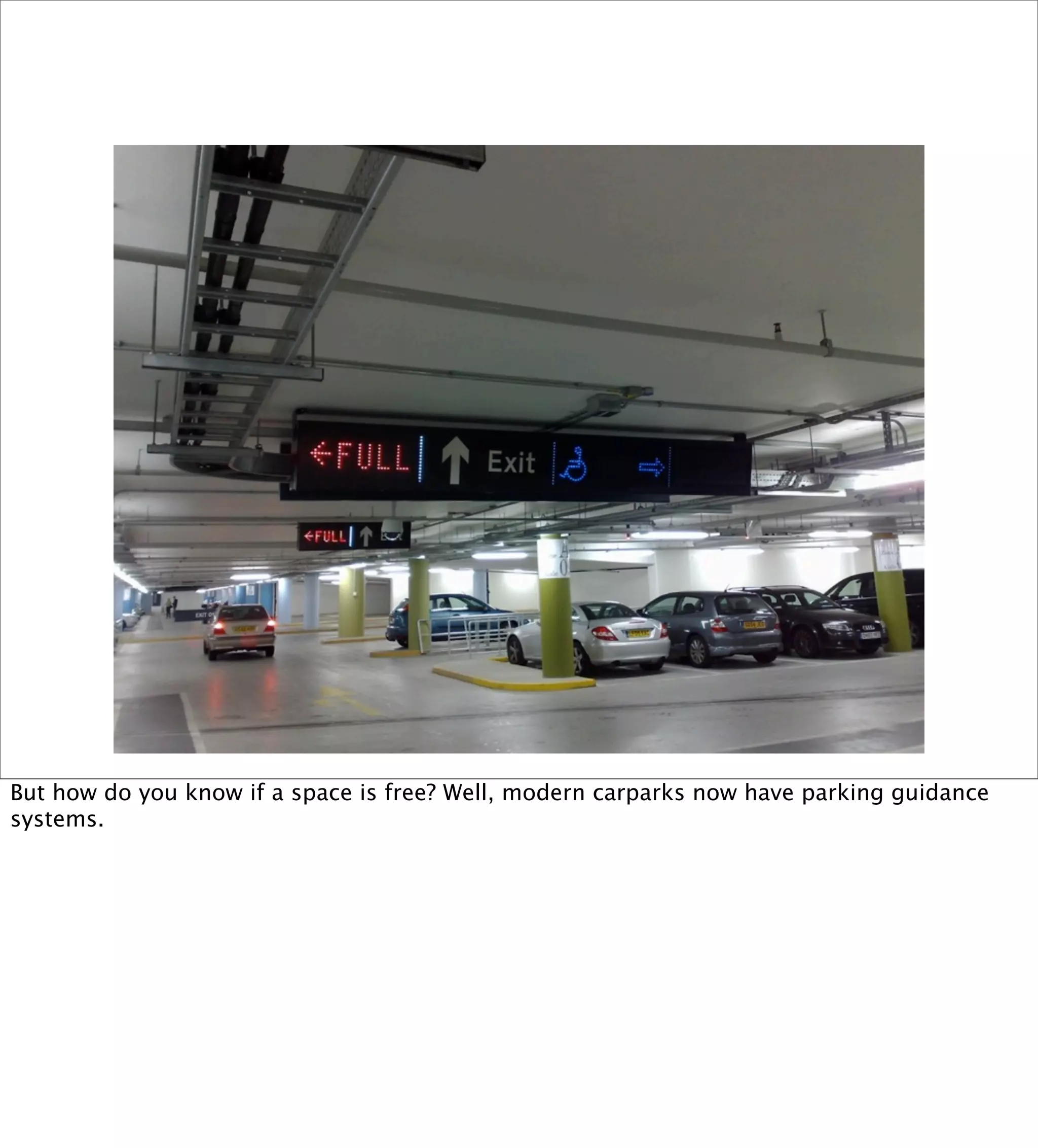
But how do you know if a space is free? Well, modern carparks now have parking guidance
systems.
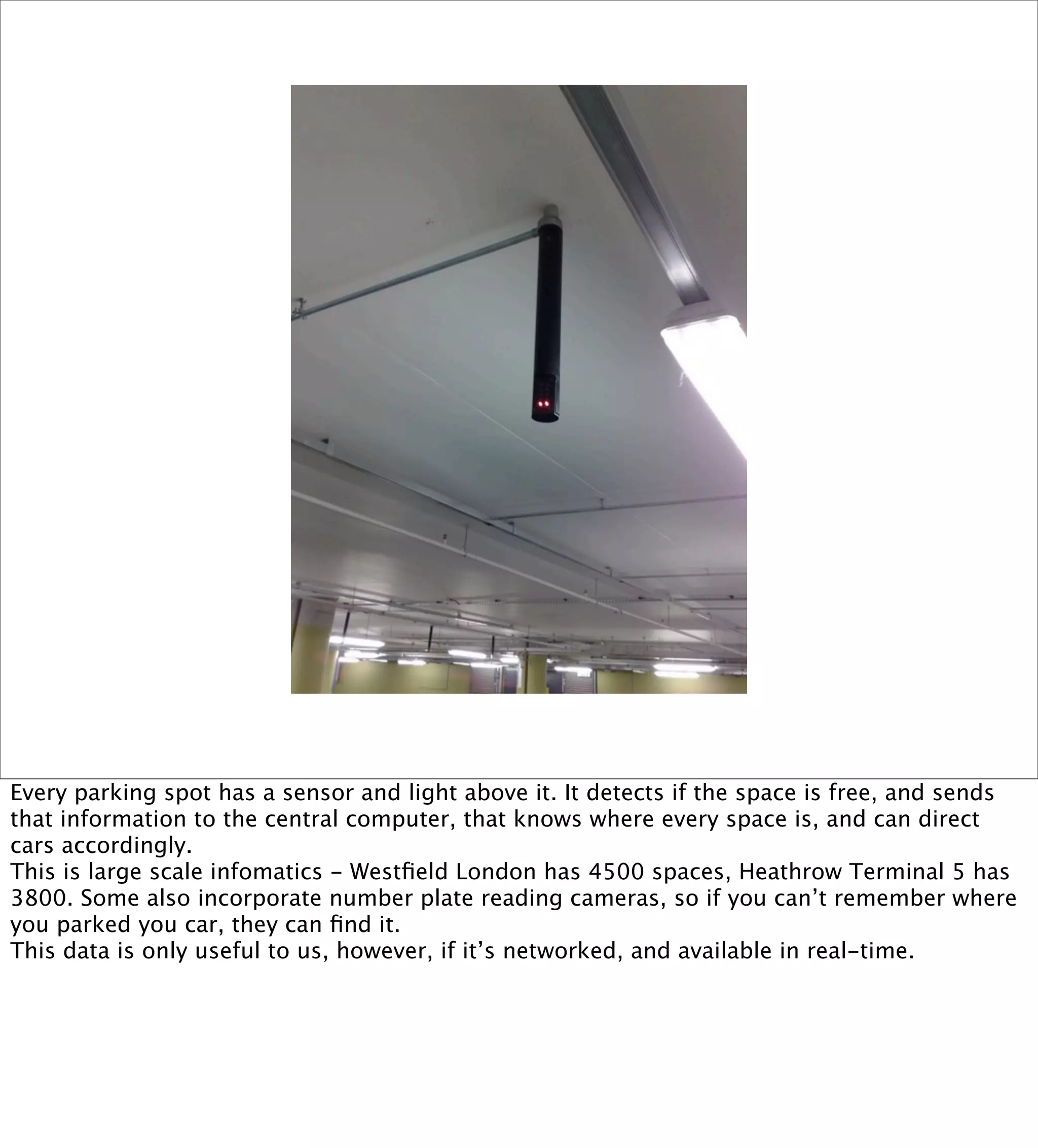
Every parking spot has a sensor and light above it. It detects if the space is free, and sends
that information to the central computer, that knows where every space is, and can direct
cars accordingly.
This is large scale infomatics - Westfield London has 4500 spaces, Heathrow Terminal 5 has
3800. Some also incorporate number plate reading cameras, so if you can’t remember where
you parked you car, they can find it.
This data is only useful to us, however, if it’s networked, and available in real-time.
Food that texts you when
        it’s going out of date.


OK, another example. Your shopping basket can answer back. Again, we’re nearly there with
this...
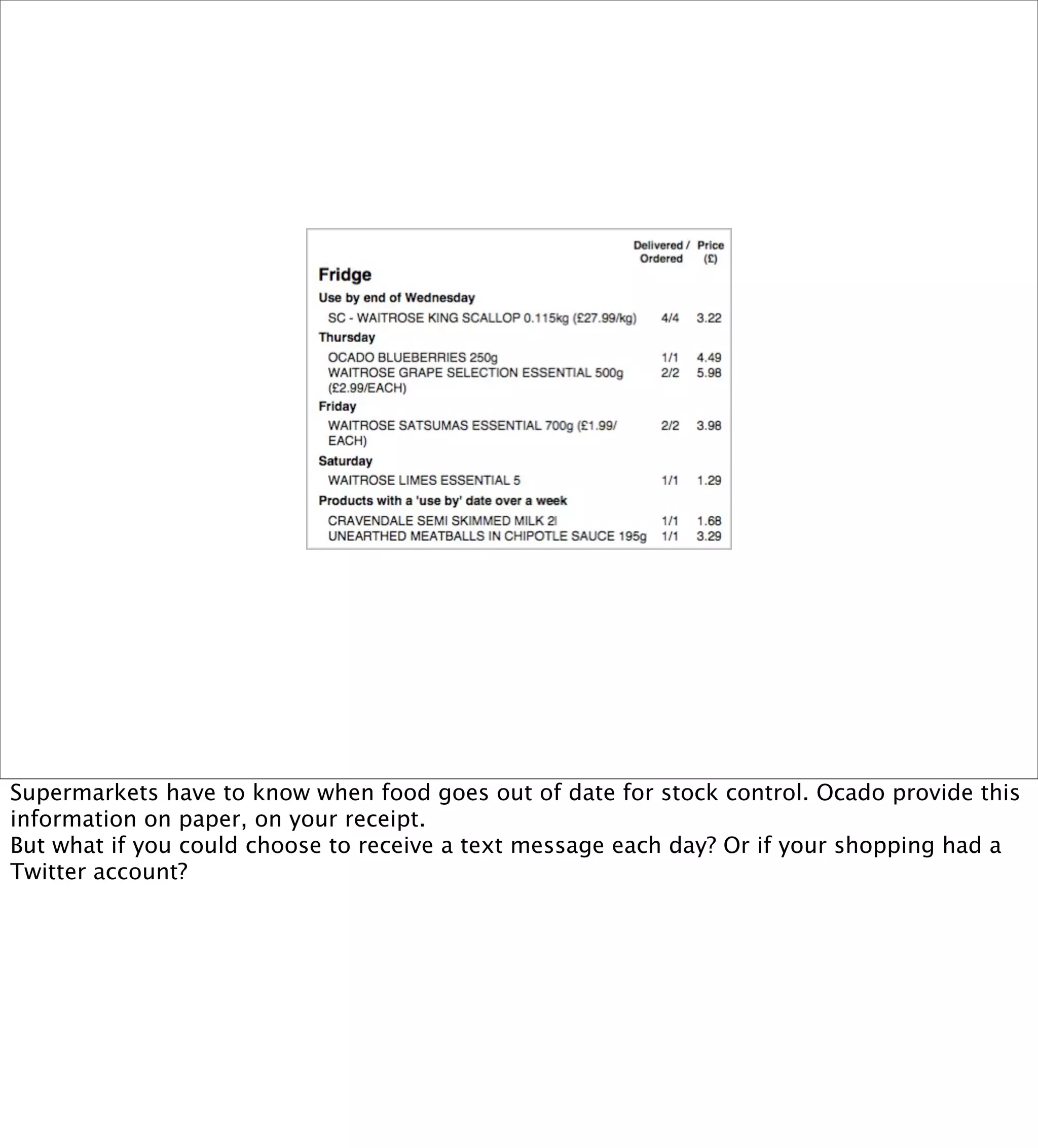
Supermarkets have to know when food goes out of date for stock control. Ocado provide this
information on paper, on your receipt.
But what if you could choose to receive a text message each day? Or if your shopping had a
Twitter account?
If anyone’s going to help
        people understand what’s
        going on, it might as well
        be us.

These examples just scratch the surface. The world is going to get magical and strange, and
people will be confused and fearful. Designers have to do what they do best, helping people
understand the world and the way they live in it, and make the tools that people can use to
shape their own lives.
Thank you.

@antimega
anti-mega.com

Design of understanding: New new media.

  • 1.
    New new media. ChrisHeathcote Design of Understanding 2011
  • 2.
    The specialist designer. It’sthin ice to come to St Brides and talk about type, but I really respect the holistic view that type designers had. They understood how their design would sit on the page, what it was working with and near, how it would be printed, what kind of paper would be used, how ink flows, and still came up with designs that incorporated all of this technical knowledge and produced things with flair and beauty. I often wish that I could be a specialist and have an intimate understanding of how one thing worked. Unfortunately the modern world doesn’t often work that way...
  • 3.
    makes calls I’ve designedpretty much every different aspect of mobile phones for the last 8 years. When I started, this was the model to get. It was amazing.
  • 4.
    makes calls colour screen takesphotos Within months, this phone had come out. It had a colour screen! It had a camera! I was living in the future. This totally changed what a phone was, and what it could be.
  • 5.
    makes calls colour screen takesphotos browse web And the next month, this came out. It could browse the web. (just). This totally changed what a phone was, and what it could be.
  • 6.
    makes calls record video colour screen listen to radio takes photos Facebook browse web run apps play games write email play music video call knows where it is And they just kept on changing. In less than a decade we went from a phone that magically had no wires to mundane Star Trek.
  • 7.
    makes calls record video colour screen listen to radio takes photos Facebook browse web run apps play games be your tickets write email be your keys play music pay for things video call knows where it is (and it’s not stopping, yet)
  • 8.
    makes calls record video colour screen listen to radio takes photos Facebook browse web run apps play games be your ticket write email pay for things play music video call knows where it is Contrast this with how digital cameras have evolved. 10 years ago they could take photos and had a colour screen.
  • 9.
    makes calls record video colour screen listen to radio takes photos Facebook browse web run apps play games be your ticket write email pay for things play music video call knows where it is Now they can record video too. No wonder mobile phones ate their lunch. It’s only the fact that certain cameras are *really good* at taking photos that digital cameras still exist.
  • 10.
    Designer, engineer, anthropologist, sociologist. Designers have to understand what stuff is available, they need to know some of how it works, how people will use it, and how it will fit into their daily life. I counted 26 different ways I can communicate with people with this iPhone. That’s illogical, but each fulfils a slightly different role, and humans are great at understanding just the right way to communicate with the right person in the right context. It’s impossible to design holistically these days.
  • 11.
    A thing. But atleast it’s still a thing. It’s an understandable object. This used to often be what most designers cared about.
  • 12.
    An action causesa reaction. With the introduction of electricity right through to the Internet, this became the design challenge - interaction and experiences.
  • 13.
    Things happen... other things happen... something happens to you. But we’re entering a weirder world now. We’re now able to collect large amounts of information, piece together lots of different data and then act on it. Actions can be displaced by time and space, and transmogrified into outcomes no-one would have predicted.
  • 14.
    Although you’re stillacting on the world, it’s all quite seemingly innocuous passive actions. The fact that doing anything can now have a reaction generates a real sense of unease. I received this email yesterday. I’d been to the Tate the day before, they’d scanned my membership card at the entrance to the exhibition. It felt weird for two reasons: the first is that you don’t expect everything to be joined up. You don’t think your membership card is linked to your email address. Secondly, it’s really personal. It’s not from Tate, it’s from Jessica Morgan. It’s addressed to me.
  • 15.
    Another example. TfLmine Oyster data to see what routes you frequently use, and email you if there are long-term engineering works.
  • 16.
    A world ofsensors and the sensed. So we’re in a world of sensors, where all kinds of things can be sensed and reacted upon.
  • 17.
    This is aJapanese vending machine. It looks the same as many others, but it’s actually a 47 inch touch screen. It’s got a camera built in, recognises age and gender, and tailors drink suggestions accordingly. Using the same technology, there’s also a digital screen network that changes the ads presented based on who’s walking past. Pretty much all screens will have a camera built in - they’re really cheap. But how does it change the relationship between people and public space?
  • 18.
    Adding a network connection changes any medium. Even media we’ve had centuries to perfect and understand suddenly changes when you plug the Internet into it.
  • 19.
    Even something likea receipt can change when you add a network connection. This is from a project by Dentsu London and BERG exploring incidental media. Print can be fast. Live data, the news, the weather could be included... the purpose of the receipt can be changed.
  • 20.
    Similarly, what happensif a TV gets a network connection? Why isn’t the ticker made up of information important to you?
  • 21.
    Design is aboutwrangling invisible ows of data. personal data, private data, friends data, public data, urban data. They’re unseen and intangible, and it’s our job as designers to both instantiate them - make them real - and make them understandable.
  • 22.
    40p o alatte. The cliche of ubiquitous computing is that as you walk past a starbucks, your phone will vibrate with a coupon for 20p off a latte. It’s an unscalable, unsustainable example, but lets unpick what could be going on. First off - what ratted on you? Your Nike+ talking shoes, using a credit card nearby, your car number plate being recognised, your phone reporting your location, or your Oyster card informing the system that you’ve just come out of Oxford Circus tube? Next, why you? Maybe your credit card or Foursquare checkins told them you prefer Cafe Nero. Your age and gender are mixed with your home address’ purchasing profile, plus your social standing from Facebook and Twitter. And why now? The store has lower sales this hour than normal - in fact there’s no queue. You didn’t take them up on the offer last time - they’d only offered 20p off - but you really want a coffee, and as you enter the store, the barista greets you by name, as your details and photo have popped up on her till. That’s a lot of work to sell a latte.
  • 23.
    Magic is anawful lot of hard work behind-the- scenes. To appear effortless in real-time takes a lot of work. Computing is cheap, thankfully. Let’s have a look at a few less creepy, more useful ideas.
  • 24.
    A car thatknows where the nearest free parking space is to your destination. I think of a car as a big mobile phone you sit in. It has many of the same capabilities and characteristics (other than moving at 90 miles an hour). This seems like an easy problem - after all nearly every car has GPS in now.
  • 25.
    But how doyou know if a space is free? Well, modern carparks now have parking guidance systems.
  • 26.
    Every parking spothas a sensor and light above it. It detects if the space is free, and sends that information to the central computer, that knows where every space is, and can direct cars accordingly. This is large scale infomatics - Westfield London has 4500 spaces, Heathrow Terminal 5 has 3800. Some also incorporate number plate reading cameras, so if you can’t remember where you parked you car, they can find it. This data is only useful to us, however, if it’s networked, and available in real-time.
  • 27.
    Food that textsyou when it’s going out of date. OK, another example. Your shopping basket can answer back. Again, we’re nearly there with this...
  • 28.
    Supermarkets have toknow when food goes out of date for stock control. Ocado provide this information on paper, on your receipt. But what if you could choose to receive a text message each day? Or if your shopping had a Twitter account?
  • 29.
    If anyone’s goingto help people understand what’s going on, it might as well be us. These examples just scratch the surface. The world is going to get magical and strange, and people will be confused and fearful. Designers have to do what they do best, helping people understand the world and the way they live in it, and make the tools that people can use to shape their own lives.
  • 30.