

Strategies for the Social Web For Documentation Anne Gentlewww.justwriteclick.comSTC Summit May 2010
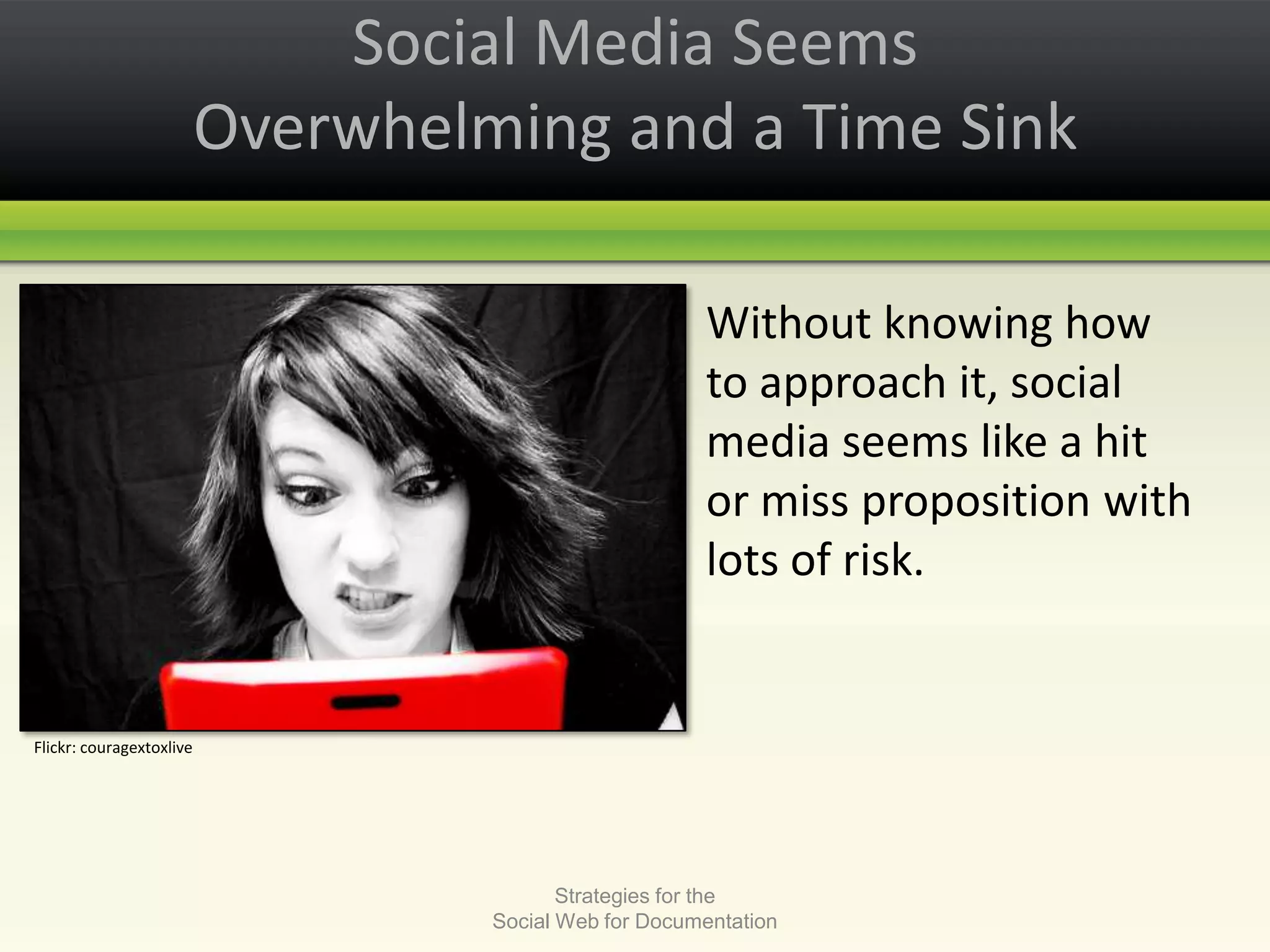
Social Media Seems Overwhelming and a Time SinkStrategies for the Social Web for Documentation	Without knowing how to approach it, social media seems like a hit or miss proposition with lots of risk.Flickr: couragextoxlive
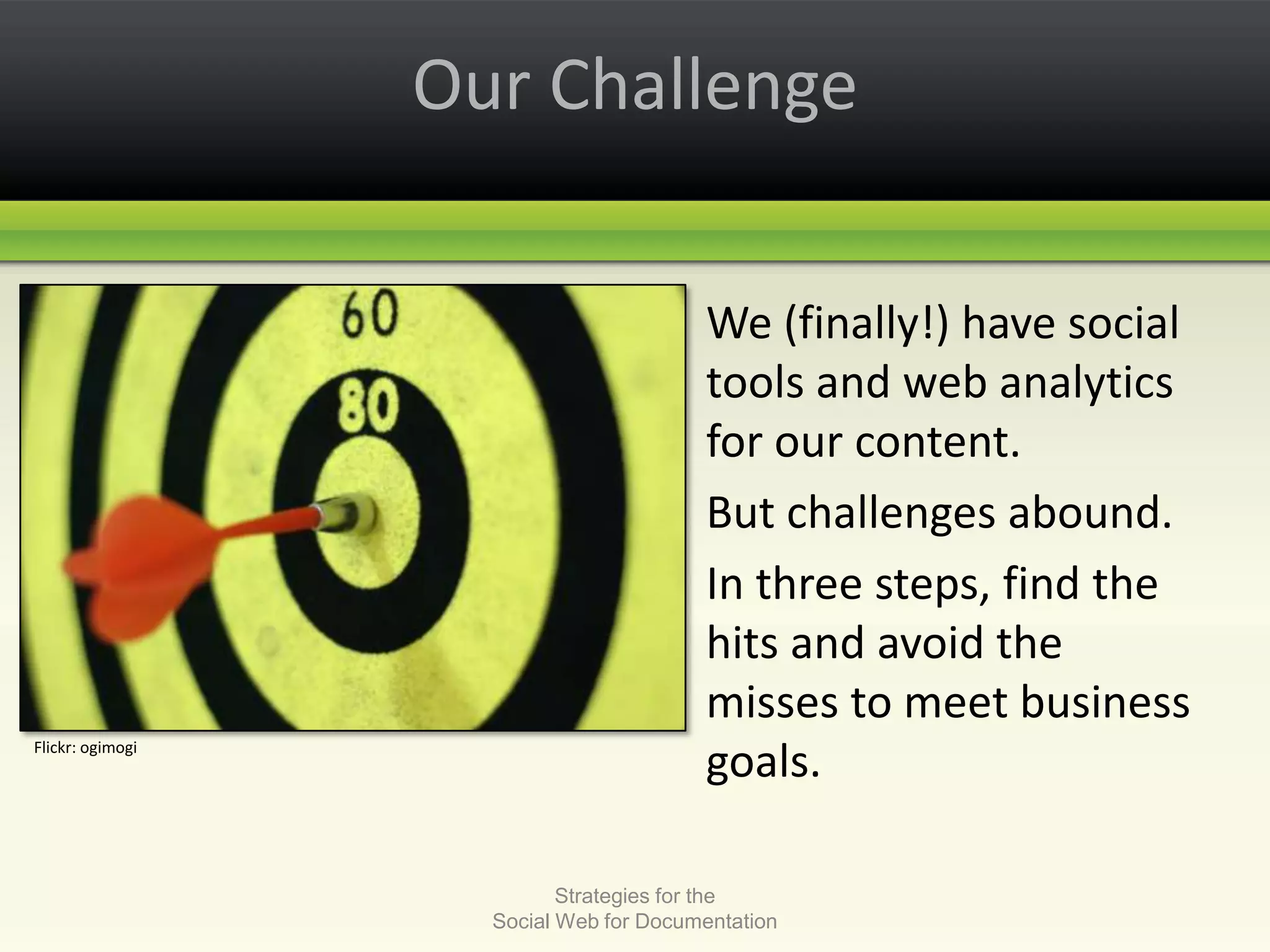
Our Challenge	We (finally!) have social tools and web analytics for our content. 		But challenges abound. 	In three steps, find the hits and avoid the misses to meet business goals.Strategies for the Social Web for DocumentationFlickr: ogimogi
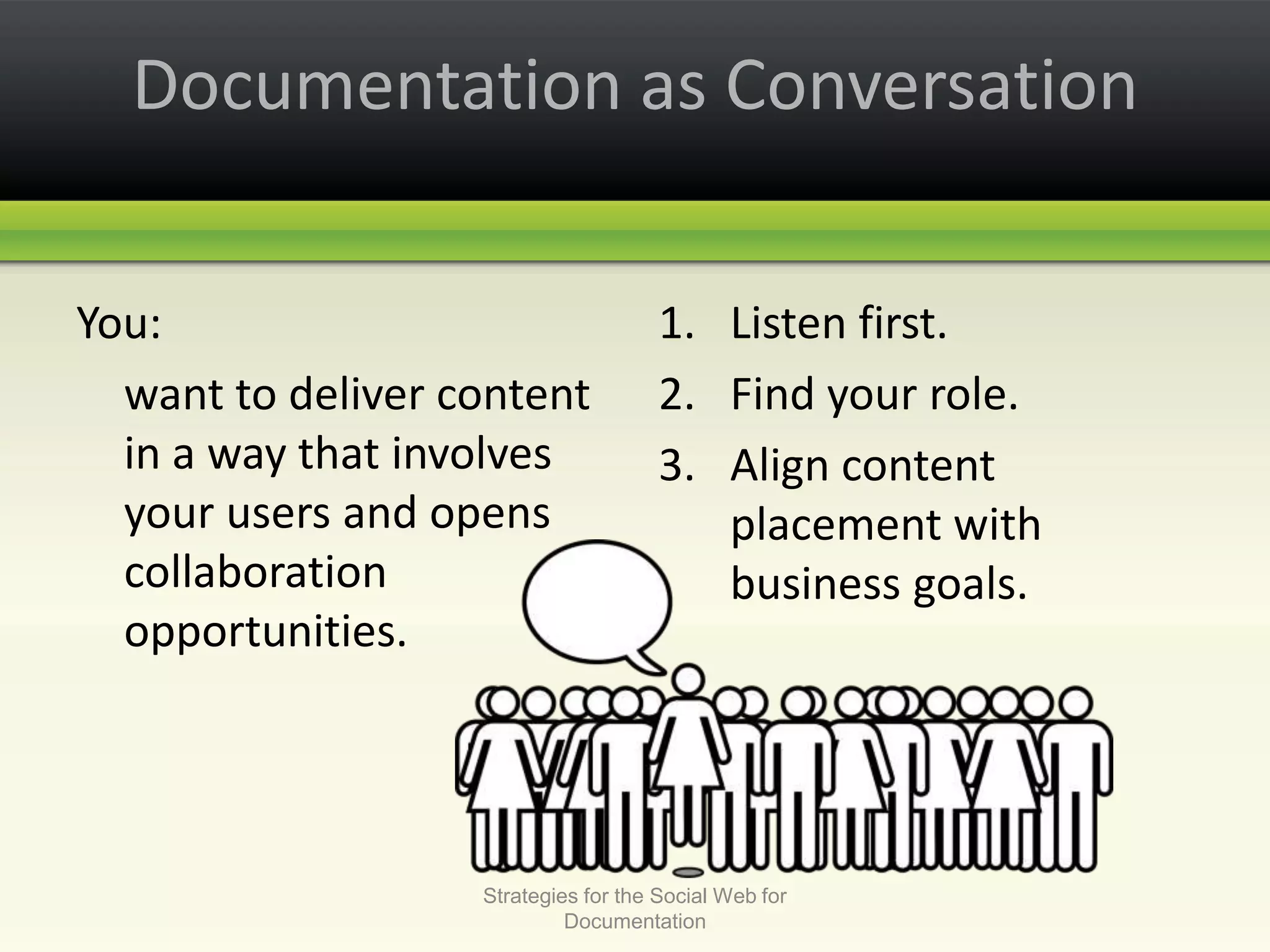
Documentation as ConversationYou:	want to deliver content in a way that involves your users and opens collaboration opportunities.Listen first.Find your role.Align content placement with business goals.Strategies for the Social Web for Documentation
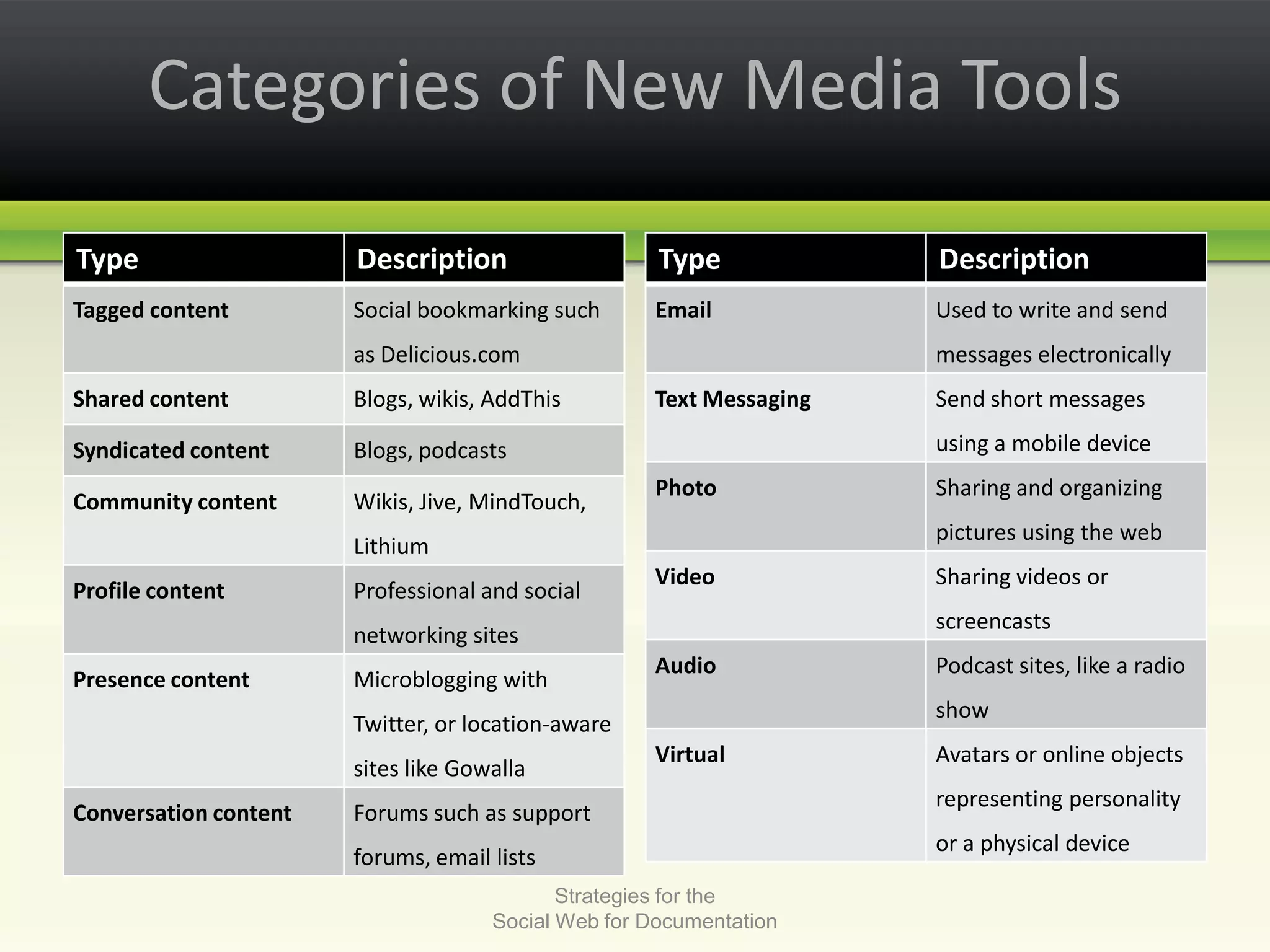
Categories of New Media ToolsStrategies for the Social Web for Documentation
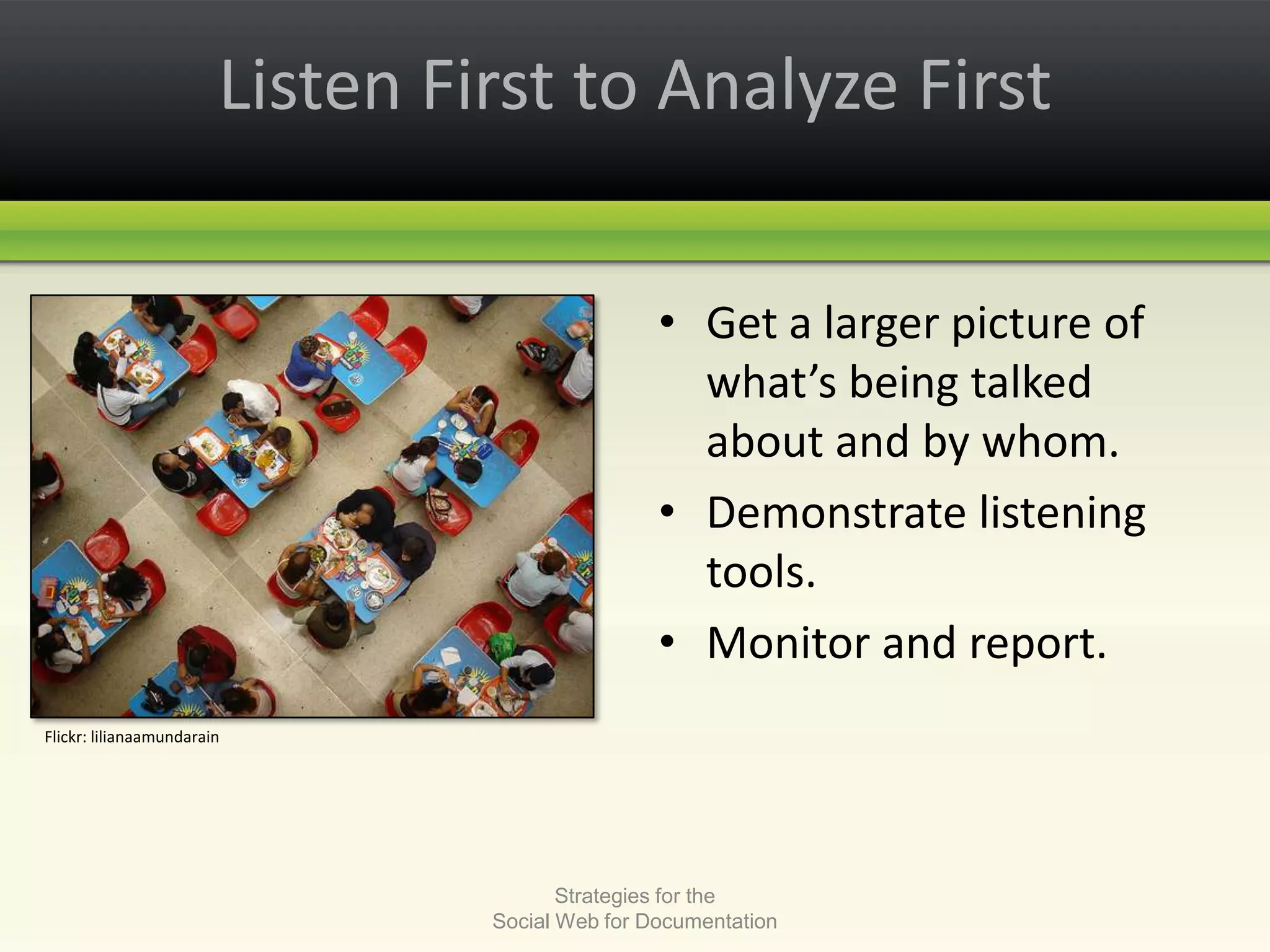
Listen First to Analyze First Get a larger picture of what’s being talked about and by whom.Demonstrate listening tools.Monitor and report.Strategies for the Social Web for DocumentationFlickr: lilianaamundarain
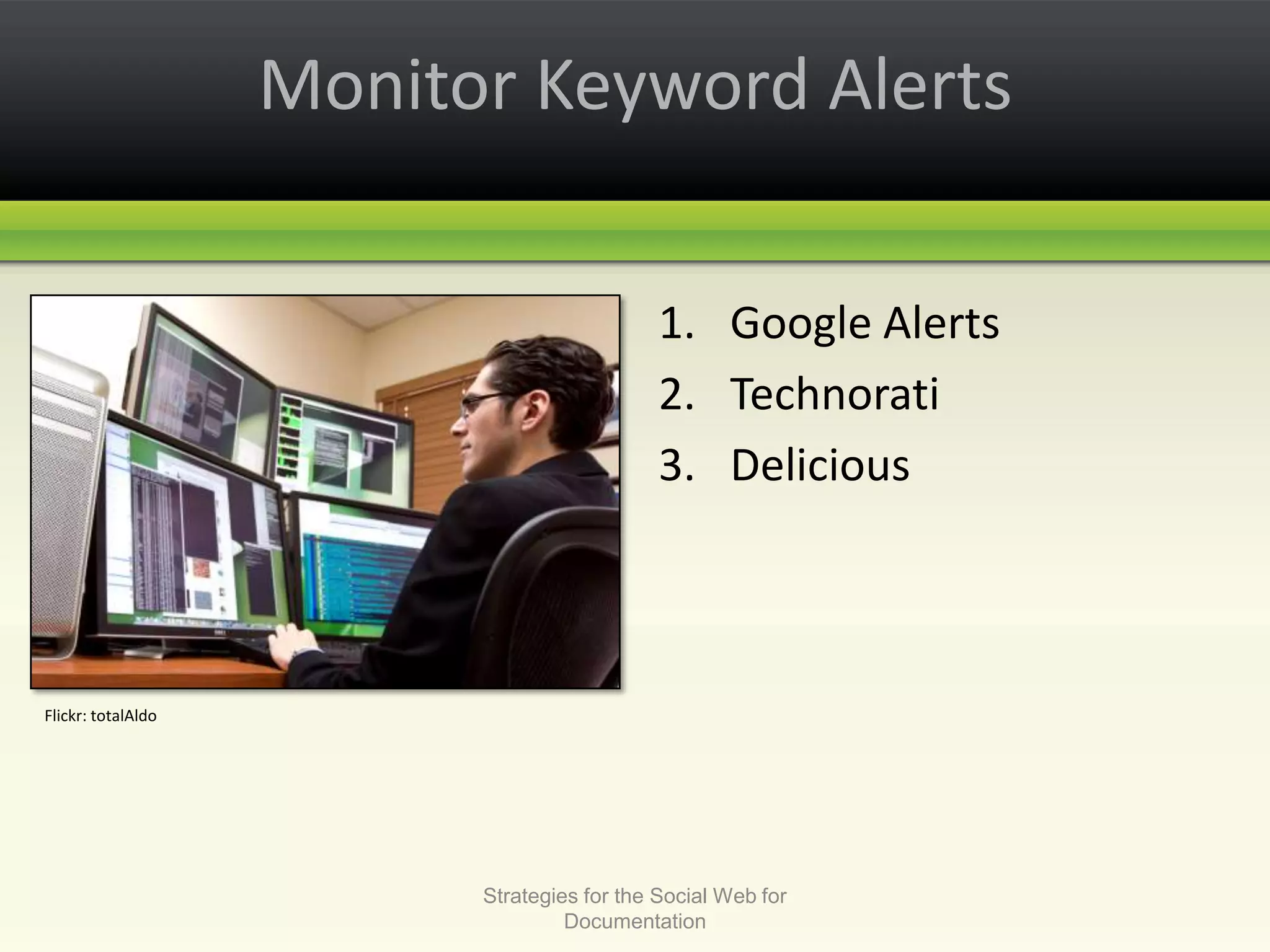
Monitor Keyword AlertsGoogle AlertsTechnoratiDeliciousStrategies for the Social Web for DocumentationFlickr: totalAldo
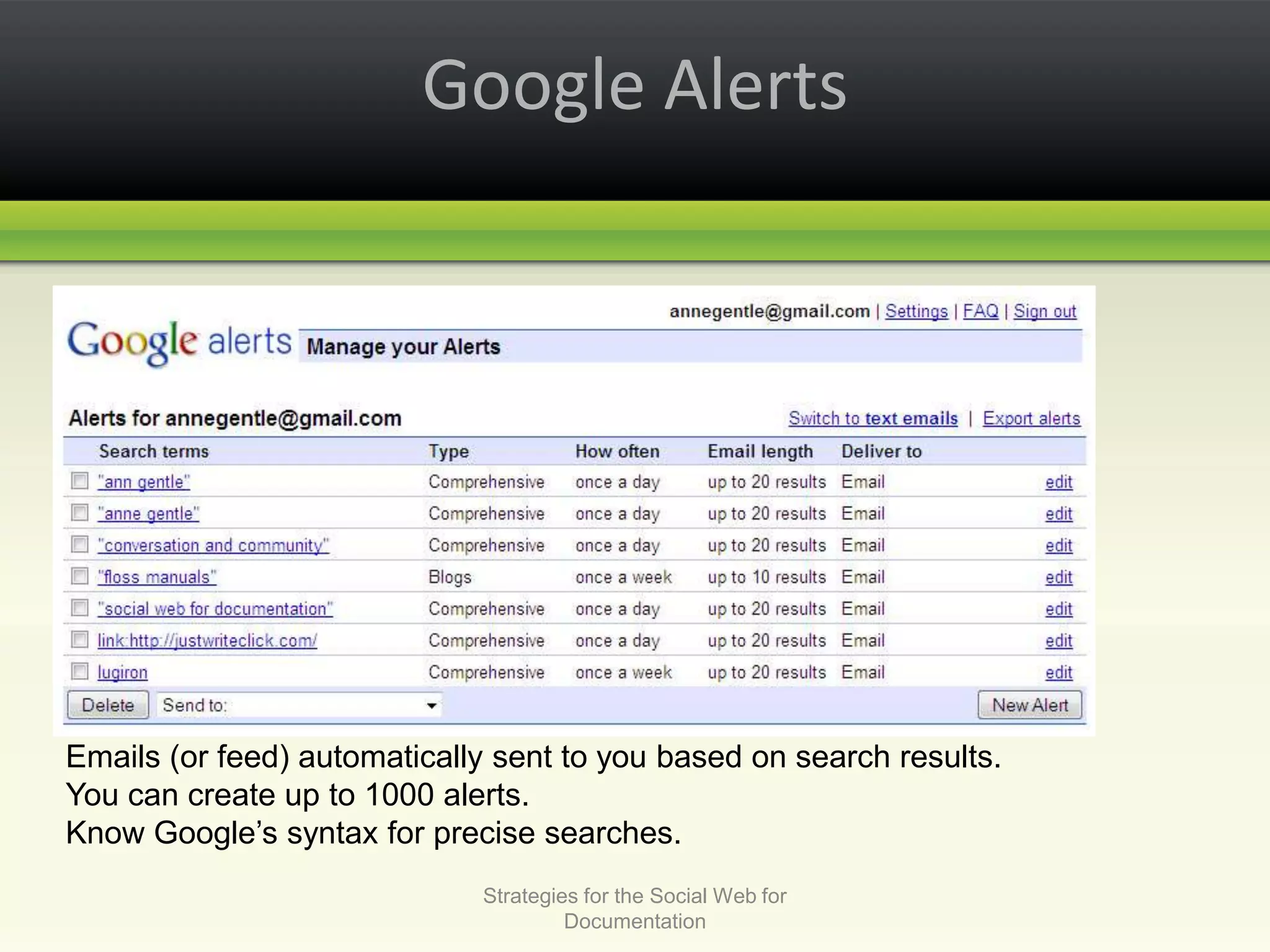
Google AlertsStrategies for the Social Web for DocumentationEmails (or feed) automatically sent to you based on search results.You can create up to 1000 alerts. Know Google’s syntax for precise searches.
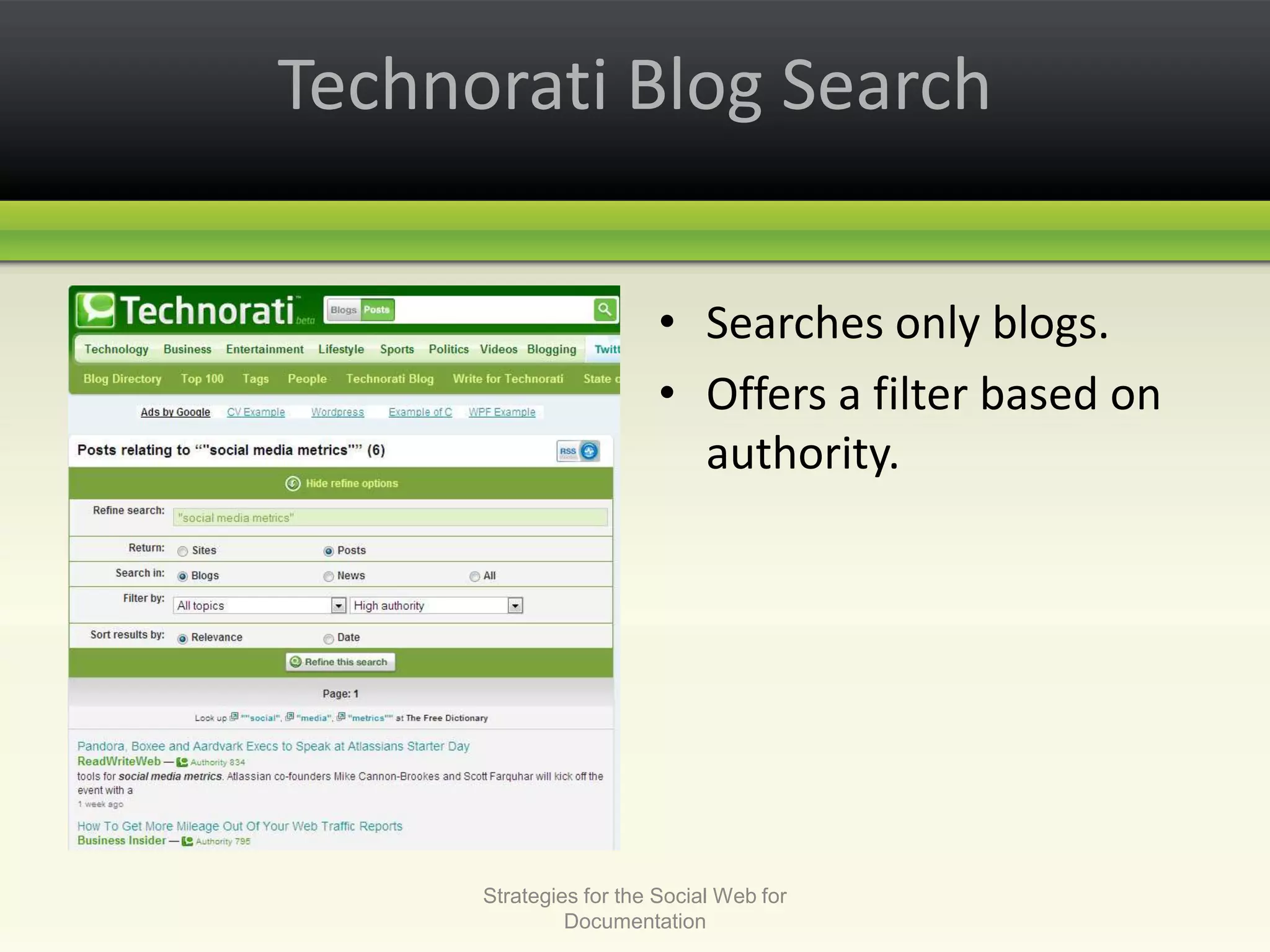
Technorati Blog SearchSearches only blogs. Offers a filter based on authority.Strategies for the Social Web for Documentation
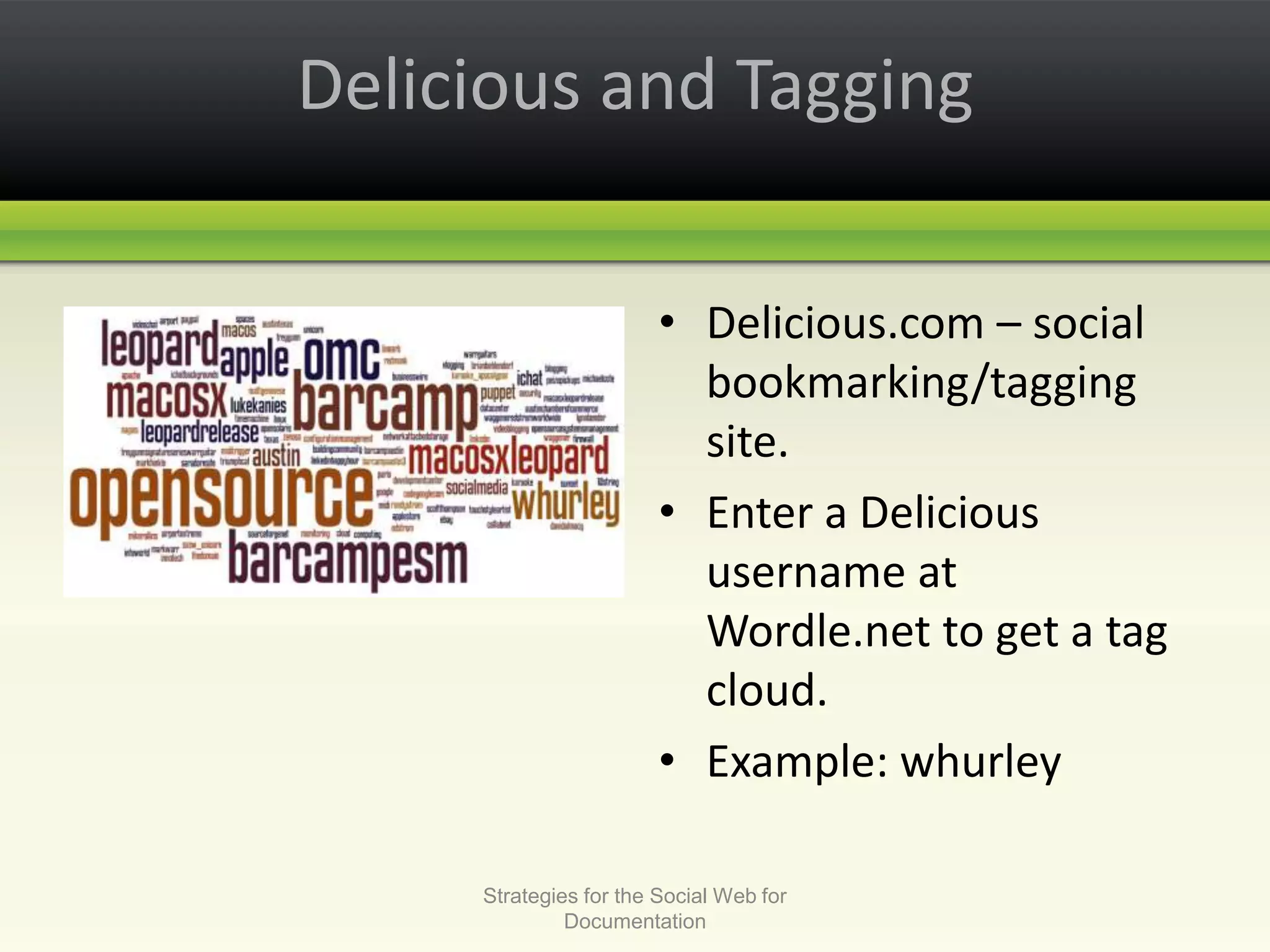
Delicious and TaggingDelicious.com – social bookmarking/tagging site.Enter a Delicious username at Wordle.net to get a tag cloud. Example: whurleyStrategies for the Social Web for Documentation
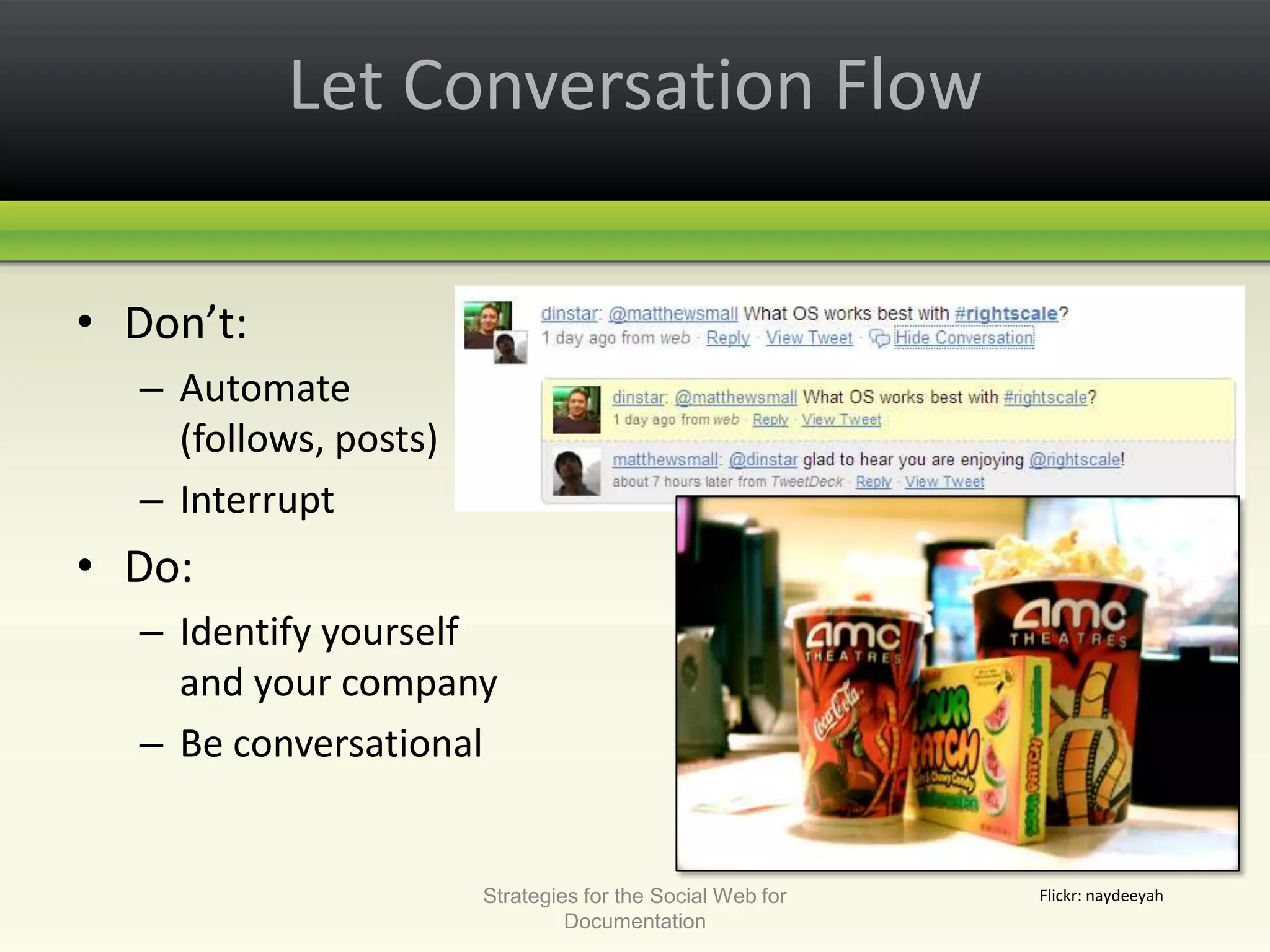
Let Conversation FlowDon’t:Automate (follows, posts)InterruptDo: Identify yourself and your companyBe conversationalStrategies for the Social Web for DocumentationFlickr: naydeeyah
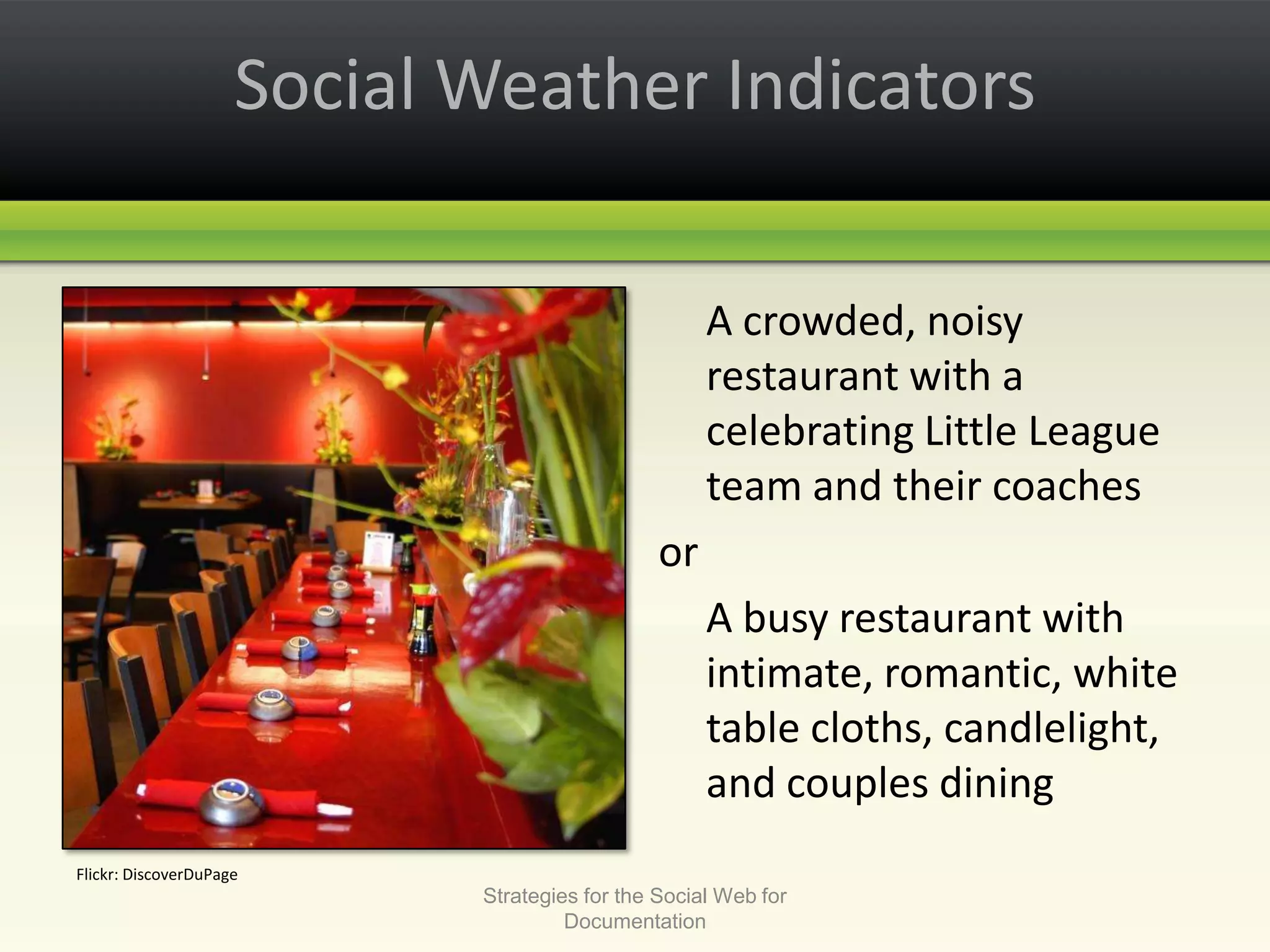
Social Weather Indicators	A crowded, noisy restaurant with a celebrating Little League team and their coachesor	A busy restaurant with intimate, romantic, white table cloths, candlelight, and couples diningStrategies for the Social Web for DocumentationFlickr: DiscoverDuPage
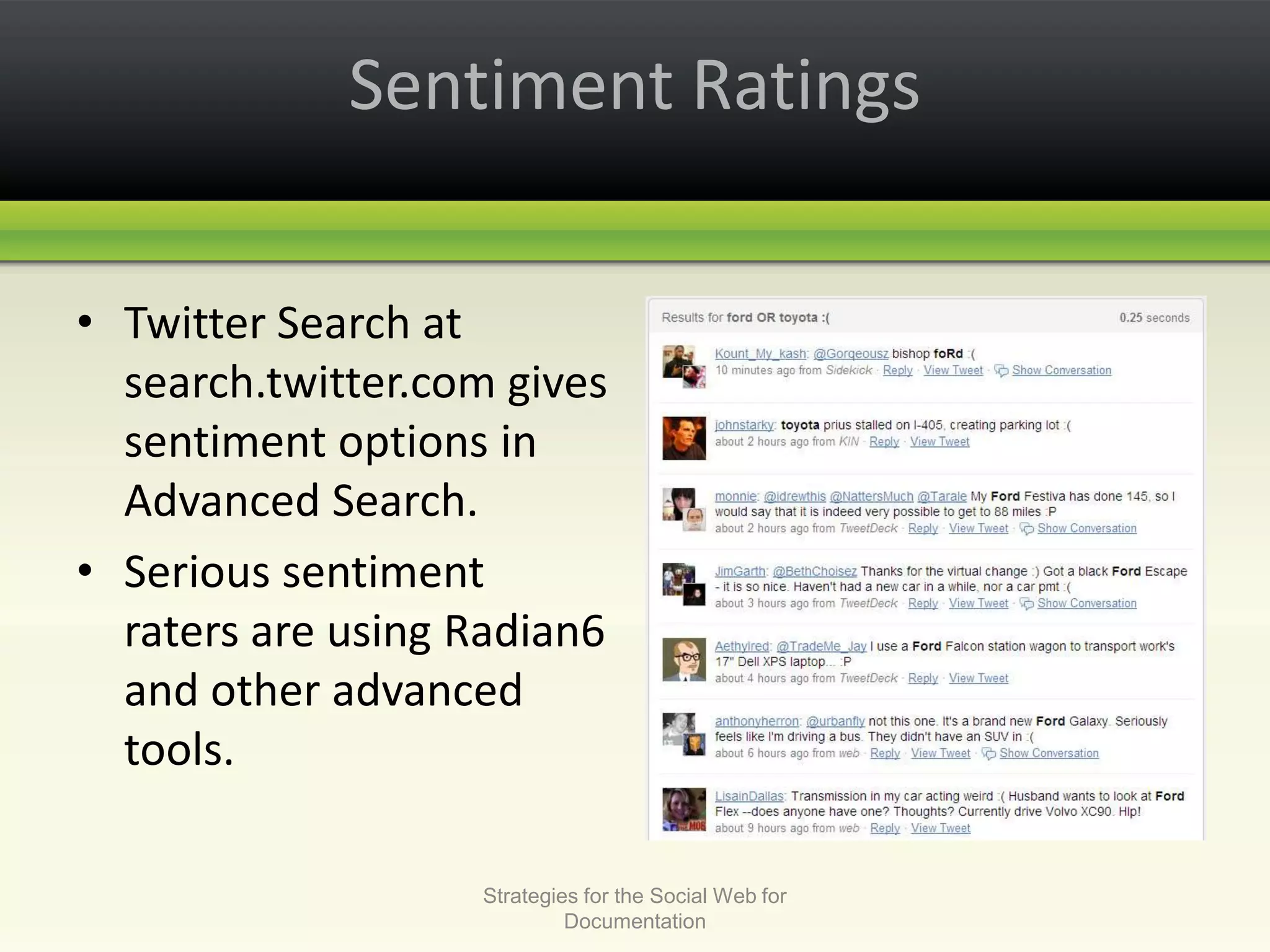
Sentiment RatingsTwitter Search at search.twitter.com gives sentiment options in Advanced Search. Serious sentiment raters are using Radian6 and other advanced tools.Strategies for the Social Web for Documentation
Create Audience Personas and Perform Task Analysis Have the data, use it. Demographics and Social TechnographicsIndeed.com and LinkedIn.com demoStrategies for the Social Web for DocumentationFlickr: alex e proimos
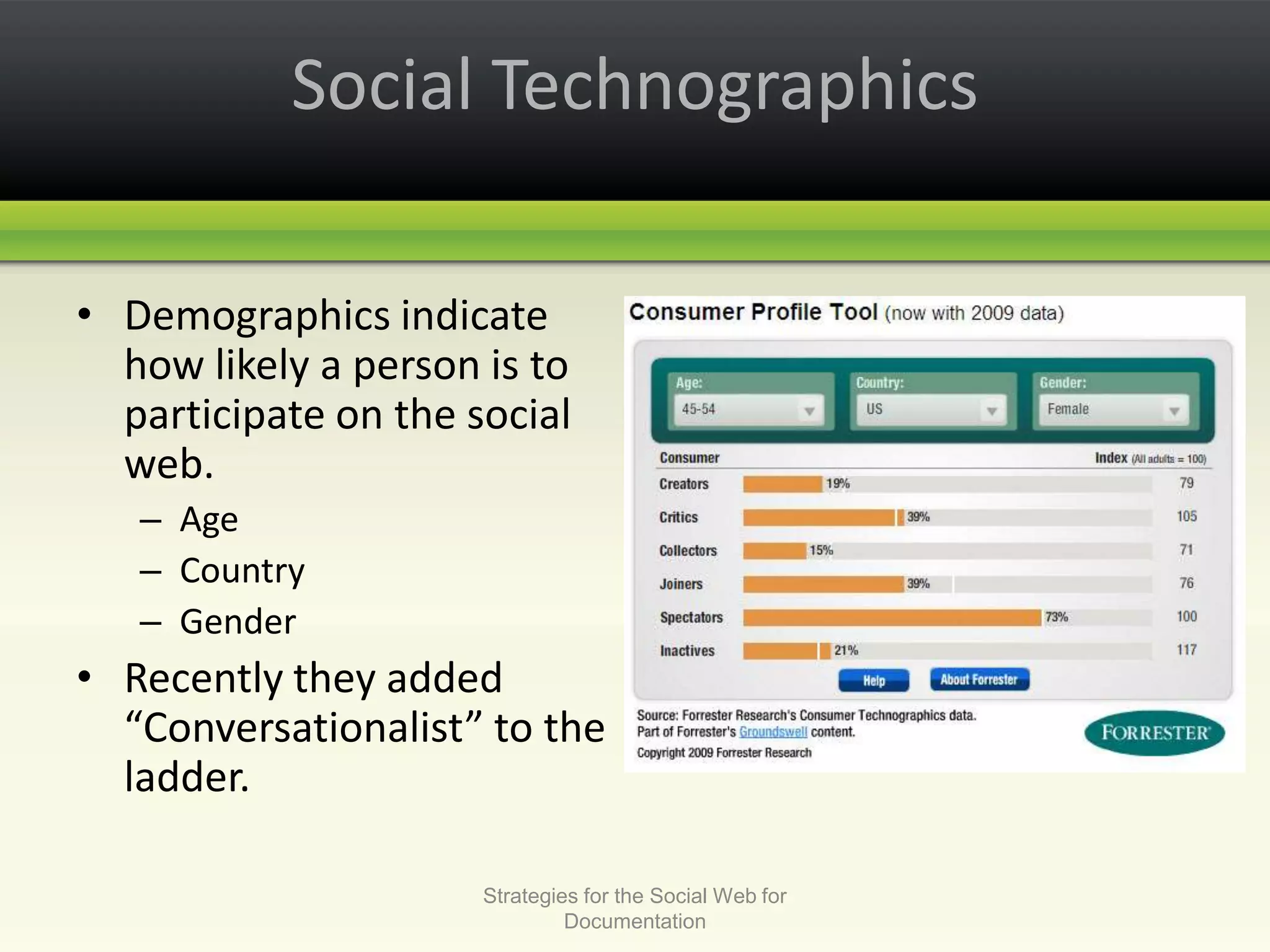
Social TechnographicsDemographics indicate how likely a person is to participate on the social web. Age CountryGenderRecently they added “Conversationalist” to the ladder.Strategies for the Social Web for Documentation
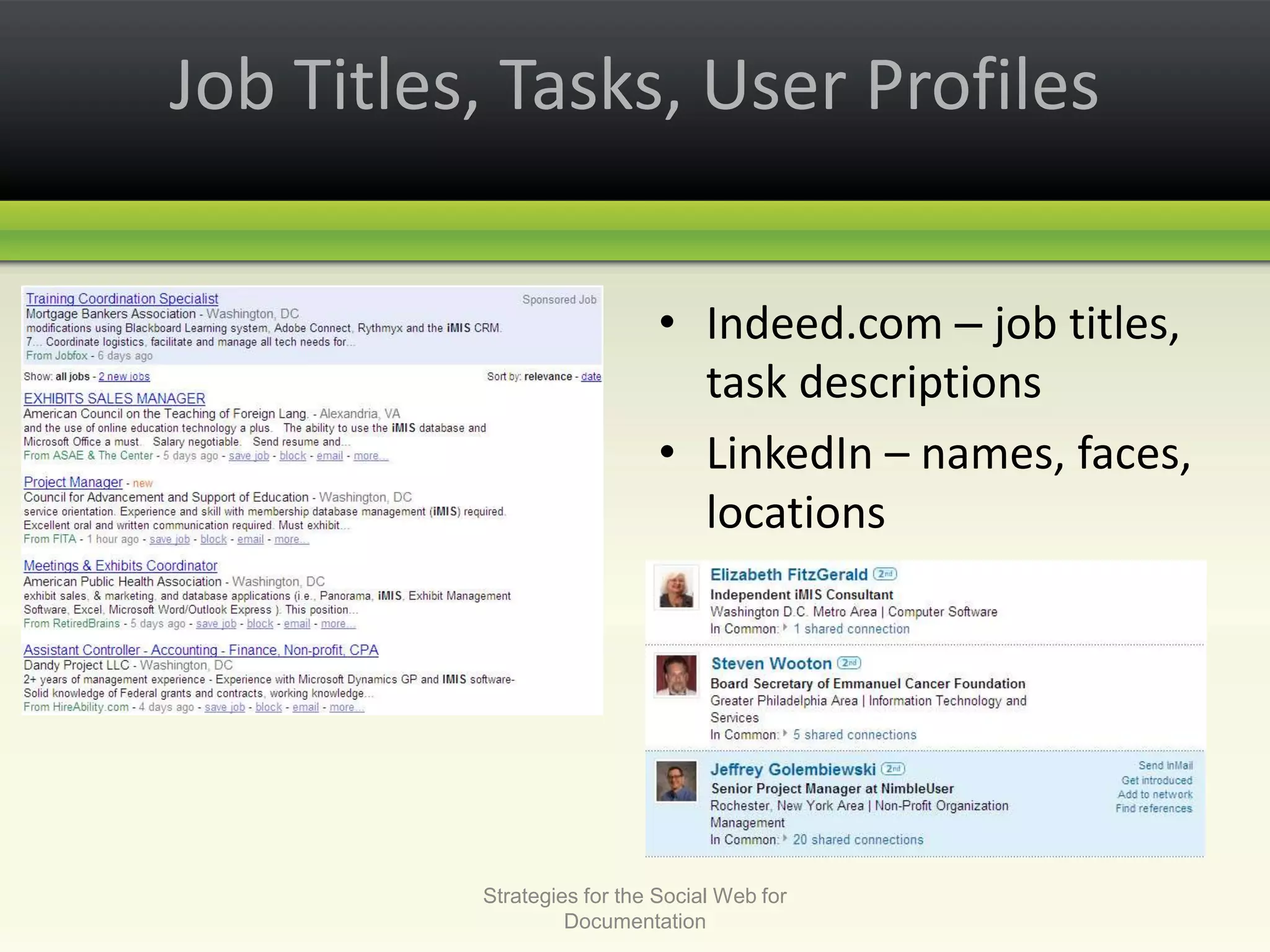
Job Titles, Tasks, User ProfilesStrategies for the Social Web for DocumentationIndeed.com – job titles, task descriptions
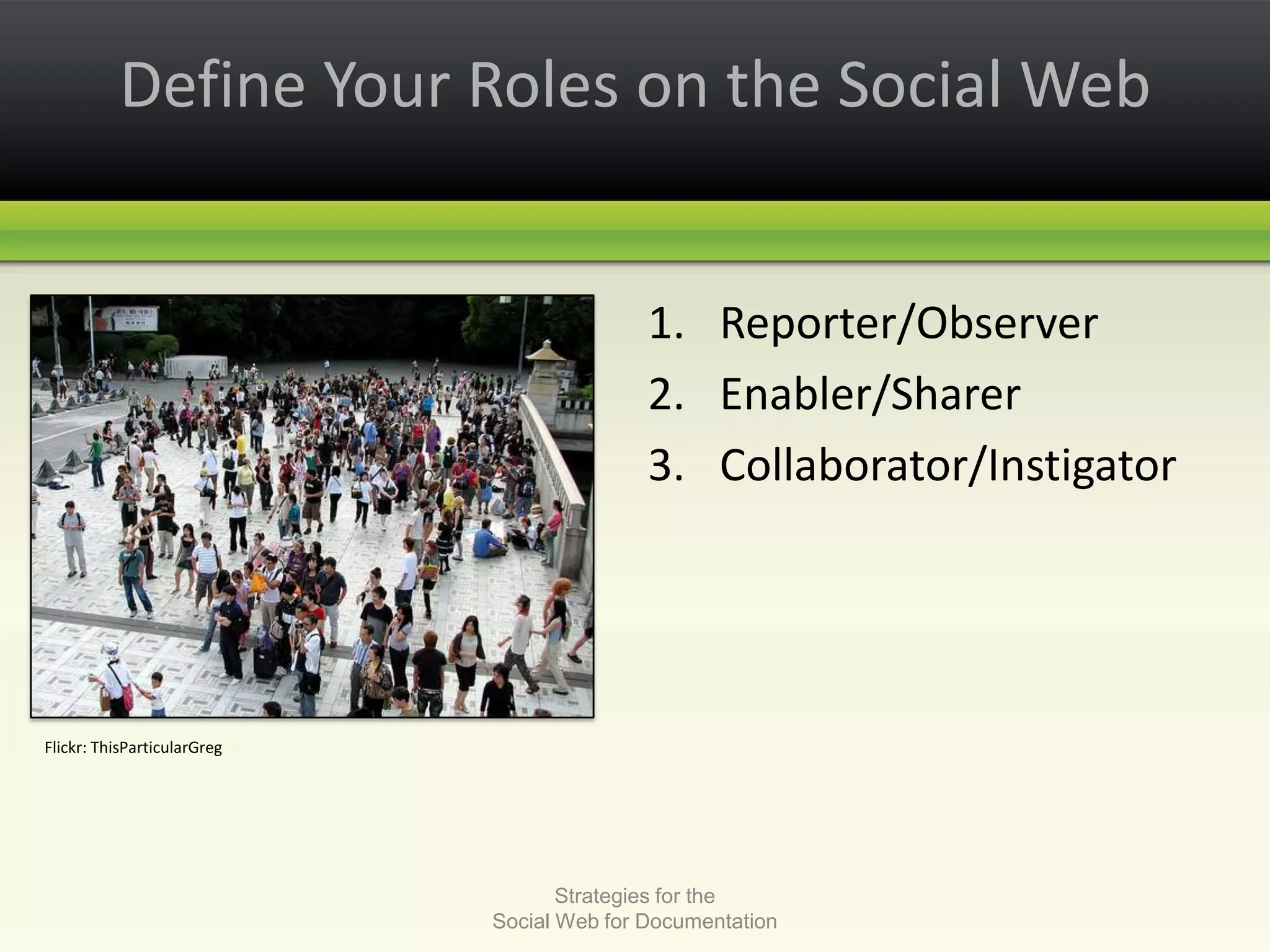
LinkedIn – names, faces, locationsDefine Your Roles on the Social WebReporter/ObserverEnabler/SharerCollaborator/Instigator Strategies for the Social Web for DocumentationFlickr: ThisParticularGreg
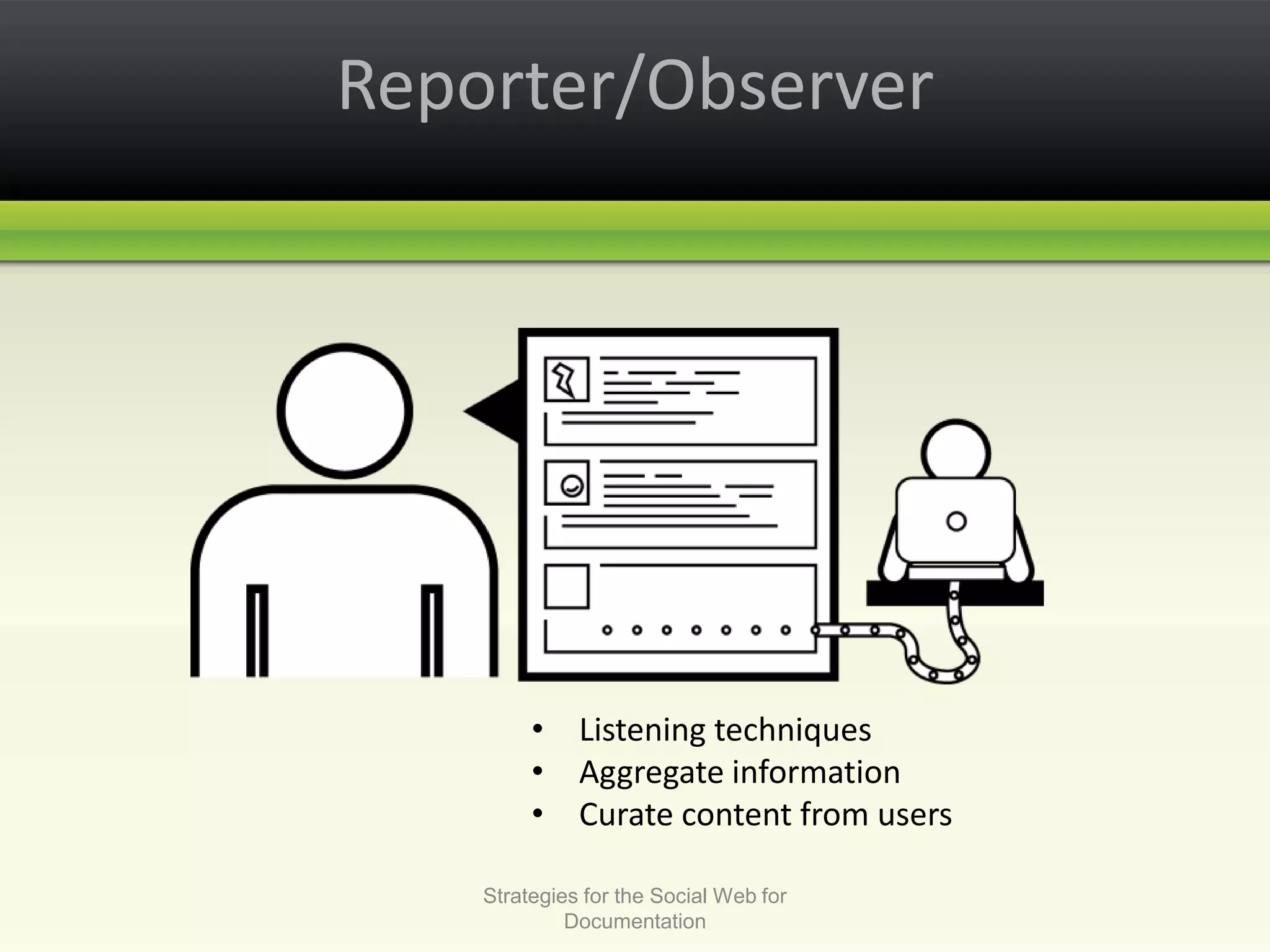
Reporter/ObserverListening techniquesAggregate informationCurate content from usersStrategies for the Social Web for Documentation
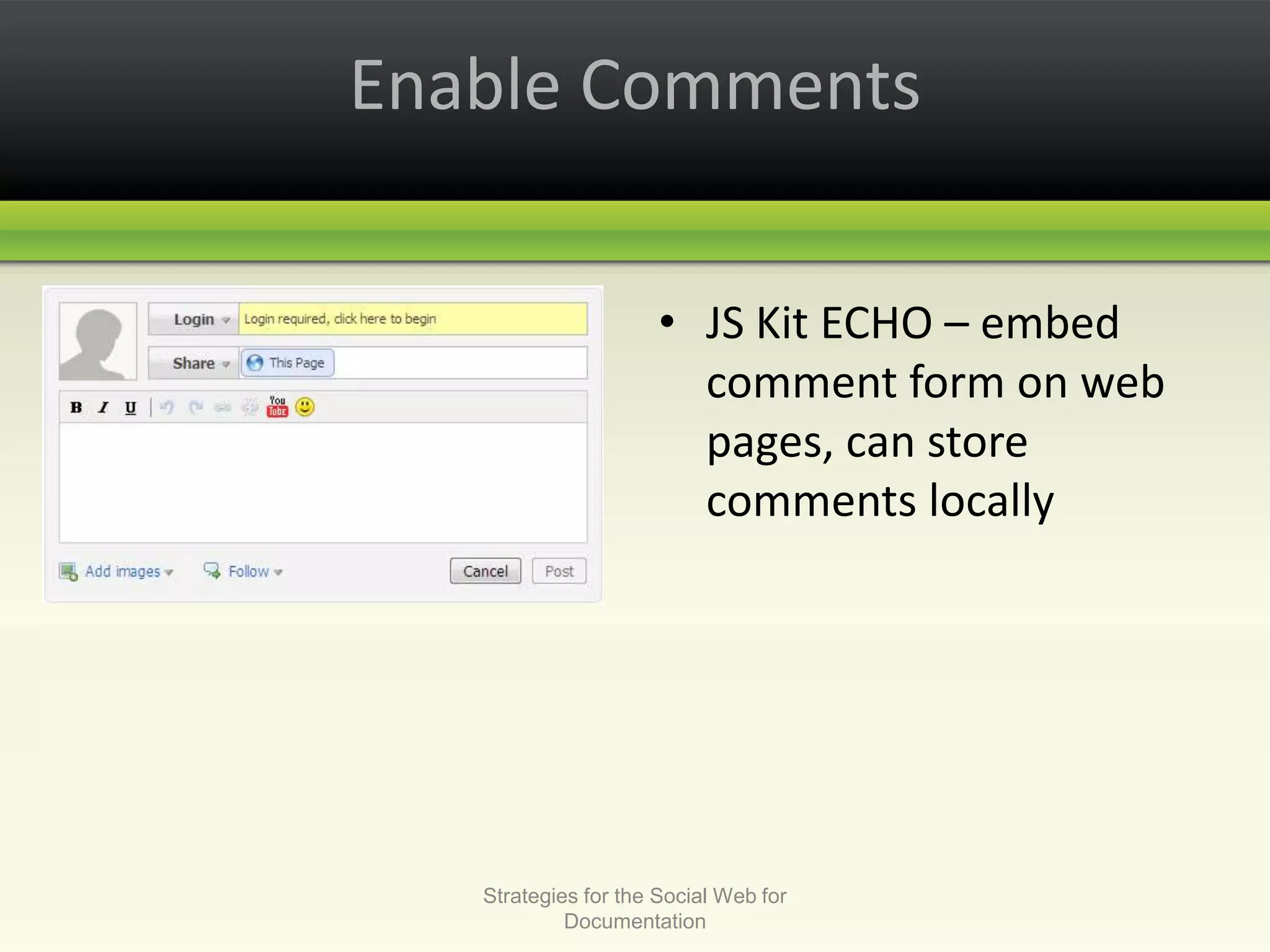
Enable CommentsJS Kit ECHO – embed comment form on web pages, can store comments locallyStrategies for the Social Web for Documentation
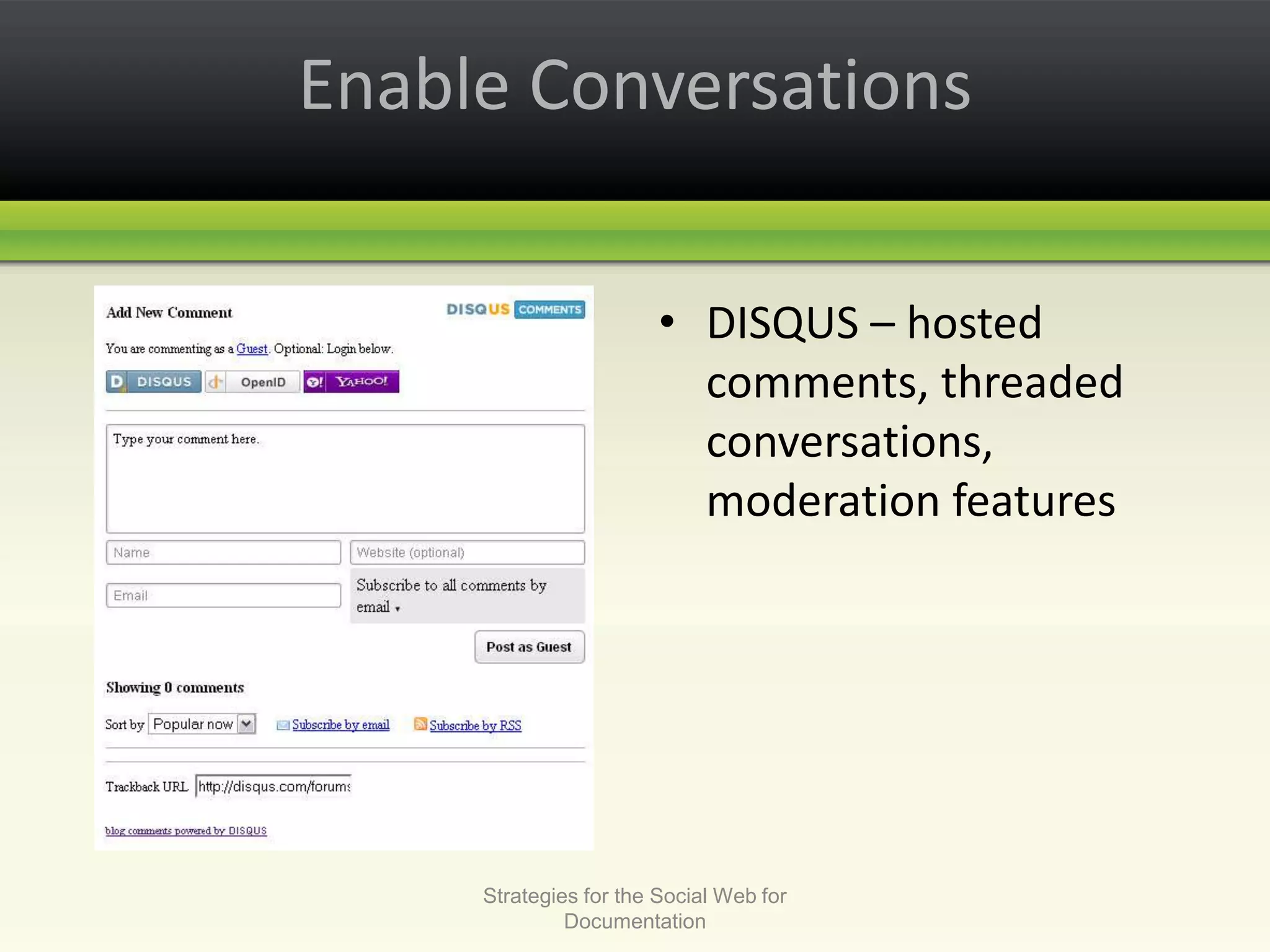
Enable ConversationsDISQUS – hosted comments, threaded conversations, moderation featuresStrategies for the Social Web for Documentation
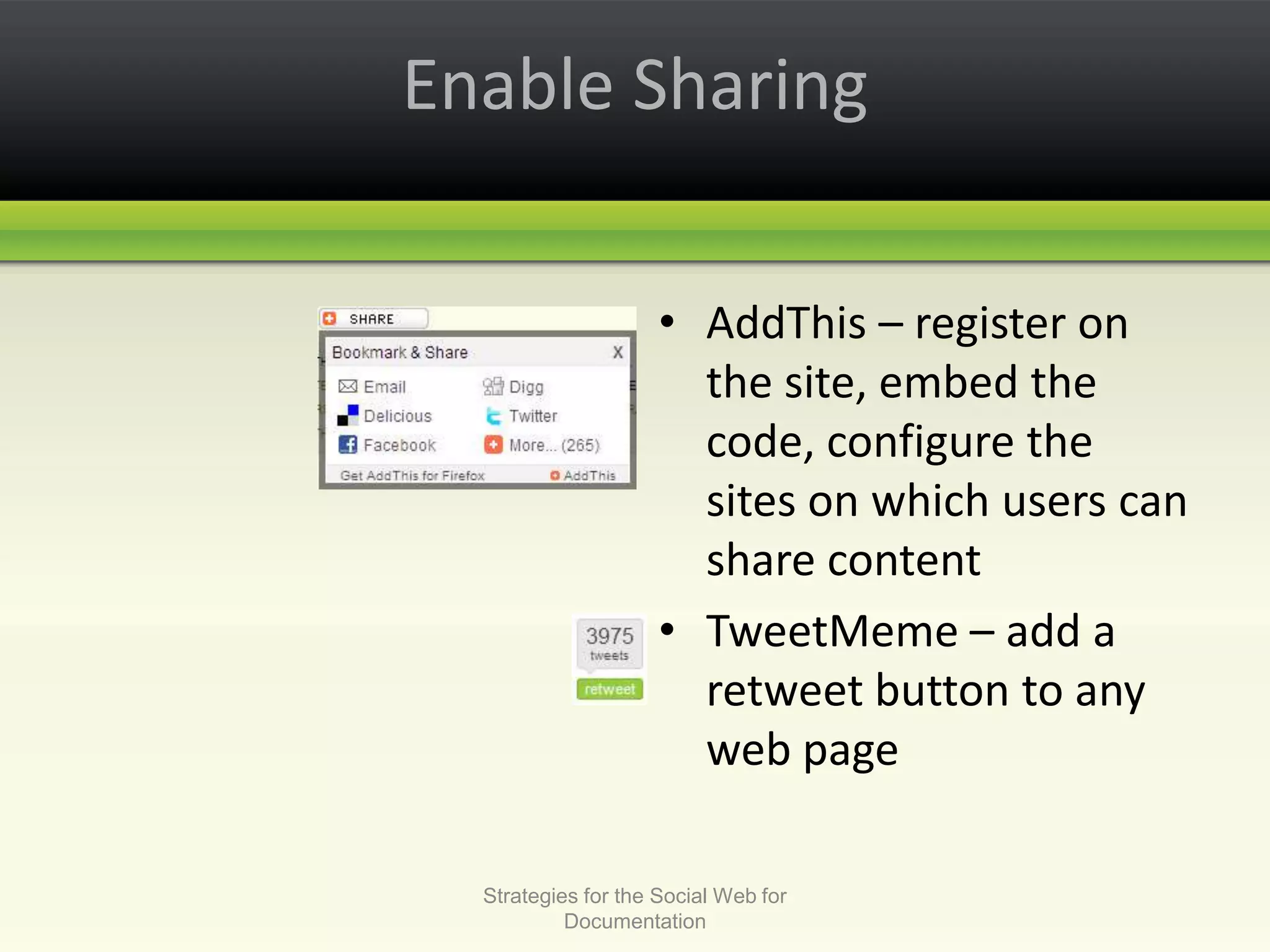
Enable SharingAddThis – register on the site, embed the code, configure the sites on which users can share contentTweetMeme – add a retweet button to any web pageStrategies for the Social Web for Documentation
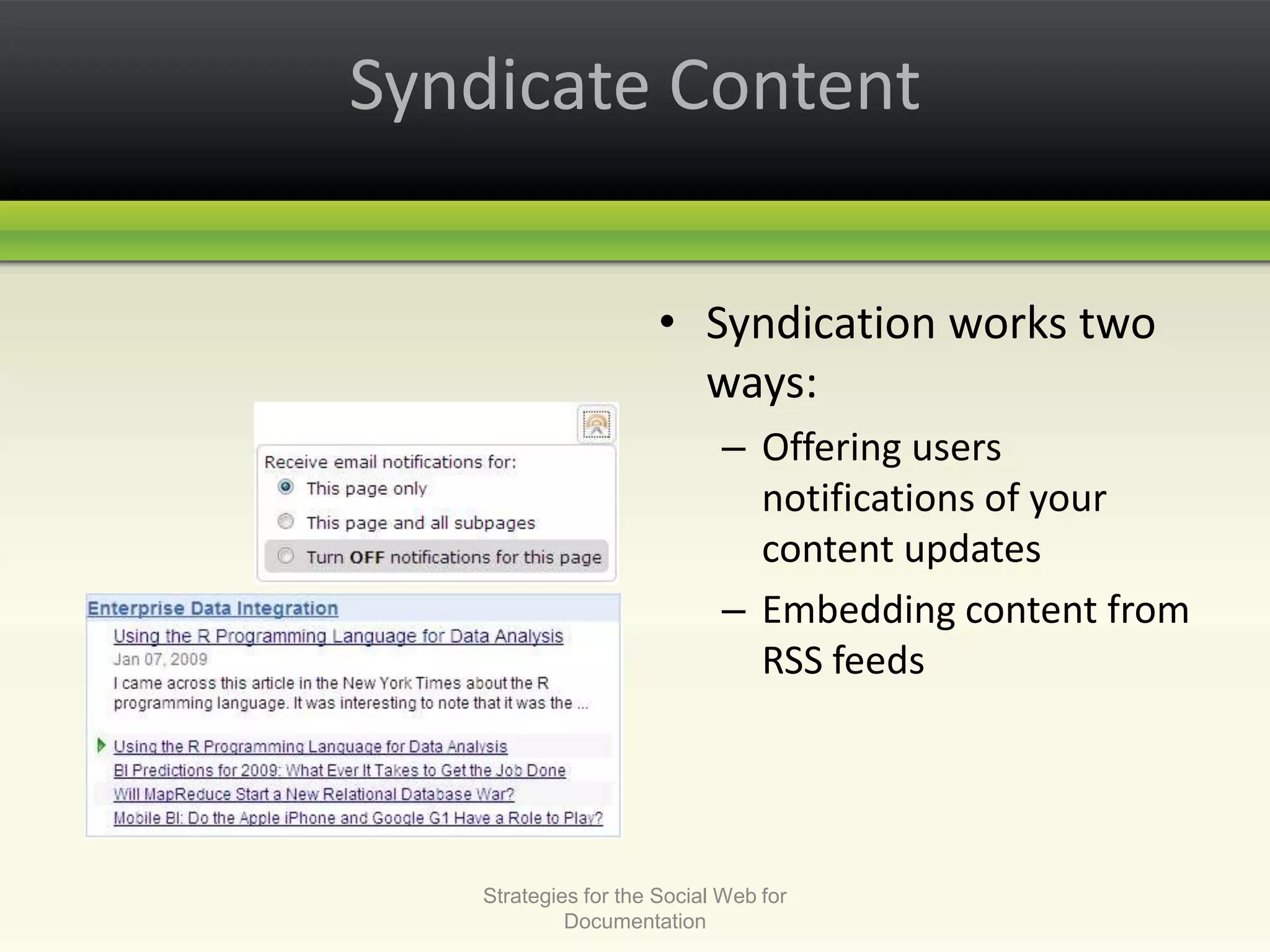
Syndicate ContentSyndication works two ways:Offering users notifications of your content updatesEmbedding content from RSS feedsStrategies for the Social Web for Documentation
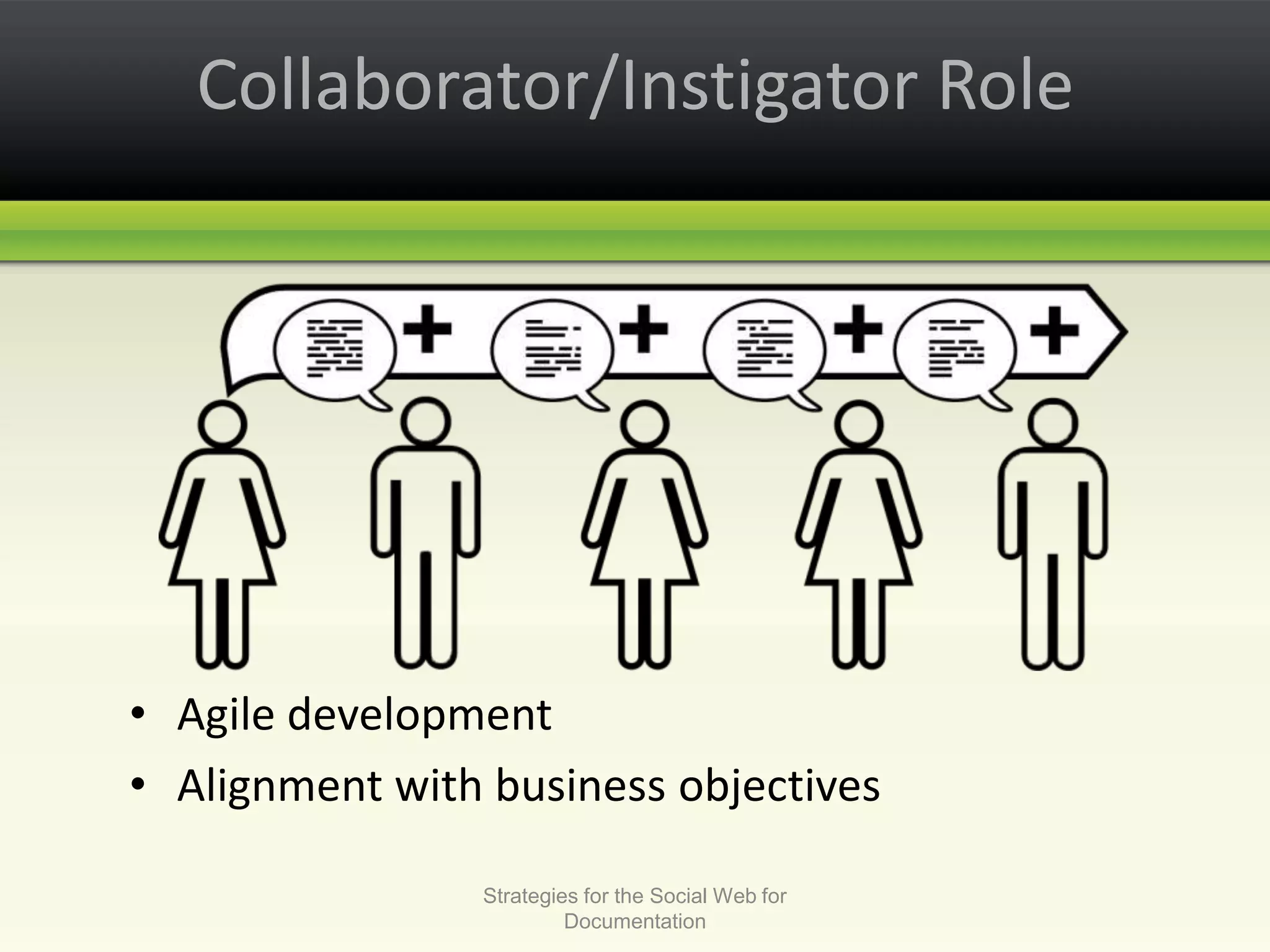
Collaborator/Instigator RoleAgile developmentAlignment with business objectivesStrategies for the Social Web for Documentation
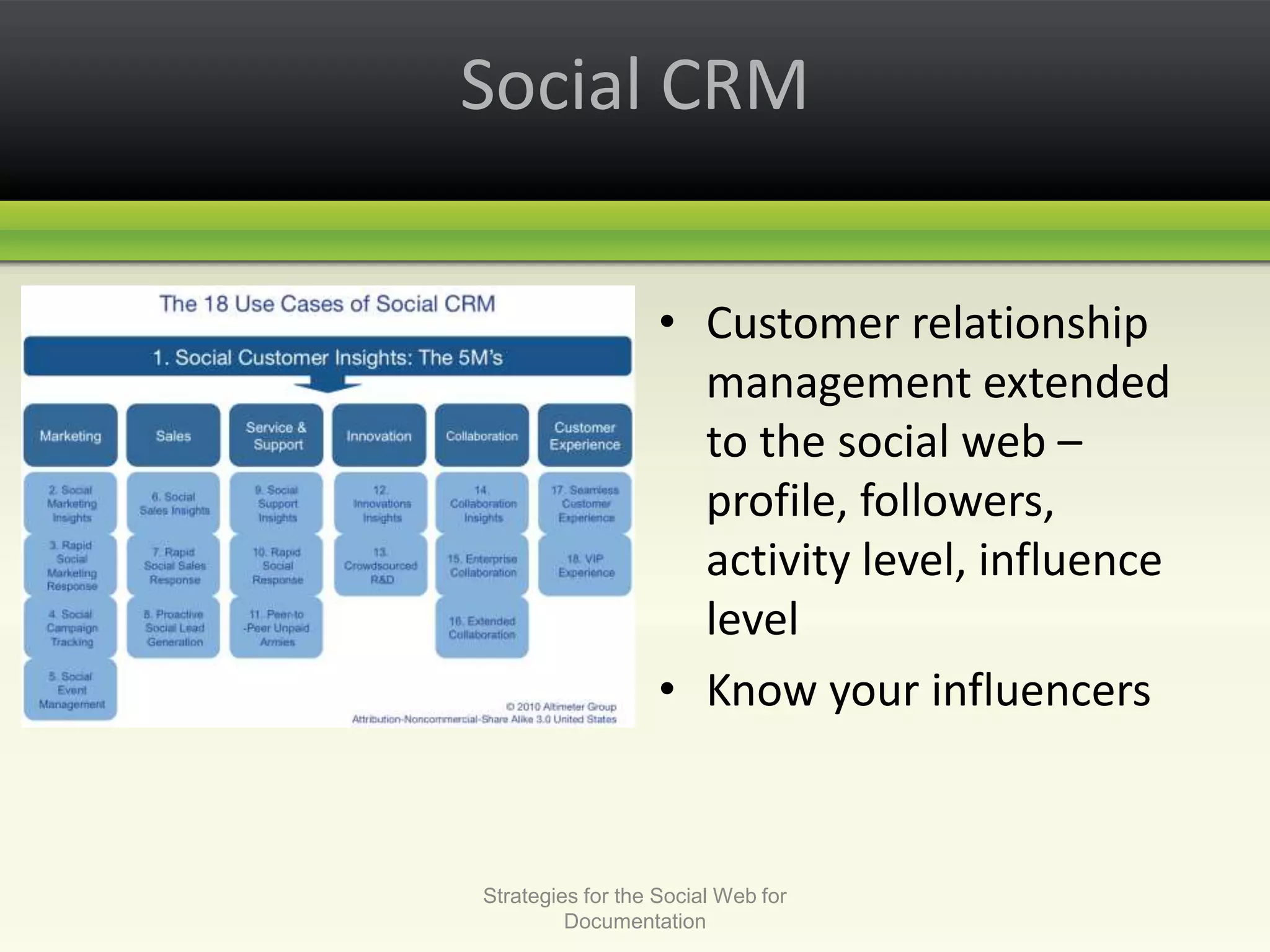
Social CRMCustomer relationship management extended to the social web – profile, followers, activity level, influence levelKnow your influencersStrategies for the Social Web for Documentation
Align with Business GoalsCommunity building also may be your responsibility. Provide a platform, support a community, when your audience and business goals support it.Strategies for the Social Web for DocumentationFlickr: max-all
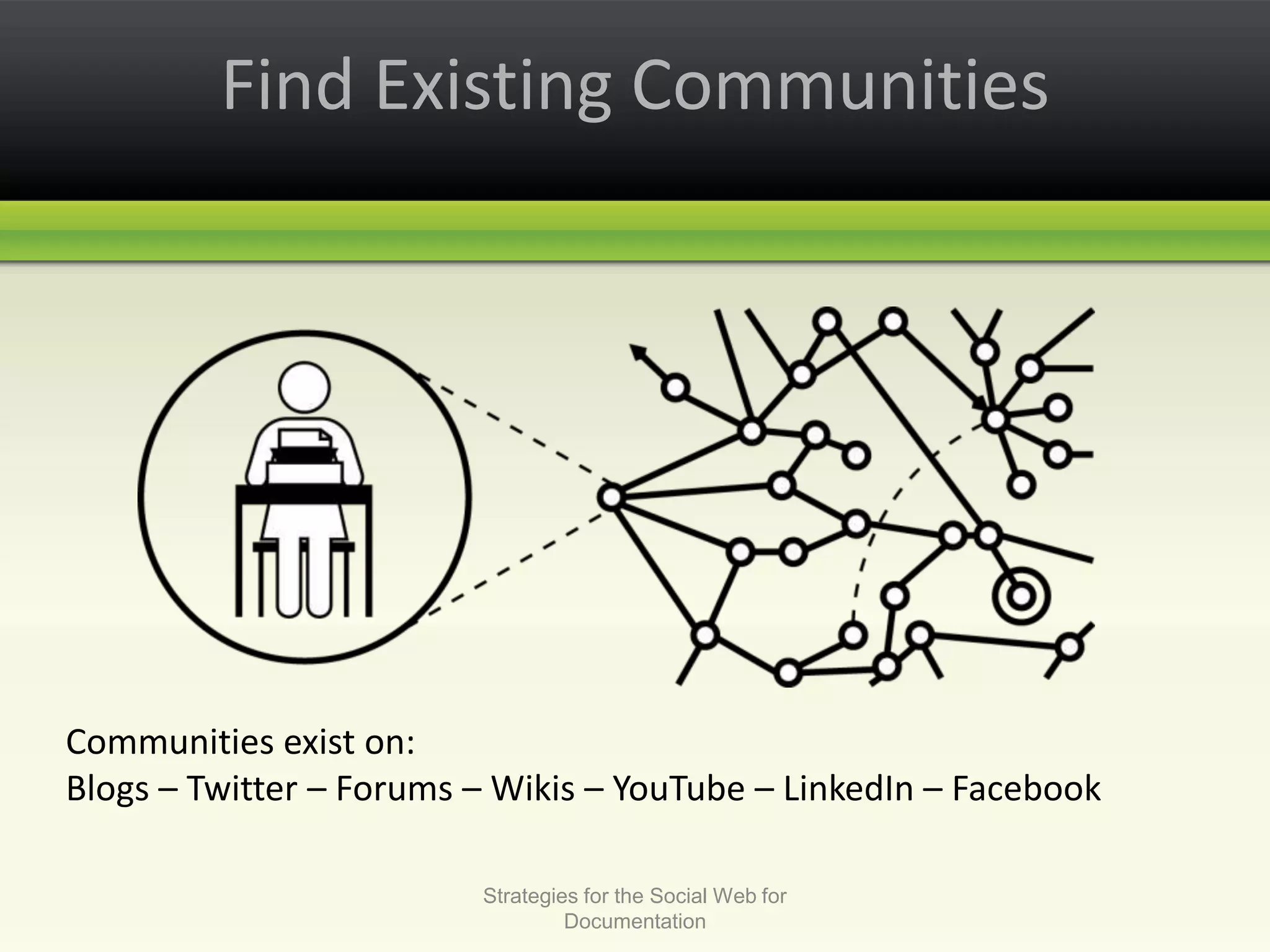
Find Existing CommunitiesCommunities exist on:Blogs – Twitter – Forums – Wikis – YouTube – LinkedIn – FacebookStrategies for the Social Web for Documentation
Community PitfallsToo much content, not enough engagement.Another community already took all the major players attention.Activity level thin.High barriers to entry. Pilot debate – yes or no?We came out of the gate with way too many topics out there. We quickly learned that with too many topics and not enough interaction to start, it made the community seem empty. It’s what I call ‘empty restaurant syndrome’ — if you look in a window and no one is in there, you likely won’t go in.– 	Mike HardyStrategic communications program managerPitney-Bowes Strategies for the Social Web for Documentation
MeasurementMeasure social media participation and engagement with web analytics.Key Performance Indicators depend on overall goals for site.Engagement indicators may differ from web analytics.Strategies for the Social Web for DocumentationFlickr: HeavyWeightGeek
Key Performance IndicatorsCustomer support and help sites: New vs. returning visitorsSearches that had zero yieldSearch results to site exits ratioDownload completion rates (if relevant)Strategies for the Social Web for DocumentationFlickr: ~Brenda-Starr~
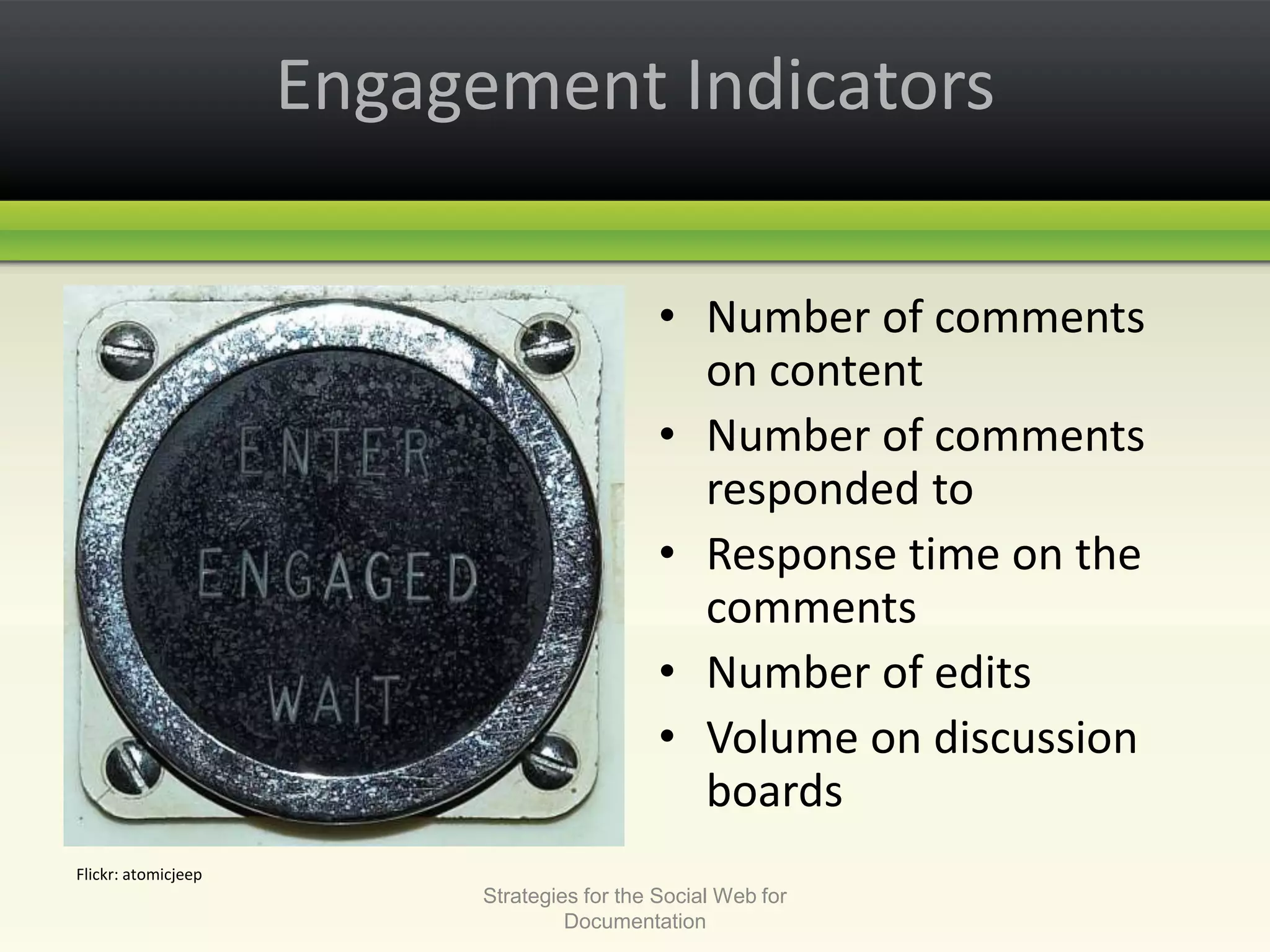
Engagement IndicatorsNumber of comments on contentNumber of comments responded toResponse time on the commentsNumber of editsVolume on discussion boardsStrategies for the Social Web for DocumentationFlickr: atomicjeep
When to StopLittle engagementDemographics and Technographics don’t line upNo sense of community with your usersBusiness alignment isn’t rightStrategies for the Social Web for DocumentationFlickr: bug-a-lug
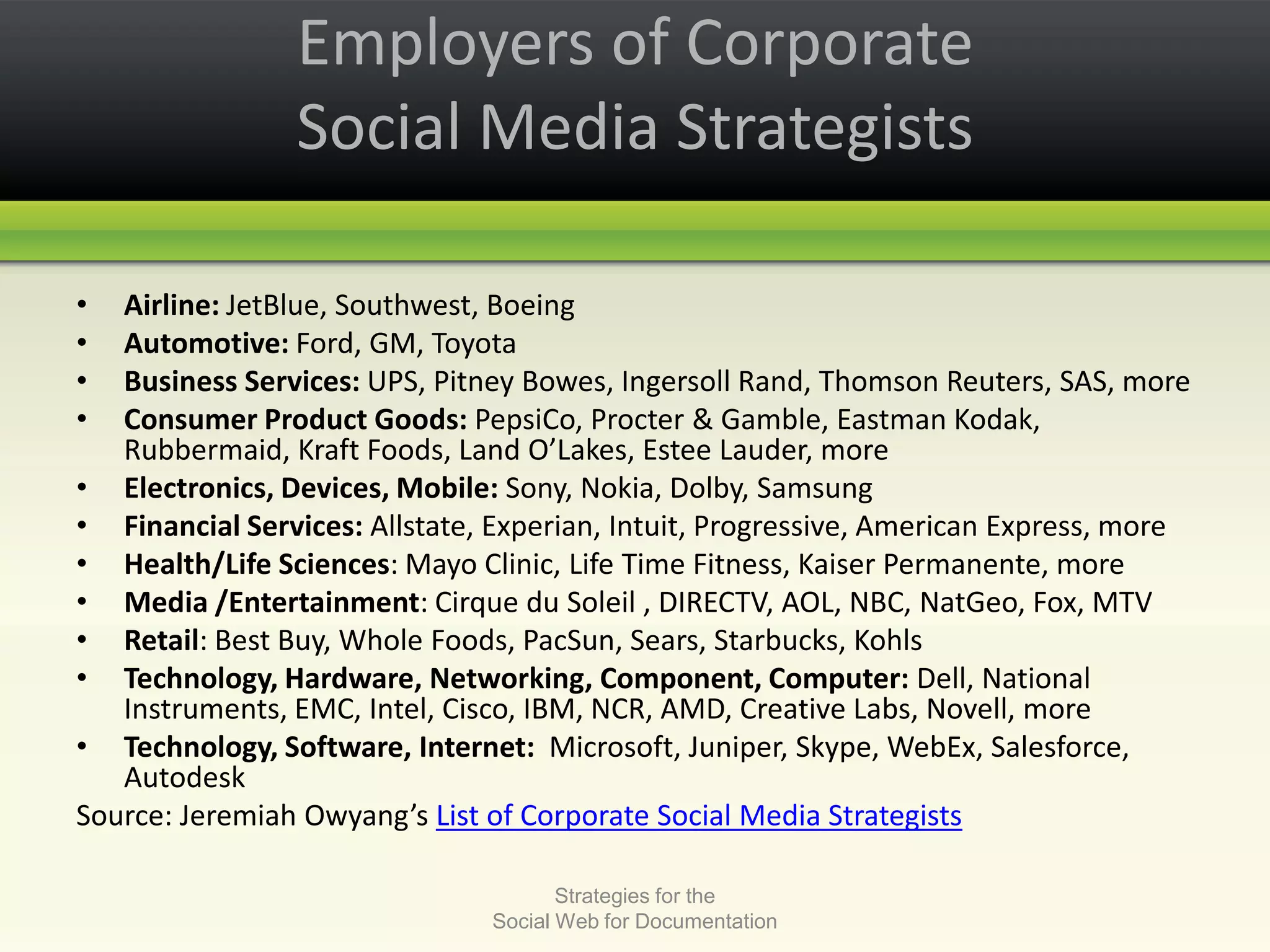
Employers of Corporate Social Media StrategistsAirline: JetBlue, Southwest, Boeing Automotive: Ford, GM, Toyota Business Services: UPS, Pitney Bowes, Ingersoll Rand, Thomson Reuters, SAS, more Consumer Product Goods: PepsiCo, Procter & Gamble, Eastman Kodak, Rubbermaid, Kraft Foods, Land O’Lakes, Estee Lauder, more Electronics, Devices, Mobile: Sony, Nokia, Dolby, Samsung Financial Services: Allstate, Experian, Intuit, Progressive, American Express, moreHealth/Life Sciences: Mayo Clinic, Life Time Fitness, Kaiser Permanente, more Media /Entertainment: Cirque du Soleil , DIRECTV, AOL, NBC, NatGeo, Fox, MTVRetail: Best Buy, Whole Foods, PacSun, Sears, Starbucks, KohlsTechnology, Hardware, Networking, Component, Computer: Dell, National Instruments, EMC, Intel, Cisco, IBM, NCR, AMD, Creative Labs, Novell, moreTechnology, Software, Internet:  Microsoft, Juniper, Skype, WebEx, Salesforce, AutodeskSource: Jeremiah Owyang’sList of Corporate Social Media StrategistsStrategies for the Social Web for Documentation
Learn Best PracticesLaunch and learn.Strategies for the Social Web for Documentation
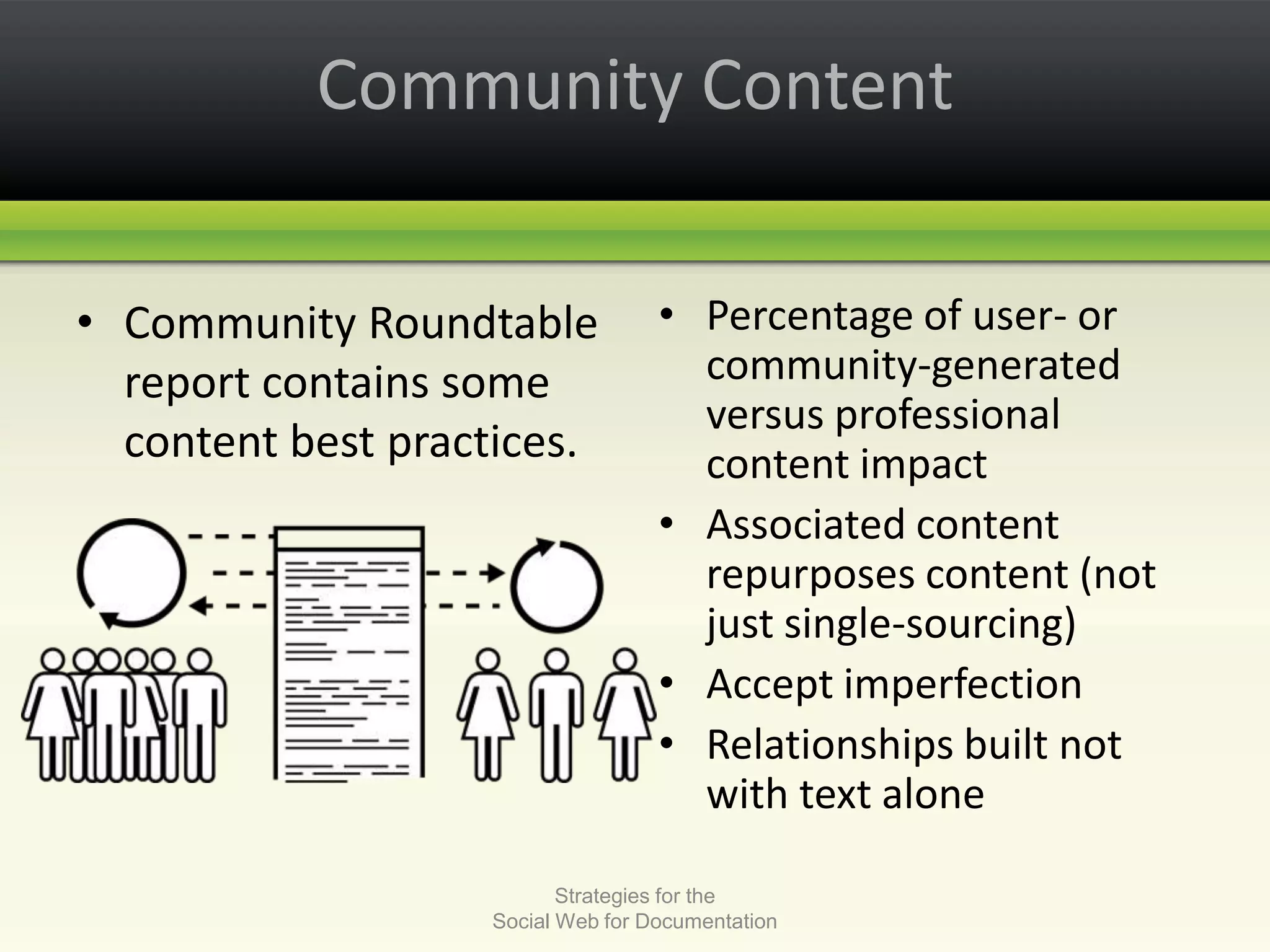
Community ContentCommunity Roundtable report contains some content best practices. Percentage of user- or community-generated versus professional content impactAssociated content repurposes content (not just single-sourcing)Accept imperfectionRelationships built not with text aloneStrategies for the Social Web for Documentation
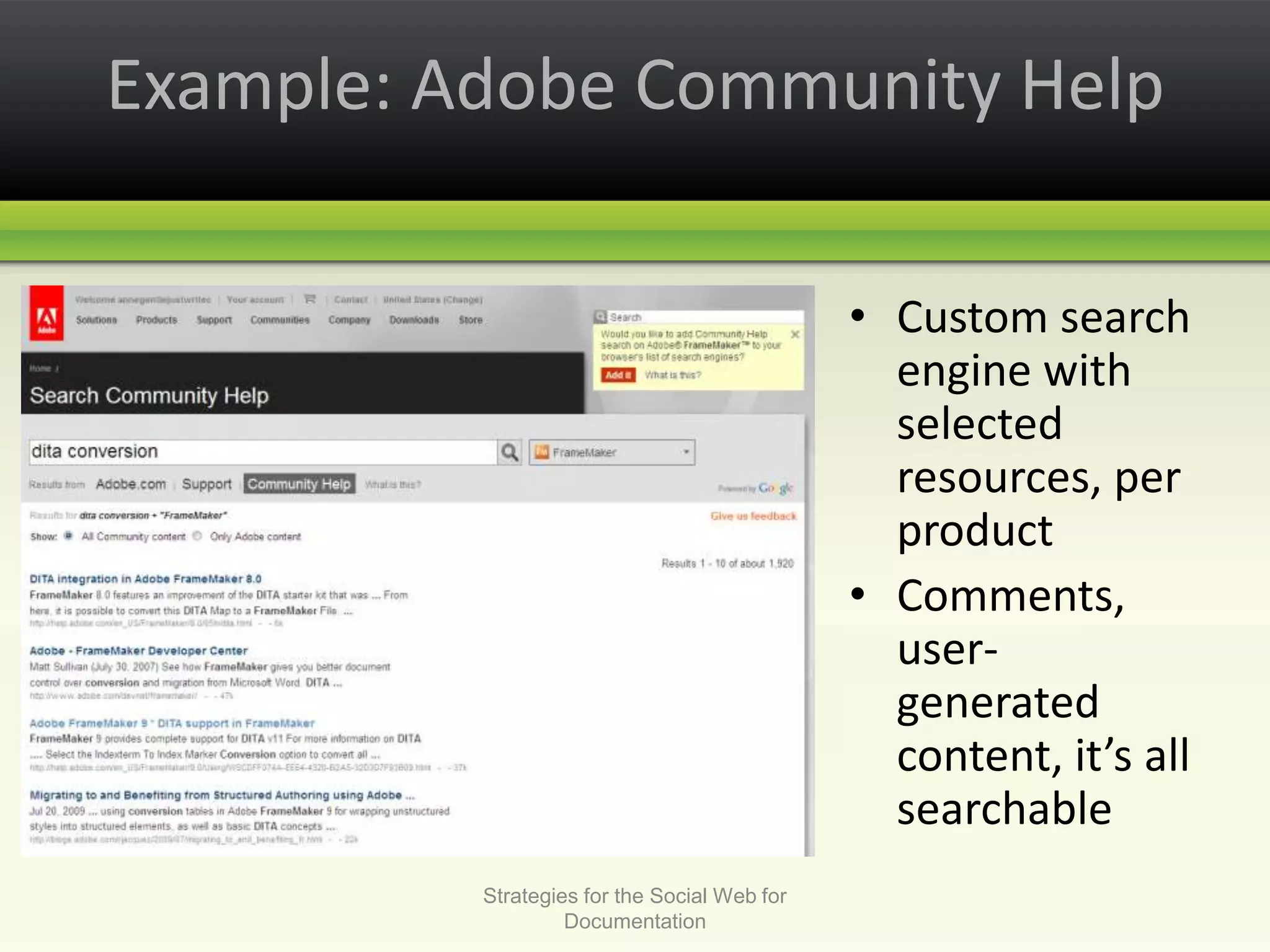
Example: Adobe Community HelpCustom search engine with selected resources, per productComments, user-generated content, it’s all searchableStrategies for the Social Web for Documentation
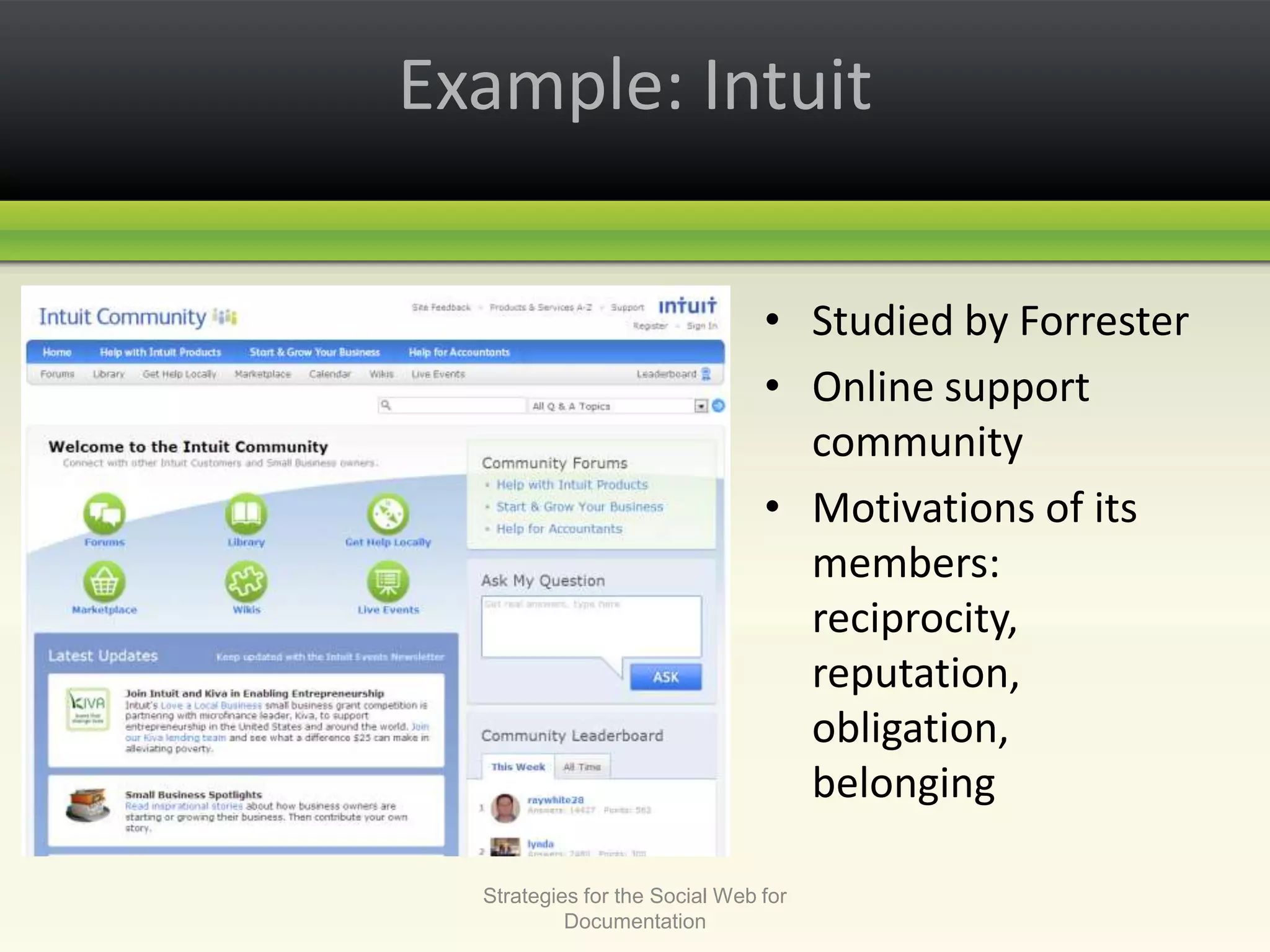
Example: IntuitStudied by ForresterOnline support communityMotivations of its members: reciprocity, reputation, obligation, belongingStrategies for the Social Web for Documentation
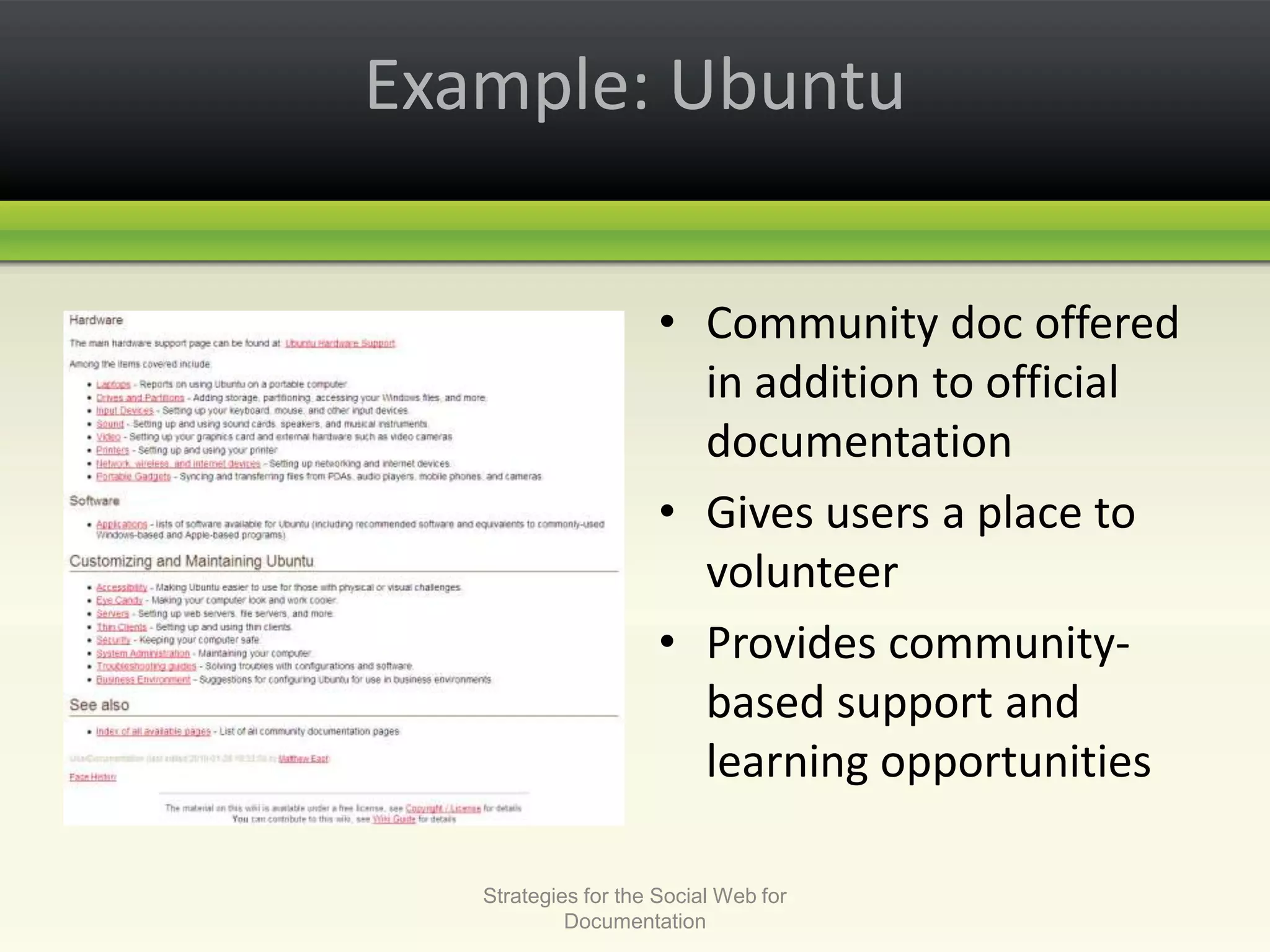
Example: UbuntuCommunity doc offered in addition to official documentationGives users a place to volunteerProvides community-based support and learning opportunitiesStrategies for the Social Web for Documentation
Example: MozillaSeparate end-user doc from the developer documentationComprehensive style guidance for new contributorsSwitched from MediaWiki to the MindTouch collaboration platformStrategies for the Social Web for Documentation
Align Content with Business GoalsMarketing & SalesService & SupportInvention & Development CollaborationCustomer ExperienceLearning & EducationStrategies for the Social Web for DocumentationFlickr: The Wu’s Photo Land
We Can Do ItStrategies for the Social Web for DocumentationFlickr: couragextoxliveFlickr: ogimogi
Documentation as ConversationYou:	want to deliver content in a way that involves your users and opens collaboration opportunities.Listen first.Find your role.Align content placement with business goals.Strategies for the Social Web for Documentation
Conversation, continued.Ask Anne Gentlewww.facebook.com/conversationandcommunityStrategies for the Social Web for Documentation
Questions?Anne Gentlewww.justwriteclick.comannegentle@justwriteclick.com@annegentlewww.facebook.com/conversationandcommunitywww.linkedin.com/in/annegentle

STC 2010 Strategies for the Social Web for Documentation

  • 1.
    Strategies for theSocial Web For Documentation Anne Gentlewww.justwriteclick.comSTC Summit May 2010
  • 2.
    Social Media SeemsOverwhelming and a Time SinkStrategies for the Social Web for Documentation Without knowing how to approach it, social media seems like a hit or miss proposition with lots of risk.Flickr: couragextoxlive
  • 3.
    Our Challenge We (finally!)have social tools and web analytics for our content. But challenges abound. In three steps, find the hits and avoid the misses to meet business goals.Strategies for the Social Web for DocumentationFlickr: ogimogi
  • 4.
    Documentation as ConversationYou: wantto deliver content in a way that involves your users and opens collaboration opportunities.Listen first.Find your role.Align content placement with business goals.Strategies for the Social Web for Documentation
  • 5.
    Categories of NewMedia ToolsStrategies for the Social Web for Documentation
  • 6.
    Listen First toAnalyze First Get a larger picture of what’s being talked about and by whom.Demonstrate listening tools.Monitor and report.Strategies for the Social Web for DocumentationFlickr: lilianaamundarain
  • 7.
    Monitor Keyword AlertsGoogleAlertsTechnoratiDeliciousStrategies for the Social Web for DocumentationFlickr: totalAldo
  • 8.
    Google AlertsStrategies forthe Social Web for DocumentationEmails (or feed) automatically sent to you based on search results.You can create up to 1000 alerts. Know Google’s syntax for precise searches.
  • 9.
    Technorati Blog SearchSearchesonly blogs. Offers a filter based on authority.Strategies for the Social Web for Documentation
  • 10.
    Delicious and TaggingDelicious.com– social bookmarking/tagging site.Enter a Delicious username at Wordle.net to get a tag cloud. Example: whurleyStrategies for the Social Web for Documentation
  • 11.
    Let Conversation FlowDon’t:Automate(follows, posts)InterruptDo: Identify yourself and your companyBe conversationalStrategies for the Social Web for DocumentationFlickr: naydeeyah
  • 12.
    Social Weather Indicators Acrowded, noisy restaurant with a celebrating Little League team and their coachesor A busy restaurant with intimate, romantic, white table cloths, candlelight, and couples diningStrategies for the Social Web for DocumentationFlickr: DiscoverDuPage
  • 13.
    Sentiment RatingsTwitter Searchat search.twitter.com gives sentiment options in Advanced Search. Serious sentiment raters are using Radian6 and other advanced tools.Strategies for the Social Web for Documentation
  • 14.
    Create Audience Personasand Perform Task Analysis Have the data, use it. Demographics and Social TechnographicsIndeed.com and LinkedIn.com demoStrategies for the Social Web for DocumentationFlickr: alex e proimos
  • 15.
    Social TechnographicsDemographics indicatehow likely a person is to participate on the social web. Age CountryGenderRecently they added “Conversationalist” to the ladder.Strategies for the Social Web for Documentation
  • 16.
    Job Titles, Tasks,User ProfilesStrategies for the Social Web for DocumentationIndeed.com – job titles, task descriptions
  • 17.
    LinkedIn – names,faces, locationsDefine Your Roles on the Social WebReporter/ObserverEnabler/SharerCollaborator/Instigator Strategies for the Social Web for DocumentationFlickr: ThisParticularGreg
  • 18.
    Reporter/ObserverListening techniquesAggregate informationCuratecontent from usersStrategies for the Social Web for Documentation
  • 19.
    Enable CommentsJS KitECHO – embed comment form on web pages, can store comments locallyStrategies for the Social Web for Documentation
  • 20.
    Enable ConversationsDISQUS –hosted comments, threaded conversations, moderation featuresStrategies for the Social Web for Documentation
  • 21.
    Enable SharingAddThis –register on the site, embed the code, configure the sites on which users can share contentTweetMeme – add a retweet button to any web pageStrategies for the Social Web for Documentation
  • 22.
    Syndicate ContentSyndication workstwo ways:Offering users notifications of your content updatesEmbedding content from RSS feedsStrategies for the Social Web for Documentation
  • 23.
    Collaborator/Instigator RoleAgile developmentAlignmentwith business objectivesStrategies for the Social Web for Documentation
  • 24.
    Social CRMCustomer relationshipmanagement extended to the social web – profile, followers, activity level, influence levelKnow your influencersStrategies for the Social Web for Documentation
  • 25.
    Align with BusinessGoalsCommunity building also may be your responsibility. Provide a platform, support a community, when your audience and business goals support it.Strategies for the Social Web for DocumentationFlickr: max-all
  • 26.
    Find Existing CommunitiesCommunitiesexist on:Blogs – Twitter – Forums – Wikis – YouTube – LinkedIn – FacebookStrategies for the Social Web for Documentation
  • 27.
    Community PitfallsToo muchcontent, not enough engagement.Another community already took all the major players attention.Activity level thin.High barriers to entry. Pilot debate – yes or no?We came out of the gate with way too many topics out there. We quickly learned that with too many topics and not enough interaction to start, it made the community seem empty. It’s what I call ‘empty restaurant syndrome’ — if you look in a window and no one is in there, you likely won’t go in.– Mike HardyStrategic communications program managerPitney-Bowes Strategies for the Social Web for Documentation
  • 28.
    MeasurementMeasure social mediaparticipation and engagement with web analytics.Key Performance Indicators depend on overall goals for site.Engagement indicators may differ from web analytics.Strategies for the Social Web for DocumentationFlickr: HeavyWeightGeek
  • 29.
    Key Performance IndicatorsCustomersupport and help sites: New vs. returning visitorsSearches that had zero yieldSearch results to site exits ratioDownload completion rates (if relevant)Strategies for the Social Web for DocumentationFlickr: ~Brenda-Starr~
  • 30.
    Engagement IndicatorsNumber ofcomments on contentNumber of comments responded toResponse time on the commentsNumber of editsVolume on discussion boardsStrategies for the Social Web for DocumentationFlickr: atomicjeep
  • 31.
    When to StopLittleengagementDemographics and Technographics don’t line upNo sense of community with your usersBusiness alignment isn’t rightStrategies for the Social Web for DocumentationFlickr: bug-a-lug
  • 32.
    Employers of CorporateSocial Media StrategistsAirline: JetBlue, Southwest, Boeing Automotive: Ford, GM, Toyota Business Services: UPS, Pitney Bowes, Ingersoll Rand, Thomson Reuters, SAS, more Consumer Product Goods: PepsiCo, Procter & Gamble, Eastman Kodak, Rubbermaid, Kraft Foods, Land O’Lakes, Estee Lauder, more Electronics, Devices, Mobile: Sony, Nokia, Dolby, Samsung Financial Services: Allstate, Experian, Intuit, Progressive, American Express, moreHealth/Life Sciences: Mayo Clinic, Life Time Fitness, Kaiser Permanente, more Media /Entertainment: Cirque du Soleil , DIRECTV, AOL, NBC, NatGeo, Fox, MTVRetail: Best Buy, Whole Foods, PacSun, Sears, Starbucks, KohlsTechnology, Hardware, Networking, Component, Computer: Dell, National Instruments, EMC, Intel, Cisco, IBM, NCR, AMD, Creative Labs, Novell, moreTechnology, Software, Internet: Microsoft, Juniper, Skype, WebEx, Salesforce, AutodeskSource: Jeremiah Owyang’sList of Corporate Social Media StrategistsStrategies for the Social Web for Documentation
  • 33.
    Learn Best PracticesLaunchand learn.Strategies for the Social Web for Documentation
  • 34.
    Community ContentCommunity Roundtablereport contains some content best practices. Percentage of user- or community-generated versus professional content impactAssociated content repurposes content (not just single-sourcing)Accept imperfectionRelationships built not with text aloneStrategies for the Social Web for Documentation
  • 35.
    Example: Adobe CommunityHelpCustom search engine with selected resources, per productComments, user-generated content, it’s all searchableStrategies for the Social Web for Documentation
  • 36.
    Example: IntuitStudied byForresterOnline support communityMotivations of its members: reciprocity, reputation, obligation, belongingStrategies for the Social Web for Documentation
  • 37.
    Example: UbuntuCommunity docoffered in addition to official documentationGives users a place to volunteerProvides community-based support and learning opportunitiesStrategies for the Social Web for Documentation
  • 38.
    Example: MozillaSeparate end-userdoc from the developer documentationComprehensive style guidance for new contributorsSwitched from MediaWiki to the MindTouch collaboration platformStrategies for the Social Web for Documentation
  • 39.
    Align Content withBusiness GoalsMarketing & SalesService & SupportInvention & Development CollaborationCustomer ExperienceLearning & EducationStrategies for the Social Web for DocumentationFlickr: The Wu’s Photo Land
  • 40.
    We Can DoItStrategies for the Social Web for DocumentationFlickr: couragextoxliveFlickr: ogimogi
  • 41.
    Documentation as ConversationYou: wantto deliver content in a way that involves your users and opens collaboration opportunities.Listen first.Find your role.Align content placement with business goals.Strategies for the Social Web for Documentation
  • 42.
    Conversation, continued.Ask AnneGentlewww.facebook.com/conversationandcommunityStrategies for the Social Web for Documentation
  • 43.

Editor's Notes

  • #2 Introduce myselfBackground and reasons for writing my bookWhat we’ll cover today – disclaimer, you should already know about social media tools and their uses. I have a slide at the end that shows categories.
  • #5 Next we’ll talk about the categories of these new media tools and content types
  • #6 These are the general categories for communication with this new media. There are lots of crossovers and multiple purpose tools. So what’s the first step? Listen.
  • #8 Monitoring keyword alerts gives you a larger picture of what’s being talked about and by whom.Google Alerts - Emailed alertsKeyword searches in blogs, news, or the webYour role is to be the monitor and inform others in the company. Groundswell authors even say technical writers are good at this.
  • #9 Emails (or feed) automatically sent to you based on search results.You can create up to 1000 alerts. Know Google’s syntax for precise searches. + exact match, ~alternate keywords, site: domain.com, type: web, news, videoYou control the frequency of notification and delivery.Your role is to be the monitor and inform others in the company. Groundswell authors say technical writers are good at this.
  • #10 Searches only blogs. Gives you a rating of the blog’s authority - Find blogs to read – or perhaps a dearth of blogs.Also lets you filter by authority level. Highest numbers equal the most authority.
  • #12 Even though some people have had success with fake identities, it’s usually ill advised in a corporate environment.
  • #13 Online communities can evoke this sense of social weather – consider a community that says “There are no dumb questions” to one that says “Read the Fine Manual” – The social weather in each would be quite different.
  • #14 Your marketing department or PR department may have more need for this than you, but you can also figure out where pitfalls might lie.
  • #15 For the first time in history, this data is available to us as writers. Use it to research users and get to know them.Become a cultural anthropologist.
  • #16 Groundswell’s Technographics profile tool tells you how age, gender, and country can indicate propensity to participate in social media.
  • #17 IMIS is a unique software name – manager and coordinator are in these job titles, and they tend to be in Washington, DC. Indeed.com and LinkedIn offer job titles, job descriptions, and profile information about your audience. Demonstrate building a persona from that info.
  • #18 By defining your role, you can enable or instigate conversational or community solutions. Several additional roles come into play if you climb into intense collaborator or a community manager role. Community builderAdministratorModeratorSupport specialistSubject Matter Expert
  • #19 Technical writers are good at reporting their findings about users. Write a monthly email summarizing what you see on the social web after listening for a while.If you see a troublesome spot based on feedback, fix it, or report it to someone who can. Be careful to remain as observer and reporter in environments where you could get fired for mis-steps.
  • #20 Some can pull in comments from other sites. ECHO requires a small subscription fee ($12/year to start.)Benefits: Conversation goes back and forth for all to see, and users can get to know you and each other through comment threads. Number of comments might help make decisions aboutcontent.Comments can offer readers more in-depth explanation. Cautions: Comments are only useful to those who speak the language a comment is written and displayed in. Comment threads can be long, so long that the critical nugget of information can get buried in a thread. Negative comments must be addressed and handled with care.
  • #21 DISQUS is another option. It’s free. It can pull in comments from other sites like Twitter too.A third option is IntenseDebate which was acquired by the people behind WordPress
  • #22 A popular free tool for content sharing is Add This. Implementation is as simple as registering on the Add This site and obtaining configurable code to add to your site. You can configure which external sites are listed with buttons for users to share the content with others. You can grow your content's "reach" by enabling sharing through social sites, potentially assisting even more users. You can also enable tagging as a way to share content.
  • #23 Benefits: Content is constantly updated as long as the provided feeds remain active.  Enables links to conversational web content such as blogs. Cautions: Click-throughs on syndicated content could take readers away from your site. Requires that end-users have Internet access and that filtering on the content does not prevent it from displaying. You have no control over headlines from other sites, bloggers, news feeds, and so on, so choose your feeds wisely.These are the Enabler/Sharer actions you can take for those roles.
  • #24 Collaborative authoring is important in Agile shops. The community might not expand beyond your immediate team mates.If your objectives align with customer support, check forums, Twitter, a knowledgebase or wiki. If your objectives align with sales or encouraging product adoption, facilitate with user groups, fan pages, and meet ups.
  • #25 Find out who your influencers are by applying Social CRM. Also think of your alignment in the organization – marketing, sales, service & support, innovation (including product development), collaboration, customer experience.
  • #26 After reviewing all the conversations and communities that already exist, you may find a role as a community builder.
  • #27 Social media becomes a part of your job. It’s not necessarily a new job.Be open to collaboration - see if the community would be interested in a collaboration or content supply. Pitfall - there are lots of “land grabs” out there and turf wars, tread carefully.Community platforms include Jive, Lithium, Helpstream, even CoTweet has features that enable community
  • #28 Lowest barriers to entry - If it looks like too much work to a user, it probably is. DITA wiki was about easing use of DITA for all areas of an organization.Some people say pilots are a hinderance to uptake and engagment – if people sense there’s not a full investment, they may not participate as fully. Why invest their time if the company isn’t all in?
  • #29 One exciting new feature of the web are analytics that let you find the business goals. We’ll talk about KPIs for our particular kinds of content and also indicators of engagement.
  • #30 New v returning tells you the loyalty of your visitors. Build a big loyal base and that indicates community and success.Downloads of PDF or .doc files might indicate print-loyal people or offline users.
  • #31 These kinds of reports are for content with comments. In a service and support community these are vital aspects of indicating how much people are finding what they need and returning to help others.
  • #32 If you don’t see the numbers, social media may not work well for your business goals, and that’s okay. So who are some of the companies doing this sort of engagement?
  • #33 NI has had boards since 1999, one customer answered 10,000 questions, and then when he got to 20,000 answers they let him choose his own “level” of community member. The Knights of NI (nee) was born.If your objectives align with education and training, think about videos, demonstrations, webinars, blogs, interviews or podcasts for content. Community support is happening more and more also – Twitter accounts are being manned 24/7, discussion boards are being answered by customers.
  • #35 @TheCRwww.community-roundtable.comCommunity management resources: Community Roundtable has a great report out that you can glean many content best practices from. For example, “The percentage of content that is desirable andfeasible to be formally produced versus community-generatedwill have a big impact on resource andbudget planning. This aspect is likely to change – oftendramatically – over time, although it should not beassumed that content should ever be exclusivelycommunity-generated.”Repurposing content:“Instead of directly repurposing content from one format to another, createassociated content. For example, instead of turning a white paper into anaudio transcript, create a podcast discussion about it with the author.”Also, “People seldom form relationships with text alone.” Boy that’s compelling if it’s a story with pictures or a video.And finally, the one that might be the toughest for professional writers, copy editors, and technical communicators to accept:“Learn to accept imperfection. Concentrate on making content interestingand relevant rather than perfect. Imperfection actually allows communitymembers to better relate to it and engage with it.”Let’s talk about some example sites and their approaches.
  • #36 From http://community.adobe.com/help/about.htmlThis search index includes content such as product Help, language references, TechNotes, Developer Connection articles, and Design Center tutorials as well as the best online content from the Adobe community. Searchable content is chosen by experts at Adobe and in the design and developer communities, meaning you find the focused answers you need faster than with any standard web search. Comments are an easy way for you to share your knowledge and your expertise to a particular article or topic. Examples include code samples, tips, undocumented scenarios, links to additional resources, etc. Commenting is enabled on a lot of Adobe instructional content - check out your product's online Help and tutorials and and articles to see it in action.
  • #37 The case study is a $500 download but there are webinars that talk about their successes as a social support community. Their members are motivated to show their know-how. Think of which of your end users might benefit from such a community.
  • #38 Support and Learning are biggest motivators and pay offs. When you search for community documentation on Twitter, this site is mentioned the most.
  • #40 Get your ducks in a row – For Marketing & Sales, think about how Facebook friends and LinkedIn groups could help you make purchasing decisions. You ask your friends for advice on buying some things, don’t you? Imagine if your users are doing the same. Would they find your content useful, shareable, linkable?For Service & Support, notifications are important as well as the ideas of reciprocity and other community feelings of altruism. Also know-how and reputation can be showcased with certain types of social media content such as wikis or blogs.With Invention & Development, your users ideas are important. There are products on the market like Dell’s Idea storm or My Starbucks Idea site that help your users submit and then vote up the best ideas. You could apply the same principles of “voting up” to your online help.Collaborative authoring is a great way to align content with business and end-user goals. Collaboration can happen in intense shortened periods such as a book sprint. Customer experience is a huge part of the social web today, in that customers want to feel partnered with, and there are social aspects to all areas of the business from when they are just prospects, poking around your help site, to full-fledged paying supported users. Read Clued In for interesting ideas about customer experience not just with content but with everyone related to the company.Learning & Education is already a social experience. It’s no surprise that Facebook sprung from a college dorm room and was focused first with college students. Much learning is done independent of classes but in study groups and user groups. Students simply expect to be able to interact with learning content just like they do the rest of the world’s websites. Ones to watch are Thinkwell, an interactive textbook company, and Autodesk, where engineers spend 400 hours to get certified on AutoCAD products. Think about how much people would like to interact with each other while spending 400 hours learning a product. And now to summarize our learning journey today.
  • #41 Without knowing how to approach it, social media seems like a hit or miss proposition with lots of risk.Our Challenge: Figure out how to use social media tools to hit your target.
  • #42 And that leads us back to our call to action. With these three steps you can find the hits and avoid the misses.
  • #43 I welcome you to join the Conversation and Community Facebook page where I post thoughts, tweets, photos and blog posts and you can ask me questions.
  • #44 Any questions?