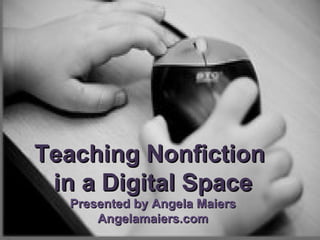
Teaching NonFiction in a Digital Space

Loading...

Flash Player 9 (or above) is needed to view presentations.
We have detected that you do not have it on your computer. To install it, go here.

0 comments

Post a comment

    Post a comment
    Embed Video
    Edit your comment Cancel

    Favorites, Groups & Events

    Teaching NonFiction in a Digital Space - Presentation Transcript

    1. Teaching Nonfiction in a Digital Space Presented by Angela Maiers Angelamaiers.com
    2. Agenda/Goals I . What is Information? II. Digitally Literate III. Reading/Writing the Web IV. Lesson Planning
    3.  
    4. ?
    5. STUDY
    6.  
    7. ©Maiers, 2008
    8.  
    9.  
    10.  
    11.  
    12.  
    13.  
      • Explore?
      • Extend?
      • Enlighten?
      • Engage?
      • Exchange?
      • Empower?
    14. Knowledge is Power
    15. ©Angela Maiers, 2008 Code Breaker Text User Meaning Maker Text Critic 21 st Century Reading Proficiency
      • Technology Digital Literacy
    16.  
    17. Is Our Audience There?
      • 93% youth, 94% parents online 1
      • 64% on-line teens (12-17) have participated on social sites 1
      • 59% on-line teens have shared ALL of the following 2 :
        • Artwork (videos, photos, stories)
        • Blogs or Webpages for Member Groups
        • Online Journals or Personal Blogs
        • Personal Webpage
        • Remixed Content
      • 1 – Pew Internet & American Life Project, 2008; 2 – Pew Internet & American Life Project, 2007
    18. Is Our Audience There?
      • 45% Youth 7-17 in <$15K households have computer at home (2003) 1
      • 52% of connected families go online together for shared experiences 2
      • Lower income youth download more study guides 1
      • Lower income youth more apt to visit conversational sites to express opinions 1
      • 80% of households in demo own game systems 1
      • 94% of parents present when video games bought 3
      • 63% teens, 89% parents have cell phones 2
      • 1 – G. Knell, National Literacy Summit, 2007; 2 – Pew Internet & American Life Project, 2008; 3 – Entertainment Software Association, 2008 Essential Facts
    19. Is Our Audience There?
      • 56% low-income Hispanics are on-line 1
      • 78% English-dominant; 76% Bilingual; 32% Spanish-dominant 1
      • 59% of Latino adults have cell phones; 49% w/text 1
      • Hispanic audience share growing 2X U.S. 1
      • Low-Income Hispanics 2
        • 5 of top 10 Websites are Social Media Sites
        • 4 of top 10 are search sites
        • Other is Univision
        • No. 1 is MySpace (1.1 million Hispanics there)
      • 1 – Pew Hispanic Center, March 2007; 2 – Quantcast 2009
    20. Is Our Audience There?
      • Low-Income w/Children 1
        • 4 of top 10 Websites are Social Media Sites
        • Other 6 of top 10 are search/ISP sites
        • MySpace No. 3; YouTube No. 4; Facebook No. 8
      • Low-Income Minorities w/Children 1
        • 6 of top 10 Websites are Social Media Sites
        • Other 4 of top 10 are search/ISP sites
        • MySpace No. 1; YouTube No. 4; Facebook No. 9
      • 1 – Quantcast 2009
    21.  
    22. Understanding the Read/Write Web
    23.  
    24.  
    25.  
    26.  
    27. The Basics
    28. ©Angela Maiers, 2008 Code Breaker Text User Meaning Maker Text Critic 21 st Century Reading Proficiency
      • Conventions
      • Language
      • Syntax
      • Semantics
    29. Letters
    30. Words/Symbols @ edu .net
    31. Punctuation . __ // ( )
    32. Language delicious digg tweet tinyurl
    33. ©Angela Maiers, 2008 Code Breaker Text User Meaning Maker Text Critic 21 st Century Reading Proficiency
    34. Text User
      • Genre
      • Form
      • Format
      • Medium
    35.  
    36.  
    37. ©Angela Maiers, 2008 Code Breaker Text User Meaning Maker Text Critic 21 st Century Reading Proficiency
    38.  
      • Ask Q
      • Schema
      • Inference
      • Det Imp
      • Visualize
      • Monitor
      • Synthesize
    39. Strategy Left/Right Link Forwards/Backwards Up/Down
    40. ©Angela Maiers, 2008 Code Breaker Text User Meaning Maker Text Critic 21 st Century Reading Proficiency
      • Purpose
      • Intention
      • Motivation
      • Bias
      • Viewpoint
      • Credibility
      • Reliability
      • Craft
    41. New Literacy Lessons
    42. Find it Decode It Analyze it Organize it Use it Share it
      • Google
      • Google Image
    43. Find it
    44. “ Global Warming ”
    45.  
    46. Decode It
      • Type of site
        • .com
        • .org
        • .net
        • .gov
        • .edu
      At a Glance
      • Type of site
        • .com
        • .org
        • .net
        • .gov
        • .edu
      Author & Bias Author’s Name Contact Info Advertisements Timestamp Copyright Date At a Glance
    47. Analyze It
    48.  
    49.  
      • What’s on the Page?
      • Who Wrote It & What do We Know About Them?
      • What Are Others Saying About It?
      • When Was it Written?
    50. “ Get” to Front Page http:www.sandiegozoo.org/teachers/classroom_activities.html http:www.sandiegozoo.org/teachers/ http:www.sandiegozoo.org/
    51. Organize It
    52.  
    53. Use It?
    54. Share It!
    55.  
      • Language Literacy
      • Visuwords:  http://www.visuwords.com/
      • Wordle:  http://www.wordle.net/
      • Kids Spell Spelling Games:  http://www.kidsspell.com/
      • http://www.languagegames.org/
      • Health Literacy
      • Kidnetic:  http://www.kidnetic.com/
      • Financial Literacy
      • Kids Count:  http://www.nfikidscount.org/
      • Economic Glossary:  http://www2.scholastic.com/browse/article.jsp?id=3750579
      • Visual Literacy
      • CogDog 50 Digital Storytelling:  http://cogdogroo.wikispaces.com/StoryTools
      • Artsonia http://www.artsonia.com/
      • Numeracy:
      • Math Dictionary for Kids:  http://www.teachers.ash.org.au/jeather/maths/dictionary.html
      • Create-a-Graph:  http://nces.ed.gov/nceskids/createagraph/default.aspx
      • New Media Literacy
      • Real eBooks:  http://www.realebooks.com/
      • WillowWeb Podcast:  http://www.mpsomaha.org/willow/Radio/
      • Music Literacy
      • http://www.creatingmusic.com/
      • In ternet Literacy
      • http://kidrocket.org/
      • http://www.kindernet.com/
      • http://www.kidsclick.org/
      • Professional Development
      • Classroom 2.0
      • English Teacher Ning
      • Twitter.com
    56.  
    57.  
    58.  

    + angelamaiersangelamaiers, 5 months ago

    custom

    345 views, 0 favs, 0 embeds more stats

    Day Two of Clinton Institute

    More info about this document

    © All Rights Reserved

    Go to text version

    • Total Views 345
      • 345 on SlideShare
      • 0 from embeds
    • Comments 0
    • Favorites 0
    • Downloads 12
    Most viewed embeds

    more

    All embeds

    less

    Flagged as inappropriate Flag as inappropriate
    Flag as inappropriate

    Select your reason for flagging this presentation as inappropriate. If needed, use the feedback form to let us know more details.

    Cancel
    File a copyright complaint
    Having problems? Go to our helpdesk?

    Categories