Types of Error in Mechanical Measurement & Metrology (MMM)
The document discusses various types of errors that can occur in mechanical measurement and metrology. It outlines 11 types of errors: gross, systematic, instrument, environmental, observation, alignment, elastic deformation, dirt, contact, parallax, and random errors. For each error type, it provides a definition and examples to explain the source and nature of the error. The goal is to bring awareness to common errors that can impact measurements so they can be avoided or accounted for.
Overview of a presentation on Mechanical Measurement & Metrology focusing on the types of errors.
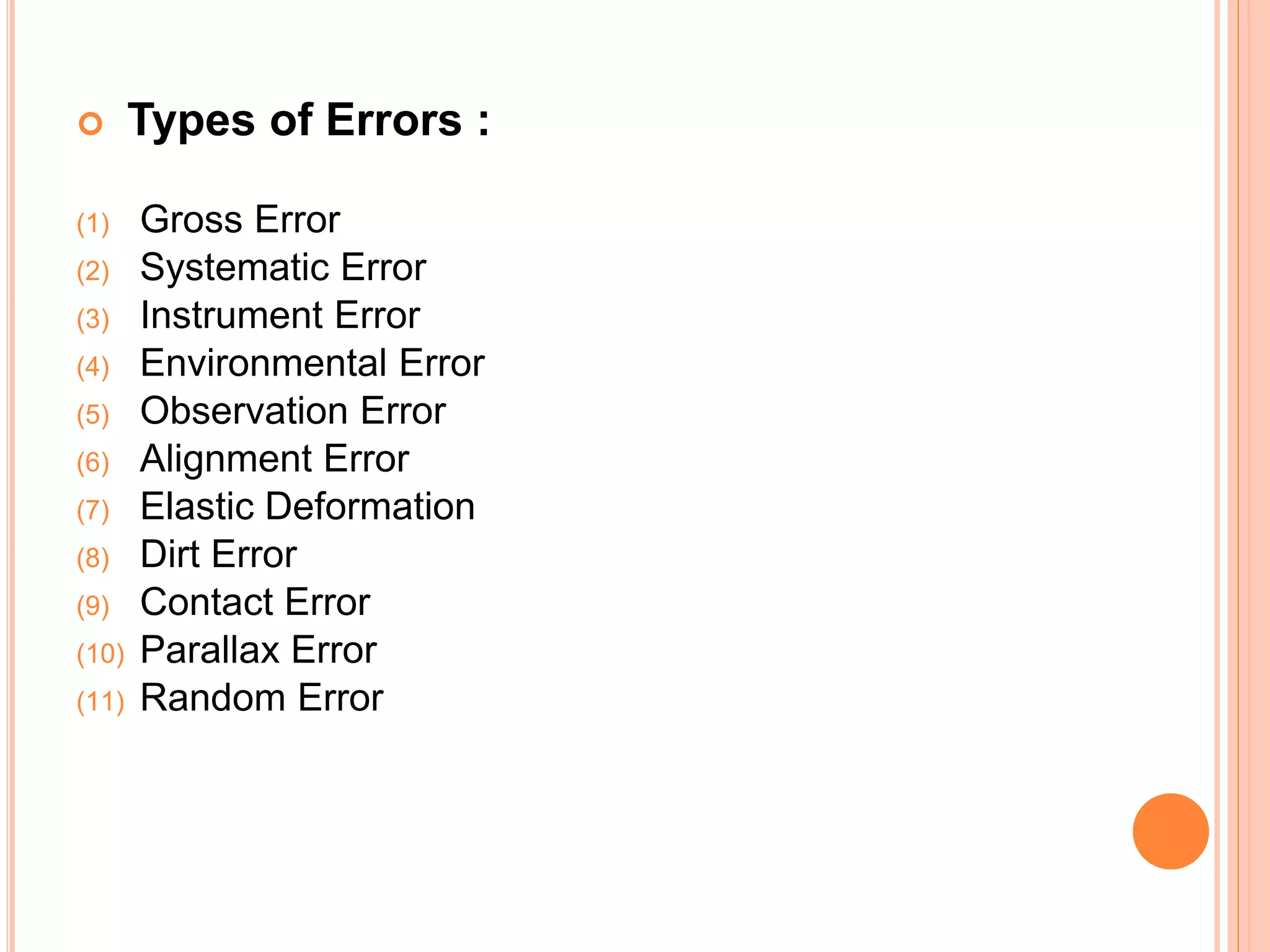
Discussion of different types of errors in measurement including Gross, Systematic, Instrument, Environmental, Observation, Alignment, Elastic Deformation, Dirt, Contact, Parallax, and Random errors.
Description of Gross Errors caused by human mistakes in measurement, emphasizing the importance of careful data handling.
Explanation of Systematic Errors, their causes, and how they can be controlled through proper analysis.
Details on Instrument Errors stemming from design and maintenance issues, and ways to mitigate these through proper selection.
Description of Environmental Errors caused by external conditions like temperature and humidity affecting measurements.
Overview of Observation Errors related to human factors, with examples of potential mistakes in data handling.
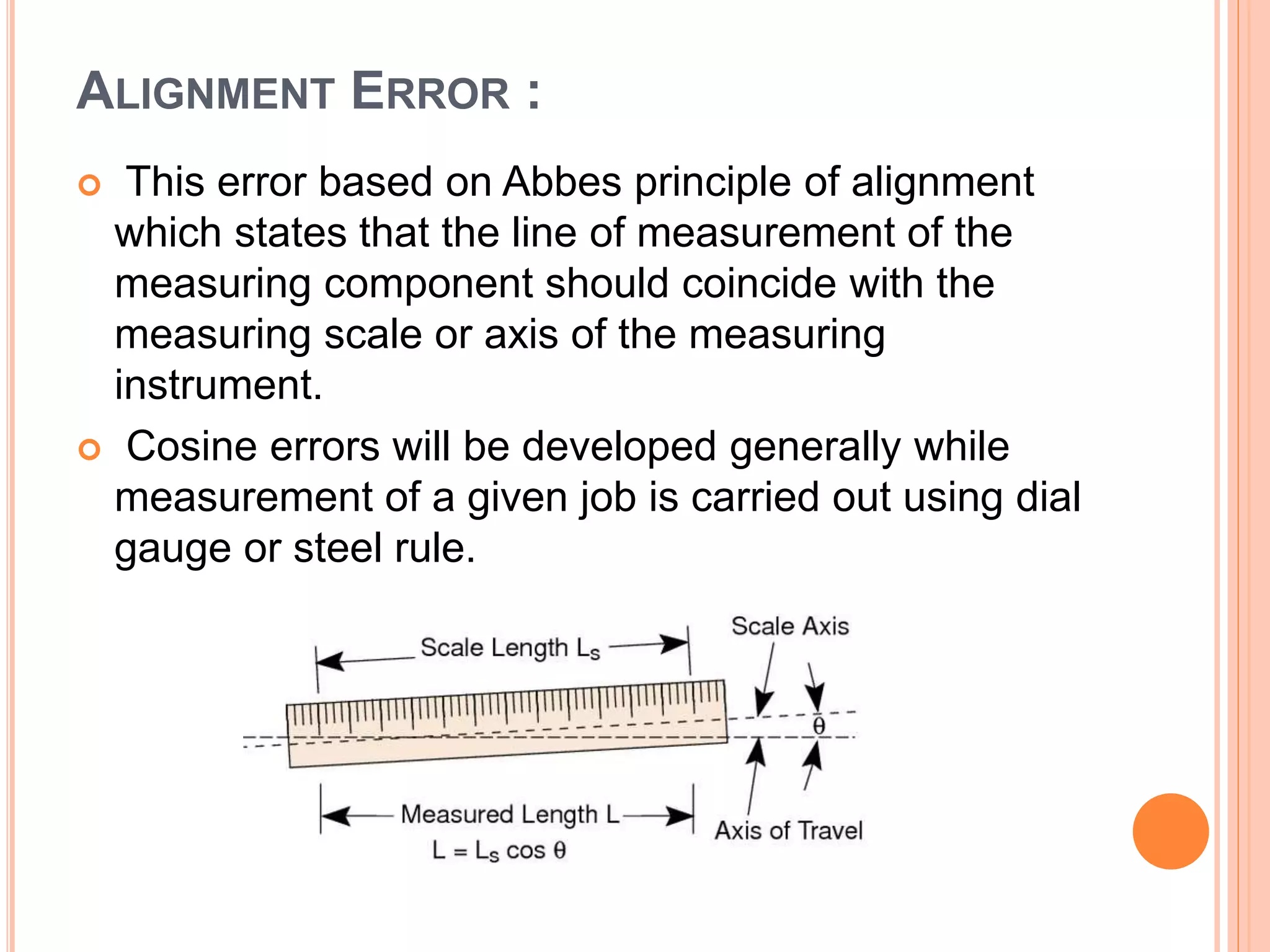
Explanation of Alignment Errors based on Abbes principle, highlighting the impact of misalignment on measurements.
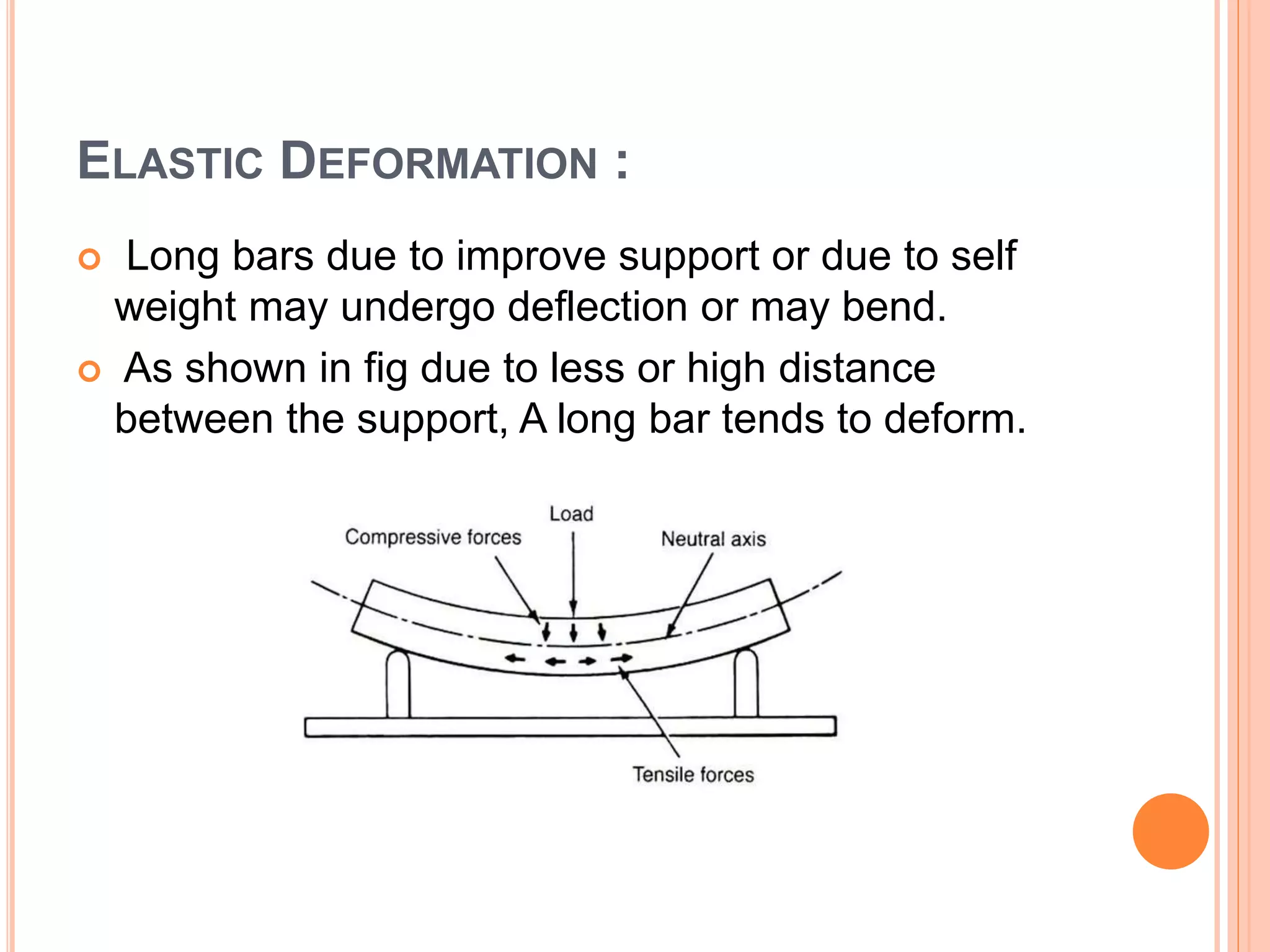
Discussion of Elastic Deformation due to physical forces acting on long bars, affecting measurement accuracy.
Description of Dirt Errors caused by particles in the measurement area and suggestions for dust-proof environments.
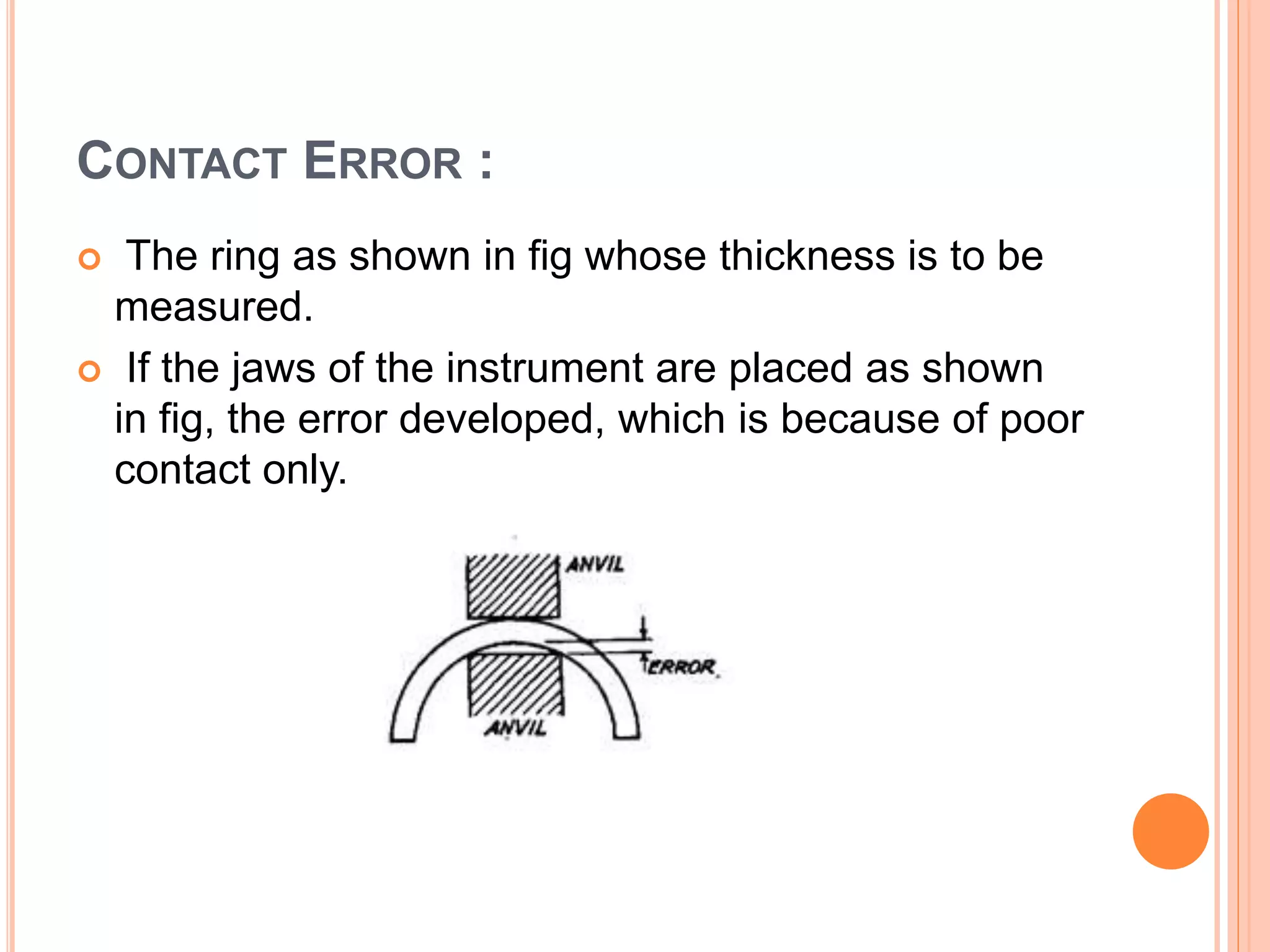
Explanation of Contact Errors due to poor contact in measurement and the implications for accuracy.
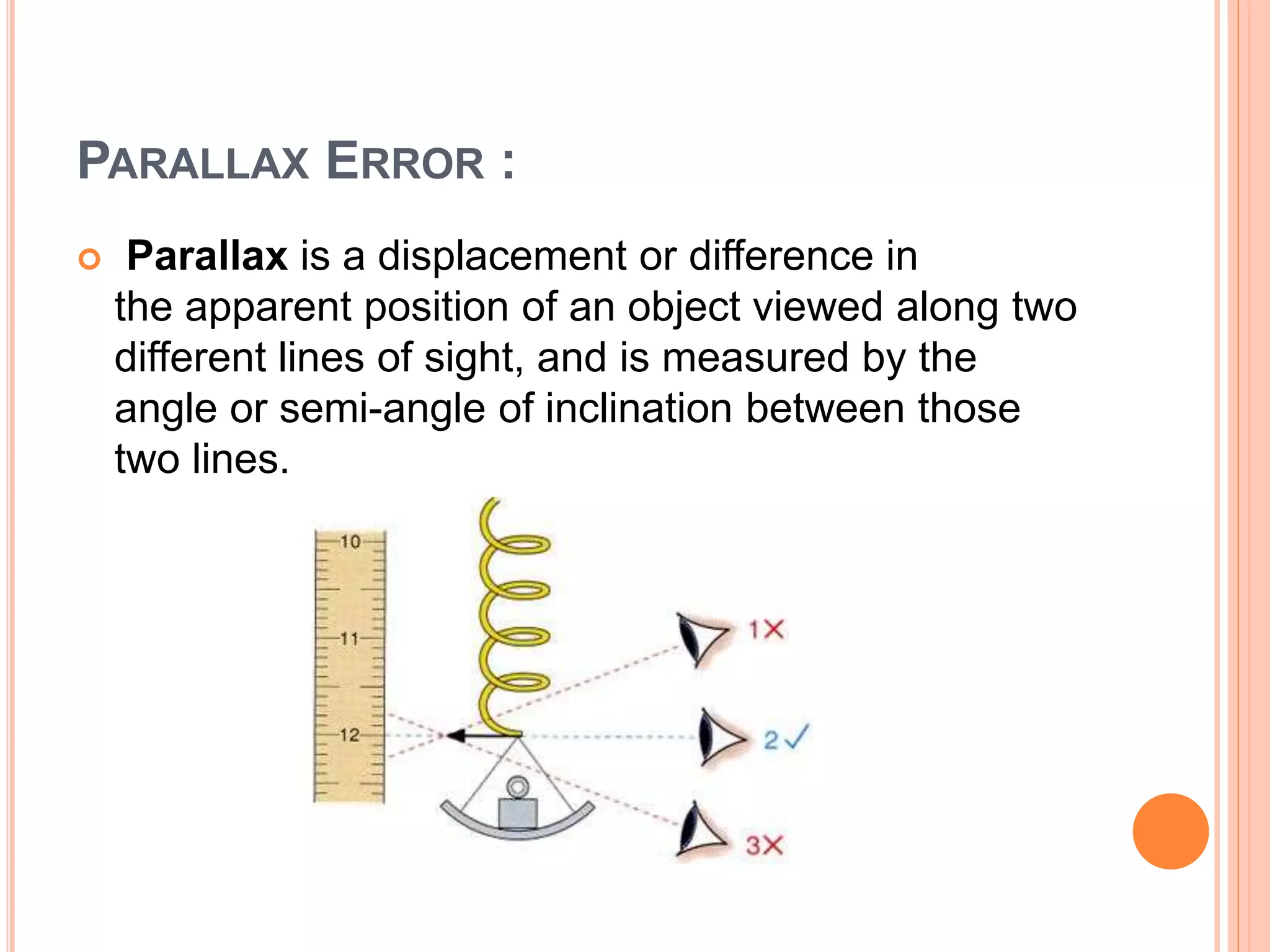
Definition of Parallax Errors as the apparent position change due to different viewing angles in measurements.
Summary of Random Errors caused by unknown variations in measurements, emphasizing unpredictability.
GROSS ERROR :
These errors occur due to human mistakes such
as careless reading, mistake in recording
observation, incorrect applications of a correction,
improper application of instruments.
These errors can not be treated mathematically.
They can be avoided only by taking care in reading
and recording the measurement data.
5.
SYSTEMATIC ERROR :
These error include calibration errors, error due to
variation in the atmospheric condition, variation in
contact pressure etc.
If properly analysed, these errors can be
determined and reduced hence also called
controllable errors.
These errors results from irregular procedure that
are consistent in action.
6.
INSTRUMENT ERROR :
These errors are due to design and construction of
instruments that limits the accuracy of
measurements.
Example : Improper selection of instruments, poor
maintenance, loading effects, etc.
Can be avoided by : Selecting suitable
instruments, applying correction factors, etc.
7.
ENVIRONMENTAL ERROR :
An environmental error is an error in calculations
that are being a part of observations due to
environment.
Any experiment performing anywhere in the
universe has its surroundings, from which we
cannot eliminate our system.
The environmental errors have different causes,
which are widening with the passage of time, as the
research works telling us,
including; temprature, humidity, magnetic field,
constantly vibrating earth surface, wind and
improper lightening.
8.
OBSERVATION ERROR :
When human factors involved in measurement, the
capabilities of individual observers effects the
accuracy of measurement.
The observation errors occur due to poor
capabilities and carelessness of operators.
Example : Wrong reading, wrong calculations,
wrong conversion, wrong recording data, etc.
These errors eliminates by using modern
instrument having digital display.
9.
ALIGNMENT ERROR :
This error based on Abbes principle of alignment
which states that the line of measurement of the
measuring component should coincide with the
measuring scale or axis of the measuring
instrument.
Cosine errors will be developed generally while
measurement of a given job is carried out using dial
gauge or steel rule.
10.
ELASTIC DEFORMATION :
Long bars due to improve support or due to self
weight may undergo deflection or may bend.
As shown in fig due to less or high distance
between the support, A long bar tends to deform.
11.
DIRT ERROR :
Sometimes, dirt particles can enter in the
inspection room through the door and the windows.
These particles can create small dirt errors at the
time of measurement.
These errors can be reduced by making dust proof
laboratories.
12.
CONTACT ERROR :
The ring as shown in fig whose thickness is to be
measured.
If the jaws of the instrument are placed as shown
in fig, the error developed, which is because of poor
contact only.
13.
PARALLAX ERROR :
Parallax is a displacement or difference in
the apparent position of an object viewed along two
different lines of sight, and is measured by the
angle or semi-angle of inclination between those
two lines.
14.
RANDOM ERROR :
These errors are caused due to variation on
position of setting standard and work piece.
Due to Displacement of level joints of instrument,
due to backlash and friction, these error are
induced.
Random errors in experimental measurements are
caused by unknown and unpredictable changes in
the experiment. These changes may occur in the
measuring instruments or in the environmental
conditions.