Systems Management project management, planning and analysis tools BY ENG. AHMAD BASSIOUNY AIR CRAFT FACTORY
What we will cover today Project management What is it What does it involve Methodology Planning and Analysis tools Especially Network Analysis Practical session - Network Analysis!
Project Management What is Project Management? Why is it important? What does it involve:  What practical techniques can we learn and apply?
Project Management “ A whole framework of logical and progressive management planning and decisions, perceptiveness, the liberal application of common sense, proper organisation, effective commercial and financial management, painstaking attention to documentation, and a clear grasp of proven and long-established principles of management and leadership”. (Lock)
What is Project Management? A way of exercising control A way of preventing mistakes A way of maximizing efficiency Why is it important? Project success and failure...
Types of project “ Practical” projects Classic “industrial” subjects e.g. construction Projects with tangible “production” outcomes “ Management” projects Organisational projects e.g. Relocations May not have such a tangible outcome “ Research” projects More difficult to fit in the mould Outcomes may be undefined!
Types of management Cost Time Performance Quality The relationship between cost, time and performance Balance of objectives The importance of good communication
Project management in our contexts Large vs small scale projects Relevance of “proper” techniques Formal considerations  Functional and line management Matrix organization Authority and responsibility What’s the best approach?
PRINCE2 Projects in Controlled Environments Complete project management philosophy Useful framework regardless of scale Not suggesting direct use (in most cases) but approach can remind us of important considerations
PRINCE2 environment Key elements: Organization Plans Controls Project Board Manages project overall Responsibilities/Interests: Executive, User, Technical
PRINCE2 environment  Project manager “ executive” manager - plans, monitors, co-ordinates overall project Stage manager manages parts of projects, focus on schedule/quality/cost targets Project assurance team Business, Technical & User coordinators
Project definition Need for clear scope User specification User needs analysis Feasibility studies Operational requirements Whats and Hows
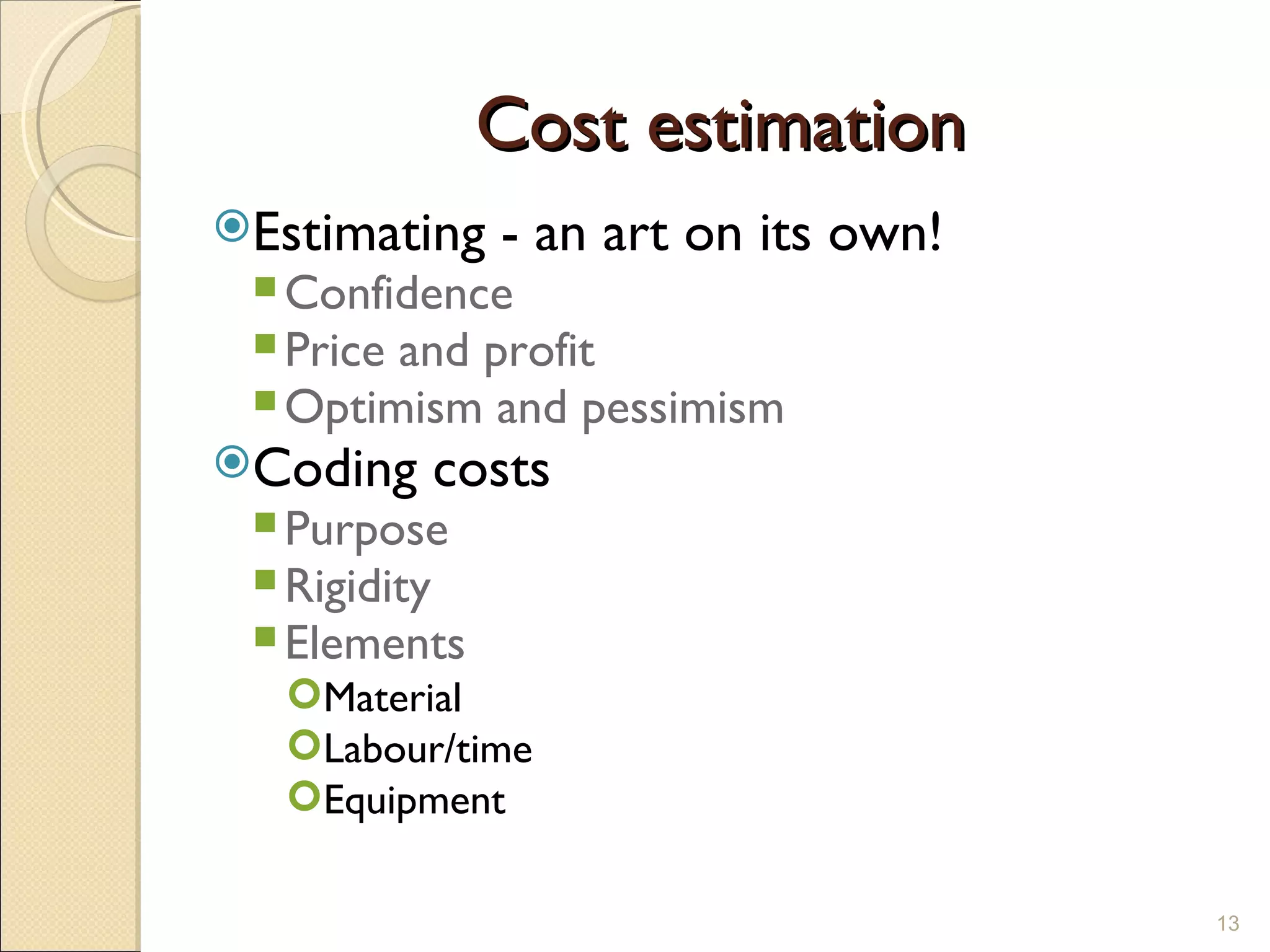
Cost estimation Estimating - an art on its own! Confidence Price and profit Optimism and pessimism Coding costs Purpose Rigidity Elements Material Labour/time Equipment
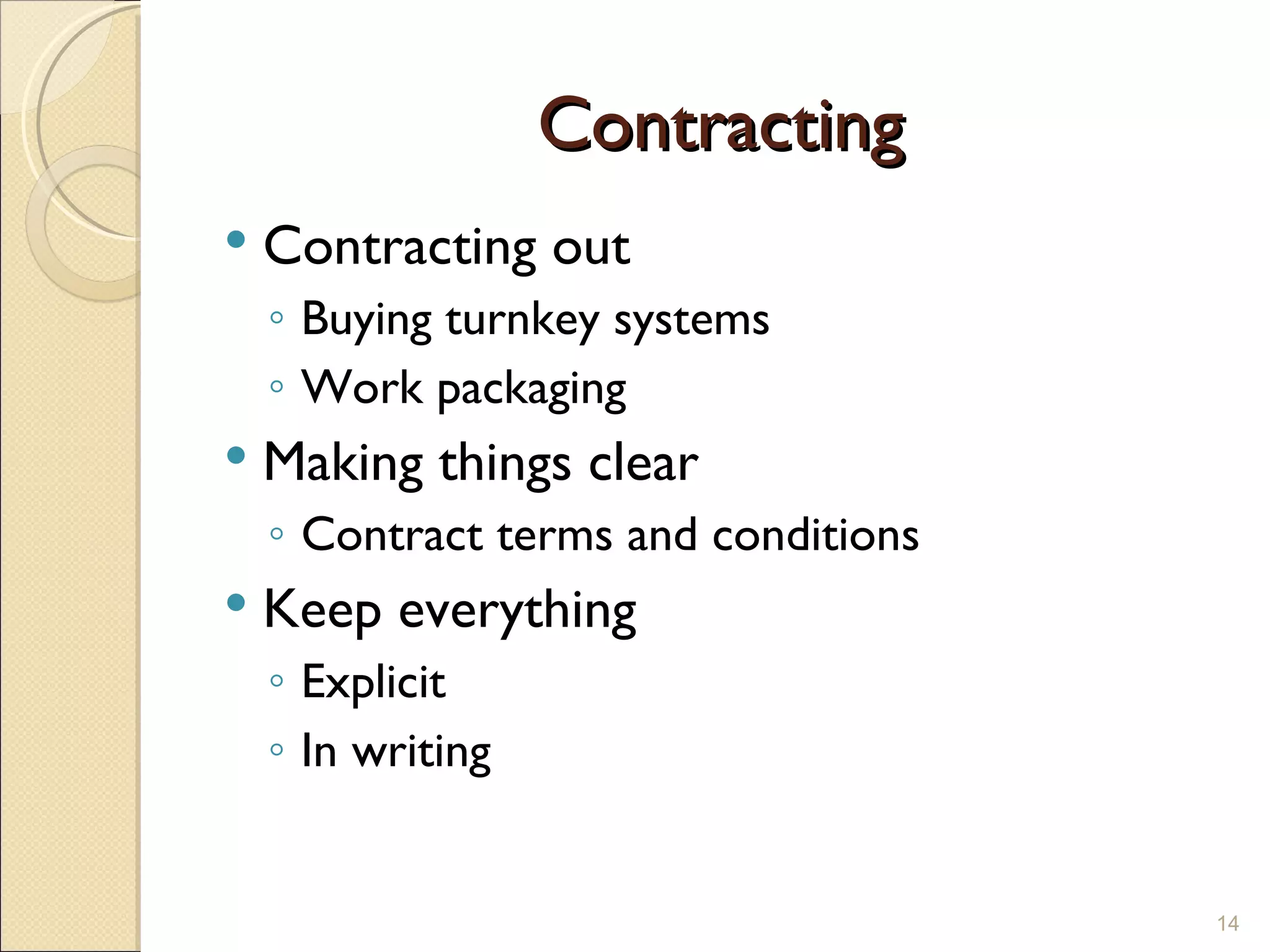
Contracting Contracting out  Buying turnkey systems Work packaging Making things clear Contract terms and conditions Keep everything Explicit In writing
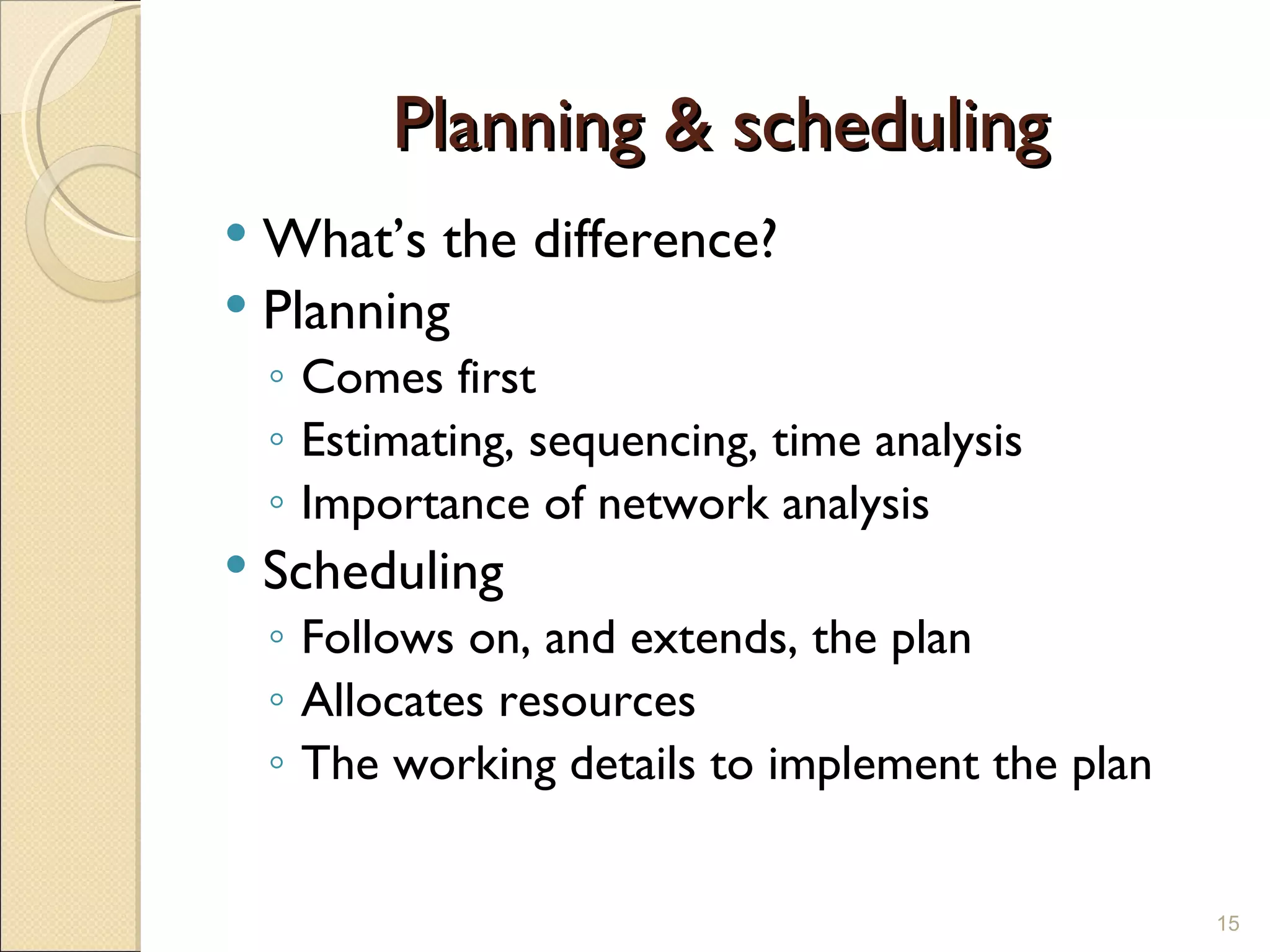
Planning & scheduling What’s the difference? Planning Comes first Estimating, sequencing, time analysis  Importance of network analysis Scheduling Follows on, and extends, the plan Allocates resources The working details to implement the plan
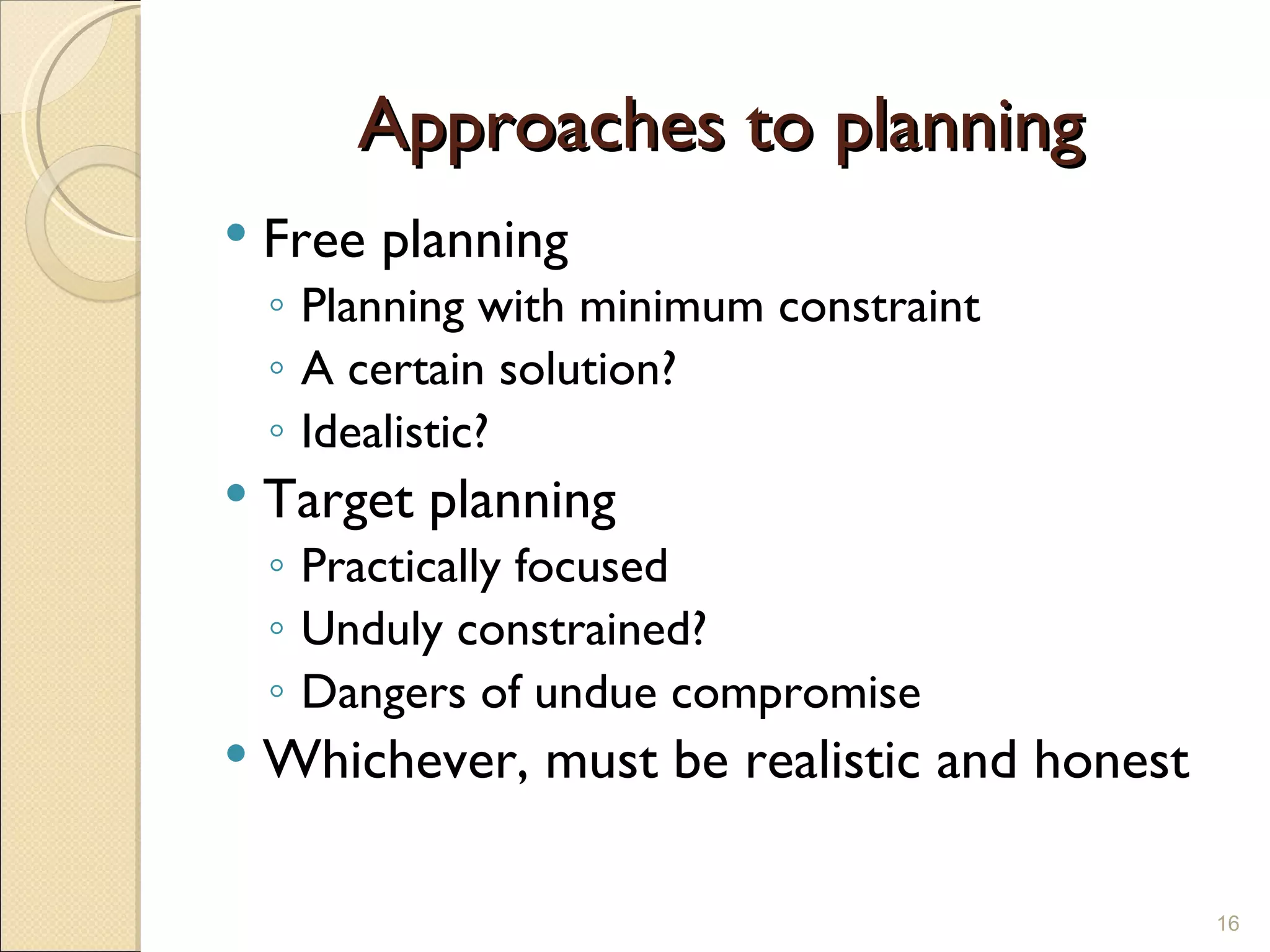
Approaches to planning Free planning Planning with minimum constraint A certain solution? Idealistic? Target planning Practically focused Unduly constrained? Dangers of undue compromise Whichever, must be realistic and honest
Monitoring the plan The key questions: Where should we be? Where are we? And thus What do we need to do? What can go wrong? Estimating errors Execution errors Importance of honesty (again) Key danger - the “knock-on”effect
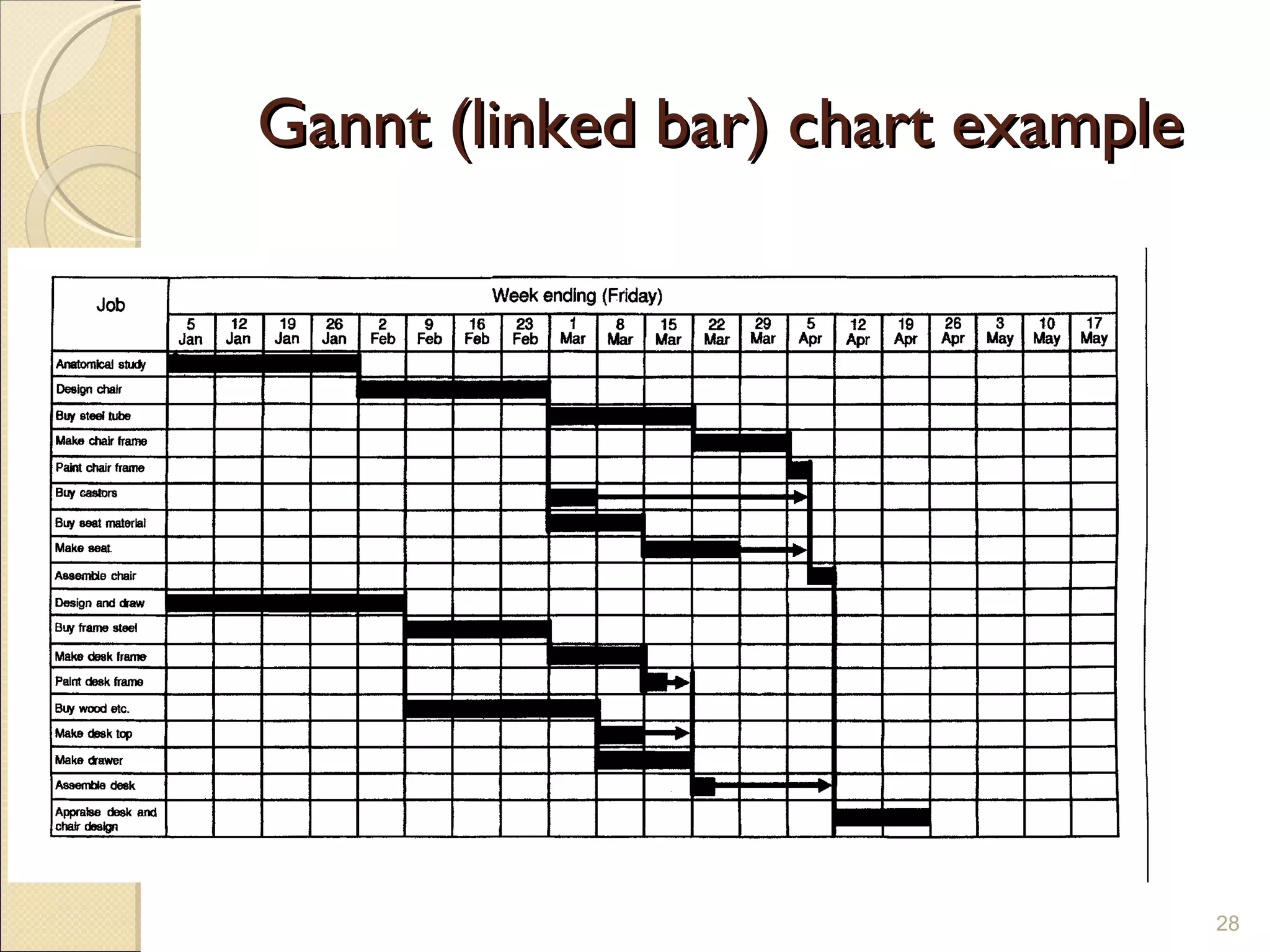
Planning (& scheduling) tools Timetabling Bar charting (Gannt charts) Simple bar charts Linked bar charts Problems Complexity Rescheduling
Network analysis  Not as intuitive … Inappropriate for resource scheduling BUT Much more powerful notation Prevent constraints being missed Allow prioritisation  Criticality quantified by task duration and interdependence
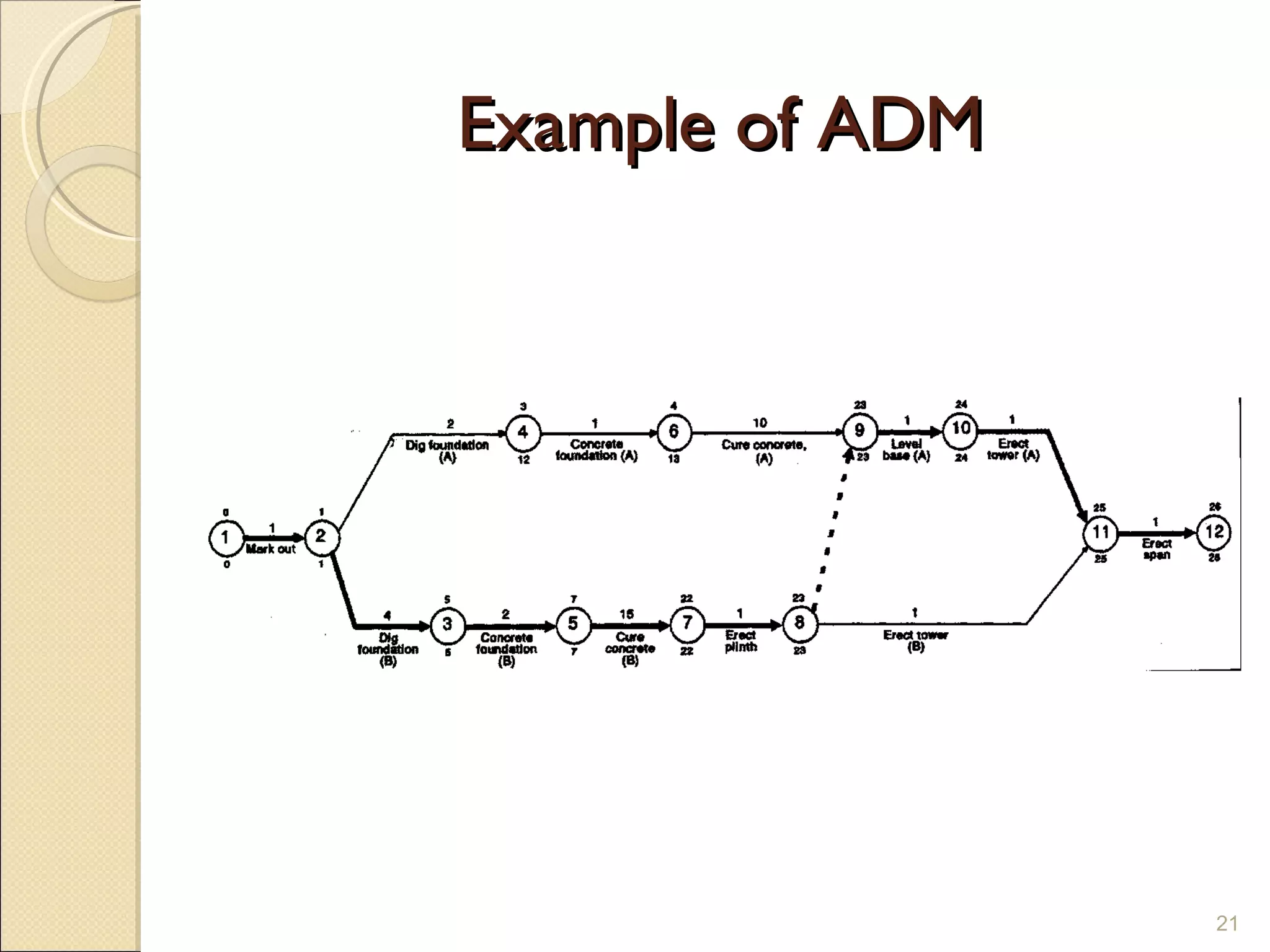
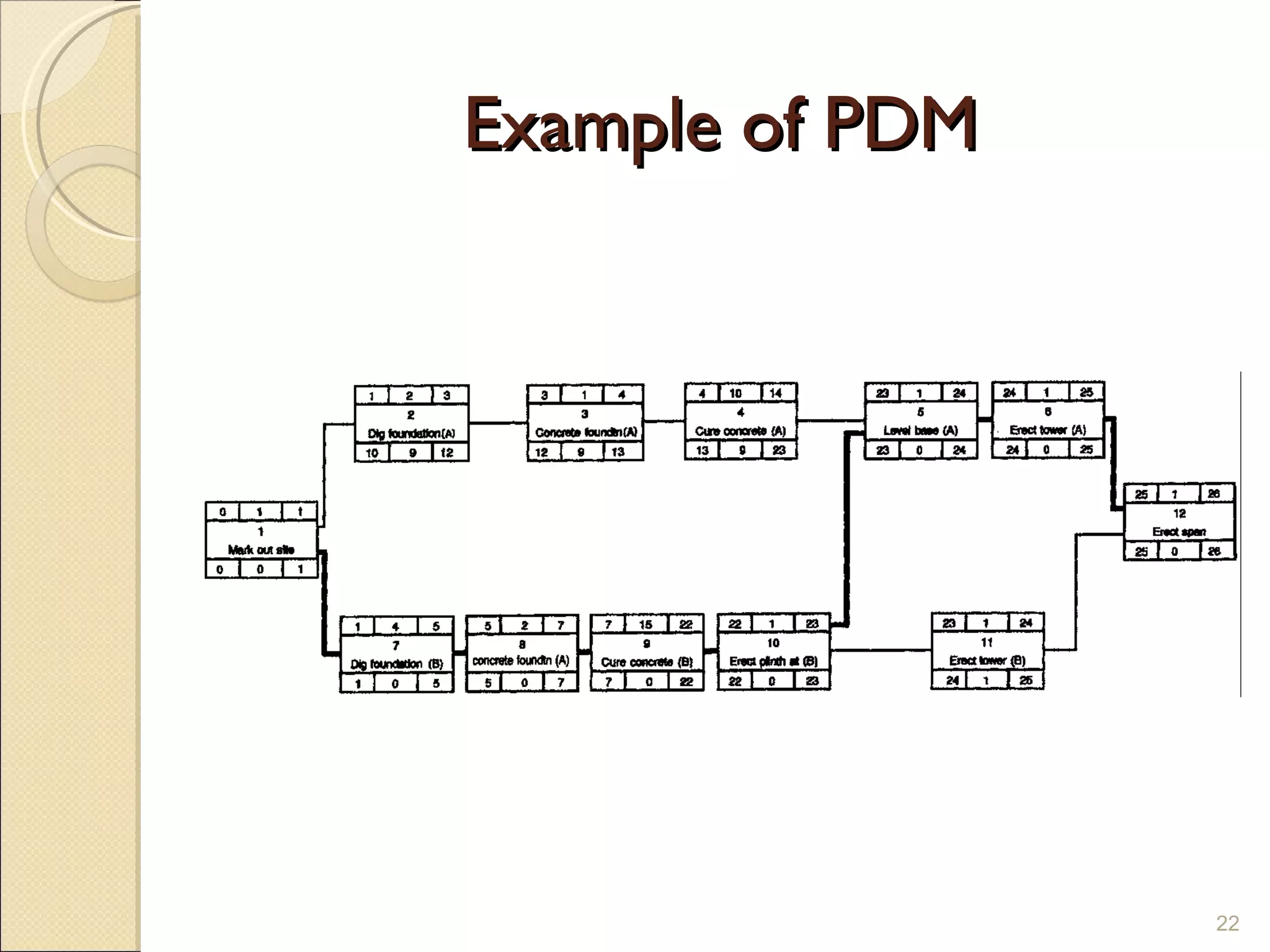
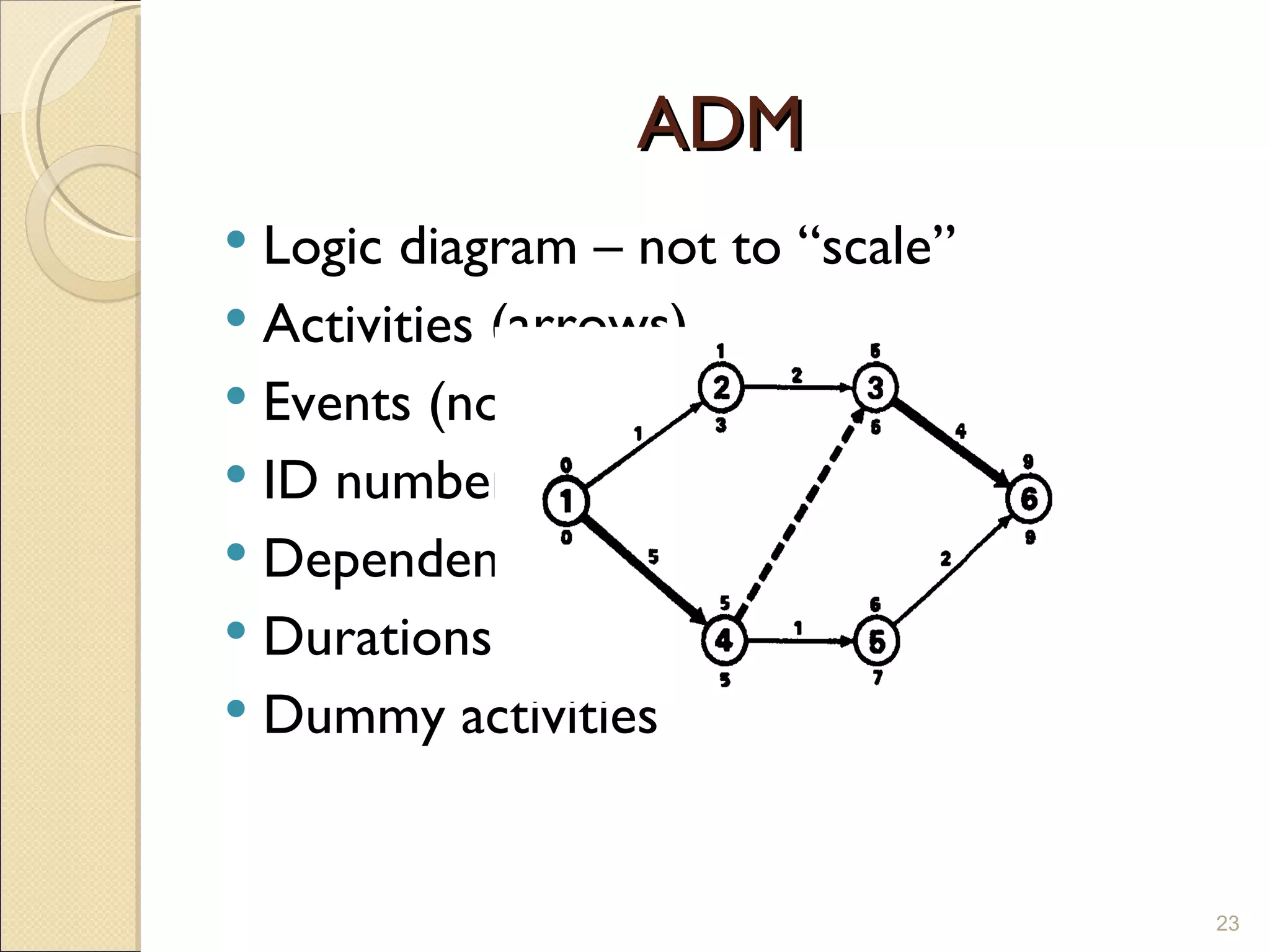
Network analysis Notation systems Arrow systems (activity-on-arrow) ADM, CPM/CPA, PERT Good for initial freehand planning Node systems (activity-on-node) PDM (Precedence Diagram Method) Good for checking Quite acceptable to use either – or both!
Example of ADM
Example of PDM
ADM Logic diagram – not to “scale” Activities (arrows)  Events (nodes) ID numbers Dependencies Durations Dummy activities
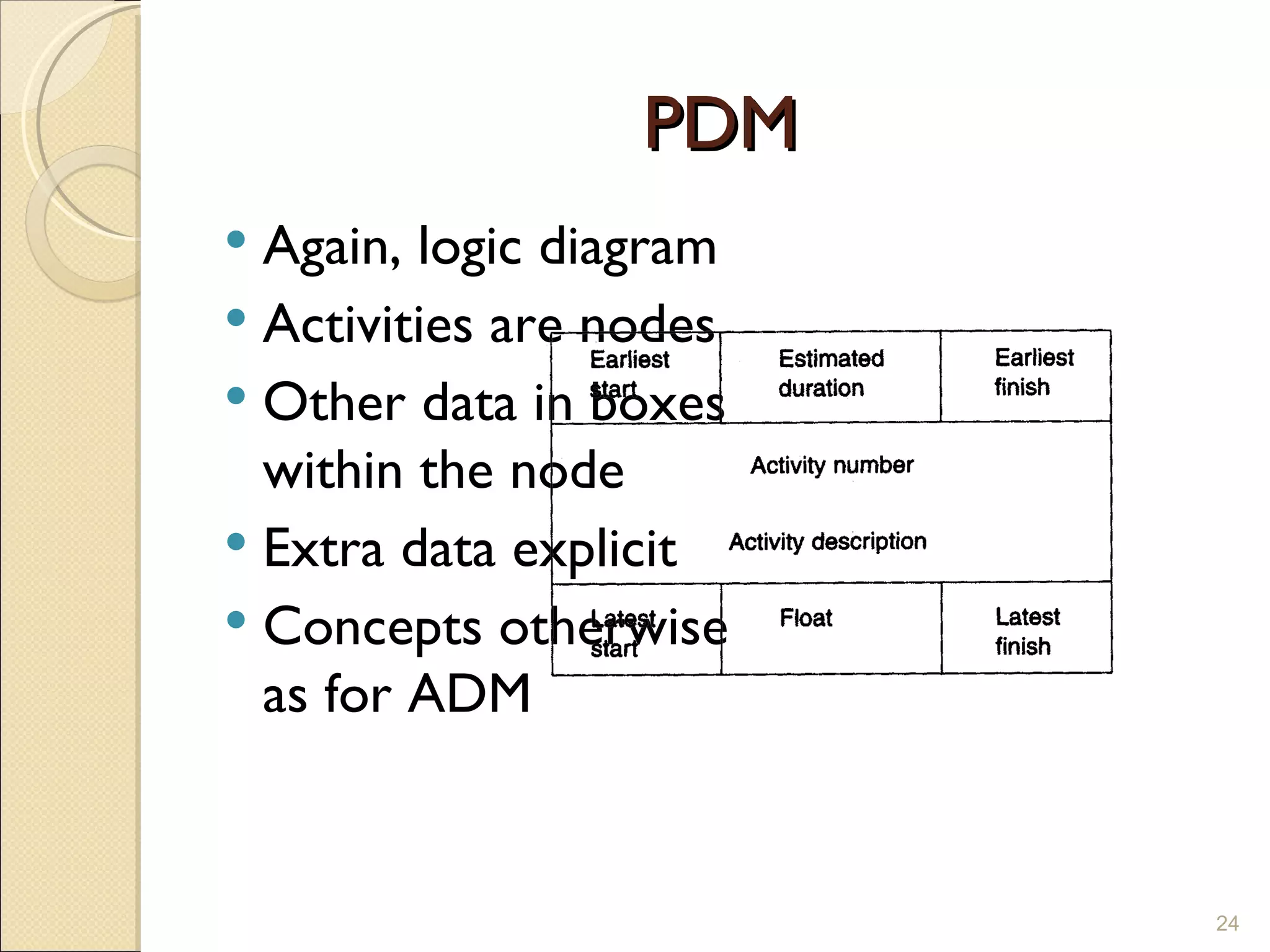
PDM Again, logic diagram Activities are nodes Other data in boxes within the node Extra data explicit Concepts otherwise as for ADM
ADM in practice Brainstorm & rough out plan Check logic (precedence) Estimate durations Perform analysis Forward pass Backward pass Establish CPA and float Review
Resource scheduling Views of resource scheduling Utilisation of actual resource Identifying what’s available How to deploy it as efficiently as possible Identifying what’s needed and what’s surplus? Establishment of requirement for bought-in resource Subcontracting Purchasing
Resource scheduling in practice What can be scheduled? People Equipment Materials  Money Preferred vs constrained (target) scheduling  Relation to the CPA Gannt charting
Gannt (linked bar) chart example
The seven steps of scheduling (after Lock) Define the objectives Divide into manageable parts Decide in detail what has to be done and in what sequence Estimate durations Calculate project lengths and assess significance Reconcile programme with resources Assign jobs
Software for analysis and scheduling Why use a computer? Speed and flexibility… … for large projects! Ease of review and distribution Multiproject scheduling Off-the-shelf products “ Serious” software MS Project
Managing progress The need for review and updating Collecting data Role of good communications Dealing with real-world crises The importance of accuracy and honesty Corrective actions What-ifs and risk analysis
Managing costs Cost reporting vs cost control Cost management factors … many and varied! The Total Cost approach Holistic, cooperative… … Difficult? Budget milestone monitoring Achievement analysis Requires quantification of work done Importance of work breakdown in cost management
Managing quality What is quality? On time on budget? Fitness for purpose? Customer satisfaction? Contractual quality definitions Quality systems Quality plans The importance of commitment
Closure When does a project end? “ The end of a continuous process” Lifecycles Handover Signoff Records Archives Retrievability Post mortem?

Project Management, Planning And Analysis Tools

  • 1.
    Systems Management projectmanagement, planning and analysis tools BY ENG. AHMAD BASSIOUNY AIR CRAFT FACTORY
  • 2.
    What we willcover today Project management What is it What does it involve Methodology Planning and Analysis tools Especially Network Analysis Practical session - Network Analysis!
  • 3.
    Project Management Whatis Project Management? Why is it important? What does it involve: What practical techniques can we learn and apply?
  • 4.
    Project Management “A whole framework of logical and progressive management planning and decisions, perceptiveness, the liberal application of common sense, proper organisation, effective commercial and financial management, painstaking attention to documentation, and a clear grasp of proven and long-established principles of management and leadership”. (Lock)
  • 5.
    What is ProjectManagement? A way of exercising control A way of preventing mistakes A way of maximizing efficiency Why is it important? Project success and failure...
  • 6.
    Types of project“ Practical” projects Classic “industrial” subjects e.g. construction Projects with tangible “production” outcomes “ Management” projects Organisational projects e.g. Relocations May not have such a tangible outcome “ Research” projects More difficult to fit in the mould Outcomes may be undefined!
  • 7.
    Types of managementCost Time Performance Quality The relationship between cost, time and performance Balance of objectives The importance of good communication
  • 8.
    Project management inour contexts Large vs small scale projects Relevance of “proper” techniques Formal considerations Functional and line management Matrix organization Authority and responsibility What’s the best approach?
  • 9.
    PRINCE2 Projects inControlled Environments Complete project management philosophy Useful framework regardless of scale Not suggesting direct use (in most cases) but approach can remind us of important considerations
  • 10.
    PRINCE2 environment Keyelements: Organization Plans Controls Project Board Manages project overall Responsibilities/Interests: Executive, User, Technical
  • 11.
    PRINCE2 environment Project manager “ executive” manager - plans, monitors, co-ordinates overall project Stage manager manages parts of projects, focus on schedule/quality/cost targets Project assurance team Business, Technical & User coordinators
  • 12.
    Project definition Needfor clear scope User specification User needs analysis Feasibility studies Operational requirements Whats and Hows
  • 13.
    Cost estimation Estimating- an art on its own! Confidence Price and profit Optimism and pessimism Coding costs Purpose Rigidity Elements Material Labour/time Equipment
  • 14.
    Contracting Contracting out Buying turnkey systems Work packaging Making things clear Contract terms and conditions Keep everything Explicit In writing
  • 15.
    Planning & schedulingWhat’s the difference? Planning Comes first Estimating, sequencing, time analysis Importance of network analysis Scheduling Follows on, and extends, the plan Allocates resources The working details to implement the plan
  • 16.
    Approaches to planningFree planning Planning with minimum constraint A certain solution? Idealistic? Target planning Practically focused Unduly constrained? Dangers of undue compromise Whichever, must be realistic and honest
  • 17.
    Monitoring the planThe key questions: Where should we be? Where are we? And thus What do we need to do? What can go wrong? Estimating errors Execution errors Importance of honesty (again) Key danger - the “knock-on”effect
  • 18.
    Planning (& scheduling)tools Timetabling Bar charting (Gannt charts) Simple bar charts Linked bar charts Problems Complexity Rescheduling
  • 19.
    Network analysis Not as intuitive … Inappropriate for resource scheduling BUT Much more powerful notation Prevent constraints being missed Allow prioritisation Criticality quantified by task duration and interdependence
  • 20.
    Network analysis Notationsystems Arrow systems (activity-on-arrow) ADM, CPM/CPA, PERT Good for initial freehand planning Node systems (activity-on-node) PDM (Precedence Diagram Method) Good for checking Quite acceptable to use either – or both!
  • 21.
  • 22.
  • 23.
    ADM Logic diagram– not to “scale” Activities (arrows) Events (nodes) ID numbers Dependencies Durations Dummy activities
  • 24.
    PDM Again, logicdiagram Activities are nodes Other data in boxes within the node Extra data explicit Concepts otherwise as for ADM
  • 25.
    ADM in practiceBrainstorm & rough out plan Check logic (precedence) Estimate durations Perform analysis Forward pass Backward pass Establish CPA and float Review
  • 26.
    Resource scheduling Viewsof resource scheduling Utilisation of actual resource Identifying what’s available How to deploy it as efficiently as possible Identifying what’s needed and what’s surplus? Establishment of requirement for bought-in resource Subcontracting Purchasing
  • 27.
    Resource scheduling inpractice What can be scheduled? People Equipment Materials Money Preferred vs constrained (target) scheduling Relation to the CPA Gannt charting
  • 28.
    Gannt (linked bar)chart example
  • 29.
    The seven stepsof scheduling (after Lock) Define the objectives Divide into manageable parts Decide in detail what has to be done and in what sequence Estimate durations Calculate project lengths and assess significance Reconcile programme with resources Assign jobs
  • 30.
    Software for analysisand scheduling Why use a computer? Speed and flexibility… … for large projects! Ease of review and distribution Multiproject scheduling Off-the-shelf products “ Serious” software MS Project
  • 31.
    Managing progress Theneed for review and updating Collecting data Role of good communications Dealing with real-world crises The importance of accuracy and honesty Corrective actions What-ifs and risk analysis
  • 32.
    Managing costs Costreporting vs cost control Cost management factors … many and varied! The Total Cost approach Holistic, cooperative… … Difficult? Budget milestone monitoring Achievement analysis Requires quantification of work done Importance of work breakdown in cost management
  • 33.
    Managing quality Whatis quality? On time on budget? Fitness for purpose? Customer satisfaction? Contractual quality definitions Quality systems Quality plans The importance of commitment
  • 34.
    Closure When doesa project end? “ The end of a continuous process” Lifecycles Handover Signoff Records Archives Retrievability Post mortem?