Creating Mathematical Opportunities in 
the Early Years 
Dr Tracey Muir 
University of Tasmania 
AAMT Connect with 
Maths 
26th August 2014
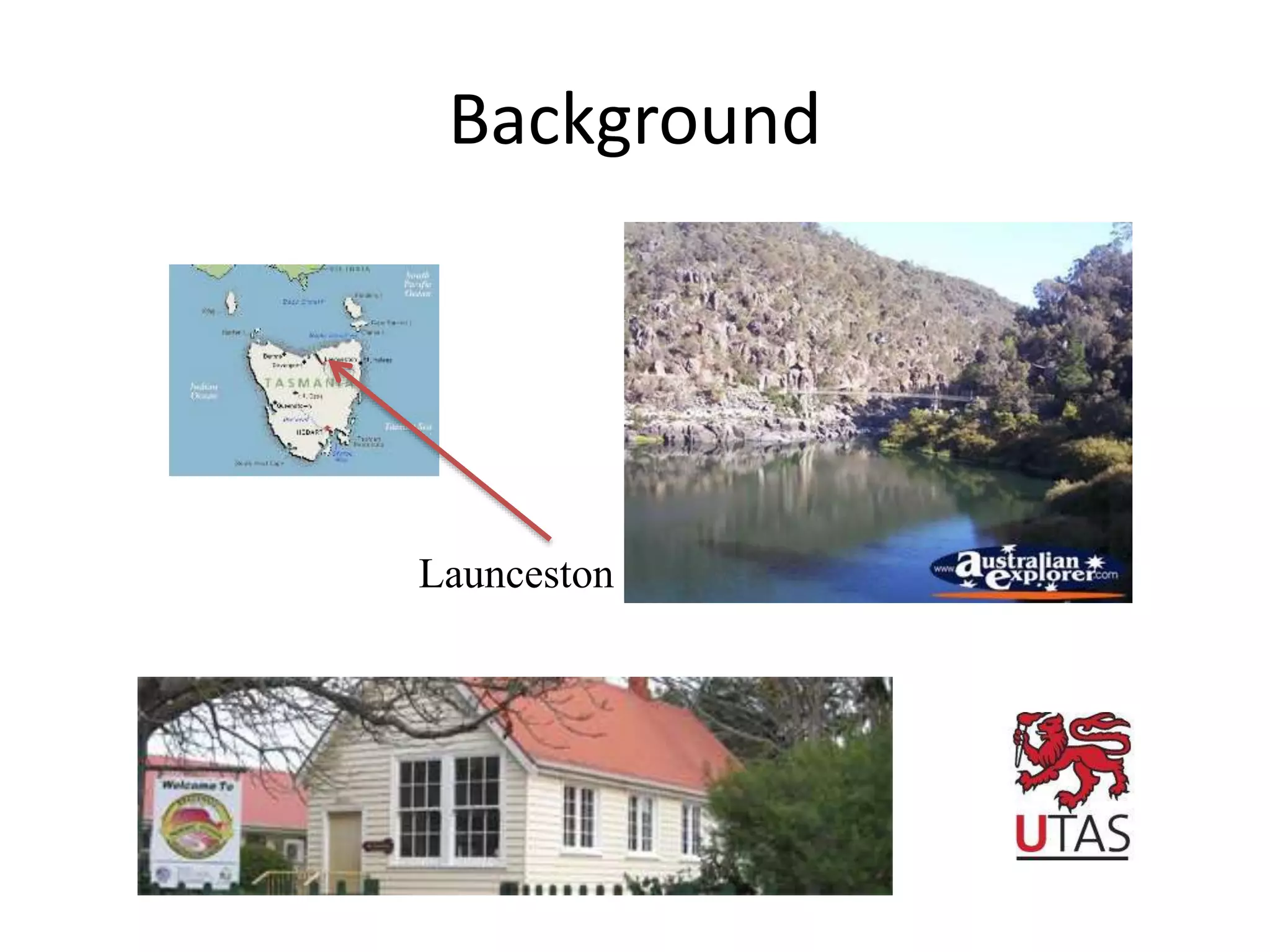
Background 
Launceston
Overview 
• What does effective mathematics teaching 
look like? 
• What types of knowledge does an effective 
teacher require? 
• How can we provide students with 
authentic mathematical opportunities? 
• What aspects of classroom practice should 
we focus on in order to maximise 
mathematical opportunities?
Connectionist, transmission and 
discovery beliefs 
Connectionist Transmission Discovery 
The use of methods of 
Primarily the ability to 
calculation which are 
perform standard 
both efficient and 
procedures or routines 
effective 
Finding the answer to a 
calculation by any 
method 
Confidence and ability in 
mental methods 
A heavy reliance on 
paper and pencil 
methods 
A heavy reliance on 
practical methods 
Pupil misunderstandings 
need to be recognised, 
made explicit and worked 
on 
Pupils’ 
misunderstandings are 
the result of ‘grasp’ what 
was being taught and 
need to be remedied by 
further reinforcement of 
the ‘correct’ method 
Pupils’ 
misunderstandings are 
the results of pupils not 
being ready to learn the 
ideas 
(Askew, et al., 1997)
Characteristics of effective 
numeracy teachers 
•Emphasise the importance of understanding mathematical 
concepts and the connections between these 
•Have high expectations that all children will engage seriously 
with mathematical ideas 
•Structure purposeful tasks that enable different possibilities, 
strategies and products to emerge 
•Probe and challenge children’s thinking and reasoning 
•Build on children’s mathematical ideas and strategies 
•Are confident in their own knowledge of mathematics at the 
level they are teaching 
(Groves et al., 2006)
Principles of practice 
•Make connections 
•Challenge all pupils 
•Teach for conceptual understanding 
•Purposeful discussion 
•Focus on mathematics 
•Convey and instill positive attitudes 
towards mathematics
Teaching actions 
• Choice of examples 
• Choice of tasks 
• Questioning 
• Use of representations 
• Modelling 
• Teachable moments
How familiar is term PCK? 
(Vote)
• Teacher knowledge 
(Ball, Thames, & Phelps, 2008)
5 Practices 
• Anticipating 
• Monitoring 
• Selecting 
• Sequencing 
• Connecting 
(Smith & Stein, 2011)
Anticipating 
• Planning for ‘teachable moments’ 
• Knowing your subject and the difficulties 
students might encounter 
• Experience, research and reflection 
• Highlighting possible misconceptions in 
planning
Pre-planning 
• What do I need to know and understand 
before teaching this topic? 
• What are the likely difficulties or 
misconceptions students may have?
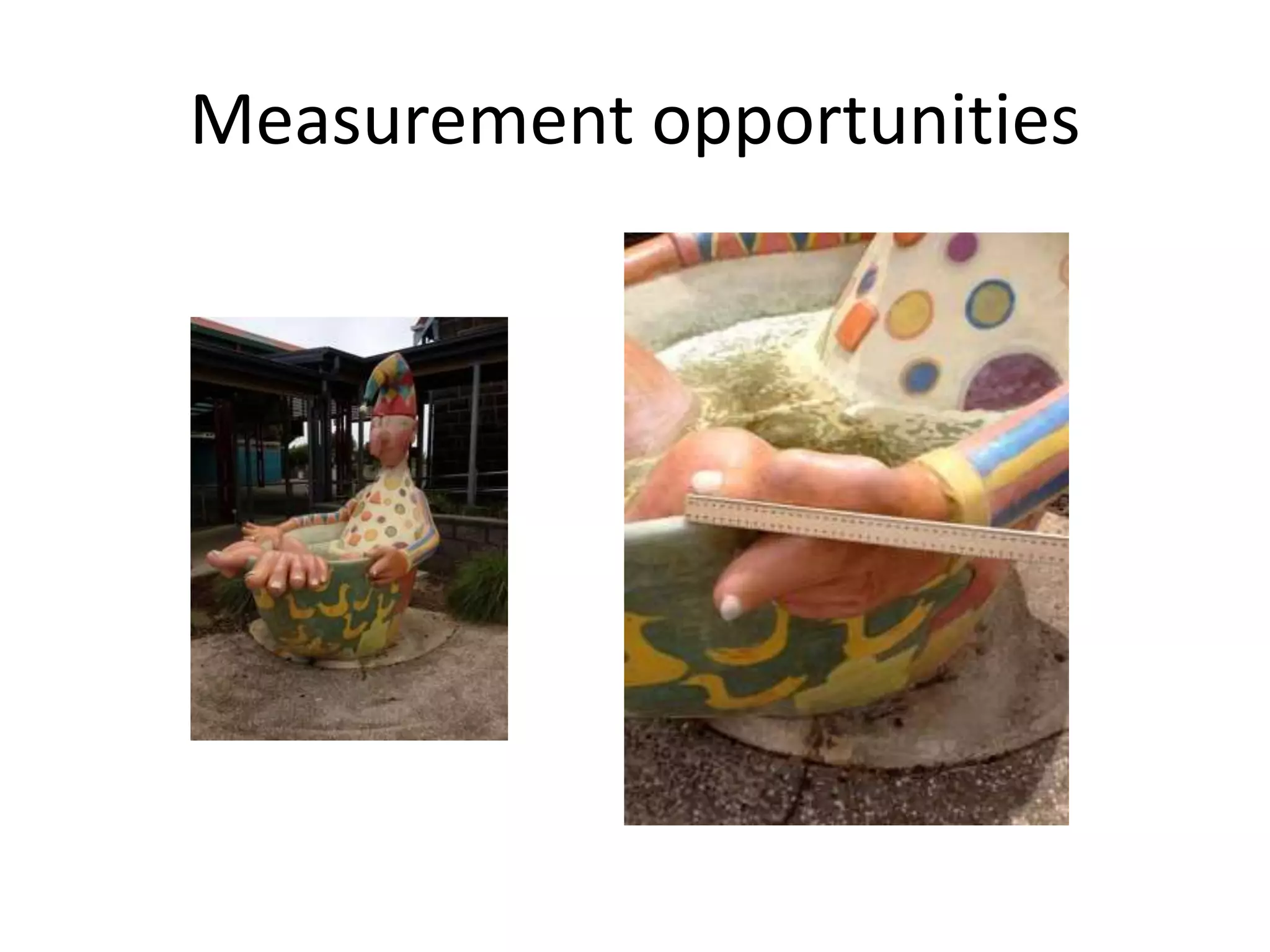
Measurement opportunities
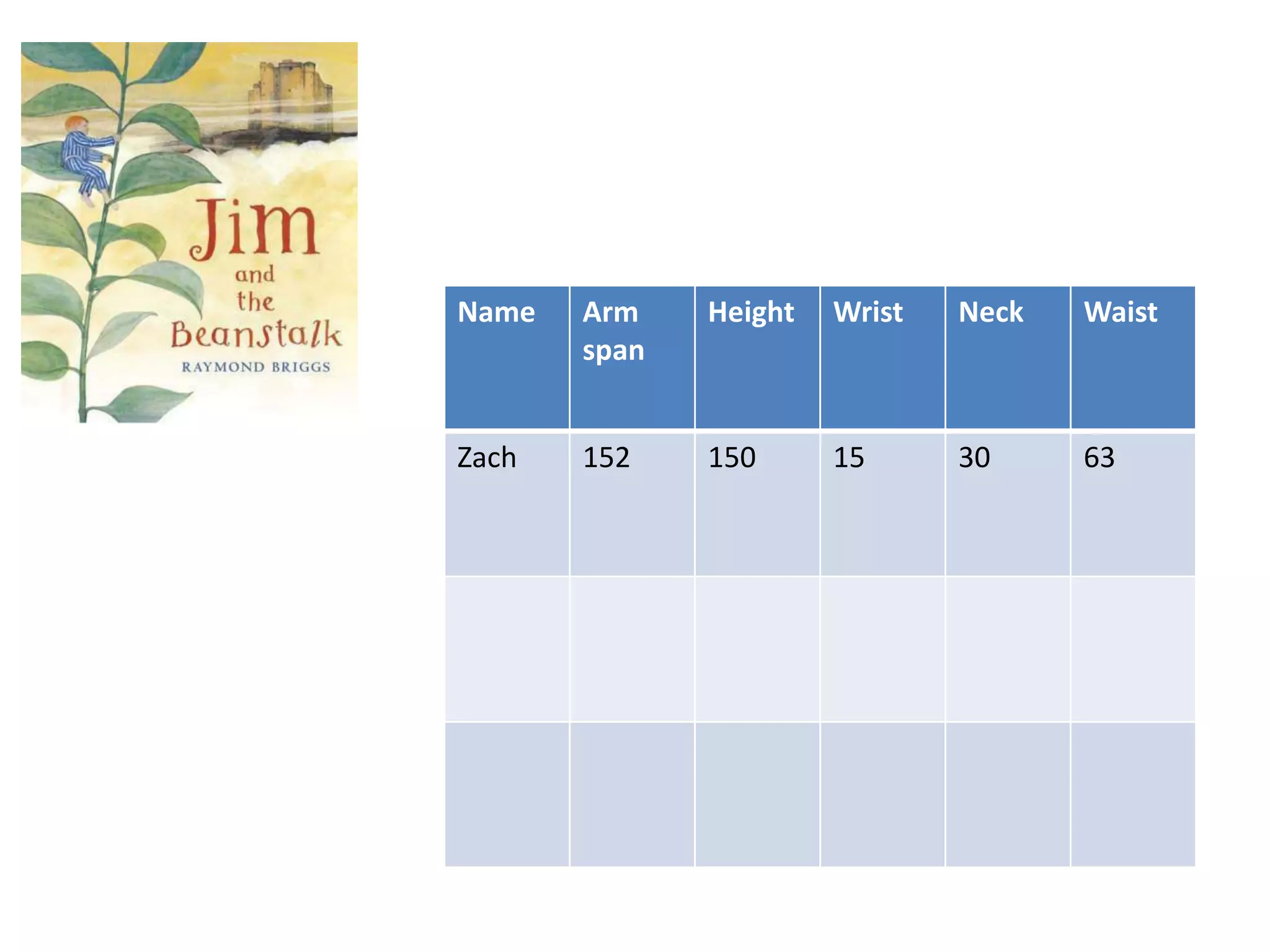
Devise task 
• What are some activities or tasks you could 
undertake to explore ‘Mr Splash’?
• This is a photograph of Mr. Splash. He loves to 
have a bath in his pajamas. He seems to be a 
bit big for the bath! I wonder how tall he is? 
How could we find out?
• Does the tallest person have the longest feet? 
• Does the tallest person have the greatest hand span? 
• Are hand spans and foot lengths related? 
• Are boys taller than girls? 
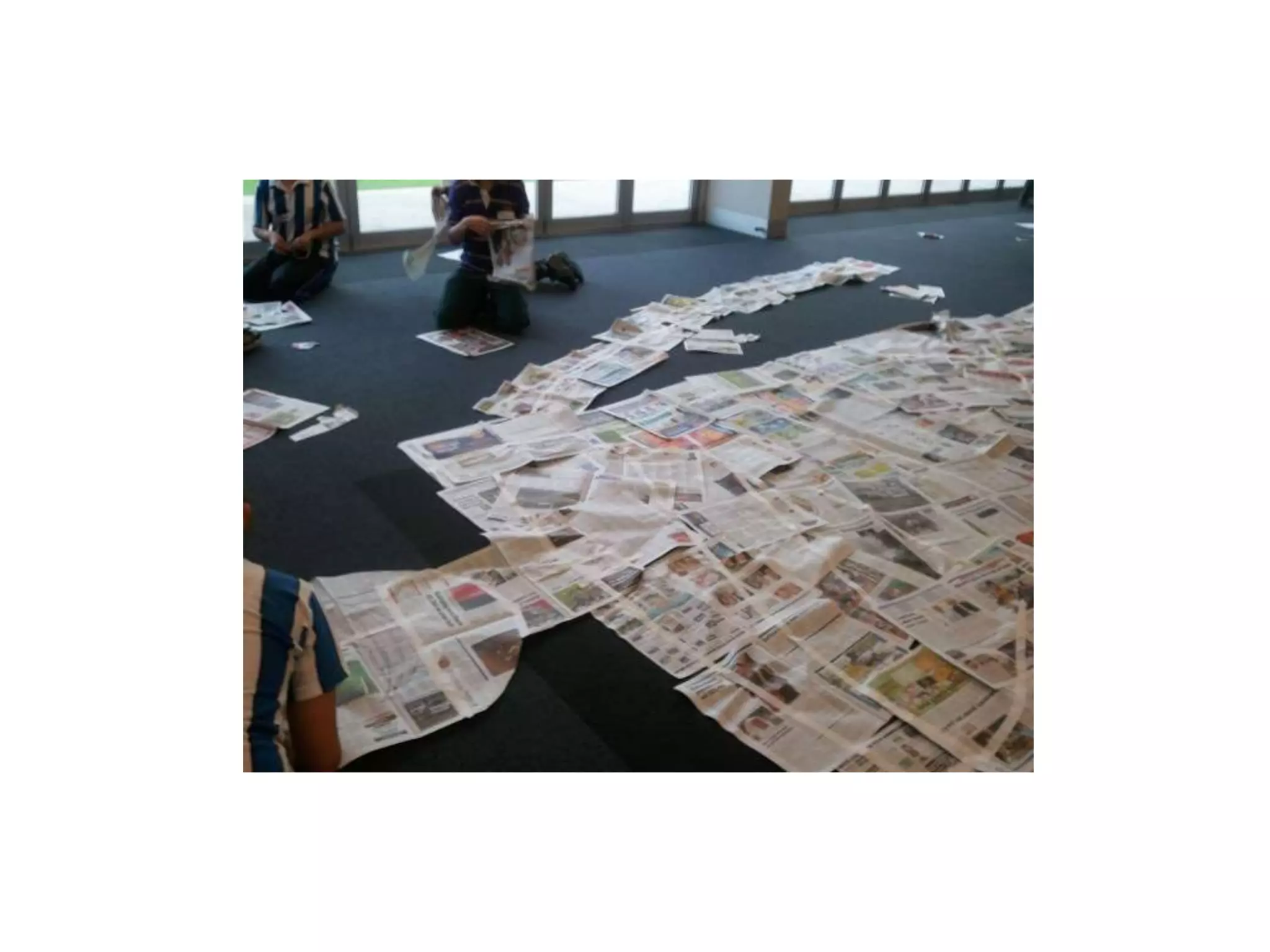
• Draw a representation of Mr. Splash on the butcher paper. 
• Estimate the following and explain your estimates: 
– Mr. Splash’s height 
– Mr. Splash’s height compared to the tallest person in class 
– Mr. Splash’s height compared to the tallest person in your 
family 
– Mr. Splash’s height compared to the tallest person in the 
world 
• Explain whether you think Mr. Splash has the dimensions of a 
real person.
What teacher knowledge is required? 
• Content knowledge 
• Curriculum knowledge 
• PCK
Anticipating student responses 
Measurement considerations: 
• Selection of appropriate unit 
• Measuring accurately with units (e.g., lining 
up with no gaps, using the one unit) 
• Confusion with formal units and conversions 
(for older students)
In your groups, measure your 
heights, arm spans, hand spans and 
foot size (record these measures in 
the following table).
Name Arm 
span 
Height Wrist Neck Waist 
Zach 152 150 15 30 63
More informal 
measurement 
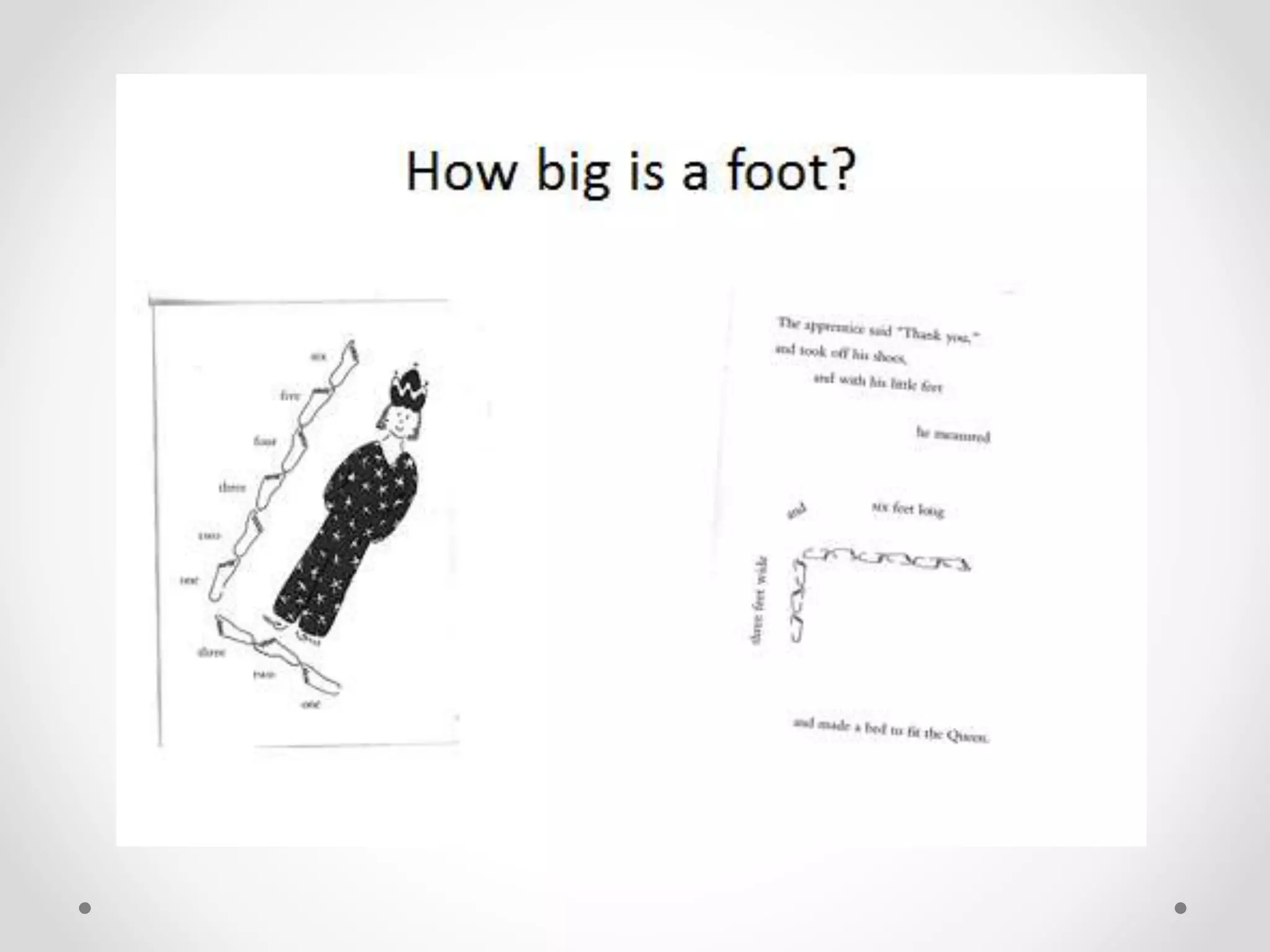
• Story 
• Book 
• Clip 
• Interactive website 
• Scenario 
• http://www.mwpenn.com/lesson-plans/lesson-plan-for- 
how-big-is-a-foot/ 
• http://illuminations.nctm.org/LessonDetail.aspx?ID=L 
205
What do I need to know/consider about 
topic?
What do I need to know/consider about 
topic? 
• Length refers to the measurement of something from end to end 
• Sequence for teaching measurement 
• Children need to experience the usefulness of non-standard units 
• There are a number of principles to consider when asking 
students to measure with non-standard units: 
• The unit must not change – for example, we should select one 
type of informal unit, such as straws, to measure the length of the 
table, rather than a straw, pencil and rubber 
• The units must be placed end to end (when measuring length), 
with no gaps or overlapping units 
• The unit needs to be used in a uniform manner – i.e., if dominoes 
are being used to find the area of the top of a desk, then each 
domino needs to be placed in the same orientation in order to 
accurately represent the standard unit 
• There is a direct relationship between the size of the unit and the 
number required – i.e., the smaller the unit, the bigger the number 
and vice versa
What do I need to know about students’ 
learning of topic? 
• Possible misconceptions 
• Physical difficulties with measuring (e.g., physically 
lining up units, etc) 
• Individual considerations – how to differentiate the 
task
Estimating – a teachable moment
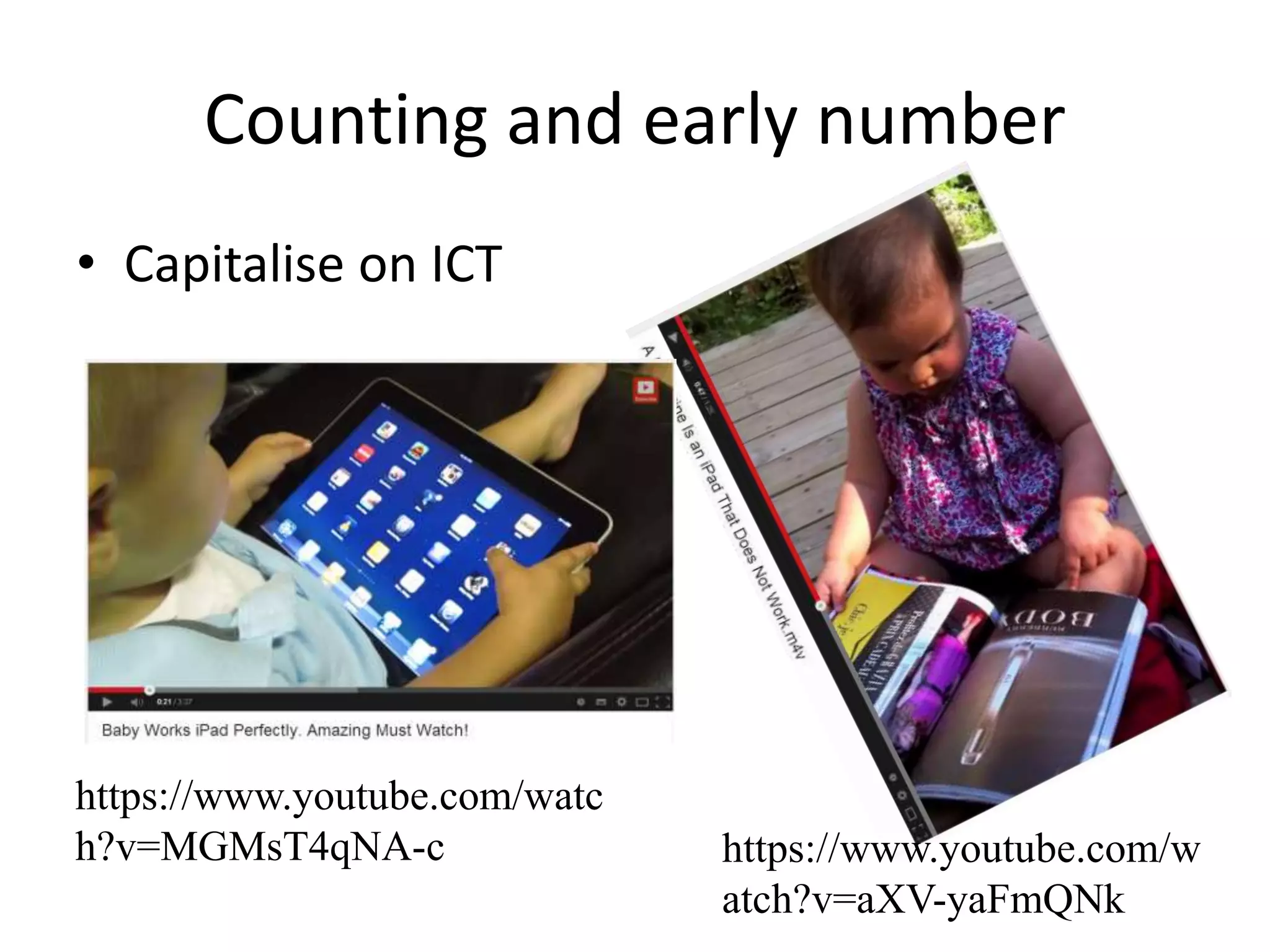
Counting and early number 
• Capitalise on ICT 
https://www.youtube.com/w 
atch?v=aXV-yaFmQNk 
https://www.youtube.com/watc 
h?v=MGMsT4qNA-c
Songs and Rhymes
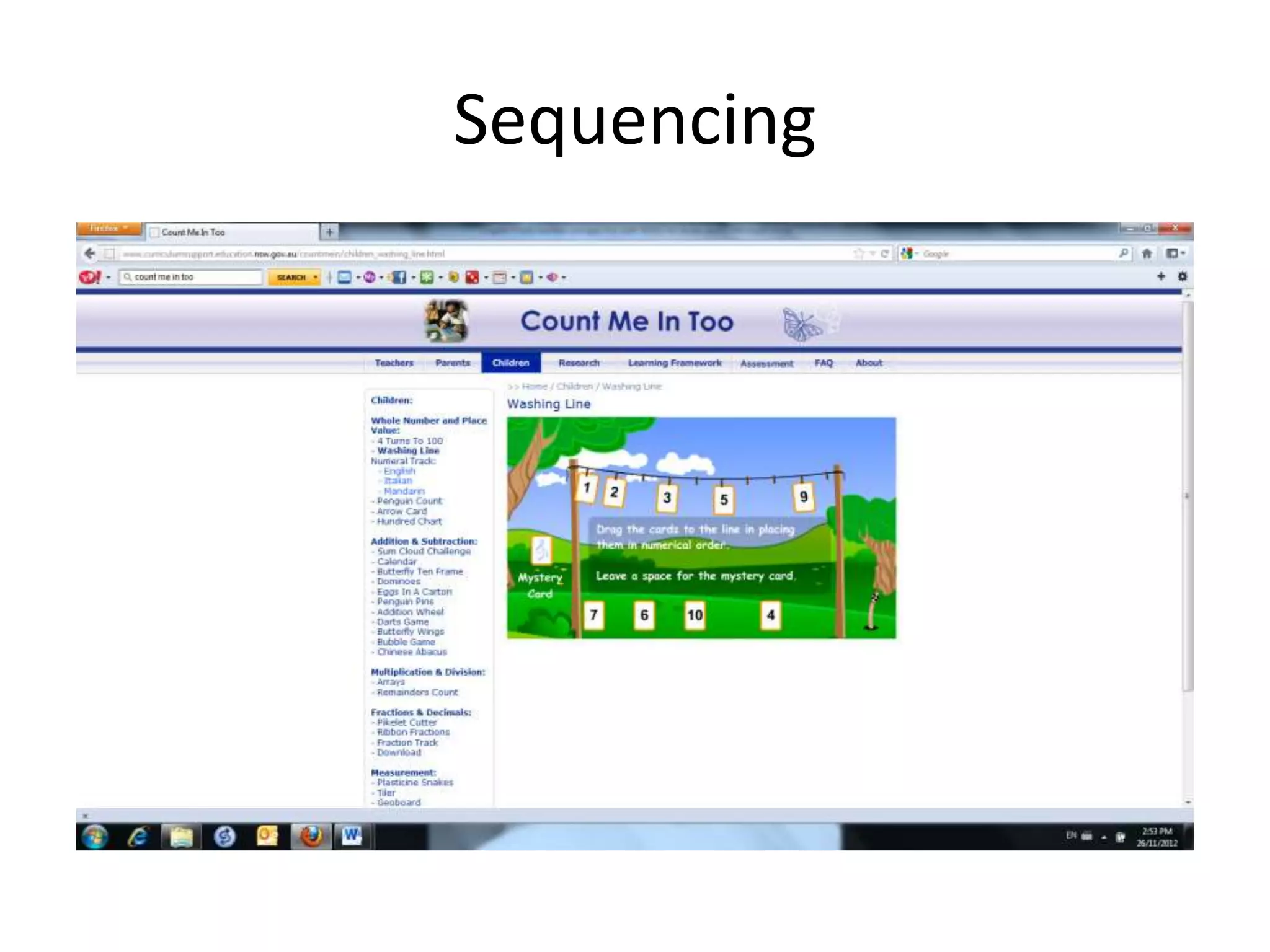
Sequencing
Consider: 
• What would be the advantages and 
disadvantages of doing this activity online as 
compared with using real materials in the 
classroom?
Capitalising on the ICT
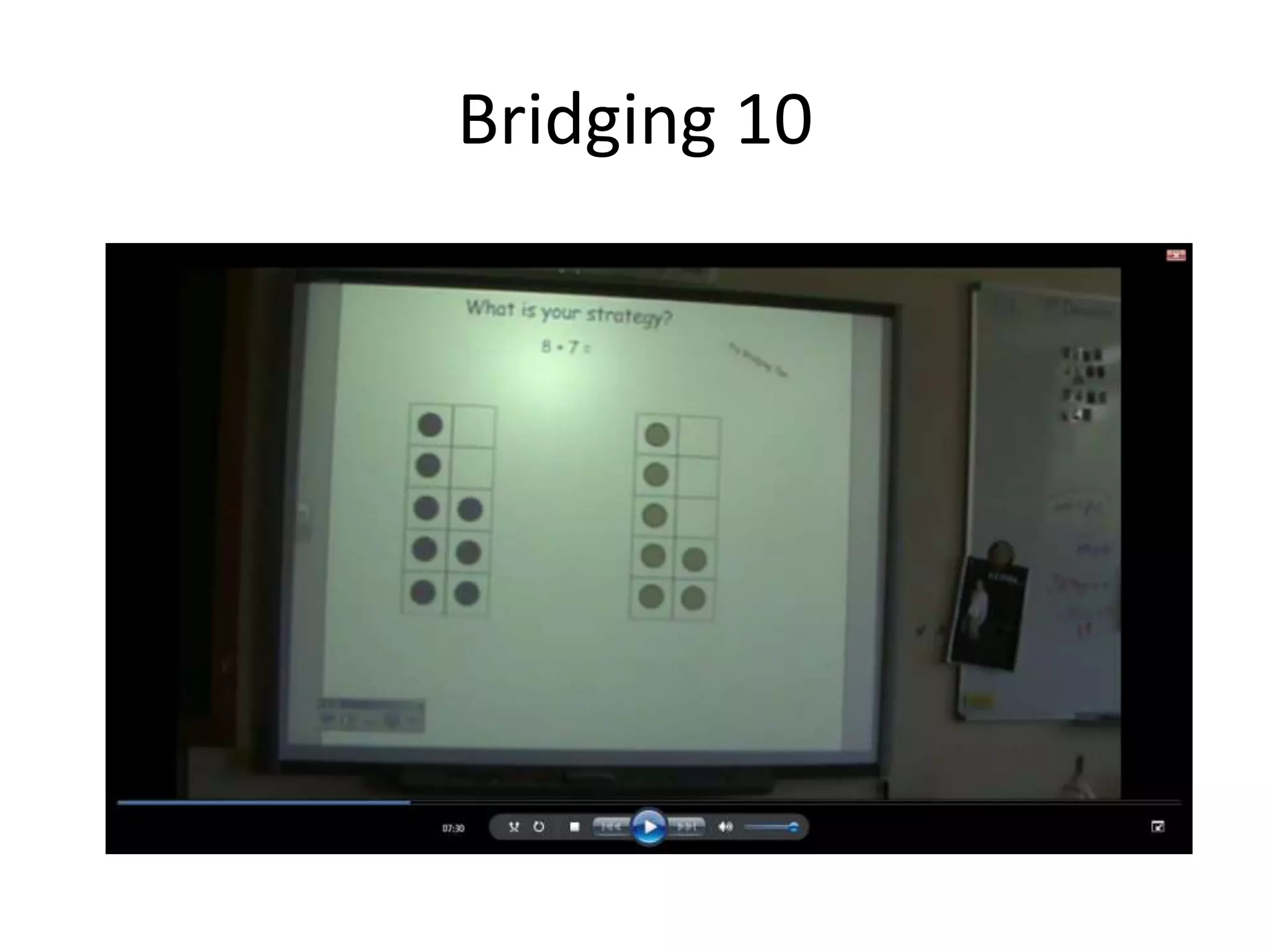
Bridging 10
• Teacher: Great. OK. This is what we do when we 
bridge ten. We make one of the ten frames up into 
ten by moving the dots [shows two ten frames on the 
board next to each other, one with eight and one 
with seven counters or dots] Which would be the 
sensible one to move the dots in up here? 
• Student: Move from the yellow one to the purple one 
[ten frame] 
• Teacher: Would you do that Jim? Would you fill up 
the ten frame, the purple ten frame, with eight in it? 
Would you be able to put the dots on the other side? 
• [Jim moves the dots to the ten frame, and leaves a 
column of three dots and a column of two dots in the 
yellow frame]
• Teacher: Now can you arrange the other frame 
so that all the dots are in a straight line? 
• [Jim moves the dots so that they form a 
column of 5] 
• Teacher: Great, so what have we got? 
• Jim: Five and ten 
• Teacher: Which make? 
• Jim: Fifteen
TPACK 
Reproduced by permission 
of the publisher, © 2012 by 
tpack.org
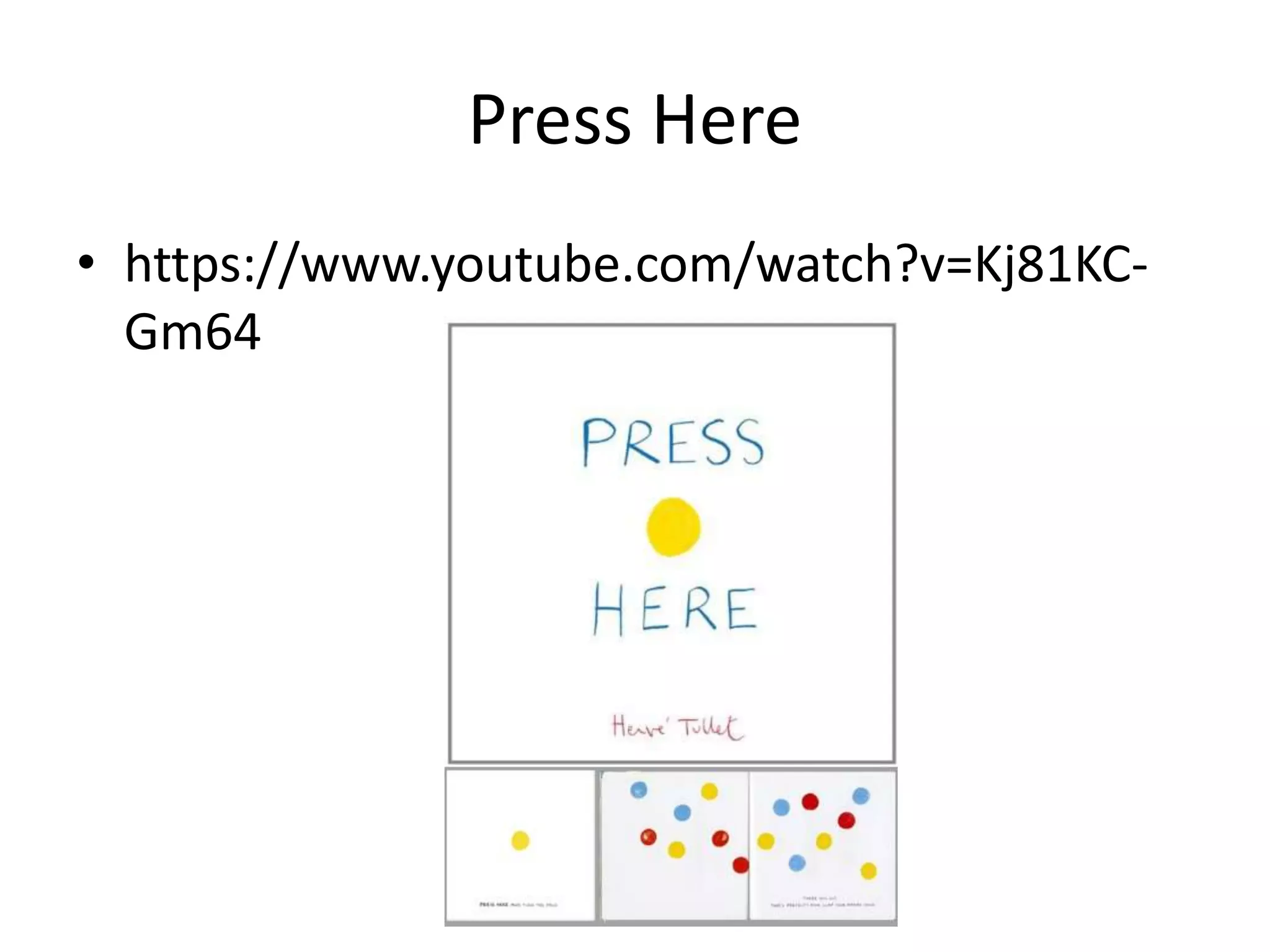
Subitising – making it purposeful
Press Here 
• https://www.youtube.com/watch?v=Kj81KC-Gm64
Thumbs up or down? 
Google Images
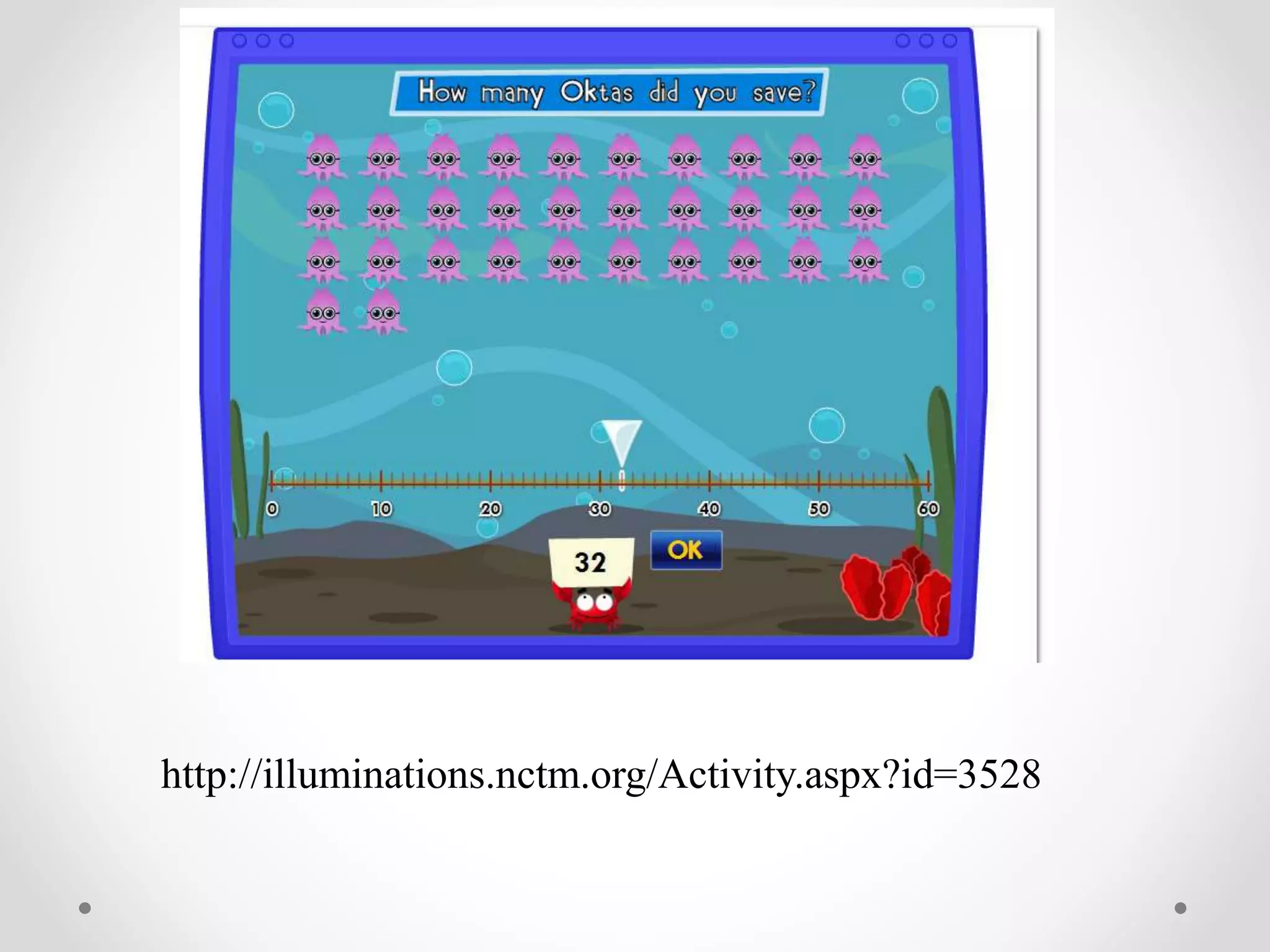
http://illuminations.nctm.org/Activity.aspx?id=3528
Two of Everything 
Google Images
Monitoring 
• Paying close attention to students’ 
mathematical thinking and solution strategies 
as they work on task 
• Can assist through creating a list of possible 
solutions before lesson (anticipating) 
• Questioning – more than observing
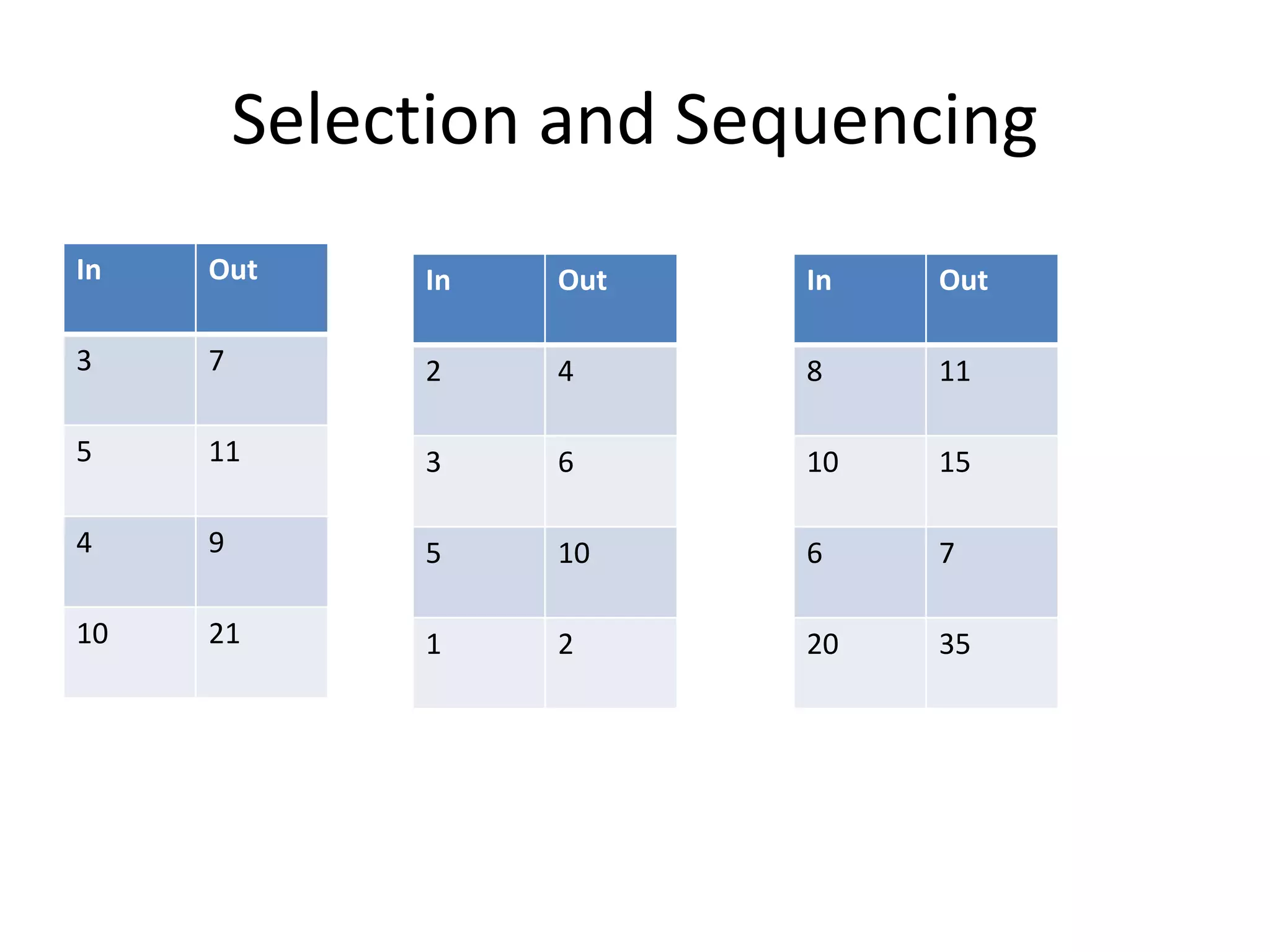
Selection and Sequencing 
In Out 
3 7 
5 11 
4 9 
10 21 
In Out 
2 4 
3 6 
5 10 
1 2 
In Out 
8 11 
10 15 
6 7 
20 35
Connecting 
• Drawing connections between students’ 
solutions and the key mathematical ideas 
• Goal is to have student presentations build on 
one another to develop powerful 
mathematical ideas
More than ‘sharing’ 
Who did it a 
different way?
Factors influencing the planning and 
uptake of mathematical 
opportunities 
• Teacher knowledge Content 
knowledge, Pedagogical Content Knowledge (PCK) 
(Shulman, 1987) 
• Teacher beliefs What it is to be numerate 
pupil, how pupils learn to become numerate, and 
how best to teach pupils to become numerate
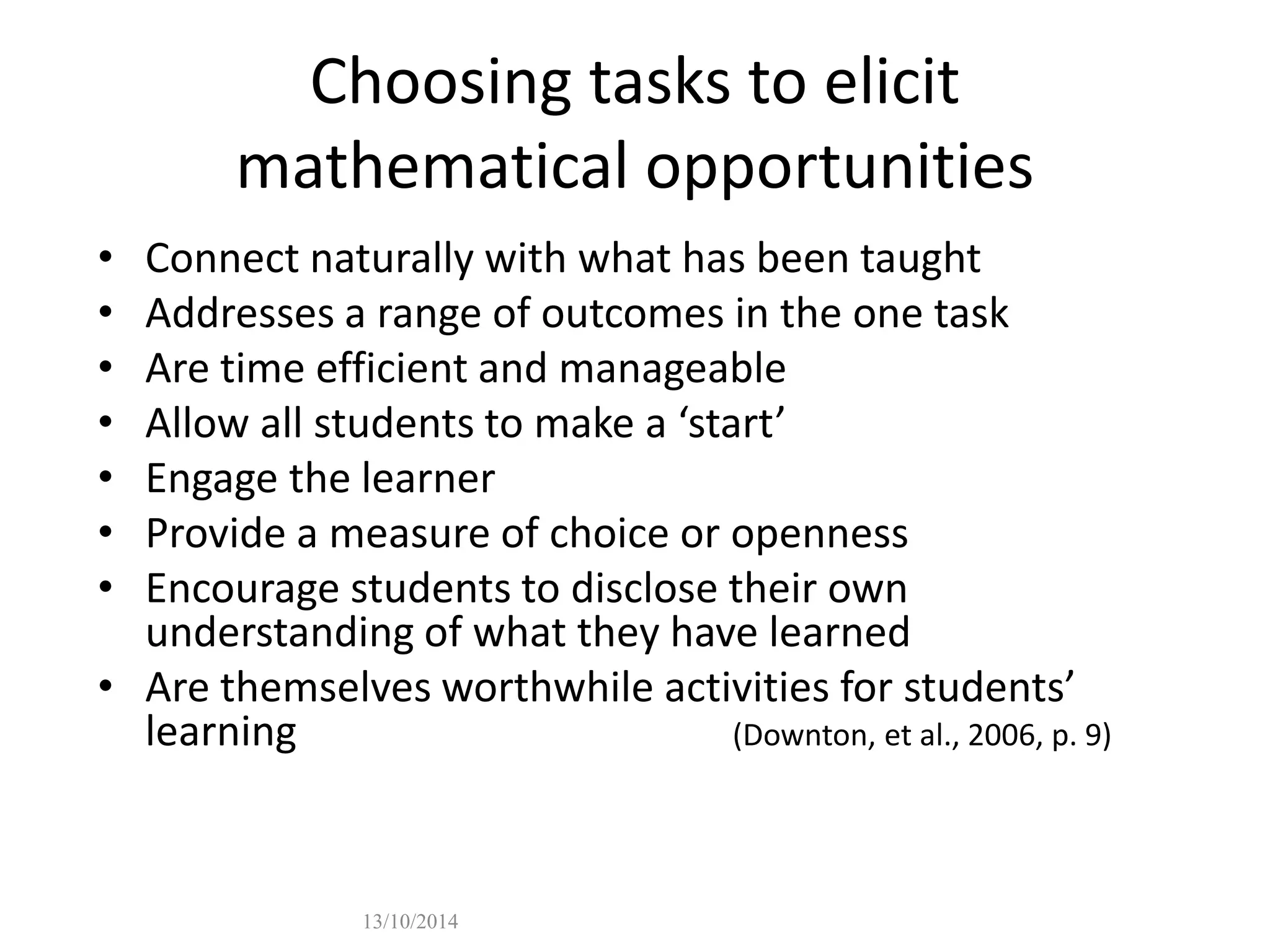
Choosing tasks to elicit 
mathematical opportunities 
• Connect naturally with what has been taught 
• Addresses a range of outcomes in the one task 
• Are time efficient and manageable 
• Allow all students to make a ‘start’ 
• Engage the learner 
• Provide a measure of choice or openness 
• Encourage students to disclose their own 
understanding of what they have learned 
• Are themselves worthwhile activities for students’ 
learning (Downton, et al., 2006, p. 9) 
13/10/2014
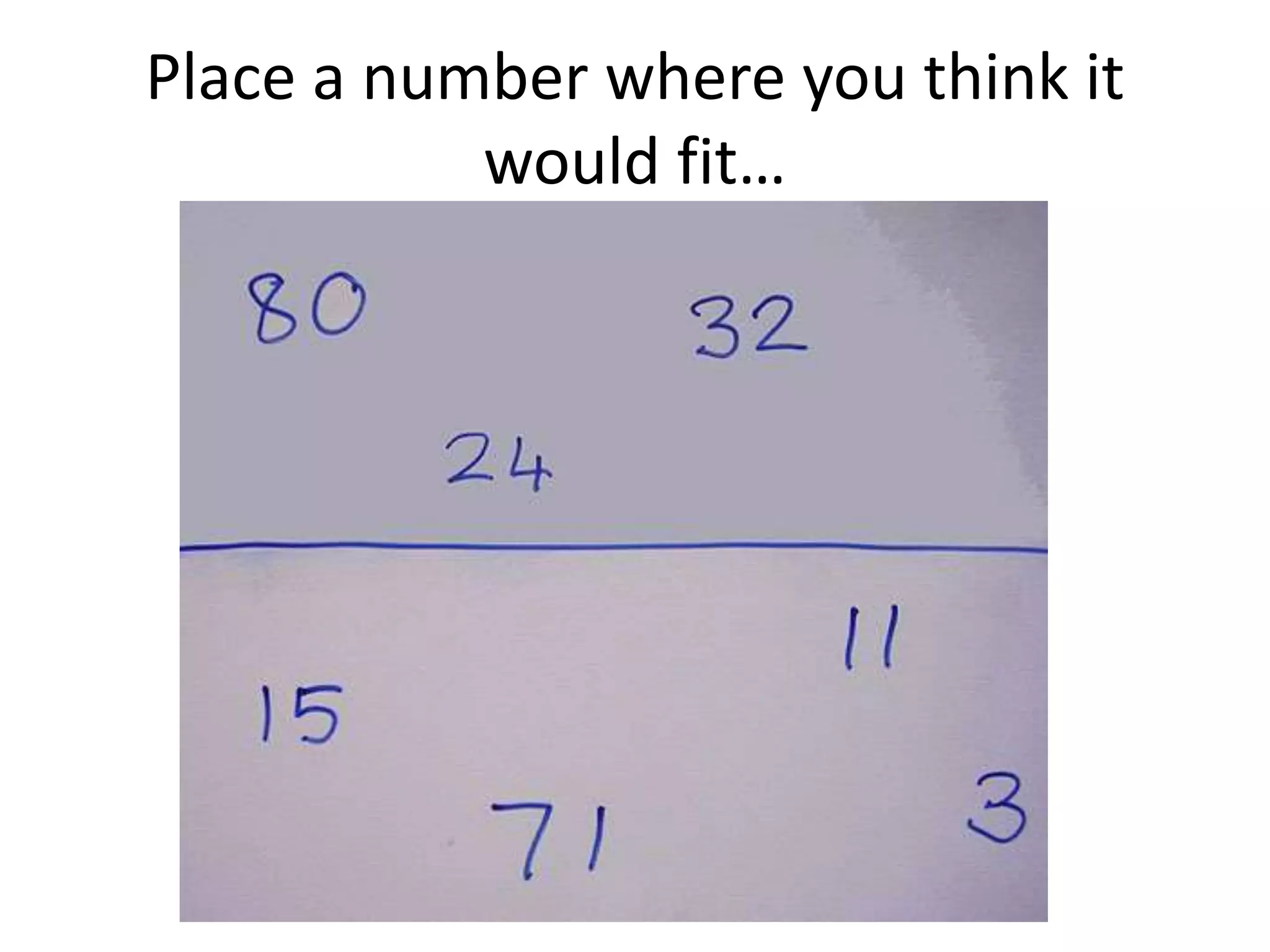
Place a number where you think it 
would fit…
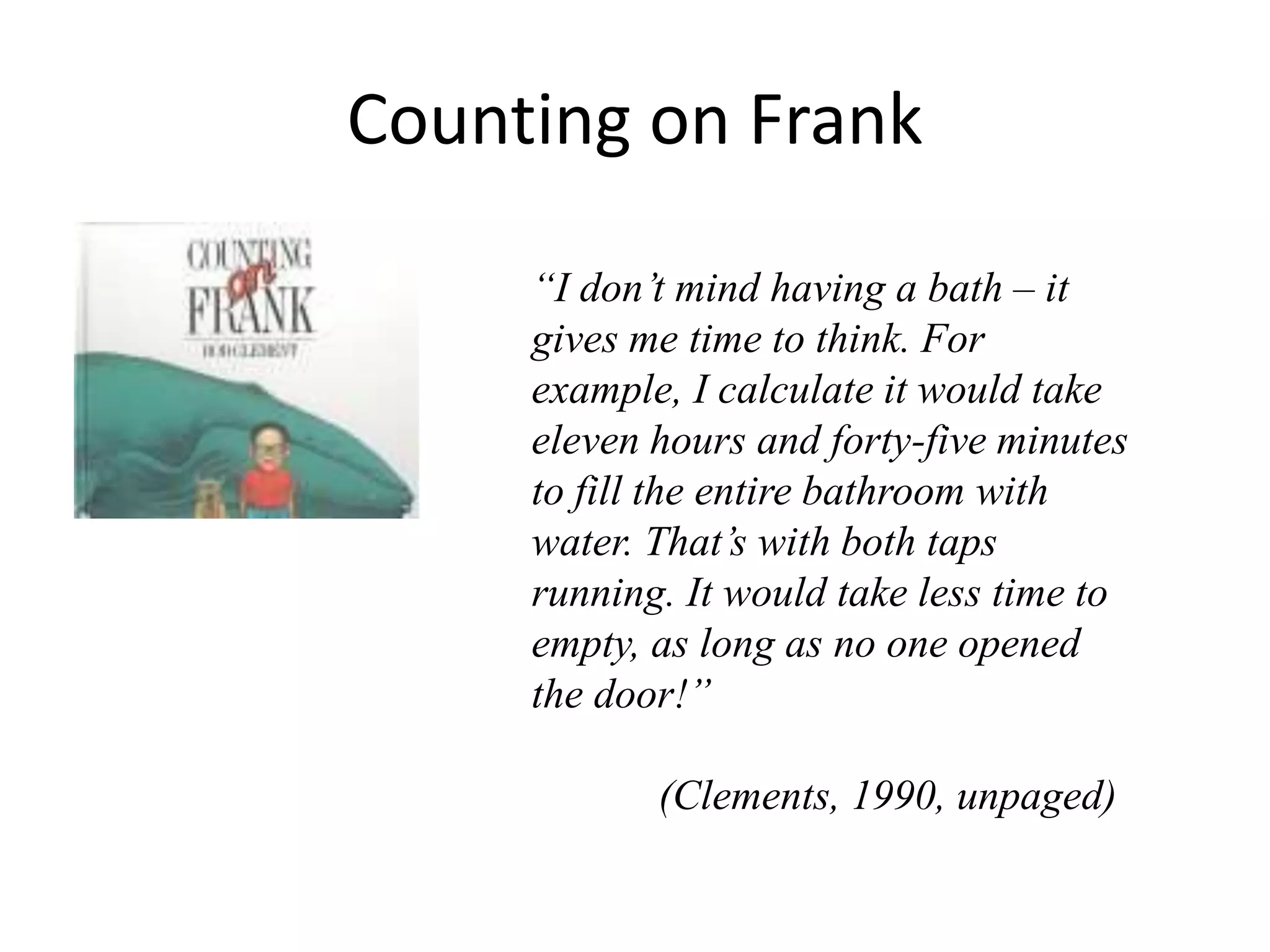
Counting on Frank 
“I don’t mind having a bath – it 
gives me time to think. For 
example, I calculate it would take 
eleven hours and forty-five minutes 
to fill the entire bathroom with 
water. That’s with both taps 
running. It would take less time to 
empty, as long as no one opened 
the door!” 
(Clements, 1990, unpaged)
Is it accurate? 
“Going shopping with mum is a big event. She is 
lucky to have such an intelligent trolley-pusher. 
It takes forty-seven cans of dog food to 
fill one trolley, but only one to knock over one 
hundred and ten!”
• Does it really take 47 cans of dog food to fill 
one trolley? Even allowing for different sized 
trolleys and cans of dog food, this seems a 
gross under-estimation. In order to test this 
claim, a 12 year-old student, using real cans of 
dog food (680 gram; 23.94 ounce tins) found 
that it took approximately 47 cans of dog food 
just to fill the base of a shopping trolley, and 
that it would take closer to 216 cans to fill your 
average shopping trolley.
Anticipating mathematical 
opportunities 
• Confusion between length, area and volume 
(and capacity) 
• Conversion of units 
• Multiplication 
• Dimensions of tins 
• Consistency for comparison
Self reflection/feedback 
Something that helped me learn … 
Something I wasn’t sure about … 
Something that stopped my learning
A couple of other favourites…. 
Google images
The wolf’s chicken stew
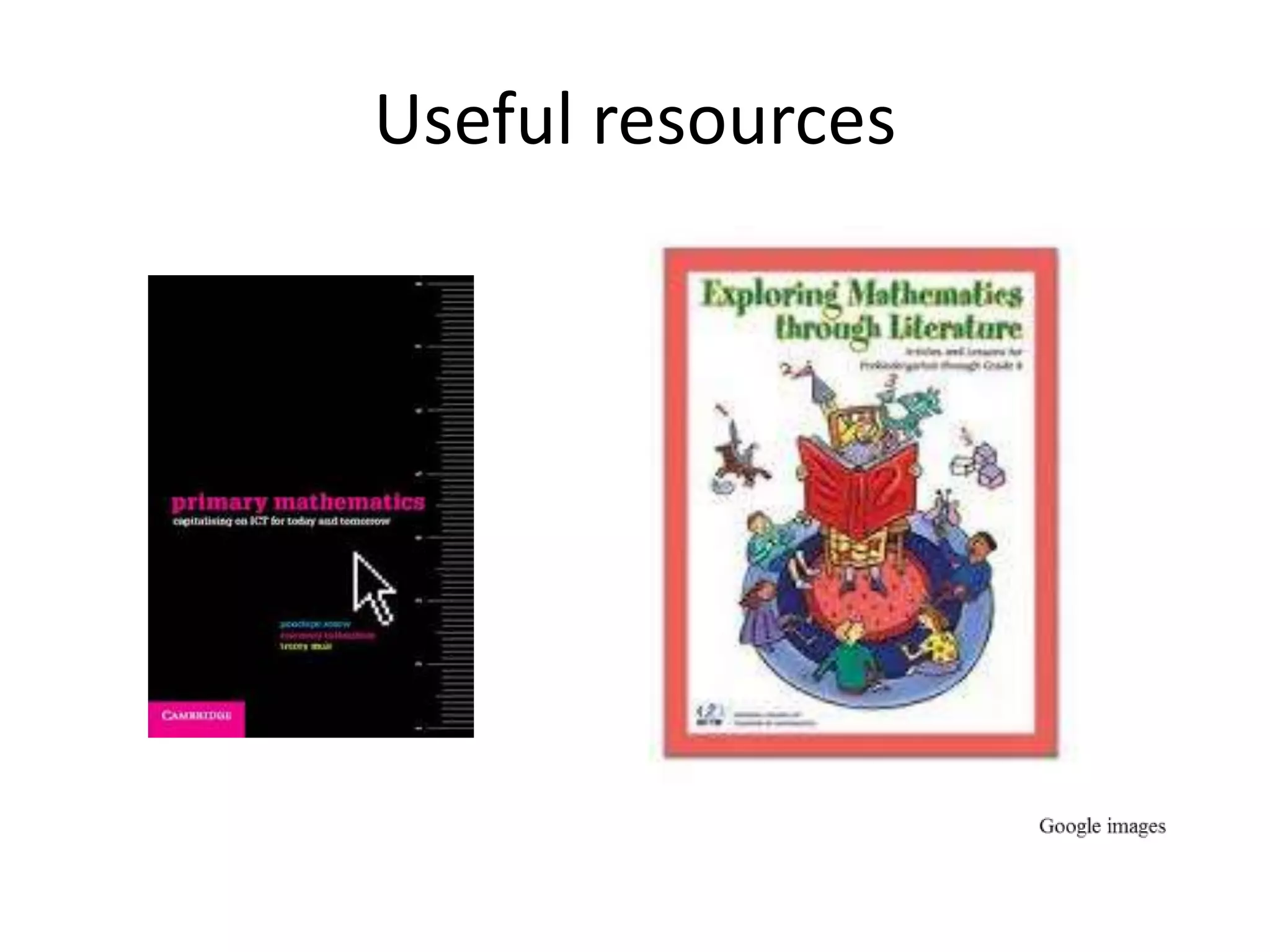
Useful resources
Conclusions 
• Useful to consider the types of knowledge 
required by teachers 
• Mathematical opportunities can be 
anticipated 
• 5 practices are useful for orchestrating 
productive mathematical discussions 
• Mathematical opportunities are 
everywhere – be creative but make them 
purposeful
Useful references 
Arafeh, S., Smerdon, B., & Snow, S. (2001, April 10-15). Learning from teachable moments: Methodological 
lessons from the secondary analysis of the TIMSS video study. Paper presented at the Annual Meeting of the 
American Educational Research Association, Seattle, WA. 
Askew, M. (2005). It ain't (just) what you do: effective teachers of numeracy. In I. Thompson (Ed.), Issues in 
teaching numeracy in primary schools (pp. 91-102). Berkshire, UK: Open University Press. 
Askew, M., Brown, M., Rhodes, V., Johnson, D., & Wiliam, D. (1997). Effective teachers of numeracy. London: 
School of Education, King's College. 
Clarke, D., & Clarke, B. (2002). Challenging and effective teaching in junior primary mathematics: What does it 
look like? In M. Goos & T. Spencer (Eds.), Mathematics making waves (Proceedings of the 19th Biennial 
Conference of the Australian Association of Mathematics Teachers, pp. 309-318). Adelaide, SA: AAMT. 
Groves, S., Mousley, J., & Forgasz, H. (2006). Primary Numeracy: A mapping, review and analysis of Australian 
research in numeracy learning at the primary school level. Canberra, ACT: Commonwealth of Australia. 
Muir, T. (2008). “Zero is not a number”: Teachable moments and their role in effective teaching of numeray. In 
M. Goos, R. Brown & K. Makar (Eds.), Navigating currents and charting directions (Proceedings of the 31st 
annual conference of the Mathematics Education Research Group of Australasia, Brisbane, pp. 361-367). 
Adelaide, SA: MERGA. 
Muir, T. (2008b, July 6-13). Describing effective teaching of numeracy: Links between principles of practice and 
teacher actions. Paper presented at the 11th International Conference on Mathematics Education (ICME-11) for 
Topic Study Group 2: New developments and trends in mathematics education at primary level, Monterrey, 
Mexico. 
Rowland, T., Turner, F., Thwaites, A., & Huckstep, P. (2009). Developing primary mathematics teaching: Reflecting 
on practice with the knowledge quartet. London: SAGE Publications Ltd. 
Smith, M. S., & Stein, M. K. (2011). 5 practices for orchestrating productive mathematical discussions. Reston, 
VA: NCTM.

Mathematical opportunties in the Early Years

  • 1.
    Creating Mathematical Opportunitiesin the Early Years Dr Tracey Muir University of Tasmania AAMT Connect with Maths 26th August 2014
  • 2.
  • 3.
    Overview • Whatdoes effective mathematics teaching look like? • What types of knowledge does an effective teacher require? • How can we provide students with authentic mathematical opportunities? • What aspects of classroom practice should we focus on in order to maximise mathematical opportunities?
  • 4.
    Connectionist, transmission and discovery beliefs Connectionist Transmission Discovery The use of methods of Primarily the ability to calculation which are perform standard both efficient and procedures or routines effective Finding the answer to a calculation by any method Confidence and ability in mental methods A heavy reliance on paper and pencil methods A heavy reliance on practical methods Pupil misunderstandings need to be recognised, made explicit and worked on Pupils’ misunderstandings are the result of ‘grasp’ what was being taught and need to be remedied by further reinforcement of the ‘correct’ method Pupils’ misunderstandings are the results of pupils not being ready to learn the ideas (Askew, et al., 1997)
  • 5.
    Characteristics of effective numeracy teachers •Emphasise the importance of understanding mathematical concepts and the connections between these •Have high expectations that all children will engage seriously with mathematical ideas •Structure purposeful tasks that enable different possibilities, strategies and products to emerge •Probe and challenge children’s thinking and reasoning •Build on children’s mathematical ideas and strategies •Are confident in their own knowledge of mathematics at the level they are teaching (Groves et al., 2006)
  • 6.
    Principles of practice •Make connections •Challenge all pupils •Teach for conceptual understanding •Purposeful discussion •Focus on mathematics •Convey and instill positive attitudes towards mathematics
  • 7.
    Teaching actions •Choice of examples • Choice of tasks • Questioning • Use of representations • Modelling • Teachable moments
  • 9.
    How familiar isterm PCK? (Vote)
  • 10.
    • Teacher knowledge (Ball, Thames, & Phelps, 2008)
  • 11.
    5 Practices •Anticipating • Monitoring • Selecting • Sequencing • Connecting (Smith & Stein, 2011)
  • 12.
    Anticipating • Planningfor ‘teachable moments’ • Knowing your subject and the difficulties students might encounter • Experience, research and reflection • Highlighting possible misconceptions in planning
  • 13.
    Pre-planning • Whatdo I need to know and understand before teaching this topic? • What are the likely difficulties or misconceptions students may have?
  • 14.
  • 15.
    Devise task •What are some activities or tasks you could undertake to explore ‘Mr Splash’?
  • 16.
    • This isa photograph of Mr. Splash. He loves to have a bath in his pajamas. He seems to be a bit big for the bath! I wonder how tall he is? How could we find out?
  • 17.
    • Does thetallest person have the longest feet? • Does the tallest person have the greatest hand span? • Are hand spans and foot lengths related? • Are boys taller than girls? • Draw a representation of Mr. Splash on the butcher paper. • Estimate the following and explain your estimates: – Mr. Splash’s height – Mr. Splash’s height compared to the tallest person in class – Mr. Splash’s height compared to the tallest person in your family – Mr. Splash’s height compared to the tallest person in the world • Explain whether you think Mr. Splash has the dimensions of a real person.
  • 18.
    What teacher knowledgeis required? • Content knowledge • Curriculum knowledge • PCK
  • 19.
    Anticipating student responses Measurement considerations: • Selection of appropriate unit • Measuring accurately with units (e.g., lining up with no gaps, using the one unit) • Confusion with formal units and conversions (for older students)
  • 20.
    In your groups,measure your heights, arm spans, hand spans and foot size (record these measures in the following table).
  • 21.
    Name Arm span Height Wrist Neck Waist Zach 152 150 15 30 63
  • 23.
    More informal measurement • Story • Book • Clip • Interactive website • Scenario • http://www.mwpenn.com/lesson-plans/lesson-plan-for- how-big-is-a-foot/ • http://illuminations.nctm.org/LessonDetail.aspx?ID=L 205
  • 25.
    What do Ineed to know/consider about topic?
  • 26.
    What do Ineed to know/consider about topic? • Length refers to the measurement of something from end to end • Sequence for teaching measurement • Children need to experience the usefulness of non-standard units • There are a number of principles to consider when asking students to measure with non-standard units: • The unit must not change – for example, we should select one type of informal unit, such as straws, to measure the length of the table, rather than a straw, pencil and rubber • The units must be placed end to end (when measuring length), with no gaps or overlapping units • The unit needs to be used in a uniform manner – i.e., if dominoes are being used to find the area of the top of a desk, then each domino needs to be placed in the same orientation in order to accurately represent the standard unit • There is a direct relationship between the size of the unit and the number required – i.e., the smaller the unit, the bigger the number and vice versa
  • 27.
    What do Ineed to know about students’ learning of topic? • Possible misconceptions • Physical difficulties with measuring (e.g., physically lining up units, etc) • Individual considerations – how to differentiate the task
  • 28.
    Estimating – ateachable moment
  • 29.
    Counting and earlynumber • Capitalise on ICT https://www.youtube.com/w atch?v=aXV-yaFmQNk https://www.youtube.com/watc h?v=MGMsT4qNA-c
  • 30.
  • 31.
  • 32.
    Consider: • Whatwould be the advantages and disadvantages of doing this activity online as compared with using real materials in the classroom?
  • 33.
  • 34.
  • 35.
    • Teacher: Great.OK. This is what we do when we bridge ten. We make one of the ten frames up into ten by moving the dots [shows two ten frames on the board next to each other, one with eight and one with seven counters or dots] Which would be the sensible one to move the dots in up here? • Student: Move from the yellow one to the purple one [ten frame] • Teacher: Would you do that Jim? Would you fill up the ten frame, the purple ten frame, with eight in it? Would you be able to put the dots on the other side? • [Jim moves the dots to the ten frame, and leaves a column of three dots and a column of two dots in the yellow frame]
  • 36.
    • Teacher: Nowcan you arrange the other frame so that all the dots are in a straight line? • [Jim moves the dots so that they form a column of 5] • Teacher: Great, so what have we got? • Jim: Five and ten • Teacher: Which make? • Jim: Fifteen
  • 38.
    TPACK Reproduced bypermission of the publisher, © 2012 by tpack.org
  • 39.
    Subitising – makingit purposeful
  • 40.
    Press Here •https://www.youtube.com/watch?v=Kj81KC-Gm64
  • 41.
    Thumbs up ordown? Google Images
  • 42.
  • 43.
    Two of Everything Google Images
  • 44.
    Monitoring • Payingclose attention to students’ mathematical thinking and solution strategies as they work on task • Can assist through creating a list of possible solutions before lesson (anticipating) • Questioning – more than observing
  • 45.
    Selection and Sequencing In Out 3 7 5 11 4 9 10 21 In Out 2 4 3 6 5 10 1 2 In Out 8 11 10 15 6 7 20 35
  • 46.
    Connecting • Drawingconnections between students’ solutions and the key mathematical ideas • Goal is to have student presentations build on one another to develop powerful mathematical ideas
  • 47.
    More than ‘sharing’ Who did it a different way?
  • 48.
    Factors influencing theplanning and uptake of mathematical opportunities • Teacher knowledge Content knowledge, Pedagogical Content Knowledge (PCK) (Shulman, 1987) • Teacher beliefs What it is to be numerate pupil, how pupils learn to become numerate, and how best to teach pupils to become numerate
  • 49.
    Choosing tasks toelicit mathematical opportunities • Connect naturally with what has been taught • Addresses a range of outcomes in the one task • Are time efficient and manageable • Allow all students to make a ‘start’ • Engage the learner • Provide a measure of choice or openness • Encourage students to disclose their own understanding of what they have learned • Are themselves worthwhile activities for students’ learning (Downton, et al., 2006, p. 9) 13/10/2014
  • 51.
    Place a numberwhere you think it would fit…
  • 52.
    Counting on Frank “I don’t mind having a bath – it gives me time to think. For example, I calculate it would take eleven hours and forty-five minutes to fill the entire bathroom with water. That’s with both taps running. It would take less time to empty, as long as no one opened the door!” (Clements, 1990, unpaged)
  • 53.
    Is it accurate? “Going shopping with mum is a big event. She is lucky to have such an intelligent trolley-pusher. It takes forty-seven cans of dog food to fill one trolley, but only one to knock over one hundred and ten!”
  • 54.
    • Does itreally take 47 cans of dog food to fill one trolley? Even allowing for different sized trolleys and cans of dog food, this seems a gross under-estimation. In order to test this claim, a 12 year-old student, using real cans of dog food (680 gram; 23.94 ounce tins) found that it took approximately 47 cans of dog food just to fill the base of a shopping trolley, and that it would take closer to 216 cans to fill your average shopping trolley.
  • 55.
    Anticipating mathematical opportunities • Confusion between length, area and volume (and capacity) • Conversion of units • Multiplication • Dimensions of tins • Consistency for comparison
  • 56.
    Self reflection/feedback Somethingthat helped me learn … Something I wasn’t sure about … Something that stopped my learning
  • 57.
    A couple ofother favourites…. Google images
  • 58.
  • 59.
  • 61.
    Conclusions • Usefulto consider the types of knowledge required by teachers • Mathematical opportunities can be anticipated • 5 practices are useful for orchestrating productive mathematical discussions • Mathematical opportunities are everywhere – be creative but make them purposeful
  • 62.
    Useful references Arafeh,S., Smerdon, B., & Snow, S. (2001, April 10-15). Learning from teachable moments: Methodological lessons from the secondary analysis of the TIMSS video study. Paper presented at the Annual Meeting of the American Educational Research Association, Seattle, WA. Askew, M. (2005). It ain't (just) what you do: effective teachers of numeracy. In I. Thompson (Ed.), Issues in teaching numeracy in primary schools (pp. 91-102). Berkshire, UK: Open University Press. Askew, M., Brown, M., Rhodes, V., Johnson, D., & Wiliam, D. (1997). Effective teachers of numeracy. London: School of Education, King's College. Clarke, D., & Clarke, B. (2002). Challenging and effective teaching in junior primary mathematics: What does it look like? In M. Goos & T. Spencer (Eds.), Mathematics making waves (Proceedings of the 19th Biennial Conference of the Australian Association of Mathematics Teachers, pp. 309-318). Adelaide, SA: AAMT. Groves, S., Mousley, J., & Forgasz, H. (2006). Primary Numeracy: A mapping, review and analysis of Australian research in numeracy learning at the primary school level. Canberra, ACT: Commonwealth of Australia. Muir, T. (2008). “Zero is not a number”: Teachable moments and their role in effective teaching of numeray. In M. Goos, R. Brown & K. Makar (Eds.), Navigating currents and charting directions (Proceedings of the 31st annual conference of the Mathematics Education Research Group of Australasia, Brisbane, pp. 361-367). Adelaide, SA: MERGA. Muir, T. (2008b, July 6-13). Describing effective teaching of numeracy: Links between principles of practice and teacher actions. Paper presented at the 11th International Conference on Mathematics Education (ICME-11) for Topic Study Group 2: New developments and trends in mathematics education at primary level, Monterrey, Mexico. Rowland, T., Turner, F., Thwaites, A., & Huckstep, P. (2009). Developing primary mathematics teaching: Reflecting on practice with the knowledge quartet. London: SAGE Publications Ltd. Smith, M. S., & Stein, M. K. (2011). 5 practices for orchestrating productive mathematical discussions. Reston, VA: NCTM.