By: Zakriua Gomma
Email: zakriua.gomma37@gmail.com
Introduction to ARM Architecture
ARM Ltd
 ARM
 Advanced RISC Machines
 Founded in November 1990
 Spun out of Acorn Computers
 Company headquarters in Cambridge, UK
 Processor design centres in Cambridge, Austin, and Sophia Antipolis
 Sales, support, and engineering offices all over the world
 Best known for its range of RISC processor cores designs
 Other products – fabric IP, software tools, models, cell libraries - to
help partners develop and ship ARM-based SoCs
 ARM does not manufacture silicon
ARM Offices Worldwide




 
In 2005 about 98 percent of all mobile phones use at
least one ARM-designed core on their motherboards,
according to research from the analyst firm the Linley
Group




• Motorola
• Panasonic
• Qualcomm
• Sharp
• Sanyo
• Sony
• Apple
• Toshiba
• Texas Instrument
• Wipro
…and many more
• 3com
• Microsoft
• IBM
• Intel
• Nokia
• Atmel
• NEC
• Fijistu
• Freescale
• Altera
• Epson
• STM
• NXP





•


•
•
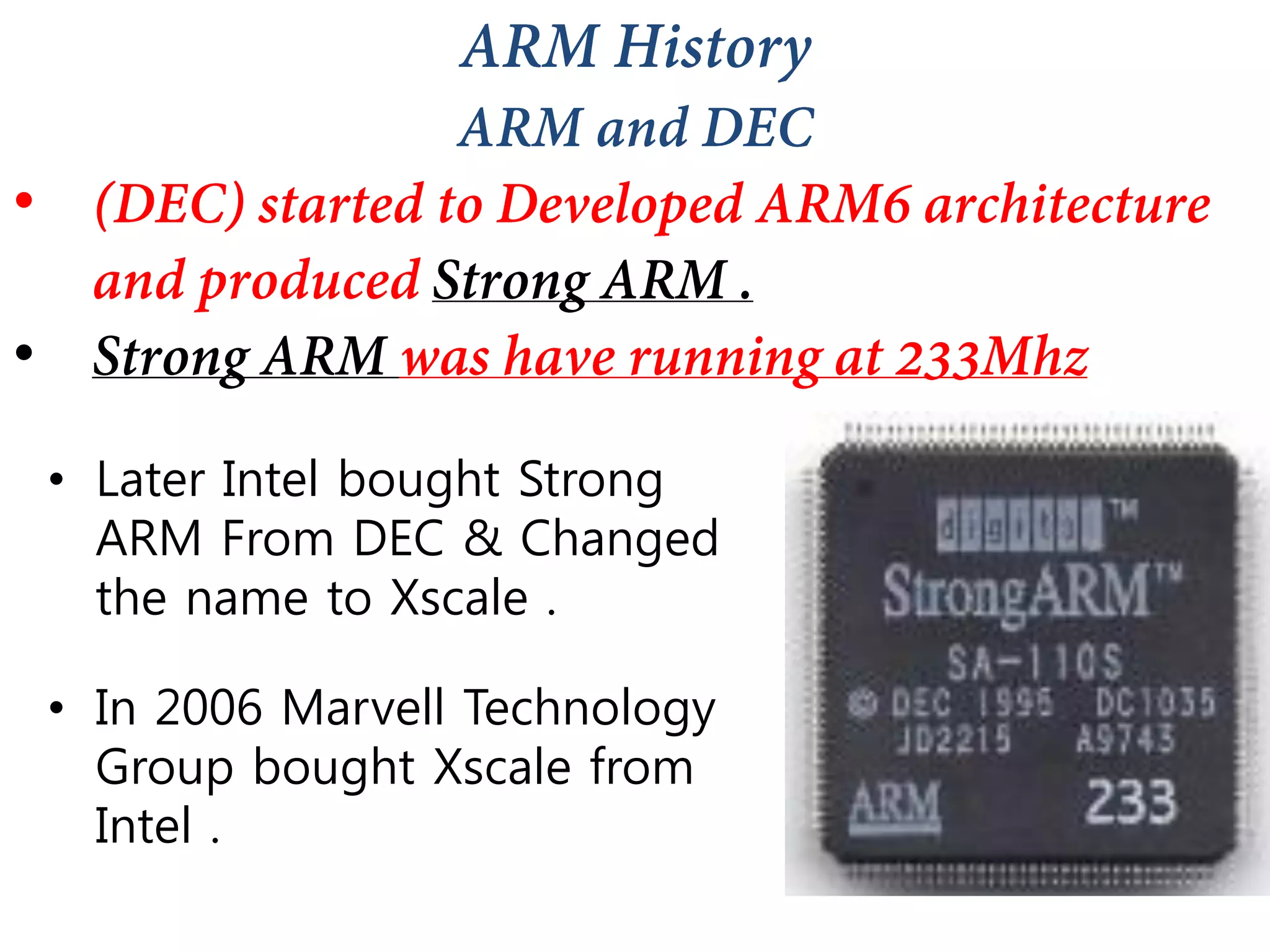
• Later Intel bought Strong
ARM From DEC & Changed
the name to Xscale .
• In 2006 Marvell Technology
Group bought Xscale from
Intel .
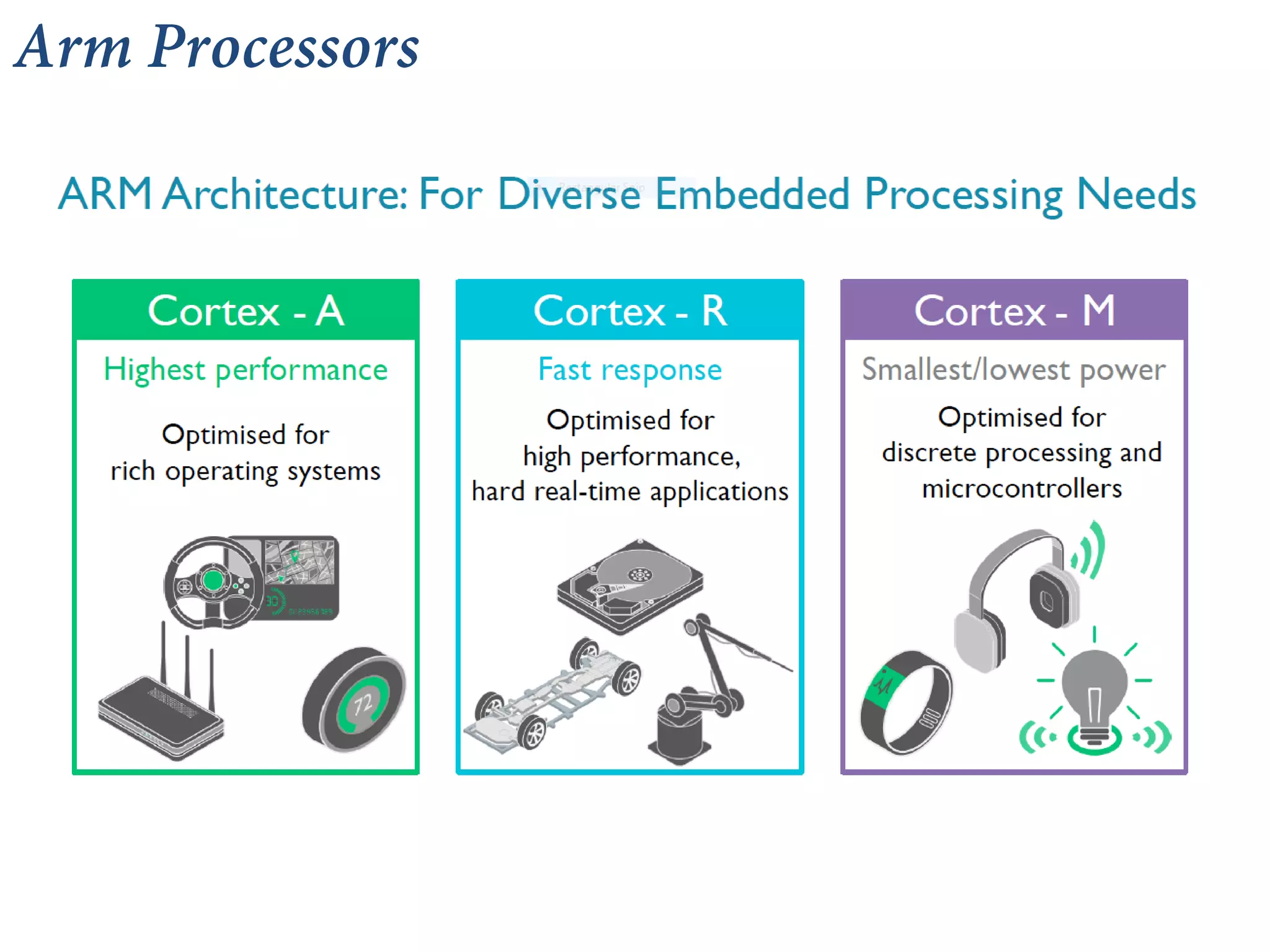
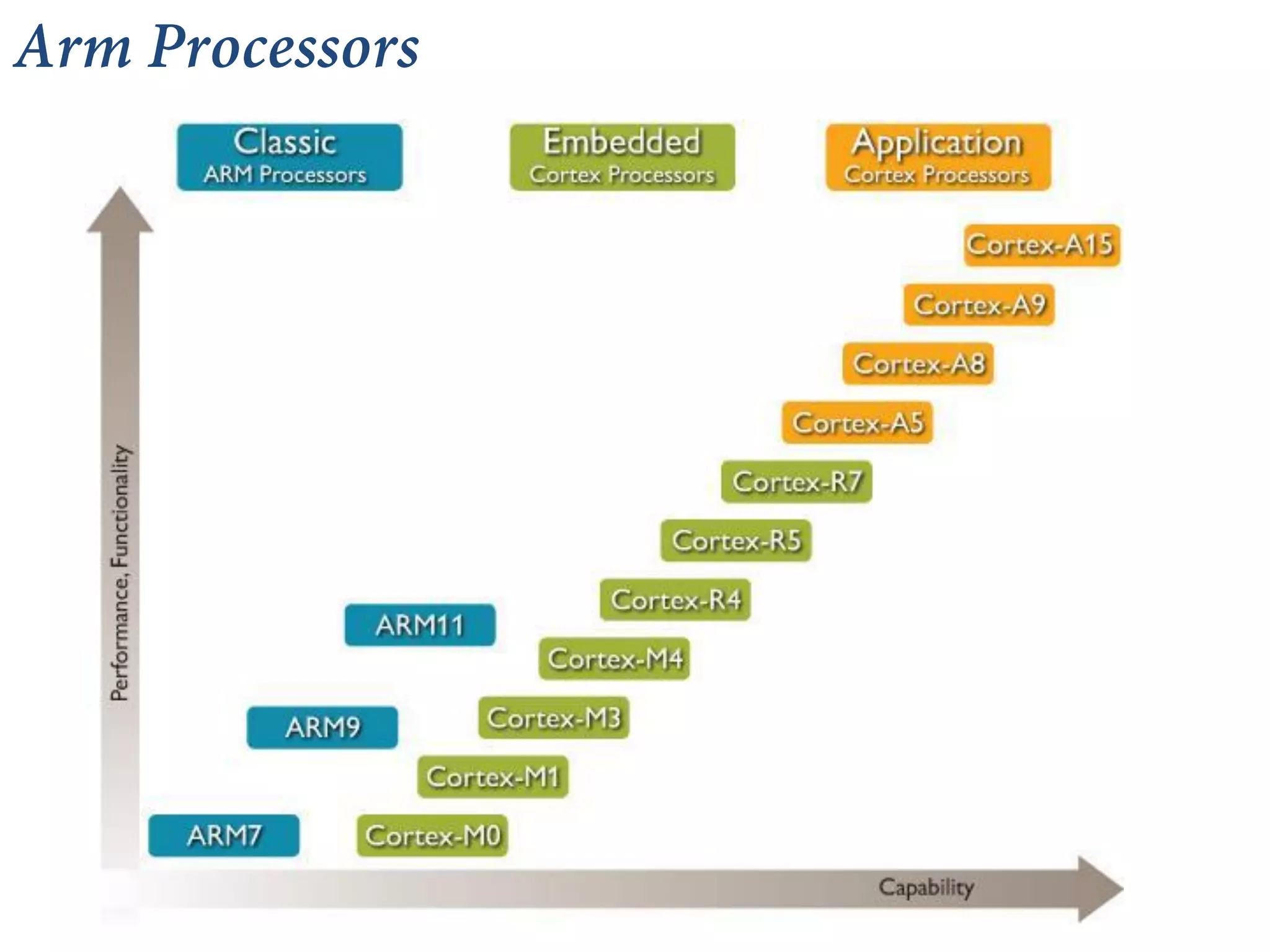
Embedded ARM Cortex
Processors
• Cortex M0:
 Ultra low gate
count (less that 12
K). gates).
 Ultra low-power (3
μW/MHz ).
 32-bit processor.
 Based on ARMv6-
M architecture.
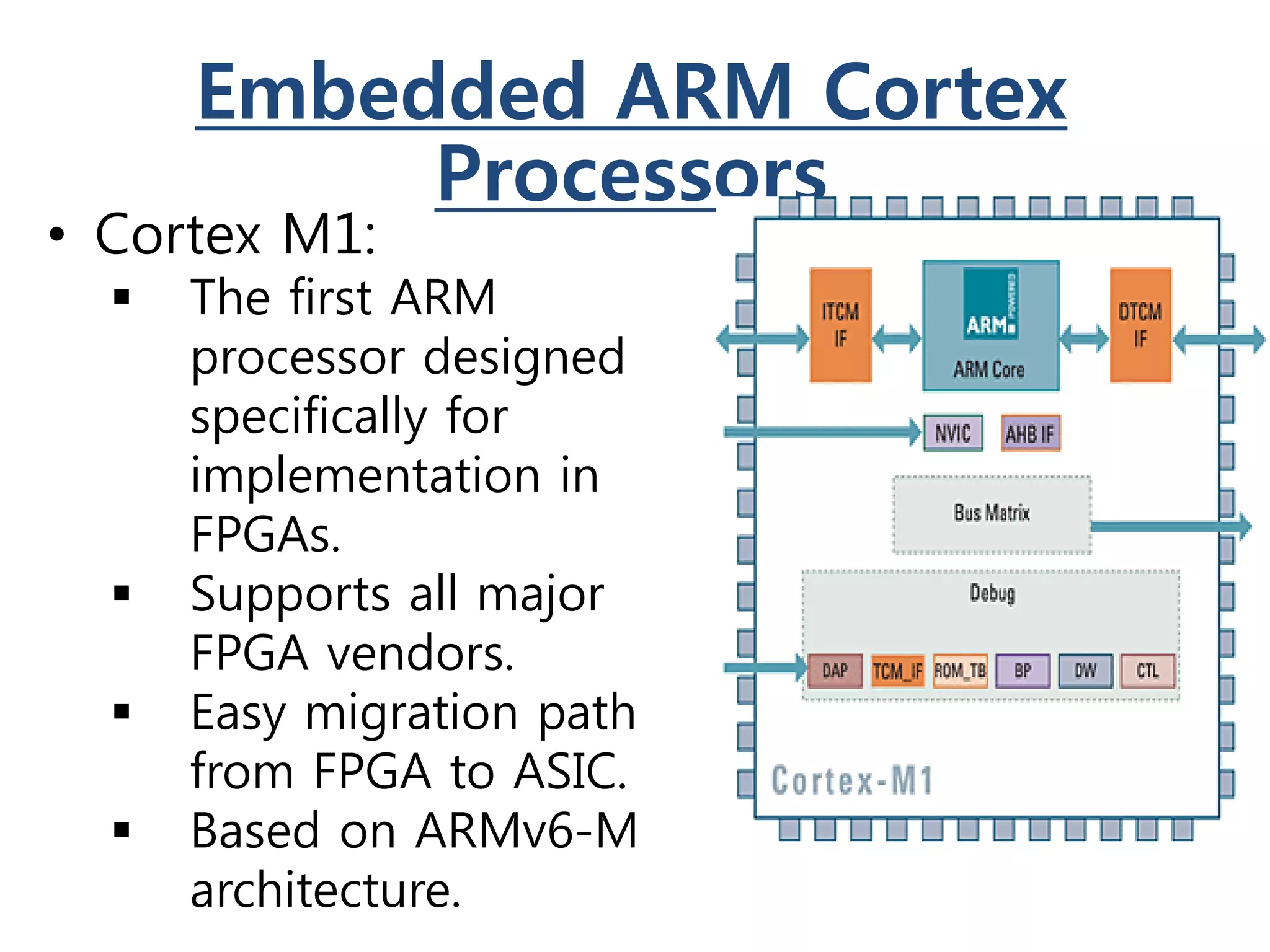
Embedded ARM Cortex
Processors
• Cortex M1:
 The first ARM
processor designed
specifically for
implementation in
FPGAs.
 Supports all major
FPGA vendors.
 Easy migration path
from FPGA to ASIC.
 Based on ARMv6-M
architecture.
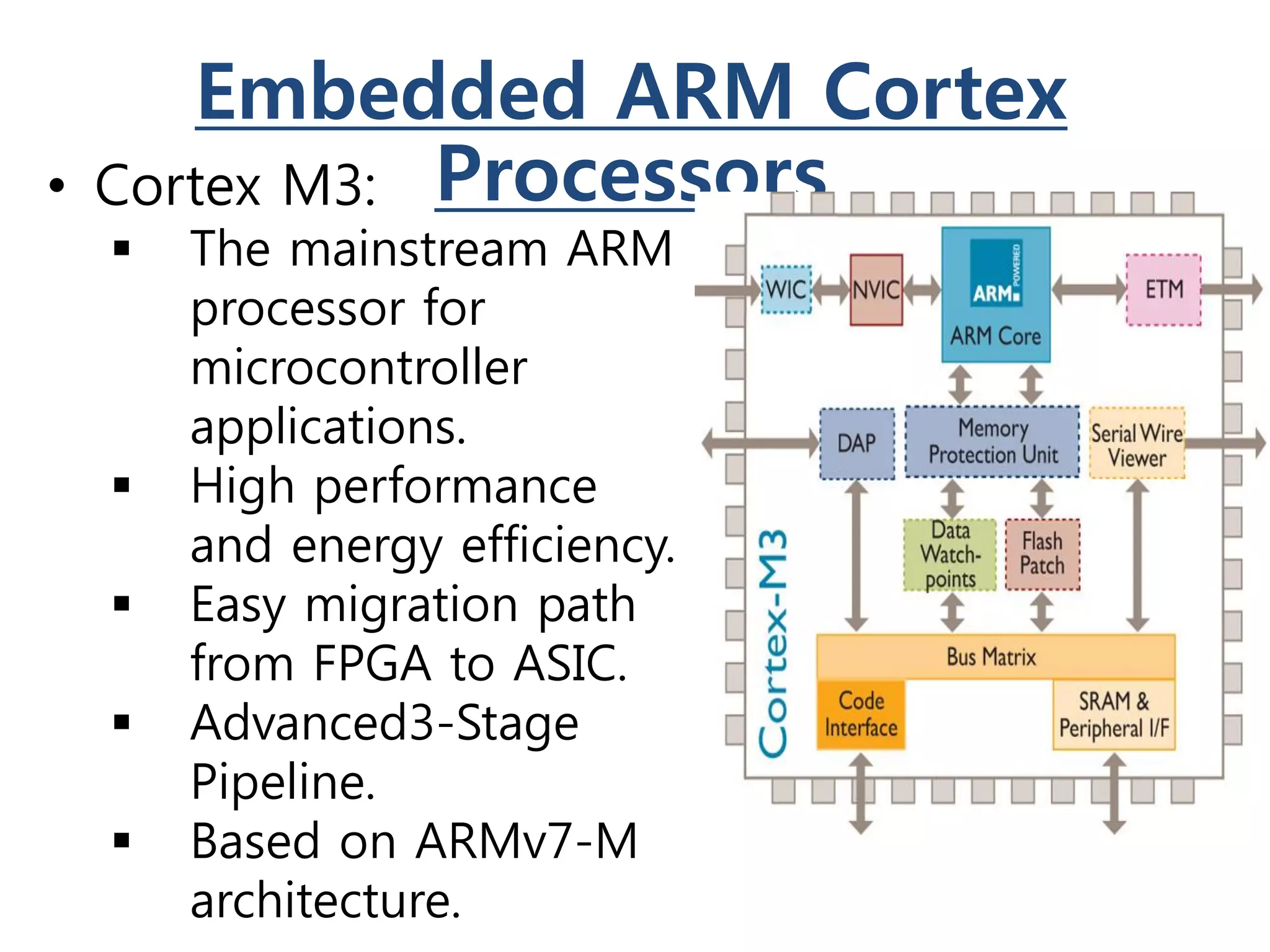
Embedded ARM Cortex
Processors• Cortex M3:
 The mainstream ARM
processor for
microcontroller
applications.
 High performance
and energy efficiency.
 Easy migration path
from FPGA to ASIC.
 Advanced3-Stage
Pipeline.
 Based on ARMv7-M
architecture.
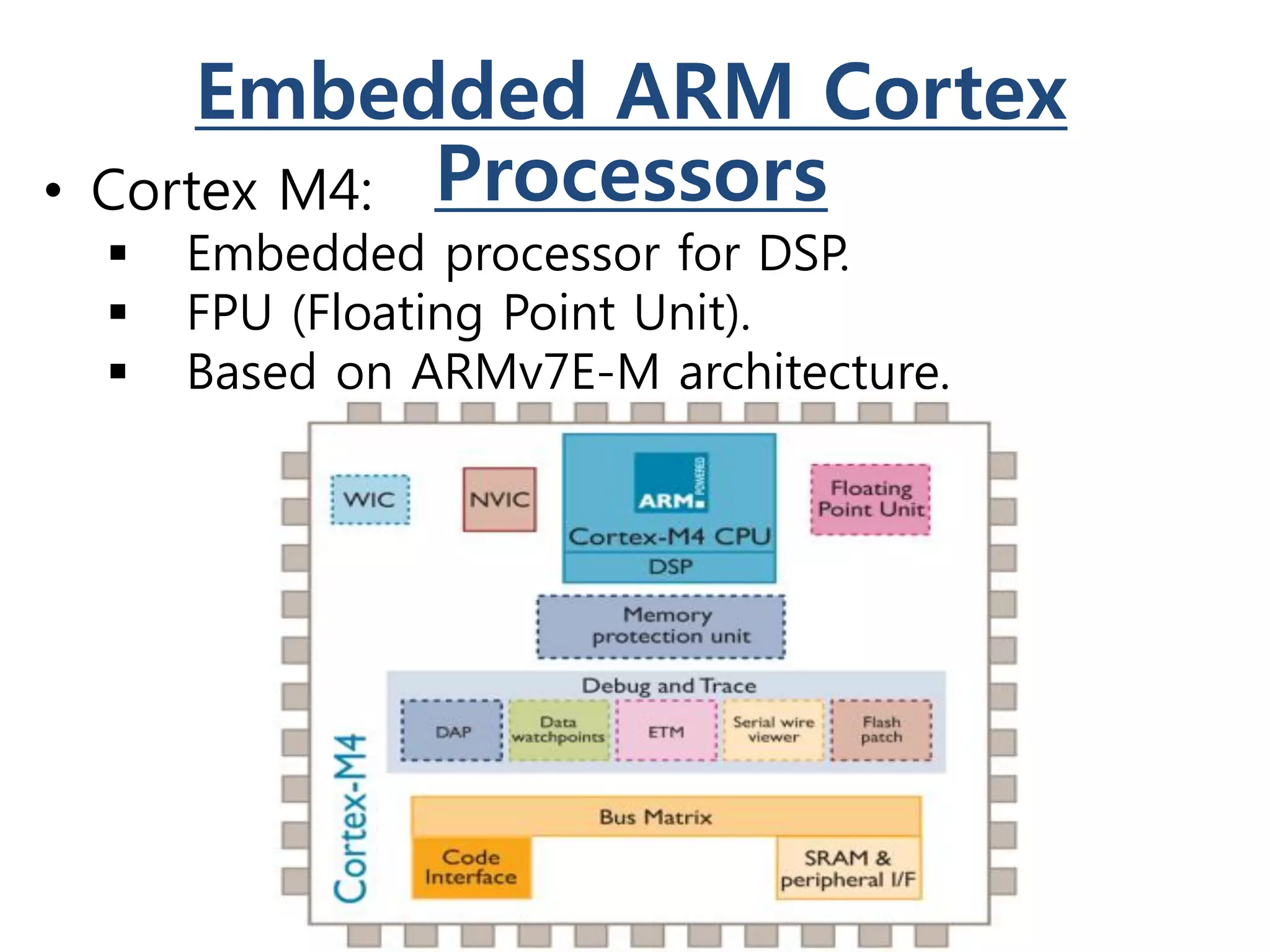
Embedded ARM Cortex
Processors• Cortex M4:
 Embedded processor for DSP.
 FPU (Floating Point Unit).
 Based on ARMv7E-M architecture.
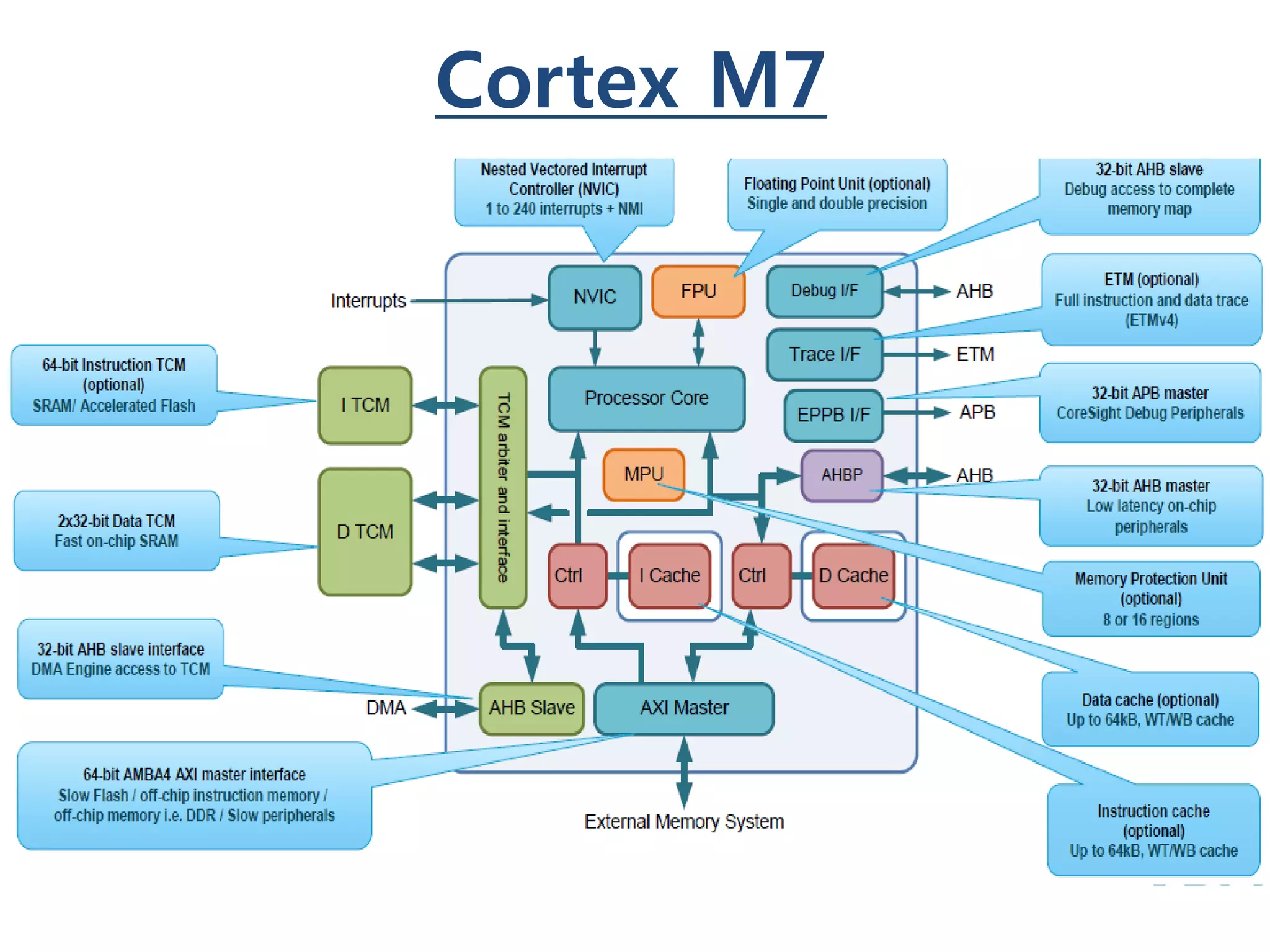
Cortex M7
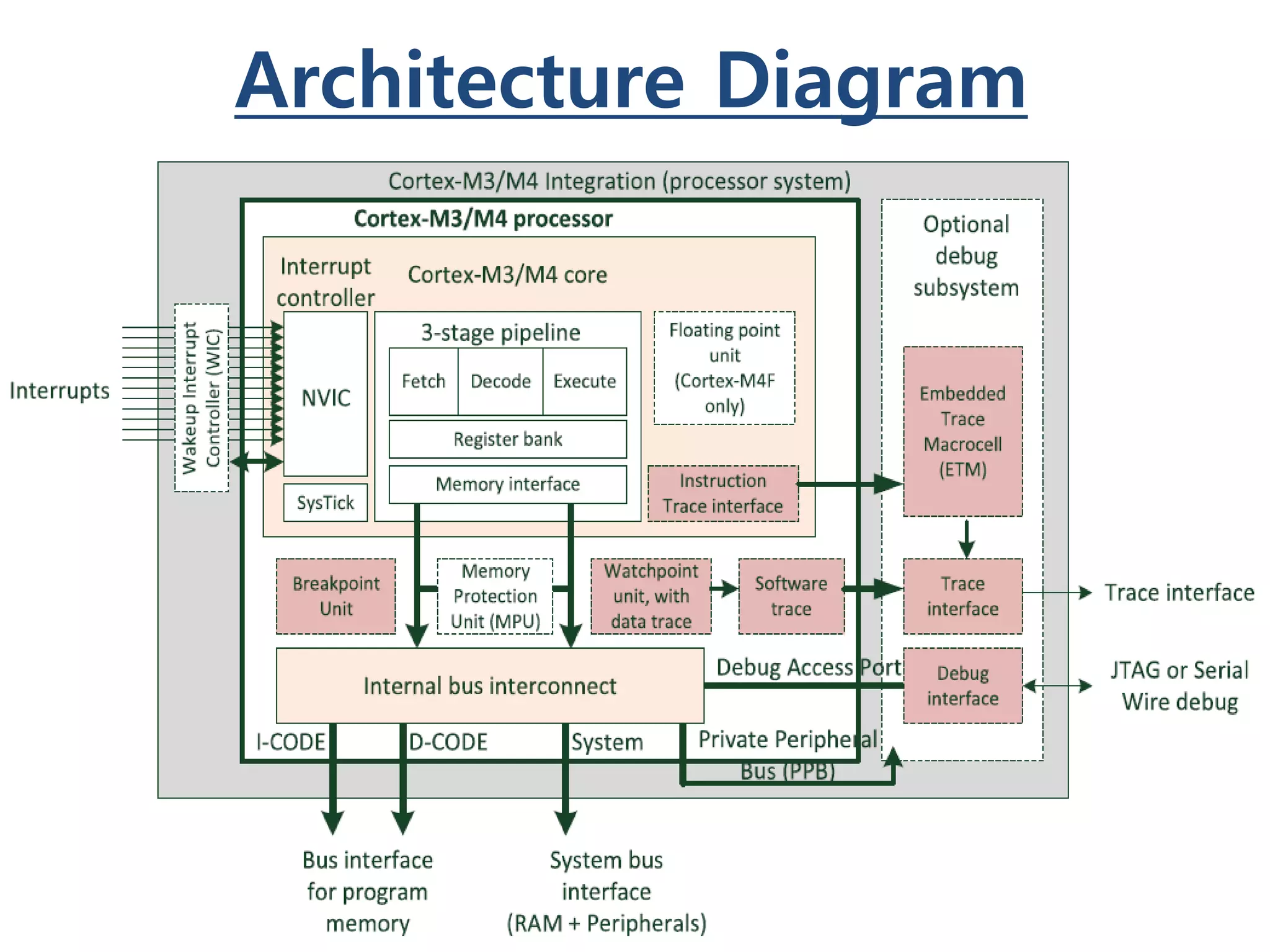
Architecture Diagram
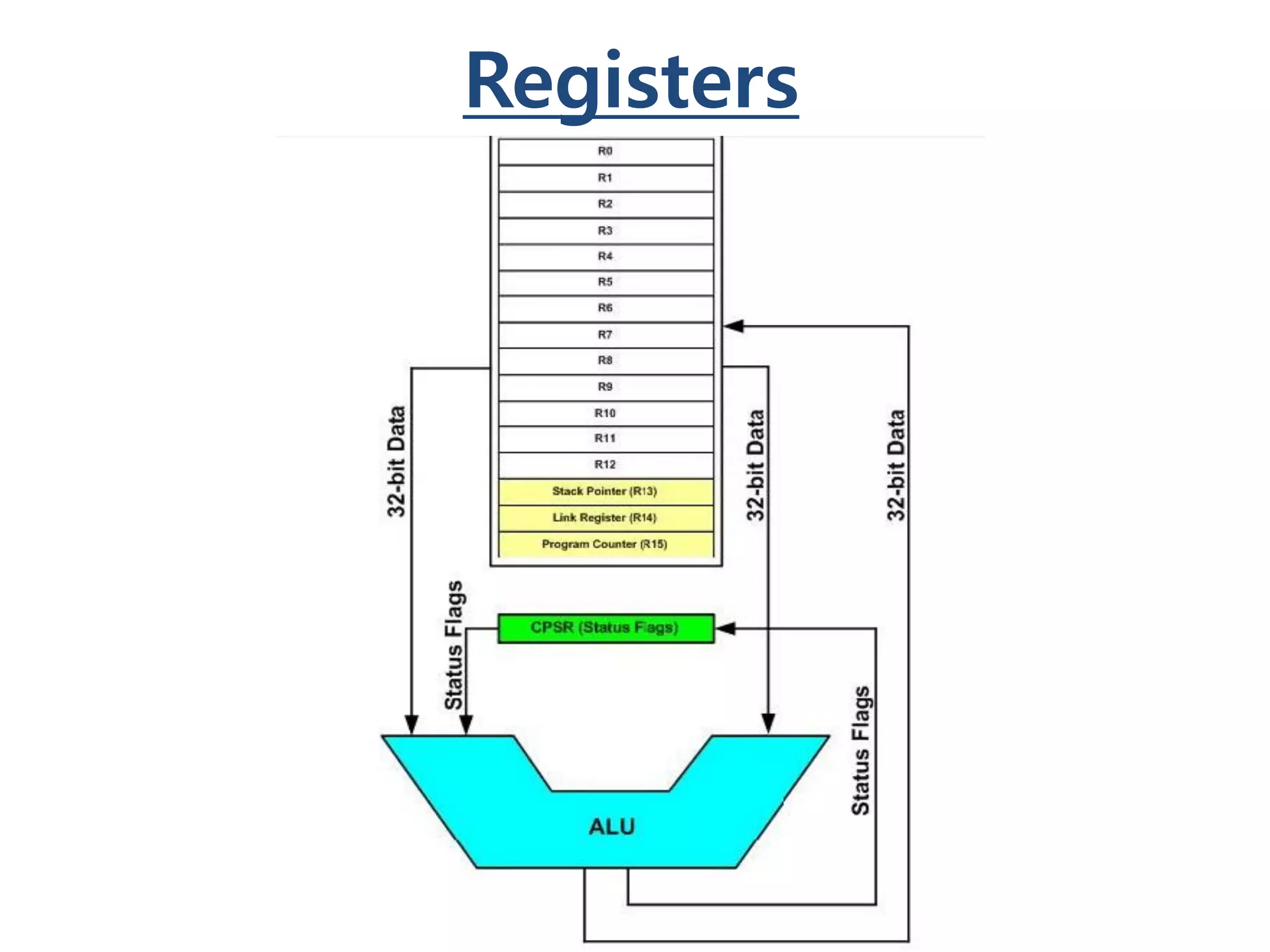
Registers
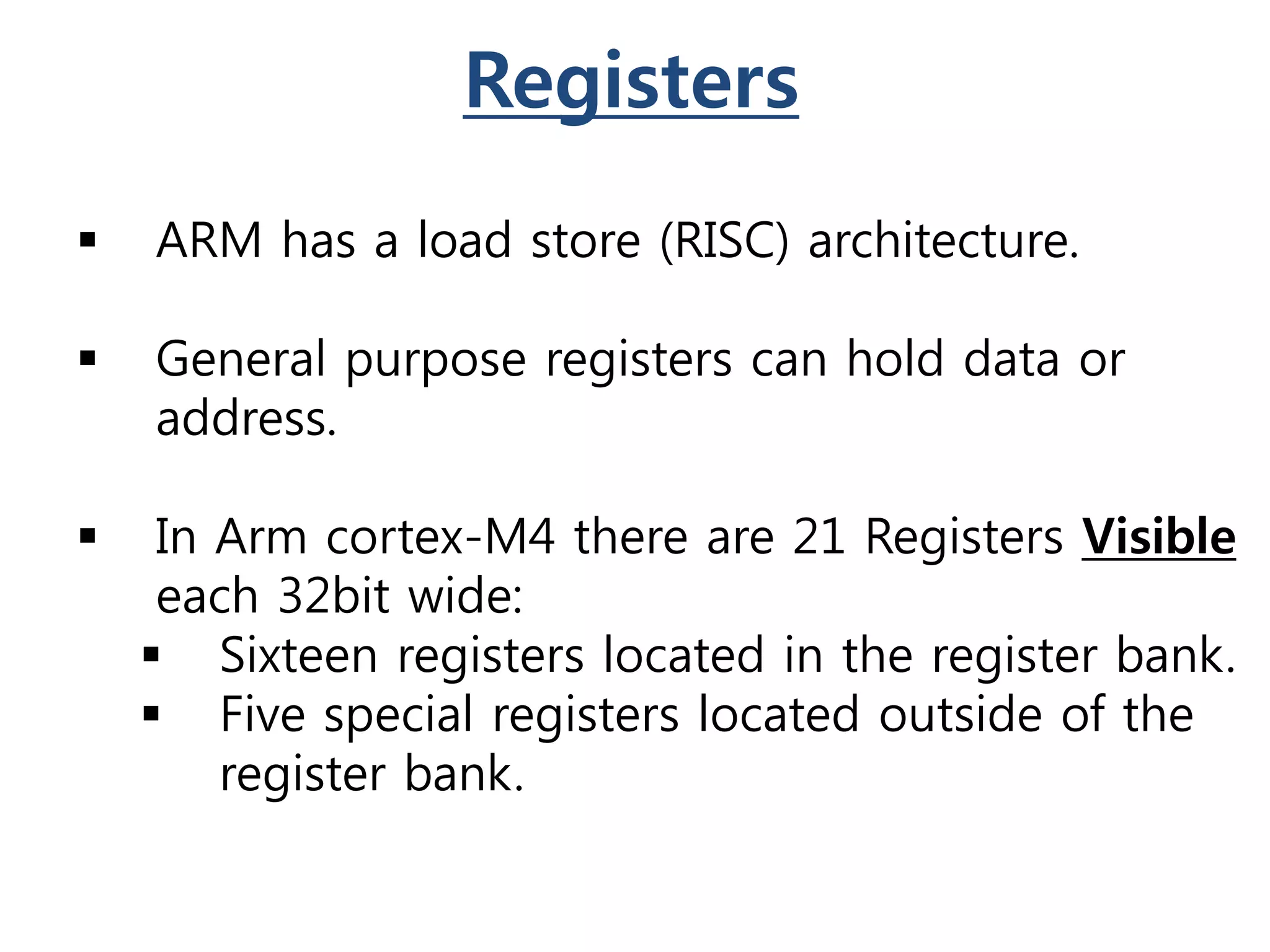
 ARM has a load store (RISC) architecture.
 General purpose registers can hold data or
address.
 In Arm cortex-M4 there are 21 Registers Visible
each 32bit wide:
 Sixteen registers located in the register bank.
 Five special registers located outside of the
register bank.
Registers
Registers
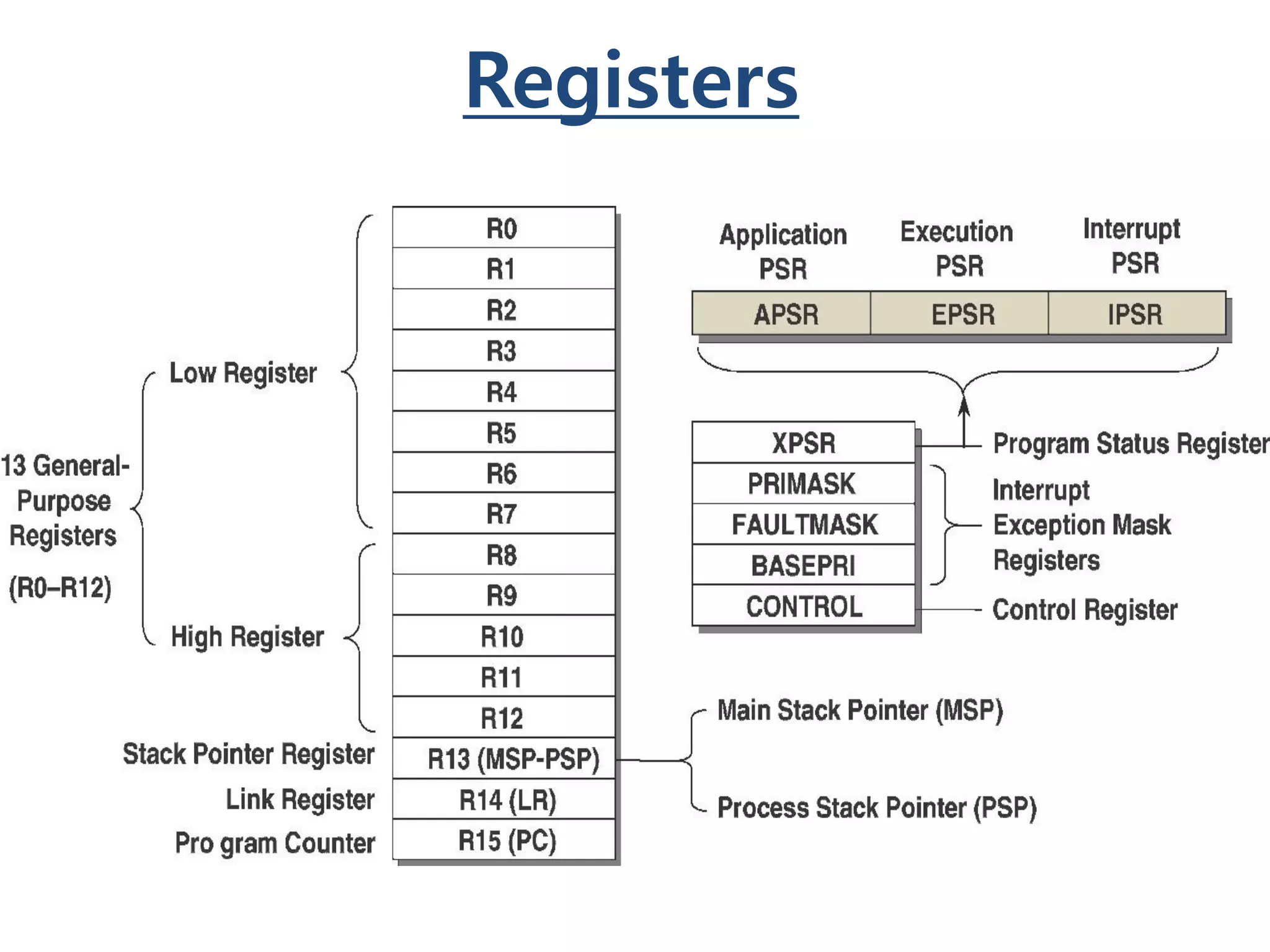
 All 13 general-purpose registers can be used to
store instruction ,data & addresses .
 These registers divided into :
 Low Register from R0 to R7.
 High Register from R8 to R12.
 Most 16-bit data operations should be
performed in the Low Register group.
 Most 32-bit data operations should be
processed in the High Register group.
Registers
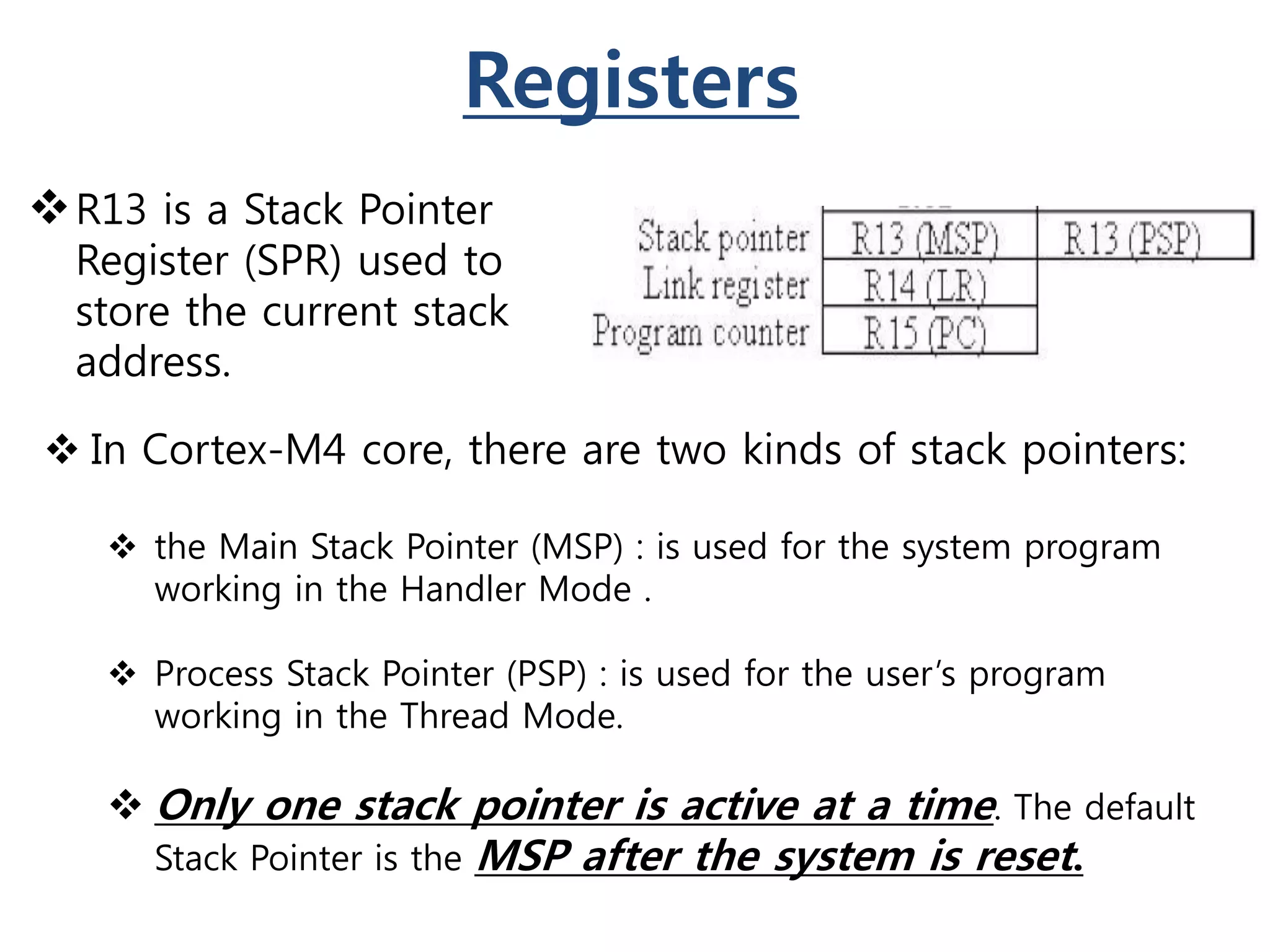
R13 is a Stack Pointer
Register (SPR) used to
store the current stack
address.
 In Cortex-M4 core, there are two kinds of stack pointers:
 the Main Stack Pointer (MSP) : is used for the system program
working in the Handler Mode .
 Process Stack Pointer (PSP) : is used for the user’s program
working in the Thread Mode.
 Only one stack pointer is active at a time. The default
Stack Pointer is the MSP after the system is reset.
Registers
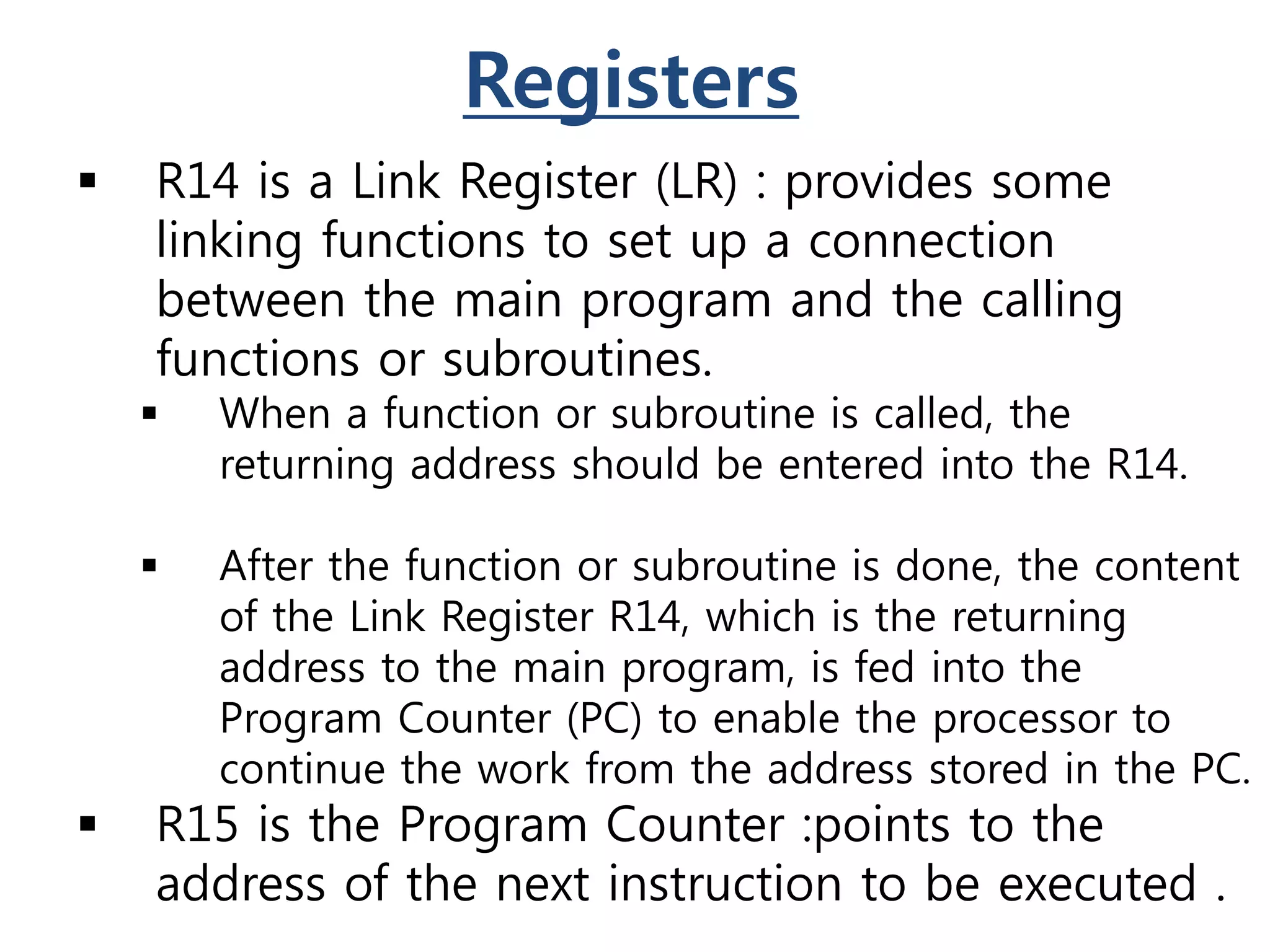
 R14 is a Link Register (LR) : provides some
linking functions to set up a connection
between the main program and the calling
functions or subroutines.
 When a function or subroutine is called, the
returning address should be entered into the R14.
 After the function or subroutine is done, the content
of the Link Register R14, which is the returning
address to the main program, is fed into the
Program Counter (PC) to enable the processor to
continue the work from the address stored in the PC.
 R15 is the Program Counter :points to the
address of the next instruction to be executed .
Registers
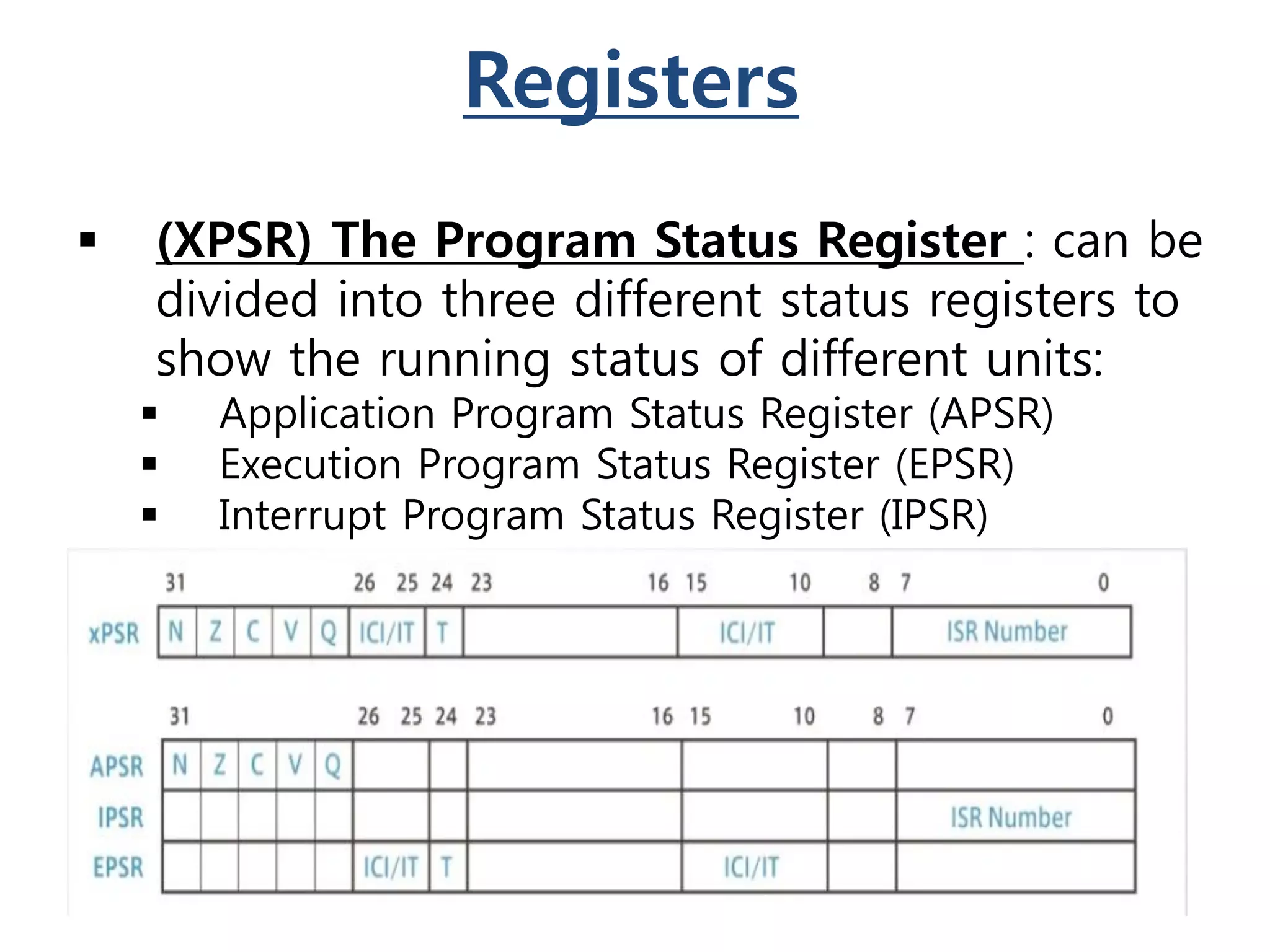
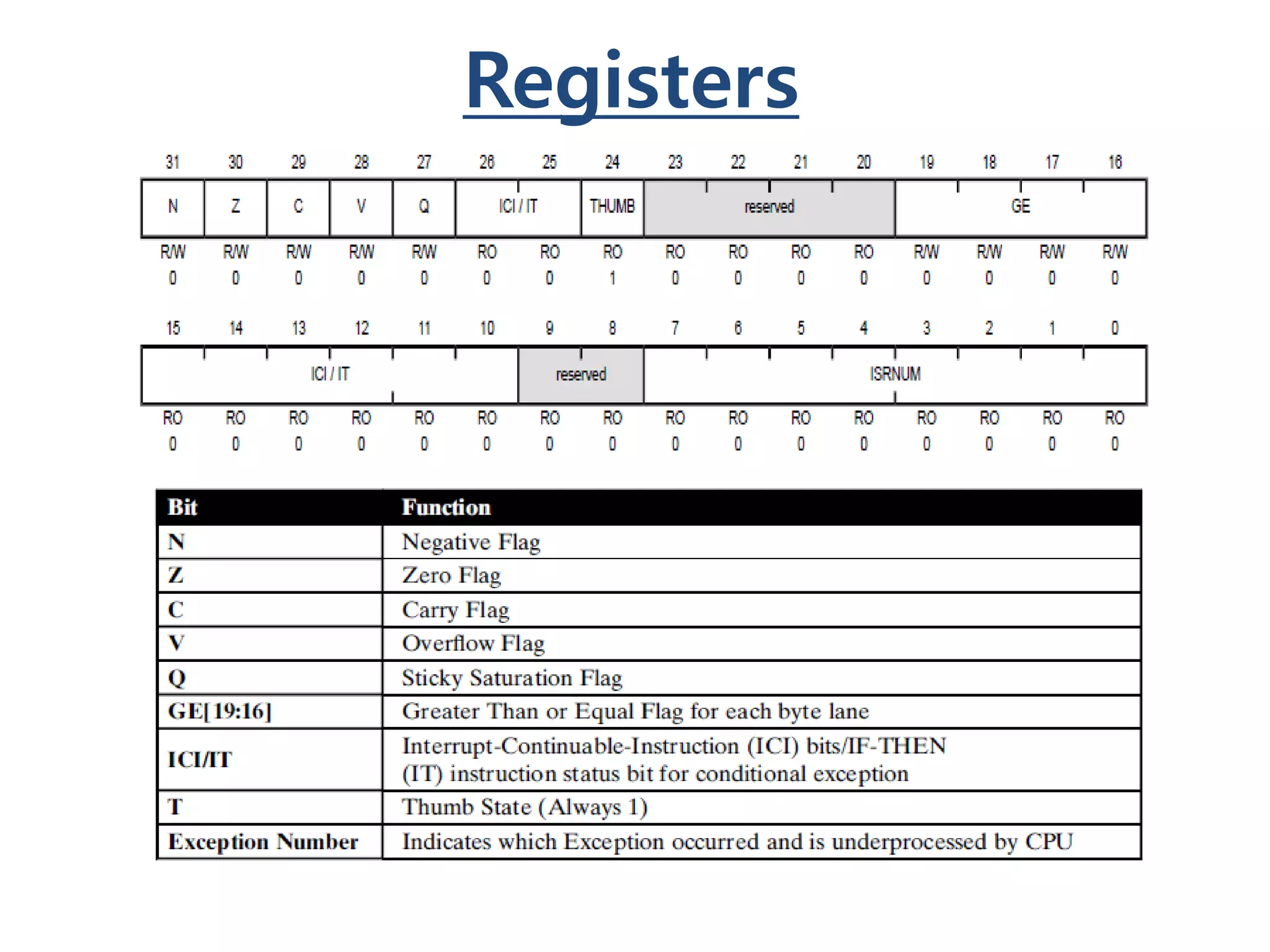
 (XPSR) The Program Status Register : can be
divided into three different status registers to
show the running status of different units:
 Application Program Status Register (APSR)
 Execution Program Status Register (EPSR)
 Interrupt Program Status Register (IPSR)
Registers
Registers
Registers
r0
r1
r2
r3
r4
r5
r6
r7
r8
r9
r10
r11
r12
r15 (pc)
cpsr
r13 (sp)
r14 (lr)
User mode
spsr
r13 (sp)
r14 (lr)
IRQ FIQ
r8
r9
r10
r11
r12
r13 (sp)
r14 (lr)
spsr spsr
r13 (sp)
r14 (lr)
Undef
spsr
r13 (sp)
r14 (lr)
Abort
spsr
r13 (sp)
r14 (lr)
SVC
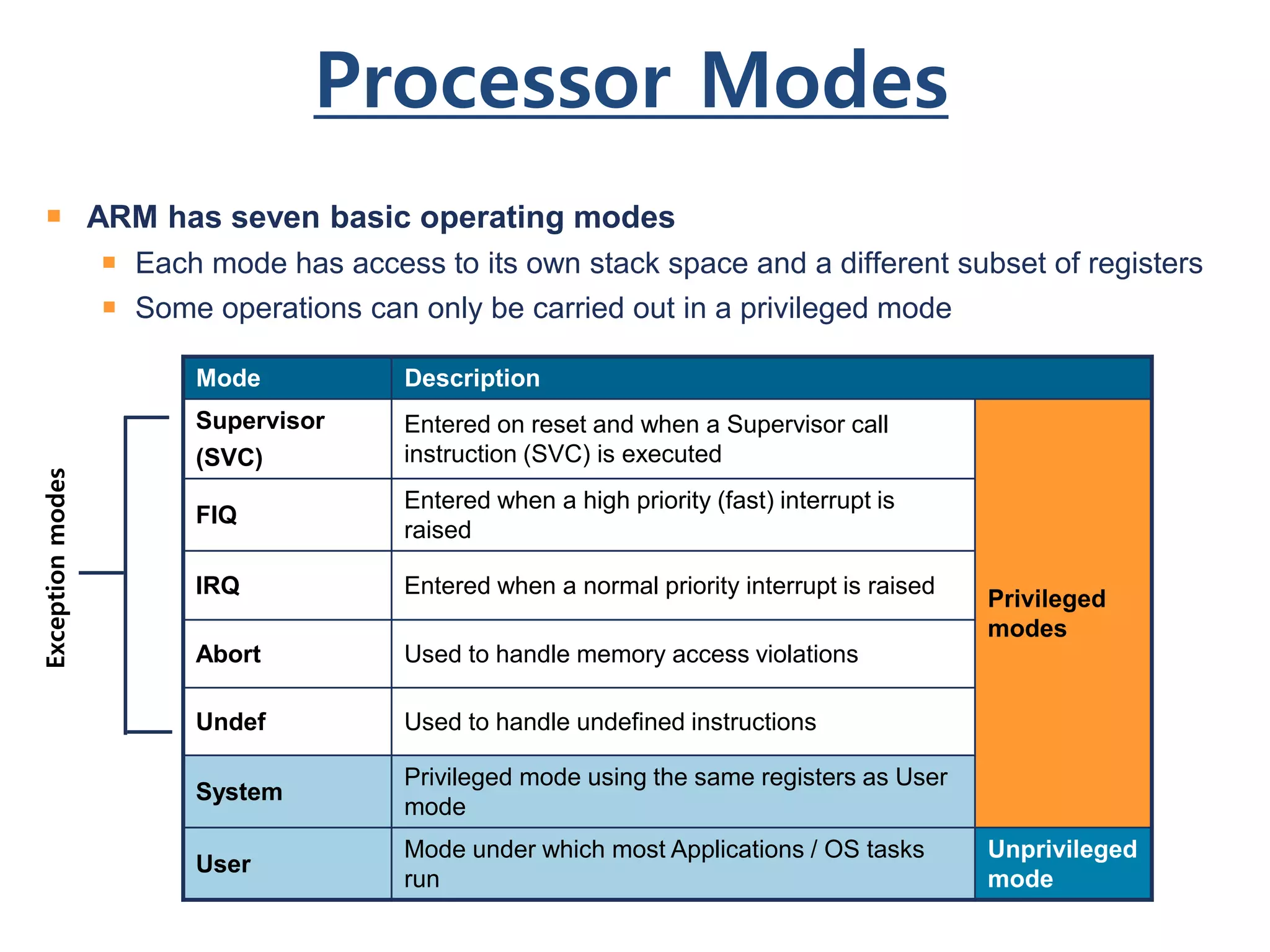
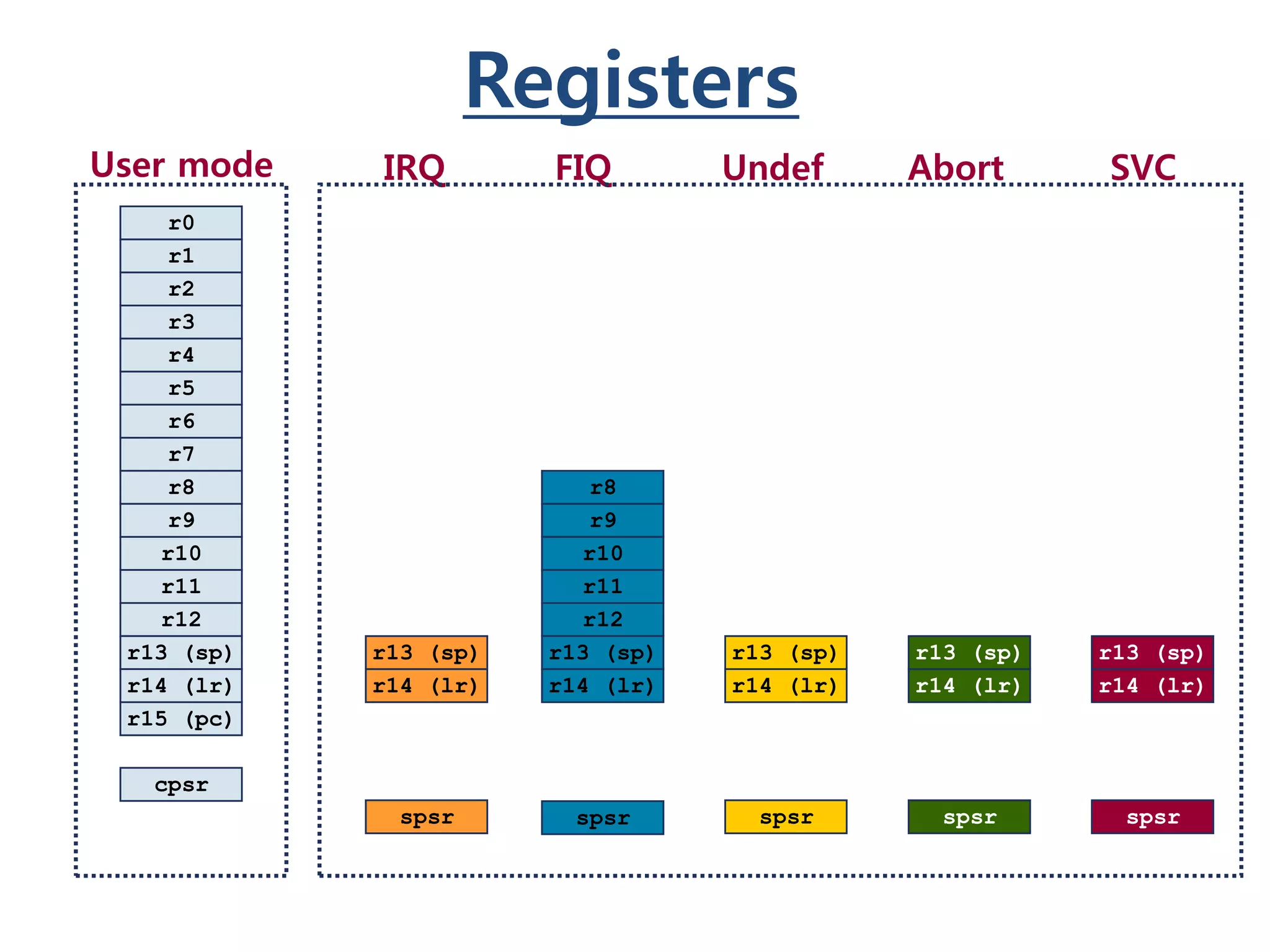
Processor Modes
 ARM has seven basic operating modes
 Each mode has access to its own stack space and a different subset of registers
 Some operations can only be carried out in a privileged mode
Mode Description
Supervisor
(SVC)
Entered on reset and when a Supervisor call
instruction (SVC) is executed
Privileged
modes
FIQ
Entered when a high priority (fast) interrupt is
raised
IRQ Entered when a normal priority interrupt is raised
Abort Used to handle memory access violations
Undef Used to handle undefined instructions
System
Privileged mode using the same registers as User
mode
User
Mode under which most Applications / OS tasks
run
Unprivileged
mode
Exceptionmodes
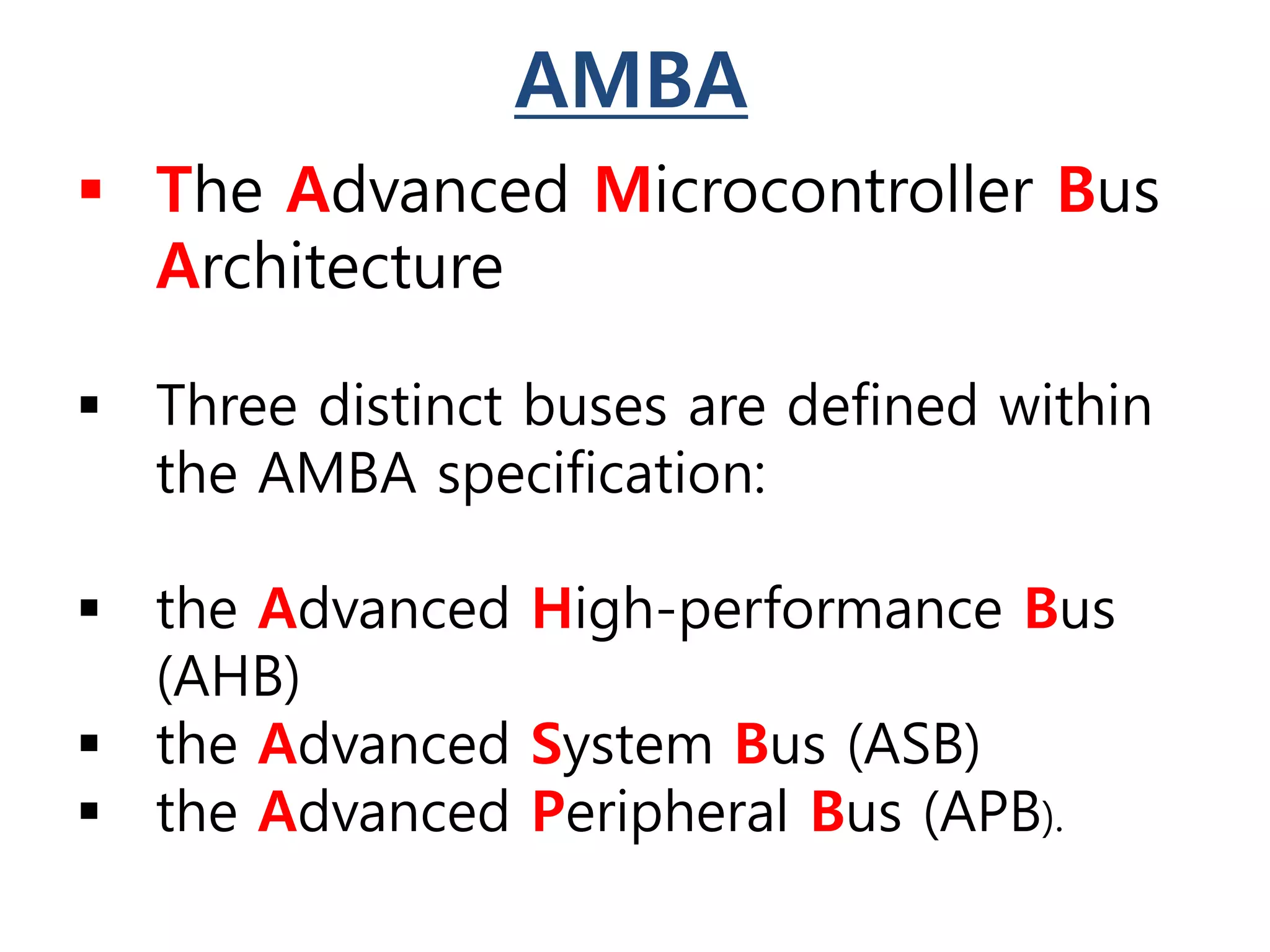
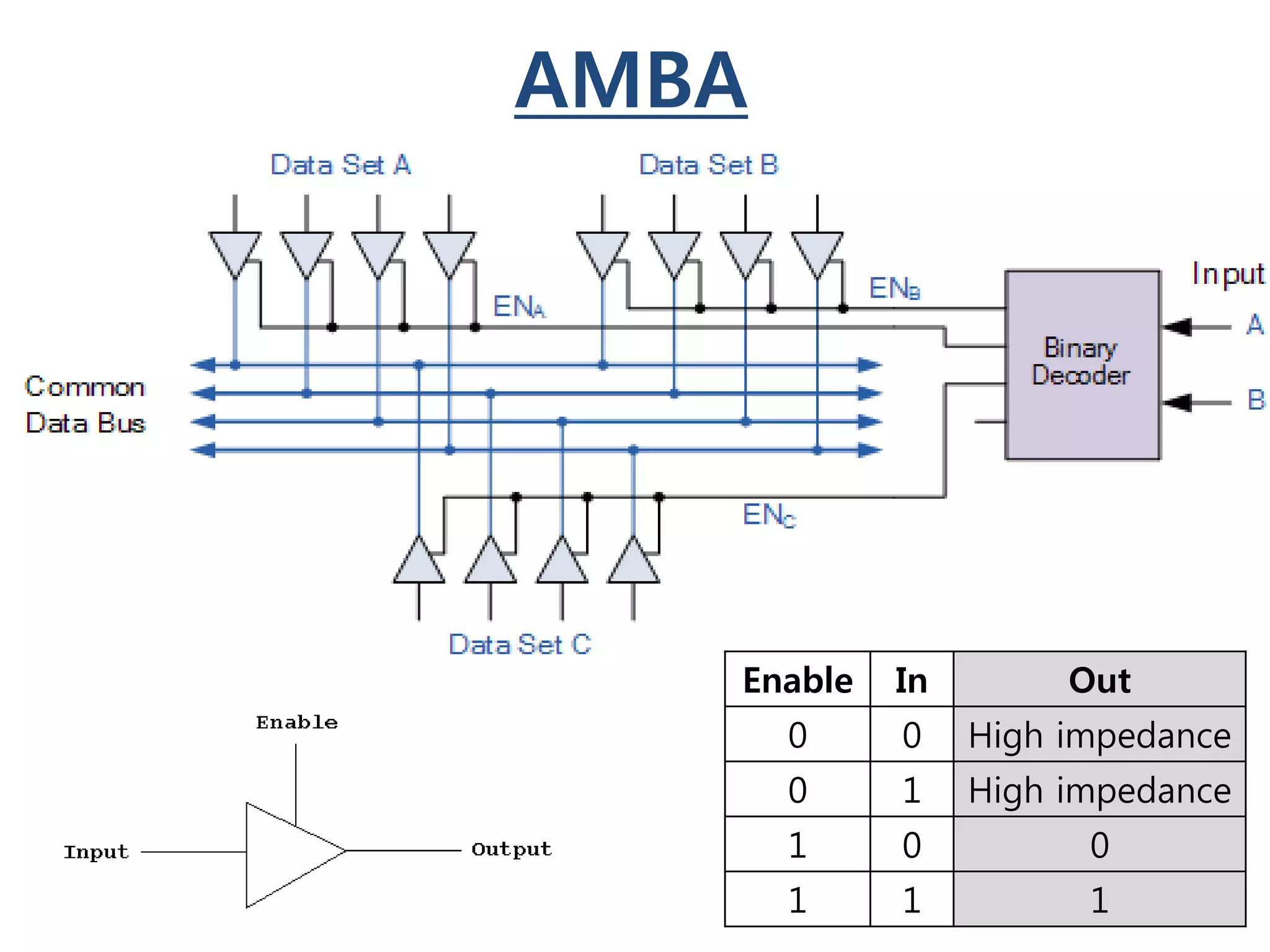
AMBA
 The Advanced Microcontroller Bus
Architecture
 Three distinct buses are defined within
the AMBA specification:
 the Advanced High-performance Bus
(AHB)
 the Advanced System Bus (ASB)
 the Advanced Peripheral Bus (APB).
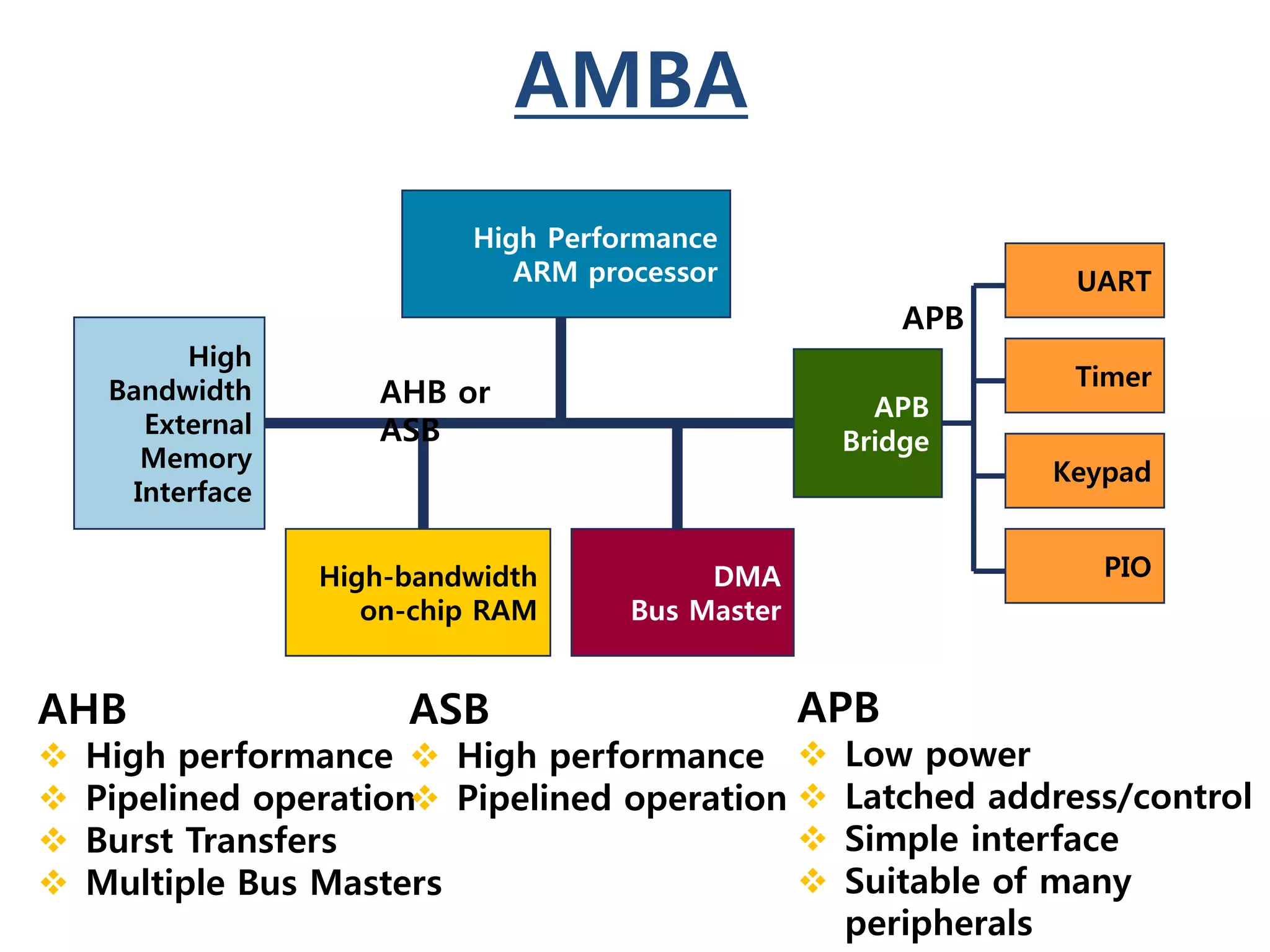
AMBA
High Performance
ARM processor
High-bandwidth
on-chip RAM
High
Bandwidth
External
Memory
Interface
DMA
Bus Master
APB
Bridge
Timer
Keypad
UART
PIO
AHB or
ASB
APB
AHB
 High performance
 Pipelined operation
 Burst Transfers
 Multiple Bus Masters
APB
 Low power
 Latched address/control
 Simple interface
 Suitable of many
peripherals
ASB
 High performance
 Pipelined operation
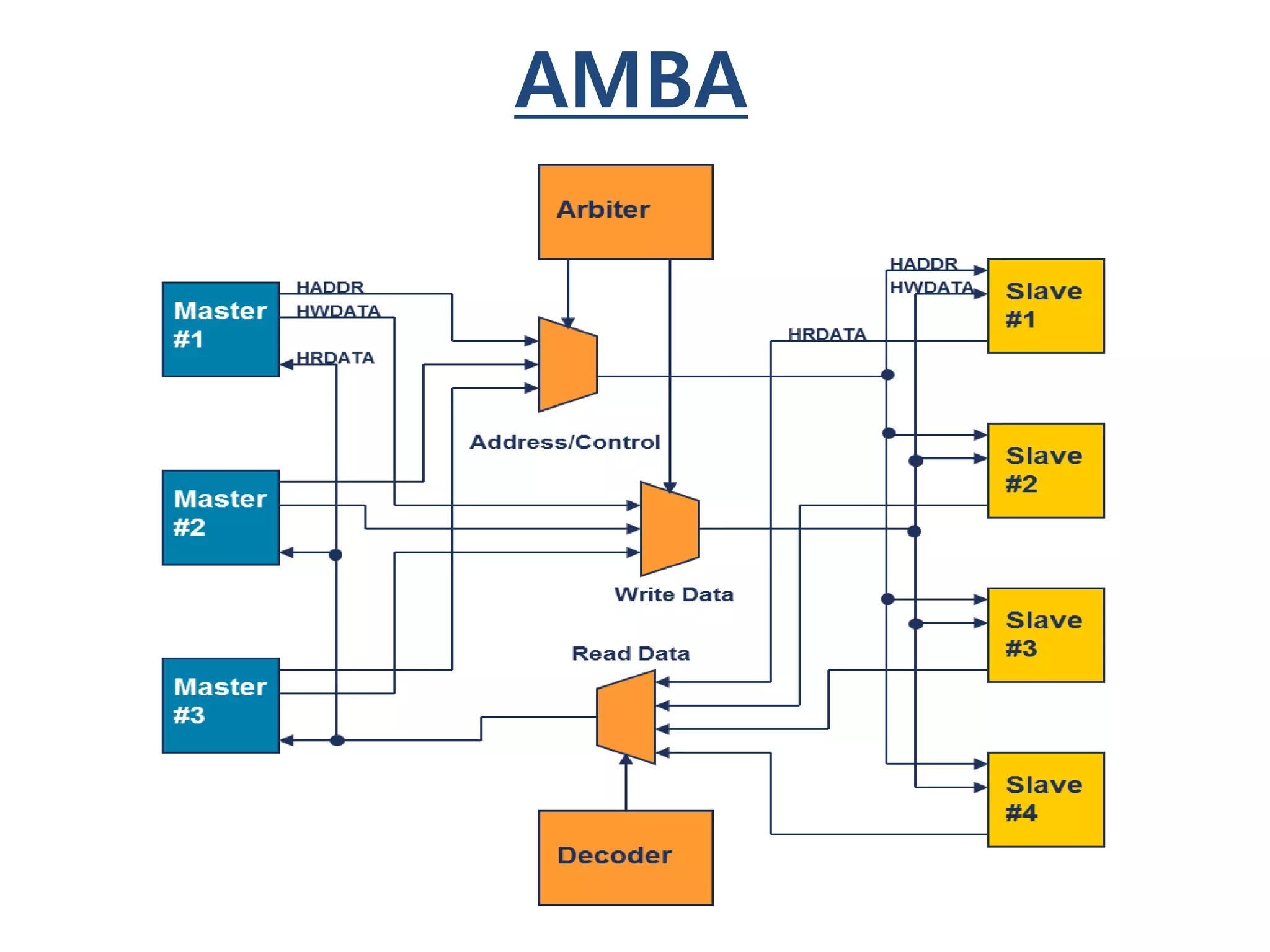
AMBA
AMBA
Enable In Out
0 0 High impedance
0 1 High impedance
1 0 0
1 1 1
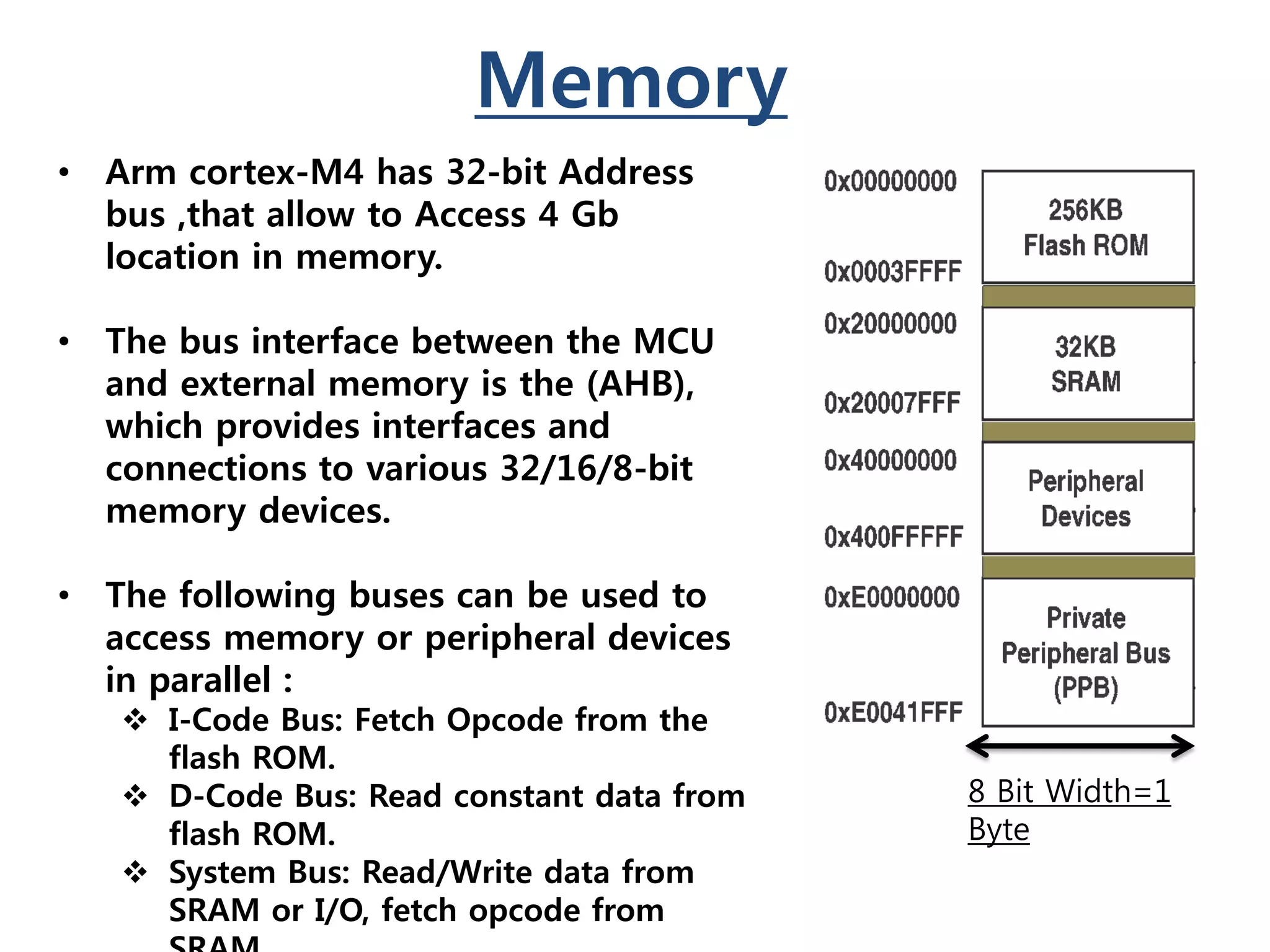
Memory
8 Bit Width=1
Byte
• Arm cortex-M4 has 32-bit Address
bus ,that allow to Access 4 Gb
location in memory.
• The bus interface between the MCU
and external memory is the (AHB),
which provides interfaces and
connections to various 32/16/8-bit
memory devices.
• The following buses can be used to
access memory or peripheral devices
in parallel :
 I-Code Bus: Fetch Opcode from the
flash ROM.
 D-Code Bus: Read constant data from
flash ROM.
 System Bus: Read/Write data from
SRAM or I/O, fetch opcode from
Memory
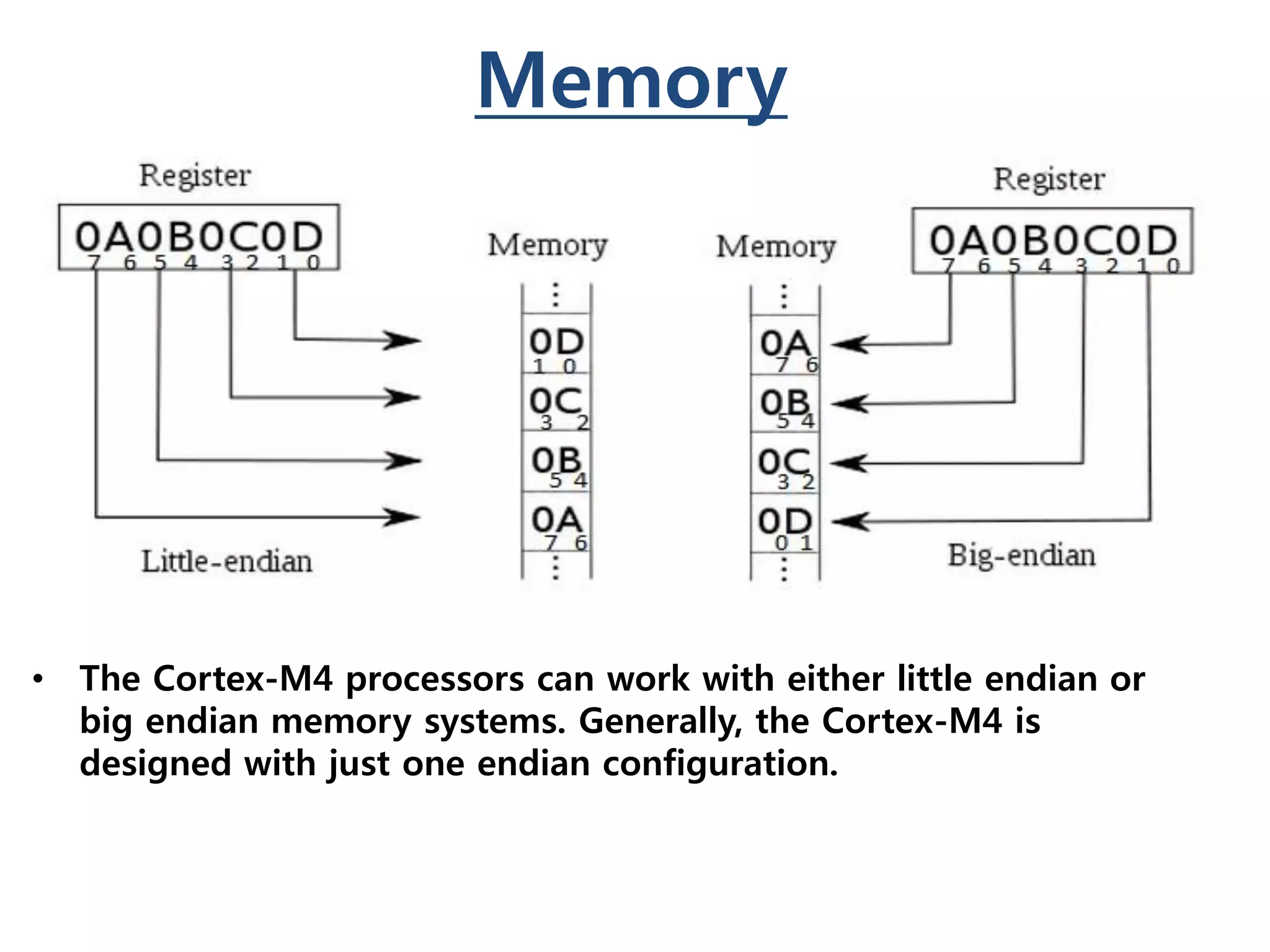
• The Cortex-M4 processors can work with either little endian or
big endian memory systems. Generally, the Cortex-M4 is
designed with just one endian configuration.
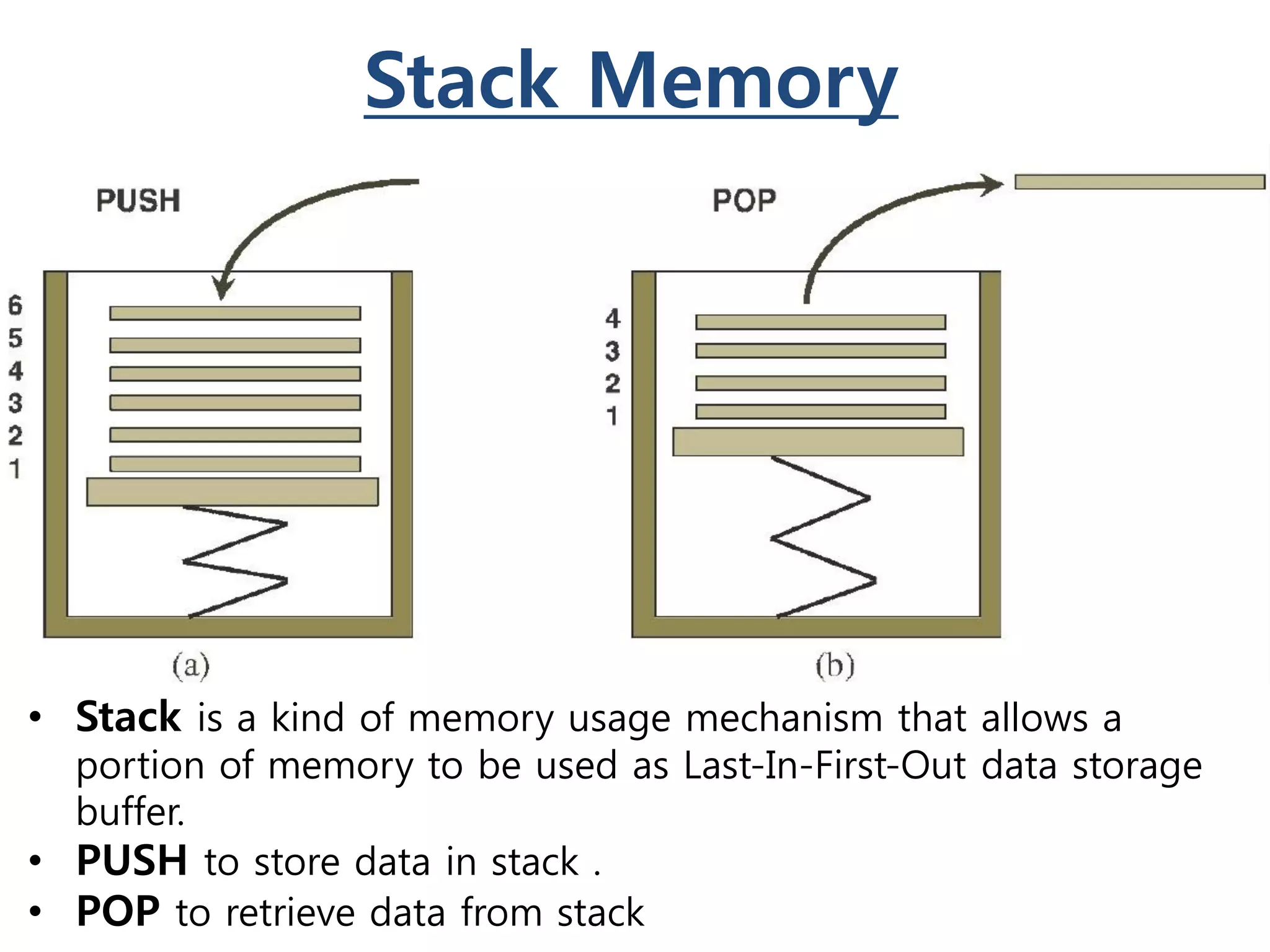
Stack Memory
• Stack is a kind of memory usage mechanism that allows a
portion of memory to be used as Last-In-First-Out data storage
buffer.
• PUSH to store data in stack .
• POP to retrieve data from stack
Stack Memory
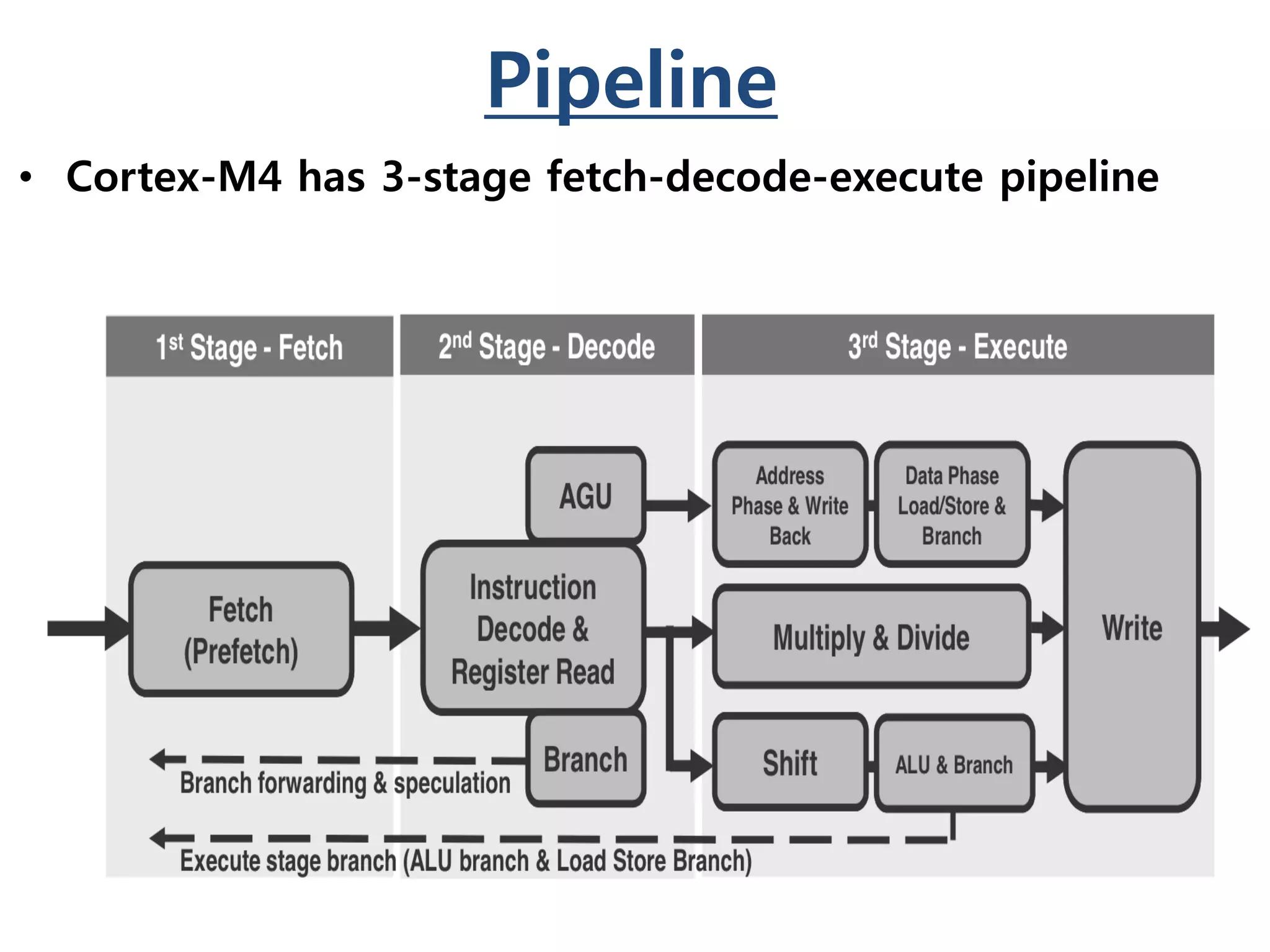
Pipeline
• Cortex-M4 has 3-stage fetch-decode-execute pipeline

Introduction to arm architecture

  • 1.
    By: Zakriua Gomma Email:zakriua.gomma37@gmail.com Introduction to ARM Architecture
  • 2.
    ARM Ltd  ARM Advanced RISC Machines  Founded in November 1990  Spun out of Acorn Computers  Company headquarters in Cambridge, UK  Processor design centres in Cambridge, Austin, and Sophia Antipolis  Sales, support, and engineering offices all over the world  Best known for its range of RISC processor cores designs  Other products – fabric IP, software tools, models, cell libraries - to help partners develop and ship ARM-based SoCs  ARM does not manufacture silicon
  • 3.
  • 4.
          In 2005about 98 percent of all mobile phones use at least one ARM-designed core on their motherboards, according to research from the analyst firm the Linley Group
  • 5.
  • 6.
    • Motorola • Panasonic •Qualcomm • Sharp • Sanyo • Sony • Apple • Toshiba • Texas Instrument • Wipro …and many more • 3com • Microsoft • IBM • Intel • Nokia • Atmel • NEC • Fijistu • Freescale • Altera • Epson • STM • NXP
  • 8.
  • 10.
  • 12.
  • 13.
    • • • Later Intelbought Strong ARM From DEC & Changed the name to Xscale . • In 2006 Marvell Technology Group bought Xscale from Intel .
  • 17.
    Embedded ARM Cortex Processors •Cortex M0:  Ultra low gate count (less that 12 K). gates).  Ultra low-power (3 μW/MHz ).  32-bit processor.  Based on ARMv6- M architecture.
  • 18.
    Embedded ARM Cortex Processors •Cortex M1:  The first ARM processor designed specifically for implementation in FPGAs.  Supports all major FPGA vendors.  Easy migration path from FPGA to ASIC.  Based on ARMv6-M architecture.
  • 19.
    Embedded ARM Cortex Processors•Cortex M3:  The mainstream ARM processor for microcontroller applications.  High performance and energy efficiency.  Easy migration path from FPGA to ASIC.  Advanced3-Stage Pipeline.  Based on ARMv7-M architecture.
  • 20.
    Embedded ARM Cortex Processors•Cortex M4:  Embedded processor for DSP.  FPU (Floating Point Unit).  Based on ARMv7E-M architecture.
  • 21.
  • 23.
  • 24.
    Registers  ARM hasa load store (RISC) architecture.  General purpose registers can hold data or address.  In Arm cortex-M4 there are 21 Registers Visible each 32bit wide:  Sixteen registers located in the register bank.  Five special registers located outside of the register bank.
  • 25.
  • 26.
    Registers  All 13general-purpose registers can be used to store instruction ,data & addresses .  These registers divided into :  Low Register from R0 to R7.  High Register from R8 to R12.  Most 16-bit data operations should be performed in the Low Register group.  Most 32-bit data operations should be processed in the High Register group.
  • 27.
    Registers R13 is aStack Pointer Register (SPR) used to store the current stack address.  In Cortex-M4 core, there are two kinds of stack pointers:  the Main Stack Pointer (MSP) : is used for the system program working in the Handler Mode .  Process Stack Pointer (PSP) : is used for the user’s program working in the Thread Mode.  Only one stack pointer is active at a time. The default Stack Pointer is the MSP after the system is reset.
  • 28.
    Registers  R14 isa Link Register (LR) : provides some linking functions to set up a connection between the main program and the calling functions or subroutines.  When a function or subroutine is called, the returning address should be entered into the R14.  After the function or subroutine is done, the content of the Link Register R14, which is the returning address to the main program, is fed into the Program Counter (PC) to enable the processor to continue the work from the address stored in the PC.  R15 is the Program Counter :points to the address of the next instruction to be executed .
  • 29.
    Registers  (XPSR) TheProgram Status Register : can be divided into three different status registers to show the running status of different units:  Application Program Status Register (APSR)  Execution Program Status Register (EPSR)  Interrupt Program Status Register (IPSR)
  • 30.
  • 31.
  • 32.
    Registers r0 r1 r2 r3 r4 r5 r6 r7 r8 r9 r10 r11 r12 r15 (pc) cpsr r13 (sp) r14(lr) User mode spsr r13 (sp) r14 (lr) IRQ FIQ r8 r9 r10 r11 r12 r13 (sp) r14 (lr) spsr spsr r13 (sp) r14 (lr) Undef spsr r13 (sp) r14 (lr) Abort spsr r13 (sp) r14 (lr) SVC
  • 33.
    Processor Modes  ARMhas seven basic operating modes  Each mode has access to its own stack space and a different subset of registers  Some operations can only be carried out in a privileged mode Mode Description Supervisor (SVC) Entered on reset and when a Supervisor call instruction (SVC) is executed Privileged modes FIQ Entered when a high priority (fast) interrupt is raised IRQ Entered when a normal priority interrupt is raised Abort Used to handle memory access violations Undef Used to handle undefined instructions System Privileged mode using the same registers as User mode User Mode under which most Applications / OS tasks run Unprivileged mode Exceptionmodes
  • 34.
    AMBA  The AdvancedMicrocontroller Bus Architecture  Three distinct buses are defined within the AMBA specification:  the Advanced High-performance Bus (AHB)  the Advanced System Bus (ASB)  the Advanced Peripheral Bus (APB).
  • 35.
    AMBA High Performance ARM processor High-bandwidth on-chipRAM High Bandwidth External Memory Interface DMA Bus Master APB Bridge Timer Keypad UART PIO AHB or ASB APB AHB  High performance  Pipelined operation  Burst Transfers  Multiple Bus Masters APB  Low power  Latched address/control  Simple interface  Suitable of many peripherals ASB  High performance  Pipelined operation
  • 36.
  • 37.
    AMBA Enable In Out 00 High impedance 0 1 High impedance 1 0 0 1 1 1
  • 38.
    Memory 8 Bit Width=1 Byte •Arm cortex-M4 has 32-bit Address bus ,that allow to Access 4 Gb location in memory. • The bus interface between the MCU and external memory is the (AHB), which provides interfaces and connections to various 32/16/8-bit memory devices. • The following buses can be used to access memory or peripheral devices in parallel :  I-Code Bus: Fetch Opcode from the flash ROM.  D-Code Bus: Read constant data from flash ROM.  System Bus: Read/Write data from SRAM or I/O, fetch opcode from
  • 39.
    Memory • The Cortex-M4processors can work with either little endian or big endian memory systems. Generally, the Cortex-M4 is designed with just one endian configuration.
  • 40.
    Stack Memory • Stackis a kind of memory usage mechanism that allows a portion of memory to be used as Last-In-First-Out data storage buffer. • PUSH to store data in stack . • POP to retrieve data from stack
  • 41.
  • 42.
    Pipeline • Cortex-M4 has3-stage fetch-decode-execute pipeline