André Olschewski – Skat Foundation Switzerland
Benedict Tuffuor – TREND Ghana
IRC Symposium, Addis Ababa, 12.04.2013
Uptake [number of units providing
services]
Trialled
Technology
Low
High
Time
Today20 years ago
Successful
Technology
Rope Pump in Africa
Rope Pump in Nicaragua
Promising
Technology
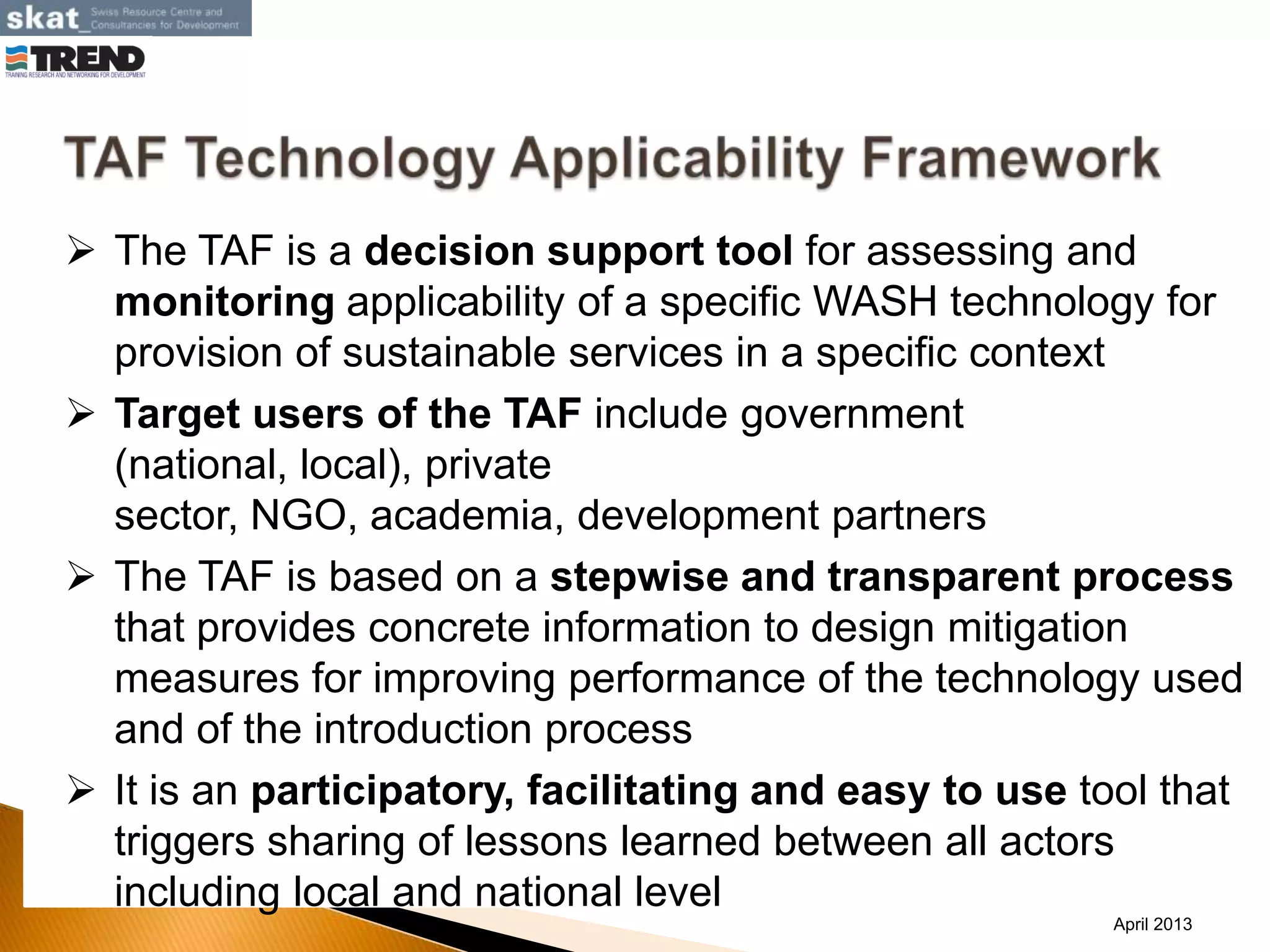
 What is the TAF
 Concept of the TAF
 Methodology to apply the TAF
 Example from TAF application
 Outlook
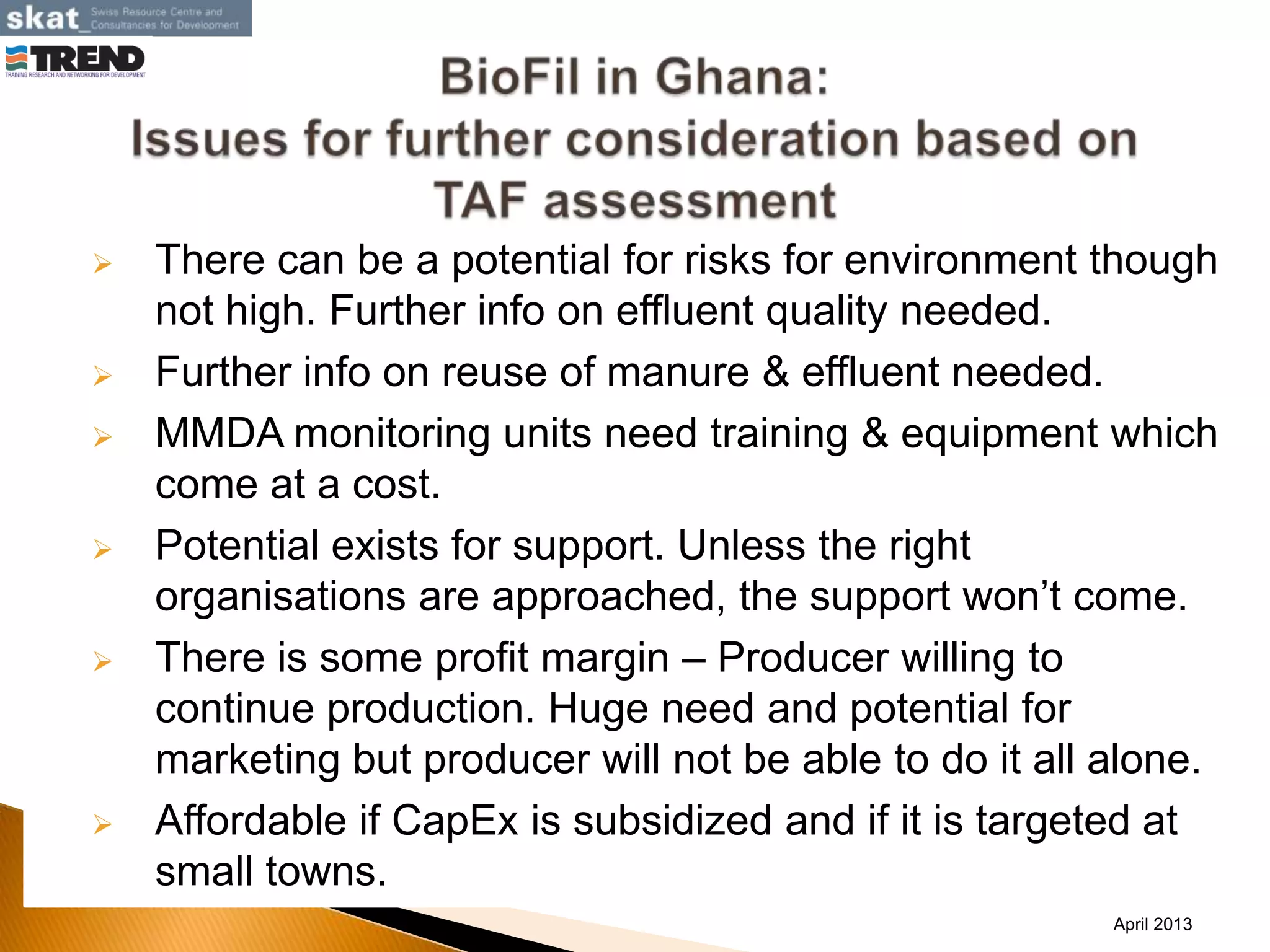
April 2013
 The TAF is a decision support tool for assessing and
monitoring applicability of a specific WASH technology for
provision of sustainable services in a specific context
 Target users of the TAF include government
(national, local), private
sector, NGO, academia, development partners
 The TAF is based on a stepwise and transparent process
that provides concrete information to design mitigation
measures for improving performance of the technology used
and of the introduction process
 It is an participatory, facilitating and easy to use tool that
triggers sharing of lessons learned between all actors
including local and national level
April 2013
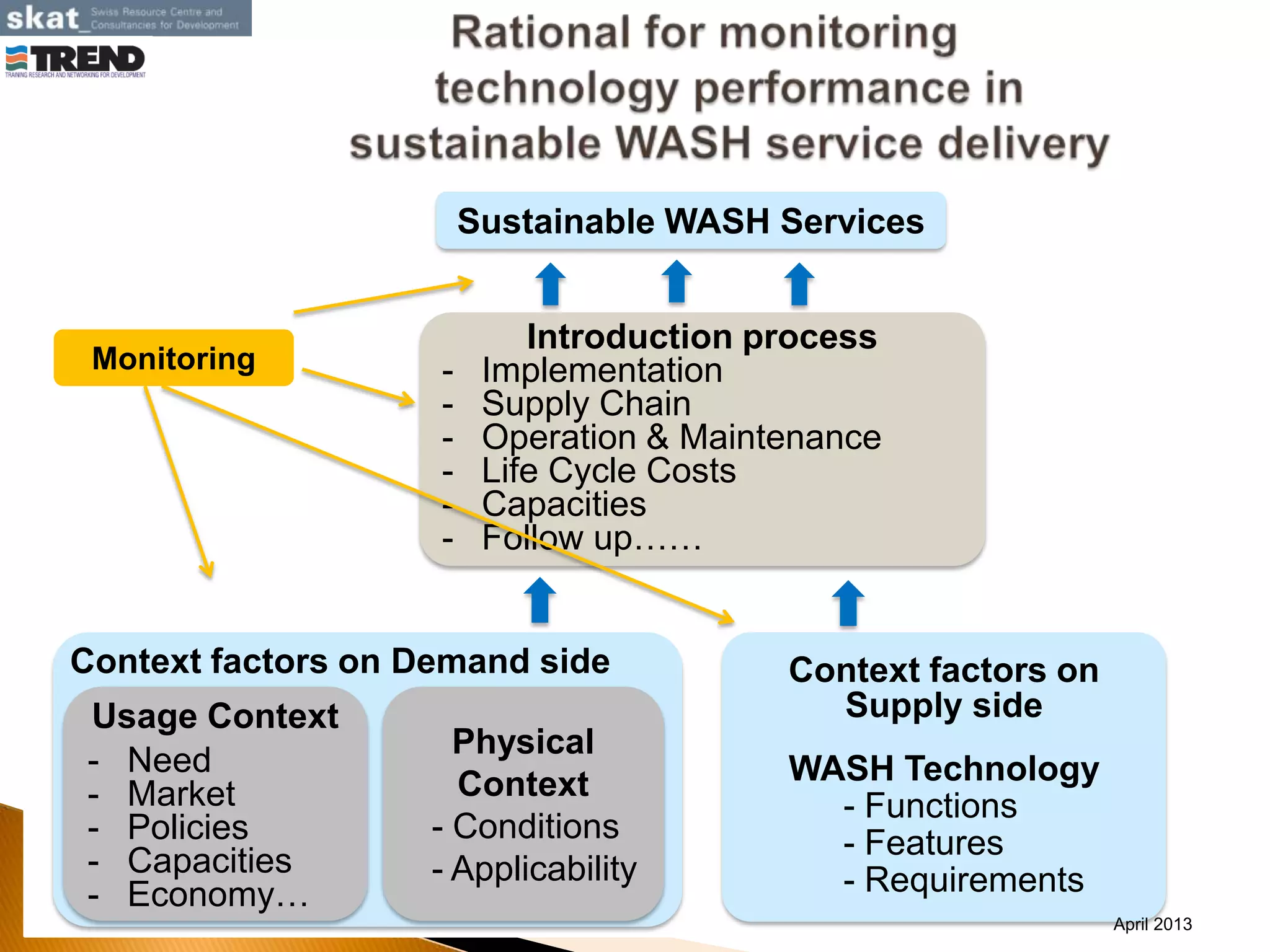
Usage Context
- Need
- Market
- Policies
- Capacities
- Economy…
Context factors on
Supply side
WASH Technology
- Functions
- Features
- Requirements
Sustainable WASH Services
Physical
Context
- Conditions
- Applicability
Context factors on Demand side
Introduction process
- Implementation
- Supply Chain
- Operation & Maintenance
- Life Cycle Costs
- Capacities
- Follow up……
April 2013
Monitoring
April 2013
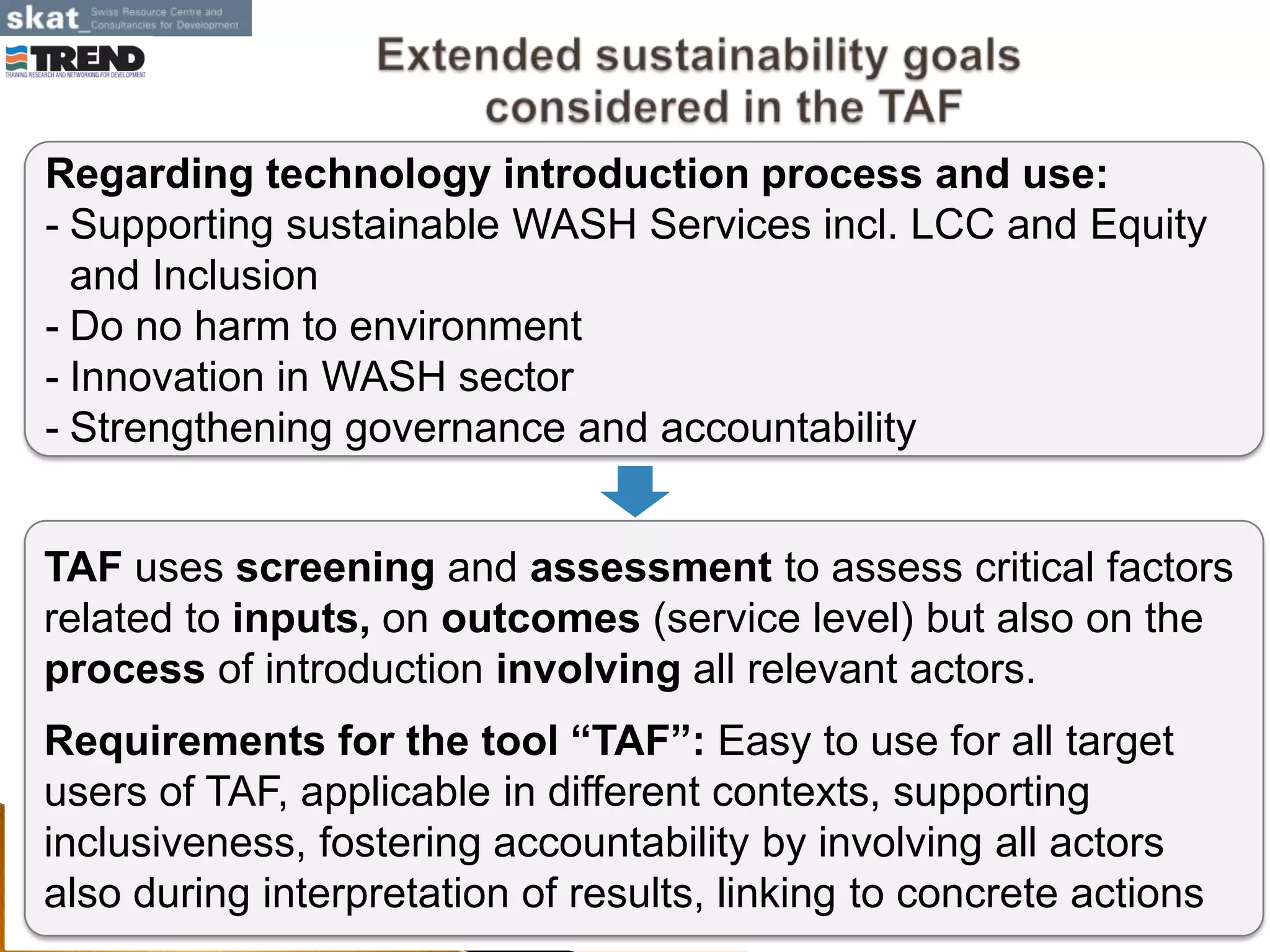
Regarding technology introduction process and use:
- Supporting sustainable WASH Services incl. LCC and Equity
and Inclusion
- Do no harm to environment
- Innovation in WASH sector
- Strengthening governance and accountability
TAF uses screening and assessment to assess critical factors
related to inputs, on outcomes (service level) but also on the
process of introduction involving all relevant actors.
Requirements for the tool “TAF”: Easy to use for all target
users of TAF, applicable in different contexts, supporting
inclusiveness, fostering accountability by involving all actors
also during interpretation of results, linking to concrete actions
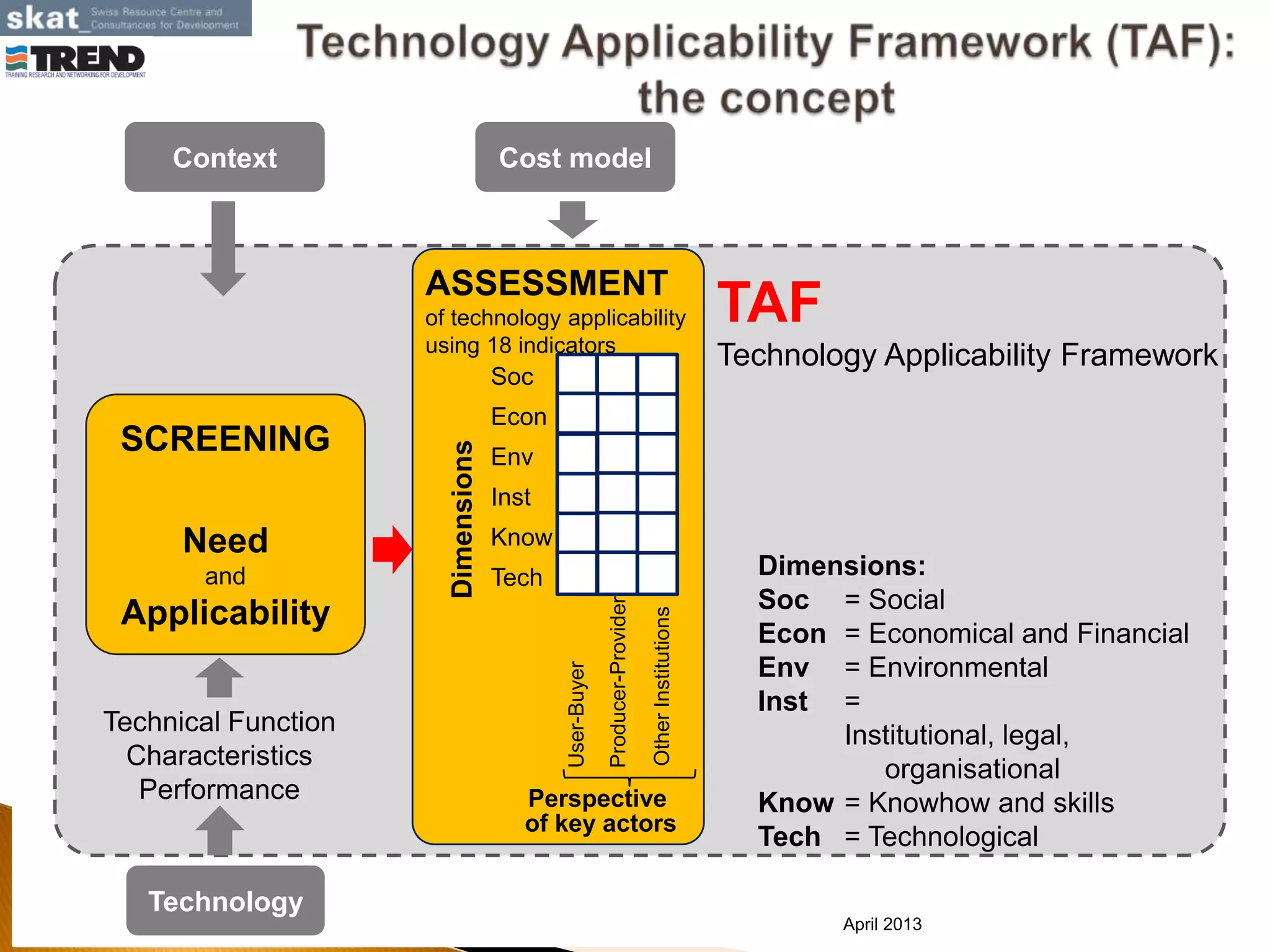
Context
Technology
SCREENING
Need
and
Applicability
Technical Function
Characteristics
Performance
ASSESSMENT
of technology applicability
using 18 indicators
Perspective
of key actors
User-Buyer
OtherInstitutions
Dimensions
Soc
Econ
Env
Inst
Know
Tech
TAF
Technology Applicability Framework
Producer-Provider
Cost model
Dimensions:
Soc = Social
Econ = Economical and Financial
Env = Environmental
Inst =
Institutional, legal,
organisational
Know = Knowhow and skills
Tech = Technological
April 2013
Technology Introduction Process
defines tasks for actors involved in each phase of introduction process
TIP
- Generic concept
- For water, sanitation and hygiene technologies
- Applicable for different cost models, e.g. market-based approach
April 2013
Uptake + O&MTIPPING
POINT
INVENTION
High
Technology
Time
Successful
Technology
Introduction
UPTAKE & USE
Uptake [number of units
installed providing services]
Actors
Invention
TippingPoint
Uptake+Use
Specific tasks
per actor and
phase
Technology Introduction Process
Actors Actors
Technology Introduction Process
(TIP): the concept
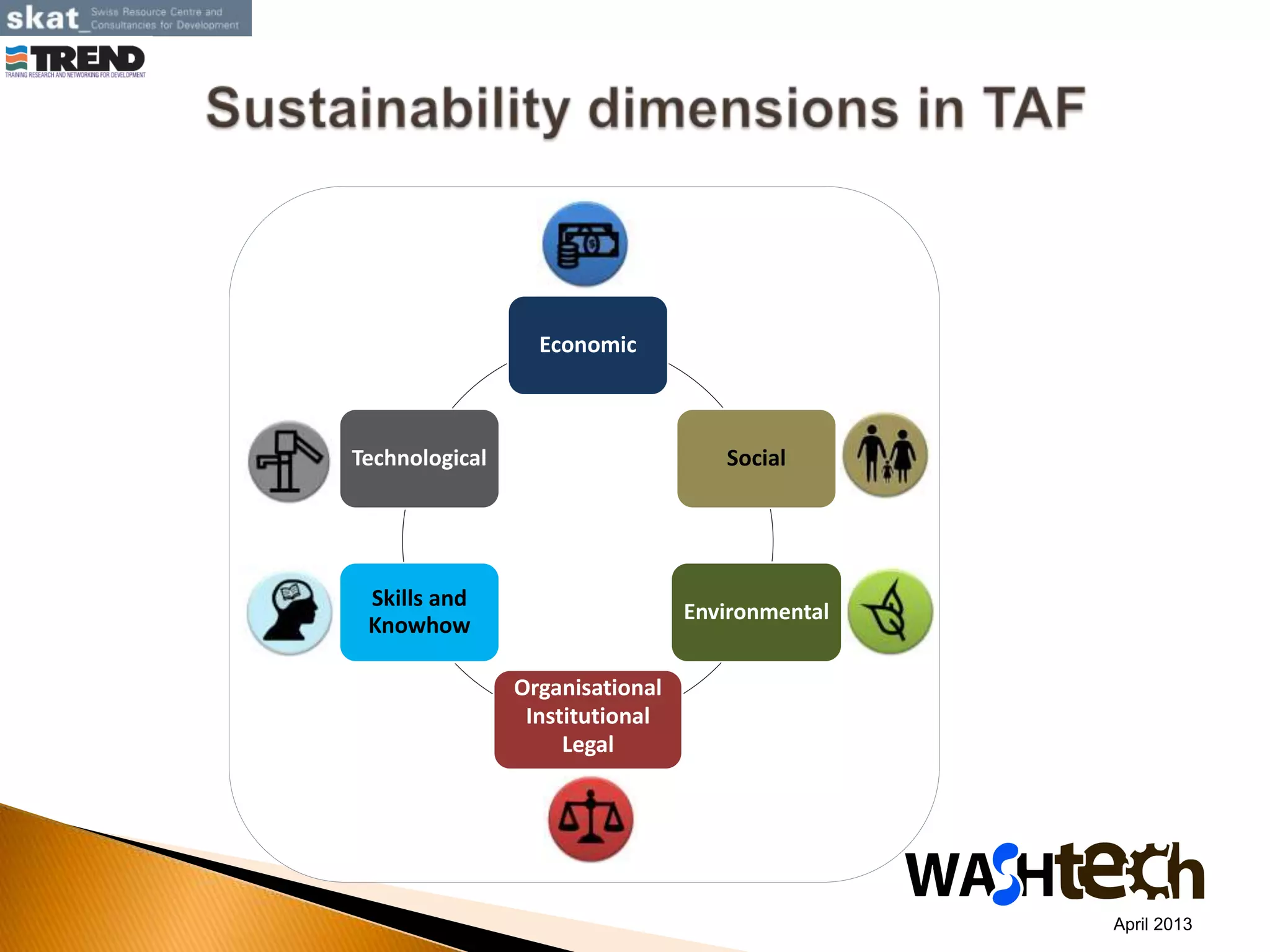
Economic
Social
Environmental
Organisational
Institutional
Legal
Skills and
Knowhow
Technological
April 2013
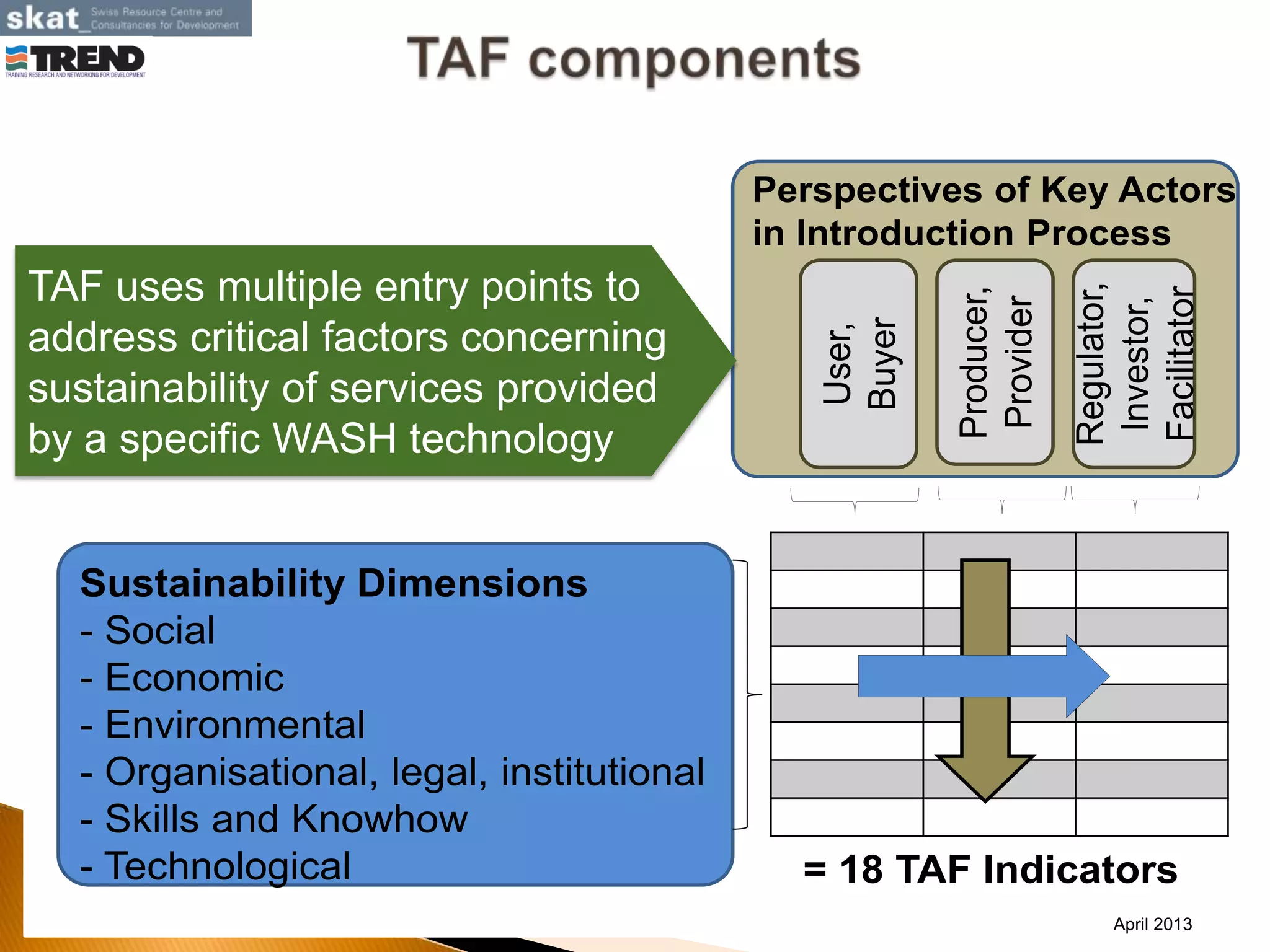
Sustainability Dimensions
- Social
- Economic
- Environmental
- Organisational, legal, institutional
- Skills and Knowhow
- Technological
User,
Buyer
Producer,
Provider
Regulator,
Investor,
Facilitator
Perspectives of Key Actors
in Introduction Process
= 18 TAF Indicators
TAF uses multiple entry points to
address critical factors concerning
sustainability of services provided
by a specific WASH technology
April 2013
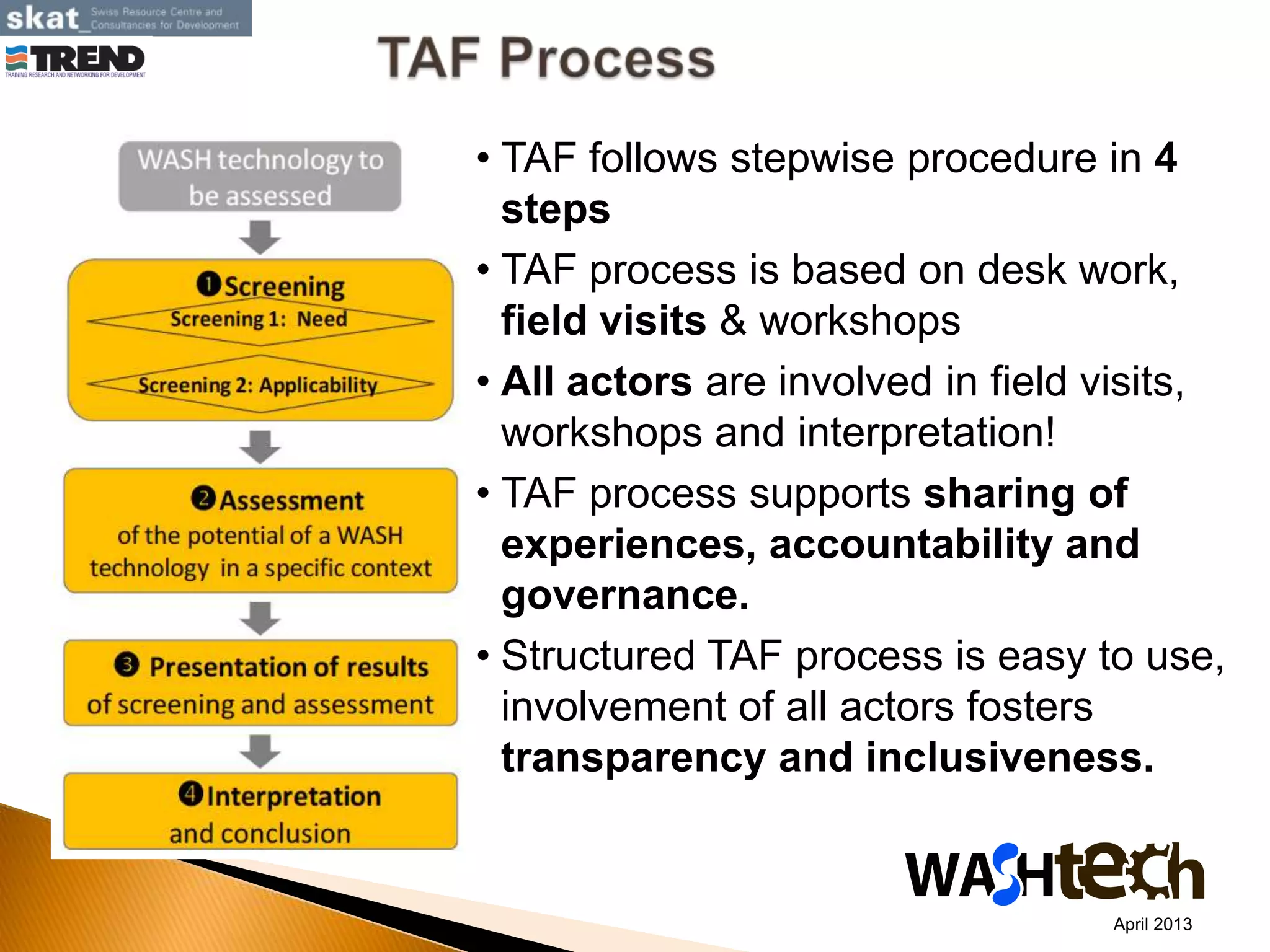
• TAF follows stepwise procedure in 4
steps
• TAF process is based on desk work,
field visits & workshops
• All actors are involved in field visits,
workshops and interpretation!
• TAF process supports sharing of
experiences, accountability and
governance.
• Structured TAF process is easy to use,
involvement of all actors fosters
transparency and inclusiveness.
April 2013
+
0
-
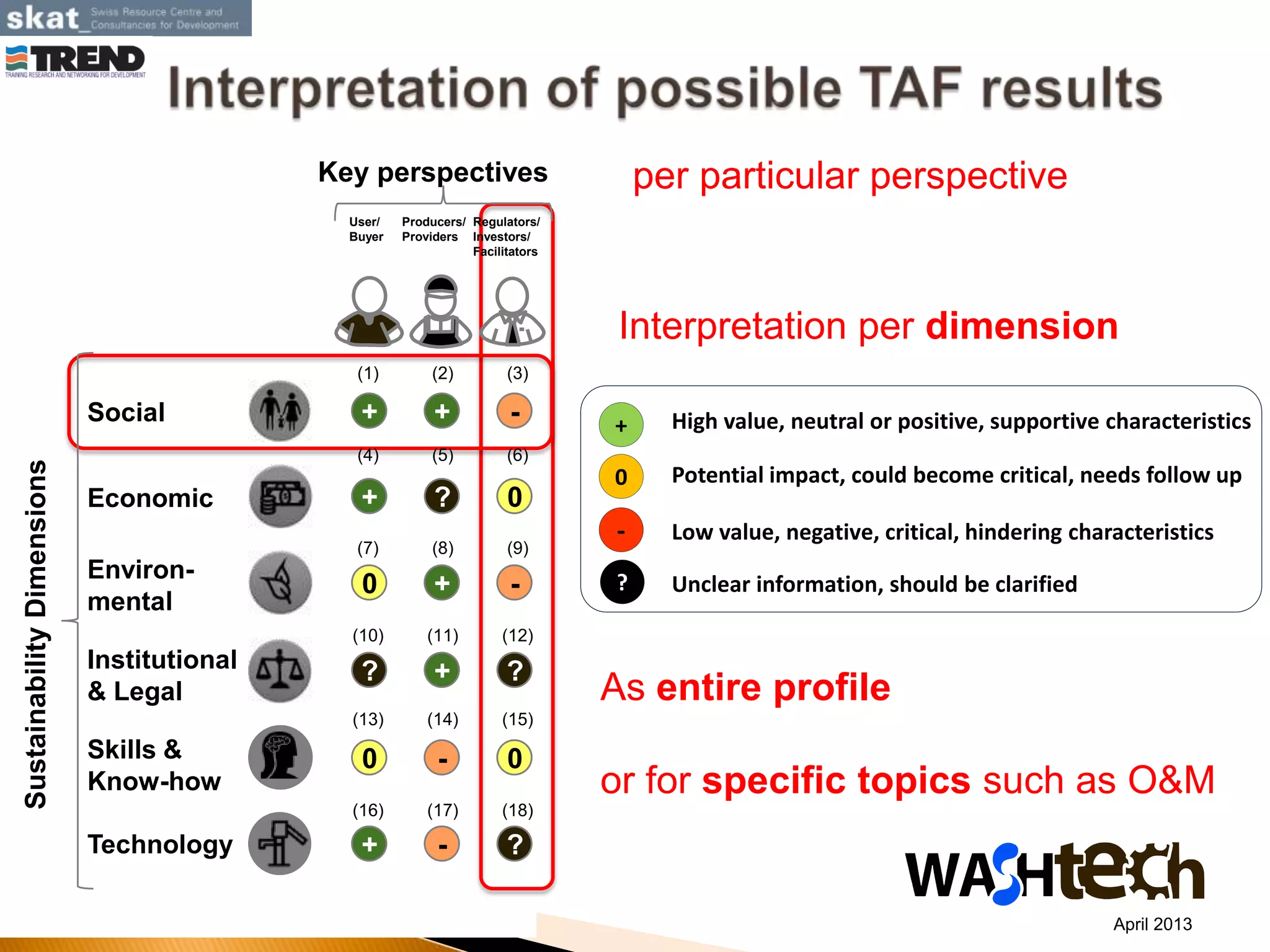
High value, neutral or positive, supportive characteristics
Potential impact, could become critical, needs follow up
Low value, negative, critical, hindering characteristics
? Unclear information, should be clarified
Interpretation per dimension
per particular perspective
As entire profile
or for specific topics such as O&M
April 2013
SustainabilityDimensions
Technology
Skills &
Know-how
Institutional
& Legal
Environ-
mental
Economic
Social
(4) (5) (6)
(7) (8) (9)
(10) (11) (12)
(13) (14) (15)
(16) (17) (18)
(1) (2) (3)
? ?
?
?
User/
Buyer
Producers/
Providers
Regulators/
Investors/
Facilitators
+ +
+
+
+
+
0
0 0
0
-
-
-
-
Key perspectives
April 2013
April 2013
Dimension
Perspective
User / Buyer Producer / Provider Regulator / Investor / Facilitator
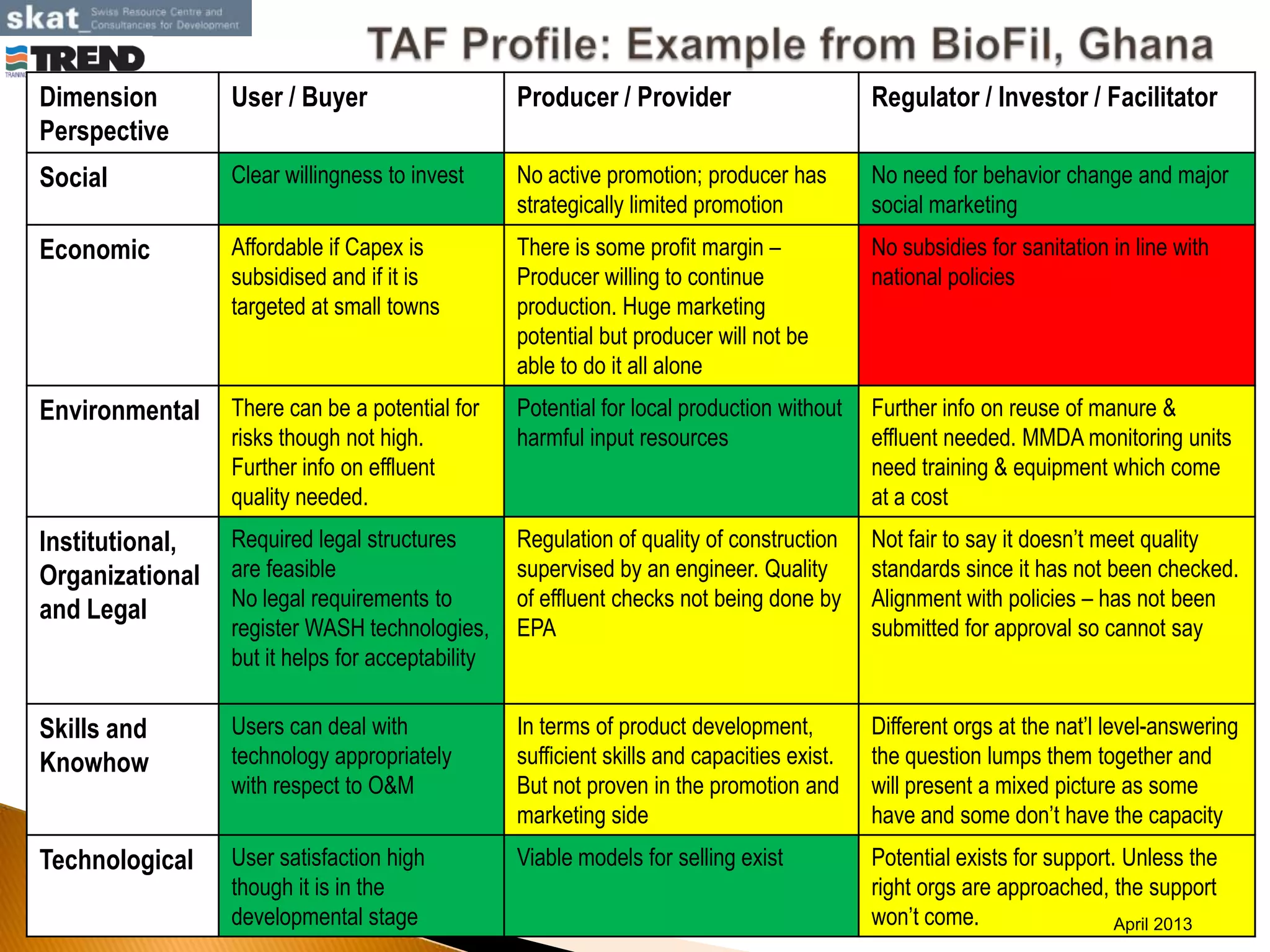
Social Clear willingness to invest No active promotion; producer has
strategically limited promotion
No need for behavior change and major
social marketing
Economic Affordable if Capex is
subsidised and if it is
targeted at small towns
There is some profit margin –
Producer willing to continue
production. Huge marketing
potential but producer will not be
able to do it all alone
No subsidies for sanitation in line with
national policies
Environmental There can be a potential for
risks though not high.
Further info on effluent
quality needed.
Potential for local production without
harmful input resources
Further info on reuse of manure &
effluent needed. MMDA monitoring units
need training & equipment which come
at a cost
Institutional,
Organizational
and Legal
Required legal structures
are feasible
No legal requirements to
register WASH technologies,
but it helps for acceptability
Regulation of quality of construction
supervised by an engineer. Quality
of effluent checks not being done by
EPA
Not fair to say it doesn’t meet quality
standards since it has not been checked.
Alignment with policies – has not been
submitted for approval so cannot say
Skills and
Knowhow
Users can deal with
technology appropriately
with respect to O&M
In terms of product development,
sufficient skills and capacities exist.
But not proven in the promotion and
marketing side
Different orgs at the nat’l level-answering
the question lumps them together and
will present a mixed picture as some
have and some don’t have the capacity
Technological User satisfaction high
though it is in the
developmental stage
Viable models for selling exist Potential exists for support. Unless the
right orgs are approached, the support
won’t come. April 2013
 There can be a potential for risks for environment though
not high. Further info on effluent quality needed.
 Further info on reuse of manure & effluent needed.
 MMDA monitoring units need training & equipment which
come at a cost.
 Potential exists for support. Unless the right
organisations are approached, the support won’t come.
 There is some profit margin – Producer willing to
continue production. Huge need and potential for
marketing but producer will not be able to do it all alone.
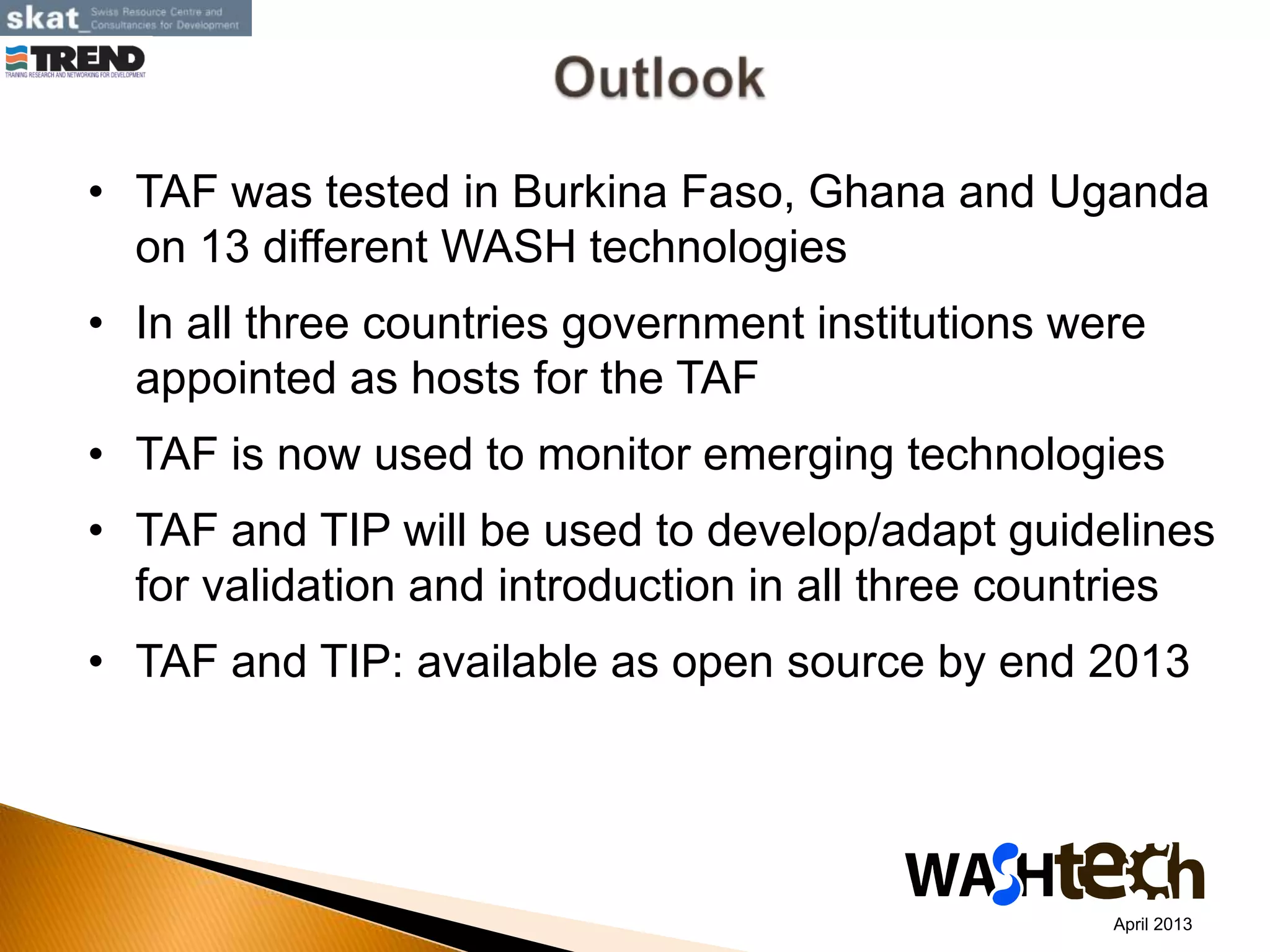
 Affordable if CapEx is subsidized and if it is targeted at
small towns.
April 2013
TAF methodology could be applied for:
- monitoring of the performance of an existing WASH
technology and of the introduction process
- to define concrete mitigation measures to increase
technology performance but also of the introduction
process
- for assessing readiness of an alternative technology
for introduction
April 2013
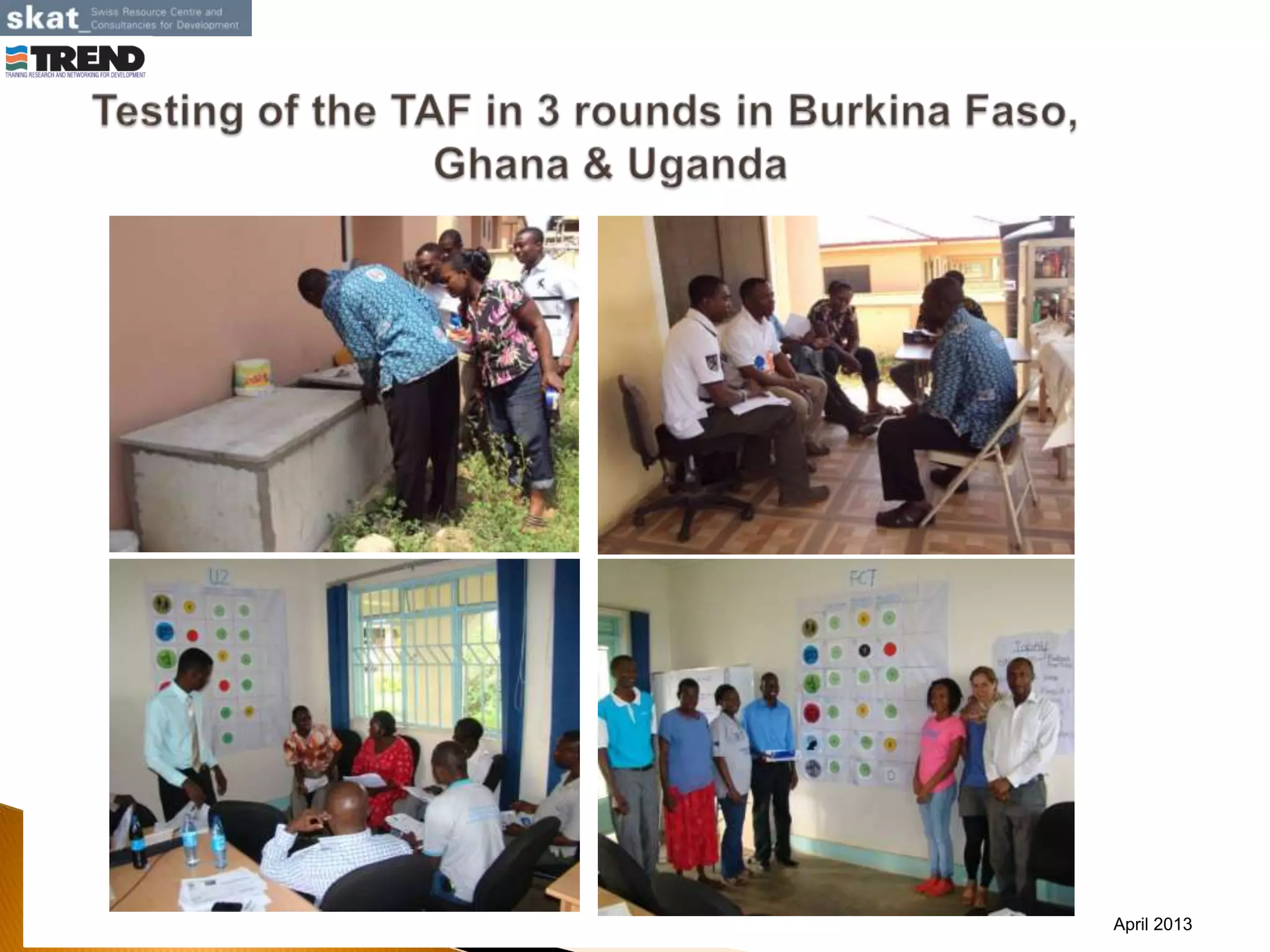
• TAF was tested in Burkina Faso, Ghana and Uganda
on 13 different WASH technologies
• In all three countries government institutions were
appointed as hosts for the TAF
• TAF is now used to monitor emerging technologies
• TAF and TIP will be used to develop/adapt guidelines
for validation and introduction in all three countries
• TAF and TIP: available as open source by end 2013
April 2013
For Information on WASHTech,
washtechafrica.wordpress.com
or email to: WASHTech@irc.nl
For details on TAF and TIP:
andre.olschewski@skat.ch
c/o Skat Foundation
April 2013
Thank you!

Technology Applicability Framework (TAF)

  • 1.
    André Olschewski –Skat Foundation Switzerland Benedict Tuffuor – TREND Ghana IRC Symposium, Addis Ababa, 12.04.2013
  • 2.
    Uptake [number ofunits providing services] Trialled Technology Low High Time Today20 years ago Successful Technology Rope Pump in Africa Rope Pump in Nicaragua Promising Technology
  • 3.
     What isthe TAF  Concept of the TAF  Methodology to apply the TAF  Example from TAF application  Outlook April 2013
  • 4.
     The TAFis a decision support tool for assessing and monitoring applicability of a specific WASH technology for provision of sustainable services in a specific context  Target users of the TAF include government (national, local), private sector, NGO, academia, development partners  The TAF is based on a stepwise and transparent process that provides concrete information to design mitigation measures for improving performance of the technology used and of the introduction process  It is an participatory, facilitating and easy to use tool that triggers sharing of lessons learned between all actors including local and national level April 2013
  • 5.
    Usage Context - Need -Market - Policies - Capacities - Economy… Context factors on Supply side WASH Technology - Functions - Features - Requirements Sustainable WASH Services Physical Context - Conditions - Applicability Context factors on Demand side Introduction process - Implementation - Supply Chain - Operation & Maintenance - Life Cycle Costs - Capacities - Follow up…… April 2013 Monitoring
  • 6.
    April 2013 Regarding technologyintroduction process and use: - Supporting sustainable WASH Services incl. LCC and Equity and Inclusion - Do no harm to environment - Innovation in WASH sector - Strengthening governance and accountability TAF uses screening and assessment to assess critical factors related to inputs, on outcomes (service level) but also on the process of introduction involving all relevant actors. Requirements for the tool “TAF”: Easy to use for all target users of TAF, applicable in different contexts, supporting inclusiveness, fostering accountability by involving all actors also during interpretation of results, linking to concrete actions
  • 7.
    Context Technology SCREENING Need and Applicability Technical Function Characteristics Performance ASSESSMENT of technologyapplicability using 18 indicators Perspective of key actors User-Buyer OtherInstitutions Dimensions Soc Econ Env Inst Know Tech TAF Technology Applicability Framework Producer-Provider Cost model Dimensions: Soc = Social Econ = Economical and Financial Env = Environmental Inst = Institutional, legal, organisational Know = Knowhow and skills Tech = Technological April 2013
  • 8.
    Technology Introduction Process definestasks for actors involved in each phase of introduction process TIP - Generic concept - For water, sanitation and hygiene technologies - Applicable for different cost models, e.g. market-based approach April 2013 Uptake + O&MTIPPING POINT INVENTION High Technology Time Successful Technology Introduction UPTAKE & USE Uptake [number of units installed providing services] Actors Invention TippingPoint Uptake+Use Specific tasks per actor and phase Technology Introduction Process Actors Actors Technology Introduction Process (TIP): the concept
  • 9.
  • 10.
    Sustainability Dimensions - Social -Economic - Environmental - Organisational, legal, institutional - Skills and Knowhow - Technological User, Buyer Producer, Provider Regulator, Investor, Facilitator Perspectives of Key Actors in Introduction Process = 18 TAF Indicators TAF uses multiple entry points to address critical factors concerning sustainability of services provided by a specific WASH technology April 2013
  • 11.
    • TAF followsstepwise procedure in 4 steps • TAF process is based on desk work, field visits & workshops • All actors are involved in field visits, workshops and interpretation! • TAF process supports sharing of experiences, accountability and governance. • Structured TAF process is easy to use, involvement of all actors fosters transparency and inclusiveness. April 2013
  • 12.
    + 0 - High value, neutralor positive, supportive characteristics Potential impact, could become critical, needs follow up Low value, negative, critical, hindering characteristics ? Unclear information, should be clarified Interpretation per dimension per particular perspective As entire profile or for specific topics such as O&M April 2013 SustainabilityDimensions Technology Skills & Know-how Institutional & Legal Environ- mental Economic Social (4) (5) (6) (7) (8) (9) (10) (11) (12) (13) (14) (15) (16) (17) (18) (1) (2) (3) ? ? ? ? User/ Buyer Producers/ Providers Regulators/ Investors/ Facilitators + + + + + + 0 0 0 0 - - - - Key perspectives
  • 13.
  • 14.
  • 15.
    Dimension Perspective User / BuyerProducer / Provider Regulator / Investor / Facilitator Social Clear willingness to invest No active promotion; producer has strategically limited promotion No need for behavior change and major social marketing Economic Affordable if Capex is subsidised and if it is targeted at small towns There is some profit margin – Producer willing to continue production. Huge marketing potential but producer will not be able to do it all alone No subsidies for sanitation in line with national policies Environmental There can be a potential for risks though not high. Further info on effluent quality needed. Potential for local production without harmful input resources Further info on reuse of manure & effluent needed. MMDA monitoring units need training & equipment which come at a cost Institutional, Organizational and Legal Required legal structures are feasible No legal requirements to register WASH technologies, but it helps for acceptability Regulation of quality of construction supervised by an engineer. Quality of effluent checks not being done by EPA Not fair to say it doesn’t meet quality standards since it has not been checked. Alignment with policies – has not been submitted for approval so cannot say Skills and Knowhow Users can deal with technology appropriately with respect to O&M In terms of product development, sufficient skills and capacities exist. But not proven in the promotion and marketing side Different orgs at the nat’l level-answering the question lumps them together and will present a mixed picture as some have and some don’t have the capacity Technological User satisfaction high though it is in the developmental stage Viable models for selling exist Potential exists for support. Unless the right orgs are approached, the support won’t come. April 2013
  • 16.
     There canbe a potential for risks for environment though not high. Further info on effluent quality needed.  Further info on reuse of manure & effluent needed.  MMDA monitoring units need training & equipment which come at a cost.  Potential exists for support. Unless the right organisations are approached, the support won’t come.  There is some profit margin – Producer willing to continue production. Huge need and potential for marketing but producer will not be able to do it all alone.  Affordable if CapEx is subsidized and if it is targeted at small towns. April 2013
  • 17.
    TAF methodology couldbe applied for: - monitoring of the performance of an existing WASH technology and of the introduction process - to define concrete mitigation measures to increase technology performance but also of the introduction process - for assessing readiness of an alternative technology for introduction April 2013
  • 18.
    • TAF wastested in Burkina Faso, Ghana and Uganda on 13 different WASH technologies • In all three countries government institutions were appointed as hosts for the TAF • TAF is now used to monitor emerging technologies • TAF and TIP will be used to develop/adapt guidelines for validation and introduction in all three countries • TAF and TIP: available as open source by end 2013 April 2013
  • 19.
    For Information onWASHTech, washtechafrica.wordpress.com or email to: WASHTech@irc.nl For details on TAF and TIP: andre.olschewski@skat.ch c/o Skat Foundation April 2013
  • 20.

Editor's Notes

  • #6 Ultimate goal: sust. Wash services; based on needs and policies (see context); but no services without technologies that are introduced correctly.Now monitoring often focus on single inputs or outcomes. Often feedback between actors involved missing. Link to objectives in TAF
  • #7 Many different actors involved – different roles  consideration on methodologyInteraction and linkages between relevant levels such as context level (policy, or technology) to introduction process (O&M, subsidies) or to service delivery level (user satisfaction,sustainability) very weak  feedback mechanisms needed