FairTest:  
Discovering  unwarranted  associa4ons  
in  data-­‐driven  applica4ons
Florian	
  Tramèr1,	
  	
  	
  Vaggelis	
  Atlidakis2,	
  	
  	
  Roxana	
  Geambasu2,	
  	
  	
  Daniel	
  Hsu2,	
  
Jean-­‐Pierre	
  Hubaux1,	
  	
  	
  Mathias	
  Humbert3,	
  	
  	
  Ari	
  Juels4,	
  	
  	
  Huang	
  Lin1	


1École	
  Polytechnique	
  Fédérale	
  de	
  Lausanne,	
  	
  	
  2Columbia	
  University,	


3Saarland	
  University,	
  	
  	
  4Cornell	
  Tech	


1	
  
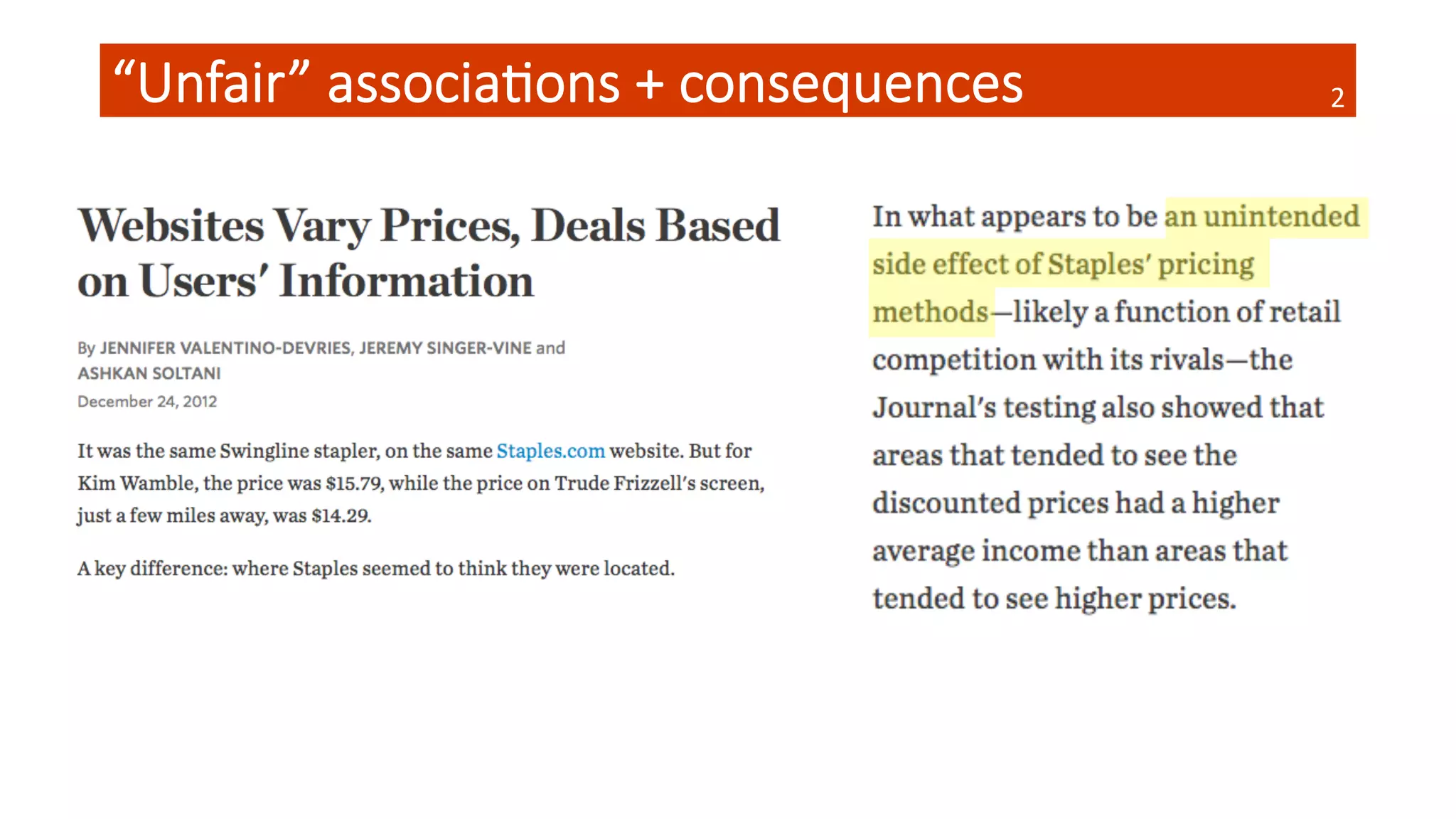
“Unfair”  associa4ons  +  consequences
 2	
  
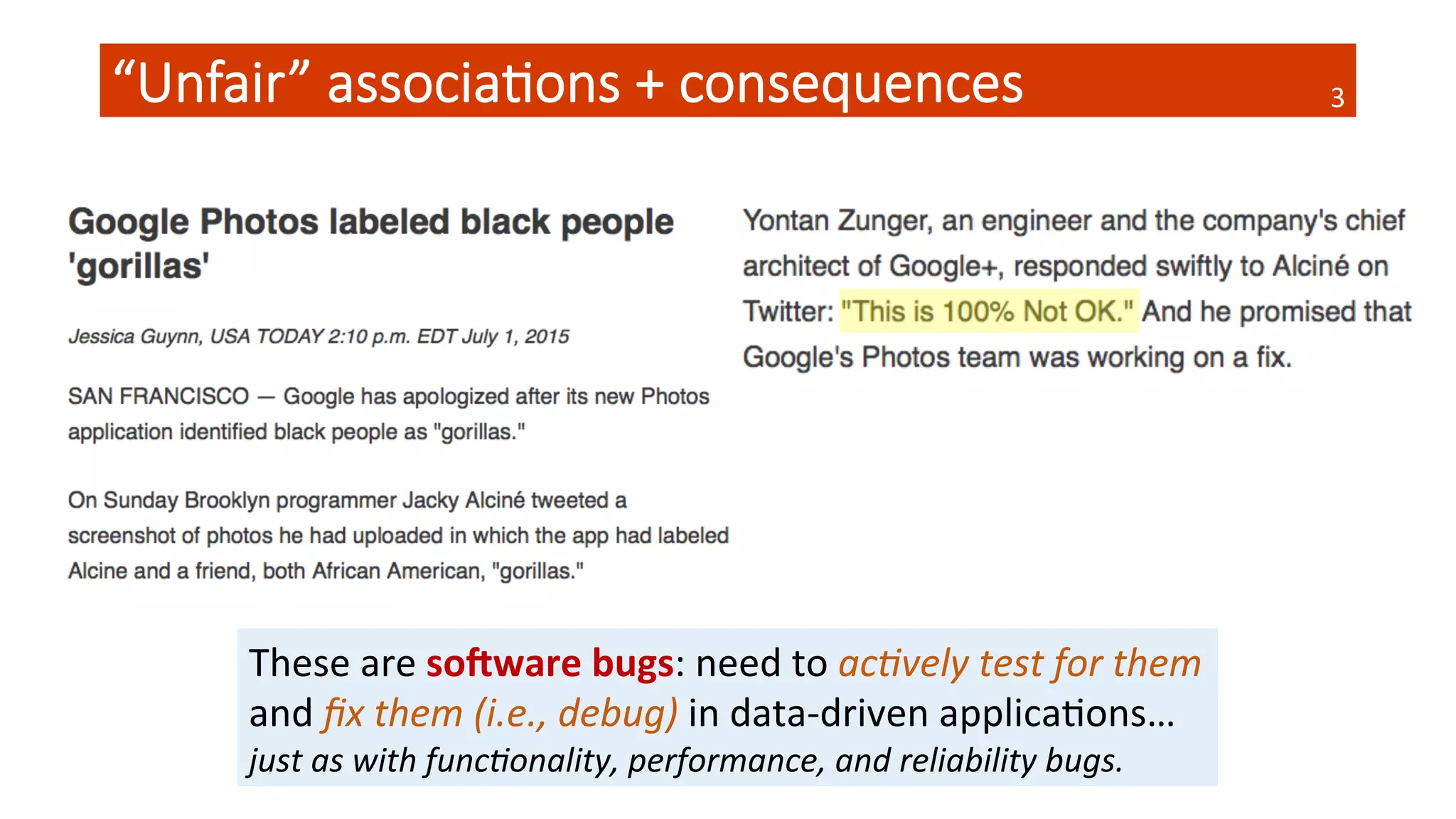
“Unfair”  associa4ons  +  consequences
 3	
  
These	
  are	
  so#ware	
  bugs:	
  need	
  to	
  ac#vely	
  test	
  for	
  them	
  
and	
  fix	
  them	
  (i.e.,	
  debug)	
  in	
  data-­‐driven	
  applicaQons…	
  
just	
  as	
  with	
  func#onality,	
  performance,	
  and	
  reliability	
  bugs.	
  
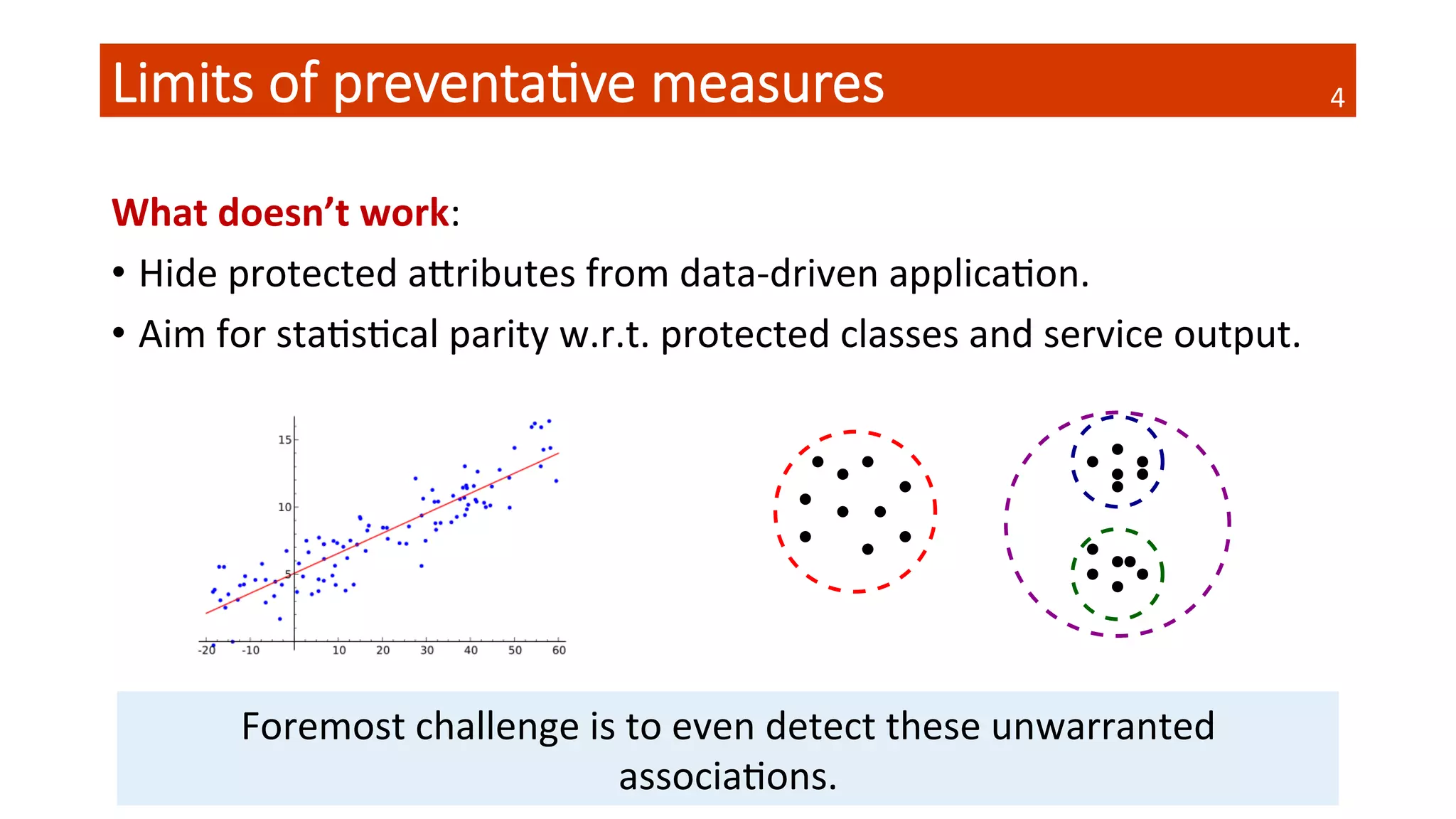
Limits  of  preventa4ve  measures
What	
  doesn’t	
  work:	
  
•  Hide	
  protected	
  aSributes	
  from	
  data-­‐driven	
  applicaQon.	
  
•  Aim	
  for	
  staQsQcal	
  parity	
  w.r.t.	
  protected	
  classes	
  and	
  service	
  output.	
  
Foremost	
  challenge	
  is	
  to	
  even	
  detect	
  these	
  unwarranted	
  
associaQons.	
  
4	
  
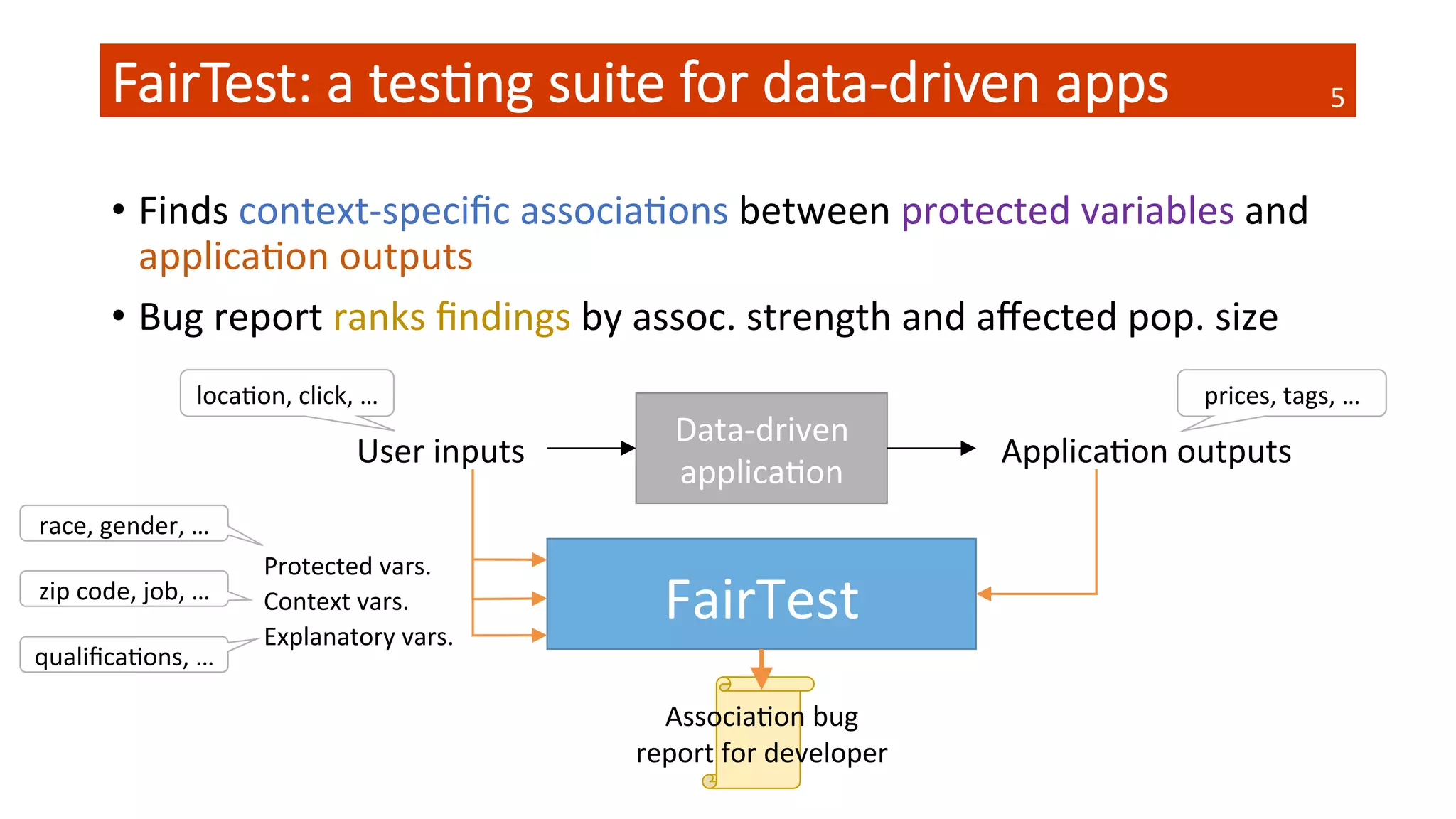
FairTest:  a  tes4ng  suite  for  data-­‐driven  apps
race,	
  gender,	
  …	
  
zip	
  code,	
  job,	
  …	
  
qualificaQons,	
  …	
  
Protected	
  vars.	
  
Context	
  vars.	
   FairTest	
  
AssociaQon	
  bug	
  
report	
  for	
  developer	
  
Explanatory	
  vars.	
  
Data-­‐driven	
  
applicaQon	
  
User	
  inputs	
   ApplicaQon	
  outputs	
  
•  Finds	
  context-­‐specific	
  associaQons	
  between	
  protected	
  variables	
  and	
  
applicaQon	
  outputs	
  
•  Bug	
  report	
  ranks	
  findings	
  by	
  assoc.	
  strength	
  and	
  affected	
  pop.	
  size	
  
	
   locaQon,	
  click,	
  …	
   prices,	
  tags,	
  …	
  
5	
  
A  data-­‐driven  approach
Core	
  of	
  FairTest	
  is	
  based	
  on	
  staQsQcal	
  machine	
  learning	
  
FairTest	
  
Find	
  context-­‐specific	
  associaQons	
  
StaQsQcally	
  validate	
  associaQons	
  
Sta4s4cal	
  machine	
  learning	
  internals:	
  
•  top-­‐down	
  spaQal	
  parQQoning	
  algorithm	
  
•  confidence	
  intervals	
  for	
  assoc.	
  metrics	
  
•  …	
  
Training	
  data	
  
Test	
  data	
  
Ideally	
  sampled	
  from	
  
relevant	
  user	
  populaQon	
  
This is a confidential draft. Please do not redistribute. 7 CONCLUSION
Report of associations of O=Labels on Si=Race:
Global Population of size 1,324
* Labels associated with Race=Black:
Label Black White DIFF p-value
Cart 4% 0% [0.0137,0.0652] 3.31e-05
Drum 4% 0% [0.0095,0.0604] 3.83e-04
Helmet 8% 3% [0.0096,0.0888] 2.34e-03
Cattle 2% 0% [0.0037,0.0432] 4.73e-03
* Labels associated with Race=White:
Label Black White DIFF p-value
Face Powder 1% 10% [-0.1339,-0.0525] 5.60e-12
Maillot 4% 15% [-0.1590,-0.0575] 3.46e-10
Person 96% 99% [-0.0563,-0.0042] 6.06e-03
Lipstick 1% 4% [-0.0622,-0.0034] 1.03e-02
Fig. 9: Racial Label Associations in the Image Tagger. Shows par-
tial report of a Discovery (top k=35); the four most strongly associated
labels (for the binary difference metric DIFF) are shown for each race.
Fig.9 shows part of FairTest’s report. It lists the labels
most disparately applied to images of black people (first
table) and white people (second table); we show only
4 (of 35) labels per race. A developer could inspect
all top k labels and judge which ones deserve further
scrutiny. In Fig.9, the ‘cattle’ label might draw attention
due to its potentially negative connotation; upon inspec-
tion, we find that none of the tagged images depict farm
animals. Moreover, black people receive the ‘person’
tag less often, thus the model seems less accurate at de-
tecting them. Further work is needed to understand these
Report of associations of O=Income on Si=Race:
Global Population of size 24,421
p-value = 1.39e-53 ; NMI = [0.0063, 0.0139]
Income Asian Black ... White Total
<=50K 556(73%) 2061(88%) 15647(75%) 18640 (76%)
>50K 206(27%) 287(12%) 5238(25%) 5781 (24%)
Total 762 (3%) 2348(10%) ... 20885(86%) 24421(100%)
1. Subpopulation of size 341
Context = Age <= 42, Hours <= 55, Job: Fed-gov
p-value = 3.24e-03 ; NMI = [0.0085, 0.1310]
Income Asian Black ... White Total
<=50K 10(71%) 62(91%) 153(63%) 239 (70%)
>50K 4(29%) 6 (9%) 91(37%) 102 (30%)
Total 14 (4%) 68(20%) ... 244(72%) 341(100%)
2. Subpopulation of size 14,477
Context = Age <= 42, Hours <= 55
p-value = 7.50e-31 ; NMI = [0.0070, 0.0187]
Income Asian Black ... White Total
<=50K 362(79%) 1408(93%) 10113(83%) 12157 (84%)
>50K 97(21%) 101 (7%) 2098(17%) 2320 (16%)
Total 459 (3%) 1509(10%) ... 12211(84%) 14477(100%)
Report of associations of O=Income on Si=Gender:
Global Population of size 24,421
p-value = 1.44e-178 ; NMI = [0.0381, 0.0540]
Income Female Male Total
<=50K 7218(89%) 11422(70%) 18640 (76%)
>50K 876(11%) 4905(30%) 5781 (24%)
Total 8094(33%) 16327(67%) 24421(100%)
1. Subpopulation of size 1,371
Context = 9 <= Education <= 11, Age >= 47
p-value = 2.23e-35 ; NMI = [0.0529, 0.1442]
Income Female Male Total
<=50K 423(88%) 497(56%) 920 (67%)
Data	
  
6	
  
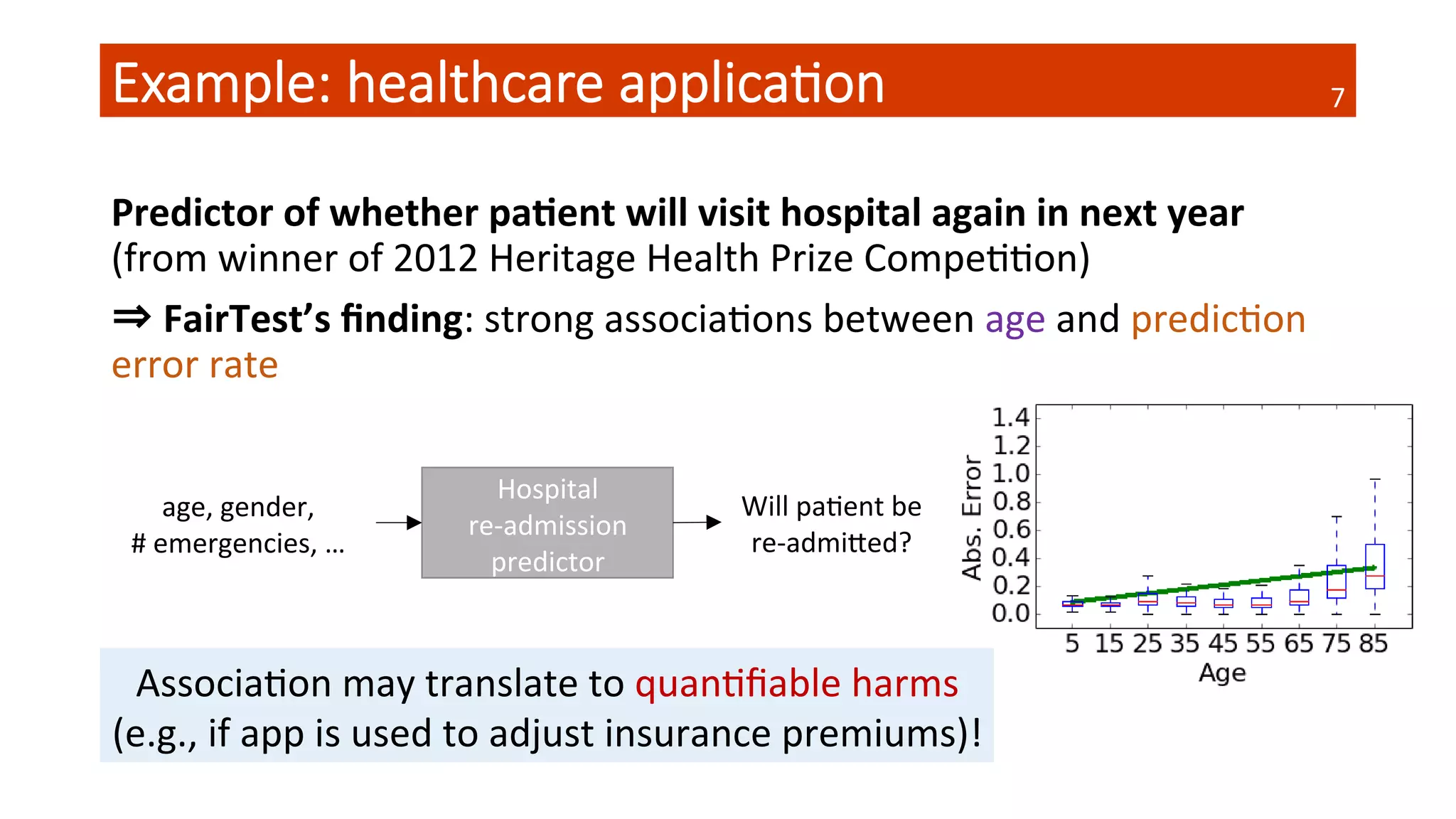
Example:  healthcare  applica4on
Predictor	
  of	
  whether	
  pa4ent	
  will	
  visit	
  hospital	
  again	
  in	
  next	
  year	
  
(from	
  winner	
  of	
  2012	
  Heritage	
  Health	
  Prize	
  CompeQQon)	
  
⇒	
  FairTest’s	
  finding:	
  strong	
  associaQons	
  between	
  age	
  and	
  predicQon	
  
error	
  rate	
  
AssociaQon	
  may	
  translate	
  to	
  quanQfiable	
  harms	
  
(e.g.,	
  if	
  app	
  is	
  used	
  to	
  adjust	
  insurance	
  premiums)!	
  
Hospital	
  
re-­‐admission	
  
predictor	
  
age,	
  gender,	
  
#	
  emergencies,	
  …	
  
Will	
  paQent	
  be	
  
re-­‐admiSed?	
  
This is a confidential draft. Please do no
Report of associations of O=Abs. Error
Global Population of size 28,930
p-value = 3.30e-179 ; CORR = [0.2057, 0
1. Subpopulation of size 6,252
Context = Urgent Care Treatments >= 1
p-value = 1.85e-141 ; CORR = [0.2724, 0
7	
  
Debugging  with  FairTest
Are	
  there	
  confounding	
  factors?	


  Do	
  associaQons	
  disappear	
  aher	
  condiQoning?	
  
	
  ⇒	
  AdapQve	
  Data	
  Analysis!	


Example:	
  the	
  healthcare	
  applicaQon	
  (again)	
  
•  EsQmate	
  predicQon	
  target	
  variance	
  
•  Does	
  this	
  explain	
  the	
  predictor’s	
  behavior?	
  
•  Yes,	
  parQally	


FairTest	
  helps	
  developers	
  understand	
  &	
  evaluate	
  
potenQal	
  associaQon	
  bugs.	
  
of size 6,252
Care Treatments >= 1
141 ; CORR = [0.2724, 0.3492]
e for Health Predictions. Shows the global
population with highest effect size (correlation).
correlation between age and prediction error,
1 + number of visits). For each age-decade, we
ots (box from the 1st to 3rd quantile with a line
skers at 1.5 interquantile-ranges). The straight
* Low Confidence: Population of size 14,48
p-value = 2.27e-128 ; CORR = [0.1722, 0.
* High Confidence: Population of size 14,4
p-value = 2.44e-13 ; CORR = [0.0377, 0.0
Fig. 8: Error Profile for Health Predictions usin
confidence as an explanatory attribute. Shows correla
prediction error and user age, broken down by prediction
High	
  confidence	
  in	
  predic#on	
  
8	
  
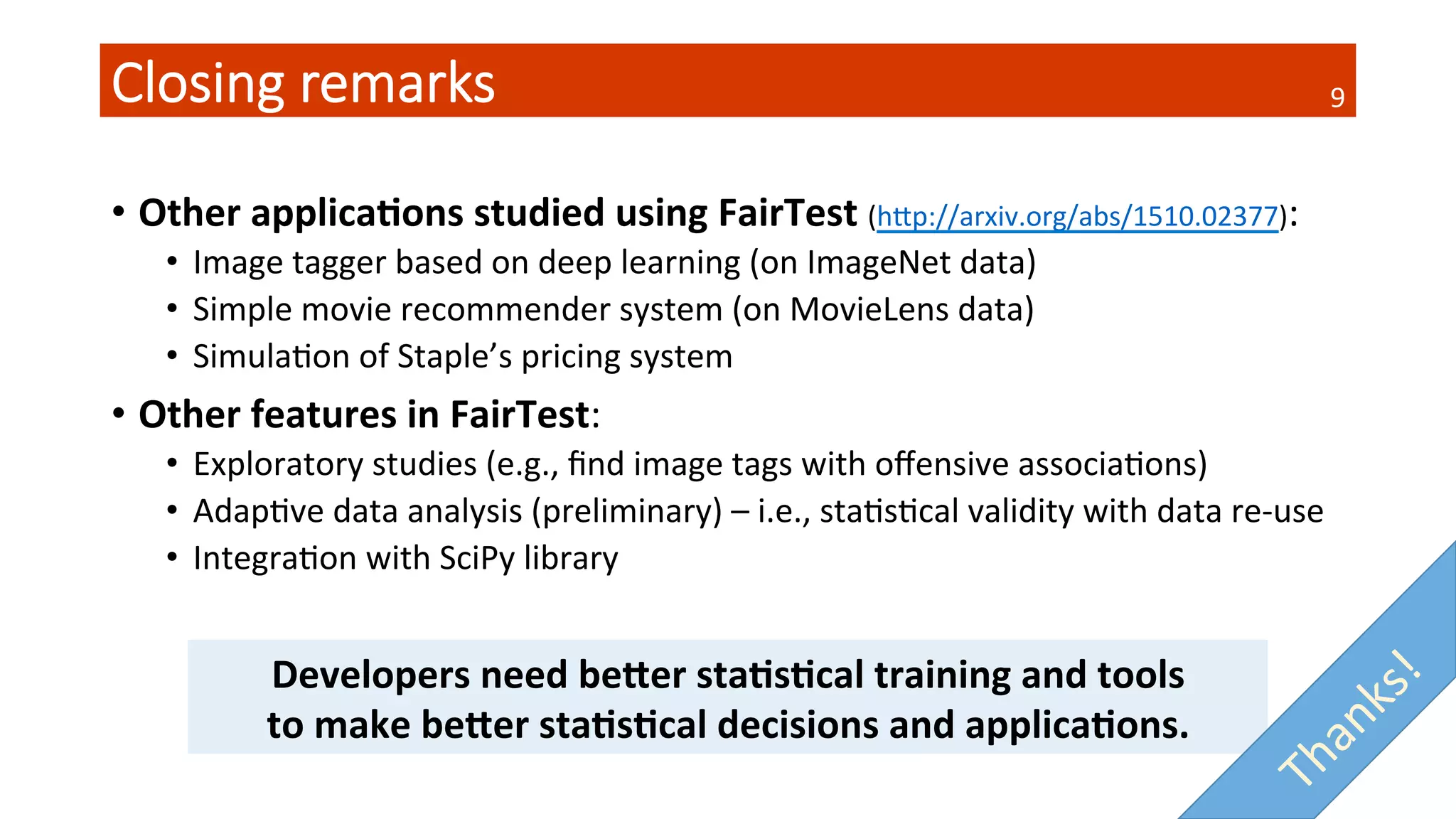
Closing  remarks
•  Other	
  applica4ons	
  studied	
  using	
  FairTest	
  (hSp://arxiv.org/abs/1510.02377):	
  
•  Image	
  tagger	
  based	
  on	
  deep	
  learning	
  (on	
  ImageNet	
  data)	
  
•  Simple	
  movie	
  recommender	
  system	
  (on	
  MovieLens	
  data)	
  
•  SimulaQon	
  of	
  Staple’s	
  pricing	
  system	
  
•  Other	
  features	
  in	
  FairTest:	
  
•  Exploratory	
  studies	
  (e.g.,	
  find	
  image	
  tags	
  with	
  offensive	
  associaQons)	
  
•  AdapQve	
  data	
  analysis	
  (preliminary)	
  –	
  i.e.,	
  staQsQcal	
  validity	
  with	
  data	
  re-­‐use	
  
•  IntegraQon	
  with	
  SciPy	
  library	
  
Developers	
  need	
  beDer	
  sta4s4cal	
  training	
  and	
  tools	
  
to	
  make	
  beDer	
  sta4s4cal	
  decisions	
  and	
  applica4ons.	
  
9	
  
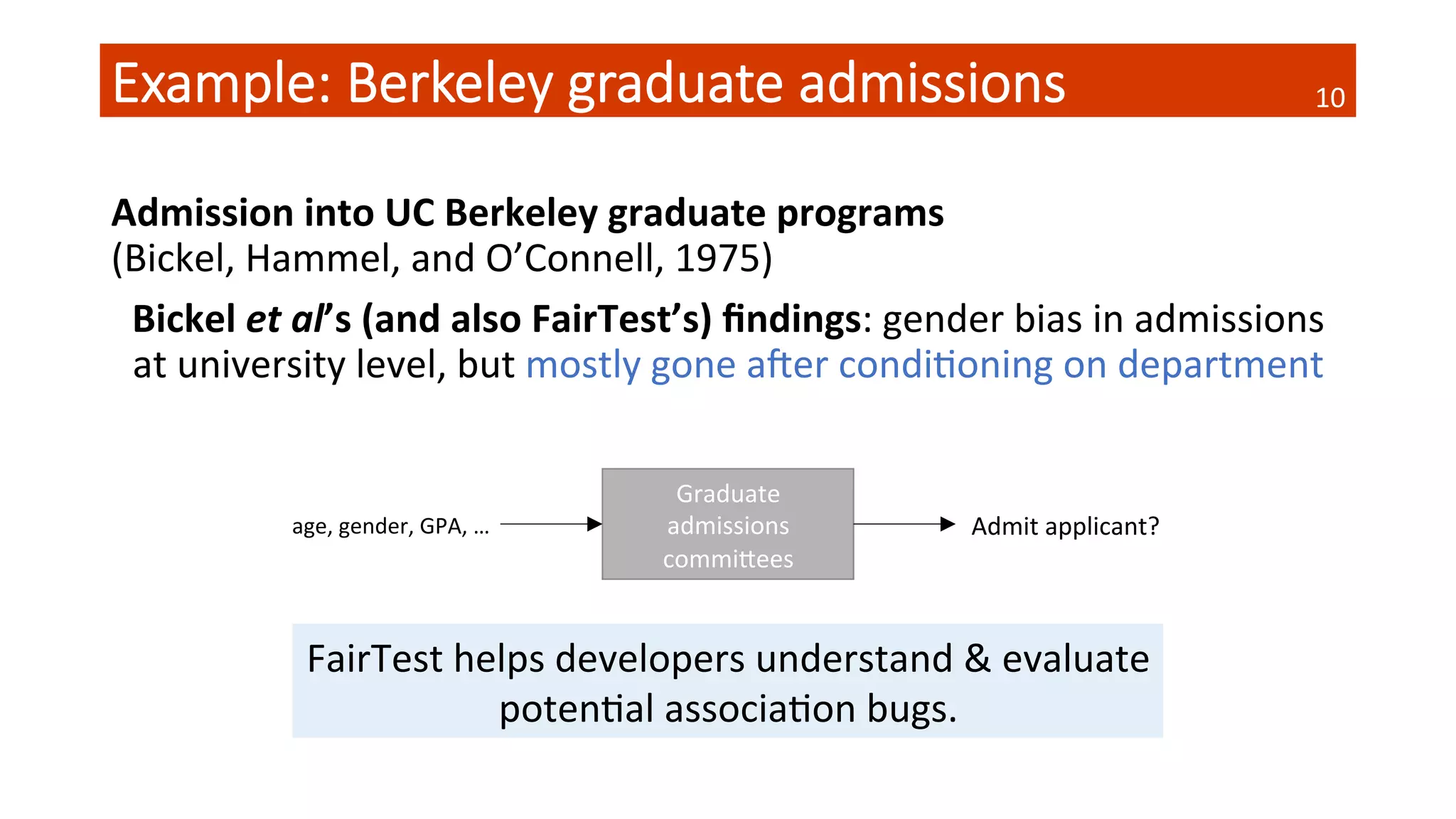
Example:  Berkeley  graduate  admissions
Admission	
  into	
  UC	
  Berkeley	
  graduate	
  programs	
  
(Bickel,	
  Hammel,	
  and	
  O’Connell,	
  1975)	
  
Bickel	
  et	
  al’s	
  (and	
  also	
  FairTest’s)	
  findings:	
  gender	
  bias	
  in	
  admissions	
  
at	
  university	
  level,	
  but	
  mostly	
  gone	
  aher	
  condiQoning	
  on	
  department	
  
FairTest	
  helps	
  developers	
  understand	
  &	
  evaluate	
  
potenQal	
  associaQon	
  bugs.	
  
Graduate	
  
admissions	
  
commiSees	
  
age,	
  gender,	
  GPA,	
  …	
   Admit	
  applicant?	
  
10	
  

Florian Tramèr, Researcher, EPFL at MLconf SEA - 5/20/16

  • 1.
    FairTest:   Discovering  unwarranted associa4ons   in  data-­‐driven  applica4ons Florian  Tramèr1,      Vaggelis  Atlidakis2,      Roxana  Geambasu2,      Daniel  Hsu2,   Jean-­‐Pierre  Hubaux1,      Mathias  Humbert3,      Ari  Juels4,      Huang  Lin1     1École  Polytechnique  Fédérale  de  Lausanne,      2Columbia  University,         3Saarland  University,      4Cornell  Tech     1  
  • 2.
    “Unfair”  associa4ons  + consequences 2  
  • 3.
    “Unfair”  associa4ons  + consequences 3   These  are  so#ware  bugs:  need  to  ac#vely  test  for  them   and  fix  them  (i.e.,  debug)  in  data-­‐driven  applicaQons…   just  as  with  func#onality,  performance,  and  reliability  bugs.  
  • 4.
    Limits  of  preventa4ve measures What  doesn’t  work:   •  Hide  protected  aSributes  from  data-­‐driven  applicaQon.   •  Aim  for  staQsQcal  parity  w.r.t.  protected  classes  and  service  output.   Foremost  challenge  is  to  even  detect  these  unwarranted   associaQons.   4  
  • 5.
    FairTest:  a  tes4ng suite  for  data-­‐driven  apps race,  gender,  …   zip  code,  job,  …   qualificaQons,  …   Protected  vars.   Context  vars.   FairTest   AssociaQon  bug   report  for  developer   Explanatory  vars.   Data-­‐driven   applicaQon   User  inputs   ApplicaQon  outputs   •  Finds  context-­‐specific  associaQons  between  protected  variables  and   applicaQon  outputs   •  Bug  report  ranks  findings  by  assoc.  strength  and  affected  pop.  size     locaQon,  click,  …   prices,  tags,  …   5  
  • 6.
    A  data-­‐driven  approach Core  of  FairTest  is  based  on  staQsQcal  machine  learning   FairTest   Find  context-­‐specific  associaQons   StaQsQcally  validate  associaQons   Sta4s4cal  machine  learning  internals:   •  top-­‐down  spaQal  parQQoning  algorithm   •  confidence  intervals  for  assoc.  metrics   •  …   Training  data   Test  data   Ideally  sampled  from   relevant  user  populaQon   This is a confidential draft. Please do not redistribute. 7 CONCLUSION Report of associations of O=Labels on Si=Race: Global Population of size 1,324 * Labels associated with Race=Black: Label Black White DIFF p-value Cart 4% 0% [0.0137,0.0652] 3.31e-05 Drum 4% 0% [0.0095,0.0604] 3.83e-04 Helmet 8% 3% [0.0096,0.0888] 2.34e-03 Cattle 2% 0% [0.0037,0.0432] 4.73e-03 * Labels associated with Race=White: Label Black White DIFF p-value Face Powder 1% 10% [-0.1339,-0.0525] 5.60e-12 Maillot 4% 15% [-0.1590,-0.0575] 3.46e-10 Person 96% 99% [-0.0563,-0.0042] 6.06e-03 Lipstick 1% 4% [-0.0622,-0.0034] 1.03e-02 Fig. 9: Racial Label Associations in the Image Tagger. Shows par- tial report of a Discovery (top k=35); the four most strongly associated labels (for the binary difference metric DIFF) are shown for each race. Fig.9 shows part of FairTest’s report. It lists the labels most disparately applied to images of black people (first table) and white people (second table); we show only 4 (of 35) labels per race. A developer could inspect all top k labels and judge which ones deserve further scrutiny. In Fig.9, the ‘cattle’ label might draw attention due to its potentially negative connotation; upon inspec- tion, we find that none of the tagged images depict farm animals. Moreover, black people receive the ‘person’ tag less often, thus the model seems less accurate at de- tecting them. Further work is needed to understand these Report of associations of O=Income on Si=Race: Global Population of size 24,421 p-value = 1.39e-53 ; NMI = [0.0063, 0.0139] Income Asian Black ... White Total <=50K 556(73%) 2061(88%) 15647(75%) 18640 (76%) >50K 206(27%) 287(12%) 5238(25%) 5781 (24%) Total 762 (3%) 2348(10%) ... 20885(86%) 24421(100%) 1. Subpopulation of size 341 Context = Age <= 42, Hours <= 55, Job: Fed-gov p-value = 3.24e-03 ; NMI = [0.0085, 0.1310] Income Asian Black ... White Total <=50K 10(71%) 62(91%) 153(63%) 239 (70%) >50K 4(29%) 6 (9%) 91(37%) 102 (30%) Total 14 (4%) 68(20%) ... 244(72%) 341(100%) 2. Subpopulation of size 14,477 Context = Age <= 42, Hours <= 55 p-value = 7.50e-31 ; NMI = [0.0070, 0.0187] Income Asian Black ... White Total <=50K 362(79%) 1408(93%) 10113(83%) 12157 (84%) >50K 97(21%) 101 (7%) 2098(17%) 2320 (16%) Total 459 (3%) 1509(10%) ... 12211(84%) 14477(100%) Report of associations of O=Income on Si=Gender: Global Population of size 24,421 p-value = 1.44e-178 ; NMI = [0.0381, 0.0540] Income Female Male Total <=50K 7218(89%) 11422(70%) 18640 (76%) >50K 876(11%) 4905(30%) 5781 (24%) Total 8094(33%) 16327(67%) 24421(100%) 1. Subpopulation of size 1,371 Context = 9 <= Education <= 11, Age >= 47 p-value = 2.23e-35 ; NMI = [0.0529, 0.1442] Income Female Male Total <=50K 423(88%) 497(56%) 920 (67%) Data   6  
  • 7.
    Example:  healthcare  applica4on Predictor  of  whether  pa4ent  will  visit  hospital  again  in  next  year   (from  winner  of  2012  Heritage  Health  Prize  CompeQQon)   ⇒  FairTest’s  finding:  strong  associaQons  between  age  and  predicQon   error  rate   AssociaQon  may  translate  to  quanQfiable  harms   (e.g.,  if  app  is  used  to  adjust  insurance  premiums)!   Hospital   re-­‐admission   predictor   age,  gender,   #  emergencies,  …   Will  paQent  be   re-­‐admiSed?   This is a confidential draft. Please do no Report of associations of O=Abs. Error Global Population of size 28,930 p-value = 3.30e-179 ; CORR = [0.2057, 0 1. Subpopulation of size 6,252 Context = Urgent Care Treatments >= 1 p-value = 1.85e-141 ; CORR = [0.2724, 0 7  
  • 8.
    Debugging  with  FairTest Are  there  confounding  factors?      Do  associaQons  disappear  aher  condiQoning?    ⇒  AdapQve  Data  Analysis!     Example:  the  healthcare  applicaQon  (again)   •  EsQmate  predicQon  target  variance   •  Does  this  explain  the  predictor’s  behavior?   •  Yes,  parQally         FairTest  helps  developers  understand  &  evaluate   potenQal  associaQon  bugs.   of size 6,252 Care Treatments >= 1 141 ; CORR = [0.2724, 0.3492] e for Health Predictions. Shows the global population with highest effect size (correlation). correlation between age and prediction error, 1 + number of visits). For each age-decade, we ots (box from the 1st to 3rd quantile with a line skers at 1.5 interquantile-ranges). The straight * Low Confidence: Population of size 14,48 p-value = 2.27e-128 ; CORR = [0.1722, 0. * High Confidence: Population of size 14,4 p-value = 2.44e-13 ; CORR = [0.0377, 0.0 Fig. 8: Error Profile for Health Predictions usin confidence as an explanatory attribute. Shows correla prediction error and user age, broken down by prediction High  confidence  in  predic#on   8  
  • 9.
    Closing  remarks •  Other  applica4ons  studied  using  FairTest  (hSp://arxiv.org/abs/1510.02377):   •  Image  tagger  based  on  deep  learning  (on  ImageNet  data)   •  Simple  movie  recommender  system  (on  MovieLens  data)   •  SimulaQon  of  Staple’s  pricing  system   •  Other  features  in  FairTest:   •  Exploratory  studies  (e.g.,  find  image  tags  with  offensive  associaQons)   •  AdapQve  data  analysis  (preliminary)  –  i.e.,  staQsQcal  validity  with  data  re-­‐use   •  IntegraQon  with  SciPy  library   Developers  need  beDer  sta4s4cal  training  and  tools   to  make  beDer  sta4s4cal  decisions  and  applica4ons.   9  
  • 10.
    Example:  Berkeley  graduate admissions Admission  into  UC  Berkeley  graduate  programs   (Bickel,  Hammel,  and  O’Connell,  1975)   Bickel  et  al’s  (and  also  FairTest’s)  findings:  gender  bias  in  admissions   at  university  level,  but  mostly  gone  aher  condiQoning  on  department   FairTest  helps  developers  understand  &  evaluate   potenQal  associaQon  bugs.   Graduate   admissions   commiSees   age,  gender,  GPA,  …   Admit  applicant?   10