Fairness and Machine Learning:
Limitations and Opportunities
Moritz Hardt
UC Berkeley
Where to start?
We live in a world of pervasive inequality, oppression, and discrimination.
As we use machine learning to formalize, scale, accelerate processes in this
world, we run danger of perpetuating existing patterns of injustice.
But there’s also a (somewhat fragile) opportunity to revisit decision making in
various domains and reform existing processes for the better.
Important work to start with
Ruha Benjamin. Race After Technology: Abolitionist Tools for the New Jim Code
Meredith Broussard. Artificial Unintelligence: How Computers Misunderstand the World
Virginia Eubanks. Automating Inequality: How High-Tech Tools Profile, Police, and Punish
the Poor
Safiya Noble. Algorithms of Oppression: How Search Engines Reinforce Racism
Cathy O’Neil. Weapons of math destruction
Joy Boulamwini, Kate Crawford, Timnit Gebru, Latanya Sweeney, Meredith Whitaker
and many others.
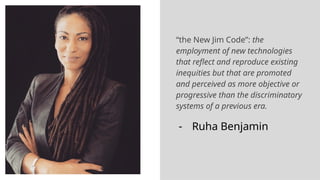
“the New Jim Code”: the
employment of new technologies
that reflect and reproduce existing
inequities but that are promoted
and perceived as more objective or
progressive than the discriminatory
systems of a previous era.
- Ruha Benjamin
Focus for this tutorial
Discrimination in consequential decision making settings
This excludes many other forms of injustice (and even unfairness)
US centric perspective (insofar as the examples and legal backdrop go)
Formal models and frameworks
This is not meant to decenter the scholarship just mentioned
This decidedly leaves room for non-technical interventions
Our concern is with unjustified basis for differentiation
● Practical irrelevance
○ Sexual orientation in employment decisions
● Moral irrelevance
○ Disability status in hiring decisions
Is discrimination not the point of machine
learning?
Discrimination is not a general concept
Domain specific:
Concerned with important opportunities that affect people’s lives
Group specific:
Concerned with socially salient categories that have served as the
basis for unjustified and systematically adverse treatment in the past
Regulated domains (based on US law)
● Credit (Equal Credit Opportunity Act)
● Education (Civil Rights Act of 1964; Education Amendments of 1972)
● Employment (Civil Rights Act of 1964)
● Housing (Fair Housing Act)
● ‘Public Accommodation’ (Civil Rights Act of 1964)
Extends to marketing and advertising; not limited to final decision
This list sets aside complex web of laws that regulates the government
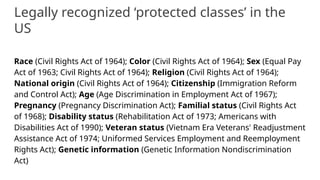
Legally recognized ‘protected classes’ in the
US
Race (Civil Rights Act of 1964); Color (Civil Rights Act of 1964); Sex (Equal Pay
Act of 1963; Civil Rights Act of 1964); Religion (Civil Rights Act of 1964);
National origin (Civil Rights Act of 1964); Citizenship (Immigration Reform
and Control Act); Age (Age Discrimination in Employment Act of 1967);
Pregnancy (Pregnancy Discrimination Act); Familial status (Civil Rights Act
of 1968); Disability status (Rehabilitation Act of 1973; Americans with
Disabilities Act of 1990); Veteran status (Vietnam Era Veterans' Readjustment
Assistance Act of 1974; Uniformed Services Employment and Reemployment
Rights Act); Genetic information (Genetic Information Nondiscrimination
Act)
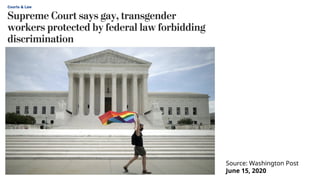
Source: Washington Post
June 15, 2020
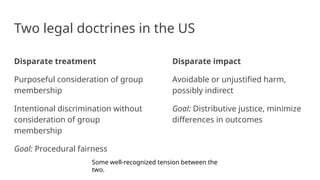
Two legal doctrines in the US
Disparate treatment
Purposeful consideration of group
membership
Intentional discrimination without
consideration of group
membership
Goal: Procedural fairness
Disparate impact
Avoidable or unjustified harm,
possibly indirect
Goal: Distributive justice, minimize
differences in outcomes
Some well-recognized tension between the
two.
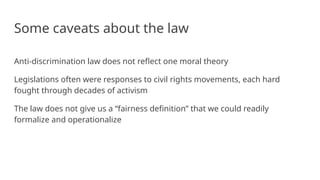
Some caveats about the law
Anti-discrimination law does not reflect one moral theory
Legislations often were responses to civil rights movements, each hard
fought through decades of activism
The law does not give us a “fairness definition” that we could readily
formalize and operationalize
The failure of fairness through unawareness
Removing (or not including) “sensitive attributes” is no
cure for fairness concerns and can exacerbate them.
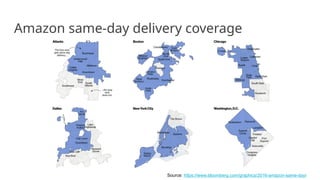
Amazon same-day delivery coverage
Source: https://www.bloomberg.com/graphics/2016-amazon-same-day/
The failure of fairness through unawareness
Perhaps Amazon was just predicting number of purchases, which correlates
with affluence, which correlates with race in the United States. Amazon almost
certainly did not look at their customers’ race when they built this product.
“We don’t consider
that in our data” is
never a valid
argument.
So what should we
do instead?
Overview
Part I (today): From a narrower perspective
Fairness criteria in classification
Part II (Thu): Toward a broader perspective
Causal models of decision-making settings
Dynamic models of socio-technical systems
Part I
Formal work on fairness in classification and
decision-making
Pioneering work in educational testing (Cleary 1968) and economics (Becker
1957, Phelps 1972, Arrow 1973) on the heels of civil rights movement.
Computer science: Mostly post 2010, explosive increase in work since 2016
Why today? Urgency, scale, reach, and impact of algorithmic decisions
Machine learning fuels adoption and motivates some new technical
problems, but also forces us to revisit fundamental normative questions
Formal prediction and decision making setting
Data described by covariates X
Outcome variable Y (often binary, sometimes called target variable)
Our goal is to predict Y from X
Use supervised machine learning to produce a score function R = r(X)
Make binary decisions according to threshold rule D = 1{R > t}
Note: Think of these as random variables in the same probability space.
Where do score functions come from
Score R could be:
● Based on parametric model of the data (X, Y), e.g. likelihood ratio test
● Non-parametric score, such as, Bayes optimal score R = E[ Y | X ]
● Most commonly, learned from labeled data using supervised learning
Decision theory 101
True
negative
False
positive
False
negative
True
positive
Decision D
Outcome
Y
0
0
1
1
True positive rate = Pr[D = 1 | Y = 1]
False positive rate = Pr[D = 1 | Y =
0]
True negative rate = Pr[D = 0 | Y =
0]
False negative rate = Pr[D = 0 | Y =
1]
Statistical fairness criteria
Introduce additional random variable A encoding membership status in
a protected class
Equalize different statistical quantities involving group membership A
Idea dates back at least to the 1960s with work of Anne Cleary about
group differences in educational testing*
We’ll review three common criteria
* See Hutchinson, Mitchell (2018).
Equalizing acceptance rate
Equal positive rate: For any two groups a, b, require
Pr[D = 1 | A = a] = Pr[D = 1 | A = b]
“Acceptance rate” equal in all groups
Generalization: Require D to be independent of A (Independence)
All sorts of variants, relaxations, equivalent formulations
Why this does not rule out unfair practices
One unfair situation: Make good/informed decisions in one group,
poor/arbitrary decisions in other groups. Equalize positive rate.
This can happen on its own if we have less data or poor data in one group.
Example: Old Framingham risk score for coronary heart disease was created
on cohort of white men, then used for other patients.
A positive call could be a false positive or a true positive. Moral intuition: You
shouldn’t get to match true positives in one group with false positives in
another.
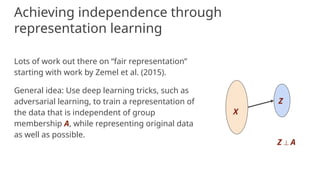
Achieving independence through
representation learning
Lots of work out there on “fair representation”
starting with work by Zemel et al. (2015).
General idea: Use deep learning tricks, such as
adversarial learning, to train a representation of
the data that is independent of group
membership A, while representing original data
as well as possible.
X
Z
Z ⟂ A
Equalizing error rates
For any two groups a, b, require
Pr[D = 1 | Y = 0, A = a] = Pr[D = 1 | Y = 0, A = b] (equal false
positive rate)
Pr[D = 0 | Y = 1, A = a] = Pr[D = 0 | Y = 1, A = b] (equal false
negative rate)
Generalization: Require D to be independent of A given Y
Also makes sense for score: Require R to be independent of A given Y
Error rate parity is a post-hoc criterion
At decision time, the decision maker doesn’t know who is a positive/negative
instance
In hindsight, somebody can collect a group of positive instances and a group
of negative instances and check how they were classified.
Group differences in this kind of post-hoc “audit” often strike people as unfair.
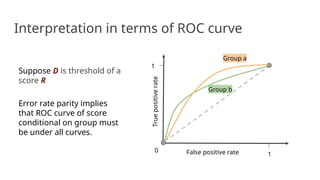
Interpretation in terms of ROC curve
False positive rate
True
positive
rate
1
1
0
Group b
Suppose D is threshold of a
score R
Error rate parity implies
that ROC curve of score
conditional on group must
be under all curves.
Group a
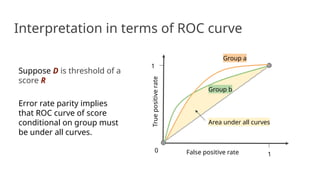
Interpretation in terms of ROC curve
False positive rate
True
positive
rate
1
1
0
Group a
Group b
Error rate parity implies
that ROC curve of score
conditional on group must
be under all curves.
Area under all curves
Suppose D is threshold of a
score R
Column-wise criteria?
We could equalize expressions of the form
Pr[Y = y | D = d, A = a]
These are called “column-wise” rates, i.e.,
false omission and false discovery rate.
Nothing wrong with this, but something
closely related but different is more
common.
n00 n01
n10 n11
Decision
Reality
0
0
1
1
Calibration
A score R is calibrated if: Pr[Y = 1 | R = r] = r
“You can pretend score is a probability” - although it may not actually be one!
Score value r corresponds to positive outcome rate r
Calibration by group: Pr[Y = y | R = r, A = a] = r
Follows from: Y independent of A conditional on R
Calibration is an a priori guarantee
The decision maker sees the score value r and knows based on this what the
frequency of positive outcomes is.
E.g., score 0.8 means 80% rate of heart failure on average over people who
receive score 0.8.
This guarantee (usually) does not hold at the individual level, e.g., “Mary’s
individual risk of heart failure is 80%.”
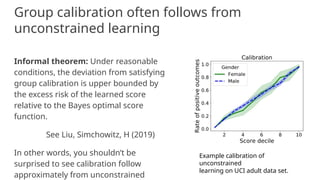
Group calibration often follows from
unconstrained learning
Informal theorem: Under reasonable
conditions, the deviation from satisfying
group calibration is upper bounded by
the excess risk of the learned score
relative to the Bayes optimal score
function.
See Liu, Simchowitz, H (2019)
In other words, you shouldn’t be
surprised to see calibration follow
approximately from unconstrained
Example calibration of
unconstrained
learning on UCI adult data set.
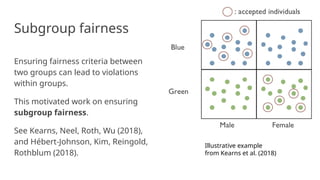
Subgroup fairness
Ensuring fairness criteria between
two groups can lead to violations
within groups.
This motivated work on ensuring
subgroup fairness.
See Kearns, Neel, Roth, Wu (2018),
and Hébert-Johnson, Kim, Reingold,
Rothblum (2018).
Illustrative example
from Kearns et al. (2018)
Recap
We saw three criteria:
● R independent of A (implies
equal acceptance rate)
● R independent of A conditional on Y (implies equal error
rates)
● Y independent of A conditional on R (implies calibration by
group)
Incompatibility results
Informal theorem: Any two of these
criteria are mutually exclusive in
general.
Error rate parity vs calibration
Theorem:
1. Assume unequal base rates: Pr[Y = 1 | A = a] ≠ Pr[Y = 1 | A
= b]
2. Assume imperfect decision rule: D has nonzero error rates
Then, calibration by group implies that error rate parity fails.
Related result due to Chouldechova (2016), Kleinberg,
Mullainathan, Raghavan (2017)
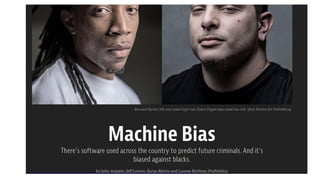
Essence of COMPAS debate
There’s a risk score used, called COMPAS, used by many jurisdictions in the
United States to assess “risk of recidivism”. Judges may detain defendant in
part based on this score.
ProPublica: Black defendants face higher false positive rate, i.e., more Black
defendants labeled “high risk” end up not committing a crime upon release
than among Whites labeled “high risk”
COMPAS maker Northpointe: But our scores are calibrated by group and
Black defendants have a higher recidivism rate! Hence, this is unavoidable.
A first word of caution about COMPAS debate
Neither error rate parity nor calibration rule out
blatantly unfair practices.
What’s fair in criminal justice is not settled by appeal to
one or the other criterion.
These properties are not meant to be “fairness
certificates”.
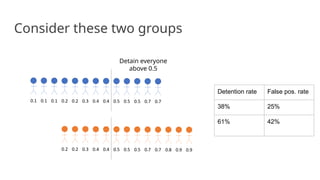
Consider these two groups
Detention rate False pos. rate
38% 25%
61% 42%
Detain everyone
above 0.5
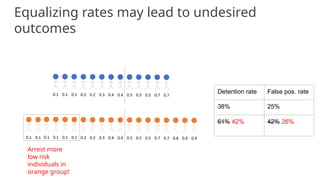
Equalizing rates may lead to undesired
outcomes
Arrest more
low risk
individuals in
orange group!
Detention rate False pos. rate
38% 25%
61% 42% 42% 26%
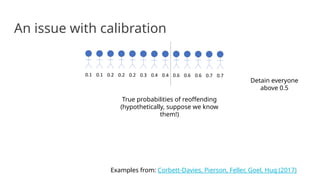
An issue with calibration
True probabilities of reoffending
(hypothetically, suppose we know
them!)
Detain everyone
above 0.5
Examples from: Corbett-Davies, Pierson, Feller, Goel, Huq (2017)
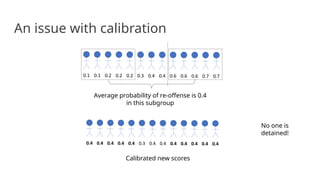
An issue with calibration
Average probability of re-offense is 0.4
in this subgroup
Calibrated new scores
No one is
detained!
Is prediction too narrow a perspective?
Scholarly debate around COMPAS was largely about
tension between fairness criteria.
Some rightfully point out data and measurement
problems
(e.g., policing patterns influence variables such as criminal history and
recidivism)
When is the issue not how we predict but that we predict?
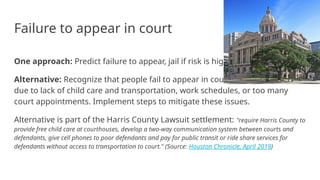
Failure to appear in court
One approach: Predict failure to appear, jail if risk is high.
Alternative: Recognize that people fail to appear in court
due to lack of child care and transportation, work schedules, or too many
court appointments. Implement steps to mitigate these issues.
Alternative is part of the Harris County Lawsuit settlement: "require Harris County to
provide free child care at courthouses, develop a two-way communication system between courts and
defendants, give cell phones to poor defendants and pay for public transit or ride share services for
defendants without access to transportation to court." (Source: Houston Chronicle, April 2019)
Toward a broader perspective
Statistical fairness criteria take data generating distribution as given and
work with nothing but the joint statistics of (X, Y, R, A).
If this statistical perspective is too narrow, how do we take salient social facts
and context into account?
This will be the subject of Part II on Thursday.
Wrapping up
Fairness through unawareness fails!
Violations of fairness criteria trigger valid moral intuitions, and can surface
normative questions about decision-making, as well as trade-offs and
tensions between different interpretations of fairness.
However, statistical fairness criteria on their own cannot be a “proof of
fairness”.
Nor are fairness criteria on their own a good objective function.
Background reading
A textbook in progress (mostly available online):
Barocas, H, Narayanan. Fairness and Machine Learning: Limitations and
Opportunities. fairmlbook.org
Today’s lecture roughly corresponds to Chapters 1 & 2.

adv_ii_fairness artificial intelligence .pptx

  • 1.
    Fairness and MachineLearning: Limitations and Opportunities Moritz Hardt UC Berkeley
  • 2.
    Where to start? Welive in a world of pervasive inequality, oppression, and discrimination. As we use machine learning to formalize, scale, accelerate processes in this world, we run danger of perpetuating existing patterns of injustice. But there’s also a (somewhat fragile) opportunity to revisit decision making in various domains and reform existing processes for the better.
  • 3.
    Important work tostart with Ruha Benjamin. Race After Technology: Abolitionist Tools for the New Jim Code Meredith Broussard. Artificial Unintelligence: How Computers Misunderstand the World Virginia Eubanks. Automating Inequality: How High-Tech Tools Profile, Police, and Punish the Poor Safiya Noble. Algorithms of Oppression: How Search Engines Reinforce Racism Cathy O’Neil. Weapons of math destruction Joy Boulamwini, Kate Crawford, Timnit Gebru, Latanya Sweeney, Meredith Whitaker and many others.
  • 4.
    “the New JimCode”: the employment of new technologies that reflect and reproduce existing inequities but that are promoted and perceived as more objective or progressive than the discriminatory systems of a previous era. - Ruha Benjamin
  • 5.
    Focus for thistutorial Discrimination in consequential decision making settings This excludes many other forms of injustice (and even unfairness) US centric perspective (insofar as the examples and legal backdrop go) Formal models and frameworks This is not meant to decenter the scholarship just mentioned This decidedly leaves room for non-technical interventions
  • 6.
    Our concern iswith unjustified basis for differentiation ● Practical irrelevance ○ Sexual orientation in employment decisions ● Moral irrelevance ○ Disability status in hiring decisions Is discrimination not the point of machine learning?
  • 7.
    Discrimination is nota general concept Domain specific: Concerned with important opportunities that affect people’s lives Group specific: Concerned with socially salient categories that have served as the basis for unjustified and systematically adverse treatment in the past
  • 8.
    Regulated domains (basedon US law) ● Credit (Equal Credit Opportunity Act) ● Education (Civil Rights Act of 1964; Education Amendments of 1972) ● Employment (Civil Rights Act of 1964) ● Housing (Fair Housing Act) ● ‘Public Accommodation’ (Civil Rights Act of 1964) Extends to marketing and advertising; not limited to final decision This list sets aside complex web of laws that regulates the government
  • 9.
    Legally recognized ‘protectedclasses’ in the US Race (Civil Rights Act of 1964); Color (Civil Rights Act of 1964); Sex (Equal Pay Act of 1963; Civil Rights Act of 1964); Religion (Civil Rights Act of 1964); National origin (Civil Rights Act of 1964); Citizenship (Immigration Reform and Control Act); Age (Age Discrimination in Employment Act of 1967); Pregnancy (Pregnancy Discrimination Act); Familial status (Civil Rights Act of 1968); Disability status (Rehabilitation Act of 1973; Americans with Disabilities Act of 1990); Veteran status (Vietnam Era Veterans' Readjustment Assistance Act of 1974; Uniformed Services Employment and Reemployment Rights Act); Genetic information (Genetic Information Nondiscrimination Act)
  • 10.
  • 11.
    Two legal doctrinesin the US Disparate treatment Purposeful consideration of group membership Intentional discrimination without consideration of group membership Goal: Procedural fairness Disparate impact Avoidable or unjustified harm, possibly indirect Goal: Distributive justice, minimize differences in outcomes Some well-recognized tension between the two.
  • 12.
    Some caveats aboutthe law Anti-discrimination law does not reflect one moral theory Legislations often were responses to civil rights movements, each hard fought through decades of activism The law does not give us a “fairness definition” that we could readily formalize and operationalize
  • 13.
    The failure offairness through unawareness Removing (or not including) “sensitive attributes” is no cure for fairness concerns and can exacerbate them.
  • 14.
    Amazon same-day deliverycoverage Source: https://www.bloomberg.com/graphics/2016-amazon-same-day/
  • 16.
    The failure offairness through unawareness Perhaps Amazon was just predicting number of purchases, which correlates with affluence, which correlates with race in the United States. Amazon almost certainly did not look at their customers’ race when they built this product.
  • 17.
    “We don’t consider thatin our data” is never a valid argument.
  • 18.
    So what shouldwe do instead?
  • 19.
    Overview Part I (today):From a narrower perspective Fairness criteria in classification Part II (Thu): Toward a broader perspective Causal models of decision-making settings Dynamic models of socio-technical systems
  • 20.
  • 21.
    Formal work onfairness in classification and decision-making Pioneering work in educational testing (Cleary 1968) and economics (Becker 1957, Phelps 1972, Arrow 1973) on the heels of civil rights movement. Computer science: Mostly post 2010, explosive increase in work since 2016 Why today? Urgency, scale, reach, and impact of algorithmic decisions Machine learning fuels adoption and motivates some new technical problems, but also forces us to revisit fundamental normative questions
  • 22.
    Formal prediction anddecision making setting Data described by covariates X Outcome variable Y (often binary, sometimes called target variable) Our goal is to predict Y from X Use supervised machine learning to produce a score function R = r(X) Make binary decisions according to threshold rule D = 1{R > t} Note: Think of these as random variables in the same probability space.
  • 23.
    Where do scorefunctions come from Score R could be: ● Based on parametric model of the data (X, Y), e.g. likelihood ratio test ● Non-parametric score, such as, Bayes optimal score R = E[ Y | X ] ● Most commonly, learned from labeled data using supervised learning
  • 24.
    Decision theory 101 True negative False positive False negative True positive DecisionD Outcome Y 0 0 1 1 True positive rate = Pr[D = 1 | Y = 1] False positive rate = Pr[D = 1 | Y = 0] True negative rate = Pr[D = 0 | Y = 0] False negative rate = Pr[D = 0 | Y = 1]
  • 25.
    Statistical fairness criteria Introduceadditional random variable A encoding membership status in a protected class Equalize different statistical quantities involving group membership A Idea dates back at least to the 1960s with work of Anne Cleary about group differences in educational testing* We’ll review three common criteria * See Hutchinson, Mitchell (2018).
  • 26.
    Equalizing acceptance rate Equalpositive rate: For any two groups a, b, require Pr[D = 1 | A = a] = Pr[D = 1 | A = b] “Acceptance rate” equal in all groups Generalization: Require D to be independent of A (Independence) All sorts of variants, relaxations, equivalent formulations
  • 27.
    Why this doesnot rule out unfair practices One unfair situation: Make good/informed decisions in one group, poor/arbitrary decisions in other groups. Equalize positive rate. This can happen on its own if we have less data or poor data in one group. Example: Old Framingham risk score for coronary heart disease was created on cohort of white men, then used for other patients. A positive call could be a false positive or a true positive. Moral intuition: You shouldn’t get to match true positives in one group with false positives in another.
  • 28.
    Achieving independence through representationlearning Lots of work out there on “fair representation” starting with work by Zemel et al. (2015). General idea: Use deep learning tricks, such as adversarial learning, to train a representation of the data that is independent of group membership A, while representing original data as well as possible. X Z Z ⟂ A
  • 29.
    Equalizing error rates Forany two groups a, b, require Pr[D = 1 | Y = 0, A = a] = Pr[D = 1 | Y = 0, A = b] (equal false positive rate) Pr[D = 0 | Y = 1, A = a] = Pr[D = 0 | Y = 1, A = b] (equal false negative rate) Generalization: Require D to be independent of A given Y Also makes sense for score: Require R to be independent of A given Y
  • 30.
    Error rate parityis a post-hoc criterion At decision time, the decision maker doesn’t know who is a positive/negative instance In hindsight, somebody can collect a group of positive instances and a group of negative instances and check how they were classified. Group differences in this kind of post-hoc “audit” often strike people as unfair.
  • 31.
    Interpretation in termsof ROC curve False positive rate True positive rate 1 1 0 Group b Suppose D is threshold of a score R Error rate parity implies that ROC curve of score conditional on group must be under all curves. Group a
  • 32.
    Interpretation in termsof ROC curve False positive rate True positive rate 1 1 0 Group a Group b Error rate parity implies that ROC curve of score conditional on group must be under all curves. Area under all curves Suppose D is threshold of a score R
  • 33.
    Column-wise criteria? We couldequalize expressions of the form Pr[Y = y | D = d, A = a] These are called “column-wise” rates, i.e., false omission and false discovery rate. Nothing wrong with this, but something closely related but different is more common. n00 n01 n10 n11 Decision Reality 0 0 1 1
  • 34.
    Calibration A score Ris calibrated if: Pr[Y = 1 | R = r] = r “You can pretend score is a probability” - although it may not actually be one! Score value r corresponds to positive outcome rate r Calibration by group: Pr[Y = y | R = r, A = a] = r Follows from: Y independent of A conditional on R
  • 35.
    Calibration is ana priori guarantee The decision maker sees the score value r and knows based on this what the frequency of positive outcomes is. E.g., score 0.8 means 80% rate of heart failure on average over people who receive score 0.8. This guarantee (usually) does not hold at the individual level, e.g., “Mary’s individual risk of heart failure is 80%.”
  • 36.
    Group calibration oftenfollows from unconstrained learning Informal theorem: Under reasonable conditions, the deviation from satisfying group calibration is upper bounded by the excess risk of the learned score relative to the Bayes optimal score function. See Liu, Simchowitz, H (2019) In other words, you shouldn’t be surprised to see calibration follow approximately from unconstrained Example calibration of unconstrained learning on UCI adult data set.
  • 37.
    Subgroup fairness Ensuring fairnesscriteria between two groups can lead to violations within groups. This motivated work on ensuring subgroup fairness. See Kearns, Neel, Roth, Wu (2018), and Hébert-Johnson, Kim, Reingold, Rothblum (2018). Illustrative example from Kearns et al. (2018)
  • 38.
    Recap We saw threecriteria: ● R independent of A (implies equal acceptance rate) ● R independent of A conditional on Y (implies equal error rates) ● Y independent of A conditional on R (implies calibration by group)
  • 39.
    Incompatibility results Informal theorem:Any two of these criteria are mutually exclusive in general.
  • 40.
    Error rate parityvs calibration Theorem: 1. Assume unequal base rates: Pr[Y = 1 | A = a] ≠ Pr[Y = 1 | A = b] 2. Assume imperfect decision rule: D has nonzero error rates Then, calibration by group implies that error rate parity fails. Related result due to Chouldechova (2016), Kleinberg, Mullainathan, Raghavan (2017)
  • 42.
    Essence of COMPASdebate There’s a risk score used, called COMPAS, used by many jurisdictions in the United States to assess “risk of recidivism”. Judges may detain defendant in part based on this score. ProPublica: Black defendants face higher false positive rate, i.e., more Black defendants labeled “high risk” end up not committing a crime upon release than among Whites labeled “high risk” COMPAS maker Northpointe: But our scores are calibrated by group and Black defendants have a higher recidivism rate! Hence, this is unavoidable.
  • 43.
    A first wordof caution about COMPAS debate Neither error rate parity nor calibration rule out blatantly unfair practices. What’s fair in criminal justice is not settled by appeal to one or the other criterion. These properties are not meant to be “fairness certificates”.
  • 44.
    Consider these twogroups Detention rate False pos. rate 38% 25% 61% 42% Detain everyone above 0.5
  • 45.
    Equalizing rates maylead to undesired outcomes Arrest more low risk individuals in orange group! Detention rate False pos. rate 38% 25% 61% 42% 42% 26%
  • 46.
    An issue withcalibration True probabilities of reoffending (hypothetically, suppose we know them!) Detain everyone above 0.5 Examples from: Corbett-Davies, Pierson, Feller, Goel, Huq (2017)
  • 47.
    An issue withcalibration Average probability of re-offense is 0.4 in this subgroup Calibrated new scores No one is detained!
  • 48.
    Is prediction toonarrow a perspective? Scholarly debate around COMPAS was largely about tension between fairness criteria. Some rightfully point out data and measurement problems (e.g., policing patterns influence variables such as criminal history and recidivism) When is the issue not how we predict but that we predict?
  • 49.
    Failure to appearin court One approach: Predict failure to appear, jail if risk is high. Alternative: Recognize that people fail to appear in court due to lack of child care and transportation, work schedules, or too many court appointments. Implement steps to mitigate these issues. Alternative is part of the Harris County Lawsuit settlement: "require Harris County to provide free child care at courthouses, develop a two-way communication system between courts and defendants, give cell phones to poor defendants and pay for public transit or ride share services for defendants without access to transportation to court." (Source: Houston Chronicle, April 2019)
  • 50.
    Toward a broaderperspective Statistical fairness criteria take data generating distribution as given and work with nothing but the joint statistics of (X, Y, R, A). If this statistical perspective is too narrow, how do we take salient social facts and context into account? This will be the subject of Part II on Thursday.
  • 51.
    Wrapping up Fairness throughunawareness fails! Violations of fairness criteria trigger valid moral intuitions, and can surface normative questions about decision-making, as well as trade-offs and tensions between different interpretations of fairness. However, statistical fairness criteria on their own cannot be a “proof of fairness”. Nor are fairness criteria on their own a good objective function.
  • 52.
    Background reading A textbookin progress (mostly available online): Barocas, H, Narayanan. Fairness and Machine Learning: Limitations and Opportunities. fairmlbook.org Today’s lecture roughly corresponds to Chapters 1 & 2.

Editor's Notes

  • #6 Practical irrelevance
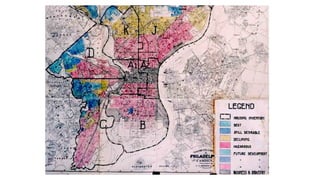
  • #15 A 1936 HOLC "residential security" map of Philadelphia, classifying various neighborhoods by estimated riskiness of mortgage loans.[1]