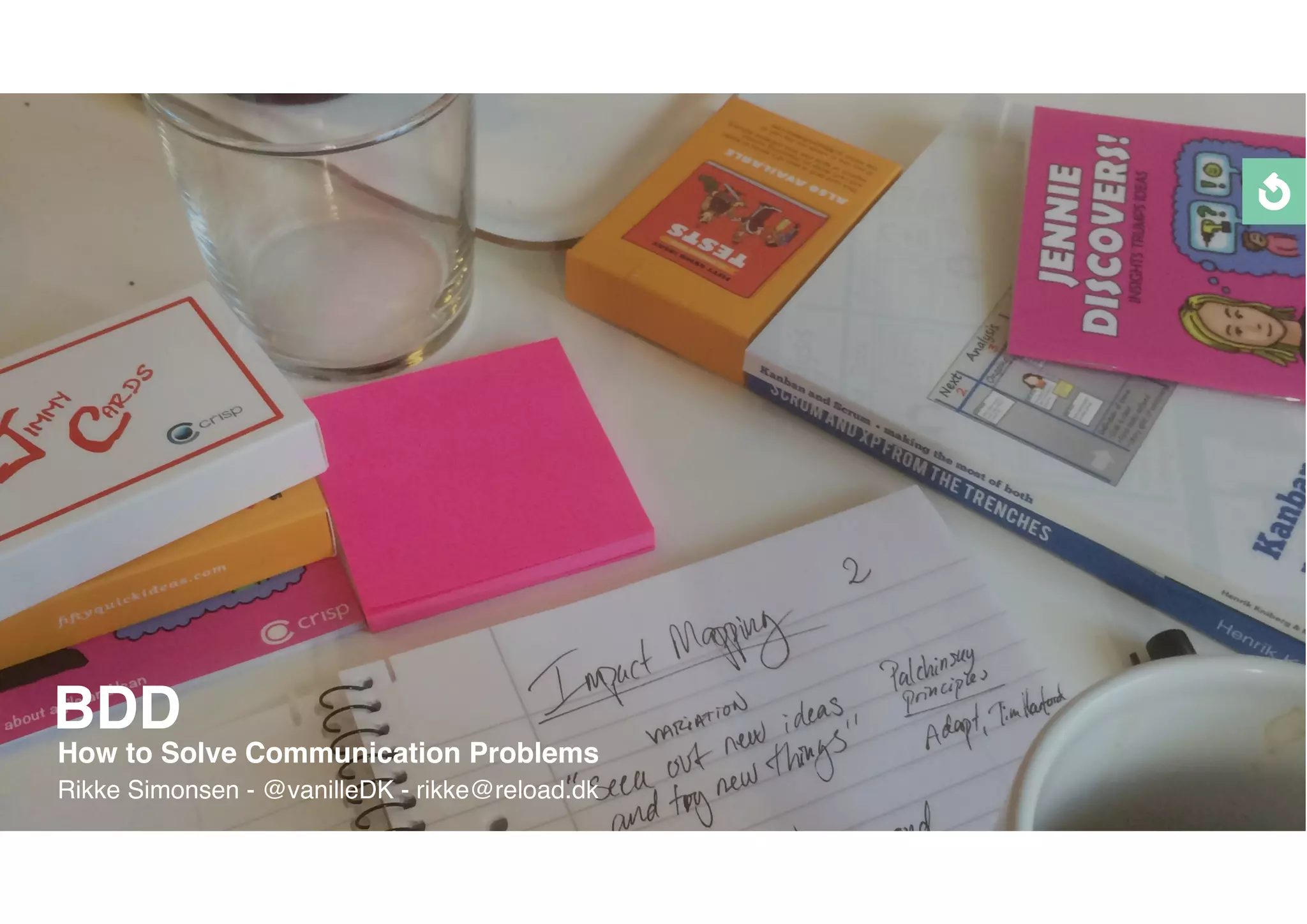
BDD
How to Solve Communication Problems
Rikke Simonsen - @vanilleDK - rikke@reload.dk
• Introduction - Me and BDD
• Exercise 1: Build a Duck
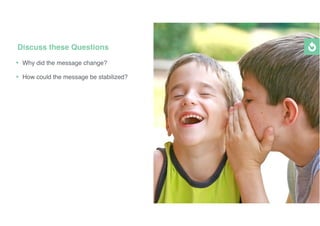
• Exercise 2: Pass the Message
• Exercise 3: Three Amigos Workshop
Workshop Agenda
• Background in Computer Science
• Former tester (and still a tester by heart)
• Project manager in a small consultancy
called Reload specialized in building
complex websites based on the CMS
called Drupal
• Passionate about agile testing and
Behavior Driven Development (BDD)
• Organizer of the “Copenhagen BDD
Meetup”
The Professional Side of Me
• From the land of vikings and the
inventors of Lego (Denmark)
• Have 3 kids with autism and a bunch of
other disabilities (What doesn't kill you
makes you stronger)
• involved in voluntary work and disability
policy (Just as passionate about this as
with testing)
• Town councillor (yes i get scolded a lot)
The Private Side of Me
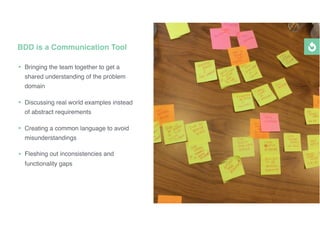
• Bringing the team together to get a
shared understanding of the problem
domain
• Discussing real world examples instead
of abstract requirements
• Creating a common language to avoid
misunderstandings
• Fleshing out inconsistencies and
functionality gaps
BDD is a Communication Tool
• “Given, When, Then” is just a syntax. It’s
not BDD.
• The value lies primarily in the
conversations, not the automated tests.
• The written specifications from a BDD
workshop can be automated giving you
automated regression tests and living
documentation, but it’s just a pleasant
side effect. It should not be the main
purpose.
BDD is not a Tool for Automation
Having conversations
is more important than
capturing conversations
is more important than
automating conversations
– Liz Keogh, @lunivore
Gherkin
Gherkin is a
Business Readable,
Domain Specific
Language that lets
you describe
software's behaviour
without detailing
how that behaviour
is implemented
Feature: [title]
In order to [achieve some goal]
As a [user]
I need to [make an impact]
Scenario: [title]
Given [some initial context]
When [some action occur]
Then [some observable consequence]
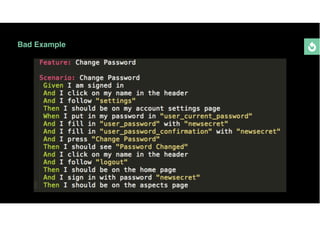
Bad Example
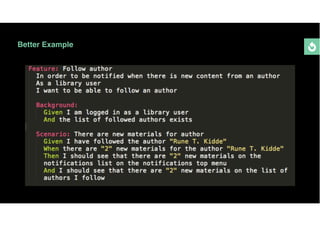
Better Example
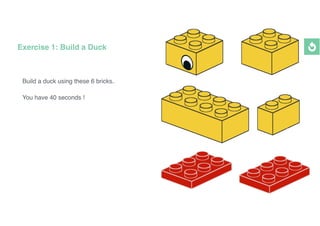
Build a duck using these 6 bricks.
You have 40 seconds !
Exercise 1: Build a Duck
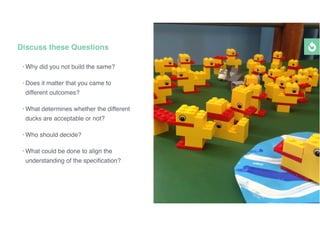
• Why did you not build the same?
• Does it matter that you came to
different outcomes?
• What determines whether the different
ducks are acceptable or not?
• Who should decide?
• What could be done to align the
understanding of the specification?
Discuss these Questions
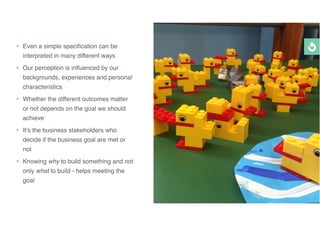
• Even a simple specification can be
interpreted in many different ways
• Our perception is influenced by our
backgrounds, experiences and personal
characteristics
• Whether the different outcomes matter
or not depends on the goal we should
achieve
• It’s the business stakeholders who
decide if the business goal are met or
not
• Knowing why to build something and not
only what to build - helps meeting the
goal
It’s not complicated to build something
that works. It’s much harder to build
something that works as intended and
that delivers the desired business value.
To ensure we meet the right business goal we need to
understand the business domain and what the desired
outcome is rather than what feature to build. Only when
everyone on the team are aligned, we can all pull in the
right direction.
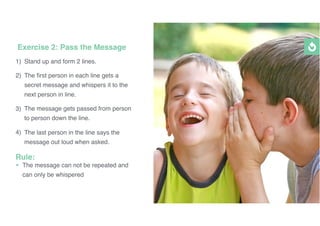
1) Stand up and form 2 lines.
2) The first person in each line gets a
secret message and whispers it to the
next person in line.
3) The message gets passed from person
to person down the line.
4) The last person in the line says the
message out loud when asked.
Rule:
• The message can not be repeated and
can only be whispered
Exercise 2: Pass the Message
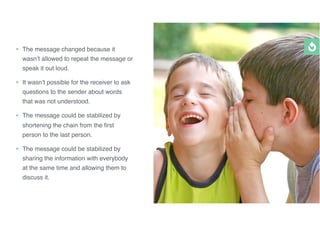
• Why did the message change?
• How could the message be stabilized?
Discuss these Questions
• The message changed because it
wasn’t allowed to repeat the message or
speak it out loud.
• It wasn’t possible for the receiver to ask
questions to the sender about words
that was not understood.
• The message could be stabilized by
shortening the chain from the first
person to the last person.
• The message could be stabilized by
sharing the information with everybody
at the same time and allowing them to
discuss it.
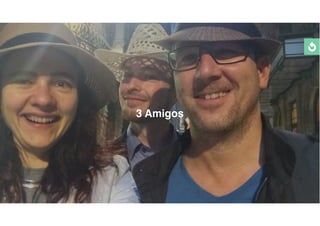
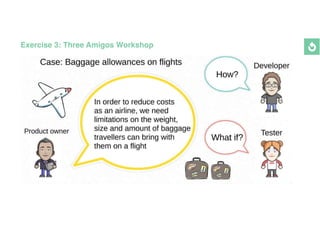
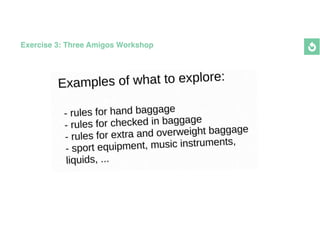
3 Amigos
Discussing examples helps exploring the
domain and identifying edge cases. The
discussion leads to new user stories,
rules and examples and flesh out gaps and
inconsistencies that has to be addressed.
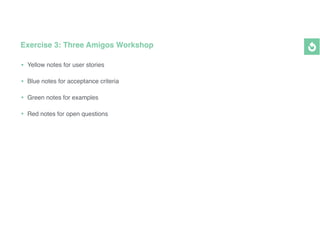
Exercise 3: Three Amigos Workshop
• Yellow notes for user stories
• Blue notes for acceptance criteria
• Green notes for examples
• Red notes for open questions
Use real life examples as much as
possible. Examples beats a list of
instructions every single time.
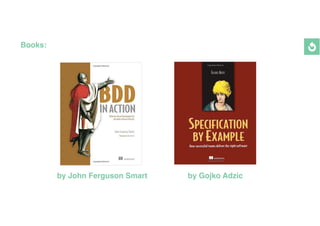
Books:
by John Ferguson Smart by Gojko Adzic
Thank you!
Get in touch: @vanilleDK or rikke@reload.dk

Bdd - how to solve communication problems

  • 1.
    BDD How to SolveCommunication Problems Rikke Simonsen - @vanilleDK - rikke@reload.dk
  • 2.
    • Introduction -Me and BDD • Exercise 1: Build a Duck • Exercise 2: Pass the Message • Exercise 3: Three Amigos Workshop Workshop Agenda
  • 3.
    • Background inComputer Science • Former tester (and still a tester by heart) • Project manager in a small consultancy called Reload specialized in building complex websites based on the CMS called Drupal • Passionate about agile testing and Behavior Driven Development (BDD) • Organizer of the “Copenhagen BDD Meetup” The Professional Side of Me
  • 4.
    • From theland of vikings and the inventors of Lego (Denmark) • Have 3 kids with autism and a bunch of other disabilities (What doesn't kill you makes you stronger) • involved in voluntary work and disability policy (Just as passionate about this as with testing) • Town councillor (yes i get scolded a lot) The Private Side of Me
  • 5.
    • Bringing theteam together to get a shared understanding of the problem domain • Discussing real world examples instead of abstract requirements • Creating a common language to avoid misunderstandings • Fleshing out inconsistencies and functionality gaps BDD is a Communication Tool
  • 6.
    • “Given, When,Then” is just a syntax. It’s not BDD. • The value lies primarily in the conversations, not the automated tests. • The written specifications from a BDD workshop can be automated giving you automated regression tests and living documentation, but it’s just a pleasant side effect. It should not be the main purpose. BDD is not a Tool for Automation
  • 7.
    Having conversations is moreimportant than capturing conversations is more important than automating conversations – Liz Keogh, @lunivore
  • 8.
    Gherkin Gherkin is a BusinessReadable, Domain Specific Language that lets you describe software's behaviour without detailing how that behaviour is implemented Feature: [title] In order to [achieve some goal] As a [user] I need to [make an impact] Scenario: [title] Given [some initial context] When [some action occur] Then [some observable consequence]
  • 9.
  • 10.
  • 11.
    Build a duckusing these 6 bricks. You have 40 seconds ! Exercise 1: Build a Duck
  • 12.
    • Why didyou not build the same? • Does it matter that you came to different outcomes? • What determines whether the different ducks are acceptable or not? • Who should decide? • What could be done to align the understanding of the specification? Discuss these Questions
  • 13.
    • Even asimple specification can be interpreted in many different ways • Our perception is influenced by our backgrounds, experiences and personal characteristics • Whether the different outcomes matter or not depends on the goal we should achieve • It’s the business stakeholders who decide if the business goal are met or not • Knowing why to build something and not only what to build - helps meeting the goal
  • 14.
    It’s not complicatedto build something that works. It’s much harder to build something that works as intended and that delivers the desired business value.
  • 15.
    To ensure wemeet the right business goal we need to understand the business domain and what the desired outcome is rather than what feature to build. Only when everyone on the team are aligned, we can all pull in the right direction.
  • 16.
    1) Stand upand form 2 lines. 2) The first person in each line gets a secret message and whispers it to the next person in line. 3) The message gets passed from person to person down the line. 4) The last person in the line says the message out loud when asked. Rule: • The message can not be repeated and can only be whispered Exercise 2: Pass the Message
  • 17.
    • Why didthe message change? • How could the message be stabilized? Discuss these Questions
  • 18.
    • The messagechanged because it wasn’t allowed to repeat the message or speak it out loud. • It wasn’t possible for the receiver to ask questions to the sender about words that was not understood. • The message could be stabilized by shortening the chain from the first person to the last person. • The message could be stabilized by sharing the information with everybody at the same time and allowing them to discuss it.
  • 19.
  • 20.
    Discussing examples helpsexploring the domain and identifying edge cases. The discussion leads to new user stories, rules and examples and flesh out gaps and inconsistencies that has to be addressed.
  • 21.
    Exercise 3: ThreeAmigos Workshop
  • 22.
    Exercise 3: ThreeAmigos Workshop
  • 23.
    Exercise 3: ThreeAmigos Workshop • Yellow notes for user stories • Blue notes for acceptance criteria • Green notes for examples • Red notes for open questions
  • 24.
    Use real lifeexamples as much as possible. Examples beats a list of instructions every single time.
  • 25.
    Books: by John FergusonSmart by Gojko Adzic
  • 26.
    Thank you! Get intouch: @vanilleDK or rikke@reload.dk