Catalyzing Drupal
collaboration & coding
  at your institution

 @adellefrank #usg12
 http://adellef.co/401
 Thursday, October 25, 2012 @ 3:15pm
      http://www.usg.edu/rock_eagle
     USG Annual Computing Conference
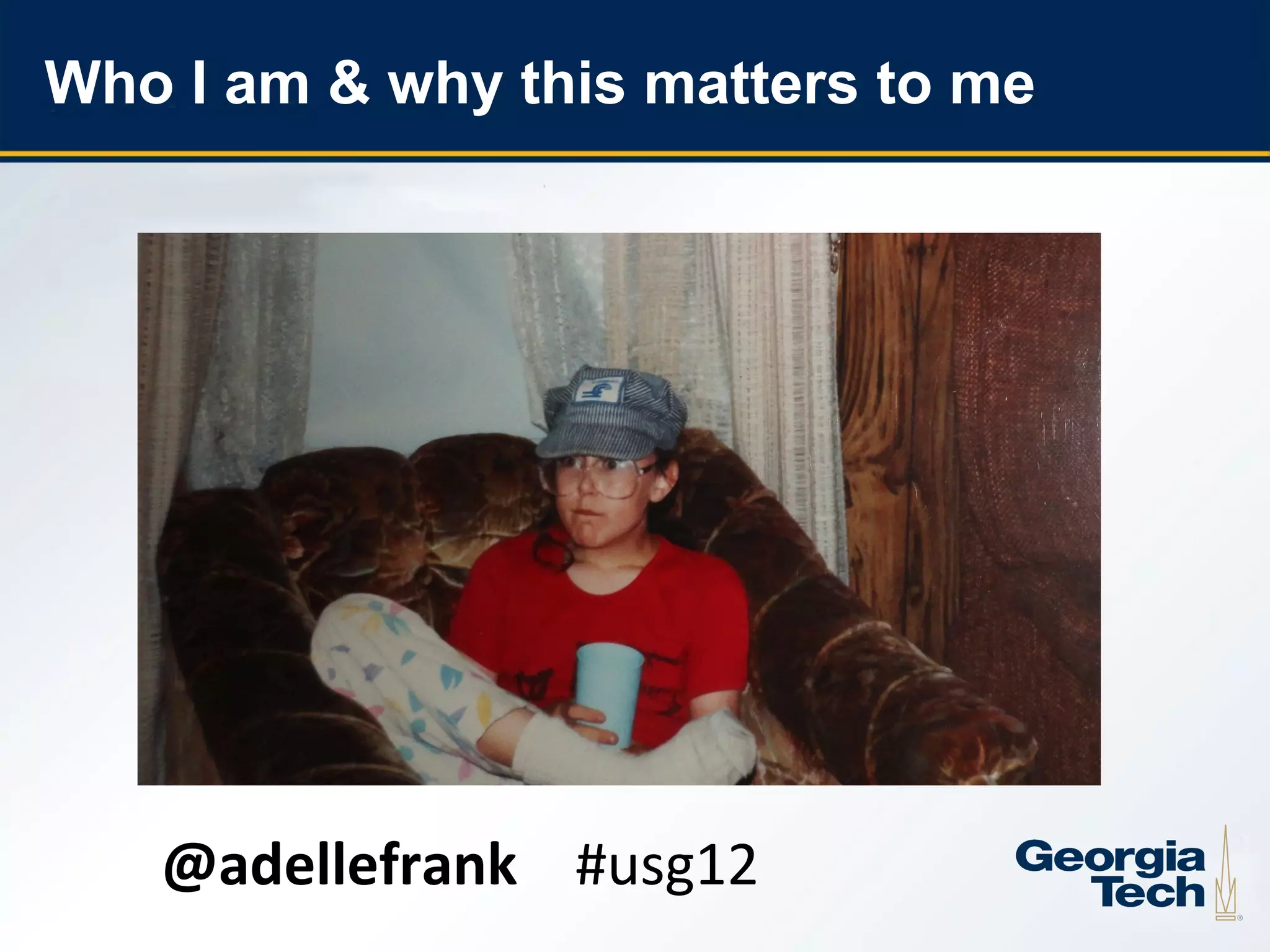
Who I am & why this matters to me


       @adellefrank #usg12
2
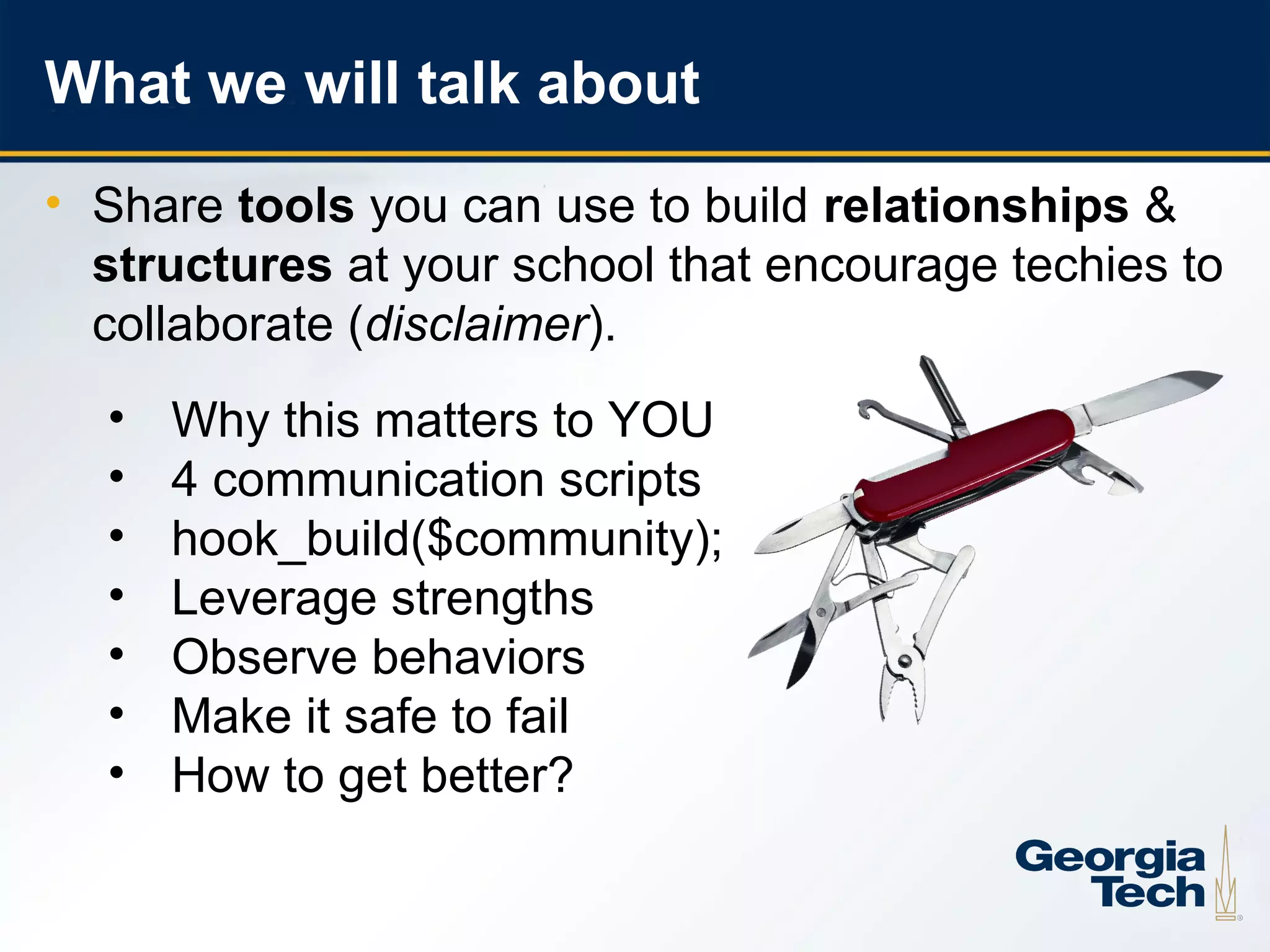
What we will talk about
    • Share tools you can use to build relationships &
      structures at your school that encourage techies to
      collaborate (disclaimer).
      •   Why this matters to YOU
      •   4 communication scripts
      •   hook_build($community);
      •   Leverage strengths
      •   Observe behaviors
      •   Make it safe to fail
      •   How to get better?

3
Script 1: Contrasting to clarify


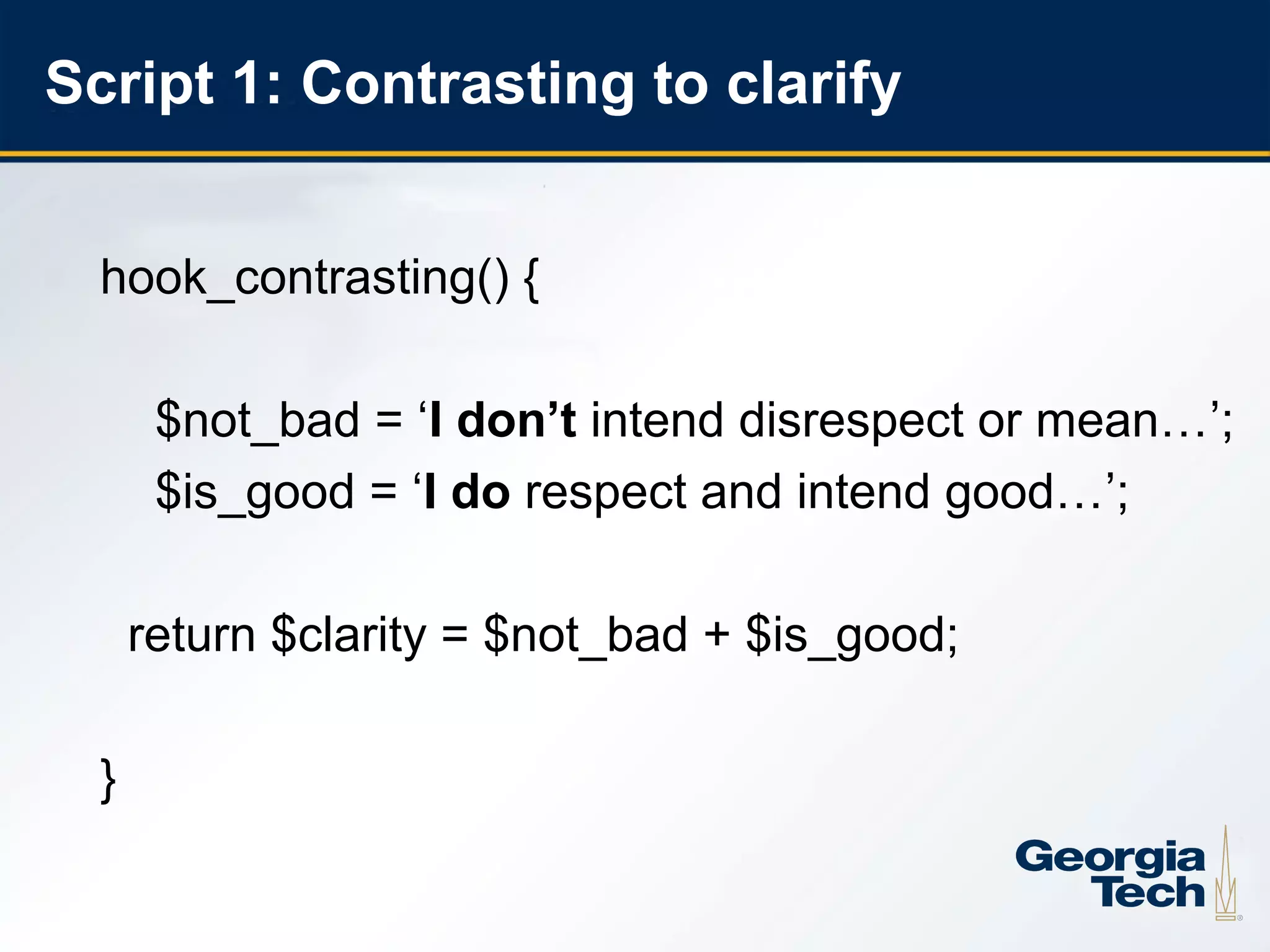
      hook_contrasting() {

           $not_bad = ‘I don’t intend disrespect or mean…’;
           $is_good = ‘I do respect and intend good…’;

          return $clarity = $not_bad + $is_good;

      }

4
Why this matters
    • Collaboration: leverage scarce resources


5
Why this matters
    • You get prizes! 


6
Why this matters
    • Collaboration: make work more pleasant &
      productive


7
Who are you & why are you here?

    • Who are you?


    • Why are you in this session?
      – Challenges?
      – Desires for this session?


8
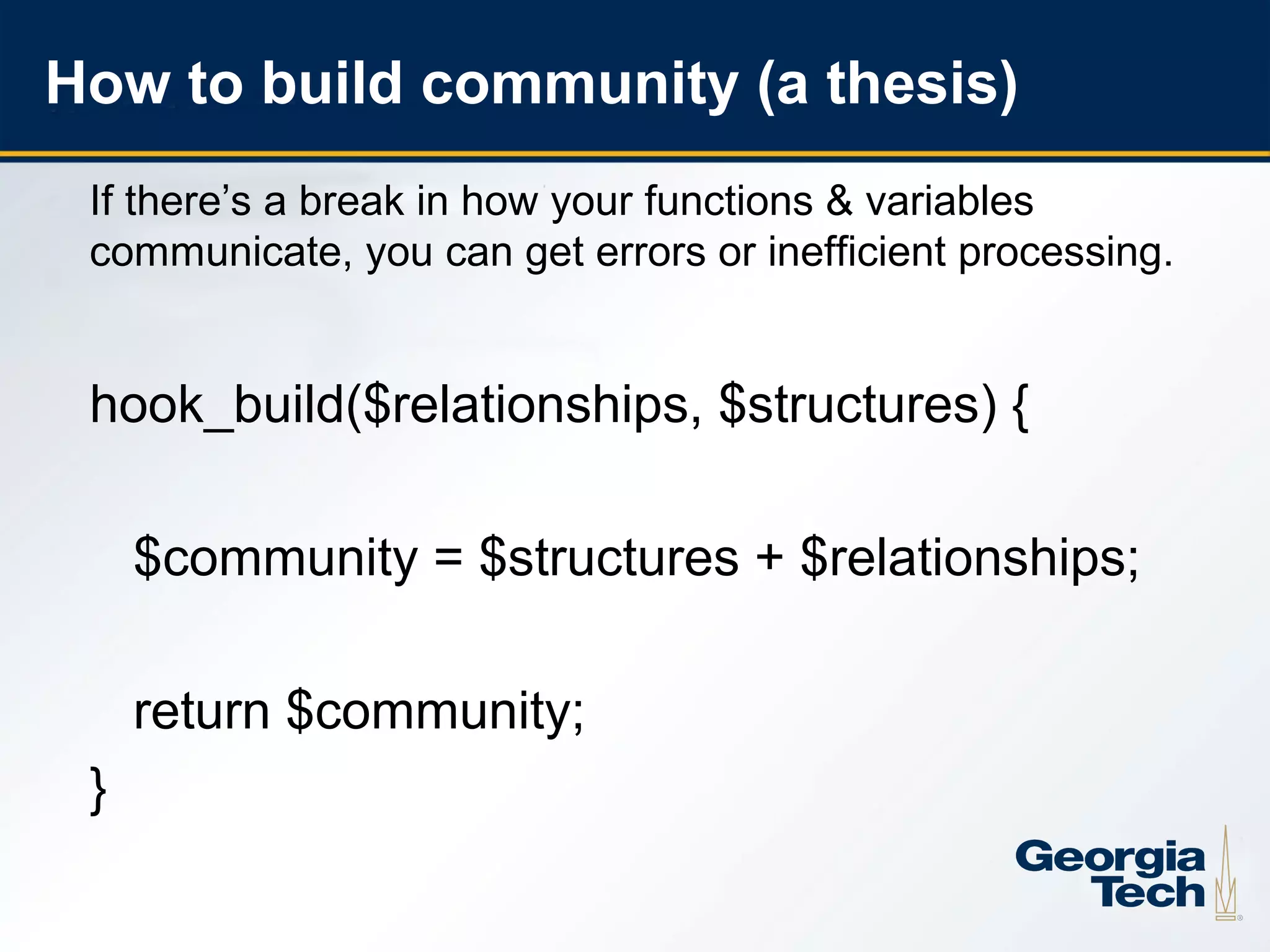
How to build community (a thesis)
     If there’s a break in how your functions & variables
     communicate, you can get errors or inefficient processing.


     hook_build($relationships, $structures) {

         $community = $structures + $relationships;

         return $community;
     }

9
Structure is a necessary framework

     • Consistency
       – Places & times to CONNECT.
       – Face-to-face: monthly, not weekly
       – Virtual places: listserv, wiki, git, right
         NOW tools


10
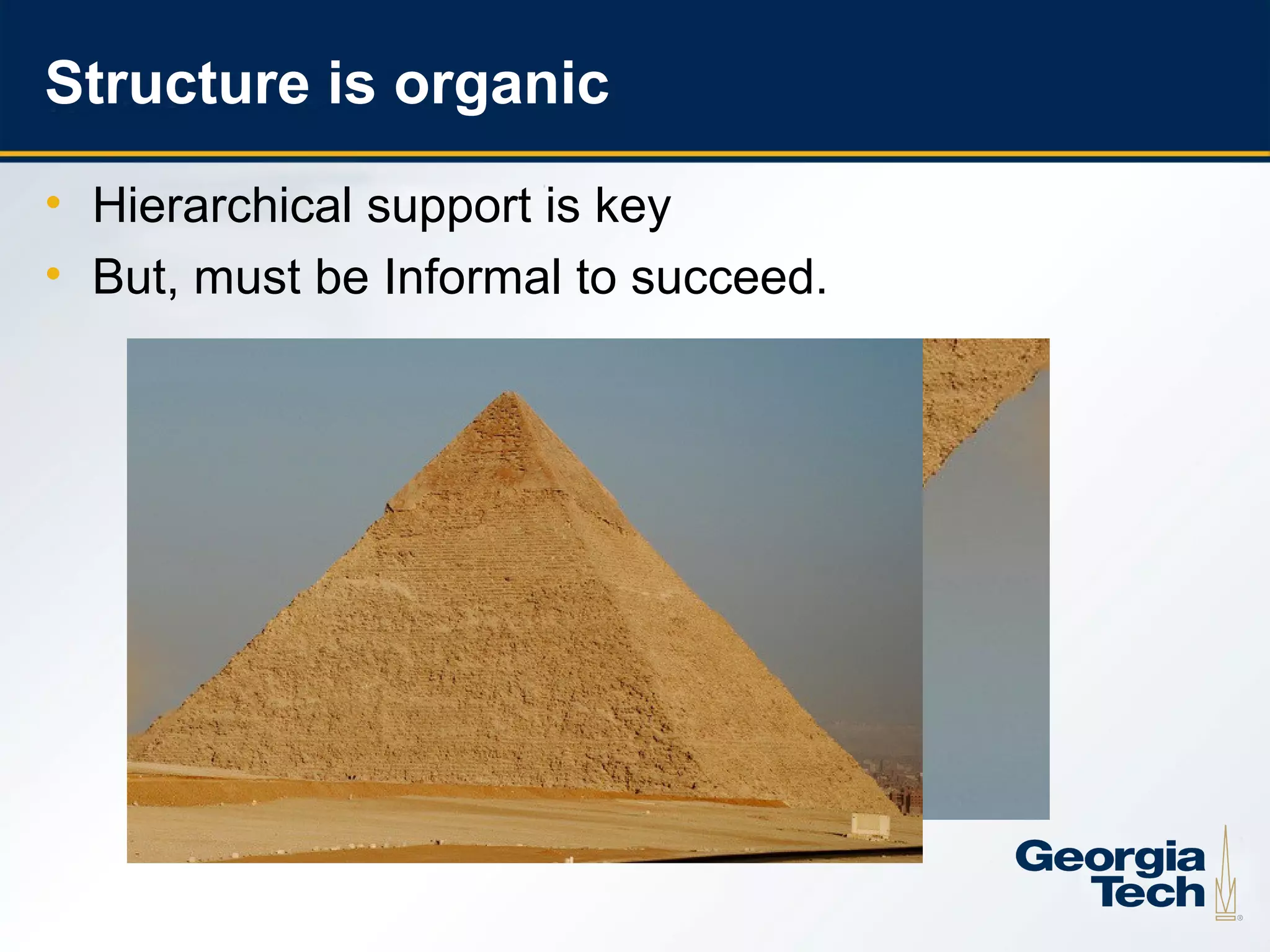
Structure is organic
     • Hierarchical support is key
     • But, must be Informal to succeed.


11
What Structures have you seen?
     • What structures and/or tools have worked for you?


     • What have not worked?


12
Recipe for Relationships

     • We also need structures and tools that
       help us interact and talk with other
       people.
       – Get to know yourself &
           use your strengths
       – Get to know others &
           make it safe to trust


13
Script 2: Focusing questions
     • Step back from the emotions part of conversation,
       to let other part of brain take over.

       hook_focusing_questions ($real_wants) {
         $myself = $real_wants [0];
         $others = $real_wants [1];
         $relationship = $real_wants [2];
         $myself + $others + $relationship = $intent;
         $behavior = $intent;
         return $behavior;
       }

14
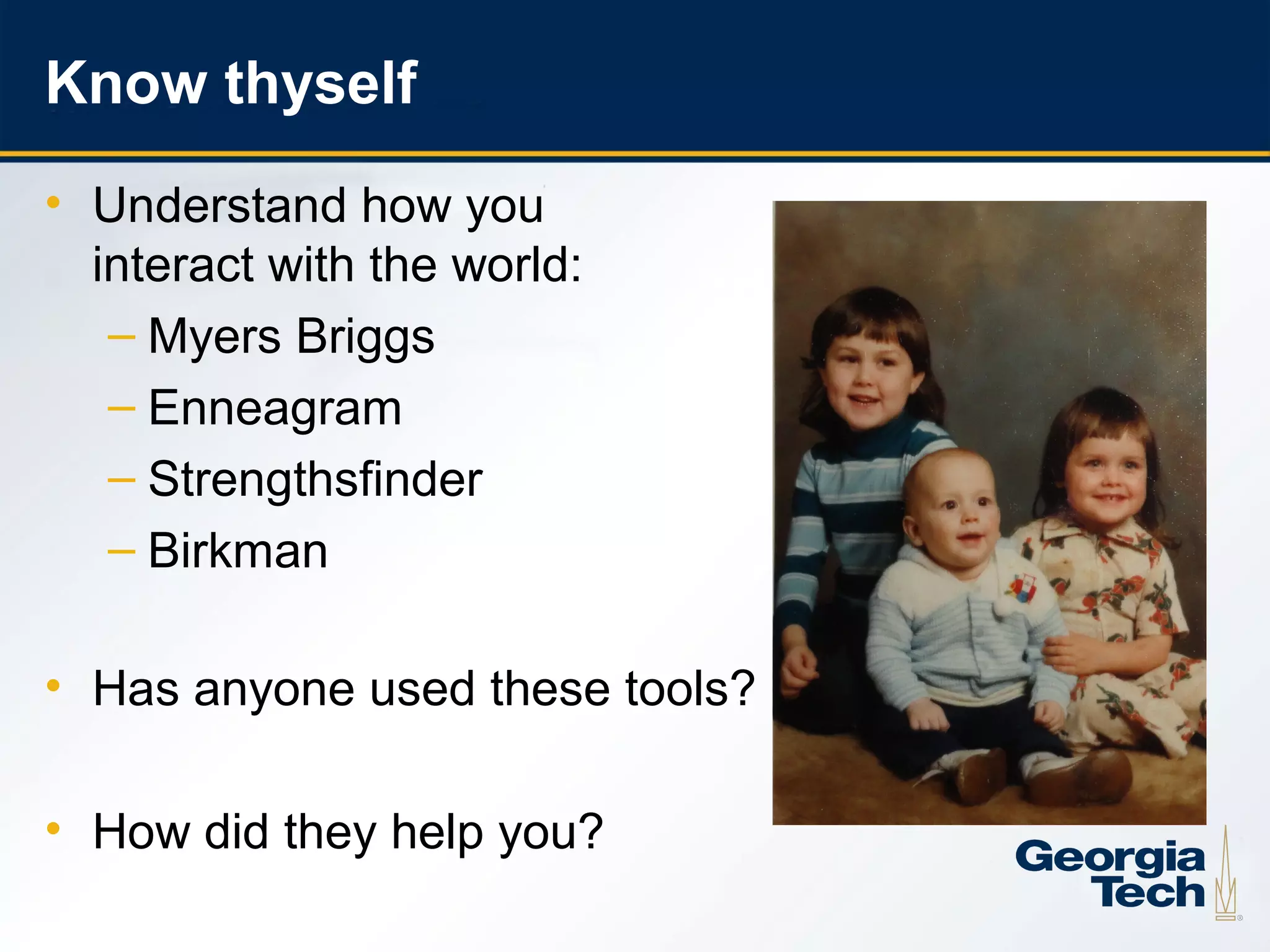
Know thyself
     • Understand how you
       interact with the world:
        – Myers Briggs
        – Enneagram
        – Strengthsfinder
        – Birkman

     • Has anyone used these tools?

     • How did they help you?
15
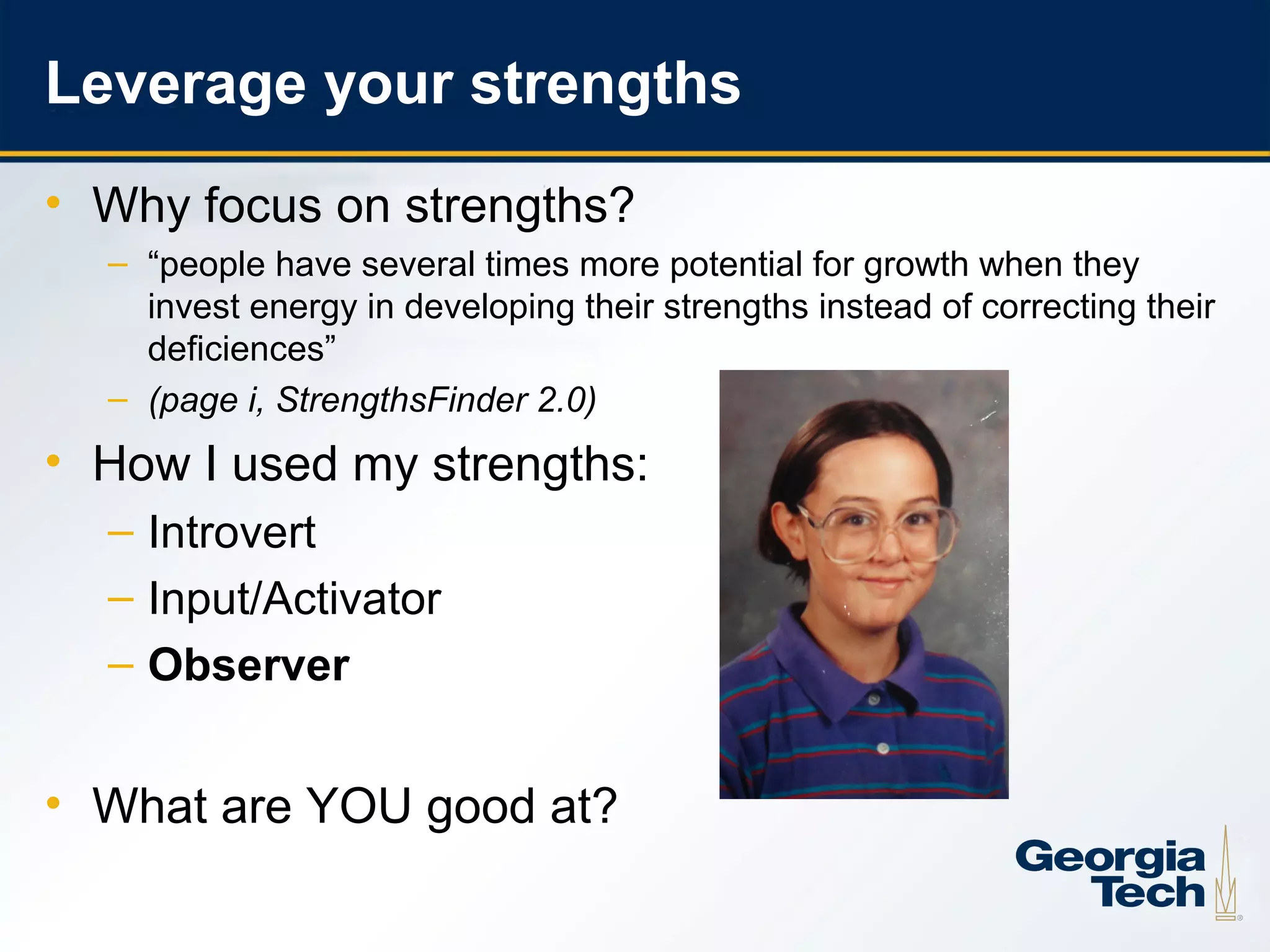
Leverage your strengths
     • Why focus on strengths?
       – “people have several times more potential for growth when they
         invest energy in developing their strengths instead of correcting their
         deficiences”
       – (page i, StrengthsFinder 2.0)
     • How I used my strengths:
       – Introvert
       – Input/Activator
       – Observer


     • What are YOU good at?

16
Observable behaviors - 1


     Data: Words spoken (often express a need).

     Tools:
       – Be open & curious
       – Asking questions to clarify
       – Paraphrasing what you think you heard
         them saying


17
Observable behaviors - 2

     Data: Body language & facial expression.

     Tools:
       – Mirroring: mimicking body position/facial
         expression
       – Paying attention: Eye contact, Lean
         forward, Nod, Smile, etc.
       – Identify facial expressions, body postures,
         gestures (yours & others)

18
Observable behaviors - 3

     • Data: Interaction patterns in different
       settings.
       Tools:
        – Look for Myers-Briggs styles of
          communicating: can you adapt your
          approach to that style?
        – Notice changes in behavior patterns
          • Acknowledge observed behavior. “You
            seem to be really concerned…”

19
Leverage your community’s strengths
     • Examples at Tech:
       –   good space for meeting,
       –   design,
       –   strategy,
       –   git server,
       –   knowledge of community history,
       –   super coder & sys admin skillsets
     • Listening & observing = discover WHO is good at
       what in your community & how you can best share.
     • What about your community???

20
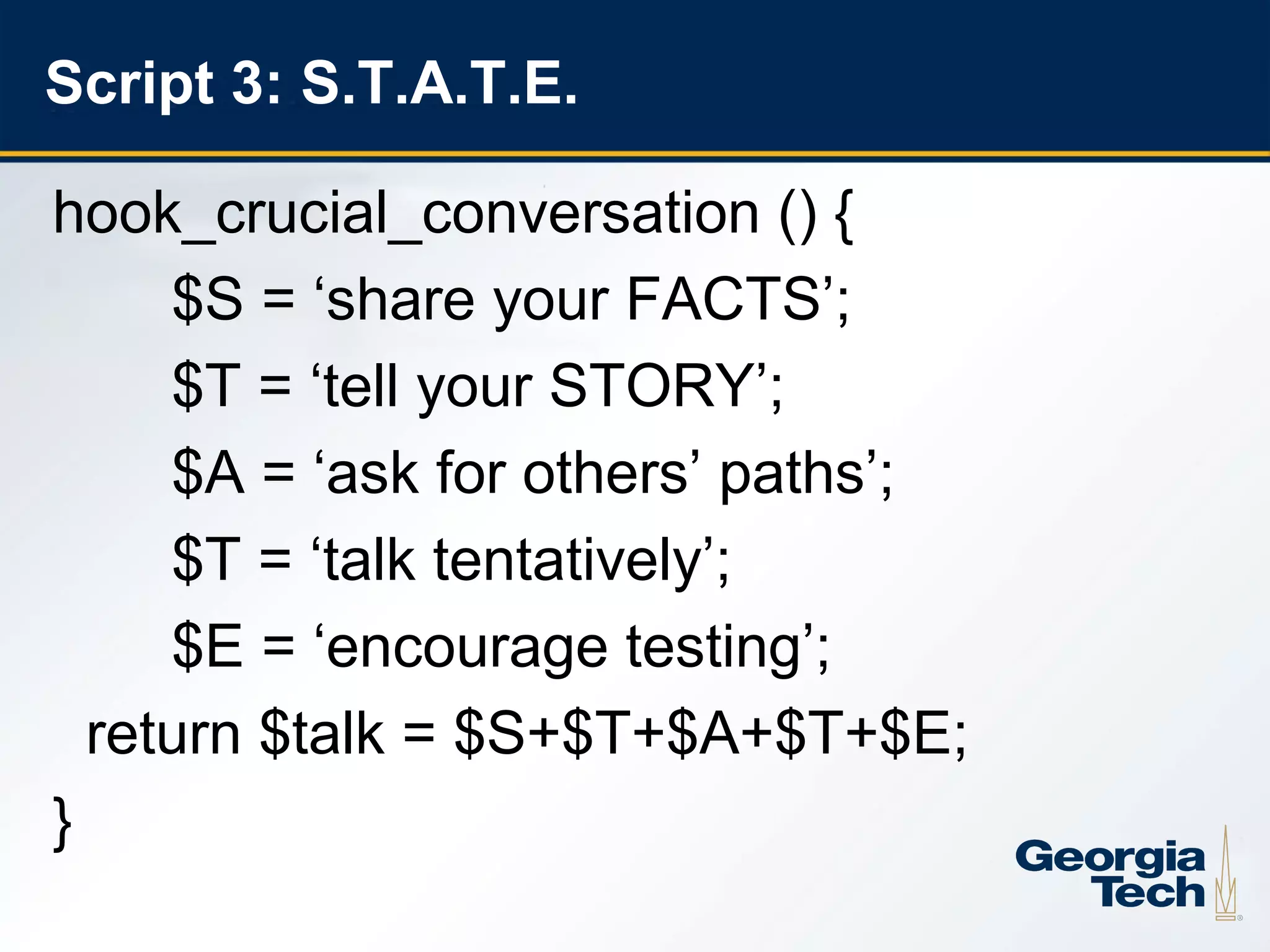
Script 3: S.T.A.T.E.

     hook_crucial_conversation () {
          $S = ‘share your FACTS’;
          $T = ‘tell your STORY’;
          $A = ‘ask for others’ paths’;
          $T = ‘talk tentatively’;
          $E = ‘encourage testing’;
       return $talk = $S+$T+$A+$T+$E;
     }
21
Creating trust & making it safe
     •   The Speed of Trust
     •   Be Intentional
     •   Be Vulnerable (like dating)
     •   Fail publicly sometimes & demo incomplete projects
     •   Ask Qs (if don’t ask, can’t say yes)
     •   Share answers & offer help
     •   Be publicly appreciative
     •   Apologize appropriately
     •   Be transparent, but honor others’ confidentiality

22
When communities fail
     •   No support from hierarchy
     •   No motivation or interest
     •   Don’t adapt to change or meet common needs
     •   Lack of relationships & trust
     •   Lack of informal, but consistent structures

     • What have you seen in failed collaborations &
       communities?


23
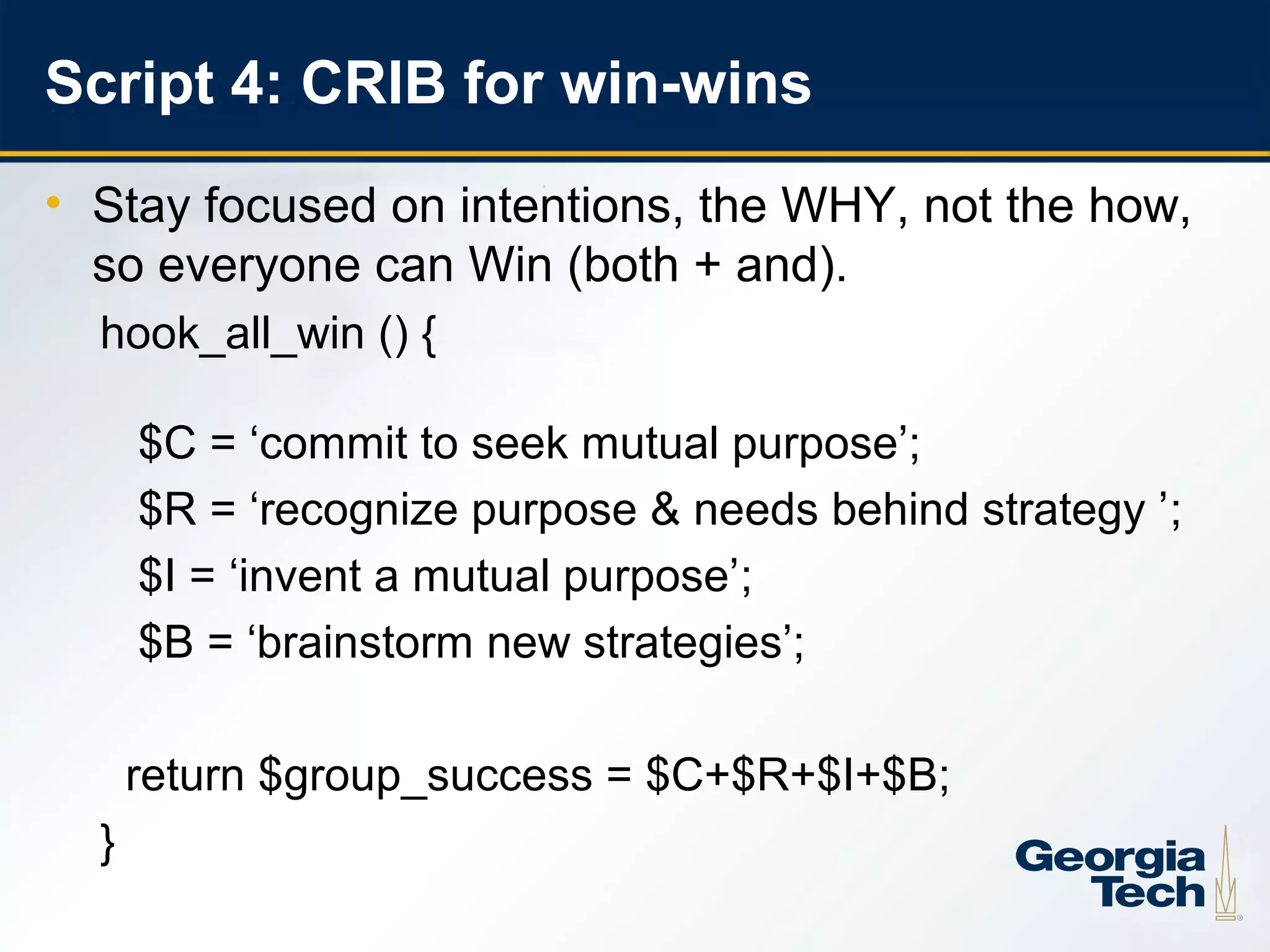
Script 4: CRIB for win-wins
     • Stay focused on intentions, the WHY, not the how,
       so everyone can Win (both + and).
       hook_all_win () {

           $C = ‘commit to seek mutual purpose’;
           $R = ‘recognize purpose & needs behind strategy ’;
           $I = ‘invent a mutual purpose’;
           $B = ‘brainstorm new strategies’;

           return $group_success = $C+$R+$I+$B;
       }
24
Ideas for getting better
     • One thing at a time
     • One person at a time
     • Honor Variety: levels & topics & personalities
       –   Listservs for lurkers
       –   How-to clinics for newbies
       –   Diving deep for developers
       –   Q&A before/after meetings (or other 1-on-1)
     • Involve larger communities (AtlantaPHP)
     • Your ideas??


25
References
     • Crucial Conversations (book)
     • The Speed of Trust (book)
     • StrengthsFinder 2.0 (book)
     • http://www.wikihow.com/Read-Body-Language
     • http://www.wikihow.com/Communicate-With-Body-
       Language
     • http://www.positivityblog.com/index.php/2006/10/27/
       18-ways-to-improve-your-body-language/
     • http://www.selfgrowth.com/articles/kyle.html


26
Slides & Alpha Code shared here


             http://adellef.co/401


      @adellefrank #usg12
27

Catalyzing Drupal collaboration & coding at your institution

  • 1.
    Catalyzing Drupal collaboration &coding at your institution @adellefrank #usg12 http://adellef.co/401 Thursday, October 25, 2012 @ 3:15pm http://www.usg.edu/rock_eagle USG Annual Computing Conference
  • 2.
    Who I am& why this matters to me @adellefrank #usg12 2
  • 3.
    What we willtalk about • Share tools you can use to build relationships & structures at your school that encourage techies to collaborate (disclaimer). • Why this matters to YOU • 4 communication scripts • hook_build($community); • Leverage strengths • Observe behaviors • Make it safe to fail • How to get better? 3
  • 4.
    Script 1: Contrastingto clarify hook_contrasting() { $not_bad = ‘I don’t intend disrespect or mean…’; $is_good = ‘I do respect and intend good…’; return $clarity = $not_bad + $is_good; } 4
  • 5.
    Why this matters • Collaboration: leverage scarce resources 5
  • 6.
    Why this matters • You get prizes!  6
  • 7.
    Why this matters • Collaboration: make work more pleasant & productive 7
  • 8.
    Who are you& why are you here? • Who are you? • Why are you in this session? – Challenges? – Desires for this session? 8
  • 9.
    How to buildcommunity (a thesis) If there’s a break in how your functions & variables communicate, you can get errors or inefficient processing. hook_build($relationships, $structures) { $community = $structures + $relationships; return $community; } 9
  • 10.
    Structure is anecessary framework • Consistency – Places & times to CONNECT. – Face-to-face: monthly, not weekly – Virtual places: listserv, wiki, git, right NOW tools 10
  • 11.
    Structure is organic • Hierarchical support is key • But, must be Informal to succeed. 11
  • 12.
    What Structures haveyou seen? • What structures and/or tools have worked for you? • What have not worked? 12
  • 13.
    Recipe for Relationships • We also need structures and tools that help us interact and talk with other people. – Get to know yourself & use your strengths – Get to know others & make it safe to trust 13
  • 14.
    Script 2: Focusingquestions • Step back from the emotions part of conversation, to let other part of brain take over. hook_focusing_questions ($real_wants) { $myself = $real_wants [0]; $others = $real_wants [1]; $relationship = $real_wants [2]; $myself + $others + $relationship = $intent; $behavior = $intent; return $behavior; } 14
  • 15.
    Know thyself • Understand how you interact with the world: – Myers Briggs – Enneagram – Strengthsfinder – Birkman • Has anyone used these tools? • How did they help you? 15
  • 16.
    Leverage your strengths • Why focus on strengths? – “people have several times more potential for growth when they invest energy in developing their strengths instead of correcting their deficiences” – (page i, StrengthsFinder 2.0) • How I used my strengths: – Introvert – Input/Activator – Observer • What are YOU good at? 16
  • 17.
    Observable behaviors -1 Data: Words spoken (often express a need). Tools: – Be open & curious – Asking questions to clarify – Paraphrasing what you think you heard them saying 17
  • 18.
    Observable behaviors -2 Data: Body language & facial expression. Tools: – Mirroring: mimicking body position/facial expression – Paying attention: Eye contact, Lean forward, Nod, Smile, etc. – Identify facial expressions, body postures, gestures (yours & others) 18
  • 19.
    Observable behaviors -3 • Data: Interaction patterns in different settings. Tools: – Look for Myers-Briggs styles of communicating: can you adapt your approach to that style? – Notice changes in behavior patterns • Acknowledge observed behavior. “You seem to be really concerned…” 19
  • 20.
    Leverage your community’sstrengths • Examples at Tech: – good space for meeting, – design, – strategy, – git server, – knowledge of community history, – super coder & sys admin skillsets • Listening & observing = discover WHO is good at what in your community & how you can best share. • What about your community??? 20
  • 21.
    Script 3: S.T.A.T.E. hook_crucial_conversation () { $S = ‘share your FACTS’; $T = ‘tell your STORY’; $A = ‘ask for others’ paths’; $T = ‘talk tentatively’; $E = ‘encourage testing’; return $talk = $S+$T+$A+$T+$E; } 21
  • 22.
    Creating trust &making it safe • The Speed of Trust • Be Intentional • Be Vulnerable (like dating) • Fail publicly sometimes & demo incomplete projects • Ask Qs (if don’t ask, can’t say yes) • Share answers & offer help • Be publicly appreciative • Apologize appropriately • Be transparent, but honor others’ confidentiality 22
  • 23.
    When communities fail • No support from hierarchy • No motivation or interest • Don’t adapt to change or meet common needs • Lack of relationships & trust • Lack of informal, but consistent structures • What have you seen in failed collaborations & communities? 23
  • 24.
    Script 4: CRIBfor win-wins • Stay focused on intentions, the WHY, not the how, so everyone can Win (both + and). hook_all_win () { $C = ‘commit to seek mutual purpose’; $R = ‘recognize purpose & needs behind strategy ’; $I = ‘invent a mutual purpose’; $B = ‘brainstorm new strategies’; return $group_success = $C+$R+$I+$B; } 24
  • 25.
    Ideas for gettingbetter • One thing at a time • One person at a time • Honor Variety: levels & topics & personalities – Listservs for lurkers – How-to clinics for newbies – Diving deep for developers – Q&A before/after meetings (or other 1-on-1) • Involve larger communities (AtlantaPHP) • Your ideas?? 25
  • 26.
    References • Crucial Conversations (book) • The Speed of Trust (book) • StrengthsFinder 2.0 (book) • http://www.wikihow.com/Read-Body-Language • http://www.wikihow.com/Communicate-With-Body- Language • http://www.positivityblog.com/index.php/2006/10/27/ 18-ways-to-improve-your-body-language/ • http://www.selfgrowth.com/articles/kyle.html 26
  • 27.
    Slides & AlphaCode shared here http://adellef.co/401 @adellefrank #usg12 27

Editor's Notes

  • #3 How this gawky geek became your suave presenter.
  • #5 Crucial Conversations book. Website summarizing a lot of the book: http://sourcesofinsight.com/make-it-safe/
  • #9 GIVE PRIZES!!
  • #11 tyranny of structurelessness Success/Fail examples
  • #12 Allows for flexibility Safe spaces (shared misery => constructive action) Self-selection (motivation & enthusiasm) Is influence without authority (and all the more convincing because of that) Informal before/after meetings Ad hoc meetings by people motivated on certain topics Knowing WHO to ask. Flickr photo of pyramid by : http://www.flickr.com/photos/wilhelmja/4233621517/
  • #13 GIVE PRIZES!!!
  • #15 Crucial Conversations What do I really want for myself? What do I really want for others? What do I really want for the relationship? How would I behave if I really wanted these results? People judge each other based on behavior , not intent , because can’t peek inside heads.
  • #16 Give PRIZES? Mullet.
  • #17 See Coke bottle glasses => Observor I = (1-on-1) & curiosity (seek to understand the why of others) Input = gather info; activator = do something 5 = Watch, listen
  • #18 (Speed of Trust book) http://www.wikihow.com/Read-Body-Language http://www.wikihow.com/Communicate-With-Body-Language http://www.positivityblog.com/index.php/2006/10/27/18-ways-to-improve-your-body-language/ http://www.selfgrowth.com/articles/kyle.html
  • #21 Give PRIZES!
  • #22 Crucial Conversations book Story = perceptions & real issue other’s paths = facts & stories Tentative = my story is opinion, not fact Testing = make it SAFE to disagree
  • #23 I hate to look stupid, but it’s the only way to learn…
  • #24 Give PRIZES!
  • #25 Crucial Conversations C ommit to seek mutual purpose (agree to stay in conversation until you can discover a shared goal or understanding) R ecognize the purpose behind the strategy (focus on the need, the “Why?” behind what each person’s strategies). I nvent a Mutual Purpose (if you can’t find common ground, create it: focus on some higher and/or longer term goals) B rainstorm new strategies (try to think outside the box for alternatives in which everyone wins)
  • #26 Give PRIZES!!