Software Engineering (3rd ed.), By K.K Aggarwal & Yogesh Singh, Copyright © New Age International Publishers, 2007   1
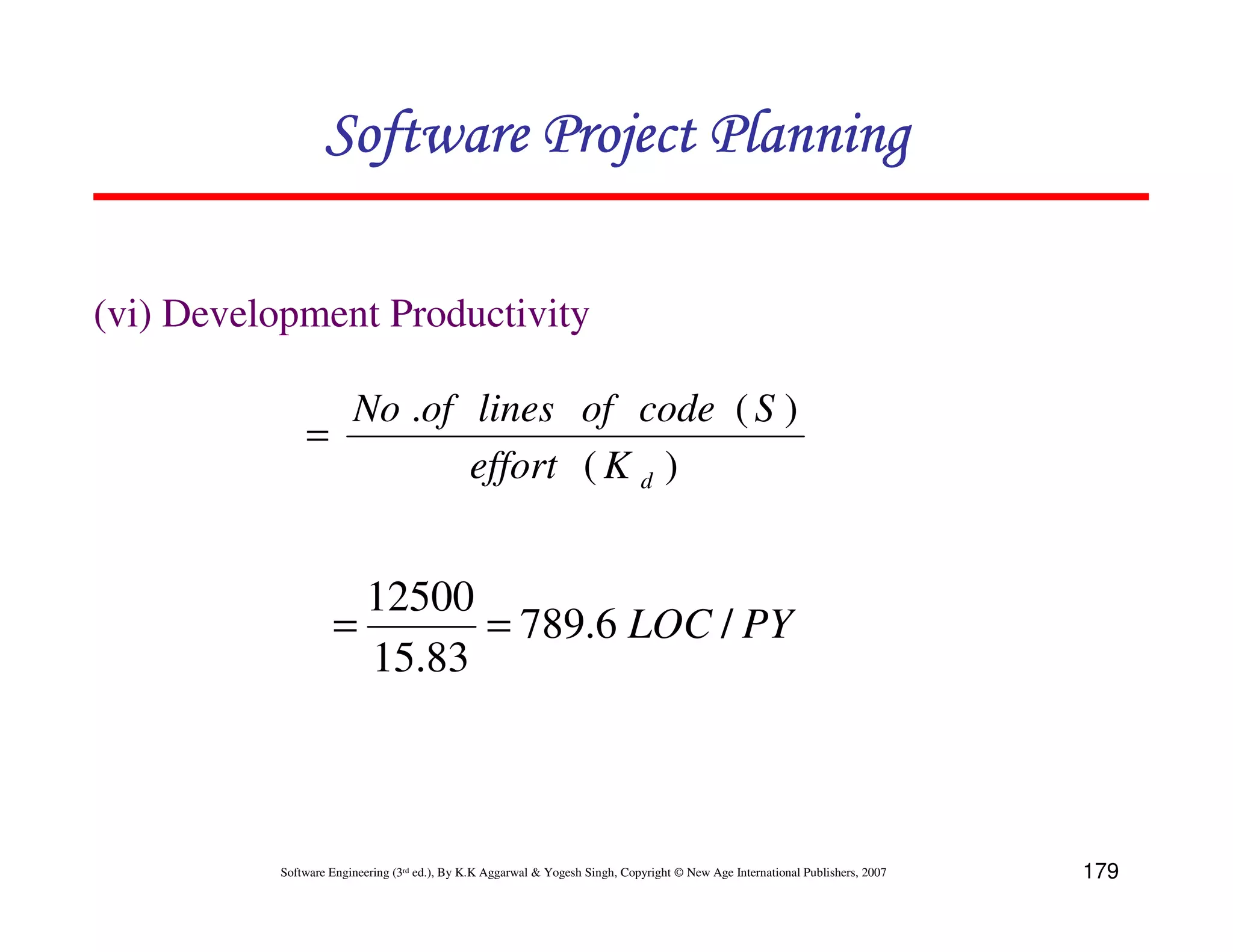
Software Project Planning

After the finalization of SRS, we would like to
estimate size, cost and development time of the
project. Also, in many cases, customer may like to
know the cost and development time even prior to
finalization of the SRS.


       Software Engineering (3rd ed.), By K.K Aggarwal & Yogesh Singh, Copyright © New Age International Publishers, 2007   2
Software Project Planning

In order to conduct a successful software project, we
must understand:
    Scope of work to be done
    The risk to be incurred
    The resources required
    The task to be accomplished
    The cost to be expended
    The schedule to be followed

         Software Engineering (3rd ed.), By K.K Aggarwal & Yogesh Singh, Copyright © New Age International Publishers, 2007   3
Software Project Planning
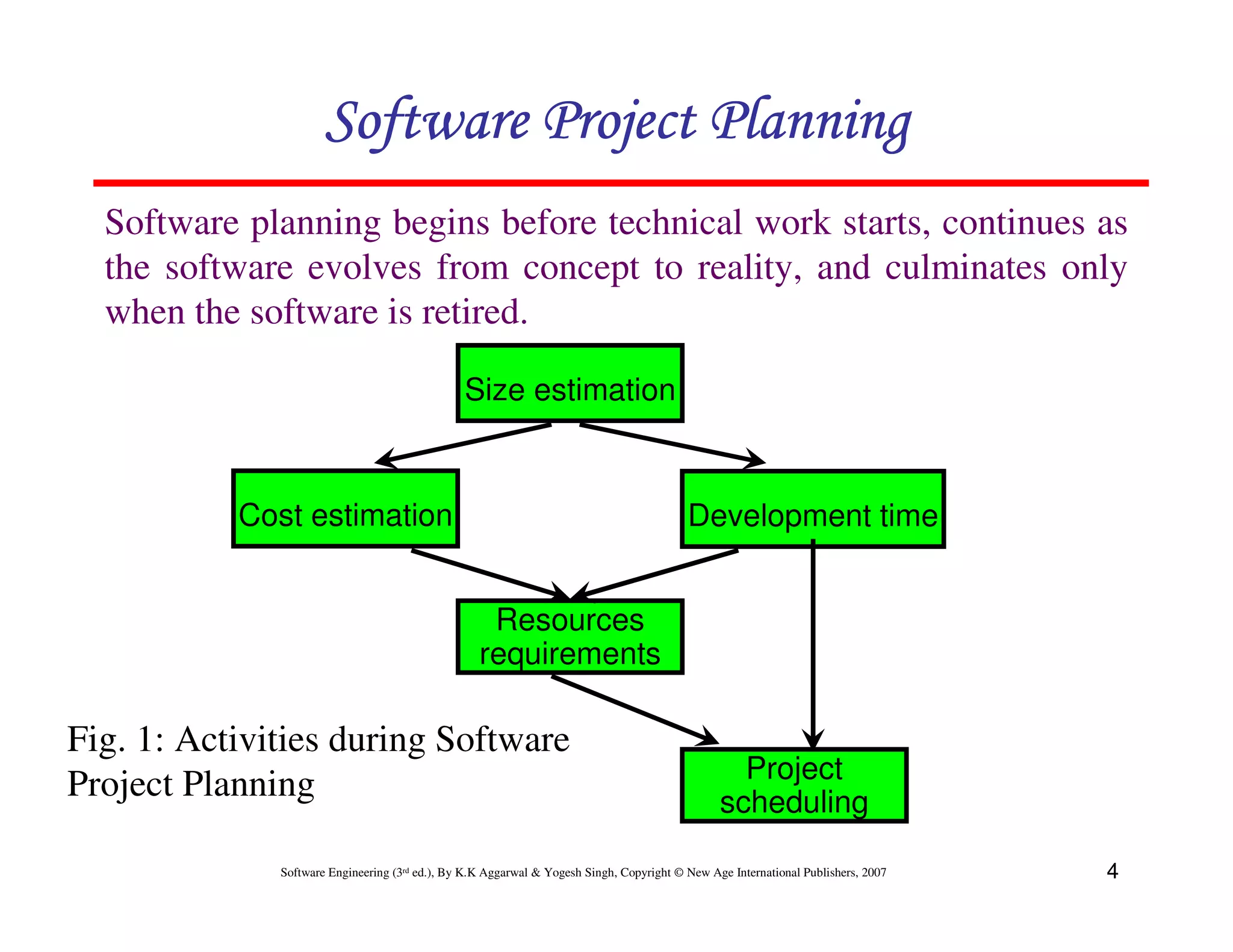
  Software planning begins before technical work starts, continues as
  the software evolves from concept to reality, and culminates only
  when the software is retired.

                                                Size estimation


           Cost estimation                                                                Development time


                                                    Resources
                                                   requirements

Fig. 1: Activities during Software
                                                                                                  Project
Project Planning                                                                                scheduling

              Software Engineering (3rd ed.), By K.K Aggarwal & Yogesh Singh, Copyright © New Age International Publishers, 2007   4
Software Project Planning
Size Estimation                                                  Fig. 2: Function for sorting an array
                                                                  1.           int. sort (int x[ ], int n)
Lines of Code (LOC)                                               2.           {
                                                                  3.           int i, j, save, im1;
If LOC is simply a count of                                       4.           /*This function sorts array x in ascending order */
                                                                  5.           If (n<2) return 1;
the number of lines then                                          6.           for (i=2; i<=n; i++)
figure shown below contains                                       7.           {
                                                                  8.           im1=i-1;
18 LOC .                                                          9.           for (j=1; j<=im; j++)
                                                                  10.          if (x[i] < x[j])
                                                                  11.          {
When comments and blank
                                                                  12.          Save = x[i];
lines are ignored, the                                            13.          x[i] = x[j];
program in figure 2 shown                                         14.          x[j] = save;
                                                                  15.          }
below contains 17 LOC.                                            16.          }
                                                                  17.          return 0;
                                                                  18.          }

          Software Engineering (3rd ed.), By K.K Aggarwal & Yogesh Singh, Copyright © New Age International Publishers, 2007    5
Software Project Planning

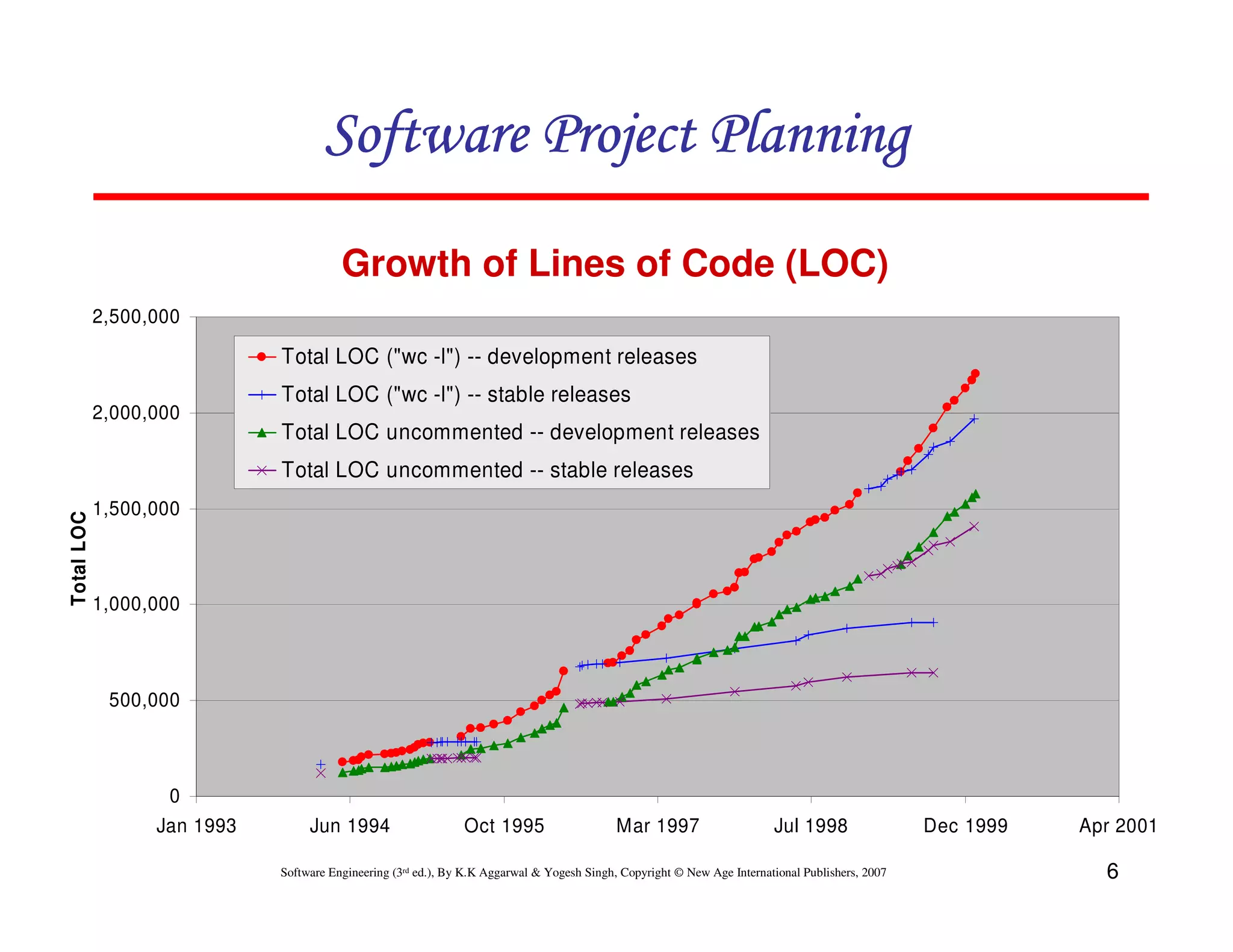
                                        Growth of Lines of Code (LOC)
            2,500,000

                             Total LOC ("wc -l") -- development releases
                             Total LOC ("wc -l") -- stable releases
            2,000,000
                             Total LOC uncommented -- development releases
                             Total LOC uncommented -- stable releases
            1,500,000
Total LOC


            1,000,000


             500,000


                   0
                  Jan 1993        Jun 1994                     Oct 1995                     Mar 1997                     Jul 1998                 Dec 1999   Apr 2001

                             Software Engineering (3rd ed.), By K.K Aggarwal & Yogesh Singh, Copyright © New Age International Publishers, 2007                6
Software Project Planning

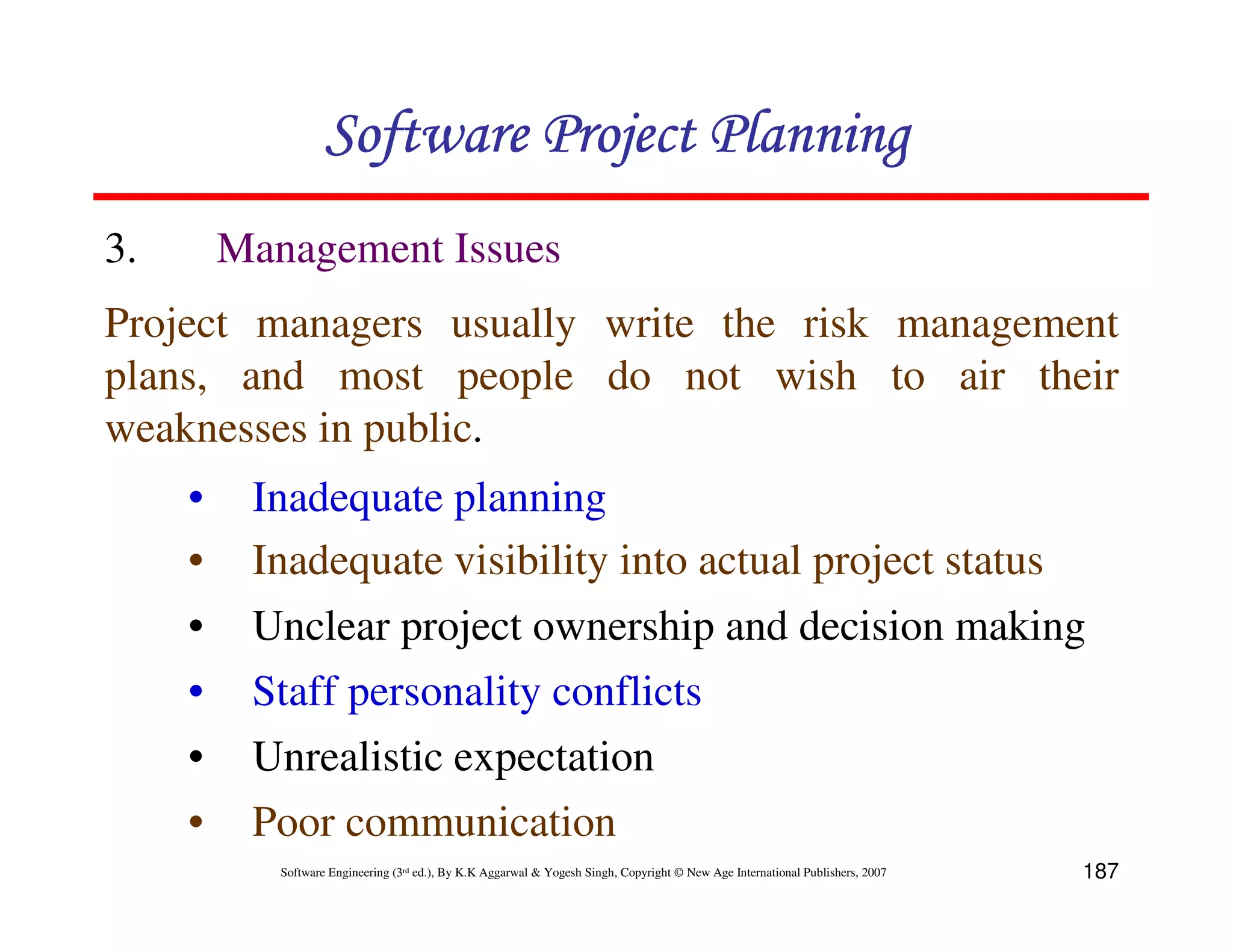
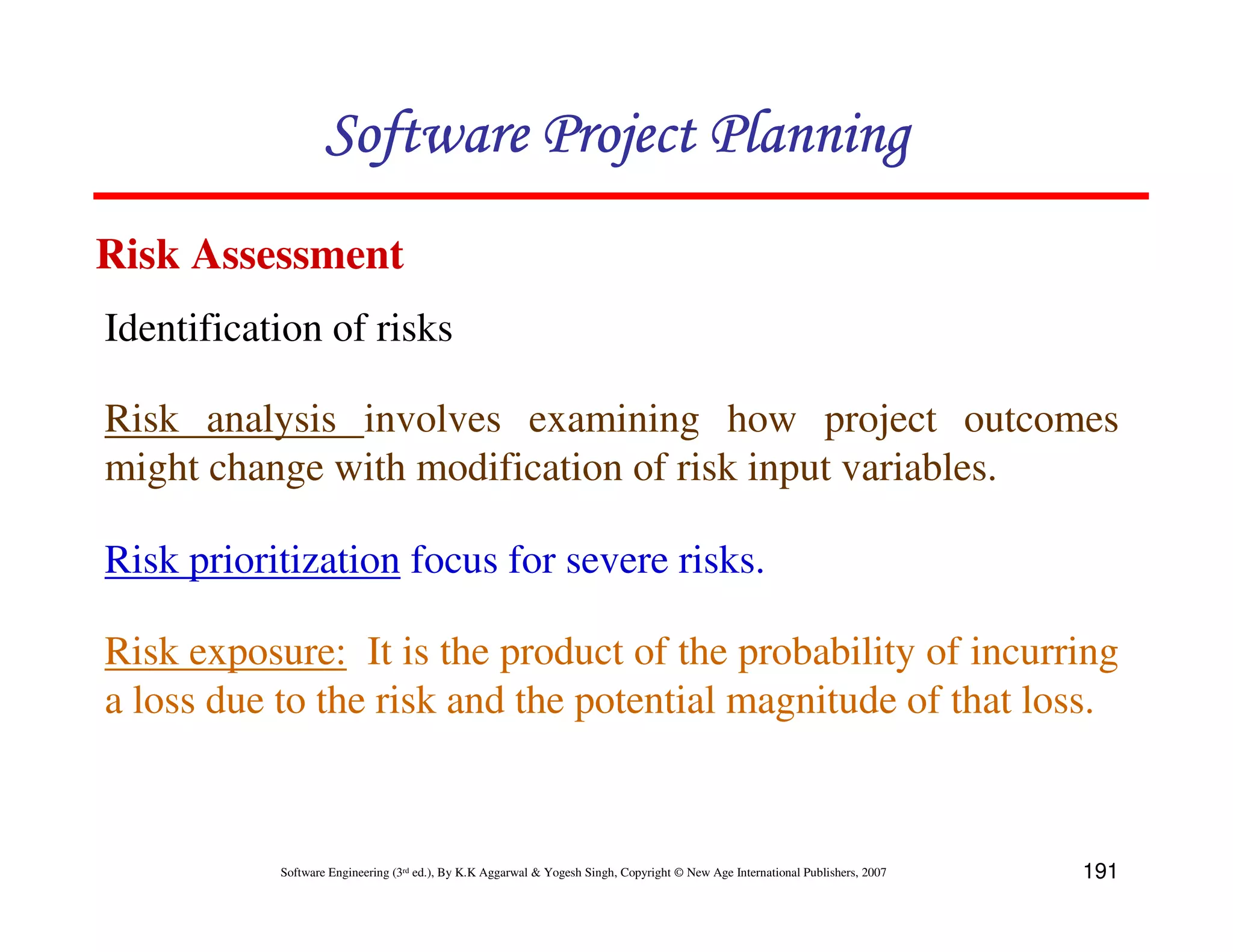
Furthermore, if the main interest is the size of the program
for specific functionality, it may be reasonable to include
executable statements. The only executable statements in
figure shown above are in lines 5-17 leading to a count of
13. The differences in the counts are 18 to 17 to 13. One
can easily see the potential for major discrepancies for
large programs with many comments or programs written
in language that allow a large number of descriptive but
non-executable statement. Conte has defined lines of code
as:

          Software Engineering (3rd ed.), By K.K Aggarwal & Yogesh Singh, Copyright © New Age International Publishers, 2007   7
Software Project Planning

“A line of code is any line of program text that is not a
comment or blank line, regardless of the number of
statements or fragments of statements on the line. This
specifically includes all lines containing program header,
declaration, and executable and non-executable
statements”.

This is the predominant definition for lines of code used
by researchers. By this definition, figure shown above
has 17 LOC.

         Software Engineering (3rd ed.), By K.K Aggarwal & Yogesh Singh, Copyright © New Age International Publishers, 2007   8
Software Project Planning
Function Count
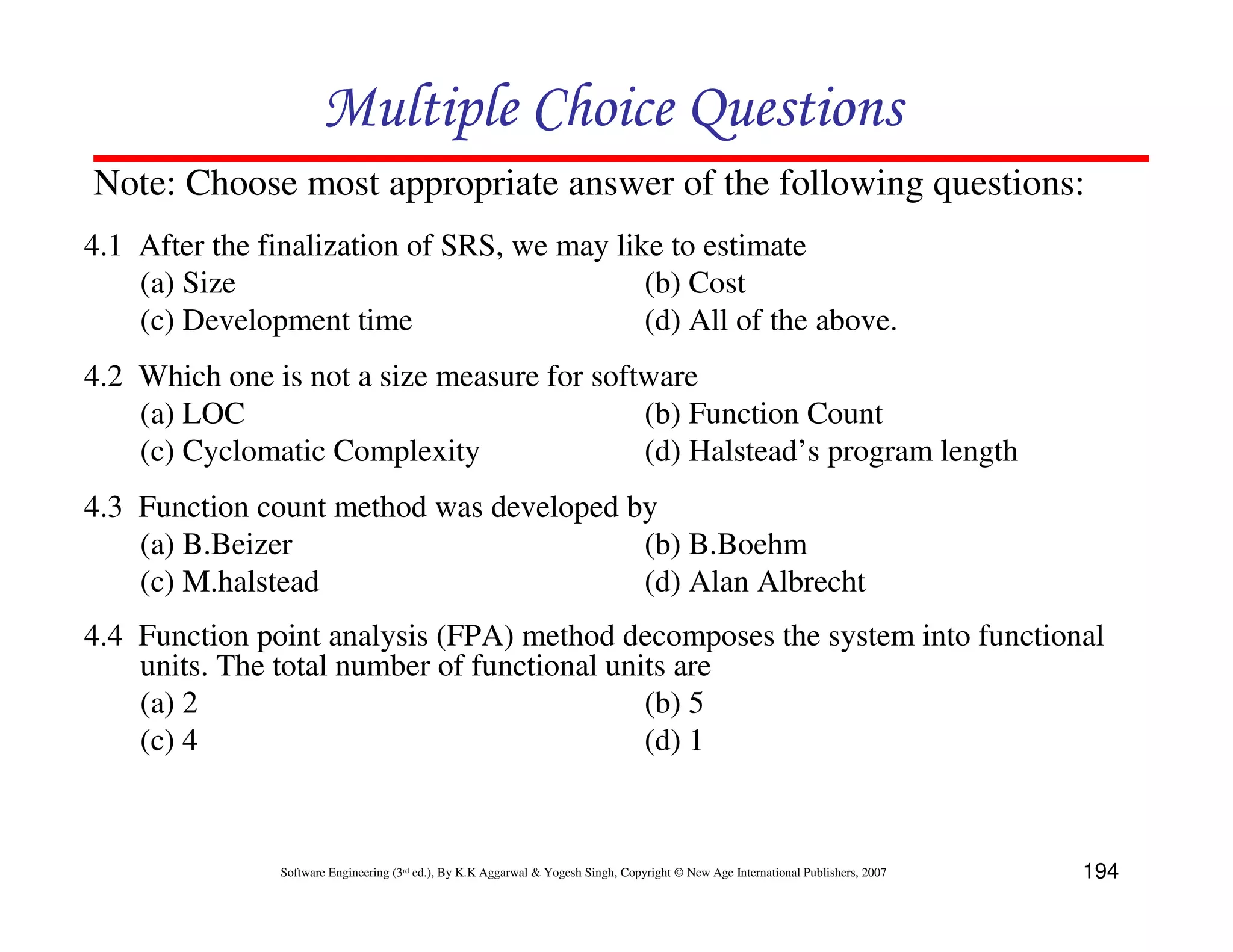
Alan Albrecht while working for IBM, recognized the
problem in size measurement in the 1970s, and
developed a technique (which he called Function Point
Analysis), which appeared to be a solution to the size
measurement problem.


         Software Engineering (3rd ed.), By K.K Aggarwal & Yogesh Singh, Copyright © New Age International Publishers, 2007   9
Software Project Planning

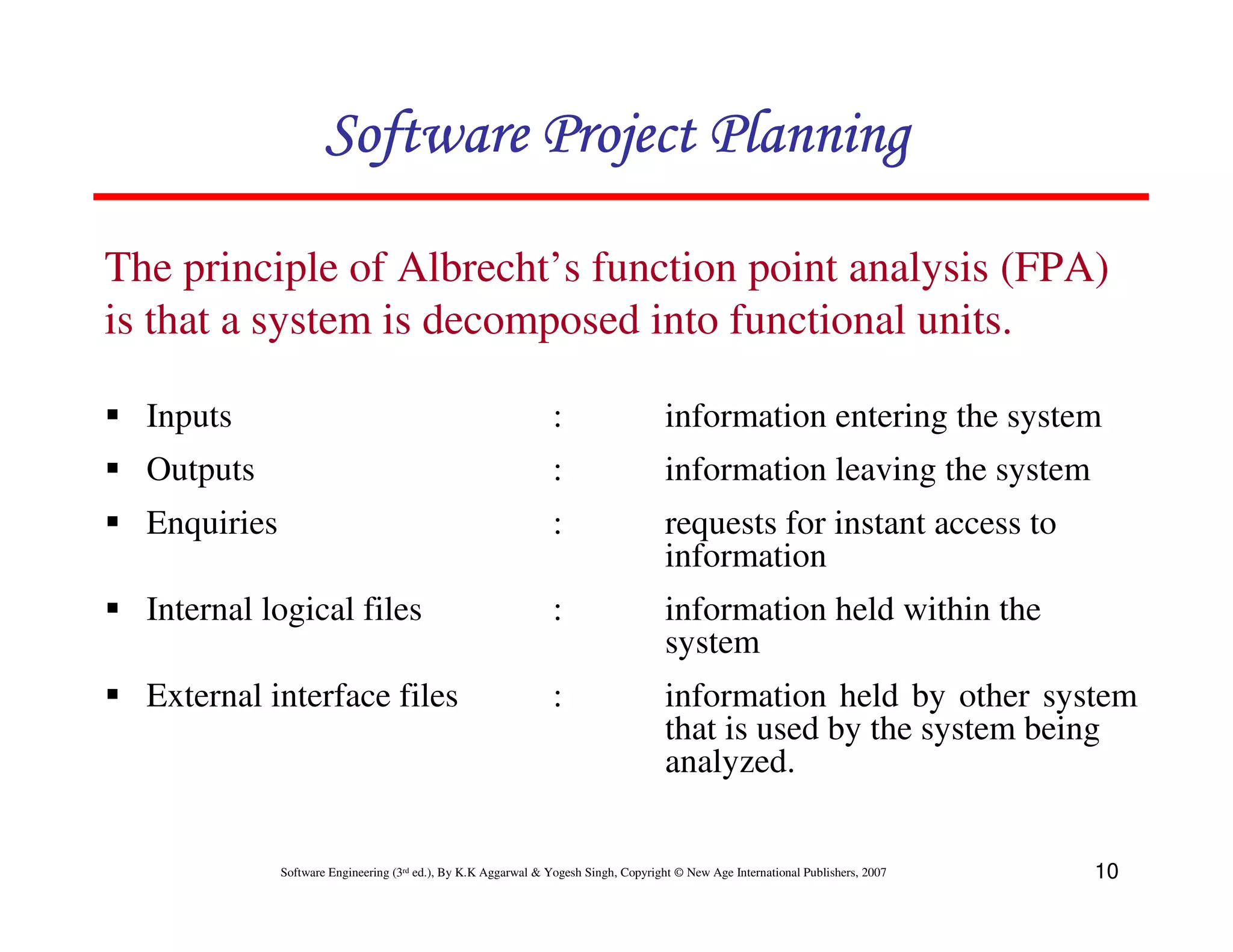
The principle of Albrecht’s function point analysis (FPA)
is that a system is decomposed into functional units.

  Inputs                                                         :                    information entering the system
  Outputs                                                        :                    information leaving the system
  Enquiries                                                      :                    requests for instant access to
                                                                                      information
  Internal logical files                                         :                    information held within the
                                                                                      system
  External interface files                                       :                    information held by other system
                                                                                      that is used by the system being
                                                                                      analyzed.


              Software Engineering (3rd ed.), By K.K Aggarwal & Yogesh Singh, Copyright © New Age International Publishers, 2007   10
Software Project Planning
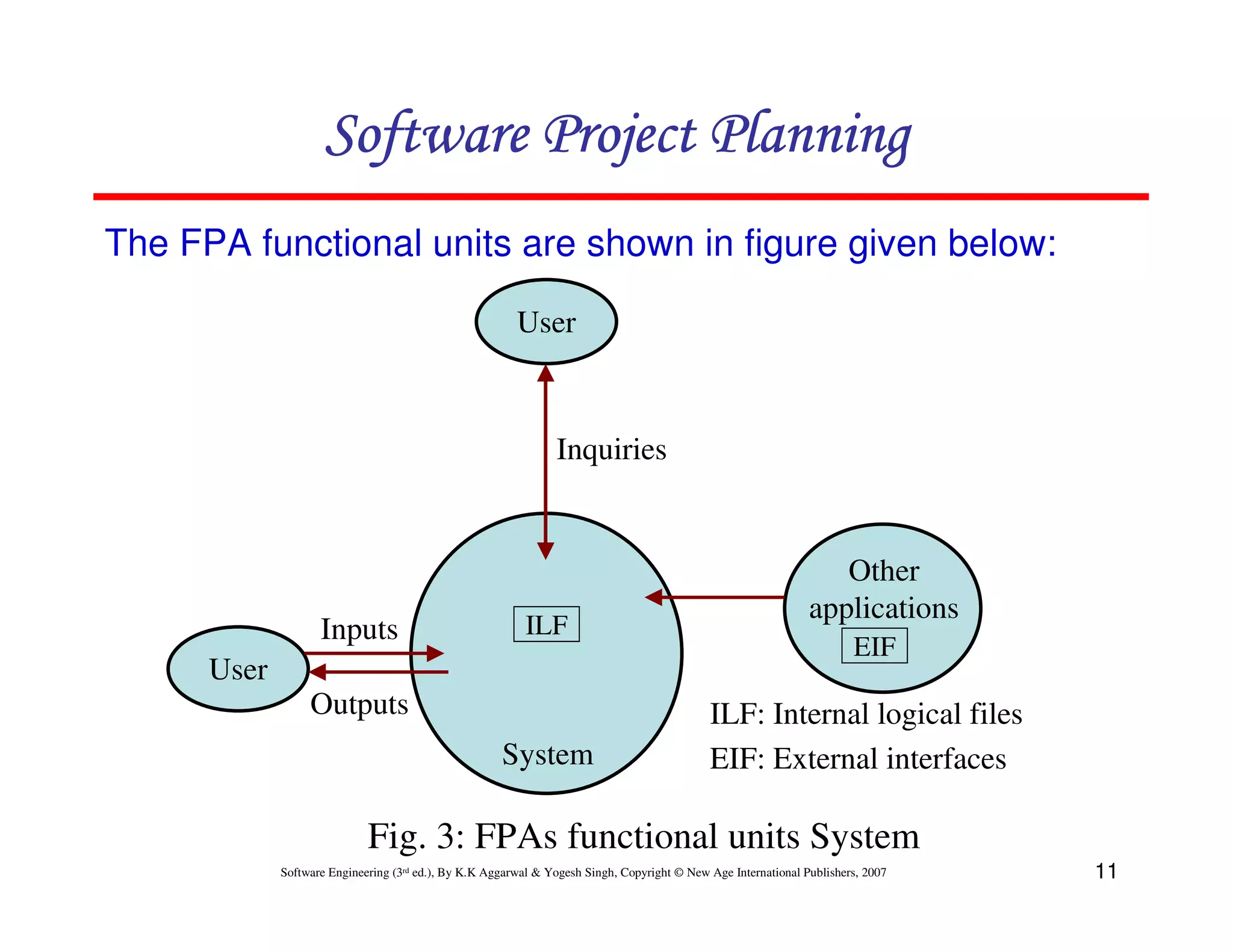
The FPA functional units are shown in figure given below:

                                                         User


                                                                Inquiries


                                                                                                                   Other
                                                                                                                applications
                    Inputs                                 ILF
                                                                                                                        EIF
      User
                  Outputs                                                                    ILF: Internal logical files
                                                      System                                 EIF: External interfaces

                             Fig. 3: FPAs functional units System
             Software Engineering (3rd ed.), By K.K Aggarwal & Yogesh Singh, Copyright © New Age International Publishers, 2007   11
Software Project Planning

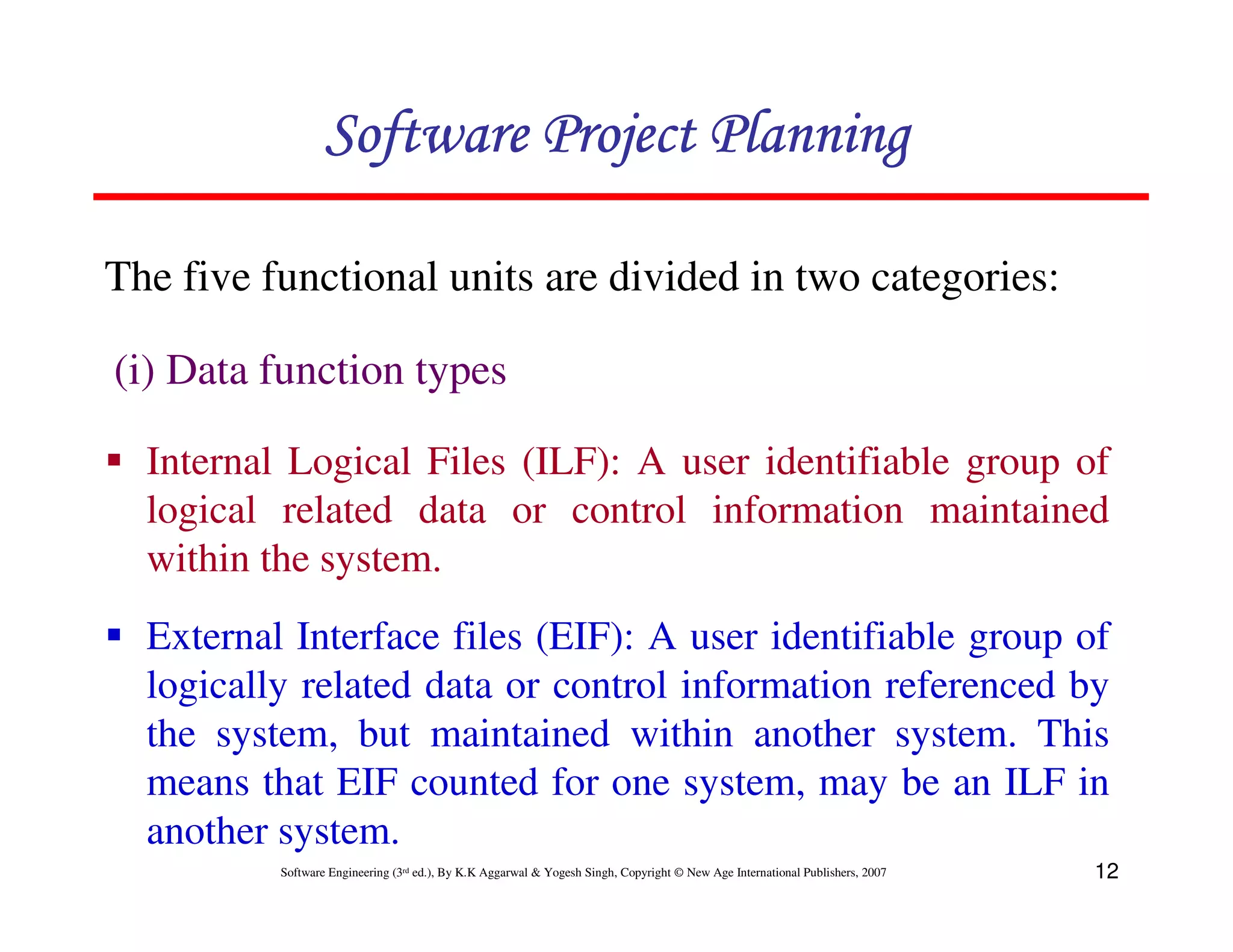
The five functional units are divided in two categories:

(i) Data function types

  Internal Logical Files (ILF): A user identifiable group of
  logical related data or control information maintained
  within the system.
  External Interface files (EIF): A user identifiable group of
  logically related data or control information referenced by
  the system, but maintained within another system. This
  means that EIF counted for one system, may be an ILF in
  another system.
          Software Engineering (3rd ed.), By K.K Aggarwal & Yogesh Singh, Copyright © New Age International Publishers, 2007   12
Software Project Planning
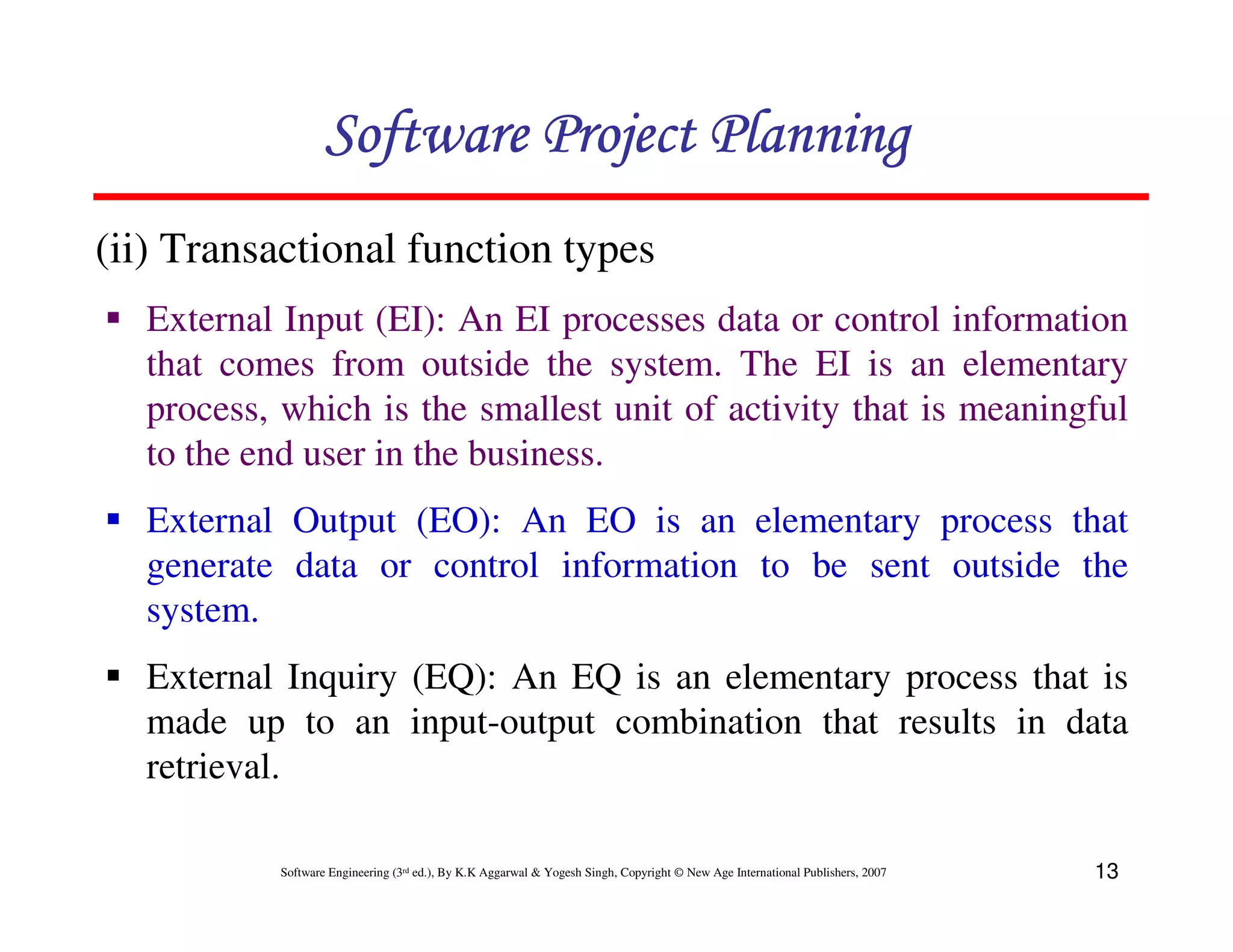
(ii) Transactional function types
   External Input (EI): An EI processes data or control information
   that comes from outside the system. The EI is an elementary
   process, which is the smallest unit of activity that is meaningful
   to the end user in the business.
   External Output (EO): An EO is an elementary process that
   generate data or control information to be sent outside the
   system.
   External Inquiry (EQ): An EQ is an elementary process that is
   made up to an input-output combination that results in data
   retrieval.

            Software Engineering (3rd ed.), By K.K Aggarwal & Yogesh Singh, Copyright © New Age International Publishers, 2007   13
Software Project Planning
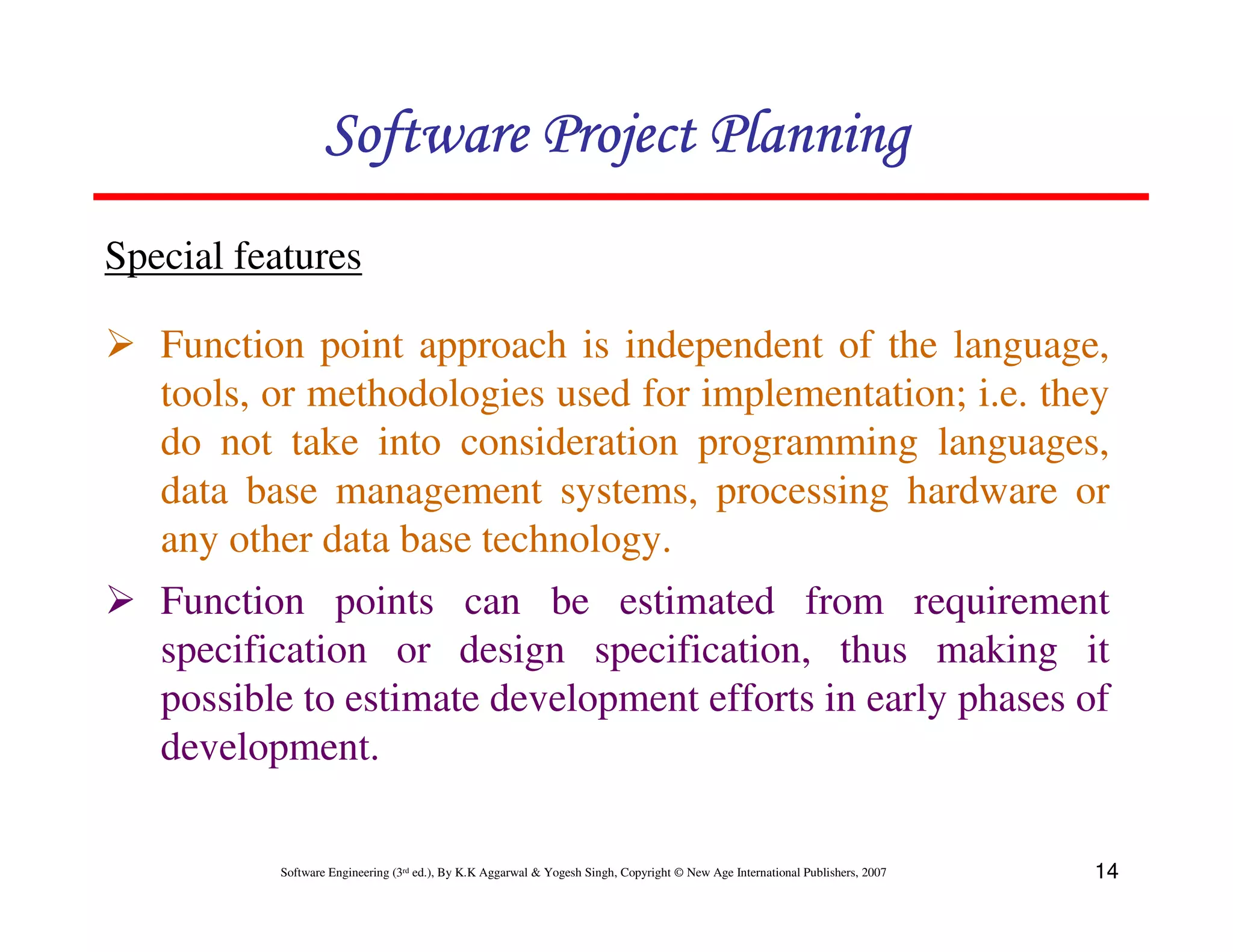
Special features

   Function point approach is independent of the language,
   tools, or methodologies used for implementation; i.e. they
   do not take into consideration programming languages,
   data base management systems, processing hardware or
   any other data base technology.
   Function points can be estimated from requirement
   specification or design specification, thus making it
   possible to estimate development efforts in early phases of
   development.

          Software Engineering (3rd ed.), By K.K Aggarwal & Yogesh Singh, Copyright © New Age International Publishers, 2007   14
Software Project Planning

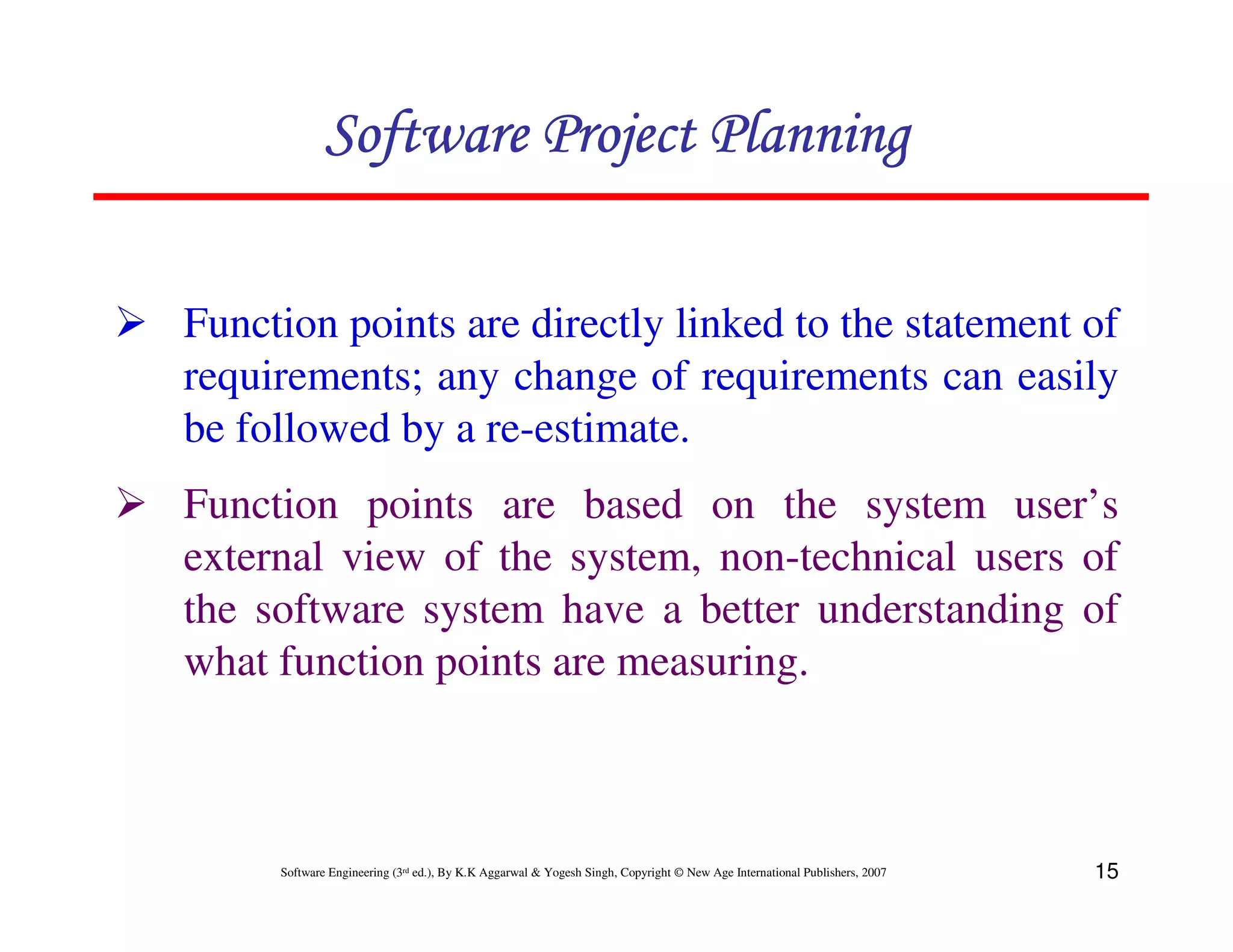
Function points are directly linked to the statement of
requirements; any change of requirements can easily
be followed by a re-estimate.
Function points are based on the system user’s
external view of the system, non-technical users of
the software system have a better understanding of
what function points are measuring.


     Software Engineering (3rd ed.), By K.K Aggarwal & Yogesh Singh, Copyright © New Age International Publishers, 2007   15
Software Project Planning

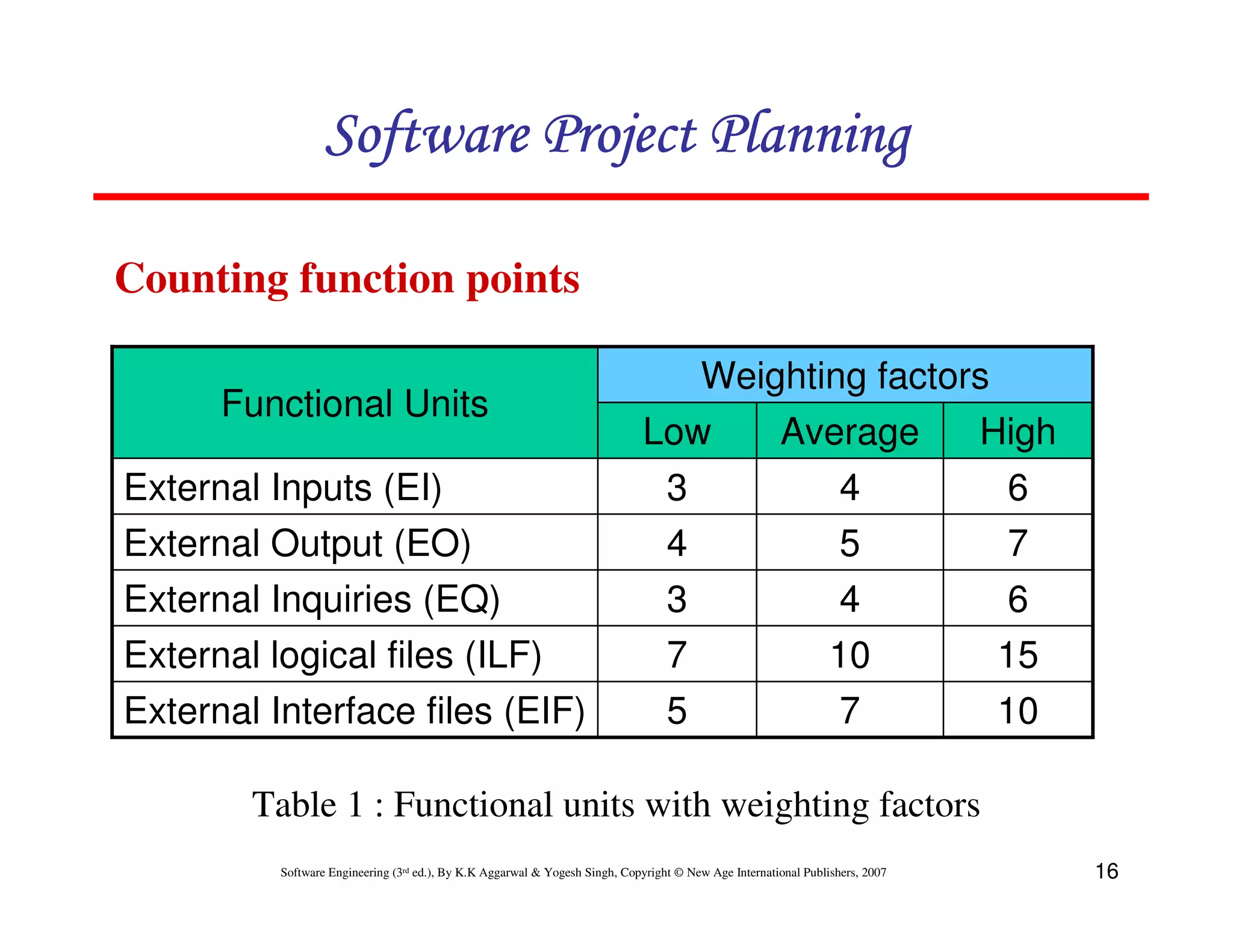
Counting function points

                                                                                 Weighting factors
      Functional Units
                                                                              Low    Average     High
External Inputs (EI)                                                           3         4          6
External Output (EO)                                                           4         5          7
External Inquiries (EQ)                                                        3         4          6
External logical files (ILF)                                                   7        10         15
External Interface files (EIF)                                                 5         7         10

        Table 1 : Functional units with weighting factors
          Software Engineering (3rd ed.), By K.K Aggarwal & Yogesh Singh, Copyright © New Age International Publishers, 2007   16
Software Project Planning
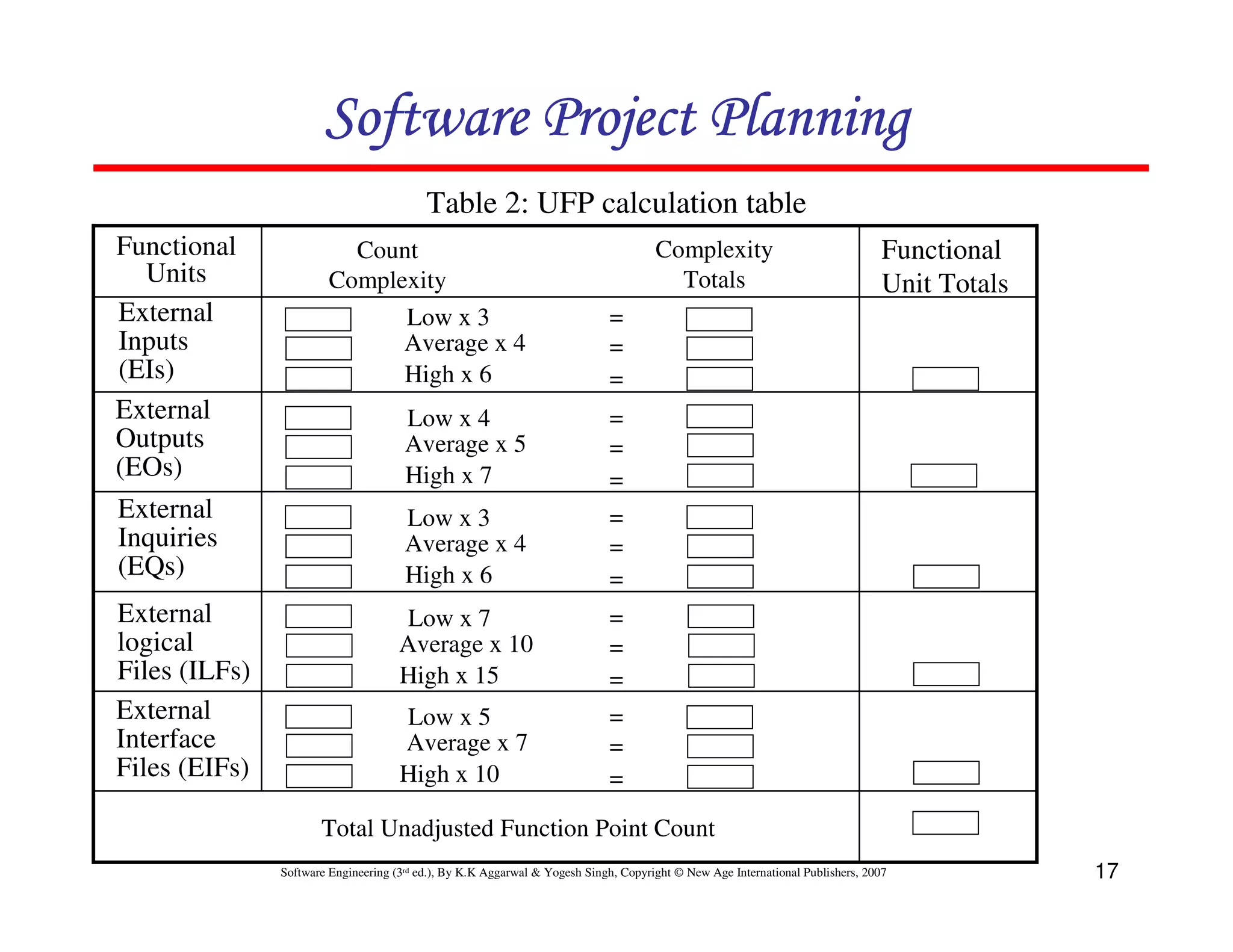
                                          Table 2: UFP calculation table
Functional                Count                                                      Complexity                                 Functional
  Units                 Complexity                                                     Totals                                   Unit Totals
External                      Low x 3                                       =
Inputs                        Average x 4                                   =
(EIs)                         High x 6                                      =
External                              Low x 4                               =
Outputs                               Average x 5                           =
(EOs)                                 High x 7                              =
External                              Low x 3                               =
Inquiries                             Average x 4                           =
(EQs)                                 High x 6                              =
External                             Low x 7                                =
logical                              Average x 10                           =
Files (ILFs)                         High x 15                              =
External                             Low x 5                                =
Interface                            Average x 7                            =
Files (EIFs)                         High x 10                              =

                      Total Unadjusted Function Point Count
               Software Engineering (3rd ed.), By K.K Aggarwal & Yogesh Singh, Copyright © New Age International Publishers, 2007             17
Software Project Planning


The weighting factors are identified for all
functional units and multiplied with the functional
units accordingly. The procedure for the
calculation of Unadjusted Function Point (UFP) is
given in table shown above.


        Software Engineering (3rd ed.), By K.K Aggarwal & Yogesh Singh, Copyright © New Age International Publishers, 2007   18
Software Project Planning
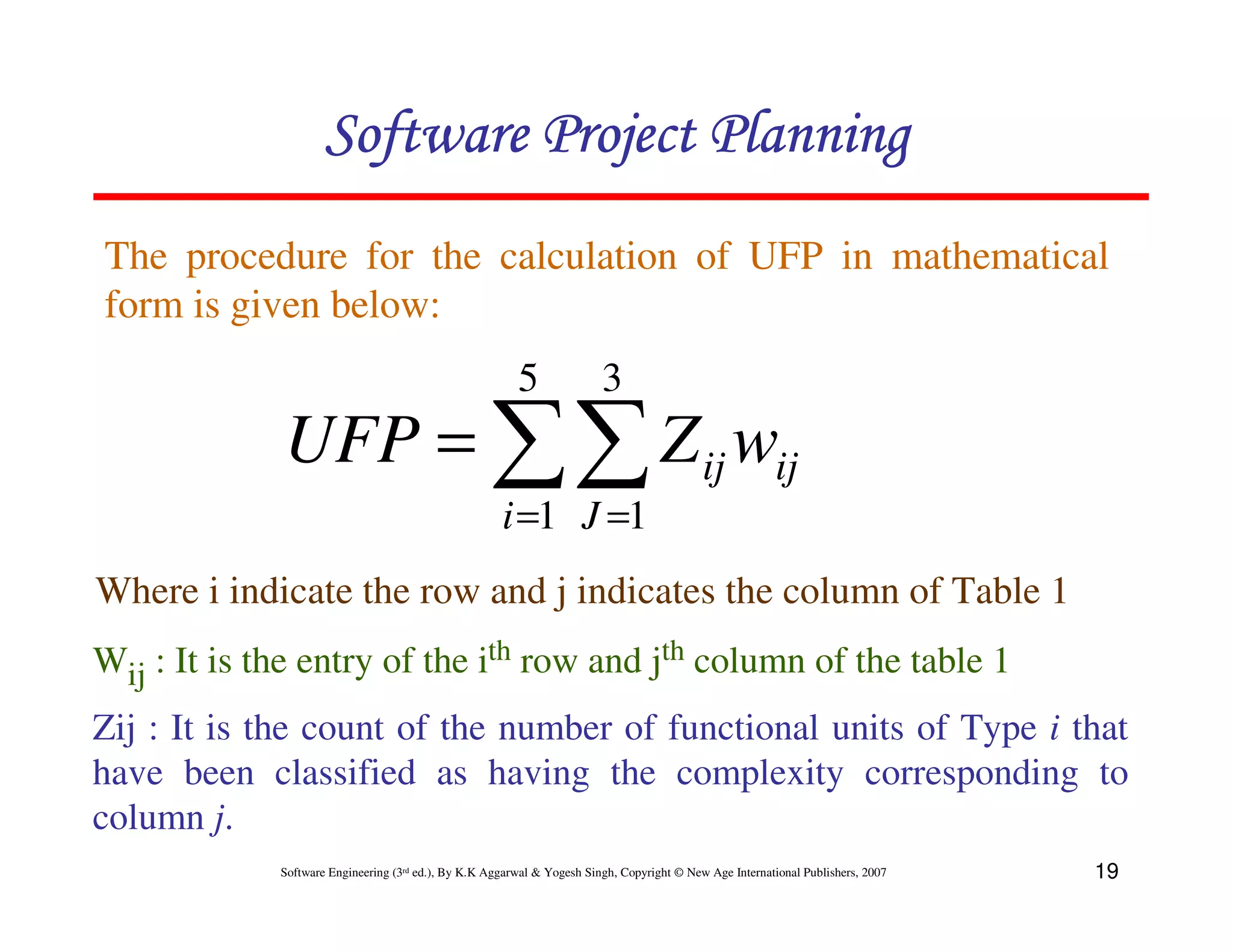
The procedure for the calculation of UFP in mathematical
form is given below:
                                                         5               3
             UFP = ∑∑ Z ij wij
                                                      i =1 J =1
Where i indicate the row and j indicates the column of Table 1
Wij : It is the entry of the ith row and jth column of the table 1
Zij : It is the count of the number of functional units of Type i that
have been classified as having the complexity corresponding to
column j.
             Software Engineering (3rd ed.), By K.K Aggarwal & Yogesh Singh, Copyright © New Age International Publishers, 2007   19
Software Project Planning

Organizations that use function point methods develop a criterion for
determining whether a particular entry is Low, Average or High.
Nonetheless, the determination of complexity is somewhat
subjective.

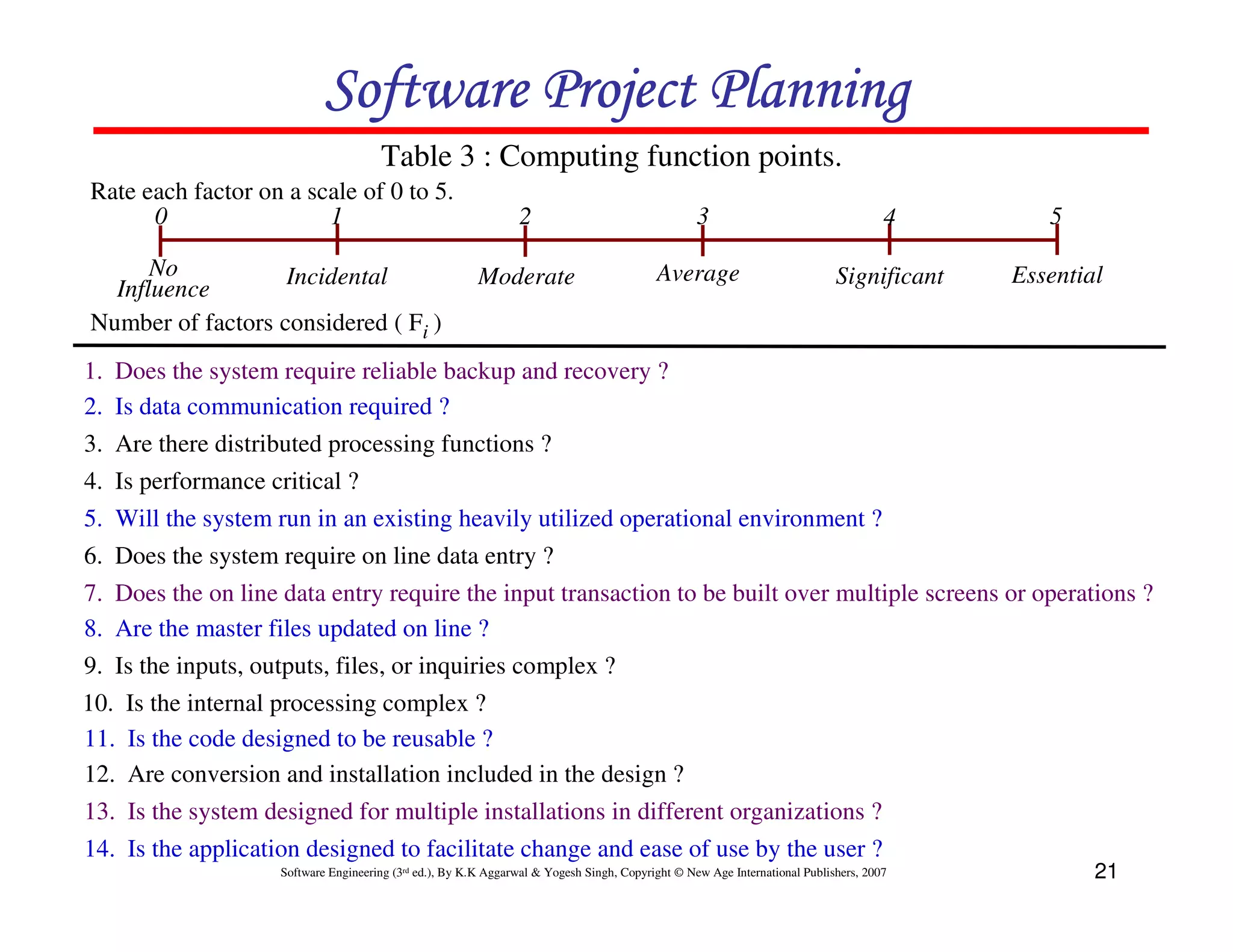
                                               FP = UFP * CAF

Where CAF is complexity adjustment factor and is equal to [0.65 +
0.01 x ΣFi]. The Fi (i=1 to 14) are the degree of influence and are
based on responses to questions noted in table 3.


           Software Engineering (3rd ed.), By K.K Aggarwal & Yogesh Singh, Copyright © New Age International Publishers, 2007   20
Software Project Planning
                                      Table 3 : Computing function points.
Rate each factor on a scale of 0 to 5.
      0                 1                                       2                                 3                                  4       5

      No           Incidental                            Moderate                         Average                           Significant   Essential
  Influence
Number of factors considered ( Fi )
1. Does the system require reliable backup and recovery ?
2. Is data communication required ?
3. Are there distributed processing functions ?
4. Is performance critical ?
5. Will the system run in an existing heavily utilized operational environment ?
6. Does the system require on line data entry ?
7. Does the on line data entry require the input transaction to be built over multiple screens or operations ?
8. Are the master files updated on line ?
9. Is the inputs, outputs, files, or inquiries complex ?
10. Is the internal processing complex ?
11. Is the code designed to be reusable ?
12. Are conversion and installation included in the design ?
13. Is the system designed for multiple installations in different organizations ?
14. Is the application designed to facilitate change and ease of use by the user ?
                    Software Engineering (3rd ed.), By K.K Aggarwal & Yogesh Singh, Copyright © New Age International Publishers, 2007            21
Software Project Planning
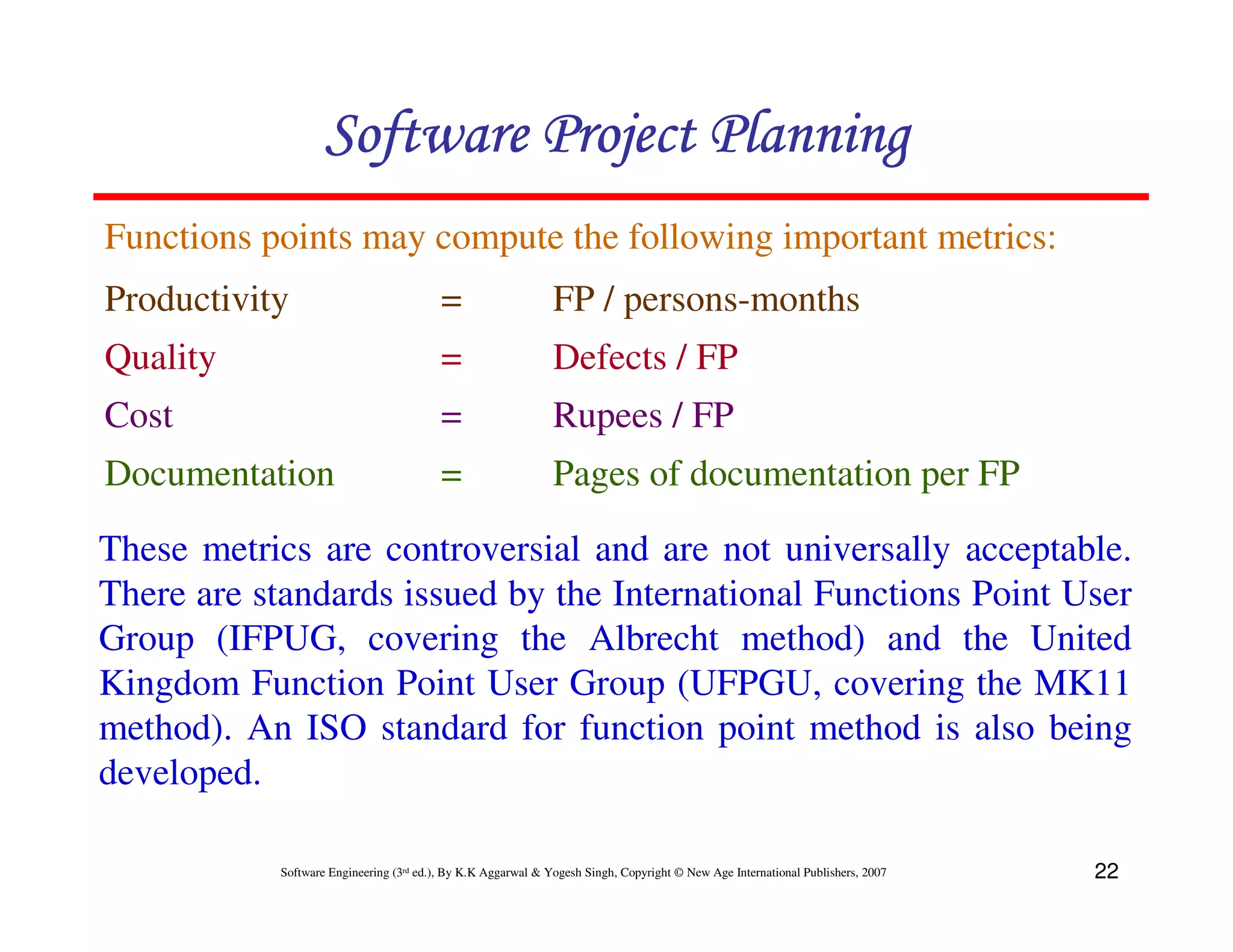
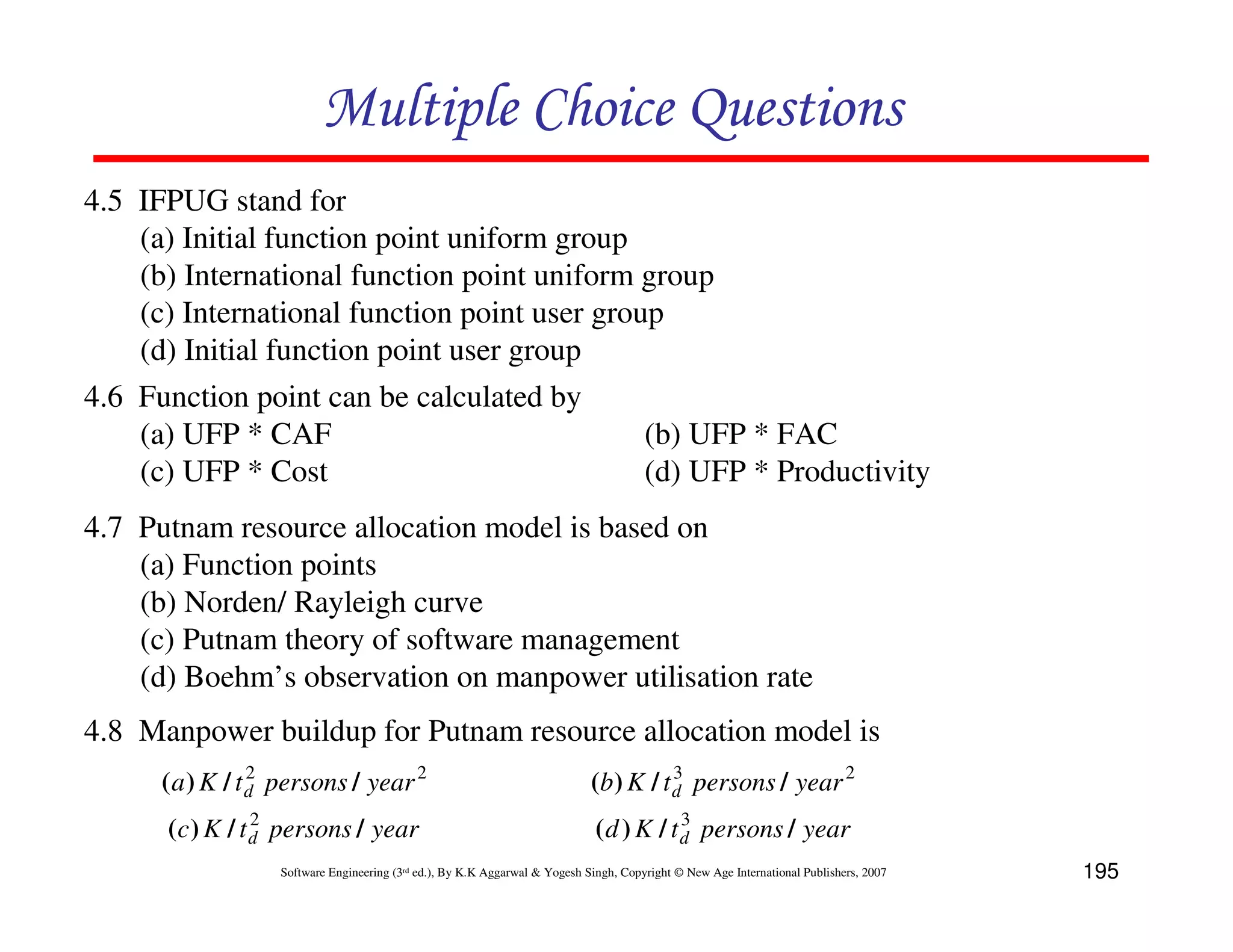
Functions points may compute the following important metrics:
Productivity                             =                    FP / persons-months
Quality                                  =                    Defects / FP
Cost                                     =                    Rupees / FP
Documentation                            =                    Pages of documentation per FP

These metrics are controversial and are not universally acceptable.
There are standards issued by the International Functions Point User
Group (IFPUG, covering the Albrecht method) and the United
Kingdom Function Point User Group (UFPGU, covering the MK11
method). An ISO standard for function point method is also being
developed.

           Software Engineering (3rd ed.), By K.K Aggarwal & Yogesh Singh, Copyright © New Age International Publishers, 2007   22
Software Project Planning
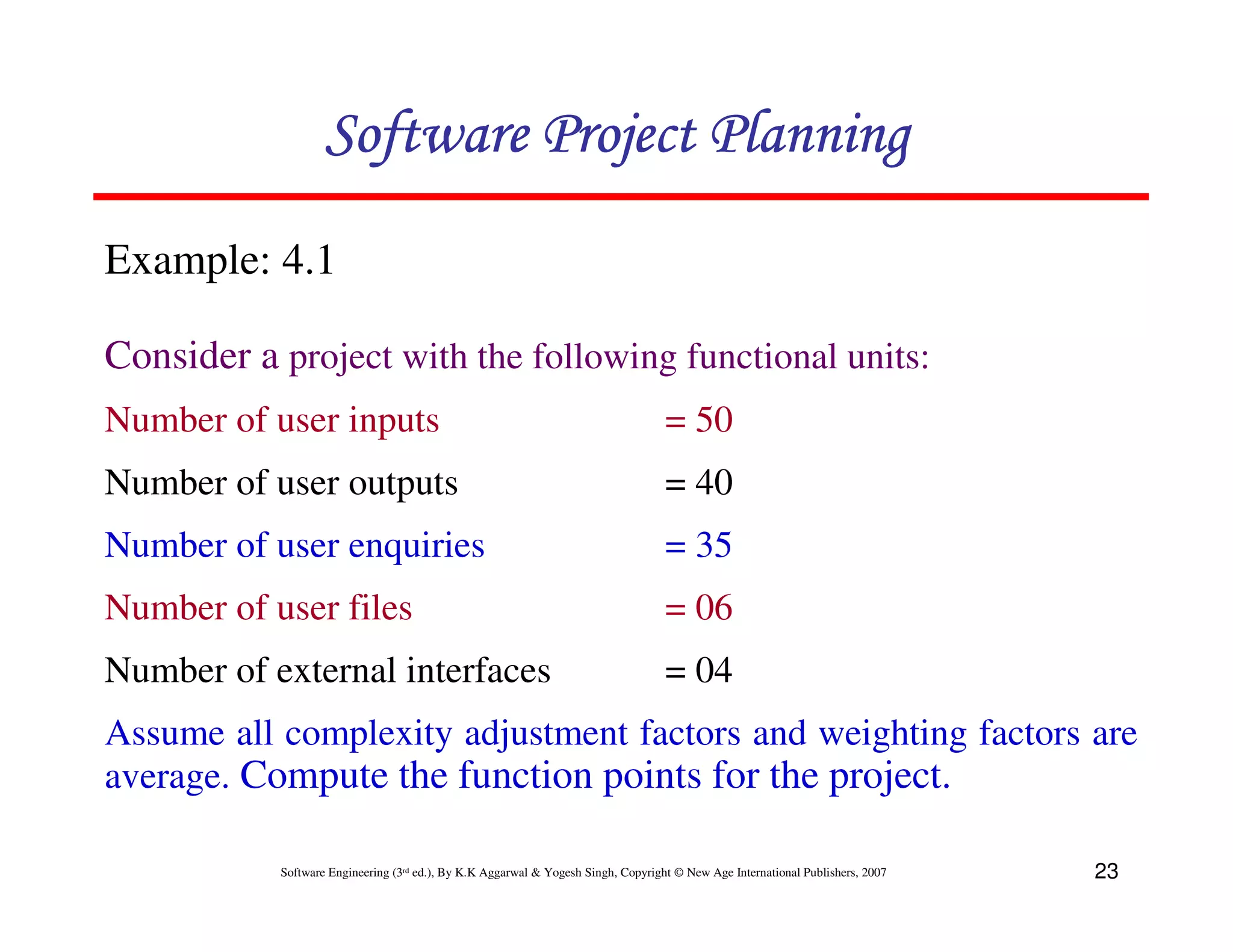
Example: 4.1

Consider a project with the following functional units:
Number of user inputs                                                              = 50
Number of user outputs                                                             = 40
Number of user enquiries                                                           = 35
Number of user files                                                               = 06
Number of external interfaces                                                      = 04
Assume all complexity adjustment factors and weighting factors are
average. Compute the function points for the project.

           Software Engineering (3rd ed.), By K.K Aggarwal & Yogesh Singh, Copyright © New Age International Publishers, 2007   23
Software Project Planning
Solution
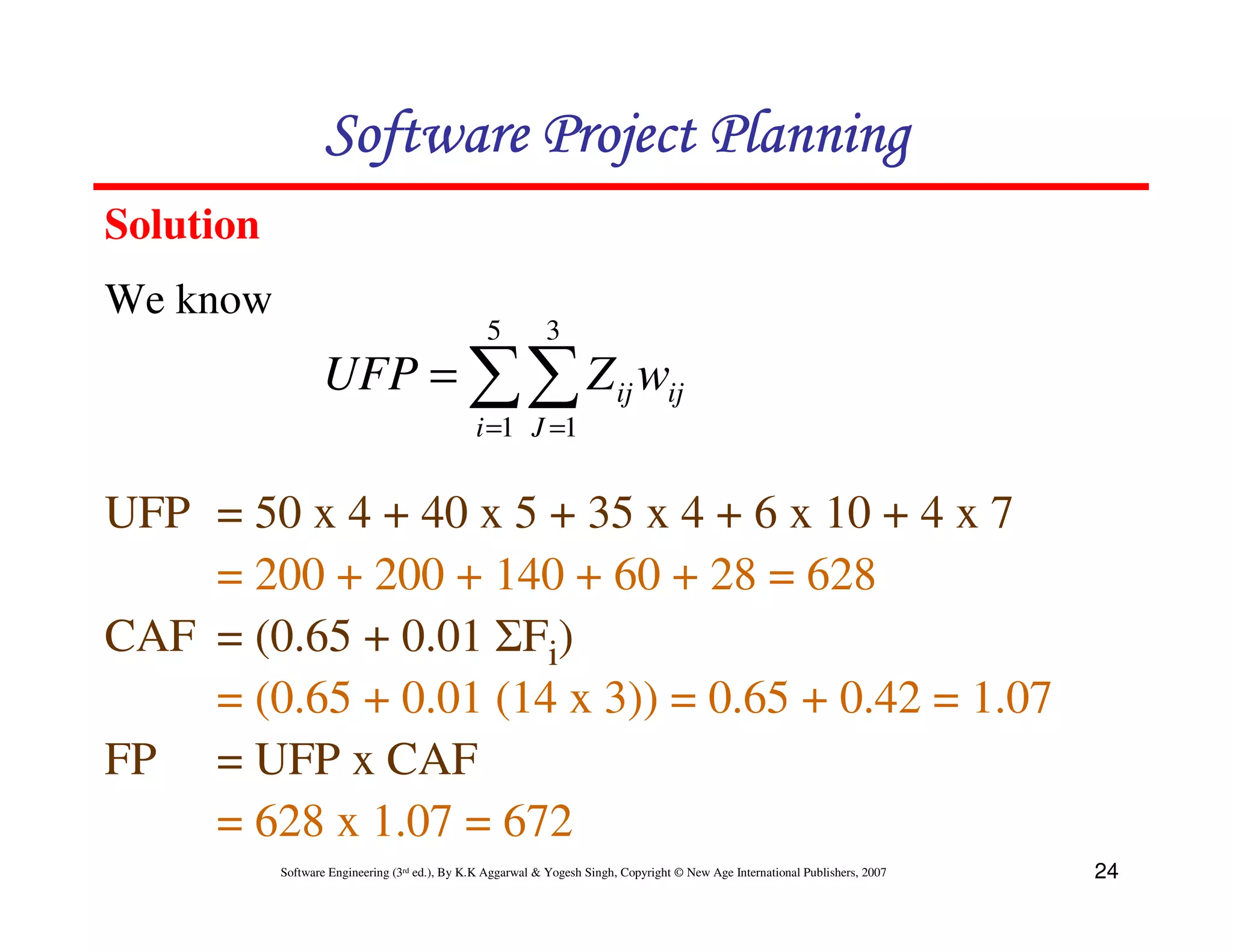
We know
                                                 5          3
                  UFP = ∑∑ Z ij wij
                                               i =1 J =1


UFP = 50 x 4 + 40 x 5 + 35 x 4 + 6 x 10 + 4 x 7
    = 200 + 200 + 140 + 60 + 28 = 628
CAF = (0.65 + 0.01 ΣFi)
    = (0.65 + 0.01 (14 x 3)) = 0.65 + 0.42 = 1.07
FP = UFP x CAF
    = 628 x 1.07 = 672
           Software Engineering (3rd ed.), By K.K Aggarwal & Yogesh Singh, Copyright © New Age International Publishers, 2007   24
Software Project Planning

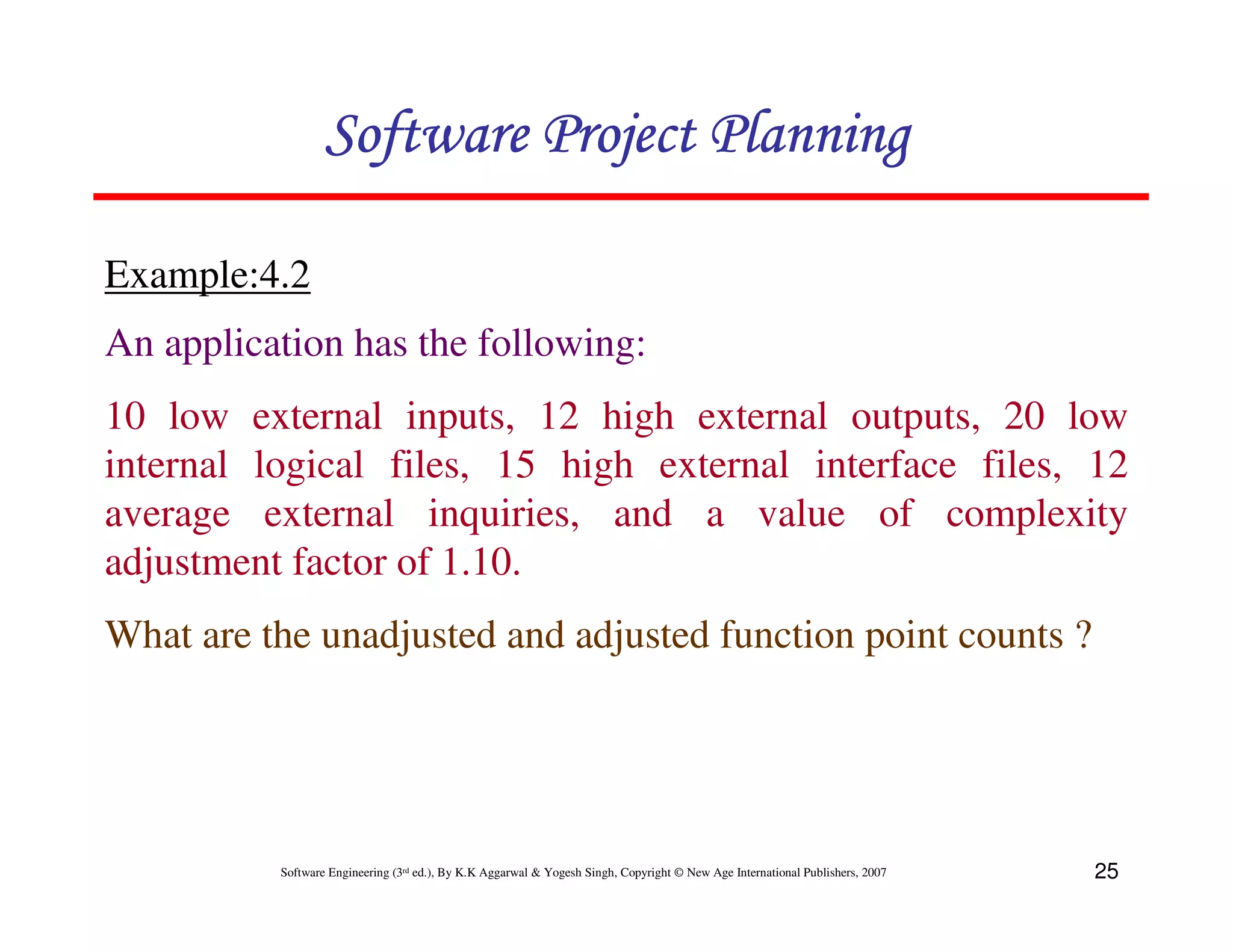
Example:4.2
An application has the following:
10 low external inputs, 12 high external outputs, 20 low
internal logical files, 15 high external interface files, 12
average external inquiries, and a value of complexity
adjustment factor of 1.10.
What are the unadjusted and adjusted function point counts ?


          Software Engineering (3rd ed.), By K.K Aggarwal & Yogesh Singh, Copyright © New Age International Publishers, 2007   25
Software Project Planning

Solution
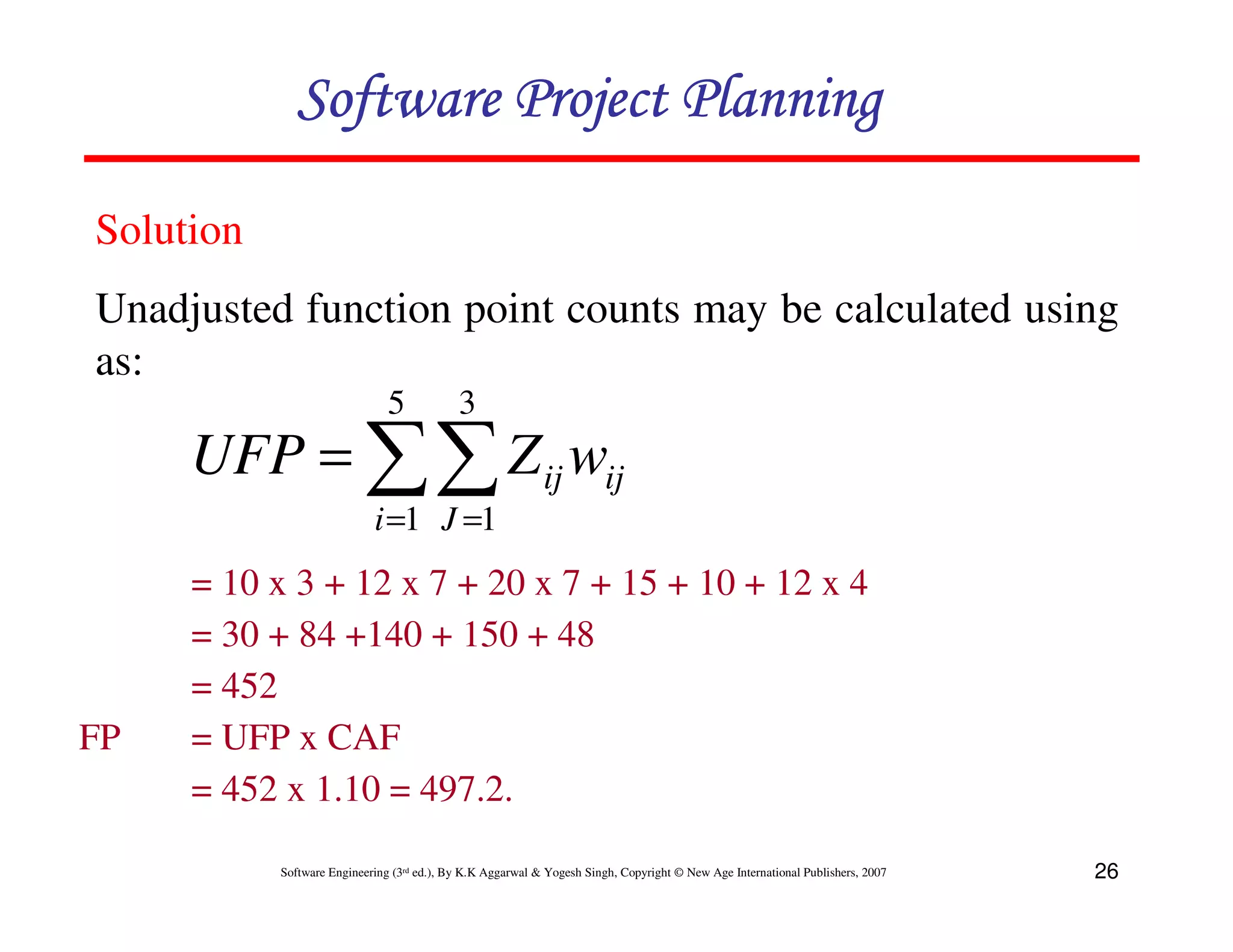
Unadjusted function point counts may be calculated using
as:
                               5            3
     UFP = ∑∑ Z ij wij
                            i =1 J =1
     = 10 x 3 + 12 x 7 + 20 x 7 + 15 + 10 + 12 x 4
     = 30 + 84 +140 + 150 + 48
     = 452
FP   = UFP x CAF
     = 452 x 1.10 = 497.2.

           Software Engineering (3rd ed.), By K.K Aggarwal & Yogesh Singh, Copyright © New Age International Publishers, 2007   26
Software Project Planning
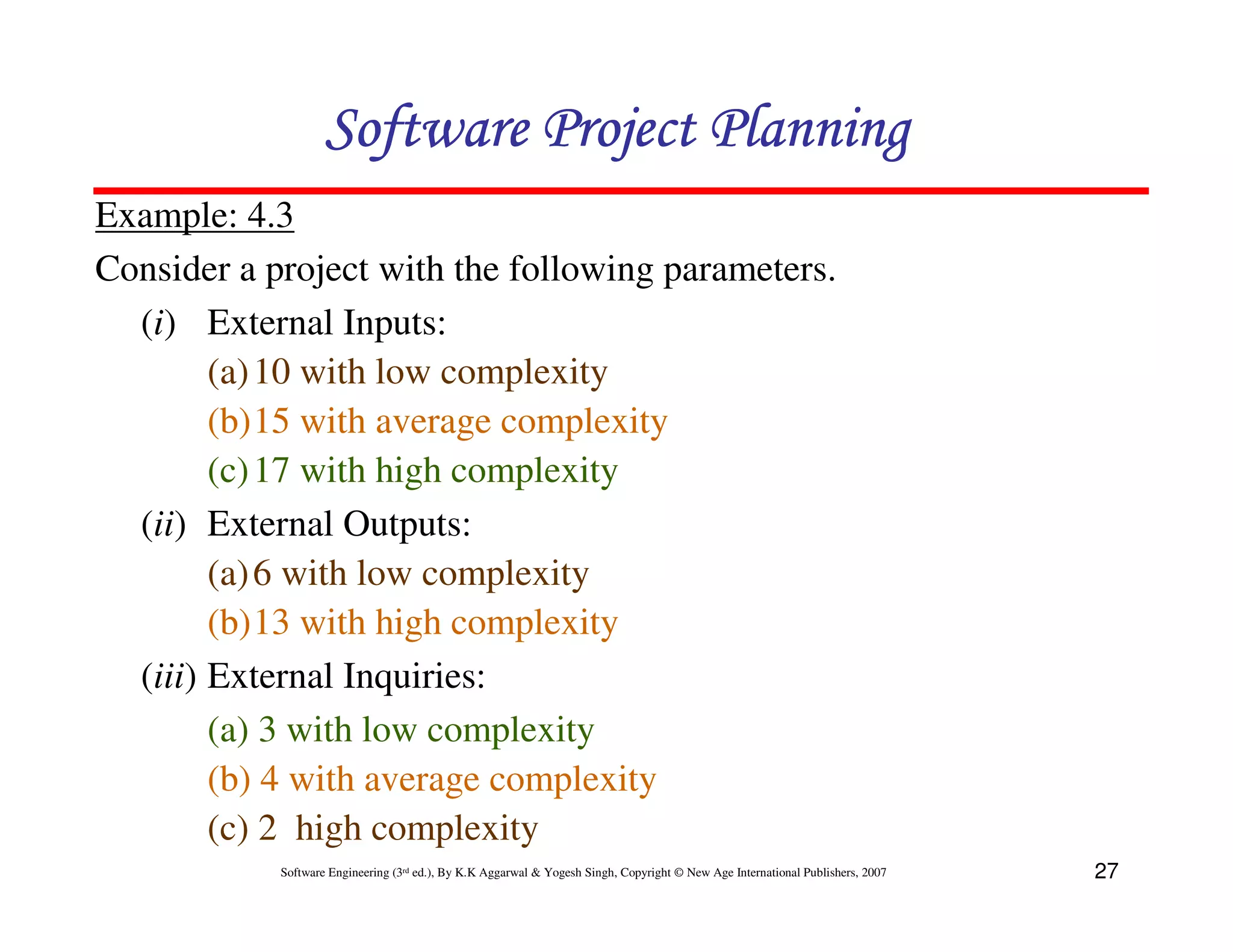
Example: 4.3
Consider a project with the following parameters.
  (i) External Inputs:
        (a) 10 with low complexity
        (b)15 with average complexity
        (c) 17 with high complexity
  (ii) External Outputs:
        (a) 6 with low complexity
        (b)13 with high complexity
  (iii) External Inquiries:
        (a) 3 with low complexity
        (b) 4 with average complexity
        (c) 2 high complexity
            Software Engineering (3rd ed.), By K.K Aggarwal & Yogesh Singh, Copyright © New Age International Publishers, 2007   27
Software Project Planning
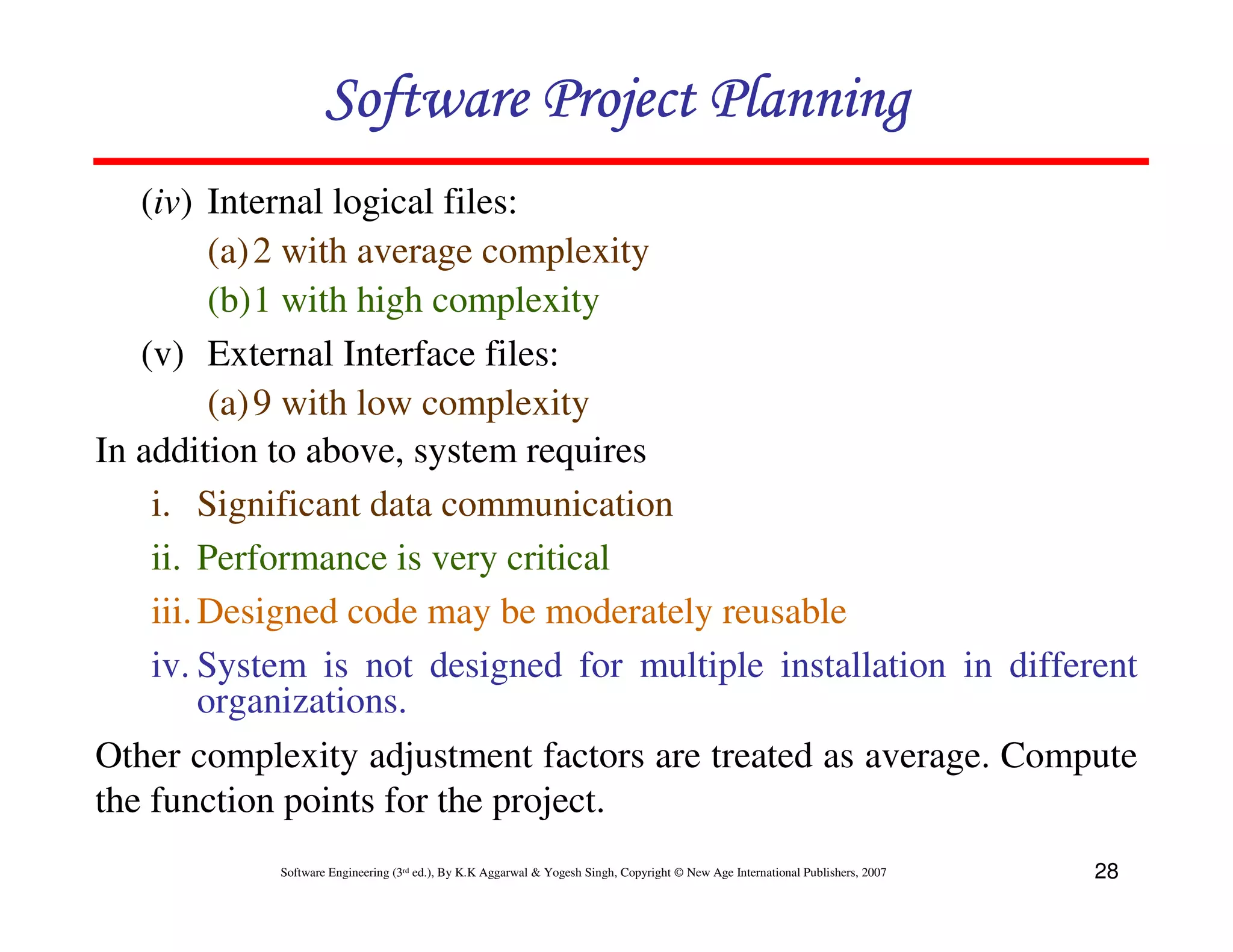
   (iv) Internal logical files:
          (a) 2 with average complexity
          (b)1 with high complexity
   (v) External Interface files:
          (a) 9 with low complexity
In addition to above, system requires
    i. Significant data communication
    ii. Performance is very critical
    iii. Designed code may be moderately reusable
    iv. System is not designed for multiple installation in different
         organizations.
Other complexity adjustment factors are treated as average. Compute
the function points for the project.
            Software Engineering (3rd ed.), By K.K Aggarwal & Yogesh Singh, Copyright © New Age International Publishers, 2007   28
Software Project Planning
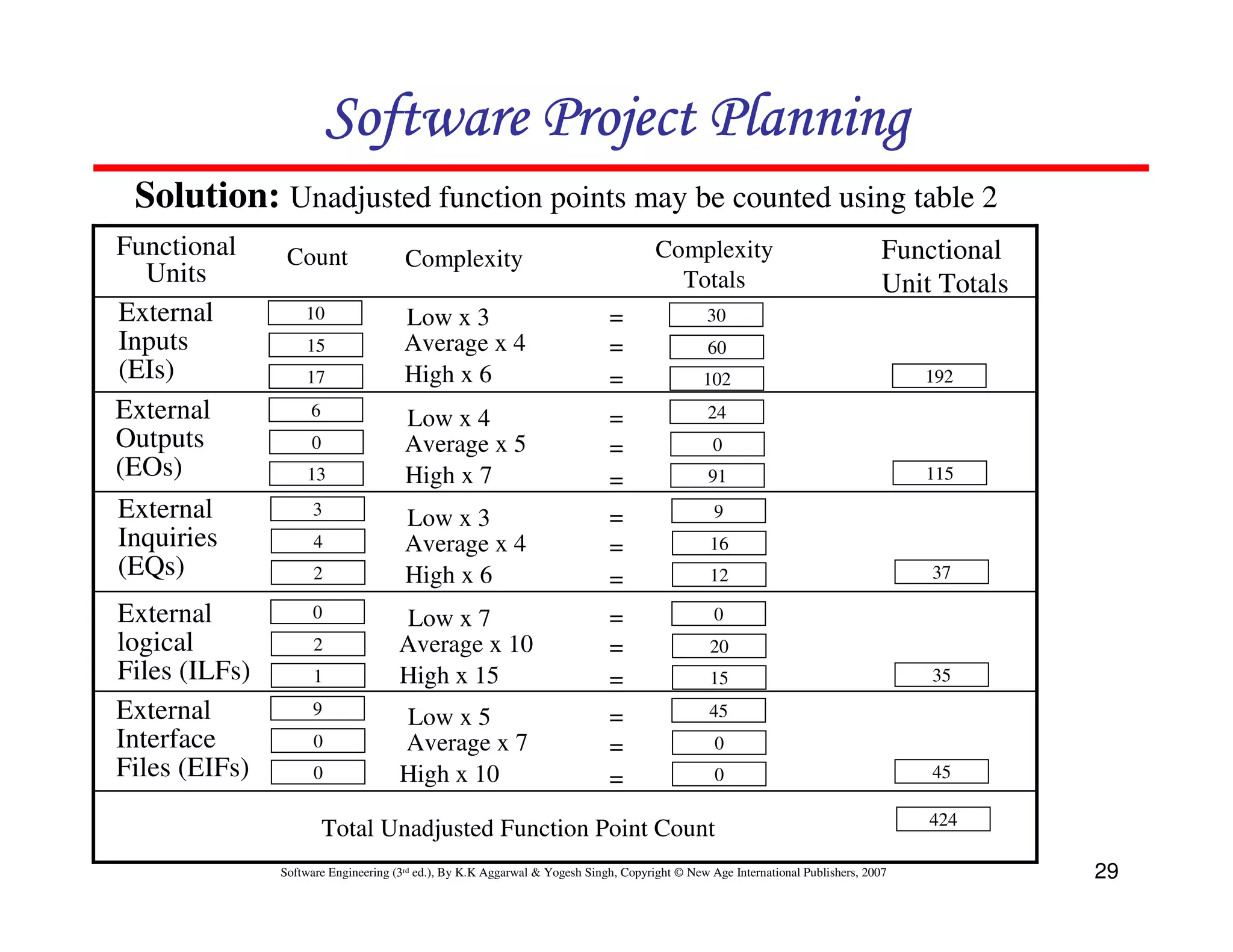
 Solution: Unadjusted function points may be counted using table 2
Functional      Count                 Complexity                                     Complexity                                 Functional
  Units                                                                                Totals                                   Unit Totals
External           10                 Low x 3                               =                  30
Inputs             15                 Average x 4                           =                  60
(EIs)              17                 High x 6                              =                 102                                   192
External            6
                                      Low x 4                               =                  24
Outputs             0                 Average x 5                           =                   0
(EOs)              13                 High x 7                              =                  91                                   115

External             3
                                      Low x 3                               =                   9
Inquiries            4                Average x 4                           =                  16
(EQs)                2                High x 6                              =                  12                                   37

External             0               Low x 7                                =                   0
logical              2               Average x 10                           =                  20
Files (ILFs)         1               High x 15                              =                  15                                   35

External             9
                                     Low x 5                                =                  45
Interface            0               Average x 7                            =                   0
Files (EIFs)         0               High x 10                              =                   0                                   45

                                                                                                                                    424
                        Total Unadjusted Function Point Count
               Software Engineering (3rd ed.), By K.K Aggarwal & Yogesh Singh, Copyright © New Age International Publishers, 2007             29
Software Project Planning
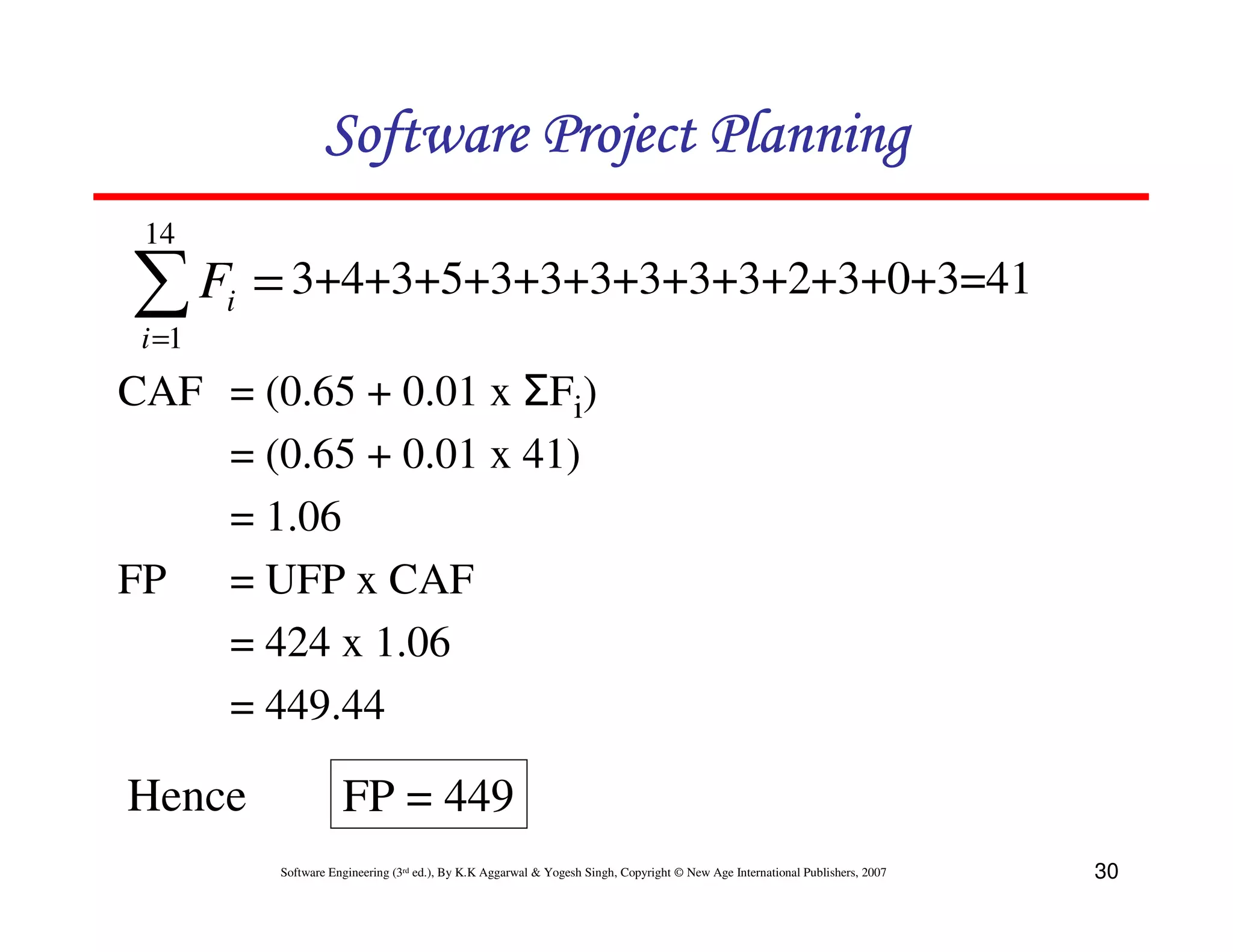
 14

∑ F = 3+4+3+5+3+3+3+3+3+3+2+3+0+3=41
 i =1
        i


CAF = (0.65 + 0.01 x ΣFi)
    = (0.65 + 0.01 x 41)
    = 1.06
FP = UFP x CAF
    = 424 x 1.06
    = 449.44

Hence                  FP = 449
            Software Engineering (3rd ed.), By K.K Aggarwal & Yogesh Singh, Copyright © New Age International Publishers, 2007   30
Software Project Planning
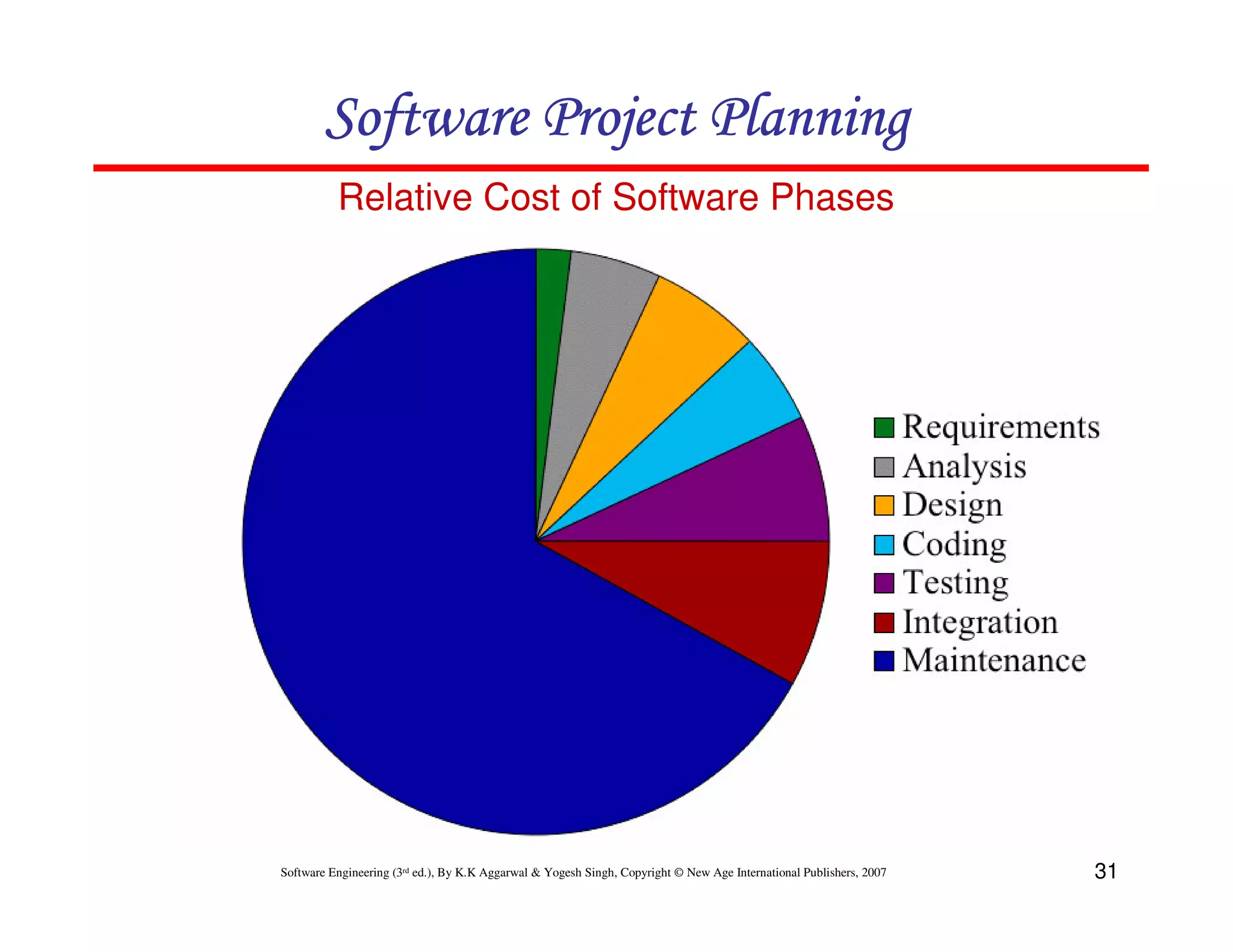
          Relative Cost of Software Phases


Software Engineering (3rd ed.), By K.K Aggarwal & Yogesh Singh, Copyright © New Age International Publishers, 2007   31
Software Project Planning

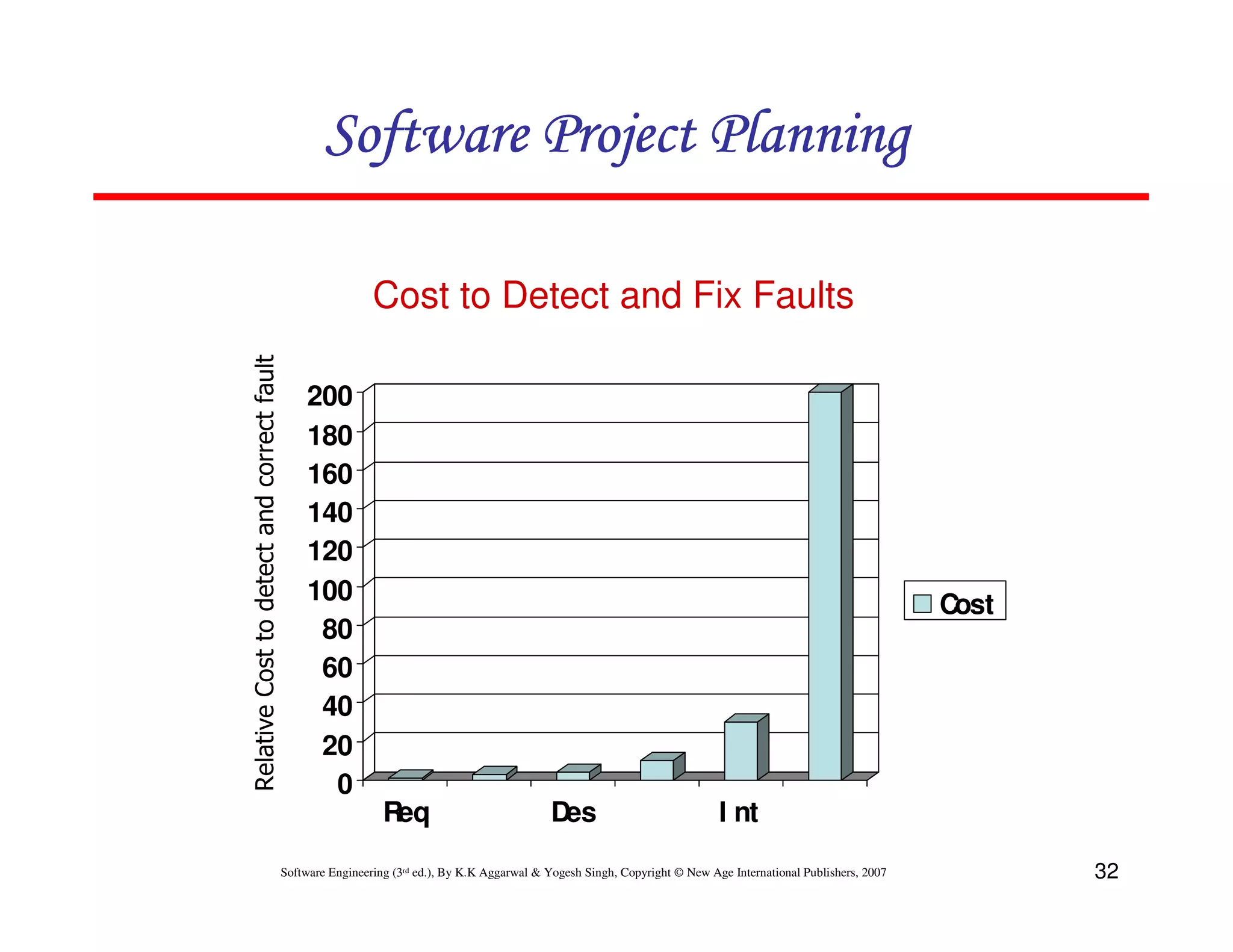
                                                             Cost to Detect and Fix Faults
Relative Cost to detect and correct fault


                                                200
                                                180
                                                160
                                                140
                                                120
                                                100                                                                                                              Cost
                                                 80
                                                 60
                                                 40
                                                 20
                                                  0
                                                               Req                            Des                             I nt
                                            Software Engineering (3rd ed.), By K.K Aggarwal & Yogesh Singh, Copyright © New Age International Publishers, 2007          32
Software Project Planning
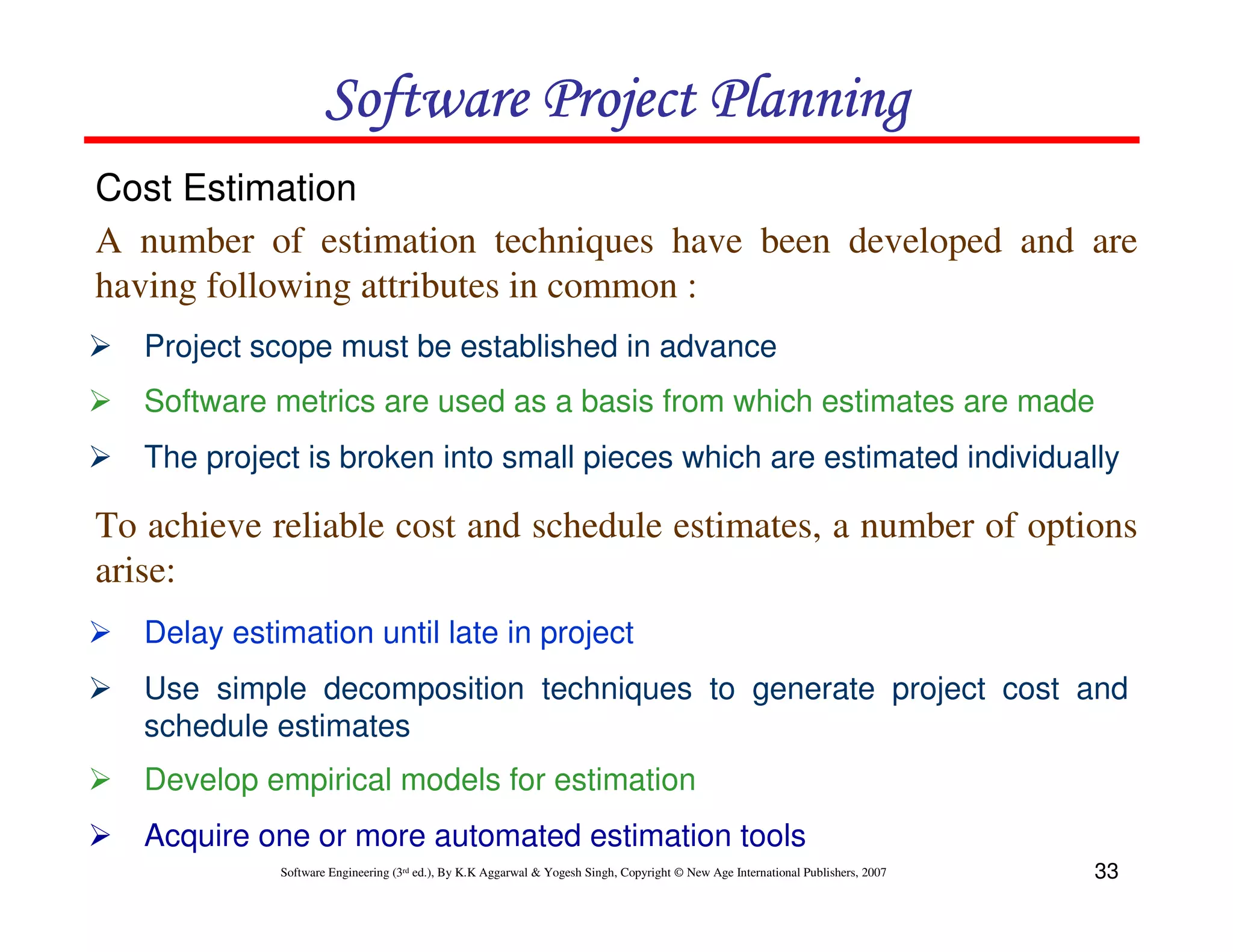
Cost Estimation
A number of estimation techniques have been developed and are
having following attributes in common :
   Project scope must be established in advance
   Software metrics are used as a basis from which estimates are made
   The project is broken into small pieces which are estimated individually

To achieve reliable cost and schedule estimates, a number of options
arise:
   Delay estimation until late in project
   Use simple decomposition techniques to generate project cost and
   schedule estimates
   Develop empirical models for estimation
   Acquire one or more automated estimation tools
             Software Engineering (3rd ed.), By K.K Aggarwal & Yogesh Singh, Copyright © New Age International Publishers, 2007   33
Software Project Planning

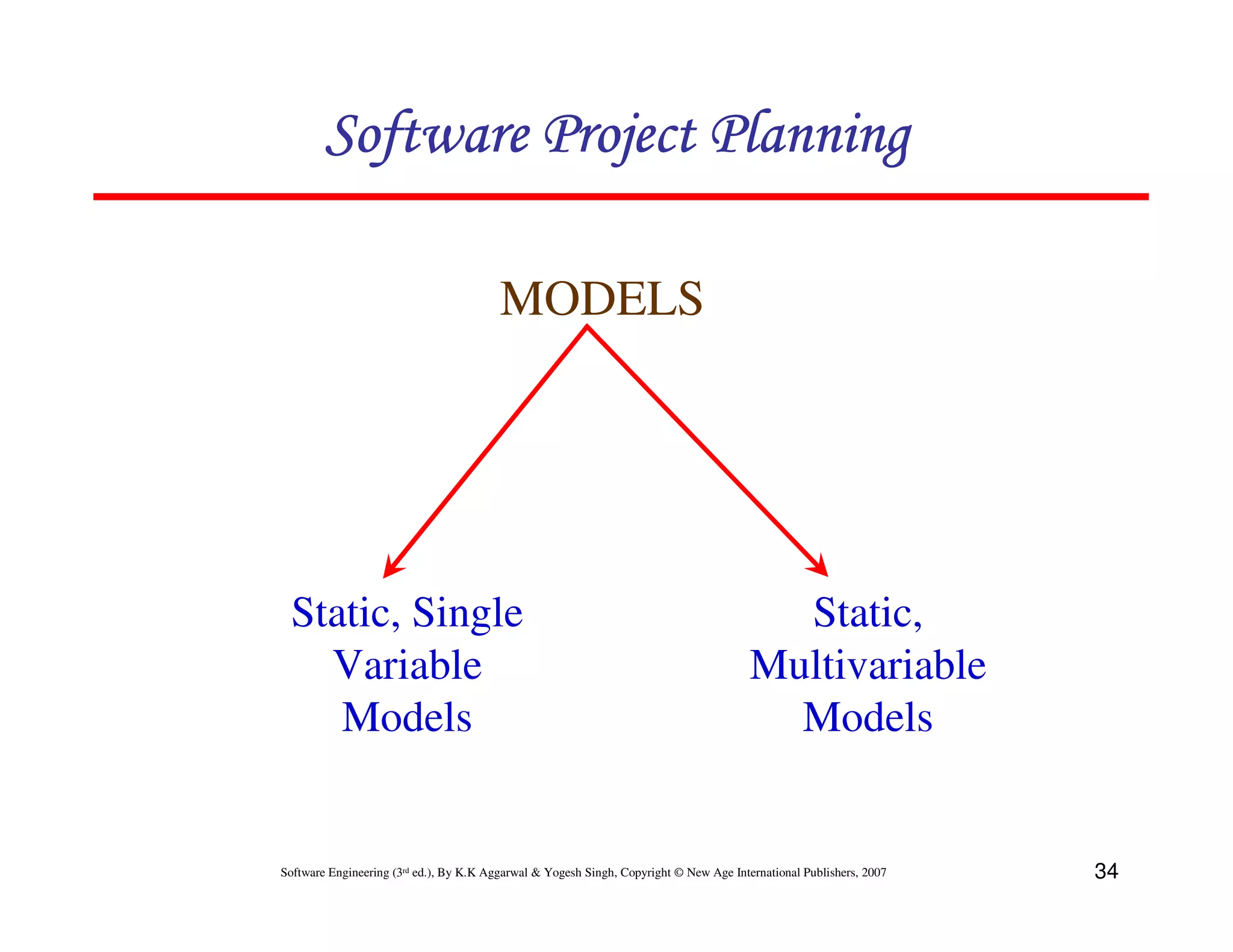
                                         MODELS


 Static, Single                                                                           Static,
   Variable                                                                             Multivariable
    Models                                                                                Models


Software Engineering (3rd ed.), By K.K Aggarwal & Yogesh Singh, Copyright © New Age International Publishers, 2007   34
Software Project Planning
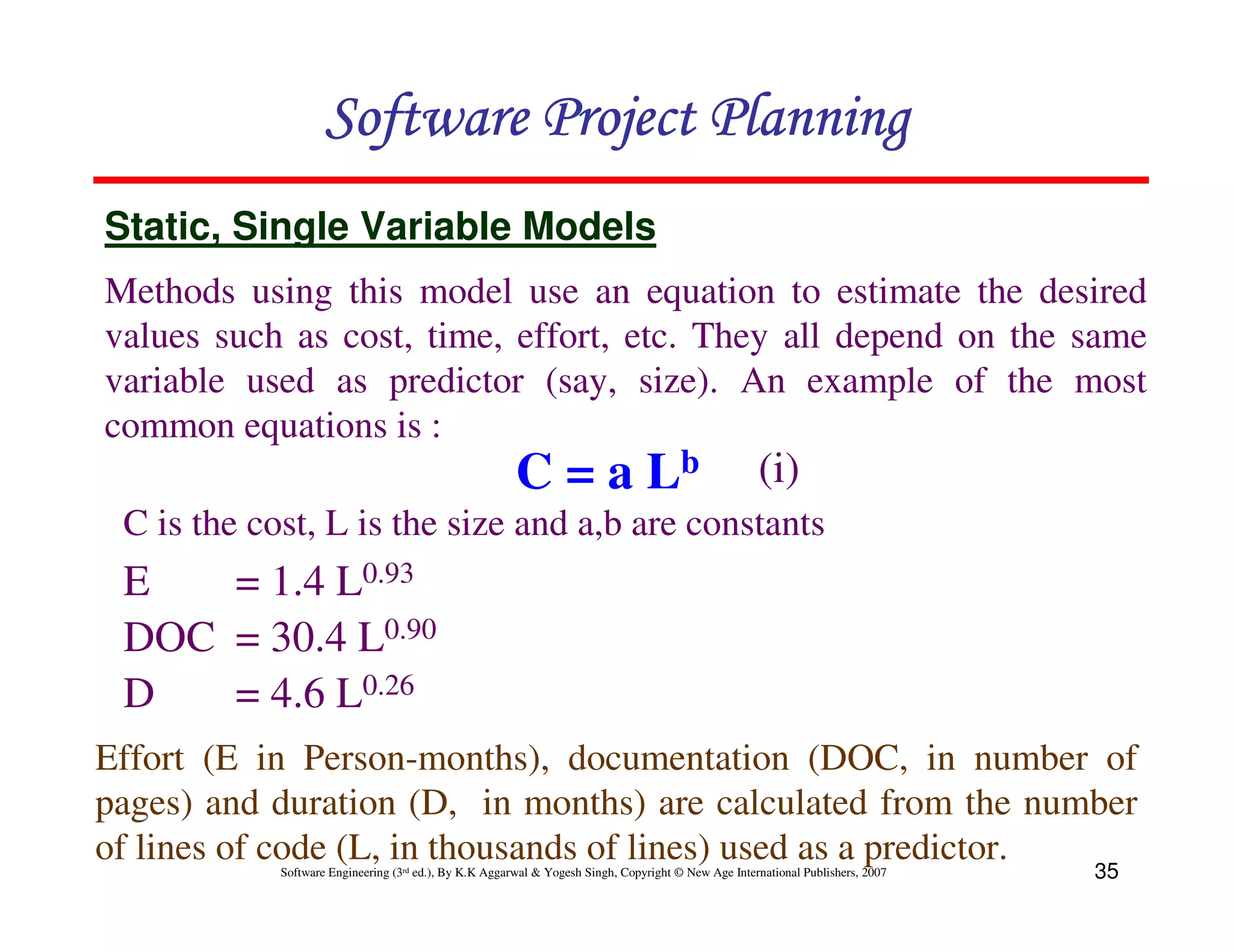
Static, Single Variable Models
Methods using this model use an equation to estimate the desired
values such as cost, time, effort, etc. They all depend on the same
variable used as predictor (say, size). An example of the most
common equations is :
                                                        C = a Lb                                     (i)
 C is the cost, L is the size and a,b are constants
 E   = 1.4 L0.93
 DOC = 30.4 L0.90
 D   = 4.6 L0.26
Effort (E in Person-months), documentation (DOC, in number of
pages) and duration (D, in months) are calculated from the number
of lines of code (L, in thousands of lines) used as a predictor.
            Software Engineering (3rd ed.), By K.K Aggarwal & Yogesh Singh, Copyright © New Age International Publishers, 2007   35
Software Project Planning
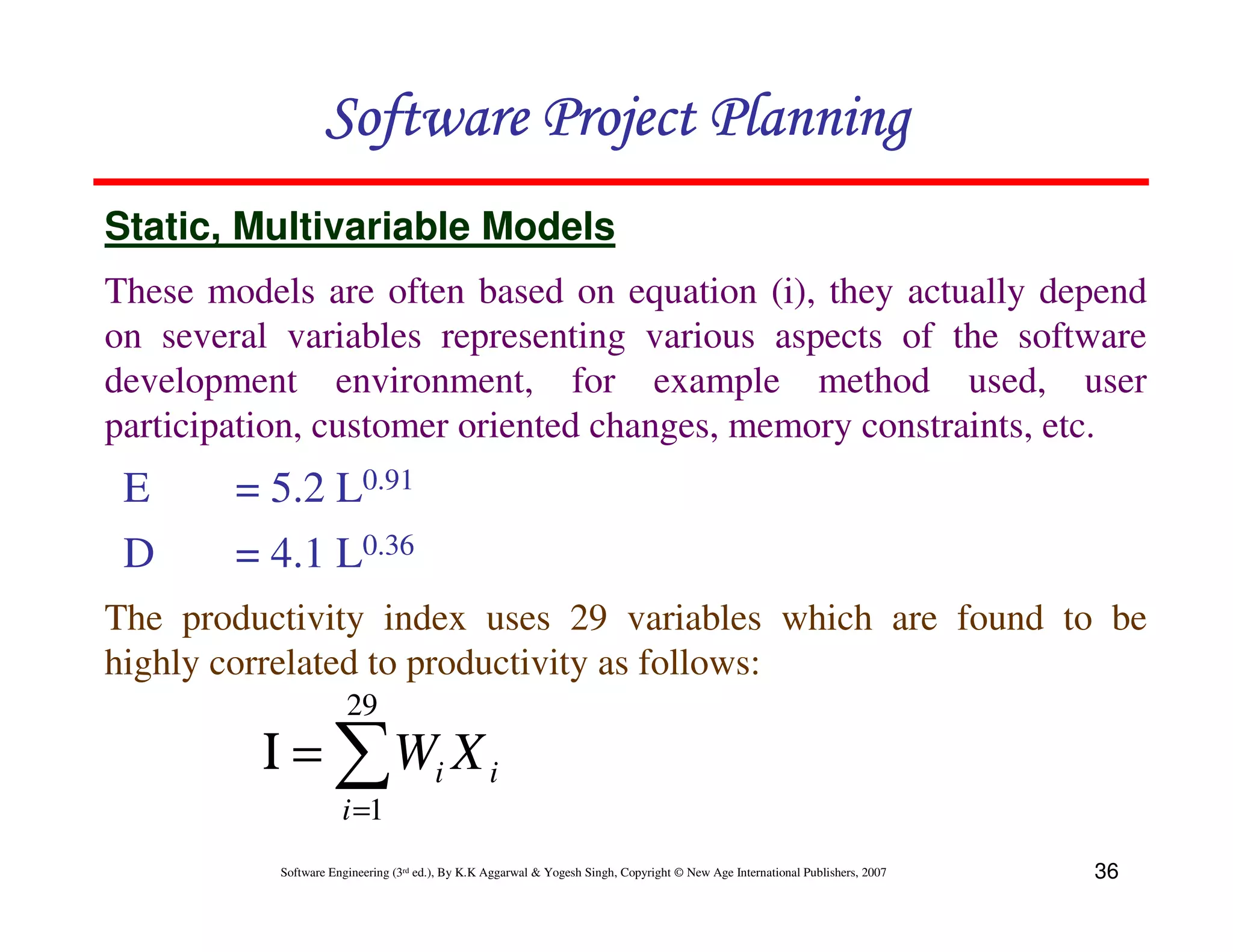
Static, Multivariable Models
These models are often based on equation (i), they actually depend
on several variables representing various aspects of the software
development environment, for example method used, user
participation, customer oriented changes, memory constraints, etc.
 E      = 5.2 L0.91
 D      = 4.1 L0.36
The productivity index uses 29 variables which are found to be
highly correlated to productivity as follows:
                       29
         Ι = ∑ Wi X i
                      i =1
           Software Engineering (3rd ed.), By K.K Aggarwal & Yogesh Singh, Copyright © New Age International Publishers, 2007   36
Software Project Planning

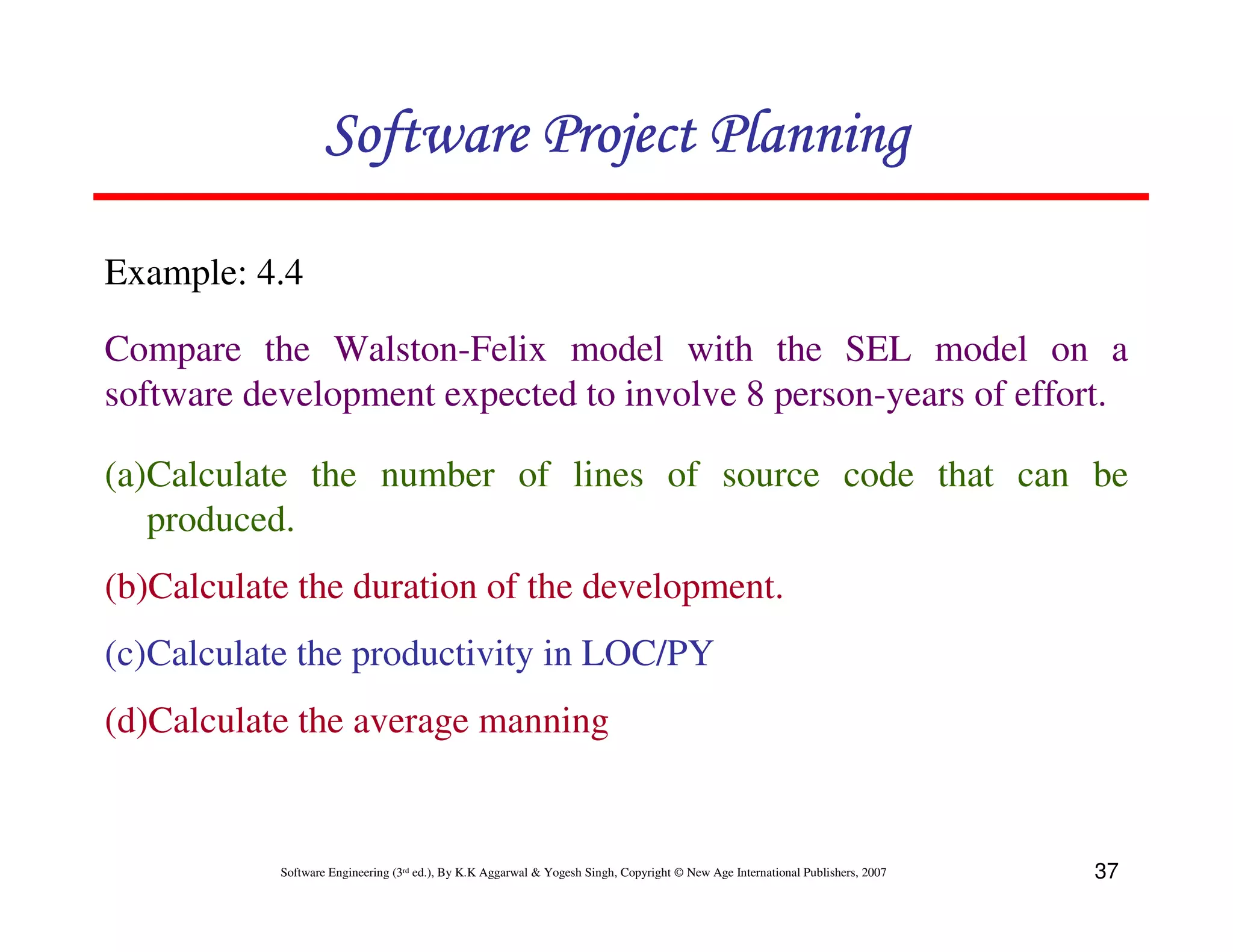
Example: 4.4

Compare the Walston-Felix model with the SEL model on a
software development expected to involve 8 person-years of effort.

(a)Calculate the number of lines of source code that can be
   produced.
(b)Calculate the duration of the development.
(c)Calculate the productivity in LOC/PY
(d)Calculate the average manning


           Software Engineering (3rd ed.), By K.K Aggarwal & Yogesh Singh, Copyright © New Age International Publishers, 2007   37
Software Project Planning
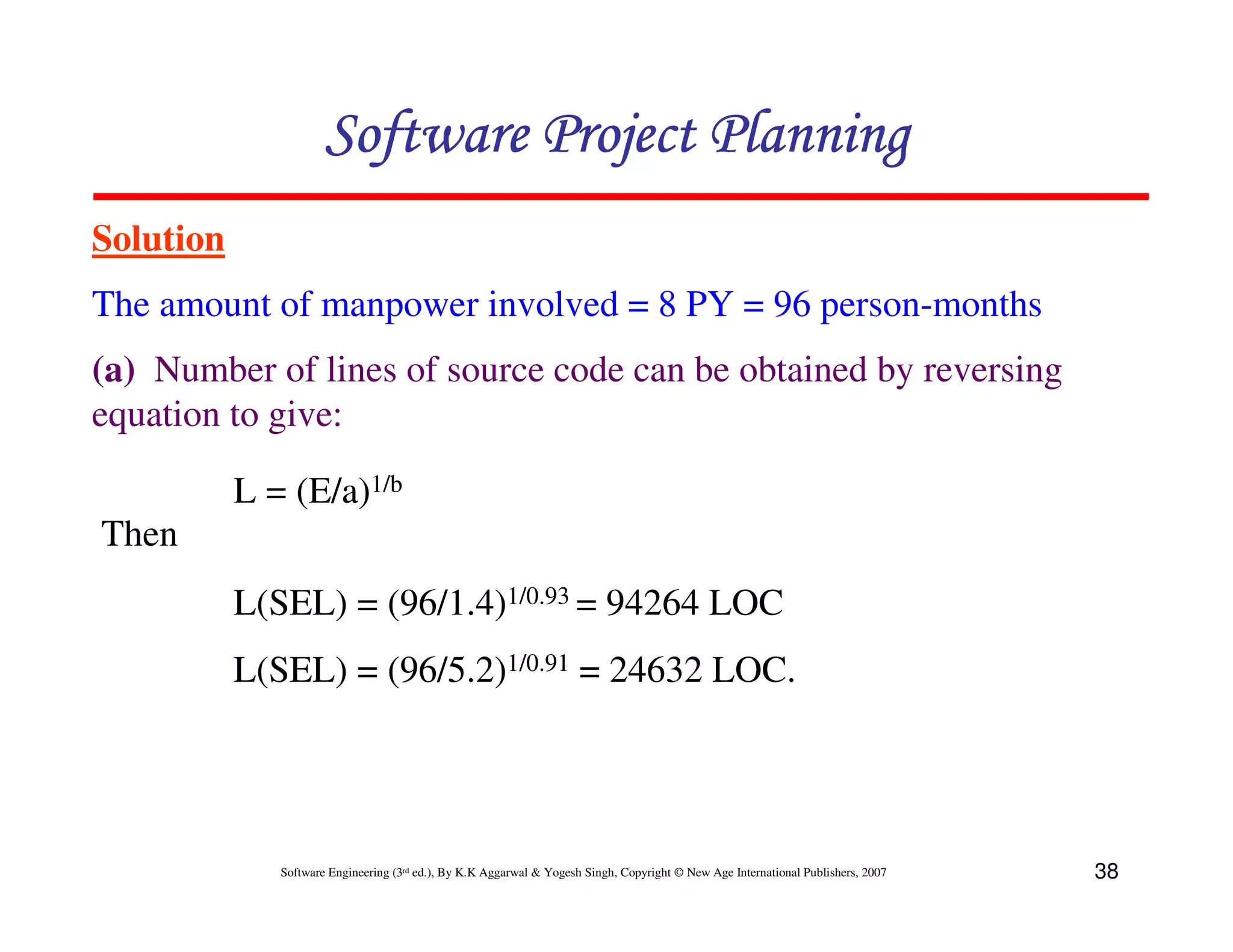
Solution
The amount of manpower involved = 8 PY = 96 person-months
(a) Number of lines of source code can be obtained by reversing
equation to give:

           L = (E/a)1/b
Then
           L(SEL) = (96/1.4)1/0.93 = 94264 LOC
           L(SEL) = (96/5.2)1/0.91 = 24632 LOC.


              Software Engineering (3rd ed.), By K.K Aggarwal & Yogesh Singh, Copyright © New Age International Publishers, 2007   38
Software Project Planning
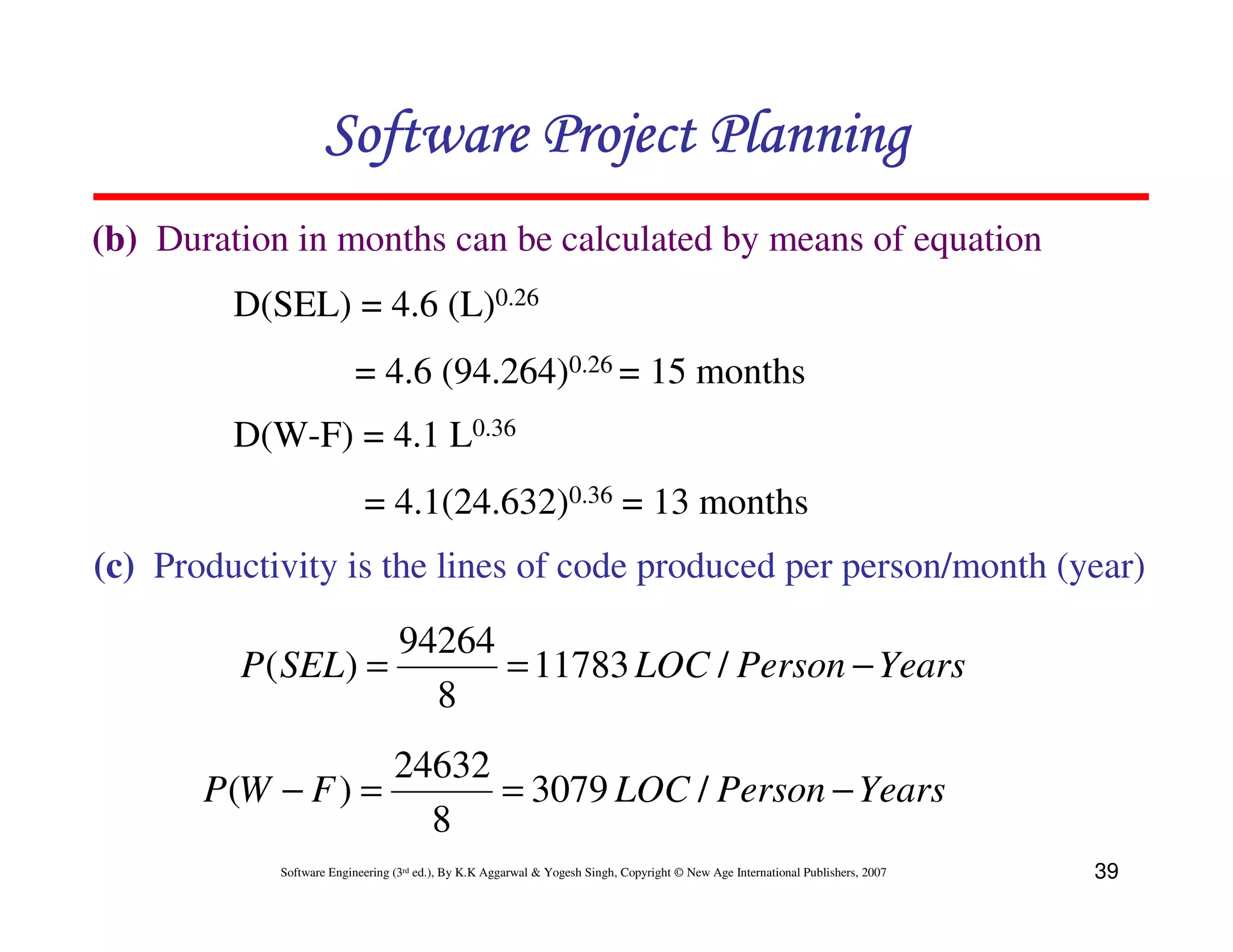
(b) Duration in months can be calculated by means of equation
         D(SEL) = 4.6 (L)0.26
                         = 4.6 (94.264)0.26 = 15 months
         D(W-F) = 4.1 L0.36
                           = 4.1(24.632)0.36 = 13 months
(c) Productivity is the lines of code produced per person/month (year)

                   94264
         P( SEL) =       = 11783 LOC / Person − Years
                     8
                   24632
       P(W − F ) =       = 3079 LOC / Person − Years
                     8
            Software Engineering (3rd ed.), By K.K Aggarwal & Yogesh Singh, Copyright © New Age International Publishers, 2007   39
Software Project Planning
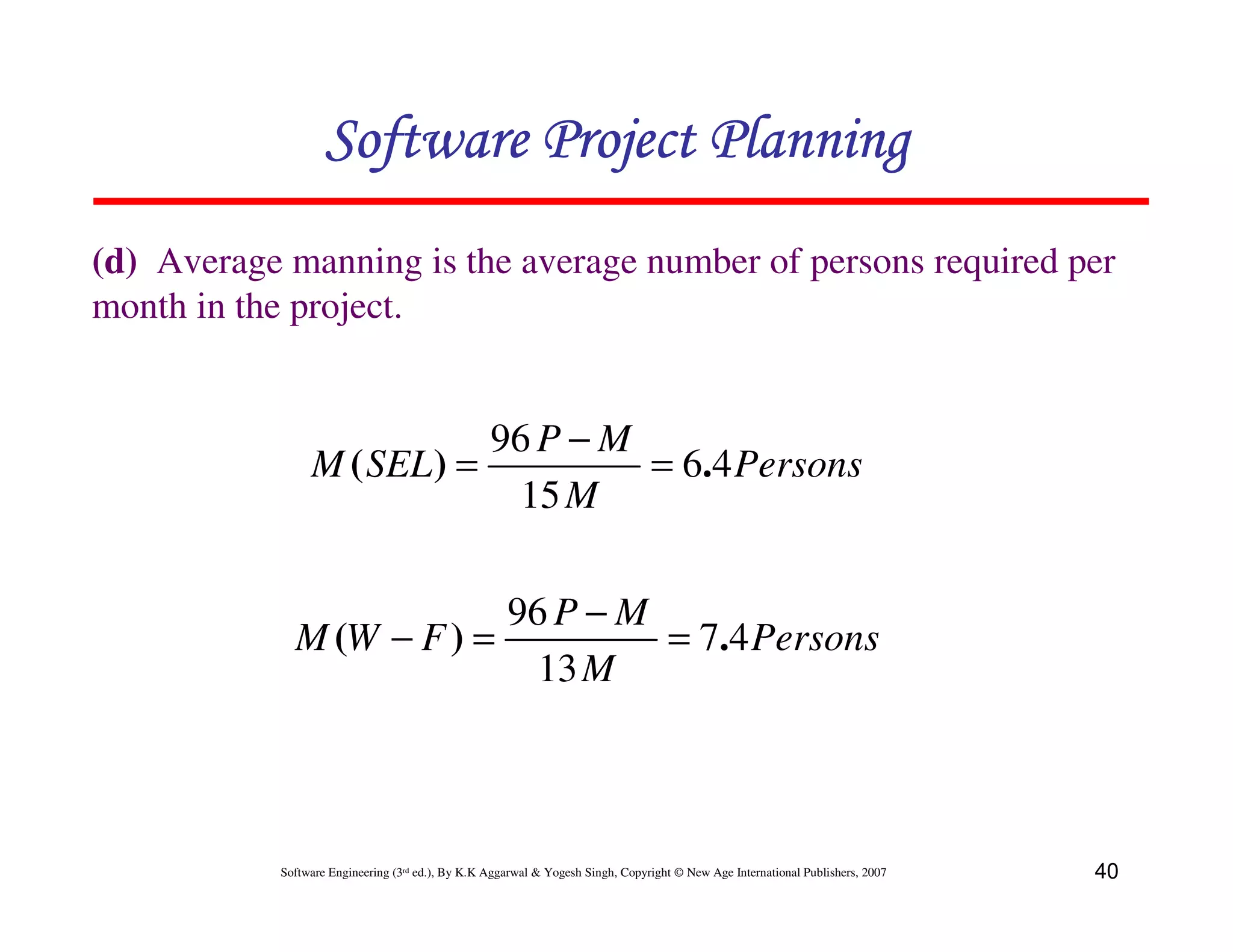
(d) Average manning is the average number of persons required per
month in the project.


                            96 P − M
                M ( SEL ) =          = 6.4 Persons
                             15 M

                          96 P − M
             M (W − F ) =          = 7.4 Persons
                            13 M


           Software Engineering (3rd ed.), By K.K Aggarwal & Yogesh Singh, Copyright © New Age International Publishers, 2007   40
Software Project Planning

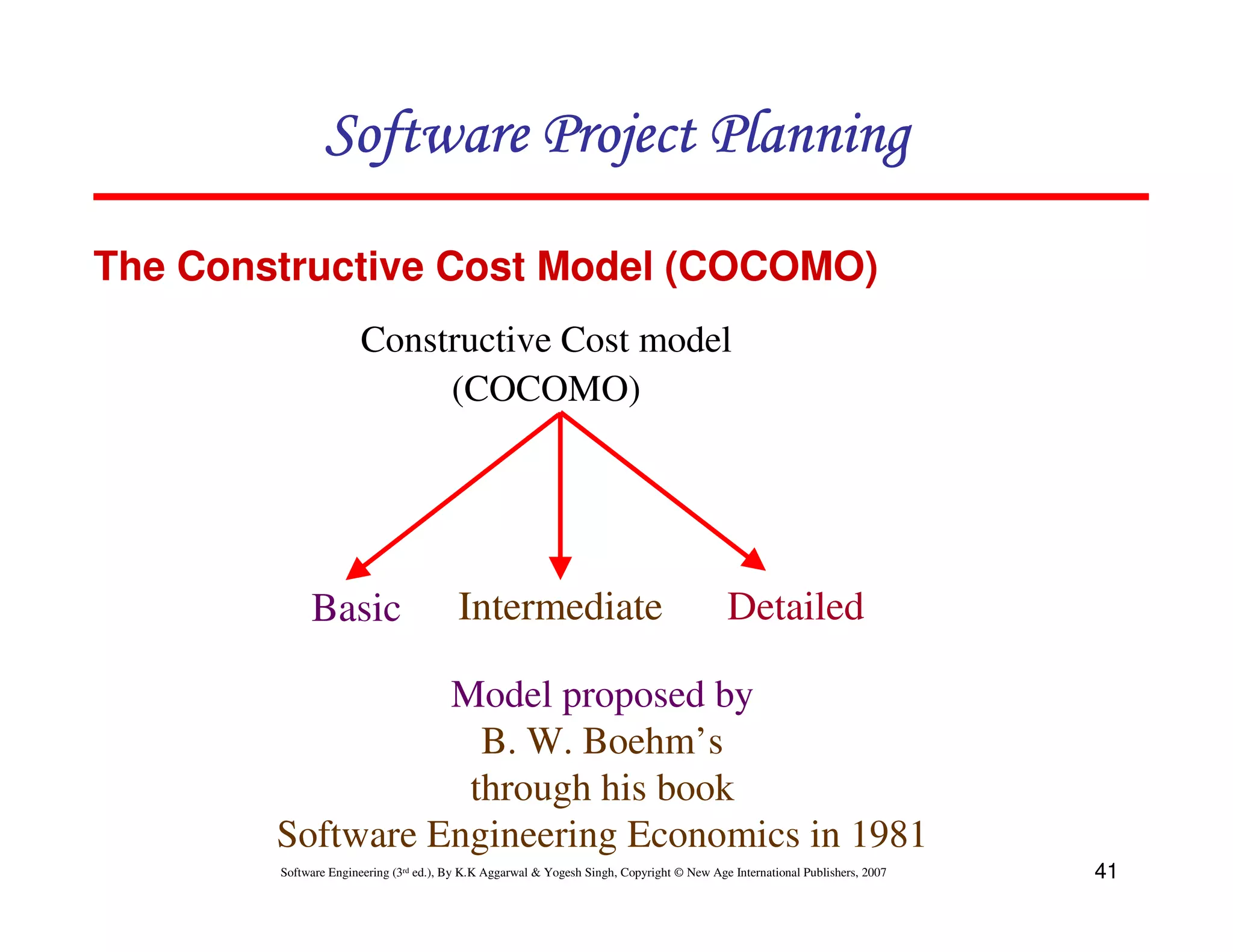
The Constructive Cost Model (COCOMO)
                       Constructive Cost model
                            (COCOMO)


             Basic                       Intermediate                                       Detailed

                  Model proposed by
                    B. W. Boehm’s
                   through his book
        Software Engineering Economics in 1981
        Software Engineering (3rd ed.), By K.K Aggarwal & Yogesh Singh, Copyright © New Age International Publishers, 2007   41
Software Project Planning

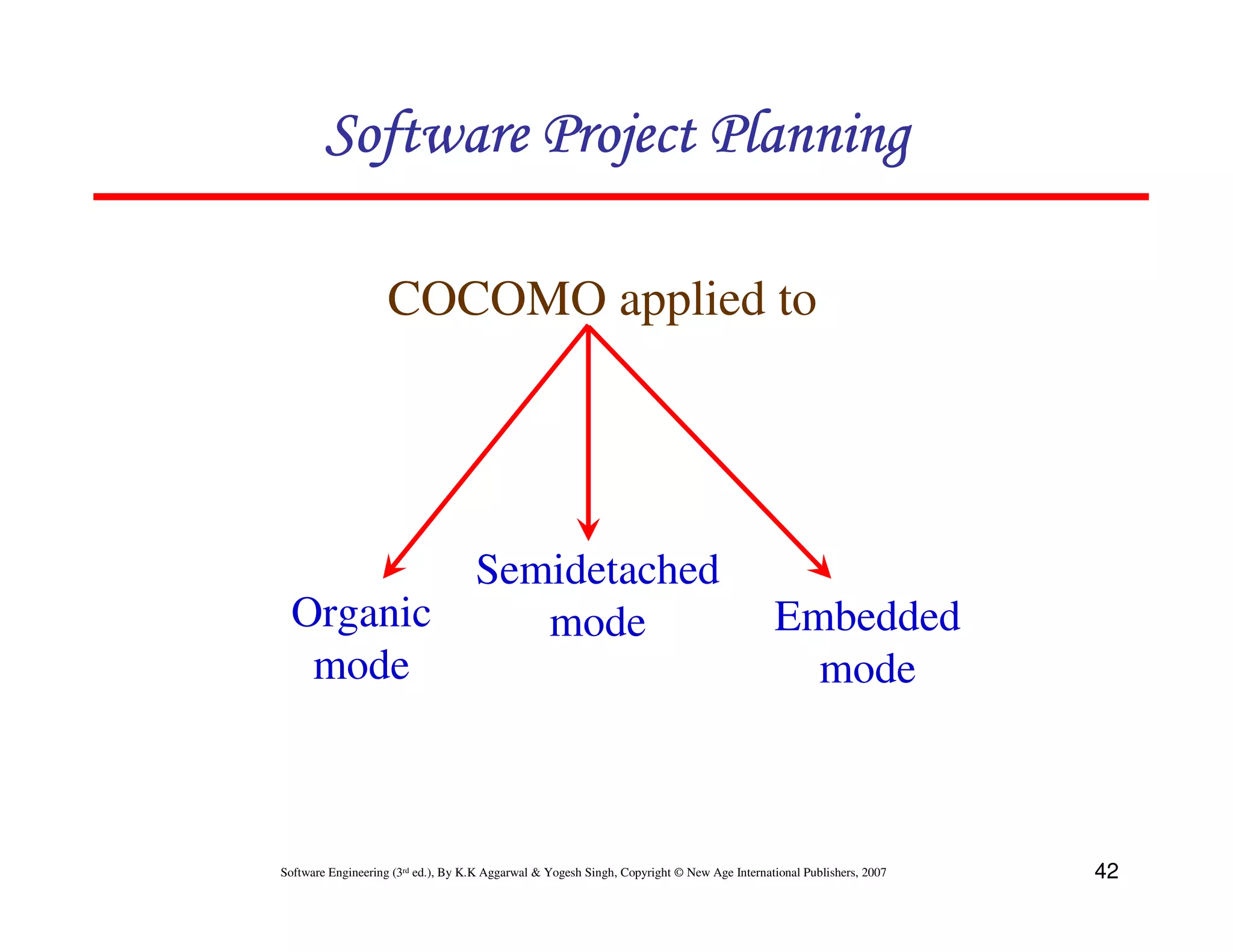
                    COCOMO applied to


                                    Semidetached
  Organic                              mode                                                 Embedded
   mode                                                                                       mode


Software Engineering (3rd ed.), By K.K Aggarwal & Yogesh Singh, Copyright © New Age International Publishers, 2007   42
Software Project Planning
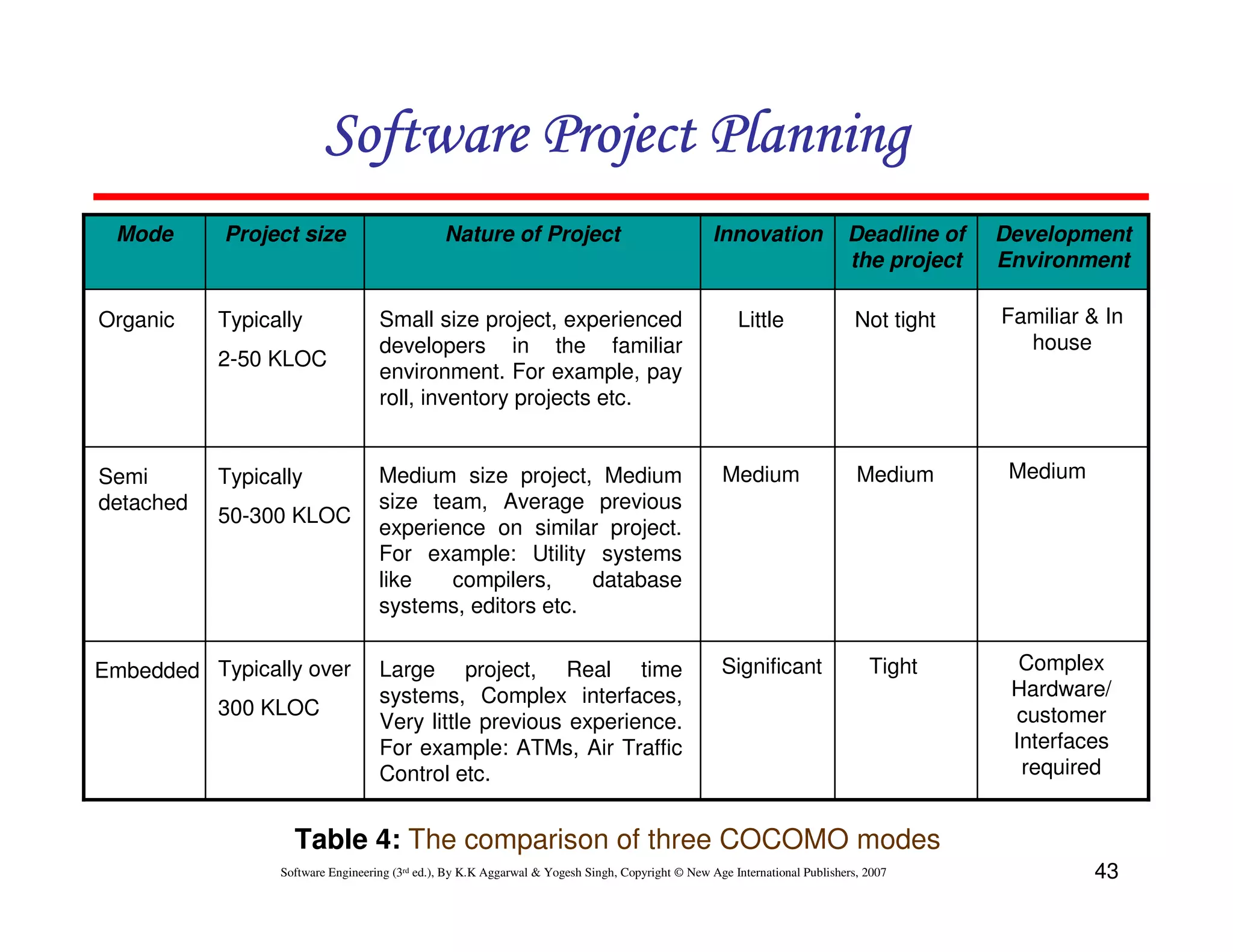
 Mode      Project size                        Nature of Project                                  Innovation               Deadline of   Development
                                                                                                                           the project   Environment

Organic    Typically               Small size project, experienced                                     Little               Not tight    Familiar & In
                                   developers in the familiar                                                                              house
           2-50 KLOC
                                   environment. For example, pay
                                   roll, inventory projects etc.


Semi       Typically               Medium size project, Medium                                      Medium                   Medium       Medium
detached                           size team, Average previous
           50-300 KLOC
                                   experience on similar project.
                                   For example: Utility systems
                                   like   compilers,     database
                                   systems, editors etc.

Embedded Typically over            Large project, Real time                                        Significant                 Tight       Complex
                                   systems, Complex interfaces,                                                                           Hardware/
           300 KLOC                                                                                                                        customer
                                   Very little previous experience.
                                   For example: ATMs, Air Traffic                                                                         Interfaces
                                   Control etc.                                                                                            required


                   Table 4: The comparison of three COCOMO modes
                 Software Engineering (3rd ed.), By K.K Aggarwal & Yogesh Singh, Copyright © New Age International Publishers, 2007                43
Software Project Planning

Basic Model
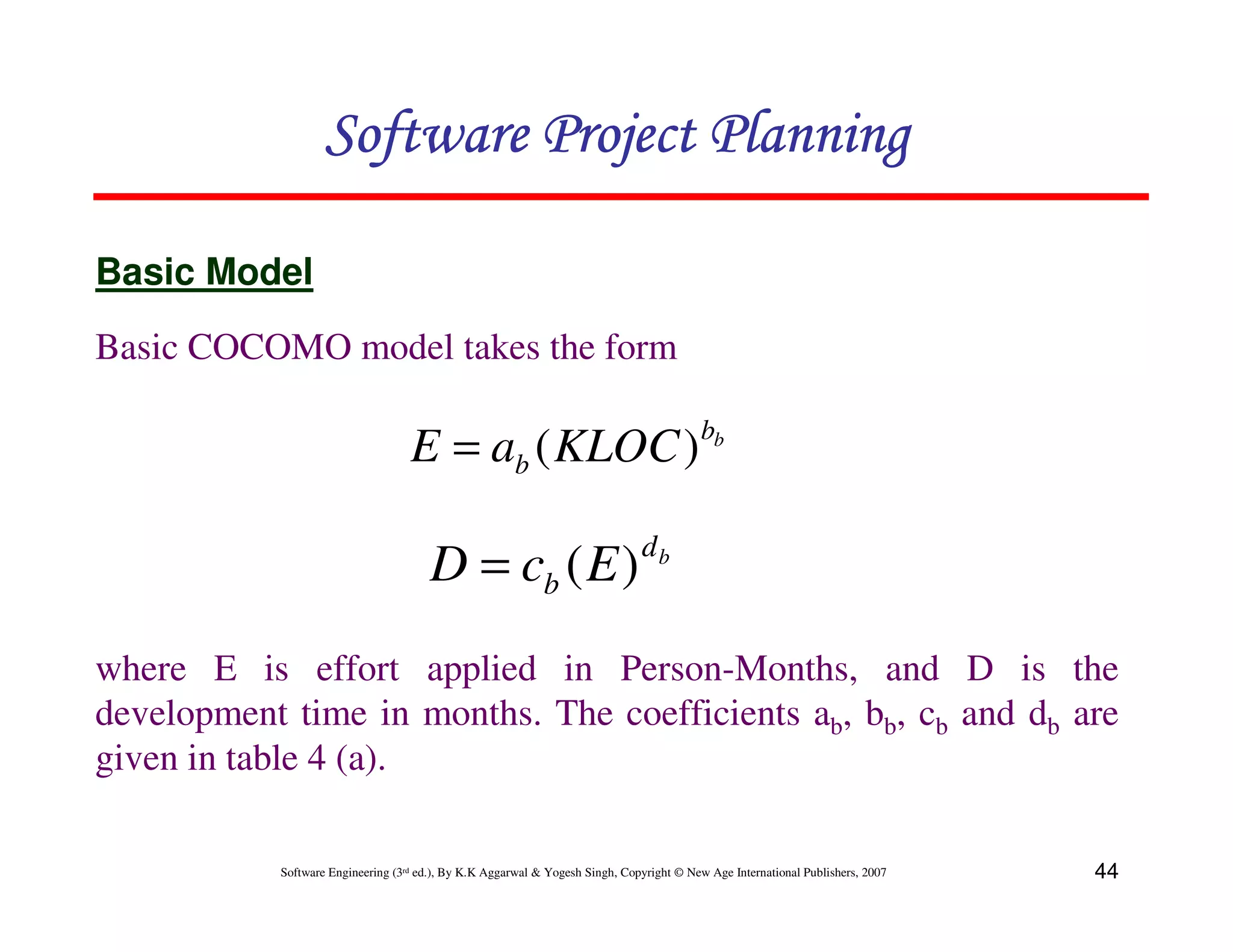
Basic COCOMO model takes the form

                                                                                          bb
                                   E = ab ( KLOC )
                                                                              db
                                       D = cb ( E )
where E is effort applied in Person-Months, and D is the
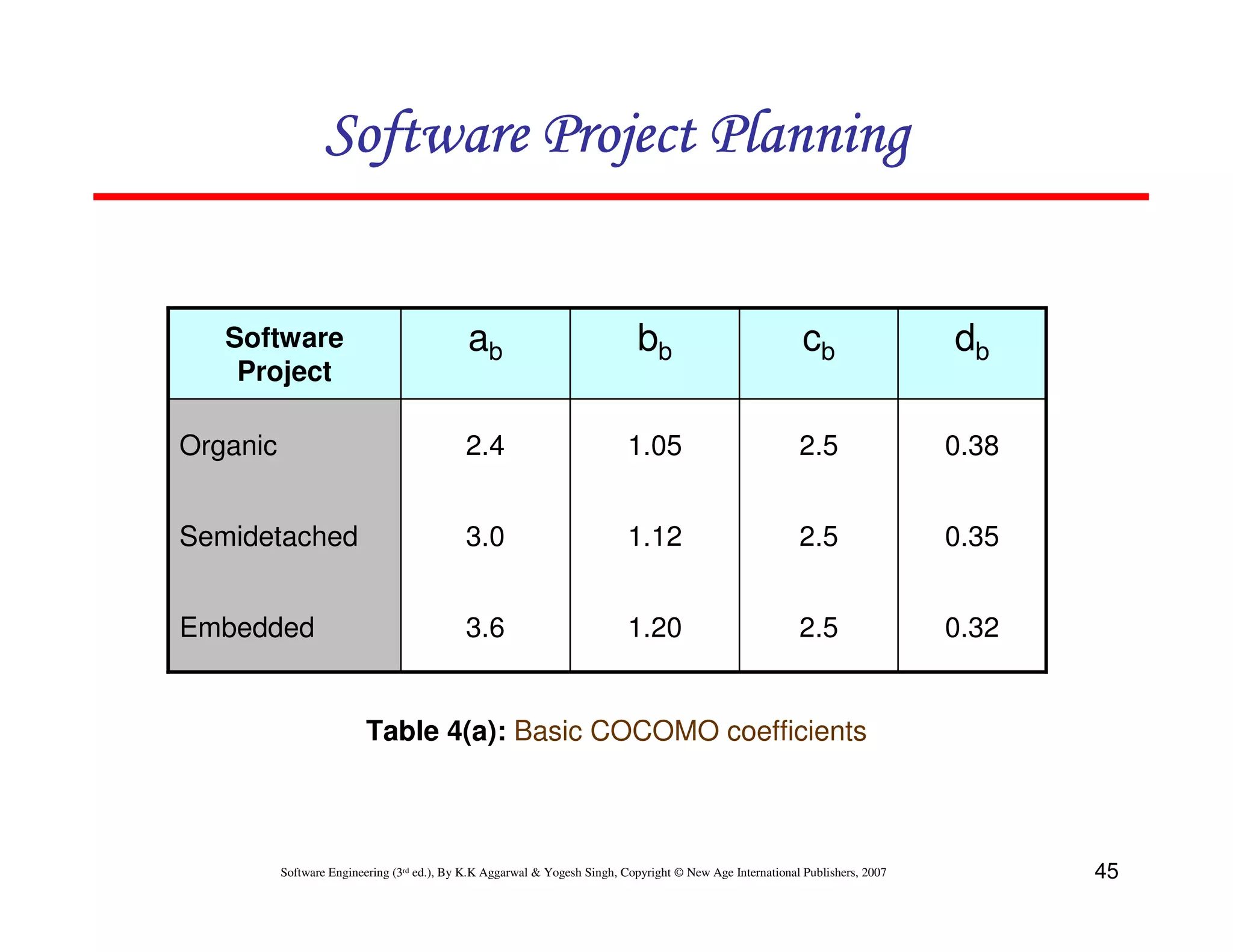
development time in months. The coefficients ab, bb, cb and db are
given in table 4 (a).

           Software Engineering (3rd ed.), By K.K Aggarwal & Yogesh Singh, Copyright © New Age International Publishers, 2007   44
Software Project Planning


   Software                                  ab                              bb                             cb                 db
    Project

Organic                                     2.4                            1.05                            2.5                 0.38


Semidetached                                3.0                            1.12                            2.5                 0.35


Embedded                                    3.6                            1.20                            2.5                 0.32


                          Table 4(a): Basic COCOMO coefficients


          Software Engineering (3rd ed.), By K.K Aggarwal & Yogesh Singh, Copyright © New Age International Publishers, 2007          45
Software Project Planning

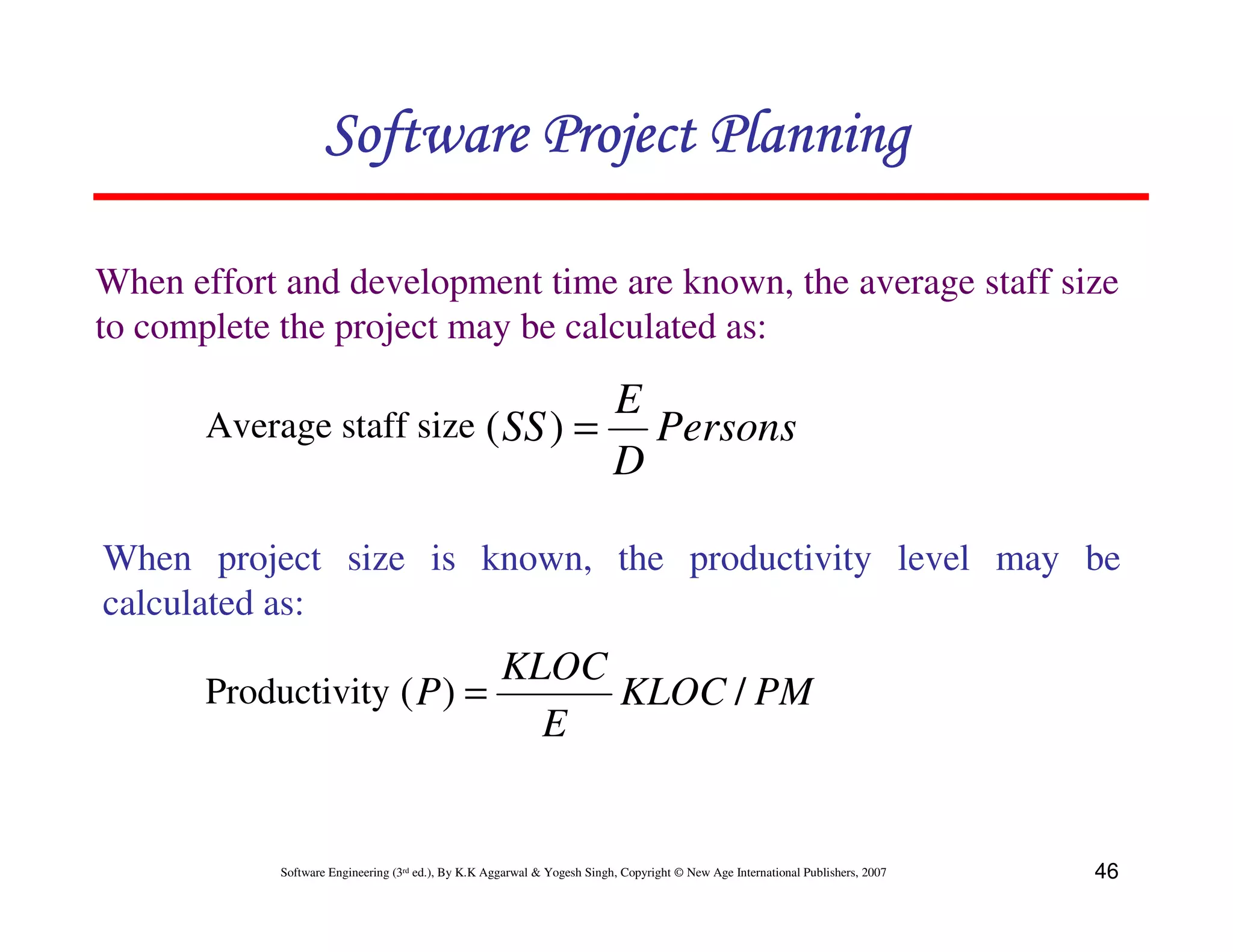
When effort and development time are known, the average staff size
to complete the project may be calculated as:

                                   E
       Average staff size ( SS ) =   Persons
                                   D

When project size is known, the productivity level may be
calculated as:
                            KLOC
       Productivity ( P ) =      KLOC / PM
                              E


           Software Engineering (3rd ed.), By K.K Aggarwal & Yogesh Singh, Copyright © New Age International Publishers, 2007   46
Software Project Planning

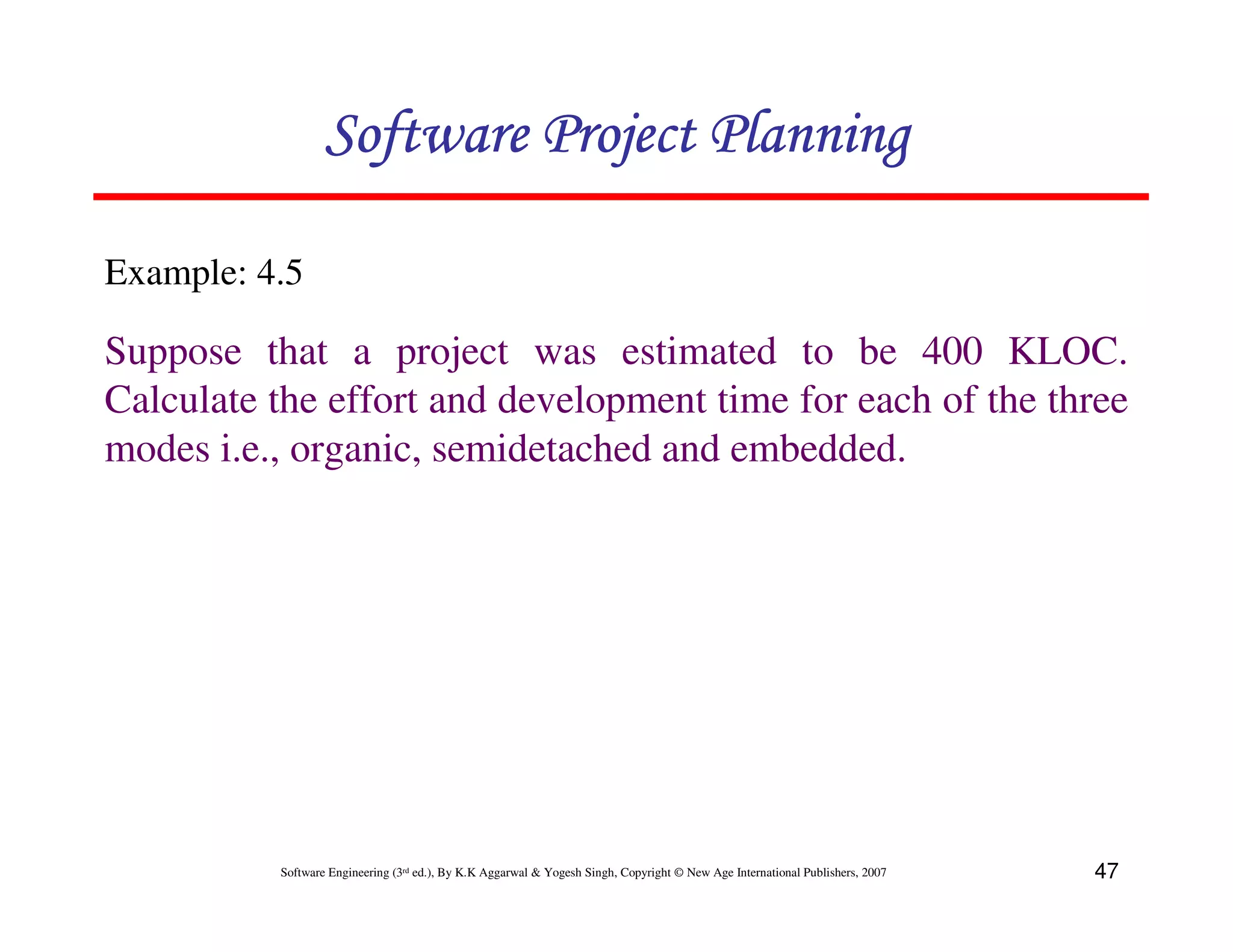
Example: 4.5

Suppose that a project was estimated to be 400 KLOC.
Calculate the effort and development time for each of the three
modes i.e., organic, semidetached and embedded.


          Software Engineering (3rd ed.), By K.K Aggarwal & Yogesh Singh, Copyright © New Age International Publishers, 2007   47
Software Project Planning
Solution
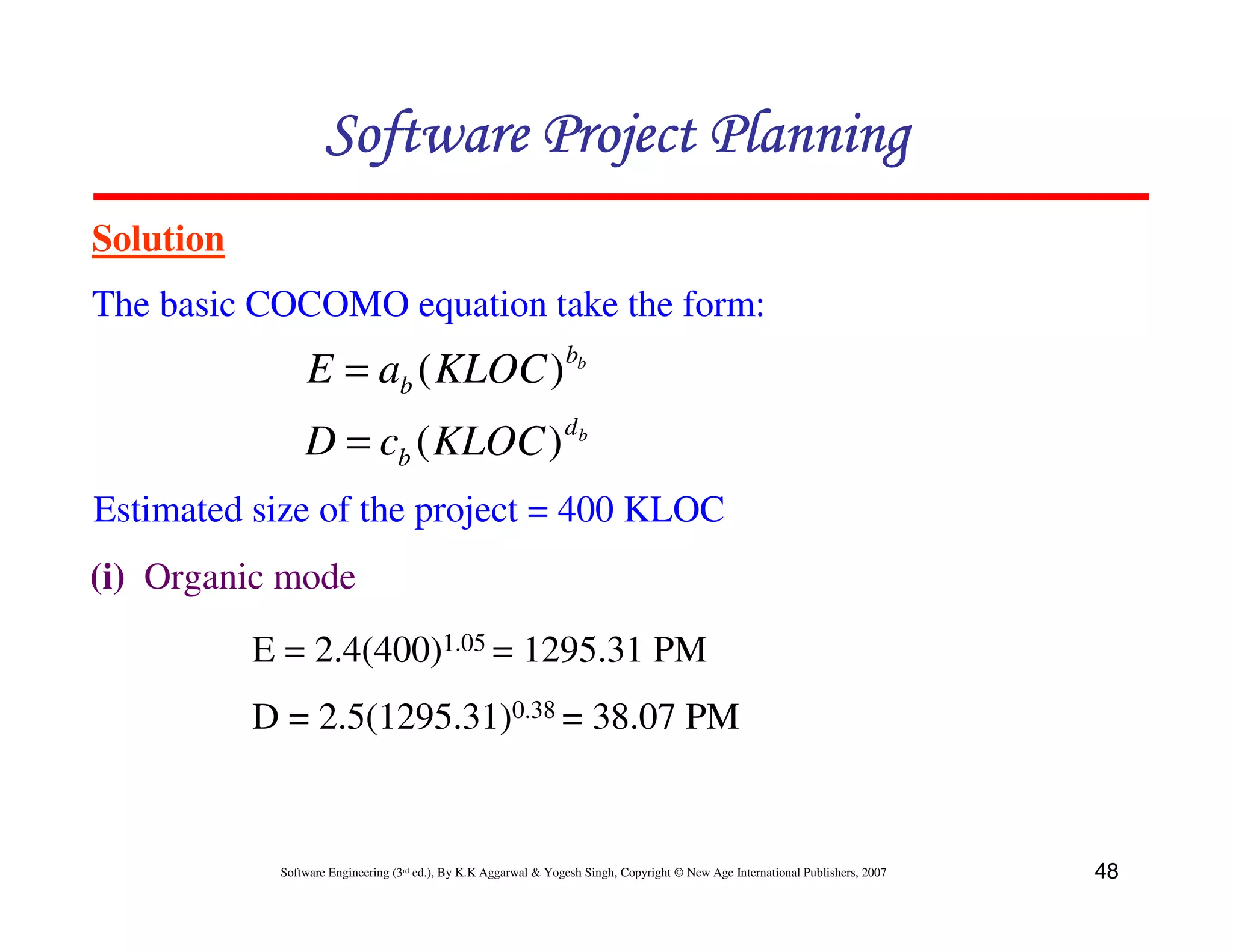
The basic COCOMO equation take the form:
                E = ab ( KLOC ) bb
                                                                 db
                D = cb ( KLOC )
Estimated size of the project = 400 KLOC
(i) Organic mode
           E = 2.4(400)1.05 = 1295.31 PM
           D = 2.5(1295.31)0.38 = 38.07 PM


            Software Engineering (3rd ed.), By K.K Aggarwal & Yogesh Singh, Copyright © New Age International Publishers, 2007   48
Software Project Planning

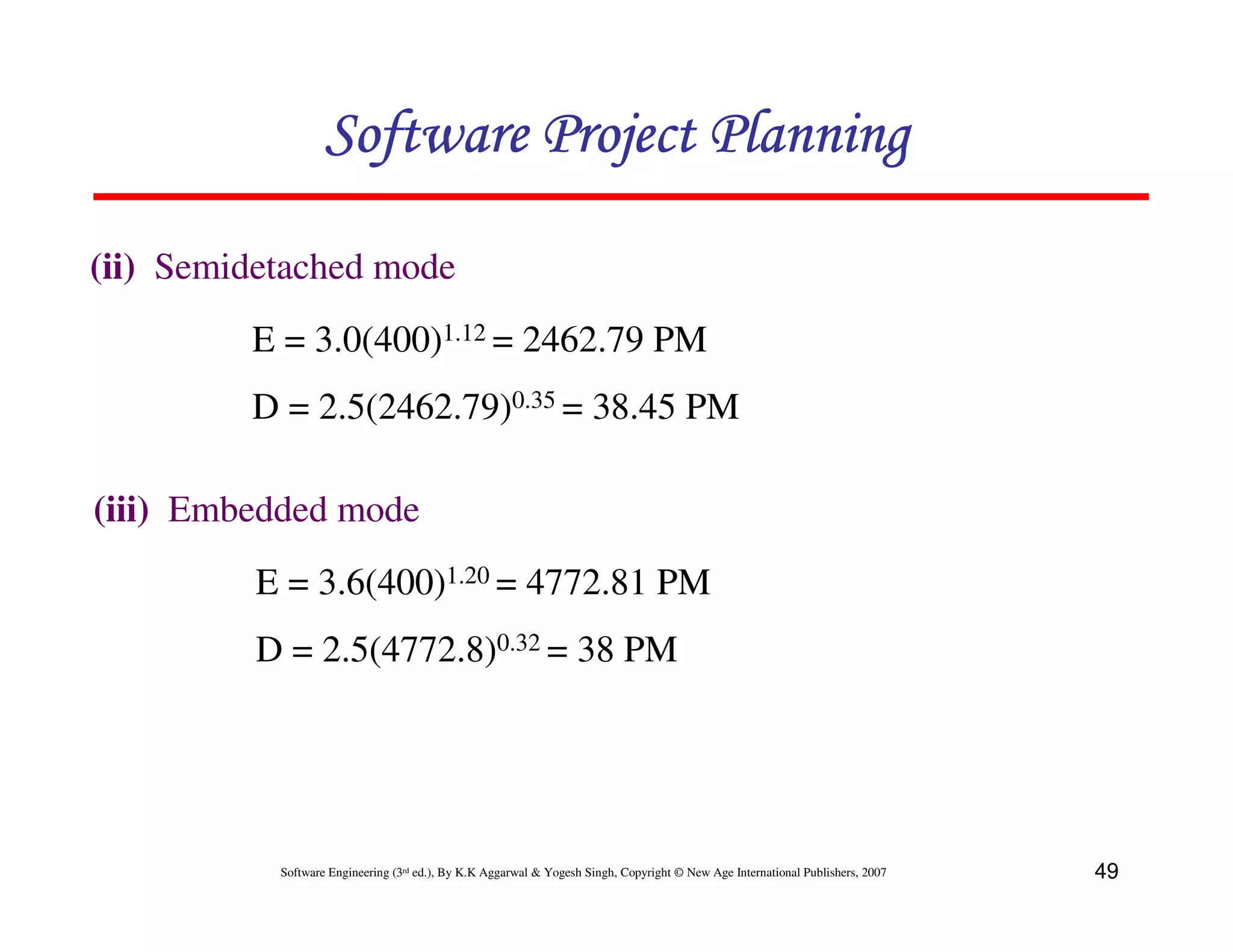
(ii) Semidetached mode
         E = 3.0(400)1.12 = 2462.79 PM
         D = 2.5(2462.79)0.35 = 38.45 PM

(iii) Embedded mode
         E = 3.6(400)1.20 = 4772.81 PM
         D = 2.5(4772.8)0.32 = 38 PM


           Software Engineering (3rd ed.), By K.K Aggarwal & Yogesh Singh, Copyright © New Age International Publishers, 2007   49
Software Project Planning

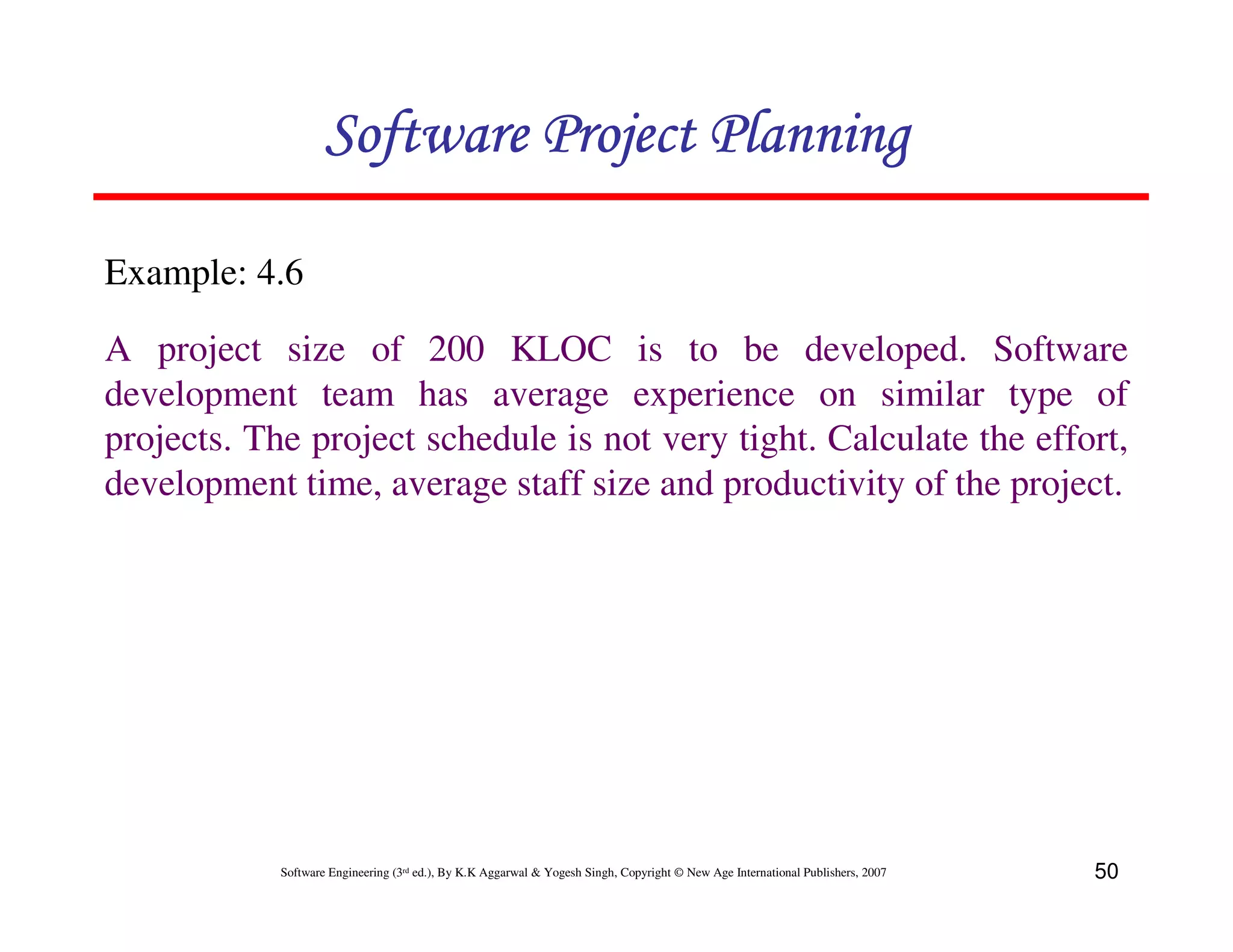
Example: 4.6

A project size of 200 KLOC is to be developed. Software
development team has average experience on similar type of
projects. The project schedule is not very tight. Calculate the effort,
development time, average staff size and productivity of the project.


            Software Engineering (3rd ed.), By K.K Aggarwal & Yogesh Singh, Copyright © New Age International Publishers, 2007   50
Software Project Planning
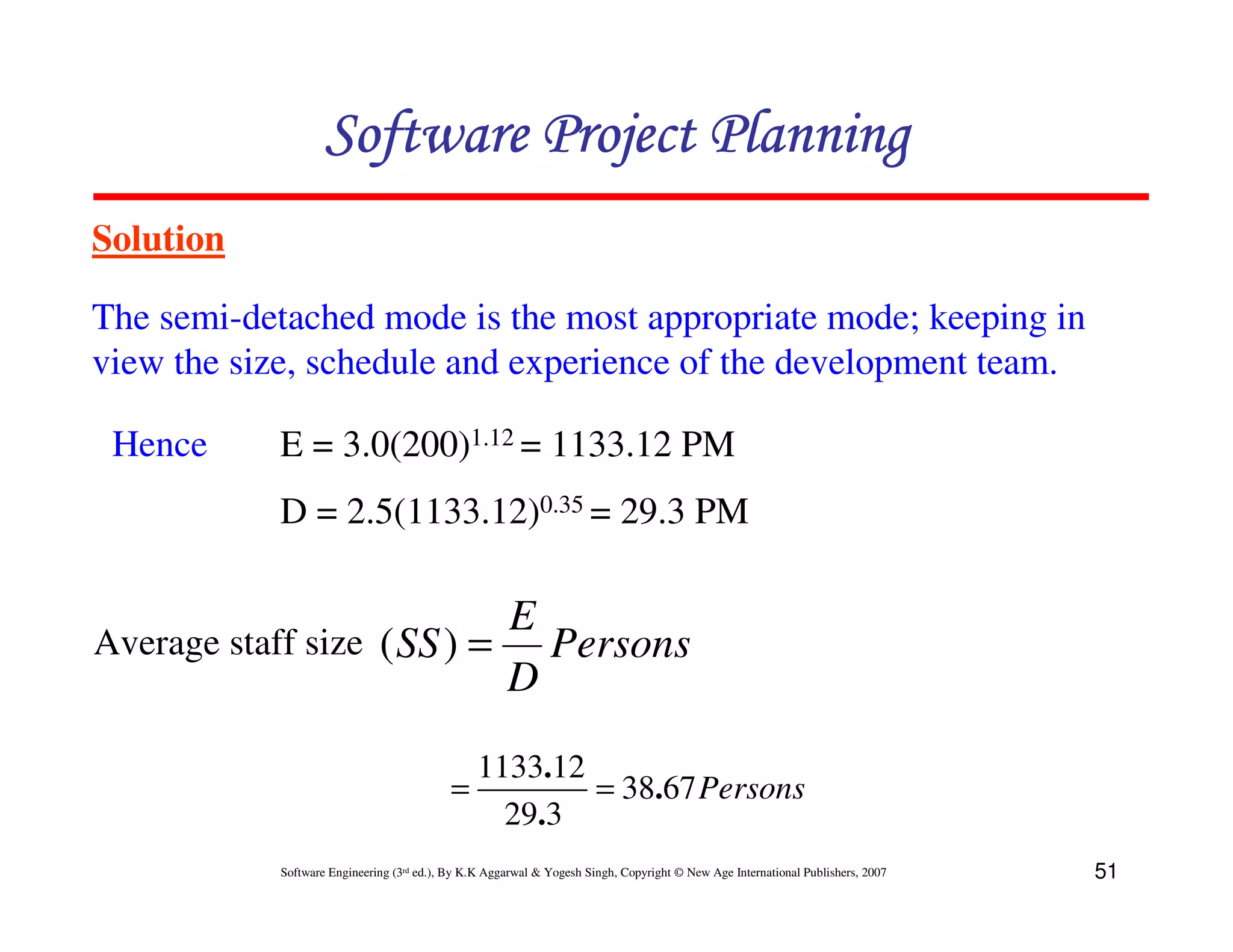
Solution

The semi-detached mode is the most appropriate mode; keeping in
view the size, schedule and experience of the development team.

 Hence     E = 3.0(200)1.12 = 1133.12 PM
           D = 2.5(1133.12)0.35 = 29.3 PM

                            E
Average staff size ( SS ) =   Persons
                            D
                                             1133.12
                                           =         = 38.67 Persons
                                               29.3
           Software Engineering (3rd ed.), By K.K Aggarwal & Yogesh Singh, Copyright © New Age International Publishers, 2007   51
Software Project Planning


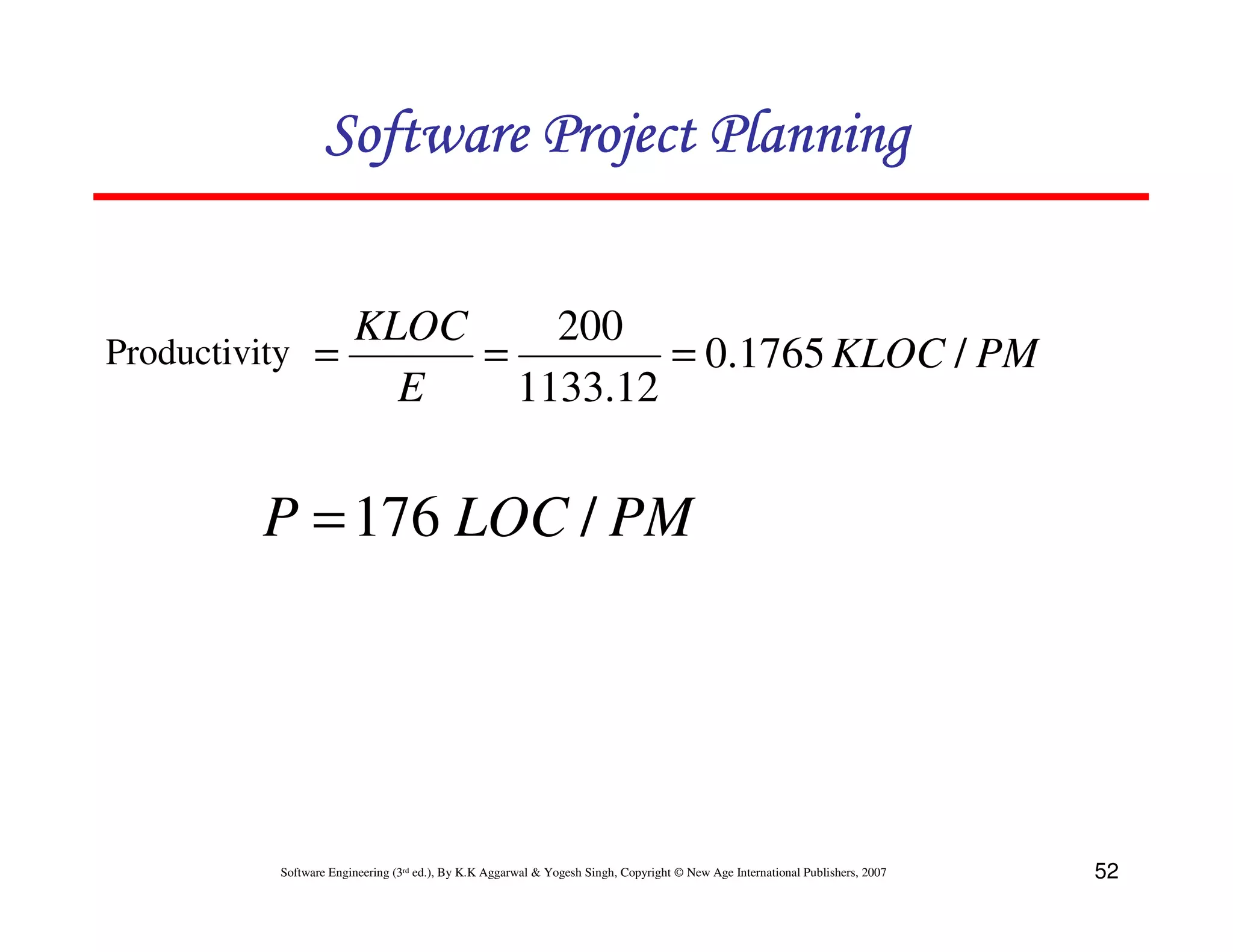
               KLOC     200
Productivity =      =         = 0.1765 KLOC / PM
                 E    1133.12


        P = 176 LOC / PM


        Software Engineering (3rd ed.), By K.K Aggarwal & Yogesh Singh, Copyright © New Age International Publishers, 2007   52
Software Project Planning
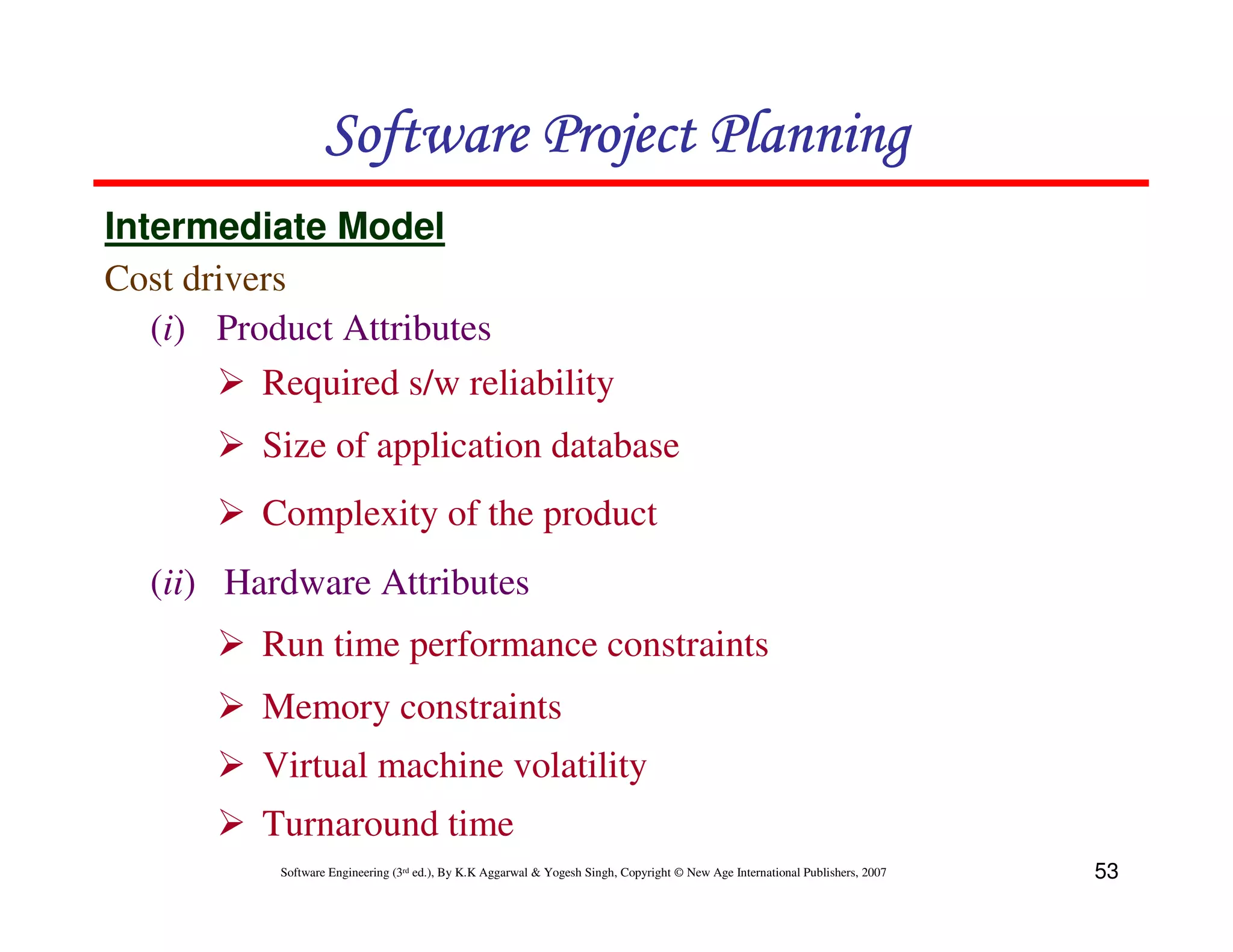
Intermediate Model
Cost drivers
   (i) Product Attributes
          Required s/w reliability
          Size of application database
          Complexity of the product
   (ii) Hardware Attributes
          Run time performance constraints
          Memory constraints
          Virtual machine volatility
          Turnaround time
           Software Engineering (3rd ed.), By K.K Aggarwal & Yogesh Singh, Copyright © New Age International Publishers, 2007   53
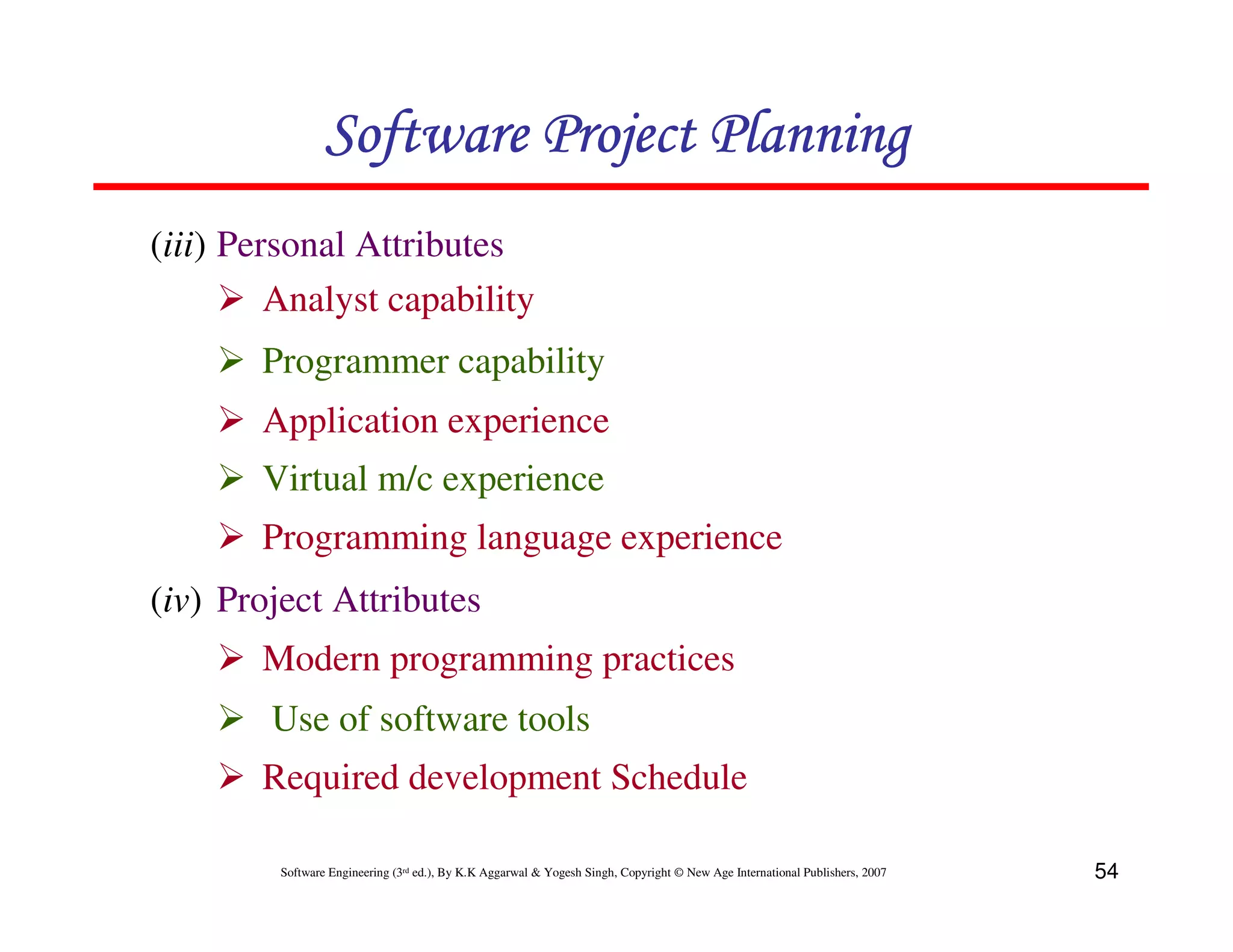
Software Project Planning
(iii) Personal Attributes
         Analyst capability
       Programmer capability
       Application experience
       Virtual m/c experience
       Programming language experience
(iv) Project Attributes
       Modern programming practices
        Use of software tools
       Required development Schedule

         Software Engineering (3rd ed.), By K.K Aggarwal & Yogesh Singh, Copyright © New Age International Publishers, 2007   54
Software Project Planning
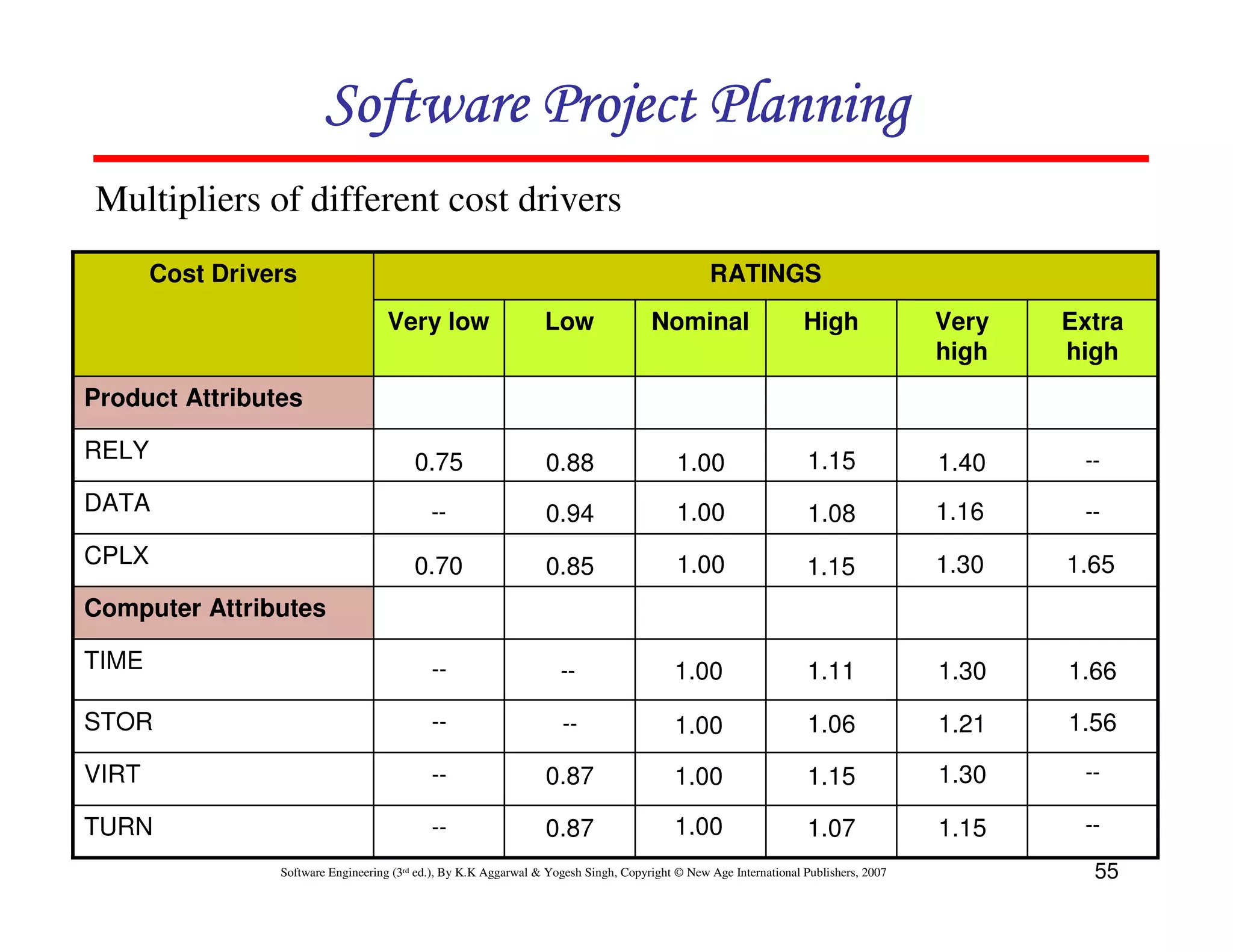
Multipliers of different cost drivers
       Cost Drivers                                                                              RATINGS
                                     Very low                     Low                 Nominal                      High               Very   Extra
                                                                                                                                      high   high
Product Attributes

RELY                                      0.75                    0.88                     1.00                     1.15              1.40    --

DATA                                         --                   0.94                     1.00                     1.08              1.16    --

CPLX                                      0.70                    0.85                     1.00                    1.15               1.30   1.65
Computer Attributes

TIME                                         --                      --                    1.00                     1.11              1.30   1.66

STOR                                         --                       --                   1.00                     1.06              1.21   1.56

VIRT                                         --                   0.87                     1.00                     1.15              1.30    --

TURN                                         --                   0.87                     1.00                     1.07              1.15    --

                 Software Engineering (3rd ed.), By K.K Aggarwal & Yogesh Singh, Copyright © New Age International Publishers, 2007            55
Software Project Planning
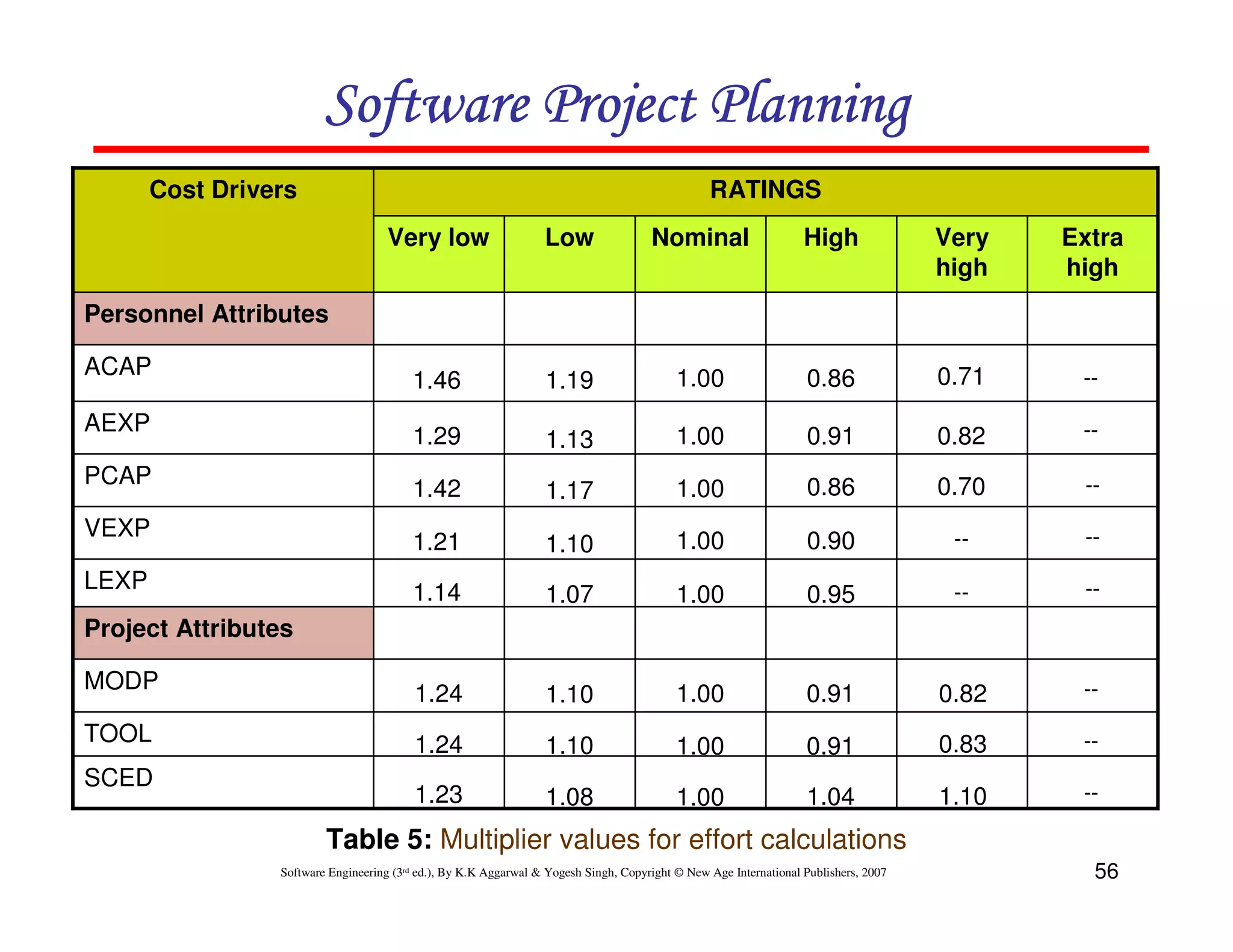
       Cost Drivers                                                                              RATINGS
                                     Very low                     Low                 Nominal                      High               Very   Extra
                                                                                                                                      high   high
Personnel Attributes

ACAP                                                                                       1.00                    0.86               0.71    --
                                         1.46                     1.19
AEXP                                                                                                                                          --
                                         1.29                     1.13                     1.00                    0.91               0.82
PCAP                                                                                                               0.86               0.70    --
                                         1.42                     1.17                     1.00
VEXP                                                                                                                                   --     --
                                         1.21                     1.10                     1.00                    0.90
LEXP                                     1.14                                                                                          --     --
                                                                  1.07                     1.00                    0.95
Project Attributes

MODP                                                                                                                                          --
                                          1.24                    1.10                     1.00                    0.91               0.82
TOOL                                      1.24                    1.10                                                                0.83    --
                                                                                           1.00                    0.91
SCED
                                          1.23                    1.08                     1.00                    1.04               1.10    --

                         Table 5: Multiplier values for effort calculations
                 Software Engineering (3rd ed.), By K.K Aggarwal & Yogesh Singh, Copyright © New Age International Publishers, 2007            56
Software Project Planning
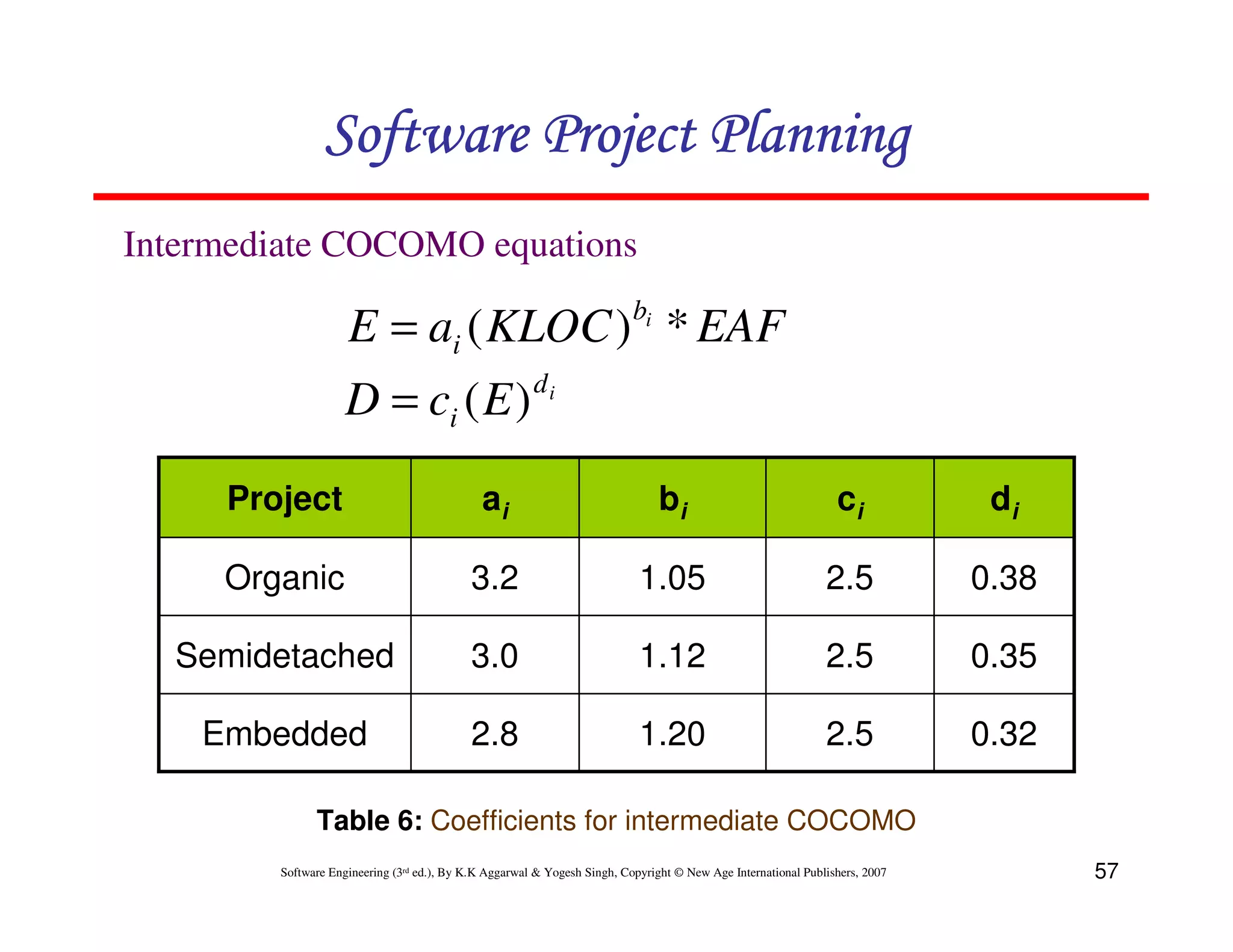
Intermediate COCOMO equations

                    E = ai ( KLOC ) bi * EAF
                    D = ci ( E ) d i
     Project                                 ai                                bi                               ci            di

     Organic                               3.2                             1.05                               2.5            0.38

  Semidetached                             3.0                             1.12                               2.5            0.35

    Embedded                               2.8                             1.20                               2.5            0.32

              Table 6: Coefficients for intermediate COCOMO
        Software Engineering (3rd ed.), By K.K Aggarwal & Yogesh Singh, Copyright © New Age International Publishers, 2007          57
Software Project Planning
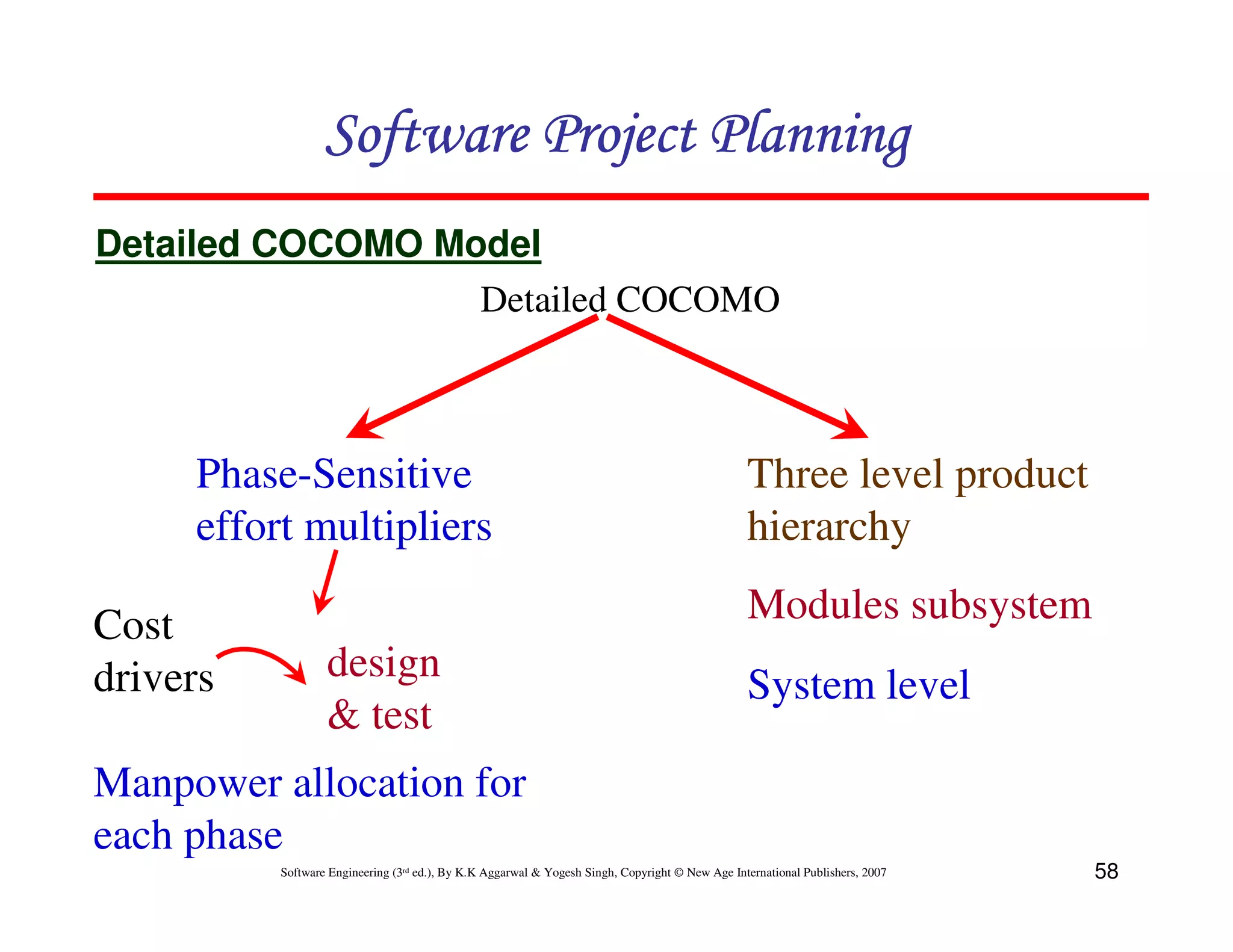
Detailed COCOMO Model
                  Detailed COCOMO


     Phase-Sensitive                                                                             Three level product
     effort multipliers                                                                          hierarchy

Cost                                                                                             Modules subsystem
drivers           design
                                                                                                 System level
                  & test
Manpower allocation for
each phase
          Software Engineering (3rd ed.), By K.K Aggarwal & Yogesh Singh, Copyright © New Age International Publishers, 2007   58
Software Project Planning

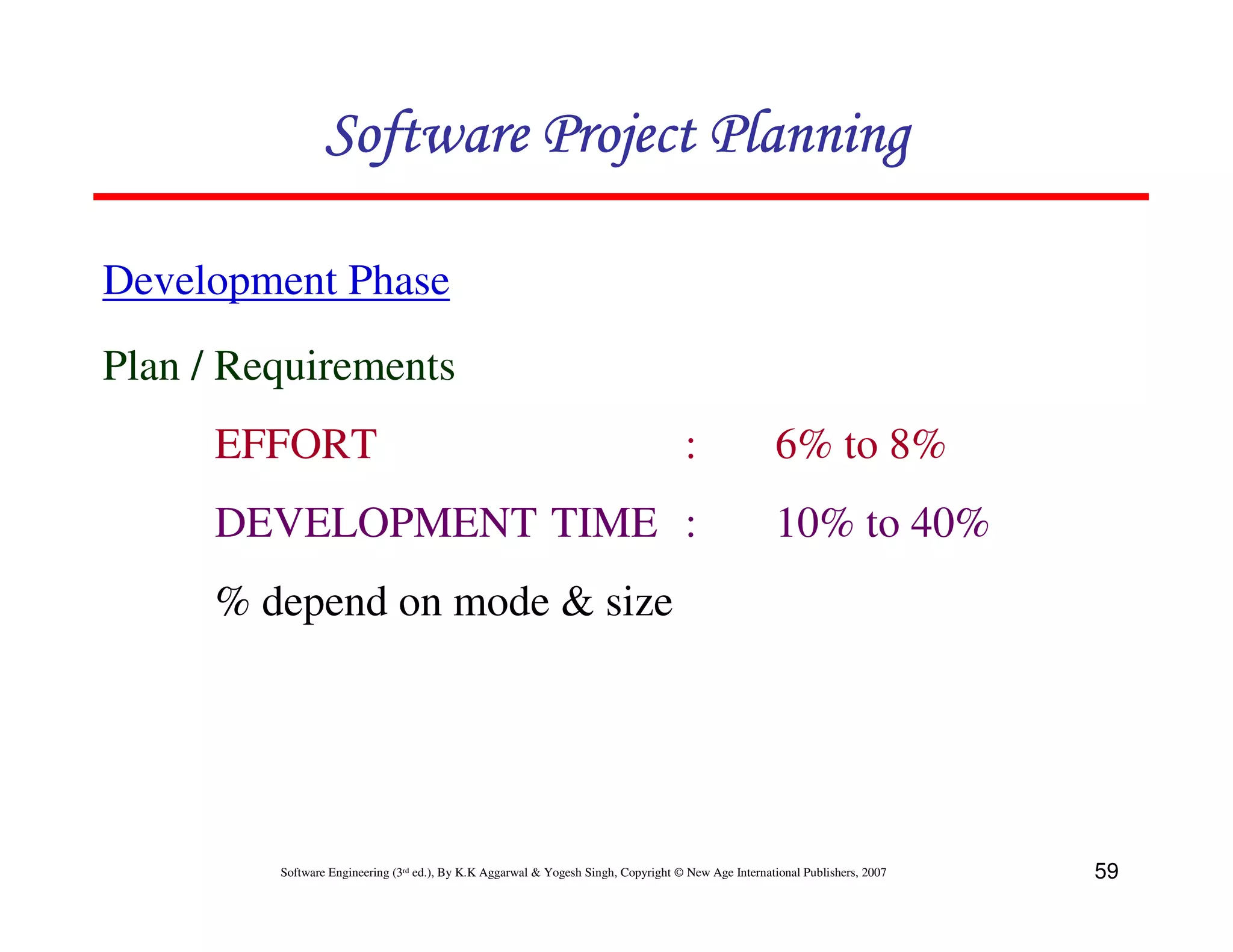
Development Phase
Plan / Requirements
      EFFORT                                                                         :                6% to 8%
      DEVELOPMENT TIME :                                                                              10% to 40%
      % depend on mode & size


         Software Engineering (3rd ed.), By K.K Aggarwal & Yogesh Singh, Copyright © New Age International Publishers, 2007   59
Software Project Planning

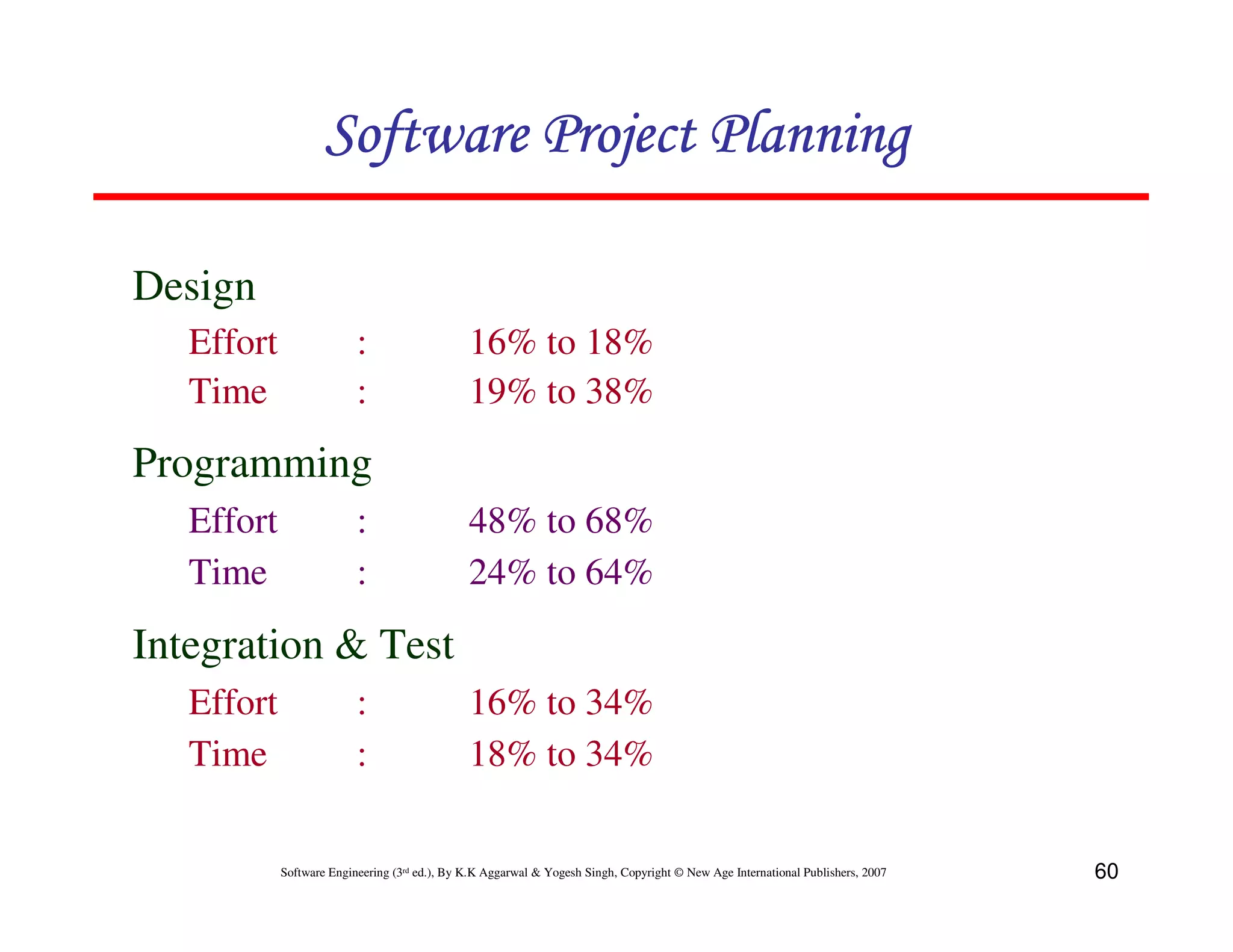
Design
   Effort                 :                    16% to 18%
   Time                   :                    19% to 38%
Programming
   Effort                 :                    48% to 68%
   Time                   :                    24% to 64%
Integration & Test
   Effort                 :                    16% to 34%
   Time                   :                    18% to 34%

            Software Engineering (3rd ed.), By K.K Aggarwal & Yogesh Singh, Copyright © New Age International Publishers, 2007   60
Software Project Planning
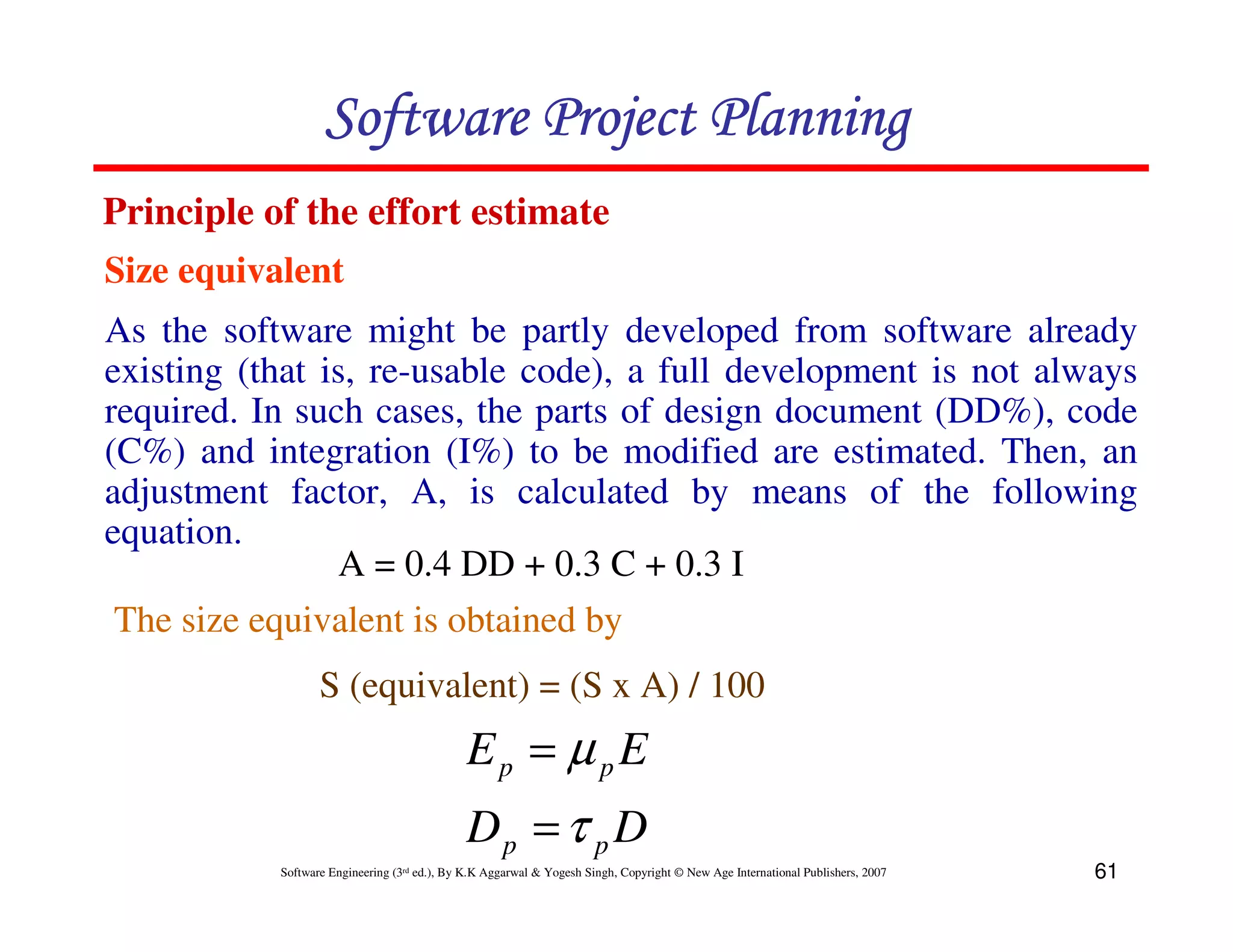
Principle of the effort estimate
Size equivalent
As the software might be partly developed from software already
existing (that is, re-usable code), a full development is not always
required. In such cases, the parts of design document (DD%), code
(C%) and integration (I%) to be modified are estimated. Then, an
adjustment factor, A, is calculated by means of the following
equation.
                 A = 0.4 DD + 0.3 C + 0.3 I
 The size equivalent is obtained by
                  S (equivalent) = (S x A) / 100
                                             Ep = µ pE
                                             Dp = τ p D
           Software Engineering (3rd ed.), By K.K Aggarwal & Yogesh Singh, Copyright © New Age International Publishers, 2007   61
Software Project Planning
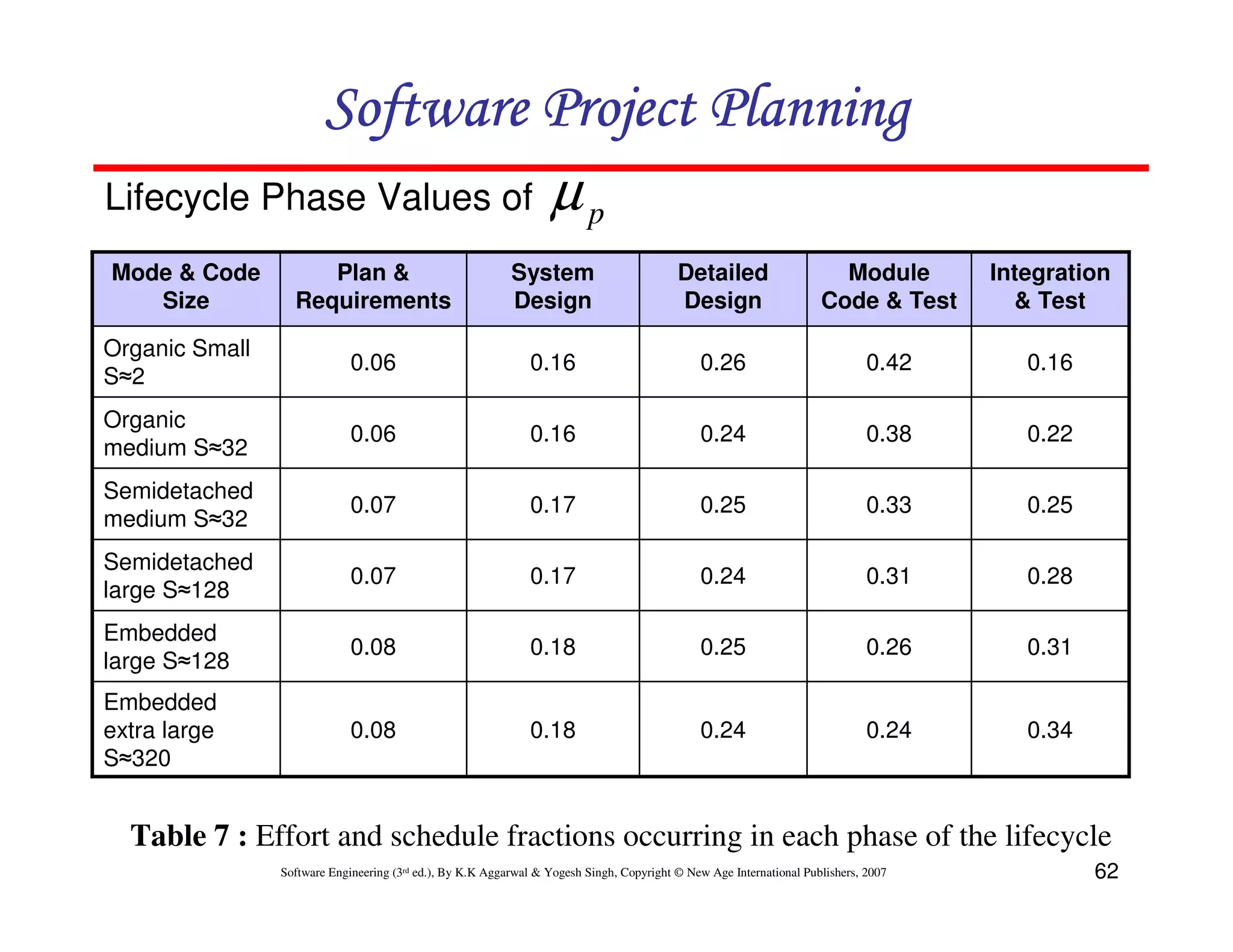
Lifecycle Phase Values of                                         µp
Mode & Code          Plan &                                System                         Detailed                     Module        Integration
   Size           Requirements                             Design                         Design                     Code & Test       & Test

Organic Small
                             0.06                             0.16                            0.26                            0.42      0.16
S≈2
Organic
                             0.06                             0.16                            0.24                            0.38      0.22
medium S≈32
Semidetached
                             0.07                             0.17                            0.25                            0.33      0.25
medium S≈32
Semidetached
                             0.07                             0.17                            0.24                            0.31      0.28
large S≈128
Embedded
                             0.08                             0.18                            0.25                            0.26      0.31
large S≈128
Embedded
extra large                  0.08                             0.18                            0.24                            0.24      0.34
S≈320


  Table 7 : Effort and schedule fractions occurring in each phase of the lifecycle
                Software Engineering (3rd ed.), By K.K Aggarwal & Yogesh Singh, Copyright © New Age International Publishers, 2007             62
Software Project Planning
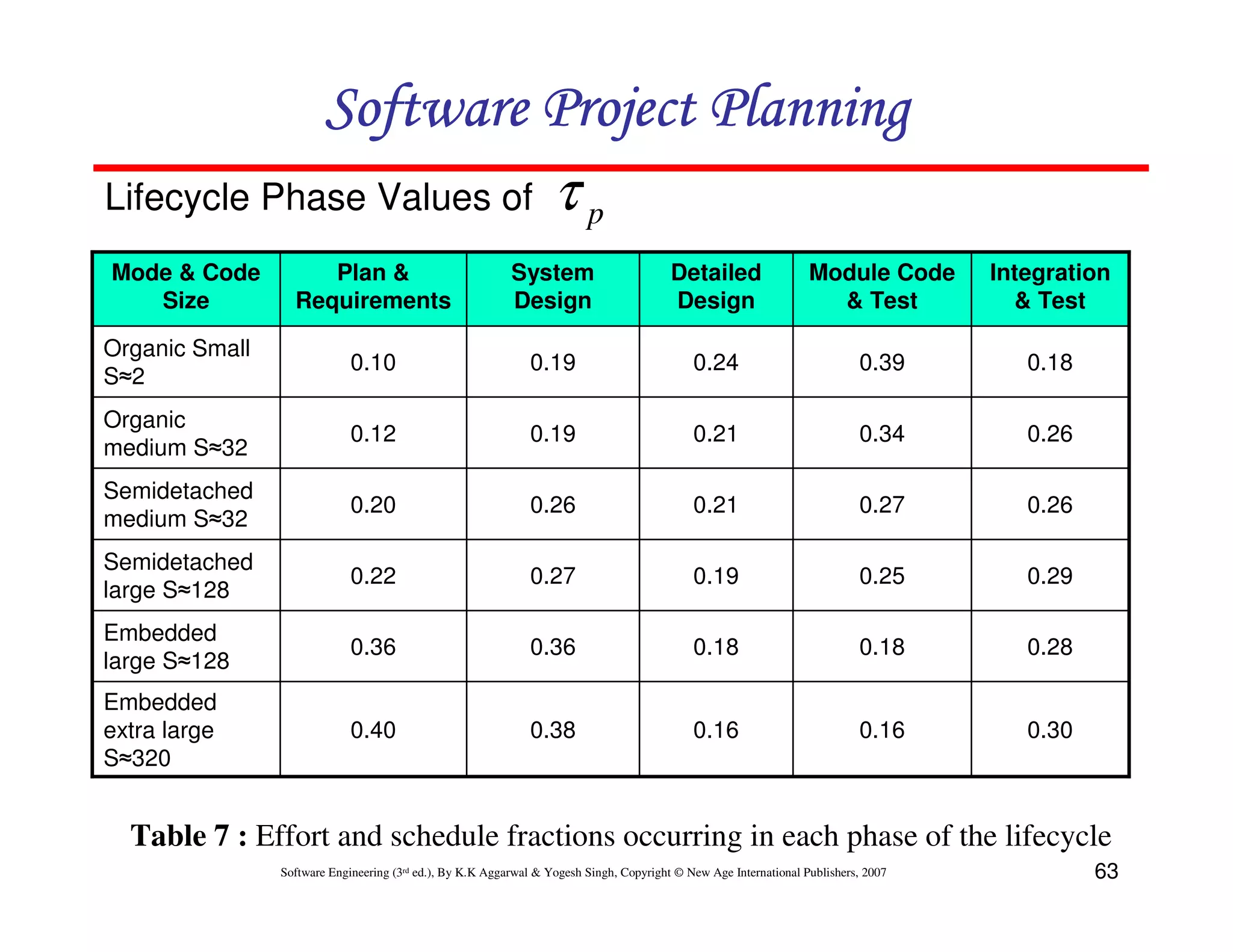
Lifecycle Phase Values of                                          τp
Mode & Code          Plan &                                System                        Detailed                  Module Code       Integration
   Size           Requirements                             Design                        Design                      & Test            & Test

Organic Small
                             0.10                             0.19                           0.24                           0.39        0.18
S≈2
Organic
                             0.12                             0.19                           0.21                           0.34        0.26
medium S≈32
Semidetached
                             0.20                             0.26                           0.21                           0.27        0.26
medium S≈32
Semidetached
                             0.22                             0.27                           0.19                           0.25        0.29
large S≈128
Embedded
                             0.36                             0.36                           0.18                           0.18        0.28
large S≈128
Embedded
extra large                  0.40                             0.38                           0.16                           0.16        0.30
S≈320


  Table 7 : Effort and schedule fractions occurring in each phase of the lifecycle
                Software Engineering (3rd ed.), By K.K Aggarwal & Yogesh Singh, Copyright © New Age International Publishers, 2007             63
Software Project Planning
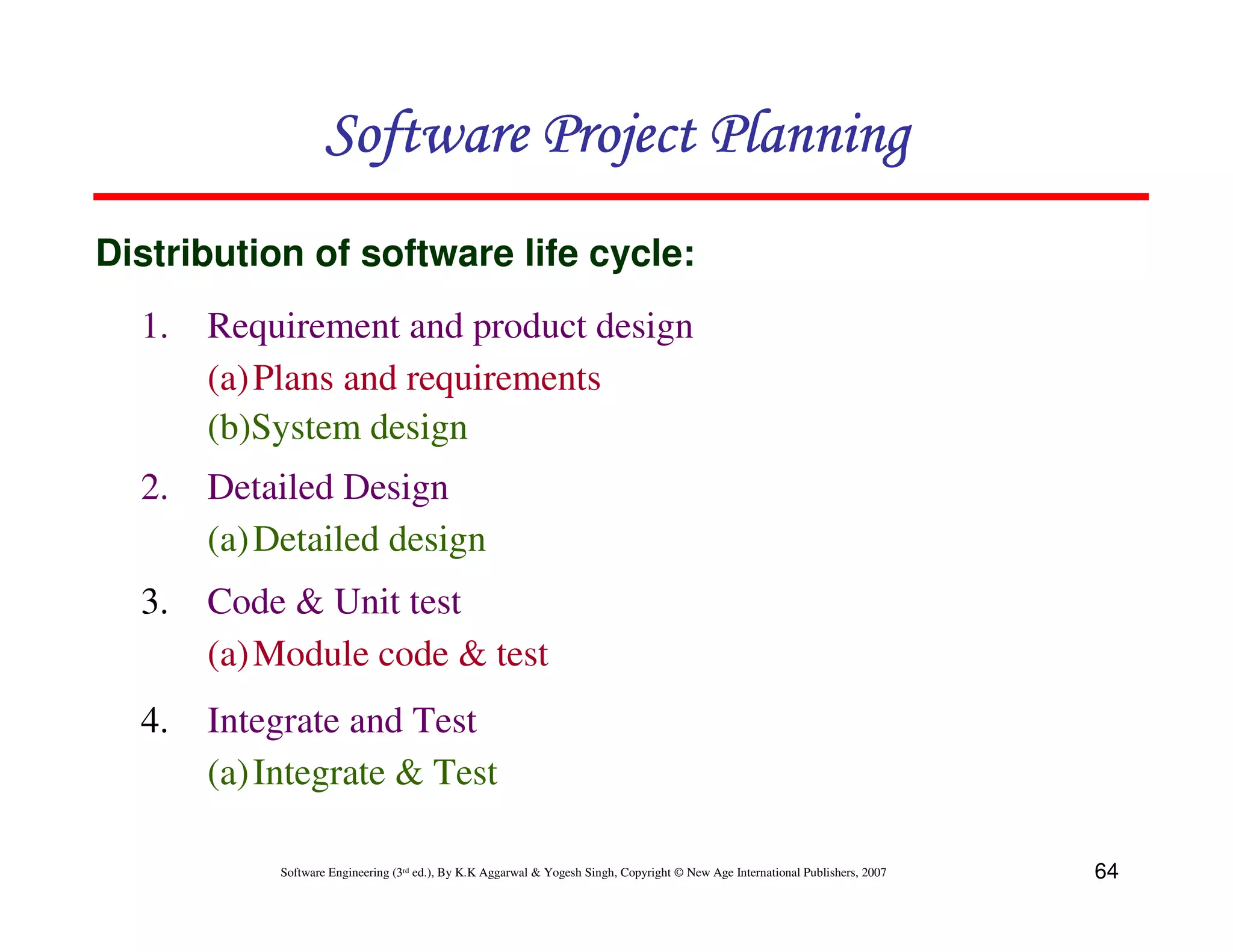
Distribution of software life cycle:
  1.   Requirement and product design
       (a) Plans and requirements
       (b)System design
  2.   Detailed Design
       (a) Detailed design
  3.   Code & Unit test
       (a) Module code & test
  4.   Integrate and Test
       (a) Integrate & Test

            Software Engineering (3rd ed.), By K.K Aggarwal & Yogesh Singh, Copyright © New Age International Publishers, 2007   64
Software Project Planning
Example: 4.7
A new project with estimated 400 KLOC embedded system has to be
developed. Project manager has a choice of hiring from two pools of
developers: Very highly capable with very little experience in the
programming language being used
Or
Developers of low quality but a lot of experience with the programming
language. What is the impact of hiring all developers from one or the
other pool ?


            Software Engineering (3rd ed.), By K.K Aggarwal & Yogesh Singh, Copyright © New Age International Publishers, 2007   65
Software Project Planning
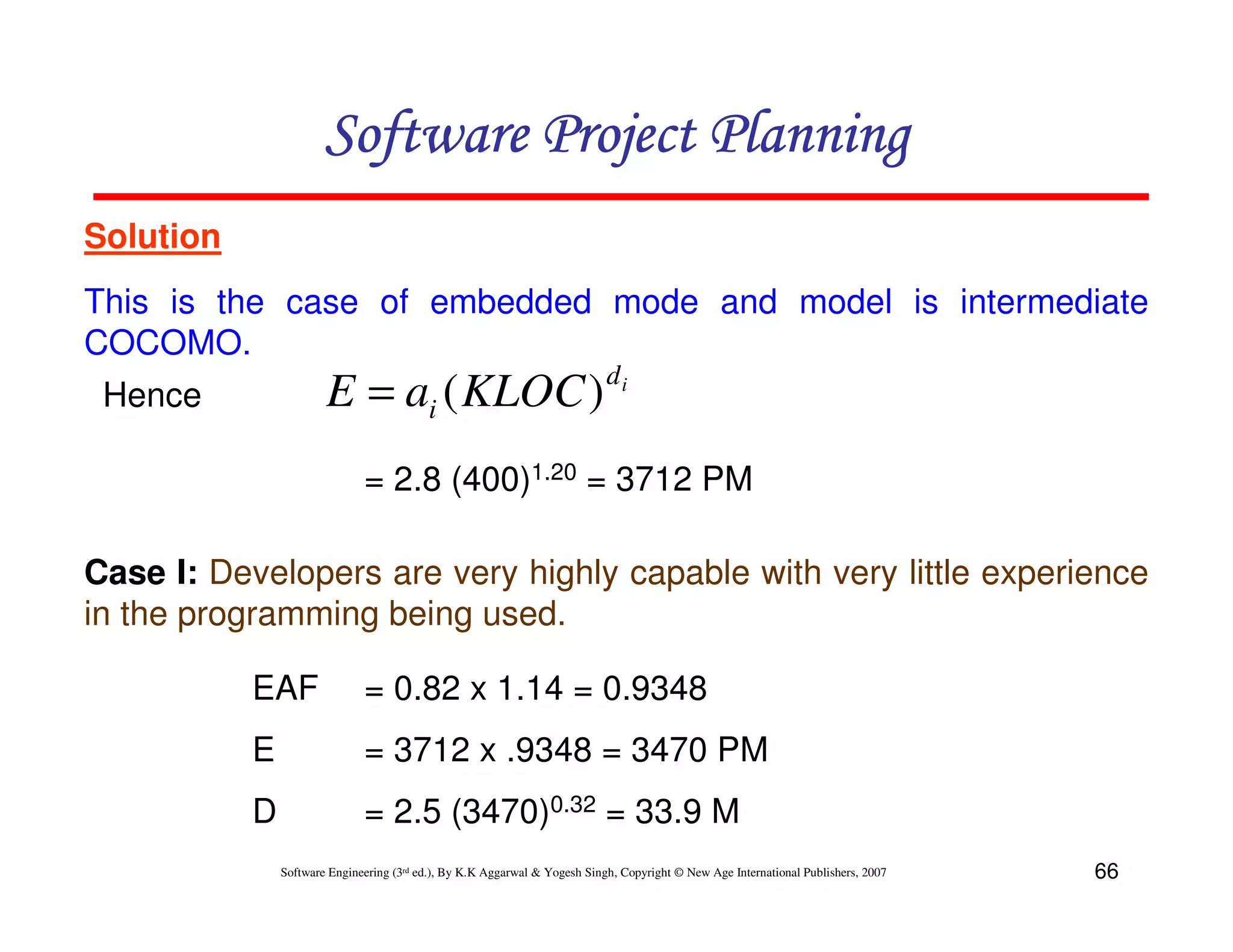
Solution
This is the case of embedded mode and model is intermediate
COCOMO.
                                                                            di
 Hence                 E = ai ( KLOC )
                              = 2.8 (400)1.20 = 3712 PM

Case I: Developers are very highly capable with very little experience
in the programming being used.

           EAF                = 0.82 x 1.14 = 0.9348
           E                  = 3712 x .9348 = 3470 PM
           D                  = 2.5 (3470)0.32 = 33.9 M
               Software Engineering (3rd ed.), By K.K Aggarwal & Yogesh Singh, Copyright © New Age International Publishers, 2007   66
Software Project Planning
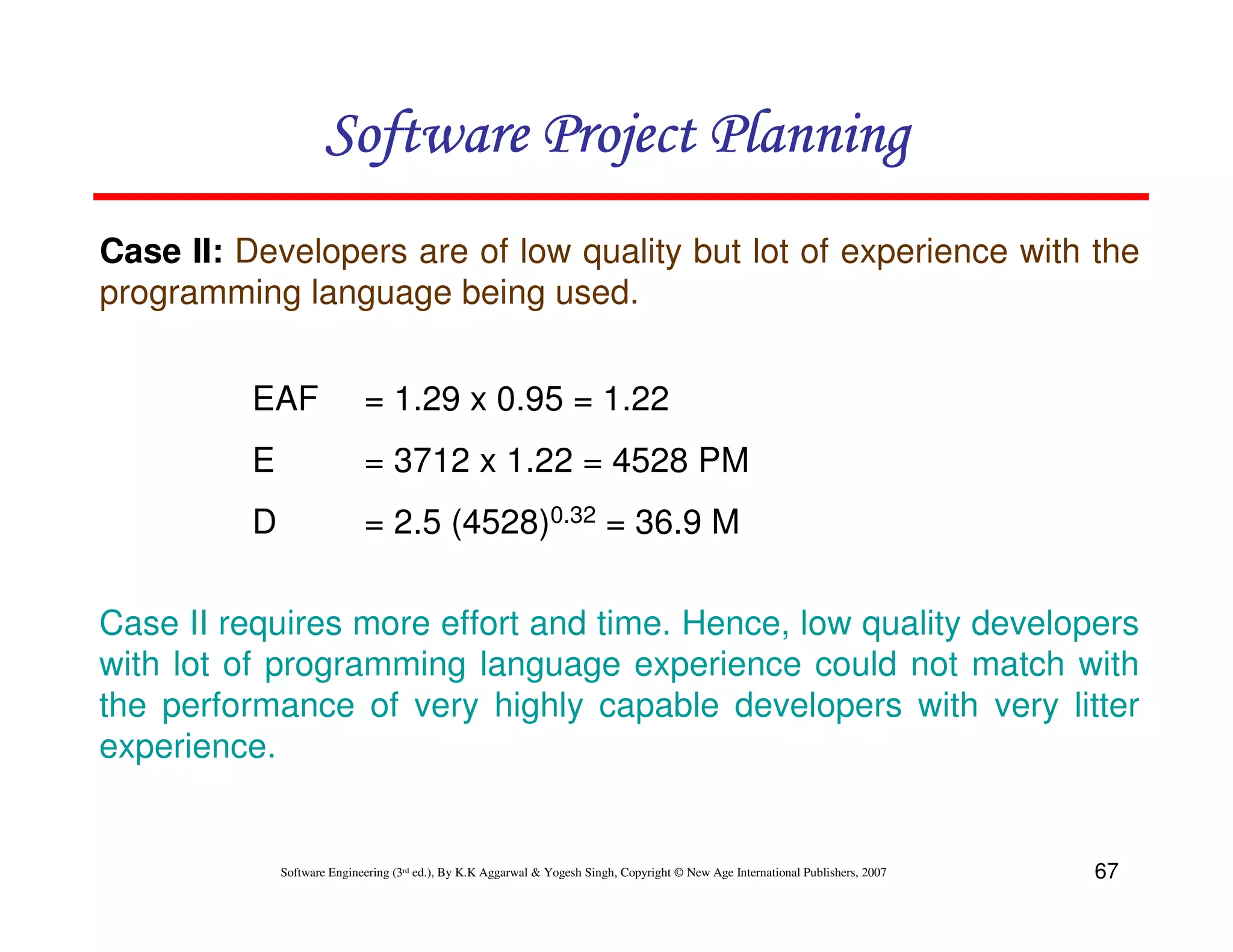
Case II: Developers are of low quality but lot of experience with the
programming language being used.


          EAF                = 1.29 x 0.95 = 1.22
          E                  = 3712 x 1.22 = 4528 PM
          D                  = 2.5 (4528)0.32 = 36.9 M

Case II requires more effort and time. Hence, low quality developers
with lot of programming language experience could not match with
the performance of very highly capable developers with very litter
experience.


              Software Engineering (3rd ed.), By K.K Aggarwal & Yogesh Singh, Copyright © New Age International Publishers, 2007   67
Software Project Planning
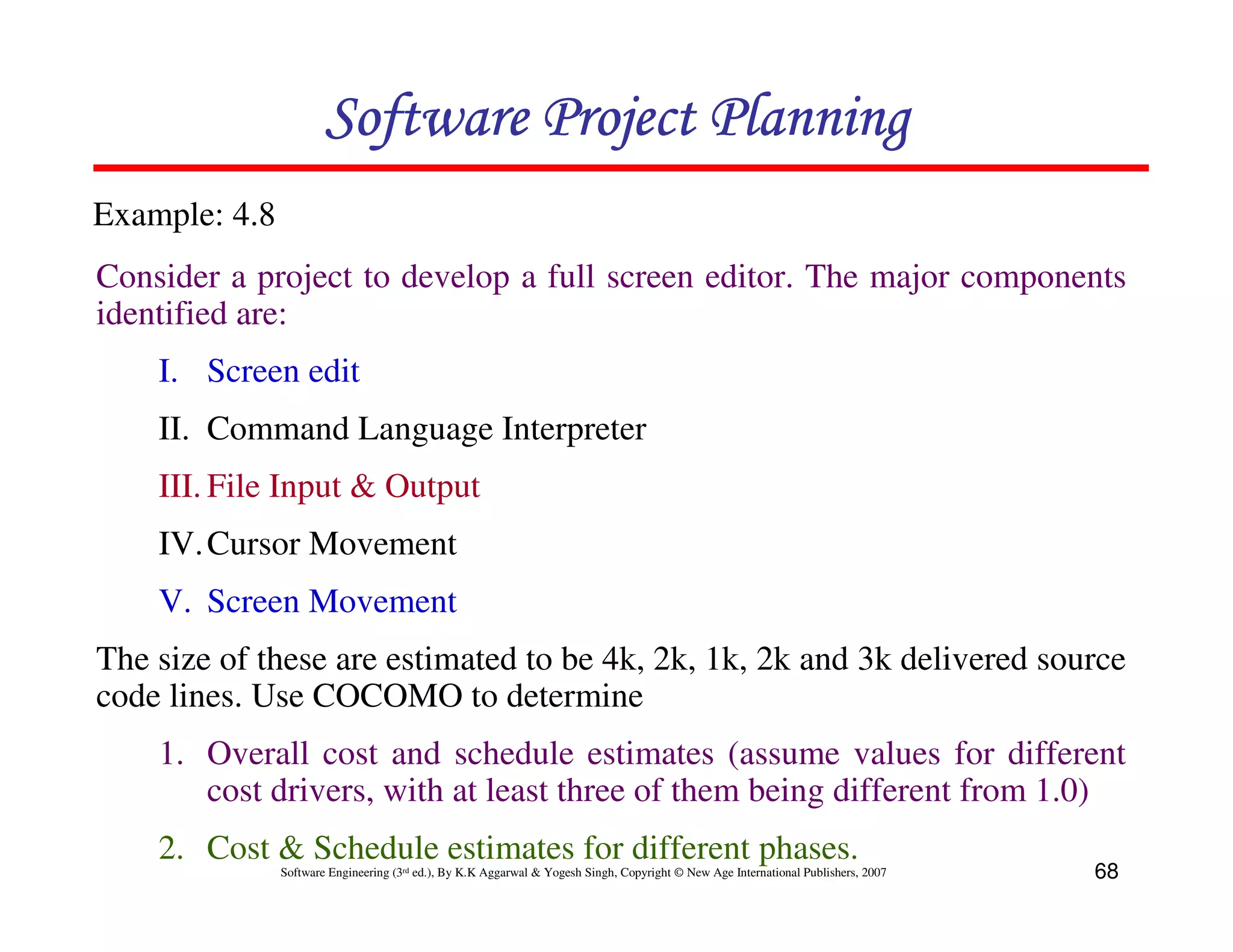
Example: 4.8
Consider a project to develop a full screen editor. The major components
identified are:
    I. Screen edit
    II. Command Language Interpreter
    III. File Input & Output
    IV. Cursor Movement
    V. Screen Movement
The size of these are estimated to be 4k, 2k, 1k, 2k and 3k delivered source
code lines. Use COCOMO to determine
    1. Overall cost and schedule estimates (assume values for different
       cost drivers, with at least three of them being different from 1.0)
    2. Cost & Schedule estimates for different phases.
               Software Engineering (3rd ed.), By K.K Aggarwal & Yogesh Singh, Copyright © New Age International Publishers, 2007   68
Software Project Planning

Solution

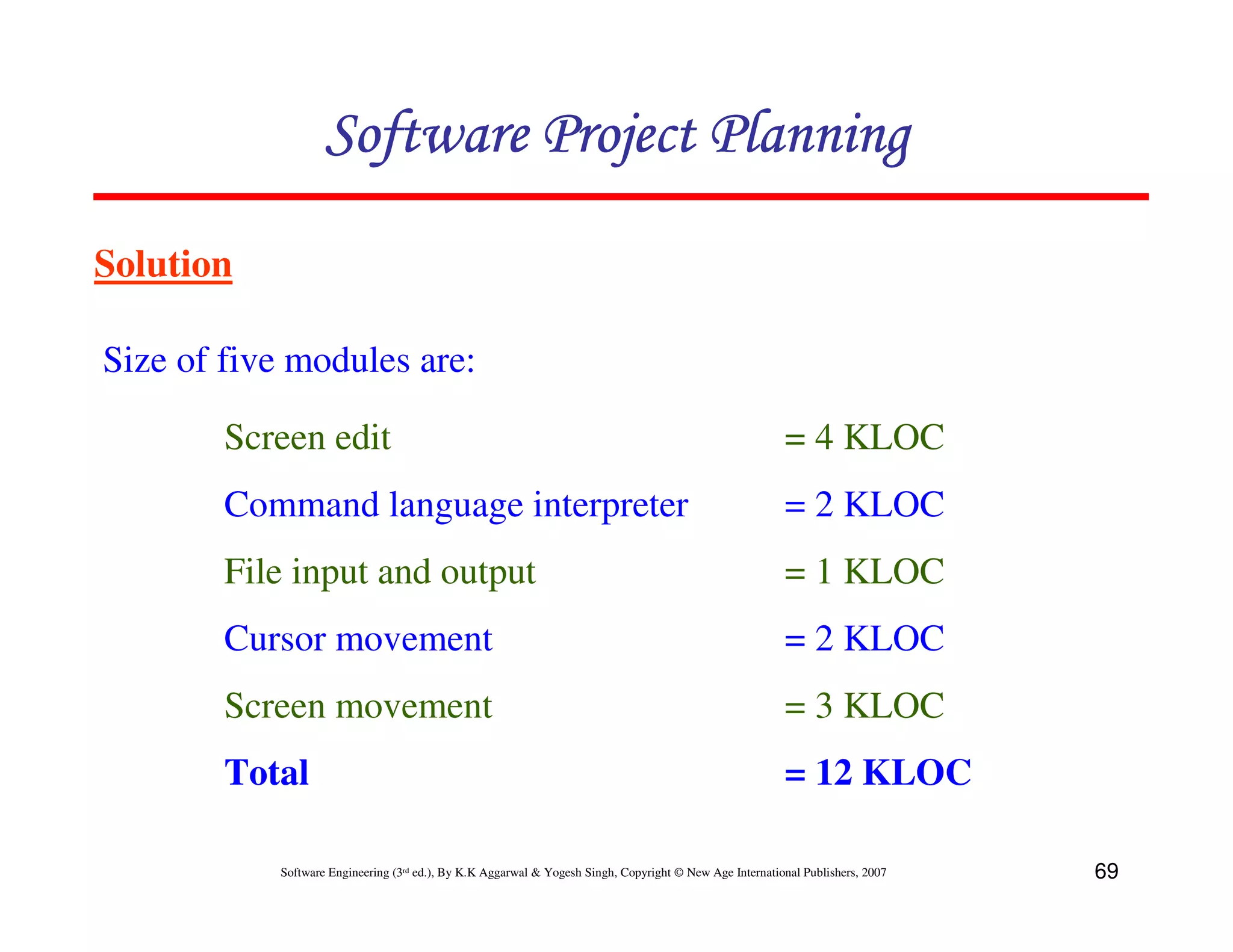
Size of five modules are:

        Screen edit                                                                                      = 4 KLOC
        Command language interpreter                                                                     = 2 KLOC
        File input and output                                                                            = 1 KLOC
        Cursor movement                                                                                  = 2 KLOC
        Screen movement                                                                                  = 3 KLOC
        Total                                                                                            = 12 KLOC

           Software Engineering (3rd ed.), By K.K Aggarwal & Yogesh Singh, Copyright © New Age International Publishers, 2007   69
Software Project Planning

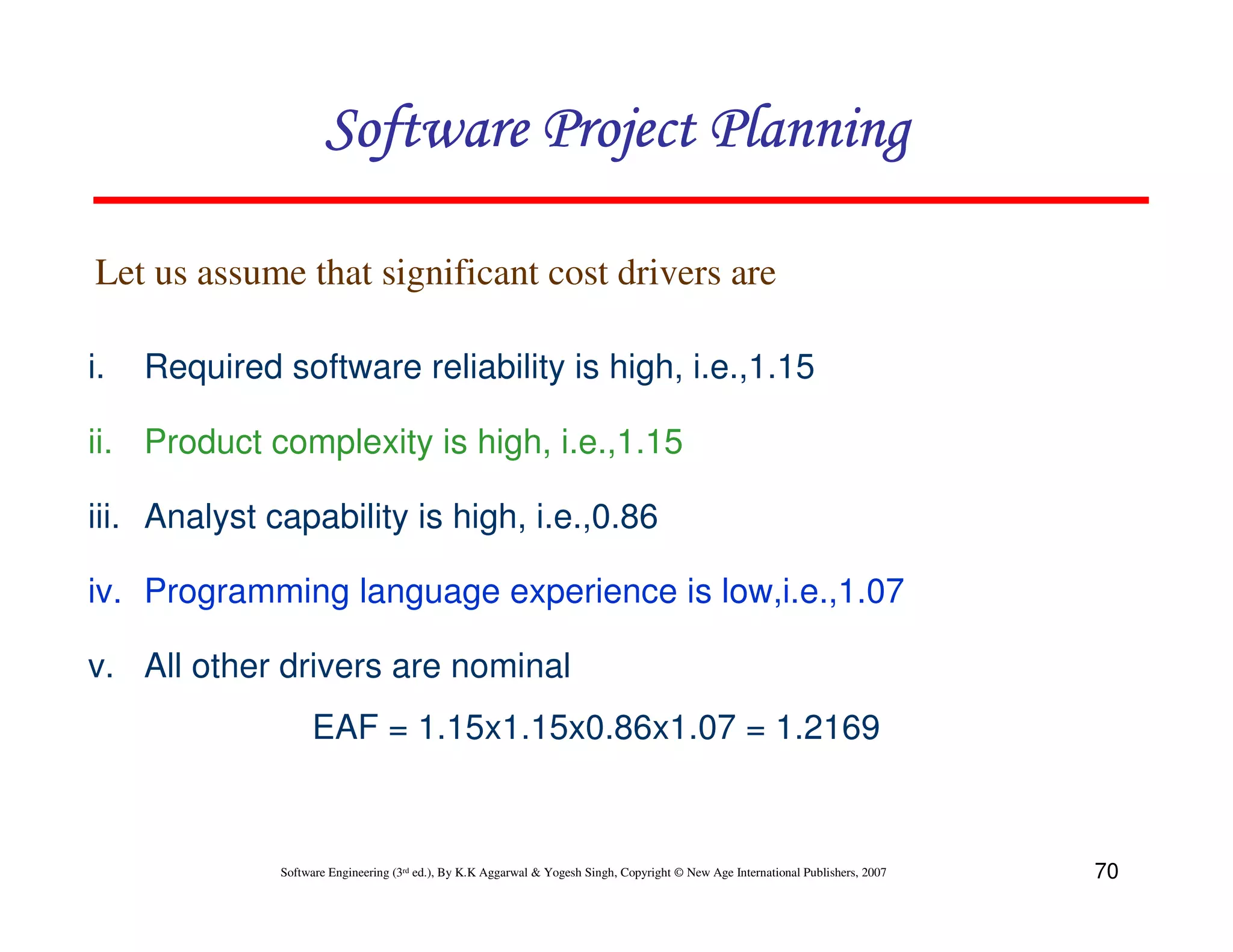
Let us assume that significant cost drivers are

i.   Required software reliability is high, i.e.,1.15

ii. Product complexity is high, i.e.,1.15

iii. Analyst capability is high, i.e.,0.86

iv. Programming language experience is low,i.e.,1.07

v. All other drivers are nominal
                   EAF = 1.15x1.15x0.86x1.07 = 1.2169


              Software Engineering (3rd ed.), By K.K Aggarwal & Yogesh Singh, Copyright © New Age International Publishers, 2007   70
Software Project Planning

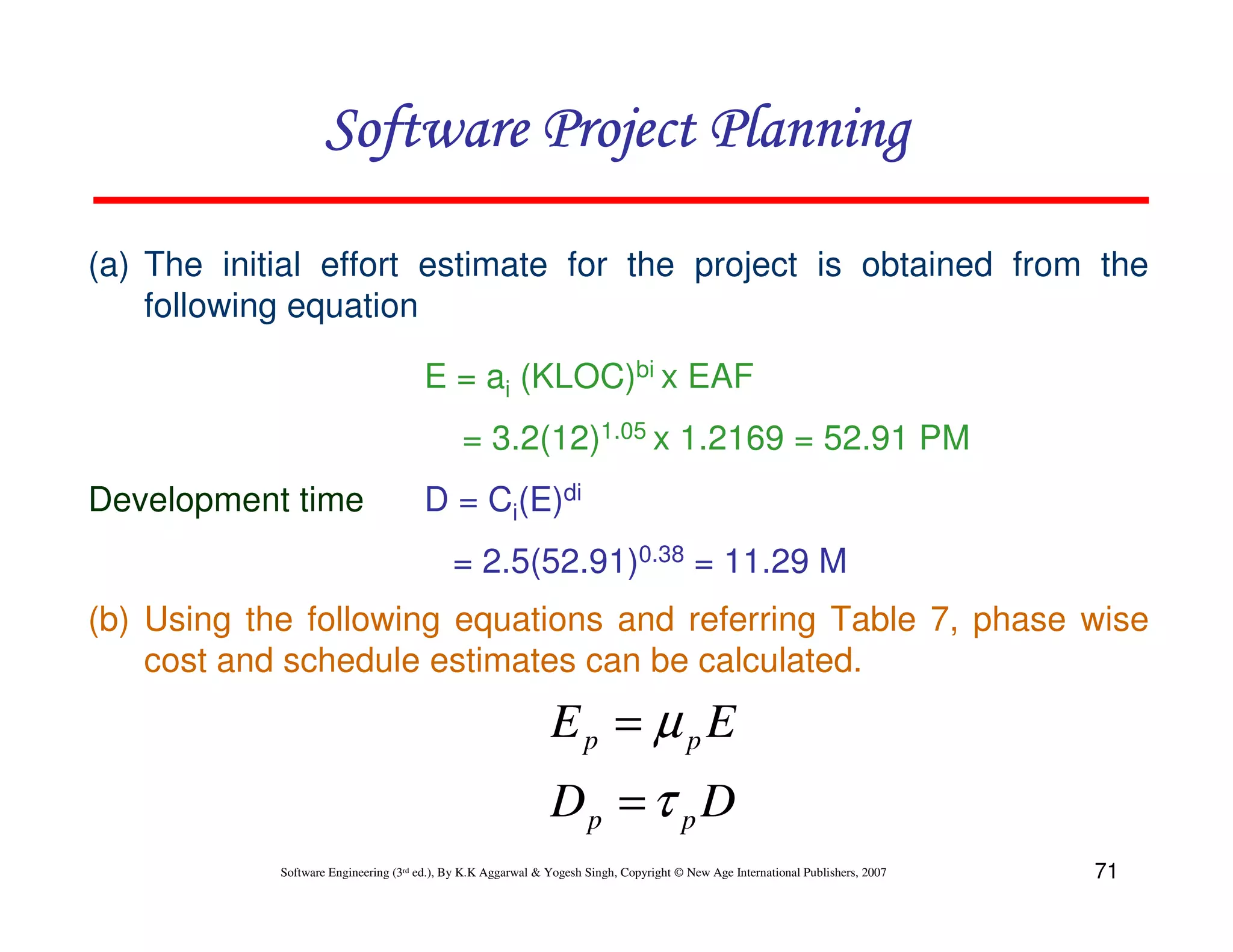
(a) The initial effort estimate for the project is obtained from the
    following equation

                                       E = ai (KLOC)bi x EAF
                                              = 3.2(12)1.05 x 1.2169 = 52.91 PM
Development time                       D = Ci(E)di
                                            = 2.5(52.91)0.38 = 11.29 M
(b) Using the following equations and referring Table 7, phase wise
    cost and schedule estimates can be calculated.
                                                              Ep = µ pE
                                                              Dp = τ p D
            Software Engineering (3rd ed.), By K.K Aggarwal & Yogesh Singh, Copyright © New Age International Publishers, 2007   71
Software Project Planning
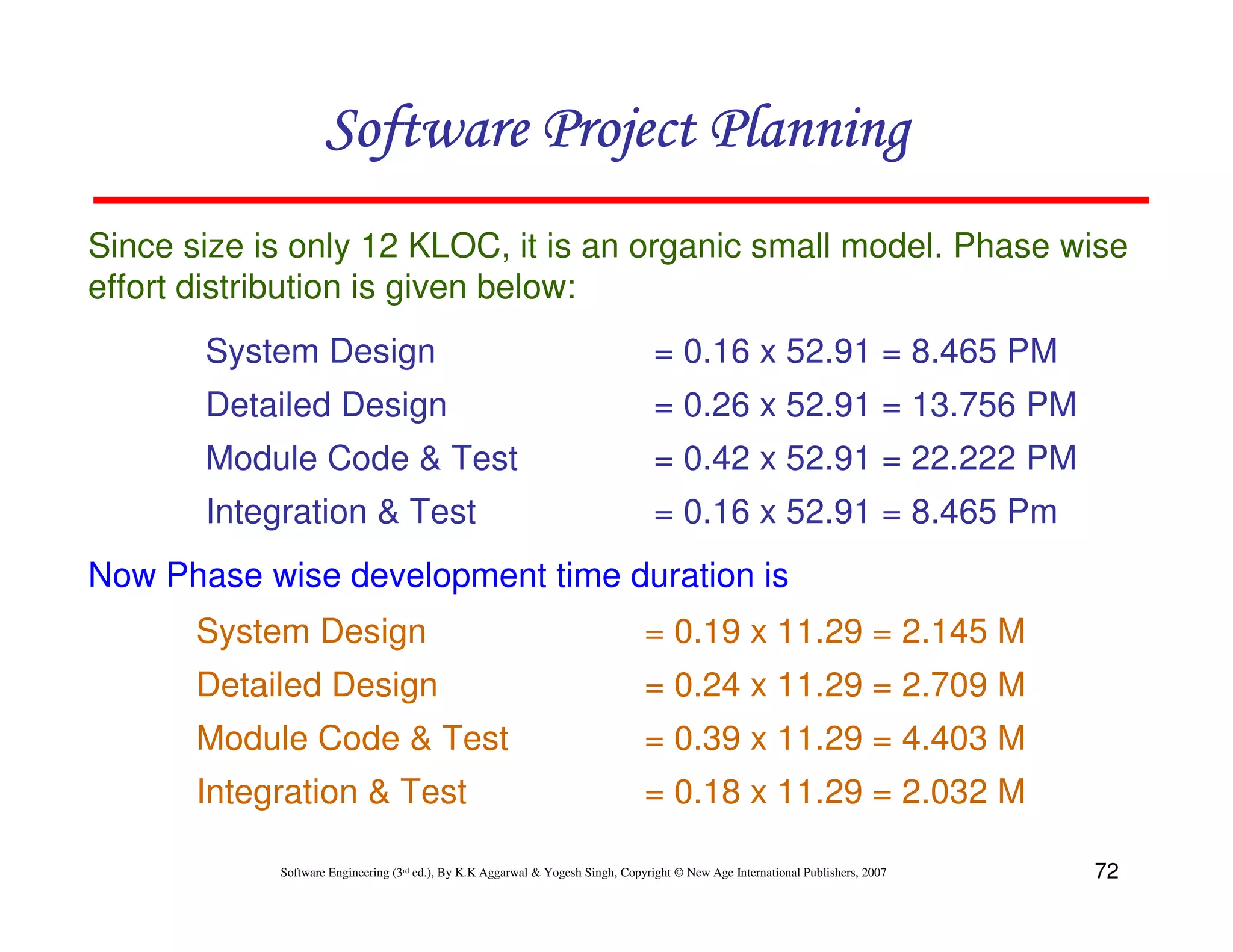
Since size is only 12 KLOC, it is an organic small model. Phase wise
effort distribution is given below:
       System Design                                                              = 0.16 x 52.91 = 8.465 PM
       Detailed Design                                                            = 0.26 x 52.91 = 13.756 PM
       Module Code & Test                                                         = 0.42 x 52.91 = 22.222 PM
       Integration & Test                                                         = 0.16 x 52.91 = 8.465 Pm
Now Phase wise development time duration is
       System Design                                                            = 0.19 x 11.29 = 2.145 M
       Detailed Design                                                          = 0.24 x 11.29 = 2.709 M
       Module Code & Test                                                       = 0.39 x 11.29 = 4.403 M
       Integration & Test                                                       = 0.18 x 11.29 = 2.032 M

            Software Engineering (3rd ed.), By K.K Aggarwal & Yogesh Singh, Copyright © New Age International Publishers, 2007   72
Software Project Planning
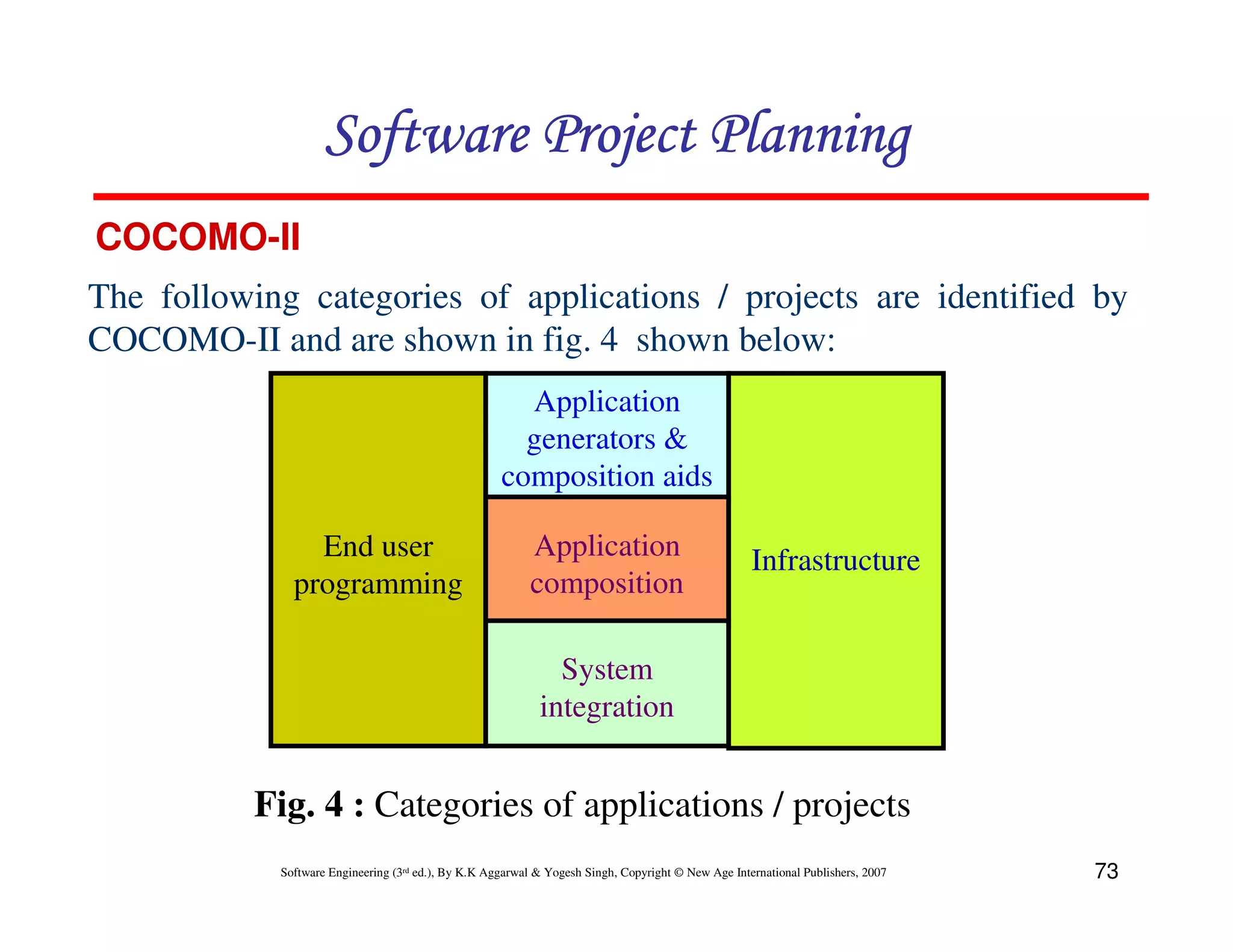
COCOMO-II
The following categories of applications / projects are identified by
COCOMO-II and are shown in fig. 4 shown below:
                                                       Application
                                                       generators &
                                                     composition aids

                End user                                  Application                               Infrastructure
              programming                                 composition

                                                              System
                                                            integration


           Fig. 4 : Categories of applications / projects
            Software Engineering (3rd ed.), By K.K Aggarwal & Yogesh Singh, Copyright © New Age International Publishers, 2007   73
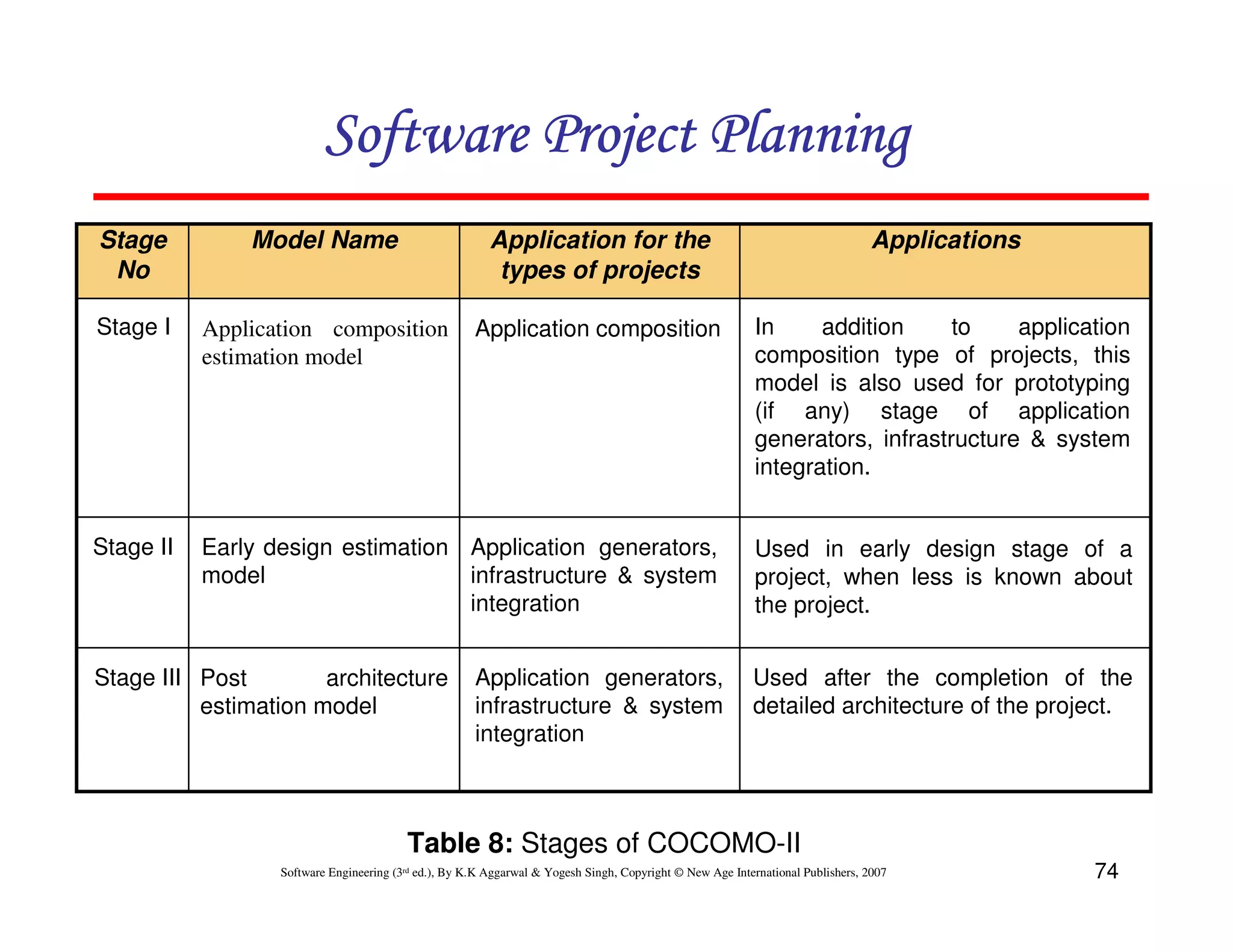
Software Project Planning
Stage          Model Name                                Application for the                                                    Applications
 No                                                       types of projects

Stage I    Application composition                    Application composition                              In     addition     to    application
           estimation model                                                                                composition type of projects, this
                                                                                                           model is also used for prototyping
                                                                                                           (if any) stage of application
                                                                                                           generators, infrastructure & system
                                                                                                           integration.


Stage II   Early design estimation Application generators,                                                 Used in early design stage of a
           model                   infrastructure & system                                                 project, when less is known about
                                   integration                                                             the project.


Stage III Post        architecture                    Application generators,                             Used after the completion of the
          estimation model                            infrastructure & system                             detailed architecture of the project.
                                                      integration


                                         Table 8: Stages of COCOMO-II
                  Software Engineering (3rd ed.), By K.K Aggarwal & Yogesh Singh, Copyright © New Age International Publishers, 2007           74
Software Project Planning
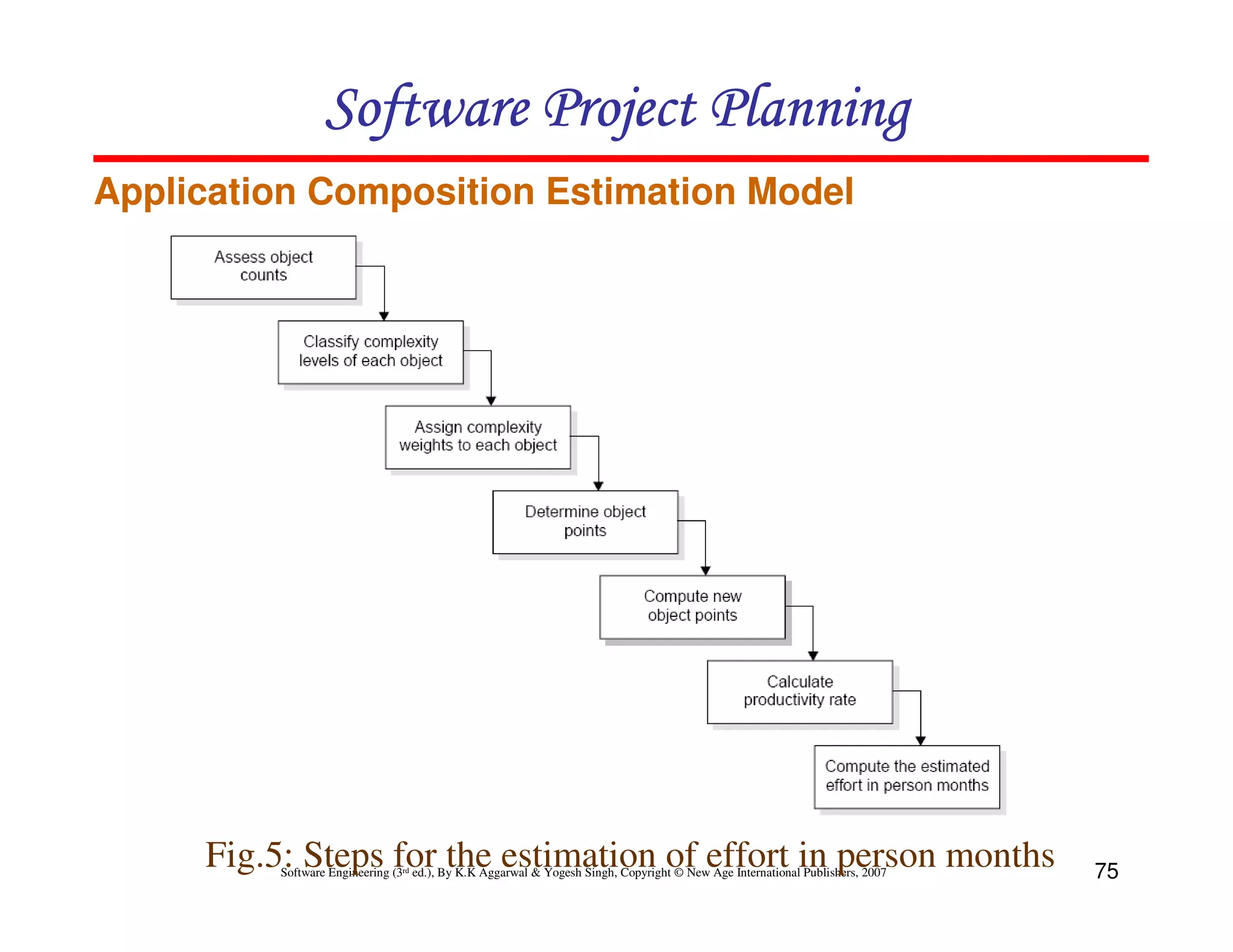
Application Composition Estimation Model


     Fig.5: Steps for the estimation of effort in person months
          Software Engineering (3rd ed.), By K.K Aggarwal & Yogesh Singh, Copyright © New Age International Publishers, 2007   75
Software Project Planning
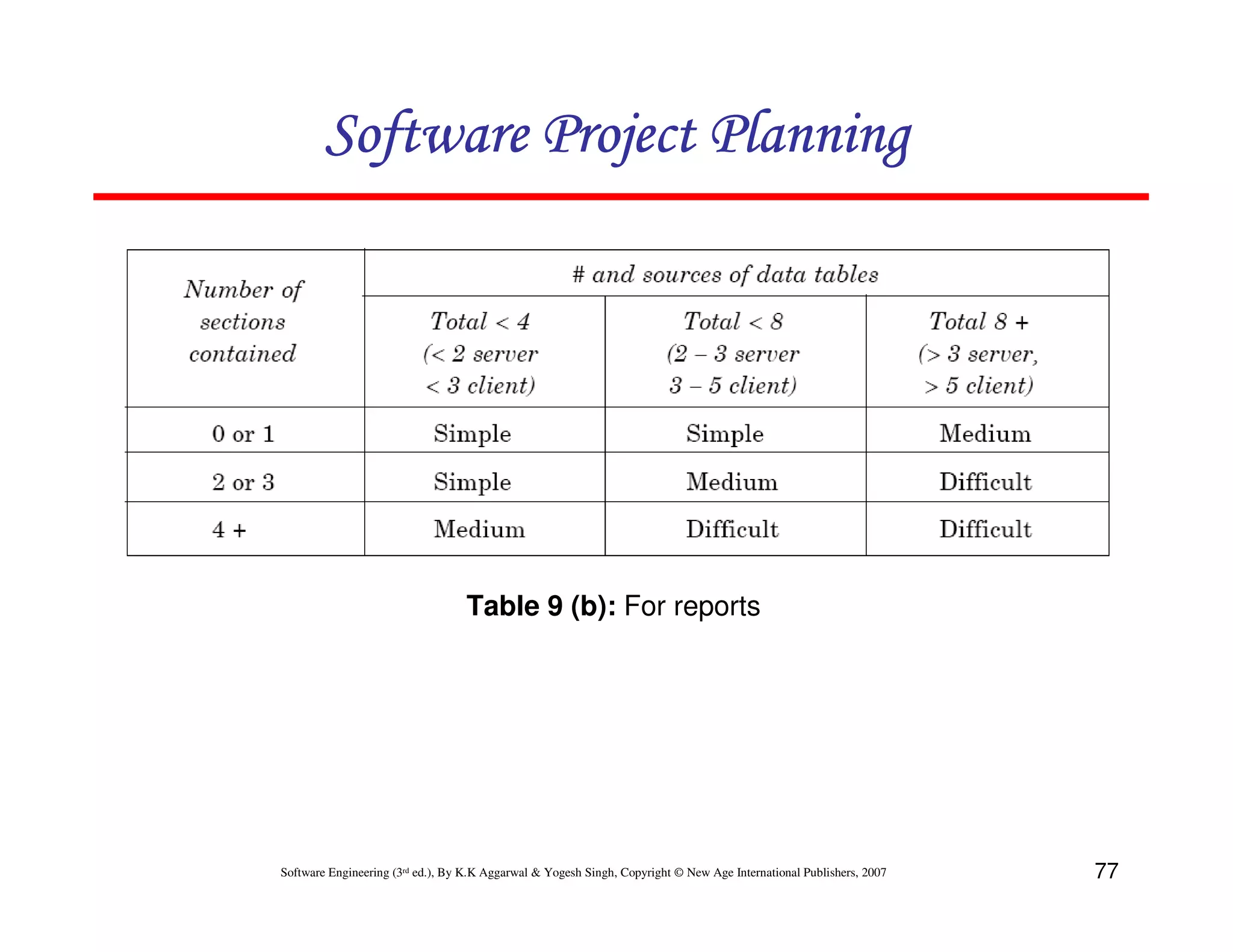
i. Assess object counts: Estimate the number of screens, reports and
   3 GL components that will comprise this application.

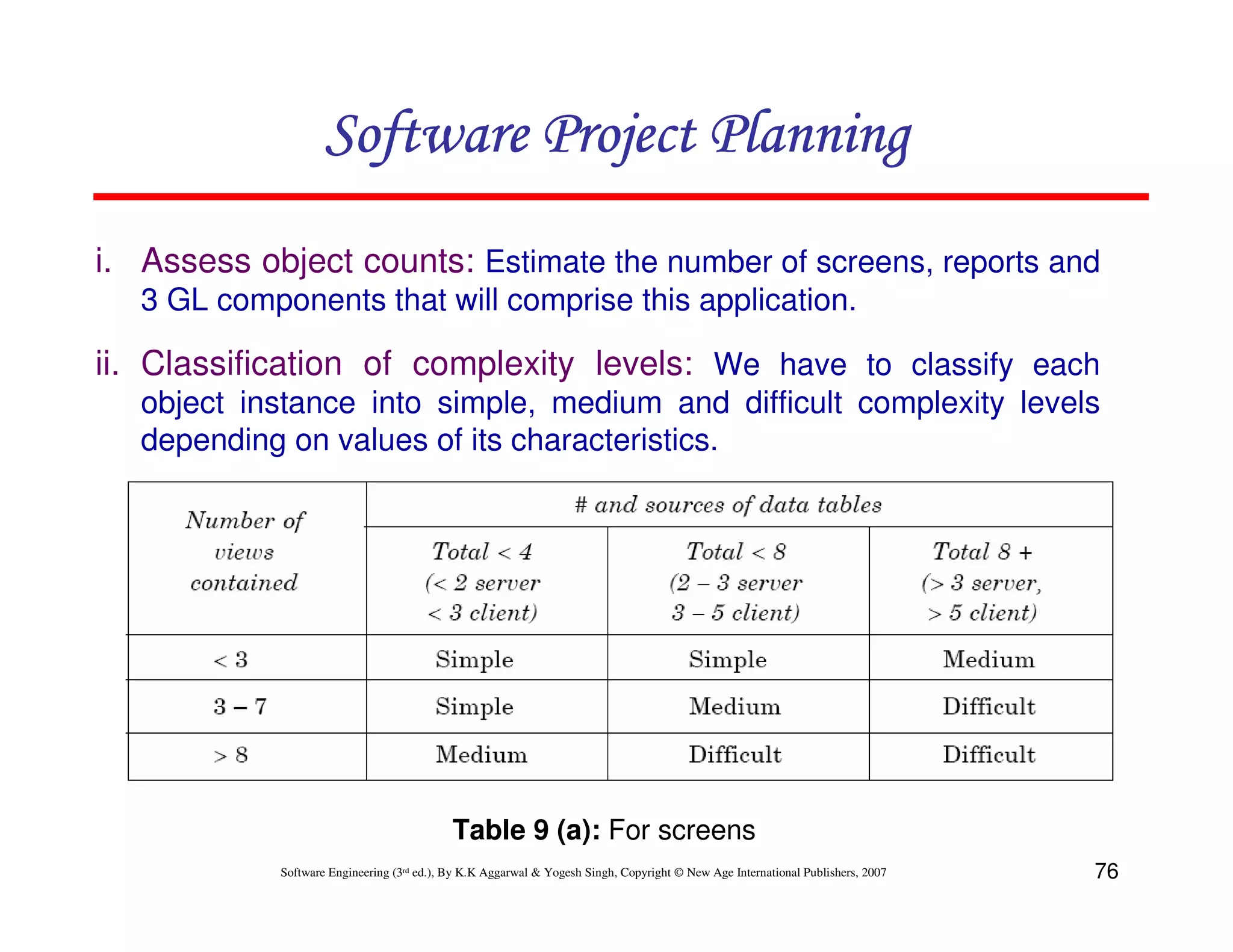
ii. Classification of complexity levels: We have to classify each
   object instance into simple, medium and difficult complexity levels
   depending on values of its characteristics.


                                             Table 9 (a): For screens
             Software Engineering (3rd ed.), By K.K Aggarwal & Yogesh Singh, Copyright © New Age International Publishers, 2007   76
Software Project Planning


                                  Table 9 (b): For reports


Software Engineering (3rd ed.), By K.K Aggarwal & Yogesh Singh, Copyright © New Age International Publishers, 2007   77
Software Project Planning
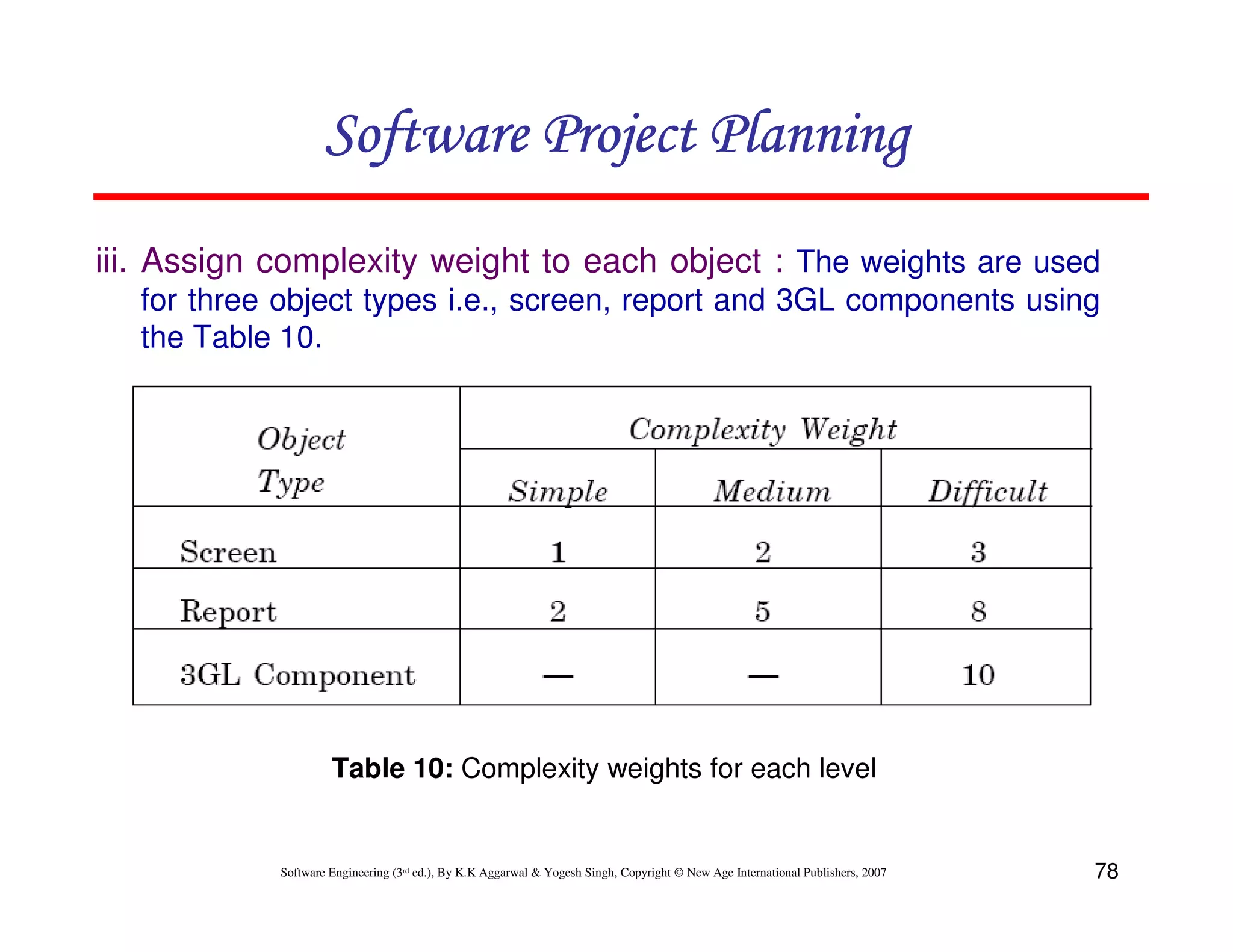
iii. Assign complexity weight to each object : The weights are used
   for three object types i.e., screen, report and 3GL components using
   the Table 10.


                     Table 10: Complexity weights for each level


            Software Engineering (3rd ed.), By K.K Aggarwal & Yogesh Singh, Copyright © New Age International Publishers, 2007   78
Software Project Planning
iv. Determine object points: Add all the weighted object instances to
   get one number and this known as object-point count.

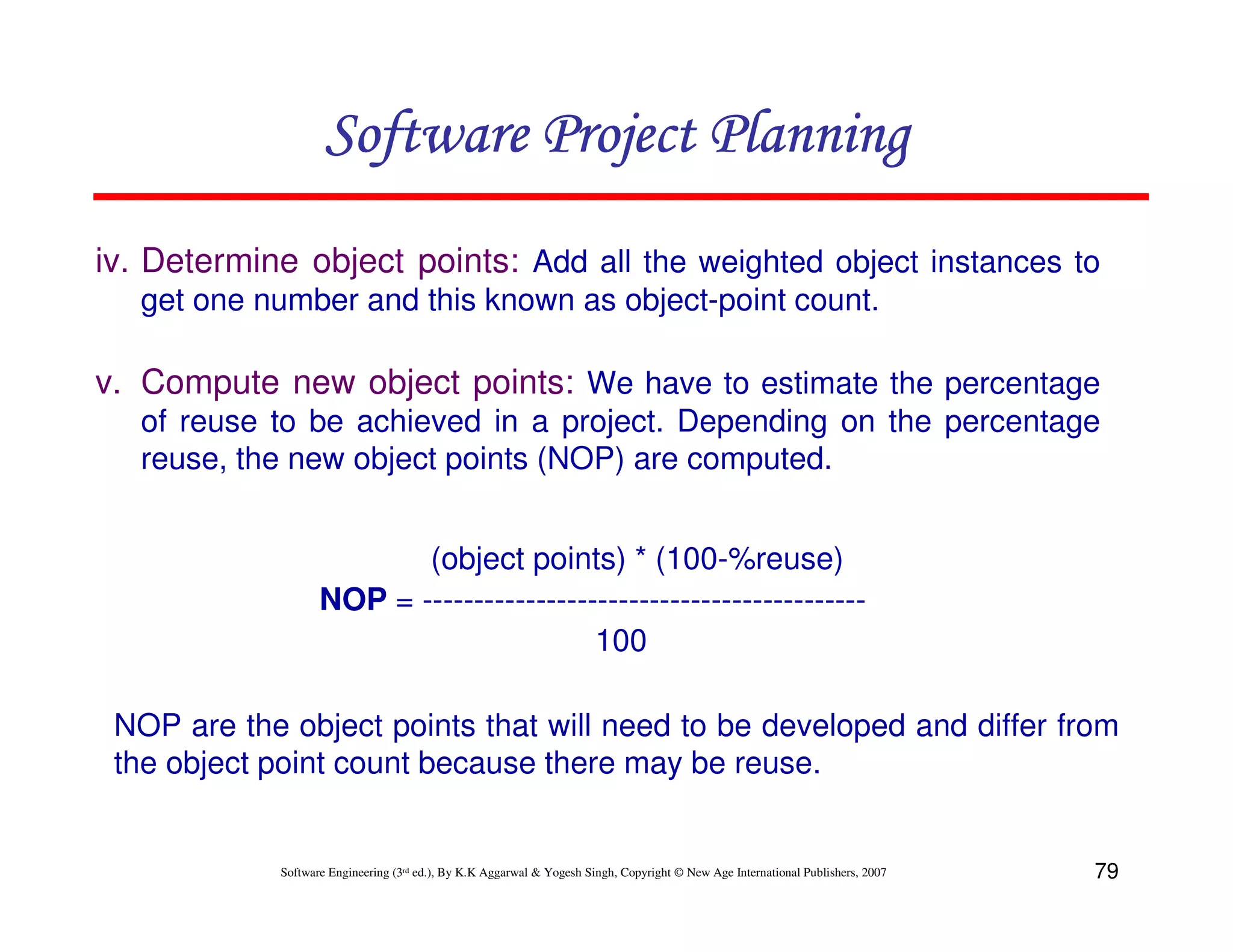
v. Compute new object points: We have to estimate the percentage
   of reuse to be achieved in a project. Depending on the percentage
   reuse, the new object points (NOP) are computed.


                          (object points) * (100-%reuse)
                   NOP = -------------------------------------------
                                          100

 NOP are the object points that will need to be developed and differ from
 the object point count because there may be reuse.


            Software Engineering (3rd ed.), By K.K Aggarwal & Yogesh Singh, Copyright © New Age International Publishers, 2007   79
Software Project Planning
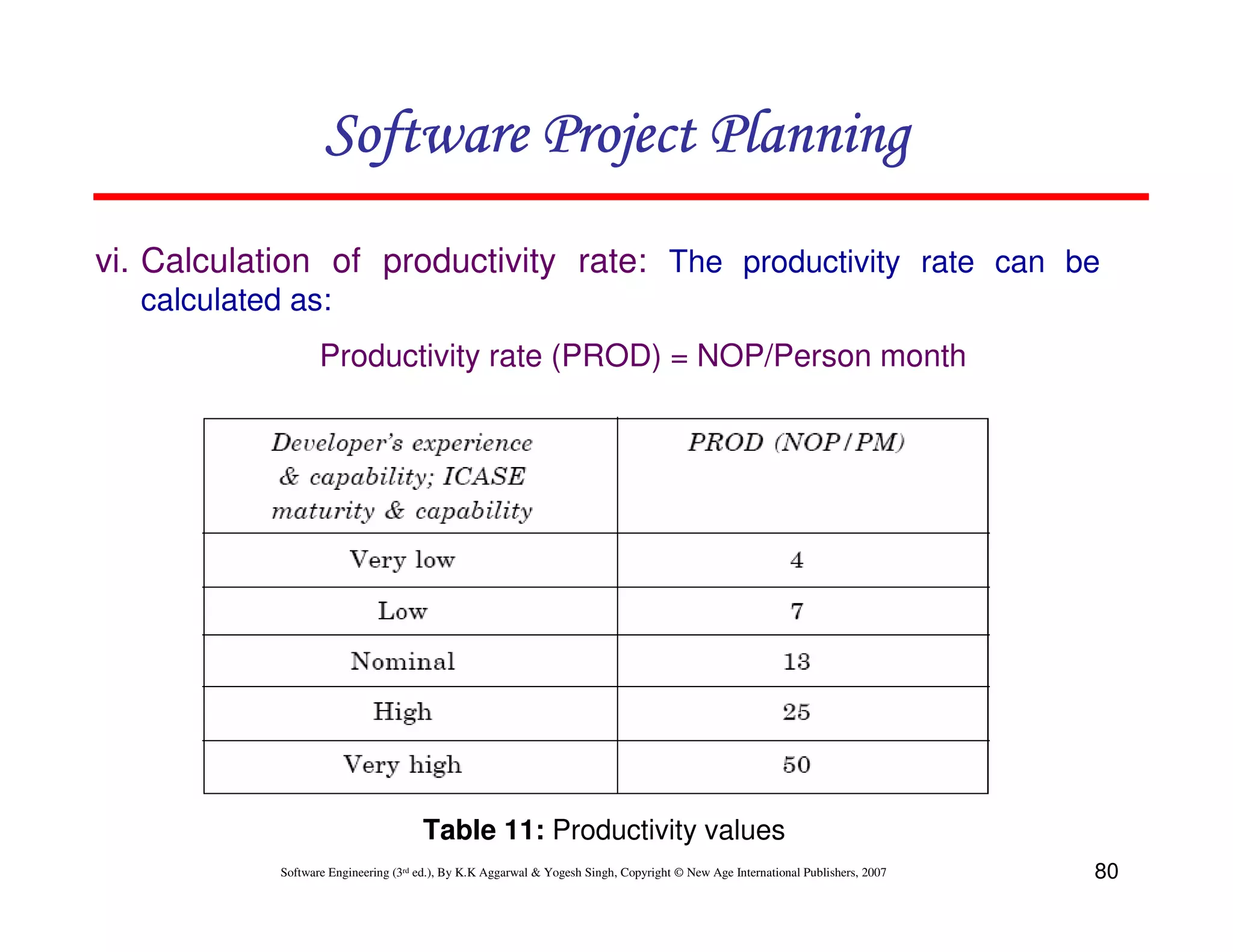
vi. Calculation of productivity rate: The productivity rate can be
  calculated as:
                   Productivity rate (PROD) = NOP/Person month


                                      Table 11: Productivity values
            Software Engineering (3rd ed.), By K.K Aggarwal & Yogesh Singh, Copyright © New Age International Publishers, 2007   80
Software Project Planning

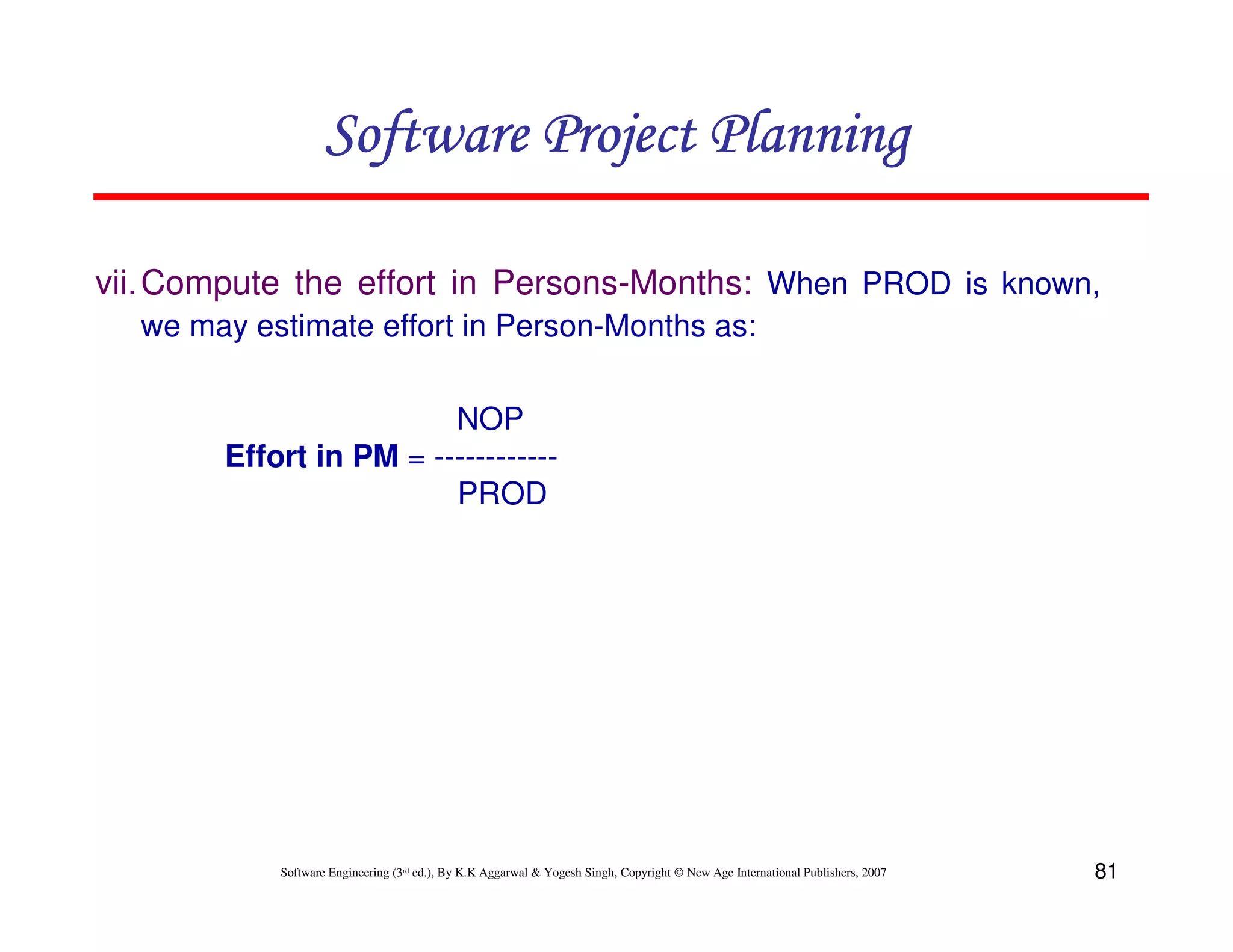
vii. Compute the effort in Persons-Months: When PROD is known,
  we may estimate effort in Person-Months as:

                        NOP
       Effort in PM = ------------
                        PROD


           Software Engineering (3rd ed.), By K.K Aggarwal & Yogesh Singh, Copyright © New Age International Publishers, 2007   81
Software Project Planning
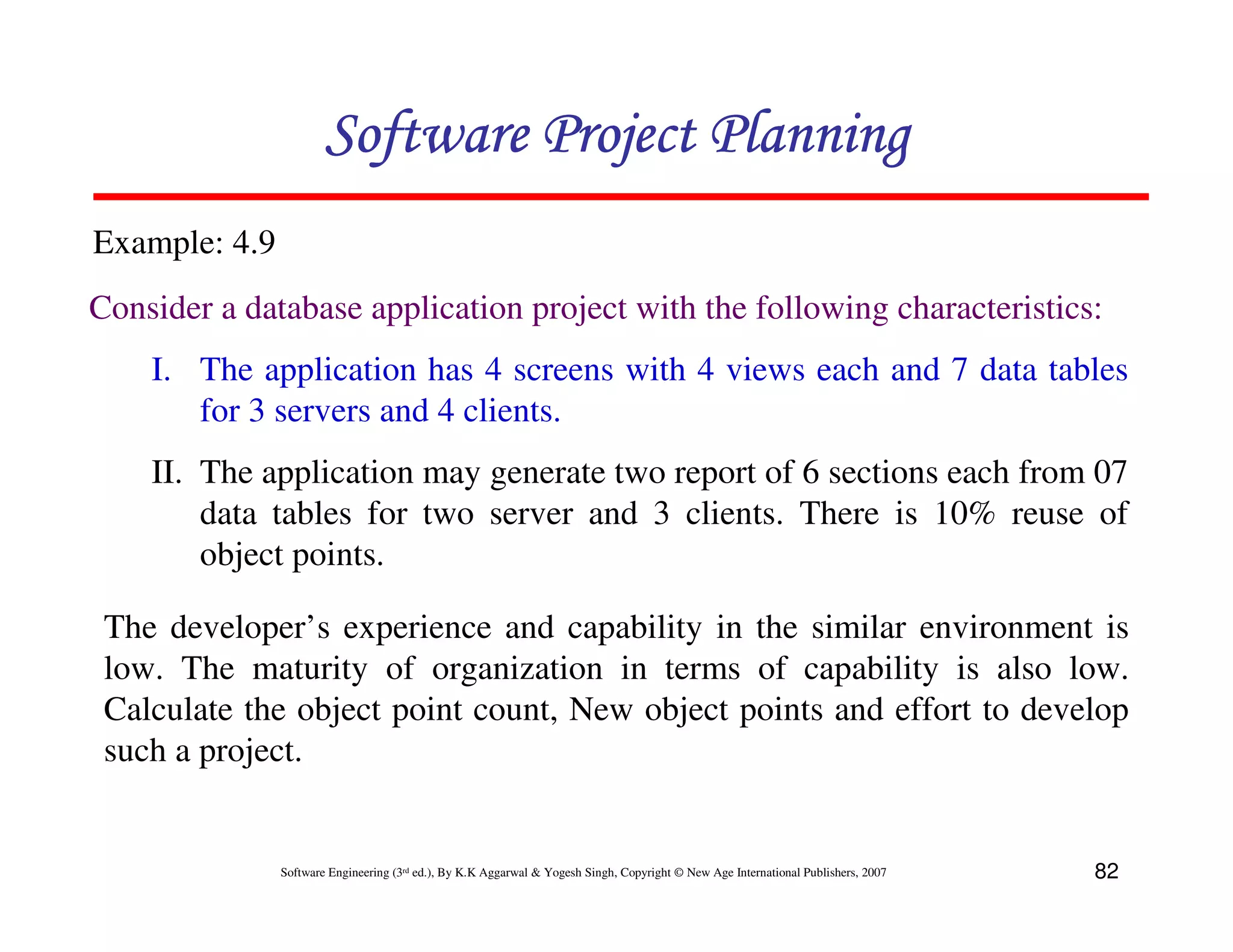
Example: 4.9
Consider a database application project with the following characteristics:
    I. The application has 4 screens with 4 views each and 7 data tables
       for 3 servers and 4 clients.
    II. The application may generate two report of 6 sections each from 07
        data tables for two server and 3 clients. There is 10% reuse of
        object points.

 The developer’s experience and capability in the similar environment is
 low. The maturity of organization in terms of capability is also low.
 Calculate the object point count, New object points and effort to develop
 such a project.


               Software Engineering (3rd ed.), By K.K Aggarwal & Yogesh Singh, Copyright © New Age International Publishers, 2007   82
Software Project Planning
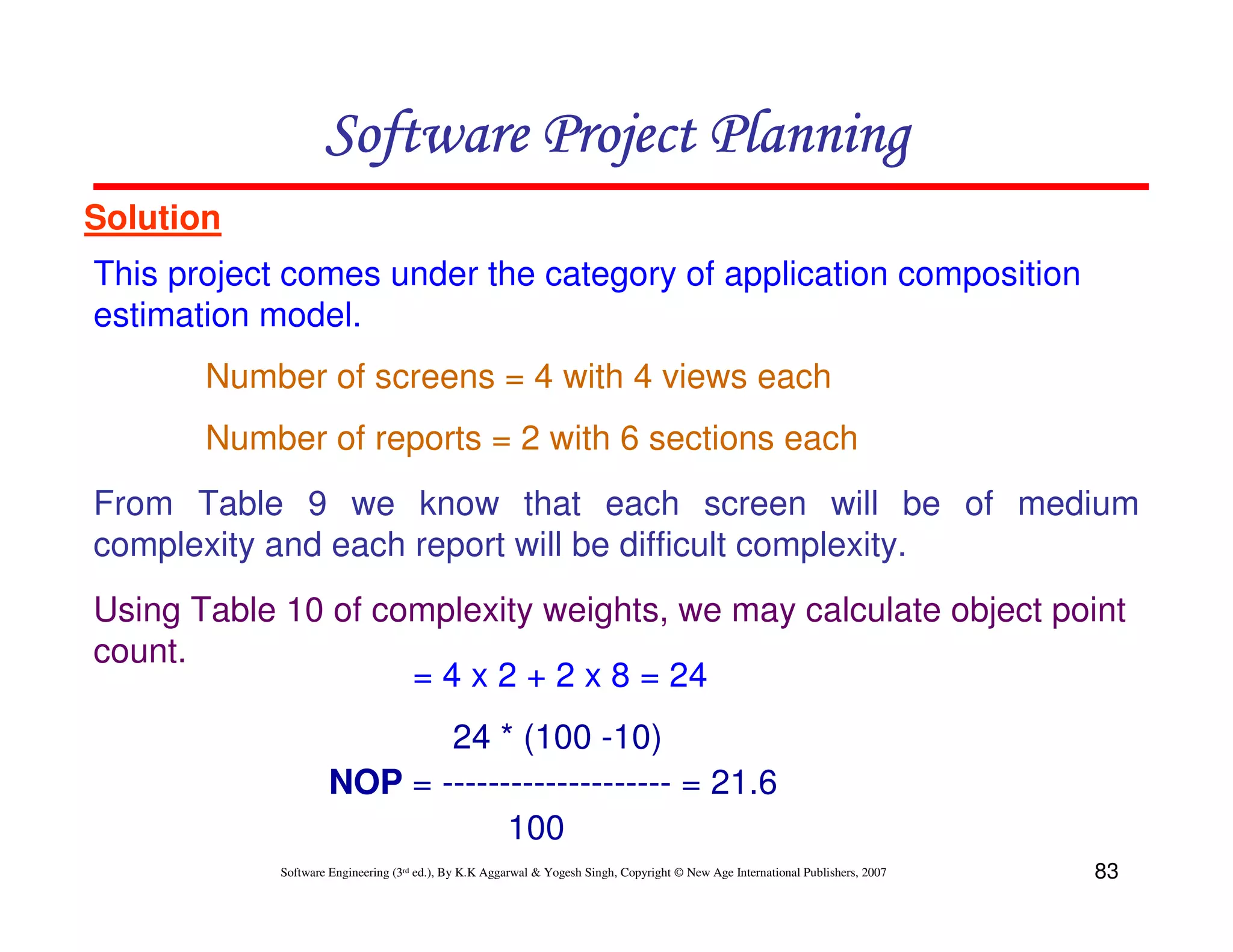
Solution
This project comes under the category of application composition
estimation model.
       Number of screens = 4 with 4 views each
       Number of reports = 2 with 6 sections each
From Table 9 we know that each screen will be of medium
complexity and each report will be difficult complexity.
Using Table 10 of complexity weights, we may calculate object point
count.
                    = 4 x 2 + 2 x 8 = 24
                            24 * (100 -10)
                     NOP = -------------------- = 21.6
                                 100
            Software Engineering (3rd ed.), By K.K Aggarwal & Yogesh Singh, Copyright © New Age International Publishers, 2007   83
Software Project Planning

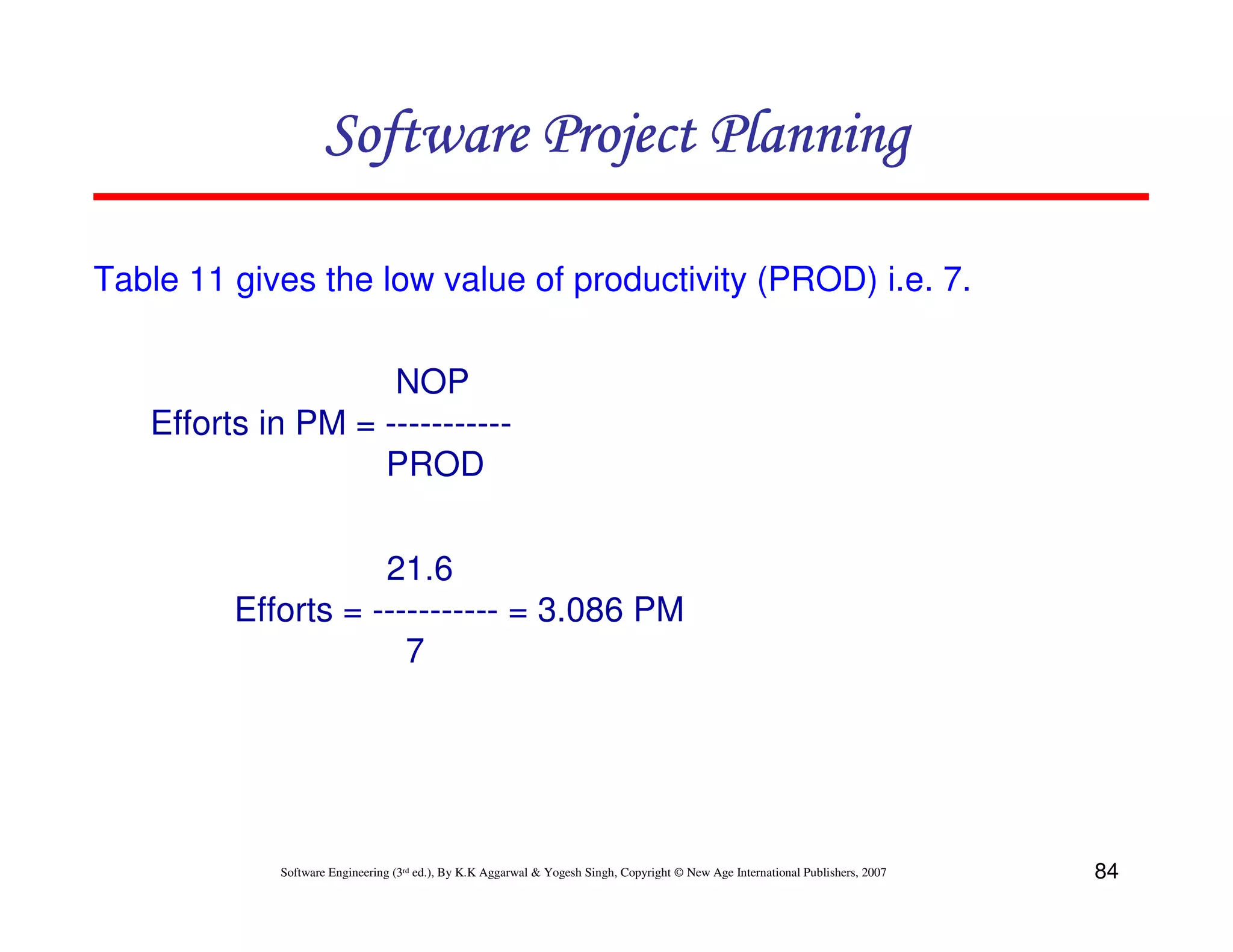
Table 11 gives the low value of productivity (PROD) i.e. 7.


                    NOP
   Efforts in PM = -----------
                   PROD


                    21.6
         Efforts = ----------- = 3.086 PM
                      7


            Software Engineering (3rd ed.), By K.K Aggarwal & Yogesh Singh, Copyright © New Age International Publishers, 2007   84
Software Project Planning
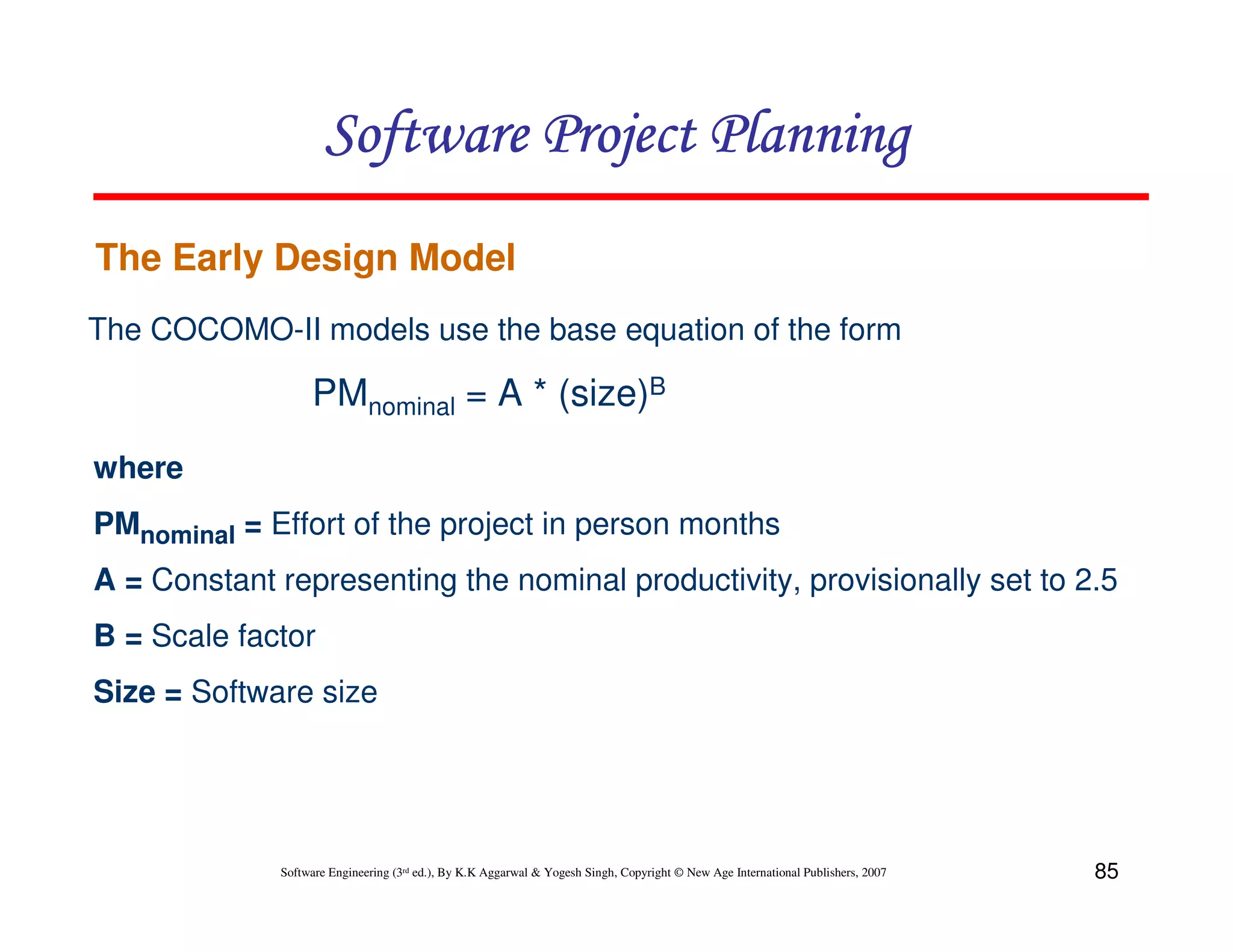
The Early Design Model
The COCOMO-II models use the base equation of the form

                  PMnominal = A * (size)B
where
PMnominal = Effort of the project in person months
A = Constant representing the nominal productivity, provisionally set to 2.5
B = Scale factor
Size = Software size


             Software Engineering (3rd ed.), By K.K Aggarwal & Yogesh Singh, Copyright © New Age International Publishers, 2007   85
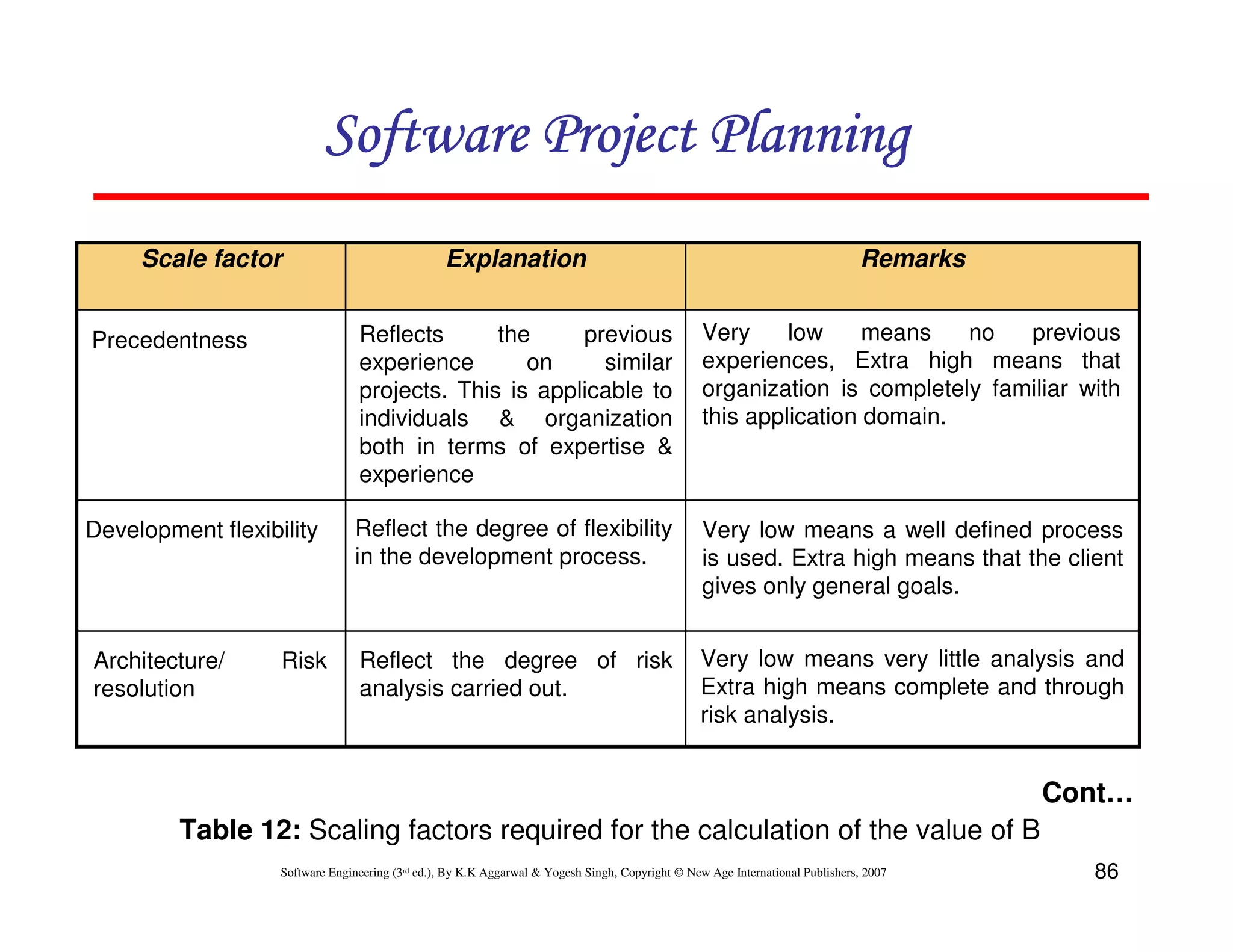
Software Project Planning
     Scale factor                                Explanation                                                                   Remarks


Precedentness                    Reflects      the     previous                                   Very     low     means   no   previous
                                 experience       on     similar                                  experiences, Extra high means that
                                 projects. This is applicable to                                  organization is completely familiar with
                                 individuals & organization                                       this application domain.
                                 both in terms of expertise &
                                 experience

Development flexibility         Reflect the degree of flexibility                                 Very low means a well defined process
                                in the development process.                                       is used. Extra high means that the client
                                                                                                  gives only general goals.


Architecture/      Risk          Reflect the degree of risk                                      Very low means very little analysis and
resolution                       analysis carried out.                                           Extra high means complete and through
                                                                                                 risk analysis.


                                                                                                                                         Cont…
         Table 12: Scaling factors required for the calculation of the value of B
                   Software Engineering (3rd ed.), By K.K Aggarwal & Yogesh Singh, Copyright © New Age International Publishers, 2007      86
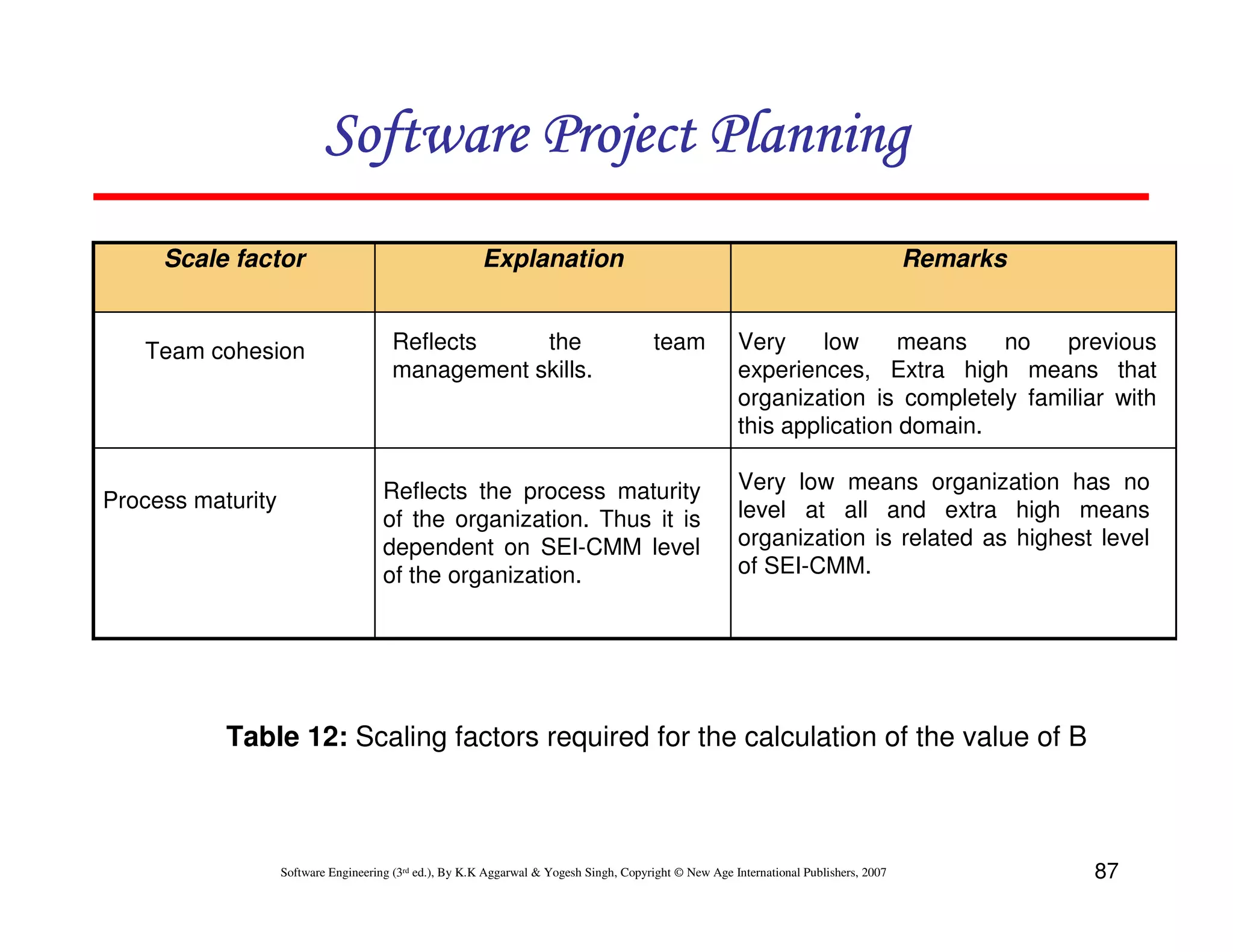
Software Project Planning
     Scale factor                                       Explanation                                                                     Remarks


   Team cohesion                        Reflects    the                                  team            Very     low     means   no   previous
                                        management skills.                                               experiences, Extra high means that
                                                                                                         organization is completely familiar with
                                                                                                         this application domain.

                                      Reflects the process maturity                                      Very low means organization has no
Process maturity                                                                                         level at all and extra high means
                                      of the organization. Thus it is
                                      dependent on SEI-CMM level                                         organization is related as highest level
                                      of the organization.                                               of SEI-CMM.


           Table 12: Scaling factors required for the calculation of the value of B


                   Software Engineering (3rd ed.), By K.K Aggarwal & Yogesh Singh, Copyright © New Age International Publishers, 2007             87
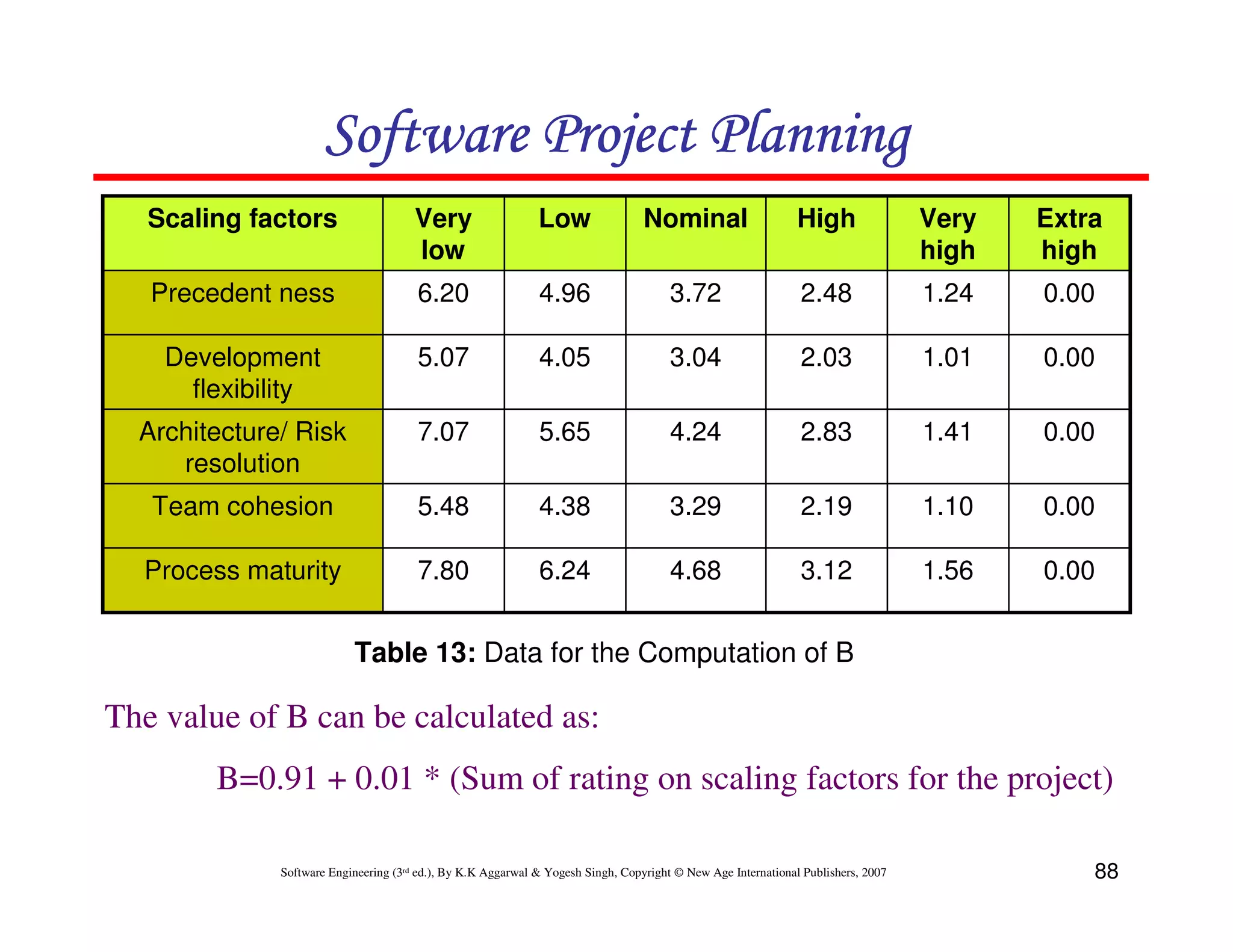
Software Project Planning
   Scaling factors                     Very                   Low                 Nominal                      High                Very   Extra
                                       low                                                                                         high   high
   Precedent ness                      6.20                   4.96                     3.72                    2.48                1.24   0.00

    Development                        5.07                   4.05                     3.04                    2.03                1.01   0.00
      flexibility
  Architecture/ Risk                   7.07                   5.65                     4.24                    2.83                1.41   0.00
     resolution
   Team cohesion                       5.48                   4.38                     3.29                    2.19                1.10   0.00

  Process maturity                     7.80                   6.24                     4.68                    3.12                1.56   0.00


                           Table 13: Data for the Computation of B

The value of B can be calculated as:
        B=0.91 + 0.01 * (Sum of rating on scaling factors for the project)

              Software Engineering (3rd ed.), By K.K Aggarwal & Yogesh Singh, Copyright © New Age International Publishers, 2007              88
Software Project Planning
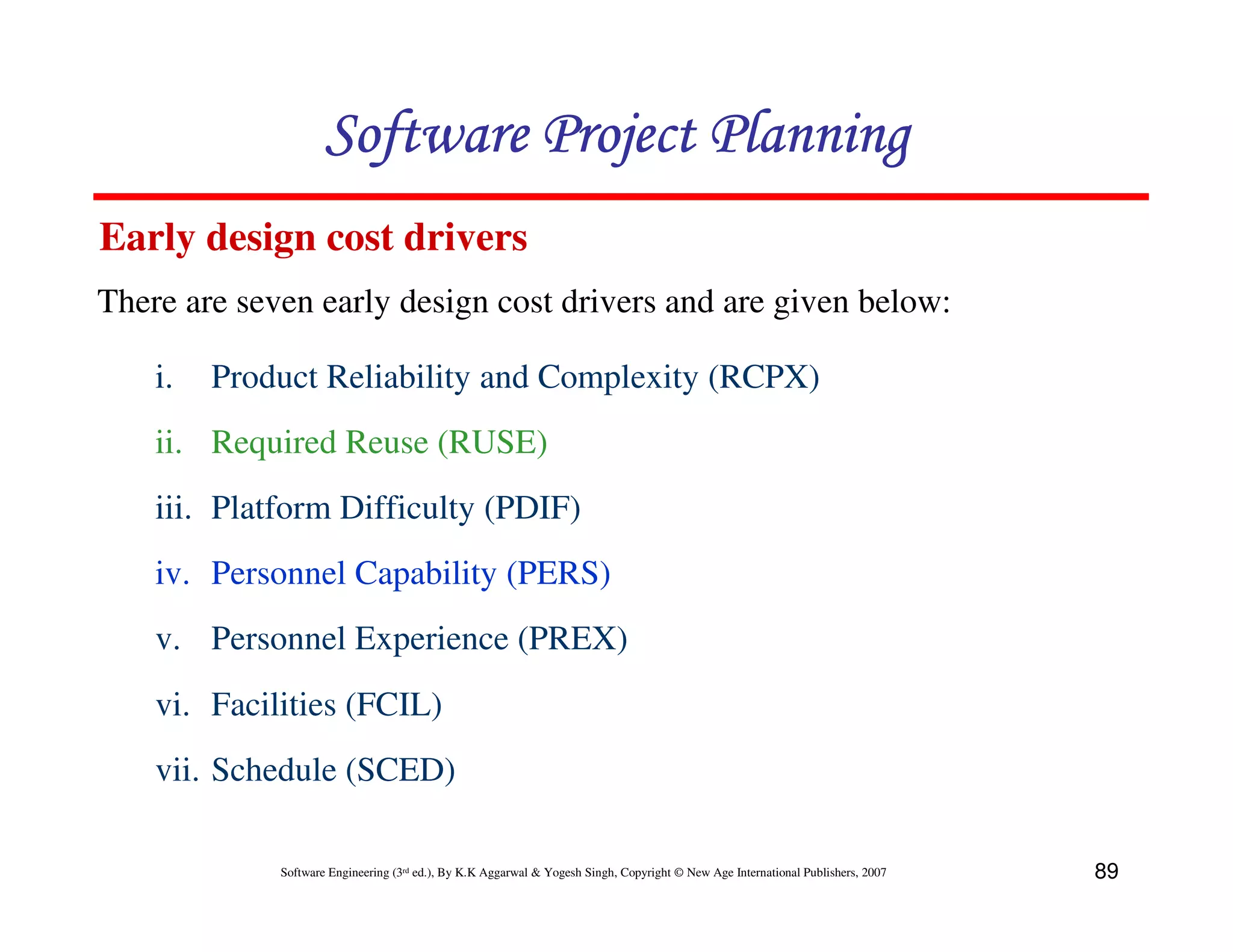
Early design cost drivers
There are seven early design cost drivers and are given below:

    i.   Product Reliability and Complexity (RCPX)
    ii. Required Reuse (RUSE)
    iii. Platform Difficulty (PDIF)
    iv. Personnel Capability (PERS)
    v. Personnel Experience (PREX)
    vi. Facilities (FCIL)
    vii. Schedule (SCED)

             Software Engineering (3rd ed.), By K.K Aggarwal & Yogesh Singh, Copyright © New Age International Publishers, 2007   89
Software Project Planning
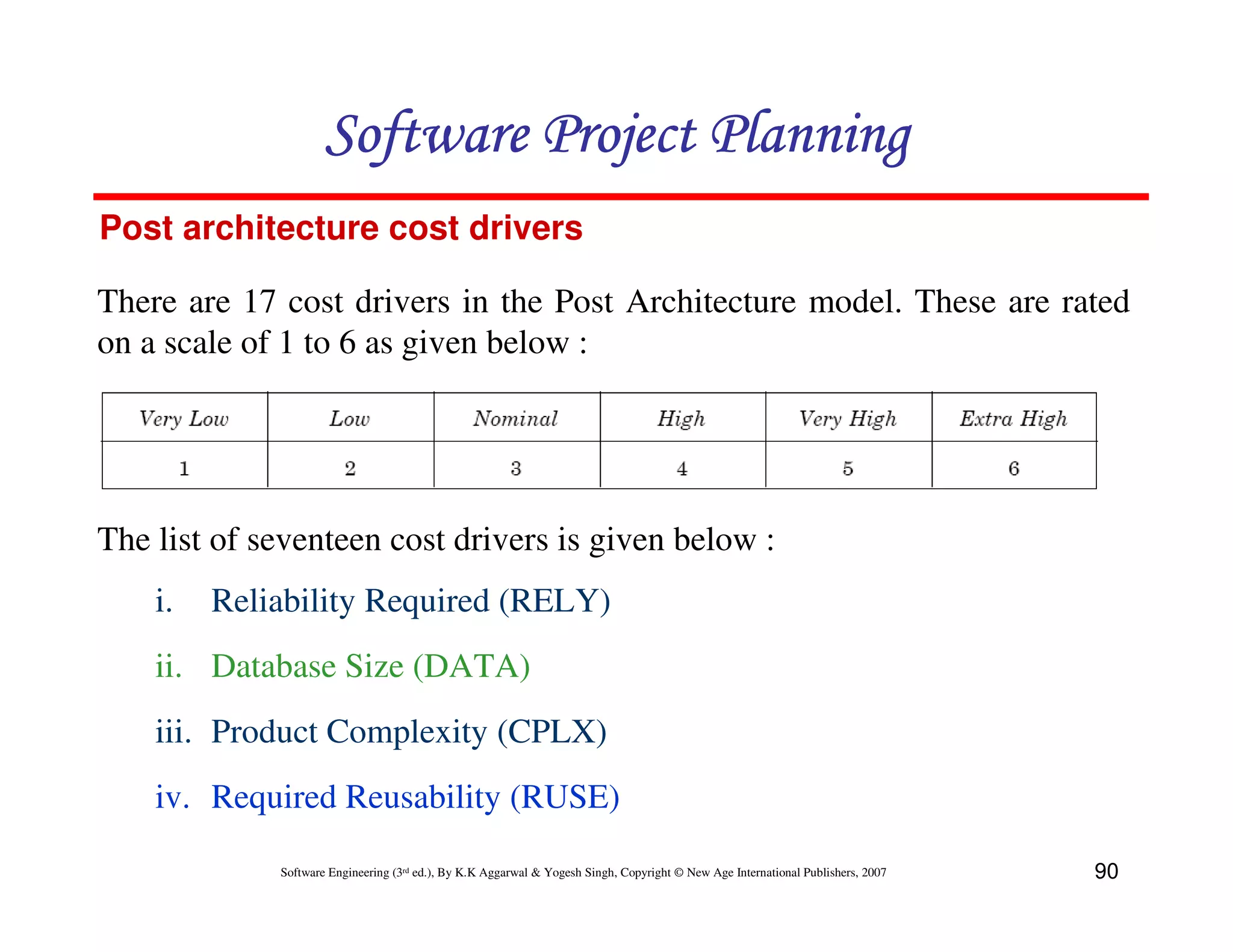
Post architecture cost drivers

There are 17 cost drivers in the Post Architecture model. These are rated
on a scale of 1 to 6 as given below :


The list of seventeen cost drivers is given below :
    i.   Reliability Required (RELY)
    ii. Database Size (DATA)
    iii. Product Complexity (CPLX)
    iv. Required Reusability (RUSE)

             Software Engineering (3rd ed.), By K.K Aggarwal & Yogesh Singh, Copyright © New Age International Publishers, 2007   90
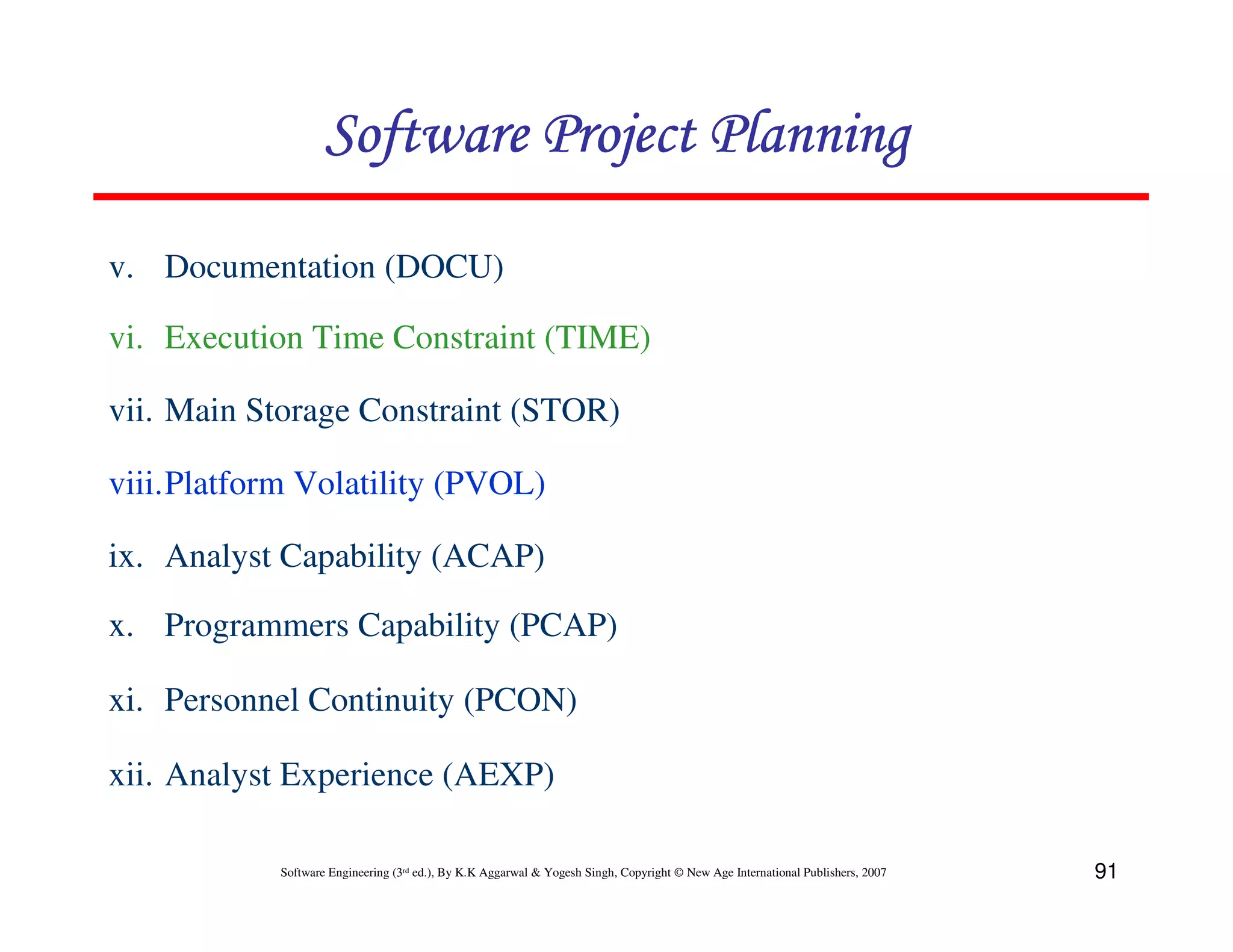
Software Project Planning

v. Documentation (DOCU)

vi. Execution Time Constraint (TIME)

vii. Main Storage Constraint (STOR)

viii.Platform Volatility (PVOL)

ix. Analyst Capability (ACAP)

x. Programmers Capability (PCAP)

xi. Personnel Continuity (PCON)

xii. Analyst Experience (AEXP)

            Software Engineering (3rd ed.), By K.K Aggarwal & Yogesh Singh, Copyright © New Age International Publishers, 2007   91
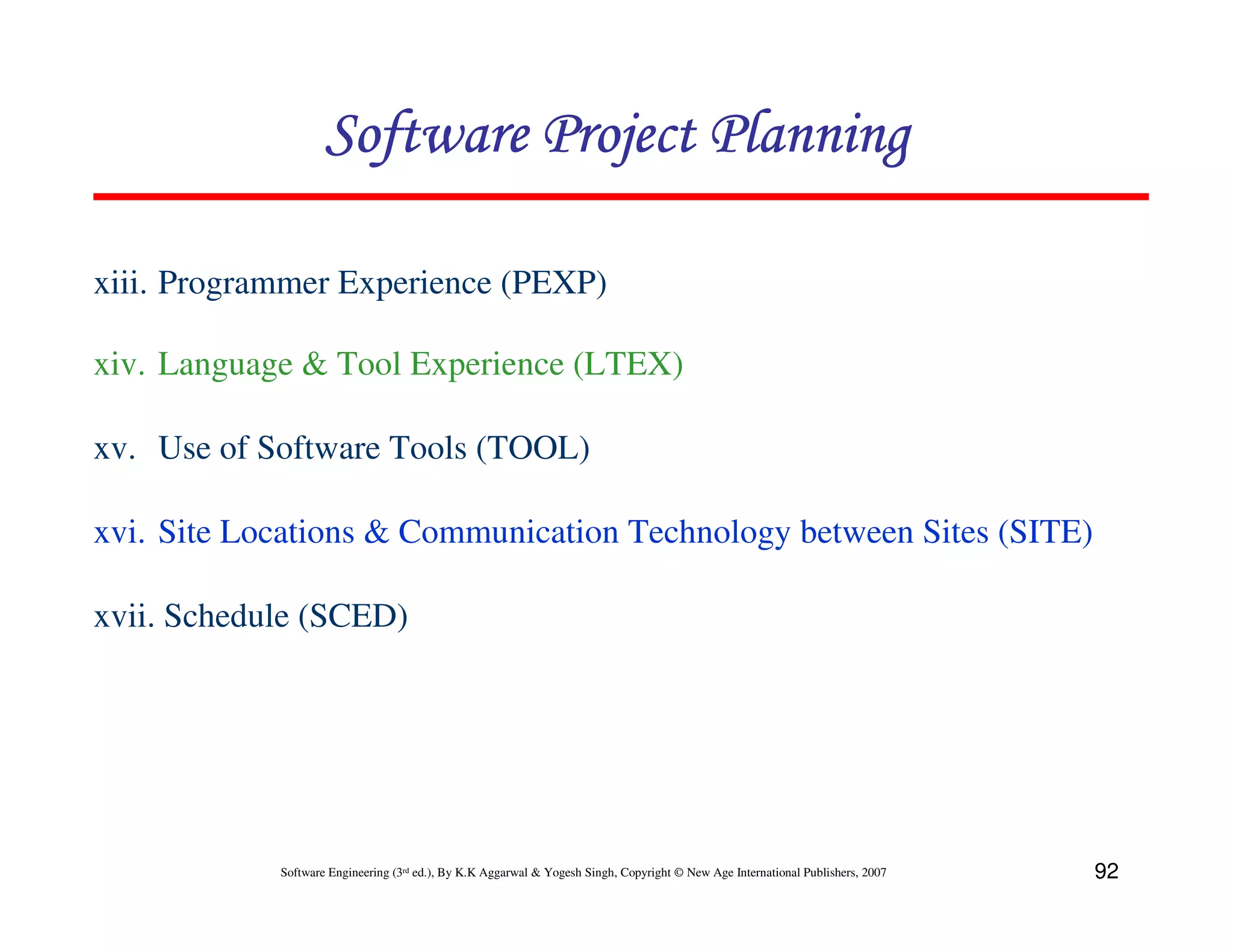
Software Project Planning

xiii. Programmer Experience (PEXP)

xiv. Language & Tool Experience (LTEX)

xv. Use of Software Tools (TOOL)

xvi. Site Locations & Communication Technology between Sites (SITE)

xvii. Schedule (SCED)


            Software Engineering (3rd ed.), By K.K Aggarwal & Yogesh Singh, Copyright © New Age International Publishers, 2007   92
Software Project Planning
Mapping of early design cost drivers and post architecture cost
drivers

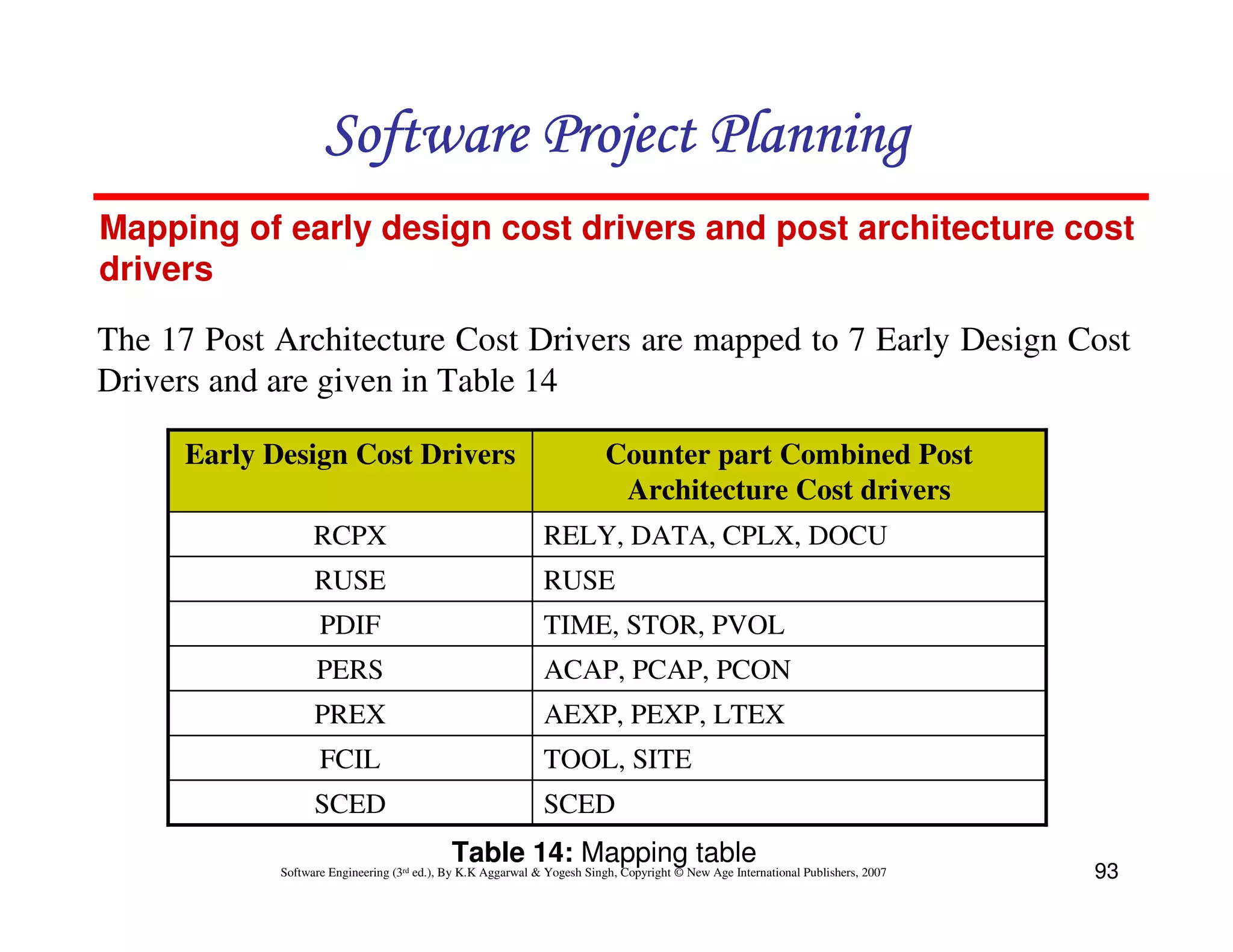
The 17 Post Architecture Cost Drivers are mapped to 7 Early Design Cost
Drivers and are given in Table 14

      Early Design Cost Drivers                                           Counter part Combined Post
                                                                           Architecture Cost drivers
                   RCPX                                       RELY, DATA, CPLX, DOCU
                   RUSE                                       RUSE
                    PDIF                                      TIME, STOR, PVOL
                   PERS                                       ACAP, PCAP, PCON
                   PREX                                       AEXP, PEXP, LTEX
                    FCIL                                      TOOL, SITE
                   SCED                                       SCED
                                             Table 14: Mapping table
             Software Engineering (3rd ed.), By K.K Aggarwal & Yogesh Singh, Copyright © New Age International Publishers, 2007   93
Software Project Planning
Product of cost drivers for early design model
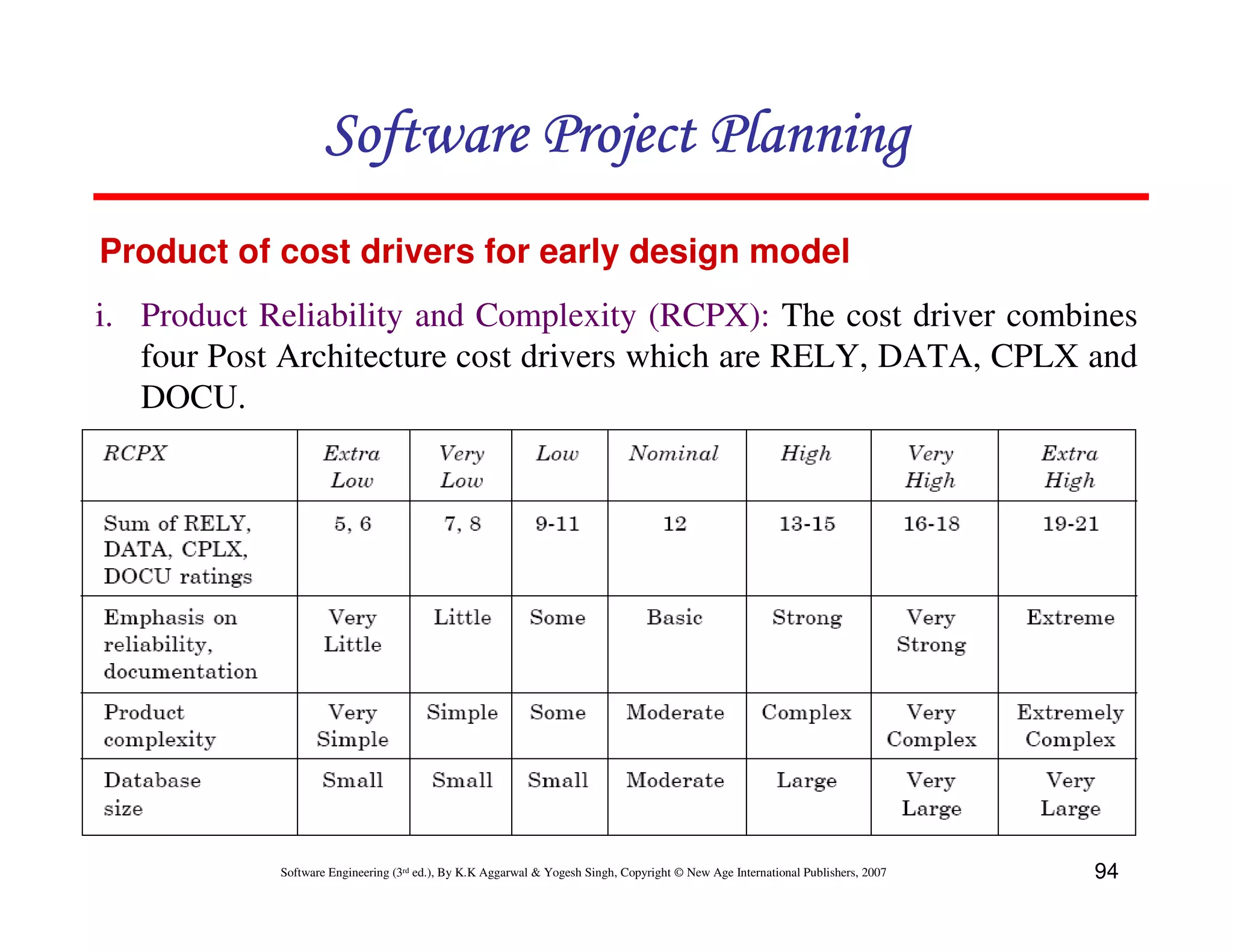
i. Product Reliability and Complexity (RCPX): The cost driver combines
   four Post Architecture cost drivers which are RELY, DATA, CPLX and
   DOCU.


            Software Engineering (3rd ed.), By K.K Aggarwal & Yogesh Singh, Copyright © New Age International Publishers, 2007   94
Software Project Planning

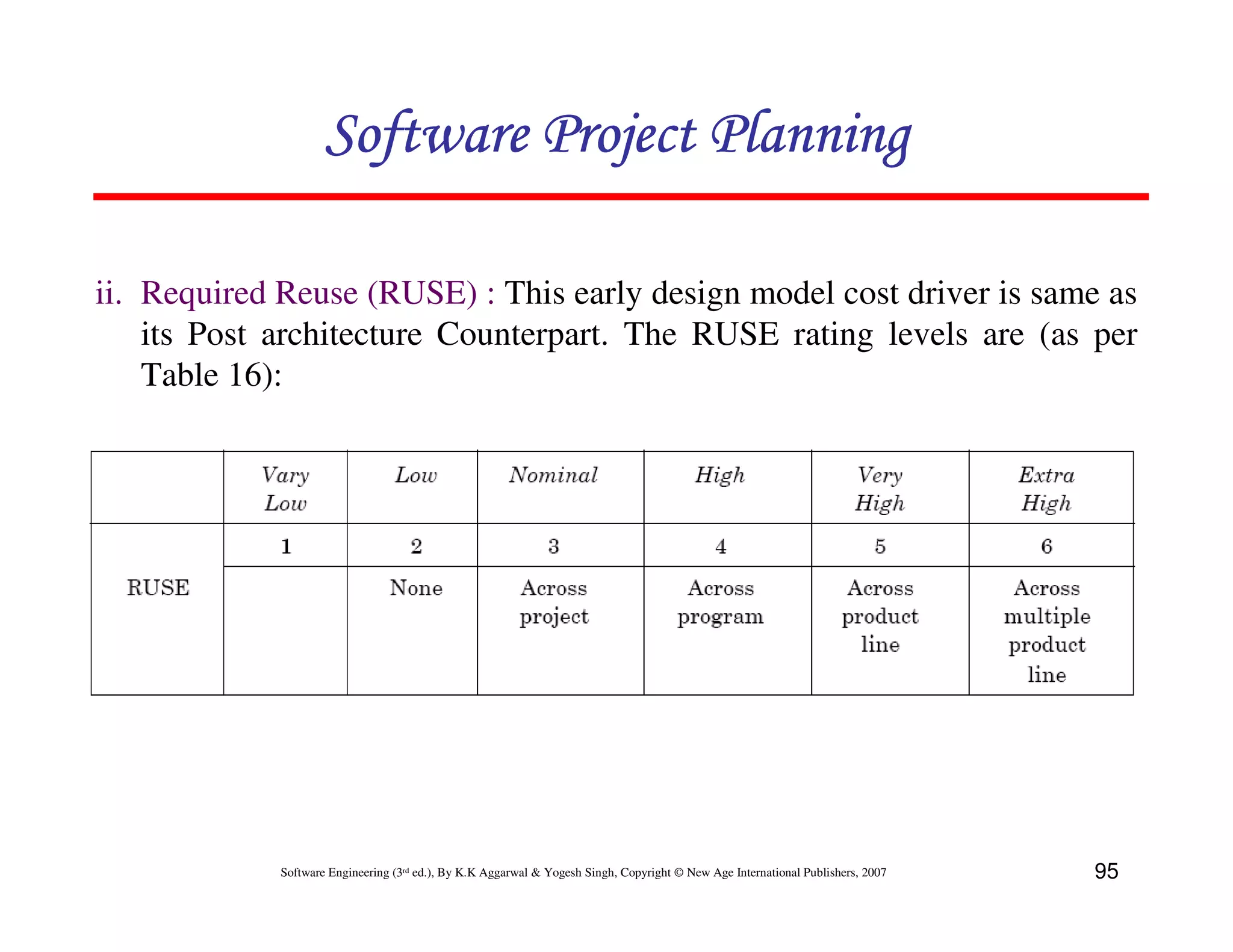
ii. Required Reuse (RUSE) : This early design model cost driver is same as
    its Post architecture Counterpart. The RUSE rating levels are (as per
    Table 16):


             Software Engineering (3rd ed.), By K.K Aggarwal & Yogesh Singh, Copyright © New Age International Publishers, 2007   95
Software Project Planning

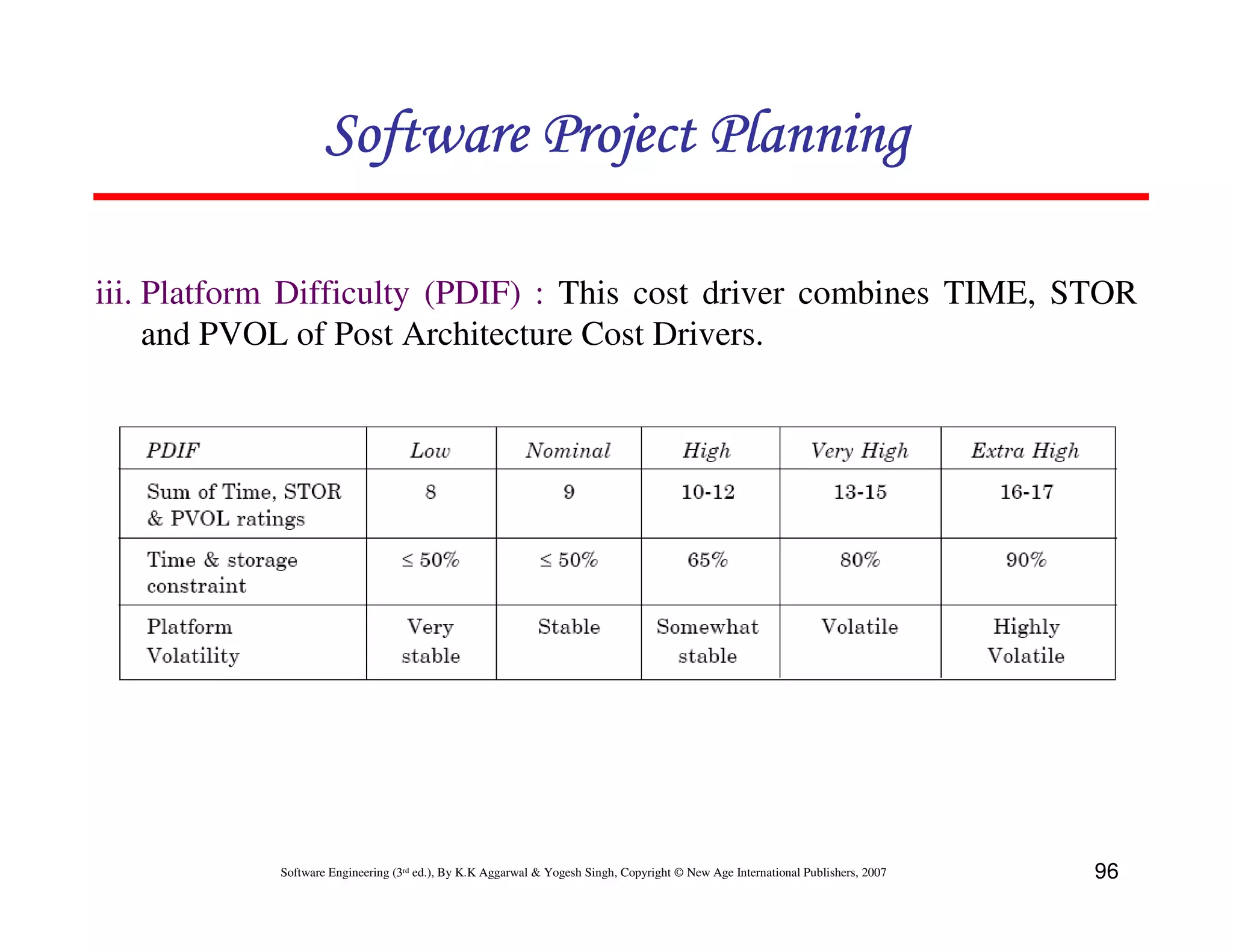
iii. Platform Difficulty (PDIF) : This cost driver combines TIME, STOR
     and PVOL of Post Architecture Cost Drivers.


            Software Engineering (3rd ed.), By K.K Aggarwal & Yogesh Singh, Copyright © New Age International Publishers, 2007   96
Software Project Planning

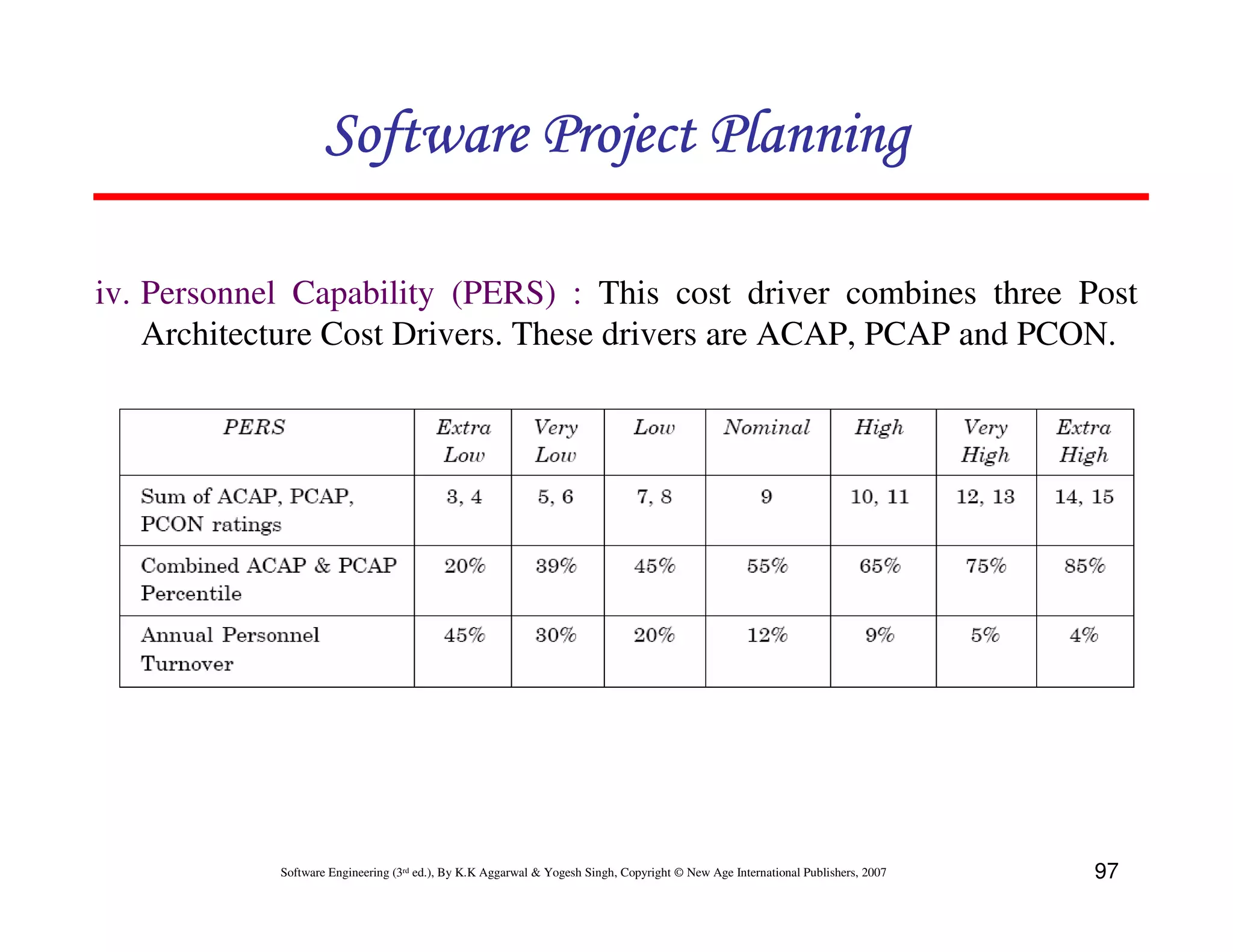
iv. Personnel Capability (PERS) : This cost driver combines three Post
    Architecture Cost Drivers. These drivers are ACAP, PCAP and PCON.


            Software Engineering (3rd ed.), By K.K Aggarwal & Yogesh Singh, Copyright © New Age International Publishers, 2007   97
Software Project Planning

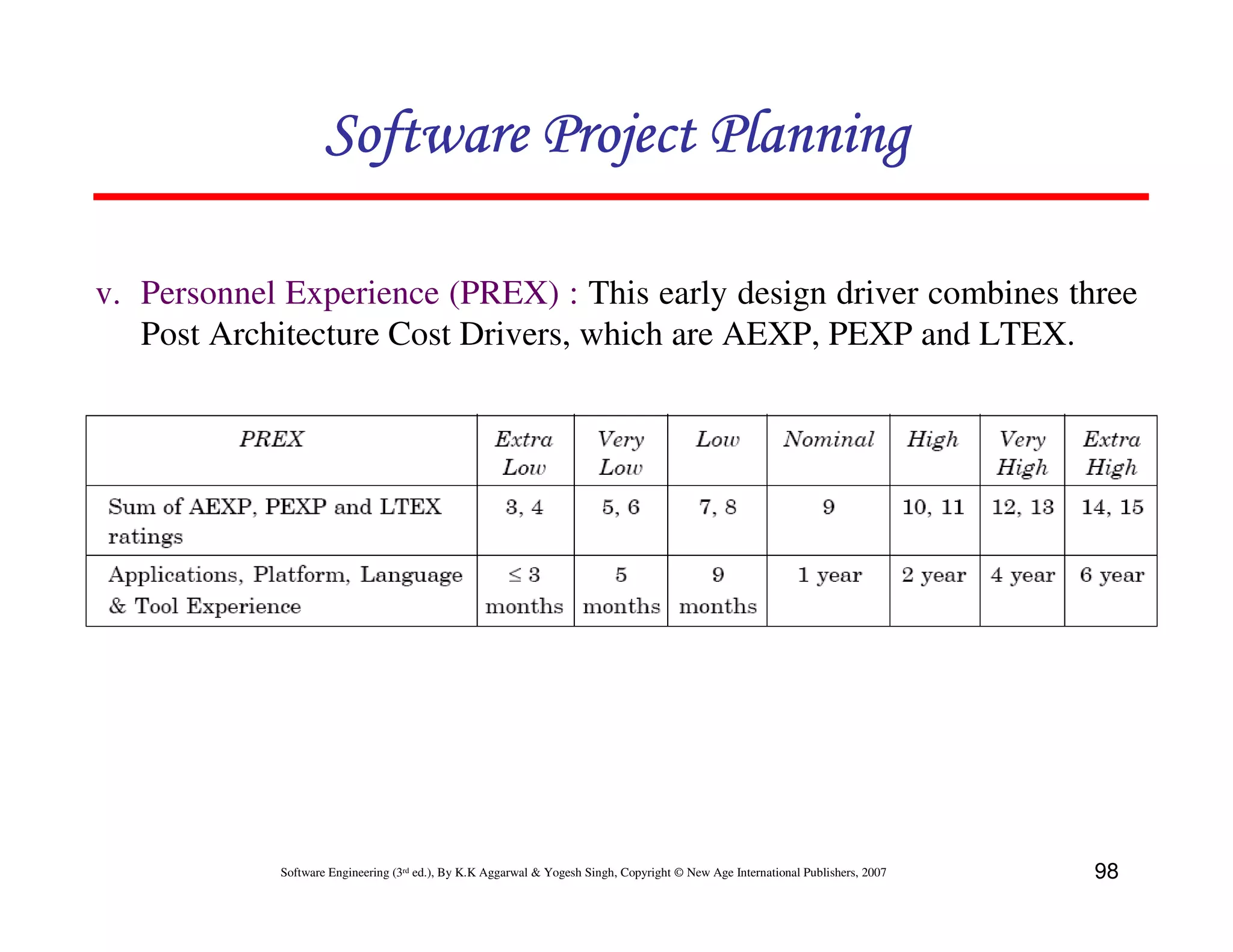
v. Personnel Experience (PREX) : This early design driver combines three
   Post Architecture Cost Drivers, which are AEXP, PEXP and LTEX.


            Software Engineering (3rd ed.), By K.K Aggarwal & Yogesh Singh, Copyright © New Age International Publishers, 2007   98
Software Project Planning

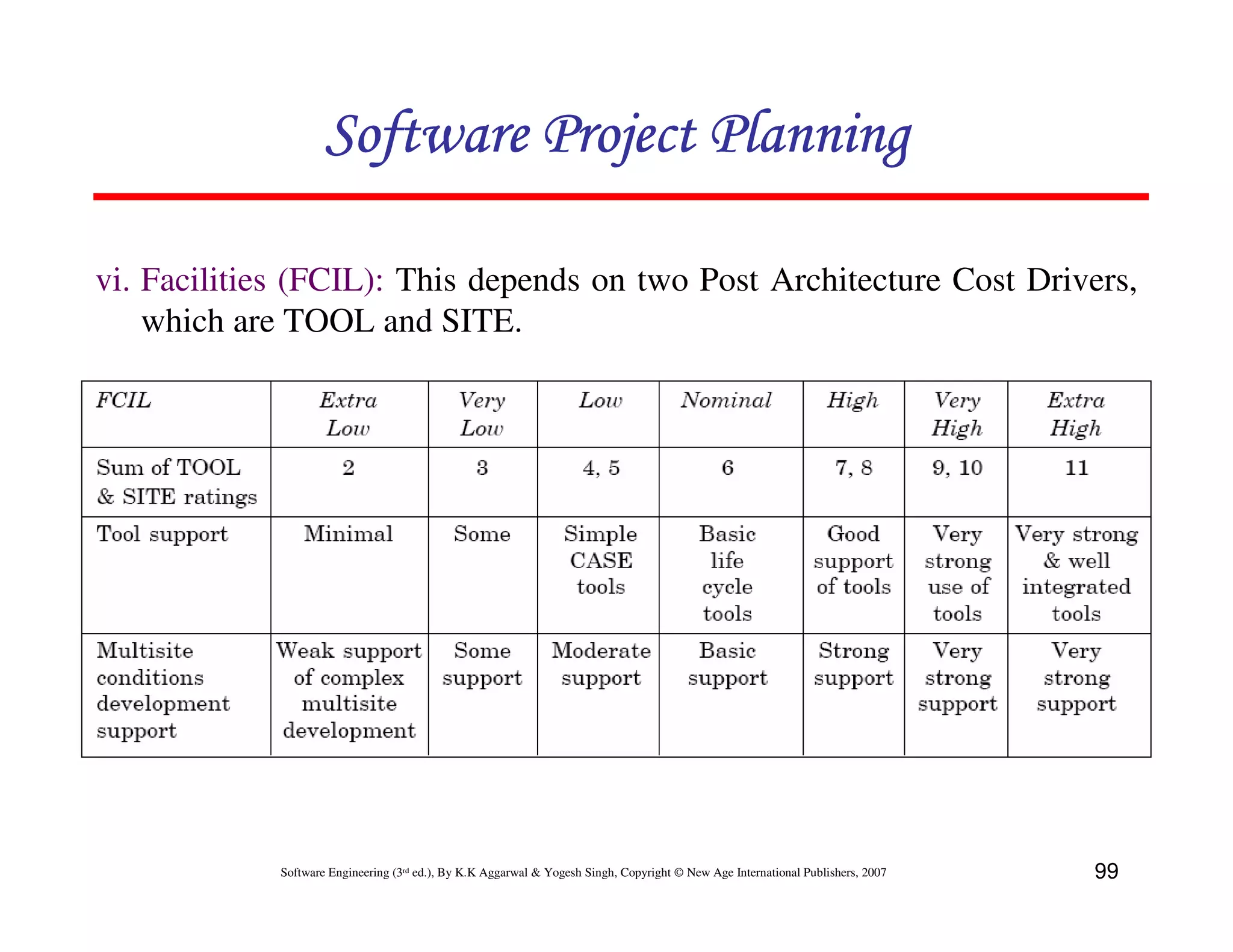
vi. Facilities (FCIL): This depends on two Post Architecture Cost Drivers,
    which are TOOL and SITE.


             Software Engineering (3rd ed.), By K.K Aggarwal & Yogesh Singh, Copyright © New Age International Publishers, 2007   99
Software Project Planning

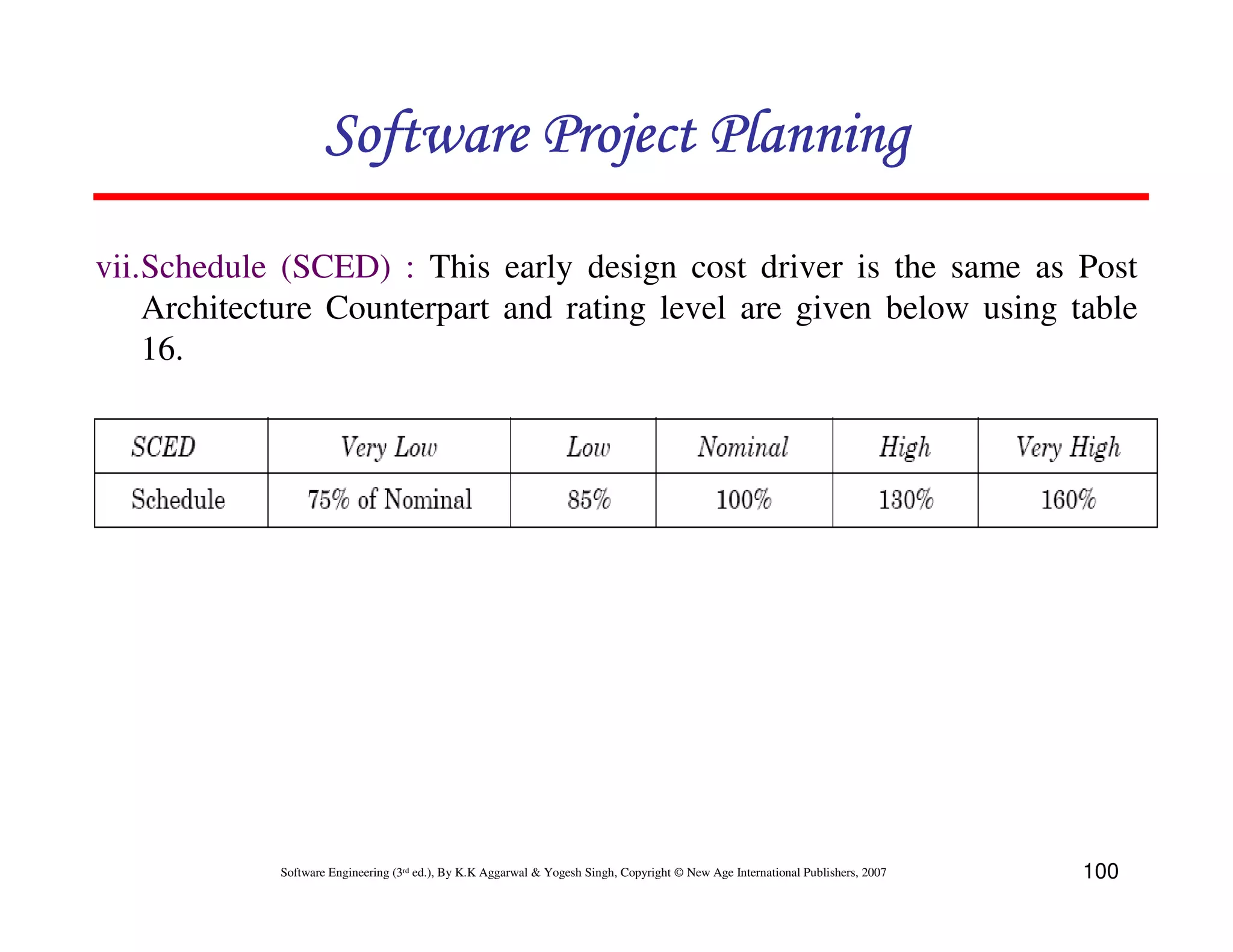
vii.Schedule (SCED) : This early design cost driver is the same as Post
    Architecture Counterpart and rating level are given below using table
    16.


            Software Engineering (3rd ed.), By K.K Aggarwal & Yogesh Singh, Copyright © New Age International Publishers, 2007   100
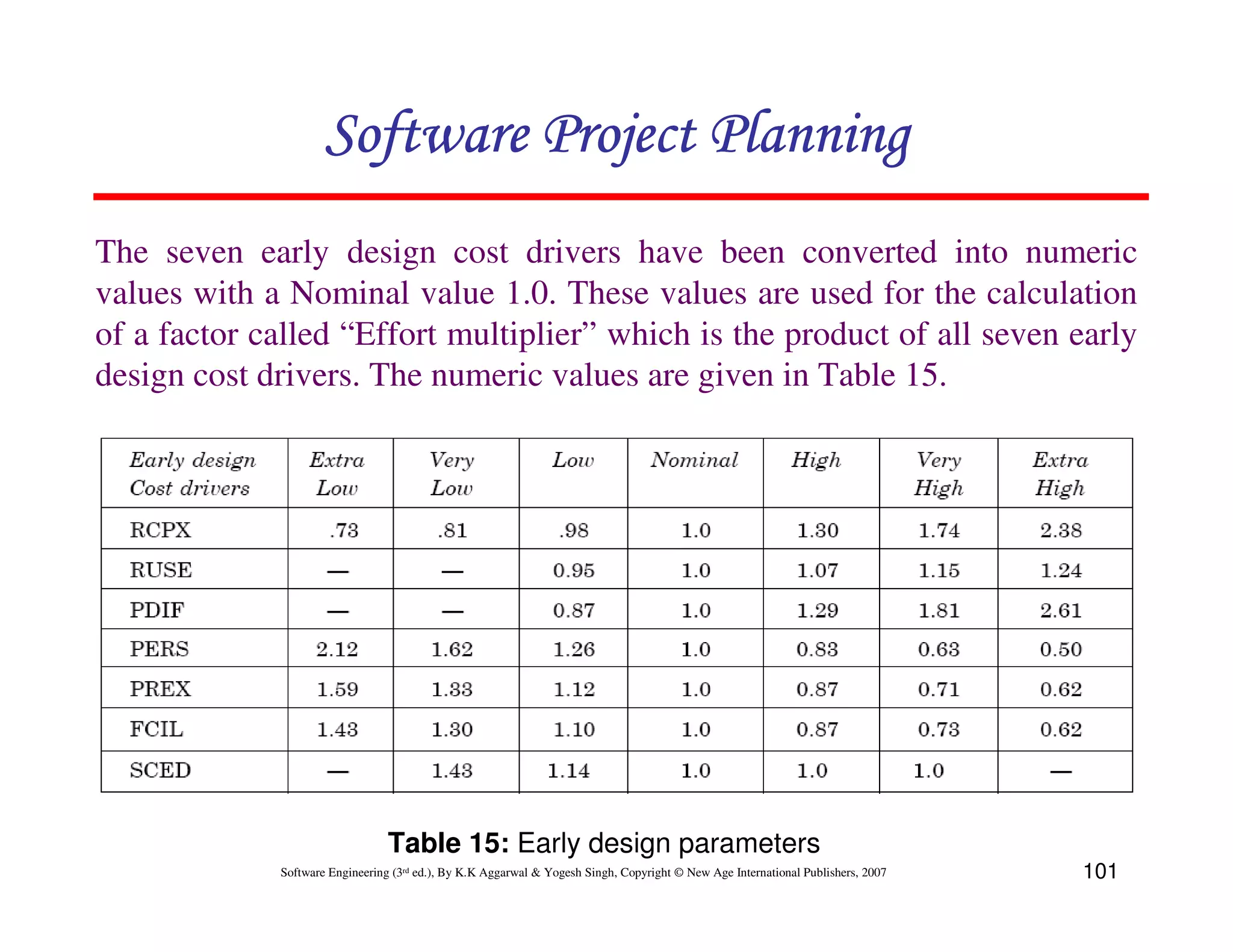
Software Project Planning
The seven early design cost drivers have been converted into numeric
values with a Nominal value 1.0. These values are used for the calculation
of a factor called “Effort multiplier” which is the product of all seven early
design cost drivers. The numeric values are given in Table 15.


                                 Table 15: Early design parameters
             Software Engineering (3rd ed.), By K.K Aggarwal & Yogesh Singh, Copyright © New Age International Publishers, 2007   101
Software Project Planning

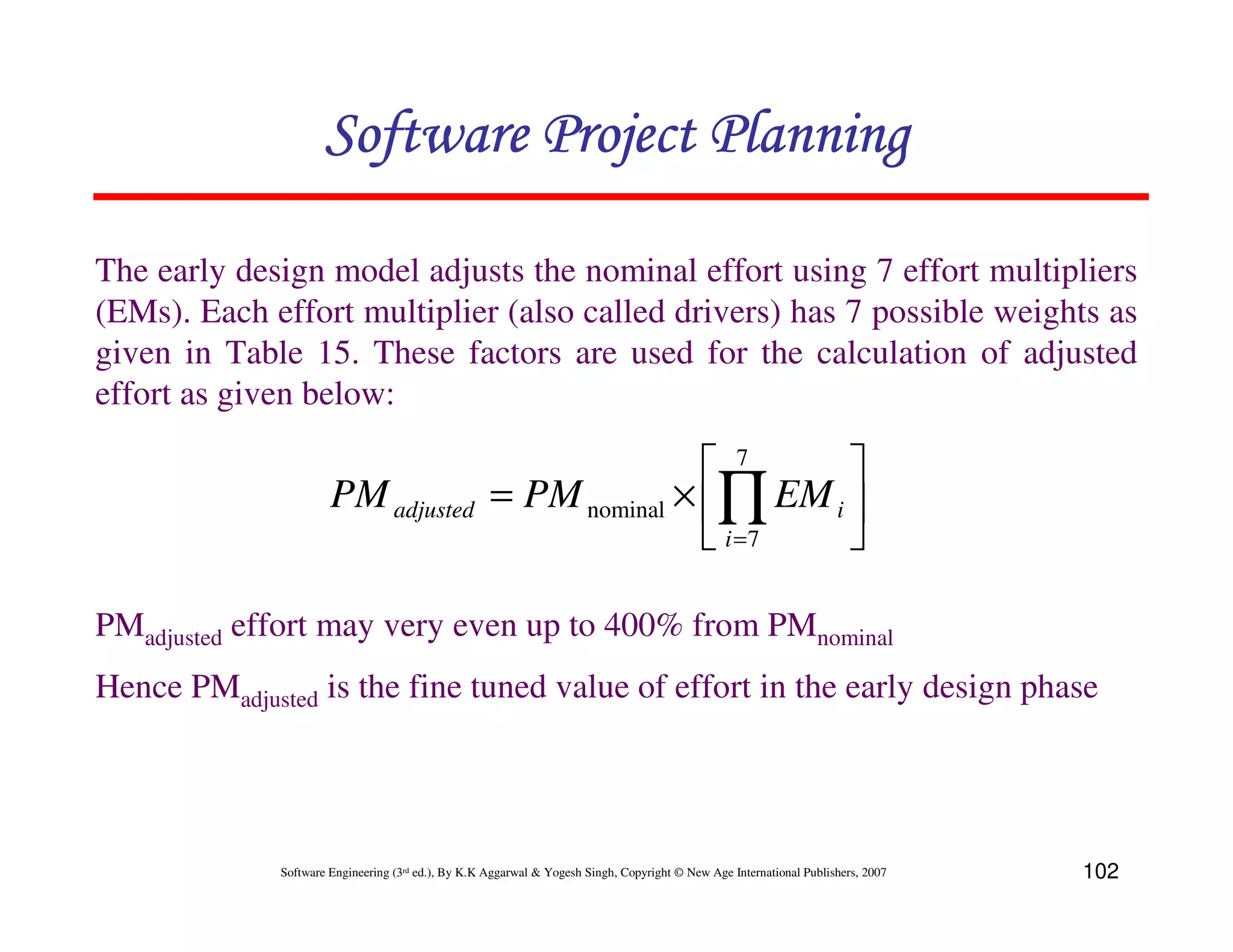
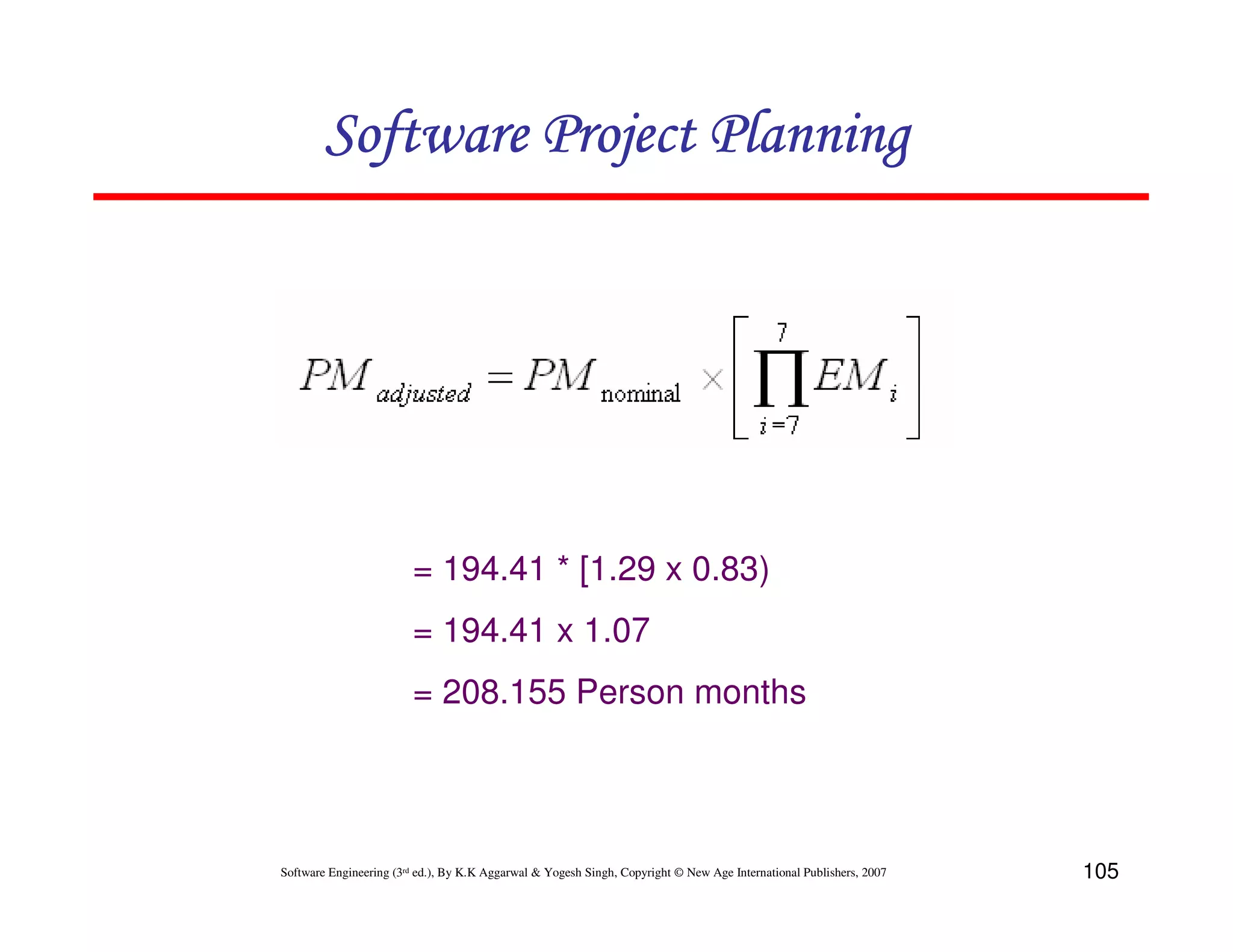
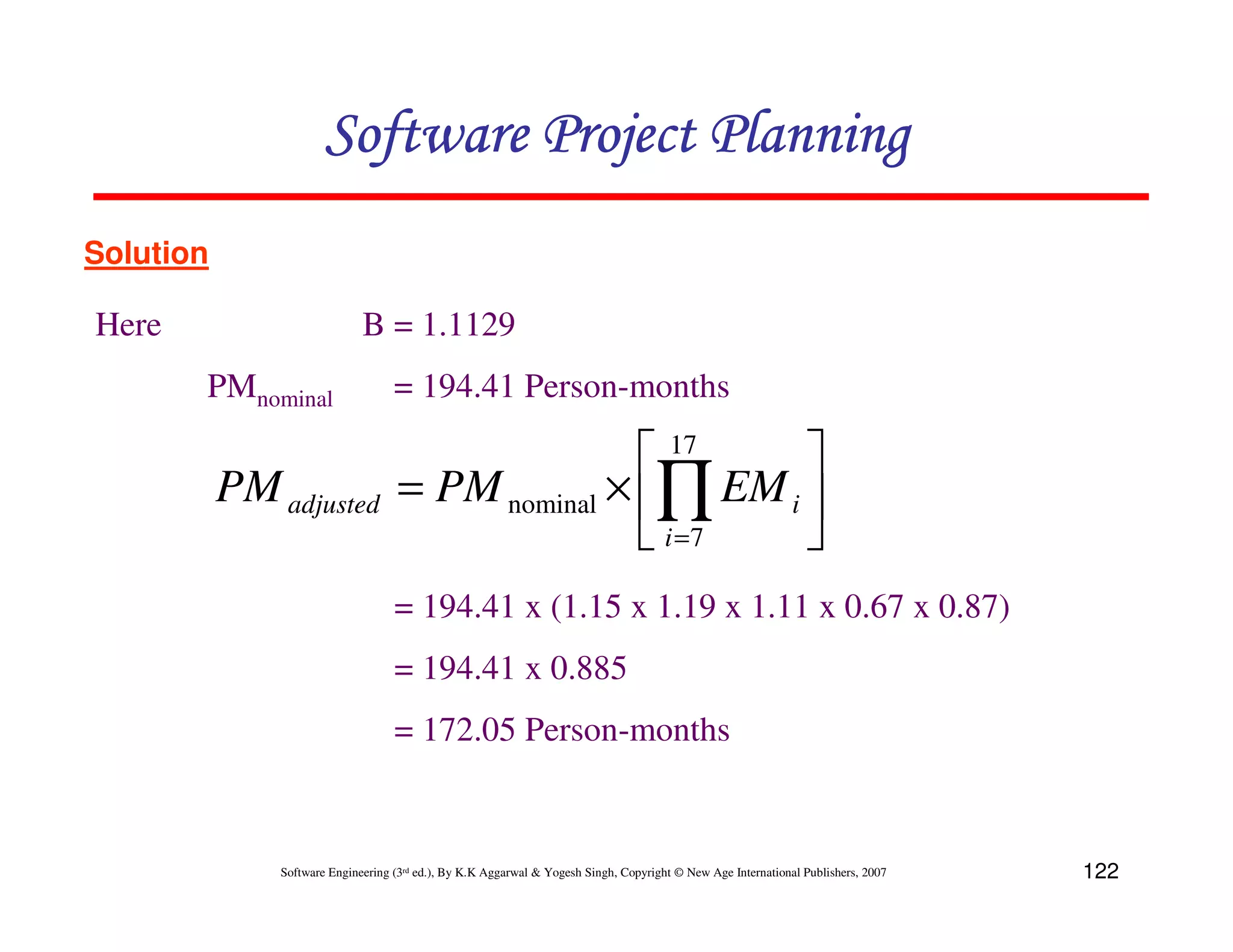
The early design model adjusts the nominal effort using 7 effort multipliers
(EMs). Each effort multiplier (also called drivers) has 7 possible weights as
given in Table 15. These factors are used for the calculation of adjusted
effort as given below:

                                                                     7     
                       PM adjusted                   = PM nominal × ∏ EM i 
                                                                     i =7  

PMadjusted effort may very even up to 400% from PMnominal
Hence PMadjusted is the fine tuned value of effort in the early design phase


              Software Engineering (3rd ed.), By K.K Aggarwal & Yogesh Singh, Copyright © New Age International Publishers, 2007   102
Software Project Planning

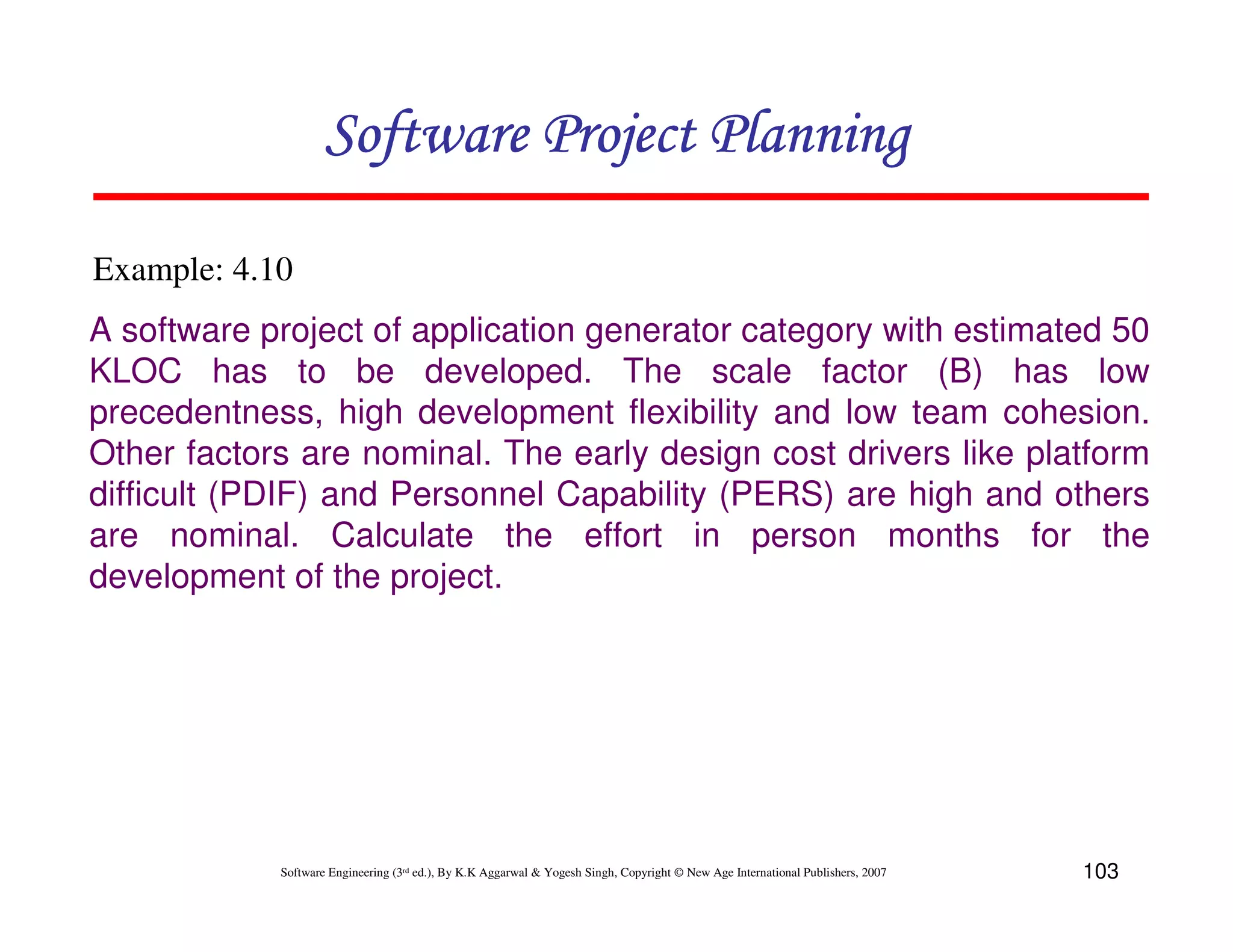
Example: 4.10
A software project of application generator category with estimated 50
KLOC has to be developed. The scale factor (B) has low
precedentness, high development flexibility and low team cohesion.
Other factors are nominal. The early design cost drivers like platform
difficult (PDIF) and Personnel Capability (PERS) are high and others
are nominal. Calculate the effort in person months for the
development of the project.


            Software Engineering (3rd ed.), By K.K Aggarwal & Yogesh Singh, Copyright © New Age International Publishers, 2007   103
Software Project Planning
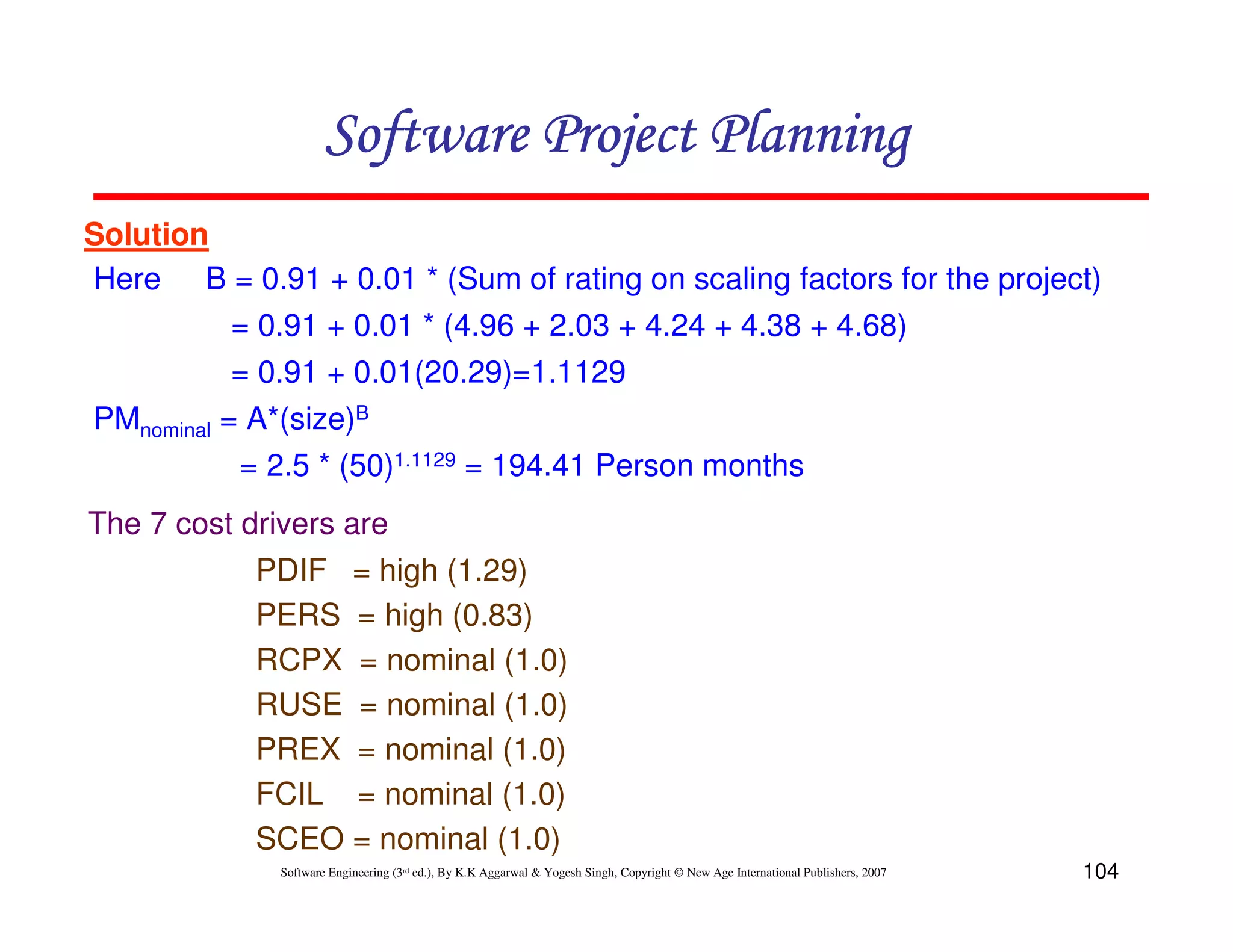
Solution
Here B = 0.91 + 0.01 * (Sum of rating on scaling factors for the project)
           = 0.91 + 0.01 * (4.96 + 2.03 + 4.24 + 4.38 + 4.68)
           = 0.91 + 0.01(20.29)=1.1129
PMnominal = A*(size)B
           = 2.5 * (50)1.1129 = 194.41 Person months
The 7 cost drivers are
            PDIF = high (1.29)
            PERS = high (0.83)
            RCPX = nominal (1.0)
            RUSE = nominal (1.0)
            PREX = nominal (1.0)
            FCIL = nominal (1.0)
            SCEO = nominal (1.0)
              Software Engineering (3rd ed.), By K.K Aggarwal & Yogesh Singh, Copyright © New Age International Publishers, 2007   104
Software Project Planning


                        = 194.41 * [1.29 x 0.83)
                        = 194.41 x 1.07
                        = 208.155 Person months


Software Engineering (3rd ed.), By K.K Aggarwal & Yogesh Singh, Copyright © New Age International Publishers, 2007   105
Software Project Planning
Post Architecture Model

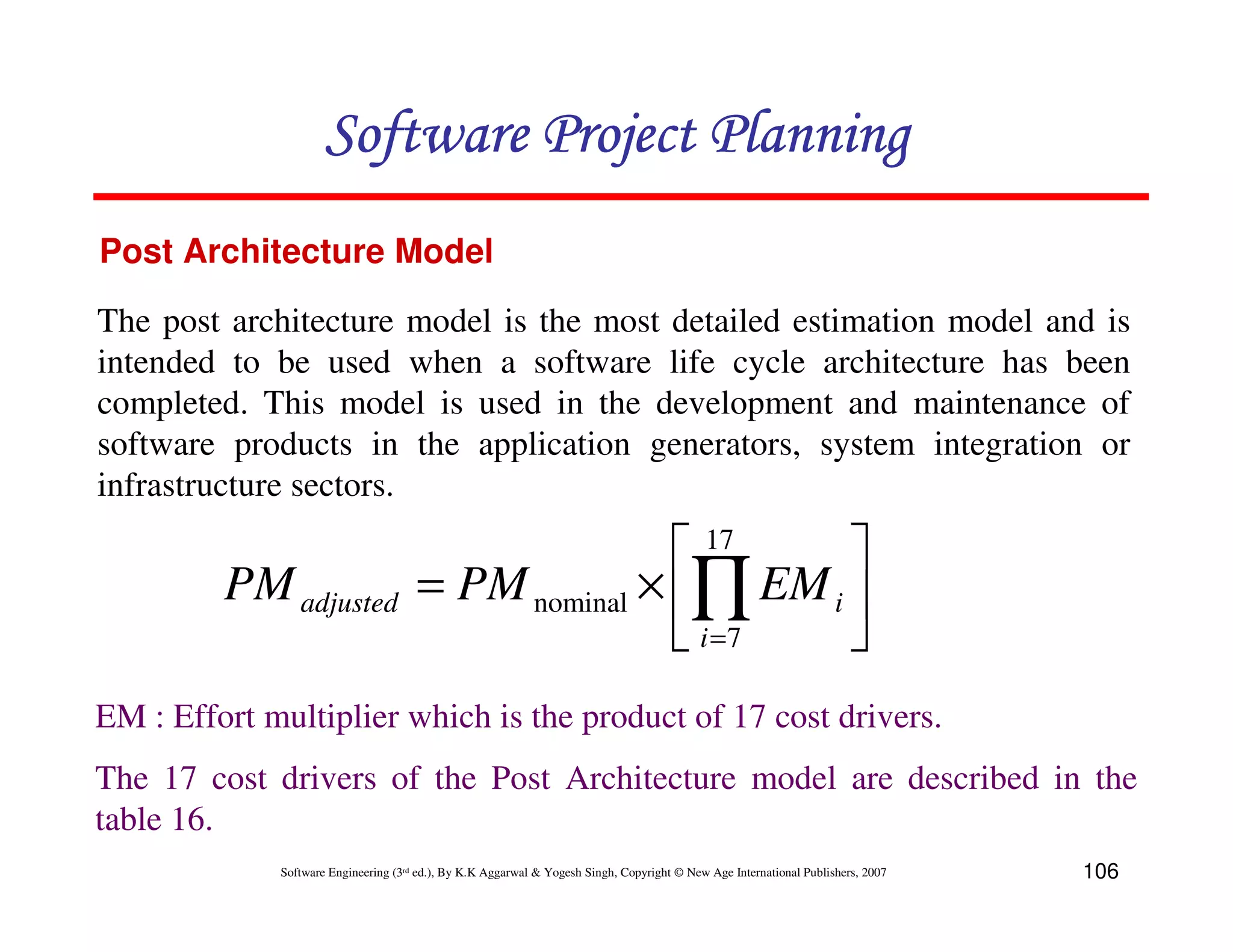
The post architecture model is the most detailed estimation model and is
intended to be used when a software life cycle architecture has been
completed. This model is used in the development and maintenance of
software products in the application generators, system integration or
infrastructure sectors.

                                                      17    
         PM adjusted                  = PM nominal × ∏ EM i 
                                                      i =7  
EM : Effort multiplier which is the product of 17 cost drivers.
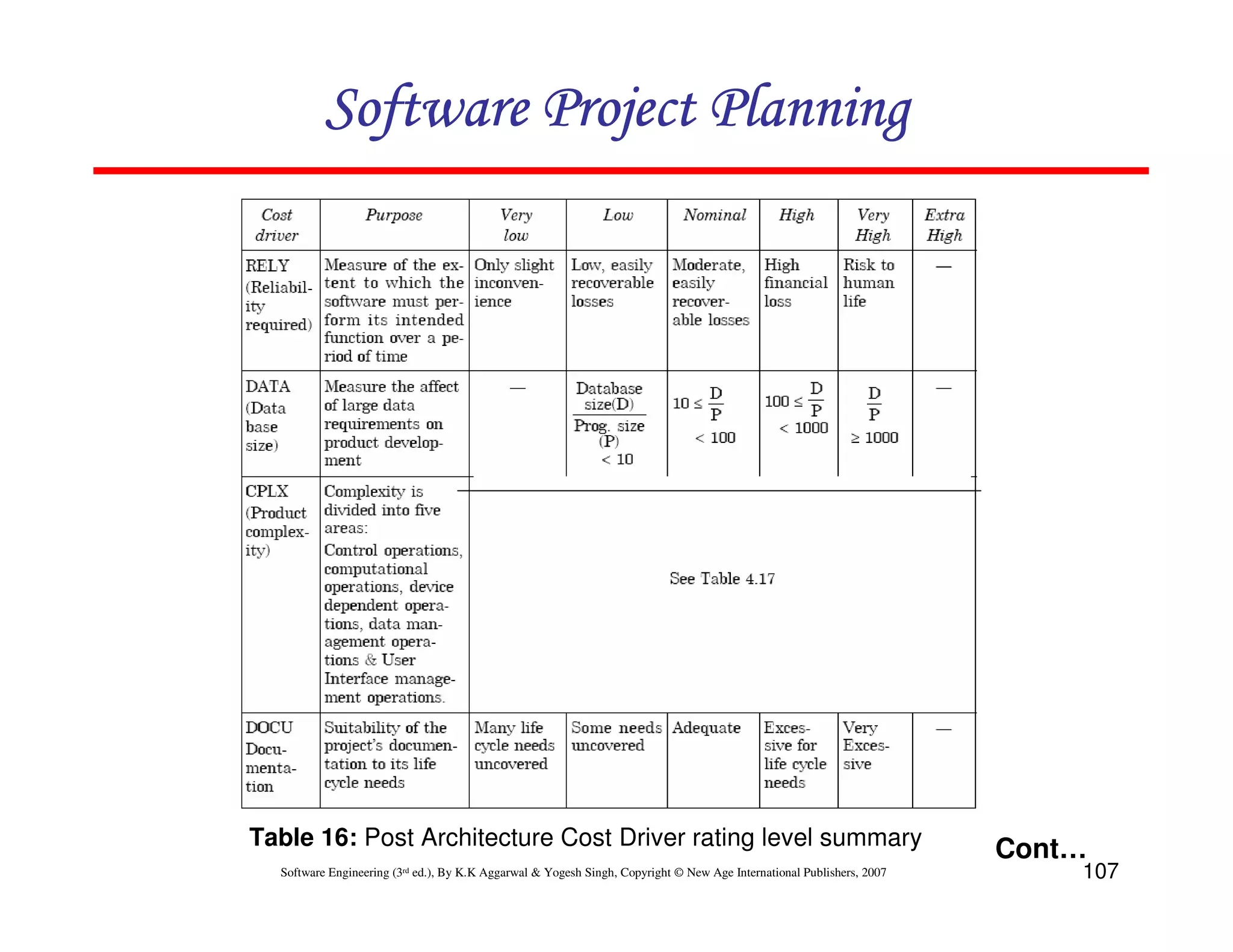
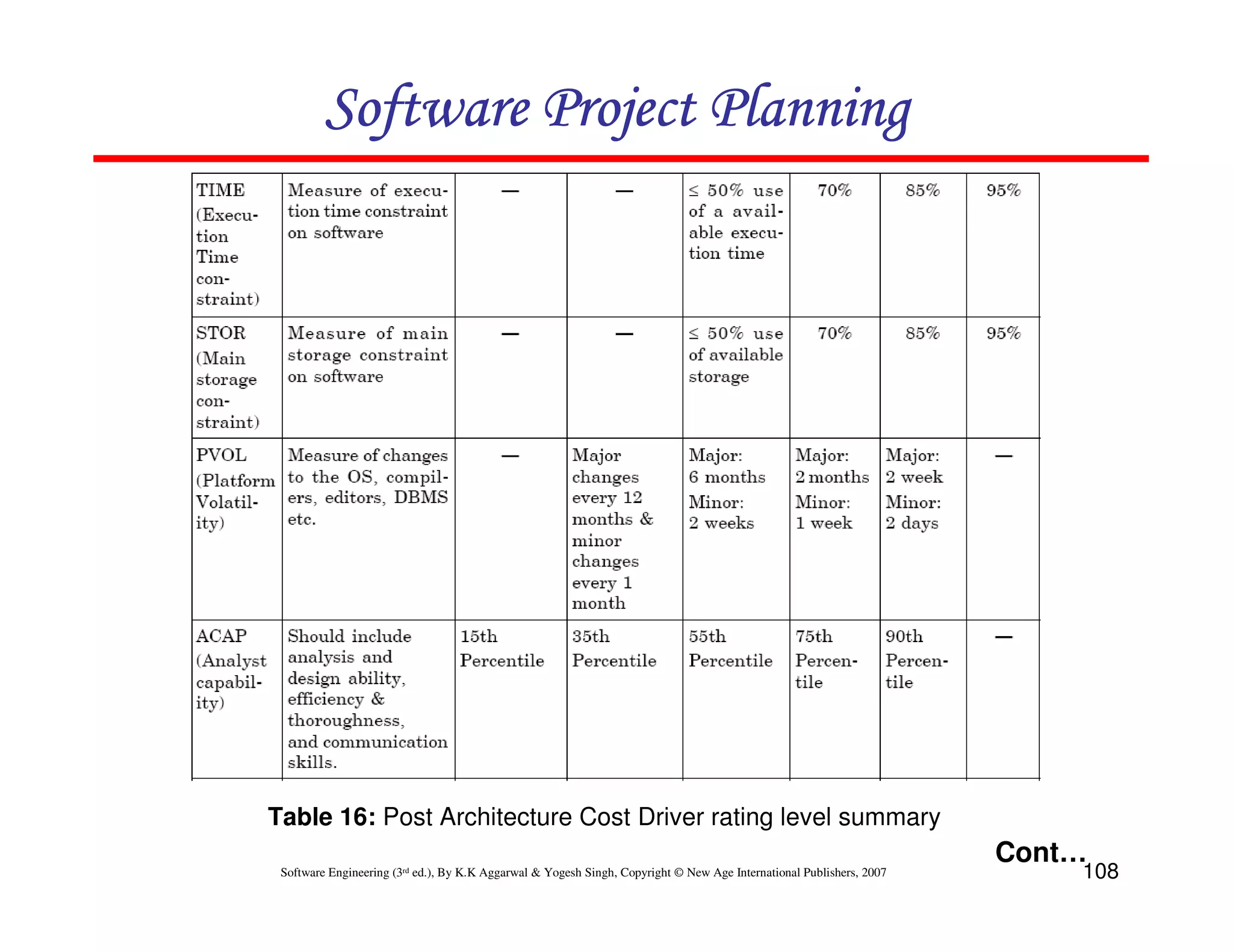
The 17 cost drivers of the Post Architecture model are described in the
table 16.
             Software Engineering (3rd ed.), By K.K Aggarwal & Yogesh Singh, Copyright © New Age International Publishers, 2007   106
Software Project Planning


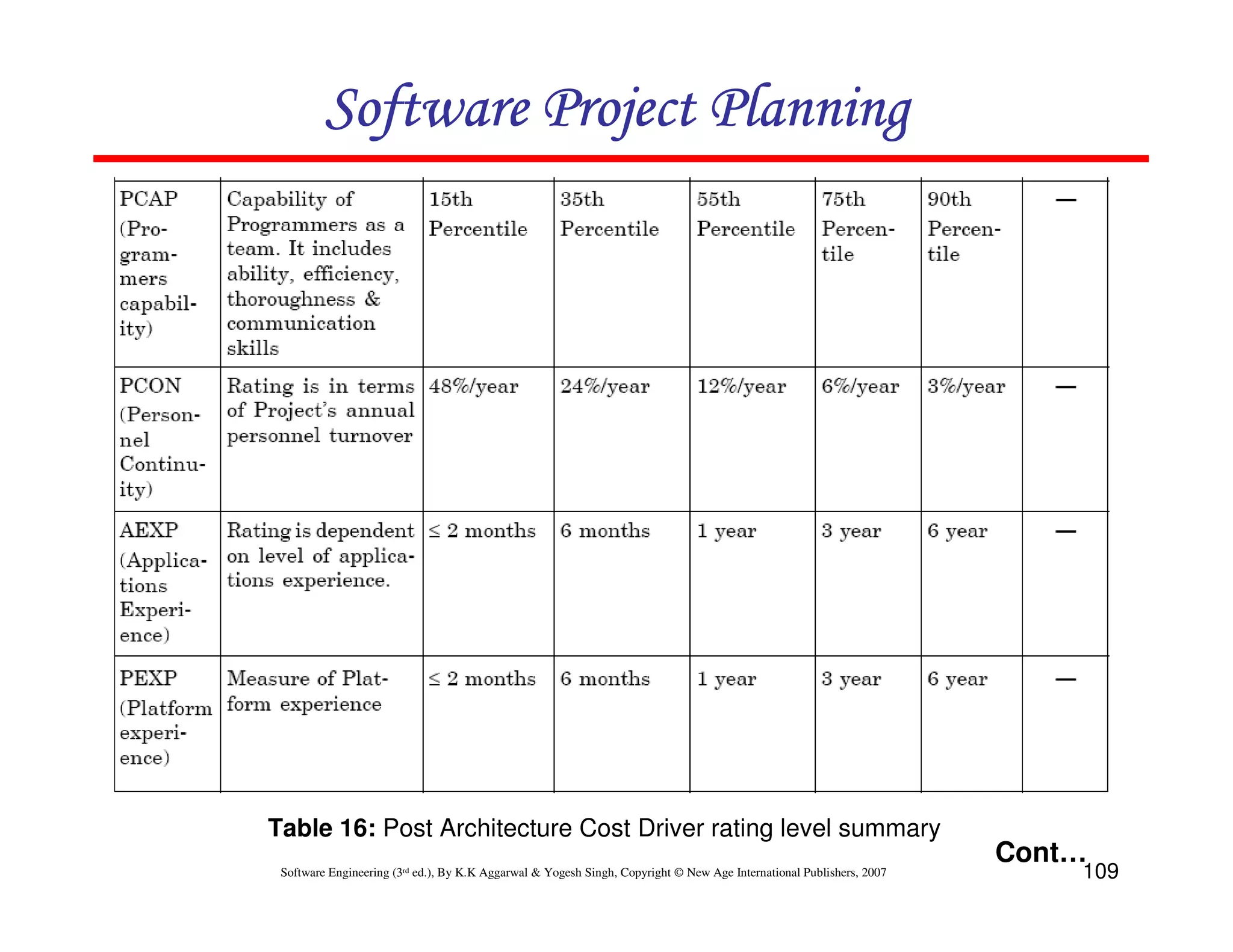
Table 16: Post Architecture Cost Driver rating level summary                                                           Cont…
  Software Engineering (3rd ed.), By K.K Aggarwal & Yogesh Singh, Copyright © New Age International Publishers, 2007       107
Software Project Planning


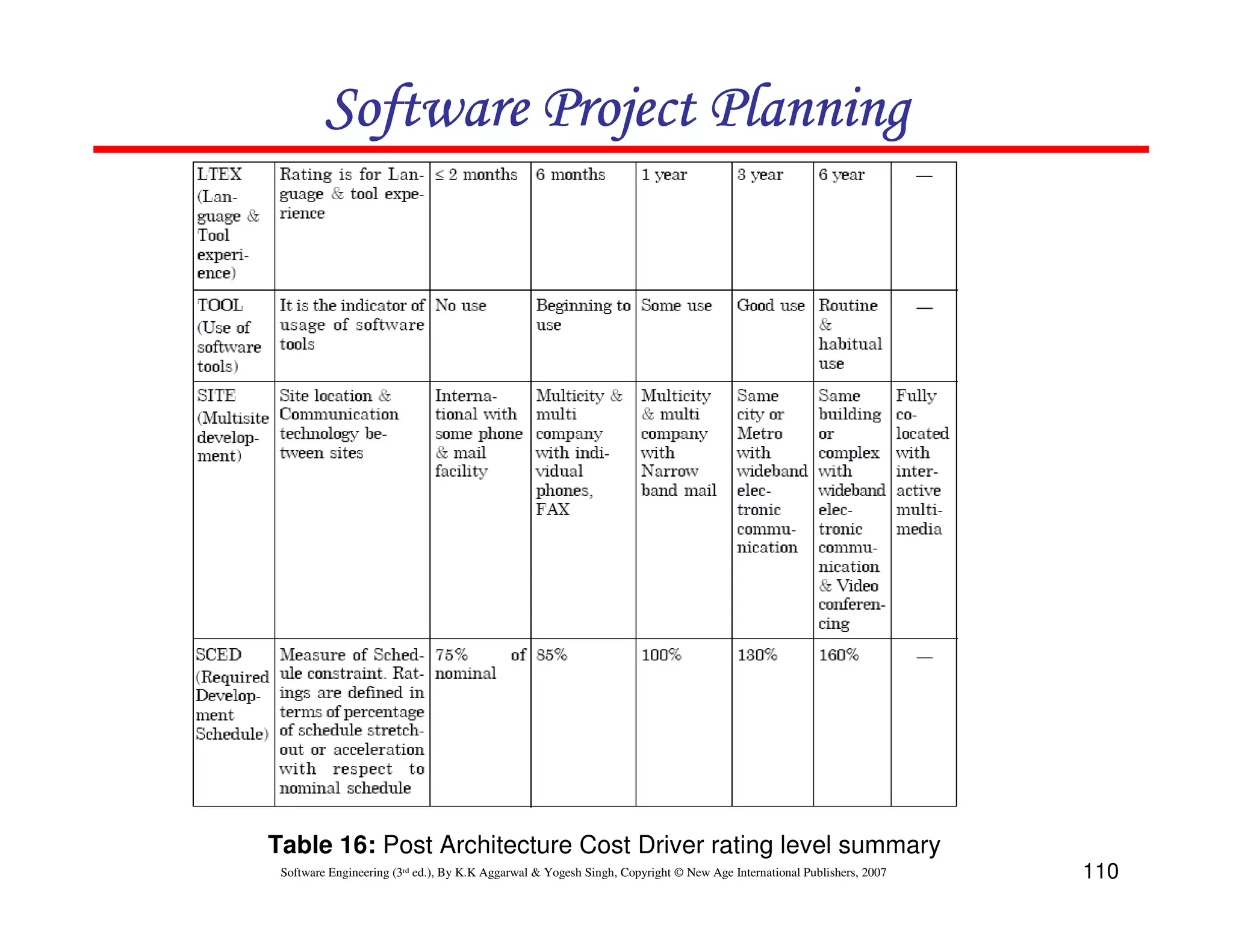
Table 16: Post Architecture Cost Driver rating level summary
                                                                                                                      Cont…
 Software Engineering (3rd ed.), By K.K Aggarwal & Yogesh Singh, Copyright © New Age International Publishers, 2007       108
Software Project Planning


Table 16: Post Architecture Cost Driver rating level summary
                                                                                                                      Cont…
 Software Engineering (3rd ed.), By K.K Aggarwal & Yogesh Singh, Copyright © New Age International Publishers, 2007       109
Software Project Planning


Table 16: Post Architecture Cost Driver rating level summary
 Software Engineering (3rd ed.), By K.K Aggarwal & Yogesh Singh, Copyright © New Age International Publishers, 2007   110
Software Project Planning

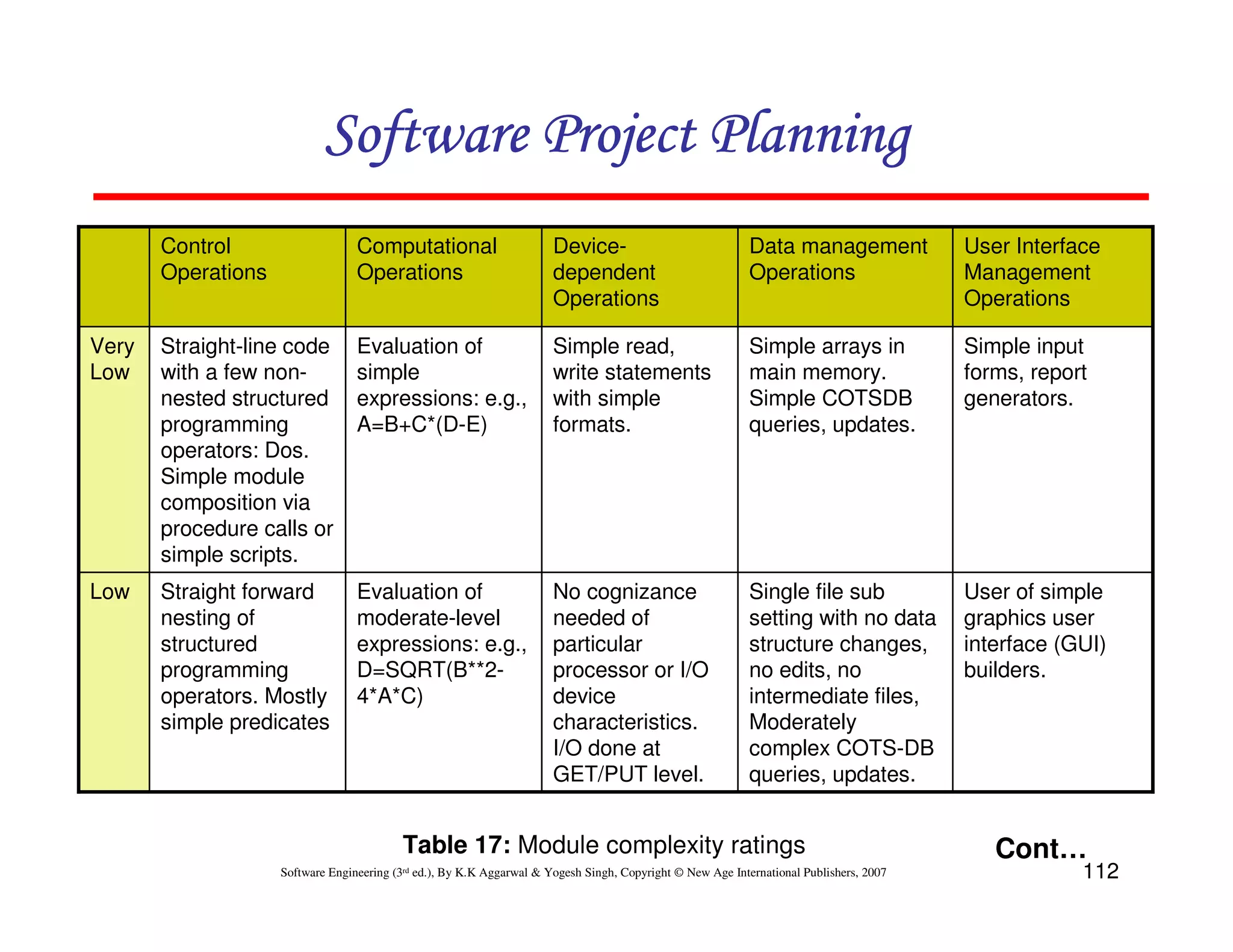
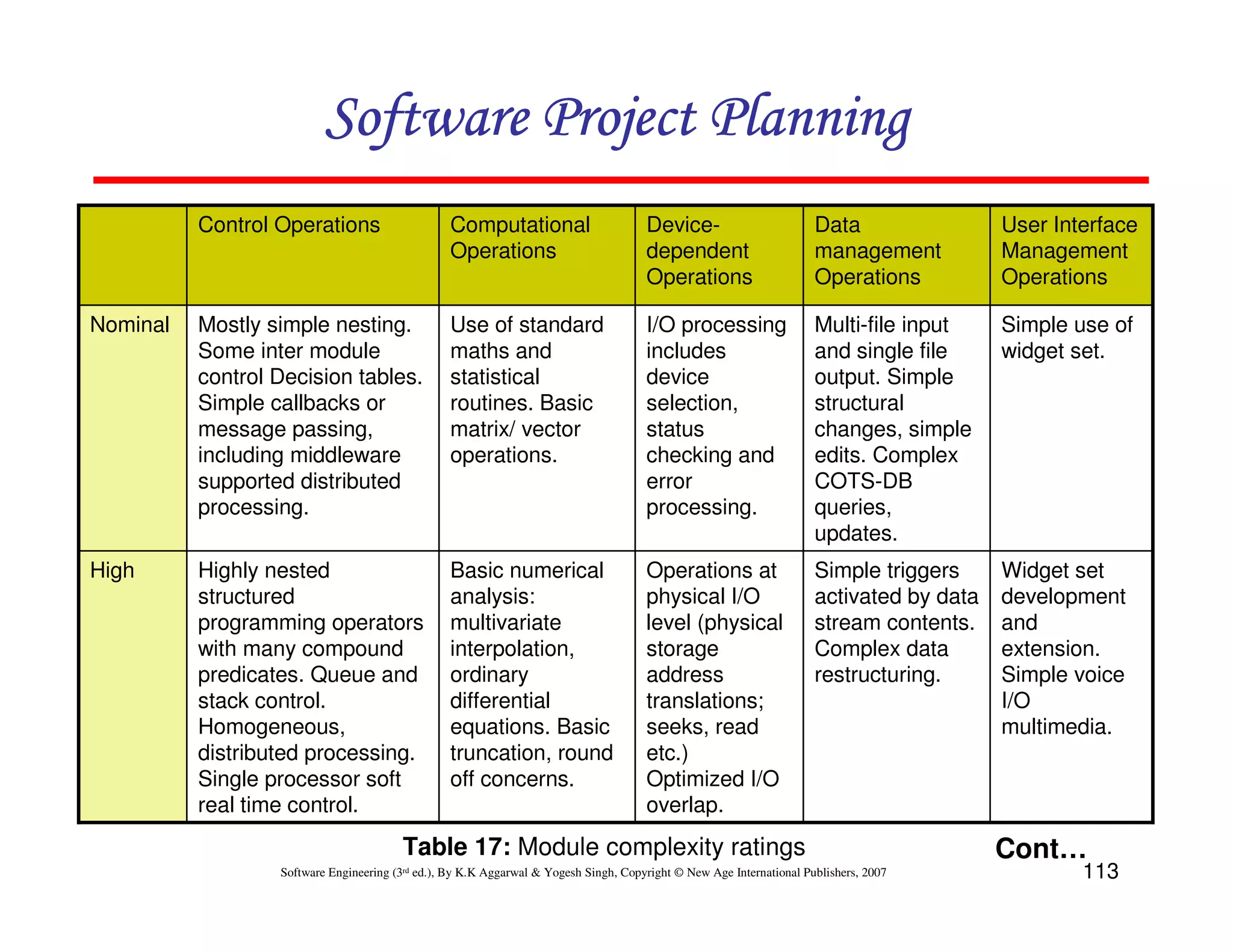
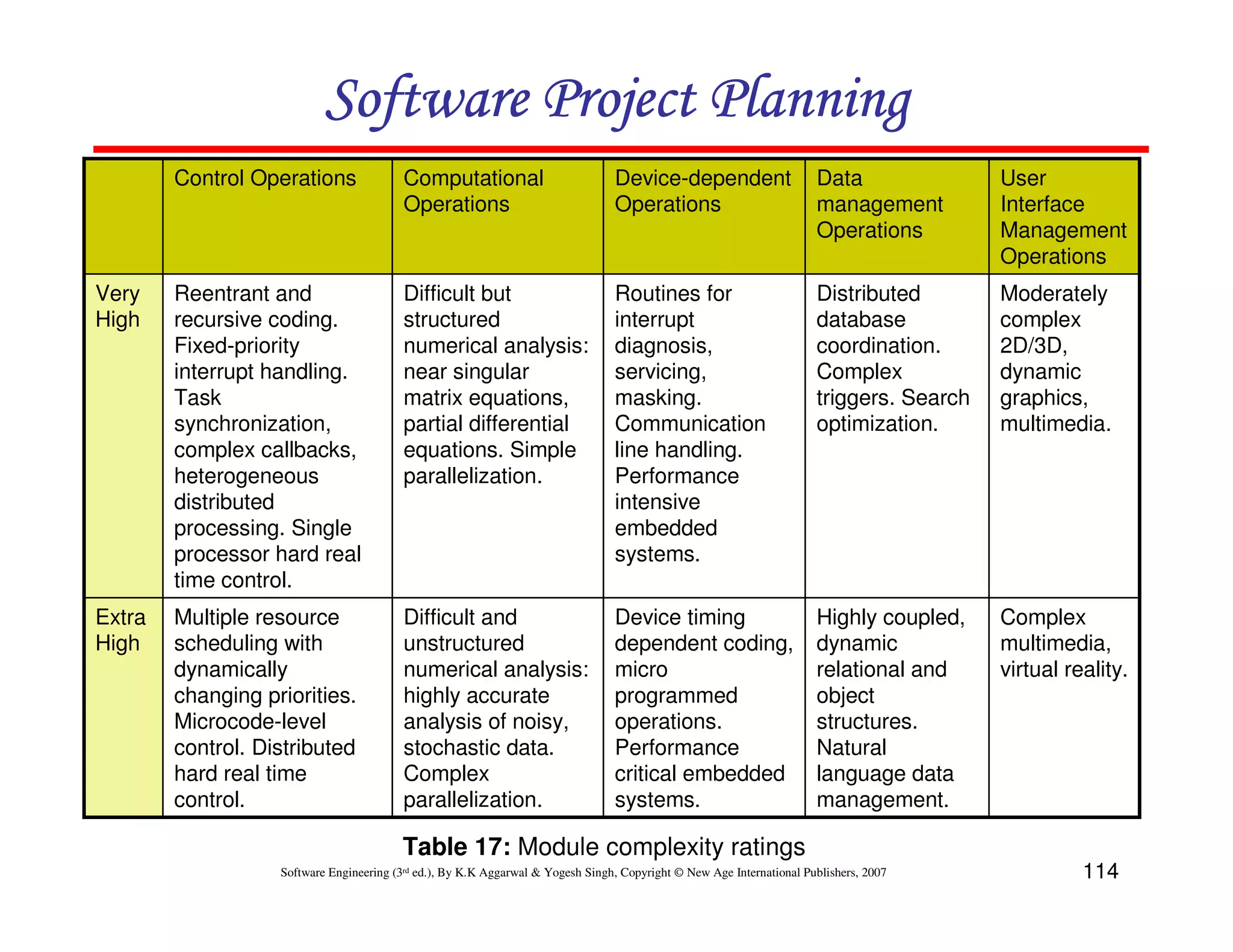
Product complexity is based on control operations, computational
operations, device dependent operations, data management operations and
user interface management operations. Module complexity rating are given
in table 17.

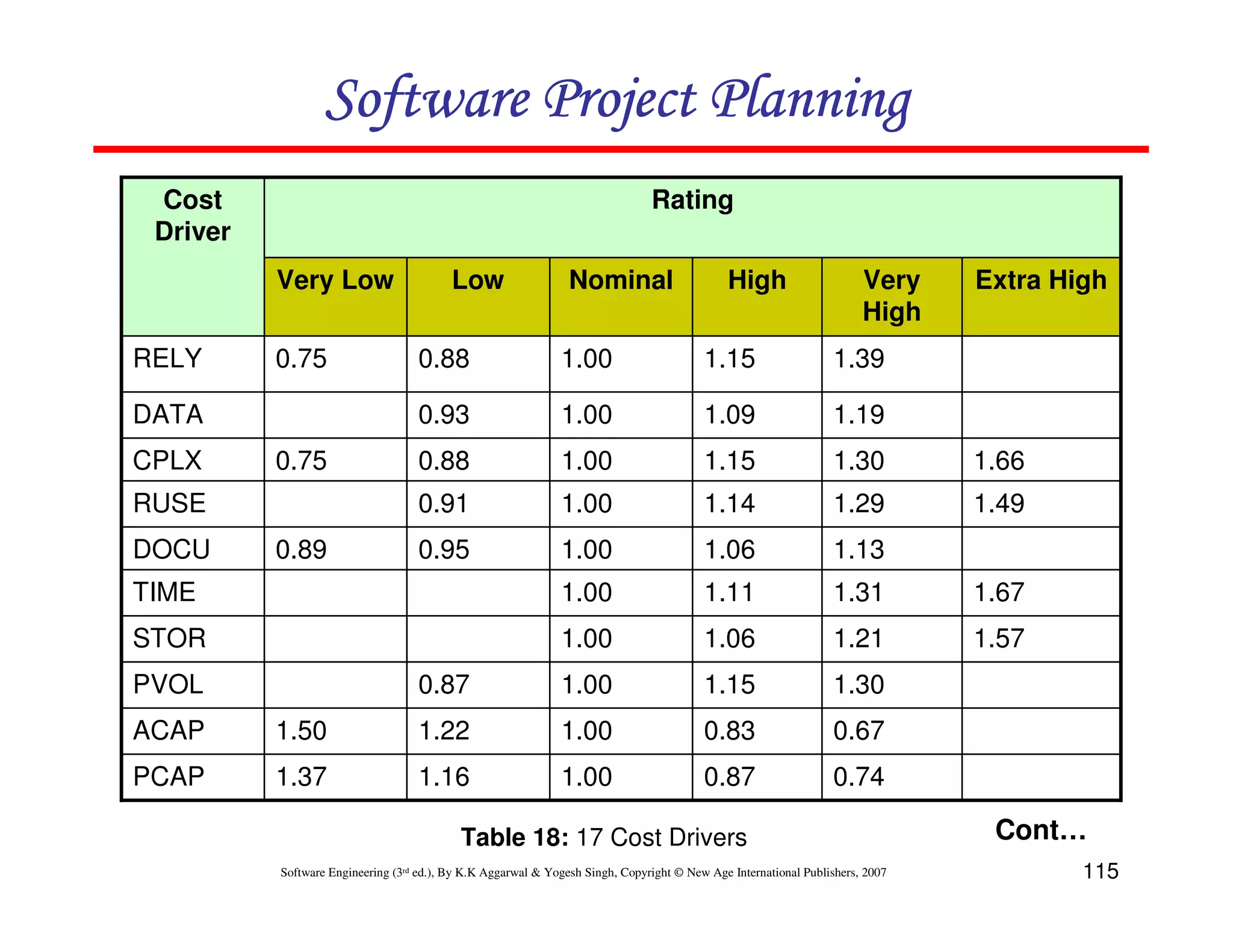
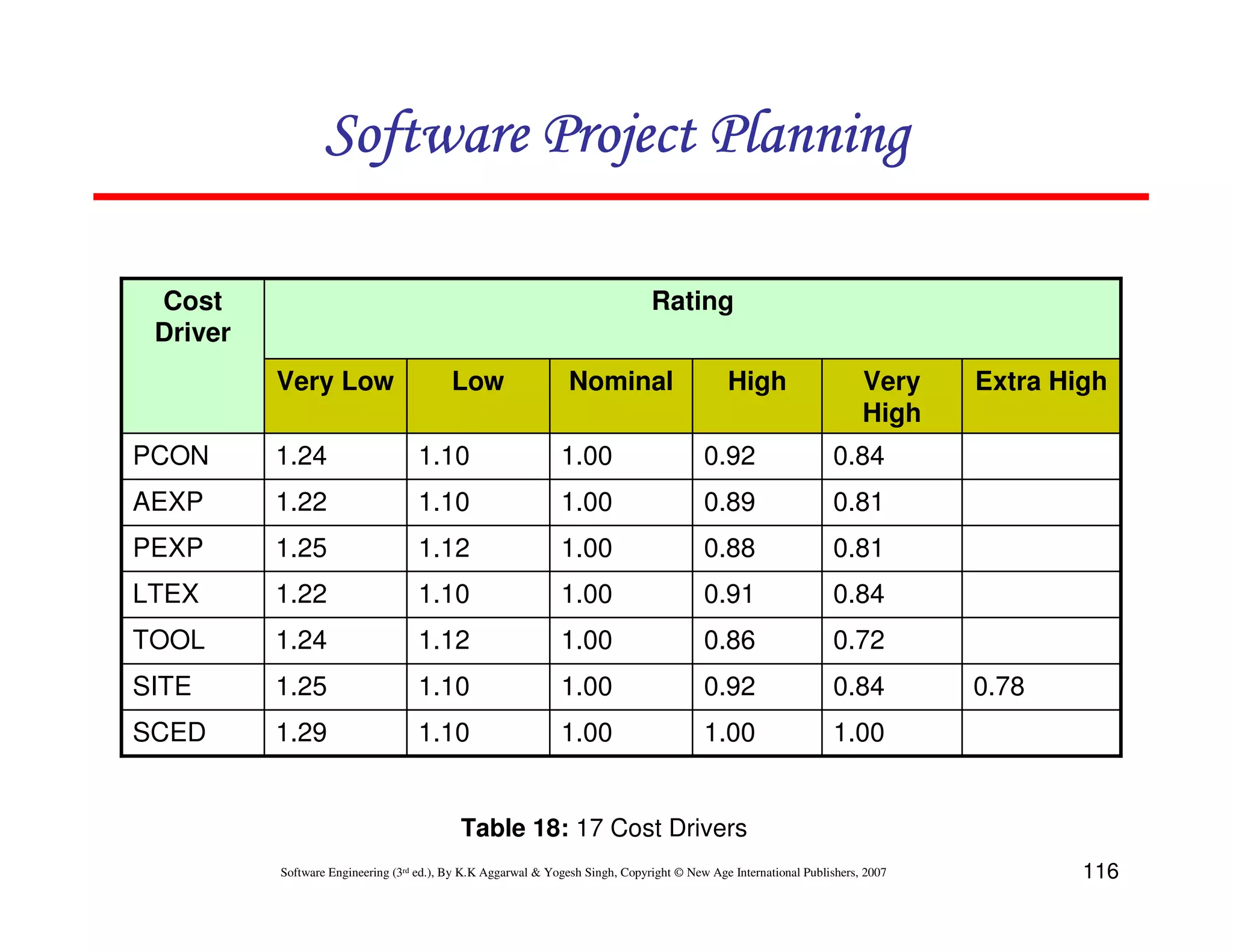
The numeric values of these 17 cost drivers are given in table 18 for the
calculation of the product of efforts i.e., effort multiplier (EM). Hence PM
adjusted is calculated which will be a better and fine tuned value of effort
in person months.


             Software Engineering (3rd ed.), By K.K Aggarwal & Yogesh Singh, Copyright © New Age International Publishers, 2007   111
Software Project Planning
       Control                    Computational                        Device-                              Data management              User Interface
       Operations                 Operations                           dependent                            Operations                   Management
                                                                       Operations                                                        Operations

Very   Straight-line code         Evaluation of                        Simple read,                         Simple arrays in             Simple input
Low    with a few non-            simple                               write statements                     main memory.                 forms, report
       nested structured          expressions: e.g.,                   with simple                          Simple COTSDB                generators.
       programming                A=B+C*(D-E)                          formats.                             queries, updates.
       operators: Dos.
       Simple module
       composition via
       procedure calls or
       simple scripts.
Low    Straight forward           Evaluation of                        No cognizance                        Single file sub              User of simple
       nesting of                 moderate-level                       needed of                            setting with no data         graphics user
       structured                 expressions: e.g.,                   particular                           structure changes,           interface (GUI)
       programming                D=SQRT(B**2-                         processor or I/O                     no edits, no                 builders.
       operators. Mostly          4*A*C)                               device                               intermediate files,
       simple predicates                                               characteristics.                     Moderately
                                                                       I/O done at                          complex COTS-DB
                                                                       GET/PUT level.                       queries, updates.


                                          Table 17: Module complexity ratings                                                               Cont…
                    Software Engineering (3rd ed.), By K.K Aggarwal & Yogesh Singh, Copyright © New Age International Publishers, 2007               112
Software Project Planning
          Control Operations                     Computational                        Device-                         Data                User Interface
                                                 Operations                           dependent                       management          Management
                                                                                      Operations                      Operations          Operations

Nominal   Mostly simple nesting.                 Use of standard                      I/O processing                  Multi-file input    Simple use of
          Some inter module                      maths and                            includes                        and single file     widget set.
          control Decision tables.               statistical                          device                          output. Simple
          Simple callbacks or                    routines. Basic                      selection,                      structural
          message passing,                       matrix/ vector                       status                          changes, simple
          including middleware                   operations.                          checking and                    edits. Complex
          supported distributed                                                       error                           COTS-DB
          processing.                                                                 processing.                     queries,
                                                                                                                      updates.
High      Highly nested                          Basic numerical                      Operations at                   Simple triggers     Widget set
          structured                             analysis:                            physical I/O                    activated by data   development
          programming operators                  multivariate                         level (physical                 stream contents.    and
          with many compound                     interpolation,                       storage                         Complex data        extension.
          predicates. Queue and                  ordinary                             address                         restructuring.      Simple voice
          stack control.                         differential                         translations;                                       I/O
          Homogeneous,                           equations. Basic                     seeks, read                                         multimedia.
          distributed processing.                truncation, round                    etc.)
          Single processor soft                  off concerns.                        Optimized I/O
          real time control.                                                          overlap.
                                        Table 17: Module complexity ratings                                                               Cont…
                  Software Engineering (3rd ed.), By K.K Aggarwal & Yogesh Singh, Copyright © New Age International Publishers, 2007              113
Software Project Planning
        Control Operations                Computational                          Device-dependent                      Data               User
                                          Operations                             Operations                            management         Interface
                                                                                                                       Operations         Management
                                                                                                                                          Operations
Very    Reentrant and                     Difficult but                          Routines for                          Distributed        Moderately
High    recursive coding.                 structured                             interrupt                             database           complex
        Fixed-priority                    numerical analysis:                    diagnosis,                            coordination.      2D/3D,
        interrupt handling.               near singular                          servicing,                            Complex            dynamic
        Task                              matrix equations,                      masking.                              triggers. Search   graphics,
        synchronization,                  partial differential                   Communication                         optimization.      multimedia.
        complex callbacks,                equations. Simple                      line handling.
        heterogeneous                     parallelization.                       Performance
        distributed                                                              intensive
        processing. Single                                                       embedded
        processor hard real                                                      systems.
        time control.
Extra   Multiple resource                 Difficult and                          Device timing                         Highly coupled,    Complex
High    scheduling with                   unstructured                           dependent coding,                     dynamic            multimedia,
        dynamically                       numerical analysis:                    micro                                 relational and     virtual reality.
        changing priorities.              highly accurate                        programmed                            object
        Microcode-level                   analysis of noisy,                     operations.                           structures.
        control. Distributed              stochastic data.                       Performance                           Natural
        hard real time                    Complex                                critical embedded                     language data
        control.                          parallelization.                       systems.                              management.

                                         Table 17: Module complexity ratings
                   Software Engineering (3rd ed.), By K.K Aggarwal & Yogesh Singh, Copyright © New Age International Publishers, 2007               114
Software Project Planning
 Cost                                                                          Rating
 Driver
          Very Low                        Low                   Nominal                       High                     Very    Extra High
                                                                                                                       High
RELY      0.75                     0.88                       1.00                       1.15                    1.39

DATA                               0.93                       1.00                       1.09                    1.19
CPLX      0.75                     0.88                       1.00                       1.15                    1.30          1.66
RUSE                               0.91                       1.00                       1.14                    1.29          1.49
DOCU      0.89                     0.95                       1.00                       1.06                    1.13
TIME                                                          1.00                       1.11                    1.31          1.67
STOR                                                          1.00                       1.06                    1.21          1.57
PVOL                               0.87                       1.00                       1.15                    1.30
ACAP      1.50                     1.22                       1.00                       0.83                    0.67
PCAP      1.37                     1.16                       1.00                       0.87                    0.74

                                           Table 18: 17 Cost Drivers                                                            Cont…
          Software Engineering (3rd ed.), By K.K Aggarwal & Yogesh Singh, Copyright © New Age International Publishers, 2007           115
Software Project Planning

 Cost                                                                          Rating
 Driver
          Very Low                        Low                   Nominal                       High                     Very    Extra High
                                                                                                                       High
PCON      1.24                     1.10                       1.00                       0.92                    0.84
AEXP      1.22                     1.10                       1.00                       0.89                    0.81
PEXP      1.25                     1.12                       1.00                       0.88                    0.81
LTEX      1.22                     1.10                       1.00                       0.91                    0.84
TOOL      1.24                     1.12                       1.00                       0.86                    0.72
SITE      1.25                     1.10                       1.00                       0.92                    0.84          0.78
SCED      1.29                     1.10                       1.00                       1.00                    1.00


                                           Table 18: 17 Cost Drivers
          Software Engineering (3rd ed.), By K.K Aggarwal & Yogesh Singh, Copyright © New Age International Publishers, 2007           116
Software Project Planning
Schedule estimation

Development time can be calculated using PMadjusted as a key factor and the
desired equation is:


                                                                                    ( 0.28+ 0.2 ( B − 0.091))]                      SCED %
         TDEVnominal = [φ × ( PM adjusted )                                                                                       ∗
                                                                                                                                      100
where Φ = constant, provisionally set to 3.67
TDEVnominal = calendar time in months with a scheduled constraint
        B = Scaling factor
PMadjusted = Estimated effort in Person months (after adjustment)

             Software Engineering (3rd ed.), By K.K Aggarwal & Yogesh Singh, Copyright © New Age International Publishers, 2007              117
Software Project Planning
Size measurement
Size can be measured in any unit and the model can be calibrated
accordingly. However, COCOMO II details are:

 i. Application composition model uses the size in object points.

 ii. The other two models use size in KLOC

Early design model uses unadjusted function points. These function points
are converted into KLOC using Table 19. Post architecture model may
compute KLOC after defining LOC counting rules. If function points are
used, then use unadjusted function points and convert it into KLOC using
Table 19.

             Software Engineering (3rd ed.), By K.K Aggarwal & Yogesh Singh, Copyright © New Age International Publishers, 2007   118
Software Project Planning
              Language                                                             SLOC/UFP
Ada                                                                                            71
AI Shell                                                                                       49
APL                                                                                            32
Assembly                                                                                     320
Assembly (Macro)                                                                             213
ANSI/Quick/Turbo Basic                                                                         64
Basic-Compiled                                                                                 91
Basic-Interpreted                                                                            128
C                                                                                            128
C++                                                                                            29

          Table 19: Converting function points to lines of code
    Software Engineering (3rd ed.), By K.K Aggarwal & Yogesh Singh, Copyright © New Age International Publishers, 2007   Cont…119
Software Project Planning
             Language                                                             SLOC/UFP
ANSI Cobol 85                                                                                 91
Fortan 77                                                                                   105
Forth                                                                                         64
Jovial                                                                                      105
Lisp                                                                                          64
Modula 2                                                                                      80
Pascal                                                                                        91
Prolog                                                                                        64
Report Generator                                                                              80
Spreadsheet                                                                                     6

         Table 19: Converting function points to lines of code
   Software Engineering (3rd ed.), By K.K Aggarwal & Yogesh Singh, Copyright © New Age International Publishers, 2007   120
Software Project Planning

Example: 4.11
Consider the software project given in example 4.10. Size and scale factor
(B) are the same. The identified 17 Cost drivers are high reliability (RELY),
very high database size (DATA), high execution time constraint (TIME),
very high analyst capability (ACAP), high programmers capability (PCAP).
The other cost drivers are nominal. Calculate the effort in Person-Months for
the development of the project.


             Software Engineering (3rd ed.), By K.K Aggarwal & Yogesh Singh, Copyright © New Age International Publishers, 2007   121
Software Project Planning
Solution

Here                          B = 1.1129
       PMnominal                    = 194.41 Person-months

                                                     17    
           PM adjusted               = PM nominal × ∏ EM i 
                                                     i =7  
                                    = 194.41 x (1.15 x 1.19 x 1.11 x 0.67 x 0.87)
                                    = 194.41 x 0.885
                                    = 172.05 Person-months


               Software Engineering (3rd ed.), By K.K Aggarwal & Yogesh Singh, Copyright © New Age International Publishers, 2007   122
Software Project Planning
Putnam Resource Allocation Model
Norden of IBM
    Rayleigh curve

         Model for a range of hardware development projects.
                                                                                                                               Overall Curve
                                                                                                                               Design and Coding

      Persons


                                                                Time
         Fig.6: The Rayleigh manpower loading curve
          Software Engineering (3rd ed.), By K.K Aggarwal & Yogesh Singh, Copyright © New Age International Publishers, 2007               123
Software Project Planning

Putnam observed that this curve was a close
approximation at project level and software subsystem
level.


          No. of projects = 150


         Software Engineering (3rd ed.), By K.K Aggarwal & Yogesh Singh, Copyright © New Age International Publishers, 2007   124
Software Project Planning

The Norden / Rayleigh Curve

The curve is modeled by differential equation

                 dy         − at 2                                                              --------- (1)
         m(t ) =    = 2kate
                 dt
  dy
  dt    = manpower utilization rate per unit time
   a    = parameter that affects the shape of the curve
   K    = area under curve in the interval [0, ∞ ]
   t    = elapsed time
            Software Engineering (3rd ed.), By K.K Aggarwal & Yogesh Singh, Copyright © New Age International Publishers, 2007   125
Software Project Planning

On Integration on interval [o, t]

                      y(t) = K [1-e-at2] -------------(2)
Where y(t): cumulative manpower used upto time t.

                                                      y(0) = 0
                                                      y(∞) = k

The cumulative manpower is null at the start of the project, and
grows monotonically towards the total effort K (area under the
curve).


            Software Engineering (3rd ed.), By K.K Aggarwal & Yogesh Singh, Copyright © New Age International Publishers, 2007   126
Software Project Planning
 d2y        − at 2
      = 2kae [1 − 2at 2 ] = 0
 dt 2
  2    1
 td =
      2a
“td”: time where maximum effort rate occurs
Replace “td” for t in equation (2)
                                                 
                                            2
                                           td

 E = y (t ) = k   1 − e 2 t d2                    = K (1 − e − 0 .5 )
                                                 
                                                 
 E = y ( t ) = 0 . 3935 k
        1
 a=       2
       2t d
              Software Engineering (3rd ed.), By K.K Aggarwal & Yogesh Singh, Copyright © New Age International Publishers, 2007   127
Software Project Planning

                    1
Replace “a” with      2 in the Norden/Rayleigh model. By
                   2t d
making this substitution in equation we have

                                                                    t2
                                                               −
                                             2K                       2
                                                                   2t d
                       m(t ) =                  2
                                                         te
                                             2t d

                                                                         t2
                                        K − 2td2
                                       = 2 te
                                        td
        Software Engineering (3rd ed.), By K.K Aggarwal & Yogesh Singh, Copyright © New Age International Publishers, 2007   128
Software Project Planning

                                                          a=2


                                        a=0.5
                                                                      a=0.222
m (t)
Person
                                             a=0.125

                                          Time (years)

  Fig.7: Influence of parameter ‘a’ on the manpower
                       distribution
    Software Engineering (3rd ed.), By K.K Aggarwal & Yogesh Singh, Copyright © New Age International Publishers, 2007   129
Software Project Planning
At time t=td, peak manning m (td) is obtained and denoted by mo.

                                                             k
                                     mo =
                                                       td e
k       = Total project cost/effort in person-years.
td      = Delivery time in years
m0      = No. of persons employed at the peak
e       = 2.71828


            Software Engineering (3rd ed.), By K.K Aggarwal & Yogesh Singh, Copyright © New Age International Publishers, 2007   130
Software Project Planning

Example: 4.12
A software development project is planned to cost 95 MY in a period
of 1 year and 9 months. Calculate the peak manning and average rate
of software team build up.


            Software Engineering (3rd ed.), By K.K Aggarwal & Yogesh Singh, Copyright © New Age International Publishers, 2007   131
Software Project Planning
Solution
Software development cost                                           k=95 MY
Peak development time                                               td = 1.75 years
                                                                                        k
Peak manning                                                        mo=
                                                                                   td e

                95
                        = 32.94 = 33 persons
           1.75 × 1.648
Average rate of software team build up

      m0        33
  =        =        = 18.8 persons / year or 1.56 person / month
      td       1.75
                Software Engineering (3rd ed.), By K.K Aggarwal & Yogesh Singh, Copyright © New Age International Publishers, 2007   132
Software Project Planning

Example: 4.13
Consider a large-scale project for which the manpower requirement is
K=600 PY and the development time is 3 years 6 months.

(a)Calculate the peak manning and peak time.
(b)What is the manpower cost after 1 year and 2 months?


            Software Engineering (3rd ed.), By K.K Aggarwal & Yogesh Singh, Copyright © New Age International Publishers, 2007   133
Software Project Planning

Solution

(a) We know td=3 years and 6 months = 3.5 years
                   K
NOW     m0 =
               td e


∴ m0 =          600/(3.5x1.648) ≅ 104 persons


           Software Engineering (3rd ed.), By K.K Aggarwal & Yogesh Singh, Copyright © New Age International Publishers, 2007   134
Software Project Planning
(b) We know
         y (t ) = K 1 − e         [               − at 2
                                                            ]
                 t = 1 year and 2 months
                    = 1.17 years
                           1        1
               a=            2
                               =         2
                                           = 0.041
                          2t d 2 × (3.5)

    y (1 .17 ) = 600 1 − e              [                − 0 . 041 (1 . 17 ) 2
                                                                                         ]
                    = 32.6 PY


          Software Engineering (3rd ed.), By K.K Aggarwal & Yogesh Singh, Copyright © New Age International Publishers, 2007   135
Software Project Planning

Difficulty Metric
Slope of manpower distribution curve at start time t=0 has
some useful properties.

                d2y      − at 2
       m' (t ) = 2 = 2kae (1 − 2at 2 )
                dt

 Then, for t=0
                           2K K
            m' (0) = 2 Ka = 2 = 2
                           2t d t d

          Software Engineering (3rd ed.), By K.K Aggarwal & Yogesh Singh, Copyright © New Age International Publishers, 2007   136
Software Project Planning
            K
The ratio t 2 is called difficulty and denoted by D,
             d
which is measured in person/year :
                       k
                    D= 2 persons/year
                       td


        Software Engineering (3rd ed.), By K.K Aggarwal & Yogesh Singh, Copyright © New Age International Publishers, 2007   137
Software Project Planning

                  Project is difficult to develop
                                 if


Manpower demand                                                               When time schedule
is high                                                                       is short


   Software Engineering (3rd ed.), By K.K Aggarwal & Yogesh Singh, Copyright © New Age International Publishers, 2007   138
Software Project Planning

Peak manning is defined as:
                  k
   m0 =
           td e

     k m0 e
  D= 2 =
    td   td

Thus difficult projects tend to have a higher peak
manning for a given development time, which is in line
with Norden’s observations relative to the parameter “a”.
         Software Engineering (3rd ed.), By K.K Aggarwal & Yogesh Singh, Copyright © New Age International Publishers, 2007   139
Software Project Planning

Manpower buildup

D is dependent upon “K”. The derivative of D relative to
“K” and “td” are

                          −2k
      D' (t d ) =             3
                                        persons / year 2
                             td

                1
     D ' (k ) = 2 year − 2
               td

          Software Engineering (3rd ed.), By K.K Aggarwal & Yogesh Singh, Copyright © New Age International Publishers, 2007   140
Software Project Planning
D1(K) will always be very much smaller than the absolute value of
D1(td). This difference in sensitivity is shown by considering two
projects

Project A             : Cost = 20 PY & td = 1 year
Project B             : Cost = 120 PY & td = 2.5 years

The derivative values are

Project A             : D` (td) = -40 & D`(K) = 1
Project B             : D` (td) = -15.36 & D`(K) = 0.16
This shows that a given software development is time sensitive.

            Software Engineering (3rd ed.), By K.K Aggarwal & Yogesh Singh, Copyright © New Age International Publishers, 2007   141
Software Project Planning

Putnam observed that
Difficulty derivative relative to time

                    Behavior of s/w development

If project scale is increased, the development time also
increase to such an extent that k remains constant
                                    3
                                   td
around a value which could be 8,15,27.


          Software Engineering (3rd ed.), By K.K Aggarwal & Yogesh Singh, Copyright © New Age International Publishers, 2007   142
Software Project Planning

It is represented by D0 and can be expressed as:
                     k
                D0 = 3 person / year 2
                    td


D0 =8, new s/w with many interfaces & interactions
with other systems.
D0 =15, New standalone system.
D0 =27, The software is rebuild form existing software.


         Software Engineering (3rd ed.), By K.K Aggarwal & Yogesh Singh, Copyright © New Age International Publishers, 2007   143
Software Project Planning

Example: 4.14

Consider the example 4.13 and calculate the difficulty and
manpower build up.


          Software Engineering (3rd ed.), By K.K Aggarwal & Yogesh Singh, Copyright © New Age International Publishers, 2007   144
Software Project Planning
Solution
   We know
                 K
   Difficulty D = 2
                 td
                            600
                         =       2
                                   = 49 person / year
                           (3.5)
   Manpower build up can be calculated by following equation
                     K
                D0 = 3
                    td
                               600
                         =           = 14 person / year 2
                              (3.5)3

           Software Engineering (3rd ed.), By K.K Aggarwal & Yogesh Singh, Copyright © New Age International Publishers, 2007   145
Software Project Planning

Productivity Versus Difficulty
Productivity = No. of LOC developed per person-month

                                        P ∞ Dβ
Avg. productivity

                            LOC produced
       P=
                         cumulative manpower
                         used to produce code

         Software Engineering (3rd ed.), By K.K Aggarwal & Yogesh Singh, Copyright © New Age International Publishers, 2007   146
Software Project Planning
P = S/E

 P = φD −2 / 3
 S = φD − 2 / 3 E
 = φD − 2 / 3 (0.3935 K )
                     2
                 −
      k            3
S = φ  2  k (0.3935)
       td 
                                      1/ 3            4/3
 S = 0.3935 φ K                                td

            Software Engineering (3rd ed.), By K.K Aggarwal & Yogesh Singh, Copyright © New Age International Publishers, 2007   147
Software Project Planning

  0.39 φ                          c

                 Technology Factor


Hardware                                                         Experience                                    Programming
constraints                                                                                                    environment
                                   Complexity

   Software Engineering (3rd ed.), By K.K Aggarwal & Yogesh Singh, Copyright © New Age International Publishers, 2007    148
Software Project Planning
C                610 – 57314
                 K : P-Y
                 T : Years
                                              1/ 3 4 / 3
                                                       td
                S = CK
                                            −1 / 3 −4 / 3
                                                      td
            C = S .K
The trade off of time versus cost
                      1/ 3 4 / 3
               K t         d                = S /C
                                                                               3
                              1  S 
                               4    
              K             =
                              td  C 
          Software Engineering (3rd ed.), By K.K Aggarwal & Yogesh Singh, Copyright © New Age International Publishers, 2007   149
Software Project Planning

C = 5000                                          1        3
                                              K = 4 (100 )
S = 5,00,000 LOC                                 td

                 td (years)                                                               K (P-Y)
                           5.0                                                               1600
                           4.0                                                               3906
                           3.5                                                               6664
                           3.0                                                              12346

       Table 20: (Manpower versus development time)
         Software Engineering (3rd ed.), By K.K Aggarwal & Yogesh Singh, Copyright © New Age International Publishers, 2007   150
Software Project Planning
Development Subcycle
All that has been discussed so far is related to project life cycle as
represented by project curve
          Manpower
              distribution           Project


                             Design code                                    Test &
                             development                                   Validation                                        Ma
Requirements                                                                                                                      inte
& Specification                                                                                                                       nan
                                                                                                                                            ce

                                            Fig.8: Project life cycle                                                              Time
            Software Engineering (3rd ed.), By K.K Aggarwal & Yogesh Singh, Copyright © New Age International Publishers, 2007                   151
Software Project Planning

Project life cycle
         Project curve is the addition of two curves


      Development                                                                        Test &
         Curve                                                                          Validation
                                                                                         Curve
           Software Engineering (3rd ed.), By K.K Aggarwal & Yogesh Singh, Copyright © New Age International Publishers, 2007   152
Software Project Planning

          ∴ md (t) = 2kdbt e-bt2
            yd (t) = Kd [1-e-bt2]
An examination of md(t) function shows a non-zero value of md
at time td.
This is because the manpower involved in design & coding is
still completing this activity after td in form of rework due to
the validation of the product.
Nevertheless, for the model, a level of completion has to be
assumed for development.
It is assumed that 95% of the development will be completed
by the time td.
            Software Engineering (3rd ed.), By K.K Aggarwal & Yogesh Singh, Copyright © New Age International Publishers, 2007   153
Software Project Planning

 yd (t )        −bt 2
         = 1 − e = 0.95
  Kd
                                                          1
∴ We may say that                                      b= 2
                                                         2tod

Tod: time at which development curve exhibits a peak
manning.

          td
 t od   =
            6
         Software Engineering (3rd ed.), By K.K Aggarwal & Yogesh Singh, Copyright © New Age International Publishers, 2007   154
Software Project Planning

Relationship between Kd & K must be established.
At the time of origin, both cycles have the same slope.

 dm    K K d  dmd 
     = 2 = 2 =     
 dt  o t d tod  dt  o

  Kd=K/6

     K   Kd
 D = 2 = 2
     td  t od

           Software Engineering (3rd ed.), By K.K Aggarwal & Yogesh Singh, Copyright © New Age International Publishers, 2007   155
Software Project Planning

This does not apply to the manpower build up D0.
                    K   Kd
               Do = 3 =   3
                   td   6tod
Conte investigated that
Larger projects                                                                      reasonable
Medium & small projects                                                               overestimate


         Software Engineering (3rd ed.), By K.K Aggarwal & Yogesh Singh, Copyright © New Age International Publishers, 2007   156
Software Project Planning
Example: 4.15
A software development requires 90 PY during the total development
sub-cycle. The development time is planned for a duration of 3 years
and 5 months

(a)Calculate the manpower cost expended until development time
(b) Determine the development peak time
(c) Calculate the difficulty and manpower build up.


           Software Engineering (3rd ed.), By K.K Aggarwal & Yogesh Singh, Copyright © New Age International Publishers, 2007   157
Software Project Planning
Solution
(a) Duration td = 3.41 years
                                                    yd (t )        −btd
We know from equation                                       = 1 − e = 0.95
                                                     Kd
         yd (t d )
                   = 0.95
          Kd

        Yd (t d ) = 0.95 × 90

            = 85.5 PY


             Software Engineering (3rd ed.), By K.K Aggarwal & Yogesh Singh, Copyright © New Age International Publishers, 2007   158
Software Project Planning

                                                                          td
(b) We know from equation                               t od            =
                                                                            6
              td
     t od   =     = 3 . 41 / 2 . 449 = 1 . 39 years
                6
      ≅ 17 months


             Software Engineering (3rd ed.), By K.K Aggarwal & Yogesh Singh, Copyright © New Age International Publishers, 2007   159
Software Project Planning

(c) Total Manpower development

    K d = yd (t d ) / 0.95
         = 85.5 / 0.95 = 90

     K = 6 K d = 90 × 6 = 540 PY

     D = K / t d = 540 /(3.41) 2 = 46
               2
                                                                                             persons/years

          K
     Do = 3 = 540 /(3.41) 3 = 13.6                                                           persons/years2
         td

           Software Engineering (3rd ed.), By K.K Aggarwal & Yogesh Singh, Copyright © New Age International Publishers, 2007   160
Software Project Planning

Example:4.16
A software development for avionics has consumed 32 PY
up to development cycle and produced a size of 48000
LOC. The development of project was completed in 25
months. Calculate the development time, total manpower
requirement, development peak time, difficulty,
manpower build up and technology factor.


         Software Engineering (3rd ed.), By K.K Aggarwal & Yogesh Singh, Copyright © New Age International Publishers, 2007   161
Software Project Planning
Solution:
Development time td = 25 months = 2.08 years
                                 Yd (t d )   32
Total manpower development k d =           =    = 33.7 PY
                                  0.95 0.95

                                                                               (t d )
Development peak time                                           t od =                     = 0.85 years = 10 months
                                                                                    6

            K = 6Kd = 6 x 33.7 = 202 PY

               k    202
            D= 2 =       2
                           = 46.7 pesons / years
              t d (2.08)
            Software Engineering (3rd ed.), By K.K Aggarwal & Yogesh Singh, Copyright © New Age International Publishers, 2007   162
Software Project Planning

                                    k                  202
                   D0 =             3
                                           =                            = 22.5 Persons / year 2
                                   td             ( 2.08)3


Technology factor

                                                          −1 / 3             −4 / 3
                          C = SK                                      td
                                      = 3077


          Software Engineering (3rd ed.), By K.K Aggarwal & Yogesh Singh, Copyright © New Age International Publishers, 2007   163
Software Project Planning
Example 4.17
What amount of software can be delivered in 1 year 10 months in an
organization whose technology factor is 2400 if a total of 25 PY is
permitted for development effort.


            Software Engineering (3rd ed.), By K.K Aggarwal & Yogesh Singh, Copyright © New Age International Publishers, 2007   164
Software Project Planning
Solution:
                                    td = 1.8 years
                                    Kd = 25 PY
                                    K = 25 x 6 = 150 PY
                                    C = 2400
                                                                            1/3                4/3
    We know                             S = CK                                        td
                                                 = 2400 x 5.313 x 2.18 = 27920 LOC


            Software Engineering (3rd ed.), By K.K Aggarwal & Yogesh Singh, Copyright © New Age International Publishers, 2007   165
Software Project Planning
Example 4.18
 The software development organization developing real time
 software has been assessed at technology factor of 2200. The
 maximum value of manpower build up for this type of
 software is Do=7.5. The estimated size to be developed is
 S=55000 LOC.
(a) Determine the total development time, the total
   development manpower cost, the difficulty and the
   development peak manning.
(b) The development time determined in (a) is considered too
   long. It is recommended that it be reduced by two months.
   What would happen?
           Software Engineering (3rd ed.), By K.K Aggarwal & Yogesh Singh, Copyright © New Age International Publishers, 2007   166
Software Project Planning
Solution
                                                         1/ 3          4/3
       We have                S = CK t d
                                        3
                             s     4
                               = ktd
                             c
                                                                               3
which is also equivalent to   = Do t d
                             S         7
                             
                                                                C 

                                            3 1/ 7
               1 S                          
then     td =                               
               D0  C 
                                              
                                               
           Software Engineering (3rd ed.), By K.K Aggarwal & Yogesh Singh, Copyright © New Age International Publishers, 2007   167
Software Project Planning
        S
Since     = 25
        C
td = 3 years
        3
K = D0t d = 7.5 × 27 = 202 PY
                                     202
Total development manpower cost Kd =    = 33.75PY
                                     06
D = D0td = 22.5 persons / year
      td    3
tod =    =     = 1.2 years
       6     6
        Software Engineering (3rd ed.), By K.K Aggarwal & Yogesh Singh, Copyright © New Age International Publishers, 2007   168
Software Project Planning

                     Md(t) = 2kd                                  bte -bt2


                     Yd(t) = kd                             (1-e -bt2                  )

Here                                  t = tod
                                                                                       −1 / 2
Peak manning                        = mod = Dtod e
                                    = 22.5 x 1.2 x .606 = 16 persons


       Software Engineering (3rd ed.), By K.K Aggarwal & Yogesh Singh, Copyright © New Age International Publishers, 2007   169
Software Project Planning

III. If development time is reduced by 2 months


       Developing                                                      Producing
       s/w at higher                                                   less software
       manpower
       build-up
        Software Engineering (3rd ed.), By K.K Aggarwal & Yogesh Singh, Copyright © New Age International Publishers, 2007   170
Software Project Planning
(i) Increase Manpower Build-up
                                                               3
                             1S
                        Do = 7  
                            td  C 
Now td = 3 years – 2 months = 2.8 years

   Do = ( 25)3 /( 2.8) 7 = 11.6 persons / years

          3
  k = D0t d = 254 PY
       254
  Kd =     = 42.4 PY
        6
           Software Engineering (3rd ed.), By K.K Aggarwal & Yogesh Singh, Copyright © New Age International Publishers, 2007   171
Software Project Planning

            D = D0td = 32.5 persons / year
The peak time is tod = 1.14 years
Peak manning     mod = Dtod e-0.5
                      = 32.5 x 1.14 x 0.6
                      = 22 persons

Note the huge increase in peak manning & manpower
cost.


         Software Engineering (3rd ed.), By K.K Aggarwal & Yogesh Singh, Copyright © New Age International Publishers, 2007   172
Software Project Planning

(ii) Produce Less Software
        3
   S
      = D0t d = 7.5 × (2.8) 7 = 10119.696
              7

   C 
         3
    S
      = 21.62989
    C 

 Then for                                   C=2200
                                            S=47586 LOC
             Software Engineering (3rd ed.), By K.K Aggarwal & Yogesh Singh, Copyright © New Age International Publishers, 2007   173
Productivity versus difficult
Example 4.19

A stand alone project for which the size is estimated at 12500
LOC is to be developed in an environment such that the
technology factor is 1200. Choosing a manpower build up
Do=15, Calculate the minimum development time, total
development man power cost, the difficulty, the peak manning,
the development peak time, and the development productivity.


          Software Engineering (3rd ed.), By K.K Aggarwal & Yogesh Singh, Copyright © New Age International Publishers, 2007   174
Software Project Planning
Solution
Size (S)                                                     = 12500 LOC
Technology factor (C)                                        = 1200
Manpower buildup (Do)                                        = 15

Now                                                     S = CK 1/ 3t d / 3
                                                                     4


                                                         S
                                                           = K 1 / 3t d / 3
                                                                      4

                                                         C
                                                             3
                                              S      4
                                                = Kt d
                                              C 
           Software Engineering (3rd ed.), By K.K Aggarwal & Yogesh Singh, Copyright © New Age International Publishers, 2007   175
Software Project Planning
                  K
Also we know Do = 3
                 td
                                      3       3
                              K = Dot d = Dot d
                                             3
                                   S      7
       Hence                         = Dotd
                                   C
                                                                                                   3
                                 12500        7
Substituting the values, we get         = 15t d
                                 1200 
                                                                1/ 7
                             (10.416)                   3
                       td =           
                                15    

                      t d = 1.85 years
           Software Engineering (3rd ed.), By K.K Aggarwal & Yogesh Singh, Copyright © New Age International Publishers, 2007   176
Software Project Planning

(i) Hence Minimum development time (td)=1.85 years
                                           K
(ii) Total development manpower cost K d =
                                           6
                                     3
        Hence                  K =15td
                                     =15(1.85)3=94.97 PY
                                  K 94.97
                              Kd = =      = 15.83 PY
                                  6   6
                                                 K             94.97
(iii) Difficulty                      D=          2
                                                        =                  2
                                                                                = 27.75 Persons / year
                                                 td          (1.85)


             Software Engineering (3rd ed.), By K.K Aggarwal & Yogesh Singh, Copyright © New Age International Publishers, 2007   177
Software Project Planning

                                                                    K
(iv) Peak Manning                           m0 =
                                                              td e
                                           94.97
                                      =           = 31.15Persons
                                        1.85×1.648

                                                                                   td
(v) Development Peak time                                            tod         =
                                                                                    6
                                       1.85
                                     =       = 0.755 years
                                       2.449
          Software Engineering (3rd ed.), By K.K Aggarwal & Yogesh Singh, Copyright © New Age International Publishers, 2007   178
Software Project Planning

(vi) Development Productivity

                No .of lines of code ( S )
              =
                       effort ( K d )


                     12500
                   =       = 789.6 LOC / PY
                     15.83


          Software Engineering (3rd ed.), By K.K Aggarwal & Yogesh Singh, Copyright © New Age International Publishers, 2007   179
Software Project Planning

Software Risk Management

    We Software developers are extremely optimists.
    We assume, everything will go exactly as planned.
    Other view
      not possible to predict what is going to happen ?
    Software surprises
      Never good news

         Software Engineering (3rd ed.), By K.K Aggarwal & Yogesh Singh, Copyright © New Age International Publishers, 2007   180
Software Project Planning

Risk management is required to reduce this surprise
factor

Dealing with concern before it becomes a crisis.

Quantify probability of failure & consequences of failure.


         Software Engineering (3rd ed.), By K.K Aggarwal & Yogesh Singh, Copyright © New Age International Publishers, 2007   181
Software Project Planning

What is risk ?
Tomorrow’s problems are today’s risks.

“Risk is a problem that may cause some loss or
threaten the success of the project, but which has
not happened yet”.


         Software Engineering (3rd ed.), By K.K Aggarwal & Yogesh Singh, Copyright © New Age International Publishers, 2007   182
Software Project Planning

Risk management is the process of identifying addressing
and eliminating these problems before they can damage
the project.

Current problems &


                  Potential Problems


         Software Engineering (3rd ed.), By K.K Aggarwal & Yogesh Singh, Copyright © New Age International Publishers, 2007   183
Software Project Planning
Typical Software Risk
Capers Jones has identified the top five risk factors that
threaten projects in different applications.
1.    Dependencies on outside agencies or factors.
      •   Availability of trained, experienced persons
      •   Inter group dependencies
      •   Customer-Furnished items or information
      •   Internal & external subcontractor relationships
          Software Engineering (3rd ed.), By K.K Aggarwal & Yogesh Singh, Copyright © New Age International Publishers, 2007   184
Software Project Planning
2.   Requirement issues
          Uncertain requirements


                               Wrong product
                                                  or
                      Right product badly

Either situation results in unpleasant surprises and
unhappy customers.
        Software Engineering (3rd ed.), By K.K Aggarwal & Yogesh Singh, Copyright © New Age International Publishers, 2007   185
Software Project Planning

• Lack of clear product vision
• Lack of agreement on product requirements
• Unprioritized requirements
• New market with uncertain needs
• Rapidly changing requirements
• Inadequate Impact analysis of requirements changes


         Software Engineering (3rd ed.), By K.K Aggarwal & Yogesh Singh, Copyright © New Age International Publishers, 2007   186
Software Project Planning
3.       Management Issues
Project managers usually write the risk management
plans, and most people do not wish to air their
weaknesses in public.
     •    Inadequate planning
     •    Inadequate visibility into actual project status
     •    Unclear project ownership and decision making
     •    Staff personality conflicts
     •    Unrealistic expectation
     •    Poor communication
            Software Engineering (3rd ed.), By K.K Aggarwal & Yogesh Singh, Copyright © New Age International Publishers, 2007   187
Software Project Planning
4.       Lack of knowledge

     •    Inadequate training
     •    Poor understanding of methods, tools, and
          techniques
     •    Inadequate application domain experience
     •    New Technologies
     •    Ineffective, poorly documented or neglected
          processes

            Software Engineering (3rd ed.), By K.K Aggarwal & Yogesh Singh, Copyright © New Age International Publishers, 2007   188
Software Project Planning
5.       Other risk categories
     •     Unavailability of adequate testing facilities
     •     Turnover of essential personnel
     •     Unachievable performance requirements
     •     Technical approaches that may not work


            Software Engineering (3rd ed.), By K.K Aggarwal & Yogesh Singh, Copyright © New Age International Publishers, 2007   189
Software Project Planning
Risk Management Activities
                                                                                                   Risk Identification

                                 Risk                                                                      Risk Analysis
                              Assessment                                                           Risk Prioritization

    Risk
 Management                                                                                         Risk Management
                                                                                                        Planning
                            Risk Control
                                                                                                      Risk Monitoring
  Fig. 9: Risk Management
          Activities                                                                                   Risk Resolution
          Software Engineering (3rd ed.), By K.K Aggarwal & Yogesh Singh, Copyright © New Age International Publishers, 2007   190
Software Project Planning
Risk Assessment
Identification of risks

Risk analysis involves examining how project outcomes
might change with modification of risk input variables.

Risk prioritization focus for severe risks.

Risk exposure: It is the product of the probability of incurring
a loss due to the risk and the potential magnitude of that loss.


           Software Engineering (3rd ed.), By K.K Aggarwal & Yogesh Singh, Copyright © New Age International Publishers, 2007   191
Software Project Planning

Another way of handling risk is the risk avoidance. Do not do
the risky things! We may avoid risks by not undertaking
certain projects, or by relying on proven rather than cutting
edge technologies.


          Software Engineering (3rd ed.), By K.K Aggarwal & Yogesh Singh, Copyright © New Age International Publishers, 2007   192
Software Project Planning
Risk Control
Risk Management Planning produces a plan for dealing with
each significant risks.

     Record decision in the plan.

Risk resolution is the execution of the plans of dealing with
each risk.


          Software Engineering (3rd ed.), By K.K Aggarwal & Yogesh Singh, Copyright © New Age International Publishers, 2007   193
Multiple Choice Questions
Note: Choose most appropriate answer of the following questions:
4.1 After the finalization of SRS, we may like to estimate
    (a) Size                                 (b) Cost
    (c) Development time                     (d) All of the above.
4.2 Which one is not a size measure for software
    (a) LOC                                 (b) Function Count
    (c) Cyclomatic Complexity               (d) Halstead’s program length
4.3 Function count method was developed by
    (a) B.Beizer                         (b) B.Boehm
    (c) M.halstead                       (d) Alan Albrecht
4.4 Function point analysis (FPA) method decomposes the system into functional
    units. The total number of functional units are
    (a) 2                                    (b) 5
    (c) 4                                    (d) 1


               Software Engineering (3rd ed.), By K.K Aggarwal & Yogesh Singh, Copyright © New Age International Publishers, 2007   194
Multiple Choice Questions
4.5 IFPUG stand for
    (a) Initial function point uniform group
    (b) International function point uniform group
    (c) International function point user group
    (d) Initial function point user group
4.6 Function point can be calculated by
    (a) UFP * CAF                             (b) UFP * FAC
    (c) UFP * Cost                            (d) UFP * Productivity
4.7 Putnam resource allocation model is based on
    (a) Function points
    (b) Norden/ Rayleigh curve
    (c) Putnam theory of software management
    (d) Boehm’s observation on manpower utilisation rate
4.8 Manpower buildup for Putnam resource allocation model is
      ( a ) K / t d persons / year 2
                  2
                                                                             (b) K / t d persons / year 2
                                                                                       3

                 2                                                                        3
      (c ) K / t d persons / year                                             ( d ) K / t d persons / year
                   Software Engineering (3rd ed.), By K.K Aggarwal & Yogesh Singh, Copyright © New Age International Publishers, 2007   195
Multiple Choice Questions
4.9 COCOMO was developed initially by
    (a) B.W.Bohem                                                                     (b) Gregg Rothermal
    (c) B.Beizer                                                                      (d) Rajiv Gupta
4.10 A COCOMO model is
    (a) Common Cost estimation model
    (b) Constructive cost Estimation model
    (c) Complete cost estimation model
    (d) Comprehensive Cost estimation model
4.11 Estimation of software development effort for organic software is COCOMO is
    (a) E=2.4(KLOC)1.05PM                   (b) E=3.4(KLOC)1.06PM
    (c) E=2.0(KLOC)1.05PM                   (d) E-2.4(KLOC)1.07PM
4.12 Estimation of size for a project is dependent on
    (a) Cost                                   (b) Schedule
    (c) Time                                   (d) None of the above
4.13 In function point analysis, number of Complexity adjustment factor are
    (a) 10                                   (b) 20
    (c) 14                                   (d) 12
               Software Engineering (3rd ed.), By K.K Aggarwal & Yogesh Singh, Copyright © New Age International Publishers, 2007   196
Multiple Choice Questions
4.14 COCOMO-II estimation model is based on
     (a) Complex approach                     (b) Algorithm approach
     (c) Bottom up approach                   (d) Top down approach
4.15 Cost estimation for a project may include
    (a) Software Cost                         (b) Hardware Cost
    (c) Personnel Costs                       (d) All of the above

4.16 In COCOMO model, if project size is typically 2-50 KLOC, then which mode
    is to be selected?
    (a) Organic                             (b) Semidetached
    (c) Embedded                            (d) None of the above
4.17 COCOMO-II was developed at
    (a) University of Maryland                                                        (b) University of Southern California
    (c) IBM                                                                           (d) AT & T Bell labs
4.18 Which one is not a Category of COCOMO-II
    (a) End User Programming             (b) Infrastructure Sector
    (c) Requirement Sector               (d) System Integration
               Software Engineering (3rd ed.), By K.K Aggarwal & Yogesh Singh, Copyright © New Age International Publishers, 2007   197
Multiple Choice Questions
4.19 Which one is not an infrastructure software?
    (a) Operating system                     (b) Database management system
    (c) Compilers                            (d) Result management system

4.20 How many stages are in COCOMO-II?
    (a) 2                              (b) 3
    (c) 4                              (d) 5
4.21 Which one is not a stage of COCOMO-II?
    (a) Application Composition estimation model
    (b) Early design estimation model
    (c) Post architecture estimation model
    (d) Comprehensive cost estimation model
4.22 In Putnam resource allocation model, Rayleigh curve is modeled by the equation
                                   2                                                                                                    2
    (a ) m(t ) = 2at e − at                                                                (b) m(t ) = 2 Kt e − at
                        − at 2                                                                                   − at 2
   (c) m(t ) = 2 Kat e                                                                     ( d ) m(t ) = 2 Kbt e

                   Software Engineering (3rd ed.), By K.K Aggarwal & Yogesh Singh, Copyright © New Age International Publishers, 2007       198
Multiple Choice Questions
4.23 In Putnam resource allocation model, technology factor ‘C’ is defined as
      (a) C = SK −1/ 3t d 4 / 3
                        −
                                                                                             (b) C = SK 1/ 3t d / 3
                                                                                                              4

                       −
      (c) C = SK 1/ 3t d 4 / 3                                                              (d ) C = SK −1/ 3t d / 3
                                                                                                               4


4.24 Risk management activities are divided in
    (a) 3 Categories                           (b) 2 Categories
    (c) 5 Categories                           (d) 10 Categories

4.25 Which one is not a risk management activity?
    (a) Risk assessment                        (b) Risk control
    (c) Risk generation                        (d) None of the above


                  Software Engineering (3rd ed.), By K.K Aggarwal & Yogesh Singh, Copyright © New Age International Publishers, 2007   199
Exercises
4.1 What are various activities during software project planning?
4.2 Describe any two software size estimation techniques.
4.3 A proposal is made to count the size of ‘C’ programs by number of
    semicolons, except those occurring with literal strings. Discuss the
    strengths and weaknesses to this size measure when compared with the
    lines of code count.
4.4 Design a LOC counter for counting LOC automatically. Is it language
    dependent? What are the limitations of such a counter?
4.5 Compute the function point value for a project with the following
    information domain characteristics.
    Number of user inputs = 30
    Number of user outputs = 42
    Number of user enquiries = 08
    Number of files = 07
    Number of external interfaces = 6
Assume that all complexity adjustment values are moderate.
              Software Engineering (3rd ed.), By K.K Aggarwal & Yogesh Singh, Copyright © New Age International Publishers, 2007   200
Exercises
4.6 Explain the concept of function points. Why FPs are becoming
    acceptable in industry?

4.7 What are the size metrics? How is function point metric advantageous
    over LOC metric? Explain.

4.8 Is it possible to estimate software size before coding? Justify your answer
    with suitable example.

4.9 Describe the Albrecht’s function count method with a suitable example.

4.10 Compute the function point FP for a payroll program that reads a file of
    employee and a file of information for the current month and prints
    cheque for all the employees. The program is capable of handling an
    interactive command to print an individually requested cheque
    immediately.


              Software Engineering (3rd ed.), By K.K Aggarwal & Yogesh Singh, Copyright © New Age International Publishers, 2007   201
Exercises
4.11 Assume that the previous payroll program is expected to read a file
    containing information about all the cheques that have been printed. The
    file is supposed to be printed and also used by the program next time it is
    run, to produce a report that compares payroll expenses of the current
    month with those of the previous month. Compute functions points for
    this program. Justify the difference between the function points of this
    program and previous one by considering how the complexity of the
    program is affected by adding the requirement of interfacing with
    another application (in this case, itself).
4.12 Explain the Walson & Felix model and compare with the SEL model.
4.13 The size of a software product to be developed has been estimated to be
    22000 LOC. Predict the manpower cost (effort) by Walston-Felix Model
    and SEL model.
4.14 A database system is to be developed. The effort has been estimated to
    be 100 Persons-Months. Calculate the number of lines of code and
    productivity in LOC/Person-Month.

              Software Engineering (3rd ed.), By K.K Aggarwal & Yogesh Singh, Copyright © New Age International Publishers, 2007   202
Exercises
4.15 Discuss various types of COCOMO mode. Explain the phase wise
    distribution of effort.
4.16 Explain all the levels of COCOMO model. Assume that the size of an
    organic software product has been estimated to be 32,000 lines of code.
    Determine the effort required to developed the software product and the
    nominal development time.
4.17 Using the basic COCOMO model, under all three operating modes,
    determine the performance relation for the ratio of delivered source code
    lines per person-month of effort. Determine the reasonableness of this
    relation for several types of software projects.
4.18 The effort distribution for a 240 KLOC organic mode software
    development project is: product design 12%, detailed design 24%, code
    and unit test 36%, integrate and test 28%. How would the following
    changes, from low to high, affect the phase distribution of effort and the
    total effort: analyst capability, use of modern programming languages,
    required reliability, requirements volatility?

              Software Engineering (3rd ed.), By K.K Aggarwal & Yogesh Singh, Copyright © New Age International Publishers, 2007   203
Exercises
4.19 Specify, design, and develop a program that implements COCOMO.
    Using reference as a guide, extend the program so that it can be used as a
    planning tool.
4.20 Suppose a system for office automation is to be designed. It is clear
    from requirements that there will be five modules of size 0.5 KLOC, 1.5
    KLOC, 2.0 KLOC, 1.0 KLOC and 2.0 KLOC respectively. Complexity,
    and reliability requirements are high. Programmer’s capability and
    experience is low. All other factors are of nominal rating. Use COCOMO
    model to determine overall cost and schedule estimates. Also calculate
    the cost and schedule estimates for different phases.
4.21 Suppose that a project was estimated to be 600 KLOC. Calculate the
    effort and development time for each of the three modes i.e., organic,
    semidetached and embedded.
4.22 Explain the COCOMO-II in detail. What types of categories of projects
    are identified?


              Software Engineering (3rd ed.), By K.K Aggarwal & Yogesh Singh, Copyright © New Age International Publishers, 2007   204
Exercises
4.23 Discuss the Infrastructure Sector of COCOMO-II.
4.24 Describe various stages of COCOMO-II. Which stage is more popular
    and why?
4.25 A software project of application generator category with estimated size
    of 100 KLOC has to be developed. The scale factor (B) has high
    percedentness, high development flexibility. Other factors are nominal.
    The cost drivers are high reliability, medium database size, high
    Personnel capability, high analyst capability. The other cost drivers are
    nominal. Calculate the effort in Person-Months for the development of
    the project.
4.26 Explain the Putnam resource allocation model. What are the limitations
    of this model?
4.27 Describe the trade-off between time versus cost in Putnam resource
    allocation model.
4.28 Discuss the Putnam resources allocation model. Derive the time and
    effort equations.
              Software Engineering (3rd ed.), By K.K Aggarwal & Yogesh Singh, Copyright © New Age International Publishers, 2007   205
Exercises
4.29 Assuming the Putnam model, with S=100,000 , C=5000, Do=15,
    Compute development time td and manpower development Kd.

4.30 Obtain software productivity data for two or three software development
    programs. Use several cost estimating models discussed in this chapter.
    How to the results compare with actual project results?

4.31 It seems odd that cost and size estimates are developed during software
    project planning-before detailed software requirements analysis or design
    has been conducted. Why do we think this is done? Are there
    circumstances when it should not be done?

4.32 Discuss typical software risks. How staff turnover problem affects
    software projects?

4.33 What are risk management activities? Is it possible to prioritize the risk?


              Software Engineering (3rd ed.), By K.K Aggarwal & Yogesh Singh, Copyright © New Age International Publishers, 2007   206
Exercises
4.34 What is risk exposure? What techniques can be used to control each
    risk?

4.35 What is risk? Is it economical to do risk management? What is the effect
    of this activity on the overall cost of the project?

4.36 There are significant risks even in student projects. Analyze a student
    project and list all the risk.


              Software Engineering (3rd ed.), By K.K Aggarwal & Yogesh Singh, Copyright © New Age International Publishers, 2007   207

Chapter 4 software project planning

  • 1.
    Software Engineering (3rded.), By K.K Aggarwal & Yogesh Singh, Copyright © New Age International Publishers, 2007 1
  • 2.
    Software Project Planning Afterthe finalization of SRS, we would like to estimate size, cost and development time of the project. Also, in many cases, customer may like to know the cost and development time even prior to finalization of the SRS. Software Engineering (3rd ed.), By K.K Aggarwal & Yogesh Singh, Copyright © New Age International Publishers, 2007 2
  • 3.
    Software Project Planning Inorder to conduct a successful software project, we must understand: Scope of work to be done The risk to be incurred The resources required The task to be accomplished The cost to be expended The schedule to be followed Software Engineering (3rd ed.), By K.K Aggarwal & Yogesh Singh, Copyright © New Age International Publishers, 2007 3
  • 4.
    Software Project Planning Software planning begins before technical work starts, continues as the software evolves from concept to reality, and culminates only when the software is retired. Size estimation Cost estimation Development time Resources requirements Fig. 1: Activities during Software Project Project Planning scheduling Software Engineering (3rd ed.), By K.K Aggarwal & Yogesh Singh, Copyright © New Age International Publishers, 2007 4
  • 5.
    Software Project Planning SizeEstimation Fig. 2: Function for sorting an array 1. int. sort (int x[ ], int n) Lines of Code (LOC) 2. { 3. int i, j, save, im1; If LOC is simply a count of 4. /*This function sorts array x in ascending order */ 5. If (n<2) return 1; the number of lines then 6. for (i=2; i<=n; i++) figure shown below contains 7. { 8. im1=i-1; 18 LOC . 9. for (j=1; j<=im; j++) 10. if (x[i] < x[j]) 11. { When comments and blank 12. Save = x[i]; lines are ignored, the 13. x[i] = x[j]; program in figure 2 shown 14. x[j] = save; 15. } below contains 17 LOC. 16. } 17. return 0; 18. } Software Engineering (3rd ed.), By K.K Aggarwal & Yogesh Singh, Copyright © New Age International Publishers, 2007 5
  • 6.
    Software Project Planning Growth of Lines of Code (LOC) 2,500,000 Total LOC ("wc -l") -- development releases Total LOC ("wc -l") -- stable releases 2,000,000 Total LOC uncommented -- development releases Total LOC uncommented -- stable releases 1,500,000 Total LOC 1,000,000 500,000 0 Jan 1993 Jun 1994 Oct 1995 Mar 1997 Jul 1998 Dec 1999 Apr 2001 Software Engineering (3rd ed.), By K.K Aggarwal & Yogesh Singh, Copyright © New Age International Publishers, 2007 6
  • 7.
    Software Project Planning Furthermore,if the main interest is the size of the program for specific functionality, it may be reasonable to include executable statements. The only executable statements in figure shown above are in lines 5-17 leading to a count of 13. The differences in the counts are 18 to 17 to 13. One can easily see the potential for major discrepancies for large programs with many comments or programs written in language that allow a large number of descriptive but non-executable statement. Conte has defined lines of code as: Software Engineering (3rd ed.), By K.K Aggarwal & Yogesh Singh, Copyright © New Age International Publishers, 2007 7
  • 8.
    Software Project Planning “Aline of code is any line of program text that is not a comment or blank line, regardless of the number of statements or fragments of statements on the line. This specifically includes all lines containing program header, declaration, and executable and non-executable statements”. This is the predominant definition for lines of code used by researchers. By this definition, figure shown above has 17 LOC. Software Engineering (3rd ed.), By K.K Aggarwal & Yogesh Singh, Copyright © New Age International Publishers, 2007 8
  • 9.
    Software Project Planning FunctionCount Alan Albrecht while working for IBM, recognized the problem in size measurement in the 1970s, and developed a technique (which he called Function Point Analysis), which appeared to be a solution to the size measurement problem. Software Engineering (3rd ed.), By K.K Aggarwal & Yogesh Singh, Copyright © New Age International Publishers, 2007 9
  • 10.
    Software Project Planning Theprinciple of Albrecht’s function point analysis (FPA) is that a system is decomposed into functional units. Inputs : information entering the system Outputs : information leaving the system Enquiries : requests for instant access to information Internal logical files : information held within the system External interface files : information held by other system that is used by the system being analyzed. Software Engineering (3rd ed.), By K.K Aggarwal & Yogesh Singh, Copyright © New Age International Publishers, 2007 10
  • 11.
    Software Project Planning TheFPA functional units are shown in figure given below: User Inquiries Other applications Inputs ILF EIF User Outputs ILF: Internal logical files System EIF: External interfaces Fig. 3: FPAs functional units System Software Engineering (3rd ed.), By K.K Aggarwal & Yogesh Singh, Copyright © New Age International Publishers, 2007 11
  • 12.
    Software Project Planning Thefive functional units are divided in two categories: (i) Data function types Internal Logical Files (ILF): A user identifiable group of logical related data or control information maintained within the system. External Interface files (EIF): A user identifiable group of logically related data or control information referenced by the system, but maintained within another system. This means that EIF counted for one system, may be an ILF in another system. Software Engineering (3rd ed.), By K.K Aggarwal & Yogesh Singh, Copyright © New Age International Publishers, 2007 12
  • 13.
    Software Project Planning (ii)Transactional function types External Input (EI): An EI processes data or control information that comes from outside the system. The EI is an elementary process, which is the smallest unit of activity that is meaningful to the end user in the business. External Output (EO): An EO is an elementary process that generate data or control information to be sent outside the system. External Inquiry (EQ): An EQ is an elementary process that is made up to an input-output combination that results in data retrieval. Software Engineering (3rd ed.), By K.K Aggarwal & Yogesh Singh, Copyright © New Age International Publishers, 2007 13
  • 14.
    Software Project Planning Specialfeatures Function point approach is independent of the language, tools, or methodologies used for implementation; i.e. they do not take into consideration programming languages, data base management systems, processing hardware or any other data base technology. Function points can be estimated from requirement specification or design specification, thus making it possible to estimate development efforts in early phases of development. Software Engineering (3rd ed.), By K.K Aggarwal & Yogesh Singh, Copyright © New Age International Publishers, 2007 14
  • 15.
    Software Project Planning Functionpoints are directly linked to the statement of requirements; any change of requirements can easily be followed by a re-estimate. Function points are based on the system user’s external view of the system, non-technical users of the software system have a better understanding of what function points are measuring. Software Engineering (3rd ed.), By K.K Aggarwal & Yogesh Singh, Copyright © New Age International Publishers, 2007 15
  • 16.
    Software Project Planning Countingfunction points Weighting factors Functional Units Low Average High External Inputs (EI) 3 4 6 External Output (EO) 4 5 7 External Inquiries (EQ) 3 4 6 External logical files (ILF) 7 10 15 External Interface files (EIF) 5 7 10 Table 1 : Functional units with weighting factors Software Engineering (3rd ed.), By K.K Aggarwal & Yogesh Singh, Copyright © New Age International Publishers, 2007 16
  • 17.
    Software Project Planning Table 2: UFP calculation table Functional Count Complexity Functional Units Complexity Totals Unit Totals External Low x 3 = Inputs Average x 4 = (EIs) High x 6 = External Low x 4 = Outputs Average x 5 = (EOs) High x 7 = External Low x 3 = Inquiries Average x 4 = (EQs) High x 6 = External Low x 7 = logical Average x 10 = Files (ILFs) High x 15 = External Low x 5 = Interface Average x 7 = Files (EIFs) High x 10 = Total Unadjusted Function Point Count Software Engineering (3rd ed.), By K.K Aggarwal & Yogesh Singh, Copyright © New Age International Publishers, 2007 17
  • 18.
    Software Project Planning Theweighting factors are identified for all functional units and multiplied with the functional units accordingly. The procedure for the calculation of Unadjusted Function Point (UFP) is given in table shown above. Software Engineering (3rd ed.), By K.K Aggarwal & Yogesh Singh, Copyright © New Age International Publishers, 2007 18
  • 19.
    Software Project Planning Theprocedure for the calculation of UFP in mathematical form is given below: 5 3 UFP = ∑∑ Z ij wij i =1 J =1 Where i indicate the row and j indicates the column of Table 1 Wij : It is the entry of the ith row and jth column of the table 1 Zij : It is the count of the number of functional units of Type i that have been classified as having the complexity corresponding to column j. Software Engineering (3rd ed.), By K.K Aggarwal & Yogesh Singh, Copyright © New Age International Publishers, 2007 19
  • 20.
    Software Project Planning Organizationsthat use function point methods develop a criterion for determining whether a particular entry is Low, Average or High. Nonetheless, the determination of complexity is somewhat subjective. FP = UFP * CAF Where CAF is complexity adjustment factor and is equal to [0.65 + 0.01 x ΣFi]. The Fi (i=1 to 14) are the degree of influence and are based on responses to questions noted in table 3. Software Engineering (3rd ed.), By K.K Aggarwal & Yogesh Singh, Copyright © New Age International Publishers, 2007 20
  • 21.
    Software Project Planning Table 3 : Computing function points. Rate each factor on a scale of 0 to 5. 0 1 2 3 4 5 No Incidental Moderate Average Significant Essential Influence Number of factors considered ( Fi ) 1. Does the system require reliable backup and recovery ? 2. Is data communication required ? 3. Are there distributed processing functions ? 4. Is performance critical ? 5. Will the system run in an existing heavily utilized operational environment ? 6. Does the system require on line data entry ? 7. Does the on line data entry require the input transaction to be built over multiple screens or operations ? 8. Are the master files updated on line ? 9. Is the inputs, outputs, files, or inquiries complex ? 10. Is the internal processing complex ? 11. Is the code designed to be reusable ? 12. Are conversion and installation included in the design ? 13. Is the system designed for multiple installations in different organizations ? 14. Is the application designed to facilitate change and ease of use by the user ? Software Engineering (3rd ed.), By K.K Aggarwal & Yogesh Singh, Copyright © New Age International Publishers, 2007 21
  • 22.
    Software Project Planning Functionspoints may compute the following important metrics: Productivity = FP / persons-months Quality = Defects / FP Cost = Rupees / FP Documentation = Pages of documentation per FP These metrics are controversial and are not universally acceptable. There are standards issued by the International Functions Point User Group (IFPUG, covering the Albrecht method) and the United Kingdom Function Point User Group (UFPGU, covering the MK11 method). An ISO standard for function point method is also being developed. Software Engineering (3rd ed.), By K.K Aggarwal & Yogesh Singh, Copyright © New Age International Publishers, 2007 22
  • 23.
    Software Project Planning Example:4.1 Consider a project with the following functional units: Number of user inputs = 50 Number of user outputs = 40 Number of user enquiries = 35 Number of user files = 06 Number of external interfaces = 04 Assume all complexity adjustment factors and weighting factors are average. Compute the function points for the project. Software Engineering (3rd ed.), By K.K Aggarwal & Yogesh Singh, Copyright © New Age International Publishers, 2007 23
  • 24.
    Software Project Planning Solution Weknow 5 3 UFP = ∑∑ Z ij wij i =1 J =1 UFP = 50 x 4 + 40 x 5 + 35 x 4 + 6 x 10 + 4 x 7 = 200 + 200 + 140 + 60 + 28 = 628 CAF = (0.65 + 0.01 ΣFi) = (0.65 + 0.01 (14 x 3)) = 0.65 + 0.42 = 1.07 FP = UFP x CAF = 628 x 1.07 = 672 Software Engineering (3rd ed.), By K.K Aggarwal & Yogesh Singh, Copyright © New Age International Publishers, 2007 24
  • 25.
    Software Project Planning Example:4.2 Anapplication has the following: 10 low external inputs, 12 high external outputs, 20 low internal logical files, 15 high external interface files, 12 average external inquiries, and a value of complexity adjustment factor of 1.10. What are the unadjusted and adjusted function point counts ? Software Engineering (3rd ed.), By K.K Aggarwal & Yogesh Singh, Copyright © New Age International Publishers, 2007 25
  • 26.
    Software Project Planning Solution Unadjustedfunction point counts may be calculated using as: 5 3 UFP = ∑∑ Z ij wij i =1 J =1 = 10 x 3 + 12 x 7 + 20 x 7 + 15 + 10 + 12 x 4 = 30 + 84 +140 + 150 + 48 = 452 FP = UFP x CAF = 452 x 1.10 = 497.2. Software Engineering (3rd ed.), By K.K Aggarwal & Yogesh Singh, Copyright © New Age International Publishers, 2007 26
  • 27.
    Software Project Planning Example:4.3 Consider a project with the following parameters. (i) External Inputs: (a) 10 with low complexity (b)15 with average complexity (c) 17 with high complexity (ii) External Outputs: (a) 6 with low complexity (b)13 with high complexity (iii) External Inquiries: (a) 3 with low complexity (b) 4 with average complexity (c) 2 high complexity Software Engineering (3rd ed.), By K.K Aggarwal & Yogesh Singh, Copyright © New Age International Publishers, 2007 27
  • 28.
    Software Project Planning (iv) Internal logical files: (a) 2 with average complexity (b)1 with high complexity (v) External Interface files: (a) 9 with low complexity In addition to above, system requires i. Significant data communication ii. Performance is very critical iii. Designed code may be moderately reusable iv. System is not designed for multiple installation in different organizations. Other complexity adjustment factors are treated as average. Compute the function points for the project. Software Engineering (3rd ed.), By K.K Aggarwal & Yogesh Singh, Copyright © New Age International Publishers, 2007 28
  • 29.
    Software Project Planning Solution: Unadjusted function points may be counted using table 2 Functional Count Complexity Complexity Functional Units Totals Unit Totals External 10 Low x 3 = 30 Inputs 15 Average x 4 = 60 (EIs) 17 High x 6 = 102 192 External 6 Low x 4 = 24 Outputs 0 Average x 5 = 0 (EOs) 13 High x 7 = 91 115 External 3 Low x 3 = 9 Inquiries 4 Average x 4 = 16 (EQs) 2 High x 6 = 12 37 External 0 Low x 7 = 0 logical 2 Average x 10 = 20 Files (ILFs) 1 High x 15 = 15 35 External 9 Low x 5 = 45 Interface 0 Average x 7 = 0 Files (EIFs) 0 High x 10 = 0 45 424 Total Unadjusted Function Point Count Software Engineering (3rd ed.), By K.K Aggarwal & Yogesh Singh, Copyright © New Age International Publishers, 2007 29
  • 30.
    Software Project Planning 14 ∑ F = 3+4+3+5+3+3+3+3+3+3+2+3+0+3=41 i =1 i CAF = (0.65 + 0.01 x ΣFi) = (0.65 + 0.01 x 41) = 1.06 FP = UFP x CAF = 424 x 1.06 = 449.44 Hence FP = 449 Software Engineering (3rd ed.), By K.K Aggarwal & Yogesh Singh, Copyright © New Age International Publishers, 2007 30
  • 31.
    Software Project Planning Relative Cost of Software Phases Software Engineering (3rd ed.), By K.K Aggarwal & Yogesh Singh, Copyright © New Age International Publishers, 2007 31
  • 32.
    Software Project Planning Cost to Detect and Fix Faults Relative Cost to detect and correct fault 200 180 160 140 120 100 Cost 80 60 40 20 0 Req Des I nt Software Engineering (3rd ed.), By K.K Aggarwal & Yogesh Singh, Copyright © New Age International Publishers, 2007 32
  • 33.
    Software Project Planning CostEstimation A number of estimation techniques have been developed and are having following attributes in common : Project scope must be established in advance Software metrics are used as a basis from which estimates are made The project is broken into small pieces which are estimated individually To achieve reliable cost and schedule estimates, a number of options arise: Delay estimation until late in project Use simple decomposition techniques to generate project cost and schedule estimates Develop empirical models for estimation Acquire one or more automated estimation tools Software Engineering (3rd ed.), By K.K Aggarwal & Yogesh Singh, Copyright © New Age International Publishers, 2007 33
  • 34.
    Software Project Planning MODELS Static, Single Static, Variable Multivariable Models Models Software Engineering (3rd ed.), By K.K Aggarwal & Yogesh Singh, Copyright © New Age International Publishers, 2007 34
  • 35.
    Software Project Planning Static,Single Variable Models Methods using this model use an equation to estimate the desired values such as cost, time, effort, etc. They all depend on the same variable used as predictor (say, size). An example of the most common equations is : C = a Lb (i) C is the cost, L is the size and a,b are constants E = 1.4 L0.93 DOC = 30.4 L0.90 D = 4.6 L0.26 Effort (E in Person-months), documentation (DOC, in number of pages) and duration (D, in months) are calculated from the number of lines of code (L, in thousands of lines) used as a predictor. Software Engineering (3rd ed.), By K.K Aggarwal & Yogesh Singh, Copyright © New Age International Publishers, 2007 35
  • 36.
    Software Project Planning Static,Multivariable Models These models are often based on equation (i), they actually depend on several variables representing various aspects of the software development environment, for example method used, user participation, customer oriented changes, memory constraints, etc. E = 5.2 L0.91 D = 4.1 L0.36 The productivity index uses 29 variables which are found to be highly correlated to productivity as follows: 29 Ι = ∑ Wi X i i =1 Software Engineering (3rd ed.), By K.K Aggarwal & Yogesh Singh, Copyright © New Age International Publishers, 2007 36
  • 37.
    Software Project Planning Example:4.4 Compare the Walston-Felix model with the SEL model on a software development expected to involve 8 person-years of effort. (a)Calculate the number of lines of source code that can be produced. (b)Calculate the duration of the development. (c)Calculate the productivity in LOC/PY (d)Calculate the average manning Software Engineering (3rd ed.), By K.K Aggarwal & Yogesh Singh, Copyright © New Age International Publishers, 2007 37
  • 38.
    Software Project Planning Solution Theamount of manpower involved = 8 PY = 96 person-months (a) Number of lines of source code can be obtained by reversing equation to give: L = (E/a)1/b Then L(SEL) = (96/1.4)1/0.93 = 94264 LOC L(SEL) = (96/5.2)1/0.91 = 24632 LOC. Software Engineering (3rd ed.), By K.K Aggarwal & Yogesh Singh, Copyright © New Age International Publishers, 2007 38
  • 39.
    Software Project Planning (b)Duration in months can be calculated by means of equation D(SEL) = 4.6 (L)0.26 = 4.6 (94.264)0.26 = 15 months D(W-F) = 4.1 L0.36 = 4.1(24.632)0.36 = 13 months (c) Productivity is the lines of code produced per person/month (year) 94264 P( SEL) = = 11783 LOC / Person − Years 8 24632 P(W − F ) = = 3079 LOC / Person − Years 8 Software Engineering (3rd ed.), By K.K Aggarwal & Yogesh Singh, Copyright © New Age International Publishers, 2007 39
  • 40.
    Software Project Planning (d)Average manning is the average number of persons required per month in the project. 96 P − M M ( SEL ) = = 6.4 Persons 15 M 96 P − M M (W − F ) = = 7.4 Persons 13 M Software Engineering (3rd ed.), By K.K Aggarwal & Yogesh Singh, Copyright © New Age International Publishers, 2007 40
  • 41.
    Software Project Planning TheConstructive Cost Model (COCOMO) Constructive Cost model (COCOMO) Basic Intermediate Detailed Model proposed by B. W. Boehm’s through his book Software Engineering Economics in 1981 Software Engineering (3rd ed.), By K.K Aggarwal & Yogesh Singh, Copyright © New Age International Publishers, 2007 41
  • 42.
    Software Project Planning COCOMO applied to Semidetached Organic mode Embedded mode mode Software Engineering (3rd ed.), By K.K Aggarwal & Yogesh Singh, Copyright © New Age International Publishers, 2007 42
  • 43.
    Software Project Planning Mode Project size Nature of Project Innovation Deadline of Development the project Environment Organic Typically Small size project, experienced Little Not tight Familiar & In developers in the familiar house 2-50 KLOC environment. For example, pay roll, inventory projects etc. Semi Typically Medium size project, Medium Medium Medium Medium detached size team, Average previous 50-300 KLOC experience on similar project. For example: Utility systems like compilers, database systems, editors etc. Embedded Typically over Large project, Real time Significant Tight Complex systems, Complex interfaces, Hardware/ 300 KLOC customer Very little previous experience. For example: ATMs, Air Traffic Interfaces Control etc. required Table 4: The comparison of three COCOMO modes Software Engineering (3rd ed.), By K.K Aggarwal & Yogesh Singh, Copyright © New Age International Publishers, 2007 43
  • 44.
    Software Project Planning BasicModel Basic COCOMO model takes the form bb E = ab ( KLOC ) db D = cb ( E ) where E is effort applied in Person-Months, and D is the development time in months. The coefficients ab, bb, cb and db are given in table 4 (a). Software Engineering (3rd ed.), By K.K Aggarwal & Yogesh Singh, Copyright © New Age International Publishers, 2007 44
  • 45.
    Software Project Planning Software ab bb cb db Project Organic 2.4 1.05 2.5 0.38 Semidetached 3.0 1.12 2.5 0.35 Embedded 3.6 1.20 2.5 0.32 Table 4(a): Basic COCOMO coefficients Software Engineering (3rd ed.), By K.K Aggarwal & Yogesh Singh, Copyright © New Age International Publishers, 2007 45
  • 46.
    Software Project Planning Wheneffort and development time are known, the average staff size to complete the project may be calculated as: E Average staff size ( SS ) = Persons D When project size is known, the productivity level may be calculated as: KLOC Productivity ( P ) = KLOC / PM E Software Engineering (3rd ed.), By K.K Aggarwal & Yogesh Singh, Copyright © New Age International Publishers, 2007 46
  • 47.
    Software Project Planning Example:4.5 Suppose that a project was estimated to be 400 KLOC. Calculate the effort and development time for each of the three modes i.e., organic, semidetached and embedded. Software Engineering (3rd ed.), By K.K Aggarwal & Yogesh Singh, Copyright © New Age International Publishers, 2007 47
  • 48.
    Software Project Planning Solution Thebasic COCOMO equation take the form: E = ab ( KLOC ) bb db D = cb ( KLOC ) Estimated size of the project = 400 KLOC (i) Organic mode E = 2.4(400)1.05 = 1295.31 PM D = 2.5(1295.31)0.38 = 38.07 PM Software Engineering (3rd ed.), By K.K Aggarwal & Yogesh Singh, Copyright © New Age International Publishers, 2007 48
  • 49.
    Software Project Planning (ii)Semidetached mode E = 3.0(400)1.12 = 2462.79 PM D = 2.5(2462.79)0.35 = 38.45 PM (iii) Embedded mode E = 3.6(400)1.20 = 4772.81 PM D = 2.5(4772.8)0.32 = 38 PM Software Engineering (3rd ed.), By K.K Aggarwal & Yogesh Singh, Copyright © New Age International Publishers, 2007 49
  • 50.
    Software Project Planning Example:4.6 A project size of 200 KLOC is to be developed. Software development team has average experience on similar type of projects. The project schedule is not very tight. Calculate the effort, development time, average staff size and productivity of the project. Software Engineering (3rd ed.), By K.K Aggarwal & Yogesh Singh, Copyright © New Age International Publishers, 2007 50
  • 51.
    Software Project Planning Solution Thesemi-detached mode is the most appropriate mode; keeping in view the size, schedule and experience of the development team. Hence E = 3.0(200)1.12 = 1133.12 PM D = 2.5(1133.12)0.35 = 29.3 PM E Average staff size ( SS ) = Persons D 1133.12 = = 38.67 Persons 29.3 Software Engineering (3rd ed.), By K.K Aggarwal & Yogesh Singh, Copyright © New Age International Publishers, 2007 51
  • 52.
    Software Project Planning KLOC 200 Productivity = = = 0.1765 KLOC / PM E 1133.12 P = 176 LOC / PM Software Engineering (3rd ed.), By K.K Aggarwal & Yogesh Singh, Copyright © New Age International Publishers, 2007 52
  • 53.
    Software Project Planning IntermediateModel Cost drivers (i) Product Attributes Required s/w reliability Size of application database Complexity of the product (ii) Hardware Attributes Run time performance constraints Memory constraints Virtual machine volatility Turnaround time Software Engineering (3rd ed.), By K.K Aggarwal & Yogesh Singh, Copyright © New Age International Publishers, 2007 53
  • 54.
    Software Project Planning (iii)Personal Attributes Analyst capability Programmer capability Application experience Virtual m/c experience Programming language experience (iv) Project Attributes Modern programming practices Use of software tools Required development Schedule Software Engineering (3rd ed.), By K.K Aggarwal & Yogesh Singh, Copyright © New Age International Publishers, 2007 54
  • 55.
    Software Project Planning Multipliersof different cost drivers Cost Drivers RATINGS Very low Low Nominal High Very Extra high high Product Attributes RELY 0.75 0.88 1.00 1.15 1.40 -- DATA -- 0.94 1.00 1.08 1.16 -- CPLX 0.70 0.85 1.00 1.15 1.30 1.65 Computer Attributes TIME -- -- 1.00 1.11 1.30 1.66 STOR -- -- 1.00 1.06 1.21 1.56 VIRT -- 0.87 1.00 1.15 1.30 -- TURN -- 0.87 1.00 1.07 1.15 -- Software Engineering (3rd ed.), By K.K Aggarwal & Yogesh Singh, Copyright © New Age International Publishers, 2007 55
  • 56.
    Software Project Planning Cost Drivers RATINGS Very low Low Nominal High Very Extra high high Personnel Attributes ACAP 1.00 0.86 0.71 -- 1.46 1.19 AEXP -- 1.29 1.13 1.00 0.91 0.82 PCAP 0.86 0.70 -- 1.42 1.17 1.00 VEXP -- -- 1.21 1.10 1.00 0.90 LEXP 1.14 -- -- 1.07 1.00 0.95 Project Attributes MODP -- 1.24 1.10 1.00 0.91 0.82 TOOL 1.24 1.10 0.83 -- 1.00 0.91 SCED 1.23 1.08 1.00 1.04 1.10 -- Table 5: Multiplier values for effort calculations Software Engineering (3rd ed.), By K.K Aggarwal & Yogesh Singh, Copyright © New Age International Publishers, 2007 56
  • 57.
    Software Project Planning IntermediateCOCOMO equations E = ai ( KLOC ) bi * EAF D = ci ( E ) d i Project ai bi ci di Organic 3.2 1.05 2.5 0.38 Semidetached 3.0 1.12 2.5 0.35 Embedded 2.8 1.20 2.5 0.32 Table 6: Coefficients for intermediate COCOMO Software Engineering (3rd ed.), By K.K Aggarwal & Yogesh Singh, Copyright © New Age International Publishers, 2007 57
  • 58.
    Software Project Planning DetailedCOCOMO Model Detailed COCOMO Phase-Sensitive Three level product effort multipliers hierarchy Cost Modules subsystem drivers design System level & test Manpower allocation for each phase Software Engineering (3rd ed.), By K.K Aggarwal & Yogesh Singh, Copyright © New Age International Publishers, 2007 58
  • 59.
    Software Project Planning DevelopmentPhase Plan / Requirements EFFORT : 6% to 8% DEVELOPMENT TIME : 10% to 40% % depend on mode & size Software Engineering (3rd ed.), By K.K Aggarwal & Yogesh Singh, Copyright © New Age International Publishers, 2007 59
  • 60.
    Software Project Planning Design Effort : 16% to 18% Time : 19% to 38% Programming Effort : 48% to 68% Time : 24% to 64% Integration & Test Effort : 16% to 34% Time : 18% to 34% Software Engineering (3rd ed.), By K.K Aggarwal & Yogesh Singh, Copyright © New Age International Publishers, 2007 60
  • 61.
    Software Project Planning Principleof the effort estimate Size equivalent As the software might be partly developed from software already existing (that is, re-usable code), a full development is not always required. In such cases, the parts of design document (DD%), code (C%) and integration (I%) to be modified are estimated. Then, an adjustment factor, A, is calculated by means of the following equation. A = 0.4 DD + 0.3 C + 0.3 I The size equivalent is obtained by S (equivalent) = (S x A) / 100 Ep = µ pE Dp = τ p D Software Engineering (3rd ed.), By K.K Aggarwal & Yogesh Singh, Copyright © New Age International Publishers, 2007 61
  • 62.
    Software Project Planning LifecyclePhase Values of µp Mode & Code Plan & System Detailed Module Integration Size Requirements Design Design Code & Test & Test Organic Small 0.06 0.16 0.26 0.42 0.16 S≈2 Organic 0.06 0.16 0.24 0.38 0.22 medium S≈32 Semidetached 0.07 0.17 0.25 0.33 0.25 medium S≈32 Semidetached 0.07 0.17 0.24 0.31 0.28 large S≈128 Embedded 0.08 0.18 0.25 0.26 0.31 large S≈128 Embedded extra large 0.08 0.18 0.24 0.24 0.34 S≈320 Table 7 : Effort and schedule fractions occurring in each phase of the lifecycle Software Engineering (3rd ed.), By K.K Aggarwal & Yogesh Singh, Copyright © New Age International Publishers, 2007 62
  • 63.
    Software Project Planning LifecyclePhase Values of τp Mode & Code Plan & System Detailed Module Code Integration Size Requirements Design Design & Test & Test Organic Small 0.10 0.19 0.24 0.39 0.18 S≈2 Organic 0.12 0.19 0.21 0.34 0.26 medium S≈32 Semidetached 0.20 0.26 0.21 0.27 0.26 medium S≈32 Semidetached 0.22 0.27 0.19 0.25 0.29 large S≈128 Embedded 0.36 0.36 0.18 0.18 0.28 large S≈128 Embedded extra large 0.40 0.38 0.16 0.16 0.30 S≈320 Table 7 : Effort and schedule fractions occurring in each phase of the lifecycle Software Engineering (3rd ed.), By K.K Aggarwal & Yogesh Singh, Copyright © New Age International Publishers, 2007 63
  • 64.
    Software Project Planning Distributionof software life cycle: 1. Requirement and product design (a) Plans and requirements (b)System design 2. Detailed Design (a) Detailed design 3. Code & Unit test (a) Module code & test 4. Integrate and Test (a) Integrate & Test Software Engineering (3rd ed.), By K.K Aggarwal & Yogesh Singh, Copyright © New Age International Publishers, 2007 64
  • 65.
    Software Project Planning Example:4.7 A new project with estimated 400 KLOC embedded system has to be developed. Project manager has a choice of hiring from two pools of developers: Very highly capable with very little experience in the programming language being used Or Developers of low quality but a lot of experience with the programming language. What is the impact of hiring all developers from one or the other pool ? Software Engineering (3rd ed.), By K.K Aggarwal & Yogesh Singh, Copyright © New Age International Publishers, 2007 65
  • 66.
    Software Project Planning Solution Thisis the case of embedded mode and model is intermediate COCOMO. di Hence E = ai ( KLOC ) = 2.8 (400)1.20 = 3712 PM Case I: Developers are very highly capable with very little experience in the programming being used. EAF = 0.82 x 1.14 = 0.9348 E = 3712 x .9348 = 3470 PM D = 2.5 (3470)0.32 = 33.9 M Software Engineering (3rd ed.), By K.K Aggarwal & Yogesh Singh, Copyright © New Age International Publishers, 2007 66
  • 67.
    Software Project Planning CaseII: Developers are of low quality but lot of experience with the programming language being used. EAF = 1.29 x 0.95 = 1.22 E = 3712 x 1.22 = 4528 PM D = 2.5 (4528)0.32 = 36.9 M Case II requires more effort and time. Hence, low quality developers with lot of programming language experience could not match with the performance of very highly capable developers with very litter experience. Software Engineering (3rd ed.), By K.K Aggarwal & Yogesh Singh, Copyright © New Age International Publishers, 2007 67
  • 68.
    Software Project Planning Example:4.8 Consider a project to develop a full screen editor. The major components identified are: I. Screen edit II. Command Language Interpreter III. File Input & Output IV. Cursor Movement V. Screen Movement The size of these are estimated to be 4k, 2k, 1k, 2k and 3k delivered source code lines. Use COCOMO to determine 1. Overall cost and schedule estimates (assume values for different cost drivers, with at least three of them being different from 1.0) 2. Cost & Schedule estimates for different phases. Software Engineering (3rd ed.), By K.K Aggarwal & Yogesh Singh, Copyright © New Age International Publishers, 2007 68
  • 69.
    Software Project Planning Solution Sizeof five modules are: Screen edit = 4 KLOC Command language interpreter = 2 KLOC File input and output = 1 KLOC Cursor movement = 2 KLOC Screen movement = 3 KLOC Total = 12 KLOC Software Engineering (3rd ed.), By K.K Aggarwal & Yogesh Singh, Copyright © New Age International Publishers, 2007 69
  • 70.
    Software Project Planning Letus assume that significant cost drivers are i. Required software reliability is high, i.e.,1.15 ii. Product complexity is high, i.e.,1.15 iii. Analyst capability is high, i.e.,0.86 iv. Programming language experience is low,i.e.,1.07 v. All other drivers are nominal EAF = 1.15x1.15x0.86x1.07 = 1.2169 Software Engineering (3rd ed.), By K.K Aggarwal & Yogesh Singh, Copyright © New Age International Publishers, 2007 70
  • 71.
    Software Project Planning (a)The initial effort estimate for the project is obtained from the following equation E = ai (KLOC)bi x EAF = 3.2(12)1.05 x 1.2169 = 52.91 PM Development time D = Ci(E)di = 2.5(52.91)0.38 = 11.29 M (b) Using the following equations and referring Table 7, phase wise cost and schedule estimates can be calculated. Ep = µ pE Dp = τ p D Software Engineering (3rd ed.), By K.K Aggarwal & Yogesh Singh, Copyright © New Age International Publishers, 2007 71
  • 72.
    Software Project Planning Sincesize is only 12 KLOC, it is an organic small model. Phase wise effort distribution is given below: System Design = 0.16 x 52.91 = 8.465 PM Detailed Design = 0.26 x 52.91 = 13.756 PM Module Code & Test = 0.42 x 52.91 = 22.222 PM Integration & Test = 0.16 x 52.91 = 8.465 Pm Now Phase wise development time duration is System Design = 0.19 x 11.29 = 2.145 M Detailed Design = 0.24 x 11.29 = 2.709 M Module Code & Test = 0.39 x 11.29 = 4.403 M Integration & Test = 0.18 x 11.29 = 2.032 M Software Engineering (3rd ed.), By K.K Aggarwal & Yogesh Singh, Copyright © New Age International Publishers, 2007 72
  • 73.
    Software Project Planning COCOMO-II Thefollowing categories of applications / projects are identified by COCOMO-II and are shown in fig. 4 shown below: Application generators & composition aids End user Application Infrastructure programming composition System integration Fig. 4 : Categories of applications / projects Software Engineering (3rd ed.), By K.K Aggarwal & Yogesh Singh, Copyright © New Age International Publishers, 2007 73
  • 74.
    Software Project Planning Stage Model Name Application for the Applications No types of projects Stage I Application composition Application composition In addition to application estimation model composition type of projects, this model is also used for prototyping (if any) stage of application generators, infrastructure & system integration. Stage II Early design estimation Application generators, Used in early design stage of a model infrastructure & system project, when less is known about integration the project. Stage III Post architecture Application generators, Used after the completion of the estimation model infrastructure & system detailed architecture of the project. integration Table 8: Stages of COCOMO-II Software Engineering (3rd ed.), By K.K Aggarwal & Yogesh Singh, Copyright © New Age International Publishers, 2007 74
  • 75.
    Software Project Planning ApplicationComposition Estimation Model Fig.5: Steps for the estimation of effort in person months Software Engineering (3rd ed.), By K.K Aggarwal & Yogesh Singh, Copyright © New Age International Publishers, 2007 75
  • 76.
    Software Project Planning i.Assess object counts: Estimate the number of screens, reports and 3 GL components that will comprise this application. ii. Classification of complexity levels: We have to classify each object instance into simple, medium and difficult complexity levels depending on values of its characteristics. Table 9 (a): For screens Software Engineering (3rd ed.), By K.K Aggarwal & Yogesh Singh, Copyright © New Age International Publishers, 2007 76
  • 77.
    Software Project Planning Table 9 (b): For reports Software Engineering (3rd ed.), By K.K Aggarwal & Yogesh Singh, Copyright © New Age International Publishers, 2007 77
  • 78.
    Software Project Planning iii.Assign complexity weight to each object : The weights are used for three object types i.e., screen, report and 3GL components using the Table 10. Table 10: Complexity weights for each level Software Engineering (3rd ed.), By K.K Aggarwal & Yogesh Singh, Copyright © New Age International Publishers, 2007 78
  • 79.
    Software Project Planning iv.Determine object points: Add all the weighted object instances to get one number and this known as object-point count. v. Compute new object points: We have to estimate the percentage of reuse to be achieved in a project. Depending on the percentage reuse, the new object points (NOP) are computed. (object points) * (100-%reuse) NOP = ------------------------------------------- 100 NOP are the object points that will need to be developed and differ from the object point count because there may be reuse. Software Engineering (3rd ed.), By K.K Aggarwal & Yogesh Singh, Copyright © New Age International Publishers, 2007 79
  • 80.
    Software Project Planning vi.Calculation of productivity rate: The productivity rate can be calculated as: Productivity rate (PROD) = NOP/Person month Table 11: Productivity values Software Engineering (3rd ed.), By K.K Aggarwal & Yogesh Singh, Copyright © New Age International Publishers, 2007 80
  • 81.
    Software Project Planning vii.Compute the effort in Persons-Months: When PROD is known, we may estimate effort in Person-Months as: NOP Effort in PM = ------------ PROD Software Engineering (3rd ed.), By K.K Aggarwal & Yogesh Singh, Copyright © New Age International Publishers, 2007 81
  • 82.
    Software Project Planning Example:4.9 Consider a database application project with the following characteristics: I. The application has 4 screens with 4 views each and 7 data tables for 3 servers and 4 clients. II. The application may generate two report of 6 sections each from 07 data tables for two server and 3 clients. There is 10% reuse of object points. The developer’s experience and capability in the similar environment is low. The maturity of organization in terms of capability is also low. Calculate the object point count, New object points and effort to develop such a project. Software Engineering (3rd ed.), By K.K Aggarwal & Yogesh Singh, Copyright © New Age International Publishers, 2007 82
  • 83.
    Software Project Planning Solution Thisproject comes under the category of application composition estimation model. Number of screens = 4 with 4 views each Number of reports = 2 with 6 sections each From Table 9 we know that each screen will be of medium complexity and each report will be difficult complexity. Using Table 10 of complexity weights, we may calculate object point count. = 4 x 2 + 2 x 8 = 24 24 * (100 -10) NOP = -------------------- = 21.6 100 Software Engineering (3rd ed.), By K.K Aggarwal & Yogesh Singh, Copyright © New Age International Publishers, 2007 83
  • 84.
    Software Project Planning Table11 gives the low value of productivity (PROD) i.e. 7. NOP Efforts in PM = ----------- PROD 21.6 Efforts = ----------- = 3.086 PM 7 Software Engineering (3rd ed.), By K.K Aggarwal & Yogesh Singh, Copyright © New Age International Publishers, 2007 84
  • 85.
    Software Project Planning TheEarly Design Model The COCOMO-II models use the base equation of the form PMnominal = A * (size)B where PMnominal = Effort of the project in person months A = Constant representing the nominal productivity, provisionally set to 2.5 B = Scale factor Size = Software size Software Engineering (3rd ed.), By K.K Aggarwal & Yogesh Singh, Copyright © New Age International Publishers, 2007 85
  • 86.
    Software Project Planning Scale factor Explanation Remarks Precedentness Reflects the previous Very low means no previous experience on similar experiences, Extra high means that projects. This is applicable to organization is completely familiar with individuals & organization this application domain. both in terms of expertise & experience Development flexibility Reflect the degree of flexibility Very low means a well defined process in the development process. is used. Extra high means that the client gives only general goals. Architecture/ Risk Reflect the degree of risk Very low means very little analysis and resolution analysis carried out. Extra high means complete and through risk analysis. Cont… Table 12: Scaling factors required for the calculation of the value of B Software Engineering (3rd ed.), By K.K Aggarwal & Yogesh Singh, Copyright © New Age International Publishers, 2007 86
  • 87.
    Software Project Planning Scale factor Explanation Remarks Team cohesion Reflects the team Very low means no previous management skills. experiences, Extra high means that organization is completely familiar with this application domain. Reflects the process maturity Very low means organization has no Process maturity level at all and extra high means of the organization. Thus it is dependent on SEI-CMM level organization is related as highest level of the organization. of SEI-CMM. Table 12: Scaling factors required for the calculation of the value of B Software Engineering (3rd ed.), By K.K Aggarwal & Yogesh Singh, Copyright © New Age International Publishers, 2007 87
  • 88.
    Software Project Planning Scaling factors Very Low Nominal High Very Extra low high high Precedent ness 6.20 4.96 3.72 2.48 1.24 0.00 Development 5.07 4.05 3.04 2.03 1.01 0.00 flexibility Architecture/ Risk 7.07 5.65 4.24 2.83 1.41 0.00 resolution Team cohesion 5.48 4.38 3.29 2.19 1.10 0.00 Process maturity 7.80 6.24 4.68 3.12 1.56 0.00 Table 13: Data for the Computation of B The value of B can be calculated as: B=0.91 + 0.01 * (Sum of rating on scaling factors for the project) Software Engineering (3rd ed.), By K.K Aggarwal & Yogesh Singh, Copyright © New Age International Publishers, 2007 88
  • 89.
    Software Project Planning Earlydesign cost drivers There are seven early design cost drivers and are given below: i. Product Reliability and Complexity (RCPX) ii. Required Reuse (RUSE) iii. Platform Difficulty (PDIF) iv. Personnel Capability (PERS) v. Personnel Experience (PREX) vi. Facilities (FCIL) vii. Schedule (SCED) Software Engineering (3rd ed.), By K.K Aggarwal & Yogesh Singh, Copyright © New Age International Publishers, 2007 89
  • 90.
    Software Project Planning Postarchitecture cost drivers There are 17 cost drivers in the Post Architecture model. These are rated on a scale of 1 to 6 as given below : The list of seventeen cost drivers is given below : i. Reliability Required (RELY) ii. Database Size (DATA) iii. Product Complexity (CPLX) iv. Required Reusability (RUSE) Software Engineering (3rd ed.), By K.K Aggarwal & Yogesh Singh, Copyright © New Age International Publishers, 2007 90
  • 91.
    Software Project Planning v.Documentation (DOCU) vi. Execution Time Constraint (TIME) vii. Main Storage Constraint (STOR) viii.Platform Volatility (PVOL) ix. Analyst Capability (ACAP) x. Programmers Capability (PCAP) xi. Personnel Continuity (PCON) xii. Analyst Experience (AEXP) Software Engineering (3rd ed.), By K.K Aggarwal & Yogesh Singh, Copyright © New Age International Publishers, 2007 91
  • 92.
    Software Project Planning xiii.Programmer Experience (PEXP) xiv. Language & Tool Experience (LTEX) xv. Use of Software Tools (TOOL) xvi. Site Locations & Communication Technology between Sites (SITE) xvii. Schedule (SCED) Software Engineering (3rd ed.), By K.K Aggarwal & Yogesh Singh, Copyright © New Age International Publishers, 2007 92
  • 93.
    Software Project Planning Mappingof early design cost drivers and post architecture cost drivers The 17 Post Architecture Cost Drivers are mapped to 7 Early Design Cost Drivers and are given in Table 14 Early Design Cost Drivers Counter part Combined Post Architecture Cost drivers RCPX RELY, DATA, CPLX, DOCU RUSE RUSE PDIF TIME, STOR, PVOL PERS ACAP, PCAP, PCON PREX AEXP, PEXP, LTEX FCIL TOOL, SITE SCED SCED Table 14: Mapping table Software Engineering (3rd ed.), By K.K Aggarwal & Yogesh Singh, Copyright © New Age International Publishers, 2007 93
  • 94.
    Software Project Planning Productof cost drivers for early design model i. Product Reliability and Complexity (RCPX): The cost driver combines four Post Architecture cost drivers which are RELY, DATA, CPLX and DOCU. Software Engineering (3rd ed.), By K.K Aggarwal & Yogesh Singh, Copyright © New Age International Publishers, 2007 94
  • 95.
    Software Project Planning ii.Required Reuse (RUSE) : This early design model cost driver is same as its Post architecture Counterpart. The RUSE rating levels are (as per Table 16): Software Engineering (3rd ed.), By K.K Aggarwal & Yogesh Singh, Copyright © New Age International Publishers, 2007 95
  • 96.
    Software Project Planning iii.Platform Difficulty (PDIF) : This cost driver combines TIME, STOR and PVOL of Post Architecture Cost Drivers. Software Engineering (3rd ed.), By K.K Aggarwal & Yogesh Singh, Copyright © New Age International Publishers, 2007 96
  • 97.
    Software Project Planning iv.Personnel Capability (PERS) : This cost driver combines three Post Architecture Cost Drivers. These drivers are ACAP, PCAP and PCON. Software Engineering (3rd ed.), By K.K Aggarwal & Yogesh Singh, Copyright © New Age International Publishers, 2007 97
  • 98.
    Software Project Planning v.Personnel Experience (PREX) : This early design driver combines three Post Architecture Cost Drivers, which are AEXP, PEXP and LTEX. Software Engineering (3rd ed.), By K.K Aggarwal & Yogesh Singh, Copyright © New Age International Publishers, 2007 98
  • 99.
    Software Project Planning vi.Facilities (FCIL): This depends on two Post Architecture Cost Drivers, which are TOOL and SITE. Software Engineering (3rd ed.), By K.K Aggarwal & Yogesh Singh, Copyright © New Age International Publishers, 2007 99
  • 100.
    Software Project Planning vii.Schedule(SCED) : This early design cost driver is the same as Post Architecture Counterpart and rating level are given below using table 16. Software Engineering (3rd ed.), By K.K Aggarwal & Yogesh Singh, Copyright © New Age International Publishers, 2007 100
  • 101.
    Software Project Planning Theseven early design cost drivers have been converted into numeric values with a Nominal value 1.0. These values are used for the calculation of a factor called “Effort multiplier” which is the product of all seven early design cost drivers. The numeric values are given in Table 15. Table 15: Early design parameters Software Engineering (3rd ed.), By K.K Aggarwal & Yogesh Singh, Copyright © New Age International Publishers, 2007 101
  • 102.
    Software Project Planning Theearly design model adjusts the nominal effort using 7 effort multipliers (EMs). Each effort multiplier (also called drivers) has 7 possible weights as given in Table 15. These factors are used for the calculation of adjusted effort as given below:  7  PM adjusted = PM nominal × ∏ EM i   i =7  PMadjusted effort may very even up to 400% from PMnominal Hence PMadjusted is the fine tuned value of effort in the early design phase Software Engineering (3rd ed.), By K.K Aggarwal & Yogesh Singh, Copyright © New Age International Publishers, 2007 102
  • 103.
    Software Project Planning Example:4.10 A software project of application generator category with estimated 50 KLOC has to be developed. The scale factor (B) has low precedentness, high development flexibility and low team cohesion. Other factors are nominal. The early design cost drivers like platform difficult (PDIF) and Personnel Capability (PERS) are high and others are nominal. Calculate the effort in person months for the development of the project. Software Engineering (3rd ed.), By K.K Aggarwal & Yogesh Singh, Copyright © New Age International Publishers, 2007 103
  • 104.
    Software Project Planning Solution HereB = 0.91 + 0.01 * (Sum of rating on scaling factors for the project) = 0.91 + 0.01 * (4.96 + 2.03 + 4.24 + 4.38 + 4.68) = 0.91 + 0.01(20.29)=1.1129 PMnominal = A*(size)B = 2.5 * (50)1.1129 = 194.41 Person months The 7 cost drivers are PDIF = high (1.29) PERS = high (0.83) RCPX = nominal (1.0) RUSE = nominal (1.0) PREX = nominal (1.0) FCIL = nominal (1.0) SCEO = nominal (1.0) Software Engineering (3rd ed.), By K.K Aggarwal & Yogesh Singh, Copyright © New Age International Publishers, 2007 104
  • 105.
    Software Project Planning = 194.41 * [1.29 x 0.83) = 194.41 x 1.07 = 208.155 Person months Software Engineering (3rd ed.), By K.K Aggarwal & Yogesh Singh, Copyright © New Age International Publishers, 2007 105
  • 106.
    Software Project Planning PostArchitecture Model The post architecture model is the most detailed estimation model and is intended to be used when a software life cycle architecture has been completed. This model is used in the development and maintenance of software products in the application generators, system integration or infrastructure sectors.  17  PM adjusted = PM nominal × ∏ EM i   i =7  EM : Effort multiplier which is the product of 17 cost drivers. The 17 cost drivers of the Post Architecture model are described in the table 16. Software Engineering (3rd ed.), By K.K Aggarwal & Yogesh Singh, Copyright © New Age International Publishers, 2007 106
  • 107.
    Software Project Planning Table16: Post Architecture Cost Driver rating level summary Cont… Software Engineering (3rd ed.), By K.K Aggarwal & Yogesh Singh, Copyright © New Age International Publishers, 2007 107
  • 108.
    Software Project Planning Table16: Post Architecture Cost Driver rating level summary Cont… Software Engineering (3rd ed.), By K.K Aggarwal & Yogesh Singh, Copyright © New Age International Publishers, 2007 108
  • 109.
    Software Project Planning Table16: Post Architecture Cost Driver rating level summary Cont… Software Engineering (3rd ed.), By K.K Aggarwal & Yogesh Singh, Copyright © New Age International Publishers, 2007 109
  • 110.
    Software Project Planning Table16: Post Architecture Cost Driver rating level summary Software Engineering (3rd ed.), By K.K Aggarwal & Yogesh Singh, Copyright © New Age International Publishers, 2007 110
  • 111.
    Software Project Planning Productcomplexity is based on control operations, computational operations, device dependent operations, data management operations and user interface management operations. Module complexity rating are given in table 17. The numeric values of these 17 cost drivers are given in table 18 for the calculation of the product of efforts i.e., effort multiplier (EM). Hence PM adjusted is calculated which will be a better and fine tuned value of effort in person months. Software Engineering (3rd ed.), By K.K Aggarwal & Yogesh Singh, Copyright © New Age International Publishers, 2007 111
  • 112.
    Software Project Planning Control Computational Device- Data management User Interface Operations Operations dependent Operations Management Operations Operations Very Straight-line code Evaluation of Simple read, Simple arrays in Simple input Low with a few non- simple write statements main memory. forms, report nested structured expressions: e.g., with simple Simple COTSDB generators. programming A=B+C*(D-E) formats. queries, updates. operators: Dos. Simple module composition via procedure calls or simple scripts. Low Straight forward Evaluation of No cognizance Single file sub User of simple nesting of moderate-level needed of setting with no data graphics user structured expressions: e.g., particular structure changes, interface (GUI) programming D=SQRT(B**2- processor or I/O no edits, no builders. operators. Mostly 4*A*C) device intermediate files, simple predicates characteristics. Moderately I/O done at complex COTS-DB GET/PUT level. queries, updates. Table 17: Module complexity ratings Cont… Software Engineering (3rd ed.), By K.K Aggarwal & Yogesh Singh, Copyright © New Age International Publishers, 2007 112
  • 113.
    Software Project Planning Control Operations Computational Device- Data User Interface Operations dependent management Management Operations Operations Operations Nominal Mostly simple nesting. Use of standard I/O processing Multi-file input Simple use of Some inter module maths and includes and single file widget set. control Decision tables. statistical device output. Simple Simple callbacks or routines. Basic selection, structural message passing, matrix/ vector status changes, simple including middleware operations. checking and edits. Complex supported distributed error COTS-DB processing. processing. queries, updates. High Highly nested Basic numerical Operations at Simple triggers Widget set structured analysis: physical I/O activated by data development programming operators multivariate level (physical stream contents. and with many compound interpolation, storage Complex data extension. predicates. Queue and ordinary address restructuring. Simple voice stack control. differential translations; I/O Homogeneous, equations. Basic seeks, read multimedia. distributed processing. truncation, round etc.) Single processor soft off concerns. Optimized I/O real time control. overlap. Table 17: Module complexity ratings Cont… Software Engineering (3rd ed.), By K.K Aggarwal & Yogesh Singh, Copyright © New Age International Publishers, 2007 113
  • 114.
    Software Project Planning Control Operations Computational Device-dependent Data User Operations Operations management Interface Operations Management Operations Very Reentrant and Difficult but Routines for Distributed Moderately High recursive coding. structured interrupt database complex Fixed-priority numerical analysis: diagnosis, coordination. 2D/3D, interrupt handling. near singular servicing, Complex dynamic Task matrix equations, masking. triggers. Search graphics, synchronization, partial differential Communication optimization. multimedia. complex callbacks, equations. Simple line handling. heterogeneous parallelization. Performance distributed intensive processing. Single embedded processor hard real systems. time control. Extra Multiple resource Difficult and Device timing Highly coupled, Complex High scheduling with unstructured dependent coding, dynamic multimedia, dynamically numerical analysis: micro relational and virtual reality. changing priorities. highly accurate programmed object Microcode-level analysis of noisy, operations. structures. control. Distributed stochastic data. Performance Natural hard real time Complex critical embedded language data control. parallelization. systems. management. Table 17: Module complexity ratings Software Engineering (3rd ed.), By K.K Aggarwal & Yogesh Singh, Copyright © New Age International Publishers, 2007 114
  • 115.
    Software Project Planning Cost Rating Driver Very Low Low Nominal High Very Extra High High RELY 0.75 0.88 1.00 1.15 1.39 DATA 0.93 1.00 1.09 1.19 CPLX 0.75 0.88 1.00 1.15 1.30 1.66 RUSE 0.91 1.00 1.14 1.29 1.49 DOCU 0.89 0.95 1.00 1.06 1.13 TIME 1.00 1.11 1.31 1.67 STOR 1.00 1.06 1.21 1.57 PVOL 0.87 1.00 1.15 1.30 ACAP 1.50 1.22 1.00 0.83 0.67 PCAP 1.37 1.16 1.00 0.87 0.74 Table 18: 17 Cost Drivers Cont… Software Engineering (3rd ed.), By K.K Aggarwal & Yogesh Singh, Copyright © New Age International Publishers, 2007 115
  • 116.
    Software Project Planning Cost Rating Driver Very Low Low Nominal High Very Extra High High PCON 1.24 1.10 1.00 0.92 0.84 AEXP 1.22 1.10 1.00 0.89 0.81 PEXP 1.25 1.12 1.00 0.88 0.81 LTEX 1.22 1.10 1.00 0.91 0.84 TOOL 1.24 1.12 1.00 0.86 0.72 SITE 1.25 1.10 1.00 0.92 0.84 0.78 SCED 1.29 1.10 1.00 1.00 1.00 Table 18: 17 Cost Drivers Software Engineering (3rd ed.), By K.K Aggarwal & Yogesh Singh, Copyright © New Age International Publishers, 2007 116
  • 117.
    Software Project Planning Scheduleestimation Development time can be calculated using PMadjusted as a key factor and the desired equation is: ( 0.28+ 0.2 ( B − 0.091))] SCED % TDEVnominal = [φ × ( PM adjusted ) ∗ 100 where Φ = constant, provisionally set to 3.67 TDEVnominal = calendar time in months with a scheduled constraint B = Scaling factor PMadjusted = Estimated effort in Person months (after adjustment) Software Engineering (3rd ed.), By K.K Aggarwal & Yogesh Singh, Copyright © New Age International Publishers, 2007 117
  • 118.
    Software Project Planning Sizemeasurement Size can be measured in any unit and the model can be calibrated accordingly. However, COCOMO II details are: i. Application composition model uses the size in object points. ii. The other two models use size in KLOC Early design model uses unadjusted function points. These function points are converted into KLOC using Table 19. Post architecture model may compute KLOC after defining LOC counting rules. If function points are used, then use unadjusted function points and convert it into KLOC using Table 19. Software Engineering (3rd ed.), By K.K Aggarwal & Yogesh Singh, Copyright © New Age International Publishers, 2007 118
  • 119.
    Software Project Planning Language SLOC/UFP Ada 71 AI Shell 49 APL 32 Assembly 320 Assembly (Macro) 213 ANSI/Quick/Turbo Basic 64 Basic-Compiled 91 Basic-Interpreted 128 C 128 C++ 29 Table 19: Converting function points to lines of code Software Engineering (3rd ed.), By K.K Aggarwal & Yogesh Singh, Copyright © New Age International Publishers, 2007 Cont…119
  • 120.
    Software Project Planning Language SLOC/UFP ANSI Cobol 85 91 Fortan 77 105 Forth 64 Jovial 105 Lisp 64 Modula 2 80 Pascal 91 Prolog 64 Report Generator 80 Spreadsheet 6 Table 19: Converting function points to lines of code Software Engineering (3rd ed.), By K.K Aggarwal & Yogesh Singh, Copyright © New Age International Publishers, 2007 120
  • 121.
    Software Project Planning Example:4.11 Consider the software project given in example 4.10. Size and scale factor (B) are the same. The identified 17 Cost drivers are high reliability (RELY), very high database size (DATA), high execution time constraint (TIME), very high analyst capability (ACAP), high programmers capability (PCAP). The other cost drivers are nominal. Calculate the effort in Person-Months for the development of the project. Software Engineering (3rd ed.), By K.K Aggarwal & Yogesh Singh, Copyright © New Age International Publishers, 2007 121
  • 122.
    Software Project Planning Solution Here B = 1.1129 PMnominal = 194.41 Person-months  17  PM adjusted = PM nominal × ∏ EM i   i =7  = 194.41 x (1.15 x 1.19 x 1.11 x 0.67 x 0.87) = 194.41 x 0.885 = 172.05 Person-months Software Engineering (3rd ed.), By K.K Aggarwal & Yogesh Singh, Copyright © New Age International Publishers, 2007 122
  • 123.
    Software Project Planning PutnamResource Allocation Model Norden of IBM Rayleigh curve Model for a range of hardware development projects. Overall Curve Design and Coding Persons Time Fig.6: The Rayleigh manpower loading curve Software Engineering (3rd ed.), By K.K Aggarwal & Yogesh Singh, Copyright © New Age International Publishers, 2007 123
  • 124.
    Software Project Planning Putnamobserved that this curve was a close approximation at project level and software subsystem level. No. of projects = 150 Software Engineering (3rd ed.), By K.K Aggarwal & Yogesh Singh, Copyright © New Age International Publishers, 2007 124
  • 125.
    Software Project Planning TheNorden / Rayleigh Curve The curve is modeled by differential equation dy − at 2 --------- (1) m(t ) = = 2kate dt dy dt = manpower utilization rate per unit time a = parameter that affects the shape of the curve K = area under curve in the interval [0, ∞ ] t = elapsed time Software Engineering (3rd ed.), By K.K Aggarwal & Yogesh Singh, Copyright © New Age International Publishers, 2007 125
  • 126.
    Software Project Planning OnIntegration on interval [o, t] y(t) = K [1-e-at2] -------------(2) Where y(t): cumulative manpower used upto time t. y(0) = 0 y(∞) = k The cumulative manpower is null at the start of the project, and grows monotonically towards the total effort K (area under the curve). Software Engineering (3rd ed.), By K.K Aggarwal & Yogesh Singh, Copyright © New Age International Publishers, 2007 126
  • 127.
    Software Project Planning d2y − at 2 = 2kae [1 − 2at 2 ] = 0 dt 2 2 1 td = 2a “td”: time where maximum effort rate occurs Replace “td” for t in equation (2)   2 td E = y (t ) = k  1 − e 2 t d2  = K (1 − e − 0 .5 )     E = y ( t ) = 0 . 3935 k 1 a= 2 2t d Software Engineering (3rd ed.), By K.K Aggarwal & Yogesh Singh, Copyright © New Age International Publishers, 2007 127
  • 128.
    Software Project Planning 1 Replace “a” with 2 in the Norden/Rayleigh model. By 2t d making this substitution in equation we have t2 − 2K 2 2t d m(t ) = 2 te 2t d t2 K − 2td2 = 2 te td Software Engineering (3rd ed.), By K.K Aggarwal & Yogesh Singh, Copyright © New Age International Publishers, 2007 128
  • 129.
    Software Project Planning a=2 a=0.5 a=0.222 m (t) Person a=0.125 Time (years) Fig.7: Influence of parameter ‘a’ on the manpower distribution Software Engineering (3rd ed.), By K.K Aggarwal & Yogesh Singh, Copyright © New Age International Publishers, 2007 129
  • 130.
    Software Project Planning Attime t=td, peak manning m (td) is obtained and denoted by mo. k mo = td e k = Total project cost/effort in person-years. td = Delivery time in years m0 = No. of persons employed at the peak e = 2.71828 Software Engineering (3rd ed.), By K.K Aggarwal & Yogesh Singh, Copyright © New Age International Publishers, 2007 130
  • 131.
    Software Project Planning Example:4.12 A software development project is planned to cost 95 MY in a period of 1 year and 9 months. Calculate the peak manning and average rate of software team build up. Software Engineering (3rd ed.), By K.K Aggarwal & Yogesh Singh, Copyright © New Age International Publishers, 2007 131
  • 132.
    Software Project Planning Solution Softwaredevelopment cost k=95 MY Peak development time td = 1.75 years k Peak manning mo= td e 95 = 32.94 = 33 persons 1.75 × 1.648 Average rate of software team build up m0 33 = = = 18.8 persons / year or 1.56 person / month td 1.75 Software Engineering (3rd ed.), By K.K Aggarwal & Yogesh Singh, Copyright © New Age International Publishers, 2007 132
  • 133.
    Software Project Planning Example:4.13 Consider a large-scale project for which the manpower requirement is K=600 PY and the development time is 3 years 6 months. (a)Calculate the peak manning and peak time. (b)What is the manpower cost after 1 year and 2 months? Software Engineering (3rd ed.), By K.K Aggarwal & Yogesh Singh, Copyright © New Age International Publishers, 2007 133
  • 134.
    Software Project Planning Solution (a)We know td=3 years and 6 months = 3.5 years K NOW m0 = td e ∴ m0 = 600/(3.5x1.648) ≅ 104 persons Software Engineering (3rd ed.), By K.K Aggarwal & Yogesh Singh, Copyright © New Age International Publishers, 2007 134
  • 135.
    Software Project Planning (b)We know y (t ) = K 1 − e [ − at 2 ] t = 1 year and 2 months = 1.17 years 1 1 a= 2 = 2 = 0.041 2t d 2 × (3.5) y (1 .17 ) = 600 1 − e [ − 0 . 041 (1 . 17 ) 2 ] = 32.6 PY Software Engineering (3rd ed.), By K.K Aggarwal & Yogesh Singh, Copyright © New Age International Publishers, 2007 135
  • 136.
    Software Project Planning DifficultyMetric Slope of manpower distribution curve at start time t=0 has some useful properties. d2y − at 2 m' (t ) = 2 = 2kae (1 − 2at 2 ) dt Then, for t=0 2K K m' (0) = 2 Ka = 2 = 2 2t d t d Software Engineering (3rd ed.), By K.K Aggarwal & Yogesh Singh, Copyright © New Age International Publishers, 2007 136
  • 137.
    Software Project Planning K The ratio t 2 is called difficulty and denoted by D, d which is measured in person/year : k D= 2 persons/year td Software Engineering (3rd ed.), By K.K Aggarwal & Yogesh Singh, Copyright © New Age International Publishers, 2007 137
  • 138.
    Software Project Planning Project is difficult to develop if Manpower demand When time schedule is high is short Software Engineering (3rd ed.), By K.K Aggarwal & Yogesh Singh, Copyright © New Age International Publishers, 2007 138
  • 139.
    Software Project Planning Peakmanning is defined as: k m0 = td e k m0 e D= 2 = td td Thus difficult projects tend to have a higher peak manning for a given development time, which is in line with Norden’s observations relative to the parameter “a”. Software Engineering (3rd ed.), By K.K Aggarwal & Yogesh Singh, Copyright © New Age International Publishers, 2007 139
  • 140.
    Software Project Planning Manpowerbuildup D is dependent upon “K”. The derivative of D relative to “K” and “td” are −2k D' (t d ) = 3 persons / year 2 td 1 D ' (k ) = 2 year − 2 td Software Engineering (3rd ed.), By K.K Aggarwal & Yogesh Singh, Copyright © New Age International Publishers, 2007 140
  • 141.
    Software Project Planning D1(K)will always be very much smaller than the absolute value of D1(td). This difference in sensitivity is shown by considering two projects Project A : Cost = 20 PY & td = 1 year Project B : Cost = 120 PY & td = 2.5 years The derivative values are Project A : D` (td) = -40 & D`(K) = 1 Project B : D` (td) = -15.36 & D`(K) = 0.16 This shows that a given software development is time sensitive. Software Engineering (3rd ed.), By K.K Aggarwal & Yogesh Singh, Copyright © New Age International Publishers, 2007 141
  • 142.
    Software Project Planning Putnamobserved that Difficulty derivative relative to time Behavior of s/w development If project scale is increased, the development time also increase to such an extent that k remains constant 3 td around a value which could be 8,15,27. Software Engineering (3rd ed.), By K.K Aggarwal & Yogesh Singh, Copyright © New Age International Publishers, 2007 142
  • 143.
    Software Project Planning Itis represented by D0 and can be expressed as: k D0 = 3 person / year 2 td D0 =8, new s/w with many interfaces & interactions with other systems. D0 =15, New standalone system. D0 =27, The software is rebuild form existing software. Software Engineering (3rd ed.), By K.K Aggarwal & Yogesh Singh, Copyright © New Age International Publishers, 2007 143
  • 144.
    Software Project Planning Example:4.14 Consider the example 4.13 and calculate the difficulty and manpower build up. Software Engineering (3rd ed.), By K.K Aggarwal & Yogesh Singh, Copyright © New Age International Publishers, 2007 144
  • 145.
    Software Project Planning Solution We know K Difficulty D = 2 td 600 = 2 = 49 person / year (3.5) Manpower build up can be calculated by following equation K D0 = 3 td 600 = = 14 person / year 2 (3.5)3 Software Engineering (3rd ed.), By K.K Aggarwal & Yogesh Singh, Copyright © New Age International Publishers, 2007 145
  • 146.
    Software Project Planning ProductivityVersus Difficulty Productivity = No. of LOC developed per person-month P ∞ Dβ Avg. productivity LOC produced P= cumulative manpower used to produce code Software Engineering (3rd ed.), By K.K Aggarwal & Yogesh Singh, Copyright © New Age International Publishers, 2007 146
  • 147.
    Software Project Planning P= S/E P = φD −2 / 3 S = φD − 2 / 3 E = φD − 2 / 3 (0.3935 K ) 2 − k  3 S = φ  2  k (0.3935)  td  1/ 3 4/3 S = 0.3935 φ K td Software Engineering (3rd ed.), By K.K Aggarwal & Yogesh Singh, Copyright © New Age International Publishers, 2007 147
  • 148.
    Software Project Planning 0.39 φ c Technology Factor Hardware Experience Programming constraints environment Complexity Software Engineering (3rd ed.), By K.K Aggarwal & Yogesh Singh, Copyright © New Age International Publishers, 2007 148
  • 149.
    Software Project Planning C 610 – 57314 K : P-Y T : Years 1/ 3 4 / 3 td S = CK −1 / 3 −4 / 3 td C = S .K The trade off of time versus cost 1/ 3 4 / 3 K t d = S /C 3 1  S  4   K = td  C  Software Engineering (3rd ed.), By K.K Aggarwal & Yogesh Singh, Copyright © New Age International Publishers, 2007 149
  • 150.
    Software Project Planning C= 5000 1 3 K = 4 (100 ) S = 5,00,000 LOC td td (years) K (P-Y) 5.0 1600 4.0 3906 3.5 6664 3.0 12346 Table 20: (Manpower versus development time) Software Engineering (3rd ed.), By K.K Aggarwal & Yogesh Singh, Copyright © New Age International Publishers, 2007 150
  • 151.
    Software Project Planning DevelopmentSubcycle All that has been discussed so far is related to project life cycle as represented by project curve Manpower distribution Project Design code Test & development Validation Ma Requirements inte & Specification nan ce Fig.8: Project life cycle Time Software Engineering (3rd ed.), By K.K Aggarwal & Yogesh Singh, Copyright © New Age International Publishers, 2007 151
  • 152.
    Software Project Planning Projectlife cycle Project curve is the addition of two curves Development Test & Curve Validation Curve Software Engineering (3rd ed.), By K.K Aggarwal & Yogesh Singh, Copyright © New Age International Publishers, 2007 152
  • 153.
    Software Project Planning ∴ md (t) = 2kdbt e-bt2 yd (t) = Kd [1-e-bt2] An examination of md(t) function shows a non-zero value of md at time td. This is because the manpower involved in design & coding is still completing this activity after td in form of rework due to the validation of the product. Nevertheless, for the model, a level of completion has to be assumed for development. It is assumed that 95% of the development will be completed by the time td. Software Engineering (3rd ed.), By K.K Aggarwal & Yogesh Singh, Copyright © New Age International Publishers, 2007 153
  • 154.
    Software Project Planning yd (t ) −bt 2 = 1 − e = 0.95 Kd 1 ∴ We may say that b= 2 2tod Tod: time at which development curve exhibits a peak manning. td t od = 6 Software Engineering (3rd ed.), By K.K Aggarwal & Yogesh Singh, Copyright © New Age International Publishers, 2007 154
  • 155.
    Software Project Planning Relationshipbetween Kd & K must be established. At the time of origin, both cycles have the same slope.  dm  K K d  dmd    = 2 = 2 =   dt  o t d tod  dt  o Kd=K/6 K Kd D = 2 = 2 td t od Software Engineering (3rd ed.), By K.K Aggarwal & Yogesh Singh, Copyright © New Age International Publishers, 2007 155
  • 156.
    Software Project Planning Thisdoes not apply to the manpower build up D0. K Kd Do = 3 = 3 td 6tod Conte investigated that Larger projects reasonable Medium & small projects overestimate Software Engineering (3rd ed.), By K.K Aggarwal & Yogesh Singh, Copyright © New Age International Publishers, 2007 156
  • 157.
    Software Project Planning Example:4.15 A software development requires 90 PY during the total development sub-cycle. The development time is planned for a duration of 3 years and 5 months (a)Calculate the manpower cost expended until development time (b) Determine the development peak time (c) Calculate the difficulty and manpower build up. Software Engineering (3rd ed.), By K.K Aggarwal & Yogesh Singh, Copyright © New Age International Publishers, 2007 157
  • 158.
    Software Project Planning Solution (a)Duration td = 3.41 years yd (t ) −btd We know from equation = 1 − e = 0.95 Kd yd (t d ) = 0.95 Kd Yd (t d ) = 0.95 × 90 = 85.5 PY Software Engineering (3rd ed.), By K.K Aggarwal & Yogesh Singh, Copyright © New Age International Publishers, 2007 158
  • 159.
    Software Project Planning td (b) We know from equation t od = 6 td t od = = 3 . 41 / 2 . 449 = 1 . 39 years 6 ≅ 17 months Software Engineering (3rd ed.), By K.K Aggarwal & Yogesh Singh, Copyright © New Age International Publishers, 2007 159
  • 160.
    Software Project Planning (c)Total Manpower development K d = yd (t d ) / 0.95 = 85.5 / 0.95 = 90 K = 6 K d = 90 × 6 = 540 PY D = K / t d = 540 /(3.41) 2 = 46 2 persons/years K Do = 3 = 540 /(3.41) 3 = 13.6 persons/years2 td Software Engineering (3rd ed.), By K.K Aggarwal & Yogesh Singh, Copyright © New Age International Publishers, 2007 160
  • 161.
    Software Project Planning Example:4.16 Asoftware development for avionics has consumed 32 PY up to development cycle and produced a size of 48000 LOC. The development of project was completed in 25 months. Calculate the development time, total manpower requirement, development peak time, difficulty, manpower build up and technology factor. Software Engineering (3rd ed.), By K.K Aggarwal & Yogesh Singh, Copyright © New Age International Publishers, 2007 161
  • 162.
    Software Project Planning Solution: Developmenttime td = 25 months = 2.08 years Yd (t d ) 32 Total manpower development k d = = = 33.7 PY 0.95 0.95 (t d ) Development peak time t od = = 0.85 years = 10 months 6 K = 6Kd = 6 x 33.7 = 202 PY k 202 D= 2 = 2 = 46.7 pesons / years t d (2.08) Software Engineering (3rd ed.), By K.K Aggarwal & Yogesh Singh, Copyright © New Age International Publishers, 2007 162
  • 163.
    Software Project Planning k 202 D0 = 3 = = 22.5 Persons / year 2 td ( 2.08)3 Technology factor −1 / 3 −4 / 3 C = SK td = 3077 Software Engineering (3rd ed.), By K.K Aggarwal & Yogesh Singh, Copyright © New Age International Publishers, 2007 163
  • 164.
    Software Project Planning Example4.17 What amount of software can be delivered in 1 year 10 months in an organization whose technology factor is 2400 if a total of 25 PY is permitted for development effort. Software Engineering (3rd ed.), By K.K Aggarwal & Yogesh Singh, Copyright © New Age International Publishers, 2007 164
  • 165.
    Software Project Planning Solution: td = 1.8 years Kd = 25 PY K = 25 x 6 = 150 PY C = 2400 1/3 4/3 We know S = CK td = 2400 x 5.313 x 2.18 = 27920 LOC Software Engineering (3rd ed.), By K.K Aggarwal & Yogesh Singh, Copyright © New Age International Publishers, 2007 165
  • 166.
    Software Project Planning Example4.18 The software development organization developing real time software has been assessed at technology factor of 2200. The maximum value of manpower build up for this type of software is Do=7.5. The estimated size to be developed is S=55000 LOC. (a) Determine the total development time, the total development manpower cost, the difficulty and the development peak manning. (b) The development time determined in (a) is considered too long. It is recommended that it be reduced by two months. What would happen? Software Engineering (3rd ed.), By K.K Aggarwal & Yogesh Singh, Copyright © New Age International Publishers, 2007 166
  • 167.
    Software Project Planning Solution 1/ 3 4/3 We have S = CK t d 3 s 4   = ktd c 3 which is also equivalent to   = Do t d S 7   C  3 1/ 7  1 S  then td =      D0  C     Software Engineering (3rd ed.), By K.K Aggarwal & Yogesh Singh, Copyright © New Age International Publishers, 2007 167
  • 168.
    Software Project Planning S Since = 25 C td = 3 years 3 K = D0t d = 7.5 × 27 = 202 PY 202 Total development manpower cost Kd = = 33.75PY 06 D = D0td = 22.5 persons / year td 3 tod = = = 1.2 years 6 6 Software Engineering (3rd ed.), By K.K Aggarwal & Yogesh Singh, Copyright © New Age International Publishers, 2007 168
  • 169.
    Software Project Planning Md(t) = 2kd bte -bt2 Yd(t) = kd (1-e -bt2 ) Here t = tod −1 / 2 Peak manning = mod = Dtod e = 22.5 x 1.2 x .606 = 16 persons Software Engineering (3rd ed.), By K.K Aggarwal & Yogesh Singh, Copyright © New Age International Publishers, 2007 169
  • 170.
    Software Project Planning III.If development time is reduced by 2 months Developing Producing s/w at higher less software manpower build-up Software Engineering (3rd ed.), By K.K Aggarwal & Yogesh Singh, Copyright © New Age International Publishers, 2007 170
  • 171.
    Software Project Planning (i)Increase Manpower Build-up 3 1S Do = 7   td  C  Now td = 3 years – 2 months = 2.8 years Do = ( 25)3 /( 2.8) 7 = 11.6 persons / years 3 k = D0t d = 254 PY 254 Kd = = 42.4 PY 6 Software Engineering (3rd ed.), By K.K Aggarwal & Yogesh Singh, Copyright © New Age International Publishers, 2007 171
  • 172.
    Software Project Planning D = D0td = 32.5 persons / year The peak time is tod = 1.14 years Peak manning mod = Dtod e-0.5 = 32.5 x 1.14 x 0.6 = 22 persons Note the huge increase in peak manning & manpower cost. Software Engineering (3rd ed.), By K.K Aggarwal & Yogesh Singh, Copyright © New Age International Publishers, 2007 172
  • 173.
    Software Project Planning (ii)Produce Less Software 3 S   = D0t d = 7.5 × (2.8) 7 = 10119.696 7 C  3 S   = 21.62989 C  Then for C=2200 S=47586 LOC Software Engineering (3rd ed.), By K.K Aggarwal & Yogesh Singh, Copyright © New Age International Publishers, 2007 173
  • 174.
    Productivity versus difficult Example4.19 A stand alone project for which the size is estimated at 12500 LOC is to be developed in an environment such that the technology factor is 1200. Choosing a manpower build up Do=15, Calculate the minimum development time, total development man power cost, the difficulty, the peak manning, the development peak time, and the development productivity. Software Engineering (3rd ed.), By K.K Aggarwal & Yogesh Singh, Copyright © New Age International Publishers, 2007 174
  • 175.
    Software Project Planning Solution Size(S) = 12500 LOC Technology factor (C) = 1200 Manpower buildup (Do) = 15 Now S = CK 1/ 3t d / 3 4 S = K 1 / 3t d / 3 4 C 3 S 4   = Kt d C  Software Engineering (3rd ed.), By K.K Aggarwal & Yogesh Singh, Copyright © New Age International Publishers, 2007 175
  • 176.
    Software Project Planning K Also we know Do = 3 td 3 3 K = Dot d = Dot d 3 S 7 Hence   = Dotd C 3  12500  7 Substituting the values, we get   = 15t d  1200  1/ 7  (10.416)  3 td =    15  t d = 1.85 years Software Engineering (3rd ed.), By K.K Aggarwal & Yogesh Singh, Copyright © New Age International Publishers, 2007 176
  • 177.
    Software Project Planning (i)Hence Minimum development time (td)=1.85 years K (ii) Total development manpower cost K d = 6 3 Hence K =15td =15(1.85)3=94.97 PY K 94.97 Kd = = = 15.83 PY 6 6 K 94.97 (iii) Difficulty D= 2 = 2 = 27.75 Persons / year td (1.85) Software Engineering (3rd ed.), By K.K Aggarwal & Yogesh Singh, Copyright © New Age International Publishers, 2007 177
  • 178.
    Software Project Planning K (iv) Peak Manning m0 = td e 94.97 = = 31.15Persons 1.85×1.648 td (v) Development Peak time tod = 6 1.85 = = 0.755 years 2.449 Software Engineering (3rd ed.), By K.K Aggarwal & Yogesh Singh, Copyright © New Age International Publishers, 2007 178
  • 179.
    Software Project Planning (vi)Development Productivity No .of lines of code ( S ) = effort ( K d ) 12500 = = 789.6 LOC / PY 15.83 Software Engineering (3rd ed.), By K.K Aggarwal & Yogesh Singh, Copyright © New Age International Publishers, 2007 179
  • 180.
    Software Project Planning SoftwareRisk Management We Software developers are extremely optimists. We assume, everything will go exactly as planned. Other view not possible to predict what is going to happen ? Software surprises Never good news Software Engineering (3rd ed.), By K.K Aggarwal & Yogesh Singh, Copyright © New Age International Publishers, 2007 180
  • 181.
    Software Project Planning Riskmanagement is required to reduce this surprise factor Dealing with concern before it becomes a crisis. Quantify probability of failure & consequences of failure. Software Engineering (3rd ed.), By K.K Aggarwal & Yogesh Singh, Copyright © New Age International Publishers, 2007 181
  • 182.
    Software Project Planning Whatis risk ? Tomorrow’s problems are today’s risks. “Risk is a problem that may cause some loss or threaten the success of the project, but which has not happened yet”. Software Engineering (3rd ed.), By K.K Aggarwal & Yogesh Singh, Copyright © New Age International Publishers, 2007 182
  • 183.
    Software Project Planning Riskmanagement is the process of identifying addressing and eliminating these problems before they can damage the project. Current problems & Potential Problems Software Engineering (3rd ed.), By K.K Aggarwal & Yogesh Singh, Copyright © New Age International Publishers, 2007 183
  • 184.
    Software Project Planning TypicalSoftware Risk Capers Jones has identified the top five risk factors that threaten projects in different applications. 1. Dependencies on outside agencies or factors. • Availability of trained, experienced persons • Inter group dependencies • Customer-Furnished items or information • Internal & external subcontractor relationships Software Engineering (3rd ed.), By K.K Aggarwal & Yogesh Singh, Copyright © New Age International Publishers, 2007 184
  • 185.
    Software Project Planning 2. Requirement issues Uncertain requirements Wrong product or Right product badly Either situation results in unpleasant surprises and unhappy customers. Software Engineering (3rd ed.), By K.K Aggarwal & Yogesh Singh, Copyright © New Age International Publishers, 2007 185
  • 186.
    Software Project Planning •Lack of clear product vision • Lack of agreement on product requirements • Unprioritized requirements • New market with uncertain needs • Rapidly changing requirements • Inadequate Impact analysis of requirements changes Software Engineering (3rd ed.), By K.K Aggarwal & Yogesh Singh, Copyright © New Age International Publishers, 2007 186
  • 187.
    Software Project Planning 3. Management Issues Project managers usually write the risk management plans, and most people do not wish to air their weaknesses in public. • Inadequate planning • Inadequate visibility into actual project status • Unclear project ownership and decision making • Staff personality conflicts • Unrealistic expectation • Poor communication Software Engineering (3rd ed.), By K.K Aggarwal & Yogesh Singh, Copyright © New Age International Publishers, 2007 187
  • 188.
    Software Project Planning 4. Lack of knowledge • Inadequate training • Poor understanding of methods, tools, and techniques • Inadequate application domain experience • New Technologies • Ineffective, poorly documented or neglected processes Software Engineering (3rd ed.), By K.K Aggarwal & Yogesh Singh, Copyright © New Age International Publishers, 2007 188
  • 189.
    Software Project Planning 5. Other risk categories • Unavailability of adequate testing facilities • Turnover of essential personnel • Unachievable performance requirements • Technical approaches that may not work Software Engineering (3rd ed.), By K.K Aggarwal & Yogesh Singh, Copyright © New Age International Publishers, 2007 189
  • 190.
    Software Project Planning RiskManagement Activities Risk Identification Risk Risk Analysis Assessment Risk Prioritization Risk Management Risk Management Planning Risk Control Risk Monitoring Fig. 9: Risk Management Activities Risk Resolution Software Engineering (3rd ed.), By K.K Aggarwal & Yogesh Singh, Copyright © New Age International Publishers, 2007 190
  • 191.
    Software Project Planning RiskAssessment Identification of risks Risk analysis involves examining how project outcomes might change with modification of risk input variables. Risk prioritization focus for severe risks. Risk exposure: It is the product of the probability of incurring a loss due to the risk and the potential magnitude of that loss. Software Engineering (3rd ed.), By K.K Aggarwal & Yogesh Singh, Copyright © New Age International Publishers, 2007 191
  • 192.
    Software Project Planning Anotherway of handling risk is the risk avoidance. Do not do the risky things! We may avoid risks by not undertaking certain projects, or by relying on proven rather than cutting edge technologies. Software Engineering (3rd ed.), By K.K Aggarwal & Yogesh Singh, Copyright © New Age International Publishers, 2007 192
  • 193.
    Software Project Planning RiskControl Risk Management Planning produces a plan for dealing with each significant risks. Record decision in the plan. Risk resolution is the execution of the plans of dealing with each risk. Software Engineering (3rd ed.), By K.K Aggarwal & Yogesh Singh, Copyright © New Age International Publishers, 2007 193
  • 194.
    Multiple Choice Questions Note:Choose most appropriate answer of the following questions: 4.1 After the finalization of SRS, we may like to estimate (a) Size (b) Cost (c) Development time (d) All of the above. 4.2 Which one is not a size measure for software (a) LOC (b) Function Count (c) Cyclomatic Complexity (d) Halstead’s program length 4.3 Function count method was developed by (a) B.Beizer (b) B.Boehm (c) M.halstead (d) Alan Albrecht 4.4 Function point analysis (FPA) method decomposes the system into functional units. The total number of functional units are (a) 2 (b) 5 (c) 4 (d) 1 Software Engineering (3rd ed.), By K.K Aggarwal & Yogesh Singh, Copyright © New Age International Publishers, 2007 194
  • 195.
    Multiple Choice Questions 4.5IFPUG stand for (a) Initial function point uniform group (b) International function point uniform group (c) International function point user group (d) Initial function point user group 4.6 Function point can be calculated by (a) UFP * CAF (b) UFP * FAC (c) UFP * Cost (d) UFP * Productivity 4.7 Putnam resource allocation model is based on (a) Function points (b) Norden/ Rayleigh curve (c) Putnam theory of software management (d) Boehm’s observation on manpower utilisation rate 4.8 Manpower buildup for Putnam resource allocation model is ( a ) K / t d persons / year 2 2 (b) K / t d persons / year 2 3 2 3 (c ) K / t d persons / year ( d ) K / t d persons / year Software Engineering (3rd ed.), By K.K Aggarwal & Yogesh Singh, Copyright © New Age International Publishers, 2007 195
  • 196.
    Multiple Choice Questions 4.9COCOMO was developed initially by (a) B.W.Bohem (b) Gregg Rothermal (c) B.Beizer (d) Rajiv Gupta 4.10 A COCOMO model is (a) Common Cost estimation model (b) Constructive cost Estimation model (c) Complete cost estimation model (d) Comprehensive Cost estimation model 4.11 Estimation of software development effort for organic software is COCOMO is (a) E=2.4(KLOC)1.05PM (b) E=3.4(KLOC)1.06PM (c) E=2.0(KLOC)1.05PM (d) E-2.4(KLOC)1.07PM 4.12 Estimation of size for a project is dependent on (a) Cost (b) Schedule (c) Time (d) None of the above 4.13 In function point analysis, number of Complexity adjustment factor are (a) 10 (b) 20 (c) 14 (d) 12 Software Engineering (3rd ed.), By K.K Aggarwal & Yogesh Singh, Copyright © New Age International Publishers, 2007 196
  • 197.
    Multiple Choice Questions 4.14COCOMO-II estimation model is based on (a) Complex approach (b) Algorithm approach (c) Bottom up approach (d) Top down approach 4.15 Cost estimation for a project may include (a) Software Cost (b) Hardware Cost (c) Personnel Costs (d) All of the above 4.16 In COCOMO model, if project size is typically 2-50 KLOC, then which mode is to be selected? (a) Organic (b) Semidetached (c) Embedded (d) None of the above 4.17 COCOMO-II was developed at (a) University of Maryland (b) University of Southern California (c) IBM (d) AT & T Bell labs 4.18 Which one is not a Category of COCOMO-II (a) End User Programming (b) Infrastructure Sector (c) Requirement Sector (d) System Integration Software Engineering (3rd ed.), By K.K Aggarwal & Yogesh Singh, Copyright © New Age International Publishers, 2007 197
  • 198.
    Multiple Choice Questions 4.19Which one is not an infrastructure software? (a) Operating system (b) Database management system (c) Compilers (d) Result management system 4.20 How many stages are in COCOMO-II? (a) 2 (b) 3 (c) 4 (d) 5 4.21 Which one is not a stage of COCOMO-II? (a) Application Composition estimation model (b) Early design estimation model (c) Post architecture estimation model (d) Comprehensive cost estimation model 4.22 In Putnam resource allocation model, Rayleigh curve is modeled by the equation 2 2 (a ) m(t ) = 2at e − at (b) m(t ) = 2 Kt e − at − at 2 − at 2 (c) m(t ) = 2 Kat e ( d ) m(t ) = 2 Kbt e Software Engineering (3rd ed.), By K.K Aggarwal & Yogesh Singh, Copyright © New Age International Publishers, 2007 198
  • 199.
    Multiple Choice Questions 4.23In Putnam resource allocation model, technology factor ‘C’ is defined as (a) C = SK −1/ 3t d 4 / 3 − (b) C = SK 1/ 3t d / 3 4 − (c) C = SK 1/ 3t d 4 / 3 (d ) C = SK −1/ 3t d / 3 4 4.24 Risk management activities are divided in (a) 3 Categories (b) 2 Categories (c) 5 Categories (d) 10 Categories 4.25 Which one is not a risk management activity? (a) Risk assessment (b) Risk control (c) Risk generation (d) None of the above Software Engineering (3rd ed.), By K.K Aggarwal & Yogesh Singh, Copyright © New Age International Publishers, 2007 199
  • 200.
    Exercises 4.1 What arevarious activities during software project planning? 4.2 Describe any two software size estimation techniques. 4.3 A proposal is made to count the size of ‘C’ programs by number of semicolons, except those occurring with literal strings. Discuss the strengths and weaknesses to this size measure when compared with the lines of code count. 4.4 Design a LOC counter for counting LOC automatically. Is it language dependent? What are the limitations of such a counter? 4.5 Compute the function point value for a project with the following information domain characteristics. Number of user inputs = 30 Number of user outputs = 42 Number of user enquiries = 08 Number of files = 07 Number of external interfaces = 6 Assume that all complexity adjustment values are moderate. Software Engineering (3rd ed.), By K.K Aggarwal & Yogesh Singh, Copyright © New Age International Publishers, 2007 200
  • 201.
    Exercises 4.6 Explain theconcept of function points. Why FPs are becoming acceptable in industry? 4.7 What are the size metrics? How is function point metric advantageous over LOC metric? Explain. 4.8 Is it possible to estimate software size before coding? Justify your answer with suitable example. 4.9 Describe the Albrecht’s function count method with a suitable example. 4.10 Compute the function point FP for a payroll program that reads a file of employee and a file of information for the current month and prints cheque for all the employees. The program is capable of handling an interactive command to print an individually requested cheque immediately. Software Engineering (3rd ed.), By K.K Aggarwal & Yogesh Singh, Copyright © New Age International Publishers, 2007 201
  • 202.
    Exercises 4.11 Assume thatthe previous payroll program is expected to read a file containing information about all the cheques that have been printed. The file is supposed to be printed and also used by the program next time it is run, to produce a report that compares payroll expenses of the current month with those of the previous month. Compute functions points for this program. Justify the difference between the function points of this program and previous one by considering how the complexity of the program is affected by adding the requirement of interfacing with another application (in this case, itself). 4.12 Explain the Walson & Felix model and compare with the SEL model. 4.13 The size of a software product to be developed has been estimated to be 22000 LOC. Predict the manpower cost (effort) by Walston-Felix Model and SEL model. 4.14 A database system is to be developed. The effort has been estimated to be 100 Persons-Months. Calculate the number of lines of code and productivity in LOC/Person-Month. Software Engineering (3rd ed.), By K.K Aggarwal & Yogesh Singh, Copyright © New Age International Publishers, 2007 202
  • 203.
    Exercises 4.15 Discuss varioustypes of COCOMO mode. Explain the phase wise distribution of effort. 4.16 Explain all the levels of COCOMO model. Assume that the size of an organic software product has been estimated to be 32,000 lines of code. Determine the effort required to developed the software product and the nominal development time. 4.17 Using the basic COCOMO model, under all three operating modes, determine the performance relation for the ratio of delivered source code lines per person-month of effort. Determine the reasonableness of this relation for several types of software projects. 4.18 The effort distribution for a 240 KLOC organic mode software development project is: product design 12%, detailed design 24%, code and unit test 36%, integrate and test 28%. How would the following changes, from low to high, affect the phase distribution of effort and the total effort: analyst capability, use of modern programming languages, required reliability, requirements volatility? Software Engineering (3rd ed.), By K.K Aggarwal & Yogesh Singh, Copyright © New Age International Publishers, 2007 203
  • 204.
    Exercises 4.19 Specify, design,and develop a program that implements COCOMO. Using reference as a guide, extend the program so that it can be used as a planning tool. 4.20 Suppose a system for office automation is to be designed. It is clear from requirements that there will be five modules of size 0.5 KLOC, 1.5 KLOC, 2.0 KLOC, 1.0 KLOC and 2.0 KLOC respectively. Complexity, and reliability requirements are high. Programmer’s capability and experience is low. All other factors are of nominal rating. Use COCOMO model to determine overall cost and schedule estimates. Also calculate the cost and schedule estimates for different phases. 4.21 Suppose that a project was estimated to be 600 KLOC. Calculate the effort and development time for each of the three modes i.e., organic, semidetached and embedded. 4.22 Explain the COCOMO-II in detail. What types of categories of projects are identified? Software Engineering (3rd ed.), By K.K Aggarwal & Yogesh Singh, Copyright © New Age International Publishers, 2007 204
  • 205.
    Exercises 4.23 Discuss theInfrastructure Sector of COCOMO-II. 4.24 Describe various stages of COCOMO-II. Which stage is more popular and why? 4.25 A software project of application generator category with estimated size of 100 KLOC has to be developed. The scale factor (B) has high percedentness, high development flexibility. Other factors are nominal. The cost drivers are high reliability, medium database size, high Personnel capability, high analyst capability. The other cost drivers are nominal. Calculate the effort in Person-Months for the development of the project. 4.26 Explain the Putnam resource allocation model. What are the limitations of this model? 4.27 Describe the trade-off between time versus cost in Putnam resource allocation model. 4.28 Discuss the Putnam resources allocation model. Derive the time and effort equations. Software Engineering (3rd ed.), By K.K Aggarwal & Yogesh Singh, Copyright © New Age International Publishers, 2007 205
  • 206.
    Exercises 4.29 Assuming thePutnam model, with S=100,000 , C=5000, Do=15, Compute development time td and manpower development Kd. 4.30 Obtain software productivity data for two or three software development programs. Use several cost estimating models discussed in this chapter. How to the results compare with actual project results? 4.31 It seems odd that cost and size estimates are developed during software project planning-before detailed software requirements analysis or design has been conducted. Why do we think this is done? Are there circumstances when it should not be done? 4.32 Discuss typical software risks. How staff turnover problem affects software projects? 4.33 What are risk management activities? Is it possible to prioritize the risk? Software Engineering (3rd ed.), By K.K Aggarwal & Yogesh Singh, Copyright © New Age International Publishers, 2007 206
  • 207.
    Exercises 4.34 What isrisk exposure? What techniques can be used to control each risk? 4.35 What is risk? Is it economical to do risk management? What is the effect of this activity on the overall cost of the project? 4.36 There are significant risks even in student projects. Analyze a student project and list all the risk. Software Engineering (3rd ed.), By K.K Aggarwal & Yogesh Singh, Copyright © New Age International Publishers, 2007 207