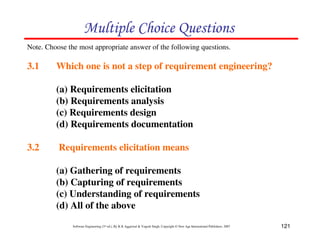
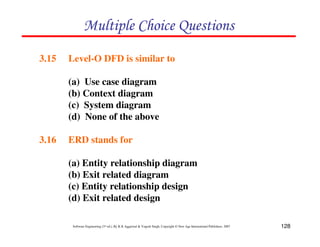
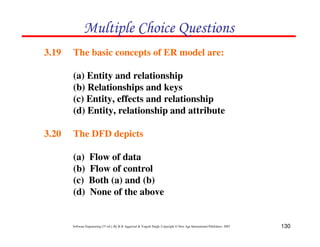
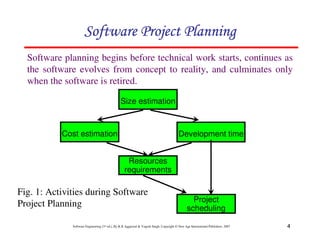
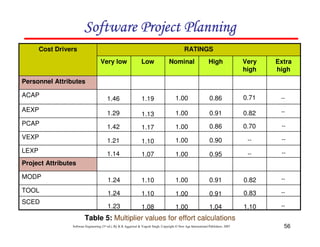
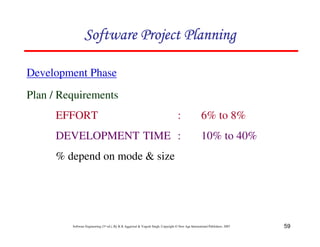
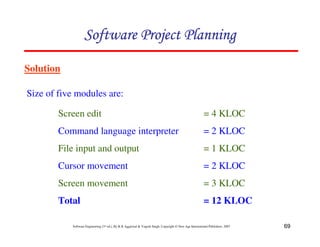
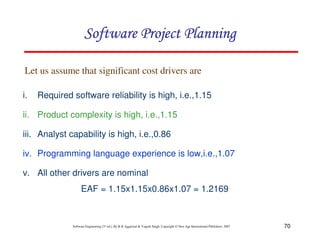
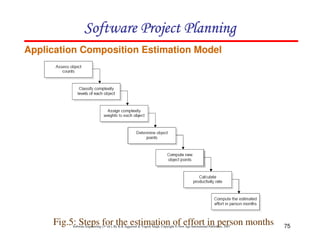
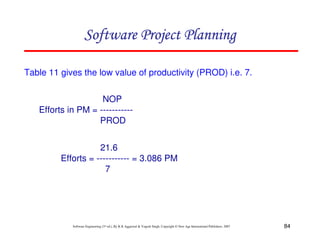
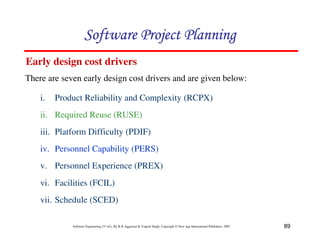
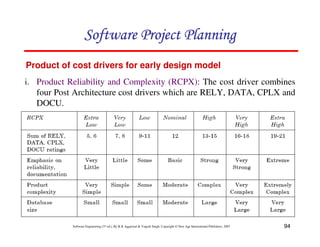
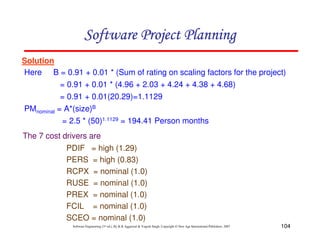
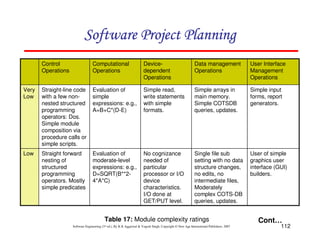
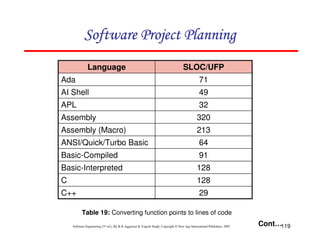
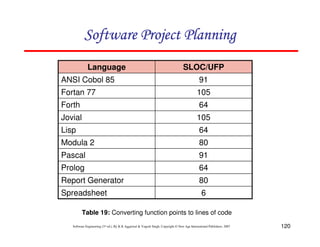
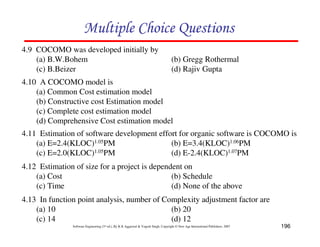
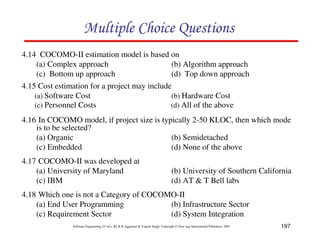
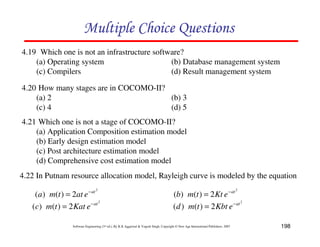
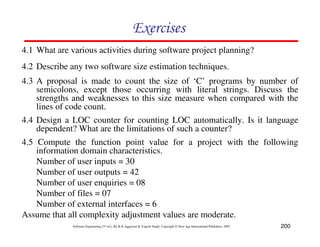
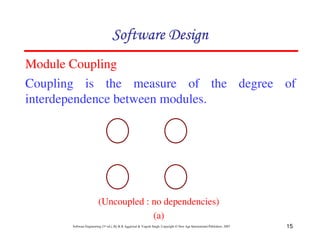
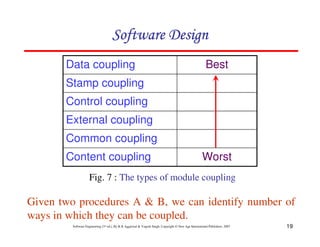
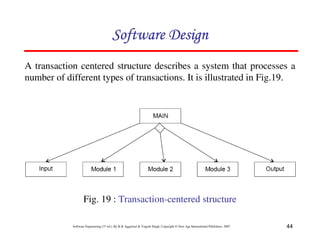
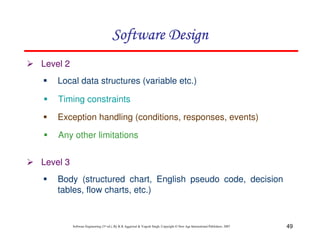
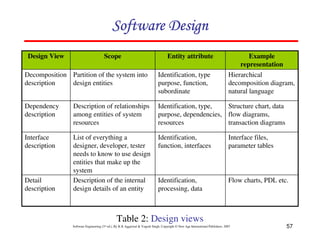
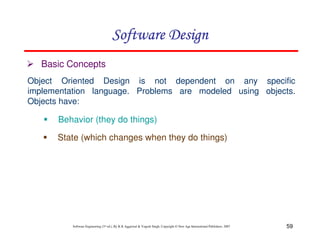
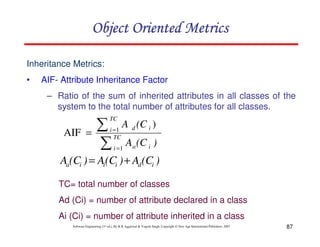
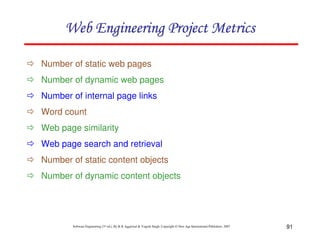
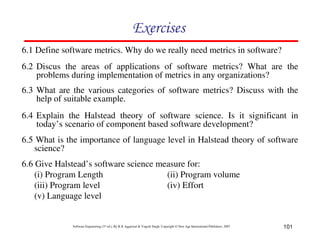
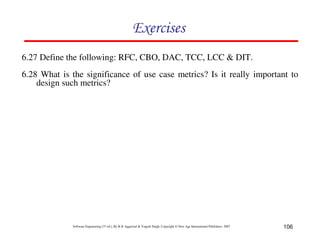
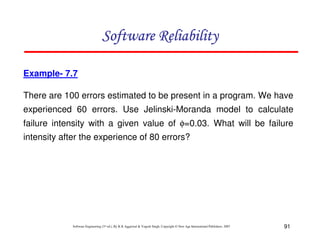
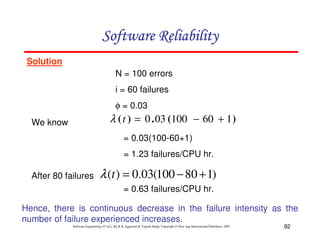
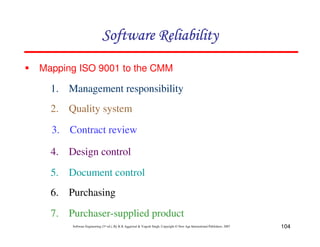
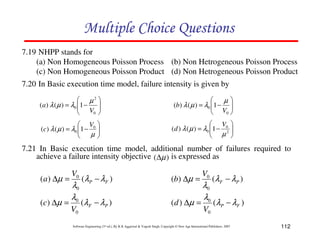
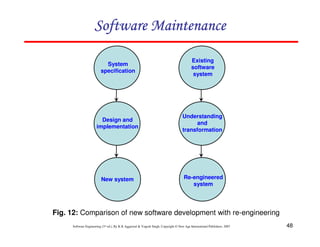
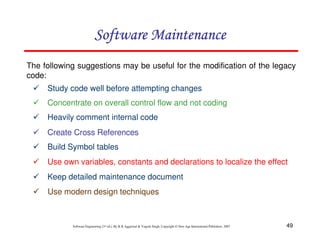
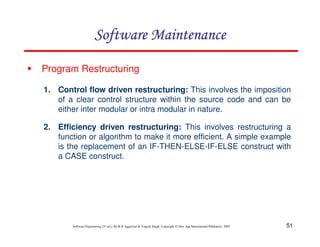
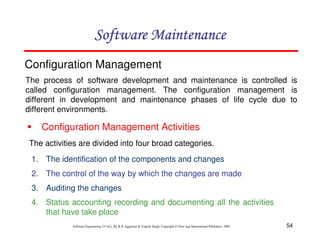
Software Engineering (3rd ed.), By K.K Aggarwal & Yogesh Singh, Copyright © New Age International Publishers, 2007
1
Software Engineering (3rd ed.), By K.K Aggarwal & Yogesh Singh, Copyright © New Age International Publishers, 2007
2
Change in nature & complexity of software
Ready for change
Concept of one “guru” is over
We all want improvement
Software Engineering (3rd ed.), By K.K Aggarwal & Yogesh Singh, Copyright © New Age International Publishers, 2007
3
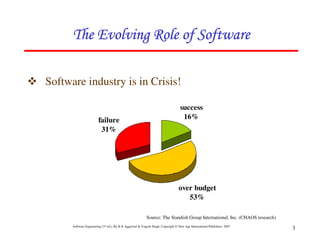
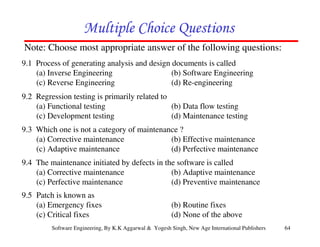
Software industry is in Crisis!
Source: The Standish Group International, Inc. (CHAOS research)
over budget
53%
success
16%
failure
31%
Software Engineering (3rd ed.), By K.K Aggarwal & Yogesh Singh, Copyright © New Age International Publishers, 2007
4
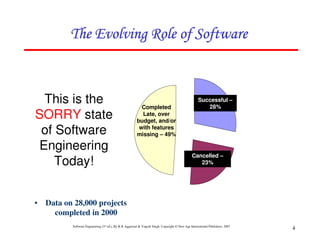
• Data on 28,000 projects
completed in 2000
This is the
SORRY state
of Software
Engineering
Today!
Completed
Late, over
budget, and/or
with features
missing – 49%
Cancelled –
23%
Successful –
28%
Software Engineering (3rd ed.), By K.K Aggarwal & Yogesh Singh, Copyright © New Age International Publishers, 2007
5
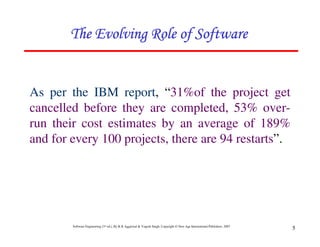
As per the IBM report, “31%of the project get
cancelled before they are completed, 53% over-
run their cost estimates by an average of 189%
and for every 100 projects, there are 94 restarts”.
Software Engineering (3rd ed.), By K.K Aggarwal & Yogesh Singh, Copyright © New Age International Publishers, 2007
6
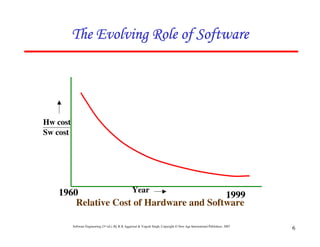
Year
Hw cost
Sw cost
Relative Cost of Hardware and Software
1960 1999
Software Engineering (3rd ed.), By K.K Aggarwal & Yogesh Singh, Copyright © New Age International Publishers, 2007
7
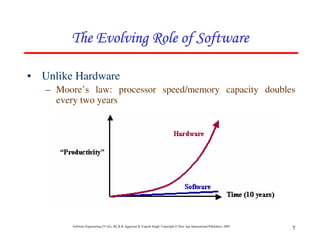
• Unlike Hardware
– Moore’s law: processor speed/memory capacity doubles
every two years
Software Engineering (3rd ed.), By K.K Aggarwal & Yogesh Singh, Copyright © New Age International Publishers, 2007
8
Managers and Technical Persons are asked:
Why does it take so long to get the program finished?
Why are costs so high?
Why can not we find all errors before release?
Why do we have difficulty in measuring progress of software
development?
Software Engineering (3rd ed.), By K.K Aggarwal & Yogesh Singh, Copyright © New Age International Publishers, 2007
9
• Larger problems,
• Lack of adequate training in software engineering,
• Increasing skill shortage,
• Low productivity improvements.
Software Engineering (3rd ed.), By K.K Aggarwal & Yogesh Singh, Copyright © New Age International Publishers, 2007
10
It took the European Space Agency 10
years and $7 billion to produce Ariane 5,
a giant rocket capable of hurling a pair of
three-ton satellites into orbit with each
launch and intended to give Europe
overwhelming supremacy in the
commercial space business.
Ariane 5
The rocket was destroyed after 39 seconds
of its launch, at an altitude of two and a
half miles along with its payload of four
expensive and uninsured scientific
satellites.
Software Engineering (3rd ed.), By K.K Aggarwal & Yogesh Singh, Copyright © New Age International Publishers, 2007
11
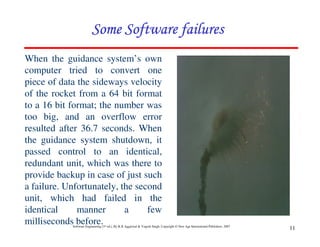
When the guidance system’s own
computer tried to convert one
piece of data the sideways velocity
of the rocket from a 64 bit format
to a 16 bit format; the number was
too big, and an overflow error
resulted after 36.7 seconds. When
the guidance system shutdown, it
passed control to an identical,
redundant unit, which was there to
provide backup in case of just such
a failure. Unfortunately, the second
unit, which had failed in the
identical manner a few
milliseconds before.
Software Engineering (3rd ed.), By K.K Aggarwal & Yogesh Singh, Copyright © New Age International Publishers, 2007
12
Y2K problem:
It was simply the ignorance about the
adequacy or otherwise of using only
last two digits of the year.
The 4-digit date format, like 1964,
was shortened to 2-digit format, like
64.
Software Engineering (3rd ed.), By K.K Aggarwal & Yogesh Singh, Copyright © New Age International Publishers, 2007
13
o First time used in Gulf war
Reasons:
A small timing error in the system’s clock
accumulated to the point that after 14
hours, the tracking system was no longer
accurate. In the Dhahran attack, the
system had been operating for more than
100 hours.
o Used as a defense from Iraqi Scud
missiles
o Failed several times including one that
killed 28 US soldiers in Dhahran,
Saudi Arabia
Software Engineering (3rd ed.), By K.K Aggarwal & Yogesh Singh, Copyright © New Age International Publishers, 2007
14
Part of an abort scenario for the
Shuttle requires fuel dumps to
lighten the spacecraft. It was
during the second of these
dumps that a (software) crash
occurred.
...the fuel management module,
which had performed one
dump and successfully exited,
restarted when recalled for the
second fuel dump...
The Space Shuttle
Software Engineering (3rd ed.), By K.K Aggarwal & Yogesh Singh, Copyright © New Age International Publishers, 2007
15
A simple fix took care of the problem…but the
programmers decided to see if they could come up with a
systematic way to eliminate these generic sorts of bugs in
the future. A random group of programmers applied this
system to the fuel dump module and other modules.
Seventeen additional, previously unknown problems
surfaced!
Software Engineering (3rd ed.), By K.K Aggarwal & Yogesh Singh, Copyright © New Age International Publishers, 2007
16
Many companies have experienced failures in their
accounting system due to faults in the software itself. The
failures range from producing the wrong information to
the whole system crashing.
Financial Software
Software Engineering (3rd ed.), By K.K Aggarwal & Yogesh Singh, Copyright © New Age International Publishers, 2007
17
Windows XP
o Microsoft released Windows XP on October 25, 2001.
o On the same day company posted 18 MB of
compatibility patches on the website for bug fixes,
compatibility updates, and enhancements.
o Two patches fixed important security holes.
This is Software Engineering.
Software Engineering (3rd ed.), By K.K Aggarwal & Yogesh Singh, Copyright © New Age International Publishers, 2007
18
The hardware cost continues to decline
drastically.
!
!
!
! "
"
"
"
However, there are desperate cries for a
silver bullet something to make software
costs drop as rapidly as computer hardware
costs do.
But as we look to the horizon of a decade,
we see no silver bullet. There is no single
development, either in technology or in
management technique, that by itself
promises even one order of magnitude
improvement in productivity, in reliability
and in simplicity.
Software Engineering (3rd ed.), By K.K Aggarwal & Yogesh Singh, Copyright © New Age International Publishers, 2007
19
The hard part of building software is the specification, design and
testing of this conceptual construct, not the labour of representing it
and testing the correctness of representation.
While there is no royal road, there is a path forward.
Is reusability (and open source) the new silver bullet?
!
!
!
! "
"
"
"
We still make syntax errors, to be sure, but they are trivial as
compared to the conceptual errors (logic errors) in most systems.
That is why, building software is always hard and there is inherently
no silver bullet.
Software Engineering (3rd ed.), By K.K Aggarwal & Yogesh Singh, Copyright © New Age International Publishers, 2007
20
!
!
!
! "
"
"
"
The blame for software bugs belongs to:
• Software companies
• Software developers
• Legal system
• Universities
Software Engineering (3rd ed.), By K.K Aggarwal & Yogesh Singh, Copyright © New Age International Publishers, 2007
21
• Computer programs and associated
documentation
Software Engineering (3rd ed.), By K.K Aggarwal & Yogesh Singh, Copyright © New Age International Publishers, 2007
22
Programs
Operating
Procedures
Documentation
Software=Program+Documentation+Operating Procedures
Components of software
Software Engineering (3rd ed.), By K.K Aggarwal & Yogesh Singh, Copyright © New Age International Publishers, 2007
23
Documentation
Manuals
Analysis
/Specification
Design
Implementation
Testing
Formal Specification
Context-
Diagram
Data Flow
Diagrams
Flow Charts
Entity-Relationship
Diagram
Source Code Listings
Cross-Reference
Listing
Test Data
Test Results
# $ %
# $ %
# $ %
# $ %
List of documentation manuals
Software Engineering (3rd ed.), By K.K Aggarwal & Yogesh Singh, Copyright © New Age International Publishers, 2007
24
Operating
Procedures
User
Manuals
Operational
Manuals
System Overview
Beginner’s Guide
Tutorial
Reference Guide
Installation Guide
System
Administration Guide
List of operating procedure manuals.
# $ %
# $ %
# $ %
# $ %
Software Engineering (3rd ed.), By K.K Aggarwal & Yogesh Singh, Copyright © New Age International Publishers, 2007
25
• Software products may be developed for a particular
customer or may be developed for a general market
$
$
$
$
• Software products may be
–Generic - developed to be sold to a range of different
customers
–Bespoke (custom) - developed for a single customer according
to their specification
Software Engineering (3rd ed.), By K.K Aggarwal & Yogesh Singh, Copyright © New Age International Publishers, 2007
26
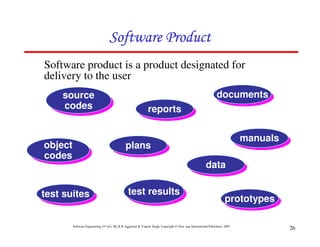
Software product is a product designated for
delivery to the user
source
codes
source
codes
object
codes
object
codes
plans
plans
reports
reports
manuals
manuals
documents
documents
test suites
test suites
prototypes
prototypes
data
data
test results
test results
$
$
$
$
Software Engineering (3rd ed.), By K.K Aggarwal & Yogesh Singh, Copyright © New Age International Publishers, 2007
27
Software engineering is an engineering discipline which
is concerned with all aspects of software production
Software engineers should
– adopt a systematic and organised approach to their
work
– use appropriate tools and techniques depending on
• the problem to be solved,
• the development constraints and
– use the resources available
Software Engineering (3rd ed.), By K.K Aggarwal & Yogesh Singh, Copyright © New Age International Publishers, 2007
28
At the first conference on software engineering in 1968, Fritz Bauer
defined software engineering as “The establishment and use of
sound engineering principles in order to obtain economically
developed software that is reliable and works efficiently on real
machines”.
Stephen Schach defined the same as “A discipline whose aim is the
production of quality software, software that is delivered on time,
within budget, and that satisfies its requirements”.
Both the definitions are popular and acceptable to majority.
However, due to increase in cost of maintaining software, objective
is now shifting to produce quality software that is maintainable,
delivered on time, within budget, and also satisfies its requirements.
Software Engineering (3rd ed.), By K.K Aggarwal & Yogesh Singh, Copyright © New Age International Publishers, 2007
29
The software process is the way in which we produce
software.
Why is it difficult to improve software process ?
• Not enough time
• Lack of knowledge
Software Engineering (3rd ed.), By K.K Aggarwal & Yogesh Singh, Copyright © New Age International Publishers, 2007
30
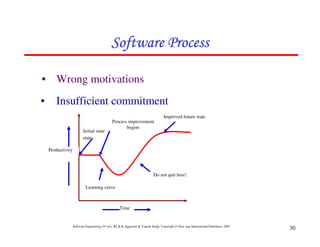
Learning curve
Do not quit here!
Improved future state
Process improvement
begins
Initial state
state
Productivity
Time
• Wrong motivations
• Insufficient commitment
Software Engineering (3rd ed.), By K.K Aggarwal & Yogesh Singh, Copyright © New Age International Publishers, 2007
31
&
&
&
&
Software does not wear out.
Useful life
phase
Wear out
phase
Burn-in
phase
Failure
Intensity
Time
Software Engineering (3rd ed.), By K.K Aggarwal & Yogesh Singh, Copyright © New Age International Publishers, 2007
32
Software is not manufactured
&
&
&
&
Reusability of components
Software is flexible
Software Engineering (3rd ed.), By K.K Aggarwal & Yogesh Singh, Copyright © New Age International Publishers, 2007
33
Comparison of constructing a bridge vis-à-vis writing a program.
7.
6.
5.
4.
3.
2.
1.
Writing a program
Constructing a bridge
Sr.
No
&
&
&
&
The problem is well understood
Only some parts of the problem are
understood, others are not
There are many existing bridges
The requirement for a bridge typically do
not change much during construction
The strength and stability of a bridge can be
calculated with reasonable precision
When a bridge collapses, there is a
detailed investigation and report
Engineers have been constructing bridges
for thousands of years
Materials (wood, stone,iron, steel) and
techniques (making joints in wood, carving
stone, casting iron) change slowly.
Every program is different and designed for
special applications.
Requirements typically change during all
phases of development.
Not possible to calculate correctness of a
program with existing methods.
When a program fails, the reasons are often
unavailable or even deliberately concealed.
Developers have been writing programs
for 50 years or so.
Hardware and software changes rapidly.
Software Engineering (3rd ed.), By K.K Aggarwal & Yogesh Singh, Copyright © New Age International Publishers, 2007
34
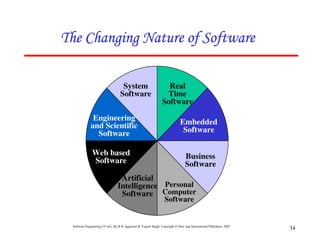
System
Software
Real
Time
Software
Embedded
Software
Engineering
and Scientific
Software
Web based
Software
Artificial
Intelligence
Software
Personal
Computer
Software
Business
Software
Software Engineering (3rd ed.), By K.K Aggarwal & Yogesh Singh, Copyright © New Age International Publishers, 2007
35
Trend has emerged to provide source code to the
customer and organizations.
Software where source codes are available are known
as open source software.
Examples
Open source software: LINUX, MySQL, PHP, Open office,
Apache webserver etc.
Software Engineering (3rd ed.), By K.K Aggarwal & Yogesh Singh, Copyright © New Age International Publishers, 2007
36
Management may be confident about good
standards and clear procedures of the company.
' %
' %
' %
' % )
Software Engineering (3rd ed.), By K.K Aggarwal & Yogesh Singh, Copyright © New Age International Publishers, 2007
37
Company has latest computers and state-of-
the-art software tools, so we shouldn’t worry
about the quality of the product.
' %
' %
' %
' % )
Software Engineering (3rd ed.), By K.K Aggarwal & Yogesh Singh, Copyright © New Age International Publishers, 2007
38
Addition of more software specialists, those
with higher skills and longer experience may
bring the schedule back on the track!
' %
' %
' %
' % )
Software Engineering (3rd ed.), By K.K Aggarwal & Yogesh Singh, Copyright © New Age International Publishers, 2007
39
Software is easy to change
' %
' %
' %
' % )
Software Engineering (3rd ed.), By K.K Aggarwal & Yogesh Singh, Copyright © New Age International Publishers, 2007
40
Computers provide greater reliability than
the devices they replace
' %
' %
' %
' % )
Software Engineering (3rd ed.), By K.K Aggarwal & Yogesh Singh, Copyright © New Age International Publishers, 2007
41
A general statement of objectives is sufficient to get started with
the development of software. Missing/vague requirements can
easily be incorporated/detailed out as they get concretized.
' %
' %
' %
' % )
Software Engineering (3rd ed.), By K.K Aggarwal & Yogesh Singh, Copyright © New Age International Publishers, 2007
42
Software with more features is better
software
Software can work right the first time
' %
' %
' %
' % )
Software Engineering (3rd ed.), By K.K Aggarwal & Yogesh Singh, Copyright © New Age International Publishers, 2007
43
Once the software is demonstrated, the job is done.
!
'# % %
'# % %
'# % %
'# % % )
Software Engineering (3rd ed.), By K.K Aggarwal & Yogesh Singh, Copyright © New Age International Publishers, 2007
44
Software quality can not be assessed before
testing.
"
'# % %
'# % %
'# % %
'# % % )
Software Engineering (3rd ed.), By K.K Aggarwal & Yogesh Singh, Copyright © New Age International Publishers, 2007
45
The only deliverable for a software
development project is the tested code.
'# % %
'# % %
'# % %
'# % % )
Software Engineering (3rd ed.), By K.K Aggarwal & Yogesh Singh, Copyright © New Age International Publishers, 2007
46
Aim is to develop working programs
# !
'# % %
'# % %
'# % %
'# % % )
Software Engineering (3rd ed.), By K.K Aggarwal & Yogesh Singh, Copyright © New Age International Publishers, 2007
47
Deliverables and Milestones
Different deliverables are generated during software development.
The examples are source code, user manuals, operating procedure
manuals etc.
The milestones are the events that are used to ascertain the status of
the project. Finalization of specification is a milestone. Completion of
design documentation is another milestone. The milestones are
essential for project planning and management.
Software Engineering (3rd ed.), By K.K Aggarwal & Yogesh Singh, Copyright © New Age International Publishers, 2007
48
Product and Process
Product: What is delivered to the customer, is called a product. It
may include source code, specification document, manuals,
documentation etc. Basically, it is nothing but a set of deliverables
only.
Process: Process is the way in which we produce software. It is the
collection of activities that leads to (a part of) a product. An efficient
process is required to produce good quality products.
If the process is weak, the end product will undoubtedly suffer, but
an obsessive over reliance on process is also dangerous.
Software Engineering (3rd ed.), By K.K Aggarwal & Yogesh Singh, Copyright © New Age International Publishers, 2007
49
Measures, Metrics and Measurement
A measure provides a quantitative indication of the extent,
dimension, size, capacity, efficiency, productivity or reliability of
some attributes of a product or process.
Measurement is the act of evaluating a measure.
A metric is a quantitative measure of the degree to which a system,
component or process possesses a given attribute.
Software Engineering (3rd ed.), By K.K Aggarwal & Yogesh Singh, Copyright © New Age International Publishers, 2007
50
Software Process and Product Metrics
Process metrics quantify the attributes of software development
process and environment;
whereas product metrics are measures for the software product.
Examples
Process metrics: Productivity, Quality, Efficiency etc.
Product metrics: Size, Reliability, Complexity etc.
Software Engineering (3rd ed.), By K.K Aggarwal & Yogesh Singh, Copyright © New Age International Publishers, 2007
51
Productivity and Effort
Productivity is defined as the rate of output, or production per unit of
effort, i.e. the output achieved with regard to the time taken but
irrespective of the cost incurred.
Hence most appropriate unit of effort is Person Months (PMs),
meaning thereby number of persons involved for specified months.
So, productivity may be measured as LOC/PM (lines of code
produced/person month)
Software Engineering (3rd ed.), By K.K Aggarwal & Yogesh Singh, Copyright © New Age International Publishers, 2007
52
Module and Software Components
There are many definitions of the term module. They range from “a
module is a FORTRAN subroutine” to “a module is an Ada
Package”, to “Procedures and functions of PASCAL and C”, to
“C++ Java classes” to “Java packages” to “a module is a work
assignment for an individual developer”. All these definition are
correct. The term subprogram is also used sometimes in place of
module.
Software Engineering (3rd ed.), By K.K Aggarwal & Yogesh Singh, Copyright © New Age International Publishers, 2007
53
“An independently deliverable piece of functionality providing
access to its services through interfaces”.
“A component represents a modular, deployable, and replaceable
part of a system that encapsulates implementation and exposes a set
of interfaces”.
Software Engineering (3rd ed.), By K.K Aggarwal & Yogesh Singh, Copyright © New Age International Publishers, 2007
54
Generic and Customized Software Products
Generic products are developed for anonymous customers. The target
is generally the entire world and many copies are expected to be sold.
Infrastructure software like operating system, compilers, analyzers,
word processors, CASE tools etc. are covered in this category.
The customized products are developed for particular customers.
The specific product is designed and developed as per customer
requirements. Most of the development projects (say about
80%)come under this category.
Software Engineering (3rd ed.), By K.K Aggarwal & Yogesh Singh, Copyright © New Age International Publishers, 2007
55
# %
Factors
People
Product Process
Project
Software Engineering (3rd ed.), By K.K Aggarwal & Yogesh Singh, Copyright © New Age International Publishers, 2007
56
Dependency
Order
Project Product
Process
People
1
2
3
4
# %
Software Engineering (3rd ed.), By K.K Aggarwal & Yogesh Singh, Copyright © New Age International Publishers, 2007
57
1.1 Software is
(a) Superset of programs (b) subset of programs
(c) Set of programs (d) none of the above
1.2 Which is NOT the part of operating procedure manuals?
(a) User manuals (b) Operational manuals
(c) Documentation manuals (d) Installation manuals
1.3 Which is NOT a software characteristic?
(a) Software does not wear out (b) Software is flexible
(c) Software is not manufactured (d) Software is always correct
1.4 Product is
(a) Deliverables (b) User expectations
(c) Organization's effort in development (d) none of the above
% (
Note: Select most appropriate answer of the following questions:
1.5 To produce a good quality product, process should be
(a) Complex (b) Efficient
(c) Rigorous (d) none of the above
Software Engineering (3rd ed.), By K.K Aggarwal & Yogesh Singh, Copyright © New Age International Publishers, 2007
58
1.6 Which is not a product metric?
(a) Size (b) Reliability
(c) Productivity (d) Functionality
1.7 Which is NOT a process metric?
(a) Productivity (b) Functionality
(c) Quality (d) Efficiency
1.8 Effort is measured in terms of:
(a) Person-months (b) Rupees
(c) Persons (d) Months
1.9 UML stands for
(a) Uniform modeling language (b) Unified modeling language
(c) Unit modeling language (d) Universal modeling language
% (
Note: Select most appropriate answer of the following questions:
1.1 An independently deliverable piece of functionality providing access to
its services through interface is called
(a) Software measurement (b) Software composition
(c) Software measure (d) Software component
Software Engineering (3rd ed.), By K.K Aggarwal & Yogesh Singh, Copyright © New Age International Publishers, 2007
59
1.11 Infrastructure software are covered under
(a) Generic products (b) Customized products
(c) Generic and Customized products (d) none of the above
1.12 Management of software development is dependent on
(a) people (b) product
(c) process (d) all of the above
1.13 During software development, which factor is most crucial?
(a) People (b) Product
(c) Process (d) Project
1.14 Program is
(a) subset of software (b) super set of software
(c) software (d) none of the above
% (
Note: Select most appropriate answer of the following questions:
1.15 Milestones are used to
(a) know the cost of the project (b) know the status of the project
(c) know user expectations (d) none of the above
Software Engineering (3rd ed.), By K.K Aggarwal & Yogesh Singh, Copyright © New Age International Publishers, 2007
60
1.16 The term module used during design phase refers to
(a) Function (b) Procedure
(c) Sub program (d) All of the above
1.17 Software consists of
(a) Set of instructions + operating system
(b) Programs + documentation + operating procedures
(c) Programs + hardware manuals (d) Set of programs
1.18 Software engineering approach is used to achieve:
(a) Better performance of hardware (b) Error free software
(c) Reusable software (d) Quality software product
1.19 Concept of software engineering are applicable to
(a) Fortran language only (b) Pascal language only
(c) ‘C’ language only (d) All of the above
% (
Note: Select most appropriate answer of the following questions:
1.20 CASE Tool is
(a) Computer Aided Software Engineering (b) Component Aided Software Engineering
(c) Constructive Aided Software Engineering (d)Computer Analysis Software Engineering
Software Engineering (3rd ed.), By K.K Aggarwal & Yogesh Singh, Copyright © New Age International Publishers, 2007
61
)
1.1 Why is primary goal of software development now shifting from
producing good quality software to good quality maintainable software?
1.2 List the reasons for the “software crisis”?Why are CASE tools not
normally able to control it?
1.3 “The software crisis is aggravated by the progress in hardware
technology?” Explain with examples.
1.4 What is software crisis? Was Y2K a software crisis?
1.5 What is the significance of software crisis in reference to software
engineering discipline.
1.6 How are software myths affecting software process? Explain with the
help of examples.
1.7 State the difference between program and software. Why have documents
and documentation become very important.
1.8 What is software engineering? Is it an art, craft or a science? Discuss.
Software Engineering (3rd ed.), By K.K Aggarwal & Yogesh Singh, Copyright © New Age International Publishers, 2007
62
)
1.9 What is aim of software engineering? What does the discipline of
software engineering discuss?
1.10 Define the term “Software engineering”. Explain the major differences
between software engineering and other traditional engineering disciplines.
1.11 What is software process? Why is it difficult to improve it?
1.12 Describe the characteristics of software contrasting it with the
characteristics of hardware.
1.13 Write down the major characteristics of a software. Illustrate with a
diagram that the software does not wear out.
1.14 What are the components of a software? Discuss how a software differs
from a program.
1.15 Discuss major areas of the applications of the software.
1.16 Is software a product or process? Justify your answer with example
Software Engineering (3rd ed.), By K.K Aggarwal & Yogesh Singh, Copyright © New Age International Publishers, 2007
63
)
1.17 Differentiate between the following
(i) Deliverables and milestones (ii) Product and process
(iii) Measures, metrics and measurement
1.18 What is software metric? How is it different from software
measurement
1.19 Discuss software process and product metrics with the help of examples.
1.20 What is productivity? How is it related to effort. What is the unit of
effort.
1.21 Differentiate between module and software component.
1.22 Distinguish between generic and customized software products. Which
one has larger share of market and why?
1.23 Is software a product or process? Justify your answer with example
Software Engineering (3rd ed.), By K.K Aggarwal & Yogesh Singh, Copyright © New Age International Publishers, 2007
64
1.23 Describe the role of management in software development with the help
of examples.
1.24 What are various factors of management dependency in software
development. Discuss each factor in detail.
1.25 What is more important: Product or process? Justify your answer.
)
1
Software Engineering (3rd ed.), By K.K Aggarwal & Yogesh Singh, Copyright © New Age International Publishers, 2007
2
Software Engineering (3rd ed.), By K.K Aggarwal & Yogesh Singh, Copyright © New Age International Publishers, 2007
Why should we really need
it?
Who should carry out this
activity?
Where should we do such
type of certification?
What is certification?
3
Software Engineering (3rd ed.), By K.K Aggarwal & Yogesh Singh, Copyright © New Age International Publishers, 2007
People
Process
Product
We have seen many certified developers (Microsoft certified,
Cisco certified, JAVA certified), certified processes (like ISO or
CMM) and certified products.
There is no clarity about the procedure of software certification.
People
Process Product
To whom should we target
4
Software Engineering (3rd ed.), By K.K Aggarwal & Yogesh Singh, Copyright © New Age International Publishers, 2007
Adam Kalawa of Parasoft has given his views on certification like:
“I strongly oppose certification of software developers. I fear that it
will bring more harm than good to the software industry. It may
further hurt software quality by shifting the blame for bad
software. The campaign for certification assumes that unqualified
developers cause software problem and that we can improve
software quality by ensuring that all developers have the golden
stamp of approval. However, improving quality requires
improving the production process and integrating in to it practices
that reduce the opportunity for introducing defects into the
product”
5
Software Engineering (3rd ed.), By K.K Aggarwal & Yogesh Singh, Copyright © New Age International Publishers, 2007
 How often will developers require certification to keep pace with
new technologies?
 How will any certification address the issues like fundamentals
of computer science, analytical & logical reasoning,
programming aptitude & positive attitude?
 Process certification alone cannot guarantee high quality
product.
 Whether we go for certified developers or certified processes?
Can independent certification agency provide a fair playing
field for each software industry??
6
Software Engineering (3rd ed.), By K.K Aggarwal & Yogesh Singh, Copyright © New Age International Publishers, 2007
People
– Industry specific
Process
– Industry specific
Product
– For the customer directly and helps to select a particular
product
7
Software Engineering (3rd ed.), By K.K Aggarwal & Yogesh Singh, Copyright © New Age International Publishers, 2007
The individual obtaining certification receives the following values:
Recognition by peers
Increased confidence in personal capabilities
Recognition by software industry for professional achievement
Improvement in processes
Competences maintained through recertification
Certification is employees initiated improvement process which
improves competence in quality assurances methods & techniques.
8
Software Engineering (3rd ed.), By K.K Aggarwal & Yogesh Singh, Copyright © New Age International Publishers, 2007
Professional level of competence in the principles & practices of
software quality assurance in the software industry can be
achieved by acquiring the designation of:
o Certified Software Quality Analyst (CSQA)
o Certified Software Tester (CSTE)
o Certified Software Project Manager (CSPM)
Some company specific certifications are also very popular like
Microsoft Office Specialist (MOS) certifications in Word, Excel
and PowerPoint.
MOS is far best known computer skills certification for
administrator.
9
Software Engineering (3rd ed.), By K.K Aggarwal & Yogesh Singh, Copyright © New Age International Publishers, 2007
The most popular process certification approaches are:
ISO 9000
SEI-CMM
One should always be suspicious about the quality of end
product, however, certification reduces the possibility of poor
quality products.
Any type of process certification helps to produce good quality
and stable software product.
10
Software Engineering (3rd ed.), By K.K Aggarwal & Yogesh Singh, Copyright © New Age International Publishers, 2007
This is what is required for the customer.
There is no universally accepted product certification
scheme.
Aviation industry has a popular certification “RTCA DO-
178B”.
The targeted certification level is either A, B, C, D, or E.
These levels describe the consequences of a potential failure
of the software : catastrophic, hazardous severe, major,
minor or no effect.
11
Software Engineering (3rd ed.), By K.K Aggarwal & Yogesh Singh, Copyright © New Age International Publishers, 2007
DO-178B Records
Software Development Plan
Software Verification Plan
Software Configuration Management Plan
Software Quality Assurance Plan
Software Requirements Standards
Software Design Document
Software Verification Test Cases & Products
12
Software Engineering (3rd ed.), By K.K Aggarwal & Yogesh Singh, Copyright © New Age International Publishers, 2007
DO-178B Documents
Software Verification Results
Problem Report
Software Configuration Management Records
Software Quality Assurance Records
DO-178B certification process is most demanding at higher levels.
13
Software Engineering (3rd ed.), By K.K Aggarwal & Yogesh Singh, Copyright © New Age International Publishers, 2007
DO-178B level A will:
1. Have largest potential market
2. Require thorough labour intensive preparation of most of
the items on the DO-178B support list.
DO-178B Level E would:
1. Require fewer support item and
2. Less taxing on company resources.
14
Software Engineering (3rd ed.), By K.K Aggarwal & Yogesh Singh, Copyright © New Age International Publishers, 2007
We don’t have product certification in most of the areas. RTOS
(real time operating system) is the real-time operating system
certification & marked as “LinuxOS-178”.
The establishment of independent agencies is a viable option.
15
Software Engineering (3rd ed.), By K.K Aggarwal & Yogesh Singh, Copyright © New Age International Publishers, 2007
Weyukar has rightly said “For Component based Software
Development (CBO) to revolutionalize software development,
developers must be able to produce software significantly cheaper
and faster than they otherwise could, even as the resulting software
meets the same sort of high reliability standards while being easy to
maintain”.
Bill council has also given his views as “Currently, there is a little
evidences that component based software engineering (CBSE) is
revolutionizing software development, and lots of reasons to believe
otherwise. I believe the primary reason is that the community is not
showing how to develop trusted components”.
16
Software Engineering (3rd ed.), By K.K Aggarwal & Yogesh Singh, Copyright © New Age International Publishers, 2007
Contractor:
• Gives the standard
• Directs any variations in specification
• Define patterns
• Allowable tolerances
• Fix the date of delivery
Third party certification is a method to ensure software components
conform to well defined standards, based on this certification,
trusted assemblies of components can be constructed
Third party certification is based on UL 1998, 2nd ed., UL standard
for safety for software in programmable component.
17
Software Engineering (3rd ed.), By K.K Aggarwal & Yogesh Singh, Copyright © New Age International Publishers, 2007
10.1 What is software certification? Discuss its importance in the changing
scenario of software industry.
10.2 What are different types of certifications? Explain the significance of
each type & which one is most important for the end user.
10.3 What is the role of third party certification in component based software
engineering? Why are we not able to stabilize the component based software
engineering practices.
10.4 Name few person specific certification schemes. Which one is most
popular & why?
10.5 Why customer is only interested in product certification? Discuss any
product certification techniques with their generic applicability.
1
Software Engineering (3rd ed.), By K.K Aggarwal & Yogesh Singh, Copyright © New Age International Publishers, 2007
2
Software Engineering (3rd ed.), By K.K Aggarwal & Yogesh Singh, Copyright © New Age International Publishers, 2007
The goal of Software Engineering is to provide
models and processes that lead to the
production of well-documented maintainable
software in a manner that is predictable.
3
Software Engineering (3rd ed.), By K.K Aggarwal & Yogesh Singh, Copyright © New Age International Publishers, 2007
“The period of time that starts when a software product is conceived
and ends when the product is no longer available for use. The
software life cycle typically includes a requirement phase, design
phase, implementation phase, test phase, installation and check out
phase, operation and maintenance phase, and sometimes retirement
phase”.
4
Software Engineering (3rd ed.), By K.K Aggarwal & Yogesh Singh, Copyright © New Age International Publishers, 2007
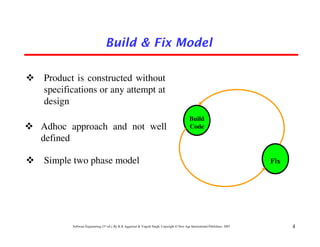
Product is constructed without
specifications or any attempt at
design
Adhoc approach and not well
defined
Simple two phase model Fix
Build
Code
5
Software Engineering (3rd ed.), By K.K Aggarwal & Yogesh Singh, Copyright © New Age International Publishers, 2007
Suitable for small programming exercises of 100 or 200 lines
Unsatisfactory for software for any reasonable size
Code soon becomes unfixable & unenhanceable
No room for structured design
Maintenance is practically not possible
6
Software Engineering (3rd ed.), By K.K Aggarwal & Yogesh Singh, Copyright © New Age International Publishers, 2007
Requirement
Design
Implementation
and unit testing
Integrationand
system testing
Operation and
maintenance
Analysis & Specification
This model is named “waterfall
model” because its diagrammatic
representation resembles a cascade of
waterfalls.
7
Software Engineering (3rd ed.), By K.K Aggarwal & Yogesh Singh, Copyright © New Age International Publishers, 2007
This model is easy to understand and reinforces
the notion of “define before design” and “design
before code”.
The model expects complete & accurate
requirements early in the process, which is
unrealistic
8
Software Engineering (3rd ed.), By K.K Aggarwal & Yogesh Singh, Copyright © New Age International Publishers, 2007
Problems of waterfall model
i. It is difficult to define all requirements at the beginning of a
project
ii. This model is not suitable for accommodating any change
iii. A working version of the system is not seen until late in
the project’s life
iv. It does not scale up well to large projects.
v. Real projects are rarely sequential.
9
Software Engineering (3rd ed.), By K.K Aggarwal & Yogesh Singh, Copyright © New Age International Publishers, 2007
They are effective in the situations where requirements are
defined precisely and there is no confusion about the
functionality of the final product.
After every cycle a useable product is given to the customer.
Popular particularly when we have to quickly deliver a limited
functionality system.
10
Software Engineering (3rd ed.), By K.K Aggarwal & Yogesh Singh, Copyright © New Age International Publishers, 2007
This model has the same phases as the waterfall model, but with
fewer restrictions. Generally the phases occur in the same order as
in the waterfall model, but they may be conducted in several cycles.
Useable product is released at the end of the each cycle, with each
release providing additional functionality.
Customers and developers specify as many requirements as
possible and prepare a SRS document.
Developers and customers then prioritize these requirements
Developers implement the specified requirements in one or
more cycles of design, implementation and test based on the
defined priorities.
11
Software Engineering (3rd ed.), By K.K Aggarwal & Yogesh Singh, Copyright © New Age International Publishers, 2007
Requirements
specification
Architectural
design
Detailed
design
Implementation
and unit testing
Integration
and testing
Operation and
Maintenance
12
Software Engineering (3rd ed.), By K.K Aggarwal & Yogesh Singh, Copyright © New Age International Publishers, 2007
o Developed by IBM in 1980
o User participation is essential
The requirements
specification was
defined like this
The developers
understood it in
that way
This is how the
problem was
solved before.
This is how the
problem is
solved now
That is the program after
debugging
This is how the program is
described by marketing
department
This, in fact, is what the
customer wanted …
13
Software Engineering (3rd ed.), By K.K Aggarwal & Yogesh Singh, Copyright © New Age International Publishers, 2007
o Build a rapid prototype
o Give it to user for evaluation & obtain feedback
o Prototype is refined
Requirements
Planning
User
Description
Construction Cut over
With active participation of users
14
Software Engineering (3rd ed.), By K.K Aggarwal & Yogesh Singh, Copyright © New Age International Publishers, 2007
Not an appropriate model in the absence of user
participation.
Reusable components are required to reduce development
time.
Highly specialized & skilled developers are required and
such developers are not easily available.
15
Software Engineering (3rd ed.), By K.K Aggarwal & Yogesh Singh, Copyright © New Age International Publishers, 2007
Evolutionary process model resembles iterative enhancement
model. The same phases as defined for the waterfall model occur
here in a cyclical fashion. This model differs from iterative
enhancement model in the sense that this does not require a
useable product at the end of each cycle. In evolutionary
development, requirements are implemented by category rather
than by priority.
This model is useful for projects using new technology that is not
well understood. This is also used for complex projects where all
functionality must be delivered at one time, but the requirements
are unstable or not well understood at the beginning.
16
Software Engineering (3rd ed.), By K.K Aggarwal & Yogesh Singh, Copyright © New Age International Publishers, 2007
Validation
Final
version
Development
Intermediate
versions
Specification
Initial
version
Outline
description
Concurrent
activities
17
Software Engineering (3rd ed.), By K.K Aggarwal & Yogesh Singh, Copyright © New Age International Publishers, 2007
! "
The prototype may be a usable program but is not suitable as
the final software product.
The code for the prototype is thrown away. However
experience gathered helps in developing the actual system.
The development of a prototype might involve extra cost, but
overall cost might turnout to be lower than that of an
equivalent system developed using the waterfall model.
18
Software Engineering (3rd ed.), By K.K Aggarwal & Yogesh Singh, Copyright © New Age International Publishers, 2007
• Linear model
• “Rapid”
! "
19
Software Engineering (3rd ed.), By K.K Aggarwal & Yogesh Singh, Copyright © New Age International Publishers, 2007
#
Models do not deal with uncertainly which is inherent to software
projects.
Important software projects have failed because project risks were
neglected & nobody was prepared when something unforeseen
happened.
Barry Boehm recognized this and tired to incorporate the “project
risk” factor into a life cycle model.
The result is the spiral model, which was presented in 1986.
20
Software Engineering (3rd ed.), By K.K Aggarwal & Yogesh Singh, Copyright © New Age International Publishers, 2007
#
21
Software Engineering (3rd ed.), By K.K Aggarwal & Yogesh Singh, Copyright © New Age International Publishers, 2007
The radial dimension of the model represents the cumulative costs.
Each path around the spiral is indicative of increased costs. The
angular dimension represents the progress made in completing each
cycle. Each loop of the spiral from X-axis clockwise through 360o
represents one phase. One phase is split roughly into four sectors of
major activities.
Planning: Determination of objectives, alternatives &
constraints.
Risk Analysis: Analyze alternatives and attempts to identify
and resolve the risks involved.
Development: Product development and testing product.
Assessment: Customer evaluation
#
22
Software Engineering (3rd ed.), By K.K Aggarwal & Yogesh Singh, Copyright © New Age International Publishers, 2007
An important feature of the spiral model is that each phase is
completed with a review by the people concerned with the
project (designers and programmers)
The advantage of this model is the wide range of options to
accommodate the good features of other life cycle models.
It becomes equivalent to another life cycle model in
appropriate situations.
The spiral model has some difficulties that need to be resolved
before it can be a universally applied life cycle model. These
difficulties include lack of explicit process guidance in determining
objectives, constraints, alternatives; relying on risk assessment
expertise; and provides more flexibility than required for many
applications.
#
23
Software Engineering (3rd ed.), By K.K Aggarwal & Yogesh Singh, Copyright © New Age International Publishers, 2007
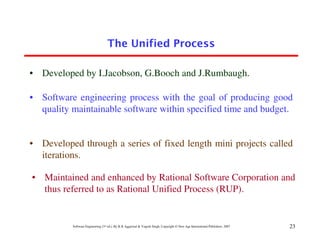
• Developed by I.Jacobson, G.Booch and J.Rumbaugh.
• Software engineering process with the goal of producing good
quality maintainable software within specified time and budget.
• Developed through a series of fixed length mini projects called
iterations.
• Maintained and enhanced by Rational Software Corporation and
thus referred to as Rational Unified Process (RUP).
24
Software Engineering (3rd ed.), By K.K Aggarwal & Yogesh Singh, Copyright © New Age International Publishers, 2007
Definition of
objectives
of the project
Planning &
architecture
for the project
Initial
operational
capability
Inception
Inception Elaboration
Elaboration Construction
Construction Transition
Transition
Release of
the Software
product
Time
25
Software Engineering (3rd ed.), By K.K Aggarwal & Yogesh Singh, Copyright © New Age International Publishers, 2007
• Inception: defines scope of the project.
• Elaboration
- How do we plan & design the project?
- What resources are required?
- What type of architecture may be suitable?
• Construction: the objectives are translated in design &
architecture documents.
• Transition : involves many activities like delivering, training,
supporting, and maintaining the product.
26
Software Engineering (3rd ed.), By K.K Aggarwal & Yogesh Singh, Copyright © New Age International Publishers, 2007
Initial development Cycle
Evolution Cycle
Continue till the product is retired
Inception
Inception Elaboration
Elaboration Construction
Construction Transition
Transition
V1
Inception
Inception Elaboration
Elaboration Construction
Construction Transition
Transition
V2
Inception
Inception Elaboration
Elaboration Construction
Construction Transition
Transition
V3
V1=version1, V2 =version2, V3=version3
27
Software Engineering (3rd ed.), By K.K Aggarwal & Yogesh Singh, Copyright © New Age International Publishers, 2007
28
Software Engineering (3rd ed.), By K.K Aggarwal & Yogesh Singh, Copyright © New Age International Publishers, 2007
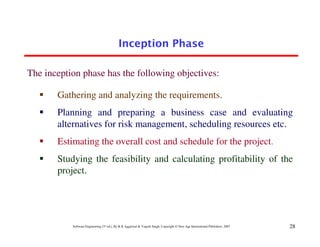
Gathering and analyzing the requirements.
Planning and preparing a business case and evaluating
alternatives for risk management, scheduling resources etc.
Estimating the overall cost and schedule for the project.
Studying the feasibility and calculating profitability of the
project.
The inception phase has the following objectives:
29
Software Engineering (3rd ed.), By K.K Aggarwal & Yogesh Singh, Copyright © New Age International Publishers, 2007
!
Inception
Project plan
Initial risk
assessment
Initial business
case
Vision
document Initial use
case model
Initial
project
Glossary
Business
model
Prototypes
30
Software Engineering (3rd ed.), By K.K Aggarwal & Yogesh Singh, Copyright © New Age International Publishers, 2007
"
Establishing architectural foundations.
Design of use case model.
Elaborating the process, infrastructure & development
environment.
Selecting component.
Demonstrating that architecture support the vision at
reasonable cost & within specified time.
The elaboration phase has the following objectives:
31
Software Engineering (3rd ed.), By K.K Aggarwal & Yogesh Singh, Copyright © New Age International Publishers, 2007
! "
Elaboration
Revised risk
document
An executable
architectural
prototype
Use case
model Supplementary
Requirements
with non functional
requirement
Architecture
Description
document
Preliminary
User manual
Development plan
32
Software Engineering (3rd ed.), By K.K Aggarwal & Yogesh Singh, Copyright © New Age International Publishers, 2007
Implementing the project.
Minimizing development cost.
Management and optimizing resources.
Testing the product
Assessing the product releases against acceptance criteria
The construction phase has the following objectives:
33
Software Engineering (3rd ed.), By K.K Aggarwal & Yogesh Singh, Copyright © New Age International Publishers, 2007
!
Construction
Operational
manuals
Test Suite
A description
of the
current release
Software
product User manuals
Documentation
manuals
Test
Outline
34
Software Engineering (3rd ed.), By K.K Aggarwal & Yogesh Singh, Copyright © New Age International Publishers, 2007
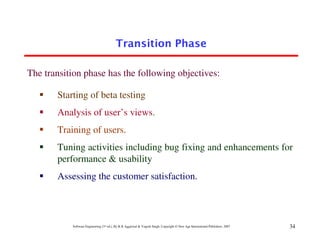
Starting of beta testing
Analysis of user’s views.
Training of users.
Tuning activities including bug fixing and enhancements for
performance & usability
Assessing the customer satisfaction.
The transition phase has the following objectives:
35
Software Engineering (3rd ed.), By K.K Aggarwal & Yogesh Singh, Copyright © New Age International Publishers, 2007
!
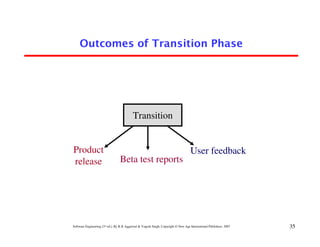
Transition
Product
release Beta test reports
User feedback
36
Software Engineering (3rd ed.), By K.K Aggarwal & Yogesh Singh, Copyright © New Age International Publishers, 2007
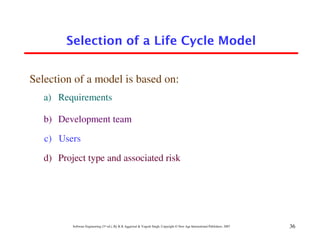
Selection of a model is based on:
a) Requirements
b) Development team
c) Users
d) Project type and associated risk
37
Software Engineering (3rd ed.), By K.K Aggarwal & Yogesh Singh, Copyright © New Age International Publishers, 2007
RAD
Spiral
Evolutionary
development
Iterative
enhancement
Prototype
Waterfall
Requirements
Are requirements
easily understandable
and defined?
Do we change
requirements quite
often?
Can we define
requirements early
in the cycle?
Requirements are
indicating a complex
system to be built
Yes Yes
Yes Yes
Yes Yes Yes Yes
Yes Yes Yes Yes
No
No
No
No
No
No No
No
No
No
No
No
38
Software Engineering (3rd ed.), By K.K Aggarwal & Yogesh Singh, Copyright © New Age International Publishers, 2007
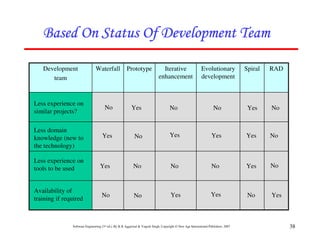
RAD
Spiral
Evolutionary
development
Iterative
enhancement
Prototype
Waterfall
Development
team
Less experience on
similar projects?
Less domain
knowledge (new to
the technology)
Less experience on
tools to be used
Availability of
training if required
Yes
Yes
Yes
Yes
Yes
Yes Yes
Yes
Yes
Yes
Yes
No
No
No
No
No
No No No
No
No
No
No
No
39
Software Engineering (3rd ed.), By K.K Aggarwal & Yogesh Singh, Copyright © New Age International Publishers, 2007
RAD
Spiral
Evolutionary
development
Iterative
enhancement
Prototype
Waterfall
Involvement
of Users
User involvement
in all phases
Limited user
participation
User have no
previous experience
of participation in
similar projects
Users are experts
of problem domain
Yes
Yes
Yes
Yes
Yes
Yes
Yes
Yes
Yes
Yes
Yes
Yes
Yes
Yes
No
No
No
No
No No No
No
No
No
40
Software Engineering (3rd ed.), By K.K Aggarwal & Yogesh Singh, Copyright © New Age International Publishers, 2007
RAD
Spiral
Evolutionary
development
Iterative
enhancement
Prototype
Waterfall
Project type
and risk
! "
! "
! "
! "
Project is the
enhancement of the
existing system
Funding is stable
for the project
High reliability
requirements
Tight project
schedule
Use of reusable
components
Are resources
(time, money,
people etc.) scare?
Yes Yes
Yes
Yes
Yes
Yes
Yes
Yes
Yes
Yes
Yes
Yes
Yes
Yes
Yes
Yes
Yes
Yes
Yes No
No
No
No
No
No
No
No
No
No
No
No
No
No
No
No
No
41
Software Engineering (3rd ed.), By K.K Aggarwal & Yogesh Singh, Copyright © New Age International Publishers, 2007
# $
Note: Select most appropriate answer of the following questions:
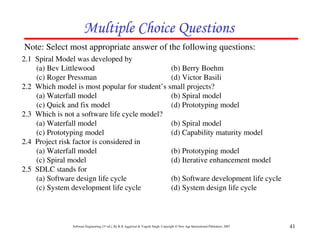
2.1 Spiral Model was developed by
(a) Bev Littlewood (b) Berry Boehm
(c) Roger Pressman (d) Victor Basili
2.2 Which model is most popular for student’s small projects?
(a) Waterfall model (b) Spiral model
(c) Quick and fix model (d) Prototyping model
2.3 Which is not a software life cycle model?
(a) Waterfall model (b) Spiral model
(c) Prototyping model (d) Capability maturity model
2.4 Project risk factor is considered in
(a) Waterfall model (b) Prototyping model
(c) Spiral model (d) Iterative enhancement model
2.5 SDLC stands for
(a) Software design life cycle (b) Software development life cycle
(c) System development life cycle (d) System design life cycle
42
Software Engineering (3rd ed.), By K.K Aggarwal & Yogesh Singh, Copyright © New Age International Publishers, 2007
# $
Note: Select most appropriate answer of the following questions:
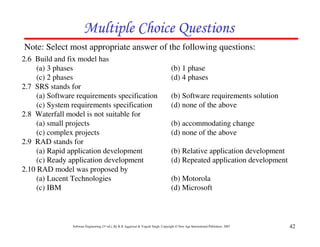
2.6 Build and fix model has
(a) 3 phases (b) 1 phase
(c) 2 phases (d) 4 phases
2.7 SRS stands for
(a) Software requirements specification (b) Software requirements solution
(c) System requirements specification (d) none of the above
2.8 Waterfall model is not suitable for
(a) small projects (b) accommodating change
(c) complex projects (d) none of the above
2.9 RAD stands for
(a) Rapid application development (b) Relative application development
(c) Ready application development (d) Repeated application development
2.10 RAD model was proposed by
(a) Lucent Technologies (b) Motorola
(c) IBM (d) Microsoft
43
Software Engineering (3rd ed.), By K.K Aggarwal & Yogesh Singh, Copyright © New Age International Publishers, 2007
# $
Note: Select most appropriate answer of the following questions:
2.11 If requirements are easily understandable and defined,which model is best suited?
(a) Waterfall model (b) Prototyping model
(c) Spiral model (d) None of the above
2.12 If requirements are frequently changing, which model is to be selected?
(a) Waterfall model (b) Prototyping model
(c) RAD model (d) Iterative enhancement model
2.13 If user participation is available, which model is to be chosen?
(a) Waterfall model (b) Iterative enhancement model
(c) Spiral model (d) RAD model
2.14 If limited user participation is available, which model is to be selected?
(a) Waterfall model (b) Spiral model
(c) Iterative enhancement model (d) any of the above
2.15 If project is the enhancement of existing system, which model is best suited?
(a) Waterfall model (b) Prototyping model
(c) Iterative enhancement model (d) Spiral model
44
Software Engineering (3rd ed.), By K.K Aggarwal & Yogesh Singh, Copyright © New Age International Publishers, 2007
# $
Note: Select most appropriate answer of the following questions:
2.16 Which one is the most important feature of spiral model?
(a) Quality management (b) Risk management
(c) Performance management (d) Efficiency management
2.17 Most suitable model for new technology that is not well understood is:
(a) Waterfall model (b) RAD model
(c) Iterative enhancement model (d) Evolutionary development model
2.18 Statistically, the maximum percentage of errors belong to the following phase of
SDLC
(a) Coding (b) Design
(c) Specifications (d) Installation and maintenance
2.19 Which phase is not available in software life cycle?
(a) Coding (b) Testing
(c) Maintenance (d) Abstraction
2.20 The development is supposed to proceed linearly through the phase in
(a) Spiral model (b) Waterfall model
(c) Prototyping model (d) None of the above
45
Software Engineering (3rd ed.), By K.K Aggarwal & Yogesh Singh, Copyright © New Age International Publishers, 2007
# $
Note: Select most appropriate answer of the following questions:
2.21 Unified process is maintained by
(a) Infosys (b) Rational software corporation
(c) SUN Microsystems (d) None of the above
2.22 Unified process is
(a) Iterative (b) Incremental
(c) Evolutionary (d) All of the above
2.23 Who is not in the team of Unified process development?
(a) I.Jacobson (b) G.Booch
(c) B.Boehm (d) J.Rumbaugh
2.24 How many phases are in the unified process?
(a) 4 (b) 5
(c) 2 (d) None of the above
2.25 The outcome of construction phased can be treated as:
(a) Product release (b) Beta release
(c) Alpha release (d) All of the above
46
Software Engineering (3rd ed.), By K.K Aggarwal & Yogesh Singh, Copyright © New Age International Publishers, 2007
%&
2.1 What do you understand by the term Software Development Life Cycle
(SDLC)? Why is it important to adhere to a life cycle model while
developing a large software product?
2.2 What is software life cycle? Discuss the generic waterfall model.
2.3 List the advantages of using waterfall model instead of adhoc build and
fix model.
2.4 Discuss the prototyping model. What is the effect of designing a
prototype on the overall cost of the project?
2.5 What are the advantages of developing the prototype of a system?
2.6 Describe the type of situations where iterative enhancement model might
lead to difficulties.
2.7 Compare iterative enhancement model and evolutionary process model.
47
Software Engineering (3rd ed.), By K.K Aggarwal & Yogesh Singh, Copyright © New Age International Publishers, 2007
%&
2.8 Sketch a neat diagram of spiral model of software life cycle.
2.10 As we move outward along with process flow path of the spiral model,
what can we say about software that is being developed or maintained.
2.11 How does “project risk” factor effect the spiral model of software
development.
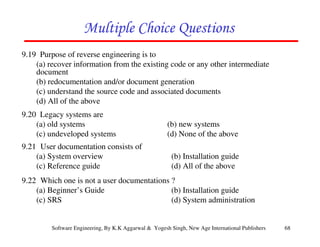
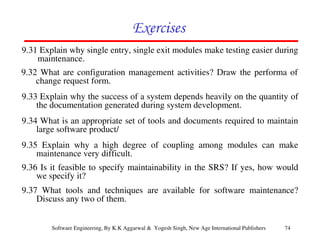
2.12 List the advantages and disadvantages of involving a software engineer
throughout the software development planning process.
2.13 Explain the spiral model of software development. What are the
limitations of such a model?
2.14 Describe the rapid application development (RAD) model.Discuss each
phase in detail.
2.15 What are the characteristics to be considered for the selection of the life
cycle model?
2.9 Compare the waterfall model and the spiral model of software
development.
48
Software Engineering (3rd ed.), By K.K Aggarwal & Yogesh Singh, Copyright © New Age International Publishers, 2007
%&
2.16 What is the role of user participation in the selection of a life cycle
model?.
2.18 Write short note on “status of development team” for the selection of a
life cycle model?.
2.19 Discuss the selection process parameters for a life cycle model.
2.20 What is unified process? Explain various phases along with the outcome
of each phase.
2.21 Describe the unified process work products after each phase of unified
process.
2.22 What are the advantages of iterative approach over sequential approach?
Why is unified process called as iterative or incremental?
2.17 Why do we feel that characteristics of requirements play a very
significant role in the selection of a life cycle model?
1
Software Engineering (3rd ed.), By K.K Aggarwal & Yogesh Singh, Copyright © New Age International Publishers, 2007
2
Software Engineering (3rd ed.), By K.K Aggarwal & Yogesh Singh, Copyright © New Age International Publishers, 2007
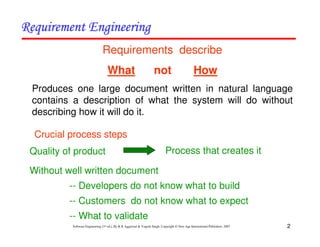
Quality of product
Without well written document
-- Developers do not know what to build
-- Customers do not know what to expect
-- What to validate
Requirements describe
What not How
Produces one large document written in natural language
contains a description of what the system will do without
describing how it will do it.
Process that creates it
Crucial process steps
3
Software Engineering (3rd ed.), By K.K Aggarwal & Yogesh Singh, Copyright © New Age International Publishers, 2007
Requirement
Engineering
Requirements
Elicitation
Requirements
Analysis
Requirements
Documentation
Requirements
Review
Problem Statement
SRS
Crucial Process Steps of requirement engineering
4
Software Engineering (3rd ed.), By K.K Aggarwal & Yogesh Singh, Copyright © New Age International Publishers, 2007
Requirement Engineering is the disciplined application of
proven principles, methods, tools, and notations to describe a
proposed system’s intended behavior and its associated
constraints.
SRS may act as a contract between developer and customer.
State of practice
Requirements are difficult to uncover
• Requirements change
• Over reliance on CASE Tools
• Tight project Schedule
• Communication barriers
• Market driven software development
• Lack of resources
5
Software Engineering (3rd ed.), By K.K Aggarwal & Yogesh Singh, Copyright © New Age International Publishers, 2007
Example
A University wish to develop a software system for the
student result management of its M.Tech. Programme. A
problem statement is to be prepared for the software
development company. The problem statement may give
an overview of the existing system and broad expectations
from the new software system.
6
Software Engineering (3rd ed.), By K.K Aggarwal & Yogesh Singh, Copyright © New Age International Publishers, 2007
Types of Requirements
Known
Requirements
Undreamed
Requirements
Unknown
Requirements
Stakeholder: Anyone who should have some direct or indirect
influence on the system requirements.
--- User
--- Affected persons
Requirements
Functional Non-Functional
7
Software Engineering (3rd ed.), By K.K Aggarwal & Yogesh Singh, Copyright © New Age International Publishers, 2007
Maintainability
Portability
Testability
For Users
For Developers
Functional requirements describe what the software has to
do. They are often called product features.
Non Functional requirements are mostly quality
requirements. That stipulate how well the software does,
what it has to do.
Availability
Reliability
Usability
Flexibility
8
Software Engineering (3rd ed.), By K.K Aggarwal & Yogesh Singh, Copyright © New Age International Publishers, 2007
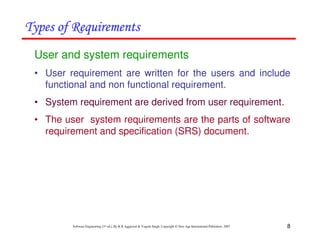
User and system requirements
• User requirement are written for the users and include
functional and non functional requirement.
• System requirement are derived from user requirement.
• The user system requirements are the parts of software
requirement and specification (SRS) document.
9
Software Engineering (3rd ed.), By K.K Aggarwal & Yogesh Singh, Copyright © New Age International Publishers, 2007
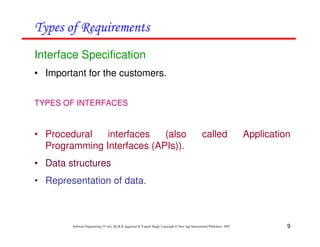
Interface Specification
• Important for the customers.
TYPES OF INTERFACES
• Procedural interfaces (also called Application
Programming Interfaces (APIs)).
• Data structures
• Representation of data.
10
Software Engineering (3rd ed.), By K.K Aggarwal & Yogesh Singh, Copyright © New Age International Publishers, 2007
Is cancellation of a project a bad news?
As per IBM report, “31% projects get cancelled before they
are completed, 53% over-run their cost estimates by an
average of 189% & for every 100 projects, there are 94
restarts.
How do we cancel a project with the least work?
CONDUCT A FEASIBILTY STUDY
11
Software Engineering (3rd ed.), By K.K Aggarwal & Yogesh Singh, Copyright © New Age International Publishers, 2007
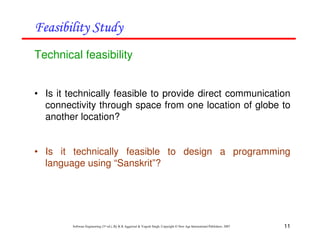
Technical feasibility
• Is it technically feasible to provide direct communication
connectivity through space from one location of globe to
another location?
• Is it technically feasible to design a programming
language using “Sanskrit”?
12
Software Engineering (3rd ed.), By K.K Aggarwal & Yogesh Singh, Copyright © New Age International Publishers, 2007
Feasibility depends upon non technical Issues like:
• Are the project’s cost and schedule assumption realistic?
• Does the business model realistic?
• Is there any market for the product?
13
Software Engineering (3rd ed.), By K.K Aggarwal & Yogesh Singh, Copyright © New Age International Publishers, 2007
Purpose of feasibility study
“evaluation or analysis of the potential impact of a
proposed project or program.”
Focus of feasibility studies
• Is the product concept viable?
• Will it be possible to develop a product that matches the
project’s vision statement?
• What are the current estimated cost and schedule for the
project?
14
Software Engineering (3rd ed.), By K.K Aggarwal & Yogesh Singh, Copyright © New Age International Publishers, 2007
Focus of feasibility studies
• How big is the gap between the original cost & schedule
targets & current estimates?
• Is the business model for software justified when the
current cost & schedule estimate are considered?
• Have the major risks to the project been identified & can
they be surmounted?
• Is the specifications complete & stable enough to
support remaining development work?
15
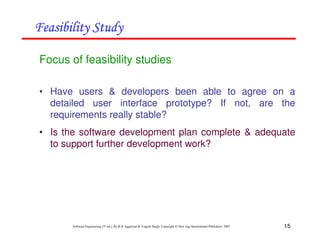
Software Engineering (3rd ed.), By K.K Aggarwal & Yogesh Singh, Copyright © New Age International Publishers, 2007
Focus of feasibility studies
• Have users & developers been able to agree on a
detailed user interface prototype? If not, are the
requirements really stable?
• Is the software development plan complete & adequate
to support further development work?
16
Software Engineering (3rd ed.), By K.K Aggarwal & Yogesh Singh, Copyright © New Age International Publishers, 2007
Perhaps
• Most difficult
• Most critical
• Most error prone
• Most communication intensive
Succeed
Selection of any method
1. It is the only method that we know
2. It is our favorite method for all situations
3. We understand intuitively that the method is effective in
the present circumstances.
Normally we rely on first two reasons.
effective customer developer partnership
17
Software Engineering (3rd ed.), By K.K Aggarwal & Yogesh Singh, Copyright © New Age International Publishers, 2007
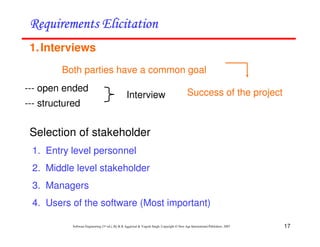
1.Interviews
Both parties have a common goal
Interview
Selection of stakeholder
1. Entry level personnel
2. Middle level stakeholder
3. Managers
4. Users of the software (Most important)
Success of the project
--- open ended
--- structured
18
Software Engineering (3rd ed.), By K.K Aggarwal & Yogesh Singh, Copyright © New Age International Publishers, 2007
Types of questions.
• Any problems with existing system
• Any Calculation errors
• Possible reasons for malfunctioning
• No. of Student Enrolled
19
Software Engineering (3rd ed.), By K.K Aggarwal & Yogesh Singh, Copyright © New Age International Publishers, 2007
5. Possible benefits
6. Satisfied with current policies
7.How are you maintaining the records of previous students?
8. Any requirement of data from other system
9. Any specific problems
10. Any additional functionality
11. Most important goal of the proposed development
At the end, we may have wide variety of expectations from the
proposed software.
20
Software Engineering (3rd ed.), By K.K Aggarwal & Yogesh Singh, Copyright © New Age International Publishers, 2007
2. Brainstorming Sessions
It is a group technique
Creative Thinking
New ideas Quickly
*Idea is to generate views ,not to vet them.
Groups
1. Users 2. Middle Level managers 3. Total Stakeholders
Categorized
Prioritized
Pruned
Prepare long list of requirements
group discussions
21
Software Engineering (3rd ed.), By K.K Aggarwal & Yogesh Singh, Copyright © New Age International Publishers, 2007
A Facilitator may handle group bias, conflicts carefully.
-- Facilitator may follow a published agenda
-- Every idea will be documented in a way that everyone can
see it.
--A detailed report is prepared.
3. Facilitated Application specification Techniques (FAST)
-- Similar to brainstorming sessions.
-- Team oriented approach
-- Creation of joint team of customers and developers.
22
Software Engineering (3rd ed.), By K.K Aggarwal & Yogesh Singh, Copyright © New Age International Publishers, 2007
Guidelines
1. Arrange a meeting at a neutral site.
2. Establish rules for participation.
3. Informal agenda to encourage free flow of ideas.
4. Appoint a facilitator.
5. Prepare definition mechanism board, worksheets, wall
stickier.
6. Participants should not criticize or debate.
FAST session Preparations
Each attendee is asked to make a list of objects that are:
23
Software Engineering (3rd ed.), By K.K Aggarwal & Yogesh Singh, Copyright © New Age International Publishers, 2007
1. Part of environment that surrounds the system.
2. Produced by the system.
3. Used by the system.
A. List of constraints
B. Functions
C. Performance criteria
Activities of FAST session
1. Every participant presents his/her list
2. Combine list for each topic
3. Discussion
4. Consensus list
5. Sub teams for mini specifications
6. Presentations of mini-specifications
7. Validation criteria
8. A sub team to draft specifications
24
Software Engineering (3rd ed.), By K.K Aggarwal & Yogesh Singh, Copyright © New Age International Publishers, 2007
4.Quality Function Deployment
-- Incorporate voice of the customer
-- Normal requirements
-- Expected requirements
-- Exciting requirements
What is important for customer?
Prime concern is customer satisfaction
Documented
Technical requirements.
25
Software Engineering (3rd ed.), By K.K Aggarwal & Yogesh Singh, Copyright © New Age International Publishers, 2007
Steps
1. Identify stakeholders
2. List out requirements
3. Degree of importance to each requirement.
26
Software Engineering (3rd ed.), By K.K Aggarwal & Yogesh Singh, Copyright © New Age International Publishers, 2007
5 Points : V. Important
4 Points : Important
3 Points : Not Important but nice to have
2 Points : Not important
1 Points : Unrealistic, required further
exploration
Requirement Engineer may categorize like:
(i) It is possible to achieve
(ii) It should be deferred & Why
(iii) It is impossible and should be dropped from
consideration
First Category requirements will be implemented as per
priority assigned with every requirement.
27
Software Engineering (3rd ed.), By K.K Aggarwal & Yogesh Singh, Copyright © New Age International Publishers, 2007
5. The Use Case Approach
Ivar Jacobson & others introduced Use Case approach for
elicitation & modeling.
Use Case – give functional view
The terms
Use Case
Use Case Scenario
Use Case Diagram
Use Cases are structured outline or template for the
description of user requirements modeled in a structured
language like English.
Often Interchanged
But they are different
28
Software Engineering (3rd ed.), By K.K Aggarwal & Yogesh Singh, Copyright © New Age International Publishers, 2007
Use case Scenarios are unstructured descriptions of user
requirements.
Use case diagrams are graphical representations that
may be decomposed into further levels of abstraction.
Components of Use Case approach
Actor:
An actor or external agent, lies outside the system model, but
interacts with it in some way.
Actor Person, machine, information System
29
Software Engineering (3rd ed.), By K.K Aggarwal & Yogesh Singh, Copyright © New Age International Publishers, 2007
• Cockburn distinguishes between Primary and
secondary actors.
• A Primary actor is one having a goal requiring the
assistance of the system.
• A Secondary actor is one from which System needs
assistance.
Use Cases
A use case is initiated by a user with a particular goal in
mind, and completes successfully when that goal is
satisfied.
30
Software Engineering (3rd ed.), By K.K Aggarwal & Yogesh Singh, Copyright © New Age International Publishers, 2007
* It describes the sequence of interactions between actors
and the system necessary to deliver the services that
satisfies the goal.
* Alternate sequence
* System is treated as black box.
Thus
Use Case captures who (actor) does what (interaction)
with the system, for what purpose (goal), without dealing
with system internals.
31
Software Engineering (3rd ed.), By K.K Aggarwal & Yogesh Singh, Copyright © New Age International Publishers, 2007
*defines all behavior required of the system, bounding
the scope of the system.
Jacobson & others proposed a template for writing Use
cases as shown below:
1. Introduction
Describe a quick background of the use case.
2.Actors
List the actors that interact and participate in the
use cases.
3.Pre Conditions
Pre conditions that need to be satisfied for the use
case to perform.
4. Post Conditions
Define the different states in which we expect the system
to be in, after the use case executes.
32
Software Engineering (3rd ed.), By K.K Aggarwal & Yogesh Singh, Copyright © New Age International Publishers, 2007
5. Flow of events
5.1 Basic Flow
List the primary events that will occur when this use case is executed.
5.2 Alternative Flows
Any Subsidiary events that can occur in the use case should be
separately listed. List each such event as an alternative flow.
A use case can have many alternative flows as required.
6.Special Requirements
Business rules should be listed for basic & information flows as special
requirements in the use case narration .These rules will also be used
for writing test cases. Both success and failures scenarios should be
described.
7.Use Case relationships
For Complex systems it is recommended to document the relationships
between use cases. Listing the relationships between use cases also
provides a mechanism for traceability
Use Case Template.
33
Software Engineering (3rd ed.), By K.K Aggarwal & Yogesh Singh, Copyright © New Age International Publishers, 2007
Use Case Guidelines
1. Identify all users
2. Create a user profile for each category of users including
all roles of the users play that are relevant to the system.
3. Create a use case for each goal, following the use case
template maintain the same level of abstraction throughout
the use case. Steps in higher level use cases may be
treated as goals for lower level (i.e. more detailed), sub-
use cases.
4. Structure the use case
5. Review and validate with users.
34
Software Engineering (3rd ed.), By K.K Aggarwal & Yogesh Singh, Copyright © New Age International Publishers, 2007
Use case Diagrams
-- represents what happens when actor interacts with a system.
-- captures functional aspect of the system.
Use Case
Relationship between
actors and use case
and/or between the
use cases.
-- Actors appear outside the rectangle.
--Use cases within rectangle providing functionality.
--Relationship association is a solid line between actor & use
cases.
Actor
35
Software Engineering (3rd ed.), By K.K Aggarwal & Yogesh Singh, Copyright © New Age International Publishers, 2007
*Use cases should not be used to capture all the details of the
system.
*Only significant aspects of the required functionality
*No design issues
*Use Cases are for “what” the system is , not “how” the system
will be designed
* Free of design characteristics
36
Software Engineering (3rd ed.), By K.K Aggarwal & Yogesh Singh, Copyright © New Age International Publishers, 2007
Use case diagram for Result Management System
Maintain Student
Details
Maintain Subject
Details
Maintain Result
Details
Login
Generate Result
Reports
View Results
Data Entry Operator
Administrator/DR
Student/Teacher
37
Software Engineering (3rd ed.), By K.K Aggarwal & Yogesh Singh, Copyright © New Age International Publishers, 2007
1. Maintain student Details
Add/Modify/update students details like name, address.
2.Maintain subject Details
Add/Modify/Update Subject information semester wise
3.Maintain Result Details
Include entry of marks and assignment of credit points for each
paper.
4. Login
Use to Provide way to enter through user id & password.
5. Generate Result Report
Use to print various reports
6. View Result
(i) According to course code
(ii) According to Enrollment number/roll number
38
Software Engineering (3rd ed.), By K.K Aggarwal & Yogesh Singh, Copyright © New Age International Publishers, 2007
Login
1.1 Introduction : This use case describes how a user logs into
the Result Management System.
1.2 Actors : (i) Data Entry Operator
(ii) Administrator/Deputy Registrar
1.3 Pre Conditions : None
1.4 Post Conditions : If the use case is successful, the actor is
logged into the system. If not, the system state is unchanged.
39
Software Engineering (3rd ed.), By K.K Aggarwal & Yogesh Singh, Copyright © New Age International Publishers, 2007
1.5 Basic Flow : This use case starts when the actor wishes
to login to the Result Management system.
(i) System requests that the actor enter his/her name and
password.
(ii) The actor enters his/her name & password.
(iii) System validates name & password, and if finds correct
allow the actor to logs into the system.
40
Software Engineering (3rd ed.), By K.K Aggarwal & Yogesh Singh, Copyright © New Age International Publishers, 2007
1.6 Alternate Flows
1.6.1 Invalid name & password
If in the basic flow, the actor enters an invalid name
and/or password, the system displays an error message. The
actor can choose to either return to the beginning of the basic
flow or cancel the login, at that point, the use case ends.
1.7 Special Requirements:
None
1.8 Use case Relationships:
None
41
Software Engineering (3rd ed.), By K.K Aggarwal & Yogesh Singh, Copyright © New Age International Publishers, 2007
2.Maintain student details
2.1 Introduction : Allow DEO to maintain student details.
This includes adding, changing and deleting student
information
2.2 Actors : DEO
2.3 Pre-Conditions: DEO must be logged onto the
system before this use case begins.
42
Software Engineering (3rd ed.), By K.K Aggarwal & Yogesh Singh, Copyright © New Age International Publishers, 2007
2.4 Post-conditions : If use case is successful, student
information is added/updated/deleted from the system.
Otherwise, the system state is unchanged.
2.5 Basic Flow : Starts when DEO wishes to
add/modify/update/delete Student information.
(i) The system requests the DEO to specify the function,
he/she would like to perform (Add/update/delete)
(ii) One of the sub flow will execute after getting the
information.
43
Software Engineering (3rd ed.), By K.K Aggarwal & Yogesh Singh, Copyright © New Age International Publishers, 2007
If DEO selects "Add a student", "Add a student" sub flow will
be executed.
If DEO selects "update a student", "update a student" sub flow
will be executed.
If DEO selects "delete a student", "delete a student" sub flow
will be executed.
2.5.1 Add a student
(i) The system requests the DEO to enter:
Name
Address
Roll No
Phone No
Date of admission
(ii) System generates unique id
44
Software Engineering (3rd ed.), By K.K Aggarwal & Yogesh Singh, Copyright © New Age International Publishers, 2007
2.5.2 Update a student
(i) System requires the DEO to enter student-id.
(ii) DEO enters the student_id. The system retrieves and
display the student information.
(iii) DEO makes the desired changes to the student
information.
(iv) After changes, the system updates the student record with
changed information.
45
Software Engineering (3rd ed.), By K.K Aggarwal & Yogesh Singh, Copyright © New Age International Publishers, 2007
2.5.3 Delete a student
(i) The system requests the DEO to specify the student-id.
(ii) DEO enters the student-id. The system retrieves and
displays the student information.
(iii) The system prompts the DEO to confirm the deletion of
the student.
(iv) The DEO confirms the deletion.
(v) The system marks the student record for deletion.
46
Software Engineering (3rd ed.), By K.K Aggarwal & Yogesh Singh, Copyright © New Age International Publishers, 2007
2.6 Alternative flows
2.6.1 Student not found
If in the update a student or delete a student sub flows,
a student with specified_id does not exist, the system
displays an error message .The DEO may enter a
different id or cancel the operation. At this point ,Use
case ends.
47
Software Engineering (3rd ed.), By K.K Aggarwal & Yogesh Singh, Copyright © New Age International Publishers, 2007
2.6.2 Update Cancelled
If in the update a student sub-flow, the data entry
operator decides not to update the student information,
the update is cancelled and the basic flow is restarted at
the begin.
48
Software Engineering (3rd ed.), By K.K Aggarwal & Yogesh Singh, Copyright © New Age International Publishers, 2007
2.6.3 Delete cancelled
If in the delete a student sub flows, DEO decides not to
delete student record ,the delete is cancelled and the
basic flow is re-started at the beginning.
2.7 Special requirements
None
2.8 Use case relationships
None
49
Software Engineering (3rd ed.), By K.K Aggarwal & Yogesh Singh, Copyright © New Age International Publishers, 2007
3. Maintain Subject Details
3.1 Introduction
The DEO to maintain subject information. This includes
adding, changing, deleting subject information from the
system
3.2 Actors : DEO
3.3 Preconditions : DEO must be logged onto the
system before the use case begins.
50
Software Engineering (3rd ed.), By K.K Aggarwal & Yogesh Singh, Copyright © New Age International Publishers, 2007
3.4 Post conditions :
If the use case is successful, the subject information
is added, updated, or deleted from the system,
otherwise the system state is unchanged.
3.5 Basic flows :
The use case starts when DEO wishes to add, change,
and/or delete subject information from the system.
(i) The system requests DEO to specify the function he/she
would like to perform i.e.
• Add a subject
• Update a subject
• Delete a subject.
51
Software Engineering (3rd ed.), By K.K Aggarwal & Yogesh Singh, Copyright © New Age International Publishers, 2007
(ii) Once the DEO provides the required information, one of the sub
flows is executed.
If DEO selected “Add a subject” the “Add-a subject sub flow
is executed.
If DEO selected “Update-a subject” the “update-a- subject”
sub flow is executed
If DEO selected “Delete- a- subject”, the “Delete-a-subject”
sub flow is executed.
3.5.1 Add a Subject
(i) The System requests the DEO to enter the
subject information. This includes :
* Name of the subject
52
Software Engineering (3rd ed.), By K.K Aggarwal & Yogesh Singh, Copyright © New Age International Publishers, 2007
* Subject Code
* Semester
* Credit points
(ii) Once DEO provides the requested information,
the system generates and assigns a unique subject-id to the
subject. The subject is added to the system.
(iii) The system provides the DEO with new
subject-id.
53
Software Engineering (3rd ed.), By K.K Aggarwal & Yogesh Singh, Copyright © New Age International Publishers, 2007
3.5.2 Update a Subject
(i) The system requests the DEO to enter
subject_id.
(ii) DEO enters the subject_id. The system retrieves
and displays the subject information.
(iii) DEO makes the changes.
(iv) Record is updated.
54
Software Engineering (3rd ed.), By K.K Aggarwal & Yogesh Singh, Copyright © New Age International Publishers, 2007
3.5.3 Delete a Subject
(i) Entry of subject_id.
(ii) After this, system retrieves & displays subject
information.
* System prompts the DEO to confirm the deletion.
* DEO verifies the deletion.
* The system marks the subject record for deletion.
55
Software Engineering (3rd ed.), By K.K Aggarwal & Yogesh Singh, Copyright © New Age International Publishers, 2007
3.6 Alternative Flow
3.6.1 Subject not found
If in any sub flows, subject-id not found, error message is
displayed. The DEO may enter a different id or cancel the
case ends here.
3.6.2 Update Cancelled
If in the update a subject sub-flow, the data entry operator
decides not to update the subject information, the update is
cancelled and the basic flow is restarted at the begin.
56
Software Engineering (3rd ed.), By K.K Aggarwal & Yogesh Singh, Copyright © New Age International Publishers, 2007
3.6.3 Delete Cancellation
If in delete-a-subject sub flow, the DEO decides not to
delete subject, the delete is cancelled, and the basic flow
is restarted from the beginning.
3.7 Special Requirements:
None
3.8 Use Case-relationships
None
57
Software Engineering (3rd ed.), By K.K Aggarwal & Yogesh Singh, Copyright © New Age International Publishers, 2007
4. Maintain Result Details
4.1 Introduction
This use case allows the DEO to maintain subject &
marks information of each student. This includes adding
and/or deleting subject and marks information from the
system.
4.2 Actor
DEO
58
Software Engineering (3rd ed.), By K.K Aggarwal & Yogesh Singh, Copyright © New Age International Publishers, 2007
4.3 Pre Conditions
DEO must be logged onto the system.
4.4 Post Conditions
If use case is successful ,marks information is
added or deleted from the system. Otherwise,
the system state is unchanged.
59
Software Engineering (3rd ed.), By K.K Aggarwal & Yogesh Singh, Copyright © New Age International Publishers, 2007
4.5 Basic Flow
This use case starts, when the DEO wishes to add,
update and/or delete marks from the system.
(i) DEO to specify the function
(ii) Once DEO provides the information one of the
subflow is executed.
* If DEO selected “Add Marks “, the Add marks
subflow is executed.
* If DEO selected “Update Marks”, the update marks
subflow is executed.
* If DEO selected “Delete Marks”, the delete marks
subflow is executed.
60
Software Engineering (3rd ed.), By K.K Aggarwal & Yogesh Singh, Copyright © New Age International Publishers, 2007
4.5.1 Add Marks Records
Add marks information .This includes:
a. Selecting a subject code.
b. Selecting the student enrollment number.
c. Entering internal/external marks for that subject code &
enrollment number.
61
Software Engineering (3rd ed.), By K.K Aggarwal & Yogesh Singh, Copyright © New Age International Publishers, 2007
(ii) If DEO tries to enter marks for the same combination of
subject and enrollment number,the system gives a message
that the marks have already been entered.
(iii) Each record is assigned a unique result_id.
4.5.2 Delete Marks records
1. DEO makes the following entries:
a. Selecting subject for which marks have to be
deleted.
b. Selecting student enrollment number.
c. Displays the record with id number.
d. Verify the deletion.
e. Delete the record.
62
Software Engineering (3rd ed.), By K.K Aggarwal & Yogesh Singh, Copyright © New Age International Publishers, 2007
4.5.2 Update Marks records
1. The System requests DEO to enter the
record_id.
2. DEO enters record_id. The system retrieves &
displays the information.
3. DEO makes changes.
4. Record is updated.
63
Software Engineering (3rd ed.), By K.K Aggarwal & Yogesh Singh, Copyright © New Age International Publishers, 2007
4.5.3 Compute Result
(i) Once the marks are entered, result is computed
for each student.
(ii) If a student has scored more than 50% in a
subject, the associated credit points are allotted to that
student.
(iii) The result is displayed with subject-code, marks
& credit points.
4.6 Alternative Flow
4.6.1 Record not found
If in update or delete marks sub flows, marks
with specified id number do not exist, the system displays
an error message. DEO can enter another id or cancel the
operation.
64
Software Engineering (3rd ed.), By K.K Aggarwal & Yogesh Singh, Copyright © New Age International Publishers, 2007
4.6.2 Delete Cancelled
If in Delete Marks, DEO decides not to delete marks,
the delete is cancelled and basic flow is re-started at the
beginning.
4.7 Special Requirements
None
4.8 Use case relationships
None
65
Software Engineering (3rd ed.), By K.K Aggarwal & Yogesh Singh, Copyright © New Age International Publishers, 2007
5 View/Display result
5.1 Introduction
This use case allows the student/Teacher or anyone
to view the result. The result can be viewed on the basis
of course code and/or enrollment number.
5.2 Actors
Administrator/DR, Teacher/Student
5.3 Pre Conditions
None
5.4 Post Conditions
If use case is successful, the marks information is
displayed by the system. Otherwise, state is unchanged.
66
Software Engineering (3rd ed.), By K.K Aggarwal & Yogesh Singh, Copyright © New Age International Publishers, 2007
5.5 Basic Flow
Use case begins when student, teacher or any other
person wish to view the result.
Two ways
-- Enrollment no.
-- Course code
67
Software Engineering (3rd ed.), By K.K Aggarwal & Yogesh Singh, Copyright © New Age International Publishers, 2007
(ii) After selection, one of the sub flow is executed.
Course code
Enrollment no.
5.5.1 View result enrollment number wise
(i) User to enter enrollment number
(ii) System retrieves the marks of all subjects with
credit points
(iii) Result is displayed.
Sub flow is executed
68
Software Engineering (3rd ed.), By K.K Aggarwal & Yogesh Singh, Copyright © New Age International Publishers, 2007
5.6 Alternative Flow
5.6.1 Record not found
Error message should be displayed.
5.7 Special Requirements
None
5.8 Use Case relationships
None
69
Software Engineering (3rd ed.), By K.K Aggarwal & Yogesh Singh, Copyright © New Age International Publishers, 2007
6. Generate Report
6.1 Introduction
This use case allows the DR to generate result
reports. Options are
a. Course code wise
b. Semester wise
c. Enrollment Number wise
6.2 Actors
DR
6.3 Pre-Conditions
DR must logged on to the system
70
Software Engineering (3rd ed.), By K.K Aggarwal & Yogesh Singh, Copyright © New Age International Publishers, 2007
6.4 Post conditions
If use case is successful, desired report is
generated. Otherwise, the system state is
unchanged.
6.5 Basic Flow
The use case starts, when DR wish to generate
reports.
(i) DR selects option.
(ii) System retrieves the information displays.
(iii) DR takes printed reports.
71
Software Engineering (3rd ed.), By K.K Aggarwal & Yogesh Singh, Copyright © New Age International Publishers, 2007
6.6 Alternative Flows
6.6.1 Record not found
If not found, system generates appropriate
message. The DR can select another option or cancel the
operation. At this point, the use case ends.
6.7 Special Requirements
None
6.8 Use case relationships
None
72
Software Engineering (3rd ed.), By K.K Aggarwal & Yogesh Singh, Copyright © New Age International Publishers, 2007
7. Maintain User Accounts
7.1 Introduction
This use case allows the administrator to maintain
user account. This includes adding, changing and
deleting user account information from the system.
7.2 Actors
Administrator
7.3 Pre-Conditions
The administrator must be logged on to the
system before the use case begins.
73
Software Engineering (3rd ed.), By K.K Aggarwal & Yogesh Singh, Copyright © New Age International Publishers, 2007
7.4 Post-Conditions
If the use case was successful, the user account information
is added, updated, or deleted from the system. Otherwise, the
system state is unchanged.
7.5 Basic Flow
This use case starts when the Administrator wishes to add,
change, and/or delete use account information from the system.
(i) The system requests that the Administrator specify the
function he/she would like to perform (either Add a User
Account, Update a User Account, or Delete a User
Account).
(ii) Once the Administrator provides the requested information,
one of the sub-flows is executed
74
Software Engineering (3rd ed.), By K.K Aggarwal & Yogesh Singh, Copyright © New Age International Publishers, 2007
* If the Administrator selected “Add a User Account”, the
Add a User Account sub flow is executed.
* If the Administrator selected “Update a User Account”, the
Update a User Account sub-flow is executed.
* If the Administrator selected “Delete a User Account”, the
Delete a User Account sub-flow is executed.22
7.5.1 Add a User Account
1. The system requests that the Administrator enters the user
information. This includes:
(a) User Name
(b) User ID-should be unique for each user account
(c) Password
(d) Role
.
75
Software Engineering (3rd ed.), By K.K Aggarwal & Yogesh Singh, Copyright © New Age International Publishers, 2007
2. Once the Administrator provides the requested information, the
user account information is added.
7.5.2 Update a User Account
1. The system requests that the Administrator enters the User ID.
2. The Administrator enters the User ID. The system retrieves and
displays the user account information.
3. The Administrator makes the desired changes to the user
account information. This includes any of the information
specified in the Add a User Account sub-flow.
4. Once the Administrator updates the necessary information, the
system updates the user account record with the updated
information.
76
Software Engineering (3rd ed.), By K.K Aggarwal & Yogesh Singh, Copyright © New Age International Publishers, 2007
7.5.3 Delete a User Account
1. The system requests that the Administrator enters
the User ID.
2. The Administrator enters the User ID. The system
retrieves and displays the user account information.
3. The system prompts the Administrator to confirm
the deletion of the user account.
4. The Administrator confirms the deletion.
5. The system deletes the user account record.
77
Software Engineering (3rd ed.), By K.K Aggarwal & Yogesh Singh, Copyright © New Age International Publishers, 2007
7.6 Alternative Flows
7.6.1 User Not Found
If in the Update a User Account or Delete a User
Account sub-flows, a user account with the specified
User ID does not exist, the system displays an error
message. The Administrator can then enter a
different User ID or cancel the operation, at which point
the use case ends.
7.6.2 Update Cancelled
If in the Update a User Account sub-flow, the
Administrator decides not to update the user account
information, the update is cancelled and the Basic Flow
is re-started at the beginning.
78
Software Engineering (3rd ed.), By K.K Aggarwal & Yogesh Singh, Copyright © New Age International Publishers, 2007
7.6.3 Delete Cancelled
If in the Delete a User Account sub-flow, the
Administrator decides not to delete the user account
information, the delete is cancelled and the Basic
Flow is re-started at the beginning.
7.7 Special Requirements
None
7.8 Use case relationships
None
79
Software Engineering (3rd ed.), By K.K Aggarwal & Yogesh Singh, Copyright © New Age International Publishers, 2007
8. Reset System
8.1 Introduction
This use case allows the allows the administrator to
reset the system by deleting all existing information from
the system .
8.2 Actors
Administrator
8.3 Pre-Conditions
The administrator must be logged on to the system
before the use case begins.
80
Software Engineering (3rd ed.), By K.K Aggarwal & Yogesh Singh, Copyright © New Age International Publishers, 2007
8.4 Post-Conditions
If the use case was successful, all the existing
information is deleted from the backend database of
the system. Otherwise, the system state is unchanged.
8.5 Basic Flow
This use case starts when the Administrator wishes to
reset the system.
i. The system requests the Administrator to confirm if
he/she wants to delete all the existing information
from the system.
ii. Once the Administrator provides confirmation, the
system deletes all the existing information from the
backend database and displays an appropriate
message.
81
Software Engineering (3rd ed.), By K.K Aggarwal & Yogesh Singh, Copyright © New Age International Publishers, 2007
8.6 Alternative Flows
8.6.1 Reset Cancelled
If in the Basic Flow, the Administrator decides
not to delete the entire existing information, the reset is
cancelled and the use case ends.
8.7 Special Requirements
None
8.8 Use case relationships
None
82
Software Engineering (3rd ed.), By K.K Aggarwal & Yogesh Singh, Copyright © New Age International Publishers, 2007
We analyze, refine and scrutinize requirements to make
consistent & unambiguous requirements.
Steps
Draw the context
Diagram
Develop prototype
(optional)
Model the
Requirements
Finalize the
Requirements
Requirements Analysis Steps
83
Software Engineering (3rd ed.), By K.K Aggarwal & Yogesh Singh, Copyright © New Age International Publishers, 2007
Result Management
System
Administrator Marks Entry
Operator
Student Information
Reports generated
Mark sheet generated Student performance
Reports generated
Subject Information
Entry
Student Information
Entry
Marks Entry
84
Software Engineering (3rd ed.), By K.K Aggarwal & Yogesh Singh, Copyright © New Age International Publishers, 2007
Data Flow Diagrams
DFD show the flow of data through the system.
--All names should be unique
-- It is not a flow chart
-- Suppress logical decisions
-- Defer error conditions & handling until the end of
the analysis
Symbol Name Function
Data Flow Connect process
Process Perform some transformation of its
input data to yield output data.
85
Software Engineering (3rd ed.), By K.K Aggarwal & Yogesh Singh, Copyright © New Age International Publishers, 2007
Data Store A repository of data, the
arrowhead indicate net
input and net outputs
to store
Source or sink A source of system inputs or
sink of system outputs
Leveling
DFD represent a system or software at any level of
abstraction.
A level 0 DFD is called fundamental system model or context
model represents entire software element as a single bubble
with input and output data indicating by incoming & outgoing
arrows.
Symbol Name Function
86
Software Engineering (3rd ed.), By K.K Aggarwal & Yogesh Singh, Copyright © New Age International Publishers, 2007
A
I1
I2
O3
O3
I1
I2
87
Software Engineering (3rd ed.), By K.K Aggarwal & Yogesh Singh, Copyright © New Age International Publishers, 2007
Data Dictionaries are simply repositories to store
information about all data items defined in DFD.
Includes :
Name of data item
Aliases (other names for items)
Description/Purpose
Related data items
Range of values
Data flows
Data structure definition
DD
DFD
88
Software Engineering (3rd ed.), By K.K Aggarwal & Yogesh Singh, Copyright © New Age International Publishers, 2007
Notation Meaning
x= a+b x consists of data element a & b
x={a/b} x consists of either a or b
x=(a) x consists of an optional data element a
x= y{a} x consists of y or more occurrences
x={a}z x consists of z or fewer occurrences of a
x=y{a}z x consists of between y & z occurrences of a{
89
Software Engineering (3rd ed.), By K.K Aggarwal & Yogesh Singh, Copyright © New Age International Publishers, 2007
!
!
!
!
Entity-Relationship Diagrams
It is a detailed logical representation of data for an
organization and uses three main constructs.
Entities Relationships Attributes
Entities
Fundamental thing about which data may be
maintained. Each entity has its own identity.
Entity Type is the description of all entities to which a
common definition and common relationships and attributes
apply.
90
Software Engineering (3rd ed.), By K.K Aggarwal & Yogesh Singh, Copyright © New Age International Publishers, 2007
!
!
!
!
Consider an insurance company that offers both home
and automobile insurance policies .These policies are
offered to individuals and businesses.
POLICY CUSTOMER
home Automobile individual businesses
POLICY CUSTOMER
91
Software Engineering (3rd ed.), By K.K Aggarwal & Yogesh Singh, Copyright © New Age International Publishers, 2007
!
!
!
!
Relationships
A relationship is a reason for associating two entity types.
Binary relationships involve two entity types
A CUSTOMER is insured by a POLICY. A POLICY CLAIM is made
against a POLICY.
Relationships are represented by diamond notation in a ER diagram.
CUSTOMER
Insured
by
POLICY
POLICY
CLAIM
Made
Against
Relationships added to ERD
92
Software Engineering (3rd ed.), By K.K Aggarwal & Yogesh Singh, Copyright © New Age International Publishers, 2007
!
!
!
!
A training department is interested in tracking which training
courses each of its employee has completed.
Each employee may complete more than one course,and
each course may be completed by more than one
employee.
EMPLOYEE completes COURSE
Many-to Many relationship
93
Software Engineering (3rd ed.), By K.K Aggarwal & Yogesh Singh, Copyright © New Age International Publishers, 2007
!
!
!
!
Degree of relationship
It is the number of entity types that participates in that relationship.
Unary Binary Ternary
Unary relationship
Person
Is
Married
to
Employee
Manages
One to One
One to many
94
Software Engineering (3rd ed.), By K.K Aggarwal & Yogesh Singh, Copyright © New Age International Publishers, 2007
!
!
!
!
Binary Relationship
EMPLOYEE PARKING
PLACE
Is
assigned
PRODUCT
LINE PRODUCT
Contains
STUDENT COURSE
Registers
for
One to One
One to many
Many to many
95
Software Engineering (3rd ed.), By K.K Aggarwal & Yogesh Singh, Copyright © New Age International Publishers, 2007
!
!
!
!
Ternary relationship
Part
Vendor Ware House
Ships
Cardinalities and optionality
Two entity types A,B, connected by a relationship.
The cardinality of a relationship is the number of instances of entity B that
can be associated with each instance of entity A
Movie Video Tape
Is
Stocked
as
96
Software Engineering (3rd ed.), By K.K Aggarwal & Yogesh Singh, Copyright © New Age International Publishers, 2007
!
!
!
!
Minimum cardinality is the minimum number of instances of
entity B that may be associated with each instance of entity
A.
Minimum no. of tapes available for a movie is zero.We say
VIDEO TAPE is an optional participant in the is-stocked-as
relationship.
MOVIE VIDEO TAPE
Is
Stocked
As
97
Software Engineering (3rd ed.), By K.K Aggarwal & Yogesh Singh, Copyright © New Age International Publishers, 2007
!
!
!
!
Attributes
Each entity type has a set of attributes associated with it.
An attribute is a property or characteristic of an entity that is
of interest to organization.
Attribute
98
Software Engineering (3rd ed.), By K.K Aggarwal & Yogesh Singh, Copyright © New Age International Publishers, 2007
!
!
!
!
If there are more candidate keys, one of the key may be chosen
as the Identifier.
It is used as unique characteristic for an entity type.
Identifier
A candidate key is an attribute or combination of attributes that
uniquely identifies each instance of an entity type.
Student_ID Candidate Key
99
Software Engineering (3rd ed.), By K.K Aggarwal & Yogesh Singh, Copyright © New Age International Publishers, 2007
!
!
!
!
STUDENT
Student_ID
Name Address
Phone_No
Vendors quote prices for several parts along with quantity of parts.
Draw an E-R diagram.
Quote-
price
Vendor Parts
price
quantity
100
Software Engineering (3rd ed.), By K.K Aggarwal & Yogesh Singh, Copyright © New Age International Publishers, 2007
1. List all inputs, outputs and functions.
2. List all functions and then list all inputs and outputs
associated with each function.
Structured requirements definition (SRD)
Step1
Define a user level DFD. Record the inputs and outputs
for each individual in a DFD.
Step2
Define a combined user level DFD.
Step3
Define application level DFD.
Step4
Define application level functions.
!
!
!
!
101
Software Engineering (3rd ed.), By K.K Aggarwal & Yogesh Singh, Copyright © New Age International Publishers, 2007
This is the way of representing requirements in a
consistent format
SRS serves many purpose depending upon who is writing
it.
-- written by customer
-- written by developer
Serves as contract between customer & developer.
102
Software Engineering (3rd ed.), By K.K Aggarwal & Yogesh Singh, Copyright © New Age International Publishers, 2007
Nature of SRS
Basic Issues
• Functionality
• External Interfaces
• Performance
• Attributes
• Design constraints imposed on an Implementation
103
Software Engineering (3rd ed.), By K.K Aggarwal & Yogesh Singh, Copyright © New Age International Publishers, 2007
SRS Should
-- Correctly define all requirements
-- not describe any design details
-- not impose any additional constraints
Characteristics of a good SRS
An SRS Should be
Correct
Unambiguous
Complete
Consistent
104
Software Engineering (3rd ed.), By K.K Aggarwal & Yogesh Singh, Copyright © New Age International Publishers, 2007
Ranked for important and/or stability
Verifiable
Modifiable
Traceable
105
Software Engineering (3rd ed.), By K.K Aggarwal & Yogesh Singh, Copyright © New Age International Publishers, 2007
Correct
An SRS is correct if and only if every requirement
stated therein is one that the software shall meet.
Unambiguous
An SRS is unambiguous if and only if, every
requirement stated therein has only one interpretation.
Complete
An SRS is complete if and only if, it includes the
following elements
(i) All significant requirements, whether related to
functionality, performance, design constraints,
attributes or external interfaces.
106
Software Engineering (3rd ed.), By K.K Aggarwal & Yogesh Singh, Copyright © New Age International Publishers, 2007
(ii) Responses to both valid & invalid inputs.
(iii) Full Label and references to all figures, tables and diagrams
in the SRS and definition of all terms and units of measure.
Consistent
An SRS is consistent if and only if, no subset of
individual requirements described in it conflict.
Ranked for importance and/or Stability
If an identifier is attached to every requirement to
indicate either the importance or stability of that particular
requirement.
107
Software Engineering (3rd ed.), By K.K Aggarwal & Yogesh Singh, Copyright © New Age International Publishers, 2007
Verifiable
An SRS is verifiable, if and only if, every requirement
stated therein is verifiable.
Modifiable
An SRS is modifiable, if and only if, its structure and style
are such that any changes to the requirements can be made
easily, completely, and consistently while retaining structure and
style.
Traceable
An SRS is traceable, if the origin of each of the
requirements is clear and if it facilitates the referencing of each
requirement in future development or enhancement
documentation.
108
Software Engineering (3rd ed.), By K.K Aggarwal & Yogesh Singh, Copyright © New Age International Publishers, 2007
Organization of the SRS
IEEE has published guidelines and standards to organize an
SRS.
First two sections are same. The specific tailoring occurs in
section-3.
1. Introduction
1.1 Purpose
1.2 Scope
1.3 Definition, Acronyms and abbreviations
1.4 References
1.5 Overview
109
Software Engineering (3rd ed.), By K.K Aggarwal & Yogesh Singh, Copyright © New Age International Publishers, 2007
2. The Overall Description
2.1 Product Perspective
2.1.1 System Interfaces
2.1.2 Interfaces
2.1.3 Hardware Interfaces
2.1.4 Software Interfaces
2.1.5 Communication Interfaces
2.1.6 Memory Constraints
2.1.7 Operations
2.1.8 Site Adaptation Requirements
110
Software Engineering (3rd ed.), By K.K Aggarwal & Yogesh Singh, Copyright © New Age International Publishers, 2007
2.2 Product Functions
2.3 User Characteristics
2.4 Constraints
2.5 Assumptions for dependencies
2.6 Apportioning of requirements
3. Specific Requirements
3.1 External Interfaces
3.2 Functions
3.3 Performance requirements
3.4 Logical database requirements
3.5 Design Constraints
3.6 Software System attributes
3.7 Organization of specific requirements
3.8 Additional Comments.
111
Software Engineering (3rd ed.), By K.K Aggarwal & Yogesh Singh, Copyright © New Age International Publishers, 2007
"
"
"
"
Check the document for:
Completeness & consistency
Conformance to standards
Requirements conflicts
Technical errors
Ambiguous requirements
112
Software Engineering (3rd ed.), By K.K Aggarwal & Yogesh Singh, Copyright © New Age International Publishers, 2007
"
"
"
"
Validation
process
List of problems
Approved actions
SRS document
Organizational
standards
Organizational
knowledge
113
Software Engineering (3rd ed.), By K.K Aggarwal & Yogesh Singh, Copyright © New Age International Publishers, 2007
# $ %
# $ %
# $ %
# $ %
Plan review
Plan review
Distribute
SRS
documents
Distribute
SRS
documents
Read
documents
Read
documents
Organize
review
Organize
review
Revise
document
Revise
document
Follow up
actions
Follow up
actions
114
Software Engineering (3rd ed.), By K.K Aggarwal & Yogesh Singh, Copyright © New Age International Publishers, 2007
"
"
"
"
Problem actions
• Requirements clarification
• Missing information
• find this information from stakeholders
• Requirements conflicts
• Stakeholders must negotiate to resolve this conflict
• Unrealistic requirements
• Stakeholders must be consulted
• Security issues
• Review the system in accordance to security standards
115
Software Engineering (3rd ed.), By K.K Aggarwal & Yogesh Singh, Copyright © New Age International Publishers, 2007
Redundancy
Completeness
Ambiguity
Consistency
Organization
Conformance
Traceability
# $ ! &
# $ ! &
# $ ! &
# $ ! &
116
Software Engineering (3rd ed.), By K.K Aggarwal & Yogesh Singh, Copyright © New Age International Publishers, 2007
%
%
%
%
Validation prototype should be reasonably complete &
efficient & should be used as the required system.
117
Software Engineering (3rd ed.), By K.K Aggarwal & Yogesh Singh, Copyright © New Age International Publishers, 2007
'
'
'
'
• Process of understanding and controlling changes to
system requirements.
ENDURING & VOLATILE REQUIREMENTS
o Enduring requirements: They are core requirements &
are related to main activity of the organization.
Example: issue/return of a book, cataloging etc.
o Volatile requirements: likely to change during software
development lifer cycle or after delivery of the product
118
Software Engineering (3rd ed.), By K.K Aggarwal & Yogesh Singh, Copyright © New Age International Publishers, 2007
' %
' %
' %
' %
• Very critical.
• Important for the success of any project.
119
Software Engineering (3rd ed.), By K.K Aggarwal & Yogesh Singh, Copyright © New Age International Publishers, 2007
! '
! '
! '
! '
• Allocating adequate resources
• Analysis of requirements
• Documenting requirements
• Requirements traceability
• Establishing team communication
• Establishment of baseline
120
Software Engineering (3rd ed.), By K.K Aggarwal & Yogesh Singh, Copyright © New Age International Publishers, 2007
Q:IRMPRIVATEINITIATIATIQAQAPLANSRSPLAN.DOC
$
$
$
$
121
Software Engineering (3rd ed.), By K.K Aggarwal & Yogesh Singh, Copyright © New Age International Publishers, 2007
Note. Choose the most appropriate answer of the following questions.
3.1 Which one is not a step of requirement engineering?
(a) Requirements elicitation
(b) Requirements analysis
(c) Requirements design
(d) Requirements documentation
3.2 Requirements elicitation means
(a) Gathering of requirements
(b) Capturing of requirements
(c) Understanding of requirements
(d) All of the above
' ! (
122
Software Engineering (3rd ed.), By K.K Aggarwal & Yogesh Singh, Copyright © New Age International Publishers, 2007
3.3 SRS stands for
(a) Software requirements specification
(b) System requirements specification
(c) Systematic requirements specifications
(d) None of the above
3.4 SRS document is for
(a) “What” of a system?
(b) How to design the system?
(c) Costing and scheduling of a system
(d) System’s requirement.
' ! (
123
Software Engineering (3rd ed.), By K.K Aggarwal & Yogesh Singh, Copyright © New Age International Publishers, 2007
3.5 Requirements review process is carried out to
(a) Spend time in requirements gathering
(b) Improve the quality of SRS
(c) Document the requirements
(d) None of the above
3.6 Which one of the statements is not correct during
requirements engineering?
(a) Requirements are difficult to uncover
(b) Requirements are subject to change
(c) Requirements should be consistent
(d) Requirements are always precisely known.
' ! (
124
Software Engineering (3rd ed.), By K.K Aggarwal & Yogesh Singh, Copyright © New Age International Publishers, 2007
3.7 Which one is not a type of requirements?
(a) Known requirements
(b) Unknown requirements
(c) Undreamt requirements
(d) Complex requirements
3.8 Which one is not a requirements elicitation
technique?
(a) Interviews
(b) The use case approach
(c) FAST
(d) Data flow diagram.
' ! (
125
Software Engineering (3rd ed.), By K.K Aggarwal & Yogesh Singh, Copyright © New Age International Publishers, 2007
3.9 FAST stands for
(a) Functional Application Specification Technique
(b) Fast Application Specification Technique
(c) Facilitated Application Specification Technique
(d) None of the above
3.10 QFD in requirement engineering stands for
(a) Quality function design
(b) Quality factor design
(c) Quality function development
(d) Quality function deployment
' ! (
126
Software Engineering (3rd ed.), By K.K Aggarwal & Yogesh Singh, Copyright © New Age International Publishers, 2007
3.11 Which is not a type of requirements under
quality function deployment
(a) Normal requirements
(b) Abnormal requirements
(c) Expected requirements
(d) Exciting requirements
3.12 Use case approach was developed by
(a) I. Jacobson and others
(b) J.D. Musa and others
(c) B. Littlewood
(d) None of the above
' ! (
127
Software Engineering (3rd ed.), By K.K Aggarwal & Yogesh Singh, Copyright © New Age International Publishers, 2007
3.13 Context diagram explains
(a) The overview of the system
(b) The internal view of the system
(c) The entities of the system
(d) None of the above
3.14 DFD stands for
(a) Data Flow design
(b) Descriptive functional design
(c) Data flow diagram
(d) None of the above
' ! (
128
Software Engineering (3rd ed.), By K.K Aggarwal & Yogesh Singh, Copyright © New Age International Publishers, 2007
3.15 Level-O DFD is similar to
(a) Use case diagram
(b) Context diagram
(c) System diagram
(d) None of the above
3.16 ERD stands for
(a) Entity relationship diagram
(b) Exit related diagram
(c) Entity relationship design
(d) Exit related design
' ! (
129
Software Engineering (3rd ed.), By K.K Aggarwal & Yogesh Singh, Copyright © New Age International Publishers, 2007
3.17 Which is not a characteristic of a good SRS?
(a) Correct
(b) Complete
(c) Consistent
(d) Brief
3.18 Outcome of requirements specification phase is
(a) Design Document
(b) Software requirements specification
(c) Test Document
(d) None of the above
' ! (
130
Software Engineering (3rd ed.), By K.K Aggarwal & Yogesh Singh, Copyright © New Age International Publishers, 2007
3.19 The basic concepts of ER model are:
(a) Entity and relationship
(b) Relationships and keys
(c) Entity, effects and relationship
(d) Entity, relationship and attribute
3.20 The DFD depicts
(a) Flow of data
(b) Flow of control
(c) Both (a) and (b)
(d) None of the above
' ! (
131
Software Engineering (3rd ed.), By K.K Aggarwal & Yogesh Singh, Copyright © New Age International Publishers, 2007
3.21 Product features are related to:
(a) Functional requirements
(b) Non functional requirements
(c) Interface requirement
(d) None of the above
3.22 Which one is a quality attribute?
(a) Reliability
(b) Availability
(c) Security
(d) All of the above
' ! (
132
Software Engineering (3rd ed.), By K.K Aggarwal & Yogesh Singh, Copyright © New Age International Publishers, 2007
3.23 IEEE standard for SRS is:
(a) IEEE Standard 837-1998
(b) IEEE Standard 830-1998
(c) IEEE Standard 832-1998
(d) IEEE Standard 839-1998
3.24 Which one is not a functional requirement?
(a) Efficiency
(b) Reliability
(c) Product features
(d) Stability
' ! (
133
Software Engineering (3rd ed.), By K.K Aggarwal & Yogesh Singh, Copyright © New Age International Publishers, 2007
3.23 APIs stand for:
(a) Application performance interfaces
(b) Application programming interfaces
(c) Application programming integration
(d) Application performance integration
' ! (
134
Software Engineering (3rd ed.), By K.K Aggarwal & Yogesh Singh, Copyright © New Age International Publishers, 2007
)
3.1 Discuss the significance and use of requirement engineering. What are
the problems in the formulation of requirements?
3.2 Requirements analysis is unquestionably the most communication
intensive step in the software engineering process. Why does the
communication path frequently break down ?
3.3 What are crucial process steps of requirement engineering ? Discuss with
the help of a diagram.
3.4 Discuss the present state of practices in requirement engineering. Suggest
few steps to improve the present state of practice.
3.5 Explain the importance of requirements. How many types of
requirements are possible and why ?
3.7 What do you understand with the term “requirements elicitation” ?
Discuss any two techniques in detail.
3.8 List out requirements elicitation techniques. Which one is most popular
and why ?
3.6 Describe the various steps of requirements engineering. Is it essential to
follow these steps ?
135
Software Engineering (3rd ed.), By K.K Aggarwal & Yogesh Singh, Copyright © New Age International Publishers, 2007
)
3.10 Discuss quality function deployment technique of requirements
elicitation. Why an importance or value factor is associated with every
requirement ?
3.11. Explain the use case approach of requirements elicitation. What are
use-case guidelines ?
3.12. What are components of a use case diagram. Explain their usage with
the help of an example.
3.13. Consider the problem of library management system and design the
following:
(i) Problem statement
(ii) Use case diagram
(iii) Use cases.
3.9 Describe facilitated application specification technique (FAST) and
compare this with brainstorming sessions.
136
Software Engineering (3rd ed.), By K.K Aggarwal & Yogesh Singh, Copyright © New Age International Publishers, 2007
)
3.14. Consider the problem of railway reservation system and design the
following:
(i) Problem statement
(ii) Use case diagram
(iii) Use cases.
3.15. Explain why a many to many relationship is to be modeled as an
associative entity ?
3.16. What are the linkages between data flow and E–R diagrams ?
3.17. What is the degree of a relationship ? Give an example of each of the
relationship degree.
3.18. Explain the relationship between minimum cardinality and optional and
mandatory participation.
3.19. An airline reservation is an association between a passenger, a flight,
and a seat. Select a few
pertinent attributes for each of these entity types and represent a reservation
in an E–R diagram.
137
Software Engineering (3rd ed.), By K.K Aggarwal & Yogesh Singh, Copyright © New Age International Publishers, 2007
)
3.20. A department of computer science has usual resources and usual users
for these resources. A software is to be developed so that resources are
assigned without conflict. Draw a DFD specifying the above system.
3.21. Draw a DFD for result preparation automation system of B. Tech.
courses (or MCA program) of any university. Clearly describe the working
of the system. Also mention all assumptions made by you.
3.22. Write short notes on
(i) Data flow diagram
(ii) Data dictionary.
3.23. Draw a DFD for borrowing a book in a library which is explained
below: “A borrower can borrow a book if it is available else he/she can
reserve for the book if he/she so wishes. He/she can borrow a maximum of
three books”.
3.24. Draw the E–R diagram for a hotel reception desk management.
Explain why, for large software systems development, is it recommended
that prototypes should be “throw-away” prototype ?
138
Software Engineering (3rd ed.), By K.K Aggarwal & Yogesh Singh, Copyright © New Age International Publishers, 2007
)
3.26. Discuss the significance of using prototyping for reusable components
and explain the problems,which may arise in this situation.
3.27. Suppose a user is satisfied with the performance of a prototype. If
he/she is interested to buy this
for actual work, what should be the response of a developer ?
3.28. Comment on the statement: “The term throw-away prototype is
inappropriate in that these prototypes expand and enhance the knowledge
base that is retained and incorporated in the final prototype; therefore they
are not disposed of or thrown away at all.”
3.29. Which of the following statements are ambiguous ? Explain why.
(a) The system shall exhibit good response time.
(b) The system shall be menu driven.
(c) There shall exist twenty-five buttons on the control panel, numbered PF1
to PF25.
(d) The software size shall not exceed 128K of RAM.
139
Software Engineering (3rd ed.), By K.K Aggarwal & Yogesh Singh, Copyright © New Age International Publishers, 2007
)
3.30. Are there other characteristics of an SRS (besides listed in section
3.4.2) that are desirable ? List a few and describe why ?
3.31. What is software requirements specification (SRS) ? List out the
advantages of SRS standards.
Why is SRS known as the black box specification of a system ?
3.32. State the model of a data dictionary and its contents. What are its
advantages ?
3.33. List five desirable characteristics of a good SRS document. Discuss the
relative advantages of formal requirement specifications. List the important
issues, which an SRS must address.
3.34. Construct an example of an inconsistent (incomplete) SRS.
3.35. Discuss the organization of a SRS. List out some important issues of
this organization.
140
Software Engineering (3rd ed.), By K.K Aggarwal & Yogesh Singh, Copyright © New Age International Publishers, 2007
)
3.36. Discuss the difference between the following:
(a) Functional & nonfunctional requirements
(b) User & system requirements
1
Software Engineering (3rd ed.), By K.K Aggarwal & Yogesh Singh, Copyright © New Age International Publishers, 2007
2
Software Engineering (3rd ed.), By K.K Aggarwal & Yogesh Singh, Copyright © New Age International Publishers, 2007
After the finalization of SRS, we would like to
estimate size, cost and development time of the
project. Also, in many cases, customer may like to
know the cost and development time even prior to
finalization of the SRS.
3
Software Engineering (3rd ed.), By K.K Aggarwal & Yogesh Singh, Copyright © New Age International Publishers, 2007
In order to conduct a successful software project, we
must understand:
Scope of work to be done
The risk to be incurred
The resources required
The task to be accomplished
The cost to be expended
The schedule to be followed
4
Software Engineering (3rd ed.), By K.K Aggarwal & Yogesh Singh, Copyright © New Age International Publishers, 2007
Software planning begins before technical work starts, continues as
the software evolves from concept to reality, and culminates only
when the software is retired.
Size estimation
Cost estimation Development time
Resources
requirements
Project
scheduling
Fig. 1: Activities during Software
Project Planning
5
Software Engineering (3rd ed.), By K.K Aggarwal & Yogesh Singh, Copyright © New Age International Publishers, 2007
}
18.
return 0;
17.
}
16.
}
15.
x[j] = save;
14.
x[i] = x[j];
13.
Save = x[i];
12.
{
11.
if (x[i] < x[j])
10.
for (j=1; j<=im; j++)
9.
im1=i-1;
8.
{
7.
for (i=2; i<=n; i++)
6.
If (n<2) return 1;
5.
/*This function sorts array x in ascending order */
4.
int i, j, save, im1;
3.
{
2.
int. sort (int x[ ], int n)
1.
If LOC is simply a count of
the number of lines then
figure shown below contains
18 LOC .
When comments and blank
lines are ignored, the
program in figure 2 shown
below contains 17 LOC.
Lines of Code (LOC)
Size Estimation Fig. 2: Function for sorting an array
6
Software Engineering (3rd ed.), By K.K Aggarwal & Yogesh Singh, Copyright © New Age International Publishers, 2007
0
500,000
1,000,000
1,500,000
2,000,000
2,500,000
Jan 1993 Jun 1994 Oct 1995 Mar 1997 Jul 1998 Dec 1999 Apr 2001
Total
LOC
Total LOC ("wc -l") -- development releases
Total LOC ("wc -l") -- stable releases
Total LOC uncommented -- development releases
Total LOC uncommented -- stable releases
Growth of Lines of Code (LOC)
7
Software Engineering (3rd ed.), By K.K Aggarwal & Yogesh Singh, Copyright © New Age International Publishers, 2007
Furthermore, if the main interest is the size of the program
for specific functionality, it may be reasonable to include
executable statements. The only executable statements in
figure shown above are in lines 5-17 leading to a count of
13. The differences in the counts are 18 to 17 to 13. One
can easily see the potential for major discrepancies for
large programs with many comments or programs written
in language that allow a large number of descriptive but
non-executable statement. Conte has defined lines of code
as:
8
Software Engineering (3rd ed.), By K.K Aggarwal & Yogesh Singh, Copyright © New Age International Publishers, 2007
“A line of code is any line of program text that is not a
comment or blank line, regardless of the number of
statements or fragments of statements on the line. This
specifically includes all lines containing program header,
declaration, and executable and non-executable
statements”.
This is the predominant definition for lines of code used
by researchers. By this definition, figure shown above
has 17 LOC.
9
Software Engineering (3rd ed.), By K.K Aggarwal & Yogesh Singh, Copyright © New Age International Publishers, 2007
Alan Albrecht while working for IBM, recognized the
problem in size measurement in the 1970s, and
developed a technique (which he called Function Point
Analysis), which appeared to be a solution to the size
measurement problem.
Function Count
10
Software Engineering (3rd ed.), By K.K Aggarwal & Yogesh Singh, Copyright © New Age International Publishers, 2007
The principle of Albrecht’s function point analysis (FPA)
is that a system is decomposed into functional units.
Inputs : information entering the system
Outputs : information leaving the system
Enquiries : requests for instant access to
information
Internal logical files : information held within the
system
External interface files : information held by other system
that is used by the system being
analyzed.
11
Software Engineering (3rd ed.), By K.K Aggarwal & Yogesh Singh, Copyright © New Age International Publishers, 2007
The FPA functional units are shown in figure given below:
ILF
EIF
User
User
Other
applications
System
Outputs
Inputs
Inquiries
ILF: Internal logical files
EIF: External interfaces
Fig. 3: FPAs functional units System
12
Software Engineering (3rd ed.), By K.K Aggarwal & Yogesh Singh, Copyright © New Age International Publishers, 2007
The five functional units are divided in two categories:
(i) Data function types
Internal Logical Files (ILF): A user identifiable group of
logical related data or control information maintained
within the system.
External Interface files (EIF): A user identifiable group of
logically related data or control information referenced by
the system, but maintained within another system. This
means that EIF counted for one system, may be an ILF in
another system.
13
Software Engineering (3rd ed.), By K.K Aggarwal & Yogesh Singh, Copyright © New Age International Publishers, 2007
(ii) Transactional function types
External Input (EI): An EI processes data or control information
that comes from outside the system. The EI is an elementary
process, which is the smallest unit of activity that is meaningful
to the end user in the business.
External Output (EO): An EO is an elementary process that
generate data or control information to be sent outside the
system.
External Inquiry (EQ): An EQ is an elementary process that is
made up to an input-output combination that results in data
retrieval.
14
Software Engineering (3rd ed.), By K.K Aggarwal & Yogesh Singh, Copyright © New Age International Publishers, 2007
Special features
Function point approach is independent of the language,
tools, or methodologies used for implementation; i.e. they
do not take into consideration programming languages,
data base management systems, processing hardware or
any other data base technology.
Function points can be estimated from requirement
specification or design specification, thus making it
possible to estimate development efforts in early phases of
development.
15
Software Engineering (3rd ed.), By K.K Aggarwal & Yogesh Singh, Copyright © New Age International Publishers, 2007
Function points are directly linked to the statement of
requirements; any change of requirements can easily
be followed by a re-estimate.
Function points are based on the system user’s
external view of the system, non-technical users of
the software system have a better understanding of
what function points are measuring.
16
Software Engineering (3rd ed.), By K.K Aggarwal & Yogesh Singh, Copyright © New Age International Publishers, 2007
Counting function points
10
7
5
External Interface files (EIF)
15
10
7
External logical files (ILF)
6
4
3
External Inquiries (EQ)
7
5
4
External Output (EO)
6
4
3
External Inputs (EI)
High
Average
Low
Weighting factors
Functional Units
Table 1 : Functional units with weighting factors
17
Software Engineering (3rd ed.), By K.K Aggarwal & Yogesh Singh, Copyright © New Age International Publishers, 2007
Table 2: UFP calculation table
Count
Complexity
Complexity
Totals
Low x 3
Average x 4
High x 6
=
=
=
=
=
=
=
=
=
=
=
=
=
=
=
Low x 4
Average x 5
High x 7
Low x 3
Average x 4
High x 6
Low x 7
Average x 10
High x 15
Low x 5
Average x 7
High x 10
Functional
Units
External
Inputs
(EIs)
External
Outputs
(EOs)
External
Inquiries
(EQs)
External
logical
Files (ILFs)
External
Interface
Files (EIFs)
Functional
Unit Totals
Total Unadjusted Function Point Count
18
Software Engineering (3rd ed.), By K.K Aggarwal & Yogesh Singh, Copyright © New Age International Publishers, 2007
The weighting factors are identified for all
functional units and multiplied with the functional
units accordingly. The procedure for the
calculation of Unadjusted Function Point (UFP) is
given in table shown above.
19
Software Engineering (3rd ed.), By K.K Aggarwal & Yogesh Singh, Copyright © New Age International Publishers, 2007
The procedure for the calculation of UFP in mathematical
form is given below:
Where i indicate the row and j indicates the column of Table 1
Wij : It is the entry of the ith row and jth column of the table 1
Zij : It is the count of the number of functional units of Type i that
have been classified as having the complexity corresponding to
column j.
= =
=
5
1
3
1
i J
ij
ij w
Z
UFP
20
Software Engineering (3rd ed.), By K.K Aggarwal & Yogesh Singh, Copyright © New Age International Publishers, 2007
Organizations that use function point methods develop a criterion for
determining whether a particular entry is Low, Average or High.
Nonetheless, the determination of complexity is somewhat
subjective.
FP = UFP * CAF
Where CAF is complexity adjustment factor and is equal to [0.65 +
0.01 x Fi]. The Fi (i=1 to 14) are the degree of influence and are
based on responses to questions noted in table 3.
21
Software Engineering (3rd ed.), By K.K Aggarwal & Yogesh Singh, Copyright © New Age International Publishers, 2007
Table 3 : Computing function points.
Rate each factor on a scale of 0 to 5.
2
0 3 5
4
1
Moderate
No
Influence
Average Essential
Significant
Incidental
Number of factors considered ( Fi )
1. Does the system require reliable backup and recovery ?
2. Is data communication required ?
3. Are there distributed processing functions ?
4. Is performance critical ?
5. Will the system run in an existing heavily utilized operational environment ?
6. Does the system require on line data entry ?
7. Does the on line data entry require the input transaction to be built over multiple screens or operations ?
8. Are the master files updated on line ?
9. Is the inputs, outputs, files, or inquiries complex ?
10. Is the internal processing complex ?
11. Is the code designed to be reusable ?
12. Are conversion and installation included in the design ?
13. Is the system designed for multiple installations in different organizations ?
14. Is the application designed to facilitate change and ease of use by the user ?
22
Software Engineering (3rd ed.), By K.K Aggarwal & Yogesh Singh, Copyright © New Age International Publishers, 2007
Functions points may compute the following important metrics:
Productivity = FP / persons-months
Quality = Defects / FP
Cost = Rupees / FP
Documentation = Pages of documentation per FP
These metrics are controversial and are not universally acceptable.
There are standards issued by the International Functions Point User
Group (IFPUG, covering the Albrecht method) and the United
Kingdom Function Point User Group (UFPGU, covering the MK11
method). An ISO standard for function point method is also being
developed.
23
Software Engineering (3rd ed.), By K.K Aggarwal & Yogesh Singh, Copyright © New Age International Publishers, 2007
Example: 4.1
Consider a project with the following functional units:
Number of user inputs = 50
Number of user outputs = 40
Number of user enquiries = 35
Number of user files = 06
Number of external interfaces = 04
Assume all complexity adjustment factors and weighting factors are
average. Compute the function points for the project.
24
Software Engineering (3rd ed.), By K.K Aggarwal & Yogesh Singh, Copyright © New Age International Publishers, 2007
Solution
= =
=
5
1
3
1
i J
ij
ij w
Z
UFP
UFP = 50 x 4 + 40 x 5 + 35 x 4 + 6 x 10 + 4 x 7
= 200 + 200 + 140 + 60 + 28 = 628
CAF = (0.65 + 0.01 Fi)
= (0.65 + 0.01 (14 x 3)) = 0.65 + 0.42 = 1.07
FP = UFP x CAF
= 628 x 1.07 = 672
We know
25
Software Engineering (3rd ed.), By K.K Aggarwal & Yogesh Singh, Copyright © New Age International Publishers, 2007
Example:4.2
An application has the following:
10 low external inputs, 12 high external outputs, 20 low
internal logical files, 15 high external interface files, 12
average external inquiries, and a value of complexity
adjustment factor of 1.10.
What are the unadjusted and adjusted function point counts ?
26
Software Engineering (3rd ed.), By K.K Aggarwal & Yogesh Singh, Copyright © New Age International Publishers, 2007
= 10 x 3 + 12 x 7 + 20 x 7 + 15 + 10 + 12 x 4
= 30 + 84 +140 + 150 + 48
= 452
FP = UFP x CAF
= 452 x 1.10 = 497.2.
= =
=
5
1
3
1
i J
ij
ij w
Z
UFP
Solution
Unadjusted function point counts may be calculated using
as:
27
Software Engineering (3rd ed.), By K.K Aggarwal & Yogesh Singh, Copyright © New Age International Publishers, 2007
Example: 4.3
Consider a project with the following parameters.
(i) External Inputs:
(a)10 with low complexity
(b)15 with average complexity
(c)17 with high complexity
(ii) External Outputs:
(a)6 with low complexity
(b)13 with high complexity
(iii) External Inquiries:
(a) 3 with low complexity
(b) 4 with average complexity
(c) 2 high complexity
28
Software Engineering (3rd ed.), By K.K Aggarwal & Yogesh Singh, Copyright © New Age International Publishers, 2007
(iv) Internal logical files:
(a)2 with average complexity
(b)1 with high complexity
(v) External Interface files:
(a)9 with low complexity
In addition to above, system requires
i. Significant data communication
ii. Performance is very critical
iii.Designed code may be moderately reusable
iv. System is not designed for multiple installation in different
organizations.
Other complexity adjustment factors are treated as average. Compute
the function points for the project.
29
Software Engineering (3rd ed.), By K.K Aggarwal & Yogesh Singh, Copyright © New Age International Publishers, 2007
Solution: Unadjusted function points may be counted using table 2
Count Complexity
Totals
Low x 3
Average x 4
High x 6
=
=
=
=
=
=
=
=
=
=
=
=
=
=
=
Low x 4
Average x 5
High x 7
Low x 3
Average x 4
High x 6
Low x 7
Average x 10
High x 15
Low x 5
Average x 7
High x 10
Functional
Units
External
Inputs
(EIs)
External
Outputs
(EOs)
External
Inquiries
(EQs)
External
logical
Files (ILFs)
External
Interface
Files (EIFs)
Functional
Unit Totals
Total Unadjusted Function Point Count
10
Complexity
15
17
6
0
13
3
4
2
0
2
1
9
0
0
30
60
102
24
0
91
9
16
12
0
20
15
45
0
0
192
115
37
35
45
424
30
Software Engineering (3rd ed.), By K.K Aggarwal & Yogesh Singh, Copyright © New Age International Publishers, 2007
=
=
14
1
i
i
F 3+4+3+5+3+3+3+3+3+3+2+3+0+3=41
CAF = (0.65 + 0.01 x Fi)
= (0.65 + 0.01 x 41)
= 1.06
FP = UFP x CAF
= 424 x 1.06
= 449.44
Hence FP = 449
31
Software Engineering (3rd ed.), By K.K Aggarwal & Yogesh Singh, Copyright © New Age International Publishers, 2007
Relative Cost of Software Phases
32
Software Engineering (3rd ed.), By K.K Aggarwal & Yogesh Singh, Copyright © New Age International Publishers, 2007
Cost to Detect and Fix Faults
0
20
40
60
80
100
120
140
160
180
200
Req Des I nt
Cost
33
Software Engineering (3rd ed.), By K.K Aggarwal & Yogesh Singh, Copyright © New Age International Publishers, 2007
Project scope must be established in advance
Cost Estimation
Software metrics are used as a basis from which estimates are made
The project is broken into small pieces which are estimated individually
Delay estimation until late in project
Use simple decomposition techniques to generate project cost and
schedule estimates
Develop empirical models for estimation
Acquire one or more automated estimation tools
A number of estimation techniques have been developed and are
having following attributes in common :
To achieve reliable cost and schedule estimates, a number of options
arise:
34
Software Engineering (3rd ed.), By K.K Aggarwal & Yogesh Singh, Copyright © New Age International Publishers, 2007
MODELS
Static, Single
Variable
Models
Static,
Multivariable
Models
35
Software Engineering (3rd ed.), By K.K Aggarwal & Yogesh Singh, Copyright © New Age International Publishers, 2007
C = a Lb
E = 1.4 L0.93
DOC = 30.4 L0.90
D = 4.6 L0.26
Static, Single Variable Models
Effort (E in Person-months), documentation (DOC, in number of
pages) and duration (D, in months) are calculated from the number
of lines of code (L, in thousands of lines) used as a predictor.
Methods using this model use an equation to estimate the desired
values such as cost, time, effort, etc. They all depend on the same
variable used as predictor (say, size). An example of the most
common equations is :
(i)
C is the cost, L is the size and a,b are constants
36
Software Engineering (3rd ed.), By K.K Aggarwal & Yogesh Singh, Copyright © New Age International Publishers, 2007
E = 5.2 L0.91
D = 4.1 L0.36
Static, Multivariable Models
The productivity index uses 29 variables which are found to be
highly correlated to productivity as follows:
These models are often based on equation (i), they actually depend
on several variables representing various aspects of the software
development environment, for example method used, user
participation, customer oriented changes, memory constraints, etc.
=
=
Ι
29
1
i
i
i X
W
37
Software Engineering (3rd ed.), By K.K Aggarwal & Yogesh Singh, Copyright © New Age International Publishers, 2007
Example: 4.4
Compare the Walston-Felix model with the SEL model on a
software development expected to involve 8 person-years of effort.
(a)Calculate the number of lines of source code that can be
produced.
(b)Calculate the duration of the development.
(c)Calculate the productivity in LOC/PY
(d)Calculate the average manning
38
Software Engineering (3rd ed.), By K.K Aggarwal & Yogesh Singh, Copyright © New Age International Publishers, 2007
Solution
The amount of manpower involved = 8 PY = 96 person-months
(a) Number of lines of source code can be obtained by reversing
equation to give:
L = (E/a)1/b
L(SEL) = (96/1.4)1/0.93 = 94264 LOC
L(SEL) = (96/5.2)1/0.91 = 24632 LOC.
Then
39
Software Engineering (3rd ed.), By K.K Aggarwal & Yogesh Singh, Copyright © New Age International Publishers, 2007
(b) Duration in months can be calculated by means of equation
D(W-F) = 4.1 L0.36
= 4.1(24.632)0.36 = 13 months
D(SEL) = 4.6 (L)0.26
= 4.6 (94.264)0.26 = 15 months
(c) Productivity is the lines of code produced per person/month (year)
Years
Person
LOC
SEL
P −
=
= /
11783
8
94264
)
(
Years
Person
LOC
F
W
P −
=
=
− /
3079
8
24632
)
(
40
Software Engineering (3rd ed.), By K.K Aggarwal & Yogesh Singh, Copyright © New Age International Publishers, 2007
(d) Average manning is the average number of persons required per
month in the project.
Persons
M
M
P
SEL
M 4
6
15
96
.
)
( =
−
=
Persons
M
M
P
F
W
M 4
7
13
96
.
)
( =
−
=
−
41
Software Engineering (3rd ed.), By K.K Aggarwal & Yogesh Singh, Copyright © New Age International Publishers, 2007
Constructive Cost model
(COCOMO)
Basic Intermediate Detailed
Model proposed by
B. W. Boehm’s
through his book
Software Engineering Economics in 1981
The Constructive Cost Model (COCOMO)
42
Software Engineering (3rd ed.), By K.K Aggarwal & Yogesh Singh, Copyright © New Age International Publishers, 2007
COCOMO applied to
Semidetached
mode Embedded
mode
Organic
mode
43
Software Engineering (3rd ed.), By K.K Aggarwal & Yogesh Singh, Copyright © New Age International Publishers, 2007
Deadline of
the project
Innovation Development
Environment
Nature of Project
Project size
Mode
Small size project, experienced
developers in the familiar
environment. For example, pay
roll, inventory projects etc.
Medium size project, Medium
size team, Average previous
experience on similar project.
For example: Utility systems
like compilers, database
systems, editors etc.
Organic
Semi
detached
Embedded
Table 4: The comparison of three COCOMO modes
Typically
2-50 KLOC
Typically
50-300 KLOC
Typically over
300 KLOC
Little Not tight Familiar & In
house
Medium Medium Medium
Significant Tight Complex
Hardware/
customer
Interfaces
required
Large project, Real time
systems, Complex interfaces,
Very little previous experience.
For example: ATMs, Air Traffic
Control etc.
44
Software Engineering (3rd ed.), By K.K Aggarwal & Yogesh Singh, Copyright © New Age International Publishers, 2007
Basic COCOMO model takes the form
Basic Model
b
b
b KLOC
a
E )
(
=
b
d
b E
c
D )
(
=
where E is effort applied in Person-Months, and D is the
development time in months. The coefficients ab, bb, cb and db are
given in table 4 (a).
45
Software Engineering (3rd ed.), By K.K Aggarwal & Yogesh Singh, Copyright © New Age International Publishers, 2007
0.32
2.5
1.20
3.6
Embedded
0.35
2.5
1.12
3.0
Semidetached
0.38
2.5
1.05
2.4
Organic
db
cb
bb
ab
Software
Project
Table 4(a): Basic COCOMO coefficients
46
Software Engineering (3rd ed.), By K.K Aggarwal & Yogesh Singh, Copyright © New Age International Publishers, 2007
When effort and development time are known, the average staff size
to complete the project may be calculated as:
Persons
D
E
SS =
)
(
Average staff size
When project size is known, the productivity level may be
calculated as:
PM
KLOC
E
KLOC
P /
)
( =
Productivity
47
Software Engineering (3rd ed.), By K.K Aggarwal & Yogesh Singh, Copyright © New Age International Publishers, 2007
Example: 4.5
Suppose that a project was estimated to be 400 KLOC.
Calculate the effort and development time for each of the three
modes i.e., organic, semidetached and embedded.
48
Software Engineering (3rd ed.), By K.K Aggarwal & Yogesh Singh, Copyright © New Age International Publishers, 2007
Solution
The basic COCOMO equation take the form:
b
b
b KLOC
a
E )
(
=
b
d
b KLOC
c
D )
(
=
Estimated size of the project = 400 KLOC
(i) Organic mode
E = 2.4(400)1.05 = 1295.31 PM
D = 2.5(1295.31)0.38 = 38.07 PM
49
Software Engineering (3rd ed.), By K.K Aggarwal & Yogesh Singh, Copyright © New Age International Publishers, 2007
(ii) Semidetached mode
E = 3.0(400)1.12 = 2462.79 PM
D = 2.5(2462.79)0.35 = 38.45 PM
(iii) Embedded mode
E = 3.6(400)1.20 = 4772.81 PM
D = 2.5(4772.8)0.32 = 38 PM
50
Software Engineering (3rd ed.), By K.K Aggarwal & Yogesh Singh, Copyright © New Age International Publishers, 2007
Example: 4.6
A project size of 200 KLOC is to be developed. Software
development team has average experience on similar type of
projects. The project schedule is not very tight. Calculate the effort,
development time, average staff size and productivity of the project.
51
Software Engineering (3rd ed.), By K.K Aggarwal & Yogesh Singh, Copyright © New Age International Publishers, 2007
Solution
The semi-detached mode is the most appropriate mode; keeping in
view the size, schedule and experience of the development team.
Average staff size
E = 3.0(200)1.12 = 1133.12 PM
D = 2.5(1133.12)0.35 = 29.3 PM
Hence
Persons
D
E
SS =
)
(
Persons
67
38
3
29
12
1133
.
.
.
=
=
52
Software Engineering (3rd ed.), By K.K Aggarwal & Yogesh Singh, Copyright © New Age International Publishers, 2007
Productivity PM
KLOC
E
KLOC
/
1765
.
0
12
.
1133
200
=
=
=
PM
LOC
P /
176
=
53
Software Engineering (3rd ed.), By K.K Aggarwal & Yogesh Singh, Copyright © New Age International Publishers, 2007
Cost drivers
Intermediate Model
(i) Product Attributes
Required s/w reliability
Size of application database
Complexity of the product
(ii) Hardware Attributes
Run time performance constraints
Memory constraints
Virtual machine volatility
Turnaround time
54
Software Engineering (3rd ed.), By K.K Aggarwal & Yogesh Singh, Copyright © New Age International Publishers, 2007
(iii) Personal Attributes
Analyst capability
Programmer capability
Application experience
Virtual m/c experience
Programming language experience
(iv) Project Attributes
Modern programming practices
Use of software tools
Required development Schedule
55
Software Engineering (3rd ed.), By K.K Aggarwal & Yogesh Singh, Copyright © New Age International Publishers, 2007
TURN
VIRT
STOR
TIME
Computer Attributes
CPLX
DATA
RELY
Product Attributes
Extra
high
Very
high
High
Nominal
Low
Very low
Cost Drivers RATINGS
Multipliers of different cost drivers
1.65
1.30
1.15
1.00
0.85
0.70
--
1.16
1.08
1.00
0.94
--
--
1.40
1.15
1.00
0.88
0.75
--
1.15
1.07
1.00
0.87
--
--
1.30
1.15
1.00
0.87
--
1.56
1.21
1.06
1.00
--
--
1.66
1.30
1.11
1.00
--
--
56
Software Engineering (3rd ed.), By K.K Aggarwal & Yogesh Singh, Copyright © New Age International Publishers, 2007
SCED
TOOL
MODP
Project Attributes
LEXP
VEXP
PCAP
AEXP
ACAP
Personnel Attributes
Extra
high
Very
high
High
Nominal
Low
Very low
Cost Drivers RATINGS
--
--
0.95
1.00
1.07
1.14
--
0.90
1.00
1.10
1.21
0.70
0.86
1.00
1.17
1.42
0.82
0.91
1.00
1.13
1.29 --
0.71
0.86
1.00
1.19
1.46
1.10
1.04
1.00
1.08
1.23
0.83
0.91
1.00
1.10
1.24
0.82
0.91
1.00
1.10
1.24
Table 5: Multiplier values for effort calculations
--
--
--
--
--
--
57
Software Engineering (3rd ed.), By K.K Aggarwal & Yogesh Singh, Copyright © New Age International Publishers, 2007
Intermediate COCOMO equations
0.32
2.5
1.20
2.8
Embedded
0.35
2.5
1.12
3.0
Semidetached
0.38
2.5
1.05
3.2
Organic
di
ci
bi
ai
Project
Table 6: Coefficients for intermediate COCOMO
EAF
KLOC
a
E i
b
i *
)
(
=
i
d
i E
c
D )
(
=
58
Software Engineering (3rd ed.), By K.K Aggarwal & Yogesh Singh, Copyright © New Age International Publishers, 2007
Detailed COCOMO
Phase-Sensitive
effort multipliers
Three level product
hierarchy
Modules subsystem
System level
Cost
drivers design
& test
Manpower allocation for
each phase
Detailed COCOMO Model
59
Software Engineering (3rd ed.), By K.K Aggarwal & Yogesh Singh, Copyright © New Age International Publishers, 2007
Development Phase
Plan / Requirements
EFFORT : 6% to 8%
DEVELOPMENT TIME : 10% to 40%
% depend on mode & size
60
Software Engineering (3rd ed.), By K.K Aggarwal & Yogesh Singh, Copyright © New Age International Publishers, 2007
Design
Effort : 16% to 18%
Time : 19% to 38%
Programming
Effort : 48% to 68%
Time : 24% to 64%
Integration & Test
Effort : 16% to 34%
Time : 18% to 34%
61
Software Engineering (3rd ed.), By K.K Aggarwal & Yogesh Singh, Copyright © New Age International Publishers, 2007
Size equivalent
Principle of the effort estimate
D
D
E
E
p
p
p
p
τ
µ
=
=
As the software might be partly developed from software already
existing (that is, re-usable code), a full development is not always
required. In such cases, the parts of design document (DD%), code
(C%) and integration (I%) to be modified are estimated. Then, an
adjustment factor, A, is calculated by means of the following
equation.
A = 0.4 DD + 0.3 C + 0.3 I
The size equivalent is obtained by
S (equivalent) = (S x A) / 100
62
Software Engineering (3rd ed.), By K.K Aggarwal & Yogesh Singh, Copyright © New Age International Publishers, 2007
Lifecycle Phase Values of
0.34
0.24
0.24
0.18
0.08
Embedded
extra large
S 320
0.31
0.26
0.25
0.18
0.08
Embedded
large S 128
0.28
0.31
0.24
0.17
0.07
Semidetached
large S 128
0.25
0.33
0.25
0.17
0.07
Semidetached
medium S 32
0.22
0.38
0.24
0.16
0.06
Organic
medium S 32
0.16
0.42
0.26
0.16
0.06
Organic Small
S 2
Integration
& Test
Module
Code & Test
Detailed
Design
System
Design
Plan &
Requirements
Mode & Code
Size
p
µ
Table 7 : Effort and schedule fractions occurring in each phase of the lifecycle
63
Software Engineering (3rd ed.), By K.K Aggarwal & Yogesh Singh, Copyright © New Age International Publishers, 2007
Lifecycle Phase Values of
0.30
0.16
0.16
0.38
0.40
Embedded
extra large
S 320
0.28
0.18
0.18
0.36
0.36
Embedded
large S 128
0.29
0.25
0.19
0.27
0.22
Semidetached
large S 128
0.26
0.27
0.21
0.26
0.20
Semidetached
medium S 32
0.26
0.34
0.21
0.19
0.12
Organic
medium S 32
0.18
0.39
0.24
0.19
0.10
Organic Small
S 2
Integration
& Test
Module Code
& Test
Detailed
Design
System
Design
Plan &
Requirements
Mode & Code
Size
p
τ
Table 7 : Effort and schedule fractions occurring in each phase of the lifecycle
64
Software Engineering (3rd ed.), By K.K Aggarwal & Yogesh Singh, Copyright © New Age International Publishers, 2007
1. Requirement and product design
(a)Plans and requirements
(b)System design
Distribution of software life cycle:
2. Detailed Design
(a)Detailed design
3. Code & Unit test
(a)Module code & test
4. Integrate and Test
(a)Integrate & Test
65
Software Engineering (3rd ed.), By K.K Aggarwal & Yogesh Singh, Copyright © New Age International Publishers, 2007
Example: 4.7
A new project with estimated 400 KLOC embedded system has to be
developed. Project manager has a choice of hiring from two pools of
developers: Very highly capable with very little experience in the
programming language being used
Or
Developers of low quality but a lot of experience with the programming
language. What is the impact of hiring all developers from one or the
other pool ?
66
Software Engineering (3rd ed.), By K.K Aggarwal & Yogesh Singh, Copyright © New Age International Publishers, 2007
Solution
This is the case of embedded mode and model is intermediate
COCOMO.
Case I: Developers are very highly capable with very little experience
in the programming being used.
= 2.8 (400)1.20 = 3712 PM
EAF = 0.82 x 1.14 = 0.9348
E = 3712 x .9348 = 3470 PM
D = 2.5 (3470)0.32 = 33.9 M
Hence i
d
i KLOC
a
E )
(
=
67
Software Engineering (3rd ed.), By K.K Aggarwal & Yogesh Singh, Copyright © New Age International Publishers, 2007
Case II: Developers are of low quality but lot of experience with the
programming language being used.
EAF = 1.29 x 0.95 = 1.22
E = 3712 x 1.22 = 4528 PM
D = 2.5 (4528)0.32 = 36.9 M
Case II requires more effort and time. Hence, low quality developers
with lot of programming language experience could not match with
the performance of very highly capable developers with very litter
experience.
68
Software Engineering (3rd ed.), By K.K Aggarwal & Yogesh Singh, Copyright © New Age International Publishers, 2007
Consider a project to develop a full screen editor. The major components
identified are:
I. Screen edit
II. Command Language Interpreter
III. File Input & Output
IV.Cursor Movement
V. Screen Movement
The size of these are estimated to be 4k, 2k, 1k, 2k and 3k delivered source
code lines. Use COCOMO to determine
1. Overall cost and schedule estimates (assume values for different
cost drivers, with at least three of them being different from 1.0)
2. Cost & Schedule estimates for different phases.
Example: 4.8
69
Software Engineering (3rd ed.), By K.K Aggarwal & Yogesh Singh, Copyright © New Age International Publishers, 2007
Solution
Size of five modules are:
Screen edit = 4 KLOC
Command language interpreter = 2 KLOC
File input and output = 1 KLOC
Cursor movement = 2 KLOC
Screen movement = 3 KLOC
Total = 12 KLOC
70
Software Engineering (3rd ed.), By K.K Aggarwal & Yogesh Singh, Copyright © New Age International Publishers, 2007
i. Required software reliability is high, i.e.,1.15
ii. Product complexity is high, i.e.,1.15
iii. Analyst capability is high, i.e.,0.86
iv. Programming language experience is low,i.e.,1.07
v. All other drivers are nominal
EAF = 1.15x1.15x0.86x1.07 = 1.2169
Let us assume that significant cost drivers are
71
Software Engineering (3rd ed.), By K.K Aggarwal & Yogesh Singh, Copyright © New Age International Publishers, 2007
(a) The initial effort estimate for the project is obtained from the
following equation
E = ai (KLOC)bi x EAF
= 3.2(12)1.05 x 1.2169 = 52.91 PM
Development time D = Ci(E)di
= 2.5(52.91)0.38 = 11.29 M
(b) Using the following equations and referring Table 7, phase wise
cost and schedule estimates can be calculated.
D
D
E
E
p
p
p
p
τ
µ
=
=
72
Software Engineering (3rd ed.), By K.K Aggarwal & Yogesh Singh, Copyright © New Age International Publishers, 2007
Since size is only 12 KLOC, it is an organic small model. Phase wise
effort distribution is given below:
System Design = 0.16 x 52.91 = 8.465 PM
Detailed Design = 0.26 x 52.91 = 13.756 PM
Module Code & Test = 0.42 x 52.91 = 22.222 PM
Integration & Test = 0.16 x 52.91 = 8.465 Pm
Now Phase wise development time duration is
System Design = 0.19 x 11.29 = 2.145 M
Detailed Design = 0.24 x 11.29 = 2.709 M
Module Code & Test = 0.39 x 11.29 = 4.403 M
Integration & Test = 0.18 x 11.29 = 2.032 M
73
Software Engineering (3rd ed.), By K.K Aggarwal & Yogesh Singh, Copyright © New Age International Publishers, 2007
COCOMO-II
The following categories of applications / projects are identified by
COCOMO-II and are shown in fig. 4 shown below:
End user
programming
Infrastructure
Application
generators &
composition aids
Application
composition
System
integration
Fig. 4 : Categories of applications / projects
74
Software Engineering (3rd ed.), By K.K Aggarwal & Yogesh Singh, Copyright © New Age International Publishers, 2007
Table 8: Stages of COCOMO-II
Applications
Application for the
types of projects
Model Name
Stage
No
Stage I
Stage II
Stage III
Application composition
estimation model
Early design estimation
model
Post architecture
estimation model
Application composition
Application generators,
infrastructure & system
integration
Application generators,
infrastructure & system
integration
In addition to application
composition type of projects, this
model is also used for prototyping
(if any) stage of application
generators, infrastructure & system
integration.
Used in early design stage of a
project, when less is known about
the project.
Used after the completion of the
detailed architecture of the project.
75
Software Engineering (3rd ed.), By K.K Aggarwal & Yogesh Singh, Copyright © New Age International Publishers, 2007
Application Composition Estimation Model
Fig.5: Steps for the estimation of effort in person months
76
Software Engineering (3rd ed.), By K.K Aggarwal & Yogesh Singh, Copyright © New Age International Publishers, 2007
i. Assess object counts: Estimate the number of screens, reports and
3 GL components that will comprise this application.
ii. Classification of complexity levels: We have to classify each
object instance into simple, medium and difficult complexity levels
depending on values of its characteristics.
Table 9 (a): For screens
77
Software Engineering (3rd ed.), By K.K Aggarwal & Yogesh Singh, Copyright © New Age International Publishers, 2007
Table 9 (b): For reports
78
Software Engineering (3rd ed.), By K.K Aggarwal & Yogesh Singh, Copyright © New Age International Publishers, 2007
iii. Assign complexity weight to each object : The weights are used
for three object types i.e., screen, report and 3GL components using
the Table 10.
Table 10: Complexity weights for each level
79
Software Engineering (3rd ed.), By K.K Aggarwal & Yogesh Singh, Copyright © New Age International Publishers, 2007
iv. Determine object points: Add all the weighted object instances to
get one number and this known as object-point count.
v. Compute new object points: We have to estimate the percentage
of reuse to be achieved in a project. Depending on the percentage
reuse, the new object points (NOP) are computed.
(object points) * (100-%reuse)
NOP = -------------------------------------------
100
NOP are the object points that will need to be developed and differ from
the object point count because there may be reuse.
80
Software Engineering (3rd ed.), By K.K Aggarwal & Yogesh Singh, Copyright © New Age International Publishers, 2007
vi. Calculation of productivity rate: The productivity rate can be
calculated as:
Productivity rate (PROD) = NOP/Person month
Table 11: Productivity values
81
Software Engineering (3rd ed.), By K.K Aggarwal & Yogesh Singh, Copyright © New Age International Publishers, 2007
vii.Compute the effort in Persons-Months: When PROD is known,
we may estimate effort in Person-Months as:
NOP
Effort in PM = ------------
PROD
82
Software Engineering (3rd ed.), By K.K Aggarwal & Yogesh Singh, Copyright © New Age International Publishers, 2007
Consider a database application project with the following characteristics:
I. The application has 4 screens with 4 views each and 7 data tables
for 3 servers and 4 clients.
II. The application may generate two report of 6 sections each from 07
data tables for two server and 3 clients. There is 10% reuse of
object points.
Example: 4.9
The developer’s experience and capability in the similar environment is
low. The maturity of organization in terms of capability is also low.
Calculate the object point count, New object points and effort to develop
such a project.
83
Software Engineering (3rd ed.), By K.K Aggarwal & Yogesh Singh, Copyright © New Age International Publishers, 2007
Solution
This project comes under the category of application composition
estimation model.
24 * (100 -10)
NOP = -------------------- = 21.6
100
Number of screens = 4 with 4 views each
Number of reports = 2 with 6 sections each
From Table 9 we know that each screen will be of medium
complexity and each report will be difficult complexity.
Using Table 10 of complexity weights, we may calculate object point
count.
= 4 x 2 + 2 x 8 = 24
84
Software Engineering (3rd ed.), By K.K Aggarwal & Yogesh Singh, Copyright © New Age International Publishers, 2007
Table 11 gives the low value of productivity (PROD) i.e. 7.
NOP
Efforts in PM = -----------
PROD
21.6
Efforts = ----------- = 3.086 PM
7
85
Software Engineering (3rd ed.), By K.K Aggarwal & Yogesh Singh, Copyright © New Age International Publishers, 2007
The Early Design Model
The COCOMO-II models use the base equation of the form
PMnominal = A * (size)B
where
PMnominal = Effort of the project in person months
A = Constant representing the nominal productivity, provisionally set to 2.5
B = Scale factor
Size = Software size
86
Software Engineering (3rd ed.), By K.K Aggarwal & Yogesh Singh, Copyright © New Age International Publishers, 2007
Cont…
Remarks
Explanation
Scale factor
Precedentness
Development flexibility
Architecture/ Risk
resolution
Reflects the previous
experience on similar
projects. This is applicable to
individuals & organization
both in terms of expertise &
experience
Reflect the degree of flexibility
in the development process.
Reflect the degree of risk
analysis carried out.
Very low means no previous
experiences, Extra high means that
organization is completely familiar with
this application domain.
Very low means a well defined process
is used. Extra high means that the client
gives only general goals.
Very low means very little analysis and
Extra high means complete and through
risk analysis.
Table 12: Scaling factors required for the calculation of the value of B
87
Software Engineering (3rd ed.), By K.K Aggarwal & Yogesh Singh, Copyright © New Age International Publishers, 2007
Table 12: Scaling factors required for the calculation of the value of B
Remarks
Explanation
Scale factor
Team cohesion
Process maturity
Reflects the team
management skills.
Reflects the process maturity
of the organization. Thus it is
dependent on SEI-CMM level
of the organization.
Very low means no previous
experiences, Extra high means that
organization is completely familiar with
this application domain.
Very low means organization has no
level at all and extra high means
organization is related as highest level
of SEI-CMM.
88
Software Engineering (3rd ed.), By K.K Aggarwal & Yogesh Singh, Copyright © New Age International Publishers, 2007
0.00
1.56
3.12
4.68
6.24
7.80
Process maturity
0.00
1.10
2.19
3.29
4.38
5.48
Team cohesion
0.00
1.41
2.83
4.24
5.65
7.07
Architecture/ Risk
resolution
0.00
1.01
2.03
3.04
4.05
5.07
Development
flexibility
0.00
1.24
2.48
3.72
4.96
6.20
Precedent ness
Extra
high
Very
high
High
Nominal
Low
Very
low
Scaling factors
Table 13: Data for the Computation of B
The value of B can be calculated as:
B=0.91 + 0.01 * (Sum of rating on scaling factors for the project)
89
Software Engineering (3rd ed.), By K.K Aggarwal & Yogesh Singh, Copyright © New Age International Publishers, 2007
Early design cost drivers
There are seven early design cost drivers and are given below:
i. Product Reliability and Complexity (RCPX)
ii. Required Reuse (RUSE)
iii. Platform Difficulty (PDIF)
iv. Personnel Capability (PERS)
v. Personnel Experience (PREX)
vi. Facilities (FCIL)
vii. Schedule (SCED)
90
Software Engineering (3rd ed.), By K.K Aggarwal & Yogesh Singh, Copyright © New Age International Publishers, 2007
Post architecture cost drivers
There are 17 cost drivers in the Post Architecture model. These are rated
on a scale of 1 to 6 as given below :
i. Reliability Required (RELY)
ii. Database Size (DATA)
iii. Product Complexity (CPLX)
iv. Required Reusability (RUSE)
The list of seventeen cost drivers is given below :
91
Software Engineering (3rd ed.), By K.K Aggarwal & Yogesh Singh, Copyright © New Age International Publishers, 2007
v. Documentation (DOCU)
vi. Execution Time Constraint (TIME)
vii. Main Storage Constraint (STOR)
viii.Platform Volatility (PVOL)
ix. Analyst Capability (ACAP)
x. Programmers Capability (PCAP)
xi. Personnel Continuity (PCON)
xii. Analyst Experience (AEXP)
92
Software Engineering (3rd ed.), By K.K Aggarwal & Yogesh Singh, Copyright © New Age International Publishers, 2007
xiii. Programmer Experience (PEXP)
xiv. Language & Tool Experience (LTEX)
xv. Use of Software Tools (TOOL)
xvi. Site Locations & Communication Technology between Sites (SITE)
xvii. Schedule (SCED)
93
Software Engineering (3rd ed.), By K.K Aggarwal & Yogesh Singh, Copyright © New Age International Publishers, 2007
Mapping of early design cost drivers and post architecture cost
drivers
The 17 Post Architecture Cost Drivers are mapped to 7 Early Design Cost
Drivers and are given in Table 14
SCED
SCED
TOOL, SITE
FCIL
AEXP, PEXP, LTEX
PREX
ACAP, PCAP, PCON
PERS
TIME, STOR, PVOL
PDIF
RUSE
RUSE
RELY, DATA, CPLX, DOCU
RCPX
Counter part Combined Post
Architecture Cost drivers
Early Design Cost Drivers
Table 14: Mapping table
94
Software Engineering (3rd ed.), By K.K Aggarwal & Yogesh Singh, Copyright © New Age International Publishers, 2007
i. Product Reliability and Complexity (RCPX): The cost driver combines
four Post Architecture cost drivers which are RELY, DATA, CPLX and
DOCU.
Product of cost drivers for early design model
95
Software Engineering (3rd ed.), By K.K Aggarwal & Yogesh Singh, Copyright © New Age International Publishers, 2007
ii. Required Reuse (RUSE) : This early design model cost driver is same as
its Post architecture Counterpart. The RUSE rating levels are (as per
Table 16):
96
Software Engineering (3rd ed.), By K.K Aggarwal & Yogesh Singh, Copyright © New Age International Publishers, 2007
iii. Platform Difficulty (PDIF) : This cost driver combines TIME, STOR
and PVOL of Post Architecture Cost Drivers.
97
Software Engineering (3rd ed.), By K.K Aggarwal & Yogesh Singh, Copyright © New Age International Publishers, 2007
iv. Personnel Capability (PERS) : This cost driver combines three Post
Architecture Cost Drivers. These drivers are ACAP, PCAP and PCON.
98
Software Engineering (3rd ed.), By K.K Aggarwal & Yogesh Singh, Copyright © New Age International Publishers, 2007
v. Personnel Experience (PREX) : This early design driver combines three
Post Architecture Cost Drivers, which are AEXP, PEXP and LTEX.
99
Software Engineering (3rd ed.), By K.K Aggarwal & Yogesh Singh, Copyright © New Age International Publishers, 2007
vi. Facilities (FCIL): This depends on two Post Architecture Cost Drivers,
which are TOOL and SITE.
100
Software Engineering (3rd ed.), By K.K Aggarwal & Yogesh Singh, Copyright © New Age International Publishers, 2007
vii.Schedule (SCED) : This early design cost driver is the same as Post
Architecture Counterpart and rating level are given below using table
16.
101
Software Engineering (3rd ed.), By K.K Aggarwal & Yogesh Singh, Copyright © New Age International Publishers, 2007
The seven early design cost drivers have been converted into numeric
values with a Nominal value 1.0. These values are used for the calculation
of a factor called “Effort multiplier” which is the product of all seven early
design cost drivers. The numeric values are given in Table 15.
Table 15: Early design parameters
102
Software Engineering (3rd ed.), By K.K Aggarwal & Yogesh Singh, Copyright © New Age International Publishers, 2007
The early design model adjusts the nominal effort using 7 effort multipliers
(EMs). Each effort multiplier (also called drivers) has 7 possible weights as
given in Table 15. These factors are used for the calculation of adjusted
effort as given below:
PMadjusted effort may very even up to 400% from PMnominal
Hence PMadjusted is the fine tuned value of effort in the early design phase
×
= ∏
=
7
7
nominal
i
i
adjusted EM
PM
PM
103
Software Engineering (3rd ed.), By K.K Aggarwal & Yogesh Singh, Copyright © New Age International Publishers, 2007
A software project of application generator category with estimated 50
KLOC has to be developed. The scale factor (B) has low
precedentness, high development flexibility and low team cohesion.
Other factors are nominal. The early design cost drivers like platform
difficult (PDIF) and Personnel Capability (PERS) are high and others
are nominal. Calculate the effort in person months for the
development of the project.
Example: 4.10
104
Software Engineering (3rd ed.), By K.K Aggarwal & Yogesh Singh, Copyright © New Age International Publishers, 2007
Solution
Here B = 0.91 + 0.01 * (Sum of rating on scaling factors for the project)
= 0.91 + 0.01 * (4.96 + 2.03 + 4.24 + 4.38 + 4.68)
= 0.91 + 0.01(20.29)=1.1129
PMnominal = A*(size)B
= 2.5 * (50)1.1129 = 194.41 Person months
The 7 cost drivers are
PDIF = high (1.29)
PERS = high (0.83)
RCPX = nominal (1.0)
RUSE = nominal (1.0)
PREX = nominal (1.0)
FCIL = nominal (1.0)
SCEO = nominal (1.0)
105
Software Engineering (3rd ed.), By K.K Aggarwal & Yogesh Singh, Copyright © New Age International Publishers, 2007
= 194.41 * [1.29 x 0.83)
= 194.41 x 1.07
= 208.155 Person months
106
Software Engineering (3rd ed.), By K.K Aggarwal & Yogesh Singh, Copyright © New Age International Publishers, 2007
Post Architecture Model
The post architecture model is the most detailed estimation model and is
intended to be used when a software life cycle architecture has been
completed. This model is used in the development and maintenance of
software products in the application generators, system integration or
infrastructure sectors.
×
= ∏
=
17
7
nominal
i
i
adjusted EM
PM
PM
EM : Effort multiplier which is the product of 17 cost drivers.
The 17 cost drivers of the Post Architecture model are described in the
table 16.
107
Software Engineering (3rd ed.), By K.K Aggarwal & Yogesh Singh, Copyright © New Age International Publishers, 2007
Cont…
Table 16: Post Architecture Cost Driver rating level summary
108
Software Engineering (3rd ed.), By K.K Aggarwal & Yogesh Singh, Copyright © New Age International Publishers, 2007
Cont…
Table 16: Post Architecture Cost Driver rating level summary
109
Software Engineering (3rd ed.), By K.K Aggarwal & Yogesh Singh, Copyright © New Age International Publishers, 2007
Cont…
Table 16: Post Architecture Cost Driver rating level summary
110
Software Engineering (3rd ed.), By K.K Aggarwal & Yogesh Singh, Copyright © New Age International Publishers, 2007
Table 16: Post Architecture Cost Driver rating level summary
111
Software Engineering (3rd ed.), By K.K Aggarwal & Yogesh Singh, Copyright © New Age International Publishers, 2007
Product complexity is based on control operations, computational
operations, device dependent operations, data management operations and
user interface management operations. Module complexity rating are given
in table 17.
The numeric values of these 17 cost drivers are given in table 18 for the
calculation of the product of efforts i.e., effort multiplier (EM). Hence PM
adjusted is calculated which will be a better and fine tuned value of effort
in person months.
112
Software Engineering (3rd ed.), By K.K Aggarwal & Yogesh Singh, Copyright © New Age International Publishers, 2007
User of simple
graphics user
interface (GUI)
builders.
Single file sub
setting with no data
structure changes,
no edits, no
intermediate files,
Moderately
complex COTS-DB
queries, updates.
No cognizance
needed of
particular
processor or I/O
device
characteristics.
I/O done at
GET/PUT level.
Evaluation of
moderate-level
expressions: e.g.,
D=SQRT(B**2-
4*A*C)
Straight forward
nesting of
structured
programming
operators. Mostly
simple predicates
Low
Simple input
forms, report
generators.
Simple arrays in
main memory.
Simple COTSDB
queries, updates.
Simple read,
write statements
with simple
formats.
Evaluation of
simple
expressions: e.g.,
A=B+C*(D-E)
Straight-line code
with a few non-
nested structured
programming
operators: Dos.
Simple module
composition via
procedure calls or
simple scripts.
Very
Low
User Interface
Management
Operations
Data management
Operations
Device-
dependent
Operations
Computational
Operations
Control
Operations
Table 17: Module complexity ratings Cont…
113
Software Engineering (3rd ed.), By K.K Aggarwal & Yogesh Singh, Copyright © New Age International Publishers, 2007
Widget set
development
and
extension.
Simple voice
I/O
multimedia.
Simple triggers
activated by data
stream contents.
Complex data
restructuring.
Operations at
physical I/O
level (physical
storage
address
translations;
seeks, read
etc.)
Optimized I/O
overlap.
Basic numerical
analysis:
multivariate
interpolation,
ordinary
differential
equations. Basic
truncation, round
off concerns.
Highly nested
structured
programming operators
with many compound
predicates. Queue and
stack control.
Homogeneous,
distributed processing.
Single processor soft
real time control.
High
Simple use of
widget set.
Multi-file input
and single file
output. Simple
structural
changes, simple
edits. Complex
COTS-DB
queries,
updates.
I/O processing
includes
device
selection,
status
checking and
error
processing.
Use of standard
maths and
statistical
routines. Basic
matrix/ vector
operations.
Mostly simple nesting.
Some inter module
control Decision tables.
Simple callbacks or
message passing,
including middleware
supported distributed
processing.
Nominal
User Interface
Management
Operations
Data
management
Operations
Device-
dependent
Operations
Computational
Operations
Control Operations
Table 17: Module complexity ratings Cont…
114
Software Engineering (3rd ed.), By K.K Aggarwal & Yogesh Singh, Copyright © New Age International Publishers, 2007
Complex
multimedia,
virtual reality.
Highly coupled,
dynamic
relational and
object
structures.
Natural
language data
management.
Device timing
dependent coding,
micro
programmed
operations.
Performance
critical embedded
systems.
Difficult and
unstructured
numerical analysis:
highly accurate
analysis of noisy,
stochastic data.
Complex
parallelization.
Multiple resource
scheduling with
dynamically
changing priorities.
Microcode-level
control. Distributed
hard real time
control.
Extra
High
Moderately
complex
2D/3D,
dynamic
graphics,
multimedia.
Distributed
database
coordination.
Complex
triggers. Search
optimization.
Routines for
interrupt
diagnosis,
servicing,
masking.
Communication
line handling.
Performance
intensive
embedded
systems.
Difficult but
structured
numerical analysis:
near singular
matrix equations,
partial differential
equations. Simple
parallelization.
Reentrant and
recursive coding.
Fixed-priority
interrupt handling.
Task
synchronization,
complex callbacks,
heterogeneous
distributed
processing. Single
processor hard real
time control.
Very
High
User
Interface
Management
Operations
Data
management
Operations
Device-dependent
Operations
Computational
Operations
Control Operations
Table 17: Module complexity ratings
115
Software Engineering (3rd ed.), By K.K Aggarwal & Yogesh Singh, Copyright © New Age International Publishers, 2007
Table 18: 17 Cost Drivers
0.74
0.87
1.00
1.16
1.37
PCAP
0.67
0.83
1.00
1.22
1.50
ACAP
1.30
1.15
1.00
0.87
PVOL
1.57
1.21
1.06
1.00
STOR
1.67
1.31
1.11
1.00
TIME
1.13
1.06
1.00
0.95
0.89
DOCU
1.49
1.29
1.14
1.00
0.91
RUSE
1.66
1.30
1.15
1.00
0.88
0.75
CPLX
1.19
1.09
1.00
0.93
DATA
1.39
1.15
1.00
0.88
0.75
RELY
Extra High
Very
High
High
Nominal
Low
Very Low
Rating
Cost
Driver
Cont…
116
Software Engineering (3rd ed.), By K.K Aggarwal & Yogesh Singh, Copyright © New Age International Publishers, 2007
Table 18: 17 Cost Drivers
1.00
1.00
1.00
1.10
1.29
SCED
0.78
0.84
0.92
1.00
1.10
1.25
SITE
0.72
0.86
1.00
1.12
1.24
TOOL
0.84
0.91
1.00
1.10
1.22
LTEX
0.81
0.88
1.00
1.12
1.25
PEXP
0.81
0.89
1.00
1.10
1.22
AEXP
0.84
0.92
1.00
1.10
1.24
PCON
Extra High
Very
High
High
Nominal
Low
Very Low
Rating
Cost
Driver
117
Software Engineering (3rd ed.), By K.K Aggarwal & Yogesh Singh, Copyright © New Age International Publishers, 2007
Schedule estimation
Development time can be calculated using PMadjusted as a key factor and the
desired equation is:
100
%
)
(
[ ))]
091
.
0
(
2
.
0
28
.
0
(
nominal
SCED
PM
TDEV B
adjusted ∗
×
= −
+
φ
where = constant, provisionally set to 3.67
TDEVnominal = calendar time in months with a scheduled constraint
B = Scaling factor
PMadjusted = Estimated effort in Person months (after adjustment)
118
Software Engineering (3rd ed.), By K.K Aggarwal & Yogesh Singh, Copyright © New Age International Publishers, 2007
Size measurement
Size can be measured in any unit and the model can be calibrated
accordingly. However, COCOMO II details are:
i. Application composition model uses the size in object points.
ii. The other two models use size in KLOC
Early design model uses unadjusted function points. These function points
are converted into KLOC using Table 19. Post architecture model may
compute KLOC after defining LOC counting rules. If function points are
used, then use unadjusted function points and convert it into KLOC using
Table 19.
119
Software Engineering (3rd ed.), By K.K Aggarwal & Yogesh Singh, Copyright © New Age International Publishers, 2007
29
C++
128
C
128
Basic-Interpreted
91
Basic-Compiled
64
ANSI/Quick/Turbo Basic
213
Assembly (Macro)
320
Assembly
32
APL
49
AI Shell
71
Ada
SLOC/UFP
Language
Table 19: Converting function points to lines of code
Cont…
120
Software Engineering (3rd ed.), By K.K Aggarwal & Yogesh Singh, Copyright © New Age International Publishers, 2007
6
Spreadsheet
80
Report Generator
64
Prolog
91
Pascal
80
Modula 2
64
Lisp
105
Jovial
64
Forth
105
Fortan 77
91
ANSI Cobol 85
SLOC/UFP
Language
Table 19: Converting function points to lines of code
121
Software Engineering (3rd ed.), By K.K Aggarwal & Yogesh Singh, Copyright © New Age International Publishers, 2007
Consider the software project given in example 4.10. Size and scale factor
(B) are the same. The identified 17 Cost drivers are high reliability (RELY),
very high database size (DATA), high execution time constraint (TIME),
very high analyst capability (ACAP), high programmers capability (PCAP).
The other cost drivers are nominal. Calculate the effort in Person-Months for
the development of the project.
Example: 4.11
122
Software Engineering (3rd ed.), By K.K Aggarwal & Yogesh Singh, Copyright © New Age International Publishers, 2007
Solution
Here B = 1.1129
PMnominal = 194.41 Person-months
= 194.41 x (1.15 x 1.19 x 1.11 x 0.67 x 0.87)
= 194.41 x 0.885
= 172.05 Person-months
×
= ∏
=
17
7
nominal
i
i
adjusted EM
PM
PM
123
Software Engineering (3rd ed.), By K.K Aggarwal & Yogesh Singh, Copyright © New Age International Publishers, 2007
Putnam Resource Allocation Model
Norden of IBM
Rayleigh curve
Model for a range of hardware development projects.
Fig.6: The Rayleigh manpower loading curve
Persons
Time
Overall Curve
Design and Coding
124
Software Engineering (3rd ed.), By K.K Aggarwal & Yogesh Singh, Copyright © New Age International Publishers, 2007
Putnam observed that this curve was a close
approximation at project level and software subsystem
level.
No. of projects = 150
125
Software Engineering (3rd ed.), By K.K Aggarwal & Yogesh Singh, Copyright © New Age International Publishers, 2007
The Norden / Rayleigh Curve
= manpower utilization rate per unit time
a = parameter that affects the shape of the curve
K = area under curve in the interval [0, ]
t = elapsed time
dt
dy
2
2
)
( at
kate
dt
dy
t
m −
=
= --------- (1)
The curve is modeled by differential equation
126
Software Engineering (3rd ed.), By K.K Aggarwal & Yogesh Singh, Copyright © New Age International Publishers, 2007
On Integration on interval [o, t]
Where y(t): cumulative manpower used upto time t.
y(0) = 0
y( ) = k
y(t) = K [1-e-at2
] -------------(2)
The cumulative manpower is null at the start of the project, and
grows monotonically towards the total effort K (area under the
curve).
127
Software Engineering (3rd ed.), By K.K Aggarwal & Yogesh Singh, Copyright © New Age International Publishers, 2007
0
]
2
1
[
2 2
2
2
2
=
−
= −
at
kae
dt
y
d at
a
td
2
1
2
=
“td”: time where maximum effort rate occurs
Replace “td” for t in equation (2)
2
5
.
0
2
2
1
3935
.
0
)
(
)
1
(
1
)
(
2
2
d
t
t
t
a
k
t
y
E
e
K
e
k
t
y
E d
d
=
=
=
−
=
−
=
= −
128
Software Engineering (3rd ed.), By K.K Aggarwal & Yogesh Singh, Copyright © New Age International Publishers, 2007
Replace “a” with in the Norden/Rayleigh model. By
making this substitution in equation we have
2
2
1
d
t
2
2
2
2
2
2 d
t
t
d
te
t
K
t
m
−
=
)
(
2
2
2
2
d
t
t
d
te
t
K −
=
129
Software Engineering (3rd ed.), By K.K Aggarwal & Yogesh Singh, Copyright © New Age International Publishers, 2007
m (t)
Person
Time (years)
a=2
a=0.5
a=0.222
a=0.125
Fig.7: Influence of parameter ‘a’ on the manpower
distribution
130
Software Engineering (3rd ed.), By K.K Aggarwal & Yogesh Singh, Copyright © New Age International Publishers, 2007
At time t=td, peak manning m (td) is obtained and denoted by mo.
e
t
k
m
d
o =
k = Total project cost/effort in person-years.
td = Delivery time in years
m0 = No. of persons employed at the peak
e = 2.71828
131
Software Engineering (3rd ed.), By K.K Aggarwal & Yogesh Singh, Copyright © New Age International Publishers, 2007
Example: 4.12
A software development project is planned to cost 95 MY in a period
of 1 year and 9 months. Calculate the peak manning and average rate
of software team build up.
132
Software Engineering (3rd ed.), By K.K Aggarwal & Yogesh Singh, Copyright © New Age International Publishers, 2007
persons
33
94
.
32
648
.
1
75
.
1
95
=
=
×
Average rate of software team build up
month
person
or
year
persons
t
m
d
/
56
.
1
/
8
.
18
75
.
1
33
0
=
=
=
Software development cost k=95 MY
Peak development time td = 1.75 years
Peak manning mo=
e
t
k
d
Solution
133
Software Engineering (3rd ed.), By K.K Aggarwal & Yogesh Singh, Copyright © New Age International Publishers, 2007
Example: 4.13
Consider a large-scale project for which the manpower requirement is
K=600 PY and the development time is 3 years 6 months.
(a)Calculate the peak manning and peak time.
(b)What is the manpower cost after 1 year and 2 months?
134
Software Engineering (3rd ed.), By K.K Aggarwal & Yogesh Singh, Copyright © New Age International Publishers, 2007
(a)We know td=3 years and 6 months = 3.5 years
NOW
=
∴ 0
m
Solution
600/(3.5x1.648) 104 persons
≅
e
t
K
m
d
=
0
135
Software Engineering (3rd ed.), By K.K Aggarwal & Yogesh Singh, Copyright © New Age International Publishers, 2007
(b) We know
[ ]
2
1
)
( at
e
K
t
y −
−
=
t = 1 year and 2 months
= 1.17 years
041
.
0
)
5
.
3
(
2
1
2
1
2
2
=
×
=
=
d
t
a
[ ]
2
)
17
.
1
(
041
.
0
1
600
)
17
.
1
( −
−
= e
y
= 32.6 PY
136
Software Engineering (3rd ed.), By K.K Aggarwal & Yogesh Singh, Copyright © New Age International Publishers, 2007
Slope of manpower distribution curve at start time t=0 has
some useful properties.
)
2
1
(
2
)
(
' 2
2
2
2
at
kae
dt
y
d
t
m at
−
=
= −
Then, for t=0
2
2
2
2
2
)
0
(
'
d
d t
K
t
K
Ka
m =
=
=
Difficulty Metric
137
Software Engineering (3rd ed.), By K.K Aggarwal & Yogesh Singh, Copyright © New Age International Publishers, 2007
The ratio is called difficulty and denoted by D,
which is measured in person/year :
2
d
t
K
D= persons/year
2
d
t
k
138
Software Engineering (3rd ed.), By K.K Aggarwal & Yogesh Singh, Copyright © New Age International Publishers, 2007
Project is difficult to develop
if
Manpower demand
is high
When time schedule
is short
139
Software Engineering (3rd ed.), By K.K Aggarwal & Yogesh Singh, Copyright © New Age International Publishers, 2007
Peak manning is defined as:
Thus difficult projects tend to have a higher peak
manning for a given development time, which is in line
with Norden’s observations relative to the parameter “a”.
e
t
k
m
d
=
0
d
d t
e
m
t
k
D 0
2
=
=
140
Software Engineering (3rd ed.), By K.K Aggarwal & Yogesh Singh, Copyright © New Age International Publishers, 2007
D is dependent upon “K”. The derivative of D relative to
“K” and “td” are
2
3
2
year
persons
t
k
t
D
d
d /
)
(
'
−
=
2
2
1
)
(
' −
= year
t
k
D
d
Manpower buildup
141
Software Engineering (3rd ed.), By K.K Aggarwal & Yogesh Singh, Copyright © New Age International Publishers, 2007
D1(K) will always be very much smaller than the absolute value of
D1(td). This difference in sensitivity is shown by considering two
projects
Project A : Cost = 20 PY & td = 1 year
Project B : Cost = 120 PY & td = 2.5 years
Project A : D` (td) = -40 & D`(K) = 1
Project B : D` (td) = -15.36 & D`(K) = 0.16
The derivative values are
This shows that a given software development is time sensitive.
142
Software Engineering (3rd ed.), By K.K Aggarwal & Yogesh Singh, Copyright © New Age International Publishers, 2007
Putnam observed that
Difficulty derivative relative to time
Behavior of s/w development
If project scale is increased, the development time also
increase to such an extent that remains constant
around a value which could be 8,15,27.
3
d
t
k
143
Software Engineering (3rd ed.), By K.K Aggarwal & Yogesh Singh, Copyright © New Age International Publishers, 2007
It is represented by D0 and can be expressed as:
2
3
0 / year
person
t
k
D
d
=
D0 =8, new s/w with many interfaces & interactions
with other systems.
D0 =15, New standalone system.
D0 =27, The software is rebuild form existing software.
144
Software Engineering (3rd ed.), By K.K Aggarwal & Yogesh Singh, Copyright © New Age International Publishers, 2007
Example: 4.14
Consider the example 4.13 and calculate the difficulty and
manpower build up.
145
Software Engineering (3rd ed.), By K.K Aggarwal & Yogesh Singh, Copyright © New Age International Publishers, 2007
We know
Solution
2
d
t
K
D =
Difficulty
year
person/
49
)
5
.
3
(
600
2
=
=
Manpower build up can be calculated by following equation
3
0
d
t
K
D =
2
3
/
14
)
5
.
3
(
600
year
person
=
=
146
Software Engineering (3rd ed.), By K.K Aggarwal & Yogesh Singh, Copyright © New Age International Publishers, 2007
Productivity = No. of LOC developed per person-month
P D
Avg. productivity
P =
code
produce
to
used
manpower
cumulative
produced
LOC
Productivity Versus Difficulty
147
Software Engineering (3rd ed.), By K.K Aggarwal & Yogesh Singh, Copyright © New Age International Publishers, 2007
P = S/E
)
3935
.
0
(
3
2
2
k
t
k
S
d
−
= φ
3
4
3
1
3935
0
/
/
. d
t
K
S φ
=
)
.
(
/
/
/
K
D
E
D
S
D
P
3935
0
3
2
3
2
3
2
−
−
−
=
=
=
φ
φ
φ
148
Software Engineering (3rd ed.), By K.K Aggarwal & Yogesh Singh, Copyright © New Age International Publishers, 2007
c
Technology Factor
Programming
environment
Hardware
constraints
Complexity
Experience
φ
39
.
0
149
Software Engineering (3rd ed.), By K.K Aggarwal & Yogesh Singh, Copyright © New Age International Publishers, 2007
C 610 – 57314
K : P-Y
T : Years
3
/
4
3
/
1
d
t
CK
S =
3
/
4
3
/
1
.
−
−
= d
t
K
S
C
C
S
t
K d /
3
/
4
3
/
1
=
3
4
1
=
C
S
t
K
d
The trade off of time versus cost
150
Software Engineering (3rd ed.), By K.K Aggarwal & Yogesh Singh, Copyright © New Age International Publishers, 2007
C = 5000
S = 5,00,000 LOC
3
4
)
100
(
1
d
t
K =
12346
3.0
6664
3.5
3906
4.0
1600
5.0
K (P-Y)
td (years)
Table 20: (Manpower versus development time)
151
Software Engineering (3rd ed.), By K.K Aggarwal & Yogesh Singh, Copyright © New Age International Publishers, 2007
Development Subcycle
All that has been discussed so far is related to project life cycle as
represented by project curve
Manpower
distribution
Fig.8: Project life cycle
Maintenance
Project
Test &
Validation
Design code
development
Requirements
& Specification
Time
152
Software Engineering (3rd ed.), By K.K Aggarwal & Yogesh Singh, Copyright © New Age International Publishers, 2007
Project curve is the addition of two curves
Development
Curve
Test &
Validation
Curve
Project life cycle
153
Software Engineering (3rd ed.), By K.K Aggarwal & Yogesh Singh, Copyright © New Age International Publishers, 2007
An examination of md(t) function shows a non-zero value of md
at time td.
This is because the manpower involved in design & coding is
still completing this activity after td in form of rework due to
the validation of the product.
Nevertheless, for the model, a level of completion has to be
assumed for development.
It is assumed that 95% of the development will be completed
by the time td.
md (t) = 2kdbt e-bt2
yd (t) = Kd [1-e-bt2
]
∴
154
Software Engineering (3rd ed.), By K.K Aggarwal & Yogesh Singh, Copyright © New Age International Publishers, 2007
95
.
0
1
)
( 2
=
−
=
−bt
e
K
t
y
d
d
2
2
1
od
t
b =
Tod: time at which development curve exhibits a peak
manning.
6
d
od
t
t =
We may say that
∴
155
Software Engineering (3rd ed.), By K.K Aggarwal & Yogesh Singh, Copyright © New Age International Publishers, 2007
Relationship between Kd & K must be established.
At the time of origin, both cycles have the same slope.
o
d
od
d
d
o dt
dm
t
K
t
K
dt
dm
=
=
= 2
2
Kd=K/6
2
2
od
d
d t
K
t
K
D =
=
156
Software Engineering (3rd ed.), By K.K Aggarwal & Yogesh Singh, Copyright © New Age International Publishers, 2007
This does not apply to the manpower build up D0.
Conte investigated that
Larger projects reasonable
Medium & small projects overestimate
3
3
6 od
d
d
o
t
K
t
K
D =
=
157
Software Engineering (3rd ed.), By K.K Aggarwal & Yogesh Singh, Copyright © New Age International Publishers, 2007
Example: 4.15
A software development requires 90 PY during the total development
sub-cycle. The development time is planned for a duration of 3 years
and 5 months
(a)Calculate the manpower cost expended until development time
(b) Determine the development peak time
(c) Calculate the difficulty and manpower build up.
158
Software Engineering (3rd ed.), By K.K Aggarwal & Yogesh Singh, Copyright © New Age International Publishers, 2007
(a) Duration td = 3.41 years
Solution
95
.
0
)
(
=
d
d
d
K
t
y
90
95
.
0
)
( ×
=
d
d t
Y
= 85.5 PY
We know from equation 95
.
0
1
)
(
=
−
=
− d
bt
e
K
t
y
d
d
159
Software Engineering (3rd ed.), By K.K Aggarwal & Yogesh Singh, Copyright © New Age International Publishers, 2007
(b) We know from equation
6
d
od
t
t =
years
t
t d
od 39
.
1
449
.
2
/
41
.
3
6
=
=
=
months
17
≅
160
Software Engineering (3rd ed.), By K.K Aggarwal & Yogesh Singh, Copyright © New Age International Publishers, 2007
(c) Total Manpower development
PY
K
K d 540
6
90
6 =
×
=
=
46
)
41
.
3
/(
540
/ 2
2
=
=
= d
t
K
D
95
.
0
/
)
( d
d
d t
y
K =
= 85.5 / 0.95 = 90
persons/years
6
.
13
)
41
.
3
/(
540 3
3
=
=
=
d
o
t
K
D persons/years2
161
Software Engineering (3rd ed.), By K.K Aggarwal & Yogesh Singh, Copyright © New Age International Publishers, 2007
Example:4.16
A software development for avionics has consumed 32 PY
up to development cycle and produced a size of 48000
LOC. The development of project was completed in 25
months. Calculate the development time, total manpower
requirement, development peak time, difficulty,
manpower build up and technology factor.
162
Software Engineering (3rd ed.), By K.K Aggarwal & Yogesh Singh, Copyright © New Age International Publishers, 2007
Solution:
PY
t
Y
k d
d
d 7
.
33
95
.
0
32
95
.
0
)
(
=
=
=
months
years
t
t d
od 10
85
0
6
=
=
= .
)
(
K = 6Kd = 6 x 33.7 = 202 PY
years
pesons
t
k
D
d
/
7
.
46
)
08
.
2
(
202
2
2
=
=
=
Development time td = 25 months = 2.08 years
Total manpower development
Development peak time
163
Software Engineering (3rd ed.), By K.K Aggarwal & Yogesh Singh, Copyright © New Age International Publishers, 2007
2
3
3
0 5
22
08
2
202
year
Persons
t
k
D
d
/
.
)
.
(
=
=
=
3
/
4
3
/
1 −
−
= d
t
SK
C
= 3077
Technology factor
164
Software Engineering (3rd ed.), By K.K Aggarwal & Yogesh Singh, Copyright © New Age International Publishers, 2007
Example 4.17
What amount of software can be delivered in 1 year 10 months in an
organization whose technology factor is 2400 if a total of 25 PY is
permitted for development effort.
165
Software Engineering (3rd ed.), By K.K Aggarwal & Yogesh Singh, Copyright © New Age International Publishers, 2007
Solution:
3
/
4
3
/
1
d
t
CK
S =
= 2400 x 5.313 x 2.18 = 27920 LOC
We know
td = 1.8 years
Kd = 25 PY
K = 25 x 6 = 150 PY
C = 2400
166
Software Engineering (3rd ed.), By K.K Aggarwal & Yogesh Singh, Copyright © New Age International Publishers, 2007
Example 4.18
The software development organization developing real time
software has been assessed at technology factor of 2200. The
maximum value of manpower build up for this type of
software is Do=7.5. The estimated size to be developed is
S=55000 LOC.
(a) Determine the total development time, the total
development manpower cost, the difficulty and the
development peak manning.
(b) The development time determined in (a) is considered too
long. It is recommended that it be reduced by two months.
What would happen?
167
Software Engineering (3rd ed.), By K.K Aggarwal & Yogesh Singh, Copyright © New Age International Publishers, 2007
Solution
3
/
4
3
/
1
d
t
CK
S =
4
3
d
kt
c
s
=
7
3
d
ot
D
C
S
=
7
/
1
3
0
1
=
C
S
D
td
We have
which is also equivalent to
then
168
Software Engineering (3rd ed.), By K.K Aggarwal & Yogesh Singh, Copyright © New Age International Publishers, 2007
25
=
C
S
Since
td = 3 years
PY
Kd 75
.
33
06
202
=
=
D = D0td = 22.5 persons / year
years
t
t d
od 2
.
1
6
3
6
=
=
=
Total development manpower cost
PY
t
D
K d 202
27
5
.
7
3
0 =
×
=
=
169
Software Engineering (3rd ed.), By K.K Aggarwal & Yogesh Singh, Copyright © New Age International Publishers, 2007
Md(t) = 2kd bte-bt2
Yd(t) = kd (1-e-bt2
)
Here t = tod
2
/
1
−
=
= e
Dt
m od
od
= 22.5 x 1.2 x .606 = 16 persons
Peak manning
170
Software Engineering (3rd ed.), By K.K Aggarwal & Yogesh Singh, Copyright © New Age International Publishers, 2007
III. If development time is reduced by 2 months
Developing
s/w at higher
manpower
build-up
Producing
less software
171
Software Engineering (3rd ed.), By K.K Aggarwal & Yogesh Singh, Copyright © New Age International Publishers, 2007
3
7
1
=
C
S
t
D
d
o
Now td = 3 years – 2 months = 2.8 years
years
persons
Do /
.
)
.
/(
)
( 6
11
8
2
25 7
3
=
=
PY
t
D
k d 254
3
0 =
=
(i) Increase Manpower Build-up
PY
Kd 4
.
42
6
254
=
=
172
Software Engineering (3rd ed.), By K.K Aggarwal & Yogesh Singh, Copyright © New Age International Publishers, 2007
D = D0td = 32.5 persons / year
The peak time is tod = 1.14 years
Peak manning mod = Dtod e-0.5
= 32.5 x 1.14 x 0.6
= 22 persons
Note the huge increase in peak manning & manpower
cost.
173
Software Engineering (3rd ed.), By K.K Aggarwal & Yogesh Singh, Copyright © New Age International Publishers, 2007
696
.
10119
)
8
.
2
(
5
.
7 7
7
0
3
=
×
=
= d
t
D
C
S
62989
.
21
3
=
C
S
Then for C=2200
S=47586 LOC
(ii) Produce Less Software
174
Software Engineering (3rd ed.), By K.K Aggarwal & Yogesh Singh, Copyright © New Age International Publishers, 2007
Example 4.19
A stand alone project for which the size is estimated at 12500
LOC is to be developed in an environment such that the
technology factor is 1200. Choosing a manpower build up
Do=15, Calculate the minimum development time, total
development man power cost, the difficulty, the peak manning,
the development peak time, and the development productivity.
175
Software Engineering (3rd ed.), By K.K Aggarwal & Yogesh Singh, Copyright © New Age International Publishers, 2007
Solution
3
/
4
3
/
1
d
t
CK
S =
Size (S) = 12500 LOC
Technology factor (C) = 1200
Manpower buildup (Do) = 15
Now
3
/
4
3
/
1
d
t
K
C
S
=
4
3
d
Kt
C
S
=
176
Software Engineering (3rd ed.), By K.K Aggarwal & Yogesh Singh, Copyright © New Age International Publishers, 2007
3
d
o
t
K
D
know
we
Also =
7
3
d
ot
D
C
S
=
7
/
1
3
15
)
416
.
10
(
=
d
t
Substituting the values, we get
3
3
d
o
d
o t
D
t
D
K =
=
Hence
7
3
15
1200
12500
d
t
=
years
td 85
.
1
=
177
Software Engineering (3rd ed.), By K.K Aggarwal & Yogesh Singh, Copyright © New Age International Publishers, 2007
(i) Hence Minimum development time (td)=1.85 years
(ii) Total development manpower cost
6
K
Kd =
3
15 d
t
K=
PY
K
Kd 83
.
15
6
97
.
94
6
=
=
=
=15(1.85)3=94.97 PY
Hence
(iii) Difficulty year
Persons
t
K
D
d
/
.
)
.
(
.
75
27
85
1
97
94
2
2
=
=
=
178
Software Engineering (3rd ed.), By K.K Aggarwal & Yogesh Singh, Copyright © New Age International Publishers, 2007
(iv) Peak Manning
e
t
K
m
d
=
0
Persons
15
.
31
648
.
1
85
.
1
97
.
94
=
×
=
(v) Development Peak time
6
d
od
t
t =
years
755
.
0
449
.
2
85
.
1
=
=
179
Software Engineering (3rd ed.), By K.K Aggarwal & Yogesh Singh, Copyright © New Age International Publishers, 2007
(vi) Development Productivity
)
(
)
(
.
d
K
effort
S
code
of
lines
of
No
=
PY
LOC /
6
.
789
83
.
15
12500
=
=
180
Software Engineering (3rd ed.), By K.K Aggarwal & Yogesh Singh, Copyright © New Age International Publishers, 2007
We Software developers are extremely optimists.
We assume, everything will go exactly as planned.
Other view
not possible to predict what is going to happen ?
Software surprises
Never good news
Software Risk Management
181
Software Engineering (3rd ed.), By K.K Aggarwal & Yogesh Singh, Copyright © New Age International Publishers, 2007
Risk management is required to reduce this surprise
factor
Dealing with concern before it becomes a crisis.
Quantify probability of failure & consequences of failure.
182
Software Engineering (3rd ed.), By K.K Aggarwal & Yogesh Singh, Copyright © New Age International Publishers, 2007
What is risk ?
Tomorrow’s problems are today’s risks.
“Risk is a problem that may cause some loss or
threaten the success of the project, but which has
not happened yet”.
183
Software Engineering (3rd ed.), By K.K Aggarwal & Yogesh Singh, Copyright © New Age International Publishers, 2007
Risk management is the process of identifying addressing
and eliminating these problems before they can damage
the project.
Current problems &
Potential Problems
184
Software Engineering (3rd ed.), By K.K Aggarwal & Yogesh Singh, Copyright © New Age International Publishers, 2007
Capers Jones has identified the top five risk factors that
threaten projects in different applications.
1. Dependencies on outside agencies or factors.
Typical Software Risk
• Availability of trained, experienced persons
• Inter group dependencies
• Customer-Furnished items or information
• Internal & external subcontractor relationships
185
Software Engineering (3rd ed.), By K.K Aggarwal & Yogesh Singh, Copyright © New Age International Publishers, 2007
2. Requirement issues
Uncertain requirements
Wrong product
or
Right product badly
Either situation results in unpleasant surprises and
unhappy customers.
186
Software Engineering (3rd ed.), By K.K Aggarwal & Yogesh Singh, Copyright © New Age International Publishers, 2007
• Lack of clear product vision
• Unprioritized requirements
• Lack of agreement on product requirements
• New market with uncertain needs
• Rapidly changing requirements
• Inadequate Impact analysis of requirements changes
187
Software Engineering (3rd ed.), By K.K Aggarwal & Yogesh Singh, Copyright © New Age International Publishers, 2007
3. Management Issues
Project managers usually write the risk management
plans, and most people do not wish to air their
weaknesses in public.
• Inadequate planning
• Inadequate visibility into actual project status
• Unclear project ownership and decision making
• Staff personality conflicts
• Unrealistic expectation
• Poor communication
188
Software Engineering (3rd ed.), By K.K Aggarwal & Yogesh Singh, Copyright © New Age International Publishers, 2007
4. Lack of knowledge
• Inadequate training
• Poor understanding of methods, tools, and
techniques
• Inadequate application domain experience
• New Technologies
• Ineffective, poorly documented or neglected
processes
189
Software Engineering (3rd ed.), By K.K Aggarwal & Yogesh Singh, Copyright © New Age International Publishers, 2007
5. Other risk categories
• Unavailability of adequate testing facilities
• Turnover of essential personnel
• Unachievable performance requirements
• Technical approaches that may not work
190
Software Engineering (3rd ed.), By K.K Aggarwal & Yogesh Singh, Copyright © New Age International Publishers, 2007
Risk
Management
Risk
Assessment
Risk Control
Risk Identification
Risk Analysis
Risk Prioritization
Risk Management
Planning
Risk Monitoring
Risk Resolution
Risk Management Activities
Fig. 9: Risk Management
Activities
191
Software Engineering (3rd ed.), By K.K Aggarwal & Yogesh Singh, Copyright © New Age International Publishers, 2007
Identification of risks
Risk Assessment
Risk analysis involves examining how project outcomes
might change with modification of risk input variables.
Risk prioritization focus for severe risks.
Risk exposure: It is the product of the probability of incurring
a loss due to the risk and the potential magnitude of that loss.
192
Software Engineering (3rd ed.), By K.K Aggarwal & Yogesh Singh, Copyright © New Age International Publishers, 2007
Another way of handling risk is the risk avoidance. Do not do
the risky things! We may avoid risks by not undertaking
certain projects, or by relying on proven rather than cutting
edge technologies.
193
Software Engineering (3rd ed.), By K.K Aggarwal & Yogesh Singh, Copyright © New Age International Publishers, 2007
Risk Management Planning produces a plan for dealing with
each significant risks.
Risk Control
Record decision in the plan.
Risk resolution is the execution of the plans of dealing with
each risk.
194
Software Engineering (3rd ed.), By K.K Aggarwal & Yogesh Singh, Copyright © New Age International Publishers, 2007
4.1 After the finalization of SRS, we may like to estimate
(a) Size (b) Cost
(c) Development time (d) All of the above.
4.2 Which one is not a size measure for software
(a) LOC (b) Function Count
(c) Cyclomatic Complexity (d) Halstead’s program length
4.3 Function count method was developed by
(a) B.Beizer (b) B.Boehm
(c) M.halstead (d) Alan Albrecht
4.4 Function point analysis (FPA) method decomposes the system into functional
units. The total number of functional units are
(a) 2 (b) 5
(c) 4 (d) 1
Note: Choose most appropriate answer of the following questions:
195
Software Engineering (3rd ed.), By K.K Aggarwal & Yogesh Singh, Copyright © New Age International Publishers, 2007
4.6 Function point can be calculated by
(a) UFP * CAF (b) UFP * FAC
(c) UFP * Cost (d) UFP * Productivity
4.7 Putnam resource allocation model is based on
(a) Function points
(b) Norden/ Rayleigh curve
(c) Putnam theory of software management
(d) Boehm’s observation on manpower utilisation rate
4.5 IFPUG stand for
(a) Initial function point uniform group
(b) International function point uniform group
(c) International function point user group
(d) Initial function point user group
4.8 Manpower buildup for Putnam resource allocation model is
2
2
year
persons
t
K
a d /
/
)
( 2
3
year
persons
t
K
b d /
/
)
(
year
persons
t
K
c d /
/
)
( 2
year
persons
t
K
d d /
/
)
( 3
196
Software Engineering (3rd ed.), By K.K Aggarwal & Yogesh Singh, Copyright © New Age International Publishers, 2007
4.9 COCOMO was developed initially by
(a) B.W.Bohem (b) Gregg Rothermal
(c) B.Beizer (d) Rajiv Gupta
4.10 A COCOMO model is
(a) Common Cost estimation model
(b) Constructive cost Estimation model
(c) Complete cost estimation model
(d) Comprehensive Cost estimation model
4.11 Estimation of software development effort for organic software is COCOMO is
(a) E=2.4(KLOC)1.05PM (b) E=3.4(KLOC)1.06PM
(c) E=2.0(KLOC)1.05PM (d) E-2.4(KLOC)1.07PM
4.12 Estimation of size for a project is dependent on
(a) Cost (b) Schedule
(c) Time (d) None of the above
4.13 In function point analysis, number of Complexity adjustment factor are
(a) 10 (b) 20
(c) 14 (d) 12
197
Software Engineering (3rd ed.), By K.K Aggarwal & Yogesh Singh, Copyright © New Age International Publishers, 2007
4.14 COCOMO-II estimation model is based on
(a) Complex approach (b) Algorithm approach
(c) Bottom up approach (d) Top down approach
4.15 Cost estimation for a project may include
(a) Software Cost (b) Hardware Cost
(c) Personnel Costs (d) All of the above
4.16 In COCOMO model, if project size is typically 2-50 KLOC, then which mode
is to be selected?
(a) Organic (b) Semidetached
(c) Embedded (d) None of the above
4.17 COCOMO-II was developed at
(a) University of Maryland (b) University of Southern California
(c) IBM (d) AT & T Bell labs
4.18 Which one is not a Category of COCOMO-II
(a) End User Programming (b) Infrastructure Sector
(c) Requirement Sector (d) System Integration
198
Software Engineering (3rd ed.), By K.K Aggarwal & Yogesh Singh, Copyright © New Age International Publishers, 2007
4.19 Which one is not an infrastructure software?
(a) Operating system (b) Database management system
(c) Compilers (d) Result management system
4.20 How many stages are in COCOMO-II?
(a) 2 (b) 3
(c) 4 (d) 5
4.21 Which one is not a stage of COCOMO-II?
(a) Application Composition estimation model
(b) Early design estimation model
(c) Post architecture estimation model
(d) Comprehensive cost estimation model
4.22 In Putnam resource allocation model, Rayleigh curve is modeled by the equation
2
2
)
(
)
( at
e
at
t
m
a −
=
2
2
)
(
)
( at
e
Kt
t
m
b −
=
2
2
)
(
)
( at
e
Kat
t
m
c −
=
2
2
)
(
)
( at
e
Kbt
t
m
d −
=
199
Software Engineering (3rd ed.), By K.K Aggarwal & Yogesh Singh, Copyright © New Age International Publishers, 2007
4.23 In Putnam resource allocation model, technology factor ‘C’ is defined as
4.24 Risk management activities are divided in
(a) 3 Categories (b) 2 Categories
(c) 5 Categories (d) 10 Categories
4.25 Which one is not a risk management activity?
(a) Risk assessment (b) Risk control
(c) Risk generation (d) None of the above
3
/
4
3
/
1
)
( −
−
= d
t
SK
C
a 3
/
4
3
/
1
)
( d
t
SK
C
b =
3
/
4
3
/
1
)
( −
= d
t
SK
C
c 3
/
4
3
/
1
)
( d
t
SK
C
d −
=
200
Software Engineering (3rd ed.), By K.K Aggarwal & Yogesh Singh, Copyright © New Age International Publishers, 2007
4.1 What are various activities during software project planning?
4.2 Describe any two software size estimation techniques.
4.3 A proposal is made to count the size of ‘C’ programs by number of
semicolons, except those occurring with literal strings. Discuss the
strengths and weaknesses to this size measure when compared with the
lines of code count.
4.4 Design a LOC counter for counting LOC automatically. Is it language
dependent? What are the limitations of such a counter?
4.5 Compute the function point value for a project with the following
information domain characteristics.
Number of user inputs = 30
Number of user outputs = 42
Number of user enquiries = 08
Number of files = 07
Number of external interfaces = 6
Assume that all complexity adjustment values are moderate.
201
Software Engineering (3rd ed.), By K.K Aggarwal & Yogesh Singh, Copyright © New Age International Publishers, 2007
4.6 Explain the concept of function points. Why FPs are becoming
acceptable in industry?
4.7 What are the size metrics? How is function point metric advantageous
over LOC metric? Explain.
4.8 Is it possible to estimate software size before coding? Justify your answer
with suitable example.
4.9 Describe the Albrecht’s function count method with a suitable example.
4.10 Compute the function point FP for a payroll program that reads a file of
employee and a file of information for the current month and prints
cheque for all the employees. The program is capable of handling an
interactive command to print an individually requested cheque
immediately.
202
Software Engineering (3rd ed.), By K.K Aggarwal & Yogesh Singh, Copyright © New Age International Publishers, 2007
4.11 Assume that the previous payroll program is expected to read a file
containing information about all the cheques that have been printed. The
file is supposed to be printed and also used by the program next time it is
run, to produce a report that compares payroll expenses of the current
month with those of the previous month. Compute functions points for
this program. Justify the difference between the function points of this
program and previous one by considering how the complexity of the
program is affected by adding the requirement of interfacing with
another application (in this case, itself).
4.12 Explain the Walson & Felix model and compare with the SEL model.
4.13 The size of a software product to be developed has been estimated to be
22000 LOC. Predict the manpower cost (effort) by Walston-Felix Model
and SEL model.
4.14 A database system is to be developed. The effort has been estimated to
be 100 Persons-Months. Calculate the number of lines of code and
productivity in LOC/Person-Month.
203
Software Engineering (3rd ed.), By K.K Aggarwal & Yogesh Singh, Copyright © New Age International Publishers, 2007
4.15 Discuss various types of COCOMO mode. Explain the phase wise
distribution of effort.
4.16 Explain all the levels of COCOMO model. Assume that the size of an
organic software product has been estimated to be 32,000 lines of code.
Determine the effort required to developed the software product and the
nominal development time.
4.17 Using the basic COCOMO model, under all three operating modes,
determine the performance relation for the ratio of delivered source code
lines per person-month of effort. Determine the reasonableness of this
relation for several types of software projects.
4.18 The effort distribution for a 240 KLOC organic mode software
development project is: product design 12%, detailed design 24%, code
and unit test 36%, integrate and test 28%. How would the following
changes, from low to high, affect the phase distribution of effort and the
total effort: analyst capability, use of modern programming languages,
required reliability, requirements volatility?
204
Software Engineering (3rd ed.), By K.K Aggarwal & Yogesh Singh, Copyright © New Age International Publishers, 2007
4.19 Specify, design, and develop a program that implements COCOMO.
Using reference as a guide, extend the program so that it can be used as a
planning tool.
4.20 Suppose a system for office automation is to be designed. It is clear
from requirements that there will be five modules of size 0.5 KLOC, 1.5
KLOC, 2.0 KLOC, 1.0 KLOC and 2.0 KLOC respectively. Complexity,
and reliability requirements are high. Programmer’s capability and
experience is low. All other factors are of nominal rating. Use COCOMO
model to determine overall cost and schedule estimates. Also calculate
the cost and schedule estimates for different phases.
4.21 Suppose that a project was estimated to be 600 KLOC. Calculate the
effort and development time for each of the three modes i.e., organic,
semidetached and embedded.
4.22 Explain the COCOMO-II in detail. What types of categories of projects
are identified?
205
Software Engineering (3rd ed.), By K.K Aggarwal & Yogesh Singh, Copyright © New Age International Publishers, 2007
4.24 Describe various stages of COCOMO-II. Which stage is more popular
and why?
4.25 A software project of application generator category with estimated size
of 100 KLOC has to be developed. The scale factor (B) has high
percedentness, high development flexibility. Other factors are nominal.
The cost drivers are high reliability, medium database size, high
Personnel capability, high analyst capability. The other cost drivers are
nominal. Calculate the effort in Person-Months for the development of
the project.
4.27 Describe the trade-off between time versus cost in Putnam resource
allocation model.
4.26 Explain the Putnam resource allocation model. What are the limitations
of this model?
4.23 Discuss the Infrastructure Sector of COCOMO-II.
4.28 Discuss the Putnam resources allocation model. Derive the time and
effort equations.
206
Software Engineering (3rd ed.), By K.K Aggarwal & Yogesh Singh, Copyright © New Age International Publishers, 2007
4.30 Obtain software productivity data for two or three software development
programs. Use several cost estimating models discussed in this chapter.
How to the results compare with actual project results?
4.31 It seems odd that cost and size estimates are developed during software
project planning-before detailed software requirements analysis or design
has been conducted. Why do we think this is done? Are there
circumstances when it should not be done?
4.29 Assuming the Putnam model, with S=100,000 , C=5000, Do=15,
Compute development time td and manpower development Kd.
4.32 Discuss typical software risks. How staff turnover problem affects
software projects?
4.33 What are risk management activities? Is it possible to prioritize the risk?
207
Software Engineering (3rd ed.), By K.K Aggarwal & Yogesh Singh, Copyright © New Age International Publishers, 2007
4.35 What is risk? Is it economical to do risk management? What is the effect
of this activity on the overall cost of the project?
4.36 There are significant risks even in student projects. Analyze a student
project and list all the risk.
4.34 What is risk exposure? What techniques can be used to control each
risk?
1
Software Engineering (3rd ed.), By K.K Aggarwal & Yogesh Singh, Copyright © New Age International Publishers, 2007
2
Software Engineering (3rd ed.), By K.K Aggarwal & Yogesh Singh, Copyright © New Age International Publishers, 2007
More creative than analysis
Problem solving activity
‘HOW’
Software design document (SDD)
WHAT IS DESIGN
3
Software Engineering (3rd ed.), By K.K Aggarwal & Yogesh Singh, Copyright © New Age International Publishers, 2007
Gather data on user requirements
Analyze requirements data
Conceive of a high level design
Refine & document the design
Initial requirements
Obtain answers to
requirement
questions
Validate the design
against the
requirements
Completed design
Fig. 1 : Design framework
4
Software Engineering (3rd ed.), By K.K Aggarwal & Yogesh Singh, Copyright © New Age International Publishers, 2007
design
Customer Developers
(Implementers)
Satisfy
5
Software Engineering (3rd ed.), By K.K Aggarwal & Yogesh Singh, Copyright © New Age International Publishers, 2007
Fig. 2 : A two part design process
A two part design
process
Customer System
Builders
How
Technical
design
D
e
s
i
g
n
e
r
s
What
Conceptual
design
Conceptual Design and Technical Design
6
Software Engineering (3rd ed.), By K.K Aggarwal & Yogesh Singh, Copyright © New Age International Publishers, 2007
Conceptual design answers :
Where will the data come from ?
What will happen to data in the system?
How will the system look to users?
What choices will be offered to users?
What is the timings of events?
How will the reports & screens look like?
7
Software Engineering (3rd ed.), By K.K Aggarwal & Yogesh Singh, Copyright © New Age International Publishers, 2007
Technical design describes :
Hardware configuration
Software needs
Communication interfaces
I/O of the system
Software architecture
Network architecture
Any other thing that translates the requirements in to a
solution to the customer’s problem.
8
Software Engineering (3rd ed.), By K.K Aggarwal & Yogesh Singh, Copyright © New Age International Publishers, 2007
The design needs to be
Correct & complete
Understandable
At the right level
Maintainable
9
Software Engineering (3rd ed.), By K.K Aggarwal & Yogesh Singh, Copyright © New Age International Publishers, 2007
Informal
design
outline
Informal
design
More
formal
design
Finished
design
Fig. 3 : The transformation of an informal design to a detailed
design.
10
Software Engineering (3rd ed.), By K.K Aggarwal & Yogesh Singh, Copyright © New Age International Publishers, 2007
MODULARITY
There are many definitions of the term module. Range is from :
i. Fortran subroutine
ii. Ada package
iii. Procedures & functions of PASCAL & C
iv. C++ / Java classes
v. Java packages
vi. Work assignment for an individual programmer
11
Software Engineering (3rd ed.), By K.K Aggarwal & Yogesh Singh, Copyright © New Age International Publishers, 2007
All these definitions are correct. A modular
system consist of well defined manageable
units with well defined interfaces among
the units.
12
Software Engineering (3rd ed.), By K.K Aggarwal & Yogesh Singh, Copyright © New Age International Publishers, 2007
Properties :
i. Well defined subsystem
ii. Well defined purpose
iii. Can be separately compiled and stored in a
library.
iv. Module can use other modules
v. Module should be easier to use than to build
vi. Simpler from outside than from the inside.
13
Software Engineering (3rd ed.), By K.K Aggarwal & Yogesh Singh, Copyright © New Age International Publishers, 2007
Modularity is the single attribute of software that
allows a program to be intellectually manageable.
It enhances design clarity, which in turn eases
implementation, debugging, testing,
documenting, and maintenance of software
product.
14
Software Engineering (3rd ed.), By K.K Aggarwal & Yogesh Singh, Copyright © New Age International Publishers, 2007
Fig. 4 : Modularity and software cost
15
Software Engineering (3rd ed.), By K.K Aggarwal & Yogesh Singh, Copyright © New Age International Publishers, 2007
Module Coupling
(Uncoupled : no dependencies)
(a)
Coupling is the measure of the degree of
interdependence between modules.
16
Software Engineering (3rd ed.), By K.K Aggarwal & Yogesh Singh, Copyright © New Age International Publishers, 2007
Loosely coupled:
some dependencies
(B)
Highly coupled:
many dependencies
(C)
Fig. 5 : Module coupling
17
Software Engineering (3rd ed.), By K.K Aggarwal & Yogesh Singh, Copyright © New Age International Publishers, 2007
This can be achieved as:
Controlling the number of parameters passed
amongst modules.
Avoid passing undesired data to calling
module.
Maintain parent / child relationship between
calling & called modules.
Pass data, not the control information.
18
Software Engineering (3rd ed.), By K.K Aggarwal & Yogesh Singh, Copyright © New Age International Publishers, 2007
Consider the example of editing a student record in a
‘student information system’.
Edit student
record
Retrieve
student record
Student name,
student ID,
address,
course
Student
record
EOF
Edit student
record
Retrieve
student record
Student
record
EOF
Student
ID
Poor design: Tight Coupling Good design: Loose Coupling
Fig. 6 : Example of coupling
19
Software Engineering (3rd ed.), By K.K Aggarwal & Yogesh Singh, Copyright © New Age International Publishers, 2007
Given two procedures A & B, we can identify number of
ways in which they can be coupled.
Worst
Content coupling
Common coupling
External coupling
Control coupling
Stamp coupling
Best
Data coupling
Fig. 7 : The types of module coupling
20
Software Engineering (3rd ed.), By K.K Aggarwal & Yogesh Singh, Copyright © New Age International Publishers, 2007
Data coupling
Stamp coupling
The dependency between module A and B is said to be data
coupled if their dependency is based on the fact they
communicate by only passing of data. Other than
communicating through data, the two modules are
independent.
Stamp coupling occurs between module A and B when
complete data structure is passed from one module to another.
21
Software Engineering (3rd ed.), By K.K Aggarwal & Yogesh Singh, Copyright © New Age International Publishers, 2007
Control coupling
Module A and B are said to be control coupled if they
communicate by passing of control information. This is usually
accomplished by means of flags that are set by one module and
reacted upon by the dependent module.
Common coupling
With common coupling, module A and module B have shared
data. Global data areas are commonly found in programming
languages. Making a change to the common data means tracing
back to all the modules which access that data to evaluate the
effect of changes.
22
Software Engineering (3rd ed.), By K.K Aggarwal & Yogesh Singh, Copyright © New Age International Publishers, 2007
Fig. 8 : Example of common coupling
23
Software Engineering (3rd ed.), By K.K Aggarwal & Yogesh Singh, Copyright © New Age International Publishers, 2007
Content coupling
Content coupling occurs when module A changes data of
module B or when control is passed from one module to the
middle of another. In Fig. 9, module B branches into D, even
though D is supposed to be under the control of C.
24
Software Engineering (3rd ed.), By K.K Aggarwal & Yogesh Singh, Copyright © New Age International Publishers, 2007
Fig. 9 : Example of content coupling
25
Software Engineering (3rd ed.), By K.K Aggarwal & Yogesh Singh, Copyright © New Age International Publishers, 2007
Cohesion is a measure of the degree to which the
elements of a module are functionally related.
Module Cohesion
Fig. 10 : Cohesion=Strength of relations within modules
Module
strength
26
Software Engineering (3rd ed.), By K.K Aggarwal & Yogesh Singh, Copyright © New Age International Publishers, 2007
Types of cohesion
Functional cohesion
Sequential cohesion
Procedural cohesion
Temporal cohesion
Logical cohesion
Coincident cohesion
27
Software Engineering (3rd ed.), By K.K Aggarwal & Yogesh Singh, Copyright © New Age International Publishers, 2007
Fig. 11 : Types of module cohesion
Worst (low)
Coincidental Cohesion
Logical Cohesion
Temporal Cohesion
Procedural Cohesion
Communicational Cohesion
Sequential Cohesion
Best (high)
Functional Cohesion
28
Software Engineering (3rd ed.), By K.K Aggarwal & Yogesh Singh, Copyright © New Age International Publishers, 2007
Functional Cohesion
A and B are part of a single functional task. This is very good
reason for them to be contained in the same procedure.
Sequential Cohesion
Module A outputs some data which forms the input to B. This is
the reason for them to be contained in the same procedure.
29
Software Engineering (3rd ed.), By K.K Aggarwal & Yogesh Singh, Copyright © New Age International Publishers, 2007
Procedural Cohesion
Procedural Cohesion occurs in modules whose instructions
although accomplish different tasks yet have been combined
because there is a specific order in which the tasks are to be
completed.
Temporal Cohesion
Module exhibits temporal cohesion when it contains tasks that
are related by the fact that all tasks must be executed in the
same time-span.
30
Software Engineering (3rd ed.), By K.K Aggarwal & Yogesh Singh, Copyright © New Age International Publishers, 2007
Logical Cohesion
Logical cohesion occurs in modules that contain instructions
that appear to be related because they fall into the same logical
class of functions.
Coincidental Cohesion
Coincidental cohesion exists in modules that contain
instructions that have little or no relationship to one another.
31
Software Engineering (3rd ed.), By K.K Aggarwal & Yogesh Singh, Copyright © New Age International Publishers, 2007
Relationship between Cohesion & Coupling
Fig. 12 : View of cohesion and coupling
If the software is not properly modularized, a host of seemingly
trivial enhancement or changes will result into death of the project.
Therefore, a software engineer must design the modules with goal of
high cohesion and low coupling.
32
Software Engineering (3rd ed.), By K.K Aggarwal & Yogesh Singh, Copyright © New Age International Publishers, 2007
STRATEGY OF DESIGN
A good system design strategy is to organize the program modules
in such a way that are easy to develop and latter to, change.
Structured design techniques help developers to deal with the size
and complexity of programs. Analysts create instructions for the
developers about how code should be written and how pieces of
code should fit together to form a program. It is important for two
reasons:
First, even pre-existing code, if any, needs to be understood,
organized and pieced together.
Second, it is still common for the project team to have to write
some code and produce original programs that support the
application logic of the system.
33
Software Engineering (3rd ed.), By K.K Aggarwal & Yogesh Singh, Copyright © New Age International Publishers, 2007
Bottom-Up Design
Fig. 13 : Bottom-up tree structure
These modules are collected together in the form of a “library”.
34
Software Engineering (3rd ed.), By K.K Aggarwal & Yogesh Singh, Copyright © New Age International Publishers, 2007
Top-Down Design
A top down design approach starts by identifying the major modules
of the system, decomposing them into their lower level modules and
iterating until the desired level of detail is achieved. This is stepwise
refinement; starting from an abstract design, in each step the design
is refined to a more concrete level, until we reach a level where no
more refinement is needed and the design can be implemented
directly.
35
Software Engineering (3rd ed.), By K.K Aggarwal & Yogesh Singh, Copyright © New Age International Publishers, 2007
Hybrid Design
For top-down approach to be effective, some bottom-up approach is
essential for the following reasons:
To permit common sub modules.
Near the bottom of the hierarchy, where the intuition is simpler,
and the need for bottom-up testing is greater, because there are
more number of modules at low levels than high levels.
In the use of pre-written library modules, in particular, reuse of
modules.
36
Software Engineering (3rd ed.), By K.K Aggarwal & Yogesh Singh, Copyright © New Age International Publishers, 2007
FUNCTION ORIENTED DESIGN
Function Oriented design is an approach to software design where
the design is decomposed into a set of interacting units where each
unit has a clearly defined function. Thus, system is designed from
a functional viewpoint.
37
Software Engineering (3rd ed.), By K.K Aggarwal & Yogesh Singh, Copyright © New Age International Publishers, 2007
38
Software Engineering (3rd ed.), By K.K Aggarwal & Yogesh Singh, Copyright © New Age International Publishers, 2007
We continue the refinement of each module until we reach the statement
level of our programming language. At that point, we can describe the
structure of our program as a tree of refinement as in design top-down
structure as shown in fig. 14.
Fig. 14 : Top-down structure
39
Software Engineering (3rd ed.), By K.K Aggarwal & Yogesh Singh, Copyright © New Age International Publishers, 2007
If a program is created top-down, the modules become very specialized.
As one can easily see in top down design structure, each module is used
by at most one other module, its parent. For a module, however, we
must require that several other modules as in design reusable structure
as shown in fig. 15.
Fig. 15 : Design reusable structure
40
Software Engineering (3rd ed.), By K.K Aggarwal & Yogesh Singh, Copyright © New Age International Publishers, 2007
Design Notations
Design notations are largely meant to be used during the process
of design and are used to represent design or design decisions.
For a function oriented design, the design can be represented
graphically or mathematically by the following:
Data flow diagrams
Data Dictionaries
Structure Charts
Pseudocode
41
Software Engineering (3rd ed.), By K.K Aggarwal & Yogesh Singh, Copyright © New Age International Publishers, 2007
Structure Chart
It partition a system into block boxes. A black box means that
functionality is known to the user without the knowledge of internal
design.
Fig. 16 : Hierarchical format of a structure chart
42
Software Engineering (3rd ed.), By K.K Aggarwal & Yogesh Singh, Copyright © New Age International Publishers, 2007
Fig. 17 : Structure chart notations
43
Software Engineering (3rd ed.), By K.K Aggarwal & Yogesh Singh, Copyright © New Age International Publishers, 2007
Fig. 18 : Update file
A structure chart for “update file” is given in fig. 18.
44
Software Engineering (3rd ed.), By K.K Aggarwal & Yogesh Singh, Copyright © New Age International Publishers, 2007
Fig. 19 : Transaction-centered structure
A transaction centered structure describes a system that processes a
number of different types of transactions. It is illustrated in Fig.19.
45
Software Engineering (3rd ed.), By K.K Aggarwal & Yogesh Singh, Copyright © New Age International Publishers, 2007
In the above figure the MAIN module controls the system operation
its functions is to:
invoke the INPUT module to read a transaction;
determine the kind of transaction and select one of a number
of transaction modules to process that transaction, and
output the results of the processing by calling OUTPUT
module.
46
Software Engineering (3rd ed.), By K.K Aggarwal & Yogesh Singh, Copyright © New Age International Publishers, 2007
Pseudocode
Pseudocode notation can be used in both the preliminary and detailed
design phases.
Using pseudocode, the designer describes system characteristics
using short, concise, English language phrases that are structured by
key words such as It-Then-Else, While-Do, and End.
47
Software Engineering (3rd ed.), By K.K Aggarwal & Yogesh Singh, Copyright © New Age International Publishers, 2007
Functional Procedure Layers
Function are built in layers, Additional notation is used to
specify details.
Level 0
Function or procedure name
Relationship to other system components (e.g., part of
which system, called by which routines, etc.)
Brief description of the function purpose.
Author, date
48
Software Engineering (3rd ed.), By K.K Aggarwal & Yogesh Singh, Copyright © New Age International Publishers, 2007
Level 1
Function Parameters (problem variables, types, purpose,
etc.)
Global variables (problem variable, type, purpose,
sharing information)
Routines called by the function
Side effects
Input/Output Assertions
49
Software Engineering (3rd ed.), By K.K Aggarwal & Yogesh Singh, Copyright © New Age International Publishers, 2007
Level 2
Local data structures (variable etc.)
Timing constraints
Exception handling (conditions, responses, events)
Any other limitations
Level 3
Body (structured chart, English pseudo code, decision
tables, flow charts, etc.)
50
Software Engineering (3rd ed.), By K.K Aggarwal & Yogesh Singh, Copyright © New Age International Publishers, 2007
IEEE Recommended practice for software design
descriptions (IEEE STD 1016-1998)
An SDD is a representation of a software system that is used as a medium
for communicating software design information.
Scope
References
i. IEEE std 830-1998, IEEE recommended practice for
software requirements specifications.
ii. IEEE std 610.12-1990, IEEE glossary of software
engineering terminology.
51
Software Engineering (3rd ed.), By K.K Aggarwal & Yogesh Singh, Copyright © New Age International Publishers, 2007
Definitions
i. Design entity. An element (Component) of a design that is
structurally and functionally distinct from other elements and
that is separately named and referenced.
ii. Design View. A subset of design entity attribute information
that is specifically suited to the needs of a software project
activity.
iii. Entity attributes. A named property or characteristics of a
design entity. It provides a statement of fact about the entity.
iv. Software design description (SDD). A representation of a
software system created to facilitate analysis, planning,
implementation and decision making.
52
Software Engineering (3rd ed.), By K.K Aggarwal & Yogesh Singh, Copyright © New Age International Publishers, 2007
The SDD shows how the software system will be structured to
satisfy the requirements identified in the SRS. It is basically the
translation of requirements into a description of the software
structure, software components, interfaces, and data necessary for
the implementation phase. Hence, SDD becomes the blue print for
the implementation activity.
Purpose of an SDD
Design Description Information Content
Introduction
Design entities
Design entity attributes
53
Software Engineering (3rd ed.), By K.K Aggarwal & Yogesh Singh, Copyright © New Age International Publishers, 2007
a) Identification
b) Type
c) Purpose
d) Function
e) Subordinates
f) Dependencies
The attributes and associated information items are defined in the
following subsections:
g) Interface
h) Resources
i) Processing
j) Data
54
Software Engineering (3rd ed.), By K.K Aggarwal & Yogesh Singh, Copyright © New Age International Publishers, 2007
Each design description writer may have a different view of what
are considered the essential aspects of a software design. The
organization of SDD is given in table 1. This is one of the possible
ways to organize and format the SDD.
Design Description Organization
A recommended organization of the SDD into separate design
views to facilitate information access and assimilation is given in
table 2.
55
Software Engineering (3rd ed.), By K.K Aggarwal & Yogesh Singh, Copyright © New Age International Publishers, 2007
Cont…
56
Software Engineering (3rd ed.), By K.K Aggarwal & Yogesh Singh, Copyright © New Age International Publishers, 2007
Table 1:
Organization of
SDD
57
Software Engineering (3rd ed.), By K.K Aggarwal & Yogesh Singh, Copyright © New Age International Publishers, 2007
Table 2: Design views
Flow charts, PDL etc.
Identification,
processing, data
Description of the internal
design details of an entity
Detail
description
Interface files,
parameter tables
Identification,
function, interfaces
List of everything a
designer, developer, tester
needs to know to use design
entities that make up the
system
Interface
description
Structure chart, data
flow diagrams,
transaction diagrams
Identification, type,
purpose, dependencies,
resources
Description of relationships
among entities of system
resources
Dependency
description
Hierarchical
decomposition diagram,
natural language
Identification, type
purpose, function,
subordinate
Partition of the system into
design entities
Decomposition
description
Example
representation
Entity attribute
Scope
Design View
58
Software Engineering (3rd ed.), By K.K Aggarwal & Yogesh Singh, Copyright © New Age International Publishers, 2007
Object Oriented Design
Object oriented design is the result of focusing attention not on the
function performed by the program, but instead on the data that are
to do manipulated by the program. Thus, it is orthogonal to function
oriented design.
Object Oriented Design begins with an examination of the real
world “things” that are part of the problem to be solved. These
things (which we will call objects) are characterized individually in
terms of their attributes and behavior.
59
Software Engineering (3rd ed.), By K.K Aggarwal & Yogesh Singh, Copyright © New Age International Publishers, 2007
Object Oriented Design is not dependent on any specific
implementation language. Problems are modeled using objects.
Objects have:
Basic Concepts
Behavior (they do things)
State (which changes when they do things)
60
Software Engineering (3rd ed.), By K.K Aggarwal & Yogesh Singh, Copyright © New Age International Publishers, 2007
i. Objects
The various terms related to object design are:
The word “Object” is used very frequently and conveys different
meaning in different circumstances. Here, meaning is an entity able to
save a state (information) and which offers a number of operations
(behavior) to either examine or affect this state. An object is
characterized by number of operations and a state which remembers
the effect of these operations.
61
Software Engineering (3rd ed.), By K.K Aggarwal & Yogesh Singh, Copyright © New Age International Publishers, 2007
Objects communicate by message passing. Messages consist of the
identity of the target object, the name of the requested operation and
any other operation needed to perform the function. Message are often
implemented as procedure or function calls.
ii. Messages
iii. Abstraction
In object oriented design, complexity is managed using abstraction.
Abstraction is the elimination of the irrelevant and the amplification of
the essentials.
62
Software Engineering (3rd ed.), By K.K Aggarwal & Yogesh Singh, Copyright © New Age International Publishers, 2007
In any system, there shall be number of objects. Some of the objects
may have common characteristics and we can group the objects
according to these characteristics. This type of grouping is known as a
class. Hence, a class is a set of objects that share a common structure
and a common behavior.
iv. Class
We may define a class “car” and each object that represent a car
becomes an instance of this class. In this class “car”, Indica, Santro,
Maruti, Indigo are instances of this class as shown in fig. 20.
Classes are useful because they act as a blueprint for objects. If we
want a new square we may use the square class and simply fill in the
particular details (i.e. colour and position) fig. 21 shows how can we
represent the square class.
63
Software Engineering (3rd ed.), By K.K Aggarwal & Yogesh Singh, Copyright © New Age International Publishers, 2007
Fig.20: Indica, Santro, Maruti, Indigo are all instances of the class “car”
64
Software Engineering (3rd ed.), By K.K Aggarwal & Yogesh Singh, Copyright © New Age International Publishers, 2007
Fig. 21: The square class
65
Software Engineering (3rd ed.), By K.K Aggarwal & Yogesh Singh, Copyright © New Age International Publishers, 2007
An attributes is a data value held by the objects in a class. The square
class has two attributes: a colour and array of points. Each attributes
has a value for each object instance. The attributes are shown as
second part of the class as shown in fig. 21.
v. Attributes
An operation is a function or transformation that may be applied to or
by objects in a class. In the square class, we have two operations: set
colour() and draw(). All objects in a class share the same operations.
An object “knows” its class, and hence the right implementation of the
operation. Operation are shown in the third part of the class as
indicated in fig. 21.
vi. Operations
66
Software Engineering (3rd ed.), By K.K Aggarwal & Yogesh Singh, Copyright © New Age International Publishers, 2007
Imagine that, as well as squares, we have triangle class. Fig. 22 shows
the class for a triangle.
vii. Inheritance
Fig. 22: The triangle class
67
Software Engineering (3rd ed.), By K.K Aggarwal & Yogesh Singh, Copyright © New Age International Publishers, 2007
Now, comparing fig. 21 and 22, we can see that there is some
difference between triangle and squares classes.
For example, at a high level of abstraction, we might want to think of a
picture as made up of shapes and to draw the picture, we draw each
shape in turn. We want to eliminate the irrelevant details: we do not
care that one shape is a square and the other is a triangle as long as
both can draw themselves.
To do this, we consider the important parts out of these classes in to a
new class called Shape. Fig. 23 shows the results.
68
Software Engineering (3rd ed.), By K.K Aggarwal & Yogesh Singh, Copyright © New Age International Publishers, 2007
Fig. 23: Abstracting common features in a new class
This sort of abstraction is called inheritance. The low level classes
(known as subclasses or derived classes) inherit state and behavior
from this high level class (known as a super class or base class).
69
Software Engineering (3rd ed.), By K.K Aggarwal & Yogesh Singh, Copyright © New Age International Publishers, 2007
When we abstract just the interface of an operation and leave the
implementation to subclasses it is called a polymorphic operation and
process is called polymorphism.
Encapsulation is also commonly referred to as “Information Hiding”. It
consists of the separation of the external aspects of an object from the
internal implementation details of the object.
viii. Polymorphism
ix. Encapsulation (Information Hiding)
x. Hierarchy
Hierarchy involves organizing something according to some particular
order or rank. It is another mechanism for reducing the complexity of
software by being able to treat and express sub-types in a generic way.
70
Software Engineering (3rd ed.), By K.K Aggarwal & Yogesh Singh, Copyright © New Age International Publishers, 2007
Fig. 24: Hierarchy
71
Software Engineering (3rd ed.), By K.K Aggarwal & Yogesh Singh, Copyright © New Age International Publishers, 2007
There are various steps in the analysis and design of an object
oriented system and are given in fig. 25
Steps to Analyze and Design Object Oriented System
72
Software Engineering (3rd ed.), By K.K Aggarwal & Yogesh Singh, Copyright © New Age International Publishers, 2007
Fig. 25: Steps for analysis & design of object
oriented system
73
Software Engineering (3rd ed.), By K.K Aggarwal & Yogesh Singh, Copyright © New Age International Publishers, 2007
i. Create use case model
First step is to identify the actors interacting with the system. We
should then write the use case and draw the use case diagram.
Activity Diagram illustrate the dynamic nature of a system by modeling
the flow of control form activity to activity. An activity represents an
operation on some class in the system that results in a change in the
state of the system. Fig. 26 shows the activity diagram processing an
order to deliver some goods.
ii. Draw activity diagram (If required)
74
Software Engineering (3rd ed.), By K.K Aggarwal & Yogesh Singh, Copyright © New Age International Publishers, 2007
Fig. 26: Activity diagram
75
Software Engineering (3rd ed.), By K.K Aggarwal & Yogesh Singh, Copyright © New Age International Publishers, 2007
iii. Draw the interaction diagram
An interaction diagram shows an interaction, consisting of a set of
objects and their relationship, including the messages that may be
dispatched among them. Interaction diagrams address the dynamic
view of a system.
a) Firstly, we should identify that the objects with respects to every
use case.
b) We draw the sequence diagrams for every use case.
d) We draw the collaboration diagrams for every use case.
Steps to draws interaction diagrams are as under:
76
Software Engineering (3rd ed.), By K.K Aggarwal & Yogesh Singh, Copyright © New Age International Publishers, 2007
The object types used in this analysis model are entity objects,
interface objects and control objects as given in fig. 27.
Fig. 27: Object types
77
Software Engineering (3rd ed.), By K.K Aggarwal & Yogesh Singh, Copyright © New Age International Publishers, 2007
The class diagram shows the relationship amongst classes. There are
four types of relationships in class diagrams.
iv. Draw the class diagram
a) Association are semantic connection between classes. When
an association connects two classes, each class can send
messages to the other in a sequence or a collaboration
diagram. Associations can be bi-directional or unidirectional.
78
Software Engineering (3rd ed.), By K.K Aggarwal & Yogesh Singh, Copyright © New Age International Publishers, 2007
b) Dependencies connect two classes. Dependencies are
always unidirectional and show that one class, depends on the
definitions in another class.
c) Aggregations are stronger form of association. An
aggregation is a relationship between a whole and its parts.
d) Generalizations are used to show an inheritance relationship
between two classes.
79
Software Engineering (3rd ed.), By K.K Aggarwal & Yogesh Singh, Copyright © New Age International Publishers, 2007
A state chart diagram is used to show the state space of a given class,
the event that cause a transition from one state to another, and the
action that result from a state change. A state transition diagram for a
“book” in the library system is given in fig. 28.
v. Design of state chart diagrams
Fig. 28: Transition chart for “book” in a library system.
80
Software Engineering (3rd ed.), By K.K Aggarwal & Yogesh Singh, Copyright © New Age International Publishers, 2007
Component diagrams address the static implementation view of a
system they are related to class diagrams in that a component typically
maps to one or more classes, interfaces or collaboration.
vi. Draw component and development diagram
Deployment Diagram Captures relationship between physical
components and the hardware.
81
Software Engineering (3rd ed.), By K.K Aggarwal & Yogesh Singh, Copyright © New Age International Publishers, 2007
A software has to be developed for automating the manual library of a
University. The system should be stand alone in nature. It should be
designed to provide functionality’s as explained below:
Issue of Books:
A student of any course should be able to get books issued.
Books from General Section are issued to all but Book bank
books are issued only for their respective courses.
A limitation is imposed on the number of books a student can
issue.
A maximum of 4 books from Book bank and 3 books from
General section is issued for 15 days only.The software takes
the current system date as the date of issue and calculates date
of return.
82
Software Engineering (3rd ed.), By K.K Aggarwal & Yogesh Singh, Copyright © New Age International Publishers, 2007
A bar code detector is used to save the student as well as book
information.
The due date for return of the book is stamped on the book.
Return of Books:
Any person can return the issued books.
The student information is displayed using the bar code
detector.
The system displays the student details on whose name the
books were issued as well as the date of issue and return of the
book.
The system operator verifies the duration for the issue.
The information is saved and the corresponding updating take
place in the database.
83
Software Engineering (3rd ed.), By K.K Aggarwal & Yogesh Singh, Copyright © New Age International Publishers, 2007
Query Processing:
The system should be able to provide information like:
Availability of a particular book.
Availability of book of any particular author.
Number of copies available of the desired book.
The system should also be able to generate reports regarding the
details of the books available in the library at any given time. The
corresponding printouts for each entry (issue/return) made in the
system should be generated. Security provisions like the ‘login
authenticity should be provided. Each user should have a user id and
a password. Record of the users of the system should be kept in the
log file. Provision should be made for full backup of the system.
84
Software Engineering (3rd ed.), By K.K Aggarwal & Yogesh Singh, Copyright © New Age International Publishers, 2007
85
Software Engineering (3rd ed.), By K.K Aggarwal & Yogesh Singh, Copyright © New Age International Publishers, 2007
86
Software Engineering (3rd ed.), By K.K Aggarwal & Yogesh Singh, Copyright © New Age International Publishers, 2007
87
Software Engineering (3rd ed.), By K.K Aggarwal & Yogesh Singh, Copyright © New Age International Publishers, 2007
88
Software Engineering (3rd ed.), By K.K Aggarwal & Yogesh Singh, Copyright © New Age International Publishers, 2007
89
Software Engineering (3rd ed.), By K.K Aggarwal & Yogesh Singh, Copyright © New Age International Publishers, 2007
90
Software Engineering (3rd ed.), By K.K Aggarwal & Yogesh Singh, Copyright © New Age International Publishers, 2007
91
Software Engineering (3rd ed.), By K.K Aggarwal & Yogesh Singh, Copyright © New Age International Publishers, 2007
92
Software Engineering (3rd ed.), By K.K Aggarwal & Yogesh Singh, Copyright © New Age International Publishers, 2007
93
Software Engineering (3rd ed.), By K.K Aggarwal & Yogesh Singh, Copyright © New Age International Publishers, 2007
94
Software Engineering (3rd ed.), By K.K Aggarwal & Yogesh Singh, Copyright © New Age International Publishers, 2007
5.1 The most desirable form of coupling is
(a) Control Coupling (b) Data Coupling
(c) Common Coupling (d) Content Coupling
5.2 The worst type of coupling is
(a) Content coupling (b) Common coupling
(c) External coupling (d) Data coupling
Note: Choose most appropriate answer of the following questions:
5.3 The most desirable form of cohesion is
(a) Logical cohesion (b) Procedural cohesion
(c) Functional cohesion (d) Temporal cohesion
5.4 The worst type of cohesion is
(a) Temporal cohesion (b) Coincidental cohesion
(c) Logical cohesion (d) Sequential cohesion
5.5 Which one is not a strategy for design?
(a) Bottom up design (b) Top down design
(c) Embedded design (d) Hybrid design
95
Software Engineering (3rd ed.), By K.K Aggarwal & Yogesh Singh, Copyright © New Age International Publishers, 2007
5.6 Temporal cohesion means
(a) Cohesion between temporary variables
(b) Cohesion between local variable
(c) Cohesion with respect to time
(d) Coincidental cohesion
5.7 Functional cohesion means
(a) Operations are part of single functional task and are placed in same procedures
(b) Operations are part of single functional task and are placed in multiple procedures
(c) Operations are part of multiple tasks
(d) None of the above
5.8 When two modules refer to the same global data area, they are related as
(a) External coupled (b) Data coupled
(c) Content coupled (d) Common coupled
5.9 The module in which instructions are related through flow of control is
(a) Temporal cohesion (b) Logical cohesion
(c) Procedural cohesion (d) Functional cohesion
96
Software Engineering (3rd ed.), By K.K Aggarwal & Yogesh Singh, Copyright © New Age International Publishers, 2007
5.10 The relationship of data elements in a module is called
(a) Coupling (b) Cohesion
(c) Modularity (d) None of the above
5.12 The extent to which different modules are dependent upon each other is called
(a) Coupling (b) Cohesion
(c) Modularity (d) Stability
5.11 A system that does not interact with external environment is called
(a) Closed system (b) Logical system
(c) Open system (d) Hierarchal system
97
Software Engineering (3rd ed.), By K.K Aggarwal & Yogesh Singh, Copyright © New Age International Publishers, 2007
5.1 What is design? Describe the difference between conceptual design and
technical design.
5.2 Discuss the objectives of software design. How do we transform an
informal design to a detailed design?
5.3 Do we design software when we “write” a program? What makes
software design different from coding?
5.4 What is modularity? List the important properties of a modular system.
5.5 Define module coupling and explain different types of coupling.
5.6 Define module cohesion and explain different types of cohesion.
5.7 Discuss the objectives of modular software design. What are the effects
of module coupling and cohesion?
5.8 If a module has logical cohesion, what kind of coupling is this module
likely to have with others?
5.9 What problems are likely to arise if two modules have high coupling?
98
Software Engineering (3rd ed.), By K.K Aggarwal & Yogesh Singh, Copyright © New Age International Publishers, 2007
5.10 What problems are likely to arise if a module has low cohesion?
5.11 Describe the various strategies of design. Which design strategy is most
popular and practical?
5.12 If some existing modules are to be re-used in building a new system,
which design strategy is used and why?
5.13 What is the difference between a flow chart and a structure chart?
5.14 Explain why it is important to use different notations to describe
software designs.
5.15 List a few well-established function oriented software design
techniques.
5.16 Define the following terms: Objects, Message, Abstraction, Class,
Inheritance and Polymorphism.
5.17 What is the relationship between abstract data types and classes?
99
Software Engineering (3rd ed.), By K.K Aggarwal & Yogesh Singh, Copyright © New Age International Publishers, 2007
5.18 Can we have inheritance without polymorphism? Explain.
5.19 Discuss the reasons for improvement using object-oriented design.
5.20 Explain the design guidelines that can be used to produce “good
quality” classes or reusable classes.
5.21 List the points of a simplified design process.
5.22 Discuss the differences between object oriented and function oriented
design.
5.23 What documents should be produced on completion of the design
phase?
5.24 Can a system ever be completely “decoupled”? That is, can the degree
of coupling be reduced so much that there is no coupling between
modules?
1
Software Engineering (3rd ed.), By K.K Aggarwal & Yogesh Singh, Copyright © New Age International Publishers, 2007
2
Software Engineering (3rd ed.), By K.K Aggarwal & Yogesh Singh, Copyright © New Age International Publishers, 2007
Software Metrics: What and Why ?
1. How to measure the size of a software?
2. How much will it cost to develop a software?
3. How many bugs can we expect?
4. When can we stop testing?
5. When can we release the software?
3
Software Engineering (3rd ed.), By K.K Aggarwal & Yogesh Singh, Copyright © New Age International Publishers, 2007
6. What is the complexity of a module?
7. What is the module strength and coupling?
8. What is the reliability at the time of release?
9. Which test technique is more effective?
10. Are we testing hard or are we testing smart?
11. Do we have a strong program or a week test suite?
4
Software Engineering (3rd ed.), By K.K Aggarwal & Yogesh Singh, Copyright © New Age International Publishers, 2007
Pressman explained as “A measure provides a quantitative
indication of the extent, amount, dimension, capacity, or size
of some attribute of the product or process”.
Measurement is the act of determine a measure
The metric is a quantitative measure of the degree to which
a system, component, or process possesses a given
attribute.
Fenton defined measurement as “ it is the process by which
numbers or symbols are assigned to attributes of entities in
the real world in such a way as to describe them according
to clearly defined rules”.
5
Software Engineering (3rd ed.), By K.K Aggarwal & Yogesh Singh, Copyright © New Age International Publishers, 2007
Definition
Software metrics can be defined as “The continuous application of
measurement based techniques to the software development
process and its products to supply meaningful and timely
management information, together with the use of those techniques
to improve that process and its products”.
6
Software Engineering (3rd ed.), By K.K Aggarwal & Yogesh Singh, Copyright © New Age International Publishers, 2007
Areas of Applications
The most established area of software metrics is cost and size
estimation techniques.
The prediction of quality levels for software, often in terms of
reliability, is another area where software metrics have an important
role to play.
The use of software metrics to provide quantitative checks on
software design is also a well established area.
7
Software Engineering (3rd ed.), By K.K Aggarwal & Yogesh Singh, Copyright © New Age International Publishers, 2007
Problems During Implementation
Statement : Software development is to complex; it
cannot be managed like other parts of
the organization.
Management view : Forget it, we will find developers and
managers who will manage that
development.
Statement : I am only six months late with project.
Management view : Fine, you are only out of a job.
8
Software Engineering (3rd ed.), By K.K Aggarwal & Yogesh Singh, Copyright © New Age International Publishers, 2007
Statement : I am only six months late with project.
Management view : Fine, you are only out of a job.
Statement : But you cannot put reliability constraints
in the contract.
Management view : Then we may not get the contract.
9
Software Engineering (3rd ed.), By K.K Aggarwal & Yogesh Singh, Copyright © New Age International Publishers, 2007
i. Product metrics: describe the characteristics of the
product such as size, complexity, design features,
performance, efficiency, reliability, portability, etc.
ii. Process metrics: describe the effectiveness and
quality of the processes that produce the software
product. Examples are:
Categories of Metrics
• effort required in the process
• time to produce the product
• effectiveness of defect removal during development
• number of defects found during testing
• maturity of the process
10
Software Engineering (3rd ed.), By K.K Aggarwal & Yogesh Singh, Copyright © New Age International Publishers, 2007
ii. Project metrics: describe the project characteristics
and execution. Examples are :
• number of software developers
• staffing pattern over the life cycle of the software
• cost and schedule
• productivity
11
Software Engineering (3rd ed.), By K.K Aggarwal & Yogesh Singh, Copyright © New Age International Publishers, 2007
Token Count
The size of the vocabulary of a program, which consists of the
number of unique tokens used to build a program is defined as:
= 1+ 2
: vocabulary of a program
1 : number of unique operators
2 : number of unique operands
where
12
Software Engineering (3rd ed.), By K.K Aggarwal & Yogesh Singh, Copyright © New Age International Publishers, 2007
The length of the program in the terms of the total number of tokens
used is
N = N1+N2
N : program length
N1 : total occurrences of operators
N2 : total occurrences of operands
where
13
Software Engineering (3rd ed.), By K.K Aggarwal & Yogesh Singh, Copyright © New Age International Publishers, 2007
V = N * log2
Volume
The unit of measurement of volume is the common unit for
size “bits”. It is the actual size of a program if a uniform
binary encoding for the vocabulary is used.
Program Level
The value of L ranges between zero and one, with L=1
representing a program written at the highest possible level
(i.e., with minimum size).
L = V* / V
14
Software Engineering (3rd ed.), By K.K Aggarwal & Yogesh Singh, Copyright © New Age International Publishers, 2007
D = 1 / L
E = V / L = D * V
Program Difficulty
As the volume of an implementation of a program increases,
the program level decreases and the difficulty increases.
Thus, programming practices such as redundant usage of
operands, or the failure to use higher-level control constructs
will tend to increase the volume as well as the difficulty.
Effort
The unit of measurement of E is elementary mental
discriminations.
15
Software Engineering (3rd ed.), By K.K Aggarwal & Yogesh Singh, Copyright © New Age International Publishers, 2007
Estimated Program Length
2
2
2
1
2
1 log
log η
η
η
η +
=
Ν
∧
10
log
10
14
log
14 2
2 +
=
Ν
∧
= 53.34 + 33.22 = 86.56
)
!
(
log
)
!
( 2
2
1
2 η
η +
=
Ν Log
J
The following alternate expressions have been published to
estimate program length.
16
Software Engineering (3rd ed.), By K.K Aggarwal & Yogesh Singh, Copyright © New Age International Publishers, 2007
1
2
2
2
2
1 log η
η
η
η +
=
Ν Log
B
2
2
1
1 η
η
η
η +
=
Νc
2
/
)
log
( 2 η
η
=
Νs
The definitions of unique operators, unique operands, total
operators and total operands are not specifically delineated.
17
Software Engineering (3rd ed.), By K.K Aggarwal & Yogesh Singh, Copyright © New Age International Publishers, 2007
1. Comments are not considered.
2. The identifier and function declarations are not considered.
3. All the variables and constants are considered operands.
4. Global variables used in different modules of the same
program are counted as multiple occurrences of the same
variable.
Counting rules for C language
18
Software Engineering (3rd ed.), By K.K Aggarwal & Yogesh Singh, Copyright © New Age International Publishers, 2007
6. Functions calls are considered as operators.
7. All looping statements e.g., do {…} while ( ), while ( ) {…}, for ( )
{…}, all control statements e.g., if ( ) {…}, if ( ) {…} else {…}, etc.
are considered as operators.
8. In control construct switch ( ) {case:…}, switch as well as all the
case statements are considered as operators.
5. Local variables with the same name in different functions are
counted as unique operands.
19
Software Engineering (3rd ed.), By K.K Aggarwal & Yogesh Singh, Copyright © New Age International Publishers, 2007
11. GOTO is counted as an operator and the label is counted as
an operand.
12. The unary and binary occurrence of “+” and “-” are dealt
separately. Similarly “*” (multiplication operator) are dealt with
separately.
9. The reserve words like return, default, continue, break, sizeof,
etc., are considered as operators.
10. All the brackets, commas, and terminators are considered as
operators.
20
Software Engineering (3rd ed.), By K.K Aggarwal & Yogesh Singh, Copyright © New Age International Publishers, 2007
15. All the hash directive are ignored.
14. In the structure variables such as “struct-name, member-name”
or “struct-name -> member-name”, struct-name, member-name
are taken as operands and ‘.’, ‘->’ are taken as operators. Some
names of member elements in different structure variables are
counted as unique operands.
13. In the array variables such as “array-name [index]” “array-
name” and “index” are considered as operands and [ ] is
considered as operator.
21
Software Engineering (3rd ed.), By K.K Aggarwal & Yogesh Singh, Copyright © New Age International Publishers, 2007
Potential Volume
)
2
(
log
)
2
(
* *
2
2
*
2 η
η +
+
=
V
Estimated Program Level / Difficulty
Halstead offered an alternate formula that estimate the program
level.
where
∧
)
/(
2 2
1
2 Ν
=
∧
η
η
L
2
2
1
2
1
η
η Ν
=
= ∧
∧
L
D
22
Software Engineering (3rd ed.), By K.K Aggarwal & Yogesh Singh, Copyright © New Age International Publishers, 2007
∧
∧
=
=
Ε D
V
L
V *
/
2
2
2
1 2
/
)
log
( η
η
N
N
n
=
β
/
E
T =
Effort and Time
is normally set to 18 since this seemed to give best results in
Halstead’s earliest experiments, which compared the predicted
times with observed programming times, including the time for
design, coding, and testing.
23
Software Engineering (3rd ed.), By K.K Aggarwal & Yogesh Singh, Copyright © New Age International Publishers, 2007
V
L
V
L 2
* =
×
=
λ
Language Level
Using this formula, Halstead and other researchers determined the
language level for various languages as shown in Table 1.
24
Software Engineering (3rd ed.), By K.K Aggarwal & Yogesh Singh, Copyright © New Age International Publishers, 2007
Table 1: Language levels
25
Software Engineering (3rd ed.), By K.K Aggarwal & Yogesh Singh, Copyright © New Age International Publishers, 2007
Example- 6.I
Consider the sorting program in Fig. 2 of chapter 4. List out the
operators and operands and also calculate the values of software
science measures like .
,
,
,
, etc
E
V
N λ
η
26
Software Engineering (3rd ed.), By K.K Aggarwal & Yogesh Singh, Copyright © New Age International Publishers, 2007
Solution
The list of operators and operands is given in table 2.
27
Software Engineering (3rd ed.), By K.K Aggarwal & Yogesh Singh, Copyright © New Age International Publishers, 2007
Table 2: Operators and operands of sorting program of fig. 2 of chapter 4
28
Software Engineering (3rd ed.), By K.K Aggarwal & Yogesh Singh, Copyright © New Age International Publishers, 2007
Here N1=53 and N2=38. The program length N=N1+N2=91
Vocabulary of the program
Volume
= 91 x log224 = 417 bits
24
10
14
2
1 =
+
=
+
= η
η
η
η
2
log
×
= N
V
The estimated program length of the program
∧
N
= 14 log214 + 10 log210
= 14 * 3.81 + 10 * 3.32
= 53.34 + 33.2 = 86.45
29
Software Engineering (3rd ed.), By K.K Aggarwal & Yogesh Singh, Copyright © New Age International Publishers, 2007
Conceptually unique input and output parameters are
represented by
{x: array holding the integer to be sorted. This is used
both as input and output}.
{N: the size of the array to be sorted}.
The potential volume V* = 5 log25 = 11.6
L = V* / V
*
2
η
3
*
2 =
η
Since
30
Software Engineering (3rd ed.), By K.K Aggarwal & Yogesh Singh, Copyright © New Age International Publishers, 2007
Estimated program level
027
.
0
417
6
.
11
=
=
D = I / L
03
.
37
027
.
0
1
=
=
038
.
0
38
10
14
2
2
2
2
1
=
×
=
×
=
∧
N
L
η
η
31
Software Engineering (3rd ed.), By K.K Aggarwal & Yogesh Singh, Copyright © New Age International Publishers, 2007
We may use another formula
67
.
15
038
.
0
417 =
×
=
×
=
∧
∧
L
V
V
V
D
L
V
E ×
=
=
∧
∧
∧
/
=417 / 0.038 = 10973.68
Therefore, 10974 elementary mental discrimination are
required to construct the program.
minutes
10
seconds
610
18
10974
/ =
=
=
= β
E
T
This is probably a reasonable time to produce the program,
which is very simple
32
Software Engineering (3rd ed.), By K.K Aggarwal & Yogesh Singh, Copyright © New Age International Publishers, 2007
Table 3
33
Software Engineering (3rd ed.), By K.K Aggarwal & Yogesh Singh, Copyright © New Age International Publishers, 2007
Table 3
34
Software Engineering (3rd ed.), By K.K Aggarwal & Yogesh Singh, Copyright © New Age International Publishers, 2007
Example- 6.2
Consider the program shown in Table 3. Calculate the various
software science metrics.
35
Software Engineering (3rd ed.), By K.K Aggarwal & Yogesh Singh, Copyright © New Age International Publishers, 2007
Solution
List of operators and operands are given in Table 4.
Table 4
36
Software Engineering (3rd ed.), By K.K Aggarwal & Yogesh Singh, Copyright © New Age International Publishers, 2007
Table 5
37
Software Engineering (3rd ed.), By K.K Aggarwal & Yogesh Singh, Copyright © New Age International Publishers, 2007
Program vocabulary
Program length
= 84 + 55 = 139
42
=
η
N = N1 +N2
Estimated length 115
.
185
18
log
18
24
log
24 2
2 =
+
=
∧
N
% error = 24.91
Program volume V = 749.605 bits
Estimated program level
2
2
1
2
N
η
η
×
=
02727
.
0
55
18
24
2
=
×
=
38
Software Engineering (3rd ed.), By K.K Aggarwal & Yogesh Singh, Copyright © New Age International Publishers, 2007
Effort
∧
= L
V /
= 27488.33 elementary mental discriminations.
Time T =
02727
.
605
.
748
=
18
33
.
27488
/ =
β
E
Minimal volume V*=20.4417
= 1527.1295 seconds
= 25.452 minutes
39
Software Engineering (3rd ed.), By K.K Aggarwal & Yogesh Singh, Copyright © New Age International Publishers, 2007
Data Structure Metrics
Data Output
Internal Data
Data Input
Program
Payroll Name/ Social Security
No./ Pay Rate/ Number
of hours worked
Spreadsheet
Software
Planner
Item Names/ Item
amounts/ Relationships
among items
Program size/ No. of
software developers on
team
Withholding rates
Overtime factors
Insurance premium
Rates
Cell computations
Sub-totals
Model parameters
Constants
Coefficients
Gross pay withholding
Net pay
Pay ledgers
Spreadsheet of items
and totals
Est. project effort
Est. project duration
Fig.1: Some examples of input, internal, and output data
40
Software Engineering (3rd ed.), By K.K Aggarwal & Yogesh Singh, Copyright © New Age International Publishers, 2007
One method for determining the amount of data is to count the
number of entries in the cross-reference list.
The Amount of Data
A variable is a string of alphanumeric characters that is defined by a
developer and that is used to represent some value during either
compilation or execution.
41
Software Engineering (3rd ed.), By K.K Aggarwal & Yogesh Singh, Copyright © New Age International Publishers, 2007
Fig.2: Payday program
42
Software Engineering (3rd ed.), By K.K Aggarwal & Yogesh Singh, Copyright © New Age International Publishers, 2007
Fig.3: A cross reference of program payday
check
gross
hours
net
pay
rate
tax
2
4
6
4
5
6
4
14
12
11
14
12
11
13
14
13
12
15
13
12
14
15
14
13
15
15
15
14
15
43
Software Engineering (3rd ed.), By K.K Aggarwal & Yogesh Singh, Copyright © New Age International Publishers, 2007
2
η
10
stdin
9
feof
Fig.4: Some items not counted as VARS
= VARS + unique constants + labels.
Halstead introduced a metric that he referred to as to be a count
of the operands in a program – including all variables, constants, and
labels. Thus,
2
η
labels
constants
unique
2 +
+
=VARS
η
44
Software Engineering (3rd ed.), By K.K Aggarwal & Yogesh Singh, Copyright © New Age International Publishers, 2007
Fig.6: Program payday with operands in brackets
45
Software Engineering (3rd ed.), By K.K Aggarwal & Yogesh Singh, Copyright © New Age International Publishers, 2007
The Usage of Data within a Module
Live Variables
Definitions :
1. A variable is live from the beginning of a procedure to the end
of the procedure.
2. A variable is live at a particular statement only if it is referenced
a certain number of statements before or after that statement.
3. A variable is live from its first to its last references within a
procedure.
46
Software Engineering (3rd ed.), By K.K Aggarwal & Yogesh Singh, Copyright © New Age International Publishers, 2007 cont…
47
Software Engineering (3rd ed.), By K.K Aggarwal & Yogesh Singh, Copyright © New Age International Publishers, 2007
Fig.6: Bubble sort program
48
Software Engineering (3rd ed.), By K.K Aggarwal & Yogesh Singh, Copyright © New Age International Publishers, 2007
It is thus possible to define the average number of live variables,
which is the sum of the count of live variables divided by
the count of executable statements in a procedure. This is a
complexity measure for data usage in a procedure or program.
The live variables in the program in fig. 6 appear in fig. 7 the
average live variables for this program is
647
.
3
34
124
=
)
(LV
49
Software Engineering (3rd ed.), By K.K Aggarwal & Yogesh Singh, Copyright © New Age International Publishers, 2007
Count
Live Variables
Line
cont…
4
5
6
7
8
9
10
11
12
13
14
15
0
0
3
3
3
0
0
0
0
0
1
2
16 4
----
----
t, x, k
t, x, k
t, x, k
----
----
----
----
----
size
size, j
Size, j, a, b
50
Software Engineering (3rd ed.), By K.K Aggarwal & Yogesh Singh, Copyright © New Age International Publishers, 2007
Count
Live Variables
Line
cont…
17
18
19
20
21
22
23
24
25
26
27
28
5
6
6
6
6
6
7
7
6
6
6
6
29 5
size, j, a, b, last
size, j, a, b, last, continue
size, j, a, b, last, continue, i
size, j, a, b, continue, i
size, j, a, b, i
51
Software Engineering (3rd ed.), By K.K Aggarwal & Yogesh Singh, Copyright © New Age International Publishers, 2007
Count
Live Variables
Line
30
31
32
33
34
35
36
37
5
5
5
4
4
4
3
0
size, j, a, b, i
size, j, a, b, i
size, j, a, b, i
size, j, a, b
size, j, a, b
size, j, a, b
j, a, b
--
Fig.7: Live variables for the program in fig.6
52
Software Engineering (3rd ed.), By K.K Aggarwal & Yogesh Singh, Copyright © New Age International Publishers, 2007
Variable spans
scanf (“%d %d, &a, &b)
x =a;
y = a – b;
z = a;
printf (“%d %d, a, b);
…
21
…
32
…
45
…
53
…
60
…
Fig.: Statements in ac program referring to variables a and b.
The size of a span indicates the number of statements that pass
between successive uses of a variables
53
Software Engineering (3rd ed.), By K.K Aggarwal & Yogesh Singh, Copyright © New Age International Publishers, 2007
Making program-wide metrics from intra-module metrics
m
LV
program
LV
i
m
i 1
=
Σ
=
n
SP
program
SP
i
n
i 1
=
Σ
=
For example if we want to characterize the average number of live variables
for a program having modules, we can use this equation.
where is the average live variable metric computed from the ith module
i
LV )
(
The average span size for a program of n spans could be computed by
using the equation.
)
(SP
54
Software Engineering (3rd ed.), By K.K Aggarwal & Yogesh Singh, Copyright © New Age International Publishers, 2007
Program Weakness
γ
*
LV
WM =
A program consists of modules. Using the average number of live
variables and average life variables , the module weakness
has been defined as
)
(LV )
(γ
55
Software Engineering (3rd ed.), By K.K Aggarwal & Yogesh Singh, Copyright © New Age International Publishers, 2007
m
WM
WP
i
m
i
Σ
=
=1
A program is normally a combination of various modules, hence
program weakness can be a useful measure and is defined as:
where, WMi : weakness of ith module
WP : weakness of the program
m : number of modules in the program
56
Software Engineering (3rd ed.), By K.K Aggarwal & Yogesh Singh, Copyright © New Age International Publishers, 2007
Example- 6.3
Consider a program for sorting and searching. The program sorts an
array using selection sort and than search for an element in the
sorted array. The program is given in fig. 8. Generate cross
reference list for the program and also calculate and WM for the
program.
LV ,
,γ
57
Software Engineering (3rd ed.), By K.K Aggarwal & Yogesh Singh, Copyright © New Age International Publishers, 2007
Solution
The given program is of 66 lines and has 11 variables. The variables
are a, I, j, item, min, temp, low, high, mid, loc and option.
58
Software Engineering (3rd ed.), By K.K Aggarwal & Yogesh Singh, Copyright © New Age International Publishers, 2007
59
Software Engineering (3rd ed.), By K.K Aggarwal & Yogesh Singh, Copyright © New Age International Publishers, 2007
60
Software Engineering (3rd ed.), By K.K Aggarwal & Yogesh Singh, Copyright © New Age International Publishers, 2007
61
Software Engineering (3rd ed.), By K.K Aggarwal & Yogesh Singh, Copyright © New Age International Publishers, 2007
Fig.8: Sorting & searching program
62
Software Engineering (3rd ed.), By K.K Aggarwal & Yogesh Singh, Copyright © New Age International Publishers, 2007
Cross-Reference list of the program is given below:
a
i
j
item
min
temp
low
high
mid
loc
option
11
12
12
12
12
12
13
13
13
13
14
18
16
25
44
24
29
46
45
46
56
40
19
16
25
47
27
31
47
46
47
61
41
27
16
25
49
29
50
47
49
62
27
18
27
59
30
52
51
50
29
19
30
62
54
52
51
30
22
31
54
52
30
22
59
31
22
61
37
24
47
36
49
36
59
36 37 37
63
Software Engineering (3rd ed.), By K.K Aggarwal & Yogesh Singh, Copyright © New Age International Publishers, 2007
Count
Live Variables
Line
cont…
13
14
15
16
17
18
19
20
22
23
24
25
1
1
1
2
2
3
3
3
3
3
4
5
26 5
low
low
low
low, i
low, i
low, i, a
low, i, a
low, i, a
low, i, a
low, i, a
low, i, a, min
low, i, a, min, j
Live Variables per line are calculated as:
low, i, a, min, j
64
Software Engineering (3rd ed.), By K.K Aggarwal & Yogesh Singh, Copyright © New Age International Publishers, 2007
Count
Live Variables
Line
cont…
27
28
29
30
31
32
33
34
35
36
37
38
5
5
6
6
5
3
3
3
3
3
3
2
39 2
low, i, a
low, i, a, min, j
low, i, a, min, j
low, i, a, min, j, temp
low, i, a, j, temp
low, i, a
low, i, a
low, i, a
low, i, a
low, i, a
low, a
low, a
65
Software Engineering (3rd ed.), By K.K Aggarwal & Yogesh Singh, Copyright © New Age International Publishers, 2007
Count
Live Variables
Line
cont…
40
41
42
43
44
45
46
47
48
49
50
51
3
3
2
2
3
4
5
5
5
5
5
5
52 5
low, a, option
low, a, option
low, a
low, a
low, a, item
low, a, item, high
low, a, item, high, mid
66
Software Engineering (3rd ed.), By K.K Aggarwal & Yogesh Singh, Copyright © New Age International Publishers, 2007
Count
Live Variables
Line
cont…
53
54
55
56
57
58
59
60
61
62
5
5
3
4
4
4
4
3
3
2
low, a, item, high, mid
a, item, mid
a, item, mid, loc
a, item, mid, loc
a, item, mid, loc
a, item, mid, loc
item, mid, loc
item, mid, loc
item, loc
67
Software Engineering (3rd ed.), By K.K Aggarwal & Yogesh Singh, Copyright © New Age International Publishers, 2007
Count
Live Variables
Line
63
64
65
66
0
0
0
0
174
Total
68
Software Engineering (3rd ed.), By K.K Aggarwal & Yogesh Singh, Copyright © New Age International Publishers, 2007
Average number of live variables ( ) =
statements
executable
of
Count
variables
live
of
count
of
Sum
8
51
8
15
28
3
LV
(WM)
Weakness
Module
8
15
11
174
variables
of
number
Total
variables
live
of
count
of
Sum
28
3
53
174
.
.
.
.
.
=
×
=
×
=
=
=
=
=
=
WM
LV
γ
γ
γ
LV
69
Software Engineering (3rd ed.), By K.K Aggarwal & Yogesh Singh, Copyright © New Age International Publishers, 2007
The Sharing of Data Among Modules
A program normally contains several modules and share coupling
among modules. However, it may be desirable to know the amount
of data being shared among the modules.
Fig.10: Three modules from an imaginary program
70
Software Engineering (3rd ed.), By K.K Aggarwal & Yogesh Singh, Copyright © New Age International Publishers, 2007
Fig.11: ”Pipes” of data shared among the modules
Fig.12: The data shared in program bubble
71
Software Engineering (3rd ed.), By K.K Aggarwal & Yogesh Singh, Copyright © New Age International Publishers, 2007
Component : Any element identified by decomposing a
(software) system into its constituent
parts.
Cohesion : The degree to which a component
performs a single function.
Coupling : The term used to describe the degree of
linkage between one component to
others in the same system.
Information Flow Metrics
72
Software Engineering (3rd ed.), By K.K Aggarwal & Yogesh Singh, Copyright © New Age International Publishers, 2007
1. ‘FAN IN’ is simply a count of the number of other Components
that can call, or pass control, to Component A.
2. ‘FANOUT’ is the number of Components that are called by
Component A.
3. This is derived from the first two by using the following formula.
We will call this measure the INFORMATION FLOW index of
Component A, abbreviated as IF(A).
The Basic Information Flow Model
Information Flow metrics are applied to the Components of a
system design. Fig. 13 shows a fragment of such a design, and for
component ‘A’ we can define three measures, but remember that
these are the simplest models of IF.
IF(A) = [FAN IN(A) x FAN OUT (A)]2
73
Software Engineering (3rd ed.), By K.K Aggarwal & Yogesh Singh, Copyright © New Age International Publishers, 2007
Fig.13: Aspects of complexity
74
Software Engineering (3rd ed.), By K.K Aggarwal & Yogesh Singh, Copyright © New Age International Publishers, 2007
1. Note the level of each Component in the system design.
2. For each Component, count the number of calls so that
Component – this is the FAN IN of that Component. Some
organizations allow more than one Component at the highest
level in the design, so for Components at the highest level which
should have a FAN IN of zero, assign a FAN IN of one. Also
note that a simple model of FAN IN can penalize reused
Components.
3. For each Component, count the number of calls from the
Component. For Component that call no other, assign a FAN
OUT value of one.
The following is a step-by-step guide to deriving these most simple
of IF metrics.
cont…
75
Software Engineering (3rd ed.), By K.K Aggarwal & Yogesh Singh, Copyright © New Age International Publishers, 2007
4. Calculate the IF value for each Component using the above
formula.
5. Sum the IF value for all Components within each level which is
called as the LEVEL SUM.
6. Sum the IF values for the total system design which is called the
SYSTEM SUM.
7. For each level, rank the Component in that level according to
FAN IN, FAN OUT and IF values. Three histograms or line plots
should be prepared for each level.
8. Plot the LEVEL SUM values for each level using a histogram or
line plot.
76
Software Engineering (3rd ed.), By K.K Aggarwal & Yogesh Singh, Copyright © New Age International Publishers, 2007
A More Sophisticated Information Flow Model
a = the number of components that call A.
b = the number of parameters passed to A from components
higher in the hierarchy.
c = the number of parameters passed to A from components
lower in the hierarchy.
d = the number of data elements read by component A.
Then:
FAN IN(A)= a + b + c + d
77
Software Engineering (3rd ed.), By K.K Aggarwal & Yogesh Singh, Copyright © New Age International Publishers, 2007
Also let:
e = the number of components called by A;
f = the number of parameters passed from A to components higher
in the hierarchy;
g = the number of parameters passed from A to components lower
in the hierarchy;
h = the number of data elements written to by A.
Then:
FAN OUT(A)= e + f + g + h
78
Software Engineering (3rd ed.), By K.K Aggarwal & Yogesh Singh, Copyright © New Age International Publishers, 2007
An action performed by or on an object, available
to all instances of class, need not be unique.
Operation
6
Defines the structural properties of a class and
unique within a class.
Attribute
5
an operation upon an object, defined as part of the
declaration of a class.
Method
4
A set of objects that share a common structure and
common behavior manifested by a set of methods;
the set serves as a template from which object can
be created.
Class
3
A request that an object makes of another object to
perform an operation.
Message
2
Object is an entity able to save a state (information)
and offers a number of operations (behavior) to
either examine or affect this state.
Object
1
Meaning/purpose
Term
S.No
Terminologies
79
Software Engineering (3rd ed.), By K.K Aggarwal & Yogesh Singh, Copyright © New Age International Publishers, 2007
Object A is coupled to object B, if and only if A
sends a message to B.
Coupling
10
The degree to which the methods within a class
are related to one another.
Cohesion
9
A relationship among classes, where in an object
in a class acquires characteristics from one or
more other classes.
Inheritance
8
The process of creating an instance of the object
and binding or adding the specific data.
Instantiation
7
Meaning/purpose
Term
S.No
Terminologies
80
Software Engineering (3rd ed.), By K.K Aggarwal & Yogesh Singh, Copyright © New Age International Publishers, 2007
• Measuring on class level
– coupling
– inheritance
– methods
– attributes
– cohesion
• Measuring on system level
81
Software Engineering (3rd ed.), By K.K Aggarwal & Yogesh Singh, Copyright © New Age International Publishers, 2007
Size Metrics:
Number of Methods per Class (NOM)
Number of Attributes per Class (NOA)
• Weighted Number Methods in a Class (WMC)
– Methods implemented within a class or the sum of the
complexities of all methods
82
Software Engineering (3rd ed.), By K.K Aggarwal & Yogesh Singh, Copyright © New Age International Publishers, 2007
Coupling Metrics:
• Response for a Class (RFC )
– Number of methods (internal and external) in a class.
Data Abstraction Coupling(DAC)
- Number of Abstract Data Types in a class.
Coupling between Objects (CBO)
– Number of other classes to which it is coupled.
83
Software Engineering (3rd ed.), By K.K Aggarwal & Yogesh Singh, Copyright © New Age International Publishers, 2007
• Message Passing Coupling (MPC)
– Number of send statements defined in a class.
• Coupling Factor (CF)
– Ratio of actual number of coupling in the system to
the max. possible coupling.
84
Software Engineering (3rd ed.), By K.K Aggarwal & Yogesh Singh, Copyright © New Age International Publishers, 2007
Cohesion Metrics:
LCOM: Lack of cohesion in methods
– Consider a class C1 with n methods M1, M2…., Mn. Let (Ij)
= set of all instance variables used by method Mi. There
are n such sets {I1},…….{In}. Let
otherwise
0
|
Q
|
|
P
|
if
|,
Q
|
-
|
P
|
LCOM
=
>
=
}
0
I
I
|
)
I
I
(
{(
Q
and
}
0
I
I
|
)
I
I
{(
P j
i
j
,
j
i
j
, ≠
∩
=
=
∩
= i
i
)}
.(I
},........
I
{( n
1 sets are 0 then P=0
If all n
85
Software Engineering (3rd ed.), By K.K Aggarwal & Yogesh Singh, Copyright © New Age International Publishers, 2007
• Tight Class Cohesion (TCC)
_ Percentage of pairs of public methods of the class
with common attribute usage.
• Loose Class Cohesion (LCC)
– Same as TCC except that this metric also
consider indirectly connected methods.
• Information based Cohesion (ICH)
– Number of invocations of other methods of the same
class, weighted by the number of parameters of the
invoked method.
86
Software Engineering (3rd ed.), By K.K Aggarwal & Yogesh Singh, Copyright © New Age International Publishers, 2007
Inheritance Metrics:
• DIT - Depth of inheritance tree
• NOC - Number of children
– only immediate subclasses are counted.
87
Software Engineering (3rd ed.), By K.K Aggarwal & Yogesh Singh, Copyright © New Age International Publishers, 2007
Inheritance Metrics:
• AIF- Attribute Inheritance Factor
– Ratio of the sum of inherited attributes in all classes of the
system to the total number of attributes for all classes.
=
=
= TC
i i
a
TC
i i
d
)
(C
A
(C
A
1
1
)
AIF
)
(C
A
)
(C
A
)
(C
A i
d
i
i
i
a +
=
TC= total number of classes
Ad (Ci) = number of attribute declared in a class
Ai (Ci) = number of attribute inherited in a class
88
Software Engineering (3rd ed.), By K.K Aggarwal & Yogesh Singh, Copyright © New Age International Publishers, 2007
Inheritance Metrics:
• MIF- Method Inheritance Factor
– Ratio of the sum of inherited methods in all classes of the
system to the total number of methods for all classes.
=
=
= TC
i
i
a
TC
i
i
i
)
(C
M
)
(C
M
1
1
MIF
)
(C
M
)
(C
M
)
(C
M i
d
i
i
i
a +
=
TC= total number of classes
Md(Ci)= the number of methods declared in a class
Mi(Ci)= the number of methods inherited in a class
89
Software Engineering (3rd ed.), By K.K Aggarwal & Yogesh Singh, Copyright © New Age International Publishers, 2007
• Counting actors
2
Interactive or protocol
driven interface
Average
1
Program interface
Simple
3
Graphical interface
Complex
Factor
Description
Type
Actor weighting factors
o Simple actor: represents another system with a defined interface.
o Average actor: another system that interacts through a text based
interface through a protocol such as TCP/IP.
o Complex actor: person interacting through a GUI interface.
The actors weight can be calculated by adding these values together.
90
Software Engineering (3rd ed.), By K.K Aggarwal & Yogesh Singh, Copyright © New Age International Publishers, 2007
• Counting use cases
10
4 to 7 transactions
Average
5
3 or fewer transactions
Simple
15
More than 7 transactions
Complex
Factor
Description
Type
Transaction-based weighting factors
The number of each use case type is counted in the software and
then each number is multiplied by a weighting factor as shown in
table above.
91
Software Engineering (3rd ed.), By K.K Aggarwal & Yogesh Singh, Copyright © New Age International Publishers, 2007
Number of static web pages
Number of dynamic web pages
Number of internal page links
Word count
Web page similarity
Web page search and retrieval
Number of static content objects
Number of dynamic content objects
92
Software Engineering (3rd ed.), By K.K Aggarwal & Yogesh Singh, Copyright © New Age International Publishers, 2007
Statistical Techniques
• Summary statistics such as mean, median, max. and min.
• Graphical representations such as histograms, pie charts and
box plots.
• Principal component analysis
• Regression and correlation analysis
• Reliability models for predicting future reliability.
93
Software Engineering (3rd ed.), By K.K Aggarwal & Yogesh Singh, Copyright © New Age International Publishers, 2007
Problems with metric data:
• Normal Distribution
• Outliers
• Measurement Scale
• Multicollinearity
94
Software Engineering (3rd ed.), By K.K Aggarwal & Yogesh Singh, Copyright © New Age International Publishers, 2007
Common pool of data:
• The selection of projects should be representative and not all
come from a single application domain or development styles.
• No single very large project should be allowed to dominate the
pool.
• For some projects, certain metrics may not have been collected.
95
Software Engineering (3rd ed.), By K.K Aggarwal & Yogesh Singh, Copyright © New Age International Publishers, 2007
Pattern of Successful Applications:
• Any metric is better then none.
• Automation is essential.
• Empiricism is better then theory.
• Use multifactor rather then single metrics.
• Don’t confuse productivity metrics with complexity metrics.
• Let them mature.
• Maintain them.
• Let them die.
96
Software Engineering (3rd ed.), By K.K Aggarwal & Yogesh Singh, Copyright © New Age International Publishers, 2007
6.1 Which one is not a category of software metrics ?
(a) Product metrics (b) Process metrics
(c) Project metrics (d) People metrics
6.2 Software science measures are developed by
(a) M.Halstead (b) B.Littlewood
(c) T.J.McCabe (d) G.Rothermal
6.3 Vocabulary of a program is defined as:
6.4 In halstead theory of software science, volume is measured in bits. The bits are
(a) Number of bits required to store the program
(b) Actual size of a program if a uniform binary encoding scheme for
vocabulary is used
(c) Number of bits required to execute the program
(d) None of the above
Note: Choose most appropriate answer of the following questions:
2
1
)
( η
η
η +
=
a 2
1
)
( η
η
η −
=
b
2
1
)
( η
η
η ×
=
c 2
1 /
)
( η
η
η =
d
97
Software Engineering (3rd ed.), By K.K Aggarwal & Yogesh Singh, Copyright © New Age International Publishers, 2007
6.6 Language level is defined as
6.7 Program weakness is
6.5 In Halstead theory, effort is measured in
(a) Person-months (b) Hours
(c) Elementary mental discriminations (d) None of the above
V
L
a 3
)
( =
λ LV
b =
λ
)
(
*
)
( LV
c =
λ V
L
d 2
)
( =
λ
γ
×
= LV
WM
a)
( γ
/
)
( LV
WM
b =
γ
+
= LV
WM
a)
( (d) None of the above
6.8 ‘FAN IN’ of a component A is defined as
(a) Count of the number of components that can call, or pass control, to
component A
(b) Number of components related to component A
(c) Number of components dependent on component A
(d) None of the above
98
Software Engineering (3rd ed.), By K.K Aggarwal & Yogesh Singh, Copyright © New Age International Publishers, 2007
6.9 ‘FAN OUT’ of a component A is defined as
(a) number of components related to component A
(b) number of components dependent on component A
(c) number of components that are called by component A
(d) none of the above
6.10 Which is not a size metric?
(a) LOC (b) Function count
(c) Program length (d) Cyclomatic complexity
6.12 A human mind is capable of making how many number of elementary mental
discriminations per second (i.e., stroud number)?
(a) 5 to 20 (b) 20 to 40
(c) 1 to 10 (d) 40 to 80
6.11 Which one is not a measure of software science theory?
(a) Vocabulary (b) Volume
(c) Level (d) Logic
99
Software Engineering (3rd ed.), By K.K Aggarwal & Yogesh Singh, Copyright © New Age International Publishers, 2007
6.13 Minimal implementation of any algorithm was given the following name by
Halstead:
(a) Volume (b) Potential volume
(c) Effective volume (d) None of the above
6.14 Program volume of a software product is
(a) V=N log2n (b) V=(N/2) log2n
(c) V=2N log2n (d) V=N log2n+1
6.15 Which one is the international standard for size measure?
(a) LOC (b) Function count
(c) Program length (d) None of the above
6.16 Which one is not an object oriented metric?
(a) RFC (b) CBO
(c)DAC (d) OBC
100
Software Engineering (3rd ed.), By K.K Aggarwal & Yogesh Singh, Copyright © New Age International Publishers, 2007
6.17 Which metric also consider indirect connected methods?
(a) TCC (b) LCC
(c) Both of the above (d) None of the above
6.20 Which of the following is not a size metric?
(a) LOC (b) FP
(c) Cyclomatic Complexity (d) program length
6.18 depth of inheritance tree (DIT) can be measured by:
(a) Number of ancestors classes (b) Number of successor classes
(c) Number of failure classes (d) Number of root classes
6.19 A dynamic page is:
(a) where contents are not dependent on the actions of the user
(b) where contents are dependent on the actions of the user
(c) where contents cannot be displayed
(d) None of the above
101
Software Engineering (3rd ed.), By K.K Aggarwal & Yogesh Singh, Copyright © New Age International Publishers, 2007
!
6.1 Define software metrics. Why do we really need metrics in software?
6.2 Discus the areas of applications of software metrics? What are the
problems during implementation of metrics in any organizations?
6.3 What are the various categories of software metrics? Discuss with the
help of suitable example.
6.4 Explain the Halstead theory of software science. Is it significant in
today’s scenario of component based software development?
6.5 What is the importance of language level in Halstead theory of software
science?
6.6 Give Halstead’s software science measure for:
(i) Program Length (ii) Program volume
(iii) Program level (iv) Effort
(v) Language level
102
Software Engineering (3rd ed.), By K.K Aggarwal & Yogesh Singh, Copyright © New Age International Publishers, 2007
!
6.7 For a program with number of unique operators and number of
unique operands , Compute the following:
(i) Program volume (ii) Effort and time
(iii) Program length (iv) Program level
6.8 Develop a small software tool that will perform a Halstead analysis on a
programming language source code of your choice.
6.9 Write a program in C and also PASCAL for the calculation of the roots
of a quadratic equation, Find out all software science metrics for both the
programs. Compare the outcomes and comment on the efficiency and
size of both the source codes.
6.10 How should a procedure identifier be considered, both when declared
and when called/ What about the identifier of a procedure that is passed
as a parameter to another procedure?
20
1 =
η
40
2 =
η
103
Software Engineering (3rd ed.), By K.K Aggarwal & Yogesh Singh, Copyright © New Age International Publishers, 2007
!
6.11 Assume that the previous payroll program is expected to read a file
containing information about all the cheques that have been printed. The
file is supposed to be printed and also used by the program next time it is
run, to produce a report that compares payroll expenses of the current
month with those of the previous month. Compute functions points for
this program. Justify the difference between the function points of this
program and previous one by considering how the complexity of the
program is affected by adding the requirement of interfacing with
another application (in this case, itself).
6.12 Define data structure metrics. How can we calculate amount of data in a
program?
6.13 Describe the concept of module weakness. Is it applicable to programs
also.
6.14 Write a program for the calculation of roots of a quadratic equation.
Generate cross reference list for the program and also calculate for this
program.
104
Software Engineering (3rd ed.), By K.K Aggarwal & Yogesh Singh, Copyright © New Age International Publishers, 2007
!
6.15 Show that the value of SP at a particular statement is also the value of
LV at that point.
6.16 Discuss the significance of data structure metrics during testing.
6.17 What are information flow metrics? Explain the basic information flow
model.
6.18 Discuss the problems with metrics data. Explain two methods for the
analysis of such data.
6.19 Show why and how software metrics can improve the software process.
Enumerate the effect of metrics on software productivity.
6.20 Why does lines of code (LOC) not measure software nesting and control
structures?
6.21 Several researchers in software metrics concentrate on data structure to
measure complexity. Is data structure a complexity or quality issue, or
both?
105
Software Engineering (3rd ed.), By K.K Aggarwal & Yogesh Singh, Copyright © New Age International Publishers, 2007
!
6.22 List the benefits and disadvantages of using Library routines rather than
writing own code.
6.23 Compare software science measure and function points as measure of
complexity. Which do you think more useful as a predictor of how much
particular software’s development will cost?
6.24 Some experimental evidence suggests that the initial size estimate for a
project affects the nature and results of the project. Consider two
different managers charged with developing the same application. One
estimates that the size of the application will be 50,000 lines, while the
other estimates that it will be 100,000 lines. Discuss how these estimates
affect the project throughout its life cycle.
6.25 Which one is the most appropriate size estimation technique and why?
6.26 Discuss the object oriented metrics. What is the importance of metrics
in object oriented software development ?
106
Software Engineering (3rd ed.), By K.K Aggarwal & Yogesh Singh, Copyright © New Age International Publishers, 2007
!
6.27 Define the following: RFC, CBO, DAC, TCC, LCC & DIT.
6.28 What is the significance of use case metrics? Is it really important to
design such metrics?
1
Software Engineering (3rd ed.), By K.K Aggarwal & Yogesh Singh, Copyright © New Age International Publishers, 2007
2
Software Engineering (3rd ed.), By K.K Aggarwal & Yogesh Singh, Copyright © New Age International Publishers, 2007
Basic Concepts
There are three phases in the life of any hardware component i.e.,
burn-in, useful life & wear-out.
Failure rate increase in wear-out phase due to wearing out/aging of
components. The best period is useful life period. The shape of this
curve is like a “bath tub” and that is why it is known as bath tub
curve. The “bath tub curve” is given in Fig.7.1.
During useful life period, failure rate is approximately constant.
In burn-in phase, failure rate is quite high initially, and it starts
decreasing gradually as the time progresses.
3
Software Engineering (3rd ed.), By K.K Aggarwal & Yogesh Singh, Copyright © New Age International Publishers, 2007
Fig. 7.1: Bath tub curve of hardware reliability.
4
Software Engineering (3rd ed.), By K.K Aggarwal & Yogesh Singh, Copyright © New Age International Publishers, 2007
Fig. 7.2: Software reliability curve (failure rate versus time)
We do not have wear out phase in software. The expected curve for
software is given in fig. 7.2.
5
Software Engineering (3rd ed.), By K.K Aggarwal & Yogesh Singh, Copyright © New Age International Publishers, 2007
change in environment
change in infrastructure/technology
major change in requirements
increase in complexity
extremely difficult to maintain
Software may be retired only if it becomes obsolete. Some of
contributing factors are given below:
deterioration in structure of the code
slow execution speed
poor graphical user interfaces
6
Software Engineering (3rd ed.), By K.K Aggarwal & Yogesh Singh, Copyright © New Age International Publishers, 2007
What is Software Reliability?
“Software reliability means operational reliability. Who cares how
many bugs are in the program?
As per IEEE standard: “Software reliability is defined as the ability of
a system or component to perform its required functions under
stated conditions for a specified period of time”.
7
Software Engineering (3rd ed.), By K.K Aggarwal & Yogesh Singh, Copyright © New Age International Publishers, 2007
“It is the probability of a failure free operation of a program for a
specified time in a specified environment”.
Software reliability is also defined as the probability that a software
system fulfills its assigned task in a given environment for a
predefined number of input cases, assuming that the hardware and
the inputs are free of error.
8
Software Engineering (3rd ed.), By K.K Aggarwal & Yogesh Singh, Copyright © New Age International Publishers, 2007
Failures and Faults
A fault is the defect in the program that, when executed under
particular conditions, causes a failure.
The execution time for a program is the time that is actually spent by
a processor in executing the instructions of that program. The
second kind of time is calendar time. It is the familiar time that we
normally experience.
9
Software Engineering (3rd ed.), By K.K Aggarwal & Yogesh Singh, Copyright © New Age International Publishers, 2007
There are four general ways of characterising failure occurrences in
time:
1. time of failure,
2. time interval between failures,
3. cumulative failure experienced up to a given time,
4. failures experienced in a time interval.
10
Software Engineering (3rd ed.), By K.K Aggarwal & Yogesh Singh, Copyright © New Age International Publishers, 2007
28
250
15
25
222
14
28
197
13
26
169
12
19
143
11
20
124
10
18
104
9
15
86
8
14
71
7
12
57
6
9
45
5
11
36
4
7
25
3
10
18
2
8
8
1
Failure interval (sec)
Failure Time (sec)
Failure Number
Table 7.1: Time based failure specification
11
Software Engineering (3rd ed.), By K.K Aggarwal & Yogesh Singh, Copyright © New Age International Publishers, 2007
1
14
240
1
13
210
1
12
180
2
11
150
1
9
120
2
8
90
3
6
60
3
3
30
Failure in interval (30 sec)
Cumulative Failures
Time (sec)
Table 7.2: Failure based failure specification
12
Software Engineering (3rd ed.), By K.K Aggarwal & Yogesh Singh, Copyright © New Age International Publishers, 2007
0.13
0.02
9
0.16
0.03
8
Probability
Value of random
variable (failures
in time period)
0.12
0.04
7
0.09
0.05
6
0.07
0.08
5
0.05
0.11
4
0.04
0.16
3
0.03
0.22
2
0.02
0.18
1
0.01
0.10
0
Elapsed time tB = 5 hr
Elapsed time tA = 1 hr
Table 7.3: Probability distribution at times tA and tB
13
Software Engineering (3rd ed.), By K.K Aggarwal & Yogesh Singh, Copyright © New Age International Publishers, 2007
Probability
Value of random
variable (failures
in time period)
7.77
3.04
Mean failures
0.01
0
15
0.02
0
14
0.03
0
13
0.05
0
12
0.07
0
11
0.10
0.01
10
Elapsed time tB = 5 hr
Elapsed time tA = 1 hr
Table 7.3: Probability distribution at times tA and tB
14
Software Engineering (3rd ed.), By K.K Aggarwal & Yogesh Singh, Copyright © New Age International Publishers, 2007
Failure behavior is affected by two principal factors:
A random process whose probability distribution varies with time to
time is called non-homogeneous. Most failure processes during test
fit this situation. Fig. 7.3 illustrates the mean value and the related
failure intensity functions at time tA and tB. Note that the mean
failures experienced increases from 3.04 to 7.77 between these two
points, while the failure intensity decreases.
the number of faults in the software being executed.
the execution environment or the operational profile of
execution.
15
Software Engineering (3rd ed.), By K.K Aggarwal & Yogesh Singh, Copyright © New Age International Publishers, 2007
Fig. 7.3: Mean Value & failure intensity functions.
16
Software Engineering (3rd ed.), By K.K Aggarwal & Yogesh Singh, Copyright © New Age International Publishers, 2007
Environment
The environment is described by the operational profile. The
proportion of runs of various types may vary, depending on the
functional environment. Examples of a run type might be:
1. a particular transaction in an airline reservation system or a
business data processing system,
2. a specific cycle in a closed loop control system (for
example, in a chemical process industry),
3. a particular service performed by an operating system for a
user.
17
Software Engineering (3rd ed.), By K.K Aggarwal & Yogesh Singh, Copyright © New Age International Publishers, 2007
The run types required of the program by the environment can be
viewed as being selected randomly. Thus, we define the operational
profile as the set of run types that the program can execute along
with possibilities with which they will occur. In fig. 7.4, we show two
of many possible input states A and B, with their probabilities of
occurrence.
The part of the operational profile for just these two states is shown
in fig. 7.5. A realistic operational profile is illustrated in fig.7.6.
18
Software Engineering (3rd ed.), By K.K Aggarwal & Yogesh Singh, Copyright © New Age International Publishers, 2007
Fig. 7.4: Input Space
19
Software Engineering (3rd ed.), By K.K Aggarwal & Yogesh Singh, Copyright © New Age International Publishers, 2007
Fig. 7.5: Portion of operational profile
20
Software Engineering (3rd ed.), By K.K Aggarwal & Yogesh Singh, Copyright © New Age International Publishers, 2007
Fig. 7.6: Operational profile
21
Software Engineering (3rd ed.), By K.K Aggarwal & Yogesh Singh, Copyright © New Age International Publishers, 2007
Fig. 7.7: Reliability and failure intensity
Fig.7.7 shows how failure intensity and reliability typically vary
during a test period, as faults are removed.
22
Software Engineering (3rd ed.), By K.K Aggarwal & Yogesh Singh, Copyright © New Age International Publishers, 2007
There are at least four other ways in which software reliability
measures can be of great value to the software engineer, manager
or user.
1. you can use software reliability measures to evaluate software
engineering technology quantitatively.
2. software reliability measures offer you the possibility of
evaluating development status during the test phases of a
project.
Uses of Reliability Studies
23
Software Engineering (3rd ed.), By K.K Aggarwal & Yogesh Singh, Copyright © New Age International Publishers, 2007
3. one can use software reliability measures to monitor the
operational performance of software and to control new features
added and design changes made to the software.
4. a quantitative understanding of software quality and the various
factors influencing it and affected by it enriches into the
software product and the software development process.
24
Software Engineering (3rd ed.), By K.K Aggarwal & Yogesh Singh, Copyright © New Age International Publishers, 2007
Software Quality
Different people understand different meanings of quality like:
conformance to requirements
fitness for the purpose
level of satisfaction
25
Software Engineering (3rd ed.), By K.K Aggarwal & Yogesh Singh, Copyright © New Age International Publishers, 2007
26
Software Engineering (3rd ed.), By K.K Aggarwal & Yogesh Singh, Copyright © New Age International Publishers, 2007
Fig 7.8: Software quality attributes
27
Software Engineering (3rd ed.), By K.K Aggarwal & Yogesh Singh, Copyright © New Age International Publishers, 2007
The extent of effort required to learn, operate and
understand the functions of the software
Usability
7
The extent to which an error is traceable in order to
fix it.
Traceability
6
The extent to which a software is simple in its
operations.
Simplicity
5
The extent to which a software tolerates the
unexpected problems.
Robustness
4
The extent to which a software is consistent and give
results with precision.
Consistency &
precision
3
The extent to which a software meets its
specifications.
Correctness
2
The extent to which a software performs its intended
functions without failure.
Reliability
1
28
Software Engineering (3rd ed.), By K.K Aggarwal & Yogesh Singh, Copyright © New Age International Publishers, 2007
The effort required to locate and fix an error during
maintenance phase.
Maintainability
14
The effort required to test a software to ensure that it
performs its intended functions.
Testability
13
The amount of computing resources and code required
by software to perform a function.
Efficiency
12
The extent to which a software has specified functions.
Completeness
11
The extent to which a software is in conformity of
operational environment.
Conformity of
operational
environment
10
The extent to which documents are clearly & accurately
written.
Clarity &
Accuracy of
documentation
9
Meeting specifications with precision.
Accuracy
8
29
Software Engineering (3rd ed.), By K.K Aggarwal & Yogesh Singh, Copyright © New Age International Publishers, 2007
The effort required to transfer a program from one
platform to another platform.
Portability
20
The extent to which a software is expandable without
undesirable side effects.
Expandability
19
The effort required to modify a software during
maintenance phase.
Modifiability
18
The extent to which a software is adaptable to new
platforms & technologies.
Adaptability
17
The extent to which a software is readable in order to
understand.
Readability
16
It is the extent of ease to implement, test, debug and
maintain the software.
Modularity
15
Table 7.4: Software quality attributes
30
Software Engineering (3rd ed.), By K.K Aggarwal & Yogesh Singh, Copyright © New Age International Publishers, 2007
Fig 7.9: Software quality factors
McCall Software Quality Model
31
Software Engineering (3rd ed.), By K.K Aggarwal & Yogesh Singh, Copyright © New Age International Publishers, 2007
Factors which are related to the operation of a product are
combined. The factors are:
Correctness
Efficiency
Integrity
Reliability
Usability
i. Product Operation
These five factors are related to operational performance,
convenience, ease of usage and its correctness. These factors play
a very significant role in building customer’s satisfaction.
32
Software Engineering (3rd ed.), By K.K Aggarwal & Yogesh Singh, Copyright © New Age International Publishers, 2007
The factors which are required for testing & maintenance are
combined and are given below:
Maintainability
Flexibility
Testability
ii. Product Revision
These factors pertain to the testing & maintainability of software.
They give us idea about ease of maintenance, flexibility and testing
effort. Hence, they are combined under the umbrella of product
revision.
33
Software Engineering (3rd ed.), By K.K Aggarwal & Yogesh Singh, Copyright © New Age International Publishers, 2007
We may have to transfer a product from one platform to an other
platform or from one technology to another technology. The factors
related to such a transfer are combined and given below:
Portability
Reusability
Interoperability
iii. Product Transition
34
Software Engineering (3rd ed.), By K.K Aggarwal & Yogesh Singh, Copyright © New Age International Publishers, 2007
Most of the quality factors are explained in table 7.4. The remaining
factors are given in table 7.5.
The effort required to couple one system with
another.
Interoperability
4
The extent to which a program can be reused in
other applications.
Reusability
3
The effort required to modify an operational program.
Flexibility
2
The extent to which access to software or data by
the unauthorized persons can be controlled.
Integrity
1
Purpose
Quality Factors
Sr.No.
Table 7.5: Remaining quality factors (other are in table 7.4)
35
Software Engineering (3rd ed.), By K.K Aggarwal & Yogesh Singh, Copyright © New Age International Publishers, 2007
Fig 7.10: McCall’s quality model
Quality criteria
36
Software Engineering (3rd ed.), By K.K Aggarwal & Yogesh Singh, Copyright © New Age International Publishers, 2007
Table 7.5(a):
Relation
between quality
factors and
quality criteria
37
Software Engineering (3rd ed.), By K.K Aggarwal & Yogesh Singh, Copyright © New Age International Publishers, 2007
The run-time efficiency of the software.
Execution efficiency
9
The run time storage requirements of the software.
Storage efficiency
8
The ease with which software and data can be
checked for compliance with standards or other
requirements.
Access audit
7
The provisions for control and protection of the
software and data.
Access control
6
It is the indication of I/O rate.
I/O rate
5
It is related to the I/O volume.
I/O volume
4
The ease with which inputs and outputs can be
assimilated.
Communicativeness
3
The ease with which new users can use the
system.
Training
2
The ease of operation of the software.
Operability
1
38
Software Engineering (3rd ed.), By K.K Aggarwal & Yogesh Singh, Copyright © New Age International Publishers, 2007
The degree to which the software provides for
measurements of its use or identification of errors.
Instrumentation
17
The compactness of the source code, in terms of lines
of code.
Conciseness
16
The ease with which the software can be understood.
Simplicity
15
The use of uniform design and implementation
techniques and notations throughout a project.
Consistency
14
The degree to which continuity of operation is ensured
under adverse conditions.
Error tolerance
13
The precision of computations and output.
Accuracy
12
The degree to which a full implementation of the
required functionality has been achieved.
Completeness
11
The ability to link software components to
requirements.
Traceability
10
39
Software Engineering (3rd ed.), By K.K Aggarwal & Yogesh Singh, Copyright © New Age International Publishers, 2007
The use of standard data representations.
Data commonality
25
The degree to which standard protocols and
interfaces are used.
Communication
commonality
24
The degree to which software is independent of its
environment.
Software system
independence
23
The degree to which software is dependent on its
associated hardware.
Machine
independence
22
The provision of highly independent modules.
Modularity
21
The degree to which the documents are self
explanatory.
Self-
descriptiveness
20
The breadth of the potential application of software
components.
Generability
19
The degree to which storage requirements or
software functions can be expanded.
Expandability
18
Table 7.5 (b): Software quality criteria
40
Software Engineering (3rd ed.), By K.K Aggarwal & Yogesh Singh, Copyright © New Age International Publishers, 2007
Boehm Software Quality Model
Fig.7.11: The Boehm software quality model
41
Software Engineering (3rd ed.), By K.K Aggarwal & Yogesh Singh, Copyright © New Age International Publishers, 2007
ISO 9126
Functionality
Reliability
Usability
Efficiency
Maintainability
Portability
42
Software Engineering (3rd ed.), By K.K Aggarwal & Yogesh Singh, Copyright © New Age International Publishers, 2007
Attributes of software that bear on the frequency of failure
by faults in the software
• Maturity
Characteristics relating to capability of software to
maintain its level of performance under stated conditions
for a stated period of time
Reliability
Ability to prevent unauthorized access, whether accidental
or deliberate, to program and data.
• Security
Software’s ability to interact with specified systems
• Interoperability
The provision of right or agreed results or effects
• Accuracy
The presence and appropriateness of a set of functions for
specified tasks
• Suitability
Characteristics relating to achievement of the basic
purpose for which the software is being engineered
Functionality
Short Description of the Characteristics and the
concerns Addressed by Attributes
Characteristic/
Attribute
43
Software Engineering (3rd ed.), By K.K Aggarwal & Yogesh Singh, Copyright © New Age International Publishers, 2007
Characteristic related to the relationship between the level
of performance of the software and the amount of
resources used, under stated conditions.
Efficiency
The ease of operation and control by users.
• Operability
The effort required for a user to learn its application,
operation, input and output.
• Learnability
The effort required for a user to recognize the logical
concept and its applicability.
• Understandability
Characteristics relating to the effort needed for use, and on
the individual assessment of such use, by a stated implied
set of users.
Usability
Capability and effort needed to reestablish level of
performance and recover affected data after possible
failure.
• Recoverability
Ability to maintain a specified level of performance in cases
of software faults or unexpected inputs
• Fault tolerance
44
Software Engineering (3rd ed.), By K.K Aggarwal & Yogesh Singh, Copyright © New Age International Publishers, 2007
The effort needed for validating the modified software.
• Testability
The risk of unexpected effect of modifications.
• Stability
The effort needed for modification, fault removal or for
environmental change.
• Changeability
The effort needed for diagnosis of deficiencies or causes
of failures, or for identification of parts to be modified.
• Analyzability
Characteristics related to the effort needed to make
modifications, including corrections, improvements or
adaptation of software to changes in environment,
requirements and functions specifications.
Maintainability
The amount of resources used and the duration of such
use in performing its function.
• Resource
behavior
The speed of response and processing times and
throughout rates in performing its function.
• Time behavior
45
Software Engineering (3rd ed.), By K.K Aggarwal & Yogesh Singh, Copyright © New Age International Publishers, 2007
The opportunity and effort of using it in the place of other
software in a particular environment.
• Replaceability
The extent to which it adheres to standards or
conventions relating to portability.
• Conformance
The effort needed to install the software in a specified
environment.
• Installability
The opportunity for its adaptation to different specified
environments.
• Adaptability
Characteristics related to the ability to transfer the
software from one organization or hardware or software
environment to another.
Portability
Table 7.6: Software quality characteristics and attributes – The ISO 9126
view
46
Software Engineering (3rd ed.), By K.K Aggarwal & Yogesh Singh, Copyright © New Age International Publishers, 2007
Fig.7.12: ISO 9126 quality model
47
Software Engineering (3rd ed.), By K.K Aggarwal & Yogesh Singh, Copyright © New Age International Publishers, 2007
Software Reliability Models
Basic Execution Time Model
−
=
0
0 1
)
(
V
µ
λ
µ
λ
Fig.7.13: Failure intensity λ as a
function of for basic model
(1)
48
Software Engineering (3rd ed.), By K.K Aggarwal & Yogesh Singh, Copyright © New Age International Publishers, 2007
0
0
V
d
d λ
µ
λ −
=
Fig.7.14: Relationship between & for basic model
τ
(2)
49
Software Engineering (3rd ed.), By K.K Aggarwal & Yogesh Singh, Copyright © New Age International Publishers, 2007
−
=
0
0
)
(
1
)
(
V
d
d τ
µ
λ
τ
τ
µ
For a derivation of this relationship, equation 1 can be written as:
The above equation can be solved for and result in :
)
(τ
µ
−
−
=
0
0
0 exp
1
)
(
V
V
τ
λ
τ
µ (3)
50
Software Engineering (3rd ed.), By K.K Aggarwal & Yogesh Singh, Copyright © New Age International Publishers, 2007
Fig.7.15: Failure intensity versus execution time for basic model
The failure intensity as a function of execution time is shown in
figure given below
−
=
0
0
0 exp
)
(
V
τ
λ
λ
τ
λ
51
Software Engineering (3rd ed.), By K.K Aggarwal & Yogesh Singh, Copyright © New Age International Publishers, 2007
Derived quantities
Fig.7.16: Additional failures required to be experienced to reach the
objective
52
Software Engineering (3rd ed.), By K.K Aggarwal & Yogesh Singh, Copyright © New Age International Publishers, 2007
This can be derived in mathematical form as:
=
∆
F
P
Ln
V
λ
λ
λ
τ
0
0
Fig.7.17: Additional time required to reach the
objective
53
Software Engineering (3rd ed.), By K.K Aggarwal & Yogesh Singh, Copyright © New Age International Publishers, 2007
Example- 7.1
Assume that a program will experience 200 failures in infinite time. It has
now experienced 100. The initial failure intensity was 20 failures/CPU hr.
(i) Determine the current failure intensity.
(ii) Find the decrement of failure intensity per failure.
(iii)Calculate the failures experienced and failure intensity after 20 and 100
CPU hrs. of execution.
(iv)Compute addition failures and additional execution time required to
reach the failure intensity objective of 5 failures/CPU hr.
Use the basic execution time model for the above mentioned calculations.
54
Software Engineering (3rd ed.), By K.K Aggarwal & Yogesh Singh, Copyright © New Age International Publishers, 2007
Solution
Here Vo=200 failures
(i) Current failure intensity:
−
=
0
0 1
)
(
V
µ
λ
µ
λ
failures
100
=
µ
hr.
PU
failures/C
20
0 =
λ
r
h
PU
failures/C
10
)
5
.
0
1
(
20
200
100
1
20 =
−
=
−
=
55
Software Engineering (3rd ed.), By K.K Aggarwal & Yogesh Singh, Copyright © New Age International Publishers, 2007
(ii) Decrement of failure intensity per failure can be calculated as:
hr.
CPU
/
1
.
0
200
20
0
0
−
=
−
=
−
=
V
d
d λ
µ
λ
−
−
=
0
0
0 exp
1
)
(
V
V
τ
λ
τ
µ
(iii) (a) Failures experienced & failure intensity after 20 CPU hr:
))
2
1
exp(
1
(
200
200
20
20
exp
1
200 −
−
=
×
−
−
=
failures
173
)
1353
.
0
1
(
200 ≈
−
=
56
Software Engineering (3rd ed.), By K.K Aggarwal & Yogesh Singh, Copyright © New Age International Publishers, 2007
−
=
0
0
0 exp
)
(
V
τ
λ
λ
τ
λ
−
−
=
0
0
0 exp
1
)
(
V
V
τ
λ
τ
µ
(b) Failures experienced & failure intensity after 100 CPU hr:
lmost)
failures(a
200
200
100
20
exp
1
200 =
×
−
−
=
−
=
0
0
0 exp
)
(
V
τ
λ
λ
τ
λ
hr
CPU
failures /
71
.
2
)
2
exp(
20
200
20
20
exp
20 =
−
=
×
−
=
57
Software Engineering (3rd ed.), By K.K Aggarwal & Yogesh Singh, Copyright © New Age International Publishers, 2007
hr
CPU
failures /
000908
.
0
200
100
20
exp
20 =
×
−
=
( ) failures
50
)
5
10
(
20
200
0
0
=
−
=
−
=
∆ F
P
V
λ
λ
λ
µ
(iv) Additional failures required to reach the failure intensity
objective of 5 failures/CPU hr.
( )
µ
∆
58
Software Engineering (3rd ed.), By K.K Aggarwal & Yogesh Singh, Copyright © New Age International Publishers, 2007
=
∆
F
P
Ln
V
λ
λ
λ
τ
0
0
Additional execution time required to reach failure intensity objective
of 5 failures/CPU hr.
hr.
CPU
93
.
6
5
10
20
200
=
= Ln
59
Software Engineering (3rd ed.), By K.K Aggarwal & Yogesh Singh, Copyright © New Age International Publishers, 2007
Logarithmic Poisson Execution Time Model
Failure Intensity
Fig.7.18: Relationship between
)
exp(
)
( 0 θµ
λ
µ
λ −
=
60
Software Engineering (3rd ed.), By K.K Aggarwal & Yogesh Singh, Copyright © New Age International Publishers, 2007
Fig.7.19: Relationship between
)
exp(
0 µθ
θ
λ
µ
λ
−
−
=
d
d
θλ
µ
λ
−
=
d
d
61
Software Engineering (3rd ed.), By K.K Aggarwal & Yogesh Singh, Copyright © New Age International Publishers, 2007
)
1
(
1
)
( 0 +
= θτ
λ
θ
τ
µ Ln
)
1
/(
)
( 0
0 +
= θτ
λ
λ
τ
λ
(4)
=
∆
F
P
Ln
λ
λ
θ
µ
1
−
=
∆
P
F λ
λ
θ
τ
1
1
1
objective
intensity
Failure
intensity
failure
Present
=
=
F
P
λ
λ
62
Software Engineering (3rd ed.), By K.K Aggarwal & Yogesh Singh, Copyright © New Age International Publishers, 2007
Example- 7.2
Assume that the initial failure intensity is 20 failures/CPU hr. The failure
intensity decay parameter is 0.02/failures. We have experienced 100
failures up to this time.
(i) Determine the current failure intensity.
(ii) Calculate the decrement of failure intensity per failure.
(iii)Find the failures experienced and failure intensity after 20 and 100 CPU
hrs. of execution.
(iv)Compute the additional failures and additional execution time required to
reach the failure intensity objective of 2 failures/CPU hr.
Use Logarithmic Poisson execution time model for the above mentioned
calculations.
63
Software Engineering (3rd ed.), By K.K Aggarwal & Yogesh Singh, Copyright © New Age International Publishers, 2007
Solution
(i) Current failure intensity:
)
exp(
)
( 0 θµ
λ
µ
λ −
=
failures
100
=
µ
failures
/
02
.
0
=
θ
hr.
PU
failures/C
20
0 =
λ
= 20 exp (-0.02 x 100)
= 2.7 failures/CPU hr.
64
Software Engineering (3rd ed.), By K.K Aggarwal & Yogesh Singh, Copyright © New Age International Publishers, 2007
(ii) Decrement of failure intensity per failure can be calculated as:
d
d
−
=
µ
λ
( )
1
1
)
( 0 +
= θτ
λ
θ
τ
µ Ln
(iii) (a) Failures experienced & failure intensity after 20 CPU hr:
failures
Ln 109
)
1
20
02
.
0
20
(
02
.
0
1
=
+
×
×
=
= -.02 x 2.7 = -.054/CPU hr.
65
Software Engineering (3rd ed.), By K.K Aggarwal & Yogesh Singh, Copyright © New Age International Publishers, 2007
( )
1
/
)
( 0
0 +
= θτ
λ
λ
τ
λ
(b) Failures experienced & failure intensity after 100 CPU hr:
.
/
22
.
2
)
1
20
02
.
20
/(
)
20
( hr
CPU
failures
=
+
×
×
=
( )
1
1
)
( 0 +
= θτ
λ
θ
τ
µ Ln
failures
Ln 186
)
1
100
02
.
0
20
(
02
.
0
1
=
+
×
×
=
( )
1
/
)
( 0
0 +
= θτ
λ
λ
τ
λ
.
/
4878
.
0
)
1
100
02
.
20
/(
)
20
( hr
CPU
failures
=
+
×
×
=
66
Software Engineering (3rd ed.), By K.K Aggarwal & Yogesh Singh, Copyright © New Age International Publishers, 2007
failures
15
2
7
2
02
0
1
1
=
=
=
∆
.
.
Ln
Ln
F
P
λ
λ
θ
µ
(iv) Additional failures required to reach the failure intensity
objective of 2 failures/CPU hr.
( )
µ
∆
hr.
CPU
5
6
7
2
1
2
1
02
0
1
1
1
1
.
.
.
=
−
=
−
=
∆
P
F λ
λ
θ
τ
67
Software Engineering (3rd ed.), By K.K Aggarwal & Yogesh Singh, Copyright © New Age International Publishers, 2007
Example- 7.3
The following parameters for basic and logarithmic Poisson models are
given:
(a) Determine the addition failures and additional execution time required to
reach the failure intensity objective of 5 failures/CPU hr. for both models.
(b) Repeat this for an objective function of 0.5 failure/CPU hr. Assume that
we start with the initial failure intensity only.
Logarithmic Poisson
execution time model
Basic execution time model
hr
PU
failures/C
10
=
o
λ hr
PU
failures/C
30
=
o
λ
failures
0
10
=
o
V failure
25
0 /
.
=
θ
68
Software Engineering (3rd ed.), By K.K Aggarwal & Yogesh Singh, Copyright © New Age International Publishers, 2007
Solution
(a) (i) Basic execution time model
)
(
0
0
F
P
V
λ
λ
λ
µ −
=
∆
0
λ
=
∆
F
P
Ln
λ
λ
λ
τ
0
0
V
P
λ
failures
50
)
5
10
(
10
100
=
−
=
(Present failure intensity) in this case is same as (initial
failure intensity).
Now,
69
Software Engineering (3rd ed.), By K.K Aggarwal & Yogesh Singh, Copyright © New Age International Publishers, 2007
(ii) Logarithmic execution time model
hr.
CPU
93
.
6
5
10
10
100
=
= Ln
=
∆
F
P
Ln
λ
λ
θ
µ
1
Failures
67
.
71
5
30
025
.
0
1
=
= Ln
−
=
∆
P
F λ
λ
θ
τ
1
1
1
hr.
CPU
66
.
6
30
1
5
1
025
.
0
1
=
−
= Ln
70
Software Engineering (3rd ed.), By K.K Aggarwal & Yogesh Singh, Copyright © New Age International Publishers, 2007
(b) Failure intensity objective = 0.5 failures/CPU hr.
( )
F
P
V
λ
λ
λ
µ −
=
∆
0
0
failures
95
)
5
.
0
10
(
10
100
=
−
=
Logarithmic model has calculated more failures in almost some duration of
execution time initially.
( )
F
λ
(i) Basic execution time model
=
∆
F
P
Ln
V
λ
λ
λ
τ
0
0
hr
CPU
Ln /
30
05
.
0
10
10
100
=
=
71
Software Engineering (3rd ed.), By K.K Aggarwal & Yogesh Singh, Copyright © New Age International Publishers, 2007
=
∆
F
P
Ln
λ
λ
µ
1
failures
Ln 164
5
.
0
30
025
.
0
1
=
=
(ii) Logarithmic execution time model
−
=
∆
P
F λ
λ
τ
1
1
1
hr
CPU/
66
.
78
30
1
5
.
0
1
025
.
0
1
=
−
=
72
Software Engineering (3rd ed.), By K.K Aggarwal & Yogesh Singh, Copyright © New Age International Publishers, 2007
The calendar time component is based on a debugging process
model. This model takes into account:
1. resources used in operating the program for a given
execution time and processing an associated quantity of
failure.
2. resources quantities available, and
3. the degree to which a resource can be utilized (due to
bottlenecks) during the period in which it is limiting.
Table 7.7 will help in visualizing these different aspects of the
resources, and the parameters that result.
Calendar Time Component
73
Software Engineering (3rd ed.), By K.K Aggarwal & Yogesh Singh, Copyright © New Age International Publishers, 2007
Pc
Pc
c
θc
Computer time
Pf
Pf
f
0
Failure correction
personnel
1
PI
I
θI
Failure identification
personnel
Utilisation
Quantities
available
Failure
CPU hr
Resource
Planned parameters
Usage parameters
requirements per
Fig. : Calendar time component resources and parameters
Resource usage
74
Software Engineering (3rd ed.), By K.K Aggarwal & Yogesh Singh, Copyright © New Age International Publishers, 2007
τ
θ
µ
µ ∆
+
∆
= c
c
C
X
µ
µ ∆
= f
f
X
τ
θ
µ
µ ∆
+
∆
= I
I
I
X
Hence, to be more precise, we have
(for computer time)
(for failure correction)
(for failure identification)
λ
µ
θ
τ r
r
T d
dx +
=
/
75
Software Engineering (3rd ed.), By K.K Aggarwal & Yogesh Singh, Copyright © New Age International Publishers, 2007
τ
τ d
dx
p
P
d
dt T
r
r /
)
/
1
(
/ =
r
r
r
r p
P
d
dt /
)
(
/ λ
µ
θ
τ +
=
Calendar time to execution time relationship
76
Software Engineering (3rd ed.), By K.K Aggarwal & Yogesh Singh, Copyright © New Age International Publishers, 2007
Fig.7.20: Instantaneous calendar time to execution time ratio
77
Software Engineering (3rd ed.), By K.K Aggarwal & Yogesh Singh, Copyright © New Age International Publishers, 2007
Fig.7.21: Calendar time to execution time ratio for different
limiting resources
78
Software Engineering (3rd ed.), By K.K Aggarwal & Yogesh Singh, Copyright © New Age International Publishers, 2007
Example- 7.4
A team run test cases for 10 CPU hrs and identifies 25 failures. The effort
required per hour of execution time is 5 person hr. Each failure requires 2
hr. on an average to verify and determine its nature. Calculate the failure
identification effort required.
79
Software Engineering (3rd ed.), By K.K Aggarwal & Yogesh Singh, Copyright © New Age International Publishers, 2007
Solution
As we know, resource usage is:
µ
µ
τ
θ r
r
r
X +
=
hr.
person
15
Here =
r
Hence,
failures
25
=
µ
hrs.
CPU
10
=
τ re
hrs./failu
2
=
r
µ
Xr = 5 (10) + 2 (25)
= 50 + 50 = 100 person hr.
80
Software Engineering (3rd ed.), By K.K Aggarwal & Yogesh Singh, Copyright © New Age International Publishers, 2007
Example- 7.5
Initial failure intensity for a given software is 20 failures/CPU hr. The
failure intensity objective of 1 failure/CPU hr. is to be achieved.
Assume the following resource usage parameters.
)
( 0
λ
)
( F
λ
1 CPU hr.
1.5 CPU hr.
Computer time
5 Person hr.
0
Failure Correction effort
1 Person hr.
2 Person hr.
Failure identification effort
Per failure
Per hour
Resource Usage
81
Software Engineering (3rd ed.), By K.K Aggarwal & Yogesh Singh, Copyright © New Age International Publishers, 2007
(a)What resources must be expended to achieve the reliability
improvement? Use the logarithmic Poisson execution time model with a
failure intensity decay parameter of 0.025/failure.
(b)If the failure intensity objective is cut to half, what is the effect on
requirement of resources ?
82
Software Engineering (3rd ed.), By K.K Aggarwal & Yogesh Singh, Copyright © New Age International Publishers, 2007
Solution
(a) =
∆
F
P
Ln
λ
λ
θ
µ
1
failures
119
1
20
0.025
1
=
= Ln
−
=
∆
P
F λ
λ
θ
τ
1
1
1
( ) hrs.
CPU
38
05
.
0
1
025
.
0
1
20
1
1
1
025
.
0
1
=
−
=
−
=
83
Software Engineering (3rd ed.), By K.K Aggarwal & Yogesh Singh, Copyright © New Age International Publishers, 2007
Hence τ
µ
µ ∆
+
∆
= 1
1
1
X
µ
µ ∆
= F
F
X
= 1 (119) + 2 (38) = 195 Person hrs.
= 5 (119) = 595 Person hrs.
τ
µ
µ ∆
+
∆
= c
c
C
X
= 1 (119) + (1.5) (38) = 176 CPU hr.
84
Software Engineering (3rd ed.), By K.K Aggarwal & Yogesh Singh, Copyright © New Age International Publishers, 2007
(b) hr.
PU
failures/C
5
.
0
=
F
λ
failures
148
5
.
0
20
025
.
0
1
=
=
∆ Ln
µ
.
hr
CPU
78
20
1
5
.
0
1
025
.
0
1
=
−
=
∆τ
So, XI = 1 (148) + 2 (78) = 304 Person hrs.
XF = 5 (148) = 740 Person hrs.
XC = 1 (148) + (1.5)(78) = 265 CPU hrs.
85
Software Engineering (3rd ed.), By K.K Aggarwal & Yogesh Singh, Copyright © New Age International Publishers, 2007
Hence, if we cut failure intensity objective to half, resources requirements
are not doubled but they are some what less. Note that is
approximately doubled but increases logarithmically. Thus, the resources
increase will be between a logarithmic increase and a linear increase for
changes in failure intensity objective.
τ
∆
86
Software Engineering (3rd ed.), By K.K Aggarwal & Yogesh Singh, Copyright © New Age International Publishers, 2007
Example- 7.6
A program is expected to have 500 faults. It is also assumed that one fault
may lead to one failure only. The initial failure intensity was 2 failures/CPU
hr. The program was to be released with a failure intensity objective of 5
failures/100 CPU hr. Calculated the number of failure experienced before
release.
87
Software Engineering (3rd ed.), By K.K Aggarwal & Yogesh Singh, Copyright © New Age International Publishers, 2007
Solution
The number of failure experienced during testing can be calculated using
the equation mentioned below:
( )
F
P
V
λ
λ
λ
µ −
=
∆
0
0
failure
one
to
leads
fault
one
because
500
V
Here 0 =
hr.
PU
failures/C
2
0 =
λ
.
hr
CPU
00
failures/1
5
F =
λ
hr.
PU
failures/C
05
.
0
=
88
Software Engineering (3rd ed.), By K.K Aggarwal & Yogesh Singh, Copyright © New Age International Publishers, 2007
So ( )
05
.
0
2
2
500
−
=
∆µ
= 487 failures
Hence 13 faults are expected to remain at the release instant of
the software.
89
Software Engineering (3rd ed.), By K.K Aggarwal & Yogesh Singh, Copyright © New Age International Publishers, 2007
The Jelinski-Moranda Model
)
1
(
)
( +
−
= i
N
t φ
λ
where
φ = Constant of proportionality
N = Total number of errors present
I = number of errors found by time interval ti
90
Software Engineering (3rd ed.), By K.K Aggarwal & Yogesh Singh, Copyright © New Age International Publishers, 2007
Fig.7.22: Relation between t & λ
91
Software Engineering (3rd ed.), By K.K Aggarwal & Yogesh Singh, Copyright © New Age International Publishers, 2007
Example- 7.7
There are 100 errors estimated to be present in a program. We have
experienced 60 errors. Use Jelinski-Moranda model to calculate
failure intensity with a given value of φ=0.03. What will be failure
intensity after the experience of 80 errors?
92
Software Engineering (3rd ed.), By K.K Aggarwal & Yogesh Singh, Copyright © New Age International Publishers, 2007
Solution
N = 100 errors
i = 60 failures
φ = 0.03
We know
= 0.03(100-60+1)
= 1.23 failures/CPU hr.
)
(
.
)
( 1
60
100
03
0 +
−
=
t
λ
After 80 failures )
1
80
100
(
03
.
0
)
( +
−
=
t
λ
= 0.63 failures/CPU hr.
Hence, there is continuous decrease in the failure intensity as the
number of failure experienced increases.
93
Software Engineering (3rd ed.), By K.K Aggarwal & Yogesh Singh, Copyright © New Age International Publishers, 2007
The Bug Seeding Model
t
t
t
t
n
n
n
N
N
N
+
=
+
The bug seeding model is an outgrowth of a technique used to
estimate the number of animals in a wild life population or fish in a
pond.
t
t
N
n
n
N =
∧
s
s
N
n
n
N =
94
Software Engineering (3rd ed.), By K.K Aggarwal & Yogesh Singh, Copyright © New Age International Publishers, 2007
Capability Maturity Model
Fig.7.23: Maturity levels of CMM
It is a strategy for improving the software process, irrespective of the
actual life cycle model used.
95
Software Engineering (3rd ed.), By K.K Aggarwal & Yogesh Singh, Copyright © New Age International Publishers, 2007
Maturity Levels:
Initial (Maturity Level 1)
Repeatable (Maturity Level 2)
Defined (Maturity Level 3)
Managed (Maturity Level 4)
Optimizing (Maturity Level 5)
96
Software Engineering (3rd ed.), By K.K Aggarwal & Yogesh Singh, Copyright © New Age International Publishers, 2007
Fig.7.24: The five levels of CMM
Process Control
Optimizing
Process Measurement
Managed
Process Definition
Defined
Basic Project Management
Repeatable
Adhoc Process
Initial
Characterization
Maturity Level
97
Software Engineering (3rd ed.), By K.K Aggarwal & Yogesh Singh, Copyright © New Age International Publishers, 2007
Key Process Areas
The key process areas at level 2 focus on the software project’s
concerns related to establishing basic project management controls,
as summarized below:
98
Software Engineering (3rd ed.), By K.K Aggarwal & Yogesh Singh, Copyright © New Age International Publishers, 2007
The key process areas at level 3 address both project and
organizational issues, as summarized below:
99
Software Engineering (3rd ed.), By K.K Aggarwal & Yogesh Singh, Copyright © New Age International Publishers, 2007
100
Software Engineering (3rd ed.), By K.K Aggarwal & Yogesh Singh, Copyright © New Age International Publishers, 2007
The key process areas at level 4 focus on establishing a quantitative
understanding of both the software process and the software work
products being built, as summarized below:
101
Software Engineering (3rd ed.), By K.K Aggarwal & Yogesh Singh, Copyright © New Age International Publishers, 2007
The key process areas at level 5 cover the issues that both the
organization and the projects must address to implement continuous
and measurable software process improvement, as summarized
below:
102
Software Engineering (3rd ed.), By K.K Aggarwal & Yogesh Singh, Copyright © New Age International Publishers, 2007
Common Features
103
Software Engineering (3rd ed.), By K.K Aggarwal & Yogesh Singh, Copyright © New Age International Publishers, 2007
ISO 9000
The SEI capability maturity model initiative is an attempt to improve
software quality by improving the process by which software is
developed.
ISO-9000 series of standards is a set of document dealing with
quality systems that can be used for quality assurance purposes.
ISO-9000 series is not just software standard. It is a series of five
related standards that are applicable to a wide variety of industrial
activities, including design/ development, production, installation,
and servicing. Within the ISO 9000 Series, standard ISO 9001 for
quality system is the standard that is most applicable to software
development.
104
Software Engineering (3rd ed.), By K.K Aggarwal & Yogesh Singh, Copyright © New Age International Publishers, 2007
1. Management responsibility
2. Quality system
3. Contract review
4. Design control
5. Document control
Mapping ISO 9001 to the CMM
6. Purchasing
7. Purchaser-supplied product
105
Software Engineering (3rd ed.), By K.K Aggarwal & Yogesh Singh, Copyright © New Age International Publishers, 2007
8. Product identification and traceability
9. Process control
10. Inspection and testing
11. Inspection, measuring and test equipment
12. Inspection and test status
13. Control of nonconforming product
14. Corrective action
106
Software Engineering (3rd ed.), By K.K Aggarwal & Yogesh Singh, Copyright © New Age International Publishers, 2007
15. Handling, storage, packaging and delivery
16. Quality records
17. Internal quality audits
18. Training
19. Servicing
20. Statistical techniques
107
Software Engineering (3rd ed.), By K.K Aggarwal & Yogesh Singh, Copyright © New Age International Publishers, 2007
Contrasting ISO 9001 and the CMM
The biggest difference, however, between these two documents is
the emphasis of the CMM on continuous process improvement.
The biggest similarity is that for both the CMM and ISO 9001, the
bottom line is “Say what you do; do what you say”.
There is a strong correlation between ISO 9001 and the CMM,
although some issues in ISO 9001 are not covered in the CMM, and
some issues in the CMM are not addressed in ISO 9001.
108
Software Engineering (3rd ed.), By K.K Aggarwal & Yogesh Singh, Copyright © New Age International Publishers, 2007
7.1 Which one is not a phase of “bath tub curve” of hardware reliability
(a) Burn-in (b) Useful life
(c) Wear-out (d) Test-out
7.2 Software reliability is
(a) the probability of failure free operation of a program for a specified time in
a specified environment
(b) the probability of failure of a program for a specified time in a specified
environment
(c) the probability of success of a program for a specified time in any
environment
(d) None of the above
7.3 Fault is
(a) Defect in the program (b) Mistake in the program
(c) Error in the program (d) All of the above
7.4 One fault may lead to
(a) one failure (b) two failures
(c) many failures (d) all of the above
Note: Choose most appropriate answer of the following questions:
109
Software Engineering (3rd ed.), By K.K Aggarwal & Yogesh Singh, Copyright © New Age International Publishers, 2007
7.7 Maximum possible value of reliability is
(a) 100 (b) 10
(c) 1 (d) 0
7.5 Which ‘time’ unit is not used in reliability studies
(a) Execution time (b) Machine time
(c) Clock time (d) Calendar time
7.6 Failure occurrences can be represented as
(a) time to failure (b) time interval between failures
(c) failures experienced in a time interval (d) All of the above
7.9 As the reliability increases, failure intensity
(a) decreases (b) increases
(c) no effect (d) None of the above
7.8 Minimum possible value of reliability is
(a) 100 (b) 10
(c) 1 (d) 0
110
Software Engineering (3rd ed.), By K.K Aggarwal & Yogesh Singh, Copyright © New Age International Publishers, 2007
7.10 If failure intensity is 0.005 failures/hour during 10 hours of operation of a
software, its reliability can be expressed as
(a) 0.10 (b) 0.92
(c) 0.95 (d) 0.98
7.11 Software Quality is
(a) Conformance to requirements (b) Fitness for the purpose
(c) Level of satisfaction (d) All of the above
7.12 Defect rate is
(a) number of defects per million lines of source code
(b) number of defects per function point
(c) number of defects per unit of size of software
(d) All of the above
7.13 How many product quality factors have been proposed in McCall quality model?
(a) 2 (b) 3
(c) 11 (d) 6
111
Software Engineering (3rd ed.), By K.K Aggarwal & Yogesh Singh, Copyright © New Age International Publishers, 2007
7.14 Which one is not a product quality factor of McCall quality model?
(a) Product revision (b) Product operation
(c) Product specification (d) Product transition
7.15 The second level of quality attributes in McCall quality model are termed as
(a) quality criteria (b) quality factors
(c) quality guidelines (d) quality specifications
7.16 Which one is not a level in Boehm software quality model ?
(a) Primary uses (b) Intermediate constructs
(c) Primitive constructs (d) Final constructs
7.17 Which one is not a software quality model?
(a) McCall model (b) Boehm model
(c) ISO 9000 (d) ISO 9126
7.18 Basic execution time model was developed by
(a) Bev.Littlewood (b) J.D.Musa
(c) R.Pressman (d) Victor Baisili
112
Software Engineering (3rd ed.), By K.K Aggarwal & Yogesh Singh, Copyright © New Age International Publishers, 2007
7.19 NHPP stands for
(a) Non Homogeneous Poisson Process (b) Non Hetrogeneous Poisson Process
(c) Non Homogeneous Poisson Product (d) Non Hetrogeneous Poisson Product
7.20 In Basic execution time model, failure intensity is given by
7.21 In Basic execution time model, additional number of failures required to
achieve a failure intensity objective is expressed as
−
=
0
2
0 1
)
(
)
(
V
a
µ
λ
µ
λ −
=
0
0 1
)
(
)
(
V
b
µ
λ
µ
λ
−
=
µ
λ
µ
λ 0
0 1
)
(
)
(
V
c −
= 2
0
0 1
)
(
)
(
µ
λ
µ
λ
V
d
)
( µ
∆
)
(
)
(
0
0
F
P
V
a λ
λ
λ
µ −
=
∆ )
(
)
(
0
0
P
F
V
b λ
λ
λ
µ −
=
∆
)
(
)
(
0
0
P
F
V
c λ
λ
λ
µ −
=
∆ )
(
)
(
0
0
F
P
V
d λ
λ
λ
µ −
=
∆
113
Software Engineering (3rd ed.), By K.K Aggarwal & Yogesh Singh, Copyright © New Age International Publishers, 2007
7.22 In Basic execution time model, additional time required to achieve a failure
intensity objective is given as
7.23 Failure intensity function of Logarithmic Poisson execution model is given as
)
( τ
∆
)
(
)
(
)
( 0 θµ
λ
µ
λ −
= LN
a
=
∆
P
F
Ln
V
c
λ
λ
λ
τ
0
0
)
( =
∆
F
P
Ln
V
d
λ
λ
λ
τ
0
0
)
(
=
∆
P
F
Ln
V
a
λ
λ
λ
τ
0
0
)
( =
∆
F
P
Ln
V
b
λ
λ
λ
τ
0
0
)
(
)
exp(
)
(
)
( 0 θµ
λ
µ
λ =
b
)
exp(
)
(
)
( 0 θµ
λ
µ
λ −
=
c )
log(
)
(
)
( 0 θµ
λ
µ
λ −
=
d
7.24 In Logarithmic Poisson execution model, ‘θ’ is known as
(a) Failure intensity function parameter (b) Failure intensity decay parameter
(c) Failure intensity measurement (d) Failure intensity increment parameter
114
Software Engineering (3rd ed.), By K.K Aggarwal & Yogesh Singh, Copyright © New Age International Publishers, 2007
7.25 In jelinski-Moranda model, failure intensity is defined aseneous Poisson
Product
7.26 CMM level 1 has
(a) 6 KPAs (b) 2 KPAs
(c) 0 KPAs (d) None of the above
7.27 MTBF stands for
(a) Mean time between failure (b) Maximum time between failures
(c) Minimum time between failures (d) Many time between failures
7.28 CMM model is a technique to
(a) Improve the software process (b) Automatically develop the software
(c) Test the software (d) All of the above
7.29 Total number of maturing levels in CMM are
(a) 1 (b) 3
(c) 5 (d) 7
)
1
(
)
(
)
( +
−
= i
N
t
a φ
λ
)
1
(
)
(
)
( −
+
= i
N
t
c φ
λ
)
1
(
)
(
)
( +
+
= i
N
t
b φ
λ
)
1
(
)
(
)
( −
−
= i
N
t
d φ
λ
115
Software Engineering (3rd ed.), By K.K Aggarwal & Yogesh Singh, Copyright © New Age International Publishers, 2007
7.30 Reliability of a software is dependent on number of errors
(a) removed (b) remaining
(c) both (a) & (b) (d) None of the above
7.31 Reliability of software is usually estimated at
(a) Analysis phase (b) Design phase
(c) Coding phase (d) Testing phase
7.32 CMM stands for
(a) Capacity maturity model (b) Capability maturity model
(c) Cost management model (d) Comprehensive maintenance model
7.33 Which level of CMM is for basic project management?
(a) Initial (b) Repeatable
(c) Defined (d) Managed
7.34 Which level of CMM is for process management?
(a) Initial (b) Repeatable
(c) Defined (d) Optimizing
116
Software Engineering (3rd ed.), By K.K Aggarwal & Yogesh Singh, Copyright © New Age International Publishers, 2007
7.36 CMM was developed at
(a) Harvard University (b) Cambridge University
(c) Carnegie Mellon University (d) Maryland University
7.39 The number of clauses used in ISO 9001 are
(a) 15 (b) 25
(c) 20 (d) 10
7.35 Which level of CMM is for process management?
(a) Initial (b) Defined
(c) Managed (d) Optimizing
7.38 The model to measure the software process improvement is called
(a) ISO 9000 (b) ISO 9126
(c) CMM (d) Spiral model
7.37 McCall has developed a
(a) Quality model (b) Process improvement model
(c) Requirement model (d) Design model
117
Software Engineering (3rd ed.), By K.K Aggarwal & Yogesh Singh, Copyright © New Age International Publishers, 2007
7.41 In ISO 9126, each characteristics is related to
(a) one attributes (b) two attributes
(c) three attributes (d) four attributes
7.44 Each maturity model is CMM has
(a) One KPA (b) Equal KPAs
(c) Several KPAs (d) no KPA
7.40 ISO 9126 contains definitions of
(a) quality characteristics (b) quality factors
(c) quality attributes (d) All of the above
7.43 Which is not a software reliability model ?
(a) The Jelinski-Moranda Model (b) Basic execution time model
(c) Spiral model (d) None of the above
7.42 In McCall quality model; product revision quality factor consist of
(a) Maintainability (b) Flexibility
(c) Testability (d) None of the above
118
Software Engineering (3rd ed.), By K.K Aggarwal & Yogesh Singh, Copyright © New Age International Publishers, 2007
7.46 In reliability models, our emphasis is on
(a) errors (b) faults
(c) failures (d) bugs
7.49 MTTF stands for
(a) Mean time to failure (b) Maximum time to failure
(c) Minimum time to failure (d) None of the above
7.45 KPA in CMM stands for
(a) Key Process Area (b) Key Product Area
(c) Key Principal Area (d) Key Performance Area
7.48 Software reliability is defined with respect to
(a) time (b) speed
(c) quality (d) None of the above
7.47 Software does not break or wear out like hardware. What is your opinion?
(a) True (b) False
(c) Can not say (d) not fixed
119
Software Engineering (3rd ed.), By K.K Aggarwal & Yogesh Singh, Copyright © New Age International Publishers, 2007
7.50 ISO 9000 is a series of standards for quality management systems and has
(a) 2 related standards (b) 5 related standards
(c) 10 related standards (d) 25 related standards
120
Software Engineering (3rd ed.), By K.K Aggarwal & Yogesh Singh, Copyright © New Age International Publishers, 2007
7.1 What is software reliability? Does it exist?
7.2 Explain the significance of bath tube curve of reliability with the help of
a diagram.
7.3 Compare hardware reliability with software reliability.
7.6 Describe the following terms:
(i) Operational profile (ii) Input space
(iii) MTBF (iv) MTTF
(v) Failure intensity.
7.4 What is software failure? How is it related with a fault?
7.5 Discuss the various ways of characterising failure occurrences with
respect to time.
121
Software Engineering (3rd ed.), By K.K Aggarwal & Yogesh Singh, Copyright © New Age International Publishers, 2007
7.7 What are uses of reliability studies? How can one use software reliability
measures to monitor the operational performance of software?
7.8 What is software quality? Discuss software quality attributes.
7.9 What do you mean by software quality standards? Illustrate their essence
as well as benefits.
7.10 Describe the McCall software quality model. How many product quality
factors are defined and why?
7.11 Discuss the relationship between quality factors and quality criteria in
McCall’s software quality model.
7.12 Explain the Boehm software quality model with the help of a block
diagram.
7.13 What is ISO9126 ? What are the quality characteristics and attributes?
122
Software Engineering (3rd ed.), By K.K Aggarwal & Yogesh Singh, Copyright © New Age International Publishers, 2007
7.14 Compare the ISO9126 with McCall software quality model and
highlight few advantages of ISO9126.
7.15 Discuss the basic model of software reliability. How can be
calculated.
7.16 Assume that the initial failure intensity is 6 failures/CPU hr. The failure
intensity decay parameter is 0.02/failure. We assume that 45 failures
have been experienced. Calculate the current failure intensity.
7.17 Explain the basic & logarithmic Poisson model and their significance in
reliability studies.
τ
µ ∆
∆ and
123
Software Engineering (3rd ed.), By K.K Aggarwal & Yogesh Singh, Copyright © New Age International Publishers, 2007
7.18 Assume that a program will experience 150 failures in infinite time. It
has now experienced 80. The initial failure intensity was 10 failures/CPU
hr.
(i) Determine the current failure intensity
(ii) Calculate the failures experienced and failure intensity after 25 and
40 CPU hrs. of execution.
(iii) Compute additional failures and additional execution time required
to reach the failure intensity objective of 2 failures/CPU hr.
Use the basic execution time model for the above mentioned
calculations.
7.19 Write a short note on Logarithmic Poisson Execution time model. How
can we calculate
7.20 Assume that the initial failure intensity is 10 failures/CPU hr. The
failure intensity decay parameter is 0.03/failure. We have experienced 75
failures upto this time. Find the failures experienced and failure intensity
after 25 and 50 CPU hrs. of execution.
?
& τ
µ ∆
∆
124
Software Engineering (3rd ed.), By K.K Aggarwal & Yogesh Singh, Copyright © New Age International Publishers, 2007
7.21 The following parameters for basic and logarithmic Poisson models are
given:
7.22 Quality and reliability are related concepts but are fundamentally
different in a number of ways. Discuss them.
7.23 Discuss the calendar time component model. Establish the relationship
between calendar time to execution time.
Determine the additional failures and additional execution time required
to reach the failure intensity objective of 0.1 failure/CPU hr. for both
models.
125
Software Engineering (3rd ed.), By K.K Aggarwal & Yogesh Singh, Copyright © New Age International Publishers, 2007
7.24 A program is expected to have 250 faults. It is also assumed that one
fault may lead to one failure. The initial failure intensity is 5 failure/CPU
hr. The program is released with a failure intensity objective of 4
failures/10 CPU hr. Calculate the number of failures experienced before
release.
7.25 Explain the Jelinski-Moranda model of reliability theory. What is the
relation between ‘t’ and
7.27 Explain how the CMM encourages continuous improvement of the
software process.
7.28 Discuss various key process areas of CMM at various maturity levels.
?
'
'λ
7.26 Describe the Mill’s bug seeding model. Discuss few advantages of this
model over other reliability models.
7.30 Discuss the 20 clauses of ISO9001 and compare with the practices in the
CMM.
7.29 Construct a table that correlates key process areas (KPAs) in the CMM
with ISO9000.
126
Software Engineering (3rd ed.), By K.K Aggarwal & Yogesh Singh, Copyright © New Age International Publishers, 2007
7.31 List the difference of CMM and ISO9001. Why is it suggested that
CMM is the better choice than ISO9001?
7.32 Explain the significance of software reliability engineering. Discuss the
advantage of using any software standard for software development?
7.33 What are the various key process areas at defined level in CMM?
Describe activities associated with one key process area.
7.34 Discuss main requirements of ISO9001 and compare it with SEI
capability maturity model.
7.35 Discuss the relative merits of ISO9001 certification and the SEI CMM
based evaluation. Point out some of the shortcomings of the ISO9001
certification process as applied to the software industry.
1
Software Engineering (3rd ed.), By K.K Aggarwal & Yogesh Singh, Copyright © New Age International Publishers, 2007
2
Software Engineering (3rd ed.), By K.K Aggarwal & Yogesh Singh, Copyright © New Age International Publishers, 2007
Many people understand many definitions of testing :
• What is Testing?
1. Testing is the process of demonstrating that errors are not present.
2. The purpose of testing is to show that a program performs its intended
functions correctly.
3. Testing is the process of establishing confidence that a program does
what it is supposed to do.
These definitions are incorrect.
3
Software Engineering (3rd ed.), By K.K Aggarwal & Yogesh Singh, Copyright © New Age International Publishers, 2007
A more appropriate definition is:
“Testing is the process of executing a program with
the intent of finding errors.”
4
Software Engineering (3rd ed.), By K.K Aggarwal & Yogesh Singh, Copyright © New Age International Publishers, 2007
• Why should We Test ?
Although software testing is itself an expensive activity, yet launching of
software without testing may lead to cost potentially much higher than that
of testing, specially in systems where human safety is involved.
In the software life cycle the earlier the errors are discovered and removed,
the lower is the cost of their removal.
5
Software Engineering (3rd ed.), By K.K Aggarwal & Yogesh Singh, Copyright © New Age International Publishers, 2007
• Who should Do the Testing ?
o Testing requires the developers to find errors from their software.
o It is difficult for software developer to point out errors from own
creations.
o Many organisations have made a distinction between development
and testing phase by making different people responsible for each
phase.
6
Software Engineering (3rd ed.), By K.K Aggarwal & Yogesh Singh, Copyright © New Age International Publishers, 2007
• What should We Test ?
We should test the program’s responses to every possible input. It means,
we should test for all valid and invalid inputs. Suppose a program requires
two 8 bit integers as inputs. Total possible combinations are 28x28. If only
one second it required to execute one set of inputs, it may take 18 hours to
test all combinations. Practically, inputs are more than two and size is also
more than 8 bits. We have also not considered invalid inputs where so
many combinations are possible. Hence, complete testing is just not
possible, although, we may wish to do so.
7
Software Engineering (3rd ed.), By K.K Aggarwal & Yogesh Singh, Copyright © New Age International Publishers, 2007
Fig. 1: Control flow graph
8
Software Engineering (3rd ed.), By K.K Aggarwal & Yogesh Singh, Copyright © New Age International Publishers, 2007
The number of paths in the example of Fig. 1 are 1014 or 100 trillions. It is
computed from 520 + 519 + 518 + …… + 51; where 5 is the number of paths
through the loop body. If only 5 minutes are required to test one test path, it
may take approximately one billion years to execute every path.
9
Software Engineering (3rd ed.), By K.K Aggarwal & Yogesh Singh, Copyright © New Age International Publishers, 2007
People make errors. A good synonym is mistake. This may be a syntax
error or misunderstanding of specifications. Sometimes, there are logical
errors.
When developers make mistakes while coding, we call these mistakes
“bugs”.
Some Terminologies
Error, Mistake, Bug, Fault and Failure
A fault is the representation of an error, where representation is the mode
of expression, such as narrative text, data flow diagrams, ER diagrams,
source code etc. Defect is a good synonym for fault.
A failure occurs when a fault executes. A particular fault may cause
different failures, depending on how it has been exercised.
10
Software Engineering (3rd ed.), By K.K Aggarwal & Yogesh Singh, Copyright © New Age International Publishers, 2007
Test and Test case terms are used interchangeably. In practice, both are
same and are treated as synonyms. Test case describes an input
description and an expected output description.
The set of test cases is called a test suite. Hence any combination of test
cases may generate a test suite.
Test, Test Case and Test Suite
Date:
Date:
Run by:
Written by:
Any suggestion:
Post conditions:
Any other observation:
Expected Outputs:
If fails, any possible reason (Optional);
Inputs:
Result:
Pre condition: (If any)
Execution History:
Purpose :
Section-II
(After Execution)
Section-I
(Before Execution)
Test Case ID
Fig. 2: Test case template
11
Software Engineering (3rd ed.), By K.K Aggarwal & Yogesh Singh, Copyright © New Age International Publishers, 2007
Verification is the process of evaluating a system or component to
determine whether the products of a given development phase satisfy the
conditions imposed at the start of that phase.
Verification and Validation
Validation is the process of evaluating a system or component during or at
the end of development process to determine whether it satisfies the
specified requirements .
Testing= Verification+Validation
12
Software Engineering (3rd ed.), By K.K Aggarwal & Yogesh Singh, Copyright © New Age International Publishers, 2007
Alpha, Beta and Acceptance Testing
The term Acceptance Testing is used when the software is developed for
a specific customer. A series of tests are conducted to enable the customer
to validate all requirements. These tests are conducted by the end user /
customer and may range from adhoc tests to well planned systematic
series of tests.
The terms alpha and beta testing are used when the software is developed
as a product for anonymous customers.
Alpha Tests are conducted at the developer’s site by some potential
customers. These tests are conducted in a controlled environment. Alpha
testing may be started when formal testing process is near completion.
Beta Tests are conducted by the customers / end users at their sites.
Unlike alpha testing, developer is not present here. Beta testing is
conducted in a real environment that cannot be controlled by the developer.
13
Software Engineering (3rd ed.), By K.K Aggarwal & Yogesh Singh, Copyright © New Age International Publishers, 2007
Input test
data
System
under
test
Output
test data
Input
domain
Output
domain
Functional Testing
Fig. 3: Black box testing
14
Software Engineering (3rd ed.), By K.K Aggarwal & Yogesh Singh, Copyright © New Age International Publishers, 2007
Boundary Value Analysis
Consider a program with two input variables x and y. These input variables
have specified boundaries as:
a x b
c y d
Fig.4: Input domain for program having two input variables
Input domain
y
d
c
a b
x
15
Software Engineering (3rd ed.), By K.K Aggarwal & Yogesh Singh, Copyright © New Age International Publishers, 2007
Fig. 5: Input domain of two variables x and y with
boundaries [100,300] each
The boundary value analysis test cases for our program with two inputs
variables (x and y) that may have any value from 100 to 300 are: (200,100),
(200,101), (200,200), (200,299), (200,300), (100,200), (101,200), (299,200) and
(300,200). This input domain is shown in Fig. 8.5. Each dot represent a test case
and inner rectangle is the domain of legitimate inputs. Thus, for a program of n
variables, boundary value analysis yield 4n + 1 test cases.
y
x
Input domain
300
200
100
400
0 300
200
100 400
16
Software Engineering (3rd ed.), By K.K Aggarwal & Yogesh Singh, Copyright © New Age International Publishers, 2007
Example- 8.I
Consider a program for the determination of the nature of roots of a
quadratic equation. Its input is a triple of positive integers (say a,b,c) and
values may be from interval [0,100]. The program output may have one of
the following words.
[Not a quadratic equation; Real roots; Imaginary roots; Equal roots]
Design the boundary value test cases.
17
Software Engineering (3rd ed.), By K.K Aggarwal & Yogesh Singh, Copyright © New Age International Publishers, 2007
Solution
Quadratic equation will be of type:
ax2+bx+c=0
Roots are real if (b2-4ac)>0
Roots are imaginary if (b2-4ac)<0
Roots are equal if (b2-4ac)=0
Equation is not quadratic if a=0
18
Software Engineering (3rd ed.), By K.K Aggarwal & Yogesh Singh, Copyright © New Age International Publishers, 2007
The boundary value test cases are :
Expected output
c
b
a
Test Case
1
3
2
4
5
7
6
10
8
11
9
12
13
0
50
1
99
100
50
50
50
50
50
50
50
50
50
50
50
50
50
1
0
50
99
50
100
50
50
50
50
50
50
50
50
50
0
50
1
50
99
100
Not Quadratic
Real Roots
Imaginary Roots
Imaginary Roots
Imaginary Roots
Imaginary Roots
Imaginary Roots
Imaginary Roots
Imaginary Roots
Imaginary Roots
Equal Roots
Real Roots
Real Roots
19
Software Engineering (3rd ed.), By K.K Aggarwal & Yogesh Singh, Copyright © New Age International Publishers, 2007
Example – 8.2
Consider a program for determining the Previous date. Its input is a triple of
day, month and year with the values in the range
1 month 12
1 day 31
1900 year 2025
The possible outputs would be Previous date or invalid input date. Design the
boundary value test cases.
20
Software Engineering (3rd ed.), By K.K Aggarwal & Yogesh Singh, Copyright © New Age International Publishers, 2007
Solution
The Previous date program takes a date as input and checks it for validity.
If valid, it returns the previous date as its output.
With single fault assumption theory, 4n+1 test cases can be designed and
which are equal to 13.
21
Software Engineering (3rd ed.), By K.K Aggarwal & Yogesh Singh, Copyright © New Age International Publishers, 2007
The boundary value test cases are:
Expected output
Year
Day
Month
Test Case
1
3
2
4
5
7
6
10
8
11
9
12
13
6
6
6
6
6
6
6
1
6
2
6
11
12
15
15
15
15
15
2
1
15
30
15
31
15
15
1900
1962
1901
2024
2025
1962
1962
1962
1962
1962
1962
1962
1962
14 June, 1900
14 June, 1901
14 June, 1962
14 June, 2024
14 June, 2025
31 May, 1962
1 June, 1962
29 June, 1962
Invalid date
14 January, 1962
14 February, 1962
14 November, 1962
14 December, 1962
22
Software Engineering (3rd ed.), By K.K Aggarwal & Yogesh Singh, Copyright © New Age International Publishers, 2007
Example – 8.3
Consider a simple program to classify a triangle. Its inputs is a triple of
positive integers (say x, y, z) and the date type for input parameters ensures
that these will be integers greater than 0 and less than or equal to 100. The
program output may be one of the following words:
[Scalene; Isosceles; Equilateral; Not a triangle]
Design the boundary value test cases.
23
Software Engineering (3rd ed.), By K.K Aggarwal & Yogesh Singh, Copyright © New Age International Publishers, 2007
Solution
The boundary value test cases are shown below:
Expected Output
z
y
x
Test case
Isosceles
Isosceles
Isosceles
Equilateral
Isosceles
Isosceles
Isosceles
Not a triangle
Not a triangle
Not a triangle
Isosceles
Isosceles
Isosceles
1
2
50
99
100
50
50
50
50
50
50
50
50
50
50
50
50
50
1
2
99
100
50
50
50
50
1
2
3
4
5
6
7
8
9
10
11
12
13
50
50
50
50
50
50
50
50
50
1
2
99
100
24
Software Engineering (3rd ed.), By K.K Aggarwal & Yogesh Singh, Copyright © New Age International Publishers, 2007
It is nothing but the extension of boundary value analysis. Here, we would
like to see, what happens when the extreme values are exceeded with a
value slightly greater than the maximum, and a value slightly less than
minimum. It means, we want to go outside the legitimate boundary of input
domain. This extended form of boundary value analysis is called
robustness testing and shown in Fig. 6
There are four additional test cases which are outside the legitimate input
domain. Hence total test cases in robustness testing are 6n+1, where n is
the number of input variables. So, 13 test cases are:
(200,99), (200,100), (200,101), (200,200), (200,299), (200,300)
(200,301), (99,200), (100,200), (101,200), (299,200), (300,200), (301,200)
Robustness testing
25
Software Engineering (3rd ed.), By K.K Aggarwal & Yogesh Singh, Copyright © New Age International Publishers, 2007
Fig. 8.6: Robustness test cases for two variables x
and y with range [100,300] each
y
x
300
200
100
400
0 300
200
100 400
26
Software Engineering (3rd ed.), By K.K Aggarwal & Yogesh Singh, Copyright © New Age International Publishers, 2007
If we reject “single fault” assumption theory of reliability and may like to see
what happens when more than one variable has an extreme value. In
electronic circuits analysis, this is called “worst case analysis”. It is more
thorough in the sense that boundary value test cases are a proper subset
of worst case test cases. It requires more effort. Worst case testing for a
function of n variables generate 5n test cases as opposed to 4n+1 test
cases for boundary value analysis. Our two variables example will have
52=25 test cases and are given in table 1.
Worst-case testing
27
Software Engineering (3rd ed.), By K.K Aggarwal & Yogesh Singh, Copyright © New Age International Publishers, 2007
299
299
19
100
101
6
200
299
18
300
100
5
101
299
17
299
100
4
100
299
16
200
100
3
300
200
15
101
100
2
299
200
14
100
100
1
y
x
y
x
Inputs
Test case
number
Inputs
Test case
number
--
200
200
13
300
300
25
101
200
12
299
300
24
100
200
11
200
300
23
300
101
10
101
300
22
299
101
9
100
300
21
200
101
8
300
299
20
101
101
7
Table 1: Worst cases test inputs for two variables example
28
Software Engineering (3rd ed.), By K.K Aggarwal & Yogesh Singh, Copyright © New Age International Publishers, 2007
Example - 8.4
Consider the program for the determination of nature of roots of a quadratic
equation as explained in example 8.1. Design the Robust test case and worst
test cases for this program.
29
Software Engineering (3rd ed.), By K.K Aggarwal & Yogesh Singh, Copyright © New Age International Publishers, 2007
Solution
Robust test cases are 6n+1. Hence, in 3 variable input cases total number
of test cases are 19 as given on next slide:
30
Software Engineering (3rd ed.), By K.K Aggarwal & Yogesh Singh, Copyright © New Age International Publishers, 2007
Expected Output
c
b
a
Test case
Invalid input`
Not quadratic equation
Imaginary roots
Real roots
Imaginary roots
Invalid input
Invalid input
Imaginary roots
Imaginary roots
Invalid input
Imaginary roots
Imaginary roots
Equal roots
50
50
50
50
50
50
50
50
50
50
50
50
50
50
50
50
50
50
50
50
-1
0
1
99
100
101
1
2
3
4
5
6
7
8
9
10
11
12
13
-1
0
1
50
99
100
101
50
50
50
50
50
50
Invalid input
Real roots
Imaginary roots
Real roots
Invalid input
Imaginary roots
-1
0
1
99
100
101
50
50
50
50
50
50
14
15
16
17
18
19
50
50
50
50
50
50
31
Software Engineering (3rd ed.), By K.K Aggarwal & Yogesh Singh, Copyright © New Age International Publishers, 2007
In case of worst test case total test cases are 5n. Hence, 125 test cases will be
generated in worst test cases. The worst test cases are given below:
Not Quadratic
100
0
0
5
Not Quadratic
99
0
0
4
Not Quadratic
50
0
0
3
Not Quadratic
1
0
0
2
Not Quadratic
0
0
0
1
Expected output
c
b
a
Test Case
Not Quadratic
100
1
0
10
Not Quadratic
99
1
0
9
Not Quadratic
50
1
0
8
Not Quadratic
1
1
0
7
Not Quadratic
0
1
0
6
Not Quadratic
99
50
0
14
Not Quadratic
50
50
0
13
Not Quadratic
1
50
0
12
Not Quadratic
0
50
0
11
32
Software Engineering (3rd ed.), By K.K Aggarwal & Yogesh Singh, Copyright © New Age International Publishers, 2007
Not Quadratic
100
99
0
20
Not Quadratic
99
99
0
19
Not Quadratic
50
99
0
18
Not Quadratic
1
99
0
17
Not Quadratic
0
99
0
16
Not Quadratic
100
50
0
15
Expected output
c
b
A
Test Case
Not Quadratic
100
100
0
25
Not Quadratic
99
100
0
24
Not Quadratic
50
100
0
23
Not Quadratic
1
100
0
22
Not Quadratic
0
100
0
21
Real Roots
0
1
1
31
Imaginary
100
0
1
30
Imaginary
99
0
1
29
Imaginary
50
0
1
28
Imaginary
1
0
1
27
Equal Roots
0
0
1
26
33
Software Engineering (3rd ed.), By K.K Aggarwal & Yogesh Singh, Copyright © New Age International Publishers, 2007
Real Roots
1
50
1
37
Real Roots
0
50
1
36
Imaginary
100
1
1
35
Imaginary
99
1
1
34
Imaginary
50
1
1
33
Imaginary
1
1
1
32
Expected output
C
b
A
Test Case
Real Roots
50
99
1
43
Real Roots
1
99
1
42
Real Roots
0
99
1
41
Real Roots
100
50
1
40
Real Roots
99
50
1
39
Real Roots
50
50
1
38
Real Roots
50
100
1
48
Real Roots
1
100
1
47
Real Roots
0
100
1
46
Real Roots
100
99
1
45
Real Roots
99
99
1
44`
34
Software Engineering (3rd ed.), By K.K Aggarwal & Yogesh Singh, Copyright © New Age International Publishers, 2007
Imaginary
99
0
50
54
Imaginary
50
0
50
53
Imaginary
1
0
50
52
Equal Roots
0
0
50
51
Real Roots
100
100
1
50
Real Roots
99
100
1
49
Expected output
C
b
A
Test Case
Imaginary
100
1
50
60
Imaginary
99
1
50
59
Imaginary
50
1
50
58
Imaginary
1
1
50
57
Real Roots
0
1
50
56
Imaginary
100
0
50
55
Imaginary
100
50
50
65
Imaginary
99
50
50
64
Imaginary
50
50
50
63
Real Roots
1
50
50
62
Real Roots
0
50
50
61
35
Software Engineering (3rd ed.), By K.K Aggarwal & Yogesh Singh, Copyright © New Age International Publishers, 2007
Real Roots
0
100
50
71
Imaginary
100
99
50
70
Imaginary
99
99
50
69
Imaginary
50
99
50
68
Real Roots
1
99
50
67
Real Roots
0
99
50
66
Expected output
C
b
A
Test Case
Imaginary
1
0
99
77
Equal Roots
0
0
99
76
Imaginary
100
100
50
75
Imaginary
99
100
50
74
Equal Roots
50
100
50
73
Real Roots
1
100
50
72
Imaginary
1
1
99
82
Real Roots
0
1
99
81
Imaginary
100
0
99
80
Imaginary
99
0
99
79
Imaginary
50
0
99
78
36
Software Engineering (3rd ed.), By K.K Aggarwal & Yogesh Singh, Copyright © New Age International Publishers, 2007
Imaginary
50
50
99
88
Real Roots
1
50
99
87
Real Roots
0
50
99
86
Imaginary
100
1
99
85
Imaginary
99
1
99
84
Imaginary
50
1
99
83
Expected output
C
b
A
Test Case
Imaginary
99
99
99
94
Imaginary Roots
50
99
99
93
Real Roots
1
99
99
92
Real Roots
0
99
99
91
Imaginary
100
50
99
90
Imaginary
99
50
99
89
Imaginary
100
100
99
100
Imaginary
99
100
99
99
Imaginary
50
100
99
98
Real Roots
1
100
99
97
Real Roots
0
100
99
96
Imaginary
100
99
99
95
37
Software Engineering (3rd ed.), By K.K Aggarwal & Yogesh Singh, Copyright © New Age International Publishers, 2007
Real Roots
0
1
100
106
Imaginary
100
0
100
105
Imaginary
99
0
100
104
Imaginary
50
0
100
103
Imaginary
1
0
100
102
Equal Roots
0
0
100
101
Expected output
C
b
A
Test Case
Real Roots
1
50
100
112
Real Roots
0
50
100
111
Imaginary
100
1
100
110
Imaginary
99
1
100
109
Imaginary
50
1
100
108
Imaginary
1
1
100
107
Imaginary
50
99
100
118
Real Roots
1
99
100
117
Real Roots
0
99
100
116
Imaginary
100
50
100
115
Imaginary
99
50
100
114
Imaginary
50
50
100
113
38
Software Engineering (3rd ed.), By K.K Aggarwal & Yogesh Singh, Copyright © New Age International Publishers, 2007
Imaginary
100
100
100
125
Imaginary
99
100
100
124
Imaginary
50
100
100
123
Real Roots
1
100
100
122
Real Roots
0
100
100
121
Imaginary
100
99
100
120
Imaginary
99
99
100
119
Expected output
C
b
A
Test Case
39
Software Engineering (3rd ed.), By K.K Aggarwal & Yogesh Singh, Copyright © New Age International Publishers, 2007
Example – 8.5
Consider the program for the determination of previous date in a calendar as
explained in example 8.2. Design the robust and worst test cases for this
program.
40
Software Engineering (3rd ed.), By K.K Aggarwal & Yogesh Singh, Copyright © New Age International Publishers, 2007
Solution
Robust test cases are 6n+1. Hence total 19 robust test cases are designed
and are given on next slide.
41
Software Engineering (3rd ed.), By K.K Aggarwal & Yogesh Singh, Copyright © New Age International Publishers, 2007
Expected Output
Year
Day
Month
Test case
Invalid date (outside range)
14 June, 1900
14 June, 1962
14 June, 1901
14 June, 2025
Invalid date (outside range)
Invalid date
14 June, 2024
31 May, 1962
Invalid date
1 June, 1962
29 June, 1962
Invalid date
1899
1900
1901
1962
2024
2025
2026
1962
1962
1962
1962
1962
1962
15
15
15
15
15
15
15
0
1
2
30
31
32
1
2
3
4
5
6
7
8
9
10
11
12
13
6
6
6
6
6
6
6
6
6
6
6
6
6
Invalid date
14 January, 1962
14 November, 1962
14 February, 1962
Invalid date
14 December, 1962
1962
1962
1962
1962
1962
1962
15
15
15
15
15
15
14
15
16
17
18
19
0
1
2
11
12
13
42
Software Engineering (3rd ed.), By K.K Aggarwal & Yogesh Singh, Copyright © New Age International Publishers, 2007
In case of worst test case total test cases are 5n. Hence, 125 test cases will be
generated in worst test cases. The worst test cases are given below:
31 December, 2024
2025
1
1
5
31 December, 2023
2024
1
1
4
31 December, 1961
1962
1
1
3
31 December, 1900
1901
1
1
2
31 December, 1899
1900
1
1
1
Expected output
Year
Day
Month
Test Case
1 January, 2025
2025
2
1
10
1 January, 2024
2024
2
1
9
1 January, 1962
1962
2
1
8
1 January, 1901
1901
2
1
7
1 January, 1900
1900
2
1
6
14 January, 2024
2024
15
1
14
14 January, 1962
1962
15
1
13
14 January, 1901
1901
15
1
12
14 January, 1900
1900
15
1
11
43
Software Engineering (3rd ed.), By K.K Aggarwal & Yogesh Singh, Copyright © New Age International Publishers, 2007
29 January, 2025
2025
30
1
20
29 January, 2024
2024
30
1
19
29 January, 1962
1962
30
1
18
29 January, 1901
1901
30
1
17
29 January, 1900
1900
30
1
16
14 January, 2025
2025
15
1
15
Expected output
c
b
A
Test Case
30 January, 2025
2025
31
1
25
30 January, 2024
2024
31
1
24
30 January, 1962
1962
31
1
23
30 January, 1901
1901
31
1
22
30 January, 1900
1900
31
1
21
1 February, 1900
1900
2
2
31
31 January, 2025
2025
1
2
30
31 January, 2024
2024
1
2
29
31 January, 1962
1962
1
2
28
31 January, 1901
1901
1
2
27
31 January, 1900
1900
1
2
26
44
Software Engineering (3rd ed.), By K.K Aggarwal & Yogesh Singh, Copyright © New Age International Publishers, 2007
14 February, 1901
1901
15
2
37
14 February, 1900
1900
15
2
36
1 February, 2025
2025
2
2
35
1 February, 2024
2024
2
2
34
1 February, 1962
1962
2
2
33
1 February, 1901
1901
2
2
32
Expected output
Year
Day
Month
Test Case
Invalid date
1962
30
2
43
Invalid date
1901
30
2
42
Invalid date
1900
30
2
41
14 February, 2025
2025
15
2
40
14 February, 2024
2024
15
2
39
14 February, 1962
1962
15
2
38
Invalid date
1962
31
2
48
Invalid date
1901
31
2
47
Invalid date
1900
31
2
46
Invalid date
2025
30
2
45
Invalid date
2024
30
2
44
45
Software Engineering (3rd ed.), By K.K Aggarwal & Yogesh Singh, Copyright © New Age International Publishers, 2007
31 May, 2024
2024
1
6
54
31 May, 1962
1962
1
6
53
31 May, 1901
1901
1
6
52
31 May, 1900
1900
1
6
51
Invalid date
2025
31
2
50
Invalid date
2024
31
2
49
Expected output
Year
Day
Month
Test Case
1 June, 2025
2025
2
6
60
1 June, 2024
2024
2
6
59
1 June, 1962
1962
2
6
58
1 June, 1901
1901
2
6
57
1 June, 1900
1900
2
6
56
31 May, 2025
2025
1
6
55
14 June, 2025
2025
15
6
65
14 June, 2024
2024
15
6
64
14 June, 1962
1962
15
6
63
14 June, 1901
1901
15
6
62
14 June, 1900
1900
15
6
61
46
Software Engineering (3rd ed.), By K.K Aggarwal & Yogesh Singh, Copyright © New Age International Publishers, 2007
Invalid date
1900
31
6
71
29 June, 2025
2025
30
6
70
29 June, 2024
2024
30
6
69
29 June, 1962
1962
30
6
68
29 June, 1901
1901
30
6
67
29 June, 1900
1900
30
6
66
Expected output
Year
Day
Month
Test Case
31 October, 1901
1901
1
11
77
31 October, 1900
1900
1
11
76
Invalid date
2025
31
6
75
Invalid date
2024
31
6
74
Invalid date
1962
31
6
73
Invalid date
1901
31
6
72
1 November, 1901
1901
2
11
82
1 November, 1900
1900
2
11
81
31 October, 2025
2025
1
11
80
31 October, 2024
2024
1
11
79
31 October, 1962
1962
1
11
78
47
Software Engineering (3rd ed.), By K.K Aggarwal & Yogesh Singh, Copyright © New Age International Publishers, 2007
14 November, 1962
1962
15
11
88
14 November, 1901
1901
15
11
87
14 November, 1900
1900
15
11
86
1 November, 2025
2025
2
11
85
1 November, 2024
2024
2
11
84
1 November, 1962
1962
2
11
83
Expected output
Year
Day
Month
Test Case
29 November, 2024
2024
30
11
94
29 November, 1962
1962
30
11
93
29 November, 1901
1901
30
11
92
29 November, 1900
1900
30
11
91
14 November, 2025
2025
15
11
90
14 November, 2024
2024
15
11
89
Invalid date
2025
31
11
100
Invalid date
2024
31
11
99
Invalid date
1962
31
11
98
Invalid date
1901
31
11
97
Invalid date
1900
31
11
96
29 November, 2025
2025
30
11
95
48
Software Engineering (3rd ed.), By K.K Aggarwal & Yogesh Singh, Copyright © New Age International Publishers, 2007
1 December, 1900
1900
2
12
106
30 November, 2025
2025
1
12
105
30 November, 2024
2024
1
12
104
30 November, 1962
1962
1
12
103
30 November, 1901
1901
1
12
102
30 November, 1900
1900
1
12
101
Expected output
Year
Day
Month
Test Case
14 December, 1901
1901
15
12
112
14 December, 1900
1900
15
12
111
1 December, 2025
2025
2
12
110
1 December, 2024
2024
2
12
109
1 December, 1962
1962
2
12
108
1 December, 1901
1901
2
12
107
29 December, 1962
1962
30
12
118
29 December, 1901
1901
30
12
117
29 December, 1900
1900
30
12
116
14 December, 2025
2025
15
12
115
14 December, 2024
2024
15
12
114
14 December, 1962
1962
15
12
113
49
Software Engineering (3rd ed.), By K.K Aggarwal & Yogesh Singh, Copyright © New Age International Publishers, 2007
30 December, 2025
2025
31
12
125
30 December, 2024
2024
31
12
124
30 December, 1962
1962
31
12
123
30 December, 1901
1901
31
12
122
30 December, 1900
1900
31
12
121
29 December, 2025
2025
30
12
120
29 December, 2024
2024
30
12
119
Expected output
Year
Day
Month
Test Case
50
Software Engineering (3rd ed.), By K.K Aggarwal & Yogesh Singh, Copyright © New Age International Publishers, 2007
Example – 8.6
Consider the triangle problem as given in example 8.3. Generate robust and
worst test cases for this problem.
51
Software Engineering (3rd ed.), By K.K Aggarwal & Yogesh Singh, Copyright © New Age International Publishers, 2007
Solution
Robust test cases are given on next slide.
52
Software Engineering (3rd ed.), By K.K Aggarwal & Yogesh Singh, Copyright © New Age International Publishers, 2007
Expected Output
z
y
x
`
Invalid input`
Isosceles
Equilateral
Isosceles
Not a triangle
Invalid input
Invalid input
Isosceles
Isosceles
Invalid input
Isosceles
Isosceles
Not a triangle
0
1
2
50
99
100
101
50
50
50
50
50
50
50
50
50
50
50
50
50
0
1
2
99
100
101
1
2
3
4
5
6
7
8
9
10
11
12
13
50
50
50
50
50
50
50
50
50
50
50
50
50
Invalid input
Isosceles
Isosceles
Isosceles
Invalid input
Not a triangle
50
50
50
50
50
50
50
50
50
50
50
50
14
15
16
17
18
19
0
1
2
99
100
100
53
Software Engineering (3rd ed.), By K.K Aggarwal & Yogesh Singh, Copyright © New Age International Publishers, 2007
Worst test cases are 125 and are given below:
Not a triangle
99
50
1
14
Isosceles
50
50
1
13
Not a triangle
2
50
1
12
Not a triangle
1
50
1
11
Not a triangle
100
2
1
10
Not a triangle
99
2
1
9
Not a triangle
50
2
1
8
Isosceles
2
2
1
7
Not a triangle
1
2
1
6
Not a triangle
100
1
1
5
Not a triangle
99
1
1
4
Not a triangle
50
1
1
3
Not a triangle
2
1
1
2
Equilateral
1
1
1
1
Expected output
z
y
x
Test Case
54
Software Engineering (3rd ed.), By K.K Aggarwal & Yogesh Singh, Copyright © New Age International Publishers, 2007
Isosceles
1
2
2
31
Not a triangle
100
1
2
30
Not a triangle
99
1
2
29
Not a triangle
50
1
2
28
Isosceles
2
1
2
27
Not a triangle
1
1
2
26
Isosceles
100
100
1
25
Not a triangle
99
100
1
24
Not a triangle
50
100
1
23
Not a triangle
2
100
1
22
Not a triangle
1
100
1
21
Not a triangle
100
99
1
20
Isosceles
99
99
1
19
Not a triangle
50
99
1
18
Not a triangle
2
99
1
17
Not a triangle
1
99
1
16
Not a triangle
100
50
1
15
Expected output
c
b
A
Test Case
55
Software Engineering (3rd ed.), By K.K Aggarwal & Yogesh Singh, Copyright © New Age International Publishers, 2007
Not a triangle
50
100
2
48
Not a triangle
2
100
2
47
Not a triangle
1
100
2
46
Scalene
100
99
2
45
Isosceles
99
99
2
44
Not a triangle
50
99
2
43
Not a triangle
2
99
2
42
Not a triangle
1
99
2
41
Not a triangle
100
50
2
40
Not a triangle
99
50
2
39
Isosceles
50
50
2
38
Not a triangle
2
50
2
37
Not a triangle
1
50
2
36
Not a triangle
100
2
2
35
Not a triangle
99
2
2
34
Not a triangle
50
2
2
33
Equilateral
2
2
2
32
Expected output
C
b
A
Test Case
56
Software Engineering (3rd ed.), By K.K Aggarwal & Yogesh Singh, Copyright © New Age International Publishers, 2007
Not a triangle
99
50
50
65
Isosceles
50
50
50
64
Equilateral
2
50
50
63
Isosceles
1
50
50
62
Isosceles
100
50
50
61
Not a triangle
99
2
50
60
Not a triangle
50
2
50
59
Isosceles
2
2
50
58
Not a triangle
1
2
50
57
Not a triangle
100
2
50
56
Not a triangle
99
1
50
55
Not a triangle
50
1
50
54
Isosceles
2
1
50
53
Not a triangle
1
1
50
52
Not a triangle
100
1
50
51
Isosceles
99
100
2
50
Scalene
50
100
2
49
Expected output
C
b
A
Test Case
57
Software Engineering (3rd ed.), By K.K Aggarwal & Yogesh Singh, Copyright © New Age International Publishers, 2007
Not a triangle
2
2
99
82
Not a triangle
1
2
99
81
Not a triangle
100
1
99
80
Isosceles
99
1
99
79
Not a triangle
50
1
99
78
Not a triangle
2
1
99
77
Not a triangle
1
1
50
76
Isosceles
100
100
50
75
Scalene
99
100
50
74
Not a triangle
50
100
50
73
Not a triangle
2
100
50
72
Not a triangle
1
100
50
71
Scalene
100
99
50
70
Isosceles
99
99
50
69
Isosceles
50
99
50
68
Not a triangle
2
99
50
67
Not a triangle
1
99
50
66
Expected output
C
B
A
Test Case
58
Software Engineering (3rd ed.), By K.K Aggarwal & Yogesh Singh, Copyright © New Age International Publishers, 2007
Isosceles
100
100
99
100
Isosceles
99
100
99
99
Scalene
50
100
99
98
Scalene
2
100
99
97
Not a triangle
1
100
99
96
Isosceles
100
99
99
95
Equilateral
99
99
99
94
Isosceles
50
99
99
93
Isosceles
2
99
99
92
Isosceles
1
99
99
91
Scalene
100
50
99
90
Isosceles
99
50
99
89
Isosceles
50
50
99
88
Not a triangle
2
50
99
87
Not a triangle
1
50
99
86
Scalene
100
2
99
85
Isosceles
99
2
99
84
Not a triangle
50
2
99
83
Expected output
C
b
A
Test Case
59
Software Engineering (3rd ed.), By K.K Aggarwal & Yogesh Singh, Copyright © New Age International Publishers, 2007
Scalene
50
99
100
118
Scalene
2
99
100
117
Not a triangle
1
99
100
116
Isosceles
100
50
100
115
Scalene
99
50
100
114
Not a triangle
50
50
100
113
Not a triangle
2
50
100
112
Not a triangle
1
50
100
111
Isosceles
100
2
100
110
Scalene
99
2
100
109
Not a triangle
50
2
100
108
Not a triangle
2
2
100
107
Not a triangle
1
2
100
106
Isosceles
100
1
100
105
Not a triangle
99
1
100
104
Not a triangle
50
1
100
103
Not a triangle
2
1
100
102
Not a triangle
1
1
100
101
Expected output
C
b
A
Test Case
60
Software Engineering (3rd ed.), By K.K Aggarwal & Yogesh Singh, Copyright © New Age International Publishers, 2007
Equilateral
100
100
100
125
Isosceles
99
100
100
124
Isosceles
50
100
100
123
Isosceles
2
100
100
122
Isosceles
1
100
100
121
Isosceles
100
99
100
120
Isosceles
99
99
100
119
Expected output
C
b
A
Test Case
61
Software Engineering (3rd ed.), By K.K Aggarwal & Yogesh Singh, Copyright © New Age International Publishers, 2007
In this method, input domain of a program is partitioned into a finite number of
equivalence classes such that one can reasonably assume, but not be
absolutely sure, that the test of a representative value of each class is
equivalent to a test of any other value.
Two steps are required to implementing this method:
Equivalence Class Testing
1. The equivalence classes are identified by taking each input condition and
partitioning it into valid and invalid classes. For example, if an input
condition specifies a range of values from 1 to 999, we identify one valid
equivalence class [1<item<999]; and two invalid equivalence classes
[item<1] and [item>999].
2. Generate the test cases using the equivalence classes identified in the
previous step. This is performed by writing test cases covering all the valid
equivalence classes. Then a test case is written for each invalid equivalence
class so that no test contains more than one invalid class. This is to ensure
that no two invalid classes mask each other.
62
Software Engineering (3rd ed.), By K.K Aggarwal & Yogesh Singh, Copyright © New Age International Publishers, 2007
Fig. 7: Equivalence partitioning
System
under test
Outputs
Valid
inputs
Invalid input
Input domain Output domain
Most of the time, equivalence class testing defines classes of the input domain.
However, equivalence classes should also be defined for output domain.
Hence, we should design equivalence classes based on input and output
domain.
63
Software Engineering (3rd ed.), By K.K Aggarwal & Yogesh Singh, Copyright © New Age International Publishers, 2007
Example 8.7
Consider the program for the determination of nature of roots of a quadratic
equation as explained in example 8.1. Identify the equivalence class test
cases for output and input domains.
64
Software Engineering (3rd ed.), By K.K Aggarwal & Yogesh Singh, Copyright © New Age International Publishers, 2007
Solution
Output domain equivalence class test cases can be identified as follows:
O1={<a,b,c>:Not a quadratic equation if a = 0}
O1={<a,b,c>:Real roots if (b2-4ac)>0}
O1={<a,b,c>:Imaginary roots if (b2-4ac)<0}
O1={<a,b,c>:Equal roots if (b2-4ac)=0}`
The number of test cases can be derived form above relations and shown
below:
Equal roots
50
100
50
4
Imaginary roots
50
50
50
3
Real roots
50
50
1
2
Not a quadratic equation
50
50
0
1
Expected output
c
b
a
Test case
65
Software Engineering (3rd ed.), By K.K Aggarwal & Yogesh Singh, Copyright © New Age International Publishers, 2007
We may have another set of test cases based on input domain.
I1= {a: a = 0}
I2= {a: a < 0}
I3= {a: 1 a 100}
I4= {a: a > 100}
I5= {b: 0 b 100}
I6= {b: b < 0}
I7= {b: b > 100}
I8= {c: 0 c 100}
I9= {c: c < 0}
I10={c: c > 100}
66
Software Engineering (3rd ed.), By K.K Aggarwal & Yogesh Singh, Copyright © New Age International Publishers, 2007
Expected output
c
b
a
Test Case
1
3
2
4
5
7
6
10
8
9
0
50
-1
101
50
50
50
50
50
50
50
50
50
50
50
101
-1
50
50
50
50
50
50
50
50
50
50
101
50
-1
Not a quadratic equation
Invalid input
Imaginary Roots
invalid input
Imaginary Roots
invalid input
invalid input
Imaginary Roots
invalid input
invalid input
Here test cases 5 and 8 are redundant test cases. If we choose any value other
than nominal, we may not have redundant test cases. Hence total test cases are
10+4=14 for this problem.
67
Software Engineering (3rd ed.), By K.K Aggarwal & Yogesh Singh, Copyright © New Age International Publishers, 2007
Example 8.8
Consider the program for determining the previous date in a calendar as
explained in example 8.3. Identify the equivalence class test cases for output
& input domains.
68
Software Engineering (3rd ed.), By K.K Aggarwal & Yogesh Singh, Copyright © New Age International Publishers, 2007
Solution
Output domain equivalence class are:
O1={<D,M,Y>: Previous date if all are valid inputs}
O1={<D,M,Y>: Invalid date if any input makes the date invalid}
Invalid date
1962
31
6
2
14 June, 1962
1962
15
6
1
Expected output
Y
D
M
Test case
69
Software Engineering (3rd ed.), By K.K Aggarwal & Yogesh Singh, Copyright © New Age International Publishers, 2007
We may have another set of test cases which are based on input domain.
I1={month: 1 m 12}
I2={month: m < 1}
I3={month: m > 12}
I4={day: 1 D 31}
I5={day: D < 1}
I6={day: D > 31}
I7={year: 1900 Y 2025}
I8={year: Y < 1900}
I9={year: Y > 2025}
70
Software Engineering (3rd ed.), By K.K Aggarwal & Yogesh Singh, Copyright © New Age International Publishers, 2007
Expected output
Y
D
M
Test Case
1
3
2
4
5
7
6
8
9
6
13
-1
6
6
6
6
6
6
15
15
15
15
-1
15
32
15
15
1962
1962
1962
1962
1962
1962
1962
1899
2026
14 June, 1962
Invalid input
invalid input
14 June, 1962
invalid input
invalid input
14 June, 1962
invalid input (Value out of range)
Inputs domain test cases are :
invalid input (Value out of range)
71
Software Engineering (3rd ed.), By K.K Aggarwal & Yogesh Singh, Copyright © New Age International Publishers, 2007
Example – 8.9
Consider the triangle problem specified in a example 8.3. Identify the
equivalence class test cases for output and input domain.
72
Software Engineering (3rd ed.), By K.K Aggarwal & Yogesh Singh, Copyright © New Age International Publishers, 2007
Solution
Output domain equivalence classes are:
O1={<x,y,z>: Equilateral triangle with sides x,y,z}
O1={<x,y,z>: Isosceles triangle with sides x,y,z}
O1={<x,y,z>: Scalene triangle with sides x,y,z}
O1={<x,y,z>: Not a triangle with sides x,y,z}
The test cases are:
Expected Output
z
y
x
Test case
Equilateral
Isosceles
Not a triangle
Scalene
50
99
50
50
50
50
99
100
1
2
3
4
50
50
100
50
73
Software Engineering (3rd ed.), By K.K Aggarwal & Yogesh Singh, Copyright © New Age International Publishers, 2007
Input domain based classes are:
I1={x: x < 1}
I2={x: x > 100}
I3={x: 1 x 100}
I4={y: y < 1}
I5={y: y > 100}
I6={y: 1 y 100}
I7={z: z < 1}
I8={z: z > 100}
I9={z: 1 z 100}
74
Software Engineering (3rd ed.), By K.K Aggarwal & Yogesh Singh, Copyright © New Age International Publishers, 2007
Some inputs domain test cases can be obtained using the relationship amongst x,y
and z.
I10={< x,y,z >: x = y = z}
I11={< x,y,z >: x = y, x z}
I12={< x,y,z >: x = z, x y}
I13={< x,y,z >: y = z, x y}
I14={< x,y,z >: x y, x z, y z}
I15={< x,y,z >: x = y + z}
I16={< x,y,z >: x > y +z}
I17={< x,y,z >: y = x +z}
I18={< x,y,z >: y > x + z}
I19={< x,y,z >: z = x + y}
I20={< x,y,z >: z > x +y}
75
Software Engineering (3rd ed.), By K.K Aggarwal & Yogesh Singh, Copyright © New Age International Publishers, 2007
Expected Output
z
y
x
Test case
Invalid input
Invalid input
Equilateral
Equilateral
50
50
50
50
50
50
0
101
50
60
60
50
50
50
50
50
0
101
50
50
50
50
60
50
60
50
1
2
3
4
5
6
7
8
9
10
11
12
13
0
101
50
50
50
50
50
50
50
60
50
50
60
Test cases derived from input domain are:
Invalid input
Invalid input
Invalid input
Invalid input
Equilateral
Equilateral
Isosceles
Isosceles
Isosceles
76
Software Engineering (3rd ed.), By K.K Aggarwal & Yogesh Singh, Copyright © New Age International Publishers, 2007
Expected Output
z
y
x
Test case
Scalene
Not a triangle
50
50
25
50
25
100
100
99
50
50
100
100
50
50
14
15
16
17
18
19
20
100
100
100
50
50
50
25
Not a triangle
Not a triangle
Not a triangle
Not a triangle
Not a triangle
77
Software Engineering (3rd ed.), By K.K Aggarwal & Yogesh Singh, Copyright © New Age International Publishers, 2007
Decision Table Based Testing
X
X
X
X
X
X
X
X
X
X
X
Action a1
Stub
a2
a3
a4
---
False
True
False
True
False
True
False
True
True False
False
True
Entry
Condition
Stub
C1
C2
C3
Table 2: Decision table terminology
78
Software Engineering (3rd ed.), By K.K Aggarwal & Yogesh Singh, Copyright © New Age International Publishers, 2007
Test case design
N
--
Y
Y N
Y N Y N
Y Y Y Y
N N N N
X
X
X X
X
X
X X
X
--
--
C1:x,y,z are sides of a triangle?
C2:x = y?
C3:x = z?
C4:y = z?
a1: Not a triangle
a2: Scalene
a3: Isosceles
a4: Equilateral
a5: Impossible
Table 3: Decision table for triangle problem
79
Software Engineering (3rd ed.), By K.K Aggarwal & Yogesh Singh, Copyright © New Age International Publishers, 2007
Table 4: Modified decision table
X
X
X
a5 : Impossible
X
a4 : Equilateral
X
X
X
a3 : Isosceles
X
a2 : Scalene
X
X
X
a1 : Not a triangle
F
T
F
T
F
T
F
T
--
--
--
C6 : y = z ?
F
F
T
T
F
F
T
T
--
--
--
C5 : x = z ?
F
F
F
F
T
T
T
T
--
--
--
C4 : x = y ?
T
T
T
T
T
T
T
T
F
--
--
C3 : z < x + y ?
T
T
T
T
T
T
T
T
T
F
--
C2 : y < x + z ?
T
T
T
T
T
T
T
T
T
T
F
Conditions
C1 : x < y + z ?
80
Software Engineering (3rd ed.), By K.K Aggarwal & Yogesh Singh, Copyright © New Age International Publishers, 2007
Example 8.10
Consider the triangle program specified in example 8.3. Identify the
test cases using the decision table of Table 4.
81
Software Engineering (3rd ed.), By K.K Aggarwal & Yogesh Singh, Copyright © New Age International Publishers, 2007
Expected Output
z
y
x
Test case
Not a triangle
Equilateral
Isosceles
Impossible
Isosceles
Isosceles
2
2
4
5
?
?
3
?
2
2
5
1
4
2
5
?
?
2
?
3
2
4
1
2
3
4
5
6
7
8
9
10
11
4
1
1
5
?
?
2
?
2
3
3
Solution
There are eleven functional test cases, three to fail triangle property, three
impossible cases, one each to get equilateral, scalene triangle cases, and
three to get on isosceles triangle. The test cases are given in Table 5.
Not a triangle
Not a triangle
Scalene
Impossible
Impossible
Test cases of triangle problem using decision table
82
Software Engineering (3rd ed.), By K.K Aggarwal & Yogesh Singh, Copyright © New Age International Publishers, 2007
Example 8.11
Consider a program for the determination of Previous date. Its input is a triple of day,
month and year with the values in the range
1 month 12
1 day 31
1900 year 2025
The possible outputs are “Previous date” and “Invalid date”. Design the test cases
using decision table based testing.
83
Software Engineering (3rd ed.), By K.K Aggarwal & Yogesh Singh, Copyright © New Age International Publishers, 2007
Solution
The input domain can be divided into following classes:
I1= {M1: month has 30 days}
I2= {M2: month has 31 days except March, August and January}
I3= {M3: month is March}
I4= {M4: month is August}
I5= {M5: month is January}
I6= {M6: month is February}
I7= {D1: day = 1}
I8= {D2: 2 day 28}
I9= {D3: day = 29}
I10={D4: day = 30}
I11={D5: day = 31}
I12={Y1: year is a leap year}
I13={Y2: year is a common year}
84
Software Engineering (3rd ed.), By K.K Aggarwal & Yogesh Singh, Copyright © New Age International Publishers, 2007
The decision table is given below:
a9: Decrement year
a8: Reset month to December
X
X
X
X
a7: decrement month
a6: Reset day to 28
a5: Reset day to 29
X
X
a4: Reset day to 30
X
X
a3: Reset day to 31
X
X
X
X
X
X
X
X
X
a2: Decrement day
X
X
a1: Impossible
Y1
Y2
Y1
Y2
Y1
Y2
Y1
Y2
Y1
Y2
Y1
Y2
Y1
Y2
Y1
C3: year in
D3
D2
D2
D1
D1
D5
D5
D4
D4
D3
D3
D2
D2
D1
D1
C2: days in
M2
M2
M2
M2
M2
M1
M1
M1
M1
M1
M1
M1
M1
M1
M1
C1: Months in
15
14
13
12
11
10
9
8
7
6
5
4
3
2
1
Sr.No.
85
Software Engineering (3rd ed.), By K.K Aggarwal & Yogesh Singh, Copyright © New Age International Publishers, 2007
a9: Decrement year
a8: Reset month to December
X
X
a7: decrement month
X
a6: Reset day to 28
X
a5: Reset day to 29
a4: Reset day to 30
a3: Reset day to 31
X
X
X
X
X
X
X
X
X
X
X
X
X
a2: Decrement day
a1: Impossible
Y2
Y1
Y2
Y1
Y2
Y1
Y2
Y1
Y2
Y1
Y2
Y1
Y2
Y1
Y2
C3: year in
D5
D5
D4
D4
D3
D3
D2
D2
D1
D1
D5
D5
D4
D4
D3
C2: days in
M3
M3
M3
M3
M3
M3
M3
M3
M3
M3
M2
M2
M2
M2
M2
C1: Months in
30
29
28
27
26
25
24
23
22
21
20
19
18
17
16
Sr.No.
86
Software Engineering (3rd ed.), By K.K Aggarwal & Yogesh Singh, Copyright © New Age International Publishers, 2007
X
X
a9: Decrement year
X
X
a8: Reset month to December
X
X
a7: decrement month
a6: Reset day to 28
a5: Reset day to 29
a4: Reset day to 30
X
X
X
X
a3: Reset day to 31
X
X
X
X
X
X
X
X
X
X
X
a2: Decrement day
a1: Impossible
Y1
Y2
Y1
Y2
Y1
Y2
Y1
Y2
Y1
Y2
Y1
Y2
Y1
Y2
Y1
C3: year in
D3
D2
D2
D1
D1
D5
D5
D4
D4
D3
D3
D2
D2
D1
D1
C2: days in
M5
M5
M5
M5
M5
M4
M4
M4
M4
M4
M4
M4
M4
M4
M4
C1: Months in
45
44
43
42
41
40
39
38
37
36
35
34
33
32
31
Sr.No.
87
Software Engineering (3rd ed.), By K.K Aggarwal & Yogesh Singh, Copyright © New Age International Publishers, 2007
a9: Decrement year
a8: Reset month to December
X
X
a7: decrement month
a6: Reset day to 28
a5: Reset day to 29
a4: Reset day to 30
X
X
a3: Reset day to 31
X
X
X
X
X
X
X
X
a2: Decrement day
X
X
X
X
X
a1: Impossible
Y2
Y1
Y2
Y1
Y2
Y1
Y2
Y1
Y2
Y1
Y2
Y1
Y2
Y1
Y2
C3: year in
D5
D5
D4
D4
D3
D3
D2
D2
D1
D1
D5
D5
D4
D4
D3
C2: days in
M6
M6
M6
M6
M6
M6
M6
M6
M6
M6
M5
M5
M5
M5
M5
C1: Months in
60
59
58
57
56
55
54
53
52
51
50
49
48
47
46
Sr.No.
88
Software Engineering (3rd ed.), By K.K Aggarwal & Yogesh Singh, Copyright © New Age International Publishers, 2007
28 May, 1964
1964
29
May
15
14 May, 1962
1962
15
May
14
14 May, 1964
1964
15
May
13
30 April, 1962
1962
1
May
12
30 April, 1964
1964
1
May
11
Impossible
1962
31
June
10
Impossible
1964
31
June
9
29 June, 1962
1962
30
June
8
29 June, 1964
1964
30
June
7
28 June, 1962
1962
29
June
6
28 June, 1964
1964
29
June
5
14 June, 1962
1962
15
June
4
14 June, 1964
1964
15
June
3
31 May, 1962
1962
1
June
2
31 May, 1964
1964
1
June
1
Expected output
Year
Day
Month
Test case
89
Software Engineering (3rd ed.), By K.K Aggarwal & Yogesh Singh, Copyright © New Age International Publishers, 2007
30 March, 1962
1962
31
March
30
30 March, 1964
1964
31
March
29
29 March, 1962
1962
30
March
28
29 March, 1964
1964
30
March
27
28 March, 1962
1962
29
March
26
28 March, 1964
1964
29
March
25
14 March, 1962
1962
15
March
24
14 March, 1964
1964
15
March
23
28 February, 1962
1962
1
March
22
29 February, 1964
1964
1
March
21
30 May, 1962
1962
31
May
20
30 May, 1964
1964
31
May
19
29 May, 1962
1962
30
May
18
29 May, 1964
1964
30
May
17
28 May, 1962
1962
29
May
16
Expected output
Year
Day
Month
Test case
90
Software Engineering (3rd ed.), By K.K Aggarwal & Yogesh Singh, Copyright © New Age International Publishers, 2007
28 January, 1964
1964
29
January
45
14 January, 1962
1962
15
January
44
14 January, 1964
1964
15
January
43
31 December, 1962
1962
1
January
42
31 December, 1964
1964
1
January
41
30 August, 1962
1962
31
August
40
30 August, 1964
1964
31
August
39
29 August, 1962
1962
30
August
38
29 August, 1964
1964
30
August
37
28 August, 1962
1962
29
August
36
28 August, 1964
1964
29
August
35
14 August, 1962
1962
15
August
34
14 August, 1964
1964
15
August
33
31 July, 1964
1962
1
August
32
31 July, 1962
1964
1
August
31
Expected output
Year
Day
Month
Test case
91
Software Engineering (3rd ed.), By K.K Aggarwal & Yogesh Singh, Copyright © New Age International Publishers, 2007
Impossible
1962
31
February
60
Impossible
1964
31
February
59
Impossible
1962
30
February
58
Impossible
1964
30
February
57
Impossible
1962
29
February
56
28 February, 1964
1964
29
February
55
14 February, 1962
1962
15
February
54
14 February, 1964
1964
15
February
53
31 January, 1962
1962
1
February
52
31 January, 1964
1964
1
February
51
30 January, 1962
1962
31
January
50
30 January, 1964
1964
31
January
49
29 January, 1962
1962
30
January
48
29 January, 1964
1964
30
January
47
28 January, 1962
1962
29
January
46
Expected output
Year
Day
Month
Test case
92
Software Engineering (3rd ed.), By K.K Aggarwal & Yogesh Singh, Copyright © New Age International Publishers, 2007
Cause Effect Graphing Technique
Consider single input conditions
Steps
do not explore combinations of input circumstances
1. Causes & effects in the specifications are identified.
A cause is a distinct input condition or an equivalence class of input conditions.
An effect is an output condition or a system transformation.
2. The semantic content of the specification is analysed and transformed into a
boolean graph linking the causes & effects.
3. Constraints are imposed
4. graph – limited entry decision table
Each column in the table represent a test case.
5. The columns in the decision table are converted into test cases.
93
Software Engineering (3rd ed.), By K.K Aggarwal & Yogesh Singh, Copyright © New Age International Publishers, 2007
The basic notation for the graph is shown in fig. 8
Fig.8. 8 : Basic cause effect graph symbols
94
Software Engineering (3rd ed.), By K.K Aggarwal & Yogesh Singh, Copyright © New Age International Publishers, 2007
Myers explained this effectively with following example. “The characters in column 1
must be an A or B. The character in column 2 must be a digit. In this situation, the
file update is made. If the character in column 1 is incorrect, message x is issued. If
the character in column 2 is not a digit, message y is issued”.
The causes are
c1: character in column 1 is A
c2: character in column 1 is B
c3: character in column 2 is a digit
and the effects are
e1: update made
e2: message x is issued
e3: message y is issued
95
Software Engineering (3rd ed.), By K.K Aggarwal & Yogesh Singh, Copyright © New Age International Publishers, 2007
Fig. 9: Sample cause effect graph
96
Software Engineering (3rd ed.), By K.K Aggarwal & Yogesh Singh, Copyright © New Age International Publishers, 2007
The E constraint states that it must always be true that at most
one of c1 or c2 can be 1 (c1 or c2 cannot be 1 simultaneously). The
I constraint states that at least one of c1, c2 and c3 must always be
1 (c1, c2 and c3 cannot be 0 simultaneously). The O constraint
states that one, and only one, of c1 and c2 must be 1. The
constraint R states that, for c1 to be 1, c2 must be 1 (i.e. it is
impossible for c1 to be 1 and c2 to be 0),
97
Software Engineering (3rd ed.), By K.K Aggarwal & Yogesh Singh, Copyright © New Age International Publishers, 2007
Fig. 10: Constraint symbols
98
Software Engineering (3rd ed.), By K.K Aggarwal & Yogesh Singh, Copyright © New Age International Publishers, 2007
Fig. 11: Symbol for masks constraint
99
Software Engineering (3rd ed.), By K.K Aggarwal & Yogesh Singh, Copyright © New Age International Publishers, 2007
Fig. 12 : Sample cause effect graph with exclusive constraint
100
Software Engineering (3rd ed.), By K.K Aggarwal & Yogesh Singh, Copyright © New Age International Publishers, 2007
Example 8.12
Consider the triangle problem specified in the example 8.3. Draw the Cause
effect graph and identify the test cases.
101
Software Engineering (3rd ed.), By K.K Aggarwal & Yogesh Singh, Copyright © New Age International Publishers, 2007
Solution
The causes are
and effects are
c1: side x is less than sum of sides y and z
c2: side y is less than sum of sides x and y
c3: side z is less than sum of sides x and y
c4: side x is equal to side y
c5: side x is equal to side z
c6: side y is equal to side z
e1: Not a triangle
e2: Scalene triangle
e3: Isosceles triangle
e4: Equilateral triangle
e5: Impossible stage
102
Software Engineering (3rd ed.), By K.K Aggarwal & Yogesh Singh, Copyright © New Age International Publishers, 2007
Conditions
C1: x < y + z ? 1 1
X
1 1
X
1
X
1
X
1 1
1
1
X
1
0
1 1 1 1 1 1 1 1
1
0
0 1 1 1 1 1 1 1
1
X
X 1 1 1 1 0 0 0
0
X
X 1 1 0 0 1 1 0
0
X
X 1 0 1 0 1 0 0
1
X
1
1
1 1
1
1
1
1
1
1
C2: y < x + z ?
C3: z < x + y ?
C4: x = y ?
C5: x = z ?
C6: y = z ?
e1: Not a triangle
e2: Scalene
e3: Isosceles
e4: Equilateral
e5: Impossible
Table 6: Decision table
The cause effect graph is shown in fig. 13 and decision table is shown in table 6.
The test cases for this problem are available in Table 5.
103
Software Engineering (3rd ed.), By K.K Aggarwal & Yogesh Singh, Copyright © New Age International Publishers, 2007
Fig. 13: Cause effect graph of triangle problem
104
Software Engineering (3rd ed.), By K.K Aggarwal & Yogesh Singh, Copyright © New Age International Publishers, 2007
Structural Testing
A complementary approach to functional testing is called structural / white box
testing. It permits us to examine the internal structure of the program.
Path Testing
Path testing is the name given to a group of test techniques based on judiciously
selecting a set of test paths through the program. If the set of paths is properly
chosen, then it means that we have achieved some measure of test thoroughness.
This type of testing involves:
1. generating a set of paths that will cover every branch in the program.
2. finding a set of test cases that will execute every path in the set of program
paths.
105
Software Engineering (3rd ed.), By K.K Aggarwal & Yogesh Singh, Copyright © New Age International Publishers, 2007
Flow Graph
Fig. 14: The basic construct of the flow graph
The control flow of a program can be analysed using a graphical representation
known as flow graph. The flow graph is a directed graph in which nodes are either
entire statements or fragments of a statement, and edges represents flow of control.
106
Software Engineering (3rd ed.), By K.K Aggarwal & Yogesh Singh, Copyright © New Age International Publishers, 2007
107
Software Engineering (3rd ed.), By K.K Aggarwal & Yogesh Singh, Copyright © New Age International Publishers, 2007
108
Software Engineering (3rd ed.), By K.K Aggarwal & Yogesh Singh, Copyright © New Age International Publishers, 2007
109
Software Engineering (3rd ed.), By K.K Aggarwal & Yogesh Singh, Copyright © New Age International Publishers, 2007
110
Software Engineering (3rd ed.), By K.K Aggarwal & Yogesh Singh, Copyright © New Age International Publishers, 2007
Fig. 15: Program for previous date problem
111
Software Engineering (3rd ed.), By K.K Aggarwal & Yogesh Singh, Copyright © New Age International Publishers, 2007
Fig. 16: Flow graph of previous date
problem
112
Software Engineering (3rd ed.), By K.K Aggarwal & Yogesh Singh, Copyright © New Age International Publishers, 2007
Sequential nodes
n6
15,16,17
Sequential nodes and are combined to form new node n5
n5
13,14
Decision node, if true go to 13 else go to 15
n4
12
Decision node, if true go to 12 else go to 19
n3
11
Decision node, if true go to 13 else go to 44
n2
10
There is a sequential flow from node 1 to 9
n1
1 to 9
Remarks
DD Path graph
corresponding
node
Flow graph
nodes
Cont….
Table 7: Mapping of flow graph nodes and DD path nodes
DD Path Graph
Decision node, if true go to 24 else go to 26
n12
23
Intermediate node
n11
22
Decision node, if true go to 22 else go to 27
n10
21
Intermediate node with one input edge and one output edge
n9
20
Decision node, if true go to 20 else go to 37
n8
19
Edges from node 14 to 17 are terminated here
n7
18
113
Software Engineering (3rd ed.), By K.K Aggarwal & Yogesh Singh, Copyright © New Age International Publishers, 2007
Sequential nodes
n18
31,32
Decision node, if true go to 31 else go to 33
n17
30
Sequential nodes
n16
28,29
Two edges from node 26 & 21 are terminated here. Also a decision node
n15
27
Two edges from node 25 & 23 are terminated here
n14
26
Sequential nodes
n13
24,25
Remarks
DD Path graph
corresponding
node
Flow graph
nodes
Cont….
Three edge from node 36,39 and 42 are terminated here
n24
43
Sequential nodes
n23
40,41,42
Sequential nodes
n22
38,39
Decision node, if true go to 38 else go to 40
n21
37
Three edge from node 29,32 and 35 are terminated here
n20
36
Sequential nodes
n19
33,34,35
114
Software Engineering (3rd ed.), By K.K Aggarwal & Yogesh Singh, Copyright © New Age International Publishers, 2007
Decision node, if true go to 45 else go to 82. Three edges from 18,43 & 10
are also terminated here.
n25
44
Decision node, if true go to 46 else go to 77
n26
45
Decision node, if true go to 47 else go to 51
n27
46
Intermediate node with one input edge & one output ege
n30
52
Decision node, if true go to 52 else go to 68
n29
51
Sequential nodes
n28
47,48,49,50
Remarks
DD Path graph
corresponding
node
Flow graph
nodes
Cont….
Decision node, if true go to 60 else go to 63. Two edge from nodes 58 and
53 are terminated.
n36
59
Two edge from node 57 and 55 are terminated here
n35
58
Sequential nodes
n34
56,57
Decision node, if true go to 56 else go to 58
n33
55
Intermediate node
n32
54
Decision node, if true go to 54 else go to 59
n31
53
115
Software Engineering (3rd ed.), By K.K Aggarwal & Yogesh Singh, Copyright © New Age International Publishers, 2007
Sequential nodes
n37
60,61,62
Sequential nodes
n38
63,64,65,66
Two edge from node 62 and 66 are terminated here
n39
67
Decision node, if true go to 69 else go to 72
n40
68
Sequential nodes
n41
69,70,71
Sequential nodes
n42
72,73,74,75
Remarks
DD Path graph
corresponding
node
Flow graph
nodes
Sequential nodes with exit node
n49
86,87
Two edges from nodes 81 and 84 are terminated here
n48
85
Sequential nodes
n47
82,83,84
Intermediate node
n46
81
Two edges from nodes 76 & 79 are terminated here
n45
80
Sequential nodes
n44
77,78,79
Four edges from nodes 50, 67, 71 and 75 are terminated here.
n43
76
116
Software Engineering (3rd ed.), By K.K Aggarwal & Yogesh Singh, Copyright © New Age International Publishers, 2007
Fig. 17: DD path graph
of previous date
problem
117
Software Engineering (3rd ed.), By K.K Aggarwal & Yogesh Singh, Copyright © New Age International Publishers, 2007
Fig. 18: Independent paths of previous date problem
118
Software Engineering (3rd ed.), By K.K Aggarwal & Yogesh Singh, Copyright © New Age International Publishers, 2007
Example 8.13
Consider the problem for the determination of the nature of roots of a quadratic
equation. Its input a triple of positive integers (say a,b,c) and value may be from
interval [0,100].
The program is given in fig. 19. The output may have one of the following words:
[Not a quadratic equation; real roots; Imaginary roots; Equal roots]
Draw the flow graph and DD path graph. Also find independent paths from the DD
Path graph.
119
Software Engineering (3rd ed.), By K.K Aggarwal & Yogesh Singh, Copyright © New Age International Publishers, 2007
Cont….
120
Software Engineering (3rd ed.), By K.K Aggarwal & Yogesh Singh, Copyright © New Age International Publishers, 2007
Fig. 19: Code of quadratic equation problem
121
Software Engineering (3rd ed.), By K.K Aggarwal & Yogesh Singh, Copyright © New Age International Publishers, 2007
Solution
Fig. 19 (a) : Program flow
graph
122
Software Engineering (3rd ed.), By K.K Aggarwal & Yogesh Singh, Copyright © New Age International Publishers, 2007
Fig. 19 (b) : DD Path graph
123
Software Engineering (3rd ed.), By K.K Aggarwal & Yogesh Singh, Copyright © New Age International Publishers, 2007
Two edges are combined here
F
16
Sequential node
E
14,15
Decision node
D
13
Intermediate node
C
12
Decision node
B
11
Sequential nodes
A
1 to 10
Remarks
DD Path graph
corresponding
node
Flow graph
nodes
Cont….
The mapping table for DD path graph is:
Sequential node
L
23,24,25
Decision node
K
22
Sequential node
J
20,21
Decision node
I
19
Intermediate node
H
18
Two edges are combined and decision node
G
17
124
Software Engineering (3rd ed.), By K.K Aggarwal & Yogesh Singh, Copyright © New Age International Publishers, 2007
Sequential nodes with exit node
S
38,39
Three edges are combined here
R
37
Sequential node
Q
34,35,36
Sequential node
P
32,33
Decision node
O
31
Three edges are combined
N
30
Sequential nodes
M
26,27,28,29
Remarks
DD Path graph
corresponding
node
Flow graph
nodes
Independent paths are:
(i) ABGOQRS (ii) ABGOPRS
(iii) ABCDFGOQRS (iv) ABCDEFGOPRS
(v) ABGHIJNRS (vi) ABGHIKLNRS
(vi) ABGHIKMNRS
125
Software Engineering (3rd ed.), By K.K Aggarwal & Yogesh Singh, Copyright © New Age International Publishers, 2007
Example 8.14
Consider a program given in Fig.8.20 for the classification of a triangle. Its input is a
triple of positive integers (say a,b,c) from the interval [1,100]. The output may be
[Scalene, Isosceles, Equilateral, Not a triangle].
Draw the flow graph & DD Path graph. Also find the independent paths from the DD
Path graph.
126
Software Engineering (3rd ed.), By K.K Aggarwal & Yogesh Singh, Copyright © New Age International Publishers, 2007
127
Software Engineering (3rd ed.), By K.K Aggarwal & Yogesh Singh, Copyright © New Age International Publishers, 2007
Fig. 20 : Code of triangle classification problem
128
Software Engineering (3rd ed.), By K.K Aggarwal & Yogesh Singh, Copyright © New Age International Publishers, 2007
Flow graph of
triangle problem is:
Solution :
Fig.8. 20 (a): Program flow graph
129
Software Engineering (3rd ed.), By K.K Aggarwal & Yogesh Singh, Copyright © New Age International Publishers, 2007
Remarks
DD Path graph
corresponding
node
Flow graph
nodes
Cont….
The mapping table for DD path graph is:
Sequential nodes
Decision node
Decision node
Sequential nodes
Two edges are joined here
Sequential nodes
Decision nodes plus joining of two edges
Decision node
Sequential nodes
Decision node
Sequential nodes
Sequential nodes
A
C
D
E
F
H
G
B
I
J
L
K
1 TO 9
10
11
12, 13
14
15, 16, 17
18
19
20, 21
22
23, 24
25, 26, 27
130
Software Engineering (3rd ed.), By K.K Aggarwal & Yogesh Singh, Copyright © New Age International Publishers, 2007
Remarks
DD Path graph
corresponding
node
Flow graph
nodes
Fig. 20 (b): DD Path graph
Decision node
Sequential nodes
Sequential nodes
Sequential nodes with exit node
Three edges are combined here
N
M
O
P
R
Q
28
29
30, 31
32, 33, 34
35
36, 37
131
Software Engineering (3rd ed.), By K.K Aggarwal & Yogesh Singh, Copyright © New Age International Publishers, 2007
Fig. 20 (b): DD Path graph
DD Path graph is given in Fig. 20 (b)
Independent paths are:
(i) ABFGNPQR
(ii) ABFGNOQR
(iii) ABCEGNPQR
(iv) ABCDEGNOQR
(v) ABFGHIMQR
(vi) ABFGHJKMQR
(vii)ABFGHJMQR
132
Software Engineering (3rd ed.), By K.K Aggarwal & Yogesh Singh, Copyright © New Age International Publishers, 2007
Cyclomatic Complexity
McCabe’s cyclomatic metric V(G) = e – n + 2P.
For example, a flow graph shown in in Fig. 21 with entry node ‘a’ and exit node ‘f’.
Fig. 21: Flow graph
133
Software Engineering (3rd ed.), By K.K Aggarwal & Yogesh Singh, Copyright © New Age International Publishers, 2007
The value of cyclomatic complexity can be calculated as :
V(G) = 9 – 6 + 2 = 5
Here e = 9, n = 6 and P =1
There will be five independent paths for the flow graph illustrated in Fig. 21.
Path 1 : a c f
Path 2 : a b e f
Path 3 : a d c f
Path 4 : a b e a c f or a b e a b e f
Path 5 : a b e b e f
134
Software Engineering (3rd ed.), By K.K Aggarwal & Yogesh Singh, Copyright © New Age International Publishers, 2007
Several properties of cyclomatic complexity are stated below:
1. V(G) 1
2. V (G) is the maximum number of independent paths in graph G.
3. Inserting & deleting functional statements to G does not affect V(G).
4. G has only one path if and only if V(G)=1.
5. Inserting a new row in G increases V(G) by unity.
6. V(G) depends only on the decision structure of G.
135
Software Engineering (3rd ed.), By K.K Aggarwal & Yogesh Singh, Copyright © New Age International Publishers, 2007
Fig. 22
The role of P in the complexity calculation V(G)=e-n+2P is required to be understood
correctly. We define a flow graph with unique entry and exit nodes, all nodes
reachable from the entry, and exit reachable from all nodes. This definition would
result in all flow graphs having only one connected component. One could, however,
imagine a main program M and two called subroutines A and B having a flow graph
shown in Fig. 22.
136
Software Engineering (3rd ed.), By K.K Aggarwal & Yogesh Singh, Copyright © New Age International Publishers, 2007
Let us denote the total graph above with 3 connected components as
P
n
e
B
A
M
V 2
)
( +
−
=
∪
∪
= 13-13+2*3
= 6
This method with P 1 can be used to calculate the complexity of a
collection of programs, particularly a hierarchical nest of subroutines.
≠
137
Software Engineering (3rd ed.), By K.K Aggarwal & Yogesh Singh, Copyright © New Age International Publishers, 2007
K
n
e
p
n
e
C
V
k
i
k
i
i
i 2
2
)
(
1 1
+
−
=
+
−
=
= =
)
(
)
2
(
1
1 =
=
=
+
−
=
k
i
i
k
i
i
i C
V
n
e
Notice that . In general, the
complexity of a collection C of flow graphs with K connected components is
equal to the summation of their complexities. To see this let Ci,1 I K
denote the k distinct connected component, and let ei and ni be the number of edges
and nodes in the ith-connected component. Then
6
)
(
)
(
)
(
)
( =
+
+
=
∪
∪ B
V
A
V
M
V
B
A
M
V
138
Software Engineering (3rd ed.), By K.K Aggarwal & Yogesh Singh, Copyright © New Age International Publishers, 2007
Two alternate methods are available for the complexity calculations.
1. Cyclomatic complexity V(G) of a flow graph G is equal to the number of
predicate (decision) nodes plus one.
V(G)= +1
Where is the number of predicate nodes contained in the flow graph
G.
2. Cyclomatic complexity is equal to the number of regions of the flow
graph.
∏
∏
139
Software Engineering (3rd ed.), By K.K Aggarwal & Yogesh Singh, Copyright © New Age International Publishers, 2007
Example 8.15
Consider a flow graph given in Fig. 23 and calculate the cyclomatic
complexity by all three methods.
Fig. 23
140
Software Engineering (3rd ed.), By K.K Aggarwal & Yogesh Singh, Copyright © New Age International Publishers, 2007
Solution
Cyclomatic complexity can be calculated by any of the three methods.
1. V(G) = e – n + 2P
= 13 – 10 + 2 = 5
2. V(G) = + 1
= 4 + 1 = 5
3. V(G) = number of regions
= 5
Therefore, complexity value of a flow graph in Fig. 23 is 5.
141
Software Engineering (3rd ed.), By K.K Aggarwal & Yogesh Singh, Copyright © New Age International Publishers, 2007
Example 8.16
Consider the previous date program with DD path graph given in Fig. 17.
Find cyclomatic complexity.
142
Software Engineering (3rd ed.), By K.K Aggarwal & Yogesh Singh, Copyright © New Age International Publishers, 2007
Solution
Number of edges (e) = 65
Number of nodes (n) =49
(i) V(G) = e – n + 2P = 65 – 49 + 2 = 18
(ii) V(G) = + 1 = 17 + 1 = 18
(iii) V(G) = Number of regions = 18
The cyclomatic complexity is 18.
143
Software Engineering (3rd ed.), By K.K Aggarwal & Yogesh Singh, Copyright © New Age International Publishers, 2007
Example 8.17
Consider the quadratic equation problem given in example 8.13 with its DD
Path graph. Find the cyclomatic complexity:
144
Software Engineering (3rd ed.), By K.K Aggarwal & Yogesh Singh, Copyright © New Age International Publishers, 2007
Solution
Number of nodes (n) = 19
Number of edges (e) = 24
(i) V(G) = e – n + 2P = 24 – 19 + 2 = 7
(ii) V(G) = + 1 = 6 + 1 = 7
(iii)V(G) = Number of regions = 7
Hence cyclomatic complexity is 7 meaning thereby, seven
independent paths in the DD Path graph.
145
Software Engineering (3rd ed.), By K.K Aggarwal & Yogesh Singh, Copyright © New Age International Publishers, 2007
Example 8.18
Consider the classification of triangle problem given in example 8.14. Find
the cyclomatic complexity.
146
Software Engineering (3rd ed.), By K.K Aggarwal & Yogesh Singh, Copyright © New Age International Publishers, 2007
Solution
Number of edges (e) = 23
Number of nodes (n) =18
(i) V(G) = e – n + 2P = 23 – 18 + 2 = 7
(ii) V(G) = + 1 = 6 + 1 = 7
(iii)V(G) = Number of regions = 7
The cyclomatic complexity is 7. Hence, there are seven independent paths
as given in example 8.14.
147
Software Engineering (3rd ed.), By K.K Aggarwal & Yogesh Singh, Copyright © New Age International Publishers, 2007
Graph Matrices
Fig. 24 (a): Flow graph and graph matrices
A graph matrix is a square matrix with one row and one column for every node in the
graph. The size of the matrix (i.e., the number of rows and columns) is equal to the
number of nodes in the flow graph. Some examples of graphs and associated
matrices are shown in fig. 24.
148
Software Engineering (3rd ed.), By K.K Aggarwal & Yogesh Singh, Copyright © New Age International Publishers, 2007
Fig. 24 (b): Flow graph and graph matrices
149
Software Engineering (3rd ed.), By K.K Aggarwal & Yogesh Singh, Copyright © New Age International Publishers, 2007
Fig. 24 (c): Flow graph and graph matrices
150
Software Engineering (3rd ed.), By K.K Aggarwal & Yogesh Singh, Copyright © New Age International Publishers, 2007
Fig. 25 : Connection matrix of flow graph shown in Fig. 24 (c)
151
Software Engineering (3rd ed.), By K.K Aggarwal & Yogesh Singh, Copyright © New Age International Publishers, 2007
The square matrix represent that there are two path ab and cd from node 1 to
node 2.
152
Software Engineering (3rd ed.), By K.K Aggarwal & Yogesh Singh, Copyright © New Age International Publishers, 2007
Example 8.19
Consider the flow graph shown in the Fig. 26 and draw the graph & connection
matrices. Find out cyclomatic complexity and two / three link paths from a node to
any other node.
Fig. 26 : Flow graph
153
Software Engineering (3rd ed.), By K.K Aggarwal & Yogesh Singh, Copyright © New Age International Publishers, 2007
Solution
The graph & connection matrices are given below :
To find two link paths, we have to generate a square of graph matrix [A] and for three
link paths, a cube of matrix [A] is required.
154
Software Engineering (3rd ed.), By K.K Aggarwal & Yogesh Singh, Copyright © New Age International Publishers, 2007
155
Software Engineering (3rd ed.), By K.K Aggarwal & Yogesh Singh, Copyright © New Age International Publishers, 2007
Data Flow Testing
As we know, variables are defined and referenced throughout the program. We
may have few define/ reference anomalies:
Data flow testing is another from of structural testing. It has nothing to do with data
flow diagrams.
i. Statements where variables receive values.
ii. Statements where these values are used or referenced.
i. A variable is defined but not used/ referenced.
ii. A variable is used but never defined.
iii. A variable is defined twice before it is used.
156
Software Engineering (3rd ed.), By K.K Aggarwal & Yogesh Singh, Copyright © New Age International Publishers, 2007
Definitions
(i) Defining Node: Node n G(P) is a defining node of the variable v V,
written as DEF (v, n), if the value of the variable v is defined at the statement
fragment corresponding to node n.
The definitions refer to a program P that has a program graph G(P) and a set of
program variables V. The G(P) has a single entry node and a single exit node. The
set of all paths in P is PATHS(P)
(ii) Usage Node: Node n G(P) is a usage node of the variable v V, written as
USE (v, n), if the value of the variable v is used at statement fragment
corresponding to node n. A usage node USE (v, n) is a predicate use (denote
as p) if statement n is a predicate statement otherwise USE (v, n) is a
computation use (denoted as c).
157
Software Engineering (3rd ed.), By K.K Aggarwal & Yogesh Singh, Copyright © New Age International Publishers, 2007
(iii) Definition use: A definition use path with respect to a variable v (denoted
du-path) is a path in PATHS(P) such that, for some v
(iv) Definition clear : A definition clear path with respect to a variable v (denoted
dc-path) is a definition use path in PATHS(P) with initial and final nodes DEF
(v, m) and USE (v, n), such that no other node in the path is a defining node of v.
The du-paths and dc-paths describe the flow of data across source statements from
points at which the values are defined to points at which the values are used. The
du-paths that are not definition clear are potential trouble spots.
158
Software Engineering (3rd ed.), By K.K Aggarwal & Yogesh Singh, Copyright © New Age International Publishers, 2007
Fig. 27 : Steps for data flow testing
Hence, our objective is to find all du-paths and then identity those du-paths which are
not dc-paths. The steps are given in Fig. 27. We may like to generate specific test
cases for du-paths that are not dc-paths.
159
Software Engineering (3rd ed.), By K.K Aggarwal & Yogesh Singh, Copyright © New Age International Publishers, 2007
Example 8.20
Consider the program of the determination of the nature of roots of a quadratic
equation. Its input is a triple of positive integers (say a,b,c) and values for each of
these may be from interval [0,100]. The program is given in Fig. 19. The output may
have one of the option given below:
(i) Not a quadratic program
(ii) real roots
(iii) imaginary roots
(iv) equal roots
(v) invalid inputs
Find all du-paths and identify those du-paths that are definition clear.
160
Software Engineering (3rd ed.), By K.K Aggarwal & Yogesh Singh, Copyright © New Age International Publishers, 2007
Solution
Step I: The program flow graph is given in Fig. 19 (a). The variables used in the
program are a,b,c,d, validinput, D.
Used at node
Defined at node
Variable
a
b
c
d
6
8
10
18
11,13,18,20,24,27,28
11,18,20,24,28
11,18
19,22,23,27
D
Validinput
23, 27
3, 12, 14
24,28
17,31
Step III: Define/use nodes for all variables are given below:
Step II: DD Path graph is given in Fig. 19(b). The cyclomatic complexity of this graph
is 7 indicating there are seven independent paths.
161
Software Engineering (3rd ed.), By K.K Aggarwal & Yogesh Singh, Copyright © New Age International Publishers, 2007
Step IV: The du-paths are identified and are named by their beginning and ending
nodes using Fig. 19 (a).
Definition clear ?
Path (beginning, end) nodes
Variable
a
b
6, 11
6, 13
6, 18
6, 20
6, 24
6, 27
6, 28
Yes
Yes
Yes
Yes
Yes
Yes
Yes
8, 11
8, 18
8, 20
8, 24
8, 28
Yes
Yes
Yes
Yes
Yes
162
Software Engineering (3rd ed.), By K.K Aggarwal & Yogesh Singh, Copyright © New Age International Publishers, 2007
Definition clear ?
Path (beginning, end) nodes
Variable
3, 17
3, 31
12, 17
12, 31
14, 17
14, 31
no
no
no
no
yes
yes
23, 24
23, 28
27, 24
27, 28
18, 19
18, 22
18, 23
18, 27
Yes
Yes
Yes
Yes
Yes
Path not possible
Path not possible
Yes
10, 11
10, 18
Yes
Yes
c
d
D
validinput
163
Software Engineering (3rd ed.), By K.K Aggarwal & Yogesh Singh, Copyright © New Age International Publishers, 2007
Example 8.21
Consider the program given in Fig. 20 for the classification of a triangle. Its
input is a triple of positive integers (say a,b,c) from the interval [1,100]. The
output may be:
[Scalene, Isosceles, Equilateral, Not a triangle, Invalid inputs].
Find all du-paths and identify those du-paths that are definition clear.
164
Software Engineering (3rd ed.), By K.K Aggarwal & Yogesh Singh, Copyright © New Age International Publishers, 2007
Solution
Step I: The program flow graph is given in Fig. 20 (a). The variables used in
the program are a,b,c, valid input.
Step III: Define/use nodes for all variables are given below:
Used at node
Defined at node
Variable
a
b
c
valid input
6
7
9
3, 13, 16
10, 11, 19, 22
10, 11, 19, 22
10, 11, 19, 22
18, 29
Step II: DD Path graph is given in Fig. 20(b). The cyclomatic complexity of
this graph is 7 and thus, there are 7 independent paths.
165
Software Engineering (3rd ed.), By K.K Aggarwal & Yogesh Singh, Copyright © New Age International Publishers, 2007
Definition clear ?
Path (beginning, end) nodes
Variable
a
b
5, 10
5, 11
5, 19
5, 22
Yes
Yes
Yes
Yes
7, 10
7, 11
7, 19
7, 22
Yes
Yes
Yes
Yes
Step IV: The du-paths are identified and are named by their beginning and ending
nodes using Fig. 20 (a).
166
Software Engineering (3rd ed.), By K.K Aggarwal & Yogesh Singh, Copyright © New Age International Publishers, 2007
Definition clear ?
Path (beginning, end) nodes
Variable
3, 18
3, 29
12, 18
12, 29
16, 18
16, 29
no
no
no
no
Yes
Yes
9, 10
9, 11
9, 19
9, 22
Yes
Yes
Yes
Yes
c
valid input
Hence total du-paths are 18 out of which four paths are not definition clear
167
Software Engineering (3rd ed.), By K.K Aggarwal & Yogesh Singh, Copyright © New Age International Publishers, 2007
Mutation Testing
Mutation testing is a fault based technique that is similar to fault seeding, except that
mutations to program statements are made in order to determine properties about
test cases. it is basically a fault simulation technique.
Multiple copies of a program are made, and each copy is altered; this altered copy is
called a mutant. Mutants are executed with test data to determine whether the test
data are capable of detecting the change between the original program and the
mutated program.
A mutant that is detected by a test case is termed “killed” and the goal of mutation
procedure is to find a set of test cases that are able to kill groups of mutant
programs.
168
Software Engineering (3rd ed.), By K.K Aggarwal & Yogesh Singh, Copyright © New Age International Publishers, 2007
When we mutate code there needs to be a way of measuring the degree to which the
code has been modified. For example, if the original expression is x+1 and the
mutant for that expression is x+2, that is a lesser change to the original code than a
mutant such as (c*22), where both the operand and the operator are changed. We
may have a ranking scheme, where a first order mutant is a single change to an
expression, a second order mutant is a mutation to a first order mutant, and so on.
High order mutants becomes intractable and thus in practice only low order mutants
are used.
One difficulty associated with whether mutants will be killed is the problem of
reaching the location; if a mutant is not executed, it cannot be killed. Special test
cases are to be designed to reach a mutant. For example, suppose, we have the
code.
Read (a,b,c);
If(a>b) and (b=c) then
x:=a*b*c; (make mutants; m1, m2, m3 …….)
169
Software Engineering (3rd ed.), By K.K Aggarwal & Yogesh Singh, Copyright © New Age International Publishers, 2007
To execute this, input domain must contain a value such that a is greater than b and
b equals c. If input domain does not contain such a value, then all mutants made at
this location should be considered equivalent to the original program, because the
statement x:=a*b*c is dead code (code that cannot be reached during execution). If
we make the mutant x+y for x+1, then we should take care about the value of y
which should not be equal to 1 for designing a test case.
The manner by which a test suite is evaluated (scored) via mutation testing is as
follows: for a specified test suite and a specific set of mutants, there will be three
types of mutants in the code i.e., killed or dead, live, equivalent. The sum of the
number of live, killed, and equivalent mutants will be the total number of mutants
created. The score associated with a test suite T and mutants M is simply.
%
100
#
#
#
×
− equivalent
total
killed
170
Software Engineering (3rd ed.), By K.K Aggarwal & Yogesh Singh, Copyright © New Age International Publishers, 2007
Levels of Testing
There are 3 levels of testing:
i. Unit Testing
ii. Integration Testing
iii. System Testing
171
Software Engineering (3rd ed.), By K.K Aggarwal & Yogesh Singh, Copyright © New Age International Publishers, 2007
There are number of reasons in support of unit testing than testing the entire product.
Unit Testing
1. The size of a single module is small enough that we can locate an error
fairly easily.
2. The module is small enough that we can attempt to test it in some
demonstrably exhaustive fashion.
3. Confusing interactions of multiple errors in widely different parts of the
software are eliminated.
172
Software Engineering (3rd ed.), By K.K Aggarwal & Yogesh Singh, Copyright © New Age International Publishers, 2007
Stubs serve to replace modules that are subordinate to (called by) the module to be
tested. A stub or dummy subprogram uses the subordinate module’s interface, may
do minimal data manipulation, prints verification of entry, and returns.
This overhead code, called scaffolding represents effort that is import to testing, but
does not appear in the delivered product as shown in Fig. 29.
There are problems associated with testing a module in isolation. How do we run a
module without anything to call it, to be called by it or, possibly, to output
intermediate values obtained during execution? One approach is to construct an
appropriate driver routine to call if and, simple stubs to be called by it, and to insert
output statements in it.
173
Software Engineering (3rd ed.), By K.K Aggarwal & Yogesh Singh, Copyright © New Age International Publishers, 2007
Fig. 29 : Scaffolding required testing a program unit (module)
174
Software Engineering (3rd ed.), By K.K Aggarwal & Yogesh Singh, Copyright © New Age International Publishers, 2007
The purpose of unit testing is to determine that each independent module is
correctly implemented. This gives little chance to determine that the interface
between modules is also correct, and for this reason integration testing must be
performed. One specific target of integration testing is the interface: whether
parameters match on both sides as to type, permissible ranges, meaning and
utilization.
Integration Testing
175
Software Engineering (3rd ed.), By K.K Aggarwal & Yogesh Singh, Copyright © New Age International Publishers, 2007
Fig. 30 : Three different integration approaches
176
Software Engineering (3rd ed.), By K.K Aggarwal & Yogesh Singh, Copyright © New Age International Publishers, 2007
Of the three levels of testing, the system level is closet to everyday experiences.
We test many things; a used car before we buy it, an on-line cable network
service before we subscribe, and so on. A common pattern in these familiar
forms is that we evaluate a product in terms of our expectations; not with
respect to a specification or a standard. Consequently, goal is not to find faults,
but to demonstrate performance. Because of this we tend to approach system
testing from a functional standpoint rather than from a structural one. Since it is
so intuitively familiar, system testing in practice tends to be less formal than it
might be, and is compounded by the reduced testing interval that usually
remains before a delivery deadline.
System Testing
Petschenik gives some guidelines for choosing test cases during system testing.
177
Software Engineering (3rd ed.), By K.K Aggarwal & Yogesh Singh, Copyright © New Age International Publishers, 2007
During system testing, we should evaluate a number of attributes of the
software that are vital to the user and are listed in Fig. 31. These represent the
operational correctness of the product and may be part of the software
specifications.
Usable
Secure
Compatible
Dependable
Documented
Is the product convenient, clear, and predictable?
Is access to sensitive data restricted to those with authorization?
Will the product work correctly in conjunction with existing data,
software, and procedures?
Do adequate safeguards against failure and methods for recovery
exist in the product?
Are manuals complete, correct, and understandable?
Fig. 31 : Attributes of software to be tested during system testing
178
Software Engineering (3rd ed.), By K.K Aggarwal & Yogesh Singh, Copyright © New Age International Publishers, 2007
o It refers to test the software as a complete product.
o This should be done after unit & integration testing.
o Alpha, beta & acceptance testing are nothing but the various ways of involving
customer during testing.
Validation Testing
179
Software Engineering (3rd ed.), By K.K Aggarwal & Yogesh Singh, Copyright © New Age International Publishers, 2007
o IEEE has developed a standard (IEEE standard 1059-1993) entitled “ IEEE guide
for software verification and validation “ to provide specific guidance about
planning and documenting the tasks required by the standard so that the
customer may write an effective plan.
o Validation testing improves the quality of software product in terms of functional
capabilities and quality attributes.
Validation Testing
180
Software Engineering (3rd ed.), By K.K Aggarwal & Yogesh Singh, Copyright © New Age International Publishers, 2007
The Art of Debugging
The goal of testing is to identify errors (bugs) in the program. The process of
testing generates symptoms, and a program’s failure is a clear symptom of the
presence of an error. After getting a symptom, we begin to investigate the cause
and place of that error. After identification of place, we examine that portion to
identify the cause of the problem. This process is called debugging.
Debugging Techniques
Pressman explained few characteristics of bugs that provide some clues.
1. “The symptom and the cause may be geographically remote. That is, the
symptom may appear in one part of a program, while the cause may actually be
located in other part. Highly coupled program structures may complicate this
situation.
2. The symptom may disappear (temporarily) when another error is corrected.
181
Software Engineering (3rd ed.), By K.K Aggarwal & Yogesh Singh, Copyright © New Age International Publishers, 2007
3. The symptom may actually be caused by non errors (e.g. round off inaccuracies).
4. The symptom may be caused by a human error that is not easily traced.
5. The symptom may be a result of timing problems rather than processing
problems.
6. It may be difficult to accurately reproduce input conditions (e.g. a real time
application in which input ordering is indeterminate).
7. The symptom may be intermittent. This is particularly common in embedded
system that couple hardware with software inextricably.
8. The symptom may be due to causes that are distributed across a number of tasks
running on different processors”.
182
Software Engineering (3rd ed.), By K.K Aggarwal & Yogesh Singh, Copyright © New Age International Publishers, 2007
Induction approach
Locate the pertinent data
Organize the data
Devise a hypothesis
Prove the hypothesis
183
Software Engineering (3rd ed.), By K.K Aggarwal & Yogesh Singh, Copyright © New Age International Publishers, 2007
Fig. 32 : The inductive debugging process
184
Software Engineering (3rd ed.), By K.K Aggarwal & Yogesh Singh, Copyright © New Age International Publishers, 2007
Deduction approach
Enumerate the possible causes or hypotheses
Use the data to eliminate possible causes
Refine the remaining hypothesis
Prove the remaining hypothesis
185
Software Engineering (3rd ed.), By K.K Aggarwal & Yogesh Singh, Copyright © New Age International Publishers, 2007
Fig. 33 : The inductive debugging process
186
Software Engineering (3rd ed.), By K.K Aggarwal & Yogesh Singh, Copyright © New Age International Publishers, 2007
Testing Tools
One way to improve the quality & quantity of testing is to make the process as
pleasant as possible for the tester. This means that tools should be as concise,
powerful & natural as possible.
The two broad categories of software testing tools are :
Static
Dynamic
187
Software Engineering (3rd ed.), By K.K Aggarwal & Yogesh Singh, Copyright © New Age International Publishers, 2007
There are different types of tools available and some are listed below:
1. Static analyzers, which examine programs systematically and automatically.
2. Code inspectors, who inspect programs automatically to make sure they adhere
to minimum quality standards.
3. standards enforcers, which impose simple rules on the developer.
4. Coverage analysers, which measure the extent of coverage.
5. Output comparators, used to determine whether the output in a program is
appropriate or not.
188
Software Engineering (3rd ed.), By K.K Aggarwal & Yogesh Singh, Copyright © New Age International Publishers, 2007
6. Test file/ data generators, used to set up test inputs.
7. Test harnesses, used to simplify test operations.
8. Test archiving systems, used to provide documentation about programs.
189
Software Engineering (3rd ed.), By K.K Aggarwal & Yogesh Singh, Copyright © New Age International Publishers, 2007
8.1 Software testing is:
(a) the process of demonstrating that errors are not present
(b) the process of establishing confidence that a program does what it is supposed
to do
(c) the process of executing a program to show it is working as per specifications
(d) the process of executing a program with the intent of finding errors
8.2 Software mistakes during coding are known as:
(a) failures (b) defects
(c) bugs (d) errors
8.3 Functional testing is known as:
(a) Structural testing (b) Behavior testing
(c) Regression testing (d) None of the above
8.4 For a function of n variables, boundary value analysis yields:
(a) 4n+3 test cases (b) 4n+1 test cases
(c) n+4 test cases (d) None of the above
Note: Choose most appropriate answer of the following questions:
190
Software Engineering (3rd ed.), By K.K Aggarwal & Yogesh Singh, Copyright © New Age International Publishers, 2007
8.7 Regression testing is primarily related to:
(a) Functional testing (b) Data flow testing
(c) Development testing (d) Maintenance testing
8.8 A node with indegree=0 and out degree 0 is called
(a) Source node (b) Destination node
(c) Transfer node (d) None of the above
8.5 For a function of two variables, how many cases will be generated by
robustness testing?
(a) 9 (b) 13
(c) 25 (d) 42
8.6 For a function of n variables robustness testing of boundary value analysis yields:
(a) 4n+1 (b) 4n+3
(c) 6n+1 (d) None of the above
8.9 A node with indegree 0 and out degree=0 is called
(a) Source node (b) Predicate node
(c) Destination node (d) None of the above
191
Software Engineering (3rd ed.), By K.K Aggarwal & Yogesh Singh, Copyright © New Age International Publishers, 2007
8.10 A decision table has
(a) Four portions (b) Three portions
(c) Five portions (d) Two portions
8.11 Beta testing is carried out by
(a) Users (b) Developers
(c) Testers (d) All of the above
8.12 Equivalence class partitioning is related to
(a) Structural testing (b) Blackbox testing
(c) Mutation testing (d) All of the above
8.13 Cause effect graphing techniques is one form of
(a) Maintenance testing (b) Structural testing
(c) Function testing (d) Regression testing
8.14 During validation
(a) Process is checked (b) Product is checked
(c) Developer’s performance is evaluated (d) The customer checks the product
192
Software Engineering (3rd ed.), By K.K Aggarwal & Yogesh Singh, Copyright © New Age International Publishers, 2007
8.15 Verification is
(a) Checking the product with respect to customer’s expectation
(b) Checking the product with respect to specifications
(c) Checking the product with respect to the constraints of the project
(d) All of the above
8.16 Validation is
(a) Checking the product with respect to customer’s expectation
(b) Checking the product with respect to specifications
(c) Checking the product with respect to the constraints of the project
(d) All of the above
8.17 Alpha testing is done by
(a) Customer (b) Tester
(c) Developer (d) All of the above
8.18 Site for Alpha testing is
(a) Software company (b) Installation place
(c) Any where (d) None of the above
193
Software Engineering (3rd ed.), By K.K Aggarwal & Yogesh Singh, Copyright © New Age International Publishers, 2007
8.19 Site for Beta testing is
(a) Software company (b) User’s site
(c) Any where (d) All of the above
8.20 Acceptance testing is done by
(a) Developers (b) Customers
(c) Testers (d) All of the above
8.21 One fault may lead to
(a) One failure (b) No failure
(c) Many failure (d) All of the above
8.22 Test suite is
(a) Set of test cases (b) Set of inputs
(c) Set of outputs (d) None of the above
8.23 Behavioral specification are required for:
(a) Modeling (b) Verification
(c) Validation (d) None of the above
194
Software Engineering (3rd ed.), By K.K Aggarwal & Yogesh Singh, Copyright © New Age International Publishers, 2007
8.24 During the development phase, the following testing approach is not adopted
(a) Unit testing (b) Bottom up testing
(c) Integration testing (d) Acceptance testing
8.25 Which is not a functional testing technique?
(a) Boundary value analysis (b) Decision table
(c) Regression testing (d) None of the above
8.26 Decision table are useful for describing situations in which:
(a) An action is taken under varying sets of conditions.
(b) Number of combinations of actions are taken under varying sets of conditions
(c) No action is taken under varying sets of conditions
(d) None of the above
8.27 One weakness of boundary value analysis and equivalence partitioning is
(a) They are not effective
(b) They do not explore combinations of input circumstances
(c) They explore combinations of input circumstances
(d) None of the above
195
Software Engineering (3rd ed.), By K.K Aggarwal & Yogesh Singh, Copyright © New Age International Publishers, 2007
8.28 In cause effect graphing technique, cause & effect are related to
(a) Input and output (b) Output and input
(c) Destination and source (d) None of the above
8.29 DD path graph is called as
(a) Design to Design Path graph (b) Defect to Defect Path graph
(c) Destination to Destination Path graph (d) Decision to decision Path graph
8.31 Cyclomatic complexity is developed by
(a) B.W.Boehm (b) T.J.McCabe
(c) B.W.Lettlewood (d) Victor Basili
8.30 An independent path is
(a) Any path through the DD path graph that introduce at least one new set of
processing statements or new conditions
(b) Any path through the DD path graph that introduce at most one new set of
processing statements or new conditions
(c) Any path through the DD path graph that introduce at one and only one new
set of processing statements or new conditions
(d) None of the above
196
Software Engineering (3rd ed.), By K.K Aggarwal & Yogesh Singh, Copyright © New Age International Publishers, 2007
8.32 Cyclomatic complexity is denoted by
(a) V(G)=e-n+2P (b) V(G)= +1
(c) V(G)=Number of regions of the graph (d) All of the above
8.33 The equation V(G)= +1 of cyclomatic complexity is applicable only if
every predicate node has
(a) two outgoing edges (b) three or more outgoing edges
(c) no outgoing edges (d) none of the above
8.34 The size of the graph matrix is
(a) Number of edges in the flow graph
(b) Number of nodes in the flow graph
(c) Number of paths in the flow graph
(d) Number of independent paths in the flow graph
197
Software Engineering (3rd ed.), By K.K Aggarwal & Yogesh Singh, Copyright © New Age International Publishers, 2007
8.35 Every node is represented by
(a) One row and one column in graph matrix
(b) Two rows and two columns in graph matrix
(c) One row and two columns in graph matrix
(d) None of the above
8.36 Cyclomatic complexity is equal to
(a) Number of independent paths (b) Number of paths
(c) Number of edges (d) None of the above
8.37 Data flow testing is related to
(a) Data flow diagrams (b) E-R diagrams
(c) Data dictionaries (d) none of the above
8.38 In data flow testing, objective is to find
(a) All dc-paths that are not du-paths (b) All du-paths
(c) All du-paths that are not dc-paths (d) All dc-paths
198
Software Engineering (3rd ed.), By K.K Aggarwal & Yogesh Singh, Copyright © New Age International Publishers, 2007
8.39 Mutation testing is related to
(a) Fault seeding (b) Functional testing
(c) Fault checking (d) None of the above
8.40 The overhead code required to be written for unit testing is called
(a) Drivers (b) Stubs
(c) Scaffolding (d) None of the above
8.41 Which is not a debugging techniques
(a) Core dumps (b) Traces
(c) Print statements (d) Regression testing
8.42 A break in the working of a system is called
(a) Defect (b) Failure
(c) Fault (d) Error
8.43 Alpha and Beta testing techniques are related to
(a) System testing (b) Unit testing
(c) acceptance testing (d) Integration testing
199
Software Engineering (3rd ed.), By K.K Aggarwal & Yogesh Singh, Copyright © New Age International Publishers, 2007
8.44 Which one is not the verification activity
(a) Reviews (b) Path testing
(c) Walkthrough (d) Acceptance testing
8.45 Testing the software is basically
(a) Verification (b) Validation
(c) Verification and validation (d) None of the above
8.46 Integration testing techniques are
(a) Topdown (b) Bottom up
(c) Sandwich (d) All of the above
8.47 Functionality of a software is tested by
(a) White box testing (b) Black box testing
(c) Regression testing (d) None of the above
8.48 Top down approach is used for
(a) Development (b) Identification of faults
(c) Validation (d) Functional testing
200
Software Engineering (3rd ed.), By K.K Aggarwal & Yogesh Singh, Copyright © New Age International Publishers, 2007
8.49 Thread testing is used for testing
(a) Real time systems (b) Object oriented systems
(c) Event driven systems (d) All of the above
8.50 Testing of software with actual data and in the actual environment is called
(a) Alpha testing (b) Beta testing
(c) Regression testing (d) None of the above
201
Software Engineering (3rd ed.), By K.K Aggarwal & Yogesh Singh, Copyright © New Age International Publishers, 2007
8.1 What is software testing? Discuss the role of software testing during
software life cycle and why is it so difficult?
8.2 Why should we test? Who should do the testing?
8.3 What should we test? Comment on this statement. Illustrate the
importance of testing
8.4 Defined the following terms:
(i) fault (ii) failure
(iii)bug (iv) mistake
8.5 What is the difference between
(i) Alpha testing & beta testing
(ii) Development & regression testing
(iii)Functional & structural testing
8.6 Discuss the limitation of testing. Why do we say that complete testing is
impossible?
202
Software Engineering (3rd ed.), By K.K Aggarwal & Yogesh Singh, Copyright © New Age International Publishers, 2007
8.7 Briefly discuss the following
(i) Test case design, Test & Test suite
(ii) Verification & Validation
(iii)Alpha, beta & acceptance testing
8.8 Will exhaustive testing (even if possible for every small programs)
guarantee that the program is 100% correct?
8.9 Why does software fail after it has passed from acceptance testing?
Explain.
8.10 What are various kinds of functional testing? Describe any one in detail.
8.11 What is a software failure? Explain necessary and sufficient conditions
for software failure. Mere presence of faults means software failure. Is it
true? If not, explain through an example, a situation in which a failure
will definitely occur.
8.12 Explain the boundary value analysis testing techniques with the help of
an example.
203
Software Engineering (3rd ed.), By K.K Aggarwal & Yogesh Singh, Copyright © New Age International Publishers, 2007
8.13 Consider the program for the determination of next date in a calendar.
Its input is a triple of day, month and year with the following range
1 month 12
1 day 31
1900 1 year 2025
The possible outputs would be Next date or invalid date. Design
boundary value, robust and worst test cases for this programs.
8.14 Discuss the difference between worst test case and adhoc test case
performance evaluation by means of testing. How can we be sure that the
real worst case has actually been observed?
8.15 Describe the equivalence class testing method. Compare this with
boundary value analysis techniques
204
Software Engineering (3rd ed.), By K.K Aggarwal & Yogesh Singh, Copyright © New Age International Publishers, 2007
8.16 Consider a program given below for the selection of the largest of
numbers
205
Software Engineering (3rd ed.), By K.K Aggarwal & Yogesh Singh, Copyright © New Age International Publishers, 2007
(i) Design the set of test cases using boundary value analysis technique and
equivalence class testing technique.
(ii) Select a set of test cases that will provide 100% statement coverage.
(iii) Develop a decision table for this program.
8.17 Consider a small program and show, why is it practically impossible to
do exhaustive testing?
8.18 Explain the usefulness of decision table during testing. Is it really
effective? Justify your answer.
8.19 Draw the cause effect graph of the program given in exercise 8.16.
8.20 Discuss cause effect graphing technique with an example.
8.21 Determine the boundary value test cases the extended triangle problem
that also considers right angle triangles.
206
Software Engineering (3rd ed.), By K.K Aggarwal & Yogesh Singh, Copyright © New Age International Publishers, 2007
8.22 Why does software testing need extensive planning? Explain.
8.23 What is meant by test case design? Discuss its objectives and indicate
the steps involved in test case design.
8.24 Let us consider an example of grading the students in an academic
institution. The grading is done according to the following rules:
Generate test cases using equivalence class testing technique
207
Software Engineering (3rd ed.), By K.K Aggarwal & Yogesh Singh, Copyright © New Age International Publishers, 2007
8.25 Consider a program to determine whether a number is ‘odd’ or ‘even’
and print the message
NUMBER IS EVEN
Or
NUMBER IS ODD
The number may be any valid integer.
Design boundary value and equivalence class test cases.
8.26 Admission to a professional course is subject to the following
conditions:
208
Software Engineering (3rd ed.), By K.K Aggarwal & Yogesh Singh, Copyright © New Age International Publishers, 2007
If aggregate marks of an eligible candidate are more than 225, he/she will be
eligible for honors course, otherwise he/she will be eligible for pass course.
The program reads the marks in the three subjects and generates the
following outputs:
(a) Not Eligible
(b) Eligible to Pass Course
(c) Eligible to Honors Course
Design test cases using decision table testing technique.
8.27 Draw the flow graph for program of largest of three numbers as shown
in exercise 8.16. Find out all independent paths that will guarantee that
all statements in the program have been tested.
8.28 Explain the significance of independent paths. Is it necessary to look for
a tool for flow graph generation, if program size increases beyond 100
source lines?
8.29 Discuss the structure testing. How is it different form functional testing?
209
Software Engineering (3rd ed.), By K.K Aggarwal & Yogesh Singh, Copyright © New Age International Publishers, 2007
8.30 What do you understand by structural testing? Illustrate important
structural testing techniques.
8.31 Discuss the importance of path testing during structural testing.
8.32 What is cyclomatic complexity? Explain with the help of an example.
8.33 Is it reasonable to define “thresholds” for software modules? For
example, is a module acceptable if its V(G) 10? Justify your answer.
8.34 Explain data flow testing. Consider an example and show all “du” paths.
Also identify those “du” paths that are not “dc” paths.
8.35 Discuss the various steps of data flow testing.
8.36 If we perturb a value, changing the current value of 100 by 1000, what
is the effect of this change? What precautions are required while
designing the test cases?
210
Software Engineering (3rd ed.), By K.K Aggarwal & Yogesh Singh, Copyright © New Age International Publishers, 2007
8.38 What are the objectives of testing? Why is the psychology of a testing
person important?
8.39 Why does software fail after it has passed all testing phases? Remember,
software, unlike hardware does not wear out with time.
8.43 Peteschenik suggested that a different team than the one that does
integration testing should carry out system testing. What are some good
reasons for this?
8.40 What is the purpose of integration testing? How is it done?
8.41 Differentiate between integration testing and system testing.
8.42 Is unit testing possible or even desirable in all circumstances? Provide
examples to Justify your answer?
8.37 What is the difference between white and black box testing? Is
determining test cases easier in back or white box testing? Is it correct to
claim that if white box testing is done properly, it will achieve close to
100% path coverage?
211
Software Engineering (3rd ed.), By K.K Aggarwal & Yogesh Singh, Copyright © New Age International Publishers, 2007
8.45 How can design attributes facilitate debugging?
8.46 List some of the problem that could result from adding debugging
statements to code. Discuss possible solutions to these problems.
8.47 What are various debugging approaches? Discuss them with the help of
examples.
8.48 Researchers and practitioners have proposed several mixed testing
strategies intended to combine advantages of various techniques
discussed in this chapter. Propose your own combination, perhaps also
using some kind of random testing at selected points.
8.44 Test a program of your choice, and uncover several program errors.
Localise the main route of these errors, and explain how you found the
courses. Did you use the techniques of Table 8? Explain why or why not.
8.49 Design a test set for a spell checker. Then run it on a word processor
having a spell checker, and report on possible inadequacies with respect
to your requirements.
212
Software Engineering (3rd ed.), By K.K Aggarwal & Yogesh Singh, Copyright © New Age International Publishers, 2007
8.50 4 GLs represent a major step forward in the development of automatic
program generation. Explain the major advantage & disadvantage in the
use of 4 GLs. What are the cost impact of applications of testing and how
do you justify expenditures for these activities.
1
Software Engineering (3rd ed.), By K.K Aggarwal & Yogesh Singh, Copyright © New Age International Publishers, 2007
2
Software Engineering (3rd ed.), By K.K Aggarwal & Yogesh Singh, Copyright © New Age International Publishers, 2007
Software Maintenance is a very broad activity that includes error
corrections, enhancements of capabilities, deletion of obsolete capabilities,
and optimization.
What is Software Maintenance?
3
Software Engineering (3rd ed.), By K.K Aggarwal & Yogesh Singh, Copyright © New Age International Publishers, 2007
Categories of Maintenance
Corrective maintenance
This refer to modifications initiated by defects in the software.
Adaptive maintenance
It includes modifying the software to match changes in the ever changing
environment.
Perfective maintenance
It means improving processing efficiency or performance, or restructuring
the software to improve changeability. This may include enhancement of
existing system functionality, improvement in computational efficiency etc.
4
Software Engineering (3rd ed.), By K.K Aggarwal & Yogesh Singh, Copyright © New Age International Publishers, 2007
Other types of maintenance
There are long term effects of corrective, adaptive and perfective changes.
This leads to increase in the complexity of the software, which reflect
deteriorating structure. The work is required to be done to maintain it or to
reduce it, if possible. This work may be named as preventive
maintenance.
5
Software Engineering (3rd ed.), By K.K Aggarwal & Yogesh Singh, Copyright © New Age International Publishers, 2007
Fig. 1: Distribution of maintenance effort
Perfective (50%)
Adaptive (25%)
Preventive (4%)
Corrective (21%) Perfective
Adaptive
Preventive
Corrective
6
Software Engineering (3rd ed.), By K.K Aggarwal & Yogesh Singh, Copyright © New Age International Publishers, 2007
Often the program is written by another person or group of persons.
Problems During Maintenance
Often the program is changed by person who did not understand it
clearly.
Program listings are not structured.
High staff turnover.
Information gap.
Systems are not designed for change.
7
Software Engineering (3rd ed.), By K.K Aggarwal & Yogesh Singh, Copyright © New Age International Publishers, 2007
A common misconception about maintenance is that it is not manageable.
Report of survey conducted by Lientz & Swanson gives some interesting
observations:
Maintenance is Manageable
Table 1: Distribution of maintenance effort
12.4%
9.3%
17.3%
6.2%
41.8%
5.5%
4.0%
3.5%
1
2
3
4
5
6
7
8
Emergency debugging
Routine debugging
Data environment adaptation
Changes in hardware and OS
Enhancements for users
Documentation Improvement
Code efficiency improvement
Others
8
Software Engineering (3rd ed.), By K.K Aggarwal & Yogesh Singh, Copyright © New Age International Publishers, 2007
Table 2: Kinds of maintenance requests
Kinds of maintenance requests
1
2
3
4
5
6
40.8%
27.1%
10%
5.6%
6.4%
10.1%
New reports
Add data in existing reports
Reformed reports
Condense reports
Consolidate reports
Others
9
Software Engineering (3rd ed.), By K.K Aggarwal & Yogesh Singh, Copyright © New Age International Publishers, 2007
Budget and effort reallocation
Potential Solutions to Maintenance Problems
Complete replacement of the system
Maintenance of existing system
10
Software Engineering (3rd ed.), By K.K Aggarwal & Yogesh Singh, Copyright © New Age International Publishers, 2007
The Maintenance Process
Fig. 2: The software
maintenance process
11
Software Engineering (3rd ed.), By K.K Aggarwal & Yogesh Singh, Copyright © New Age International Publishers, 2007
Program Understanding
The first phase consists of analyzing the program in order to understand.
Generating Particular Maintenance Proposal
The second phase consists of generating a particular maintenance
proposal to accomplish the implementation of the maintenance objective.
Ripple Effect
The third phase consists of accounting for all of the ripple effect as a
consequence of program modifications.
12
Software Engineering (3rd ed.), By K.K Aggarwal & Yogesh Singh, Copyright © New Age International Publishers, 2007
Modified Program Testing
The fourth phase consists of testing the modified program to ensure that
the modified program has at least the same reliability level as before.
Maintainability
Each of these four phases and their associated software quality attributes
are critical to the maintenance process. All of these factors must be
combined to form maintainability.
13
Software Engineering (3rd ed.), By K.K Aggarwal & Yogesh Singh, Copyright © New Age International Publishers, 2007
Maintenance Models
Quick-fix Model
Fig. 3: The quick-fix model
This is basically an adhoc approach to maintaining software. It is a fire
fighting approach, waiting for the problem to occur and then trying to fix it
as quickly as possible.
Problem
found
Fix it
14
Software Engineering (3rd ed.), By K.K Aggarwal & Yogesh Singh, Copyright © New Age International Publishers, 2007
Iterative Enhancement Model
Analysis
Characterization of proposed modifications
Redesign and implementation
15
Software Engineering (3rd ed.), By K.K Aggarwal & Yogesh Singh, Copyright © New Age International Publishers, 2007
Fig. 4: The three stage cycle of iterative enhancement
Analyze existing system
Characterize
proposed
modifications
Redesign current
version and
implementation
16
Software Engineering (3rd ed.), By K.K Aggarwal & Yogesh Singh, Copyright © New Age International Publishers, 2007
Reuse Oriented Model
1. Identification of the parts of the old system that are candidates for
reuse.
2. Understanding these system parts.
3. Modification of the old system parts appropriate to the new
requirements.
4. Integration of the modified parts into the new system.
The reuse model has four main steps:
17
Software Engineering (3rd ed.), By K.K Aggarwal & Yogesh Singh, Copyright © New Age International Publishers, 2007
Fig. 5: The reuse model
New system
Components
library
Requirements analysis
Design
Source code
Test data
Requirements analysis
Design
Source code
Test data
Old system
18
Software Engineering (3rd ed.), By K.K Aggarwal & Yogesh Singh, Copyright © New Age International Publishers, 2007
Boehm’s Model
Boehm proposed a model for the maintenance process based upon
the economic models and principles.
Boehm represent the maintenance process as a closed loop cycle.
19
Software Engineering (3rd ed.), By K.K Aggarwal & Yogesh Singh, Copyright © New Age International Publishers, 2007
Management decisions
Change
implementation
Evaluation
Approved changes
Proposed changes
New version of
software
Results
Fig. 6: Boehm’s model
20
Software Engineering (3rd ed.), By K.K Aggarwal & Yogesh Singh, Copyright © New Age International Publishers, 2007
Taute Maintenance Model
Fig. 7: Taute maintenance model
It is a typical maintenance model and has eight phases in cycle fashion. The
phases are shown in Fig. 7
21
Software Engineering (3rd ed.), By K.K Aggarwal & Yogesh Singh, Copyright © New Age International Publishers, 2007
1. Change request phase
2. Estimate phase
3. Schedule phase
4. Programming phase
5. Test phase
6. Documentation phase
7. Release phase
8. Operation phase
Phases :
22
Software Engineering (3rd ed.), By K.K Aggarwal & Yogesh Singh, Copyright © New Age International Publishers, 2007
Estimation of maintenance costs
100
Implementation
10
Design
1
Analysis
Ratio
Phase
Table 3: Defect repair ratio
23
Software Engineering (3rd ed.), By K.K Aggarwal & Yogesh Singh, Copyright © New Age International Publishers, 2007
Belady and Lehman Model
M = P + Ke (c-d)
M : Total effort expended
P : Productive effort that involves analysis, design, coding, testing and
evaluation.
K : An empirically determined constant.
c : Complexity measure due to lack of good design and documentation.
d : Degree to which maintenance team is familiar with the software.
where
24
Software Engineering (3rd ed.), By K.K Aggarwal & Yogesh Singh, Copyright © New Age International Publishers, 2007
Example – 9.1
The development effort for a software project is 500 person months. The
empirically determined constant (K) is 0.3. The complexity of the code is
quite high and is equal to 8. Calculate the total effort expended (M) if
(i) maintenance team has good level of understanding of the project (d=0.9)
(ii) maintenance team has poor understanding of the project (d=0.1)
25
Software Engineering (3rd ed.), By K.K Aggarwal & Yogesh Singh, Copyright © New Age International Publishers, 2007
Solution
Development effort (P) = 500 PM
(i) maintenance team has good level of understanding of the project (d=0.9)
(ii) maintenance team has poor understanding of the project (d=0.1)
K = 0.3
C = 8
M = P + Ke (c-d)
= 500 + 0.3e(8-0.9)
= 500 + 363.59 = 863.59 PM
M = P + Ke (c-d)
= 500 + 0.3e(8-0.1)
= 500 + 809.18 = 1309.18 PM
26
Software Engineering (3rd ed.), By K.K Aggarwal & Yogesh Singh, Copyright © New Age International Publishers, 2007
Boehm Model
Boehm used a quantity called Annual Change Traffic (ACT).
“The fraction of a software product’s source instructions which undergo
change during a year either through addition, deletion or modification”.
Where, SDE : Software development effort in person months
ACT : Annual change Traffic
EAF : Effort Adjustment Factor
AME = ACT * SDE * EAF
total
deleted
added
KLOC
KLOC
KLOC
ACT
+
=
AME = ACT x SDE
27
Software Engineering (3rd ed.), By K.K Aggarwal & Yogesh Singh, Copyright © New Age International Publishers, 2007
Example – 9.2
Annual Change Traffic (ACT) for a software system is 15% per year. The
development effort is 600 PMs. Compute estimate for Annual Maintenance
Effort (AME). If life time of the project is 10 years, what is the total effort of
the project ?
28
Software Engineering (3rd ed.), By K.K Aggarwal & Yogesh Singh, Copyright © New Age International Publishers, 2007
Solution
The development effort = 600 PM
Annual Change Traffic (ACT) = 15%
Total duration for which effort is to be calculated = 10 years
The maintenance effort is a fraction of development effort and is assumed to
be constant.
AME = ACT x SDE
= 0.15 x 600 = 90 PM
Maintenance effort for 10 years = 10 x 90 = 90 PM
Total effort = 600 + 900 = 1500 PM
29
Software Engineering (3rd ed.), By K.K Aggarwal & Yogesh Singh, Copyright © New Age International Publishers, 2007
Example – 9.3
A software project has development effort of 500 PM. It is assumed that 10%
code will be modified per year. Some of the cost multipliers are given as:
1. Required software Reliability (RELY) : high
2. Date base size (DATA) : high
3. Analyst capability (ACAP) : high
4. Application experience (AEXP) : Very high
5. Programming language experience (LEXP) : high
Other multipliers are nominal. Calculate the Annual Maintenance Effort
(AME).
30
Software Engineering (3rd ed.), By K.K Aggarwal & Yogesh Singh, Copyright © New Age International Publishers, 2007
Solution
Annual change traffic (ACT) = 10%
Software development effort (SDE) = 500 Pm
Using Table 5 of COCOMO model, effort adjustment factor can be
calculated given below :
RELY = 1.15
ACAP = 0.86
AEXP = 0.82
LEXP = 0.95
DATA = 1.08
31
Software Engineering (3rd ed.), By K.K Aggarwal & Yogesh Singh, Copyright © New Age International Publishers, 2007
Other values are nominal values. Hence,
EAF = 1.15 x 0.86 x 0.82 x 0.95 x 1.08 = 0.832
AME = ACT * SDE * EAF
= 0.1 * 500 * 0.832 = 41.6 PM
AME = 41.6 PM
32
Software Engineering (3rd ed.), By K.K Aggarwal & Yogesh Singh, Copyright © New Age International Publishers, 2007
Regression Testing
Regression testing is the process of retesting the modified parts of the
software and ensuring that no new errors have been introduced into
previously test code.
“Regression testing tests both the modified code and other parts of the
program that may be affected by the program change. It serves many
purposes :
increase confidence in the correctness of the modified program
locate errors in the modified program
preserve the quality and reliability of software
ensure the software’s continued operation
33
Software Engineering (3rd ed.), By K.K Aggarwal & Yogesh Singh, Copyright © New Age International Publishers, 2007
Development Testing Versus Regression Testing
5.
4.
3.
2.
1.
Regression testing
Development testing
Sr.
No.
We create test suites and test plans
We test all software components
Budget gives time for testing
We perform testing just once on a
software product
Performed under the pressure of
release date of the software
We can make use of existing test suite and
test plans
We retest affected components that have
been modified by modifications.
Budget often does not give time for
regression testing.
We perform regression testing many times
over the life of the software product.
Performed in crisis situations, under greater
time constraints.
34
Software Engineering (3rd ed.), By K.K Aggarwal & Yogesh Singh, Copyright © New Age International Publishers, 2007
Regression Test Selection
Regression testing is very expensive activity and consumes significant
amount of effort / cost. Many techniques are available to reduce this effort/
cost.
1. Reuse the whole test suite
2. Reuse the existing test suite, but to apply a regression test
selection technique to select an appropriate subset of the test suite
to be run.
35
Software Engineering (3rd ed.), By K.K Aggarwal & Yogesh Singh, Copyright © New Age International Publishers, 2007
return
S5’
return
S5
else
S4’
else
S4
return (error)
S3’
return (error)
S3
if (y = 0)
S2’
if (y = 0)
S2
y = (x -1) * (x + 1)
S1’
y = (x - 1) * (x + 1)
S1
Fragment B
(modified form of A)
Fragment A
y
1
− 3
1
y
Fig. 8: code fragment A and B
36
Software Engineering (3rd ed.), By K.K Aggarwal & Yogesh Singh, Copyright © New Age International Publishers, 2007
S1, S2, S5
x = 0
t4
S1, S2, S5
x = 2
t3
S1, S2, S3
x = -1
t2
S1, S2, S3
x = 1
t1
Execution History
Input
Test number
Test cases
Fig. 9: Test cases for code fragment A of Fig. 8
37
Software Engineering (3rd ed.), By K.K Aggarwal & Yogesh Singh, Copyright © New Age International Publishers, 2007
If we execute all test cases, we will detect this divide by zero fault. But we
have to minimize the test suite. From the fig. 9, it is clear that test cases t3
and t4 have the same execution history i.e. S1, S2, S5. If few test cases have
the same execution history; minimization methods select only one test case.
Hence, either t3 or t4 will be selected. If we select t4 then fine otherwise fault
not found.
Minimization methods can omit some test cases that might expose fault in
the modified software and so, they are not safe.
A safe regression test selection technique is one that, under certain
assumptions, selects every test case from the original test suite that can
expose faults in the modified program.
38
Software Engineering (3rd ed.), By K.K Aggarwal & Yogesh Singh, Copyright © New Age International Publishers, 2007
Selective Retest Techniques
Selective retest techniques are broadly classified in three categories :
1. Coverage techniques : They are based on test coverage criteria.
They locate coverable program components that have been modified,
and select test cases that exercise these components.
2. Minimization techniques: They work like coverage techniques,
except that they select minimal sets of test cases.
3. Safe techniques: They do not focus on coverage criteria; instead they
select every test case that cause a modified program to produce
different output than its original version.
Selective retest techniques may be more economical than the “retest-all”
technique.
39
Software Engineering (3rd ed.), By K.K Aggarwal & Yogesh Singh, Copyright © New Age International Publishers, 2007
Rothermal identified categories in which regression test selection
techniques can be compared and evaluated. These categories are:
Inclusiveness measures the extent to which a technique chooses test
cases that will cause the modified program to produce different output than
the original program, and thereby expose faults caused by modifications.
Precision measures the ability of a technique to avoid choosing test cases
that will not cause the modified program to produce different output than
the original program.
Efficiency measures the computational cost, and thus, practically, of a
technique.
Generality measures the ability of a technique to handle realistic and
diverse language constructs, arbitrarily complex modifications, and realistic
testing applications.
40
Software Engineering (3rd ed.), By K.K Aggarwal & Yogesh Singh, Copyright © New Age International Publishers, 2007
Reverse Engineering
Reverse engineering is the process followed in order to find difficult,
unknown and hidden information about a software system.
41
Software Engineering (3rd ed.), By K.K Aggarwal & Yogesh Singh, Copyright © New Age International Publishers, 2007
1. Program comprehension
2. Redocumentation and/ or document generation
3. Recovery of design approach and design details at any level of
abstraction
4. Identifying reusable components
5. Identifying components that need restructuring
6. Recovering business rules, and
7. Understanding high level system description
Scope and Tasks
The areas there reverse engineering is applicable include (but not limited to):
42
Software Engineering (3rd ed.), By K.K Aggarwal & Yogesh Singh, Copyright © New Age International Publishers, 2007
Fig. 10: Mapping between application and domains program
Mapping between application and program domains
Problem/
application domain
Programming/
implement domain
Mapping
Reverse Engineering encompasses a wide array of tasks related to understanding
and modifying software system. This array of tasks can be broken into a number of
classes.
43
Software Engineering (3rd ed.), By K.K Aggarwal & Yogesh Singh, Copyright © New Age International Publishers, 2007
Mapping between concrete and abstract levels
Rediscovering high level structures
Finding missing links between program syntax and
semantics
To extract reusable component
44
Software Engineering (3rd ed.), By K.K Aggarwal & Yogesh Singh, Copyright © New Age International Publishers, 2007
Levels of Reverse Engineering
Reverse Engineers detect low level implementation constructs and replace
them with their high level counterparts.
The process eventually results in an incremental formation of an overall
architecture of the program.
45
Software Engineering (3rd ed.), By K.K Aggarwal & Yogesh Singh, Copyright © New Age International Publishers, 2007
Fig. 11: Levels of abstraction
46
Software Engineering (3rd ed.), By K.K Aggarwal & Yogesh Singh, Copyright © New Age International Publishers, 2007
Redocumentation
Redocumentation is the recreation of a semantically equivalent
representation within the same relative abstraction level.
Design recovery
Design recovery entails identifying and extracting meaningful higher level
abstractions beyond those obtained directly from examination of the source
code. This may be achieved from a combination of code, existing design
documentation, personal experience, and knowledge of the problem and
application domains.
47
Software Engineering (3rd ed.), By K.K Aggarwal & Yogesh Singh, Copyright © New Age International Publishers, 2007
Software RE-Engineering
Software re-engineering is concerned with taking existing legacy systems
and re-implementing them to make them more maintainable.
The critical distinction between re-engineering and new software
development is the starting point for the development as shown in Fig.12.
48
Software Engineering (3rd ed.), By K.K Aggarwal & Yogesh Singh, Copyright © New Age International Publishers, 2007
Fig. 12: Comparison of new software development with re-engineering
System
specification
Design and
implementation
New system
Existing
software
system
Understanding
and
transformation
Re-engineered
system
49
Software Engineering (3rd ed.), By K.K Aggarwal & Yogesh Singh, Copyright © New Age International Publishers, 2007
Study code well before attempting changes
Concentrate on overall control flow and not coding
Heavily comment internal code
Create Cross References
Build Symbol tables
Use own variables, constants and declarations to localize the effect
Keep detailed maintenance document
The following suggestions may be useful for the modification of the legacy
code:
Use modern design techniques
50
Software Engineering (3rd ed.), By K.K Aggarwal & Yogesh Singh, Copyright © New Age International Publishers, 2007
Source Code Translation
1. Hardware platform update: The organization may wish to
change its standard hardware platform. Compilers for the original
language may not be available on the new platform.
2. Staff Skill Shortages: There may be lack of trained
maintenance staff for the original language. This is a particular
problem where programs were written in some non standard
language that has now gone out of general use.
3. Organizational policy changes: An organization may decide to
standardize on a particular language to minimize its support
software costs. Maintaining many versions of old compilers can
be very expensive.
51
Software Engineering (3rd ed.), By K.K Aggarwal & Yogesh Singh, Copyright © New Age International Publishers, 2007
Program Restructuring
1. Control flow driven restructuring: This involves the imposition
of a clear control structure within the source code and can be
either inter modular or intra modular in nature.
2. Efficiency driven restructuring: This involves restructuring a
function or algorithm to make it more efficient. A simple example
is the replacement of an IF-THEN-ELSE-IF-ELSE construct with
a CASE construct.
52
Software Engineering (3rd ed.), By K.K Aggarwal & Yogesh Singh, Copyright © New Age International Publishers, 2007
Fig. 13: Restructuring a program
53
Software Engineering (3rd ed.), By K.K Aggarwal & Yogesh Singh, Copyright © New Age International Publishers, 2007
3. Adaption driven restructuring: This involves changing the
coding style in order to adapt the program to a new programming
language or new operating environment, for instance changing
an imperative program in PASCAL into a functional program in
LISP.
54
Software Engineering (3rd ed.), By K.K Aggarwal & Yogesh Singh, Copyright © New Age International Publishers, 2007
Configuration Management
The process of software development and maintenance is controlled is
called configuration management. The configuration management is
different in development and maintenance phases of life cycle due to
different environments.
Configuration Management Activities
The activities are divided into four broad categories.
1. The identification of the components and changes
2. The control of the way by which the changes are made
3. Auditing the changes
4. Status accounting recording and documenting all the activities
that have take place
55
Software Engineering (3rd ed.), By K.K Aggarwal & Yogesh Singh, Copyright © New Age International Publishers, 2007
The following documents are required for these activities
Project plan
Software requirements specification document
Software design description document
Source code listing
Test plans / procedures / test cases
User manuals
56
Software Engineering (3rd ed.), By K.K Aggarwal & Yogesh Singh, Copyright © New Age International Publishers, 2007
Software Versions
Two types of versions namely revisions (replace) and variations (variety).
Version Control :
A version control tool is the first stage towards being able to manage
multiple versions. Once it is in place, a detailed record of every version of
the software must be kept. This comprises the
Name of each source code component, including the variations and
revisions
The versions of the various compilers and linkers used
The name of the software staff who constructed the component
The date and the time at which it was constructed
57
Software Engineering (3rd ed.), By K.K Aggarwal & Yogesh Singh, Copyright © New Age International Publishers, 2007
Change Control Process
Change control process comes into effect when the software and
associated documentation are delivered to configuration management
change request form (as shown in fig. 14), which should record the
recommendations regarding the change.
58
Software Engineering (3rd ed.), By K.K Aggarwal & Yogesh Singh, Copyright © New Age International Publishers, 2007
Fig. 14: Change request form
59
Software Engineering (3rd ed.), By K.K Aggarwal & Yogesh Singh, Copyright © New Age International Publishers, 2007
Documentation
Software documentation is the written record of the facts about a
software system recorded with the intent to convey purpose, content
and clarity.
60
Software Engineering (3rd ed.), By K.K Aggarwal & Yogesh Singh, Copyright © New Age International Publishers, 2007
User Documentation
7.
6.
5.
4.
3.
2.
1.
Function
Document
S.No.
Table 5: User Documentation
System Overview
Installation Guide
Beginner’s Guide
Reference Guide
Enhancement
Quick reference card
System administration
Provides general description of system’s functions.
Describes how to set up the system, customize it to
local hardware needs and configure it to particular
hardware and other software systems.
Provides simple explanations of how to start using
the system.
Provides in depth description of each system facility
and how it can be used.
Booklet Contains a summary of new features.
Serves as a factual lookup.
Provides information on services such as net-
working, security and upgrading.
61
Software Engineering (3rd ed.), By K.K Aggarwal & Yogesh Singh, Copyright © New Age International Publishers, 2007
System Documentation
It refers to those documentation containing all facets of system, including
analysis, specification, design, implementation, testing, security, error
diagnosis and recovery.
62
Software Engineering (3rd ed.), By K.K Aggarwal & Yogesh Singh, Copyright © New Age International Publishers, 2007
System Documentation
4.
3.
2.
1.
Function
Document
S.No.
System Rationale
SRS
Specification/ Design
Implementation
Describes the objectives of the entire system.
Provides information on exact requirements of
system as agreed between user and developers.
Provides description of:
(i) How system requirements are implemented.
(ii) How the system is decomposed into a set of
interacting program units.
(iii) The function of each program unit.
Provides description of:
(i) How the detailed system design is expressed in
some formal programming language.
(ii) Program actions in the form of intra program
comments.
63
Software Engineering (3rd ed.), By K.K Aggarwal & Yogesh Singh, Copyright © New Age International Publishers, 2007
7.
6.
5.
Function
Document
S.No.
System Test Plan
Acceptance Test Plan
Data Dictionaries
Provides description of how program units are
tested individually and how the whole system is
tested after integration.
Describes the tests that the system must pass
before users accept it.
Contains description of all terms that relate to the
software system in question.
Table 6: System Documentation
64
Software Engineering, By K.K Aggarwal & Yogesh Singh, New Age International Publishers
9.1 Process of generating analysis and design documents is called
(a) Inverse Engineering (b) Software Engineering
(c) Reverse Engineering (d) Re-engineering
9.2 Regression testing is primarily related to
(a) Functional testing (b) Data flow testing
(c) Development testing (d) Maintenance testing
9.3 Which one is not a category of maintenance ?
(a) Corrective maintenance (b) Effective maintenance
(c) Adaptive maintenance (d) Perfective maintenance
9.4 The maintenance initiated by defects in the software is called
(a) Corrective maintenance (b) Adaptive maintenance
(c) Perfective maintenance (d) Preventive maintenance
Note: Choose most appropriate answer of the following questions:
9.5 Patch is known as
(a) Emergency fixes (b) Routine fixes
(c) Critical fixes (d) None of the above
65
Software Engineering, By K.K Aggarwal & Yogesh Singh, New Age International Publishers
9.6 Adaptive maintenance is related to
(a) Modification in software due to failure
(b) Modification in software due to demand of new functionalities
(c) Modification in software due to increase in complexity
(d) Modification in software to match changes in the ever-changing environment.
9.7 Perfective maintenance refers to enhancements
(a) Making the product better
(b) Making the product faster and smaller
(c) Making the product with new functionalities
(d) All of the above
9.8 As per distribution of maintenance effort, which type of maintenance has
consumed maximum share?
(a) Adaptive (b) Corrective
(c) Perfective (d) Preventive
9.9 As per distribution of maintenance effort, which type of maintenance has
consumed minimum share?
(a) Adaptive (b) Corrective
(c) Perfective (d) Preventive
66
Software Engineering, By K.K Aggarwal & Yogesh Singh, New Age International Publishers
9.10 Which one is not a maintenance model ?
(a) CMM (b) Iterative Enhancement model
(c) Quick-fix model (d) Reuse-Oriented model
9.11 In which model, fixes are done without detailed analysis of the long-term effects?
(a) Reuse oriented model (b) Quick-fix model
(c) Taute maintenance model (d) None of the above
9.12 Iterative enhancement model is a
(a) three stage model (b) two stage model
(c) four stage model (d) seven stage model
9.13 Taute maintenance model has
(a) Two phases (b) six phases
(c) eight phases (d) ten phases
9.14 In Boehm model, ACT stands for
(a) Actual change time (b) Actual change traffic
(c) Annual change traffic (d) Annual change time
67
Software Engineering, By K.K Aggarwal & Yogesh Singh, New Age International Publishers
9.15 Regression testing is known as
(a) the process of retesting the modified parts of the software
(b) the process of testing the design documents
(c) the process of reviewing the SRS
(d) None of the above
9.16 The purpose of regression testing is to
(a) increase confidence in the correctness of the modified program
(b) locate errors in the modified program
(c) preserve the quantity and reliability of software
(d) All of the above
9.17 Regression testing is related to
(a) maintenance of software (b) development of software
(c) both (a) and (b) (d) none of the above.
9.18 Which one is not a selective retest technique
(a) coverage technique (b) minimization technique
(c) safe technique (d) maximization technique
68
Software Engineering, By K.K Aggarwal & Yogesh Singh, New Age International Publishers
9.19 Purpose of reverse engineering is to
(a) recover information from the existing code or any other intermediate
document
(b) redocumentation and/or document generation
(c) understand the source code and associated documents
(d) All of the above
9.20 Legacy systems are
(a) old systems (b) new systems
(c) undeveloped systems (d) None of the above
9.21 User documentation consists of
(a) System overview (b) Installation guide
(c) Reference guide (d) All of the above
9.22 Which one is not a user documentations ?
(a) Beginner’s Guide (b) Installation guide
(c) SRS (d) System administration
69
Software Engineering, By K.K Aggarwal & Yogesh Singh, New Age International Publishers
9.23 System documentation may not have
(a) SRS (b) Design document
(c) Acceptance Test Plan (d) System administration
9.24 The process by which existing processes and methods are replaced by new
techniques is:
(a) Reverse engineering (b) Business process re-engineering
(c) Software configuration management (d) Technical feasibility
9.25 The process of transforming a model into source code is
(a) Reverse Engineering (b) Forward engineering
(c) Re-engineering (d) Restructuring
70
Software Engineering, By K.K Aggarwal & Yogesh Singh, New Age International Publishers
9.1 What is software maintenance? Describe various categories of
maintenance. Which category consumes maximum effort and why?
9.2 What are the implication of maintenance for a one person software
production organisation?
9.3 Some people feel that “maintenance is manageable”. What is your
opinion about this issue?
9.4 Discuss various problems during maintenance. Describe some solutions
to these problems.
9.5 Why do you think that the mistake is frequently made of considering
software maintenance inferior to software development?
9.6 Explain the importance of maintenance. Which category consumes
maximum effort and why?
9.7 Explain the steps of software maintenance with help of a diagram.
9.8 What is self descriptiveness of a program? Explain the effect of this
parameter on maintenance activities.
71
Software Engineering, By K.K Aggarwal & Yogesh Singh, New Age International Publishers
9.9 What is ripple effect? Discuss the various aspects of ripple effect and
how does it affect the stability of a program?
9.10 What is maintainability? What is its role during maintenance?
9.11 Describe Quick-fix model. What are the advantage and disadvantage of
this model?
9.12 How iterative enhancement model is helpful during maintenance?
Explain the various stage cycles of this model.
9.13 Explain the Boehm’s maintenance model with the help of a diagram.
9.14 State the various steps of reuse oriented model. Is it a recommended
model in object oriented design?
9.15 Describe the Taute maintenance model. What are various phases of this
model?
9.16 Write a short note on Boledy and Lehman model for the calculation of
maintenance effort.
72
Software Engineering, By K.K Aggarwal & Yogesh Singh, New Age International Publishers
9.17 Describe various maintenance cost estimation model.s
9.18 The development effort for a project is 600 PMs. The empirically
determined constant (K) of Belady and Lehman model is 0.5. The
complexity of code is quite high and is equal to 7. Calculate the total
effort expended (M) if maintenance team has reasonable level of
understanding of the project (d=0.7).
9.19 Annual change traffic (ACT) in a software system is 25% per year. The
initial development cost was Rs. 20 lacs. Total life time for software is
10 years. What is the total cost of the software system?
9.20 What is regression testing? Differentiate between regression and
development testing?
9.21 What is the importance of regression test selection? Discuss with help of
examples.
9.22 What are selective retest techniques? How are they different from
“retest-all” techniques?
73
Software Engineering, By K.K Aggarwal & Yogesh Singh, New Age International Publishers
9.23 Explain the various categories of retest techniques. Which one is not
useful and why?
9.24 What are the categories to evaluate regression test selection techniques?
Why do we use such categorisation?
9.25 What is reverse engineering? Discuss levels of reverse engineering.
9.26 What are the appropriate reverse engineering tools? Discuss any two
tools in detail.
9.27 Discuss reverse engineering and re-engineering.
9.28 What is re-engineering? Differentiate between re-engineering and new
development.
9.29 Discuss the suggestions that may be useful for the modification of the
legacy code.
9.30 Explain various types of restructuring techniques. How does
restructuring help in maintaining a program?
74
Software Engineering, By K.K Aggarwal & Yogesh Singh, New Age International Publishers
9.31 Explain why single entry, single exit modules make testing easier during
maintenance.
9.32 What are configuration management activities? Draw the performa of
change request form.
9.33 Explain why the success of a system depends heavily on the quantity of
the documentation generated during system development.
9.34 What is an appropriate set of tools and documents required to maintain
large software product/
9.35 Explain why a high degree of coupling among modules can make
maintenance very difficult.
9.36 Is it feasible to specify maintainability in the SRS? If yes, how would
we specify it?
9.37 What tools and techniques are available for software maintenance?
Discuss any two of them.
75
Software Engineering, By K.K Aggarwal & Yogesh Singh, New Age International Publishers
9.38 Why is maintenance programming becoming more challenging than
new development? What are desirable characteristics of a maintenance
programmer?
9.39 Why little attention is paid to maintainability during design phase?
9.40 List out system documentation and also explain their purpose.

[slides] Software Engineering Third Edition - Aggarwal, Singh.pdf

  • 1.
    Software Engineering (3rded.), By K.K Aggarwal & Yogesh Singh, Copyright © New Age International Publishers, 2007 1
  • 2.
    Software Engineering (3rded.), By K.K Aggarwal & Yogesh Singh, Copyright © New Age International Publishers, 2007 2 Change in nature & complexity of software Ready for change Concept of one “guru” is over We all want improvement
  • 3.
    Software Engineering (3rded.), By K.K Aggarwal & Yogesh Singh, Copyright © New Age International Publishers, 2007 3 Software industry is in Crisis! Source: The Standish Group International, Inc. (CHAOS research) over budget 53% success 16% failure 31%
  • 4.
    Software Engineering (3rded.), By K.K Aggarwal & Yogesh Singh, Copyright © New Age International Publishers, 2007 4 • Data on 28,000 projects completed in 2000 This is the SORRY state of Software Engineering Today! Completed Late, over budget, and/or with features missing – 49% Cancelled – 23% Successful – 28%
  • 5.
    Software Engineering (3rded.), By K.K Aggarwal & Yogesh Singh, Copyright © New Age International Publishers, 2007 5 As per the IBM report, “31%of the project get cancelled before they are completed, 53% over- run their cost estimates by an average of 189% and for every 100 projects, there are 94 restarts”.
  • 6.
    Software Engineering (3rded.), By K.K Aggarwal & Yogesh Singh, Copyright © New Age International Publishers, 2007 6 Year Hw cost Sw cost Relative Cost of Hardware and Software 1960 1999
  • 7.
    Software Engineering (3rded.), By K.K Aggarwal & Yogesh Singh, Copyright © New Age International Publishers, 2007 7 • Unlike Hardware – Moore’s law: processor speed/memory capacity doubles every two years
  • 8.
    Software Engineering (3rded.), By K.K Aggarwal & Yogesh Singh, Copyright © New Age International Publishers, 2007 8 Managers and Technical Persons are asked: Why does it take so long to get the program finished? Why are costs so high? Why can not we find all errors before release? Why do we have difficulty in measuring progress of software development?
  • 9.
    Software Engineering (3rded.), By K.K Aggarwal & Yogesh Singh, Copyright © New Age International Publishers, 2007 9 • Larger problems, • Lack of adequate training in software engineering, • Increasing skill shortage, • Low productivity improvements.
  • 10.
    Software Engineering (3rded.), By K.K Aggarwal & Yogesh Singh, Copyright © New Age International Publishers, 2007 10 It took the European Space Agency 10 years and $7 billion to produce Ariane 5, a giant rocket capable of hurling a pair of three-ton satellites into orbit with each launch and intended to give Europe overwhelming supremacy in the commercial space business. Ariane 5 The rocket was destroyed after 39 seconds of its launch, at an altitude of two and a half miles along with its payload of four expensive and uninsured scientific satellites.
  • 11.
    Software Engineering (3rded.), By K.K Aggarwal & Yogesh Singh, Copyright © New Age International Publishers, 2007 11 When the guidance system’s own computer tried to convert one piece of data the sideways velocity of the rocket from a 64 bit format to a 16 bit format; the number was too big, and an overflow error resulted after 36.7 seconds. When the guidance system shutdown, it passed control to an identical, redundant unit, which was there to provide backup in case of just such a failure. Unfortunately, the second unit, which had failed in the identical manner a few milliseconds before.
  • 12.
    Software Engineering (3rded.), By K.K Aggarwal & Yogesh Singh, Copyright © New Age International Publishers, 2007 12 Y2K problem: It was simply the ignorance about the adequacy or otherwise of using only last two digits of the year. The 4-digit date format, like 1964, was shortened to 2-digit format, like 64.
  • 13.
    Software Engineering (3rded.), By K.K Aggarwal & Yogesh Singh, Copyright © New Age International Publishers, 2007 13 o First time used in Gulf war Reasons: A small timing error in the system’s clock accumulated to the point that after 14 hours, the tracking system was no longer accurate. In the Dhahran attack, the system had been operating for more than 100 hours. o Used as a defense from Iraqi Scud missiles o Failed several times including one that killed 28 US soldiers in Dhahran, Saudi Arabia
  • 14.
    Software Engineering (3rded.), By K.K Aggarwal & Yogesh Singh, Copyright © New Age International Publishers, 2007 14 Part of an abort scenario for the Shuttle requires fuel dumps to lighten the spacecraft. It was during the second of these dumps that a (software) crash occurred. ...the fuel management module, which had performed one dump and successfully exited, restarted when recalled for the second fuel dump... The Space Shuttle
  • 15.
    Software Engineering (3rded.), By K.K Aggarwal & Yogesh Singh, Copyright © New Age International Publishers, 2007 15 A simple fix took care of the problem…but the programmers decided to see if they could come up with a systematic way to eliminate these generic sorts of bugs in the future. A random group of programmers applied this system to the fuel dump module and other modules. Seventeen additional, previously unknown problems surfaced!
  • 16.
    Software Engineering (3rded.), By K.K Aggarwal & Yogesh Singh, Copyright © New Age International Publishers, 2007 16 Many companies have experienced failures in their accounting system due to faults in the software itself. The failures range from producing the wrong information to the whole system crashing. Financial Software
  • 17.
    Software Engineering (3rded.), By K.K Aggarwal & Yogesh Singh, Copyright © New Age International Publishers, 2007 17 Windows XP o Microsoft released Windows XP on October 25, 2001. o On the same day company posted 18 MB of compatibility patches on the website for bug fixes, compatibility updates, and enhancements. o Two patches fixed important security holes. This is Software Engineering.
  • 18.
    Software Engineering (3rded.), By K.K Aggarwal & Yogesh Singh, Copyright © New Age International Publishers, 2007 18 The hardware cost continues to decline drastically. ! ! ! ! " " " " However, there are desperate cries for a silver bullet something to make software costs drop as rapidly as computer hardware costs do. But as we look to the horizon of a decade, we see no silver bullet. There is no single development, either in technology or in management technique, that by itself promises even one order of magnitude improvement in productivity, in reliability and in simplicity.
  • 19.
    Software Engineering (3rded.), By K.K Aggarwal & Yogesh Singh, Copyright © New Age International Publishers, 2007 19 The hard part of building software is the specification, design and testing of this conceptual construct, not the labour of representing it and testing the correctness of representation. While there is no royal road, there is a path forward. Is reusability (and open source) the new silver bullet? ! ! ! ! " " " " We still make syntax errors, to be sure, but they are trivial as compared to the conceptual errors (logic errors) in most systems. That is why, building software is always hard and there is inherently no silver bullet.
  • 20.
    Software Engineering (3rded.), By K.K Aggarwal & Yogesh Singh, Copyright © New Age International Publishers, 2007 20 ! ! ! ! " " " " The blame for software bugs belongs to: • Software companies • Software developers • Legal system • Universities
  • 21.
    Software Engineering (3rded.), By K.K Aggarwal & Yogesh Singh, Copyright © New Age International Publishers, 2007 21 • Computer programs and associated documentation
  • 22.
    Software Engineering (3rded.), By K.K Aggarwal & Yogesh Singh, Copyright © New Age International Publishers, 2007 22 Programs Operating Procedures Documentation Software=Program+Documentation+Operating Procedures Components of software
  • 23.
    Software Engineering (3rded.), By K.K Aggarwal & Yogesh Singh, Copyright © New Age International Publishers, 2007 23 Documentation Manuals Analysis /Specification Design Implementation Testing Formal Specification Context- Diagram Data Flow Diagrams Flow Charts Entity-Relationship Diagram Source Code Listings Cross-Reference Listing Test Data Test Results # $ % # $ % # $ % # $ % List of documentation manuals
  • 24.
    Software Engineering (3rded.), By K.K Aggarwal & Yogesh Singh, Copyright © New Age International Publishers, 2007 24 Operating Procedures User Manuals Operational Manuals System Overview Beginner’s Guide Tutorial Reference Guide Installation Guide System Administration Guide List of operating procedure manuals. # $ % # $ % # $ % # $ %
  • 25.
    Software Engineering (3rded.), By K.K Aggarwal & Yogesh Singh, Copyright © New Age International Publishers, 2007 25 • Software products may be developed for a particular customer or may be developed for a general market $ $ $ $ • Software products may be –Generic - developed to be sold to a range of different customers –Bespoke (custom) - developed for a single customer according to their specification
  • 26.
    Software Engineering (3rded.), By K.K Aggarwal & Yogesh Singh, Copyright © New Age International Publishers, 2007 26 Software product is a product designated for delivery to the user source codes source codes object codes object codes plans plans reports reports manuals manuals documents documents test suites test suites prototypes prototypes data data test results test results $ $ $ $
  • 27.
    Software Engineering (3rded.), By K.K Aggarwal & Yogesh Singh, Copyright © New Age International Publishers, 2007 27 Software engineering is an engineering discipline which is concerned with all aspects of software production Software engineers should – adopt a systematic and organised approach to their work – use appropriate tools and techniques depending on • the problem to be solved, • the development constraints and – use the resources available
  • 28.
    Software Engineering (3rded.), By K.K Aggarwal & Yogesh Singh, Copyright © New Age International Publishers, 2007 28 At the first conference on software engineering in 1968, Fritz Bauer defined software engineering as “The establishment and use of sound engineering principles in order to obtain economically developed software that is reliable and works efficiently on real machines”. Stephen Schach defined the same as “A discipline whose aim is the production of quality software, software that is delivered on time, within budget, and that satisfies its requirements”. Both the definitions are popular and acceptable to majority. However, due to increase in cost of maintaining software, objective is now shifting to produce quality software that is maintainable, delivered on time, within budget, and also satisfies its requirements.
  • 29.
    Software Engineering (3rded.), By K.K Aggarwal & Yogesh Singh, Copyright © New Age International Publishers, 2007 29 The software process is the way in which we produce software. Why is it difficult to improve software process ? • Not enough time • Lack of knowledge
  • 30.
    Software Engineering (3rded.), By K.K Aggarwal & Yogesh Singh, Copyright © New Age International Publishers, 2007 30 Learning curve Do not quit here! Improved future state Process improvement begins Initial state state Productivity Time • Wrong motivations • Insufficient commitment
  • 31.
    Software Engineering (3rded.), By K.K Aggarwal & Yogesh Singh, Copyright © New Age International Publishers, 2007 31 & & & & Software does not wear out. Useful life phase Wear out phase Burn-in phase Failure Intensity Time
  • 32.
    Software Engineering (3rded.), By K.K Aggarwal & Yogesh Singh, Copyright © New Age International Publishers, 2007 32 Software is not manufactured & & & & Reusability of components Software is flexible
  • 33.
    Software Engineering (3rded.), By K.K Aggarwal & Yogesh Singh, Copyright © New Age International Publishers, 2007 33 Comparison of constructing a bridge vis-à-vis writing a program. 7. 6. 5. 4. 3. 2. 1. Writing a program Constructing a bridge Sr. No & & & & The problem is well understood Only some parts of the problem are understood, others are not There are many existing bridges The requirement for a bridge typically do not change much during construction The strength and stability of a bridge can be calculated with reasonable precision When a bridge collapses, there is a detailed investigation and report Engineers have been constructing bridges for thousands of years Materials (wood, stone,iron, steel) and techniques (making joints in wood, carving stone, casting iron) change slowly. Every program is different and designed for special applications. Requirements typically change during all phases of development. Not possible to calculate correctness of a program with existing methods. When a program fails, the reasons are often unavailable or even deliberately concealed. Developers have been writing programs for 50 years or so. Hardware and software changes rapidly.
  • 34.
    Software Engineering (3rded.), By K.K Aggarwal & Yogesh Singh, Copyright © New Age International Publishers, 2007 34 System Software Real Time Software Embedded Software Engineering and Scientific Software Web based Software Artificial Intelligence Software Personal Computer Software Business Software
  • 35.
    Software Engineering (3rded.), By K.K Aggarwal & Yogesh Singh, Copyright © New Age International Publishers, 2007 35 Trend has emerged to provide source code to the customer and organizations. Software where source codes are available are known as open source software. Examples Open source software: LINUX, MySQL, PHP, Open office, Apache webserver etc.
  • 36.
    Software Engineering (3rded.), By K.K Aggarwal & Yogesh Singh, Copyright © New Age International Publishers, 2007 36 Management may be confident about good standards and clear procedures of the company. ' % ' % ' % ' % )
  • 37.
    Software Engineering (3rded.), By K.K Aggarwal & Yogesh Singh, Copyright © New Age International Publishers, 2007 37 Company has latest computers and state-of- the-art software tools, so we shouldn’t worry about the quality of the product. ' % ' % ' % ' % )
  • 38.
    Software Engineering (3rded.), By K.K Aggarwal & Yogesh Singh, Copyright © New Age International Publishers, 2007 38 Addition of more software specialists, those with higher skills and longer experience may bring the schedule back on the track! ' % ' % ' % ' % )
  • 39.
    Software Engineering (3rded.), By K.K Aggarwal & Yogesh Singh, Copyright © New Age International Publishers, 2007 39 Software is easy to change ' % ' % ' % ' % )
  • 40.
    Software Engineering (3rded.), By K.K Aggarwal & Yogesh Singh, Copyright © New Age International Publishers, 2007 40 Computers provide greater reliability than the devices they replace ' % ' % ' % ' % )
  • 41.
    Software Engineering (3rded.), By K.K Aggarwal & Yogesh Singh, Copyright © New Age International Publishers, 2007 41 A general statement of objectives is sufficient to get started with the development of software. Missing/vague requirements can easily be incorporated/detailed out as they get concretized. ' % ' % ' % ' % )
  • 42.
    Software Engineering (3rded.), By K.K Aggarwal & Yogesh Singh, Copyright © New Age International Publishers, 2007 42 Software with more features is better software Software can work right the first time ' % ' % ' % ' % )
  • 43.
    Software Engineering (3rded.), By K.K Aggarwal & Yogesh Singh, Copyright © New Age International Publishers, 2007 43 Once the software is demonstrated, the job is done. ! '# % % '# % % '# % % '# % % )
  • 44.
    Software Engineering (3rded.), By K.K Aggarwal & Yogesh Singh, Copyright © New Age International Publishers, 2007 44 Software quality can not be assessed before testing. " '# % % '# % % '# % % '# % % )
  • 45.
    Software Engineering (3rded.), By K.K Aggarwal & Yogesh Singh, Copyright © New Age International Publishers, 2007 45 The only deliverable for a software development project is the tested code. '# % % '# % % '# % % '# % % )
  • 46.
    Software Engineering (3rded.), By K.K Aggarwal & Yogesh Singh, Copyright © New Age International Publishers, 2007 46 Aim is to develop working programs # ! '# % % '# % % '# % % '# % % )
  • 47.
    Software Engineering (3rded.), By K.K Aggarwal & Yogesh Singh, Copyright © New Age International Publishers, 2007 47 Deliverables and Milestones Different deliverables are generated during software development. The examples are source code, user manuals, operating procedure manuals etc. The milestones are the events that are used to ascertain the status of the project. Finalization of specification is a milestone. Completion of design documentation is another milestone. The milestones are essential for project planning and management.
  • 48.
    Software Engineering (3rded.), By K.K Aggarwal & Yogesh Singh, Copyright © New Age International Publishers, 2007 48 Product and Process Product: What is delivered to the customer, is called a product. It may include source code, specification document, manuals, documentation etc. Basically, it is nothing but a set of deliverables only. Process: Process is the way in which we produce software. It is the collection of activities that leads to (a part of) a product. An efficient process is required to produce good quality products. If the process is weak, the end product will undoubtedly suffer, but an obsessive over reliance on process is also dangerous.
  • 49.
    Software Engineering (3rded.), By K.K Aggarwal & Yogesh Singh, Copyright © New Age International Publishers, 2007 49 Measures, Metrics and Measurement A measure provides a quantitative indication of the extent, dimension, size, capacity, efficiency, productivity or reliability of some attributes of a product or process. Measurement is the act of evaluating a measure. A metric is a quantitative measure of the degree to which a system, component or process possesses a given attribute.
  • 50.
    Software Engineering (3rded.), By K.K Aggarwal & Yogesh Singh, Copyright © New Age International Publishers, 2007 50 Software Process and Product Metrics Process metrics quantify the attributes of software development process and environment; whereas product metrics are measures for the software product. Examples Process metrics: Productivity, Quality, Efficiency etc. Product metrics: Size, Reliability, Complexity etc.
  • 51.
    Software Engineering (3rded.), By K.K Aggarwal & Yogesh Singh, Copyright © New Age International Publishers, 2007 51 Productivity and Effort Productivity is defined as the rate of output, or production per unit of effort, i.e. the output achieved with regard to the time taken but irrespective of the cost incurred. Hence most appropriate unit of effort is Person Months (PMs), meaning thereby number of persons involved for specified months. So, productivity may be measured as LOC/PM (lines of code produced/person month)
  • 52.
    Software Engineering (3rded.), By K.K Aggarwal & Yogesh Singh, Copyright © New Age International Publishers, 2007 52 Module and Software Components There are many definitions of the term module. They range from “a module is a FORTRAN subroutine” to “a module is an Ada Package”, to “Procedures and functions of PASCAL and C”, to “C++ Java classes” to “Java packages” to “a module is a work assignment for an individual developer”. All these definition are correct. The term subprogram is also used sometimes in place of module.
  • 53.
    Software Engineering (3rded.), By K.K Aggarwal & Yogesh Singh, Copyright © New Age International Publishers, 2007 53 “An independently deliverable piece of functionality providing access to its services through interfaces”. “A component represents a modular, deployable, and replaceable part of a system that encapsulates implementation and exposes a set of interfaces”.
  • 54.
    Software Engineering (3rded.), By K.K Aggarwal & Yogesh Singh, Copyright © New Age International Publishers, 2007 54 Generic and Customized Software Products Generic products are developed for anonymous customers. The target is generally the entire world and many copies are expected to be sold. Infrastructure software like operating system, compilers, analyzers, word processors, CASE tools etc. are covered in this category. The customized products are developed for particular customers. The specific product is designed and developed as per customer requirements. Most of the development projects (say about 80%)come under this category.
  • 55.
    Software Engineering (3rded.), By K.K Aggarwal & Yogesh Singh, Copyright © New Age International Publishers, 2007 55 # % Factors People Product Process Project
  • 56.
    Software Engineering (3rded.), By K.K Aggarwal & Yogesh Singh, Copyright © New Age International Publishers, 2007 56 Dependency Order Project Product Process People 1 2 3 4 # %
  • 57.
    Software Engineering (3rded.), By K.K Aggarwal & Yogesh Singh, Copyright © New Age International Publishers, 2007 57 1.1 Software is (a) Superset of programs (b) subset of programs (c) Set of programs (d) none of the above 1.2 Which is NOT the part of operating procedure manuals? (a) User manuals (b) Operational manuals (c) Documentation manuals (d) Installation manuals 1.3 Which is NOT a software characteristic? (a) Software does not wear out (b) Software is flexible (c) Software is not manufactured (d) Software is always correct 1.4 Product is (a) Deliverables (b) User expectations (c) Organization's effort in development (d) none of the above % ( Note: Select most appropriate answer of the following questions: 1.5 To produce a good quality product, process should be (a) Complex (b) Efficient (c) Rigorous (d) none of the above
  • 58.
    Software Engineering (3rded.), By K.K Aggarwal & Yogesh Singh, Copyright © New Age International Publishers, 2007 58 1.6 Which is not a product metric? (a) Size (b) Reliability (c) Productivity (d) Functionality 1.7 Which is NOT a process metric? (a) Productivity (b) Functionality (c) Quality (d) Efficiency 1.8 Effort is measured in terms of: (a) Person-months (b) Rupees (c) Persons (d) Months 1.9 UML stands for (a) Uniform modeling language (b) Unified modeling language (c) Unit modeling language (d) Universal modeling language % ( Note: Select most appropriate answer of the following questions: 1.1 An independently deliverable piece of functionality providing access to its services through interface is called (a) Software measurement (b) Software composition (c) Software measure (d) Software component
  • 59.
    Software Engineering (3rded.), By K.K Aggarwal & Yogesh Singh, Copyright © New Age International Publishers, 2007 59 1.11 Infrastructure software are covered under (a) Generic products (b) Customized products (c) Generic and Customized products (d) none of the above 1.12 Management of software development is dependent on (a) people (b) product (c) process (d) all of the above 1.13 During software development, which factor is most crucial? (a) People (b) Product (c) Process (d) Project 1.14 Program is (a) subset of software (b) super set of software (c) software (d) none of the above % ( Note: Select most appropriate answer of the following questions: 1.15 Milestones are used to (a) know the cost of the project (b) know the status of the project (c) know user expectations (d) none of the above
  • 60.
    Software Engineering (3rded.), By K.K Aggarwal & Yogesh Singh, Copyright © New Age International Publishers, 2007 60 1.16 The term module used during design phase refers to (a) Function (b) Procedure (c) Sub program (d) All of the above 1.17 Software consists of (a) Set of instructions + operating system (b) Programs + documentation + operating procedures (c) Programs + hardware manuals (d) Set of programs 1.18 Software engineering approach is used to achieve: (a) Better performance of hardware (b) Error free software (c) Reusable software (d) Quality software product 1.19 Concept of software engineering are applicable to (a) Fortran language only (b) Pascal language only (c) ‘C’ language only (d) All of the above % ( Note: Select most appropriate answer of the following questions: 1.20 CASE Tool is (a) Computer Aided Software Engineering (b) Component Aided Software Engineering (c) Constructive Aided Software Engineering (d)Computer Analysis Software Engineering
  • 61.
    Software Engineering (3rded.), By K.K Aggarwal & Yogesh Singh, Copyright © New Age International Publishers, 2007 61 ) 1.1 Why is primary goal of software development now shifting from producing good quality software to good quality maintainable software? 1.2 List the reasons for the “software crisis”?Why are CASE tools not normally able to control it? 1.3 “The software crisis is aggravated by the progress in hardware technology?” Explain with examples. 1.4 What is software crisis? Was Y2K a software crisis? 1.5 What is the significance of software crisis in reference to software engineering discipline. 1.6 How are software myths affecting software process? Explain with the help of examples. 1.7 State the difference between program and software. Why have documents and documentation become very important. 1.8 What is software engineering? Is it an art, craft or a science? Discuss.
  • 62.
    Software Engineering (3rded.), By K.K Aggarwal & Yogesh Singh, Copyright © New Age International Publishers, 2007 62 ) 1.9 What is aim of software engineering? What does the discipline of software engineering discuss? 1.10 Define the term “Software engineering”. Explain the major differences between software engineering and other traditional engineering disciplines. 1.11 What is software process? Why is it difficult to improve it? 1.12 Describe the characteristics of software contrasting it with the characteristics of hardware. 1.13 Write down the major characteristics of a software. Illustrate with a diagram that the software does not wear out. 1.14 What are the components of a software? Discuss how a software differs from a program. 1.15 Discuss major areas of the applications of the software. 1.16 Is software a product or process? Justify your answer with example
  • 63.
    Software Engineering (3rded.), By K.K Aggarwal & Yogesh Singh, Copyright © New Age International Publishers, 2007 63 ) 1.17 Differentiate between the following (i) Deliverables and milestones (ii) Product and process (iii) Measures, metrics and measurement 1.18 What is software metric? How is it different from software measurement 1.19 Discuss software process and product metrics with the help of examples. 1.20 What is productivity? How is it related to effort. What is the unit of effort. 1.21 Differentiate between module and software component. 1.22 Distinguish between generic and customized software products. Which one has larger share of market and why? 1.23 Is software a product or process? Justify your answer with example
  • 64.
    Software Engineering (3rded.), By K.K Aggarwal & Yogesh Singh, Copyright © New Age International Publishers, 2007 64 1.23 Describe the role of management in software development with the help of examples. 1.24 What are various factors of management dependency in software development. Discuss each factor in detail. 1.25 What is more important: Product or process? Justify your answer. )
  • 65.
    1 Software Engineering (3rded.), By K.K Aggarwal & Yogesh Singh, Copyright © New Age International Publishers, 2007
  • 66.
    2 Software Engineering (3rded.), By K.K Aggarwal & Yogesh Singh, Copyright © New Age International Publishers, 2007 Why should we really need it? Who should carry out this activity? Where should we do such type of certification? What is certification?
  • 67.
    3 Software Engineering (3rded.), By K.K Aggarwal & Yogesh Singh, Copyright © New Age International Publishers, 2007 People Process Product We have seen many certified developers (Microsoft certified, Cisco certified, JAVA certified), certified processes (like ISO or CMM) and certified products. There is no clarity about the procedure of software certification. People Process Product To whom should we target
  • 68.
    4 Software Engineering (3rded.), By K.K Aggarwal & Yogesh Singh, Copyright © New Age International Publishers, 2007 Adam Kalawa of Parasoft has given his views on certification like: “I strongly oppose certification of software developers. I fear that it will bring more harm than good to the software industry. It may further hurt software quality by shifting the blame for bad software. The campaign for certification assumes that unqualified developers cause software problem and that we can improve software quality by ensuring that all developers have the golden stamp of approval. However, improving quality requires improving the production process and integrating in to it practices that reduce the opportunity for introducing defects into the product”
  • 69.
    5 Software Engineering (3rded.), By K.K Aggarwal & Yogesh Singh, Copyright © New Age International Publishers, 2007  How often will developers require certification to keep pace with new technologies?  How will any certification address the issues like fundamentals of computer science, analytical & logical reasoning, programming aptitude & positive attitude?  Process certification alone cannot guarantee high quality product.  Whether we go for certified developers or certified processes? Can independent certification agency provide a fair playing field for each software industry??
  • 70.
    6 Software Engineering (3rded.), By K.K Aggarwal & Yogesh Singh, Copyright © New Age International Publishers, 2007 People – Industry specific Process – Industry specific Product – For the customer directly and helps to select a particular product
  • 71.
    7 Software Engineering (3rded.), By K.K Aggarwal & Yogesh Singh, Copyright © New Age International Publishers, 2007 The individual obtaining certification receives the following values: Recognition by peers Increased confidence in personal capabilities Recognition by software industry for professional achievement Improvement in processes Competences maintained through recertification Certification is employees initiated improvement process which improves competence in quality assurances methods & techniques.
  • 72.
    8 Software Engineering (3rded.), By K.K Aggarwal & Yogesh Singh, Copyright © New Age International Publishers, 2007 Professional level of competence in the principles & practices of software quality assurance in the software industry can be achieved by acquiring the designation of: o Certified Software Quality Analyst (CSQA) o Certified Software Tester (CSTE) o Certified Software Project Manager (CSPM) Some company specific certifications are also very popular like Microsoft Office Specialist (MOS) certifications in Word, Excel and PowerPoint. MOS is far best known computer skills certification for administrator.
  • 73.
    9 Software Engineering (3rded.), By K.K Aggarwal & Yogesh Singh, Copyright © New Age International Publishers, 2007 The most popular process certification approaches are: ISO 9000 SEI-CMM One should always be suspicious about the quality of end product, however, certification reduces the possibility of poor quality products. Any type of process certification helps to produce good quality and stable software product.
  • 74.
    10 Software Engineering (3rded.), By K.K Aggarwal & Yogesh Singh, Copyright © New Age International Publishers, 2007 This is what is required for the customer. There is no universally accepted product certification scheme. Aviation industry has a popular certification “RTCA DO- 178B”. The targeted certification level is either A, B, C, D, or E. These levels describe the consequences of a potential failure of the software : catastrophic, hazardous severe, major, minor or no effect.
  • 75.
    11 Software Engineering (3rded.), By K.K Aggarwal & Yogesh Singh, Copyright © New Age International Publishers, 2007 DO-178B Records Software Development Plan Software Verification Plan Software Configuration Management Plan Software Quality Assurance Plan Software Requirements Standards Software Design Document Software Verification Test Cases & Products
  • 76.
    12 Software Engineering (3rded.), By K.K Aggarwal & Yogesh Singh, Copyright © New Age International Publishers, 2007 DO-178B Documents Software Verification Results Problem Report Software Configuration Management Records Software Quality Assurance Records DO-178B certification process is most demanding at higher levels.
  • 77.
    13 Software Engineering (3rded.), By K.K Aggarwal & Yogesh Singh, Copyright © New Age International Publishers, 2007 DO-178B level A will: 1. Have largest potential market 2. Require thorough labour intensive preparation of most of the items on the DO-178B support list. DO-178B Level E would: 1. Require fewer support item and 2. Less taxing on company resources.
  • 78.
    14 Software Engineering (3rded.), By K.K Aggarwal & Yogesh Singh, Copyright © New Age International Publishers, 2007 We don’t have product certification in most of the areas. RTOS (real time operating system) is the real-time operating system certification & marked as “LinuxOS-178”. The establishment of independent agencies is a viable option.
  • 79.
    15 Software Engineering (3rded.), By K.K Aggarwal & Yogesh Singh, Copyright © New Age International Publishers, 2007 Weyukar has rightly said “For Component based Software Development (CBO) to revolutionalize software development, developers must be able to produce software significantly cheaper and faster than they otherwise could, even as the resulting software meets the same sort of high reliability standards while being easy to maintain”. Bill council has also given his views as “Currently, there is a little evidences that component based software engineering (CBSE) is revolutionizing software development, and lots of reasons to believe otherwise. I believe the primary reason is that the community is not showing how to develop trusted components”.
  • 80.
    16 Software Engineering (3rded.), By K.K Aggarwal & Yogesh Singh, Copyright © New Age International Publishers, 2007 Contractor: • Gives the standard • Directs any variations in specification • Define patterns • Allowable tolerances • Fix the date of delivery Third party certification is a method to ensure software components conform to well defined standards, based on this certification, trusted assemblies of components can be constructed Third party certification is based on UL 1998, 2nd ed., UL standard for safety for software in programmable component.
  • 81.
    17 Software Engineering (3rded.), By K.K Aggarwal & Yogesh Singh, Copyright © New Age International Publishers, 2007 10.1 What is software certification? Discuss its importance in the changing scenario of software industry. 10.2 What are different types of certifications? Explain the significance of each type & which one is most important for the end user. 10.3 What is the role of third party certification in component based software engineering? Why are we not able to stabilize the component based software engineering practices. 10.4 Name few person specific certification schemes. Which one is most popular & why? 10.5 Why customer is only interested in product certification? Discuss any product certification techniques with their generic applicability.
  • 82.
    1 Software Engineering (3rded.), By K.K Aggarwal & Yogesh Singh, Copyright © New Age International Publishers, 2007
  • 83.
    2 Software Engineering (3rded.), By K.K Aggarwal & Yogesh Singh, Copyright © New Age International Publishers, 2007 The goal of Software Engineering is to provide models and processes that lead to the production of well-documented maintainable software in a manner that is predictable.
  • 84.
    3 Software Engineering (3rded.), By K.K Aggarwal & Yogesh Singh, Copyright © New Age International Publishers, 2007 “The period of time that starts when a software product is conceived and ends when the product is no longer available for use. The software life cycle typically includes a requirement phase, design phase, implementation phase, test phase, installation and check out phase, operation and maintenance phase, and sometimes retirement phase”.
  • 85.
    4 Software Engineering (3rded.), By K.K Aggarwal & Yogesh Singh, Copyright © New Age International Publishers, 2007 Product is constructed without specifications or any attempt at design Adhoc approach and not well defined Simple two phase model Fix Build Code
  • 86.
    5 Software Engineering (3rded.), By K.K Aggarwal & Yogesh Singh, Copyright © New Age International Publishers, 2007 Suitable for small programming exercises of 100 or 200 lines Unsatisfactory for software for any reasonable size Code soon becomes unfixable & unenhanceable No room for structured design Maintenance is practically not possible
  • 87.
    6 Software Engineering (3rded.), By K.K Aggarwal & Yogesh Singh, Copyright © New Age International Publishers, 2007 Requirement Design Implementation and unit testing Integrationand system testing Operation and maintenance Analysis & Specification This model is named “waterfall model” because its diagrammatic representation resembles a cascade of waterfalls.
  • 88.
    7 Software Engineering (3rded.), By K.K Aggarwal & Yogesh Singh, Copyright © New Age International Publishers, 2007 This model is easy to understand and reinforces the notion of “define before design” and “design before code”. The model expects complete & accurate requirements early in the process, which is unrealistic
  • 89.
    8 Software Engineering (3rded.), By K.K Aggarwal & Yogesh Singh, Copyright © New Age International Publishers, 2007 Problems of waterfall model i. It is difficult to define all requirements at the beginning of a project ii. This model is not suitable for accommodating any change iii. A working version of the system is not seen until late in the project’s life iv. It does not scale up well to large projects. v. Real projects are rarely sequential.
  • 90.
    9 Software Engineering (3rded.), By K.K Aggarwal & Yogesh Singh, Copyright © New Age International Publishers, 2007 They are effective in the situations where requirements are defined precisely and there is no confusion about the functionality of the final product. After every cycle a useable product is given to the customer. Popular particularly when we have to quickly deliver a limited functionality system.
  • 91.
    10 Software Engineering (3rded.), By K.K Aggarwal & Yogesh Singh, Copyright © New Age International Publishers, 2007 This model has the same phases as the waterfall model, but with fewer restrictions. Generally the phases occur in the same order as in the waterfall model, but they may be conducted in several cycles. Useable product is released at the end of the each cycle, with each release providing additional functionality. Customers and developers specify as many requirements as possible and prepare a SRS document. Developers and customers then prioritize these requirements Developers implement the specified requirements in one or more cycles of design, implementation and test based on the defined priorities.
  • 92.
    11 Software Engineering (3rded.), By K.K Aggarwal & Yogesh Singh, Copyright © New Age International Publishers, 2007 Requirements specification Architectural design Detailed design Implementation and unit testing Integration and testing Operation and Maintenance
  • 93.
    12 Software Engineering (3rded.), By K.K Aggarwal & Yogesh Singh, Copyright © New Age International Publishers, 2007 o Developed by IBM in 1980 o User participation is essential The requirements specification was defined like this The developers understood it in that way This is how the problem was solved before. This is how the problem is solved now That is the program after debugging This is how the program is described by marketing department This, in fact, is what the customer wanted …
  • 94.
    13 Software Engineering (3rded.), By K.K Aggarwal & Yogesh Singh, Copyright © New Age International Publishers, 2007 o Build a rapid prototype o Give it to user for evaluation & obtain feedback o Prototype is refined Requirements Planning User Description Construction Cut over With active participation of users
  • 95.
    14 Software Engineering (3rded.), By K.K Aggarwal & Yogesh Singh, Copyright © New Age International Publishers, 2007 Not an appropriate model in the absence of user participation. Reusable components are required to reduce development time. Highly specialized & skilled developers are required and such developers are not easily available.
  • 96.
    15 Software Engineering (3rded.), By K.K Aggarwal & Yogesh Singh, Copyright © New Age International Publishers, 2007 Evolutionary process model resembles iterative enhancement model. The same phases as defined for the waterfall model occur here in a cyclical fashion. This model differs from iterative enhancement model in the sense that this does not require a useable product at the end of each cycle. In evolutionary development, requirements are implemented by category rather than by priority. This model is useful for projects using new technology that is not well understood. This is also used for complex projects where all functionality must be delivered at one time, but the requirements are unstable or not well understood at the beginning.
  • 97.
    16 Software Engineering (3rded.), By K.K Aggarwal & Yogesh Singh, Copyright © New Age International Publishers, 2007 Validation Final version Development Intermediate versions Specification Initial version Outline description Concurrent activities
  • 98.
    17 Software Engineering (3rded.), By K.K Aggarwal & Yogesh Singh, Copyright © New Age International Publishers, 2007 ! " The prototype may be a usable program but is not suitable as the final software product. The code for the prototype is thrown away. However experience gathered helps in developing the actual system. The development of a prototype might involve extra cost, but overall cost might turnout to be lower than that of an equivalent system developed using the waterfall model.
  • 99.
    18 Software Engineering (3rded.), By K.K Aggarwal & Yogesh Singh, Copyright © New Age International Publishers, 2007 • Linear model • “Rapid” ! "
  • 100.
    19 Software Engineering (3rded.), By K.K Aggarwal & Yogesh Singh, Copyright © New Age International Publishers, 2007 # Models do not deal with uncertainly which is inherent to software projects. Important software projects have failed because project risks were neglected & nobody was prepared when something unforeseen happened. Barry Boehm recognized this and tired to incorporate the “project risk” factor into a life cycle model. The result is the spiral model, which was presented in 1986.
  • 101.
    20 Software Engineering (3rded.), By K.K Aggarwal & Yogesh Singh, Copyright © New Age International Publishers, 2007 #
  • 102.
    21 Software Engineering (3rded.), By K.K Aggarwal & Yogesh Singh, Copyright © New Age International Publishers, 2007 The radial dimension of the model represents the cumulative costs. Each path around the spiral is indicative of increased costs. The angular dimension represents the progress made in completing each cycle. Each loop of the spiral from X-axis clockwise through 360o represents one phase. One phase is split roughly into four sectors of major activities. Planning: Determination of objectives, alternatives & constraints. Risk Analysis: Analyze alternatives and attempts to identify and resolve the risks involved. Development: Product development and testing product. Assessment: Customer evaluation #
  • 103.
    22 Software Engineering (3rded.), By K.K Aggarwal & Yogesh Singh, Copyright © New Age International Publishers, 2007 An important feature of the spiral model is that each phase is completed with a review by the people concerned with the project (designers and programmers) The advantage of this model is the wide range of options to accommodate the good features of other life cycle models. It becomes equivalent to another life cycle model in appropriate situations. The spiral model has some difficulties that need to be resolved before it can be a universally applied life cycle model. These difficulties include lack of explicit process guidance in determining objectives, constraints, alternatives; relying on risk assessment expertise; and provides more flexibility than required for many applications. #
  • 104.
    23 Software Engineering (3rded.), By K.K Aggarwal & Yogesh Singh, Copyright © New Age International Publishers, 2007 • Developed by I.Jacobson, G.Booch and J.Rumbaugh. • Software engineering process with the goal of producing good quality maintainable software within specified time and budget. • Developed through a series of fixed length mini projects called iterations. • Maintained and enhanced by Rational Software Corporation and thus referred to as Rational Unified Process (RUP).
  • 105.
    24 Software Engineering (3rded.), By K.K Aggarwal & Yogesh Singh, Copyright © New Age International Publishers, 2007 Definition of objectives of the project Planning & architecture for the project Initial operational capability Inception Inception Elaboration Elaboration Construction Construction Transition Transition Release of the Software product Time
  • 106.
    25 Software Engineering (3rded.), By K.K Aggarwal & Yogesh Singh, Copyright © New Age International Publishers, 2007 • Inception: defines scope of the project. • Elaboration - How do we plan & design the project? - What resources are required? - What type of architecture may be suitable? • Construction: the objectives are translated in design & architecture documents. • Transition : involves many activities like delivering, training, supporting, and maintaining the product.
  • 107.
    26 Software Engineering (3rded.), By K.K Aggarwal & Yogesh Singh, Copyright © New Age International Publishers, 2007 Initial development Cycle Evolution Cycle Continue till the product is retired Inception Inception Elaboration Elaboration Construction Construction Transition Transition V1 Inception Inception Elaboration Elaboration Construction Construction Transition Transition V2 Inception Inception Elaboration Elaboration Construction Construction Transition Transition V3 V1=version1, V2 =version2, V3=version3
  • 108.
    27 Software Engineering (3rded.), By K.K Aggarwal & Yogesh Singh, Copyright © New Age International Publishers, 2007
  • 109.
    28 Software Engineering (3rded.), By K.K Aggarwal & Yogesh Singh, Copyright © New Age International Publishers, 2007 Gathering and analyzing the requirements. Planning and preparing a business case and evaluating alternatives for risk management, scheduling resources etc. Estimating the overall cost and schedule for the project. Studying the feasibility and calculating profitability of the project. The inception phase has the following objectives:
  • 110.
    29 Software Engineering (3rded.), By K.K Aggarwal & Yogesh Singh, Copyright © New Age International Publishers, 2007 ! Inception Project plan Initial risk assessment Initial business case Vision document Initial use case model Initial project Glossary Business model Prototypes
  • 111.
    30 Software Engineering (3rded.), By K.K Aggarwal & Yogesh Singh, Copyright © New Age International Publishers, 2007 " Establishing architectural foundations. Design of use case model. Elaborating the process, infrastructure & development environment. Selecting component. Demonstrating that architecture support the vision at reasonable cost & within specified time. The elaboration phase has the following objectives:
  • 112.
    31 Software Engineering (3rded.), By K.K Aggarwal & Yogesh Singh, Copyright © New Age International Publishers, 2007 ! " Elaboration Revised risk document An executable architectural prototype Use case model Supplementary Requirements with non functional requirement Architecture Description document Preliminary User manual Development plan
  • 113.
    32 Software Engineering (3rded.), By K.K Aggarwal & Yogesh Singh, Copyright © New Age International Publishers, 2007 Implementing the project. Minimizing development cost. Management and optimizing resources. Testing the product Assessing the product releases against acceptance criteria The construction phase has the following objectives:
  • 114.
    33 Software Engineering (3rded.), By K.K Aggarwal & Yogesh Singh, Copyright © New Age International Publishers, 2007 ! Construction Operational manuals Test Suite A description of the current release Software product User manuals Documentation manuals Test Outline
  • 115.
    34 Software Engineering (3rded.), By K.K Aggarwal & Yogesh Singh, Copyright © New Age International Publishers, 2007 Starting of beta testing Analysis of user’s views. Training of users. Tuning activities including bug fixing and enhancements for performance & usability Assessing the customer satisfaction. The transition phase has the following objectives:
  • 116.
    35 Software Engineering (3rded.), By K.K Aggarwal & Yogesh Singh, Copyright © New Age International Publishers, 2007 ! Transition Product release Beta test reports User feedback
  • 117.
    36 Software Engineering (3rded.), By K.K Aggarwal & Yogesh Singh, Copyright © New Age International Publishers, 2007 Selection of a model is based on: a) Requirements b) Development team c) Users d) Project type and associated risk
  • 118.
    37 Software Engineering (3rded.), By K.K Aggarwal & Yogesh Singh, Copyright © New Age International Publishers, 2007 RAD Spiral Evolutionary development Iterative enhancement Prototype Waterfall Requirements Are requirements easily understandable and defined? Do we change requirements quite often? Can we define requirements early in the cycle? Requirements are indicating a complex system to be built Yes Yes Yes Yes Yes Yes Yes Yes Yes Yes Yes Yes No No No No No No No No No No No No
  • 119.
    38 Software Engineering (3rded.), By K.K Aggarwal & Yogesh Singh, Copyright © New Age International Publishers, 2007 RAD Spiral Evolutionary development Iterative enhancement Prototype Waterfall Development team Less experience on similar projects? Less domain knowledge (new to the technology) Less experience on tools to be used Availability of training if required Yes Yes Yes Yes Yes Yes Yes Yes Yes Yes Yes No No No No No No No No No No No No No
  • 120.
    39 Software Engineering (3rded.), By K.K Aggarwal & Yogesh Singh, Copyright © New Age International Publishers, 2007 RAD Spiral Evolutionary development Iterative enhancement Prototype Waterfall Involvement of Users User involvement in all phases Limited user participation User have no previous experience of participation in similar projects Users are experts of problem domain Yes Yes Yes Yes Yes Yes Yes Yes Yes Yes Yes Yes Yes Yes No No No No No No No No No No
  • 121.
    40 Software Engineering (3rded.), By K.K Aggarwal & Yogesh Singh, Copyright © New Age International Publishers, 2007 RAD Spiral Evolutionary development Iterative enhancement Prototype Waterfall Project type and risk ! " ! " ! " ! " Project is the enhancement of the existing system Funding is stable for the project High reliability requirements Tight project schedule Use of reusable components Are resources (time, money, people etc.) scare? Yes Yes Yes Yes Yes Yes Yes Yes Yes Yes Yes Yes Yes Yes Yes Yes Yes Yes Yes No No No No No No No No No No No No No No No No No
  • 122.
    41 Software Engineering (3rded.), By K.K Aggarwal & Yogesh Singh, Copyright © New Age International Publishers, 2007 # $ Note: Select most appropriate answer of the following questions: 2.1 Spiral Model was developed by (a) Bev Littlewood (b) Berry Boehm (c) Roger Pressman (d) Victor Basili 2.2 Which model is most popular for student’s small projects? (a) Waterfall model (b) Spiral model (c) Quick and fix model (d) Prototyping model 2.3 Which is not a software life cycle model? (a) Waterfall model (b) Spiral model (c) Prototyping model (d) Capability maturity model 2.4 Project risk factor is considered in (a) Waterfall model (b) Prototyping model (c) Spiral model (d) Iterative enhancement model 2.5 SDLC stands for (a) Software design life cycle (b) Software development life cycle (c) System development life cycle (d) System design life cycle
  • 123.
    42 Software Engineering (3rded.), By K.K Aggarwal & Yogesh Singh, Copyright © New Age International Publishers, 2007 # $ Note: Select most appropriate answer of the following questions: 2.6 Build and fix model has (a) 3 phases (b) 1 phase (c) 2 phases (d) 4 phases 2.7 SRS stands for (a) Software requirements specification (b) Software requirements solution (c) System requirements specification (d) none of the above 2.8 Waterfall model is not suitable for (a) small projects (b) accommodating change (c) complex projects (d) none of the above 2.9 RAD stands for (a) Rapid application development (b) Relative application development (c) Ready application development (d) Repeated application development 2.10 RAD model was proposed by (a) Lucent Technologies (b) Motorola (c) IBM (d) Microsoft
  • 124.
    43 Software Engineering (3rded.), By K.K Aggarwal & Yogesh Singh, Copyright © New Age International Publishers, 2007 # $ Note: Select most appropriate answer of the following questions: 2.11 If requirements are easily understandable and defined,which model is best suited? (a) Waterfall model (b) Prototyping model (c) Spiral model (d) None of the above 2.12 If requirements are frequently changing, which model is to be selected? (a) Waterfall model (b) Prototyping model (c) RAD model (d) Iterative enhancement model 2.13 If user participation is available, which model is to be chosen? (a) Waterfall model (b) Iterative enhancement model (c) Spiral model (d) RAD model 2.14 If limited user participation is available, which model is to be selected? (a) Waterfall model (b) Spiral model (c) Iterative enhancement model (d) any of the above 2.15 If project is the enhancement of existing system, which model is best suited? (a) Waterfall model (b) Prototyping model (c) Iterative enhancement model (d) Spiral model
  • 125.
    44 Software Engineering (3rded.), By K.K Aggarwal & Yogesh Singh, Copyright © New Age International Publishers, 2007 # $ Note: Select most appropriate answer of the following questions: 2.16 Which one is the most important feature of spiral model? (a) Quality management (b) Risk management (c) Performance management (d) Efficiency management 2.17 Most suitable model for new technology that is not well understood is: (a) Waterfall model (b) RAD model (c) Iterative enhancement model (d) Evolutionary development model 2.18 Statistically, the maximum percentage of errors belong to the following phase of SDLC (a) Coding (b) Design (c) Specifications (d) Installation and maintenance 2.19 Which phase is not available in software life cycle? (a) Coding (b) Testing (c) Maintenance (d) Abstraction 2.20 The development is supposed to proceed linearly through the phase in (a) Spiral model (b) Waterfall model (c) Prototyping model (d) None of the above
  • 126.
    45 Software Engineering (3rded.), By K.K Aggarwal & Yogesh Singh, Copyright © New Age International Publishers, 2007 # $ Note: Select most appropriate answer of the following questions: 2.21 Unified process is maintained by (a) Infosys (b) Rational software corporation (c) SUN Microsystems (d) None of the above 2.22 Unified process is (a) Iterative (b) Incremental (c) Evolutionary (d) All of the above 2.23 Who is not in the team of Unified process development? (a) I.Jacobson (b) G.Booch (c) B.Boehm (d) J.Rumbaugh 2.24 How many phases are in the unified process? (a) 4 (b) 5 (c) 2 (d) None of the above 2.25 The outcome of construction phased can be treated as: (a) Product release (b) Beta release (c) Alpha release (d) All of the above
  • 127.
    46 Software Engineering (3rded.), By K.K Aggarwal & Yogesh Singh, Copyright © New Age International Publishers, 2007 %& 2.1 What do you understand by the term Software Development Life Cycle (SDLC)? Why is it important to adhere to a life cycle model while developing a large software product? 2.2 What is software life cycle? Discuss the generic waterfall model. 2.3 List the advantages of using waterfall model instead of adhoc build and fix model. 2.4 Discuss the prototyping model. What is the effect of designing a prototype on the overall cost of the project? 2.5 What are the advantages of developing the prototype of a system? 2.6 Describe the type of situations where iterative enhancement model might lead to difficulties. 2.7 Compare iterative enhancement model and evolutionary process model.
  • 128.
    47 Software Engineering (3rded.), By K.K Aggarwal & Yogesh Singh, Copyright © New Age International Publishers, 2007 %& 2.8 Sketch a neat diagram of spiral model of software life cycle. 2.10 As we move outward along with process flow path of the spiral model, what can we say about software that is being developed or maintained. 2.11 How does “project risk” factor effect the spiral model of software development. 2.12 List the advantages and disadvantages of involving a software engineer throughout the software development planning process. 2.13 Explain the spiral model of software development. What are the limitations of such a model? 2.14 Describe the rapid application development (RAD) model.Discuss each phase in detail. 2.15 What are the characteristics to be considered for the selection of the life cycle model? 2.9 Compare the waterfall model and the spiral model of software development.
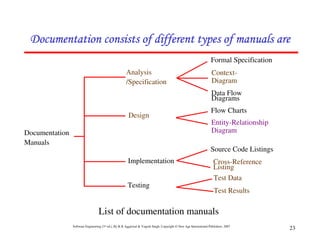
  • 129.
    48 Software Engineering (3rded.), By K.K Aggarwal & Yogesh Singh, Copyright © New Age International Publishers, 2007 %& 2.16 What is the role of user participation in the selection of a life cycle model?. 2.18 Write short note on “status of development team” for the selection of a life cycle model?. 2.19 Discuss the selection process parameters for a life cycle model. 2.20 What is unified process? Explain various phases along with the outcome of each phase. 2.21 Describe the unified process work products after each phase of unified process. 2.22 What are the advantages of iterative approach over sequential approach? Why is unified process called as iterative or incremental? 2.17 Why do we feel that characteristics of requirements play a very significant role in the selection of a life cycle model?
  • 130.
    1 Software Engineering (3rded.), By K.K Aggarwal & Yogesh Singh, Copyright © New Age International Publishers, 2007
  • 131.
    2 Software Engineering (3rded.), By K.K Aggarwal & Yogesh Singh, Copyright © New Age International Publishers, 2007 Quality of product Without well written document -- Developers do not know what to build -- Customers do not know what to expect -- What to validate Requirements describe What not How Produces one large document written in natural language contains a description of what the system will do without describing how it will do it. Process that creates it Crucial process steps
  • 132.
    3 Software Engineering (3rded.), By K.K Aggarwal & Yogesh Singh, Copyright © New Age International Publishers, 2007 Requirement Engineering Requirements Elicitation Requirements Analysis Requirements Documentation Requirements Review Problem Statement SRS Crucial Process Steps of requirement engineering
  • 133.
    4 Software Engineering (3rded.), By K.K Aggarwal & Yogesh Singh, Copyright © New Age International Publishers, 2007 Requirement Engineering is the disciplined application of proven principles, methods, tools, and notations to describe a proposed system’s intended behavior and its associated constraints. SRS may act as a contract between developer and customer. State of practice Requirements are difficult to uncover • Requirements change • Over reliance on CASE Tools • Tight project Schedule • Communication barriers • Market driven software development • Lack of resources
  • 134.
    5 Software Engineering (3rded.), By K.K Aggarwal & Yogesh Singh, Copyright © New Age International Publishers, 2007 Example A University wish to develop a software system for the student result management of its M.Tech. Programme. A problem statement is to be prepared for the software development company. The problem statement may give an overview of the existing system and broad expectations from the new software system.
  • 135.
    6 Software Engineering (3rded.), By K.K Aggarwal & Yogesh Singh, Copyright © New Age International Publishers, 2007 Types of Requirements Known Requirements Undreamed Requirements Unknown Requirements Stakeholder: Anyone who should have some direct or indirect influence on the system requirements. --- User --- Affected persons Requirements Functional Non-Functional
  • 136.
    7 Software Engineering (3rded.), By K.K Aggarwal & Yogesh Singh, Copyright © New Age International Publishers, 2007 Maintainability Portability Testability For Users For Developers Functional requirements describe what the software has to do. They are often called product features. Non Functional requirements are mostly quality requirements. That stipulate how well the software does, what it has to do. Availability Reliability Usability Flexibility
  • 137.
    8 Software Engineering (3rded.), By K.K Aggarwal & Yogesh Singh, Copyright © New Age International Publishers, 2007 User and system requirements • User requirement are written for the users and include functional and non functional requirement. • System requirement are derived from user requirement. • The user system requirements are the parts of software requirement and specification (SRS) document.
  • 138.
    9 Software Engineering (3rded.), By K.K Aggarwal & Yogesh Singh, Copyright © New Age International Publishers, 2007 Interface Specification • Important for the customers. TYPES OF INTERFACES • Procedural interfaces (also called Application Programming Interfaces (APIs)). • Data structures • Representation of data.
  • 139.
    10 Software Engineering (3rded.), By K.K Aggarwal & Yogesh Singh, Copyright © New Age International Publishers, 2007 Is cancellation of a project a bad news? As per IBM report, “31% projects get cancelled before they are completed, 53% over-run their cost estimates by an average of 189% & for every 100 projects, there are 94 restarts. How do we cancel a project with the least work? CONDUCT A FEASIBILTY STUDY
  • 140.
    11 Software Engineering (3rded.), By K.K Aggarwal & Yogesh Singh, Copyright © New Age International Publishers, 2007 Technical feasibility • Is it technically feasible to provide direct communication connectivity through space from one location of globe to another location? • Is it technically feasible to design a programming language using “Sanskrit”?
  • 141.
    12 Software Engineering (3rded.), By K.K Aggarwal & Yogesh Singh, Copyright © New Age International Publishers, 2007 Feasibility depends upon non technical Issues like: • Are the project’s cost and schedule assumption realistic? • Does the business model realistic? • Is there any market for the product?
  • 142.
    13 Software Engineering (3rded.), By K.K Aggarwal & Yogesh Singh, Copyright © New Age International Publishers, 2007 Purpose of feasibility study “evaluation or analysis of the potential impact of a proposed project or program.” Focus of feasibility studies • Is the product concept viable? • Will it be possible to develop a product that matches the project’s vision statement? • What are the current estimated cost and schedule for the project?
  • 143.
    14 Software Engineering (3rded.), By K.K Aggarwal & Yogesh Singh, Copyright © New Age International Publishers, 2007 Focus of feasibility studies • How big is the gap between the original cost & schedule targets & current estimates? • Is the business model for software justified when the current cost & schedule estimate are considered? • Have the major risks to the project been identified & can they be surmounted? • Is the specifications complete & stable enough to support remaining development work?
  • 144.
    15 Software Engineering (3rded.), By K.K Aggarwal & Yogesh Singh, Copyright © New Age International Publishers, 2007 Focus of feasibility studies • Have users & developers been able to agree on a detailed user interface prototype? If not, are the requirements really stable? • Is the software development plan complete & adequate to support further development work?
  • 145.
    16 Software Engineering (3rded.), By K.K Aggarwal & Yogesh Singh, Copyright © New Age International Publishers, 2007 Perhaps • Most difficult • Most critical • Most error prone • Most communication intensive Succeed Selection of any method 1. It is the only method that we know 2. It is our favorite method for all situations 3. We understand intuitively that the method is effective in the present circumstances. Normally we rely on first two reasons. effective customer developer partnership
  • 146.
    17 Software Engineering (3rded.), By K.K Aggarwal & Yogesh Singh, Copyright © New Age International Publishers, 2007 1.Interviews Both parties have a common goal Interview Selection of stakeholder 1. Entry level personnel 2. Middle level stakeholder 3. Managers 4. Users of the software (Most important) Success of the project --- open ended --- structured
  • 147.
    18 Software Engineering (3rded.), By K.K Aggarwal & Yogesh Singh, Copyright © New Age International Publishers, 2007 Types of questions. • Any problems with existing system • Any Calculation errors • Possible reasons for malfunctioning • No. of Student Enrolled
  • 148.
    19 Software Engineering (3rded.), By K.K Aggarwal & Yogesh Singh, Copyright © New Age International Publishers, 2007 5. Possible benefits 6. Satisfied with current policies 7.How are you maintaining the records of previous students? 8. Any requirement of data from other system 9. Any specific problems 10. Any additional functionality 11. Most important goal of the proposed development At the end, we may have wide variety of expectations from the proposed software.
  • 149.
    20 Software Engineering (3rded.), By K.K Aggarwal & Yogesh Singh, Copyright © New Age International Publishers, 2007 2. Brainstorming Sessions It is a group technique Creative Thinking New ideas Quickly *Idea is to generate views ,not to vet them. Groups 1. Users 2. Middle Level managers 3. Total Stakeholders Categorized Prioritized Pruned Prepare long list of requirements group discussions
  • 150.
    21 Software Engineering (3rded.), By K.K Aggarwal & Yogesh Singh, Copyright © New Age International Publishers, 2007 A Facilitator may handle group bias, conflicts carefully. -- Facilitator may follow a published agenda -- Every idea will be documented in a way that everyone can see it. --A detailed report is prepared. 3. Facilitated Application specification Techniques (FAST) -- Similar to brainstorming sessions. -- Team oriented approach -- Creation of joint team of customers and developers.
  • 151.
    22 Software Engineering (3rded.), By K.K Aggarwal & Yogesh Singh, Copyright © New Age International Publishers, 2007 Guidelines 1. Arrange a meeting at a neutral site. 2. Establish rules for participation. 3. Informal agenda to encourage free flow of ideas. 4. Appoint a facilitator. 5. Prepare definition mechanism board, worksheets, wall stickier. 6. Participants should not criticize or debate. FAST session Preparations Each attendee is asked to make a list of objects that are:
  • 152.
    23 Software Engineering (3rded.), By K.K Aggarwal & Yogesh Singh, Copyright © New Age International Publishers, 2007 1. Part of environment that surrounds the system. 2. Produced by the system. 3. Used by the system. A. List of constraints B. Functions C. Performance criteria Activities of FAST session 1. Every participant presents his/her list 2. Combine list for each topic 3. Discussion 4. Consensus list 5. Sub teams for mini specifications 6. Presentations of mini-specifications 7. Validation criteria 8. A sub team to draft specifications
  • 153.
    24 Software Engineering (3rded.), By K.K Aggarwal & Yogesh Singh, Copyright © New Age International Publishers, 2007 4.Quality Function Deployment -- Incorporate voice of the customer -- Normal requirements -- Expected requirements -- Exciting requirements What is important for customer? Prime concern is customer satisfaction Documented Technical requirements.
  • 154.
    25 Software Engineering (3rded.), By K.K Aggarwal & Yogesh Singh, Copyright © New Age International Publishers, 2007 Steps 1. Identify stakeholders 2. List out requirements 3. Degree of importance to each requirement.
  • 155.
    26 Software Engineering (3rded.), By K.K Aggarwal & Yogesh Singh, Copyright © New Age International Publishers, 2007 5 Points : V. Important 4 Points : Important 3 Points : Not Important but nice to have 2 Points : Not important 1 Points : Unrealistic, required further exploration Requirement Engineer may categorize like: (i) It is possible to achieve (ii) It should be deferred & Why (iii) It is impossible and should be dropped from consideration First Category requirements will be implemented as per priority assigned with every requirement.
  • 156.
    27 Software Engineering (3rded.), By K.K Aggarwal & Yogesh Singh, Copyright © New Age International Publishers, 2007 5. The Use Case Approach Ivar Jacobson & others introduced Use Case approach for elicitation & modeling. Use Case – give functional view The terms Use Case Use Case Scenario Use Case Diagram Use Cases are structured outline or template for the description of user requirements modeled in a structured language like English. Often Interchanged But they are different
  • 157.
    28 Software Engineering (3rded.), By K.K Aggarwal & Yogesh Singh, Copyright © New Age International Publishers, 2007 Use case Scenarios are unstructured descriptions of user requirements. Use case diagrams are graphical representations that may be decomposed into further levels of abstraction. Components of Use Case approach Actor: An actor or external agent, lies outside the system model, but interacts with it in some way. Actor Person, machine, information System
  • 158.
    29 Software Engineering (3rded.), By K.K Aggarwal & Yogesh Singh, Copyright © New Age International Publishers, 2007 • Cockburn distinguishes between Primary and secondary actors. • A Primary actor is one having a goal requiring the assistance of the system. • A Secondary actor is one from which System needs assistance. Use Cases A use case is initiated by a user with a particular goal in mind, and completes successfully when that goal is satisfied.
  • 159.
    30 Software Engineering (3rded.), By K.K Aggarwal & Yogesh Singh, Copyright © New Age International Publishers, 2007 * It describes the sequence of interactions between actors and the system necessary to deliver the services that satisfies the goal. * Alternate sequence * System is treated as black box. Thus Use Case captures who (actor) does what (interaction) with the system, for what purpose (goal), without dealing with system internals.
  • 160.
    31 Software Engineering (3rded.), By K.K Aggarwal & Yogesh Singh, Copyright © New Age International Publishers, 2007 *defines all behavior required of the system, bounding the scope of the system. Jacobson & others proposed a template for writing Use cases as shown below: 1. Introduction Describe a quick background of the use case. 2.Actors List the actors that interact and participate in the use cases. 3.Pre Conditions Pre conditions that need to be satisfied for the use case to perform. 4. Post Conditions Define the different states in which we expect the system to be in, after the use case executes.
  • 161.
    32 Software Engineering (3rded.), By K.K Aggarwal & Yogesh Singh, Copyright © New Age International Publishers, 2007 5. Flow of events 5.1 Basic Flow List the primary events that will occur when this use case is executed. 5.2 Alternative Flows Any Subsidiary events that can occur in the use case should be separately listed. List each such event as an alternative flow. A use case can have many alternative flows as required. 6.Special Requirements Business rules should be listed for basic & information flows as special requirements in the use case narration .These rules will also be used for writing test cases. Both success and failures scenarios should be described. 7.Use Case relationships For Complex systems it is recommended to document the relationships between use cases. Listing the relationships between use cases also provides a mechanism for traceability Use Case Template.
  • 162.
    33 Software Engineering (3rded.), By K.K Aggarwal & Yogesh Singh, Copyright © New Age International Publishers, 2007 Use Case Guidelines 1. Identify all users 2. Create a user profile for each category of users including all roles of the users play that are relevant to the system. 3. Create a use case for each goal, following the use case template maintain the same level of abstraction throughout the use case. Steps in higher level use cases may be treated as goals for lower level (i.e. more detailed), sub- use cases. 4. Structure the use case 5. Review and validate with users.
  • 163.
    34 Software Engineering (3rded.), By K.K Aggarwal & Yogesh Singh, Copyright © New Age International Publishers, 2007 Use case Diagrams -- represents what happens when actor interacts with a system. -- captures functional aspect of the system. Use Case Relationship between actors and use case and/or between the use cases. -- Actors appear outside the rectangle. --Use cases within rectangle providing functionality. --Relationship association is a solid line between actor & use cases. Actor
  • 164.
    35 Software Engineering (3rded.), By K.K Aggarwal & Yogesh Singh, Copyright © New Age International Publishers, 2007 *Use cases should not be used to capture all the details of the system. *Only significant aspects of the required functionality *No design issues *Use Cases are for “what” the system is , not “how” the system will be designed * Free of design characteristics
  • 165.
    36 Software Engineering (3rded.), By K.K Aggarwal & Yogesh Singh, Copyright © New Age International Publishers, 2007 Use case diagram for Result Management System Maintain Student Details Maintain Subject Details Maintain Result Details Login Generate Result Reports View Results Data Entry Operator Administrator/DR Student/Teacher
  • 166.
    37 Software Engineering (3rded.), By K.K Aggarwal & Yogesh Singh, Copyright © New Age International Publishers, 2007 1. Maintain student Details Add/Modify/update students details like name, address. 2.Maintain subject Details Add/Modify/Update Subject information semester wise 3.Maintain Result Details Include entry of marks and assignment of credit points for each paper. 4. Login Use to Provide way to enter through user id & password. 5. Generate Result Report Use to print various reports 6. View Result (i) According to course code (ii) According to Enrollment number/roll number
  • 167.
    38 Software Engineering (3rded.), By K.K Aggarwal & Yogesh Singh, Copyright © New Age International Publishers, 2007 Login 1.1 Introduction : This use case describes how a user logs into the Result Management System. 1.2 Actors : (i) Data Entry Operator (ii) Administrator/Deputy Registrar 1.3 Pre Conditions : None 1.4 Post Conditions : If the use case is successful, the actor is logged into the system. If not, the system state is unchanged.
  • 168.
    39 Software Engineering (3rded.), By K.K Aggarwal & Yogesh Singh, Copyright © New Age International Publishers, 2007 1.5 Basic Flow : This use case starts when the actor wishes to login to the Result Management system. (i) System requests that the actor enter his/her name and password. (ii) The actor enters his/her name & password. (iii) System validates name & password, and if finds correct allow the actor to logs into the system.
  • 169.
    40 Software Engineering (3rded.), By K.K Aggarwal & Yogesh Singh, Copyright © New Age International Publishers, 2007 1.6 Alternate Flows 1.6.1 Invalid name & password If in the basic flow, the actor enters an invalid name and/or password, the system displays an error message. The actor can choose to either return to the beginning of the basic flow or cancel the login, at that point, the use case ends. 1.7 Special Requirements: None 1.8 Use case Relationships: None
  • 170.
    41 Software Engineering (3rded.), By K.K Aggarwal & Yogesh Singh, Copyright © New Age International Publishers, 2007 2.Maintain student details 2.1 Introduction : Allow DEO to maintain student details. This includes adding, changing and deleting student information 2.2 Actors : DEO 2.3 Pre-Conditions: DEO must be logged onto the system before this use case begins.
  • 171.
    42 Software Engineering (3rded.), By K.K Aggarwal & Yogesh Singh, Copyright © New Age International Publishers, 2007 2.4 Post-conditions : If use case is successful, student information is added/updated/deleted from the system. Otherwise, the system state is unchanged. 2.5 Basic Flow : Starts when DEO wishes to add/modify/update/delete Student information. (i) The system requests the DEO to specify the function, he/she would like to perform (Add/update/delete) (ii) One of the sub flow will execute after getting the information.
  • 172.
    43 Software Engineering (3rded.), By K.K Aggarwal & Yogesh Singh, Copyright © New Age International Publishers, 2007 If DEO selects "Add a student", "Add a student" sub flow will be executed. If DEO selects "update a student", "update a student" sub flow will be executed. If DEO selects "delete a student", "delete a student" sub flow will be executed. 2.5.1 Add a student (i) The system requests the DEO to enter: Name Address Roll No Phone No Date of admission (ii) System generates unique id
  • 173.
    44 Software Engineering (3rded.), By K.K Aggarwal & Yogesh Singh, Copyright © New Age International Publishers, 2007 2.5.2 Update a student (i) System requires the DEO to enter student-id. (ii) DEO enters the student_id. The system retrieves and display the student information. (iii) DEO makes the desired changes to the student information. (iv) After changes, the system updates the student record with changed information.
  • 174.
    45 Software Engineering (3rded.), By K.K Aggarwal & Yogesh Singh, Copyright © New Age International Publishers, 2007 2.5.3 Delete a student (i) The system requests the DEO to specify the student-id. (ii) DEO enters the student-id. The system retrieves and displays the student information. (iii) The system prompts the DEO to confirm the deletion of the student. (iv) The DEO confirms the deletion. (v) The system marks the student record for deletion.
  • 175.
    46 Software Engineering (3rded.), By K.K Aggarwal & Yogesh Singh, Copyright © New Age International Publishers, 2007 2.6 Alternative flows 2.6.1 Student not found If in the update a student or delete a student sub flows, a student with specified_id does not exist, the system displays an error message .The DEO may enter a different id or cancel the operation. At this point ,Use case ends.
  • 176.
    47 Software Engineering (3rded.), By K.K Aggarwal & Yogesh Singh, Copyright © New Age International Publishers, 2007 2.6.2 Update Cancelled If in the update a student sub-flow, the data entry operator decides not to update the student information, the update is cancelled and the basic flow is restarted at the begin.
  • 177.
    48 Software Engineering (3rded.), By K.K Aggarwal & Yogesh Singh, Copyright © New Age International Publishers, 2007 2.6.3 Delete cancelled If in the delete a student sub flows, DEO decides not to delete student record ,the delete is cancelled and the basic flow is re-started at the beginning. 2.7 Special requirements None 2.8 Use case relationships None
  • 178.
    49 Software Engineering (3rded.), By K.K Aggarwal & Yogesh Singh, Copyright © New Age International Publishers, 2007 3. Maintain Subject Details 3.1 Introduction The DEO to maintain subject information. This includes adding, changing, deleting subject information from the system 3.2 Actors : DEO 3.3 Preconditions : DEO must be logged onto the system before the use case begins.
  • 179.
    50 Software Engineering (3rded.), By K.K Aggarwal & Yogesh Singh, Copyright © New Age International Publishers, 2007 3.4 Post conditions : If the use case is successful, the subject information is added, updated, or deleted from the system, otherwise the system state is unchanged. 3.5 Basic flows : The use case starts when DEO wishes to add, change, and/or delete subject information from the system. (i) The system requests DEO to specify the function he/she would like to perform i.e. • Add a subject • Update a subject • Delete a subject.
  • 180.
    51 Software Engineering (3rded.), By K.K Aggarwal & Yogesh Singh, Copyright © New Age International Publishers, 2007 (ii) Once the DEO provides the required information, one of the sub flows is executed. If DEO selected “Add a subject” the “Add-a subject sub flow is executed. If DEO selected “Update-a subject” the “update-a- subject” sub flow is executed If DEO selected “Delete- a- subject”, the “Delete-a-subject” sub flow is executed. 3.5.1 Add a Subject (i) The System requests the DEO to enter the subject information. This includes : * Name of the subject
  • 181.
    52 Software Engineering (3rded.), By K.K Aggarwal & Yogesh Singh, Copyright © New Age International Publishers, 2007 * Subject Code * Semester * Credit points (ii) Once DEO provides the requested information, the system generates and assigns a unique subject-id to the subject. The subject is added to the system. (iii) The system provides the DEO with new subject-id.
  • 182.
    53 Software Engineering (3rded.), By K.K Aggarwal & Yogesh Singh, Copyright © New Age International Publishers, 2007 3.5.2 Update a Subject (i) The system requests the DEO to enter subject_id. (ii) DEO enters the subject_id. The system retrieves and displays the subject information. (iii) DEO makes the changes. (iv) Record is updated.
  • 183.
    54 Software Engineering (3rded.), By K.K Aggarwal & Yogesh Singh, Copyright © New Age International Publishers, 2007 3.5.3 Delete a Subject (i) Entry of subject_id. (ii) After this, system retrieves & displays subject information. * System prompts the DEO to confirm the deletion. * DEO verifies the deletion. * The system marks the subject record for deletion.
  • 184.
    55 Software Engineering (3rded.), By K.K Aggarwal & Yogesh Singh, Copyright © New Age International Publishers, 2007 3.6 Alternative Flow 3.6.1 Subject not found If in any sub flows, subject-id not found, error message is displayed. The DEO may enter a different id or cancel the case ends here. 3.6.2 Update Cancelled If in the update a subject sub-flow, the data entry operator decides not to update the subject information, the update is cancelled and the basic flow is restarted at the begin.
  • 185.
    56 Software Engineering (3rded.), By K.K Aggarwal & Yogesh Singh, Copyright © New Age International Publishers, 2007 3.6.3 Delete Cancellation If in delete-a-subject sub flow, the DEO decides not to delete subject, the delete is cancelled, and the basic flow is restarted from the beginning. 3.7 Special Requirements: None 3.8 Use Case-relationships None
  • 186.
    57 Software Engineering (3rded.), By K.K Aggarwal & Yogesh Singh, Copyright © New Age International Publishers, 2007 4. Maintain Result Details 4.1 Introduction This use case allows the DEO to maintain subject & marks information of each student. This includes adding and/or deleting subject and marks information from the system. 4.2 Actor DEO
  • 187.
    58 Software Engineering (3rded.), By K.K Aggarwal & Yogesh Singh, Copyright © New Age International Publishers, 2007 4.3 Pre Conditions DEO must be logged onto the system. 4.4 Post Conditions If use case is successful ,marks information is added or deleted from the system. Otherwise, the system state is unchanged.
  • 188.
    59 Software Engineering (3rded.), By K.K Aggarwal & Yogesh Singh, Copyright © New Age International Publishers, 2007 4.5 Basic Flow This use case starts, when the DEO wishes to add, update and/or delete marks from the system. (i) DEO to specify the function (ii) Once DEO provides the information one of the subflow is executed. * If DEO selected “Add Marks “, the Add marks subflow is executed. * If DEO selected “Update Marks”, the update marks subflow is executed. * If DEO selected “Delete Marks”, the delete marks subflow is executed.
  • 189.
    60 Software Engineering (3rded.), By K.K Aggarwal & Yogesh Singh, Copyright © New Age International Publishers, 2007 4.5.1 Add Marks Records Add marks information .This includes: a. Selecting a subject code. b. Selecting the student enrollment number. c. Entering internal/external marks for that subject code & enrollment number.
  • 190.
    61 Software Engineering (3rded.), By K.K Aggarwal & Yogesh Singh, Copyright © New Age International Publishers, 2007 (ii) If DEO tries to enter marks for the same combination of subject and enrollment number,the system gives a message that the marks have already been entered. (iii) Each record is assigned a unique result_id. 4.5.2 Delete Marks records 1. DEO makes the following entries: a. Selecting subject for which marks have to be deleted. b. Selecting student enrollment number. c. Displays the record with id number. d. Verify the deletion. e. Delete the record.
  • 191.
    62 Software Engineering (3rded.), By K.K Aggarwal & Yogesh Singh, Copyright © New Age International Publishers, 2007 4.5.2 Update Marks records 1. The System requests DEO to enter the record_id. 2. DEO enters record_id. The system retrieves & displays the information. 3. DEO makes changes. 4. Record is updated.
  • 192.
    63 Software Engineering (3rded.), By K.K Aggarwal & Yogesh Singh, Copyright © New Age International Publishers, 2007 4.5.3 Compute Result (i) Once the marks are entered, result is computed for each student. (ii) If a student has scored more than 50% in a subject, the associated credit points are allotted to that student. (iii) The result is displayed with subject-code, marks & credit points. 4.6 Alternative Flow 4.6.1 Record not found If in update or delete marks sub flows, marks with specified id number do not exist, the system displays an error message. DEO can enter another id or cancel the operation.
  • 193.
    64 Software Engineering (3rded.), By K.K Aggarwal & Yogesh Singh, Copyright © New Age International Publishers, 2007 4.6.2 Delete Cancelled If in Delete Marks, DEO decides not to delete marks, the delete is cancelled and basic flow is re-started at the beginning. 4.7 Special Requirements None 4.8 Use case relationships None
  • 194.
    65 Software Engineering (3rded.), By K.K Aggarwal & Yogesh Singh, Copyright © New Age International Publishers, 2007 5 View/Display result 5.1 Introduction This use case allows the student/Teacher or anyone to view the result. The result can be viewed on the basis of course code and/or enrollment number. 5.2 Actors Administrator/DR, Teacher/Student 5.3 Pre Conditions None 5.4 Post Conditions If use case is successful, the marks information is displayed by the system. Otherwise, state is unchanged.
  • 195.
    66 Software Engineering (3rded.), By K.K Aggarwal & Yogesh Singh, Copyright © New Age International Publishers, 2007 5.5 Basic Flow Use case begins when student, teacher or any other person wish to view the result. Two ways -- Enrollment no. -- Course code
  • 196.
    67 Software Engineering (3rded.), By K.K Aggarwal & Yogesh Singh, Copyright © New Age International Publishers, 2007 (ii) After selection, one of the sub flow is executed. Course code Enrollment no. 5.5.1 View result enrollment number wise (i) User to enter enrollment number (ii) System retrieves the marks of all subjects with credit points (iii) Result is displayed. Sub flow is executed Sub flow is executed
  • 197.
    68 Software Engineering (3rded.), By K.K Aggarwal & Yogesh Singh, Copyright © New Age International Publishers, 2007 5.6 Alternative Flow 5.6.1 Record not found Error message should be displayed. 5.7 Special Requirements None 5.8 Use Case relationships None
  • 198.
    69 Software Engineering (3rded.), By K.K Aggarwal & Yogesh Singh, Copyright © New Age International Publishers, 2007 6. Generate Report 6.1 Introduction This use case allows the DR to generate result reports. Options are a. Course code wise b. Semester wise c. Enrollment Number wise 6.2 Actors DR 6.3 Pre-Conditions DR must logged on to the system
  • 199.
    70 Software Engineering (3rded.), By K.K Aggarwal & Yogesh Singh, Copyright © New Age International Publishers, 2007 6.4 Post conditions If use case is successful, desired report is generated. Otherwise, the system state is unchanged. 6.5 Basic Flow The use case starts, when DR wish to generate reports. (i) DR selects option. (ii) System retrieves the information displays. (iii) DR takes printed reports.
  • 200.
    71 Software Engineering (3rded.), By K.K Aggarwal & Yogesh Singh, Copyright © New Age International Publishers, 2007 6.6 Alternative Flows 6.6.1 Record not found If not found, system generates appropriate message. The DR can select another option or cancel the operation. At this point, the use case ends. 6.7 Special Requirements None 6.8 Use case relationships None
  • 201.
    72 Software Engineering (3rded.), By K.K Aggarwal & Yogesh Singh, Copyright © New Age International Publishers, 2007 7. Maintain User Accounts 7.1 Introduction This use case allows the administrator to maintain user account. This includes adding, changing and deleting user account information from the system. 7.2 Actors Administrator 7.3 Pre-Conditions The administrator must be logged on to the system before the use case begins.
  • 202.
    73 Software Engineering (3rded.), By K.K Aggarwal & Yogesh Singh, Copyright © New Age International Publishers, 2007 7.4 Post-Conditions If the use case was successful, the user account information is added, updated, or deleted from the system. Otherwise, the system state is unchanged. 7.5 Basic Flow This use case starts when the Administrator wishes to add, change, and/or delete use account information from the system. (i) The system requests that the Administrator specify the function he/she would like to perform (either Add a User Account, Update a User Account, or Delete a User Account). (ii) Once the Administrator provides the requested information, one of the sub-flows is executed
  • 203.
    74 Software Engineering (3rded.), By K.K Aggarwal & Yogesh Singh, Copyright © New Age International Publishers, 2007 * If the Administrator selected “Add a User Account”, the Add a User Account sub flow is executed. * If the Administrator selected “Update a User Account”, the Update a User Account sub-flow is executed. * If the Administrator selected “Delete a User Account”, the Delete a User Account sub-flow is executed.22 7.5.1 Add a User Account 1. The system requests that the Administrator enters the user information. This includes: (a) User Name (b) User ID-should be unique for each user account (c) Password (d) Role .
  • 204.
    75 Software Engineering (3rded.), By K.K Aggarwal & Yogesh Singh, Copyright © New Age International Publishers, 2007 2. Once the Administrator provides the requested information, the user account information is added. 7.5.2 Update a User Account 1. The system requests that the Administrator enters the User ID. 2. The Administrator enters the User ID. The system retrieves and displays the user account information. 3. The Administrator makes the desired changes to the user account information. This includes any of the information specified in the Add a User Account sub-flow. 4. Once the Administrator updates the necessary information, the system updates the user account record with the updated information.
  • 205.
    76 Software Engineering (3rded.), By K.K Aggarwal & Yogesh Singh, Copyright © New Age International Publishers, 2007 7.5.3 Delete a User Account 1. The system requests that the Administrator enters the User ID. 2. The Administrator enters the User ID. The system retrieves and displays the user account information. 3. The system prompts the Administrator to confirm the deletion of the user account. 4. The Administrator confirms the deletion. 5. The system deletes the user account record.
  • 206.
    77 Software Engineering (3rded.), By K.K Aggarwal & Yogesh Singh, Copyright © New Age International Publishers, 2007 7.6 Alternative Flows 7.6.1 User Not Found If in the Update a User Account or Delete a User Account sub-flows, a user account with the specified User ID does not exist, the system displays an error message. The Administrator can then enter a different User ID or cancel the operation, at which point the use case ends. 7.6.2 Update Cancelled If in the Update a User Account sub-flow, the Administrator decides not to update the user account information, the update is cancelled and the Basic Flow is re-started at the beginning.
  • 207.
    78 Software Engineering (3rded.), By K.K Aggarwal & Yogesh Singh, Copyright © New Age International Publishers, 2007 7.6.3 Delete Cancelled If in the Delete a User Account sub-flow, the Administrator decides not to delete the user account information, the delete is cancelled and the Basic Flow is re-started at the beginning. 7.7 Special Requirements None 7.8 Use case relationships None
  • 208.
    79 Software Engineering (3rded.), By K.K Aggarwal & Yogesh Singh, Copyright © New Age International Publishers, 2007 8. Reset System 8.1 Introduction This use case allows the allows the administrator to reset the system by deleting all existing information from the system . 8.2 Actors Administrator 8.3 Pre-Conditions The administrator must be logged on to the system before the use case begins.
  • 209.
    80 Software Engineering (3rded.), By K.K Aggarwal & Yogesh Singh, Copyright © New Age International Publishers, 2007 8.4 Post-Conditions If the use case was successful, all the existing information is deleted from the backend database of the system. Otherwise, the system state is unchanged. 8.5 Basic Flow This use case starts when the Administrator wishes to reset the system. i. The system requests the Administrator to confirm if he/she wants to delete all the existing information from the system. ii. Once the Administrator provides confirmation, the system deletes all the existing information from the backend database and displays an appropriate message.
  • 210.
    81 Software Engineering (3rded.), By K.K Aggarwal & Yogesh Singh, Copyright © New Age International Publishers, 2007 8.6 Alternative Flows 8.6.1 Reset Cancelled If in the Basic Flow, the Administrator decides not to delete the entire existing information, the reset is cancelled and the use case ends. 8.7 Special Requirements None 8.8 Use case relationships None
  • 211.
    82 Software Engineering (3rded.), By K.K Aggarwal & Yogesh Singh, Copyright © New Age International Publishers, 2007 We analyze, refine and scrutinize requirements to make consistent & unambiguous requirements. Steps Draw the context Diagram Develop prototype (optional) Model the Requirements Finalize the Requirements Requirements Analysis Steps
  • 212.
    83 Software Engineering (3rded.), By K.K Aggarwal & Yogesh Singh, Copyright © New Age International Publishers, 2007 Result Management System Administrator Marks Entry Operator Student Information Reports generated Mark sheet generated Student performance Reports generated Subject Information Entry Student Information Entry Marks Entry
  • 213.
    84 Software Engineering (3rded.), By K.K Aggarwal & Yogesh Singh, Copyright © New Age International Publishers, 2007 Data Flow Diagrams DFD show the flow of data through the system. --All names should be unique -- It is not a flow chart -- Suppress logical decisions -- Defer error conditions & handling until the end of the analysis Symbol Name Function Data Flow Connect process Process Perform some transformation of its input data to yield output data.
  • 214.
    85 Software Engineering (3rded.), By K.K Aggarwal & Yogesh Singh, Copyright © New Age International Publishers, 2007 Data Store A repository of data, the arrowhead indicate net input and net outputs to store Source or sink A source of system inputs or sink of system outputs Leveling DFD represent a system or software at any level of abstraction. A level 0 DFD is called fundamental system model or context model represents entire software element as a single bubble with input and output data indicating by incoming & outgoing arrows. Symbol Name Function
  • 215.
    86 Software Engineering (3rded.), By K.K Aggarwal & Yogesh Singh, Copyright © New Age International Publishers, 2007 A I1 I2 O3 O3 I1 I2
  • 216.
    87 Software Engineering (3rded.), By K.K Aggarwal & Yogesh Singh, Copyright © New Age International Publishers, 2007 Data Dictionaries are simply repositories to store information about all data items defined in DFD. Includes : Name of data item Aliases (other names for items) Description/Purpose Related data items Range of values Data flows Data structure definition DD DFD
  • 217.
    88 Software Engineering (3rded.), By K.K Aggarwal & Yogesh Singh, Copyright © New Age International Publishers, 2007 Notation Meaning x= a+b x consists of data element a & b x={a/b} x consists of either a or b x=(a) x consists of an optional data element a x= y{a} x consists of y or more occurrences x={a}z x consists of z or fewer occurrences of a x=y{a}z x consists of between y & z occurrences of a{
  • 218.
    89 Software Engineering (3rded.), By K.K Aggarwal & Yogesh Singh, Copyright © New Age International Publishers, 2007 ! ! ! ! Entity-Relationship Diagrams It is a detailed logical representation of data for an organization and uses three main constructs. Entities Relationships Attributes Entities Fundamental thing about which data may be maintained. Each entity has its own identity. Entity Type is the description of all entities to which a common definition and common relationships and attributes apply.
  • 219.
    90 Software Engineering (3rded.), By K.K Aggarwal & Yogesh Singh, Copyright © New Age International Publishers, 2007 ! ! ! ! Consider an insurance company that offers both home and automobile insurance policies .These policies are offered to individuals and businesses. POLICY CUSTOMER home Automobile individual businesses POLICY CUSTOMER
  • 220.
    91 Software Engineering (3rded.), By K.K Aggarwal & Yogesh Singh, Copyright © New Age International Publishers, 2007 ! ! ! ! Relationships A relationship is a reason for associating two entity types. Binary relationships involve two entity types A CUSTOMER is insured by a POLICY. A POLICY CLAIM is made against a POLICY. Relationships are represented by diamond notation in a ER diagram. CUSTOMER Insured by POLICY POLICY CLAIM Made Against Relationships added to ERD
  • 221.
    92 Software Engineering (3rded.), By K.K Aggarwal & Yogesh Singh, Copyright © New Age International Publishers, 2007 ! ! ! ! A training department is interested in tracking which training courses each of its employee has completed. Each employee may complete more than one course,and each course may be completed by more than one employee. EMPLOYEE completes COURSE Many-to Many relationship
  • 222.
    93 Software Engineering (3rded.), By K.K Aggarwal & Yogesh Singh, Copyright © New Age International Publishers, 2007 ! ! ! ! Degree of relationship It is the number of entity types that participates in that relationship. Unary Binary Ternary Unary relationship Person Is Married to Employee Manages One to One One to many
  • 223.
    94 Software Engineering (3rded.), By K.K Aggarwal & Yogesh Singh, Copyright © New Age International Publishers, 2007 ! ! ! ! Binary Relationship EMPLOYEE PARKING PLACE Is assigned PRODUCT LINE PRODUCT Contains STUDENT COURSE Registers for One to One One to many Many to many
  • 224.
    95 Software Engineering (3rded.), By K.K Aggarwal & Yogesh Singh, Copyright © New Age International Publishers, 2007 ! ! ! ! Ternary relationship Part Vendor Ware House Ships Cardinalities and optionality Two entity types A,B, connected by a relationship. The cardinality of a relationship is the number of instances of entity B that can be associated with each instance of entity A Movie Video Tape Is Stocked as
  • 225.
    96 Software Engineering (3rded.), By K.K Aggarwal & Yogesh Singh, Copyright © New Age International Publishers, 2007 ! ! ! ! Minimum cardinality is the minimum number of instances of entity B that may be associated with each instance of entity A. Minimum no. of tapes available for a movie is zero.We say VIDEO TAPE is an optional participant in the is-stocked-as relationship. MOVIE VIDEO TAPE Is Stocked As
  • 226.
    97 Software Engineering (3rded.), By K.K Aggarwal & Yogesh Singh, Copyright © New Age International Publishers, 2007 ! ! ! ! Attributes Each entity type has a set of attributes associated with it. An attribute is a property or characteristic of an entity that is of interest to organization. Attribute
  • 227.
    98 Software Engineering (3rded.), By K.K Aggarwal & Yogesh Singh, Copyright © New Age International Publishers, 2007 ! ! ! ! If there are more candidate keys, one of the key may be chosen as the Identifier. It is used as unique characteristic for an entity type. Identifier A candidate key is an attribute or combination of attributes that uniquely identifies each instance of an entity type. Student_ID Candidate Key
  • 228.
    99 Software Engineering (3rded.), By K.K Aggarwal & Yogesh Singh, Copyright © New Age International Publishers, 2007 ! ! ! ! STUDENT Student_ID Name Address Phone_No Vendors quote prices for several parts along with quantity of parts. Draw an E-R diagram. Quote- price Vendor Parts price quantity
  • 229.
    100 Software Engineering (3rded.), By K.K Aggarwal & Yogesh Singh, Copyright © New Age International Publishers, 2007 1. List all inputs, outputs and functions. 2. List all functions and then list all inputs and outputs associated with each function. Structured requirements definition (SRD) Step1 Define a user level DFD. Record the inputs and outputs for each individual in a DFD. Step2 Define a combined user level DFD. Step3 Define application level DFD. Step4 Define application level functions. ! ! ! !
  • 230.
    101 Software Engineering (3rded.), By K.K Aggarwal & Yogesh Singh, Copyright © New Age International Publishers, 2007 This is the way of representing requirements in a consistent format SRS serves many purpose depending upon who is writing it. -- written by customer -- written by developer Serves as contract between customer & developer.
  • 231.
    102 Software Engineering (3rded.), By K.K Aggarwal & Yogesh Singh, Copyright © New Age International Publishers, 2007 Nature of SRS Basic Issues • Functionality • External Interfaces • Performance • Attributes • Design constraints imposed on an Implementation
  • 232.
    103 Software Engineering (3rded.), By K.K Aggarwal & Yogesh Singh, Copyright © New Age International Publishers, 2007 SRS Should -- Correctly define all requirements -- not describe any design details -- not impose any additional constraints Characteristics of a good SRS An SRS Should be Correct Unambiguous Complete Consistent
  • 233.
    104 Software Engineering (3rded.), By K.K Aggarwal & Yogesh Singh, Copyright © New Age International Publishers, 2007 Ranked for important and/or stability Verifiable Modifiable Traceable
  • 234.
    105 Software Engineering (3rded.), By K.K Aggarwal & Yogesh Singh, Copyright © New Age International Publishers, 2007 Correct An SRS is correct if and only if every requirement stated therein is one that the software shall meet. Unambiguous An SRS is unambiguous if and only if, every requirement stated therein has only one interpretation. Complete An SRS is complete if and only if, it includes the following elements (i) All significant requirements, whether related to functionality, performance, design constraints, attributes or external interfaces.
  • 235.
    106 Software Engineering (3rded.), By K.K Aggarwal & Yogesh Singh, Copyright © New Age International Publishers, 2007 (ii) Responses to both valid & invalid inputs. (iii) Full Label and references to all figures, tables and diagrams in the SRS and definition of all terms and units of measure. Consistent An SRS is consistent if and only if, no subset of individual requirements described in it conflict. Ranked for importance and/or Stability If an identifier is attached to every requirement to indicate either the importance or stability of that particular requirement.
  • 236.
    107 Software Engineering (3rded.), By K.K Aggarwal & Yogesh Singh, Copyright © New Age International Publishers, 2007 Verifiable An SRS is verifiable, if and only if, every requirement stated therein is verifiable. Modifiable An SRS is modifiable, if and only if, its structure and style are such that any changes to the requirements can be made easily, completely, and consistently while retaining structure and style. Traceable An SRS is traceable, if the origin of each of the requirements is clear and if it facilitates the referencing of each requirement in future development or enhancement documentation.
  • 237.
    108 Software Engineering (3rded.), By K.K Aggarwal & Yogesh Singh, Copyright © New Age International Publishers, 2007 Organization of the SRS IEEE has published guidelines and standards to organize an SRS. First two sections are same. The specific tailoring occurs in section-3. 1. Introduction 1.1 Purpose 1.2 Scope 1.3 Definition, Acronyms and abbreviations 1.4 References 1.5 Overview
  • 238.
    109 Software Engineering (3rded.), By K.K Aggarwal & Yogesh Singh, Copyright © New Age International Publishers, 2007 2. The Overall Description 2.1 Product Perspective 2.1.1 System Interfaces 2.1.2 Interfaces 2.1.3 Hardware Interfaces 2.1.4 Software Interfaces 2.1.5 Communication Interfaces 2.1.6 Memory Constraints 2.1.7 Operations 2.1.8 Site Adaptation Requirements
  • 239.
    110 Software Engineering (3rded.), By K.K Aggarwal & Yogesh Singh, Copyright © New Age International Publishers, 2007 2.2 Product Functions 2.3 User Characteristics 2.4 Constraints 2.5 Assumptions for dependencies 2.6 Apportioning of requirements 3. Specific Requirements 3.1 External Interfaces 3.2 Functions 3.3 Performance requirements 3.4 Logical database requirements 3.5 Design Constraints 3.6 Software System attributes 3.7 Organization of specific requirements 3.8 Additional Comments.
  • 240.
    111 Software Engineering (3rded.), By K.K Aggarwal & Yogesh Singh, Copyright © New Age International Publishers, 2007 " " " " Check the document for: Completeness & consistency Conformance to standards Requirements conflicts Technical errors Ambiguous requirements
  • 241.
    112 Software Engineering (3rded.), By K.K Aggarwal & Yogesh Singh, Copyright © New Age International Publishers, 2007 " " " " Validation process List of problems Approved actions SRS document Organizational standards Organizational knowledge
  • 242.
    113 Software Engineering (3rded.), By K.K Aggarwal & Yogesh Singh, Copyright © New Age International Publishers, 2007 # $ % # $ % # $ % # $ % Plan review Plan review Distribute SRS documents Distribute SRS documents Read documents Read documents Organize review Organize review Revise document Revise document Follow up actions Follow up actions
  • 243.
    114 Software Engineering (3rded.), By K.K Aggarwal & Yogesh Singh, Copyright © New Age International Publishers, 2007 " " " " Problem actions • Requirements clarification • Missing information • find this information from stakeholders • Requirements conflicts • Stakeholders must negotiate to resolve this conflict • Unrealistic requirements • Stakeholders must be consulted • Security issues • Review the system in accordance to security standards
  • 244.
    115 Software Engineering (3rded.), By K.K Aggarwal & Yogesh Singh, Copyright © New Age International Publishers, 2007 Redundancy Completeness Ambiguity Consistency Organization Conformance Traceability # $ ! & # $ ! & # $ ! & # $ ! &
  • 245.
    116 Software Engineering (3rded.), By K.K Aggarwal & Yogesh Singh, Copyright © New Age International Publishers, 2007 % % % % Validation prototype should be reasonably complete & efficient & should be used as the required system.
  • 246.
    117 Software Engineering (3rded.), By K.K Aggarwal & Yogesh Singh, Copyright © New Age International Publishers, 2007 ' ' ' ' • Process of understanding and controlling changes to system requirements. ENDURING & VOLATILE REQUIREMENTS o Enduring requirements: They are core requirements & are related to main activity of the organization. Example: issue/return of a book, cataloging etc. o Volatile requirements: likely to change during software development lifer cycle or after delivery of the product
  • 247.
    118 Software Engineering (3rded.), By K.K Aggarwal & Yogesh Singh, Copyright © New Age International Publishers, 2007 ' % ' % ' % ' % • Very critical. • Important for the success of any project.
  • 248.
    119 Software Engineering (3rded.), By K.K Aggarwal & Yogesh Singh, Copyright © New Age International Publishers, 2007 ! ' ! ' ! ' ! ' • Allocating adequate resources • Analysis of requirements • Documenting requirements • Requirements traceability • Establishing team communication • Establishment of baseline
  • 249.
    120 Software Engineering (3rded.), By K.K Aggarwal & Yogesh Singh, Copyright © New Age International Publishers, 2007 Q:IRMPRIVATEINITIATIATIQAQAPLANSRSPLAN.DOC $ $ $ $
  • 250.
    121 Software Engineering (3rded.), By K.K Aggarwal & Yogesh Singh, Copyright © New Age International Publishers, 2007 Note. Choose the most appropriate answer of the following questions. 3.1 Which one is not a step of requirement engineering? (a) Requirements elicitation (b) Requirements analysis (c) Requirements design (d) Requirements documentation 3.2 Requirements elicitation means (a) Gathering of requirements (b) Capturing of requirements (c) Understanding of requirements (d) All of the above ' ! (
  • 251.
    122 Software Engineering (3rded.), By K.K Aggarwal & Yogesh Singh, Copyright © New Age International Publishers, 2007 3.3 SRS stands for (a) Software requirements specification (b) System requirements specification (c) Systematic requirements specifications (d) None of the above 3.4 SRS document is for (a) “What” of a system? (b) How to design the system? (c) Costing and scheduling of a system (d) System’s requirement. ' ! (
  • 252.
    123 Software Engineering (3rded.), By K.K Aggarwal & Yogesh Singh, Copyright © New Age International Publishers, 2007 3.5 Requirements review process is carried out to (a) Spend time in requirements gathering (b) Improve the quality of SRS (c) Document the requirements (d) None of the above 3.6 Which one of the statements is not correct during requirements engineering? (a) Requirements are difficult to uncover (b) Requirements are subject to change (c) Requirements should be consistent (d) Requirements are always precisely known. ' ! (
  • 253.
    124 Software Engineering (3rded.), By K.K Aggarwal & Yogesh Singh, Copyright © New Age International Publishers, 2007 3.7 Which one is not a type of requirements? (a) Known requirements (b) Unknown requirements (c) Undreamt requirements (d) Complex requirements 3.8 Which one is not a requirements elicitation technique? (a) Interviews (b) The use case approach (c) FAST (d) Data flow diagram. ' ! (
  • 254.
    125 Software Engineering (3rded.), By K.K Aggarwal & Yogesh Singh, Copyright © New Age International Publishers, 2007 3.9 FAST stands for (a) Functional Application Specification Technique (b) Fast Application Specification Technique (c) Facilitated Application Specification Technique (d) None of the above 3.10 QFD in requirement engineering stands for (a) Quality function design (b) Quality factor design (c) Quality function development (d) Quality function deployment ' ! (
  • 255.
    126 Software Engineering (3rded.), By K.K Aggarwal & Yogesh Singh, Copyright © New Age International Publishers, 2007 3.11 Which is not a type of requirements under quality function deployment (a) Normal requirements (b) Abnormal requirements (c) Expected requirements (d) Exciting requirements 3.12 Use case approach was developed by (a) I. Jacobson and others (b) J.D. Musa and others (c) B. Littlewood (d) None of the above ' ! (
  • 256.
    127 Software Engineering (3rded.), By K.K Aggarwal & Yogesh Singh, Copyright © New Age International Publishers, 2007 3.13 Context diagram explains (a) The overview of the system (b) The internal view of the system (c) The entities of the system (d) None of the above 3.14 DFD stands for (a) Data Flow design (b) Descriptive functional design (c) Data flow diagram (d) None of the above ' ! (
  • 257.
    128 Software Engineering (3rded.), By K.K Aggarwal & Yogesh Singh, Copyright © New Age International Publishers, 2007 3.15 Level-O DFD is similar to (a) Use case diagram (b) Context diagram (c) System diagram (d) None of the above 3.16 ERD stands for (a) Entity relationship diagram (b) Exit related diagram (c) Entity relationship design (d) Exit related design ' ! (
  • 258.
    129 Software Engineering (3rded.), By K.K Aggarwal & Yogesh Singh, Copyright © New Age International Publishers, 2007 3.17 Which is not a characteristic of a good SRS? (a) Correct (b) Complete (c) Consistent (d) Brief 3.18 Outcome of requirements specification phase is (a) Design Document (b) Software requirements specification (c) Test Document (d) None of the above ' ! (
  • 259.
    130 Software Engineering (3rded.), By K.K Aggarwal & Yogesh Singh, Copyright © New Age International Publishers, 2007 3.19 The basic concepts of ER model are: (a) Entity and relationship (b) Relationships and keys (c) Entity, effects and relationship (d) Entity, relationship and attribute 3.20 The DFD depicts (a) Flow of data (b) Flow of control (c) Both (a) and (b) (d) None of the above ' ! (
  • 260.
    131 Software Engineering (3rded.), By K.K Aggarwal & Yogesh Singh, Copyright © New Age International Publishers, 2007 3.21 Product features are related to: (a) Functional requirements (b) Non functional requirements (c) Interface requirement (d) None of the above 3.22 Which one is a quality attribute? (a) Reliability (b) Availability (c) Security (d) All of the above ' ! (
  • 261.
    132 Software Engineering (3rded.), By K.K Aggarwal & Yogesh Singh, Copyright © New Age International Publishers, 2007 3.23 IEEE standard for SRS is: (a) IEEE Standard 837-1998 (b) IEEE Standard 830-1998 (c) IEEE Standard 832-1998 (d) IEEE Standard 839-1998 3.24 Which one is not a functional requirement? (a) Efficiency (b) Reliability (c) Product features (d) Stability ' ! (
  • 262.
    133 Software Engineering (3rded.), By K.K Aggarwal & Yogesh Singh, Copyright © New Age International Publishers, 2007 3.23 APIs stand for: (a) Application performance interfaces (b) Application programming interfaces (c) Application programming integration (d) Application performance integration ' ! (
  • 263.
    134 Software Engineering (3rded.), By K.K Aggarwal & Yogesh Singh, Copyright © New Age International Publishers, 2007 ) 3.1 Discuss the significance and use of requirement engineering. What are the problems in the formulation of requirements? 3.2 Requirements analysis is unquestionably the most communication intensive step in the software engineering process. Why does the communication path frequently break down ? 3.3 What are crucial process steps of requirement engineering ? Discuss with the help of a diagram. 3.4 Discuss the present state of practices in requirement engineering. Suggest few steps to improve the present state of practice. 3.5 Explain the importance of requirements. How many types of requirements are possible and why ? 3.7 What do you understand with the term “requirements elicitation” ? Discuss any two techniques in detail. 3.8 List out requirements elicitation techniques. Which one is most popular and why ? 3.6 Describe the various steps of requirements engineering. Is it essential to follow these steps ?
  • 264.
    135 Software Engineering (3rded.), By K.K Aggarwal & Yogesh Singh, Copyright © New Age International Publishers, 2007 ) 3.10 Discuss quality function deployment technique of requirements elicitation. Why an importance or value factor is associated with every requirement ? 3.11. Explain the use case approach of requirements elicitation. What are use-case guidelines ? 3.12. What are components of a use case diagram. Explain their usage with the help of an example. 3.13. Consider the problem of library management system and design the following: (i) Problem statement (ii) Use case diagram (iii) Use cases. 3.9 Describe facilitated application specification technique (FAST) and compare this with brainstorming sessions.
  • 265.
    136 Software Engineering (3rded.), By K.K Aggarwal & Yogesh Singh, Copyright © New Age International Publishers, 2007 ) 3.14. Consider the problem of railway reservation system and design the following: (i) Problem statement (ii) Use case diagram (iii) Use cases. 3.15. Explain why a many to many relationship is to be modeled as an associative entity ? 3.16. What are the linkages between data flow and E–R diagrams ? 3.17. What is the degree of a relationship ? Give an example of each of the relationship degree. 3.18. Explain the relationship between minimum cardinality and optional and mandatory participation. 3.19. An airline reservation is an association between a passenger, a flight, and a seat. Select a few pertinent attributes for each of these entity types and represent a reservation in an E–R diagram.
  • 266.
    137 Software Engineering (3rded.), By K.K Aggarwal & Yogesh Singh, Copyright © New Age International Publishers, 2007 ) 3.20. A department of computer science has usual resources and usual users for these resources. A software is to be developed so that resources are assigned without conflict. Draw a DFD specifying the above system. 3.21. Draw a DFD for result preparation automation system of B. Tech. courses (or MCA program) of any university. Clearly describe the working of the system. Also mention all assumptions made by you. 3.22. Write short notes on (i) Data flow diagram (ii) Data dictionary. 3.23. Draw a DFD for borrowing a book in a library which is explained below: “A borrower can borrow a book if it is available else he/she can reserve for the book if he/she so wishes. He/she can borrow a maximum of three books”. 3.24. Draw the E–R diagram for a hotel reception desk management. Explain why, for large software systems development, is it recommended that prototypes should be “throw-away” prototype ?
  • 267.
    138 Software Engineering (3rded.), By K.K Aggarwal & Yogesh Singh, Copyright © New Age International Publishers, 2007 ) 3.26. Discuss the significance of using prototyping for reusable components and explain the problems,which may arise in this situation. 3.27. Suppose a user is satisfied with the performance of a prototype. If he/she is interested to buy this for actual work, what should be the response of a developer ? 3.28. Comment on the statement: “The term throw-away prototype is inappropriate in that these prototypes expand and enhance the knowledge base that is retained and incorporated in the final prototype; therefore they are not disposed of or thrown away at all.” 3.29. Which of the following statements are ambiguous ? Explain why. (a) The system shall exhibit good response time. (b) The system shall be menu driven. (c) There shall exist twenty-five buttons on the control panel, numbered PF1 to PF25. (d) The software size shall not exceed 128K of RAM.
  • 268.
    139 Software Engineering (3rded.), By K.K Aggarwal & Yogesh Singh, Copyright © New Age International Publishers, 2007 ) 3.30. Are there other characteristics of an SRS (besides listed in section 3.4.2) that are desirable ? List a few and describe why ? 3.31. What is software requirements specification (SRS) ? List out the advantages of SRS standards. Why is SRS known as the black box specification of a system ? 3.32. State the model of a data dictionary and its contents. What are its advantages ? 3.33. List five desirable characteristics of a good SRS document. Discuss the relative advantages of formal requirement specifications. List the important issues, which an SRS must address. 3.34. Construct an example of an inconsistent (incomplete) SRS. 3.35. Discuss the organization of a SRS. List out some important issues of this organization.
  • 269.
    140 Software Engineering (3rded.), By K.K Aggarwal & Yogesh Singh, Copyright © New Age International Publishers, 2007 ) 3.36. Discuss the difference between the following: (a) Functional & nonfunctional requirements (b) User & system requirements
  • 270.
    1 Software Engineering (3rded.), By K.K Aggarwal & Yogesh Singh, Copyright © New Age International Publishers, 2007
  • 271.
    2 Software Engineering (3rded.), By K.K Aggarwal & Yogesh Singh, Copyright © New Age International Publishers, 2007 After the finalization of SRS, we would like to estimate size, cost and development time of the project. Also, in many cases, customer may like to know the cost and development time even prior to finalization of the SRS.
  • 272.
    3 Software Engineering (3rded.), By K.K Aggarwal & Yogesh Singh, Copyright © New Age International Publishers, 2007 In order to conduct a successful software project, we must understand: Scope of work to be done The risk to be incurred The resources required The task to be accomplished The cost to be expended The schedule to be followed
  • 273.
    4 Software Engineering (3rded.), By K.K Aggarwal & Yogesh Singh, Copyright © New Age International Publishers, 2007 Software planning begins before technical work starts, continues as the software evolves from concept to reality, and culminates only when the software is retired. Size estimation Cost estimation Development time Resources requirements Project scheduling Fig. 1: Activities during Software Project Planning
  • 274.
    5 Software Engineering (3rded.), By K.K Aggarwal & Yogesh Singh, Copyright © New Age International Publishers, 2007 } 18. return 0; 17. } 16. } 15. x[j] = save; 14. x[i] = x[j]; 13. Save = x[i]; 12. { 11. if (x[i] < x[j]) 10. for (j=1; j<=im; j++) 9. im1=i-1; 8. { 7. for (i=2; i<=n; i++) 6. If (n<2) return 1; 5. /*This function sorts array x in ascending order */ 4. int i, j, save, im1; 3. { 2. int. sort (int x[ ], int n) 1. If LOC is simply a count of the number of lines then figure shown below contains 18 LOC . When comments and blank lines are ignored, the program in figure 2 shown below contains 17 LOC. Lines of Code (LOC) Size Estimation Fig. 2: Function for sorting an array
  • 275.
    6 Software Engineering (3rded.), By K.K Aggarwal & Yogesh Singh, Copyright © New Age International Publishers, 2007 0 500,000 1,000,000 1,500,000 2,000,000 2,500,000 Jan 1993 Jun 1994 Oct 1995 Mar 1997 Jul 1998 Dec 1999 Apr 2001 Total LOC Total LOC ("wc -l") -- development releases Total LOC ("wc -l") -- stable releases Total LOC uncommented -- development releases Total LOC uncommented -- stable releases Growth of Lines of Code (LOC)
  • 276.
    7 Software Engineering (3rded.), By K.K Aggarwal & Yogesh Singh, Copyright © New Age International Publishers, 2007 Furthermore, if the main interest is the size of the program for specific functionality, it may be reasonable to include executable statements. The only executable statements in figure shown above are in lines 5-17 leading to a count of 13. The differences in the counts are 18 to 17 to 13. One can easily see the potential for major discrepancies for large programs with many comments or programs written in language that allow a large number of descriptive but non-executable statement. Conte has defined lines of code as:
  • 277.
    8 Software Engineering (3rded.), By K.K Aggarwal & Yogesh Singh, Copyright © New Age International Publishers, 2007 “A line of code is any line of program text that is not a comment or blank line, regardless of the number of statements or fragments of statements on the line. This specifically includes all lines containing program header, declaration, and executable and non-executable statements”. This is the predominant definition for lines of code used by researchers. By this definition, figure shown above has 17 LOC.
  • 278.
    9 Software Engineering (3rded.), By K.K Aggarwal & Yogesh Singh, Copyright © New Age International Publishers, 2007 Alan Albrecht while working for IBM, recognized the problem in size measurement in the 1970s, and developed a technique (which he called Function Point Analysis), which appeared to be a solution to the size measurement problem. Function Count
  • 279.
    10 Software Engineering (3rded.), By K.K Aggarwal & Yogesh Singh, Copyright © New Age International Publishers, 2007 The principle of Albrecht’s function point analysis (FPA) is that a system is decomposed into functional units. Inputs : information entering the system Outputs : information leaving the system Enquiries : requests for instant access to information Internal logical files : information held within the system External interface files : information held by other system that is used by the system being analyzed.
  • 280.
    11 Software Engineering (3rded.), By K.K Aggarwal & Yogesh Singh, Copyright © New Age International Publishers, 2007 The FPA functional units are shown in figure given below: ILF EIF User User Other applications System Outputs Inputs Inquiries ILF: Internal logical files EIF: External interfaces Fig. 3: FPAs functional units System
  • 281.
    12 Software Engineering (3rded.), By K.K Aggarwal & Yogesh Singh, Copyright © New Age International Publishers, 2007 The five functional units are divided in two categories: (i) Data function types Internal Logical Files (ILF): A user identifiable group of logical related data or control information maintained within the system. External Interface files (EIF): A user identifiable group of logically related data or control information referenced by the system, but maintained within another system. This means that EIF counted for one system, may be an ILF in another system.
  • 282.
    13 Software Engineering (3rded.), By K.K Aggarwal & Yogesh Singh, Copyright © New Age International Publishers, 2007 (ii) Transactional function types External Input (EI): An EI processes data or control information that comes from outside the system. The EI is an elementary process, which is the smallest unit of activity that is meaningful to the end user in the business. External Output (EO): An EO is an elementary process that generate data or control information to be sent outside the system. External Inquiry (EQ): An EQ is an elementary process that is made up to an input-output combination that results in data retrieval.
  • 283.
    14 Software Engineering (3rded.), By K.K Aggarwal & Yogesh Singh, Copyright © New Age International Publishers, 2007 Special features Function point approach is independent of the language, tools, or methodologies used for implementation; i.e. they do not take into consideration programming languages, data base management systems, processing hardware or any other data base technology. Function points can be estimated from requirement specification or design specification, thus making it possible to estimate development efforts in early phases of development.
  • 284.
    15 Software Engineering (3rded.), By K.K Aggarwal & Yogesh Singh, Copyright © New Age International Publishers, 2007 Function points are directly linked to the statement of requirements; any change of requirements can easily be followed by a re-estimate. Function points are based on the system user’s external view of the system, non-technical users of the software system have a better understanding of what function points are measuring.
  • 285.
    16 Software Engineering (3rded.), By K.K Aggarwal & Yogesh Singh, Copyright © New Age International Publishers, 2007 Counting function points 10 7 5 External Interface files (EIF) 15 10 7 External logical files (ILF) 6 4 3 External Inquiries (EQ) 7 5 4 External Output (EO) 6 4 3 External Inputs (EI) High Average Low Weighting factors Functional Units Table 1 : Functional units with weighting factors
  • 286.
    17 Software Engineering (3rded.), By K.K Aggarwal & Yogesh Singh, Copyright © New Age International Publishers, 2007 Table 2: UFP calculation table Count Complexity Complexity Totals Low x 3 Average x 4 High x 6 = = = = = = = = = = = = = = = Low x 4 Average x 5 High x 7 Low x 3 Average x 4 High x 6 Low x 7 Average x 10 High x 15 Low x 5 Average x 7 High x 10 Functional Units External Inputs (EIs) External Outputs (EOs) External Inquiries (EQs) External logical Files (ILFs) External Interface Files (EIFs) Functional Unit Totals Total Unadjusted Function Point Count
  • 287.
    18 Software Engineering (3rded.), By K.K Aggarwal & Yogesh Singh, Copyright © New Age International Publishers, 2007 The weighting factors are identified for all functional units and multiplied with the functional units accordingly. The procedure for the calculation of Unadjusted Function Point (UFP) is given in table shown above.
  • 288.
    19 Software Engineering (3rded.), By K.K Aggarwal & Yogesh Singh, Copyright © New Age International Publishers, 2007 The procedure for the calculation of UFP in mathematical form is given below: Where i indicate the row and j indicates the column of Table 1 Wij : It is the entry of the ith row and jth column of the table 1 Zij : It is the count of the number of functional units of Type i that have been classified as having the complexity corresponding to column j. = = = 5 1 3 1 i J ij ij w Z UFP
  • 289.
    20 Software Engineering (3rded.), By K.K Aggarwal & Yogesh Singh, Copyright © New Age International Publishers, 2007 Organizations that use function point methods develop a criterion for determining whether a particular entry is Low, Average or High. Nonetheless, the determination of complexity is somewhat subjective. FP = UFP * CAF Where CAF is complexity adjustment factor and is equal to [0.65 + 0.01 x Fi]. The Fi (i=1 to 14) are the degree of influence and are based on responses to questions noted in table 3.
  • 290.
    21 Software Engineering (3rded.), By K.K Aggarwal & Yogesh Singh, Copyright © New Age International Publishers, 2007 Table 3 : Computing function points. Rate each factor on a scale of 0 to 5. 2 0 3 5 4 1 Moderate No Influence Average Essential Significant Incidental Number of factors considered ( Fi ) 1. Does the system require reliable backup and recovery ? 2. Is data communication required ? 3. Are there distributed processing functions ? 4. Is performance critical ? 5. Will the system run in an existing heavily utilized operational environment ? 6. Does the system require on line data entry ? 7. Does the on line data entry require the input transaction to be built over multiple screens or operations ? 8. Are the master files updated on line ? 9. Is the inputs, outputs, files, or inquiries complex ? 10. Is the internal processing complex ? 11. Is the code designed to be reusable ? 12. Are conversion and installation included in the design ? 13. Is the system designed for multiple installations in different organizations ? 14. Is the application designed to facilitate change and ease of use by the user ?
  • 291.
    22 Software Engineering (3rded.), By K.K Aggarwal & Yogesh Singh, Copyright © New Age International Publishers, 2007 Functions points may compute the following important metrics: Productivity = FP / persons-months Quality = Defects / FP Cost = Rupees / FP Documentation = Pages of documentation per FP These metrics are controversial and are not universally acceptable. There are standards issued by the International Functions Point User Group (IFPUG, covering the Albrecht method) and the United Kingdom Function Point User Group (UFPGU, covering the MK11 method). An ISO standard for function point method is also being developed.
  • 292.
    23 Software Engineering (3rded.), By K.K Aggarwal & Yogesh Singh, Copyright © New Age International Publishers, 2007 Example: 4.1 Consider a project with the following functional units: Number of user inputs = 50 Number of user outputs = 40 Number of user enquiries = 35 Number of user files = 06 Number of external interfaces = 04 Assume all complexity adjustment factors and weighting factors are average. Compute the function points for the project.
  • 293.
    24 Software Engineering (3rded.), By K.K Aggarwal & Yogesh Singh, Copyright © New Age International Publishers, 2007 Solution = = = 5 1 3 1 i J ij ij w Z UFP UFP = 50 x 4 + 40 x 5 + 35 x 4 + 6 x 10 + 4 x 7 = 200 + 200 + 140 + 60 + 28 = 628 CAF = (0.65 + 0.01 Fi) = (0.65 + 0.01 (14 x 3)) = 0.65 + 0.42 = 1.07 FP = UFP x CAF = 628 x 1.07 = 672 We know
  • 294.
    25 Software Engineering (3rded.), By K.K Aggarwal & Yogesh Singh, Copyright © New Age International Publishers, 2007 Example:4.2 An application has the following: 10 low external inputs, 12 high external outputs, 20 low internal logical files, 15 high external interface files, 12 average external inquiries, and a value of complexity adjustment factor of 1.10. What are the unadjusted and adjusted function point counts ?
  • 295.
    26 Software Engineering (3rded.), By K.K Aggarwal & Yogesh Singh, Copyright © New Age International Publishers, 2007 = 10 x 3 + 12 x 7 + 20 x 7 + 15 + 10 + 12 x 4 = 30 + 84 +140 + 150 + 48 = 452 FP = UFP x CAF = 452 x 1.10 = 497.2. = = = 5 1 3 1 i J ij ij w Z UFP Solution Unadjusted function point counts may be calculated using as:
  • 296.
    27 Software Engineering (3rded.), By K.K Aggarwal & Yogesh Singh, Copyright © New Age International Publishers, 2007 Example: 4.3 Consider a project with the following parameters. (i) External Inputs: (a)10 with low complexity (b)15 with average complexity (c)17 with high complexity (ii) External Outputs: (a)6 with low complexity (b)13 with high complexity (iii) External Inquiries: (a) 3 with low complexity (b) 4 with average complexity (c) 2 high complexity
  • 297.
    28 Software Engineering (3rded.), By K.K Aggarwal & Yogesh Singh, Copyright © New Age International Publishers, 2007 (iv) Internal logical files: (a)2 with average complexity (b)1 with high complexity (v) External Interface files: (a)9 with low complexity In addition to above, system requires i. Significant data communication ii. Performance is very critical iii.Designed code may be moderately reusable iv. System is not designed for multiple installation in different organizations. Other complexity adjustment factors are treated as average. Compute the function points for the project.
  • 298.
    29 Software Engineering (3rded.), By K.K Aggarwal & Yogesh Singh, Copyright © New Age International Publishers, 2007 Solution: Unadjusted function points may be counted using table 2 Count Complexity Totals Low x 3 Average x 4 High x 6 = = = = = = = = = = = = = = = Low x 4 Average x 5 High x 7 Low x 3 Average x 4 High x 6 Low x 7 Average x 10 High x 15 Low x 5 Average x 7 High x 10 Functional Units External Inputs (EIs) External Outputs (EOs) External Inquiries (EQs) External logical Files (ILFs) External Interface Files (EIFs) Functional Unit Totals Total Unadjusted Function Point Count 10 Complexity 15 17 6 0 13 3 4 2 0 2 1 9 0 0 30 60 102 24 0 91 9 16 12 0 20 15 45 0 0 192 115 37 35 45 424
  • 299.
    30 Software Engineering (3rded.), By K.K Aggarwal & Yogesh Singh, Copyright © New Age International Publishers, 2007 = = 14 1 i i F 3+4+3+5+3+3+3+3+3+3+2+3+0+3=41 CAF = (0.65 + 0.01 x Fi) = (0.65 + 0.01 x 41) = 1.06 FP = UFP x CAF = 424 x 1.06 = 449.44 Hence FP = 449
  • 300.
    31 Software Engineering (3rded.), By K.K Aggarwal & Yogesh Singh, Copyright © New Age International Publishers, 2007 Relative Cost of Software Phases
  • 301.
    32 Software Engineering (3rded.), By K.K Aggarwal & Yogesh Singh, Copyright © New Age International Publishers, 2007 Cost to Detect and Fix Faults 0 20 40 60 80 100 120 140 160 180 200 Req Des I nt Cost
  • 302.
    33 Software Engineering (3rded.), By K.K Aggarwal & Yogesh Singh, Copyright © New Age International Publishers, 2007 Project scope must be established in advance Cost Estimation Software metrics are used as a basis from which estimates are made The project is broken into small pieces which are estimated individually Delay estimation until late in project Use simple decomposition techniques to generate project cost and schedule estimates Develop empirical models for estimation Acquire one or more automated estimation tools A number of estimation techniques have been developed and are having following attributes in common : To achieve reliable cost and schedule estimates, a number of options arise:
  • 303.
    34 Software Engineering (3rded.), By K.K Aggarwal & Yogesh Singh, Copyright © New Age International Publishers, 2007 MODELS Static, Single Variable Models Static, Multivariable Models
  • 304.
    35 Software Engineering (3rded.), By K.K Aggarwal & Yogesh Singh, Copyright © New Age International Publishers, 2007 C = a Lb E = 1.4 L0.93 DOC = 30.4 L0.90 D = 4.6 L0.26 Static, Single Variable Models Effort (E in Person-months), documentation (DOC, in number of pages) and duration (D, in months) are calculated from the number of lines of code (L, in thousands of lines) used as a predictor. Methods using this model use an equation to estimate the desired values such as cost, time, effort, etc. They all depend on the same variable used as predictor (say, size). An example of the most common equations is : (i) C is the cost, L is the size and a,b are constants
  • 305.
    36 Software Engineering (3rded.), By K.K Aggarwal & Yogesh Singh, Copyright © New Age International Publishers, 2007 E = 5.2 L0.91 D = 4.1 L0.36 Static, Multivariable Models The productivity index uses 29 variables which are found to be highly correlated to productivity as follows: These models are often based on equation (i), they actually depend on several variables representing various aspects of the software development environment, for example method used, user participation, customer oriented changes, memory constraints, etc. = = Ι 29 1 i i i X W
  • 306.
    37 Software Engineering (3rded.), By K.K Aggarwal & Yogesh Singh, Copyright © New Age International Publishers, 2007 Example: 4.4 Compare the Walston-Felix model with the SEL model on a software development expected to involve 8 person-years of effort. (a)Calculate the number of lines of source code that can be produced. (b)Calculate the duration of the development. (c)Calculate the productivity in LOC/PY (d)Calculate the average manning
  • 307.
    38 Software Engineering (3rded.), By K.K Aggarwal & Yogesh Singh, Copyright © New Age International Publishers, 2007 Solution The amount of manpower involved = 8 PY = 96 person-months (a) Number of lines of source code can be obtained by reversing equation to give: L = (E/a)1/b L(SEL) = (96/1.4)1/0.93 = 94264 LOC L(SEL) = (96/5.2)1/0.91 = 24632 LOC. Then
  • 308.
    39 Software Engineering (3rded.), By K.K Aggarwal & Yogesh Singh, Copyright © New Age International Publishers, 2007 (b) Duration in months can be calculated by means of equation D(W-F) = 4.1 L0.36 = 4.1(24.632)0.36 = 13 months D(SEL) = 4.6 (L)0.26 = 4.6 (94.264)0.26 = 15 months (c) Productivity is the lines of code produced per person/month (year) Years Person LOC SEL P − = = / 11783 8 94264 ) ( Years Person LOC F W P − = = − / 3079 8 24632 ) (
  • 309.
    40 Software Engineering (3rded.), By K.K Aggarwal & Yogesh Singh, Copyright © New Age International Publishers, 2007 (d) Average manning is the average number of persons required per month in the project. Persons M M P SEL M 4 6 15 96 . ) ( = − = Persons M M P F W M 4 7 13 96 . ) ( = − = −
  • 310.
    41 Software Engineering (3rded.), By K.K Aggarwal & Yogesh Singh, Copyright © New Age International Publishers, 2007 Constructive Cost model (COCOMO) Basic Intermediate Detailed Model proposed by B. W. Boehm’s through his book Software Engineering Economics in 1981 The Constructive Cost Model (COCOMO)
  • 311.
    42 Software Engineering (3rded.), By K.K Aggarwal & Yogesh Singh, Copyright © New Age International Publishers, 2007 COCOMO applied to Semidetached mode Embedded mode Organic mode
  • 312.
    43 Software Engineering (3rded.), By K.K Aggarwal & Yogesh Singh, Copyright © New Age International Publishers, 2007 Deadline of the project Innovation Development Environment Nature of Project Project size Mode Small size project, experienced developers in the familiar environment. For example, pay roll, inventory projects etc. Medium size project, Medium size team, Average previous experience on similar project. For example: Utility systems like compilers, database systems, editors etc. Organic Semi detached Embedded Table 4: The comparison of three COCOMO modes Typically 2-50 KLOC Typically 50-300 KLOC Typically over 300 KLOC Little Not tight Familiar & In house Medium Medium Medium Significant Tight Complex Hardware/ customer Interfaces required Large project, Real time systems, Complex interfaces, Very little previous experience. For example: ATMs, Air Traffic Control etc.
  • 313.
    44 Software Engineering (3rded.), By K.K Aggarwal & Yogesh Singh, Copyright © New Age International Publishers, 2007 Basic COCOMO model takes the form Basic Model b b b KLOC a E ) ( = b d b E c D ) ( = where E is effort applied in Person-Months, and D is the development time in months. The coefficients ab, bb, cb and db are given in table 4 (a).
  • 314.
    45 Software Engineering (3rded.), By K.K Aggarwal & Yogesh Singh, Copyright © New Age International Publishers, 2007 0.32 2.5 1.20 3.6 Embedded 0.35 2.5 1.12 3.0 Semidetached 0.38 2.5 1.05 2.4 Organic db cb bb ab Software Project Table 4(a): Basic COCOMO coefficients
  • 315.
    46 Software Engineering (3rded.), By K.K Aggarwal & Yogesh Singh, Copyright © New Age International Publishers, 2007 When effort and development time are known, the average staff size to complete the project may be calculated as: Persons D E SS = ) ( Average staff size When project size is known, the productivity level may be calculated as: PM KLOC E KLOC P / ) ( = Productivity
  • 316.
    47 Software Engineering (3rded.), By K.K Aggarwal & Yogesh Singh, Copyright © New Age International Publishers, 2007 Example: 4.5 Suppose that a project was estimated to be 400 KLOC. Calculate the effort and development time for each of the three modes i.e., organic, semidetached and embedded.
  • 317.
    48 Software Engineering (3rded.), By K.K Aggarwal & Yogesh Singh, Copyright © New Age International Publishers, 2007 Solution The basic COCOMO equation take the form: b b b KLOC a E ) ( = b d b KLOC c D ) ( = Estimated size of the project = 400 KLOC (i) Organic mode E = 2.4(400)1.05 = 1295.31 PM D = 2.5(1295.31)0.38 = 38.07 PM
  • 318.
    49 Software Engineering (3rded.), By K.K Aggarwal & Yogesh Singh, Copyright © New Age International Publishers, 2007 (ii) Semidetached mode E = 3.0(400)1.12 = 2462.79 PM D = 2.5(2462.79)0.35 = 38.45 PM (iii) Embedded mode E = 3.6(400)1.20 = 4772.81 PM D = 2.5(4772.8)0.32 = 38 PM
  • 319.
    50 Software Engineering (3rded.), By K.K Aggarwal & Yogesh Singh, Copyright © New Age International Publishers, 2007 Example: 4.6 A project size of 200 KLOC is to be developed. Software development team has average experience on similar type of projects. The project schedule is not very tight. Calculate the effort, development time, average staff size and productivity of the project.
  • 320.
    51 Software Engineering (3rded.), By K.K Aggarwal & Yogesh Singh, Copyright © New Age International Publishers, 2007 Solution The semi-detached mode is the most appropriate mode; keeping in view the size, schedule and experience of the development team. Average staff size E = 3.0(200)1.12 = 1133.12 PM D = 2.5(1133.12)0.35 = 29.3 PM Hence Persons D E SS = ) ( Persons 67 38 3 29 12 1133 . . . = =
  • 321.
    52 Software Engineering (3rded.), By K.K Aggarwal & Yogesh Singh, Copyright © New Age International Publishers, 2007 Productivity PM KLOC E KLOC / 1765 . 0 12 . 1133 200 = = = PM LOC P / 176 =
  • 322.
    53 Software Engineering (3rded.), By K.K Aggarwal & Yogesh Singh, Copyright © New Age International Publishers, 2007 Cost drivers Intermediate Model (i) Product Attributes Required s/w reliability Size of application database Complexity of the product (ii) Hardware Attributes Run time performance constraints Memory constraints Virtual machine volatility Turnaround time
  • 323.
    54 Software Engineering (3rded.), By K.K Aggarwal & Yogesh Singh, Copyright © New Age International Publishers, 2007 (iii) Personal Attributes Analyst capability Programmer capability Application experience Virtual m/c experience Programming language experience (iv) Project Attributes Modern programming practices Use of software tools Required development Schedule
  • 324.
    55 Software Engineering (3rded.), By K.K Aggarwal & Yogesh Singh, Copyright © New Age International Publishers, 2007 TURN VIRT STOR TIME Computer Attributes CPLX DATA RELY Product Attributes Extra high Very high High Nominal Low Very low Cost Drivers RATINGS Multipliers of different cost drivers 1.65 1.30 1.15 1.00 0.85 0.70 -- 1.16 1.08 1.00 0.94 -- -- 1.40 1.15 1.00 0.88 0.75 -- 1.15 1.07 1.00 0.87 -- -- 1.30 1.15 1.00 0.87 -- 1.56 1.21 1.06 1.00 -- -- 1.66 1.30 1.11 1.00 -- --
  • 325.
    56 Software Engineering (3rded.), By K.K Aggarwal & Yogesh Singh, Copyright © New Age International Publishers, 2007 SCED TOOL MODP Project Attributes LEXP VEXP PCAP AEXP ACAP Personnel Attributes Extra high Very high High Nominal Low Very low Cost Drivers RATINGS -- -- 0.95 1.00 1.07 1.14 -- 0.90 1.00 1.10 1.21 0.70 0.86 1.00 1.17 1.42 0.82 0.91 1.00 1.13 1.29 -- 0.71 0.86 1.00 1.19 1.46 1.10 1.04 1.00 1.08 1.23 0.83 0.91 1.00 1.10 1.24 0.82 0.91 1.00 1.10 1.24 Table 5: Multiplier values for effort calculations -- -- -- -- -- --
  • 326.
    57 Software Engineering (3rded.), By K.K Aggarwal & Yogesh Singh, Copyright © New Age International Publishers, 2007 Intermediate COCOMO equations 0.32 2.5 1.20 2.8 Embedded 0.35 2.5 1.12 3.0 Semidetached 0.38 2.5 1.05 3.2 Organic di ci bi ai Project Table 6: Coefficients for intermediate COCOMO EAF KLOC a E i b i * ) ( = i d i E c D ) ( =
  • 327.
    58 Software Engineering (3rded.), By K.K Aggarwal & Yogesh Singh, Copyright © New Age International Publishers, 2007 Detailed COCOMO Phase-Sensitive effort multipliers Three level product hierarchy Modules subsystem System level Cost drivers design & test Manpower allocation for each phase Detailed COCOMO Model
  • 328.
    59 Software Engineering (3rded.), By K.K Aggarwal & Yogesh Singh, Copyright © New Age International Publishers, 2007 Development Phase Plan / Requirements EFFORT : 6% to 8% DEVELOPMENT TIME : 10% to 40% % depend on mode & size
  • 329.
    60 Software Engineering (3rded.), By K.K Aggarwal & Yogesh Singh, Copyright © New Age International Publishers, 2007 Design Effort : 16% to 18% Time : 19% to 38% Programming Effort : 48% to 68% Time : 24% to 64% Integration & Test Effort : 16% to 34% Time : 18% to 34%
  • 330.
    61 Software Engineering (3rded.), By K.K Aggarwal & Yogesh Singh, Copyright © New Age International Publishers, 2007 Size equivalent Principle of the effort estimate D D E E p p p p τ µ = = As the software might be partly developed from software already existing (that is, re-usable code), a full development is not always required. In such cases, the parts of design document (DD%), code (C%) and integration (I%) to be modified are estimated. Then, an adjustment factor, A, is calculated by means of the following equation. A = 0.4 DD + 0.3 C + 0.3 I The size equivalent is obtained by S (equivalent) = (S x A) / 100
  • 331.
    62 Software Engineering (3rded.), By K.K Aggarwal & Yogesh Singh, Copyright © New Age International Publishers, 2007 Lifecycle Phase Values of 0.34 0.24 0.24 0.18 0.08 Embedded extra large S 320 0.31 0.26 0.25 0.18 0.08 Embedded large S 128 0.28 0.31 0.24 0.17 0.07 Semidetached large S 128 0.25 0.33 0.25 0.17 0.07 Semidetached medium S 32 0.22 0.38 0.24 0.16 0.06 Organic medium S 32 0.16 0.42 0.26 0.16 0.06 Organic Small S 2 Integration & Test Module Code & Test Detailed Design System Design Plan & Requirements Mode & Code Size p µ Table 7 : Effort and schedule fractions occurring in each phase of the lifecycle
  • 332.
    63 Software Engineering (3rded.), By K.K Aggarwal & Yogesh Singh, Copyright © New Age International Publishers, 2007 Lifecycle Phase Values of 0.30 0.16 0.16 0.38 0.40 Embedded extra large S 320 0.28 0.18 0.18 0.36 0.36 Embedded large S 128 0.29 0.25 0.19 0.27 0.22 Semidetached large S 128 0.26 0.27 0.21 0.26 0.20 Semidetached medium S 32 0.26 0.34 0.21 0.19 0.12 Organic medium S 32 0.18 0.39 0.24 0.19 0.10 Organic Small S 2 Integration & Test Module Code & Test Detailed Design System Design Plan & Requirements Mode & Code Size p τ Table 7 : Effort and schedule fractions occurring in each phase of the lifecycle
  • 333.
    64 Software Engineering (3rded.), By K.K Aggarwal & Yogesh Singh, Copyright © New Age International Publishers, 2007 1. Requirement and product design (a)Plans and requirements (b)System design Distribution of software life cycle: 2. Detailed Design (a)Detailed design 3. Code & Unit test (a)Module code & test 4. Integrate and Test (a)Integrate & Test
  • 334.
    65 Software Engineering (3rded.), By K.K Aggarwal & Yogesh Singh, Copyright © New Age International Publishers, 2007 Example: 4.7 A new project with estimated 400 KLOC embedded system has to be developed. Project manager has a choice of hiring from two pools of developers: Very highly capable with very little experience in the programming language being used Or Developers of low quality but a lot of experience with the programming language. What is the impact of hiring all developers from one or the other pool ?
  • 335.
    66 Software Engineering (3rded.), By K.K Aggarwal & Yogesh Singh, Copyright © New Age International Publishers, 2007 Solution This is the case of embedded mode and model is intermediate COCOMO. Case I: Developers are very highly capable with very little experience in the programming being used. = 2.8 (400)1.20 = 3712 PM EAF = 0.82 x 1.14 = 0.9348 E = 3712 x .9348 = 3470 PM D = 2.5 (3470)0.32 = 33.9 M Hence i d i KLOC a E ) ( =
  • 336.
    67 Software Engineering (3rded.), By K.K Aggarwal & Yogesh Singh, Copyright © New Age International Publishers, 2007 Case II: Developers are of low quality but lot of experience with the programming language being used. EAF = 1.29 x 0.95 = 1.22 E = 3712 x 1.22 = 4528 PM D = 2.5 (4528)0.32 = 36.9 M Case II requires more effort and time. Hence, low quality developers with lot of programming language experience could not match with the performance of very highly capable developers with very litter experience.
  • 337.
    68 Software Engineering (3rded.), By K.K Aggarwal & Yogesh Singh, Copyright © New Age International Publishers, 2007 Consider a project to develop a full screen editor. The major components identified are: I. Screen edit II. Command Language Interpreter III. File Input & Output IV.Cursor Movement V. Screen Movement The size of these are estimated to be 4k, 2k, 1k, 2k and 3k delivered source code lines. Use COCOMO to determine 1. Overall cost and schedule estimates (assume values for different cost drivers, with at least three of them being different from 1.0) 2. Cost & Schedule estimates for different phases. Example: 4.8
  • 338.
    69 Software Engineering (3rded.), By K.K Aggarwal & Yogesh Singh, Copyright © New Age International Publishers, 2007 Solution Size of five modules are: Screen edit = 4 KLOC Command language interpreter = 2 KLOC File input and output = 1 KLOC Cursor movement = 2 KLOC Screen movement = 3 KLOC Total = 12 KLOC
  • 339.
    70 Software Engineering (3rded.), By K.K Aggarwal & Yogesh Singh, Copyright © New Age International Publishers, 2007 i. Required software reliability is high, i.e.,1.15 ii. Product complexity is high, i.e.,1.15 iii. Analyst capability is high, i.e.,0.86 iv. Programming language experience is low,i.e.,1.07 v. All other drivers are nominal EAF = 1.15x1.15x0.86x1.07 = 1.2169 Let us assume that significant cost drivers are
  • 340.
    71 Software Engineering (3rded.), By K.K Aggarwal & Yogesh Singh, Copyright © New Age International Publishers, 2007 (a) The initial effort estimate for the project is obtained from the following equation E = ai (KLOC)bi x EAF = 3.2(12)1.05 x 1.2169 = 52.91 PM Development time D = Ci(E)di = 2.5(52.91)0.38 = 11.29 M (b) Using the following equations and referring Table 7, phase wise cost and schedule estimates can be calculated. D D E E p p p p τ µ = =
  • 341.
    72 Software Engineering (3rded.), By K.K Aggarwal & Yogesh Singh, Copyright © New Age International Publishers, 2007 Since size is only 12 KLOC, it is an organic small model. Phase wise effort distribution is given below: System Design = 0.16 x 52.91 = 8.465 PM Detailed Design = 0.26 x 52.91 = 13.756 PM Module Code & Test = 0.42 x 52.91 = 22.222 PM Integration & Test = 0.16 x 52.91 = 8.465 Pm Now Phase wise development time duration is System Design = 0.19 x 11.29 = 2.145 M Detailed Design = 0.24 x 11.29 = 2.709 M Module Code & Test = 0.39 x 11.29 = 4.403 M Integration & Test = 0.18 x 11.29 = 2.032 M
  • 342.
    73 Software Engineering (3rded.), By K.K Aggarwal & Yogesh Singh, Copyright © New Age International Publishers, 2007 COCOMO-II The following categories of applications / projects are identified by COCOMO-II and are shown in fig. 4 shown below: End user programming Infrastructure Application generators & composition aids Application composition System integration Fig. 4 : Categories of applications / projects
  • 343.
    74 Software Engineering (3rded.), By K.K Aggarwal & Yogesh Singh, Copyright © New Age International Publishers, 2007 Table 8: Stages of COCOMO-II Applications Application for the types of projects Model Name Stage No Stage I Stage II Stage III Application composition estimation model Early design estimation model Post architecture estimation model Application composition Application generators, infrastructure & system integration Application generators, infrastructure & system integration In addition to application composition type of projects, this model is also used for prototyping (if any) stage of application generators, infrastructure & system integration. Used in early design stage of a project, when less is known about the project. Used after the completion of the detailed architecture of the project.
  • 344.
    75 Software Engineering (3rded.), By K.K Aggarwal & Yogesh Singh, Copyright © New Age International Publishers, 2007 Application Composition Estimation Model Fig.5: Steps for the estimation of effort in person months
  • 345.
    76 Software Engineering (3rded.), By K.K Aggarwal & Yogesh Singh, Copyright © New Age International Publishers, 2007 i. Assess object counts: Estimate the number of screens, reports and 3 GL components that will comprise this application. ii. Classification of complexity levels: We have to classify each object instance into simple, medium and difficult complexity levels depending on values of its characteristics. Table 9 (a): For screens
  • 346.
    77 Software Engineering (3rded.), By K.K Aggarwal & Yogesh Singh, Copyright © New Age International Publishers, 2007 Table 9 (b): For reports
  • 347.
    78 Software Engineering (3rded.), By K.K Aggarwal & Yogesh Singh, Copyright © New Age International Publishers, 2007 iii. Assign complexity weight to each object : The weights are used for three object types i.e., screen, report and 3GL components using the Table 10. Table 10: Complexity weights for each level
  • 348.
    79 Software Engineering (3rded.), By K.K Aggarwal & Yogesh Singh, Copyright © New Age International Publishers, 2007 iv. Determine object points: Add all the weighted object instances to get one number and this known as object-point count. v. Compute new object points: We have to estimate the percentage of reuse to be achieved in a project. Depending on the percentage reuse, the new object points (NOP) are computed. (object points) * (100-%reuse) NOP = ------------------------------------------- 100 NOP are the object points that will need to be developed and differ from the object point count because there may be reuse.
  • 349.
    80 Software Engineering (3rded.), By K.K Aggarwal & Yogesh Singh, Copyright © New Age International Publishers, 2007 vi. Calculation of productivity rate: The productivity rate can be calculated as: Productivity rate (PROD) = NOP/Person month Table 11: Productivity values
  • 350.
    81 Software Engineering (3rded.), By K.K Aggarwal & Yogesh Singh, Copyright © New Age International Publishers, 2007 vii.Compute the effort in Persons-Months: When PROD is known, we may estimate effort in Person-Months as: NOP Effort in PM = ------------ PROD
  • 351.
    82 Software Engineering (3rded.), By K.K Aggarwal & Yogesh Singh, Copyright © New Age International Publishers, 2007 Consider a database application project with the following characteristics: I. The application has 4 screens with 4 views each and 7 data tables for 3 servers and 4 clients. II. The application may generate two report of 6 sections each from 07 data tables for two server and 3 clients. There is 10% reuse of object points. Example: 4.9 The developer’s experience and capability in the similar environment is low. The maturity of organization in terms of capability is also low. Calculate the object point count, New object points and effort to develop such a project.
  • 352.
    83 Software Engineering (3rded.), By K.K Aggarwal & Yogesh Singh, Copyright © New Age International Publishers, 2007 Solution This project comes under the category of application composition estimation model. 24 * (100 -10) NOP = -------------------- = 21.6 100 Number of screens = 4 with 4 views each Number of reports = 2 with 6 sections each From Table 9 we know that each screen will be of medium complexity and each report will be difficult complexity. Using Table 10 of complexity weights, we may calculate object point count. = 4 x 2 + 2 x 8 = 24
  • 353.
    84 Software Engineering (3rded.), By K.K Aggarwal & Yogesh Singh, Copyright © New Age International Publishers, 2007 Table 11 gives the low value of productivity (PROD) i.e. 7. NOP Efforts in PM = ----------- PROD 21.6 Efforts = ----------- = 3.086 PM 7
  • 354.
    85 Software Engineering (3rded.), By K.K Aggarwal & Yogesh Singh, Copyright © New Age International Publishers, 2007 The Early Design Model The COCOMO-II models use the base equation of the form PMnominal = A * (size)B where PMnominal = Effort of the project in person months A = Constant representing the nominal productivity, provisionally set to 2.5 B = Scale factor Size = Software size
  • 355.
    86 Software Engineering (3rded.), By K.K Aggarwal & Yogesh Singh, Copyright © New Age International Publishers, 2007 Cont… Remarks Explanation Scale factor Precedentness Development flexibility Architecture/ Risk resolution Reflects the previous experience on similar projects. This is applicable to individuals & organization both in terms of expertise & experience Reflect the degree of flexibility in the development process. Reflect the degree of risk analysis carried out. Very low means no previous experiences, Extra high means that organization is completely familiar with this application domain. Very low means a well defined process is used. Extra high means that the client gives only general goals. Very low means very little analysis and Extra high means complete and through risk analysis. Table 12: Scaling factors required for the calculation of the value of B
  • 356.
    87 Software Engineering (3rded.), By K.K Aggarwal & Yogesh Singh, Copyright © New Age International Publishers, 2007 Table 12: Scaling factors required for the calculation of the value of B Remarks Explanation Scale factor Team cohesion Process maturity Reflects the team management skills. Reflects the process maturity of the organization. Thus it is dependent on SEI-CMM level of the organization. Very low means no previous experiences, Extra high means that organization is completely familiar with this application domain. Very low means organization has no level at all and extra high means organization is related as highest level of SEI-CMM.
  • 357.
    88 Software Engineering (3rded.), By K.K Aggarwal & Yogesh Singh, Copyright © New Age International Publishers, 2007 0.00 1.56 3.12 4.68 6.24 7.80 Process maturity 0.00 1.10 2.19 3.29 4.38 5.48 Team cohesion 0.00 1.41 2.83 4.24 5.65 7.07 Architecture/ Risk resolution 0.00 1.01 2.03 3.04 4.05 5.07 Development flexibility 0.00 1.24 2.48 3.72 4.96 6.20 Precedent ness Extra high Very high High Nominal Low Very low Scaling factors Table 13: Data for the Computation of B The value of B can be calculated as: B=0.91 + 0.01 * (Sum of rating on scaling factors for the project)
  • 358.
    89 Software Engineering (3rded.), By K.K Aggarwal & Yogesh Singh, Copyright © New Age International Publishers, 2007 Early design cost drivers There are seven early design cost drivers and are given below: i. Product Reliability and Complexity (RCPX) ii. Required Reuse (RUSE) iii. Platform Difficulty (PDIF) iv. Personnel Capability (PERS) v. Personnel Experience (PREX) vi. Facilities (FCIL) vii. Schedule (SCED)
  • 359.
    90 Software Engineering (3rded.), By K.K Aggarwal & Yogesh Singh, Copyright © New Age International Publishers, 2007 Post architecture cost drivers There are 17 cost drivers in the Post Architecture model. These are rated on a scale of 1 to 6 as given below : i. Reliability Required (RELY) ii. Database Size (DATA) iii. Product Complexity (CPLX) iv. Required Reusability (RUSE) The list of seventeen cost drivers is given below :
  • 360.
    91 Software Engineering (3rded.), By K.K Aggarwal & Yogesh Singh, Copyright © New Age International Publishers, 2007 v. Documentation (DOCU) vi. Execution Time Constraint (TIME) vii. Main Storage Constraint (STOR) viii.Platform Volatility (PVOL) ix. Analyst Capability (ACAP) x. Programmers Capability (PCAP) xi. Personnel Continuity (PCON) xii. Analyst Experience (AEXP)
  • 361.
    92 Software Engineering (3rded.), By K.K Aggarwal & Yogesh Singh, Copyright © New Age International Publishers, 2007 xiii. Programmer Experience (PEXP) xiv. Language & Tool Experience (LTEX) xv. Use of Software Tools (TOOL) xvi. Site Locations & Communication Technology between Sites (SITE) xvii. Schedule (SCED)
  • 362.
    93 Software Engineering (3rded.), By K.K Aggarwal & Yogesh Singh, Copyright © New Age International Publishers, 2007 Mapping of early design cost drivers and post architecture cost drivers The 17 Post Architecture Cost Drivers are mapped to 7 Early Design Cost Drivers and are given in Table 14 SCED SCED TOOL, SITE FCIL AEXP, PEXP, LTEX PREX ACAP, PCAP, PCON PERS TIME, STOR, PVOL PDIF RUSE RUSE RELY, DATA, CPLX, DOCU RCPX Counter part Combined Post Architecture Cost drivers Early Design Cost Drivers Table 14: Mapping table
  • 363.
    94 Software Engineering (3rded.), By K.K Aggarwal & Yogesh Singh, Copyright © New Age International Publishers, 2007 i. Product Reliability and Complexity (RCPX): The cost driver combines four Post Architecture cost drivers which are RELY, DATA, CPLX and DOCU. Product of cost drivers for early design model
  • 364.
    95 Software Engineering (3rded.), By K.K Aggarwal & Yogesh Singh, Copyright © New Age International Publishers, 2007 ii. Required Reuse (RUSE) : This early design model cost driver is same as its Post architecture Counterpart. The RUSE rating levels are (as per Table 16):
  • 365.
    96 Software Engineering (3rded.), By K.K Aggarwal & Yogesh Singh, Copyright © New Age International Publishers, 2007 iii. Platform Difficulty (PDIF) : This cost driver combines TIME, STOR and PVOL of Post Architecture Cost Drivers.
  • 366.
    97 Software Engineering (3rded.), By K.K Aggarwal & Yogesh Singh, Copyright © New Age International Publishers, 2007 iv. Personnel Capability (PERS) : This cost driver combines three Post Architecture Cost Drivers. These drivers are ACAP, PCAP and PCON.
  • 367.
    98 Software Engineering (3rded.), By K.K Aggarwal & Yogesh Singh, Copyright © New Age International Publishers, 2007 v. Personnel Experience (PREX) : This early design driver combines three Post Architecture Cost Drivers, which are AEXP, PEXP and LTEX.
  • 368.
    99 Software Engineering (3rded.), By K.K Aggarwal & Yogesh Singh, Copyright © New Age International Publishers, 2007 vi. Facilities (FCIL): This depends on two Post Architecture Cost Drivers, which are TOOL and SITE.
  • 369.
    100 Software Engineering (3rded.), By K.K Aggarwal & Yogesh Singh, Copyright © New Age International Publishers, 2007 vii.Schedule (SCED) : This early design cost driver is the same as Post Architecture Counterpart and rating level are given below using table 16.
  • 370.
    101 Software Engineering (3rded.), By K.K Aggarwal & Yogesh Singh, Copyright © New Age International Publishers, 2007 The seven early design cost drivers have been converted into numeric values with a Nominal value 1.0. These values are used for the calculation of a factor called “Effort multiplier” which is the product of all seven early design cost drivers. The numeric values are given in Table 15. Table 15: Early design parameters
  • 371.
    102 Software Engineering (3rded.), By K.K Aggarwal & Yogesh Singh, Copyright © New Age International Publishers, 2007 The early design model adjusts the nominal effort using 7 effort multipliers (EMs). Each effort multiplier (also called drivers) has 7 possible weights as given in Table 15. These factors are used for the calculation of adjusted effort as given below: PMadjusted effort may very even up to 400% from PMnominal Hence PMadjusted is the fine tuned value of effort in the early design phase × = ∏ = 7 7 nominal i i adjusted EM PM PM
  • 372.
    103 Software Engineering (3rded.), By K.K Aggarwal & Yogesh Singh, Copyright © New Age International Publishers, 2007 A software project of application generator category with estimated 50 KLOC has to be developed. The scale factor (B) has low precedentness, high development flexibility and low team cohesion. Other factors are nominal. The early design cost drivers like platform difficult (PDIF) and Personnel Capability (PERS) are high and others are nominal. Calculate the effort in person months for the development of the project. Example: 4.10
  • 373.
    104 Software Engineering (3rded.), By K.K Aggarwal & Yogesh Singh, Copyright © New Age International Publishers, 2007 Solution Here B = 0.91 + 0.01 * (Sum of rating on scaling factors for the project) = 0.91 + 0.01 * (4.96 + 2.03 + 4.24 + 4.38 + 4.68) = 0.91 + 0.01(20.29)=1.1129 PMnominal = A*(size)B = 2.5 * (50)1.1129 = 194.41 Person months The 7 cost drivers are PDIF = high (1.29) PERS = high (0.83) RCPX = nominal (1.0) RUSE = nominal (1.0) PREX = nominal (1.0) FCIL = nominal (1.0) SCEO = nominal (1.0)
  • 374.
    105 Software Engineering (3rded.), By K.K Aggarwal & Yogesh Singh, Copyright © New Age International Publishers, 2007 = 194.41 * [1.29 x 0.83) = 194.41 x 1.07 = 208.155 Person months
  • 375.
    106 Software Engineering (3rded.), By K.K Aggarwal & Yogesh Singh, Copyright © New Age International Publishers, 2007 Post Architecture Model The post architecture model is the most detailed estimation model and is intended to be used when a software life cycle architecture has been completed. This model is used in the development and maintenance of software products in the application generators, system integration or infrastructure sectors. × = ∏ = 17 7 nominal i i adjusted EM PM PM EM : Effort multiplier which is the product of 17 cost drivers. The 17 cost drivers of the Post Architecture model are described in the table 16.
  • 376.
    107 Software Engineering (3rded.), By K.K Aggarwal & Yogesh Singh, Copyright © New Age International Publishers, 2007 Cont… Table 16: Post Architecture Cost Driver rating level summary
  • 377.
    108 Software Engineering (3rded.), By K.K Aggarwal & Yogesh Singh, Copyright © New Age International Publishers, 2007 Cont… Table 16: Post Architecture Cost Driver rating level summary
  • 378.
    109 Software Engineering (3rded.), By K.K Aggarwal & Yogesh Singh, Copyright © New Age International Publishers, 2007 Cont… Table 16: Post Architecture Cost Driver rating level summary
  • 379.
    110 Software Engineering (3rded.), By K.K Aggarwal & Yogesh Singh, Copyright © New Age International Publishers, 2007 Table 16: Post Architecture Cost Driver rating level summary
  • 380.
    111 Software Engineering (3rded.), By K.K Aggarwal & Yogesh Singh, Copyright © New Age International Publishers, 2007 Product complexity is based on control operations, computational operations, device dependent operations, data management operations and user interface management operations. Module complexity rating are given in table 17. The numeric values of these 17 cost drivers are given in table 18 for the calculation of the product of efforts i.e., effort multiplier (EM). Hence PM adjusted is calculated which will be a better and fine tuned value of effort in person months.
  • 381.
    112 Software Engineering (3rded.), By K.K Aggarwal & Yogesh Singh, Copyright © New Age International Publishers, 2007 User of simple graphics user interface (GUI) builders. Single file sub setting with no data structure changes, no edits, no intermediate files, Moderately complex COTS-DB queries, updates. No cognizance needed of particular processor or I/O device characteristics. I/O done at GET/PUT level. Evaluation of moderate-level expressions: e.g., D=SQRT(B**2- 4*A*C) Straight forward nesting of structured programming operators. Mostly simple predicates Low Simple input forms, report generators. Simple arrays in main memory. Simple COTSDB queries, updates. Simple read, write statements with simple formats. Evaluation of simple expressions: e.g., A=B+C*(D-E) Straight-line code with a few non- nested structured programming operators: Dos. Simple module composition via procedure calls or simple scripts. Very Low User Interface Management Operations Data management Operations Device- dependent Operations Computational Operations Control Operations Table 17: Module complexity ratings Cont…
  • 382.
    113 Software Engineering (3rded.), By K.K Aggarwal & Yogesh Singh, Copyright © New Age International Publishers, 2007 Widget set development and extension. Simple voice I/O multimedia. Simple triggers activated by data stream contents. Complex data restructuring. Operations at physical I/O level (physical storage address translations; seeks, read etc.) Optimized I/O overlap. Basic numerical analysis: multivariate interpolation, ordinary differential equations. Basic truncation, round off concerns. Highly nested structured programming operators with many compound predicates. Queue and stack control. Homogeneous, distributed processing. Single processor soft real time control. High Simple use of widget set. Multi-file input and single file output. Simple structural changes, simple edits. Complex COTS-DB queries, updates. I/O processing includes device selection, status checking and error processing. Use of standard maths and statistical routines. Basic matrix/ vector operations. Mostly simple nesting. Some inter module control Decision tables. Simple callbacks or message passing, including middleware supported distributed processing. Nominal User Interface Management Operations Data management Operations Device- dependent Operations Computational Operations Control Operations Table 17: Module complexity ratings Cont…
  • 383.
    114 Software Engineering (3rded.), By K.K Aggarwal & Yogesh Singh, Copyright © New Age International Publishers, 2007 Complex multimedia, virtual reality. Highly coupled, dynamic relational and object structures. Natural language data management. Device timing dependent coding, micro programmed operations. Performance critical embedded systems. Difficult and unstructured numerical analysis: highly accurate analysis of noisy, stochastic data. Complex parallelization. Multiple resource scheduling with dynamically changing priorities. Microcode-level control. Distributed hard real time control. Extra High Moderately complex 2D/3D, dynamic graphics, multimedia. Distributed database coordination. Complex triggers. Search optimization. Routines for interrupt diagnosis, servicing, masking. Communication line handling. Performance intensive embedded systems. Difficult but structured numerical analysis: near singular matrix equations, partial differential equations. Simple parallelization. Reentrant and recursive coding. Fixed-priority interrupt handling. Task synchronization, complex callbacks, heterogeneous distributed processing. Single processor hard real time control. Very High User Interface Management Operations Data management Operations Device-dependent Operations Computational Operations Control Operations Table 17: Module complexity ratings
  • 384.
    115 Software Engineering (3rded.), By K.K Aggarwal & Yogesh Singh, Copyright © New Age International Publishers, 2007 Table 18: 17 Cost Drivers 0.74 0.87 1.00 1.16 1.37 PCAP 0.67 0.83 1.00 1.22 1.50 ACAP 1.30 1.15 1.00 0.87 PVOL 1.57 1.21 1.06 1.00 STOR 1.67 1.31 1.11 1.00 TIME 1.13 1.06 1.00 0.95 0.89 DOCU 1.49 1.29 1.14 1.00 0.91 RUSE 1.66 1.30 1.15 1.00 0.88 0.75 CPLX 1.19 1.09 1.00 0.93 DATA 1.39 1.15 1.00 0.88 0.75 RELY Extra High Very High High Nominal Low Very Low Rating Cost Driver Cont…
  • 385.
    116 Software Engineering (3rded.), By K.K Aggarwal & Yogesh Singh, Copyright © New Age International Publishers, 2007 Table 18: 17 Cost Drivers 1.00 1.00 1.00 1.10 1.29 SCED 0.78 0.84 0.92 1.00 1.10 1.25 SITE 0.72 0.86 1.00 1.12 1.24 TOOL 0.84 0.91 1.00 1.10 1.22 LTEX 0.81 0.88 1.00 1.12 1.25 PEXP 0.81 0.89 1.00 1.10 1.22 AEXP 0.84 0.92 1.00 1.10 1.24 PCON Extra High Very High High Nominal Low Very Low Rating Cost Driver
  • 386.
    117 Software Engineering (3rded.), By K.K Aggarwal & Yogesh Singh, Copyright © New Age International Publishers, 2007 Schedule estimation Development time can be calculated using PMadjusted as a key factor and the desired equation is: 100 % ) ( [ ))] 091 . 0 ( 2 . 0 28 . 0 ( nominal SCED PM TDEV B adjusted ∗ × = − + φ where = constant, provisionally set to 3.67 TDEVnominal = calendar time in months with a scheduled constraint B = Scaling factor PMadjusted = Estimated effort in Person months (after adjustment)
  • 387.
    118 Software Engineering (3rded.), By K.K Aggarwal & Yogesh Singh, Copyright © New Age International Publishers, 2007 Size measurement Size can be measured in any unit and the model can be calibrated accordingly. However, COCOMO II details are: i. Application composition model uses the size in object points. ii. The other two models use size in KLOC Early design model uses unadjusted function points. These function points are converted into KLOC using Table 19. Post architecture model may compute KLOC after defining LOC counting rules. If function points are used, then use unadjusted function points and convert it into KLOC using Table 19.
  • 388.
    119 Software Engineering (3rded.), By K.K Aggarwal & Yogesh Singh, Copyright © New Age International Publishers, 2007 29 C++ 128 C 128 Basic-Interpreted 91 Basic-Compiled 64 ANSI/Quick/Turbo Basic 213 Assembly (Macro) 320 Assembly 32 APL 49 AI Shell 71 Ada SLOC/UFP Language Table 19: Converting function points to lines of code Cont…
  • 389.
    120 Software Engineering (3rded.), By K.K Aggarwal & Yogesh Singh, Copyright © New Age International Publishers, 2007 6 Spreadsheet 80 Report Generator 64 Prolog 91 Pascal 80 Modula 2 64 Lisp 105 Jovial 64 Forth 105 Fortan 77 91 ANSI Cobol 85 SLOC/UFP Language Table 19: Converting function points to lines of code
  • 390.
    121 Software Engineering (3rded.), By K.K Aggarwal & Yogesh Singh, Copyright © New Age International Publishers, 2007 Consider the software project given in example 4.10. Size and scale factor (B) are the same. The identified 17 Cost drivers are high reliability (RELY), very high database size (DATA), high execution time constraint (TIME), very high analyst capability (ACAP), high programmers capability (PCAP). The other cost drivers are nominal. Calculate the effort in Person-Months for the development of the project. Example: 4.11
  • 391.
    122 Software Engineering (3rded.), By K.K Aggarwal & Yogesh Singh, Copyright © New Age International Publishers, 2007 Solution Here B = 1.1129 PMnominal = 194.41 Person-months = 194.41 x (1.15 x 1.19 x 1.11 x 0.67 x 0.87) = 194.41 x 0.885 = 172.05 Person-months × = ∏ = 17 7 nominal i i adjusted EM PM PM
  • 392.
    123 Software Engineering (3rded.), By K.K Aggarwal & Yogesh Singh, Copyright © New Age International Publishers, 2007 Putnam Resource Allocation Model Norden of IBM Rayleigh curve Model for a range of hardware development projects. Fig.6: The Rayleigh manpower loading curve Persons Time Overall Curve Design and Coding
  • 393.
    124 Software Engineering (3rded.), By K.K Aggarwal & Yogesh Singh, Copyright © New Age International Publishers, 2007 Putnam observed that this curve was a close approximation at project level and software subsystem level. No. of projects = 150
  • 394.
    125 Software Engineering (3rded.), By K.K Aggarwal & Yogesh Singh, Copyright © New Age International Publishers, 2007 The Norden / Rayleigh Curve = manpower utilization rate per unit time a = parameter that affects the shape of the curve K = area under curve in the interval [0, ] t = elapsed time dt dy 2 2 ) ( at kate dt dy t m − = = --------- (1) The curve is modeled by differential equation
  • 395.
    126 Software Engineering (3rded.), By K.K Aggarwal & Yogesh Singh, Copyright © New Age International Publishers, 2007 On Integration on interval [o, t] Where y(t): cumulative manpower used upto time t. y(0) = 0 y( ) = k y(t) = K [1-e-at2 ] -------------(2) The cumulative manpower is null at the start of the project, and grows monotonically towards the total effort K (area under the curve).
  • 396.
    127 Software Engineering (3rded.), By K.K Aggarwal & Yogesh Singh, Copyright © New Age International Publishers, 2007 0 ] 2 1 [ 2 2 2 2 2 = − = − at kae dt y d at a td 2 1 2 = “td”: time where maximum effort rate occurs Replace “td” for t in equation (2) 2 5 . 0 2 2 1 3935 . 0 ) ( ) 1 ( 1 ) ( 2 2 d t t t a k t y E e K e k t y E d d = = = − = − = = −
  • 397.
    128 Software Engineering (3rded.), By K.K Aggarwal & Yogesh Singh, Copyright © New Age International Publishers, 2007 Replace “a” with in the Norden/Rayleigh model. By making this substitution in equation we have 2 2 1 d t 2 2 2 2 2 2 d t t d te t K t m − = ) ( 2 2 2 2 d t t d te t K − =
  • 398.
    129 Software Engineering (3rded.), By K.K Aggarwal & Yogesh Singh, Copyright © New Age International Publishers, 2007 m (t) Person Time (years) a=2 a=0.5 a=0.222 a=0.125 Fig.7: Influence of parameter ‘a’ on the manpower distribution
  • 399.
    130 Software Engineering (3rded.), By K.K Aggarwal & Yogesh Singh, Copyright © New Age International Publishers, 2007 At time t=td, peak manning m (td) is obtained and denoted by mo. e t k m d o = k = Total project cost/effort in person-years. td = Delivery time in years m0 = No. of persons employed at the peak e = 2.71828
  • 400.
    131 Software Engineering (3rded.), By K.K Aggarwal & Yogesh Singh, Copyright © New Age International Publishers, 2007 Example: 4.12 A software development project is planned to cost 95 MY in a period of 1 year and 9 months. Calculate the peak manning and average rate of software team build up.
  • 401.
    132 Software Engineering (3rded.), By K.K Aggarwal & Yogesh Singh, Copyright © New Age International Publishers, 2007 persons 33 94 . 32 648 . 1 75 . 1 95 = = × Average rate of software team build up month person or year persons t m d / 56 . 1 / 8 . 18 75 . 1 33 0 = = = Software development cost k=95 MY Peak development time td = 1.75 years Peak manning mo= e t k d Solution
  • 402.
    133 Software Engineering (3rded.), By K.K Aggarwal & Yogesh Singh, Copyright © New Age International Publishers, 2007 Example: 4.13 Consider a large-scale project for which the manpower requirement is K=600 PY and the development time is 3 years 6 months. (a)Calculate the peak manning and peak time. (b)What is the manpower cost after 1 year and 2 months?
  • 403.
    134 Software Engineering (3rded.), By K.K Aggarwal & Yogesh Singh, Copyright © New Age International Publishers, 2007 (a)We know td=3 years and 6 months = 3.5 years NOW = ∴ 0 m Solution 600/(3.5x1.648) 104 persons ≅ e t K m d = 0
  • 404.
    135 Software Engineering (3rded.), By K.K Aggarwal & Yogesh Singh, Copyright © New Age International Publishers, 2007 (b) We know [ ] 2 1 ) ( at e K t y − − = t = 1 year and 2 months = 1.17 years 041 . 0 ) 5 . 3 ( 2 1 2 1 2 2 = × = = d t a [ ] 2 ) 17 . 1 ( 041 . 0 1 600 ) 17 . 1 ( − − = e y = 32.6 PY
  • 405.
    136 Software Engineering (3rded.), By K.K Aggarwal & Yogesh Singh, Copyright © New Age International Publishers, 2007 Slope of manpower distribution curve at start time t=0 has some useful properties. ) 2 1 ( 2 ) ( ' 2 2 2 2 at kae dt y d t m at − = = − Then, for t=0 2 2 2 2 2 ) 0 ( ' d d t K t K Ka m = = = Difficulty Metric
  • 406.
    137 Software Engineering (3rded.), By K.K Aggarwal & Yogesh Singh, Copyright © New Age International Publishers, 2007 The ratio is called difficulty and denoted by D, which is measured in person/year : 2 d t K D= persons/year 2 d t k
  • 407.
    138 Software Engineering (3rded.), By K.K Aggarwal & Yogesh Singh, Copyright © New Age International Publishers, 2007 Project is difficult to develop if Manpower demand is high When time schedule is short
  • 408.
    139 Software Engineering (3rded.), By K.K Aggarwal & Yogesh Singh, Copyright © New Age International Publishers, 2007 Peak manning is defined as: Thus difficult projects tend to have a higher peak manning for a given development time, which is in line with Norden’s observations relative to the parameter “a”. e t k m d = 0 d d t e m t k D 0 2 = =
  • 409.
    140 Software Engineering (3rded.), By K.K Aggarwal & Yogesh Singh, Copyright © New Age International Publishers, 2007 D is dependent upon “K”. The derivative of D relative to “K” and “td” are 2 3 2 year persons t k t D d d / ) ( ' − = 2 2 1 ) ( ' − = year t k D d Manpower buildup
  • 410.
    141 Software Engineering (3rded.), By K.K Aggarwal & Yogesh Singh, Copyright © New Age International Publishers, 2007 D1(K) will always be very much smaller than the absolute value of D1(td). This difference in sensitivity is shown by considering two projects Project A : Cost = 20 PY & td = 1 year Project B : Cost = 120 PY & td = 2.5 years Project A : D` (td) = -40 & D`(K) = 1 Project B : D` (td) = -15.36 & D`(K) = 0.16 The derivative values are This shows that a given software development is time sensitive.
  • 411.
    142 Software Engineering (3rded.), By K.K Aggarwal & Yogesh Singh, Copyright © New Age International Publishers, 2007 Putnam observed that Difficulty derivative relative to time Behavior of s/w development If project scale is increased, the development time also increase to such an extent that remains constant around a value which could be 8,15,27. 3 d t k
  • 412.
    143 Software Engineering (3rded.), By K.K Aggarwal & Yogesh Singh, Copyright © New Age International Publishers, 2007 It is represented by D0 and can be expressed as: 2 3 0 / year person t k D d = D0 =8, new s/w with many interfaces & interactions with other systems. D0 =15, New standalone system. D0 =27, The software is rebuild form existing software.
  • 413.
    144 Software Engineering (3rded.), By K.K Aggarwal & Yogesh Singh, Copyright © New Age International Publishers, 2007 Example: 4.14 Consider the example 4.13 and calculate the difficulty and manpower build up.
  • 414.
    145 Software Engineering (3rded.), By K.K Aggarwal & Yogesh Singh, Copyright © New Age International Publishers, 2007 We know Solution 2 d t K D = Difficulty year person/ 49 ) 5 . 3 ( 600 2 = = Manpower build up can be calculated by following equation 3 0 d t K D = 2 3 / 14 ) 5 . 3 ( 600 year person = =
  • 415.
    146 Software Engineering (3rded.), By K.K Aggarwal & Yogesh Singh, Copyright © New Age International Publishers, 2007 Productivity = No. of LOC developed per person-month P D Avg. productivity P = code produce to used manpower cumulative produced LOC Productivity Versus Difficulty
  • 416.
    147 Software Engineering (3rded.), By K.K Aggarwal & Yogesh Singh, Copyright © New Age International Publishers, 2007 P = S/E ) 3935 . 0 ( 3 2 2 k t k S d − = φ 3 4 3 1 3935 0 / / . d t K S φ = ) . ( / / / K D E D S D P 3935 0 3 2 3 2 3 2 − − − = = = φ φ φ
  • 417.
    148 Software Engineering (3rded.), By K.K Aggarwal & Yogesh Singh, Copyright © New Age International Publishers, 2007 c Technology Factor Programming environment Hardware constraints Complexity Experience φ 39 . 0
  • 418.
    149 Software Engineering (3rded.), By K.K Aggarwal & Yogesh Singh, Copyright © New Age International Publishers, 2007 C 610 – 57314 K : P-Y T : Years 3 / 4 3 / 1 d t CK S = 3 / 4 3 / 1 . − − = d t K S C C S t K d / 3 / 4 3 / 1 = 3 4 1 = C S t K d The trade off of time versus cost
  • 419.
    150 Software Engineering (3rded.), By K.K Aggarwal & Yogesh Singh, Copyright © New Age International Publishers, 2007 C = 5000 S = 5,00,000 LOC 3 4 ) 100 ( 1 d t K = 12346 3.0 6664 3.5 3906 4.0 1600 5.0 K (P-Y) td (years) Table 20: (Manpower versus development time)
  • 420.
    151 Software Engineering (3rded.), By K.K Aggarwal & Yogesh Singh, Copyright © New Age International Publishers, 2007 Development Subcycle All that has been discussed so far is related to project life cycle as represented by project curve Manpower distribution Fig.8: Project life cycle Maintenance Project Test & Validation Design code development Requirements & Specification Time
  • 421.
    152 Software Engineering (3rded.), By K.K Aggarwal & Yogesh Singh, Copyright © New Age International Publishers, 2007 Project curve is the addition of two curves Development Curve Test & Validation Curve Project life cycle
  • 422.
    153 Software Engineering (3rded.), By K.K Aggarwal & Yogesh Singh, Copyright © New Age International Publishers, 2007 An examination of md(t) function shows a non-zero value of md at time td. This is because the manpower involved in design & coding is still completing this activity after td in form of rework due to the validation of the product. Nevertheless, for the model, a level of completion has to be assumed for development. It is assumed that 95% of the development will be completed by the time td. md (t) = 2kdbt e-bt2 yd (t) = Kd [1-e-bt2 ] ∴
  • 423.
    154 Software Engineering (3rded.), By K.K Aggarwal & Yogesh Singh, Copyright © New Age International Publishers, 2007 95 . 0 1 ) ( 2 = − = −bt e K t y d d 2 2 1 od t b = Tod: time at which development curve exhibits a peak manning. 6 d od t t = We may say that ∴
  • 424.
    155 Software Engineering (3rded.), By K.K Aggarwal & Yogesh Singh, Copyright © New Age International Publishers, 2007 Relationship between Kd & K must be established. At the time of origin, both cycles have the same slope. o d od d d o dt dm t K t K dt dm = = = 2 2 Kd=K/6 2 2 od d d t K t K D = =
  • 425.
    156 Software Engineering (3rded.), By K.K Aggarwal & Yogesh Singh, Copyright © New Age International Publishers, 2007 This does not apply to the manpower build up D0. Conte investigated that Larger projects reasonable Medium & small projects overestimate 3 3 6 od d d o t K t K D = =
  • 426.
    157 Software Engineering (3rded.), By K.K Aggarwal & Yogesh Singh, Copyright © New Age International Publishers, 2007 Example: 4.15 A software development requires 90 PY during the total development sub-cycle. The development time is planned for a duration of 3 years and 5 months (a)Calculate the manpower cost expended until development time (b) Determine the development peak time (c) Calculate the difficulty and manpower build up.
  • 427.
    158 Software Engineering (3rded.), By K.K Aggarwal & Yogesh Singh, Copyright © New Age International Publishers, 2007 (a) Duration td = 3.41 years Solution 95 . 0 ) ( = d d d K t y 90 95 . 0 ) ( × = d d t Y = 85.5 PY We know from equation 95 . 0 1 ) ( = − = − d bt e K t y d d
  • 428.
    159 Software Engineering (3rded.), By K.K Aggarwal & Yogesh Singh, Copyright © New Age International Publishers, 2007 (b) We know from equation 6 d od t t = years t t d od 39 . 1 449 . 2 / 41 . 3 6 = = = months 17 ≅
  • 429.
    160 Software Engineering (3rded.), By K.K Aggarwal & Yogesh Singh, Copyright © New Age International Publishers, 2007 (c) Total Manpower development PY K K d 540 6 90 6 = × = = 46 ) 41 . 3 /( 540 / 2 2 = = = d t K D 95 . 0 / ) ( d d d t y K = = 85.5 / 0.95 = 90 persons/years 6 . 13 ) 41 . 3 /( 540 3 3 = = = d o t K D persons/years2
  • 430.
    161 Software Engineering (3rded.), By K.K Aggarwal & Yogesh Singh, Copyright © New Age International Publishers, 2007 Example:4.16 A software development for avionics has consumed 32 PY up to development cycle and produced a size of 48000 LOC. The development of project was completed in 25 months. Calculate the development time, total manpower requirement, development peak time, difficulty, manpower build up and technology factor.
  • 431.
    162 Software Engineering (3rded.), By K.K Aggarwal & Yogesh Singh, Copyright © New Age International Publishers, 2007 Solution: PY t Y k d d d 7 . 33 95 . 0 32 95 . 0 ) ( = = = months years t t d od 10 85 0 6 = = = . ) ( K = 6Kd = 6 x 33.7 = 202 PY years pesons t k D d / 7 . 46 ) 08 . 2 ( 202 2 2 = = = Development time td = 25 months = 2.08 years Total manpower development Development peak time
  • 432.
    163 Software Engineering (3rded.), By K.K Aggarwal & Yogesh Singh, Copyright © New Age International Publishers, 2007 2 3 3 0 5 22 08 2 202 year Persons t k D d / . ) . ( = = = 3 / 4 3 / 1 − − = d t SK C = 3077 Technology factor
  • 433.
    164 Software Engineering (3rded.), By K.K Aggarwal & Yogesh Singh, Copyright © New Age International Publishers, 2007 Example 4.17 What amount of software can be delivered in 1 year 10 months in an organization whose technology factor is 2400 if a total of 25 PY is permitted for development effort.
  • 434.
    165 Software Engineering (3rded.), By K.K Aggarwal & Yogesh Singh, Copyright © New Age International Publishers, 2007 Solution: 3 / 4 3 / 1 d t CK S = = 2400 x 5.313 x 2.18 = 27920 LOC We know td = 1.8 years Kd = 25 PY K = 25 x 6 = 150 PY C = 2400
  • 435.
    166 Software Engineering (3rded.), By K.K Aggarwal & Yogesh Singh, Copyright © New Age International Publishers, 2007 Example 4.18 The software development organization developing real time software has been assessed at technology factor of 2200. The maximum value of manpower build up for this type of software is Do=7.5. The estimated size to be developed is S=55000 LOC. (a) Determine the total development time, the total development manpower cost, the difficulty and the development peak manning. (b) The development time determined in (a) is considered too long. It is recommended that it be reduced by two months. What would happen?
  • 436.
    167 Software Engineering (3rded.), By K.K Aggarwal & Yogesh Singh, Copyright © New Age International Publishers, 2007 Solution 3 / 4 3 / 1 d t CK S = 4 3 d kt c s = 7 3 d ot D C S = 7 / 1 3 0 1 = C S D td We have which is also equivalent to then
  • 437.
    168 Software Engineering (3rded.), By K.K Aggarwal & Yogesh Singh, Copyright © New Age International Publishers, 2007 25 = C S Since td = 3 years PY Kd 75 . 33 06 202 = = D = D0td = 22.5 persons / year years t t d od 2 . 1 6 3 6 = = = Total development manpower cost PY t D K d 202 27 5 . 7 3 0 = × = =
  • 438.
    169 Software Engineering (3rded.), By K.K Aggarwal & Yogesh Singh, Copyright © New Age International Publishers, 2007 Md(t) = 2kd bte-bt2 Yd(t) = kd (1-e-bt2 ) Here t = tod 2 / 1 − = = e Dt m od od = 22.5 x 1.2 x .606 = 16 persons Peak manning
  • 439.
    170 Software Engineering (3rded.), By K.K Aggarwal & Yogesh Singh, Copyright © New Age International Publishers, 2007 III. If development time is reduced by 2 months Developing s/w at higher manpower build-up Producing less software
  • 440.
    171 Software Engineering (3rded.), By K.K Aggarwal & Yogesh Singh, Copyright © New Age International Publishers, 2007 3 7 1 = C S t D d o Now td = 3 years – 2 months = 2.8 years years persons Do / . ) . /( ) ( 6 11 8 2 25 7 3 = = PY t D k d 254 3 0 = = (i) Increase Manpower Build-up PY Kd 4 . 42 6 254 = =
  • 441.
    172 Software Engineering (3rded.), By K.K Aggarwal & Yogesh Singh, Copyright © New Age International Publishers, 2007 D = D0td = 32.5 persons / year The peak time is tod = 1.14 years Peak manning mod = Dtod e-0.5 = 32.5 x 1.14 x 0.6 = 22 persons Note the huge increase in peak manning & manpower cost.
  • 442.
    173 Software Engineering (3rded.), By K.K Aggarwal & Yogesh Singh, Copyright © New Age International Publishers, 2007 696 . 10119 ) 8 . 2 ( 5 . 7 7 7 0 3 = × = = d t D C S 62989 . 21 3 = C S Then for C=2200 S=47586 LOC (ii) Produce Less Software
  • 443.
    174 Software Engineering (3rded.), By K.K Aggarwal & Yogesh Singh, Copyright © New Age International Publishers, 2007 Example 4.19 A stand alone project for which the size is estimated at 12500 LOC is to be developed in an environment such that the technology factor is 1200. Choosing a manpower build up Do=15, Calculate the minimum development time, total development man power cost, the difficulty, the peak manning, the development peak time, and the development productivity.
  • 444.
    175 Software Engineering (3rded.), By K.K Aggarwal & Yogesh Singh, Copyright © New Age International Publishers, 2007 Solution 3 / 4 3 / 1 d t CK S = Size (S) = 12500 LOC Technology factor (C) = 1200 Manpower buildup (Do) = 15 Now 3 / 4 3 / 1 d t K C S = 4 3 d Kt C S =
  • 445.
    176 Software Engineering (3rded.), By K.K Aggarwal & Yogesh Singh, Copyright © New Age International Publishers, 2007 3 d o t K D know we Also = 7 3 d ot D C S = 7 / 1 3 15 ) 416 . 10 ( = d t Substituting the values, we get 3 3 d o d o t D t D K = = Hence 7 3 15 1200 12500 d t = years td 85 . 1 =
  • 446.
    177 Software Engineering (3rded.), By K.K Aggarwal & Yogesh Singh, Copyright © New Age International Publishers, 2007 (i) Hence Minimum development time (td)=1.85 years (ii) Total development manpower cost 6 K Kd = 3 15 d t K= PY K Kd 83 . 15 6 97 . 94 6 = = = =15(1.85)3=94.97 PY Hence (iii) Difficulty year Persons t K D d / . ) . ( . 75 27 85 1 97 94 2 2 = = =
  • 447.
    178 Software Engineering (3rded.), By K.K Aggarwal & Yogesh Singh, Copyright © New Age International Publishers, 2007 (iv) Peak Manning e t K m d = 0 Persons 15 . 31 648 . 1 85 . 1 97 . 94 = × = (v) Development Peak time 6 d od t t = years 755 . 0 449 . 2 85 . 1 = =
  • 448.
    179 Software Engineering (3rded.), By K.K Aggarwal & Yogesh Singh, Copyright © New Age International Publishers, 2007 (vi) Development Productivity ) ( ) ( . d K effort S code of lines of No = PY LOC / 6 . 789 83 . 15 12500 = =
  • 449.
    180 Software Engineering (3rded.), By K.K Aggarwal & Yogesh Singh, Copyright © New Age International Publishers, 2007 We Software developers are extremely optimists. We assume, everything will go exactly as planned. Other view not possible to predict what is going to happen ? Software surprises Never good news Software Risk Management
  • 450.
    181 Software Engineering (3rded.), By K.K Aggarwal & Yogesh Singh, Copyright © New Age International Publishers, 2007 Risk management is required to reduce this surprise factor Dealing with concern before it becomes a crisis. Quantify probability of failure & consequences of failure.
  • 451.
    182 Software Engineering (3rded.), By K.K Aggarwal & Yogesh Singh, Copyright © New Age International Publishers, 2007 What is risk ? Tomorrow’s problems are today’s risks. “Risk is a problem that may cause some loss or threaten the success of the project, but which has not happened yet”.
  • 452.
    183 Software Engineering (3rded.), By K.K Aggarwal & Yogesh Singh, Copyright © New Age International Publishers, 2007 Risk management is the process of identifying addressing and eliminating these problems before they can damage the project. Current problems & Potential Problems
  • 453.
    184 Software Engineering (3rded.), By K.K Aggarwal & Yogesh Singh, Copyright © New Age International Publishers, 2007 Capers Jones has identified the top five risk factors that threaten projects in different applications. 1. Dependencies on outside agencies or factors. Typical Software Risk • Availability of trained, experienced persons • Inter group dependencies • Customer-Furnished items or information • Internal & external subcontractor relationships
  • 454.
    185 Software Engineering (3rded.), By K.K Aggarwal & Yogesh Singh, Copyright © New Age International Publishers, 2007 2. Requirement issues Uncertain requirements Wrong product or Right product badly Either situation results in unpleasant surprises and unhappy customers.
  • 455.
    186 Software Engineering (3rded.), By K.K Aggarwal & Yogesh Singh, Copyright © New Age International Publishers, 2007 • Lack of clear product vision • Unprioritized requirements • Lack of agreement on product requirements • New market with uncertain needs • Rapidly changing requirements • Inadequate Impact analysis of requirements changes
  • 456.
    187 Software Engineering (3rded.), By K.K Aggarwal & Yogesh Singh, Copyright © New Age International Publishers, 2007 3. Management Issues Project managers usually write the risk management plans, and most people do not wish to air their weaknesses in public. • Inadequate planning • Inadequate visibility into actual project status • Unclear project ownership and decision making • Staff personality conflicts • Unrealistic expectation • Poor communication
  • 457.
    188 Software Engineering (3rded.), By K.K Aggarwal & Yogesh Singh, Copyright © New Age International Publishers, 2007 4. Lack of knowledge • Inadequate training • Poor understanding of methods, tools, and techniques • Inadequate application domain experience • New Technologies • Ineffective, poorly documented or neglected processes
  • 458.
    189 Software Engineering (3rded.), By K.K Aggarwal & Yogesh Singh, Copyright © New Age International Publishers, 2007 5. Other risk categories • Unavailability of adequate testing facilities • Turnover of essential personnel • Unachievable performance requirements • Technical approaches that may not work
  • 459.
    190 Software Engineering (3rded.), By K.K Aggarwal & Yogesh Singh, Copyright © New Age International Publishers, 2007 Risk Management Risk Assessment Risk Control Risk Identification Risk Analysis Risk Prioritization Risk Management Planning Risk Monitoring Risk Resolution Risk Management Activities Fig. 9: Risk Management Activities
  • 460.
    191 Software Engineering (3rded.), By K.K Aggarwal & Yogesh Singh, Copyright © New Age International Publishers, 2007 Identification of risks Risk Assessment Risk analysis involves examining how project outcomes might change with modification of risk input variables. Risk prioritization focus for severe risks. Risk exposure: It is the product of the probability of incurring a loss due to the risk and the potential magnitude of that loss.
  • 461.
    192 Software Engineering (3rded.), By K.K Aggarwal & Yogesh Singh, Copyright © New Age International Publishers, 2007 Another way of handling risk is the risk avoidance. Do not do the risky things! We may avoid risks by not undertaking certain projects, or by relying on proven rather than cutting edge technologies.
  • 462.
    193 Software Engineering (3rded.), By K.K Aggarwal & Yogesh Singh, Copyright © New Age International Publishers, 2007 Risk Management Planning produces a plan for dealing with each significant risks. Risk Control Record decision in the plan. Risk resolution is the execution of the plans of dealing with each risk.
  • 463.
    194 Software Engineering (3rded.), By K.K Aggarwal & Yogesh Singh, Copyright © New Age International Publishers, 2007 4.1 After the finalization of SRS, we may like to estimate (a) Size (b) Cost (c) Development time (d) All of the above. 4.2 Which one is not a size measure for software (a) LOC (b) Function Count (c) Cyclomatic Complexity (d) Halstead’s program length 4.3 Function count method was developed by (a) B.Beizer (b) B.Boehm (c) M.halstead (d) Alan Albrecht 4.4 Function point analysis (FPA) method decomposes the system into functional units. The total number of functional units are (a) 2 (b) 5 (c) 4 (d) 1 Note: Choose most appropriate answer of the following questions:
  • 464.
    195 Software Engineering (3rded.), By K.K Aggarwal & Yogesh Singh, Copyright © New Age International Publishers, 2007 4.6 Function point can be calculated by (a) UFP * CAF (b) UFP * FAC (c) UFP * Cost (d) UFP * Productivity 4.7 Putnam resource allocation model is based on (a) Function points (b) Norden/ Rayleigh curve (c) Putnam theory of software management (d) Boehm’s observation on manpower utilisation rate 4.5 IFPUG stand for (a) Initial function point uniform group (b) International function point uniform group (c) International function point user group (d) Initial function point user group 4.8 Manpower buildup for Putnam resource allocation model is 2 2 year persons t K a d / / ) ( 2 3 year persons t K b d / / ) ( year persons t K c d / / ) ( 2 year persons t K d d / / ) ( 3
  • 465.
    196 Software Engineering (3rded.), By K.K Aggarwal & Yogesh Singh, Copyright © New Age International Publishers, 2007 4.9 COCOMO was developed initially by (a) B.W.Bohem (b) Gregg Rothermal (c) B.Beizer (d) Rajiv Gupta 4.10 A COCOMO model is (a) Common Cost estimation model (b) Constructive cost Estimation model (c) Complete cost estimation model (d) Comprehensive Cost estimation model 4.11 Estimation of software development effort for organic software is COCOMO is (a) E=2.4(KLOC)1.05PM (b) E=3.4(KLOC)1.06PM (c) E=2.0(KLOC)1.05PM (d) E-2.4(KLOC)1.07PM 4.12 Estimation of size for a project is dependent on (a) Cost (b) Schedule (c) Time (d) None of the above 4.13 In function point analysis, number of Complexity adjustment factor are (a) 10 (b) 20 (c) 14 (d) 12
  • 466.
    197 Software Engineering (3rded.), By K.K Aggarwal & Yogesh Singh, Copyright © New Age International Publishers, 2007 4.14 COCOMO-II estimation model is based on (a) Complex approach (b) Algorithm approach (c) Bottom up approach (d) Top down approach 4.15 Cost estimation for a project may include (a) Software Cost (b) Hardware Cost (c) Personnel Costs (d) All of the above 4.16 In COCOMO model, if project size is typically 2-50 KLOC, then which mode is to be selected? (a) Organic (b) Semidetached (c) Embedded (d) None of the above 4.17 COCOMO-II was developed at (a) University of Maryland (b) University of Southern California (c) IBM (d) AT & T Bell labs 4.18 Which one is not a Category of COCOMO-II (a) End User Programming (b) Infrastructure Sector (c) Requirement Sector (d) System Integration
  • 467.
    198 Software Engineering (3rded.), By K.K Aggarwal & Yogesh Singh, Copyright © New Age International Publishers, 2007 4.19 Which one is not an infrastructure software? (a) Operating system (b) Database management system (c) Compilers (d) Result management system 4.20 How many stages are in COCOMO-II? (a) 2 (b) 3 (c) 4 (d) 5 4.21 Which one is not a stage of COCOMO-II? (a) Application Composition estimation model (b) Early design estimation model (c) Post architecture estimation model (d) Comprehensive cost estimation model 4.22 In Putnam resource allocation model, Rayleigh curve is modeled by the equation 2 2 ) ( ) ( at e at t m a − = 2 2 ) ( ) ( at e Kt t m b − = 2 2 ) ( ) ( at e Kat t m c − = 2 2 ) ( ) ( at e Kbt t m d − =
  • 468.
    199 Software Engineering (3rded.), By K.K Aggarwal & Yogesh Singh, Copyright © New Age International Publishers, 2007 4.23 In Putnam resource allocation model, technology factor ‘C’ is defined as 4.24 Risk management activities are divided in (a) 3 Categories (b) 2 Categories (c) 5 Categories (d) 10 Categories 4.25 Which one is not a risk management activity? (a) Risk assessment (b) Risk control (c) Risk generation (d) None of the above 3 / 4 3 / 1 ) ( − − = d t SK C a 3 / 4 3 / 1 ) ( d t SK C b = 3 / 4 3 / 1 ) ( − = d t SK C c 3 / 4 3 / 1 ) ( d t SK C d − =
  • 469.
    200 Software Engineering (3rded.), By K.K Aggarwal & Yogesh Singh, Copyright © New Age International Publishers, 2007 4.1 What are various activities during software project planning? 4.2 Describe any two software size estimation techniques. 4.3 A proposal is made to count the size of ‘C’ programs by number of semicolons, except those occurring with literal strings. Discuss the strengths and weaknesses to this size measure when compared with the lines of code count. 4.4 Design a LOC counter for counting LOC automatically. Is it language dependent? What are the limitations of such a counter? 4.5 Compute the function point value for a project with the following information domain characteristics. Number of user inputs = 30 Number of user outputs = 42 Number of user enquiries = 08 Number of files = 07 Number of external interfaces = 6 Assume that all complexity adjustment values are moderate.
  • 470.
    201 Software Engineering (3rded.), By K.K Aggarwal & Yogesh Singh, Copyright © New Age International Publishers, 2007 4.6 Explain the concept of function points. Why FPs are becoming acceptable in industry? 4.7 What are the size metrics? How is function point metric advantageous over LOC metric? Explain. 4.8 Is it possible to estimate software size before coding? Justify your answer with suitable example. 4.9 Describe the Albrecht’s function count method with a suitable example. 4.10 Compute the function point FP for a payroll program that reads a file of employee and a file of information for the current month and prints cheque for all the employees. The program is capable of handling an interactive command to print an individually requested cheque immediately.
  • 471.
    202 Software Engineering (3rded.), By K.K Aggarwal & Yogesh Singh, Copyright © New Age International Publishers, 2007 4.11 Assume that the previous payroll program is expected to read a file containing information about all the cheques that have been printed. The file is supposed to be printed and also used by the program next time it is run, to produce a report that compares payroll expenses of the current month with those of the previous month. Compute functions points for this program. Justify the difference between the function points of this program and previous one by considering how the complexity of the program is affected by adding the requirement of interfacing with another application (in this case, itself). 4.12 Explain the Walson & Felix model and compare with the SEL model. 4.13 The size of a software product to be developed has been estimated to be 22000 LOC. Predict the manpower cost (effort) by Walston-Felix Model and SEL model. 4.14 A database system is to be developed. The effort has been estimated to be 100 Persons-Months. Calculate the number of lines of code and productivity in LOC/Person-Month.
  • 472.
    203 Software Engineering (3rded.), By K.K Aggarwal & Yogesh Singh, Copyright © New Age International Publishers, 2007 4.15 Discuss various types of COCOMO mode. Explain the phase wise distribution of effort. 4.16 Explain all the levels of COCOMO model. Assume that the size of an organic software product has been estimated to be 32,000 lines of code. Determine the effort required to developed the software product and the nominal development time. 4.17 Using the basic COCOMO model, under all three operating modes, determine the performance relation for the ratio of delivered source code lines per person-month of effort. Determine the reasonableness of this relation for several types of software projects. 4.18 The effort distribution for a 240 KLOC organic mode software development project is: product design 12%, detailed design 24%, code and unit test 36%, integrate and test 28%. How would the following changes, from low to high, affect the phase distribution of effort and the total effort: analyst capability, use of modern programming languages, required reliability, requirements volatility?
  • 473.
    204 Software Engineering (3rded.), By K.K Aggarwal & Yogesh Singh, Copyright © New Age International Publishers, 2007 4.19 Specify, design, and develop a program that implements COCOMO. Using reference as a guide, extend the program so that it can be used as a planning tool. 4.20 Suppose a system for office automation is to be designed. It is clear from requirements that there will be five modules of size 0.5 KLOC, 1.5 KLOC, 2.0 KLOC, 1.0 KLOC and 2.0 KLOC respectively. Complexity, and reliability requirements are high. Programmer’s capability and experience is low. All other factors are of nominal rating. Use COCOMO model to determine overall cost and schedule estimates. Also calculate the cost and schedule estimates for different phases. 4.21 Suppose that a project was estimated to be 600 KLOC. Calculate the effort and development time for each of the three modes i.e., organic, semidetached and embedded. 4.22 Explain the COCOMO-II in detail. What types of categories of projects are identified?
  • 474.
    205 Software Engineering (3rded.), By K.K Aggarwal & Yogesh Singh, Copyright © New Age International Publishers, 2007 4.24 Describe various stages of COCOMO-II. Which stage is more popular and why? 4.25 A software project of application generator category with estimated size of 100 KLOC has to be developed. The scale factor (B) has high percedentness, high development flexibility. Other factors are nominal. The cost drivers are high reliability, medium database size, high Personnel capability, high analyst capability. The other cost drivers are nominal. Calculate the effort in Person-Months for the development of the project. 4.27 Describe the trade-off between time versus cost in Putnam resource allocation model. 4.26 Explain the Putnam resource allocation model. What are the limitations of this model? 4.23 Discuss the Infrastructure Sector of COCOMO-II. 4.28 Discuss the Putnam resources allocation model. Derive the time and effort equations.
  • 475.
    206 Software Engineering (3rded.), By K.K Aggarwal & Yogesh Singh, Copyright © New Age International Publishers, 2007 4.30 Obtain software productivity data for two or three software development programs. Use several cost estimating models discussed in this chapter. How to the results compare with actual project results? 4.31 It seems odd that cost and size estimates are developed during software project planning-before detailed software requirements analysis or design has been conducted. Why do we think this is done? Are there circumstances when it should not be done? 4.29 Assuming the Putnam model, with S=100,000 , C=5000, Do=15, Compute development time td and manpower development Kd. 4.32 Discuss typical software risks. How staff turnover problem affects software projects? 4.33 What are risk management activities? Is it possible to prioritize the risk?
  • 476.
    207 Software Engineering (3rded.), By K.K Aggarwal & Yogesh Singh, Copyright © New Age International Publishers, 2007 4.35 What is risk? Is it economical to do risk management? What is the effect of this activity on the overall cost of the project? 4.36 There are significant risks even in student projects. Analyze a student project and list all the risk. 4.34 What is risk exposure? What techniques can be used to control each risk?
  • 477.
    1 Software Engineering (3rded.), By K.K Aggarwal & Yogesh Singh, Copyright © New Age International Publishers, 2007
  • 478.
    2 Software Engineering (3rded.), By K.K Aggarwal & Yogesh Singh, Copyright © New Age International Publishers, 2007 More creative than analysis Problem solving activity ‘HOW’ Software design document (SDD) WHAT IS DESIGN
  • 479.
    3 Software Engineering (3rded.), By K.K Aggarwal & Yogesh Singh, Copyright © New Age International Publishers, 2007 Gather data on user requirements Analyze requirements data Conceive of a high level design Refine & document the design Initial requirements Obtain answers to requirement questions Validate the design against the requirements Completed design Fig. 1 : Design framework
  • 480.
    4 Software Engineering (3rded.), By K.K Aggarwal & Yogesh Singh, Copyright © New Age International Publishers, 2007 design Customer Developers (Implementers) Satisfy
  • 481.
    5 Software Engineering (3rded.), By K.K Aggarwal & Yogesh Singh, Copyright © New Age International Publishers, 2007 Fig. 2 : A two part design process A two part design process Customer System Builders How Technical design D e s i g n e r s What Conceptual design Conceptual Design and Technical Design
  • 482.
    6 Software Engineering (3rded.), By K.K Aggarwal & Yogesh Singh, Copyright © New Age International Publishers, 2007 Conceptual design answers : Where will the data come from ? What will happen to data in the system? How will the system look to users? What choices will be offered to users? What is the timings of events? How will the reports & screens look like?
  • 483.
    7 Software Engineering (3rded.), By K.K Aggarwal & Yogesh Singh, Copyright © New Age International Publishers, 2007 Technical design describes : Hardware configuration Software needs Communication interfaces I/O of the system Software architecture Network architecture Any other thing that translates the requirements in to a solution to the customer’s problem.
  • 484.
    8 Software Engineering (3rded.), By K.K Aggarwal & Yogesh Singh, Copyright © New Age International Publishers, 2007 The design needs to be Correct & complete Understandable At the right level Maintainable
  • 485.
    9 Software Engineering (3rded.), By K.K Aggarwal & Yogesh Singh, Copyright © New Age International Publishers, 2007 Informal design outline Informal design More formal design Finished design Fig. 3 : The transformation of an informal design to a detailed design.
  • 486.
    10 Software Engineering (3rded.), By K.K Aggarwal & Yogesh Singh, Copyright © New Age International Publishers, 2007 MODULARITY There are many definitions of the term module. Range is from : i. Fortran subroutine ii. Ada package iii. Procedures & functions of PASCAL & C iv. C++ / Java classes v. Java packages vi. Work assignment for an individual programmer
  • 487.
    11 Software Engineering (3rded.), By K.K Aggarwal & Yogesh Singh, Copyright © New Age International Publishers, 2007 All these definitions are correct. A modular system consist of well defined manageable units with well defined interfaces among the units.
  • 488.
    12 Software Engineering (3rded.), By K.K Aggarwal & Yogesh Singh, Copyright © New Age International Publishers, 2007 Properties : i. Well defined subsystem ii. Well defined purpose iii. Can be separately compiled and stored in a library. iv. Module can use other modules v. Module should be easier to use than to build vi. Simpler from outside than from the inside.
  • 489.
    13 Software Engineering (3rded.), By K.K Aggarwal & Yogesh Singh, Copyright © New Age International Publishers, 2007 Modularity is the single attribute of software that allows a program to be intellectually manageable. It enhances design clarity, which in turn eases implementation, debugging, testing, documenting, and maintenance of software product.
  • 490.
    14 Software Engineering (3rded.), By K.K Aggarwal & Yogesh Singh, Copyright © New Age International Publishers, 2007 Fig. 4 : Modularity and software cost
  • 491.
    15 Software Engineering (3rded.), By K.K Aggarwal & Yogesh Singh, Copyright © New Age International Publishers, 2007 Module Coupling (Uncoupled : no dependencies) (a) Coupling is the measure of the degree of interdependence between modules.
  • 492.
    16 Software Engineering (3rded.), By K.K Aggarwal & Yogesh Singh, Copyright © New Age International Publishers, 2007 Loosely coupled: some dependencies (B) Highly coupled: many dependencies (C) Fig. 5 : Module coupling
  • 493.
    17 Software Engineering (3rded.), By K.K Aggarwal & Yogesh Singh, Copyright © New Age International Publishers, 2007 This can be achieved as: Controlling the number of parameters passed amongst modules. Avoid passing undesired data to calling module. Maintain parent / child relationship between calling & called modules. Pass data, not the control information.
  • 494.
    18 Software Engineering (3rded.), By K.K Aggarwal & Yogesh Singh, Copyright © New Age International Publishers, 2007 Consider the example of editing a student record in a ‘student information system’. Edit student record Retrieve student record Student name, student ID, address, course Student record EOF Edit student record Retrieve student record Student record EOF Student ID Poor design: Tight Coupling Good design: Loose Coupling Fig. 6 : Example of coupling
  • 495.
    19 Software Engineering (3rded.), By K.K Aggarwal & Yogesh Singh, Copyright © New Age International Publishers, 2007 Given two procedures A & B, we can identify number of ways in which they can be coupled. Worst Content coupling Common coupling External coupling Control coupling Stamp coupling Best Data coupling Fig. 7 : The types of module coupling
  • 496.
    20 Software Engineering (3rded.), By K.K Aggarwal & Yogesh Singh, Copyright © New Age International Publishers, 2007 Data coupling Stamp coupling The dependency between module A and B is said to be data coupled if their dependency is based on the fact they communicate by only passing of data. Other than communicating through data, the two modules are independent. Stamp coupling occurs between module A and B when complete data structure is passed from one module to another.
  • 497.
    21 Software Engineering (3rded.), By K.K Aggarwal & Yogesh Singh, Copyright © New Age International Publishers, 2007 Control coupling Module A and B are said to be control coupled if they communicate by passing of control information. This is usually accomplished by means of flags that are set by one module and reacted upon by the dependent module. Common coupling With common coupling, module A and module B have shared data. Global data areas are commonly found in programming languages. Making a change to the common data means tracing back to all the modules which access that data to evaluate the effect of changes.
  • 498.
    22 Software Engineering (3rded.), By K.K Aggarwal & Yogesh Singh, Copyright © New Age International Publishers, 2007 Fig. 8 : Example of common coupling
  • 499.
    23 Software Engineering (3rded.), By K.K Aggarwal & Yogesh Singh, Copyright © New Age International Publishers, 2007 Content coupling Content coupling occurs when module A changes data of module B or when control is passed from one module to the middle of another. In Fig. 9, module B branches into D, even though D is supposed to be under the control of C.
  • 500.
    24 Software Engineering (3rded.), By K.K Aggarwal & Yogesh Singh, Copyright © New Age International Publishers, 2007 Fig. 9 : Example of content coupling
  • 501.
    25 Software Engineering (3rded.), By K.K Aggarwal & Yogesh Singh, Copyright © New Age International Publishers, 2007 Cohesion is a measure of the degree to which the elements of a module are functionally related. Module Cohesion Fig. 10 : Cohesion=Strength of relations within modules Module strength
  • 502.
    26 Software Engineering (3rded.), By K.K Aggarwal & Yogesh Singh, Copyright © New Age International Publishers, 2007 Types of cohesion Functional cohesion Sequential cohesion Procedural cohesion Temporal cohesion Logical cohesion Coincident cohesion
  • 503.
    27 Software Engineering (3rded.), By K.K Aggarwal & Yogesh Singh, Copyright © New Age International Publishers, 2007 Fig. 11 : Types of module cohesion Worst (low) Coincidental Cohesion Logical Cohesion Temporal Cohesion Procedural Cohesion Communicational Cohesion Sequential Cohesion Best (high) Functional Cohesion
  • 504.
    28 Software Engineering (3rded.), By K.K Aggarwal & Yogesh Singh, Copyright © New Age International Publishers, 2007 Functional Cohesion A and B are part of a single functional task. This is very good reason for them to be contained in the same procedure. Sequential Cohesion Module A outputs some data which forms the input to B. This is the reason for them to be contained in the same procedure.
  • 505.
    29 Software Engineering (3rded.), By K.K Aggarwal & Yogesh Singh, Copyright © New Age International Publishers, 2007 Procedural Cohesion Procedural Cohesion occurs in modules whose instructions although accomplish different tasks yet have been combined because there is a specific order in which the tasks are to be completed. Temporal Cohesion Module exhibits temporal cohesion when it contains tasks that are related by the fact that all tasks must be executed in the same time-span.
  • 506.
    30 Software Engineering (3rded.), By K.K Aggarwal & Yogesh Singh, Copyright © New Age International Publishers, 2007 Logical Cohesion Logical cohesion occurs in modules that contain instructions that appear to be related because they fall into the same logical class of functions. Coincidental Cohesion Coincidental cohesion exists in modules that contain instructions that have little or no relationship to one another.
  • 507.
    31 Software Engineering (3rded.), By K.K Aggarwal & Yogesh Singh, Copyright © New Age International Publishers, 2007 Relationship between Cohesion & Coupling Fig. 12 : View of cohesion and coupling If the software is not properly modularized, a host of seemingly trivial enhancement or changes will result into death of the project. Therefore, a software engineer must design the modules with goal of high cohesion and low coupling.
  • 508.
    32 Software Engineering (3rded.), By K.K Aggarwal & Yogesh Singh, Copyright © New Age International Publishers, 2007 STRATEGY OF DESIGN A good system design strategy is to organize the program modules in such a way that are easy to develop and latter to, change. Structured design techniques help developers to deal with the size and complexity of programs. Analysts create instructions for the developers about how code should be written and how pieces of code should fit together to form a program. It is important for two reasons: First, even pre-existing code, if any, needs to be understood, organized and pieced together. Second, it is still common for the project team to have to write some code and produce original programs that support the application logic of the system.
  • 509.
    33 Software Engineering (3rded.), By K.K Aggarwal & Yogesh Singh, Copyright © New Age International Publishers, 2007 Bottom-Up Design Fig. 13 : Bottom-up tree structure These modules are collected together in the form of a “library”.
  • 510.
    34 Software Engineering (3rded.), By K.K Aggarwal & Yogesh Singh, Copyright © New Age International Publishers, 2007 Top-Down Design A top down design approach starts by identifying the major modules of the system, decomposing them into their lower level modules and iterating until the desired level of detail is achieved. This is stepwise refinement; starting from an abstract design, in each step the design is refined to a more concrete level, until we reach a level where no more refinement is needed and the design can be implemented directly.
  • 511.
    35 Software Engineering (3rded.), By K.K Aggarwal & Yogesh Singh, Copyright © New Age International Publishers, 2007 Hybrid Design For top-down approach to be effective, some bottom-up approach is essential for the following reasons: To permit common sub modules. Near the bottom of the hierarchy, where the intuition is simpler, and the need for bottom-up testing is greater, because there are more number of modules at low levels than high levels. In the use of pre-written library modules, in particular, reuse of modules.
  • 512.
    36 Software Engineering (3rded.), By K.K Aggarwal & Yogesh Singh, Copyright © New Age International Publishers, 2007 FUNCTION ORIENTED DESIGN Function Oriented design is an approach to software design where the design is decomposed into a set of interacting units where each unit has a clearly defined function. Thus, system is designed from a functional viewpoint.
  • 513.
    37 Software Engineering (3rded.), By K.K Aggarwal & Yogesh Singh, Copyright © New Age International Publishers, 2007
  • 514.
    38 Software Engineering (3rded.), By K.K Aggarwal & Yogesh Singh, Copyright © New Age International Publishers, 2007 We continue the refinement of each module until we reach the statement level of our programming language. At that point, we can describe the structure of our program as a tree of refinement as in design top-down structure as shown in fig. 14. Fig. 14 : Top-down structure
  • 515.
    39 Software Engineering (3rded.), By K.K Aggarwal & Yogesh Singh, Copyright © New Age International Publishers, 2007 If a program is created top-down, the modules become very specialized. As one can easily see in top down design structure, each module is used by at most one other module, its parent. For a module, however, we must require that several other modules as in design reusable structure as shown in fig. 15. Fig. 15 : Design reusable structure
  • 516.
    40 Software Engineering (3rded.), By K.K Aggarwal & Yogesh Singh, Copyright © New Age International Publishers, 2007 Design Notations Design notations are largely meant to be used during the process of design and are used to represent design or design decisions. For a function oriented design, the design can be represented graphically or mathematically by the following: Data flow diagrams Data Dictionaries Structure Charts Pseudocode
  • 517.
    41 Software Engineering (3rded.), By K.K Aggarwal & Yogesh Singh, Copyright © New Age International Publishers, 2007 Structure Chart It partition a system into block boxes. A black box means that functionality is known to the user without the knowledge of internal design. Fig. 16 : Hierarchical format of a structure chart
  • 518.
    42 Software Engineering (3rded.), By K.K Aggarwal & Yogesh Singh, Copyright © New Age International Publishers, 2007 Fig. 17 : Structure chart notations
  • 519.
    43 Software Engineering (3rded.), By K.K Aggarwal & Yogesh Singh, Copyright © New Age International Publishers, 2007 Fig. 18 : Update file A structure chart for “update file” is given in fig. 18.
  • 520.
    44 Software Engineering (3rded.), By K.K Aggarwal & Yogesh Singh, Copyright © New Age International Publishers, 2007 Fig. 19 : Transaction-centered structure A transaction centered structure describes a system that processes a number of different types of transactions. It is illustrated in Fig.19.
  • 521.
    45 Software Engineering (3rded.), By K.K Aggarwal & Yogesh Singh, Copyright © New Age International Publishers, 2007 In the above figure the MAIN module controls the system operation its functions is to: invoke the INPUT module to read a transaction; determine the kind of transaction and select one of a number of transaction modules to process that transaction, and output the results of the processing by calling OUTPUT module.
  • 522.
    46 Software Engineering (3rded.), By K.K Aggarwal & Yogesh Singh, Copyright © New Age International Publishers, 2007 Pseudocode Pseudocode notation can be used in both the preliminary and detailed design phases. Using pseudocode, the designer describes system characteristics using short, concise, English language phrases that are structured by key words such as It-Then-Else, While-Do, and End.
  • 523.
    47 Software Engineering (3rded.), By K.K Aggarwal & Yogesh Singh, Copyright © New Age International Publishers, 2007 Functional Procedure Layers Function are built in layers, Additional notation is used to specify details. Level 0 Function or procedure name Relationship to other system components (e.g., part of which system, called by which routines, etc.) Brief description of the function purpose. Author, date
  • 524.
    48 Software Engineering (3rded.), By K.K Aggarwal & Yogesh Singh, Copyright © New Age International Publishers, 2007 Level 1 Function Parameters (problem variables, types, purpose, etc.) Global variables (problem variable, type, purpose, sharing information) Routines called by the function Side effects Input/Output Assertions
  • 525.
    49 Software Engineering (3rded.), By K.K Aggarwal & Yogesh Singh, Copyright © New Age International Publishers, 2007 Level 2 Local data structures (variable etc.) Timing constraints Exception handling (conditions, responses, events) Any other limitations Level 3 Body (structured chart, English pseudo code, decision tables, flow charts, etc.)
  • 526.
    50 Software Engineering (3rded.), By K.K Aggarwal & Yogesh Singh, Copyright © New Age International Publishers, 2007 IEEE Recommended practice for software design descriptions (IEEE STD 1016-1998) An SDD is a representation of a software system that is used as a medium for communicating software design information. Scope References i. IEEE std 830-1998, IEEE recommended practice for software requirements specifications. ii. IEEE std 610.12-1990, IEEE glossary of software engineering terminology.
  • 527.
    51 Software Engineering (3rded.), By K.K Aggarwal & Yogesh Singh, Copyright © New Age International Publishers, 2007 Definitions i. Design entity. An element (Component) of a design that is structurally and functionally distinct from other elements and that is separately named and referenced. ii. Design View. A subset of design entity attribute information that is specifically suited to the needs of a software project activity. iii. Entity attributes. A named property or characteristics of a design entity. It provides a statement of fact about the entity. iv. Software design description (SDD). A representation of a software system created to facilitate analysis, planning, implementation and decision making.
  • 528.
    52 Software Engineering (3rded.), By K.K Aggarwal & Yogesh Singh, Copyright © New Age International Publishers, 2007 The SDD shows how the software system will be structured to satisfy the requirements identified in the SRS. It is basically the translation of requirements into a description of the software structure, software components, interfaces, and data necessary for the implementation phase. Hence, SDD becomes the blue print for the implementation activity. Purpose of an SDD Design Description Information Content Introduction Design entities Design entity attributes
  • 529.
    53 Software Engineering (3rded.), By K.K Aggarwal & Yogesh Singh, Copyright © New Age International Publishers, 2007 a) Identification b) Type c) Purpose d) Function e) Subordinates f) Dependencies The attributes and associated information items are defined in the following subsections: g) Interface h) Resources i) Processing j) Data
  • 530.
    54 Software Engineering (3rded.), By K.K Aggarwal & Yogesh Singh, Copyright © New Age International Publishers, 2007 Each design description writer may have a different view of what are considered the essential aspects of a software design. The organization of SDD is given in table 1. This is one of the possible ways to organize and format the SDD. Design Description Organization A recommended organization of the SDD into separate design views to facilitate information access and assimilation is given in table 2.
  • 531.
    55 Software Engineering (3rded.), By K.K Aggarwal & Yogesh Singh, Copyright © New Age International Publishers, 2007 Cont…
  • 532.
    56 Software Engineering (3rded.), By K.K Aggarwal & Yogesh Singh, Copyright © New Age International Publishers, 2007 Table 1: Organization of SDD
  • 533.
    57 Software Engineering (3rded.), By K.K Aggarwal & Yogesh Singh, Copyright © New Age International Publishers, 2007 Table 2: Design views Flow charts, PDL etc. Identification, processing, data Description of the internal design details of an entity Detail description Interface files, parameter tables Identification, function, interfaces List of everything a designer, developer, tester needs to know to use design entities that make up the system Interface description Structure chart, data flow diagrams, transaction diagrams Identification, type, purpose, dependencies, resources Description of relationships among entities of system resources Dependency description Hierarchical decomposition diagram, natural language Identification, type purpose, function, subordinate Partition of the system into design entities Decomposition description Example representation Entity attribute Scope Design View
  • 534.
    58 Software Engineering (3rded.), By K.K Aggarwal & Yogesh Singh, Copyright © New Age International Publishers, 2007 Object Oriented Design Object oriented design is the result of focusing attention not on the function performed by the program, but instead on the data that are to do manipulated by the program. Thus, it is orthogonal to function oriented design. Object Oriented Design begins with an examination of the real world “things” that are part of the problem to be solved. These things (which we will call objects) are characterized individually in terms of their attributes and behavior.
  • 535.
    59 Software Engineering (3rded.), By K.K Aggarwal & Yogesh Singh, Copyright © New Age International Publishers, 2007 Object Oriented Design is not dependent on any specific implementation language. Problems are modeled using objects. Objects have: Basic Concepts Behavior (they do things) State (which changes when they do things)
  • 536.
    60 Software Engineering (3rded.), By K.K Aggarwal & Yogesh Singh, Copyright © New Age International Publishers, 2007 i. Objects The various terms related to object design are: The word “Object” is used very frequently and conveys different meaning in different circumstances. Here, meaning is an entity able to save a state (information) and which offers a number of operations (behavior) to either examine or affect this state. An object is characterized by number of operations and a state which remembers the effect of these operations.
  • 537.
    61 Software Engineering (3rded.), By K.K Aggarwal & Yogesh Singh, Copyright © New Age International Publishers, 2007 Objects communicate by message passing. Messages consist of the identity of the target object, the name of the requested operation and any other operation needed to perform the function. Message are often implemented as procedure or function calls. ii. Messages iii. Abstraction In object oriented design, complexity is managed using abstraction. Abstraction is the elimination of the irrelevant and the amplification of the essentials.
  • 538.
    62 Software Engineering (3rded.), By K.K Aggarwal & Yogesh Singh, Copyright © New Age International Publishers, 2007 In any system, there shall be number of objects. Some of the objects may have common characteristics and we can group the objects according to these characteristics. This type of grouping is known as a class. Hence, a class is a set of objects that share a common structure and a common behavior. iv. Class We may define a class “car” and each object that represent a car becomes an instance of this class. In this class “car”, Indica, Santro, Maruti, Indigo are instances of this class as shown in fig. 20. Classes are useful because they act as a blueprint for objects. If we want a new square we may use the square class and simply fill in the particular details (i.e. colour and position) fig. 21 shows how can we represent the square class.
  • 539.
    63 Software Engineering (3rded.), By K.K Aggarwal & Yogesh Singh, Copyright © New Age International Publishers, 2007 Fig.20: Indica, Santro, Maruti, Indigo are all instances of the class “car”
  • 540.
    64 Software Engineering (3rded.), By K.K Aggarwal & Yogesh Singh, Copyright © New Age International Publishers, 2007 Fig. 21: The square class
  • 541.
    65 Software Engineering (3rded.), By K.K Aggarwal & Yogesh Singh, Copyright © New Age International Publishers, 2007 An attributes is a data value held by the objects in a class. The square class has two attributes: a colour and array of points. Each attributes has a value for each object instance. The attributes are shown as second part of the class as shown in fig. 21. v. Attributes An operation is a function or transformation that may be applied to or by objects in a class. In the square class, we have two operations: set colour() and draw(). All objects in a class share the same operations. An object “knows” its class, and hence the right implementation of the operation. Operation are shown in the third part of the class as indicated in fig. 21. vi. Operations
  • 542.
    66 Software Engineering (3rded.), By K.K Aggarwal & Yogesh Singh, Copyright © New Age International Publishers, 2007 Imagine that, as well as squares, we have triangle class. Fig. 22 shows the class for a triangle. vii. Inheritance Fig. 22: The triangle class
  • 543.
    67 Software Engineering (3rded.), By K.K Aggarwal & Yogesh Singh, Copyright © New Age International Publishers, 2007 Now, comparing fig. 21 and 22, we can see that there is some difference between triangle and squares classes. For example, at a high level of abstraction, we might want to think of a picture as made up of shapes and to draw the picture, we draw each shape in turn. We want to eliminate the irrelevant details: we do not care that one shape is a square and the other is a triangle as long as both can draw themselves. To do this, we consider the important parts out of these classes in to a new class called Shape. Fig. 23 shows the results.
  • 544.
    68 Software Engineering (3rded.), By K.K Aggarwal & Yogesh Singh, Copyright © New Age International Publishers, 2007 Fig. 23: Abstracting common features in a new class This sort of abstraction is called inheritance. The low level classes (known as subclasses or derived classes) inherit state and behavior from this high level class (known as a super class or base class).
  • 545.
    69 Software Engineering (3rded.), By K.K Aggarwal & Yogesh Singh, Copyright © New Age International Publishers, 2007 When we abstract just the interface of an operation and leave the implementation to subclasses it is called a polymorphic operation and process is called polymorphism. Encapsulation is also commonly referred to as “Information Hiding”. It consists of the separation of the external aspects of an object from the internal implementation details of the object. viii. Polymorphism ix. Encapsulation (Information Hiding) x. Hierarchy Hierarchy involves organizing something according to some particular order or rank. It is another mechanism for reducing the complexity of software by being able to treat and express sub-types in a generic way.
  • 546.
    70 Software Engineering (3rded.), By K.K Aggarwal & Yogesh Singh, Copyright © New Age International Publishers, 2007 Fig. 24: Hierarchy
  • 547.
    71 Software Engineering (3rded.), By K.K Aggarwal & Yogesh Singh, Copyright © New Age International Publishers, 2007 There are various steps in the analysis and design of an object oriented system and are given in fig. 25 Steps to Analyze and Design Object Oriented System
  • 548.
    72 Software Engineering (3rded.), By K.K Aggarwal & Yogesh Singh, Copyright © New Age International Publishers, 2007 Fig. 25: Steps for analysis & design of object oriented system
  • 549.
    73 Software Engineering (3rded.), By K.K Aggarwal & Yogesh Singh, Copyright © New Age International Publishers, 2007 i. Create use case model First step is to identify the actors interacting with the system. We should then write the use case and draw the use case diagram. Activity Diagram illustrate the dynamic nature of a system by modeling the flow of control form activity to activity. An activity represents an operation on some class in the system that results in a change in the state of the system. Fig. 26 shows the activity diagram processing an order to deliver some goods. ii. Draw activity diagram (If required)
  • 550.
    74 Software Engineering (3rded.), By K.K Aggarwal & Yogesh Singh, Copyright © New Age International Publishers, 2007 Fig. 26: Activity diagram
  • 551.
    75 Software Engineering (3rded.), By K.K Aggarwal & Yogesh Singh, Copyright © New Age International Publishers, 2007 iii. Draw the interaction diagram An interaction diagram shows an interaction, consisting of a set of objects and their relationship, including the messages that may be dispatched among them. Interaction diagrams address the dynamic view of a system. a) Firstly, we should identify that the objects with respects to every use case. b) We draw the sequence diagrams for every use case. d) We draw the collaboration diagrams for every use case. Steps to draws interaction diagrams are as under:
  • 552.
    76 Software Engineering (3rded.), By K.K Aggarwal & Yogesh Singh, Copyright © New Age International Publishers, 2007 The object types used in this analysis model are entity objects, interface objects and control objects as given in fig. 27. Fig. 27: Object types
  • 553.
    77 Software Engineering (3rded.), By K.K Aggarwal & Yogesh Singh, Copyright © New Age International Publishers, 2007 The class diagram shows the relationship amongst classes. There are four types of relationships in class diagrams. iv. Draw the class diagram a) Association are semantic connection between classes. When an association connects two classes, each class can send messages to the other in a sequence or a collaboration diagram. Associations can be bi-directional or unidirectional.
  • 554.
    78 Software Engineering (3rded.), By K.K Aggarwal & Yogesh Singh, Copyright © New Age International Publishers, 2007 b) Dependencies connect two classes. Dependencies are always unidirectional and show that one class, depends on the definitions in another class. c) Aggregations are stronger form of association. An aggregation is a relationship between a whole and its parts. d) Generalizations are used to show an inheritance relationship between two classes.
  • 555.
    79 Software Engineering (3rded.), By K.K Aggarwal & Yogesh Singh, Copyright © New Age International Publishers, 2007 A state chart diagram is used to show the state space of a given class, the event that cause a transition from one state to another, and the action that result from a state change. A state transition diagram for a “book” in the library system is given in fig. 28. v. Design of state chart diagrams Fig. 28: Transition chart for “book” in a library system.
  • 556.
    80 Software Engineering (3rded.), By K.K Aggarwal & Yogesh Singh, Copyright © New Age International Publishers, 2007 Component diagrams address the static implementation view of a system they are related to class diagrams in that a component typically maps to one or more classes, interfaces or collaboration. vi. Draw component and development diagram Deployment Diagram Captures relationship between physical components and the hardware.
  • 557.
    81 Software Engineering (3rded.), By K.K Aggarwal & Yogesh Singh, Copyright © New Age International Publishers, 2007 A software has to be developed for automating the manual library of a University. The system should be stand alone in nature. It should be designed to provide functionality’s as explained below: Issue of Books: A student of any course should be able to get books issued. Books from General Section are issued to all but Book bank books are issued only for their respective courses. A limitation is imposed on the number of books a student can issue. A maximum of 4 books from Book bank and 3 books from General section is issued for 15 days only.The software takes the current system date as the date of issue and calculates date of return.
  • 558.
    82 Software Engineering (3rded.), By K.K Aggarwal & Yogesh Singh, Copyright © New Age International Publishers, 2007 A bar code detector is used to save the student as well as book information. The due date for return of the book is stamped on the book. Return of Books: Any person can return the issued books. The student information is displayed using the bar code detector. The system displays the student details on whose name the books were issued as well as the date of issue and return of the book. The system operator verifies the duration for the issue. The information is saved and the corresponding updating take place in the database.
  • 559.
    83 Software Engineering (3rded.), By K.K Aggarwal & Yogesh Singh, Copyright © New Age International Publishers, 2007 Query Processing: The system should be able to provide information like: Availability of a particular book. Availability of book of any particular author. Number of copies available of the desired book. The system should also be able to generate reports regarding the details of the books available in the library at any given time. The corresponding printouts for each entry (issue/return) made in the system should be generated. Security provisions like the ‘login authenticity should be provided. Each user should have a user id and a password. Record of the users of the system should be kept in the log file. Provision should be made for full backup of the system.
  • 560.
    84 Software Engineering (3rded.), By K.K Aggarwal & Yogesh Singh, Copyright © New Age International Publishers, 2007
  • 561.
    85 Software Engineering (3rded.), By K.K Aggarwal & Yogesh Singh, Copyright © New Age International Publishers, 2007
  • 562.
    86 Software Engineering (3rded.), By K.K Aggarwal & Yogesh Singh, Copyright © New Age International Publishers, 2007
  • 563.
    87 Software Engineering (3rded.), By K.K Aggarwal & Yogesh Singh, Copyright © New Age International Publishers, 2007
  • 564.
    88 Software Engineering (3rded.), By K.K Aggarwal & Yogesh Singh, Copyright © New Age International Publishers, 2007
  • 565.
    89 Software Engineering (3rded.), By K.K Aggarwal & Yogesh Singh, Copyright © New Age International Publishers, 2007
  • 566.
    90 Software Engineering (3rded.), By K.K Aggarwal & Yogesh Singh, Copyright © New Age International Publishers, 2007
  • 567.
    91 Software Engineering (3rded.), By K.K Aggarwal & Yogesh Singh, Copyright © New Age International Publishers, 2007
  • 568.
    92 Software Engineering (3rded.), By K.K Aggarwal & Yogesh Singh, Copyright © New Age International Publishers, 2007
  • 569.
    93 Software Engineering (3rded.), By K.K Aggarwal & Yogesh Singh, Copyright © New Age International Publishers, 2007
  • 570.
    94 Software Engineering (3rded.), By K.K Aggarwal & Yogesh Singh, Copyright © New Age International Publishers, 2007 5.1 The most desirable form of coupling is (a) Control Coupling (b) Data Coupling (c) Common Coupling (d) Content Coupling 5.2 The worst type of coupling is (a) Content coupling (b) Common coupling (c) External coupling (d) Data coupling Note: Choose most appropriate answer of the following questions: 5.3 The most desirable form of cohesion is (a) Logical cohesion (b) Procedural cohesion (c) Functional cohesion (d) Temporal cohesion 5.4 The worst type of cohesion is (a) Temporal cohesion (b) Coincidental cohesion (c) Logical cohesion (d) Sequential cohesion 5.5 Which one is not a strategy for design? (a) Bottom up design (b) Top down design (c) Embedded design (d) Hybrid design
  • 571.
    95 Software Engineering (3rded.), By K.K Aggarwal & Yogesh Singh, Copyright © New Age International Publishers, 2007 5.6 Temporal cohesion means (a) Cohesion between temporary variables (b) Cohesion between local variable (c) Cohesion with respect to time (d) Coincidental cohesion 5.7 Functional cohesion means (a) Operations are part of single functional task and are placed in same procedures (b) Operations are part of single functional task and are placed in multiple procedures (c) Operations are part of multiple tasks (d) None of the above 5.8 When two modules refer to the same global data area, they are related as (a) External coupled (b) Data coupled (c) Content coupled (d) Common coupled 5.9 The module in which instructions are related through flow of control is (a) Temporal cohesion (b) Logical cohesion (c) Procedural cohesion (d) Functional cohesion
  • 572.
    96 Software Engineering (3rded.), By K.K Aggarwal & Yogesh Singh, Copyright © New Age International Publishers, 2007 5.10 The relationship of data elements in a module is called (a) Coupling (b) Cohesion (c) Modularity (d) None of the above 5.12 The extent to which different modules are dependent upon each other is called (a) Coupling (b) Cohesion (c) Modularity (d) Stability 5.11 A system that does not interact with external environment is called (a) Closed system (b) Logical system (c) Open system (d) Hierarchal system
  • 573.
    97 Software Engineering (3rded.), By K.K Aggarwal & Yogesh Singh, Copyright © New Age International Publishers, 2007 5.1 What is design? Describe the difference between conceptual design and technical design. 5.2 Discuss the objectives of software design. How do we transform an informal design to a detailed design? 5.3 Do we design software when we “write” a program? What makes software design different from coding? 5.4 What is modularity? List the important properties of a modular system. 5.5 Define module coupling and explain different types of coupling. 5.6 Define module cohesion and explain different types of cohesion. 5.7 Discuss the objectives of modular software design. What are the effects of module coupling and cohesion? 5.8 If a module has logical cohesion, what kind of coupling is this module likely to have with others? 5.9 What problems are likely to arise if two modules have high coupling?
  • 574.
    98 Software Engineering (3rded.), By K.K Aggarwal & Yogesh Singh, Copyright © New Age International Publishers, 2007 5.10 What problems are likely to arise if a module has low cohesion? 5.11 Describe the various strategies of design. Which design strategy is most popular and practical? 5.12 If some existing modules are to be re-used in building a new system, which design strategy is used and why? 5.13 What is the difference between a flow chart and a structure chart? 5.14 Explain why it is important to use different notations to describe software designs. 5.15 List a few well-established function oriented software design techniques. 5.16 Define the following terms: Objects, Message, Abstraction, Class, Inheritance and Polymorphism. 5.17 What is the relationship between abstract data types and classes?
  • 575.
    99 Software Engineering (3rded.), By K.K Aggarwal & Yogesh Singh, Copyright © New Age International Publishers, 2007 5.18 Can we have inheritance without polymorphism? Explain. 5.19 Discuss the reasons for improvement using object-oriented design. 5.20 Explain the design guidelines that can be used to produce “good quality” classes or reusable classes. 5.21 List the points of a simplified design process. 5.22 Discuss the differences between object oriented and function oriented design. 5.23 What documents should be produced on completion of the design phase? 5.24 Can a system ever be completely “decoupled”? That is, can the degree of coupling be reduced so much that there is no coupling between modules?
  • 576.
    1 Software Engineering (3rded.), By K.K Aggarwal & Yogesh Singh, Copyright © New Age International Publishers, 2007
  • 577.
    2 Software Engineering (3rded.), By K.K Aggarwal & Yogesh Singh, Copyright © New Age International Publishers, 2007 Software Metrics: What and Why ? 1. How to measure the size of a software? 2. How much will it cost to develop a software? 3. How many bugs can we expect? 4. When can we stop testing? 5. When can we release the software?
  • 578.
    3 Software Engineering (3rded.), By K.K Aggarwal & Yogesh Singh, Copyright © New Age International Publishers, 2007 6. What is the complexity of a module? 7. What is the module strength and coupling? 8. What is the reliability at the time of release? 9. Which test technique is more effective? 10. Are we testing hard or are we testing smart? 11. Do we have a strong program or a week test suite?
  • 579.
    4 Software Engineering (3rded.), By K.K Aggarwal & Yogesh Singh, Copyright © New Age International Publishers, 2007 Pressman explained as “A measure provides a quantitative indication of the extent, amount, dimension, capacity, or size of some attribute of the product or process”. Measurement is the act of determine a measure The metric is a quantitative measure of the degree to which a system, component, or process possesses a given attribute. Fenton defined measurement as “ it is the process by which numbers or symbols are assigned to attributes of entities in the real world in such a way as to describe them according to clearly defined rules”.
  • 580.
    5 Software Engineering (3rded.), By K.K Aggarwal & Yogesh Singh, Copyright © New Age International Publishers, 2007 Definition Software metrics can be defined as “The continuous application of measurement based techniques to the software development process and its products to supply meaningful and timely management information, together with the use of those techniques to improve that process and its products”.
  • 581.
    6 Software Engineering (3rded.), By K.K Aggarwal & Yogesh Singh, Copyright © New Age International Publishers, 2007 Areas of Applications The most established area of software metrics is cost and size estimation techniques. The prediction of quality levels for software, often in terms of reliability, is another area where software metrics have an important role to play. The use of software metrics to provide quantitative checks on software design is also a well established area.
  • 582.
    7 Software Engineering (3rded.), By K.K Aggarwal & Yogesh Singh, Copyright © New Age International Publishers, 2007 Problems During Implementation Statement : Software development is to complex; it cannot be managed like other parts of the organization. Management view : Forget it, we will find developers and managers who will manage that development. Statement : I am only six months late with project. Management view : Fine, you are only out of a job.
  • 583.
    8 Software Engineering (3rded.), By K.K Aggarwal & Yogesh Singh, Copyright © New Age International Publishers, 2007 Statement : I am only six months late with project. Management view : Fine, you are only out of a job. Statement : But you cannot put reliability constraints in the contract. Management view : Then we may not get the contract.
  • 584.
    9 Software Engineering (3rded.), By K.K Aggarwal & Yogesh Singh, Copyright © New Age International Publishers, 2007 i. Product metrics: describe the characteristics of the product such as size, complexity, design features, performance, efficiency, reliability, portability, etc. ii. Process metrics: describe the effectiveness and quality of the processes that produce the software product. Examples are: Categories of Metrics • effort required in the process • time to produce the product • effectiveness of defect removal during development • number of defects found during testing • maturity of the process
  • 585.
    10 Software Engineering (3rded.), By K.K Aggarwal & Yogesh Singh, Copyright © New Age International Publishers, 2007 ii. Project metrics: describe the project characteristics and execution. Examples are : • number of software developers • staffing pattern over the life cycle of the software • cost and schedule • productivity
  • 586.
    11 Software Engineering (3rded.), By K.K Aggarwal & Yogesh Singh, Copyright © New Age International Publishers, 2007 Token Count The size of the vocabulary of a program, which consists of the number of unique tokens used to build a program is defined as: = 1+ 2 : vocabulary of a program 1 : number of unique operators 2 : number of unique operands where
  • 587.
    12 Software Engineering (3rded.), By K.K Aggarwal & Yogesh Singh, Copyright © New Age International Publishers, 2007 The length of the program in the terms of the total number of tokens used is N = N1+N2 N : program length N1 : total occurrences of operators N2 : total occurrences of operands where
  • 588.
    13 Software Engineering (3rded.), By K.K Aggarwal & Yogesh Singh, Copyright © New Age International Publishers, 2007 V = N * log2 Volume The unit of measurement of volume is the common unit for size “bits”. It is the actual size of a program if a uniform binary encoding for the vocabulary is used. Program Level The value of L ranges between zero and one, with L=1 representing a program written at the highest possible level (i.e., with minimum size). L = V* / V
  • 589.
    14 Software Engineering (3rded.), By K.K Aggarwal & Yogesh Singh, Copyright © New Age International Publishers, 2007 D = 1 / L E = V / L = D * V Program Difficulty As the volume of an implementation of a program increases, the program level decreases and the difficulty increases. Thus, programming practices such as redundant usage of operands, or the failure to use higher-level control constructs will tend to increase the volume as well as the difficulty. Effort The unit of measurement of E is elementary mental discriminations.
  • 590.
    15 Software Engineering (3rded.), By K.K Aggarwal & Yogesh Singh, Copyright © New Age International Publishers, 2007 Estimated Program Length 2 2 2 1 2 1 log log η η η η + = Ν ∧ 10 log 10 14 log 14 2 2 + = Ν ∧ = 53.34 + 33.22 = 86.56 ) ! ( log ) ! ( 2 2 1 2 η η + = Ν Log J The following alternate expressions have been published to estimate program length.
  • 591.
    16 Software Engineering (3rded.), By K.K Aggarwal & Yogesh Singh, Copyright © New Age International Publishers, 2007 1 2 2 2 2 1 log η η η η + = Ν Log B 2 2 1 1 η η η η + = Νc 2 / ) log ( 2 η η = Νs The definitions of unique operators, unique operands, total operators and total operands are not specifically delineated.
  • 592.
    17 Software Engineering (3rded.), By K.K Aggarwal & Yogesh Singh, Copyright © New Age International Publishers, 2007 1. Comments are not considered. 2. The identifier and function declarations are not considered. 3. All the variables and constants are considered operands. 4. Global variables used in different modules of the same program are counted as multiple occurrences of the same variable. Counting rules for C language
  • 593.
    18 Software Engineering (3rded.), By K.K Aggarwal & Yogesh Singh, Copyright © New Age International Publishers, 2007 6. Functions calls are considered as operators. 7. All looping statements e.g., do {…} while ( ), while ( ) {…}, for ( ) {…}, all control statements e.g., if ( ) {…}, if ( ) {…} else {…}, etc. are considered as operators. 8. In control construct switch ( ) {case:…}, switch as well as all the case statements are considered as operators. 5. Local variables with the same name in different functions are counted as unique operands.
  • 594.
    19 Software Engineering (3rded.), By K.K Aggarwal & Yogesh Singh, Copyright © New Age International Publishers, 2007 11. GOTO is counted as an operator and the label is counted as an operand. 12. The unary and binary occurrence of “+” and “-” are dealt separately. Similarly “*” (multiplication operator) are dealt with separately. 9. The reserve words like return, default, continue, break, sizeof, etc., are considered as operators. 10. All the brackets, commas, and terminators are considered as operators.
  • 595.
    20 Software Engineering (3rded.), By K.K Aggarwal & Yogesh Singh, Copyright © New Age International Publishers, 2007 15. All the hash directive are ignored. 14. In the structure variables such as “struct-name, member-name” or “struct-name -> member-name”, struct-name, member-name are taken as operands and ‘.’, ‘->’ are taken as operators. Some names of member elements in different structure variables are counted as unique operands. 13. In the array variables such as “array-name [index]” “array- name” and “index” are considered as operands and [ ] is considered as operator.
  • 596.
    21 Software Engineering (3rded.), By K.K Aggarwal & Yogesh Singh, Copyright © New Age International Publishers, 2007 Potential Volume ) 2 ( log ) 2 ( * * 2 2 * 2 η η + + = V Estimated Program Level / Difficulty Halstead offered an alternate formula that estimate the program level. where ∧ ) /( 2 2 1 2 Ν = ∧ η η L 2 2 1 2 1 η η Ν = = ∧ ∧ L D
  • 597.
    22 Software Engineering (3rded.), By K.K Aggarwal & Yogesh Singh, Copyright © New Age International Publishers, 2007 ∧ ∧ = = Ε D V L V * / 2 2 2 1 2 / ) log ( η η N N n = β / E T = Effort and Time is normally set to 18 since this seemed to give best results in Halstead’s earliest experiments, which compared the predicted times with observed programming times, including the time for design, coding, and testing.
  • 598.
    23 Software Engineering (3rded.), By K.K Aggarwal & Yogesh Singh, Copyright © New Age International Publishers, 2007 V L V L 2 * = × = λ Language Level Using this formula, Halstead and other researchers determined the language level for various languages as shown in Table 1.
  • 599.
    24 Software Engineering (3rded.), By K.K Aggarwal & Yogesh Singh, Copyright © New Age International Publishers, 2007 Table 1: Language levels
  • 600.
    25 Software Engineering (3rded.), By K.K Aggarwal & Yogesh Singh, Copyright © New Age International Publishers, 2007 Example- 6.I Consider the sorting program in Fig. 2 of chapter 4. List out the operators and operands and also calculate the values of software science measures like . , , , , etc E V N λ η
  • 601.
    26 Software Engineering (3rded.), By K.K Aggarwal & Yogesh Singh, Copyright © New Age International Publishers, 2007 Solution The list of operators and operands is given in table 2.
  • 602.
    27 Software Engineering (3rded.), By K.K Aggarwal & Yogesh Singh, Copyright © New Age International Publishers, 2007 Table 2: Operators and operands of sorting program of fig. 2 of chapter 4
  • 603.
    28 Software Engineering (3rded.), By K.K Aggarwal & Yogesh Singh, Copyright © New Age International Publishers, 2007 Here N1=53 and N2=38. The program length N=N1+N2=91 Vocabulary of the program Volume = 91 x log224 = 417 bits 24 10 14 2 1 = + = + = η η η η 2 log × = N V The estimated program length of the program ∧ N = 14 log214 + 10 log210 = 14 * 3.81 + 10 * 3.32 = 53.34 + 33.2 = 86.45
  • 604.
    29 Software Engineering (3rded.), By K.K Aggarwal & Yogesh Singh, Copyright © New Age International Publishers, 2007 Conceptually unique input and output parameters are represented by {x: array holding the integer to be sorted. This is used both as input and output}. {N: the size of the array to be sorted}. The potential volume V* = 5 log25 = 11.6 L = V* / V * 2 η 3 * 2 = η Since
  • 605.
    30 Software Engineering (3rded.), By K.K Aggarwal & Yogesh Singh, Copyright © New Age International Publishers, 2007 Estimated program level 027 . 0 417 6 . 11 = = D = I / L 03 . 37 027 . 0 1 = = 038 . 0 38 10 14 2 2 2 2 1 = × = × = ∧ N L η η
  • 606.
    31 Software Engineering (3rded.), By K.K Aggarwal & Yogesh Singh, Copyright © New Age International Publishers, 2007 We may use another formula 67 . 15 038 . 0 417 = × = × = ∧ ∧ L V V V D L V E × = = ∧ ∧ ∧ / =417 / 0.038 = 10973.68 Therefore, 10974 elementary mental discrimination are required to construct the program. minutes 10 seconds 610 18 10974 / = = = = β E T This is probably a reasonable time to produce the program, which is very simple
  • 607.
    32 Software Engineering (3rded.), By K.K Aggarwal & Yogesh Singh, Copyright © New Age International Publishers, 2007 Table 3
  • 608.
    33 Software Engineering (3rded.), By K.K Aggarwal & Yogesh Singh, Copyright © New Age International Publishers, 2007 Table 3
  • 609.
    34 Software Engineering (3rded.), By K.K Aggarwal & Yogesh Singh, Copyright © New Age International Publishers, 2007 Example- 6.2 Consider the program shown in Table 3. Calculate the various software science metrics.
  • 610.
    35 Software Engineering (3rded.), By K.K Aggarwal & Yogesh Singh, Copyright © New Age International Publishers, 2007 Solution List of operators and operands are given in Table 4. Table 4
  • 611.
    36 Software Engineering (3rded.), By K.K Aggarwal & Yogesh Singh, Copyright © New Age International Publishers, 2007 Table 5
  • 612.
    37 Software Engineering (3rded.), By K.K Aggarwal & Yogesh Singh, Copyright © New Age International Publishers, 2007 Program vocabulary Program length = 84 + 55 = 139 42 = η N = N1 +N2 Estimated length 115 . 185 18 log 18 24 log 24 2 2 = + = ∧ N % error = 24.91 Program volume V = 749.605 bits Estimated program level 2 2 1 2 N η η × = 02727 . 0 55 18 24 2 = × =
  • 613.
    38 Software Engineering (3rded.), By K.K Aggarwal & Yogesh Singh, Copyright © New Age International Publishers, 2007 Effort ∧ = L V / = 27488.33 elementary mental discriminations. Time T = 02727 . 605 . 748 = 18 33 . 27488 / = β E Minimal volume V*=20.4417 = 1527.1295 seconds = 25.452 minutes
  • 614.
    39 Software Engineering (3rded.), By K.K Aggarwal & Yogesh Singh, Copyright © New Age International Publishers, 2007 Data Structure Metrics Data Output Internal Data Data Input Program Payroll Name/ Social Security No./ Pay Rate/ Number of hours worked Spreadsheet Software Planner Item Names/ Item amounts/ Relationships among items Program size/ No. of software developers on team Withholding rates Overtime factors Insurance premium Rates Cell computations Sub-totals Model parameters Constants Coefficients Gross pay withholding Net pay Pay ledgers Spreadsheet of items and totals Est. project effort Est. project duration Fig.1: Some examples of input, internal, and output data
  • 615.
    40 Software Engineering (3rded.), By K.K Aggarwal & Yogesh Singh, Copyright © New Age International Publishers, 2007 One method for determining the amount of data is to count the number of entries in the cross-reference list. The Amount of Data A variable is a string of alphanumeric characters that is defined by a developer and that is used to represent some value during either compilation or execution.
  • 616.
    41 Software Engineering (3rded.), By K.K Aggarwal & Yogesh Singh, Copyright © New Age International Publishers, 2007 Fig.2: Payday program
  • 617.
    42 Software Engineering (3rded.), By K.K Aggarwal & Yogesh Singh, Copyright © New Age International Publishers, 2007 Fig.3: A cross reference of program payday check gross hours net pay rate tax 2 4 6 4 5 6 4 14 12 11 14 12 11 13 14 13 12 15 13 12 14 15 14 13 15 15 15 14 15
  • 618.
    43 Software Engineering (3rded.), By K.K Aggarwal & Yogesh Singh, Copyright © New Age International Publishers, 2007 2 η 10 stdin 9 feof Fig.4: Some items not counted as VARS = VARS + unique constants + labels. Halstead introduced a metric that he referred to as to be a count of the operands in a program – including all variables, constants, and labels. Thus, 2 η labels constants unique 2 + + =VARS η
  • 619.
    44 Software Engineering (3rded.), By K.K Aggarwal & Yogesh Singh, Copyright © New Age International Publishers, 2007 Fig.6: Program payday with operands in brackets
  • 620.
    45 Software Engineering (3rded.), By K.K Aggarwal & Yogesh Singh, Copyright © New Age International Publishers, 2007 The Usage of Data within a Module Live Variables Definitions : 1. A variable is live from the beginning of a procedure to the end of the procedure. 2. A variable is live at a particular statement only if it is referenced a certain number of statements before or after that statement. 3. A variable is live from its first to its last references within a procedure.
  • 621.
    46 Software Engineering (3rded.), By K.K Aggarwal & Yogesh Singh, Copyright © New Age International Publishers, 2007 cont…
  • 622.
    47 Software Engineering (3rded.), By K.K Aggarwal & Yogesh Singh, Copyright © New Age International Publishers, 2007 Fig.6: Bubble sort program
  • 623.
    48 Software Engineering (3rded.), By K.K Aggarwal & Yogesh Singh, Copyright © New Age International Publishers, 2007 It is thus possible to define the average number of live variables, which is the sum of the count of live variables divided by the count of executable statements in a procedure. This is a complexity measure for data usage in a procedure or program. The live variables in the program in fig. 6 appear in fig. 7 the average live variables for this program is 647 . 3 34 124 = ) (LV
  • 624.
    49 Software Engineering (3rded.), By K.K Aggarwal & Yogesh Singh, Copyright © New Age International Publishers, 2007 Count Live Variables Line cont… 4 5 6 7 8 9 10 11 12 13 14 15 0 0 3 3 3 0 0 0 0 0 1 2 16 4 ---- ---- t, x, k t, x, k t, x, k ---- ---- ---- ---- ---- size size, j Size, j, a, b
  • 625.
    50 Software Engineering (3rded.), By K.K Aggarwal & Yogesh Singh, Copyright © New Age International Publishers, 2007 Count Live Variables Line cont… 17 18 19 20 21 22 23 24 25 26 27 28 5 6 6 6 6 6 7 7 6 6 6 6 29 5 size, j, a, b, last size, j, a, b, last, continue size, j, a, b, last, continue size, j, a, b, last, continue size, j, a, b, last, continue size, j, a, b, last, continue size, j, a, b, last, continue, i size, j, a, b, last, continue, i size, j, a, b, continue, i size, j, a, b, continue, i size, j, a, b, continue, i size, j, a, b, continue, i size, j, a, b, i
  • 626.
    51 Software Engineering (3rded.), By K.K Aggarwal & Yogesh Singh, Copyright © New Age International Publishers, 2007 Count Live Variables Line 30 31 32 33 34 35 36 37 5 5 5 4 4 4 3 0 size, j, a, b, i size, j, a, b, i size, j, a, b, i size, j, a, b size, j, a, b size, j, a, b j, a, b -- Fig.7: Live variables for the program in fig.6
  • 627.
    52 Software Engineering (3rded.), By K.K Aggarwal & Yogesh Singh, Copyright © New Age International Publishers, 2007 Variable spans scanf (“%d %d, &a, &b) x =a; y = a – b; z = a; printf (“%d %d, a, b); … 21 … 32 … 45 … 53 … 60 … Fig.: Statements in ac program referring to variables a and b. The size of a span indicates the number of statements that pass between successive uses of a variables
  • 628.
    53 Software Engineering (3rded.), By K.K Aggarwal & Yogesh Singh, Copyright © New Age International Publishers, 2007 Making program-wide metrics from intra-module metrics m LV program LV i m i 1 = Σ = n SP program SP i n i 1 = Σ = For example if we want to characterize the average number of live variables for a program having modules, we can use this equation. where is the average live variable metric computed from the ith module i LV ) ( The average span size for a program of n spans could be computed by using the equation. ) (SP
  • 629.
    54 Software Engineering (3rded.), By K.K Aggarwal & Yogesh Singh, Copyright © New Age International Publishers, 2007 Program Weakness γ * LV WM = A program consists of modules. Using the average number of live variables and average life variables , the module weakness has been defined as ) (LV ) (γ
  • 630.
    55 Software Engineering (3rded.), By K.K Aggarwal & Yogesh Singh, Copyright © New Age International Publishers, 2007 m WM WP i m i Σ = =1 A program is normally a combination of various modules, hence program weakness can be a useful measure and is defined as: where, WMi : weakness of ith module WP : weakness of the program m : number of modules in the program
  • 631.
    56 Software Engineering (3rded.), By K.K Aggarwal & Yogesh Singh, Copyright © New Age International Publishers, 2007 Example- 6.3 Consider a program for sorting and searching. The program sorts an array using selection sort and than search for an element in the sorted array. The program is given in fig. 8. Generate cross reference list for the program and also calculate and WM for the program. LV , ,γ
  • 632.
    57 Software Engineering (3rded.), By K.K Aggarwal & Yogesh Singh, Copyright © New Age International Publishers, 2007 Solution The given program is of 66 lines and has 11 variables. The variables are a, I, j, item, min, temp, low, high, mid, loc and option.
  • 633.
    58 Software Engineering (3rded.), By K.K Aggarwal & Yogesh Singh, Copyright © New Age International Publishers, 2007
  • 634.
    59 Software Engineering (3rded.), By K.K Aggarwal & Yogesh Singh, Copyright © New Age International Publishers, 2007
  • 635.
    60 Software Engineering (3rded.), By K.K Aggarwal & Yogesh Singh, Copyright © New Age International Publishers, 2007
  • 636.
    61 Software Engineering (3rded.), By K.K Aggarwal & Yogesh Singh, Copyright © New Age International Publishers, 2007 Fig.8: Sorting & searching program
  • 637.
    62 Software Engineering (3rded.), By K.K Aggarwal & Yogesh Singh, Copyright © New Age International Publishers, 2007 Cross-Reference list of the program is given below: a i j item min temp low high mid loc option 11 12 12 12 12 12 13 13 13 13 14 18 16 25 44 24 29 46 45 46 56 40 19 16 25 47 27 31 47 46 47 61 41 27 16 25 49 29 50 47 49 62 27 18 27 59 30 52 51 50 29 19 30 62 54 52 51 30 22 31 54 52 30 22 59 31 22 61 37 24 47 36 49 36 59 36 37 37
  • 638.
    63 Software Engineering (3rded.), By K.K Aggarwal & Yogesh Singh, Copyright © New Age International Publishers, 2007 Count Live Variables Line cont… 13 14 15 16 17 18 19 20 22 23 24 25 1 1 1 2 2 3 3 3 3 3 4 5 26 5 low low low low, i low, i low, i, a low, i, a low, i, a low, i, a low, i, a low, i, a, min low, i, a, min, j Live Variables per line are calculated as: low, i, a, min, j
  • 639.
    64 Software Engineering (3rded.), By K.K Aggarwal & Yogesh Singh, Copyright © New Age International Publishers, 2007 Count Live Variables Line cont… 27 28 29 30 31 32 33 34 35 36 37 38 5 5 6 6 5 3 3 3 3 3 3 2 39 2 low, i, a low, i, a, min, j low, i, a, min, j low, i, a, min, j, temp low, i, a, min, j, temp low, i, a, j, temp low, i, a low, i, a low, i, a low, i, a low, i, a low, a low, a
  • 640.
    65 Software Engineering (3rded.), By K.K Aggarwal & Yogesh Singh, Copyright © New Age International Publishers, 2007 Count Live Variables Line cont… 40 41 42 43 44 45 46 47 48 49 50 51 3 3 2 2 3 4 5 5 5 5 5 5 52 5 low, a, option low, a, option low, a low, a low, a, item low, a, item, high low, a, item, high, mid low, a, item, high, mid low, a, item, high, mid low, a, item, high, mid low, a, item, high, mid low, a, item, high, mid low, a, item, high, mid
  • 641.
    66 Software Engineering (3rded.), By K.K Aggarwal & Yogesh Singh, Copyright © New Age International Publishers, 2007 Count Live Variables Line cont… 53 54 55 56 57 58 59 60 61 62 5 5 3 4 4 4 4 3 3 2 low, a, item, high, mid low, a, item, high, mid a, item, mid a, item, mid, loc a, item, mid, loc a, item, mid, loc a, item, mid, loc item, mid, loc item, mid, loc item, loc
  • 642.
    67 Software Engineering (3rded.), By K.K Aggarwal & Yogesh Singh, Copyright © New Age International Publishers, 2007 Count Live Variables Line 63 64 65 66 0 0 0 0 174 Total
  • 643.
    68 Software Engineering (3rded.), By K.K Aggarwal & Yogesh Singh, Copyright © New Age International Publishers, 2007 Average number of live variables ( ) = statements executable of Count variables live of count of Sum 8 51 8 15 28 3 LV (WM) Weakness Module 8 15 11 174 variables of number Total variables live of count of Sum 28 3 53 174 . . . . . = × = × = = = = = = WM LV γ γ γ LV
  • 644.
    69 Software Engineering (3rded.), By K.K Aggarwal & Yogesh Singh, Copyright © New Age International Publishers, 2007 The Sharing of Data Among Modules A program normally contains several modules and share coupling among modules. However, it may be desirable to know the amount of data being shared among the modules. Fig.10: Three modules from an imaginary program
  • 645.
    70 Software Engineering (3rded.), By K.K Aggarwal & Yogesh Singh, Copyright © New Age International Publishers, 2007 Fig.11: ”Pipes” of data shared among the modules Fig.12: The data shared in program bubble
  • 646.
    71 Software Engineering (3rded.), By K.K Aggarwal & Yogesh Singh, Copyright © New Age International Publishers, 2007 Component : Any element identified by decomposing a (software) system into its constituent parts. Cohesion : The degree to which a component performs a single function. Coupling : The term used to describe the degree of linkage between one component to others in the same system. Information Flow Metrics
  • 647.
    72 Software Engineering (3rded.), By K.K Aggarwal & Yogesh Singh, Copyright © New Age International Publishers, 2007 1. ‘FAN IN’ is simply a count of the number of other Components that can call, or pass control, to Component A. 2. ‘FANOUT’ is the number of Components that are called by Component A. 3. This is derived from the first two by using the following formula. We will call this measure the INFORMATION FLOW index of Component A, abbreviated as IF(A). The Basic Information Flow Model Information Flow metrics are applied to the Components of a system design. Fig. 13 shows a fragment of such a design, and for component ‘A’ we can define three measures, but remember that these are the simplest models of IF. IF(A) = [FAN IN(A) x FAN OUT (A)]2
  • 648.
    73 Software Engineering (3rded.), By K.K Aggarwal & Yogesh Singh, Copyright © New Age International Publishers, 2007 Fig.13: Aspects of complexity
  • 649.
    74 Software Engineering (3rded.), By K.K Aggarwal & Yogesh Singh, Copyright © New Age International Publishers, 2007 1. Note the level of each Component in the system design. 2. For each Component, count the number of calls so that Component – this is the FAN IN of that Component. Some organizations allow more than one Component at the highest level in the design, so for Components at the highest level which should have a FAN IN of zero, assign a FAN IN of one. Also note that a simple model of FAN IN can penalize reused Components. 3. For each Component, count the number of calls from the Component. For Component that call no other, assign a FAN OUT value of one. The following is a step-by-step guide to deriving these most simple of IF metrics. cont…
  • 650.
    75 Software Engineering (3rded.), By K.K Aggarwal & Yogesh Singh, Copyright © New Age International Publishers, 2007 4. Calculate the IF value for each Component using the above formula. 5. Sum the IF value for all Components within each level which is called as the LEVEL SUM. 6. Sum the IF values for the total system design which is called the SYSTEM SUM. 7. For each level, rank the Component in that level according to FAN IN, FAN OUT and IF values. Three histograms or line plots should be prepared for each level. 8. Plot the LEVEL SUM values for each level using a histogram or line plot.
  • 651.
    76 Software Engineering (3rded.), By K.K Aggarwal & Yogesh Singh, Copyright © New Age International Publishers, 2007 A More Sophisticated Information Flow Model a = the number of components that call A. b = the number of parameters passed to A from components higher in the hierarchy. c = the number of parameters passed to A from components lower in the hierarchy. d = the number of data elements read by component A. Then: FAN IN(A)= a + b + c + d
  • 652.
    77 Software Engineering (3rded.), By K.K Aggarwal & Yogesh Singh, Copyright © New Age International Publishers, 2007 Also let: e = the number of components called by A; f = the number of parameters passed from A to components higher in the hierarchy; g = the number of parameters passed from A to components lower in the hierarchy; h = the number of data elements written to by A. Then: FAN OUT(A)= e + f + g + h
  • 653.
    78 Software Engineering (3rded.), By K.K Aggarwal & Yogesh Singh, Copyright © New Age International Publishers, 2007 An action performed by or on an object, available to all instances of class, need not be unique. Operation 6 Defines the structural properties of a class and unique within a class. Attribute 5 an operation upon an object, defined as part of the declaration of a class. Method 4 A set of objects that share a common structure and common behavior manifested by a set of methods; the set serves as a template from which object can be created. Class 3 A request that an object makes of another object to perform an operation. Message 2 Object is an entity able to save a state (information) and offers a number of operations (behavior) to either examine or affect this state. Object 1 Meaning/purpose Term S.No Terminologies
  • 654.
    79 Software Engineering (3rded.), By K.K Aggarwal & Yogesh Singh, Copyright © New Age International Publishers, 2007 Object A is coupled to object B, if and only if A sends a message to B. Coupling 10 The degree to which the methods within a class are related to one another. Cohesion 9 A relationship among classes, where in an object in a class acquires characteristics from one or more other classes. Inheritance 8 The process of creating an instance of the object and binding or adding the specific data. Instantiation 7 Meaning/purpose Term S.No Terminologies
  • 655.
    80 Software Engineering (3rded.), By K.K Aggarwal & Yogesh Singh, Copyright © New Age International Publishers, 2007 • Measuring on class level – coupling – inheritance – methods – attributes – cohesion • Measuring on system level
  • 656.
    81 Software Engineering (3rded.), By K.K Aggarwal & Yogesh Singh, Copyright © New Age International Publishers, 2007 Size Metrics: Number of Methods per Class (NOM) Number of Attributes per Class (NOA) • Weighted Number Methods in a Class (WMC) – Methods implemented within a class or the sum of the complexities of all methods
  • 657.
    82 Software Engineering (3rded.), By K.K Aggarwal & Yogesh Singh, Copyright © New Age International Publishers, 2007 Coupling Metrics: • Response for a Class (RFC ) – Number of methods (internal and external) in a class. Data Abstraction Coupling(DAC) - Number of Abstract Data Types in a class. Coupling between Objects (CBO) – Number of other classes to which it is coupled.
  • 658.
    83 Software Engineering (3rded.), By K.K Aggarwal & Yogesh Singh, Copyright © New Age International Publishers, 2007 • Message Passing Coupling (MPC) – Number of send statements defined in a class. • Coupling Factor (CF) – Ratio of actual number of coupling in the system to the max. possible coupling.
  • 659.
    84 Software Engineering (3rded.), By K.K Aggarwal & Yogesh Singh, Copyright © New Age International Publishers, 2007 Cohesion Metrics: LCOM: Lack of cohesion in methods – Consider a class C1 with n methods M1, M2…., Mn. Let (Ij) = set of all instance variables used by method Mi. There are n such sets {I1},…….{In}. Let otherwise 0 | Q | | P | if |, Q | - | P | LCOM = > = } 0 I I | ) I I ( {( Q and } 0 I I | ) I I {( P j i j , j i j , ≠ ∩ = = ∩ = i i )} .(I },........ I {( n 1 sets are 0 then P=0 If all n
  • 660.
    85 Software Engineering (3rded.), By K.K Aggarwal & Yogesh Singh, Copyright © New Age International Publishers, 2007 • Tight Class Cohesion (TCC) _ Percentage of pairs of public methods of the class with common attribute usage. • Loose Class Cohesion (LCC) – Same as TCC except that this metric also consider indirectly connected methods. • Information based Cohesion (ICH) – Number of invocations of other methods of the same class, weighted by the number of parameters of the invoked method.
  • 661.
    86 Software Engineering (3rded.), By K.K Aggarwal & Yogesh Singh, Copyright © New Age International Publishers, 2007 Inheritance Metrics: • DIT - Depth of inheritance tree • NOC - Number of children – only immediate subclasses are counted.
  • 662.
    87 Software Engineering (3rded.), By K.K Aggarwal & Yogesh Singh, Copyright © New Age International Publishers, 2007 Inheritance Metrics: • AIF- Attribute Inheritance Factor – Ratio of the sum of inherited attributes in all classes of the system to the total number of attributes for all classes. = = = TC i i a TC i i d ) (C A (C A 1 1 ) AIF ) (C A ) (C A ) (C A i d i i i a + = TC= total number of classes Ad (Ci) = number of attribute declared in a class Ai (Ci) = number of attribute inherited in a class
  • 663.
    88 Software Engineering (3rded.), By K.K Aggarwal & Yogesh Singh, Copyright © New Age International Publishers, 2007 Inheritance Metrics: • MIF- Method Inheritance Factor – Ratio of the sum of inherited methods in all classes of the system to the total number of methods for all classes. = = = TC i i a TC i i i ) (C M ) (C M 1 1 MIF ) (C M ) (C M ) (C M i d i i i a + = TC= total number of classes Md(Ci)= the number of methods declared in a class Mi(Ci)= the number of methods inherited in a class
  • 664.
    89 Software Engineering (3rded.), By K.K Aggarwal & Yogesh Singh, Copyright © New Age International Publishers, 2007 • Counting actors 2 Interactive or protocol driven interface Average 1 Program interface Simple 3 Graphical interface Complex Factor Description Type Actor weighting factors o Simple actor: represents another system with a defined interface. o Average actor: another system that interacts through a text based interface through a protocol such as TCP/IP. o Complex actor: person interacting through a GUI interface. The actors weight can be calculated by adding these values together.
  • 665.
    90 Software Engineering (3rded.), By K.K Aggarwal & Yogesh Singh, Copyright © New Age International Publishers, 2007 • Counting use cases 10 4 to 7 transactions Average 5 3 or fewer transactions Simple 15 More than 7 transactions Complex Factor Description Type Transaction-based weighting factors The number of each use case type is counted in the software and then each number is multiplied by a weighting factor as shown in table above.
  • 666.
    91 Software Engineering (3rded.), By K.K Aggarwal & Yogesh Singh, Copyright © New Age International Publishers, 2007 Number of static web pages Number of dynamic web pages Number of internal page links Word count Web page similarity Web page search and retrieval Number of static content objects Number of dynamic content objects
  • 667.
    92 Software Engineering (3rded.), By K.K Aggarwal & Yogesh Singh, Copyright © New Age International Publishers, 2007 Statistical Techniques • Summary statistics such as mean, median, max. and min. • Graphical representations such as histograms, pie charts and box plots. • Principal component analysis • Regression and correlation analysis • Reliability models for predicting future reliability.
  • 668.
    93 Software Engineering (3rded.), By K.K Aggarwal & Yogesh Singh, Copyright © New Age International Publishers, 2007 Problems with metric data: • Normal Distribution • Outliers • Measurement Scale • Multicollinearity
  • 669.
    94 Software Engineering (3rded.), By K.K Aggarwal & Yogesh Singh, Copyright © New Age International Publishers, 2007 Common pool of data: • The selection of projects should be representative and not all come from a single application domain or development styles. • No single very large project should be allowed to dominate the pool. • For some projects, certain metrics may not have been collected.
  • 670.
    95 Software Engineering (3rded.), By K.K Aggarwal & Yogesh Singh, Copyright © New Age International Publishers, 2007 Pattern of Successful Applications: • Any metric is better then none. • Automation is essential. • Empiricism is better then theory. • Use multifactor rather then single metrics. • Don’t confuse productivity metrics with complexity metrics. • Let them mature. • Maintain them. • Let them die.
  • 671.
    96 Software Engineering (3rded.), By K.K Aggarwal & Yogesh Singh, Copyright © New Age International Publishers, 2007 6.1 Which one is not a category of software metrics ? (a) Product metrics (b) Process metrics (c) Project metrics (d) People metrics 6.2 Software science measures are developed by (a) M.Halstead (b) B.Littlewood (c) T.J.McCabe (d) G.Rothermal 6.3 Vocabulary of a program is defined as: 6.4 In halstead theory of software science, volume is measured in bits. The bits are (a) Number of bits required to store the program (b) Actual size of a program if a uniform binary encoding scheme for vocabulary is used (c) Number of bits required to execute the program (d) None of the above Note: Choose most appropriate answer of the following questions: 2 1 ) ( η η η + = a 2 1 ) ( η η η − = b 2 1 ) ( η η η × = c 2 1 / ) ( η η η = d
  • 672.
    97 Software Engineering (3rded.), By K.K Aggarwal & Yogesh Singh, Copyright © New Age International Publishers, 2007 6.6 Language level is defined as 6.7 Program weakness is 6.5 In Halstead theory, effort is measured in (a) Person-months (b) Hours (c) Elementary mental discriminations (d) None of the above V L a 3 ) ( = λ LV b = λ ) ( * ) ( LV c = λ V L d 2 ) ( = λ γ × = LV WM a) ( γ / ) ( LV WM b = γ + = LV WM a) ( (d) None of the above 6.8 ‘FAN IN’ of a component A is defined as (a) Count of the number of components that can call, or pass control, to component A (b) Number of components related to component A (c) Number of components dependent on component A (d) None of the above
  • 673.
    98 Software Engineering (3rded.), By K.K Aggarwal & Yogesh Singh, Copyright © New Age International Publishers, 2007 6.9 ‘FAN OUT’ of a component A is defined as (a) number of components related to component A (b) number of components dependent on component A (c) number of components that are called by component A (d) none of the above 6.10 Which is not a size metric? (a) LOC (b) Function count (c) Program length (d) Cyclomatic complexity 6.12 A human mind is capable of making how many number of elementary mental discriminations per second (i.e., stroud number)? (a) 5 to 20 (b) 20 to 40 (c) 1 to 10 (d) 40 to 80 6.11 Which one is not a measure of software science theory? (a) Vocabulary (b) Volume (c) Level (d) Logic
  • 674.
    99 Software Engineering (3rded.), By K.K Aggarwal & Yogesh Singh, Copyright © New Age International Publishers, 2007 6.13 Minimal implementation of any algorithm was given the following name by Halstead: (a) Volume (b) Potential volume (c) Effective volume (d) None of the above 6.14 Program volume of a software product is (a) V=N log2n (b) V=(N/2) log2n (c) V=2N log2n (d) V=N log2n+1 6.15 Which one is the international standard for size measure? (a) LOC (b) Function count (c) Program length (d) None of the above 6.16 Which one is not an object oriented metric? (a) RFC (b) CBO (c)DAC (d) OBC
  • 675.
    100 Software Engineering (3rded.), By K.K Aggarwal & Yogesh Singh, Copyright © New Age International Publishers, 2007 6.17 Which metric also consider indirect connected methods? (a) TCC (b) LCC (c) Both of the above (d) None of the above 6.20 Which of the following is not a size metric? (a) LOC (b) FP (c) Cyclomatic Complexity (d) program length 6.18 depth of inheritance tree (DIT) can be measured by: (a) Number of ancestors classes (b) Number of successor classes (c) Number of failure classes (d) Number of root classes 6.19 A dynamic page is: (a) where contents are not dependent on the actions of the user (b) where contents are dependent on the actions of the user (c) where contents cannot be displayed (d) None of the above
  • 676.
    101 Software Engineering (3rded.), By K.K Aggarwal & Yogesh Singh, Copyright © New Age International Publishers, 2007 ! 6.1 Define software metrics. Why do we really need metrics in software? 6.2 Discus the areas of applications of software metrics? What are the problems during implementation of metrics in any organizations? 6.3 What are the various categories of software metrics? Discuss with the help of suitable example. 6.4 Explain the Halstead theory of software science. Is it significant in today’s scenario of component based software development? 6.5 What is the importance of language level in Halstead theory of software science? 6.6 Give Halstead’s software science measure for: (i) Program Length (ii) Program volume (iii) Program level (iv) Effort (v) Language level
  • 677.
    102 Software Engineering (3rded.), By K.K Aggarwal & Yogesh Singh, Copyright © New Age International Publishers, 2007 ! 6.7 For a program with number of unique operators and number of unique operands , Compute the following: (i) Program volume (ii) Effort and time (iii) Program length (iv) Program level 6.8 Develop a small software tool that will perform a Halstead analysis on a programming language source code of your choice. 6.9 Write a program in C and also PASCAL for the calculation of the roots of a quadratic equation, Find out all software science metrics for both the programs. Compare the outcomes and comment on the efficiency and size of both the source codes. 6.10 How should a procedure identifier be considered, both when declared and when called/ What about the identifier of a procedure that is passed as a parameter to another procedure? 20 1 = η 40 2 = η
  • 678.
    103 Software Engineering (3rded.), By K.K Aggarwal & Yogesh Singh, Copyright © New Age International Publishers, 2007 ! 6.11 Assume that the previous payroll program is expected to read a file containing information about all the cheques that have been printed. The file is supposed to be printed and also used by the program next time it is run, to produce a report that compares payroll expenses of the current month with those of the previous month. Compute functions points for this program. Justify the difference between the function points of this program and previous one by considering how the complexity of the program is affected by adding the requirement of interfacing with another application (in this case, itself). 6.12 Define data structure metrics. How can we calculate amount of data in a program? 6.13 Describe the concept of module weakness. Is it applicable to programs also. 6.14 Write a program for the calculation of roots of a quadratic equation. Generate cross reference list for the program and also calculate for this program.
  • 679.
    104 Software Engineering (3rded.), By K.K Aggarwal & Yogesh Singh, Copyright © New Age International Publishers, 2007 ! 6.15 Show that the value of SP at a particular statement is also the value of LV at that point. 6.16 Discuss the significance of data structure metrics during testing. 6.17 What are information flow metrics? Explain the basic information flow model. 6.18 Discuss the problems with metrics data. Explain two methods for the analysis of such data. 6.19 Show why and how software metrics can improve the software process. Enumerate the effect of metrics on software productivity. 6.20 Why does lines of code (LOC) not measure software nesting and control structures? 6.21 Several researchers in software metrics concentrate on data structure to measure complexity. Is data structure a complexity or quality issue, or both?
  • 680.
    105 Software Engineering (3rded.), By K.K Aggarwal & Yogesh Singh, Copyright © New Age International Publishers, 2007 ! 6.22 List the benefits and disadvantages of using Library routines rather than writing own code. 6.23 Compare software science measure and function points as measure of complexity. Which do you think more useful as a predictor of how much particular software’s development will cost? 6.24 Some experimental evidence suggests that the initial size estimate for a project affects the nature and results of the project. Consider two different managers charged with developing the same application. One estimates that the size of the application will be 50,000 lines, while the other estimates that it will be 100,000 lines. Discuss how these estimates affect the project throughout its life cycle. 6.25 Which one is the most appropriate size estimation technique and why? 6.26 Discuss the object oriented metrics. What is the importance of metrics in object oriented software development ?
  • 681.
    106 Software Engineering (3rded.), By K.K Aggarwal & Yogesh Singh, Copyright © New Age International Publishers, 2007 ! 6.27 Define the following: RFC, CBO, DAC, TCC, LCC & DIT. 6.28 What is the significance of use case metrics? Is it really important to design such metrics?
  • 682.
    1 Software Engineering (3rded.), By K.K Aggarwal & Yogesh Singh, Copyright © New Age International Publishers, 2007
  • 683.
    2 Software Engineering (3rded.), By K.K Aggarwal & Yogesh Singh, Copyright © New Age International Publishers, 2007 Basic Concepts There are three phases in the life of any hardware component i.e., burn-in, useful life & wear-out. Failure rate increase in wear-out phase due to wearing out/aging of components. The best period is useful life period. The shape of this curve is like a “bath tub” and that is why it is known as bath tub curve. The “bath tub curve” is given in Fig.7.1. During useful life period, failure rate is approximately constant. In burn-in phase, failure rate is quite high initially, and it starts decreasing gradually as the time progresses.
  • 684.
    3 Software Engineering (3rded.), By K.K Aggarwal & Yogesh Singh, Copyright © New Age International Publishers, 2007 Fig. 7.1: Bath tub curve of hardware reliability.
  • 685.
    4 Software Engineering (3rded.), By K.K Aggarwal & Yogesh Singh, Copyright © New Age International Publishers, 2007 Fig. 7.2: Software reliability curve (failure rate versus time) We do not have wear out phase in software. The expected curve for software is given in fig. 7.2.
  • 686.
    5 Software Engineering (3rded.), By K.K Aggarwal & Yogesh Singh, Copyright © New Age International Publishers, 2007 change in environment change in infrastructure/technology major change in requirements increase in complexity extremely difficult to maintain Software may be retired only if it becomes obsolete. Some of contributing factors are given below: deterioration in structure of the code slow execution speed poor graphical user interfaces
  • 687.
    6 Software Engineering (3rded.), By K.K Aggarwal & Yogesh Singh, Copyright © New Age International Publishers, 2007 What is Software Reliability? “Software reliability means operational reliability. Who cares how many bugs are in the program? As per IEEE standard: “Software reliability is defined as the ability of a system or component to perform its required functions under stated conditions for a specified period of time”.
  • 688.
    7 Software Engineering (3rded.), By K.K Aggarwal & Yogesh Singh, Copyright © New Age International Publishers, 2007 “It is the probability of a failure free operation of a program for a specified time in a specified environment”. Software reliability is also defined as the probability that a software system fulfills its assigned task in a given environment for a predefined number of input cases, assuming that the hardware and the inputs are free of error.
  • 689.
    8 Software Engineering (3rded.), By K.K Aggarwal & Yogesh Singh, Copyright © New Age International Publishers, 2007 Failures and Faults A fault is the defect in the program that, when executed under particular conditions, causes a failure. The execution time for a program is the time that is actually spent by a processor in executing the instructions of that program. The second kind of time is calendar time. It is the familiar time that we normally experience.
  • 690.
    9 Software Engineering (3rded.), By K.K Aggarwal & Yogesh Singh, Copyright © New Age International Publishers, 2007 There are four general ways of characterising failure occurrences in time: 1. time of failure, 2. time interval between failures, 3. cumulative failure experienced up to a given time, 4. failures experienced in a time interval.
  • 691.
    10 Software Engineering (3rded.), By K.K Aggarwal & Yogesh Singh, Copyright © New Age International Publishers, 2007 28 250 15 25 222 14 28 197 13 26 169 12 19 143 11 20 124 10 18 104 9 15 86 8 14 71 7 12 57 6 9 45 5 11 36 4 7 25 3 10 18 2 8 8 1 Failure interval (sec) Failure Time (sec) Failure Number Table 7.1: Time based failure specification
  • 692.
    11 Software Engineering (3rded.), By K.K Aggarwal & Yogesh Singh, Copyright © New Age International Publishers, 2007 1 14 240 1 13 210 1 12 180 2 11 150 1 9 120 2 8 90 3 6 60 3 3 30 Failure in interval (30 sec) Cumulative Failures Time (sec) Table 7.2: Failure based failure specification
  • 693.
    12 Software Engineering (3rded.), By K.K Aggarwal & Yogesh Singh, Copyright © New Age International Publishers, 2007 0.13 0.02 9 0.16 0.03 8 Probability Value of random variable (failures in time period) 0.12 0.04 7 0.09 0.05 6 0.07 0.08 5 0.05 0.11 4 0.04 0.16 3 0.03 0.22 2 0.02 0.18 1 0.01 0.10 0 Elapsed time tB = 5 hr Elapsed time tA = 1 hr Table 7.3: Probability distribution at times tA and tB
  • 694.
    13 Software Engineering (3rded.), By K.K Aggarwal & Yogesh Singh, Copyright © New Age International Publishers, 2007 Probability Value of random variable (failures in time period) 7.77 3.04 Mean failures 0.01 0 15 0.02 0 14 0.03 0 13 0.05 0 12 0.07 0 11 0.10 0.01 10 Elapsed time tB = 5 hr Elapsed time tA = 1 hr Table 7.3: Probability distribution at times tA and tB
  • 695.
    14 Software Engineering (3rded.), By K.K Aggarwal & Yogesh Singh, Copyright © New Age International Publishers, 2007 Failure behavior is affected by two principal factors: A random process whose probability distribution varies with time to time is called non-homogeneous. Most failure processes during test fit this situation. Fig. 7.3 illustrates the mean value and the related failure intensity functions at time tA and tB. Note that the mean failures experienced increases from 3.04 to 7.77 between these two points, while the failure intensity decreases. the number of faults in the software being executed. the execution environment or the operational profile of execution.
  • 696.
    15 Software Engineering (3rded.), By K.K Aggarwal & Yogesh Singh, Copyright © New Age International Publishers, 2007 Fig. 7.3: Mean Value & failure intensity functions.
  • 697.
    16 Software Engineering (3rded.), By K.K Aggarwal & Yogesh Singh, Copyright © New Age International Publishers, 2007 Environment The environment is described by the operational profile. The proportion of runs of various types may vary, depending on the functional environment. Examples of a run type might be: 1. a particular transaction in an airline reservation system or a business data processing system, 2. a specific cycle in a closed loop control system (for example, in a chemical process industry), 3. a particular service performed by an operating system for a user.
  • 698.
    17 Software Engineering (3rded.), By K.K Aggarwal & Yogesh Singh, Copyright © New Age International Publishers, 2007 The run types required of the program by the environment can be viewed as being selected randomly. Thus, we define the operational profile as the set of run types that the program can execute along with possibilities with which they will occur. In fig. 7.4, we show two of many possible input states A and B, with their probabilities of occurrence. The part of the operational profile for just these two states is shown in fig. 7.5. A realistic operational profile is illustrated in fig.7.6.
  • 699.
    18 Software Engineering (3rded.), By K.K Aggarwal & Yogesh Singh, Copyright © New Age International Publishers, 2007 Fig. 7.4: Input Space
  • 700.
    19 Software Engineering (3rded.), By K.K Aggarwal & Yogesh Singh, Copyright © New Age International Publishers, 2007 Fig. 7.5: Portion of operational profile
  • 701.
    20 Software Engineering (3rded.), By K.K Aggarwal & Yogesh Singh, Copyright © New Age International Publishers, 2007 Fig. 7.6: Operational profile
  • 702.
    21 Software Engineering (3rded.), By K.K Aggarwal & Yogesh Singh, Copyright © New Age International Publishers, 2007 Fig. 7.7: Reliability and failure intensity Fig.7.7 shows how failure intensity and reliability typically vary during a test period, as faults are removed.
  • 703.
    22 Software Engineering (3rded.), By K.K Aggarwal & Yogesh Singh, Copyright © New Age International Publishers, 2007 There are at least four other ways in which software reliability measures can be of great value to the software engineer, manager or user. 1. you can use software reliability measures to evaluate software engineering technology quantitatively. 2. software reliability measures offer you the possibility of evaluating development status during the test phases of a project. Uses of Reliability Studies
  • 704.
    23 Software Engineering (3rded.), By K.K Aggarwal & Yogesh Singh, Copyright © New Age International Publishers, 2007 3. one can use software reliability measures to monitor the operational performance of software and to control new features added and design changes made to the software. 4. a quantitative understanding of software quality and the various factors influencing it and affected by it enriches into the software product and the software development process.
  • 705.
    24 Software Engineering (3rded.), By K.K Aggarwal & Yogesh Singh, Copyright © New Age International Publishers, 2007 Software Quality Different people understand different meanings of quality like: conformance to requirements fitness for the purpose level of satisfaction
  • 706.
    25 Software Engineering (3rded.), By K.K Aggarwal & Yogesh Singh, Copyright © New Age International Publishers, 2007
  • 707.
    26 Software Engineering (3rded.), By K.K Aggarwal & Yogesh Singh, Copyright © New Age International Publishers, 2007 Fig 7.8: Software quality attributes
  • 708.
    27 Software Engineering (3rded.), By K.K Aggarwal & Yogesh Singh, Copyright © New Age International Publishers, 2007 The extent of effort required to learn, operate and understand the functions of the software Usability 7 The extent to which an error is traceable in order to fix it. Traceability 6 The extent to which a software is simple in its operations. Simplicity 5 The extent to which a software tolerates the unexpected problems. Robustness 4 The extent to which a software is consistent and give results with precision. Consistency & precision 3 The extent to which a software meets its specifications. Correctness 2 The extent to which a software performs its intended functions without failure. Reliability 1
  • 709.
    28 Software Engineering (3rded.), By K.K Aggarwal & Yogesh Singh, Copyright © New Age International Publishers, 2007 The effort required to locate and fix an error during maintenance phase. Maintainability 14 The effort required to test a software to ensure that it performs its intended functions. Testability 13 The amount of computing resources and code required by software to perform a function. Efficiency 12 The extent to which a software has specified functions. Completeness 11 The extent to which a software is in conformity of operational environment. Conformity of operational environment 10 The extent to which documents are clearly & accurately written. Clarity & Accuracy of documentation 9 Meeting specifications with precision. Accuracy 8
  • 710.
    29 Software Engineering (3rded.), By K.K Aggarwal & Yogesh Singh, Copyright © New Age International Publishers, 2007 The effort required to transfer a program from one platform to another platform. Portability 20 The extent to which a software is expandable without undesirable side effects. Expandability 19 The effort required to modify a software during maintenance phase. Modifiability 18 The extent to which a software is adaptable to new platforms & technologies. Adaptability 17 The extent to which a software is readable in order to understand. Readability 16 It is the extent of ease to implement, test, debug and maintain the software. Modularity 15 Table 7.4: Software quality attributes
  • 711.
    30 Software Engineering (3rded.), By K.K Aggarwal & Yogesh Singh, Copyright © New Age International Publishers, 2007 Fig 7.9: Software quality factors McCall Software Quality Model
  • 712.
    31 Software Engineering (3rded.), By K.K Aggarwal & Yogesh Singh, Copyright © New Age International Publishers, 2007 Factors which are related to the operation of a product are combined. The factors are: Correctness Efficiency Integrity Reliability Usability i. Product Operation These five factors are related to operational performance, convenience, ease of usage and its correctness. These factors play a very significant role in building customer’s satisfaction.
  • 713.
    32 Software Engineering (3rded.), By K.K Aggarwal & Yogesh Singh, Copyright © New Age International Publishers, 2007 The factors which are required for testing & maintenance are combined and are given below: Maintainability Flexibility Testability ii. Product Revision These factors pertain to the testing & maintainability of software. They give us idea about ease of maintenance, flexibility and testing effort. Hence, they are combined under the umbrella of product revision.
  • 714.
    33 Software Engineering (3rded.), By K.K Aggarwal & Yogesh Singh, Copyright © New Age International Publishers, 2007 We may have to transfer a product from one platform to an other platform or from one technology to another technology. The factors related to such a transfer are combined and given below: Portability Reusability Interoperability iii. Product Transition
  • 715.
    34 Software Engineering (3rded.), By K.K Aggarwal & Yogesh Singh, Copyright © New Age International Publishers, 2007 Most of the quality factors are explained in table 7.4. The remaining factors are given in table 7.5. The effort required to couple one system with another. Interoperability 4 The extent to which a program can be reused in other applications. Reusability 3 The effort required to modify an operational program. Flexibility 2 The extent to which access to software or data by the unauthorized persons can be controlled. Integrity 1 Purpose Quality Factors Sr.No. Table 7.5: Remaining quality factors (other are in table 7.4)
  • 716.
    35 Software Engineering (3rded.), By K.K Aggarwal & Yogesh Singh, Copyright © New Age International Publishers, 2007 Fig 7.10: McCall’s quality model Quality criteria
  • 717.
    36 Software Engineering (3rded.), By K.K Aggarwal & Yogesh Singh, Copyright © New Age International Publishers, 2007 Table 7.5(a): Relation between quality factors and quality criteria
  • 718.
    37 Software Engineering (3rded.), By K.K Aggarwal & Yogesh Singh, Copyright © New Age International Publishers, 2007 The run-time efficiency of the software. Execution efficiency 9 The run time storage requirements of the software. Storage efficiency 8 The ease with which software and data can be checked for compliance with standards or other requirements. Access audit 7 The provisions for control and protection of the software and data. Access control 6 It is the indication of I/O rate. I/O rate 5 It is related to the I/O volume. I/O volume 4 The ease with which inputs and outputs can be assimilated. Communicativeness 3 The ease with which new users can use the system. Training 2 The ease of operation of the software. Operability 1
  • 719.
    38 Software Engineering (3rded.), By K.K Aggarwal & Yogesh Singh, Copyright © New Age International Publishers, 2007 The degree to which the software provides for measurements of its use or identification of errors. Instrumentation 17 The compactness of the source code, in terms of lines of code. Conciseness 16 The ease with which the software can be understood. Simplicity 15 The use of uniform design and implementation techniques and notations throughout a project. Consistency 14 The degree to which continuity of operation is ensured under adverse conditions. Error tolerance 13 The precision of computations and output. Accuracy 12 The degree to which a full implementation of the required functionality has been achieved. Completeness 11 The ability to link software components to requirements. Traceability 10
  • 720.
    39 Software Engineering (3rded.), By K.K Aggarwal & Yogesh Singh, Copyright © New Age International Publishers, 2007 The use of standard data representations. Data commonality 25 The degree to which standard protocols and interfaces are used. Communication commonality 24 The degree to which software is independent of its environment. Software system independence 23 The degree to which software is dependent on its associated hardware. Machine independence 22 The provision of highly independent modules. Modularity 21 The degree to which the documents are self explanatory. Self- descriptiveness 20 The breadth of the potential application of software components. Generability 19 The degree to which storage requirements or software functions can be expanded. Expandability 18 Table 7.5 (b): Software quality criteria
  • 721.
    40 Software Engineering (3rded.), By K.K Aggarwal & Yogesh Singh, Copyright © New Age International Publishers, 2007 Boehm Software Quality Model Fig.7.11: The Boehm software quality model
  • 722.
    41 Software Engineering (3rded.), By K.K Aggarwal & Yogesh Singh, Copyright © New Age International Publishers, 2007 ISO 9126 Functionality Reliability Usability Efficiency Maintainability Portability
  • 723.
    42 Software Engineering (3rded.), By K.K Aggarwal & Yogesh Singh, Copyright © New Age International Publishers, 2007 Attributes of software that bear on the frequency of failure by faults in the software • Maturity Characteristics relating to capability of software to maintain its level of performance under stated conditions for a stated period of time Reliability Ability to prevent unauthorized access, whether accidental or deliberate, to program and data. • Security Software’s ability to interact with specified systems • Interoperability The provision of right or agreed results or effects • Accuracy The presence and appropriateness of a set of functions for specified tasks • Suitability Characteristics relating to achievement of the basic purpose for which the software is being engineered Functionality Short Description of the Characteristics and the concerns Addressed by Attributes Characteristic/ Attribute
  • 724.
    43 Software Engineering (3rded.), By K.K Aggarwal & Yogesh Singh, Copyright © New Age International Publishers, 2007 Characteristic related to the relationship between the level of performance of the software and the amount of resources used, under stated conditions. Efficiency The ease of operation and control by users. • Operability The effort required for a user to learn its application, operation, input and output. • Learnability The effort required for a user to recognize the logical concept and its applicability. • Understandability Characteristics relating to the effort needed for use, and on the individual assessment of such use, by a stated implied set of users. Usability Capability and effort needed to reestablish level of performance and recover affected data after possible failure. • Recoverability Ability to maintain a specified level of performance in cases of software faults or unexpected inputs • Fault tolerance
  • 725.
    44 Software Engineering (3rded.), By K.K Aggarwal & Yogesh Singh, Copyright © New Age International Publishers, 2007 The effort needed for validating the modified software. • Testability The risk of unexpected effect of modifications. • Stability The effort needed for modification, fault removal or for environmental change. • Changeability The effort needed for diagnosis of deficiencies or causes of failures, or for identification of parts to be modified. • Analyzability Characteristics related to the effort needed to make modifications, including corrections, improvements or adaptation of software to changes in environment, requirements and functions specifications. Maintainability The amount of resources used and the duration of such use in performing its function. • Resource behavior The speed of response and processing times and throughout rates in performing its function. • Time behavior
  • 726.
    45 Software Engineering (3rded.), By K.K Aggarwal & Yogesh Singh, Copyright © New Age International Publishers, 2007 The opportunity and effort of using it in the place of other software in a particular environment. • Replaceability The extent to which it adheres to standards or conventions relating to portability. • Conformance The effort needed to install the software in a specified environment. • Installability The opportunity for its adaptation to different specified environments. • Adaptability Characteristics related to the ability to transfer the software from one organization or hardware or software environment to another. Portability Table 7.6: Software quality characteristics and attributes – The ISO 9126 view
  • 727.
    46 Software Engineering (3rded.), By K.K Aggarwal & Yogesh Singh, Copyright © New Age International Publishers, 2007 Fig.7.12: ISO 9126 quality model
  • 728.
    47 Software Engineering (3rded.), By K.K Aggarwal & Yogesh Singh, Copyright © New Age International Publishers, 2007 Software Reliability Models Basic Execution Time Model − = 0 0 1 ) ( V µ λ µ λ Fig.7.13: Failure intensity λ as a function of for basic model (1)
  • 729.
    48 Software Engineering (3rded.), By K.K Aggarwal & Yogesh Singh, Copyright © New Age International Publishers, 2007 0 0 V d d λ µ λ − = Fig.7.14: Relationship between & for basic model τ (2)
  • 730.
    49 Software Engineering (3rded.), By K.K Aggarwal & Yogesh Singh, Copyright © New Age International Publishers, 2007 − = 0 0 ) ( 1 ) ( V d d τ µ λ τ τ µ For a derivation of this relationship, equation 1 can be written as: The above equation can be solved for and result in : ) (τ µ − − = 0 0 0 exp 1 ) ( V V τ λ τ µ (3)
  • 731.
    50 Software Engineering (3rded.), By K.K Aggarwal & Yogesh Singh, Copyright © New Age International Publishers, 2007 Fig.7.15: Failure intensity versus execution time for basic model The failure intensity as a function of execution time is shown in figure given below − = 0 0 0 exp ) ( V τ λ λ τ λ
  • 732.
    51 Software Engineering (3rded.), By K.K Aggarwal & Yogesh Singh, Copyright © New Age International Publishers, 2007 Derived quantities Fig.7.16: Additional failures required to be experienced to reach the objective
  • 733.
    52 Software Engineering (3rded.), By K.K Aggarwal & Yogesh Singh, Copyright © New Age International Publishers, 2007 This can be derived in mathematical form as: = ∆ F P Ln V λ λ λ τ 0 0 Fig.7.17: Additional time required to reach the objective
  • 734.
    53 Software Engineering (3rded.), By K.K Aggarwal & Yogesh Singh, Copyright © New Age International Publishers, 2007 Example- 7.1 Assume that a program will experience 200 failures in infinite time. It has now experienced 100. The initial failure intensity was 20 failures/CPU hr. (i) Determine the current failure intensity. (ii) Find the decrement of failure intensity per failure. (iii)Calculate the failures experienced and failure intensity after 20 and 100 CPU hrs. of execution. (iv)Compute addition failures and additional execution time required to reach the failure intensity objective of 5 failures/CPU hr. Use the basic execution time model for the above mentioned calculations.
  • 735.
    54 Software Engineering (3rded.), By K.K Aggarwal & Yogesh Singh, Copyright © New Age International Publishers, 2007 Solution Here Vo=200 failures (i) Current failure intensity: − = 0 0 1 ) ( V µ λ µ λ failures 100 = µ hr. PU failures/C 20 0 = λ r h PU failures/C 10 ) 5 . 0 1 ( 20 200 100 1 20 = − = − =
  • 736.
    55 Software Engineering (3rded.), By K.K Aggarwal & Yogesh Singh, Copyright © New Age International Publishers, 2007 (ii) Decrement of failure intensity per failure can be calculated as: hr. CPU / 1 . 0 200 20 0 0 − = − = − = V d d λ µ λ − − = 0 0 0 exp 1 ) ( V V τ λ τ µ (iii) (a) Failures experienced & failure intensity after 20 CPU hr: )) 2 1 exp( 1 ( 200 200 20 20 exp 1 200 − − = × − − = failures 173 ) 1353 . 0 1 ( 200 ≈ − =
  • 737.
    56 Software Engineering (3rded.), By K.K Aggarwal & Yogesh Singh, Copyright © New Age International Publishers, 2007 − = 0 0 0 exp ) ( V τ λ λ τ λ − − = 0 0 0 exp 1 ) ( V V τ λ τ µ (b) Failures experienced & failure intensity after 100 CPU hr: lmost) failures(a 200 200 100 20 exp 1 200 = × − − = − = 0 0 0 exp ) ( V τ λ λ τ λ hr CPU failures / 71 . 2 ) 2 exp( 20 200 20 20 exp 20 = − = × − =
  • 738.
    57 Software Engineering (3rded.), By K.K Aggarwal & Yogesh Singh, Copyright © New Age International Publishers, 2007 hr CPU failures / 000908 . 0 200 100 20 exp 20 = × − = ( ) failures 50 ) 5 10 ( 20 200 0 0 = − = − = ∆ F P V λ λ λ µ (iv) Additional failures required to reach the failure intensity objective of 5 failures/CPU hr. ( ) µ ∆
  • 739.
    58 Software Engineering (3rded.), By K.K Aggarwal & Yogesh Singh, Copyright © New Age International Publishers, 2007 = ∆ F P Ln V λ λ λ τ 0 0 Additional execution time required to reach failure intensity objective of 5 failures/CPU hr. hr. CPU 93 . 6 5 10 20 200 = = Ln
  • 740.
    59 Software Engineering (3rded.), By K.K Aggarwal & Yogesh Singh, Copyright © New Age International Publishers, 2007 Logarithmic Poisson Execution Time Model Failure Intensity Fig.7.18: Relationship between ) exp( ) ( 0 θµ λ µ λ − =
  • 741.
    60 Software Engineering (3rded.), By K.K Aggarwal & Yogesh Singh, Copyright © New Age International Publishers, 2007 Fig.7.19: Relationship between ) exp( 0 µθ θ λ µ λ − − = d d θλ µ λ − = d d
  • 742.
    61 Software Engineering (3rded.), By K.K Aggarwal & Yogesh Singh, Copyright © New Age International Publishers, 2007 ) 1 ( 1 ) ( 0 + = θτ λ θ τ µ Ln ) 1 /( ) ( 0 0 + = θτ λ λ τ λ (4) = ∆ F P Ln λ λ θ µ 1 − = ∆ P F λ λ θ τ 1 1 1 objective intensity Failure intensity failure Present = = F P λ λ
  • 743.
    62 Software Engineering (3rded.), By K.K Aggarwal & Yogesh Singh, Copyright © New Age International Publishers, 2007 Example- 7.2 Assume that the initial failure intensity is 20 failures/CPU hr. The failure intensity decay parameter is 0.02/failures. We have experienced 100 failures up to this time. (i) Determine the current failure intensity. (ii) Calculate the decrement of failure intensity per failure. (iii)Find the failures experienced and failure intensity after 20 and 100 CPU hrs. of execution. (iv)Compute the additional failures and additional execution time required to reach the failure intensity objective of 2 failures/CPU hr. Use Logarithmic Poisson execution time model for the above mentioned calculations.
  • 744.
    63 Software Engineering (3rded.), By K.K Aggarwal & Yogesh Singh, Copyright © New Age International Publishers, 2007 Solution (i) Current failure intensity: ) exp( ) ( 0 θµ λ µ λ − = failures 100 = µ failures / 02 . 0 = θ hr. PU failures/C 20 0 = λ = 20 exp (-0.02 x 100) = 2.7 failures/CPU hr.
  • 745.
    64 Software Engineering (3rded.), By K.K Aggarwal & Yogesh Singh, Copyright © New Age International Publishers, 2007 (ii) Decrement of failure intensity per failure can be calculated as: d d − = µ λ ( ) 1 1 ) ( 0 + = θτ λ θ τ µ Ln (iii) (a) Failures experienced & failure intensity after 20 CPU hr: failures Ln 109 ) 1 20 02 . 0 20 ( 02 . 0 1 = + × × = = -.02 x 2.7 = -.054/CPU hr.
  • 746.
    65 Software Engineering (3rded.), By K.K Aggarwal & Yogesh Singh, Copyright © New Age International Publishers, 2007 ( ) 1 / ) ( 0 0 + = θτ λ λ τ λ (b) Failures experienced & failure intensity after 100 CPU hr: . / 22 . 2 ) 1 20 02 . 20 /( ) 20 ( hr CPU failures = + × × = ( ) 1 1 ) ( 0 + = θτ λ θ τ µ Ln failures Ln 186 ) 1 100 02 . 0 20 ( 02 . 0 1 = + × × = ( ) 1 / ) ( 0 0 + = θτ λ λ τ λ . / 4878 . 0 ) 1 100 02 . 20 /( ) 20 ( hr CPU failures = + × × =
  • 747.
    66 Software Engineering (3rded.), By K.K Aggarwal & Yogesh Singh, Copyright © New Age International Publishers, 2007 failures 15 2 7 2 02 0 1 1 = = = ∆ . . Ln Ln F P λ λ θ µ (iv) Additional failures required to reach the failure intensity objective of 2 failures/CPU hr. ( ) µ ∆ hr. CPU 5 6 7 2 1 2 1 02 0 1 1 1 1 . . . = − = − = ∆ P F λ λ θ τ
  • 748.
    67 Software Engineering (3rded.), By K.K Aggarwal & Yogesh Singh, Copyright © New Age International Publishers, 2007 Example- 7.3 The following parameters for basic and logarithmic Poisson models are given: (a) Determine the addition failures and additional execution time required to reach the failure intensity objective of 5 failures/CPU hr. for both models. (b) Repeat this for an objective function of 0.5 failure/CPU hr. Assume that we start with the initial failure intensity only. Logarithmic Poisson execution time model Basic execution time model hr PU failures/C 10 = o λ hr PU failures/C 30 = o λ failures 0 10 = o V failure 25 0 / . = θ
  • 749.
    68 Software Engineering (3rded.), By K.K Aggarwal & Yogesh Singh, Copyright © New Age International Publishers, 2007 Solution (a) (i) Basic execution time model ) ( 0 0 F P V λ λ λ µ − = ∆ 0 λ = ∆ F P Ln λ λ λ τ 0 0 V P λ failures 50 ) 5 10 ( 10 100 = − = (Present failure intensity) in this case is same as (initial failure intensity). Now,
  • 750.
    69 Software Engineering (3rded.), By K.K Aggarwal & Yogesh Singh, Copyright © New Age International Publishers, 2007 (ii) Logarithmic execution time model hr. CPU 93 . 6 5 10 10 100 = = Ln = ∆ F P Ln λ λ θ µ 1 Failures 67 . 71 5 30 025 . 0 1 = = Ln − = ∆ P F λ λ θ τ 1 1 1 hr. CPU 66 . 6 30 1 5 1 025 . 0 1 = − = Ln
  • 751.
    70 Software Engineering (3rded.), By K.K Aggarwal & Yogesh Singh, Copyright © New Age International Publishers, 2007 (b) Failure intensity objective = 0.5 failures/CPU hr. ( ) F P V λ λ λ µ − = ∆ 0 0 failures 95 ) 5 . 0 10 ( 10 100 = − = Logarithmic model has calculated more failures in almost some duration of execution time initially. ( ) F λ (i) Basic execution time model = ∆ F P Ln V λ λ λ τ 0 0 hr CPU Ln / 30 05 . 0 10 10 100 = =
  • 752.
    71 Software Engineering (3rded.), By K.K Aggarwal & Yogesh Singh, Copyright © New Age International Publishers, 2007 = ∆ F P Ln λ λ µ 1 failures Ln 164 5 . 0 30 025 . 0 1 = = (ii) Logarithmic execution time model − = ∆ P F λ λ τ 1 1 1 hr CPU/ 66 . 78 30 1 5 . 0 1 025 . 0 1 = − =
  • 753.
    72 Software Engineering (3rded.), By K.K Aggarwal & Yogesh Singh, Copyright © New Age International Publishers, 2007 The calendar time component is based on a debugging process model. This model takes into account: 1. resources used in operating the program for a given execution time and processing an associated quantity of failure. 2. resources quantities available, and 3. the degree to which a resource can be utilized (due to bottlenecks) during the period in which it is limiting. Table 7.7 will help in visualizing these different aspects of the resources, and the parameters that result. Calendar Time Component
  • 754.
    73 Software Engineering (3rded.), By K.K Aggarwal & Yogesh Singh, Copyright © New Age International Publishers, 2007 Pc Pc c θc Computer time Pf Pf f 0 Failure correction personnel 1 PI I θI Failure identification personnel Utilisation Quantities available Failure CPU hr Resource Planned parameters Usage parameters requirements per Fig. : Calendar time component resources and parameters Resource usage
  • 755.
    74 Software Engineering (3rded.), By K.K Aggarwal & Yogesh Singh, Copyright © New Age International Publishers, 2007 τ θ µ µ ∆ + ∆ = c c C X µ µ ∆ = f f X τ θ µ µ ∆ + ∆ = I I I X Hence, to be more precise, we have (for computer time) (for failure correction) (for failure identification) λ µ θ τ r r T d dx + = /
  • 756.
    75 Software Engineering (3rded.), By K.K Aggarwal & Yogesh Singh, Copyright © New Age International Publishers, 2007 τ τ d dx p P d dt T r r / ) / 1 ( / = r r r r p P d dt / ) ( / λ µ θ τ + = Calendar time to execution time relationship
  • 757.
    76 Software Engineering (3rded.), By K.K Aggarwal & Yogesh Singh, Copyright © New Age International Publishers, 2007 Fig.7.20: Instantaneous calendar time to execution time ratio
  • 758.
    77 Software Engineering (3rded.), By K.K Aggarwal & Yogesh Singh, Copyright © New Age International Publishers, 2007 Fig.7.21: Calendar time to execution time ratio for different limiting resources
  • 759.
    78 Software Engineering (3rded.), By K.K Aggarwal & Yogesh Singh, Copyright © New Age International Publishers, 2007 Example- 7.4 A team run test cases for 10 CPU hrs and identifies 25 failures. The effort required per hour of execution time is 5 person hr. Each failure requires 2 hr. on an average to verify and determine its nature. Calculate the failure identification effort required.
  • 760.
    79 Software Engineering (3rded.), By K.K Aggarwal & Yogesh Singh, Copyright © New Age International Publishers, 2007 Solution As we know, resource usage is: µ µ τ θ r r r X + = hr. person 15 Here = r Hence, failures 25 = µ hrs. CPU 10 = τ re hrs./failu 2 = r µ Xr = 5 (10) + 2 (25) = 50 + 50 = 100 person hr.
  • 761.
    80 Software Engineering (3rded.), By K.K Aggarwal & Yogesh Singh, Copyright © New Age International Publishers, 2007 Example- 7.5 Initial failure intensity for a given software is 20 failures/CPU hr. The failure intensity objective of 1 failure/CPU hr. is to be achieved. Assume the following resource usage parameters. ) ( 0 λ ) ( F λ 1 CPU hr. 1.5 CPU hr. Computer time 5 Person hr. 0 Failure Correction effort 1 Person hr. 2 Person hr. Failure identification effort Per failure Per hour Resource Usage
  • 762.
    81 Software Engineering (3rded.), By K.K Aggarwal & Yogesh Singh, Copyright © New Age International Publishers, 2007 (a)What resources must be expended to achieve the reliability improvement? Use the logarithmic Poisson execution time model with a failure intensity decay parameter of 0.025/failure. (b)If the failure intensity objective is cut to half, what is the effect on requirement of resources ?
  • 763.
    82 Software Engineering (3rded.), By K.K Aggarwal & Yogesh Singh, Copyright © New Age International Publishers, 2007 Solution (a) = ∆ F P Ln λ λ θ µ 1 failures 119 1 20 0.025 1 = = Ln − = ∆ P F λ λ θ τ 1 1 1 ( ) hrs. CPU 38 05 . 0 1 025 . 0 1 20 1 1 1 025 . 0 1 = − = − =
  • 764.
    83 Software Engineering (3rded.), By K.K Aggarwal & Yogesh Singh, Copyright © New Age International Publishers, 2007 Hence τ µ µ ∆ + ∆ = 1 1 1 X µ µ ∆ = F F X = 1 (119) + 2 (38) = 195 Person hrs. = 5 (119) = 595 Person hrs. τ µ µ ∆ + ∆ = c c C X = 1 (119) + (1.5) (38) = 176 CPU hr.
  • 765.
    84 Software Engineering (3rded.), By K.K Aggarwal & Yogesh Singh, Copyright © New Age International Publishers, 2007 (b) hr. PU failures/C 5 . 0 = F λ failures 148 5 . 0 20 025 . 0 1 = = ∆ Ln µ . hr CPU 78 20 1 5 . 0 1 025 . 0 1 = − = ∆τ So, XI = 1 (148) + 2 (78) = 304 Person hrs. XF = 5 (148) = 740 Person hrs. XC = 1 (148) + (1.5)(78) = 265 CPU hrs.
  • 766.
    85 Software Engineering (3rded.), By K.K Aggarwal & Yogesh Singh, Copyright © New Age International Publishers, 2007 Hence, if we cut failure intensity objective to half, resources requirements are not doubled but they are some what less. Note that is approximately doubled but increases logarithmically. Thus, the resources increase will be between a logarithmic increase and a linear increase for changes in failure intensity objective. τ ∆
  • 767.
    86 Software Engineering (3rded.), By K.K Aggarwal & Yogesh Singh, Copyright © New Age International Publishers, 2007 Example- 7.6 A program is expected to have 500 faults. It is also assumed that one fault may lead to one failure only. The initial failure intensity was 2 failures/CPU hr. The program was to be released with a failure intensity objective of 5 failures/100 CPU hr. Calculated the number of failure experienced before release.
  • 768.
    87 Software Engineering (3rded.), By K.K Aggarwal & Yogesh Singh, Copyright © New Age International Publishers, 2007 Solution The number of failure experienced during testing can be calculated using the equation mentioned below: ( ) F P V λ λ λ µ − = ∆ 0 0 failure one to leads fault one because 500 V Here 0 = hr. PU failures/C 2 0 = λ . hr CPU 00 failures/1 5 F = λ hr. PU failures/C 05 . 0 =
  • 769.
    88 Software Engineering (3rded.), By K.K Aggarwal & Yogesh Singh, Copyright © New Age International Publishers, 2007 So ( ) 05 . 0 2 2 500 − = ∆µ = 487 failures Hence 13 faults are expected to remain at the release instant of the software.
  • 770.
    89 Software Engineering (3rded.), By K.K Aggarwal & Yogesh Singh, Copyright © New Age International Publishers, 2007 The Jelinski-Moranda Model ) 1 ( ) ( + − = i N t φ λ where φ = Constant of proportionality N = Total number of errors present I = number of errors found by time interval ti
  • 771.
    90 Software Engineering (3rded.), By K.K Aggarwal & Yogesh Singh, Copyright © New Age International Publishers, 2007 Fig.7.22: Relation between t & λ
  • 772.
    91 Software Engineering (3rded.), By K.K Aggarwal & Yogesh Singh, Copyright © New Age International Publishers, 2007 Example- 7.7 There are 100 errors estimated to be present in a program. We have experienced 60 errors. Use Jelinski-Moranda model to calculate failure intensity with a given value of φ=0.03. What will be failure intensity after the experience of 80 errors?
  • 773.
    92 Software Engineering (3rded.), By K.K Aggarwal & Yogesh Singh, Copyright © New Age International Publishers, 2007 Solution N = 100 errors i = 60 failures φ = 0.03 We know = 0.03(100-60+1) = 1.23 failures/CPU hr. ) ( . ) ( 1 60 100 03 0 + − = t λ After 80 failures ) 1 80 100 ( 03 . 0 ) ( + − = t λ = 0.63 failures/CPU hr. Hence, there is continuous decrease in the failure intensity as the number of failure experienced increases.
  • 774.
    93 Software Engineering (3rded.), By K.K Aggarwal & Yogesh Singh, Copyright © New Age International Publishers, 2007 The Bug Seeding Model t t t t n n n N N N + = + The bug seeding model is an outgrowth of a technique used to estimate the number of animals in a wild life population or fish in a pond. t t N n n N = ∧ s s N n n N =
  • 775.
    94 Software Engineering (3rded.), By K.K Aggarwal & Yogesh Singh, Copyright © New Age International Publishers, 2007 Capability Maturity Model Fig.7.23: Maturity levels of CMM It is a strategy for improving the software process, irrespective of the actual life cycle model used.
  • 776.
    95 Software Engineering (3rded.), By K.K Aggarwal & Yogesh Singh, Copyright © New Age International Publishers, 2007 Maturity Levels: Initial (Maturity Level 1) Repeatable (Maturity Level 2) Defined (Maturity Level 3) Managed (Maturity Level 4) Optimizing (Maturity Level 5)
  • 777.
    96 Software Engineering (3rded.), By K.K Aggarwal & Yogesh Singh, Copyright © New Age International Publishers, 2007 Fig.7.24: The five levels of CMM Process Control Optimizing Process Measurement Managed Process Definition Defined Basic Project Management Repeatable Adhoc Process Initial Characterization Maturity Level
  • 778.
    97 Software Engineering (3rded.), By K.K Aggarwal & Yogesh Singh, Copyright © New Age International Publishers, 2007 Key Process Areas The key process areas at level 2 focus on the software project’s concerns related to establishing basic project management controls, as summarized below:
  • 779.
    98 Software Engineering (3rded.), By K.K Aggarwal & Yogesh Singh, Copyright © New Age International Publishers, 2007 The key process areas at level 3 address both project and organizational issues, as summarized below:
  • 780.
    99 Software Engineering (3rded.), By K.K Aggarwal & Yogesh Singh, Copyright © New Age International Publishers, 2007
  • 781.
    100 Software Engineering (3rded.), By K.K Aggarwal & Yogesh Singh, Copyright © New Age International Publishers, 2007 The key process areas at level 4 focus on establishing a quantitative understanding of both the software process and the software work products being built, as summarized below:
  • 782.
    101 Software Engineering (3rded.), By K.K Aggarwal & Yogesh Singh, Copyright © New Age International Publishers, 2007 The key process areas at level 5 cover the issues that both the organization and the projects must address to implement continuous and measurable software process improvement, as summarized below:
  • 783.
    102 Software Engineering (3rded.), By K.K Aggarwal & Yogesh Singh, Copyright © New Age International Publishers, 2007 Common Features
  • 784.
    103 Software Engineering (3rded.), By K.K Aggarwal & Yogesh Singh, Copyright © New Age International Publishers, 2007 ISO 9000 The SEI capability maturity model initiative is an attempt to improve software quality by improving the process by which software is developed. ISO-9000 series of standards is a set of document dealing with quality systems that can be used for quality assurance purposes. ISO-9000 series is not just software standard. It is a series of five related standards that are applicable to a wide variety of industrial activities, including design/ development, production, installation, and servicing. Within the ISO 9000 Series, standard ISO 9001 for quality system is the standard that is most applicable to software development.
  • 785.
    104 Software Engineering (3rded.), By K.K Aggarwal & Yogesh Singh, Copyright © New Age International Publishers, 2007 1. Management responsibility 2. Quality system 3. Contract review 4. Design control 5. Document control Mapping ISO 9001 to the CMM 6. Purchasing 7. Purchaser-supplied product
  • 786.
    105 Software Engineering (3rded.), By K.K Aggarwal & Yogesh Singh, Copyright © New Age International Publishers, 2007 8. Product identification and traceability 9. Process control 10. Inspection and testing 11. Inspection, measuring and test equipment 12. Inspection and test status 13. Control of nonconforming product 14. Corrective action
  • 787.
    106 Software Engineering (3rded.), By K.K Aggarwal & Yogesh Singh, Copyright © New Age International Publishers, 2007 15. Handling, storage, packaging and delivery 16. Quality records 17. Internal quality audits 18. Training 19. Servicing 20. Statistical techniques
  • 788.
    107 Software Engineering (3rded.), By K.K Aggarwal & Yogesh Singh, Copyright © New Age International Publishers, 2007 Contrasting ISO 9001 and the CMM The biggest difference, however, between these two documents is the emphasis of the CMM on continuous process improvement. The biggest similarity is that for both the CMM and ISO 9001, the bottom line is “Say what you do; do what you say”. There is a strong correlation between ISO 9001 and the CMM, although some issues in ISO 9001 are not covered in the CMM, and some issues in the CMM are not addressed in ISO 9001.
  • 789.
    108 Software Engineering (3rded.), By K.K Aggarwal & Yogesh Singh, Copyright © New Age International Publishers, 2007 7.1 Which one is not a phase of “bath tub curve” of hardware reliability (a) Burn-in (b) Useful life (c) Wear-out (d) Test-out 7.2 Software reliability is (a) the probability of failure free operation of a program for a specified time in a specified environment (b) the probability of failure of a program for a specified time in a specified environment (c) the probability of success of a program for a specified time in any environment (d) None of the above 7.3 Fault is (a) Defect in the program (b) Mistake in the program (c) Error in the program (d) All of the above 7.4 One fault may lead to (a) one failure (b) two failures (c) many failures (d) all of the above Note: Choose most appropriate answer of the following questions:
  • 790.
    109 Software Engineering (3rded.), By K.K Aggarwal & Yogesh Singh, Copyright © New Age International Publishers, 2007 7.7 Maximum possible value of reliability is (a) 100 (b) 10 (c) 1 (d) 0 7.5 Which ‘time’ unit is not used in reliability studies (a) Execution time (b) Machine time (c) Clock time (d) Calendar time 7.6 Failure occurrences can be represented as (a) time to failure (b) time interval between failures (c) failures experienced in a time interval (d) All of the above 7.9 As the reliability increases, failure intensity (a) decreases (b) increases (c) no effect (d) None of the above 7.8 Minimum possible value of reliability is (a) 100 (b) 10 (c) 1 (d) 0
  • 791.
    110 Software Engineering (3rded.), By K.K Aggarwal & Yogesh Singh, Copyright © New Age International Publishers, 2007 7.10 If failure intensity is 0.005 failures/hour during 10 hours of operation of a software, its reliability can be expressed as (a) 0.10 (b) 0.92 (c) 0.95 (d) 0.98 7.11 Software Quality is (a) Conformance to requirements (b) Fitness for the purpose (c) Level of satisfaction (d) All of the above 7.12 Defect rate is (a) number of defects per million lines of source code (b) number of defects per function point (c) number of defects per unit of size of software (d) All of the above 7.13 How many product quality factors have been proposed in McCall quality model? (a) 2 (b) 3 (c) 11 (d) 6
  • 792.
    111 Software Engineering (3rded.), By K.K Aggarwal & Yogesh Singh, Copyright © New Age International Publishers, 2007 7.14 Which one is not a product quality factor of McCall quality model? (a) Product revision (b) Product operation (c) Product specification (d) Product transition 7.15 The second level of quality attributes in McCall quality model are termed as (a) quality criteria (b) quality factors (c) quality guidelines (d) quality specifications 7.16 Which one is not a level in Boehm software quality model ? (a) Primary uses (b) Intermediate constructs (c) Primitive constructs (d) Final constructs 7.17 Which one is not a software quality model? (a) McCall model (b) Boehm model (c) ISO 9000 (d) ISO 9126 7.18 Basic execution time model was developed by (a) Bev.Littlewood (b) J.D.Musa (c) R.Pressman (d) Victor Baisili
  • 793.
    112 Software Engineering (3rded.), By K.K Aggarwal & Yogesh Singh, Copyright © New Age International Publishers, 2007 7.19 NHPP stands for (a) Non Homogeneous Poisson Process (b) Non Hetrogeneous Poisson Process (c) Non Homogeneous Poisson Product (d) Non Hetrogeneous Poisson Product 7.20 In Basic execution time model, failure intensity is given by 7.21 In Basic execution time model, additional number of failures required to achieve a failure intensity objective is expressed as − = 0 2 0 1 ) ( ) ( V a µ λ µ λ − = 0 0 1 ) ( ) ( V b µ λ µ λ − = µ λ µ λ 0 0 1 ) ( ) ( V c − = 2 0 0 1 ) ( ) ( µ λ µ λ V d ) ( µ ∆ ) ( ) ( 0 0 F P V a λ λ λ µ − = ∆ ) ( ) ( 0 0 P F V b λ λ λ µ − = ∆ ) ( ) ( 0 0 P F V c λ λ λ µ − = ∆ ) ( ) ( 0 0 F P V d λ λ λ µ − = ∆
  • 794.
    113 Software Engineering (3rded.), By K.K Aggarwal & Yogesh Singh, Copyright © New Age International Publishers, 2007 7.22 In Basic execution time model, additional time required to achieve a failure intensity objective is given as 7.23 Failure intensity function of Logarithmic Poisson execution model is given as ) ( τ ∆ ) ( ) ( ) ( 0 θµ λ µ λ − = LN a = ∆ P F Ln V c λ λ λ τ 0 0 ) ( = ∆ F P Ln V d λ λ λ τ 0 0 ) ( = ∆ P F Ln V a λ λ λ τ 0 0 ) ( = ∆ F P Ln V b λ λ λ τ 0 0 ) ( ) exp( ) ( ) ( 0 θµ λ µ λ = b ) exp( ) ( ) ( 0 θµ λ µ λ − = c ) log( ) ( ) ( 0 θµ λ µ λ − = d 7.24 In Logarithmic Poisson execution model, ‘θ’ is known as (a) Failure intensity function parameter (b) Failure intensity decay parameter (c) Failure intensity measurement (d) Failure intensity increment parameter
  • 795.
    114 Software Engineering (3rded.), By K.K Aggarwal & Yogesh Singh, Copyright © New Age International Publishers, 2007 7.25 In jelinski-Moranda model, failure intensity is defined aseneous Poisson Product 7.26 CMM level 1 has (a) 6 KPAs (b) 2 KPAs (c) 0 KPAs (d) None of the above 7.27 MTBF stands for (a) Mean time between failure (b) Maximum time between failures (c) Minimum time between failures (d) Many time between failures 7.28 CMM model is a technique to (a) Improve the software process (b) Automatically develop the software (c) Test the software (d) All of the above 7.29 Total number of maturing levels in CMM are (a) 1 (b) 3 (c) 5 (d) 7 ) 1 ( ) ( ) ( + − = i N t a φ λ ) 1 ( ) ( ) ( − + = i N t c φ λ ) 1 ( ) ( ) ( + + = i N t b φ λ ) 1 ( ) ( ) ( − − = i N t d φ λ
  • 796.
    115 Software Engineering (3rded.), By K.K Aggarwal & Yogesh Singh, Copyright © New Age International Publishers, 2007 7.30 Reliability of a software is dependent on number of errors (a) removed (b) remaining (c) both (a) & (b) (d) None of the above 7.31 Reliability of software is usually estimated at (a) Analysis phase (b) Design phase (c) Coding phase (d) Testing phase 7.32 CMM stands for (a) Capacity maturity model (b) Capability maturity model (c) Cost management model (d) Comprehensive maintenance model 7.33 Which level of CMM is for basic project management? (a) Initial (b) Repeatable (c) Defined (d) Managed 7.34 Which level of CMM is for process management? (a) Initial (b) Repeatable (c) Defined (d) Optimizing
  • 797.
    116 Software Engineering (3rded.), By K.K Aggarwal & Yogesh Singh, Copyright © New Age International Publishers, 2007 7.36 CMM was developed at (a) Harvard University (b) Cambridge University (c) Carnegie Mellon University (d) Maryland University 7.39 The number of clauses used in ISO 9001 are (a) 15 (b) 25 (c) 20 (d) 10 7.35 Which level of CMM is for process management? (a) Initial (b) Defined (c) Managed (d) Optimizing 7.38 The model to measure the software process improvement is called (a) ISO 9000 (b) ISO 9126 (c) CMM (d) Spiral model 7.37 McCall has developed a (a) Quality model (b) Process improvement model (c) Requirement model (d) Design model
  • 798.
    117 Software Engineering (3rded.), By K.K Aggarwal & Yogesh Singh, Copyright © New Age International Publishers, 2007 7.41 In ISO 9126, each characteristics is related to (a) one attributes (b) two attributes (c) three attributes (d) four attributes 7.44 Each maturity model is CMM has (a) One KPA (b) Equal KPAs (c) Several KPAs (d) no KPA 7.40 ISO 9126 contains definitions of (a) quality characteristics (b) quality factors (c) quality attributes (d) All of the above 7.43 Which is not a software reliability model ? (a) The Jelinski-Moranda Model (b) Basic execution time model (c) Spiral model (d) None of the above 7.42 In McCall quality model; product revision quality factor consist of (a) Maintainability (b) Flexibility (c) Testability (d) None of the above
  • 799.
    118 Software Engineering (3rded.), By K.K Aggarwal & Yogesh Singh, Copyright © New Age International Publishers, 2007 7.46 In reliability models, our emphasis is on (a) errors (b) faults (c) failures (d) bugs 7.49 MTTF stands for (a) Mean time to failure (b) Maximum time to failure (c) Minimum time to failure (d) None of the above 7.45 KPA in CMM stands for (a) Key Process Area (b) Key Product Area (c) Key Principal Area (d) Key Performance Area 7.48 Software reliability is defined with respect to (a) time (b) speed (c) quality (d) None of the above 7.47 Software does not break or wear out like hardware. What is your opinion? (a) True (b) False (c) Can not say (d) not fixed
  • 800.
    119 Software Engineering (3rded.), By K.K Aggarwal & Yogesh Singh, Copyright © New Age International Publishers, 2007 7.50 ISO 9000 is a series of standards for quality management systems and has (a) 2 related standards (b) 5 related standards (c) 10 related standards (d) 25 related standards
  • 801.
    120 Software Engineering (3rded.), By K.K Aggarwal & Yogesh Singh, Copyright © New Age International Publishers, 2007 7.1 What is software reliability? Does it exist? 7.2 Explain the significance of bath tube curve of reliability with the help of a diagram. 7.3 Compare hardware reliability with software reliability. 7.6 Describe the following terms: (i) Operational profile (ii) Input space (iii) MTBF (iv) MTTF (v) Failure intensity. 7.4 What is software failure? How is it related with a fault? 7.5 Discuss the various ways of characterising failure occurrences with respect to time.
  • 802.
    121 Software Engineering (3rded.), By K.K Aggarwal & Yogesh Singh, Copyright © New Age International Publishers, 2007 7.7 What are uses of reliability studies? How can one use software reliability measures to monitor the operational performance of software? 7.8 What is software quality? Discuss software quality attributes. 7.9 What do you mean by software quality standards? Illustrate their essence as well as benefits. 7.10 Describe the McCall software quality model. How many product quality factors are defined and why? 7.11 Discuss the relationship between quality factors and quality criteria in McCall’s software quality model. 7.12 Explain the Boehm software quality model with the help of a block diagram. 7.13 What is ISO9126 ? What are the quality characteristics and attributes?
  • 803.
    122 Software Engineering (3rded.), By K.K Aggarwal & Yogesh Singh, Copyright © New Age International Publishers, 2007 7.14 Compare the ISO9126 with McCall software quality model and highlight few advantages of ISO9126. 7.15 Discuss the basic model of software reliability. How can be calculated. 7.16 Assume that the initial failure intensity is 6 failures/CPU hr. The failure intensity decay parameter is 0.02/failure. We assume that 45 failures have been experienced. Calculate the current failure intensity. 7.17 Explain the basic & logarithmic Poisson model and their significance in reliability studies. τ µ ∆ ∆ and
  • 804.
    123 Software Engineering (3rded.), By K.K Aggarwal & Yogesh Singh, Copyright © New Age International Publishers, 2007 7.18 Assume that a program will experience 150 failures in infinite time. It has now experienced 80. The initial failure intensity was 10 failures/CPU hr. (i) Determine the current failure intensity (ii) Calculate the failures experienced and failure intensity after 25 and 40 CPU hrs. of execution. (iii) Compute additional failures and additional execution time required to reach the failure intensity objective of 2 failures/CPU hr. Use the basic execution time model for the above mentioned calculations. 7.19 Write a short note on Logarithmic Poisson Execution time model. How can we calculate 7.20 Assume that the initial failure intensity is 10 failures/CPU hr. The failure intensity decay parameter is 0.03/failure. We have experienced 75 failures upto this time. Find the failures experienced and failure intensity after 25 and 50 CPU hrs. of execution. ? & τ µ ∆ ∆
  • 805.
    124 Software Engineering (3rded.), By K.K Aggarwal & Yogesh Singh, Copyright © New Age International Publishers, 2007 7.21 The following parameters for basic and logarithmic Poisson models are given: 7.22 Quality and reliability are related concepts but are fundamentally different in a number of ways. Discuss them. 7.23 Discuss the calendar time component model. Establish the relationship between calendar time to execution time. Determine the additional failures and additional execution time required to reach the failure intensity objective of 0.1 failure/CPU hr. for both models.
  • 806.
    125 Software Engineering (3rded.), By K.K Aggarwal & Yogesh Singh, Copyright © New Age International Publishers, 2007 7.24 A program is expected to have 250 faults. It is also assumed that one fault may lead to one failure. The initial failure intensity is 5 failure/CPU hr. The program is released with a failure intensity objective of 4 failures/10 CPU hr. Calculate the number of failures experienced before release. 7.25 Explain the Jelinski-Moranda model of reliability theory. What is the relation between ‘t’ and 7.27 Explain how the CMM encourages continuous improvement of the software process. 7.28 Discuss various key process areas of CMM at various maturity levels. ? ' 'λ 7.26 Describe the Mill’s bug seeding model. Discuss few advantages of this model over other reliability models. 7.30 Discuss the 20 clauses of ISO9001 and compare with the practices in the CMM. 7.29 Construct a table that correlates key process areas (KPAs) in the CMM with ISO9000.
  • 807.
    126 Software Engineering (3rded.), By K.K Aggarwal & Yogesh Singh, Copyright © New Age International Publishers, 2007 7.31 List the difference of CMM and ISO9001. Why is it suggested that CMM is the better choice than ISO9001? 7.32 Explain the significance of software reliability engineering. Discuss the advantage of using any software standard for software development? 7.33 What are the various key process areas at defined level in CMM? Describe activities associated with one key process area. 7.34 Discuss main requirements of ISO9001 and compare it with SEI capability maturity model. 7.35 Discuss the relative merits of ISO9001 certification and the SEI CMM based evaluation. Point out some of the shortcomings of the ISO9001 certification process as applied to the software industry.
  • 808.
    1 Software Engineering (3rded.), By K.K Aggarwal & Yogesh Singh, Copyright © New Age International Publishers, 2007
  • 809.
    2 Software Engineering (3rded.), By K.K Aggarwal & Yogesh Singh, Copyright © New Age International Publishers, 2007 Many people understand many definitions of testing : • What is Testing? 1. Testing is the process of demonstrating that errors are not present. 2. The purpose of testing is to show that a program performs its intended functions correctly. 3. Testing is the process of establishing confidence that a program does what it is supposed to do. These definitions are incorrect.
  • 810.
    3 Software Engineering (3rded.), By K.K Aggarwal & Yogesh Singh, Copyright © New Age International Publishers, 2007 A more appropriate definition is: “Testing is the process of executing a program with the intent of finding errors.”
  • 811.
    4 Software Engineering (3rded.), By K.K Aggarwal & Yogesh Singh, Copyright © New Age International Publishers, 2007 • Why should We Test ? Although software testing is itself an expensive activity, yet launching of software without testing may lead to cost potentially much higher than that of testing, specially in systems where human safety is involved. In the software life cycle the earlier the errors are discovered and removed, the lower is the cost of their removal.
  • 812.
    5 Software Engineering (3rded.), By K.K Aggarwal & Yogesh Singh, Copyright © New Age International Publishers, 2007 • Who should Do the Testing ? o Testing requires the developers to find errors from their software. o It is difficult for software developer to point out errors from own creations. o Many organisations have made a distinction between development and testing phase by making different people responsible for each phase.
  • 813.
    6 Software Engineering (3rded.), By K.K Aggarwal & Yogesh Singh, Copyright © New Age International Publishers, 2007 • What should We Test ? We should test the program’s responses to every possible input. It means, we should test for all valid and invalid inputs. Suppose a program requires two 8 bit integers as inputs. Total possible combinations are 28x28. If only one second it required to execute one set of inputs, it may take 18 hours to test all combinations. Practically, inputs are more than two and size is also more than 8 bits. We have also not considered invalid inputs where so many combinations are possible. Hence, complete testing is just not possible, although, we may wish to do so.
  • 814.
    7 Software Engineering (3rded.), By K.K Aggarwal & Yogesh Singh, Copyright © New Age International Publishers, 2007 Fig. 1: Control flow graph
  • 815.
    8 Software Engineering (3rded.), By K.K Aggarwal & Yogesh Singh, Copyright © New Age International Publishers, 2007 The number of paths in the example of Fig. 1 are 1014 or 100 trillions. It is computed from 520 + 519 + 518 + …… + 51; where 5 is the number of paths through the loop body. If only 5 minutes are required to test one test path, it may take approximately one billion years to execute every path.
  • 816.
    9 Software Engineering (3rded.), By K.K Aggarwal & Yogesh Singh, Copyright © New Age International Publishers, 2007 People make errors. A good synonym is mistake. This may be a syntax error or misunderstanding of specifications. Sometimes, there are logical errors. When developers make mistakes while coding, we call these mistakes “bugs”. Some Terminologies Error, Mistake, Bug, Fault and Failure A fault is the representation of an error, where representation is the mode of expression, such as narrative text, data flow diagrams, ER diagrams, source code etc. Defect is a good synonym for fault. A failure occurs when a fault executes. A particular fault may cause different failures, depending on how it has been exercised.
  • 817.
    10 Software Engineering (3rded.), By K.K Aggarwal & Yogesh Singh, Copyright © New Age International Publishers, 2007 Test and Test case terms are used interchangeably. In practice, both are same and are treated as synonyms. Test case describes an input description and an expected output description. The set of test cases is called a test suite. Hence any combination of test cases may generate a test suite. Test, Test Case and Test Suite Date: Date: Run by: Written by: Any suggestion: Post conditions: Any other observation: Expected Outputs: If fails, any possible reason (Optional); Inputs: Result: Pre condition: (If any) Execution History: Purpose : Section-II (After Execution) Section-I (Before Execution) Test Case ID Fig. 2: Test case template
  • 818.
    11 Software Engineering (3rded.), By K.K Aggarwal & Yogesh Singh, Copyright © New Age International Publishers, 2007 Verification is the process of evaluating a system or component to determine whether the products of a given development phase satisfy the conditions imposed at the start of that phase. Verification and Validation Validation is the process of evaluating a system or component during or at the end of development process to determine whether it satisfies the specified requirements . Testing= Verification+Validation
  • 819.
    12 Software Engineering (3rded.), By K.K Aggarwal & Yogesh Singh, Copyright © New Age International Publishers, 2007 Alpha, Beta and Acceptance Testing The term Acceptance Testing is used when the software is developed for a specific customer. A series of tests are conducted to enable the customer to validate all requirements. These tests are conducted by the end user / customer and may range from adhoc tests to well planned systematic series of tests. The terms alpha and beta testing are used when the software is developed as a product for anonymous customers. Alpha Tests are conducted at the developer’s site by some potential customers. These tests are conducted in a controlled environment. Alpha testing may be started when formal testing process is near completion. Beta Tests are conducted by the customers / end users at their sites. Unlike alpha testing, developer is not present here. Beta testing is conducted in a real environment that cannot be controlled by the developer.
  • 820.
    13 Software Engineering (3rded.), By K.K Aggarwal & Yogesh Singh, Copyright © New Age International Publishers, 2007 Input test data System under test Output test data Input domain Output domain Functional Testing Fig. 3: Black box testing
  • 821.
    14 Software Engineering (3rded.), By K.K Aggarwal & Yogesh Singh, Copyright © New Age International Publishers, 2007 Boundary Value Analysis Consider a program with two input variables x and y. These input variables have specified boundaries as: a x b c y d Fig.4: Input domain for program having two input variables Input domain y d c a b x
  • 822.
    15 Software Engineering (3rded.), By K.K Aggarwal & Yogesh Singh, Copyright © New Age International Publishers, 2007 Fig. 5: Input domain of two variables x and y with boundaries [100,300] each The boundary value analysis test cases for our program with two inputs variables (x and y) that may have any value from 100 to 300 are: (200,100), (200,101), (200,200), (200,299), (200,300), (100,200), (101,200), (299,200) and (300,200). This input domain is shown in Fig. 8.5. Each dot represent a test case and inner rectangle is the domain of legitimate inputs. Thus, for a program of n variables, boundary value analysis yield 4n + 1 test cases. y x Input domain 300 200 100 400 0 300 200 100 400
  • 823.
    16 Software Engineering (3rded.), By K.K Aggarwal & Yogesh Singh, Copyright © New Age International Publishers, 2007 Example- 8.I Consider a program for the determination of the nature of roots of a quadratic equation. Its input is a triple of positive integers (say a,b,c) and values may be from interval [0,100]. The program output may have one of the following words. [Not a quadratic equation; Real roots; Imaginary roots; Equal roots] Design the boundary value test cases.
  • 824.
    17 Software Engineering (3rded.), By K.K Aggarwal & Yogesh Singh, Copyright © New Age International Publishers, 2007 Solution Quadratic equation will be of type: ax2+bx+c=0 Roots are real if (b2-4ac)>0 Roots are imaginary if (b2-4ac)<0 Roots are equal if (b2-4ac)=0 Equation is not quadratic if a=0
  • 825.
    18 Software Engineering (3rded.), By K.K Aggarwal & Yogesh Singh, Copyright © New Age International Publishers, 2007 The boundary value test cases are : Expected output c b a Test Case 1 3 2 4 5 7 6 10 8 11 9 12 13 0 50 1 99 100 50 50 50 50 50 50 50 50 50 50 50 50 50 1 0 50 99 50 100 50 50 50 50 50 50 50 50 50 0 50 1 50 99 100 Not Quadratic Real Roots Imaginary Roots Imaginary Roots Imaginary Roots Imaginary Roots Imaginary Roots Imaginary Roots Imaginary Roots Imaginary Roots Equal Roots Real Roots Real Roots
  • 826.
    19 Software Engineering (3rded.), By K.K Aggarwal & Yogesh Singh, Copyright © New Age International Publishers, 2007 Example – 8.2 Consider a program for determining the Previous date. Its input is a triple of day, month and year with the values in the range 1 month 12 1 day 31 1900 year 2025 The possible outputs would be Previous date or invalid input date. Design the boundary value test cases.
  • 827.
    20 Software Engineering (3rded.), By K.K Aggarwal & Yogesh Singh, Copyright © New Age International Publishers, 2007 Solution The Previous date program takes a date as input and checks it for validity. If valid, it returns the previous date as its output. With single fault assumption theory, 4n+1 test cases can be designed and which are equal to 13.
  • 828.
    21 Software Engineering (3rded.), By K.K Aggarwal & Yogesh Singh, Copyright © New Age International Publishers, 2007 The boundary value test cases are: Expected output Year Day Month Test Case 1 3 2 4 5 7 6 10 8 11 9 12 13 6 6 6 6 6 6 6 1 6 2 6 11 12 15 15 15 15 15 2 1 15 30 15 31 15 15 1900 1962 1901 2024 2025 1962 1962 1962 1962 1962 1962 1962 1962 14 June, 1900 14 June, 1901 14 June, 1962 14 June, 2024 14 June, 2025 31 May, 1962 1 June, 1962 29 June, 1962 Invalid date 14 January, 1962 14 February, 1962 14 November, 1962 14 December, 1962
  • 829.
    22 Software Engineering (3rded.), By K.K Aggarwal & Yogesh Singh, Copyright © New Age International Publishers, 2007 Example – 8.3 Consider a simple program to classify a triangle. Its inputs is a triple of positive integers (say x, y, z) and the date type for input parameters ensures that these will be integers greater than 0 and less than or equal to 100. The program output may be one of the following words: [Scalene; Isosceles; Equilateral; Not a triangle] Design the boundary value test cases.
  • 830.
    23 Software Engineering (3rded.), By K.K Aggarwal & Yogesh Singh, Copyright © New Age International Publishers, 2007 Solution The boundary value test cases are shown below: Expected Output z y x Test case Isosceles Isosceles Isosceles Equilateral Isosceles Isosceles Isosceles Not a triangle Not a triangle Not a triangle Isosceles Isosceles Isosceles 1 2 50 99 100 50 50 50 50 50 50 50 50 50 50 50 50 50 1 2 99 100 50 50 50 50 1 2 3 4 5 6 7 8 9 10 11 12 13 50 50 50 50 50 50 50 50 50 1 2 99 100
  • 831.
    24 Software Engineering (3rded.), By K.K Aggarwal & Yogesh Singh, Copyright © New Age International Publishers, 2007 It is nothing but the extension of boundary value analysis. Here, we would like to see, what happens when the extreme values are exceeded with a value slightly greater than the maximum, and a value slightly less than minimum. It means, we want to go outside the legitimate boundary of input domain. This extended form of boundary value analysis is called robustness testing and shown in Fig. 6 There are four additional test cases which are outside the legitimate input domain. Hence total test cases in robustness testing are 6n+1, where n is the number of input variables. So, 13 test cases are: (200,99), (200,100), (200,101), (200,200), (200,299), (200,300) (200,301), (99,200), (100,200), (101,200), (299,200), (300,200), (301,200) Robustness testing
  • 832.
    25 Software Engineering (3rded.), By K.K Aggarwal & Yogesh Singh, Copyright © New Age International Publishers, 2007 Fig. 8.6: Robustness test cases for two variables x and y with range [100,300] each y x 300 200 100 400 0 300 200 100 400
  • 833.
    26 Software Engineering (3rded.), By K.K Aggarwal & Yogesh Singh, Copyright © New Age International Publishers, 2007 If we reject “single fault” assumption theory of reliability and may like to see what happens when more than one variable has an extreme value. In electronic circuits analysis, this is called “worst case analysis”. It is more thorough in the sense that boundary value test cases are a proper subset of worst case test cases. It requires more effort. Worst case testing for a function of n variables generate 5n test cases as opposed to 4n+1 test cases for boundary value analysis. Our two variables example will have 52=25 test cases and are given in table 1. Worst-case testing
  • 834.
    27 Software Engineering (3rded.), By K.K Aggarwal & Yogesh Singh, Copyright © New Age International Publishers, 2007 299 299 19 100 101 6 200 299 18 300 100 5 101 299 17 299 100 4 100 299 16 200 100 3 300 200 15 101 100 2 299 200 14 100 100 1 y x y x Inputs Test case number Inputs Test case number -- 200 200 13 300 300 25 101 200 12 299 300 24 100 200 11 200 300 23 300 101 10 101 300 22 299 101 9 100 300 21 200 101 8 300 299 20 101 101 7 Table 1: Worst cases test inputs for two variables example
  • 835.
    28 Software Engineering (3rded.), By K.K Aggarwal & Yogesh Singh, Copyright © New Age International Publishers, 2007 Example - 8.4 Consider the program for the determination of nature of roots of a quadratic equation as explained in example 8.1. Design the Robust test case and worst test cases for this program.
  • 836.
    29 Software Engineering (3rded.), By K.K Aggarwal & Yogesh Singh, Copyright © New Age International Publishers, 2007 Solution Robust test cases are 6n+1. Hence, in 3 variable input cases total number of test cases are 19 as given on next slide:
  • 837.
    30 Software Engineering (3rded.), By K.K Aggarwal & Yogesh Singh, Copyright © New Age International Publishers, 2007 Expected Output c b a Test case Invalid input` Not quadratic equation Imaginary roots Real roots Imaginary roots Invalid input Invalid input Imaginary roots Imaginary roots Invalid input Imaginary roots Imaginary roots Equal roots 50 50 50 50 50 50 50 50 50 50 50 50 50 50 50 50 50 50 50 50 -1 0 1 99 100 101 1 2 3 4 5 6 7 8 9 10 11 12 13 -1 0 1 50 99 100 101 50 50 50 50 50 50 Invalid input Real roots Imaginary roots Real roots Invalid input Imaginary roots -1 0 1 99 100 101 50 50 50 50 50 50 14 15 16 17 18 19 50 50 50 50 50 50
  • 838.
    31 Software Engineering (3rded.), By K.K Aggarwal & Yogesh Singh, Copyright © New Age International Publishers, 2007 In case of worst test case total test cases are 5n. Hence, 125 test cases will be generated in worst test cases. The worst test cases are given below: Not Quadratic 100 0 0 5 Not Quadratic 99 0 0 4 Not Quadratic 50 0 0 3 Not Quadratic 1 0 0 2 Not Quadratic 0 0 0 1 Expected output c b a Test Case Not Quadratic 100 1 0 10 Not Quadratic 99 1 0 9 Not Quadratic 50 1 0 8 Not Quadratic 1 1 0 7 Not Quadratic 0 1 0 6 Not Quadratic 99 50 0 14 Not Quadratic 50 50 0 13 Not Quadratic 1 50 0 12 Not Quadratic 0 50 0 11
  • 839.
    32 Software Engineering (3rded.), By K.K Aggarwal & Yogesh Singh, Copyright © New Age International Publishers, 2007 Not Quadratic 100 99 0 20 Not Quadratic 99 99 0 19 Not Quadratic 50 99 0 18 Not Quadratic 1 99 0 17 Not Quadratic 0 99 0 16 Not Quadratic 100 50 0 15 Expected output c b A Test Case Not Quadratic 100 100 0 25 Not Quadratic 99 100 0 24 Not Quadratic 50 100 0 23 Not Quadratic 1 100 0 22 Not Quadratic 0 100 0 21 Real Roots 0 1 1 31 Imaginary 100 0 1 30 Imaginary 99 0 1 29 Imaginary 50 0 1 28 Imaginary 1 0 1 27 Equal Roots 0 0 1 26
  • 840.
    33 Software Engineering (3rded.), By K.K Aggarwal & Yogesh Singh, Copyright © New Age International Publishers, 2007 Real Roots 1 50 1 37 Real Roots 0 50 1 36 Imaginary 100 1 1 35 Imaginary 99 1 1 34 Imaginary 50 1 1 33 Imaginary 1 1 1 32 Expected output C b A Test Case Real Roots 50 99 1 43 Real Roots 1 99 1 42 Real Roots 0 99 1 41 Real Roots 100 50 1 40 Real Roots 99 50 1 39 Real Roots 50 50 1 38 Real Roots 50 100 1 48 Real Roots 1 100 1 47 Real Roots 0 100 1 46 Real Roots 100 99 1 45 Real Roots 99 99 1 44`
  • 841.
    34 Software Engineering (3rded.), By K.K Aggarwal & Yogesh Singh, Copyright © New Age International Publishers, 2007 Imaginary 99 0 50 54 Imaginary 50 0 50 53 Imaginary 1 0 50 52 Equal Roots 0 0 50 51 Real Roots 100 100 1 50 Real Roots 99 100 1 49 Expected output C b A Test Case Imaginary 100 1 50 60 Imaginary 99 1 50 59 Imaginary 50 1 50 58 Imaginary 1 1 50 57 Real Roots 0 1 50 56 Imaginary 100 0 50 55 Imaginary 100 50 50 65 Imaginary 99 50 50 64 Imaginary 50 50 50 63 Real Roots 1 50 50 62 Real Roots 0 50 50 61
  • 842.
    35 Software Engineering (3rded.), By K.K Aggarwal & Yogesh Singh, Copyright © New Age International Publishers, 2007 Real Roots 0 100 50 71 Imaginary 100 99 50 70 Imaginary 99 99 50 69 Imaginary 50 99 50 68 Real Roots 1 99 50 67 Real Roots 0 99 50 66 Expected output C b A Test Case Imaginary 1 0 99 77 Equal Roots 0 0 99 76 Imaginary 100 100 50 75 Imaginary 99 100 50 74 Equal Roots 50 100 50 73 Real Roots 1 100 50 72 Imaginary 1 1 99 82 Real Roots 0 1 99 81 Imaginary 100 0 99 80 Imaginary 99 0 99 79 Imaginary 50 0 99 78
  • 843.
    36 Software Engineering (3rded.), By K.K Aggarwal & Yogesh Singh, Copyright © New Age International Publishers, 2007 Imaginary 50 50 99 88 Real Roots 1 50 99 87 Real Roots 0 50 99 86 Imaginary 100 1 99 85 Imaginary 99 1 99 84 Imaginary 50 1 99 83 Expected output C b A Test Case Imaginary 99 99 99 94 Imaginary Roots 50 99 99 93 Real Roots 1 99 99 92 Real Roots 0 99 99 91 Imaginary 100 50 99 90 Imaginary 99 50 99 89 Imaginary 100 100 99 100 Imaginary 99 100 99 99 Imaginary 50 100 99 98 Real Roots 1 100 99 97 Real Roots 0 100 99 96 Imaginary 100 99 99 95
  • 844.
    37 Software Engineering (3rded.), By K.K Aggarwal & Yogesh Singh, Copyright © New Age International Publishers, 2007 Real Roots 0 1 100 106 Imaginary 100 0 100 105 Imaginary 99 0 100 104 Imaginary 50 0 100 103 Imaginary 1 0 100 102 Equal Roots 0 0 100 101 Expected output C b A Test Case Real Roots 1 50 100 112 Real Roots 0 50 100 111 Imaginary 100 1 100 110 Imaginary 99 1 100 109 Imaginary 50 1 100 108 Imaginary 1 1 100 107 Imaginary 50 99 100 118 Real Roots 1 99 100 117 Real Roots 0 99 100 116 Imaginary 100 50 100 115 Imaginary 99 50 100 114 Imaginary 50 50 100 113
  • 845.
    38 Software Engineering (3rded.), By K.K Aggarwal & Yogesh Singh, Copyright © New Age International Publishers, 2007 Imaginary 100 100 100 125 Imaginary 99 100 100 124 Imaginary 50 100 100 123 Real Roots 1 100 100 122 Real Roots 0 100 100 121 Imaginary 100 99 100 120 Imaginary 99 99 100 119 Expected output C b A Test Case
  • 846.
    39 Software Engineering (3rded.), By K.K Aggarwal & Yogesh Singh, Copyright © New Age International Publishers, 2007 Example – 8.5 Consider the program for the determination of previous date in a calendar as explained in example 8.2. Design the robust and worst test cases for this program.
  • 847.
    40 Software Engineering (3rded.), By K.K Aggarwal & Yogesh Singh, Copyright © New Age International Publishers, 2007 Solution Robust test cases are 6n+1. Hence total 19 robust test cases are designed and are given on next slide.
  • 848.
    41 Software Engineering (3rded.), By K.K Aggarwal & Yogesh Singh, Copyright © New Age International Publishers, 2007 Expected Output Year Day Month Test case Invalid date (outside range) 14 June, 1900 14 June, 1962 14 June, 1901 14 June, 2025 Invalid date (outside range) Invalid date 14 June, 2024 31 May, 1962 Invalid date 1 June, 1962 29 June, 1962 Invalid date 1899 1900 1901 1962 2024 2025 2026 1962 1962 1962 1962 1962 1962 15 15 15 15 15 15 15 0 1 2 30 31 32 1 2 3 4 5 6 7 8 9 10 11 12 13 6 6 6 6 6 6 6 6 6 6 6 6 6 Invalid date 14 January, 1962 14 November, 1962 14 February, 1962 Invalid date 14 December, 1962 1962 1962 1962 1962 1962 1962 15 15 15 15 15 15 14 15 16 17 18 19 0 1 2 11 12 13
  • 849.
    42 Software Engineering (3rded.), By K.K Aggarwal & Yogesh Singh, Copyright © New Age International Publishers, 2007 In case of worst test case total test cases are 5n. Hence, 125 test cases will be generated in worst test cases. The worst test cases are given below: 31 December, 2024 2025 1 1 5 31 December, 2023 2024 1 1 4 31 December, 1961 1962 1 1 3 31 December, 1900 1901 1 1 2 31 December, 1899 1900 1 1 1 Expected output Year Day Month Test Case 1 January, 2025 2025 2 1 10 1 January, 2024 2024 2 1 9 1 January, 1962 1962 2 1 8 1 January, 1901 1901 2 1 7 1 January, 1900 1900 2 1 6 14 January, 2024 2024 15 1 14 14 January, 1962 1962 15 1 13 14 January, 1901 1901 15 1 12 14 January, 1900 1900 15 1 11
  • 850.
    43 Software Engineering (3rded.), By K.K Aggarwal & Yogesh Singh, Copyright © New Age International Publishers, 2007 29 January, 2025 2025 30 1 20 29 January, 2024 2024 30 1 19 29 January, 1962 1962 30 1 18 29 January, 1901 1901 30 1 17 29 January, 1900 1900 30 1 16 14 January, 2025 2025 15 1 15 Expected output c b A Test Case 30 January, 2025 2025 31 1 25 30 January, 2024 2024 31 1 24 30 January, 1962 1962 31 1 23 30 January, 1901 1901 31 1 22 30 January, 1900 1900 31 1 21 1 February, 1900 1900 2 2 31 31 January, 2025 2025 1 2 30 31 January, 2024 2024 1 2 29 31 January, 1962 1962 1 2 28 31 January, 1901 1901 1 2 27 31 January, 1900 1900 1 2 26
  • 851.
    44 Software Engineering (3rded.), By K.K Aggarwal & Yogesh Singh, Copyright © New Age International Publishers, 2007 14 February, 1901 1901 15 2 37 14 February, 1900 1900 15 2 36 1 February, 2025 2025 2 2 35 1 February, 2024 2024 2 2 34 1 February, 1962 1962 2 2 33 1 February, 1901 1901 2 2 32 Expected output Year Day Month Test Case Invalid date 1962 30 2 43 Invalid date 1901 30 2 42 Invalid date 1900 30 2 41 14 February, 2025 2025 15 2 40 14 February, 2024 2024 15 2 39 14 February, 1962 1962 15 2 38 Invalid date 1962 31 2 48 Invalid date 1901 31 2 47 Invalid date 1900 31 2 46 Invalid date 2025 30 2 45 Invalid date 2024 30 2 44
  • 852.
    45 Software Engineering (3rded.), By K.K Aggarwal & Yogesh Singh, Copyright © New Age International Publishers, 2007 31 May, 2024 2024 1 6 54 31 May, 1962 1962 1 6 53 31 May, 1901 1901 1 6 52 31 May, 1900 1900 1 6 51 Invalid date 2025 31 2 50 Invalid date 2024 31 2 49 Expected output Year Day Month Test Case 1 June, 2025 2025 2 6 60 1 June, 2024 2024 2 6 59 1 June, 1962 1962 2 6 58 1 June, 1901 1901 2 6 57 1 June, 1900 1900 2 6 56 31 May, 2025 2025 1 6 55 14 June, 2025 2025 15 6 65 14 June, 2024 2024 15 6 64 14 June, 1962 1962 15 6 63 14 June, 1901 1901 15 6 62 14 June, 1900 1900 15 6 61
  • 853.
    46 Software Engineering (3rded.), By K.K Aggarwal & Yogesh Singh, Copyright © New Age International Publishers, 2007 Invalid date 1900 31 6 71 29 June, 2025 2025 30 6 70 29 June, 2024 2024 30 6 69 29 June, 1962 1962 30 6 68 29 June, 1901 1901 30 6 67 29 June, 1900 1900 30 6 66 Expected output Year Day Month Test Case 31 October, 1901 1901 1 11 77 31 October, 1900 1900 1 11 76 Invalid date 2025 31 6 75 Invalid date 2024 31 6 74 Invalid date 1962 31 6 73 Invalid date 1901 31 6 72 1 November, 1901 1901 2 11 82 1 November, 1900 1900 2 11 81 31 October, 2025 2025 1 11 80 31 October, 2024 2024 1 11 79 31 October, 1962 1962 1 11 78
  • 854.
    47 Software Engineering (3rded.), By K.K Aggarwal & Yogesh Singh, Copyright © New Age International Publishers, 2007 14 November, 1962 1962 15 11 88 14 November, 1901 1901 15 11 87 14 November, 1900 1900 15 11 86 1 November, 2025 2025 2 11 85 1 November, 2024 2024 2 11 84 1 November, 1962 1962 2 11 83 Expected output Year Day Month Test Case 29 November, 2024 2024 30 11 94 29 November, 1962 1962 30 11 93 29 November, 1901 1901 30 11 92 29 November, 1900 1900 30 11 91 14 November, 2025 2025 15 11 90 14 November, 2024 2024 15 11 89 Invalid date 2025 31 11 100 Invalid date 2024 31 11 99 Invalid date 1962 31 11 98 Invalid date 1901 31 11 97 Invalid date 1900 31 11 96 29 November, 2025 2025 30 11 95
  • 855.
    48 Software Engineering (3rded.), By K.K Aggarwal & Yogesh Singh, Copyright © New Age International Publishers, 2007 1 December, 1900 1900 2 12 106 30 November, 2025 2025 1 12 105 30 November, 2024 2024 1 12 104 30 November, 1962 1962 1 12 103 30 November, 1901 1901 1 12 102 30 November, 1900 1900 1 12 101 Expected output Year Day Month Test Case 14 December, 1901 1901 15 12 112 14 December, 1900 1900 15 12 111 1 December, 2025 2025 2 12 110 1 December, 2024 2024 2 12 109 1 December, 1962 1962 2 12 108 1 December, 1901 1901 2 12 107 29 December, 1962 1962 30 12 118 29 December, 1901 1901 30 12 117 29 December, 1900 1900 30 12 116 14 December, 2025 2025 15 12 115 14 December, 2024 2024 15 12 114 14 December, 1962 1962 15 12 113
  • 856.
    49 Software Engineering (3rded.), By K.K Aggarwal & Yogesh Singh, Copyright © New Age International Publishers, 2007 30 December, 2025 2025 31 12 125 30 December, 2024 2024 31 12 124 30 December, 1962 1962 31 12 123 30 December, 1901 1901 31 12 122 30 December, 1900 1900 31 12 121 29 December, 2025 2025 30 12 120 29 December, 2024 2024 30 12 119 Expected output Year Day Month Test Case
  • 857.
    50 Software Engineering (3rded.), By K.K Aggarwal & Yogesh Singh, Copyright © New Age International Publishers, 2007 Example – 8.6 Consider the triangle problem as given in example 8.3. Generate robust and worst test cases for this problem.
  • 858.
    51 Software Engineering (3rded.), By K.K Aggarwal & Yogesh Singh, Copyright © New Age International Publishers, 2007 Solution Robust test cases are given on next slide.
  • 859.
    52 Software Engineering (3rded.), By K.K Aggarwal & Yogesh Singh, Copyright © New Age International Publishers, 2007 Expected Output z y x ` Invalid input` Isosceles Equilateral Isosceles Not a triangle Invalid input Invalid input Isosceles Isosceles Invalid input Isosceles Isosceles Not a triangle 0 1 2 50 99 100 101 50 50 50 50 50 50 50 50 50 50 50 50 50 0 1 2 99 100 101 1 2 3 4 5 6 7 8 9 10 11 12 13 50 50 50 50 50 50 50 50 50 50 50 50 50 Invalid input Isosceles Isosceles Isosceles Invalid input Not a triangle 50 50 50 50 50 50 50 50 50 50 50 50 14 15 16 17 18 19 0 1 2 99 100 100
  • 860.
    53 Software Engineering (3rded.), By K.K Aggarwal & Yogesh Singh, Copyright © New Age International Publishers, 2007 Worst test cases are 125 and are given below: Not a triangle 99 50 1 14 Isosceles 50 50 1 13 Not a triangle 2 50 1 12 Not a triangle 1 50 1 11 Not a triangle 100 2 1 10 Not a triangle 99 2 1 9 Not a triangle 50 2 1 8 Isosceles 2 2 1 7 Not a triangle 1 2 1 6 Not a triangle 100 1 1 5 Not a triangle 99 1 1 4 Not a triangle 50 1 1 3 Not a triangle 2 1 1 2 Equilateral 1 1 1 1 Expected output z y x Test Case
  • 861.
    54 Software Engineering (3rded.), By K.K Aggarwal & Yogesh Singh, Copyright © New Age International Publishers, 2007 Isosceles 1 2 2 31 Not a triangle 100 1 2 30 Not a triangle 99 1 2 29 Not a triangle 50 1 2 28 Isosceles 2 1 2 27 Not a triangle 1 1 2 26 Isosceles 100 100 1 25 Not a triangle 99 100 1 24 Not a triangle 50 100 1 23 Not a triangle 2 100 1 22 Not a triangle 1 100 1 21 Not a triangle 100 99 1 20 Isosceles 99 99 1 19 Not a triangle 50 99 1 18 Not a triangle 2 99 1 17 Not a triangle 1 99 1 16 Not a triangle 100 50 1 15 Expected output c b A Test Case
  • 862.
    55 Software Engineering (3rded.), By K.K Aggarwal & Yogesh Singh, Copyright © New Age International Publishers, 2007 Not a triangle 50 100 2 48 Not a triangle 2 100 2 47 Not a triangle 1 100 2 46 Scalene 100 99 2 45 Isosceles 99 99 2 44 Not a triangle 50 99 2 43 Not a triangle 2 99 2 42 Not a triangle 1 99 2 41 Not a triangle 100 50 2 40 Not a triangle 99 50 2 39 Isosceles 50 50 2 38 Not a triangle 2 50 2 37 Not a triangle 1 50 2 36 Not a triangle 100 2 2 35 Not a triangle 99 2 2 34 Not a triangle 50 2 2 33 Equilateral 2 2 2 32 Expected output C b A Test Case
  • 863.
    56 Software Engineering (3rded.), By K.K Aggarwal & Yogesh Singh, Copyright © New Age International Publishers, 2007 Not a triangle 99 50 50 65 Isosceles 50 50 50 64 Equilateral 2 50 50 63 Isosceles 1 50 50 62 Isosceles 100 50 50 61 Not a triangle 99 2 50 60 Not a triangle 50 2 50 59 Isosceles 2 2 50 58 Not a triangle 1 2 50 57 Not a triangle 100 2 50 56 Not a triangle 99 1 50 55 Not a triangle 50 1 50 54 Isosceles 2 1 50 53 Not a triangle 1 1 50 52 Not a triangle 100 1 50 51 Isosceles 99 100 2 50 Scalene 50 100 2 49 Expected output C b A Test Case
  • 864.
    57 Software Engineering (3rded.), By K.K Aggarwal & Yogesh Singh, Copyright © New Age International Publishers, 2007 Not a triangle 2 2 99 82 Not a triangle 1 2 99 81 Not a triangle 100 1 99 80 Isosceles 99 1 99 79 Not a triangle 50 1 99 78 Not a triangle 2 1 99 77 Not a triangle 1 1 50 76 Isosceles 100 100 50 75 Scalene 99 100 50 74 Not a triangle 50 100 50 73 Not a triangle 2 100 50 72 Not a triangle 1 100 50 71 Scalene 100 99 50 70 Isosceles 99 99 50 69 Isosceles 50 99 50 68 Not a triangle 2 99 50 67 Not a triangle 1 99 50 66 Expected output C B A Test Case
  • 865.
    58 Software Engineering (3rded.), By K.K Aggarwal & Yogesh Singh, Copyright © New Age International Publishers, 2007 Isosceles 100 100 99 100 Isosceles 99 100 99 99 Scalene 50 100 99 98 Scalene 2 100 99 97 Not a triangle 1 100 99 96 Isosceles 100 99 99 95 Equilateral 99 99 99 94 Isosceles 50 99 99 93 Isosceles 2 99 99 92 Isosceles 1 99 99 91 Scalene 100 50 99 90 Isosceles 99 50 99 89 Isosceles 50 50 99 88 Not a triangle 2 50 99 87 Not a triangle 1 50 99 86 Scalene 100 2 99 85 Isosceles 99 2 99 84 Not a triangle 50 2 99 83 Expected output C b A Test Case
  • 866.
    59 Software Engineering (3rded.), By K.K Aggarwal & Yogesh Singh, Copyright © New Age International Publishers, 2007 Scalene 50 99 100 118 Scalene 2 99 100 117 Not a triangle 1 99 100 116 Isosceles 100 50 100 115 Scalene 99 50 100 114 Not a triangle 50 50 100 113 Not a triangle 2 50 100 112 Not a triangle 1 50 100 111 Isosceles 100 2 100 110 Scalene 99 2 100 109 Not a triangle 50 2 100 108 Not a triangle 2 2 100 107 Not a triangle 1 2 100 106 Isosceles 100 1 100 105 Not a triangle 99 1 100 104 Not a triangle 50 1 100 103 Not a triangle 2 1 100 102 Not a triangle 1 1 100 101 Expected output C b A Test Case
  • 867.
    60 Software Engineering (3rded.), By K.K Aggarwal & Yogesh Singh, Copyright © New Age International Publishers, 2007 Equilateral 100 100 100 125 Isosceles 99 100 100 124 Isosceles 50 100 100 123 Isosceles 2 100 100 122 Isosceles 1 100 100 121 Isosceles 100 99 100 120 Isosceles 99 99 100 119 Expected output C b A Test Case
  • 868.
    61 Software Engineering (3rded.), By K.K Aggarwal & Yogesh Singh, Copyright © New Age International Publishers, 2007 In this method, input domain of a program is partitioned into a finite number of equivalence classes such that one can reasonably assume, but not be absolutely sure, that the test of a representative value of each class is equivalent to a test of any other value. Two steps are required to implementing this method: Equivalence Class Testing 1. The equivalence classes are identified by taking each input condition and partitioning it into valid and invalid classes. For example, if an input condition specifies a range of values from 1 to 999, we identify one valid equivalence class [1<item<999]; and two invalid equivalence classes [item<1] and [item>999]. 2. Generate the test cases using the equivalence classes identified in the previous step. This is performed by writing test cases covering all the valid equivalence classes. Then a test case is written for each invalid equivalence class so that no test contains more than one invalid class. This is to ensure that no two invalid classes mask each other.
  • 869.
    62 Software Engineering (3rded.), By K.K Aggarwal & Yogesh Singh, Copyright © New Age International Publishers, 2007 Fig. 7: Equivalence partitioning System under test Outputs Valid inputs Invalid input Input domain Output domain Most of the time, equivalence class testing defines classes of the input domain. However, equivalence classes should also be defined for output domain. Hence, we should design equivalence classes based on input and output domain.
  • 870.
    63 Software Engineering (3rded.), By K.K Aggarwal & Yogesh Singh, Copyright © New Age International Publishers, 2007 Example 8.7 Consider the program for the determination of nature of roots of a quadratic equation as explained in example 8.1. Identify the equivalence class test cases for output and input domains.
  • 871.
    64 Software Engineering (3rded.), By K.K Aggarwal & Yogesh Singh, Copyright © New Age International Publishers, 2007 Solution Output domain equivalence class test cases can be identified as follows: O1={<a,b,c>:Not a quadratic equation if a = 0} O1={<a,b,c>:Real roots if (b2-4ac)>0} O1={<a,b,c>:Imaginary roots if (b2-4ac)<0} O1={<a,b,c>:Equal roots if (b2-4ac)=0}` The number of test cases can be derived form above relations and shown below: Equal roots 50 100 50 4 Imaginary roots 50 50 50 3 Real roots 50 50 1 2 Not a quadratic equation 50 50 0 1 Expected output c b a Test case
  • 872.
    65 Software Engineering (3rded.), By K.K Aggarwal & Yogesh Singh, Copyright © New Age International Publishers, 2007 We may have another set of test cases based on input domain. I1= {a: a = 0} I2= {a: a < 0} I3= {a: 1 a 100} I4= {a: a > 100} I5= {b: 0 b 100} I6= {b: b < 0} I7= {b: b > 100} I8= {c: 0 c 100} I9= {c: c < 0} I10={c: c > 100}
  • 873.
    66 Software Engineering (3rded.), By K.K Aggarwal & Yogesh Singh, Copyright © New Age International Publishers, 2007 Expected output c b a Test Case 1 3 2 4 5 7 6 10 8 9 0 50 -1 101 50 50 50 50 50 50 50 50 50 50 50 101 -1 50 50 50 50 50 50 50 50 50 50 101 50 -1 Not a quadratic equation Invalid input Imaginary Roots invalid input Imaginary Roots invalid input invalid input Imaginary Roots invalid input invalid input Here test cases 5 and 8 are redundant test cases. If we choose any value other than nominal, we may not have redundant test cases. Hence total test cases are 10+4=14 for this problem.
  • 874.
    67 Software Engineering (3rded.), By K.K Aggarwal & Yogesh Singh, Copyright © New Age International Publishers, 2007 Example 8.8 Consider the program for determining the previous date in a calendar as explained in example 8.3. Identify the equivalence class test cases for output & input domains.
  • 875.
    68 Software Engineering (3rded.), By K.K Aggarwal & Yogesh Singh, Copyright © New Age International Publishers, 2007 Solution Output domain equivalence class are: O1={<D,M,Y>: Previous date if all are valid inputs} O1={<D,M,Y>: Invalid date if any input makes the date invalid} Invalid date 1962 31 6 2 14 June, 1962 1962 15 6 1 Expected output Y D M Test case
  • 876.
    69 Software Engineering (3rded.), By K.K Aggarwal & Yogesh Singh, Copyright © New Age International Publishers, 2007 We may have another set of test cases which are based on input domain. I1={month: 1 m 12} I2={month: m < 1} I3={month: m > 12} I4={day: 1 D 31} I5={day: D < 1} I6={day: D > 31} I7={year: 1900 Y 2025} I8={year: Y < 1900} I9={year: Y > 2025}
  • 877.
    70 Software Engineering (3rded.), By K.K Aggarwal & Yogesh Singh, Copyright © New Age International Publishers, 2007 Expected output Y D M Test Case 1 3 2 4 5 7 6 8 9 6 13 -1 6 6 6 6 6 6 15 15 15 15 -1 15 32 15 15 1962 1962 1962 1962 1962 1962 1962 1899 2026 14 June, 1962 Invalid input invalid input 14 June, 1962 invalid input invalid input 14 June, 1962 invalid input (Value out of range) Inputs domain test cases are : invalid input (Value out of range)
  • 878.
    71 Software Engineering (3rded.), By K.K Aggarwal & Yogesh Singh, Copyright © New Age International Publishers, 2007 Example – 8.9 Consider the triangle problem specified in a example 8.3. Identify the equivalence class test cases for output and input domain.
  • 879.
    72 Software Engineering (3rded.), By K.K Aggarwal & Yogesh Singh, Copyright © New Age International Publishers, 2007 Solution Output domain equivalence classes are: O1={<x,y,z>: Equilateral triangle with sides x,y,z} O1={<x,y,z>: Isosceles triangle with sides x,y,z} O1={<x,y,z>: Scalene triangle with sides x,y,z} O1={<x,y,z>: Not a triangle with sides x,y,z} The test cases are: Expected Output z y x Test case Equilateral Isosceles Not a triangle Scalene 50 99 50 50 50 50 99 100 1 2 3 4 50 50 100 50
  • 880.
    73 Software Engineering (3rded.), By K.K Aggarwal & Yogesh Singh, Copyright © New Age International Publishers, 2007 Input domain based classes are: I1={x: x < 1} I2={x: x > 100} I3={x: 1 x 100} I4={y: y < 1} I5={y: y > 100} I6={y: 1 y 100} I7={z: z < 1} I8={z: z > 100} I9={z: 1 z 100}
  • 881.
    74 Software Engineering (3rded.), By K.K Aggarwal & Yogesh Singh, Copyright © New Age International Publishers, 2007 Some inputs domain test cases can be obtained using the relationship amongst x,y and z. I10={< x,y,z >: x = y = z} I11={< x,y,z >: x = y, x z} I12={< x,y,z >: x = z, x y} I13={< x,y,z >: y = z, x y} I14={< x,y,z >: x y, x z, y z} I15={< x,y,z >: x = y + z} I16={< x,y,z >: x > y +z} I17={< x,y,z >: y = x +z} I18={< x,y,z >: y > x + z} I19={< x,y,z >: z = x + y} I20={< x,y,z >: z > x +y}
  • 882.
    75 Software Engineering (3rded.), By K.K Aggarwal & Yogesh Singh, Copyright © New Age International Publishers, 2007 Expected Output z y x Test case Invalid input Invalid input Equilateral Equilateral 50 50 50 50 50 50 0 101 50 60 60 50 50 50 50 50 0 101 50 50 50 50 60 50 60 50 1 2 3 4 5 6 7 8 9 10 11 12 13 0 101 50 50 50 50 50 50 50 60 50 50 60 Test cases derived from input domain are: Invalid input Invalid input Invalid input Invalid input Equilateral Equilateral Isosceles Isosceles Isosceles
  • 883.
    76 Software Engineering (3rded.), By K.K Aggarwal & Yogesh Singh, Copyright © New Age International Publishers, 2007 Expected Output z y x Test case Scalene Not a triangle 50 50 25 50 25 100 100 99 50 50 100 100 50 50 14 15 16 17 18 19 20 100 100 100 50 50 50 25 Not a triangle Not a triangle Not a triangle Not a triangle Not a triangle
  • 884.
    77 Software Engineering (3rded.), By K.K Aggarwal & Yogesh Singh, Copyright © New Age International Publishers, 2007 Decision Table Based Testing X X X X X X X X X X X Action a1 Stub a2 a3 a4 --- False True False True False True False True True False False True Entry Condition Stub C1 C2 C3 Table 2: Decision table terminology
  • 885.
    78 Software Engineering (3rded.), By K.K Aggarwal & Yogesh Singh, Copyright © New Age International Publishers, 2007 Test case design N -- Y Y N Y N Y N Y Y Y Y N N N N X X X X X X X X X -- -- C1:x,y,z are sides of a triangle? C2:x = y? C3:x = z? C4:y = z? a1: Not a triangle a2: Scalene a3: Isosceles a4: Equilateral a5: Impossible Table 3: Decision table for triangle problem
  • 886.
    79 Software Engineering (3rded.), By K.K Aggarwal & Yogesh Singh, Copyright © New Age International Publishers, 2007 Table 4: Modified decision table X X X a5 : Impossible X a4 : Equilateral X X X a3 : Isosceles X a2 : Scalene X X X a1 : Not a triangle F T F T F T F T -- -- -- C6 : y = z ? F F T T F F T T -- -- -- C5 : x = z ? F F F F T T T T -- -- -- C4 : x = y ? T T T T T T T T F -- -- C3 : z < x + y ? T T T T T T T T T F -- C2 : y < x + z ? T T T T T T T T T T F Conditions C1 : x < y + z ?
  • 887.
    80 Software Engineering (3rded.), By K.K Aggarwal & Yogesh Singh, Copyright © New Age International Publishers, 2007 Example 8.10 Consider the triangle program specified in example 8.3. Identify the test cases using the decision table of Table 4.
  • 888.
    81 Software Engineering (3rded.), By K.K Aggarwal & Yogesh Singh, Copyright © New Age International Publishers, 2007 Expected Output z y x Test case Not a triangle Equilateral Isosceles Impossible Isosceles Isosceles 2 2 4 5 ? ? 3 ? 2 2 5 1 4 2 5 ? ? 2 ? 3 2 4 1 2 3 4 5 6 7 8 9 10 11 4 1 1 5 ? ? 2 ? 2 3 3 Solution There are eleven functional test cases, three to fail triangle property, three impossible cases, one each to get equilateral, scalene triangle cases, and three to get on isosceles triangle. The test cases are given in Table 5. Not a triangle Not a triangle Scalene Impossible Impossible Test cases of triangle problem using decision table
  • 889.
    82 Software Engineering (3rded.), By K.K Aggarwal & Yogesh Singh, Copyright © New Age International Publishers, 2007 Example 8.11 Consider a program for the determination of Previous date. Its input is a triple of day, month and year with the values in the range 1 month 12 1 day 31 1900 year 2025 The possible outputs are “Previous date” and “Invalid date”. Design the test cases using decision table based testing.
  • 890.
    83 Software Engineering (3rded.), By K.K Aggarwal & Yogesh Singh, Copyright © New Age International Publishers, 2007 Solution The input domain can be divided into following classes: I1= {M1: month has 30 days} I2= {M2: month has 31 days except March, August and January} I3= {M3: month is March} I4= {M4: month is August} I5= {M5: month is January} I6= {M6: month is February} I7= {D1: day = 1} I8= {D2: 2 day 28} I9= {D3: day = 29} I10={D4: day = 30} I11={D5: day = 31} I12={Y1: year is a leap year} I13={Y2: year is a common year}
  • 891.
    84 Software Engineering (3rded.), By K.K Aggarwal & Yogesh Singh, Copyright © New Age International Publishers, 2007 The decision table is given below: a9: Decrement year a8: Reset month to December X X X X a7: decrement month a6: Reset day to 28 a5: Reset day to 29 X X a4: Reset day to 30 X X a3: Reset day to 31 X X X X X X X X X a2: Decrement day X X a1: Impossible Y1 Y2 Y1 Y2 Y1 Y2 Y1 Y2 Y1 Y2 Y1 Y2 Y1 Y2 Y1 C3: year in D3 D2 D2 D1 D1 D5 D5 D4 D4 D3 D3 D2 D2 D1 D1 C2: days in M2 M2 M2 M2 M2 M1 M1 M1 M1 M1 M1 M1 M1 M1 M1 C1: Months in 15 14 13 12 11 10 9 8 7 6 5 4 3 2 1 Sr.No.
  • 892.
    85 Software Engineering (3rded.), By K.K Aggarwal & Yogesh Singh, Copyright © New Age International Publishers, 2007 a9: Decrement year a8: Reset month to December X X a7: decrement month X a6: Reset day to 28 X a5: Reset day to 29 a4: Reset day to 30 a3: Reset day to 31 X X X X X X X X X X X X X a2: Decrement day a1: Impossible Y2 Y1 Y2 Y1 Y2 Y1 Y2 Y1 Y2 Y1 Y2 Y1 Y2 Y1 Y2 C3: year in D5 D5 D4 D4 D3 D3 D2 D2 D1 D1 D5 D5 D4 D4 D3 C2: days in M3 M3 M3 M3 M3 M3 M3 M3 M3 M3 M2 M2 M2 M2 M2 C1: Months in 30 29 28 27 26 25 24 23 22 21 20 19 18 17 16 Sr.No.
  • 893.
    86 Software Engineering (3rded.), By K.K Aggarwal & Yogesh Singh, Copyright © New Age International Publishers, 2007 X X a9: Decrement year X X a8: Reset month to December X X a7: decrement month a6: Reset day to 28 a5: Reset day to 29 a4: Reset day to 30 X X X X a3: Reset day to 31 X X X X X X X X X X X a2: Decrement day a1: Impossible Y1 Y2 Y1 Y2 Y1 Y2 Y1 Y2 Y1 Y2 Y1 Y2 Y1 Y2 Y1 C3: year in D3 D2 D2 D1 D1 D5 D5 D4 D4 D3 D3 D2 D2 D1 D1 C2: days in M5 M5 M5 M5 M5 M4 M4 M4 M4 M4 M4 M4 M4 M4 M4 C1: Months in 45 44 43 42 41 40 39 38 37 36 35 34 33 32 31 Sr.No.
  • 894.
    87 Software Engineering (3rded.), By K.K Aggarwal & Yogesh Singh, Copyright © New Age International Publishers, 2007 a9: Decrement year a8: Reset month to December X X a7: decrement month a6: Reset day to 28 a5: Reset day to 29 a4: Reset day to 30 X X a3: Reset day to 31 X X X X X X X X a2: Decrement day X X X X X a1: Impossible Y2 Y1 Y2 Y1 Y2 Y1 Y2 Y1 Y2 Y1 Y2 Y1 Y2 Y1 Y2 C3: year in D5 D5 D4 D4 D3 D3 D2 D2 D1 D1 D5 D5 D4 D4 D3 C2: days in M6 M6 M6 M6 M6 M6 M6 M6 M6 M6 M5 M5 M5 M5 M5 C1: Months in 60 59 58 57 56 55 54 53 52 51 50 49 48 47 46 Sr.No.
  • 895.
    88 Software Engineering (3rded.), By K.K Aggarwal & Yogesh Singh, Copyright © New Age International Publishers, 2007 28 May, 1964 1964 29 May 15 14 May, 1962 1962 15 May 14 14 May, 1964 1964 15 May 13 30 April, 1962 1962 1 May 12 30 April, 1964 1964 1 May 11 Impossible 1962 31 June 10 Impossible 1964 31 June 9 29 June, 1962 1962 30 June 8 29 June, 1964 1964 30 June 7 28 June, 1962 1962 29 June 6 28 June, 1964 1964 29 June 5 14 June, 1962 1962 15 June 4 14 June, 1964 1964 15 June 3 31 May, 1962 1962 1 June 2 31 May, 1964 1964 1 June 1 Expected output Year Day Month Test case
  • 896.
    89 Software Engineering (3rded.), By K.K Aggarwal & Yogesh Singh, Copyright © New Age International Publishers, 2007 30 March, 1962 1962 31 March 30 30 March, 1964 1964 31 March 29 29 March, 1962 1962 30 March 28 29 March, 1964 1964 30 March 27 28 March, 1962 1962 29 March 26 28 March, 1964 1964 29 March 25 14 March, 1962 1962 15 March 24 14 March, 1964 1964 15 March 23 28 February, 1962 1962 1 March 22 29 February, 1964 1964 1 March 21 30 May, 1962 1962 31 May 20 30 May, 1964 1964 31 May 19 29 May, 1962 1962 30 May 18 29 May, 1964 1964 30 May 17 28 May, 1962 1962 29 May 16 Expected output Year Day Month Test case
  • 897.
    90 Software Engineering (3rded.), By K.K Aggarwal & Yogesh Singh, Copyright © New Age International Publishers, 2007 28 January, 1964 1964 29 January 45 14 January, 1962 1962 15 January 44 14 January, 1964 1964 15 January 43 31 December, 1962 1962 1 January 42 31 December, 1964 1964 1 January 41 30 August, 1962 1962 31 August 40 30 August, 1964 1964 31 August 39 29 August, 1962 1962 30 August 38 29 August, 1964 1964 30 August 37 28 August, 1962 1962 29 August 36 28 August, 1964 1964 29 August 35 14 August, 1962 1962 15 August 34 14 August, 1964 1964 15 August 33 31 July, 1964 1962 1 August 32 31 July, 1962 1964 1 August 31 Expected output Year Day Month Test case
  • 898.
    91 Software Engineering (3rded.), By K.K Aggarwal & Yogesh Singh, Copyright © New Age International Publishers, 2007 Impossible 1962 31 February 60 Impossible 1964 31 February 59 Impossible 1962 30 February 58 Impossible 1964 30 February 57 Impossible 1962 29 February 56 28 February, 1964 1964 29 February 55 14 February, 1962 1962 15 February 54 14 February, 1964 1964 15 February 53 31 January, 1962 1962 1 February 52 31 January, 1964 1964 1 February 51 30 January, 1962 1962 31 January 50 30 January, 1964 1964 31 January 49 29 January, 1962 1962 30 January 48 29 January, 1964 1964 30 January 47 28 January, 1962 1962 29 January 46 Expected output Year Day Month Test case
  • 899.
    92 Software Engineering (3rded.), By K.K Aggarwal & Yogesh Singh, Copyright © New Age International Publishers, 2007 Cause Effect Graphing Technique Consider single input conditions Steps do not explore combinations of input circumstances 1. Causes & effects in the specifications are identified. A cause is a distinct input condition or an equivalence class of input conditions. An effect is an output condition or a system transformation. 2. The semantic content of the specification is analysed and transformed into a boolean graph linking the causes & effects. 3. Constraints are imposed 4. graph – limited entry decision table Each column in the table represent a test case. 5. The columns in the decision table are converted into test cases.
  • 900.
    93 Software Engineering (3rded.), By K.K Aggarwal & Yogesh Singh, Copyright © New Age International Publishers, 2007 The basic notation for the graph is shown in fig. 8 Fig.8. 8 : Basic cause effect graph symbols
  • 901.
    94 Software Engineering (3rded.), By K.K Aggarwal & Yogesh Singh, Copyright © New Age International Publishers, 2007 Myers explained this effectively with following example. “The characters in column 1 must be an A or B. The character in column 2 must be a digit. In this situation, the file update is made. If the character in column 1 is incorrect, message x is issued. If the character in column 2 is not a digit, message y is issued”. The causes are c1: character in column 1 is A c2: character in column 1 is B c3: character in column 2 is a digit and the effects are e1: update made e2: message x is issued e3: message y is issued
  • 902.
    95 Software Engineering (3rded.), By K.K Aggarwal & Yogesh Singh, Copyright © New Age International Publishers, 2007 Fig. 9: Sample cause effect graph
  • 903.
    96 Software Engineering (3rded.), By K.K Aggarwal & Yogesh Singh, Copyright © New Age International Publishers, 2007 The E constraint states that it must always be true that at most one of c1 or c2 can be 1 (c1 or c2 cannot be 1 simultaneously). The I constraint states that at least one of c1, c2 and c3 must always be 1 (c1, c2 and c3 cannot be 0 simultaneously). The O constraint states that one, and only one, of c1 and c2 must be 1. The constraint R states that, for c1 to be 1, c2 must be 1 (i.e. it is impossible for c1 to be 1 and c2 to be 0),
  • 904.
    97 Software Engineering (3rded.), By K.K Aggarwal & Yogesh Singh, Copyright © New Age International Publishers, 2007 Fig. 10: Constraint symbols
  • 905.
    98 Software Engineering (3rded.), By K.K Aggarwal & Yogesh Singh, Copyright © New Age International Publishers, 2007 Fig. 11: Symbol for masks constraint
  • 906.
    99 Software Engineering (3rded.), By K.K Aggarwal & Yogesh Singh, Copyright © New Age International Publishers, 2007 Fig. 12 : Sample cause effect graph with exclusive constraint
  • 907.
    100 Software Engineering (3rded.), By K.K Aggarwal & Yogesh Singh, Copyright © New Age International Publishers, 2007 Example 8.12 Consider the triangle problem specified in the example 8.3. Draw the Cause effect graph and identify the test cases.
  • 908.
    101 Software Engineering (3rded.), By K.K Aggarwal & Yogesh Singh, Copyright © New Age International Publishers, 2007 Solution The causes are and effects are c1: side x is less than sum of sides y and z c2: side y is less than sum of sides x and y c3: side z is less than sum of sides x and y c4: side x is equal to side y c5: side x is equal to side z c6: side y is equal to side z e1: Not a triangle e2: Scalene triangle e3: Isosceles triangle e4: Equilateral triangle e5: Impossible stage
  • 909.
    102 Software Engineering (3rded.), By K.K Aggarwal & Yogesh Singh, Copyright © New Age International Publishers, 2007 Conditions C1: x < y + z ? 1 1 X 1 1 X 1 X 1 X 1 1 1 1 X 1 0 1 1 1 1 1 1 1 1 1 0 0 1 1 1 1 1 1 1 1 X X 1 1 1 1 0 0 0 0 X X 1 1 0 0 1 1 0 0 X X 1 0 1 0 1 0 0 1 X 1 1 1 1 1 1 1 1 1 1 C2: y < x + z ? C3: z < x + y ? C4: x = y ? C5: x = z ? C6: y = z ? e1: Not a triangle e2: Scalene e3: Isosceles e4: Equilateral e5: Impossible Table 6: Decision table The cause effect graph is shown in fig. 13 and decision table is shown in table 6. The test cases for this problem are available in Table 5.
  • 910.
    103 Software Engineering (3rded.), By K.K Aggarwal & Yogesh Singh, Copyright © New Age International Publishers, 2007 Fig. 13: Cause effect graph of triangle problem
  • 911.
    104 Software Engineering (3rded.), By K.K Aggarwal & Yogesh Singh, Copyright © New Age International Publishers, 2007 Structural Testing A complementary approach to functional testing is called structural / white box testing. It permits us to examine the internal structure of the program. Path Testing Path testing is the name given to a group of test techniques based on judiciously selecting a set of test paths through the program. If the set of paths is properly chosen, then it means that we have achieved some measure of test thoroughness. This type of testing involves: 1. generating a set of paths that will cover every branch in the program. 2. finding a set of test cases that will execute every path in the set of program paths.
  • 912.
    105 Software Engineering (3rded.), By K.K Aggarwal & Yogesh Singh, Copyright © New Age International Publishers, 2007 Flow Graph Fig. 14: The basic construct of the flow graph The control flow of a program can be analysed using a graphical representation known as flow graph. The flow graph is a directed graph in which nodes are either entire statements or fragments of a statement, and edges represents flow of control.
  • 913.
    106 Software Engineering (3rded.), By K.K Aggarwal & Yogesh Singh, Copyright © New Age International Publishers, 2007
  • 914.
    107 Software Engineering (3rded.), By K.K Aggarwal & Yogesh Singh, Copyright © New Age International Publishers, 2007
  • 915.
    108 Software Engineering (3rded.), By K.K Aggarwal & Yogesh Singh, Copyright © New Age International Publishers, 2007
  • 916.
    109 Software Engineering (3rded.), By K.K Aggarwal & Yogesh Singh, Copyright © New Age International Publishers, 2007
  • 917.
    110 Software Engineering (3rded.), By K.K Aggarwal & Yogesh Singh, Copyright © New Age International Publishers, 2007 Fig. 15: Program for previous date problem
  • 918.
    111 Software Engineering (3rded.), By K.K Aggarwal & Yogesh Singh, Copyright © New Age International Publishers, 2007 Fig. 16: Flow graph of previous date problem
  • 919.
    112 Software Engineering (3rded.), By K.K Aggarwal & Yogesh Singh, Copyright © New Age International Publishers, 2007 Sequential nodes n6 15,16,17 Sequential nodes and are combined to form new node n5 n5 13,14 Decision node, if true go to 13 else go to 15 n4 12 Decision node, if true go to 12 else go to 19 n3 11 Decision node, if true go to 13 else go to 44 n2 10 There is a sequential flow from node 1 to 9 n1 1 to 9 Remarks DD Path graph corresponding node Flow graph nodes Cont…. Table 7: Mapping of flow graph nodes and DD path nodes DD Path Graph Decision node, if true go to 24 else go to 26 n12 23 Intermediate node n11 22 Decision node, if true go to 22 else go to 27 n10 21 Intermediate node with one input edge and one output edge n9 20 Decision node, if true go to 20 else go to 37 n8 19 Edges from node 14 to 17 are terminated here n7 18
  • 920.
    113 Software Engineering (3rded.), By K.K Aggarwal & Yogesh Singh, Copyright © New Age International Publishers, 2007 Sequential nodes n18 31,32 Decision node, if true go to 31 else go to 33 n17 30 Sequential nodes n16 28,29 Two edges from node 26 & 21 are terminated here. Also a decision node n15 27 Two edges from node 25 & 23 are terminated here n14 26 Sequential nodes n13 24,25 Remarks DD Path graph corresponding node Flow graph nodes Cont…. Three edge from node 36,39 and 42 are terminated here n24 43 Sequential nodes n23 40,41,42 Sequential nodes n22 38,39 Decision node, if true go to 38 else go to 40 n21 37 Three edge from node 29,32 and 35 are terminated here n20 36 Sequential nodes n19 33,34,35
  • 921.
    114 Software Engineering (3rded.), By K.K Aggarwal & Yogesh Singh, Copyright © New Age International Publishers, 2007 Decision node, if true go to 45 else go to 82. Three edges from 18,43 & 10 are also terminated here. n25 44 Decision node, if true go to 46 else go to 77 n26 45 Decision node, if true go to 47 else go to 51 n27 46 Intermediate node with one input edge & one output ege n30 52 Decision node, if true go to 52 else go to 68 n29 51 Sequential nodes n28 47,48,49,50 Remarks DD Path graph corresponding node Flow graph nodes Cont…. Decision node, if true go to 60 else go to 63. Two edge from nodes 58 and 53 are terminated. n36 59 Two edge from node 57 and 55 are terminated here n35 58 Sequential nodes n34 56,57 Decision node, if true go to 56 else go to 58 n33 55 Intermediate node n32 54 Decision node, if true go to 54 else go to 59 n31 53
  • 922.
    115 Software Engineering (3rded.), By K.K Aggarwal & Yogesh Singh, Copyright © New Age International Publishers, 2007 Sequential nodes n37 60,61,62 Sequential nodes n38 63,64,65,66 Two edge from node 62 and 66 are terminated here n39 67 Decision node, if true go to 69 else go to 72 n40 68 Sequential nodes n41 69,70,71 Sequential nodes n42 72,73,74,75 Remarks DD Path graph corresponding node Flow graph nodes Sequential nodes with exit node n49 86,87 Two edges from nodes 81 and 84 are terminated here n48 85 Sequential nodes n47 82,83,84 Intermediate node n46 81 Two edges from nodes 76 & 79 are terminated here n45 80 Sequential nodes n44 77,78,79 Four edges from nodes 50, 67, 71 and 75 are terminated here. n43 76
  • 923.
    116 Software Engineering (3rded.), By K.K Aggarwal & Yogesh Singh, Copyright © New Age International Publishers, 2007 Fig. 17: DD path graph of previous date problem
  • 924.
    117 Software Engineering (3rded.), By K.K Aggarwal & Yogesh Singh, Copyright © New Age International Publishers, 2007 Fig. 18: Independent paths of previous date problem
  • 925.
    118 Software Engineering (3rded.), By K.K Aggarwal & Yogesh Singh, Copyright © New Age International Publishers, 2007 Example 8.13 Consider the problem for the determination of the nature of roots of a quadratic equation. Its input a triple of positive integers (say a,b,c) and value may be from interval [0,100]. The program is given in fig. 19. The output may have one of the following words: [Not a quadratic equation; real roots; Imaginary roots; Equal roots] Draw the flow graph and DD path graph. Also find independent paths from the DD Path graph.
  • 926.
    119 Software Engineering (3rded.), By K.K Aggarwal & Yogesh Singh, Copyright © New Age International Publishers, 2007 Cont….
  • 927.
    120 Software Engineering (3rded.), By K.K Aggarwal & Yogesh Singh, Copyright © New Age International Publishers, 2007 Fig. 19: Code of quadratic equation problem
  • 928.
    121 Software Engineering (3rded.), By K.K Aggarwal & Yogesh Singh, Copyright © New Age International Publishers, 2007 Solution Fig. 19 (a) : Program flow graph
  • 929.
    122 Software Engineering (3rded.), By K.K Aggarwal & Yogesh Singh, Copyright © New Age International Publishers, 2007 Fig. 19 (b) : DD Path graph
  • 930.
    123 Software Engineering (3rded.), By K.K Aggarwal & Yogesh Singh, Copyright © New Age International Publishers, 2007 Two edges are combined here F 16 Sequential node E 14,15 Decision node D 13 Intermediate node C 12 Decision node B 11 Sequential nodes A 1 to 10 Remarks DD Path graph corresponding node Flow graph nodes Cont…. The mapping table for DD path graph is: Sequential node L 23,24,25 Decision node K 22 Sequential node J 20,21 Decision node I 19 Intermediate node H 18 Two edges are combined and decision node G 17
  • 931.
    124 Software Engineering (3rded.), By K.K Aggarwal & Yogesh Singh, Copyright © New Age International Publishers, 2007 Sequential nodes with exit node S 38,39 Three edges are combined here R 37 Sequential node Q 34,35,36 Sequential node P 32,33 Decision node O 31 Three edges are combined N 30 Sequential nodes M 26,27,28,29 Remarks DD Path graph corresponding node Flow graph nodes Independent paths are: (i) ABGOQRS (ii) ABGOPRS (iii) ABCDFGOQRS (iv) ABCDEFGOPRS (v) ABGHIJNRS (vi) ABGHIKLNRS (vi) ABGHIKMNRS
  • 932.
    125 Software Engineering (3rded.), By K.K Aggarwal & Yogesh Singh, Copyright © New Age International Publishers, 2007 Example 8.14 Consider a program given in Fig.8.20 for the classification of a triangle. Its input is a triple of positive integers (say a,b,c) from the interval [1,100]. The output may be [Scalene, Isosceles, Equilateral, Not a triangle]. Draw the flow graph & DD Path graph. Also find the independent paths from the DD Path graph.
  • 933.
    126 Software Engineering (3rded.), By K.K Aggarwal & Yogesh Singh, Copyright © New Age International Publishers, 2007
  • 934.
    127 Software Engineering (3rded.), By K.K Aggarwal & Yogesh Singh, Copyright © New Age International Publishers, 2007 Fig. 20 : Code of triangle classification problem
  • 935.
    128 Software Engineering (3rded.), By K.K Aggarwal & Yogesh Singh, Copyright © New Age International Publishers, 2007 Flow graph of triangle problem is: Solution : Fig.8. 20 (a): Program flow graph
  • 936.
    129 Software Engineering (3rded.), By K.K Aggarwal & Yogesh Singh, Copyright © New Age International Publishers, 2007 Remarks DD Path graph corresponding node Flow graph nodes Cont…. The mapping table for DD path graph is: Sequential nodes Decision node Decision node Sequential nodes Two edges are joined here Sequential nodes Decision nodes plus joining of two edges Decision node Sequential nodes Decision node Sequential nodes Sequential nodes A C D E F H G B I J L K 1 TO 9 10 11 12, 13 14 15, 16, 17 18 19 20, 21 22 23, 24 25, 26, 27
  • 937.
    130 Software Engineering (3rded.), By K.K Aggarwal & Yogesh Singh, Copyright © New Age International Publishers, 2007 Remarks DD Path graph corresponding node Flow graph nodes Fig. 20 (b): DD Path graph Decision node Sequential nodes Sequential nodes Sequential nodes with exit node Three edges are combined here Three edges are combined here N M O P R Q 28 29 30, 31 32, 33, 34 35 36, 37
  • 938.
    131 Software Engineering (3rded.), By K.K Aggarwal & Yogesh Singh, Copyright © New Age International Publishers, 2007 Fig. 20 (b): DD Path graph DD Path graph is given in Fig. 20 (b) Independent paths are: (i) ABFGNPQR (ii) ABFGNOQR (iii) ABCEGNPQR (iv) ABCDEGNOQR (v) ABFGHIMQR (vi) ABFGHJKMQR (vii)ABFGHJMQR
  • 939.
    132 Software Engineering (3rded.), By K.K Aggarwal & Yogesh Singh, Copyright © New Age International Publishers, 2007 Cyclomatic Complexity McCabe’s cyclomatic metric V(G) = e – n + 2P. For example, a flow graph shown in in Fig. 21 with entry node ‘a’ and exit node ‘f’. Fig. 21: Flow graph
  • 940.
    133 Software Engineering (3rded.), By K.K Aggarwal & Yogesh Singh, Copyright © New Age International Publishers, 2007 The value of cyclomatic complexity can be calculated as : V(G) = 9 – 6 + 2 = 5 Here e = 9, n = 6 and P =1 There will be five independent paths for the flow graph illustrated in Fig. 21. Path 1 : a c f Path 2 : a b e f Path 3 : a d c f Path 4 : a b e a c f or a b e a b e f Path 5 : a b e b e f
  • 941.
    134 Software Engineering (3rded.), By K.K Aggarwal & Yogesh Singh, Copyright © New Age International Publishers, 2007 Several properties of cyclomatic complexity are stated below: 1. V(G) 1 2. V (G) is the maximum number of independent paths in graph G. 3. Inserting & deleting functional statements to G does not affect V(G). 4. G has only one path if and only if V(G)=1. 5. Inserting a new row in G increases V(G) by unity. 6. V(G) depends only on the decision structure of G.
  • 942.
    135 Software Engineering (3rded.), By K.K Aggarwal & Yogesh Singh, Copyright © New Age International Publishers, 2007 Fig. 22 The role of P in the complexity calculation V(G)=e-n+2P is required to be understood correctly. We define a flow graph with unique entry and exit nodes, all nodes reachable from the entry, and exit reachable from all nodes. This definition would result in all flow graphs having only one connected component. One could, however, imagine a main program M and two called subroutines A and B having a flow graph shown in Fig. 22.
  • 943.
    136 Software Engineering (3rded.), By K.K Aggarwal & Yogesh Singh, Copyright © New Age International Publishers, 2007 Let us denote the total graph above with 3 connected components as P n e B A M V 2 ) ( + − = ∪ ∪ = 13-13+2*3 = 6 This method with P 1 can be used to calculate the complexity of a collection of programs, particularly a hierarchical nest of subroutines. ≠
  • 944.
    137 Software Engineering (3rded.), By K.K Aggarwal & Yogesh Singh, Copyright © New Age International Publishers, 2007 K n e p n e C V k i k i i i 2 2 ) ( 1 1 + − = + − = = = ) ( ) 2 ( 1 1 = = = + − = k i i k i i i C V n e Notice that . In general, the complexity of a collection C of flow graphs with K connected components is equal to the summation of their complexities. To see this let Ci,1 I K denote the k distinct connected component, and let ei and ni be the number of edges and nodes in the ith-connected component. Then 6 ) ( ) ( ) ( ) ( = + + = ∪ ∪ B V A V M V B A M V
  • 945.
    138 Software Engineering (3rded.), By K.K Aggarwal & Yogesh Singh, Copyright © New Age International Publishers, 2007 Two alternate methods are available for the complexity calculations. 1. Cyclomatic complexity V(G) of a flow graph G is equal to the number of predicate (decision) nodes plus one. V(G)= +1 Where is the number of predicate nodes contained in the flow graph G. 2. Cyclomatic complexity is equal to the number of regions of the flow graph. ∏ ∏
  • 946.
    139 Software Engineering (3rded.), By K.K Aggarwal & Yogesh Singh, Copyright © New Age International Publishers, 2007 Example 8.15 Consider a flow graph given in Fig. 23 and calculate the cyclomatic complexity by all three methods. Fig. 23
  • 947.
    140 Software Engineering (3rded.), By K.K Aggarwal & Yogesh Singh, Copyright © New Age International Publishers, 2007 Solution Cyclomatic complexity can be calculated by any of the three methods. 1. V(G) = e – n + 2P = 13 – 10 + 2 = 5 2. V(G) = + 1 = 4 + 1 = 5 3. V(G) = number of regions = 5 Therefore, complexity value of a flow graph in Fig. 23 is 5.
  • 948.
    141 Software Engineering (3rded.), By K.K Aggarwal & Yogesh Singh, Copyright © New Age International Publishers, 2007 Example 8.16 Consider the previous date program with DD path graph given in Fig. 17. Find cyclomatic complexity.
  • 949.
    142 Software Engineering (3rded.), By K.K Aggarwal & Yogesh Singh, Copyright © New Age International Publishers, 2007 Solution Number of edges (e) = 65 Number of nodes (n) =49 (i) V(G) = e – n + 2P = 65 – 49 + 2 = 18 (ii) V(G) = + 1 = 17 + 1 = 18 (iii) V(G) = Number of regions = 18 The cyclomatic complexity is 18.
  • 950.
    143 Software Engineering (3rded.), By K.K Aggarwal & Yogesh Singh, Copyright © New Age International Publishers, 2007 Example 8.17 Consider the quadratic equation problem given in example 8.13 with its DD Path graph. Find the cyclomatic complexity:
  • 951.
    144 Software Engineering (3rded.), By K.K Aggarwal & Yogesh Singh, Copyright © New Age International Publishers, 2007 Solution Number of nodes (n) = 19 Number of edges (e) = 24 (i) V(G) = e – n + 2P = 24 – 19 + 2 = 7 (ii) V(G) = + 1 = 6 + 1 = 7 (iii)V(G) = Number of regions = 7 Hence cyclomatic complexity is 7 meaning thereby, seven independent paths in the DD Path graph.
  • 952.
    145 Software Engineering (3rded.), By K.K Aggarwal & Yogesh Singh, Copyright © New Age International Publishers, 2007 Example 8.18 Consider the classification of triangle problem given in example 8.14. Find the cyclomatic complexity.
  • 953.
    146 Software Engineering (3rded.), By K.K Aggarwal & Yogesh Singh, Copyright © New Age International Publishers, 2007 Solution Number of edges (e) = 23 Number of nodes (n) =18 (i) V(G) = e – n + 2P = 23 – 18 + 2 = 7 (ii) V(G) = + 1 = 6 + 1 = 7 (iii)V(G) = Number of regions = 7 The cyclomatic complexity is 7. Hence, there are seven independent paths as given in example 8.14.
  • 954.
    147 Software Engineering (3rded.), By K.K Aggarwal & Yogesh Singh, Copyright © New Age International Publishers, 2007 Graph Matrices Fig. 24 (a): Flow graph and graph matrices A graph matrix is a square matrix with one row and one column for every node in the graph. The size of the matrix (i.e., the number of rows and columns) is equal to the number of nodes in the flow graph. Some examples of graphs and associated matrices are shown in fig. 24.
  • 955.
    148 Software Engineering (3rded.), By K.K Aggarwal & Yogesh Singh, Copyright © New Age International Publishers, 2007 Fig. 24 (b): Flow graph and graph matrices
  • 956.
    149 Software Engineering (3rded.), By K.K Aggarwal & Yogesh Singh, Copyright © New Age International Publishers, 2007 Fig. 24 (c): Flow graph and graph matrices
  • 957.
    150 Software Engineering (3rded.), By K.K Aggarwal & Yogesh Singh, Copyright © New Age International Publishers, 2007 Fig. 25 : Connection matrix of flow graph shown in Fig. 24 (c)
  • 958.
    151 Software Engineering (3rded.), By K.K Aggarwal & Yogesh Singh, Copyright © New Age International Publishers, 2007 The square matrix represent that there are two path ab and cd from node 1 to node 2.
  • 959.
    152 Software Engineering (3rded.), By K.K Aggarwal & Yogesh Singh, Copyright © New Age International Publishers, 2007 Example 8.19 Consider the flow graph shown in the Fig. 26 and draw the graph & connection matrices. Find out cyclomatic complexity and two / three link paths from a node to any other node. Fig. 26 : Flow graph
  • 960.
    153 Software Engineering (3rded.), By K.K Aggarwal & Yogesh Singh, Copyright © New Age International Publishers, 2007 Solution The graph & connection matrices are given below : To find two link paths, we have to generate a square of graph matrix [A] and for three link paths, a cube of matrix [A] is required.
  • 961.
    154 Software Engineering (3rded.), By K.K Aggarwal & Yogesh Singh, Copyright © New Age International Publishers, 2007
  • 962.
    155 Software Engineering (3rded.), By K.K Aggarwal & Yogesh Singh, Copyright © New Age International Publishers, 2007 Data Flow Testing As we know, variables are defined and referenced throughout the program. We may have few define/ reference anomalies: Data flow testing is another from of structural testing. It has nothing to do with data flow diagrams. i. Statements where variables receive values. ii. Statements where these values are used or referenced. i. A variable is defined but not used/ referenced. ii. A variable is used but never defined. iii. A variable is defined twice before it is used.
  • 963.
    156 Software Engineering (3rded.), By K.K Aggarwal & Yogesh Singh, Copyright © New Age International Publishers, 2007 Definitions (i) Defining Node: Node n G(P) is a defining node of the variable v V, written as DEF (v, n), if the value of the variable v is defined at the statement fragment corresponding to node n. The definitions refer to a program P that has a program graph G(P) and a set of program variables V. The G(P) has a single entry node and a single exit node. The set of all paths in P is PATHS(P) (ii) Usage Node: Node n G(P) is a usage node of the variable v V, written as USE (v, n), if the value of the variable v is used at statement fragment corresponding to node n. A usage node USE (v, n) is a predicate use (denote as p) if statement n is a predicate statement otherwise USE (v, n) is a computation use (denoted as c).
  • 964.
    157 Software Engineering (3rded.), By K.K Aggarwal & Yogesh Singh, Copyright © New Age International Publishers, 2007 (iii) Definition use: A definition use path with respect to a variable v (denoted du-path) is a path in PATHS(P) such that, for some v (iv) Definition clear : A definition clear path with respect to a variable v (denoted dc-path) is a definition use path in PATHS(P) with initial and final nodes DEF (v, m) and USE (v, n), such that no other node in the path is a defining node of v. The du-paths and dc-paths describe the flow of data across source statements from points at which the values are defined to points at which the values are used. The du-paths that are not definition clear are potential trouble spots.
  • 965.
    158 Software Engineering (3rded.), By K.K Aggarwal & Yogesh Singh, Copyright © New Age International Publishers, 2007 Fig. 27 : Steps for data flow testing Hence, our objective is to find all du-paths and then identity those du-paths which are not dc-paths. The steps are given in Fig. 27. We may like to generate specific test cases for du-paths that are not dc-paths.
  • 966.
    159 Software Engineering (3rded.), By K.K Aggarwal & Yogesh Singh, Copyright © New Age International Publishers, 2007 Example 8.20 Consider the program of the determination of the nature of roots of a quadratic equation. Its input is a triple of positive integers (say a,b,c) and values for each of these may be from interval [0,100]. The program is given in Fig. 19. The output may have one of the option given below: (i) Not a quadratic program (ii) real roots (iii) imaginary roots (iv) equal roots (v) invalid inputs Find all du-paths and identify those du-paths that are definition clear.
  • 967.
    160 Software Engineering (3rded.), By K.K Aggarwal & Yogesh Singh, Copyright © New Age International Publishers, 2007 Solution Step I: The program flow graph is given in Fig. 19 (a). The variables used in the program are a,b,c,d, validinput, D. Used at node Defined at node Variable a b c d 6 8 10 18 11,13,18,20,24,27,28 11,18,20,24,28 11,18 19,22,23,27 D Validinput 23, 27 3, 12, 14 24,28 17,31 Step III: Define/use nodes for all variables are given below: Step II: DD Path graph is given in Fig. 19(b). The cyclomatic complexity of this graph is 7 indicating there are seven independent paths.
  • 968.
    161 Software Engineering (3rded.), By K.K Aggarwal & Yogesh Singh, Copyright © New Age International Publishers, 2007 Step IV: The du-paths are identified and are named by their beginning and ending nodes using Fig. 19 (a). Definition clear ? Path (beginning, end) nodes Variable a b 6, 11 6, 13 6, 18 6, 20 6, 24 6, 27 6, 28 Yes Yes Yes Yes Yes Yes Yes 8, 11 8, 18 8, 20 8, 24 8, 28 Yes Yes Yes Yes Yes
  • 969.
    162 Software Engineering (3rded.), By K.K Aggarwal & Yogesh Singh, Copyright © New Age International Publishers, 2007 Definition clear ? Path (beginning, end) nodes Variable 3, 17 3, 31 12, 17 12, 31 14, 17 14, 31 no no no no yes yes 23, 24 23, 28 27, 24 27, 28 18, 19 18, 22 18, 23 18, 27 Yes Yes Yes Yes Yes Path not possible Path not possible Yes 10, 11 10, 18 Yes Yes c d D validinput
  • 970.
    163 Software Engineering (3rded.), By K.K Aggarwal & Yogesh Singh, Copyright © New Age International Publishers, 2007 Example 8.21 Consider the program given in Fig. 20 for the classification of a triangle. Its input is a triple of positive integers (say a,b,c) from the interval [1,100]. The output may be: [Scalene, Isosceles, Equilateral, Not a triangle, Invalid inputs]. Find all du-paths and identify those du-paths that are definition clear.
  • 971.
    164 Software Engineering (3rded.), By K.K Aggarwal & Yogesh Singh, Copyright © New Age International Publishers, 2007 Solution Step I: The program flow graph is given in Fig. 20 (a). The variables used in the program are a,b,c, valid input. Step III: Define/use nodes for all variables are given below: Used at node Defined at node Variable a b c valid input 6 7 9 3, 13, 16 10, 11, 19, 22 10, 11, 19, 22 10, 11, 19, 22 18, 29 Step II: DD Path graph is given in Fig. 20(b). The cyclomatic complexity of this graph is 7 and thus, there are 7 independent paths.
  • 972.
    165 Software Engineering (3rded.), By K.K Aggarwal & Yogesh Singh, Copyright © New Age International Publishers, 2007 Definition clear ? Path (beginning, end) nodes Variable a b 5, 10 5, 11 5, 19 5, 22 Yes Yes Yes Yes 7, 10 7, 11 7, 19 7, 22 Yes Yes Yes Yes Step IV: The du-paths are identified and are named by their beginning and ending nodes using Fig. 20 (a).
  • 973.
    166 Software Engineering (3rded.), By K.K Aggarwal & Yogesh Singh, Copyright © New Age International Publishers, 2007 Definition clear ? Path (beginning, end) nodes Variable 3, 18 3, 29 12, 18 12, 29 16, 18 16, 29 no no no no Yes Yes 9, 10 9, 11 9, 19 9, 22 Yes Yes Yes Yes c valid input Hence total du-paths are 18 out of which four paths are not definition clear
  • 974.
    167 Software Engineering (3rded.), By K.K Aggarwal & Yogesh Singh, Copyright © New Age International Publishers, 2007 Mutation Testing Mutation testing is a fault based technique that is similar to fault seeding, except that mutations to program statements are made in order to determine properties about test cases. it is basically a fault simulation technique. Multiple copies of a program are made, and each copy is altered; this altered copy is called a mutant. Mutants are executed with test data to determine whether the test data are capable of detecting the change between the original program and the mutated program. A mutant that is detected by a test case is termed “killed” and the goal of mutation procedure is to find a set of test cases that are able to kill groups of mutant programs.
  • 975.
    168 Software Engineering (3rded.), By K.K Aggarwal & Yogesh Singh, Copyright © New Age International Publishers, 2007 When we mutate code there needs to be a way of measuring the degree to which the code has been modified. For example, if the original expression is x+1 and the mutant for that expression is x+2, that is a lesser change to the original code than a mutant such as (c*22), where both the operand and the operator are changed. We may have a ranking scheme, where a first order mutant is a single change to an expression, a second order mutant is a mutation to a first order mutant, and so on. High order mutants becomes intractable and thus in practice only low order mutants are used. One difficulty associated with whether mutants will be killed is the problem of reaching the location; if a mutant is not executed, it cannot be killed. Special test cases are to be designed to reach a mutant. For example, suppose, we have the code. Read (a,b,c); If(a>b) and (b=c) then x:=a*b*c; (make mutants; m1, m2, m3 …….)
  • 976.
    169 Software Engineering (3rded.), By K.K Aggarwal & Yogesh Singh, Copyright © New Age International Publishers, 2007 To execute this, input domain must contain a value such that a is greater than b and b equals c. If input domain does not contain such a value, then all mutants made at this location should be considered equivalent to the original program, because the statement x:=a*b*c is dead code (code that cannot be reached during execution). If we make the mutant x+y for x+1, then we should take care about the value of y which should not be equal to 1 for designing a test case. The manner by which a test suite is evaluated (scored) via mutation testing is as follows: for a specified test suite and a specific set of mutants, there will be three types of mutants in the code i.e., killed or dead, live, equivalent. The sum of the number of live, killed, and equivalent mutants will be the total number of mutants created. The score associated with a test suite T and mutants M is simply. % 100 # # # × − equivalent total killed
  • 977.
    170 Software Engineering (3rded.), By K.K Aggarwal & Yogesh Singh, Copyright © New Age International Publishers, 2007 Levels of Testing There are 3 levels of testing: i. Unit Testing ii. Integration Testing iii. System Testing
  • 978.
    171 Software Engineering (3rded.), By K.K Aggarwal & Yogesh Singh, Copyright © New Age International Publishers, 2007 There are number of reasons in support of unit testing than testing the entire product. Unit Testing 1. The size of a single module is small enough that we can locate an error fairly easily. 2. The module is small enough that we can attempt to test it in some demonstrably exhaustive fashion. 3. Confusing interactions of multiple errors in widely different parts of the software are eliminated.
  • 979.
    172 Software Engineering (3rded.), By K.K Aggarwal & Yogesh Singh, Copyright © New Age International Publishers, 2007 Stubs serve to replace modules that are subordinate to (called by) the module to be tested. A stub or dummy subprogram uses the subordinate module’s interface, may do minimal data manipulation, prints verification of entry, and returns. This overhead code, called scaffolding represents effort that is import to testing, but does not appear in the delivered product as shown in Fig. 29. There are problems associated with testing a module in isolation. How do we run a module without anything to call it, to be called by it or, possibly, to output intermediate values obtained during execution? One approach is to construct an appropriate driver routine to call if and, simple stubs to be called by it, and to insert output statements in it.
  • 980.
    173 Software Engineering (3rded.), By K.K Aggarwal & Yogesh Singh, Copyright © New Age International Publishers, 2007 Fig. 29 : Scaffolding required testing a program unit (module)
  • 981.
    174 Software Engineering (3rded.), By K.K Aggarwal & Yogesh Singh, Copyright © New Age International Publishers, 2007 The purpose of unit testing is to determine that each independent module is correctly implemented. This gives little chance to determine that the interface between modules is also correct, and for this reason integration testing must be performed. One specific target of integration testing is the interface: whether parameters match on both sides as to type, permissible ranges, meaning and utilization. Integration Testing
  • 982.
    175 Software Engineering (3rded.), By K.K Aggarwal & Yogesh Singh, Copyright © New Age International Publishers, 2007 Fig. 30 : Three different integration approaches
  • 983.
    176 Software Engineering (3rded.), By K.K Aggarwal & Yogesh Singh, Copyright © New Age International Publishers, 2007 Of the three levels of testing, the system level is closet to everyday experiences. We test many things; a used car before we buy it, an on-line cable network service before we subscribe, and so on. A common pattern in these familiar forms is that we evaluate a product in terms of our expectations; not with respect to a specification or a standard. Consequently, goal is not to find faults, but to demonstrate performance. Because of this we tend to approach system testing from a functional standpoint rather than from a structural one. Since it is so intuitively familiar, system testing in practice tends to be less formal than it might be, and is compounded by the reduced testing interval that usually remains before a delivery deadline. System Testing Petschenik gives some guidelines for choosing test cases during system testing.
  • 984.
    177 Software Engineering (3rded.), By K.K Aggarwal & Yogesh Singh, Copyright © New Age International Publishers, 2007 During system testing, we should evaluate a number of attributes of the software that are vital to the user and are listed in Fig. 31. These represent the operational correctness of the product and may be part of the software specifications. Usable Secure Compatible Dependable Documented Is the product convenient, clear, and predictable? Is access to sensitive data restricted to those with authorization? Will the product work correctly in conjunction with existing data, software, and procedures? Do adequate safeguards against failure and methods for recovery exist in the product? Are manuals complete, correct, and understandable? Fig. 31 : Attributes of software to be tested during system testing
  • 985.
    178 Software Engineering (3rded.), By K.K Aggarwal & Yogesh Singh, Copyright © New Age International Publishers, 2007 o It refers to test the software as a complete product. o This should be done after unit & integration testing. o Alpha, beta & acceptance testing are nothing but the various ways of involving customer during testing. Validation Testing
  • 986.
    179 Software Engineering (3rded.), By K.K Aggarwal & Yogesh Singh, Copyright © New Age International Publishers, 2007 o IEEE has developed a standard (IEEE standard 1059-1993) entitled “ IEEE guide for software verification and validation “ to provide specific guidance about planning and documenting the tasks required by the standard so that the customer may write an effective plan. o Validation testing improves the quality of software product in terms of functional capabilities and quality attributes. Validation Testing
  • 987.
    180 Software Engineering (3rded.), By K.K Aggarwal & Yogesh Singh, Copyright © New Age International Publishers, 2007 The Art of Debugging The goal of testing is to identify errors (bugs) in the program. The process of testing generates symptoms, and a program’s failure is a clear symptom of the presence of an error. After getting a symptom, we begin to investigate the cause and place of that error. After identification of place, we examine that portion to identify the cause of the problem. This process is called debugging. Debugging Techniques Pressman explained few characteristics of bugs that provide some clues. 1. “The symptom and the cause may be geographically remote. That is, the symptom may appear in one part of a program, while the cause may actually be located in other part. Highly coupled program structures may complicate this situation. 2. The symptom may disappear (temporarily) when another error is corrected.
  • 988.
    181 Software Engineering (3rded.), By K.K Aggarwal & Yogesh Singh, Copyright © New Age International Publishers, 2007 3. The symptom may actually be caused by non errors (e.g. round off inaccuracies). 4. The symptom may be caused by a human error that is not easily traced. 5. The symptom may be a result of timing problems rather than processing problems. 6. It may be difficult to accurately reproduce input conditions (e.g. a real time application in which input ordering is indeterminate). 7. The symptom may be intermittent. This is particularly common in embedded system that couple hardware with software inextricably. 8. The symptom may be due to causes that are distributed across a number of tasks running on different processors”.
  • 989.
    182 Software Engineering (3rded.), By K.K Aggarwal & Yogesh Singh, Copyright © New Age International Publishers, 2007 Induction approach Locate the pertinent data Organize the data Devise a hypothesis Prove the hypothesis
  • 990.
    183 Software Engineering (3rded.), By K.K Aggarwal & Yogesh Singh, Copyright © New Age International Publishers, 2007 Fig. 32 : The inductive debugging process
  • 991.
    184 Software Engineering (3rded.), By K.K Aggarwal & Yogesh Singh, Copyright © New Age International Publishers, 2007 Deduction approach Enumerate the possible causes or hypotheses Use the data to eliminate possible causes Refine the remaining hypothesis Prove the remaining hypothesis
  • 992.
    185 Software Engineering (3rded.), By K.K Aggarwal & Yogesh Singh, Copyright © New Age International Publishers, 2007 Fig. 33 : The inductive debugging process
  • 993.
    186 Software Engineering (3rded.), By K.K Aggarwal & Yogesh Singh, Copyright © New Age International Publishers, 2007 Testing Tools One way to improve the quality & quantity of testing is to make the process as pleasant as possible for the tester. This means that tools should be as concise, powerful & natural as possible. The two broad categories of software testing tools are : Static Dynamic
  • 994.
    187 Software Engineering (3rded.), By K.K Aggarwal & Yogesh Singh, Copyright © New Age International Publishers, 2007 There are different types of tools available and some are listed below: 1. Static analyzers, which examine programs systematically and automatically. 2. Code inspectors, who inspect programs automatically to make sure they adhere to minimum quality standards. 3. standards enforcers, which impose simple rules on the developer. 4. Coverage analysers, which measure the extent of coverage. 5. Output comparators, used to determine whether the output in a program is appropriate or not.
  • 995.
    188 Software Engineering (3rded.), By K.K Aggarwal & Yogesh Singh, Copyright © New Age International Publishers, 2007 6. Test file/ data generators, used to set up test inputs. 7. Test harnesses, used to simplify test operations. 8. Test archiving systems, used to provide documentation about programs.
  • 996.
    189 Software Engineering (3rded.), By K.K Aggarwal & Yogesh Singh, Copyright © New Age International Publishers, 2007 8.1 Software testing is: (a) the process of demonstrating that errors are not present (b) the process of establishing confidence that a program does what it is supposed to do (c) the process of executing a program to show it is working as per specifications (d) the process of executing a program with the intent of finding errors 8.2 Software mistakes during coding are known as: (a) failures (b) defects (c) bugs (d) errors 8.3 Functional testing is known as: (a) Structural testing (b) Behavior testing (c) Regression testing (d) None of the above 8.4 For a function of n variables, boundary value analysis yields: (a) 4n+3 test cases (b) 4n+1 test cases (c) n+4 test cases (d) None of the above Note: Choose most appropriate answer of the following questions:
  • 997.
    190 Software Engineering (3rded.), By K.K Aggarwal & Yogesh Singh, Copyright © New Age International Publishers, 2007 8.7 Regression testing is primarily related to: (a) Functional testing (b) Data flow testing (c) Development testing (d) Maintenance testing 8.8 A node with indegree=0 and out degree 0 is called (a) Source node (b) Destination node (c) Transfer node (d) None of the above 8.5 For a function of two variables, how many cases will be generated by robustness testing? (a) 9 (b) 13 (c) 25 (d) 42 8.6 For a function of n variables robustness testing of boundary value analysis yields: (a) 4n+1 (b) 4n+3 (c) 6n+1 (d) None of the above 8.9 A node with indegree 0 and out degree=0 is called (a) Source node (b) Predicate node (c) Destination node (d) None of the above
  • 998.
    191 Software Engineering (3rded.), By K.K Aggarwal & Yogesh Singh, Copyright © New Age International Publishers, 2007 8.10 A decision table has (a) Four portions (b) Three portions (c) Five portions (d) Two portions 8.11 Beta testing is carried out by (a) Users (b) Developers (c) Testers (d) All of the above 8.12 Equivalence class partitioning is related to (a) Structural testing (b) Blackbox testing (c) Mutation testing (d) All of the above 8.13 Cause effect graphing techniques is one form of (a) Maintenance testing (b) Structural testing (c) Function testing (d) Regression testing 8.14 During validation (a) Process is checked (b) Product is checked (c) Developer’s performance is evaluated (d) The customer checks the product
  • 999.
    192 Software Engineering (3rded.), By K.K Aggarwal & Yogesh Singh, Copyright © New Age International Publishers, 2007 8.15 Verification is (a) Checking the product with respect to customer’s expectation (b) Checking the product with respect to specifications (c) Checking the product with respect to the constraints of the project (d) All of the above 8.16 Validation is (a) Checking the product with respect to customer’s expectation (b) Checking the product with respect to specifications (c) Checking the product with respect to the constraints of the project (d) All of the above 8.17 Alpha testing is done by (a) Customer (b) Tester (c) Developer (d) All of the above 8.18 Site for Alpha testing is (a) Software company (b) Installation place (c) Any where (d) None of the above
  • 1000.
    193 Software Engineering (3rded.), By K.K Aggarwal & Yogesh Singh, Copyright © New Age International Publishers, 2007 8.19 Site for Beta testing is (a) Software company (b) User’s site (c) Any where (d) All of the above 8.20 Acceptance testing is done by (a) Developers (b) Customers (c) Testers (d) All of the above 8.21 One fault may lead to (a) One failure (b) No failure (c) Many failure (d) All of the above 8.22 Test suite is (a) Set of test cases (b) Set of inputs (c) Set of outputs (d) None of the above 8.23 Behavioral specification are required for: (a) Modeling (b) Verification (c) Validation (d) None of the above
  • 1001.
    194 Software Engineering (3rded.), By K.K Aggarwal & Yogesh Singh, Copyright © New Age International Publishers, 2007 8.24 During the development phase, the following testing approach is not adopted (a) Unit testing (b) Bottom up testing (c) Integration testing (d) Acceptance testing 8.25 Which is not a functional testing technique? (a) Boundary value analysis (b) Decision table (c) Regression testing (d) None of the above 8.26 Decision table are useful for describing situations in which: (a) An action is taken under varying sets of conditions. (b) Number of combinations of actions are taken under varying sets of conditions (c) No action is taken under varying sets of conditions (d) None of the above 8.27 One weakness of boundary value analysis and equivalence partitioning is (a) They are not effective (b) They do not explore combinations of input circumstances (c) They explore combinations of input circumstances (d) None of the above
  • 1002.
    195 Software Engineering (3rded.), By K.K Aggarwal & Yogesh Singh, Copyright © New Age International Publishers, 2007 8.28 In cause effect graphing technique, cause & effect are related to (a) Input and output (b) Output and input (c) Destination and source (d) None of the above 8.29 DD path graph is called as (a) Design to Design Path graph (b) Defect to Defect Path graph (c) Destination to Destination Path graph (d) Decision to decision Path graph 8.31 Cyclomatic complexity is developed by (a) B.W.Boehm (b) T.J.McCabe (c) B.W.Lettlewood (d) Victor Basili 8.30 An independent path is (a) Any path through the DD path graph that introduce at least one new set of processing statements or new conditions (b) Any path through the DD path graph that introduce at most one new set of processing statements or new conditions (c) Any path through the DD path graph that introduce at one and only one new set of processing statements or new conditions (d) None of the above
  • 1003.
    196 Software Engineering (3rded.), By K.K Aggarwal & Yogesh Singh, Copyright © New Age International Publishers, 2007 8.32 Cyclomatic complexity is denoted by (a) V(G)=e-n+2P (b) V(G)= +1 (c) V(G)=Number of regions of the graph (d) All of the above 8.33 The equation V(G)= +1 of cyclomatic complexity is applicable only if every predicate node has (a) two outgoing edges (b) three or more outgoing edges (c) no outgoing edges (d) none of the above 8.34 The size of the graph matrix is (a) Number of edges in the flow graph (b) Number of nodes in the flow graph (c) Number of paths in the flow graph (d) Number of independent paths in the flow graph
  • 1004.
    197 Software Engineering (3rded.), By K.K Aggarwal & Yogesh Singh, Copyright © New Age International Publishers, 2007 8.35 Every node is represented by (a) One row and one column in graph matrix (b) Two rows and two columns in graph matrix (c) One row and two columns in graph matrix (d) None of the above 8.36 Cyclomatic complexity is equal to (a) Number of independent paths (b) Number of paths (c) Number of edges (d) None of the above 8.37 Data flow testing is related to (a) Data flow diagrams (b) E-R diagrams (c) Data dictionaries (d) none of the above 8.38 In data flow testing, objective is to find (a) All dc-paths that are not du-paths (b) All du-paths (c) All du-paths that are not dc-paths (d) All dc-paths
  • 1005.
    198 Software Engineering (3rded.), By K.K Aggarwal & Yogesh Singh, Copyright © New Age International Publishers, 2007 8.39 Mutation testing is related to (a) Fault seeding (b) Functional testing (c) Fault checking (d) None of the above 8.40 The overhead code required to be written for unit testing is called (a) Drivers (b) Stubs (c) Scaffolding (d) None of the above 8.41 Which is not a debugging techniques (a) Core dumps (b) Traces (c) Print statements (d) Regression testing 8.42 A break in the working of a system is called (a) Defect (b) Failure (c) Fault (d) Error 8.43 Alpha and Beta testing techniques are related to (a) System testing (b) Unit testing (c) acceptance testing (d) Integration testing
  • 1006.
    199 Software Engineering (3rded.), By K.K Aggarwal & Yogesh Singh, Copyright © New Age International Publishers, 2007 8.44 Which one is not the verification activity (a) Reviews (b) Path testing (c) Walkthrough (d) Acceptance testing 8.45 Testing the software is basically (a) Verification (b) Validation (c) Verification and validation (d) None of the above 8.46 Integration testing techniques are (a) Topdown (b) Bottom up (c) Sandwich (d) All of the above 8.47 Functionality of a software is tested by (a) White box testing (b) Black box testing (c) Regression testing (d) None of the above 8.48 Top down approach is used for (a) Development (b) Identification of faults (c) Validation (d) Functional testing
  • 1007.
    200 Software Engineering (3rded.), By K.K Aggarwal & Yogesh Singh, Copyright © New Age International Publishers, 2007 8.49 Thread testing is used for testing (a) Real time systems (b) Object oriented systems (c) Event driven systems (d) All of the above 8.50 Testing of software with actual data and in the actual environment is called (a) Alpha testing (b) Beta testing (c) Regression testing (d) None of the above
  • 1008.
    201 Software Engineering (3rded.), By K.K Aggarwal & Yogesh Singh, Copyright © New Age International Publishers, 2007 8.1 What is software testing? Discuss the role of software testing during software life cycle and why is it so difficult? 8.2 Why should we test? Who should do the testing? 8.3 What should we test? Comment on this statement. Illustrate the importance of testing 8.4 Defined the following terms: (i) fault (ii) failure (iii)bug (iv) mistake 8.5 What is the difference between (i) Alpha testing & beta testing (ii) Development & regression testing (iii)Functional & structural testing 8.6 Discuss the limitation of testing. Why do we say that complete testing is impossible?
  • 1009.
    202 Software Engineering (3rded.), By K.K Aggarwal & Yogesh Singh, Copyright © New Age International Publishers, 2007 8.7 Briefly discuss the following (i) Test case design, Test & Test suite (ii) Verification & Validation (iii)Alpha, beta & acceptance testing 8.8 Will exhaustive testing (even if possible for every small programs) guarantee that the program is 100% correct? 8.9 Why does software fail after it has passed from acceptance testing? Explain. 8.10 What are various kinds of functional testing? Describe any one in detail. 8.11 What is a software failure? Explain necessary and sufficient conditions for software failure. Mere presence of faults means software failure. Is it true? If not, explain through an example, a situation in which a failure will definitely occur. 8.12 Explain the boundary value analysis testing techniques with the help of an example.
  • 1010.
    203 Software Engineering (3rded.), By K.K Aggarwal & Yogesh Singh, Copyright © New Age International Publishers, 2007 8.13 Consider the program for the determination of next date in a calendar. Its input is a triple of day, month and year with the following range 1 month 12 1 day 31 1900 1 year 2025 The possible outputs would be Next date or invalid date. Design boundary value, robust and worst test cases for this programs. 8.14 Discuss the difference between worst test case and adhoc test case performance evaluation by means of testing. How can we be sure that the real worst case has actually been observed? 8.15 Describe the equivalence class testing method. Compare this with boundary value analysis techniques
  • 1011.
    204 Software Engineering (3rded.), By K.K Aggarwal & Yogesh Singh, Copyright © New Age International Publishers, 2007 8.16 Consider a program given below for the selection of the largest of numbers
  • 1012.
    205 Software Engineering (3rded.), By K.K Aggarwal & Yogesh Singh, Copyright © New Age International Publishers, 2007 (i) Design the set of test cases using boundary value analysis technique and equivalence class testing technique. (ii) Select a set of test cases that will provide 100% statement coverage. (iii) Develop a decision table for this program. 8.17 Consider a small program and show, why is it practically impossible to do exhaustive testing? 8.18 Explain the usefulness of decision table during testing. Is it really effective? Justify your answer. 8.19 Draw the cause effect graph of the program given in exercise 8.16. 8.20 Discuss cause effect graphing technique with an example. 8.21 Determine the boundary value test cases the extended triangle problem that also considers right angle triangles.
  • 1013.
    206 Software Engineering (3rded.), By K.K Aggarwal & Yogesh Singh, Copyright © New Age International Publishers, 2007 8.22 Why does software testing need extensive planning? Explain. 8.23 What is meant by test case design? Discuss its objectives and indicate the steps involved in test case design. 8.24 Let us consider an example of grading the students in an academic institution. The grading is done according to the following rules: Generate test cases using equivalence class testing technique
  • 1014.
    207 Software Engineering (3rded.), By K.K Aggarwal & Yogesh Singh, Copyright © New Age International Publishers, 2007 8.25 Consider a program to determine whether a number is ‘odd’ or ‘even’ and print the message NUMBER IS EVEN Or NUMBER IS ODD The number may be any valid integer. Design boundary value and equivalence class test cases. 8.26 Admission to a professional course is subject to the following conditions:
  • 1015.
    208 Software Engineering (3rded.), By K.K Aggarwal & Yogesh Singh, Copyright © New Age International Publishers, 2007 If aggregate marks of an eligible candidate are more than 225, he/she will be eligible for honors course, otherwise he/she will be eligible for pass course. The program reads the marks in the three subjects and generates the following outputs: (a) Not Eligible (b) Eligible to Pass Course (c) Eligible to Honors Course Design test cases using decision table testing technique. 8.27 Draw the flow graph for program of largest of three numbers as shown in exercise 8.16. Find out all independent paths that will guarantee that all statements in the program have been tested. 8.28 Explain the significance of independent paths. Is it necessary to look for a tool for flow graph generation, if program size increases beyond 100 source lines? 8.29 Discuss the structure testing. How is it different form functional testing?
  • 1016.
    209 Software Engineering (3rded.), By K.K Aggarwal & Yogesh Singh, Copyright © New Age International Publishers, 2007 8.30 What do you understand by structural testing? Illustrate important structural testing techniques. 8.31 Discuss the importance of path testing during structural testing. 8.32 What is cyclomatic complexity? Explain with the help of an example. 8.33 Is it reasonable to define “thresholds” for software modules? For example, is a module acceptable if its V(G) 10? Justify your answer. 8.34 Explain data flow testing. Consider an example and show all “du” paths. Also identify those “du” paths that are not “dc” paths. 8.35 Discuss the various steps of data flow testing. 8.36 If we perturb a value, changing the current value of 100 by 1000, what is the effect of this change? What precautions are required while designing the test cases?
  • 1017.
    210 Software Engineering (3rded.), By K.K Aggarwal & Yogesh Singh, Copyright © New Age International Publishers, 2007 8.38 What are the objectives of testing? Why is the psychology of a testing person important? 8.39 Why does software fail after it has passed all testing phases? Remember, software, unlike hardware does not wear out with time. 8.43 Peteschenik suggested that a different team than the one that does integration testing should carry out system testing. What are some good reasons for this? 8.40 What is the purpose of integration testing? How is it done? 8.41 Differentiate between integration testing and system testing. 8.42 Is unit testing possible or even desirable in all circumstances? Provide examples to Justify your answer? 8.37 What is the difference between white and black box testing? Is determining test cases easier in back or white box testing? Is it correct to claim that if white box testing is done properly, it will achieve close to 100% path coverage?
  • 1018.
    211 Software Engineering (3rded.), By K.K Aggarwal & Yogesh Singh, Copyright © New Age International Publishers, 2007 8.45 How can design attributes facilitate debugging? 8.46 List some of the problem that could result from adding debugging statements to code. Discuss possible solutions to these problems. 8.47 What are various debugging approaches? Discuss them with the help of examples. 8.48 Researchers and practitioners have proposed several mixed testing strategies intended to combine advantages of various techniques discussed in this chapter. Propose your own combination, perhaps also using some kind of random testing at selected points. 8.44 Test a program of your choice, and uncover several program errors. Localise the main route of these errors, and explain how you found the courses. Did you use the techniques of Table 8? Explain why or why not. 8.49 Design a test set for a spell checker. Then run it on a word processor having a spell checker, and report on possible inadequacies with respect to your requirements.
  • 1019.
    212 Software Engineering (3rded.), By K.K Aggarwal & Yogesh Singh, Copyright © New Age International Publishers, 2007 8.50 4 GLs represent a major step forward in the development of automatic program generation. Explain the major advantage & disadvantage in the use of 4 GLs. What are the cost impact of applications of testing and how do you justify expenditures for these activities.
  • 1020.
    1 Software Engineering (3rded.), By K.K Aggarwal & Yogesh Singh, Copyright © New Age International Publishers, 2007
  • 1021.
    2 Software Engineering (3rded.), By K.K Aggarwal & Yogesh Singh, Copyright © New Age International Publishers, 2007 Software Maintenance is a very broad activity that includes error corrections, enhancements of capabilities, deletion of obsolete capabilities, and optimization. What is Software Maintenance?
  • 1022.
    3 Software Engineering (3rded.), By K.K Aggarwal & Yogesh Singh, Copyright © New Age International Publishers, 2007 Categories of Maintenance Corrective maintenance This refer to modifications initiated by defects in the software. Adaptive maintenance It includes modifying the software to match changes in the ever changing environment. Perfective maintenance It means improving processing efficiency or performance, or restructuring the software to improve changeability. This may include enhancement of existing system functionality, improvement in computational efficiency etc.
  • 1023.
    4 Software Engineering (3rded.), By K.K Aggarwal & Yogesh Singh, Copyright © New Age International Publishers, 2007 Other types of maintenance There are long term effects of corrective, adaptive and perfective changes. This leads to increase in the complexity of the software, which reflect deteriorating structure. The work is required to be done to maintain it or to reduce it, if possible. This work may be named as preventive maintenance.
  • 1024.
    5 Software Engineering (3rded.), By K.K Aggarwal & Yogesh Singh, Copyright © New Age International Publishers, 2007 Fig. 1: Distribution of maintenance effort Perfective (50%) Adaptive (25%) Preventive (4%) Corrective (21%) Perfective Adaptive Preventive Corrective
  • 1025.
    6 Software Engineering (3rded.), By K.K Aggarwal & Yogesh Singh, Copyright © New Age International Publishers, 2007 Often the program is written by another person or group of persons. Problems During Maintenance Often the program is changed by person who did not understand it clearly. Program listings are not structured. High staff turnover. Information gap. Systems are not designed for change.
  • 1026.
    7 Software Engineering (3rded.), By K.K Aggarwal & Yogesh Singh, Copyright © New Age International Publishers, 2007 A common misconception about maintenance is that it is not manageable. Report of survey conducted by Lientz & Swanson gives some interesting observations: Maintenance is Manageable Table 1: Distribution of maintenance effort 12.4% 9.3% 17.3% 6.2% 41.8% 5.5% 4.0% 3.5% 1 2 3 4 5 6 7 8 Emergency debugging Routine debugging Data environment adaptation Changes in hardware and OS Enhancements for users Documentation Improvement Code efficiency improvement Others
  • 1027.
    8 Software Engineering (3rded.), By K.K Aggarwal & Yogesh Singh, Copyright © New Age International Publishers, 2007 Table 2: Kinds of maintenance requests Kinds of maintenance requests 1 2 3 4 5 6 40.8% 27.1% 10% 5.6% 6.4% 10.1% New reports Add data in existing reports Reformed reports Condense reports Consolidate reports Others
  • 1028.
    9 Software Engineering (3rded.), By K.K Aggarwal & Yogesh Singh, Copyright © New Age International Publishers, 2007 Budget and effort reallocation Potential Solutions to Maintenance Problems Complete replacement of the system Maintenance of existing system
  • 1029.
    10 Software Engineering (3rded.), By K.K Aggarwal & Yogesh Singh, Copyright © New Age International Publishers, 2007 The Maintenance Process Fig. 2: The software maintenance process
  • 1030.
    11 Software Engineering (3rded.), By K.K Aggarwal & Yogesh Singh, Copyright © New Age International Publishers, 2007 Program Understanding The first phase consists of analyzing the program in order to understand. Generating Particular Maintenance Proposal The second phase consists of generating a particular maintenance proposal to accomplish the implementation of the maintenance objective. Ripple Effect The third phase consists of accounting for all of the ripple effect as a consequence of program modifications.
  • 1031.
    12 Software Engineering (3rded.), By K.K Aggarwal & Yogesh Singh, Copyright © New Age International Publishers, 2007 Modified Program Testing The fourth phase consists of testing the modified program to ensure that the modified program has at least the same reliability level as before. Maintainability Each of these four phases and their associated software quality attributes are critical to the maintenance process. All of these factors must be combined to form maintainability.
  • 1032.
    13 Software Engineering (3rded.), By K.K Aggarwal & Yogesh Singh, Copyright © New Age International Publishers, 2007 Maintenance Models Quick-fix Model Fig. 3: The quick-fix model This is basically an adhoc approach to maintaining software. It is a fire fighting approach, waiting for the problem to occur and then trying to fix it as quickly as possible. Problem found Fix it
  • 1033.
    14 Software Engineering (3rded.), By K.K Aggarwal & Yogesh Singh, Copyright © New Age International Publishers, 2007 Iterative Enhancement Model Analysis Characterization of proposed modifications Redesign and implementation
  • 1034.
    15 Software Engineering (3rded.), By K.K Aggarwal & Yogesh Singh, Copyright © New Age International Publishers, 2007 Fig. 4: The three stage cycle of iterative enhancement Analyze existing system Characterize proposed modifications Redesign current version and implementation
  • 1035.
    16 Software Engineering (3rded.), By K.K Aggarwal & Yogesh Singh, Copyright © New Age International Publishers, 2007 Reuse Oriented Model 1. Identification of the parts of the old system that are candidates for reuse. 2. Understanding these system parts. 3. Modification of the old system parts appropriate to the new requirements. 4. Integration of the modified parts into the new system. The reuse model has four main steps:
  • 1036.
    17 Software Engineering (3rded.), By K.K Aggarwal & Yogesh Singh, Copyright © New Age International Publishers, 2007 Fig. 5: The reuse model New system Components library Requirements analysis Design Source code Test data Requirements analysis Design Source code Test data Old system
  • 1037.
    18 Software Engineering (3rded.), By K.K Aggarwal & Yogesh Singh, Copyright © New Age International Publishers, 2007 Boehm’s Model Boehm proposed a model for the maintenance process based upon the economic models and principles. Boehm represent the maintenance process as a closed loop cycle.
  • 1038.
    19 Software Engineering (3rded.), By K.K Aggarwal & Yogesh Singh, Copyright © New Age International Publishers, 2007 Management decisions Change implementation Evaluation Approved changes Proposed changes New version of software Results Fig. 6: Boehm’s model
  • 1039.
    20 Software Engineering (3rded.), By K.K Aggarwal & Yogesh Singh, Copyright © New Age International Publishers, 2007 Taute Maintenance Model Fig. 7: Taute maintenance model It is a typical maintenance model and has eight phases in cycle fashion. The phases are shown in Fig. 7
  • 1040.
    21 Software Engineering (3rded.), By K.K Aggarwal & Yogesh Singh, Copyright © New Age International Publishers, 2007 1. Change request phase 2. Estimate phase 3. Schedule phase 4. Programming phase 5. Test phase 6. Documentation phase 7. Release phase 8. Operation phase Phases :
  • 1041.
    22 Software Engineering (3rded.), By K.K Aggarwal & Yogesh Singh, Copyright © New Age International Publishers, 2007 Estimation of maintenance costs 100 Implementation 10 Design 1 Analysis Ratio Phase Table 3: Defect repair ratio
  • 1042.
    23 Software Engineering (3rded.), By K.K Aggarwal & Yogesh Singh, Copyright © New Age International Publishers, 2007 Belady and Lehman Model M = P + Ke (c-d) M : Total effort expended P : Productive effort that involves analysis, design, coding, testing and evaluation. K : An empirically determined constant. c : Complexity measure due to lack of good design and documentation. d : Degree to which maintenance team is familiar with the software. where
  • 1043.
    24 Software Engineering (3rded.), By K.K Aggarwal & Yogesh Singh, Copyright © New Age International Publishers, 2007 Example – 9.1 The development effort for a software project is 500 person months. The empirically determined constant (K) is 0.3. The complexity of the code is quite high and is equal to 8. Calculate the total effort expended (M) if (i) maintenance team has good level of understanding of the project (d=0.9) (ii) maintenance team has poor understanding of the project (d=0.1)
  • 1044.
    25 Software Engineering (3rded.), By K.K Aggarwal & Yogesh Singh, Copyright © New Age International Publishers, 2007 Solution Development effort (P) = 500 PM (i) maintenance team has good level of understanding of the project (d=0.9) (ii) maintenance team has poor understanding of the project (d=0.1) K = 0.3 C = 8 M = P + Ke (c-d) = 500 + 0.3e(8-0.9) = 500 + 363.59 = 863.59 PM M = P + Ke (c-d) = 500 + 0.3e(8-0.1) = 500 + 809.18 = 1309.18 PM
  • 1045.
    26 Software Engineering (3rded.), By K.K Aggarwal & Yogesh Singh, Copyright © New Age International Publishers, 2007 Boehm Model Boehm used a quantity called Annual Change Traffic (ACT). “The fraction of a software product’s source instructions which undergo change during a year either through addition, deletion or modification”. Where, SDE : Software development effort in person months ACT : Annual change Traffic EAF : Effort Adjustment Factor AME = ACT * SDE * EAF total deleted added KLOC KLOC KLOC ACT + = AME = ACT x SDE
  • 1046.
    27 Software Engineering (3rded.), By K.K Aggarwal & Yogesh Singh, Copyright © New Age International Publishers, 2007 Example – 9.2 Annual Change Traffic (ACT) for a software system is 15% per year. The development effort is 600 PMs. Compute estimate for Annual Maintenance Effort (AME). If life time of the project is 10 years, what is the total effort of the project ?
  • 1047.
    28 Software Engineering (3rded.), By K.K Aggarwal & Yogesh Singh, Copyright © New Age International Publishers, 2007 Solution The development effort = 600 PM Annual Change Traffic (ACT) = 15% Total duration for which effort is to be calculated = 10 years The maintenance effort is a fraction of development effort and is assumed to be constant. AME = ACT x SDE = 0.15 x 600 = 90 PM Maintenance effort for 10 years = 10 x 90 = 90 PM Total effort = 600 + 900 = 1500 PM
  • 1048.
    29 Software Engineering (3rded.), By K.K Aggarwal & Yogesh Singh, Copyright © New Age International Publishers, 2007 Example – 9.3 A software project has development effort of 500 PM. It is assumed that 10% code will be modified per year. Some of the cost multipliers are given as: 1. Required software Reliability (RELY) : high 2. Date base size (DATA) : high 3. Analyst capability (ACAP) : high 4. Application experience (AEXP) : Very high 5. Programming language experience (LEXP) : high Other multipliers are nominal. Calculate the Annual Maintenance Effort (AME).
  • 1049.
    30 Software Engineering (3rded.), By K.K Aggarwal & Yogesh Singh, Copyright © New Age International Publishers, 2007 Solution Annual change traffic (ACT) = 10% Software development effort (SDE) = 500 Pm Using Table 5 of COCOMO model, effort adjustment factor can be calculated given below : RELY = 1.15 ACAP = 0.86 AEXP = 0.82 LEXP = 0.95 DATA = 1.08
  • 1050.
    31 Software Engineering (3rded.), By K.K Aggarwal & Yogesh Singh, Copyright © New Age International Publishers, 2007 Other values are nominal values. Hence, EAF = 1.15 x 0.86 x 0.82 x 0.95 x 1.08 = 0.832 AME = ACT * SDE * EAF = 0.1 * 500 * 0.832 = 41.6 PM AME = 41.6 PM
  • 1051.
    32 Software Engineering (3rded.), By K.K Aggarwal & Yogesh Singh, Copyright © New Age International Publishers, 2007 Regression Testing Regression testing is the process of retesting the modified parts of the software and ensuring that no new errors have been introduced into previously test code. “Regression testing tests both the modified code and other parts of the program that may be affected by the program change. It serves many purposes : increase confidence in the correctness of the modified program locate errors in the modified program preserve the quality and reliability of software ensure the software’s continued operation
  • 1052.
    33 Software Engineering (3rded.), By K.K Aggarwal & Yogesh Singh, Copyright © New Age International Publishers, 2007 Development Testing Versus Regression Testing 5. 4. 3. 2. 1. Regression testing Development testing Sr. No. We create test suites and test plans We test all software components Budget gives time for testing We perform testing just once on a software product Performed under the pressure of release date of the software We can make use of existing test suite and test plans We retest affected components that have been modified by modifications. Budget often does not give time for regression testing. We perform regression testing many times over the life of the software product. Performed in crisis situations, under greater time constraints.
  • 1053.
    34 Software Engineering (3rded.), By K.K Aggarwal & Yogesh Singh, Copyright © New Age International Publishers, 2007 Regression Test Selection Regression testing is very expensive activity and consumes significant amount of effort / cost. Many techniques are available to reduce this effort/ cost. 1. Reuse the whole test suite 2. Reuse the existing test suite, but to apply a regression test selection technique to select an appropriate subset of the test suite to be run.
  • 1054.
    35 Software Engineering (3rded.), By K.K Aggarwal & Yogesh Singh, Copyright © New Age International Publishers, 2007 return S5’ return S5 else S4’ else S4 return (error) S3’ return (error) S3 if (y = 0) S2’ if (y = 0) S2 y = (x -1) * (x + 1) S1’ y = (x - 1) * (x + 1) S1 Fragment B (modified form of A) Fragment A y 1 − 3 1 y Fig. 8: code fragment A and B
  • 1055.
    36 Software Engineering (3rded.), By K.K Aggarwal & Yogesh Singh, Copyright © New Age International Publishers, 2007 S1, S2, S5 x = 0 t4 S1, S2, S5 x = 2 t3 S1, S2, S3 x = -1 t2 S1, S2, S3 x = 1 t1 Execution History Input Test number Test cases Fig. 9: Test cases for code fragment A of Fig. 8
  • 1056.
    37 Software Engineering (3rded.), By K.K Aggarwal & Yogesh Singh, Copyright © New Age International Publishers, 2007 If we execute all test cases, we will detect this divide by zero fault. But we have to minimize the test suite. From the fig. 9, it is clear that test cases t3 and t4 have the same execution history i.e. S1, S2, S5. If few test cases have the same execution history; minimization methods select only one test case. Hence, either t3 or t4 will be selected. If we select t4 then fine otherwise fault not found. Minimization methods can omit some test cases that might expose fault in the modified software and so, they are not safe. A safe regression test selection technique is one that, under certain assumptions, selects every test case from the original test suite that can expose faults in the modified program.
  • 1057.
    38 Software Engineering (3rded.), By K.K Aggarwal & Yogesh Singh, Copyright © New Age International Publishers, 2007 Selective Retest Techniques Selective retest techniques are broadly classified in three categories : 1. Coverage techniques : They are based on test coverage criteria. They locate coverable program components that have been modified, and select test cases that exercise these components. 2. Minimization techniques: They work like coverage techniques, except that they select minimal sets of test cases. 3. Safe techniques: They do not focus on coverage criteria; instead they select every test case that cause a modified program to produce different output than its original version. Selective retest techniques may be more economical than the “retest-all” technique.
  • 1058.
    39 Software Engineering (3rded.), By K.K Aggarwal & Yogesh Singh, Copyright © New Age International Publishers, 2007 Rothermal identified categories in which regression test selection techniques can be compared and evaluated. These categories are: Inclusiveness measures the extent to which a technique chooses test cases that will cause the modified program to produce different output than the original program, and thereby expose faults caused by modifications. Precision measures the ability of a technique to avoid choosing test cases that will not cause the modified program to produce different output than the original program. Efficiency measures the computational cost, and thus, practically, of a technique. Generality measures the ability of a technique to handle realistic and diverse language constructs, arbitrarily complex modifications, and realistic testing applications.
  • 1059.
    40 Software Engineering (3rded.), By K.K Aggarwal & Yogesh Singh, Copyright © New Age International Publishers, 2007 Reverse Engineering Reverse engineering is the process followed in order to find difficult, unknown and hidden information about a software system.
  • 1060.
    41 Software Engineering (3rded.), By K.K Aggarwal & Yogesh Singh, Copyright © New Age International Publishers, 2007 1. Program comprehension 2. Redocumentation and/ or document generation 3. Recovery of design approach and design details at any level of abstraction 4. Identifying reusable components 5. Identifying components that need restructuring 6. Recovering business rules, and 7. Understanding high level system description Scope and Tasks The areas there reverse engineering is applicable include (but not limited to):
  • 1061.
    42 Software Engineering (3rded.), By K.K Aggarwal & Yogesh Singh, Copyright © New Age International Publishers, 2007 Fig. 10: Mapping between application and domains program Mapping between application and program domains Problem/ application domain Programming/ implement domain Mapping Reverse Engineering encompasses a wide array of tasks related to understanding and modifying software system. This array of tasks can be broken into a number of classes.
  • 1062.
    43 Software Engineering (3rded.), By K.K Aggarwal & Yogesh Singh, Copyright © New Age International Publishers, 2007 Mapping between concrete and abstract levels Rediscovering high level structures Finding missing links between program syntax and semantics To extract reusable component
  • 1063.
    44 Software Engineering (3rded.), By K.K Aggarwal & Yogesh Singh, Copyright © New Age International Publishers, 2007 Levels of Reverse Engineering Reverse Engineers detect low level implementation constructs and replace them with their high level counterparts. The process eventually results in an incremental formation of an overall architecture of the program.
  • 1064.
    45 Software Engineering (3rded.), By K.K Aggarwal & Yogesh Singh, Copyright © New Age International Publishers, 2007 Fig. 11: Levels of abstraction
  • 1065.
    46 Software Engineering (3rded.), By K.K Aggarwal & Yogesh Singh, Copyright © New Age International Publishers, 2007 Redocumentation Redocumentation is the recreation of a semantically equivalent representation within the same relative abstraction level. Design recovery Design recovery entails identifying and extracting meaningful higher level abstractions beyond those obtained directly from examination of the source code. This may be achieved from a combination of code, existing design documentation, personal experience, and knowledge of the problem and application domains.
  • 1066.
    47 Software Engineering (3rded.), By K.K Aggarwal & Yogesh Singh, Copyright © New Age International Publishers, 2007 Software RE-Engineering Software re-engineering is concerned with taking existing legacy systems and re-implementing them to make them more maintainable. The critical distinction between re-engineering and new software development is the starting point for the development as shown in Fig.12.
  • 1067.
    48 Software Engineering (3rded.), By K.K Aggarwal & Yogesh Singh, Copyright © New Age International Publishers, 2007 Fig. 12: Comparison of new software development with re-engineering System specification Design and implementation New system Existing software system Understanding and transformation Re-engineered system
  • 1068.
    49 Software Engineering (3rded.), By K.K Aggarwal & Yogesh Singh, Copyright © New Age International Publishers, 2007 Study code well before attempting changes Concentrate on overall control flow and not coding Heavily comment internal code Create Cross References Build Symbol tables Use own variables, constants and declarations to localize the effect Keep detailed maintenance document The following suggestions may be useful for the modification of the legacy code: Use modern design techniques
  • 1069.
    50 Software Engineering (3rded.), By K.K Aggarwal & Yogesh Singh, Copyright © New Age International Publishers, 2007 Source Code Translation 1. Hardware platform update: The organization may wish to change its standard hardware platform. Compilers for the original language may not be available on the new platform. 2. Staff Skill Shortages: There may be lack of trained maintenance staff for the original language. This is a particular problem where programs were written in some non standard language that has now gone out of general use. 3. Organizational policy changes: An organization may decide to standardize on a particular language to minimize its support software costs. Maintaining many versions of old compilers can be very expensive.
  • 1070.
    51 Software Engineering (3rded.), By K.K Aggarwal & Yogesh Singh, Copyright © New Age International Publishers, 2007 Program Restructuring 1. Control flow driven restructuring: This involves the imposition of a clear control structure within the source code and can be either inter modular or intra modular in nature. 2. Efficiency driven restructuring: This involves restructuring a function or algorithm to make it more efficient. A simple example is the replacement of an IF-THEN-ELSE-IF-ELSE construct with a CASE construct.
  • 1071.
    52 Software Engineering (3rded.), By K.K Aggarwal & Yogesh Singh, Copyright © New Age International Publishers, 2007 Fig. 13: Restructuring a program
  • 1072.
    53 Software Engineering (3rded.), By K.K Aggarwal & Yogesh Singh, Copyright © New Age International Publishers, 2007 3. Adaption driven restructuring: This involves changing the coding style in order to adapt the program to a new programming language or new operating environment, for instance changing an imperative program in PASCAL into a functional program in LISP.
  • 1073.
    54 Software Engineering (3rded.), By K.K Aggarwal & Yogesh Singh, Copyright © New Age International Publishers, 2007 Configuration Management The process of software development and maintenance is controlled is called configuration management. The configuration management is different in development and maintenance phases of life cycle due to different environments. Configuration Management Activities The activities are divided into four broad categories. 1. The identification of the components and changes 2. The control of the way by which the changes are made 3. Auditing the changes 4. Status accounting recording and documenting all the activities that have take place
  • 1074.
    55 Software Engineering (3rded.), By K.K Aggarwal & Yogesh Singh, Copyright © New Age International Publishers, 2007 The following documents are required for these activities Project plan Software requirements specification document Software design description document Source code listing Test plans / procedures / test cases User manuals
  • 1075.
    56 Software Engineering (3rded.), By K.K Aggarwal & Yogesh Singh, Copyright © New Age International Publishers, 2007 Software Versions Two types of versions namely revisions (replace) and variations (variety). Version Control : A version control tool is the first stage towards being able to manage multiple versions. Once it is in place, a detailed record of every version of the software must be kept. This comprises the Name of each source code component, including the variations and revisions The versions of the various compilers and linkers used The name of the software staff who constructed the component The date and the time at which it was constructed
  • 1076.
    57 Software Engineering (3rded.), By K.K Aggarwal & Yogesh Singh, Copyright © New Age International Publishers, 2007 Change Control Process Change control process comes into effect when the software and associated documentation are delivered to configuration management change request form (as shown in fig. 14), which should record the recommendations regarding the change.
  • 1077.
    58 Software Engineering (3rded.), By K.K Aggarwal & Yogesh Singh, Copyright © New Age International Publishers, 2007 Fig. 14: Change request form
  • 1078.
    59 Software Engineering (3rded.), By K.K Aggarwal & Yogesh Singh, Copyright © New Age International Publishers, 2007 Documentation Software documentation is the written record of the facts about a software system recorded with the intent to convey purpose, content and clarity.
  • 1079.
    60 Software Engineering (3rded.), By K.K Aggarwal & Yogesh Singh, Copyright © New Age International Publishers, 2007 User Documentation 7. 6. 5. 4. 3. 2. 1. Function Document S.No. Table 5: User Documentation System Overview Installation Guide Beginner’s Guide Reference Guide Enhancement Quick reference card System administration Provides general description of system’s functions. Describes how to set up the system, customize it to local hardware needs and configure it to particular hardware and other software systems. Provides simple explanations of how to start using the system. Provides in depth description of each system facility and how it can be used. Booklet Contains a summary of new features. Serves as a factual lookup. Provides information on services such as net- working, security and upgrading.
  • 1080.
    61 Software Engineering (3rded.), By K.K Aggarwal & Yogesh Singh, Copyright © New Age International Publishers, 2007 System Documentation It refers to those documentation containing all facets of system, including analysis, specification, design, implementation, testing, security, error diagnosis and recovery.
  • 1081.
    62 Software Engineering (3rded.), By K.K Aggarwal & Yogesh Singh, Copyright © New Age International Publishers, 2007 System Documentation 4. 3. 2. 1. Function Document S.No. System Rationale SRS Specification/ Design Implementation Describes the objectives of the entire system. Provides information on exact requirements of system as agreed between user and developers. Provides description of: (i) How system requirements are implemented. (ii) How the system is decomposed into a set of interacting program units. (iii) The function of each program unit. Provides description of: (i) How the detailed system design is expressed in some formal programming language. (ii) Program actions in the form of intra program comments.
  • 1082.
    63 Software Engineering (3rded.), By K.K Aggarwal & Yogesh Singh, Copyright © New Age International Publishers, 2007 7. 6. 5. Function Document S.No. System Test Plan Acceptance Test Plan Data Dictionaries Provides description of how program units are tested individually and how the whole system is tested after integration. Describes the tests that the system must pass before users accept it. Contains description of all terms that relate to the software system in question. Table 6: System Documentation
  • 1083.
    64 Software Engineering, ByK.K Aggarwal & Yogesh Singh, New Age International Publishers 9.1 Process of generating analysis and design documents is called (a) Inverse Engineering (b) Software Engineering (c) Reverse Engineering (d) Re-engineering 9.2 Regression testing is primarily related to (a) Functional testing (b) Data flow testing (c) Development testing (d) Maintenance testing 9.3 Which one is not a category of maintenance ? (a) Corrective maintenance (b) Effective maintenance (c) Adaptive maintenance (d) Perfective maintenance 9.4 The maintenance initiated by defects in the software is called (a) Corrective maintenance (b) Adaptive maintenance (c) Perfective maintenance (d) Preventive maintenance Note: Choose most appropriate answer of the following questions: 9.5 Patch is known as (a) Emergency fixes (b) Routine fixes (c) Critical fixes (d) None of the above
  • 1084.
    65 Software Engineering, ByK.K Aggarwal & Yogesh Singh, New Age International Publishers 9.6 Adaptive maintenance is related to (a) Modification in software due to failure (b) Modification in software due to demand of new functionalities (c) Modification in software due to increase in complexity (d) Modification in software to match changes in the ever-changing environment. 9.7 Perfective maintenance refers to enhancements (a) Making the product better (b) Making the product faster and smaller (c) Making the product with new functionalities (d) All of the above 9.8 As per distribution of maintenance effort, which type of maintenance has consumed maximum share? (a) Adaptive (b) Corrective (c) Perfective (d) Preventive 9.9 As per distribution of maintenance effort, which type of maintenance has consumed minimum share? (a) Adaptive (b) Corrective (c) Perfective (d) Preventive
  • 1085.
    66 Software Engineering, ByK.K Aggarwal & Yogesh Singh, New Age International Publishers 9.10 Which one is not a maintenance model ? (a) CMM (b) Iterative Enhancement model (c) Quick-fix model (d) Reuse-Oriented model 9.11 In which model, fixes are done without detailed analysis of the long-term effects? (a) Reuse oriented model (b) Quick-fix model (c) Taute maintenance model (d) None of the above 9.12 Iterative enhancement model is a (a) three stage model (b) two stage model (c) four stage model (d) seven stage model 9.13 Taute maintenance model has (a) Two phases (b) six phases (c) eight phases (d) ten phases 9.14 In Boehm model, ACT stands for (a) Actual change time (b) Actual change traffic (c) Annual change traffic (d) Annual change time
  • 1086.
    67 Software Engineering, ByK.K Aggarwal & Yogesh Singh, New Age International Publishers 9.15 Regression testing is known as (a) the process of retesting the modified parts of the software (b) the process of testing the design documents (c) the process of reviewing the SRS (d) None of the above 9.16 The purpose of regression testing is to (a) increase confidence in the correctness of the modified program (b) locate errors in the modified program (c) preserve the quantity and reliability of software (d) All of the above 9.17 Regression testing is related to (a) maintenance of software (b) development of software (c) both (a) and (b) (d) none of the above. 9.18 Which one is not a selective retest technique (a) coverage technique (b) minimization technique (c) safe technique (d) maximization technique
  • 1087.
    68 Software Engineering, ByK.K Aggarwal & Yogesh Singh, New Age International Publishers 9.19 Purpose of reverse engineering is to (a) recover information from the existing code or any other intermediate document (b) redocumentation and/or document generation (c) understand the source code and associated documents (d) All of the above 9.20 Legacy systems are (a) old systems (b) new systems (c) undeveloped systems (d) None of the above 9.21 User documentation consists of (a) System overview (b) Installation guide (c) Reference guide (d) All of the above 9.22 Which one is not a user documentations ? (a) Beginner’s Guide (b) Installation guide (c) SRS (d) System administration
  • 1088.
    69 Software Engineering, ByK.K Aggarwal & Yogesh Singh, New Age International Publishers 9.23 System documentation may not have (a) SRS (b) Design document (c) Acceptance Test Plan (d) System administration 9.24 The process by which existing processes and methods are replaced by new techniques is: (a) Reverse engineering (b) Business process re-engineering (c) Software configuration management (d) Technical feasibility 9.25 The process of transforming a model into source code is (a) Reverse Engineering (b) Forward engineering (c) Re-engineering (d) Restructuring
  • 1089.
    70 Software Engineering, ByK.K Aggarwal & Yogesh Singh, New Age International Publishers 9.1 What is software maintenance? Describe various categories of maintenance. Which category consumes maximum effort and why? 9.2 What are the implication of maintenance for a one person software production organisation? 9.3 Some people feel that “maintenance is manageable”. What is your opinion about this issue? 9.4 Discuss various problems during maintenance. Describe some solutions to these problems. 9.5 Why do you think that the mistake is frequently made of considering software maintenance inferior to software development? 9.6 Explain the importance of maintenance. Which category consumes maximum effort and why? 9.7 Explain the steps of software maintenance with help of a diagram. 9.8 What is self descriptiveness of a program? Explain the effect of this parameter on maintenance activities.
  • 1090.
    71 Software Engineering, ByK.K Aggarwal & Yogesh Singh, New Age International Publishers 9.9 What is ripple effect? Discuss the various aspects of ripple effect and how does it affect the stability of a program? 9.10 What is maintainability? What is its role during maintenance? 9.11 Describe Quick-fix model. What are the advantage and disadvantage of this model? 9.12 How iterative enhancement model is helpful during maintenance? Explain the various stage cycles of this model. 9.13 Explain the Boehm’s maintenance model with the help of a diagram. 9.14 State the various steps of reuse oriented model. Is it a recommended model in object oriented design? 9.15 Describe the Taute maintenance model. What are various phases of this model? 9.16 Write a short note on Boledy and Lehman model for the calculation of maintenance effort.
  • 1091.
    72 Software Engineering, ByK.K Aggarwal & Yogesh Singh, New Age International Publishers 9.17 Describe various maintenance cost estimation model.s 9.18 The development effort for a project is 600 PMs. The empirically determined constant (K) of Belady and Lehman model is 0.5. The complexity of code is quite high and is equal to 7. Calculate the total effort expended (M) if maintenance team has reasonable level of understanding of the project (d=0.7). 9.19 Annual change traffic (ACT) in a software system is 25% per year. The initial development cost was Rs. 20 lacs. Total life time for software is 10 years. What is the total cost of the software system? 9.20 What is regression testing? Differentiate between regression and development testing? 9.21 What is the importance of regression test selection? Discuss with help of examples. 9.22 What are selective retest techniques? How are they different from “retest-all” techniques?
  • 1092.
    73 Software Engineering, ByK.K Aggarwal & Yogesh Singh, New Age International Publishers 9.23 Explain the various categories of retest techniques. Which one is not useful and why? 9.24 What are the categories to evaluate regression test selection techniques? Why do we use such categorisation? 9.25 What is reverse engineering? Discuss levels of reverse engineering. 9.26 What are the appropriate reverse engineering tools? Discuss any two tools in detail. 9.27 Discuss reverse engineering and re-engineering. 9.28 What is re-engineering? Differentiate between re-engineering and new development. 9.29 Discuss the suggestions that may be useful for the modification of the legacy code. 9.30 Explain various types of restructuring techniques. How does restructuring help in maintaining a program?
  • 1093.
    74 Software Engineering, ByK.K Aggarwal & Yogesh Singh, New Age International Publishers 9.31 Explain why single entry, single exit modules make testing easier during maintenance. 9.32 What are configuration management activities? Draw the performa of change request form. 9.33 Explain why the success of a system depends heavily on the quantity of the documentation generated during system development. 9.34 What is an appropriate set of tools and documents required to maintain large software product/ 9.35 Explain why a high degree of coupling among modules can make maintenance very difficult. 9.36 Is it feasible to specify maintainability in the SRS? If yes, how would we specify it? 9.37 What tools and techniques are available for software maintenance? Discuss any two of them.
  • 1094.
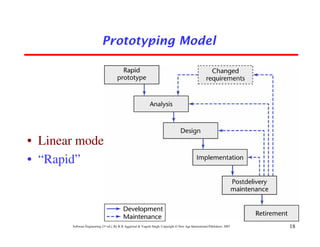
    75 Software Engineering, ByK.K Aggarwal & Yogesh Singh, New Age International Publishers 9.38 Why is maintenance programming becoming more challenging than new development? What are desirable characteristics of a maintenance programmer? 9.39 Why little attention is paid to maintainability during design phase? 9.40 List out system documentation and also explain their purpose.