www.england.nhs.uk
Children’s
Health
Digital
Strategy
2016
An Introduction
November 2015
www.england.nhs.uk
What is the Digital Strategy?
• A roadmap which explores the options for transforming the way
children’s health information is gathered and used over the next 5
years.
• Currently child health information services (CHIS) comprise:
 Child Health Record Departments (CHRDs)
 Child Health Information Service Systems (CHISS)
 Personal Child Health Records (PCHR or ‘red book’)
• Child health information services liaise across care settings and
agencies and regions to ensure that children and young people in
their local population are offered the universal services available –
the ‘Healthy Child Programme’ – and that key information on
children’s health is available to parents and professionals and for
public health purposes.
www.england.nhs.uk
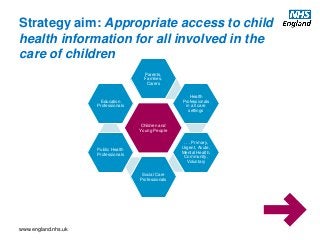
Children and
Young People
Parents,
Families,
Carers
Health
Professionals
in all care
settings
. . . Primary,
Urgent, Acute,
Mental Health,
Community,
Voluntary
Social Care
Professionals
Public Health
Professionals
Education
Professionals
Strategy aim: Appropriate access to child
health information for all involved in the
care of children
www.england.nhs.uk
Why a new digital strategy now?
• In recent years there has been a new emphasis on ways of
improving children’s health:
 Focusing on the importance of early interventions and preventive measures
in improving health
 The idea of proportionate universalism – improving the lives of all, with
proportionately greater resources targeted at the more disadvantaged
groups
 The need for more coordinated approaches to child health and wellbeing if
outcomes are to be improved
 Thinking of investing in the current and future health of children and young
people rather than focusing purely on spend
 Needing to listen to children and young people and families if we are to
develop effective strategies
• But the way we manage and inform parents and professionals
about the health of children has not changed in over 20 years
and cannot support the new vision.
www.england.nhs.uk
• Changing perceptions about organisational boundaries to provide
joined-up care
• Overcoming technical constraints to provide information when it is
needed, in easily understandable formats
• More information sharing across care settings within health
• More information sharing with partners outside of the NHS who are also
responsible for the health and wellbeing of children
• Online access for children, parents and families to their own health
records
• Using the potential of new technologies to enhance health and wellbeing
Significant change is needed:
www.england.nhs.uk
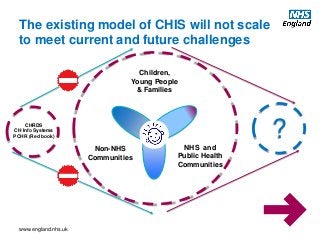
The existing model of CHIS will not scale
to meet current and future challenges
NHS and
Public Health
Communities
Non-NHS
Communities
Children,
Young People
& Families
?CHRDS
CH Info Systems
PCHR (Red book)
www.england.nhs.uk
• Is fragmented – partial records in several different systems – Maternity,
GP, Child Health Information Systems, Acute
• No single picture of a child’s health interventions
• Is complex - disparate systems with very little interoperability
• Very limited access to information for our partners outside the NHS, for
example, Social Services or Education
• Information still largely recorded on paper and sent from care-setting to
care-setting
• Information re-keyed from systems to system creating large
administrative burden
• Possible for children’s information to be mislaid/delayed when they
move to a new area
• Impossible to easily view a child’s history and determine how healthy
they are
Current Information Landscape
www.england.nhs.uk
NIPE
Bloodspot
Hearing
NewBaby
Review
6-8WeekExam
8/12/16wkImms
12mthReview
12/13mthImms
2/2.5yrInteg
Review
3yr4mthImms
4-5yreyesight
check
SchoolEntryChk
Year6Check
Year8HPV
Booster
Imms
MaternityIS
0d 5d 8d 11d 7w 9w 12m 13m 24m 40m 4y
5y
5y
Public Health & MDS
Acute & Mental
Health



e
e
Primary Care IS
Child Health IS
CP-
IS
PDS & Summary Care Record
Screening
Local AuthorityLab
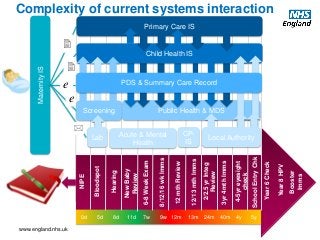
Complexity of current systems interaction
www.england.nhs.uk
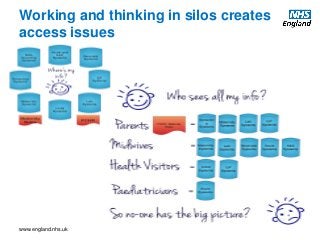
Working and thinking in silos creates
access issues
www.england.nhs.uk
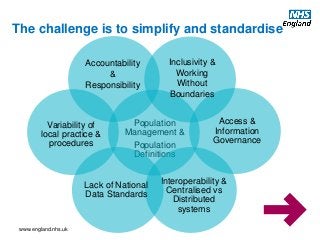
The challenge is to simplify and standardise
Population
Management &
Population
Definitions
Access &
Information
Governance
Interoperability &
Centralised vs
Distributed
systems
Lack of National
Data Standards
Variability of
local practice &
procedures
Accountability
&
Responsibility
Inclusivity &
Working
Without
Boundaries
www.england.nhs.uk
• Imagination and intelligence need to be applied to use information in
ways that enhance professional practice and personal/parental
responsibility for the health of children and young people
• We need to inquire into why we do things in certain ways and ask
whether there are better ideas and models available.
• We need to change our perspective to truly see and deliver integrated
care, no more working and thinking in silos.
• We need to do things differently
We need to think differently
www.england.nhs.uk
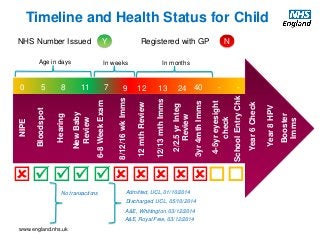
• We had a simple, almost real time, single view of whether the healthy child
programme had been delivered to a child?
• It acted as failsafe for the population and the child and the parents?
• It could be used easily by parents and children – what interventions should
my child be having, at what age, have they had them?
• It could be used by professionals managing a population cohort (or
caseload)
 Health Visitors
 School Nurses
 GPs
 Practice Nurses
 Commissioners
What if. . .
www.england.nhs.uk
NIPE
Bloodspot
Hearing
NewBaby
Review
6-8WeekExam
8/12/16wkImms
12mthReview
12/13mthImms
2/2.5yrInteg
Review
3yr4mthImms
4-5yreyesight
check
SchoolEntryChk
Year6Check
Year8HPV
Booster
Imms
  
0 5 8 11 7 9 12 13 24 40 - -
Age in days In monthsIn weeks
NHS Number Issued Registered with GPY N
Admitted, UCL, 01/10/2014
Discharged, UCL, 05/10/2014
A&E, Whittington, 03/12/2014
A&E, Royal Free, 03/12/2014
No transactions
Timeline and Health Status for Child
www.england.nhs.uk
• This is only an initial idea, one among may, a beginning
But what if. . .
What if you decided to contribute your
ideas for how we can better use
information and digital services to
improve healthcare for children?f
www.england.nhs.uk
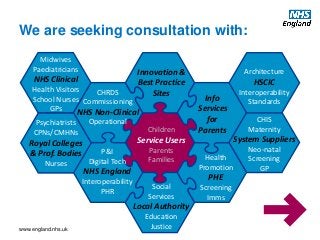
We are seeking consultation with:
Children
Service Users
Parents
Families
Info
Services
for
Parents
Architecture
HSCIC
Interoperability
Standards
CHIS
Maternity
System Suppliers
Neo-natal
Screening
GP
Health
Promotion
PHE
Screening
Imms
Innovation &
Best Practice
Sites
Social
Services
Local Authority
Education
Justice
Midwives
Paediatricians
NHS Clinical
Health Visitors
School Nurses
GPs
Psychiatrists
CPNs/CMHNs
Royal Colleges
& Prof. Bodies
Nurses
CHRDS
Commissioning
NHS Non-Clinical
Operational
P&I
Digital Tech
NHS England
Interoperability
PHR
www.england.nhs.uk
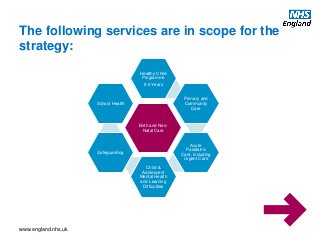
Birth and Neo-
Natal Care
Healthy Child
Programme
0-5 Years
Primary and
Community
Care
Acute
Paediatric
Care, including
Urgent Care
Child &
Adolescent
Mental Health
and Learning
Difficulties
Safeguarding
School Health
The following services are in scope for the
strategy:
www.england.nhs.uk
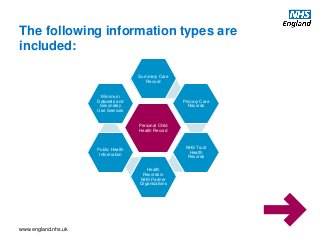
Personal Child
Health Record
Summary Care
Record
Primary Care
Records
NHS Trust
Health
Records
Health
Records in
NHS Partner
Organisations
Public Health
Information
Minimum
Datasets and
Secondary
Use Services
The following information types are
included:
www.england.nhs.uk
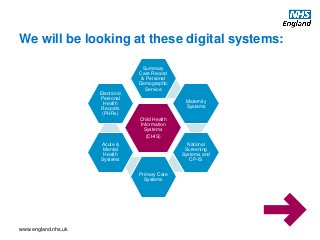
Child Health
Information
Systems
(CHIS)
Summary
Care Record
& Personal
Demographic
Service
Maternity
Systems
National
Screening
Systems and
CP-IS
Primary Care
Systems
Acute &
Mental
Health
Systems
Electronic
Personal
Health
Records
(PHRs)
We will be looking at these digital systems:
www.england.nhs.uk
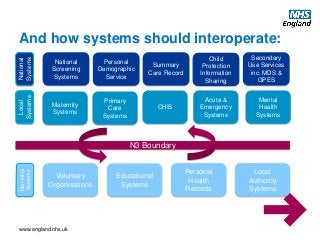
And how systems should interoperate:
N3 Boundary
Voluntary
Organisations
Educational
Systems
Personal
Health
Records
Local
Authority
Systems
Non-NHS
Systems
National
Screening
Systems
Personal
Demographic
Service
Summary
Care Record
Child
Protection
Information
Sharing
National
Systems
Maternity
Systems
Local
Systems
Primary
Care
Systems
CHIS
Acute &
Emergency
Systems
Mental
Health
Systems
Secondary
Use Services
inc. MDS &
GPES
www.england.nhs.uk
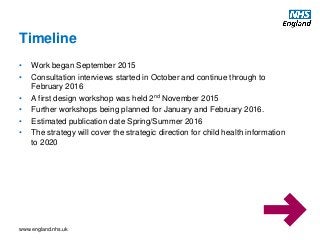
• Work began September 2015
• Consultation interviews started in October and continue through to
February 2016
• A first design workshop was held 2nd November 2015
• Further workshops being planned for January and February 2016.
• Estimated publication date Spring/Summer 2016
• The strategy will cover the strategic direction for child health information
to 2020
Timeline
www.england.nhs.uk
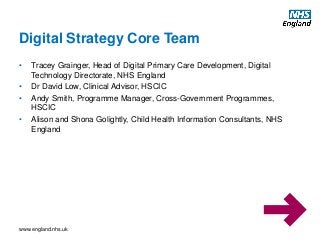
• Tracey Grainger, Head of Digital Primary Care Development, Digital
Technology Directorate, NHS England
• Dr David Low, Clinical Advisor, HSCIC
• Andy Smith, Programme Manager, Cross-Government Programmes,
HSCIC
• Alison and Shona Golightly, Child Health Information Consultants, NHS
England
Digital Strategy Core Team
www.england.nhs.uk
• Email alison@golightlyandgolightly.com to be included on our contact
lists for information and events.
• Then:
• Contribute your ideas for the strategy via our online feedback form – we
will send you the link for this by email.
• Attend one of the workshops we will be planning for 2016.
• If you represent an organisation, invite us to attend one of your regular
forums to discuss the strategy.
• Or let us know you’d like a call to discuss your ideas.
How to contribute to the strategy

Children's Health Digital Strategy 2016 - An introduction

  • 1.
  • 2.
    www.england.nhs.uk What is theDigital Strategy? • A roadmap which explores the options for transforming the way children’s health information is gathered and used over the next 5 years. • Currently child health information services (CHIS) comprise:  Child Health Record Departments (CHRDs)  Child Health Information Service Systems (CHISS)  Personal Child Health Records (PCHR or ‘red book’) • Child health information services liaise across care settings and agencies and regions to ensure that children and young people in their local population are offered the universal services available – the ‘Healthy Child Programme’ – and that key information on children’s health is available to parents and professionals and for public health purposes.
  • 3.
    www.england.nhs.uk Children and Young People Parents, Families, Carers Health Professionals inall care settings . . . Primary, Urgent, Acute, Mental Health, Community, Voluntary Social Care Professionals Public Health Professionals Education Professionals Strategy aim: Appropriate access to child health information for all involved in the care of children
  • 4.
    www.england.nhs.uk Why a newdigital strategy now? • In recent years there has been a new emphasis on ways of improving children’s health:  Focusing on the importance of early interventions and preventive measures in improving health  The idea of proportionate universalism – improving the lives of all, with proportionately greater resources targeted at the more disadvantaged groups  The need for more coordinated approaches to child health and wellbeing if outcomes are to be improved  Thinking of investing in the current and future health of children and young people rather than focusing purely on spend  Needing to listen to children and young people and families if we are to develop effective strategies • But the way we manage and inform parents and professionals about the health of children has not changed in over 20 years and cannot support the new vision.
  • 5.
    www.england.nhs.uk • Changing perceptionsabout organisational boundaries to provide joined-up care • Overcoming technical constraints to provide information when it is needed, in easily understandable formats • More information sharing across care settings within health • More information sharing with partners outside of the NHS who are also responsible for the health and wellbeing of children • Online access for children, parents and families to their own health records • Using the potential of new technologies to enhance health and wellbeing Significant change is needed:
  • 6.
    www.england.nhs.uk The existing modelof CHIS will not scale to meet current and future challenges NHS and Public Health Communities Non-NHS Communities Children, Young People & Families ?CHRDS CH Info Systems PCHR (Red book)
  • 7.
    www.england.nhs.uk • Is fragmented– partial records in several different systems – Maternity, GP, Child Health Information Systems, Acute • No single picture of a child’s health interventions • Is complex - disparate systems with very little interoperability • Very limited access to information for our partners outside the NHS, for example, Social Services or Education • Information still largely recorded on paper and sent from care-setting to care-setting • Information re-keyed from systems to system creating large administrative burden • Possible for children’s information to be mislaid/delayed when they move to a new area • Impossible to easily view a child’s history and determine how healthy they are Current Information Landscape
  • 8.
    www.england.nhs.uk NIPE Bloodspot Hearing NewBaby Review 6-8WeekExam 8/12/16wkImms 12mthReview 12/13mthImms 2/2.5yrInteg Review 3yr4mthImms 4-5yreyesight check SchoolEntryChk Year6Check Year8HPV Booster Imms MaternityIS 0d 5d 8d11d 7w 9w 12m 13m 24m 40m 4y 5y 5y Public Health & MDS Acute & Mental Health    e e Primary Care IS Child Health IS CP- IS PDS & Summary Care Record Screening Local AuthorityLab Complexity of current systems interaction
  • 9.
    www.england.nhs.uk Working and thinkingin silos creates access issues
  • 10.
    www.england.nhs.uk The challenge isto simplify and standardise Population Management & Population Definitions Access & Information Governance Interoperability & Centralised vs Distributed systems Lack of National Data Standards Variability of local practice & procedures Accountability & Responsibility Inclusivity & Working Without Boundaries
  • 11.
    www.england.nhs.uk • Imagination andintelligence need to be applied to use information in ways that enhance professional practice and personal/parental responsibility for the health of children and young people • We need to inquire into why we do things in certain ways and ask whether there are better ideas and models available. • We need to change our perspective to truly see and deliver integrated care, no more working and thinking in silos. • We need to do things differently We need to think differently
  • 12.
    www.england.nhs.uk • We hada simple, almost real time, single view of whether the healthy child programme had been delivered to a child? • It acted as failsafe for the population and the child and the parents? • It could be used easily by parents and children – what interventions should my child be having, at what age, have they had them? • It could be used by professionals managing a population cohort (or caseload)  Health Visitors  School Nurses  GPs  Practice Nurses  Commissioners What if. . .
  • 13.
    www.england.nhs.uk NIPE Bloodspot Hearing NewBaby Review 6-8WeekExam 8/12/16wkImms 12mthReview 12/13mthImms 2/2.5yrInteg Review 3yr4mthImms 4-5yreyesight check SchoolEntryChk Year6Check Year8HPV Booster Imms    05 8 11 7 9 12 13 24 40 - - Age in days In monthsIn weeks NHS Number Issued Registered with GPY N Admitted, UCL, 01/10/2014 Discharged, UCL, 05/10/2014 A&E, Whittington, 03/12/2014 A&E, Royal Free, 03/12/2014 No transactions Timeline and Health Status for Child
  • 14.
    www.england.nhs.uk • This isonly an initial idea, one among may, a beginning But what if. . . What if you decided to contribute your ideas for how we can better use information and digital services to improve healthcare for children?f
  • 15.
    www.england.nhs.uk We are seekingconsultation with: Children Service Users Parents Families Info Services for Parents Architecture HSCIC Interoperability Standards CHIS Maternity System Suppliers Neo-natal Screening GP Health Promotion PHE Screening Imms Innovation & Best Practice Sites Social Services Local Authority Education Justice Midwives Paediatricians NHS Clinical Health Visitors School Nurses GPs Psychiatrists CPNs/CMHNs Royal Colleges & Prof. Bodies Nurses CHRDS Commissioning NHS Non-Clinical Operational P&I Digital Tech NHS England Interoperability PHR
  • 16.
    www.england.nhs.uk Birth and Neo- NatalCare Healthy Child Programme 0-5 Years Primary and Community Care Acute Paediatric Care, including Urgent Care Child & Adolescent Mental Health and Learning Difficulties Safeguarding School Health The following services are in scope for the strategy:
  • 17.
    www.england.nhs.uk Personal Child Health Record SummaryCare Record Primary Care Records NHS Trust Health Records Health Records in NHS Partner Organisations Public Health Information Minimum Datasets and Secondary Use Services The following information types are included:
  • 18.
    www.england.nhs.uk Child Health Information Systems (CHIS) Summary Care Record &Personal Demographic Service Maternity Systems National Screening Systems and CP-IS Primary Care Systems Acute & Mental Health Systems Electronic Personal Health Records (PHRs) We will be looking at these digital systems:
  • 19.
    www.england.nhs.uk And how systemsshould interoperate: N3 Boundary Voluntary Organisations Educational Systems Personal Health Records Local Authority Systems Non-NHS Systems National Screening Systems Personal Demographic Service Summary Care Record Child Protection Information Sharing National Systems Maternity Systems Local Systems Primary Care Systems CHIS Acute & Emergency Systems Mental Health Systems Secondary Use Services inc. MDS & GPES
  • 20.
    www.england.nhs.uk • Work beganSeptember 2015 • Consultation interviews started in October and continue through to February 2016 • A first design workshop was held 2nd November 2015 • Further workshops being planned for January and February 2016. • Estimated publication date Spring/Summer 2016 • The strategy will cover the strategic direction for child health information to 2020 Timeline
  • 21.
    www.england.nhs.uk • Tracey Grainger,Head of Digital Primary Care Development, Digital Technology Directorate, NHS England • Dr David Low, Clinical Advisor, HSCIC • Andy Smith, Programme Manager, Cross-Government Programmes, HSCIC • Alison and Shona Golightly, Child Health Information Consultants, NHS England Digital Strategy Core Team
  • 22.
    www.england.nhs.uk • Email alison@golightlyandgolightly.comto be included on our contact lists for information and events. • Then: • Contribute your ideas for the strategy via our online feedback form – we will send you the link for this by email. • Attend one of the workshops we will be planning for 2016. • If you represent an organisation, invite us to attend one of your regular forums to discuss the strategy. • Or let us know you’d like a call to discuss your ideas. How to contribute to the strategy