Physics SF 016                Chapter 15
                                      16


              CHAPTER 15:
             Thermodynamics

   1
Physics SF 016                               Chapter 15
                                Remarks :
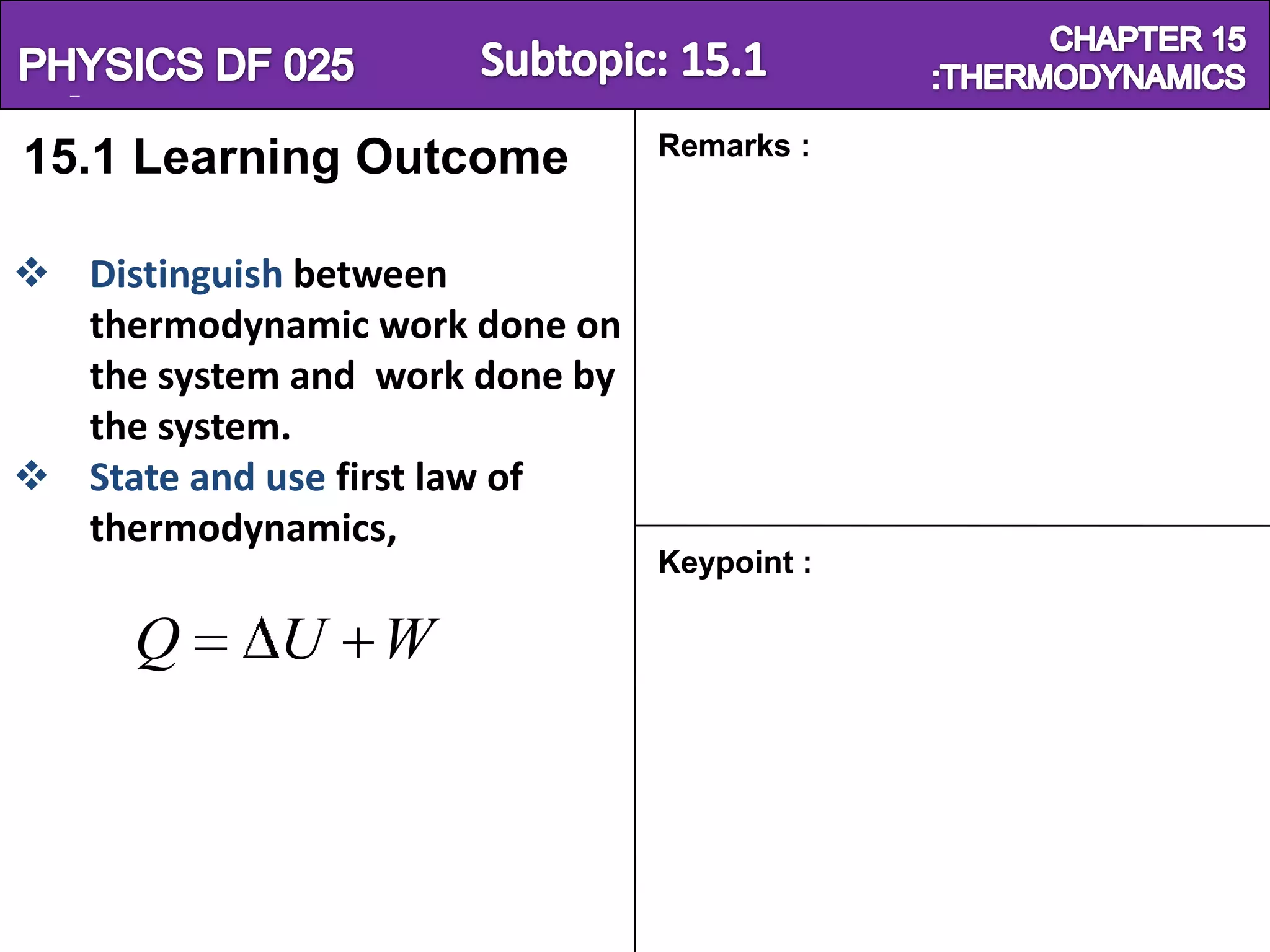
15.1 Learning Outcome

 Distinguish between
  thermodynamic work done on
  the system and work done by
  the system.
 State and use first law of
  thermodynamics,
                                Keypoint :

      Q      U W
Physics SF 016                                                Chapter 15
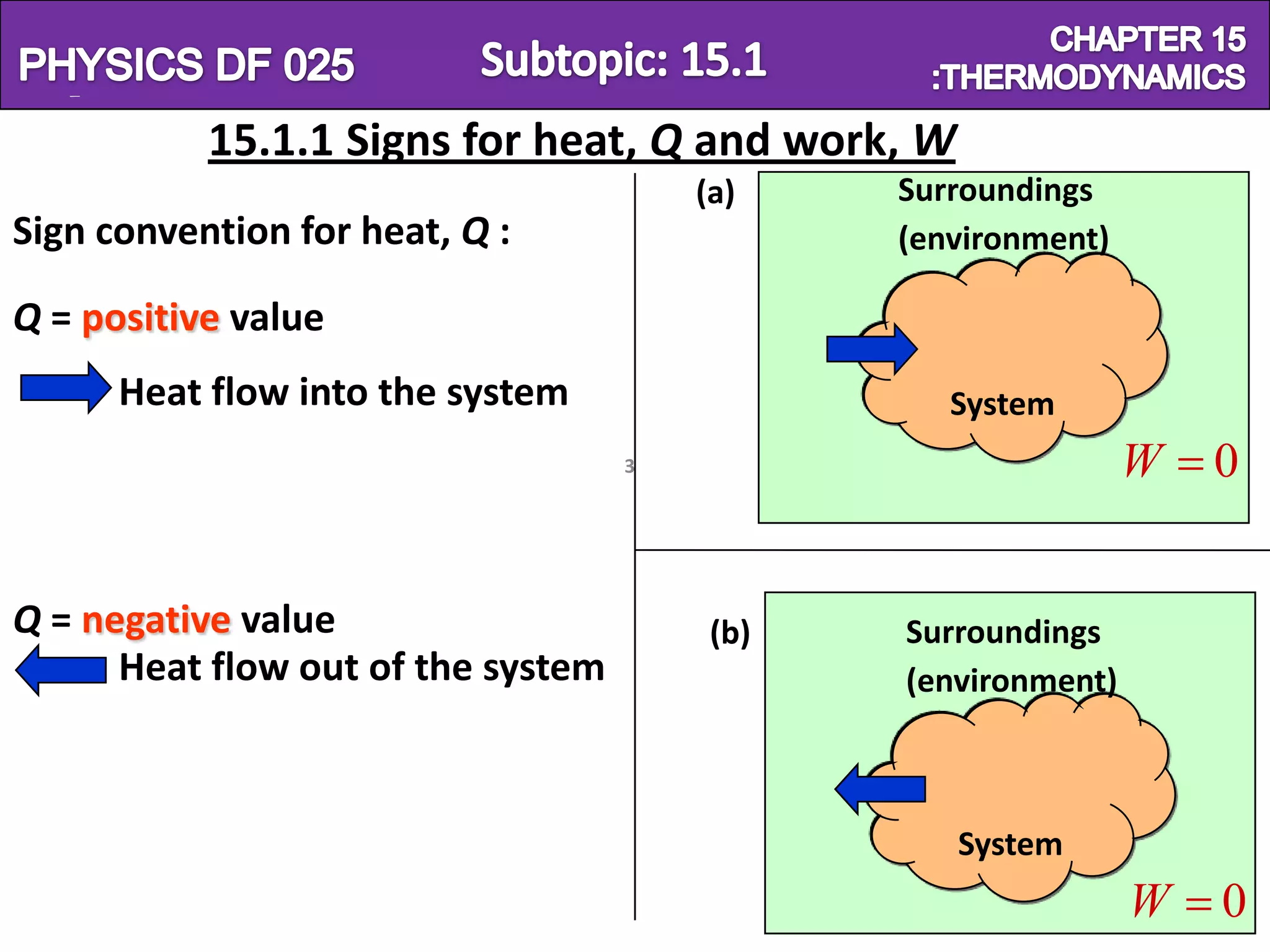
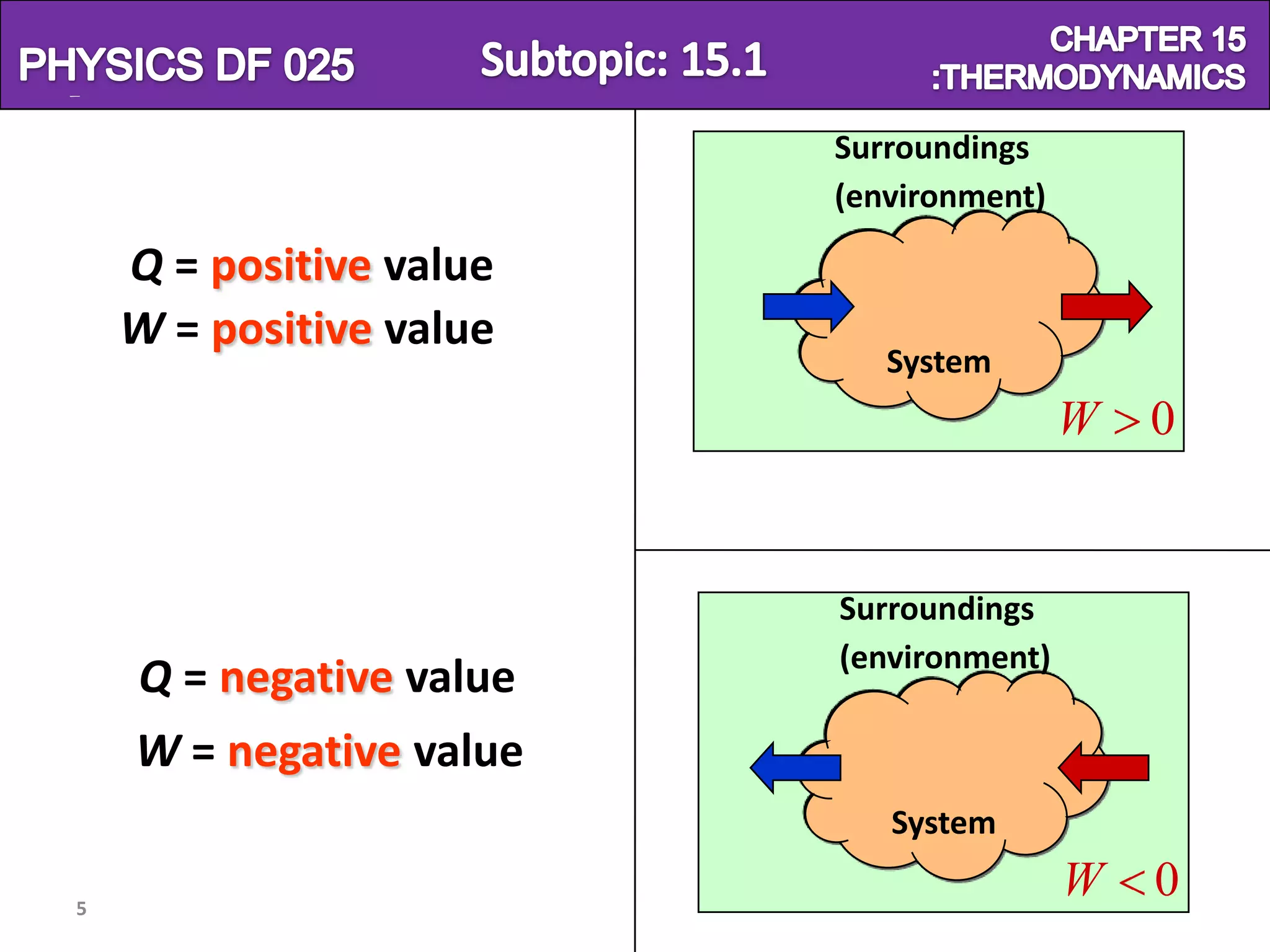
           15.1.1 Signs for heat, Q and work, W
                                        (a)          Surroundings
Sign convention for heat, Q :                        (environment)

Q = positive value
      Heat flow into the system                           System
                                    3          Q 0                   W   0


Q = negative value                       (b)         Surroundings
      Heat flow out of the system                    (environment)


                                                          System
                                                      3              W   0
Physics SF 016                                      Chapter 15
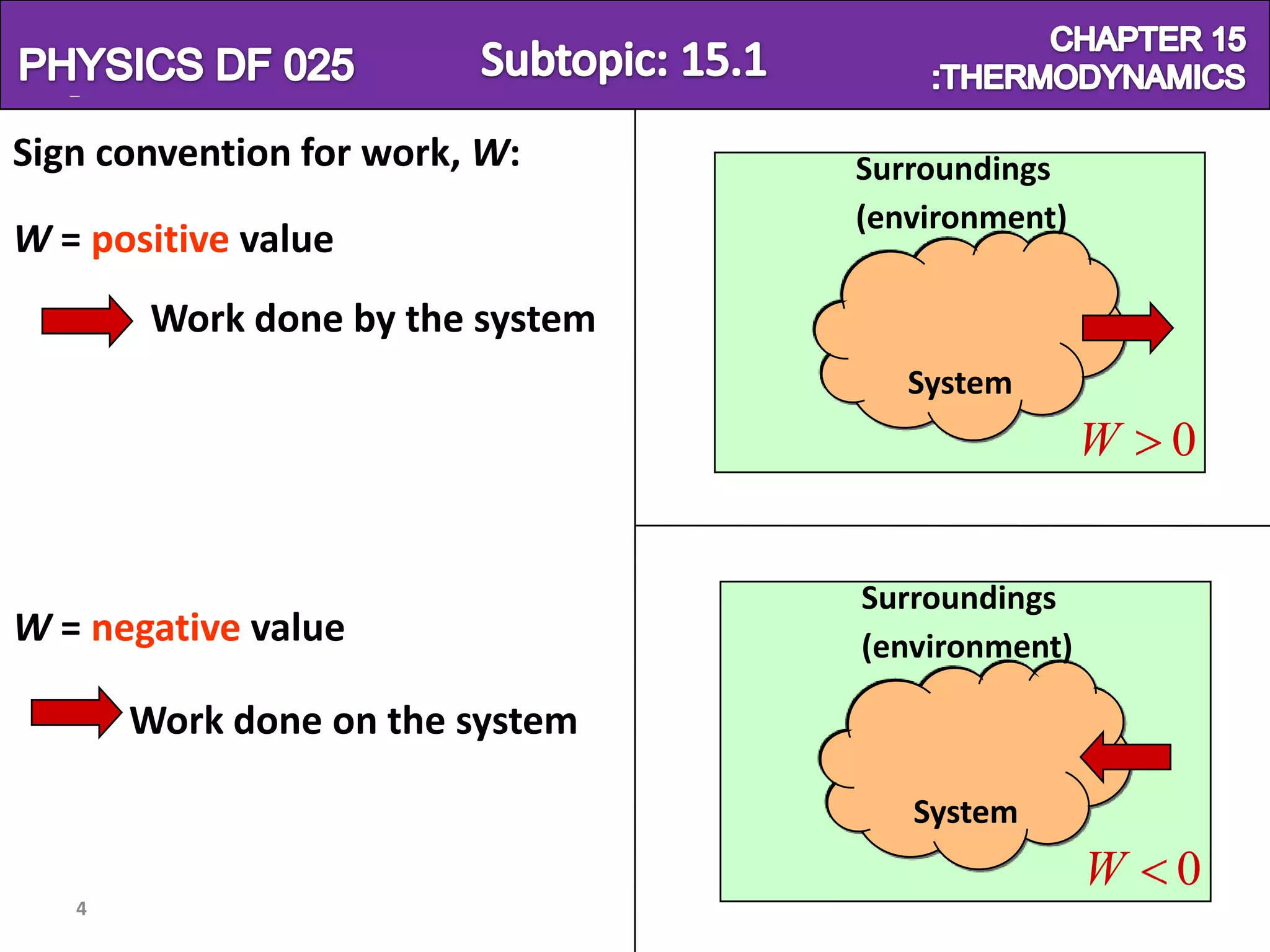
Sign convention for work, W:            Surroundings
                                        (environment)
W = positive value
        Work done by the system
                                           System
                                  Q 0                   W   0


                                        Surroundings
W = negative value                      (environment)

       Work done on the system

                                           System
                                                        W   0
   4
Physics SF 016                                Chapter 15
                                  Surroundings
                                  (environment)

       Q = positive value
       W = positive value
                                     System
                            Q 0                   W   0


                                  Surroundings
                                  (environment)
       Q = negative value
       W = negative value
                                     System

   5
                                                  W   0
Physics SF 016                                         Chapter 15

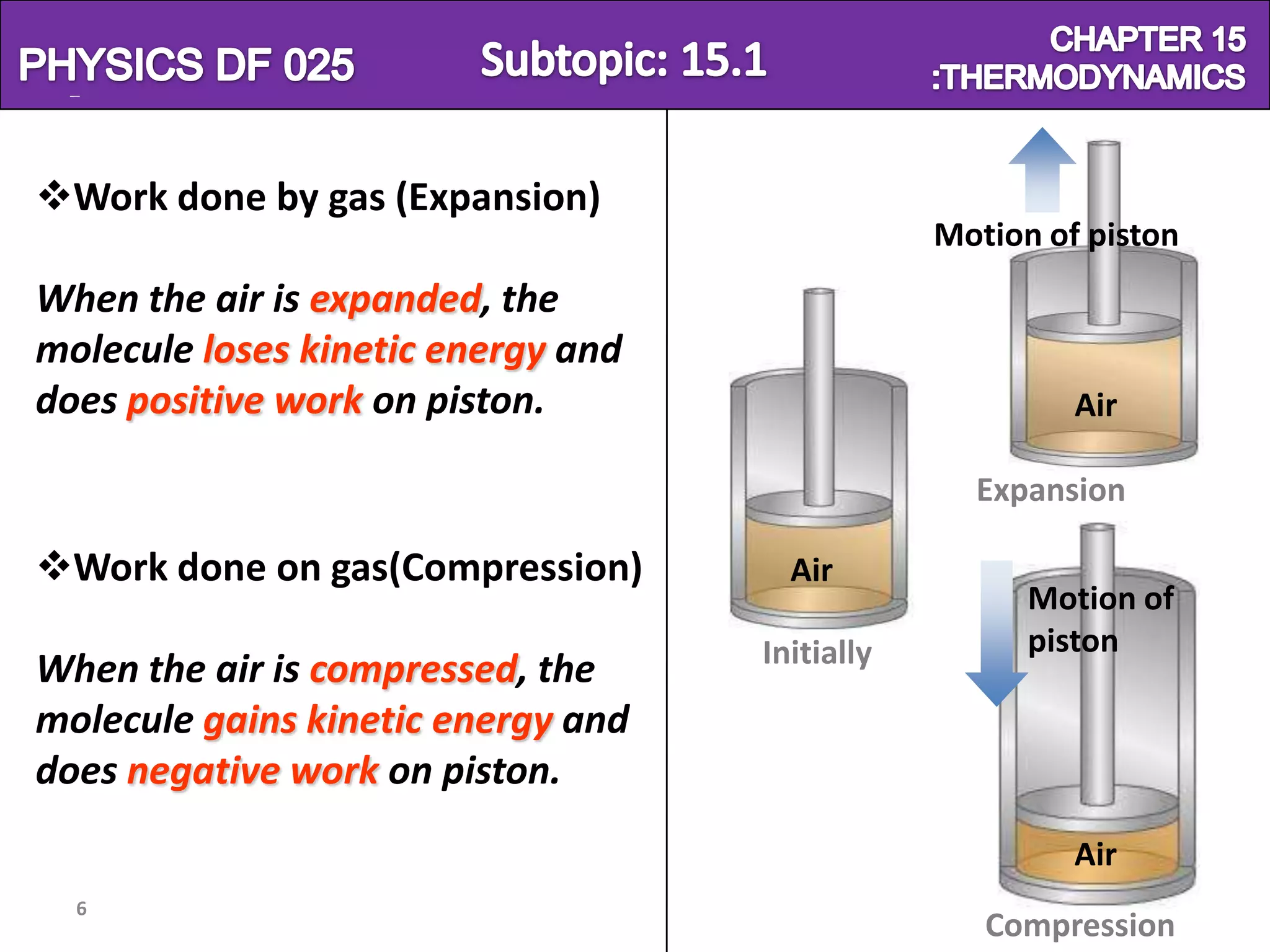
 Work done by gas (Expansion)
                                                 Motion of piston
 When the air is expanded, the
 molecule loses kinetic energy and
 does positive work on piston.                            Air

                                                   Expansion

 Work done on gas(Compression)        Air
                                                       Motion of
                                     Initially         piston
 When the air is compressed, the
 molecule gains kinetic energy and
 does negative work on piston.
                                                          Air
   6
                                                    Compression
Physics SF 016                                            Chapter 15

       15.1.2 Work done in the thermodynamics system
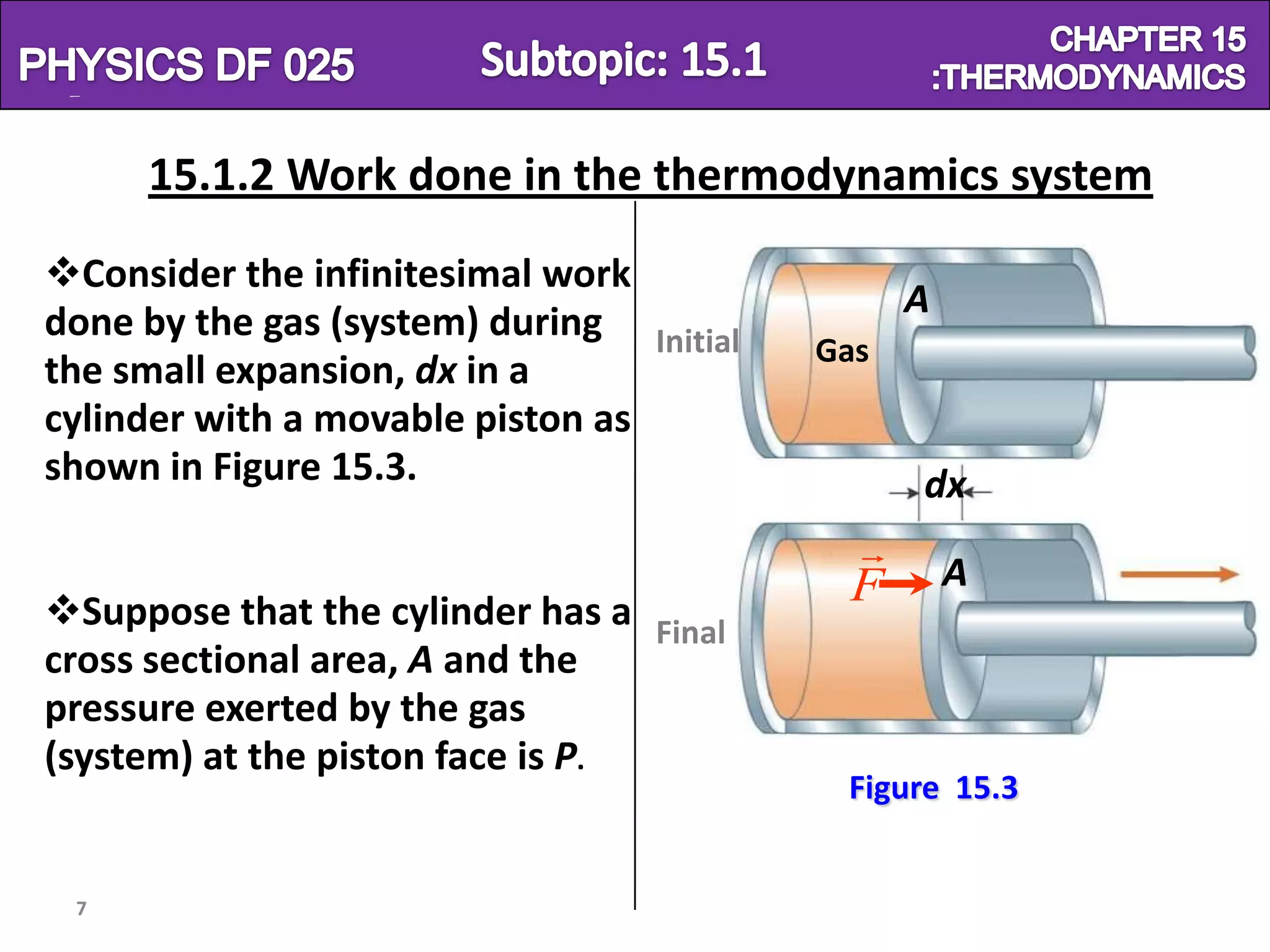
 Consider the infinitesimal work
                                                 A
 done by the gas (system) during Initial
                                           Gas
 the small expansion, dx in a
 cylinder with a movable piston as
 shown in Figure 15.3.                           dx
                                            
                                            F        A
 Suppose that the cylinder has a Final
 cross sectional area, A and the
 pressure exerted by the gas
 (system) at the piston face is P.
                                            Figure 15.3


   7
Physics SF 016                                                          Chapter 15
                 15.1.3 First law of thermodynamics
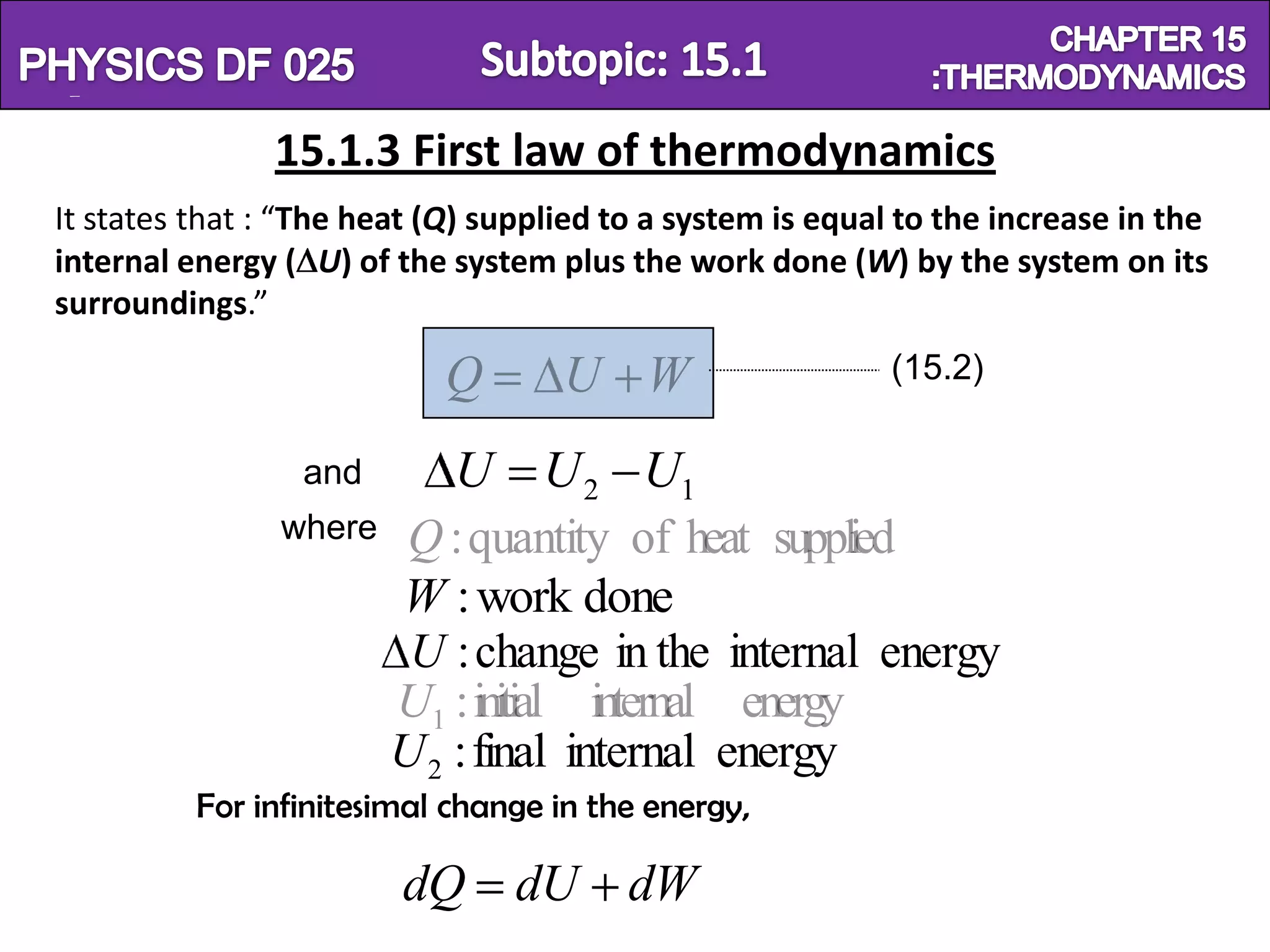
  It states that : “The heat (Q) supplied to a system is equal to the increase in the
  internal energy ( U) of the system plus the work done (W) by the system on its
  surroundings.”

                              Q       U W                     (15.2)

                   and        U U 2 U1
                  where    Q : quantity of heat supplied
                          W : work done
                           U : change in the internal energy
                          U1 : initial internal energy
                          U 2 : final internal energy
            For infinitesimal change in the energy,

                           dQ dU dW
Physics SF 016                                                  Chapter 15

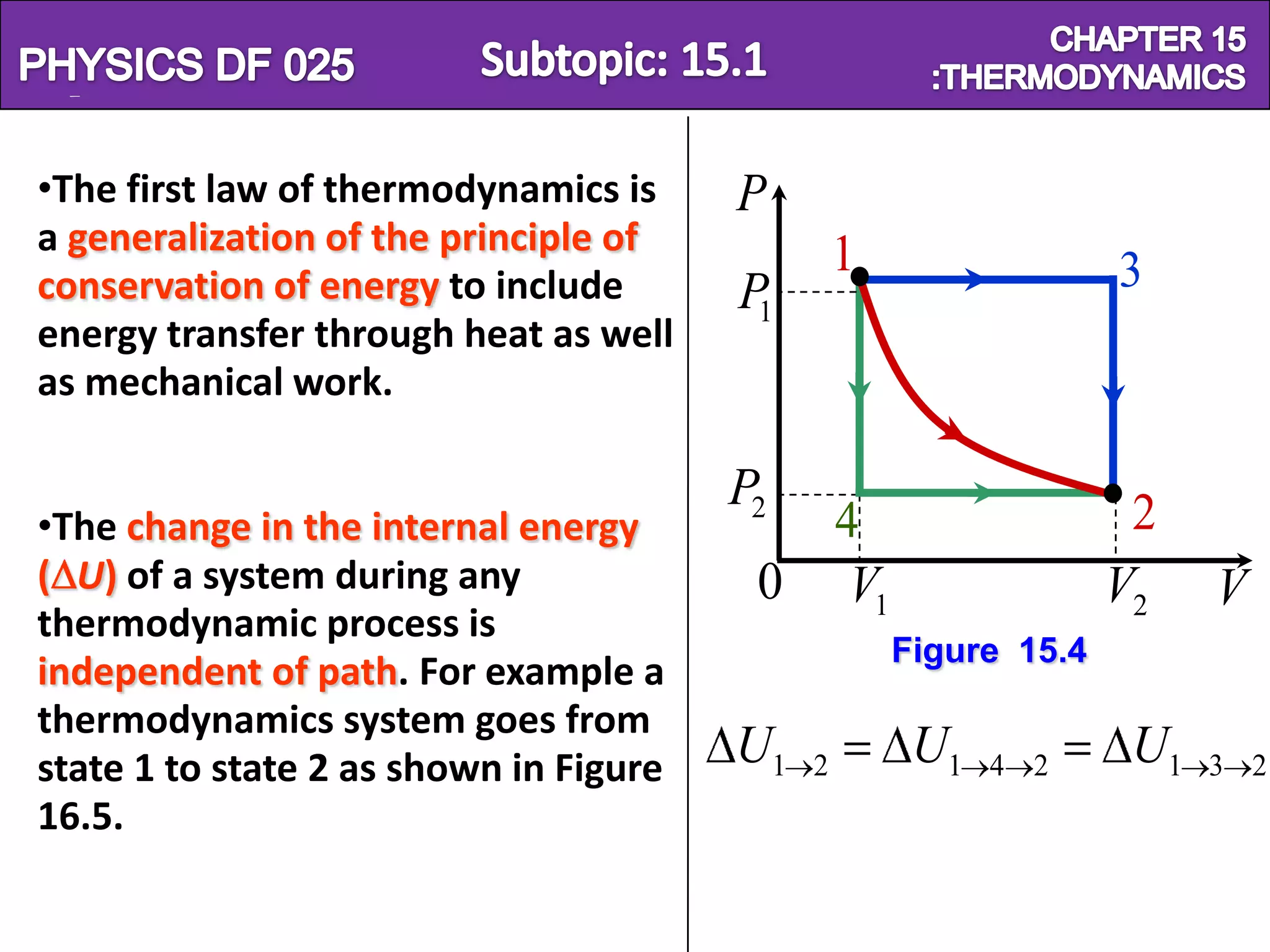
 •The first law of thermodynamics is     P
 a generalization of the principle of             1
 conservation of energy to include       P1                           3
 energy transfer through heat as well
 as mechanical work.

                                         P2                            2
 •The change in the internal energy               4
 ( U) of a system during any              0        V1                 V2    V
 thermodynamic process is
                                                        Figure 15.4
 independent of path. For example a
 thermodynamics system goes from
 state 1 to state 2 as shown in Figure   U1   2          U1   4 2      U1   3 2
 16.5.
Physics SF 016                                                 Chapter 15
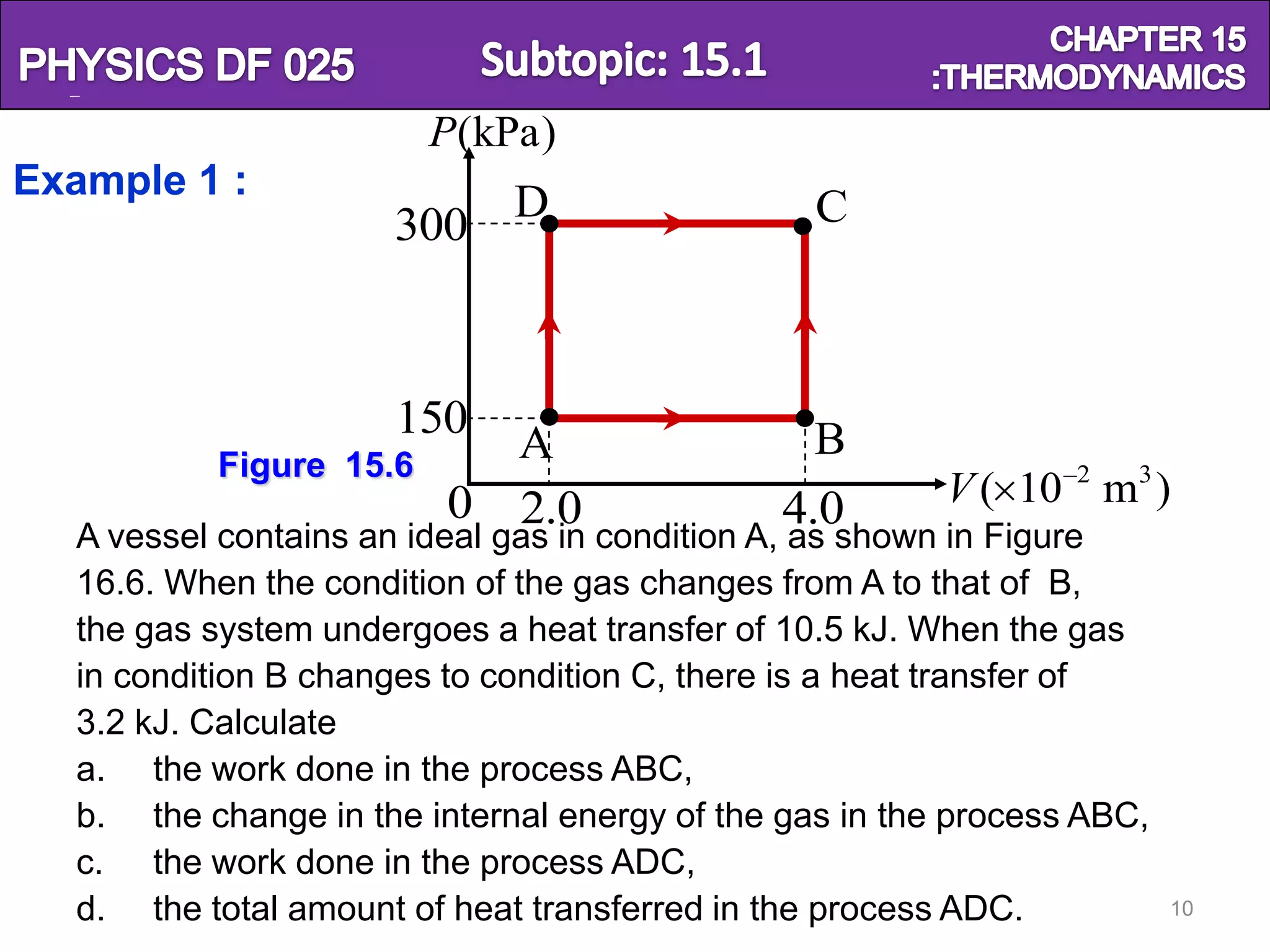
                         P(kPa )
Example 1 :
                              D                  C
                      300


                      150                        B
           Figure 15.6
                            A
                          0 2.0                4.0       V ( 10 2 m3 )
   A vessel contains an ideal gas in condition A, as shown in Figure
   16.6. When the condition of the gas changes from A to that of B,
   the gas system undergoes a heat transfer of 10.5 kJ. When the gas
   in condition B changes to condition C, there is a heat transfer of
   3.2 kJ. Calculate
   a. the work done in the process ABC,
   b. the change in the internal energy of the gas in the process ABC,
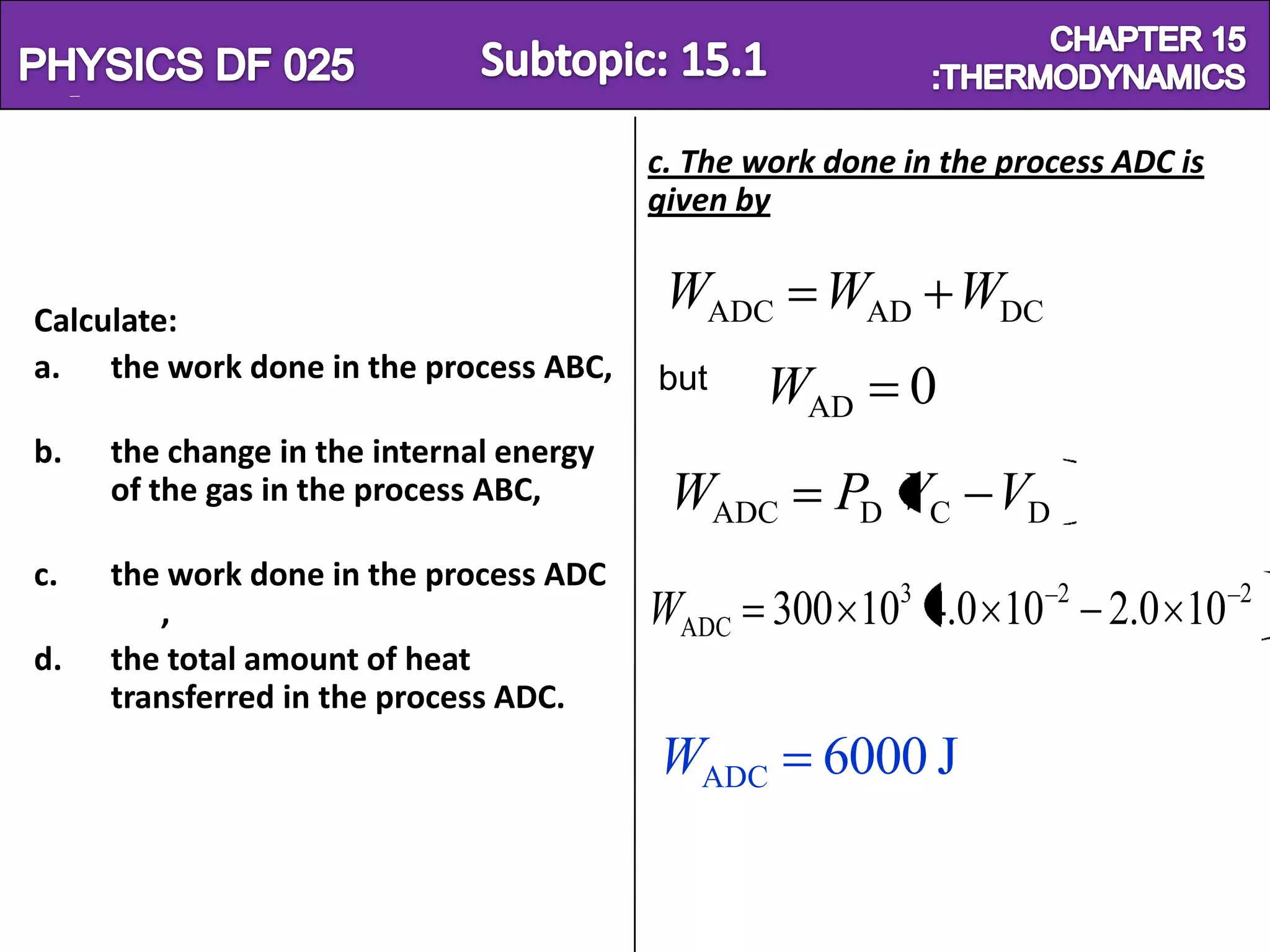
   c. the work done in the process ADC,
   d. the total amount of heat transferred in the process ADC.           10
Physics SF 016                                                      Chapter 15
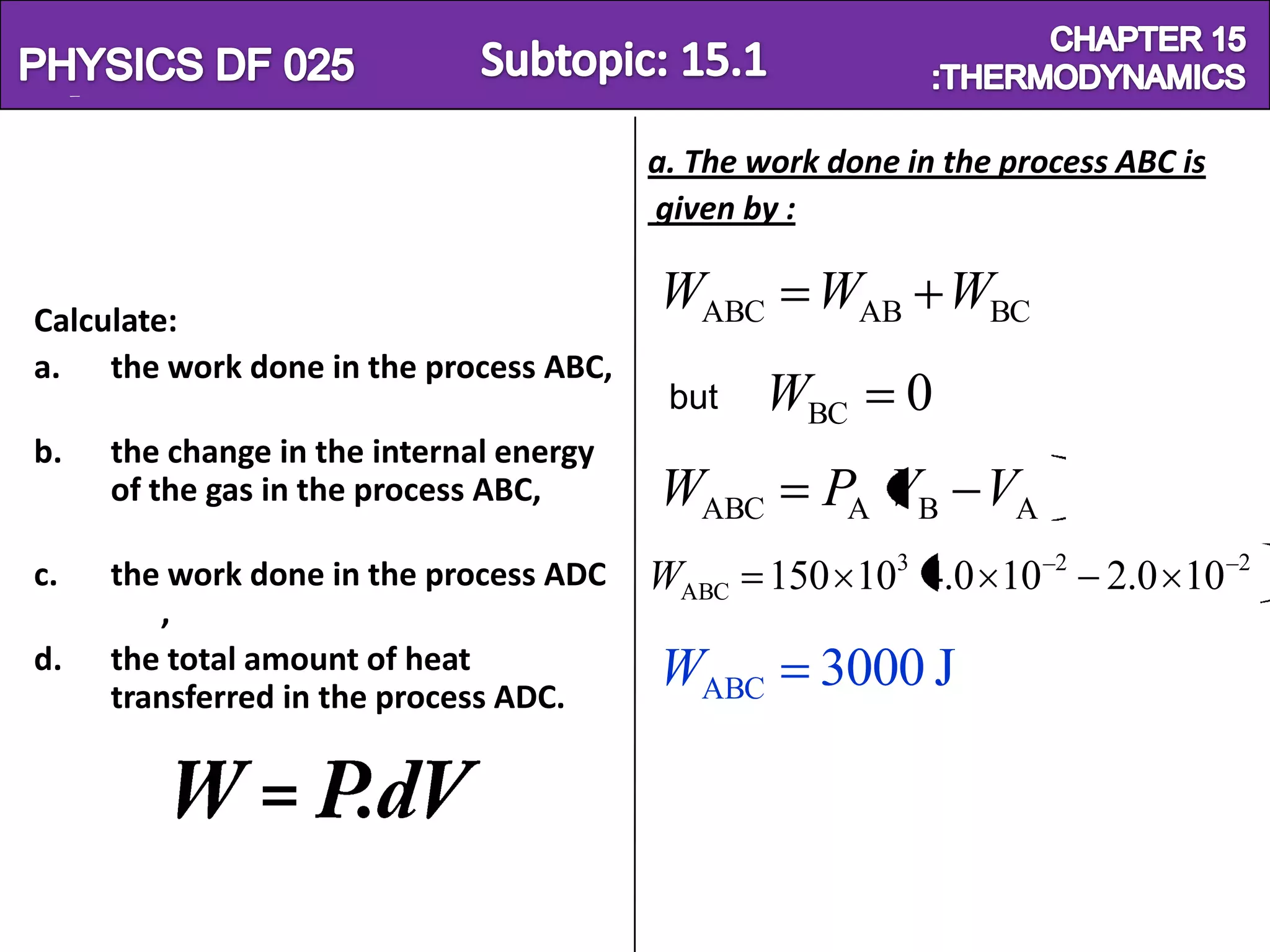
                                          a. The work done in the process ABC is
                                          given by :


 Calculate:
                                          WABC WAB WBC
 a. the work done in the process ABC,
                                           but   WBC       0
 b.   the change in the internal energy
      of the gas in the process ABC,      WABC       PA VB VA
 c.   the work done in the process ADC    WABC 150 103 4.0 10        2
                                                                         2.0 10    2

         ,
 d.   the total amount of heat            WABC       3000 J
      transferred in the process ADC.
Physics SF 016                                                    Chapter 15
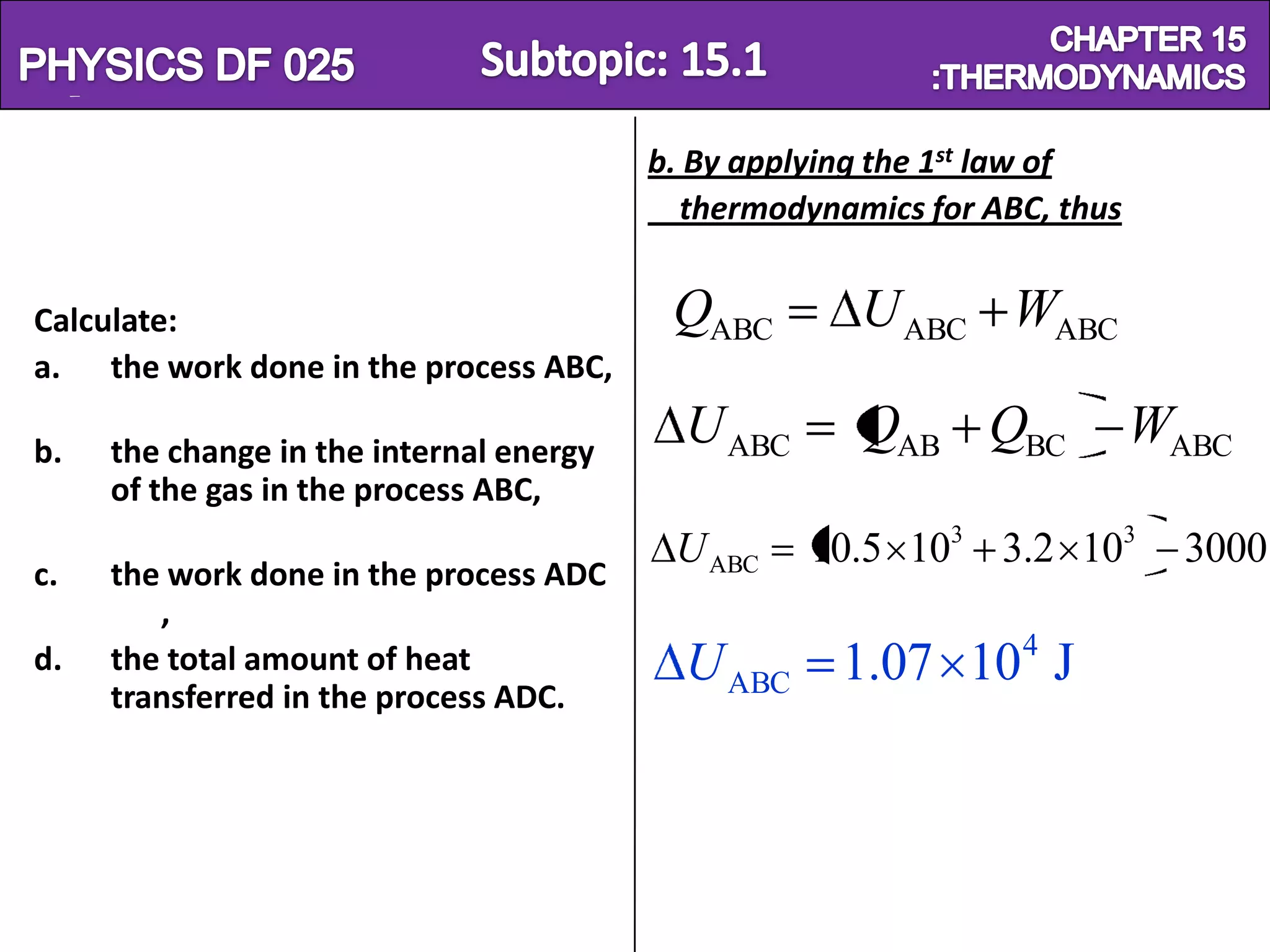
                                          b. By applying the 1st law of
                                            thermodynamics for ABC, thus


 Calculate:                                QABC        U ABC WABC
 a. the work done in the process ABC,

 b.   the change in the internal energy
                                            U ABC      QAB QBC             WABC
      of the gas in the process ABC,
                                           U ABC    10.5 103 3.2 103         3000
 c.   the work done in the process ADC
         ,
                                                                 4
 d.   the total amount of heat              U ABC 1.07 10 J
      transferred in the process ADC.
Physics SF 016                                                      Chapter 15
                                          c. The work done in the process ADC is
                                          given by


 Calculate:
                                           WADC WAD WDC
 a. the work done in the process ABC,     but     WAD      0
 b.   the change in the internal energy
      of the gas in the process ABC,       WADC       PD VC VD
 c.   the work done in the process ADC
         ,                                WADC 300 103 4.0 10 2 2.0 10 2
 d.   the total amount of heat
      transferred in the process ADC.
                                          WADC       6000 J
Physics SF 016                                                   Chapter 15
                                          d. By applying the 1st law of
                                          thermodynamics for ADC, thus


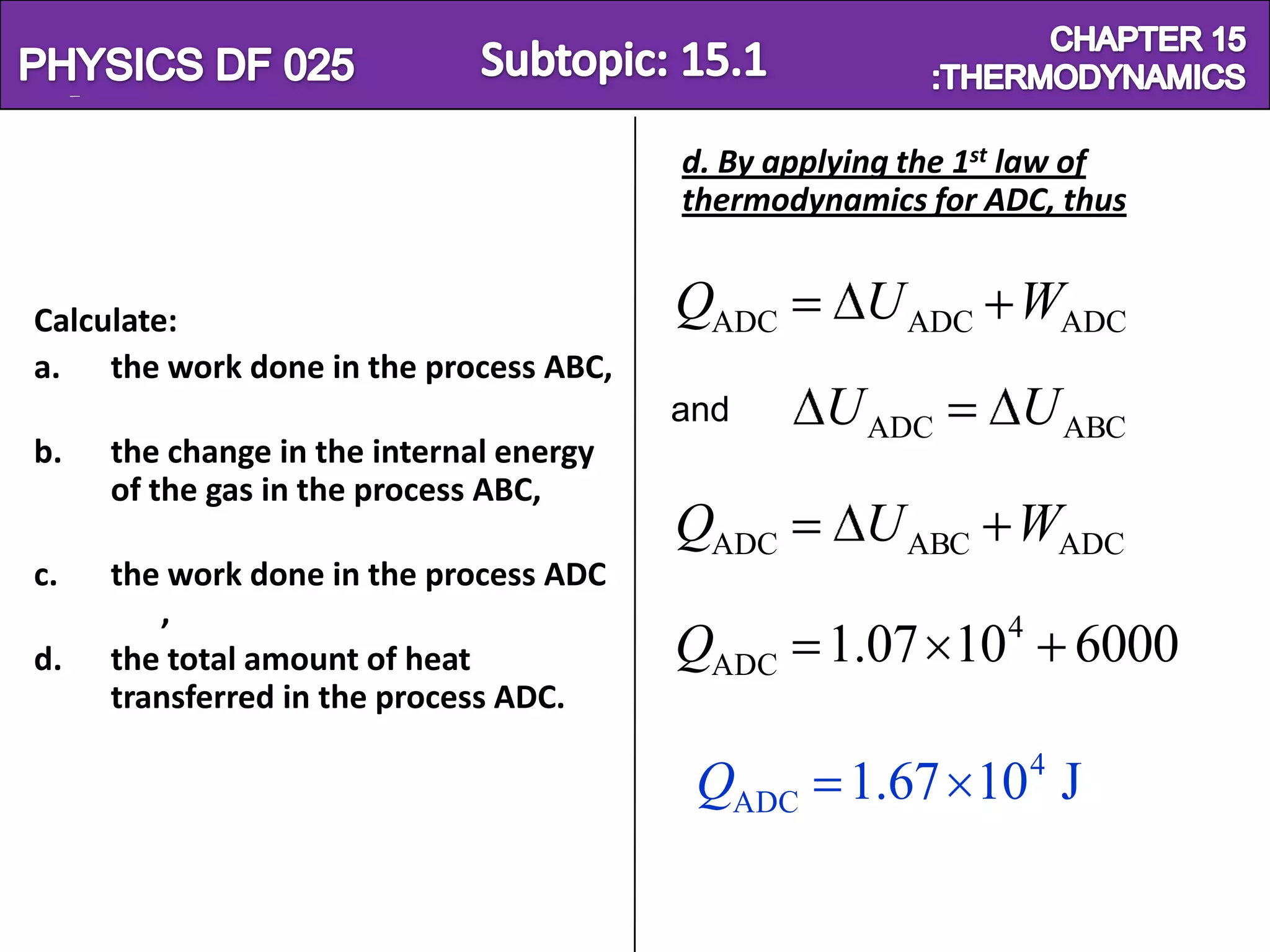
 Calculate:                               QADC       U ADC WADC
 a. the work done in the process ABC,
                                          and      U ADC        U ABC
 b.   the change in the internal energy
      of the gas in the process ABC,
                                          QADC       U ABC WADC
 c.   the work done in the process ADC
         ,
 d.   the total amount of heat            QADC 1.07 104 6000
      transferred in the process ADC.
                                                                4
                                           QADC 1.67 10 J
Physics SF 016                                          Chapter 15
                                           Remarks :
15.2 Learning Outcome

Thermodynamics processes (1 hours)
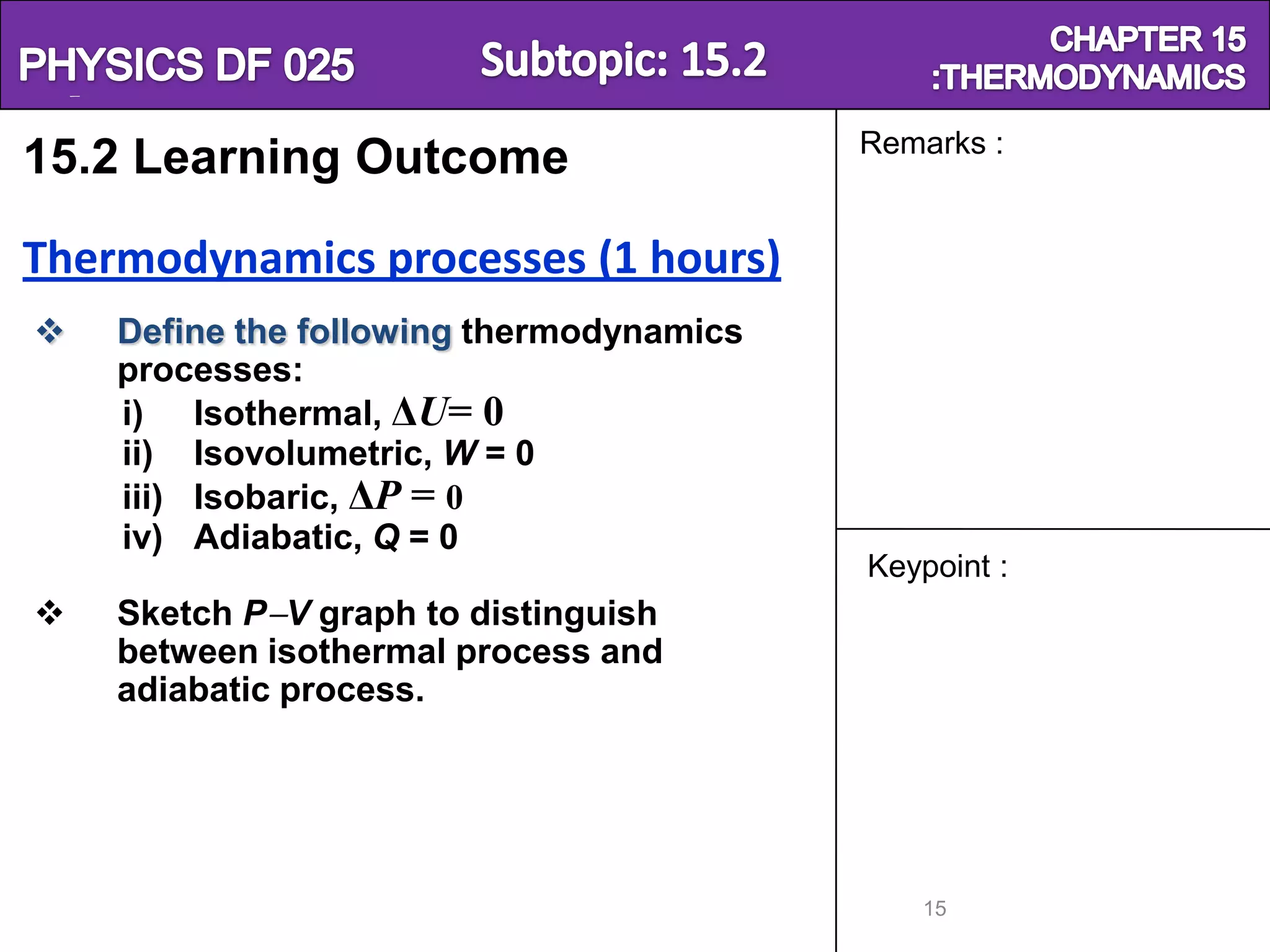
    Define the following thermodynamics
     processes:
     i) Isothermal, ΔU= 0
     ii) Isovolumetric, W = 0
     iii) Isobaric, ΔP = 0
     iv) Adiabatic, Q = 0
                                           Keypoint :
    Sketch P V graph to distinguish
     between isothermal process and
     adiabatic process.


                                              15
Physics SF 016                                  Chapter 15


   There are four specific kinds of thermodynamic
   processes. It is :

       Isothermal process

       Isovolumetric @ Isochoric process

       Isobaric process

       Adiabatic process
Physics SF 016                                                      Chapter 15
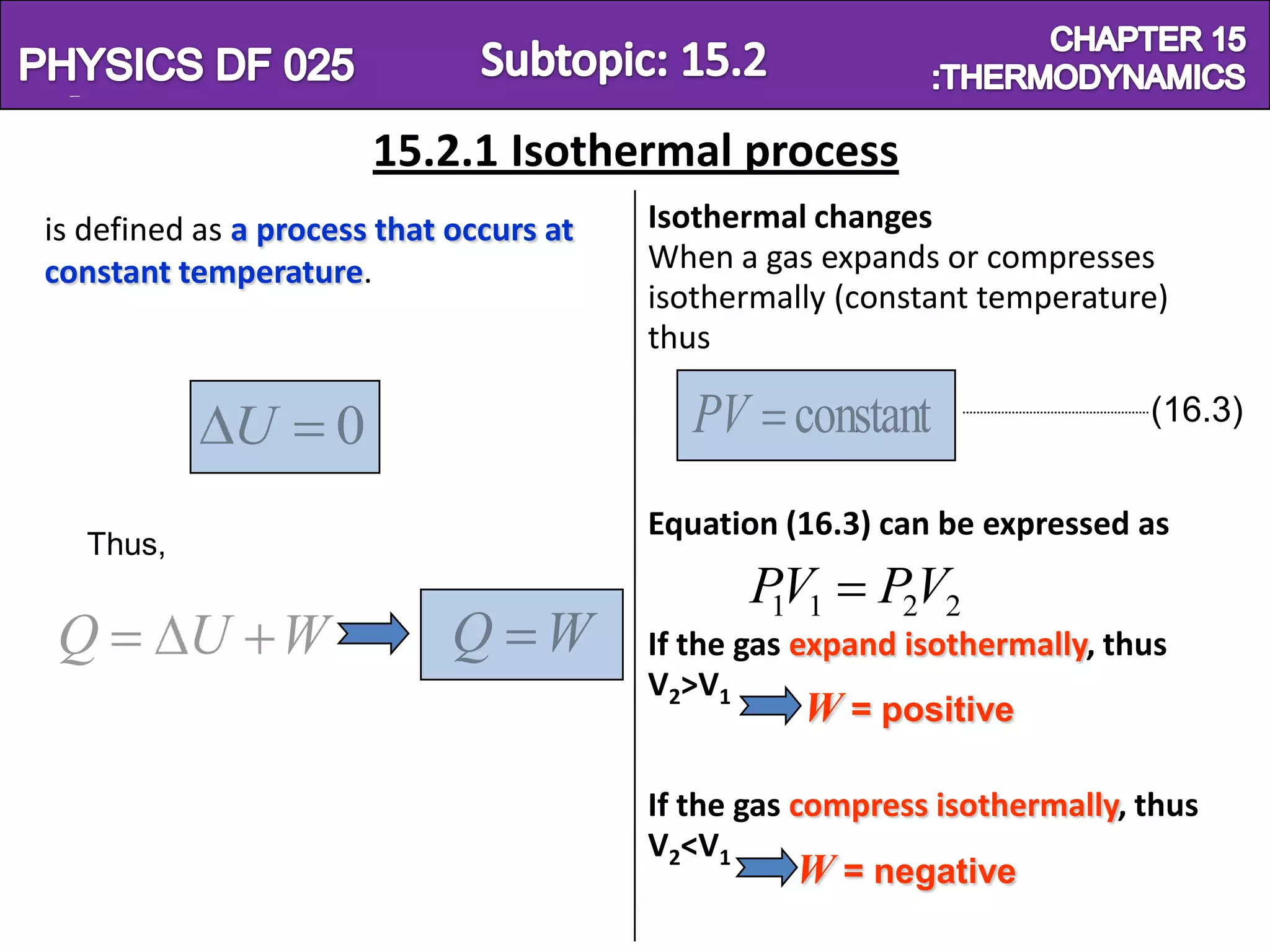
                         15.2.1 Isothermal process
 is defined as a process that occurs at   Isothermal changes
 constant temperature.                    When a gas expands or compresses
                                          isothermally (constant temperature)
                                          thus

              U      0                       PV constant                    (16.3)


                                          Equation (16.3) can be expressed as
    Thus,
                                                 PV1
                                                  1       P2V2
  Q         U W               Q W         If the gas expand isothermally, thus
                                          V2>V1
                                                      W = positive

                                          If the gas compress isothermally, thus
                                          V2<V1
                                                     W = negative
Physics SF 016                                              Chapter 15
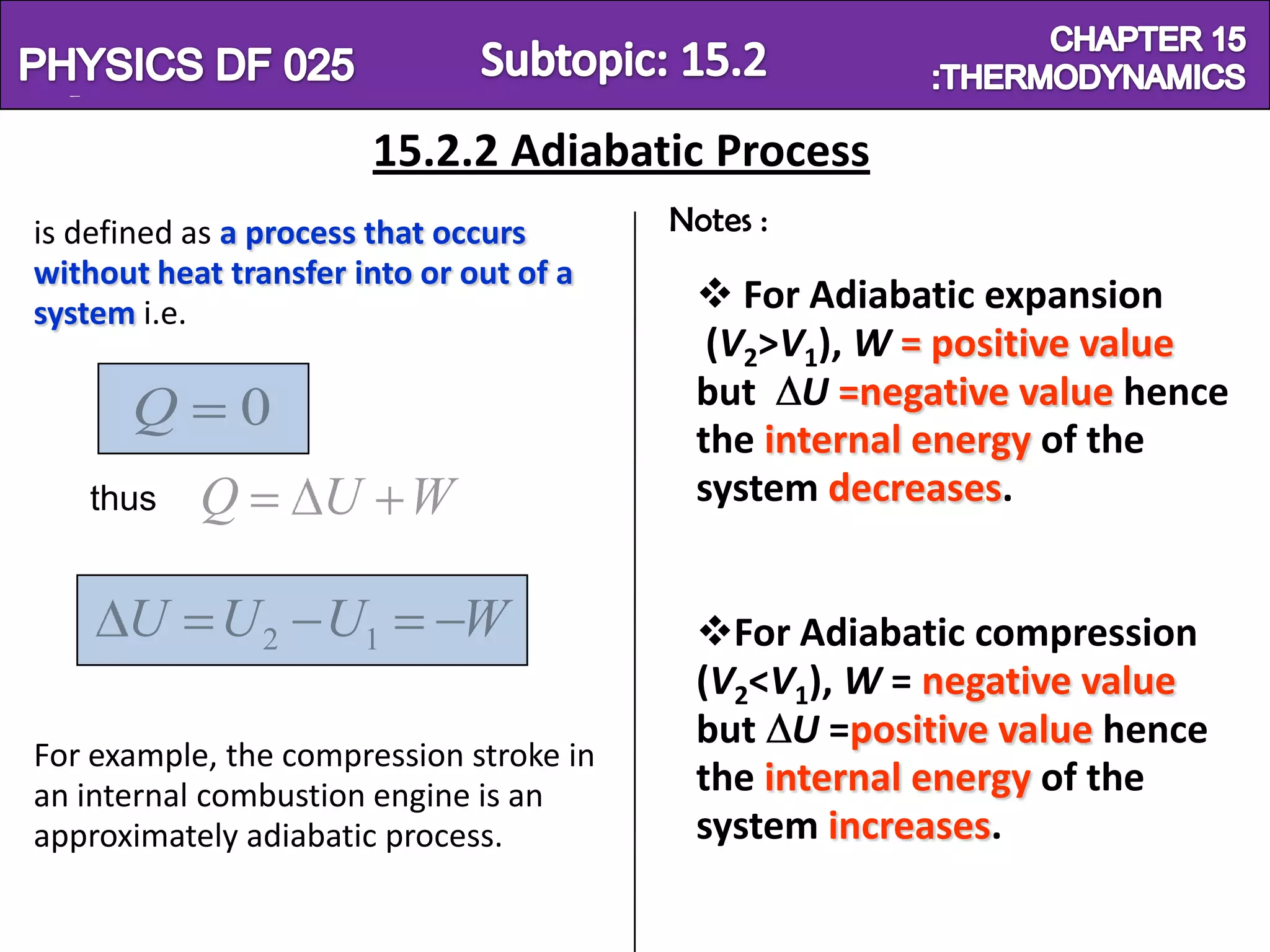
                        15.2.2 Adiabatic Process
 is defined as a process that occurs      Notes :
 without heat transfer into or out of a
 system i.e.                                For Adiabatic expansion
                                            (V2>V1), W = positive value
       Q        0                          but U =negative value hence
                                           the internal energy of the
    thus    Q        U W                   system decreases.


       U U 2 U1                W           For Adiabatic compression
                                           (V2<V1), W = negative value
                                           but U =positive value hence
 For example, the compression stroke in
 an internal combustion engine is an       the internal energy of the
 approximately adiabatic process.          system increases.
Physics SF 016                                                          Chapter 15
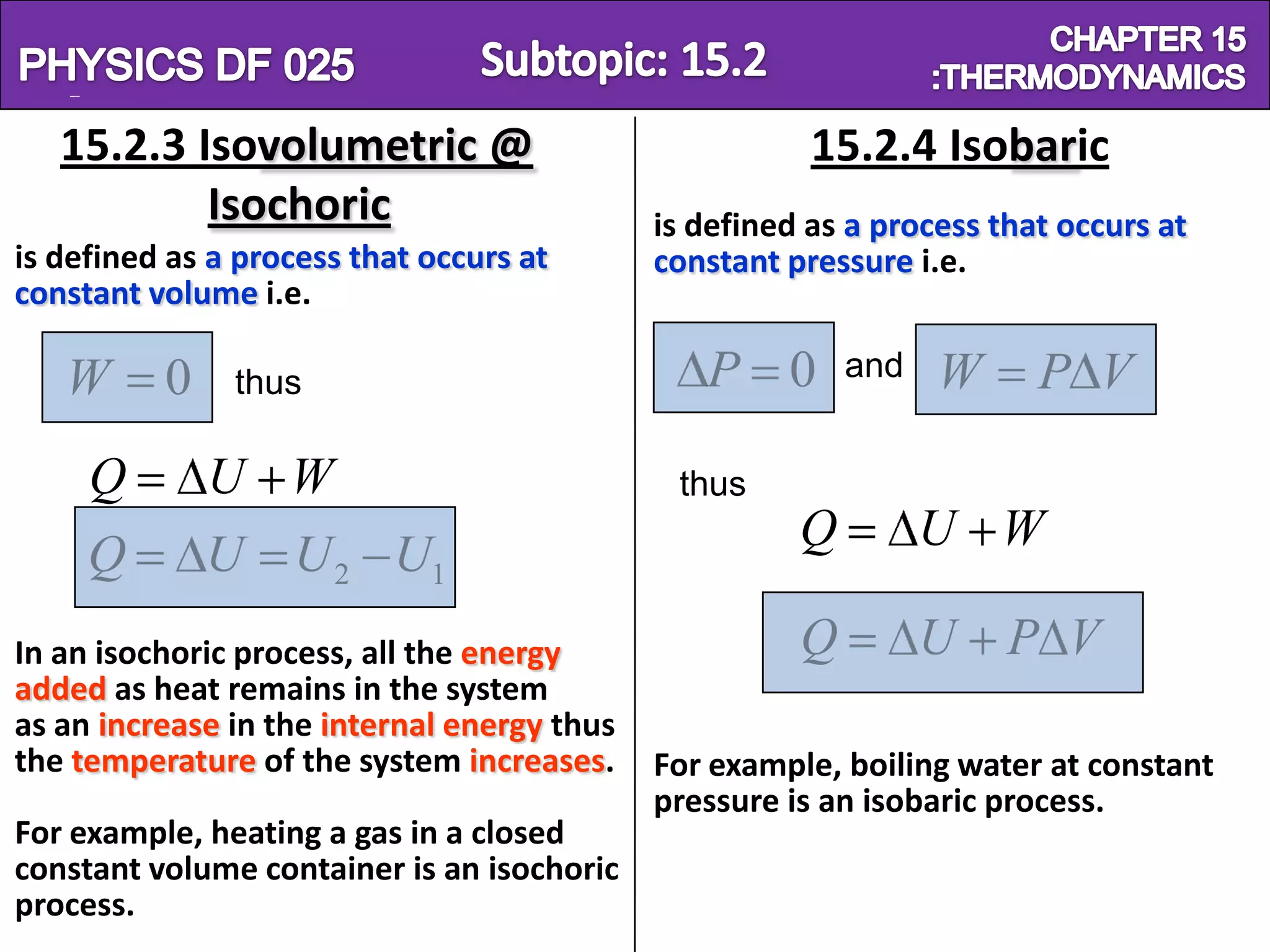
   15.2.3 Isovolumetric @                               15.2.4 Isobaric
           Isochoric                         is defined as a process that occurs at
is defined as a process that occurs at       constant pressure i.e.
constant volume i.e.

   W      0    thus                             P 0        and   W      P V

     Q        U W                             thus
                                                       Q         U W
     Q        U U 2 U1
In an isochoric process, all the energy                Q         U    P V
added as heat remains in the system
as an increase in the internal energy thus
the temperature of the system increases.     For example, boiling water at constant
                                             pressure is an isobaric process.
For example, heating a gas in a closed
constant volume container is an isochoric
process.
Physics SF 016                                                   Chapter 15
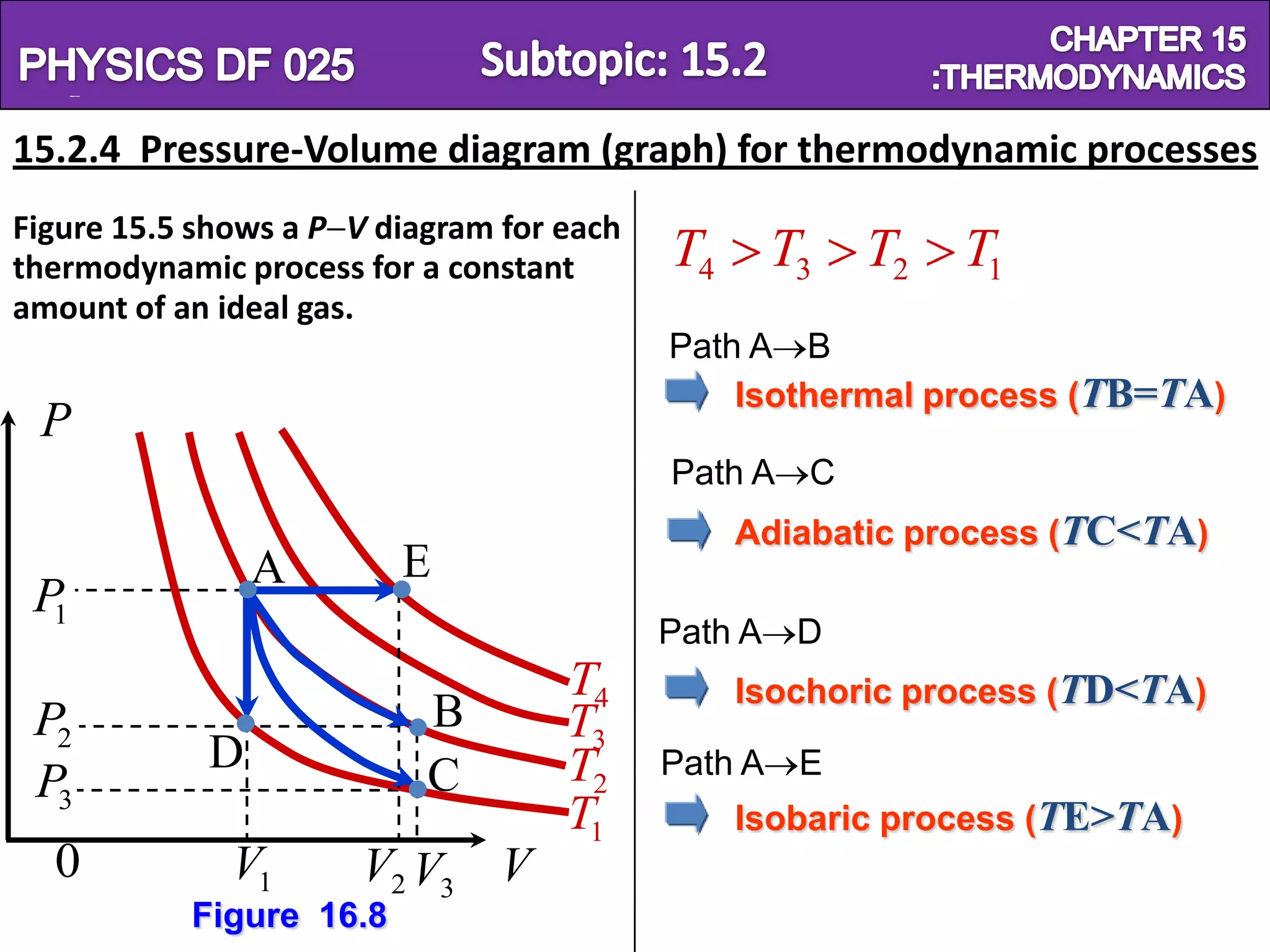
15.2.4 Pressure-Volume diagram (graph) for thermodynamic processes
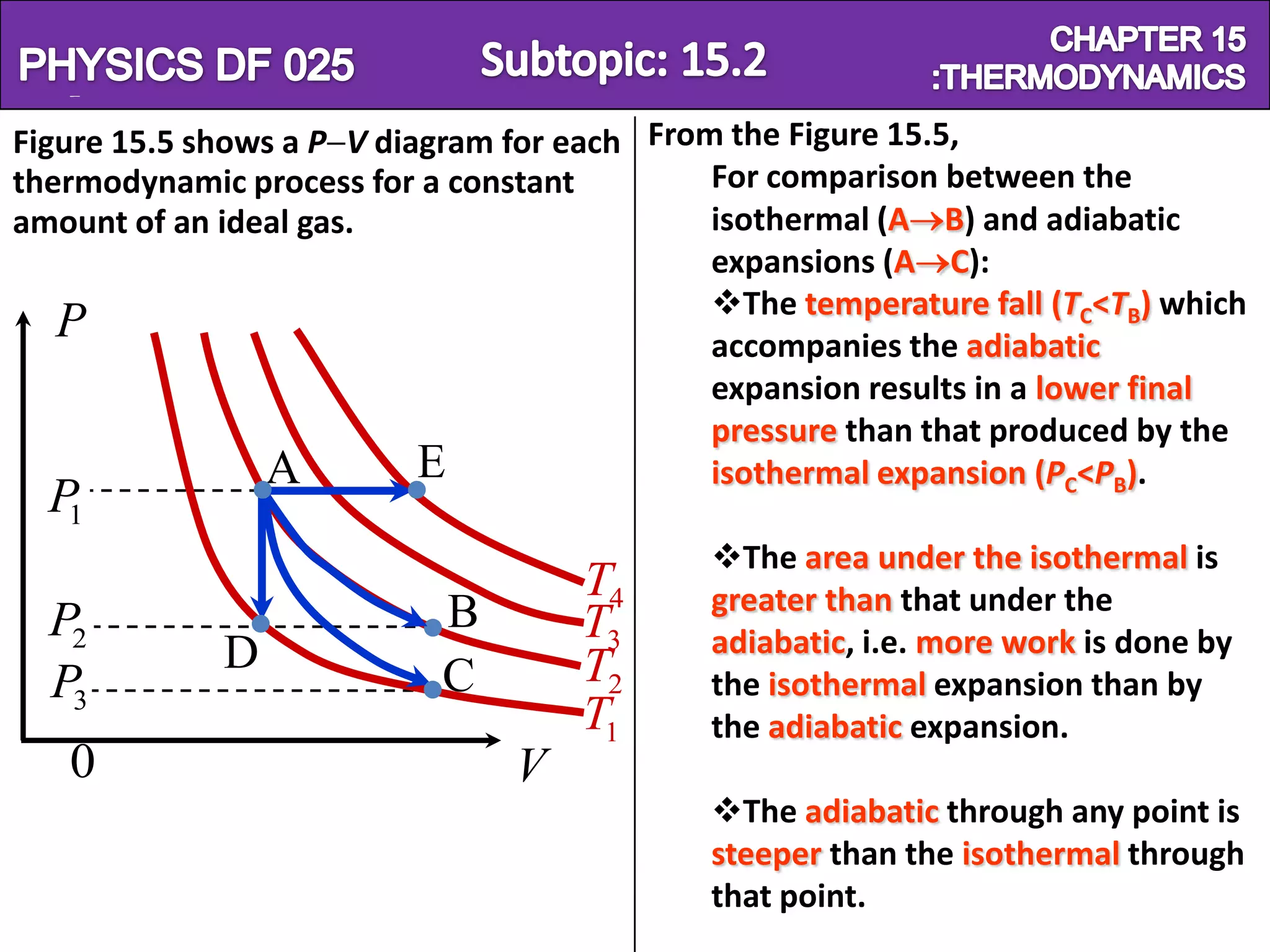
Figure 15.5 shows a P V diagram for each
thermodynamic process for a constant       T4    T3 T2      T1
amount of an ideal gas.
                                           Path A B
                                               Isothermal process (TB=TA)
 P
                                           Path A C
                                                Adiabatic process (TC<TA)
                A        E
 P1
                                           Path A D
                                    T4          Isochoric process (TD<TA)
 P2                        B        T3
            D              C        T2     Path A E
 P3
                                    T1          Isobaric process (TE>TA)
  0           V1      V2 V3 V
           Figure 16.8
Physics SF 016                                                     Chapter 15
Figure 15.5 shows a P V diagram for each From the Figure 15.5,
thermodynamic process for a constant         For comparison between the
amount of an ideal gas.                      isothermal (A B) and adiabatic
                                             expansions (A C):
                                             The temperature fall (TC<TB) which
   P                                         accompanies the adiabatic
                                             expansion results in a lower final
                                             pressure than that produced by the
                A          E                 isothermal expansion (PC<PB).
  P1
                                             The area under the isothermal is
                                    T4       greater than that under the
  P2                       B        T3
             D                               adiabatic, i.e. more work is done by
  P3                       C        T2       the isothermal expansion than by
                                    T1       the adiabatic expansion.
   0                            V
                                             The adiabatic through any point is
                                             steeper than the isothermal through
                                             that point.
Physics SF 016                                               Chapter 15

   Example 3 :

   Air is contained in a cylinder by a frictionless gas-tight piston.


   a. Calculate the work done by the air as it expands from a
   volume of 0.015 m3 to a volume of 0.027 m3 at a
   constant pressure of 2.0 105 Pa.


   b. Determine the final pressure of the air if it starts from the
   same initial conditions as in (a) and expanding by the same
   amount, the change occurs isothermally.
Physics SF 016                                                            Chapter 15
Example 3 :                                  Solution :
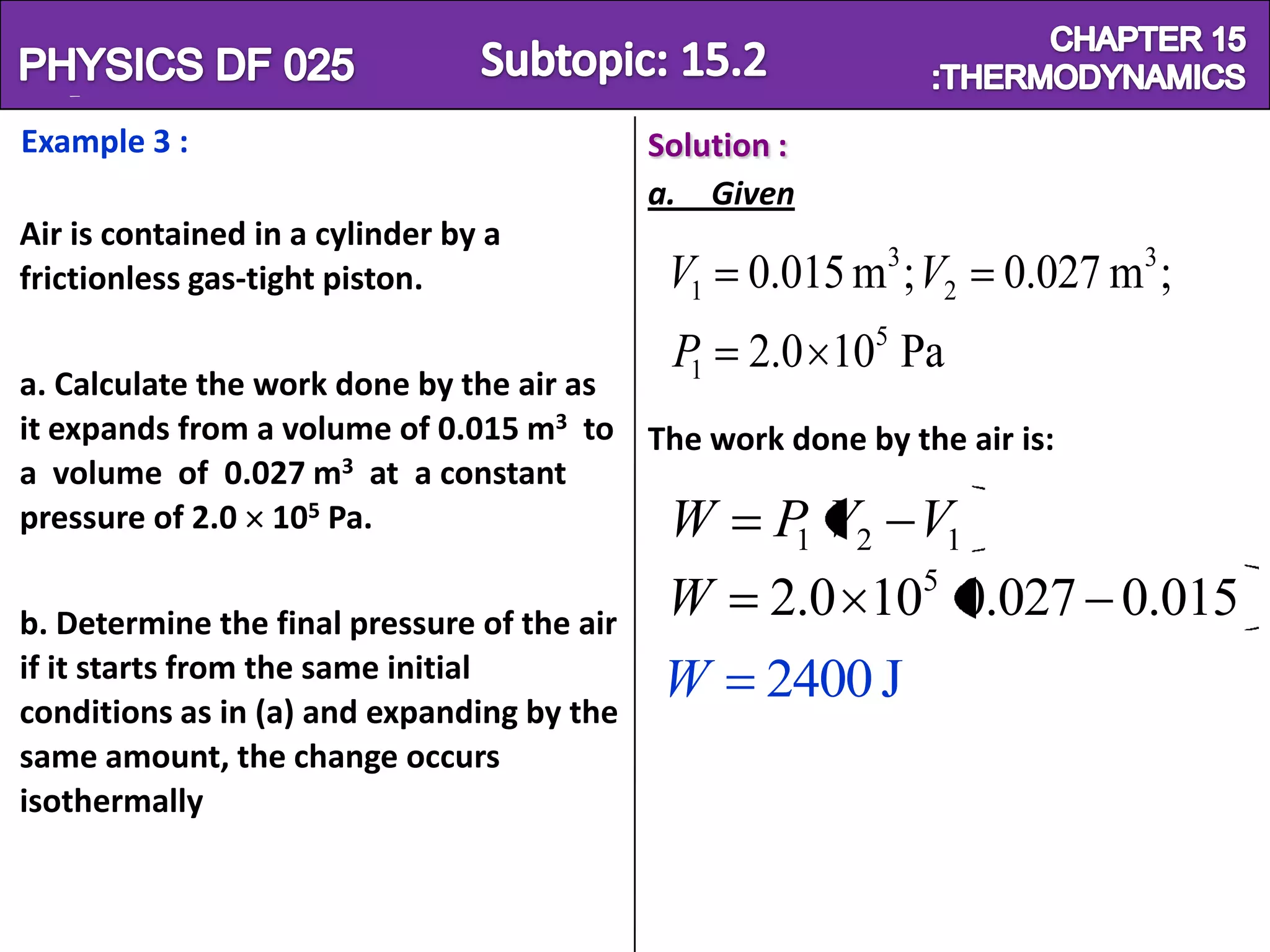
                                             a. Given
Air is contained in a cylinder by a
frictionless gas-tight piston.                V1 0.015 m3 ; V2 0.027 m3 ;
                                              P1 2.0 105 Pa
a. Calculate the work done by the air as
it expands from a volume of 0.015 m3 to The work done by the air is:
a volume of 0.027 m3 at a constant
pressure of 2.0 105 Pa.                  W PV V           1   2       1
                                                                  5
b. Determine the final pressure of the air
                                              W      2.0 10 0.027 0.015
if it starts from the same initial
conditions as in (a) and expanding by the
                                             W       2400 J
same amount, the change occurs
isothermally
Physics SF 016                                                          Chapter 15
Example 3 :
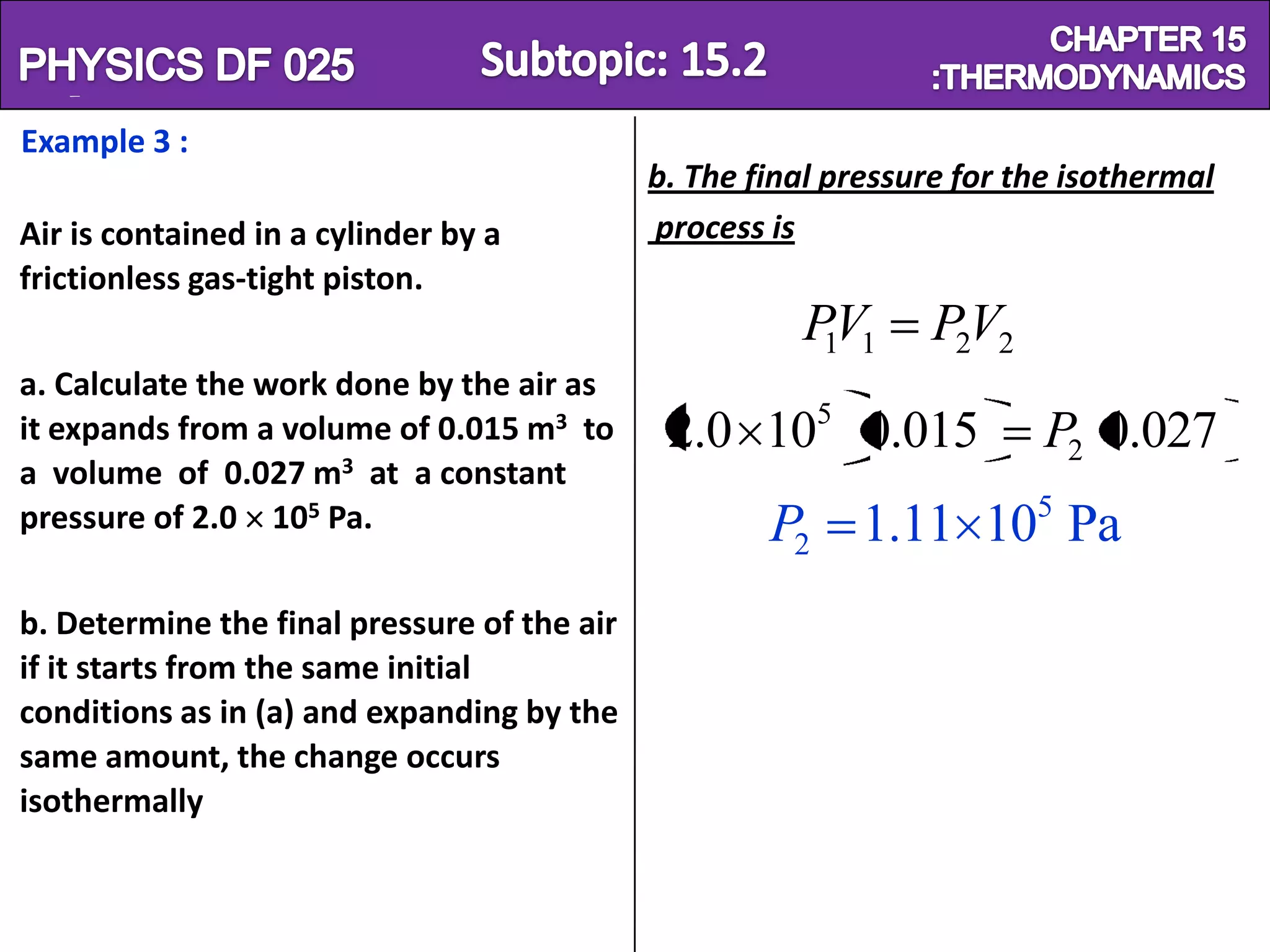
                                             b. The final pressure for the isothermal
Air is contained in a cylinder by a          process is
frictionless gas-tight piston.
                                                       PV1
                                                        1        P2V2
a. Calculate the work done by the air as
it expands from a volume of 0.015 m3 to       2.0 105 0.015              P2 0.027
a volume of 0.027 m3 at a constant
pressure of 2.0 105 Pa.                              P2 1.11 105 Pa
b. Determine the final pressure of the air
if it starts from the same initial
conditions as in (a) and expanding by the
same amount, the change occurs
isothermally
Physics SF 016                                                          Chapter 15
                                                          Remarks :
15.3 Learning Outcome
    Thermodynamics work (4 hour)
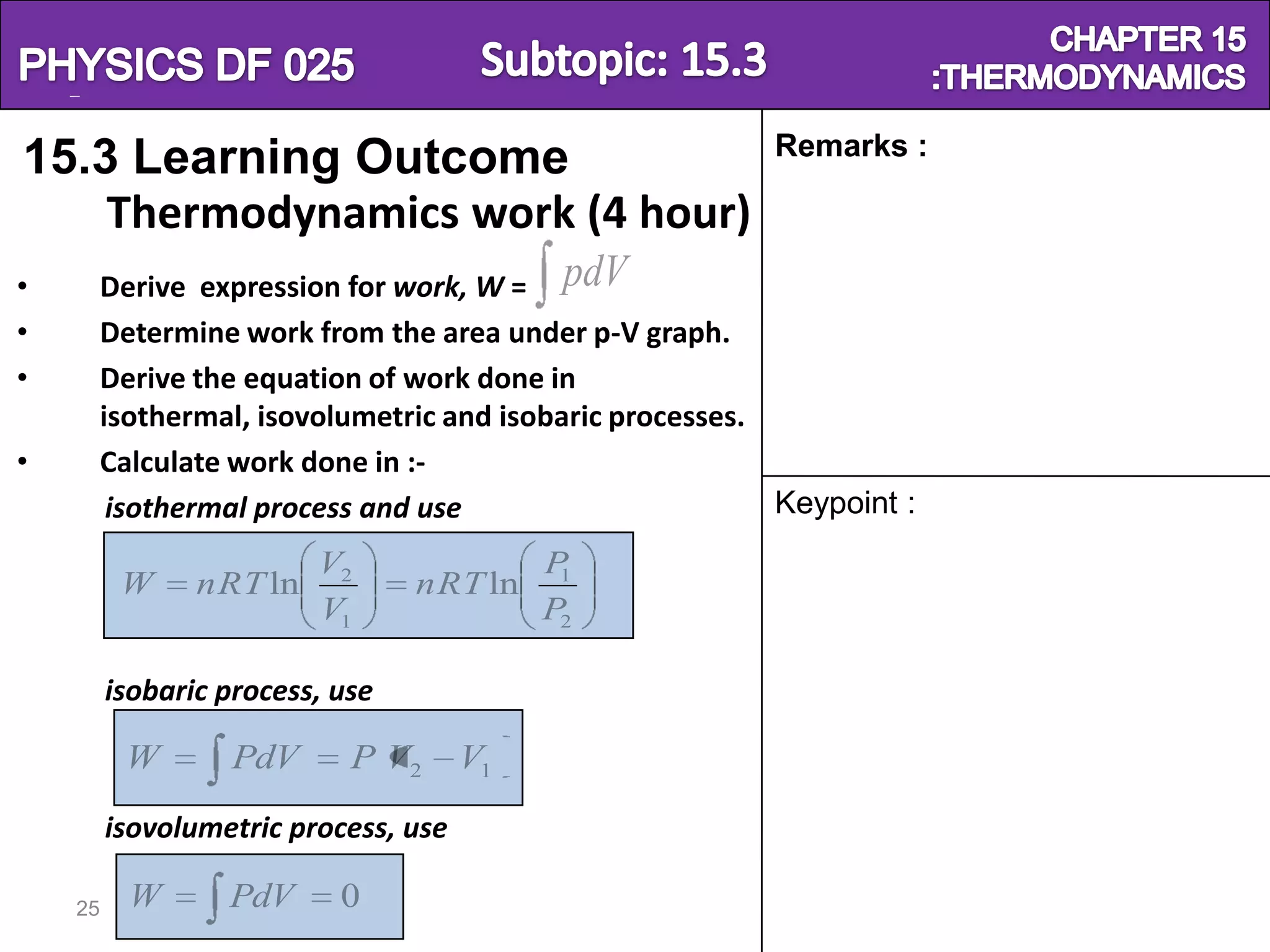
•        Derive expression for work, W = pdV
•        Determine work from the area under p-V graph.
•        Derive the equation of work done in
         isothermal, isovolumetric and isobaric processes.
•        Calculate work done in :-
          isothermal process and use                       Keypoint :
                         V2                P1
          W     nRT ln           nRT ln
                         V1                P2

         isobaric process, use

          W       PdV       P V2      V1
         isovolumetric process, use

    25     W      PdV      0
Physics SF 016                                                Chapter 15
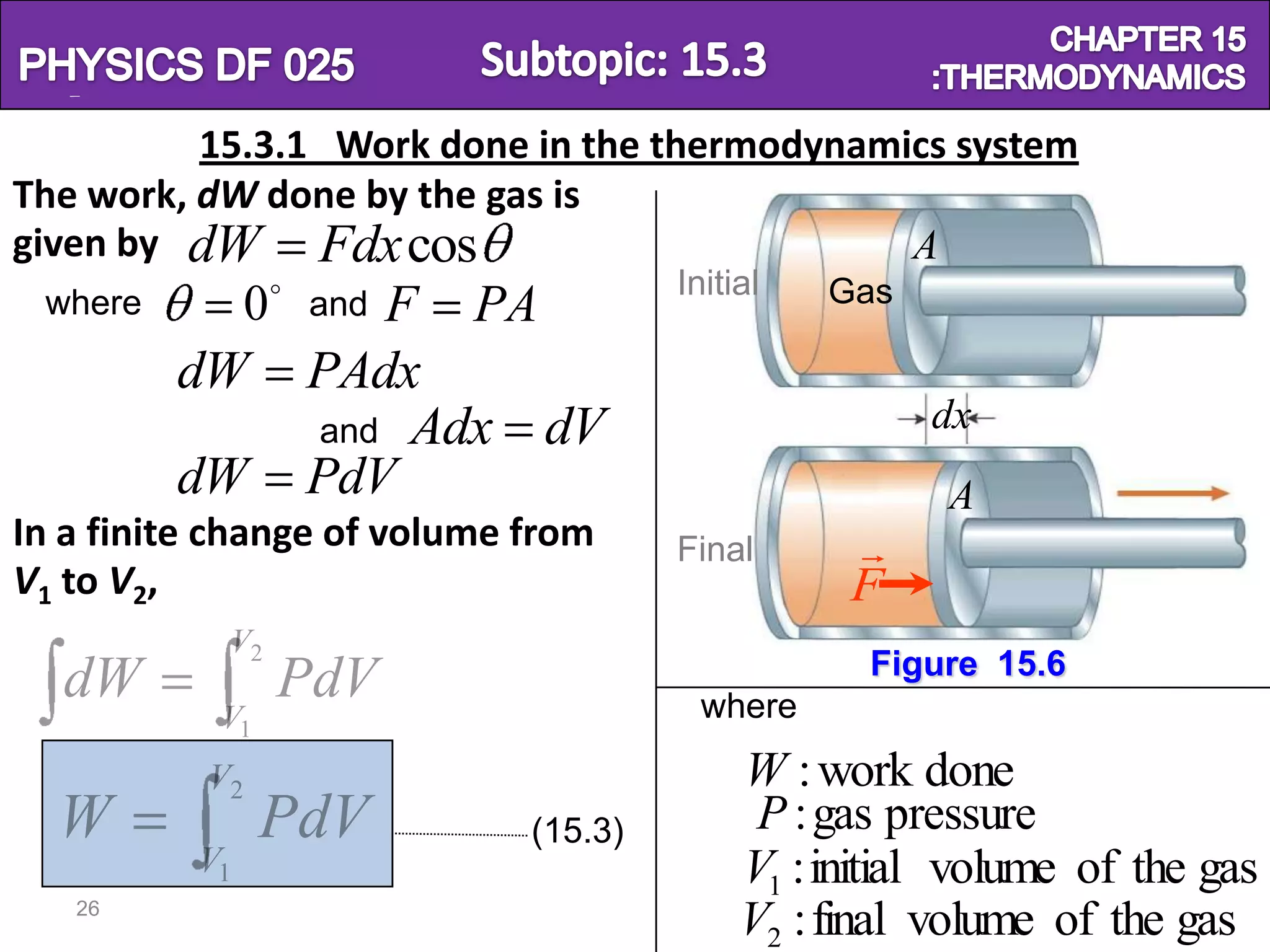
          15.3.1 Work done in the thermodynamics system
The work, dW done by the gas is
given by dW Fdx cos                           A
                                       Initial   Gas
 where          0       andF PA
         dW             PAdx
                        and Adx dV                      dx
         dW             PdV                              A
In a finite change of volume from       Final      
V1 to V2,                                          F
            V2
                                                    Figure 15.6
  dW                PdV                   where
           V1
           V2                                W : work done
  W             PdV            (15.3)         P : gas pressure
          V1                                 V1 : initial volume of the gas
   26
                                             V2 : final volume of the gas
Physics SF 016                                                 Chapter 15
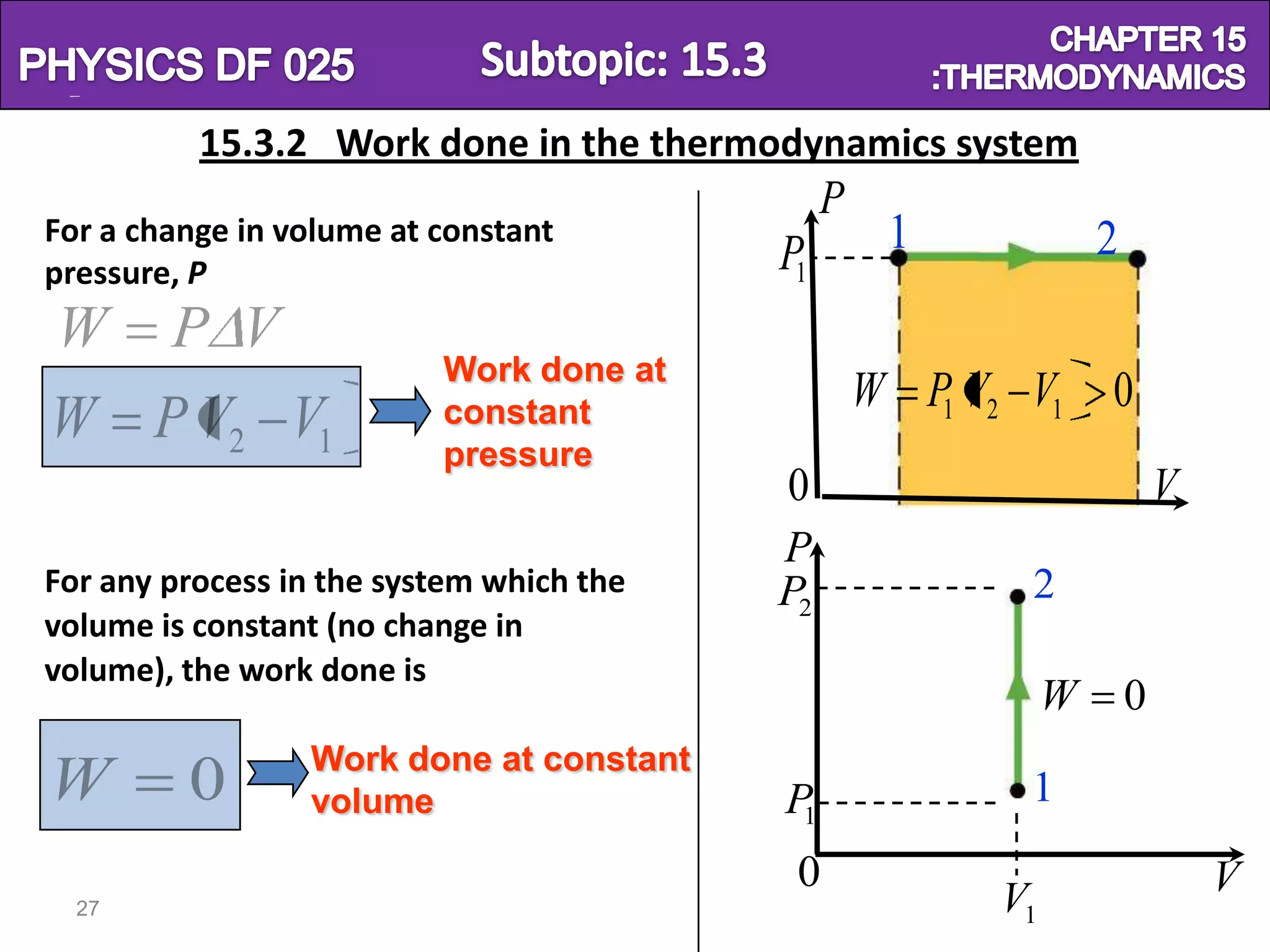
           15.3.2 Work done in the thermodynamics system
                                                P
 For a change in volume at constant
                                           P1        1             2
 pressure, P
  W      P V
                           Work done at
                                                    W P1 V2 V1 0
 W P V2 V1                 constant
                           pressure
                                           0                               V
                                           P
 For any process in the system which the   P2              2
 volume is constant (no change in
 volume), the work done is
                                                               W       0
                  Work done at constant
 W        0       volume                   P1
                                                           1
                                            0                                  V
   27                                                     V1
Physics SF 016                                                         Chapter 15
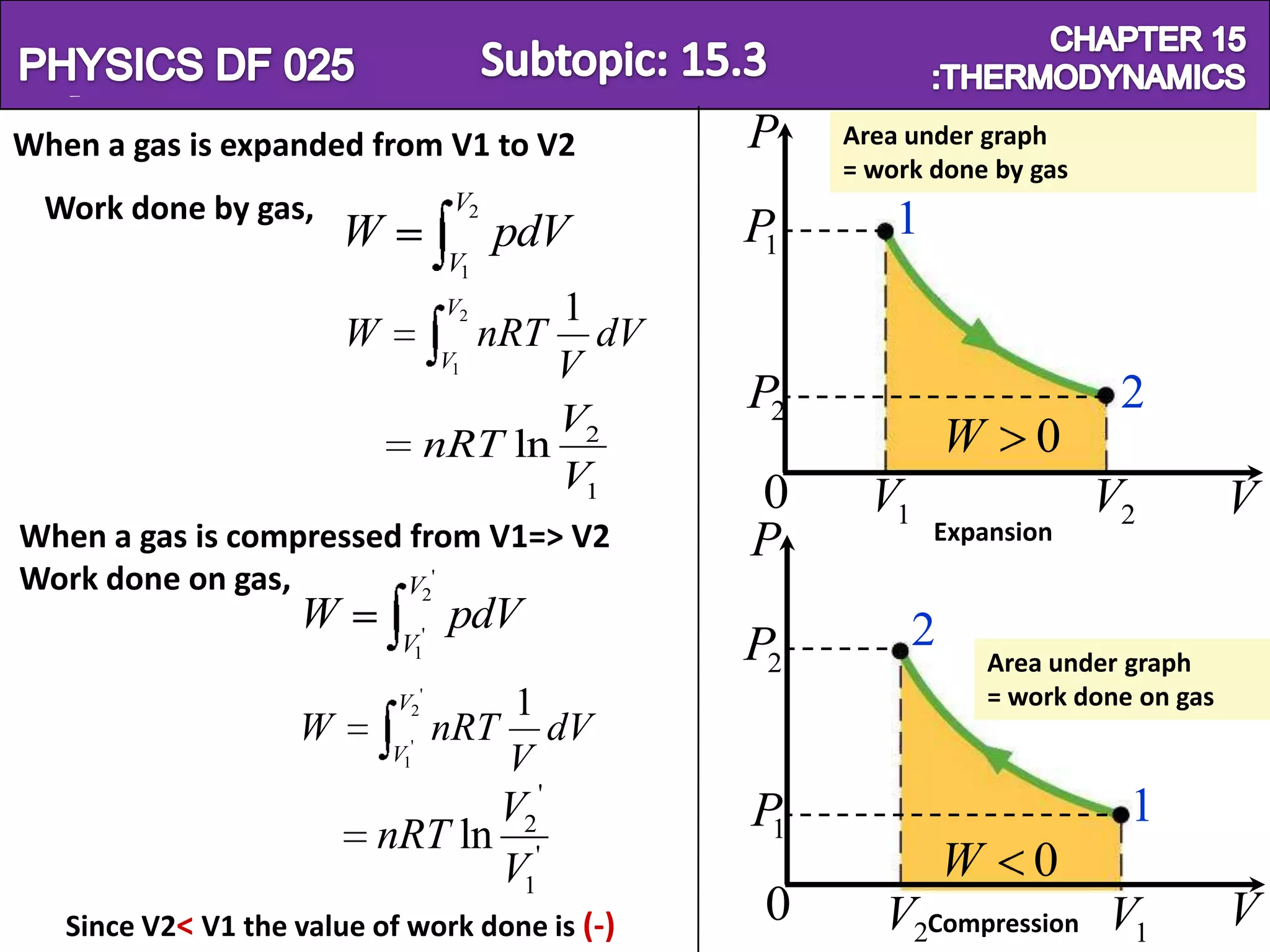
When a gas is expanded from V1 to V2            P    Area under graph
                                                     = work done by gas
  Work done by gas,                 V2
                        W                pdV    P1
                                                         1
                                   V1
                                   V2    1
                        W             nRT dV
                                   V1    V
                                         V
                                                P2                            2
                                  nRT ln 2                      W      0
                                         V1     0      V1                   V2           V
When a gas is compressed from V1=> V2                        Expansion
                                                P
Work done on gas,        V2'
                    W              pdV                      2
                             V1'                P2                  Area under graph
                            V2'          1                          = work done on gas
                    W              nRT     dV
                            V1'          V
                                V2'             P                              1
                          nRT ln '               1
                                V1                              W      0
   Since V2< V1 the value of work done is (-)
                                                 0      V2Compression V1                 V
Physics SF 016                                               Chapter 15
                    15.3.3 Work done in Isothermal Process
From the equation of state for an ideal
gas,
                                nRT                          V2
  PV        nRT      then   P             W     nRT ln V     V1
                                 V
Therefore the work done in the
isothermal process which change of        W     nRT ln V2 ln V1
volume from V1 to V2, is given
               V2
                                                       V2
      W             PdV                   W     nRT ln            (15.9)
               V1                                      V1
               V2nRT
      W                dV
              V1  V
                  V2 1
      W      nRT        dV
                 V1 V
Physics SF 016                                                         Chapter 15
                 15.3.3 Work done in Isothermal Process

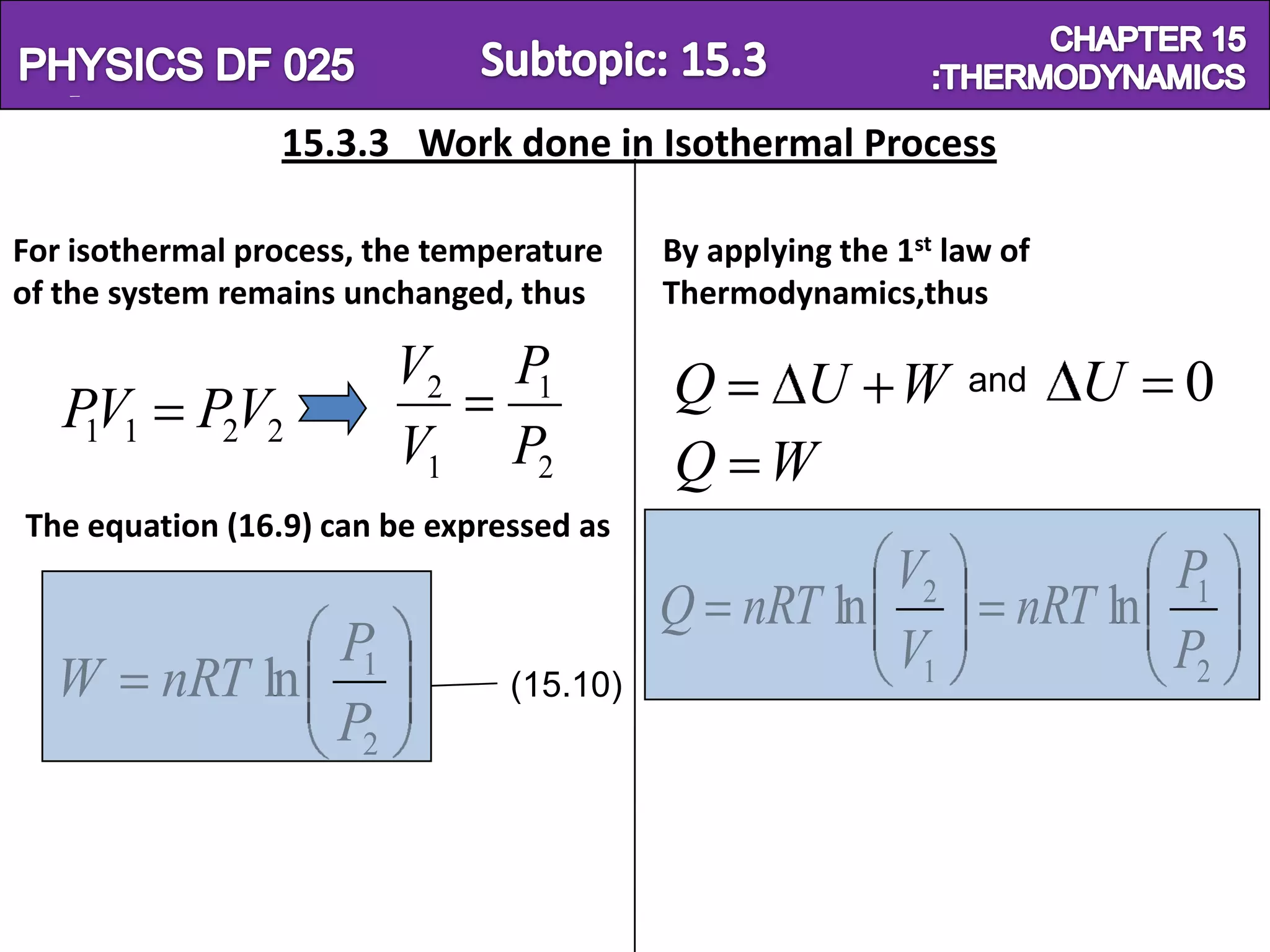
For isothermal process, the temperature   By applying the 1st law of
of the system remains unchanged, thus     Thermodynamics,thus

                         V2      P1       Q  U W               and       U   0
   PV1 P2V2
    1
                         V1      P2       Q W
The equation (16.9) can be expressed as
                                                   V2                     P1
                                          Q nRT ln                 nRT ln
                P                                  V1                     P2
  W      nRT ln 1               (15.10)
                P2
Physics SF 016                                                       Chapter 15
15.3.3 Work done in isobaric process 15.3.3 Work done in isovolumetric
                                     process
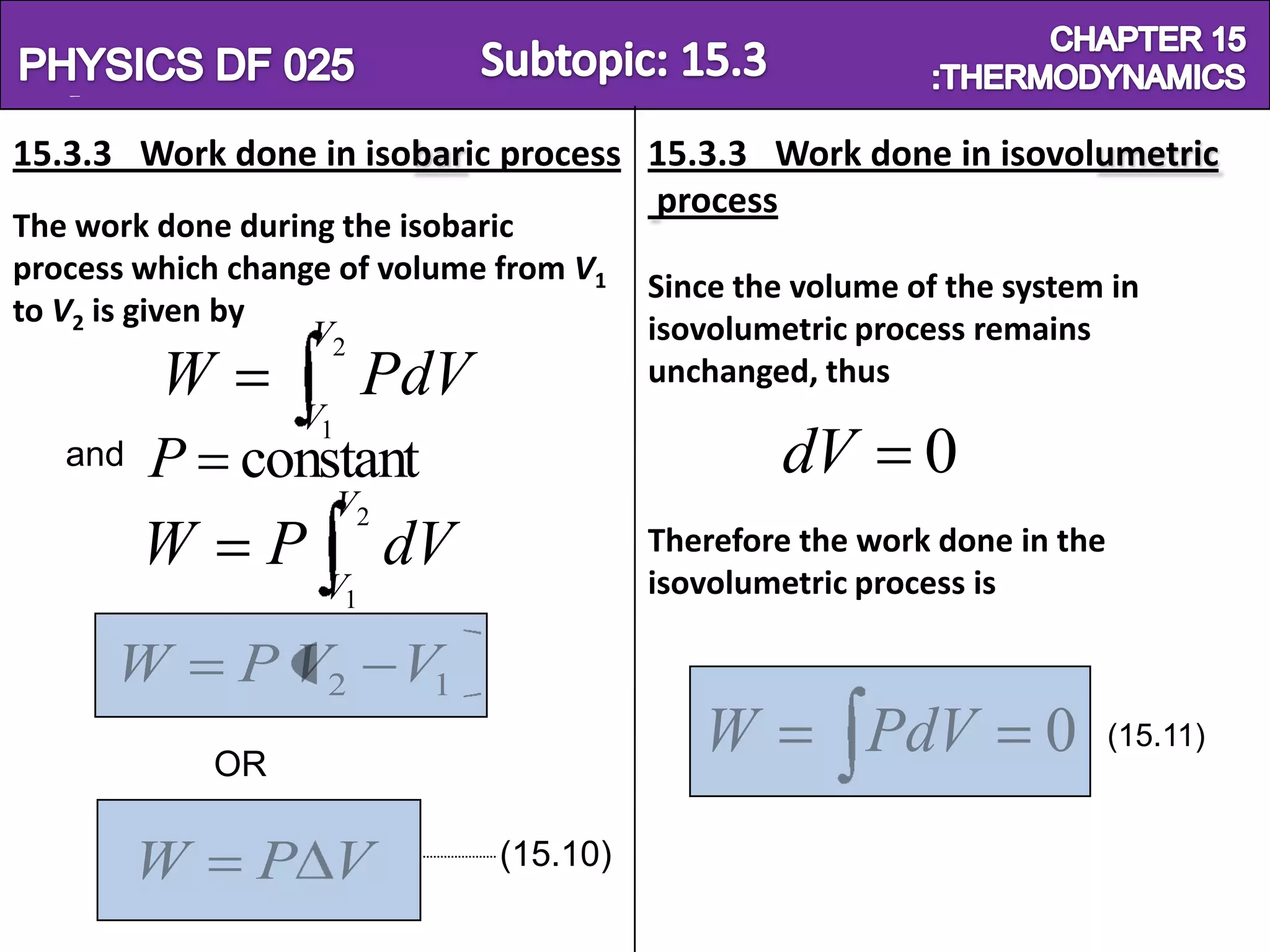
The work done during the isobaric
process which change of volume from V1
                                           Since the volume of the system in
to V2 is given by
                   V2                      isovolumetric process remains
         W                 PdV             unchanged, thus
                  V1
   and   P constant                                 dV       0
                       V2
         W        P         dV             Therefore the work done in the
                                           isovolumetric process is
                      V1

      W       P V2 V1
             OR
                                              W          PdV         0      (15.11)


         W     P V               (15.10)
Physics SF 016                                                          Chapter 15
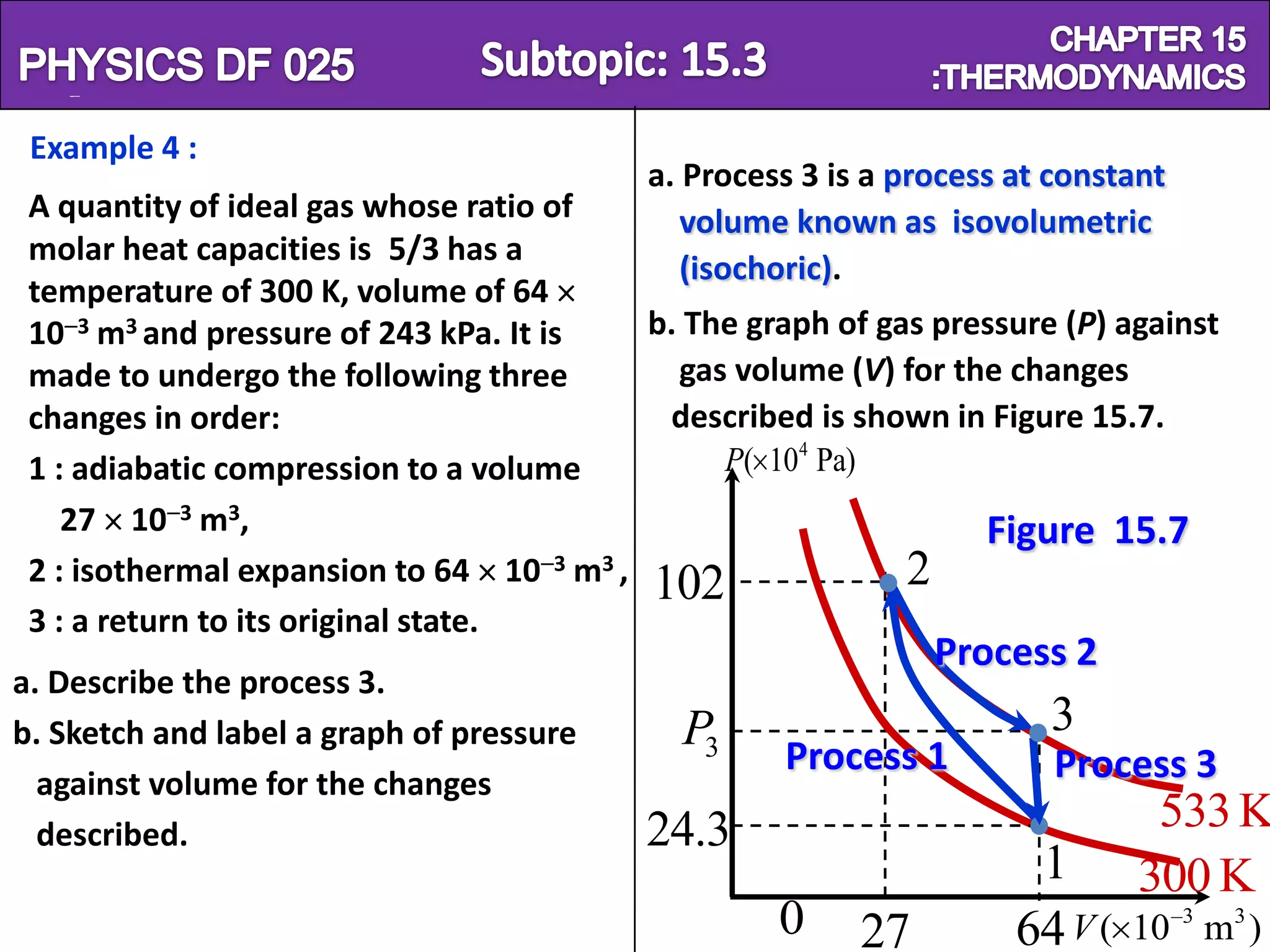
 Example 4 :
                                            a. Process 3 is a process at constant
 A quantity of ideal gas whose ratio of        volume known as isovolumetric
 molar heat capacities is 5/3 has a
                                               (isochoric).
 temperature of 300 K, volume of 64
 10 3 m3 and pressure of 243 kPa. It is      b. The graph of gas pressure (P) against
 made to undergo the following three           gas volume (V) for the changes
 changes in order:                            described is shown in Figure 15.7.
 1 : adiabatic compression to a volume            P( 104 Pa)
    27 10 3 m3,                                                     Figure 15.7
 2 : isothermal expansion to 64 10    3 m3 ,
                                             102               2
 3 : a return to its original state.
                                                                Process 2
a. Describe the process 3.
b. Sketch and label a graph of pressure        P3                        3
                                                      Process 1          Process 3
  against volume for the changes
  described.                                24.3                                533 K
                                                                       1       300 K
                                                     0     27         64 V (   10 3 m3 )
Physics SF 016                                                          Chapter 15
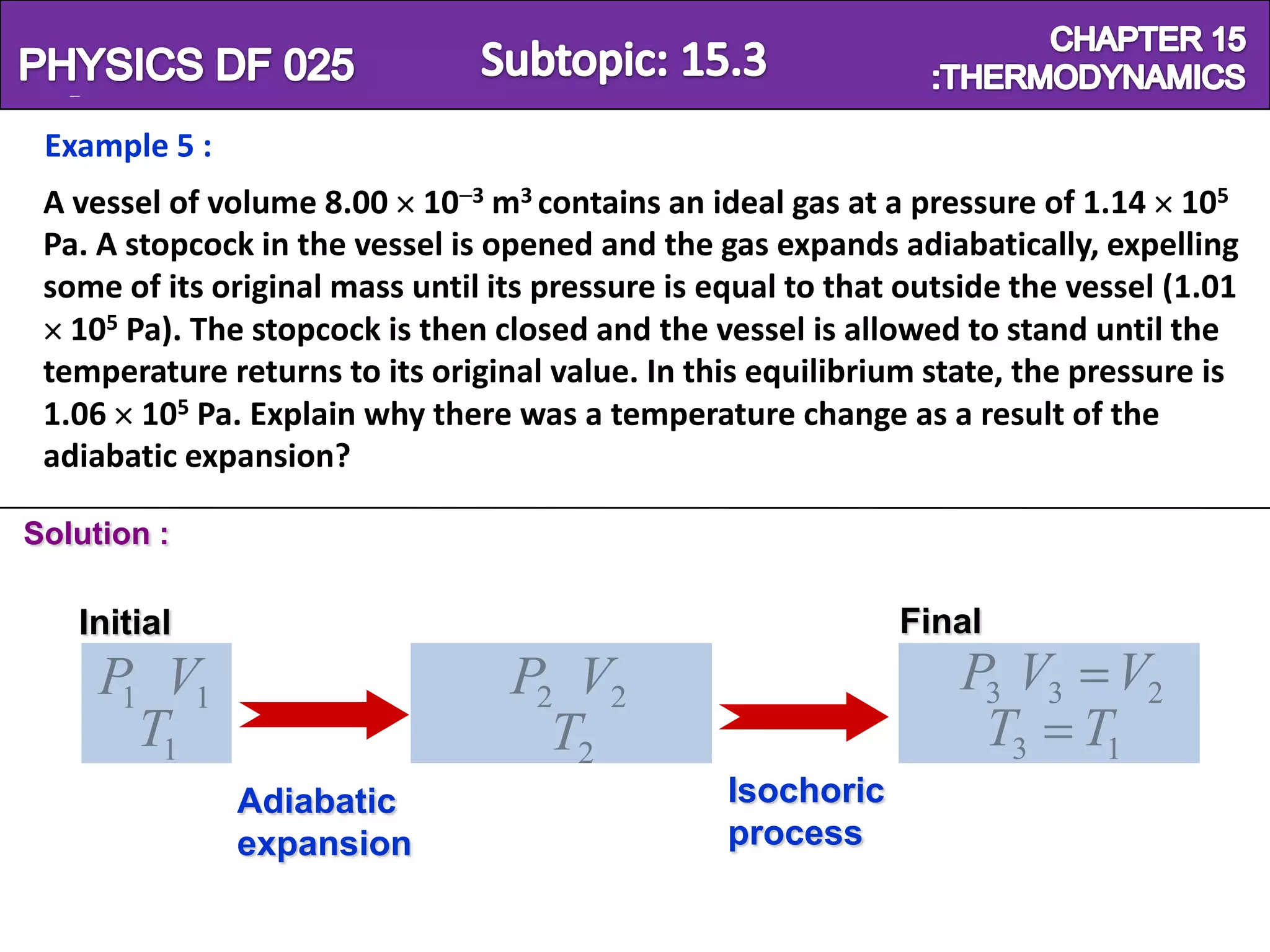
 Example 5 :
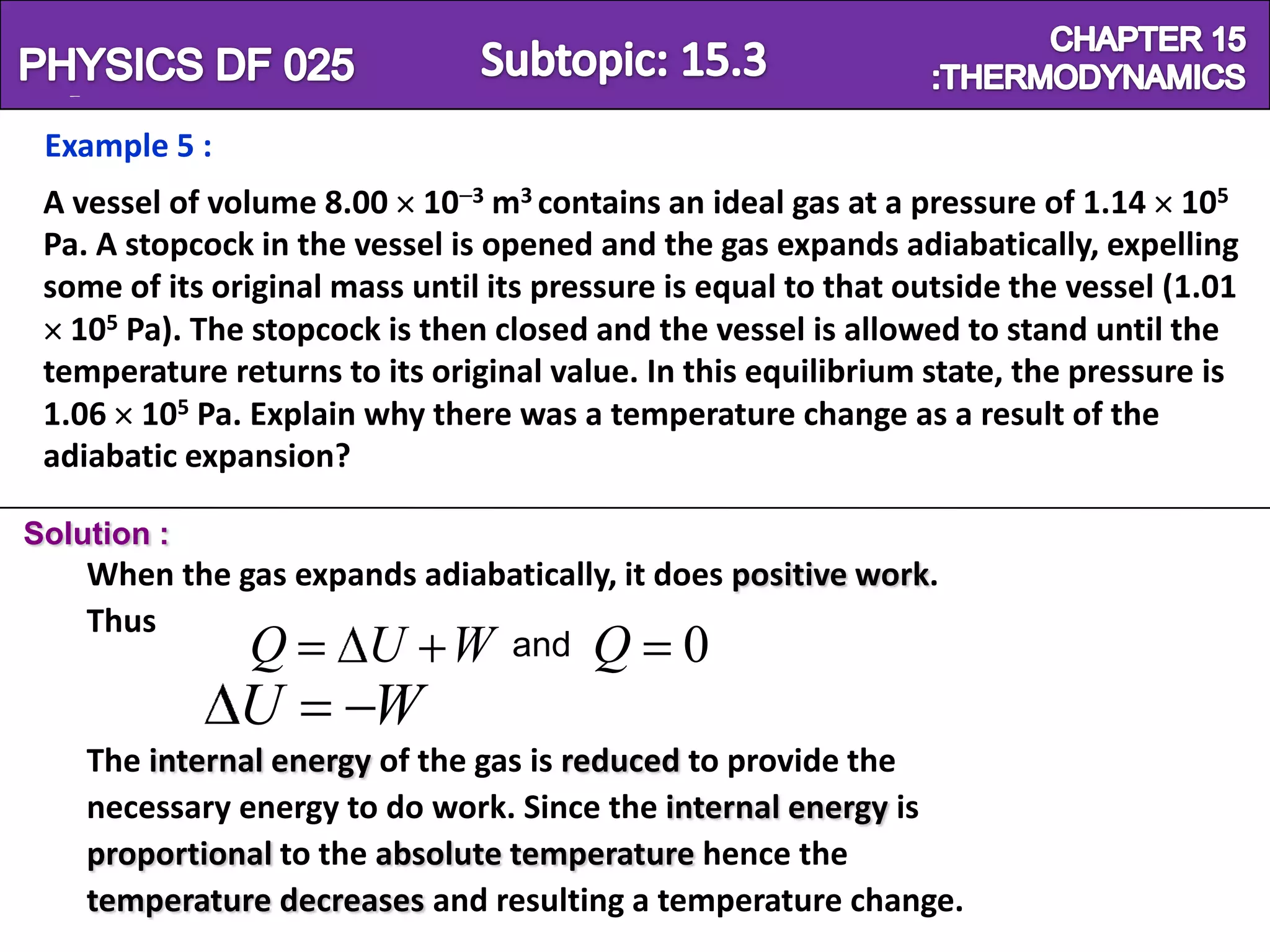
 A vessel of volume 8.00 10 3 m3 contains an ideal gas at a pressure of 1.14 105
 Pa. A stopcock in the vessel is opened and the gas expands adiabatically, expelling
 some of its original mass until its pressure is equal to that outside the vessel (1.01
   105 Pa). The stopcock is then closed and the vessel is allowed to stand until the
 temperature returns to its original value. In this equilibrium state, the pressure is
 1.06 105 Pa. Explain why there was a temperature change as a result of the
 adiabatic expansion?

Solution :

   Initial                                                    Final
     P V1
      1                           P2 V2                            P3 V3 V2
        T1                          T2                              T3 T1
               Adiabatic                          Isochoric
               expansion                          process
Physics SF 016                                                          Chapter 15
 Example 5 :
 A vessel of volume 8.00 10 3 m3 contains an ideal gas at a pressure of 1.14 105
 Pa. A stopcock in the vessel is opened and the gas expands adiabatically, expelling
 some of its original mass until its pressure is equal to that outside the vessel (1.01
   105 Pa). The stopcock is then closed and the vessel is allowed to stand until the
 temperature returns to its original value. In this equilibrium state, the pressure is
 1.06 105 Pa. Explain why there was a temperature change as a result of the
 adiabatic expansion?

Solution :
    When the gas expands adiabatically, it does positive work.
    Thus
              Q      U W and Q 0
               U        W
    The internal energy of the gas is reduced to provide the
    necessary energy to do work. Since the internal energy is
    proportional to the absolute temperature hence the
    temperature decreases and resulting a temperature change.
Physics SF 016                                                         Chapter 15
  Example 6 :
  a. Write an expression representing
     i. the 1st law of thermodynamics and state the meaning of all the
         symbols.
     ii. the work done by an ideal gas at variable pressure. [3 marks]
  b. Sketch a graph of pressure P versus volume V of 1 mole of ideal
     gas. Label and show clearly the four thermodynamics process.
                                                                [5 marks]
  c. A monatomic ideal gas at pressure P and volume V is compressed
     isothermally until its new pressure is 3P. The gas is then allowed
     to expand adiabatically until its new volume is 9V. If P, V and for
     the gas is 1.2 105 Pa,1.0 10 2 m3 and 5/3 respectively, calculate
     i. the final pressure of the gas.
     ii. the work done on the gas during isothermal compression.
  (Examination Question Intake 2003/2004)                               [7 marks]
Physics SF 016                                                       Chapter 15
  Example 6 :
  a. Write an expression representing
     i. the 1st law of thermodynamics and state the meaning of all the
         symbols.
     ii. the work done by an ideal gas at variable pressure. [3 marks]
Solution :
 a. i. 1st law of thermodynamics:
         Q      U W
      where     U : change in internal energy
                Q : quantity of heat trans ferred
                W : work done
   ii. Work done at variable pressure:

                V2                              V2
       W             PdV   OR    W       nRT ln
                V1                              V1
Physics SF 016                                                       Chapter 15
  Example 6 :
 b. Sketch a graph of pressure P versus volume V of 1 mole of ideal gas. Label and
   show clearly the four thermodynamics process.
                                                                      [5 marks]


Solution :
 b. PV diagram below represents four thermodynamic processes:
                 P
                                     Isobaric process
                               A       E     Isothermal process
                PA
       Isochoric process                         T4
                           D             B       T3
       adiabatic process                C        T2
                                                 T1
                  0          VA                     V
Physics SF 016                                                            Chapter 15
   Example 6 :
c. A monatomic ideal gas at pressure P and volume V is compressed isothermally
   until its new pressure is 3P. The gas is then allowed to expand adiabatically until its
   new volume is 9V. If P, V and for the gas is 1.2 105 Pa,1.0 10 2 m3 and 5/3
   respectively, calculate
   i. the work done on the gas during isothermal compression.               [7 marks]

Solution :
  i. The work done during the isothermal compression is
                               V1
                 W     nRT ln            and   nRT       PV
                               V
                              V
                                                                                  1
                 W     PV ln 3             W                 5
                                                   1.2 10 1.0 10           2
                                                                               ln
                              V                                                   3
                                           W         1.32 103 J
Physics SF 016                         Chapter 15


      THE END…
          Good luck
          For Second Semester Examination


               PDT STUDENTS,
         DO YOUR BEST, BEAT THE REST
           PHYSICS ‘A’, INSYAALLAH ...

Chapter 15=Thermodynamics

  • 1.
    Physics SF 016 Chapter 15 16 CHAPTER 15: Thermodynamics 1
  • 2.
    Physics SF 016 Chapter 15 Remarks : 15.1 Learning Outcome  Distinguish between thermodynamic work done on the system and work done by the system.  State and use first law of thermodynamics, Keypoint : Q U W
  • 3.
    Physics SF 016 Chapter 15 15.1.1 Signs for heat, Q and work, W (a) Surroundings Sign convention for heat, Q : (environment) Q = positive value Heat flow into the system System 3 Q 0 W 0 Q = negative value (b) Surroundings Heat flow out of the system (environment) System 3 W 0
  • 4.
    Physics SF 016 Chapter 15 Sign convention for work, W: Surroundings (environment) W = positive value Work done by the system System Q 0 W 0 Surroundings W = negative value (environment) Work done on the system System W 0 4
  • 5.
    Physics SF 016 Chapter 15 Surroundings (environment) Q = positive value W = positive value System Q 0 W 0 Surroundings (environment) Q = negative value W = negative value System 5 W 0
  • 6.
    Physics SF 016 Chapter 15 Work done by gas (Expansion) Motion of piston When the air is expanded, the molecule loses kinetic energy and does positive work on piston. Air Expansion Work done on gas(Compression) Air Motion of Initially piston When the air is compressed, the molecule gains kinetic energy and does negative work on piston. Air 6 Compression
  • 7.
    Physics SF 016 Chapter 15 15.1.2 Work done in the thermodynamics system Consider the infinitesimal work A done by the gas (system) during Initial Gas the small expansion, dx in a cylinder with a movable piston as shown in Figure 15.3. dx  F A Suppose that the cylinder has a Final cross sectional area, A and the pressure exerted by the gas (system) at the piston face is P. Figure 15.3 7
  • 8.
    Physics SF 016 Chapter 15 15.1.3 First law of thermodynamics It states that : “The heat (Q) supplied to a system is equal to the increase in the internal energy ( U) of the system plus the work done (W) by the system on its surroundings.” Q U W (15.2) and U U 2 U1 where Q : quantity of heat supplied W : work done U : change in the internal energy U1 : initial internal energy U 2 : final internal energy For infinitesimal change in the energy, dQ dU dW
  • 9.
    Physics SF 016 Chapter 15 •The first law of thermodynamics is P a generalization of the principle of 1 conservation of energy to include P1 3 energy transfer through heat as well as mechanical work. P2 2 •The change in the internal energy 4 ( U) of a system during any 0 V1 V2 V thermodynamic process is Figure 15.4 independent of path. For example a thermodynamics system goes from state 1 to state 2 as shown in Figure U1 2 U1 4 2 U1 3 2 16.5.
  • 10.
    Physics SF 016 Chapter 15 P(kPa ) Example 1 : D C 300 150 B Figure 15.6 A 0 2.0 4.0 V ( 10 2 m3 ) A vessel contains an ideal gas in condition A, as shown in Figure 16.6. When the condition of the gas changes from A to that of B, the gas system undergoes a heat transfer of 10.5 kJ. When the gas in condition B changes to condition C, there is a heat transfer of 3.2 kJ. Calculate a. the work done in the process ABC, b. the change in the internal energy of the gas in the process ABC, c. the work done in the process ADC, d. the total amount of heat transferred in the process ADC. 10
  • 11.
    Physics SF 016 Chapter 15 a. The work done in the process ABC is given by : Calculate: WABC WAB WBC a. the work done in the process ABC, but WBC 0 b. the change in the internal energy of the gas in the process ABC, WABC PA VB VA c. the work done in the process ADC WABC 150 103 4.0 10 2 2.0 10 2 , d. the total amount of heat WABC 3000 J transferred in the process ADC.
  • 12.
    Physics SF 016 Chapter 15 b. By applying the 1st law of thermodynamics for ABC, thus Calculate: QABC U ABC WABC a. the work done in the process ABC, b. the change in the internal energy U ABC QAB QBC WABC of the gas in the process ABC, U ABC 10.5 103 3.2 103 3000 c. the work done in the process ADC , 4 d. the total amount of heat U ABC 1.07 10 J transferred in the process ADC.
  • 13.
    Physics SF 016 Chapter 15 c. The work done in the process ADC is given by Calculate: WADC WAD WDC a. the work done in the process ABC, but WAD 0 b. the change in the internal energy of the gas in the process ABC, WADC PD VC VD c. the work done in the process ADC , WADC 300 103 4.0 10 2 2.0 10 2 d. the total amount of heat transferred in the process ADC. WADC 6000 J
  • 14.
    Physics SF 016 Chapter 15 d. By applying the 1st law of thermodynamics for ADC, thus Calculate: QADC U ADC WADC a. the work done in the process ABC, and U ADC U ABC b. the change in the internal energy of the gas in the process ABC, QADC U ABC WADC c. the work done in the process ADC , d. the total amount of heat QADC 1.07 104 6000 transferred in the process ADC. 4 QADC 1.67 10 J
  • 15.
    Physics SF 016 Chapter 15 Remarks : 15.2 Learning Outcome Thermodynamics processes (1 hours)  Define the following thermodynamics processes: i) Isothermal, ΔU= 0 ii) Isovolumetric, W = 0 iii) Isobaric, ΔP = 0 iv) Adiabatic, Q = 0 Keypoint :  Sketch P V graph to distinguish between isothermal process and adiabatic process. 15
  • 16.
    Physics SF 016 Chapter 15 There are four specific kinds of thermodynamic processes. It is :  Isothermal process  Isovolumetric @ Isochoric process  Isobaric process  Adiabatic process
  • 17.
    Physics SF 016 Chapter 15 15.2.1 Isothermal process is defined as a process that occurs at Isothermal changes constant temperature. When a gas expands or compresses isothermally (constant temperature) thus U 0 PV constant (16.3) Equation (16.3) can be expressed as Thus, PV1 1 P2V2 Q U W Q W If the gas expand isothermally, thus V2>V1 W = positive If the gas compress isothermally, thus V2<V1 W = negative
  • 18.
    Physics SF 016 Chapter 15 15.2.2 Adiabatic Process is defined as a process that occurs Notes : without heat transfer into or out of a system i.e.  For Adiabatic expansion (V2>V1), W = positive value Q 0 but U =negative value hence the internal energy of the thus Q U W system decreases. U U 2 U1 W For Adiabatic compression (V2<V1), W = negative value but U =positive value hence For example, the compression stroke in an internal combustion engine is an the internal energy of the approximately adiabatic process. system increases.
  • 19.
    Physics SF 016 Chapter 15 15.2.3 Isovolumetric @ 15.2.4 Isobaric Isochoric is defined as a process that occurs at is defined as a process that occurs at constant pressure i.e. constant volume i.e. W 0 thus P 0 and W P V Q U W thus Q U W Q U U 2 U1 In an isochoric process, all the energy Q U P V added as heat remains in the system as an increase in the internal energy thus the temperature of the system increases. For example, boiling water at constant pressure is an isobaric process. For example, heating a gas in a closed constant volume container is an isochoric process.
  • 20.
    Physics SF 016 Chapter 15 15.2.4 Pressure-Volume diagram (graph) for thermodynamic processes Figure 15.5 shows a P V diagram for each thermodynamic process for a constant T4 T3 T2 T1 amount of an ideal gas. Path A B Isothermal process (TB=TA) P Path A C Adiabatic process (TC<TA) A E P1 Path A D T4 Isochoric process (TD<TA) P2 B T3 D C T2 Path A E P3 T1 Isobaric process (TE>TA) 0 V1 V2 V3 V Figure 16.8
  • 21.
    Physics SF 016 Chapter 15 Figure 15.5 shows a P V diagram for each From the Figure 15.5, thermodynamic process for a constant For comparison between the amount of an ideal gas. isothermal (A B) and adiabatic expansions (A C): The temperature fall (TC<TB) which P accompanies the adiabatic expansion results in a lower final pressure than that produced by the A E isothermal expansion (PC<PB). P1 The area under the isothermal is T4 greater than that under the P2 B T3 D adiabatic, i.e. more work is done by P3 C T2 the isothermal expansion than by T1 the adiabatic expansion. 0 V The adiabatic through any point is steeper than the isothermal through that point.
  • 22.
    Physics SF 016 Chapter 15 Example 3 : Air is contained in a cylinder by a frictionless gas-tight piston. a. Calculate the work done by the air as it expands from a volume of 0.015 m3 to a volume of 0.027 m3 at a constant pressure of 2.0 105 Pa. b. Determine the final pressure of the air if it starts from the same initial conditions as in (a) and expanding by the same amount, the change occurs isothermally.
  • 23.
    Physics SF 016 Chapter 15 Example 3 : Solution : a. Given Air is contained in a cylinder by a frictionless gas-tight piston. V1 0.015 m3 ; V2 0.027 m3 ; P1 2.0 105 Pa a. Calculate the work done by the air as it expands from a volume of 0.015 m3 to The work done by the air is: a volume of 0.027 m3 at a constant pressure of 2.0 105 Pa. W PV V 1 2 1 5 b. Determine the final pressure of the air W 2.0 10 0.027 0.015 if it starts from the same initial conditions as in (a) and expanding by the W 2400 J same amount, the change occurs isothermally
  • 24.
    Physics SF 016 Chapter 15 Example 3 : b. The final pressure for the isothermal Air is contained in a cylinder by a process is frictionless gas-tight piston. PV1 1 P2V2 a. Calculate the work done by the air as it expands from a volume of 0.015 m3 to 2.0 105 0.015 P2 0.027 a volume of 0.027 m3 at a constant pressure of 2.0 105 Pa. P2 1.11 105 Pa b. Determine the final pressure of the air if it starts from the same initial conditions as in (a) and expanding by the same amount, the change occurs isothermally
  • 25.
    Physics SF 016 Chapter 15 Remarks : 15.3 Learning Outcome Thermodynamics work (4 hour) • Derive expression for work, W = pdV • Determine work from the area under p-V graph. • Derive the equation of work done in isothermal, isovolumetric and isobaric processes. • Calculate work done in :- isothermal process and use Keypoint : V2 P1 W nRT ln nRT ln V1 P2 isobaric process, use W PdV P V2 V1 isovolumetric process, use 25 W PdV 0
  • 26.
    Physics SF 016 Chapter 15 15.3.1 Work done in the thermodynamics system The work, dW done by the gas is given by dW Fdx cos A  Initial Gas where 0 andF PA dW PAdx and Adx dV dx dW PdV A In a finite change of volume from Final  V1 to V2, F V2 Figure 15.6 dW PdV where V1 V2 W : work done W PdV (15.3) P : gas pressure V1 V1 : initial volume of the gas 26 V2 : final volume of the gas
  • 27.
    Physics SF 016 Chapter 15 15.3.2 Work done in the thermodynamics system P For a change in volume at constant P1 1 2 pressure, P W P V Work done at W P1 V2 V1 0 W P V2 V1 constant pressure 0 V P For any process in the system which the P2 2 volume is constant (no change in volume), the work done is W 0 Work done at constant W 0 volume P1 1 0 V 27 V1
  • 28.
    Physics SF 016 Chapter 15 When a gas is expanded from V1 to V2 P Area under graph = work done by gas Work done by gas, V2 W pdV P1 1 V1 V2 1 W nRT dV V1 V V P2 2 nRT ln 2 W 0 V1 0 V1 V2 V When a gas is compressed from V1=> V2 Expansion P Work done on gas, V2' W pdV 2 V1' P2 Area under graph V2' 1 = work done on gas W nRT dV V1' V V2' P 1 nRT ln ' 1 V1 W 0 Since V2< V1 the value of work done is (-) 0 V2Compression V1 V
  • 29.
    Physics SF 016 Chapter 15 15.3.3 Work done in Isothermal Process From the equation of state for an ideal gas, nRT V2 PV nRT then P W nRT ln V V1 V Therefore the work done in the isothermal process which change of W nRT ln V2 ln V1 volume from V1 to V2, is given V2 V2 W PdV W nRT ln (15.9) V1 V1 V2nRT W dV V1 V V2 1 W nRT dV V1 V
  • 30.
    Physics SF 016 Chapter 15 15.3.3 Work done in Isothermal Process For isothermal process, the temperature By applying the 1st law of of the system remains unchanged, thus Thermodynamics,thus V2 P1 Q U W and U 0 PV1 P2V2 1 V1 P2 Q W The equation (16.9) can be expressed as V2 P1 Q nRT ln nRT ln P V1 P2 W nRT ln 1 (15.10) P2
  • 31.
    Physics SF 016 Chapter 15 15.3.3 Work done in isobaric process 15.3.3 Work done in isovolumetric process The work done during the isobaric process which change of volume from V1 Since the volume of the system in to V2 is given by V2 isovolumetric process remains W PdV unchanged, thus V1 and P constant dV 0 V2 W P dV Therefore the work done in the isovolumetric process is V1 W P V2 V1 OR W PdV 0 (15.11) W P V (15.10)
  • 32.
    Physics SF 016 Chapter 15 Example 4 : a. Process 3 is a process at constant A quantity of ideal gas whose ratio of volume known as isovolumetric molar heat capacities is 5/3 has a (isochoric). temperature of 300 K, volume of 64 10 3 m3 and pressure of 243 kPa. It is b. The graph of gas pressure (P) against made to undergo the following three gas volume (V) for the changes changes in order: described is shown in Figure 15.7. 1 : adiabatic compression to a volume P( 104 Pa) 27 10 3 m3, Figure 15.7 2 : isothermal expansion to 64 10 3 m3 , 102 2 3 : a return to its original state. Process 2 a. Describe the process 3. b. Sketch and label a graph of pressure P3 3 Process 1 Process 3 against volume for the changes described. 24.3 533 K 1 300 K 0 27 64 V ( 10 3 m3 )
  • 33.
    Physics SF 016 Chapter 15 Example 5 : A vessel of volume 8.00 10 3 m3 contains an ideal gas at a pressure of 1.14 105 Pa. A stopcock in the vessel is opened and the gas expands adiabatically, expelling some of its original mass until its pressure is equal to that outside the vessel (1.01 105 Pa). The stopcock is then closed and the vessel is allowed to stand until the temperature returns to its original value. In this equilibrium state, the pressure is 1.06 105 Pa. Explain why there was a temperature change as a result of the adiabatic expansion? Solution : Initial Final P V1 1 P2 V2 P3 V3 V2 T1 T2 T3 T1 Adiabatic Isochoric expansion process
  • 34.
    Physics SF 016 Chapter 15 Example 5 : A vessel of volume 8.00 10 3 m3 contains an ideal gas at a pressure of 1.14 105 Pa. A stopcock in the vessel is opened and the gas expands adiabatically, expelling some of its original mass until its pressure is equal to that outside the vessel (1.01 105 Pa). The stopcock is then closed and the vessel is allowed to stand until the temperature returns to its original value. In this equilibrium state, the pressure is 1.06 105 Pa. Explain why there was a temperature change as a result of the adiabatic expansion? Solution : When the gas expands adiabatically, it does positive work. Thus Q U W and Q 0 U W The internal energy of the gas is reduced to provide the necessary energy to do work. Since the internal energy is proportional to the absolute temperature hence the temperature decreases and resulting a temperature change.
  • 35.
    Physics SF 016 Chapter 15 Example 6 : a. Write an expression representing i. the 1st law of thermodynamics and state the meaning of all the symbols. ii. the work done by an ideal gas at variable pressure. [3 marks] b. Sketch a graph of pressure P versus volume V of 1 mole of ideal gas. Label and show clearly the four thermodynamics process. [5 marks] c. A monatomic ideal gas at pressure P and volume V is compressed isothermally until its new pressure is 3P. The gas is then allowed to expand adiabatically until its new volume is 9V. If P, V and for the gas is 1.2 105 Pa,1.0 10 2 m3 and 5/3 respectively, calculate i. the final pressure of the gas. ii. the work done on the gas during isothermal compression. (Examination Question Intake 2003/2004) [7 marks]
  • 36.
    Physics SF 016 Chapter 15 Example 6 : a. Write an expression representing i. the 1st law of thermodynamics and state the meaning of all the symbols. ii. the work done by an ideal gas at variable pressure. [3 marks] Solution : a. i. 1st law of thermodynamics: Q U W where U : change in internal energy Q : quantity of heat trans ferred W : work done ii. Work done at variable pressure: V2 V2 W PdV OR W nRT ln V1 V1
  • 37.
    Physics SF 016 Chapter 15 Example 6 : b. Sketch a graph of pressure P versus volume V of 1 mole of ideal gas. Label and show clearly the four thermodynamics process. [5 marks] Solution : b. PV diagram below represents four thermodynamic processes: P Isobaric process A E Isothermal process PA Isochoric process T4 D B T3 adiabatic process C T2 T1 0 VA V
  • 38.
    Physics SF 016 Chapter 15 Example 6 : c. A monatomic ideal gas at pressure P and volume V is compressed isothermally until its new pressure is 3P. The gas is then allowed to expand adiabatically until its new volume is 9V. If P, V and for the gas is 1.2 105 Pa,1.0 10 2 m3 and 5/3 respectively, calculate i. the work done on the gas during isothermal compression. [7 marks] Solution : i. The work done during the isothermal compression is V1 W nRT ln and nRT PV V V 1 W PV ln 3 W 5 1.2 10 1.0 10 2 ln V 3 W 1.32 103 J
  • 39.
    Physics SF 016 Chapter 15 THE END… Good luck For Second Semester Examination PDT STUDENTS, DO YOUR BEST, BEAT THE REST PHYSICS ‘A’, INSYAALLAH ...