Money is No Object:
Accounting for Deficits, Taxes and Trust in the 21st
                   Century


Stephanie Kelton, Associate Professor, University of Missouri-Kansas City
         Financial Planning Association Annual Retreat Conference, May 5-8, 2012
What is Money?

“Money is the most powerful and pervasive secular force
on the planet. Yet for most, it’s a source of mysticism and
mystery.”
                                      - Dick Wagner, JD, CFP®
Barter Theory
•   Dominant within Economics

•   Metallist/Monetarist

•   Spontaneously Originates in
    Private Sector

•   Replaces Clumsy Barter

•   Eliminates “double-
    coincidence of wants”
                                  “Truck, Barter and Exchange”
                                                     ~Adam Smith
•   Reduces Transactions Costs
The Evolution of Money
     (textbook story)
• Primitive monies
 •   stones, beads, shells, feathers, fish,
     cattle, etc.

• Precious metals
• Paper with metal backing
• Fiat money -- Trust?
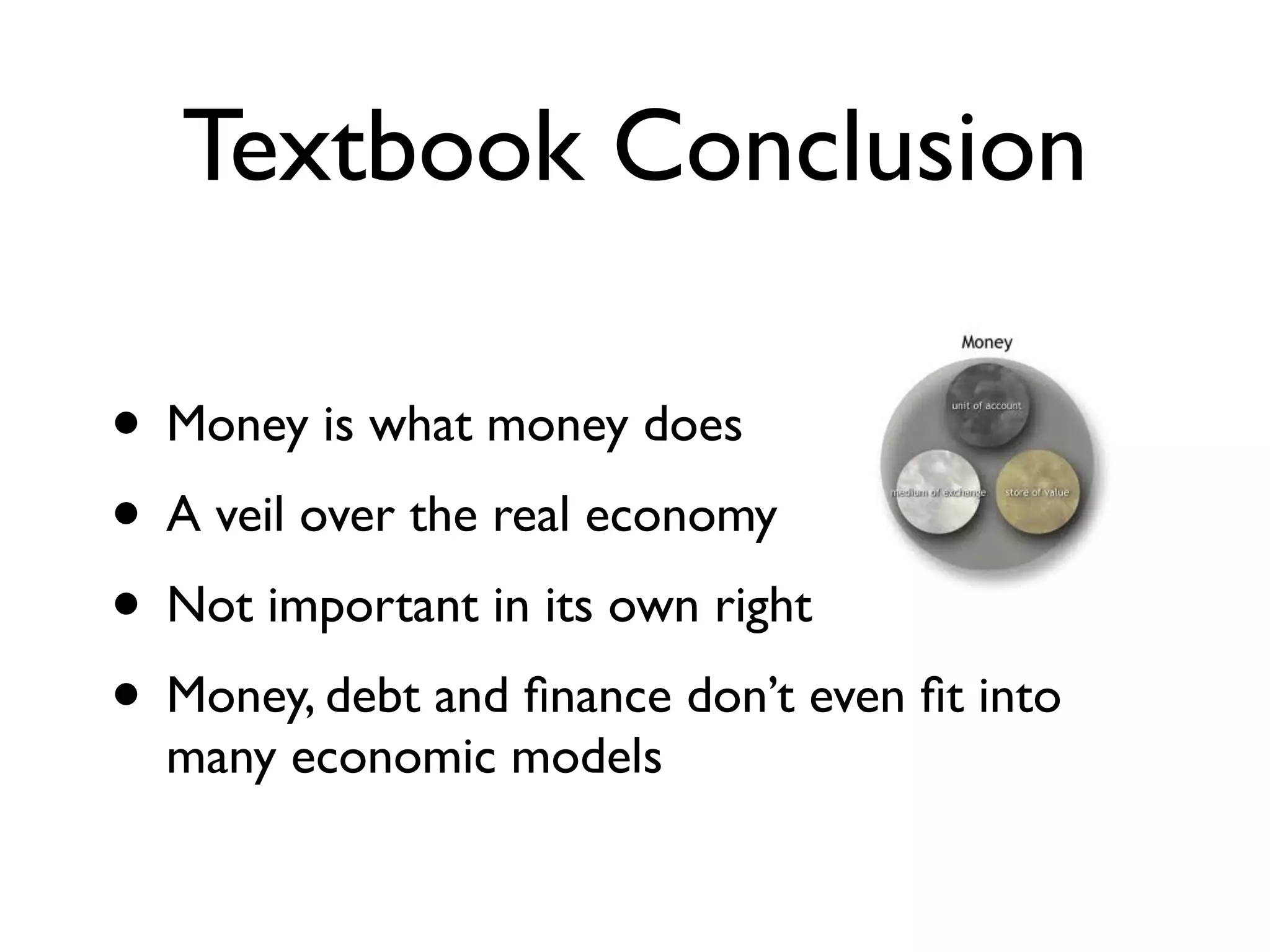
Textbook Conclusion

• Money is what money does
• A veil over the real economy
• Not important in its own right
• Money, debt and finance don’t even fit into
  many economic models
Credit and State Theories
                                      •   Chartalist/Cartalist

                                      •   Anthropologists, Sociologists,
                                          Numismatists

                                      •   Find origin of money in credit/debt
                                          relations

                                      •   Precedes markets and exchange

                                      •   Separate currencies not a
                                          coincidence

 Roman tally sticks, British Museum   •   State plays central role
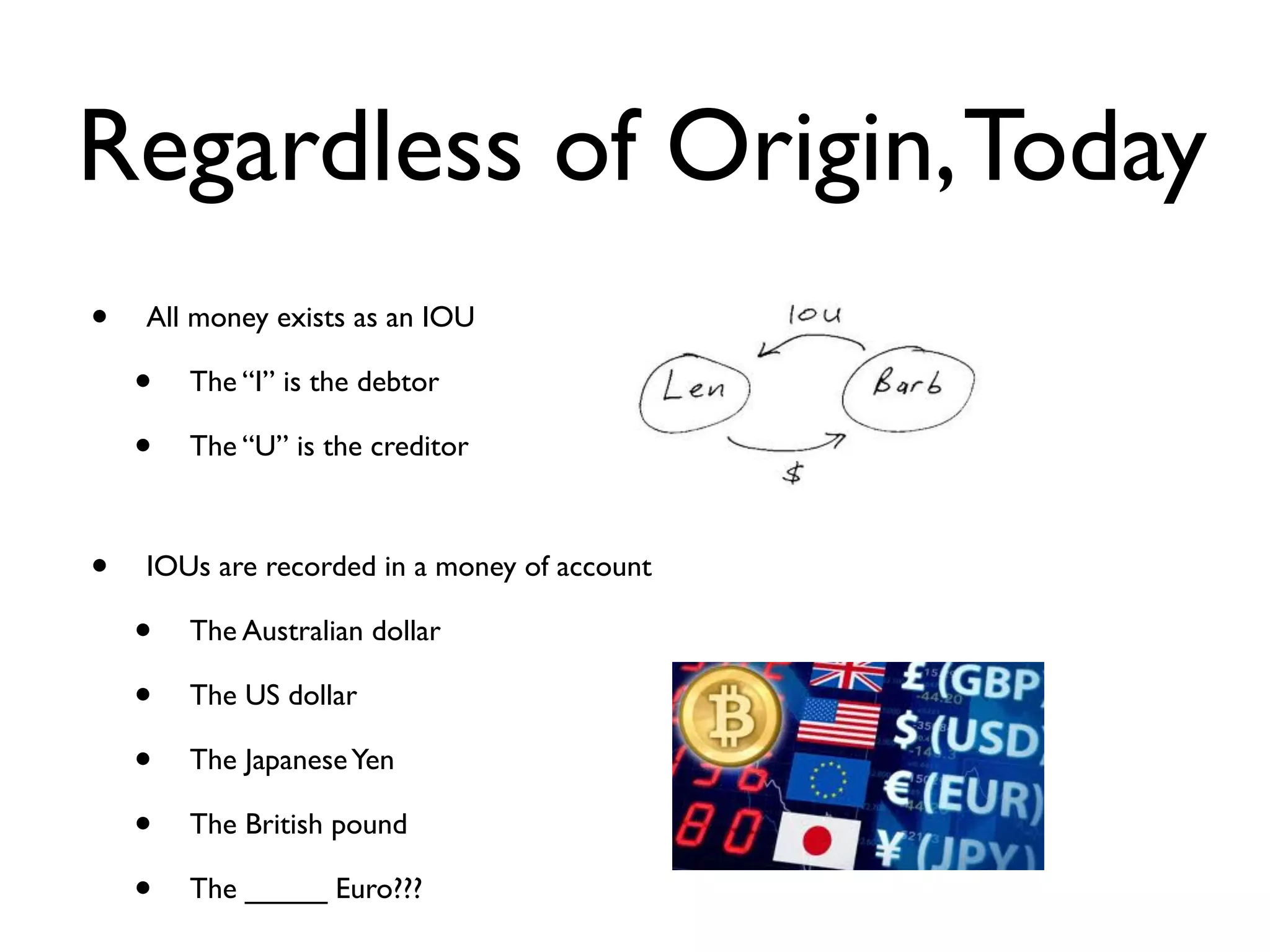
Regardless of Origin, Today
•   All money exists as an IOU

    •   The “I” is the debtor

    •   The “U” is the creditor
        

•   IOUs are recorded in a money of account

    •   The Australian dollar

    •   The US dollar

    •   The Japanese Yen

    •   The British pound

    •   The _____ Euro???
Money is Not an Object
• The money of account is abstract
  •   Like an “inch,” a “foot” or a “yard”


• It cannot be seen or felt
• It is represents a social debt relation
• In any modern nation, the money of
  account is chosen by the national
  government
The Power of the State

• Recognized as far back as Aristotle, through Adam
  Smith and into the modern era
• John Maynard Keynes told us:


  “The age of Chartalist or State Money was reached when the
  State claimed the right to declare what thing should answer as
  money to the current money-of-account...To-day all civilised
  money is, beyond the possibility of dispute, chartalist.”
A Sovereign Government

 • Defines the money of account
 • Imposes taxes, fees and other
   obligations
 • Decides what it will accept in payment
   to itself
 • Chooses how it will make its payments
Sovereign Money
• Most governments choose their own unique
  money of account and issue their own unique
  currency
   •   “One Nation, One Money”

• Most governments also require that taxes be
  paid in a currency that the state has the
  exclusive power to issue
• These currencies are “sovereign money”
Taxes Drive Money
•   As long as the state has the power to enforce its tax
    laws, the people will need the government’s money

•   The currency will have value, and people will sell
    things to the government in order to get the
    government’s money

•   Whatever the government accepts in payment to
    itself will become the “definite” money in the system

•   The final means of settlement
The Hierarchy of Money
•   The private sector                                   Most acceptable
    “leverages” the                         Government

    government’s money
                                           Banks

•   Layering of IOUs with
                                   Non-financial Business
    differing degrees of
    acceptability
                      Households


•   But private sector cannot
    create net financial assets 

•   Only one final means of
                                                         Least acceptable
    payment
The US Hierarchy
                         Issues the currency 

Taxes and spends               at the top 
                   $        of the pyramid
    in dollars


                                Non-convertible 
                                  fiat money


        United States Government
The Benefits of Sovereign Money

  •   The government can never “go broke” or “run
      out” of money

  •   It can afford anything for sale in the domestic unit
      of account

  •   It does not need to borrow its own currency

  •   It can set the policy interest rate at any level

  •   It has an expanded policy space
Pre-1973, Bretton Woods
                                   Had to limit 

                                   spending to 

Promised to convert     Gold
                                   protect gold 

 US$ into gold at a                  reserves
    fixed price          $


                                        Dollars were 

                                        subordinate 


             United States Government
Post-1973 Fixed Exchange Rates

                                                  Had to limit spending 

Did not issue the currency
        US$
                                                   to protect reserves
at the top of the pyramid
                              Ruble, Peso, etc.


                                                  Heavily dependent on 

Sacrificed control of 
                              trade surpluses
   interest rates


   Russia, Argentina, Southeast Asia and Mexico
What about the Euro?
•   EMU is an exceptional case

•   The currency is divorced from the nation
     •   “One Market, One Money”

•   The euro is effectively a foreign currency from the
    perspective of the individual nations

•   The EUR-17 are USERS of the currency

•   They lack the powers of a sovereign ISSUER
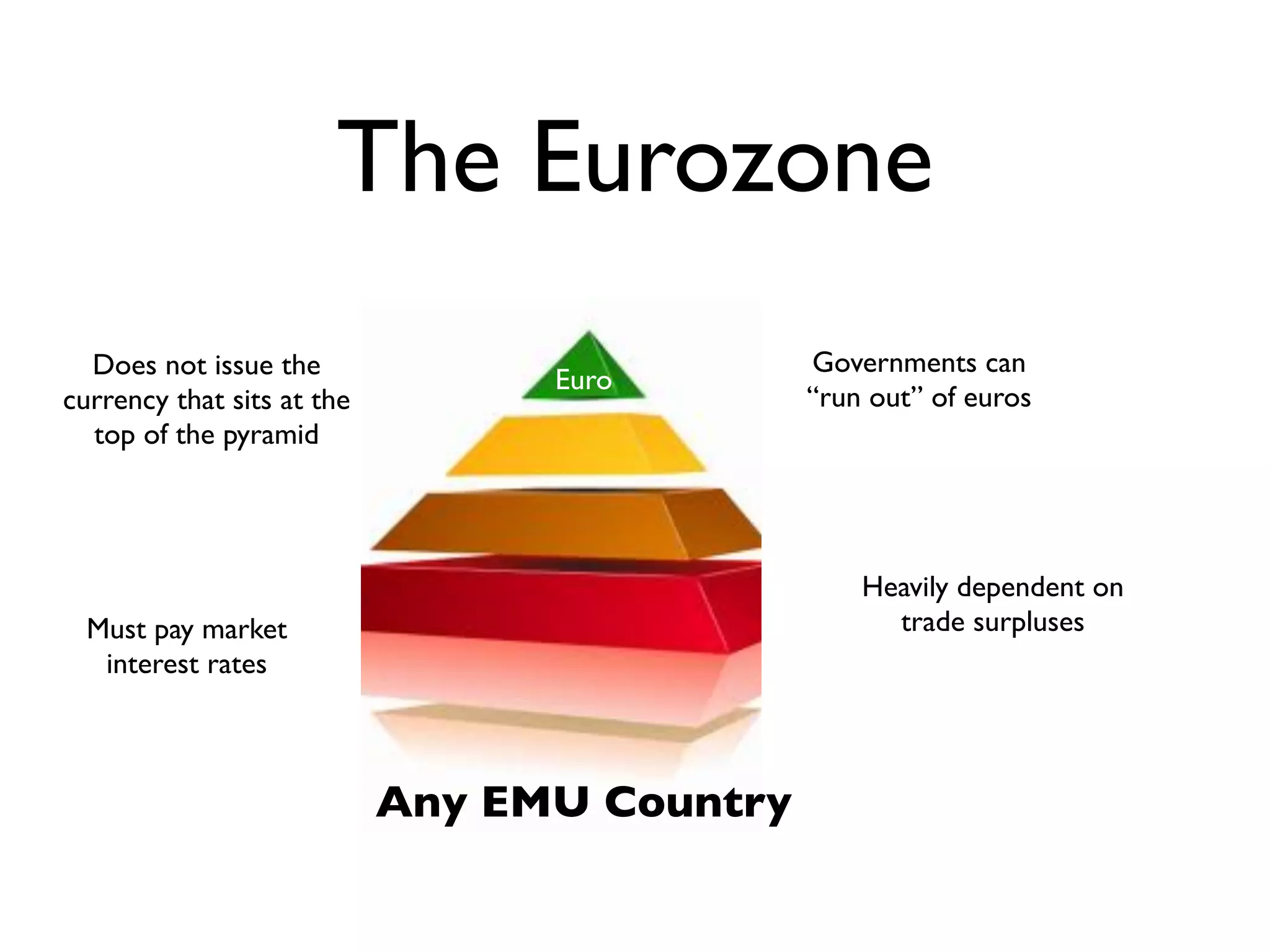
The Eurozone
  Does not issue the 
                          Governments can 

                                    Euro
currency that sits at the 
                     “run out” of euros
  top of the pyramid


                                                    Heavily dependent on 

  Must pay market
                                    trade surpluses
   interest rates


                              Any EMU Country
Money Matters
    • Governments should be in control of the
        currency that sits at the top of the pyramid
    • Otherwise, they lack the power to keep their
        domestic economies on track

 “By virtue of its power to create or destroy money by fiat and its power to take
money away from people by taxation, [the State] is in a position to keep the rate
of spending in the economy at the level required to [maintain full employment].”
                                        
                                                                    ~Abba P. Lerner
How does a Currency Issuer Spend?
 • By directing its bank (usually the central bank)
   to credit someone’s account
 • Frequently happens without even writing a
   check
 • In the “modern money” era, government
   spending is accomplished through electronic
   keystrokes (Bernanke)
 • The monopoly issuer of the currency can
   always meet its obligations (Greenspan)
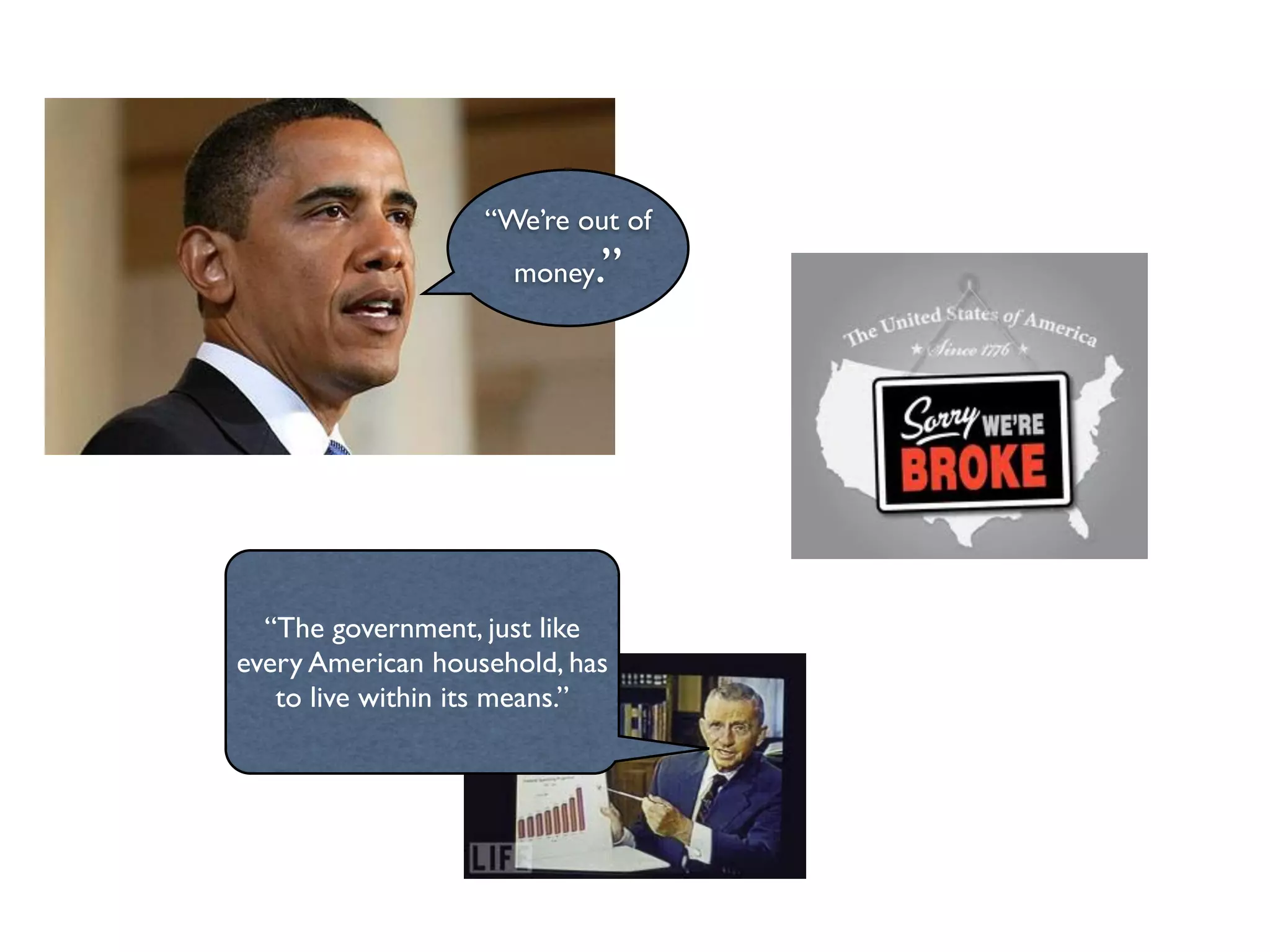
“We’re out of
                     money .”


  “The government, just like
every American household, has
   to live within its means.”
Is the Government Like a Household?

•   No - not anymore

•   We abandoned the gold standard

•   We ended Bretton Woods

•   We have “modern money” created
    by keystrokes on a computer

•   But we act as if we are still stuck in
    a fixed exchange rate world
Afraid of Becoming Greece
Why is the Eurozone a Train Wreck?

  • The EUR-17 gave up their keyboards!
      •   Became users of the currency, much like individual US States


  • Italy is like Indiana. Greece is like Georgia.
  • Transferred spending authority to the financial
    markets 
  • Forced to accept job-killing austerity or risk
    defaulting on euro-denominated debt
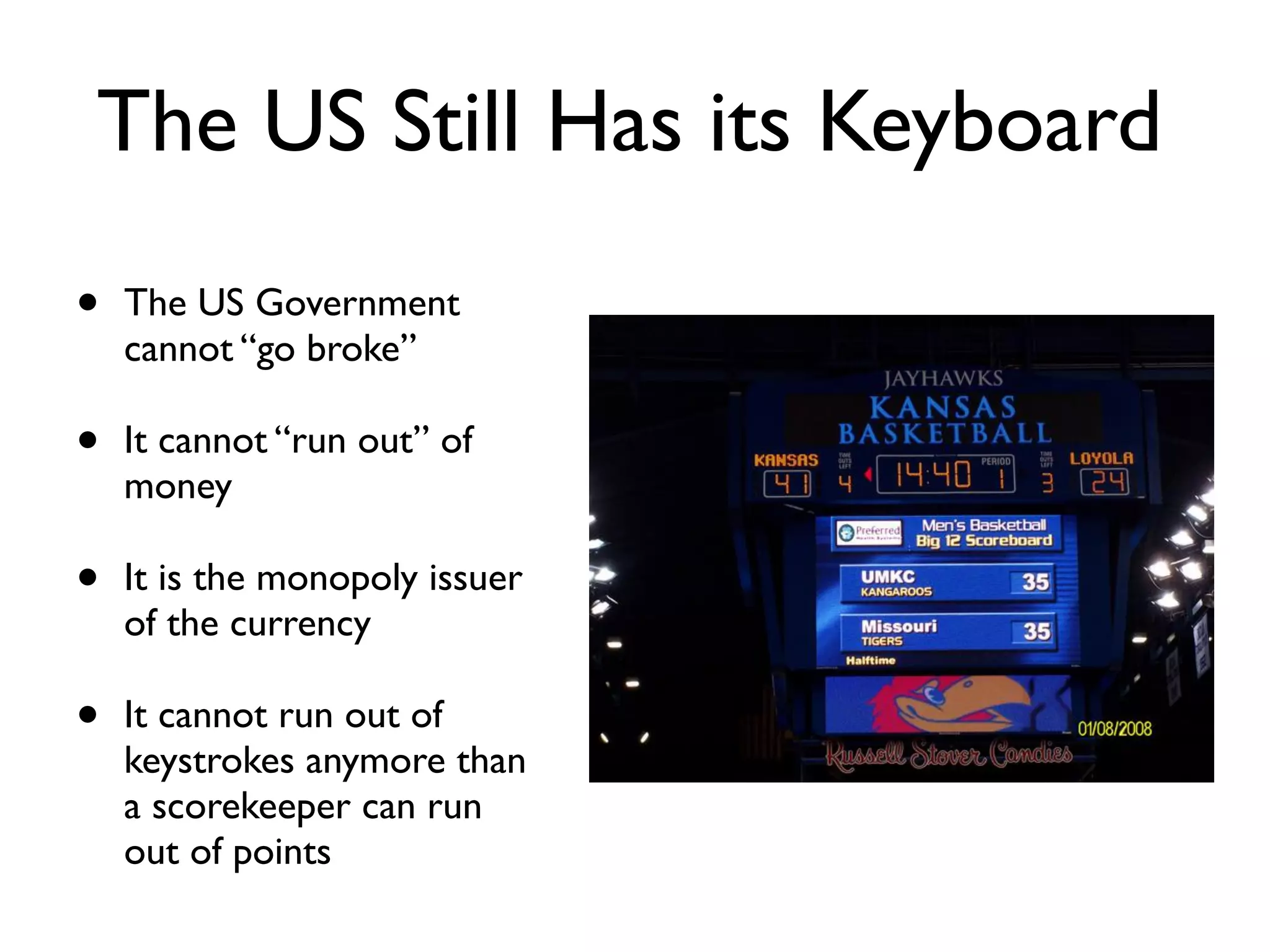
The US Still Has its Keyboard
•   The US Government
    cannot “go broke”

•   It cannot “run out” of
    money

•   It is the monopoly issuer
    of the currency

•   It cannot run out of
    keystrokes anymore than
    a scorekeeper can run
    out of points
Money is No Object
•   As Chairman Bernanke
    explained on 60 Minutes in
    2009:


    (PELLEY): Is that tax money
    that the Fed is spending?


    (BERNANKE): It’s not tax
    money. [W]e simply use the
    computer to mark up the
    size of the account.
The Issuer of the Currency Can’t Go Broke


 “[A] government cannot become insolvent with respect to
obligations in its own currency. A fiat money system, like the
 ones we have today, can produce such claims without limit”
                                                                          

                                                  ~Alan Greenspan, 1997
Then Why the Weak Recovery?

•   Policymakers (and most economists) don’t understand
    how the monetary system works

•   They think the government faces the same kinds of
    constraints that users of the currency 

    (i.e. households, businesses and state/local
    governments) face

•   They warn that our fiscal path is unsustainable

•   And they ask for “shared sacrifice”
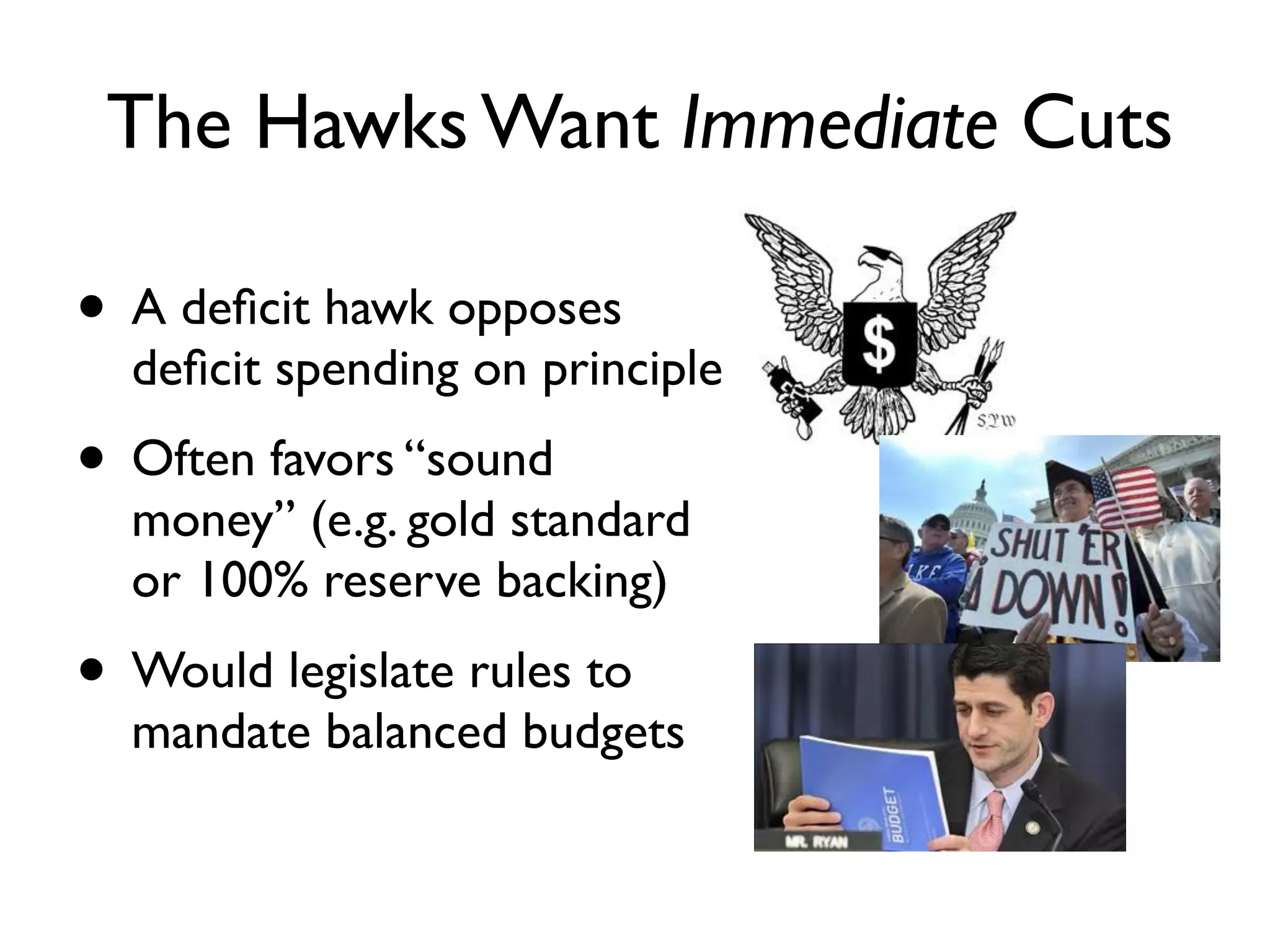
The Hawks Want Immediate Cuts

• A deficit hawk opposes
  deficit spending on principle
• Often favors “sound
  money” (e.g. gold standard
  or 100% reserve backing)
• Would legislate rules to
  mandate balanced budgets

The Doves Want Eventual Cuts
•   A deficit dove supports
    limited deficit spending in
    tough economic times

•   Want the budget balanced
    over the business cycle

•   Support rules to limit the
    size of the deficit (e.g.
    Europe’s Fiscal Pact)

•   Prefer to wait until after the
    economy begins to recover
    before imposing austerity
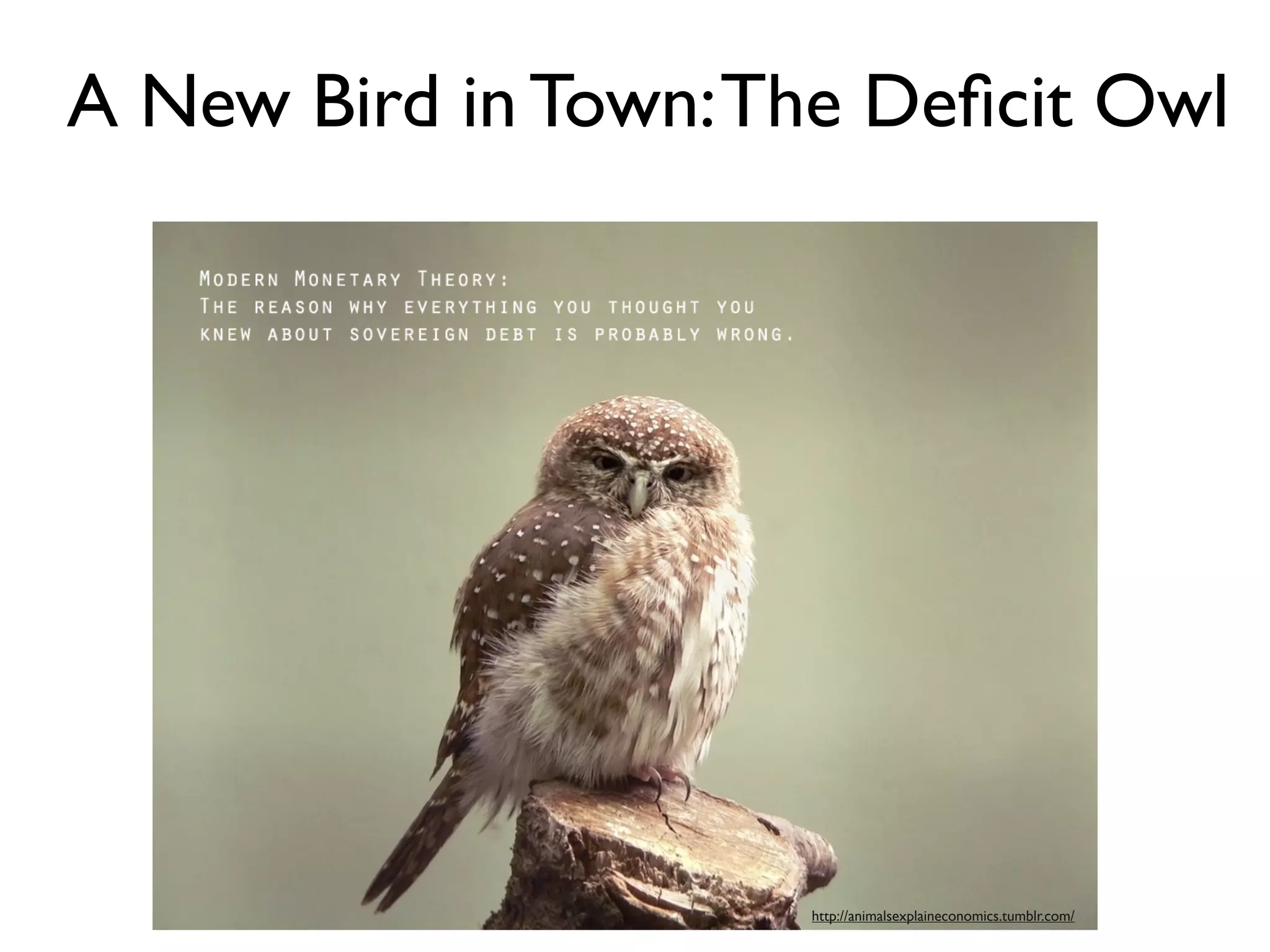
A New Bird in Town: The Deficit Owl


                     http://animalsexplaineconomics.tumblr.com/
Owls   Doves   Hawks
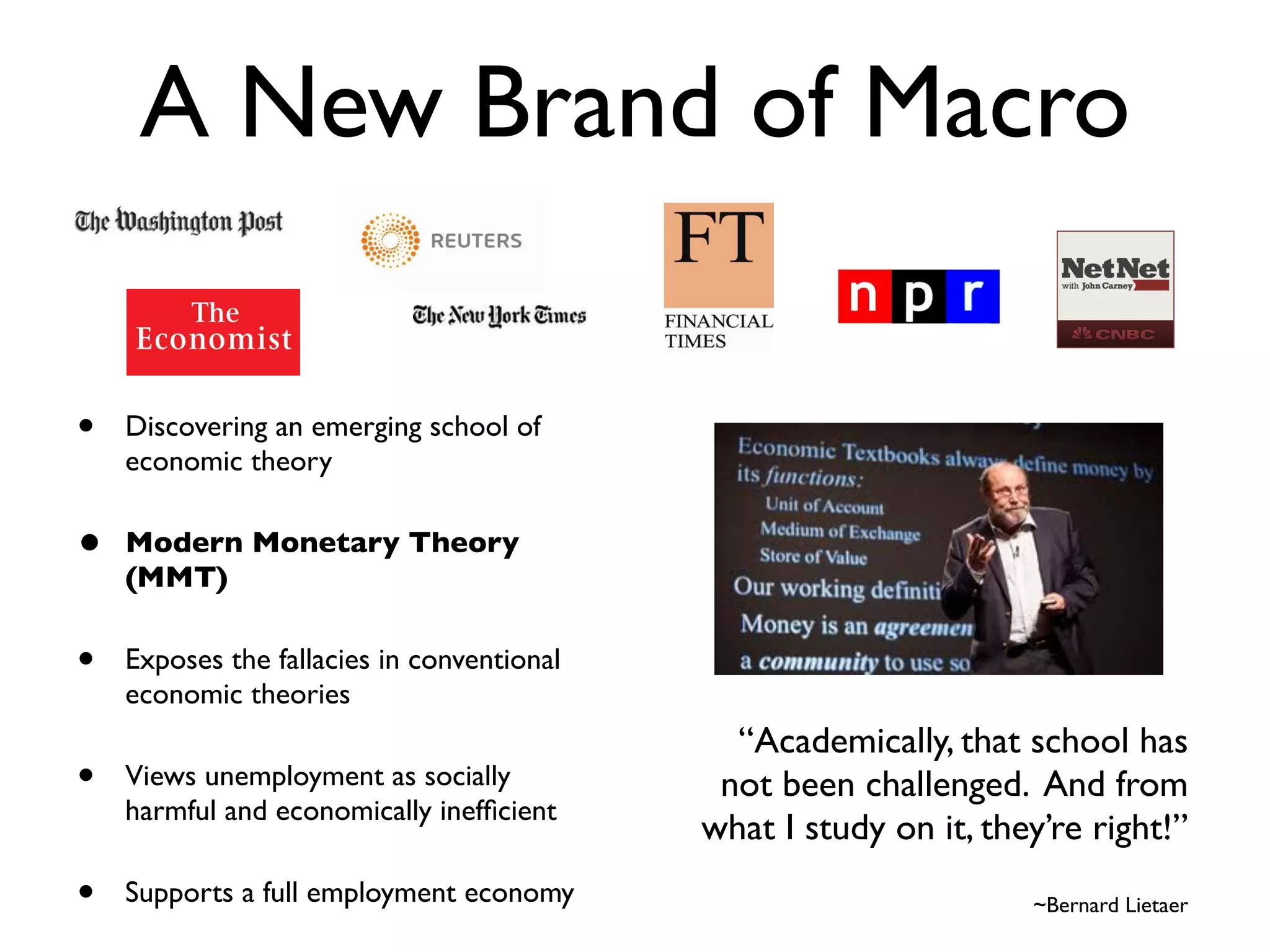
A New Brand of Macro

•   Discovering an emerging school of
    economic theory

•   Modern Monetary Theory
    (MMT)

•   Exposes the fallacies in conventional
    economic theories
                                              “Academically, that school has 

•   Views unemployment as socially           not been challenged. And from 

    harmful and economically inefficient
                                            what I study on it, they’re right!”


•   Supports a full employment economy                               ~Bernard Lietaer
The MMT Deficit Owl

•   Assigns no arbitrary limit
    to the size or duration of
    the deficit

•   Relates government’s
    balance sheet to the rest of
    the economy

•   Uses sectoral balance sheet
    approach
A Simple and Fundamental
     Accounting Truth
                   G>T


                  $$$
    Government              Non-Government

                  $$$
                   T>G


Government Surplus = Non-government Deficit
Government Deficit = Non-government Surplus
What They Show
•   In any given period, the sectoral balances show whether
    a particular part of the economy is:

    •   Spending more than its income
          •   Running a deficit

    •   Spending less than its income
       Surplus


          •   Running a surplus
                              Deficit


    •   Spending just equal to its income
          •   Balancing its budget
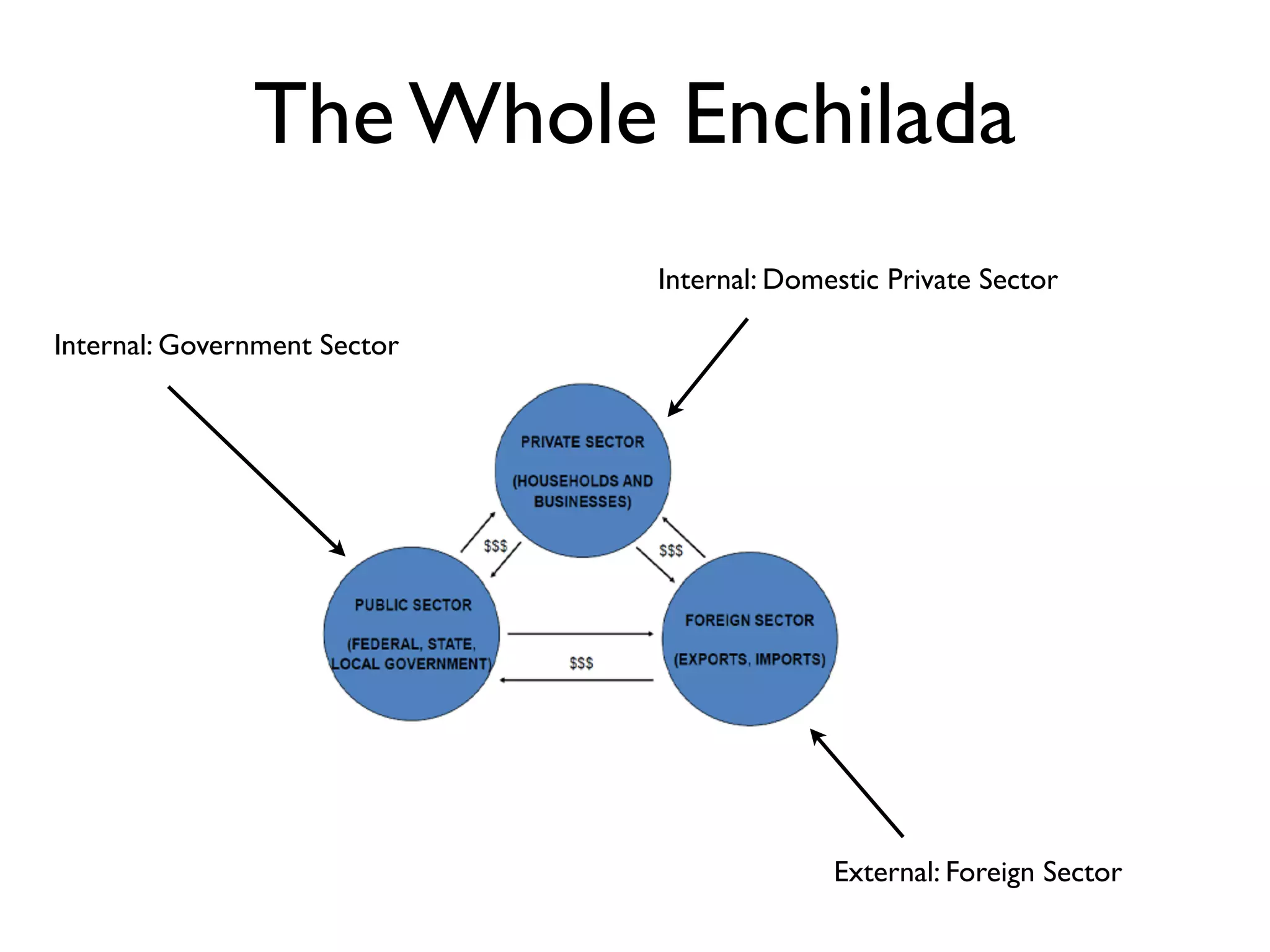
The Whole Enchilada
                              Internal: Domestic Private Sector

Internal: Government Sector


                                            External: Foreign Sector
One Rule
•   The laws of double-entry
    bookkeeping apply

•   All sectors cannot take in
    more than they spend 

    (i.e. be in surplus)

•   All sectors cannot spend
    more than they take in 

    (i.e. be in deficit) 

•   At least one sector will be in
    deficit
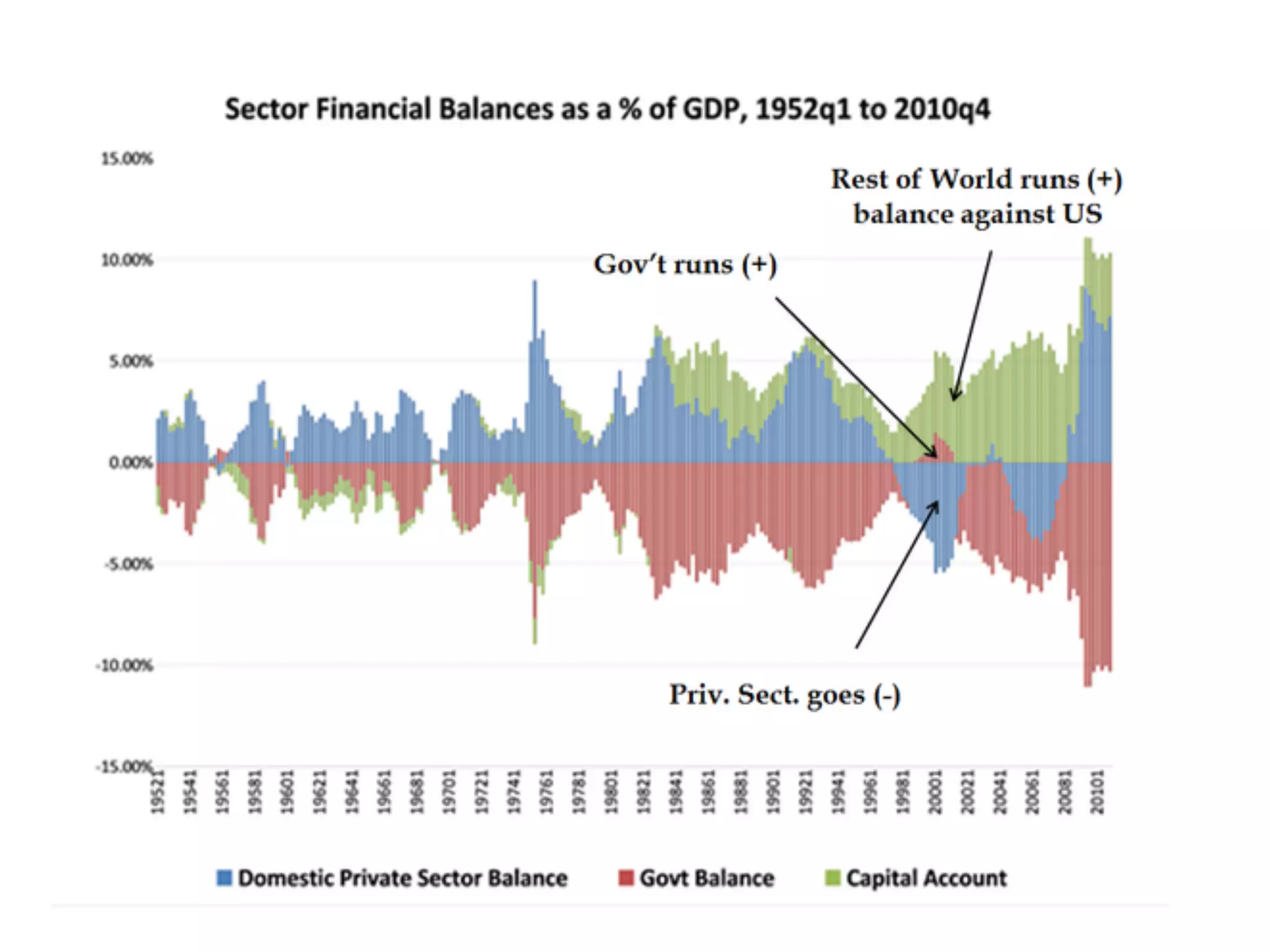
0.00%"
                                                             2.00%"
                                                                      4.00%"
                                                                               6.00%"
                                                                                        8.00%"


&8.00%"
          &6.00%"
                    &4.00%"
                              &2.00%"
                                                                                                 10.00%"
                                        19521"
                                        19524"
                                        19533"
                                        19542"
                                        19551"
                                        19554"
                                        19563"
                                        19572"
                                        19581"
                                        19584"
                                        19593"
                                        19602"
                                        19611"
                                        19614"
                                        19623"
                                        19632"
                                        19641"
                                        19644"
                                        19653"
                                        19662"
                                        19671"
                                        19674"
                                        19683"
                                        19692"
                                        19701"
                                        19704"
                                        19713"
                                        19722"
                                        19731"
                                        19734"
                                        19743"
                                        19752"
                                        19761"
                                        19764"
                                        19773"
                                        19782"
                                        19791"
                                        19794"
                                        19803"
                                        19812"
                                        19821"
                                        19824"
                                        19833"
                                        19842"
                                        19851"
                                        19854"
                                        19863"
                                        19872"
                                        19881"
                                        19884"
                                        19893"
                                        19902"
                                        19911"
                                        19914"
                                        19923"
                                        19932"
                                        19941"
                                        19944"
                                        19953"
                                        19962"
                                        19971"
                                        19974"
                                        19983"
                                        19992"
                                        20001"
                                        20004"
                                        20013"
                                        20022"
                                        20031"
                                        20034"
                                        20043"
                                        20052"
                                        20061"
                                        20064"
                                        20073"
                                        20082"
                                        20091"
                                        20094"
                                        20103"
                                                                                                           Beware Swings in Private Sector Balance


                                        20112"
0"
                                                                                                 1"


                                                      0.5"
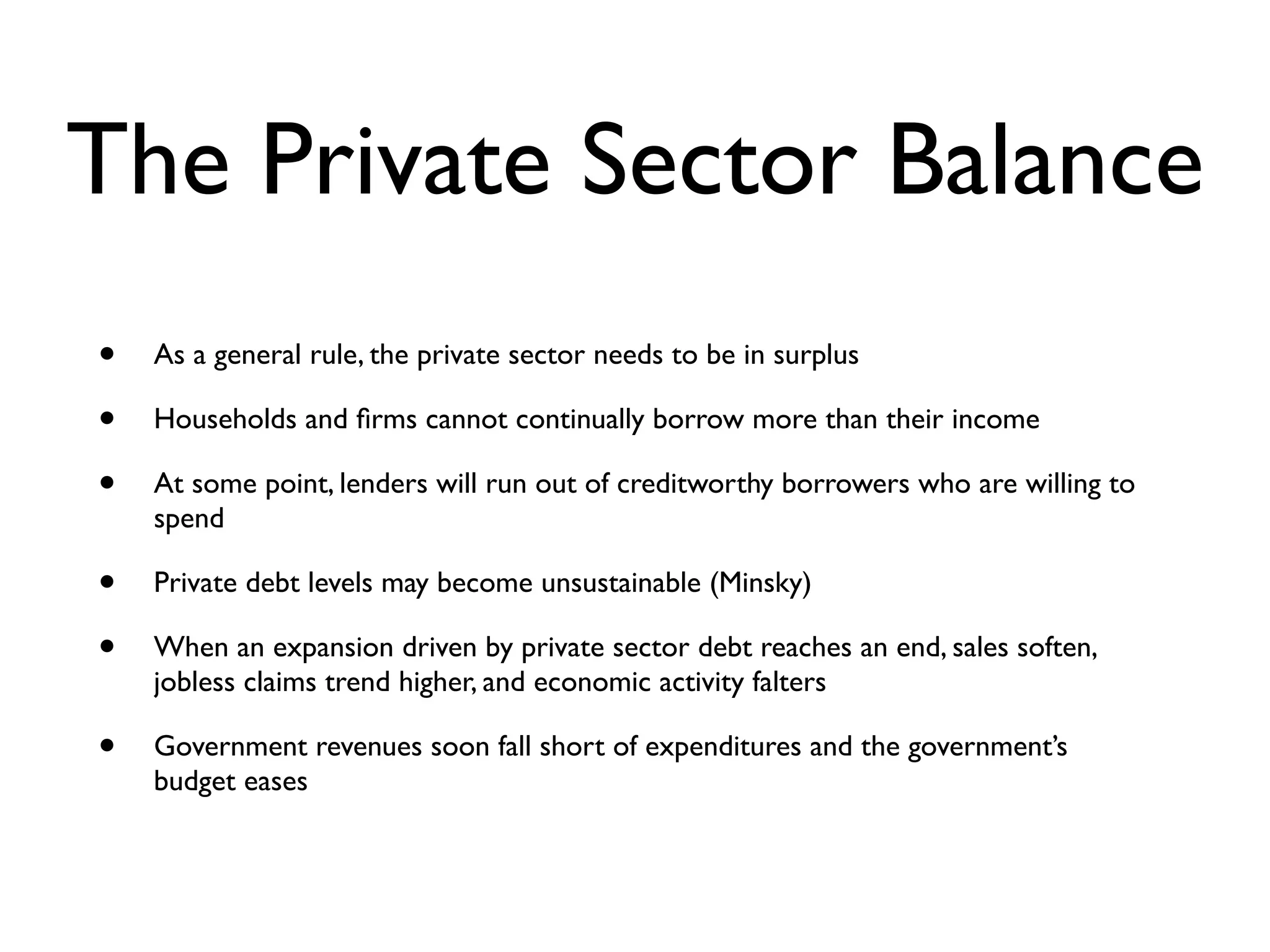
The Private Sector Balance
•   As a general rule, the private sector needs to be in surplus

•   Households and firms cannot continually borrow more than their income

•   At some point, lenders will run out of creditworthy borrowers who are willing to
    spend

•   Private debt levels may become unsustainable (Minsky)

•   When an expansion driven by private sector debt reaches an end, sales soften,
    jobless claims trend higher, and economic activity falters

•   Government revenues soon fall short of expenditures and the government’s
    budget eases
Achieving a Private Sector
                 Surplus
•   There are only three ways to put the private sector in
    surplus:
    •   1.) Run a government deficit and a current account surplus

    •   2.) Run a government deficit > current account deficit

    •   3.) Run a government surplus < current account surplus

•   Only countries with trade surpluses can avoid running
    government deficits

•   But not everyone can be a net exporter!
    •   As long as our current account is in deficit, the US government needs to frequently
        be in deficit
But We’re Terrified of Deficits
• What if people lose
  trust in the dollar?
• What if China
  refuses to buy our
  bonds?
• What if interest
  rates skyrocket?
• What if we set off
  hyperinflation?
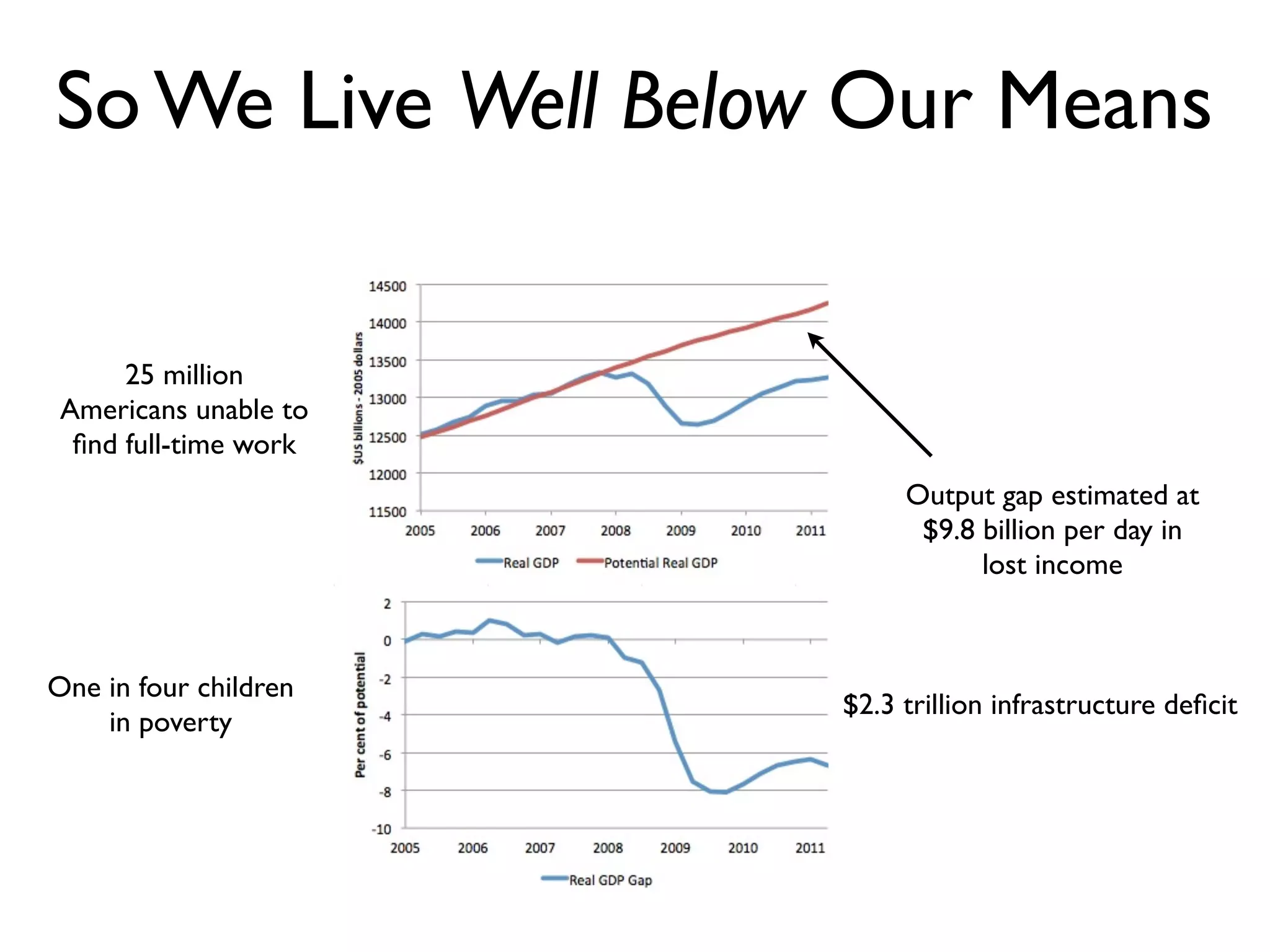
So We Live Well Below Our Means


      25 million

 Americans unable to
  find full-time work
                              Output gap estimated at 

                               $9.8 billion per day in 

                                    lost income


One in four children 

                         $2.3 trillion infrastructure deficit
    in poverty
There Is An Alternative
to Shared Sacrifice and
 Economic Stagnation


     Twitter: @deficitowl

Money is No Object

  • 1.
    Money is NoObject: Accounting for Deficits, Taxes and Trust in the 21st Century Stephanie Kelton, Associate Professor, University of Missouri-Kansas City Financial Planning Association Annual Retreat Conference, May 5-8, 2012
  • 2.
    What is Money? “Moneyis the most powerful and pervasive secular force on the planet. Yet for most, it’s a source of mysticism and mystery.” - Dick Wagner, JD, CFP®
  • 3.
    Barter Theory • Dominant within Economics • Metallist/Monetarist • Spontaneously Originates in Private Sector • Replaces Clumsy Barter • Eliminates “double- coincidence of wants” “Truck, Barter and Exchange” ~Adam Smith • Reduces Transactions Costs
  • 4.
    The Evolution ofMoney (textbook story) • Primitive monies • stones, beads, shells, feathers, fish, cattle, etc. • Precious metals • Paper with metal backing • Fiat money -- Trust?
  • 5.
    Textbook Conclusion • Moneyis what money does • A veil over the real economy • Not important in its own right • Money, debt and finance don’t even fit into many economic models
  • 6.
    Credit and StateTheories • Chartalist/Cartalist • Anthropologists, Sociologists, Numismatists • Find origin of money in credit/debt relations • Precedes markets and exchange • Separate currencies not a coincidence Roman tally sticks, British Museum • State plays central role
  • 7.
    Regardless of Origin,Today • All money exists as an IOU • The “I” is the debtor • The “U” is the creditor • IOUs are recorded in a money of account • The Australian dollar • The US dollar • The Japanese Yen • The British pound • The _____ Euro???
  • 8.
    Money is Notan Object • The money of account is abstract • Like an “inch,” a “foot” or a “yard” • It cannot be seen or felt • It is represents a social debt relation • In any modern nation, the money of account is chosen by the national government
  • 9.
    The Power ofthe State • Recognized as far back as Aristotle, through Adam Smith and into the modern era • John Maynard Keynes told us:
 
 “The age of Chartalist or State Money was reached when the State claimed the right to declare what thing should answer as money to the current money-of-account...To-day all civilised money is, beyond the possibility of dispute, chartalist.”
  • 10.
    A Sovereign Government • Defines the money of account • Imposes taxes, fees and other obligations • Decides what it will accept in payment to itself • Chooses how it will make its payments
  • 11.
    Sovereign Money • Mostgovernments choose their own unique money of account and issue their own unique currency • “One Nation, One Money” • Most governments also require that taxes be paid in a currency that the state has the exclusive power to issue • These currencies are “sovereign money”
  • 12.
    Taxes Drive Money • As long as the state has the power to enforce its tax laws, the people will need the government’s money • The currency will have value, and people will sell things to the government in order to get the government’s money • Whatever the government accepts in payment to itself will become the “definite” money in the system • The final means of settlement
  • 13.
    The Hierarchy ofMoney • The private sector Most acceptable “leverages” the Government government’s money Banks • Layering of IOUs with Non-financial Business differing degrees of acceptability Households • But private sector cannot create net financial assets • Only one final means of Least acceptable payment
  • 14.
    The US Hierarchy Issues the currency 
 Taxes and spends at the top $ of the pyramid in dollars Non-convertible fiat money United States Government
  • 15.
    The Benefits ofSovereign Money • The government can never “go broke” or “run out” of money • It can afford anything for sale in the domestic unit of account • It does not need to borrow its own currency • It can set the policy interest rate at any level • It has an expanded policy space
  • 16.
    Pre-1973, Bretton Woods Had to limit 
 spending to 
 Promised to convert Gold protect gold 
 US$ into gold at a reserves fixed price $ Dollars were 
 subordinate 
 United States Government
  • 17.
    Post-1973 Fixed ExchangeRates Had to limit spending 
 Did not issue the currency
 US$ to protect reserves at the top of the pyramid Ruble, Peso, etc. Heavily dependent on 
 Sacrificed control of 
 trade surpluses interest rates Russia, Argentina, Southeast Asia and Mexico
  • 18.
    What about theEuro? • EMU is an exceptional case • The currency is divorced from the nation • “One Market, One Money” • The euro is effectively a foreign currency from the perspective of the individual nations • The EUR-17 are USERS of the currency • They lack the powers of a sovereign ISSUER
  • 19.
    The Eurozone Does not issue the 
 Governments can 
 Euro currency that sits at the 
 “run out” of euros top of the pyramid Heavily dependent on 
 Must pay market
 trade surpluses interest rates Any EMU Country
  • 20.
    Money Matters • Governments should be in control of the currency that sits at the top of the pyramid • Otherwise, they lack the power to keep their domestic economies on track “By virtue of its power to create or destroy money by fiat and its power to take money away from people by taxation, [the State] is in a position to keep the rate of spending in the economy at the level required to [maintain full employment].” ~Abba P. Lerner
  • 21.
    How does aCurrency Issuer Spend? • By directing its bank (usually the central bank) to credit someone’s account • Frequently happens without even writing a check • In the “modern money” era, government spending is accomplished through electronic keystrokes (Bernanke) • The monopoly issuer of the currency can always meet its obligations (Greenspan)
  • 22.
    “We’re out of money .” “The government, just like every American household, has to live within its means.”
  • 23.
    Is the GovernmentLike a Household? • No - not anymore • We abandoned the gold standard • We ended Bretton Woods • We have “modern money” created by keystrokes on a computer • But we act as if we are still stuck in a fixed exchange rate world
  • 24.
  • 25.
    Why is theEurozone a Train Wreck? • The EUR-17 gave up their keyboards! • Became users of the currency, much like individual US States • Italy is like Indiana. Greece is like Georgia. • Transferred spending authority to the financial markets • Forced to accept job-killing austerity or risk defaulting on euro-denominated debt
  • 26.
    The US StillHas its Keyboard • The US Government cannot “go broke” • It cannot “run out” of money • It is the monopoly issuer of the currency • It cannot run out of keystrokes anymore than a scorekeeper can run out of points
  • 27.
    Money is NoObject • As Chairman Bernanke explained on 60 Minutes in 2009:
 
 (PELLEY): Is that tax money that the Fed is spending?
 
 (BERNANKE): It’s not tax money. [W]e simply use the computer to mark up the size of the account.
  • 28.
    The Issuer ofthe Currency Can’t Go Broke “[A] government cannot become insolvent with respect to obligations in its own currency. A fiat money system, like the ones we have today, can produce such claims without limit” 
 ~Alan Greenspan, 1997
  • 29.
    Then Why theWeak Recovery? • Policymakers (and most economists) don’t understand how the monetary system works • They think the government faces the same kinds of constraints that users of the currency 
 (i.e. households, businesses and state/local governments) face • They warn that our fiscal path is unsustainable • And they ask for “shared sacrifice”
  • 30.
    The Hawks WantImmediate Cuts • A deficit hawk opposes deficit spending on principle • Often favors “sound money” (e.g. gold standard or 100% reserve backing) • Would legislate rules to mandate balanced budgets

  • 31.
    The Doves WantEventual Cuts • A deficit dove supports limited deficit spending in tough economic times • Want the budget balanced over the business cycle • Support rules to limit the size of the deficit (e.g. Europe’s Fiscal Pact) • Prefer to wait until after the economy begins to recover before imposing austerity
  • 32.
    A New Birdin Town: The Deficit Owl http://animalsexplaineconomics.tumblr.com/
  • 33.
    Owls Doves Hawks
  • 34.
    A New Brandof Macro • Discovering an emerging school of economic theory • Modern Monetary Theory (MMT) • Exposes the fallacies in conventional economic theories “Academically, that school has 
 • Views unemployment as socially not been challenged. And from 
 harmful and economically inefficient what I study on it, they’re right!”
 
 • Supports a full employment economy ~Bernard Lietaer
  • 35.
    The MMT DeficitOwl • Assigns no arbitrary limit to the size or duration of the deficit • Relates government’s balance sheet to the rest of the economy • Uses sectoral balance sheet approach
  • 36.
    A Simple andFundamental Accounting Truth G>T $$$ Government Non-Government $$$ T>G Government Surplus = Non-government Deficit Government Deficit = Non-government Surplus
  • 37.
    What They Show • In any given period, the sectoral balances show whether a particular part of the economy is: • Spending more than its income • Running a deficit • Spending less than its income Surplus • Running a surplus Deficit • Spending just equal to its income • Balancing its budget
  • 38.
    The Whole Enchilada Internal: Domestic Private Sector Internal: Government Sector External: Foreign Sector
  • 39.
    One Rule • The laws of double-entry bookkeeping apply • All sectors cannot take in more than they spend 
 (i.e. be in surplus) • All sectors cannot spend more than they take in 
 (i.e. be in deficit) • At least one sector will be in deficit
  • 41.
    0.00%" 2.00%" 4.00%" 6.00%" 8.00%" &8.00%" &6.00%" &4.00%" &2.00%" 10.00%" 19521" 19524" 19533" 19542" 19551" 19554" 19563" 19572" 19581" 19584" 19593" 19602" 19611" 19614" 19623" 19632" 19641" 19644" 19653" 19662" 19671" 19674" 19683" 19692" 19701" 19704" 19713" 19722" 19731" 19734" 19743" 19752" 19761" 19764" 19773" 19782" 19791" 19794" 19803" 19812" 19821" 19824" 19833" 19842" 19851" 19854" 19863" 19872" 19881" 19884" 19893" 19902" 19911" 19914" 19923" 19932" 19941" 19944" 19953" 19962" 19971" 19974" 19983" 19992" 20001" 20004" 20013" 20022" 20031" 20034" 20043" 20052" 20061" 20064" 20073" 20082" 20091" 20094" 20103" Beware Swings in Private Sector Balance 20112" 0" 1" 0.5"
  • 42.
    The Private SectorBalance • As a general rule, the private sector needs to be in surplus • Households and firms cannot continually borrow more than their income • At some point, lenders will run out of creditworthy borrowers who are willing to spend • Private debt levels may become unsustainable (Minsky) • When an expansion driven by private sector debt reaches an end, sales soften, jobless claims trend higher, and economic activity falters • Government revenues soon fall short of expenditures and the government’s budget eases
  • 43.
    Achieving a PrivateSector Surplus • There are only three ways to put the private sector in surplus: • 1.) Run a government deficit and a current account surplus • 2.) Run a government deficit > current account deficit • 3.) Run a government surplus < current account surplus • Only countries with trade surpluses can avoid running government deficits • But not everyone can be a net exporter! • As long as our current account is in deficit, the US government needs to frequently be in deficit
  • 44.
    But We’re Terrifiedof Deficits • What if people lose trust in the dollar? • What if China refuses to buy our bonds? • What if interest rates skyrocket? • What if we set off hyperinflation?
  • 45.
    So We LiveWell Below Our Means 25 million
 Americans unable to find full-time work Output gap estimated at 
 $9.8 billion per day in 
 lost income One in four children 
 $2.3 trillion infrastructure deficit in poverty
  • 46.
    There Is AnAlternative to Shared Sacrifice and Economic Stagnation Twitter: @deficitowl